

Operation EPIC FURY and Four Lessons for the Marine Corps’ SIF and EABO Concepts
By: Maj Jeremy CarterPosted on November 15,2026
Lesson 3: Ability Organization
I
n October 2025, Gen Smith endorsed the 2025 Force Design Update, emphasizing the added capabilities the Marine Corps has achieved over the last six years. Specifically, Gen Smith notes the Marine Corps’ advances in kinetic fires, finding and fixing the enemy, expeditionary manufacturing, ground-based air defense, the Light-Marine Air Defense Integrated System, installation and organic counter-small unmanned aerial systems.1 While the Marine Corps has made great strides in a short period on a reduced budget, Gen Smith emphasizes that “Force Design is not an endstate but a journey.”2
When it comes to Operation Epic Fury (OEF), we see that these capabilities did not cause noteworthy acknowledgement from our highest military leadership (Secretary of War, Pete Hegseth; Chairman of the Joint Chiefs of Staff, Gen Dan Caine; Commander of Central Command, ADM Brad Cooper) over 38 days of major combat operations (MCO). The first two lessons that we must learn from OEF are that the Marine Corps must preposition its forces and that these forces must be lethal.3 The third lesson is that the Marine Corps must create abilities, not mere capabilities. This article will discuss the framework of being an ability organization, rather than a capability organization.
Why Capabilities Do Not Equal Abilities
Capabilities do not equal abilities. For example, on 23 October 1983, a suicide driver detonated a vehicle-borne explosive in Beirut, Lebanon, killing 231 U.S. service members—220 of whom were Marines.4 The Marines on watch were instructed to be in Condition 4 for their individual rifles (i.e., no magazine inserted, no round in the chamber, bolt forward, weapon on safe).5 Despite these Marines being capable of engaging the enemy with their issued rifles, they were not able to engage the threat. As stated, “increasing their capability, whether through enhanced equipping, training, or education, would not change the death toll and destruction on 23 October 1983, as they lacked the ability to be lethal due to the lack of permission to be in Condition 1 with their rifles.”6
Another decisive example of creating capabilities rather than abilities is the Marine Corps’ lack of Joint Force (JF) integration in the 1980s. Specifically, during the evolution of the U.S. military in the 1980s, Army Rangers created lasting, meaningful relationships, where the Marine Corps deliberately did not. In the 1980s, the Army created its elite counter-terrorism unit.7 In that same time period, Joint Special Operations Command started being formed.8 The Army Rangers created professional relationships with both the elite counter-terrorism unit and Joint Special Operations Command.9 The early relationships facilitated the Army Rangers’ integration into Operation Eagle Claw (1980) and Operation Gothic Serpent (1993). “To this day, these professional relationships enable the US Army Rangers’ missions to be at a higher tier (i.e., of greater strategic and national relevance, higher priority targets) than the Marine Corps’ infantry, Marine Corps’ Force Reconnaissance, and Marine Corps Special Operations Forces units.”10
Regardless of how much organic Marine Corps capability is created with our modernization efforts, without creating abilities, we are limiting our role to the JF, military campaign, and overall strategy.11 Thus, we must strive for abilities, not capabilities, as we transform our formation. This concept is most notable in enacting our Stand-in Forces (SIF) and Expeditionary Advanced Base Operations (EABO) concepts.12 The next sections will demonstrate this concept in greater detail.
What is a Capability
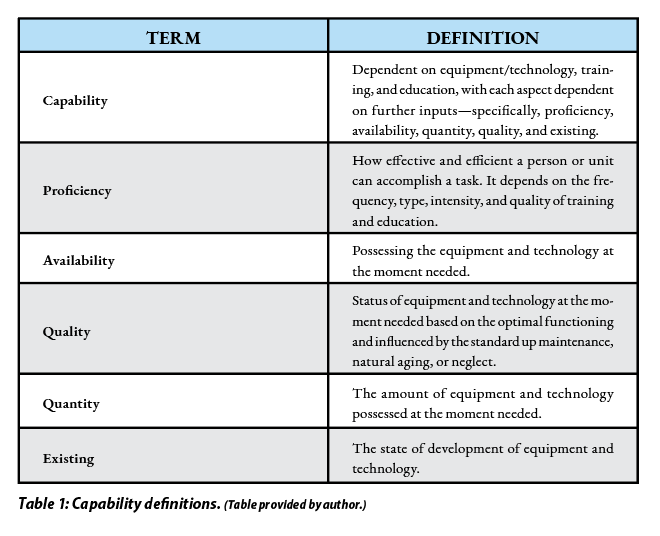
Capabilities can be simply explained as the interplay of equipment and technology combined with training and education.13 Capabilities are further influenced by the inputs of proficiency, availability, quantity, quality, and existence.14 To be concise, Table 1 portrays the definitions related to capability based on previous works, while Table 2 has been modified from previous works, with it relating to force protection capabilities in OEF.15
What is an Ability
The first step to creating an ability is to create the capability. Thus, the Marine Corps should continue to advance its capabilities with the intent to create abilities. As stated, “rather than striving to be a capability organization, we must drive to become an ability organization. The concept of becoming an ability organization is critical as the USMC transitions to execute concepts such as SIF and EABO.”16
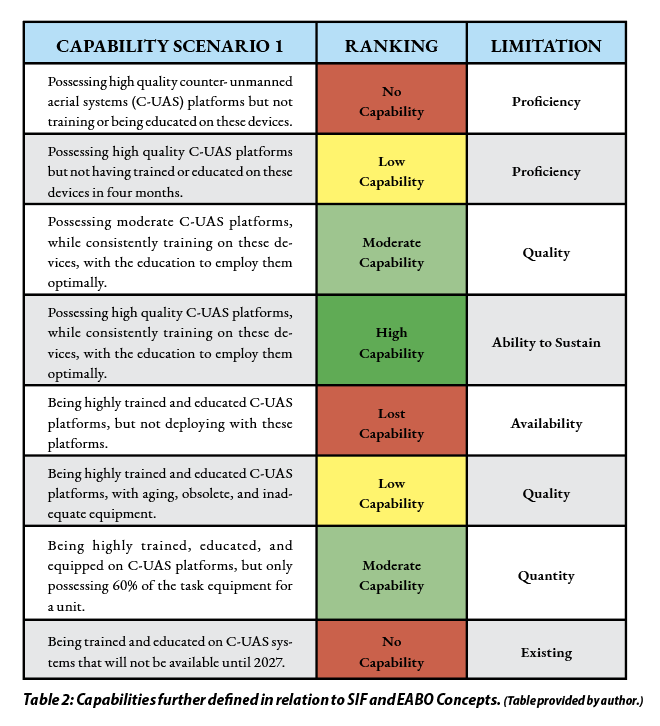
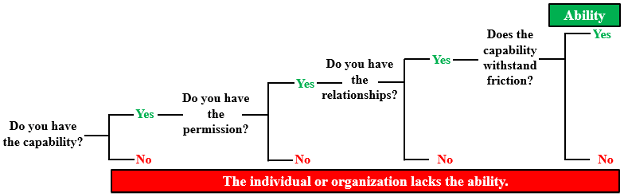
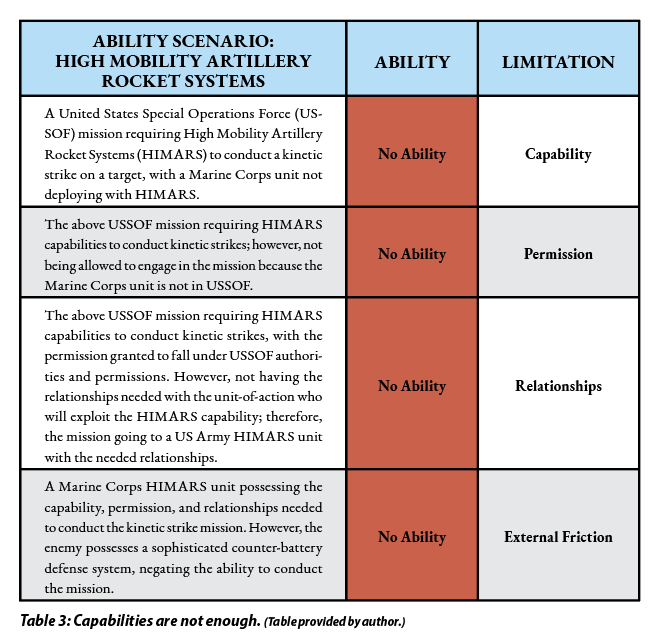
“Whereas capabilities should be viewed as dependent, abilities should be viewed as relative and can be defined as the relationship of possessing a capability combined with the permission to achieve stated objectives, with the needed relationships, while combining friction (i.e., physical, mental, external, and self-induced).”17 Figure 1 depicts a flow chart to determine if one has an ability. Furthermore, Table 3 (modified from previous works) demonstrates that capabilities are not enough, which is why we must drive to create abilities.18
Provided the Marine Corps creates a high capability (highly equipped, trained, and educated), the next step to create an ability is to gain the optimal permissions to unleash the capability. During OEF, Secretary Hegseth publicly stated several times that maximum permissions were granted to the JF, which enabled over 13,000 strikes during 38 days of MCO.19 Gaining the optimal permissions is critical for the Marine Corps’ operational leaders to fully unleash our potential of SIF and EABO.20
Relationships, as demonstrated in Table 3, are critical for creating and maintaining an ability. Gen Smith states the Marines of III MEF “will act as the JTAC [Joint Terminal Air Controller] of the Joint Force, sensing, making sense, and communicating to the rest of the Joint Force with an ‘any sensor, any shooter’ mindset.”21 However, our SIF forces were not at the Strait of Hormuz and therefore did not preserve the shipping route that impacts the global economy.
To our strength and detriment, we are notoriously Service-isolated.22 The MAGTF is the “principal organization for all Marine Corps missions across the range of military operations,” with its key feature being its expandability.23 As every Marine is taught, each MAGTF can harmonize all seven warfighting functions independently, which enables the Marine Corps to conduct operations self-sufficiently. However, our self-sufficiency can facilitate our Service’s isolated culture.
Milan Vego believes that “the main prerequisites for success in littoral warfare are suitable and diverse platforms, weapons, and sensors; robust command organization; close cooperation among friendly forces; air superiority; well-developed theory; and sound doctrine.”24 Vego states that “littoral warfare requires the closest cooperation among the Services.”25 In 2021, Gen Berger stated that SIF “will be positioned forward, shoulder-to-shoulder with our allies and partners, leveraging all-domain tools as the eyes and ears of the fleet and joint force.”26 In 2023, Gen Berger stated that the Marine Corps will enable kill webs for the joint and combined forces.27
Thus, to fully realize SIF and EABO, we must break our Service-isolated culture.28 However, for SIF and EABO, we should not view joint warfare at the geographic combatant commands or theater special operations commands with planners, liaison officers, and staff personnel.29 For our SIF and EABO concepts, we should view joint warfare down to the smallest unit possible.30
As we modernize, we must deliberately seek out Joint Force interdependence, interoperability, and integration (JF-I3). Our JF-I3 must be at the tactical level and ensure resilient and redundant pathways to close joint kill webs. Our JF-I3 should be directed to enabling the joint F2T2EA (Find, Fix, Track, Target, Engage, and Assess) cycle in critical littoral terrain.
Lastly, when creating an ability, it must be resilient to friction, including physical, mental, external, and self-induced friction. Factoring in friction when creating an ability is critical. Accordingly, we must plan for friction relative to the dilemma posed by the pacing threat.31 Throughout OEF, Iran demonstrated a large storage of one-way attack unmanned aerial systems and ballistic missiles. However, we know the Chinese Communist Party has a greater and more capable magazine depth.
Conclusion
The Marine Corps has made great strides in increasing its capability since Force Design 2030 was published in 2020. However, these added capabilities did not enable the Marine Corps to create notable effects in OEF over 38 days of MCO. Furthermore, doubling our current capabilities would not have changed our effectiveness in OEF. Thus, we must increase our abilities, which is the interplay of possessing the capability with the needed permissions and optimal relationships, while being resilient to all forms of friction. This is critical as 2030 is only 43 months away at the time of this writing.
The first two articles of this series discussed the first two lessons to be learned from OEF: the need for the Marine Corps to preposition its forces and the need for these forces to be lethal. This article discussed the need for us to create abilities, not mere capabilities. The last article will discuss the final lesson to be learned; specifically, we must be a prepositioned, lethal, and able force at optimal capacity.
ABOUT THE AUTHOR
>Maj Carter is currently serving as a Marine Raider Officer in MARSOC. He previously served as an Infantry Platoon Commander, Company Executive Officer, and Company Commander. Before commissioning in the Marine Corps, he was a Strength and Conditioning Coach, a Researcher in Sports Science, and a Graduate Teaching Assistant. He is currently active in the human performance community, is a reviewer and editor for three different human performance journals, recently earned his fourth master’s degree, and is the President of True Performance Realization (trueperformancerealization.com). For free, accessible information on human performance, the reader can see: trueperformancerealization.com/journal.
Notes
1.Gen. Eric M. Smith, Force Design Update 2025 (Washington, DC: Headquarters, U.S. Marine Corps, October 2025).
2. Ibid.
3. Jeremy Carter, “Major Combat Operations Against Iran from 28 February–7 April 2026: Four Lessons for the Marine Corps’ Modernization Efforts” (master’s thesis, Air Command and Staff College, Maxwell Air Force Base, AL, May 2026).
4. Irene Loewenson, “40 Years after Beirut: How the Bombing Still Haunts the Corps Today,” Marine Corps Times, October 23, 2023, accessed May 7, 2026, https://www.marinecorpstimes.com/news/your-marine-corps/2023/10/23/40-years-after-beirut-how-the-bombing-still-haunts-the-corps-today.
5. “Marine Barracks Beirut 1983 Bombing Defense Department Report,” Paperless Archives, accessed May 7, 2026, https://safe.menlosecurity.com/doc/docview/viewer/docN890CAF60DDDF57f52f87bce59293e4f9a4316f095c3435cbd727da105537bfd3fc78da9705f8.
6. Carter, “Major Combat Operations Against Iran.”
7. Eric L. Haney, Inside Delta Force: The Story of America’s Elite Counterterrorist Unit (New York: Random House Publishing Group, 2004).
8. Sean Naylor, Relentless Strike: The Secret History of Joint Special Operations Command (New York: St. Martin’s Press, 2015).
9. Dick Couch, Always Faithful, Always Forward: The Forging of a Special Operations Marine (New York: Berkley Publishing Group, 2014).
10. Carter, “Major Combat Operations Against Iran.”
11. Jeremy Carter, “The Need to Become an Ability Organization: A Novel View of Capabilities versus Abilities,” Marine Corps Gazette 109 (2025): 18–21.
12. Ibid.
13. Ibid.
14. Ibid.
15. Ibid.
16. Ibid.
17. Ibid.
18. Ibid.
19. “Secretary of War Pete Hegseth and Chairman of the Joint Chiefs Air Force Gen. Dan Caine Hold a Press Briefing (Transcript),” U.S. Department of War, April 8, 2026, accessed April 12, 2026, https://www.war.gov/News/Transcripts/Transcript/Article/4454648/secretary-of-war-pete-hegseth-and-chairman-of-the-joint-chiefs-air-force-gen-da.
20. Carter, “Major Combat Operations Against Iran.”
21. Ibid.
22. Jeremy Carter, “The Marine Corps’ Maginot Line? A Lack of Joint Force Interdependence, Interoperability, and Integration: A Solution for Stand-In Forces,” Marine Corps Gazette (accepted for publication).
23. Headquarters, U.S. Marine Corps, MCDP 1-0: Operations (Washington, DC: Headquarters, U.S. Marine Corps, 1997).
24. Milan Vego, “On Littoral Warfare,” Naval War College Review 68, no. 2 (2015).
25. Ibid.
26. Gen. David H. Berger, A Concept for Stand-In Forces (Washington, DC: Headquarters, U.S. Marine Corps, December 2021).
27. Gen. David H. Berger, Force Design 2030 Annual Update (Washington, DC: Headquarters, U.S. Marine Corps, June 2023).
28. Carter, “Major Combat Operations Against Iran.”
29. Jeremy Carter, “OPERATION EPIC FURY from 28 February–7 April 2026: The Marine Corps Was Not Needed—Lessons for SIF and EABO,” Marine Corps Gazette (October 2026): WE1– WE7.
30. Ibid.
31. Carter, “The Need to Become an Ability Organization.”