

The Hidden Engine of Strategy
By: Maj Hwamok KongPosted on July 15,2026
Article Date 01/08/2026
Interpersonal trust in the Pacific War and its implications for the modern ROK-U.S. alliance
Histories of the Pacific War tend to focus on industrial production, technological competition, and the clash of operational plans. These factors mattered. But they do not fully explain why some decisions moved quickly and boldly while others were paralyzed by institutional friction, or why an alliance that defeated Japan in four years planted the seeds of a Cold War that lasted four decades. This article argues that interpersonal trust among commanders and heads of state was a decisive variable at both levels. Where trust existed, it overcame structural dysfunction and accelerated strategy. Where trust was absent, deception took its place, and the results were costly in ways that went well beyond the immediate military situation. These lessons speak directly to the Republic of Korea (ROK)-U.S. alliance today, where the human dimension of coalition warfare remains as important as any weapons system or command arrangement.1
MacArthur and Halsey: Trust as an Operational Accelerant
The most serious organizational weakness in America’s Pacific War was the absence of a unified theater commander, a deficiency that historians have attributed directly to “service interests and personality problems.”2 The Joint Chiefs maintained this arrangement deliberately, arguing that parallel commands offered operational advantages, but the costs in coordination were real. The Southwest Pacific Area under GEN Douglas MacArthur and the Pacific Ocean Areas under ADM Chester W. Nimitz operated as parallel commands, each guarding its resources and vision. The Army wanted to liberate the Philippines and sever Japan’s southern supply lines. The Navy wanted to drive through the Central Pacific toward Formosa. Neither Service was willing to subordinate its forces to the other.3
One factor that prevented this institutional stalemate from becoming operational paralysis was the personal relationship between MacArthur and ADM William F. Halsey. Thomas Alexander Hughes, in his authoritative biography Admiral Bill Halsey: A Naval Life, offers an important corrective to the popular image of Halsey as a simple, aggressive brawler. Hughes reveals a commander of genuine interpersonal sophistication who understood that coalition effectiveness depended on personal credibility as much as on formal command arrangements.4 Halsey was among the very few senior naval officers who could work effectively under MacArthur. ADM Thomas C. Kinkaid, who commanded the Seventh Fleet, was another.5 But it was Halsey whose relationship with MacArthur carried the deepest personal dimension, largely because both men shared a professional identity shaped entirely by military service.
MacArthur’s trust in Halsey was earned through specific operational behavior. At Guadalcanal and throughout the Solomon Islands campaign, Halsey repeatedly put his carriers at risk in support of Army and Marine ground operations. This stood in contrast to the Navy’s general preference for preserving fleet strength. When the two met in Brisbane in April 1943, MacArthur was struck by Halsey’s willingness to fight for a shared objective rather than protect his Service’s institutional interests.6 Their partnership provided essential coordination between two commands that had no formal mechanism for cooperation.
That trust produced a concrete strategic result in September 1944. Halsey’s Third Fleet conducted preparatory air strikes across the central Philippines and found Japanese air defenses far weaker than intelligence had projected, a result of severe Japanese aircraft losses earlier in the campaign. Halsey recommended bypassing the planned invasion of Mindanao entirely and striking directly at Leyte, compressing the timeline by two months.7 MacArthur was at sea and observing radio silence when the recommendation arrived. It was LTG Richard K. Sutherland, MacArthur’s chief of staff, who accepted the recommendation on his behalf and immediately notified the Joint Chiefs that the command was prepared to execute the Leyte operation with a target date of 20 October.8 The Joint Chiefs approved the proposal on 15 September. An approved operational sequence covering several months was set aside in a matter of days.
The mechanism worth noting here is not simply that Halsey provided timely intelligence. It is that MacArthur’s headquarters acted on it without hesitation and without calling for a staff review. Sutherland did not treat the proposal with the inter-Service suspicion that pervaded Washington. He could move at that speed because the trust MacArthur had built with Halsey over two years of shared operations had become embedded in the command itself. It was not a personal relationship between two commanders alone that produced this result. It was an institutional culture of trust that those two commanders had created together. No organizational directive could have replicated it.
The partnership survived its most severe test at the Battle of Leyte Gulf in October 1944. Halsey, detecting a Japanese carrier force approaching from the north, took his entire fleet in pursuit and left the San Bernardino Strait unguarded. The Japanese Center Force passed through and nearly destroyed the landing force’s escort carriers before withdrawing.9 It was a serious operational error, and historians have debated Halsey’s judgment on this point ever since.10 What is notable is that MacArthur did not call for Halsey’s relief, and their cooperation continued without interruption through the end of the war.11 The trust they had built over two years was resilient enough to absorb a major mistake. This points to something often overlooked: interpersonal trust does not simply accelerate good decisions. It also provides a buffer when decisions go wrong.
Grand Strategic Failure: Roosevelt, Truman, and Stalin
At the grand-strategic level, the Pacific War offers the inverse lesson. The absence of genuine trust among the Allied principals produced a war termination at maximum violence and established the adversarial foundation for the Cold War. Tsuyoshi Hasegawa’s Racing the Enemy: Stalin, Truman, and the Surrender of Japan reconstructs these dynamics with exceptional care, analyzing the final months of the war as a three-way competition in which each party was calculating against its allies as much as against Japan.12
President Franklin D. Roosevelt believed that personal diplomacy at the summit level could achieve what formal institutions could not. As Frank Costigliola argues in Roosevelt’s Lost Alliances, Roosevelt was convinced that cultivating a personal relationship with Stalin would allow the United States to manage Soviet behavior in the postwar world.13 At Yalta in February 1945, acting on this conviction, Roosevelt accepted substantial concessions to secure Soviet entry into the Pacific War: rights at Dairen, the Chinese Eastern Railway, southern Sakhalin, and the Kuril Islands. He trusted that the relationship would provide a check on Soviet ambitions that the treaty language could not.
It was not a personal Relationship … It was an institutional culture of trust that those two commanders had created together.
The concessions were real and lasting. The relationship was not. Stalin was a calculating realist who honored commitments precisely as long as they served Soviet interests. Roosevelt’s faith that interpersonal warmth could substitute for structural guarantees was, in the end, a form of strategic naivete. The Yalta concessions gave the Soviet Union a legitimized framework for extending its influence across the Far East, and nothing in the personal relationship prevented Stalin from using it.14
The situation changed when Harry S. Truman assumed the presidency in April 1945. Truman distrusted Stalin and was determined to prevent Soviet expansion in Asia. The Trinity nuclear test during the Potsdam Conference in July transformed his strategic calculus. With an atomic weapon available, the United States no longer needed Soviet intervention to force Japan’s surrender. Soviet entry now represented a liability, since it would give the Soviet Union a basis for participating in the occupation of Japan and a foothold in East Asian affairs.
Hasegawa’s central argument about the Potsdam Proclamation deserves particular attention.15 Truman and Secretary of State James F. Byrnes knew that Japan’s moderate faction was seeking a negotiated peace and that their minimum condition was a guarantee of the imperial institution. Truman and Byrnes deliberately left any such guarantee out of the Proclamation, knowing that Japan would reject terms that left the emperor’s fate unresolved. The rejection would then provide the political justification for using the atomic bomb before Soviet forces could enter the war. This was not a failure of communication. It was a calculated move directed at Japan and, implicitly, at the Soviet ally.
Stalin was running a parallel calculation. The Japanese government was requesting Soviet mediation to open negotiations with the United States, hoping to avoid unconditional surrender. Stalin and Foreign Minister Vyacheslav Molotov maintained deliberate ambiguity, keeping Japan from seeking a separate peace while Soviet commanders moved over a million soldiers into position for the invasion of Manchuria.16 Stalin’s central concern was that the war might end before Soviet forces were ready to claim their share of the postwar settlement.
In August 1945, these strategies collided. Truman authorized the atomic bombing of Hiroshima on 6 August, in part to force Japan’s capitulation before the Soviets entered the war. Stalin abrogated the Neutrality Pact and launched the Manchurian invasion on 9 August. The second atomic bomb fell on Nagasaki the same day.17 Hasegawa argues that it was the combination of these blows, not either one in isolation, that broke Japanese resistance. The leadership had relied on Soviet neutrality as a diplomatic lifeline. When that option collapsed at the same moment as the atomic attacks, the conditions sustaining continued resistance were simultaneously destroyed.
The deeper lesson is not about whether the atomic bomb was the right decision. It is about what the whole sequence reveals. Three allied nations fighting a common enemy were simultaneously deceiving one another about their real objectives. No genuine trust existed among them at the level where it most mattered. The competitive logic driving those deceptions survived intact into the postwar order and became the direct foundation of the Cold War.
Implications for the ROK-US Alliance
The ROK-U.S. Alliance was built on a different kind of foundation. During the Korean War, the performance of Gen Paik Sun-yup and the ROK First Division at the Pusan Perimeter left a lasting impression on American commanders. Paik’s personal courage under fire and the demonstrated reliability of his troops in defensive positions along the Naktong River convinced GEN Douglas MacArthur, GEN Matthew B. Ridgway, and MG Edwin A. Walker that their Korean counterparts were genuine combat partners.18 That judgment translated directly into institutional outcomes. The KATUSA program, and ultimately the 1953 Mutual Defense Treaty, were downstream consequences of trust earned in combat rather than negotiated in conference rooms.
The alliance has evolved considerably since 1953, and the challenges it faces today are different in character. The Combined Forces Command now operates across multiple domains and functions within a broader Indo-Pacific strategic architecture. The command systems are sophisticated, but a recent analysis published in Military Review raises a concern that the Pacific War cases help contextualize.19 The digital liaison teams that historically enabled real-time data sharing between U.S. and ROK commands have been reduced for force management reasons. In contingency scenarios, U.S. commanders may find themselves dependent on telephone reports from Korean liaison officers, a communication method from 1950, inside a 21st-century headquarters. The gap between technical capability and human connectivity creates a genuine operational risk.
The MacArthur-Halsey dynamic offers a useful analogy. That partnership worked because it was built through shared operational experience, including a crisis. Halsey arrived in the South Pacific Area during one of the most difficult periods of the Guadalcanal campaign, and it was precisely his willingness to fight through that crisis, to commit his forces aggressively when the situation was most uncertain, that convinced MacArthur his partnership was worth sustaining. When Halsey made his Leyte recommendation, MacArthur did not need to evaluate the proposal from scratch. He already knew Halsey’s professional judgment and trusted his instincts from two years of operational experience together. That prior relationship allowed the decision to move at the speed the situation required. Without it, the same proposal would have generated institutional friction and delay. The same logic applies to combined operations today. Large-scale field training exercises, officer exchange programs, and sustained unit partnerships are not merely readiness activities. They are the mechanisms through which the trust needed for fast, effective combined action is actually built.
The documented experience of the 3rd Cavalry Regiment’s combined training with the 136th ROK Infantry Battalion shows how this investment pays off in practical terms. Joint training events produced measurable improvements in command post integration and procedural coordination.20 These activities suffered during the COVID pandemic and the diplomatic pressures of the 2018–2019 period. Restoring them should be treated as a strategic priority rather than a training preference.
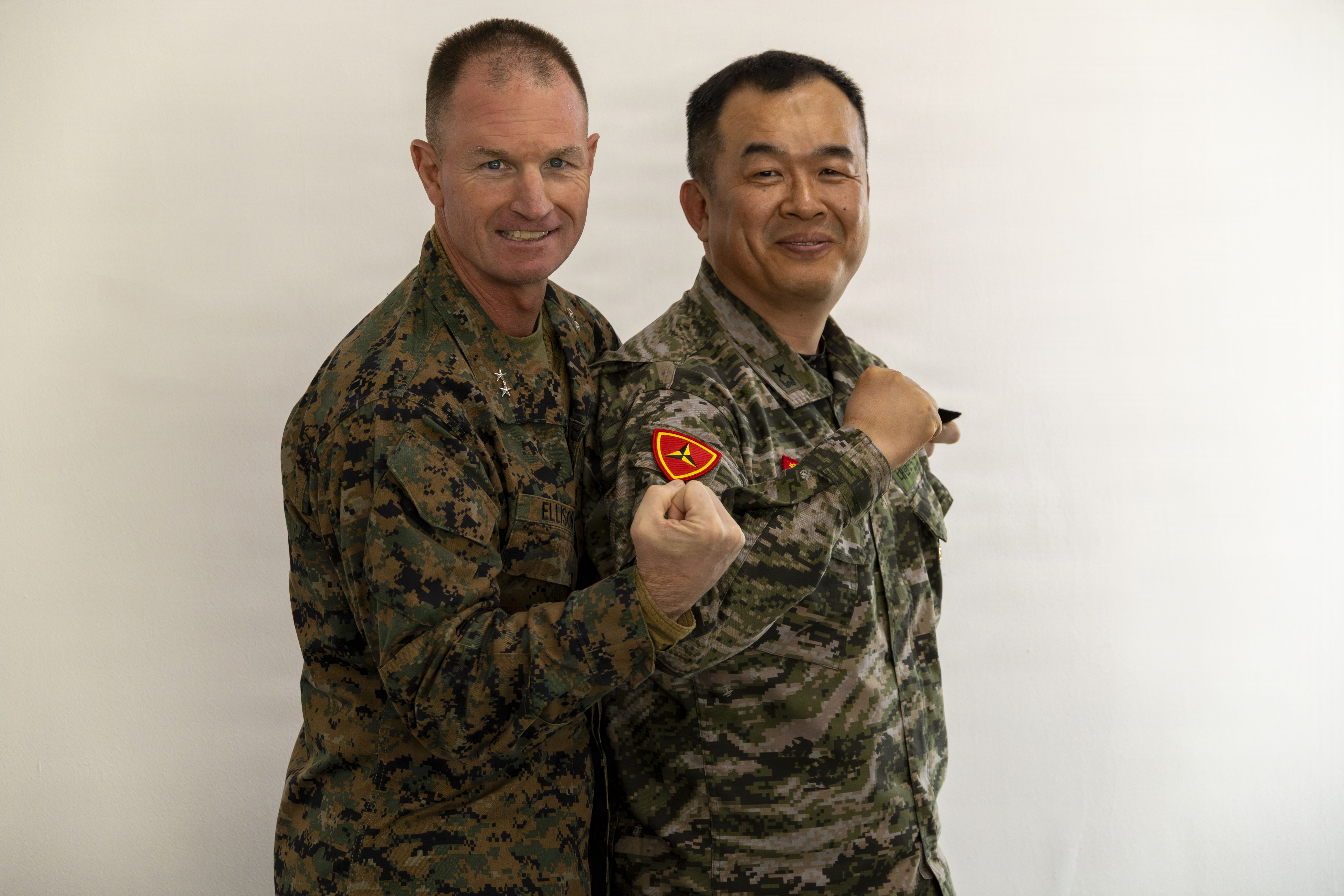
The author writes from direct experience with this problem. As a combined training officer at Headquarters, Republic of Korea Marine Corps, he planned and coordinated a sustained portfolio of combined and multinational exercises: KMEP and Ssangyong on the Korean Peninsula, and overseas exercises including Talisman Sabre in Australia, RIMPAC in Hawaii, Cobra Gold in Thailand, and Kamandag in the Philippines. What those experiences made clear is that the operational value of combined training cannot be captured in readiness metrics alone. Every planning cycle, every coordination friction worked through at the staff level, every night spent in the field alongside counterparts from another Service or nation, deposits something that cannot be manufactured in a crisis. It deposits familiarity, and familiarity is the precondition of trust. The officer who has planned an amphibious exercise with an American counterpart, argued through a logistics problem with him, and seen how he responds when things go wrong, carries something into a combined headquarters that no exchange of liaison reports can replicate. The exercises are not overhead. They are the investment that makes the alliance real.
Conclusion
The Pacific War was decided by industrial production, logistics, and military skill, but its most consequential turning points were shaped by the quality of personal relationships among the people making the decisions. The trust MacArthur and Halsey built through two years of shared operations allowed MacArthur’s headquarters to compress a two-month operational sequence into a rapid decision. Roosevelt’s misplaced confidence in Stalin yielded lasting strategic costs. Truman’s distrust of Stalin, combined with Stalin’s own calculations, produced a war termination at maximum destruction and established the adversarial framework that defined the next half-century of international relations.
The author writes from a relevant vantage point. As a Korean officer currently enrolled in the Marine Corps University Command and Staff College at Quantico, he works daily alongside officers of the United States Army, Navy, Air Force, and Marine Corps, as well as officers from United Nations Command force-providing nations. The professional relationships taking shape in these classrooms are not incidental to the curriculum. They are among its most durable products, and they confirm what the historical record suggests: an officer who already knows how his counterpart thinks will perform differently in a combined headquarters than one who meets him for the first time when the crisis begins.
For the ROK-U.S. Alliance, the practical implication is straightforward. The alliance motto, We Go Together (Katchi Kapshida), describes a form of strategic capability that no treaty provision or technology can replace.21 The officers who train together, work through tactical problems together, and develop genuine confidence in each other’s judgment are the ones who will make the Alliance function when it matters most. Sustaining that human dimension, through consistent training, cultural exchange, and officer-to-officer relationships, is not a secondary concern. It is the hidden engine of strategic success.
ABOUT THE AUTHOR
>Maj Kong serves with the Republic of Korea Marine Corps.
Notes
1. U.S. Army, The Army Human Dimension Strategy (Washington, DC: Department of the Army, 2015), 3.
2. Stanley L. Falk, “Interservice Rivalry in the Pacific,” U.S. Army War College Paper (Carlisle, PA: U.S. Army War College, 1986), 1, https://apps.dtic.mil/sti/pdfs/ADA528913.pdf.
3. Ibid., 2.
4. Thomas Alexander Hughes, Admiral Bill Halsey: A Naval Life (Cambridge, MA: Harvard University Press, 2016), 213.
5. Gerald E. Wheeler, Kinkaid of the Seventh Fleet: A Biography of Admiral Thomas C. Kinkaid (Washington, DC: Naval Historical Center, 1995), 255–258.
6. Hughes, Admiral Bill Halsey, 219.
7. Trent Hone, Mastering the Art of Command: Admiral Chester W. Nimitz and Victory in the Pacific (Annapolis, MD: Naval Institute Press, 2022), 267–268; Samuel Eliot Morison, History of United States Naval Operations in World War II, vol. 12 (Boston: Little, Brown, 1958), 13–15; National Defense University Press, “Movement and Maneuver at Leyte, October 1944,” accessed March 6, 2026, https://ndupress.ndu.edu/Media/News/News-Article-View/Article/4193655/movement-and-maneuver-at-leyte-october-1944.
8. Ronald H. Spector, Eagle Against the Sun: The American War with Japan (New York: Free Press, 1985), 430.
9. E. B. Potter, Bull Halsey (Annapolis, MD: Naval Institute Press, 1985), 291.
10. Hughes, Admiral Bill Halsey, 256. Hughes argues that Halsey’s decision, though operationally flawed, reflected a coherent offensive philosophy rather than simple recklessness.
11. Cassidy, “General of the Army Douglas MacArthur,” 38.
12. Tsuyoshi Hasegawa, Racing the Enemy: Stalin, Truman, and the Surrender of Japan (Cambridge, MA: Harvard University Press, 2005), 3.
13. Frank Costigliola, Roosevelt’s Lost Alliances: How Personal Politics Helped Start the Cold War (Princeton, NJ: Princeton University Press, 2012), 201.
14. Hasegawa, Racing the Enemy, 44.
15. Ibid., 155. Hasegawa demonstrates that Truman and Byrnes deliberately omitted any guarantee of the imperial institution from the Potsdam Proclamation, knowing Japan would reject the terms.
16. Ibid., 107.
17. Ibid., 238.
18. Paik Sun-yup, From Pusan to Panmunjom (Washington, DC: Brassey’s, 1992), 27.
19. John A. Bonin, “Mission Essential: Rebuilding the ROK-US Combined Forces Command,” Military Review (November–December 2022): 50.
20. U.S. Army, “Tactical Interoperability through Combined Training: A KRF Story,” accessed March 6, 2026, https://www.army.mil/article/286709.
21. Combined Forces Command, “CFC Underlines Ironclad Commitment during Ceremony,” accessed March 6, 2026, https://www.pacom.mil/Media/News/News-Article-View/Article/3584546.