

1989 Every Marine a Rifleman; 2029 Every Marine a Commando
By: Maj Jeremy CarterPosted on May 15,2026
Making it an unfair fight
Gen Gray oversaw our Marine Corps as Commandant from 1987 to 1991. Gen Gray notoriously reinforced that “Every Marine is, first and foremost, a rifleman. All other conditions are secondary.” Our self-imposed standard that every Marine is a rifleman has served us well in countless kinetic engagements since our founding in 1775, with just one modern example being when then MajGen Mattis, commander of 1st MarDiv, stated that none of his infantry would be used to guard the supply chains of 1st MarDiv during the 2003 Invasion of Iraq (“as every Marine is, first and foremost, a rifleman”). Notably, the 1st MarDiv made it to Baghdad in 17 days, with the Pentagon’s planners expecting it would take 55 days to reach Baghdad.1
While Gen Gray in the late 1980s reinforced our ethos that every Marine is a rifleman, in 2026, every Marine being a rifleman is not enough to add to our future battlefield success. Using modern nation-on-nation conflicts between Azerbaijan and Armenia, Russia and Ukraine, and Israel and Iran as our guiding features, we see that we must evolve from every Marine being a rifleman to every Marine becoming a commando. The author argues that this is how we will fully realize the potential of Force Design 2030 and create an “unfair fight.”2 Our Marines are our competitive advantage, and we must improve our truest capability by increasing our self-imposed standards.3 Thus, each Marine must be survivable, lethal, and able to deliver outsized effects in a denied environment against our nation-state enemies. Of note, one cannot be a commando without being a rifleman, but one can be a rifleman without being a commando.
What Is a Commando
World War II is considered by many as the birthplace of modern special operations, as “The Allies needed commandos in World War II because they did not have technological overmatch or initially possess the initiative—a situation which our Corps is potentially facing with strategic adversaries.”4 Many of today’s U.S. special operations forces can trace their heritage to World War II, such as the Navy SEALs (i.e., underwater demolition teams), Army Rangers, Army Special Forces (i.e., Jedburgh Program), and Marine Raiders. Of note, a definition for a United States Marine commando has been proposed as “a Marine who is assessed, selected, highly trained and equipped, able to endure sustained hardship, and is supported by the Marine Corps to train and conduct operations deep behind enemy lines, and in areas without a defined enemy line, both in and out of uniform, with minimal guidance from their higher unit, often without higher, adjacent, or supporting units, in which their actions will have direct effects on the operational, strategical, and national policy levels of war.”5
“There are no dangerous weapons; there are only dangerous men.”
—Robert A. Heinlein, Starship Troopers
Why We Should Become Commandos?
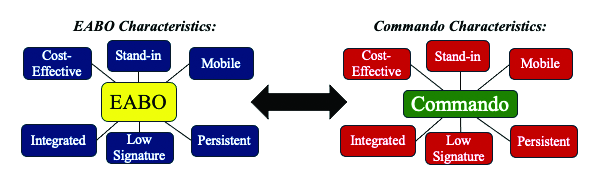
Why should each Marine become a commando? Markedly, the concepts of stand-in forces (SIF) and expeditionary advanced base operations (EABO) are proposing this notion if we can appreciate the overlap between commandos and what the Marine Corps is asking us to become. As stated, “SIF are small but lethal, low signature, mobile, relatively simple to maintain and sustain forces designed to operate across the competition continuum within a contested area as the leading edge of a maritime defense-in-depth to intentionally disrupt the plans of a potential or actual adversary.”6 Additionally stated, “SIF impose costs on the enemy by presenting operationally relevant capabilities that cannot be ignored, even as their low signature, high mobility, dispersion, and use of deception make them difficult for an enemy to find and target.”7 The characteristics of EABO are: stand-in, mobile, persistent, low signature, integrated, and cost effective, or as stated “EABO are a form of expeditionary warfare that involve the employment of mobile, low signature, persistent, and relatively easy to maintain and sustain naval expeditionary forces from a series of austere, temporary locations ashore or inshore within a contested or potentially contested maritime area in order to conduct sea denial, support sea control, or enable fleet sustainment.”8 Simply put, the Marine Corps wants us to already be behind the enemy lines during the opening stages of conflict (i.e., commandos).
Figure 1 demonstrates that EABO and commandos possess mutual characteristics. Accordingly, emphasizing these shared characteristics in basic training (BT) and the Officer Candidate Course (OCC) would amplify our ongoing efforts to experiment with and validate EABO, and SIF within the FMF. Furthermore, applying and incorporating our lessons learned with EABO and SIF from and within the FMF into our initial training will enhance our quality of Marine. Thus, mandating the interdependence and integration of SIF and EABO into BT and OCC and vice versa increases our ability to impose our will against our adversaries.
As the Marine Corps seeks to transition to Force Design 2030 to enact concepts, such as SIF and EABO, which are centric to the idea of operating inside the weapons engagement zone (WEZ) of the People’s Republic of China, we must evolve our recruitment of civilians, our initial training pipelines (e.g. BT and OCC, School of Infantry, and basic officer course), and our sustainment training (i.e., FMF), as Marines are our competitive advantage.9 As we evolve, “we must ensure our efforts are in the right direction with both precision and speed,”10 while treating our evolution as an attack, with the phases of preparation (recruitment), conduct (initial training), and exploit (FMF).11 The emphasis of this manuscript will be to provide the rationale, justification, and suggestions for how we should evolve our initial training, specifically where civilians earn our title of United States Marine (i.e., BT and OCC). The earning of our title, United States Marine, is critical for our Corps as BT and OCC establish our identity as United States Marines, with each Marine having to pass through the test to earn a spot in our formation.
Evolving our Initial Training
A notable feature of a commando is that a commando is “an individual who is assessed, selected, trained, supported, and able to operate without control from their chain of command.”12 Talent Management 2030 states that one out of five Marines fails to complete their single four-year contract.13 Thus, we must treat our initial training as an assessment and selection.14 As the character of war changes, we must change and accordingly emphasize units of actions that are distributed, mobile, survivable, lethal, and that can generate the needed effects, which takes a higher caliber Marine, not simply more Marines. Thus, raising the standard to earn the title Marine would cause greater attrition but would make us more lethal inside the WEZ as smaller, distributed units of action that can generate effects are essential to adapting to the evolving character of war. Regarding commandos, “decentralized and small-unit action should always be the intent … especially considering a contested environment where dispersed operations provide security.”15
So, how do we evolve our BT and OCC? The first step is to divest any training that is not adding to our survivability or lethality in a denied environment. Accordingly, we should divest the amount of time we dedicated to drill. As stated, “One immediate adjustment that our Marine Corps’ leaders can enact now to make our Marines more prepared for modern conflict is to divest the amount of ceremony and drill conducted at BT and OCC,”16 as the notion of drill instilling discipline “is invalid, outdated, and dangerous to our warfighting organization.”17 “Here is the litmus test: if it does not directly correlate to lethality and survivability, we must divest of it.”18
Following divesting of non-essential tasks that do not add directly to lethality and survivability, we should simply apply the concept of less comfort; more discomfort as we evolve our initial training. For example, we should sleep less in our racks (comfort) and sleep more outside (discomfort). We should eat less in the chow hall (comfort) and eat more Meals Ready to Eat (discomfort). Rather than conduct movements during the day (comfort), we should increase the number of night movements (discomfort).
Next, we must raise our standards in all domains that add to early 21st-century warfighting performance. Within the true performance realization model, performance is impacted by the proposed seven influencers of performance (e.g., fitness, cognition, skills, abilities, leadership, will, and culture).19 As we evolve as an organization to increase our lethality and survivability, we must determine what influences early 21st-century warfighting performance to determine which standards we must raise.
Fourth, replicate the WEZ (i.e., the enemy’s most dangerous course of action) whenever possible. The book 7 Seconds to Die provides us with an excellent example of what could happen to us if we fail to adapt (i.e., the nation of Armenia).20 Fifth, we must realize that not all civilians need to earn the title Marine, and attrition will occur. Moving forward, quality over quantity will be more important than ever before in our 250 years of history. Accordingly, our task organization will need to change as well. Sixth, exploit these gained levels of performance and proficiency in our follow-on schools at the School of Infantry and basic officer course, as well as within the FMF.
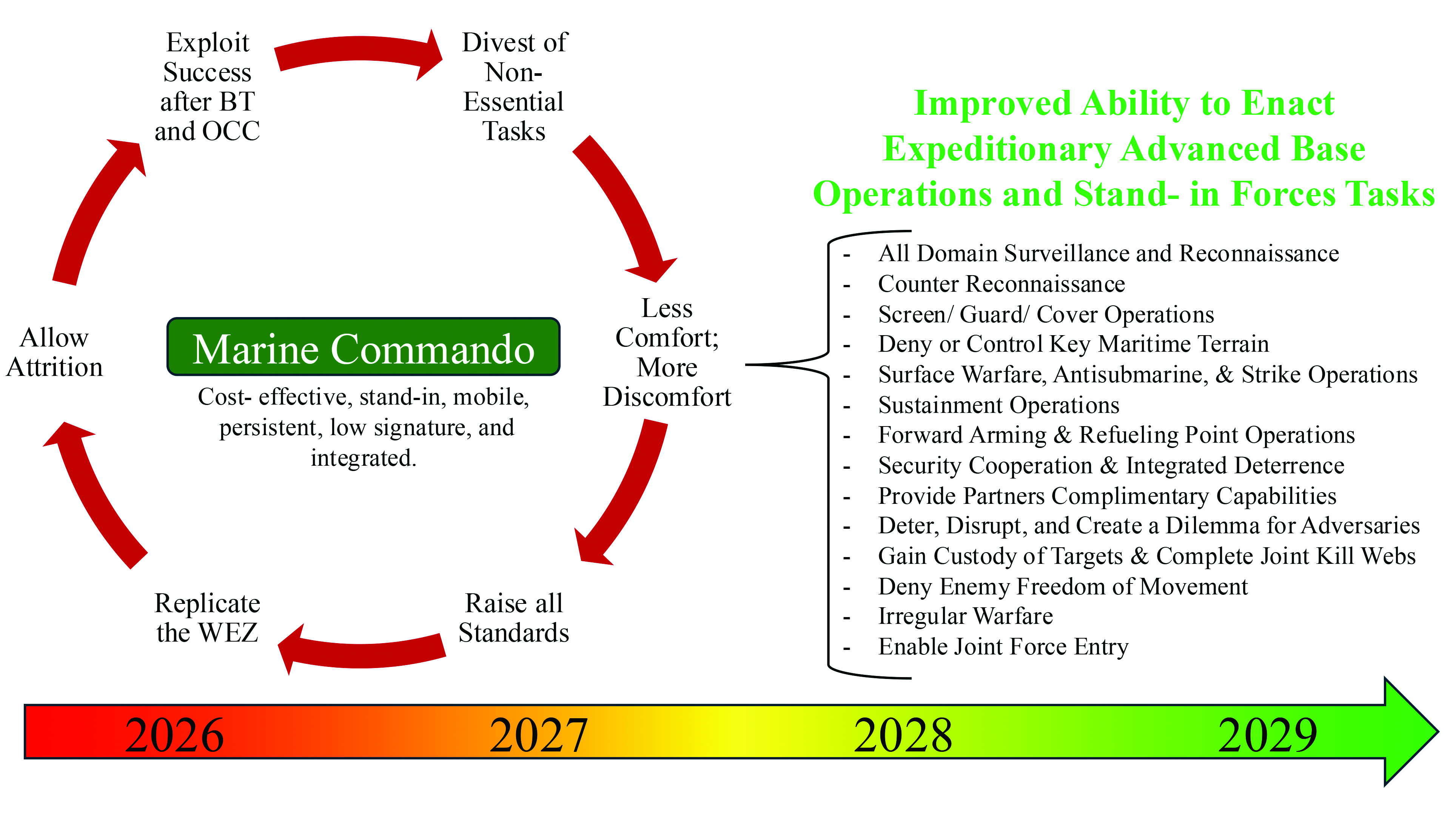
These six simple recommendations can be implemented immediately in 2026 and increased and refined by 2029 to make us more effective in SIF and EABO. By divesting non-essential tasks, having less comfort and more discomfort, raising our standards, replicating the WEZ, allowing attrition to occur, and exploiting the higher level of Marine at follow-on schools and the FMF, we are stepping in the direction of every Marine becoming a commando (Figure 2). “Let us not view BT and OCC as only a prerequisite to earning the title Marine, but also as the greatest opportunity in the Marine Corps, since all Marines must make the passage through these courses to enter our formation.”21
To the Critic
To the critic of each Marine being a commando, will each Marine be equivalent in the fitness, cognition, and skills of modern-day special operations forces? No. However, by evolving our initial training, each Marine will be more survivable, lethal, and effective inside the WEZ. Accordingly, each Marine will have greater resiliency, fitness, cognition, skills, leadership, and abilities than those currently being formed at BT and OCC, which will lead to enhanced follow-on training. As stated earlier, one cannot be a commando without being a rifleman, but one can be a rifleman without being a commando; therefore, becoming commandos raises the quality of Marines, thus the Marine Corps.
The author will leave the reader with a final question and answer. Why should we modernize our initial training? Simple. If we seek to intentionally be inside the WEZ, then we must replicate the WEZ. We must replicate being behind enemy lines, in a denied, hostile, and logistically restrained environment, while able to create effects, which is akin to the tasks, expectations, and standards of commandos. This replication of the enemy’s most dangerous course of action must start with our initial training. By training to be a commando in our initial training, we are facilitating our effectiveness in SIF and EABO inside the WEZ. Anything less than this standard is unacceptable.
Conclusion
Former Commandant Gen Gray infamously stated, “Every Marine is, first and foremost, a rifleman. All other conditions are secondary.” Respectfully, the author argues this is an incorrect statement, as every Marine is first and foremost a Marine, and the transformation from civilian to Marine is the primary task of BT and OCC. During our initial training, we emphasize becoming and being a Marine, which is why we are not called Marines until the conclusion of BT or OCC. While being a Marine is linked to being a rifleman, being a Marine is additionally associated with success on the battlefield. As the battlefield evolves, we must evolve as United States Marines. As we seek to create an unfair fight, we must realize that our Marines are a competitive advantage, not technology, mass, or anything other than our Marines.22 Thus, we must evolve our Marines to impose our will against any enemy at any time.
While Gen Gray re-emphasized that “Every Marine is, first and foremost, a rifleman,” Gen Smith, our current Commandant, states that SIF will open “the door from the inside”23 as we will be placed inside the WEZ to enable Joint Force entry. With the dilemma and threat, as well as the opportunity of being forward deployed inside the WEZ, we must evolve now. What was valid in the late 1980s is no longer valid in 2025 and beyond. While the change may seem monumental, as stated by Gen Berger, “We have been here before. Over the course of our history, Marines have often been on the leading edge of our Nation’s forward deployed forces … Marines have also embraced truly difficult operational problems and come up with solutions no one thought possible. And Marines have gone into contested areas that others feared to enter and returned victorious.”24
As stated, “What we can provide today that our other Services cannot provide, are the United States Marines. We need to raise our standards within our Corps. The Army can have its mass, the Navy can have its ships, and the Air Force can have their budget; let us have our Marines.”25 If in 1989, every Marine was a rifleman; in 2029, every Marine needs to be a commando.
ABOUT THE AUTHOR
>Maj Carter is currently serving as a Special Operations Officer in MARSOC. He previously served as an Infantry Platoon Commander, Company Executive Officer, and Company Commander. Before commissioning in the Marine Corps, he was a Strength and Conditioning Coach, a Researcher in Sports Science, and a Graduate Teaching Assistant. He is still currently active in the human performance community, is a reviewer and editor for three different human performance journals, and is the President of True Performance Realization (trueperformancerealization.com).
Notes:
1. Jim Proser, No Better Friend, No Worse Enemy: The Life of General James Mattis (New York: Harper’s Collins Publisher, 2018).
2. Gen David H. Berger, Force Design 2030 (Washington, DC: March 2020).
3. Jeremy Carter, “United States Marines: Our True Competitive Advantage- Expounding our Capability,” Marine Corps Gazette (Accepted).
4. Jeremy Carter, “21st- Century Marine Corps’ Commandos: Why We Need Them and How We Get There,” Marine Corps Gazette, November 2022, https://www.mca-marines.org/wp-content/uploads/21st-Century-Marine-Corps-Commandos.pdf.
5. Ibid.
6. Gen David H. Berger, A Concept for Stand-in Forces (Washington, DC: December 2021).
7. Ibid.
8. Headquarters Marine Corps, Tentative Manual for Expeditionary Advanced Base Operations 2d Edition (Washington, DC: 2023).
9. Force Design 2030; A Concept for Stand-in Forces; Tentative Manual for Expeditionary Advanced Base Operations; and “United States Marines: Our True Competitive Advantage- Expounding our Capability.”
10. Jeremy Carter, “The Need to become an Ability Organization: A Novel View of Capabilities versus Abilities,” Marine Corps Gazette 109, No 2 (2025).
11. “United States Marines: Our True Competitive Advantage- Expounding our Capability.”
12. “21st- Century Marine Corps’ Commandos: Why We Need Them and How We Get There.”
13. Gen David H. Berger, Talent Management 2030 (Washington, DC: November 2021).
14. Jeremy Carter, “Talent: We Do Not Need It Eleven challenges to Talent Management 2030,” Marine Corps Gazette 108, No 11, (2024).
15. “21st- Century Marine Corps’ Commandos: Why We Need Them and How We Get There.”
16. “United States Marines: Our True Competitive Advantage- Expounding our Capability.”
17. Jeremy Carter, “Divest of Drill; Invest in Discipline: Evolving our Initial Training to meet the Demands of Modern Warfare,” Marine Corps Gazette (Accepted).
18. “United States Marines: Our True Competitive Advantage- Expounding our Capability.”
19. See https://trueperformancerealization.com.
20. John F. Antal, 7 Seconds to Die: A Military Analysis of the Second Nagorno-Karabakh War and the Future of Warfighting (Havertown: Casemate Publishers, 2022).
21. “United States Marines: Our True Competitive Advantage- Expounding our Capability.”
22. Ibid.
23. Thomas A. Walsh and Alexandra L. Huber, “A Symphony of Capabilities: How the Joint Warfighting Concept Guides Service Force Design and Development,” Joint Force Quarterly 111 (2023).
24. A Concept for Stand-in Forces.
25. “United States Marines: Our True Competitive Advantage- Expounding our Capability.”