


The Price of Relevance
By: Vince FasonePosted on September 15,2026
Divesting legacy capabilities to win the stand-in fight
2026 MajGen Harold W. Chase Essay Contest: First Place
The Marine Corps stands at an institutional crossroads it has visited before—and repeatedly chosen the comfortable path. Force Design 2030 was supposed to break that habit. It did not finish the job.1 The Corps shed its tanks, reduced infantry battalions, and reorganized into Marine Littoral Regiments, but it retained systems that belong to a prior era: towed artillery, Light Armored Vehicle (LAV) units, an Amphibious Combat Vehicle (ACV) procurement line that perpetuates the logic of the platform it replaced, aging CH-53E Super Stallions, and an F-35 procurement posture built for a different strategic context. The result is a Corps caught between two identities—too transformed to fight the last war well and not transformed enough to fight the next one decisively.
The solution is structural. The Marine Corps must divest all towed artillery, all LAV units, 50 percent of its planned ACV procurement, one hundred F-35B/C airframes, and the remaining CH-53E fleet—and reinvest those savings into unmanned-aerial vehicles (UAV), intelligence, surveillance, and reconnaissance (ISR) platforms, loitering munitions, autonomous ground systems, CH-53K procurement, and expanded MV-22 capacity. This is not a proposal to make the Corps leaner for economy. It is a proposal to make it lethal in the one fight that defines institutional relevance: the stand-in fight.
The 2022 National Defense Strategy elevated the People’s Republic of China as the pacing threat.2 The operational implication is unambiguous: the Marine Corps must be capable of operating inside the weapons engagement zone—forward, distributed, and lethal—before a conflict formally begins. This is the stand-in fight. It is characterized by long-range precision fires, electromagnetic competition, small, distributed nodes that are survivable precisely because they are mobile and austere, and the ability to deny an adversary the sea control it requires to project power.3 A towed howitzer battery cannot win this fight; neither can a column of LAVs, nor an amphibious vehicle designed around the assault doctrine the Corps has been walking away from for 6 years, nor a 30-year-old heavy-lift helicopter sustaining distributed forces across a contested island chain. If the Corps cannot resource the force that the fight demands, it will not win it, and if it cannot win it, it is not the force the Nation needs.
The Case for Divestiture
Towed Artillery
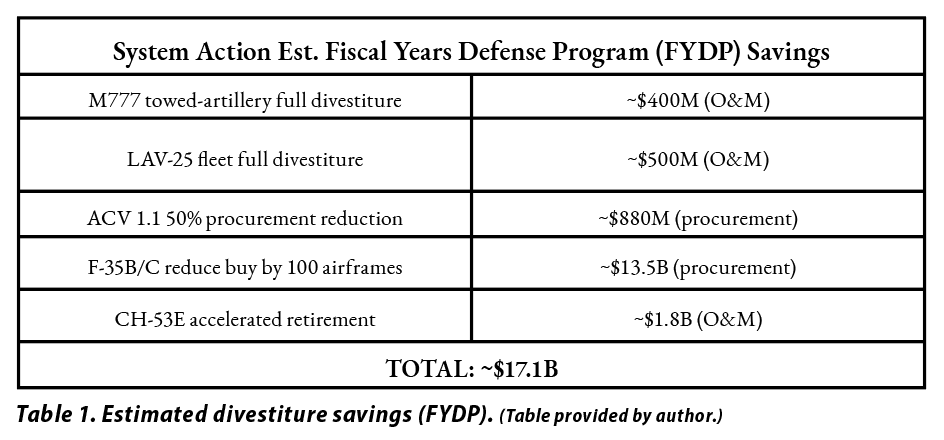
The M777 155mm Howitzer is a tactically capable system rendered operationally irrelevant in the stand-in environment. Its signature is detectable by People’s Liberation Army ISR assets. The Marine Corps operates approximately 350 M777s across fourteen active batteries, consuming hundreds of millions in annual operations and maintenance funds.4 The HIMARS provides longer range, greater precision, and superior survivability through dispersion—and it already exists in the force. Divestiture of all towed artillery is not a reduction in fires capability. It is a rationalization of the fires portfolio around systems that can actually survive.
Light Armored Vehicles
The LAV-25 was designed for reconnaissance and economy-of-force in a joint maneuver context. In the stand-in fight, that context does not exist. The LAV’s reconnaissance function is better performed by unmanned aerial systems at a fraction of the logistical cost.5 Its direct fire role is modest and increasingly redundant against a peer adversary with anti-armor assets that outrange the 25mm cannon by orders of magnitude. The Corps should divest the entire inventory.
Amphibious Combat Vehicles
The ACV 1.1 was procured as the replacement for the Amphibious Assault Vehicle—a platform the Corps rightly retired as Force Design 2030 moved away from ship-to-shore assault under fire.6 The ACV does not escape the same conceptual trap. A 50 percent procurement reduction—approximately 102 vehicles—preserves residual capability for permissive environments while liberating nearly $900 million for systems the stand-in fight actually demands.
F-35 Procurement Reduction
The F-35 is a maintenance nightmare—and that is not hyperbole. The Director of Operational Test and Evaluation reports the F-35 carries an average of more than 800 open deficiencies per aircraft, with mission-capable rates that have chronically lagged program targets.7 Sustainment costs rank among the most expensive in the joint inventory.8 The Corps is not buying lethality with every additional airframe. It is buying complexity, maintenance debt, and readiness drag. One hundred fewer airframes, at approximately $135 million per jet, redirected into UAVs and ISR platforms, produce the unmanned ecosystem the stand-in fight demands at a fraction of the sustainment cost.9
CH-53E Retirement
The CH-53E is not operationally mature—it is old. At an operating cost exceeding $17,000 per flight hour, its maintenance burden is substantial.10 Its retirement is an engineering inevitability. The policy choice is whether to manage that retirement deliberately—tied to CH-53K fielding—or wait until readiness rates force the issue.
The Fiscal Case
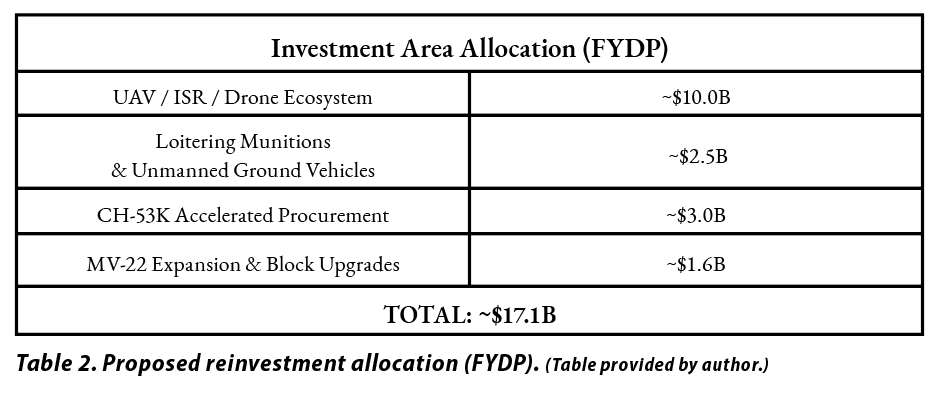
The argument for divestiture is arithmetic. Table 1 presents approximate savings across the five-year defense program. Table 2 shows the proposed reinvestment allocation. The UAV and ISR investments represent the core of the argument: unmanned systems in Ukraine have demonstrated that persistent ISR, loitering munitions, and drone-delivered effects have fundamentally changed the calculus of contested operations.11
The Reinvestment Imperative
Unmanned ground vehicles and loitering munitions extend the Corps’ logistics, reconnaissance, and direct fire capacity without adding to the human signature that distributed forces must manage. They are cheaper per effect than manned aviation, harder to target than traditional artillery, and scalable in a way that large platforms are not. The Corps that masters distributed precision fires through unmanned systems will hold a decisive operational advantage. The Corps that does not will struggle to survive the first 72 hours of a contested maritime fight.
Vertical lift is the connective tissue of the stand-in force. The CH-53K King Stallion nearly triples the external lift capacity of the CH-53E, with a digital architecture that dramatically reduces the maintenance burden.12 The MV-22 Osprey remains the stand-in force’s primary medium lift solution, and its ability to rapidly reposition Marines across vast maritime distances is without peer. Investing in both is not a hedge. It is the direct enabler of distributed operations.
The Cost of Doing Nothing
Force Design 2030 identified the direction. It did not mandate the velocity. In the absence of structural divestiture, legacy systems will continue to consume operations and maintenance funding, aviation enterprise bandwidth, and the institutional attention that should be focused on the stand-in fight. The Corps will arrive at the next conflict partially transformed—capable enough in the old ways to generate activity, but not capable enough in the new ways to generate decision. The People’s Liberation Army does not share this problem. It is building the force it intends to fight with, not the force it is comfortable sustaining.
The Politics of Preservation
Every argument in this essay is operationally sound, fiscally defensible, and strategically necessary. It will not matter. None of these divestitures will happen at the scale proposed. The reason is power—the machinery of institutional politics that no planning document has ever overcome.
The Marine Corps is not a rational actor. It is a coalition of constituencies—each built around a platform, a community, or a legacy. Towed artillery is a branch, a career path, a collection of colonels who sit on promotion boards, and a network of contractors with district-level congressional representation. The LAV community will not consent to its own obsolescence. The ACV is the Corps’ most public symbol of staying amphibious in an era when the Navy is increasingly unwilling to risk a hull inside the weapons engagement zone.
The F-35 is the most powerful example. It is a program of record that employs tens of thousands of Americans across 45 states. The Marine Corps could declare tomorrow that it needs only 240 F-35s instead of 340, and within a week, the Chairman of the House Armed Services Committee would receive phone calls from every affected district. Within a month, a bipartisan letter would land on the Commandant’s desk. Within a quarter, the language would appear in the National Defense Authorization Act prohibiting the reduction. The Marine Corps does not control its own force structure. It controls a recommendation. Congress disposes.
This is not corruption. It is the system functioning as designed—and that is precisely the problem. The defense budget is not a strategy document. It is a jobs program, a political hedge, and a series of compromises dressed in strategic language. Until the Corps is willing to tell a three-star general that his community no longer exists or tell a committee chairman that the factory in his district is no longer relevant, the divestitures will remain intellectual exercises.
There is a deeper political reality: the Marine Corps’ identity is itself a political constituency. The Corps sells itself as the force that is “first to fight,” the institution that does more with less. That identity requires visible modernization but also the appearance of stability. No Commandant wants to be remembered as the one who “broke the Marine Corps” by stripping away platforms that generations have bled on. The fear of that legacy—of being attacked by retired three-stars, of a hearing titled “Are We Gutting the Corps?”—is more powerful than any threat matrix from the Indo-Pacific.
The tragedy is that the political calculus is backward. The Marine Corps will not be judged by history for divesting LAVs or reducing F-35 buys. It will be judged for what it did with the years it had. If it arrives at the next fight with an amphibious tractor designed for a Navy that will not close the beach, a light armored vehicle that cannot survive against peer anti-armor, a logistics helicopter that cannot sustain distributed operations, and a fighter fleet that consumes the budget without generating mission-capable rates—that will be the legacy. That will be the indictment.
The political system will not save the Marine Corps from itself. The Marine Corps must decide whether it wants to be saved.
Conclusion
Divestiture is not defeat. It is discipline—the willingness to make hard choices about what the force must become, rather than preserve what it has always been. Towed artillery, LAVs, excess ACV procurement, surplus F-35 airframes, and aging Super Stallions are not the foundation of the stand-in force. They are the weight that prevents the Corps from becoming one. The Marine Corps should shed that weight—deliberately, aggressively, and without apology—and invest the proceeds in the systems that will enable it to contest the maritime environment, sustain distributed forces, and deliver precision effects at range.
The Corps that wins the stand-in fight will be mobile, distributed, unmanned-capable, and sustained by lift assets that can keep pace with its operational concept. The Corps that loses it will look precisely like the Corps that chose comfort over consequence at the programmatic crossroads.
Relevance is not inherited. It is earned—and the price is divestiture.
ABOUT THE AUTHOR
>Mr. Fasone is a former enlisted communications Marine who served in the First Gulf War with the 13th MEU and the evacuation of the Philippines and Somalia with the 15th MEU. He also considers himself to be an amateur military historian.
NOTES:
1. U.S. Marine Corps, Force Design 2030 (Washington, DC: Headquarters, U.S. Marine Corps, March 2020), https://www.marines.mil/Portals/1/Docs/Force%20Design%202030.pdf.
2. U.S. Department of Defense, 2022 National Defense Strategy of the United States of America (Washington, DC: U.S. Department of Defense, October 2022), 4–8, https://media.defense.gov/2022/Oct/27/2003103845/-1/-1/1/2022-NATIONAL-DEFENSE-STRATEGY-NPR-MDR.PDF.
3. Headquarters, U.S. Marine Corps, Commandant’s Planning Guidance (Washington, DC: Headquarters, U.S. Marine Corps, July 2021), https://www.cmc.marines.mil/CPG; and Headquarters, U.S. Marine Corps, Tentative Manual for Expeditionary Advanced Base Operations, 2nd ed. (Washington, DC: Headquarters, U.S. Marine Corps, May 9, 2023), https://www.marines.mil/Portals/1/Docs/230509-Tentative-Manual-For-Expeditionary-Advanced-Base-Operations-2nd-Edition.pdf.
4. U.S. Marine Corps, Marine Corps Total Force Structure Review, FY2023; Department of the Navy, Department of the Navy Budget Estimates, Fiscal Year 2023 (Washington, DC: Department of the Navy, 2022), https://www.secnav.navy.mil/fmc/fmb/Pages/Fiscal-Year-2023.aspx; and Department of the Navy, Department of the Navy Budget Estimates, Fiscal Year 2024 (Washington, DC: Department of the Navy, 2023), https://www.secnav.navy.mil/fmc/fmb/Pages/Fiscal-Year-2024.aspx.
5. U.S. Government Accountability Office, Marine Corps Modernization: Actions Needed to Improve Management of Force Design 2030 Initiatives, GAO-22-105230 (Washington, DC: U.S. Government Accountability Office, April 14, 2022), https://www.gao.gov/products/gao-22-105230.
6. Department of the Navy, Department of the Navy Budget Estimates, Fiscal Year 2023 (Washington, DC: Department of the Navy, 2022), https://www.secnav.navy.mil/fmc/fmb/Pages/Fiscal-Year-2023.aspx; Department of the Navy, Department of the Navy Budget Estimates, Fiscal Year 2024 (Washington, DC: Department of the Navy, 2023), https://www.secnav.navy.mil/fmc/fmb/Pages/Fiscal-Year-2024.aspx. The ACV 1.1 program of record includes 204 vehicles at approximately $8.6 million per vehicle.
7. Director, Operational Test and Evaluation, FY2022 Annual Report (Washington, DC: U.S. Department of Defense, January 2023), F-35 Joint Strike Fighter section, https://www.dote.osd.mil/Portals/97/pub/reports/FY2022/other/2022DOTEAnnualReport.pdf.
8. U.S. Government Accountability Office, F-35 Aircraft Sustainment: DOD Faces Challenges Sustaining a Complex Weapon System, GAO-23-105816 (Washington, DC: U.S. Government Accountability Office, March 23, 2023), https://www.gao.gov/products/gao-23-105816.
9. Office of the Under Secretary of Defense (Comptroller), Selected Acquisition Report: F-35 Joint Strike Fighter (Washington, DC: U.S. Department of Defense, December 2022), https://www.esd.whs.mil/Portals/54/Documents/FOID/Reading%20Room/Selected_Acquisition_Reports/F-35_DEC_2022_SAR.pdf. Unit Recurring Flyaway cost for the F-35B: approximately $135.8 million in FY2023 constant dollars.
10. Headquarters, U.S. Marine Corps, Deputy Commandant for Aviation, Marine Corps Aviation Plan 2023 (Washington, DC: Headquarters, U.S. Marine Corps, 2023), https://www.aviation.marines.mil/Portals/11/Documents/AVPLAN2023.pdf. CH-53E cost per flight hour: $16,000–$19,000 depending on depot induction rate.
11. Stacie L. Pettyjohn and Hannah Dennis, Drone Warfare in Ukraine: Key Takeaways (Washington, DC: Center for a New American Security, January 2024), https://www.cnas.org/publications/reports/drone-warfare-in-ukraine-key-takeaways.
12. Headquarters, U.S. Marine Corps, Deputy Commandant for Aviation, Marine Corps Aviation Plan 2023 (Washington, DC: Headquarters, U.S. Marine Corps, 2023), https://www.aviation.marines.mil/Portals/11/Documents/AVPLAN2023.pdf. The CH-53K provides an external lift capability of 27,000 pounds compared to 16,000 pounds for the CH-53E.