

From the Archive: “The Marines’ Hymn” – Collector Preserves the History of the Legendary Song
By: Sara W. BockPosted on November 1, 2026
This article was originally published in the November 2014 issue of Leatherneck Magazine.
Between its recognizable melody and iconic lyrics, “The Marines’ Hymn” is arguably the most well-known of the U.S. military songs. For Marines both past and present, the hymn stirs great emotion and pride; and for all Americans, it serves as a reminder of the illustrious history of the nation’s premier expeditionary force. While its origins are somewhat shrouded in mystery, one Marine has made it his mission to preserve the history that can be traced-through his extensive collection of “The Marines’ Hymn” sheet music.
Colonel Blake M. Wilson, Inspector General, Marine Corps Base Quantico, Va., didn’t initially set out to become a sheet-music collector. In fact, he really had no
idea how many publications of the hymn existed when he came up with the idea to frame a copy to hang in his office while serving as the assistant operations officer for the 11th Marine Regiment, MCB Camp Pendleton, Calif. At the time, finding a paper copy of the hymn proved to be more difficult than he imagined. He recruited his extended family members to help him search for sheet music in antique shops, and when they came up with nothing, Wilson gave up on the idea for a while – until he discovered eBay.com.
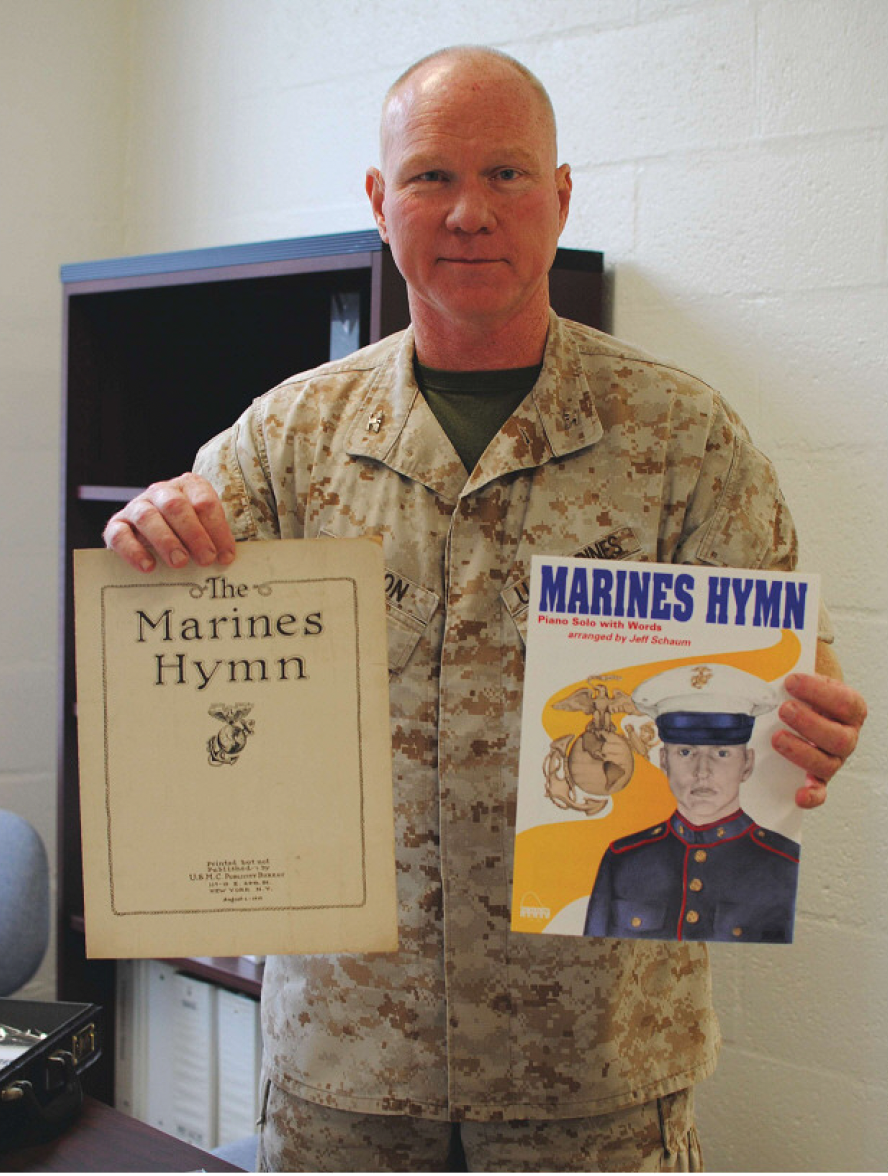
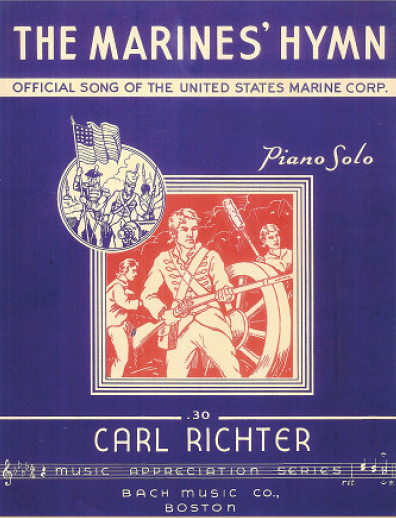
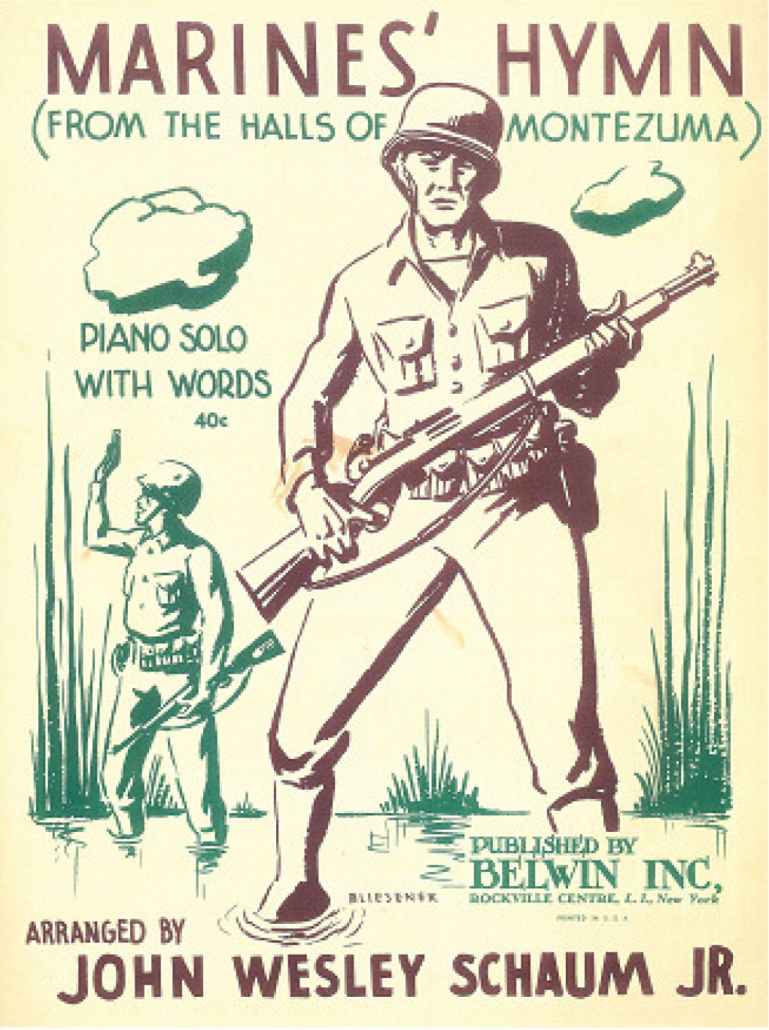
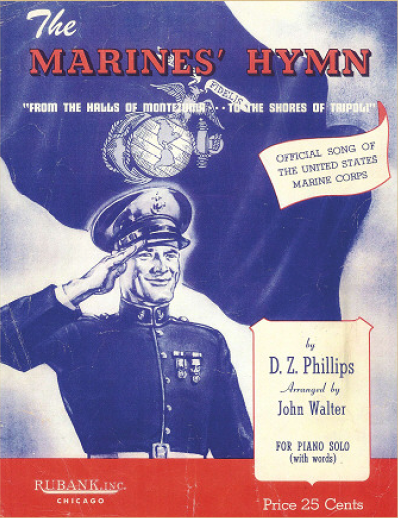
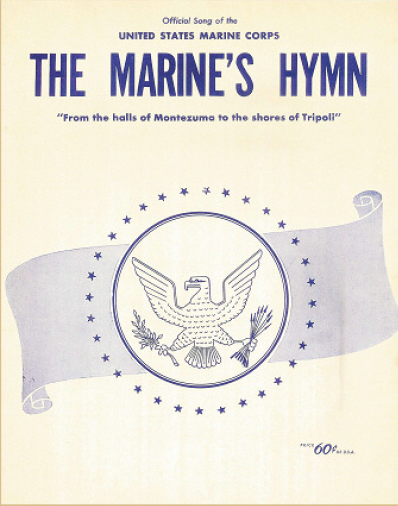
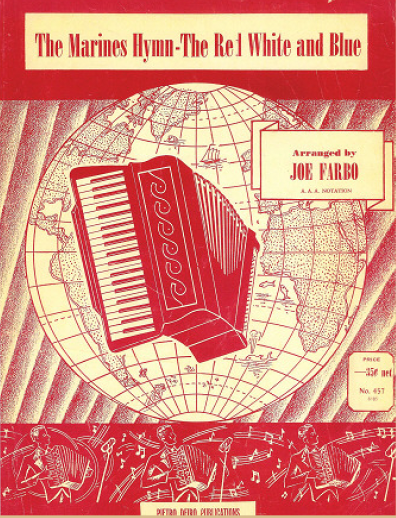
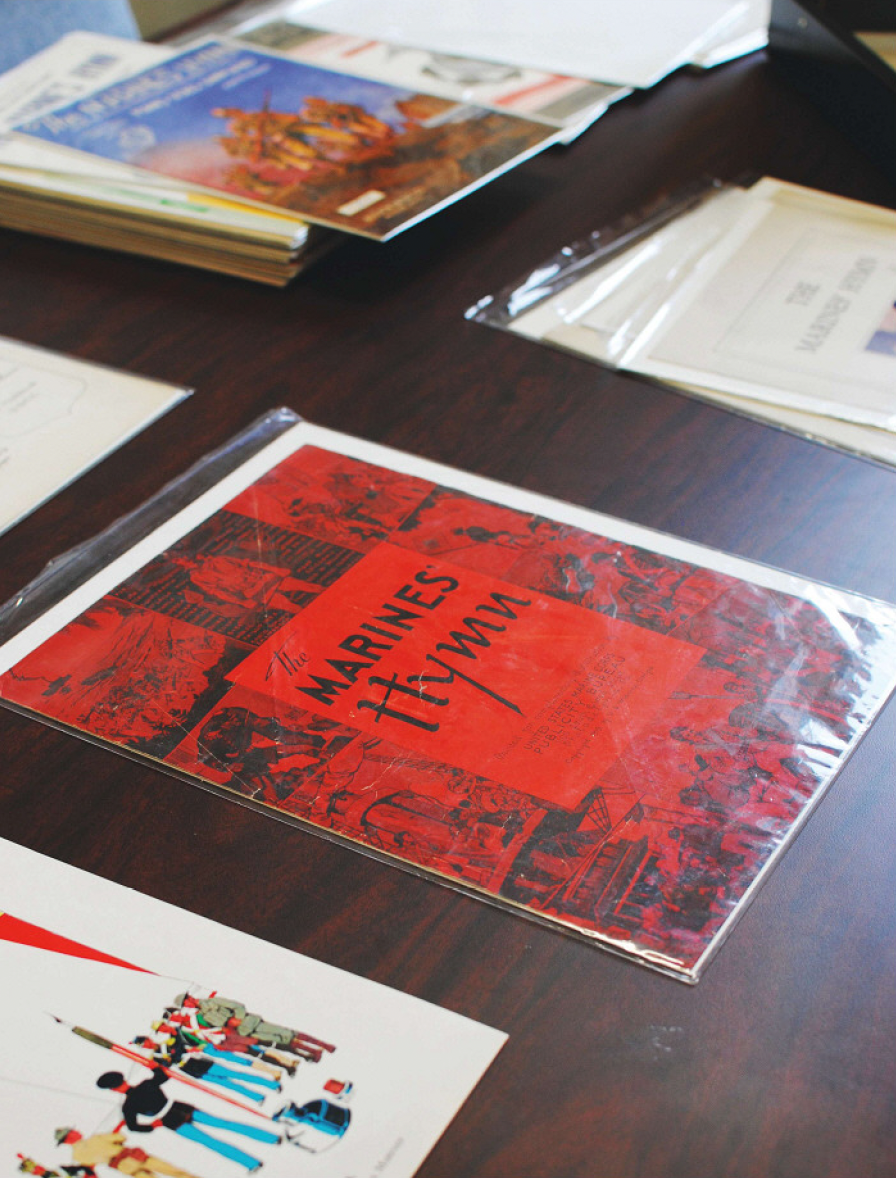
After receiving his first eBay purchase of sheet music, Wilson was hooked and quickly realized how many different publications of the hymn were floating around. As he uncovered the vast array of selections available, with varying artwork, arrangements and additional verses, his interest was piqued and he admits that he not only enjoyed discovering new editions of the hymn, but he also relished the “bidding wars” he took part in on the online auction site. He has accumulated more than 60 different sheet-music publications of the hymn, all printed between 1918 and 1981 and stored in archival sleeves inside an antique printing cabinet at his home in Fredericksburg, Va.
Wilson jokes that while he was forward deployed, his wife would ask, “What’s all this sheet music showing up on my door step?” as he found himself using his downtime to search the Internet for versions of the hymn he didn’t have yet. For him, the draw isn’t just the music itself, but the different artwork found on the covers and the varying uses for the sheet music; each is an invaluable piece of Marine Corps history, and not solely in a musical sense.
“Sheet music not only brought the music and words into the home, but also colorful artwork and depictions suggesting the content of the song,” said Wilson. “The artwork, like that on old recruiting posters… helped evoke some of the patriotism, pride and, to a certain extent, social obligation from the American public.” He added that many of the original publications of “The Marines’ Hymn” were used as recruiting tools and souvenirs, handed out at fairs and other events.
The origins of the hymn itself are fairly obscure. The tune is generally attributed to German-born French composer Jacques Offenbach’s comic opera “Genevieve de Brabant,” which debuted in Paris in November 1859. However, many believed that the air originated from an old Spanish folk song, which is quite possible, since it is said that Offenbach spent a good deal of time in Spain.
The origin of the tune was uncovered sometime around the turn of the 20th century by Col A. S. McLemore and Walter F. Smith, second leader of The United States Marine Band. In a letter to Smith, McLemore wrote, “Major Richard Wallach, USMC, says that in 1878, when he was in Paris, France, the air to which the Marines’ Hymn is now sung was a very popular one.” Maj Wallach sent Smith the name of the opera, and Smith replied with his congratulations on “a wonderfully accurate musical memory, for the air of the Marine Hymn is certainly to be found in the opera ‘Genevieve de Brabant.’ “
While those Marines may have figured out the origin, how the tune actually became what we know as “The Marines’ Hymn” was never discovered.
Even more of a mystery is the source of the renowned lyrics. The author of the first verse is unknown, but tradition has it that a Marine on
duty in Mexico penned the words after the end of the Mexican-American War(1846-48). His references to “the halls of Montezuma” and “the shores of Tripoli” are taken from the early colors of the Corps.
During the war with the Barbary pirates
in 1805, when Lieutenant Presley N. O’Bannon led his Marines to capture Deme, Tripoli, and there raised the American flag, the colors were inscribed with the words “to the shores of Tripoli.” In 1847, the Marines participated in the
capture and occupation of Mexico City, which included the castle ofChapultepec, also known as the “halls of the Montezuma.” After this, the words on the Corps’ colors were changed to ”From the shores of Tripoli to the halls of Montezuma.” The unknown author transposed the phrase on the colors when writing the lyrics,
which is the first line of the hymn, as we know it today.
From the American Civil War to Afghanistan, leathernecks proudly have taken their hymn with them to every clime and place. In 1918, The Stars and Stripes, the official newspaper of the American Expeditionary Forces in France, reported, “A wounded officer from among the gallant French lancers had just been carried into a Yankee [American] field hospital to have his dressing changed. He was full of compliments and curiosity about the dashing contingent that fought at his regiment’s left. ‘A lot of them are mounted troops by this time,’ he explained, ‘for when our men would be shot from their horses, these youngsters would give one running jump and gallop ahead as cavalry. I believe they are soldiers from Montezuma. At least, when they advanced this morning, they were all singing, “From the Halls of Montezuma to the Shores of Tripoli.”‘
Other Lyrics
Additional or altered verses appeared in several publications during the early 20th century, including our own Leatherneck.
Occasional early version:
“From the Halls of Montezuma
To the shores of Tripoli;
We fight our country’s battles
On the land as on the sea;
Admiration of the nation,
We’re the finest ever seen;
And we glory in the title
Of United States Marines.”
Additional verse in Leatherneck
(Words by Brigadier General Charles Doyen)
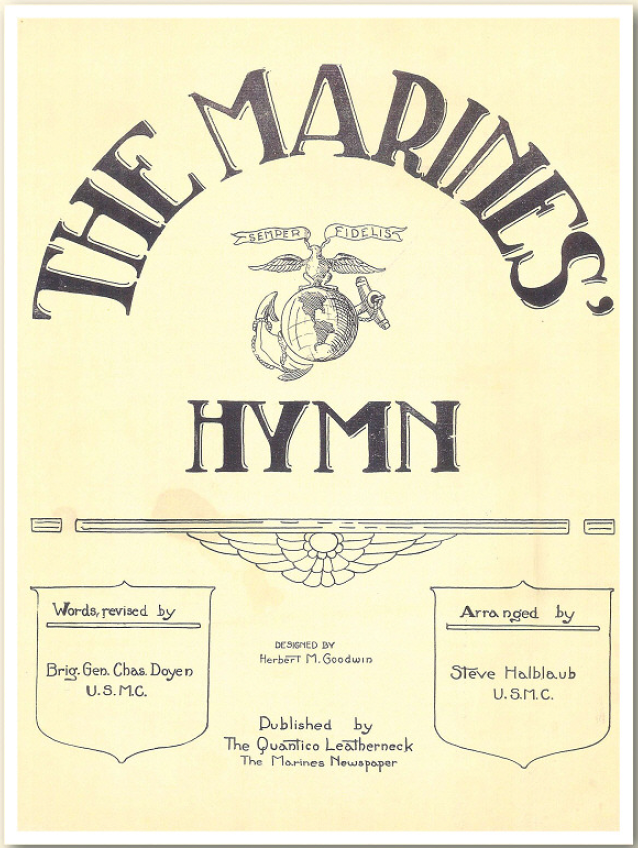
“From the pest hole of Cavite,
To the ditch at Panama;
You will find them very needy,
Of Marines-that’s what we are.
We’re the watch dogs of a pile of coal,
Or we dig a magazine;
Tho he lends a hand at every job,
Who would not be a Marine.”
Additional verse in the Ladies’ Home Journal
“As we raised our flag at Tripoli,
And again in Mexico;
So we took Chateau Thierry
And the forest of Belleau.
When we hurled the Hun back from the Marne,
He said we fought like fiends;
And the French rechristened Belleau Wood
For United States Marines.”
It is unclear who penned the second and third verses, as you can find them
attributed to a few names: Col Henry C. Davis, Brigadier General Charles Doyen and L. Z. Phillips. There have been numerous additional verses written and published at one time or another, and Wilson’s collection is an asset when it comes to tracking the evolution of the extra lyrics.
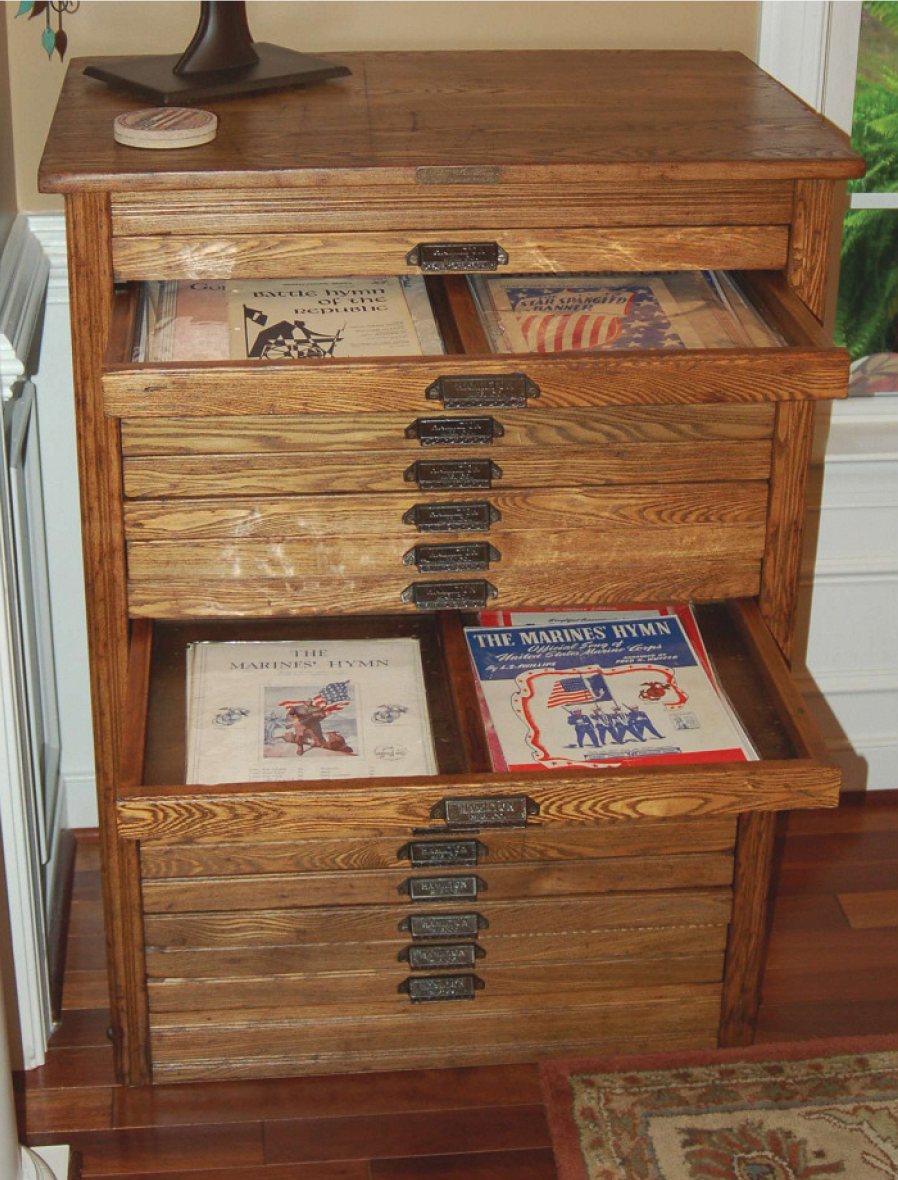
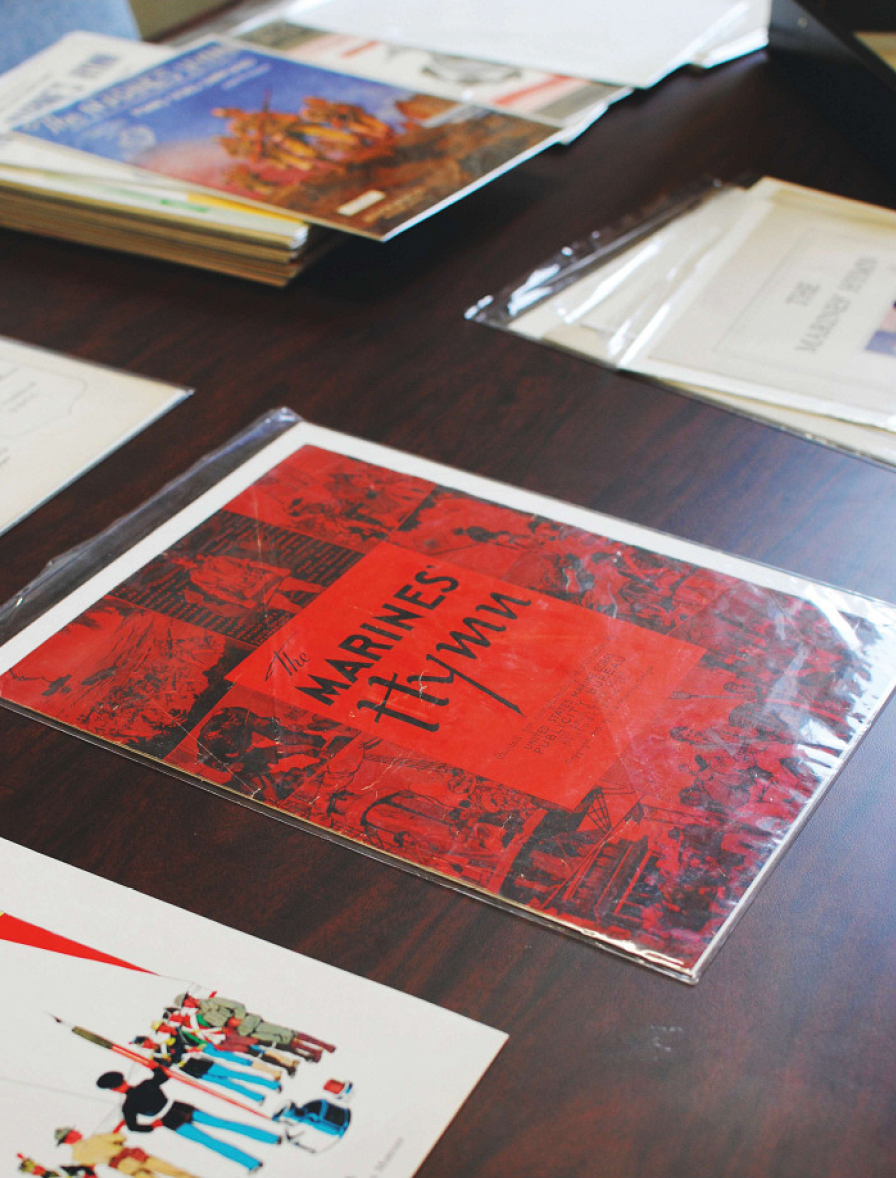
Regardless, in February 1929, Major General Commandant John A. Lejeune officially approved the version we know today as “The Marines’ Hymn.” Since then, the only change made to the lyrics occurred in 1942, when aviation units were given a nod in the fourth line of the hymn. The line officially was changed from “on the land as on the sea” to “in the air, on land, and sea.” The authorized title is “The Marines’ Hymn,” but it is often referred to as ”The Marine
Corps Hymn,” and has been errantly printed as ”The Marine’s Hymn,” “The Marine Hymn,” and “The Marine Corps Song,” according to Wilson.
While there may be a shortage of definitive history of the hymn, we do know that the first time the words and music were arranged together in print was Aug. 1, 1918. That version, although not copyrighted, was printed by the USMC Publicity Bureau and quickly picked up by other publications, such as the Boston Sunday Advertiser and the Ladies’ Home Journal, which even featured an additional verse. Leatherneck printed and distributed several versions of the hymn during the early 20th century, both in sheet-music form and as a booklet of lyrics with accompanying illustrations.
Interestingly, Wilson’s search for versions
of the hymn also turned up versions of the other military service songs. He was intrigued to find out that there is only one sheet-music version of the Air Force song, 14 or 15 of the Army’s “The Army Goes Rolling Along,” and a handful for the Navy’s “Anchors Aweigh.”
At 60 and counting, “The Marines’ Hymn” has an incredible lead in the number of sheet-music versions, which speaks volumes to its popularity throughout the ages.
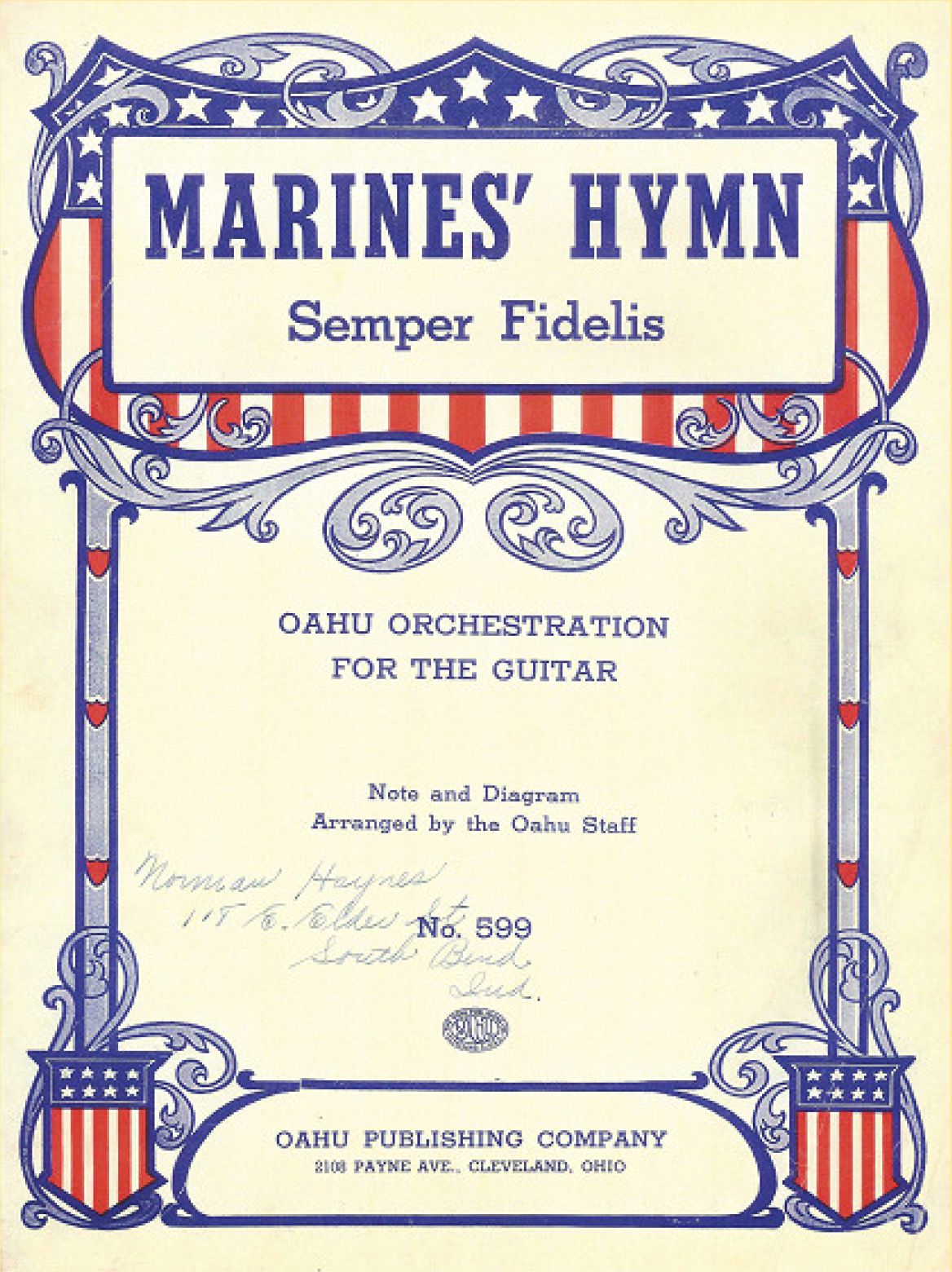
The channels through which individuals share and receive music have changed drastically since the early 20th century. In those days, said Wilson, people would bring the sheet music of new or favorite songs with them into their host’s home to share and enjoy together.
Official Lyrics
“From the Halls of Montezuma
To the shores of Tripoli;
We fight our country’s battles
In the air, on land, and sea;
First to fight for right and freedom
And to keep our honor clean;
We are proud to claim the title
Of United States Marine.
“Our flag’s unfurl’d to ev’ry breeze
From dawn to setting sun;
We have fought in ev’ry clime and place
Where we could take a gun;
In the snow of far-off Northern lands
And in sunny tropic scenes;
You will find us always on the job-
The
United States Marines.
“Here’s health to you and to our Corps
Which we are proud to serve;
In many a strife we’ve fought for life
And never lost our nerve;
If the Army and the Navy
Ever look on Heaven’s scenes;
They will find the streets are guarded
By United States Marines.”
Although sheet music is increasingly becoming a relic of the past, timeless tunes like “The Marines’ Hymn” will endure.
“The day of sheet music is over – everything is digital – while stereos and Bluetooth speakers have replaced the family piano. But ‘The Marines’ Hymn’ is as strong as ever, commanding the attention of every Marine, from active duty, veteran or retired,” said Wilson. “It defines who we are as Marines … it’s ingrained from day one to know the music.”