

Leathernecks in Overlord
By: Paul WestermeyerPosted on May 15, 2026
The World War II Allied landing in Normandy, France, known as Operation Overlord, is undoubtedly the most famous amphibious landing in American history, and soldiers seldom let Marines forget it was conducted by the United States Army rather than by America’s premier amphibious force: the Marine Corps. However, leathernecks did support Operation Overlord; Marines served aboard U.S. Navy cruisers and battleships as members of each ship’s complement, as observers with various Allied forces, and on the naval staffs which helped plan the invasion. Marines also served in the covert Allied teams put together by the British Special Operations Executive (SOE), the U.S. Office of Strategic Services (OSS) and the Free French Bureau Central de Renseignements et d’Action (the intelligence service) that sought to sow confusion and chaos be-hind German lines during the campaign. However, the largest contribution of the Marine Corps to the Normandy campaign was the American amphibious doctrine and training which enabled the campaign in the first place.
Amphibious Doctrine and Training
In the opening decades of the 20th century, the Marine Corps chose for its raison d’être the seizure and defense of advanced naval bases in support of fleet operations. Then the First World War illustrated, especially through the Dardanelles campaign of 1915, the great difficulties inherent in making an amphibious assault upon strongly held and fortified beaches. Nonetheless, after the war, the Corps persisted in examining how to best succeed at taking such beaches. In the immediate post-Great War period, Major Earl H. “Pete” Ellis, supported by Major General Commandant John A. Lejeune, produced a systemic approach to the problem of getting forces ashore against resistance for the Pacific with “Operation Plan 712, Advanced Base Operations in Micronesia.” The document looked at what would be required operationally for the Marine Corps to properly support War Plan Orange, the plan for a war against Japan should it be necessary.
Ellis’ operations plan was a step forward, but it was short on detail. What was needed was a doctrine that would convert the strategic and operational visions into a tactical plan for achieving a landing and sustainable bridgehead on a hostile, defended shore. In 1933, the Marine Corps turned seriously to confront this problem. Marine Corps schools’ classes were canceled, and the students and staff worked instead to produce the “Tentative Landing Operations Manual” published in 1935, which became the Navy’s “Fleet Training Publication 167” and which the Army copied for its own amphibious warfare training document, “FM #31-5, Landing Operations on a Hostile Shore”(June 2, 1941).
In a 1966 letter sent to Thomas Parsons, Major General Robert Bare, one of the Marines involved in planning Operation Overlord, remarked on the limited interest that the Army had expressed in amphibious operations prior to World War II: “At the beginning of World War II, the only two nations in the world with an amphibious doctrine were the United States and Japan. … [When] I was a student at the Army Command & General Staff School at Leavenworth in 1938-1939, the course in Amphib operations was about six hours, taught by a Coast Artillery lieutenant colonel who one day in exasperation at trying to explain landing schedules and boat diagrams, said, ‘If you really want to learn something about this get ahold of a good Marine Corps sergeant and have him explain it.’”
In addition to developing doctrine and manuals, the Corps’ extensive study of previous amphibious landings indicated that for a modern force, new assault craft were needed. Modern, mechanized military forces needed to deploy swiftly from ships during an amphibious assault in order to survive in the face of modern firepower. The 19th-century style boats that the world’s navies had previously used for ship to shore assaults were ill-suited for speedy debarkation. The Marine Corps pushed the Navy to begin testing new small craft for
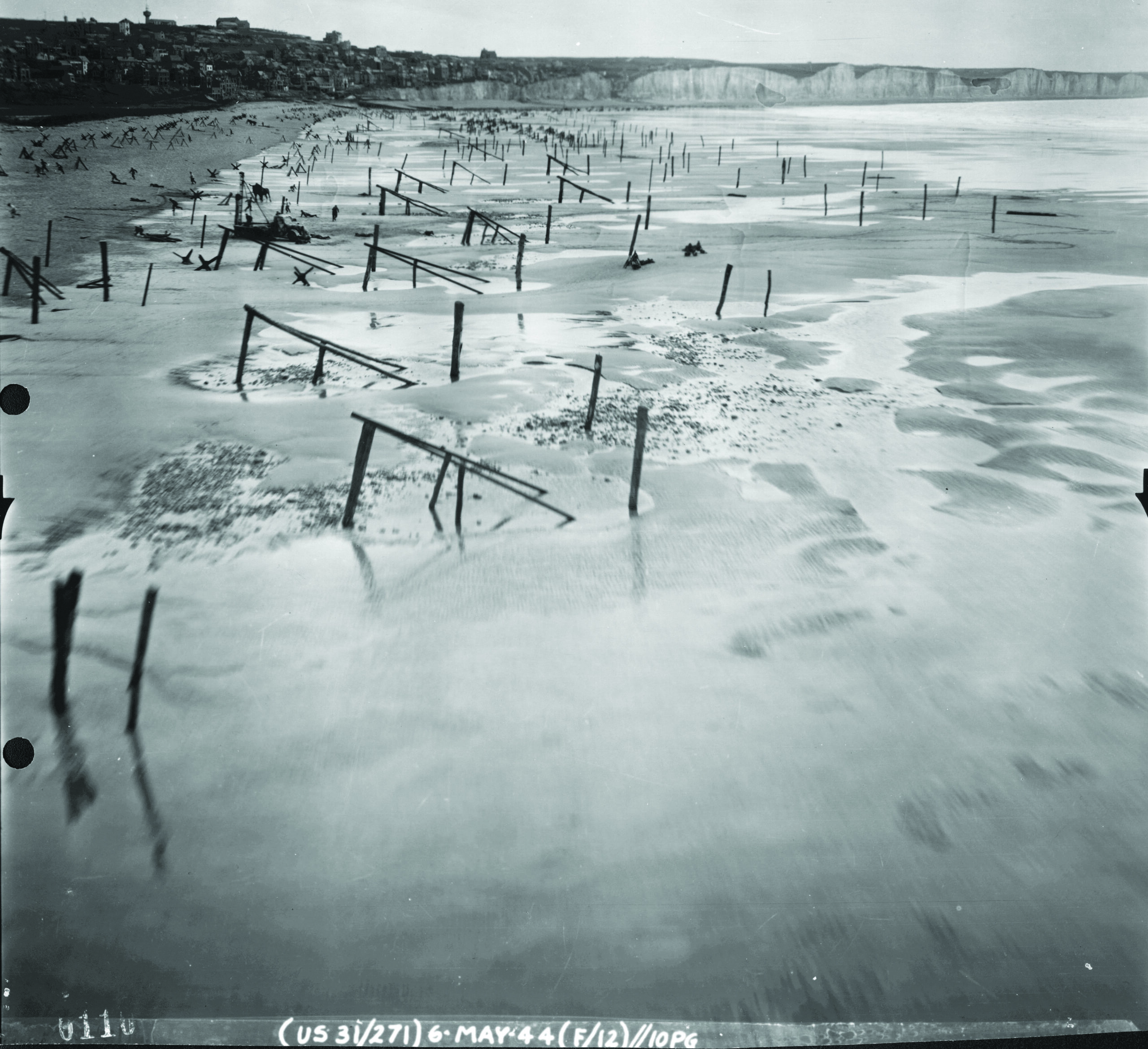
Beach defenses on Normandy, May 6, 1944. (Photo courtesy of USMC History Division)
landing operations in 1935, and this process led eventually to Andrew Higgins’ “Eureka” boat in 1940, though this boat was still awkward to disembark. Then, in April 1941, Marine Major Ernest E. Linsert shared with Higgins a series of photo-graphs taken by then-First Lieutenant Victor H. Krulak during a Japanese amphibious assault in Shanghai during 1937.
The pictures clearly illustrated Japanese landing boats with a bow ramp, a concept that Higgins was able to marry successfully to his Eureka boat design. The improvement resulted in the famous “Higgins Boat” Landing Craft Vehicle, Personnel (LCVP) that would become ubiquitous in all amphibious landings conducted by the Western allies during World War II. Similarly, Higgins produced the landing craft, mechanized (LCM), allowing for the rapid debarkation of heavy equipment on the beach as well.
Along with doctrine and equipment, troops had to train for amphibious assaults. In 1941, the First Joint Training Force was established under the Atlantic Fleet to train Army, Navy and Marine Corps units that would conduct amphibious assaults during World War II. Marine Major General Holland M. Smith commanded the force. The Army’s 1st Infantry Division, which would eventually land on Omaha Beach at Normandy, received its initial amphibious warfare training here.
The Army did take issue with certain aspects of Marine amphibious training, some of which stemmed from the differing purposes of amphibious landings. The Army saw an amphibious assault as merely the initial phase of a much longer, more extensive land campaign, whereas the Marine Corps was focused on seizing bases for continuing naval campaigns. Army doctrine therefore rejected the Navy and Marine Corps’ suggestions that the Army form lighter divisions devoted solely to amphibious warfare, choosing instead to provide amphibious training to regular troops. Beginning in 1942, the Army developed its own amphibious training centers that operated throughout the rest of the war.
Planning for Overlord
Colonel Robert O. Bare arrived in London in June 1943 and joined the Navy section of the staff of British Lieutenant General Sir Frederick E. Morgan. Morgan had recently, in the wake of the Casablanca Conference, been appointed Chief of Staff to the Supreme Allied Commander (COSSAC), although there was yet no Supreme Allied Commander appointed. Morgan’s appointment was intended, at least partially, as a sop to the Americans after the Casablanca Conference postponed the European landing until 1944. However, the COSSAC staff did much of the preliminary planning that was required for the actual Normandy campaign.
Along with Bare, the American portion of the staff included Navy Captain Gordon Huchins and five other Sailors. Bare was appointed staff officer, plans, whose duties included selecting training areas for the landing and naval gunfire exercises. Bare said in an interview, “It was fascinating work, since I was in on all the most secret dope, and had an opportunity to travel in seeking out training areas, and visiting various military commands and installations in working out the intricate combined plans.”
In October 1943 Bare participated in a COSSAC test run for the cross-channel invasion, “a fake invasion of the Pas da Calais” that involved “a lot of fighter aircraft up in the air and trying to draw those Germans out into a big air battle. So they set up a lot of dummy craft and a lot of real craft, and a naval officer and I were allowed to go down and board a British destroyer and we headed right straight for the Pas da Calais with this outfit that looked like a little good-sized invasion. And we went over within 10 miles of the coast, and we didn’t draw a single round of fire, there was no air action, and they found out through intelligence that the Germans had really thought this was something, but they flew two reconnaissance flights, one to the north and one to the South—they couldn’t see anything else so they went back home.”
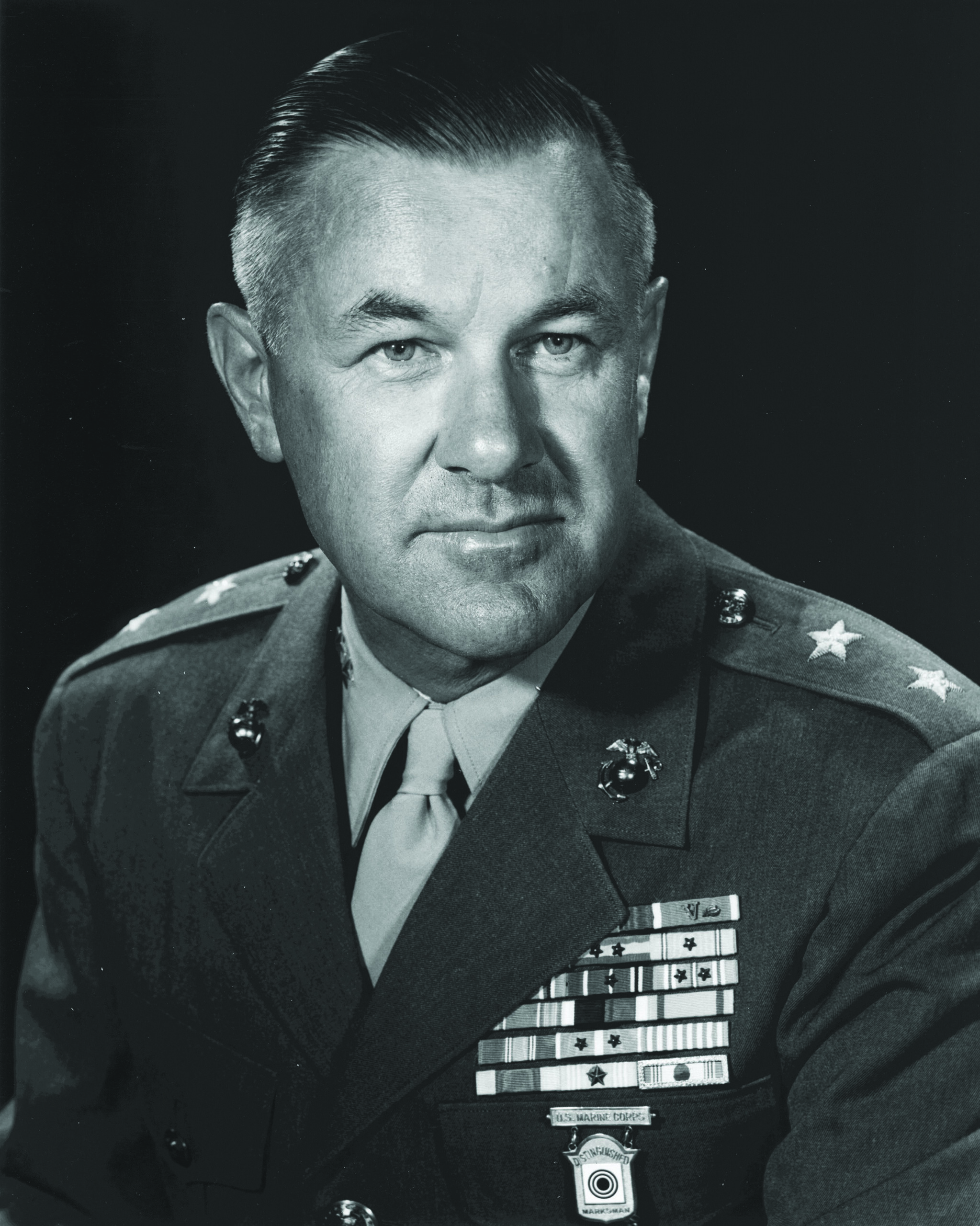
Several other Marines were involved in the planning for D-Day. Col Richard H. Jeschke had already seen a great deal of the war when he arrived in Britain to rejoin the staff of the Western Naval Task Force as assistant planning officer and joint operations officer. He previously commanded the 8th Marines defending Samoa and through the Battle of Guadalcanal, then transferred to the Mediterranean where he participated in the invasion of Sicily as a Force Marine operations and training officer. Colonel James E. Kerr served as the training officer, Landing Craft and Bases, 11th Amphibious Force, Europe, supervising the training of the personnel for landing craft and ships for the invasion through the planning and preparation for the landing. Col William T. Clement arrived in late 1942 and set up the intelligence section of Naval Forces, Europe, com-manded by Admiral Harold R. Stark. Major Louis H. King served as the assistant plans and operations officer for Commander Group 3, 8th Amphibious Force, according to Marine Corps History Division documents.
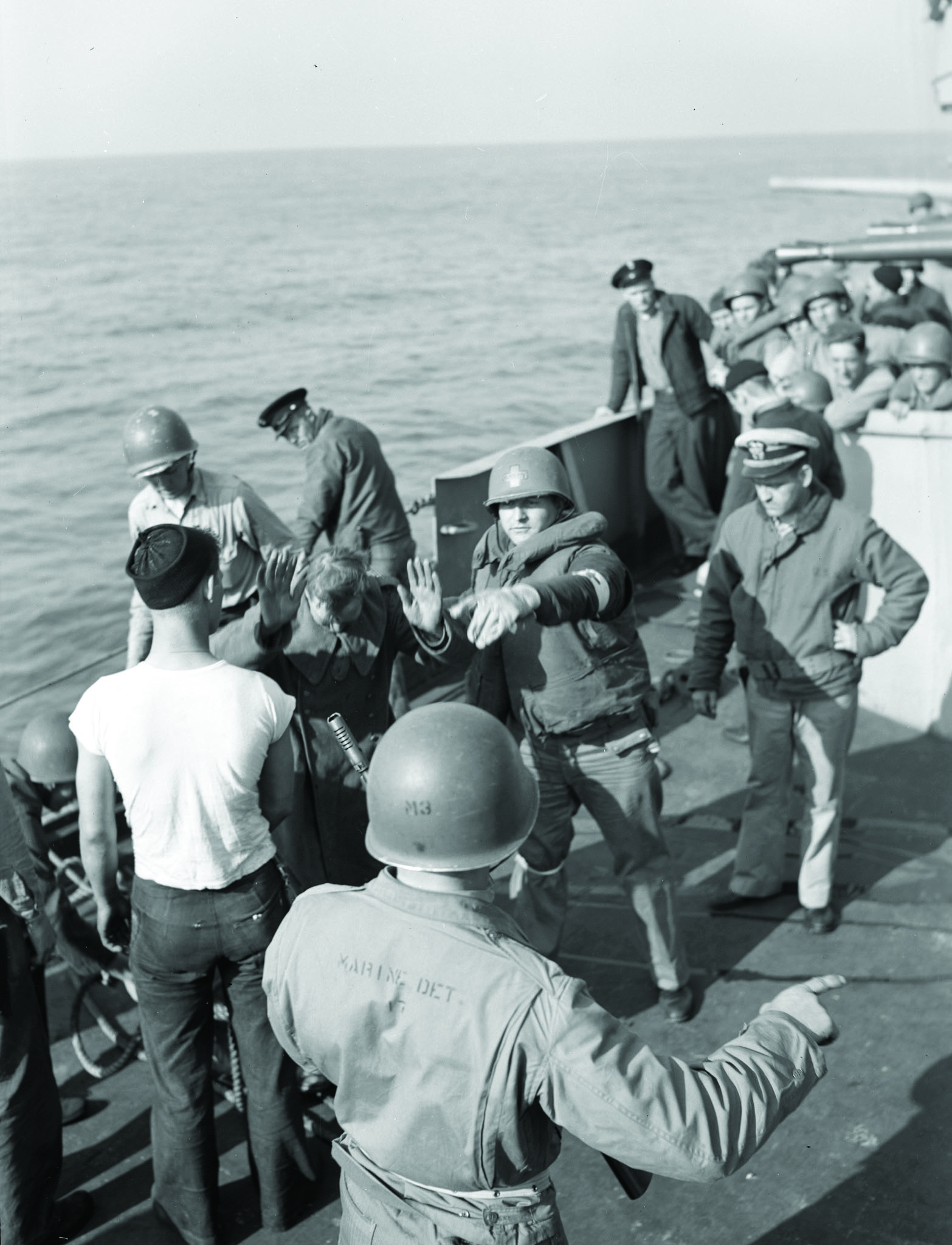
A Marine aboard USS Texas assists in processing prisoners of war off Pointe du Hoc, near Omaha Beach, 1944. (Courtesy of National Archives)
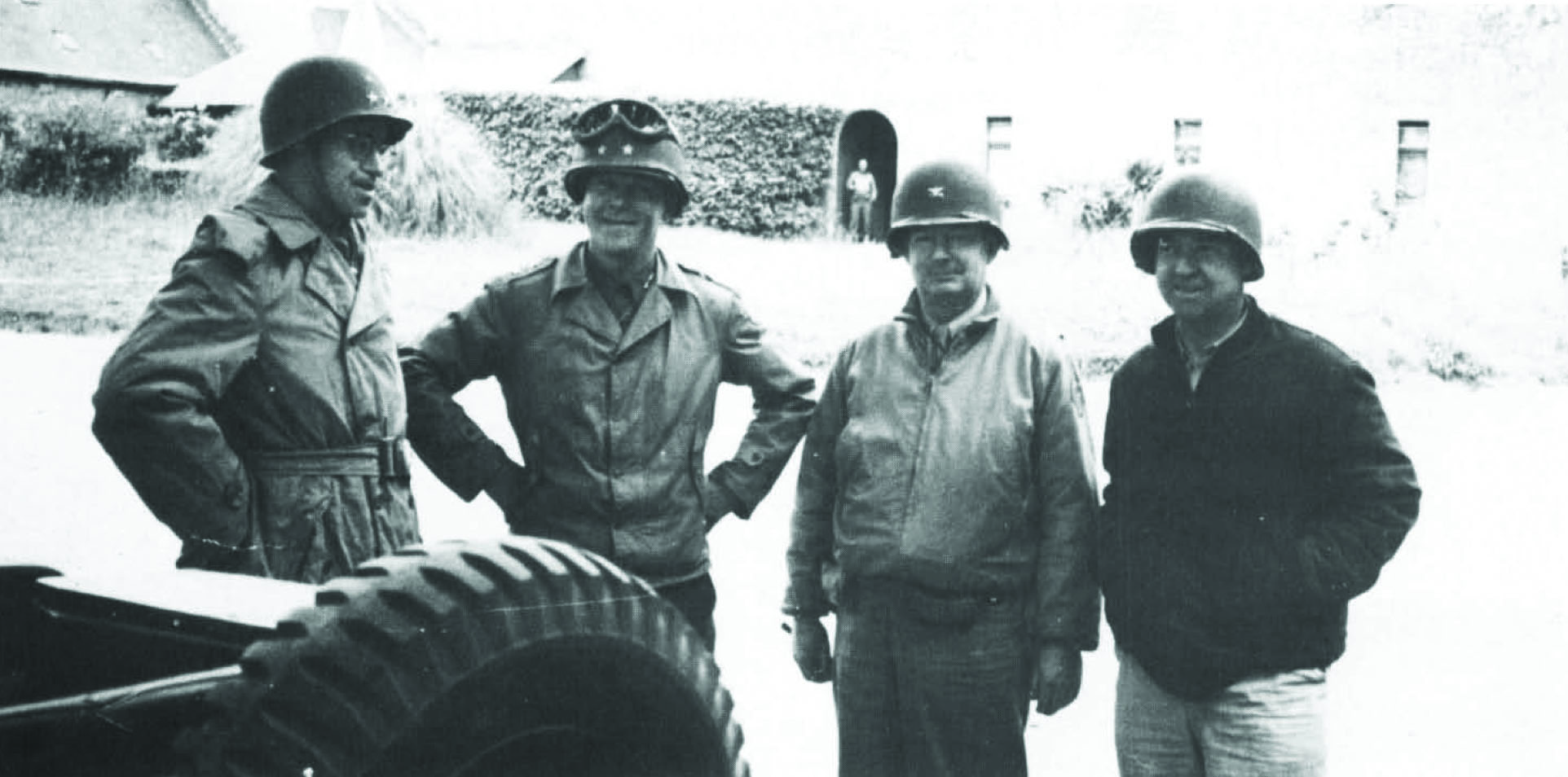
Serving as the Joint Operations Officer, Col Richard H. Jeschke, second from right, went ashore at Normandy with Army LTG Omar Bradley, left, and MajGen J. Lawton Collins to coordinate the push inland. (Courtesy of USMC History Division)
Preparing the Battlefield
Other Marines prepared the battlefield more directly for the Normandy campaign. They were members of the Office of Strategic Services (OSS), a young wartime organization that drew its members from civilian society as well as the Army, Navy and Marine Corps. It was intended as an intelligence and covert operations organization. The OSS began its European operations in 1942 with Operation Torch and had been cooperating with the various British agencies ever since, preparing for the cross-channel invasion.
In the months immediately preceding the invasion, the American OSS, the British Special Operations Executive and the Free French Bureau Central de Renseignements et d’Action put together teams to enter France and contact various groups of La Résistance, which comprised factions of disparate political views and motivations, not all of which were friendly to General Charles de Gaulle’s organization. The British and the French had been working withLa Résistance since 1940; now multinational teams went into France to prepare these groups for the shift from conducting sabotage and saving Allied pilots to enacting armed uprisings intended to hinder German movement and draw enemy forces away from the main fields of action. Several of these missions included Marines.
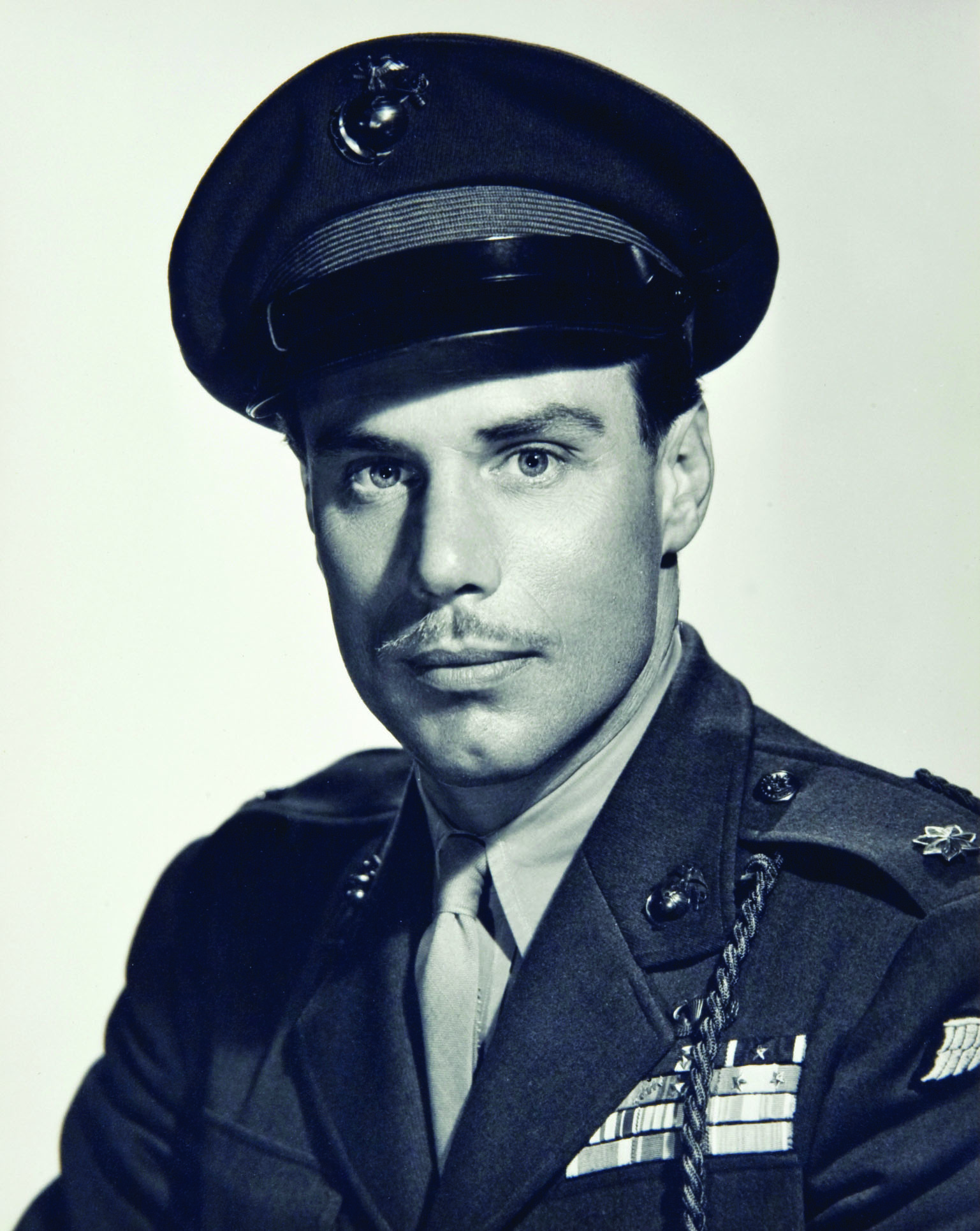
The first mission in support of the Normandy campaign that included Ma-rines was an inter-Allied mission des-ignated ‘Union’ and organized under the auspices of the special operations execu-tive RF section (the section responsible for activities in France). The team was led by Pierre Fourcaud, a French operative who had already been in and out of France multiple times, and contained an experienced British SOE agent, H. H. A. Thackwaite and an experienced French wireless operator, ‘Monnier.’ The team’s fourth member was Captain Peter J. Ortiz, a Marine who had been fighting the war since 1940. A full recounting of Ortiz’ remarkable career in World War II is beyond the scope of this article, but he had been a member of the Foreign Legion, captured by the Germans, escaped, and enlisted in the Corps in 1942. He was assigned to the OSS and deployed to North Africa during Operation Torch before coming to Britain to prepare for Operation Overlord.
The Union mission was tasked with infiltrating the Haute Savoie region of south-eastern France and evaluating the resistance there, impressing upon its leaders that “organization for guerrilla warfare activity, especially after D-Day, is now their more important duty.” The team parachuted into the region on Jan. 6, 1944, and began their mission. Unlike previous missions of this type, they brought along their uniforms to emphasize the military nature of the mission. SOE historian M.R.D. Foot later wrote that, “Ortiz, who knew not fear, did not hesitate to wear his U.S. Marine Captain’s uniform in town and country alike; this cheered the French but alerted the Germans, and the mission was constantly on the move.”
One, possibly apocryphal, story from this mission described how Ortiz “strolled into a cafe dressed in a long cape. Several Germans were drinking and cursing the maquis. One mentioned the fate which would befall the ‘filthy American swine’ when he was caught. This proved a great mistake. Captain Ortiz threw back the cape revealing his Marine uniform. In each hand he held a .45 automatic [pistol]. When the shooting stopped, there were fewer Nazis to plan his capture and Ortiz was gone into the night.”
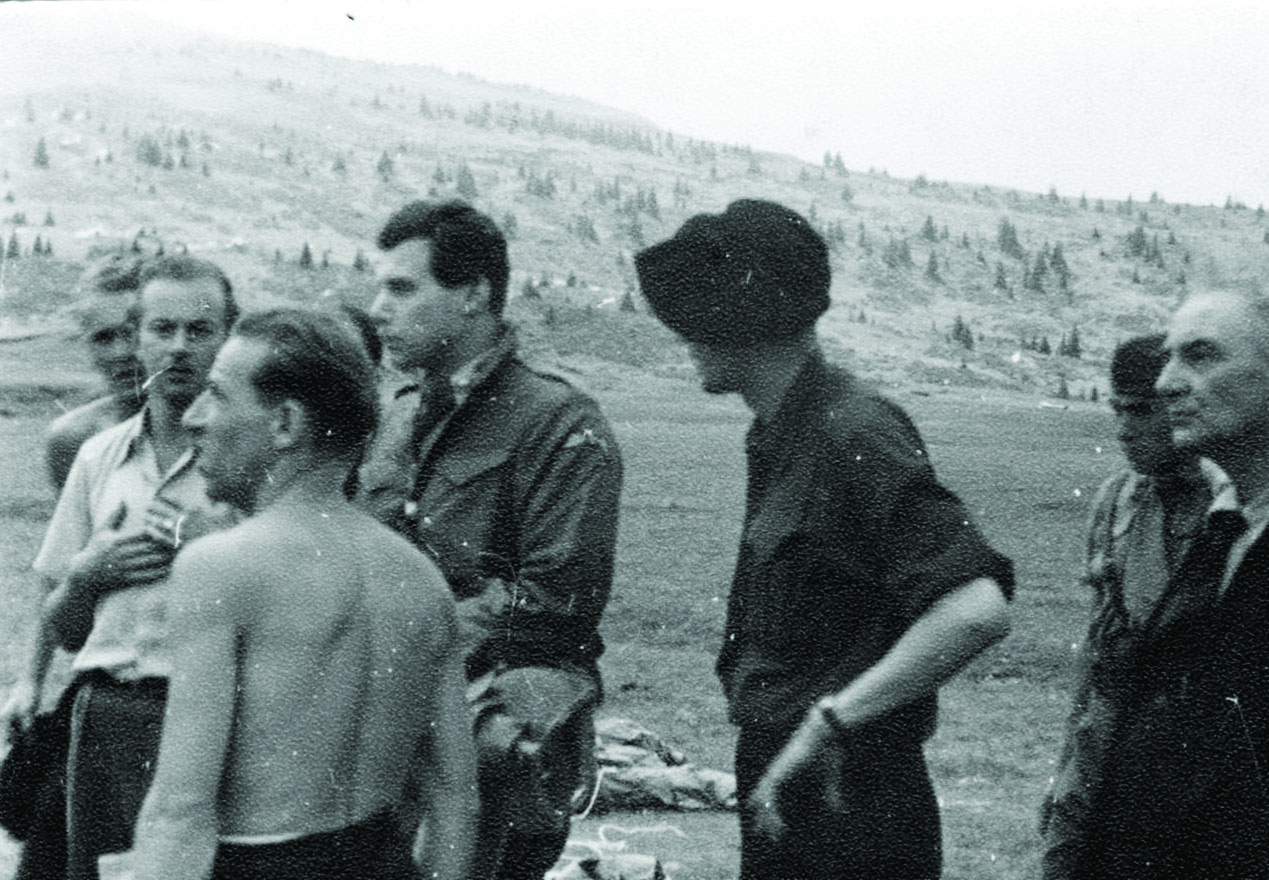
The members of the Union mission were very successful at organizing French guerrillas, especially on the Vercours plateau, which the Germans attempted to seal off with three battalions in February. Despite the German efforts, the Union members continued to organize the resistance fighters until May 1944, when they were withdrawn from the country. Ortiz received the first of his two Navy Crosses for this mission, the citation reading in part, “By his tact, resourcefulness and leadership, he was largely instrumental in affecting the acceptance of the mission by local resistance leaders, and also in organizing parachute operations for the delivery of arms, ammunition and equipment for use by the Maquis in his region. Although his identity had become known to the Gestapo with the resultant increase in personal hazard, he voluntarily conducted to the Spanish border four Royal Air Force officers who had been shot down in his region and later returned to resume his duties. Repeatedly leading successful raids during the period of this assignment, Major Ortiz inflicted heavy casualties on enemy forces greatly superior in number, with small losses to his own forces.”
Marines on and off the Beaches
On D-Day, hundreds of Marines were off the beaches, most of them serving aboard the Navy battleships and cruisers of the bombardment forces. The demands of the Fleet Marine Force, especially in the Pacific, had heavily reduced the size of the Marine ship detachments by this date. However, substantial numbers of Marines still served in the oldest role of the Marine Corps.
Marine Ship Detachments, Operation Overlord
Marines in ship detachments filled a variety of roles aboard ship; they performed a ceremonial function, especially on flagships, and acted as orderlies, guards and sentries. Additionally, particularly important for the Normandy invasion, they acted as gunners for the 5-inch, 40 mm and 20 mm ship’s guns. By 1944, there was a tendency to assign Marines to antiaircraft batteries (especially the 20 mm batteries), but on many ships Marines still manned the 5-inch secondary batteries. At Normandy, according to one uncorroborated source, “Marines in their capacity as expert riflemen, played a vital role reminiscent of the days of the sailing Navy when Marines in the ‘fighting top’ were a significant part of the ship’s offensive firepower. Stationed in the superstructures of the invasion fleet, Marine sharpshooters exploded floating mines in the ship’s paths.”
USS Arkansas (BB-33) supported the D-Day landings on Omaha beach alongside USS Texas (BB-35), suffering some return fire and air attacks over the next few days but endured no hits. On June 25, 1944, she shifted off of Cherbourg where she supported the Allied assault on the port. Shore battery fire straddled her several times off Cherbourg, but she was not hit. Captain Robert V. Allen commanded her Marine detachment and also served as commander of the Arkansas’ 20 mm antiaircraft battery, manned by the Marine detachment.
The USS Texas shelled Omaha Beach on D-Day, acting especially in support of the U.S. Army Rangers assaulting Pointe du Hoc. The USS Texas supported the landings for two more days, then retired to Plymouth to replenish ammunition before returning to support the Allied forces fighting their way out of the beachhead. On June 25, 1944, she joined USS Arkansas in the naval bombardment of Cherbourg; she was less fortunate than Arkansas, however, as a German shore battery struck her twice with 9.2-inch shells. One was a dud; it failed to explode and was later removed safely from the ship. However, the other struck the conning tower, severely damaging the bridge where it killed the helmsman and wounded 11 other Sailors. Capt Allen A. Bernard commanded Texas’ Marine detachment, which also manned some of her gun batteries. First Lieutenant Weldon B. James from public relations, Marine Detachment, U.S. Naval Forces in Europe, observed the landings from USS Texas.
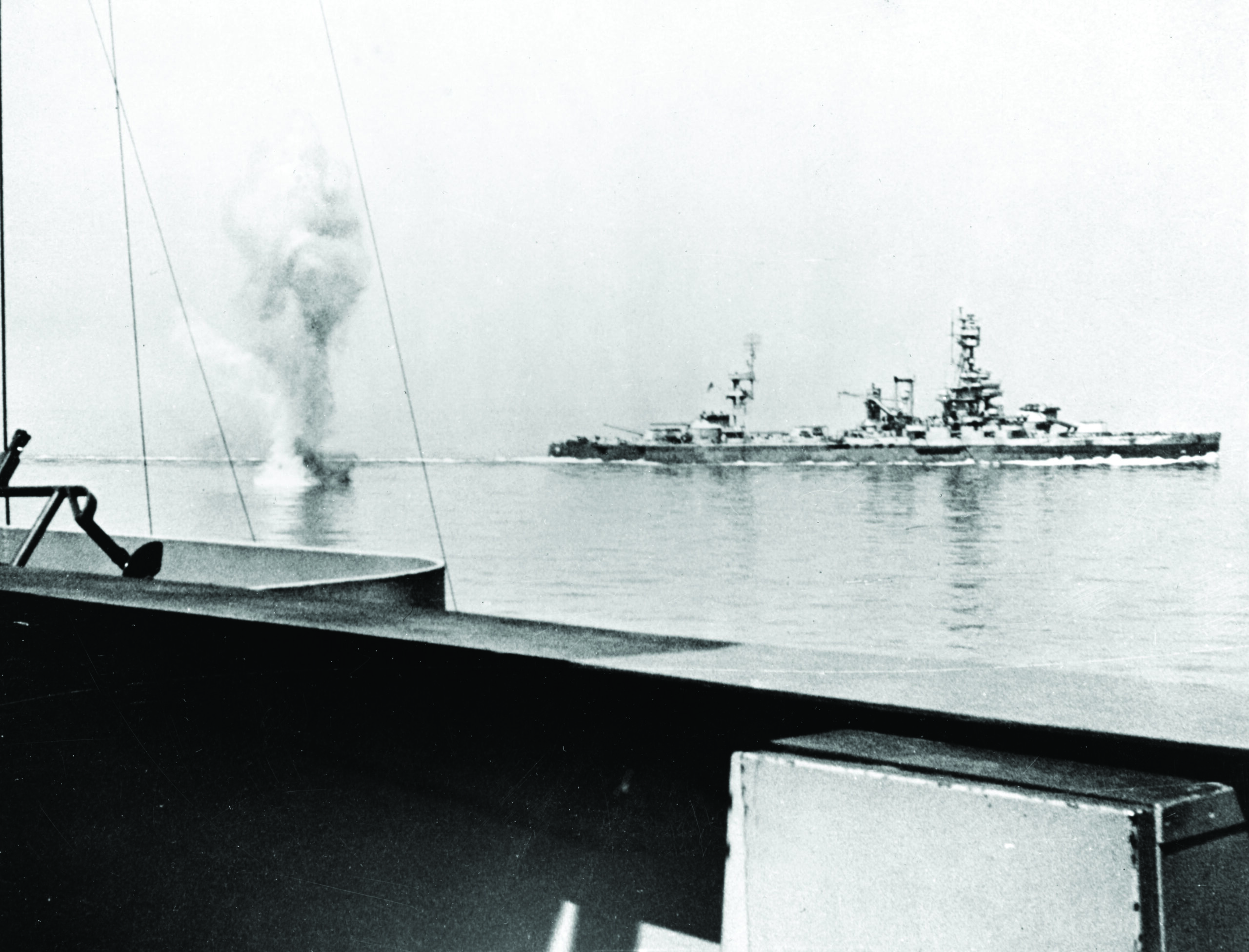
USS Nevada (BB-36) provided naval gunfire support to the forces landing at Normandy. Sunk by the Japanese during the Pearl Harbor attack, the ship was later salvaged, modernized, and returned to service. On June 8, she fired 70 shells from her main battery upon an estimated 110 German vehicles and tanks concentrated at a range of 23,500 yards and reportedly damaged or destroyed all of them. Like the other American battleships, she participated in the naval bombardment of Cherbourg on June 25. German shore battery fire came close to the vessel 20 times, but she was never hit. Her Marine detachment was commanded by Captain Alexander W. Chilton. The officers and Marines of the detachment operated the 20 mm antiaircraft batteries.
The heavy cruiser USS Augusta (CA-31) served as the flagship of Rear Admiral Alan G. Kirk, USN, Commander Western Naval Task Force, during the Normandy invasion and carried Lieutenant General Omar N. Bradley, Commanding General, U.S. First Army, to the invasion. Bradley and his staff went ashore on June 10 to establish their headquarters in Normandy. Captain Francis P. Schlesinger commanded Augusta’s Marine detachment, who manned the cruiser’s antiaircraft battery.
USS Quincy (CA-71) was a new ship, and Operation Overlord was her first combat operation. She provided gunfire support to the troops on Utah beach, firing hundreds of shells over several days against German troop concentrations and shore batteries. The vessel then participated in the naval bombardment of Cherbourg, where she endured close misses from Battery Hamburg’s 11-inch guns. Capt Wesley R. Christie commanded her Marine detachment.
Like the other cruisers and battleships at Normandy, USS Tuscaloosa (CA-37) supported the landing forces at Normandy and participated in the bombardment of Cherbourg. She was known as a lucky ship that escaped fierce battles unharmed, despite sailing through war zones from 1939 onward. Capt Kenneth C. Greenough commanded her Marine detachment, which serviced her AA battery as well as some of her 5-inch guns. According to Marine Corps History Division’s records, the single Marine casualty of D-Day was aboard Tuscaloosa: Private First Class Norman O. Violette, a 5-inch gun striker, whose gun fired so many rounds on D-Day that he suffered deafness and a concussion.
In addition to the Marine detachments fighting from Navy ships, several Marine observers were present during the invasion. Prior to the Normandy landings, the Commandant of the Marine Corps, Lieutenant General Alexander A. Vandegrift, ordered two of the Marines on the planning staffs—Colonels Bare and Kerr—to accompany the invasion and observe operations and note lessons that could be incorporated into Marine operations. In addition, combat correspondent Capt Herbert C. Merillat reported on the landings with the Royal Marines and Col Jeshke, the Joint Operations officer of Task Force 122 and the 1st U.S. Army, took a small staff ashore as he performed his duties.
At Utah beach, Colonel Kerr observed the landings and served on the staff of Rear Admiral Don P. Moon, commander of “U” Force. Late in the morning of June 6 there was a delay in landing forces on Utah and RADM Moon ordered Col Kerr towards shore in a patrol craft (PC-484)

Landing craft protected by destroyers heading to beach off the coast of France on D-Day. (Courtesy of National Archives)
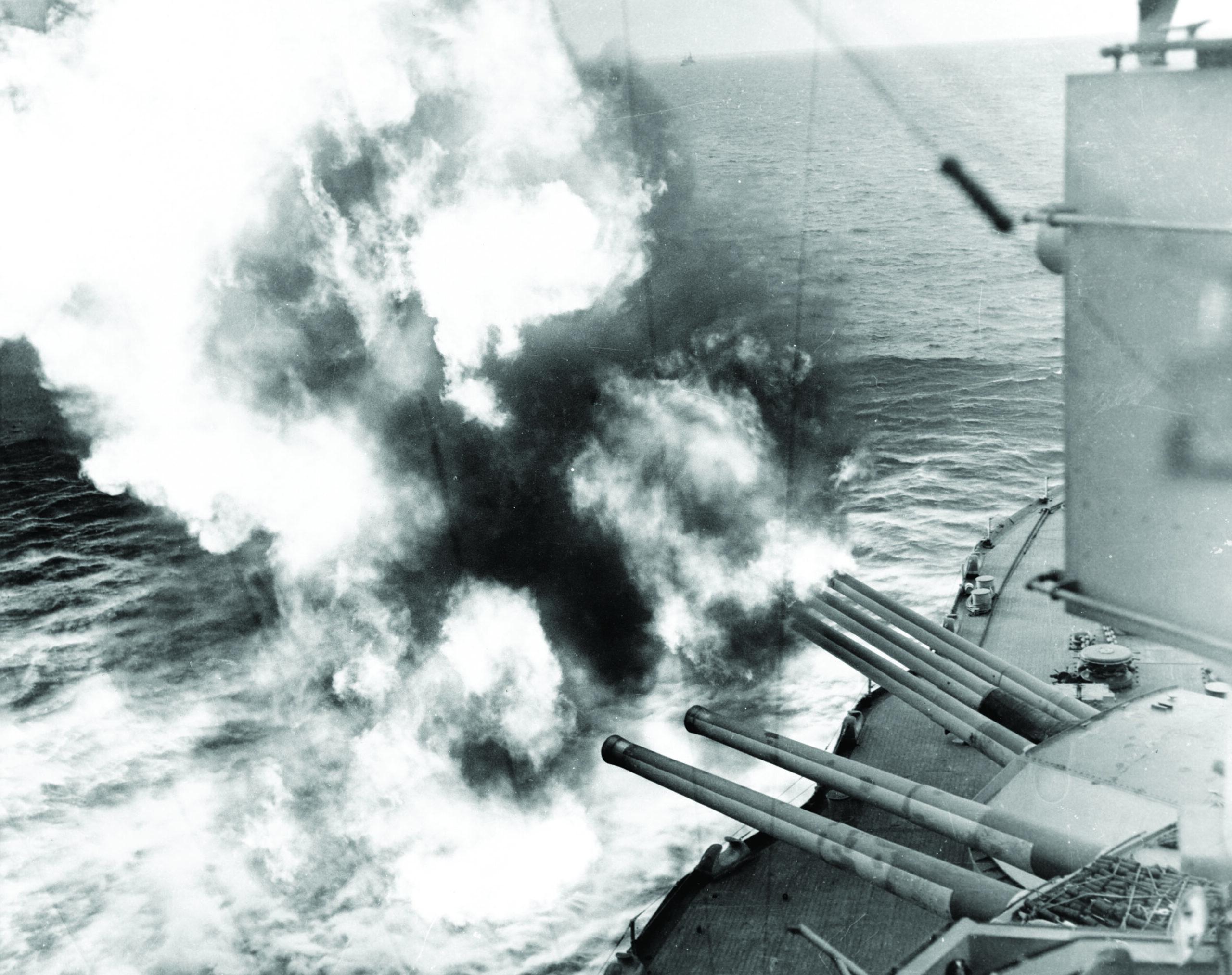
Forward guns of USS Nevada (BB-36) fire on positions ashore during the landings on Utah Beach, June 6, 1944. (Courtesy of National Archives)
to investigate the delay and take control of the landing craft traffic. Kerr soon reported that, “Landings can be made anywhere on Red Beach … obstacles no longer obstacles.” As a result of his intelligence gathering, landing craft waiting to go to Green Beach were diverted and the landing delays decreased.
Kerr gave a bit more description in his diary concerning conditions on Utah beach over the next few days as he continued to aid in the landing of troops. On D-Day he remarked, “Shelling on Red Beach was intermittent all day long, reaching a climax around 1700.” He added that “German artillery was without observation, maybe as many as 90% of their shells fell between the craft and the sea wall.” And “men on beaches hugged seawall so shells did not harm them … work was carried on between bursts and lulls.” On D+1, Kerr reported that he “landed on beach. So no beached LCVTs as all had gotten off with tide.” Kerr continued sorting out the chaos off the beach, getting men and equipment ashore and the wounded evacuated. Remarkably, on D+2, at 2100, he recounted that an officer from the beach reported more than 1,000 prisoners taken, including two Japanese. On D+4, he took a break from shuttling around the waters off the beach and took a jeep from Utah beach to St. Mere Eglise, evaluating the roads for traffic from the beaches. Kerr continued to work at unscrambling the Utah beach unloading area through D+6, according to Kerr’s war diary.
As is well known, Omaha beach was a difficult fight and for a few hours, the outcome was in doubt. On this beach, Colonel Jeshke led a small team of Marines on the staff of Task Force 122 and the 1st U.S. Army, where he served as the Joint Operations officer. Alongside Jeshke were Staff Sergeant Edward F. McKnew, Jr., Corporals John B. Flowers and Louis R. Grall, and Privates First Class Robert C. Hunter, William C. Parsons and Benjamin J. Williams. Marine Corps History Division records show that from June 6 through June 30, these Marines acted as orderlies, battle phone recorders and situation map updaters, making numerous trips ashore during the amphibious assault.
Jeshke made “15 trips ashore to ascertain actual position of army front lines.” Afterwards, he told reporters that “shell and mortar fire on D-Day at Normandy was little short of terrific,” but that his own “moments of greatest anxiety came during the [Japanese] naval gun shelling of Marine positions on Guadalcanal.” He added that fighting in Europe was more comfortable than in the Pacific, as Europe had “fine roads, big buildings and civilization.” He admitted that roads were not “the healthiest places to travel along, particularly with mines and lines of fire” but insisted that “any kind of road is preferable to pathless jungle.” According to a press release issued on Oct. 26, 1944, Col Jeshke was awarded the Legion of Merit for his efforts in the Normandy campaign, and the French government presented him with the Croix de Guerre.
Two Marine officers observed the landings on the British beaches. Capt Herbert C. Merillat, a combat correspondent who had previously served on Guadalcanal was accompanied by two other Marine journalists, Technical Sergeant Richard T. Wright and combat photographer Staff Sergeant James R. Kilpatrick. They went to Normandy with the Royal Marines in a landing craft, guns, large (LCG), a tank landing craft converted into floating artillery platforms in order to engage German pillboxes and bunkers. They were crewed by Sailors and the guns manned by Royal Marines, and the Marine correspondents were off Juno beach, where the Canadian forces were landing. Comparing Normandy with Guadalcanal, Merillat was impressed with the number and variety of craft employed in the much more massive Normandy operation. German return fire in the early morning damaged some of the LCGs, TSgt Wright pitched in, firing “twin Oerlikon guns” at beach targets. Merillat’s closest call came that night, as the LCGs stood sentry against possible German schnellboote attacks when a Junkers Ju 88 attacked the flotilla and was shot down. Merillat’s vessel was forced to drive through the wreckage. Reflecting 50 years later, Merillat stated that, “We could not claim to have contributed much if anything to the victory, but we were pleased that we had been able to witness at close quarters one of the greatest battles in history.”
Col Bare was the other Marine officer observing the British landings, on board the Llangibby Castle, a veteran British troop ship. Bare landed with the 3rd Canadian Division and spent 10 days in Normandy observing British operations. He recalled in an interview that the trip over was uneventful, “I can remember seeing a mine go floating by the side of our vessel—it looked about the size of the Lincoln Memorial. It was terribly rough—rougher than they liked—and I think that was one of the reasons that the Germans were somewhat surprised. They were basically a land animal, and they couldn’t see a big invasion taking off in weather like that.” But General Bernard Montgomery’s hostility to observers following the troops forced Col Bare to remain within about a mile of the beach. After 10 days, Bare departed Normandy and returned to the United States via Great Britain, where he reported to the Commandant on the landings before heading to the Pacific.
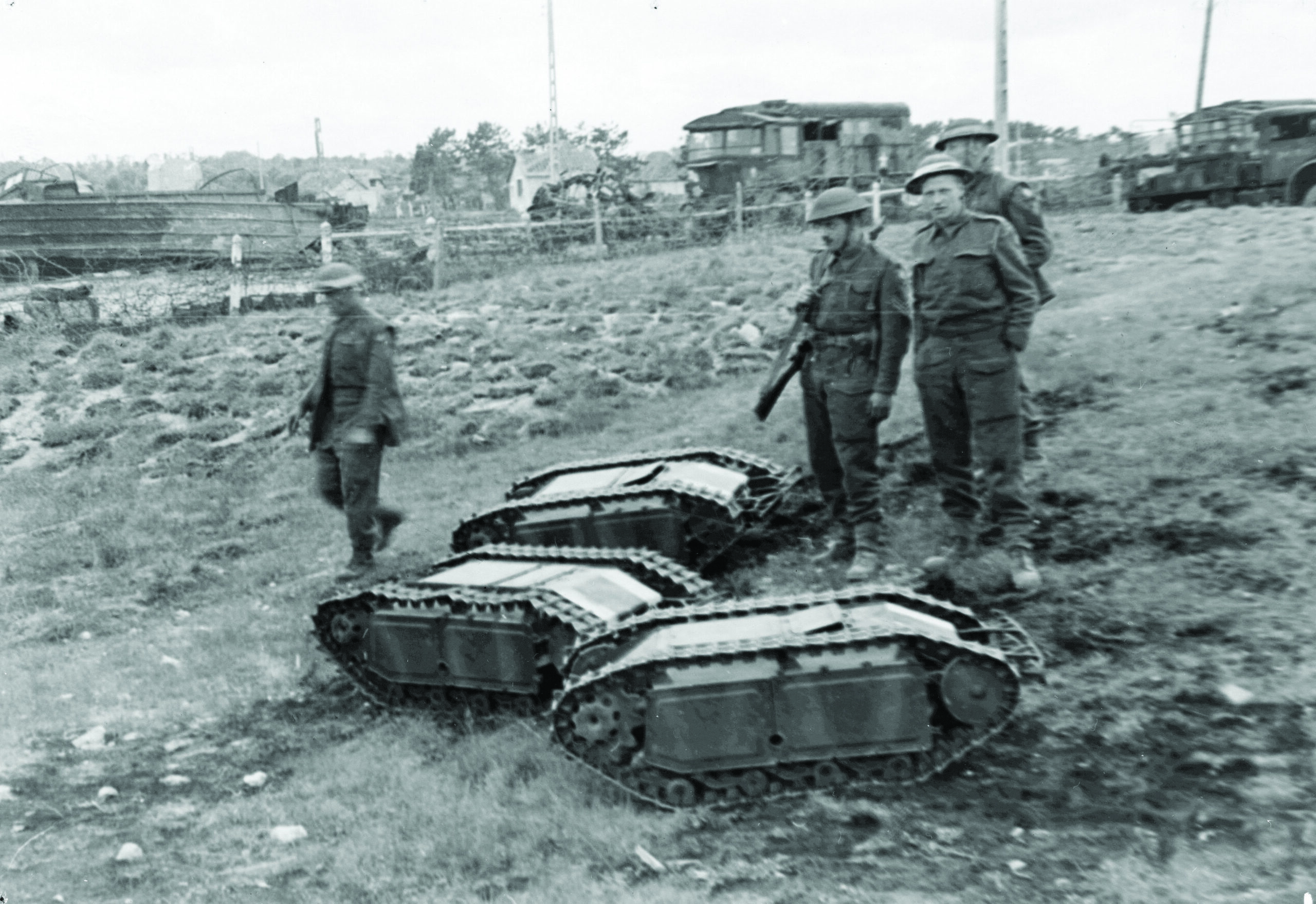
Remote controlled German Doodle Bug tanks, filled with explosives, served as a beach defense. (Courtesy of USMC History Division)
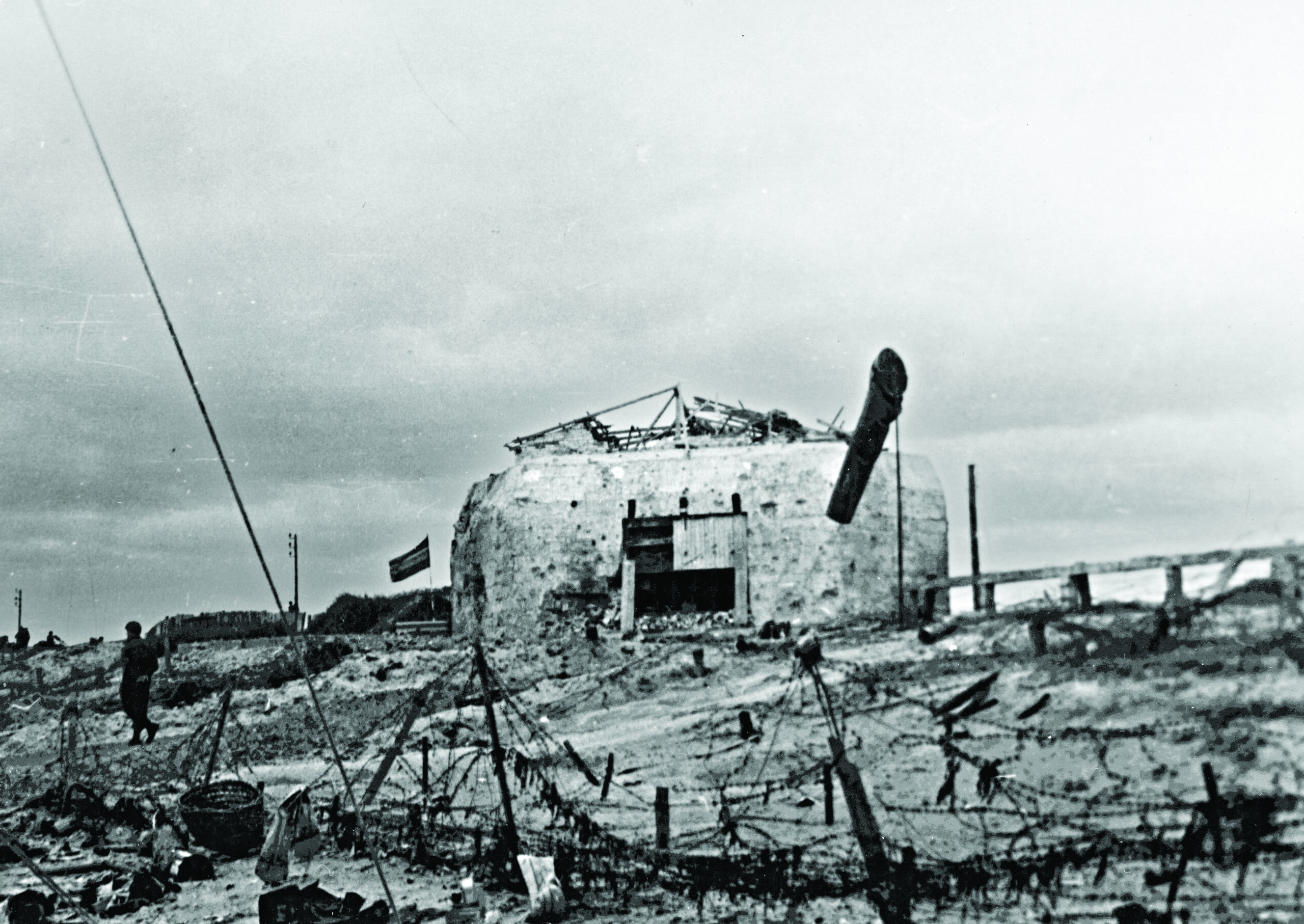
German blockhouse, Bernier Sur Mer, France, June 1944. (Courtesy of USMC History Division)
Supporting the Campaign
The landings at Normandy were only the start of the campaign, however. Operations behind the lines elsewhere in France now began in earnest as La Résistance forces increased their work of sabotage and guerilla warfare against German forces throughout France. The Allies that supported these efforts were the famous Jedburgh Teams, or combined allied military teams of American, British and French officers, who were sent to aid local forces. One of these was Jedburgh Team Buggati, commanded by Marine Maj Horace W. Fuller. His fellow ‘Jeds’ were French Army Captain Guy de la Roche, British Major Hiram Crosby and French Lieutenant Marcel Guillemont. On June 28, this team parachuted into the Hautes-Pyrenees region of occupied France and began organizing and leading local groups in sabotage, terrorist and guerilla actions against a wide variety of enemy targets throughout the region. Before their mission formally ended on Sept. 15, Fuller’s force liberated several towns, captured hundreds of German prisoners and rendered an oil refinery useless without destroying its equipment by cutting off its water supply, according to the book “Herringbone Cloak: GI Dagger Marines of the OSS.” Fuller himself was awarded the Silver Star for the mission.
The other mission was less successful, though no less dramatic. Despite only leaving France in May, Capt Ortiz was eager to return to the Haute Savoie region and aid the guerillas he had left behind there. He was placed in command of another inter-allied mission, Union II, which included Army Air Corps Captain John Coolidge and five more Marines: Gunnery Sergeant Robert La Salle, and Sergeants Charles Perry, John Bodnar, Fred Brunner and Jack Risler. Also along was a Free French officer, Joseph Arcelin.
Unlike the previous Union mission, Union II was intended as a heavily armed Operational Group and dropped with over 800 supply containers which the local resistance battalion gathered up during the landing. Unfortunately, luck was against the mission from the start when they jumped in the country on Aug. 1, 1944. Sergeant Perry’s parachute failed and he died in the landing zone. Gunnery Sergeant Robert La Salle wrenched his back on landing and was barely mobile. After a week spent training the local forces, Ortiz ordered patrols to find more local forces, but they began encountering strong German security forces. On Aug. 16, at the town of Centron, a German battalion attacked Ortiz, Arecelin, Risler and Bodnar, surrounding the town. After a fierce firefight, Ortiz and his men surrendered to spare the town. The Germans were astounded to discover there had only been four men. Ortiz and his men went into captivity and were eventually sent on to a prisoner of war camp in Germany.
Conclusion
The Marine Corps’ participation in Operation Overlord and its associated campaigns was small in terms of manpower. Fewer than 500 Marines participated, but the development of amphibious warfare doctrine and techniques during the interwar period and the creation of the initial training programs for amphibious landings were major contributions to the eventual Allied victory. Undoubtedly, many of the Marines present during the landings felt frustratingly like war tourists, but they took lessons from the landings with them to the Pacific. And the Marines serving aboard the Navy’s battlewagons fulfilled the Corps’ oldest function as soldiers of the sea, sharing as much as any Sailor in the success of the amphibious campaign.
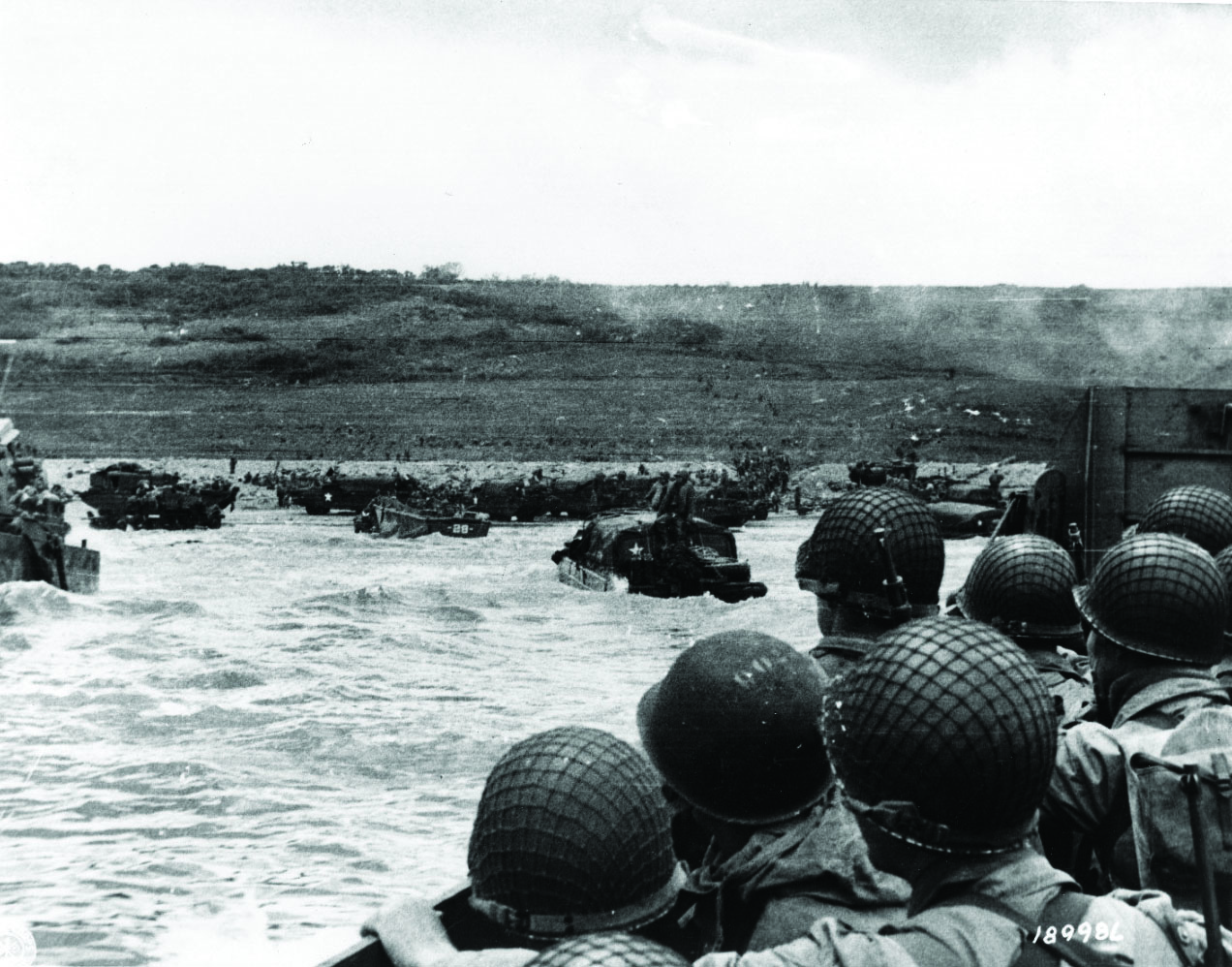
Featured Photo (Top): Soldiers land in LCVPs using Marine-developed amphibious doctrine. Offshore, leatherneck gun crews aboard the USS Texas (BB-35) and USS Arkansas (BB-33)provide cover fire for the troops arriving on Omaha beach. (Photo courtesy of National Archives)
About the Author
Paul Westermeyer is a historian with the histories branch of the Marine Corps History Division.
Enjoy this article?
Check out these similar Leatherneck and Scuttlebutt features:

A Proven Trac Record: AAV Retired After 50 Years Of Service
Leatherneck
January 2026
By: Kater Miller

Nicaragua 1928: The Rio Coco Patrol
Leatherneck
June 2025
By: Maj Allan C. Bevilacqua, USMC (Ret)

World War II: 70 Years Ago, December 1941
Leatherneck
December 2011
By: Eric Hammel