

A Symbol of Strength, Patriotism: Marines at 1926 Sesquicentennial
By: LtCol Brad Anderson, USMC (Ret) and Katie CashwellPosted on June 15, 2026
Marines are well known for our near-religious commitment to understanding our Corps’ history and for personifying our commitment to our roots. We wear that heritage on our uniforms, but more importantly, we feel it in our hearts. We bear that solemn lineage in our spirits. We live by the mantra, “Once a Marine, always a Marine.” When we step into any store, bar or social gathering anywhere across the country and see a patron wearing a cap, T-shirt or hoodie adorned with the Eagle, Globe and Anchor, there is an instant bond, bridging generations in a way that only those who have endured the crucible of Marine Corps entry-level training truly understand.
This year, we celebrate our nation’s 250th birthday. What began as the “American Experiment” was a revolutionary idea first tested in 1776: that ordinary citizens could govern themselves under a written Constitution that placed limits on government power, protected personal freedoms and derived all authority from “We the People.” The idea was dubbed an experiment because no large nation in history had ever attempted such a novel idea before, and there were doubts that the young republic would succeed.
For a quarter millennium, we have successfully navigated the American experiment and will pay homage to those who have protected our way of life. Through 12 major wars and countless smaller conflicts, Marines have paid the ultimate price. Best estimates from Congressional records reveal that more than 46,000 Marines have laid down their lives.
Celebrations across the country this July will honor the survival of our constitutional republic. Through parades, ceremonies and special events in and around the nation’s capital, this is expected to be the largest celebration of its kind in American history.
Continuing a proud tradition from past national celebrations, Marines will once again be called upon to represent generations of predecessors by supporting ceremonies and events for America’s semiquincentennial on July 4, 2026. Those stationed in “every clime and place” at embassies, at sea or on forward operating bases the world over will pause, take a knee, herringbone outward and reflect upon our nation’s beginnings. They will be reminded of the heavy cost their ancestral brothers and sisters paid to preserve this beloved experiment—exactly what they’re actively risking today. Today, we stand in gratitude for their service and for the monumental sacrifices of those who walked this path before them.
We endeavor to never sully the reputation or the legacy of those who have gone before. Because of that, Marines truly are a special breed.
As the Special Purpose Marine Air-Ground Task Force 250 mobilizes for events, we look back 100 years ago, when the Marines supporting the 1926 sesquicentennial faced a struggling exposition with challenges beyond their control. They adapted to overcome every obstacle and even earned official awards for their efforts—but more importantly, they set a powerful, resilient example that will guide the Corps for generations to come.

The Sesquicentennial Exposition
In 1926, Marines were heavily engaged in the Banana Wars in Haiti and Nicaragua while others protected American interests in China during the Northern Expedition. Despite no declared war, the Corps was stretched thin across the globe.
Faced with these demands, Marine Corps leaders intensified recruitment efforts. To replenish the ranks, they seized every opportunity to showcase their prowess to the American public. In November 1925, they had already generated strong support for new enlistments by hosting some of the first formal Marine Corps Birthday celebrations in Philadelphia, Pa. The Marines were once again called upon to proudly represent the nation, alongside the Army, Navy and other federal departments, at the Sesquicentennial International Exposition.
The idea for the exposition began in 1916 with merchant John Wanamaker, who envisioned Philadelphia again hosting an international gathering like it had for the 1876 Centennial Exposition. Delayed by World War I, planning resumed in 1921. On March 19, 1925, President Calvin Coolidge declared the sesqui “for the purpose of exhibiting the progress of the United States and other nations in art, science and industry, and trade and commerce, and the developments of products of the air, the soil, the mine, the forest and the seas.” He then formally invited international participation to promote peace and international unity after the Great War.
America had grown weary of war and had emerged from WW I as the preeminent Industrial Age power. Under what we now know as the “New World Order,” the League of Nations had been established to cultivate that peace and unity. So, in February 1926, Congress gave formal approval and appropriated funds to “demonstrate the nature of our institutions and their adaptation to the wants of the people and the progress of our people in the advancement of peace, arts, and industries,” according to the Congressional Committee on Industrial Arts and Expositions. The fair opened on June 1, 1926, on a 450-acre site at League Island Park along the Delaware River. Promotional materials proudly declared “America Welcomes the World.”
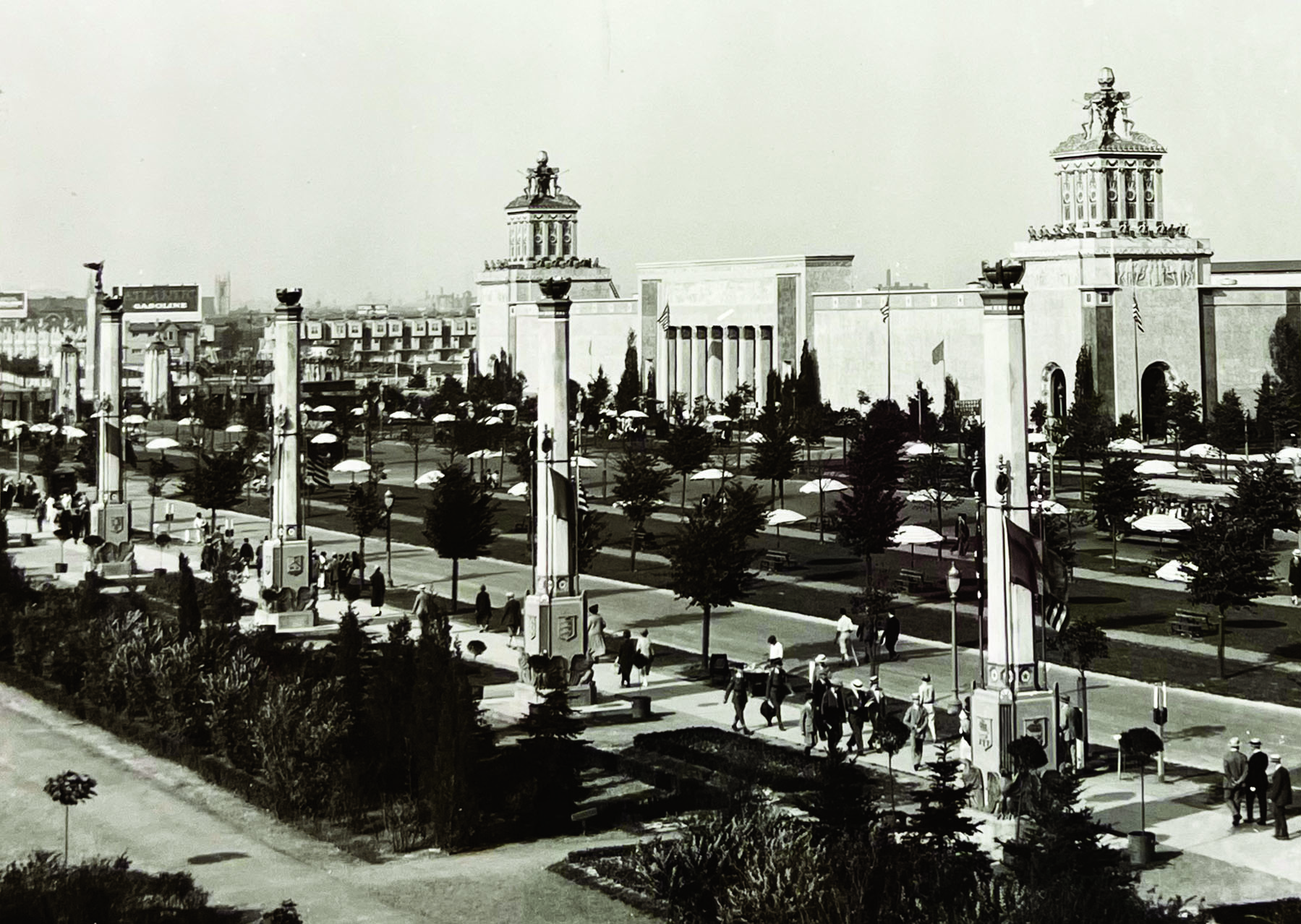
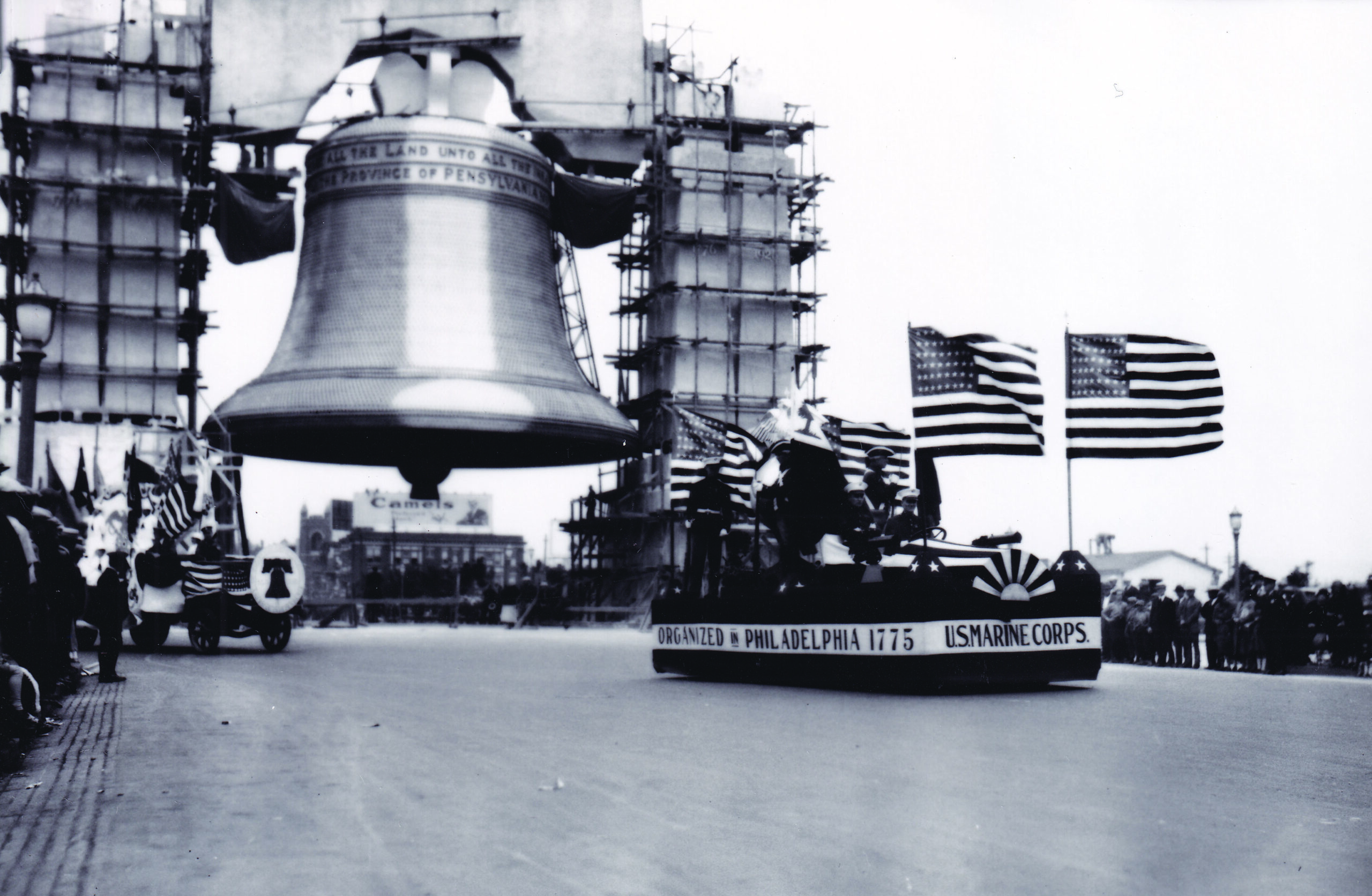
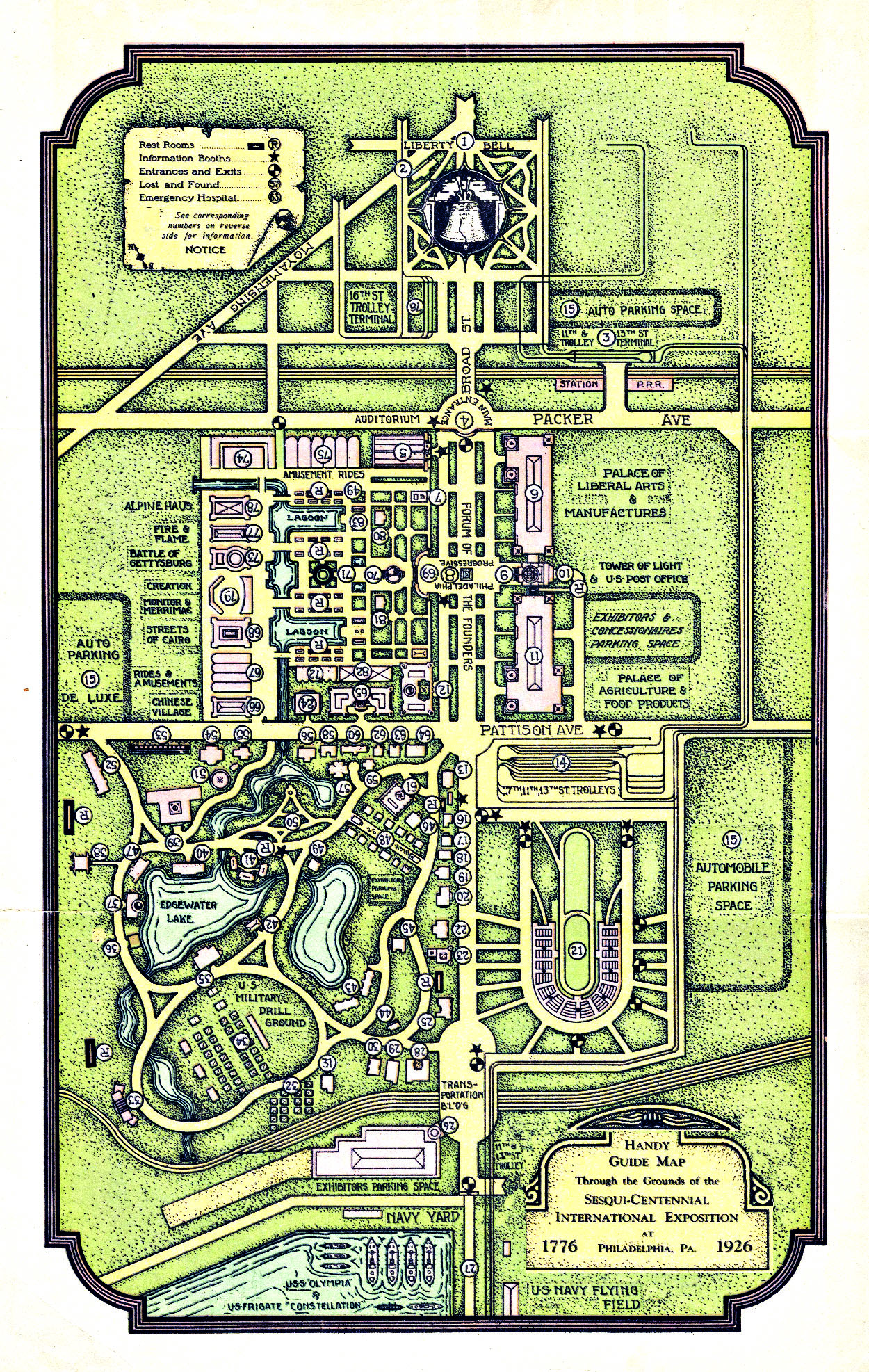
The sesqui’s general plan featured a world’s fair layout, complete with Industrial Age novelties, international cultural attractions, a semicircular arena and encampments for military displays. Two trolley terminals and a parking lot sat outside the northern, main entrance, and a third terminal provided easy access to the southern end. At the main entrance, visitors were greeted by the expo’s most recognizable feature: an enormous 80-foot-tall Liberty Bell adorned with thousands of lights. This illuminated replica became the sesqui’s logo and appeared on posters, souvenirs and invitations circulated internationally.
This amazing site formed a dramatic main gateway to the grounds, supported by two colossal towers that rose up from either side of Broad Street like majestic sentinels. Each tower was built around a heavy steel framework and sheathed in sheet metal for strength and speed of construction. A smooth, bronze-colored plaster, known as staff, covered the exterior, giving the structures a rich metallic sheen. The effect
projected the grandeur of permanent monuments while remaining lightweight, temporary and removable. The illuminated surface sparkled at night and transformed the entrance into a glowing beacon visible for miles.
After passing through the Liberty Bell and entering the park along Broad Street and Packer Avenue, guests received a 95-page program containing all the events for the entire six months, right down to the hours within each day that they would occur. They also received a trifold “Handy Guide Map” with a bird’s-eye view of the complex, complete with numbered and named attractions on the back. They were free to proceed via the walkway to the Forum of the Founders, which featured 13 Columns of the Signers. These Doric-style columns were capped with laurel-wreathed “skaphia”—a basin used in Ancient Greece to concentrate sun rays to ignite a flame, in the same fashion used in the Olympics today. Just above eye level were mounted bronze tablets, with each column naming a state’s signers of the Declaration of Independence. The number 13 was repeated in art and architecture throughout the exhibition, representing the 13 original colonies.
As visitors walked down Broad Street, they encountered the Tower of Light, which featured one of the largest search-lights in the country, according to E.L. Austin and Odell Hauser’s book on the event. Nearby, there were livestock and agricultural exhibits, an auditorium with six rides, two lagoons, a bandstand, a seaplane exhibit and Rumanian (spelled that way then) and Chinese villages. A dance hall was still under construction when the park opened. Down the main thoroughfare and to the left stood the Great Concrete Stadium with a 100,000-person seating capacity. This massive, horseshoe-shaped, concrete, stone and brick structure, constructed in the classic Greek amphitheater model, had an oval-shaped track reminiscent of hippodromes. To the right were the Hollywood exhibits and the High Street of 1776, featuring period displays. Other exhibits included international fares from over 30 different countries, and finally, situated along the southwestern most portion of the complex, the military encampments—at a location now bisected by Philadelphia’s I-95 corridor.
Military Presence
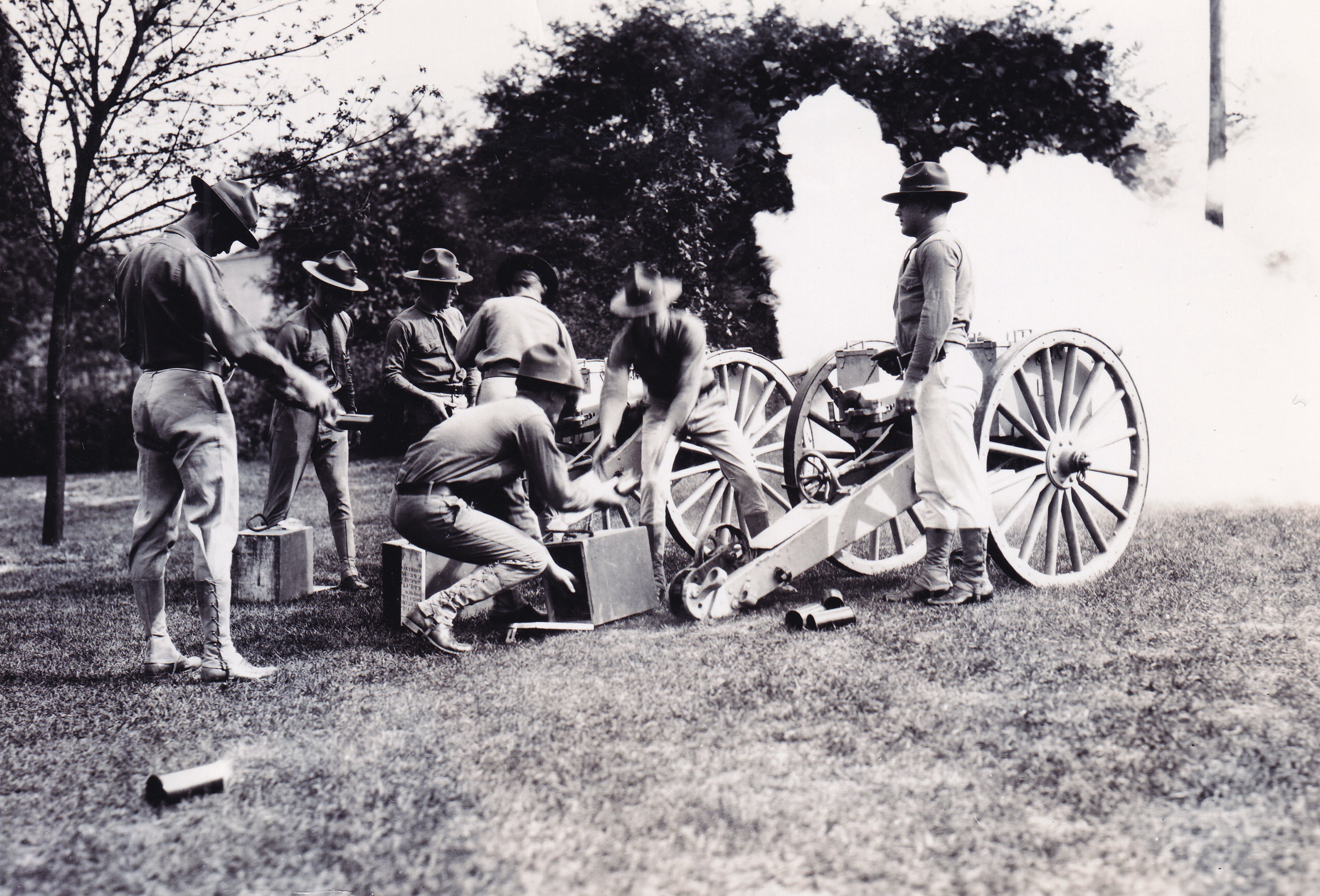
The U.S. Army’s Camp Anthony Wayne, named after the Revolutionary War hero, was nestled south of Edgewater Lake. The camp housed over 1,000 soldiers in a tent city. To the east of the camp, in a large field that is today a set of baseball diamonds, the soldiers demonstrated cavalry charges, performed drills and conducted cannon and other weapon demonstrations. South of the field, the Marine camp sat across a meandering walkway and also contained a tent city, complete with a replica of Tun Tavern. There, the Marines were within easy sprinting distance of the Navy Yard. A 10-minute walk down Broad Street and visitors could enter Building 29 for the Navy Historical Exhibit and could tour docked ships, including USS Constellation.
The Marines had robust support from the top to construct their encampment. Major General John A. Lejeune, then the Commandant of the Marine Corps, was ever cognizant of the delicate relationships between Philadelphia and Congress. He had retained Brigadier General Smedley Butler, following his two years’ serving as the city’s director of public safety, as the Commanding General of Marine Barracks in San Diego, Calif. Butler remained tethered for guidance and support.
In a letter dated May 11, 1926, the Commandant thanked Butler for his recommendation to detail a composite battalion of Marines for ceremonial purposes. In a follow-up letter, Butler mentioned his father, Congressman Thomas S. Butler, who remained a powerful ally to usher in support when necessary. The older Butler served as the Chair of the Committee on Naval Affairs and ensured the Marines had ample resources to develop their camp. His support, coupled with the Marines’ proximity to the Navy Yard and the USMC Depot of Supplies along Broad and Washington Streets, would come in handy for materiel procurement in the months that followed.

Marine senior leaders selected three companies to serve as a living model of Marine Corps life and history to the American public. The Scranton Tribune, dated July 6, 1926, reported that these included the 16th and the 20th Companies, quartered in the Navy Yard, and the 43rd in the tent city at the sesqui. According to muster rolls, the 43rd, the main effort, consisted of 121 men, led by WW I veterans Captain Louis E. Fagan and First Sergeant Thomas G. Bruce with the platoons commanded by Lieutenants Bayard Livingston Bell and Franklin William Ross Brown. The unit itself had a storied and decorated history from service in the war.
Originally formed from the Marine Guard of the USS Kansas (BB-21) battleship with the Atlantic fleet, the 43rd embarked for Vera Cruz in 1914, according to the “Marine Day Programme.” They had expeditionary duty in Mexico and Cuba, then returned from the West Indies and strengthened their ranks with volunteers from Philadelphia. Replenished and refitted, they then sailed to France with 2nd Battalion, 5th Marines. They were among the first American infantry troops to serve in the 2nd Division, American Expeditionary Forces, and would later participate in the occupation of Germany.
During the war, their participation exacted a heavy cost. They lost 41 killed in action and suffered 261 additional casualties. Eighteen of these later died from wounds. Their uncommon valor earned them an astonishing 209 awards for extraordinary heroism, including 21 Distinguished Service Crosses and 15 Navy Crosses, according to the program. By 1926, to support the sesqui, the company consisted of the original WW I veterans as well as those from Haiti, Nicaragua and China. Their ranks included the first Marines authorized to wear the coveted French fourragère awarded to the 5th and 6th Marine Regiments, alongside those who had not yet seen combat themselves.
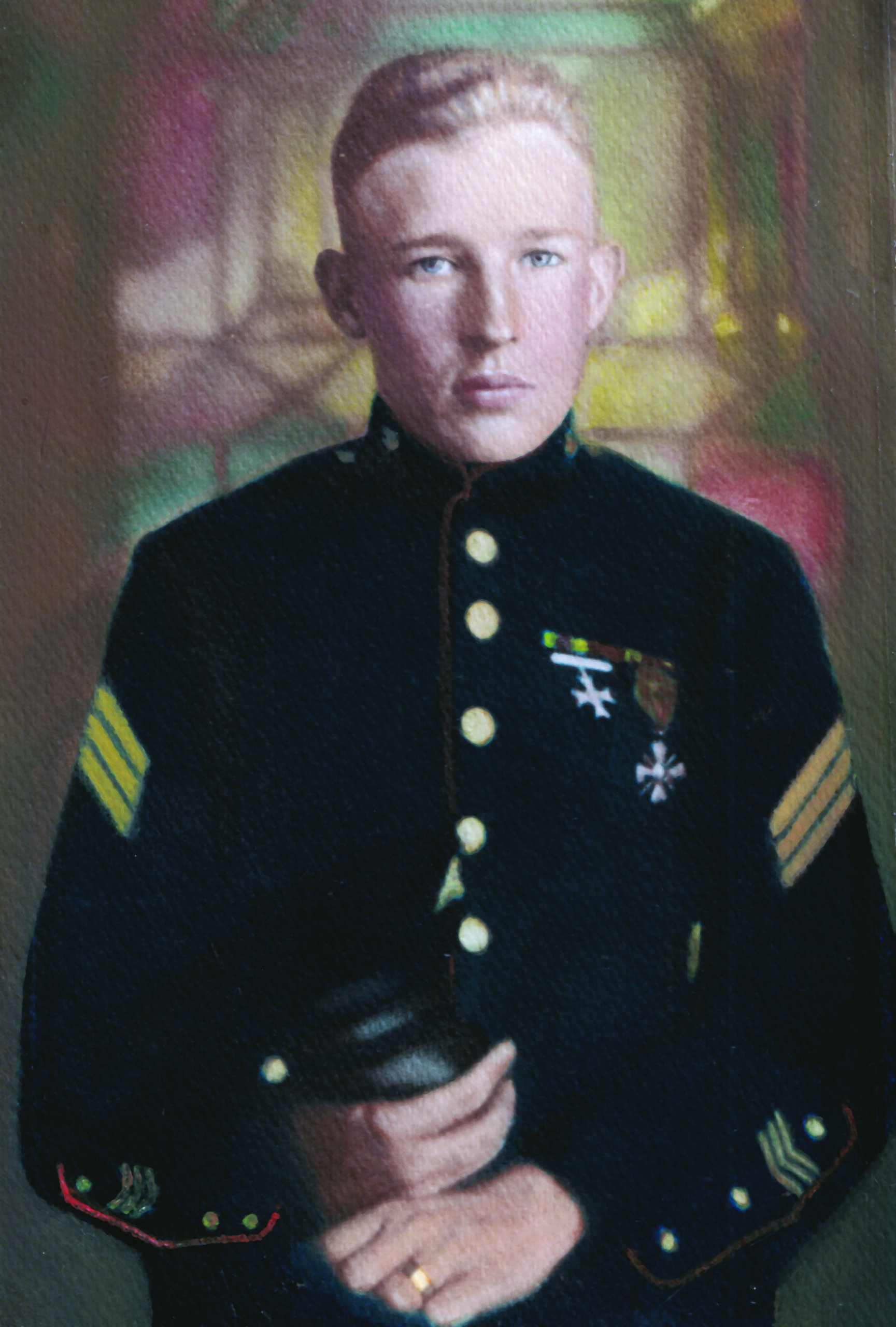
To support all three companies assigned to the sesqui, Commandant Lejeune entrusted Colonel Cyrus Sugg Radford, the officer in charge of the Depot of Supplies. Col Radford had proven himself a worthy logistics leader, running manufacturing, sustainment and materiel shipping that supported Marines both in garrison and in WW I. Throughout sesqui’s buildup and during the venue’s entire six-month event, Radford kept both BGen Butler and the Commandant well apprised of the camp’s status and all its materiel needs. This is confirmed in a letter Butler wrote to Radford on Aug. 14, 1926. These and past efforts would later secure the colonel a promotion to brigadier general, and his assignment as the Quartermaster General of the Marine Corps.
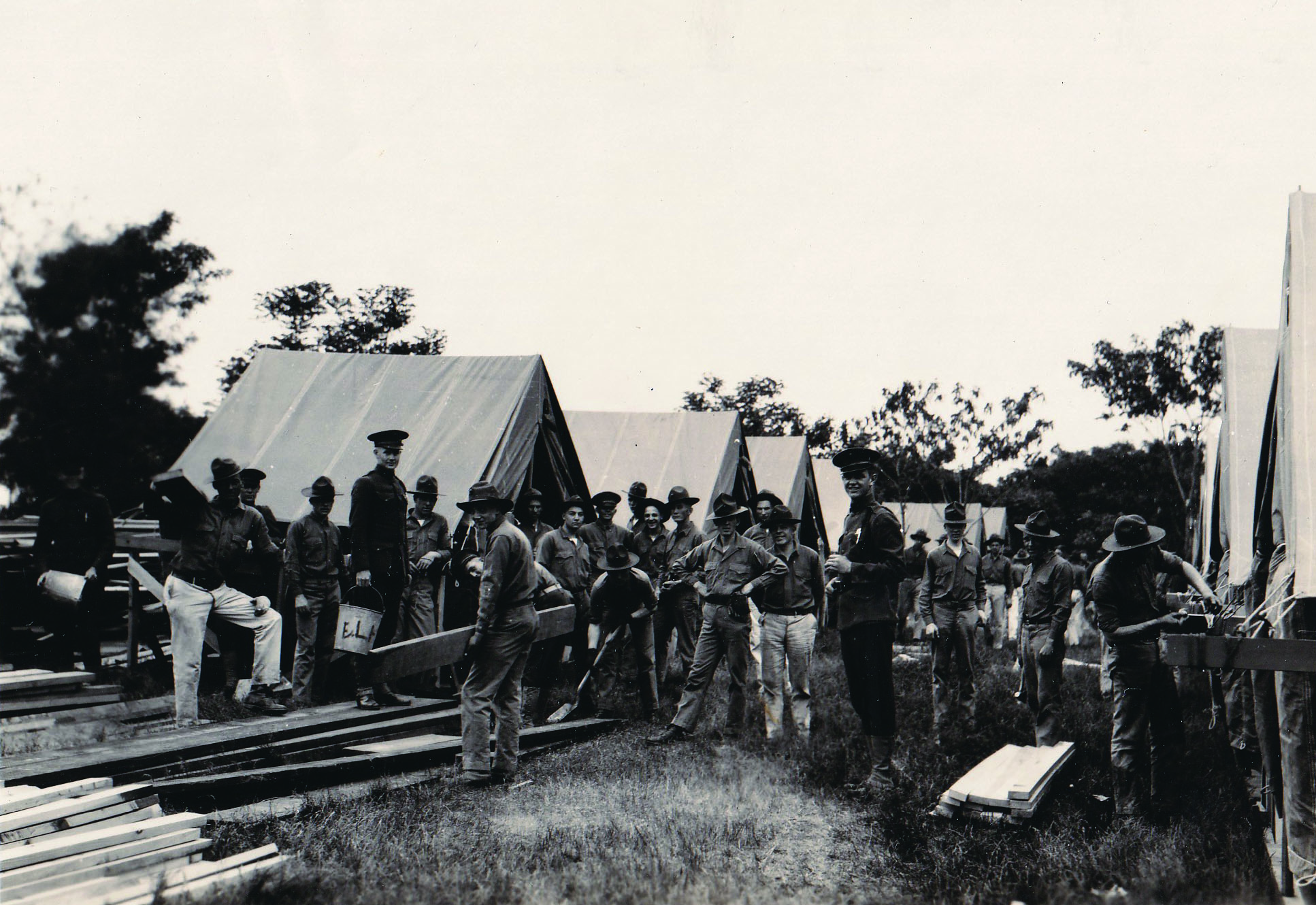
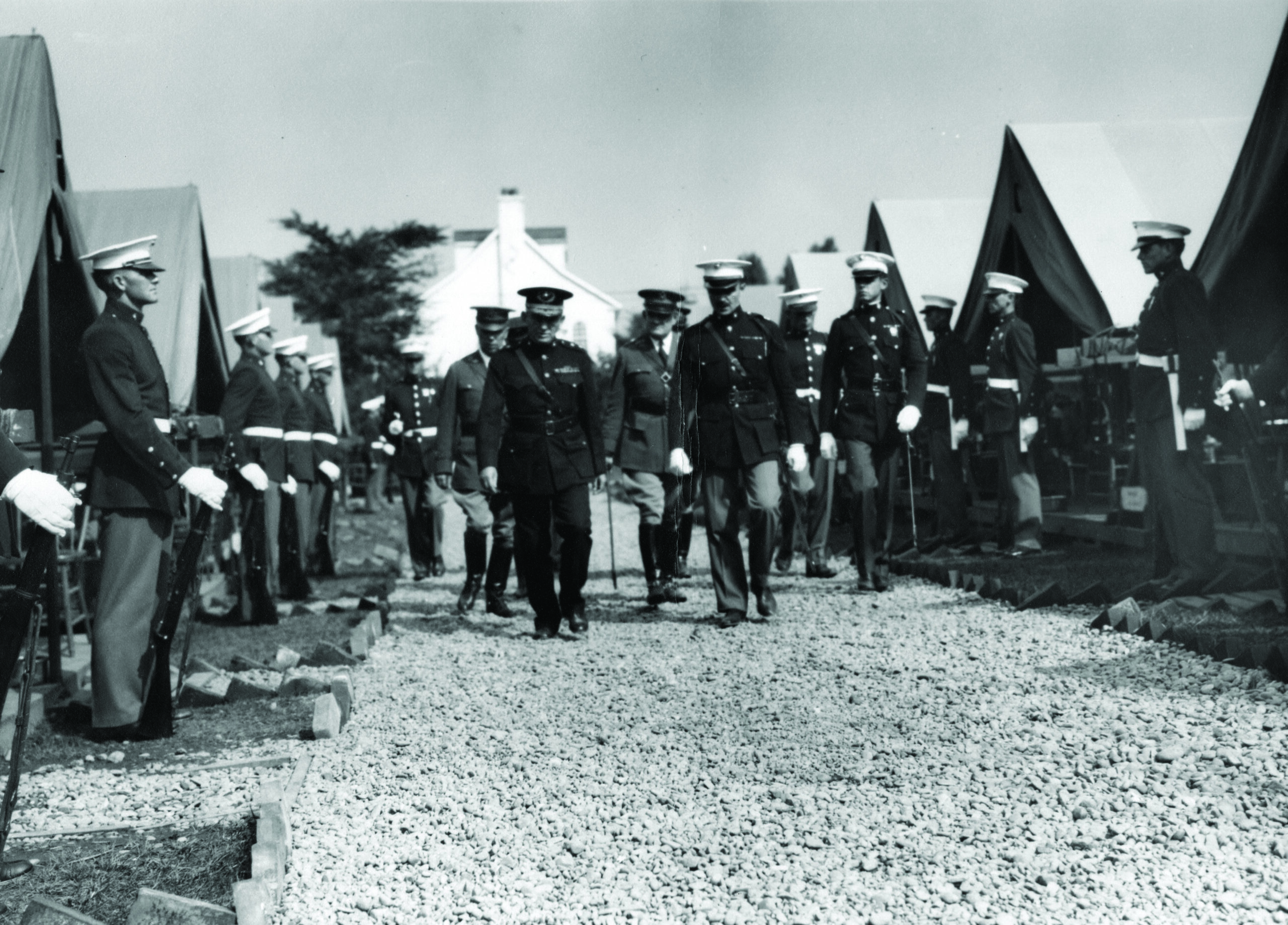
As a team, the leathernecks quickly built their tent city. The tentage, gravel walkways, a chow hall, cleansing units and a command tent with an oversized Eagle, Globe and Anchor all went up in short order. They modeled the camp after tropical layouts used on expeditions; the gravel walkways would come in handy during Pennsylvania’s rainy summer months. Appropriately enough, they named the camp after the first Marine Corps officer, Capt Samuel Nicholas. There, Marines would conduct combat demonstrations, march in formations, display uniform regalia and perform naval gunnery. They would also wear period uniforms in pageantry, complete with materiel examples used throughout Marine Corps history.

To the camp’s east, the Marines constructed their feature attraction, the Tun Tavern, the first of its kind since the original burned down in 1781, 145 years prior. The “Marine Day Programme” described the building as “a faithful replica of the original structure,” with the interior “designed to contain paintings that depict incidents of Marine Corps history,” referring to a series of 13 paint-ings contributed by Philadelphia’s own John Joseph Capolino. In part because of these efforts, Capolino would later secure a Reserve commission as a Marine Corps officer and serve as an official combat artist.
According to an Aug. 27, 1926, article in the Philadelphia Inquirer, Capolino’s artwork at the exposition depicted combat scenes throughout American history, from the Revolutionary War to WW I. His pieces included the first amphibious landing in Nassau led by Nicholas, the fight against the Seminole Indians, the Spanish-American War and Marines who fought in France under the U.S. Army’s 2nd Division. After reviewing the paintings, guests would be able to talk to live Marines who were part of the same unit depicted on the final panels. Other items displayed in the tavern included colonial period furniture and a reproduction of journal entries containing the original muster rolls of the first Marines recruited. Outside the tavern’s second level, Marines mounted Colonial, modern American and other flags.

As the sesqui approached the May 31st opening, unresolved construction delays and political friction arose. In addition, the weather didn’t cooperate; rain poured relentlessly. In a private letter written to Butler, the sesqui was dubbed “The Rainy Exposition.” Expenses were higher than anticipated, and as the exposition began, the expected 200,000 guests per day slumped at 10% turnout. Having lost over $20 million in revenue, more colorful pet names for the event emerged in print: “Kendrick’s Carnival,” after the mayor of Philadelphia, and “Sucker, Simple, Sickly-Centennial.” Variety magazine later declared the sesqui “America’s Greatest Flop.”
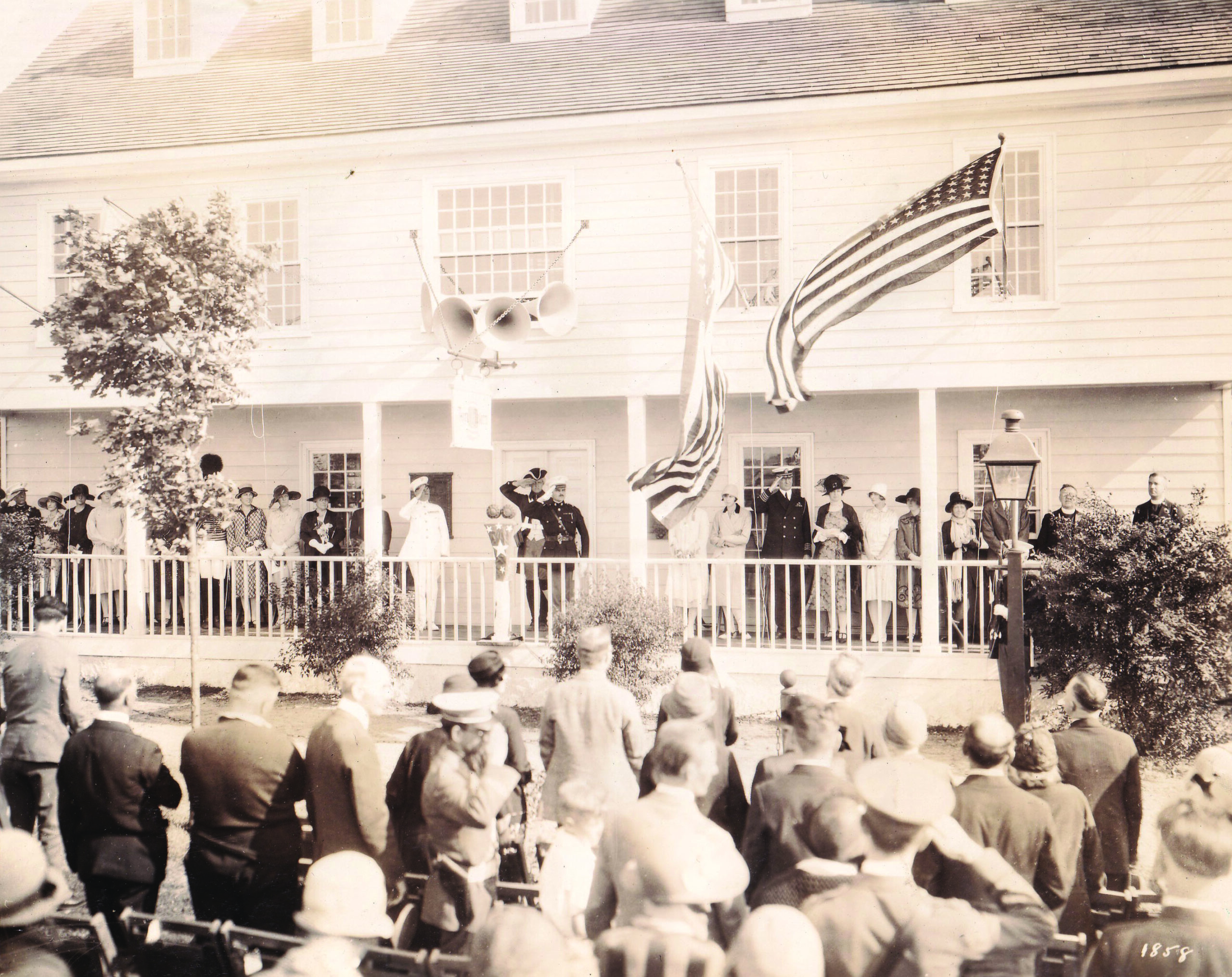
The Marines, however, were impervious to these challenges. They opened Camp Samuel Nicholas to the world at 4 p.m. on June 29, 1926, to a spellbound crowd. Principal guests included Mayor W. Freeland Kendrick and Major General Eli Kelly Cole, USMC. A direct lineal descendant of Captain Samuel Nicholas christened the camp. On what they termed “Dedication Day” and “Marine Day,” 10 sequenced events entertained visitors. These included the 43rd’s march-on, invocation, dignitary speeches, the unveiling of bronze tablets dedicated to the Thomas Roberts Reath American Legion Post and the Sojourners Club, unfurling Colonial flags, the ceremonial relief of Continental Marines by contemporary Marines, unfurling the American flag, the formal occupation of Camp Samuel Nicholas, christening and benediction and a general inspection, followed by a reception at Tun Tavern.
Cursive notes written in the program’s margin reveal that the band played “Flourishes” during the Colonial flags’ unfurling, “Four Ruffles and Flourishes” followed by “The Star-Spangled Banner” for the national flag unfurling and “The Marines’ Hymn.” During the camp occupation, they played a second rendition of “Four Ruffles and Flourishes” and blew trumpets for “Sound Assembly” to announce the general inspection. John Philip Sousa, the “March King” himself, composed the “Sesquicentennial Exposition March” for the celebrations, capturing a patriotic pride that honored this living historical exhibit.
The Marines knew that the eyes of the world were upon them and rose to meet public expectations at every engagement. Besides manning the camp, periodic parades and demonstrations, they supported other areas around the sesqui campus. They manned an exhibit depicting life in the tropics for the Haitian Expedition, stood guard at the original Liberty Bell, kept watch over display tables in the Navy exhibit and provided personal protection for visiting dignitaries, including the Queen of Rumania and President Calvin Coolidge.
President Coolidge visited the sesqui the day after Independence Day, as July 4 had fallen on a Sunday. Coolidge, devoutly religious and sensitive to American families, chose not to conduct the visit on the Sabbath. Admission was free to the grounds for his visit and his speech, conducted at the Great Concrete Stadium across the street from the military encampments. With the 50-cent entrance fee waived, according to the Philadelphia Inquirer, attendance soared to over 35,000 visitors. Having Marines present that day, and on other days when dignitaries visited, proved invaluable, as a built-in personal protective capability stood ready.
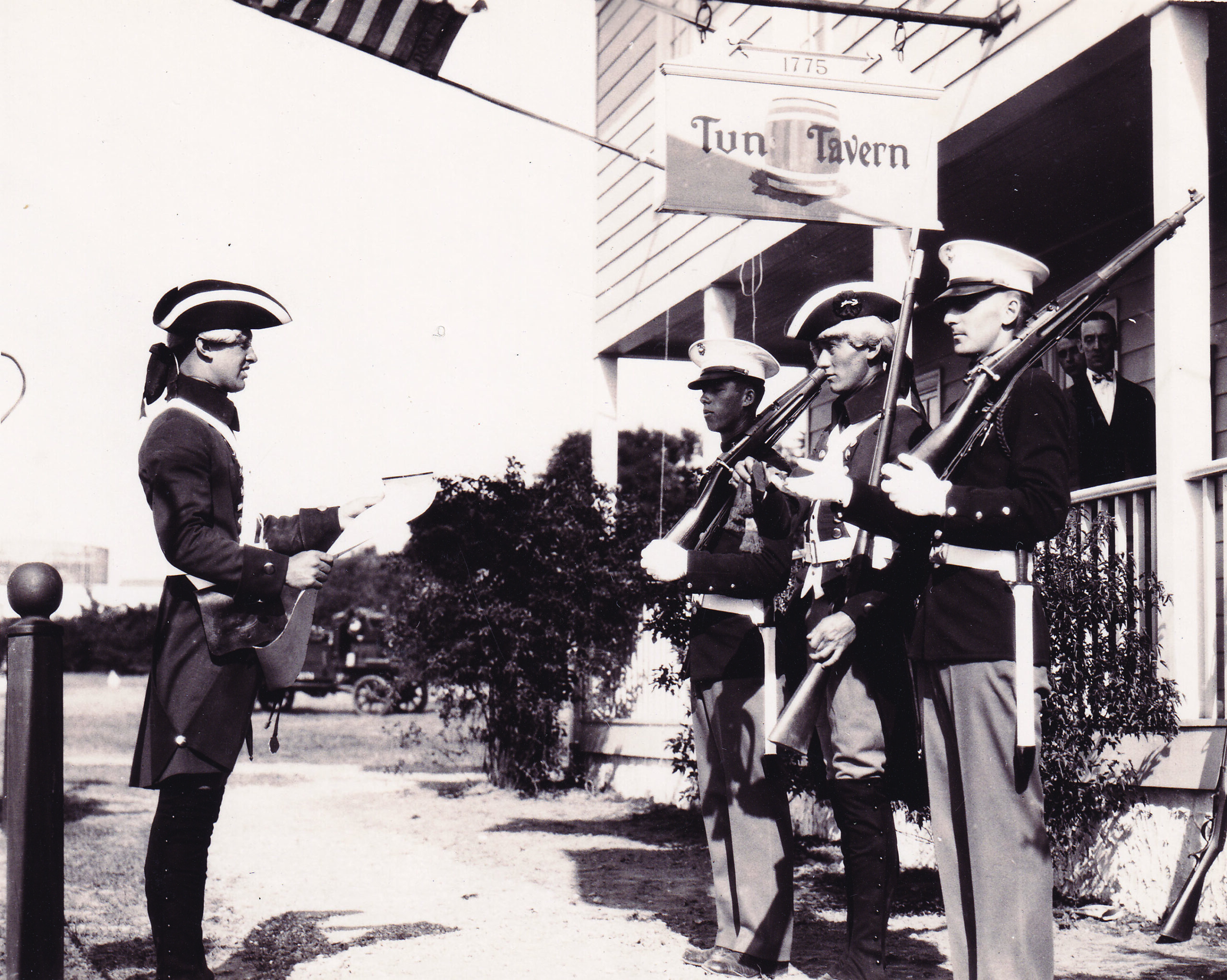
Besides their practical utility in security matters, the evidence—found in letters, photos and 35mm film newsreels from Fox Film Corporation—shows that the Marine Corps had one of the best attractions. The Marines were well set up, led and appear to have been sharp and disciplined in both period and contemporary uniform dress. Their drill reflected precise cover and alignment, their uniforms were pressed and polished, and their encampment was clean, organized and well maintained. Both officers and enlisted men clearly had solid control of their allocated space. They truly reflected the best in soldierly virtue with the discipline and attention to detail Marines are known for.
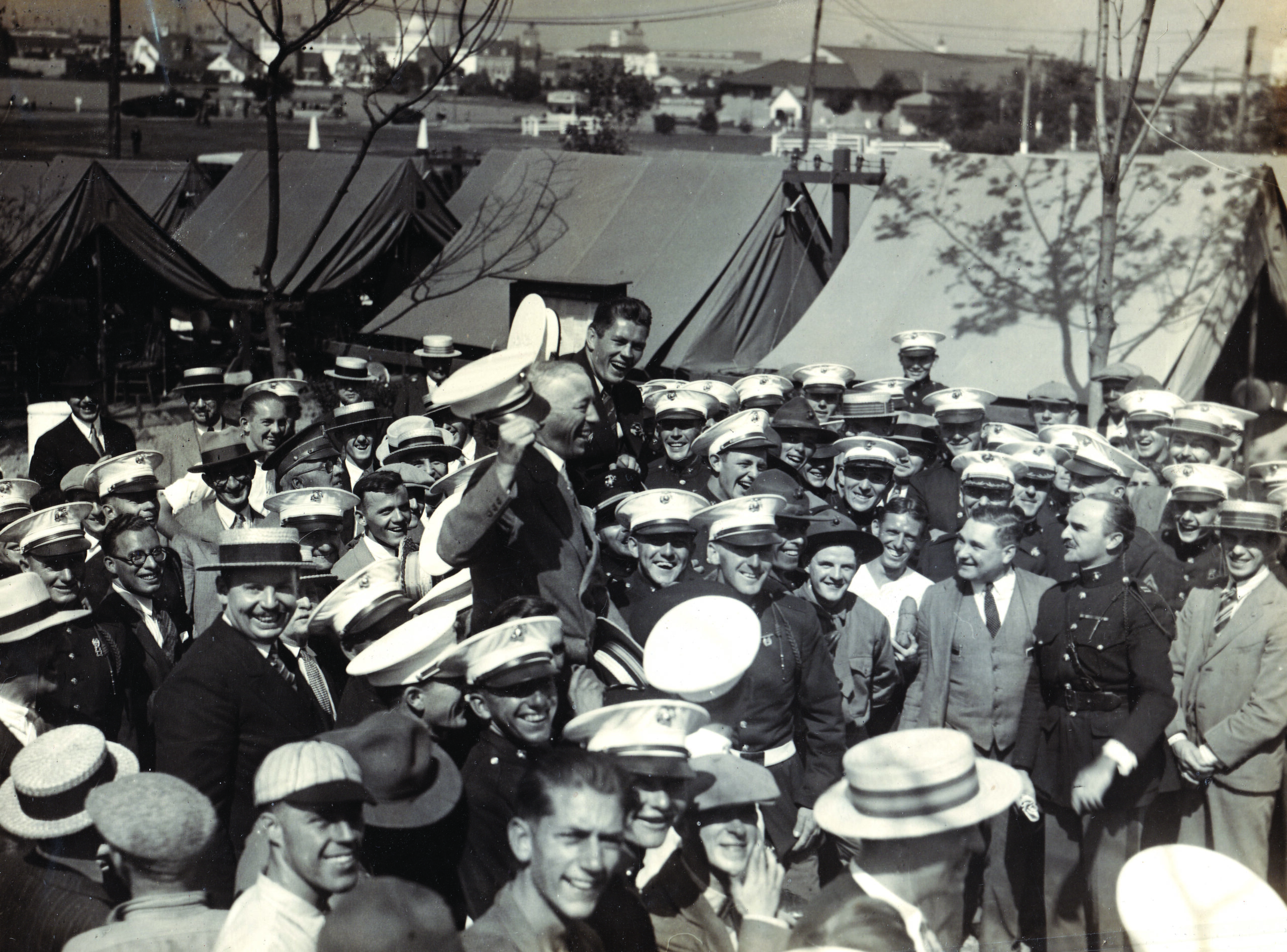
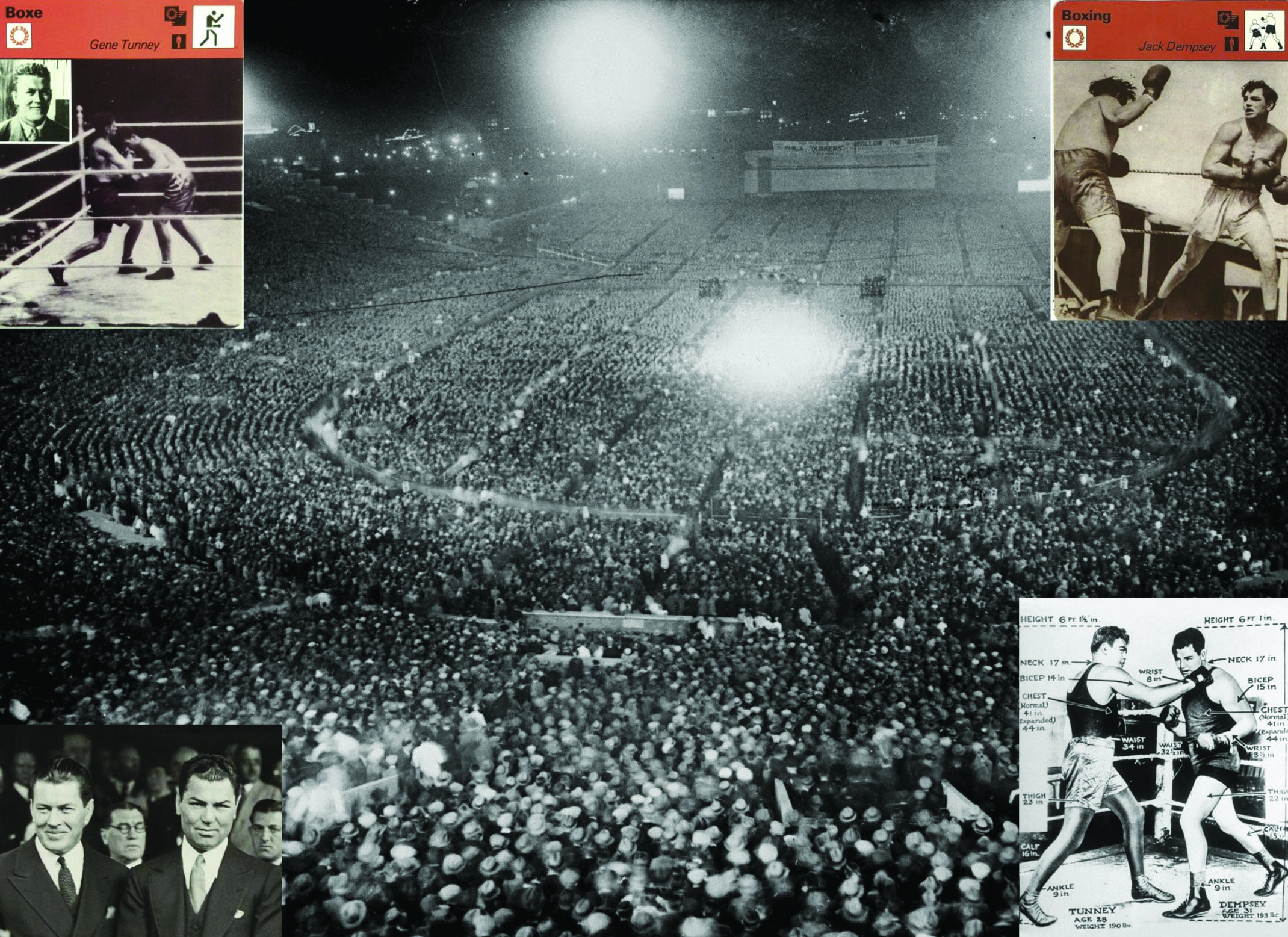
Then, on Sept. 1, 1926, they welcomed one of their own, boxing champion Gene Tunney, to the camp. Tunney, known as the “Fighting Marine,” stopped in before his participation in the heavyweight championship. He was to challenge the reigning heavyweight world champion, Jack Dempsey, at the stadium on Sept. 23. Tunney was a WW I veteran whose service had taken him to France with the 11th Marine Regiment, and later to Germany during the 1919 Rhineland occupation. Although he did not see combat himself, he spent most of the war developing his skills on the Marine Corps boxing team and ascended to become the U.S. Expeditionary Forces champion.
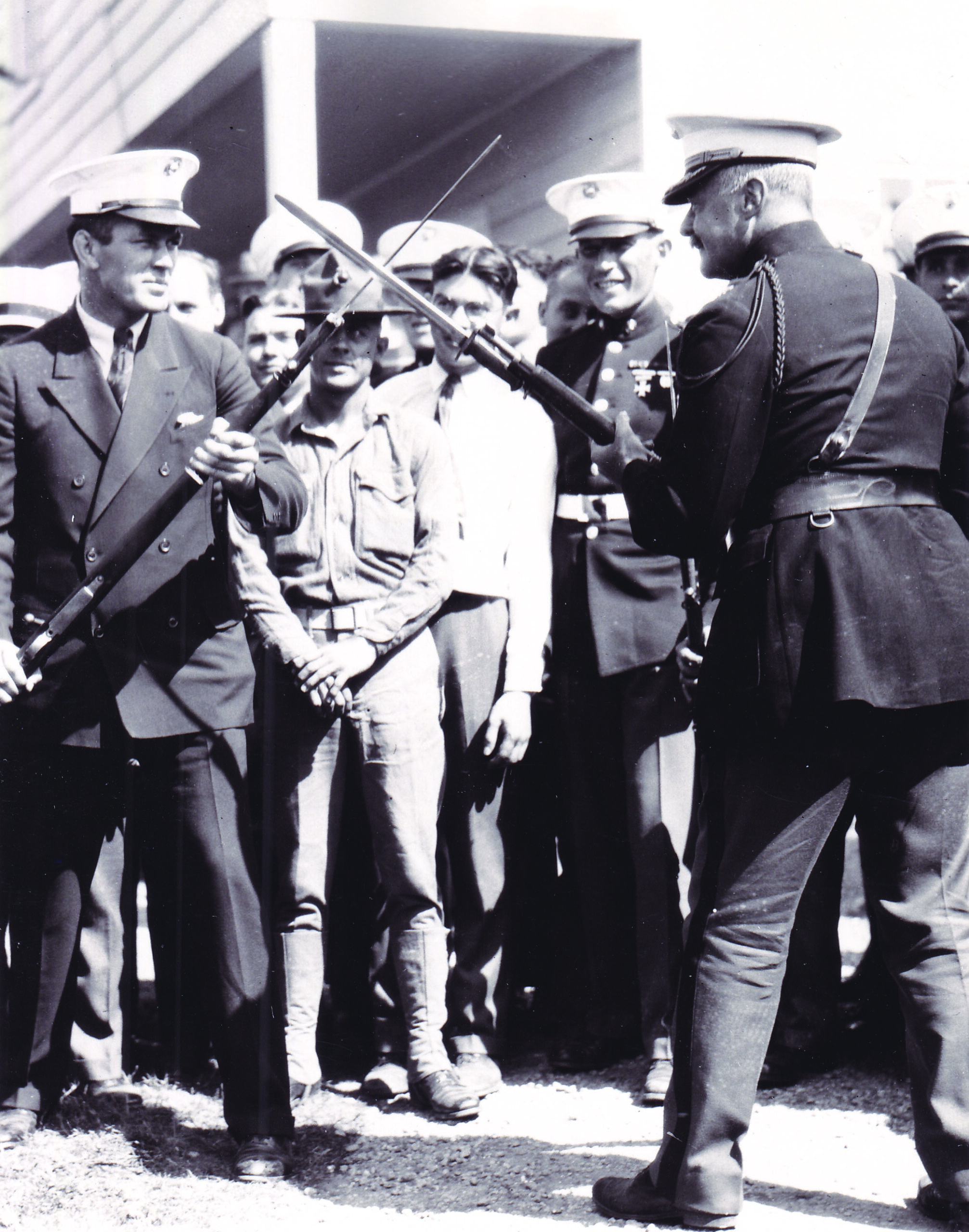
Tunney’s challenge match with Dempsey was expected to draw visitors far and wide. Photographs showed Tunney and then-Maj Anthony J. Drexel Biddle, considered the father of the Marine Corps Martial Arts Program, squared off at the parry with Model 1903 Springfield rifles and M1905 bayonets affixed. Maj Biddle trained Tunney in boxing during the war. For the sesqui, he’d volunteered to be mobilized from the Reserve to train boxers participating in the interservice championship bouts also conducted there. According to an article in the July 1926 issue of Leatherneck, his specialty was bayonet fighting, as he had spent a good portion of the war preparing Marines for close combat en route to the front lines. Together, he and Tunney embodied the courageous fighting spirit that all Marines sought to emulate.
By fight night on Sept. 23, there was little doubt that Tunney came with the backing of a home team advantage among his fellow Marines. Despite the friction created by heavy rains, Tunney defeated Dempsey in front of more than 120,000 spectators. Newspapers reported that Tunney landed so many left and right hooks that by the 10th round, Dempsey’s left eye was swollen shut. Dempsey’s loss was considered an upset, but a year later, he would challenge Tunney to reclaim his title only to lose a second time. Tunney would remain the heavyweight champion of the world until his retirement in 1928.
Public Reception
The fight, however, did little to tip the scales on the sesqui’s balance sheet. As the exposition approached its final months in operation, costs incurred to construct, staff and maintain the venue well exceeded the revenue coming in from ticket sales. Total admissions averaged approximately $1 million per month. Newspaper reports were brutal. The Asbury Park Press stated that the sesqui was widely discussed as “one of the greatest exposition failures this country, or the world has ever known.” The article claimed that America had “nothing to see” that “hasn’t been seen either through the medium of the movies or on auto tours over the country.” The paper further asserted Americans could tour every corner of the Earth through news and educational films or simply tune in to the radio from their own parlors to hear inaugural speeches, football games, the World Series or championship prize fights. Their feelings were commonplace.

(Courtesy of National Archives)
In a 2025 column titled “ ‘America’s Greatest Flop’: Why the Sesquicentennial of 1926 Fell Flat,” the author cites several possible reasons for the sesqui’s failures: financial ruin, poor management and politics, unfinished construction, bad weather, location issues (considering that south Philadelphia was underdeveloped at the time and the inadequate transportation infrastructure made the venue difficult for attendees to reach), cultural misalignment where a focus on traditional displays didn’t compete well with rapid rise of movies and automobiles, and poor word-of-mouth advertising.
When the sesqui finally closed on Dec. 1, it had lost millions, and the nickname “America’s Greatest Flop” stuck. Much of the material that constituted sesqui was sold off at auction to recoup losses, according to The Encyclopedia of Greater Philadelphia. The Tun Tavern replica remained on site into January 1927 while dismantling authority was secured; Marines handled final salvaging under Depot Quartermaster direction. Yet the Marine contingent succeeded brilliantly. The International Jury of Awards of the Sesqui-Centennial awarded the leathernecks a gold medal in recognition of their professionalism and spirit. That same spirit guides us 100 years later. General Eric M. Smith, the Commandant of the Marine Corps, stated in an interview earlier this year that individual Marines would continue to lay down their lives to do miraculous things under arduous conditions. This has been the case for the last 250 years and will continue to be the case. Sergeant Major Carlos A. Ruiz, the Sergeant Major of the Marine Corps agreed, saying that the discipline standards of the Corps would guarantee their service to the American people—some-thing we’ve done consistently for the last quarter millennium. As we celebrate America’s birthday, we hear the echoes of those Marines who, in highly disciplined and remarkable ways, turned a troubled fair into an enduring standard. They remind us that our greatest weapon remains the human mind, not only sharpened by modern wargaming but also honed by history, rooted in Tun Tavern spirit. Those leathernecks of 1926 live on in every Marine on watch today and will continue to shape the Corps for centuries to come.

Featured Photo (Top): A Marine Corps float passes beneath the sesquicentennial’s most iconic landmark, an 80-foot-tall replica Liberty Bell that served as the gateway into the 1926 exposition. (Courtesy of National Archives)
About the Authors
LtCol Brad Anderson, USMC (Ret), is a freelance writer and researcher for Leatherneck. Katie Cashwell is a veteran Marine and a graduate of the University of Mary Washington with a degree in historic preservation. She has spent decades providing research supporting recoveries of America’s Missing in Action and was instrumental helping to find the lost graves of Tarawa.
Enjoy this article?
Check out these similar Leatherneck and Scuttlebutt features:
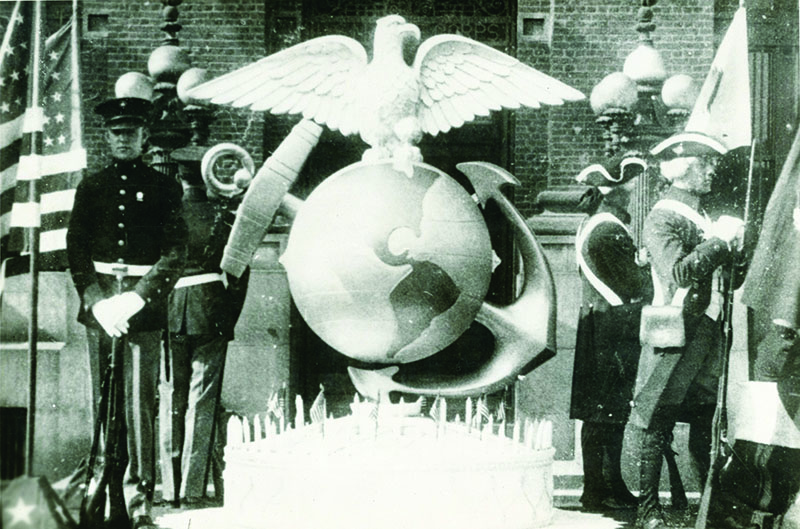
Uncovering the Origins of Marine Corps Birthday Celebrations
Leatherneck
November 2025
By: LtCol Brad Anderson, USMC (Ret), and Katie Cashwell
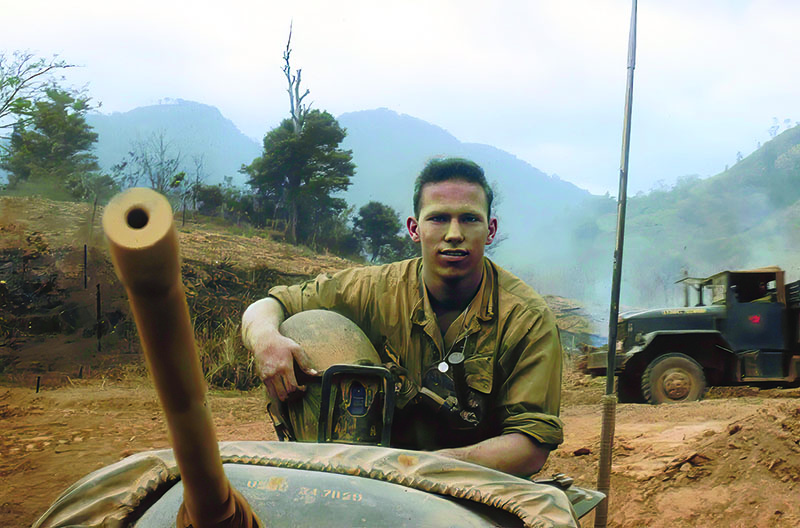
The Birthday Brawl: Tankers Hold The Line at Khe Sanh
Leatherneck
August 2025
By: Kyle Watts

Lejeune: A Leader Ahead of His Time
Leatherneck
March 2024
By: Maj Skip Crawley, USMCR (Ret)