


The Sound of Service
By: Kyle WattsPosted on June 15, 2026
“The Commandant’s Own”
A Living Expression of Marine Corps History
The first time I interviewed Marines of “The Commandant’s Own” United States Marine Drum & Bugle Corps, they carried neither drum nor bugle, but a tape measure.
Walking onto the hallowed parade deck of Marine Barracks Washington, D.C., this past spring, I discovered Marines scrutinizing the sidewalk leading to the flagpole at the center of the parade deck. They wore pristine service uniforms paired with the M65 woodland field jackets unique to “8th & I” staff. Had a monstrous spider caught their eye and interrupted the rehearsal? Perhaps a crack formed overnight in the immaculate pathway? Nope to both. The Marines crouched above the concrete, ignoring the blinding glint of mid-morning rays reflecting off their mirrored Corfams, calculating the width of the walkway down to the inch. Actually, down to the half inch.
“We call it ‘eight to five,’ ” one of them explained as I approached and asked what they were up to. “Eight 22.5-inch steps equals five yards. We’re just verifying the distance from that line there in the middle of the sidewalk to the grass. Everything we do is based on the 22.5-inch step. It’s easy to march on like a football field that’s marked every five yards, but there’s nothing like that out here on the parade deck.”
“22.5 inches, huh? So how many 23-inch steps does it take to screw everything up?”
The Marines around me snickered and smiled as one of them answered my question without hesitation.
“One.”
The men and women of the Drum & Bugle Corps (D&B) are truly THE proud professionals of their craft. Serving as the U.S. Armed Forces’ only active-duty drum and bugle corps, they dissect each performance and sharpen their skills on the parade deck every day. Catch any one of them on his or her way to the chow hall, the parking garage, exiting the head, or even sleepwalking through the barracks halls, I’d bet you a solid platinum three-valve Kanstul G series they’re gliding along at 22.5 inches per step.
Before joining this renowned organization, all D&B members first ship out to basic training to earn their Eagle, Globe and Anchor. Most are in their mid-20s through boot camp and Marine combat training, learning the mantra of “every Marine a rifleman” alongside their teenage counterparts. Their age is just one factor separating them from the herd and marking them for scrutiny. They endure boot camp as the quintessential “band nerds,” and likely the only recruits in their entire company or even battalion to know exactly where they are headed and what they will be doing after basic training. They arrive at 8th & I as privates first class and progress through rank just like their peers in any military occupational specialty (MOS).

Cpl Alejandro Gutierrez conducts a musical sequence during a parade for the Norwegian Military Tattoo at the Oslo Spektrum in Oslo, Norway on April 26, 2024. (LCpl Chloe N. McAfee, USMC)
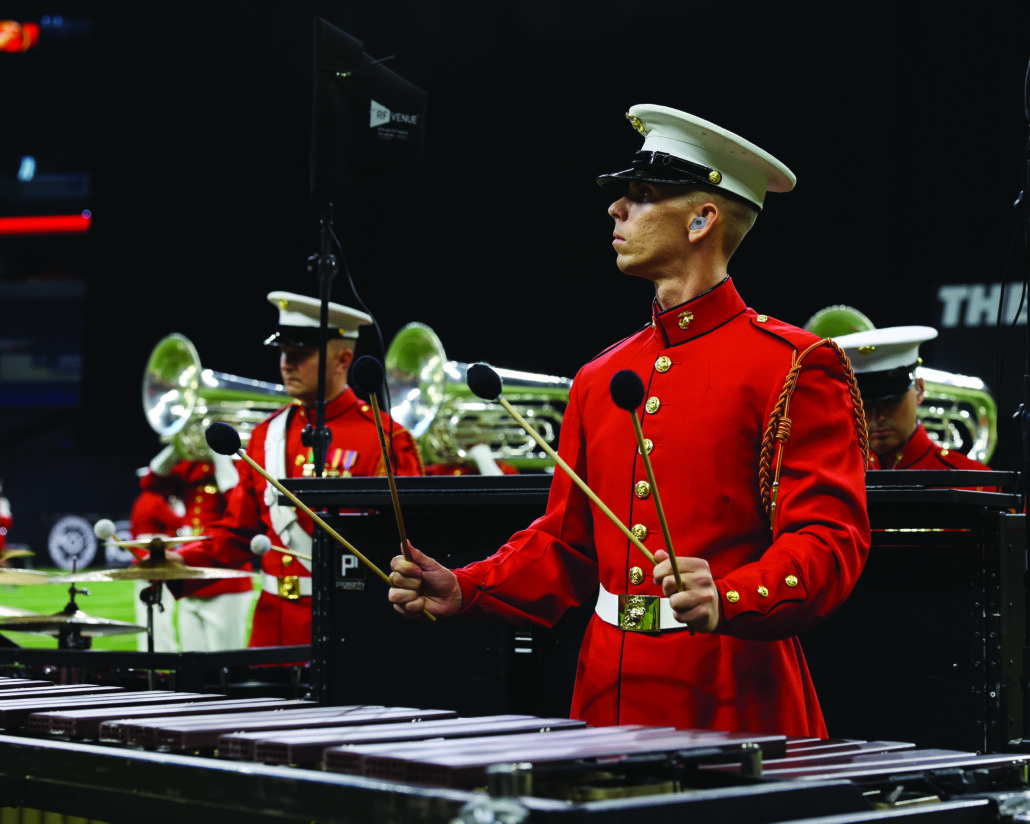
Cpl Gage P. Kroljic, a marimba player, performs during the Drum Corps International World Championship in Indianapolis, Ind., on Aug. 9, 2025. (Photo by Cpl Brynn L. Bouchard, USMC)
“As Marine musicians, sometimes it can feel like both of those inherent parts of our identity are at odds with each other,” said Staff Sergeant Alex Liddell, a tuba player and seven-year member of the D&B. “It takes an intentional approach to buy into it and doesn’t come naturally to everyone.”
Earning the title of “Marine” most often proves just as transformative and defining for musicians as any other individual who wears the uniform. The foundation they receive through basic training enables each to excel in their craft and embrace the history and vital importance of their ceremonial mission.
The unit’s lineage traces back to 1798 when an act of Congress formally established “The President’s Own” United States Marine Band. The bill also ordered the enlistment of drum and fife majors along with 32 musicians. These early “field musics” enabled commanders to signal and coordinate dispersed forces above the din of battle. Their involvement on the front lines or aboard a warship was not ceremonial. Their music was not a performance. Their presence meant command and control.
By the early 1900s, modern communications replaced the need for standardized musical signaling. The D&B at Marine Barracks Washington formed officially in 1934 to augment the U.S. Marine Band performing ceremonial duties around the nation’s capital. For a time, separate D&B’s existed at locations around the Corps, similar to the 10 Marine Corps fleet bands in operation today. By 1956, General Randolph M. Pate, the 21st Commandant of the Marine Corps, designated the 8th & I unit as the official U.S. Marine D&B. It was not until 2006 that Gen Michael W. Hagee, the 33rd CMC, gave the D&B its moniker, “The Commandant’s Own.”
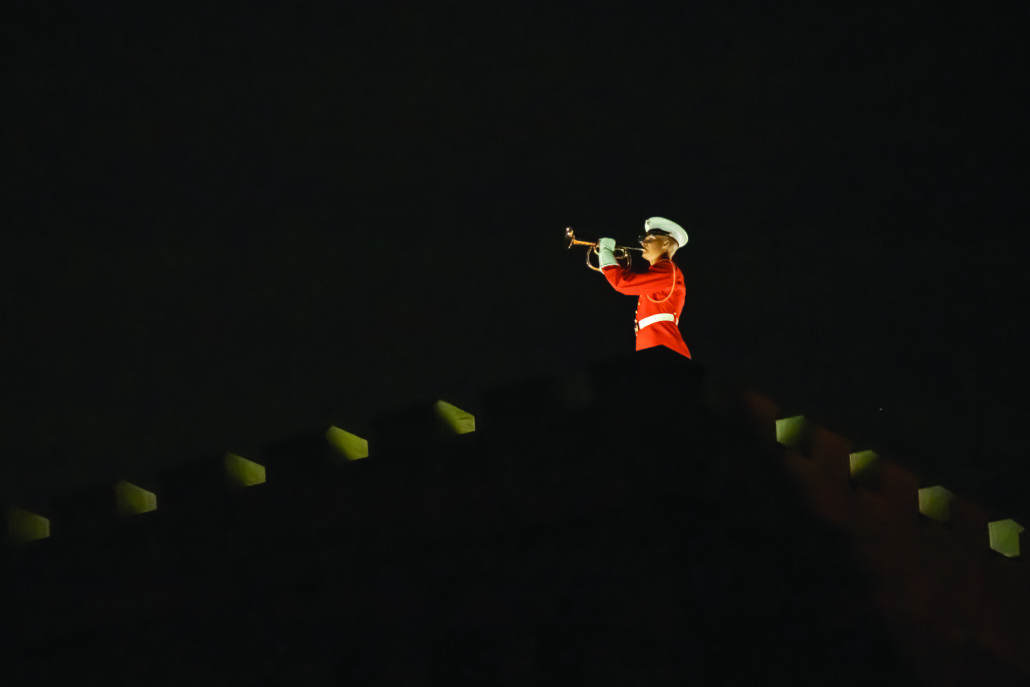
Cpl Michael R. Rosie, a bugler with “The Commandant’s Own,” plays “Taps” during a Friday evening parade at Marine Barracks Washington, D.C., on Aug. 4, 2023.
(Photo by Lance Cpl. Chloe N. McAfee)

Snare drummers with “The Commandant’s Own” perform during an evening parade at Marine Barracks Washington, D.C., on May 1. (Photo by Cpl Christopher Prelle, USMC)
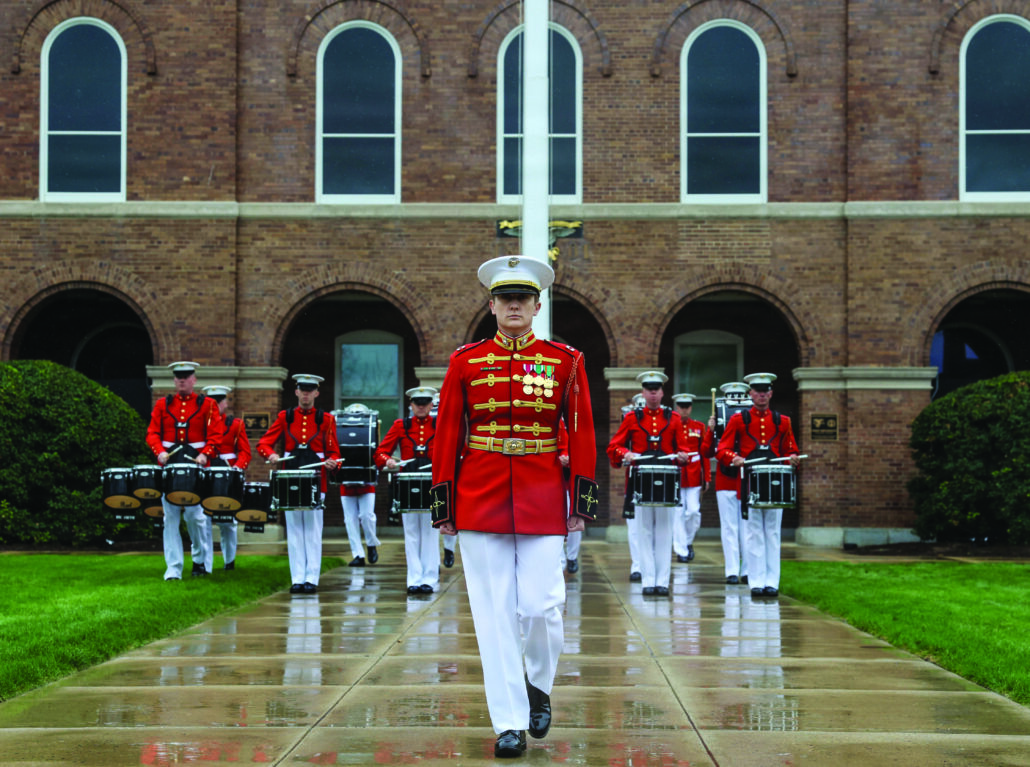
Capt Courtney Lawrence, executive officer of “The Commandant’s Own,” marches on center walk of the parade deck at Marine Barracks Washington, D.C., on March 27. (Photo by Cpl. Brynn L. Bouchard)
In 1967, Truman W. Crawford joined the D&B as chief musical arranger. His passion for music and unique ability to instruct did not simply raise the bar. He redrew the standard entirely. He was promoted to the role of commanding officer and eventually eliminated the disaggregated D&Bs around the Corps, consolidating them into the single unit existing today. Crawford served as the D&B CO from 1973 until his retirement in 1998. He left the Corps as a colonel, and at the time, was the oldest Marine on active duty. His singular, enduring impact on the organization is rightfully likened to John Philip Sousa’s contribution to the Marine Band. The headquarters building of the D&B at Marine Barracks Washington is named in his honor.
Crawford forged the D&B from a small group of Marines who were handed instruments and ordered to play into an institution of ceremonial excellence. Today, more than 85 Marines compose the D&B. The operational tempo they maintain rivals many Fleet Marine Force units. They perform nearly 500 events every year, traveling more than 50,000 miles to represent the Marine Corps and the nation. As “The Commandant’s Own,” the D&B primarily supports the ceremonial mission at 8th & I or around Washington, D.C., but is held in reserve to deploy wherever the Commandant orders them to perform.
D&B performances range from formal ceremonies to presidential honors to local parades to backyard barbecues. Every day at 8th & I, Marines perform live bugle calls, from morning colors, to chow call, to taps at 2200. For each event type, the D&B tailors the ensemble size and music selection, carrying every piece from memory. A constant stream of information batters each Marine, vying for attention while they move and play. Each must flawlessly perform his or her part of the music while tracking and adjusting to the movements of other Marines crisscrossing in every direction. Operating as a cohesive whole, any mis-step or off-tune note is easily picked out.

“The Commandant’s Own” performs for more than 22,000 guests at the Drum Corps International World Championships in Lucas Oil Stadium in Indianapolis on Aug. 12, 2023. (Photo by LCpl Iyer Ramakrishna, USMC)
Though seemingly similar to “The President’s Own,” and with a common historical origin, the D&B operates as a distinct musical entity in every way. While the band performs more like a traditional orchestra, D&B focuses on precision marching while playing. Many D&B members have extensive education and experience post-college before competing for an open spot and shipping out to basic training. Similarly credentialed musicians join the Marine Band without attending boot camp and enter at the rank of staff sergeant. The Marine Band’s dedicated musical position is signified by a lyre beneath the chevrons of their rank insignia rather than the Corps’ standard crossed rifles.
The uniform adopted by D&B offers a further clear distinction from the Marine Band, not to mention the rest of the Marine Corps. While both Marine Band and D&B Marines wear scarlet blouses with no rank insignia, band members wear decorated black piping across the chest, rows of brass buttons, white braided epaulettes on each shoulder and other ornamental features. D&B Marines likwise wear the iconic scarlet blouse, in the tradition of their “field music” predecessors, but in a more simple and unadorned fashion. The earliest battlefield signalers wore uniforms largely the reverse color scheme of their infantry counterparts—a stark visual flag to allies and enemies alike that these men were noncombatants. The D&B uniform remains true to that history, nearly an exact reversal of the enlisted Marine dress blue coat. The glaring lack of rank insignia endures as another nod to history. Many of the earliest drum and fife players were young boys or old men—too young or too old to enlist. They wore no rank because they had no rank. In keeping with that tradition, D&B officers and drum majors are the only Marines wear-ing rank in parade uniform.
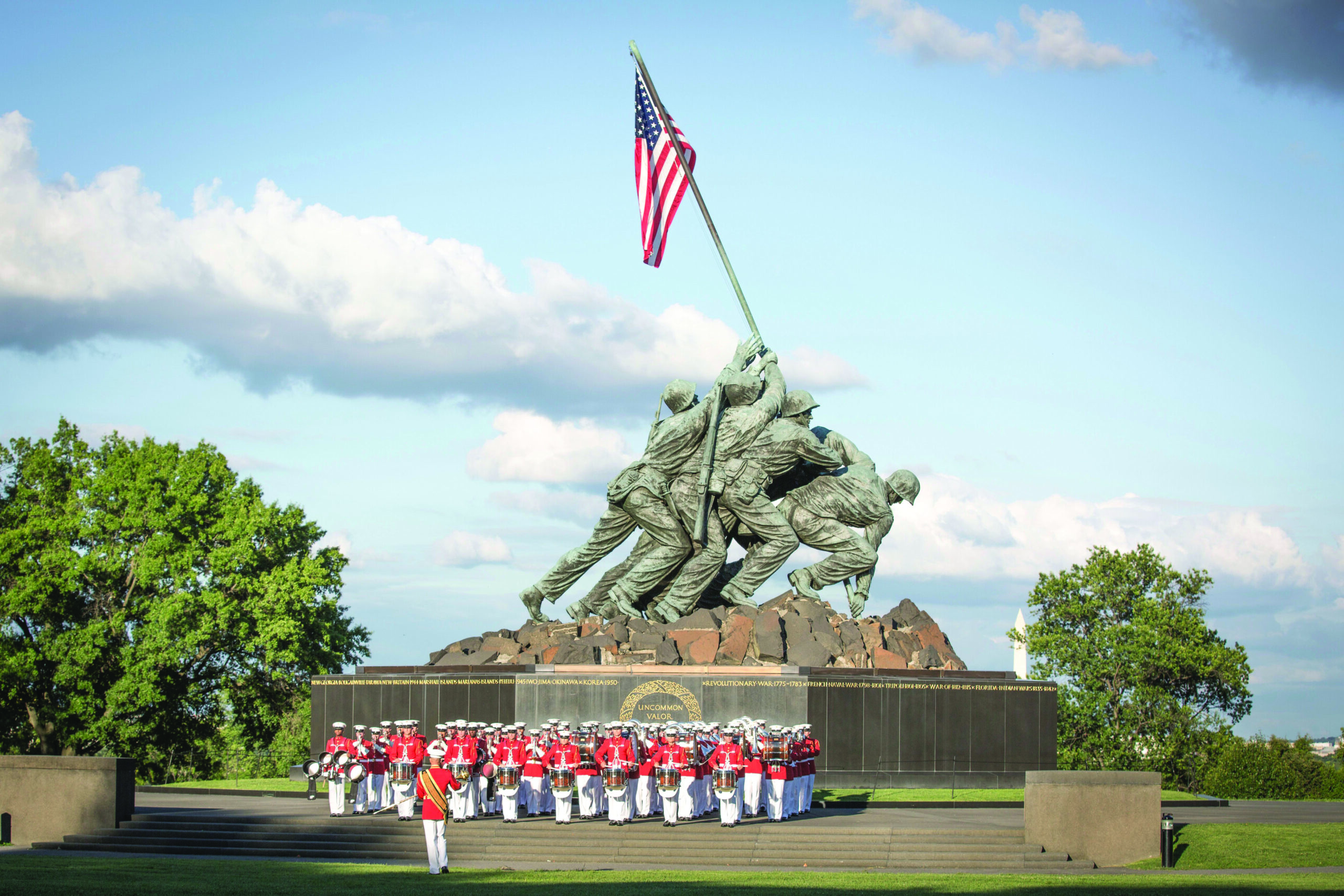
Though they can be seen all around the world, the D&B is primarily recognized for their iconic performances during the summer parade season in D.C. Every Friday night, they wow the packed stands at 8th & I during evening parades. Every Tuesday night, they bring Marine Corps history to life beneath the towering Marine Corps War Memorial in Arlington, Va., during sunset parades. Each performance shares a story and reveals a glimpse of the Marine Corps to onlookers. The responsibility they bear is certainly not lost on any D&B Marine—they represent not just “The Commandant’s Own,” but all Marines, past and present.

Capt Courtney Lawrence, executive officer of the D&B, conducts the band during the Drum Corps International World Championships in Indianapolis on Aug. 9, 2025. (Photo by Cpl Brynn L. Bouchard, USMC)

MGySgt Joshua Dannemiller, drum major of “The Commandant’s Own,” conducts the band during NightBEAT at Truist Stadium, Wake Forest University, Winston-Salem, N.C., on July 30, 2023. (Sgt Brandon Salas, USMC)
Earning a spot with the only paid, professional military drum and bugle corps naturally requires a daunting audition process and competition at the highest skill level. A dedicated D&B recruiter projects, advertises and fills vacancies within the unit every year. Most prospective applicants come from participating bands within Drum Corps International, an organization governing civilian drum and bugle corps. D&B puts on an exhibition performance at the Drum Corps International World Championships in Indianapolis, Ind., every summer. This single event sparks a significant portion of the interest and applications needed to fill vacancies.
Those who succeed through the audition process are expected to complete basic training and arrive in Washington, D.C., ready to step onto the parade deck with instrument in hand. The D&B joins other 8th & I Marines in Yuma, Ariz., for several weeks of “spring training” at the beginning of every year where they perfect the performance they will repeat throughout the summer parade season. The goal of D&B recruiting efforts is to identify openings, collect applicants, conduct auditions, finalize selections and get new enlistees through basic training, all throughout the year prior so new joins can attend the Yuma training.
Any number of things can go wrong with this process. D&B recruits sometimes suffer injuries in boot camp that delay their starting date, or worse, permanently affect their ability to play and march at the professional level required and ruin their prospective career. For various reasons, new musicians frequently arrive in D.C. after spring training is already over. Even so, they are expected to rapidly absorb the routine and join in the performance. I witnessed this firsthand during my spring visit to the barracks. As I stood on the parade deck observing rehearsal, a brand new private first class who had just arrived, having missed Yuma by only a few weeks, played his snare drum alongside staff sergeants and master sergeants who’d been performing for decades. For D&B, there is no bench or second string. Each member marches and contributes, regardless of rank or tenure.
Their job as a 5512, Member U.S. Marine Drum and Bugle Corps, in many ways is similar to any MOS within the Corps. Despite their demanding ceremonial duties and travel schedule, every Marine assigned to the D&B is a Marine first. They are expected to maintain proficient rifle qualifications, exemplary scores on the annual physical and combat fitness tests and embody our core values. They must pass leadership and career courses required to progress in rank. Drums and bugles replace rifles in daily life, but each remains a piece of serialized equipment placed in the care of an individual Marine to love, master and befriend. The creed may not formally exist, but the Marine mindset is the same.
“This is my contrabass bugle. There are many like it, but this one is mine.”
Even in times of war, members of the D&B have not been exempted from combat. While the unit as a whole remains non-deployable, individuals have shipped overseas throughout its history.
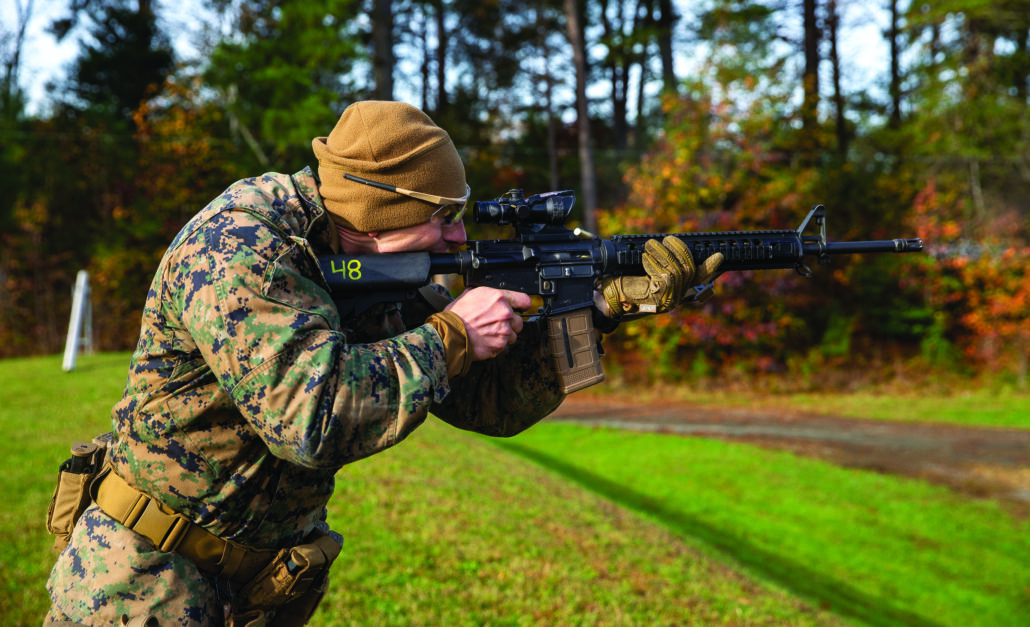
SSgt Patrick McCreary, from “The Commandant’s Own,” competes in the Marine Corps Marksmanship Competition at MCB Quantico, Va., on Nov. 4, 2021. (Photo by Lance Cpl. D’Angelo Yanez)
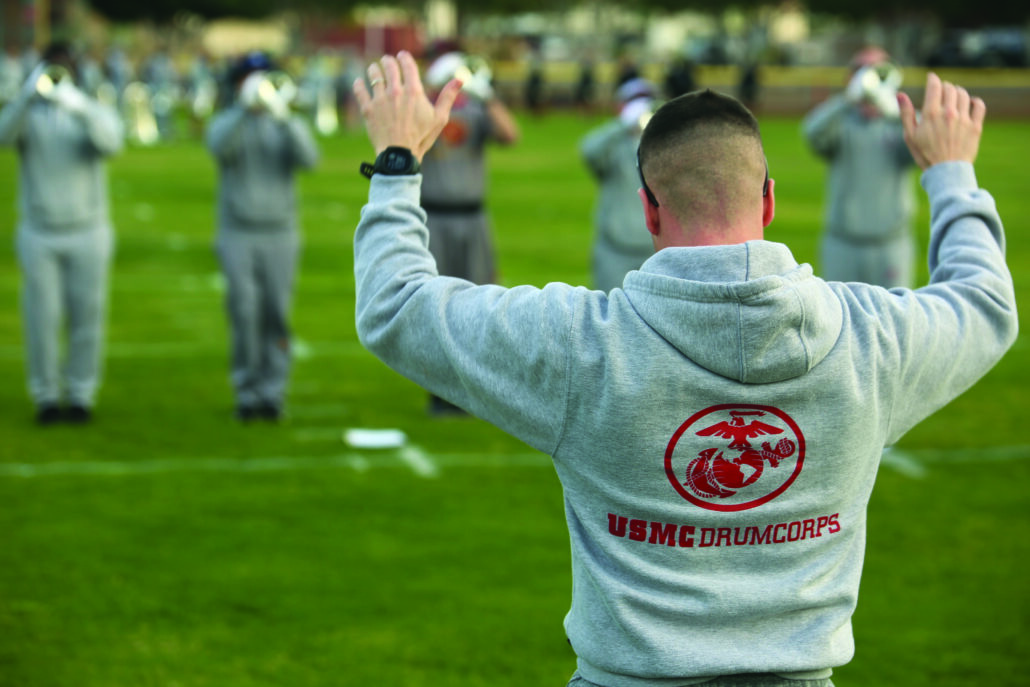
(Photo by PFC James Bourgeois, USMC)

At the beginning of every year, “The Commandant’s Own” joins other units from Marine Barracks Washington, D.C., including the Silent Drill Platoon and the Marine Corps Color Guard, in Yuma, Ariz., for annual training in preparation for the summer parade season.

Cpl Michael R. Rosie, a bugler with “The Commandant’s Own,” flips a tire during a field meet at Marine Barracks Washington, D.C., on June 12, 2024. (Photo by Lance Cpl. Chloe N. McAfee)
During Vietnam, members of the D&B wore Combat Action Ribbons and Purple Hearts on their blouses. A few had the opportunity to deploy most recently in support of the Iraq War.
Major Nathan D. Morris is a 19-year member of the D&B, currently serving as the unit’s commanding officer. Like all officers within the unit, Morris started as a PFC and was promoted from within. As a young corporal in 2008, he and one other D&B Marine volunteered to join a provisional rifle company formed in the National Capital Region (NCR). He deployed to Iraq and spent his time in country patrolling as a squad leader, returning home to a promotion to sergeant. Another provisional rifle company deployed from the NCR the following year, including two more D&B Marines.
The opportunity of a professional musician’s paycheck might represent the initial pull toward D&B, but it is the dual identity as a Marine that keeps members reenlisting.
“All are top-tier musicians, but the ones who buy into the Marine Corps culture are the most successful,” Morris explained. “Just like any MOS, we have Marines who do four years and get out, but overall, we have good retention. At some point, the Marine Corps gets a hold of you, and it becomes about being a Marine. If you don’t have that spirit and mindset in this organization, you are not going to do well. We are still like any other Marine Corps unit, operating off of Marine Corps doctrine like ‘MCDP-1.’ ”
Warfighting doctrine dictates why they do what they do and the way they do it. The Corps’ values drive them to be the best of the best, and perhaps are the reason they have endured as the only active-duty D&B. While representing the Corps on the most visible of stages, D&B Marines possess the rare opportunity to connect with Marine Corps history firsthand. Not just by embodying its visual representation, but physically experiencing it, more fully illuminating for them the importance of who they are.
Master Gunnery Sergeant Joshua Dannemiller has felt these moments, deeply connected to Marines who have gone before, at numerous points throughout his long career. Now the D&B Drum Major, Dannemiller enlisted in 2003. In 2010, he joined the D&B on an “island hopping” tour around the Pacific. During one stop, they helped commemorate the 65th anniversary of the Battle of Iwo Jima, performing at a ceremony attended by survivors from both sides of the conflict. During the visit, the Marines ran along the beaches where their predecessors landed under fire, the same black sand beneath their feet, the waves lapping against the same shoreline where so many lost their lives. Dannemiller was promoted to staff sergeant standing on top of Mount Suribachi. The scenes remain vividly etched in his memory now, more than 15 years later. Additionally, he has joined the D&B on tour for joint performances with the French at Belleau Wood.
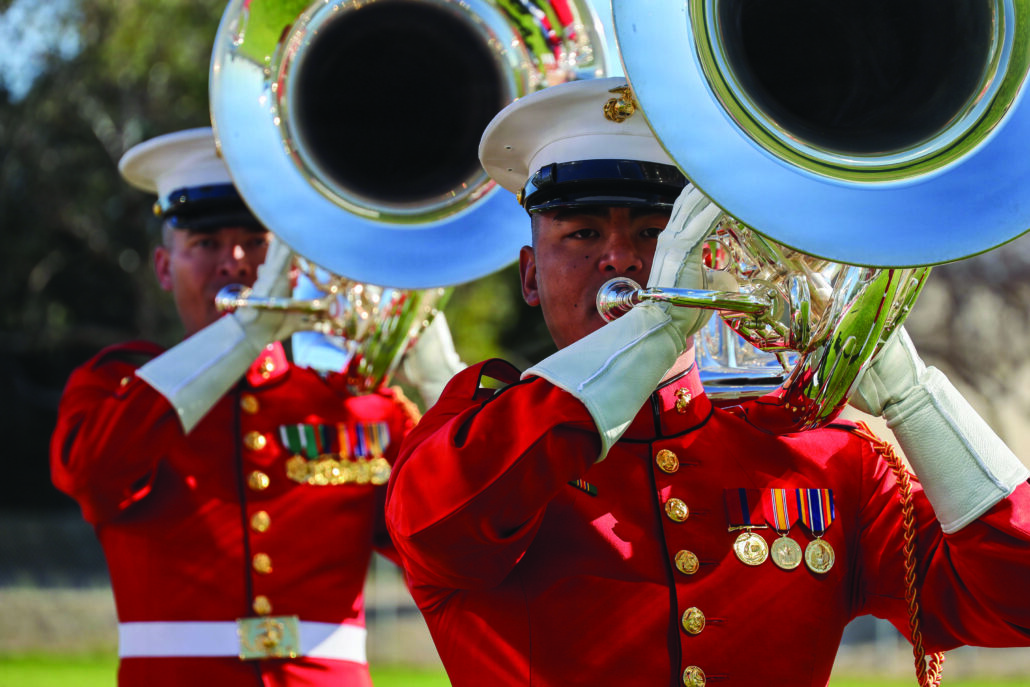
SSgt Alex Liddell, left, and Sgt Colton Garrett, tubists with “The Commandant’s Own” United States Marine Drum & Bugle Corps, play music during a dress rehearsal for performances in Australia and New Zealand at Marine Corps Air Station Yuma, Ariz., on Feb. 1. During the tour, the D&B traveled to Brisbane, Australia and Auckland, New Zealand in support of the Royal Edinburgh Military Tattoo. (Photo by Cpl. Christopher Prelle)
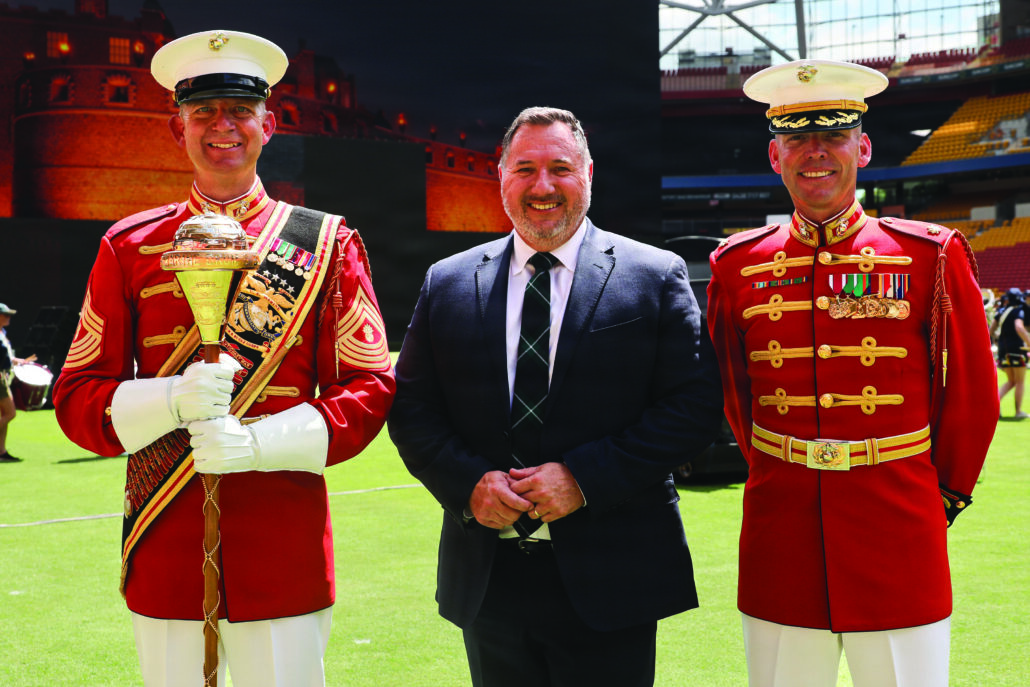
From left to right, MGySgt Joshua Dannemiller, drum major with “The Commandant’s Own”; Andrew Powell, Minister for the Environment and Tourism for Queensland; and Maj Nathan Morris, the commanding officer of “The Commandant’s Own,” at Suncorp Stadium in Brisbane, Australia, on Feb. 11. (U.S. Marine Corps photo by Cpl. Christopher Prelle)
“Seeing these battlefields and what the Marines actually overcame is a very humbling experience,” he reflected. “Part of our mission is storytelling, and that history is part of our story. It’s important for us today to see where we came from and what was learned from their sacrifice.”
From the Pacific islands to Atlantic Europe, Norway to New Zealand, or Indianapolis to Washington D.C., wherever “The Commandant’s Own” performs, their message is clear: Marines are the proud professionals of their craft, steeped in tradition, inspired by their history. They endure as one of the oldest continuous expressions of what it means to serve in the Corps.

“The Commandant’s Own” performs on the South Lawn of the White House in Washington, D.C., on April 28 as part of a state arrival ceremony for Their Majesties of the United Kingdom of Great Britain and Northern Ireland, King Charles III and Queen Camilla. (Photo by Cpl Brynn L. Bouchard, USMC)
Featured Photo (Top): The “Commandant’s Own” performs during a sunset parade at the Marine Corps War Memorial, Arlington, Va., on July 25, 2017. (Photo by Cpl Cristian L. Bestul, USMC)
About the Author

Kyle Watts is the staff writer for Leatherneck. He served on active duty in the Marine Corps as a communications officer from 2009-13. He is the 2019 winner of the Colonel Robert Debs Heinl Jr. Award for Marine Corps History. He lives in Richmond, Va., with his wife and three children.
Enjoy this article?
Check out these similar Leatherneck and Scuttlebutt features:
Celebrating America’s Music: The 225th Anniversary of “The President’s Own”
Leatherneck
July 2023
By: Kyle Watts
Hail to the Chief: “The President’s Own” Supports The Inauguration
Leatherneck
April 2017
By: Kyle Watts
Remember What You Represent: The Marine Corps Silent Drill Platoon
Leatherneck
July 2024
By: Kyle Watts