There is a distinct gravity that commands the air around a U.S. Marine Corps memorial.
Time seems to slow its heavy march. Voices drop to a murmur, and strangers fall into a kind of synchronized silence. Some stand still before the structures, their eyes tracing the lines of a cast bronze face or reading the name of a battle. Others stay around at the edges, watching as a veteran rests a hand against cold stone, lost in a private conversation spanning across the decades. A child tugs quietly at a parent’s sleeve, sensing the seriousness there.
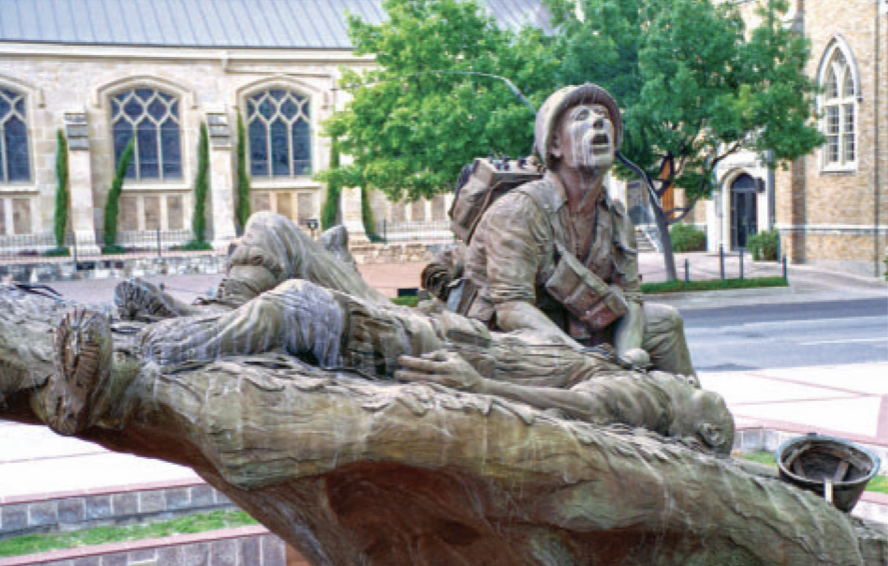
Whether it is a statue of Marines raising the flag above the Virginia skyline or a small, solitary marker tucked beside an American Legion post, these structures give us momentary pause and demand we bear witness to the history and individuals behind it. Yet it takes more than just a glance to uncover the full story behind each memorial; every etched slab of granite and bronze can carry the weight of political battles, backbreaking labor—and a unifying refusal to let any Marine fade into history.
The Reality of National Memorials
When imagining a Marine Corps memorial, a few “gold-standard” standouts may jump to mind, such as the Marine Corps War Memorial in Arlington, Va., or Semper Fidelis Memorial Park in Triangle, Va.
United by more than just their Marine Corps affiliation, these monuments function as condensed manifestations of military history, honoring pivotal campaigns and entire divisions. Their designs actively stir the esprit de corps, transforming a simple visit into a pilgrimage for shared heritage and reflection.
However, behind a monument’s final, physical form lies a grueling process. Constructing a national memorial is a monumental task that demands far more than imagination; it requires a balance of civil engineering, artistic scrutiny and the ability to rally enduring support across the entire country.
Before a single shovel hits the dirt or a block of stone is carved, a national memorial must survive federal approvals. Sponsors must navigate the Commemorative Works Act, which strictly regulates who can be honored and where, with assistance from the National Capital Memorial Advisory Commission staff. This is a process that can take decades. Memorials additionally require an act of Congress and the President signing the bill into law.
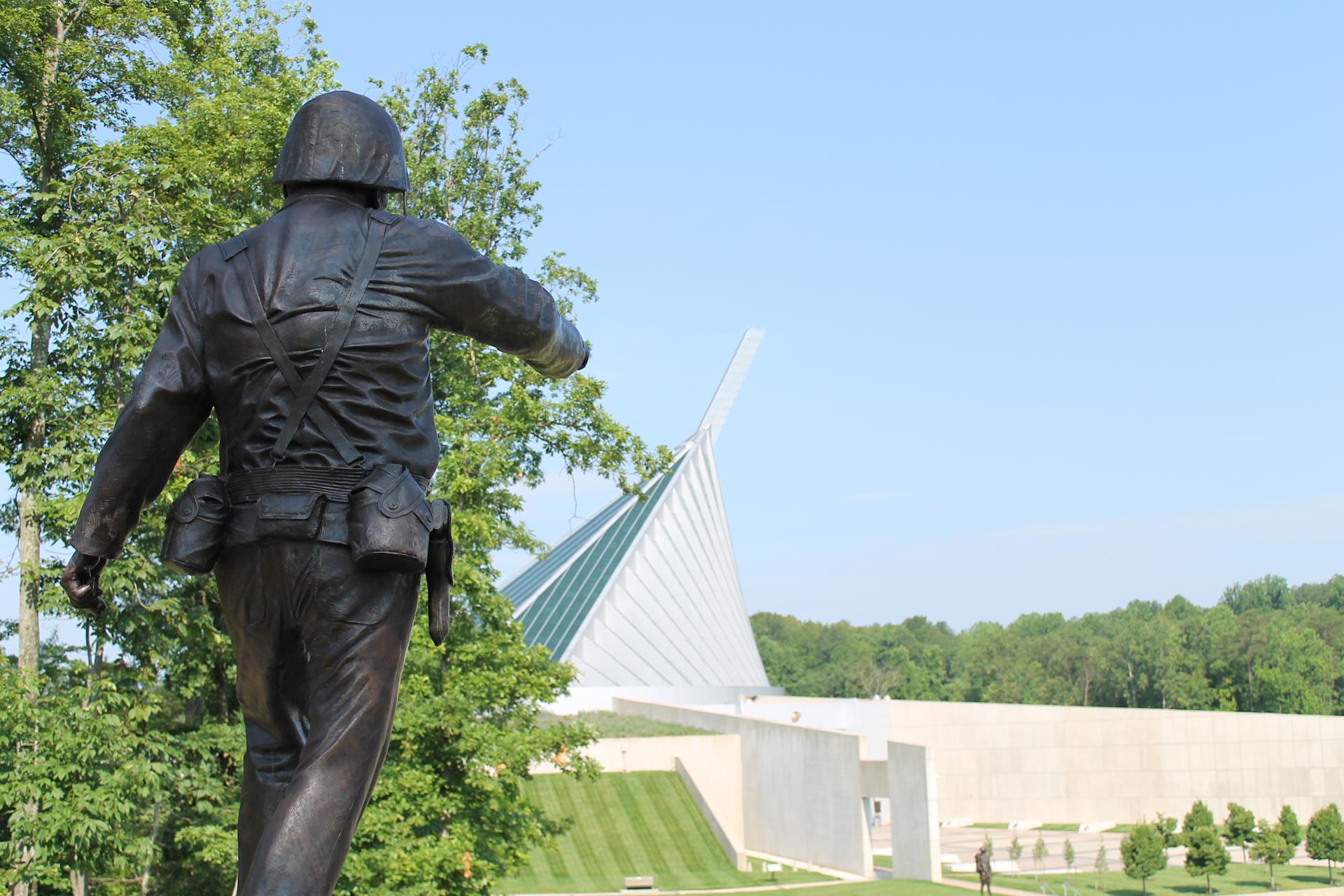
Overlooking the National Museum of the Marine Corps, a statue of LtGen Lewis B. “Chesty” Puller commands the landscape at Semper Fidelis Memorial Park in Triangle, Va. (Photo courtesy of Marine Corps Heritage Foundation )
Designs then must be passed through multiple gatekeepers such as the National Park Service, the National Capital Planning Commission, the Commission of Fine Arts and the State Historic Preservation Office. These bodies scrutinize every detail to ensure historical accuracy, environmental preservation and aesthetic harmony with the surrounding national landscape.
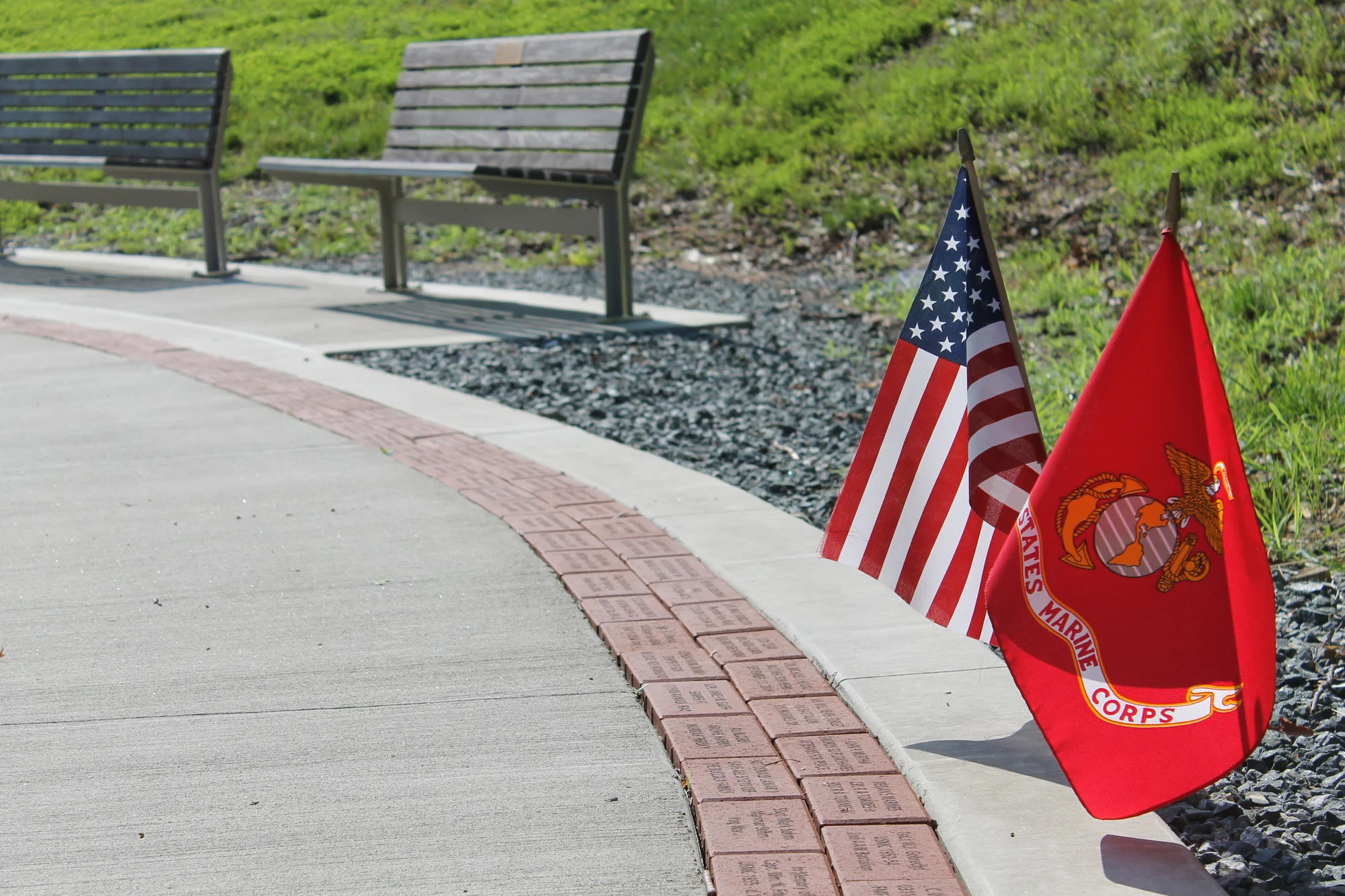
Etched brick walkways wind through Semper Fidelis Memorial Park at the National Museum of the Marine Corps.
And, if a memorial proposal for Washington, D.C., manages to push through and survive, there is a Sisyphean task at the top of Capitol Hill. Under frameworks like the Commemorative Works Act, federal authorization in the capital region isn’t open-ended; sponsors typically face a strict seven-year window from the date of enactment to secure site approval, raise funds and complete design sign-offs or else the authorization expires and the entire legislative battle must restart.
Constructing a national memorial is a monumental task that demands far more than imagination; it requires a balance of civil engineering, artistic scrutiny and the ability to rally enduring support across the entire country.
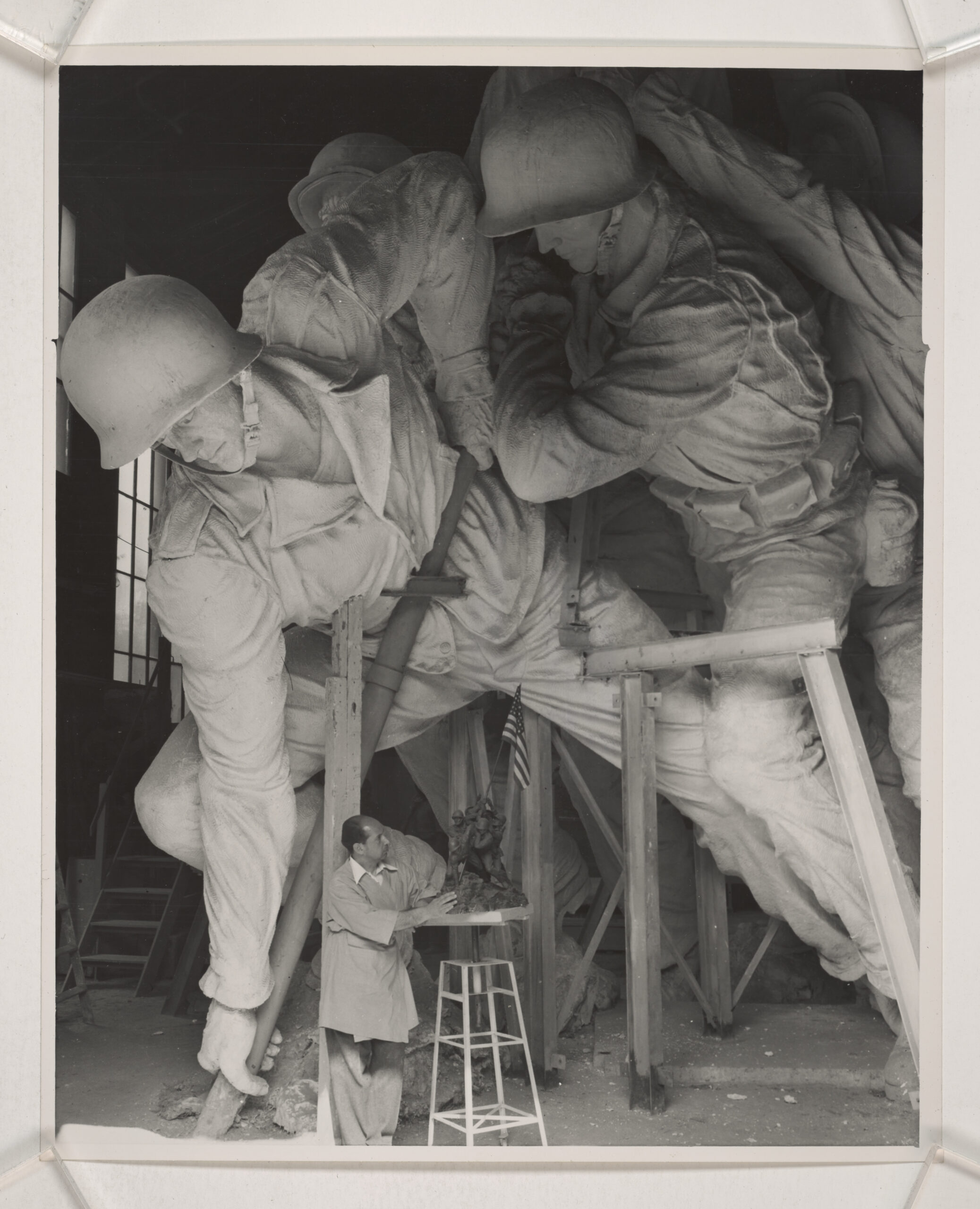
The initial concept of a memorial frequently undergoes radical transformation before becoming reality, and necessarily so. A monument representative of an entire military branch, historic campaign or national tragedy carries an immense emotional weight. Sculptors and designers face intense scrutiny from the public, historians and the very families of those being honored. Every fold of a uniform, weapon type and facial expression must be vetted to avoid controversy or misrepresentation. Overcoming these design hurdles also requires translating that vision into physical stone and bronze, involving specialized founders, stonemasons, welders and riggers—keepers of traditional trades that are increasingly difficult to find and may result in additional limitations to the memorial’s design and budget. Therefore, the final monument often looks different from its blueprint.
Amid scaffolding, sculptor Felix W. de Weldon reviews the plaster framework of the Marine Corps War Memorial. Before standing as a 78-foot bronze national landmark, his vision had to be perfected in plaster, divided into 108 separate pieces and shipped to New York for casting.(Courtesy of National Archives)
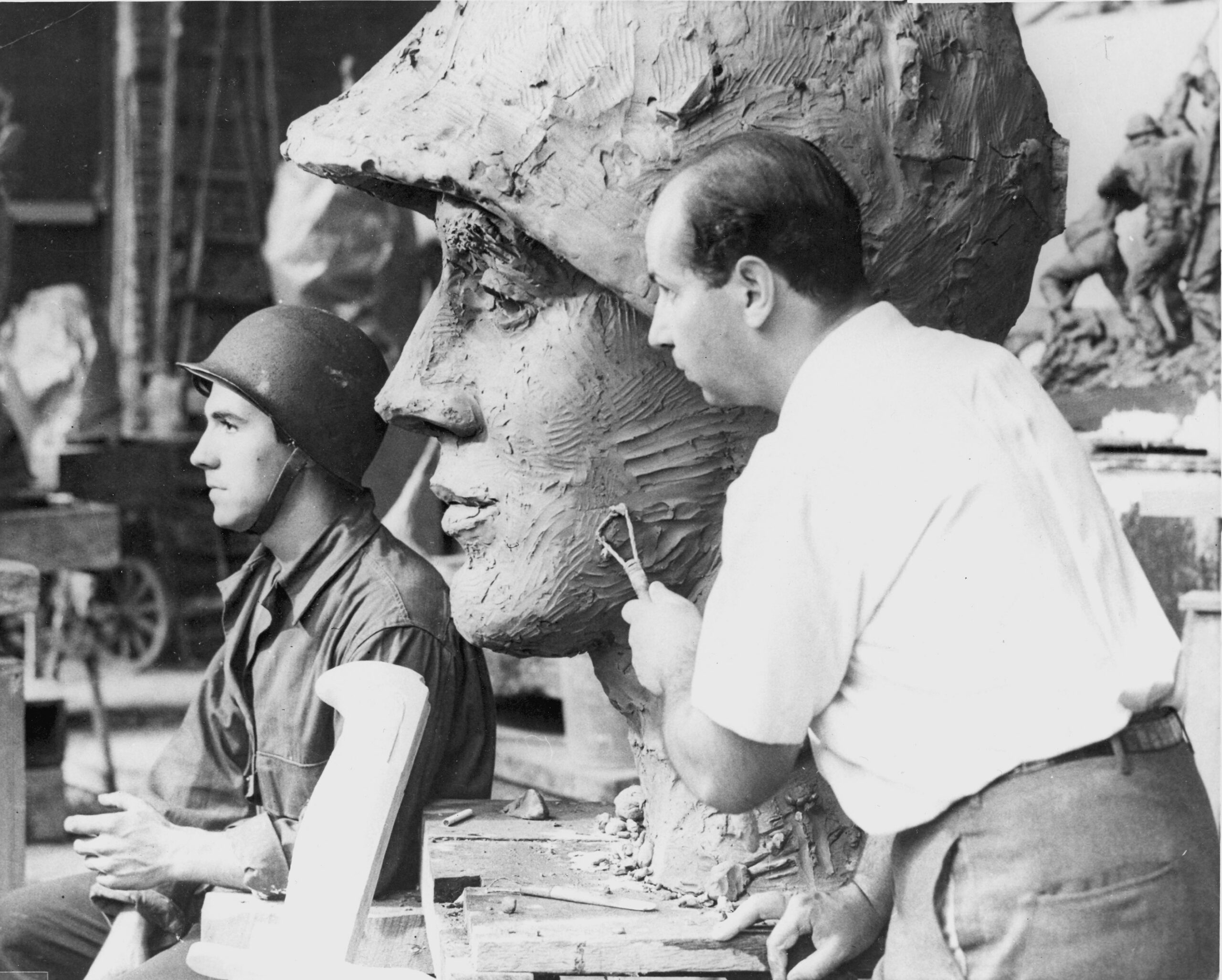
Marine Rene Gagnon poses for sculptor Felix de Weldon, who crafted each figure using live models and historic photographs.(Courtesy of National Park Service)
Executive Editor’s note: In 2019, the Bowers Board determined that Gagnon was on Mount Suribachi at the time of the second flag raising, but he was not one of the flag raisers. See “In Fairness to All Parties” in the January 2020 issue of Leatherneck for the full story.
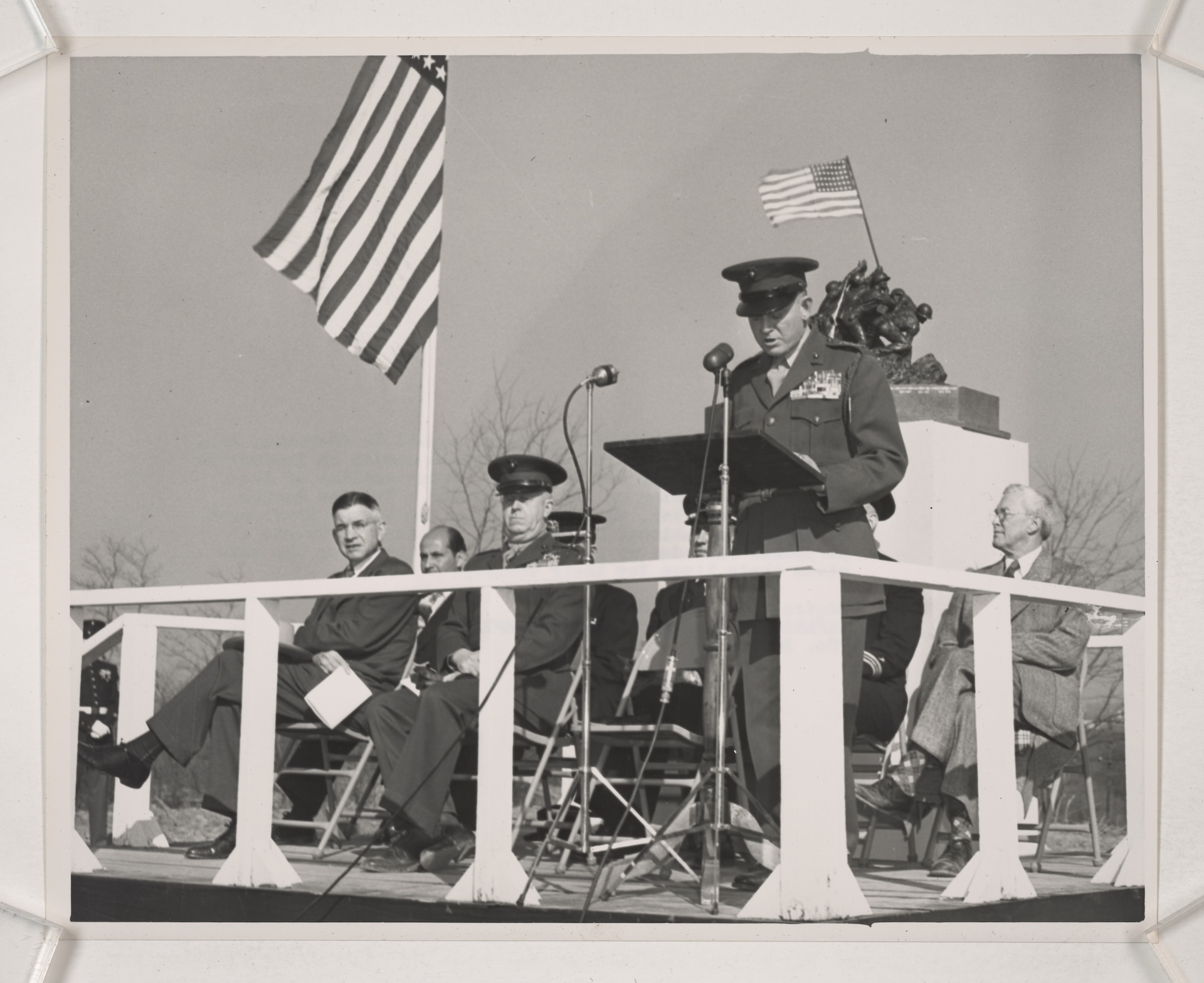
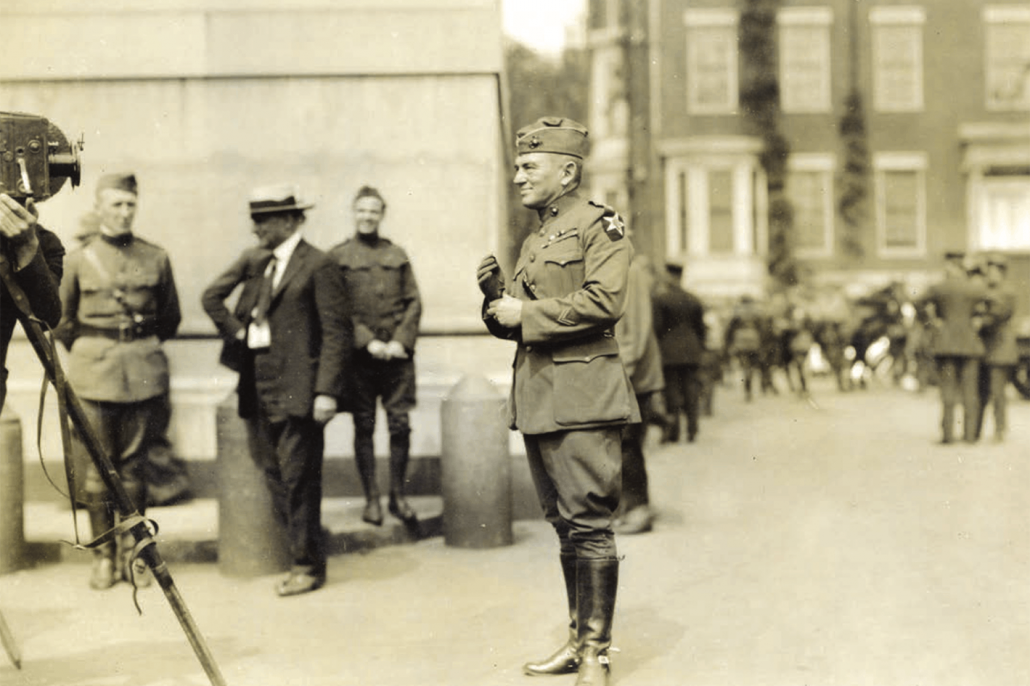
Gen Lemuel C. Shepherd Jr., the 20th Commandant of the Marine Corps, delivers remarks during the dedication ceremony of the Marine Corps War Memorial on Nov. 10, 1954.(Courtesy of National Archives)
Then comes the financial aspect. A vast majority of national landmarks do not rely on federal funding. Financing them requires strategy, as national tributes often scale into multimillion-dollar undertakings, and most projects rely on forming foundations specifically to spearhead fundraising. These entities must run multiyear, nationwide campaigns appealing to corporate sponsors, veterans’ organizations and individual citizens. Deceptively, the cost of a memorial does not end with its dedication. Organizers must also raise funds for long-term maintenance endowments to ensure that bronze does not corrode, stone does not fracture and groundskeeping is maintained in perpetuity.
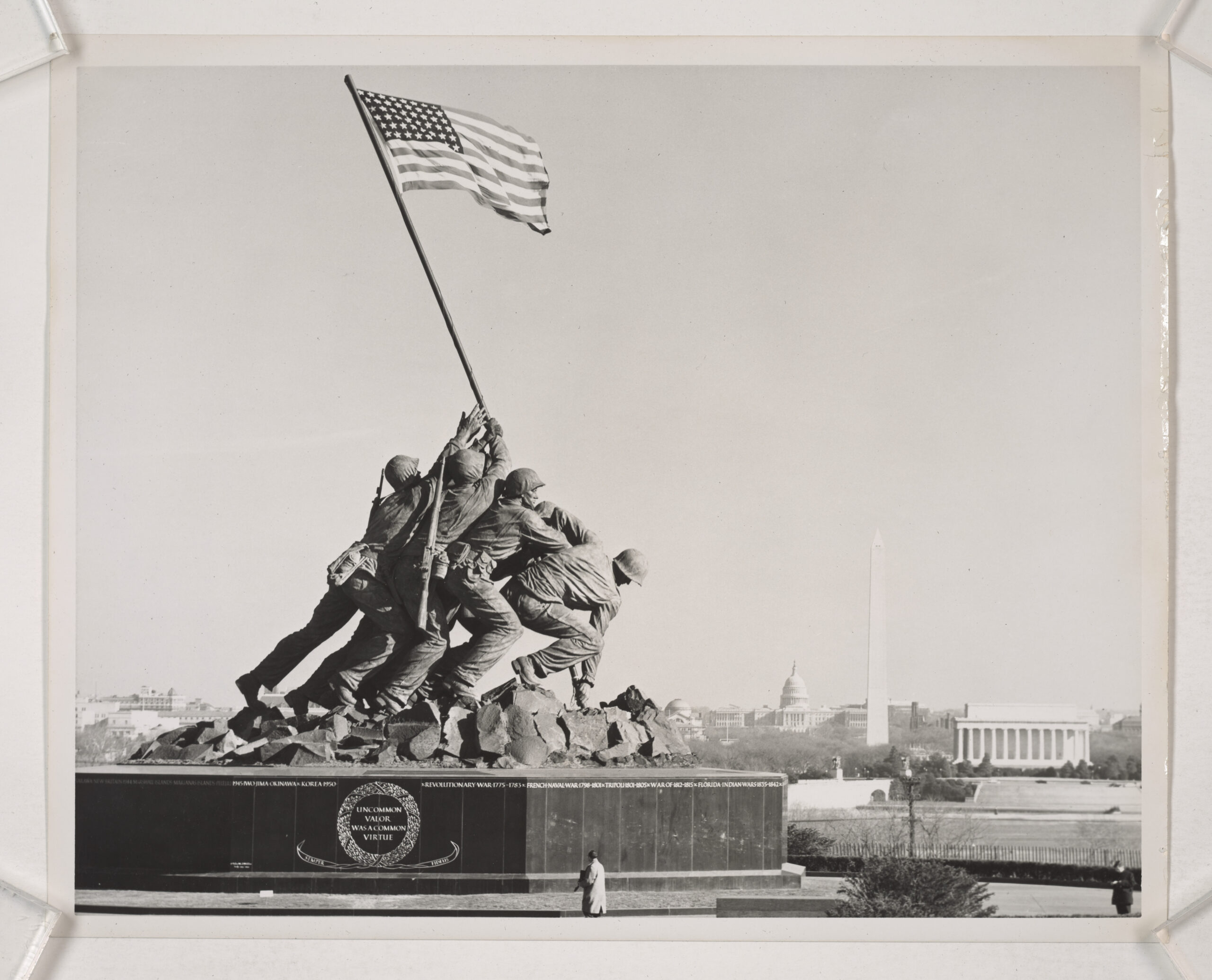
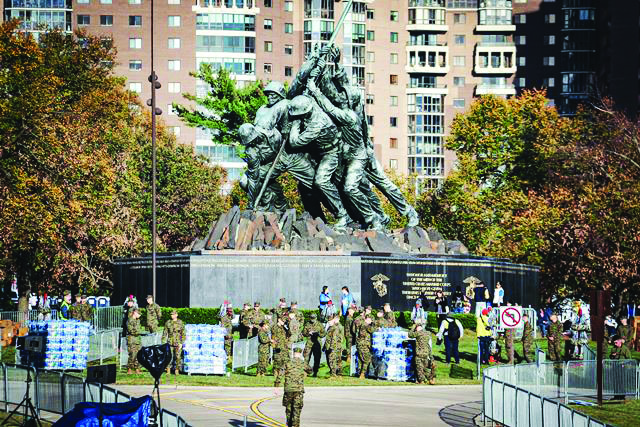
A notorious success story for a national memorial is the Marine Corps War Memorial, inspired by Joe Rosenthal’s iconic Pulitzer Prize-winning photograph of the flag raising on Mount Suribachi during the Battle of Iwo Jima. This monument stands 78 feet tall, anchored by bronze figures and a 60-foot flagpole that flies the American flag 24 hours a day by presidential proclamation.
The initial concept of a memorial frequently undergoes radical
transformation before becoming reality, and necessarily so.
Yet behind the memorial is the battle required to bring it to life. Sculptor Felix W. de Weldon—then serving in the U.S. Navy—first saw Rosenthal’s photograph in 1945 and immediately crafted a scale model. What followed was a nine-year crusade. De Weldon brought in three of the men who were believed to be the surviving flag raisers (Ira Hayes, Rene Gagnon and John Bradley) to model their faces in clay, while using photographs to meticulously recreate those who had fallen.
The figures were initially sculpted over a steel skeletal framework and, once perfected in plaster, the colossal masterpiece was disassembled into 108 separate pieces and shipped to the Bedi-Rassy Art Foundry in Brooklyn, N.Y. Over three years, artisans cast, cleaned and chased every section before trucking the components back down to Virginia in a multivehicle convoy for final welding and assembly.
For this project, no public tax dollars were used. The entire $850,000 cost in 1954 was raised entirely through donations from U.S. Marines, veterans, reservists and friends of the Corps. Upon its completion, President Dwight D. Eisenhower celebratorily dedicated the memorial on Nov. 10, 1954, on the 179th birthday of the Marine Corps.
Though de Weldon aimed for historical accuracy, the project exposed that even the most revered monuments are vulnerable not just to bureaucracy but also to human error and flawed early records. Years after its unveiling, official investigations by the Marine Corps revealed that John Bradley and Rene Gagnon were not actually among the six men in Rosenthal’s flag-raising image, cementing an accidental misidentification into bronze and stone.
The Grassroots Fight For Local Memorials
Local memorials often tell the most intimate stories of brotherhood for a community. For local governments and detachments of the Marine Corps League and platoon associations, building a memorial is frequently an underdog campaign. Smaller community veteran markers typically range from local budgets of $10,000 to well over $200,000 for expansive town plazas and commemorative spaces.
If you visit Veterans of Foreign Wars posts, county courthouses and municipal parks across America, you will find brick-paver walkways, small granite stones and bronze plaques bearing the names of local Marines who never came home from Belleau Wood, Chosin, Hue City or the valleys of Helmand Province.
Tributes like these are rarely funded by multimillion-dollar federal endowments; instead, they come to life through spaghetti dinners, charity golf tournaments, car washes and small donations from citizens who want to honor their local Marines. When a local monument committee commissions a plaque, the margin for error is zero. The Eagle, Globe and Anchor must conform to exact proportions—the rope twists, the placement of the continents, and the spread of the eagle’s wings cannot be left to an artist’s creative jurisdiction. The symbol falls under a trademark and must be licensed for use. If a foundry gets the details wrong, it will be noticed.
Consider the local effort behind projects like the Stafford County Armed Services Memorial in Stafford County, Va. Built to honor generations of local servicemembers, the project was guided by a dedicated commission—including Supervisor Gary Snellings; Lieutenant General Ron Christmas, USMC (Ret); and Supervisor Mark Dudenhefer. True to its community roots, the memorial’s design came from local classrooms. Aaron Brown of North Stafford High School won a $1,500 scholarship for his winning design, and an architect integrated ideas from the top five student submissions into the final plan.
Rather than relying on government windfalls, the committee financed the memorial through community-funded brick pathways and collaborated closely with local businesses, individual donors and civic organizations to raise nearly $835,000 and complete the site on the Stafford government campus.
Living Memorials
Rather than constructing a monument meant solely for passive observation, a living memorial actively serves, educates and sustains the veteran community day in and day out. These memorials range from dedicated park landscapes to historical sites and clubhouses operating across the United States.
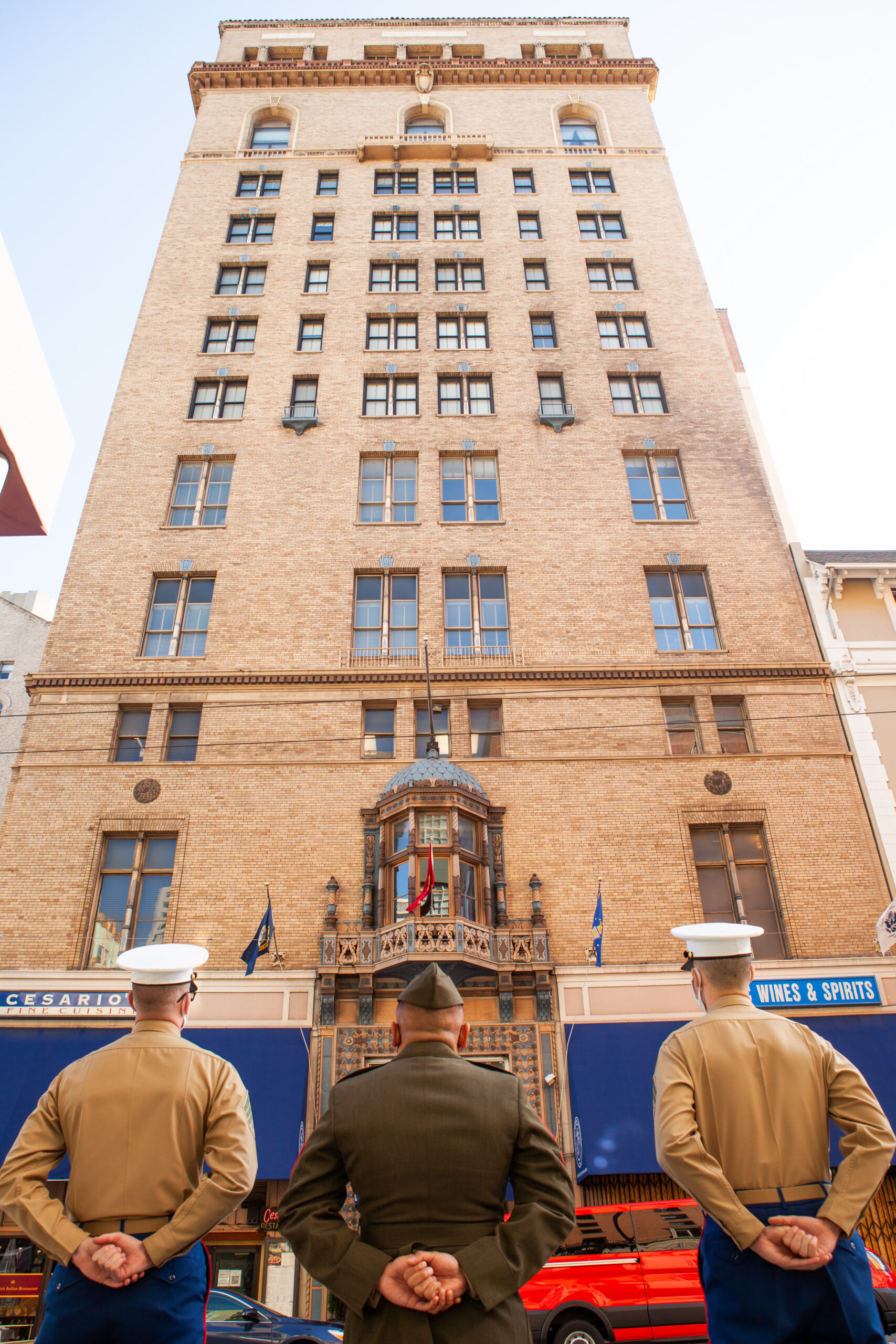
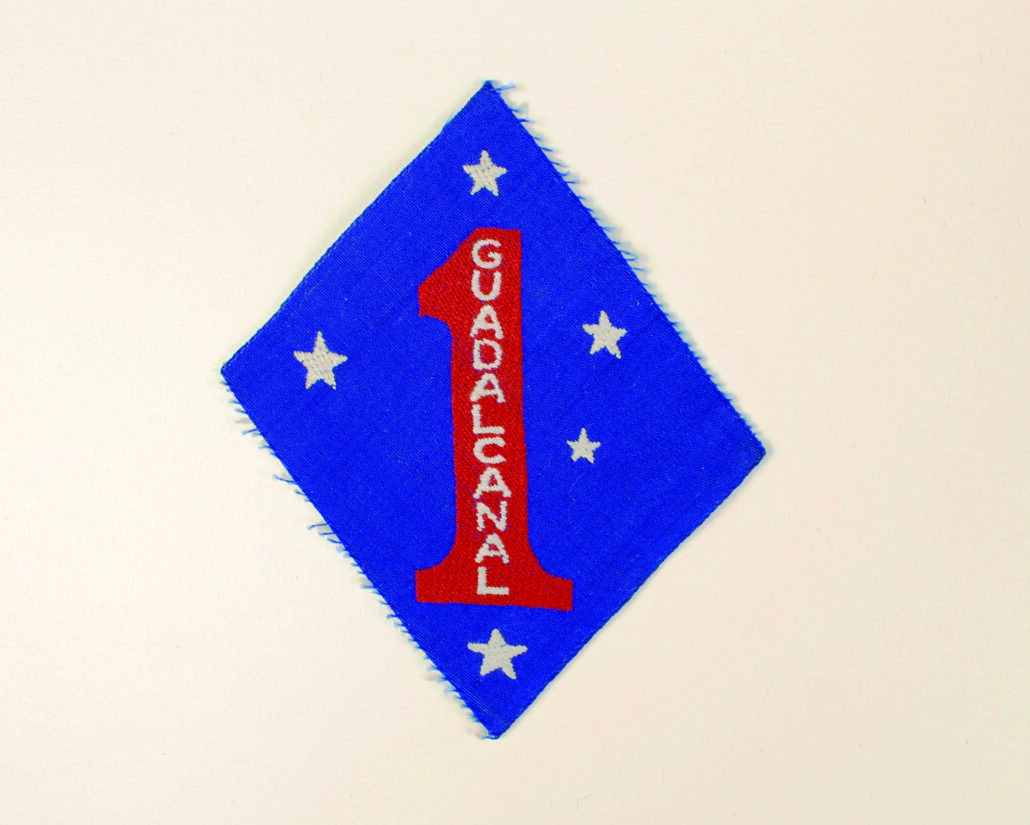
The Marines’ Memorial Association’s 1946 charter pioneered a profound evolution for memorials in the States, establishing the Marines’ Memorial Club as the nation’s first “living memorial” on Nov. 10, 1946, marking the 171st anniversary of the founding of the Corps. This 12-story landmark was conceived under the vision of Gen Alexander A. Vandegrift, the 18th Commandant of the Marine Corps who had led the 1st Marine Division through Guadalcanal, alongside a group of returning Pacific war veterans.
As these veterans stepped off into a civilian world that often struggled to comprehend what they had endured, they realized they needed more than a statue. They needed a sanctuary. They pooled their resources with the united goal of securing a building in downtown San Francisco, Calif.
Marines gather in downtown San Francisco, Calif., outside the 12-story Marines’ Memorial Club, established on Nov. 10, 1946, as the nation’s first “living memorial.”
Today, the facility houses a comprehensive military history library and museum preserving rare archives, uniforms and artifacts; the Tribute Memorial Wall, honoring American servicemembers who made the ultimate sacrifice in the global war on terror; and lodging, dining and professional spaces dedicated to active-duty personnel, veterans and their families visiting the area. To ensure this mission continues across generations, the Marines’ Memorial Association operates alongside the Marines’ Memorial Foundation, a 501(c)(3) public charity dedicated to funding educational programs, historical preservation and active support for military families.
It stands as proof that one of the best ways to honor the memory of a Marine is to take care of a living one.
Private Memorials
While national memorials command the attention of the country and local plazas rally entire towns, there exists an even more intimate tier of remembrance: the private memorial. These deeply personal tributes bypass bureaucracy entirely, finding their quiet homes in backyards, living rooms and private family sanctuaries.
If national memorials speak to the broad, collective history of the Corps, private memorials speak to an individual bond that time cannot touch. Often these spaces are constructed to symbolically bring a Marine home.
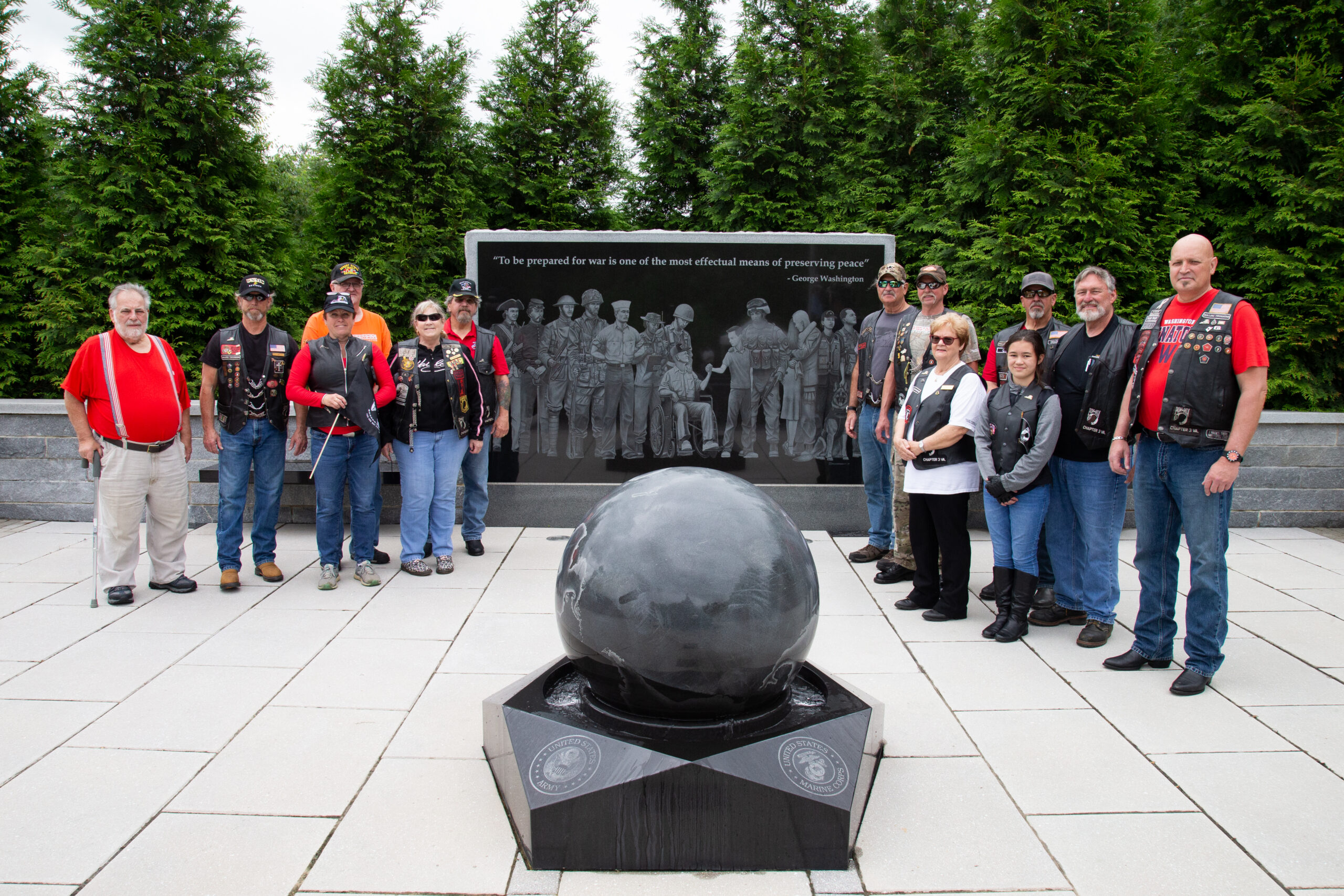
Members of Rolling Thunder Virginia Chapter 3 participate in a ceremony at the Stafford County Armed Services Memorial in Stafford, Va., on May 27, 2022.(Tarnish Pride)
These tributes scale down to what can fit on a fireplace mantel, a garden bench or a corner of a home study. They frequently feature deeply personal artifacts: a folded American flag, a pair of polished combat boots holding a helmet with dog tags draped over the brim or a single engraved river stone placed beneath a shady tree. Devoid of structural permits or public oversight, they rely instead on brass shell casings fired at a final range qualification, dog-eared pocket notebooks or uniform ribbons pinned securely into shadow boxes.
If national memorials speak to the broad, collective history of the Corps, private memorials speak to an individual bond that time cannot touch
These spaces are not meant for public speeches or wreath-laying ceremonies. Instead, they are sanctuaries for a quiet cup of coffee in the morning, a silent toast at sunset or a private conversation. These private memorials remind us that remembrance is not just found in crowds around grand public monuments; it lives intimately in the everyday spaces and lives we inhabit. These are held as the most priceless memorials of all.
The Final Salute
A memorial, no matter its national, local or private scale, is, at its core, a pledge. It is an individual pausing to look at the sacrifice of a Marine and declaring: You are seen. You are remembered. Your watch is relieved, but your name will never fade.
Author’s note: Do you or your local veteran groups have a private memorial or a quiet space dedicated to a Marine? Leatherneck invites you to share your stories, photos and descriptions of these personal tributes by emailing us at [email protected].
Featured Photo (Top):Completed after a nearly decade-long endeavor, the Marine Corps War Memorial in Arlington, Va., stands as a physical testament to the immense dedication and years of labor required to transform an idea into a permanent national landmark.
About the Author
Kayla Workman is the editorial assistant for Leatherneck and a graduate student at the University of Alabama specializing in archival studies. She previously earned her bachelor’s degree in historic preservation from the University of Mary Washington.
Enjoy this article?
Check out these similar Leatherneck, Gazette, and Scuttlebutt features:
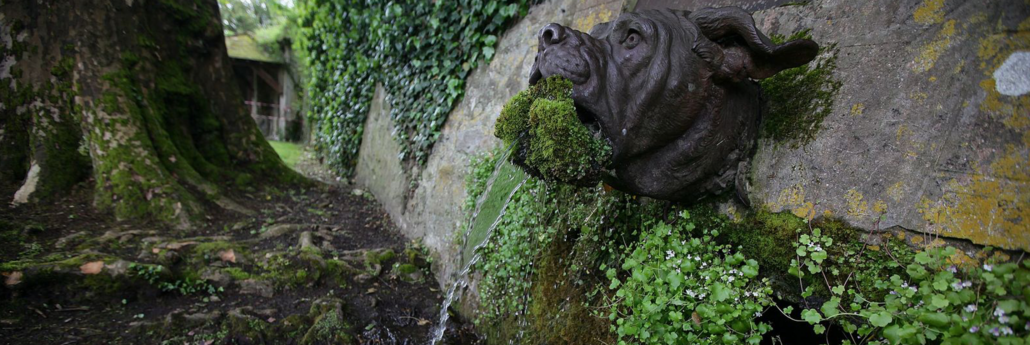
Return With The Elixir: The Psychology Of Pilgrimages To The “Devil Dog” Fountain
Leatherneck June 2024 By: Heather A. Warfield, Ph.D.
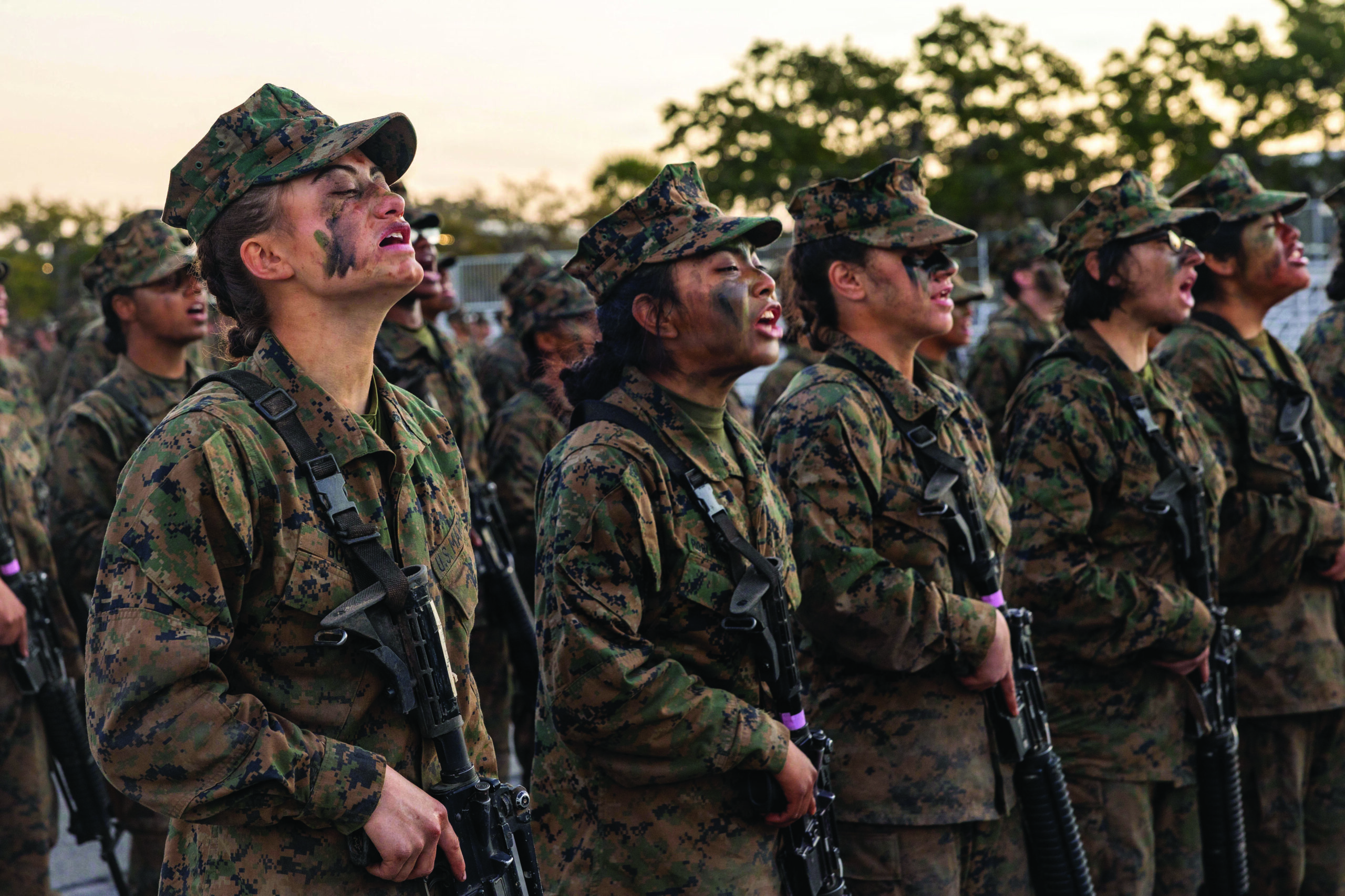
While locked at the position of attention, the Crucible completed, standing in formation sweaty, sandy, exhausted and hungry yet beaming with pride, few Marines can forget the first time they sang “The Marines’ Hymn.” After weeks enduring hard training, long marches and endless days, recruits at both Marine Corps Recruit Depots sing the hymn as a culminating event welcoming them to the lineage of the Corps.
With the black matte Eagle, Globe and Anchor finally gripped in hand, and the words of the hymn still echoing across the parade deck, they can now claim the title “United States Marine.” They enter a 2 1/2 century lineage and joining the unbroken line of those who stood in the same place and sang the same words before them. On that day, pride, spirit and connection all become real.
Although widely known, what is the history behind the hymn? Where did it come from? Who wrote it? How exactly did this 24-line, three-verse fighting anthem become the version that we know today? The answers to these questions took nearly a century to settle and involved hundreds of contributors in both war and garrison.
Researching the Hymn’s Origins
To gain insight into the origins of “The Marines’ Hymn,” we began our research at The United States Marine Band headquarters in Washington, D.C., and their extensive library of historic documents.
The building is named for The Marine Band’s most celebrated director, John Philip Sousa, known as the “March King,” whose compositions and leadership left a permanent mark on the Corps and American military music. Visitors are greeted by an 8-foot bronze statue of Sousa atop a granite base just to the left of the main entrance. It captures him with conductor’s baton in hand, head tilted intently, his eyes trained upon the ensemble.
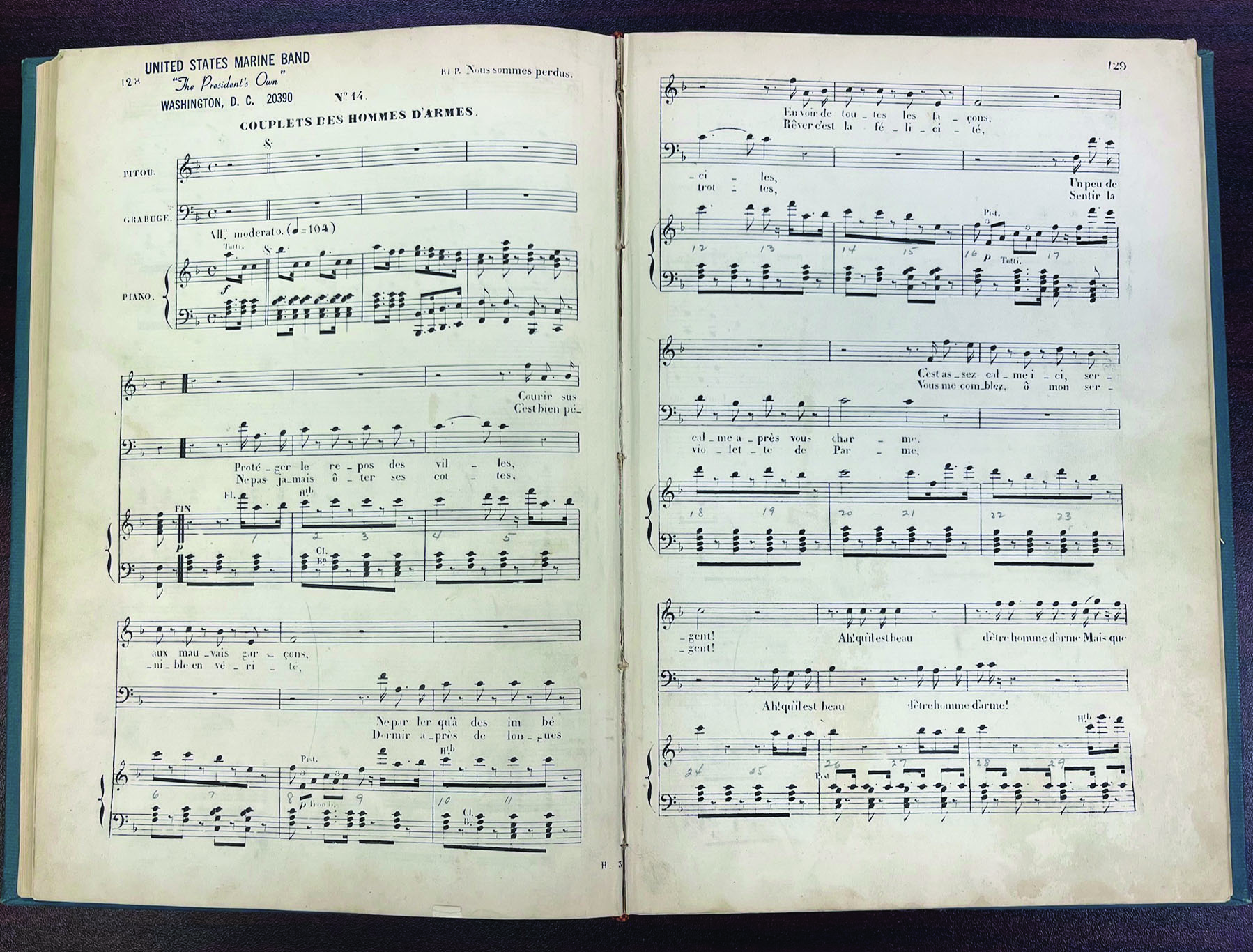
The iconic melody of “The Marines’ Hymn” originated not from a martial tune, but from a 19th-century comic opera—Jacques Offenbach’s “Genevieve de Brabant.” (USMC photo)
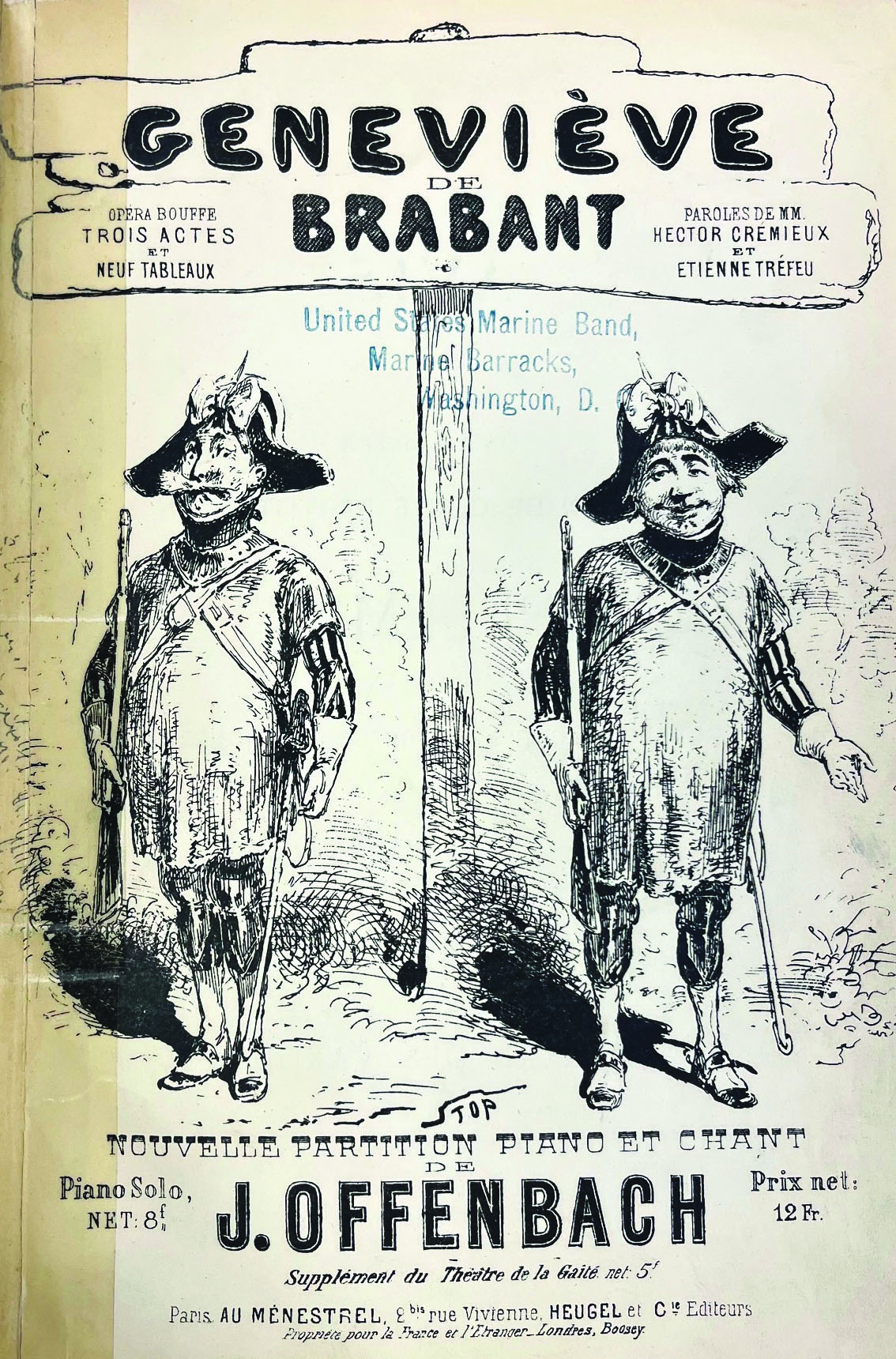
The title page of Jacques Offenbach’s “Geneviève de Brabant,” the comic opera whose second-act duet provided the musical template for “The Marines’ Hymn” despite its vastly different narrative. (USMC photo)
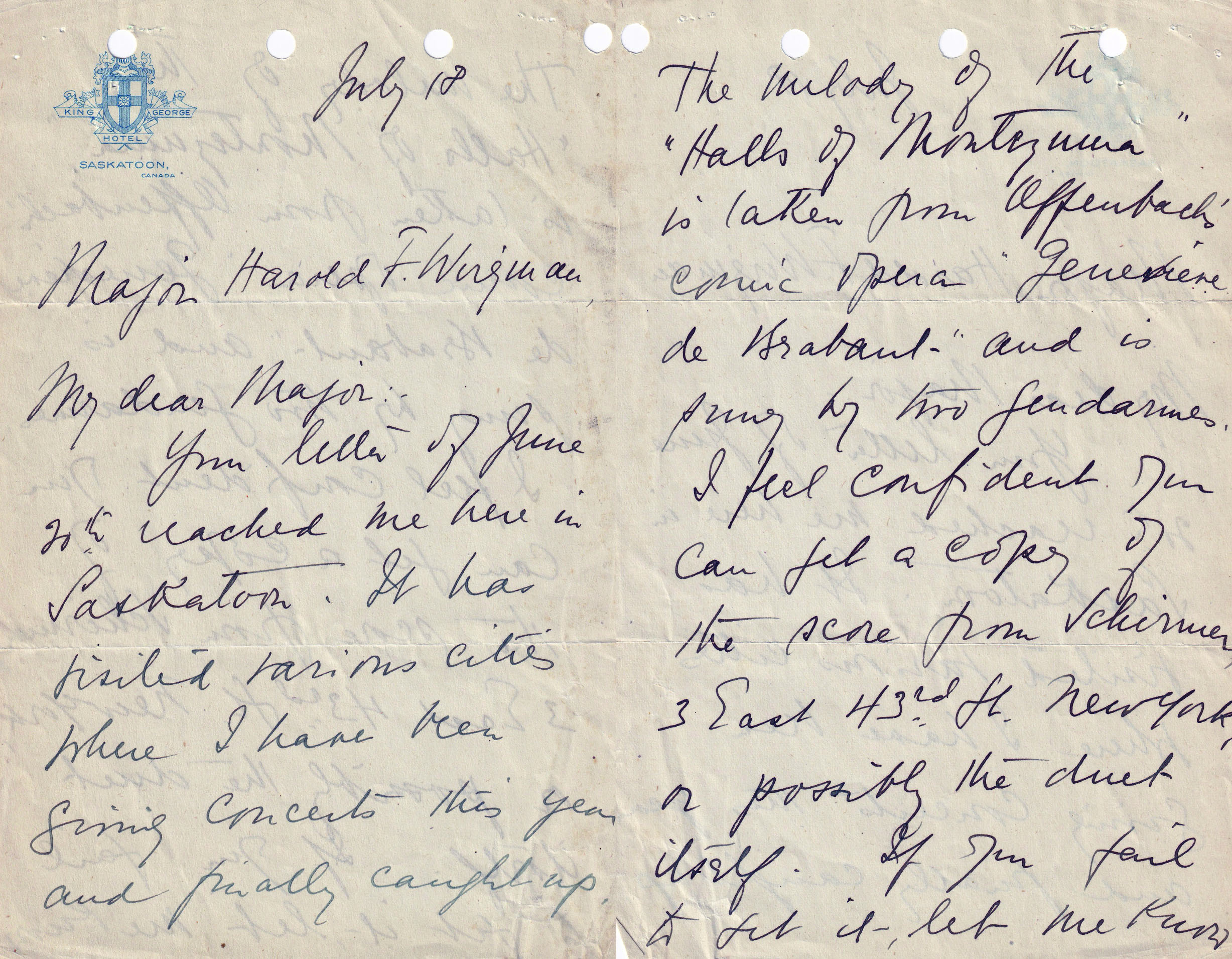
The Marine Band Library is run by Chief Librarian Master Sergeant Charles Paul and Staff Sergeant Philip Espe. Together, they safeguard The Marine Band’s most treasured materials. Among the library’s holdings is correspondence that helped settle the question of the hymn’s musical source. In the collection is a century-old letter, written on King George Hotel letterhead while Sousa was on tour, in which he informed Major Harold F. Wirgman, “The melody of the ‘Halls of Montezuma’ is taken from Offenbach’s comic opera ‘Genevieve De Brabant,’ and sung by two gendarmes.” The date on the note appears in the upper right-hand corner of the first page but omits the exact year: July 18. The letter surfaced from Wirgman’s private collection and correlates with renewed interest in October 1936, when a query from Commandant Major General John H. Russell sparked fresh efforts to trace the hymn’s origins.
MSgt Paul produced a well-used, unassuming gray book. The buckram-bound volume could sit on any professional military education library shelf without attracting attention. The cover title in gold letters reads “Opera Bouffe: Genevieve De Brabant,” and below that, black type reads, “Orchestra and Band Scores” by German-born French composer Jacques Offenbach. The inside cover contains a curious reprinted hand-drawn illustration depicting two early 19th-century soldiers, or “gendarmes,” bearing rifles at what was then trail arms—the musket held vertically with the right hand and the rifle buttstock lifted slightly off the ground.
On the title page, Sousa wrote a note to then-Commandant MajGen Wendell C. Neville that reads, “See page 128.” He drew attention to stanza No. 14, “Couplets Des Hommes D’Armes,” which contains the original score. This opera first appeared in Paris in November 1859 and developed into a three-act version on Dec. 26, 1867. Considered a comedy at the time, the plot was a satirical spoof of the medieval legend of Genevieve of Brabant, a noblewoman falsely accused of infidelity while her husband was away at war, and was meant to be sung amusingly by two characters. In the second act, two bumbling guards sing the song in a duet, bragging about how they bravely attack, while conveniently running away or hiding when the opponent is stronger. Marines would be aghast to know the melody’s origins for being quite the opposite in martial character.
In essence, the opera supplied a musical template for the melody of “The Marines’ Hymn,” rather than any connection to the story itself. Although the link between a comic duet of two cowardly malfeasants and a martial anthem may seem odd, the lighthearted, joyful theme is fitting: Marines were, after all, born in a tavern.
Previous research into the exact original lyrics remains obscured by anecdotal lore, despite multiple attempts over the years. One such effort was conducted in January 1916 by Walter F. Smith, the first man to hold the title “Second Leader” of The Marine Band. According to the 6th Marine Division’s “History of the Marines’ Hymn,” he and Colonel Albert S. McLemore found that Maj Richard Wallach, while in Paris in 1878, had drawn one of the earliest connections to the opera. They also surmised possible Spanish folk origins, in part because a band member’s Spanish spouse recognized the tune.
In a letter (top) written to Maj Harold F. Wirgman (bottom), John Philip Sousa noted, “The melody of the ‘Halls of Montezuma’ is taken from Offenbach’s comic opera ‘Genevieve de Brabant,’ and is sung by two gendarmes.” This correspondence helped reignite historical interest into the true origins of the Corps’ anthem.
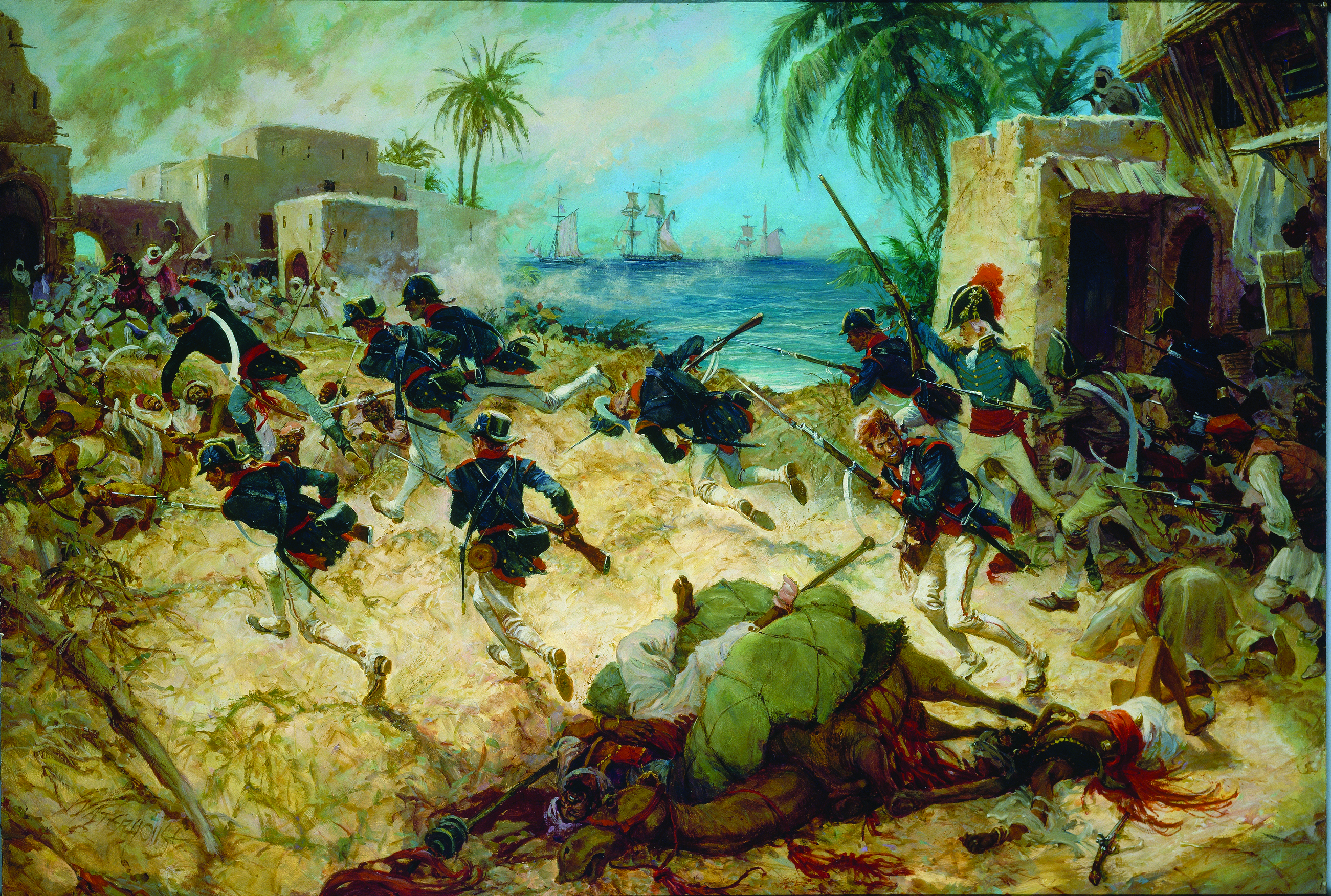
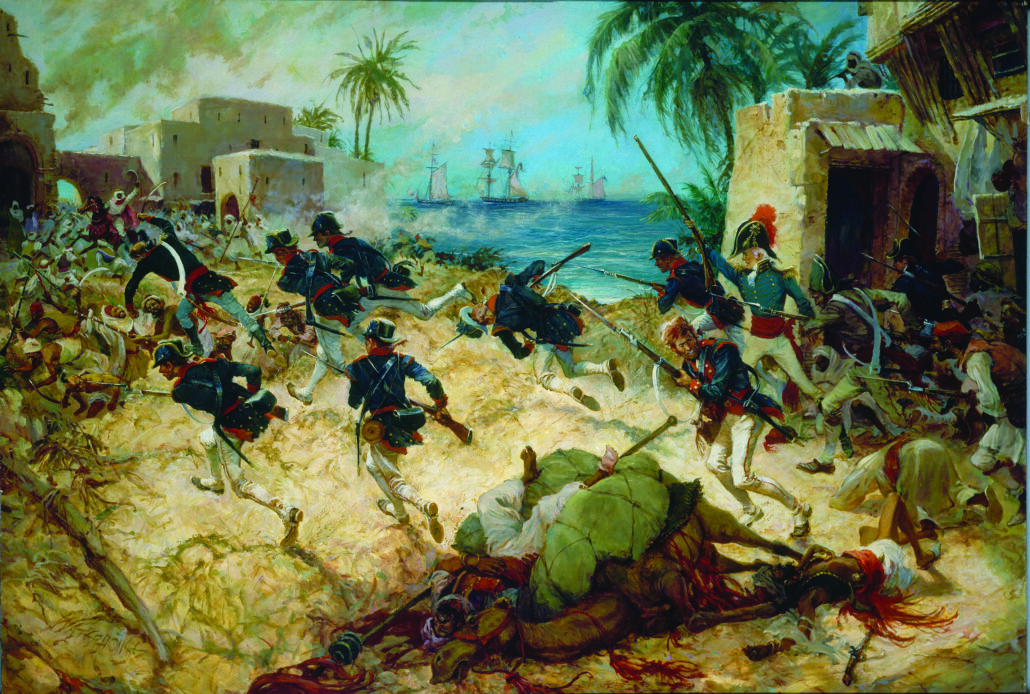
Origins widely accepted today trace the first lyrics to the Mexican-American War (1846-1848). A June 1951 edition of Washington, D.C.’s The Evening Star reports that, in 1847, an unidentified infantry Marine penned the first lines of the hymn. He took as his inspiration the words “To the Shores of Tripoli,” painted on a Marine standard, and added, “From the Halls of Montezuma.” Curiosity about this and other historic references to an early organizational standard led us to the National Museum of the Marine Corps.
Connections to the Marine Corps’ First Organizational Colors
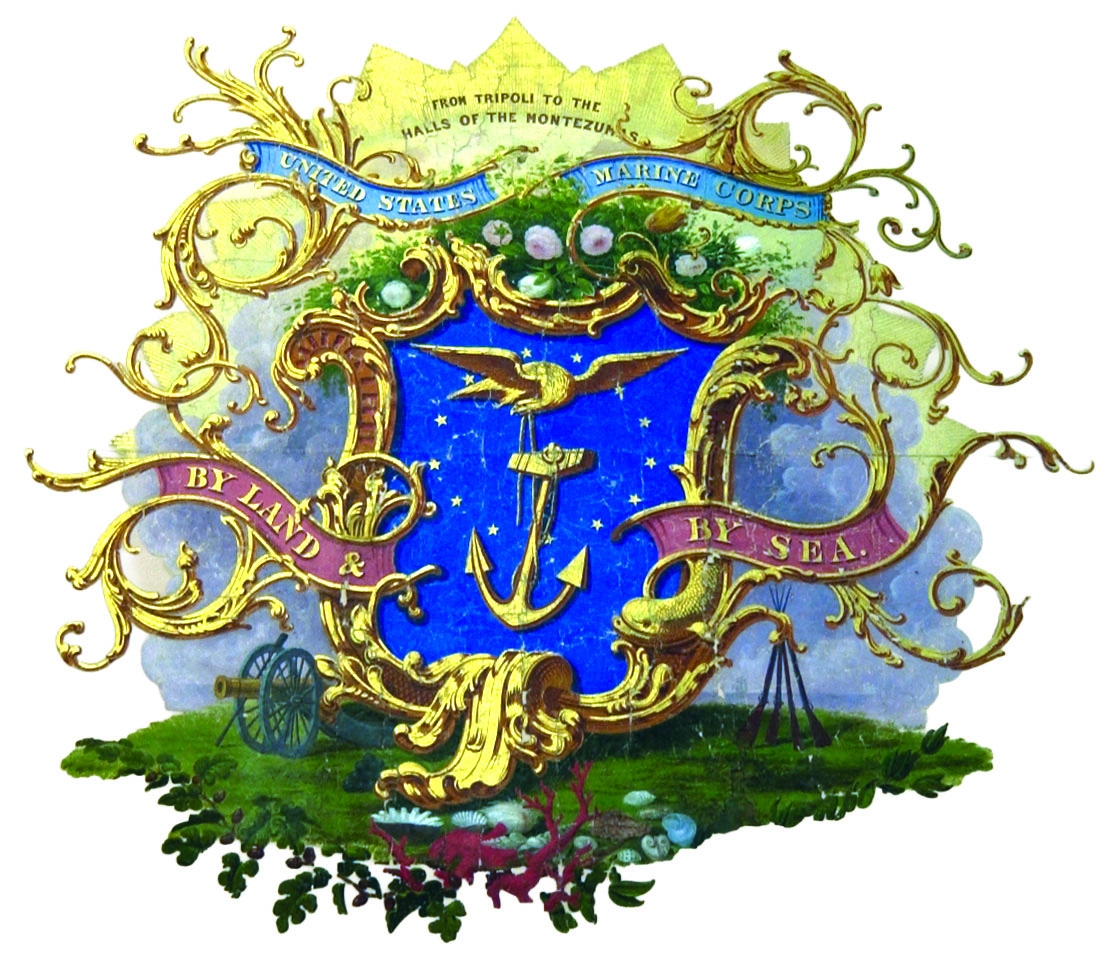
In the first set of displays to the left in the museum’s gallery entrance is the earliest Marine Corps organizational standard still in existence. Research indicates this elaborately painted silk flag was created in 1843 by Boston artist Joseph Bush and presented to Commandant Archibald Henderson by the citizens of Washington, D.C. Long stored and later rediscovered in 1916 in an unused room of the Home of the Commandants at Marine Barracks Washington, the flag is now known as the “Bush Flag.”
The “Bush Flag,” dating back to the 1840s, is the earliest known surviving Marine Corps standard and is thought to have inspired the opening lines of the hymn. (Courtesy of National Museum of the Marine Corps)
There remains some uncertainty whether this flag, or an earlier version bearing only the words “To the Shores of Tripoli,” was carried by the Marine battalion attached to MG Winfield Scott’s army during the 1847 campaign from Veracruz to Mexico City. No earlier white standard with that motto is known to survive. The Baltimore Sun of March 7, 1848, reported that an early standard originally bore the motto “By Land & by Sea” and that the words “From Tripoli to the Halls of the Montezumas” were added later. Marine Corps Order 10520.3 (the “Flag Manual”) also mentions an 1830s-1840s white flag bearing “To the Shores of Tripoli,” but no such flag is known to exist today.
Regardless, the opening lines of the hymn ultimately joined the Corps’ two early overseas victories, Tripoli and the Halls of Montezuma, into a single enduring statement.
Versions of the hymn’s lyrics have been attributed to multiple Marines in the early 1900s, including Colonel Henry C. Davis, Brigadier General Charles Doyen and First Sergeant L.Z. Phillips. In 1915, Marine Band Leader William H. Santelmann, one of five to serve two terms as director, arranged to publish sheet music for all bands across the Marine Corps. In one version, the first verse appeared slightly different than what is known today:
From the Halls of Montezuma To the shores of Tripoli We fight our country’s battles On the land as on the sea. Admiration of the nation We’re the finest ever seen. And we glory in the title Of the United States Marine.
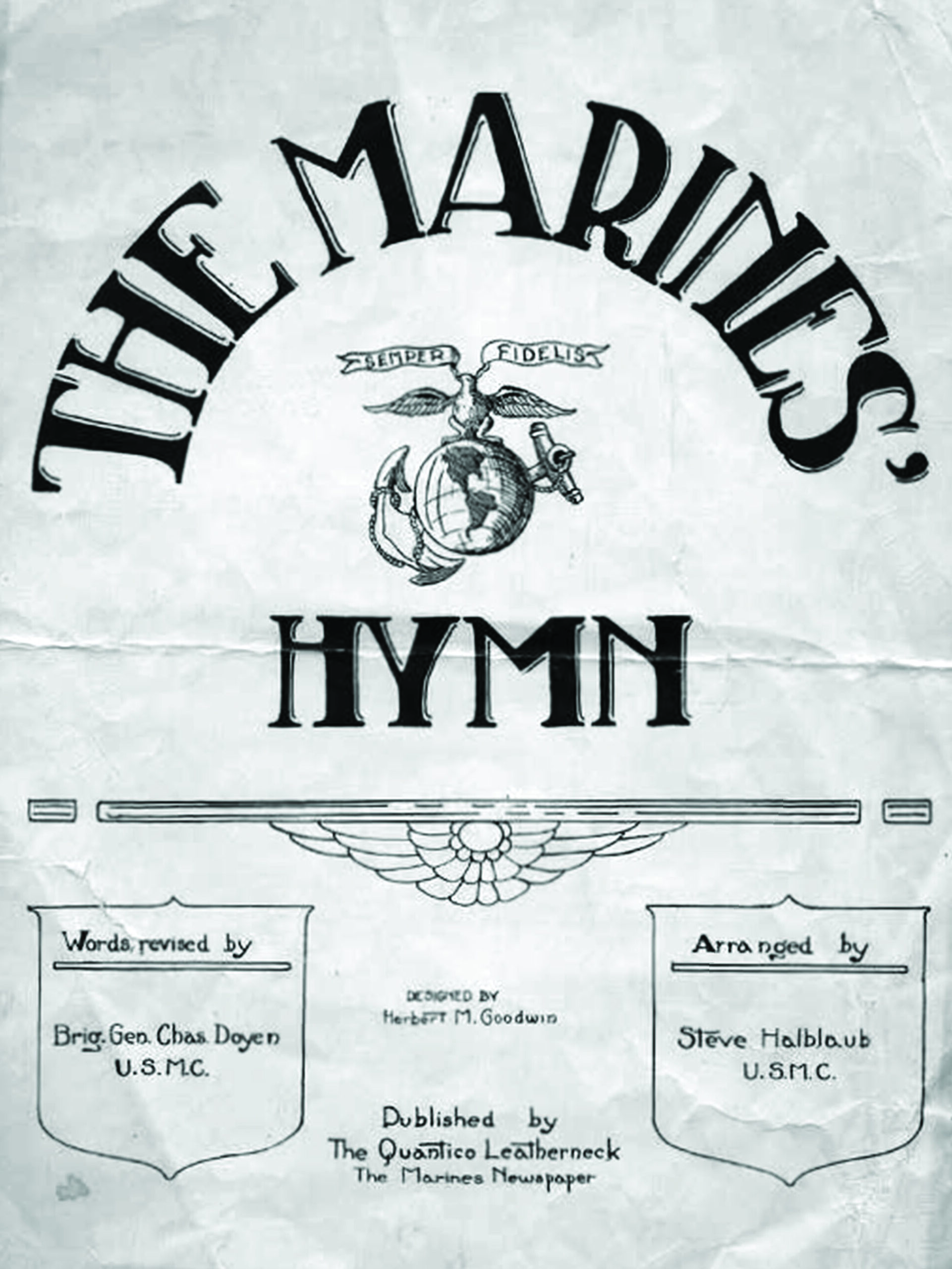
Research shows a uniquely interesting correlation between earlier hymn versions and Leatherneck. In December 1917, The Quantico Leatherneck, the newspaper predecessor to today’s magazine, published “The Marines’ Hymn” for the first time with both words and sheet music put together.
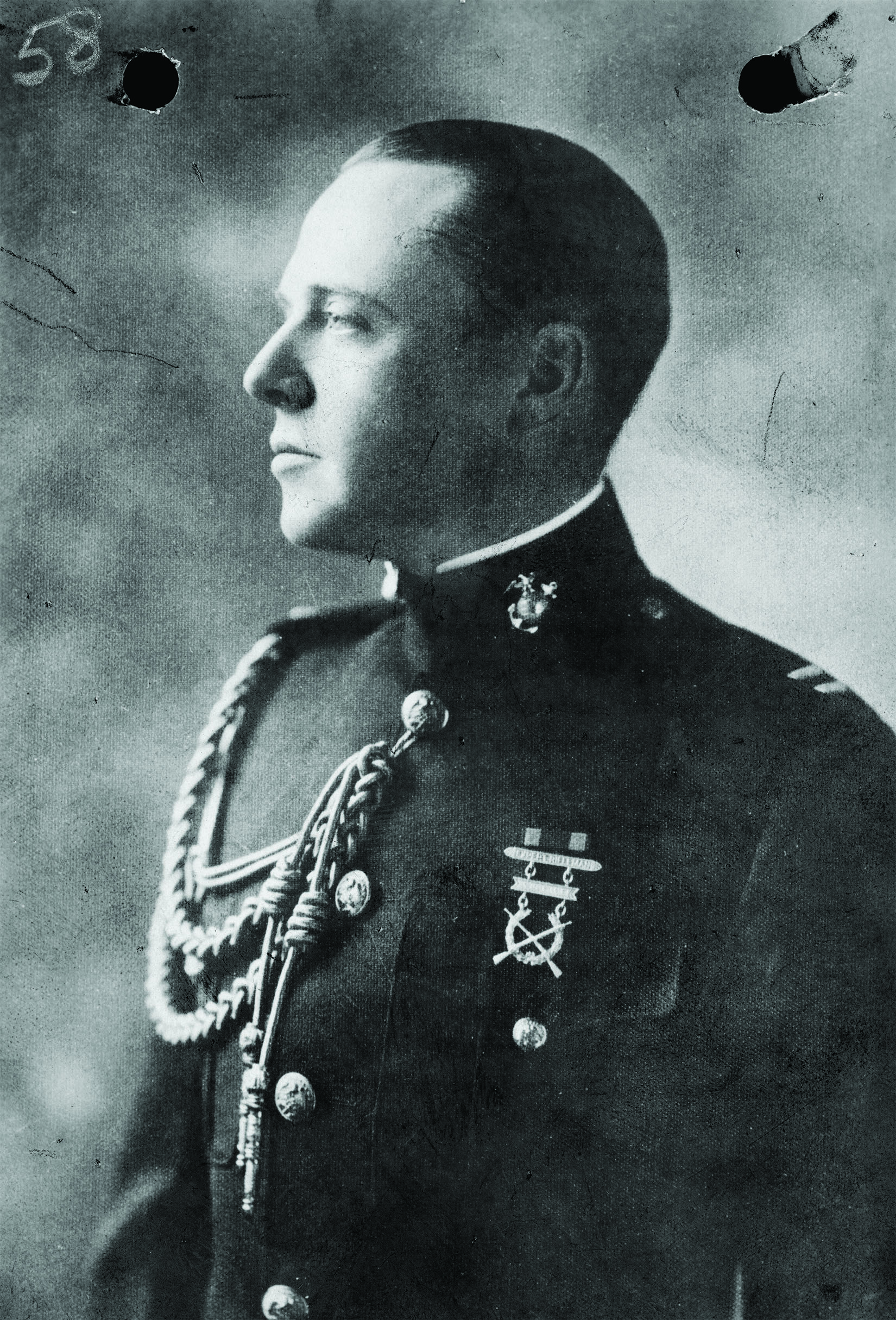
Pictured here as a colonel, Henry C. Davis is credited with writing the second and third stanzas of the hymn.(Courtesy of National Archives)
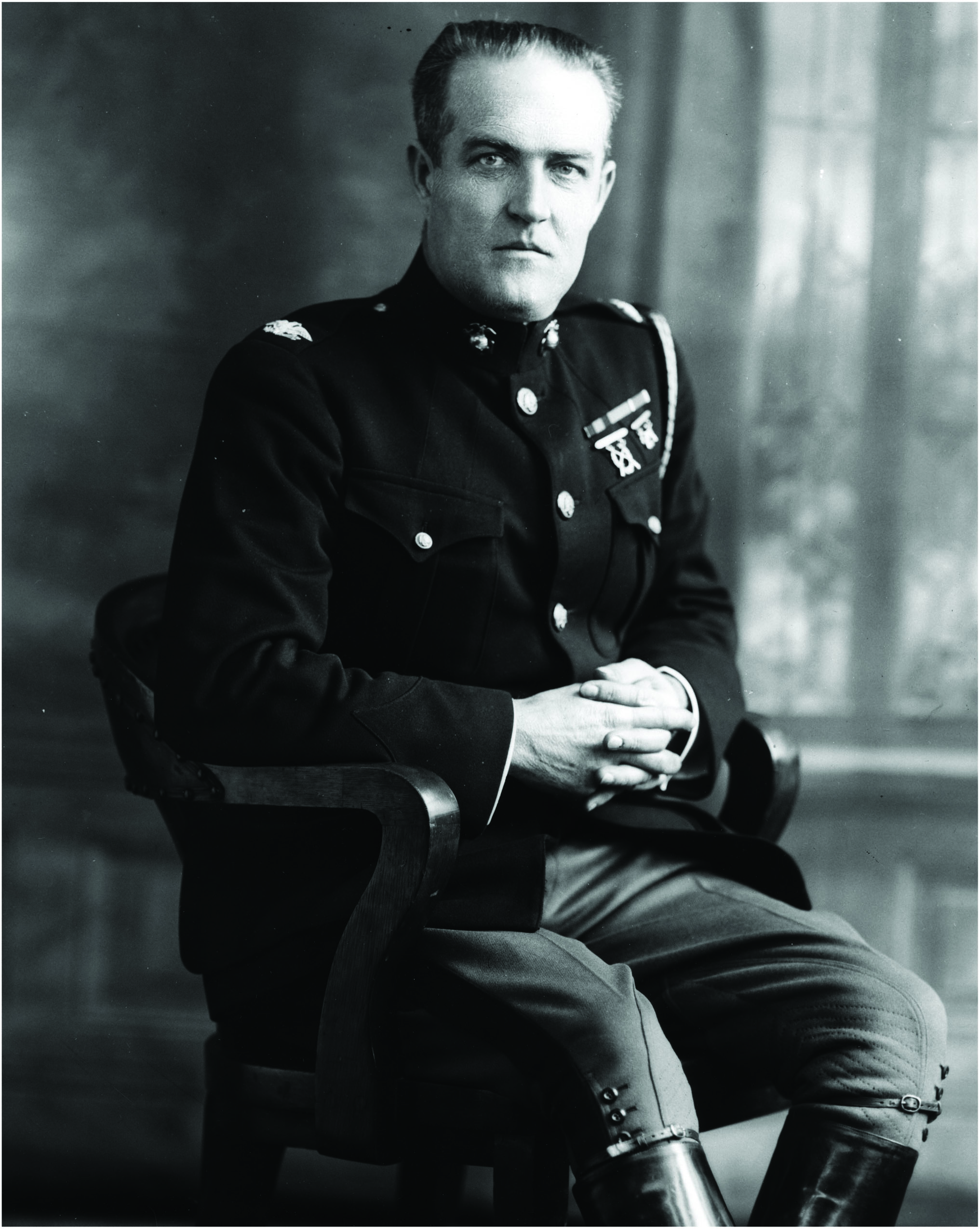
BGen Charles Doyen played a critical role in reviewing the words and unifying the variations of the hymn during the World War I era. (Courtesy of National Archives(Courtesy of National Archives)
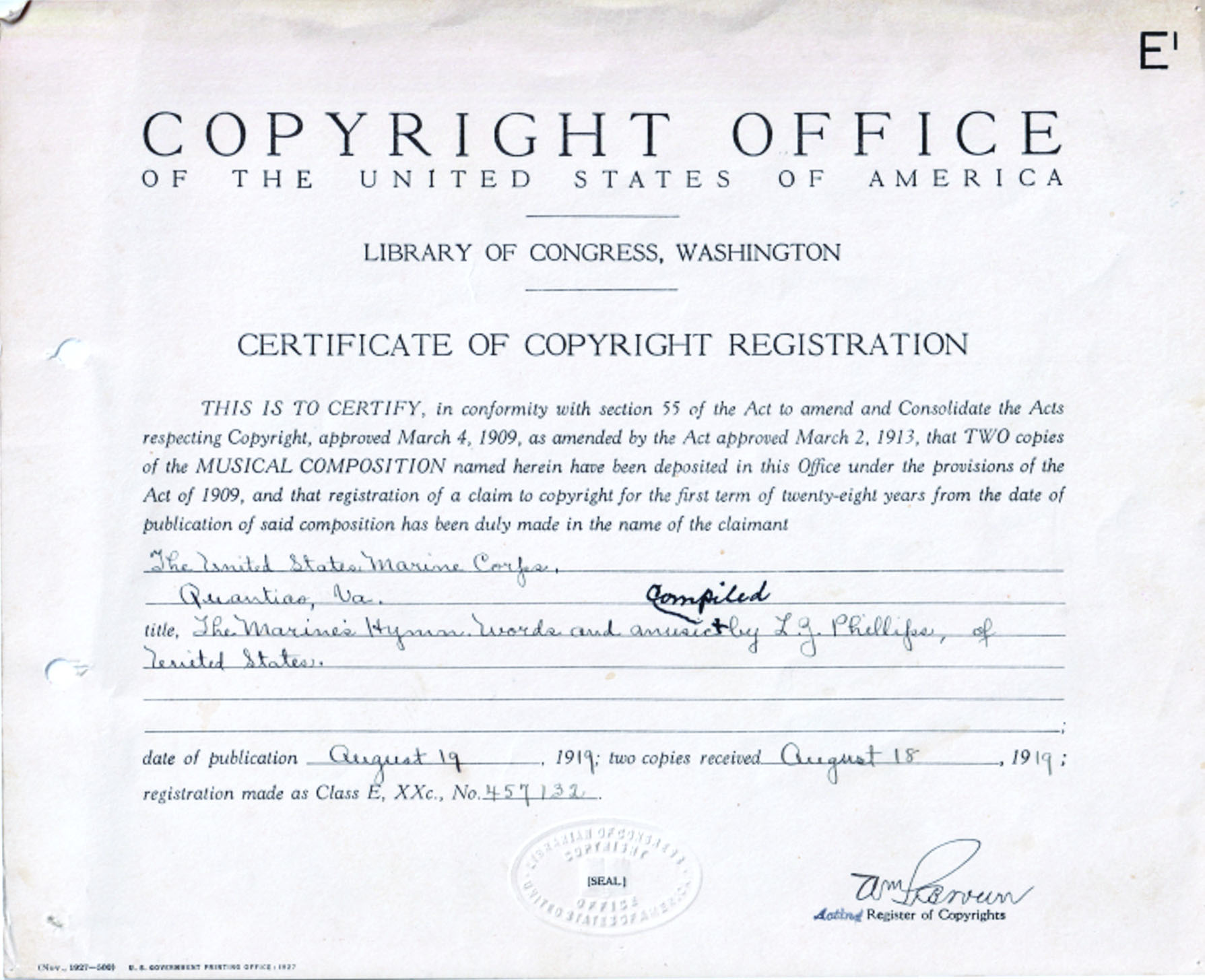
First Sergeant L.Z. Phillips listened to the variant versions of the hymn in circulation among Marines. While serving as post band leader at Marine Corps Base Quantico, Va., he standardized the melody and the lyrics into the three-stanza form that became the basis for the modern hymn. The first publication of Phillips’ version is dated Aug. 1, 1918. A copyrighted edition followed in 1919, with the copyright claimed by the Marine Corps and Phillips listed as compiler.
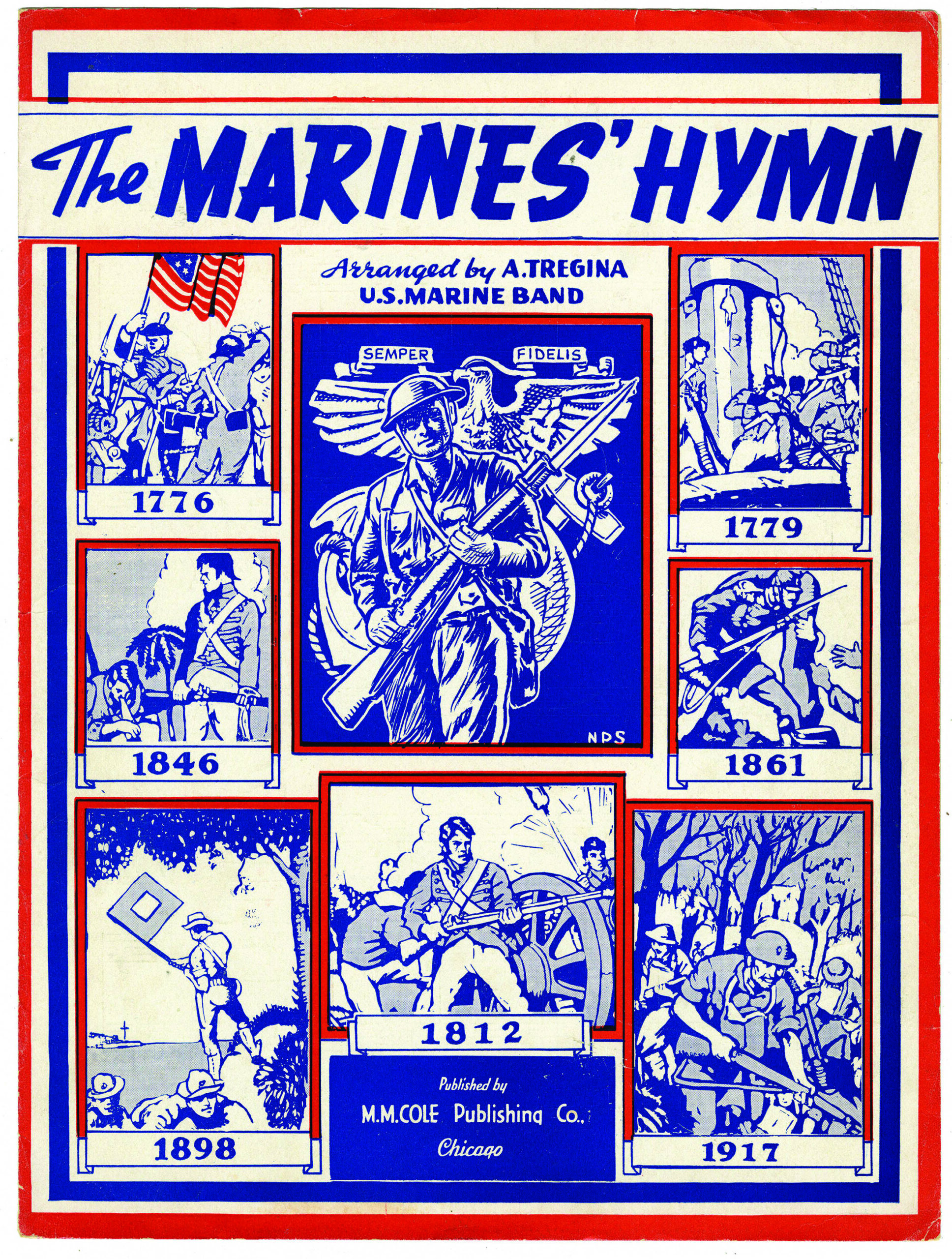
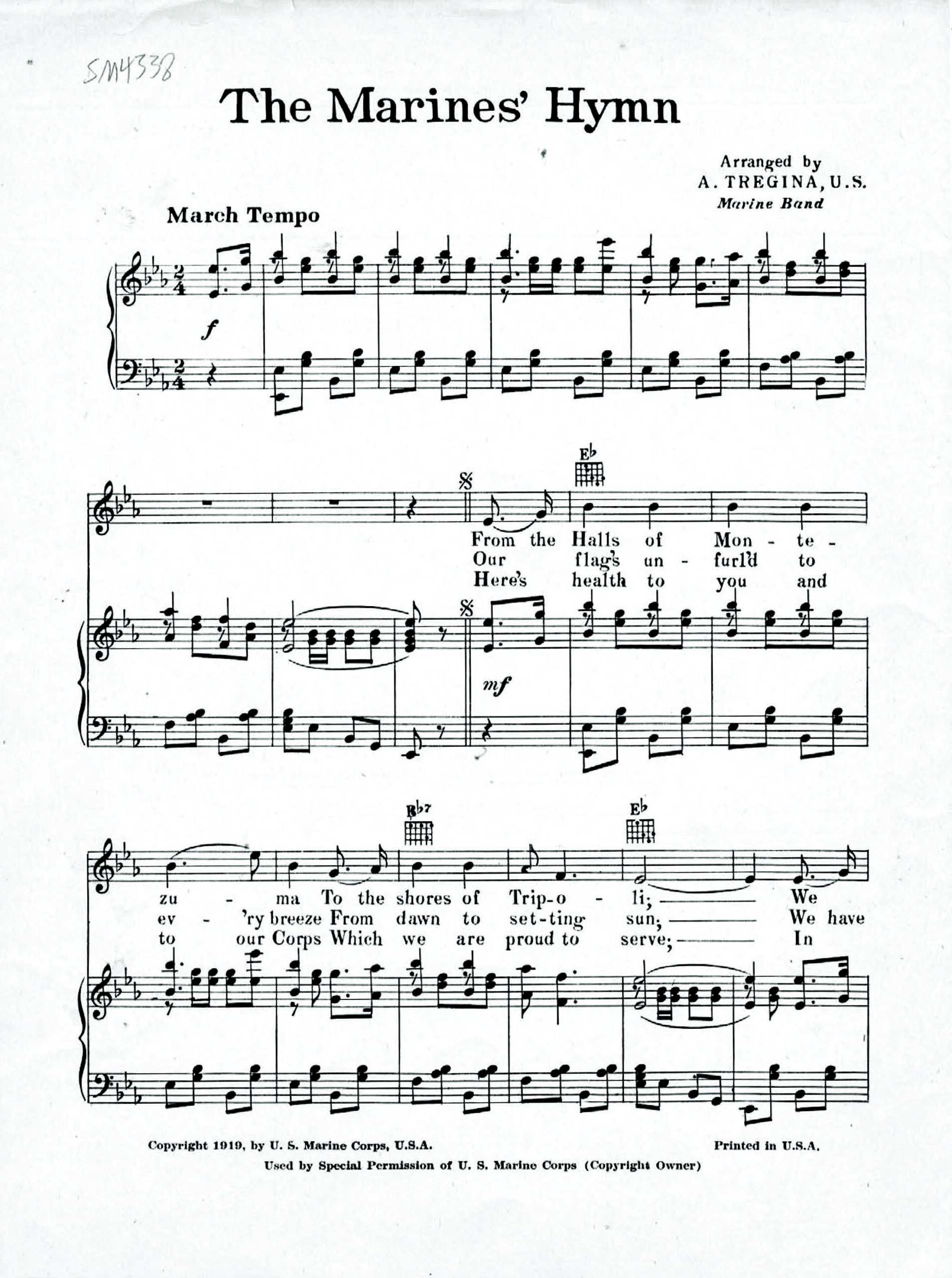
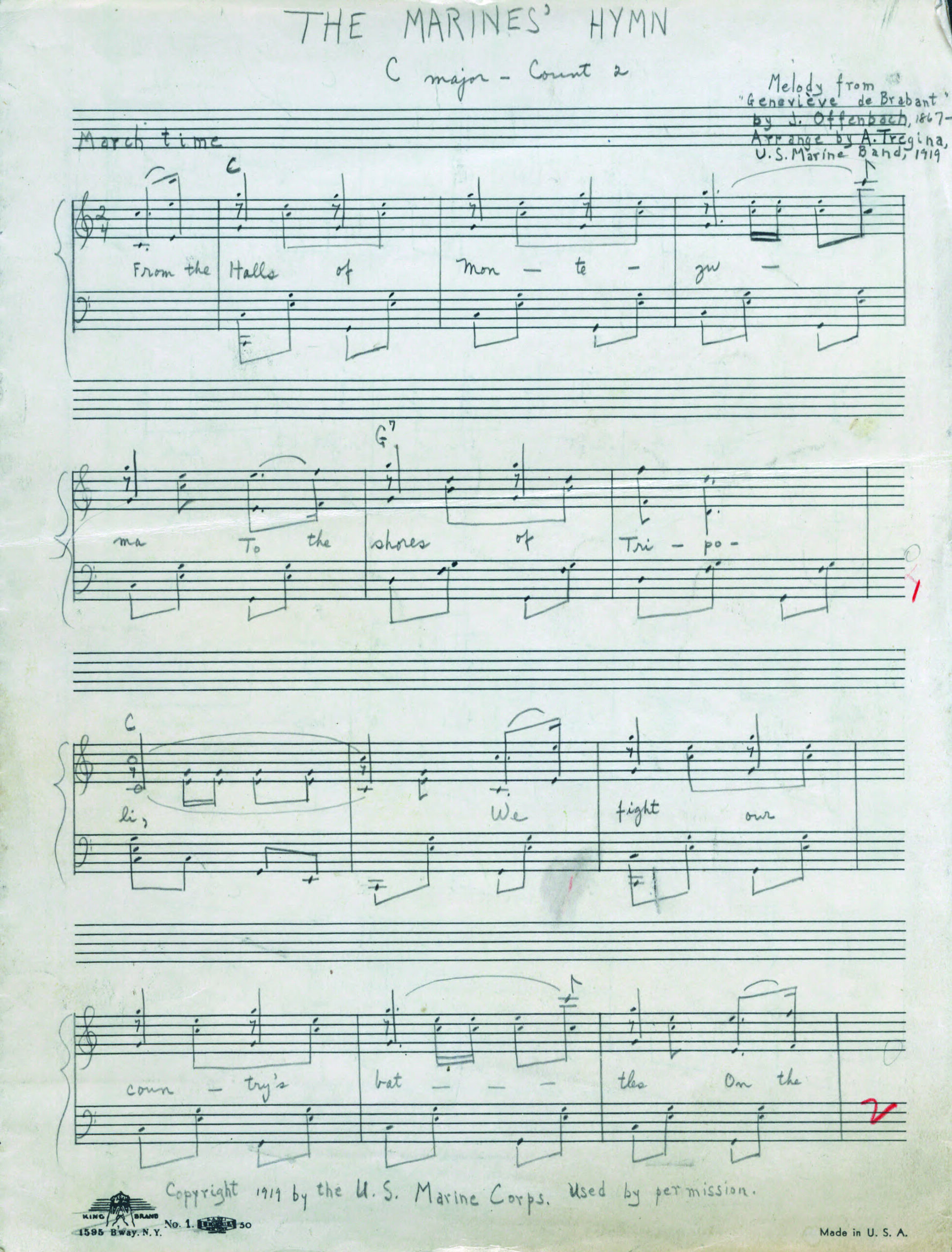
Around the same time, Arthur Tregina, a First-Class Musician who had served 27 years with “The President’s Own,” was ordered to create “a proper and appropriate setting” for the hymn so that civilians could purchase and perform it at home, according to an interview with Leatherneck in 1933. He arranged a voice-and-piano setting, which was published in 1919 by M.M. Cole Publishing Company of Chicago, Ill. The sheet music featured a striking blue-and-red cover illustration of a Marine with rifle and bayonet. His arrangement, issued the same year as the official Marine Corps copyright associated with Phillips, helped popularize the hymn beyond the ranks immediately after World War I.
“The Marines’ Hymn” was published circa 1919 by M.M. Cole Publishing Co. of Chicago and arranged by Arthur Tregina. This allowed individuals to purchase and perform the song at home, helping popularize the anthem right after World War I.
Copyright Confusion
Following the 1919 copyright of the hymn, decades of friction ensued, as Phillips left the Corps and sold his rights. In essence, Phillips fell into hard financial times and in 1931 obtained permission from the Commandant, then MajGen Ben H. Fuller, to print copies at his own expense. The Commandant granted him permission on the condition that he credit the Marine Corps with the statement, “Copyright 1919 by U.S. Marine Corps” and “Printed by special permission of the copyright owner.”
Then, in October 1935, still desperate for cash, Phillips sold the rights to Edward B. Marks Music Corporation. The company then began to pursue intellectual property rights aggressively, demanding royalties for its use. What followed were years of haggling back and forth where the interests of the Corps conflicted with private and public interests. The Marine Corps asserted a strict free-use policy and granted permission to outside publishers, provided they used the official version, and thereby poured cold water on the Marks Corporations efforts to claim the rights solely and wrongfully. In the end, the Marine Corps retained the right to control the content, distribution and sale of the hymn’s sheet music.
Finalizing the Timeless Verses of “The Marines’ Hymn”
Many proposed changes to the wording of the hymn were ultimately curtailed with Headquarters Marine Corps declaring that only the “official version” be used. Enter then Maj Joseph C. Fegan Sr., appointed by MajGen Commandant John A. Lejeune in 1925 to his post as the Corps’ first publicity officer. In April 1928, Maj Fegan received instructions from the Commandant to investigate the verses of “The Marines’ Hymn” and to report his findings. He took five months to complete his work, having traced the origins to 1892. In his findings, he concluded that the verses were, in his opinion, “spontaneous contributions of several of our older officers” and that it “just grew” over time.
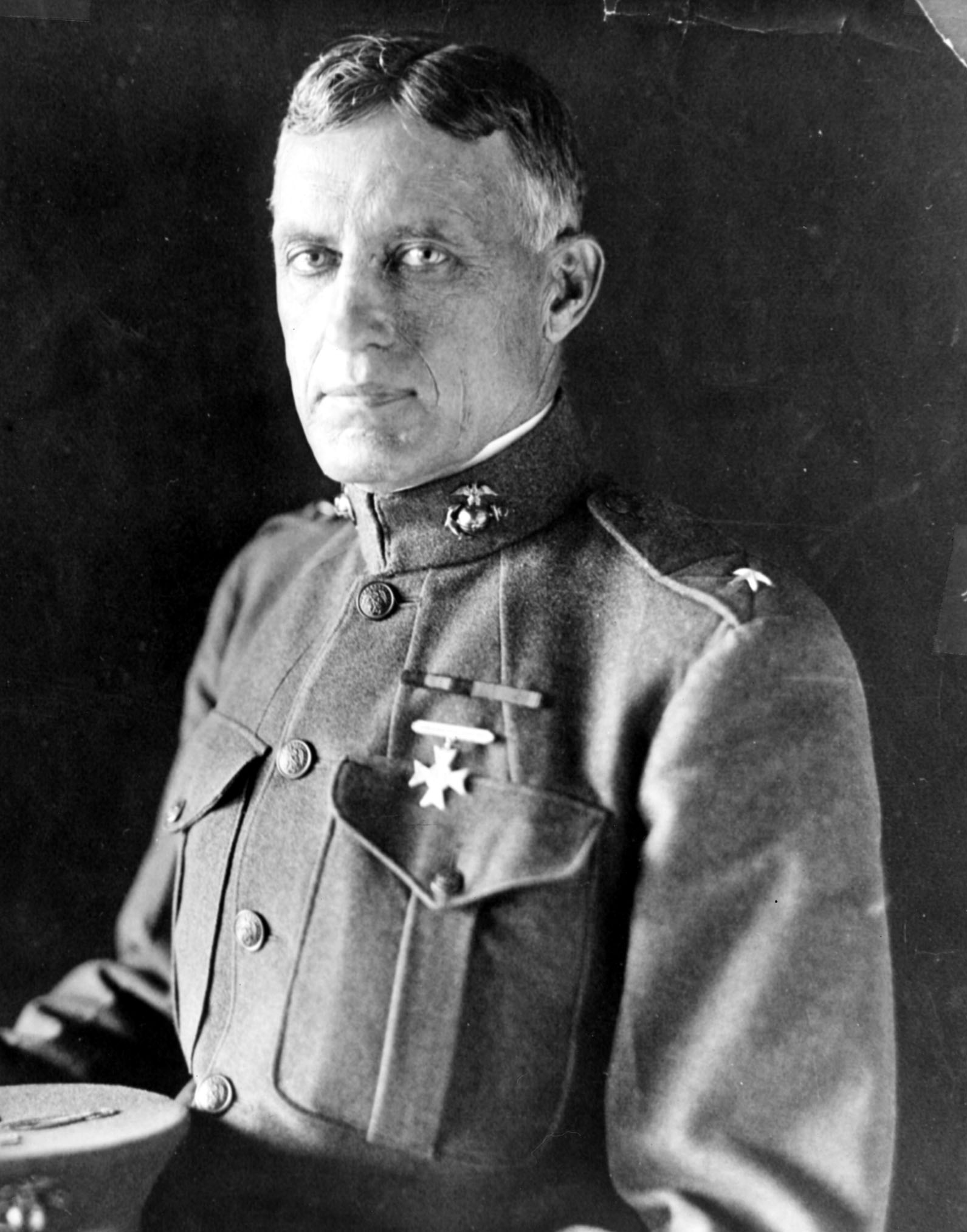
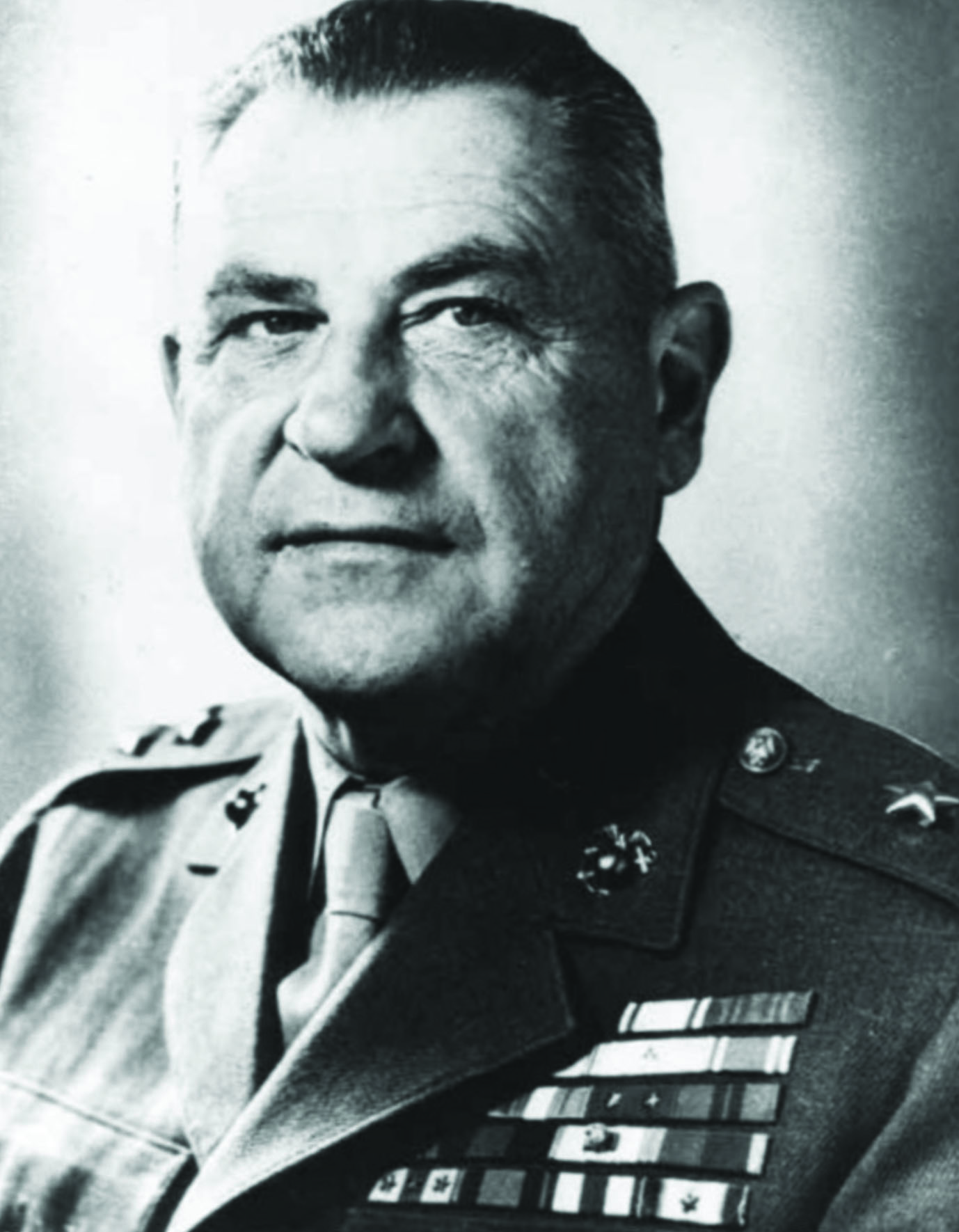
MajGen Joseph C. Fegan Sr. was tasked by the Commandant in 1928 to investigate the history of the hymn.(Courtesy of Camp Pendleton Archives)
By requirement of headquarters policy, Fegan recommended, according to “The ‘Devil-May-Care Song of the Leathernecks’ ” by Lauren Bowers,
(1) that a Marine Corps Order be issued to protect the Hymn from what he termed “ridiculous parodies,” (2) that only three verses be permitted, (3) that printing and distribution to personnel and other parties of leaflets and sheet music be pictorial and historical, (4) that respect to be shown the Hymn by personnel when it is being sung or played and (5) that the origin and history be included in training recruits and every member of the Corps “be urged” to learn it.
By April 1929, MajGen Commandant Wendell C. Neville approved changes in lyrics and policy to reflect most of Fegan’s recommendations. In his version, the only difference from today’s is the fourth line in the first verse, which read:
From the Halls of Montezuma To the shores of Tripoli, We fight our country’s battles On the land as on the sea.
On Nov. 25, 1942, after the copyright disputes had settled, the 17th Commandant of the Marine Corps, Lieutenant General Thomas Holcomb, approved the final change to the lyrics, to read, “In the air, on land, and sea,” with Letter of Instruction No. 267. This change would be the Corps’ last to the work and reflected the contributions made by the aviation combat element in a still relatively new warfighting domain at the time.
Copyright registration certificate No. 457132, dated Aug. 19, 1919, officially claimed ownership of the hymn for the Marine Corps. The handwritten copy was compiled by 1stSgt L.Z. Phillips. (Courtesy of National Archives)
Emerging Traditions, Unofficial Variations and Modern Policies
Today, unofficial versions and parodies remain a matter of archival record and are available both online and on social media. Of the many unofficial versions, we’ve elected to share a sample “by Marines and for Marines,” many using the first verse only. These reflect niche populations that demonstrate a variety of attitudes as unique as the originating contributors.
WW I, as recommended by Josephus Daniels, Secretary of the Navy:
As we raised our flag at Tripoli, and again in Mexico, So we took Chateau Thierry and the forest of Belleau. When we hurled the Hun back from the Marne, He said we fought like fiends, And the French rechristened Belleau Wood for United States Marines.
WW II, as recommended by Women Marines:
From the hearts and minds of all of us, to Marines we will be true. We will strive to give them all our help in everything we do. We will share their hopes for freedom and will keep our honor clean, we are proud that we can be of use, to United States Marines.
The global war on terror, anonymous:
From the dirt of Fallujah, To the valleys of Korengal, We will drop a JDAM on you And we’ll blow up your firewall, First to fight for oil and freedom And to keep our rifles clean; We are proud to claim the title Of United States Marine.
At the 2018 Marine Corps Heritage Foundation Awards ceremony, the 37th Commandant of the Marine Corps Gen Robert Neller demonstrated the importance and unifying nature of “The Marines’ Hymn.” Among those present were the Chairman of the Joint Chiefs of Staff, Gen Joseph Dunford; retired Gen James Mattis, then the Secretary of Defense; the 29th Commandant of the Marine Corps, retired Gen Alfred M. Gray; and generations of Marine veterans representing all modern eras.
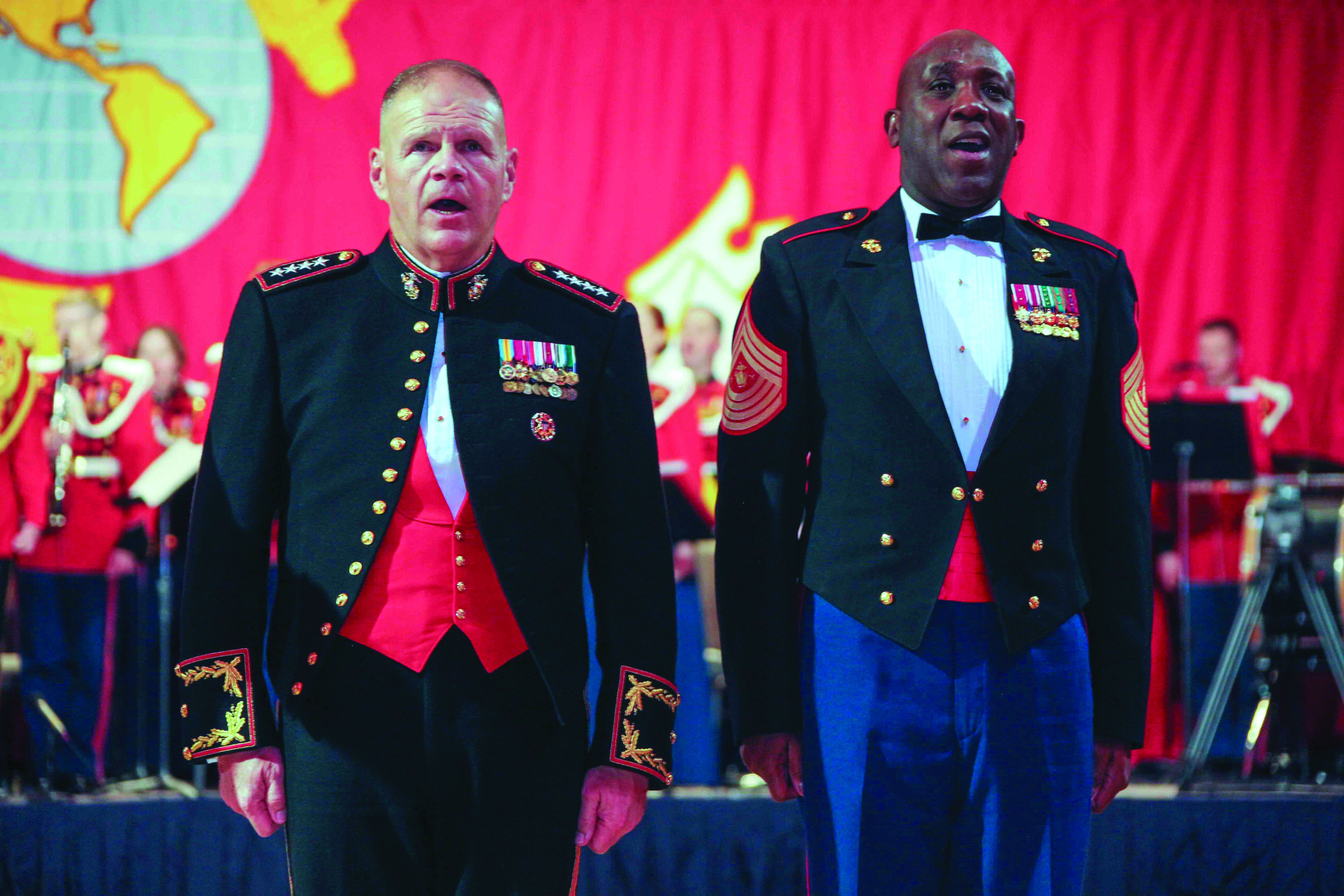
Gen Robert B. Neller, the 37th Commandant of the Marine Corps, and the 18th Sergeant Major of the Marine Corps, SgtMaj Ronald L. Green, sing “The Marines’ Hymn” during the Commandant’s Birthday Ball, Nov. 10, 2018.(Sgt Olivia G. Ortiz, USMC)
Gen Neller emphasized in policy that “The Marines’ Hymn” should be sung while standing, so he asked attendees to stand. He then led the assembly by singing the first verse. This was perhaps one of the few times in Marine Corps history that the Marines present to do so represented every level of war and national policy, both in and out of uniform and in civilian public service.
The following year, the Marine Corps Drill and Ceremonies Manual reflected a new policy, “That Marines, present and who have served honorably who are not in formation or part of an actual ceremony, or marching in a parade or review, who when they hear the playing of the Marines Hymn will stand at attention, face the music and sing the words to the Hymn.”
New Marines with Mike Company, 3rd Recruit Training Battalion, MCRD Parris Island, S.C., sing “The Marines’ Hymn” during the Eagle, Globe and Anchor ceremony, Dec. 23, 2025. (SSgt Brendan Custer, USMC)
Conclusion
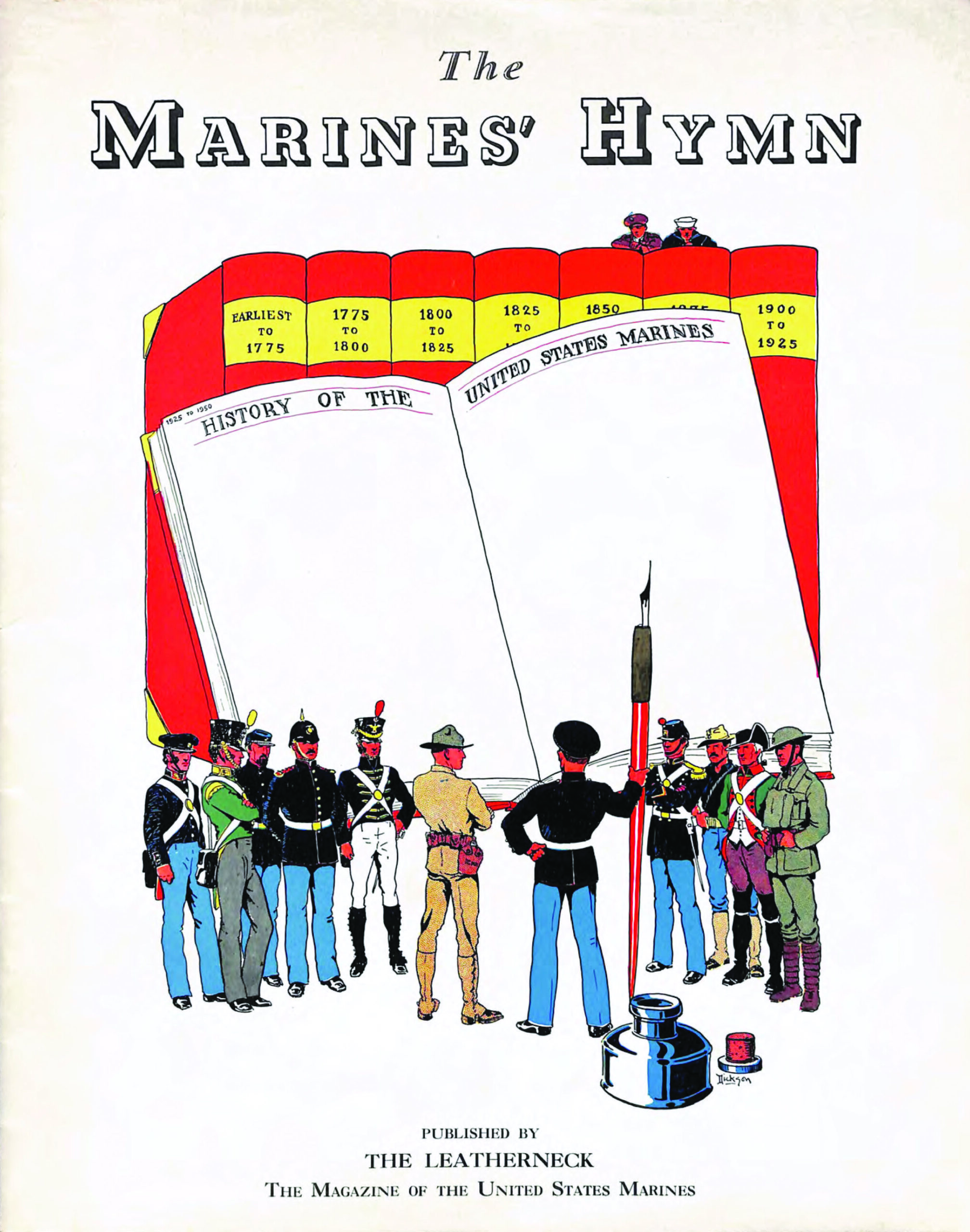
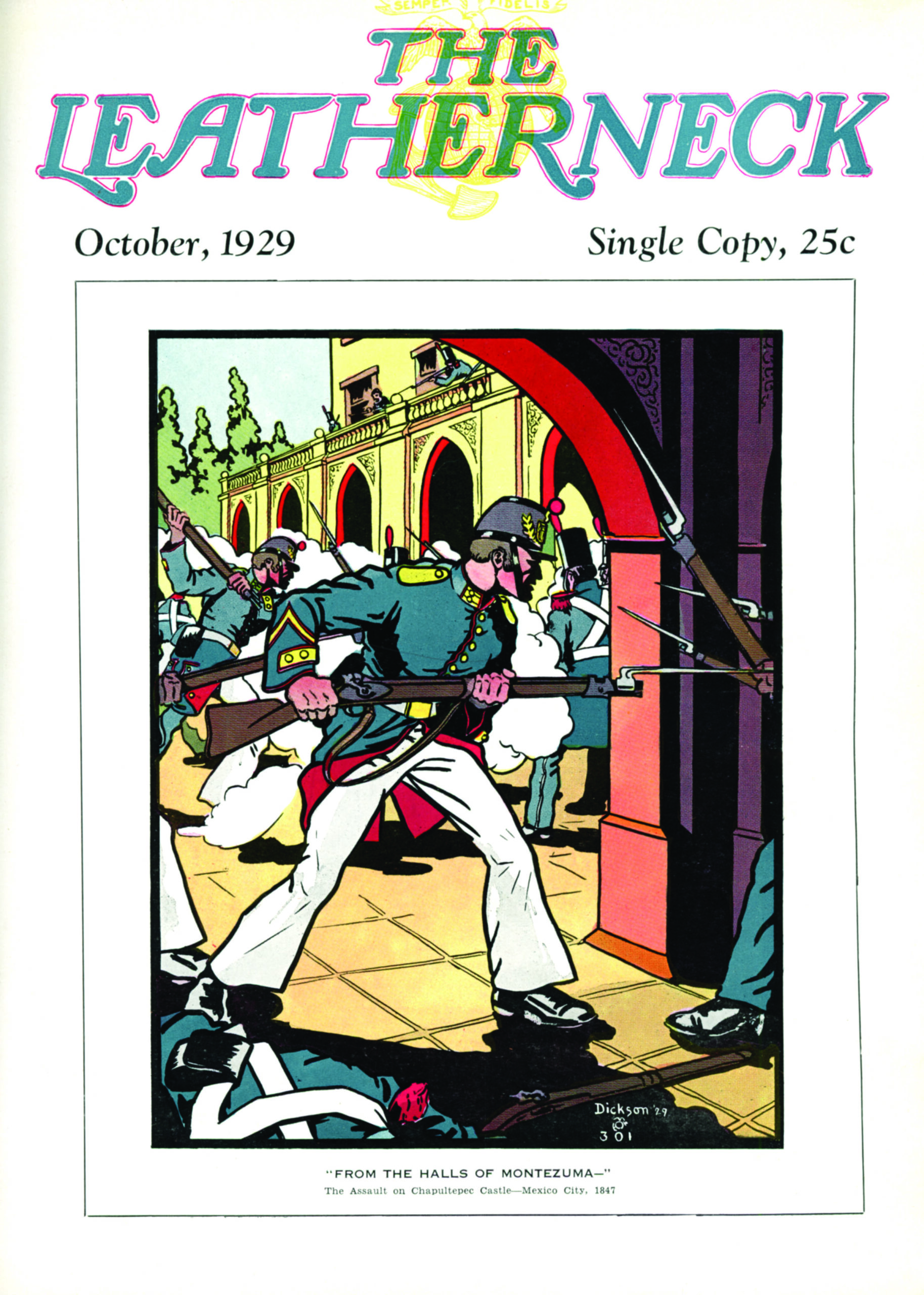
Just under 100 years ago, Leatherneck published a series of paintings by Colonel Donald L. Dickson that illustrated each verse of “The Marines’ Hymn.” The first of those images appeared on the magazine’s October 1929 cover and Leatherneck followed up with a published book of the entire set of illustrations. Of these, perhaps the most profound image appears on the cover page itself. The colorful image shows a pageantry of uniformed Marines, from the Continental Marines through WW I, similar to the pageantry at Marine Corps Birthday Balls.
Centered, with his back to the observer, is a Marine in period dress blues wearing the classic blue cover. His left hand is closed, making a fist and resting on his hip, while his right hand bears an oversized calligraphy pen. As the Marine leans back to observe the oversized book, it is open to two blank pages twice his height. At the top, the words “History of the United States Marines” are written in bold Copperplate Gothic font—in an illustrated version of what has yet to be written.
The message is clear: What will this modern Marine do with the history of our Corps? There remains a tremendous weight that every successive generation bears—as well as the responsibility to never sully the reputation of the Corps in battle as they stand on the shoulders of their predecessors. Getting there first and winning is only half the battle: “First to fight for right and freedom, And to keep our honor clean.”
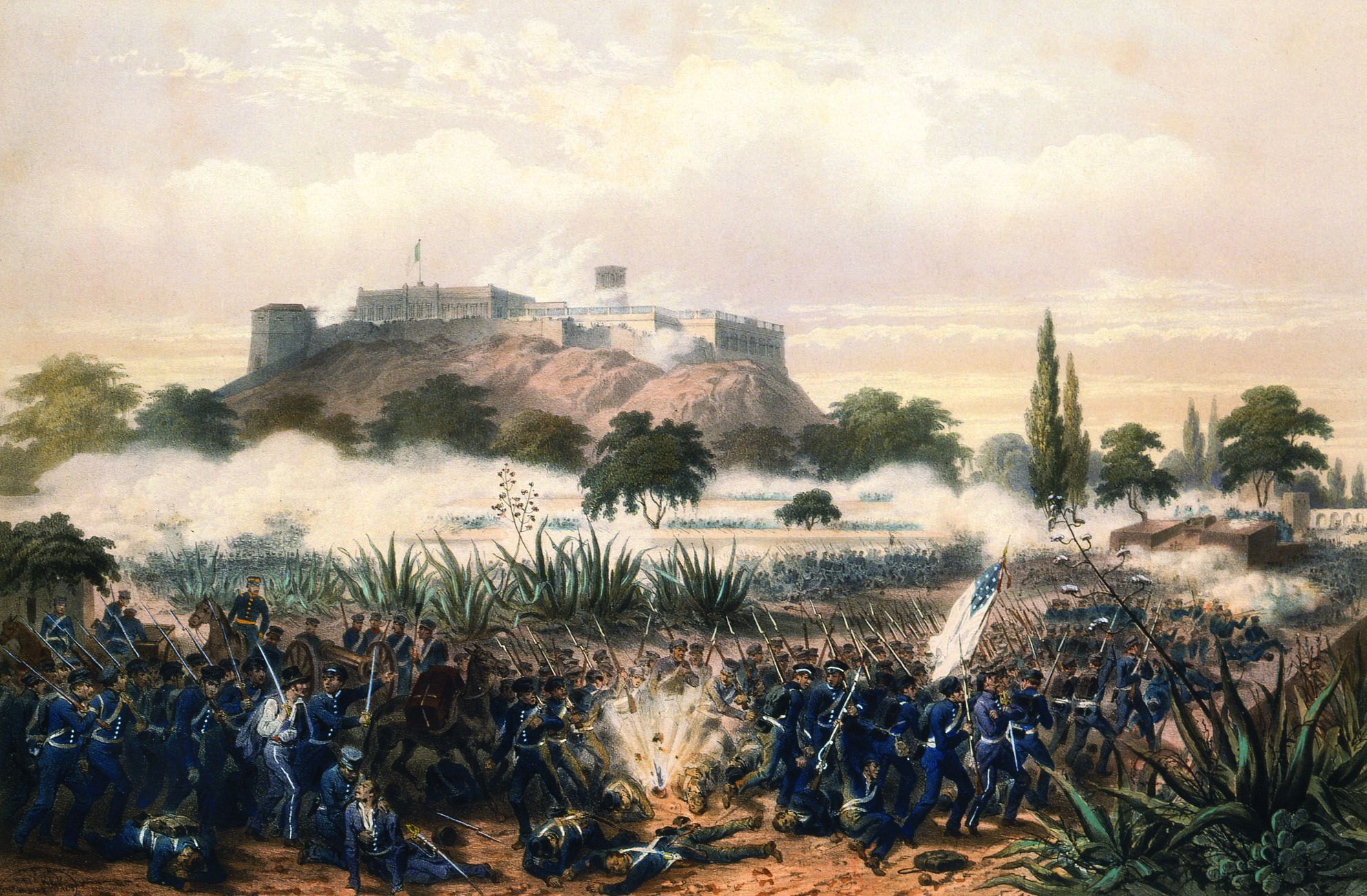
Col Donald L. Dickson’s artwork was a series ofLeatherneckcovers between 1929 and 1931 depicting the hymn, including when Marines stormed the Chapultepec castle, known as “The Halls of Montezuma”. (Courtesy of Marine Corps History Division)
It is how Marines win that still matters. That uncompromising commitment, through moral and physical courage, discipline, integrity and stoic honor, remains the Corps’ hallmark. Those Marine “boots” of the past more than rose to the challenge. They went on to win in the Pacific island-hopping campaign of WW II, the freezing Chosin Reservoir in Korea, the hills and jungles of Vietnam, the sands of Southwest Asia and every major engagement from Mogadishu to Iraq and Afghanistan.
Today, too, Marines on watch across the globe stand ready to write yet another volume of this illustrious history. Of those who went before, the lessons in these histories were written in blood. We remember that history. Through art and music, despite the murky history of a some-times winding past, “The Marines’ Hymn” remains a living, breathing, legacy. The words, now settled within these verses, provide Marines with a heartbeat.
Just as John Philip Sousa did, that cadence sets the tone, tempo and pitch for all Marines throughout the ages to respond, instantly and completely. That forms an unbreakable bond that endures the test of time, just as it was intended. This is what
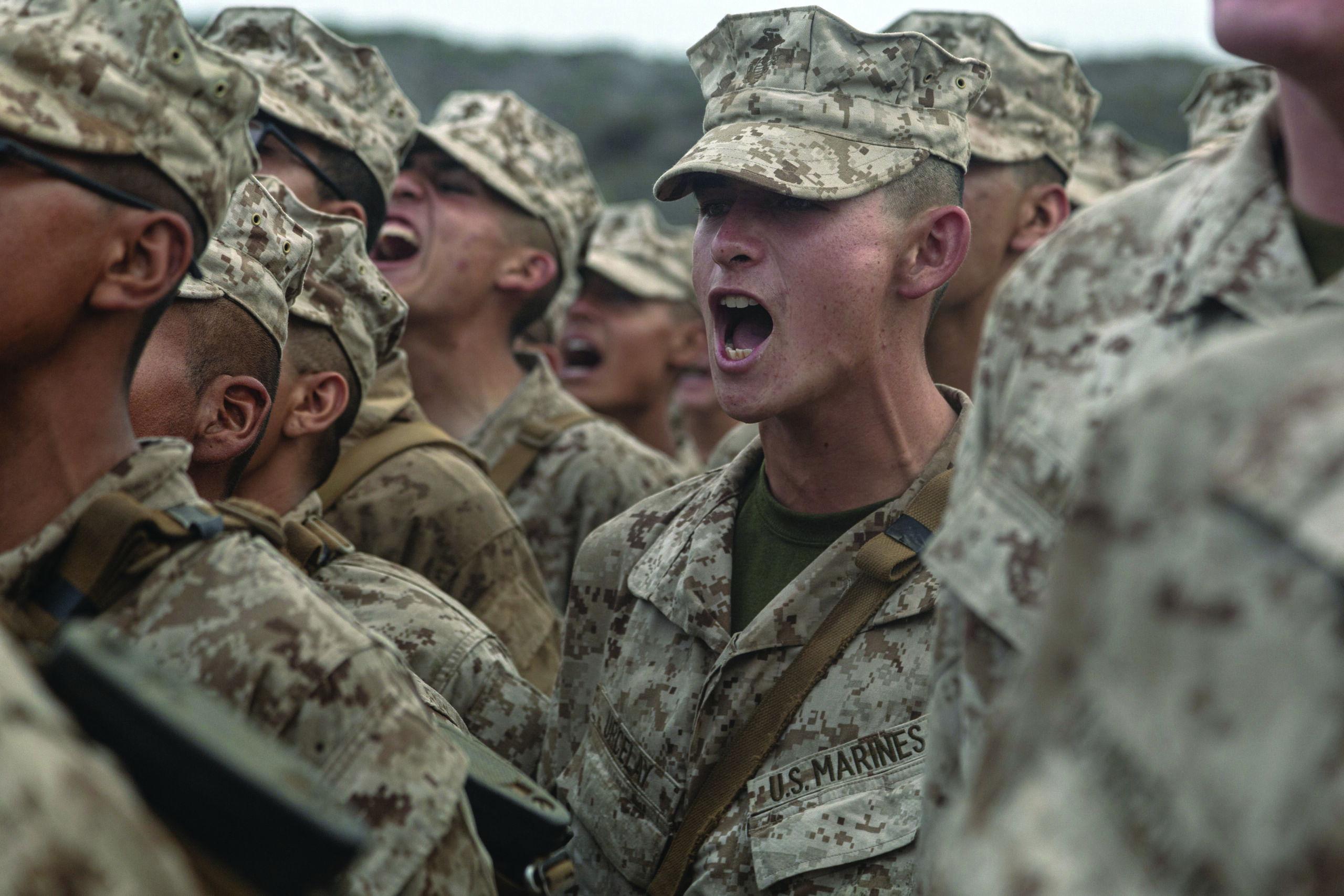
After the grueling 54-hour Crucible, Pvt Cole Urcelay of Hotel Company, 2nd Recruit Training Battalion, sings “The Marines’ Hymn” during the Eagle, Globe and Anchor ceremony at MCB Camp Pendleton, Calif., on July 27, 2022. (Photo by Cpl Tyler W. Abbott, USMC)
gives esprit de corps meaning and feeling. Today, at the conclusion of every entry-training cycle, we see this in the tears streaming down those many recruits’ faces, newly earning the right to bear the title, United States Marine.
Executive Editor’s note: The authors would like to thank Timothy Rose, National Archives at St. Louis, and Lori Miller of Redbird Research for archival research support.
Featured Photo (Top): The December 1917 cover sheet of “The Marines’ Hymn” published by The Quantico Leatherneck, featuring words reviewed by BGenCharles Doyen and music arranged by Pvt Steve Halblaub, who was mortally wounded at the Battle of Belleau Wood. (USMC)
About the Authors
LtCol Brad Anderson, USMC (Ret), is a freelance writer and researcher for Leatherneck magazine.
Katie Cashwell is a veteran Marine. She is a graduate of University of Mary Washington with a degree in historic preservation.
Enjoy this article?
Check out these similar Leatherneck and Scuttlebutt features:
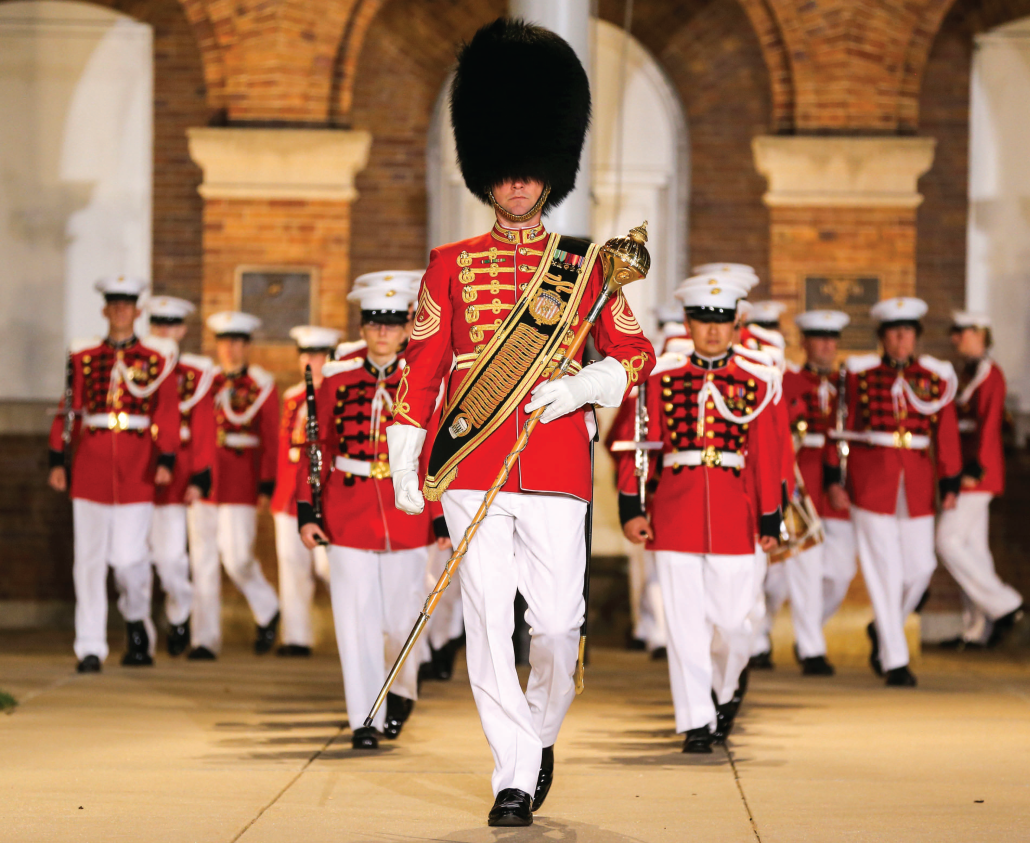
Hail To The Chief: “The President’s Own” Supports The Inauguration
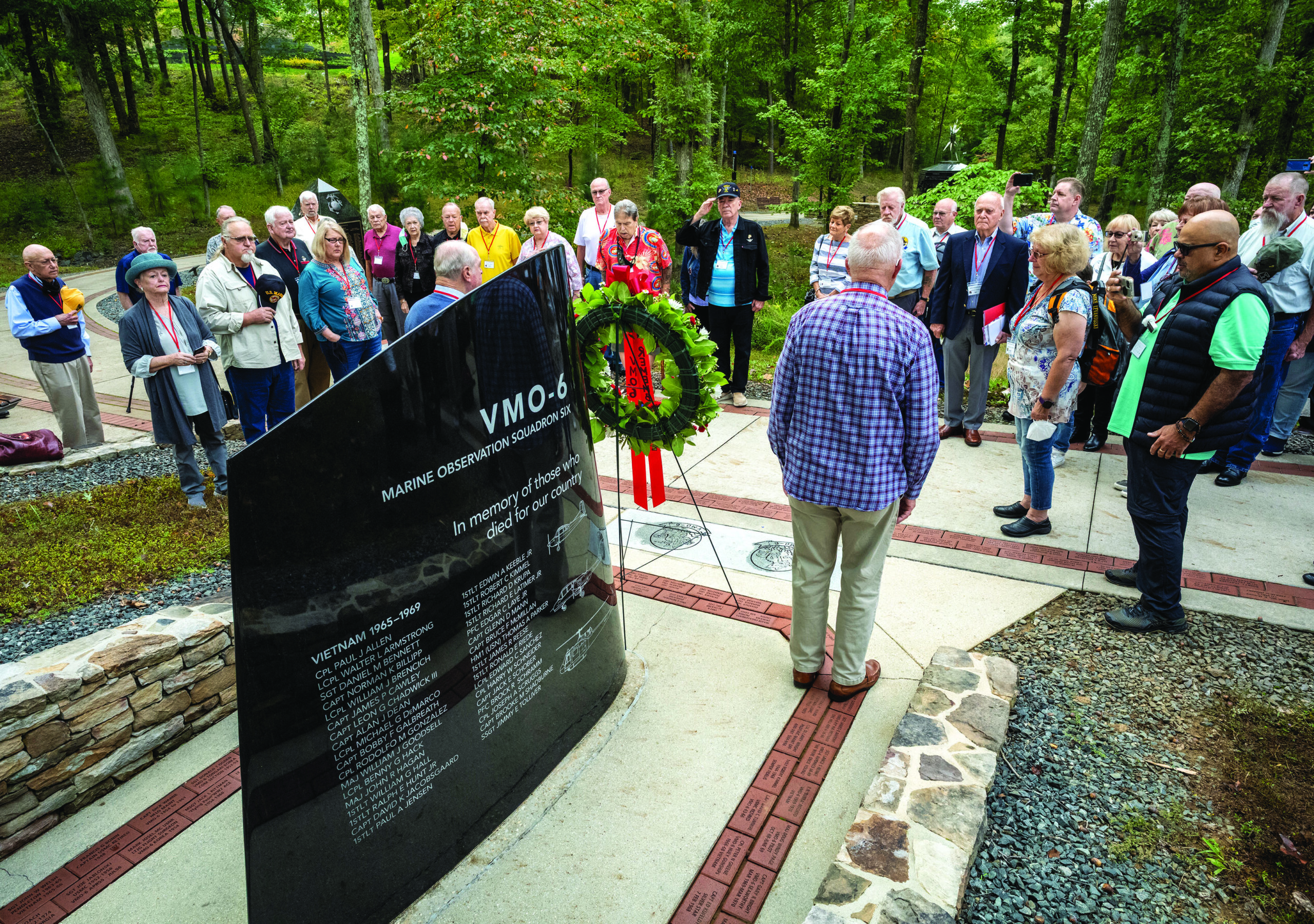
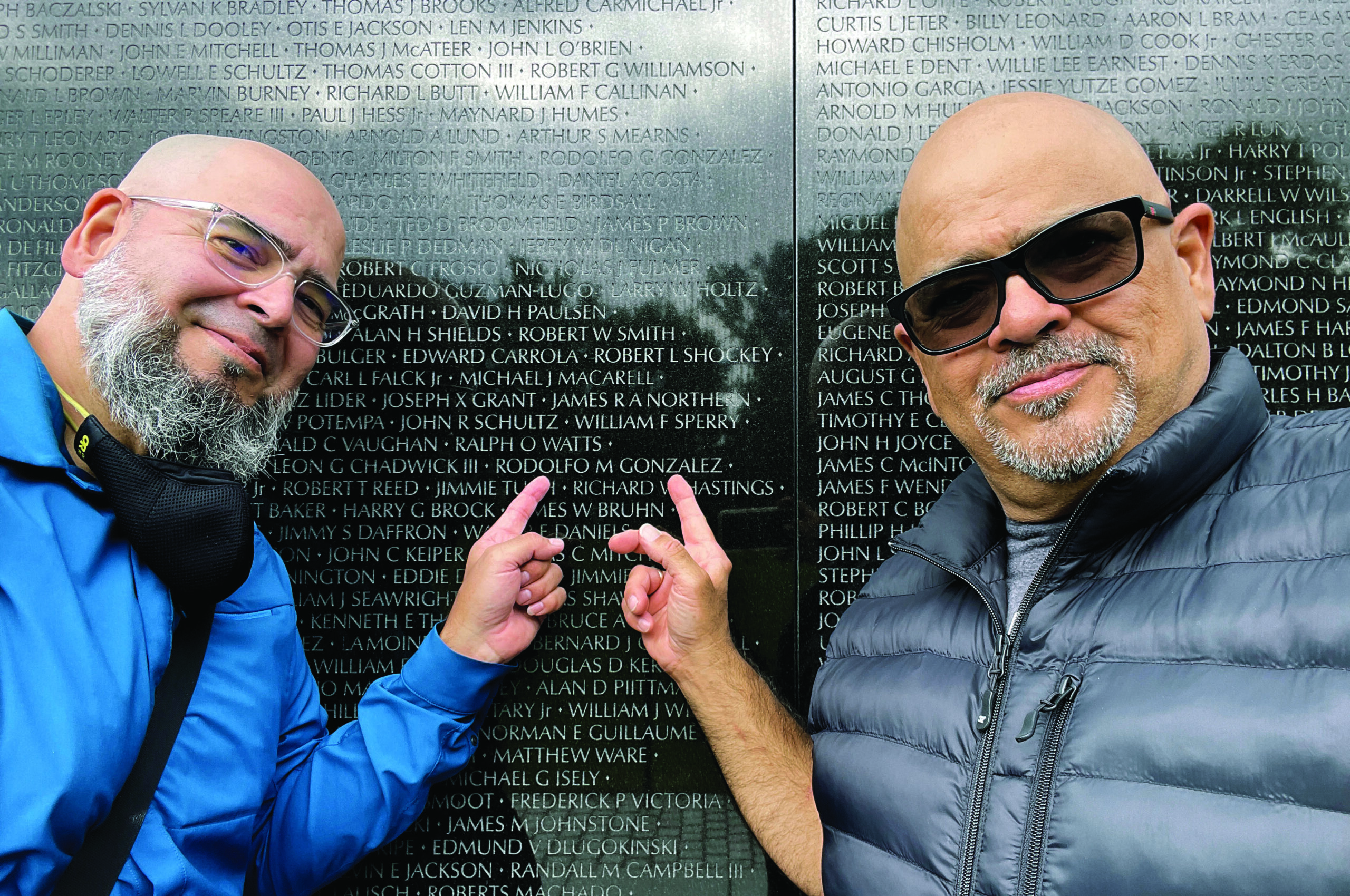
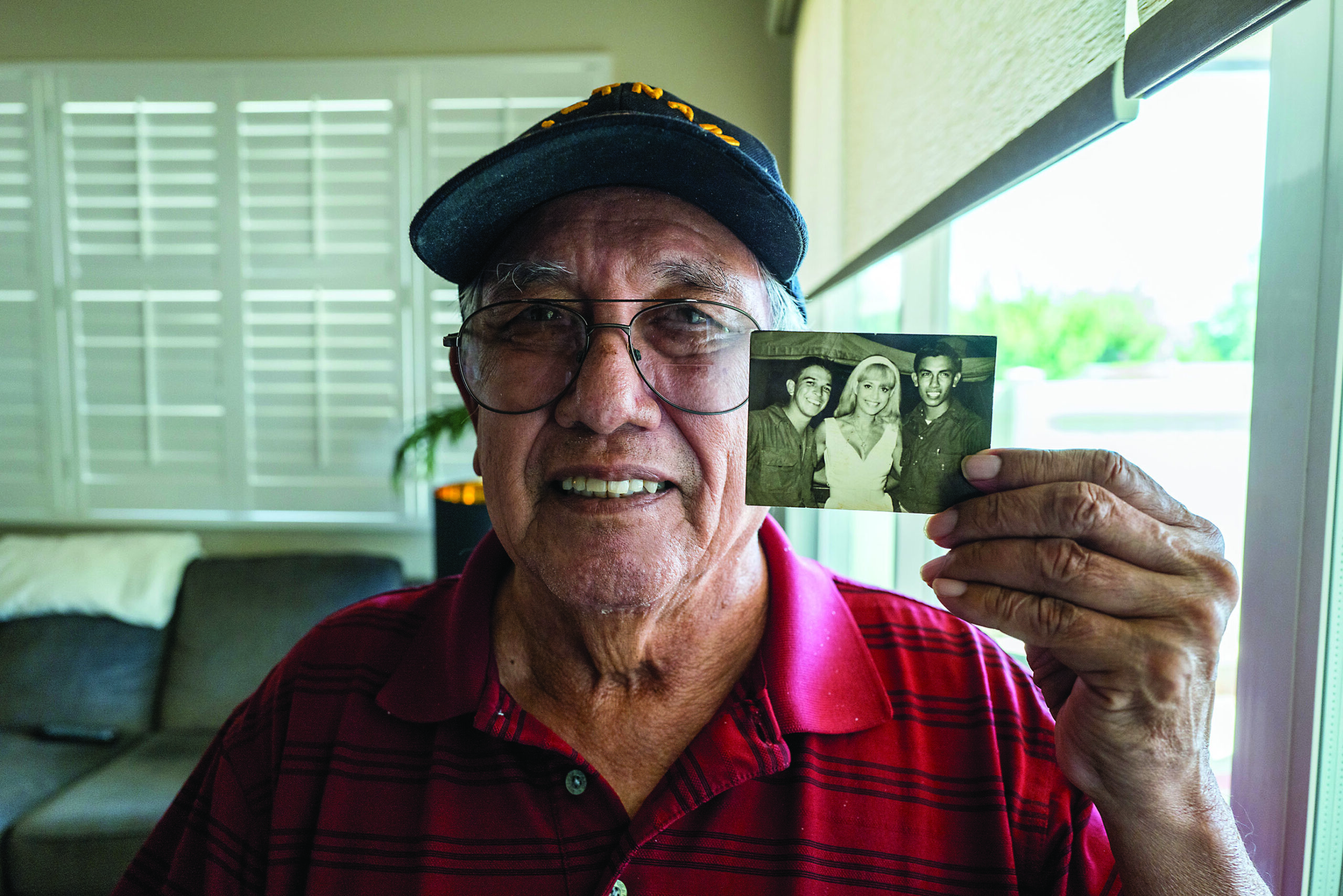
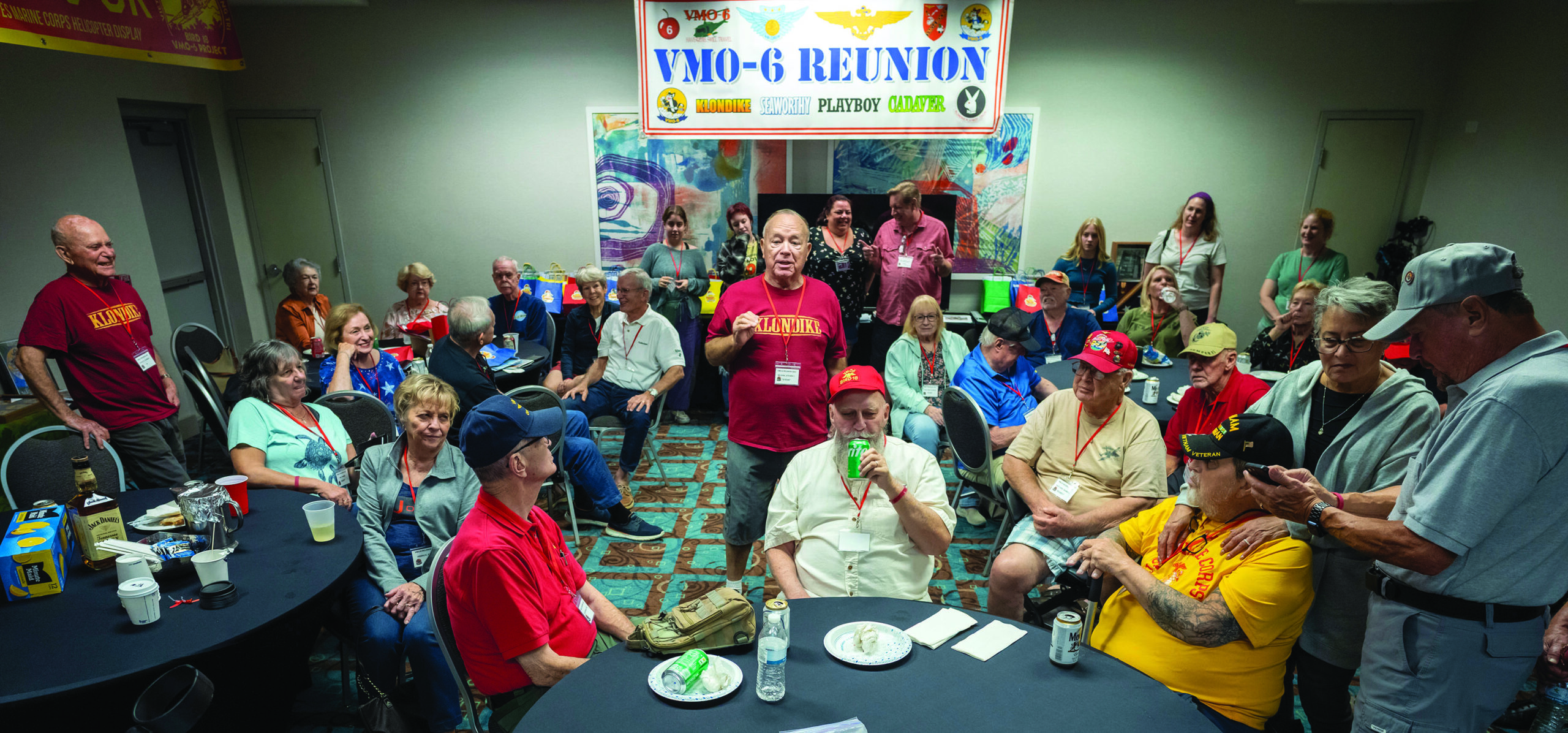
In October 2021, brothers Gerry and Rudy Gonzalez stood watching in rapt attention the men surrounding them. Many years younger than the rest, the brothers captured the moment on film as the Vietnam War veterans solemnly performed a ceremony of remembrance around a granite memorial located outside the National Museum of the Marine Corps. Unlike the others, Gerry and Rudy held no service record or prior connection to the military. The gap in age and experience notwithstanding, the reunion group welcomed the pair as immediate family.
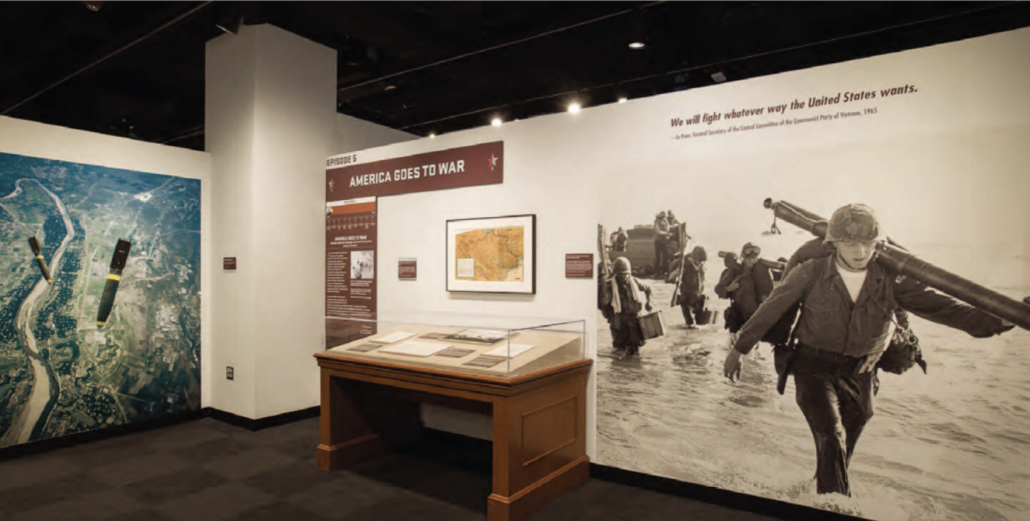
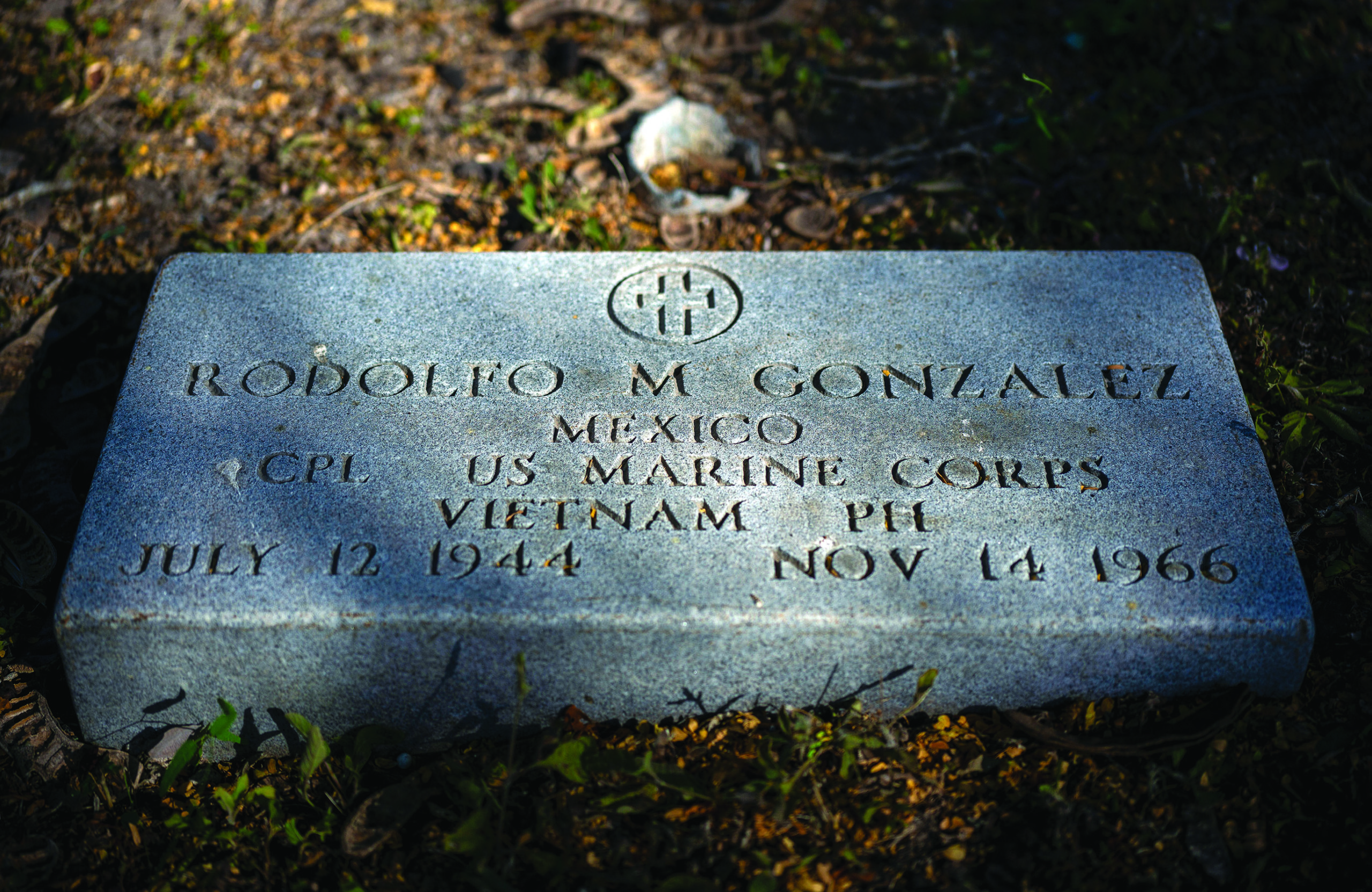
The bond uniting them centered around one of the 35 names etched into the memorial. Nearly six decades after his death, Corporal Rodolfo M. “Rudy” Gonzalez reached through time to bring them all together. To the Marines observing the ceremony, Rudy was a beloved squadron mate from Marine Observation Squadron (VMO) 6, killed in action on a rescue mission over The Republic of Vietnam. To the brothers, he was a beloved uncle and namesake, taken too soon before they ever got to know him. They travelled to the reunion desperate for information to fill in their knowledge gaps. What little they did know served as the catalyst for their journey—their uncle died in the service of a country in which he was not a citizen.
Rudy immigrated to the United States at the age of 9 with his mother and four siblings. His father preceded the rest of the family north from Mexico after a fire destroyed their home in Monterrey. An American in Harlingen, Texas, sponsored the elder Gonzalez to come to America and work as a master milliner, or hat maker. Once he was established, the rest of the family followed in 1955. Rudy worked through high school as a teenager helping support the family. By the time he graduated in 1964, his plans for the future solidified into a single pathway. He wanted to go to college. He wanted to become a naturalized U.S. citizen. To accomplish these goals, military service seemed the best option to simultaneously pursue both.
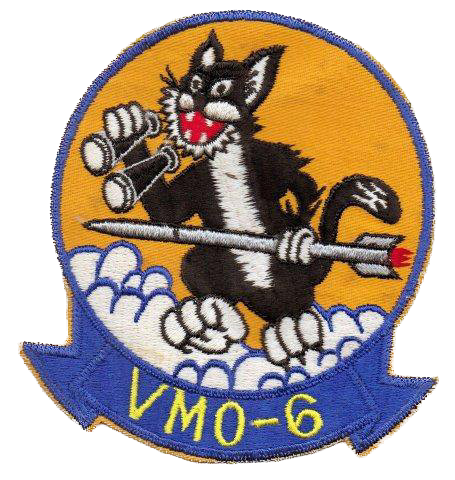
Rudy enlisted in the Marine Corps shortly after graduation and deployed to Vietnam. He served as a 3071 Aviation Supply Specialist with VMO-6. Back home in Texas, 4-year-old Gerry watched his uncle go off to war.
“I remember as a kid watching the war on the news trying to find my uncle in all of the clips they showed from Vietnam,” Gerry said. “I remember the day it was announced the he had been killed and all of the emotion. The family was just devastated. Even as a kid, I absorbed a lot of that. It was embedded in my DNA for many years.”
The end of Rudy’s tour in Vietnam imminently approached by the beginning of November 1966. Despite spending most of his tour in supply or as a driver for the squadron’s commanding officer, he volunteered repeatedly to fly as a door gunner. He survived numerous missions over the Vietnamese jungles, exposed behind the machine gun in a Huey’s open side door. His time in country finally became so short that he packed his personal belongings and shipped them home to his parents. He attended a going-home celebration for a fellow Marine who sailed to Vietnam on the same ship, also departing the country in just a couple days. His sense of duty to his squadron mates endured to the very end. Despite admonition from his buddies to prioritize his own self-interest and safety, Rudy continued volunteering to man the door gunner’s seat as missions arose.
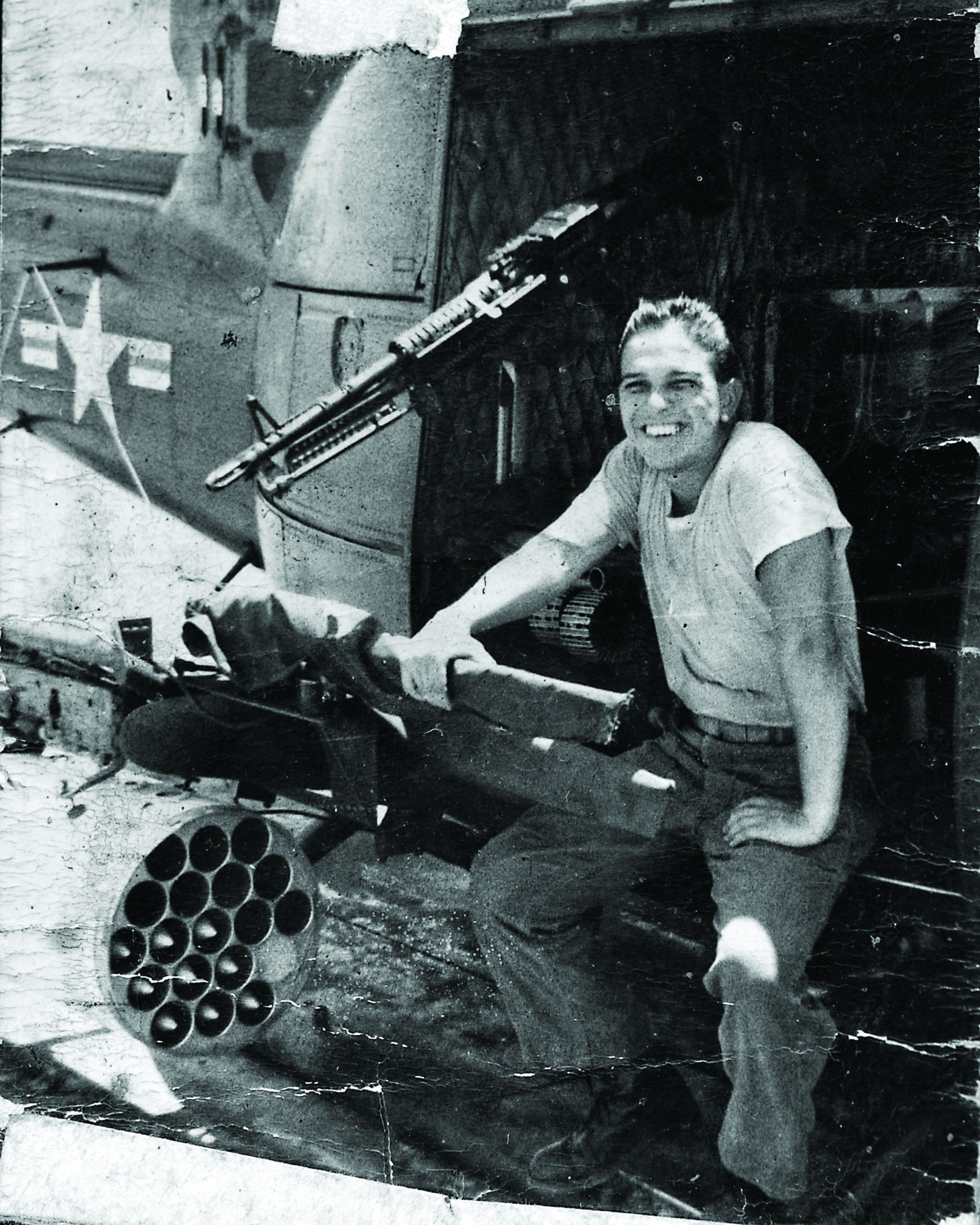
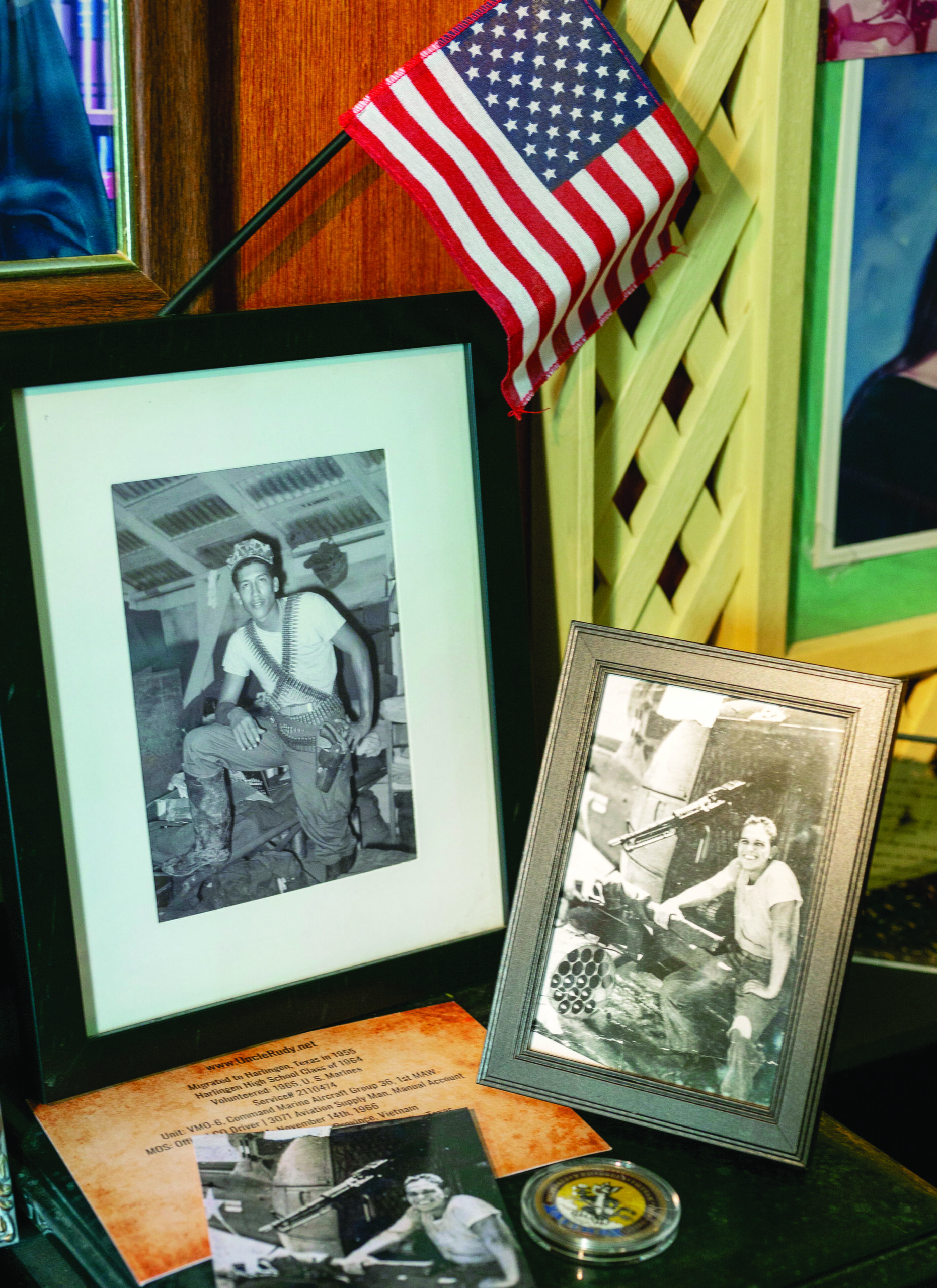
Cpl Rodolfo M. Gonzalez sits in one of the VMO-6 aircraft during his tour in Vietnam. Gonzalez served with VMO-6 as an aviation supply specialist. He was killed in November 1966 while volunteering for a dangerous rescue mission.
On Nov. 14, an urgent call came down for VMO-6’s Hueys. Marines on the ground 9 miles southwest of Danang encountered heavy enemy contact and called for a medical evacuation of their casualties. An H-34 helicopter from Marine Medium Helicopter Squadron (HMM) 263 descended into intense enemy fire and was shot down before the medevac could be accomplished. VMO-6 joined in to provide air support as a second H-34 suffered through the onslaught to extract the surviving crew members. A third chopper endured the gauntlet once again to finally pull out the original medevac casualties.
Brothers Gerry and Rudy Gonzalez attended their first VMO-6 reunion in October 2021, visiting the Vietnam Veterans Memorial in Washington, D.C., and the VMO-6 monument within the Semper Fidelis Memorial Park at the National Museum of the Marine Corps in Triangle, Va.(Rudy Gonzalez)
Gerry, right, and Rudy Gonzalez at the Vietnam Veterans Memorial in October 2021. In 2012, the brothers set out on a mission to discover more about their Uncle Rudy and his Marine Corps service after learning he never became a United States citizen. (Courtesy of Gerry Gonzalez)
By the time Rudy’s Huey was airborne, a fourth H-34 joined them heading toward the crash site. The VMO-6 birds were tasked with securing the area while maintenance Marines recovered or destroyed the sensitive equipment stranded on the ground. Captain Leon Chadwick III piloted the Huey with Rudy serving as door gunner and Sergeant Daniel Bennett as crew chief. Serving as copilot for the mission was Colonel Kenneth L. Reusser, a highly decorated three-war veteran and the commanding officer of Marine Aircraft Group 16. As they approached the crash site, Rudy waved to a Marine looking his way from the H-34 alongside them and flashed a thumbs up as the Huey peeled off for a strafing run. The Marine, a maintainer from HMM-263 named Leonard Martinez, would be the last person to see Rudy alive.
Capt Chadwick piloted the Huey low over the ground. Machine-gun rounds and rockets exploded from the chopper, lighting up the jungle below. Enemy fire increased as the helicopter shot overhead. Bullets tore through the cockpit, killing Chadwick as he sat behind the controls. The Huey careened out of control and burst into flames amongst the trees. Rudy and Bennett died in the back of the Huey, either from the savage enemy attack or the raging fire. Miraculously, Reusser escaped the helicopter alive, though horridly burned over much of his body.
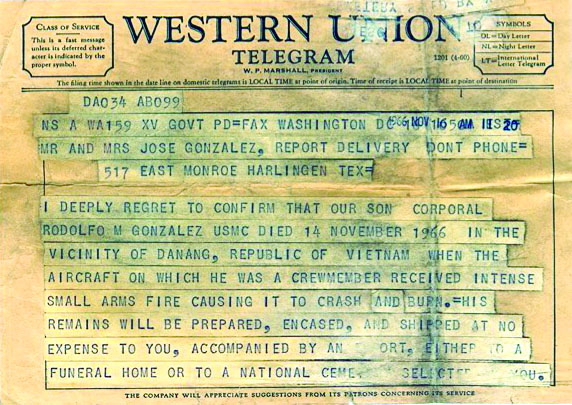
Cpl Rodolfo M. Gonzalez was killed in Vietnam just a few days before his scheduled departure. His family had already received a shipment of his personal items. In his stead, they received this telegram. (Courtesy of Gerry Gonzalez)
Rudy’s body was recovered along with the remainder of his slain aircrew. Burned beyond recognition, he was sealed in a closed casket to be shipped home, just like his belongings he’d packed and shipped a few days earlier. His parents in Texas received the personal effects and eagerly awaited the arrival of their 22-year-old son. Instead, a solemn-looking stranger in a Marine uniform appeared on their doorstep with a Western Union telegram.
The news of Rudy’s death proved so completely earth shattering to his parents that they could not believe it. His belongings survived the war and journey home. Surely, he was soon to follow. They refused to accept that the body contained within the sealed casket belonged to their son. For the rest of their lives they waited, excited and tortured by every knock on the door or sound of someone in the driveway.
By 2012, Gerry Gonzalez was a well-travelled and established professional news cameraman, a career inspired by his time as a youth watching the Vietnam War on television and dreaming about the men behind the camera filming such epic events. Rudy, born after their uncle’s death and named in his honor, was now a Pulitzer Prize-winning photojournalist. The pair covered numerous military events over their careers, inspiring interest in their uncle and his Marine Corps experience. That year, Gerry returned to Texas to interview his aunt, the sole surviving sibling of his uncle Rudy.
“I was wrapping up a segment for ABC News in Houston, so I decided to go to my aunt’s house and ask her to talk about my uncle Rudy. I had all my equipment with me and wanted to record an interview. Over the course of the conversation, she says, ‘oh, by the way, he never got his citizenship.’ I was shocked. She said my grandparents were just so devastated by his loss that they never believed he was dead. They never actually saw his body and there was no closure. All his things had come home, he was coming home, and now all of the sudden he’s in a box? They couldn’t reconcile it. They were tormented with this the rest of their lives. They had two years to apply for posthumous citizenship but never did.”
The revelation about their uncle fueled the brothers’ curiosity and drive to honor him. They used their connections in Texas to see Memorial Day tributes and blog posts published about him. Eventually, these publications led them to Marines who served alongside Rudy in Vietnam. They connected with Leonard Martinez, who shared his vivid memories of waving to Rudy through the space aloft between their helicopters and watching him peel off towards his death. They met Jesse Mendez, the Marine who sailed to war with Rudy and who celebrated his own going-home party just a day or two before Rudy died. They connected with more Marines, eventually receiving the invitation to join VMO-6 members at their reunion in Washington, D.C.
“Instantly, when we arrived, we were welcomed like family,” said Rudy. “For me, it was the first real connection with my uncle. As they shared stories with me, it felt like I was hearing my uncle’s voice for the first time. I had finally met him by meeting VMO-6. The power of that was just something that had always been missing. Being named after my uncle is an incredible honor that I really didn’t have the ability to process until meeting them for the first time. That made me a part of VMO-6 and a part of my uncle.”
Through these veterans, Gerry and Rudy gained a glimpse into the brotherhood that embodied their uncle’s time in Vietnam and the character traits that defined him. They learned of his choice to volunteer as a door gunner, a choice rooted in his desire to earn additional hazard pay in order to send the extra money home to his family. They learned of his bravery demonstrated over numerous combat missions, earning four Air Medals and a Purple Heart. Most significantly, they discovered an entire community they never knew existed, forged through their experience in combat and bound by the sacrifices they endured—a sacrifice shared by the Gonzalez family. As long as these Marines gathered, laughed and shared their memories, Uncle Rudy lived. The brothers vowed to do their part to keep those memories alive.
Pictures of Antonio Bustamante Sr., left, and Rodolfo M. Gonzalez, on a display at Bustamante’s home. (Rudy Gonzalez)
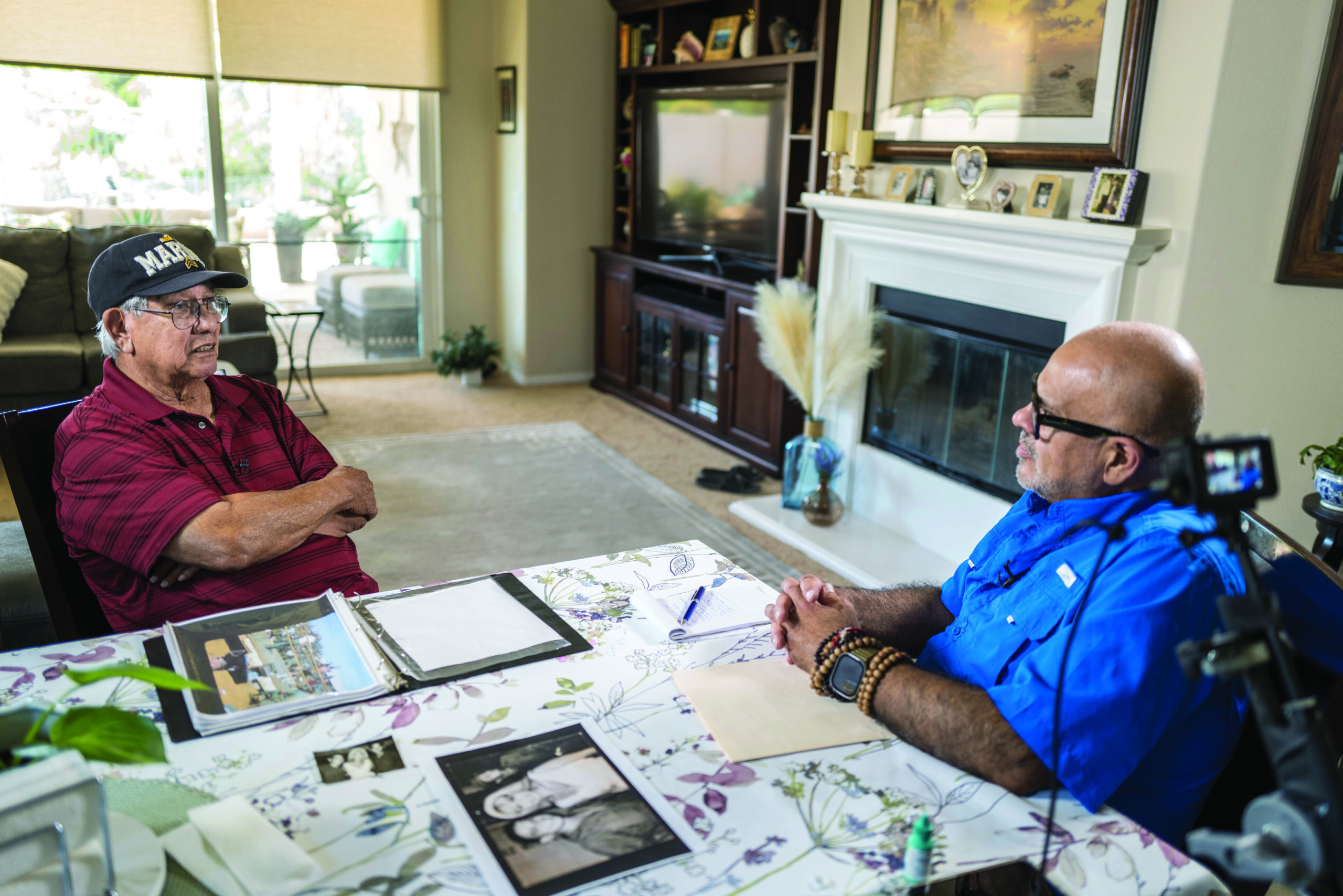
Gerry Gonzalez, right, interviewing veteran Jesse Mendez on Aug. 21, 2024. Mendez sailed to Vietnam on the same ship as Rodolfo M. Gonzalez and was scheduled to leave Vietnam on the same day. Just days before Gonzalez died, he attended Mendez’s going-home party.(Rudy Gonzalez)
Today, 60 years after his death, Rudy Gonzalez is still not an American citizen. Correcting this has become the great passion project of his nephews. Gerry and Rudy continue working through every channel they can find to advocate for their uncle’s posthumous citizenship.
“To us, citizenship completes our uncle,” Rudy stated. “It’s why he joined the Marines; it’s the story of his love for country and his dream to get an education when he returned. For us, it’s closure.”
(Rudy Gonzalez)
“It’s the ability to say he died for ‘his’ country,” Gerry echoed. “We want to be able to say that, and there is never a compromise in making someone whole.”
It began as an effort to discover and document their uncle’s life and service, but in the years since meeting the Marines of VMO-6, their efforts have expanded. The brothers have put their skills and experience as journalists to work, traveling across the country to meet and record interviews with the Marines, helping preserve not just the story of their uncle, but the memories of them all.
“Meeting the Marines from VMO-6 filled in a lot of the void in my imagination. It reaffirmed who I thought, who I hoped, my uncle was,” said Rudy. “They were able to piece together a much more tangible version of who he was. They know firsthand the sacrifice, because they lived it and survived it. Their friends who didn’t survive, they mourn. We have received from them brotherhood, family and love, in the same way that they gave it to Uncle Rudy. That’s an incredible gift they gave us and our family. It’s also an incredible story to tell. I look at the story of Uncle Rudy, and I realize it’s not just about Uncle Rudy, it’s about VMO-6. It’s not just about VMO-6, it’s about the Marines. It’s not just about the Marines, it’s every servicemember. Every servicemember that has to sacrifice and be away from family and be at risk, they are all worthy of honor.”
Each revelation they experience about the Marine Corps and the men who served with Uncle Rudy reveals another piece of him. Each piece they learn about their uncle enables them to more fully understand what it means to earn the Eagle, Globe and Anchor. In many ways, the story of one is the story of them all.
Gerry and Rudy Gonzalez attend another VMO-6 reunion in Pensacola, Fla., in October 2023.(Rudy Gonzalez)
“Watching these guys come together, most of them are in their 80s with physical limitations, but when they get together they transform into 20-year-olds like they’re back in Vietnam,” Gerry reflected. “They drink beer and tell stories and laugh the way they laughed back then. It was an amazing experience for us. I asked them, ‘how often do you guys talk about this stuff?’ And they said, ‘Never. Outside this room, we never talk about these things. These are the only guys who understand.’”
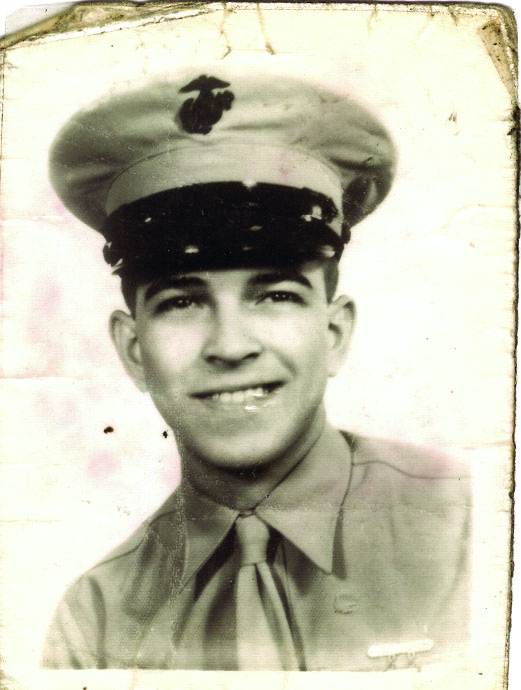
Featured Photo (Top): Service photo of Cpl Rodolfo M. Gonzalez (Courtesy of Gerry Gonzalez)
About the Author
Kyle Watts is the staff writer for Leatherneck. He served on active duty in the Marine Corps as a communications officer from 2009-13. He is the 2019 winner of the Colonel Robert Debs Heinl Jr. Award for Marine Corps History. He lives in Richmond, Va., with his wife and three children.
Enjoy this article?
Check out these similar Leatherneck and Scuttlebutt features:
Putting History Back Together: Telling The Story Of A Marine Helicopter Squadron Through A Rebuilt Huey
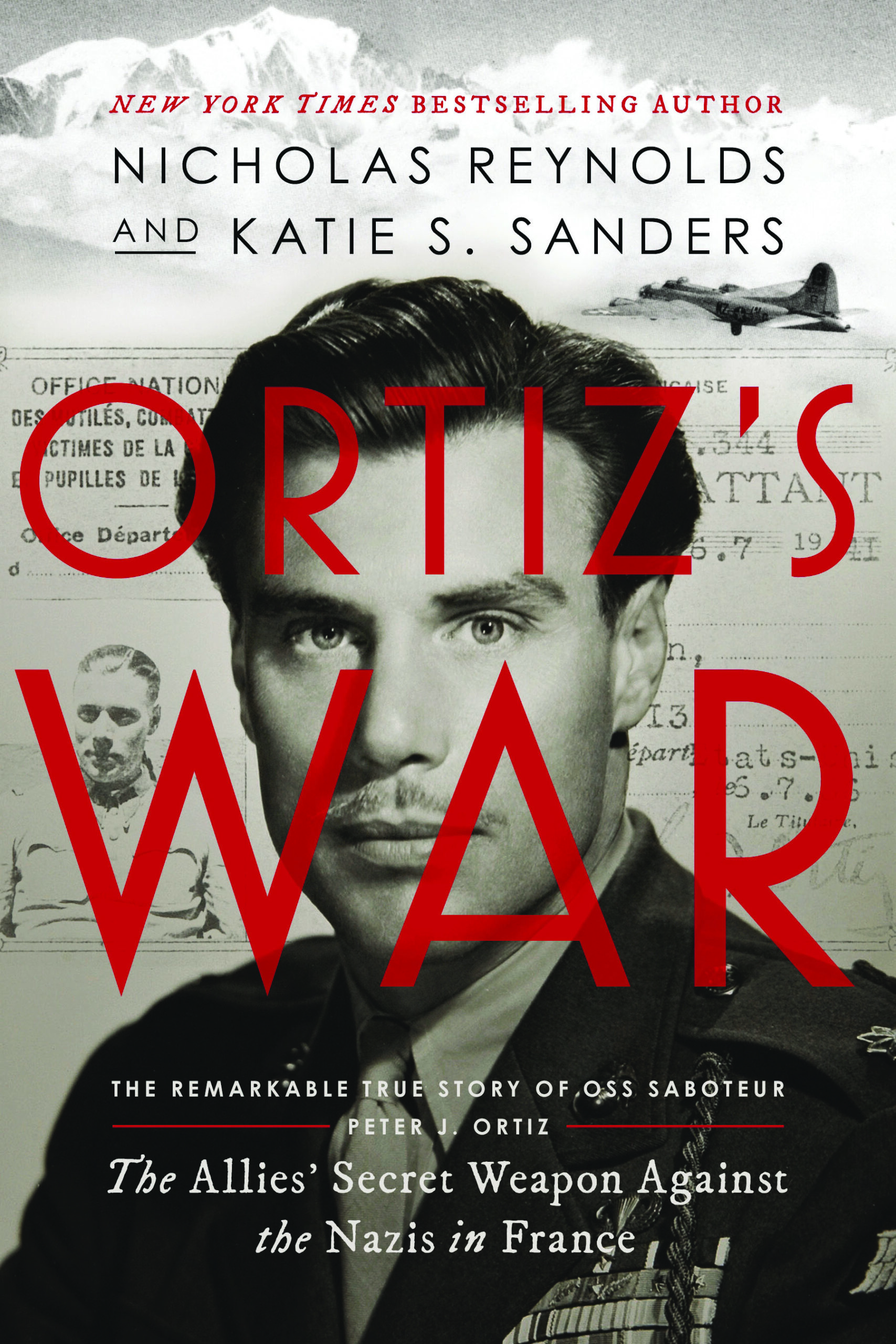
Executive Editor’s note:The following selection was taken from the newly released book, “Ortiz’s War: The Allies’ Secret Weapon Against the Nazis in France.” Col Peter Ortiz, twice the recipient of the Navy Cross, is among the most colorful, swashbuckling characters in Marine Corps history. Before becoming a Marine and being assigned to the Office of Strategic Services during World War II, he served with the French Foreign Legion. This excerpt, from chapter 4 of the book, opens with Ortiz’s return to America and enlistment in the Marine Corps. For more about the book and the incredible life of Peter Ortiz, you can listen to a conversation with the book’s authors on episode 257 of the Marine Corps Association’s Scuttlebutt podcast.
On Dec. 7, 1941, as American sailors were getting ready to sound morning colors and salute the Stars and Stripes, Japanese fighters and bombers unleashed their surprise attack on the U.S. Naval base at Pearl Harbor. They put five battleships and hundreds of airplanes out of commission, killing about 2,400 Sailors, Marines, and soldiers. That made Dec. 7 “a date which will live in infamy” in President Roosevelt’s immortal words, spoken when he called for Congress to declare war against Japan. The motion sailed through both houses of Congress with only one vote against. The United States was finally at war, at first with Japan and then a few days later with Germany and Italy too.
When the Japanese attacked, Pierre Ortiz was at sea on the steamship Exeter. From France, he had made his way to Lisbon, passing over the rugged Pyrenees Mountains and through fascist Spain. The Portuguese capital was one of the few neutral ports in Europe where travelers could board a seaplane or a boat for America—and find a hot mix of spies and proxies from both sides, Allied and Axis. Ortiz talked to one of de Gaulle’s Free French officers as well as a British representative. Both offered to take him on as a captain, a promotion from his last rank of acting lieutenant. His mind made up, he declined their offers. He was going to America, more confident than ever that the country was approaching active participation in the conflict. A week after Thanksgiving, Ortiz talked his way onto the crew of the American Export Lines steamer about to depart for New York. Rather than pay for comfort, he would earn his passage across as a deckhand.
As Exeter steamed into New York harbor on Dec. 8, Ortiz leaned nonchalantly on the ship’s railing in a double-breasted navy-blue pinstripe suit, smoking a cigarette. A ribbon sewn into his lapel marked him as a military man. A signet ring on his pinky finger and a stylish watch on his wrist hinted he was no ordinary deckhand.
Ortiz could see the signs that the country was shifting from peacetime to wartime. Military and naval intelligence officers scurried up the gangplank to interview the passengers before they disembarked. Intrigued by the story Ortiz told, they invited him to Washington, D.C., for a thorough debriefing. Before leaving New York, he registered for the draft at 331 Madison Avenue, a block from Manhattan’s Grand Central Station. His status was “unemployed,” and his last place of employment was “Foreign Legion.” The registrar noted his ruddy complexion and the scars on thigh, hip, and shoulder, where the wars in Morocco and France had left their marks.
Once in Washington, Ortiz appeared at the Munitions Building, the white concrete World War I “temporary” that took up most of the space between the Washington Monument and the Lincoln Memorial on the National Mall, along with its equally ungainly twin, Main Navy. Inside the Army headquarters, Ortiz answered the military intelligence officers’ questions, amazed at how little they knew about the war in Europe. Then he told them his goal was to join the American military and get back into the war. One intelligence officer suggested he might make a good aerial observer. But progress toward a commission in the U.S. Army Air Forces quickly foundered. He seemed too thin and weak after a year of “semi-starvation,” not to mention his recent bout of pneumonia. The doctors’ advice was for him to go to his mother’s place and put on some weight before reapplying.
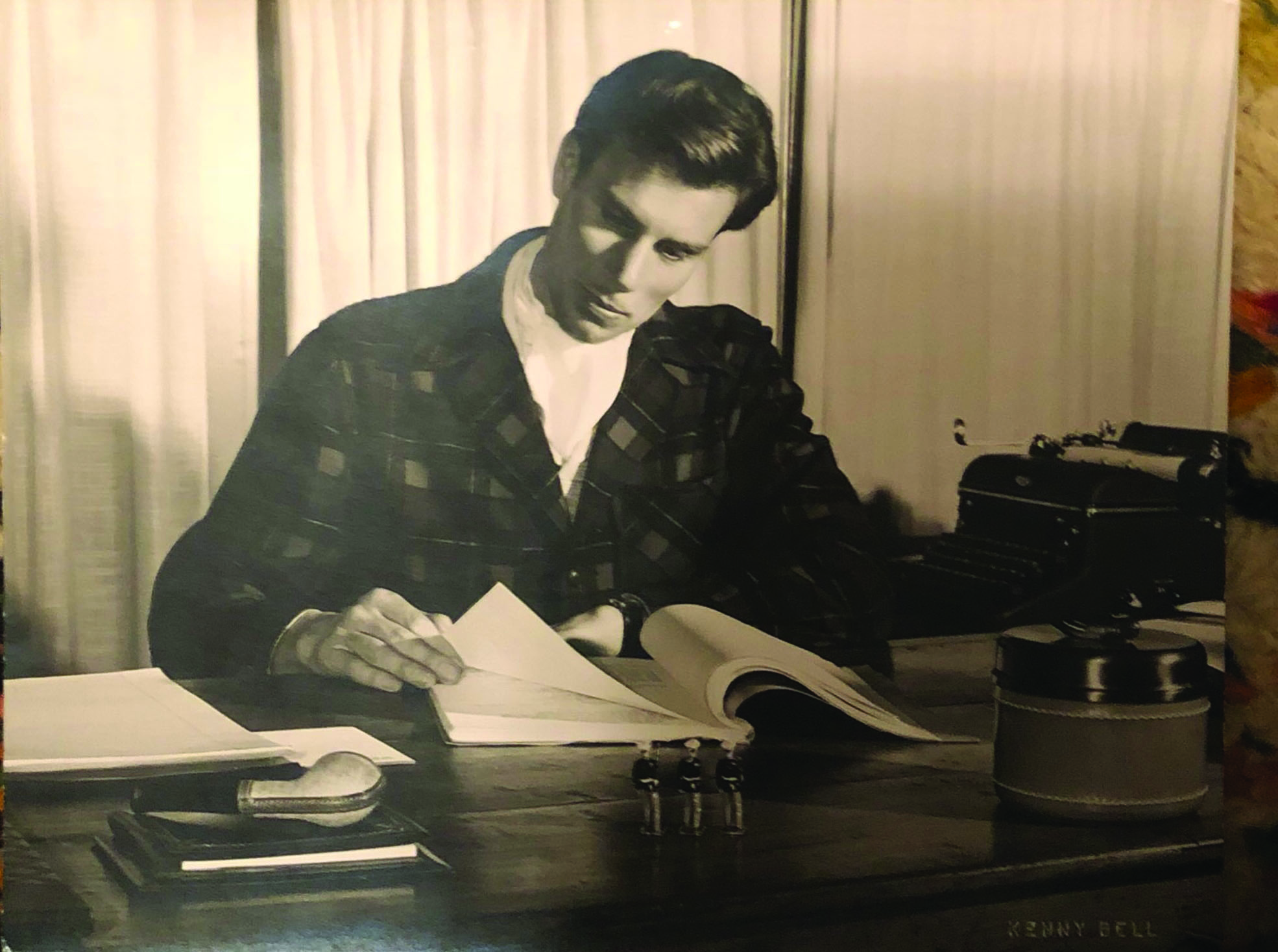
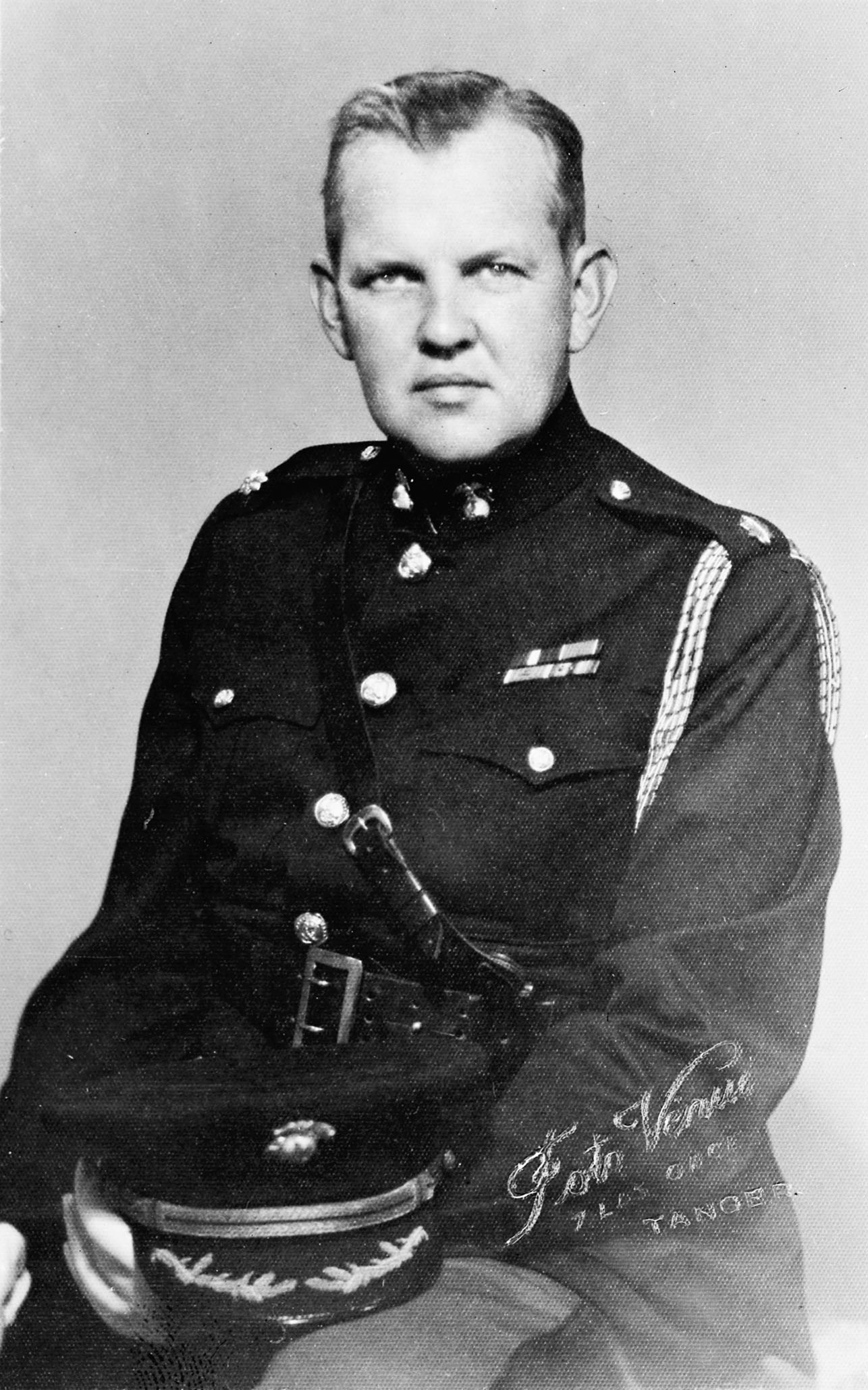
Ortiz immersed in study. His deep fascination with French military history, the Resistance and the realities of European conflicts shaped his actions in WW II.(Courtesy of The Ortiz Family)
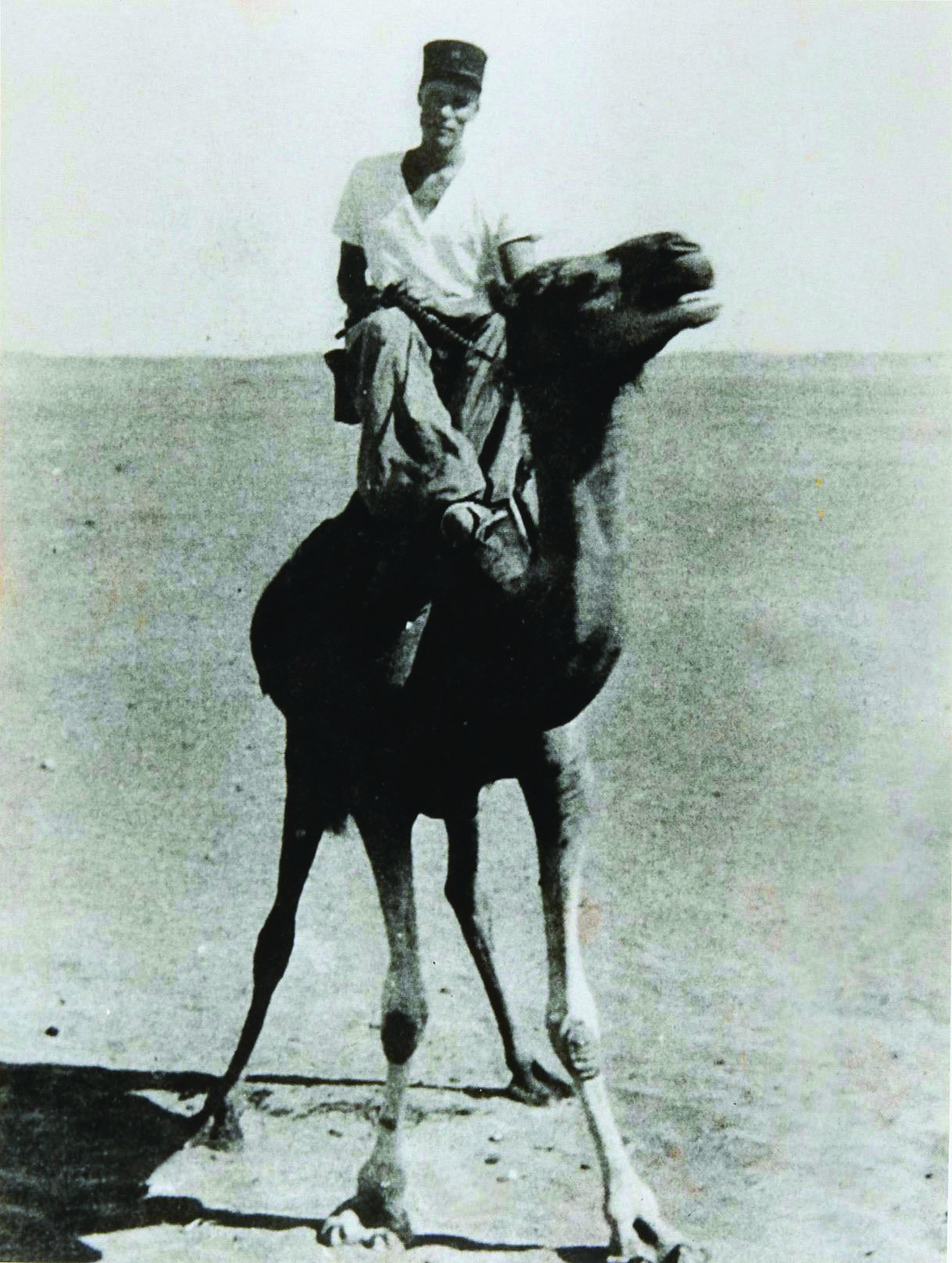
A young Peter Ortiz on camelback during his early days as a Legionnaire in the deserts of North Africa. (Courtesy of the Ortiz Family)
Three months later, Ortiz tried again. He filled out a never-ending series of forms and wrote letters, reciting his military résumé, his tone polite but insistent. At 28, he had a lot of experience in small wars and one major campaign, having held every rank from private to first lieutenant and earned a host of awards. A bureaucrat found an obscure regulation that blocked his way forward. Ortiz’s service was for France, overseas; “a person [who] had been out of the country for a certain length of time was not eligible to become an officer.” An increasingly exasperated Ortiz did not care whether he started out as an officer; he could once again earn a commission on the battlefield. What he wanted now was action: “I, who have been a professional soldier practically all my adult years, am not content to sit back and watch others fight when, at last, I have an opportunity to serve my country.”
When the military bureaucrats failed to oblige him, Ortiz decided “to hell with all that.” He would simply enlist, picking the Marines because an old Legionnaire who had served in both outfits told him that their merits were about equal. This was true enough. They had been about the same size; the strength of the Corps in 1939 was about 19,000. They were both tough military elites with fighting traditions going back over 100 years.
Just as the infantry was the backbone of the Legion, every Marine was a rifleman first. Both services included loyalty in their mottos. Each had a training program celebrated for turning troubled youths, including those who might have run afoul of the law, into disciplined men. It was as good a fit as Ortiz was likely to find in the United States.
Saying nothing about his background, Ortiz signed the papers at a recruiting station in Baltimore like any other recruit and, being east of the Mississippi, soon found himself at the Marine Corps Recruit Depot at Parris Island, S.C.
Parris Island was nowhere near a city. Isolated on the coast, it lacked the reflected glory of Sidi-Bel-Abbès. Sandy, hot, and humid most of the year, it was just a place to make Marines. Recruits lived in Quonset huts—rudimentary half circles of corrugated steel with doors and windows. They learned to tolerate the ubiquitous sand fleas and obey their drill instructors, who had up to eight weeks
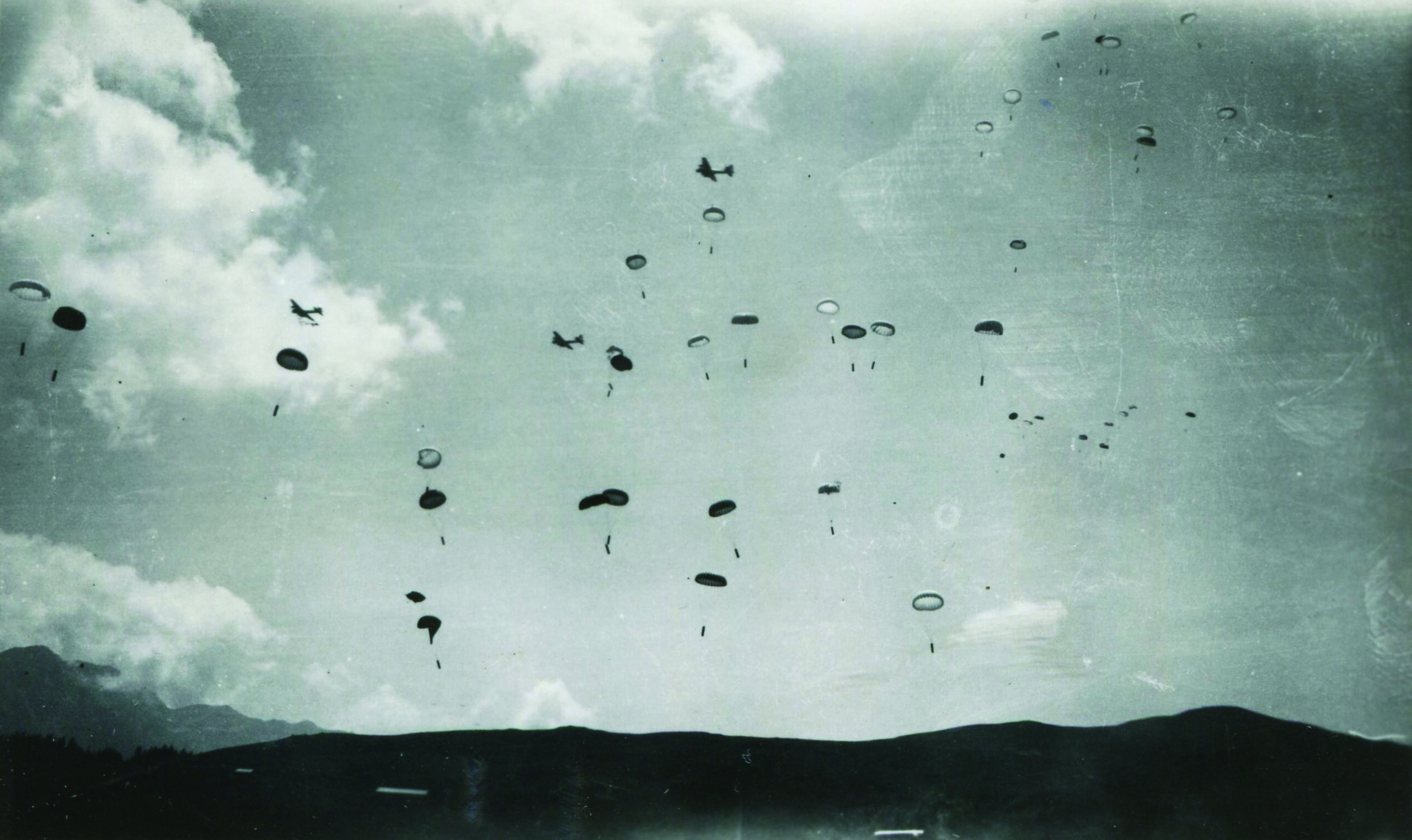
A massive air drop of supplies on Aug. 1, 1944, supporting Ortiz’s mission behind the German-occupied lines. (Photo by Raymond Bertrand, Courtesy of Risler family)
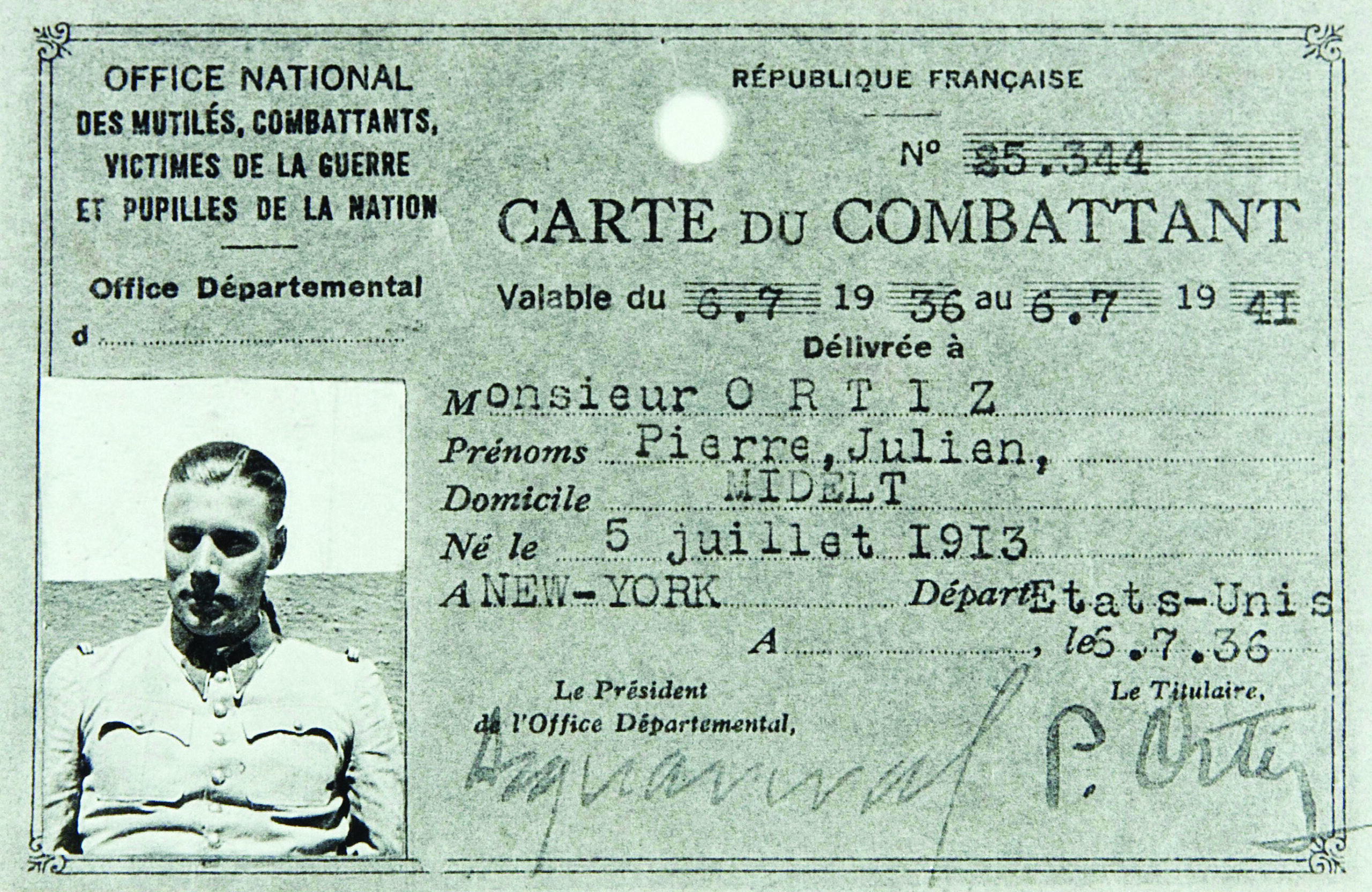
Ortiz’s official French veteran identity card (Carte du Combattant).
to turn a civilian into a Marine. Basic indoctrination, physical conditioning, and marksmanship were on the training schedule. To graduate, recruits had to absorb the ways of this branch of the sea service, especially its strict discipline and loyalty to each other and to the Corps. That the country was now at war helped motivate the young men, who were homogeneous compared to the Legion’s recruits. With the right attitude, everything else became easier.
Ten years older than the average recruit, Ortiz was not the oldest, a distinction earned by the 50-year-old college professor Paul H. Douglas, who enlisted in May 1942. With waivers for his eyesight and his teeth, Douglas had to put in a little extra effort to graduate. Not so Ortiz. He had already met many of the requirements. The Corps insisted that a man abandon his previous identity and embrace a new set of stories and priorities, things Ortiz had literally done in the Legion even before the physical toughening had begun; each service wanted to possess “the souls of its personnel as earnestly as it strive[d] to condition their bodies.” Ortiz concluded that Marine boot camp was “not as hard as Legion training,” which was usually twice as long.
Word spread about this amazing recruit. On July 1, Ortiz applied for a commission; Headquarters Marine Corps inquired about him; Colonel H. L. Smith of Parris Island replied that “we spotted him shortly after his arrival,” adding, “The Marine Corps would be unbeatable if all our men were like him.” After deciding to see for himself what Ortiz was like, the chief of staff of the recruit depot placed Ortiz above the level not only of the trainees, but also of the trainers. On July 14, Col Louis R. Jones wrote to the Commandant of the Marine Corps that the young man’s “knowledge of military matters is far beyond that of the normal recruit instructor.”
That assessment made the process flow smoothly. Less bureaucratic than its sister services, the Corps proved downright nimble. Ortiz went to Washington to meet with the Commandant, then-Lieutenant General Thomas Holcomb, the stern-looking gentleman who was presiding over the expansion of the Corps from 17,000 to 385,000 Marines. Holcomb saw a future intelligence officer in Ortiz. When Ortiz asked about the regulation that had barred his way, Holcomb laid down the law: He was “head of the Marines,” and if he said Ortiz would be a Marine officer, Ortiz would be a Marine officer.
When he finished boot camp, Ortiz went from being Private Pierre J. Ortiz, former Legionnaire, to Second Lieutenant Peter J. Ortiz, USMCR. But that did not settle his future in this war. Since he did not fit any of their existing molds, it took the Marines a few months to figure out what to do with Ortiz. Giving him a commission was the right step after boot camp. But where exactly should this unique officer serve and in what capacity?
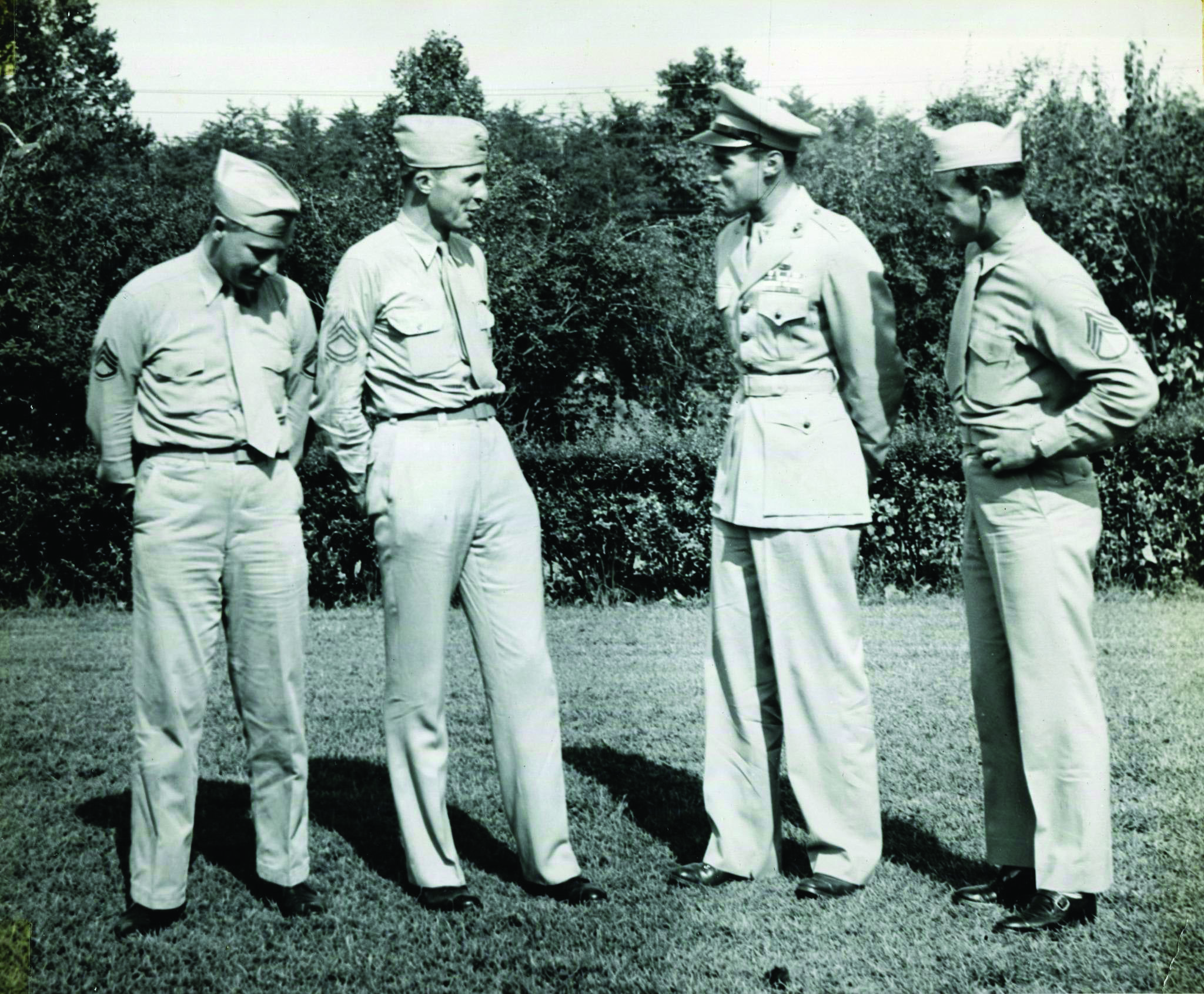
From left to right: Jack Risler, Robert LaSalle, Peter Ortiz and John Bodnar—the surviving members of the Union II mission, minus Francis Coolidge—in Washington, D.C., in 1945. (Courtesy of the Risler Family)
The Marines were planning campaigns in the Pacific; Ortiz wanted to get back to Europe, where they were a rarity. In August, he echoed Commandant Holcomb’s suggestion that he belonged in intelligence. He spoke foreign languages and could thrive in odd corners of the globe, especially French North Africa. He did not need many comforts and had a lot of stamina. “I have had unlimited experience in swimming, alpinism, and rugby,” he reminded everyone.
But the Marine Corps did not have a robust intelligence branch; if he became an intelligence officer, he would have to serve outside the Corps to realize his full potential. He suggested another, even better possibility: becoming a Paramarine, a specialty that sprang to life after the Germans showed what a few paratroopers could do in May 1940. In a surprise attack from above, a handful of Fallschirmjäger had disabled the supposedly invincible forts guarding the Belgian frontier. For a while, that seemed the wave of the future. Within a week, LtGen Holcomb had decreed that the Marine Corps, which had no paratroopers, would enter the field. The Marines had moved fast, setting up jump schools on the East and West Coasts. Two years later, the Corps approved Ortiz’s request to become a Paramarine after he messaged headquarters to lay out his qualifications and interest in this new kind of warfare.
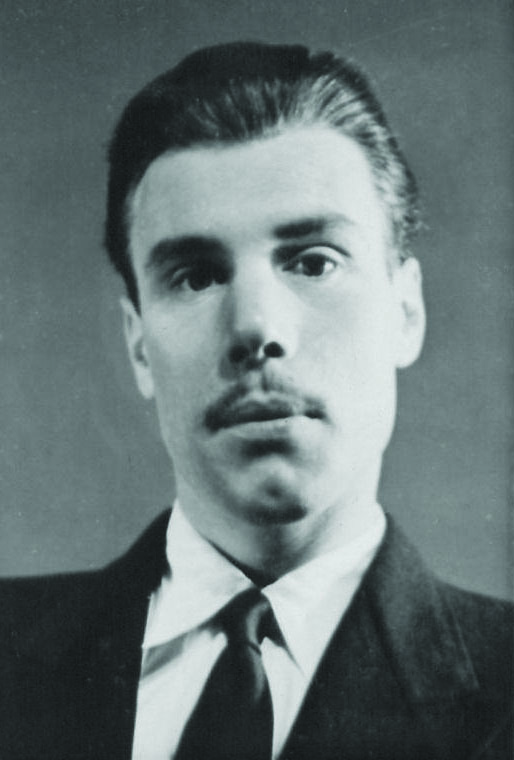
A photo Ortiz may have used for false documents.(Courtesy of UK National Archives, KEW)
In the fall of 1942, Ortiz moved up from South to North Carolina, where the Marines had been building a vast base that would be called Camp Lejeune. Beautiful beaches were ideal for rehearsing amphibious landings, the Marines’ evolving specialty. The base also had the dubious distinction of having more swampland and insects and reptiles than Parris Island, making it a good place to train for fighting in the jungle on Pacific Islands, but less so for European climes. On a part of the base known as Hadnot Point, the Marines built the East Coast parachute school on sandy soil among pine trees.
Americans qualified with just five jumps. No one cared that Ortiz had already jumped well over 100 times in the Legion. He needed to learn the Marine Corps way at Hadnot Point. He was among the first students in the summer of 1942. It was like going to boot camp again, only with more, and harder, physical training: practice jumps and landings at ground level followed by jumping from a tower and finally jumping from old cargo planes. It was a school where officers and enlisted trained together, and where he met other Paramarines of all ranks. When he graduated, Ortiz was again a member of an elite within an elite. Along with the title “reconnaissance officer,” the Marine Corps rewarded him with a promotion to captain in December.
Ortiz was in North Carolina waiting for jump school to start on Nov. 8, 1942, when 110,000 Allied soldiers landed in French Morocco and Algeria. Commanded by U.S. Army LTG Dwight D. Eisenhower, Operation Torch was part of a campaign to drive the Axis from the African continent and set the stage for a return to the European continent. But Ortiz would not miss the campaign for which he was so well prepared. The fighting in North Africa would drag on into the spring of 1943 as Eisenhower advanced east from Morocco and Algeria toward Tunisia, and British Gen Bernard L. Montgomery kept at the monthslong task of pushing the Afrika Korps west from Egypt to Tunisia.
Ortiz received orders to report to the U.S. Naval attaché in Tangier, Morocco, then to observe operations and logistics to glean anything of interest to the Marine Corps. He found that the Naval attaché was not another military bureaucrat but, like himself, an exceptional reservist who knew his way around the Arab world. As the intelligence officer for the 6th Marine Regiment in World War I, William A. Eddy crawled out into no-man’s-land between the trench lines on his belly to find out what the Germans were up to. The tall, once athletic man had returned home with a long row of decorations and a permanent limp. Between the wars, Eddy earned a Ph.D. from Princeton, taught at the American University in Cairo, and wrote the first guidebook to baseball in Arabic. For a while he was president of Hobart College in New York. In 1941, Eddy had volunteered to return to active duty despite his injury because, he said, he would rather be among Marines than put up with bickering professors. The reserve lieutenant colonel appeared to work for the Office of Naval Intelligence, but his primary allegiance was to the Office of Strategic Services, abbreviated OSS, America’s brand-new intelligence outfit. Tasked with preparing for Operation Torch, Eddy had gathered practical and political information that made a difference: everything from the topography of the beaches to the allegiances of the local chieftains.
LtCol William A. Eddy, USMC (Leatherneck File Photo)
For all his accomplishments, Eddy was soft-spoken and approachable. Upon arriving in Morocco, it was not hard for Ortiz to get his permission “to roam about at will, attaching myself to and serving with units of my choice.” To be on familiar turf with a nearly blank check was a dream assignment. He knew he “was for excellent personal reasons and as a representative of the Marine Corps, particularly desirous of … taking part in action against the Germans.” After experiencing defeat in 1940 and being held as a prisoner of war for 15 months, he was ready to hit back even though his primary mission was to observe.
Ortiz proceeded to the Tunisian high desert in time for the Battle of Kasserine Pass in February 1943. This extension of the Atlas Mountains was barren country, little more than rocky plains and sand that looked like the American Southwest. In winter, troops had to endure snowstorms as well as sandstorms; they slept cold and could not escape the sand that got into everything: the weapons, the food, the sleeping bags. It made for a tough proving ground.
tiz watched the U.S. Army fail its first test of arms against the Wehrmacht. News that the famed Field Marshal Erwin Rommel, victor of countless desert bat-tles, was coming their way was enough for many American soldiers. Others waited until German artillery shells started to burst around them, or until they could hear and see German tanks and infantry. Battalions of green troops abandoned their gear and fled 50 miles west. Ortiz saw an anticipatory evacua-tion order spark panic. A few Messer-schmitt BF-109 fighters and Junkers Ju-88 light bombers came out of nowhere at dusk and destroyed the truck carrying his bedroll, a loss that he simply shrugged off. For an experienced soldier, it was nothing to worry about.
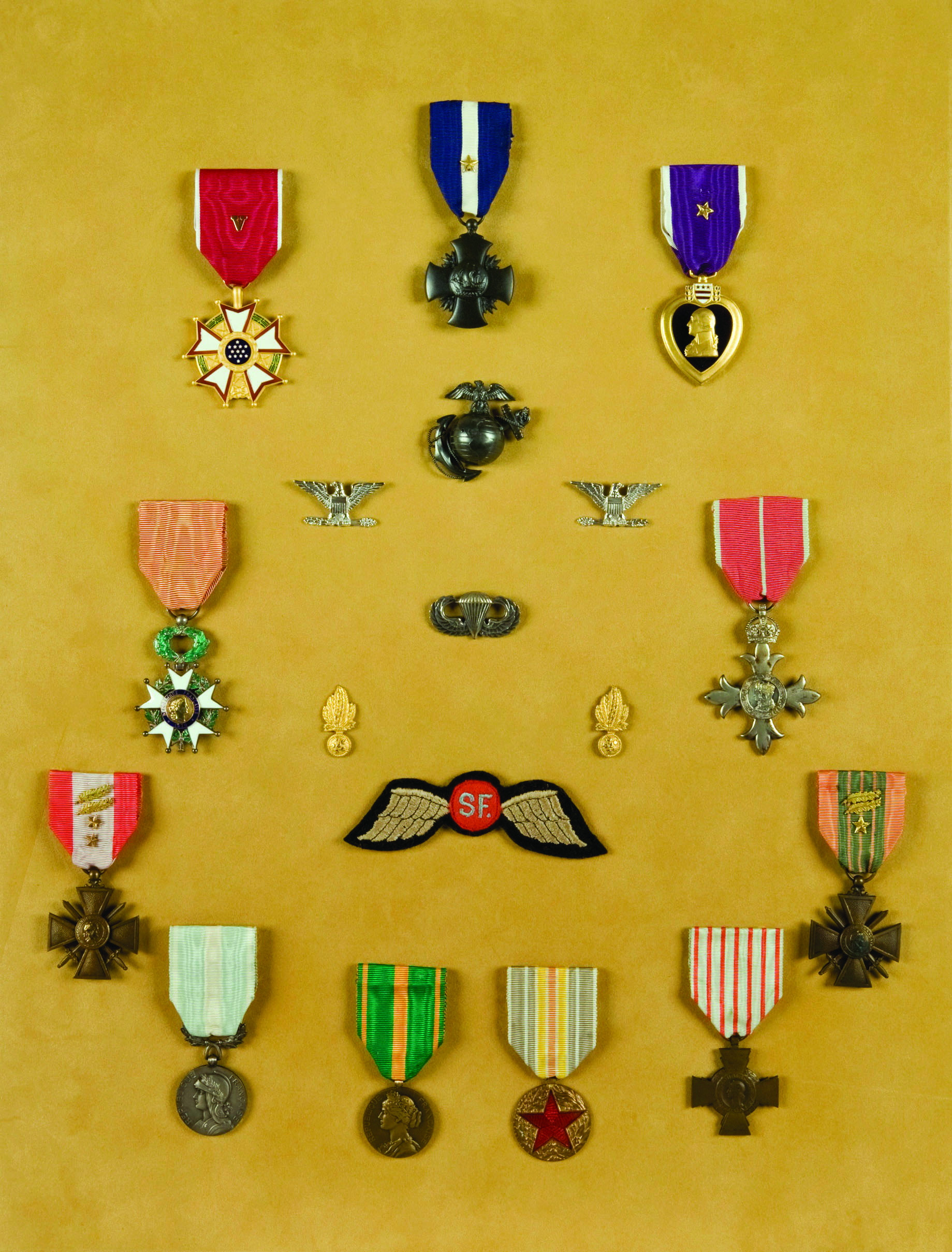
The decorated array of U.S. Marine Corps and foreign medals earned by Col Peter Ortiz.(Courtesy of National Museum of the Marine Corps)
Ortiz mustered “a group of Arabs … to find out what the Germans were doing” and help the Allies fight back. Since his time in Morocco in the 1930s, he had known the ways of the tribesmen and was comfortable working with them. “My Arab boys and I wandered around the [Tunisian] desert and had a pretty good time,” he noted. He provided headquarters with “a good deal of useful information.”
Once, they were “captured” by U.S. Army troops who doubted Ortiz’s story. By then he and the Arabs looked alike—deeply tanned, windburned, sharing bits of clothing, perhaps checkered headscarves. Having never heard of any U.S. Marines operating in North Africa, let alone an American officer leading a camel train, the soldiers suspected him of being a spy. “If this fellow is a Nazi, we can shoot him,” one soldier mused. “On the other hand, if he is a Marine, we should shoot him.” It was a dangerous joke. The interservice rivalry ended when a higher headquarters confirmed they were all on the same side.
Continuing his tour of the battlefield, Ortiz was delighted to encounter a comrade from the Legion, a captain who was busy reinforcing the almost completely encircled remnants of the 3rd Foreign Infantry Regiment, which had served alongside Ortiz’s 2nd Regiment in Morocco. Ortiz could not resist riding to the sound of the guns with the 3rd. He was there as the Legion forced the Germans to pay “a high price for every inch of terrain.” If true to form, he fired a few rounds himself. He left the Regiment only when it was withdrawn to rest and refit. The lesson he recorded was that old-fashioned military virtues still made a difference: These Legionnaires had “demonstrated conclusively that seasoned and determined troops can, albeit with very inferior equipment and armament, hold out against a numerically superior and better armed enemy.”
Every so often, Ortiz remembered he was not entirely a free agent and reported back to Eddy in Algiers, who had proven remarkably tolerant of his wandering observer. No longer a young daredevil himself, Eddy was now ready to pull in the reins—while Ortiz wanted more rein. Ortiz had heard about an unusual opportunity. Eddy was collaborating with the British on an operation codenamed “Brandon” to support Eisenhower’s forces. Under Brandon, small teams of commandos operated behind and between the lines. The mission was “reconnaissance patrolling,” which meant keeping an eye out for the enemy on unguarded flanks, reporting back to the nearest Allied command, and, not least, harassing the Germans by conducting hit-and-run attacks, laying mines, or blowing bridges.
The officers were largely British and from the Special Operations Executive, or SOE. The men were a mix of nationalities, including Spaniards and Frenchmen who hated fascism. Rounding out the picture was a sprinkling of Americans from OSS—among the first OSS officers and men to face the enemy in battle. They included Carleton Coon, the 42-year-old Harvard anthropologist who, like Eddy, was a seasoned Arabist. He spoke the language and had excellent rapport with the tribesmen he was now trying to harness for the Allied cause. (He wanted to go down in history like the multitalented British guerrilla leader T.E. Lawrence of World War I fame.) Coon thought highly of Marines and particularly of Ortiz, who knew the region and knew how to fight.
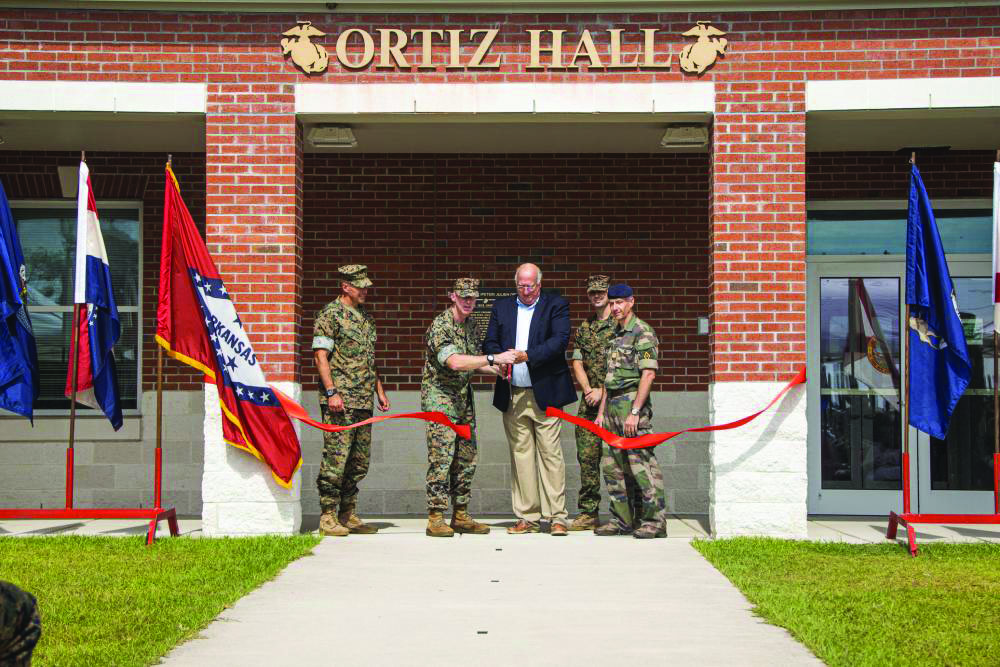
Col Brian Russell and LtCol Pete Ortiz Jr., USMC (Ret), son of Col Peter Ortiz, cut the ribbon on June 30, 2022, officially dedicating building WC504 as Ortiz Hall at Camp Lejeune, N.C.(Photo by Cpl Kyle Jia, USMC)
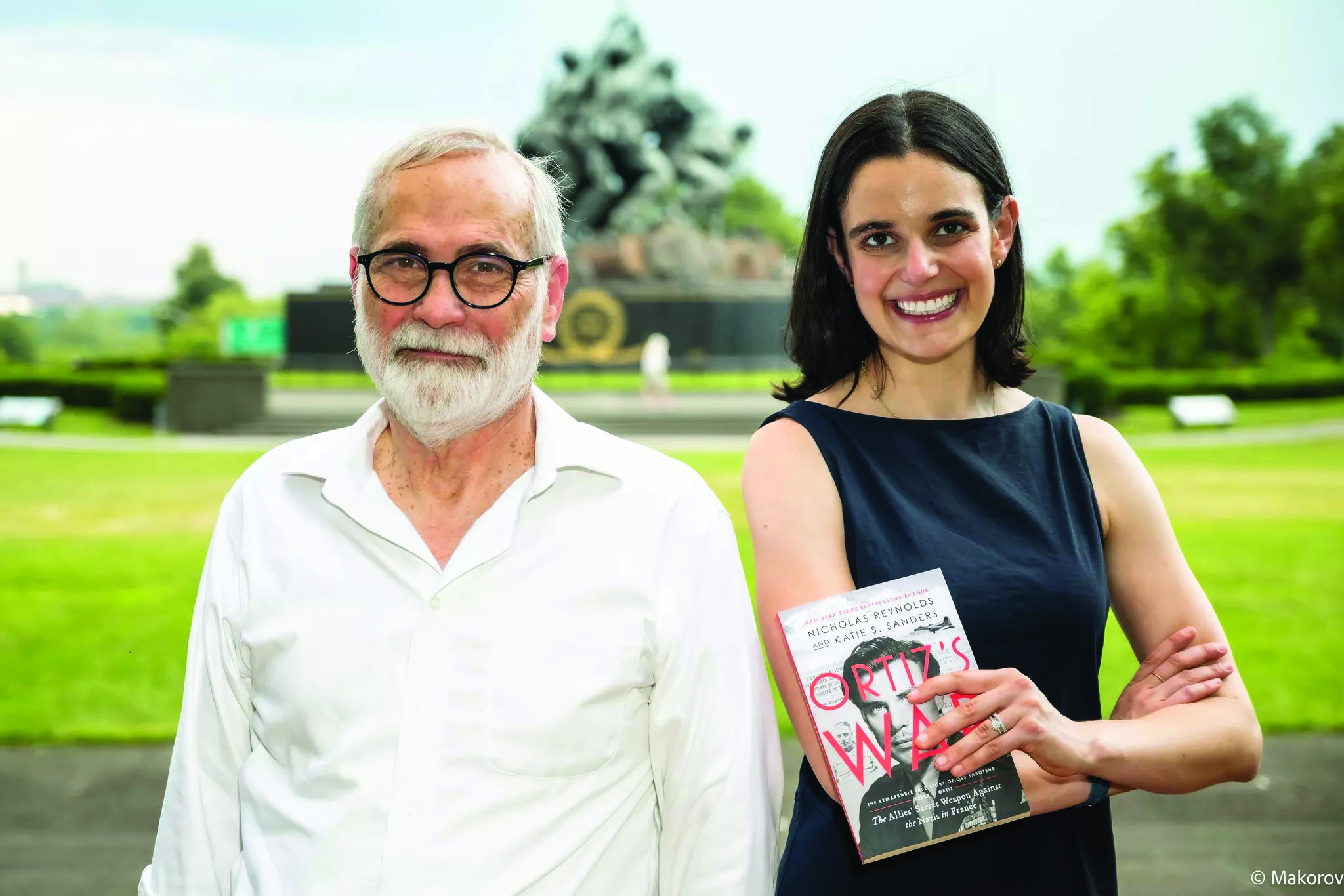
After journalist Katie S. Sanders discovered that her late grandfather—a Jewish-American pilot shot down over France—was rescued by Peter Ortiz, she teamed up with Marine veteran Dr. Nick Reynolds to co-author “Ortiz’s War: The Allies’ Secret Weapon Against the Nazis in France.”(Photo by Makarov)
Ortiz learned that one of Eddy’s officers detailed to Brandon, Captain Elmer “Pinky” Harris, also a Marine, had been wounded by a mine that morning. Ortiz argued he was just the man to take Harris’ place. It would be like for like. But Eddy had his doubts about letting Ortiz go on the assignment. Strictly speaking, he was supposed to be a pseudo-diplomat, more of an observer, less of a combatant. He even had a bona fide diplomatic passport that conferred protected status. The middle-aged Eddy did not want to abuse the privilege. But Ortiz was so eager that Eddy gave in.
In early March 1943, Ortiz took charge of five Spanish commandos and a British radio operator and ventured into the unknown. He made it his personal goal not only to find the enemy but also to bag “a German tank or two” himself.
By now, the American and British armies were facing off against the German and Italian armies in the eastern third of Tunisia, a battleground stretching 300 miles north to south and 50 miles east to west. The terrain ran the gamut from high desert to rocky foothills to valleys fertile enough for olive trees. On March 17, Ortiz presented himself to U.S. Army Brigadier General Paul M. Robinett, commander of an armored task force known as Combat Command B. The 48-year-old was an unusual career officer—5 foot 4 inches of swagger, aggression, and intelligence. He and Ortiz had some common ground. Robinett had studied at the University of Paris, attended the French cavalry school, and competed at the Paris Olympics in 1924 on the U.S. equestrian team. The general explained his plan to Ortiz and asked him to help guard his exposed left flank. He wanted advance notice of any Germans coming at him from the east.
That evening, Ortiz set up a lookout post on a small mountain called Garet Hadid—about 2,000 feet at the summit—that overlooked one of the few roads in the area. But he himself did not stay put. Leaving his second-in-command in charge, he set out by himself to reconnoiter places that might harbor tanks, to get close enough to do “a little something” to the enemy.
The night was inky black. Rain had been falling steadily for three days and showed no signs of abating. It reduced visibility to a few yards. A seasoned infantryman will tell you that this was good weather for reconnaissance, the enemy being less likely to expect a probe when it makes more sense to stay in your tent. He will also tell you that going alone, especially without a radio, is seldom the best plan.
Loaded with grenades, Ortiz inched his way forward for hours, looking and listening. When he crossed a low-lying valley, he sank into mud up to his knees, slowing him down even more. Well past midnight, he spotted tank tracks but no tanks. He neither saw nor heard any other sign of the enemy. Then, without warning, machine-gun fire blazed through the darkness at him from the front and the right. A bullet went through his right hand, near the thumb and forefinger. Another bullet grazed his right leg.
Ortiz fell to the ground and rolled to the left, looking for cover. There was not much. Some 30 yards to the front, he could now make out the dim silhouette of a vehicle. He aimed and threw a Mills bomb—a standard British hand grenade—that fell short. Making a supreme effort, he aimed again, launching a petard. He watched it explode “with a terrific blast,” stopping the automatic fire from that direction. For a man who had just been hit in his throwing hand, it was a remarkable pitch, half again the maximum range of 20 yards for the British antiarmor grenade. The “sticky bomb” designed to latch on to metal until it exploded must have hit home. Ortiz heard men crying out in pain. “With extreme caution,” he crawled one hundred yards to the rear while dodging fire from the right. Then he stood up and walked, bleeding and in shock, slowly back to his men at the lookout post on Garet Hadid.
It took until 8 a.m. to cover the few miles back to Robinett’s command post. The general was delighted with the team’s performance. In his own way, Ortiz had located the enemy. Robinett put Ortiz’s information on the wire and awarded him a Purple Heart on the spot for being wounded in combat, before personally escorting him to a well-equipped aid station. The doctors put Ortiz under and operated immediately. When he came to, he was upset to discover that Robinett had reassigned his scouts. Even worse, the doctors planned to send him to a better equipped field hospital over the border in Algeria. He protested, but to no avail. The surgeon at Tébessa proposed another operation and foresaw months of convalescence.
The war might be over before Ortiz could return to the front, a prospect he could not accept. Ortiz messaged a friend at the nearby French airfield outside Youk-les-Bains to get him quietly out of the hospital and onto a plane to Algiers. On March 22, he reported to Eddy, who let Washington know that the captain had been wounded while engaged “in a personal encounter” with a German patrol that he dispersed with grenades.
Col Peter J. Ortiz’s behind the enemy line missions in France made him the ultimate secret weapon against the Nazis.(Courtesy of the Ortiz Family)
The colonel barely resisted saying, “I told you so.” Against his better judgment, he had allowed Ortiz to go into battle. Now there was concrete proof that he had violated the rules for “observers.” It would be best to get him out of the country until things quieted down. Ortiz protested. He wanted to stay and fight. But this time he could not sway the colonel and was soon on his way to Washington by air, reporting to Headquarters Marine Corps on April 28.
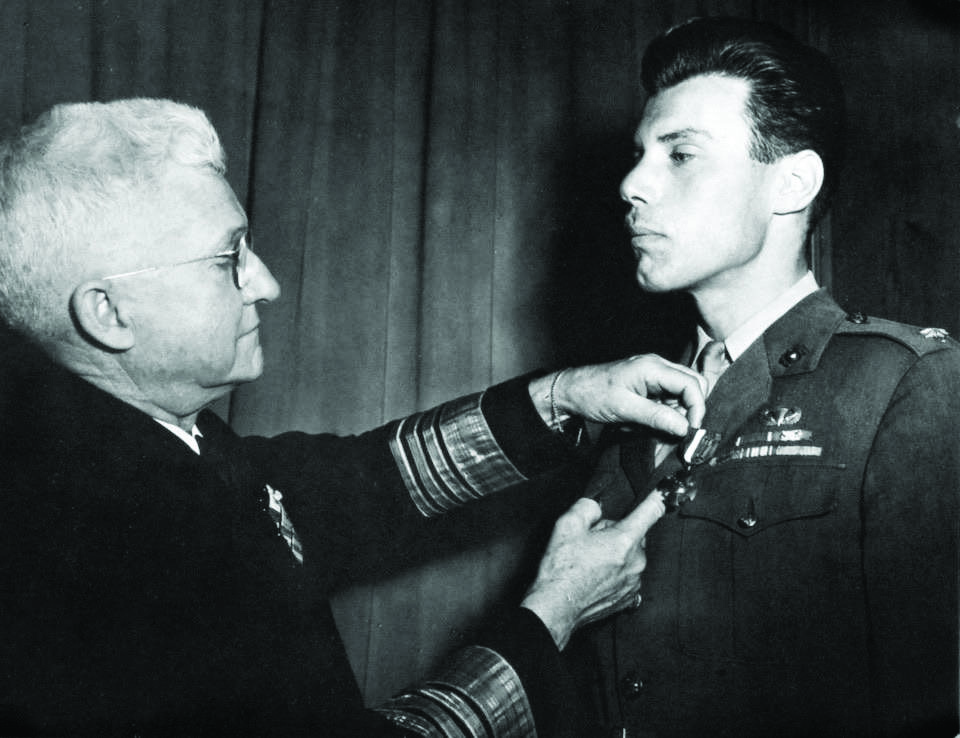
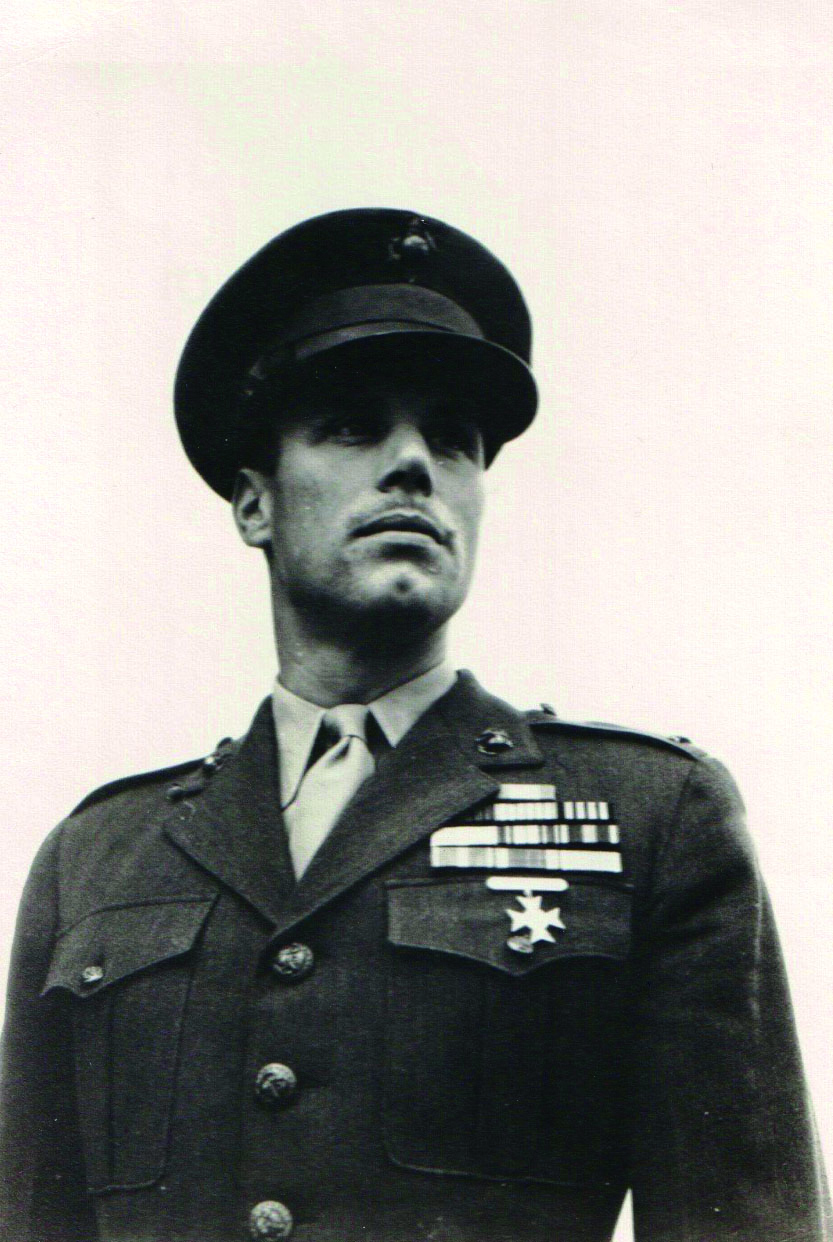
Featured Photo (Top):Col Pierre J. “Peter” Ortiz receives the first of his two Navy Crosses, awarded for extraordinary heroism during WorldWar II after a career that took him from the French Foreign Legion to the U.S. Marine Corps and the Office of Strategic Services (OSS).
Surrounded by pines and oak trees on a range in Quantico, Va., a Marine crouches in the underbrush. Beneath his flak vest and atop his helmet, he wears a digital Marine Pattern (MARPAT) utility uniform. Tucked into proper concealment, he blends into his surroundings—an onlooker would see a distorted shape from a distance, nothing that would catch the untrained eye. As hand and arm signals silently flash from a squad leader yards away, several Marines morph from unassuming shapes into a rifle squad advancing on a patrol.
Like the generations preceding them, these Marines rely on the splotchy, multicolored camouflage to provide them with a slight edge within their surroundings. The earliest examples of camouflage in the U.S. military were products of artists who used colors and patterns to adapt to environments. Modern interpretations of camouflage take a scientific approach, with defined processes and methods to create specific patterns to blend colors and break up the distinctive outlines of a warfighter. In his article “Colour and Camouflage: Design Issues in Military Clothing,” Johannes Baumbach writes that camouflage should decrease the probability of detection, identify friend from foe and provide a corporate image.
From Blues to Drabs
At the turn of the 20th century, as the linear warfare practiced by Napoleon and General Grant faded away to be replaced by multidimensional modern war, Marine Corps uniforms adapted with it. Gone were the flashy shakos and bright brass buttons. Marines retained these for garrison and parade functions but entered combat with drab colors designed to blend into their surroundings.
Fighting from mud trenches and dugouts, Marines in France during World War I wore forest green and olive drab uniforms. These uniforms were much better suited for combat than the blues that Marines previously wore. (Courtesy of USMC History Division)
The Marines of the Spanish-American War and World War I started the drab color trend. During campaigns in Cuba and the Philippines beginning in 1898, Marines replaced their white linen with a light brown “campaign suit,” a precursor to the khaki summer service uniforms. In 1912, the Corps went a step further by introducing a wool forest-green uniform to replace the navy-blue jacket and sky-blue trousers. Up until this change, what modern Marines recognize as dress blues served as everyday wear, and they were frequently worn into combat.
The distinction between dress and combat clothing became more pronounced with the first utility uniform introduced in 1941, just prior to the United States’ entry into World War II. These sage green, herringbone twill (HBT) uniforms were designed to be worn over the khaki ones during manual labor and working parties but soon formed the foundation for all future Marine combat uniforms.
Members of the USMC Historical Company demonstrate the changes in Marine Corps uniforms in the early 1900s. On the left, the undress blues with campaign cover were worn in combat during the Boxer Rebellion in 1900. To the right, the Marines wore brown linen campaign suits and their undress blues cover when landing at Guantanamo Bay in 1898.(Courtesy of USMC Historical Company)
Marines Lewis B. “Chesty” Puller and William Lee pose for a photo with members of the Nicaraguan National Guard, Carlos Gutierrez and Carmen Torrez, circa 1931. They are wearing the khaki blouses and trousers that had been the combat uniform of Marines since the Spanish-American War. (Courtesy of USMC History Division)
World War II
At the beginning of WW II, the Army beat the Marine Corps to the punch in the development of camouflage uniforms. Taking note of the Japanese jungle camouflage, the Army pioneered a one-piece green coverall covered in irregular green and brown splotches. Besides limited instances in the Solomon Islands, it proved unpopular and saw little use.
The Marines took inspiration from the development of these coveralls and released their own camouflage pattern that came to symbolize the Marine Corps in the Pacific. The first camouflage uniform was cut and fashioned similarly to the HBT utilities but was made to be reversible. One side featured splotches of brown, ranging in shade from sand tan to dark brown, to be worn on the beaches of Pacific islands. The reverse side was patterned primarily with shades of green, interspersed with mud brown, to blend into the jungle terrain. Reminiscent of a frog’s natural camouflage, these utilities were dubbed “frogskins.”
Frogskins made their widespread combat debut during the Bougainville campaign in November 1943. Many of the Marines in the 3rd Marine Division, with attached Raiders and Paramarines, trudged ashore wearing newly issued frogskin uniforms. Weeks after the invasion, 2nd Marine Division entered Tarawa nearly entirely uniformed in the utilities, with the “brown side” facing out.
Marines and a Sailor load a wounded Marine onto an LCVP during the Bougainville campaign, 1943. The Marines are wearing the new camouflage utility uniform with the green side out to blend into the dense jungles of the Solomon Islands. (Courtesy of USMC History Division)
Despite the modern association of frogskin camouflage with Marines in the Pacific, the Tarawa operation was the first, and only, campaign in which nearly every Marine was issued the uniform. Operationally, the “brown side” provided little concealment against the white, sandy Pacific beaches. Further experience revealed that the “green side” was equally ill-suited to the terrain of the Central Pacific islands. The only component to survive the war was the helmet cover, made with the same frogskin patterns as the utility uniforms.
From the Mariana Islands to Okinawa, nearly every Marine’s helmet was covered with camouflage. While it offered little concealment in the surrounding environment, it effectively broke up the obvious silhouette of the American M1 steel helmet. This practice continued throughout the Korean War a decade later. With little technological development between the two wars, Marines were still fighting in sage green utilities and frogskin helmets in Korea.
The Marines of the 2nd Marine Division wore the camouflage “frogskin” utility uniform while fighting on the Tarawa Atoll in 1943. (Courtesy of USMC History Division)
Vietnam
The development of a new pattern was once again spearheaded by the Army in the 1950s. Their Mitchell pattern camouflage was designed to be reversible; however, both sides were significantly different than those seen during WW II. The green side of the Mitchell camouflage had varying leaf shapes in shades of green with brown sticks interspersed throughout. The brown side resembled clusters of brown and tan dots.
Continuing the previous practice, the only pieces of gear issued with Mitchell camouflage were the helmet cover and shelter halves. As Marines began to arrive in Vietnam in increasing numbers in the 1960s, each wore the iconic Mitchell camouflage helmet cover. At the same time, the Army’s Engineer Research and Development Laboratory (ERDL) resurrected a pattern it had designed in 1948 to meet the operational camouflage requirements of the Vietnamese jungles. Known as the ERDL pattern, it was first used by Marine recon and combined action platoons. By 1969, ERDL camouflage, patterned with dark green, light green, brown and black splotches, was widely issued to every Marine in Vietnam. This formed the foundation of the woodland camouflage worn by all branches of the Armed Forces in the latter half of the 20th century.
When he was the Assistant Commandant, Gen Paul X. Kelley, the 28th Commandant of the Marine Corps, visited Okinawa in 1982. Two different camouflage patterns are shown here, with Gen Kelley wearing the newer woodland camouflage of the Battle Dress Uniform, while the Marine with the clipboard wears the older ERDL woodland camouflage uniform. (Courtesy of USMC History Division)
Sgt Ron Trayer wears his sage green utility uniform and a helmet with “frogskin” cover in Korea, circa 1953. This combination of utility uniform and camouflage helmet cover was standardized during World War II. (Courtesy of USMC History Division)
The ERDL camouflage was mass issued to Marines in Vietnam in 1969. This scout dog handler is wearing the ERDL jungle fatigues at the 1st MP Battalion kennels in Da Nang. (Photo courtesy of USMC History Division)
The tiger-stripe camouflage pattern was never officially adopted by the Marine Corps during Vietnam; however, several Marines, such as this member of 1st Force Recon Company, wore this pattern. (Courtesy of USMC History Division)
During the Beirut peacekeeping mission in 1983, most Marines wore the woodland camouflage Battle Dress Uniform. (Courtesy of National Archives)
Into the Desert
With conflicts erupting in the Middle East during the 1960s and 1970s, the Army pursued desert camouflage patterns as well. As a result of a series of trials in California, the six-color “chocolate chip” desert pattern was introduced. This pattern utilized four shades of brown and tan interspersed with specks of black and white “rocks.” The largest utilization of the chocolate chips was with I Marine Expeditionary Force during Operation Desert Storm and the 15th Marine Expeditionary Unit during Operation Restore Hope.
Several deficiencies were identified with the chocolate chip camouflage, however, leading to the development of the tri-color desert pattern. This was similar to its predecessor but eliminated the black and white “chips” and simplified the color palette to brown and two shades of tan. The goal of this change was to create a camouflage that was more adaptable to environments with both sand and vegetation.
Marines wearing the six-color “chocolate chip” desert camouflage climb a berm in Saudi Arabia during Operation Desert Storm. (Photo courtesy of National Archives)
Marine John Courtenay wearing the “chocolate chip” desert camouflage during Operation Desert Storm. (Courtesy of USMC History Division)
Leading the Digital Age
Since the 1950s, the Marine Corps had not fielded a truly proprietary camouflage uniform. In 2000, still clad in the classic woodlands, Marines began pioneering a new pattern. Marine Corps Systems Command led the effort to develop a new utility uniform that was not only practical in combat and reduced detection but, above all, represented the Corps’ unique identity.
After exhaustive research, two patterns of camouflage were pitted against each other in final field testing. The first option was a tiger-stripe pattern, favored by the 32nd Commandant of the Marine Corps, General James Jones, and was based on the Republic of South Korea Marine pattern and the camouflage used by a few American units in Vietnam. The second pattern was a digital one, heavily influenced by the recently developed Canadian Disruptive Pattern. Departing from traditional designs of camouflage, the digital pattern featured straight lines and edges with no blurred transitions between colors.
As the patterns were tested, the Marines at Systems Command identified three color palettes. A set of woodland, desert and urban variants were selected, although the urban color scheme was ultimately abandoned. A progressive feature of the color choice was the inclusion of coyote brown in both woodland and desert palettes. Marine packs, boots, flaks and field gear could be manufactured in coyote brown and still remain compatible with both sets of colors.
Early in Operation Iraqi Freedom, Marines wore the tri-color desert camouflage. One of the shortcomings with the use of this desert pattern was the lack of matching field gear, seen here with the heavy use of woodland camouflage flak vests and packs. (Photo courtesy of National Archives)
The disparity over the lack of proper camouflage was noted among Marines. Pictured here are Marines from Company C, 1st Battalion, 5th Marines, fighting their way into Baghdad, Iraq, with desert camouflage utilities and woodland field gear. (Photo courtesy of National Archives)
The digital pattern emerged as the superior camouflage following field testing. Dubbed Marine Pattern, or MARPAT, the new design was patented by the Marine Corps in 2001. Marines, regardless of clime or place, finally had a distinctive camouflage of their own. On Jan. 17, 2002, the new MARPAT uniform was officially adopted by the Marine Corps.
Although nearly a year passed before the uniform was issued to the Fleet Marine Force, its popularity had already spread throughout the Department of Defense, igniting the interservice digital camouflage war. Soon after the adoption of MARPAT, the Army, Navy and Air Force began searching for their own distinctive camouflage. Despite contrary results during field testing, the Army implemented the Universal Camouflage Pattern in 2005. It used the same digital pattern as MARPAT but with a tan, gray and green palette intended for use in all field environments.
Despite fighting in urban environments, Marines made do with their desert MARPAT camouflage while patrolling through urban areas like Fallujah, Iraq. (Courtesy of National Archives)
The Next Generation
In the last decade and a half, Congress became involved and called for an end to “force-specific” uniforms. Both the Army and Air Force subsequently adopted the new Operational Camouflage Pattern in 2014 and 2018, respectively. The Navy embraced their woodland camouflage and a traditional coverall while at sea.
The Marine Corps recently began exploring a next-generation uniform garment aimed at countering emerging threats, particularly the proliferation of drones and sensors. The Marine Corps has not indicated a desire to replace their MARPAT utilities but rather augment them with overgarments designed to reduce detection across multiple spectrums. This decision is likely influenced by the Ukrainian conflict’s saturation of drones with advanced sensors on the modern battlefield. As has been the case for centuries, technological developments will continue to drive innovation in warfare.
One thing is certain: Marines have proudly worn their uniforms across the globe, whenever and wherever the nation calls for them. From the decks of USS Constitution to the fields of Soissons, France, to the dusty streets of Ramadi, Iraq, Marines have worn their uniforms, emblazoned with insignia, with pride. The MARPAT uniform will not last forever, yet the Marines of the next generation will continue to serve and uphold the legacy of the Marine Corps, no matter their camouflage.
Executive Editor’s note: The International Spy Museum in Washington, D.C., currently has an exhibit called “Camouflage: Designed to Deceive.” The museum published an illustrated book by the same name to accompany the exhibit. It is available at the museum’s bookstore and through the publisher’s website, casematepublishers.com.
Featured Photo (Top): Marines conduct a field exercise with newly issued weapons and equipment. They wear the woodland MARPAT camouflage, which has served the Marines for nearly two decades. (Photo courtesy of Chris Kuhns)
About the Author
Chris Kuhns, a former Marine infantryman, separated from the Marine Corps to pursue his passion for military history, specializing in the history of the Marine Corps. He serves as the director of the Pennsylvania Military Museum in Boalsburg, Pa., and as the deputy director of the U.S. Marine Corps Historical Company, a nonprofit organization. He calls Gettysburg, Pa., home.
Enjoy this article?
Check out these similar Leatherneck and Scuttlebutt features:
The marathon has always been more than just a race. As the saying goes, attributed to the great Olympic long-distance running champion Emil Zatopek, “If you want to win something, run 100 meters. If you want to experience something, run a marathon.” The origins of the marathon go back to ancient Greece, when in 490 B.C., a messenger named Pheidippides raced from the plains of Marathon, where the Athenians had just miraculously defeated a much larger Persian army, to Athens, about 25 miles away, to deliver the news of the victory. Pheidippides, already exhausted from racing to Sparta to plead with them to fight alongside the Athenians, shouted “Nike!”—“We are victorious!”—and died. So the legends say.
Fast-forward to 1896, when the organizers of the first modern Olympics were looking for an epic event to close out the Games, which were being held, appropriately, in Athens. In a flash of inspiration, they decided to create a 25-mile long-distance race, retracing the steps of Pheidippides. They called their new race the marathon.
Since then, the now 26.2-mile run has become a true phenomenon, with over 2,500 official marathons held every year around the globe, attracting millions of athletes of all abilities and ages.
To finish a marathon, these runners have to overcome doubt and exhaustion and find a willpower that they might not have known they possessed. Through their challenges, they learn something profound about their own strength and ability.
Among the United States’ most popular and beloved marathons is the Marine Corps Marathon. This year marks the 51st Marine Corps Marathon. It was first held in 1976, spearheaded by Colonel Jim Fowler as a way to boost Marine Corps recruitment, but Fowler wasn’t sure that anyone would even show up. He needn’t have worried; since its inception, more than 700,000 runners have crossed the race’s finish line, helping it grow into a world-class event.
But the Marine Corps Marathon has always been more than just a race; it is inseparable from the Corps itself. It is an event created, organized and staged by Marines. Upon crossing the finish line, every runner is greeted by an active-duty Marine, who places a medal around their neck and congratulates them on an outstanding run. Marines run the race, too, as do the sons and daughters of Marines, to honor the service and sacrifice of their parents.
There is only one Marine Corps Marathon, and there is no other race like it in the world.
This year’s Marine Corps Marathon will be held on Oct. 25, and to honor the crucial role that the Corps has played in the 250 years of our nation’s history, its organizers have created a way for participants to engage with the past while taking on the challenges of the course.
On the official race app, participants and fans can find a history of the Marine Corps in seven significant engagements, which are linked with seven iconic moments on the race course. These Points Of Remembrance will serve to both remind runners of and educate them on the debt of gratitude that we all owe to the Corps—and offer them an opportunity to draw inspiration from those battles as they face their own challenges on race day.
(Photo by: LCpl Harleigh Faulk, USMC)
Battle of Derna, Libya, 1805
In the early 19th century, the United States faced the challenges of piracy, the kidnapping of sailors and protecting its interests abroad. It was uncertain whether the newborn United States would be able to rise to the moment and establish itself on the world stage.
In 1804, President Thomas Jefferson decided to take action. He hoped to solve all of those problems by taking sides in a power struggle for the throne of Tripoli, located in modern-day Libya. He dispatched a small U.S. squadron of fighting ships to support a force of 400 Arab and Greek mercenaries, under the command of First Lieutenant Presley O’Bannon and seven U.S. Marines.
O’Bannon and the naval agent for the Barbary Regencies, William Eaton, landed their force in Alexandria, Egypt, and marched 521 grueling miles through the desert to attack the city of Derna. Along the way, O’Bannon had to quell mutinies and maintain order in his force. Despite his limited resources and facing heavy enemy fire, he captured Derna, arranged the release of the Sailors being held prisoner and restored a former ruler to the throne.
When, on April 27, O’Bannon personally raised the flag over the harbor fortress, it marked not just the end of the first U.S. battle on foreign territory but also the first U.S. foreign military victory. This early engagement established the Marines’ reputation for resilience and tenacity and is immortalized in “The Marines’ Hymn” with the reference to “the shores of Tripoli.”
Courtesy of the Colonel Charles H. Waterhouse Estate, Art Collection of the National Museum of the Marine Corps
Langston Boulevard, MCM Mile 2
After crossing the marathon start line adjacent to Arlington National Cemetery, runners head north on Route 110 and then west on Langston Boulevard. Approaching mile 2 of the race, they have to climb a series of rolling hills. Runners can use this challenge to test their resolve and grit and set a precedent for what is to come, remembering those Marines centuries before them who paved the way for the future Corps.
Battle of Chapultepec, Mexico, 1847
In March of 1845, the United States annexed the territory of Texas. In December of that year, it became the 28th state. A border dispute quickly developed between the United States and Mexico, with Mexico maintaining that the boundary between the two countries was at the Nueces River, while the United States claimed that it was farther south, along the Rio Grande.
Over the following year, the countries tried to settle their differences through negotiation, with President James Polk offering to buy the territory. Mexico refused the offer. In response, President Polk ordered General Zachary Taylor to move his forces south of the Nueces River. Mexican cavalry attacked Taylor, killing 11 U.S. soldiers and capturing 52. On May 13, 1846, the United States declared war on Mexico.
A force of some 7,200, including about 400 Marines, landed in Mexico and moved inland to attack Mexico City. Both sides knew that the key to the city was Chapultepec Castle. It was the site of a military academy, sitting on top of a 200-foot tall hill and surrounded by a wall. It was defended by a force of about 832 soldiers and seven cannons.
On Sept. 13, 1847, a segment of the U.S. force, including 40 Marines, fought their way up the hill and attacked the castle walls. They suffered 90% casualties—among the dead was Major Levi Twiggs, who led the Marine assault. Nevertheless, they took the castle. It was a turning point in the war, as the Americans then quickly captured Mexico City. The war ended in February of 1848 with Mexico ceding territory in exchange for $15 million.
The valor of the Marines who fought at Chapultepec became a template for the Marines to follow, and their actions were also immortalized in “The Marines’ Hymn,” in the line, “From the Halls of Montezuma.”
Illustration by James Walker
George Washington Parkway, Mile 3
This is one of the most beautiful miles in all of racing, rolling mostly downhill on a tree-lined roadway adjacent to the Potomac River, in view of the historic campus of Georgetown University. Runners here can reflect on the Marines who fought uphill toward Chapultepec and take a moment of gratitude for those memorialized in the Hymn.
Battle of Belleau Wood, France, 1918
Arriving in Belleau two years into World War I, the Marines faced a fierce struggle against an entrenched German army. Taking the lead in a mixed force including British and French elements, the Marines fought back against repeated German assaults and held their ground as the fighting devolved into brutal close-range combat. The bravery and resolve of the Marines in the thickly wooded forest earned them the respect of the Germans, who nicknamed them “teufelshunde”—the Devil Dogs—a nickname that the Marines proudly adopted.
By halting the German advance to Paris, the Marines shifted the tide of the war and earned their reputation as fierce warriors. Afterwards, the French would call Belleau Wood “Bois de la Brigade de Marine”—the Wood of the Marine Brigade.
USMC
George Washington Parkway Exit Ramp, Mile 4
The climb from the George Washington Parkway up to Key Bridge marks the first major challenge of the race. It’s a short but steep hill, testing the mettle and resolve of every runner. Here is where every would-be marathoner must channel their inner Devil Dog and fight for every inch, keeping in mind the Marines of the past who bestowed on them that name.
Battle For Guadacanal, Solomon Islands, 1942
After suffering devastating losses in the sneak attack on Pearl Harbor, American forces lost island after island in the Pacific, as the Japanese war machine ground relentlessly forward. By 1942, however, the Americans pushed back, beginning their Pacific offensive.
Key to their plan was the establishment of a base on the island of Guadalcanal. The achievement of that objective was only the beginning of the challenge, however, as the Japanese launched a series of counterattacks, including assaults at Matanikau River, the airfield and Koi Point. Over the course of six months, the Marines suffered heavy casualties but held firm. Their tenacity, courage and sacrifice was key to the eventual U.S. victory in the Pacific.
USMC
“The Blue Mile,” Mile 12
At this point in the race, runners loop Hains Point, a peninsula whose tip marks the confluence of the Anacostia and Potomac Rivers. On race day, this quiet stretch of roadway will be lined with “Faces of the Fallen” posters, each of which displays the photograph, name and background of a fallen Marine. Volunteers man the Blue Mile holding full-sized American flags to honor our American heroes. Here, runners can contemplate those who sacrificed their lives for our nation at Guadalcanal and elsewhere, and find the strength and will to go on.
Robert Fry Sr. saluting the Faces of the Fallen tributes while riding a handcycle through the Blue Mile in Washington, D.C., during the 50th annual Marine Corps Marathon, Oct. 26, 2025. (Photo by Cpl Braydon Rogers, USMC)
Battle of Chosin Reservoir, Korea, 1950
Surrounded and outnumbered by the Chinese People’s Volunteer Army in the middle of a bitterly cold winter, the 1st Marine Division faced a devastating defeat. Fighting against these obstacles and overwhelming odds, the Marines suffered heavy losses but fought their way out of the encirclement and escaped the trap.
USMC
Legendary Marine Colonel Lewis B. “Chesty” Puller received his fifth Navy Cross for his actions in this battle. Reviewing the situation, he said, “We’ve been looking for the enemy for several days now. We’ve finally found them. We’re surrounded. That simplifies our problem of finding these people and killing them.” Perhaps nothing better sums up the Marine Corps’ determination to see every challenge as an opportunity to succeed, no matter the odds.
The 14th Street Bridge, Mile 20
In every marathon, runners risk hitting the legendary “wall.” It’s the point at which energy reserves are drained and legs seem to turn to cement. This usually occurs somewhere around mile 20. Dedicated training in the months before the race and careful adherence to a sound plan on race day can help runners avoid falling victim to the wall. However, even elite athletes feel the mental and physical strain of the race by this point.
Runners in the Marine Corps Marathon face more than just the dreaded wall at mile 20; it is here that they cross a bridge from Washington, D.C., back to Virginia. This bridge is not just a hill; it’s also a wide-open roadway. They can be lashed by rain and wind, or baked by a blazing sun. For this reason, veteran marathoners have been known to refer to this bridge as “The Anvil of God.”
This is the point in the race when runners should find a way to fight on, even as their bodies beg them to stop. Here, they can recall the winter at Chosin Reservoir and be reminded of the body’s capabilities. If those Marines could persevere through true suffering, how much more can a runner press on.
A Marine shares a moment of encouragement, high-fiving a participant along the course. (Courtesy of Marine Corps Marathon Organization)Participants in the 48th Marine Corps Marathon power past the U.S. Capitol building on Oct. 29, 2023.(LCpl Kayla LeClaire, USMC)
Battle of Hue City, Vietnam, 1968
Perhaps nothing in the history of the Marine Corps showcases their adaptability more than the month-long siege of this Vietnamese city. Instead of a pitched battle against an opposing army, the Marines faced an entrenched enemy in an urban battlefield. They had to shift from jungle warfare to a new kind of urban fighting. They overcame booby traps and a fortified enemy in house-to-house combat. Although they suffered heavy losses, the Marines captured the city.
USMC
Route 110, Mile 25
This is the moment for which no amount of training can adequately prepare the runners. They have now gone farther than they ever did in training. They have conquered the hills and the bridges and crashed through the “wall.” They are only a mile away from glory. And yet their legs may be shot and their energy gone. Many runners move forward on willpower alone, going step to step, and can remember the Marines in Hue City who fought house to house, certain that victory would follow if they just kept moving forward.
Battle of Iwo Jima, Japan, 1945
So far, we’ve listed these key Marine Corps engagements in chronological order, but here we reach back to World War II. There is perhaps no image more identified in the public’s mind with the Marine Corps than the famous photograph showing the raising of the American flag at the summit of Iwo Jima’s Mount Suribachi.
Iwo Jima is a small volcanic island located just 660 miles south of Tokyo. Its proximity to the Japanese capital raised the stakes of the battle for both sides and led to some of the fiercest fighting of the war.
USMC
Facing a Japanese strategy that employed a web of tunnels and fortified positions, thousands of Marines were killed or wounded, but they upheld their tradition of resourcefulness and determination and pressed forward through over a month of close-quarter combat until they captured the island. As Fleet Admiral Chester Nimitz said afterwards, “Among the men who fought on Iwo Jima, uncommon valor was a common virtue.”
Marine Corps Marathon Finish Line, Mile 26.2
Upon crossing the finish line, runners receive their medal and are congratulated, then make their way toward the Marine Corps War Memorial, where the photograph of the Marines planting the American flag at Iwo Jima has been immortalized in a sculpture. For the runners, their journey is now complete, and they have shown the same virtues that embody the Marine Corps ethos: resiliency, determination, courage, resourcefulness and grit. They have fought against the challenges of the race course, and the negative voices in their own minds, and have persevered.
As the runners gaze up at the larger-than-life Marines frozen in place at the memorial, perhaps they can appreciate that while the marathon challenge was a sporting one, the sacrifices made by Marines to secure and defend our freedom was a life-and-death struggle, one that continues long after the last runner has completed the race.
Runners make their final push toward the finish line of the 50th annual Marine Corps Marathon in 2025.(LCpl Harleigh Faulk, USMC)The U.S. Marine Corps War Memorial in Arlington, Va., serves as a powerful backdrop and final stretch for participants of the marathon.(Courtesy of Marine Corps Marathon Organization)MGySgt Antwaun Gibson receives a medal after crossing the finish line during the 50th annual Marine Corps Marathon in 2025. (Photo by LCpl Harleigh Faulk, USMC)
Featured Photo (Top): Marine Corps Commandant Gen Eric M. Smith celebrating with the top three male and female finishers, (left), and welcoming overall winner, Maj Kyle King, across the finish line during the 50th Marine Corps Marathon in Arlington, Va., Oct. 26, 2025. Maj King has been the first to cross the finish line in Arlington three times. For an in-depth conversation with King, listen to the Marine Corps Association’s Scuttlebutt podcast, available on podcast platforms and at www.mca-marines.org/scuttlebutt/. (Photo by Sgt Rowdy Vanskike, USMC)
About the Author
Jeff Horowitz ran his first marathon, the Marine Corps Marathon, in 1987, and fell in love with running. Since then, he’s completed 205 marathons, including 16 MCMs, and has completed at least one marathon in every state and on six continents, including Antarctica. Formerly a practicing attorney, Jeff quit law to share his passion for fitness. He is a certified personal trainer, endurance coach, and author. He lives with his wife and son in Washington, D.C.
Enjoy this article?
Check out these similar Leatherneck and Scuttlebutt features:
It was Thanksgiving in 1972, and the Quantico football team was flying back from Cincinnati, Ohio, after trouncing the Xavier Musketeers 34-0.
While approaching the runway at Marine Corps Base Quantico, Va., the flight crew of another aircraft in the airspace began to sing “The Marines’ Hymn” on the shared radio frequency. The Quantico team’s coach, Ron Eckert, believes that they had been listening to a broadcast of what turned out to be the team’s final game due to Department of Defense budget cuts. It was a bittersweet welcome home for a team that would never again take the field at Butler Stadium.
Fifty-four years later, the Quantico football team is mostly a distant memory, a once competitive program, only spoken about by previous generations of Marines. But even as the program was winding down, Quantico was the home to future NFL coaches and college stars, winning eight games in its final season under Eckert. Some of these players and coaches recently shared what it meant to don shoulder pads and helmets at the “Crossroads of the Corps.”
In the 1950s, Ron Eckert’s father was a chief petty officer stationed at Bainbridge Naval Training Center in Maryland. But it was the Marine Corps, not the Navy, which captured much of his son’s attention. During one of his dad’s particularly long workdays, Eckert took a shuttle bus to watch the Bainbridge football team practice. In the foyer, he saw they had a night game against a Marine squad from Parris Island. He attended the contest and walked away impressed.
“It was a helluva game,” Eckert said.
Eckert’s next encounter with leatherneck football came during college in 1958. He was playing for Upsala College in East Orange, N.J., and noticed that Quantico was scheduled to play the 11th ranked Rutgers Scarlet Knights in New Brunswick, N.J. He decided to hitchhike from East Orange to New Brunswick to watch the game. Quantico upset the highly touted Rutgers squad and the next day, Eckert got on the bus for New York City to visit his officer selection officer.
Eckert went through Officer Candidates School before playing for Quantico in 1963 and 1964. His first year in uniform, the team went 10-1 and won the Marines’ last of its five national service championships—a 13-10 victory over the San Diego Marines in the Missile Bowl in Orlando, Fla.
In 1970, Eckert was stationed in Quantico at the Development Center (precursor to Marine Corps Systems Command) when he ran into Ed Heuring, a Marine friend and the Quantico head football coach at the time. Heuring convinced him to join his staff as an assistant coach that fall. A year later, he took over head coaching duties.
Under Eckert, the coaching staff worked tirelessly to find diamonds in the rough that could compete against the likes of NCAA Division I-A teams like Syracuse, which was due to play Quantico in 1973. At the time, the Quantico team was the equivalent of a NCAA Division I-AA school, said Eckert.
In the two years that Eckert coached, approximately 51 percent of his squad was made up of enlisted Marines. Many of those Marine-turned-Quantico footballers earned scholarships from other schools after playing for their country. One such player—Mike Jay—led Texas A&M to a 10-0 start in 1975 after leading the last-ever Quantico team to an 8-4 mark in 1972.
“Thanks to the unfaltering support I got from the Marine Corps, we found some really good football players who were enlisted guys,” Eckert said. “It was brought to my attention that it was the highest influx of enlisted players [at Quantico] since 1951.
A game-day program illustration featuring the co-captains of the 1972 Quantico football team. (Courtesy of Joe Belasco)
Even at the end of the program amid the backdrop of the Vietnam War, the Quantico footballers were a popular draw for opposing teams’ fans and the local communities. The team would typically fly into the opposing team’s city on a military cargo plane, impeccably attired in their Marine uniforms. Former captain Joe Belasco remembers a road trip where he team was able to take some time when not on the gridiron to visit sick children at the Shriners Children’s Hospital in Kentucky.
“We made an impression on them, and the kids were excited to see us. We did some stuff that was … appreciated by the public.”
Eckert recalled a trip to Philadelphia where an injured Belasco was mobbed by local reporters eager to speak to the former Villanova star after he led Quantico to a 13-7 win over his former team. Hampered by a severe injury to his throwing shoulder, the Quantico team captain had to “shotput” the ball short distances to his receivers, said Eckert.
Co-captain and former Villanova standout Joe Belasco, No. 14, was a leader on the field for head coach Ron Eckert in the team’s final season. (Courtesy of Joe Belasco)
The same camaraderie that existed between Belasco’s teammates at Villanova also existed on the Quantico football team.
“The nice thing about our team was that it didn’t matter whether you were first lieutenant, second lieutenant,” said Belasco, who left the Corps as a first lieutenant. “It didn’t matter if you were a private or a corporal, everybody just blended in. There was no rank involved, there were just teammates.”
Joe Belasco hands the ball off to Gary Capehart during the team’s final game at Butler Stadium, a 24-21 loss to South Dakota State. (Courtesy of Joe Belasco)
Tom O’Brien, a standout defensive end on the 1972 squad, was a three-year starter for the Naval Academy and went on to a highly successful 40-year collegiate coaching career that included stops at the Naval Academy, University of Virginia, Boston College and North Carolina State. A nine-year Marine veteran, O’Brien recalled his Quantico playing days fondly—even though he never intended on playing or coaching football after he finished The Basic School that summer.
“We had some really good coaches,” said O’Brien, who coached NFL legend Matt Ryan at Boston College. “Coach Eckert was organized, had a plan, he understood what he wanted to do. That was important. The practices were well organized. We didn’t spend hours upon hours out there, but when we were out there, we worked hard.”
Some of the memories had nothing to do with the games. Defensive coordinator and former University of Kansas standout linebacker Mike Sweatman remembers flying over the field in Baltimore that had had a peace sign blazed into it by home team fans opposing the war.
“They couldn’t exactly hide it,” said Sweatman of the scorched grass.
A future NFL special teams coach, Sweatman also recalled during a flight to Springfield College when the football team experienced a series of touch and goes because the co-pilot was being trained on the KC-130 they were on board.
“After we finally landed, I asked the pilot what the deal was, and he said, ‘I was letting my [copilot] practice,’ ” Sweatman said.
Coach Ron Eckert, center, shares a smile with defensive coordinator and eventual NFL special teams coach Mike Sweatman, left, and co-captain Joe Belasco.(Courtesy of Joe Belasco)
The National Museum of the Marine Corps has a display dedicated to the history of the Quantico football team, including a game ball (above) and a painting by artist Jason Breidenbach (below) illustrating the timeline of the storied program.(Kipp Hanley)
Tom O’Brien, right, was a star defensive end for the Naval Academy and the 1972 Quantico football team before guiding the Boston College Eagles to a school-record 75 wins in 10 seasons from 1997 to 2006.(Courtesy of Boston College Athletics)
Thanks largely to the generosity of Eckert, the Quantico football program lives on inside the National Museum of the Marine Corps.
This January, the Triangle, Va., museum opened a small exhibit on the Quantico footballers. Visitors can view, among other things, game balls, an old helmet and a beautiful portrait titled “Semper Fi on the Field,” which provides a visual timeline of the program that started in 1919. The 1971 game ball encased in the exhibit shows the game-by-game results of the 9-3 season and features a note from Eckert saying, “Best wishes Ron.”
A running back on the 1971 squad, Les Steckel called his time in Quantico one of the greatest experiences during his football career, which included stints as head coach of the 1984 Minnesota Vikings and assistant coach of the 2000 Super Bowl runner-up Tennessee Titans. Steckel served 30 years in the Marine Corps Reserve in addition to his highly successful coaching career.
“You have to let them know that you are in the trenches with the troops,” said Steckel, who keeps a copy of the Marine Corps principles of leadership in his home office. “When they know you are in the trenches, they know who you are and your leadership can carry on. I learned that in the Marine Corps and that has been with me all my life.”
Les Steckel, right, was a running back for the 1971 Quantico football team who served as the Minnesota Vikings head coach in 1984.(LCpl Alfredo V. Ferrer, USMC)
Museum curator and Leatherneck contributor Kater Miller said he learned a lot about Marine Corps football while in the process of putting the exhibit together. He also learned just how important athletics were to the Corps as both recruiting and retention tools. Butler Stadium is named in honor of leatherneck legend Smedley Butler, whose original idea was to build the largest football stadium in the nation, said Miller.
“Whether you’re a fan of sports or not, sports and athletics were a huge part of the culture of the Marine Corps from the 1920s to 1970s,” Miller said. “I think it’s nice to finally have a display in the museum that speaks to that legacy.”
Eckert still recalls a compliment that legendary Penn State football coach Joe Paterno gave his squad of Marines at a national coach’s conference, one that exemplified the Corps’ sterling reputation.
“I talked to him about scheduling and he said, ‘Listen, I just play the games they offer me. But I know this, that everybody wants to beat us.’ He said, ‘I have to recruit the finest, and everybody is going to want to beat you because you represent the finest.’ That stuck with me in my mind every time I asked for a guy [to have on our team].”
Featured Photo (Top):The 1972 football team had many standout players like quarterback Mike Jay, who went on to play for Texas A&M.(Courtesy of Joe Belasco)
About the Author
Kipp Hanley is the deputy editor for Leatherneck magazine and resident of Woodbridge, Va. The award-winning journalist has covered a variety of topics in his writing career including the military, government, education, business and sports.
Enjoy this article?
Check out these similar Leatherneck, Gazette, and Scuttlebutt features:
Showing Her Mettle: Olympic Hopeful Goes Full Speed As Marine, Bobsledder
For some people, Sept. 11, 2001, has become a blur of distant news footage and historical footnotes. But for the Marines who stood in the dust of the Pentagon’s west wing after the attack, it wasn’t history yet, it was simply the visceral present.
Amidst the jagged steel and the hollowed-out offices, the wreckage of the Pentagon felt like the end of the world. Yet, in that landscape of gray concrete, a splash of scarlet and gold emerged from the debris. Hanging steady on the edge of a fourth-floor office, cleaved in two by the impact of Flight 77, was a Marine Corps flag.
It shouldn’t have survived. It was perched on the precipice of a gaping hole, yet it remained completely unscathed.
A quiet, defiant pulse of color in the heart of the tragedy.
When then-Major Dan Pantaleo rushed to the Pentagon to provide aid, he retrieved the Marine
(PH1 Michael W. Pendergrass, USN)
Corps flag alongside Lieutenant Colonel M.L. “Buzz” Hefti, USMC (Ret), then-Principal Deputy Assistant Secretary of Defense for Legislative Affairs, and fellow recovery workers. They weren’t just recovering a piece of fabric; they were reclaiming a piece of resolve. That flag had stood watch behind the desk of Peter Murphy, the Commandant’s senior legal advisor. Murphy, who was in that office when the airplane hit, had survived the blast and was back to work the very next day, determined that the law wouldn’t be intimidated by terror.<br><br>That flag didn’t just sit in a box after being pulled from the rubble; it went on to travel to Afghanistan, visited space on the shuttle Endeavour and now rests at the National Museum of the Marine Corps as a silent witness.<br><br>Looking at that image (top) you can see the exhaustion in the eyes of the Marines, the heavy weight of their yellow gloves and the stark contrast of the unblemished scarlet cloth against the carnage of the Pentagon. That moment captured a transition in our nation: the shock of the attack giving way to the steely-eyed response of the Marine Corps.<br><br>We look back now at the 25th anniversary, but that flag? It’s still standing guard. It reminds us that the ethos of the Corps and the spirit of this nation remain as unshakable as that scarlet and gold flag unfurled in the wreckage.<br>
Featured Photo (Top):John Monaccio Photographs, 2010-1089, Marine Corps Archives and Special Collections, Gray Research Center, Quantico, Va
About the Author
Kayla Workman is the editorial assistant for Leatherneck and a graduate student at the University of Alabama specializing in archival studies. She previously earned her bachelor’s degree in historic preservation from the University of Mary Washington.
Enjoy this article?
Check out these similar Leatherneck, Gazette, and Scuttlebutt features:
Sept. 11, 2001: A Morning Unlike Any Other
Leatherneck September 2024 By: LtCol Robert J. Darling, USMC (Ret)
It’s spring 2026 near Richmond, Va. Everyone sits around the kitchen table. Most of us coming on duty arrived before dawn, swapping our gear on the trucks with the firefighters ending their shift. Now, those coming on and those going off pour coffee and begin the day together. For the majority present, the firehouse represents more than just a job, each other more than just coworkers. For me, to be here is to be home away from home—a defining place of brotherhood and purpose I’ve lacked since leaving the Marine Corps.
The aroma of sausage and eggs drifts through the day room as our probationary firefighter (probie) whips up breakfast. It’s hardly even light outside, yet more colorful conversations spring back and forth across the table than there are people sitting around it. Our ritual is abruptly cut off. Not by the alarms signaling us away to some call for service, but by our probie slamming utensil drawers and bolting around the kitchen. Smoke begins banking down from the ceiling. The range hood exhaust whirls at warp speed, desperately evacuating the fumes. The probie sprints out the front door, smoking skillet in one hand and a spatula in the other. A lingering haze hangs in his wake. The man beside me lifts his mug to his mustache and speaks into the morning brew before savoring a sip.
“Got the cast iron too hot. Again …”
The probie returns a minute later, the empty skillet a testament to his culinary inexperience, his breakfast another snack for creatures lurking outside. His face glows like a fresh sunburn, the color rising in his cheeks outpaced only by the defense mounting in his head. Our senior man breathes a heavy sigh and breaks the pregnant silence.
“Goddamit rookie.”
“Whatever man! That stove sucks and this pan sucks worse! I walk away for two seconds …”
The table around me explodes in an uproar. I spill my coffee, doubled over in gut-wrenching laughter. Everyone bombards the probie with a proprietary blend of sarcastic, expletive-enriched heckling. He hopelessly defends himself, the skillet in his hand a futile shield against the barrage.
Through the acrid cloud, I can still see the kitchen wall behind him, covered in pictures. The wall, seen by anyone who enters our firehouse, tells a story. Some photos show vehicles or structures on fire. Some show the very men seated around the table, years earlier when they were as young as our probie. Amidst them all, two larger frames stand out. The first is one of the most iconic photographs in modern times, captured by Thomas E. Franklin on 9/11, showing three New York City firefighters raising the American flag over Ground Zero. Beside it hangs the painting “Two Minutes of Silence” by Peter O’Neill, portraying a flag-draped firefighter kneeling in solitude amidst the World Trade Center wreckage.
Even in our most lighthearted or routine moments, the photos are intentionally inescapable. They serve as a constant reminder: 25 years ago, on a sunny Tuesday in September, 343 New York City firefighters started their morning just like us—just like any other morning. On that horrific morning, though, they did not come home. Tattoos cover our skin in their honor. Vinyl stickers adorn our pickup trucks and fire helmets. This morning, nearly 400 miles away and a quarter century removed, we can never forget.
Of the men who perished, 17 wore a different uniform before donning bunker gear and air packs—17 proudly bore the dual identities as professional firefighters and United States Marines. A monument stands in their honor at the National Museum of the Marine Corps in Triangle, Va. Two beams of World Trade Center steel tower above the walkway leading through Semper Fidelis Memorial Park. One bears the Eagle, Globe and Anchor, the other the emblem of the New York City Fire Department (FDNY). The designers of this memorial understood one fundamental premise about these men: Their identities, like the twin towers, are inextricably bound.
They served their country from the 1950s through 2001. They served their city as newly minted probies to 39-year veterans on the job. Throughout their lives, the Marine Corps and the firehouse coexisted as a continuous expression of the same character. The Marine Corps does not produce men who wait to see how a situation may develop. Neither does the firehouse. These 17 men demonstrated that character over and over again.
PADDY BROWN
It’s summer 1972 in the Republic of South Vietnam. A 20-year-old Marine from Queens crawls through darkness with a flashlight in one hand and a pistol in the other. Dank earthen walls above, below and beside him restrict his movement. The Viet Cong somehow created this massive subterranean web. Now, it’s his job to ferret them out.
While many back home avoided the war in Vietnam, Patrick “Paddy” Brown sought to get into the fight. When the Corps told him he was too young to enlist, he convinced his father to sign the age waiver. When the Corps made him a clerk, Brown raised ever-living hell until he was reassigned as a combat engineer and shipped overseas. When his unit was tasked with one of the most terrifying assignments imaginable, Brown volunteered to shed his combat gear for “tunnel rat” duty and descend into the earth. He survived two tours overseas before returning home as a sergeant and leaving active duty in 1973.
The war affected him deeply. Brown turned to alcohol to ease the memories. Before it consumed him, though, Brown shifted his escape efforts into boxing. He excelled, eventually competing in the Golden Gloves tournament. His connection to the bottle endured in a markedly different fashion. Brown became a sponsor for Alcoholics Anonymous, helping others through their addictions and setting them on a new path.
Brown joined the New York Fire Patrol, an insurance-supported salvage company, upon his exit from the Marines. He had tested for a spot with FDNY before he left for Vietnam and continued working toward that goal upon his return. Finally, in 1977, FDNY appointed Brown as a probationary firefighter.
Within the first 10 years of his career, Brown established himself as one of the most decorated firefighters in the department. FDNY awarded him numerous citations or medals for individual valor, including five Medal Day medals—specifically named valor medals, with individual criteria, presented annually at a department-wide ceremony to an elite few. By the time he was promoted to lieutenant, the entire fire department knew Paddy Brown.
Somehow, his fame had yet to peak.
At the age of 17, Patrick “Paddy” Brown enlisted in the USMC. He survived two tours in Vietnam as a combat engineer.(Courtesy of Carolyn Shorthouse)
The entire nation knew Paddy Brown after May 14, 1991. That morning, Brown was the lieutenant riding in charge of Rescue 1. A fire broke out on the top floor of a 12-story building on Times Square. When he arrived on scene, Brown sized up the building. Thick black smoke pulsed out of numerous 12th-floor windows. Two civilians were trapped in separate rooms on different sides of the building, both seated precariously in the windowsills as smoke poured out over their heads. Ladder trucks on the street shot their aerials as high as they could up each building side, but they fell several stories short. Brown and his company grabbed their tools and sprinted inside. Above the shouting, whistling and clamor of the trucks, a commanding voice boomed through a loudspeaker.
“We’re on our way up. Just stay there!”
While other firefighters forced entry into the fire floor and attempted to reach the victims, Brown’s crew doffed their gear on the roof. Brown leaned over the parapet wall. Ten feet below, one of the victims stood on the windowsill, barely holding on. Fire encroached on his room. Toxic smoke enveloped him. Whether he burned, inhaled the lethal fumes or jumped, certain death threatened only seconds away. Down on the street, 150 feet below, a host of cameras recorded every angle while a growing crowd held its breath.
Brown evaluated the options and ordered his team to execute a rope rescue. While firefighter Patrick Barr slid his legs through a makeshift harness on the end of a rescue rope, firefighter Kevin Shea tied the rope through his own harness to control Barr’s descent. Due to the unique construction of the roof, there was not a single anchor point anywhere for the firemen to securely tie the rope. Shea braced his feet against the base of the parapet and leaned back against another firefighter, who wrapped his arms and legs around him. A third man lay his full body on top of Shea’s torso. With three of his men acting as a human anchor, Brown lay on top of the parapet guiding the team as they slowly lowered Barr down to the victim.
As soon as Barr dropped into view, the victim fell out of the window into his arms. The crowd below went wild, like a grand slam at Yankee Stadium. The sudden weight increase lifted all three men of the human anchor into a half-standing position. Brown kept his men steady and directed the lowering to the next floor down. Firefighters within busted out windows, hooked the rope and pulled the men inside.
“It’s like in a movie! It’s exactly like a movie! They got him!” someone can be heard exclaiming in one video of the rescue, amidst the cheering and applause.
Brown’s momentary elation ended the second after Barr disappeared inside the window. The team sprinted to the other side of the building where the remaining victim waited. Shea moved up and assumed the role as the man on the end of the rope. Again without anchor points, three firefighters created the human anchor. Brown straddled the parapet once more, feeding the rope down over the edge, now frayed from rubbing the edge on the previous rescue. The team lowered Shea to the victim. He intertwined his arms and legs with the victim and pushed out of the smoke-filled opening. Firefighters on the floor below again pulled the pair safely inside.
Ambulances rushed both victims to the hospital. The Rescue 1 crew descended to the street. For another hour, more than 100 firefighters battled the blaze. Not a single life was lost.
For their actions in the spectacular rescue, famously remembered as “hope on a rope,” Barr and Shea received medals for valor. President George H.W. Bush sent Brown a personal letter of recognition for his decisive leadership through the event.
Patrick Brown’s 3rd Plt, Charlie Co, 3rd Combat Engineer Bn. Brown is seated in the front row behind the guidon staff, fifth from the left. (Courtesy of Carolyn Shorthouse)
The 38-year-old fire lieutenant proved the same man as the 20-year-old Marine clearing enemy tunnels in Vietnam. The problems, situations and dangers he faced changed wildly throughout the years. His instinct did not. Another decade later, as a 48-year-old captain in charge of Ladder 3, he remained exactly the same.
Ladder 3 arrived at the World Trade Center on 9/11 shortly after the first airplane struck the north tower. Brown entered the building without waiting for an assignment and headed toward the stairs. At 9:21 a.m., Brown located a working telephone and dialed fire dispatch.
“Dispatch, Captain Brown Ladder 3, I’m at the World Trade Center. I’m on the 35th floor, OK? Just relay to the command post we’re trying to get up. There’s numerous civilians at all stairwells, numerous burn injuries are coming down. I’m trying to send them down first. Apparently, it’s above the 75th floor. I don’t know if they got there yet, OK? Three Truck and we are still heading up. OK? Thank you.”
At 9:59 a.m., the south tower collapsed. All firefighters remaining in the north tower were ordered to evacuate. Those near the command post outside overheard the radio exchange with Brown.
“This is the officer of Ladder Company 3. I refuse the order! I am on the 44th floor and we have too many burned people with me. I am not leaving them!”
Less than 30 minutes later, the north tower fell. Brown and 11 other members of Ladder 3 remained inside.
On Nov. 10, 2001—the Marine Corps Birthday and just one day after what would have been Brown’s own 49th birthday—Brown’s family held his memorial service. In his locker at the firehouse, he left a note to be opened in the event of his death. The note included a map of Central Park with an “X” marking a spot along his favorite jogging path. His remains were recovered on Dec. 14, and later that month, his ashes were spread near the area he indicated on the map. The remains of Brown’s firetruck were also recovered from the World Trade Center. Today, Ladder 3 lives as a sobering and jarring addition to the permanent display of the 9/11 Museum in New York City.
New York City firefighters flow water on the smoldering wreckage of the World Trade Center on Sept. 11, 2001. Captain Patrick Brown’s firetruck, Ladder 3, remains where he and the crew parked it prior to entering the north tower. It was partially crushed in the collapse. Ladder 3 was recovered from Ground Zero and stands today in the condition it was found as part of the permanent collection of the 9/11 Museum in New York City.(Courtesy of Library of Congress)
CHIP CHIPURA
It’s fall 1983 in Beirut, Lebanon. A 21-year-old Marine from Staten Island walks toward his battalion headquarters to begin his shift as a radio operator. It’s only 6:15 a.m.—an early start for a Sunday by anyone’s standard. Most of his buddies are still sound asleep in the four-story building looming ahead. By chance, one of those Marines exits the building. They pause to chat as their paths cross barely 50 yards from the barracks. Without warning, at 6:22 a.m., the entire building explodes.
The headquarters and barracks of Battalion Landing Team, 1st Battalion, 8th Marines, was instantly reduced into a pile of rubble with hundreds of men trapped inside. John “Chip” Chipura, standing so close outside the structure, miraculously survived. The explosion threw Chipura off his feet and knocked him unconscious. The Marine he stopped to speak with was killed. When he came to, Chipura awoke to a scene of unfathomable carnage. He did not seek treatment or run away from the danger. He ran toward it. Chipura battled a choking dust cloud and a chaotic maze of concrete, searching for survivors. Hundreds more joined him in the race against the clock to exhume the living, their cries a dreadful chorus rising from the wreckage.
Back in Staten Island, Chipura’s family spent three days without any information. Seeing the destruction broadcast on national TV, they were sure he was lost. It was not until their congressman traveled to Beirut to assess the situation that they heard anything. “I’m in Beirut right now,” the politician stated triumphantly to Chipura’s distraught mother over the phone. “I have your son here, and he’s safe.”
Chipura left active duty the following year. Oct. 23, 1983, left an indelible scar. How could anything ever be worse than what he witnessed in Beirut? Two hundred and forty-one of his fellow servicemembers died all around him. A chance conversation was all that spared him from the death toll. If he’d held that Marine outside the building in conversation just one minute longer, might his life have been spared too? Never again would Chipura allow an opportunity to pass for him to stop, get to know someone and try to help them out.
As soon as he returned to Staten Island, the Marine who witnessed firsthand the deadliest terrorist attack Americans had ever experienced decided to hold the line between his fellow New Yorkers and those who would seek to do them harm. Chipura joined the New York City Police Department. The job carried great personal weight, as Chipura was assigned to protect the same neighborhood in which he was born and raised. He worked for seven years before earning the gold shield of a narcotics detective. After 12 years of distinguished service, Chipura decided it was time for another career change.
“He always thought people call the police department when there’s a problem, to get somebody bad, but you call the fire department when people needed help,” recalled Chipura’s younger brother, Gerard, in the years after 9/11.
The fire service became a Chipura family tradition. John’s father, Anthony, retired from FDNY in 1971 and Gerard served with the department beginning in 1991. At the age of 37, John entered the fire academy. He graduated in 1998.
By the end of summer in 2001, Chipura found new heights of hope and happiness. He achieved his dream of becoming a firefighter. He met the girl of his dreams and set a date for their wedding that October. His 40th birthday was right around the corner.
John Chipura, left, with Guy Molinari, the U.S. Representative from Staten Island, in Beirut, Lebanon, following the barracks bombing on Oct. 23, 1983. Molinari, also a Marine Corps veteran, traveled to Beirut to assess the damage following the terrorist attack and help locate the unaccounted-for young Marine from his hometown. (Courtesy of Gerard Chipura)
On Sept. 11, Chipura arrived at the firehouse, assigned to Ladder 105 for the day. At 8:54 a.m., his company responded to the World Trade Center. Before he left the station, Chipura phoned his fiancée at her office, just five blocks from the towers. He asked if she had heard any news regarding his sister, Nancy. Nancy worked for the Port Authority on the 39th floor of the north tower—the only tower so far struck by an aircraft. By the time Chipura’s fiancée learned Nancy was safe and called back to tell him, Ladder 105 was already gone.
The ladder company responded to the south tower. Even as his sister evacuated from the adjacent tower, Chipura was last seen helping rescue civilians in the wake of the second attack. The south tower collapsed just 56 minutes later. Chipura and the five other firefighters of Ladder 105 were not heard from again.
Gerard Chipura was at home with his children on 9/11. His sister, Nancy, made it home safely. Gerard’s wife, also in Manhattan when the airplanes struck, made it off the island. John’s fiancée, too, had returned. His brother was the only one missing. September 11th became an anguished echo of Oct. 23, 1983. The Chipura family waited in agony for news. Mercifully, both of John’s parents preceded him in death. To lose him once nearly crushed them. To lose him twice would be more than they could bear. Gerard first arrived at Ground Zero on Sept. 13 and began a nightly routine of digging through the wreckage. He returned to the rubble time after time for months.
“One night I was working with one other friend of mine,” Gerard recalled recently. “Someone hung this massive banner on one of the buildings next to Ground Zero that said, ‘Never forget.’ I said to my friend, ‘You know, this is crazy. My brother did this same thing in 1983. He was digging for his friends and comrades in arms in Beirut. What are the chances we would both have this experience?’ It was surreal to me that I was doing the same thing my brother did 18 years before. I knew forgetting him would never be an option for me. I would always remember my brother and who he was.”
he twin towers on 9/11, captured moments after the second aircraft struck the south tower at 9:03 a.m.(Courtesy of Library of Congress)
Not until the spring of 2002 was the family notified that a portion of John’s remains had been identified at a landfill outside the city sifting through World Trade Center debris. John Chipura is buried at Long Island National Cemetery in East Farmingdale, N.Y. His life unfolded in chapters, depending on the uniform he wore—an Eagle Scout, a Marine, a police officer and finally a firefighter. Throughout it all, a singular defining purpose drove his every decision.
“John was always helping people, and we wanted to do the same,” said Gerard today. “We created the John G. Chipura Foundation in his memory. We tell people we’re a tiny foundation and we’re not going to change your life, but we might change your life today. Every person we can help, we do it in his memory.”
John Chipura, right, with his younger brother Gerard in their fire department dress uniforms. (Courtesy of Gerard Chipura)
Charlie Anaya
It’s January 1991 in New York City. A 24-year-old Marine from Manhattan walks into the recruiter’s office. He’s got a problem. He stood on yellow footprints years ago, the Eagle, Globe and Anchor now forever seared upon his soul. The problem, though, is one of unfortunate timing. He’s not actually in the Marine Corps anymore. After four years of peacetime service, he left active duty. Now, just a few short years later, a war is raging without him in the Persian Gulf. To him, patriotism looks a lot more like action than a T-shirt or a bumper sticker. To him, reenlisting is the answer to honor the voice inside him, compelling him to do more.
Calixto “Charlie” Anaya Jr. first enlisted as a teenager in 1984. He spent four years with 3rd Landing Support Battalion (LSB), 3rd Force Service Support Group, in Okinawa, Japan.
“Chucky, as we called him back then, was always a smiling Marine,” stated a fellow 3rd LSB veteran in an online memorial page dedicated to Anaya. “To know Chuck was to know that big smile he always had!”
Like any good Marine, Anaya wouldn’t hesitate to put himself at risk in defense of those he loved or what he thought was right. The same veteran tells a story from 1985 in which Anaya wound up in a fist fight with a Sailor where one of his front teeth was knocked out. The Marines rescued the tooth from the pavement and drove Anaya to the emergency room. Doctors managed to fix the missing chiclet and salvage his trademark smile.
He left the Marines in 1988. He met his future bride, Marie, and they married in 1990. A simple, civil ceremony wed them together at first, but Anaya was a man insistent on finishing what he started and doing things the right way. They wanted a large wedding in a grand church but could not afford to do so. The Anayas saved their money for six months before finally walking down the aisle in a formal ceremony at St. Rita’s Roman Catholic Church in Brooklyn.
In December 1990, the 6th Communication Battalion, a reserve unit headquartered out of Brooklyn, activated and deployed in support of Operation Desert Storm. Anaya felt the pull to join his hometown unit overseas. He remained on the Corps’ roster as part of the Individual Ready Reserve. He took advantage of this status and voluntarily reenlisted with the battalion. He arrived in Saudi Arabia on Feb. 13, 1991, less than two weeks before the ground offensive kicked off. He remained on active duty with the battalion until he returned home at the end of May. Anaya’s reserve obligation ended the following year. He settled with his family in Suffern, N.Y., 30 miles north of the city.
Anaya transitioned into civilian life as an employee of UPS and an active member of the community. He coached youth sports with his three young children. He served as a volunteer firefighter with Suffern Volunteer Hose Company No. 1. His patriotic fervor never waned. An American flag flew every day outside his home. Another flag traveled with him to be set up wherever the family went, whether camping in the woods or taking a trip to the beach.
After nearly a decade, Anaya sought another return to service. Working in the volunteer world gave him a taste, but he desired the camaraderie, challenge and profession of service that he loved and missed about the Marine Corps. In 2001, FDNY appointed the 35-year-old as a probationary firefighter. He began the course of instruction at the fire academy.
By that fall, Anaya and his fellow classmates were rotating through temporary assignments at operational firehouses. Anaya was assigned to Engine 4, less than half a mile away from the World Trade Center. Shortly after the first plane struck the north tower on 9/11, Engine 4 responded. As an academy probie, Anaya held no official role or responsibility within the engine company. Even so, he joined his fellow firefighters as they entered the north tower. Incredibly, photos of Anaya survived the day. They show him ascending a cramped staircase inside the tower against a descending line of civilians, heavily laden with gear and firehose. The photographer who captured these moments escaped the tower before it collapsed. Anaya and the rest of Engine 4 did not.
Less than two months later, FDNY conducted its first fire academy graduation since the terrorist attacks. More than 200 newly minted firefighters filled row after row of seating, awaiting their turn to come forward and receive their diploma. More than 2,000 spectators joined them in marking this monumental step forward in rebuilding their beloved city. Six chairs remained vacant in stark contrast to the crowd. These six most important seats were reserved for Charlie Anaya and five other probationary firefighters who died on 9/11, killed in the line of duty before completing the academy graduation requirements. During the ceremony, when his father’s name was called, 6-year-old Brandon Anaya walked to the stage to accept the posthumous diploma, dressed in his father’s oversized FDNY uniform hat.
Charlie Anaya was one of six probationary firefighters posthumously awarded an academy graduation diploma, having died in the line of duty before completing the graduation requirements. His 6-year-old son Brandon, above, accepted the award, dressed in his father’s uniform. Later, photos were discovered of Anaya ascending a north tower staircase on 9/11. Today, one of the photos, left, is on permanent display at the 9/11 Museum in New York City.
“I wasn’t really aware of what was going on or the impact it had,” Brandon reflected in a recent interview. “My father’s death didn’t really hit me until I was an adult, and I realized how much time was robbed from me that I could have spent with him.” Now 30 years old, Brandon Anaya works as an employee of Tunnel to Towers Foundation, a nonprofit founded in 2001 to benefit first responders, veterans and families of those killed on 9/11.
“I remember before my dad died, when we moved to upstate New York, before any furniture made it into the house, my dad had to put up an American flag outside. There is a video my mom recorded of him talking about it to me and my sisters. It’s tough for me to watch that video. He talks about the American dream and how to keep it alive and how to keep the legacy alive. Sometimes I wonder why am I putting myself through the emotions of working here where I am so personally connected when I could just go work another job. But at the same time, I want to be here and keep the legacy alive. I want to make my father proud.”
These images represent Marine firefighters at Ground Zero, created by Ben Cantwell, Marine veteran and professional firefighter.
FIREFIGHTERS AND MARINES
It’s Sept. 11, 2001. The sun ascends to silhouette the Manhattan skyline. The morning begins just like any other. As the clock passes 8:46 a.m., a passenger aircraft flies into the World Trade Center’s north tower and explodes. The attack immediately triggers the largest FDNY response in history. Injured, burned and terrified civilians rush down the stairs and flood the streets below as fire units arrive on scene. While a second terrorist plane strikes the south tower directly over their heads, even while dozens of civilians fall or jump to their deaths to escape the unimaginable horror inside, hundreds of New York’s bravest push into the towers and up.
Deputy Chief Raymond Downey, a Marine in the 1950s and 39-year veteran of FDNY, ran into the Marriott Hotel between the towers when the south tower collapsed. He remained inside rescuing civilians when the north tower fell.
Battalion Chief Joseph Grzelak, a Vietnam veteran and 28-year member of FDNY, brought with him to the towers a binder full of research he had conducted over the years about fighting high-rise fires. He was last seen outside the north tower, admonishing firefighters to put their helmets on before entering the structure.
Captain Michael Esposito, who enlisted in 1978 prior to his 20-year career with FDNY, rode in charge of Squad 1 to the World Trade Center. All 12 members of his company were last seen inside the south tower. Fellow Marine and firefighter Matthew Garvey was with Esposito on Squad 1. Garvey was a gunnery sergeant in the Marine Corps Reserve and a veteran of Beirut and Operation Desert Storm.
Firefighter Gary Geidel served 20 years in the FDNY after his time as an active-duty aircraft mechanic. His retirement date was set for that October. He perished with 10 other members of Rescue 1.
Firefighter Gregory Sikorsky, a former rifleman and five-year FDNY veteran, worked with members of Squad 41 to rescue civilians trapped in an elevator on the 43rd floor of the south tower when the building collapsed.
Firefighter Kevin Smith was a Marine noncommissioned officer, a 23-year veteran of FDNY and a founding member of Hazardous Materials Company 1. Smith and 10 other members of HAZMAT 1 were killed.
Firefighter Ronnie Henderson served more than 10 years in the Marines and 22 years with FDNY assigned to Engine 279. Firefighter Christian Regenhard, a former Recon Marine, graduated from the fire academy in July 2001 and was a probie assigned to Ladder 131 at the same firehouse as Henderson. Both responded for the last time to the World Trade Center.
Firefighter William Krukowski, a former mortarman, served approximately three years with Ladder 21 in Manhattan. Firefighter Manuel Mojica, a former military police officer, served 11 years with Squad 18 in Manhattan. Firefighter Allan Tarasiewicz, a former shore party man, had 12 years, earning his way into Rescue 5 in Staten Island. All three perished when the towers fell.
Firefighter Sean Tallon, an active Marine reservist and assaultman, was a probie with 11 months on. He was last seen pausing in the stairwell of the north tower to help a brother firefighter having a medical emergency before continuing up with the rest of his crew deeper into the chaos.
Firefighter Ruben Correa, a former assaultman now 13 years on the job, responded to the Marriott with Engine 74. He was overheard encouraging the junior men with him before they went inside.
“Stay close to me, loosen your coat, don’t overheat,” he told them. “Look, I’m scared too. We have to put that in the back of our minds.”
Several of the 17 Marines were recovered from the rubble alongside their fallen brethren over the following weeks and months. Some were identified only through DNA testing. Others were never recovered or identified in any form. For a few, such as Ruben Correa, Gary Geidel, Ronnie Henderson and Christian Regenhard, their names etched in panels of the National September 11 Memorial serve as the closest thing to a gravestone they have today.
EPILOGUE
It’s summer 2026 in Triangle, Va. I park my truck and begin walking toward the distant tree line. At the woods’ edge, a massive concrete circle dominates the hillside above me, like a redoubt constructed to guard the entrance. Gleaming letters in polished silver around the fortification reveal its purpose, standing not to bar entry into this hallowed ground, but to safeguard the thread that unifies all those remembered here.
“ONCE A MARINE … ALWAYS A MARINE”
The endpoint of my journey lies a half mile away, deep inside the manicured forest. Golden rays of sun weave through the trees to dance along the sidewalk. Beautiful pillars of granite jut from the earth at regular intervals with names etched in mirrored stone.
Around the final corner, my destination stands. Two beams of World Trade Center steel soar above the walkway. Far from polished granite, they carry hideous scars. One bears the Eagle, Globe and Anchor, the other the emblem of FDNY. They resolutely rise in the same unmistakable fashion as the buildings from which they came. I was only 14 when I watched those towers fall, but I feel it now as tangibly as the breeze against my face. In fact, I feel it more.
Beside the rusted, cold steel sits a black granite memorial, inscribed with 17 names—17 faces staring back at me. I never knew these men. I truly wish I had. We hold each other’s gaze for a while. I turn and walk back the way I came, through the trees and dancing light and granite pillars, each shaped as uniquely as the Marines they honor.
The monument dedicated to the 17 at the National Museum of the Marine Corps in Triangle, Va.(Photo by Kyle Watts)
THE 17 A Record of Service
The following profiles honor the 17 Marines who died as members of the New York City Fire Department (FDNY) on Sept. 11, 2001. Their service is further recognized in the main story, “Once A Marine: The 17 Who Died as New York’s Bravest.” All wore two uniforms and gave everything they had to both.
Deputy Chief Raymond M. Downey Sr.
Marine Corps Service: On active duty from 1956 to 1959. Served as an 0141 administrative man with 2nd Battalion, 10th Marines, and left the Corps as a corporal.
FDNY Career: Appointed a probationary firefighter in 1962 and rose through the ranks to battalion chief after 39 years of service. He was posthumously promoted to deputy chief. Downey was widely regarded as a legend within the department. He was a founding member of the Federal Emergency Management Agency’s Urban Search and Rescue (USAR) Teams. Throughout his career, he responded with USAR to the 1993 World Trade Center bombing, the 1995 Oklahoma City bombing, the 1996 Atlanta Olympics bombing and six hurricanes. He was a member of the presidential committee on terrorism response known as the Gilmore Commission and received individual valor medals for previous rescues. At the time of his death, Downey served as the chief of all FDNY Special Operations Command.
Additional: Downey joined FDNY alongside two of his brothers. Two of his sons also became FDNY chiefs. Even in his 60s, Downey ran several miles every day around his home in Deer Park, Long Island. He served as the FDNY hockey team’s first captain.
In Memoriam: On Sept. 11, Downey was coordinating evacuations at the Marriott Hotel between the towers when the south tower collapsed. He was last seen pushing deeper into the hotel wreckage to rescue civilians when the north tower collapsed. His remains were recovered and identified by DNA eight months later. He is buried at St. Charles Cemetery, East Farmingdale, N.Y. He is remembered on panel S-9 of the 9/11 Memorial. He was 63 years old.
Battalion Chief Joseph Grzelak
Marine Corps Service: On active duty from 1966 to 1970. Served as a 6212 aircraft mechanic. Deployed to Vietnam with Marine Observation Squadron 6 from 1968 to 1969, where he earned five Air Medals and the USMC Combat Aircrew insignia with three gold stars. He left the Marines as a sergeant.
FDNY Career: Appointed in 1973 and served for 28 years. He received two individual citations for life-saving actions while off duty. At the time of his death, he served in command of Battalion 48 in Brooklyn.
Additional: Grzelak’s nickname at the firehouse was “Joe Knows,” due to his extra-ordinary appetite for information and ability to retain it. He consumed multiple newspapers daily, completed crossword puzzles and read all sorts of books. His family encouraged him to try out for Jeopardy. He was known as “a firefighter’s chief,” always looking out for his subordinates. He was a sports enthusiast, fervently cheering on the New York Yankees and Giants, playing weekly in bowling and softball leagues and coaching both his daughters’ softball teams as they grew up.
In Memoriam: On Sept. 11, On Sept. 11, Grzelak brought with him to the World Trade Center a binder of research he had compiled over years about fighting high-rise fires. It was later discovered inside of his crushed command vehicle. He was last seen instructing firefighters outside the north tower to put their helmets on before going inside. His remains were recovered in March 2002. He is buried at Cemetery of the Resurrection, Pleasant Plains, Staten Island, N.Y. He is remembered on panel S-19 of the 9/11 Memorial. He was 52 years old.
Captain Patrick J. Brown
Marine Corps Service: On active duty from 1969 to 1973. Initially assigned as an administrative clerk, then changed to 1371 combat engineer to go to Vietnam. Deployed twice to combat with 3rd Combat Engineer Battalion, where he operated as a “tunnel rat.” Earned the Combat Action Ribbon, meritorious promotion to corporal and meritorious promotion to sergeant before leaving the Marines.
FDNY Career: Appointed in 1977 and served for nearly 25 years. Brown was one of the most decorated firefighters in the department. His long list of individual awards include five prestigious FDNY Medal Day decorations, awarded in 1981, 1985, 1986 and two in 1988. He gained national recognition for his role in the improvised rope rescue in Times Square on May 14, 1991, featured on the CBS TV series “Rescue 911.” He was promoted to captain in 1993 and assumed his final role in charge of Ladder 3 in 2000.
Additional: Brown’s brother, Michael, also served as a FDNY firefighter before becoming a medical doctor. In the immediate aftermath of 9/11, while all flights were grounded, Michael drove 2,500 miles from Las Vegas, Nev., to Ground Zero in New York. He spent weeks searching for his brother. Michael later developed cancer directly attributed to his time in the rubble and died in 2020.
In Memoriam: On Sept. 11, Brown responded with Ladder 3 to the north tower. At 9:21 a.m., he placed a now-famous phone call from the 35th floor: “Three truck and we are still heading up.” His final words heard over the radio came from the 44th floor, where he refused to evacuate the tower and leave the injured and burned civilians with him. His remains were recovered in December 2001. He is remembered on panel S-8 of the 9/11 Memorial. He was 48 years old.
Captain Michael A. Esposito
Marine Corps Service: Enlisted in 1978. Honorably discharged as a private, 9900 basic Marine, from MCRD Parris Island, S.C.
FDNY Career: Served approximately 20 years with FDNY. He served as the lieutenant in charge of Squad 1 at the time of his death and was posthumously promoted to captain. Esposito was a member of FDNY’s Urban Search and Rescue Team. He deployed in support of the 1995 Oklahoma City bombing. He also deployed to upstate New York during the January 1998 ice storm.
Additional: Esposito is remembered as a “regular guy” who led men, helped people and asked for nothing in return. His cousin, firefighter Frank Esposito of Engine 235, also died on Sept. 11. His brother, Joseph, was a firefighter with Rescue 5 who spent months working in the recovery operation at Ground Zero. His two sons also later became FDNY firefighters.
In Memoriam: On Sept. 11, Esposito arrived to the World Trade Center in charge of 11 firefighters on Squad 1. They were last seen inside the south tower. All 12 were killed. One of the cab doors from Squad 1 was recovered from the rubble at Ground Zero. It is now part of the permanent display at the Smithsonian National Museum of American History in Washington, D.C. Esposito’s remains were recovered and buried at Cemetery of the Resurrection, Pleasant Plains, Staten Island, N.Y. He is remembered on panel S-7 of the 9/11 Memorial. He was 41 years old.
Firefighter Kevin J. Smith
Marine Corps Service: On active duty from 1972 to 1974. Served as a 3531 motor vehicle operator with the 6th Marine Regiment and left the Marines as a corporal.
FDNY Career: Appointed in approximately 1978 and served 23 years. In 1984, he served as a founding member of Hazardous Materials Company 1, still today the department’s only dedicated HAZMAT unit. He remained with the company throughout his career, responding to many of the worst disasters in the city.
Additional: Smith and his wife, Jerri, had eight children. The entire family, including all eight children, volunteered with local fire and EMS companies. Smith’s daughter, Josephine, was 21 when her father was killed. She followed in her father’s footsteps and joined FDNY in 2014. One son, Brian, served as a fire department EMS officer at the World Trade Center on 9/11 and survived when the towers fell.
In Memoriam: On Sept. 11, Smith responded to the World Trade Center with HAZMAT 1. Eleven members of the company entered the south tower and were killed when it collapsed. Squad 288, stationed at the same firehouse as HAZMAT 1, suffered eight members killed. The combined total, 19 lives lost, represented the largest loss from a single firehouse on 9/11. The loss of these men alone left 51 fatherless children. Smith’s remains were not recovered. He is remembered on panel S-9 of the 9/11 Memorial. He was 47 years old.
Firefighter Ronnie L. Henderson
Marine Corps Service: On active duty from 1971 to 1973. Served as a 3531 motor vehicle operator with 9th Motor Transport Battalion and left active duty as a corporal. Continued his service in the Marine Corps Reserve for more than 10 years.
FDNY Career: Appointed in approximately 1979 and served for more than 22 years. He spent his entire career with Engine 279 and Ladder 131 in Red Hook, Brooklyn.
Additional: Henderson was an avid student of personal finances and financial responsibility. He and his wife of 18 years, Shirley, raised four children. He also helped raise five siblings from an early age. He was active in his home community and a member of the Church of God by Faith in Newburgh, N.Y.
In Memoriam: On Sept. 11, Henderson responded to the north tower with Engine 279. Only one of the six firefighters in the company survived when the tower collapsed. His remains were never recovered. He is remembered on panel S-23 of the 9/11 Memorial. He was 52 years old.
Firefighter Gary P. Geidel
Marine Corps Service: On active duty from 1975 to 1979. Served as a 6064 flight equipment man with Marine Heavy Helicopter Squadron 361 at Marine Corps Air Station (MCAS) El Toro, Calif. He left the Marines as a corporal.
FDNY Career: Appointed in 1981 and served approximately 20 years. His final assignment was with Rescue 1. He earned seven citations for valor over his career, including one during his response to the 1993 World Trade Center bombing. At the time of his death, his retirement date was set just weeks away in October 2001.
Additional: Geidel came from a family history of FDNY service. His father, Paul, a U.S. Air Force veteran who flew in 43 combat missions during the Korean War, was a retired lieutenant at Rescue 1. He had two brothers, Ralph and Michael, who also served in the department. He was survived by his wife, Mathilda, and daughter, Tillie, 6 years old at the time of his death.
In Memoriam: On Sept. 11, Geidel came to work on overtime. He responded to the north tower with Rescue 1. All 11 members of the crew were killed. His father Paul and brother Ralph spent months scouring the World Trade Center wreckage, but no trace of him was ever found. Ralph Geidel, also a Marine Corps veteran, died from 9/11-related illness in 2014. Paul Geidel died from 9/11-related cancer in 2017. Gary Geidel is remembered on panel S-10 of the 9/11 Memorial. He was 44 years old.
Firefighter Ruben D. Correa
Marine Corps Service: On active duty from 1974 to 1978. Served as an 0351 assaultman and left the Marines as a lance corporal.
FDNY Career: Appointed 1988 and served approximately 13 years. He spent his entire career with Engine 74, on the upper west side of Manhattan, becoming one of the senior firefighters in the company.
Additional: Correa lived in Staten Island with his wife of 21 years and their three daughters. He loved mountain biking, fishing and cooking for his fellow firemen. He played catcher for the firehouse softball team, earning his nickname “Yogi,” after the Yankees’ all-star catcher Yogi Berra. After 9/11, the firehouse’s Dalmatian mascot was named Yogi in his honor.
In Memoriam: On Sept. 11, Correa arrived to the World Trade Center with Engine 74. A fellow firefighter remembered his final admonition to the crew before they went inside: “Stay close to me, loosen your coat, don’t overheat. … Look, I’m scared too. We have to put that in the back of our minds.” Correa entered the Marriott Hotel between the towers to aid in evacuating civilians. He remained inside when the towers collapsed. He was the only member of Engine 74 killed. His remains were never recovered. He is remembered on panel S-9 of the 9/11 Memorial. He was 44 years old.
Firefighter Allan Tarasiewicz
Marine Corps Service: On active duty from 1974 to 1977. Served as a 1381 shore party man with Landing Support Company, Headquarters and Service Battalion, 1st Direct Support Group. He left the Marines as a lance corporal.
FDNY Career: Appointed in 1989 and served approximately 12 years. He served with various companies over the years, earning his way to an assignment with Rescue 5 on Staten Island.
Additional: Tarasiewicz joined FDNY at the age of 33. He met his wife of 24 years, Patricia, while serving as an 18-year-old lance corporal in Italy. Before returning to his native Staten Island, he was also a sheet metal worker in California and a coal miner in Colorado. He and Patricia bought a 100-year-old home on Staten Island, just a block away from his firehouse, and were in the process of restoring it when he was killed. They had two children, Melissa and Allan Jr.
In Memoriam: On the evening of Sept. 10, Tarasiewicz received a phone call that he would be required to report for mandatory overtime on the morning of Sept. 11. He and his wife had planned a vacation beginning Sept. 12 to celebrate her birthday. Tarasiewicz reported for duty, assigned to Rescue 4 for the day. Eight firefighters responded to the World Trade Center on Rescue 4. All were killed. Ten of Tarasiewicz’s fellow firefighters from his home station at Rescue 5 died. His remains were not recovered. He is remembered on panel S-7 of the 9/11 Memorial. He was 45 years old.
Firefighter Manuel Mojica Jr.
Marine Corps Service: On active duty from 1983 to 1987. Served as a 5811 military police officer with Marine Wing Support Squadron 274 at MCAS Cherry Point, N.C. He left the Marines as a lance corporal.
FDNY Career: Appointed 1990 and served approximately 11 years assigned to Squad 18 in West Village, Manhattan.
Additional: Mojica was large and muscular, known for his tattoos, his Harley and his impressive mustache. One of his firehouse rituals included a bedtime snack of milk and cookies at the end of every day, no matter the hour he finally got to hit the rack. He was also known for his astounding whistle. While dating his wife, he could stand at the front door of her apartment complex and whistle so forcefully that she knew he had arrived, even from her sixth-floor apartment. They were married for 10 years and had two children. Mojica’s son, “Little Manny,” followed in his father’s footsteps and joined FDNY in 2019.
In Memoriam: On Sept. 11, Mojica responded to the World Trade Center with Squad 18. He was one of seven members of the company killed. His remains were recovered and buried at the Cemetery of the Holy Rood, Westbury, N.Y. He is remembered on panel S-21 of the 9/11 Memorial. He was 37 years old.
Firefighter Matthew D. Garvey
Marine Corps Service: Active and reserve service from 1981 to 2001. Enlisted as a 2531 field radio operator and served 10 years on active duty. Deployed in support of combat in Beirut and Kuwait. Remained an active Marine reservist until his death, assigned to Alpha Company, 6th Communications Battalion. He attained the rank of gunnery sergeant.
FDNY Career: Appointed in 1995 and served six years, earning his way into a special operations role with Squad 1 in 1999. He served as an instructor at the FDNY Fire Academy Rescue School.
Additional: During his time in the Marines, Garvey earned three Navy and Marine Corps Achievement Medals, the Southwest Asia Medal, the Kuwait Liberation Medal and the Navy Arctic Service Ribbon. He was a certified jump master. He studied kung fu, played guitar and had just been accepted to law school at the time of his death.
In Memoriam: On Sept. 11, Garvey responded to the World Trade Center as a member of fellow Marine veteran Michael Esposito’s company on Squad 1. He entered the south tower and was killed with his entire company in the collapse. His remains were recovered and buried at Long Island National Cemetery, East Farmingdale, N.Y. He is remembered on panel S-6 of the 9/11 Memorial. He was 37 years old.
Firefighter Gregory R. Sikorsky
Marine Corps Service: In the Marine Corps Reserve from 1990 to 1994. Served as an 0311 rifleman. He left the Marines as a corporal.
FDNY Career: Appointed in 1996 and served five years. In 2000, Sikorsky earned an assignment with Squad 41, part of FDNY’s Special Operations Command.
Additional: Sikorsky was an avid sportsman and thrill seeker. He also served as a volunteer firefighter with Hillcrest Fire Department in Rockland Coun-ty, N.Y., for 16 years. He was a licensed pilot, tractor trailer driver and auto mechanic. He owned a 1939 Mack firetruck and was in the process of completely restoring it. He was survived by his wife, Marie, and 3-year-old son Steven.
In Memoriam: On Sept. 11, Sikorsky responded to the World Trade Center with Squad 41. Six members of the company ascended to the 43rd floor of the south tower and were attempting to rescue civilians trapped in an elevator when the tower collapsed. Sikorsky’s beloved Dalmatian, Dominic, was brought to Ground Zero and searched the wreckage for his master, refusing to stop even when his paws bled from scouring the debris. Sikorsky and other members of Squad 41 were finally located in March 2002. His local community completed the restoration of his Mack firetruck and used the truck to carry Sikorsky’s flag-draped casket to the church for his funeral. He is buried at Ascension Cemetery, Airmont, N.Y. He is remembered on panel S-12 of the 9/11 Memorial. He was 34 years old.
Firefighter William E. Krukowski
Marine Corps Service: In the Marine Corps Reserve from 1984 to 1989. Served as an 0341 mortarman with Weapons Company, 2nd Battalion, 25th Marines.
FDNY Career: Appointed in 1998 and served three years. Krukowski had just completed his probationary period and was serving with Ladder 21.
Additional: Known as “Super Probie” by his crew. He gave up his motorcycle and skydiving when he became a father and regularly rode his bicycle from his home in Queens to the firehouse in Manhattan—a 17-mile trip one way. His son was 10 years old at the time of his death.
In Memoriam: On Sept. 11, Krukowski responded to the north tower with Ladder 21. He and three other members of his crew died in the collapse. His remains were not recovered. He is remembered on panel S-11 of the 9/11 Memorial. He was 36 years old.
Firefighter John G. Chipura
Marine Corps Service: On active duty from 1980 to 1984. Served in Beirut, Lebanon, as a 2531 field radio operator with Battalion Landing Team 1st Battalion, 8th Marines, 24th Marine Amphibious Unit. He was a survivor of the Oct. 23, 1983, Beirut barracks bombing and a member of the Beirut Veterans Memorial Association. He received the Combat Action Ribbon. He left the Marines as a corporal.
FDNY Career: Appointed in 1998 and served three years. Chipura had just completed his probationary period and was serving with Engine 219.
Additional: Prior to joining FDNY, Chipura served 12 years as a police officer and detective with the New York Police Department. He earned the rank of Eagle Scout as a youth. His wedding was scheduled for October 2001. His brother, Gerard, also served with FDNY and responded to the terrorist attacks after 9/11 to comb the wreckage in search of his brother.
In Memoriam: On Sept. 11, Chipura responded to the World Trade Center assigned to Ladder 105 for the day. He was last seen helping rescue civilians from the south tower. His remains were identified in spring 2002. He is buried at Long Island National Cemetery, East Farmingdale, N.Y. He is remembered on panel S-21 of the 9/11 Memorial. He was 39 years old.
Firefighter Sean P. Tallon
Marine Corps Service: In the Marine Corps Reserve from 1996 to 2001. Served as an 0351 assaultman with Weapons Company, 2nd Battalion, 25th Marines. He remained an active Marine reservist at the time of his death.
FDNY Career: Appointed in 2000 and served approximately 11 months as a probationary firefighter assigned to Ladder 10 at “Ten House,” 124 Liberty Street—directly across the street from the World Trade Center.
Additional: Tallon was a first-generation American, whose parents emigrated from Ireland. He earned a degree in criminology before joining the Marines and worked as an EMT for FDNY EMS before becoming a firefighter. He enjoyed playing traditional Irish music on a button accordion and would practice many evenings at the firehouse.
In Memoriam: On Sept. 11, Tallon and the firefighters from Ten House were among the first to respond to the World Trade Center. While climbing the stairs of the north tower, Tallon was seen stopping to aid a fellow firefighter experiencing a medical emergency as they ascended. He helped care for the firefighter before continuing up with the rest of his crew. They remained inside when the building collapsed. His remains were recovered and buried at St. Mary’s Cemetery in Yonkers, N.Y. He is remembered on panel S-5 of the 9/11 Memorial. He was 26 years old.
Firefighter Christian Michael Otto Regenhard
Marine Corps Service: On active duty from 1992 to 1997. Enlisted as a 2531 field radio operator before earning the elite designation as an 0321 reconnaissance Marine. He was a qualified USMC parachutist and combatant diver. He left active duty as a sergeant.
FDNY Career: Appointed in January 2001 and graduated the fire academy in July 2001. He had just begun his probationary period assigned to Ladder 131 in Red Hook, Brooklyn.
Additional: During his time in the Marines, and afterward, Regenhard traveled extensively. He visited 22 countries around the world and lived in San Francisco while attending college. He eventually returned to New York to be with his family and pursue appointment as a New York City firefighter.
In Memoriam: On Sept. 11, Regenhard responded to the World Trade Center with Ladder 131. He was killed in the collapse along with four other firefighters from his firehouse, including fellow Marine veteran firefighter Ronnie Henderson. His remains were never recovered. He is remembered on panel S-23 of the 9/11 Memorial. He was 28 years old.
Firefighter Calixto Anaya Jr.
Marine Corps Service: On active duty from 1984 to 1988. Served as an 0481 landing support specialist with 3rd Landing Support Battalion, 3rd Force Service Support Group, at Camp Kinser, Okinawa, Japan. Reenlisted in the Marine Corps Reserve from February to May 1991 with 6th Communications Battalion to deploy in support of Operation Desert Storm.
FDNY Career: Appointed a probationary fire-fighter and entered the fire academy in summer 2001. On Sept. 11, Anaya was serving on a temporary assign-ment at an operational firehouse. He died in the line of duty before completing the academy’s graduation requirements.
Additional: Anaya was widely known for his fervent patriotism. Prior to joining FDNY, he worked for UPS while also serving as a volunteer firefighter in Suffern, N.Y. He coached little league baseball and flag football. He voluntarily reenlisted to serve during Operation Desert Storm and pursued appointment with FDNY a decade later as a second return to full-time service.
In Memoriam: On Sept. 11, Anaya responded to the World Trade Center with Engine 4. The company was last seen inside the north tower when it collapsed. On Nov. 2, 2001, Anaya was one of six probationary firefighters posthumously awarded a fire acad-emy diploma. His 6-year-old son, Brandon, accepted the diploma on his behalf. Anaya was recovered and is buried at Frederick Loescher Veterans Memorial Cemetery, New Hempstead, N.Y. He is remembered on panel S-21 of the 9/11 Memorial. He was 35 years old.
Featured Photo (Top): Memorial Collage of The 17. (Photos courtesy of FDNY Marine Corps Association)
About the Author
Kyle Watts is the staff writer for Leatherneck. He served on active duty in the Marine Corps as a communications officer from 2009-13. He is the 2019 winner of the Colonel Robert Debs Heinl Jr. Award for Marine Corps History. He lives in Richmond, Va., with his wife and three children.
Enjoy this article?
Check out these similar Leatherneck and Scuttlebutt features:
Sept. 11, 2001: A Morning Unlike Any Other
Leatherneck September 2024 By: LtCol Robert J. Darling, USMC (Ret)
Lieutenant General Len “Loni” Anderson IV has served in top-tier Marine Corps units and key leadership positions throughout his career. He is the current Commander, Marine Forces Reserve (MARFORRES) and Marine Corps Forces South, as of March 21, 2024.
Anderson joined the Corps in 1993 and was designated a naval aviator in 1995. As an F/A-18 Hornet pilot he worked with a number of different operational units, including the Blue Angels. He then transferred to the Reserve in 2006, joining the 4th Marine Air Wing as the assistant wing commander and deploying in joint service in support of Operation Inherent Resolve. In his civilian career, he has been a pilot for FedEx and an actor. He was inspired by the original “Top Gun” to become a fighter pilot and has acted in movies such as “Captain Phillips” and “13 Hours.”
In a recent interview with Leatherneck magazine, LtGen Anderson covered the upcoming 110th anniversary of the Marine Corps Reserve and the current status of the Reserve.
What is the significance of the USMCR celebrating its 110th anniversary this year?
I was in the Reserve for the 90th, I was in for the 100th [and] I’m still here for the 110th. Just to imagine that … over a century’s worth of Marine Reserve service to our Corps, and where it’s come from that time until today, all the cycles that we’ve gone through. I would say we are at a time now in the Reserve that not only do we have the most opportunity but [it’s] the most exciting and dynamic time to be a Marine reservist. There [are] multiple domains that have changed for … your average Marine, whether active or reserve … from the time we started, [a Marine] has to think in many more domains … today than we did back then.
Can you discuss the importance of Marine Forces Reserve, what you’re doing presently and its future relevance?
We are fortunate at a time right now, under Commandant General Smith, who is focused on maximizing the potential of the Reserve. … We are no longer just a ‘break glass in case of emergency’ type of formation. We’re part of a Total Force that’s planned in; we have planned rotations [and] rotate on schedule. Some of this is not only due to efficient Marine Corps planning, but it’s also what I was trying to drive home, to get to reservists being able to plan their life, have predictable, repeatable deployments, and then for the Marine Corps’ side, have them budgeted. It’s not a surprise bill that happens in the middle of a budget cycle. It’s something that we’ve looked at for years on end. Reservists can see the horizon when they join a unit, and it keeps us much more efficient that way in a much more ready Marine Corps when we are deploying. It’s not a state of emergency; it is normal ops. …
I could foresee a Marine Corps Reserve that is even more in demand, as our active component continues to modernize, as we continue to move ahead with Force Design [and] through our learning experiences of what we need in combat. Our Reserve formations fall right in there. … My goal is to modernize and equip concurrently with the active component for those units that are heading forward, whether it’s in the first island chain or in another combatant commander’s AO [area of operation]. That might be cyber, that might be space as well. … My goal as a leader for the years going forward is to set the Marine Forces Reserve up to be part of that equation. …
Over the last five years or so, as we’ve really grown the force on the tech side with a Marine Innovation Unit, or as we stand up VMU-4 [Unmanned Aerial Vehicle Squadron 4] again. We’re going to get back into the unmanned business, we’re [going to] get back into the low-altitude air defense business. There is a lot coming toward MARFORRES in the next five years as we grow the force. … We finished a little bit over 1% over our goal last year. We’re on tap to do the same this year. It’s a whole team effort. …
We have been given millions of dollars, over $20 million last year alone in bonuses and incentives to keep enlisted Marines reenlisting, having them choose where they would want to serve in the Reserve. We’re providing them [with] that option. And I think that whole team of effort across the service is really what’s got us to the health that we are today. There’s no magic number to it. … I’d be remiss if I didn’t include the Marine Corps Recruiting Command. They have not only grown in size but understand our challenges recruiting in the Reserve, as they are out with recruiting stations and finding those new, young Marine reservists that need to come into our formations. And they’ve done an excellent job, organized across the nation, you know, growing our forces that are getting ready to deploy. …
Next year, we’ll be approaching 10% of our reserve force that will be forward deployed, and that’s the most significant amount that we’ve had forward deployed since 2013. And the demands will still continue to grow. … When I talk present, my focus as a commander is saying yes to whatever I can take off of the active component’s plate, or assist the Commandant in balancing out where we’re going to conduct our missions. Some of those might be the southern border. Some of that might be down in Guantanamo Bay, Cuba, and all these things are great opportunities for the Reserve. Whether or not it’s engineers, logisticians or our Marine Wing Support Squadron Marines, it’s a great opportunity for us to become a better force. …
The Marine Corps Reserve aims to cultivate and retain top-tier talent as it marks its 110th anniversary.( Photo by LCpl Edward Spears, USMC)Marines conduct riot control training during Exercise Balikatan 2026, illustrating the high-tempo, real-world missions that now define the modern Marine Corps Reserve. (Photo by Sgt Iyer Ramakrishna, USMC) Marines with the Marine Innovation Unit and the Marine Corps Software Factory debug code in Austin, Texas, in April, integrating technical expertise into the Corps’ modernization efforts.(Photo by Cpl Orion St. Pierre, USMC)
We are conducting all those missions and will be here for the foreseeable future. … As we look to the future and … some of these bespoke critical capabilities that we have, whether or not it’s our personnel recovery platoons or it’s our advisor companies that are across the globe with our partners and allies right now, today [we’re] learning how to defeat the adversary. As an example, maybe a couple of months ago, we had cyber Marines, and there was an intrusion on the network and we had [to respond] within 72 hours. Ten of our Reserve cyber operators [were] on orders on the keyboard defending networks. [It’s] something that [we] can respond to, assist and beat back the adversary. Again, in whatever domain, it’s really a great thing to see. And Marines reservists want to do this. They step forward, leave whatever tech jobs they’re in, to come on in and fight for the Marine Corps. It’s a great thing to see, and I see more of that happening in the future. … There’s a good group of these types of individuals working in and amongst our formations, and I really do believe in that model, short work for our exquisite skills, whether it’s space, cyber, even intel Marines. …
What I’m really excited about nowadays is the team that we have in New Orleans. We’ve got an AI task force that’s working on these things to try to predict what our reserve modernization and what reserve readiness looks like. … So, it’s, again, an exciting time to kind of be able to take a look at the future. … The introduction of AI and its use is certainly an exciting time for us in the headquarters, as well.
I think when you look at current operations today, I think CENTCOM [U.S. Central Command] has done a really good job in the information environment to just post truth … and they’ll put a big post just as truth, and then, you know, beat back … this false narrative that’s being driven, and we really have to learn again … how to maneuver in that space as well. I’m fascinated by the information environment. I think there’s definitely more we can do. I’m excited that we are standing up a MIG [Marine Expeditionary Force Information Group], and get[ting] that up and running … and get[ting] Marines thinking about operations in the IE. … I’ve seen a lot of great work with II MIG out of [Camp] Lejeune here recently, wearing my other hat as Marine Forces South [Commander] … conducting our operations in South America. II MEF has really led to the information problem set, and it’s a great thing to see.
LtGen Leonard F. Anderson IV, commander of Marine Forces Reserve, speaks to Marines with 1st Battalion, 23rd Marine Regiment, 4th Marine Division, during Integrated Training Exercise 3-25 at Twentynine Palms, Calif., June 14, 2025.(Photo by SSgt Scott Jenkins, USMC)
We have a USMCR Connect app; … we invested in it [and] we update it. There are opportunities that are listed right there for either individual augmentees or job postings for SMCR [Selected Marine Corps Reserve]. It can all be done on your phone. There are certainly a ton of other resources that are on there, too. Whether or not it’s medical, dental [or] psychiatric health, you name it. It’s kind of a one-stop shop for USMCR Connect. We’re doing the best we can to find a way to connect with our reserve force that is so dispersed. …
If there’s something that I’ve tried to share with my active component general compadres, it’s that a reservist deployment starts at mobilization or at activation. … That’s when the workup starts. They leave their home from the middle of the United States, they go out to Twentynine Palms, they’re training for two to three months and then they deploy forward. And then they don’t come back for another month until after the deployments end. So, it’s a really long time to be away from home, and we’re trying to keep that family connection going and make sure that family readiness is at the top of our priority as well. I want Marine reservists to know that we understand their life. I think that’s one of the benefits of having a reservist, even though on active duty now, as the commander of Marine Forces Reserve.
I’ve lived that life for over 20 years, and I understand what it means when you deploy away from your family, and they’re out on an island somewhere. They’re not in base housing with a big community. There might not be another Marine on their block or in their city. It’s a really kind of lonely time to be a family member when a reservist is deployed, and the importance of family, even with all the digital opportunities to connect with them. If you don’t know where your loved one is, it’s always going to weigh on your mind.
Can you describe your responsibilities as the commander of Marine Forces Reserve?
It’s a continuous education across the force on the capabilities and capacity of our Reserve. To make sure that the Reserve is in the conversation, i.e., JLTV [joint light tactical vehicle] purchases, with the next generation of plate carrier or high-cut helmets. You wouldn’t believe some of the things that we have to make, where it’s, ‘Oh yeah, it’s not just buying it for … these battalions on the West Coast. We’ve got all these reserve units that we need to mix into and modernize their formations, as well.’ So, it’s not that we’re forgotten, it’s just, as we have such limited resources in the Marine Corps, we’re using every dime we can to modernize as fast as we can while maintaining the readiness. …
LtGen Anderson addresses council members in New Orleans, La., during Military Appreciation Day. Strengthening ties with local communities remains a key priority for Marine Forces Reserve leadership, which is headquartered in New Orleans.(Photo by LCpl Claire Cheney, USMC)
How do we make it better for reservists to get to drill? That includes things just like we’ve seen with the increased travel budget, you know, up to $750 for travel for those who are living outside the 150 [mile radius of their unit]. … I do congressional visits … office calls on Capitol Hill, whether it’s staff members or actual congressional members, to let them know not only what our Marine Forces Reserve is doing, but what support they can provide. … Most everybody in Washington, D.C., wants to know how they can help. That’s what’s been a refreshing thing for me to see. It’s always good to see Congressman [Jack] Bergman [retired Marine lieutenant general and former Commander, Marine Forces Reserve] in there. We’ve got some other actual Marine reservists. As you know, Senator [Dan] Sullivan [a retired USMCR colonel] just retired from the Marine Corps Reserve not too long ago, but there’s a lot of Navy and Marine Corps synergy in the building, and I think we’re very fortunate to have that.
Marines with 4th Law Enforcement Battalion pose for a group photo during Exercise Cold Response 26 in Norway. The deployment showcased the USMCR’s role in global collective defense, training next to NATO allies to ensure rapid readiness in extreme environments. (Photo by Sgt Emily De La Torre, USMC)
The Marine Corps is first to fight, and we’ve shown that over the last year and a half. Certainly, whatever taskings have come our way, the Marine Corps has been there first. I’m going to make sure that we’re still able to support that as a Marine Corps Reserve, but alongside that, certainly from our appropriators and from our civilian oversight, the fact that we are on our third consecutive clean audit … has certainly gained us some favor in and across Congress. We know where our money’s going. We know where our stuff is. You give us a dollar, we know exactly where it’s going.
The one last thing I’d say, and it is posted on the MARFORRES website, it’s easy to access from the USMCR Connect app. My campaign plan is written there (https://www.marforres.marines.mil/About/#guidance-documents). I just ask Marines to take a look at the priorities, what we are looking to do in MARFORRES and the comprehensive resources. It’s the whole Marine. It’s the family. How are we going to be ready to go? Forecasting what that might look like, what our nation looks like in the event of a mass mobilization and being ready to have those thoughts. We need to start thinking through these procedures again to make sure that we’re ready to go.
Featured Photo (Top): LtGen Anderson and SgtMaj Edwin A. Mota meet with then-Undersecretary of the Navy Hung Cao during an Individual Ready Reserve muster in Arlington, Va., in March. These events are vital to the Reserve’s mission of maintaining a ready force capable of reinforcing the active component when needed.(Photo by Cpl Orion St. Pierre, USMC)
About the Author
LtCol Joel Searls, USMCR, is a journalist, writer and creative who serves in intelligence for the Marine Corps Reserve. He has completed the Writers Guild Foundation Veterans Writing Project, is a produced playwright, a commissioned screenwriter and an entertainment consultant. His most recent feature film-producing project is “Running with the Devil,” and his most recent TV series-producing project is “Top Combat Pilot.” He is a graduate of The Ohio State University.
Enjoy this article?
Check out these similar Leatherneck and Scuttlebutt features:
Homefront Heroes: Marines Recall Lifesaving Actions During Hurricane Katrina
The future of Marine Corps warfighting was out on display in the nation’s capital earlier this year. Held April 28-30 at the Walter E. Washington Convention Center in Washington, D.C., the annual Modern Day Marine expo was where some of the latest equipment in the Corps’ arsenal—and some still in development—saw the light of day.
Attendees explored acres of floor space filled with armored vehicles, loitering munitions and radio systems, and asked questions of the people who helped design them. Several briefing stages hosted senior leaders reporting the progress of their continuous efforts to improve the way the Corps operates. There was so much to do and see that, even arriving the moment the doors opened and staying until the lights shut off, no one person could have experienced everything the expo had to offer.
With the Marine Corps Association co-hosting the event, Leatherneck compiled a list of just a few of the highlights from this year’s show. 3D printers? Virtual reality? Attack drones? All of those, and much more, were found at Modern Day Marine.
Forterra/Oshkosh Defense
In last August’s “Modern Day Marine: The Future of Fighting Is Now,” Leatherneck covered Forterra’s AutoDrive system integrated into a small unmanned ground vehicle. This year, larger vehicles were on display, demonstrating AutoDrive’s compatibility with chassis originally designed for human occupants. Forterra and Oshkosh Defense have been in the news recently as recipients of a Marine Corps contract for Block 2 production of Remotely Operated Ground Unit for Expeditionary Fires (ROGUE-Fires).
As its name implies, ROGUE-Fires is an unmanned, highly mobile long-range missile carrier. It offers some of the capability of the existing M142 High Mobility Artillery Rocket System (HIMARS) in a much smaller package, making for easier air transportation; whereas HIMARS must be carried by a C-130 or larger, ROGUE-Fires can be sling-loaded under a CH-53. Its visual similarity to the joint light tactical vehicle (JLTV) isn’t coincidental—the vehicles share a common chassis and drivetrain, alleviating potential concerns over logistics and maintenance. The launcher can also be configured for missiles compatible with the Marine Corps’ HIMARS, the Army’s M270 Multiple Launch Rocket System and allied militaries’ comparable systems.
Freeing up enough space and mass to integrate a full-size rocket artillery system on the comparatively small JLTV chassis required removing the cab entirely, which in turn mandated replacing the crew with remote operators who control ROGUE-Fires through the AutoDrive module. In addition to its intuitive remote-controlled interface, AutoDrive gives ROGUE-Fires limited autonomy, allowing it to follow a convoy or relocate between firing positions with minimal human intervention and therefore minimal human risk from counter-battery fire. Its comparatively small size and good cross-country capability granted by the JLTV chassis make it somewhat stealthy and give it tremendous freedom of movement around the battlefield. By the time one of its missiles impacts, the vehicle will have moved elsewhere, making it difficult to target, and even if it does come under attack, enemy forces will have little way of determining its human operators’ locations. All these factors combine to make ROGUE-Fires a valuable asset to the Marine Corps and a formidable threat to its adversaries.
Although the high-tech hardware is certainly exciting, Modern Day Marine isn’t just a trade show. Throughout the three-day expo, senior Marine Corps leaders including the Commandant, Gen Eric M. Smith, deliver briefings on the state of the Corps. (Photo by Amanda Higgs)
With more than 400 exhibitors and four briefing stages, there’s more to see at Modern Day Marine than there is time to see it. (Photo by Amanda Higgs)
Small arms training systems are always a big draw at Modern Day Marine. InVeris (see “Modern Day Marine: The Future of Fighting is Now” in the August 2025 issue of Leatherneck for more details), a perennial favorite among attendees, supplies the Marine Corps’ Indoor Simulated Marksmanship Trainer. (Photo by Amanda Higgs)
Polaris ULTV
Ever since the first automobiles went to war, ground troops have relied on small, lightweight vehicles at the tactical level. Though lacking the glamor and excitement of tanks and infantry fighting vehicles, the humble World War II-era jeep and its long line of successors have been versatile and trusted platforms. In plain language: There’s a lot you can do with a light vehicle. The JLTV is highly capable and protected from improvised explosive devices (IEDs) and small-arms fire, but tipping the scales at nearly 14,000 pounds, its “light” designation is a relative term. That weight can make the vehicle somewhat difficult to transport and cumbersome to use in certain environments. For situations requiring a much lighter general-purpose vehicle, infantry and reconnaissance units instead use the Polaris ultra-light tactical vehicle (ULTV), the successor to and descendant of the similar utility task vehicle.
Derived from Polaris’ similar civilian-market vehicles, the ULTV, referred to outside the Marine Corps as the MRZR Alpha, is essentially a military-grade, four-wheel-drive ATV. Its 1.5-liter turbocharged diesel engine produces up to 118 horsepower and 199 foot-pounds of torque, delivering twice the performance of the WW II jeep in a four-seat vehicle weighing just over 3,000 pounds empty. The ULTV is small and light enough to be carried inside a V-22 Osprey but offers enough performance to carry a 1-ton payload up to 300 miles on just 10 gallons of standard JP8 fuel. Its high ground clearance, low center of gravity and high power-to-weight ratio give it the agility to negotiate difficult terrain and up to 2 feet of water without endangering the four Marines inside.
The ULTV’s exportable power capability and parts commonality with other vehicles makes it a highly versatile platform. This variant features an extended wheelbase and replaces its two rear seats with a short-range missile system. (Photo by Amanda Higgs)
Though the ULTV is a simple way to deliver people and supplies from point A to point B, much of its value for Marines in the field lies in its versatility. The vehicle comes standard with a 3-ton winch and a robust electrical system that allows it to act as a mobile generator. With three electrical sockets and 5 kilowatt of power on tap, both stationary and on the move, the ULTV can power demanding external loads such as radar arrays, a necessary capability in its role in low-altitude air defense battalions. The Marines inside the vehicle have access to electrical power for charging their own devices through three 12-volt auxiliary sockets and a pair of USB ports.
MADIS Virtual Trainer
Small unmanned aircraft systems (UAS) have changed the character of warfare as dramatically in the 2020s as machine guns and airplanes did in the 1910s. Although larger unmanned aircraft have been valuable reconnaissance and strike assets in the U.S. arsenal since at least the 1990s, the wide commercial availability of small UAS allows any threat actor to deploy what amounts to a flying IED for very little expense. It follows, then, that LAAD Marines will have their work cut out for them in the next ground war, but setting up a range to train with Marine Air Defense Integrated Systems (MADIS) can be complicated and expensive.
To ensure LAAD Marines are competent with their equipment, PEO Land Systems has developed two training systems: the MADIS Desktop Trainer and Virtual Trainer (MVT). The former, in development since 2019, is a piece of software that works very much like a computer game: Using a laptop computer and a joystick, a Marine can practice the procedures necessary to track and shoot down a variety of airborne threats, ranging from small attack drones to large tanker aircraft. The MVT is much more sophisticated, running similar software on a full-scale simulator that mimics the interior of a JLTV. Sitting in the back of the dummy vehicle, crewmembers manipulate controls identical to the real ones, working together to destroy virtual aircraft just as they would in real life. Joysticks, switches, display screens, headsets—every part of the real system is replicated on a one-to-one basis inside the MVT. The system even has speakers built in to provide realistic auditory feedback. The whooshing of missiles and thunderous report of the autocannon certainly go a long way toward enhancing immersion for the LAAD Marines who use it for training.
“They’re impressed by it,” said Major Timothy Harpe of Portfolio Acquisition Executive Marine Corps, who provided a hands-on demonstration of the MVT. A former air defense control officer, Harpe identified and tracked a virtual airplane, passed targeting data to the other console, then fired a simulated Stinger surface-to-air missile, the 30mm autocannon and bursts from the coaxial M240 machine gun as needed. In short order, I, a mild-mannered author who has no experience whatsoever operating ground-based air defense systems, was shooting down enemy aircraft.
The MADIS Virtual Trainer replicates the interior of a real MADIS vehicle, down to the buttons and switches. The system is making its way out to the fleet now, giving LAAD battalions the most realistic training tool modern technology allows. (USMC)
“Cool” scarcely begins to describe the MVT (the Marines at PEO Land Systems apparently prefer “badass”). Both training systems were developed iteratively using feedback from Marines in the fleet to improve realism and ease of use, ensuring the Corps is providing its Marines with the best training products possible. The desktop trainer is already available in the fleet, and the LAAD battalions are just beginning to receive their full-scale MVTs. Their only complaint about the systems so far, according to Harpe, is that they can’t get them quickly enough.
During the expo, SgtMaj Carlos A. Ruiz, the Sergeant Major of the Marine Corps, center, stopped to talk to Marines from Sergeants School, Class 4-26, Senior NCO Academy at MCB Quantico. (Photo by Amanda Higgs)
This year’s Commandant’s Cup went to MAJ James O’Keefe and CPT Gregory Fitzpatrick of the U.S. Army’s 2d Cavalry Regiment. The wargaming tournament also included international teams from Canada and Poland, the latter of which placed second. (Photo by Amanda Higgs)
The MCA recorded episodes of the “Scuttlebutt” podcast at Modern Day Marine. Guests included Carlos A. Ruiz, Sergeant Major of the Marine Corps, left; SgtMaj Jacob Reif, Command Sergeant Major for Manpower and Reserve Affairs, second from left. Episodes of Scuttlebutt recorded at Modern Day Marine can be seen on the MCA YouTube channel, youtube.com/MarineCorpsAssoc. (Photo by Amanda Higgs)
Several groups of living history presenters attended Modern Day Marine, including Mel Bloom, left, of the 3-5-0 Girls and Rick Tucker of Baker Co 1/21 Reenacted. Also in attendance with a display of historic uniforms was MSgt Jeanine Franz, USMC (Ret), of We Are Marines Collection. (Photo by Amanda Higgs)
MCCS
Part of what makes Modern Day Marine so valuable is the diversity of its exhibitors. Amid acres of drones, missiles and radios, Marine Corps Community Services (MCCS) had a booth set up to show off the important work they do for servicemembers.
Marines might recognize MCCS as the entity that runs the Marine Corps Exchange, but they also operate dining halls, lodging, gyms and morale, welfare and recreation facilities—“anything [on base] with a cash register,” according to one representative. Profits from those enterprises are reinvested in programs to benefit Marines and their families, ranging from permanent change of station assistance to mental health services and everything in between. To raise morale among Marines deployed abroad, MCCS has the ability to provide them with a field unit—a CONEX box filled with all the amenities of a stateside convenience store, such as soda, beer and snacks.
MCCS also runs programs to support Marine spouses, such as employment workshops, career training and a financial grant system to help spouses obtain business licenses. Numerous Marine family members also work directly at MCCS operations; the next time you visit the movie theater or bowling alley at your duty station, there’s a decent chance the clerk behind the counter is a husband, wife, son or daughter of a fellow Marine.
GDLS Advanced Reconnaissance Vehicle
Though visually similar to the ACV, the ARV weighs barely half as much and fills a different role in the force. It is a dedicated Light Armored Reconnaissance (LAR) platform rather than as a general infantry carrier. (Photo by Sam Lichtman)
Since the 1980s, the Marine Corps’ light armored reconnaissance battalions have fielded the light armored vehicle (LAV) 25 and its derivatives as their vehicles of choice. Although the LAV-25 has proven its worth over the past four decades, the platform’s age limits its ability to be upgraded with modern sensing and electronic warfare equipment. Its replacement, the advanced reconnaissance vehicle (ARV), combines familiar characteristics with extensive improvements and a modular, extensible vehicle architecture.
At first glance, the ARV strongly resembles its predecessor—an eight-wheeled amphibious vehicle with a V-shaped hull for protection against land mines. Indeed, General Dynamics Land Systems (GDLS), the ARV’s designer and manufacturer, is the same company behind the LAV family and has applied numerous lessons learned to the new vehicle. The integration of new features and technology directly into the design, rather than adding them through upgrade packages for a legacy platform, helps keep the vehicle’s loaded mass under 37,000 pounds, ensuring a landing craft, air cushion, can still carry four Marines.
As a reconnaissance platform, the ARV needs to be as stealthy and agile as an 18 1/2 ton armored vehicle with a 30mm autocannon can be. Its sensor suite is augmented by several cameras mounted around the hull; the same technology that helps you parallel park your car on a narrow city street gives the ARV’s crew excellent situational awareness without requiring them to leave the safety of their vehicle. On water, the ARV’s maneuverability is enhanced by steerable propulsion units, allowing its driver to navigate tight waterways with ease. It is a surprisingly quiet vehicle, even compared to some civilian trucks, helping it to remain undetected while its Marines gather intelligence or patrol a dangerous area.
The General Dynamics ARV prototype underwent open-water testing at Camp Pendleton, Calif., in February. The company’s extensive experience in armored vehicle design showed through, as the Marine Corps selected it to replace the LAV in LAR battalions. (Photo by Helena Yared)
For security reasons, guests ordinarily aren’t allowed inside the combat vehicles on display at Modern Day Marine. An exception was made for Gen Smith when he visited the expo. (Photo by Cpl Juaquin Greaves, USMC)
Useful though these features are, by far the most impressive part of the ARV is its onboard computer system, connected to every one of the vehicle’s systems. Not only does the vehicle help its own crew to keep it running by diagnosing faults, but it can connect to an external computer running GDLS’ Digital Twin Sustainment Suite (DTSS) software to aid in training. DTSS is a powerful interactive application providing Marines with a three-dimensional virtual environment in which they can view every part of an ARV’s anatomy, down to the literal nuts and bolts.
“All of the products they need are in one software,” said GDLS engineer Dino Pelekanos, allowing ARV crewmen to learn everything they need to know about their vehicles before ever climbing inside. They can either practice maintenance and repair procedures on their own or participate in guided lessons when connected to an instructor’s computer, which itself can control the actual vehicle for demonstration purposes. On the MDM show floor, Pelekanos remotely started the ARV’s engine and rotated its turret to prove the point.
Printed Solid
Advertising agencies love to throw around the word “revolutionary” to describe the latest smartphone or newest model year of luxury car. Consumer-grade 3D printers, while not as visually appealing, actually warrant that descriptor. The Marine Corps continues to investigate 3D printing as a way to reduce logistical burdens and enable Marines in the fleet to create their own solutions for the unexpected problems they encounter. 3D printers from Czech company Prusa Research are highly desirable for defense-related applications due to their excellent build quality, ease of maintenance and optional security features; indeed, Prusa machines are already in use in the Marine Corps.
Delaware-based Printed Solid, Prusa Research’s U.S. affiliate, builds Prusa printers Stateside to ensure regulatory compliance for government and military use. They also supply replacement parts, guaranteeing a reliable supply for Marine Corps installations in the continental United States that can’t afford to wait weeks or months for components to be shipped from Europe.
3D printing allows Marines to turn spools of plastic filament into useful parts and tools at the press of a button. Printed Solid demonstrated the capabilities of the Prusa machines they distribute and service by manufacturing drone parts directly on the show floor. (Photo by Sam Lichtman)
At this year’s expo, Printed Solid showed off a menagerie of printers: the high-speed, grandfather-clock-sized Pro HT90, the hobbyist-oriented MK4S, the popular CORE One+ and the famous toolhead-switching XL. The company expects to soon offer the INDX multiple nozzle system, an upgrade for the CORE One line, allowing the printer to switch between up to eight nozzles, and therefore up to eight different materials, in seconds. This capability enables more complex parts to be manufactured—a rifle stock, for example, could be printed in sturdy ASA or PETG with an integrated buttpad made of rubbery TPU.
BAE Amphibious Combat Vehicle
Every year, BAE Systems brings out a different variant of the amphibious combat vehicle (ACV) to show off the platform’s adaptability; this year’s model was the ACV-Electronic Warfare (EW) demonstrator. BAE is developing the ACV-EW on its own initiative in the hopes of soliciting interest from the Marine Corps in new variants other than the four that have already been ordered. The goal is to “show … what’s within the realm of the possible to meet Marine Corps operational requirements,” according to BAE representative Chip Hall, a retired colonel and prior amtracker.
Similar to the ACV-C, the ACV-EW replaces the infantry compartment’s seats with special equipment and an array of workstations. Externally, the vehicle strongly resembles the baseline ACV-P, but with additional radio antennae and radar arrays to detect and track air and ground targets and interfere with enemy communications. With the same Integrated Combat System as the other variants, the ACW-EW variant can pass targeting data to other vehicles to create a more complete picture of the battlefield.
Although this vehicle’s intended role should keep it out of the line of fire, it retains a Kongsberg remote weapons station (RWS) for defense against infantry, UAS and light ground vehicles. The example at the show also mounted a dummy launcher to show the RWS’ ability to integrate antiarmor and antiaircraft missile systems.
With this electronic warfare variant, BAE Systems hopes to demonstrate that it can adapt the ACV platform to the needs of the Marine Corps. Apart from its specialized electronics package and counter-UAS hardware, this variant is still essentially the same vehicle and therefore shares broad parts compatibility. (Courtesy of Oshkosh Defense)
Objective 1 Wargaming
Modern Day Marine was the site of the semifinals and finals for the Commandant’s Cup Wargaming Tournament, an international competition pitting two-person teams from across the Marine Corps and other services against each other in a test of strategic thinking and mental stamina. Over the course of four days, participants competed on simulated battlefields across a variety of both digital and physical map boards under the watchful gaze of facilitators from Marine Corps University. Wargaming for professional military education has a long tradition dating back to the 1700s but has often been sidelined due to shifting strategic priorities. Now, wargaming is experiencing a resurgence in interest from senior military planners interested in learning tomorrow’s lessons today, and the Marine Corps has played a leading role.
In the span of three years, the Commandant’s Cup has evolved from a somewhat casual contest to win a bottle of whiskey to a battle of wits among serious professionals who spend months training for the occasion in addition to their regular duties. Teams are welcome from any military command and can include either officers or enlisted servicemembers. The Commandant of the Marine Corps, General Eric M. Smith, presented this year’s Cup to a team from the U.S. Army’s 2d Cavalry Regiment, who was followed in second place by a pair of cadets from the Polish Military Academy of Land Forces. Major Christopher Lowe of Marine Corps Forces Europe and Africa earned first place in the Flashpoint Campaigns Pro individual event and came out as this year’s highest-scoring Marine.
Wargaming for professional military education is experiencing a dramatic resurgence in popularity, and the Marine Corps is leading the charge. The annual Commandant’s Cup Wargaming Tournament is the most prestigious of its kind in the Western world. (Photo by Amanda Higgs)
OPTIA Ammo Can Computers
250 years ago, military intelligence consisted mainly of written notes and verbal reports on enemy troop movements. In 2026, military intelligence personnel rely on data from myriad sources: radio messages, UAS camera feeds, satellite reconnaissance images and more. To collate and process all that data, 02-series Marines need portable computers built to withstand rough handling and extreme environments and still perform reliably. To fill that need, United Computer Products offers the OPTIA line of ruggedized “ammo can computers.” Marines and their logistics infrastructure are already well accustomed to moving ammo cans around, the thinking goes, so why not pack a computer into a sturdy steel chassis with a similar form factor?
The familiar size and shape is a neat trick, to be sure, but it’s by no means the OPTIA line’s only design feature suiting these machines well for field use. These computers are designed from the ground up to work well sitting on bare dirt under a folding table in a tent instead of nestled comfortably in an air-conditioned data center. To prevent fans from sucking dust into the cases, all air intakes are protected by thick filter pads, which can be removed without tools for cleaning. The rear of each case has a door to cover the exhaust holes, expansion slots and motherboard’s input/output shield (the latter two recessed for further protection) during transit.
Internally, an OPTIA system has all the features and performance of a typical high-performance server or workstation, using commodity Intel Xeon CPUs connected to Nvidia RTX PRO graphics cards via PCIe or MXM interfaces. Most configurations are available with hot-swappable solid-state storage (protected, again, by doors containing aggressive dust filters), and the higher-end models can mount dual CPUs. The use of standard components ensures that any Marine with access to parts and a modicum of technical knowledge can easily maintain these systems long into the future.
Featured Photo (Top): XR Training (see “Modern Day Marine: The Future of Fighting is Now” in the August 2025 issue of Leatherneck for more details)supplies training systems combining physical controls with virtual reality headsets, allowing the user to feel as though he or she is behind the controls of a real vehicle. (Photo by Amanda Higgs)
About the Author
Sam Lichtman is a freelance writer and editor who specializes in small arms technology and military history. He has a weekly segment on Gun Owners Radio. He is a licensed pilot who lives in Virginia.
Enjoy this article?
Check out these similar Leatherneck and Scuttlebutt features: