

From Crucible to Concert: How “The Marines’ Hymn” Forges the Spirit and History of the Corps
By: LtCol Brad Anderson, USMC (Ret) and Katie CashwellPosted on October 15, 2026
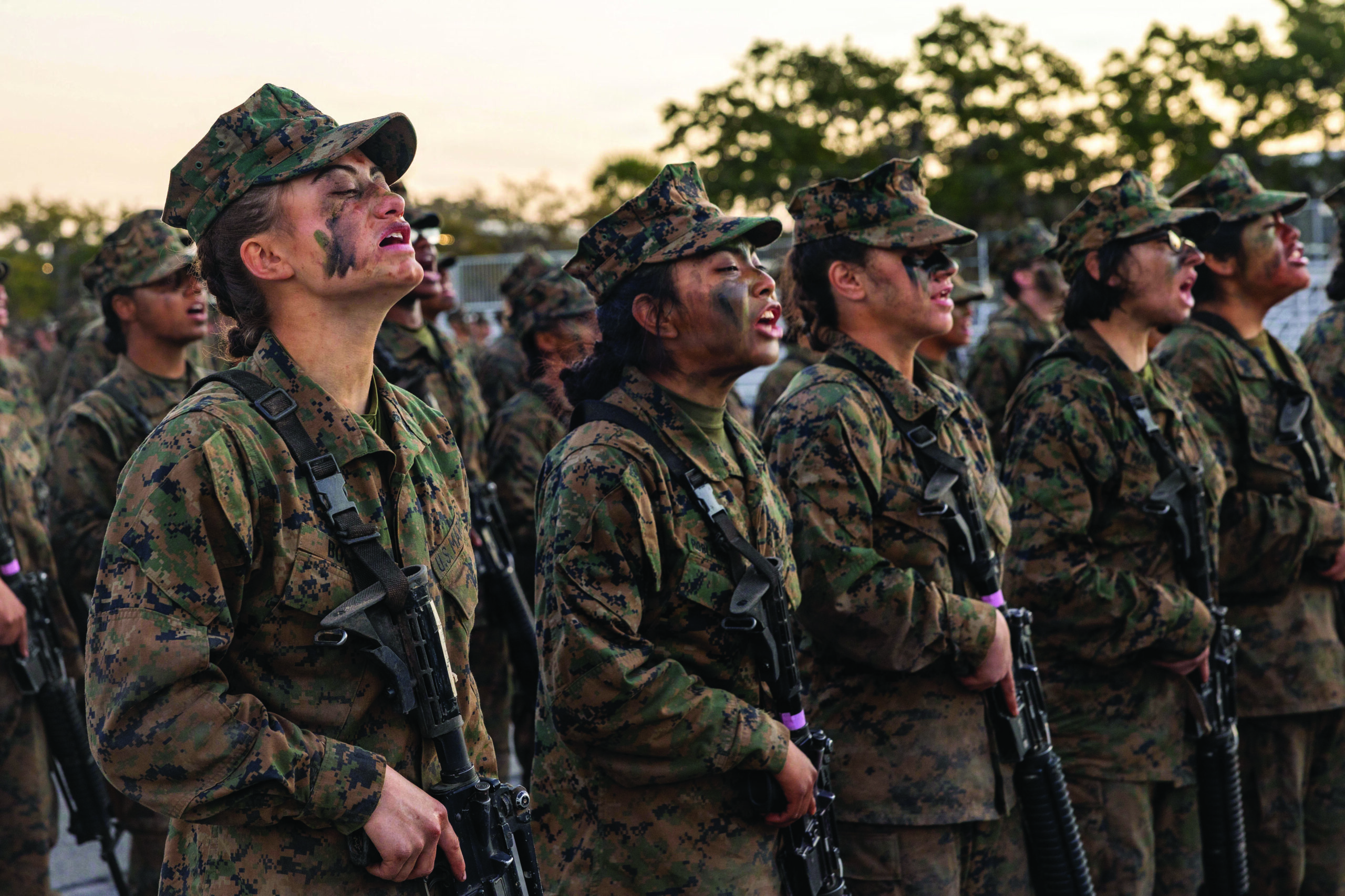
While locked at the position of attention, the Crucible completed, standing in formation sweaty, sandy, exhausted and hungry yet beaming with pride, few Marines can forget the first time they sang “The Marines’ Hymn.” After weeks enduring hard training, long marches and endless days, recruits at both Marine Corps Recruit Depots sing the hymn as a culminating event welcoming them to the lineage of the Corps.
With the black matte Eagle, Globe and Anchor finally gripped in hand, and the words of the hymn still echoing across the parade deck, they can now claim the title “United States Marine.” They enter a 2 1/2 century lineage and joining the unbroken line of those who stood in the same place and sang the same words before them. On that day, pride, spirit and connection all become real.
Although widely known, what is the history behind the hymn? Where did it come from? Who wrote it? How exactly did this 24-line, three-verse fighting anthem become the version that we know today? The answers to these questions took nearly a century to settle and involved hundreds of contributors in both war and garrison.
Researching the Hymn’s Origins
To gain insight into the origins of “The Marines’ Hymn,” we began our research at The United States Marine Band headquarters in Washington, D.C., and their extensive library of historic documents.
The building is named for The Marine Band’s most celebrated director, John Philip Sousa, known as the “March King,” whose compositions and leadership left a permanent mark on the Corps and American military music. Visitors are greeted by an 8-foot bronze statue of Sousa atop a granite base just to the left of the main entrance. It captures him with conductor’s baton in hand, head tilted intently, his eyes trained upon the ensemble.
The Marine Band Library is run by Chief Librarian Master Sergeant Charles Paul and Staff Sergeant Philip Espe. Together, they safeguard The Marine Band’s most treasured materials. Among the library’s holdings is correspondence that helped settle the question of the hymn’s musical source. In the collection is a century-old letter, written on King George Hotel letterhead while Sousa was on tour, in which he informed Major Harold F. Wirgman, “The melody of the ‘Halls of Montezuma’ is taken from Offenbach’s comic opera ‘Genevieve De Brabant,’ and sung by two gendarmes.” The date on the note appears in the upper right-hand corner of the first page but omits the exact year: July 18. The letter surfaced from Wirgman’s private collection and correlates with renewed interest in October 1936, when a query from Commandant Major General John H. Russell sparked fresh efforts to trace the hymn’s origins.
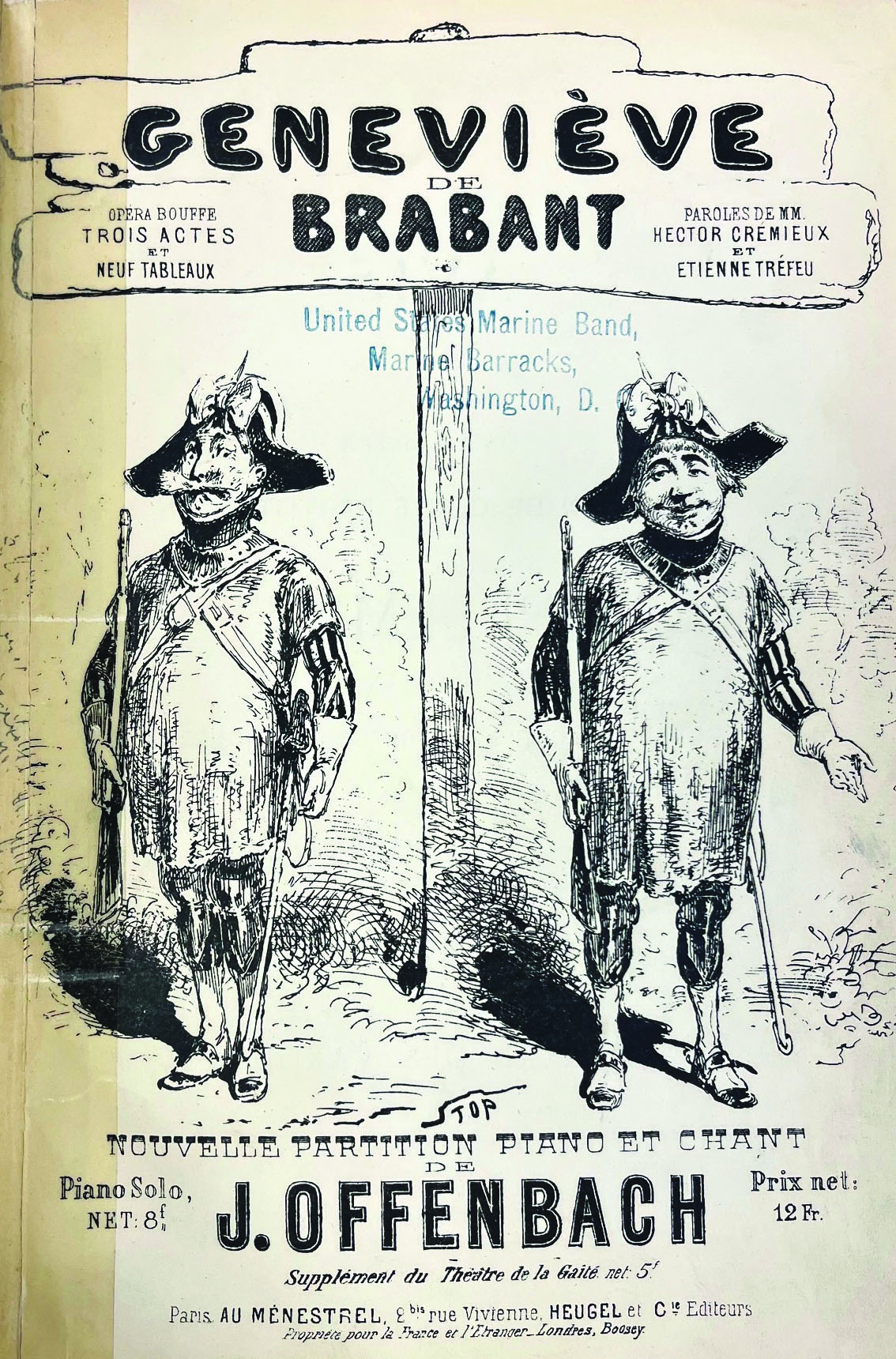
MSgt Paul produced a well-used, unassuming gray book. The buckram-bound volume could sit on any professional military education library shelf without attracting attention. The cover title in gold letters reads “Opera Bouffe: Genevieve De Brabant,” and below that, black type reads, “Orchestra and Band Scores” by German-born French composer Jacques Offenbach. The inside cover contains a curious reprinted hand-drawn illustration depicting two early 19th-century soldiers, or “gendarmes,” bearing rifles at what was then trail arms—the musket held vertically with the right hand and the rifle buttstock lifted slightly off the ground.
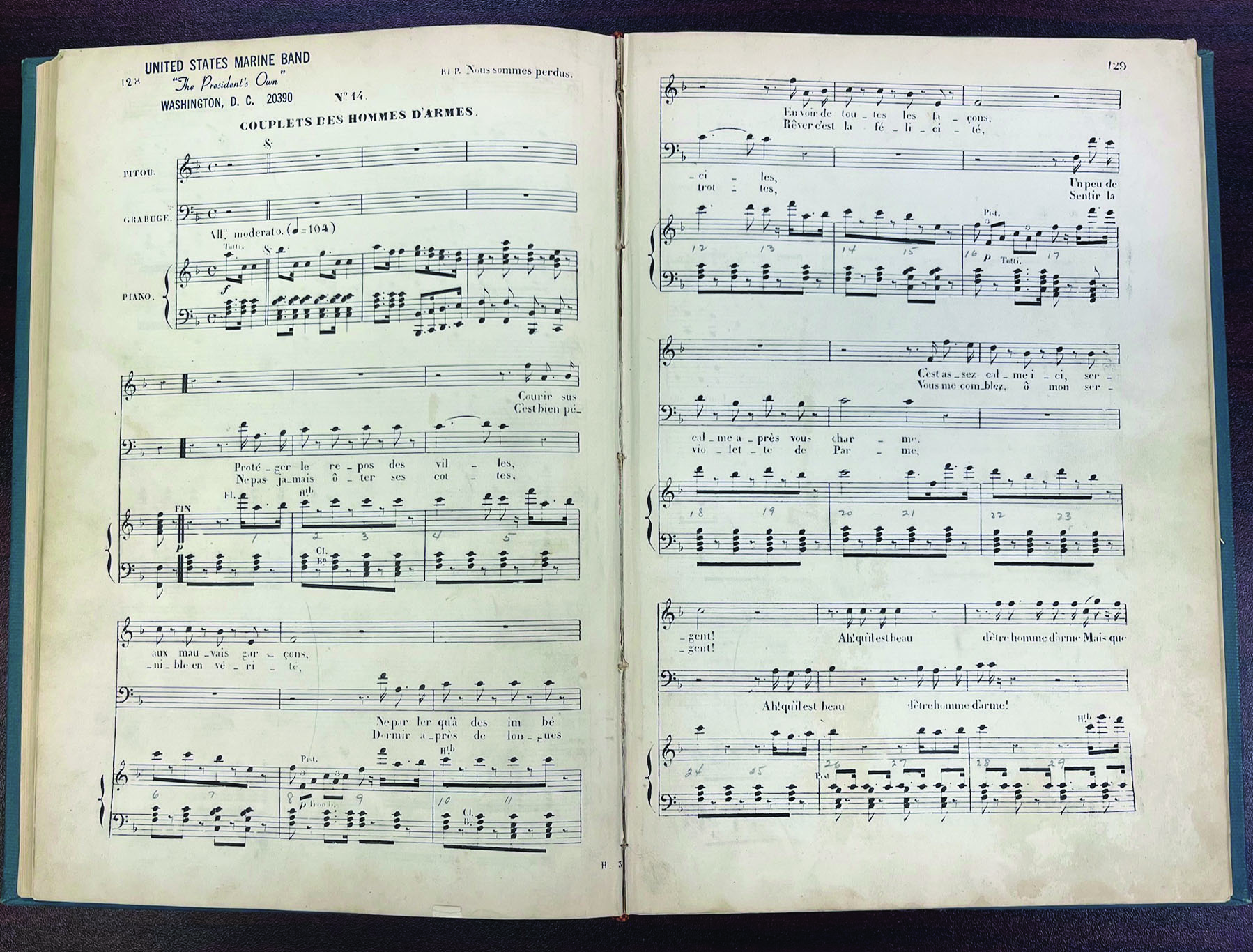
On the title page, Sousa wrote a note to then-Commandant MajGen Wendell C. Neville that reads, “See page 128.” He drew attention to stanza No. 14, “Couplets Des Hommes D’Armes,” which contains the original score. This opera first appeared in Paris in November 1859 and developed into a three-act version on Dec. 26, 1867. Considered a comedy at the time, the plot was a satirical spoof of the medieval legend of Genevieve of Brabant, a noblewoman falsely accused of infidelity while her husband was away at war, and was meant to be sung amusingly by two characters. In the second act, two bumbling guards sing the song in a duet, bragging about how they bravely attack, while conveniently running away or hiding when the opponent is stronger. Marines would be aghast to know the melody’s origins for being quite the opposite in martial character.
In essence, the opera supplied a musical template for the melody of “The Marines’ Hymn,” rather than any connection to the story itself. Although the link between a comic duet of two cowardly malfeasants and a martial anthem may seem odd, the lighthearted, joyful theme is fitting: Marines were, after all, born in a tavern.
Previous research into the exact original lyrics remains obscured by anecdotal lore, despite multiple attempts over the years. One such effort was conducted in January 1916 by Walter F. Smith, the first man to hold the title “Second Leader” of The Marine Band. According to the 6th Marine Division’s “History of the Marines’ Hymn,” he and Colonel Albert S. McLemore found that Maj Richard Wallach, while in Paris in 1878, had drawn one of the earliest connections to the opera. They also surmised possible Spanish folk origins, in part because a band member’s Spanish spouse recognized the tune.
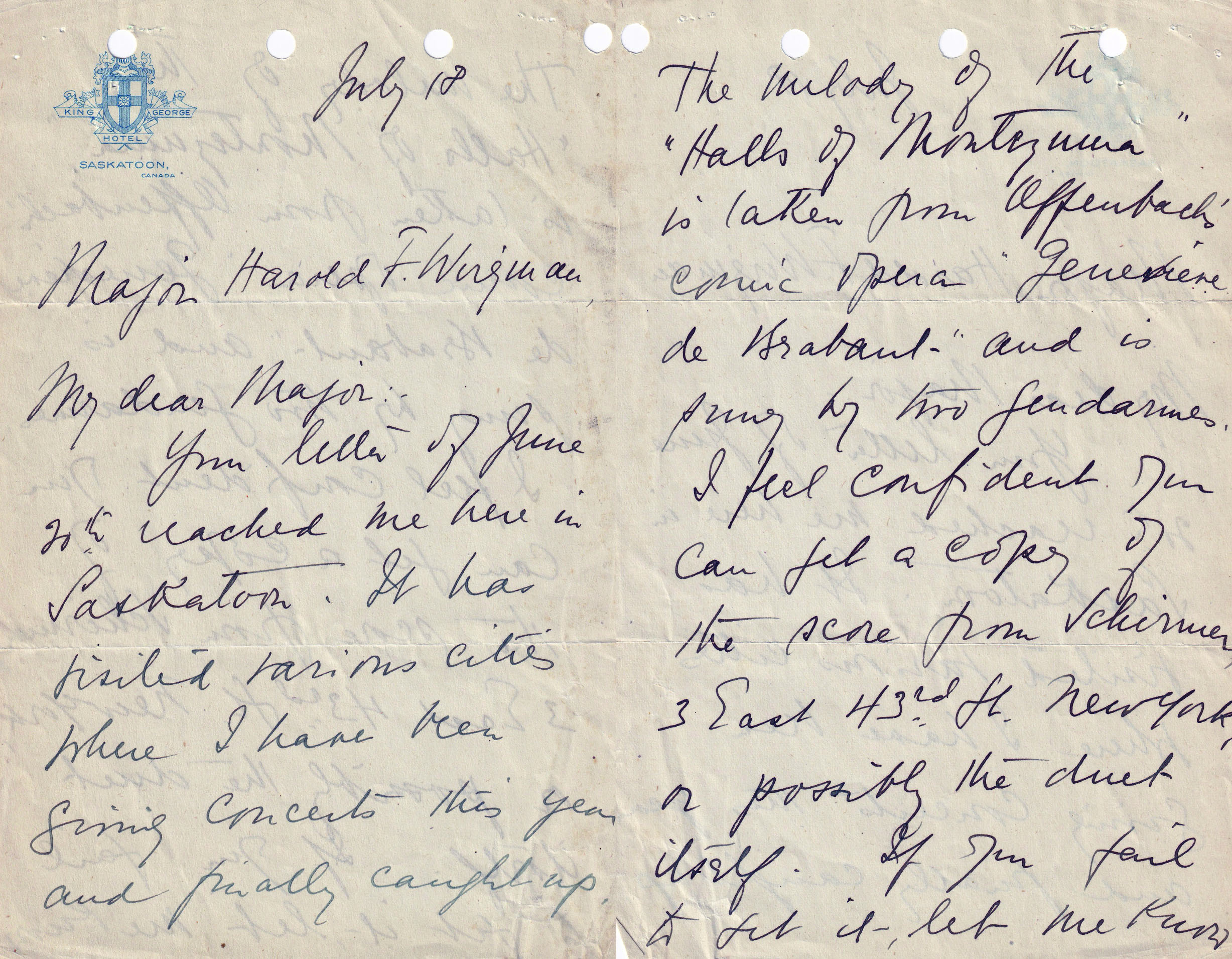
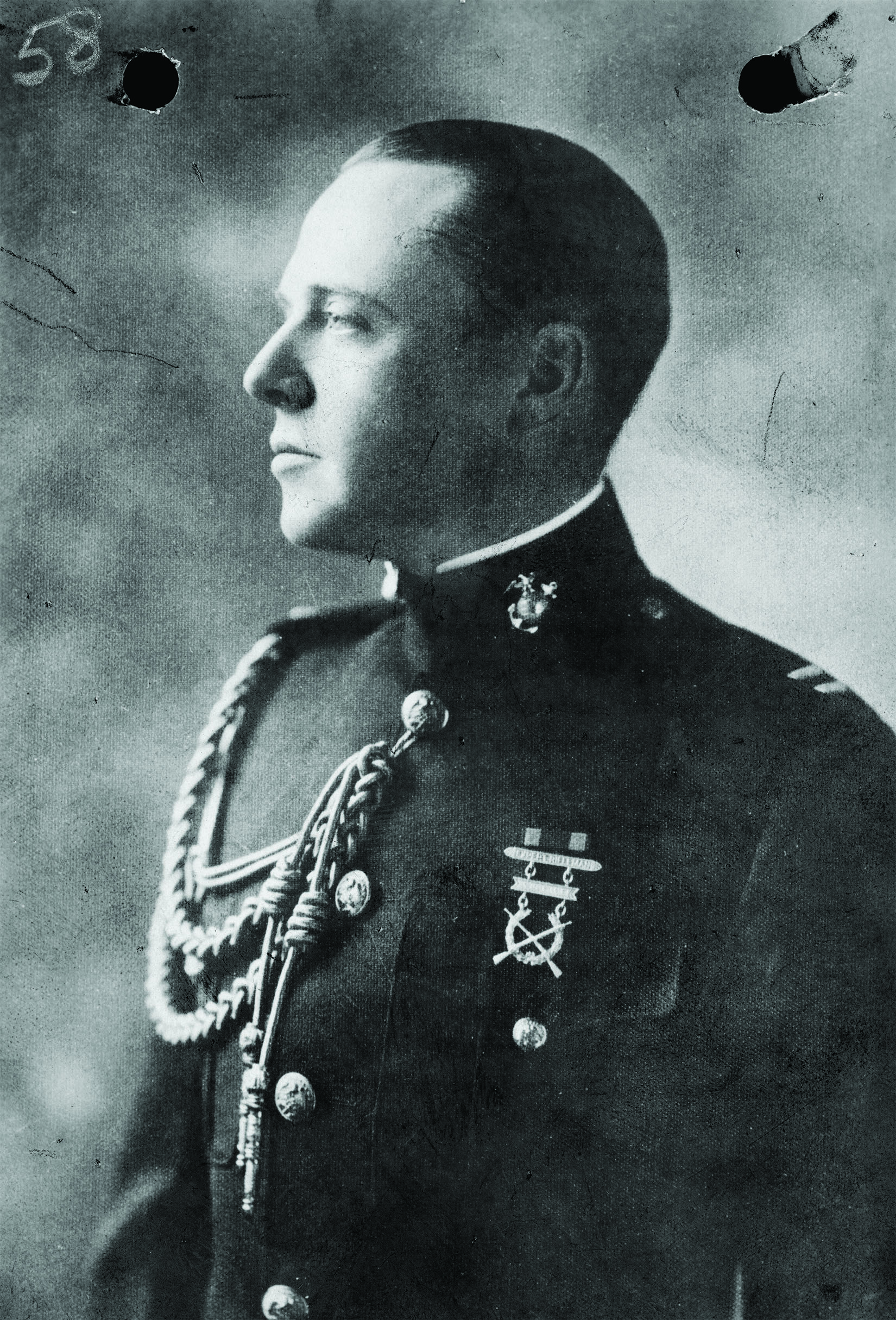
In a letter (top) written to Maj Harold F. Wirgman (bottom), John Philip Sousa noted, “The melody of the ‘Halls of Montezuma’ is taken from Offenbach’s comic opera ‘Genevieve de Brabant,’ and is sung by two gendarmes.” This correspondence helped reignite historical interest into the true origins of the Corps’ anthem.
Origins widely accepted today trace the first lyrics to the Mexican-American War (1846-1848). A June 1951 edition of Washington, D.C.’s The Evening Star reports that, in 1847, an unidentified infantry Marine penned the first lines of the hymn. He took as his inspiration the words “To the Shores of Tripoli,” painted on a Marine standard, and added, “From the Halls of Montezuma.” Curiosity about this and other historic references to an early organizational standard led us to the National Museum of the Marine Corps.
Connections to the Marine Corps’ First Organizational Colors
In the first set of displays to the left in the museum’s gallery entrance is the earliest Marine Corps organizational standard still in existence. Research indicates this elaborately painted silk flag was created in 1843 by Boston artist Joseph Bush and presented to Commandant Archibald Henderson by the citizens of Washington, D.C. Long stored and later rediscovered in 1916 in an unused room of the Home of the Commandants at Marine Barracks Washington, the flag is now known as the “Bush Flag.”
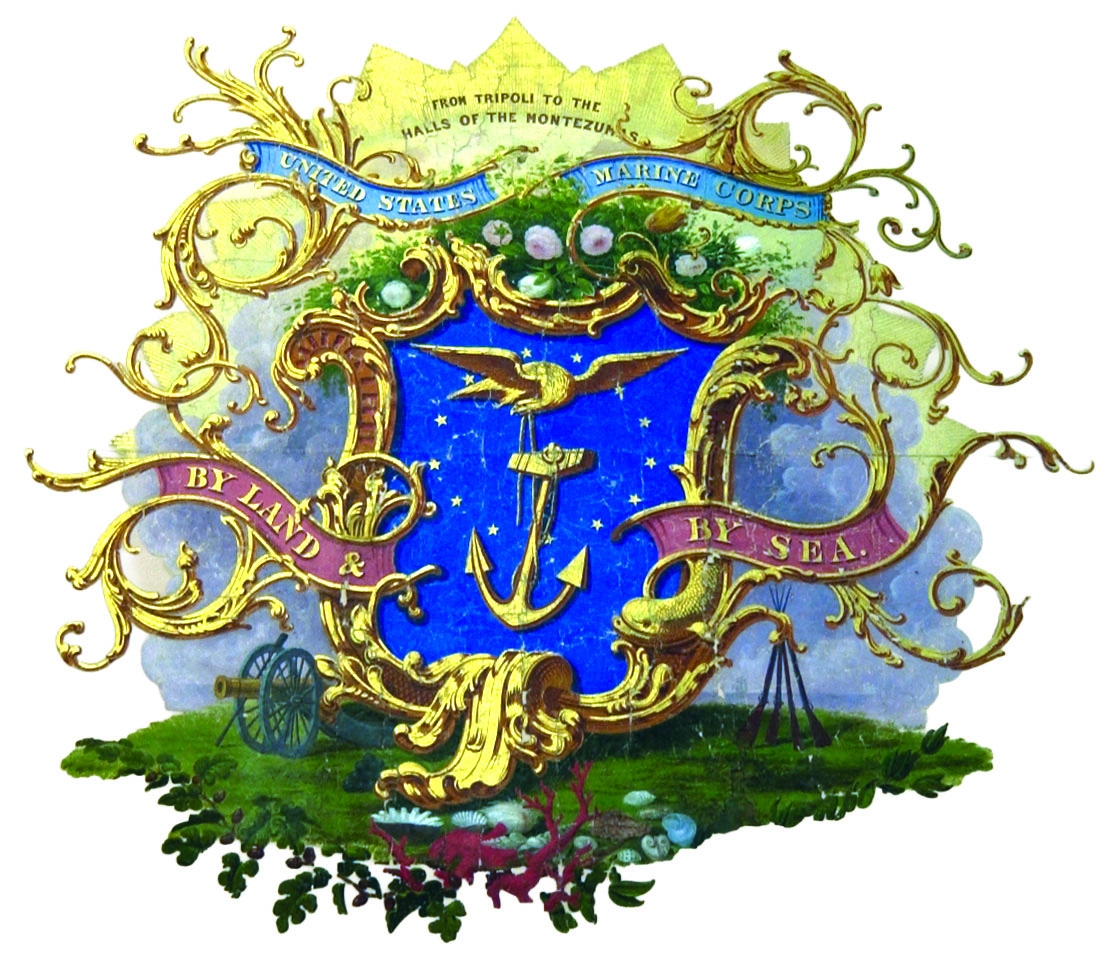
There remains some uncertainty whether this flag, or an earlier version bearing only the words “To the Shores of Tripoli,” was carried by the Marine battalion attached to MG Winfield Scott’s army during the 1847 campaign from Veracruz to Mexico City. No earlier white standard with that motto is known to survive. The Baltimore Sun of March 7, 1848, reported that an early standard originally bore the motto “By Land & by Sea” and that the words “From Tripoli to the Halls of the Montezumas” were added later. Marine Corps Order 10520.3 (the “Flag Manual”) also mentions an 1830s-1840s white flag bearing “To the Shores of Tripoli,” but no such flag is known to exist today.
Regardless, the opening lines of the hymn ultimately joined the Corps’ two early overseas victories, Tripoli and the Halls of Montezuma, into a single enduring statement.
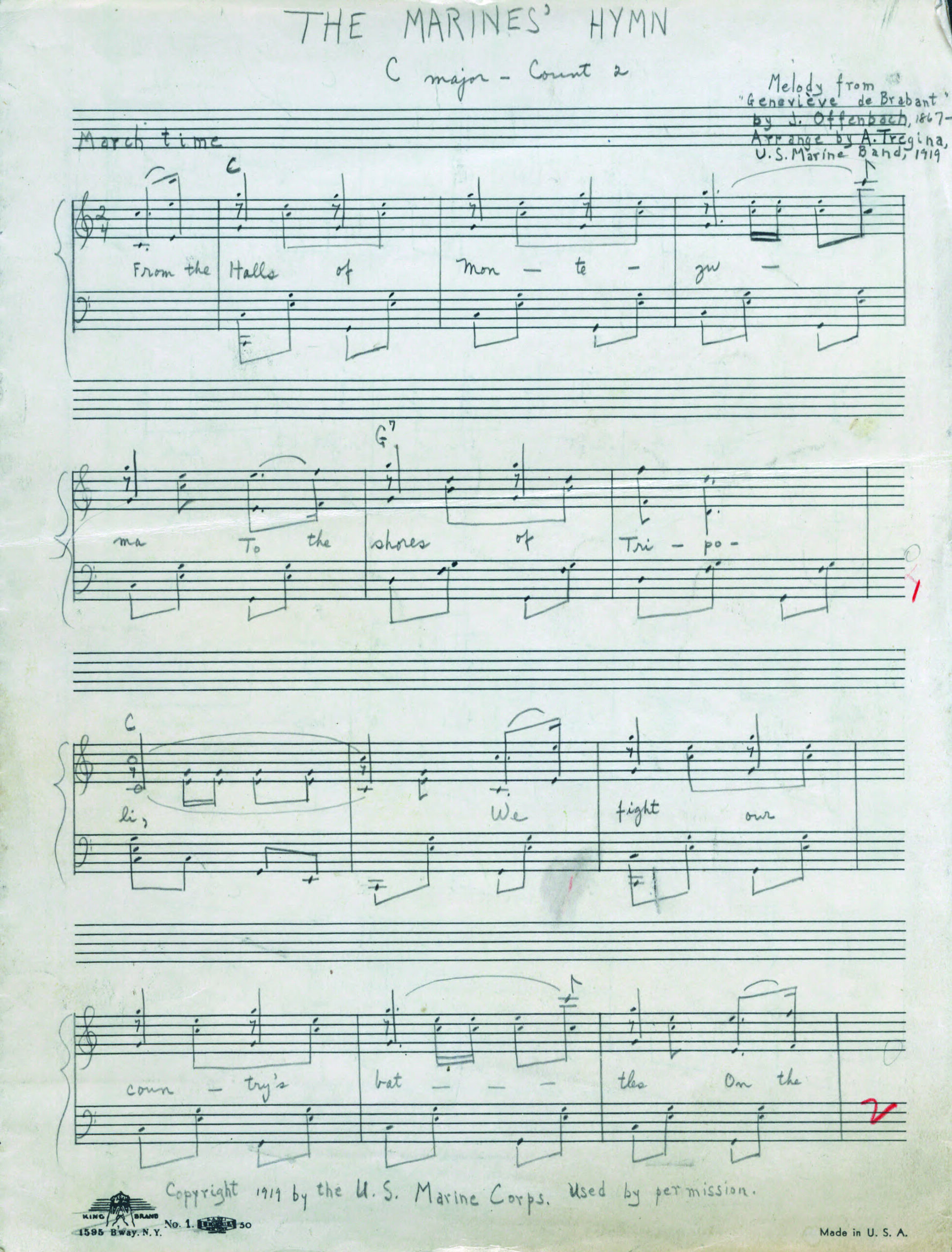
Versions of the hymn’s lyrics have been attributed to multiple Marines in the early 1900s, including Colonel Henry C. Davis, Brigadier General Charles Doyen and First Sergeant L.Z. Phillips. In 1915, Marine Band Leader William H. Santelmann, one of five to serve two terms as director, arranged to publish sheet music for all bands across the Marine Corps. In one version, the first verse appeared slightly different than what is known today:
From the Halls of Montezuma
To the shores of Tripoli
We fight our country’s battles
On the land as on the sea.
Admiration of the nation
We’re the finest ever seen.
And we glory in the title
Of the United States Marine.
Research shows a uniquely interesting correlation between earlier hymn versions and Leatherneck. In December 1917, The Quantico Leatherneck, the newspaper predecessor to today’s magazine, published “The Marines’ Hymn” for the first time with both words and sheet music put together.
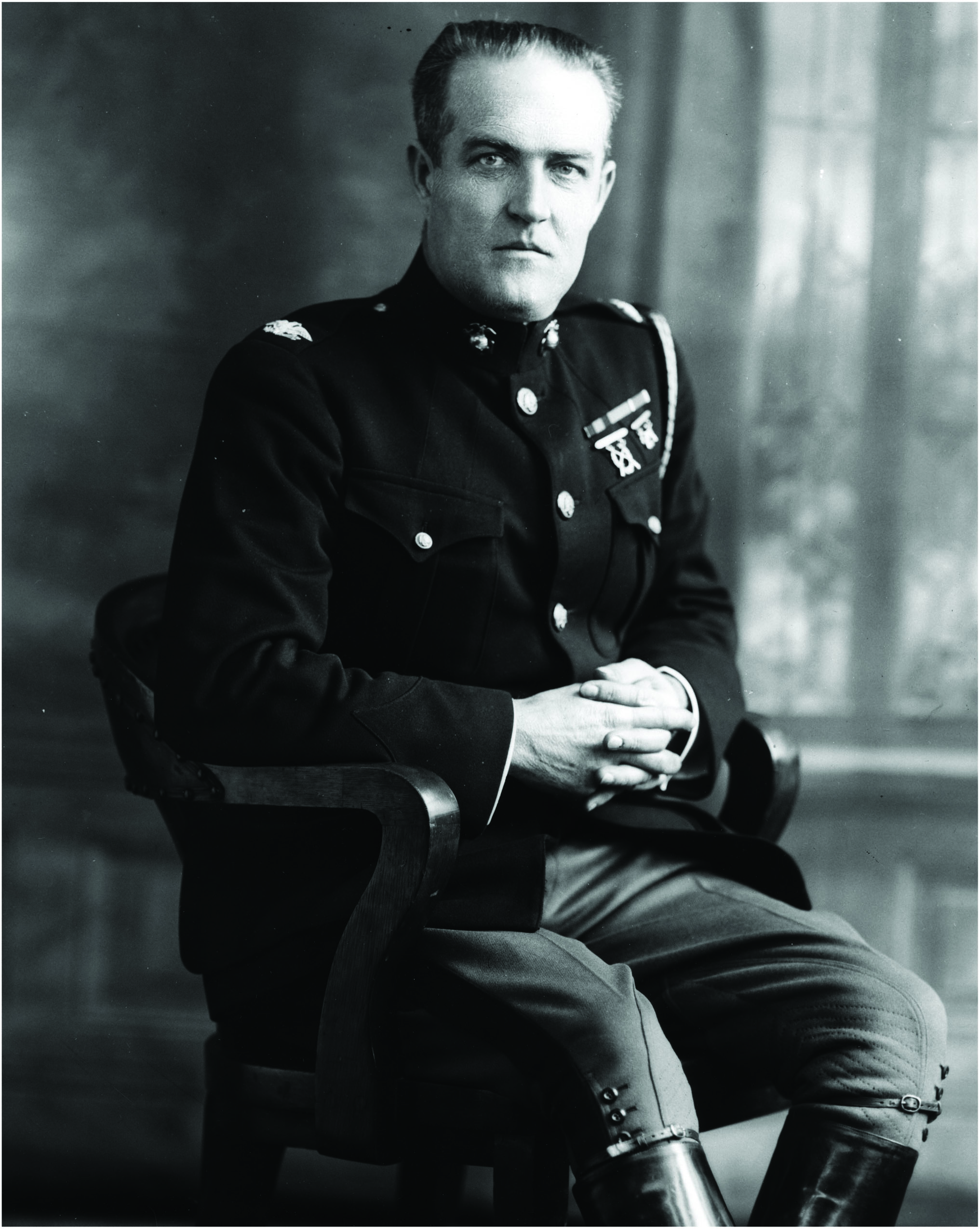
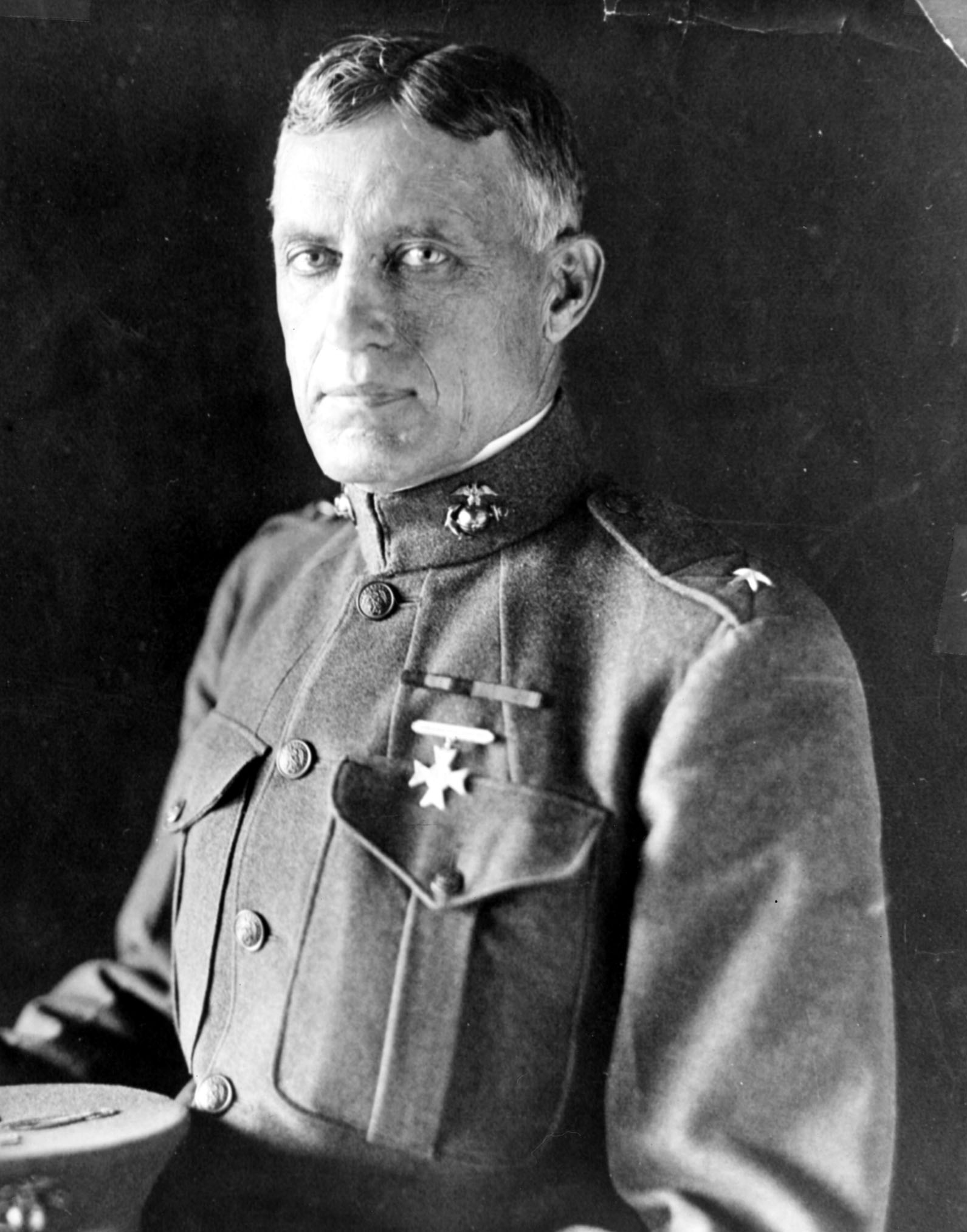
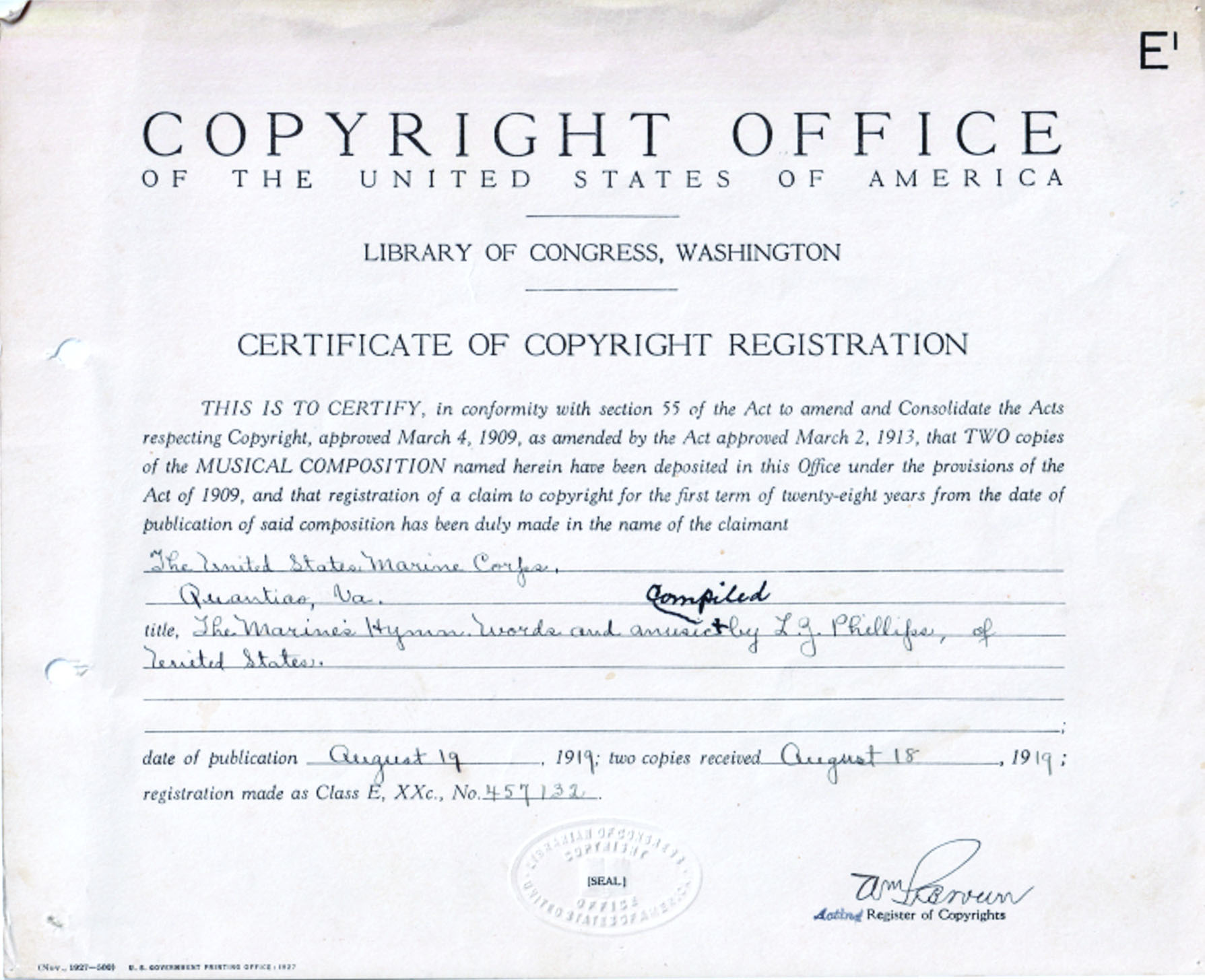
First Sergeant L.Z. Phillips listened to the variant versions of the hymn in circulation among Marines. While serving as post band leader at Marine Corps Base Quantico, Va., he standardized the melody and the lyrics into the three-stanza form that became the basis for the modern hymn. The first publication of Phillips’ version is dated Aug. 1, 1918. A copyrighted edition followed in 1919, with the copyright claimed by the Marine Corps and Phillips listed as compiler.
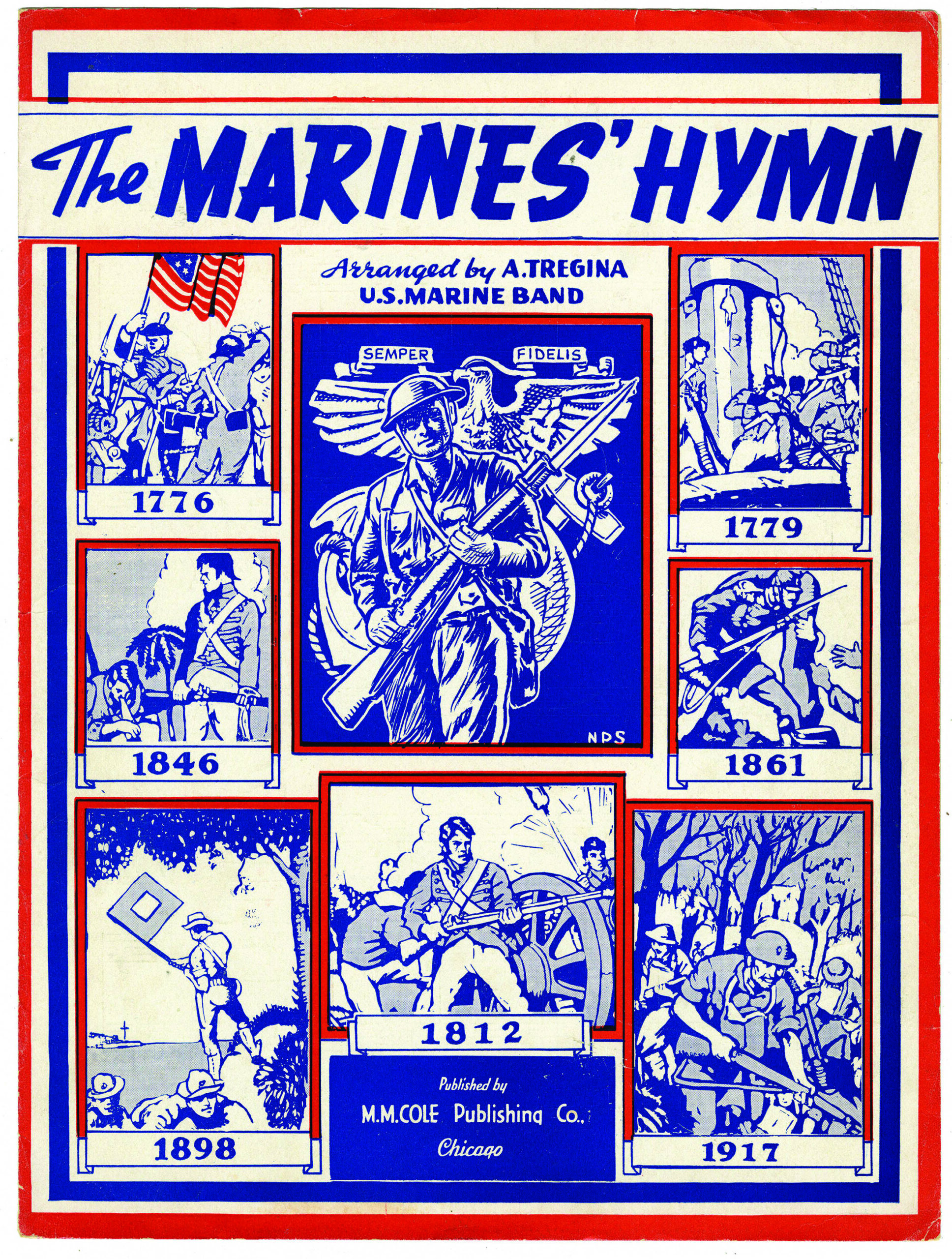
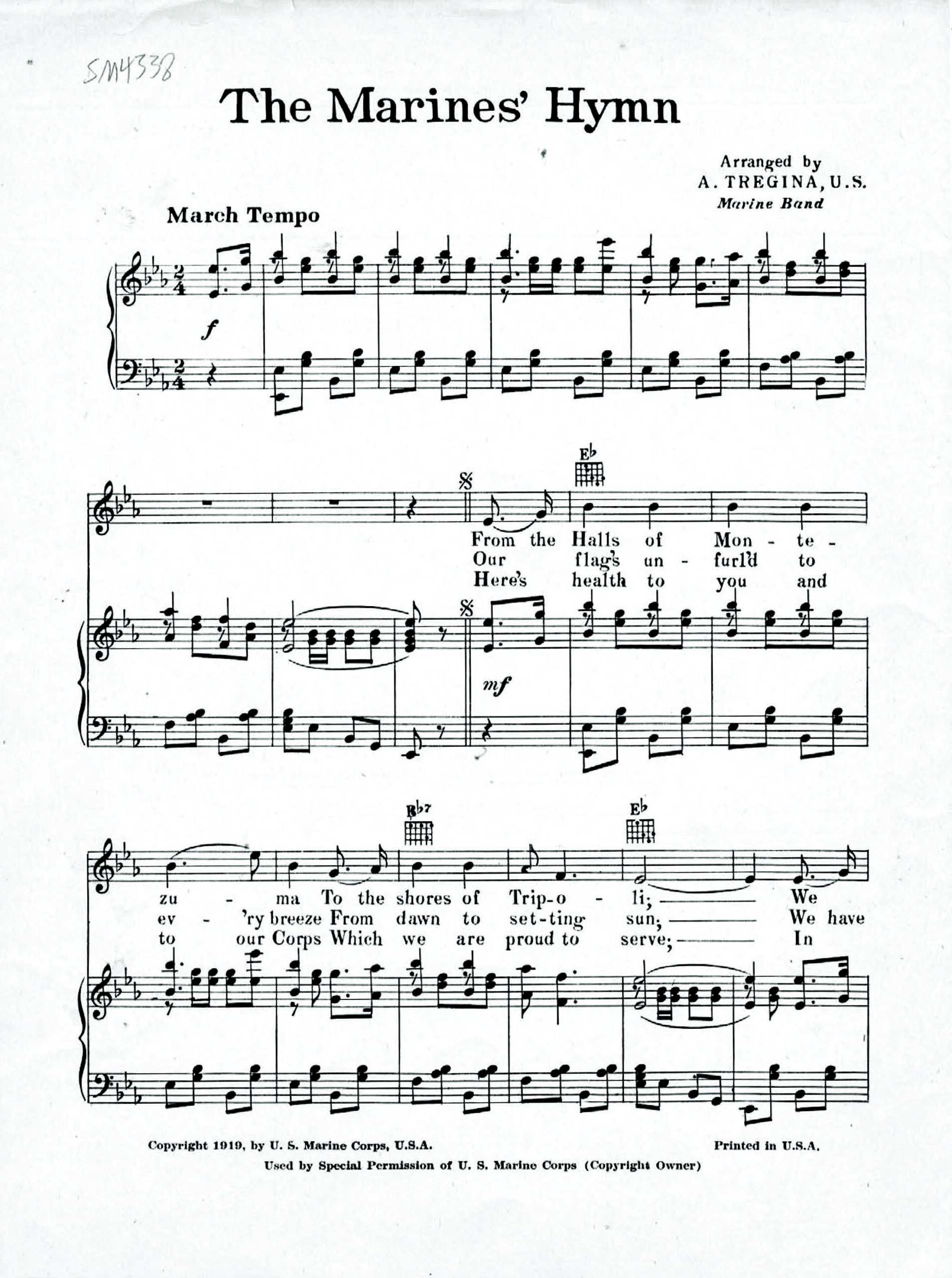
Around the same time, Arthur Tregina, a First-Class Musician who had served 27 years with “The President’s Own,” was ordered to create “a proper and appropriate setting” for the hymn so that civilians could purchase and perform it at home, according to an interview with Leatherneck in 1933. He arranged a voice-and-piano setting, which was published in 1919 by M.M. Cole Publishing Company of Chicago, Ill. The sheet music featured a striking blue-and-red cover illustration of a Marine with rifle and bayonet. His arrangement, issued the same year as the official Marine Corps copyright associated with Phillips, helped popularize the hymn beyond the ranks immediately after World War I.
Copyright Confusion
Following the 1919 copyright of the hymn, decades of friction ensued, as Phillips left the Corps and sold his rights. In essence, Phillips fell into hard financial times and in 1931 obtained permission from the Commandant, then MajGen Ben H. Fuller, to print copies at his own expense. The Commandant granted him permission on the condition that he credit the Marine Corps with the statement, “Copyright 1919 by U.S. Marine Corps” and “Printed by special permission of the copyright owner.”
Then, in October 1935, still desperate for cash, Phillips sold the rights to Edward B. Marks Music Corporation. The company then began to pursue intellectual property rights aggressively, demanding royalties for its use. What followed were years of haggling back and forth where the interests of the Corps conflicted with private and public interests. The Marine Corps asserted a strict free-use policy and granted permission to outside publishers, provided they used the official version, and thereby poured cold water on the Marks Corporations efforts to claim the rights solely and wrongfully. In the end, the Marine Corps retained the right to control the content, distribution and sale of the hymn’s sheet music.
Finalizing the Timeless Verses of “The Marines’ Hymn”
Many proposed changes to the wording of the hymn were ultimately curtailed with Headquarters Marine Corps declaring that only the “official version” be used. Enter then Maj Joseph C. Fegan Sr., appointed by MajGen Commandant John A. Lejeune in 1925 to his post as the Corps’ first publicity officer. In April 1928, Maj Fegan received instructions from the Commandant to investigate the verses of “The Marines’ Hymn” and to report his findings. He took five months to complete his work, having traced the origins to 1892. In his findings, he concluded that the verses were, in his opinion, “spontaneous contributions of several of our older officers” and that it “just grew” over time.
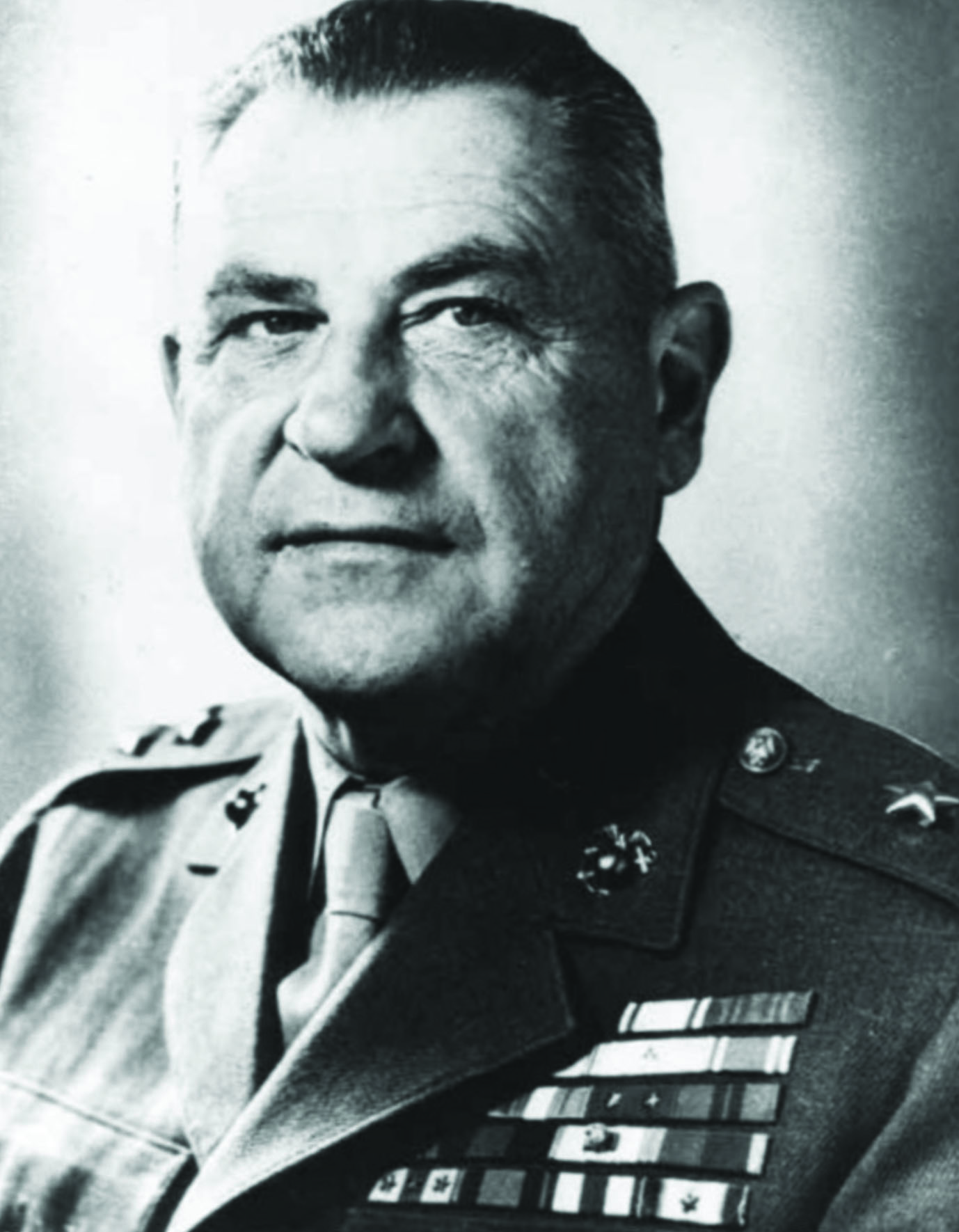
By requirement of headquarters policy, Fegan recommended, according to “The ‘Devil-May-Care Song of the Leathernecks’ ” by Lauren Bowers,
(1) that a Marine Corps Order be issued to protect the Hymn from what he termed “ridiculous parodies,”
(2) that only three verses be permitted,
(3) that printing and distribution to personnel and other parties of leaflets and sheet music be pictorial and historical,
(4) that respect to be shown the Hymn by personnel when it is being sung or played and
(5) that the origin and history be included in training recruits and every member of the Corps “be urged” to learn it.
By April 1929, MajGen Commandant Wendell C. Neville approved changes in lyrics and policy to reflect most of Fegan’s recommendations. In his version, the only difference from today’s is the fourth line in the first verse, which read:
From the Halls of Montezuma
To the shores of Tripoli,
We fight our country’s battles
On the land as on the sea.
On Nov. 25, 1942, after the copyright disputes had settled, the 17th Commandant of the Marine Corps, Lieutenant General Thomas Holcomb, approved the final change to the lyrics, to read, “In the air, on land, and sea,” with Letter of Instruction No. 267. This change would be the Corps’ last to the work and reflected the contributions made by the aviation combat element in a still relatively new warfighting domain at the time.
Emerging Traditions, Unofficial Variations and Modern Policies
Today, unofficial versions and parodies remain a matter of archival record and are available both online and on social media. Of the many unofficial versions, we’ve elected to share a sample “by Marines and for Marines,” many using the first verse only. These reflect niche populations that demonstrate a variety of attitudes as unique as the originating contributors.
WW I, as recommended by Josephus Daniels, Secretary of the Navy:
As we raised our flag at Tripoli,
and again in Mexico,
So we took Chateau Thierry and
the forest of Belleau.
When we hurled the Hun back from the Marne,
He said we fought like fiends,
And the French rechristened Belleau Wood
for United States Marines.
WW II, as recommended by Women Marines:
From the hearts and minds of all of us,
to Marines we will be true.
We will strive to give them all our help
in everything we do.
We will share their hopes for freedom
and will keep our honor clean,
we are proud that we can be of use,
to United States Marines.
The global war on terror, anonymous:
From the dirt of Fallujah,
To the valleys of Korengal,
We will drop a JDAM on you
And we’ll blow up your firewall,
First to fight for oil and freedom
And to keep our rifles clean;
We are proud to claim the title
Of United States Marine.
At the 2018 Marine Corps Heritage Foundation Awards ceremony, the 37th Commandant of the Marine Corps Gen Robert Neller demonstrated the importance and unifying nature of “The Marines’ Hymn.” Among those present were the Chairman of the Joint Chiefs of Staff, Gen Joseph Dunford; retired Gen James Mattis, then the Secretary of Defense; the 29th Commandant of the Marine Corps, retired Gen Alfred M. Gray; and generations of Marine veterans representing all modern eras.
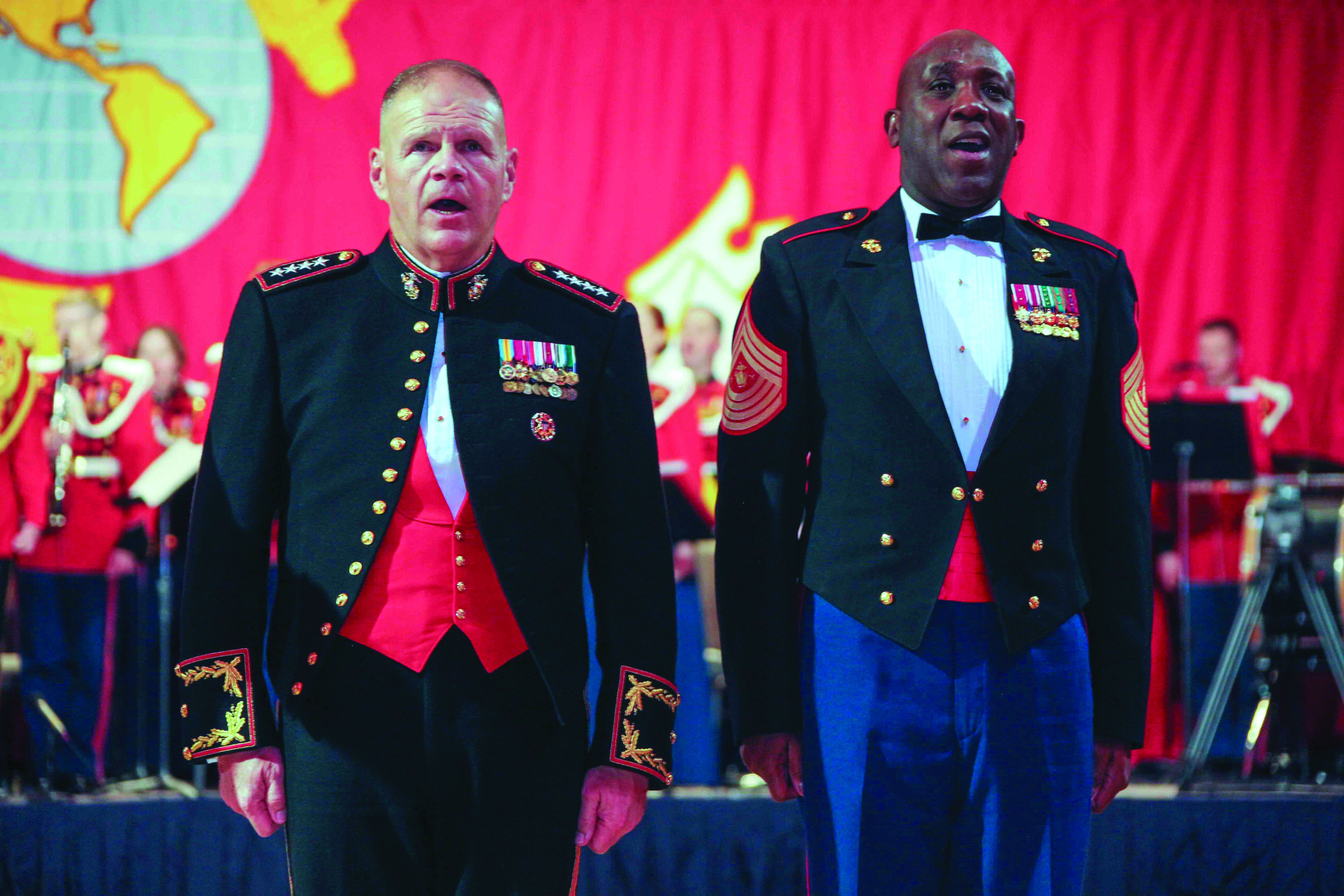
Gen Neller emphasized in policy that “The Marines’ Hymn” should be sung while standing, so he asked attendees to stand. He then led the assembly by singing the first verse. This was perhaps one of the few times in Marine Corps history that the Marines present to do so represented every level of war and national policy, both in and out of uniform and in civilian public service.
The following year, the Marine Corps Drill and Ceremonies Manual reflected a new policy, “That Marines, present and who have served honorably who are not in formation or part of an actual ceremony, or marching in a parade or review, who when they hear the playing of the Marines Hymn will stand at attention, face the music and sing the words to the Hymn.”
Conclusion
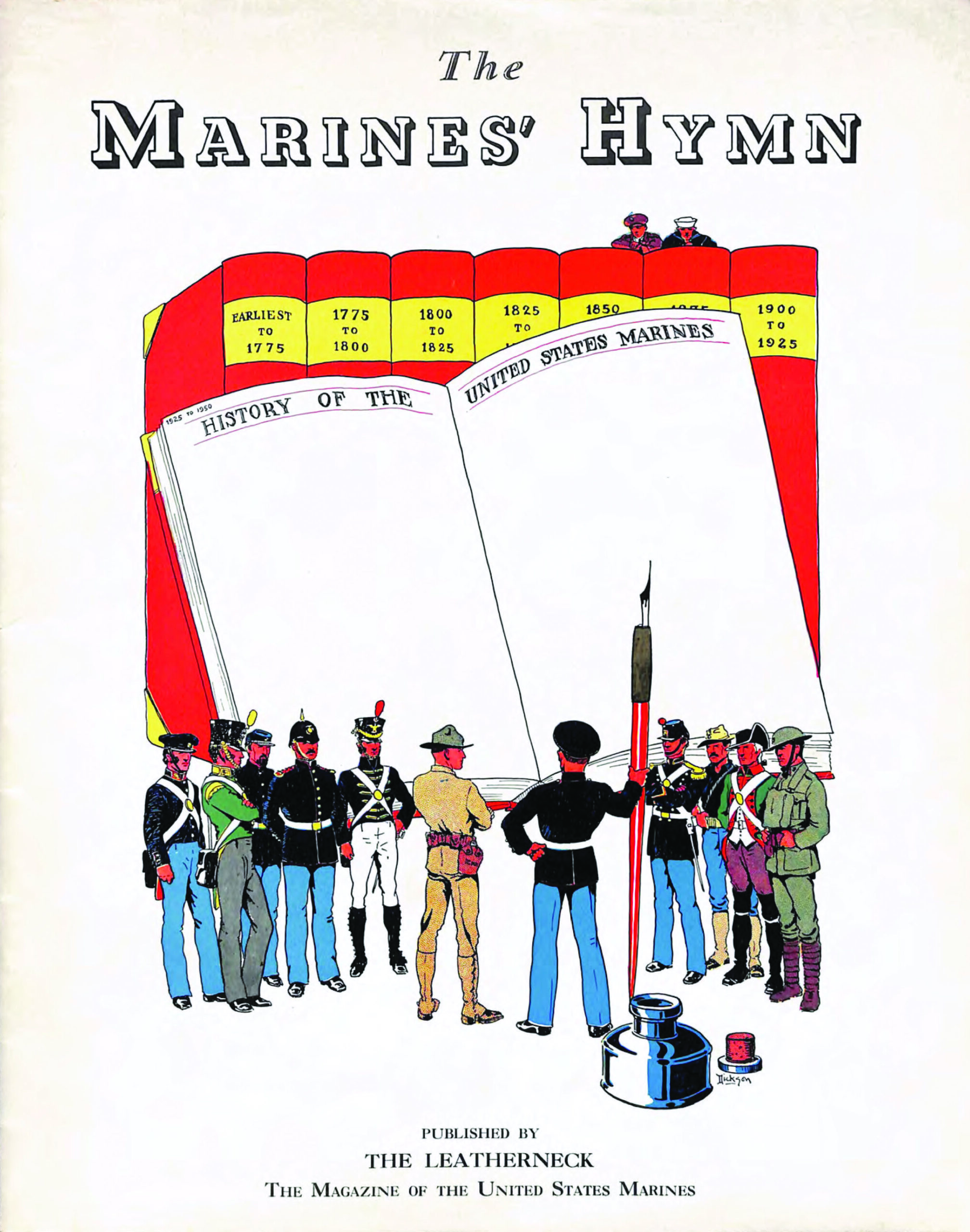
Just under 100 years ago, Leatherneck published a series of paintings by Colonel Donald L. Dickson that illustrated each verse of “The Marines’ Hymn.” The first of those images appeared on the magazine’s October 1929 cover and Leatherneck followed up with a published book of the entire set of illustrations. Of these, perhaps the most profound image appears on the cover page itself. The colorful image shows a pageantry of uniformed Marines, from the Continental Marines through WW I, similar to the pageantry at Marine Corps Birthday Balls.
Centered, with his back to the observer, is a Marine in period dress blues wearing the classic blue cover. His left hand is closed, making a fist and resting on his hip, while his right hand bears an oversized calligraphy pen. As the Marine leans back to observe the oversized book, it is open to two blank pages twice his height. At the top, the words “History of the United States Marines” are written in bold Copperplate Gothic font—in an illustrated version of what has yet to be written.
The message is clear: What will this modern Marine do with the history of our Corps? There remains a tremendous weight that every successive generation bears—as well as the responsibility to never sully the reputation of the Corps in battle as they stand on the shoulders of their predecessors. Getting there first and winning is only half the battle: “First to fight for right and freedom, And to keep our honor clean.”
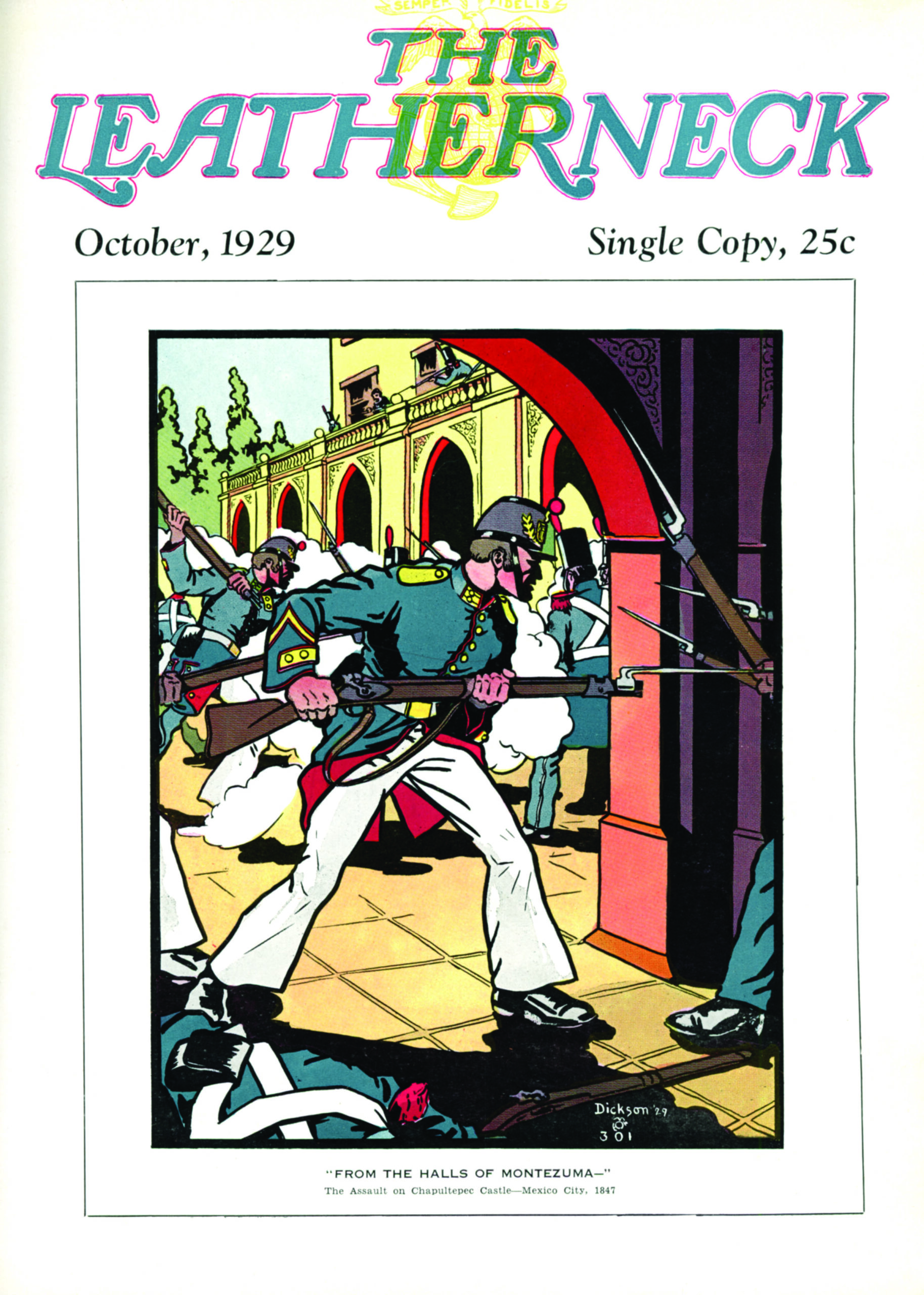
“The Halls of Montezuma”. (Courtesy of Marine Corps History Division)
It is how Marines win that still matters. That uncompromising commitment, through moral and physical courage, discipline, integrity and stoic honor, remains the Corps’ hallmark. Those Marine “boots” of the past more than rose to the challenge. They went on to win in the Pacific island-hopping campaign of WW II, the freezing Chosin Reservoir in Korea, the hills and jungles of Vietnam, the sands of Southwest Asia and every major engagement from Mogadishu to Iraq and Afghanistan.
Today, too, Marines on watch across the globe stand ready to write yet another volume of this illustrious history. Of those who went before, the lessons in these histories were written in blood. We remember that history. Through art and music, despite the murky history of a some-times winding past, “The Marines’ Hymn” remains a living, breathing, legacy. The words, now settled within these verses, provide Marines with a heartbeat.
Just as John Philip Sousa did, that cadence sets the tone, tempo and pitch for all Marines throughout the ages to respond, instantly and completely. That forms an unbreakable bond that endures the test of time, just as it was intended. This is what
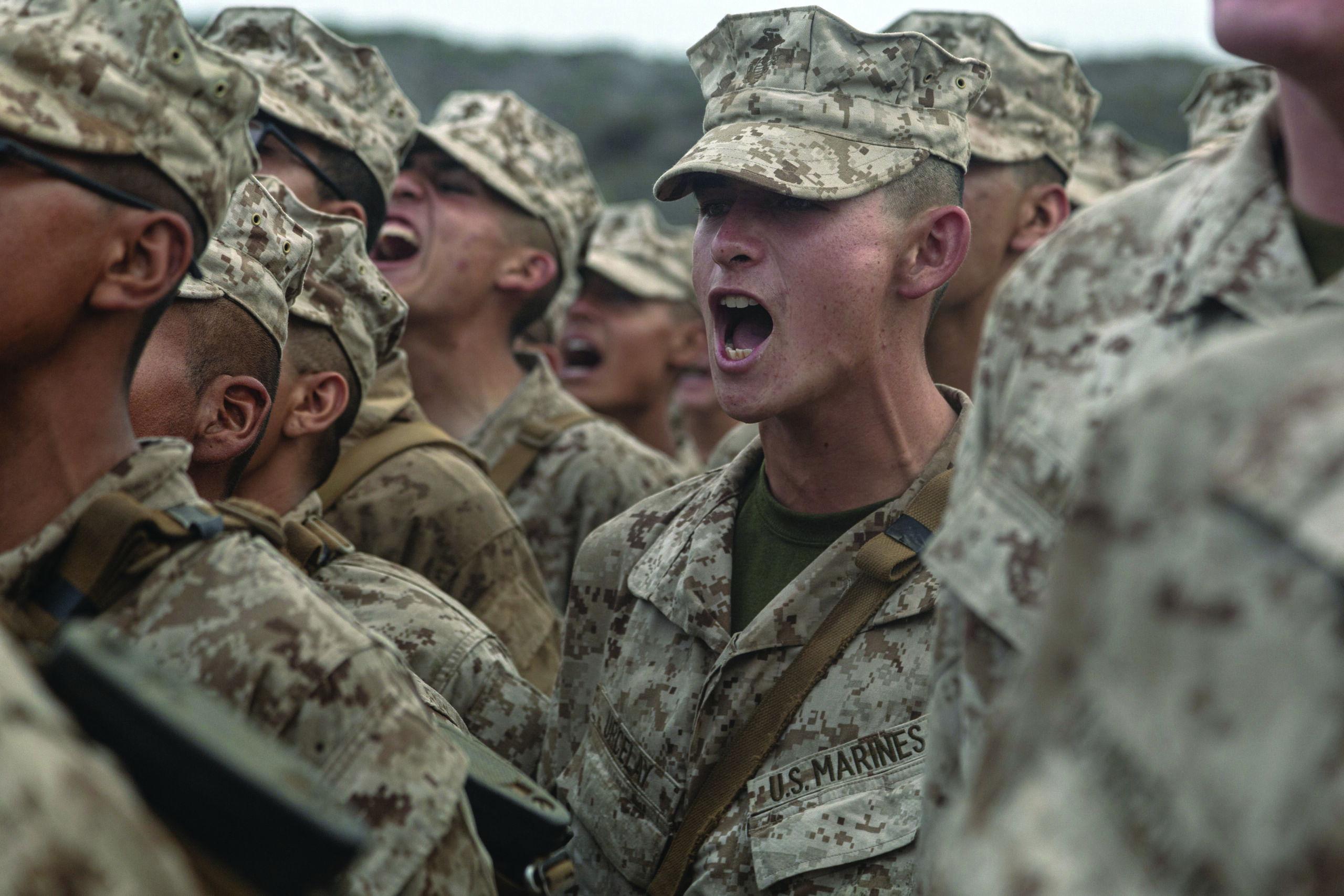
gives esprit de corps meaning and feeling. Today, at the conclusion of every entry-training cycle, we see this in the tears streaming down those many recruits’ faces, newly earning the right to bear the title, United States Marine.
Executive Editor’s note: The authors would like to thank Timothy Rose, National Archives at St. Louis, and Lori Miller of Redbird Research for archival research support.
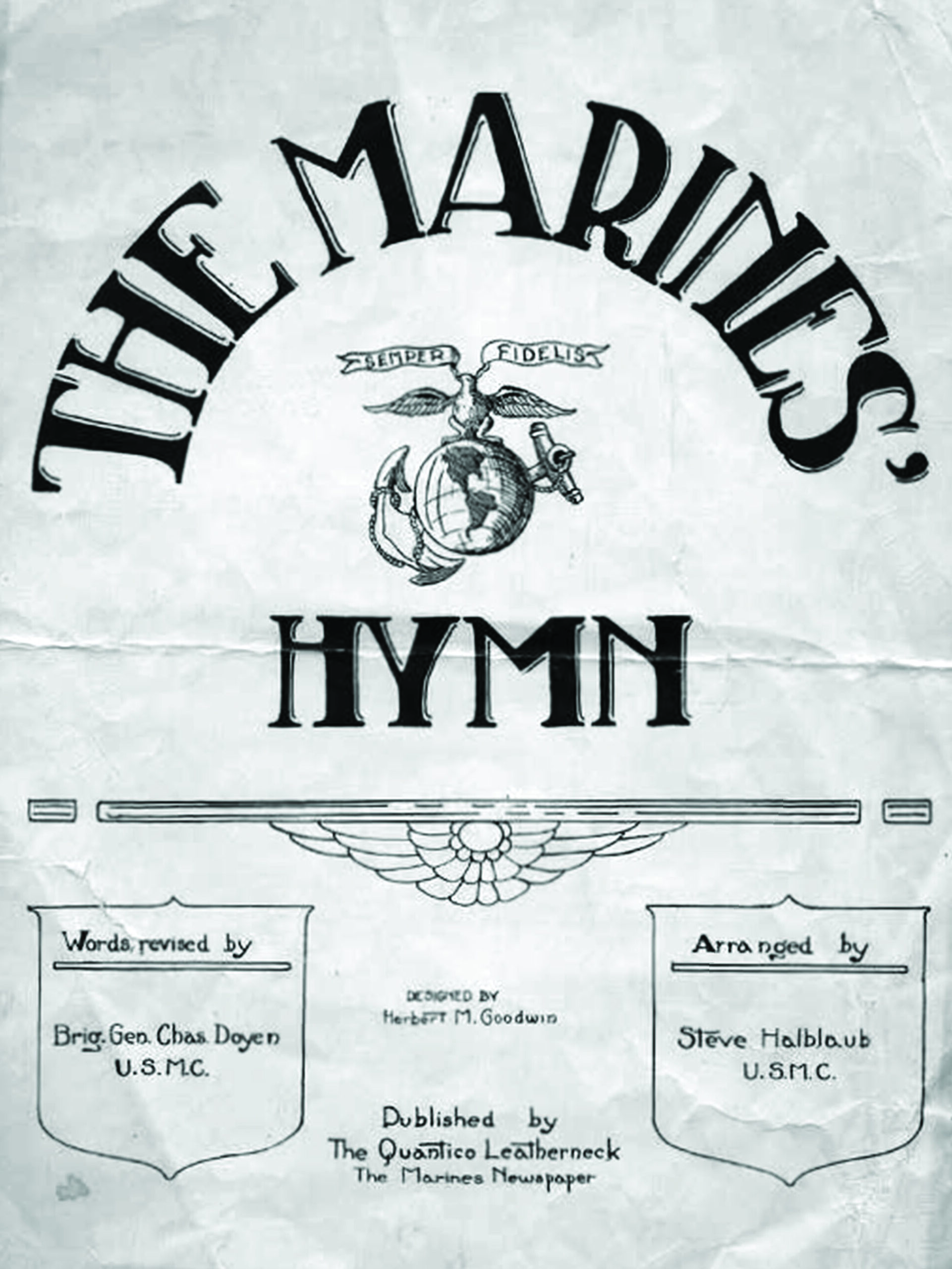
Featured Photo (Top): The December 1917 cover sheet of “The Marines’ Hymn” published by The Quantico Leatherneck, featuring words reviewed by BGenCharles Doyen and music arranged by Pvt Steve Halblaub, who was mortally wounded at the Battle of Belleau Wood. (USMC)
About the Authors
LtCol Brad Anderson, USMC (Ret), is a freelance writer and researcher for Leatherneck magazine.
Katie Cashwell is a veteran Marine. She is a graduate of University of Mary Washington with a degree in historic preservation.
Enjoy this article?
Check out these similar Leatherneck and Scuttlebutt features:
Hail To The Chief: “The President’s Own” Supports The Inauguration
Leatherneck
February 2025
By: Kyle Watts

The Sound Of Service
Leatherneck
June 2026
By: Kyle Watts
Celebrating America’s Music: The 225th Anniversary Of “The President’s Own”
Leatherneck
July 2023
By: Kyle Watts