


SIF HMLA: Why The Marine Corps Needs to rethink H-1s
By: Maj Patrick HealyPosted on December 15,2025
The Commandant’s Rapid Response Essay Contest: Second Place
The Marine Light Attack Helicopter Squadron (HMLA) has long served as the Marine Corps’ rotary-wing utility and attack aviation workhorse. Centered around the UH-1Y Venom and the AH-1Z Viper, the HMLA structure was born of Cold War legacy platforms updated to meet post-9/11 operational demands. While the H-1 upgrade program succeeded in modernizing those platforms with improved powerplants, rotor systems, and avionics, the strategic environment has since changed. As the Marine Corps pivots to great-power competition, the legacy of the H-1 plat-form must be re-evaluated.
The 1990s decision to continue with the Bell H-1 Upgrade Program instead of shifting to the Sikorsky H-60 series was appropriate for its time. It allowed for parts commonality, reduced acquisition costs, and leveraged existing maintenance infrastructure. However, the assumption underpinning that decision—that the HMLA structure could meet future expeditionary and distributed warfare needs—no longer holds.
Background: Proven Performance in a Changing World
The H-1 aircraft have served admirably across decades of conflict. The UH-1Y offered a major step up in survivability, digital cockpit integration, and mission flexibility, especially when paired with the AH-1Z. The platforms boast 85 percent parts commonality, a critical enabler in logistics efficiency during Operation ENDURING FREEDOM and MEU deployments.
However, those successes were rooted in a context of low-intensity conflict, permissive airspace, and robust forward operating bases. Today’s reality is defined by dispersed operations, denied logistics chains, anti-access/area-denial environments, and contested maritime domains.
In parallel, the Marine Corps has introduced the Stand-In Forces (SIF) concept—a doctrinal shift focused on persistent, forward-deployed units operating inside an adversary’s weapons engagement zone. These forces must be agile, survivable, and interoperable with joint and partner forces.
The Role of Rotary-Wing Close Air Support in the Future Fight
The Marine Corps possesses a deeply rooted close air support (CAS) culture, forged through decades of joint operations and integrated fires. This institutional knowledge enables Marine aviators to work seamlessly with ground forces and Joint Terminal Attack Controllers, making the Marine Corps the go-to Service for CAS in the Joint Force. The enduring emphasis on combined-arms operations reinforces the value of rotary-wing CAS as an essential tool in contested and austere environments.
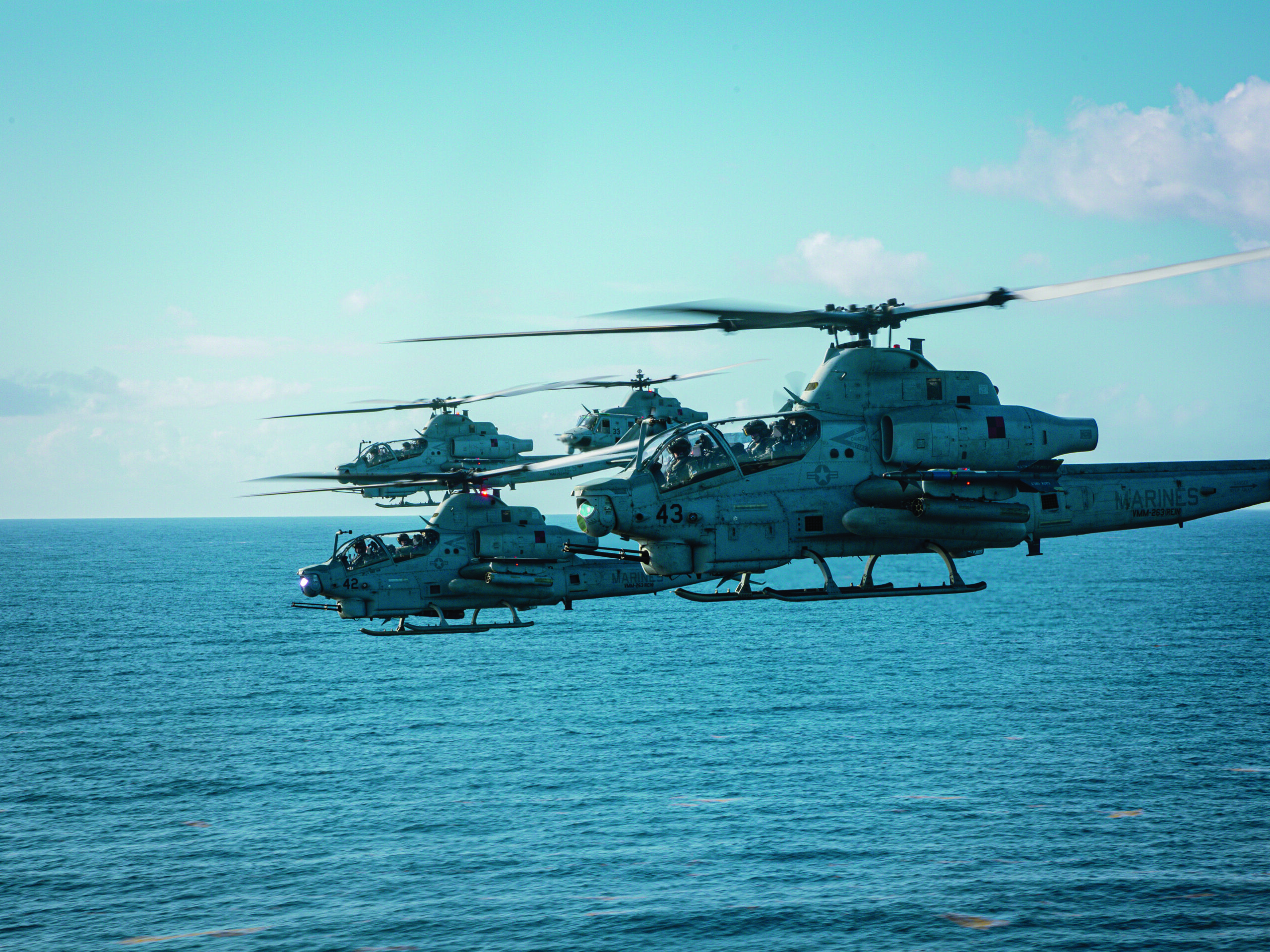
As unmanned aerial systems proliferate and prove effective in conflicts such as the Russo-Ukrainian War, questions have emerged regarding the enduring relevance of rotary-wing CAS. While drones offer low-risk, long-endurance surveillance and precision strike capabilities, they cannot fully replace the flexibility and responsiveness of manned rotary platforms.
Rotary-wing CAS provides commanders with realtime decision making, coordinated fires, and the ability to adapt to dynamic ground combat conditions. Helicopters are not only weapons delivery platforms; they are versatile airframes that can deploy and support drone operations, serve as airborne command and control nodes, and offer casualty evacuation or resupply under fire.
Moreover, CAS conducted from helicopters fosters joint terminal attack controller integration and enhances combined arms effectiveness. This layered approach ensures redundancy and resilience on the battlefield—qualities that are critical in peer or near-peer engagements. A hybrid model that combines rotary-wing CAS with drone capabilities will likely dominate future battlefields.
The MH-60S platform, especially with the armament kit making it an Armed Black Hawk (ABH), supports this hybrid future. It can deliver suppressive fire, coordinate strikes, or act as a launch and relay platform for unmanned aerial systems. Its ability to integrate into naval operations and expeditionary bases makes it a critical enabler of persistent close air support in contested environments.
The Case for the MH-60S/ABH: Flexibility, Interoperability, and Logistics
In addition to its combat utility, the MH-60S enhances the Marine Corps’ ability to contribute to joint operations in other mission areas. When embarked aboard amphibious shipping, Marine-operated MH-60s can augment search and rescue capabilities, providing rapid response and recovery for personnel in distress. This dual-purpose role strengthens naval force protection and humanitarian assistance during expeditionary missions.

The MH-60S with the ABH kit offers substantial operational and logistical benefits over the current HMLA construct:
- Multi-role Capability: The platform performs armed reconnaissance, vertical assault, medevac, ISR, armed escort, and anti-armor missions when equipped with the ABH kit.
- Naval Integration: Designed for shipboard use, the MH-60S seamlessly operates from amphibious ships (LHDs, LPDs) and other amphibious platforms.
- Logistics Commonality: Shared components with the MH-60R/S enable integration into the Navy’s global sustainment architecture.
- Interoperability: Already fielded by partner nations, the platform enhances joint and coalition mission execution.
- Growth Potential: Capable of incorporating mine detection systems, extended range tanks, and directed energy weapons in the future.
Since logistics often relies on commercial services and contracted sustainment pathways, the Marine Corps would benefit from the MH-60’s alignment with allied logistics infrastructure. The widespread use of H-60 variants across more than 30 countries enables the Marine Corps to tap into allied nations’ parts programs, boosting availability and mitigating domestic logistical shortfalls in a contested or resource-constrained environment. Logistics operations could also hide in plain sight by leveraging the parts commonality with host-nation inventories, allowing Marine Corps supply and maintenance activities to blend with existing allied infrastructure, reducing the visibility and vulnerability of logistical nodes in contested environments. The Marine Corps could also further increase resilience by prepositioning key supplies with allied forces who operate the same platform, ensuring rapid access to critical components in theater and enabling quicker recovery from attrition or supply chain disruption. This global adoption also enables greater coalition interoperability and access to multinational sustainment hubs during joint operations.
Furthermore, the H-60’s operational pedigree is unmatched among rotary-wing platforms. The platform’s modularity has allowed for adaptations across mission sets—from humanitarian assistance to special operations. Most notably, a stealth-modified version of the Black Hawk was used in Operation NEPTUNE SPEAR—the mission that resulted in the killing of Osama bin Laden. This high-risk, high-precision operation demonstrated the H-60’s adaptability, stealth modification potential, and elite mission success under extreme conditions.
Another distinct advantage of the H-60 platform is its ability to conduct aerial refueling, reducing the reliance on aviation-delivered ground refueling. In distributed maritime and expeditionary environments where forward arming and refueling points may be limited or compromised, this capability allows for greater operational endurance and tactical flexibility. Aerial refueling extends mission range and dwell time for rotary-wing platforms, enabling deeper penetration into contested areas without the logistical risk associated with groundbased refueling operations.
The Marine Corps already has VH-60N pilots stationed at HMX-1. These pilots could act as the instructor cadres during the transition. These seasoned pilots possess institutional knowledge of the H-60 platform and could assist in converting both the training pipeline and the fleet, ensuring a smoother and faster implementation of the MH-60 transition.
Organizational Implications: From HMLA to HMMA
Adopting the MH-60S would require structural changes to the HMLA designation and table of organization and equipment. The HMLA designation would need to shift to Marine Medium Attack Helicopter (HMMA) Squadron, reflecting the new platform’s capabilities and dual-role nature. The Marine Corps would require table of organization and equipment changes, as well as updates to training pipelines and maintenance protocols. Since the MH-60 variant can perform both utility and attack missions, the total number of aircraft fielded may be reduced allowing for streamlined fleet management.
Additionally, the reorganization of personnel will be necessary. Fewer aircraft could lead to a surplus of qualified aircrew and maintainers. Rather than reduce manpower, the Marine Corps should repurpose this talent to establish an aviation liaison company modeled after air naval gunfire liaison companies. Instead of coordinating fires, this unit would consist of experienced pilots and maintainers focused on building aviation capacity with allied and partner nations. These teams could deploy to enhance coalition air interoperability, provide training, and strengthen forward aviation operations in alignment with SIF objectives.
This transformation is not without cost, but the benefits are profound. In an era of constrained logistics, dispersed operations, and joint warfighting, the Marine Corps cannot afford to field legacy systems that fail to meet the threat.
Recommendations
- Initiate a phased replacement of H-1 aircraft with MH-60S variants equipped with ABH kits.
- Redesignate HMLA squadrons as HMMA and revise the table of organization and equipment accordingly.
- Integrate training and maintenance pipelines with Navy MH-60R/S programs.
- Enhance forward-deployed logistics nodes to support MH-60 operations under SIF doctrine.
- Partner with allied forces operating MH-60 variants to standardize coalition interoperability.
- Stand up an aviation liaison company to expand partner capacity and joint mission support.
A New Acquisition Opportunity: Capitalizing on Army Transition
The Army is transitioning from the H-60 platform to the Bell V-280 Valor tiltrotor, a move that will phase out thousands of existing Black Hawk helicopters. The Marine Corps could take advantage of this transition by acquiring surplus Army H-60s at a reduced cost and converting them to the MH-60S variant. This would accelerate modernization while avoiding the cost of new airframe production.
Additionally, the Marine Corps could mothball the legacy HMLA fleet. By placing H-1 airframes in long-term preservation, the Service would retain surge capacity for major conflicts while focusing current efforts on building a more integrated and survivable rotary force aligned with SIF doctrine.

Conclusion
The H-1 program has served the Marine Corps with distinction, yet the emerging operational environment demands more. The MH-60S variant—with its modularity, interoperability, and logistical advantages—provides a pathway to modernize Marine aviation. Combined with doctrinal shifts like SIF, adopting the H-60 strengthens the Corps’ ability to operate forward, fight distributed, and support allies and partners across the globe.
Modernizing to the MH-60S not only responds to current operational needs but also prepares the Marine Corps for future contingencies by leveraging the broader DOD ecosystem. If the Marine Corps acquires surplus H-60s from the Army, then it allows for cost-effective transition and rapid fielding. With the excess aircrew and maintainers, the Marine Corps has the capacity to establish liaison elements modeled after air naval gunfire liaison companies and enhance strategic partnerships while preserving legacy platforms for potential large-scale conflict and providing depth in the force.
This transition supports the Marine Corps’ enduring role as a premier crisis response force, ensuring aviation remains a lethal, flexible, and forward-postured capability. Rotary-wing CAS—when aligned with SIF principles and integrated across the naval and Joint Force—remains indispensable. Rethinking HMLA is not merely about replacing platforms but evolving the Corps’ posture to prevail in the contested, distributed fight of the future.
> Maj Healy is a Faculty Advisor at Expeditionary Warfare School.