


More Than Just a Haircut: The Self-Taught, Unofficial and Occasionally Disastrous World of Marine Corps Barracks Barbers
By: Kyle WattsPosted on November 15, 2026
Sergeant Justin Dyer wearily shakes off an abbreviated night’s sleep as a new week dawns over the eastern Camp Horno hills in Southern California. While most Marines wrapped up their weekend liberty enjoying the sights and sounds of San Clemente or Oceanside, Dyer spent his entire Sunday on base working late into the night. He wasn’t on duty or in trouble. He remained on base by choice—a choice repeated nearly every weekend. Sundays are his most lucrative day of the week, plying his trade as his infantry company’s resident barracks barber.
An 0311 by profession, Dyer created a burgeoning second career with his clippers and cornered the market within his realm of influence. Need a fresh cut for your date this weekend? A civilian barber in town screwed up your fade again? Inspection Monday morning at 0700? No problem. Sgt Dyer is your man.
As if on cue, a Marine bursts into Dyer’s room, his face distraught, his hair unkempt. Dyer knows the drill. Most Monday mornings he wakes early, expecting this very situation. Some jabroni always partied too hard, came home too late or otherwise neglected to get a haircut the night before. By now, Dyer is something of a last-minute, Monday-morning specialist.
His eyes dart to the clock. Formation begins in less than 10 minutes. Dyer curses under his breath and grabs the clippers. The Marine leaps into the barber chair. Dyer works his magic, expertly fading over the ear and around the back of the Marine’s head. Time flies faster than he can. Another glance at the timepiece shows just three minutes remaining to get outside.
“Naw bro, I’m not gonna finish in time.”
They both curse and grab their covers, sprinting down the stairs and across the grinder to land in the back of formation. They wrestle their breathing under control as the company gunnery sergeant begins his inspection. Meticulous eyes devour each Marine inch by inch as he rounds the corner into Dyer’s row. The Marine beside Dyer gulps down a breath as the gunny approaches. He painstakingly glides through the Marine’s forward gaze, scanning head to toe. He pauses in front of Dyer, looking back over his shoulder and spotting the Marine’s unfinished cut on the opposite side. A crisp about face drops him well within the Marine’s personal bubble, leaning in for a closer view. The calm in his voice belies the rage welling inside.
“Marine, why do you have half a f—king haircut?”
Color rises in the Marine’s cheeks. Sweat pours down the small of his back. His mind races, grasping for words. The gunny draws a knife hand, angled for the kill.
“OK. One side looks flawless, but the other side is like, what the hell??” Dyer pipes up, coming to his buddy’s rescue.
“Gunny, I was cutting his hair, but we didn’t get to finish. If you give me a few more minutes right after this, I’ll finish the other side.”
The gunnery sergeant mercifully relents. He sheathes his five-fingered blade and lets the Marine off with nothing but choice words. Dyer finishes the cut back in his room, chalking the experience up as one more Marine saved and a story to remember.
Perhaps the gunny figured if a last-minute haircut was the most boneheaded move his Marines had made over the weekend, it was a successful weekend. Perhaps Dyer’s professional reputation as the unit’s barracks barber, and the idea of Marines taking care of Marines, appeased him. It wasn’t the first time and surely would not be the last. As long as Marines live in the barracks, barracks barbers will be there to serve and to save.
The logic perpetuating this informal economy is rooted in practicality. Often, a barracks barber may be cheaper than the shops in town or at the PX. Always, a barracks barber is more convenient. Depending on the Marine holding the clippers, a barracks cut might even produce a higher quality fade than a civilian can offer. True, though, these practicalities come with risk.

Sgt Justin Dyer cuts a Marine’s hair in his barracks room at Marine Corps Base Camp Pendleton, Calif. Dyer served as an 0311 and as the unofficial barracks barber for his infantry company, both in garrison and on deployment. (Photo courtesy of Justin Dyer)
Many a Marine has stood in formation with the barracks cut trademark; the unfaded straight line buzzed haphazardly across the back of their scalp. Still more have simply buzzed their entire head, signifying the need for a fresh start after a failed barracks experiment.
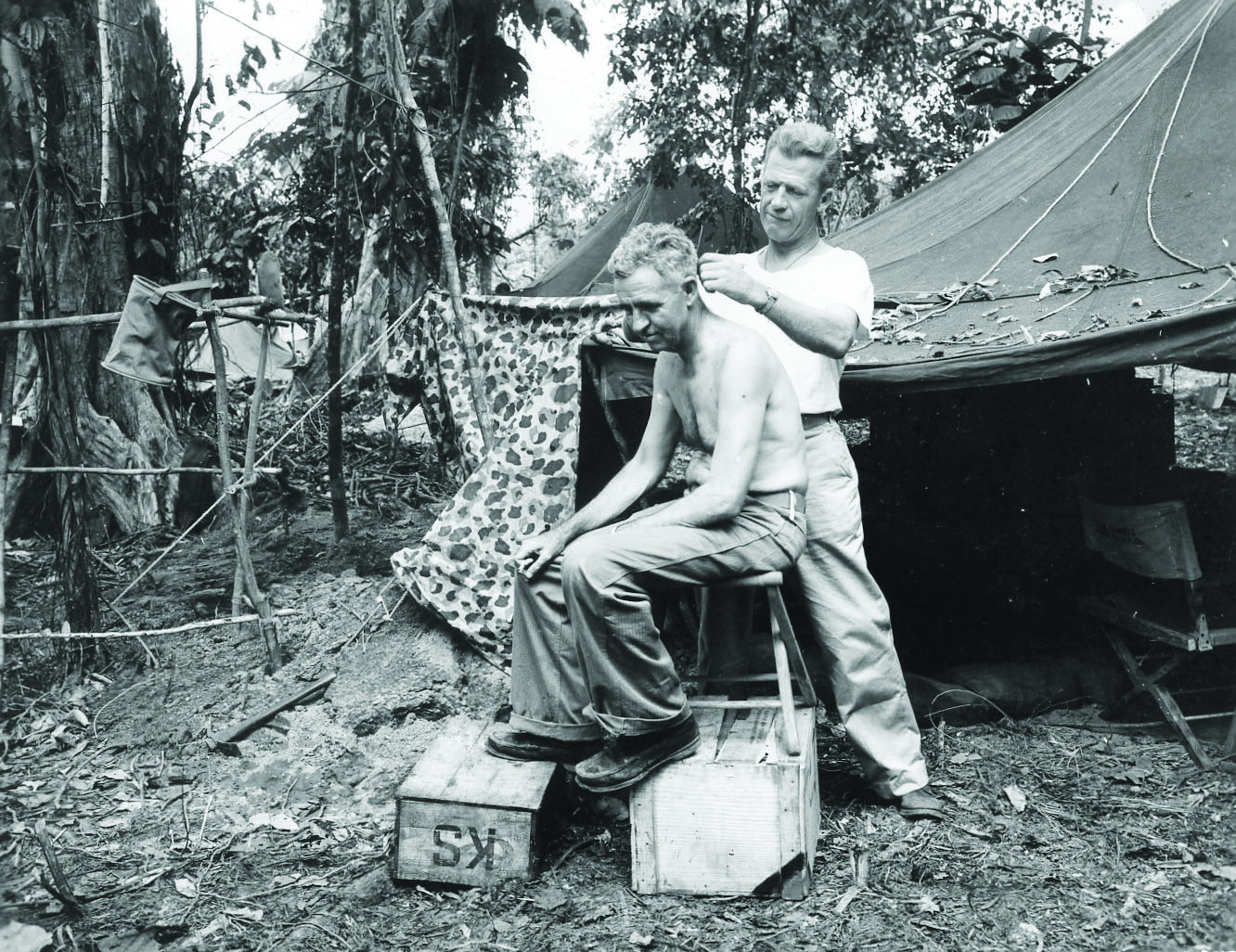
Col Caleb T. Bailey gives BGen Field Harris a haircut in the Pacific in 1943. (USMC)
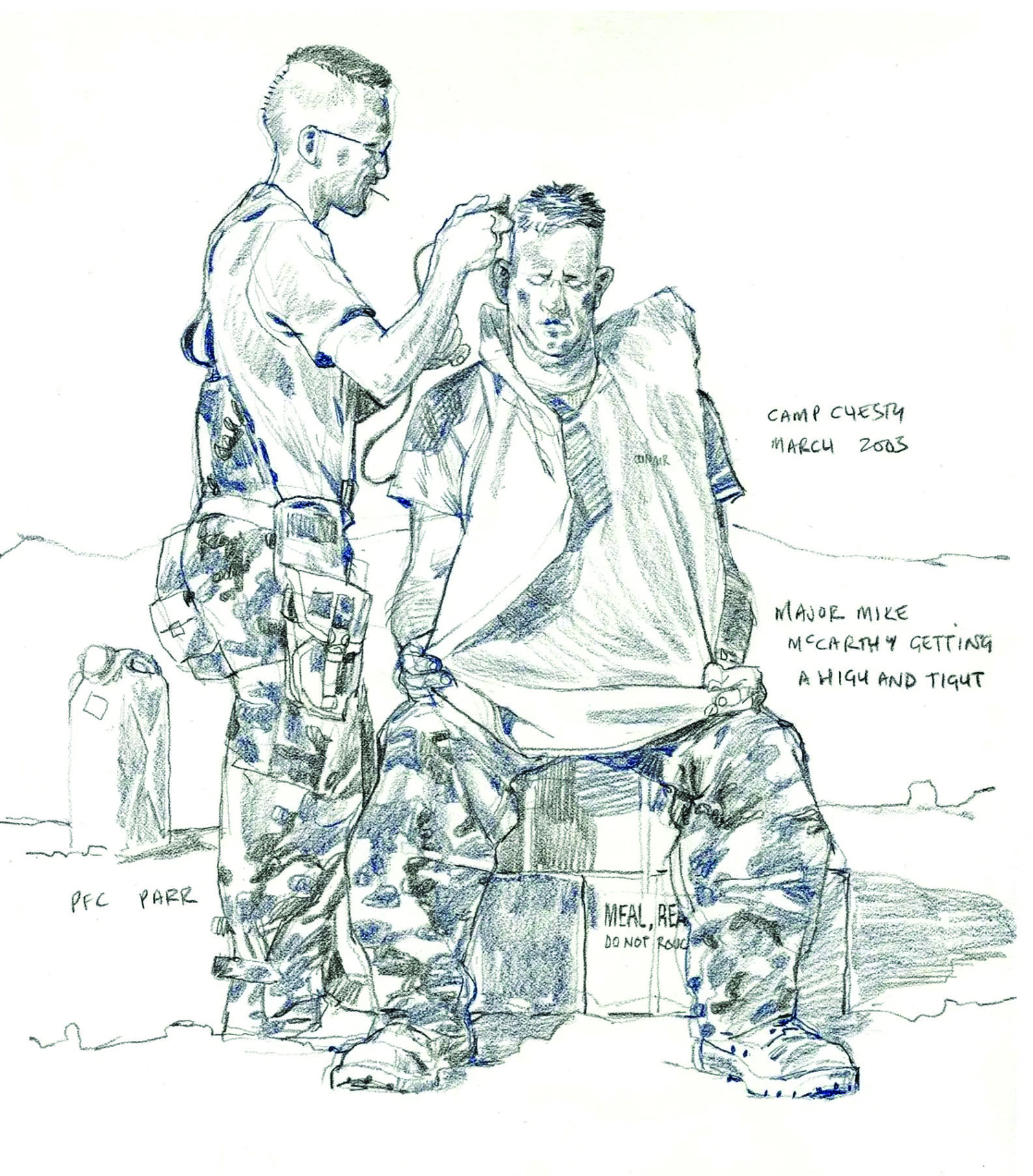
Circumstances also play a significant factor in the enduring necessity of barracks barbers. Many a Marine on deployment or in the field has perched atop a stack of MRE boxes with a towel draped around his neck while a buddy cuts his hair. The best and most well-established of these bring their clippers with them at all times. Wherever Marines may be, there will be those among them operating within this unofficial secondary military occupational specialty, self-assigned to keep the gunnys and first sergeants of the world off their backs.
Every Marine knows the grooming standard outlined by the Marine Corps Uniform Regulations. Hair will be neat and closely trimmed, evenly graduated from zero length at the hairline to the top of the ear, and extending to the maximum allowable length on the upper portion of the head. Maintaining this standard on a weekly basis can prove costly and difficult. But, it is the standard, inspected and enforced. Herein lies the catalyst for disastrous experiments and last-minute panic cuts. Entrepreneurial Marines leverage the economic principles of scarcity, supply and demand, and value creation to position themselves as the logical choice for a haircut, regardless of their level of training and experience. A surprising number have truly mastered the art and science, creatively identifying methods to not just simply cut any head of hair that occupies their chair, but transforming the experience into an expression of each Marine’s personality.
The range of skills each barracks barber has to offer varies as widely as the experiences of each that led them into the role. Dyer entered the Marine Corps with prior barbering experience.
“I started cutting hair when I was younger,” he remembered. “My dad would always take me to the barbershop to get my hair cut. I always loved the sound of the clippers and seeing the transformation of a person. One of my barbers let me watch him work, and he showed me step by step how to fade and everything. I was cutting my friends’ hair and perfecting my craft before I joined the Marine Corps. I started barber school before I joined but didn’t get to finish.”
He gave his first set of “barracks cuts” at the School of Infantry, shortly after boot camp graduation. A group of soon-to-be infantrymen enjoyed a Sunday liberty off base. Naturally, they all forgot to get haircuts.
“There were 12 or 13 guys there,” Dyer said. “I set up right there in the squad bay and cut all of them. Everybody loved it. From then on, I was their barber.”
By the time he hit the fleet with 3rd Battalion, 1st Marines, Dyer fell naturally into the barracks barber role. Cutting the hair of his peers swiftly expanded into cutting his seniors. Word got out and he began cutting the unit’s noncommissioned officers, and even sometimes staff NCOs and lieutenants.
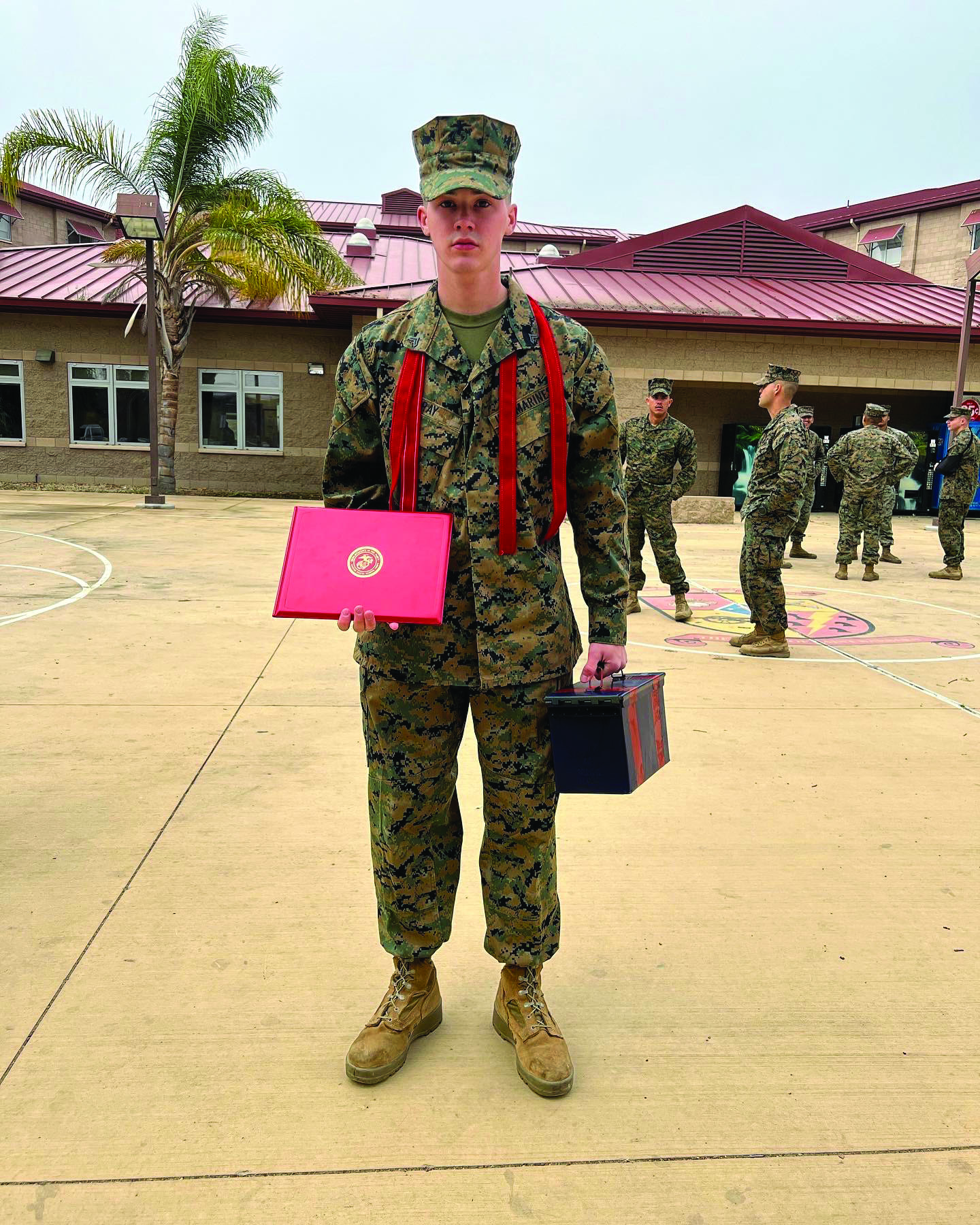
Cpl Daniel Gray served as a 3531 motor transport operator and as a barracks barber for his unit. Gray received meritorious promotion to corporal and used his barber chair to further solidify his relationships with his junior Marines. (Courtesy of Daniel Gray)
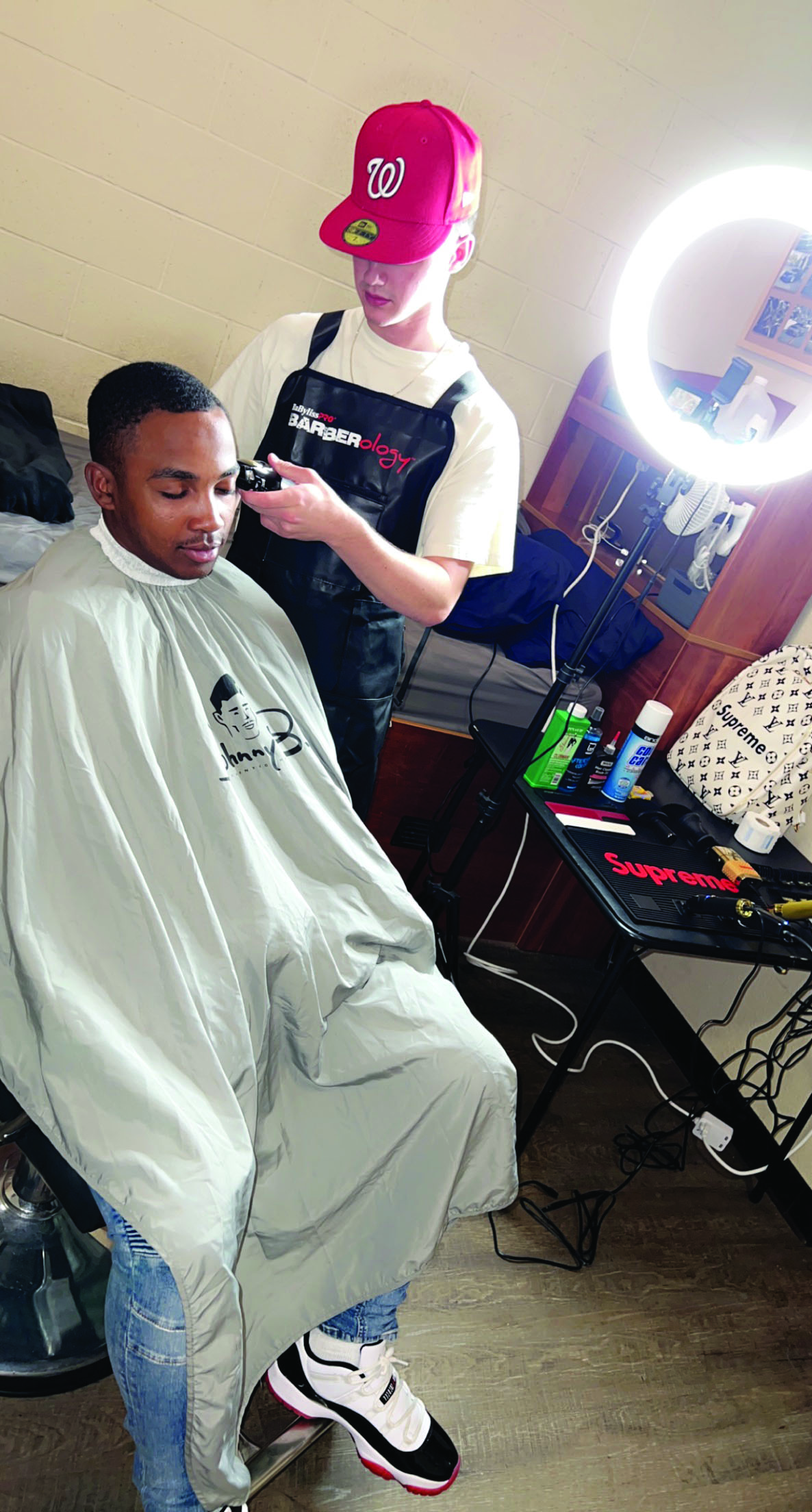
Cpl Daniel Gray started barbering for Marines by watching YouTube tutorials while he cut. His services were initially offered free of charge but evolved into a profitable and mutually beneficial economy. Gray’s barracks room set up evolved as well, eventually housing several thousand dollars’ worth of equipment. Today, Gray owns his own studio in California. (Courtesy of Daniel Gray)
Corporal Daniel Gray established an equally impressive reputation as the barber within his unit but grew the reputation from very different circumstances and levels of experience. Growing up in inner city Maryland outside Washington, D.C., or Baltimore, Gray always considered the barbershop a safe place to hang out.
“These old-head barbers always embraced us, and we always embraced them,” he said. “I feel like in those communities, barbershops are even more held dear. They take their haircuts more serious, and that kind of rubbed off on me. I always wanted a fresh haircut. We’d go there to look fresh, but we’d also go there just to hang with the OGs all day, and they’d teach us so much stuff, like life lessons that you don’t really learn from people who don’t have the experience. Especially living in such an unsafe area, the barbershop was just a place that no one really messed with.”
Gray joined the Marine Corps at a unique time. He graduated from high school and went to boot camp in 2020. Just three days before his graduation ceremony, he learned about something called the coronavirus. His would be the first graduating class to forgo a normal graduation. Pandemic lockdowns forced Gray and his classmates to mask up and move directly from Parris Island to Marine Combat Training and on to certification as a 3531 motor transport operator.
“I messed around cutting hair a little bit in high school and had this old pair of leftover clippers with me when the pandemic hit,” Gray remembered. “I started cutting my own hair, then my roommate’s, then a few others. I had no idea what I was doing. I’d just sit there watching a YouTube video following step by step while I cut their hair. It was so bad. But I was lucky that nobody cared. We were all stuck on base. We had nobody to impress. We all just looked at it like, well, if I mess up, I have to cut it again next Sunday anyway. From my standpoint, it was perfect because it allowed me to get my practice in without too much pressure. Along that whole process, I kind of just fell in love with it. Right around then is when TikTok really was taking off and my entire algorithm became hair cutting videos. I’d find myself lying in bed every night doomscrolling through videos just trying to get better.”
Like many entrepreneurial endeavors, both Gray and Dyer began their barbering venture as a bartering operation. In the beginning, Gray cut hair for free just to get in the reps. Eventually, beer or energy drinks became a fair price for his service. He started making money at $5 a head and gradually increased from there. Dyer likewise started at $5 a head but was not above a mutually beneficial exchange. One time, he traded a series of haircuts to a supply sergeant for a new pair of combat boots.
The relationships developed through their work in the barracks revealed even more value outside those garrison walls. When they deployed, the Marines who served with Dyer and Gray knew both would remain “their” barber. Dyer spent an entire predeployment workup at Camp Wilson in Twentynine Palms, Calif., cutting hair on a stack of MRE boxes. When he deployed on a Marine Expeditionary Unit with 1st Battalion, 4th Marines, he went to work on ship.
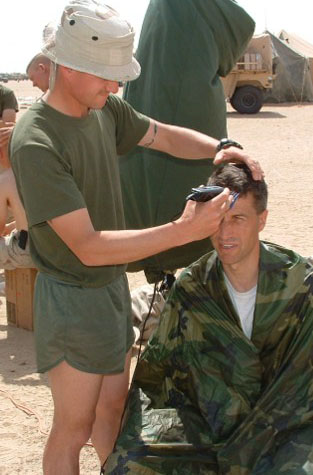
SSgt Adam Walker cuts the hair of Wall Street Journal reporter Michael Phillips in Kuwait 2003. Phillips was embedded with Kilo 3/7. He later wrote the book, “Gift of Valor,” about Medal of Honor recipient Cpl Jason Dunham.
“Being on ship gave a good amount of fuel to it,” Dyer reflected. “When you’re stuck on ship for a long time, the little barber shop they have can only cut so many heads in a day. I took that opportunity to cut more, and that’s where I started cutting hair for a lot of the higher ups too. I think the higher up you get, the more you tend to care about the quality of your haircut. So, being at that point allowed me to expand my addressable market.”
As a Motor T Marine, Gray spent his time in the field cutting hair in the back of his truck or under cammie netting at the motor pool. When he deployed to Japan as part of the Unit Deployment Program, he knew he’d be living in a barracks similar to what he was used to at Camp Pendleton. He carefully packaged his barber chair, mirrors, lights, and his entire wall locker setup and shipped the ensemble overseas.
“By that point, I had already built my reputation up a bit,” Gray said. “Everybody was just expecting it, like, ‘yeah, he’s going to bring his clippers with him. That’s our barber while we are there.’ I couldn’t bring all my stuff with me, so I shipped the rest.”
Gray was initially horrified to learn his barbering supplies were lost in transit. He purchased new equipment in Japan with the money he received from insurance on the package. Later, well after his new set up was in service and operating daily, the original package magically arrived.
The best and most committed of the barracks barbers operating around the Corps today experience the satisfaction of one key, yet often understated, aspect of their work.
“A person’s appearance is a big percentage of their personality,” Dyer said. “I’ve had so many guys come to me saying they just met this girl that they need a fresh haircut to look good for a date, or other situations like that where they trust me with that responsibility. I take that very seriously.”
“Getting a haircut is about more than just the haircut,” Gray added. “In a way, people look at you like a therapist. I’ve had so many clients tell me so many different things in my chair; the wedding they are getting a haircut for, or their son’s funeral. I hear all these crazy stories every day from my clients, and they trust you with that relationship. I feel like that is often overlooked about being a barber. Yes, you have to be good at what you do, but you also have to have people skills and communication skills.”
With his childhood barbershop in mind, Gray set out to create a similar environment in his barracks room. Once he fully furnished his barbering setup, he and his roommate bought a couch for their room. Many Sundays, the room was full of Marines watching football, laughing and waiting for their turn in the barber chair. After he was meritoriously promoted to corporal, he used the relationships he’d built to help in his new leadership role.

Sgt Kevin Martinez cuts a fellow Marine’s hair while deployed to Spain for annual training in 2015. (Courtesy of Kevin Martinez)
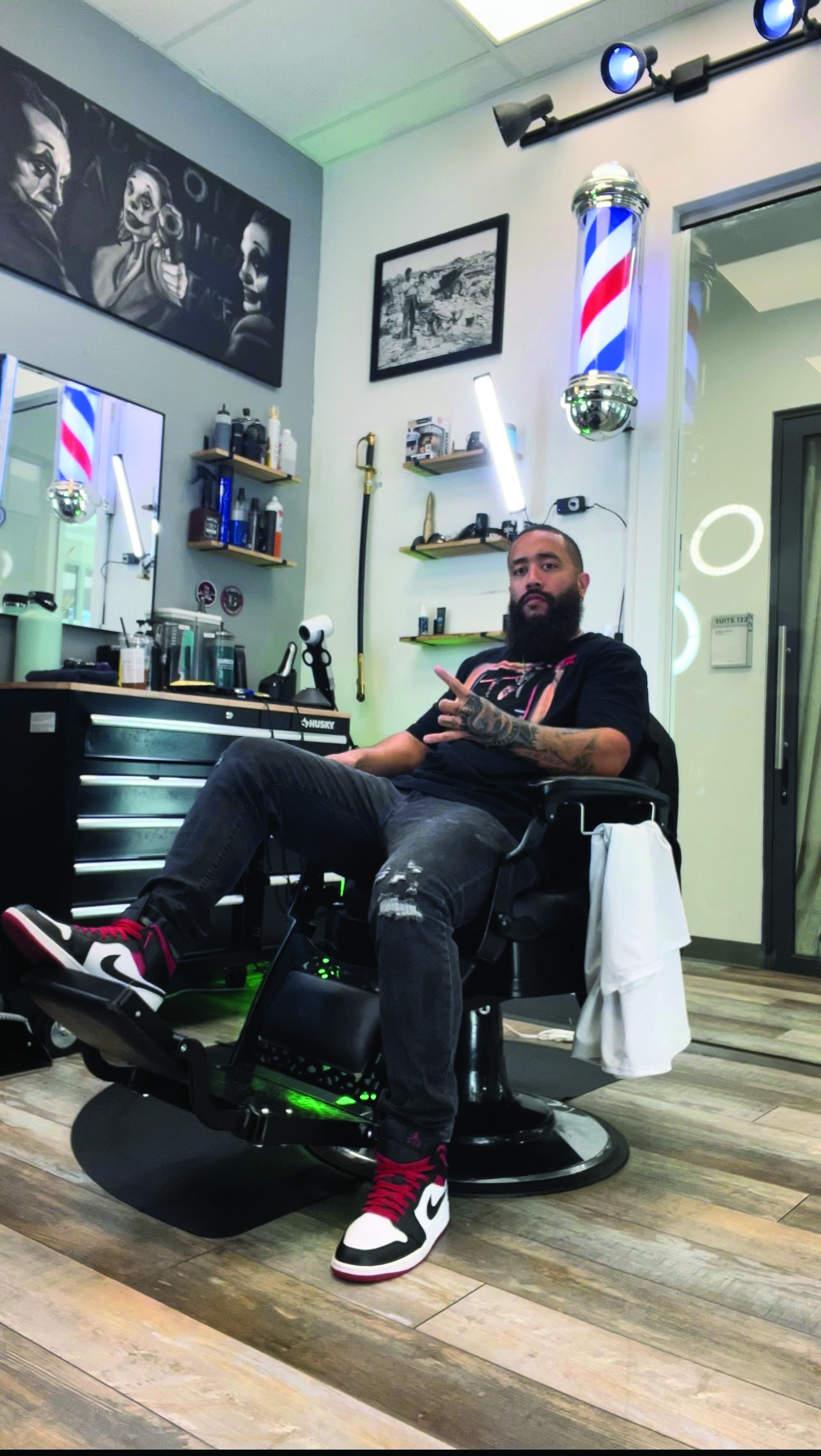
Today, Kevin Martinez owns his own studio in California. Inspired by his service in the Marine Corps Reserve and his work with active-duty Marines, Martinez adopted the social media persona of “The Barracks Barber.” (Photo courtesy of Kevin Martinez)
I cut a lot of my junior Marines’ hair. It was a great way to create a balance between more serious times at work and a time when they could be more laid back with me. It allowed me to get to know people on a deeper level. I think a lot of times as men and Marines we tend to block that off a lot, but that was kind of a way to let those walls down.”
The potential energy stored within the barber’s chair is notably revealed through the experience of Sgt Kevin Martinez. A reserve Marine, Martinez served in his home state of New Jersey, then in California, as a Motor T mechanic. Throughout his time in training, drill weekends and during each year’s two-week annual training, Martinez brought his clippers to cut Marines’ hair. He’d begun barbering at the age of 16. Though his experience barbering for Marines was not a daily fact of garrison life in the same way it was for Gray or Dyer, Martinez’s time cutting hair in the motor pool tool room or on field exercises further cemented his love for the art. In April 2016, his reserve contract ended, he graduated barber school and began cutting hair full time.
Martinez’s wife served on active duty and transitioned into civilian life around the same time his reserve contract ended. For an intense period, they simultaneously endured joblessness, homelessness, life with young children and marital separation. They eventually moved back to New Jersey, living with Martinez’s parents. Just like Gray had done in the barracks, Martinez used the unique absurdity of the time and place he was in to create opportunity. The pandemic hit while Martinez worked at a local New Jersey barber shop. With lockdowns in place, widespread fear of disease hovering, and no clients walking through the doors, Martinez decided to go to them.
“Whatever fear propaganda the media was feeding us, I was using as a marketing strategy to gain more clients,” Martinez said. “When I first graduated barber school, my persona on Instagram was, ‘The Ill Barber.’ As soon as COVID dropped, I was like, ‘I can’t be the ill barber right now. That’s the worst name in history.’ So, I changed my name to ‘The Essential Barber.’ I was doing house calls, cutting hair in a hazmat suit. I remember at one point, it was like May or June 2020, I had 81 house calls lined up for the month. I was absolutely crushing it.”
In 2021, Martinez’s wife was offered a job at Naval Medical Center San Diego, working with Marines assigned to the Wounded Warrior Battalion. The family packed their things once again and moved to California. By mid-August, Martinez was reestablished in a San Clemente barber shop, just outside the San Onofre Gate of Camp Pendleton. No longer servicing clients in a hazmat suit, Martinez once again sought to rebrand himself. As a Marine veteran, he settled on a familiar title, instantly signaling his intrinsic connection to the Marines that would now make up a significant portion of his weekly clientele: The Barracks Barber.
On Aug. 26, 2021, 13 U.S. servicemembers died in a suicide attack at Hamid Karzai International Airport in Kabul, Afghanistan. Dozens more were injured. Many of these wounded Marines returned to San Diego, where Martinez’s wife served as part of the care team.
“All the Marines from 2/1 who survived went right there to her hospital,” he remembered. “I was cutting hair right there outside the gate where the battalion was located. I asked her, ‘hey, can you try to connect me with any of the Marines on Instagram, so I can offer them a free haircut?’ I just wanted to maybe make a difference for them. Sometimes, people just need to get some things off their chest. As a barber, I like making my clients comfortable, and the haircut is really just the cherry on top. You leave my chair, you feel great, you got some stuff off your chest, maybe we laugh, and you look good. So, I thought, maybe just that is something I can provide to these Marines. They just lost a bunch of their friends, so maybe I can help them feel good for just a little bit.”

Justin Dyer, left, was promoted to sergeant in 2023. Fellow barber and sergeant of Marines Kevin Martinez attended Dyer’s promotion ceremony. Dyer left active duty in December 2024 and is now a professional barber outside Camp Pendleton. (Photo courtesy of Justin Dyer)
One of the wounded Marines connected with Martinez that September and came in for his first haircut. For the next two years, Martinez cut his hair for free.
“He’d come in once a month or so,” said Martinez. “We became really good friends. There would be times he didn’t come in, so I would hit him up just to make sure he was good. He would tell me about all the things he witnessed over there. I just wanted him in my chair to see where his mind was at. When the rest of the battalion finally came back from the deployment, little by little, more of them started trickling into the barber shop. Overall, I ended up consistently cutting 15 or 20 of those guys.”
Through his chair, Martinez collected a unique perspective on the tragedy these Marines and Navy corpsmen witnessed. The details combined into a more complete picture than any individual experienced. They also presented a far different narrative than what was being publicly stated about the tragedy.
“I was really worried about [my clients], seeing how that impacted them. Then, that July, I had another Marine client from a different unit, I cut his hair probably seven times and was getting to know him, then he committed suicide. It just really hit me how I was dealing with these Marines, learning about the day-to-day life of these grunts who were just not mentally OK, but you couldn’t tell. It made me feel even more responsible for the Marine from 2/1 and all his friends. I felt like I had his life in my hands. It made my role as a barber that much more meaningful.”
Martinez believed in the importance and healing power of allowing these Marines’ side of the story to be told. In early 2023, he filmed a series of podcast-style interviews with several 2/1 veterans, seated in his barber chair, and posted the videos to Instagram. Each video went viral. Seeing national news outlets, such as CNN, feature clips from the interviews proved validating and affirming. For Martinez, the experience echoed that of Dyer and Gray; a barber is more than just a barber, a haircut is more than just a haircut, a quiet chair and a safe place to talk with someone who gets you can help heal the deepest wounds.
Martinez, Gray and Dyer all work today as full-time, professional barbers in California. Dyer works outside Camp Pendleton, with roughly 80% of his clientele still active-duty Marines. Gray and Martinez operate their own independent barber shops farther away from the base, seeing fewer Marines walk through their doors. Gray is a licensed barber, cosmetologist and esthetician. Martinez scaled his barber shop over six figures, now operating by appointments only. The brotherhood and relationships Gray and Dyer created in the barracks still define their outlook on the profession. The experience Martinez gained with Marines in the Marine Corps Reserve and as a civilian proved equally defining and inspirational to his persona as “The Barracks Barber.” Gray’s first YouTube-coached haircut, Dyer’s first cut in the squad bay at SOI, and Martinez’s first free haircut for a wounded veteran from Abbey Gate; each experience accomplished the same fundamental thing for the Marines who needed it, by Marines they trusted. For a Marine Corps tradition steeped in hilarity, good-natured mockery and cringe-worthy results appearing each week in formation, barracks barbers generate behind the scenes esprit de corps all Marines appreciate.
Featured Photo (Top): Original art by Richard Johnson
About the Author
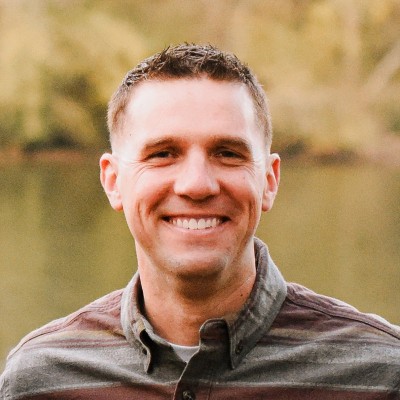
Kyle Watts is the staff writer for Leatherneck. He served on active duty in the Marine Corps as a communications officer from 2009-13. He is the 2019 winner of the Colonel Robert Debs Heinl Jr. Award for Marine Corps History. He lives in Richmond, Va., with his wife and three children.
Enjoy this article?
Check out these similar Leatherneck and Scuttlebutt features:
The Illustrated Marine
Leatherneck
January 2023
By: Kyle Watts
The spirit of basilone
Leatherneck
March 2023
By: Kyle Watts
pocket-sized storyboards
Leatherneck
October 2022
By: Sara W. Bock