Defending Maneuver Concepts

by Majs G.I. Wilson & W.A. Woods

LtCol Batchellor’s poignant uneasiness with maneuver warfare thinking (Apr82) may result from too casual a reading of the recent articles in the Marine Corps GAZETTE. Understanding the tenets of fluid/maneuver style of warfare requires careful, thoughtful reading and reflection.

Modern maneuver/fluid war took root at the small unit level with infiltration tactics developed in 1918 and conceptually has not changed since. It is applicable at every level from MAF to fire teams.

To understand maneuver warfare concepts, it is necessary to make the basic distinction between tactics and techniques. Techniques are those things that all armies must learn to do well in order to succeed, e.g., movement to contact, assault on a fortified position, and weapons proficiency. Tactics are the imaginative combination of those techniques allowing forces to move into unexpected places, at unexpected times, with unexpected speed, deception, and surprise. When a force continually strings techniques together in the same sequence, i.e., when it uses the same tactical doctrine, again and again, it becomes predictable and can be easily defeated. The “maneuverists” argue against tactical cookbook recipes because stereotype tactics lead to predictability and defeat. They do not reject battle drills that have proven successful, only the combining of such drills into dull, repetitious, and rote tactics. They do not advocate a policy of simply turning loose subordinate commanders on the battlefield. Such a command and control system, or rather the lack of it, would soon lead to total chaos and a possibility of defeat in detail. Maximum flexibility and initiative can be given to subordinates by the senior commander clearly expressing his overall tactical intent, by tailoring mission-type orders to support that intent, and by designating a point of main effort for combat, combat service, and combat service support units. Through these command and control methods the senior commander can retain enough control to ensure a cohesive, coherent effort from his force.

Amphibious operations are not an end in themselves. They are merely a means of arriving on the battlefield. In order to be successful in any subsequent operations ashore, however, it is vital we possess a maneuver capability equal to or greater than our adversary. We do not fight decisive battles in the surf. This does not necessarily mean more mechanized vehicles (and all the attendant problems). Maneuver warfare advocates have never argued for increased mechanization as a means of increasing maneuverability. The maneuver they advocate is mobility in relationship to our enemy, and this is not something that is dependent upon mechanization or tied to machines.

The maneuver warfare advocates are attempting to institutionalize fighting smart. They believe that the Marine Corps’ potential adversaries will not give it time to rethink its tactical doctrine after the shooting starts. Marine officers owe it to themselves and their profession to discover as much as they can about the tenets of maneuver/fluid warfare before dismissing it as “good old flexibility and boldness.” It is so much more than that.

More Readings On Maneuver Warfare

by Col P.G. Collins

* In a recent edition of the GAZETTE, you refer to a reading list that was printed on maneuver warfare in the Books [section] in the Nov81 and Dec81 GAZETTE. Could you please send me these listings? (I have misplaced those editions.)

As I read the various articles on “maneuver warfare” I must admit I find them interesting; but quite frankly I’m amazed at the lack of knowledge or background of some of the authors. I would suggest that maneuver warfare is nothing new, and it has been written about many times in the past. To fully understand maneuver warfare, you must at least read:

1. B.H. Liddell Hart’s Strategy:

The Indirect Approach

The Decisive Wars of History

The Rommel Papers

2. The writings of Clausewitz-particularly On War-and the writings of Moltke.

3. T.E. Lawrence’s Seven Pillars of Wisdom.

There have been numerous campaigns in the past where the indirectness of approach is as manifest as the decisiveness of the issue. The art of the indirect approach (maneuver warfare) can only be mastered and its full scope appreciated by study and reflection upon the whole history of War-I feel you can crystallize the lessons if you’d focus your reading lists on:

*Hannibal’s Lake Trasimene Campaign in Etura.

*Caesar’s Ilerda Campaign in Spain.

*Cromwell’s Preston, Dunbar, and Worcester Campaigns.

*Marlborough’s Flanders Campaign.

*Wolfe’s Quebec Campaign.

*Bonaparte’s Italian Campaigns of 1796, 1797, and 1800.

*Bonaparte’s Campaigns at Vim and Austerlitz in 1805.

*U.S. Grant’s Campaign at Vicksburg.

*Sherman’s Atlanta Campaign.

*Ludendorf’s works (Vols. I & II) of World War I.

Whatever you do or recommend, you must refer to B.H. Liddell-Hart. His works on the indirect approach are what the Wermacht in the 1930s [studied] and [what] the British, [Americans], and French overlooked or scoffed [at]. From his efforts his disciples (Rommel, Manstein, Kluge, and Guderian) perfected the techniques.

If there is one thing I could recommend for officers to read and understand, [it] is anything they can get their hands on that Liddell-Hart wrote.

Defending the ‘Maneuverists’

by LtCol M.D. Wyly

Recent letters and short articles in the GAZETTE purporting to counter the concepts of maneuver warfare are going wide of the mark. The tendency has been to counter things that the “maneuverists” haven’t said.

There is a false notion that maneuver warfare proponents dismiss lightly fire control and logistics. My observation, however, has been that the “maneuverists” tend to be the officers most willing to labor seriously in the study of their profession. The officers who devote the extra time studying the history of how man has out-maneuvered man are the same whom I see being most conscientious in studying how to control fire and ensure optimum combat service support.

A recent letter (Apr82, p. 17) to the editor asks whether maneuver warfare is “symbolic for always being on the attack”; yet, many of maneuver warfare’s best applications are in the defense. Such an application is described by Capt Anthony Coroalles in Maneuver to Win in September 1981 Military Review.

A favorite myth is that “maneuverists are ignoring the give and take of killing and destruction in combat.” Maneuver warfare, however, is based on boldness and acceptance of risk. Clearly, this means acceptance of casualties when necessary.

Worst of all, a recent writer (Apr82, p.22) has “difficulty with a concept [maneuver warfare] that appears to presume this [high] level of competence down to and including the small unit level.” Should not we set out standards at the highest level and work up to them?

I suggest maneuver warfare’s critics need to study more. The same applies to its advocates, who must also keep writing. I regretted to see Capt G.I. Wilson’s laboriously thought out article on the subject dismissed (Apr82, p. 17) as a “regurgitation of Messrs, Boyd and Lind.” There is nothing wrong with an interpretive article now and then. I am sure that Capt Wilson wrote it to be studied and discussed. He did not deserve to be insulted. I trust that he will rise above his critics, not be discouraged, keep writing, studying, and training.

The Reconnaissance Regiment

by Maj E.J. Robeson IV

CWO-2 Lavender’s article (Mar82) advocated the creation of an additional regiment in the Marine division. This regiment would incorporate the proposed light armored vehicle [now referred to as light armored assault battalions (LAABs)] as one of its “maneuver” units. While the article contained many thoughtful recommendations, 1 do no! believe that the LAAB incorporation was one of them. The LAAB . . . should be part of a reconnaissance regiment.

The increased information requirements on the modern battlefield and in maneuver warfare make a reconnaissance regiment a logical consideration. … A reconnaissance regiment would go far to improve the scope and quality of our intelligence effort. Ground reconnaissance consists of nothing more or less than professional patrolling which results in information gained covertly or overtly. A force recon, battalion recon, or STA platoon Marine is useful to the Marine Corps only if he can patrol and acquire and communicate information. Before a team can patrol, however, it must be introduced into the objective area. Here is where the distractions begin-for introduction requires the use of insertion/extraction techniques. Because these techniques are sophisticated and hazardous, ranging from military free fall parachuting to submerged submarine escape trunk lock-outs to helicopter transported motorized patrols, much time must be spent training to conduct them with proficiency. At the present time, our various recon units exhibit not only extensive duplication in these evolutions, but also a certain lack of proficiency. We are developing reconnaissance Marines who are “jacks” rather than “masters.” A reconnaissance regiment would stop this.

Consolidating the reconnaissance battalion, force reconnaissance company, SCAMP platoon, and LAAB would provide a coordinated, integrated ground informationgathering organization. Each unit could then be tasked to specialize in a limited number of landing and withdrawal techniques, in which they could then become truly proficient.

The reconnaissance battalion could become the amphibious reconnaissance battalion, and have the responsibility for all amphibious missions, both pre- and post-D-day, and all landings and withdrawals from the sea. They would lose their present fascination with parachuting, as well as motorized palrolling. The force reconnaissance company would be needed in triplicate and could continue to have responsibility for deep missions, but with a parachute delivery capability only. Hydrographic surveys, beach reconnaissance, submarine operations and cast and recovery techniques could all be dropped in order to concentrate on learning to land in an unknown zone at night as a team and communicating by radio over extended distances. The LAAB . . . would perform motorized reconnaissance, screening and counter-reconnaissance tasks. The SCAMP platoon would have access to these units to assist in emplacing sensors.

In addition to bringing all of these scattered, like units into a common organization, there would be a laudable effect at the division staff level. The G-2 and G-3 would have a single commander with a supporting staff with which to coordinate. The reconnaissance and surveillance plan would cease to be a potpourri of requests from organizations with competing ideas and become a single integrated document, responsive to the division commander’s information requirements.

In summary, FMFM O-3 Doctrinal Publications Guide states that ground reconnaissance for MCATFs is a reconnaissance organization’s responsibility. Reconnaissance, whether conducted by foot, fin, or light armored vehicle is still reconnaissance. There is nothing wrong with our doctrine; we simply need to exercise it in an intelligent manner. Perhaps a reconnaissance regiment would be a step in that direction.

Communications Training

by SSgt P.L. Stokes

CWO-2 Lavender’s Current Training and Maneuver Warfare (Feb82) was right on target! … I have been in several CPXs where one of the main concerns of the staff was ensuring that everyone had a radio net or telephone dedicated to him. This will work in a static situation, but once on the move it is a different story. In a mobile environment, the staff may well find that only 60 to 75 percent of their radio circuits will be working at one time due to terrain and frequency propagation conditions. When this occurs the use of alternative means of communications becomes imperative. The difficulty arises when the members of the staff aren’t trained in the use of alternative means, since their unit’s CPXs have always provided them with reliable circuits. So the result is that traffic is delayed for long periods and effective command and control collapses.

Overcoming this problem will take time. Some possibilities include: 1) Limiting the use of radio to highpriority traffic. 2) Getting away from the “dedicated circuit” trend. (If you have a flash message and the only available circuit belongs to (he S-2, use it!) 3) Using messengers whenever possible, especially for long data type messages. 4) Letting communication personnel operate the radios, not just monitor them. (That’s their job, and they will put out if you give them your support.)

Reliable communications is a must to be successful in maneuver warfare, and the time to train is now, not when our unit is on the beach.

Rommel’s Maxims Revisited

by CWO-2 B.N. Lavender

Rommel‘s early experiences in the infantry during World War I had a great impact on him. The tactical maxims outlined in Infantry Attacks are the “tricks of the trade” he employed with great success as an infantry small-unit leader. During World War II he continued to evolve as a tactician, building on his earlier experiences and adapting his thought to reflect the possibilities offered by motorization. In the North African campaign, he exploited these possibilities to their fullest and in so doing, secured his place in history. Fortunately, he continued to be a prolific writer and after the war B.H. Liddell Hart published Rommel‘s wartime writings as, The Rommel Papers. In this collection we find the maturation of Rommel‘s early thoughts into a comprehensive philosophy for the conduct of warfare.

The principles given below quite naturally do not deal with the “nuts and bolts” of small-unit tactics. When Rommel formulated them he was, after all, an army commander and not a company commander. Along with the change in point of view, it is also interesting to note the similarities between Rommel‘s work and that of Col John Boyd, originator of the “Boyd Theory” of conflict. In an age when Marines could well find themselves fighting under circumstances similar to those faced by Rommel, these principles take on a new significance. For military professionals desiring to grasp the concepts of maneuver warfare, Rommel provides an excellent point of departure. In 1942, reflecting on the nature of modern warfare in the desert, he wrote:

Of all theatres of operations, it was in North Africa that the war took on its most advanced form. The protagonists on both sides were fully motorised formations, for whose employment the flat and obstruction-free desert offered hitherto undreamed-of possibilities. It was the only theatre where the principles of motorised and tank warfare, as they had been taught theoretically before the war, could be applied to the full-and further developed. It was the only theatre where the pure tank battle between major formations was fought. Even though the struggle may have occasionally hardened into static warfare it remained-at any rate, in its most important stages-based on the principle of complete mobility.

Rommel then went on to present the following principles for the employment of fully motorized forces:

* In motorized/mechanized warfare, the primary objective of all planning is the material attrition and destruction of the organic cohesion of the opposing force.

* Concentrate your own forces in time and space to split the enemy forces and destroy them piecemeal.

* Supply lines are especially sensitive since fuel and ammunition required to fight the battle must pass along them. Do everything you can to protect your own lines and cut the enemy’s lines whenever possible. Operations in the enemy’s logistic area will result in his breaking off the battle elsewhere.

* The armor is the core of the mechanized army, and all other units are auxiliary. The war of attrition against the enemy armor must be waged as far as possible with antitank units; your own armor should be used only to deal the final blow.

* Reconnaissance reports must reach the commander in the shortest possible time. He must make his decisions and act on them as fast as he can. Speed of reaction decides the battle, so commanders must operate well forward and have the best possible communications capability.

* Speed of movement and organizational cohesion are decisive. Any breakdown in this cohesion must be rectified immediately by reorganization.

* Concealment of intentions is of the utmost importance in order to provide surprise and exploit the time taken by the enemy command to react. Deception measures of all kinds should be encouraged, if only to make the enemy commander hesitate and hold back.

* Once the enemy has been thoroughly beaten up, success can be exploited by attempting to overrun and destroy major parts of his disorganized forces. Speed is everything. Do not allow the enemy time to reorganize. Rapidly regroup for the pursuit and ensure supplies are available for this pursuit.

* Artillery must possess great range, mobility, and the capability to carry large quantities of ammunition.

* Infantry is best employed to occupy and hold positions that prevent the enemy from carrying out his plans or force him into other ones. Infantry must be fully mobile so that when this is accomplished, they can be rapidly shifted for employment elsewhere,

* Bold decisions give the best chance of success.

* There is no ideal solution to military problems; every course has its advantages and disadvantages. One must select that which seems best . . . and then pursue it resolutely and accept the consequences. Any compromise is bad.

As the commander of a sealifted expeditionary force operating under terrible logistic difficulties, Rommel applied these principles with great success. The Panzerarmee Afrika consistently fought outnumbered and won, often in the face of enemy air superiority. For Marines contemplating operations in the Persian Gulf region where conditions may be similar, these principles may well provide the basis for success. We cannot afford to neglect them.

The maxims present in this article were extracted primarily from The Rommel Papers, pp. 197-201 (Harcourt Brace & Co., 1953). In fairness to Rommel, it should be noted also that the development of his ideas did not stop in North Africa. For example, in 1944 while preparing to defend against the Allied invasion of Europe, he wrote (see same source p.468):

It’s obvious that if the enemy once gets his foot in, he’ll put every antitank gun and tank he can into the bridgehead and let us beat our heads against it . . . To break through such a front, you have to attack slowly and methodically, under cover of massed artillery, but we, of course, thanks to the Allied air forces, will have nothing there on time. The day of the dashing cut-and-thrust attack of the early war years is past and gone-and that goes for the East too, a fact, which may, perhaps, by this time, have gradually sunk in.

Why the German Example?

by William S. Lind

Throughout history, militaries have learned from each other. Borrowing from both friends and enemies, in peacetime and in war, they have short-circuited the normally lengthy process of developing new ideas by using somebody else’s. Sometimes, the borrowing has been wholesale: the Imperial Japanese Navy copied the Royal Navy to the point of serving a daily Western dinner. More often, it has been selective, as in the Soviet combination of Wehrmacht operational concepts with the traditional Russian penchant for mass.

In today’s Marine Corps, advocates of maneuver warfare are borrowing heavily from the Germans. They frequently draw illustrations of maneuver tactics from German military history. They use German terms such as Schwerpunkt and Auftragstaktik. They look to some pre-1945 German military institutions, including German military colleges and the German General Staff, for characteristics which might be applicable to the Marine Corps.

This emphasis on things German has been resented by some Marines. Some of the resentment is understandable. Some Marine officers reject all German ideas because of Germany’s defeat in both world wars. They do not have adequate historical background to separate German tactical and operational performance, which was generally very good, from German strategy and grand strategy, which was so poor it made defeat inevitable. Others fear that acknowledging some areas of German superiority may reflect negatively on our own achievements, even though these achievements are matters of historical record. And some confuse German military practices with the policies of the National Socialist government, even though the former, almost without exception, were developed before or apart from the latter.

Unfortunately, some Marines’ negative attitudes toward German (or other foreign) ideas spring from less excusable origins. A gut-level rejection of anything new and different is sometimes apparent. So is narrow parochialism-the idea that the “Marine way” (or what is perceived as the Marine way) is automatically the best. And so sometimes is outright prejudice and anti-intellectualism, typified by one young officer’s comment in an exercise critique, “Schwerpunkt, bilgepump, it’s all the same to me.” In his case, sadly, it probably is.

If the German example causes so much heartburn among Marines, why do the proponents of maneuver warfare keep pushing it?

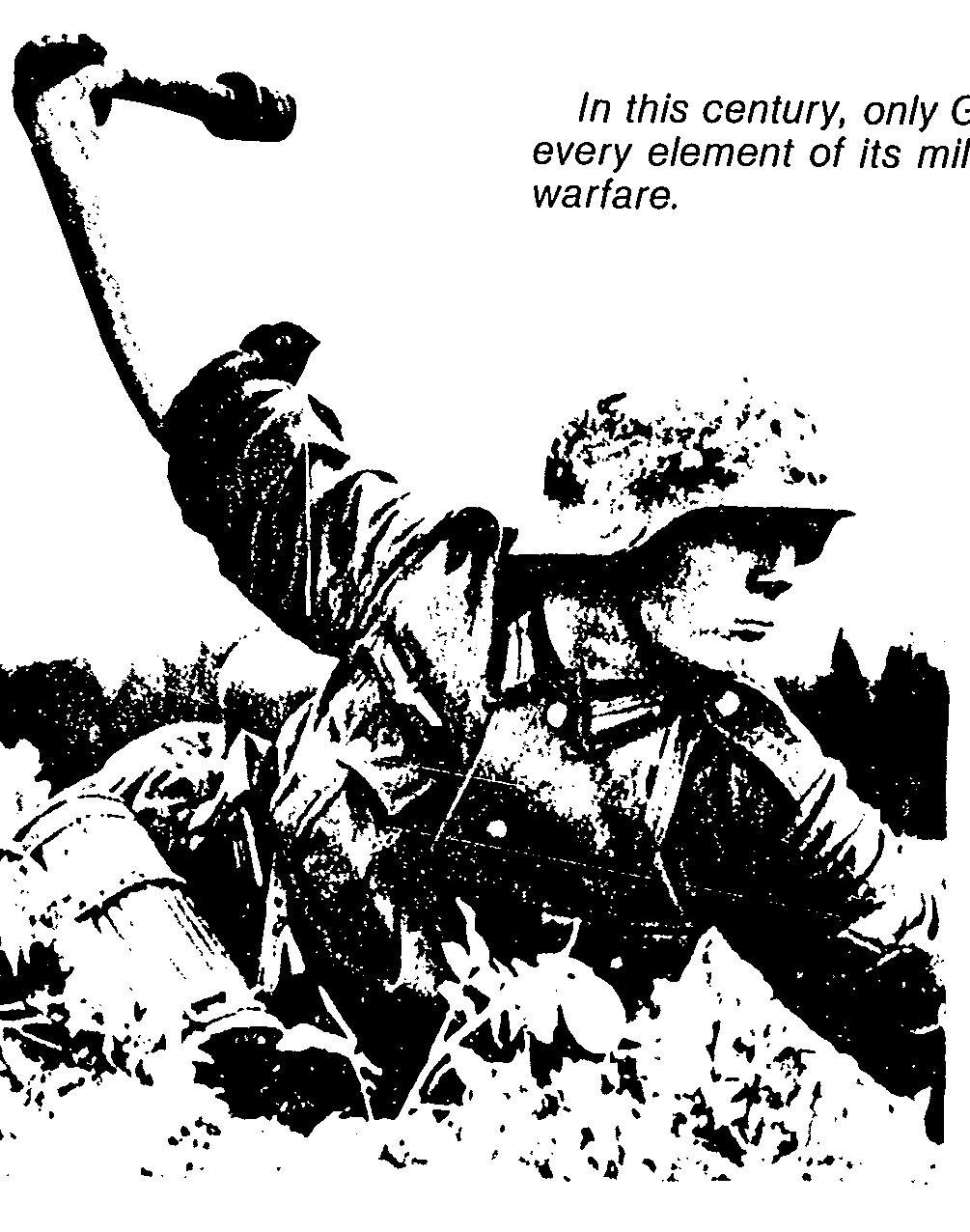
The answer is simple: in the West in this century, Germany was the only country to institutionalize maneuver warfare. That is, only the Germans endeavored to make every element of their military-their education system, officer selection, officer promotion, the way their army made its choices and decisions, etc.-supportive of maneuver warfare.

Individual commanders from other armies also practiced maneuver warfare: Patton and MacArthur are among the better known American examples. But they did so as individuals, and the effort depended entirely on them. Often, they did it in spite of their military institutions (the JCS strongly opposed the landing at Inchon). Whether or not a unit could do maneuver warfare therefore depended on chance, the chance selection of a commander.

One non-German Service may have applied elements of maneuver warfare on a Service-wide basis during World War II. That Service was the United States Marine Corps. In their comparison of Army and Marine Corps tactics in the Marshall Islands, Isely and Crowl, in their classic The U.S. Marines and Amphibious War, describe the Marines’ tactics in terms which show elements of maneuver warfare:

. . . it took six reinforced army battalions four days to advance 4,600 yards, from one tip of Kwajalein Islet to the other. The explanation lies in army indoctrination when contrasted with that of the Marines. On Kwajalein there was a marked tendency to knock out most entrenched Japanese as the army troops went forward, rather than to by-pass certain strong points in order to maintain that constant pressure essential in keeping the enemy confused and disorganized. . . .

Holland Smith accurately described the type of speedy fighting done by marines in the Marshalls. “The technique of infantry-tank teams pushing rapidly forward,” he said “closely followed by demolition and flame thrower teams is concurred in by this Headquarters as sound.” He wished, however, to stress “that it must be a continuous [emphasis added] movement in which light enemy resistance is neutralized and by-passed by the forward elements of the infantry-tank teams, then the supporting elements of the infantry equipped with demolitions and flame throwers reduce these isolated enemy positions before they can recover and fire on the rear of our troops moving forward.” Selective by-passing, combined with a quick sustained thrust to keep the enemy disorganized and tactically off balance, would in the end lower American casualties.

Maneuver warfare is also reflected in several points in Gen Vandegrift’s Battle Doctrine for Front Line Leaders (1944):

INTRODUCTION

The Senior Commander of a force plans the battle in its broader sense and is responsible for ultimate success or failure. However, once a subordinate unit has been committed to action, he must, for the time being, limit his activities to providing the necessary support and insuring the coordination of all components. . . .

The conduct of the front line rests with company commanders, and their platoon and squad leaders. The front line leader must plan and execute his own battle. . . .

29. Offensive tactics, briefly summarized, may be stated as follows: Hold the attention of your enemy with a minimum force, then quickly strike him suddenly and hard on his flank or rear with every weapon you have. . . .

30. Remember that supporting arms seldom destroy-they paralyze temporarily. Take quick advantage of their support before the enemy “comes to.” Act suddenly.

38. Positions are seldom lost because they have been destroyed, but almost invariably because the leader has decided in his own mind that the position cannot be held.

The degree to which these and other maneuver warfare concepts were typical of Marine Corps thinking during World War II is still unclear. But maxims and bypassing do not add up to a full understanding of maneuver warfare, much less its institutionalization. The German army remains the single, well-documented case of institutionalization of maneuver warfare. So what? Why should that interest us?

It is of interest-great interest-because the goal of the maneuver warfare advocates is a Marine Corps which consistently practices maneuver warfare. Just as individual practitioners have arisen in the past, so they are likely to arise in the future. But that is not good enough. We cannot count on chance to give us the lone maneuver warfare commander when we need him, where we need him. We need a high probability that any commander will be able to fight in the maneuver style.

We can only hope to achieve this if we do as the Germans did and institutionalize maneuver warfare, that is, design every aspect of our military system so it reinforces our ability to undertake this style of war. For everything we do-not just tactics-is either helpful or harmful in terms of developing the capability to conduct maneuver warfare.

Understanding maneuver warfare is one thing; doing it is something else. Doing it requires more that knowledge. It requires, above all, certain characteristics in our officers: imagination, boldness, inventiveness, ability to see the options inherent in a battlefield situation, willingness to take high risks, and eagerness to accept responsibility. It also requires certain characteristics in our units, above all, agility: the ability to respond to rapid changes without internal disorder.

How do we develop these characteristics and make them general throughout the Marine Corps? We cannot rely only on war games, field exercises, and the schools at Quantico, especially when these are given a relatively small portion of an officer’s or unit’s time. If the activities which take up most of our time do not give room for and reward these characteristics, then they work against our goal.

Again, everything we do, every aspect of the behavior of the institution which is the Marine Corps, is either helpful or harmful to our effort to develop an ability to do maneuver warfare. For example:

* Is our decision-making centralized or decentralized? Centralized decision-making teaches our officers (and NCOs) to avoid taking responsibility, to pass decisions on to those above them, to eschew imagination and inventiveness (which may offend those upstairs), and to ignore options, since the choices will be made by others. Only decentralization gives room for the characteristics we seek. Which path do we follow today, not just when in the field, but in personnel matters, in financial management, in maintenance, in disciplinary issues? How much latitude do company and battery commanders have in planning or conducting training? How much latitude do commanders have in developing a scheme of maneuver or a fire support plan?

* Does the promotion system reward or punish those individuals who demonstrate the characteristics we need for maneuver warfare? How many officers are promoted because they avoid controversy, tough decisions, or difficult billets?

* How does the personnel system define “quality”? What kind of people does it seek? Does it measure quality in ways relevant to talent for combat?

* How does the Marine Corps critique itself? Can it criticize itself honestly? Can it innovate from within? How often do we reward the “school solution” instead of innovation? How many units rehearse the exact MCCRES scenario before they take it?

Once we realize maneuver warfare has implications for our whole military institution, then the importance of the German example becomes clear. Because Germany institutionalized maneuver warfare, her practices can give us some useful suggestions for bringing our own institutional behavior into line with maneuver doctrine.

If we return to our previous examples:

Centralization/Decentralization. Martin van Creveld states in his recent study Fighting Power.

Owing partly to the lingering influence of feudal traditions, but partly also to deliberate choice, the German Army did not employ mechanical methods to administer a force whose size, at its peak, reached 6,550,000 men. This, to modern eyes astonishing, feat was made possible by an extremely decentralized organization; such matters as the distribution of recruits among the various MOSs, the regulation of leave, the administration of disciplinary measures and the exchange of personnel between units-in short, everything concerning the vital questions of the individual soldier and his personality-were left in the hands of unit (mostly regimental) commanders.

. . . the General Staff was reluctant to increase the burden of paperwork resting on the troops and to turn them into collecting agencies for data that would benefit the Army as a whole, but not them directly. . . . Thus, the Organization Department did not demand daily reports on actual strength, casualties and need for replacements; instead, it used establishment strength and losses, reported every ten days, in order to make its own calculations. . . .

Contrary to what movie-goers might be led to expect from a Prussian-German Army, therefore, the system consciously attempted to minimize the amount of paperwork and was quite prepared to take the resulting inaccuracies in stride.

Officer Promotion. In 1920, the Evaluation Forms (Fitness Reports) “were redrafted to put an even heavier emphasis on ‘character,’ i.e., honesty, selflessness, readiness to commit oneself, and a sense of responsibility. Careerism was frowned on.” Throughout the 1930s and World War II, the relative emphasis on character steadily grew, and the importance of seniority became less. The evaluation process was focused on the “whole man,” and forced comparisons and point systems were rejected. The Army Personnel Office’s officers endeavored, through frequent participation in maneuvers and exercises, to know all the general and general staff officers personally, to improve their judgment in matters of promotions and assignments.

Enlisted Personnel System. Van Creveld states:

the (German) system as a whole was . . . simple, decentralized and, above all, personal; it consistently relied on the judgment of physicians and officers rather than on the results of “objective” tests. In the final stage, as so often in the German Army, the decision lay not with some remote personnel officer but in the hands of the commanders who would subsequently have to train a recruit and, quite possibly, lead him in combat.

The Wehrmacht was interested in psychological testing, but:

Here, as elsewhere the German Army concentrated on quality rather than quantity, subjecting specialists (including pilots, drivers of special vehicles, operators of optical and acoustical apparatus, and radio operators) to the most rigorous of tests while leaving everything else in the hands of field commanders.

Since it was believed that the first requirements in war were certain moral attitudes (courage, obedience, loyalty, independence among others) the tests . . . were designed not so much to establish the presence of certain mechanical talents as to bring out a man’s personality. . . . The final result depended not so much on mechanical performance as on the examinee’s overall attitude and his ability to cope.

Ability at Honest Self-Criticism, Internal Generation of Change. A key example of German behavior in this regard is discussed in a recent article in Armed Forces and Society (Winter, 1981), The German Response to Victory in Poland, by Williamson Murray. Murray begins:

Throughout history, military organizations have attempted to learn from experience. For the most part, however, they have tended to extract from their experiences as well as the experiences of others only what supported their preconceived notions. In fact, existing doctrine has in most cases become a barrier to adaptation and improvement.

He notes that the German response to the victory in Poland was quite different:

In fact, the after-action reports (Erfahrungsberichte) of the German army for the whole period of 1938-1940 reflected a very different tone than the author’s experience in the U.S. Air Force in the 1960s. In the latter case, reports on combat capabilities and performance consistently became more and more optimistic, the higher the headquarters. The opposite was the case with German after-action reports: The higher the headquarters, the more demanding and dissatisfied were commanders with operational performance. Moreover, the entire German system during this period seems to have involved a greater degree of trust and honesty between the levels of command. German officers in command positions were not afraid to express their belief that their units were deficient when circumstances justified such comments. . . . This willingness to be self-critical was one of the major factors that enabled the German Army to perform at such a high level throughout World War II.

It is clear that immediately after the conclusion of the Polish campaign, the Germans amassed a considerable amount of critical, detailed after-action reports from the highest level of command down to regimental level. There appears to have been little fear on the part of German commanders that critical comments and evaluations of their units’ performances would be unwelcomed by superiors. . . . These reports and after-action critiques would form the basis of the entire German training program over the winter of 1939-1940.

The contrast between the behavior of the German Army in these and other cases and current practice in the Marine Corps is evident. Equally evident is the relationship between these aspects of institutional behavior and the ability to do maneuver warfare, i.e., the ability to be agile, innovative, and imaginative on the battlefield.

Could the Marine Corps develop institutional practices consistent with maneuver doctrine on its own, without reference to German examples? Probably. But it would take a great deal of time. German examples offer us shortcuts. Marines who close their minds to them condemn themselves, at best, to a lengthy process of reinventing the wheel.

While Marines should be careful not to reject German practices simply because they are foreign advocates of maneuver warfare must also take care to avoid some frequent errors:

*We must, not assume German practices were always the best. We may Well be able to improve on the Germans‘ ways of doing things, once we understand what they were.

*We must acknowledge that the practice of maneuver warfare on the battlefield was not uniquely German-only the institutionalization of maneuver warfare was.

*We must distinguish between the institutional behavior of the Wehrmacht and that of today’s Bundeswehr. The latter is subject to many of the same bureaucratic tendencies we find in our own Services.

*We must point out the failures in the German system. While the Germans were consistently superior to their opponents at the tactical and operational, levels, German strategy and grand strategy in both World Wars were poor. They were sufficiently poor that Germany lost both wars.

With these caveats kept in mind, German examples can be of great use to us. They can save us that most precious quantity, time. We have a long way to go to bring the institutional behavior of the Marine Corps fully into line with maneuver warfare, and we cannot know how much time we have to cover the distance. Anything that can save us time may also save us lives and, indeed, spare us some defeats.

And what of those Marine officers whose prejudice or parochialism will not let them learn from the Germans? We might point out how much we have borrowed from another one-time enemy: Great Britain. All Marines acknowledge the close relationship between the U.S. Marine Corps and the Royal Marines, a relationship from which both benefit. Or, if we wanted to be unkind, we might suggest they start wearing their hair long. After all, the short haircut which has come to symbolize the Marine is really very Prussian.

In Defense of Mr. Lind

by Col Bruce G. Brown, USMC(Ret)

I am not a disciple of William S. Lind nor do I agree with all that he has written on maneuver warfare. However, it is both unfair and unprofessional to castigate him and his writing by direct or implied attacks (cheap shots) on his “lack of military experience.” Recent critics should recall that it was Mr. Lind, at first almost alone, who had guts enough to offer an alternative to the Marine Corps focus on linear warfare and frontal assault tactics. He was the primary origin of the refocus on the art of war reflected in the GAZETTE over the past two years. Had it not been for Mr. Lind’s persistence, Capt S.W. Miller’s 1979 article could have been quickly forgotten.

It seems to me Marines owe Mr. Lind a debt of gratitude rather than a kick in the rear for alleged inexperience. Judge his writing and his ideas. If you don’t agree, provide alternatives, insight, better ideasborrow from his work and paint the product Marine green. After all, that’s your job not Mr. Lind’s.


January’s Potpourri

by LtCol J.P. Glasgow, Jr.

. . . LtCol Batcheller’s commentary on Officer Competence (Jan82) resurfaced many of the traditional complaints concerning the inequities and uncertainties of the present manpower system. I basically agree with him, but offer the following observations on two of his recommendations:

Promotion Criteria: I strongly disagree with the recommendation to establish a policy favoring FMF tours and command assignments as guarantors of promotion. The general consensus is that the existing system already favors those billetholders. Precisely because of this perception we forfeit combat proficiency by squeezing as many people into those hallowed billets as possible, with priority of assignment going to those who have been away the longest. I agree that we need clear cut promotion prerequisites-but not this way. We must go back the other way stressing billet performance in concert with other prerequisites.

Officer MOS Exams: No! No! No! Such exams as prerequisites for promotion would be grossly inappropriate and thoroughly biased toward those individuals fortunate enough to have spent a tour in their primary MOS prior to consideration for the next promotion. Exams are clearly not the way. Perhaps an alternative would be completion of certain schools (career level, ILS) either by residency or correspondence prior to consideration for promotion. Another alternative would be completion of predesignated correspondence courses germane to particular ranks and primary MOSs.

Maneuver Warfare: Maj Gregor’s searing letter echoes my sentiments of Capt Wilson’s regurgitation of Messrs. Boyd and Lind. By resurfacing Bill Lind’s old gaps, Capt Wilson does nothing but cloud the issue. Are we to assume that such thinking is germane to every conceivable combat environment-Vietnam, NATO’s northern flank, the Middle East, the Steppes of Russia, Central America, etc? What about the defense, or is maneuver warfare symbolic for always being on the attack? Who provides security for all the “dumps” far forward? Does our resupply system change with this thinking-and if so-how? What’s the real difference between “mission oriented orders” and “frag orders” once the players are on the field? How does one hide a giant task force in this day and age? With the Sixth Fleet off Tripoli, I doubt that Qaddafi would believe false communication transmissions concerning a pilgrimage to Bethlehem. Have I been out of the artillery so long that “artillery far forward and in reserve” is generally accepted policy? When did it become fashionable for the artillery to be “attached” rather than have specific artillery missions of direct support, general support, etc?

Before I slipped down that “insidious black hole” and lost touch with the here and now, “maneuver” was a generally accepted principle of war; and, I thought, a pretty good one. The last pure example of its use to perfection in my lifetime was the relief of Pusan-MacArthur’s bold stroke at Inchon on 15 September 1950. It worked then and no doubt it will work again; but it is a principle, not a be all and end all for doing business.

Maneuver Warfare’s Complexities

by LtCol J.R. Phaneuf, USMC(Ret)

The appearance of articles by Maj Skipper and Capt Klepper relating to the logistical ramifications of maneuver warfare in the Jan82 issue was particularly encouraging. These articles indicate Marines are examining the total, overall scope of new concepts and doctrine. . . .

Marine planners at all levels should continue to invite the logisticians (and I don’t mean only supply officers) to their meetings and planning sessions. The LAV, aircraft, or infantryman up front is the small tip of a triangle which spreads widely as you look to the rear areas. The true logistics requirements to keep that man/machine mix in action is represented by the broad base of the triangle. . . .

Engineering and food services are just two of the logistics requirements to which I am aluding. Take a moment to tally the remainder, and it becomes frightening. There are no easy solutions, but we must keep at it. Let’s not have another Iran, where the mightiest nation in the world could not react, not because of a lack of combat forces, but because we couldn’t support them if we could have found a way to get them there.

Reexamining Maneuver Warfare

by LtCol Gordon Batcheller

All the coverage on maneuver warfare leaves me uneasy for several reasons: First, I’m not sure how its proponents conceive of its application to a given body of troops. Perhaps at the field marshal level a genius of war can, with imagination, intuition, reliable intelligence, and daring, launch his forces on a series of lightning thrusts that will dismember the enemy-body, brain, and/or will. History is full of stories of successful small unit leaders who were able to succeed because of their aggressive exploitation of opportunities. But I need to hear more about how this technique or doctrine is superimposed upon an entire division or, in our case, a MAF without a certain amount of chaos resulting. Somewhere in the organization, training, and employing of forces, all the trappings of “cookbook recipes” so lightly dismissed by the maneuverists are required. If the maneuverists are talking about good old flexibility, and boldness, I can applaud the objective but am bewildered by all the fuss over something so obvious. But if they are advocating some dramatic new doctrine that rejects fire team, squad, platoon, company, and battalion formations, or recognizable patterns of maneuver, then I think they may be candidates for processing under ALMAR 246-81. History has produced precious few military geniuses, and they have been most recognizable when they were in command of all the forces involved: combat, combat support, and combat service support. I have difficulty with a concept that appears to presume this level of competence down to and including the small unit level.

Second, there is an obvious inconsistency between “mission order tactics” without detailed control and “completely integrated logistical and tactical considerations,” to say nothing of the coordination of supporting arms and adjacent units. Very few logisticians exist in the Marine Corps, and none of them are mind-readers. In the tactical arena, fire and maneuver must be closely integrated, and they both must be continuously supported. This requires, unfortunately, detailed control of all elements of the MAGTF, and its subordinate units. I won’t even go into the demands placed on the communicators by the freewheeling approach. The need to command, control, and support certainly inhibits flexibility, but need not destroy it, nor render imagination and genius ineffective. But I haven’t seen a thoughtful examination of all the ramifications of the “turn them loose” approach yet.

Third, I am concerned that the application of maneuver warfare, with its undeniable roots in land warfare, to the amphibious Marine Corps can lead to a fascination for land vehicles and tactical “mobility” for sustained land warfare that is inconsistent with our primary mission and statutory areas of responsibility. The resulting changes to our force structure, manpower, and training needs, and even our naval identity could lead us down the proverbial rabbit trail and away from areas of our more legitimate concern. I would suggest that our real need in the mobility area is not so much a way to increase or extend our land mobility, but a light, effective, and reliable way or ways to decrease the enemy’s mobility. Although over-simplified, the points is: we don’t need more tracked vehicles; we need more tracked vehicle killers.

Finally, I don’t see a careful consideration of the difference between strategic and tactical maneuver, nor of the relevancy of either to a Service’s primary mission. The simplistic embrace of maneuver warfare leads inevitably to more mechanization as a means of tactical mobility. The effect on strategic mobility is seldom thrown into the analysis. Getting there may not be half the fun, but it’s a prerequisite to what fun there might be. What the relevance of all this tactical mobility is to a Service structured for violent assault, short operations, and stubborn defense is not clear. The promised mobility might be more mirage than oasis. Machines that can’t be maintained or supplied or operated are hardly “force multipliers.” The maneuverists task the combat service support element with providing flexible, responsive support, but there is precious little analysis of the feasibility of this tasking, nor examination of the difference between maneuver warfare fought close to a friendly industrial base and maneuver warfare fought at the end of a 10,000-mile sea line of communication.