Understanding Survivability

by LtCol Alfred J. Ponnwitz

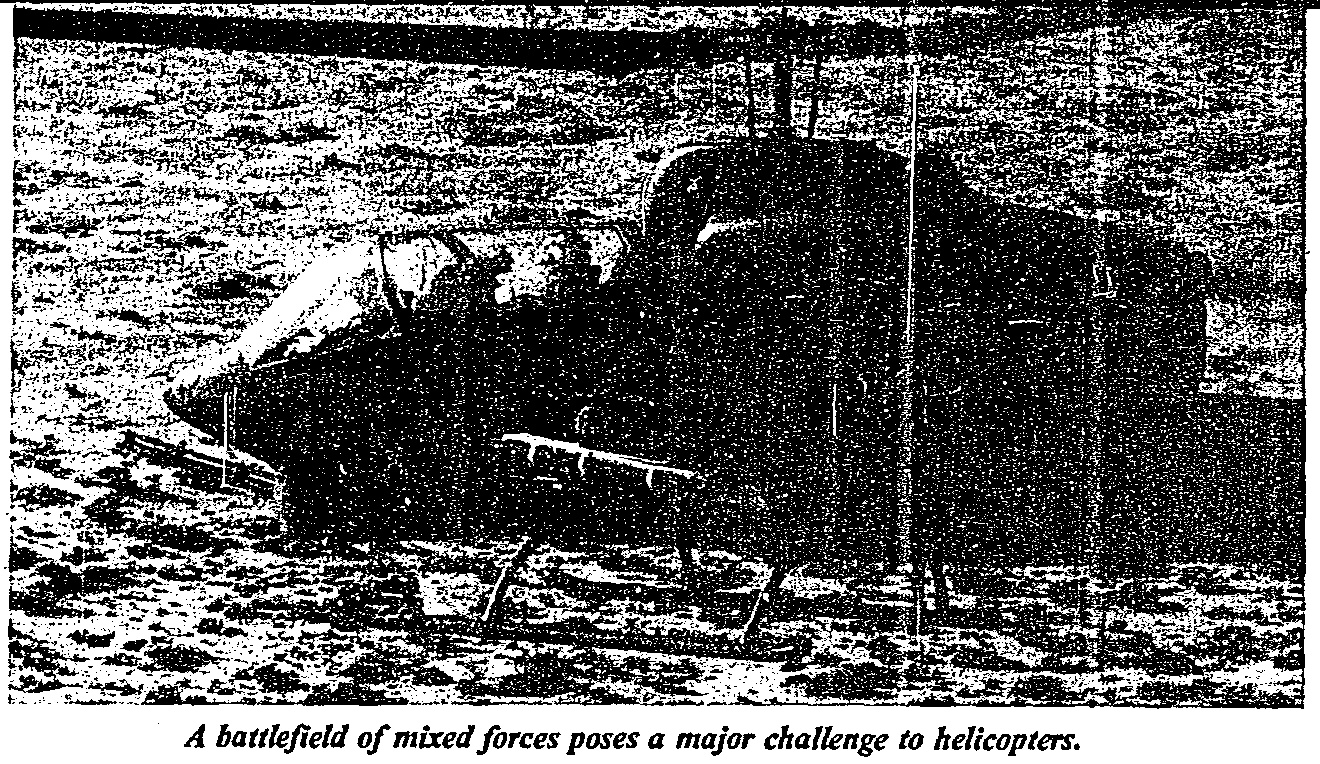
In the classic manner of the TV evangelist glibly quoting Biblical passages out of context to “prove” a point of convenience, Mr. Lind uses the history of warfare to allege that helicopters (and the MV-22) are too “vulnerable” to survive. For illustration, he cites the statistics of Operation DEWEY CANYON II (Lam Son 719), inplying that the helicopter losses were unacceptable and, as a consequence, that the helicopter operations were ineffective. These statistics must be taken in context and circumstance.

Operation DEWEY CANYON II began with the incursion into Laos by Republic of the Army of Vietnam (ARVN) forces (supported by U.S. Army and Marine helicopters) on 8 February 1971 and concluded on 6 April 1971. During that two month period, Army records indicate that 107 helicopters were lost and 618 were damaged. These losses were consistent with the magnitude of the combat encountered; the following numbers are presented for perspective. According to Keith Nolan’s Into Laos the total casualties were: United States-219 killed, 1,149 wounded, and 38 missing; ARVN-1,529 killed, 5,483 wounded, and 625 missing; North Vietnamese Army (NVA)-19,360 killed, unknown wounded, and 57 captured. The NVA also lost 5470 individual weapons; 1,963 crew-served weapons; 93 mortars; 106 tanks; 13 artillery pieces; 11 combat vehicles; 2,001 other vehicles; and 170,346 tons of ammunition.

The success or failure of the operation should not be measured on these statistics, nor should the effectiveness or ineffectiveness of the helicopter support be evaluated solely on the basis of “body counts.”

Let’s examine these helicopter operations in more detail. On the first day seven helicopters were lost Yet by the end of the third day helicopters had been instrumental in the ARVN 1st Infantry Division establishing two fire bases (one held by one battalion and the other by two) in Laos south of Route 9. The ARVN 1st Airborne Division established two fire bases (each held by a battalion). Concurrently, the ARVN 1st Armor Brigade had moved about 10 kilometers into Laos on Route 9.

As the operation progressed some roads were found to be impassable, particularly to Aloui where ARVN forces were totally dependent on aviation for support. Helicopters operating in this area were subject to effective antiaircraft fire every day. This fire was described by author Nolan as:

. . . the worst concentration of fire U.S. aircrews experienced in the Vietnam War, frail Hueys [slicks] going through World War II-style flak barrages. The casualties were high in men and material, but the NVA. never succeeded in halting U.S. Army Aviation support.

In perspective, there were 90,000 U.S. helicopter sorties flown in the two months of Operation DEWEY CANYON II. The aircraft loss to sortie rate was .12 percent Of the 618 damaged helicopters, it is conceivable that some did not return to battle; but it is also a good assumption that many did return to battle and were damaged again, resulting in multiple damage assessments to the same airframe. Those of us personally familiar with helicopter operations in Vietnam undoubtedly remember the bullet hole patches on every helicopter we flew. Despite the fact that almost every helicopter may have been hit during the war, few were damaged severely enough to be totally lost For the sake of argument, even if we presumed total loss of the additional 618 airframes, the aircraft loss to sortie rate in Laos is still less than 1 percent

However, helicopter losses in DEWEY CANYON II must also be evaluated by comparative standards. For example, in the 1973 Arab-Israeli War (October 1973), Israel lost 120, Egypt 182, and Syria 165 aircraft Israel flew 11,233 sorties, Egypt 6,815, and Syria about 3,000. The respective loss to sortie rates were: 1.1 percent, 2.7 percent, and 5.5 percent In short, losses must be viewed in a reasonable perspective and measured against a realistic standard.

Perhaps Mr. Lind’s skewed conclusions result from his confusing vulnerability with the more encompassing term survivability. Survivability on the battlefield consists of at least four aspects, of which vulnerability is one. They are:

* Orientation: The combatant must be aware of his situation in relation to the activities on the battlefield. He must have selected the proper tactics, procedures, and routes commensurate with the mission and the threat he must correctly observe the events of the battlefield and decide his actions accordingly. If he is not correct in his observations, he is disoriented, likely to make bad decisions, and seriously endangered.

* Susceptibility: The combatant must position himself and his forces so that the enemy does not have a probability of successful detection, acquisition, and targeting either by sight, sound, radar, and so forth.

* Defendability: If the combatant is detected, acquired, and targeted, he must be able to respond with some weapon system or evasive action that thwarts the enemy.

* Vulnerability: If fired upon, the combatant must be able to withstand the impact of the weapon and continue his mission. If not, he must at least be able to return to a secure area where he can recover and be committed to combat again. If he is unable to do either, then he does become a combat loss.

The Marine Corps has been effectively working for years to improve our chances for survivability in combat. In Marine aviation major improvements have been made in all four of the areas above. Marine Aviation Weapons and Tactics Squadron 1 was created to make us more familiar with our tactical options on the battlefield, to keep us from being stupid with our choices for tactics, and to train us to be skilled enough to take advantage of all of our options. We have also developed new tactics, practiced masking techniques, increased our speed, improved our night and bad weather capabilities, and enhanced our equipment to reduce our susceptibility to enemy detection. We have introduced a suite of defensive weapons to our aircraft and developed effective evasive tactics to improve defendabilily. Finally, we have introduced equipment improvements, such as frangible fuel fittings, ballistic tolerant structures, and armored panels on critical components that have lessened our vulnerability.

It is certain that Marine aviation contributions will continue to evolve commensurate with the abilities of our MAGTFs to successfully exploit all of its combined arms resources in maneuver oriented combat scenarios. Perhaps even one day well adopt the term “MAGTF Warfare” to express the truly unique warfighting capabilities of the U.S. Marine Corps.

Implementing Enemy Oriented Operations

by LtCol Gary W. Anderson

The regimental commander did not believe that the passage of the river could be forced on that day, and he was eager to carry out the welcome orders and rest . . . . I walked angrily away and tried to decide what measures I should take to improve this unhappy state of affairs. A young Lt Felix came over to where I was standing . . . . “Here, General,” he said, “I’ve just come from the Brahe (river). The enemy forces on the far bank are weak. The Poles tried to set fire to the bridge at Hammermuhle, but I put it out from my tank. The bridge is crossable. The advance has only stopped because there’s no one to lead it. You must go there yourself.

-Heinz Guderian in Panzer Leader

This passage demonstrates a rapid closing of the cycle of recognizing and exploiting enemy mistakes and vulnerabilities (R-E cycle) that is the central concept of enemy–oriented operations, but this raises a key question: Would a Marine lieutenant of the 1980s feel comfortable approaching a commanding general with an idea such as the one proposed in the above passage? In all too many cases, the answer is no, and must be rectified if the Marine Corps is to implement enemy–oriented operations.

The first article in this series (MCG. Apr89) defined enemy–oriented operations; the second (MCG, Jun89) discussed the difficulty of implementing those operations on the modern battlefield. This article will present a plan for implementing enemy–oriented operations in the Marine Corps.

The R-E cycle was relatively easy to execute in the days before radio communications when the commander could both recognize the enemy mistake or vulnerability and give the order to exploit this vulnerability. Today, the commander must work through others to complete the R-E cycle in a timely manner.

Not all victories have been achieved by a deliberate effort to complete the R-E cycle; indeed a majority probably have not. Despite this, a force with a philosophy of implementing the R-E cycle in a timely manner has a much better chance of winning than that of an opponent who lacks a similar mindset. If an enemy is vulnerable to the combat style that we currently define as “maneuver warfare,” we must accept that fact and quickly adopt maneuver warfare tactics. If we find that the enemy does not have an observation-orientation-decision-action cycle worth disrupting, we must key on other enemy mistakes or vulnerabilities.

Creating an Enemy–Oriented Philosophy

In antiquity, the Byzantines came closest to institutionalizing enemy–oriented operations. They ruthlessly analyzed their own vulnerabilities while assessing those of the enemy. Their R-E cycle began with thorough campaign planning and was modified by actual field experience. The mechanisms they used for creating this approach were less important than the philosophy that permeated their system. They used enemy–oriented operations to capitalize on enemy error and vulnerability while minimizing the effects of their own mistakes. The remainder of this article is devoted to suggesting mechanisms by which the Marine Corps can institutionalize enemy–oriented operations over the next few years.

The Warfighting Center. The advent of the Warfighting Center and the current philosophy behind the reinvigoration of Quantico is a superb starting point for the institutionalization of the enemy–oriented operations. By giving Marines a focal point for doctrine, tactics, and lessons learned, the Marine Corps Combat Development Command (MCCDC) will provide an appropriate repository for the overall institutionalization of military excellence. This is particularly important in the area of developing a system for retaining coherent lessens learned from field exercises and actual operations. Such a system is currently being developed at Quantico; this effort should receive the highest priority.

Tactical Contact Teams. Creating tactical contact teams at the Marine expeditionary force (MEF) level would help us learn from experience and institutionalize a solid lesson-learned program. (See MCG, Sep87, pp. 34-35.) These teams would be comprised of the best operators who have recently completed a Fleet Marine Force tour of duty within each MEF. They would observe all major exercises in order to develop coherent and meaningful lessons learned that could be passed on to MEF units as well as to MCCDC for wider distribution. This concept serves a dual purpose of recognizing tactical and operational excellence while letting the most skillful operators teach their craft.

Vulnerability Recognition Cells (VRCs). Each Marine air-ground task force (MAGTF) and its major subordinates should have a VRC in its command element devoted to the quick recognition of key enemy and friendly vulnerabilities. It would meet on an “as needed” basis The cell would be an informal group made up of representatives from the operations, fire support, logistics, communications, and intelligence sections. Its purpose would be to take a look at the vulnerabilities picture using an interdisciplinary approach. This merely formalizes the staff brainstorming that most truly excellent commanders demand, but the formalizing act encourages the good ideas that might otherwise randomly bounce through the command post for lack of focus. At the MAGTF level, these cells should concentrate on the operational art. Lower headquarters cells should look for tactical mistakes.

Some critics have complained that such cells smack of decisionmaking by committee; this is not the case. The only result of the cell’s work should be a recommendation to the commander. He alone makes a decision as to what action, if any, should be taken. The enemy‘s key vulnerability should be our main point of effort (Schwerpunkt, if you prefer), and our decision may well be to shift our primary focus as Grant did when he assumed command of all Union forces in 1864. The primary value of a VRC is that it will continually focus on key weaknesses, friendly as well as enemy. No single staff section can do this alone. Time is the critical factor in the R-E cycle. The VRC is designed to make the completion of the cycle as rapid as possible.

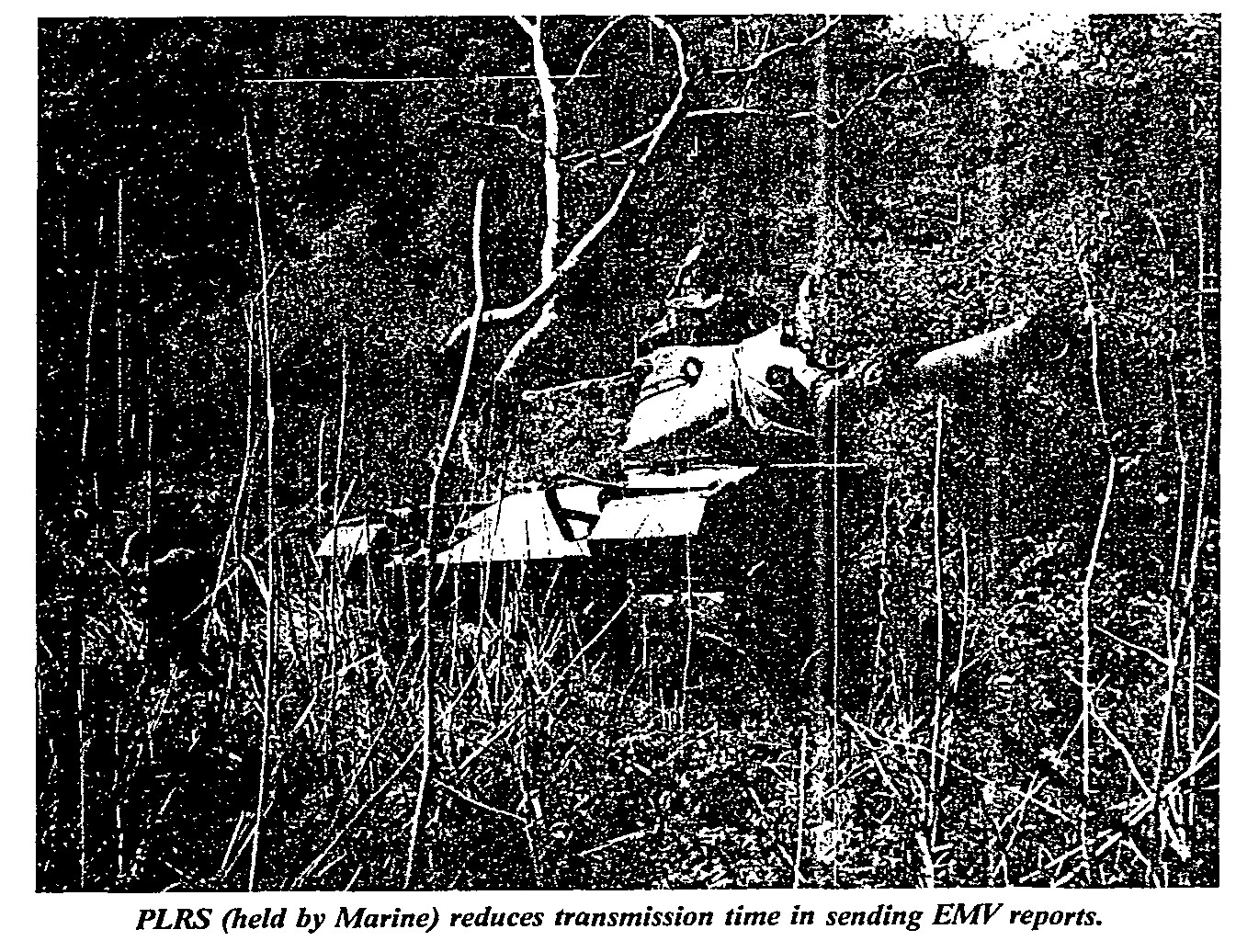
Enemy Mistake/Vulnerability (EMV) Reporting System. The concept of quickly recognizing and exploiting EMVs can be undermined by the miles of space and layers of command between the individual who spots an enemy mistake or vulnerability and the commander capable of exploiting it. Too many good opportunities are lost when the messages reporting EMVs are delayed, garbled, or neglected through many layers of command. What is needed is a reporting system that will be dedicated to spotting EMVs quickly and highlighting them all the all the way up the chain of command.

Figure 1 outlines the proposed EMV reporting system. It is not an intelligence reporting mechanism. The concept is to provide a report that contains an actual evaluation of the opportunity presented by the enemy mistake or vulnerability. Figure 2 contains the suggested report format. It is brevity coded to make it succinct and easy to use. The report is voluntary on the part of the sender, and it stresses judgment on the part of the sender and trust in that judgment on the part of the receiver. It highlights an enemy orientation on all levels of command.

Using the Light Armored Infantry (LAI) Battalion. The LAI battalion is a natural tool for creating an enemy–oriented mindset. George Patton was an advocate of the thought process that holds that the best way to get to know an enemy is to fight him. Used properly, the LAI battalion will be the first unit to make physical contact with the enemy. If the battalions are used at a proper distance from the friendly forward line of troops (a minimum of 25 kilometers), the LAI battalion will have time to develop knowledge of how the enemy fights and how well the preconceived notions of him hold up under combat experience.

An EMV report from an LAI battalion commander would not be a mere recon report. It would represent an operational judgment by a commander who has engaged the enemy. The LAI commander will have a feel for how cautious or aggressive the enemy is as well as how the enemy reacts to our use of supporting arms. These can be key observations early in the battle.

Needed: A New Attitude. Enemy–oriented operations represent a philosophy of war. The mere adoption of the mechanisms outlined in the article will not guarantee the successful implementation of this philosophy. Trust is key here. Subordinate commanders must act as the eyes of their seniors. This requires an extraordinary trust between superiors and subordinates. We must rid ourselves of the excess psychological limitations imposed by the zero defects mentality and the selfsyndrome. This will be far easier said than done; a generation of officers and staff noncommissioned officers have grown up burdened by this unneeded and unwanted baggage. These twin evils can be likened to malignant tumors; you can grow used to such things even while they are killing you. Enemy–oriented operations can cure what ails us, but we will need radical surgery first.

The Panzer troops of Guderiah’s 1939 German army had a philosophy of trust. They lacked a systematic approach for reporting good opportunities quickly. That is why Lt Felix had to seek out Gen Guderian. A system is easy to build, but mutual trust is much harder. Both are desperately needed.

Airpower on the Maneuver Battlefield

by Capt Richard A. Menton

2d Place, 1989 MCG Professional Writing Award

Since the inception of maneuver warfare, the aviation community has been accused of having little interest in the art of war and little understanding of how to employ airpower on the maneuver battlefield. Having long been regarded as a supporting arm, Marine aviation seems content to accept this subordinate role. Its focus supposedly has been on sorties flown and tonnage dropped, on ensuring that support is provided at the time and place requested. Operational employment of aviation, striking directly at an enemy’s strategic center of gravity, has never been a significant concern.

The proponents of maneuver warfare maintain that this focus must change, that aviation must be prepared to play an expanded role as a separate maneuver element The basic principles of maneuver warfare-the use of mission type orders, focus of effort, and throwing strength against weakness-are as important to aviation as to the ground. Unless aviation elements can fulfill this broader role, our Marine air-ground task forces will never realize their full potential.

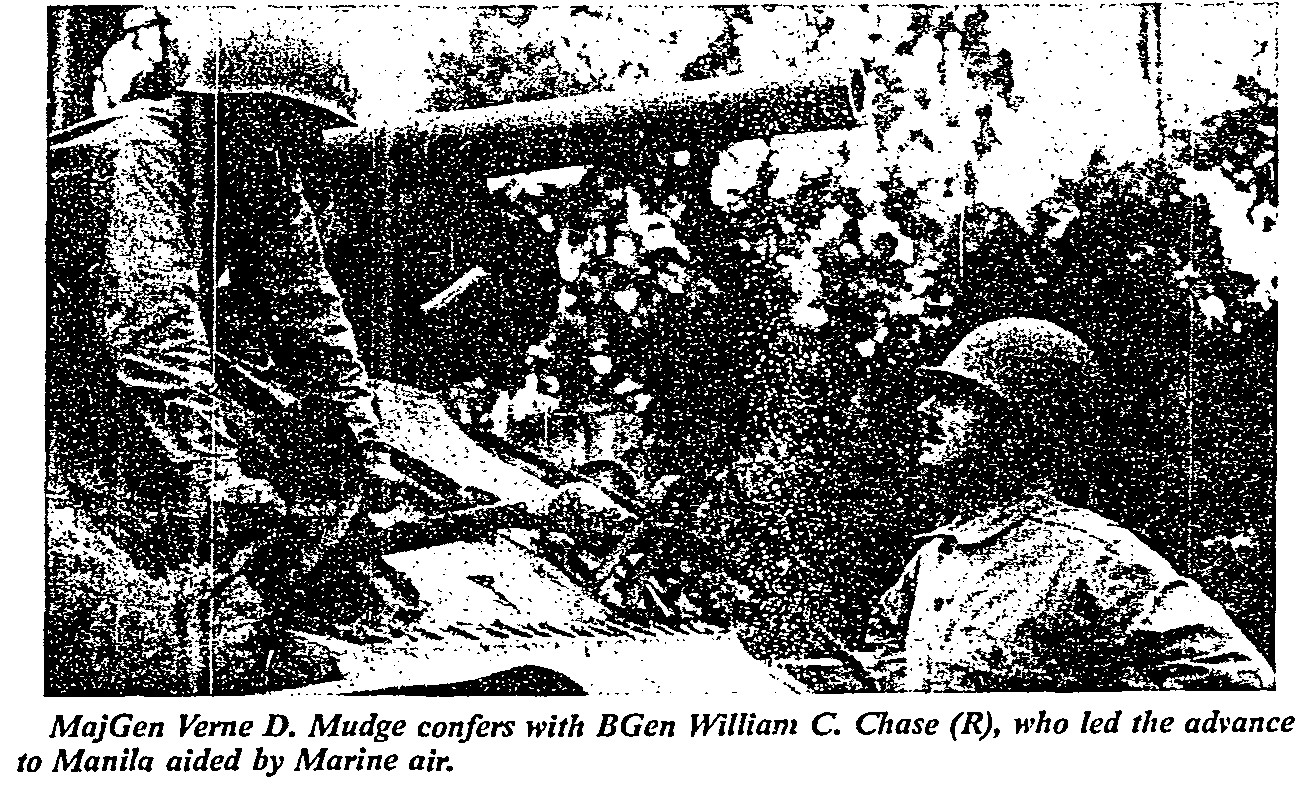
But this concept is not as new and Marine aviation is not as backward as the maneuverists allege. One of the best examples of use of the airpower as a maneuver force occurred in the Philippines during World War II. On 30 January 1945, the 1st Cavalry Division under MajGen Nerme D. Mudge, USA, was ordered by the 6th Army to race to Manila. MajGen Mudge received his orders directly from Gen MacArthur:

. . . go to Manila. Go around the Nips, bounce off the Nips, but go to Manila. Free the internees at Santo Tomas. Take Malacanan Palace and the Legislative Buildings.

Marine Air Groups Dagupan (MAGs Dagupan), consisting of MAGs 24 and 32, was ordered to “provide an air alert of nine planes from dawn to dusk over the 1st Cavalry Division.” Implied in this order was the requirement to guard the division’s open left flank.

From the start of the operation at Guimba to its conclusion at the outskirts of Manila, the nine planes continuously patrolled up and down the valley, searching every road and trail for the enemy. Because of the commander’s intended speedy execution and avoidance of decisive engagements, the MAGsDagupan aircraft would search for and recommend alternate routes when points of friction were encountered. This successful use of Marine air was described by the 1st Cavalry Division’s official historian:

Much of the success of the entire movement is credited to the superb air cover, flank protection and reconnaissance provided by Marine Aircraft Groups 24 and 32. The 1st Cavalry’s audacious drive down through Central Luzon was the longest such operation ever made in the Southwestern Pacific area using only air cover for flank protection.

There are many lessons that can be learned from study of this operation; however, the techniques for employing an aviation unit as a separate maneuver element can be understood best by applying a modern force to the situation that occurred in 1945:

Assume that an opposing army consisting of light infantry and light armored divisions has been defending along a line running from Tarlac to Cabanatuan in Central Luzon. The United States Commander Western Command (CdrWestCom) has determined that the enemy’s strategic center of gravity is the city of Manila. He has ordered a two-pronged assault to seize the accesses to this city. The main effort will be the 1st Marine Expeditionary Brigade (1st MEB) along the Cabanatuan-Baliuag axis of advance with the 25th Light Infantry Division supporting the right flank with an attack along the Tarlac-San Fernando axis.

The commanding general of 1st MEB intends to advance rapidly through his zone, bypassing the enemy whenever possible. His weakest area is his open left flank. He plans to overcome this weakness by using aviation combat element assets to cover this open flank.

MAG-24 has been tasked to provide the 3d Marines with close air support and has been assigned the eastern (left) half of 1st MEB’s zone. This sector has been further assigned to Marine Fighter Attack Squadron 232 (VMEA-232), which is equipped with F/A-18s. VMFA-232 has been ordered to seek out and locate enemy units within its zone of action in order to protect the 3d Marines’ left flank by delaying, disrupting, and destroying enemy reinforcements.

VMFA-232 has been reinforced with four A-6Es, four AH-1Ws, and two OV-10Ds. In addition, they have been provided with artillery and naval gunfire liaison teams and access to force reconnaissance teams in their zone. These teams will provide additional intelligence gathering and fire support coordination capabilities to the squadron.

The squadron’s first task is to develop the situation by conducting an intelligence estimate and analysis of the assigned zone of action to determine possible enemy avenues of approach into and out of the zone. From this information the reconnaissance plan, covering employment of ground and air surveillance assets, is developed.

The next requirement is to gain and maintain contact by using armed reconnaissance flights. Two aircraft, one A-6 and one F/A-18, are assigned to patrol each avenue of approach. The A-6 uses active or passive measures to locate the enemy. Once the enemy force is located, the A-6 launches precision guided ordnance to mark the forward edge of the enemy column or position. The F/A-18 follows the flight of this ordnance to locate the target, attacking it visually with conventional area ordnance, such as Rockeye or iron bombs. While this attack occurs, the location, composition, and direction of travel of the enemy force are reported to the squadron commander. After this initial attack, the flight would shadow and disrupt the enemy until relieved by an airborne tactical air controller (TAC(A)) in an OV-10. If the first unit to locate the enemy is a ground reconnaissance team, this unit directs the armed reconnaissance flight assigned to that particular avenue of approach onto the enemy, using artillery or naval gunfire to delay and harass the targeted force.

The final task is to concentrate superior combat power at the decisive time and place. When the squadron commander decides to concentrate his combat power, he will employ a strike force of four or more aircraft Directed by the TAC(A), this strike force is assigned the mission of halting the advance of the enemy. The exact size of this force depends on the number of avenues of approach to be covered and the size of the reserve desired. In this situation, there are 12 F/A-18s and 4 A-6s available to cover 2 avenues of approach. The squadron commander uses two sections (two F/A-18s and two A-6s) to cover the possible approach corridors, one section for each corridor. In order to maintain continuous coverage of these corridors, two additional sections are needed. As one section is relieved, the other refuels and rearms. This leaves a maximum of eight planes for the strike force. Assuming all planes are operable, the remaining aircraft could be divided into one eight-plane or two fourplane strike forces. If additional aircraft are needed, the armed reconnaissance flights are diverted from their assigned areas to attack the located enemy unit The result desired is continuous pressure on the enemy forces until they are unable to affect the mission of the main effort being carried out by the 3d Marines. Between strikes, the TAC(A) directs artillery or naval gunfire to slow the enemy’s movement.

Some other factors to consider when employing this aviation maneuver element are antiair warfare, use of attack helicopters, and command and control:

* The F/A-18 is used in a dual air-to-air, air-to-ground role. In the armed reconnaissance flights the A-6 would be responsible for locating the enemy, and the F/A-18 would be responsible for air-to-air protection until transitioning to ground attack (a better mix would be F/A-18 and F/A-18D aircraft when they become available). If a high surface-to-air threat exists, additional electronic warfare and suppression of enemy air defense (SEAD) assets would be required from MAG-24.

* Attack helicopters are assigned one of two possible missions: to block and observe chokepoints or to set up ambushes along one or more of the avenues of approach.

* Command and control is performed at the lowest level possible. The commander maintains situational awareness by using a single tactical net and situation maps or the more complicated Marine air control squadron’s radar system. The squadron commander has direct command of his assigned zone of action reporting developments directly to the commanding general of the 1st MEB. When the TAC(A) is dispatched, he assumes control of the local situation.

This example illustrates only one way to use airpower on the maneuver battlefield. This concept, however, meets all the fundamentals of employment of air in maneuver warfare: that airpower supports the ground commander’s scheme of maneuver; that it directly or indirectly supports the focus of main effort; that it shifts when the main effort shifts; and that it is able to give support beyond the range of the ground commander’s vision.

Anyone familiar with the employment of the air combat element of the Marine air-ground task force should realize that this method is not new. They would probably also conclude that this technique has already been applied during past training operations. What I suggest, however, is that Marines must consciously look at the use of airpower from a different perspective. Rather than think of aviation as just another supporting arm, they must consider the aviation combat element as a separate maneuver unit, and describe its employment in infantry, not aviation, terminology. I have not mentioned air tasking orders, mission planning, or target analysis; instead, I have discussed mission, commander’s intent, and zones of action. The answer to the question of employing aviation on the maneuver battlefield is not to develop new tactics or procedures, but is to treat the air element as a highly fluid, quickly massed maneuver arm. Although Marine aviation cannot hold the key terrain, it can locate, close with, and destroy the enemy.

The Role of Marine Aviation in Maneuver Warfare

by Maj John B. Saxman, USAF

Cowinner 1989 Bevan G. Cass Award

The survival of the Marine air-ground task force (MAGTF) is in jeopardy. Military reformers, such as William S. Lind, are advocating, in the guise of promoting maneuver warfare, that the Marine Corps should eliminate its helicopter, reconnaissance, air superiority, and all-weather interdiction aircraft and replace them with the modern day equivalent of the Stuka divebomber. These reformers believe the only role for the air combat element (ACE) in maneuver warfare is to supplement the lack of organic firepower in the ground combat element (GCE). If Marine aviation is relegated to this role, then the Marine Corps is no longer fighting as a MAGTF but merely as a ground combat unit with very expensive airborne artillery. A Marine Corps without its own multipurpose ACE would not be significantly different than any other light, mobile ground force. The MAGTF is unique because it is the only single-Service task force that can combine a GCE and ACE into a highly mobile, rapidly deployable combined arms team. However, some military reformers, along with some Marines, fail to see the advantages of using the ACE as an independent maneuver unit. In order to truly employ the tenets of maneuver warfare, the ACE must operate as an independent maneuver unit synchronized with, not subjugated to, the operations of the GCE.

The Marine Corps’ decision on how it will employ its aviation has widespread implications for the other Services. If the Marine Corps elects to restructure its ACE to emphasize only close air support (CAS), then the Air Force and Navy will have to provide the Marine GCE with all the other ground support missions (reconnaissance, antiair warfare, deep air support, and electronic warfare).

When the Army Air Force first struggled with the difficult question of how to best employ its airpower, it was fortunate to have an influential and visionary leader to give it guidance. As the Marine Corps now ponders a similar question, it unfortunately is receiving its advice from a “Billy” Lind, not a Billy Mitchell. William S. Lind needs no introduction to members of the Marine Corps. He is a controversial figure who Marines seem to either like or despise. He has significant influence with the Marine Corps and access to some of its senior leadership. While a few might regard his effort to promote maneuver warfare as little more than expanding the Marine Corps’ vocabulary of German phrases, many would grant him considerable credit for influencing the Marine Corps to adopt maneuver warfare as its official doctrine. In his book Maneuver Warfare Handbook, he describes how the ground combat element should fight using maneuver doctrine. While this book was relatively well received by the members of the GCE, aviators are finding the ideas expressed in his recent article “Maneuver Warfare and Marine Aviation” (MCG, May89) questionable at best. Although numerous people have expressed their opinion on the role of the ACE in maneuver warfare, none are as influential, have developed their ideas as extensively, or have put as much effort into reforming the Marine Corps as Mr. Lind. Therefore, his article could be considered as the “center of gravity” of the reform movement’s position on aviation. Exposing the fallacies of his maneuver warfare concepts concerning Marine aviation doctrine, command and control, education, missions, and equipment is the Schwerpunkt (main effort) of this paper.

Doctrine

Doctrine is the glue that holds everything together. It determines the command and control, education, missions, and equipment a Service needs. Therefore, doctrine must be sufficiently encompassing to cover all situations under which the Service may be called to fight. The main problem with Mr. Lind’s doctrinal concept of maneuver warfare is that he tends to focus on the tactical level of war and emphasize winning battles, rather than focus on the operational and strategic levels and emphasize winning wars. Not only does he focus on battle, but he discounts the impact that air and naval forces can have on a conflict:

. . . when we speak of an air focus of efforts, we are not saying that air is the focus for the MAGTF. There has been some misunderstanding on this point Because in almost all situations it is the ground battle that is decisive, all efforts of the MAGTF are focused on the ground battle. As noted above, the air focus of efforts is the answer to the question, “What can air do that no other arm can do that will have a decisive effect on the ground battle?” In other words, the air supports the ground, at least the majority of the time. There may be some situations where an action by aviation would be the focus of the MAGTFs efforts, i.e., where air would be looked to for a decision. One case where this may occur is in the phase of an amphibious landing before the troops come ashore. But once ground combat is joined, history suggests air will seldom, if ever, be the MAGTFs focus of effort. The history of attempts to achieve decisions by air alone is one of repeated failures.

While history might show that air alone has often failed to achieve decisions in battle, it also shows that ground combat alone has not won many wars. The war in the Pacific during World War II provides an excellent strategic example. Did the United States win the war in the Pacific because of the island-hopping battles fought by the Army and Marines, the Navy’s control of the sea lines of communication, or the Air Force’s bombardment of the Japanese mainland? What was the Schwerpunkt or focus of efforts in this example? Was it land, sea, or air forces? Obviously, the point of effort changed from one force to another throughout the campaign. None of the forces individually won the war. All made unique and essential contributions to the overall effort.

The campaign in Italy during World War II illustrates this idea at the operational level of war. Allied ground forces were stagnated at the Gustav line. Even though enough dedicated fighter and bomber CAS was provided to reduce the town of Cassino to rubble, the ground combat units could not win the tactical battle and advance. Allied airpower’s independent interdiction campaign, code-named OPERATION STRANGLE, was equally ineffective. Only after the Allies viewed the problem from the operational level did they finally realize how to overcome the Germans. The solution, an operation code-named DIADEM, called for a synchronized combined air and ground offensive. While the Allied ground units waged a renewed attack and increased the German’s need for resupply and mobility, Allied air forces interdicted the railroads and highways needed to get the supplies and reserves to the front. The Germans now faced an unsolvable dilemma. Allied destruction of the rail system forced them to devote much of their motor transportation to moving supplies. This drawdown of their motor transport assets, combined with an increased battlefield air interdiction (BAI) effort, degraded their tactical mobility at the time they needed it most. Unable to wage an effective, flexible defense, the Germans were forced to withdraw from their long-held positions.*

This example provides several excellent points. In this situation, no amount of Allied CAS was enough to help ground combat forces win the tactical battle. Likewise, an independent air interdiction operation was also unsuccessful. It took a synchronized air and ground effort at the operational, not tactical, level to eventually achieve a decision. The final point worth pondering in this example is “What was the focus of efforts?” Was it the ground maneuver unit that increased the enemy’s need for supply and mobility or was it the air maneuver unit that destroyed the enemy’s supplies and reserves?

The preceding two examples demonstrated how air, land, and sea forces can work together at the strategic and operational levels to achieve a decision. The 1973 Arab-Israeli War provides a tactical example of a ground maneuver unit conducting operations solely to support the air maneuver unit. The operation was code-named GAZELLE. The Israeli Air Force (IAF) could not adequately operate as a combined arms team with the ground combat unit because the Egyptian air defense belt was, for all practical purposes, impenetrable by air. To overcome this dilemma, the Israeli ground forces attacked the surface-to-air missile (SAM) sites, destroyed 10 of them, and eventually established a safe corridor through the air defenses for the IAF. This gave the IAF the maneuver room it needed to destroy 53 of the remaining 61 SAM sites. With the SAM threat reduced, the Israeli combined arms team went on to completely surround the Egyptian Third Army and cut it off from its source of supply.

These three examples demonstrate the need for doctrine to be applicable at the strategic and operational levels as well as the tactical level. Mr. Lind’s emphasis on maneuver warfare at the tactical level overlooks the fact that a nation must be decisive at the operational and strategic levels in order to win a war. His belief that the ground combat unit is almost always the focus of effort can lead to command and control, education, mission, and equipment decisions that fail to take advantage of the unique air and sea capabilities of our forces.

Command and Control

As all the examples point out, synchronization of forces is the key to winning at any level of war. An effective command and control system is the key to synchronization. In “Maneuver Warfare and Marine Aviation,” Mr. Lind’s discussion of command and control focuses on how to make CAS more responsive. Once again, his emphasis on the tactical level of war causes him to overlook the most important points. The real issue for maneuver warfare command and control is synchronizing the available air, land, and sea forces to best help the MAGTF, joint task force (JTF), or theater commander achieve his objective. In an ideal situation, maneuver warfare emphasis would begin at the top. The overall commander would devise a campaign plan for his theater of operations that would identify the enemy’s center of gravity. He would then designate his main effort. The air, land, and sea forces within his command would all develop proposed courses of action that would support the effort The commander would consider these courses of action and formulate his concept of operations. His concept would take advantage of the unique contributions of each force and synchronize their efforts into an effective campaign. Traditionally, the Marine Corps has not operated this way, nor supported this type operation when serving as a subordinate unit to a JTF or theater commander.

When operating as an independent task force, the MAGTF frequently fails to treat its ACE as a separate maneuver unit and relegates it to a support role. Although the titles and the organizational chart lead you to believe the MAGTF consists of two combat elements and a support element (Figure 1), practice dictates otherwise. During a recent debrief of a MAGTF exercise at the Marine Corps Command and Staff College, a student who had served on the ACE staff put up a slide (Figure 2) showing “how it really worked in the exercise and how it often works in the real world”:

The major problem in the relationship between the ACE and GCE in the MAGTF is that the GCE tends to drive the whole MAGTF. Although the official organizational chart depicts the ACE and GCE to be coequal combat elements, other Marine Corps publications better explain the true relationship. FMFM 0-1, Marine AirGround Task Force Doctrine states that only the GCE is responsible for developing courses of action for the MAGTF commander’s approval. The primary role of the ACE and the combat service support element (CSSE) during the formulation of courses of action is to determine if they can support them. Although the ACE commander is responsible for formulating the antiair warfare concept of operations, it is the GCE commander who proposes to the MAGTF commander how the remaining aviation sorties should be apportioned and allocated. The GCE commander is responsible for selecting the interdiction targets and determining when, where, and how much CAS will be used. If the Marine Corps truly considers aviation to be a “combat element,” then the ACE should be responsible for proposing courses of action and recommending the interdiction and CAS, as well as the antiair warfare, concepts of operation to the MAGTF commander.

The Marine Corps’ view of aviation as only a supporting arm, not an independent combat element, becomes very obvious when the MAGTF is employed subordinate to a JTF or theater commander. Marines traditionally have viewed any attempt by the JTF or theater air component commander to use Marine air for missions other than direct support of the Marine GCE as bordering on treason. Even though the Commandant of the Marine Corps has issued a White Letter to the contrary, most Marines still consider the air-ground team to be indivisible. The Korean and Vietnam Wars provided examples of this problem. While there are many excellent reasons to keep the MAGTF fighting as a team, there will be times when supporting the main effort will dictate the Marine Corps’ ACE performing independent missions. While Marine leadership now seems to understand this problem, many Marine Corps officers remain unconvinced. The solution to changing this prevailing attitude is to better educate the officers responsible for making command and control decisions.

Education

Mr. Lind’s concept to improve maneuver warfare education in the Marine Corps focuses on making aviators more knowledgeable of ground combat. If the curriculum at the Marine Corps Command and Staff College is representative of the amount of aviation related instruction given at the other Marine Corps schools, then the problem is not the aviator’s lack of knowledge of ground combat operations but rather the ground officer’s lack of exposure to aviation. During the 1988-89 school year, the Command and Staff College had only one, three-day exercise that emphasized the employment of airpower. This limited exposure to aviation presents problems from the top to the bottom of the command and control system. The majority of MAGTF commanders are ground, not aviation, officers. Some have little concept of what aviation can and cannot do or how it should be employed. In the absence of a strong ACE commander, they are likely to squander their aviation resources. Even if the MAGTF commander is an aviator, it is the GCE commander who makes the preponderance of critical aviation decisions. He is responsible for formulating the concept of operations for interdiction and CAS.

Even the officers at the very bottom of the chain of command must understand the capabilities of Marine aviation. The platoon leader requesting CAS needs to know what targets are appropriate for air and which are better served by artillery or direct fire weapons. He must also understand aviation weapon effects and capabilities.

In all these cases, it is the ground officer who has the ultimate decision of when, where, and how air is used, not the aviator. Therefore, it is more essential for the ground officer to understand the employment of air than for the aviator to understand ground combat.

The Marine Corps education system should also make the GCE and ACE more aware of the fact that they both view the battlefield from a different perspective. The GCE is constrained by the realities of geography that limit its speed and mobility. Even though maneuver warfare doctrine emphasizes a larger area of influence and interest than previous doctrine, Marines on the ground tend to be interested only in their immediate tactical situation. The ACE, on the other hand, operates on a battlefield basically unrestricted by geography. The ACE can more readily see the battle on the operational, as well as the tactical, level. The ACE has the mobility to influence the battlefield from well behind friendly lines to hundreds of miles into the enemy’s rear area. Because of these different views and areas of influence, the ACE and the GCE may quite often disagree on how to fight the battle. While this disparity is useful in generating a variety of courses of action (and an excellent reason to include the ACE in the process), it will also create considerable conflict in the MAGTF. A MAGTF that is aware of the problem and made up of officers well educated in the capabilities and limitations of all the elements of the MAGTF will be better prepared to make the right decisions on how to fight the war. They will also be better prepared to decide what aviation missions will best contribute to the main effort.

Missions

Marine aviation provides six tactical functions for the Marine Corps: antiair warfare, offensive air support, reconnaissance, assault support, electronic warfare, and control of aircraft and missiles. In “Maneuver Warfare and Marine Aviation,” Mr. Lind challenges many of the traditional thoughts on how, why, when, and by whom these functions should be accomplished. His ideas concerning antiair warfare and offensive air support are quite controversial and deserve individual discussion.

Mr. Lind uses the term air superiority to describe the mission the Marine Corps calls antiair warfare. Mr. Lind sees aviation‘s efforts to gain control of the air as “a private battle with the enemy air force” and questions the wisdom of current Marine doctrine that directs the antiair effort to be the priority mission for the ACE:

. . . Usually, we are told that we must win air superiority before we can do much ground support . . . . it comes first

Maneuver warfare challenges this dictum on two counts. First, the purpose of aviation is to help achieve a decision on the ground. Therefore, the ground situation, not some abstract rule, determines the priority of air-to-air compared to air-to-ground missions . . . .

Second, enemy air may not be a significant threat to our ground forces . . .

Three points must be made here. First of all, it is surprising that Mr. Lind, who developed his concept of maneuver warfare by studying the German blitzkrieg in World War II, would come to the conclusion that achieving air superiority is not a fundamental part of maneuver warfare. Germany’s major offensives into Poland and Russia both began with an extensive air superiority campaign.

Second, giving priority to air superiority is hardly an abstract rule. History has repeatedly demonstrated the consequences of ignoring it Commanders have occasionally found themselves in such dire defensive situations that they had no choice but to fly air-to-ground missions before they gained air superiority. The results have been devastating.

The Israeli Defense Force (IDF) found itself in such a position at the outbreak of the 1973 war. The Arabs surprised the Israelis by attacking on the brink of both a Moslem and Jewish holiday. The Syrians and Egyptians waged a simultaneous attack on two fronts that left the IDF in a critical situation. On the Golan Heights, the Syrian Army massed 700 tanks and 7,000 men against an IDF consisting of less than 180 tanks. Before the IAF could conduct an offensive antiair warfare campaign, they were forced into action to save the outnumbered ground forces from being overrun. The IDF called on the massive use of CAS to turn the tide of the battle. With the support of air, the ground forces were able to eventually halt the Syrian advance, but the losses to the IAF were overwhelming. In the first day of fighting in the Golan Heights, the IAF lost 40 aircraft, 38 percent of the total number of aircraft lost in the war.

Third, although enemy air may not pose a threat to the ground force, it may still pose a threat to the ACE or CSSE and must be neutralized. Mr. Lind eventually draws the same conclusion.

In summary, the commander must determine in each situation what priority to give air superioriity. As a general rule it should come first, but the operational situation may dictate otherwise. The commander must understand the consequences of attempting to perform other ground support missions without first gaining control of the air.

Mr. Lind’s concept of air-to-ground support is the other major Marine aviation functional area that deserves discussion. The Marine Corps uses the term offensive air support to describe its air-to-ground missions. It recognizes two different types of missions, deep air support (interdiction) and close air support. Mr. Lind divides air-to-ground support missions into three different types: interdiction, armed reconnaissance, and close air support His thoughts on interdiction are summed by the following quotations:

In general, attacking fixed targets-lines of communication, rail yards, supply dumps, etc.-does not have much effect on the enemy’s ability to fight effectively . . . .

Attacking fixed targets-interdiction bombing-has a long history of failure . . . .

Other historical examples suggest that attacking some kinds of fixed targets, such as bridges, can be effective when integrated with the ground situation . . . .

In general, attacks on enemy units are what count . . . .

Eliminating air superiority and interdiction missions from the Marine Corps would destroy the concept of the MAGTF. A MAGTF that doesn’t have the capability to perform air superiority or interdiction missions can hardly be described as an “air-ground” task force.

The air-to-ground missions that Mr. Lind does champion are CAS and armed reconnaissance (AR). Both of these missions require close coordination with the GCE because they are flown in areas where troops are in contact with the enemy. The missions are similar except CAS requires someone, either on the ground or in the air, to identify the target. During an armed reconnaissance mission, the pilot is on his own to visually detect, identify, and then attack his target.

Mr. Lind’s proposal to make CAS and AR the primary maneuver warfare aviation missions is neither historically supportable nor applicable to today’s modern battlefield. Mr. Lind frequently cites the success of Hans Ulrich Rudel, a German Stuka pilot on the Eastern Front, to demonstrate how effectively air and ground forces can work together. However, today’s modern battlefield is considerably different than the one Hans Rudel found himself fighting above in his JU-87 Stuka divebomber. Rudel’s primary threat came from antiaircraft flak guns, a threat he could generally visually locate and avoid. Today his Stuka dive-bomber, or any other aircraft that continually exposed itself to the vast array of air defense weapons possessed by a modern ground force, would have little chance to survive.

Technology has changed not only the lethality of the battlefield, but also increased the capability of today’s warriors to fight around the clock, in any weather. The two missions that Mr. Lind stakes the future of Marine aviation on, CAS and AR, are the only two ground support missions that can’t be accomplished at night or in the weather. Mr. Lind points out that it is exceedingly difficult to find and identify enemy units at night and in bad weather on an intermixed battlefield. This doesn’t prevent aviation from flying missions against units that aren’t intermixed on the battlefield.

If the ground forces have the potential for night/weather operations, so must aviation. Today’s aircraft have the technology to do the job. Our potential adversaries do not. It would be foolish not to exploit this advantage. The best solution for the Marine Corps is to retain its capability to perform all ground support missions as well as expanding its ability for night/weather operations.

The Marine Corps should also incorporate in its doctrine a mission that is targeted against the forces immediately to the rear of the main battle area. This mission, unlike Mr. Lind’s armed reconnaissance, would not be dependent on good weather or daylight. Rather than sending a pilot out to roam the battlefield and visually acquire, identify, and attack targets, the Marine Corps should structure its mission to be similar to a U.S. Air Force’s battlefield air interdiction mission.

BAI is a form of interdiction that is integrated with the GCE’s scheme of maneuver in order to synchronize its effect. It is targeted against enemy mobile concentrations that are far enough from the friendly troops in contact to not require visual friend or foe target identification. BAI is designed to destroy the enemy’s reserves, mobility, and fire support. It is accomplished close enough to the main battle area to have a near-term effect on the GCE’s tactical situation. BAI relies on procedural control to identify friend from foe. A flight of aircraft is given a designated target area in which it may attack any targets that it finds. Reconnaissance aircraft, ground recon units, or other strike flights can all be used to determine which target areas contain appropriate targets. In the future, the Air Force’s joint surveillance and target attack radar system (JSTARS) will have the capability to provide this information at night and in the weather.

There are considerable benefits to flying BAI as opposed to Mr. Lind’s armed reconnaissance. The most significant is that the pilot does not have to expose himself to the threat for an extended period of time attempting to determine if his target is friend or foe. If it is in his target area, it is a threat BAI is planned against enemy units that have not yet become intermixed with friendlies or dispersed into their attack formations. These concentrated threats are vulnerable to area munitions. The pilot can make one pass, limit his exposure, yet retain a high probability of destroying multiple threats. When threats are intermixed with friendlies, or if they are dispersed on the battlefield, pilots are forced to use precision guided or point and shoot weapons. These weapons require an individual pass for each target and greatly increase the pilot’s exposure to the threat.

BAI also has benefits over the other ground support missions. Unlike interdiction, BAI can have a near-term effect on the battle. Its procedural control measures require continual coordination with the GCE. While this sounds restrictive, it actually forces the air and ground to synchronize their efforts. From a pilot’s point of view, it is a better mission than CAS. He can prestudy his target areas and execute his own tactics. Unlike CAS, BAI requires much less command and control and no communication in the target area. Finally, the pilot can better mass his forces and create force packages that can help him penetrate the enemy’s defenses.

The biggest advantage of BAI compared to armed reconnaissance is that the Marine Corps doesn’t have to change any of its equipment to incorporate this mission into its maneuver warfare concept. Mr. Lind, however, suggests a brand new aircraft to execute his concept of aviation maneuver warfare.

Equipment

Mr. Lind advocates giving up the Marine Corps’ all-weather interdiction and air superiority aircraft. In their place he proposes a ground support aircraft with the following characteristics:

-slow speed with good agility

-inexpensive so it can be bought in quantity

-capable of only day, below-the-weather operations

-vertical or short takeoff and landing (V/STOL) capability

-highly accurate weapons delivery while “jinking”

-able to absorb a lot of hits

-small signature

-primary weapon would be a large caliber gun

This type aircraft would have some major drawbacks. It could not perform any missions other than armed reconnaissance or close air support The flexibility that comes from a multimission aircraft like the F/A-18 would not exist in the Marine Corps. Although the use of V/STOL aircraft operating from expeditionary fields and moving with the GCE is a desirable concept, the supply problems have yet to be worked out. The AV-8B’s former program manager, Col Lewis C. Watt, acknowledged the situation in an interview last fall when he said, “The problem with forward basing of the Harrier has been getting adequate logistical support to the aircraft at its remote site.” Any V/STOL aircraft that attempts to move with the advancing forces will tend to restrict the mobility of the GCE. The GCE will have a much larger supply train to move and a larger rear area to protect. The net result could be less mobility on the maneuver battlefield.

Many reformers maintain that large quantities of simple aircraft acquired at low cost yield more capability for the dollar than a smaller number of highly capable, expensive aircraft. Mr. Lind made this argument six years ago when he proposed the Air Force buy lots of simple fighter aircraft instead of a smaller number of expensive, but much more capable, F-15 aircraft Unfortunately, large numbers of inexpensive aircraft require large numbers of expensive people to fly, maintain, support, and provide all the other infrastructure needed to conduct aviation operations. The net result is a significant loss in capability for a very small unit savings in cost In addition, the aircraft Mr. Lind describes for the Marine Corps is really not a simple, low technology aircraft he wants V/STOL capability and the ability to deliver weapons accurately while “jinking,” something even our most advanced aircraft currently cannot do.

Mr. Lind believes that “jinking” about the battlefield will allow the pilot to defeat the threat, which he identifies as primarily small caliber automatic weapons, not radar-guided antiaircraft artillery and SAMs. If Mr. Lind had done more research, he would have found that although jinking decreases an aircraft’s chance of being hit by radar guided weapons, it actually increases its exposure to barrage-type fire such as from automatic weapons. Speed and minimum exposure, not jinking, are the key to survival against this type of threat Finally, a pilot that is seriously jinking will have little ability to see, let alone identify and destroy targets.

The Marine Corps doesn’t need to change its present mix of equipment to be effective on the maneuver battlefield. It just needs to employ its current equipment where it is best suited. Fixed-wing aircraft should concentrate on air superiority, interdiction, BAI, and to a lesser degree CAS. Armed reconnaissance missions and modern day Stukas have no place in today’s Marine Corps.

With these thoughts in mind, what is the role of Marine aviation in maneuver warfare? Marine aviation‘s role is to provide the task force or theater commander with a maneuver unit with capabilities that are distinct from his naval and ground forces. Marine aviation must be able to operate independently of the GCE to gain a decision or to work in synchronization with it to support the GCE’s efforts. To fulfill this role, Marine aviation must be guided by doctrine that is applicable on the strategic and operational levels as well as the tactical level of war. Its command and control system must take into account the unique capabilities of aviation. The ACE and GCE must be considered as two equal combat arms and have equal influence in the planning process. Aviation and ground officers must be better educated in order to understand each other’s tactical capabilities and constraints. The Marine Corps should include battlefield air interdiction as one of its offensive air support missions. Most important of all, the Marine Corps must consider aviation to be more than flying artillery. Only when the ACE is considered to be a separate maneuver unit will the Marine Corps have the true concept of maneuver warfare.

Note

*Battlefield air interdiction (BAI) is a USAF term for attacks on troops and equipment immediately behind the main battle area. It differs from deep interdiction because it has a nearterm impact on the tactical battle. For a discussion of the Italian campaign, see LtCol Price T. Bingham’s article in Parameters, March 1989.

Out With O-O-D-A

by BGen F.P. Henderson, USMC(Ret)

In your April issue, Maj R. Scott Moore, in his deservedly prize-winning essay, refers to the “observation-orientation-decision-action cycle” and attributes it to a retired Air Force officer. LtCoI Anderson in the same issue discusses the O-O-D-A cycle at some length and assigns it a “limited relevance” in maneuver warfare.

I do not know when the O-O-D-A cycle entered the current military vocabulary and thinking but wonder why it has supplanted the Marine Corps originated “sense-evaluate-decide-act (SEDA) operational process” published in the July 1971 Gazelle, “The FMF: An Alternative Future and How To Get There.” I think that the SEDA concept is superior to the O-O-D-A cycle for several reasons:

* In combat it applies to all actions by every occupational specialty at every level, from the rifleman (it is life or death for him) to the highest commander.

* It states things to be done during combat in the active voice rather than the passive voice. The battlefield is an active, not contemplative, place.

* When spoken, SEDA has a martial sound, like something a Marine drill instructor might bark. O-O-D-A is more musical, like the noise coming out of a tuba.

Based on the technology forecasts of that earlier era, the 1971 Gazette article was an attempt to visualize what a Marine air-ground task force could be in the 1980s. The most probable modus operandi of the Fleet Marine Force was considered to be “mobile/open” operations in low- and mid-intensity scenarios. The organizational structure was designed to lower as far as practical the command level at which combined arms/operational art decisions could be made.

The CAX Is Crucial

by Capt Paul J. Borror

The enhanced Combined Arms Exercise (CAX) discussed recently (MCG, Mar89) is a tremendous opportunity for unit commanders in the maneuver battalion to train in a fastpaced, ever-changing mechanized environment As the air officer for 2d Battalion, 3d Marines (Rein), I was able to participate in constant staff planning in reaction to the vari ous frag orders. We augmented our two existing forward air controllers with an additional two, allowing all three maneuver elements and recon to control aircraft. I believe this added significantly to the training at CAX 2-89.

CAX 2-89 brought with it two tremendous training improvements: more pre-CAX fire support and maneuver training and the battalion-level force-on-force exercise. The introduction of the LAI battalion and its impact on maneuver warfare offer even more new and innovative training challenges.

During our debriefing, the increased cost of the enhanced CAX was discussed. One of the possible options to meet this cost would downgrade the improved pre-CAX training to budget for the force-on-force exercise. The potential for improvement in maneuver warfare through the enhanced CAX deserves the Commandant’s attention and priority. The tremendous training opportunities offered by the enhanced CAX-especially the upgraded mechanized training exercises, increased fire support coordination exercises, the frag order CAX. and the battalion-level force-on-force exercise-should be allowed to continue and expand.

Enemy-Oriented Operations, What Makes Them Hard?

by LtCol Gary W. Anderson

In the previous article in this series (MCG, Apr89) the concept of enemyoriented operations was introduced. The heart of the concept is the R-E cycle of recognizing and exploiting enemy weaknesses, mistakes, and vulnerabilities. The best commanders throughout history have proven adept at maintaining a short R-E cycle. The battles and campaigns of Alexander the Great were replete with instances of timely completion of the R-E cycle. Caesar, Gustavus Adolphus, Napoleon, and Lee each showed the ability to rapidly complete the R-E cycle in their best battles. Lee and Napoleon only lost when they allowed their foes to dictate an attrition style of conflict. Bad commanders, through skill of good subordinates, have occasionally won battles by a rapid completion of the R-E cycle; conversely, good commanders have lost by misreading perceived enemy weaknesses. Despite these variations one of the marks of truly good commanders has been the ability to complete the R-E cycle more rapidly than their opponents.

In the days prior to the American Civil War, the completion of the R-E cycle was relatively uncomplicated. A commander could generally see the entire battlefield. Once he spotted a key enemy mistake or vulnerability, the commander could act himself or send a subordinate to exploit the opportunity. The Napoleonic era complicated the situation greatly. The French revolution ushered in modern mass armies, and Napoleon’s innovation of marching by corps began the evolution of an operational level of war to fill the gap between tactics and strategy. The introduction of telegraph and wireless radio further expanded the battlefield far beyond the physical control of the individual commander.

Ironically, these very innovations made the R-E cycle much harder to complete in a timely manner. In most cases today, a key enemy weakness may be spotted by a subordinate many miles and several layers of command removed from the only leader capable of exploiting the mistake or vulnerability. This situation has lengthened the R-E cycle.

This lengthening of the R-E cycle creates opportunities for maneuver warfare in conventional operations. A commander who must depend on fragile communications and the observations of others to form a picture of the battlefield will be much more likely to have his observation-orientation-decision-action cycle disrupted. This lengthening of the R-E cycle is illustrated very well in Harold Coyle’s excellent novel Team Yankee. In this speculative account of World War III’s first days, a U.S. Army tank-heavy combat team captures a key bridge in Germany due to a Soviet mistake. The U.S. commander encounters tremendous difficulty in getting his superiors to recognize that he has uncovered a key enemy weakness. It is obvious that Maj Coyle has encountered similar problems in his military career. Many Marine readers will be able to recount similar experiences in their own backgrounds in peacetime military exercises. There is no guarantee that our peacetime exercise experience will not be repeated in war; we really do tend to fight the way we train.

The Zero Defects Mentality and the Self Syndrome

It would be too easy to write off the problems associated with the lengthening R-E cycle to technology alone. In truth, we have exacerbated the problem in many ways. The U.S. military has fallen prey to the twin curses of the zero defects mentality and the Von Schlieffen or “self syndrome.”

The zero defects mentality is in part a natural outgrowth of a human attempt to deal with the more threatening aspects of technology, and it is not all bad. I always want the pilot of the aircraft that I’m flying in to be a zero defects kind of guy; I want him to follow every checklist to the letter. There are certain situations, however, where a zero defects mindset is inappropriate. Tactical and operational planning are two such areas. War is the realm of chaos and mistakes; to deny or ignore this is a major mistake.

In all too many instances in the sixties and seventies, avoiding mistakes replaced the pursuit of military excellence as a goal in the U.S. military; the Marine Corps was no exception. The Marine Corps is making a heroic effort to eliminate the zero defects mentality. There are two very clear dangers in a zero defects philosophy. The first danger is that we don’t learn from our mistakes because we refuse to admit to the mistakes in the first place. The second danger is that in a world where all mistakes are considered fatal, we fail to recognize the really key ones. The proverbial story about the platoon commander who becomes so obsessed with properly dug fighting holes that he fails to recognize an open flank is a case in point.

The “self syndrome” is a phrase that identifies the tendency of modern military decisionmakers to become so absorbed with what is happening to their own plans that they ignore what is happening to the enemy. It is the attempt to press on with one’s own plans despite annoying actions on the part of the enemy that suggest the need for change. The Schlieffen Plan of World War I disrepute is an example of this syndrome. The Schlieffen Plan was designed to be blindly implemented despite annoying political or strategic changes that might occur. Thus, the Germans were drawn into a war they should not have fought. Such preoccupation with your own planning can only occur at the expense of a focus on the enemy, which is the legitimate target of any military operation. A military force can only afford such self-absorption if it has such a clear superiority in men and material that enemy actions are rendered irrelevant-certainly not the case in most potential U.S. operations plans.

Even Robert E. Lee was not immune to this syndrome. In his superb novel The Killer Angels, Michael Shaara described one such incident at Gettysburg where Confederate Gen James Longstreet saw a chance to make an end run around the Union left flank and destroy its forces from the rear. Lee stubbornly refuses to change his battle plan of an assault on the union left flank; his mind is made up, and the plan has assumed a life of its own.

Historians, such as Douglas Southall Freeman, have castigated Longstreet as an insubordinate obstructionist at Gettysburg, but anyone who has studied the character of the man will recognize that he was an early proponent of enemy–oriented operations. One can only speculate how different history might have been if Lee had emulated Longstreet’s desire to combine the operational offense with a tactical defense in the Pennsylvania campaign. Gen Meade almost certainly would have been forced to attack if Lee had chosen a strong defensive position in the Gettysburg area. Instead, Lee gave the opportunity to his northern opponent Good subordinates allowed Meade to capitalize on his enemy‘s mistake.

Enemy–Oriented Operations and the Center of Gravity

Shortly after the first article in this series was published (MCG Apr89), a regimental commander whose opinion I respect, complained that it did not sufficiently address the concept of center of gravity, which he considered to be a key maneuver warfare concept. He felt that center of gravity is such a key concept in maneuver warfare that to ignore it in the greater context of enemyoriented operations is a fatal flaw in the argument. In retrospect, he is right.

The concept of center of gravity is the most elusive concept in all maneuver warfare. In my own mind, I used to think of it as the key enemy weakness, but that does not fully grasp the essence of the concept. The enemy‘s center of gravity is the point where, if proper pressure is applied at a given time and place, we can achieve decisive results against him. The same obviously holds true for our own situation.

Centers of gravity can shift. At one point in time, it may be a key enemy weakness, such as a slow observation-orientation-decision-action cycle. At another time the center of gravity may be a strong enemy commander such as Rommel in North Africa. In such situations, the key weakness or vulnerability may be an unguarded approach to the commander’s location. Because the center of gravity can shift, our actions can influence the enemy‘s center of gravity. In this respect, war is like a wrestling match where each participant is constantly looking for a shift in his opponent’s center of gravity and an opening to exploit that point A good wrestler will often make moves designed to confuse his opponent enough to open up opportunities. The wrestler doesn’t necessarily know how his opponent will react; he is looking for mistakes or vulnerabilities that will lead to an opening that exposes the other guy’s center of gravity.

The enemy‘s center of gravity is seldom self-evident. If he knows himself well, he will hide it and protect it; obviously, we should do likewise. The enemy will have many weaknesses, mistakes, and vulnerabilities. Each is a window to his internal workings, but it is like looking into the window of a building containing a merry-go-round; the center of gravity will only be visible for a limited time. That time will be determined by the poverbial speed of the merry-go-round. The essence of enemy–oriented operations is to find potential windows, look through all of them, identify the one that contains the center of gravity, and attack it with sufficient combat power before the merry-go-round moves on. This process was a lot easier before the Civil War than it is today, and that is what this article has been all about. (Figure 1 illustrates this concept.) All of this is complicated by the fact that these windows can be created by our own actions.

Ideally, a commander begins an operation with a perception of his enemy‘s center of gravity. If that center of gravity is also his key weakness, it is particularly desirable. If he is correct, the commander can consider that he has completed the recognition portion of the R-E cycle and can go onto the exploitation portion. In some situations, the commander may not believe he has a feel for the enemy‘s center of gravity or that he knows how to get at it. In this case, his initial point of main effort may be his reconnaissance/intelligence force. The early Mongols were masters of this concept as were the Boers of South Africa and the North Vietnamese/Viet Cong in the late war in Indochina.

The great commanders in history have been those who have been able to constantly seek and create windows to their enemy‘s center of gravity and determine which windows led to the actual prize. Once the key windows were discovered, these commanders were capable of exploiting the enemy‘s center of gravity in a timely manner. This is true art Many windows lead to false objectives; the enemy may create false windows as part of his deception plan. A platoon’s center of gravity may be irrelevant to battalion or, alternatively, it may lead the way to the essential center of gravity. The ability to exploit an enemy‘s center of gravity through a key window of vulnerability or weakness is the toughest military nut to crack; hence the title of this article.

It takes an extraordinary soldier to consistently complete the R-E cycle with any success. Frankly, in the last 20 years the Marine Corps as an institution has done a pretty miserable job of creating an atmosphere where such soldiers can flourish. Most of us have grown up in an atmosphere of mindnumbing conformity to directives and orders that stifle initiative and risktaking at all levels. Good people are trying to change that, but it’s still an uphill battle. For every Commandant who tries to create a thinking warrior mentality and every commanding general who allows a free play force-on-force atmosphere in training, there are other seniors hell-bent on returning us to mindless obedience. Enemy–oriented operations are not about techniques and tactics as much as they are about mindset. That is really what makes enemy–oriented operations hard.

Enemy–Oriented Operations Needed Today More Than Ever

The importance of enemy–oriented operations becomes particularly important in this era of rapid change. The need to overcome the difficulties outlined above and achieve excellence in this area is more critical than ever. The apparent disintegration of civil order in many parts of the world has provided a series of challenges that transcend purely military considerations. South Lebanon may well serve as a model for the complexity of future conflict situations that U.S. military forces could face in the future.

The failure of the Israeli use of maneuver warfare in South Lebanon is not a result of misunderstanding the maneuver warfare concept. It occurred because maneuver warfare was not relevant in that situation. There are many more Lebanons on the horizon. The seeds of the combination of social disintegration, drugs, terrorism, religious chaos, and racial hatred that mark South Lebanon have been sown in many locations in the Third World. South Lebanon may be the face of things to come in the 21st century.

In many cases, the key vulnerability or weakness of an enemy may not be in areas that can be exploited by military action. Let’s take the case of the Iran-Iraq War as an example. One can only speculate how much earlier the war might have ended if the Iraqis had elected to introduce a competing Shiite sect capable of challenging Ayatollah Khomeini for leadership. Would the old man in Qom have been forced to divert forces from the war front to internal security duties, thus ending the war much earlier? We can only speculate on the potential outcome, but the result would certainly have been worth a try considering the alternative in casualties that were actually sustained. This is just one example of how a nonmilitary solution might be applied to an area that normally would be considered a purely military matter.

Maneuver Warfare and Marine Aviation

by William S. Lind

The maneuver-dominated battlefield makes special demands on air as well as ground. Marine aviation must be able to operate effectively in such an environment. It must make its own contribution to achieving a decision. Like its ground brethren, air must have a focus of efforts, be able to operate at all levels with mission orders, and know implicitly how to find, identify and select targets on its own. And it must do all of these things while maintaining air superiority.

The Marine Corps has adopted maneuver warfare as doctrine for the Marine air-ground task force (MAGTF). The MAGTF is the only combat organization in the world intended to integrate ground, air, and logistics into a cohesive fighting unit at the lowest possible level. For this integration to occur, maneuver warfare doctrine must be thoroughly institutionalized in each of the MAGTF components.

The MAGTF command element must understand the nature of maneuver warfare on both the tactical and operational levels be prepared to issue mission orders clearly articulating commander’s intent to all three element of the MAGTF, and be able to unify the efforts of all three components in a single focus. The ground combat element must be able to put maneuver principles into practice-which is very different from simply talking about them.

As essential components of the MAGTF both the air and the logistics element must also be able to operate consistently with maneuver doctrine. Unfortunately both have been slighted in the discussions on maneuver warfare. The purpose of this article is to open an intensive discussion on maneuver warfare and Marine aviation in the context of MAGTF warfare.

Where can we start in assession what maneuver warfare means for aviation? The best place may be a picture of the maneuver-dominated battlefield. On that battlefield, there is no forward edge of the battle area; forces are intermixed, friendly and enemy, often to considerable depth. Units, both friendly and enemy, are on the move, often moving rapidly. As commanders at all levels take advantage of opportunities, units move in unanticipated directions, following only general lines of thrust Enemy counterthrusts create emergency situations quickly and unpredictably. Major enemy units, including armor units, get into our rear area, just as we get into theirs. Communications are often interrupted, and command is exercised through mission orders, not through constant directives. Shifts of reserves are of critical importance to both sides. Fire support from higher echelons is difficult, sometimes impossible. Key commanders are sometimes out of touch because they are up front, not in headquarters.-Planning at all levels must be improvised. In everything, time is the most critical quantity, as we seek to drive the tempo faster than the opponent can accommodate.

This is a battlefield dominated by the uncertainty, rapid change, disorder, and fog that make up friction. Following maneuver concepts, Marines attempt to magnify the fog and friction for the opponent, knowing they can operate in that medium better than he can. Guided by the commander’s intent, their mission, and by knowing the focus of efforts, they move fast and take audacious actions. They focus all their combat power on achieving a decision quickly.

Marine aviation must be able to operate effectively in this environment. It must make a major contribution to achieving a decision. Marginal contributions-causing some general attrition among the enemy, helping a platoon there and a company here by knocking out an occasional strong point, even winning the air battle (which alone usually hasn’t much effect on the outcome on the ground)are not enough.

Demands of Maneuver Warfare on Marine Aviation

How can we translate the nature and requirements of the maneuver warfare battlefield into aviation terms? A useful way to start is by looking at some of the specific demands maneuver warfare makes on its practitioners-air and ground.

Focus of Efforts

It demands all efforts be focused on achieving a decision. This is the concept of the Schwerpunkt or focus of efforts. In the focus of efforts, the commander decides what he will do in the specific situation to achieve a decision, always seeking to pit strength against weakness. Then he translates his concept into a unit, the unit that will lead the effort That unit becomes the focus and the commander supports it with all his combat power.*

If air is to operate on maneuver warfare principles, it must also have a focus of efforts. Generally, air’s focus will be the unit that is leading the ground effort. But that does not mean all air will simply act as close air support (although that may sometimes be the case). Rather, the air focus of efforts is the answer to the question, “What can air do in this situation that no other arm can do that will have a decisive effect on the outcome of the ground battle?” That “decisive effect” directs air in support of the ground focus of efforts because it represents the commander’s attempt to attain a decision on the ground. But the phrase “that no other arm can do” opens the door to many considerations.

Why should air focus its efforts on doing something that no other arm can do? The answer is simply because it is wasteful to have something-aviation-that can handle a wide variety of tasks doing something artillery or mortars or good infantry tactics can do just as well. It violates the principle of economy of force.

Some examples may help clarify the situation. Let us say that 2d Battalion, 8th Marines (2/8) is the focus of efforts in an attack. It has had good initial success and has outrun its artillery. In maneuver warfare, you do not want to stop at that point to let the artillery catch up; to do so would sacrifice tempo and let the enemy recover. However, 2/8 is now encountering heavy resistance it cannot bypass and needs fire support In this situation, close air support-using aircraft to replace the unavailable artillery support-is something decisive that only air can do. The mission order goes out from the MAGTF commander to the aviation combat element (ACE), “Support 2/8’s attack to keep it moving forward.” To accomplish this mission, air must be able to mass immediately in support of 2/8 and give it the fire support it needs.

Consider another case that illustrates a more subtle air focus of efforts. As a result of the close air support it received in the previous case, 2/8 breaks through into the enemy’s open depth. The ground commander commits his reserve to exploit the break-through and begins moving his whole force through the gap. At the same time, he knows the enemy has a powerful mechanized force in reserve. He tells the MAGTF commander, “I’ve opened a major gap to my northeast and I’m going through it” The MAGTF commander’s mission order to the ACE is, “Prevent enemy reserves from blocking the ground element’s advance to the northeast.” The ACE commander knows about the enemy’s reserve, because he is always fully read in on the ground situation (whenever possible, he should be collocated with the MAGTF commander). His order to the air units is, “Block movement of enemy mechanized reserves.” Again, the air must respond immediately with mass to perform its mission. It does so, and the enemy is caught in a combined arms dilemma: if he moves his reserves on the roads in columns, Marine air decimates them. If he does not, they will get there too late. He begins to come apart psychologically as well as physically.

These examples draw some key points about the air focus of efforts. First, to have a decisive effort, air must be able to mass. A few aircraft here, a couple more there, each flight doing something different, will seldom have a decisive effect. Such “penny-packeting” is the opposite of focusing efforts. This does not mean all aircraft always come in on one huge strike, though that may sometimes happen. As in the Luftwaffe’s support for Guderian’s Panzers at the crossing of the Meuse in 1940, the air support may be spread out over the time the ground force believes critical. But it will always be focused on accomplishing the decisive task, decisive in the ground battle, not the air battle.

Second, air must be able to mass on very short notice to accomplish something that was not planned. Tempo is vital in maneuver warfare, and air that can form or shift its focus quickly can accelerate the tempo. But if air takes hours or days of prior notice to mass, it is likely to slow the tempo, undermining rather than supporting the efforts of the ground force.

Third, air has a special quality other supporting arms do not share: the ability to shift its focus quickly over wide distances. As a battle or campaign progresses, the focus of efforts will often shift in response to changing threats and opportunities. Air can refocus its efforts much more quickly than other supporting arms. This is particularly true at the operational level, where the shift may involve distances of hundreds of kilometers.

Last, when we speak of an air focus of efforts, we are not saying that air is the focus for the MAGTF. There has been some misunderstanding on this point. Because in almost all situations it is the ground battle that is decisive, all efforts of the MAGTF are focused on the ground battle. As noted above, the air focus of efforts is the answer to the question, “What can air do that no other arm can do that will have a decisive effect on the ground battle?” In other words, the air supports the ground, at least the majority of the time. There may be some situations where an action by aviation would be the focus of the MAGTFs efforts, i.e., where air would be looked to for a decision. One case where this may occur is in the phase of an amphibious landing before the troops come ashore. But once ground combat is joined, history suggests air will seldom, if ever, be the MAGTFs focus of effort. The history of attempts to achieve decisions by air alone is one of repeated failures.

Mission Orders

Another demand maneuver warfare makes on its practitioners, ground and air, is that they be able to operate in fluid, rapidly changing situations. In air-to-ground battle, it means that aviation must be able to operate at all levels-from wing down through the individual aircraft-with mission orders complementary to ground mission orders. Air cannot expect to be told precisely where to go and what to do; rather, it must be able itself to translate-again, at all levels-the intent and mission and needs of ground commanders into appropriate actions by aircraft.

This means aviators must have a good understanding of ground warfare-as good an understanding as ground officers. They must understand it generally and also specifically in terms of the situation. The ground side must ensure that aviation is kept fully up to date on the ground picture. In turn, all aircraft, regardless of their specific mission, must always undertake reconnaissance of the ground battle. The information they gather must quickly be passed to the ground commander.

Air and ground must be a complete, integrated team, not through some organizational diagram or complicated command and control system, but through each having a shared picture of the other’s environment. The ground officer must strive to learn all he can about aviation and how it can assist him, just as he does with crew-served weapons and artillery. Aviators, for their part, cannot simply be technicians who fly airplanes and expect someone else to tell them what to do. Mission orders do not work that way. A system designed to provide specific direction cannot work on a fluid, rapidly changing battlefield; the situation will change faster than the detailed orders can be written and transmitted.

Intermixed Battlefield

In a maneuver ground battle, enemy and friendly forces are intermixed, there is no forward edge of the battle area, and forces change position rapidly and often in unexpected directions. No centralized, top-down system can tell aircraft where friendly forces are or whether forces in a given location are enemy or friendly.

This means that for aviation, the principal problem in air-to-ground work is not hitting targets but finding and identifying them. Finding them is alone very difficult; amid vegetation, fires, smoke, and a wide variety of vehicles, targets such as tanks, even tank units, can be very hard to find. Technology can be of some help here. But it is of little or no help in the second half of the problem: identifying friend from foe on the ground. There is no technology that can do this; the eyeball remains the best means. Historical experience suggests that maximum range at which targets can be correctly identified is a few hundred yards. Fastmoving aircraft cannot do it, at least not without repeated passes. And if aviation cannot do it, it is restricted to hitting little other than fixed targets.

A battlefield where forces are intermixed also poses a major challenge to helicopters. The attack helicopter, because of its ability to hover, may be significantly better able to find and identify targets than can a fixed-wing aircraft. But all helicopters face a new and serious survivability problem. Helicopters attempt to survive by flying very low. But on a battlefield where forces are intermixed, helicopters will continuously be flying low over enemy units. Modern ground forces have a large number of automatic weapons, and they can be counted on to point them in the direction of helicopters and shoot. Directly over enemy forces, at low level, helicopters will be relatively easy targets.

During Lam Son 719 in February and March of 1971, when the Army of the Republic of Vietnam invaded Laos in an attempt to cut the Ho Chi Minh Trail, just such a situation occurred. North Vietnamese and South Vietnamese units were mixed over approximately 500 square miles of battle area. U.S. Army helicopters, which were used to move troops and artillery about the Lam Son battlefield, were subjected to intense ground fire. The Army officially reported that 108 helicopters were shot down and 618 others damaged. Many believe these figures were actually much higher.

The maneuver battlefield raises the question, can helicopters survive over such a battlefield by flying low? Will losses to automatic weapons be prohibitive? If losses will be prohibitive with current tactics, what new tactics are called for? More fundamentally, is there an answer to this problem, or will the helicopters simply not be viable on a battlefield where friendly and enemy forces are intermixed? Clearly, a force that follows maneuver doctrine needs to answer these questions before it continues further investment in helicopters.

Selection of Targets

Air must be directed against targets that matter. Maneuver warfare is not merely a tallying up of “kills.” In that kind of warfare, attrition warfare, destruction of any enemy assets may count as a success.

In maneuver warfare, the object is to destroy the enemy’s ability to fight as a cohesive, organized force. History suggests that, for aviation, some targets matter a great deal more than others. In general, attacking fixed targets-lines of communication, rail yards, supply dumps, etc.-does not have much effect on the enemy’s ability to fight effectively. The targets that matter are, in general, enemy combat units and, more specifically, units that are doing something critical in the ongoing ground battle.

Attacking fixed targets-interdiction bombing-has a long history of failure: Operation STRANGLE in Italy during World War II, Operation STRANGLE in Korea, ROLLING THUNDER and COMMANDO HUNT in Vietnam. In none of these operations was air integrated into the ground battle. It simply battered the enemy, and the battering had no decisive effect. The redundancy, repair, and rerouting capabilities of the enemy’s supply system were able to overcome the effects of the bombing.

Other historical examples suggest that attacking some kinds of fixed targets can be effective when integrated with the ground situation. In Italy, following the failure of Operation STRANGLE, air was concentrated on the Germans’ logistical system, including both fixed and moving targets, at the same time that Allied ground forces undertook a major offensive. The air attack on their supply lines, when combined with the demands for supply generated by the Allied ground action, left the Germans with insufficient supplies, especially of fuel, to maneuver in the defense. This in turn convinced them to withdraw.

In general, attacks on enemy units are what count. For aviation to be effective on a maneuver battlefield, it must be able to find, identify, and attack enemy combat units. Examples of cases where air has had a decisive effect by doing this include the German blitzkrieg and the use of Allied airpower at Normandy.

There is an interesting symbiosis developed by air and ground working together in a maneuver environment. The nature of the ground battle makes moving enemy units especially important. Often, the moving units are reserves coming up to block a breakthrough or exploit a success, or major units that have gotten into our rear. In order to do what the enemy needs done to achieve a decision, they must move. Often, they must move fast, which usually means in column on roads.

This in turn makes them vulnerable to air attack. It also greatly reduces the quality of their air defenses. Generally, attacking fixed targets or stationary enemy units with emplaced air defenses has resulted in high aircraft losses and little important damage to the enemy. But when enemy units can be found and attacked while on the move, aircraft losses have been light and results good. Results encompass more than destruction; if the enemy units are significantly delayed by air attack, the delay itself may be decisive in maneuver warfare. In fact, the more maneuver oriented our ground forces are, the more delay will be disastrous to the enemy. So we have a symbiosis: the more our ground forces compel the enemy to move, the more vulnerable he is to air attack. And the more he can be delayed or destroyed from the air, the easier it becomes for our ground forces to carry on a battle of rapid maneuver. Here, air and ground really become a mutually reinforcing team.

It should be noted that this use of aviation does not translate simply into close support. Often, the most critical enemy units will not yet be engaged with our ground forces. Nor does it imply interdiction, which usually means hitting fixed targets. Perhaps the best term for much of what air should be doing is “armed reconnaissance.” Guided by the ground forces’ intent, aviation concentrates armed reconnaissance in the sector where we are seeking a decision. Aircraft crews know the ground situation, know what kinds of targets matter, and go out looking for them. When they spot them, they attack. Again, this places major demands on the air crews; they cannot simply be technicians who know how to fly airplanes and put bombs on targets designated by others. They must be able to operate in the ground combat environment as the ground forces themselves.

Air Superiority

One element remains to be discussed in the context of our maneuver battle on the ground: air-to-air action. The above discussion contains two major, if somewhat subtle, implications for the air-to-air battle. Usually, we are told that we must win air superiority before we can do much ground support. The air-to-air battle is given priority in time: it comes first.

Maneuver warfare challenges this dictum on two counts. First, the purpose of aviation is to help achieve a decision on the ground. Therefore, the ground situation, not some abstract rule, determines the priority of air-to-air compared to air-to-ground missions. If the ground battle is such that air must concentrate on air-to-ground action at the outset in order to have a decisive effect, then this is what it must do. If, for example, the enemy catches us by surprise at the outset and breaks through into our rear with major armor forces, aviation must concentrate on helping destroy those forces. It must do so at once; it cannot wait while it first fights the enemy air force. On the other hand, if the ground situation is not urgent at the outset, it may well be desirable to destroy the enemy air force first. This may be the case in amphibious operations before the MAGTF comes ashore.

Second, enemy air may not be a significant threat to our ground forces, depending on how well it can meet the above challenges. Is it focused on doing something decisive? Can it mass quickly in the face of the unexpected? Can it operate in a fluid, rapidly changing situation, i.e., with mission orders? Can it distinguish friend from foe on the ground where forces are intermixed? Can it effectively hit targets that matter, such as our reserves while they are moving to do something of critical importance? If the enemy can meet these criteria, his aviation is a major threat. Destroying it becomes a high priority.

On the other hand, if he cannot meet these criteria, his aviation may not matter much. It will cause us some random attrition, but it is not likely to have a decisive effect. This is true even if the enemy has a lot of modern aircraft. In this situation, the air-to-air battle takes on less importance. Certainly, it is desirable to destroy the enemy’s attack aviation because it will cause us some damage. But the priority is lower. Know which situation is the case-Can he operate effectively in a maneuver environment or can he not?-is the critical question for our intelligence.

At the same time, air-to-air action may be highly important to our own attack aviation. If the enemy has a capable fighter force, it is important that his fighters be kept off our attack aircraft. The ground attack pilot needs to concentrate fully on his task, with minimal distraction from enemy fighters. Air-to-air action that is needed to support our own ground attack aircraft also supports the ground commander.

This discussion gives us a conceptual frame of reference for examining aviation in maneuver warfare. Others will certainly be able to draw out additional implications. But it gives us an initial picture from which to work.

Where Does Marine Aviation Stand?

If we look at today’s Marine aviation, two different pictures emerge. One is of a number of aviation units that are working effectively toward maneuver warfare. They are wrestling with the requirements of the maneuver battlefield: use of mission orders, rapid massing, seeking to have a decisive effect, etc. An example of such work comes from a recent wing-level exercise. The opposing force (OpFor), comprising about an air group of mixed aircraft types, operated maneuver style. The results were most encouraging.

Unfortunately, not enough of this type of thinking and training is being done. Most Marine aviation units are not operating in ways consistent with a battle of maneuver on the ground. In exercises, they seldom have a focus of efforts; the very concept of seeking to do something decisive is usually missing (as it too often is on the ground side as well). Air units have little or no picture of what is happening on the ground, the scheme of maneuver, or the ground commanders intent (again, this is at least as much the fault of the ground commander as of the aviators). Mission orders are seldom employed; instead, everyone is tightly controlled through a centralized, directive, fragile, and very slow command and control system. Aviators are reduced to acting with no understanding of why they are doing something or what result is needed in terms of the ground battle. Such reduction of aviators to technicians has in turn undermined the true air-ground team to the point where many aviators now have little knowledge of, or interest in, ground warfare. Training seldom includes the most difficult task, finding and identifying targets from the air. Nor does Marine Corps aircraft procurement take this task into account; it is questionable whether it can be done from “fast movers.” The central problem maneuver warfare presents to the helicopter community, that of operating over an intermixed battlefield, goes unaddressed.

Again, it must be stressed that many individual aviators and some aviation units are exceptions to this gloomy picture. As one Marine aviator noted:

Most all fixed-wing pilots would like nothing better than to have a decisive impact on the ground battle but are not given the chance to fly an armed recce or fluid interdiction mission. . . . I don’t think it is the pilots’ fault. The system needs changing.

Unfortunately, the ground side has done little to draw aviation into maneuver warfare and into ground warfare. Ground commanders and units seldom make much effort to keep aviation apprised of what is happening on the ground in exercises or to build strong relationships with air units through regular exchanges of personnel, through inviting aviators to join them in the field and sending ground officers to spend some time with aviation units. Both ground and air seem to accept the growing air-ground split

What Must Be Done?

Clearly, this situation cannot be allowed to continue. Marine air must be able to operate according to Marine Corps doctrine-maneuver doctrine. What are some of the specific changes that are required?

Command and Control

One of the principal reasons for Marine aviation‘s inability to operate on a fluid, high-tempo battlefield is its elaborate, centralized, bureaucratic command and control system. A quick look at command and control for close air support illustrates the cumbersome and indeed unworkable nature of the system.

Let us look at Company A, 1st Battalion, 9th Marines (1/9). The battalion is the focus of efforts of a Marine expeditionary brigade and has plenty of close air support sorties assigned to it. The leader of 2d Platoon, which is leading one of several thrusts in an attempted breakthrough, finds he is being held up by a strong enemy company-sized position. He knows 1/9 has outrun its artillery support, so he calls for air to suppress the enemy position.

What happens? Our platoon leader has to go through an elaborate process that includes:

* Establishing communication with the nearest forward air controller (FAC) (there is just one with the company) and requesting air.

* The FAC passes the request to the direct air support center (DASC), usually by radio Communications may be down, in which case the platoon leader gets no air support. If communications are up, the DASC responds positively if it has aircraft available. The DASC usually has little or no knowledge of the ground situation and cannot decide which requests are vital to the focus of efforts.

* The FAC’s request to the DASC is monitored by the battalion, regimental, division, and ultimately MAGTF fire support coordination centers (FSCCs). All have the authority to deny the request. In doctrine, silence is consent. Some units follow doctrine in this respect, but in others, each level must give positive approval.

* If the mission is approved, the DASC initially coordinates it. The aircraft are under close (or positive) control by the DASC and/or the tactical air coordinator (airborne) (Tac(A)). If events in the battle-enemy jamming, disruption or destruction of the DASC, or shooting down the TAC(A)-break the aircraft-to-DASC/TAC(A) loop, the mission cannot go.

* As he nears what he has been told is the target, the pilot comes under close control of the FAC or FAC(A). If this loop cannot be completed, the mission is aborted. If it can be completed, the FAC or FAC(A) directs the aircraft to the marked target. If events in combat have prevented marking the target, the aircraft will probably have a difficult time finding it, and the mission will fail. If it is marked, the pilot usually will still have no idea what the platoon commander needs done, i.e., suppress the target long enough for him to go around it. Through all of this, the two key players-the platoon commander and the pilot of the aircraft-have never talked directly with each other.

Such a complex, fragile, and communications-dependent system as this cannot hope to work on a maneuver battlefield. Indeed, it will have trouble working on a set-piece, slow-paced battlefield. Generally, for scheduled and on-call air, it requires a day to arrange a mission-a very long time in combat. “Immediate” air support exists in theory, but is seldom if ever practiced. Where does the current system leave our leaders of 2d Platoon, Company A, 1/9? Waiting, waiting, waiting . . .

How would a maneuver warfare air command and control system work? The details will have to be worked out in field exercises, but in general, for close air support it would work as follows:

Because 1/9 is the focus of efforts, it has ample close air support assigned to it as direct support. This translates into actual airplanes loitering in the vicinity or on nearby ground alert (within direct communicating distance) if they are vertical/short take-off and landing aircraft. The pilots know the ground situation, the ground commander’s intent (break through into the enemy’s depth, then envelop him from the right), and that 1/9 is the brigade Schwerpunkt.

A platoon leader says, “Wolf Pack (aircraft in direct support) this is Storm Cloud” on his radio.

The flight leader of AV-8s holding recognizes the call sign Storm Cloud as that of 2d Platoon, Company A, 1/9 and responds, “Go Storm Cloud.”

PLT: “Need suppression of strong enemy unit located at 897345 for next 15 minutes while we bypass. Friendlies located 500 meters south. Will ID our position by smoke. Call inbound and one minute out.”

The aircraft immediately take off. The flight leader knows the platoon’s intent and what it needs from aviation: 15 minutes of suppression on an enemy position. Knowing he has only enough ordnance to make two passes, he calls additional aircraft to help cover the 15-minute period.

AV-8s: “Wolf Pack lead inbound. Dash-2 20 seconds in trail.”

PLT: “Copy.” The lieutenant readies his smoke. “Roger, identify smoke?”

AV-8 lead: “One minute out.”

PLT: The lieutenant pops his smoke. “Roger, identify smoke?”

AV-8 lead: “Tally, I’ve got green smoke.”

PLT: “Roger, Friendlies at green. Target 500 meters north.”

After the first aircraft goes in, the second finds the target by the burst of the lead’s bombs and a correction from the lieutenant, who is personally observing the fire. Additional passes are pinpointed on the target. Covered by the fire from the aircraft, 2d Platoon bypasses, detailing a machinegun detachment to keep the strongpoint suppressed from its rear as follow-on units come up while the rest of the platoon continues the advance. Close air support has had a decisive effect by allowing the advance of the Schwerpunkt to continue.

In his comments on a draft of this paper, one Marine aviator with Vietnam combat experience wrote, “I have flown a number of CAS missions in direct support of units that were a main effort, and I flew them with the stated mission to support the unit’s mission. We just didn’t use the current terms of Schwerpunkt and missiontype orders. But the control by the ground commander being supported was exactly like you state control should be. There was no complicated TACP communication loop that our manuals speak about . . . We, and I mean a number of airplanes, simply loitered in a secure area with direct communications to the ground commander. When he called we were there in a matter of minutes . . . We do not exercise these types of missions in peace time exercises . . . I have only been involved in one exercise that used CAS realistically and unfortunately that was with the Army in the Philippines. I personally could not get a Marine MEB commander to exercise in the same location. Very few of our Marine ground commanders and aviators have seen Marine CAS work the way it is supposed to.”

This is a radically simpler system than the present one. It has only one critical communication link: the man on the ground at the critical point and the pilot. It is driven from the bottom up, not the top down. It can react to fast-changing events as pilots use initiative rather than waiting to be told what to do.

How does the armed reconnaissance mission work under this new system? We can find an example in Hans Ulrich Rudel’s book Stuka Pilot. At one point, during the long German retreat back through Russia, Rudel observed a German tank unit that was falling back. Separated by some masking terrain but on a collision course he saw a strong Soviet tank force. He realized that by the time the Germans saw the Soviets, they would be in trouble. Worse, Rudel and the rest of his flight were out of ammunition. What did he do?

I fire red Verey flares, wave and drop a message in a container . . . . By dipping my aircraft towards the spot where the T-34s are travelling at the moment, I tip [the Germans] off to the nearness of the enemy.

Thanks to his warning, the Germans ambush the Russians and destroy their whole force with no loss to themselves.

This classic case of effective armed reconnaissance raises some questions:

* Could an F-18 or AV-8 going fast at low level, have found the tank force and, if it found it, recognized it as Soviet? Maybe.

* Would the Marine aviator immediately have appreciated the threat this force posed to the rear guard, i.e., would he have understood the ground situation from what he saw? Not if he were one of the many aviators who always ignored “the ground stuff.”

* Does current Marine air-ground doctrine allow an aviator to immediately attack a hostile enemy ground force within close proximity of friendly units, even without any communications? No.

Under the new approach advocated here, Marine aviators would act just as Rudel did. They would understand what they were seeing on the ground because they would be thoroughly educated in ground warfare and they would be well briefed on the ground situation. They would be able to make sense of what they were seeing. They would always have permission to act on their own initiative, according to the situation-whether or not they had communications with the ground.

Equipment

The debate over how to adapt Marine aviation to maneuver warfare should focus for the most part on using the equipment it already has. The defense budget situation suggests that major new procurements are unlikely for the foreseeable future.

However, funding should be sufficient to permit two relatively small, but quite important, acquisitions. The first is the 30mm gun pod. Unlike the 25mm gun, the 30mm gun can effectively strafe armored vehicles. It has a tank-killing capability. Sufficient gun pods should be acquired to equip every Marine aircraft that can carry one.

For similar reasons, every suitable aircraft should be equipped to deliver air-scatterable mines. While these mines are not likely to achieve many kills, they have considerable ability to delay enemy armor columns. In maneuver warfare, delay is often as useful as destruction. The mines themselves should be acquired in large quantities so they can be used extensively in combat.

At the same time these systems are acquired, two equipment-related actions now underway should be reconsidered. The first is the acquisition of the MV-22 Osprey. Until the issue of helicopter vulnerability on a battle-field where ground forces are intermixed can be resolved, it is foolish to proceed with the procurement of an aircraft that will share the helicopter’s vulnerability. By going ahead with the Osprey without resolution of this question, the Marine Corps risks putting an immense amount of money-around $30 billion-into a system that may not be viable in combat. Indeed, even if the vulnerability question is resolved, it is doubtful whether a Service as small as the Marine Corps should attempt, virtually alone, a $30 billion program.

Second, the planned elimination of the OV-10 should be reconsidered. The OV-10 undoubtedly has weaknesses, but it also has the advantage that it flies slow enough so its crew can see things on the ground. Its main mission, reconnaissance, will be vitally important in maneuver warfare, and it is questionable whether effective tactical reconnaissance can be done from fast-moving jets. Further, it appears the OV-10 can carry the 30mm gun pod, which would turn it into a well-armed ground support aircraft. Especially in Third World “low intensity” conflicts, the OV-10 might prove substantially more effective than its faster, but largely blind brethren.

Finally, when funds for new aircraft do eventually become available, serious considerations should be given to the acquisition of what is sometimes called a “Blitzfighter” or “Mudfighter.” The closest thing to a true Mudfighter currently in the inventory is the Air Force’s A-10. Like the A-10, the Mudfighter is slow, because it is difficult to find and identify ground targets at high speed. Unlike the A-10, a true Mudfighter would be small, agile, and cheap. It is possible that a projected future version of the Harrier, the mini-close-air-support Harrier, might be a suitable Mudfighter, as might be a propeller-driven aircraft currently under development by British Aerospace.

Training

The most important implication of maneuver warfare for Marine aviation training is that it must integrate Marine aviators with Marine ground forces in every possible way. When Hans Rudel, was asked to state the most important piece of advice he would like to pass on to his successors, he said, “Always think of yourself as a soldier, not a flier.” This maxim must guide all aviation training. From his first day at The Basic School onward, the Marine aviator must understand that “the ground stuff is just as important to him as it is to the Marine ground officer. He will live and work and fight in that environment just as much as will his ground counterpart. In fact, he bears a double burden: he must know how to fly his airplane and he must understand ground warfare. If all he knows is his airplane, he will be ineffective as a Marine aviator; he will not be able to operate on mission orders in the context of a fast-changing ground battle because he will not be able to make sense of what he is seeing.

This overriding requirement in turn mandates some more specific changes:

* We must design exercises so aviators face the challenge of finding and identifying ground targets, just as they will in combat. Marine versus Marine exercises are not very helpful here because all the equipment is the same. Marine versus Army helps to some extent. If structured correctly, exercises with other countries could be very valuable for presenting this problem.

* All exercises must use mission-type orders. The ground commanders and the overall MAGTF commander must require aviation to operate in a free-play environment, with tasking on short notice and demands for massed air focused on doing something decisive. A requirement for quick responsiveness in a free-play environment will quickly bring deficiencies like those in the command and control system to the fore, at the same time generating pressure for change.

* Nowhere-not in exercises, not in schooling, not in basing-should aviation be separated from the ground forces. In training such as that at Marine Aviation Weapons Training Squadron 1, the ground side should not simply get a ritual bow, with a slide of a “grunt” at the start of the brief, some hollow rhetoric about “we’re here to support him,” and a minimal ground scenario that is really just a fig leaf over an overall air plan.

One Marine aviator, a lieutenant colonel, wrote:

If there is one thing that has always proven to be true when supporting ground units, it is that being read into the scheme of maneuver from all angles is a must! This can only be done by living and breathing it. I found it mandatory when perfonning FAC(A)/TAC(A) to attend ground planning/training sessions, sand tables, etc. so as to perform the basic mission. . . .

* Training should be used to build personnel relationships between air and ground. Each air squadron should have a ground unit as its regular partner. In combat, the need to mass air in support of the Schwerpunkt means one air unit cannot always support the same ground unit. But a habitual, institutionalized relationship in peacetime can build valuable personal relationships and a genuine interest in ground warfare on the part of aviators. As part of the relationship, aviators should do tours with the ground unit, and not only as FACs. The occasional but infrequent practice of giving an aviator a ground billet, including assignments as a platoon or company commander, should be greatly expanded. It is natural for an aviator to focus on his air-craft; training must be designed to overcome that natural tendency and focus him instead on soldiering.

* Air training itself needs substantial reform. The current overemphasis on safety-one of the many unfortunate byproducts of overpriced aircraft-must be brought under control. An air squadron commander should be rated more on the tactical proficiency of his squadron than on whether or not he loses an airplane. “Five hundred foot bubbles” and other impediments to realistic training must be eliminated. In air-to-air training, large free-play scenarios must be the norm, and flight hours must be increased. Carrying as he must the double burden of knowing how to fly his airplane and understanding ground warfare, the pilot must not be given yet another burden: massive amounts of paperwork and “collateral duties.” As on the ground side, junior officers must be allowed to make mistakes, to experiment and innovate, and to take initiative.

* Just as with ground officers, aviators must be educated in the history and theory of war. They must read military history-ground to air. They must know the history of such issues as what kinds of targets matter, what characteristics make an aircraft successful or unsuccessful, and how air can make a decisive contribution to the ground battle. They must know what has not worked in the past so they do not repeat it They must be prepared to advise MAGTF commanders on the employment of air, not simply the technical side, but tactically and operationally.

Institutional Culture

Training considerations lead naturally into the last and most important area where maneuver warfare demands changes in Marine aviation: institutional culture. Rudel’s call for aviators to be soldiers first and fliers second is a call for a change in culture. Despite rhetoric about the “air-ground team,” what we really have today is an air-ground split. As early as The Basic School, lieutenants who know they are going to aviation often disregard “the ground stuff,” much as ground officers too often ignore material on aviation. Tours as FACs are generally dreaded (in part because ground units often do not make good use of their FACs). Canned air-ground exercises increase the split by leaving aviators bored with air-to-ground action. In many exercises, the split continues as air operates according to its own rules and preferences, and the ground side, while resenting it, accepts it

Replacing the air-ground split with a culture that makes Marine aviators (especially fixed-wing, since helicopter pilots tend to work more closely with ground forces) soldiers first and pilots second is the greatest challenge facing aviation‘s leadership-at all levels. Senior aviators must come to realize that cultural issues, not budgets and equipment, are the most important in terms of winning in combat. They must drive aviation to focus on ground combat at all levels. The schools alone are not enough; it must happen in squadrons, groups, and wings as well. The Commandant is now driving a similar process on the ground side. He needs support from aviators in making it happen on the air side.

Perhaps the greatest impediment to the Rudel mentality is an attitude prevalent among aviators that as long as they are competent technicians-as long as they can fly their airplanes well, win dogfights, and get bombs on target-they have done all that should be expected of them. Technical expertise is necessary, but not sufficient. History has many examples of technically competent air Services that had little effect on the outcome of the battle or conflict; the Air Force in ROLLING THUNDER is an example. Just doing the technical job right is not enough.

More fundamentally, no officer should ever be a mere technician. He may have to be a technician among other things, but any billet that requires none but technical skills should be filled by a technical specialist. If we are to have officers as aviators, then they must be real officers: people who can think and lead as well as fly airplanes. They must understand war, not just machinery.

Again, others will certainly be able to add to what has been written here. There are undoubtedly further implications for Marine aviation in the Corps’ adoption of maneuver warfare as doctrine. The purpose of this article is to get the ball rolling, to begin to focus thought and discussion on Marine air in the context of maneuver warfare. My hope is that this paper will stimulate Marines of all ranks, air and ground, to take on the question, “What does maneuver doctrine mean for aviation?” More than 10 years ago, we began a similar discussion on the ground side. The time has come to bring aviation into the maneuver warfare MAGTF.
Note

*The concept of focus of efforts does not translate into a single thrust Almost always, an attack involves multiple thrusts, which are critically important for generating ambiguity and confusion. Multiple thrusts are undertaken both within the unit that is the focus of efforts and also by other units. If another unit’s thrust obtains better resulls, it may be redesignated the focus of efforts. This does not alter the fact that combat power, particularly supporting arms, will be concentrated to support the unit that is the current focus.

Also note the term “focus of efforts” (plural). This was suggested by Col John Boyd as an improvement to the singular “focus of effort” It suggests the idea of multiple thrusts and actions. It is particularly apt for MAGTF warfare, which always involves the efforts of ground, air, and logistics.

Marine Air

by Maj James P. Etter

A 1988 Chase Contest Entry

During the Falklands conflict in May 1982, the successful Argentine bombing attacks against British shipping were carried out at altitudes below 200 feet Debriefs with Argentine pilots found that before the war, daily training was conducted at 50 feet. Argentine pilots believed it was easier to learn to fly at these altitudes in peacetime than on the first day of war.

It is well known that military units “fight like they train.” For this reason, we must step back and reflect on the focus of our training and ensure that it will meet the demands of the battle-field-that it will provide the experience and create the skills needed to win. If we do well in properly focused training, we should do well on the battlefield. This article will address the focus of Marine air training in target identification, tactical flying, and maneuver warfare-three areas that are of vital on today’s battlefield.

Target Identification

Ask any aviator what is the most difficult task on the battlefield, and he will tell you target identification. Historically, the battlefield has required specific target identification when attacking either ground or air targets. For example, recent air strikes in Grenada, Lebanon, and Libya required that aircrews positively identify their targets before engaging them. If targets were not identified, pilots were restricted from releasing their ordnance.

The fundamental problem with target identification is that the main equipment used to identify and distinguish targets has not changed with the advance of technology. The human eye remains the same. Although many nations have spent millions of dollars attempting to extend the eye’s capabil-ity, the battlefield limits this process. The human eye is still the dominant identifier in air–to-ground and air–to–air combat.

Historical data gathered in a 1983 Pentagon study shows that between 1954 and 1982 only four air–to–air kills were achieved beyond visual range (BVR). All other air–to–air kills involved visual target identification by the pilot. Although aircraft missiles give us the capability to shoot beyond visual range, BVR kills are few due to rules of engagement and battlefield dynamics.

When aircraft were first armed with offensive weapons, the ranges of these weapons were less than the range of the human eye. A target would be found and then the aircraft would be flown to the target to employ its weapons system. Today, however, the reverse is true. The range of an aircraft’s weapons system far exceeds the identification range of the human eye. This allows the target to be in range of the weapons system before the pilot can detect it visually.

Our training, however, seems to have focused on the extended capabilities of the weapons system but ignored the actual limitations that exist on the battlefield. In the Marine Corps fighter community, some F/A-18 training uses BVR target elimination even though BVR kills will be the exception in combat. Fleet missile shoot exercises, which are the pilots only chance at firing a missile, are also structured to allow for the firing of AIM-7 missiles under BVR conditions. In addition, these missile exercises are built around benign, nonmaneuvering, and straight and level scenarios.

Combat air–to–air missile engagement results from Vietnam and the Falklands’ air war illustrate how unrealistic such training is. Prior to Vietnam, missile statistics from training showed an 80 percent kill capability for both Sidewinder and Sparrow missiles. However, “during the period from February 1965 to March 1968, U.S. Air Force Phantoms fired 224 AIM-7 and 175 AIM-9 missiles achieving only an 8.9 and 16.0 percentage of kills, respectively.” During the Falk-lands conflict British pilots continually tried in vain to shoot Argentine air-craft from the head-on position. Technologically, the new AIM-9L missile had this capability, but out of “18 air–to–air kills, there were zero head-on kills.” My point is that both the American and British pilots had much greater technological capability than the battlefield would allow.

In the ground attack community, air–to-ground target identification training is a critical problem. Little realisitc training is being conducted where pilots have full responsibility for properly identifying a target. In all cases a forward air controller on the ground or in the air-a FAC or FAC(A)-or a range controller confirm identification for the pilot or the pilot merely tries to hit what is in close proximity to the marking round.

Where is the training that requires a pilot to hit a moving or camouflaged target? Where is the training that requires a pilot to practice popping up on a target, telling the difference between an M-60 and a T-72 tank, and then delivering effective fire on the tank? The F/A-18, the AV-8B, and the A-6 all tout their accuracy, but shooting at what-a stationary bullseye on a raked range, a stack of rubber tires that is supposed to be a ZSU or an AAA site, or a stationary armor hulk that is placed in an open field for ease of identification?

The average circular error of probability (CEP) for the attack community is approximately 15-20 feet. This score reflects a pilot’s ability to bomb a single, stationary, noncamouflaged target on a known range with little or no consideration to approaching the target tactically. The CEP for the average German Stuka pilot prior to World War II was 10 meters. BGen PaulWemer Hozzel, a retired Stuka pilot reflects:

The accuracy depended on the training of which I have spoken on before . . . . What we aimed at was to achieve hits in a circle with a radius of 10 meters from the center. . . . But you can imagine the difference diving with accuracy and hitting the target without anyone shooting at you from the ground. When you get fire in your face it is quite another situation.

In the attack helicopter community pilots spend little to no time on target identification. Cobra pilots rarely train with multiple targets or in a scenario where they must identify the one or two enemy tanks that are engaged with friendly tanks. Identifying targets at night under illumination or with night vision goggles is a realistic battlefield possibility, but it is rarely practiced.

No matter what the range of the weapon, the target must be identified before it can be engaged. All successful tactics must be based on this fact. If one fails to understand this and bases doctrine and training on the theoretical full capability of the weapons system and absent from the target identification problem, he will find activity on the battlefield quite different from the activity in training. He will find himself poorly prepared for the realities of war.

Tactical Flying

Whether we like it or not, the battle-field will demand certain tactical skills. During the Falklands conflict, Argentine pilots were required to fly at altitudes well below 100 feet in order to survive. World War II Stuka pilot Hans Rudel recounts: “we fly in low over the water from the south; it is dark and murky; I cannot distinguish anything more than 2,000 to 2,500 feet ahead . . . . I am flying at 90 feet . . . . ” Studies from the several Arab-Israeli conflicts indicate that fixed-wing aircraft must be able to routinely operate at altitudes below 200 feet and at speeds in excess of 450-500 knots. As noted by aviation author Jeffrey Ethell, “In South Africa, pilots of helicopter and fixed-wing aircraft are flying as close to the ground as possible in order to survive against a modern Soviet threat.”

If all battlefield indications point to demanding low altitude flying, 200 feet and below, then why aren’t we doing it in training? Low pilot proficiency in low altitude flying as well as other related pilot skills are reflected in both fixed-wing and helicopter communities. This low pilot proficiency in low altitude flying is for a variety of reasons.

First, the fixed-wing community is restricted from flying below 200 feet in its training-a peacetime safety consideration that prevents pilots from acquiring one of the skills that will be absolutely essential in war.

Second, flying next to the ground at high speeds is exceptionally dangerous and requires a large amount of training time to gain proficiency. Pilots don’t have the time to do this training. Pilots can’t deploy on an average of 2 to 3 months per year, properly execute their nonflying duties-S-1, S-2, S-3, etc.-stay proficient in flying, and still fly tactically. As an example, an F/A-18 pilot cannot be tactically proficient when his mission includes both fighter and attack, and will soon include the missions of the RF-4B, and TA-4F/J, the OA-4M, and eventually the A-6E. Technology can aid in mission accomplishment, but it is still the man that is the linchpin in aviation. One man can only do so much.

Another example comes from the helicopter community, where a pilot is required to have 25 hours of night vision goggle (NVG) time prior to flying a terrain following (TERF) mission with troops. The problem is not the 25hour requirement. It is the approximate 12-month period it takes to accumulate those 25 hours of NVG time in order to qualify for TERF NVG flying. The major reason given for this delay is that other commitments prevent the squadrons from flying the required amount of night flying. Although other commitments may seem important, you go to war the way you are trained, as Marine helicopter pilots did on 25 October 1983 when:

. . . at 0305 the first helicopters took off from the Guam, in total darkness. [Grenada: Operation URGENT FURY] . . . . All aircraft carried night vision goggles, but some of the pilots had not yet qualified in their use.

A second reason for reduced tactical flying proficiency is the inability to demand and monitor a high level of tactical excellence. The Marine Corps Combat Readiness Evaluation System (MCCRES) can be a very adequate and reflective tool for measuring tactical flying proficiency and combat readiness, but the aviation community is largely paying lip service to it.

Most units preparing for a MCCRES evaluation are allowed to study gouge sheets or the exact test that has been leaked out so the unit will not look bad or, heaven forbid, fail. Most of the flying portion of the MCCRES evaluation is rehearsed several times by the same individuals who will also execute the mission on the examination. Since MCCRES’s inception in 1978, not a single aviation flying squadron has failed. Further, the average aviation MCCRES score is between 95-98 percent. These results are a better reflection of the high degree of prior knowledge of MCCRES testing material than they are of tactical proficiency or combat readiness.

A squadron commander and his staff can do little in the way of focusing on tactical flying if their ability to evaluate tactical proficiency or combat readiness is somewhat askew or if non-tactical activities prevent them from dedicating enough time for tactical flying.

Maneuver Warfare

The ground side of the Marine Corps has adopted the doctrinal concept of maneuver warfare. What impact does this have on the aviation community? Will the same operational techniques work for aviation no matter what the ground doctrine of battle?

Maneuver warfare is dominated by rapid change, independent action, and decentralized control. The direction of battle is controlled through implicit commands vice explicit commands. Mission, center of gravity, and commander’s intent shape the battle; the focus is on the enemy. It is on this battlefield that Marine air must develop its warfighting concepts.

The essence of maneuver warfare is high operational tempo. A central concept is to increase the dynamics on the battlefield to such a level that the opponent begins to fail, loses his cohesion, and can no longer fight as an effective, organized force. However, for the battlefield to reach such a point of high dynamics, the parts must begin to act independently. Not independently without direction but independent in relation to the whole of battle, which is directed and guided by the commander’s intent, the mission, and the constant focus on the enemy.

The question then becomes what will Marine aviation have to do on this battlefield that is different from what they are doing today? First, Marine aviation must learn to think and act differently. Aviators must look past the cockpit. Aviators must not only know how to fly their aircraft tactically to survive, but they must know what effect they want to have on the battlefield and why. They must start learning the whole of battle so that, when they are compelled by the battlefield to take action, they know what action to take and why. Currently, Marine aviation is focused too narrowly on the mechanics of getting “bombs on target.” Although target accuracy is necessary, in maneuver warfare it is the what, where, and why targets are hit in relation to other battlefield activity that is extremely important.

The Cobra pilots must be able to think like infantry commanders. They must not only understand and know their weapon system and tactics, they must also understand how to employ their weapon systems under the guidance of the commander’s intent and the mission, while continually focusing on the enemy. Fixed-wing pilots must be able to respond immediately to an ever-changing ground situation and understand the ground situation when they arrive in the target area.

For Marine aviation this means that we must break our dependency on centralized control in the execution of air power and become less reliant on preplanned missions. This means that pilots must learn new techniques on how to identify critical targets without the aid of a mark or a FAC, and learn how to employ air power by evaluating battlefield situations. This is much different than taking out a specific target when directed by higher authority. We must truly become an air-ground team in doctrine as well as in training. Marine aviation must focus its training totally on supporting the ground commander’s mission and intent, while all focus on the enemy.

Conclusion

“Everything in war is simple, but the simplest thing is very difficult.”

-Clausewitz

It is because war has so many unknowns that simple things like identifying a target become very difficult. If you have spent your training time trying only to identify targets that are easy to see, static, nonmaneuvering, and not intermixed with friendly forces or places in difficult terrain, you are going to have a tremendous amount of difficulty in war. War offers abundant difficulties; we do not need to add to them by ignoring lessons of the past Granted, we will make plenty of mistakes on our own, but we do not need to repeat the mistakes of others.

Although the battlefield is illusive and sometimes it requires a great amount of insight to ferret out the correct solution, it can and must be done. If Marines are to fly tactically then they must look to the battlefield to find out what skills are required and practice them.

The Marine Corps has adopted maneuver warfare as its doctrine. It is a doctrine that depicts a very active battlefield. New tactics are the answer, not new equipment Old practices, only done faster and with more “G” on the aircraft, will be of little help.

For Marines the final test will always be the battlefield; anything else that we might do really doesn’t matter. Marines must be able to fight and fight well. In almost all cases the difficulties that we have in training will emerge again on the battlefield. We must not ignore this implication. Marine air must continually look to the battlefield and develop the appropriate tactics, thinking, and realistic training. If it has to be done in war, then Marines must practice it in peace.

The Art of MAGTF Warfare

Maj R. Scott Moore

First Place 1988 Chase Prize Essay Contest

Although almost 10 years have passed since William S. Lind and his followers first introduced maneuver warfare to the Marine Corps, the concepts still struggle for acceptance. While some resistance to maneuver warfare may be attributed to the natural reluctance of any military organization to change, much can be blamed on the so-called “maneuverists” themselves. Mr. land’s abrasiveness aside, the advocates of maneuver warfare have done a poor job of explaining their theory. Couching arguments in vague generalities and historical examples recalling the glory of the German Wehrmacht, they have alienated many Marines who must fight the next battle. This shortfall could have tragic consequences, for the concepts of maneuver warfare offer Marines a fresh means of facing the future. Maneuver warfare, by its concentration on tactical excellence rather than numerical superiority, is uniquely suited to the Corps. Unfortunately, the confusion surrounding maneuver warfare has obscured this basic fact.

If maneuver warfare is to be of any value to the Marine Corps, then it must be grafted to the unique missions and requirements of Marines. A Marine adaptation-a version that meets the theoretical and practical needs of Marine airground task forces (MAGTFs)-should emerge. We might call this the art of MAGTF warfare.

Two basic facts beg acceptance if this change is to be accomplished. First, the concepts of maneuver warfare are based on sound historical examples and cannot be discounted by the military professional. Second, although the Marine Corps, like any military force, has made mistakes, it possesses a fine historical combat record that can, at least in part, be attributed to its doctrine. Acceptance of these two facts should bring the conclusion that maneuver warfare and Marine doctrine are not mutually exclusive. With that in mind, synthesizing the best of both into a practical guide for Marines who will fight the next war is but a short step.

Before maneuver warfare can be interwoven with Marine Corps realities, both elements should be reviewed and understood. The basic concepts of maneuver warfare are actually quite simple. Based on retired Air Force Col John Boyd’s observation-orientation-decision-action cycle (the OODA loop), the theory states that the military unit more rapidly able to receive information and turn it into effective action will eventually place its enemy in an untenable situation. In battlefield terms, this can be accomplished through three so-called “filters”-the focus of main effort, surfaces and gaps, and mission-type orders. Without belaboring the already belabored, this translates into seeking out the enemy’s weaknesses, keeping him guessing, and doing both through decentralized control of subordinate units, allowing them to exploit fleeting opportunities. To Marines, this is often equated to gaining and maintaining the initiative. But it is more than that; maneuver warfare is a way of thinking about battle that continually sees it as a contest of wills, not weapons. Rather than outmuscling opponents, in the tradition of the Somme, Iwo Jima, and Khe Sanh, maneuver warfare seeks to outfight opponents more in the manner of Sherman before Atlanta, the German blitzkrieg, and the British in the Falklands.

Central to the theory of maneuver warfare is the concept of the operational art. A rather esoteric concept, the operational art has never been meaningfully defined for Marines. The Army, in FM 100-5, defines it in terms of corps-sized actions, a notion largely ridiculous to the Marine. Yet, the operational art is critical to the Marine’s ability to fight on the battlefield, for it provides direction to his series of small-unit battles. The operational art, then, is the art of using tactical outcomes, successful or not, to achieve a commander’s objectives. While Mr. Lind may speak of it as being the link between tactics and strategy, it is more straightforward than that. For Marines, the operational art is the art of MAGTF warfare, whatever the size of the MAGTF. This concept will be discussed in some detail below; however, Marines must never lose sight of the MAGTF commander’s unique ability to mesh the tactical outcomes of both ground and air battles into a coherent, multidimensional campaign.

As sound as the principles of maneuver warfare may be, they must be tempered by the realities of Marine Corps operations. Strategically, Marines face a rather clearly delineated set of parameters. Short of war against the Russians, a highly unlikely prospect, Marines will be confronted by low- to mid-intensity conflicts. These range from small guerrilla wars to major armored engagements. One aspect, however, will remain constant-They will be fought with existing forces, within a relatively short span of time, and under political restraints. Mobilization, including the draft, will not be authorized. Most importantly, Americans will expect quick results. Casualties without measurable progress will not be tolerated as shown by contrasting American reactions to Grenada and Beirut. Political objectives, expressed in restrictive rules of engagement, will temper military operations. In short, future combat will be fought for limited objectives with limited forces.

The logistical capabilities of the Navy and Air Force further constrain Marine forces. As all Marines are aware, strategic airlift and sealift are severely limited, particularly for amphibious operations. Quite often, these limitations, rather than operational imperatives, drive the task organization of the landing force. Even with the maritime pre-positioning program, Marines need an Air Force commodity that may not always be available, particularly if they must compete with Army forces to get to the battlefield. These strategic and logistical limitations determine the type of battle an expeditionary Marine force will fight. Not only must the Marine be able to achieve decisive results rapidly for strategic and political reasons, he must do it without the forces or the logistics buildup necessary to achieve overwhelming numerical superiority. The Marine must be able to outfight his opponent, be it a mechanized desert army or a jungle-bound insurgency. The extent to which Marines apply the principles of maneuver warfare may well determine their success.

Fortunately, the Marine Corps possesses a doctrinal organization capable of meeting the demands of the future battlefield. The MAGTF meshes theory with reality by fielding a small, expeditionary, self-sufficient, combined arms force that is potentially far more lethal than its limited size might indicate. The truly unique aspect of the MAGTF resides in its aviation combat element (ACE). Marine propaganda aside, the ACE’s true value does not lie in its ability to provide close support to the rifleman. The MAGTF structure enables its commander to designate either a ground or air focus of main effort, greatly expanding his ability to keep an enemy off balance. The MAGTF thus becomes an operational level command, despite its relatively small size, able to fight an integrated air-ground battle by shifting its emphasis between dimensions as the situation dictates. It can exploit enemy gaps quickly, not having to rely on cumbersome inter-Service coordination and successive command layers. This has been at the heart of the Marine Corps’ insistence or retaining control of its air assets during joint operations and will remain so in the future.

To fully exercise the air-ground capabilities of the MAGTF, Marines must understand the importance of the MAGTF command element. For too long, Marines have regarded the MAGTF command element as little more than a collection of coordinators and referees, whose function centered on ensuring that the ground combat element (GCE) and ACE remained in harmony and in deflecting intrusions from outside headquarters. Yet, retention of a rapid decision cycle demands more of the MAGTF command element. Fire support coordination can no longer be the sole responsibility of the GCE. Given modern, long-range weaponry, the threat, and, most important, the role of the ACE, fire support coordination must take place at the level most able to coordinate fires effectively for the entire force. General support artillery, deep air support, long-range naval gunfire, and rear area fires will all occur within the amphibious objective area and cannot be effectively planned or coordinated by the GCE. Additionally, combat units normally associated with the GCE or ACE may be controlled directly by the MAGTF command element. The MAGTF reserve, for example, cannot be encumbered by an intervening command element. The key considerations must be maintaining the ability to rapidly identify weaknesses and then shifting the focus of main effort, air or ground, to exploit them. This can only be accomplished at the MAGTF level.

The role of the MAGTF reserve, alone, justifies an enhanced command element. The reserve provides a commander with the ability to bring decisive power to bear at the critical point. This translates to that point which will unhinge the enemy’s cohesion. Normally, the MAGTF reserve is expressed in terms of the GCE. The assumption is that the reserve will be employed by the GCE in reaction to a GCE requirement. While such a mission is important, it is the function of the GCE reserve, not the MAGTF reserve. The MAGTF reserve must be keyed to the enemy’s critical weakness, be it ground, air, or logistical. The reserve, therefore, should not be solely a ground unit. Like the MAGTF, it must be an integrated combined arms force and may well be composed primarily of aviation units. It may even be employed before, rather than after, the MAGTF fully commits its main forces, should the opponent’s center of gravity be discovered early in the campaign. The MAGTF reserve, like the command element, cannot be solely tied to the GCE’s capabilities or requirements.

MAGTF warfare, however, remains hollow if not adapted to the major subordinate elements. As the ground gaining component, the GCE has been the priority target of maneuver warfare reform, and it would be redundant to recount the precepts established in OH 6-1. Ground Combat Element. Two points should be reiterated, however. First, and most crucial, the GCE is nothing if not a combined arms team. This seems obvious enough, but the term “combined arms” is an abused phrase. Too often, it equates to prep fires followed by an infantry assault, not much different in principle from the Somme. Combined arms imply more than just supporting fires. Properly understood, the term refers to fire and maneuver molded into one element, confronting the enemy with a dilemma. Actions taken to defend against firepower automatically endanger him from maneuver. When the dust clears, the enemy should emerge from his hole confronted by a Marine or, better still, bypassed and useless to the battle. In achieving this, suppression reigns. While destruction of a target may be impressive, its accomplishment not only wastes ammunition, it prevents the maneuver element from approaching its objective before the enemy survivors can recover. Neither can be afforded. Combined arms, more than the mere technical application of supporting fires, must be the foundation of the GCE.

The second MAGTF warfare principle associated with the GCE is the missiontype order, which is neither the exclusive property of the GCE nor well understood. The mission-type order applies equally to the ACE and the combat service support element (CSSE). For all three, it provides a means of battlefield control and integration. The key ingredient resides in the commander’s intent, a clear statement of what the commander intends to do to the enemy. This is critical. Mission-type orders often come encumbered by vague statements proclaiming defeat of the enemy or, worse, seizure of so-called key terrain as the intent. An effective mission-type order clearly delineates what effect the mission should have on the enemy. This enables the subordinate leader to meet the inevitable confusion of combat. If, for example, the objective is to seize a hill, then the intent should tell the unit what effect seizure of the hill will have on the enemy. The subordinate commander may then bypass the hill, should it be heavily defended, and still place his unit in a position to accomplish his mission. The mission-type order thus functions as a control mechanism, obviating many of the oft-used restrictive measures. In drafting a mission-type order, simplicity rules. A concise, standard mission statement followed by “in order to” and an equally concise statement of intent suffices. Mission-type orders offer an uncomplicated glue that binds together the diverse elements of the MAGTF.

While the GCE has slowly adopted these concepts, the same cannot be said for the ACE. This is indeed unfortunate, for the ACE provides the MAGTF with a wide ranging, potentially decisive maneuver element unknown to any other military force of similar size. All that really differs from the GCE is the dimension in which it operates. The ACE, too, can be designated as the focus of main effort or the reserve and may even assume responsibility for a geographic area. To do so, a few cherished beliefs may have to be dispelled. First, the ACE’s primary mission is not direct support of the rifleman. The MAGTF‘s operational mission determines the ACE’s tasks; many of these will not involve flying in close proximity to the forward edge of the battle area. Indeed, quite often flying there will mean suicide. Given the potential threats, to wait until the enemy is engaged with the rifleman may well be too late. Second, support relationships between the ACE and the GCE need not be one way. Elements of the GCE should be prepared to provide direct support or even attach units to the ACE. Finally, aviation tasking need not be centralized to be effective. The cumbersome Marine air command and control system contains the seeds of disaster in its reliance on extensive communications and detailed air tasking procedures. Mission-type orders apply equally to the ACE. Detailed frag orders assigning specific missions to individual aircraft bypass the command prerogatives of squadron and group commanders and often prove slow and inflexible. The ACE as a maneuver element cannot afford to be so hindered.

If the ACE is to be a maneuver element, Marines must reexamine current concepts of air support. While deep air support, interdiction, and air superiority already occupy places in a Marine’s vocabulary, other, less conventional missions present themselves. The ACE may exploit breakthroughs, conduct pursuits, screen flanks, act as the MAGTF reserve, or even control terrain. These missions can only be accomplished by a combined arms team of fixed-wing aircraft, helicopters, and ground units, particularly infantry, under the ACE commander. The greatest argument against such task organization is the paucity of command and control assets available to the ACE, particularly those for fire support coordination. Yet, this is a superficial detractor. Employment of the ACE as a maneuver element will differ fundamentally from that of the GCE. ACE missions will be short term in nature and conducted over long ranges, usually outside the artillery fan in order to take advantage of aviation capabilities. Infantry will be inserted and extracted quickly, forming a series of ambushes or overwatch positions to fix the enemy, both supporting and supported by attack aviation. Using these tactics, the ACE possesses the necessary command and control assets. The airborne supporting arms coordinator, or SAC(A), linked to forward air controllers and an airborne tactical air controller can effectively coordinate fires. Modern airborne communications suites, the most common being the ASC-26, enable the on-scene commander to maintain control of the battle, a task greatly eased by mission-type orders. The obstacles to employing the ACE as a maneuver element may not be doctrinal or technical; they may be in the minds of Marines.

However impressive the maneuvering of both the GCE and the ACE may be, neither can function without a CSSE that is equally attuned to the style of warfare. Combat service support must anticipate, rather than react to, the needs of the maneuver elements-a concept often called forward-push logistics. Resupply cannot wait for requests from units in contact with the enemy; instead, logisticians must be fully aware of the tactical situation and project requirements. Resupply must occur automatically. Forward-push logistics implies a continual flow from the rear, from the main combat service support area to the combat unit, without detailed request procedures. Plans, both tactical and logistical, must include anticipated expenditures, logistics mobility, and timing. The ACE will play an important role in this planning. Aside from the obvious reliance on heavy helicopter lift, other techniques may be applied. The forward arming and refueling point (FARP) concept already practiced by helicopter and AV-8B squadrons can be equally effective in rearming and refueling fast-moving or dispersed ground units. (See MCG, Feb88, p. 60.) Logistics, automatic and attuned to the battle, must be as rapid and flexible as maneuver.

Perhaps the CSSE’s greatest impact on MAGTF warfare rests in its degree of vulnerability. Throughout military history, logistics bases have been the targets of armies. The 20th century is no different than the 1st in this regard. Unfortunately, this truth seems to be ignored by a Marine Corps that is management and technology oriented. The simple fact is that as Marine weapons systems have improved so, too, their logistics tail has grown, sometimes exponentially. This is particularly true for the ACE. Some growth cannot be avoided; unfortunately, some is self-inflicted. Too often, CSSEs pride themselves on the amount of supplies and equipment they can move ashore and stockpile. That feat places the MAGTF in peril, for it creates the type of weakness the enemy may be seeking to exploit. The ACE and GCE share the guilt. Elaborate tent camps, replete with mess halls, modem conveniences, and garrison-like routines, all erected in the name of troop welfare, may well be offering the MAGTF up for defeat. At the very least, such rear area bases must be defended, a task that siphons combat units away from the main effort and forces the MAGTF commander to concentrate on himself rather than the enemy. Most Vietnam veterans can attest to the vulnerability and drain on combat units engendered by the large cantonments and numerous supply bases scattered throughout the I Corps tactical zone.

Yet, like much of MAGTF warfare, the solution to combat service support vulnerability is relatively simple. Recent emphasis on rear area security helps, but with it must come a fundamental attitude change. Only five requirements should be levied on the logistics system of a MAGTF-food, water, ammunition, fuel, and maintenance. All other amenities constitute luxuries and have no place on the battlefield. This may sound hard, and it is intentionally so, but not nearly so hard as defeat. Maximum use of seabasing, dispersion, austere forward operating bases for the ACE, and mobile-loaded logistics trains with no fixed location offer a partial solution. More fundamental, Marines must realize that combat is inherently an outdoor activity, waged in the field under varying extremes of terrain and weather. To deny that by insisting on indoor substitutes ignores the very nature of war. Keeping Marines warm, dry, and reasonably well rested, therefore, should become a function of training, not tonnage. While the infantryman understands these demands, his brothers in the ACE and CSSE must be equally inured to hardship. In doing so, they will erase a critical MAGTF weakness and begin practicing MAGTF warfare at its most basic level.

MAGTF warfare, in all its dimensions, comprises the operational art for Marines. Drawing on the basic principles of maneuver warfare, it adapts the unique capabilities and requirements of the MAGTF to the realities of the battlefield. In doing so, some long-held precepts may need rethinking, particularly as they relate to aviation and combat service support. The expanded role of the ACE as an integral maneuver element will demand imaginative leaders, both ground and aviation. Combat service support, too often forgotten in the equation, must be as flexible and as invulnerable as the maneuver elements. Binding them together, the MAGTF command element, rooted in the principles of mission-type orders, provides operational level planning and command. What emerges is a compact, agile combined arms team. For Marines who fight the battle, MAGTF warfare offers a means of conceptualizing combat in three dimensions-ground, air, and support. More importantly, the art of MAGTF warfare provides practical solutions to battlefield problems.

Editors & Authors

Editors

Over the past decade, the Gazette has published many articles on maneuver warfare, enough to place it clearly among the leaders in the discussion of this style of warfare. In fact, the subject has been covered so extensively that readers have been prompted to ask “How much is enough?” More than once we have felt some doubts ourselves and have suggested to would-be authors that the subject was “for all practical purposes, exhausted.” Then again we expect others have said the same for similar discussions throughout history, such as the British debate over mechanization that occupied the pages of the RUSI Journal and Army Quarterly for much of the 1920s and 1930s. Little does one know . . . .

In truth, of course, styles of warfare and military theory are anything but static. No one has the last word. Complex ideas and concepts are born but partially developed and poorly defined. They must mature and bloom, and they must adapt to ever-changing environments. While admittedly a couple of the maneuver articles may have been rehashes (we called them “useful summaries”), most broadened and clarified the underlying ideas and contributed to the growth and evolution of the concepts.

Still the process goes on. In this issue three more articles assess the maneuver topic. Maj R. Scott Moore (p. 24) expands maneuver warfare into the area of operational art and examines what aviation and combat service support must do if that style of warfare is to realize its full potential. LtCol Gary W. Anderson (p. 57) follows the Commandant’s advice and focuses on lowintensity conflict, pointing out areas in which maneuver warfare theory-at least as normally defined-seems less applicable. William S. Lind, et al. (p. 59) discuss what is meant by the term “combined arms” when it is properly understood. They offer a theoretical foundation that should be of practical value in every Marine fire support coordination center.

There is a lesson here-a lesson about the dynamic nature of the military professional. Almost nothing is final, or beyond change, or as clear or as good as it ought to be. Maneuver warfare is a part of OH 6-1 Ground Combat Operations and the new FMFM 1 Warfighting. It will continue to mature, and we expect you will continue to write about it-a development that will be all for the good.

J.E.G.

Authors

The Commandant’s “Annual Report of the Marine Corps to Congress,” p. 14, emphasizes the institutional changes accomplished in 1988, and offers a view of the future. Gen A.M. Gray also made members of Congress aware of the greatest issue they and the Corps face: how the Marines can best contribute to national security within the constraints of the budget.

For the third time in eight years Maj R. Scott Moore has won the annual MajGen Harold W. Chase Prize Essay Contest. His entry, “The Art of MAGTF Warfare,” p. 24, was selected from a field of over 32 other Chase essays submitted in 1988. He is assigned to MAG-26 at MCAS New River as an air-ground exchange officer. More 1988 Chase Contest entries appear on p. 37 (LtCol Charles L. Armstrong), p. 38 (Maj Richard J. Macak), p. 42 (Maj R. David Clarke), p. 49 (Capt Jon T. Hoffman), and p. 66 (LtCol Christopher J. Gregor).

This month’s Focus on Low-Intensity Conflict continues the discussion launched under the same title in Mar88. Now, more Marines are fueling the discussion. Maj Susan J. Flores, who first wrote for the Gazette in Oct88 with an assessment of reconnaissance, takes a look at “Marine Corps Employment in Low-Intensity Conflict,” p. 30. She is joined by four 1988 Chase contest contributors (see above) and two Reserve officers.