Critique of FMFM 1, Warfighting

by LtCol Edward J. Robeson IV

The latest doctrinal publication from the Warfighting Center is now on the street. Appropriately enough, it is entitled Warfighting. It is an excellent document-short, concise, lively, and even easy to read. It has much to commend it. However, there are also several specific areas that I believe could be improved. If you have your copy with you, you might want to examine the following passages with me.

* On pages 3-4, last line:

“Nations not at war with one another can be said to be at peace. However, absolute war and peace rarefy exist in practice. Rather, they are extremes between which exist the relations among most nations.”

Problem. Earlier on this page, war is defined as “a state of hostilities that exists between or among nations, characerized by the use of military force.” Using this definition, peace becomes the absence of war, or a state in which hostilities do not exist between nations and military force is not used. Page 4 elaborates that war “may range from intense clashes between large military forces-backed by an official declaration of war-to covert hostilities which barely reach the threshold of violence.” However, if war is a state of hostilities, which is the traditional definition, then a declaration of war is required to alter the peacetime state between nations. War does not, by definition, require conflict, it simply alters the state between nations. Also, traditionally, absolute peace has not been defined as only the absence of war, but also the absence of conflict. Our new FMFM, probably for the sake of emphasizing “warfighting,” has stood these normal definitions on their heads. While the Marine Corps steered close to this when it published the Small Wars Manual, it saved being contradictory through the use of the modifier “small,” thus making at least one additional category between war and peace. In fact, that manual specifically stated that small wars covered the spectrum from merely demonstrative actions all the way up to extensive conflicts, short of war.

Recommended Resolution. Change the last line on page 3 and the following paragraph to read:

Nations not at war with one another, however, cannot be said to be at peace, for absolute peace, the absence of both war and any conflict, is extremely rare. The need to resort to military force of some kind may arise routinely in the affairs between nations, even when a state of war does not exist. Thus, for our purposes, we understand the broad and continuing utility of military forces apart from time of war. We must be prepared to execute national policy by imposing our will on the enemy at any level, from using intense clashes between large military forces-backed by an official declaration of war-through conducting or countering covert hostilities which barely reach the threshold of violence.

* On page 12, 1st full paragraph:

“Leaders must study fear, understand it, and be prepared to cope with it. . . . Strong leadership which earns the respect and trust of subordinates can limit the effects of fear.”

Problem. While somewhat semantical, it seems important to specify accurately what it is that we really want to learn. We should be studying that. We do not want to learn fear. We want to learn courage. To do this, we need to study how men, who were placed in situations where they could have fallen prey to their fears, did not.

Recommended Solution. Change the two sentences cited to read:

Leaders must study courage, understand its moral and physical roots, and be prepared to exhibit it. . . . Demonstrating strong, tactically proficient and concerned leadership in difficult situations is the essence of courage. It will earn the respect and trust of subordinates and can even limit the effects of fear and inspire courage in them.

* On pages 19-20, paragraph 2, 5th line and paragraph 3:

” . . . As the policy aims of war may vary . . . so must the application of violence vary in accordance with those aims . . . When the policy motive of war is intense, such as the annihilation of an enemy, then policy and war’s natural military tendency toward destruction will coincide, and the war will appear more military and less political in nature. On the other hand, the less intense the policy motive, the more the military tendency toward destruction will be at variance with that motive, and the more political and less military the war will appear.”

Problem. First, we have the earlier problem of a faulty definition of “war”, when “conflict” would have been a better and broader term. Second, we don’t want to run the risk of abdicating our responsibility to continue to inform our political masters that we are not chameleons. What we have been structured, manned, and trained to do, we do very well; but we cannot do well the things we are not designed to do, and we shouldn’t try to do them. While our ability to apply force covers a broad spectrum, and can be “sized,” we should not agree to the concept of “an application of violence” as if we were discussing coats of paint of varying hues and intensities. At the point of application, for his own safety, we should never ask a Marine to diminish his level of violence other than the constraints placed on him by the law of war. Next, “annihilation of the enemy” cannot be our policy aim in war, as that would violate both the laws of war and genocide. We can have a policy aim of unconditional surrender, but we can go no further either legally or morally. Lastly, wars always appear to be completely political in nature. Sometimes the political instrument to force a favorable conclusion in wars and conflicts is military force.

Recommended Resolution. Change the sentences to read:

As the policy aims of a conflict may vary from defending national interests from aggression to requiring the complete capitulation of the enemy, so the military forces brought to hear should be organized to best support that policy . . . . However, we should never assent to artificial constraints that would attempt to use military forces in nonmilitary ways. We should never neuter our Marine’s responsibility to defend himself and his comrades. The introduction of military forces should be clearly understood to imply that violence will result unless the opponent acquiesces to our national policy aims, and the forces introduced should be organized to successfully carry out that assignment with absolute resolve if required.

* Pages 28 and 29:

Problem. These pages, when combined with the statement on page 30 that the United States (and by inference the Marine Corps) has traditionally conducted war by attrition, seem to be an attack on our history. It is as if we must demonstrate that we were getting it all wrong in the past and that we need to radically change to get it right in the future. Surely, with our past record of success, we don’t need to agree so quickly that all of our predecessors were so unaccomplished. It would do us well to tread lightly when we call into question those already in Valhalla. The past giants of the Corps might not agree that all warfare can simply be dumped into one of two piles, i.e., that it is either “attrition style” or “maneuver style,” and that they belong in the first pile. If we have been such attritionists in our past, then what style did Lt O’Bannon use in his indirect approach to Tripoli? How did we fight in our flanking engagements along the approaches to Mexico City and Chapultepec? What tactics did we apply in World War I once the trench stalemate was broken late in the war? How did we operate in Central America in the “small wars” years? Why did we place a ring around Rabaul in the Pacific, bypassing and cutting off units whenever possible? What was our scheme at Inchon, Chosin, and elsewhere? What of DEWEY CANYON and many other operations in Vietnam? To record the results of engagements in concrete terms, i.e., men and equipment destroyed, does not necessarily make one a mindless “attritionist.” In our entire history, it would be very difficult to find a single competent Marine commander who simply bloodied his men on every occasion. Yes, maneuver is a vital component, but maneuver alone will not necessarily dislocate a professional opponent. He may choose to leave one position in order to gain a better position, but if we want to take something of value from any enemy commander worth his salt, we’d better be prepared for the killing to start.

Recommended Resolution. Rewriting these two pages would not be difficult. We could emphasize that, although all warfare uses both fire and maneuver, commanders greatly improve their chances of success when they apply these two concepts simultaneously rather than sequentially, and at a higher tempo than their opponent. While superiority in men and equipment is always desirable, military competence can overcome raw numbers in many instances. The goal is not just to apply our strength against enemy weaknesses. Instead it is to discern exactly where to focus our efforts to prevent enemy success and ensure our own. While the precise intelligence needed to guarantee this may be lacking, a high tempo of operations combined with well-trained Marines will greatly assist the more competent commander in destroying the enemy’s cohesion, command and intelligence links and psychological balance. This will eventually expose the enemy’s vitals to our attack and subsequent exploitation. We could do justice to our grand heritage by showing that our desire to “fight smart” in the 1990s is simply continuing our tradition of adapting new, more capable, flexible, and lethal means to the task at hand on the battlefield.

* On Page 29, 1st full paragrah, lines 9-10:

“While attrition operates principally in the physical realm of war, the results of maneuver are both physical and moral.”

Problem. This statement seems to contradict the statement on p. 13, “. . . the greatest effect of fires on the enemy is generally not the amount of physical destruction they cause, but the effect of that physical destruction on his moral strength.”

Recommended Resolution. Change to read:

Slow, methodical, or predictable operations will not maximize the effect of our combat power on the enemy. We need to see the importance of dislocating him both physically and psychologically. In this way, we can simultaneously erode his moral strength and his physical control of his units, opening him up to defeat in detail.

* On page 35, 2d paragraph, lines 1-6 3d paragraph, lines 1-4:

“We obviously stand a better chance of success by concentrating strength against enemy weakness rather than against strength. So we seek to strike the enemy where, when, and how he is most vulnerable. This means that we should generally avoid his front, where his attention is focused and he is strongest. . . . Of all the vulnerabilities we might choose to exploit, some are more critical to the enemy than others. It follows that the most effective way to defeat our enemy is destroy that which is most critical to him.”

Problem. First we have the problem of concentrating strength against weakness. Unless that concept is carefully explained, “going where the enemy isn’t” can become a goal that simply uses resources and dissipates combat power in an area that the enemy has already decided to cede to you. We, therefore, go where he wants us to, expending time and effort better placed elsewhere. Traditionally, we have spoken of concentrating our combat power at the decisive point, rather than against weakness. The decisive point will usually be strong, but it is where the battle will be decided, and we intend to mass there faster and win quickly. A more serious problem, however, is the presumption that we will face an incompetent enemy. Who else would not recognize and strongly defend his “most critical vulnerability?” I don’t believe that we can assume that we can have it both ways, that we will always be able to go for his “gaps” and still go for his most critical vulnerability.

Recommended Resolution. Change the sentences in the 2d paragraph to read:

We obviously stand the better chance of success if we use the offensive advantages of initiative and surprise, and mass our combat power more quickly than our enemy, striking him while he is still vulnerable at our selected point of decision. Because forces are usually oriented along a particular axis in the defense, we should generally avoid his front, where his attention is focused and he is strongest . . .

* On pages 62-63, last line:

“We believe that implicit communication-to communicate through mutual understanding using a minimum of key, well-understood phrases . . .”

General Comment. This statement is understated in my opinion. Almost nothing is more important to the success of maneuver warfare principles than a common tactical vocabulary. We should all be very careful to guard against any trend to move away from standard terminology. We should never allow common tactical terms to be subverted through the assignment of alternative meanings or multiple meanings. If mission orders are to succeed, we must be absolutely merciless in maintaining a common vocabulary of tactical terms in the Corps. We must have a minimum of key, well-understood phrases that everyone understands without any additional explanation. When the formal schools at MCCDC (Marine Corps Combat Development Command) change tactical terms, the entire Marine Corps needs to know simultaneously, not through conversations with recent graduates. Homemade or special phrases that are not generally understood will not, in my opinion, stand the test of combat where a subordinate may have to carry on the mission due to casualties.

* On page 64, last paragraph, lines 3-4:

“We must not try to maintain positive control over subordinates since this will necessarily slow our tempo and inhibit initiative.”

Problem. Standing alone, this sentence could be misunderstood, it would be a mistake to equate “positive control” with “interference in internal affairs of a subordinate.” I don’t believe that we really want to agree that “positive” control is necessarily negative. Positive control in my mind, is that level of control that the commander needs to exert to ensure mission accomplishment. It varies from very general guidance to detailed instructions and is based upon the personality and experience of the subordinate commander and the capability of his particular unit.

Recommended Resolution. Change the sentence to read:

We must not attempt to overcontrol our subordinates, since that could slow their tempo and inhibit their initiative.

* On page 70,3d paragraph, lines 7-10:

“We leave the manner of accomplishing the mission to the subordinate, thereby allowing him the freedom-and establishing the duty-to take whatever steps he deems necessary based upon the situation.”

Problem. This is a terrific statement, but there should be an exceptional clause somewhere. The higher commander, like a pool player, may need to ensure that his cue ball is positioned correctly for his next move after this one has been completed. It does matter whether backspin was used or not, even if that first ball goes into the pocket. This could be covered by broadening commander’s intent, or by being slightly less free in mission tactics, but it needs to be considered.

Recommended Resolution. Change the: sentence to read:

While there may be an occasion to prescribe where a subordinate’s unit must end up following his present task in order to ensure a proper alignment for the next contemplated mission, it would be inappropriate to unnecessarily reduce any subordinate’s tactical flexibility. In fact, it is important to leave the manner of accomplishing the immediate mission to the subordinate commander.

* On page 73, 2d paragraph, lines 2-8:

“. . . Since the focus of effort represents our bid for victory, we must direct it against that object which will cause the most decisive damage to the enemy and which holds the best opportunity of success. It involves a physical and moral commitment, although not an irretrievable one. It forces us to concentrate decisive combat power just as it forces us to accept risk. Thus, we focus our effort against critical enemy vulnerabilities, exercising strict economy elsewhere.”

General Comment. It is particularly cheering that the term “point of main effort” is not mentioned in this passage, nor is there any mention of “strength against weakness.” It would also be wrong to characterize our Marines in the supporting attack as somehow giving less than their main effort. After all, depending upon relative success, the focus could shift to them anyway. “Focus” is a much better term than “point of main effort” because it implies concentration, mass, coordination, combined arms, etc. This paragraph is one of the best in the book.

* Page 74, 1st paragraph:

“Put simply, surfaces are hard spots-enemy strengths-and gaps are soft spots-enemy weaknesses. We avoid enemy strength and focus our efforts against enemy weakness, since pitting strength against weakness reduces casualties and is more likely to yield decisive results. Whenever possible, we exploit existing gaps. Failing that, we create gaps.”

Problem. There seems to be an inherent contradiction here. While it is clearly stated that we avoid enemy strengths, there is also the recognition that it may not be possible to do so if we are to achieve any kind of decisive result, so we may have to “create a gap.” While the enemy may shift his forces and expose a gap due to other initiatives we undertake, the only way we can create one directly is by attacking a “surface.” However, we have been enjoined not to do this.

Recommended Resolution. Delete all references to “surfaces and gaps” and discuss “soft spots” or “exploitation opportunities.” Particularly annoying is the use of the word “gap.” Not only does it already have a useful tactical meaning as an area in a defensive scheme that cannot be covered by either direct fire or observation, but here it loses any preciseness in definition.

In summary, this is our latest doctrinal book. The Commandant did not mince any words about how he wanted it to be read, studied, and applied. To do this, we need to get the document right not just in general terms, but also in each particular phrase. It is my opinion that, with a few relatively minor exceptions, we have done that. Perhaps best of all are the benefits that will accrue to the Corps as we discuss, seek to understand, and rally around our latest common frame of reference for warfighting.
Our Warfighting Philosophy

by LtCol Jeffrey J. Lloyd, USMCR

The Commandant describes FMFM 1 as his philosophy on warfighting and exhorts “every officer to read-and reread-this book, understand it, and take its message to heart.” It delivers a new doctrine in a document so imbued with the Commandant’s personality that in another society it might have been titled “The Thoughts of Chairman Gray.” By delivering it with the force of a papal bull. Gen Gray has sent heretics diving for cover, but some mild dissent persists.

The stated purpose of Warfighting is to describe, on an authoritative basis, a Marine Corps philosophy for the preparation and conduct of war. The book is written in a succinct, readable style, which is all too rare in offical prose. In the entire publication there is but a single acronym-MAGTF for Marine air-ground task force. This brevity and clarity are achieved, however, with the aid of serious omissions. Not only does our mandated mission (part of Title 10, U.S. Code) go unprinted, but also our particular abilities go unmentioned. We have published a book on “how we fight” that does not include the word “amphibious.”

Despite such omissions, Warfighting is no radical thesis. Most of its small pages are devoted to preaching to the choir. Although it may eschew many traditional phrases, it reinforces many traditional values. Most notably it states in clear terms a philosophy of commander-subordinate relations that recognizes the importance of individual experience in leadership development.

Maneuver Warfare

Most of the controversy springs from Warfighting‘s final chapter-“The Conduct of War.” This section constitutes a tract on maneuver warfare likely to capture the imagination of those budding Napoleons who presume that they will be the maneuverers. Its praiseworthy emphasis on individual initiative may even result in a flourishing of original thought. As it presently reads, however, it may also be construed as advocating a form of tactical shadowboxing.

That isn’t what Warfighting means to be about. In a footnote it quotes Clausewitz:

Kind-hearted people might, of course, think (here is some ingenious way to disarm or defeat an enemy without too much bloodshed, and might imagine this is the true goal of the art of war. Pleasant as it sounds, it is a fallacy that must be exposed: war is such a dangerous business that the mistakes which come from kindness are the very worst . . . .

Gen Gray and his maneuver warfare band aren’t talking about shadowboxing. What they are striving for is the tactical equivalent of a karate punch. Warfighting, however, fails to make this key point. It fails to mention the aggressive end sought by the maneuver, the ultimate mission of Marines, “to close with and destroy the enemy by fire and close combat.” Instead it defines maneuver warfare, in terms of its own success, as follows:

Maneuver warfare is a warfighting philosophy that seeks to shatter the enemy’s cohesion through a series of rapid, violent, and unexpected actions which create a turbulent and rapidly deteriorating situation with which he cannot cope.”

I have read, and reread, that definition and it still sounds a lot like “dazzle’em ’til they drop.” Might not some reader be seduced into thinking “there was some ingenious way to disarm or defeat the enemy without too much bloodshed”? Warfighting seems so determined to underline its differences with traditional philosophy, that it fails to adequately recognize areas of common ground. Add to these omissions a few questionable concepts and practices and you have more than ample fuel for controversy.

Sun Tzu

Maneuver warfare traces its roots back to the ancient Chinese concept of cheng and ch’i:

The enemy, engaged by the cheng (orthodox) force was defeated by the ch’ (unorthodox, rare, wonderful) force. . . . the normal pattern was a holding or fixing effort by the cheng, while ch’i groups attacked the deep flanks and rear. Distraction assumed great importance, and the enemy’s communications became a primary target.”

Sun Tzu was the personification of this tradition. He has also become maneuver warfare’s favorite authority. In this later role he can be misleading.

Samuel Griffith, author of Sun Tzu, The Atr of War, notes that Sun Tzu “did not conceive the object of military action to be the annihilation of the enemy’s army, destruction of his cities, and the wastage of his countryside.” In Sun Tzu’s feudal age his goal was to overawe and assimilate his opponents whenever possible. That may not be as feasible today, but a modern American saying seems to be cousin to the concept of cheng and ch’i . We call it “Hold ’em by the nose and kick ’em in the rear.” To my mind, the kick is the whole point of the maneuver.

OODA

The observation-orientation-decision-action cycle (OODA loop) was in many ways the right idea at the right time to attract serious attention. The time was the late seventies, which saw the advent of the all-volunteer force, a growing Soviet threat, and a political fondness for military bashing. It is no surprise that strategists and tacticians were at work on ways to “fight outnumbered and win.”

The OODA loop concept supposedly grew out of an observation made by a fighter pilot while dogfighting to the effect that success would follow automatically whenever the enemy was forced to think too much and too fast to maintain his orientation. Analogies with successful ground tactics were discovered, which led back to Sun Tzu and became the basis for the new philosophy of maneuver warfare.* Fighter tactics can prove difficult, however, to transfer to land combat where “flying by the seat of your pants” is likely to be a fatal experience. As Napoleon states in his Maxims of War, “When you determine to risk a battle, reserve to yourself every possible chance of success.”

Maneuver warfare is so concerned with being able to “fight outnumbered and win” it sometimes forgets that fighting outnumbered is precisely the challenge we seek to give our enemies. Gen Nathan B. Forrest, CSA, was the maneuver specialist of his day. He said the key to victory was simple. “I always make it a rule to get there first with the most men.”

Maneuver Versus Attrition

The most disagreeable aspect of Watfighting is its penchant for depicting maneuver warfare as one of but two options in a maneuver warrior (good guy) versus attrition (bad guy) debate. To the extent that it supports this fiction of two camps, it ill serves its readers.

Warfighting alludes to the fact that different styles of war can exist simultaneously. At the reader’s level of combat, maneuver may not be an option. Lord Nelson, in his instructions to the fleet for the battle of Trafalgar, outlined his intended plan of maneuver in some detail. But he also noted “in case signals can neither be seen or perfectly understood no captain can do very wrong if he places his ship alongside the enemy.”

No style of warfare is appropriate to all occasions. The overriding rule of warfare is “whatever works.” Our book of doctrine should make clear that the principles of war remain unchanged and unchallenged. The emphasis on maneuver doesn’t negate old tactics. Nor is it a license for recklessness. Rather, it is a demand for competency of each unit leader.

After Maneuver Warfare

Maneuver warfare stresses the importance of several principles in the hope that their use will enhance our opportunities for success against a numerically superior force. One of its advantages is that it would accomplish this by drawing on a (raditional Marine strength-the flexibility and initiative of our unit leaders.

The “strategy of competitive advantage” is intended to systematically identify and exploit differences between our forces and potential foes. Instead of trying to match potential adversaries force on force, it calls for finding easy means to degrade his strengths while concentrating our efforts on exploiting his weaknesses. Since the seventies, new technologies and new political environments have emerged that have changed the face of potential conflict.

It is said, with some truth, that generals are always preparing for the last war. Does Warfighting break that trend or is it merely a prescription for “fighting outnumbered to win” in a ground combat in Europe that seems less and less likely? Every doctrine, every technique, and every weapon needs the scrutiny of fresh minds. As Albert Einstein said, “the important thing is not to stop questioning.”

Conclusion

Eric Bentley has said that “ours is the age of substitutes: instead of language we have jargon; instead of principles, slogans; and instead of genuine ideas, bright ideas.” Warfighting defies that description. It is a breezy, thoughtprovoking, almost jargonless little gem. But it is not necessarily right, and it is certainly not the end. Instead it is a starting point on a new way of thinking about Marine Corps doctrine.

It’s already time to begin on the new gospel-Change 1 to FMFM 1, a doctrine that reasserts our traditional foundations by putting more fight into Warfighting. Our book on “how we fight” should serve as a reminder that our version of cheng and ch’i does indeed conclude with a swift and powerful kick.

Note

* As noted by BGen F.P. Henderson (MCG, Jun89, p. 24), the Marine Corps was talking about SEDA, a sense-evaluate-decide-act cycle, at least as early as July 1971 well before maneuver warfare became popular.

The Great FMFM 1 Debate

by Capt John F. Schmitt

It seems that one of the most common criticisms of FMFM 1-and by association of maneuver warfare in general-is that it contains nothing new. Perhaps these critics read the Commandant’s keystone manual, Warfighting, expecting to be given some radical insight that would guarantee success in this heretofore uncertain business called war. Perhaps they were disappointed. Perhaps they listened to the “maneuverists,” civilian and Marine alike (of whom I am one), who advocate this entirely “new” way of doing things, but failed to see anything revolutionary.

And so, as if a reply in the negative were reason enough to repudiate the book and its doctrine, they ask the question “Is there anything new here?” The unequivocal answer is: “Yes and no.”

In purely conceptual terms, there is nothing new in Warfighting. War is one of the oldest of the endeavors of man: I suspect we ran out of truly original ideas on the subject a long time ago. In fact, most of the thoughts contained in Warfighting date back some 2,500 years, as those familiar with Sun Tzu’s The Art of War will recognize. In some cases, it has introduced modern terms-such as the OODA (observation-orientation-decision-action) loopto describe timeless principles. But the principles, generally, are just that: timeless. What is new is that, for perhaps the first time, Warfighting manages to weave these various ideas into a cohesive doctrine, and, also for the first time, we have made that doctrine official.

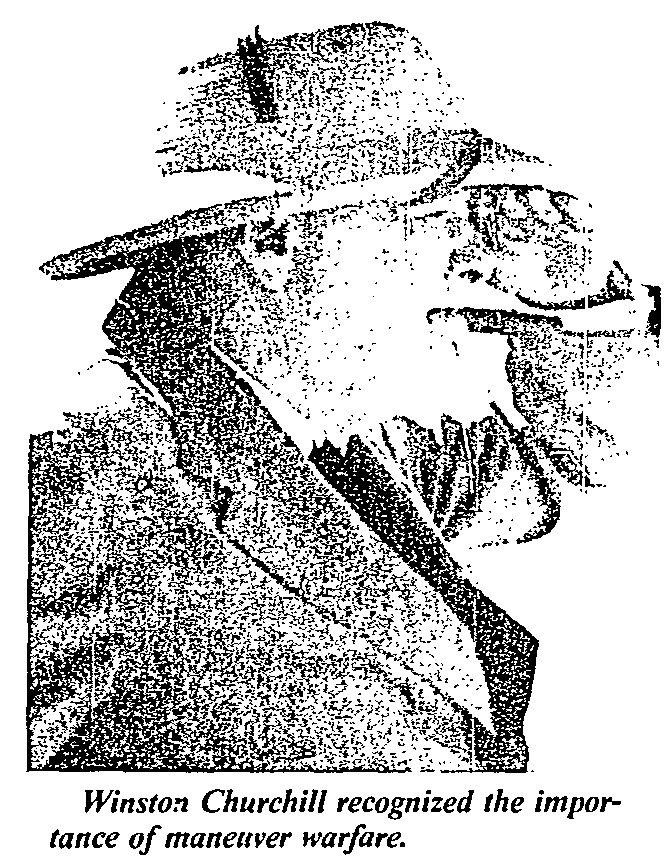
The maneuver advocates certainly cannot argue that the history of war has been one purely of brute strength and mindless attrition waged by Neanderthals-although certainly examples of this do exist. There have been maneuverists throughout the ages. In fact, it seems to me from my readings that the commanders who are recognized as the Great Captains of military history have generally waged war by maneuver. Whether by native intuition or extensive self-study, these men have generally come to the individual conclusion that maneuver is a superior way of making war. Winston Churchill observed that “nearly all battles which are regarded as masterpieces of the military art, from which have been derived the foundation of states and the fame of commanders, have been battles of maneuver.” Given this example, in absolute terms we might conclude again that there is nothing new to maneuver warfare. But these men are the true and rare geniuses of the military profession; considering the countless commanders on whose epauletted shoulders have rested the fates of nations, their numbers are infinitesimal.

It is cliche now to say that we should not attack an enemy frontally, but should envelop him instead. If this is true, and we all realize it, then in the defense we should all ignore our fronts and protect our flanks. So why is it in training we still protect our fronts to the neglect of our flanks, and yet our enemy generally persists in attacking us frontally? And why is it that we still achieve decisive victories by taking our enemy in the flank? Perhaps it is because, as Clausewitz said, “Everything in war is very simple, but the simplest thing is difficult.” It is one thing to appreciate a concept in principle but another entirely to be able to translate it into reality.

To those among us who can honestly claim membership in the elite company of Great Captains, FMFM 1 probably has nothing to say. To them Warfighting must seem a boring, although thankfully short, collection of platitudes. Certainly, such men are among us today. But we should not deceive ourselves; they are very few. What about the rest of us not gifted with the same clarity of vision?

Most of us, when we read Warfighting, will be struck by how obvious and simple its message appears to be. (This may be one cause of the disappointment of those who were perhaps expecting to be floored.) But how many of us can honestly say we would have practiced maneuver warfare naturally had we not read the book? How many of us even after reading Warfighting and criticizing its obviousness, will still miss the point? Some of us? Most of us? Unfortunately, far more than are willing to admit it. So, again, what about the rest of us?

There was a time not too long ago when maneuver warfare was being taught as “commonsense tactics.” There does in fact appear to be a certain common sensibility to the principles of maneuver warfare. But if these tactics are merely common sense, why do they need to be taught at all? Would not the average tactician apply them naturally? History has proven that these tactics are actually anything but common. Rather, they have been quite uncommon, reserved for the gifted few. The maneuver warfare advocates are simply trying to identify and formalize for the merely able among us what the geniuses seem to have grasped innately. Geniuses and true idiots will always be the exception to the rule, and we cannot hope to have much influence over their numbers (other than to give them the opportunity to demonstrate their true abilities). But we can strive to raise the general level of competence of the vast majority in between.

This explains in part why the maneuver warfare advocates like to cite the German example so often, ala Bill Lind, (to the distress of the numerous Germanophobes). The Germans were certainly not the only people to practice maneuver warfare. But they do seem to be the only ones who tried to institutionalize it. They spent a good deal of time and effort studying and writing about maneuver warfare (in the process establishing a vocabulary of hard-to-pronounce terms), and they very earnestly set about reforming their military establishment to support in every way their maneuver doctrine. As they met with a certain amount of success, we would do well to learn from their experience.

So in the absolute sense, the answer to our original question is that there is nothing new here. But this is no excuse for rejecting FMFM 1. The ideas that are the foundation of maneuver warfare are nearly as old as war itself and have been validated by history. The recognized geniuses of our profession generally gained their reputations by putting these ideas into practice. But as a group, we have not done things this way. Therefore, in the practical sense (which is the only sense that really matters in this most pragmatic of professions), the answer to our question is that there is something new here after all. Recognizing that most of us are not geniuses, the maneuver warfare advocates are simply trying to give the rest of us the same opportunity for success by formalizing what the geniuses have known all along.

Ultimately, the thing that scares me most about the mostly true “nothing new” argument is that from there it is a very short step to “This is the way we’ve always done things,” which is not true at all. From there it is another very short step to convincing ourselves that, since we have always done things this way, we do not need to try to get any better. And that is a very dangerous attitude indeed.

LAI: Light Armored Cavalry

by Capt Philip D. deCamp, USA

Winner of the 1989 Marine Corps Gazette Professional Writing Award for AWS Students

As the Marine Corps moves to refine its LAI concept and enhance its capability for independent mobility operation, it should turn to the lessons learned by the Army’s armored cavalry.

Although light armored infantry (LAI) battalions have been fielded and operational for sometime, LAI doctrine and employment continue to be debated. In the LAI concept, the Marine Corps has recognized the need for independent mobility operations in support of Marine tactical maneuver. This concept is well proven through history, and the Army’s armored cavalry has performed this role since World War II. As the Marine Corps refines its LAI concept, it should turn to lessons learned by the armored cavalry-the “masters of mobility”-as it refines the LAI organizational structure and operational concepts.

First, consider the relationship between the missions of the two units. Although the cavalry is capable of many missions, its contribution is best summed up in the following statement taken from a paper written a decade ago at the Armor Center at Fort Knox:

Cavalry fulfills three basic and closely related functions: reconnaissance, security, and economy of force. These traditional functions are inherent to warfare. They are valid on today’s battlefield and will still be valid on tomorrow’s. Some force must fulfill them, and the force that does so is cavalry, whether called so or not.

The LAI battalion, although not called cavalry, was specifically assigned these “inherent” cavalry functions in a recent change to OH 6-6:

The LAI battalion will conduct reconnaissance and security operations and economy of force missions in support of the Marine division or its subordinate elements, and within its capabilities the battalion can be employed in offensive or delaying actions that take advantage of its speed, mobility, and firepower.

How will the LAI battalion perform this cavalry role for the Marine division? Will it replace traditional Marine reconnaissance teams, deploying its own secret units deep behind enemy lines to report enemy preparations and movement? No! As a cavalry unit, the LAI will not only watch the enemy, it will engage him. In fighting for information, the LAI will make the enemy commander show his hand, either by sustaining the fight, committing reserves, breaking contact, or even by inaction. The LAI will obtain current battlefield information concerning enemy intent, giving the Marine operational commander the speed and flexibility necessary to operate within the enemy’s decision cycle. The chief of Armor’s Cavalry Branch explained this contribution to maneuver warfare in an article in Armor magazine (JanFeb86) as follows:

Cavalry [the LAI], by providing current combat information, facilitates a commander’s ability to seize and sustain the initiative and concentrate overwhelming combat power against the enemy at the decisive place and time.

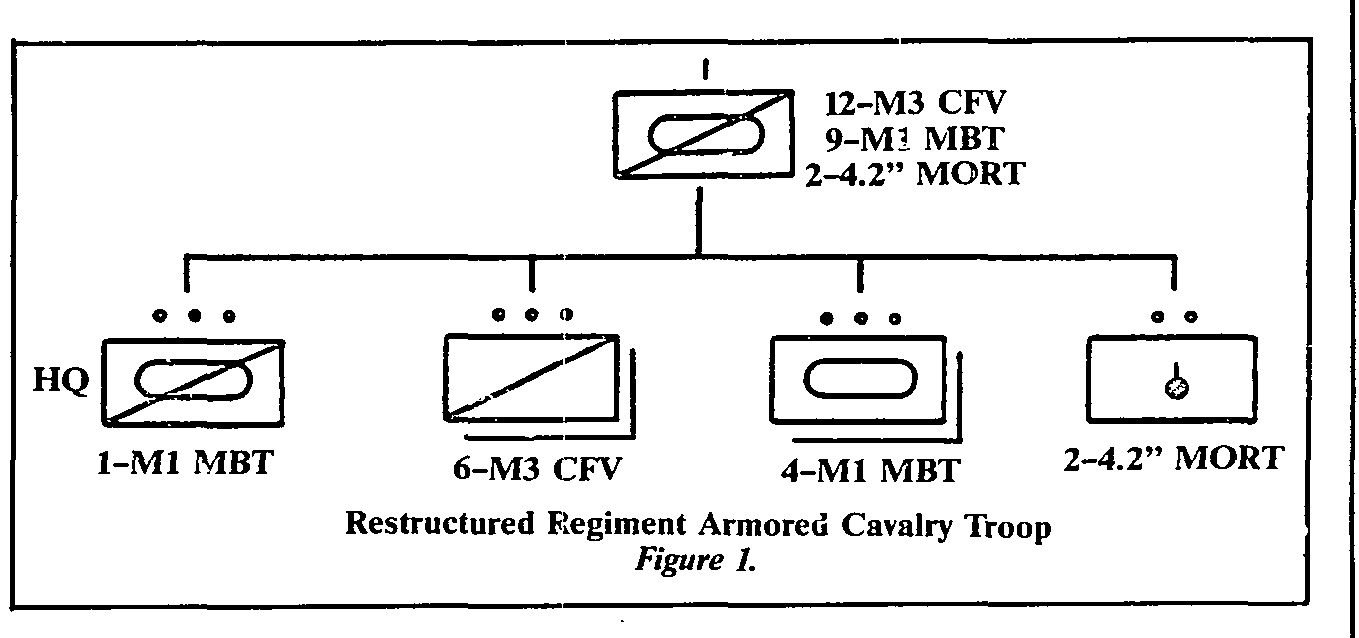
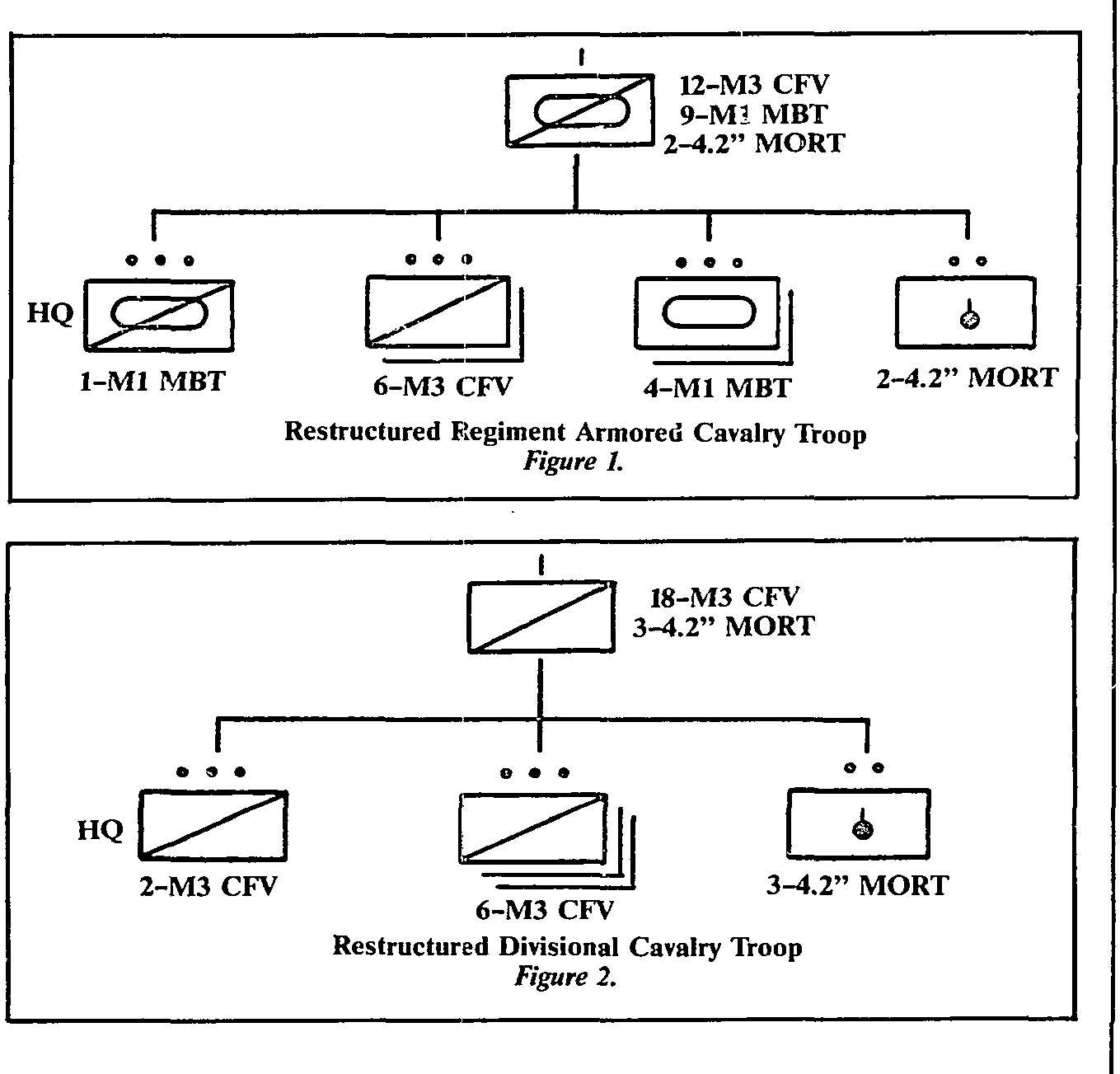
To accomplish this mission on the mechanized battlefield, cavalry commanders, after dealing with constant attachments and detachments during World War II, were convinced that a cavalry unit needed to be a self-contained, combined arms organization. The cavalry platoon of the mid-1960s typified this concept by merging scouts, tanks, infantry, and mortars into a platoon-sized combined arms team. At the company level, an organic CSS structure gave the cavalry troop the capability to sustain itself independently. This organizational approach served well but standardization and endstrength eventually forced restructuring as show in Figures 1 and 2.

The new structure created separate scout and tank platoons, deleted organic infantry support, and emphasized only parts of the cavalry mission rather than the combined arms team. Furthermore, it required the division commander to augment the lighter divisional cavalry only as the mission required, adding units unfamiliar with cavalry operations into the complex cavalry scenario. The lessons learned by the 3d Armored Cavalry Regiment (3d ACR) at the National Training Center (NTC) indicate that this structure does not support the cavalry mission. Cavalry requires a fixed structure very similar to the earlier organization. Col Jarrett R. Robertson, commander of the 3d ACR, questions the task organization approach of giving organic cavalry units only a temporary capability to accomplish traditional cavalry roles:

The book says that if a [cavalry] unit requires such a capability, the division can beef up the squadron with maneuver companies. This solution will not work We learned that during WWII. That’s why we organized the type of cavalry units that we had in the 50s and 60s. The ability to blend scouts and tanks into an effective fighting force is a major training challenge. [Emphasis added.)

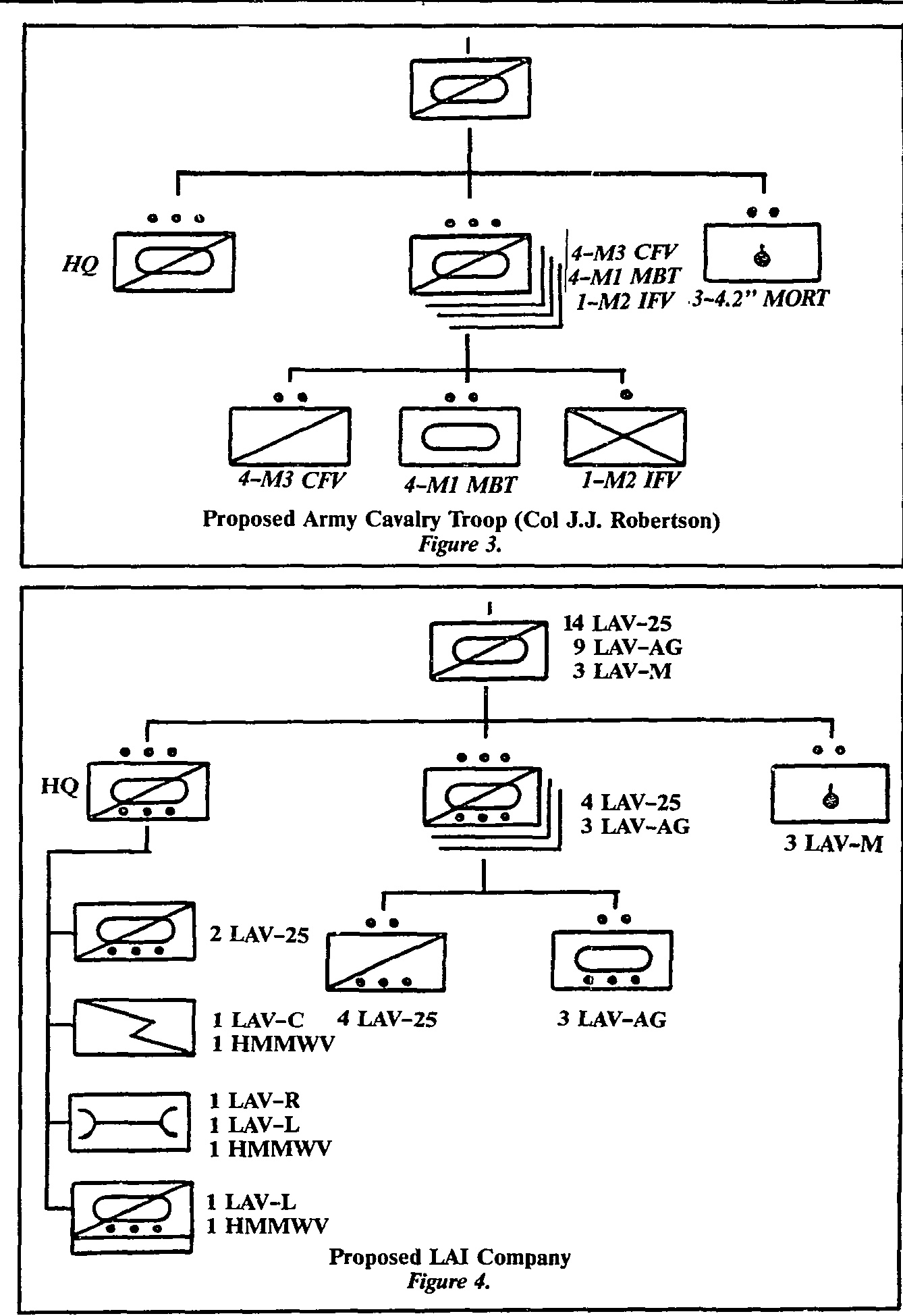
After his experience at the NTC, Col Robertson proposed the cavalry troop organization shown in Figure 3. Supported by the majority of armored cavalrymen, this structure once again integrates scouts, tankers, and infantrymen at platoon level and provides a substantial organic logistical package at troop level.

The Marine Corps’ LAI community can learn from the cavalry’s organizational mistakes. A combined arms LAI company similar to Col Robertson’s proposal is outlined in Figure 4. This self-contained LAI company, capable of operating independently and sustaining itself for some time, would give the Marine division the cavalry asset essential to maneuver warfare.

At platoon level, this proposal relates the LAI assault gun section to the cavalry tank section, since the roles of the two weapons are much the same in cavalry operations. The assault gun obviously is not a tank and is not designed to perform all tank missions. But, in its primary scout support role, the assault gun will perform the same mission the cavalry tank performs for Army scouts. The tank, with its high velocity main gun, provides instant fire support, enabling forward scouts to quickly disengage-a capability the TOW can’t provide. The assault gun, as a complement to the TOW-equipped antitank variant of the LAV, the LAVAT, will likewise support Marine scouts.

A similar relation consolidates scouts and assault gunners at platoon level. The cavalry platoon, before the recent reorganization, proved the advantages of blending separate specialties into a cohesive fighting team. As scouts, tankers, and infantrymen trained to fight together at the platoon level, intense cohesion developed. The supporting overwatch teams were dedicated to helping comrades in the forward areas, not only because of mission but because of personal commitment Thoroughly tested platoon standing operating procedures were well known and understood, and training exercises at every level practiced the combined arms concept Additionally, by bunking, eating, and socializing together, soldiers informally learned the missions and abilities of all parts of the combined arms team. It became second nature to predict actions of other elements when individual personalities became well known. Soldiers, motivated and encouraged to learn each other’s job, made duty interchangeability easy and effective, an advantage that enabled units to reorganize rapidly after high-casualty engagements and immediately continue the mission.

Will the new structure provide these advantages by training soldiers in the combined arms concept at every level? The new cavalry experience indicates not. The S-3 of the 3d ACR explains the difficulty of scout-tank coordination at the NTC:

The M1A1 proved essential to scout survivability. All too often, when the regiment mistakenly decoupled tanks and scouts, the scouts died swiftly…. 3d ACR scouts performing recon and security functions had limited survivability unless they operated with their associated tanks. The difficulty of maintaining this formation argues against the flippant response that tanks can be task organized into a cavalry structure when needed. Despite great effort, it was a continuous challenge to maintain effective tank/ scout coordination. [Emphasis added.]

By replacing “tank” with “assault gun” this statement will apply to the LAI cavalry team as well. Because of the complex nature of cavalry operations, all parts of the combined arms team must be well versed in fighting together. A fixed platoon task organization, in which the team always lives and fights together, is essential.

The only major difference between the Army and Marine platoon organizations is the infantry squad; the Marine platoon doesn’t get one. The Army’s M3 cavalry fighting vehicle (CFV) only dismounts two scouts, far too few to provide adequate dismounted security, thus the addition. The LAV-25 dismounts four, thus 16 LAI scouts are available to provide the dismounted support Furthermore, adding a separate infantry squad to the LAI platoon could require adding two LAV-25S or developing even another LAV variant, an LAV armored personnel carrier (LAV-APC). Although more infantry might well be useful, adding them is impractical at best.

To sustain these combined arms platoons, this proposal creates a large headquarters platoon, with the company executive officer (XO) as platoon commander. The heart of the platoon is the company headquarters section. Located in two LAV-25s it can move forward as necessary to fight the battle. The company commander and his fire support representatives man one LAV-25 while the second provides wingman support. In a change from the current organization, the company XO is not in this section. He heads up a new section created by the transfer of an LAV-C communications vehicle from the current battalion communications platoon.

This new LAV-C is the nucleus of a new communications section created to enhance one of the most important weapons of a scout-his radio. Since cavalry operations are by nature reporting operations, the Army cavalry has learned that information processing is vital to mission accomplishment. The XO, as the combat reporter, will remain in the LAV-C running the company’s tactical operations center (TOC). From the TOC he monitors the battle, submits reports, issues instructions, and acts as the company fire support coodinator, thus freeing the commander to fight the battle. An added communication chief and two radio repairmen provide the vital communications links. An armored high mobility, multipurpose wheeled vehicle (HMMWV) trails the LAV-C to provide two capabilities. First, it functions as a mobile communications contact vehicle to make quick repairs or exchange equipment as necessary. Second, it provides mobility for the XO enabling him to move to the front and take over the battle from one of the LAV-25s without endangering the LAV-C.

The modern equipment found in the LAI company requires detailed first- and second-echelon maintenance. In addition to operational and preventive maintenance, battle damage from swift and lethal engagements necessitates a large “on-the-spot” maintenance, recovery, and extraction capability at the unit level. A strong maintenance section, equipped with both a recovery LAV and a logistics LAV, is another vital asset These vehicles make heavy deliveries to stranded vehicles and support repair/recovery operations as needed. An armored HMMWV, acting as a maintenance contact team, checks battle damage and establishes priority of recovery and repair assignments.

As the LAI company fights for information, it will expend enormous amounts of supplies-especially classes III, IV, V, and IX. Extended movements, quickly changing missions, and engagements against numerically superior forces are only a few reasons for this heavy reliance on logistics. An organic company supply section, reporting directly to the LAI company commander, can tailor its support to the demands of the specific LAV mission. In the proposed organization, an LAVL logistics variant provides heavy supply transport while a HMMWV, probably manned by the company gunnery sergeant, allows for rapid coordination and delivery of smaller supplies.

A final addition to the LAI company brings the battalion mortars down to company level. A three-tube mortar section, firing from three mortar variants (LAV-Ms), will provide the LAI company the flexible and responsive indirect fire vital to security and reconnaissance operations. The Army cavalry community, embracing the independent combined arms team concept, has long recognized the necessity for substantial indirect fire at troop level. The requirement for responsive and specialized indirect fire in cavalry operations is so great that the Army cavalry squadron has an organic 155mm howitzer battery assigned as well. Although the Marine division artillery can’t be expected to likewise attach a battery to the LAI battalion, a company mortar section, operating in conjunction with direct support artillery, will give the LAI company the indirect fire support essential to independent operational maneuver.

The Marine Corps’ maneuver warfare concept places a premium on mobility and flexibility. As a descendant of the Horse Marines, the “Light Armored Cavalry” proposed here would have the inherent mobility to shift quickly to diverse roles anywhere on the battlefield. But like all historical cavalry units, a fixed combined arms LAI structure at company level is essential to achieving independent flexibility. The Marine Corps and the Army share many elements-infantry, armor, artillery, and aviation, to name a few. It’s time we share another element essential to land warfare, the cavalry, and use historical cavalry lessons to develop our current doctrine and organization. US MC

Stick With Maneuver

by Capt Francis G. Hoffman, USMCR

The series of three articles by LtCol Gary W. Anderson on enemy-oriented operations (MCG, Apr, Jun, Aug89) demonstrate a common but erroneous perception of maneuver warfare. While the basic characteristic of lowintensity conflict (LIC) is the absence of conventional military operations, it does not rule out application of maneuver-oriented planning and doctrine.

Perhaps this misperception is due to the connotation of “maneuver,” which has allowed many to associate the doctrine exclusively with mechanizedtype operations in the Delta Corridor. Or maybe it is because, as Maj Moore pointed out in his prize-winning Chase essay (MCG, Apr89), “The advocates of maneuver warfare have done a poor job of explaining their theory.”

Whatever the reason, the myth that maneuver doctrine is only applicable at the high end of the conflict spectrum should be quickly erased. Maneuver doctrine is not just for operations against Soviet bloc forces in a high-intensity scenario. The doctrine is based on the operational art and in its most basic aspects deals with the use of military means to achieve policy and military objectives. It is a way of thinking that drives the planning and execution of campaigns in pursuit of the attainment of strategic objectives. We have strategic and policy objectives that must be achieved across the spectrum of conflict and thus we need a doctrinal approach that is applicable across the same range of potential applications.

There are more tenets of maneuver warfare than the selective few that LtCol Anderson listed. For example, maneuver warfare is oriented toward chaotic and fluid environments. What is more chaotic and dynamic than counterinsurgency or stability operations? LtCol Anderson’s brief list omits the orientation against the moral and physical cohesion of the enemy. Maneuver doctrine, in this sense, might assist us in planning and executing counterterrorism or counternarcotic operations against terrorist groups or drug cartels.

The author also forgot to include those aspects of maneuver doctrine that call for shaping the battle. Security assistance operations, psychological operations, counterintelligence programs, and combined action programs can shape the nature of the conflict and the ability of the insurgent group to establish itself within the mainstream of the indigenous population. In this sense, the other tenets of maneuver warfare (focus of effort, surfaces and gaps, and state of mind) are also equally applicable to LIC.

In sum, I do not think we need a new approach as postulated by LiCol Anderson. Rather we need to refine and educate ourselves with the maneuver doctrine we already have. Furthermore, we need to seek ways to incorporate the tenets and principles of this doctrine in our daily business.

Comments on Logistics

by Gen A.M. Gray

On 1 September Gen AM. Gray addressed a conference attended by some 70 senior logistics officers from commands throughout the Corps. The following points, which identify some of the logistics challenges facing Marines in the years ahead, were highlighted in his remarks.

* Readiness

Over the next two fiscal years, FY90 and FY91, the Marine Corps’ Operations and Maintenance (O&M) Budget will be nearly 10 percent below the FY89 level. As a short-term response, we will curtail some training and exercises to avoid hurting readiness. When the maintenance backlog grows, as a further step in maintaining readiness, we will draw down on war reserve stocks. Over the longer term, however, unless there are budget increases above the FY90-91 levels, we can anticipate early deterioration of the equipment and facilities acquired in the mid1980s.

* Materiel Policy

We need to try to reduce the amount of equipment in the hands of the forces. We must, therefore, move ahead with a Table of Equipment review. We have been carrying out the warfighting enhancement initiatives for about one year and will continue to do so for several more years. As we do, the initiatives’ effects on sustainment and readiness need to be evaluated. Good effects can then be amplified; bad effects, attenuated.

The program to provide Marine expeditionary units with a special operations capability, the MEU(SOC) program, is now institutionalized. We started it quickly with lots of special equipment not in the system. It’s time now to establish those SOC items as system items so we can provide for their long-range supportability. At the same time, we must continue to accelerate the acquisition process so we can adjust quickly to future operational needs as they arise.

* Improving MAGTF Closure

Improving closure times is one of six key issues coming out of the recent Fleet Marine Force (FMF) Roundtable Conference. We must provide the Commanders in Chief of unified commands (CinCs) with flexible and attractive force options for use in crises and execution of their operations plans. Marine air-ground task forces (MAGTFs) are especially well suited to meet the Joint Strategic Capabilities Plan (JSCP) requirement for CinCs to develop deterrent force modules (DFMs) for early deployment.

Logistics plays a dominant role in making DFMs and crisis action modules (CAMs) a reality rather than mere rhetoric. We must know what materiel and supplies are available, where they are, and how to get them to ports of embarkation (POEs) and embark them quickly. The commanding generals of FMFs are developing DFMs and CAMs now, but all senior Marines are responsible for informing the joint community of our capabilities.

* MPF Expanded Employment Capabilities

The MAGTF Master Plan calls for improving the “capability to conduct a range of MPF [maritime prepositioning force] operations including prehostility deterrence, reinforcing a forward afloat MAGTF, providing selected capabilities, and supporting amphibious assaults.” MPF has been a singular operational and logistics success; but we now need to build on that success by making it more flexible, more responsive in a broader range of contingencies.

We must, however, take care not to damage what we’ve worked so hard to attain. Several options have been discussed and debated recently; I understand the topic has come up at this conference; I’m confident the final outcome will be yet one more enhancement of the Marine Corps’ contribution to the Nation’s security.

* A Time for New Thinking

Sustainability is the Corps’ unique strength; no other Service has it in its active structure. Our doctrine of 60 days accompanying supplies has served us well, and we must continue to plan and fond for it But that does not mean our logistics plans are set in concrete. Our operational focus has shifted toward low- and mid-intensity conflict, and our stated doctrine is now maneuver warfare. It is time to reevaluate our sustaining materiel and supply requirements in this new context. Perhaps a menu of several sustainability packages could be developed that would allow us to pick the one that best matches the needs of a specific contingency. If these were sourced, just as accompanying and nonunit supplies are sourced in deliberate planning, response times could be reduced.

* Comments on FMFM-1

You’ve read FMFM-1. You know that Marine Corps doctrine today is based on warfare by maneuver. Much has been written about the operations component of maneuver warfare. But maneuver warfare operations, like all modern types of warfare, will succeed or fail depending on the adequacy of logistics support Little has been written, however, on logistics in maneuver warfare. The task is obvious-develop new, or modify existing, combat service support doctrine and techniques to support maneuver warfare.

The essence of maneuver warfare is to do more with less. The challenge for logistics is to get the less to the proper place at the proper time. Logistics officers must know our operational doctrine, for it provides the basis for harmonious actions and mutual understanding. They must know how the operations folks are thinking-or how they should be thinking. They must understand maneuver warfare so they can support it and so they can let operational commanders know the limits of logistics support and the risks attached to various courses of action.

Marine Corps philosophy of command requires familiarity among comrades and confidence among seniors and subordinates. MAGTF organization encourages this result across its four elements. The partnership of command, ground, air, and combat service support deserves constant nurturing. Leadership within all the MAGTF elements must have this result-this teamwork-as a major goal.

Mission orders and commander’s inact are applicable to logistics. A commander’s ability to exploit fleeting opportunity will depend on the logistics officer’s skill in anticipating various situations he may be called upon to support.

* Some Key Challenges

– Logistics is a joint business. Marine logistics officers must understand the broader Department of Defense logistics systems to include those of the other Services. Strategic mobility is the key to the aggregate usefulness of the Marine Corps. We need to be the premier Service in knowing how to use airlift and sealift This means education about Military Airlift Command, Military Sealift Command, and Military Traffic Management Command assets and functioning as well as our traditional association with amphibious ships.

– We’ve begun campaign planning in the Marine Corps. The Marine Corps has a campaign plan; each Fleet Marine Force has one; each Marine expeditionary force has one. Campaign planning must become second nature to us-a tool to force us to look at the operational level of war. Campaign plans are, to a large extent, logistics plans; Adm Chester W. Nimitz’ famous GRANITE I and GRANITE II campaign plans for the Central Pacific had major logistics components. Logistics officers have a key seat at the table when it comes to campaign planning; you should seek to become experts at it.

– Expeditionary means logistically prepared. Logistics preparedness requires good planning factors, accurate data, and detailed hard work; RAdm Henry F. Eccles in his book, Logistics in the National Defense, makes the point again and again that sloppy planning will come back to haunt you. The deliberate planning process has uncovered many deficiencies in logistics planning for all Services. As a result, we’re getting better at it; we must continue the trend.

– A logistics officer’s job is to extend Clausewitz’ culminating point as far forward as possible. The offense cannot sustain itself indefinitely. It grows weaker as it advances. The mission of logistics is to find ways to minimize this unavoidable effect.

* Logistics‘ Key Role

Logisticians and combat arms Marines differ only in the tools of their trade. Both must be aggressive; both must be risktakers; both must do with less in the years ahead; both must turn on the brain power. The books on our professional military reading list reveal again and again that it has been the logistics foundation that has sustained victorious armies. Paul Kennedy’s book, The Rise and Fall of the Great Powers, summarizes warfare results in the 19th century this way:

The powers which were defeated were those that had failed to adopt to the military revolution of the mid-19th century, the acquisition of new weapons, the mobilizing and equipping of large armies, the use of improved communications offered by the railway, the steamship and the telegraph, and a productive industrial base to sustain the armed forces.

The decisive role of logistics continues today. There can be no doubt that we must give it our full attention as we move toward the 21st century.

A Primer on Maneuver Warfare

by Maj G. Kevin Brickhouse

Long before I turned the pages of Sun Tzu, long before my father blew the dust off Rommel’s Attacks, even before I had a teacher introduce me to Machiavelli, I learned some of the nuances of maneuver. Years before a single trophy graced the shelf in my bedroom, I felt the blows from not running with my head up. I learned that the confines of the sidelines could be a hindrance or an advantage. Defensively, they anchored our flank; offensively they limited our room to maneuver. My team could win with cunning and speed. We welcomed gaps in our opponent’s defense. We learned that the most obvious was often the most difficult. We understood that a thorough understanding of the fundamentals gave us the edge. We learned that game plans were only as good as execution on the field. Skill, daring, and luck play a large part in any victory. We learned not just to play, not just to be present on the field, but to ruthlessly smash our opponent. We learned to win.

As we became older, bigger, and wiser, competition became keener, and subsequently the stakes became greater. The rewards became proportionately higher. We spent more time studying our opponents. We sought out his strengths and weaknesses. We tried to avoid the one and capitalize on the other. We sought to outthink our opponent. We never once broached the subject of the German General Staff. We were having fun! We blended strategy with technique. We worked hard, and we won.

What a time we had! We forced him to extend his line, and we penetrated it. We assailed his flanks with option plays. We enveloped his defense with short passes. We turned his focus with the bomb. We misdirected him with feints, fakes, and counterplays. He changed his plans; we changed ours first. We anticipated his moves. We were better because we were faster. We knew the fundamentals. We understood that each play was important. We understood that each member of the team was an integral part of the whole effort. We were ever vigilant.

We didn’t win every battle from scrimmage. We didn’t win every game. We understood, however, the futility of blame and recrimination. We drew ourselves up and learned from our mistakes.

Frequently the home field advantage belonged to the other team. As often as not, half the fans pulled for our opponents. We didn’t care.

The team didn’t have much money. Our films were old; our chalkboards cracked. We drew sketches in the dirt and argued a lot. We lay awake at night going over each game in our minds . . . what if . . . what if. . . . We prepared ourselves as best we could.

Maneuver warfare is not a new game. It is one played on the ice rinks, baseball diamonds, and football fields of even township and city in this great country. It is neither to be feared nor ignored. It is neither catchy foreign phrases nor slick presentations. It is merely a composite of intelligence, strength, courage, and decisiveness. It is the application of tactical, operational, and strategic fundamentals at the point of the adversary’s greatest weakness at a rate faster than his reactions.

M1A1s and the Corps

by 1stLt George R. Copeland

Maj Gunzelman, (MCG, Jun89) sounds a vital warning to the ground combat element (GCE) commander of the Marine air-ground task force (MAGTF). Employing armor assels so that they both support and are supported by other combat elements is an issue that has always been important to GCE planning. It will continue to be so into the foreseeable future.

However, Maj Gunzelman’s argument that the Marine Corps should not field the M1A1 because its superior capabilities are not “compatible” with other elements of the GCE is not supportable. The M60 tank presents virtually the same challenges for proper employment; the Marine Corps has proven itself adept at task organizing units to utilize them properly. If doctrinal guidance is adhered to and creatively interpreted, the M1A1 will make an even wider array of maneuver options available to the GCE commander.

Maj Gunzelman points out that U.S. Army infantry “fights from” the so-called “Bradley Fighting Vehicle,” not explaining how this can be done in a vehicle vulnerable to light machinegun fire. A Soviet motorized rifle regiment commander with this attitude who encounters a MAGTF is in for a rude surprise. His forces will be engaged by MAGTF assets long before they reach the forward edge of the battle area, will be further reduced by assets available to the GCE commander, and will arrive in the battle area depleted, deployed into their battle formations much too early, and canalized into “kill zones” where they will be easy targets for the antiarmor weapons of the GCE commander. Robbing the GCE of this tremendous asset because its capabilities are “too great” would be absurd.

Because of space limitation aboard amphibious shipping, the Marine Corps must remain lightly armed compared to the Army. However, this limitation necessitates that we adhere even more scrupulously to the tenets of maneuver warfare; we will never have the luxury of fighting a U.S. Army-style battle of attrition. The M1A1, with its superior speed and armament, will provide the GCE commander with a superb maneuver asset that will assist him in meeting this requirement.

More MILES

by Maj Richard A. Hobbs, Jr.

Capt Walters is on the mark with his comments (MCG, Apr89) about the need for realistic training and the use of MILES (Multiple Integrated Laser Engagement System) to attain that objective. Let’s spend more money on a training tool that will save lives through realistic training. The Commandant has declared war on zero defects. Let’s put realism back into training and stop wringing our hands over MCCRES “grades.” The real grade that counts is our ability to shoot our weapons systems and stay alive in the process. MILES will give us realism in training. Why not issue it along with rifles and blank fire adapters?

PME Workshop Held

Nearly 130 Marines, instructors from formal schools around the Corps, gathered at The Basic School in July for the first professional military education (PME) workshop. Schools represented included Marine Aviation Weapons and Tactics Squadron One, Landing Force Training Commands, Schools of Infantry, Quanticobased schools, Fort Sill, the Army War College, and National Defense University where faculty members are Marines. The purpose was to familiarize the instructors with maneuver warfare doctrine outlined in FMFM-1. Warfighting and to ensure that instructional materials and curriculums are headed in the right direction.

William Lind, Col John Boyd, USAF(Ret), Dr. Stephen Canby, and West German Gen Hasso von Uslar-Gleichen were among the guest speakers on hand for the week-long event. Each gave presentations on their respective areas of expertise-Lind on maneuver warfare, Boyd on “Patterns of Conflict,” Canby on light infantry, and Gen von Uslar-Gleichen on techniques used to exercise military judgment. After the presentations, attendees broke down into discussion groups, examining issues raised in the presentations and suggesting ways to ensure that doctrinal concepts are properly woven into all PME instruction.

The primary thrust of the workshop was to stress that the philosophy in FMFM-1 must permeate the Corps’ structure from top to bottom. Understanding the theory and nature of maneuver warfare, how to prepare for this style of warfare, and how to incorporate its underlying principles into daily routine are vital to the successful employment of maneuver warfare.

Other manuals that amplify FMFM-1 are due for release within the next year. These will focus on tactics, operational art, Marines and strategy, fighting the Marine airground task force (MAGTF), and amphibious operations. In the meantime, the newly established Marine Corps University is planning more workshops to cover such topics as the strategic value of terrain and geography, fighting the MAGTF, and command and control and staff action.

“A Marine For All Seasons”?

by LtCol H. T. Hayden

Anyone who says the Marine Corps is ready to conduct counterrevolutionary operations . . . against an entrenched Communist insurgency . . . either does not understand the nature of the problem or refuses to accept it.

The April 1989 issue of the Gazette provided an interesting juxtaposition of two diverse and sometimes directly opposing concepts-“The Art of MAGTF Warfare” and “Marine Corps Employment in Low-Intensity Conflict” While elements of the “maneuver warfare” concept, such as mission type orders, decentralized control, and exploiting fleeting opportunities, can be applied in a low-intensity conflict, the basic tenets of maneuver warfare (combined arms teams running amok-sorry, amidst-a fluid, violent battlefield) have no place in most forms of low-intensity conflict.

I do not intend to debate the merits of the JCS Pub 1-02’s definition of lowintensity conflict or to challenge the four categories of military operations in low-intensity conflict (insurgency/ counterinsurgency, combating terrorism, peacekeeping, and peacetime contingencies) identified in proposed JCS Pub 3-07. The purpose of this paper is to focus on only one part of the low-in-tensity conflict paradigm-revolutionary warfare, “People’s Revolutionary War,” also known as Communist insurgency. The term revolutionary warfare is a good one because it is the only expression of the many associated with low-intensity conflict that combines both method and purpose in one comprehensive and uncomplicated term.

To repeat a quote from the Commandant on low-intensity conflict (see MCG, Apr89, p.31):

We need to be able to conduct revolutionary warfare and defeat it . . . we must not lose sight of the kind of conflict that’s most apt to confront us. We must be effective at the low end of the warfare spectrum, in the protracted conflicts that so often occur in the Third World.

Many Marines have a grasp on the basic ideas expressed by the Commandant; however, very few understand how this can be effectively accomplished. This is the crux of my criticism of the two articles. Each article has a mistaken “sight-picture” of the objective; each article has a faulty “focus of main effort.” The principal objective in maneuver warfare is the enemy forces and their means to sustain warfare. The principal objective in revolutionary warfare is the people-the indigenous population. In low-intensity conflict the focus of main effort is the security and the political-economic-social development of the indigenous population. A Marine air-ground task force (MAGTF) cannot be trained and equipped for maneuver warfare and simultaneously apply the same tactics and equipment in counterrevolutionary warfare. We do not have “Marines for all seasons.”

Many writers still do not understand what was going on in Vietnam. For example, the April 1989 article on low-intensity conflict said that “During its early stages, Vietnam was a lowintensity conflict; yet in its later stages it became increasingly a mid-intensity conflict.” In truth, of course, the North Vietnamese introduction of regular North Vietnamese Army (NVA) units into the northern and central provinces did not absorb or push aside the clandestine insurgent activities in those provinces. The low-intensity conflict of the People’s Revolutionary War continued-parallel with and supported by or supporting the NVA regular units. In the main, high level American attention was successfully diverted from the real war (People’s Revolutionary War) to the war the United States was trained and equipped to fight-the North Vietnamese maneuver war.

Worse yet, many writers still do not understand how to fight and win in a People’s Revolutionary War. For example, this is from the same April article:

If the MAGTF is enhanced with certain capabilities, it can function effectively in stability operations. . . . The largest number of missions will probably be in the area of civil-military operations, [emphasis added] where the MAGTF will interface with a local civilian population within the host nation to carry out some project . . . to develop favorable emotions, attitude and behavior while providing some worthwhile assistance . . . such activities as medical and dental programs, erection of a public building, road and bridge improvement . . . .

To the misinformed the term civilmilitary operations is always associated with civic action or civil affairs. Civil-military operations in counterrevolutionary warfare or counterinsurgency warfare are operations conducted by the local government officials, working in concert with their local security forces to effect denial measures, such as population and resource control, security operations, and intelligence operations, or to effect support measures, such as economic infrastructure development, education development, and health improvement.

Civic action and civil affairs will be part of the civil-military campaign plan-generally only a small part. Civil affairs units are designed to provide an interface between the MAGTF commander and the local government or the local population and coordinate government services, e.g., water and power, public transportation, veterinarian service, etc. Civic action represents an attempt by a military unit to support a local development project for the local population. U.S. military units must always coordinate any civic action project with the local government. The U.S. military should seldom conduct a civic action project alone. The local military should be the principal agent in any civic action project with U.S. military assistance only as necessary. A civil-military campaign plan, properly understood, marshals the resources of a pacification or a revolutionary development program in a local community using government services, security operations, psychological operations, population and resource control, etc. In some cases the military is only a small part of this campaign plan.

The MAGTF Master Plan, the “Operational Concept for Marine Corps Employment in Low-Intensity Conflict,” and the two Gazette articles mentioned herein all demonstrate a lack of understanding of the basics of revolutionary warfare.

The root causes endemic to most low-intensity conflicts (People’s Revolutionary Wars) are known: injustice, illiteracy, poverty, economic exploitation, and/or political instability. An insurgent Communist People’s Revolutionary War generally capitalizes on the problems-they seldom create them. The basic solutions to these problems are also known: local government concern and local government positive action.

There are three very different targets in a People’s Revolutionary War: (1) the insurgent political infrastructure, (2) the insurgent military, and (3) the insurgent mass organizations.

There are three central planning factors in any counterrevolutionary campaign plan: (1) the people, (2) the insurgents, and (3) the government. There are three basic elements in the execution of any counterrevolutionary campaign plan: (1) security, (2) economic and political reform, and (3) satisfaction of popular expectations.

The first priority in counterinsurgency is intelligence, and the second priority is psychological operations. The first step is security, and the second step is nation building.

Why do we make it so difficult?

We make it difficult because we do not understand the enemy. We do not understand his doctrine, his tactics and techniques, his basic organizations, nor do we understand how he organizes his assets to fight his kind of warfare.

Tom Marks, a noted counterinsurgency writer, has stated that Communist insurgent movements organize themselves into three categories: organized masses, mass activists, and party members. In the Philippines, for example, the Communist Party of the Philippines organizes each district (county) with numerous sections controlling each “barangay” (village). Each village has organizing groups (OG), controlled by organizing committees (OC), controlled by a party branch (PB). They field their own local armed forces (a popular self-defense force at the small village level or a militia the larger). The OG, OC, and PB are clandestine organizations. The rural OGs include one for men, one for women, one for youths, and one for children. The urban sectors have OGs for teachers, businessmen, workers, and others as appropriate.

There is another way to look at the organizational effort of Communist revolutionary warfare and that is in its three prinicpal organizations: (1) the political/party, (2) the armed forces/ military, and (3) the mass organizations.

In El Salvador the Farabundo Marti National Liberation Front (FMLN) is an umbrella organization for five separate groups, each of which has organized itself in the triangular structure outline above. The Salvadoran Revoludonary Party (PRS) has, for example, the PRS (political), the ERP (military), and the LP-28 (mass organization); the National Resistance (RN) has the RN (political), the EARN (military), and the FAPU (mass organization).

It is easy to see from the organizational effort above that Communist insurgent movements place equal emphasis on organizing the military effort and the political effort. Douglas Pike in his historic work The Viet Cong identified the two crucial elements of the Vietnamese Communist “revolutionary war” as the armed struggle and the political struggle (Figure 1). However, to paraphrase Bernard Fall’s comment in Street Without Joy, the Communist never forgets that his fight is first and foremost political rather than military.

Anyone that says that the Marine Corps is ready to conduct counterrevolutionary operations, counterinsurgency operations, or stability operations against an entrenched Communist insurgency, with second and third generation revolutionaries, either does not understand the nature of the problem or refuses to accept it.

Neither the Marine Corps nor the Army is prepared independently to execute a civil-military campaign (read counterinsurgency campaign) in a lowintensity conflict. The Army may be more prepared than the Marine Corps. However, the State Department with the Agency for International Development are the lead players. Justice, Commerce, Central Intelligence Agency, Department of Defense (DOD), and many others have contributions. Accordingly, it is a national level, comprehensive civil-military campaign plan that is needed to fight not only the insurgent military organizations but also to fight the insurgent political organizations.

Under present U.S. Government policy, the principal U.S. military tools for assisting a Third World nation involved in low-intensity conflict are security assistance in the form of intelligence, psychological operations, mobile training teams, logistics, foreign military sales, etc. Unfortunately, our congressionally limited security assistance budget does not meet these requirements. There are, after all, no pressure groups of articulate Americans lobbying for reduction in our commitments to NATO and increased support for Third World countries involved in a war for national survival. In the absence of bipartisan consensus for an adequate security assistance budget, we get almost no budget at all.

The Marine Corps may rank high in developing an all-source intelligence fusion center; however, it has no capability at all to provide psychological operations support or qualified counterinsurgency experts to assist and advise local government officials on nation building. We must not confuse apples and oranges. The Marine Corps is quite capable of conducting combat operations in a civil-military campaign in a low-intensity conflict. Putting Marines on the ground-in small independent action forces (SIAFs) and air-ground-logistics teams-is the forte of the Marine Corps. However, this is counterguerrilla action-at best a small part of counterinsurgency operations. Very few language qualified area specialists who can train indigenous civil-military forces in counterinsurgency or advise and assist local government representatives are available in the Marine Corps. Counterinsurgency is not a skill even remotely related to any Marine military occupational specialty (MOS). The Foreign Area Officer Program (MOS 9949) is a very limited program in the Marine Corps-limited in scope, purpose, and attendance. It should be greatly expanded. In analyzing the American approach to counterrevolutionary war, Bernard Fall wrote in 1967:

. . . all this differs radically from the American emphasis on guerrilla techniques alone and the almost total discounting of the primacy of the political factor in revolutionary warfare . . .

There are numerous other facets of Third World activities (e.g., liberation theology, informal economies such as black markets and unregistered businesses, the sanctuary movement, the role of the Third Estate, etc.) that are important factors to be understood before trying to conduct counterguerrilla operations in most low-intensity conflicts. They are essential to any understanding of revolutionary warfare.

A final critique. In counterinsurgency warfare, an attempt to attack the party and cut if off from masses based on short-range solutions cannot succeed. If “The Art of MAGTF Warfare” is correct-if Marine operations must be fought with existing forces, in a limited time span, with an expectation of quick results-Marine contributions to countering revolutionary warfare will be severely limited.

In the absence of reform that eliminates the fundamental grievances that force people to seek redress through armed force (revolutionary warfare), it is a long, hard road ahead for any counterrevolutionary effort. Tom Marks has stated it best when he said that traditional civic action-digging wells, medcap, dentcap, etc.-is but a BandAid. To succeed, the root causes of the insurgency must be removed or eliminated.

While it is fashionable to believe that communism is a failed system, in the jungles of El Salvador and the forests and mountains of Peru, people believe that it is capitalism and the socalled democratic governments that have failed them. The U.S. Armed Forces in general and the Marine Corps in particular must heed the advice of the Commandant and learn how to conduct People’s Revolutionary Warfare and defeat it. Unfortunately, the two articles in the April Gazette, current drafts on Marine Corps operational concepts in low-intensity conflict, and current Marine Corps training and education programs reveal that Marines do not yet understand where to “focus the main effort.”