Maneuver Warfare: Can the ACE Adopt This Philosophy of War?

by Majs Gordon C. O’Neill and Daniel A. Driscoll, Jr.

In March 1989, the Commandant of the Marine Corps made maneuver warfare doctrine for Marines when he published FMFM 1. Over the past two years the Gazelle has published numerous articles addressing Marine aviation and its role in maneuver warfare. These articles and the general interest in maneuver warfare have stirred up quite a bit of controversy about Marine aviation and its supposed reluctance to accept maneuver in its training programs. In truth, Marine aviation is undergoing a healthy period of self-reevaluation, one that will help it learn to “fight smarter” and deal more effectively with declining defense dollars.

On future battlefields, one of the keys to success will be how well Marines communicate within and among each element of the Marine air-ground task force (MAGTF). In fact, the better we communicate, the better we’ll be able to make timely and sound decisions in the heat of battle. Maneuver concepts include mission-type orders, commander’s intent, focus of effort, center of gravity, surfaces/gaps, reconpull, logistics push, and more. As aviators, we must understand these concepts and use them to communicate with our ground counterparts, the ground combat element (GCE). The aviation combat element (ACE) can successfully adopt maneuver warfare and all that it represents. In order to accomplish this, however, Marine aviation must improve its MAGTF training programs.

This article will examine some of the precepts of maneuver and what they mean to Marine aviators. Obviously, our thoughts are not all-inclusive of everything that maneuver represents. In fact, only three of the six Marine aviation functions are discussed due to time and space considerations. Our hope is to provide a starting point and help resolve part of the maneuver controversy.

The Marine Corps is a unique and widely envied military organization throughout the world. It is the only air-ground-logistics team in the world task-organized to deploy and fight against any threat to our Nation. When the MAGTF goes to war, it will fight for one of the unified combatant commands throughout the world. In order to succeed in this arena, the MAGTF commander and his staff must be able to operate in this joint and possibly combined environment. They must be able to ask the right questions when tasked to perform a mission and at the same time educate our sister-Service counterparts about the MAGTF’s capabilities. In order to do this we must be familiar with the different levels of war and where the MAGTF fits in.

Through strategy, or the strategic level of war, our government achieves its national policy and objectives; the ends of strategy are the vital interests of national policy.

Tactics, or the tactical level of war, is combat and the level of war at which battles and engagements are planned and executed to accomplish military objectives through fire and maneuver. As Marines, we take pride in our ability to excel at this level of war. The means of tactics include the hardware we design to destroy the enemy; the ways include the techniques and tactics we develop to defeat the enemy in order to achieve the end-victory. Tactics is the art of winning battles and engagements.

Operations, or the operational level of war, is the one at which campaigns are planned, conducted, and sustained to accomplish strategic objectives within a theater of war. The operational commander’s primary tool to organize and synthesize all military efforts in his theater of operations is the campaign plan. The operational commander decides when and where to give battle to the enemy, or conversely, not to give battle.

The essence of operational art is the enemy’s center of gravity, his critical vulnerability, and the application of our superior combat power against that source to achieve the strategic aim over time through the campaign plan. As Marines, we seek to put our strength against the enemy’s critical weaknesses-supporting units, supply depots, lines of communication, airfields, command posts-in order to exploit these weaknesses and force him to lose cohesion. Marines call this maneuver warfare; it is our philosophy of warfighting. We use maneuver, in time as well as in space, to gain an advantage against the enemy commander and exploit it by operating at a higher tempo than the enemy. The precepts of maneuver warfare apply equally at the operational and tactical levels of war.

Where do Marines fit into this picture? The MAGTF commander will operate at both the operational and tactical levels of war. The commander’s area of influence is described as that area in which he can influence combat operations through maneuver or fire support organic to his command. The GCE commander’s area of influence is roughly 18-20 kilometers, which is the maximum range of his organic artillery. On the other hand, the MAGTF commander’s area of influence is several hundred miles beyond the forward edge of the battle area (FEBA). This influence is achieved by the long spear of the ACE‘s combat power-the AV-8Bs, A-6s, F/A-18s, AH-1Ws-as well as the other components of Marine aviation. This makes the Marine Corps unique and very lethal and is reflected in the MAGTF commander’s role as a fighter and not just a facilitator. For these reasons, the ACE‘s combat power must communicate with the GCE and combat service support element (CSSE) in order to synthesize their individual combat power into a hammer and anvil delivered with speed and sustained with a system of logistics push.

Antiair Warfare

Antiair warfare (AAW) is one of the six functions of Marine aviation; the others include offensive air support, assault support, reconnaissance, electronic warfare, and control of aircraft and missiles. Every MAGTF Marine will participate to some degree in AAW, which is subdivided into two phases called air defense and offensive AAW. Air defense includes all means, active and passive, to destroy enemy aircraft and missiles and to nullify or reduce their effectiveness if an attack is made. Active air defense is a direct defensive action taken to destroy attacking enemy aircraft and missiles, including aircraft, air/groundlaunched missile intercepts, air defense artillery, automatic weapons, small arms, and electronic countermeasures. The MAGTF employs passive air defense to reduce the effectiveness of air attack and includes the use of cover, concealment, camouflage, deception, dispersion, and protective construction. Marine aviation seeks to conduct offensive AAW against enemy air, air defense assets, and installations before they can be used against us.

The ACE commander, acting through his tactical air commander (TAC), executes the six functions of Marine aviation in order to support the MAGTF commander’s intent and focus of effort against the enemy’s critical vulnerabilities. The TAC’s first priority in this process is to dedicate assets to AAW. This fact confuses and upsets many Marines and military reformers because they interpret AAWs priority to mean there will be no assets for the other five functions of Marine aviation and therefore no close air support (CAS). This simply is not the case. The ACE must accomplish all MAGTF requirements with its available assets, but it cannot do this unless it survives the enemy air threat. AAW is vital to the success of the MAGTF mission and really separates the Marines from our sister Services because the MAGTF commander owns these tactical air assets. Perhaps a couple of AAW historical examples might help clarify this situation.

The Yom Kippur War of 1973: At 1400 on 6 October 1973, the Egyptian armed forces achieved strategic and tactical surprise as they launched a preemptive attack against the Israeli Defense Forces (IDF) stationed along the broad front of the Suez Canal. Simultaneously, the Syrian armed forces attacked the IDF in the Golan Heights in northern Israel. Both the Egyptians and Syrians used their air defense commands (ADCs) as the primary weapon against the vaunted Israeli Air Force (IAF). Following the Six-Day War in 1967, the Soviets had outfitted the Arab ADCs with new surface-to-air missile (SAM) equipment such as the SAM-2, SAM-3, SAM-6, SAM-7, and the ZSU-23/4 mechanized antiaircraft artillery system. Thus, during the first three days of the Yom Kippur War, the IAF flew into the most formidable air defense umbrellas since Hanoi-Haiphong in Vietnam. The Israeli ground forces desperately needed air support to blunt the Arab attacks on two fronts, but the initial Israeli airstrikes met with disaster. The Syrians and Egyptians shot down approximately 25 A-4 Skyhawks and 5 F-4 Phantoms within the first 90 minutes of combat. At 1600 on 6 October, Gen Elazar, the Israeli Chief of Staff, suspended all tactical sorties until the IAF could devise new tactics that would counter this Arab air defense threat. By 1730, the IAF was airborne again using new tactics that involved staying away from the surface-to-air threats. However, IAF losses continued to rise at a staggering rate.

By the end of the first day the JAF had lost 40 aircraft (30 Skyhawks and 10 Phantoms). By 10 October, after 3 days of combat, the IAF had lost approximately 70 tactical aircraft to the surface-to-air threat, primarily the SAM-6 and ZSU-23/4. This was the IAF’s darkest hour, since it started the war with only 240 jet aircraft. Even more critical, the IAF lost 50 frontline combat pilots. Although the IAF owned the skies against Arab MiGs, it had failed to suppress the Arab air defense barrier and did not gain air superiority. The IAF suffered prohibitive combat losses while providing air support. This was a very hard lesson the IAF would not soon forget; it changed tactics on 10 October, destroyed the Arab surface-to-air threat, and then significantly helped the IDF win the Arab-Israeli Yom Kippur War of 1973.

The 1982 Israeli “Peace for Galilee” Operation: On 6 June 1982, the IDF attacked into southern Lebanon. The IDF mission was to demilitarize the area from all enemy forces up to a range of 40 kilometers in order to prevent further shellings into northern Israel. The Palestine Liberation Organization (PLO) and Syrian Army manned this area in Lebanon. The PLO consisted of 15,000 fighters equipped with infantry weapons, some artillery and tanks, and a large number of antitank and antiaircraft weapons. The Syrian Army consisted of a division-size force that included 2 tank brigades; 2 infantry brigades; and more than 20 air defense batteries that included SAM-2, SAM-3, SAM-6, SAM-7, and hundreds of antiaircraft artillery pieces.

On 9 June, after two days of beating back the PLO, the Israeli ground forces encountered heavy fighting against the Syrian Army in Lebanon’s Bekaa Valley. At this point the IAF decisively entered the battle. The IDF needed CAS for its heavily engaged ground forces. However, from lessons learned in the 1973 war the IAF knew it had to neutralize the Syrian surface-to-air missile threat in order to gain local air superiority prior to flying any CAS missions.

In the afternoon of 9 June, the IAF launched a massive airstrike against the SAM sites in the Bekaa Valley. Within 10 minutes the IAF destroyed 19 SAM sites and severely damaged 4 more. At this point, the IAF began a steady flow of CAS sorties for the Israeli ground forces. The Syrian Air Force reacted immediately, and over the next three days the largest air battles since World War II took place. When they were over, the Syrian Air Force was shattered. Amazingly, the IAF shot down 86 Syrian MiGs without any losses.

In combat the ACE commander will face many difficult decisions. Based on the MAGTF mission, commander’s intent, concept of operations, and the enemy’s center of gravity, he must make an intelligent recommendation to the MAGTF commander about the apportionment and allocation of his assets. The ACE commander must ask himself, “How can I best support the MAGTF focus of effort, and how can I best employ my aviation assets to decisively defeat the enemy?” AAW priority is not “some abstract rule” as the military reformers suggest, but as history clearly shows, it is a necessary requirement to achieve mission success. Successful MAGTF AAW ensures that enemy air does not impede the other five functions of Marine aviation.

Offensive Air Support

Marine aviation conducts offensive air support (OAS) against enemy ground forces in order to neutralize or destroy their installations, equipment, and personnel. OAS is divided into two areas depending on the proximity of friendly troops when the ordnance is delivered; these are deep air support (DAS) and CAS. DAS is an air action conducted against enemy targets located beyond the fire support coordination line (FSCL) in order to destroy, neutralize, or delay the enemy from attacking our GCE units. DAS does not require detailed coordination with the fire and movement of Marine ground units, but it must be integrated with the MAGTF commander’s overall focus of effort. CAS, either preplanned or immediate, is an air action against enemy targets in close proximity to friendly troops and requires detailed integration with the supported unit’s scheme of maneuver and fires for each CAS mission. As we have noted, in order to successfully conduct both DAS and CAS, Marine aviation must gain and maintain air superiority. As the air threat diminishes, more AAW sorties can be diverted to OAS.

What is the best employment of Marine aviation performing OAS? Should all the assets be dedicated to CAS at the expense of DAS? If so, how does the MAGTF commander shape the battlefield 12-72 hours away? Marine aviation decisively affects the outcome of battles and engagements at the tactical level of war by delivering ordnance in support of the GCE during CAS. In the defense, CAS supports the GCE commander and is a last resort, almost worst-case, scenario. Its use means that DAS and GCE indirect fire has failed to destroy the enemy. In the offense, the GCE will use aviation and artillery to shape the battle.

DAS, on the other hand, supports the MAGTF commander and his ability to affect or shape the battlefield 1272 hours away (or more). DAS sorties decisively affect campaigns and help the MAGTF commander achieve strategic objectives at the operational level of war. The ACE and GCE commanders must integrate and synchronize their efforts in order to maximize the destructive capabilities of both DAS and CAS. Numerous campaigns in World War II and Korea show the importance of integrating the air campaign with ground maneuver.

The Korean War: On 25 June 1950, the North Korean People’s Army (NKPA) stormed south across the demilitarized zone and began a war to unify the Korean peninsula. Gen Douglas MacArthur, the United Nations commander, requested Marine reinforcements to help beat back this NKPA preemptive attack. The 1st Provisional Marine Brigade, commanded by BGen Edward A. Craig, embarked on Navy transports one week after receipt of orders. It arrived in Korea on 3 August 1950, less than 30 days after receiving the initial warning order. This brigade was the advance unit for the follow-on 1st Marine Division/1st Marine Aircraft Wing (MAW) team, which arrived in Korea in early September 1950.

The 1st Provisional Marine Brigade, composed primarily of the reinforced 5th Marines and the squadrons of Marine Aircraft Group 33, went to the Korean War as a truly integrated airground team. During their first month of combat, the 5th Marines fought three battles in the Pusan perimeter. These included counterattacks against the NKPA in the Chinju corridor as part of Task Force Kean, 7-14 August; in the Naktong Bulge at Obong-ni, 17-20 August, and again at Obong-ni, 3-5 September. Flying F4U Corsairs from the carriers Sicily and Badoeng Straits, Marine aviators flew CAS missions for each of these counterattacks. They used highly successful World War II, Marine-developed CAS tactics, which they had practiced after the war. Repeatedly, Marine aviators provided the margin needed for victory as they consistently destroyed enemy armor, machinegun nests, artillery, and other targets. The low-flying Leathernecks became heroes to the 5th Marines they supported.

On 6 September, 8th Army Headquarters pulled 5th Marines out of the line so the regiment could join the rest of the 1st Marine Division embarked on Navy transports at Pohang. On 15 September, the 1st Marine Division landed at Inchon and began a 10-day campaign to retake Seoul. In a model for successful air-ground tactics, the Marines took Seoul in a bitter fight. Following this operation, the division made an unopposed landing at Wonsan, North Korea, on 25 October and attacked north toward the Chosin Reservoir and the Yalu River. It then fought the Chinese People’s Liberation Army’s 9th Army Group. The Marines destroyed seven enemy divisions in freezing-cold mountain warfare during the 1st Marine Division’s fighting withdrawal.

The Marine successes during the last five months of 1950 once again verified the concept of the air-ground team. Marine aviation integrated air support into the ground scheme of maneuver with devastating results for the North Korean and Chinese communists. Unfortunately, later in the war Marine aviation fell under 5th Air Force as part of “theater air,” and its ability to provide air support to the 1st Marine Division was significantly reduced. The 1st Marine Division’s wait for CAS rose from an average of 15 minutes with 1st MAW to as high as 45 minutes.

OAS cannot be planned and executed in the dark without a clear understanding of what the MAGTF commander wants to achieve and how he visualizes air support affecting the battle. When the GCE is the MAGTF’s focus of effort, which will be most of the time, the ACE cannot plan OAS sorties alone. The ACE and GCE staffs must work together to integrate their efforts in support of the MAGTF’s focus, not just to avoid conflict among their actions. Campaign success depends on the ability to closely integrate ground maneuver, DAS, and CAS.

Assault Support

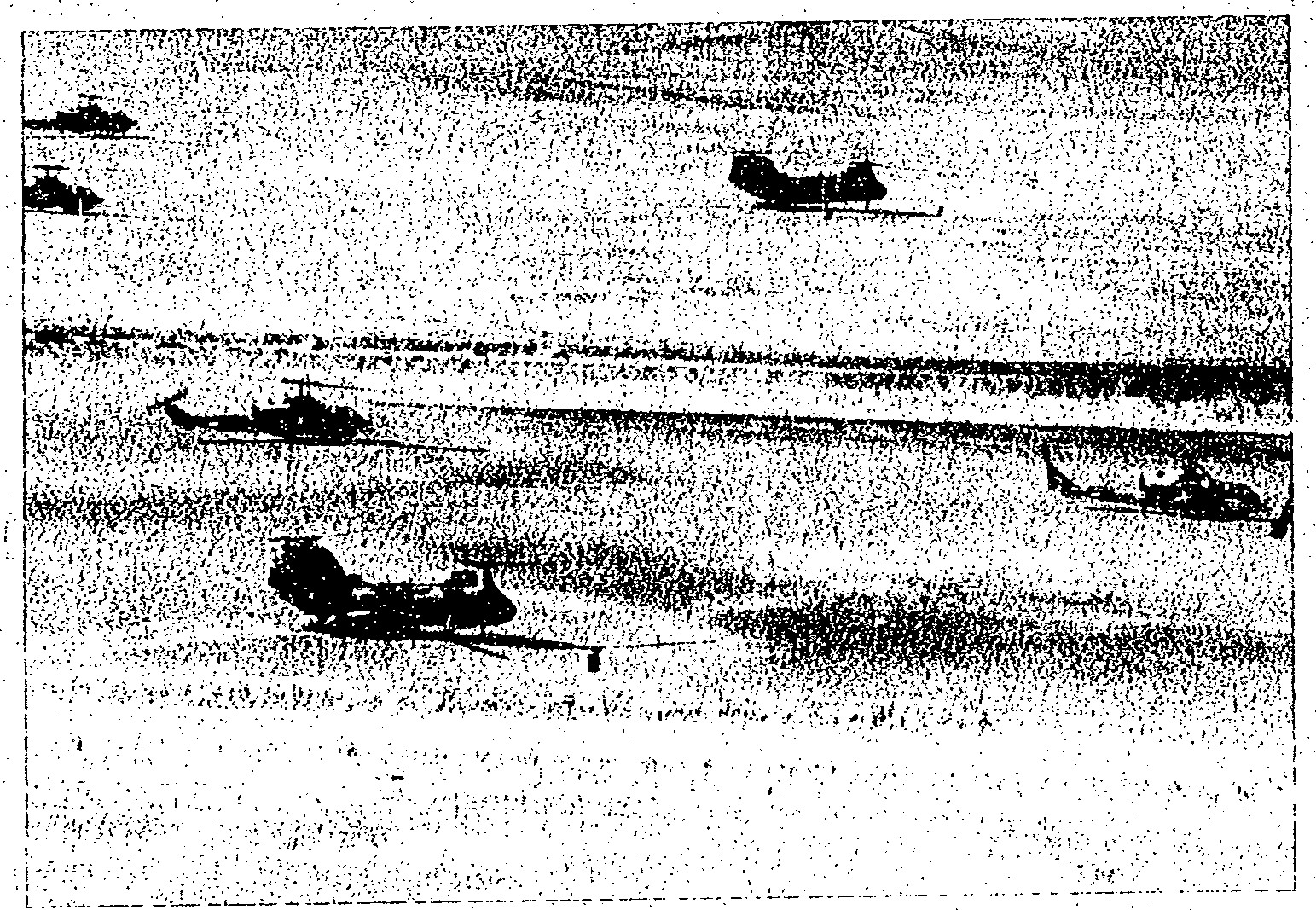
The Marine Corps first employed helicopters in a combat role during the Korean War. When the 1st Provisional Marine Brigade arrived in Korea in August 1950, its aviation assets included several light utility helicopters. During their withdrawal from Chosin Reservoir, the Marines used these helicopters for command liaison and medical evacuation. During the summer of 1951, HMR-161, the first helicopter transport squadron, lifted infantry companies to and from the frontlines. In 1952, the Marines employed helicopters to execute troop movements, combat resupply, and tactical inserts. In virtually every combat operation and major exercise since the Korean War, Marine units have used assault support aircraft. As we look to employ MAGTFs in maneuver warfare, assault support will continue to play a critical role providing operational mobility for the MAGTF. The ACE commander will employ his assets to accomplish the MAGTF commander’s intent, both in support of GCE/CSSE missions and as a maneuver element. In what manner can helicopters be employed as a maneuver element?

A MAGTF commander is not likely to employ a helicopter squadron as a separate maneuver element. Transport helicopters move troops and equipment in order to accomplish tactical, logistical, and administrative missions. They may be an integral part of a maneuver element, but transport helicopters do not lend themselves to independent action. Attack helicopters, however, are ideally suited for maneuver roles, such as screening a flank or conducting deep operations against armored or mechanized threats. However, the relatively small number of attack helicopters in a Marine wing limits the scope and duration of these operations. The ACE commander can better accomplish these missions by task organizing fixed- and rotary-wing units to achieve the synergistic effect of combined arms.

By executing a heliborne assault, the MAGTF commander extends the area that he can influence with the GCE. Normally, the GCE can influence an area of about 18-20 kilometers in depth. Employment of unrefueled CH-46s extends this to a depth of approximately 80 nautical miles. This heliborne assault incorporates surprise and swiftness; it also neutralizes the effects of natural and manmade obstacles on GCE mobility. Employing forward arming and refueling points (FARPs), the helicopter unit can make itself available on short notice to withdraw or reposition the ground maneuver element and to provide resupply, casualty evacuation, and close-in fire support (CIFS).

A heliborne assault will normally include provisions for the inserted maneuver unit to link-up with mechanized or motorized forces. An employment option that does not require linkup is the heliborne raid. MAGTFs are well suited to conduct such raids. The fixed-wing support requirements, particularly AAW and OAS, are planned along with assault support requirements under a single command, the ACE. CAS and CIFS aircraft are available to the ground maneuver units immediately upon insertion. Additionally, artillery units are helilifted into positions in order to support the raid force mission, and command and control is enhanced through the use of utility helicopters equipped with command communications modules.

In future combat operations the MAGTF will likely encounter an enemy who possesses a superior armored and mechanized capability. The MAGTF commander will have to employ superior combined arms and maneuver skills in order to defeat this threat. Two Marine Corps Gazette articles in August 1989 suggested adopting battlefield air interdiction (BAI) within our OAS doctrine in order to enhance the Marine Corps’ combined arms capability. BAI is an Air Force term that encompasses airstrikes against targets short of the FSCL, but not directly under control of the ground maneuver element. In a BAI mission the ACE would employ its assets as a maneuver element. But what does this have to do with assault support?

Although BAI is largely an OAS mission, the ACE could easily integrate helicopter assets into this operation. For attack helicopter employment, Army doctrine calls for a joint air attack team (JAAT). (See FM1-112, Attack Helicopter Battalions.) On a JAAT mission, attack helicopters, Air Force CAS aircraft, and field artillery conduct simultaneous attacks against the same target. Army doctrine calls for artillery indirect fire to engage the target while helicopters move into attack positions. Once there, the helicopter flight engages the target, and then the helicopter flight leader coordinates the air support between the ground commander and the CAS flight leader. The ACE could easily use similar tactics in support of the MAGTF.

BAI takes the fight to the enemy and disrupts his scheme of maneuver before he can make contact with the GCE. This gives the GCE commander time and maneuver space to accomplish the MAGTF commander’s mission and intent. If required, transport helicopters can lift artillery into position to support the JAAT. The ACE can improve JAAT responsiveness to identified targets by positioning FARP packages before mission execution. The MAGTF commander possesses built-in flexibility for this mission since all required aviation assets come under a single tactical commander, the ACE.

Screening a flank is a “maneuver mission” that the MAGTF commander might assign to the ACE. The light armored infantry (LAI) battalion conducts screen, guard, and cover operations, which are traditional security missions. Although the speed and agility of the light armored vehicle (LAV) make it suitable for these missions, it is vulnerable to direct fire weapons, particularly from enemy armored or mechanized forces. The ACE can augment the firepower of the LAI battalion with attack helicopters. With MAGTF approval the ACE can integrate AH-1W Cobras, using overwatch techniques, into the LAI mission. Cobras provide CIFS and antiarmor punch using both the TOW and Hellfire missiles. A habitual relationship developed between the ACE and the LAI battalion would provide the MAGTF commander with an enhanced ability to shape the battlefield.

Assault support assets provide a great deal of flexibility and mobility to the MAGTF commander, if they are effectively used. As such, helicopters play a major role in concentrating combat power against enemy critical vulnerabilities. Helicopter effectiveness may be degraded when requirements exceed the assets available. The ACE must ensure that the allocation and employment of its helicopters most effectively supports the MAGTF commander’s intent.

Future assault support aircraft will expand the maneuver capability of the MAGTF. The MV-22, currently under flight test, will have a minimum combat radius of 200 nautical miles and a cruise speed of 250 knots. This is far superior to the 120-knot cruise speed and 80-nautical-mile combat radius of the CH-46. The MV-22 will give Marine commanders a far better capability to conduct air assaults deep into enemy territory. Current fiscal constraints may jeopardize MV-22 procurement; however, we should continue to develop tactics in line with tilt-rotor capabilities. Just as Marines developed doctrine for transport helicopters in 1947, we should plan for the tilt-rotor concept in 1991. While the Marines may not procure the MV-22, this technology clearly represents the new generation helicopter we will take into any future conflict.

Recommendations and Summary

The MAGTF has an awesome arsenal of weapons and well-trained Marines to carry out any mission. Clearly, the ACE maintains the preponderance of the MAGTF’s “Sunday punch.” This combat power allows the MAGTF commander to influence what will be on the battlefield 12-72 hours in the future as well as support the GCE’s battle right now. The MAGTF commander owns these aviation assets and will use them to best achieve the strategic aim. Although not used frequently in the past, the MAGTF commander may use the ACE as the MAGTF focus of effort or as a maneuver element. This is not new. History is full of successful examples of using air as a maneuver element. On today’s battlefield, there are many examples of missions the ACE could perform as a maneuver element; these include screening forces, direct support CIFS/ CAS aircraft, deep raids, LAI/helicopter reconnaissance, and more.

During the summer of 1989, the Marine Corps University instituted maneuver warfare training at all Marine schools. This education, coupled with the Commandant’s new warfighting doctrine articulated in FMFM I, is increasing all Marines’ knowledge of, and experience in, maneuver warfare. As recent graduates of Amphibious Warfare School and Command and Staff College return to the Fleet Marine Force (FMF), they will also share their knowledge of maneuver from the academic environment. However, is this enough? Are there any other ways we in Marine aviation can increase our knowledge of things maneuver? We think so.

Marine Aviation Weapons and Tactics Squadron 1 (MAWTS-1) is the Marine Corps’ collection of duty experts regarding the best employment of Marine aviation. Twice a year, MAWTS-1 conducts a Weapons and Tactics Instructor (WTI) Course at MCAS Yuma. Marine Corps captains from all the wings attend the course; they are chosen based on tactical performance in their fleet aircraft and their career potential. Upon completion of the very rigorous WTI syllabus, they return home and assume the duty as their squadron’s tactics instructors.

Over the last two years, MAWTS-1 has conducted command element training for several Marine expeditionary brigade (MEB) staffs. This training centered on the best employment of the ACE; it followed the WTI course, but took place before the aircraft returned home. In this fashion, a MEB staff had available more than 100 Marine aircraft that represented a typical force structure in combat, coupled with the extensive training areas of Marine Corps Air Station Yuma. Additionally, over the last year the Marine Corps University has conducted MEB battle staff training with each MEB prior to the training conducted at MAWTS-1. These programs are invaluable and an ideal way to get experts, not only in weapons and tactics, but also in maneuver, back to the FMF.

The common “sheet of music” for all Marines, whether it be in training or in combat, is maneuver warfare and the concepts that make up maneuver. As Marine aviators, we must communicate with our ground brethren in a clear, concise manner. Maneuver warfare concepts will enable us to accomplish this at the operational and tactical levels of war. In FMFM 1, Gen A. M. Gray states that maneuver

. . . represents not just guidance for actions in combat, but a way of thinking in general . . . a philosophy for action which, in war and in peace, in the field and in the rear, dictates our approach to duty.

For 75 years, Marine aviators have answered Marine infantrymen’s call while engaged in mortal combat. In the future this will not change as Marine aviation adopts maneuver and learns to fight smarter, pitting strengths against enemy weaknesses in order to make him lose cohesion and the will to fight.
Don’t Forget FMFM 1

by Capt Stephen K. Bollinger, USMCR

Maj Szelowski’s article “Iraq’s Defense of Kuwait and the Battle of Kursk” in the January issue of the Gazette was very interesting, informative, and to some extent disturbing.

It is disturbing, of course, to think that many lives could be sacrificed by having Marines strike directly at the heart of Iraqi defenses. But also disturbing is the implication that if we do not apply maneuver warfare concepts at the strategic level, we cannot do so at the tactical level.

If the Marine Corps is called upon to frontally assault Iraq’s defenses in Kuwait, it is important for all of us to remember that maneuver warfare is a way of thinking that looks for and creates gaps and avoids surfaces in enemy defenses. It looks for the most cost-effective way to destroy the enemy. That thinking can and must be applied at the tactical level of warfare, perhaps especially in siege-type situations. To beat trench warfare in World War I, the Germans developed their very successful infiltration tactics. And Rommel as a lieutenant applied it in the Italian Alps with great effect.

In my opinion it is critically important now to remember to apply the tenets of maneuver warfare, to think like a maneuverist wherever possible, no matter how restrictive the tactical challenge presented.

Teaching Light Infantry Tactics

by Maj John F. Kelly and Capt Philip E. Smith

Teaching light infantry concepts is not an easy task. In some ways, it involves teaching Marines a whole new way of thinking, of acting, of solving tactical problems. However, if the Marine Corps is expected to fully implement its new maneuver warfare doctrine, this is what needs to be accomplished.

Training effective light infantry must begin with a thorough understanding of tactical concepts. Most Marine Corps schools, however, traditionally have emphasized specific techniques and procedures and have not addressed the conceptualization issue to any large degree. The “how to” has been stressed over the “why” of tactics. In addition, the techniques and procedures have largely been presented as if they were timeless and appropriate to every war, battle, and skirmish.

Commencing with the initial drafts of OH 6-1, Ground Combat and particularly with the publication of FMFM 1, Warfighting, an evolutionary process of change was initiated at the Infantry Officer Course (IOC). As this process continued, and as we responded to such realities as the expeditionary nature of the Marine air-ground task force, limited war, and low-intensity conflict, a move toward light infantry techniques became inevitable. Fundamental to these changes was the decision to teach not simply the technical details of the infantryman’s trade, but to teach the fledgling infantry officer how to think.

This process begins when the student is first designated a future infantry officer about halfway through The Basic School (TBS). At this point, he receives a required reading list that includes, among many works, Perspective On Infantry, Battlefield Central Europe, The Dynamics of Doctrine: The Changes in German Tactical Doctrine During the First World War (Leavenworth Paper #4), and the Maneuver Warfare Handbook. This process of reading and reflection continues during IOC in the form of additional books and smallgroup discussions.

Throughout the length of the course, students are also issued a number of weekend readings (e.g., book excerpts or articles from the Gazette, Infantry, Armor, etc.) in support of material that is scheduled for presentation the following week. For example, several readings are required on various techniques associated with countermechanized defense. The authors present differing points of view on the “best” way to execute this tactic or how to accomplish this task in a given environment. The instructional point is to increase the student’s perspective on the topic. This process of thought development continues for the duration of the course and is reinforced in sandtable and map exercises, tactical exercises without troops (TEWTs), TACWAR, short tactical decisionmaking exercises (similar to the series that began in the April 1990 edition of the Gazette), and, of course, in all field exercises. Although most of these methods of reinforcement have been standard fare at IOC for a decade or more, they now reflect the doctrinal philosophy of maneuver warfare and modern techniques.

A key factor in teaching any individual to think for himself is the establishment of an environment of open discussion and communication. It is also important to avoid suggesting that a student’s solution is right or wrong, providing a “yellow” or “recommended” solution, or even for the instructor to muse on how he might have accomplished the task. In the first case, it will inhibit students from offering solutions in the future; in the second case, suggesting an institutional right answer will restrict the students’ options if given a similar situation again.

Beyond the aspect of teaching the student how to think is the task of exposing him to the tactical concepts, techniques, and procedures that will ensure his effectiveness as an infantry leader. Any individual attempting to execute maneuver warfare or operate as a light infantryman must be provided, through training and historical perspective, as full a “bag of tricks” and as many techniques and procedures as possible. Procedures are relatively simple, and instruction on them at IOC covers technical tasks such as an in-depth introduction to both the 60mm and 81mm mortars, call for fire, 60mm mortar fire commands, plotting board, all aspects of machinegun employment to include qualification and defilade fire, and “sapper” level assault/field expedient demolitions. Tactical techniques are more difficult, as there is always more than one solution, and the “right” one is personality and situational dependent.

It is clear that modern techniques change as the situation demands. They cannot be codified and expected to apply forever. The first step is to make clear the concept behind the tactic, ensuring that it is fully understood, then introducing a variety of applicable techniques. An understanding of the overall concept allows this “bag of tricks” to be modified as the situation dictates. Instruction in tactical formations is an example of a technique (various formations) too often given precedence over the concept. Only if the concepts that drive unit movement (e.g., thick or light vegetation, open or close terrain, enemy contact likely or unlikely, possible air threat, etc.) are completely understood will the present tactical formations be recognized as only a set of techniques to use as starting points and not restrictions.

Training at IOD commences with mission-type orders, not just in the teaching of tactical skills, but in every aspect of the training day. The focus is on the development of decisiveness, self-reliance, and initiative in the individual and a fostering of team identity in the group. The training environment supports the natural and individual instincts of the students rather than attempting to make them all think in an “accepted” fashion. Field training is emphasized over classroom and application over lecture. Maximum use of the Socratic method is the teaching style and is viewed as critical, as it serves to place the students in continuous decisionmaking situations.

Most field-training exercises at IOC occur at night. Unlimited objective infiltration attacks, extended tactical movements over difficult terrain, and squadsized patrolling exercises are emphasized. These training techniques increase the number of individuals responsible for decisionmaking and navigation, begin the process of building proficient night fighters, reinforce the most infantry-intensive skills, and create unit bonding at the fire team and squad levels.

The course stresses that security and protection are gained not necessarily through the donning of helmets and flak jackets, or by burrowing deep in the ground with massive defensive fortifications, but by moving frequently and stealthily, remaining invisible, and exploiting the micro aspects of terrain. Although the relative advantages and disadvantages of both are addressed, in most cases students seek the reverse rather than forward slopes for their defensive positions.

Although there is little or no differentiation between offensive and defensive operations as they are presented at IOC, it will be useful for clarity’s sake to treat them as separate entities here. The defense is viewed with an ambush mentality that seeks to draw an enemy into the defense and to strike and shock him before he even realizes he is at risk. At this point, his only thought is for survival and not immediate action or calculated response. This approach suggests that it is the minimum ranges of weapons that are important-and they are. The student further understands that the key to any defense is the counterattack. In the case of an antiarmor defense, for example, the students look first to take advantage of the terrain. Most often they will seek to draw the tanks and other armor in close and execute the technique of massed surprise fires rather than the more traditional approach of ever-increasing concentric volumes of fire using heavy, medium, and light antiarmor weapons. In the first case, the secrecy of the ambush is maintained until the defender elects to act; in the second, the ambush is compromised by the defender’s own action. The first suggests nonlinear tactics, while the second employs a linear orientation.

Operations with a generally offensive bent take the form of infiltration attacks, although more traditional operational techniques (e.g., mechanized attack, strongpoint neutralization, urban combat, etc.) are also included. Platoons break down to squads, and sometimes into fire teams or smaller, to conduct lengthy moves at night over long distances. If the enemy is encountered during the infiltration, the unit might attack, depending on the mission and commander’s intent. In most cases, if an enemy unit is identified and is beyond the students’ capability to destroy, they might seek to establish ambushes along likely avenues of enemy egress or reinforcement and call observed supporting arms fire to drive the enemy from their positions.

Consistent with maneuver warfare and light infantry tactics, students come to realize that artillery and air support should not and cannot serve as a substitute for good tactics but as an adjunct to them. The functions and capabilities of various fire support agencies are conceptually grasped prior to any attempt at teaching specific methods of employment.

The most difficult task encountered when the IOC staff embarked upon the reorientation of the curriculum was that the staff themselves required philosophical reorientation. The guiding principle was established that maneuver warfare philosophy is different and that it is unlike anything the Marine Corps had done previously. This is important, as effective trainers require a full understanding of the concepts and historical perspective of maneuver warfare and light infantry. Fundamental to this understanding is an appreciation of the various styles and generations of tactics. This can only be accomplished by a thorough familiarity with military history and current military thought gained by focused reading, discussion, and study. It became immediately obvious that the teacher could no longer afford to be a bare semester ahead of the student. The answer was a comprehensive staff development program that initially oriented on specific areas that were immediately required to initiate the transition and then grew broader in perspective. This program remains in place for new instructors and, as is the case with future IOC students, it begins months before an instructor reports for duty.

These are some of the training prescriptions IOC found most effective in implementing the teaching of maneuver warfare doctrine and light infantry techniques in a formal school. This effort has also been somewhat horizontal, as a number of staff noncommissioned officers from both Schools of Infantry, Officer Candidates School, and the Marine Corps Institute have audited the complete course in order to share information, publications, and experiences. Something akin to this effort is required if the Marine Corps is seriously considering “converting” its present infantry units into light infantry. It is obviously much more demanding in almost every aspect to train and operate at light infantry standards. However, along with the much increased tactical capabilities attained by training and operating as light infantry, these units can also execute traditional “line” infantry missions with minimal preparation.

Effective employment of Marine light infantry units requires leaders imbued with the maneuver warfare philosophy. It is therefore a requirement that increasing effort be applied throughout the Marine Corps to increase the speed at which maneuver warfare is institutionalized as our operating philosophy. There are essentially two points of view on how to accomplish this, The “chipping away” method consists of training the entry level personnel (TBS, IOC, the Recruit Training Regiments, and Schools of Infantry) and only a minority of more senior personnel through squad leaders and platoon sergeants courses, Amphibious Warfare School, and the Command and Staff College. This process takes the long view and requires waiting 15 to 25 years for the newly trained lieutenants to become generals and the privates to become sergeants major. This view also assumes that entrylevel Marines (privates and lieutenants) will maintain this “revolutionary” orientation in spite of pressures from above (real or perceived) to conform to the “old way.”

The other method is to do it now. This process requires targeting not only the entry-level Marine but also every other rank through general and sergeant major. This is the most effective means to change rapidly in the short term and institutionalize the ideas quickly.

To do this, every infantry-oriented school that has as part of its curriculum the teaching of topics relative to infantry operations, must conduct a detailed course evaluation with a goal of eliminating superfluous instruction and/or any instruction that does not specifically lend itself to developing self-reliance and initiative as a way of life. The ultimate goal of all schools must be a vision of what the institution wants the graduate to be. The schools must be staffed with only the best and most experienced personnel who are themselves strong on the character traits described above and share the vision of the institution. As an example, the entirely new concept of control as it is articulated in FMFM 1 (i.e., mission orders and commander’s intent) would be emphasized. When a course includes instruction or use of electronic communication assets, the technical and procedural instruction would be moved as far toward the end of the course as is possible. This would allow entry-level Marines to concentrate on tactics and the concepts of communication without getting overwhelmed by procedures that sometimes appear to restrict rather than aid in communications. The use of communication by absolute exception would also be emphasized.

The concept of the program of instruction (POI) needs to be changed from one that inhibits development and change to one that assists in the evolution of change. This means eliminating the reliance on lesson plans that spell out a single way to do specific tasks through such things as enabling learning objectives (ELOs) and terminal learning objectives (TLOs). These do not lend themselves in any way to the teaching of tactics as an art as per the Commandant’s training and education memo dated 1 July 1989.

IOC is the only officer school that focuses exclusively on tactics and tactical techniques and procedures, although TBS has more of this instruction than ever before in its history. The Amphibious Warfare School, of course, teaches tactics, but must focus instruction on the majority of the students who do not have combat arms specialties. This reality orients the program toward basics and makes it less challenging for combat arms specialists than would be possible in different circumstances. Command and Staff College focuses, not on tactics, but on staff functioning and interaction. The tactical frame of reference for the vast majority of officers, regardless of rank or occupational field, is therefore what they learned at TBS or IOC. The Marine Corps must establish a system of cradle-to-grave resident refresher courses for infantry officers similar to the system currently in force for our noncommissioned and staff noncommissioned officers at the Schools of Infantry.

In the case of infantry captains, a four- to six-week resident course organized and conducted at Quantico should be established as soon as possible. The class size should be no more than 30 attendees, with the course condueled two to four times a year. This course should involve a great deal of focused reading and discussion, guest lecturers and seminars, TEWTS, and map and sandtable exercises. The point of the course would be both conceptual and practical. Rather than making this a return-to-the-Fleet Marine Force (FMF) course with all infantry captains attending en route, it should be filled by quota assignment to each individual infantry, light armored infantry, and reconnaissance battalion with the commander sending his best captain. Similar in concept to the Weapons Training Instructor Course for selected aviators at Marine Corps Air Station Yuma, the intent would be to have this officer return to his unit and serve as a catalyst for training and education. A similar course for field grade officers would be conceptually identical to the course for captains but would in fact be a return-to-the-FMF course. This would ensure that all potential battalion commanders can understand and operate using maneuver warfare philosophy that is so critical for light infantry units.

While the Marine Corps considers these broader changes in teaching tactics, IOC is continuing to move ahead, teaching the tactics and techniques of light infantry. It is our belief that the future of Marine infantry is primarily as modern light infantry. Training our infantry units to the exacting standards of light infantry tactics, techniques, and procedures will provide the most versatile force possible, and one that is at the same time absolutely adaptable across the spectrum of conflict. The transition involved will be a major one, as it has been at IOC. Light infantry warfare is not simply “business as usual” with new buzzwords, but a new and different way of thinking and fighting. It is, in the view of the IOC staff, what the Corps’ new doctrine of maneuver warfare means for infantry. As such, it should be the focus not only for IOC, but for every Marine Corps infantry unit as well.

References

The following is a short bibliography regarding the concepts associated with light infantry:

Canby, Steven L., Classic Light Infantry New Technology (Arlington, VA: Defense Advanced Research Center, 1983).

English, John A., On Infantry (New York: Praeger Publishers, 1981).

Fuller, J.F.C., British Light Infantry in the Eighteenth Century (London: Hutchinson and Co., 1925).*

Gudmundsson, Bruce I., Stormtroop Tactics (New York: Praeger Publishers, 1989).

Lupfer, Timothy T., The Dynamics of Doctrine: The Changes in German Tactical Doctrine During the First World War (Leavenworth Papers No. 4) (Leavenworth, KS: Combat Studies Institute, 1981).**

McMichael, Scott R., A Historical Perspective on Light Infantry (Research Survey No. 6) (Leavenworth, KS: Combat Studies Institute, 1987).

McMichael, Scott R., Discussions on Training and Employing Light Infantry (Research Survey No. 8) (Leavenworth, KS: Combat Studies Institute, 1988).

United States, Department of the Army, Vietnam Primer (Washington, DC: US. Government Printing Office. 1967).

United States Marine Corps, FMFM 1, Warfighting, (Washington, DC: 1989).

United States Marine Corps, Small Wars Manual (Washington, DC: U.S. Government Printing Office, 1940).

United States War Office, Fighting on Guadalcanal (Washington, DC: US. Government Printing Office, 1940).

Uhle-Wettler, Franz, Battlefield Central Europe.*

*Forthcoming publication expected to be available through the Marine Corps supply system at some future date.

*Available through the Marine Corps supply system. Use PCN number: 50100296400.

Maneuver Warfare

by Capt Timothy D. Sullivan, USMCR

It is always a pleasure to read Capt John F. Schmitt’s articles in the Gazette. His latest contribution, “Understanding Maneuver as the Basis for a Doctrine” (MCC, Aug90), is another fine attempt at clarifying how we are going to fight wars in the future. I think he has accomplished his objective, but at the expense of confusing some important terms.

By using the term “maneuver” interchangeably with the term “strategy,” he tries to make maneuver, a style of warfare, fit all combat situations. When he describes maneuver as consisting of two parts, creating advantage and exploiting it, he quotes what B. H. Liddell Hart wrote about strategy. All the attributes that Capt Schmitt gives to maneuver as a “mental approach to conflict,” such as exploiting vulnerability, identifying critical factors, focus, etc. are rightly the attributes of strategy. Maneuver as a style of warfare deals more with the tactics we use to execute the plan. Capt Schmitt is addressing the problem of how to characterize our approach to conflict, our strategy, with a single adjective or term. Why not say simply that we adopt a “multidimensional strategy,” a flexible approach to conflict?

Any style of warfare and associated tactics that we employ to prosecute specific combat actions should reflect the fullness of our strategy. We may use maneuver tactics in one situation and low-intensity conflict (LIC) tactics in another. It is difficult and confusing to associate an ambush tactic employed in a guerrilla or terrorist environment with maneuver. Similarly, the Combined Action Program in Vietnam was an example of good strategy, not of maneuver. Capt Schmitt may be going overboard in seeking problems to apply the maneuver solution to.

We should not change the joint definition of maneuver. As it stands, it fits neatly into the intellectual framework that Capt Schmitt has crafted for us. To overinflate the meaning of maneuver creates needless confusion within the military community. Moreover, that confusion obscures the much more important points of warfighting, which Capt Schmitt has articulated so well.


by Col R. K. Morgan, USMC(Ret)

The attempt to elevate the term “maneuver” into an all-encompassing concept (see Capt Schmilt’s August article) is doomed to failure. Redefining common, everyday words; applying basic terms such as “front,” “flank,” “rear,” and “attack” to other features or activities; and suggesting that maneuver means firepower are just a few examples of the maneuverist effort to stand language on its head. It is a poor way to communicate.

Make no mistake, this is not a complaint about the body of military theory expressed in FMFM 1 and FMFM1-1; what it is about, is the way those fundamental concepts are labeled and discussed-and about the effort to extend them beyond the range of their obvious usefulness.

If the trend to make maneuver into a universal principle continues, it won’t be long before somebody redefines a few more words and proposes it as the means for overcoming the deficit, the cure for AIDS, and answers to all spiritual needs. Newspeak will truly be with us.

When terminology becomes a barrier to comprehension, it’s time to change. Maj R. Scott Moore had it exactly right in the April 1989 Gazette when he spoke of MAGTF Warfare and allowed words to mean what they always meant.

Close Air Support Revisited

by Capt Dale R. Davis

Close air support remains essential to our success on a maneuver warfare battlefield, but providing it will be increasingly difficult.

The application of the Marine Corps’ maneuver warfare doctrine (FMFM-1) to the six functions of Marine aviation is still an area of debate. Articulating the ability of the aviation combat element (ACE) to perform missions as a Marine air-ground task force’s (MAGTFs) focus of main effort has become quite the rage, as demonstrated by numerous recent articles in our professional military journals.* Unfortunately, the doctrine of close air support (CAS), as it supports or fails to support maneuver warfare theory, is a subject that has been largely ignored.

The Marine Corps employs CAS more effectively than any other combined arms force in the world. This ability, however, does not compensate for the obvious contradictions between maneuver warfare theory and Marine aviation doctrine. Concepts such as fluidity, disorder, uncertainty, tempo, reconnaissance pull, and decentralized command often seem in conflict with aviation command and control doctrine. As the Marine Corps reorients toward the low-to-medium end of the spectrum of conflict and commits itself to maneuver warfare, it is appropriate to reexamine CAS requirements, doctrine, aviation force structure, tactics, and equipment requirements.

CAS Requirements and Doctrine

Why CAS? Does the Marine Corps really need it? Can we rely primarily on attack helicopters to support ground maneuver while fixed-wing aircraft are dedicated to air superiority and battlefield interdiction missions? Has the proliferation of the shoulder-fired surface-to-air missile (SAM) rendered CAS as ineffective as cavalry in World War II?

A quick analysis of helicopter survivability in Vietnam, Grenada, and Panama reveals the vulnerability of rotary-wing attack platforms. CAS provides flexibility to the maneuver commander, and it allows operations beyond the range of other supporting arms. Certainly during the early stages of an amphibious assault CAS will be required due to the lack of other supporting arms. It is CAS that allows a light, expeditionary force to conduct violent, successful combined arms warfare. On the maneuver battlefield, the Marine Corps will be more dependent on CAS than ever before. At the same time, however, CAS is a most inefficient use for Marine air. CAS missions generally affect the tactical level of war. No wars or campaigns have been won by CAS, only individual battles. Moreover, CAS is not easily executed. FMFM 5-4A, Close Air Support and Close-in Fire Support outlines the requirements for effective CAS as air superiority, suppression of enemy air defenses (SEAD), marking requirements, favorable weather, flexible control, prompt response, and aircrew and terminal controller proficiency. The rapid changes in technology and tactics demand a review of these requirements.

Air superiority includes superiority over the ground-to-air threat as well as the air-to-air threat. On the modern battlefield the enemy may be able to deny air superiority without actually employing aircraft. The increased lethality of modern air defense weapons may severely inhibit air operations. This increases the need for effective SEAD. The conduct of SEAD operations has become exponentially more difficult as the performance of shoulder-fired SAMs has increased. Since larger radar-guided systems usually remain farther behind the forward areas in order to defend vital facilities, manportable SAMs and antiaircraft artillery (AAA) represent the predominant threat to CAS aircraft. The great advantages of these systems are high mobility and easy concealment. areas in order to defend vital facilities, manportable SAMs and antiaircraft artillery (AAA) represent the predominant threat to CAS aircraft. The great advantages of these systems are high mobility and easy concealment.

SEAD operations fall into one of two categories, destructive or disruptive. Since the threat is extremely difficult to target, heavy reliance must be placed on disruptive means of SEAD. These include technological countermeasures (electronic countermeasures, chaff, flares), operational deception, and sound tactics. While the ability to conduct future daylight CAS operations with relative impunity is questionable, night operations are a viable alternative. The effectiveness of AAA and infrared guided missiles is limited at night due to visual target acquisition requirements.

On the maneuver battlefield, flexibility is a key to success. Flexible control of aircraft is the responsibility of the Marine Air Command and Control System (MACCS). While it provides operational flexibility, the MACCS concept of centralized coordination and decentralized control presents a unique challenge to tactical flexibility. Rapidly changing situations and fleeting windows of opportunity demand decentralization within the command and control process. The air tasking order (ATO) is presently written at the tactical air command center (TACC) 24 hours in advance of execution. This 24-hour deadline requires submission of air requests at the infantry battalion level no later than 36 hours in advance of execution. Once the air requests are submitted, the maneuver unit commander has very little latitude in the employment of CAS.

One method of providing flexible CAS has been to write preplanned oncall, strip alert, and airborne alert sorties into the ATO. A more recent innovation has been “direct support” sorties, which are simply strip and airborne alert sorties allocated to specific maneuver units. Unfortunately, these methods fail to support maneuver warfare. The principles of reconnaissance pull, mission orders, and commander’s intent are ignored. There is no direct liaison between the supporting aviation unit and the supported ground unit prior to mission execution. Aircrew are usually unaware of the actual tactical situation. Untold opportunities slip away because aircrew have no knowledge of the commander’s intent or the supported unit’s scheme of maneuver.

Since the supported unit commander does not have launch authority, he is unable to commit his dedicated CAS without approval from the tactical air commander (TAC). CAS flexibility is held hostage to long-haul communications through a lengthy chain of command. CAS mission tasking and launch authority should be pushed down to the regimental level. The ACE should retain the authority to divert any missions to support the MAGTF but should otherwise simply monitor these processes. The assignment of specific aviation subunits vice sorties (i.e., Section 1, VMA-513 vice Mission Number 7061) in direct support of ground units will provide the ground commander with the greatest degree of latitude in the employment of CAS and create the level of air-ground integration necessary to apply the principles of maneuver warfare.

Prompt response is closely tied to flexible control and is dependent on communications, aircraft availability, and flight time to the target. Forward basing and airborne/strip alerts help reduce response time. The concept for employment of the AV-8B Harrier revolves around forward basing. Located at a forward site near the supported unit, the Harrier waits in a strip alert status for mission tasking. Close proximity to the target theoretically reduces flight time and fuel requirements, thus decreasing response time and increasing ordnance payload.

Capt Sean P. McDonald’s article “Expeditionary Site Operations” (MCG, Jan90) sheds the harsh light of reality on this issue. To optimize forward site operations, significant requirements must be met in terms of site dimensions, composition, and logistics support. To carry a relevant payload, the Harrier will require a rolling takeoff on a prepared surface. This does not correlate to the image of a Harrier rising like the Phoenix out of a clearing to wreak havoc upon the enemy. Airborne alert provides the best response time, but this procedure is inefficient in terms of aircraft utilization. The limited flight times of modern jet aircraft demand either in-flight refueling or more sorties to cover a given time period.

Aircrew and terminal controller training is an issue that has received attention recently. The requirement that all forward air controllers (FACs) must be pilots is a detriment to effective CAS, whose missions are the most complicated supporting arms missions to coordinate and control. The limited exposure to ground operations, relatively short tour lengths, and often the lack of desire inhibit the proficiency of aviators as FACs. In terms of cost effectiveness and combat readiness, it makes little sense for Marine aviators to do anything other than fly. A more logical choice for FACs would be officers with the military occupational speciality (MOS) 7208/direct air support center (DASC) background. They understand the procedures and communication requirements perhaps better than Marines of any other MOS. In addition to removing MOS restrictions, FAC tour lengths should be increased to the three-year standard, for obvious reasons.

Finally, aircrew need to concentrate on more specific mission training. Due to the diverse capabilities of modern aircraft, pilots are required to train for many different missions. Undoubtedly, within the F/A-18 community, aerial combat maneuvers and deep strike tactics predominate the flight schedule at a cost to CAS proficiency. Greater specialization will lead to more effective mission accomplishment.

Aviation Force Structure

Achieving greater specialization within the aviation community requires corresponding specialization within the aviation force structure. The ACE should be restructured to accomplish the six functions of Marine aviation more effectively. At the Marine expeditionary force (MEF) level, the ACE should consist of air groups that are task organized to perform specific Marine aviation functions. An antiair warfare (AAW) group would be responsible for conducting all offensive antiair warfare and air defense missions, such as combat air patrol (CAP) and deep strike escort. An offensive air support (OAS) group would be responsible for conducting all strike and CAS missions. The heart of the OAS group would lie in three dedicated direct support (DS) squadrons. Each DS squadron would be committed to CAS missions in support of a corresponding infantry regiment within the ground combat element (GCE). In addition to the three DS squadrons, the OAS group would contain two general support (GS) squadrons. These squadrons would be responsible for strike missions and would provide the MAGTF commander flexible combat power at the operational level. Tactical employment of DS aircraft would be the responsibility of the supported regiment. The DASC would be primarily responsible for employing the GS squadrons in immediate support of the MAGTF and routing aircraft through MAGTF airspace. Of course all aircraft are MAGTF assets, and the DASC would be authorized to divert DS aircraft to immediate support of the MAGTF when necessary. MAGTFs smaller than a MEF would task organize in a similar manner, retaining a close relationship between the GCE and the ACE’s DS subunit

Tactics

Appropriate tactics are generally determined through an analysis of the mission, enemy, terrain and weather, troops and fire support, time-space, and logistics (METT-TS-L). Aviation tactics are no exception. CAS tactics have evolved to meet the air defense threat From lowaltitude ingress pop-up attacks to avoid medium altitude, radar-guided SAMs to high angle dive bombing to avoid AAA, tactics have changed as the threat has changed. Technology occasionally enables new tactics that were previously not feasible. The amazing improvements in night flight technology and precision-guided munitions have breathed new life into CAS tactics. Aircraft will be able to provide CAS at night when enemy air defenses are suppressed. Precision-guided munitions will reduce targeting problems, reduce exposure over the target, increase target destruction, and allow stand-off ordnance delivery. These factors add up to combat power and survivability.

Equipment

What are the requirements for an effective CAS platform? The most critical requirement is survivability. For years, survivability has been tied to speed, which reduces periods of exposure to the ground-to-air threat. The predominately successful use of air defense guns and small arms by the enemy in Korea and Vietnam fueled the movement from propeller-driven aircraft towards jets. The proliferation of highly effective man-portable SAMs has compounded the survivability issue further. Night flight capabilities, reduced infrared (IR) signature, IR countermeasures, precision-guided munitions, and structural resistance to battle damage are necessary components of a survivable CAS platform.

An additional requirement is the ability to respond rapidly to immediate CAS requests. An effective CAS platform should be able to loiter on station for four to five hours without support. Finally, CAS aircraft must be capable of carrying and accurately delivering substantial loads of ordnance. Jets are the least suitable aircraft for the CAS mission. An aircraft with a turbo-prop or reciprocating piston powerplant seems much more reasonable. The greater fuel efficiency, ability to operate from rough, unimproved air-strips, and short takeoff capabilities far outweigh the disadvantage of an increased maintenance effort.

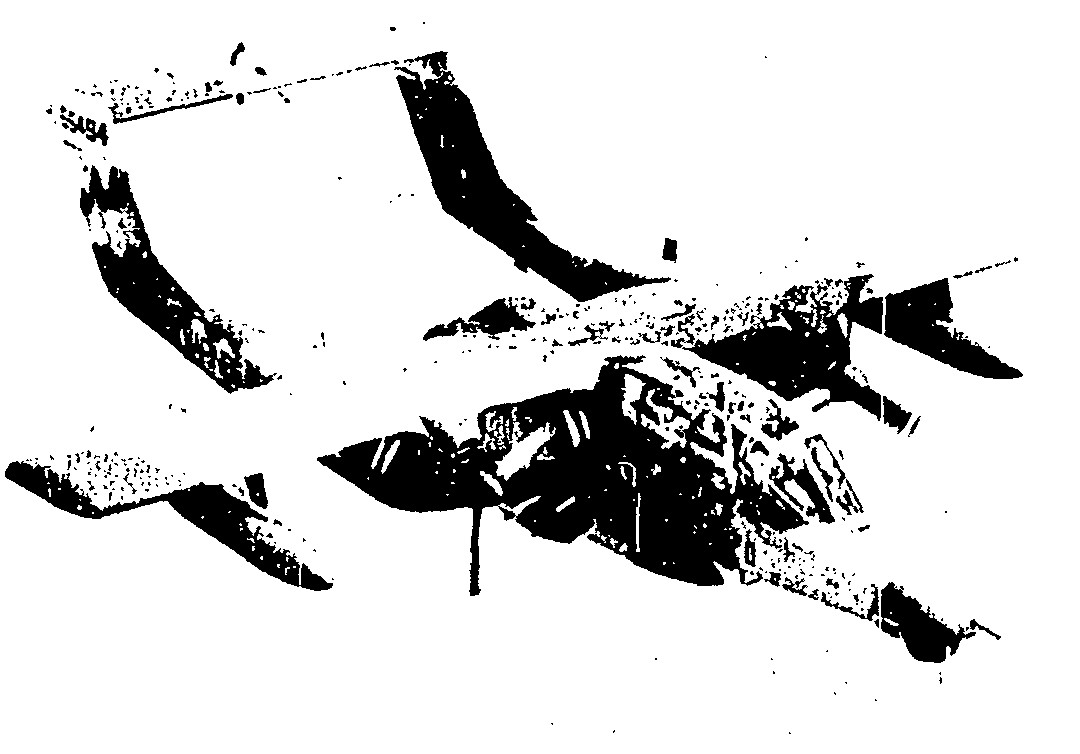
Is there an optimum CAS platform for the Marine Corps? The Air Force’s A-10 is often recognized as a true CAS platform. While it incorporates many of the capabilities required by the Marine Corps, it cannot operate from small carriers. As a jet, it is susceptible to foreign-object damage and has a limited loiter time. Other potential CAS aircraft are an upgraded version of the OV-10 or the Pucara (built by Argentina). These aircraft have limited ordnance loads of approximately 4,000 pounds. An effective CAS platform was in the Marine Corps’ inventory in 1952. The A-1 Skyraider-carrying 12,000 pounds of external ordnance and four internal 20mm guns and capable of operations from small carriers, short unimproved expeditionary airfields, and roads-loitering over the battlefield for four to five hours providing continuous CAS to maneuver forces. It also was capable of sustaining multiple small- and medium-caliber antiaircraft artillery hits, was agile enough to defend itself at low altitude against the air-to-air threat, and was cheap enough for the Marine Corps to buy in sufficient numbers. The Skyraider provided Marines accurate CAS in Korea and Vietnam. An aircraft built along the same lines as the Skyraider, with the advantages of modern technology, would provide the Marine Corps with the aircraft that William S. Lind calls the “Mudfighter.”

Appropriate CAS ordnance is also a factor to consider. In light of the political influence on rules of engagement and the need to minimize collateral damage in any future conflict, it may be more appropriate to spend millions of dollars on precision-guided munitions that can be delivered by relatively inexpensive aircraft than to develop expensive aircraft to deliver cheap, inaccurate ordnance.

Joint Operations

Future conflicts will almost assuredly entail joint operations. One of the most pressing fears of the Marine Corps is that misinterpretation of the 1986 Omnibus Agreement, which approved a new policy for command and control of Marine Corps tactical aviation during sustained operations ashore (see MCG, May 90, p. 9), will lead to the loss of operational control of Marine air by the MAGTF. This problem is complicated by the fact that our aircraft, especially the F/A-18 and A-6, are so capable of conducting air superiority and battlefield interdiction missions. The acquisition of an ugly, slow, propeller driven “CAS only” aircraft would ensure that Marine air will be there to support maneuver. The Air Force probably would not even classify it as a tactical aircraft.

Conclusions

In summary, CAS remains a necessary component of Marine combat power. It has become exceedingly more difficult to coordinate and conduct. Streamlining the tasking process and delegating the authority to commit allocated CAS sorties to the maneuver commander will provide more flexibility. Increasing the proficiency of aviators and FACs through specialized training and experience, combined with more specialization within the aviation forces structure, will improve mission effectiveness. To ensure that CAS remains available we must integrate technology and new tactics to increase survivability and allow exponentially greater combat effectiveness. Finally, it may be necessary to acquire a “CAS only” aircraft that survives on the modern battlefield, while ensuring a CAS capability remains within the MAGTF during joint operations.

Note

*For examples see:

  • Maj R. Scott Moore, “The Art of MAGTF Warfare” (MCG, Apr89)
  • William S. Lind, “Maneuver Warfare and Marine Aviation” (MCG, May89)
  • Maj James P. Etter, “Marine Air: Look to the Battlefield …” (MCG, May89)
  • Maj John B. Saxman, USAF, “The Role of Marine Aviation in Maneuver Warfare” (MCG, Aug89)
  • Major Steven B. Donnell “The ACE as a Maneuver Element” (MCG, Aug89).

Recon-Pull

by Maj R. Scott Moore

A 1989 Chase Essay Contest Entry

Recon–pull, the ability to find and exploit enemy weakness, is at the heart of a MAGTF’s mission. However, turning this task into reality requires more than simply good intelligence. What it requires is the successful marriage of intelligence and operations.

As the final North Korean charge abated in another pile of dead, the Marine company commander wondered. The day before, his company, Company A, 1st Marines, had penetrated deep into the suburb of Yongdungpo, on the outskirts of Seoul. He had found a gap in the North Korean defenses, reported it, but had seen no effort by his commanders to exploit it. Instead, the advance of the 1st Marines ground ahead to his right and left against heavy resistance. As night fell, the North Koreans awoke to the threat that had penetrated into their rear and responded with vicious, if piecemeal, attacks. Company A, alone, fought throughout the night, while the North Koreans slowly withdrew around it. A fleeting opportunity had passed, and Capt Robert H. Barrow knew it.

Capt Barrow’s frustration, incurred in September 1950, did not stem from incompetence. His commanders were professionals who had learned warfare in the Pacific little over five years before. A large percentage of the Marines with whom he served had been blooded fighting the Japanese. Yet, by training and experience, they seemed to be incapable of exploiting the opportunities uncovered by Capt Barrow. Marine doctrine, forged in the island campaigns of World War II, relied on linear tactics and firepower controlled by detailed plans and control measures that ensured the destruction of the enemy immediately to the front but did not allow for bold maneuver into enemy rear areas. Its commanders were brave and professional Marines who executed their orders as they had been taught, both by education and experience. Unfortunately, they could not capitalize when the North Koreans made mistakes.

After nearly 40 years, Marine Corps doctrine appears to be finally coming to grips with the situation at Yongdungpo. The principles of maneuver warfare have been institutionalized in FMFM 1. Warfigltting. Although fully recognized, if not accepted, by most Marines, maneuver warfare continues to meet obstacles in the Fleet Marine Force, where grand sounding theory must confront reality. At the heart of this struggle resides the concept of recon–pull, which emphasizes finding and exploiting enemy weaknesses. Unfortunately, the concept of recon–pull also tends to be abstract while the reality of the battlefield does not lend itself to abstractions. Bridging this gap requires comprehension of the principles of recon–pull and, more importantly, an understanding of how those principles may be applied.

Recon–pull is not a new idea. In 1921, Capt Basil H. Liddell Hart, drawing on his experience on the Western Front, postulated a theory of infantry tactics he called the “expanding torrent.” Equating combat to the flow of water, he wrote that tactics should seek the path of least resistance, naturally widening those soft spots that are found by pouring more forces through them. He compared initial combat to two men fighting in a dark room, each groping for the other with his hands. Success would go to the combatant first able to grasp his opponent and strike at his critical point. Shifting his analogy to modern warfare, Liddell Hart divided this groping effort into two types of reconnaissance-reconnaissance prior to battle and battle reconnaissance. The first involved long-range intelligence gathering, while the latter included the use of scouts and “reconnaissance by fighting.” Like his two fighters, the force able to locate and exploit enemy weaknesses would be victorious. Liddell Hart’s writings, reportedly read by the Germans, became the basis for the Wehrmacht’s devastating blitzkreig tactics. Coincidentally, but perhaps not surprisingly, the guerrilla tactics employed by Mao Tse-tung were conceptually the same, relying on extensive reconnaissance to find weaknesses in Japanese and later Nationalist Chinese defenses and then exploiting them by attacking isolated posts or vulnerable supply points.

Whether postulated by Liddell Hart, practiced by a Panzer commander, or exploited by an Asian guerrilla, successful application of recon–pull depends on three basic principles:

First, intelligence must determine the operational plan. Apparently a simple concept, it is perhaps the most violated. All too often, intelligence officers are consulted after a scheme of maneuver has been developed.

Second, operations must be flexible enough to capitalize on unexpected situations, normally fleeting in nature.

Third, and most important, once the fighting starts, intelligence and operations must become inseparable. They are coequal partners on the battlefield. As the situation inevitably changes, the intelligence effort must be reoriented to meet that situation, which in turn redirects the scheme of maneuver.

Thus these three principles constitute a cycle, meshing intelligence and operations.

Recon–pull‘s three principles have as their primary objective the location and destruction of the enemy’s critical weakness, an idea that eludes many, for it can be physical or psychological, constant or changing. Simply stated, it is that component of an enemy force that, when destroyed or disrupted, shatters his ability to continue fighting. In Yongdungpo, the North Koreans would not have been able to continue the defense of the approaches to Seoul had Company A’s advance been exploited. For a squad leader faced with knocking out a machinegun, the critical weakness may be the enemy gunner’s ability to see his target. For a Marine expeditionary force (MEF) commander fighting an insurgency, the enemy’s critical weakness may be the guerrillas’ political cadre rather than any purely military target. Whatever it may be, the critical weakness normally can be destroyed by exploiting numerous, smaller vulnerabilities or gaps, much like Liddell Hart’s expanding torrent. Because of this, the enemy usually understands and tries to protect his vulnerabilities, rarely cooperating in his own destruction. Even if unprotected, they can be difficult to find and be so transitory as to defy effective exploitation.

Nonetheless, military history provides numerous examples of commanders able to exploit enemy weaknesses and eventually destroy critical points. In this century, the Germans and Israelis offer the best conventional examples. Mao Tse-tung, the North Vietnamese, and terrorists provide excellent examples of unconventional warriors able to apply recon–pull. Despite their obvious differences, they have demonstrated a common denominator-an ability to turn intelligence into decisive action. This requires an intelligence capability that not only collects information but accurately assesses its significance. Operationally, the commanders have possessed forces who could react rapidly to opportunities. The relationship between intelligence and operations is one of equality. This marriage characterized Wehrmacht assaults in Russia in 1941; it also enabled a lone terrorist to kill 241 Marines in Beirut.

The Marine Corps, unfortunately, has not shown itself to be as adept at marrying intelligence and operations. The explanation derives from historical experience. World War II and the Korean War presented few opportunities to exploit enemy weaknesses. Small islands crammed with Japanese bent on extermination and Korean hill masses from which Chinese defenders had to be removed for political reasons did not favor exploitive maneuver. Even in Vietnam, where intelligence bore a larger task, it was translated into quests for body counts. In each case, intelligence focused on targeting-on determining what enemy forces were to be encountered on already established objectives. Rather than providing a clear picture of enemy weaknesses, intelligence sought to determine strengths, which then were attacked.

Historical experience pushed Marine intelligence into a subordinate role, with regrettable consequences. Most obvious, operations planners too often consult intelligence only after plans have been completed. Even when intelligence is produced early enough to influence planners, it provides them with little guidance. In fact, intelligence officers are taught not to recommend courses of action. This subordinate role leads to intelligence officers being perceived as special staff officers whose duties do not include giving tactical advice, a perception reinforced by many intelligence officers whose lack of operational experience makes them overly timid. Usually the junior officer on the staff, poorly equipped through training and experience to advise the operations officer or commander, the intelligence officer has been relegated in many units to the position of providing information and hoping that his seniors will produce accurate analysis. Exacerbating this problem, fragmentation characterizes intelligence collection and analysis with the inevitable result that the product lacks either timeliness or adequate detail. The elements of the Marine air-ground task force (MAGTF) conduct intelligence with little coordination. Greatly expanded intelligence capabilities, ranging from traditional infantry patrols to national-level systems, overburden such an intelligence structure, a fact tragically underscored in Beirut. While the newly formed surveillance, reconnaissance, intelligence (SRI) groups attempt to resolve this problem, their success has been somewhat limited, for reasons that will be discussed. By experience and structure, Marine intelligence continues to play a subservient role.

If it is to influence operations, intelligence must offer recommendations as well as information. The intelligence estimate, the primary means of presenting intelligence conclusions, fails to do so, reflecting in its format a reluctance to delve into operational matters. Yet, with a few changes, the estimate may be transformed. Indeed, the estimate need only be expanded to include recommended courses of action based on identified enemy weaknesses. Expanding the format, however, requires expansion of the horizons of intelligence, from one of description to one of prescription. Whether proffered orally or in writing, the result of long study or hasty analysis, the estimate comprises the focus of main effort for the intelligence officer. Fulfilling his expanded role of advisor, he must be capable of anticipating events, directing his collection and analysis effort ahead of operations. This ability demands equal familiarity with Marine as well as enemy doctrine and capabilities. In short, the Marine intelligence officer must be, foremost, a “combat arms intelligence officer,” adept at translating intelligence into operations.

Based on the intelligence estimate, the operational plan must be flexible enough to take advantage of rapid changes. Mission-type orders, commander’s intent, and decentralized control offer keys to exploitation. Additionally, Marines need to reexamine such operational details as objectives and control measures. An objective strives for one result, putting Marines in a position that places the enemy in an untenable situation. Control measures merely seek to ease the movement of Marines to that objective, not restrict it. Usually expressed in terms of terrain, an objective must orient on the enemy and be general in nature to allow for maximum subordinate initiative. A hill, for example, may be the highest terrain in a zone of action; however, its seizure may not endanger the enemy’s ability to keep fighting. Instead, a nearby road junction may be critical to the enemy’s ability to resupply his forces, a critical weakness if cut. A subordinate commander should have the leeway to seize either, depending on the emerging tactical situation. Given the unique capabilities of a MAGTF, an objective may not be terrain at all, but the results achieved by deep air support or by the elimination of command and control assets. In some situations, terrain objectives may be a negative influence, for they can tend to orient forces on themselves rather than the enemy.

It is at this stage that a smoothly functioning, cohesive intelligence collection and analysis capability becomes critical. As the operations plan succumbs to the battlefield, flexibility demands an accurate, all-source intelligence picture. This requires aggressive intelligence collection that continually looks into the area of interest. For the ground combat element (GCE), the area of interest may extend only a few miles forward and to the flanks. At the MAGTF level, the requirements of the air combat element (ACE) greatly expand this projection. At any command level, however, the area of interest is measured in time, not distance-the time needed for a command to identify and exploit enemy weaknesses. The SRI group demonstrates its greatest strength, and limitation, at this stage. Providing an all-source analysis capability and an ability to call up information from a wide variety of intelligence sources, it can offer a clear picture of uncovered enemy gaps. SRI group detachments, rarely comprised of the same Marines twice in a row, lack the cohesion necessary to perform in more than a technical supporting role, however. Whereas the SRI group undoubtedly offers an increased intelligence collection and analysis capability, the centralization of intelligence into a single administrative command reduces responsiveness. This dichotomy must be resolved if intelligence is to play a vital role in ensuring operational flexibility.

With intelligence guiding operations and operations exploiting intelligence, application of the third principle naturally occurs. Intelligence and operations quickly become inseparable. The intelligence officer should be as familiar with the scheme of maneuver, the operational situation, and the commander’s intent as the operations officer. No operations discussion between commander and operations officer should be without the intelligence officer. Intelligence and operations are cyclic, driving each other. Intelligence should determine the scheme of maneuver, which will dictate the intelligence effort, which will, if properly planned, then redirect the scheme. In practical terms, this means collocation of intelligence and operations officers, both in the field and in garrison. While the increasingly technical nature of intelligence may prevent replication of the Wehrmacht staff system, in which the intelligence officer was a member of the operations staff, the closeness achieved by that system provides a sound conceptual model. The two cannot be separated, nor can one be subordinated to another.

Armed with an understanding of recon–pull, its theory, and application, one may now glean valuable lessons from the fight at Yongdungpo. The 1st Marines, driven by Col Lewis B. Puller, had been advancing on Seoul since their landing at Inchon on 15 September 1950. By 19 September, the regiment, against stiffening resistance, had closed on the Han River opposite the suburb of Yongdungpo. The 2d Battalion, 1st Marines became heavily engaged on the south end of the line, warding off North Korean tank-infantry counterattacks. The 1st Battalion, after slipping to the north and relieving elements of the 5th Marines on a hill overlooking the city, had begun its assault on the north end of the suburb, encountering equally strong fighting. Company B, barely across the Han, was halted. The 3d Battalion remained in reserve but, in Puller’s unique style, was actually in the line north of the 2d Battalion, ready to respond to further North Korean attacks. During the afternoon, Barrow’s company began its attack, passing within view of the 3d Battalion and moving across the Han. To Company A’s amazement, no resistance was encountered in Yongdungpo. Pushing nearly a mile into the city, it encountered no North Koreans. Frantically radioing back to his battalion, Capt Barrow received no response other than orders to push on. The battalion commander held to his original plan with Company B as the main attack. In fact, he did not even pass the news of Barrow’s breakthrough on to Puller. Throughout the night, Company A fought off an enemy now acutely aware of the threat to its rear. The 1st Marines, meanwhile, continued to fight on both sides of the breakthrough, battering their way into Yongdungpo.

The fog of war, present as always in combat, seems to have overcome the 1st Marines’ ability to exploit the gap in the North Korean defenses. As the 1st Marines closed on Yongdungpo their momentum slowed. While the North Koreans sought to regroup and launched hasty counterattacks, Puller methodically seized the hills around the city and brought his regiment on line for a methodical push into the city. Barrow’s breakthrough, unplanned, caught the chain of command by surprise and was not exploited. Even if Puller had known of Company A’s advance, he later affirmed that he could not have committed the 3d Battalion to exploit it; the battalion was essentially committed already. The relationship of intelligence to operations at Yongdungpo was one of subordination. Little evidence exists of a concentrated reconnaissance effort being conducted prior to the 1st Marines attack across the Han, nor do the reports of enemy contact appear to have been integrated with other intelligence, a capability only resident at a much higher command level. In fact, the counterattacks launched by the North Koreans surprised Pullerand forced early commitment of the 3d Battalion. Concentration on terrain objectives around Yongdungpo limited the regiment’s flexibility but may have been unavoidable, given the intelligence picture available to Col Puller. Finally, Capt Barrow’s unexpected success was largely disregarded by his commander, whose penchant for an orderly battlefield precluded him from realizing the significance of the advance. Even more disturbing, it was unanticipated by intelligence. The 1st Marines found themselves reacting to the battlefield; intelligence and operations failed to be an integrated team.

To claim that the principles of recon–pull would have dramatically altered the battle at Yongdungpo does injustice to Marines who fought there. However, the frustration exhibited by Capt Barrow, as well as after-action reports, indicates that even those Marines who battered their way into the city realized they had forfeited an opportunity. The critical point centers on the fact that, as a consequence of training and experience, the chain of command was incapable of exploiting the situation. Intelligence and operations had diverged. As the Marine Corps strives to integrate maneuver warfare into its doctrine, the principles of recon–pull will become increasingly essential to battlefield success. Future combat will be equally as confusing as that confronted at Yongdungpo. The close marriage of intelligence and operations necessary to transform recon–pull theory into battlefield reality may well prevent a repeat of Company A’s night-long fight.

Maneuver Warfare

by Col Larry S. Taylor, USMCR

The reappearance of B. H. Liddell Hart in the pages of the Gazette (May90) brought to mind a potential solution to a problem that has bothered me ever since we all began to speak “OODA” [observation-orientation-decision-action], the language of maneuver warfare.

It is difficult to discuss maneuver warfare and avoid the inevitable misunderstanding that will always affect part of your audience. That is, there will always be some who, despite your best efforts, will equate “maneuver” with “movement.” To be sure, maneuver frequently does mean movement but, in the context of our warfighting philosophy, it means much more than that.

Think of the arc of a pendulum labeled “fire” on one end and “maneuver” on the other. In the heyday of the combined arms exercise (as they evolved in the late 1970s) the pendulum became pegged on the “fire” end. We unwittingly developed a mindset in many of our small unit leaders that the thing to do upon encountering an obstacle was to stop until you could blow it away with supporting arms. Then we started speaking “OODA,” the pendulum began to swing back, and we now run the risk of unwittingly developing a mindset that the thing to do upon encounlering an obstacle is to move; no matter the mission or circumstances, just move. Already we are suffering from an explosion of maneuver warfare jargon, frequently with little understanding of the underlying concept. It is a little reminiscent of the Cultural Revolution in Red China, when all that was required to justify criminal behavior or terminal incompetence was to be able to quote from Chairman Mao.

In his classic Strategy, Liddell Hart refers to the “indirect approach” as a “law of life in all spheres: a truth of philosophy,” as applicable to politics, business, or staff functioning, for example, as to battlefield tactics.

I propose that, to help prevent the pendulum becoming pegged on the “maneuver” end of the arc, and to honor B. H. Liddell Hart, we stop calling it “maneuver warfare” and start calling it “indirect warfare.”

Understanding Maneuver as the Basis for a Doctrine

by Capt John F. Schmitt

Maneuver warfare is the official doctrine of the Marine Corps, but not everyone has a complete understanding of the concept. This article takes it apart, studies its component parts, and dispels some of the misconceptions occasionally associated with it. Studying maneuver warfare will give you a clearer insight into how the Corps intends to fight its next war.

The Marine Corps now has an official doctrine called maneuver warfare-an entire way of war based on this single concept called Maneuver. Such a commitment implies a couple of things. First, it implies that this concept had better be awfully powerful and with wide utility-which I think it is and has. Second, it implies that we had better understand this concept very well. That is our purpose here.

This at first might appear a gratuitous, academic endeavor. After all, the concept of Maneuver seems pretty straightforward, does it not? Almost axiomatic, in fact, Maneuver has enjoyed status as one of the principles of war for decades, and it is defined explicitly in Joint Publication 1-02, Department of Defense Dictionary of Militaiy and Associated Terms.

But experience, mine at least, shows that as a group we do not understand Maneuver as well as we ought to. Misunderstandings range from fundamental-such as equating Maneuver to simple movement-to a less than full appreciation for the practical applications of the concept. With that in mind, the intent here is to develop a broader, deeper understanding of the concept of Maneuver as the foundation of a doctrine. Within that intent we will also try to clear up many of the common misconceptions about Maneuver.

Point of Departure: Advantage

As defined by Joint Publication 1-02, Maneuver is the:

employment of forces on the battlefield through movement in combination with fire, or fire potential, to achieve a position of advantage with respect to the enemy to accomplish the mission.

This is the classical definition of Maneuver, and it is fine as far as it goes. But it is a narrow definition, one that limits application, as we will see.

As noted in the joint definition, the conceptual starting point for Maneuver is the desire to gain and exploit advantage as the basis for defeating an adversary. Thus the principle behind Maneuver is simple enough and should not appear intellectually intimidating to anyone. It is in practice that it becomes more difficult-which explains the difference between the great commanders and everyone else.

Maneuver stems from the wish to attain a desired objective as effectively and economically as possible. By the effective and economical use of effort, Maneuver implies the ability to succeed beyond the amount of energy expended. To borrow from science, Maneuver is a form of leverage, which allows us to lift a heavy object that we could otherwise not lift, allows us to get more output for the amount of energy expended-like a lever or a block and tackle that increases mechanical advantage.

This point of departure is manifest in the inclination to bypass the obstacle rather than plow through it, the willingness to follow the course of least resistance, the instinct to duck the punch rather than absorb it, the desire to build a better mousetrap. Carried to the perfect extreme Maneuver offers the alluring promise of defeating an enemy without actually having to close with him; the advantage gained is so decisive the enemy realizes the futility of resisting. “For to win one hundred victories in one hundred battles is not the acme of skill,” Sun Tzu said. “To subdue the enemy without fighting is the acme of skill.” A classic example of this is Napoleon at Ulm in 1805, where his turning movement so mentally overwhelmed Mack that the Austrian surrendered his army of 30,000 without a fight. Such cases are exceptional (which led Clausewitz to reject them as unworthy of consideration), but B.H. Liddell Hart concluded that “their rarity enhances rather than detracts from their value-as an indication of latent potentialities. . . .”

Maneuver need not gain a bloodless victory; its aim is to create leverage that makes victory easier to come by. Clearly, the greater the advantage, the better. Writing about strategy, Liddell Hart said that the “true aim is not so much to bring about battle as to seek a strategic situation so advantageous that if it does not of itself produce the decision, its continuation by a battle is sure to achieve this.” It “has for its purpose the reduction of fighting to the slenderest possible proportions.” Therefore, Maneuver normally consists of two parts: creating the advantage and exploiting it, or finishing the deed.

Limitations

The joint definition is limited in several ways. First, it refers only to the “employment of forces on the battlefield.” But Winston Churchill observed that:

. . . there are many kinds of manoeuvre in war, only some of which take place on the battlefield. There are manoeuvres to the flank or rear. There are manoeuvres in time, in diplomacy, in mechanics, in psychology; all of which are removed from the battlefield, but react often decisively upon it, and the object of all is to find easier ways, other than sheer slaughter, of achieving the main purpose.

There are ways of gaining leverage other than the physical employment of forces, and our understanding should appreciate this.

Second, with its reference to battle and the employment of units through fire and movement, the definition clearly focuses on the tactical level. But, as Churchill implies, the idea of advantage applies at any level of conflict. While at the tactical levels the means of Maneuver may tend to be the physical components of combat power, this is not exclusively so. At higher levels, Maneuver will tend to incorporate a greater range of mental and moral components. The point is that our definition of Maneuver should not apply only at the tactical level but at the operational and strategic levels as well.

Third, the joint definition is one-dimensional: it considers Maneuver only in a spatial dimension, describing the aim of Maneuver as gaining a positional advantage. We limit ourselves unnecessarily by looking only for positional advantage. We ought to look for any advantage that will help us accomplish the mission effectively and economically. As Churchill mentioned, there are plenty of dimensions other than spatial in which we can gain an advantage. There is temporal advantage, for example, gained by establishing a higher tempo than the enemy can keep us with. There is psychological advantage; the boxer who tries to “psyche out” his opponent during the typical prefight hype is maneuvering for a psychological edge before the bell even rings. There are technological, diplomatic, economic, mental, and moral advantages, among others.

The definition describes movement in combination with fire as the vehicle for gaining positional advantage. Just as we limit ourselves by accepting only positional advantage, we limit ourselves by accepting movement as the only means of advantage. There are valid means we ought to consider for gaining leverage other than movement. What is movement but a change in position? The basic ingredient of Maneuver, then, is not movement but change. We gain leverage by introducing some change, or perception of change, that improves our situation relative to the enemy. And it follows that the greater the change (real or perceived-as long as it favors us), the greater the advantage.

Enemy Orientation

One good aspect of the joint definition is the idea that Maneuver makes sense only “in respect to the enemy.” Advantage is by definition a relative thing. Gaining an advantage for ourselves may equally mean putting the enemy at a disadvantage. Liddell Hart wrote that the most effective approach “is one that lures or startles the opponent into a false move-so that, as in jujitsu, his own effort is turned into the lever of his overthrow.” Movement, or any action not focused on the enemy, is not Maneuver; it is simply wasted energy. Therefore, an outward or enemy orientation is integral to Maneuver. This means far more than simply aiming at enemy forces rather than terrain objectives. It means understanding the enemy-his doctrine, tactics, and techniques, his organization, his aims, and his motives. As Sun Tzu said: “Know the enemy and know yourself; in a hundred battles you will never be in peril.”

Creating Advantage

If the basic aim of Maneuver is to maximize advantage, how do we do that?

Exploiting Vulnerability

First, we avoid enemy strength and exploit enemy vulnerability. This is not a new idea. Sun Tzu wrote:

Now an enemy may be likened to waler, for just as flowing water avoids the heights und hastens to the lowlands, so any army avoids strength and strikes weakness. And as water shapes its flow in accordance with the ground, so an army manages its victory in accordance with the situation of the enemy.

In World War I there were “soft-spot” and von Hutier tactics. Later came Liddell Hart’s theories of the “expanding torrent” and the “indirect approach.” Today, we talk of “surfaces and gaps” (from the German “Flaechen und Luekentaktik”). Classically, we think of attacking the enemy in the flanks and rear rather than the front. But in an era of fluid warfare, front, flanks, and rear are relative things rather than permanent aspects; if we are walking down a dark alley and an assailant jumps out at us from a side doorway, we instinctively turn to face him. So it is with military units, although normally the larger the unit, the longer it takes to turn. Thus, it may become necessary to “fix” our enemy’s attention before we can get at his flank.

Rather than describing these terms as permanent physical directions, we might better describe them as a function of attention. The “front” is that area in which the enemy’s attention is focused, whether it be physically before him or not. The “flanks” are on the periphery of his attention and the “rear” where he is least attentive. For that matter, these “areas” may not be areas at all in the spatial sense. The enemy’s “rear,” for example, may be any possibility for which he is unprepared.

Identifying Critical Factors

Second, we realize that some factors of the enemy’s makeup are more critical to him than others. Some, if attacked, he can function without, while others will cause him grievous harm. We should target those factors-be they locations, capabilities, functions, or moral characteristics-that are most critical, the ones from which we will gain the greatest benefit by attacking. This also is not a new idea. With the revival of Clausewitz, the term “center of gravity” is the most popular but also the most prone to misunderstanding. Jomini termed the same basic concept “decisive points” (although his discussion focused more on actual geographical points). Sun Tzu captured it very succinctly: “Seize something he cherishes, and he will conform to your desires.” The basic idea is the same. Attack the thing that will hurt the enemy most. “Attacking” in this sense need not necessarily be destructive. It may actually be a constructive act, such as the Marine Corps’ Combined Action Program (CAP) in Vietnam. The mission was to rid rural areas of Viet Cong control. Rather than trying futilely to track down a fleeter, flitting enemy, the plan was to make the guerrilla’s “position” untenable by attacking the popular support base that was critical to his survival. “Attacking” that base meant using combined action platoons to protect the villages.

A wise enemy will protect those things that are critical to him. Thus identifying our objective becomes a two-part process that must strike a balance between what is critical to him and what is vulnerable to us.

Focus

Maneuver requires not only that we go after such critical vulnerabilities, but also that we focus our own efforts against them. We should point out that focus does not necessarily equate to physical concentration (although this is the classical application of the concept). Focus is the convergence of effort in some way-in space, in time, in intent-so as to create a unified effect. It is possible to be physically dispersed and yet remain focused on a common objective. Consider the German blitzes into Poland and France in 1939 and 1940, both of which comprised multiple broadly dispersed axes, but all of which were unified by a common focus-shattering the depth and cohesion of the enemy defenses. In fact, as we will see later, multiplicity and variability, when properly focused, can be significant contributors to successful Maneuver.

The willingness to gang up (at least in purpose if not in mass) on critical enemy vulnerabilities demands a certain streak of ruthlessness and opportunism. It also demands the willingness to accept risk. Focusing in one way necessitates strict economy in others. In his study of the decisive battles and campaigns of history, John Boyd identified a common condition of success which he called “unequal distribution.” Therefore, if we will Maneuver, it seems we must overcome the natural inclination to “fair share”; that is, to spread ourselves evenly (in efforts and attention as well as resources).

Selectivity

The ability to identify those critical factors implies selectivity, which derives from judgment and intelligence (in both the G-2 sense and the generic sense). Maneuver thus means being more intelligent than the enemy-outfoxing him, outsmarting him, out-thinking him. What is the characteristic that distinguishes the Great Captains of military history? It is not that they had larger armies, because they often bested superior foes. It is not necessarily that their armies were better equipped or trained. It is because, understanding their enemy and their own capabilities, they made war more wisely. Clearly, Maneuver means “fighting smart” as FMFM 1 says, relying on the intelligent use of force rather than brute strength to gain the objective economically.

Creating Disadvantage

As we have seen, improving our situation relative to the enemy may be a matter of degrading his situation relative to us. We do this by limiting his ability-physical, mental, and moral-to effectively counter the things we do. We seek to surprise him or distract him so that, at least temporarily, he is not working at full effectiveness.

Surprise

Surprise is a condition of disorientation that occurs as the result of some unexpected event. In its most extreme cases surprise may take the form of shock or paralysis. But in any form, the result is a temporary loss, if only partial, of effectiveness. Why is an enemy surprised? There are three basic reasons: he can be deceived as to what is happening, he can be confused as to what is happening, or he can simply be ignorant of what is happening. It is important to remember that surprise is not something we do, but something that happens to the enemy as the result of some event. We can certainly take actions intended to surprise him, but success depends in the end on his susceptibility to being surprised.

The first way we can try to surprise the enemy is by deception, by which we try to delude him into believing we are doing something we are not. We try to give the enemy a clear picture of the situation, but the wrong picture. He has a choice, but we convince him to choose wrong. For example, through an elaborate deception plan in 1944, the Allies succeeded in deceiving the Germans into believing the cross-channel invasion of France would take place at Calais. So complete was the deception that a full three weeks after the Normandy landings the Germans still refused to redeploy their operational reserve, the 15th Army, out of Calais, convinced the Normandy invasion was but a subsidiary landing.

The second way, and one we do not appreciate as well, is through ambiguity, by which we seek to confuse the enemy so he does not know what to believe. He is faced with a choice but cannot choose. Ambiguity depends on multiplicity and variability, the ability to act in such a way that offers us numerous options so that the enemy cannot focus against us. Sun Tzu said:

The enemy does not know where I intend to give battle. For if he does not know where I intend to give battle he must prepare in a great many places. And when he prepares in a great many places, those I have to fight in any one place will be few.

Another way we create ambiguity is to be without any discernible form or pattern, to appear irregular and amorphous while maintaining an effective organization, to appear purposeless while having a focused purpose. Sun Tzu again:

Subtle and insubstantial, the expert leaves no trace; divinely mysterious, he is inaudible. Thus he is master of his enemy’s fate. . . .

The ultimate in disposing one’s troops is to be without ascertainable shape. Then the most penetrating spies cannot pry in nor can the wise lay plans against you.

The resulting ambiguity enabled surprise.

The third way we seek to surprise the enemy is to act in such a way that the enemy has never even considered, to do something completely outside the realm of the conceivable. Whereas in the first two methods the enemy is faced with choices, in the third he does not even realize there is a choice to be made. More than the others, surprise by this method relies on speed and security and on an ingenious flair for the truly creative and unexpected. We can turn once more to Sun Tzu who said, “Speed is the essence of war. Take advantage of the enemy’s unpreparedness; travel by unexpected routes and strike him where he has taken no precautions.”

An example is MacArthur’s masterful stroke at Inchon in 1950, which came as completely unexpected to the overextended North Koreans and resulted in the total collapse of the North Korean army. The scheme was outlandish even to MacArthur’s seniors and staff, who were opposed from the start; it became a reality only as the result of MacArthur’s personal persistence.

Of the three forms, deception would seem to offer the greater payoff because it actually deludes the enemy into misplaying his hand rather than simply leaving him guessing. But deception is usually also more difficult to pull off because it requires us to actually convince the enemy of a lie as opposed to simply trying to hide the truth. Deception will have a greater effect and a greater chance of success if the delusion we try to sell reinforces what the enemy is already predisposed to believe. Finally, deception is usually more vulnerable to compromise than the other forms.

Distraction

The second way we can degrade our enemy’s ability to counter us is to distract him, meaning we try to occupy his attention in one way to create an advantage in another. Certainly, a distraction may have as part of its purpose to deceive the enemy, but even if we cannot surprise him we can still create for him a dilemma designed to force him to divide his attention and his efforts. Thus, Maneuver would seem in many cases to consist of two distinct but complementary parts, the intent of the first being to set the stage for the second-creating the advantage then exploiting it. Sun Tzu describes this as the cheng and ch’i: the cheng being the normal or direct, the fixing force; and the ch’i being the extraordinary or indirect, the decisive force.

Generally, in battle use the normal force to engage; use the extraordinary to win. . . .

In battle there are only the normal and extraordinary forces, but their combinations are limitless; none can comprehend them all.

As BGen Samuel B. Griffith notes in his translation of Sun Tzu: “Should the enemy perceive and respond to a ch’i manoeuvre in such a manner as to neutralize it, the manoeuvre would automatically become cheng.” The cheng and ch’i will be most effective if they put the enemy on the horns of a dilemma, so that to react to one the enemy makes himself more vulnerable to the other.

The notion of distraction explains why in our very first tactics lessons we were taught that an envelopment (which, we learned, was the superior form of maneuver) requires a base of fire while a frontal attack does not.

Thus, the suppressive effect of fire (or even, as the joint definition indicates, the potential for fire), in that it prevents the enemy from effectively countering our actions, is a component of Maneuver. For that matter, the destructive effects of fire, if used to put the enemy at a specific disadvantage (such as to create a gap or knock out a machinegun position that is the backbone of an enemy defense) rather than simply to cause cumulative attrition, can be a component of Maneuver as well. The same applies for communications jamming, for example, which disrupts the enemy’s command in order to create leverage at a key moment although continuous barrage jamming that seeks to degrade the enemy’s general ability to communicate irrespective of some other, decisive action does not qualify.

We should point out that distraction does not require the physical application of force, such as a fixing attack or a base of fire, but can be any element that occupies the enemy’s attention.

Variety and Cunning

Our ability to take an enemy unprepared-to put him at a disadvantage by surprise or distraction-rests in part on our ability to remain unpredictable; that is, not to conform to the enemy’s expectations. The first time we strike the enemy’s left flank it will probably constitute Maneuver. When we repeat the action, it may or may not be Maneuver. The third time we try, it probably will not be Maneuver; it will probably be exactly what the enemy expects. Thus, variety, as a condition of unpredictability, is an integral component of Maneuver over time. By the same argument, novelty, originality, and creativity are components as well.

If we couple this bent for the original with the ruthlessness described earlier, we see the emergence of cunning and craft, a talent for artifice and wile. We get what Churchill described as “an element of legerdemain, an original and sinister touch, which leaves the enemy puzzled as well as beaten.”

Speed

The final key component of Maneuver is speed. To create advantage and exploit potential advantage, we must be able to act faster than the enemy can react. Because we now appreciate Maneuver not only in the spatial dimension, we should not think of speed only in terms of the ability to move fast, but also in terms of tempo-the ability to think, decide, act, and react quickly. And because Maneuver only has meaning relative to the enemy, it is not absolute speed that matters, but relative speed. As John Boyd says, we can be slow as long as the enemy is slower. We can gain an advantage by improving our own speed or by decreasing our enemy’s.

Speed is a contributor in that it allows us to concentrate superior force against selected enemy weakness and that it allows us to take the enemy by unexpected action. But speed is also a lever in its own right in that through superior speed we can seize and maintain the initiative, allowing us to dictate the terms of conflict and shape events to our advantage. Furthermore, if change is the basic vehicle of Maneuver, speed increases the impact of change and heightens the enemy’s resulting disorientation. In other words, the faster we change the situation, the greater the consequent advantage. And since war is a fluid phenomenon, if we change the situation quickly and continuously over time, our advantage compounds with each change.

What Maneuver Is Not

We have taken the concept of Maneuver apart, and hopefully we have discovered there is far more here than immediately meets the eye. But we are not finished. We still need to eliminate the commonly held misconceptions about Maneuver. We have analyzed what Maneuver is; we also need to clarify what Maneuver is not.

Movement

It should be clear by now that simple movement does not equate to Maneuver. By definition, Maneuver must be oriented on the enemy; simple movement does not qualify. Furthermore, Maneuver is not necessarily simply relational movement. This may be one manifestation of Maneuver, but hardly the only one. We have seen that Maneuver exists in many dimensions, not just spatial, and that the essential means of a Maneuver is change in whatever form rather than movement.

Dependent on Mechanization

Nowhere in our discussion to this point have we identified the need for mechanization or motorization. This misconception has arisen because we often equate Maneuver with rapid movement-as we have seen, a misconception in itself-and we equate rapid movement with mechanization. In many environments, if used properly, foot-mobile forces can generate greater mobility than mechanized forces. And it is not absolute speed that matters anyway, but relative speed. Even if we are slow, so long as the enemy is slower, we maintain the advantage.

Simply Flanking Attacks or Envelopments

We associate flanking attacks and envelopments with Maneuver because we associate the enemy’s flanks and rear with vulnerability. And, in fact, these actions will often constitute Maneuver in the classic sense. But to establish a universal tactic, such as the envelopment, is to contradict the variety that is integral to Maneuver. Used exclusively, the envelopment ceases to be a tactic at all and becomes a rote procedure performed mechanically and not oriented on the enemy. The Israelis learned this in Lebanon in 1982 when they discovered they had better success attacking frontally because their enemy had become conditioned to expect flanking movements.

Bloodless

War is about fighting. War is by nature a bloody business. Many of the critics of Maneuver mistakenly believe that Maneuver advocates units “running amok” (as a critical article in the Gazette recently put it), running circles around, bypassing, enveloping the enemy, and in the words of one general officer: “Trying to confuse him to death,” but never actually fighting him. With all due respect to Sun Tzu, only in exceptional cases does Maneuver eliminate the need for fighting. Rather, Maneuver seeks to arrange the situation so that when we do fight it as at an advantage. As Sun Tzu further said: “Therefore a skilled commander seeks victory from the situation and does not demand it of his subordinates.” Maneuver does not mean that we do not fight; it means that we fight selectively.

Divorced From Firepower

Similarly, Maneuver does not imply that firepower is unimportant. It does not even imply that firepower is only of secondary importance. And nothing in our discussion has implied that killing the enemy contradicts the concept of Maneuver. The JCS definition clearly states that firepower is a key component of Maneuver (at least in the tactical sense). At the tactical level at least, skillful Maneuver uses firepower to create or exploit advantage, not simply to grind the enemy down cumulatively.

Inapplicable in Low-Intensity Conflict

A recent Gazette article, “A Marine for All Seasons’? Maneuver Warfare versus Low-Intensity Conflict,” (MCG, Sep89) argues that:

the basic tenets of maneuver warfare (combined arms teams running amok-sorry, amidst-a fluid, violent battlefield) have no place in most forms of low-intensity conflict.

The author suffers from the common malady of understanding Maneuver only in the spatial dimension. Against an irregular, unconventional enemy with no discernible front, flanks, or rear (in the spatial sense), who refuses to stand and fight a conventional battle, naturally such conventional interpretations will fail. But by now I hope we are beginning to see Maneuver in broader terms than these. The components of Maneuver as we have identified them-creating and exploiting advantage in any form; opportunism; superior speed or tempo; focusing ruthlessly on critical enemy factors; surprise in the form of deception, ambiguity or unpredictability; distraction; variety; creativity; and enemy orientationwould seem to apply quite obviously to any kind of war. Indeed, these Maneuver components would seem to apnlv to any kind of comnetitive endeavor.

The guerrilla, with his hit-and-run tactics, his inherent ambiguity resulting from irregular and amorphous organizations, and his unwillingness to stand and fight unless at a distinct local advantage, demonstrates a keen appreciation for Maneuver in its unconventional forms. The ambush, a staple tactic in most types of low-intensity conflict, is a perfect example of Maneuver at its purest and most basic best: letting an unknowing enemy put himself at an overwhelming disadvantage and making him pay dearly for it. The CAP cited earlier is an excellent example of operational-level Maneuver applied to low-intensity war.

Synthesis: What Maneuver Is

We have taken Maneuver apart to try to glean its various components, some of which are integral and some of which are merely contributors or multipliers of advantage. We have tried to dispel the various misconceptions about Maneuver as well. What are we left with?

Maneuver derives from a very simple concept: creating and exploiting advantage as a means for defeating an opponent quickly, effectively, and economically. Although simple in concept, in application Maneuver comprises a nearly countless variety of forms and methods, limited only by the imagination and the parameters of the given conflict. There is far more to Maneuver than a rapid movement around an enemy’s flank. As the basis for a doctrine, Maneuver is not captured in a single act, nor even in a consistent way of acting. Rather, it is manifest in a certain state of mind, a mental approach to conflict. It is at its source an approach based on intelligence and all this implies: being selective, being focused, being clever, being creative, being crafty. It is an approach that ruthlessly exploits advantage. It is an approach that recognizes the inherent value of speed.

Thus, if we had to offer a revised definition for Joint Pub 1-02, it might read something like this: “ManeuverA mental approach to conflict, born of opportunism, variety, and cunning, by which we create and exploit advantage as a means for success by creating a rapidly and continuously changing situation in which our enemy cannot effectively cope. We do this by focusing strength against critical enemy vulnerability, generating superior speed, and distracting or disorienting our foe through ambiguity or deception.”

Maneuver Warfare in Commercial Board Wargames

by Capt Eric M. Walters

If you responded to my article, “Studying Military History With Wargames” (MCG, Dec89) and are thinking about augmenting your professional reading with wargaming, you can expect to be dazzled at least initially by most of the games produced today. You may find your library of books and games quadrupling in size every couple of months as your reading causes you to search out more games and your wargaming experiences prod you to read more books. But sooner or later the novelty will wear off, and the limitations of most board wargames will come home to roost. By this time you’ll have a basic mastery of tactical fundamentals; you’ll be winning in your games fairly often, and when you do lose it will have been by a squeak. If maneuver warfare terminology and ideas previously seemed to be vague and inconsistent to you, you will begin to understand them better and be looking for ways to test your comprehension of these principles on the gameboard. And you will find that this will be somewhat difficult, given the limitations of most board wargames.

Once this happens to you, you will have graduated from “grammar school” wargaming and be ready for something more challenging. The purpose of this article is to introduce you to advanced techniques in search of better ways to simulate the conditions of war and apply maneuver warfare on the gameboard.

Better Simulating the Conditions of Warfare

Most wargames are designed to please people with an intimate “book knowledge” of the weapons and terrain involved in a particular battle. These specific aspects of combat are relatively easy to quantify and understand; the game is focused on the “weapons effects” of units against each other, especially in regard to combined arms applications. This is what usually fascinates newcomers to wargaming. Perfect intelligence, perfect command and control, and the ability to move all of a player’s forces before his opponents can react represent sacrifices of reality made for greater attention to weapons effects and are often at first overlooked or forgiven by the wargaming novice.

The clash of forces working under

different philosophies of doctrine, organization, training, leadership, and command, control, communications, and intelligence (C3I) is much more difficult for both the designer to model and for the player to comprehend. Such considerations don’t lend themselves to a numerical analysis so easily. Games that do address them in detail tend to be complex and scare off potential players.

In most wargames, the only way to get inside the opponent’s OODA (observation, orientation, decision, action) loop is to think faster and further ahead. While this is certainly realistic to an extent, even brilliant generals have to contend with the limitations of their forces and the fog of war. Securing victory is limited to attacking immediate or potential weaknesses in the opponent’s spatial disposition of forces, not through achieving a higher tempo of operations aimed at paralyzing his control over the situation. Combat ineffectiveness of a force is only reached when there are too few pieces on the mapboard to adequately defend vital territory-the rest have been eliminated from the game solely through combat losses or isolation from supply sources. There is no way to render an opponent ineffective by any means other than the direct and systematic destruction of his pieces in these games.

This undercuts the basis of maneuver warfare philosophy as applied on the gameboard: deceive the opponent, attack his most critical weaknesses at the most critical times, use friction and the fog of war to advantage in order to overwhelm the opponent’s decisionmaking capacity. Make him not only lose whatever initiative he might have, but ultimately rob him of the chance to effectively react to friendly actions. Nimbleness and finesse, in time as well as in space, should be able to bring down an opponent with numerically superior forces on the mapboard.

Most games can’t accurately show how this is to be done. In an effort to take into account better doctrine, C3I, organization, initiative, etc., these games crudely equate such advantages in “weapons effects” terms, usually giving the better force higher combat values and movement ability than what were strictly historical. Such games, by their very nature, downplay the roles of reconnaissance units, reserves, and deception, and so distort the simulation of combat. In short, playing such games seems to feel less like war and more like just a game, and the player tends to feel that he is acting less like a commander and more like a gameplayer.

Elsewhere in this article is a listing of the handful of games that, by virtue of their system design, most successfully address the conditions of warfare and allow you, the player, the best opportunity to practice maneuver warfare. Nearly all of them have fairly long and sometimes complicated rules, and so are not recommended for beginners. Yet any wargame can more realistically reflect the conditions of warfare-without such involved systems-by the addition of an umpire or referee. When an umpire is available, each player uses his own copy of the game and can only see the position of his forces and those of the enemy he would realistically have under observation. The umpire has a third copy of the game with the positions of both forces. He determines which units are observed for each player and handles all bookkeeping functions, such as combat resolution.

If you don’t find a third player expert in a particular game or willing enough to be an umpire, try one of the games recommended in the listing. Either way, you’ll be getting a better simulation of the conditions of warfare. How this is done is explained below.

* The Fog of War. Wargames that simulate this aspect of warfare deny players perfect knowledge of enemy dispositions, sometimes even of the enemy order or battle and mission. Pieces are inverted and mixed with dummy units to confuse the opponent and can only be revealed when observed or detected by his units using rules for that purpose. In umpired games the referee determines which units can be seen and cannot be seen by using his own expert judgment. Veteran umpires usually have their own homemade rules and charts to aid in reflecting the relative difficulty of seeing motionless units in cover or seeing out of a buttoned-up tank, and so on. Reconnaissance units, practically worthless in most games, take on crucial significance.

* Friction. One of the best games to simulate this aspect of warfare, Advanced Squad Leader, has provisions for crew-served weapon malfunctions, throwing tank tracks, ammunition depletion, unit surrender in desperate circumstances, intermittent communications, units losing their way at night, etc. Strategic games may include political constraints on operations, limiting the grandiose plans of the player in a realistic way. Murphy’s Law seems to run amok, and players often anguish over how to do the simplest of operations. In refereed games the umpire can inflict varying degrees of friction on opposing forces using his own system, kept secret from the players. For example, if he tells one side that his supply status is critical, during combat resolution the unit of that side may not consistently fight at full strength-depending on how long it has been in contact.

* Fluidity. In most wargames, a player can move all his units before his opponent can react with a single piece. Games like Fire Team confront a player with an action-reaction sequence of movement in which he can only move a fraction of his force before the opponent reacts. With an umpire, both sides may write movement and combat orders for their units which the referee resolves on the gameboard simultaneously. Both sides are constantly faced with fleeting opportunities and sudden retribution for mistakes. Keeping a large reserve in order to exploit unforeseen opportunities or to deal with unexpected crises is very important in these games. Each move made is fraught with promise and peril, and the moves mesh together into a flowing continuum of combat.

* Morale. Cardboard pieces no longer blindly attack or defend to the last gasp. Some units are more steadfast than others, but no unit is ever completely reliable under fire. Today’s heroes may be tomorrow’s cowards (and vice versa). Units become more fragile as they take losses, and leader pieces are needed to rally demoralized men when they break under the shock and fatigue of combat. National will may falter, lessening a commitment to a war and restricting the actions of units in the field. These considerations can arbitrarily but realistically be incorporated into an umpired game, while some board wargames like Squad Leader and Vietnam simulate this aspect of combat well in their own right.

* Leadership. For games with leader units, such as Fire Team or 1809, the player must wrestle with decisions on

where to place his good and mediocre leaders. In umpired games with multiple players, the supreme commander of each side must determine which player is best suited to each mission and force he must command. Forces and tasks must be matched to the capabilities of their commanders; giving a leader/player more than he can handle is a real possibility to be guarded against.

* C3I Effectiveness. No longer do all subordinate units automatically do what the player wants when he wants. Different formations complete tasks at different rates, depending on a quantified effectiveness rating of their staffs and communications. A player can offset the disadvantages of numerical inferiority if the C3I and organizational structure of his force allows him to perform more actions than his opponent. Games, such as 1809 and Tank Leader, graphically demonstrate the effectiveness of superior C3I through simple but realistic rules. This consideration is harder to simulate in an umpired game if the wargame played has no C3I rules unless it’s multiplayer-one way often used is to require the side with the poorer C3I system to not only write this turn’s orders for his units, but next turn’s as well. In a multiplayer game, the umpire can enforce communications restrictions on the participants of each side that reflect historical communications constraints.

Practicing Maneuver Warfare Principles

With the conditions of warfare accurately simulated by these methods, at last you have the opportunity to successfully apply maneuver warfare on the gameboard. If you thought that executing basic tactical principles when you first began to play wargames was daunting, the uncertainties with which you now must deal often paralyze many players into indecisiveness and inaction. You will always be looking at the board and cringing at your own pitiful situation-how easily your opponent could make mincemeat out of you! But he is no doubt thinking the same thing, and do either of you really know each other’s weaknesses? And even if one or the other (or both) of you do, are forces poised to take advantage of them? Wargaming at this advanced level sees players less occupied with making the perfect move in clockwork precision and more worried about finding the enemy, discovering or creating a weakness, making sure there is appropriate force to exploit that weakness, and mentally trying to see a way through all the obstacles to success. The latter ensures that each contest is ultimately a psychological one, as players not only battle each other over the tabletop, but also battle within themselves to overcome their own fears and doubts. If nothing else, the experience is quite character forming.

How do maneuver warfare principles translate onto the gameboard at this level of wargaming? Probably better than in any other medium short of actual combat, as the following discussion demonstrates.

* Shaping the battle. You must get yourselves oriented to the situation so you won’t flail around getting oriented when the unexpected happens. Look at the gameboard (terrain). Look at the victory conditions (your mission). Look at your forces (troops available). Look at how many turns the game or scenario is going to last (time available). And most important, try to estimate what type of force your opponent has and how he will use it (the enemy). The umpire may give you some intelligence concerning the latter, but if you aren’t playing with one, the scenario instructions might provide a good enemy order of battle. Yet even if you have a detailed order of battle for your opponent’s forces, you probably won’t be sure of his dispositions once the game starts. You must identify your own strengths and weaknesses and try to at least narrow down the probable ones of your opponent. Some quick time/distance calculations on the board may give you some indications as to where battles are likely to take place. Key terrain must be identified and a basic plan developed. While no plan survives contact with the enemy, you must have some general idea of how you want the battle to go and build into your play enough flexibility to take advantage of unexpected oppor-unities while minimizing unexpected misfortune. If this isn’t done you’ll probably lose the game to a competent opponent even before you start, for you will be reacting to his moves-he will be shaping the battle to his desires. You can’t afford to let him have the initiative before the first move is made.

If you are playing in a multiplayer game as the supreme commander, issue a clear estimate of the situation (this articulates your fundamental assumptions), a clear commander’s intent (what you want to have happen to the enemy), and simple mission-type orders (what each subordinate must accomplish in order to achieve the commander’s intent-not how to accomplish it). It will take some practice to do this correctly; you will find the first few times that your subordinate may understand what you want before the game starts, only to be lost in incomprehension once contact is made. Be a subordinate commander a few times and you’ll see what I mean.

* Finding the soft spots. Well, you do have reconnaissance units of some kind. You’ll need a plan for using them, not only to find the enemy, but also to find out where he is weak. This effort will involve your whole force, to include your brain. Units on the board will find the spatial gaps in your opponent’s dispositions, but it will be you who notices that he is sluggish in his movements in this sector here but not that sector there or that he mounts a better attack than he builds a defense, and so on.

* Decisionmaking. You are going to have a lot of information to go on, so much of your appreciation of the situation is going to be based on your intuition. The more you know your opponent and his methods, the more accurate your intuition will be. Does he like to attack no matter how foolish it may look? Is he the rash type, or is he more cautious and methodical? His every quirk is both a strength and a weakness-avoid circumstances that play to his strengths, and create ones that magnify his weaknesses.

Don’t let your lack of information paralyze you into indecisiveness and inaction, leaving your pieces nearly motionless on the gameboard, because you want to have a better picture of the unfolding tactical situation. Lots of players do this. Let this natural tendency of your opponent be something you can use against him; for yourself, be firm in applying your decisions, but be flexible enough not to pursue what turns out to be a bad course of action.

* Focus of effort. If you are playing a multiplayer game, it is important that all the players on a side recognize what the focus of effort means and their target. Otherwise each participant goes sallying off to fight his own little

war, and the operations of a side are without a sense of purpose and unity. If you alone are playing a side, you must fix your goal firmly in mind, think about and designate a focus of effort for all your operations, and stick to it as long as it remains relevant to the situation at hand. A mistake many players make is to continue on with a given focus of effort despite failure, even when something else looks to be much more promising. Mostly this happens out of a fear of the unknown and the unwillingness to change plans in the face of a changing situation.

* Speed, surprise, deception. If you aren’t making any headway, don’t lapse into inaction or push on with failure. Keep looking for a vulnerability or try to create one. No matter how strong your opponent may appear, he is weak or can be made weak somewhere. Find it. Configure your units you know to be seen by your opponent in such a way that they can threaten him one way or another. Perhaps he can only react to one move or the other, not both. Perhaps he will hesitate in order to “develop the situation.” Let your opponent fall into a “wait and see” posture: feed him a deception, then hit him at the decisive point when he is committed to a course of action based on an erroneous assumption. Force him to dance to your tune, react to your operations, and keep him from initiating his own. Inflict on him many small setbacks, building the foundation for the big setback that will give you the game, or at least cause him to throw in the towel. You should try to create in his mind the impression that he is losing the game, whether he actually is or not.

Do remember, though, that wargames are just that-games-and that they aren’t worth losing friends or opponents over. If you are too blood-thirsty you will soon run out of opponents willing to play you, and thus many learning opportunities will be lost. Temper your desire to win with common courtesy and the greater desire to learn from the experience.

As you can see, the broad principles of maneuver warfare work well in games that accurately simulate the conditions of war. Some readers might want concrete examples of how this translation of theory to the gameboard is done, but it varies from game to game and from opponent to opponent. There are no magic checklists or formulas to be discovered, just as in actual combat.

Quite a few Marines toss around maneuver warfare terminology with a vague idea of what it means but usually aren’t able to articulate how these ideas might be applied practically in combat. Those somewhat versed in military history will cite the well-known historical examples as illustrations of maneuver warfare principles in action, but any detailed explanation of how these concepts could be executed against any specific foe is rarely given. Part of the problem, admittedly, is that we Marines aren’t as knowledgeable about our potential enemies as we should be, but there is also a practical unfamiliarity with maneuver warfare concepts as well. This isn’t surprising-how often are we given “hands-on” opportunities to really practice these principles in peacetime? Unless you play wargames, these opportunities are few, if they even exist at all.

Once you have achieved a basic mastery of wargaming, and if you fancy yourself to be a serious student of military history or an advanced tactician, you will have your tactical problem-solving ability severely challenged by the kinds of games this article describes. These games are so successful at simulating not only the dynamic nature of combat, but also its uncertainties, that you can only hope for success if you apply tactical solutions that would work in real life. Your first few playings may overwhelm you with the unknowns and possibilities, but with practice you will be able to confidently deal with them. You will realize that while superior tactics vis-a-vis your opponent do not always earn you victory, inferior ones certainly guarantee you defeat. Soon you will notice an increasing ability to instinctively sense the true situation, to grasp its essentials quickly, and to correctly perceive the possibilities for action with their attendant risks and benefits-both in yourself and in the Marines you train using these games. Over time you and they will be able to make tactical decisions better and faster, both on and off the gameboard. There is simply no other medium as powerful and yet as inexpensive that can so realistically test your military judgment and practical understanding of maneuver warfare.

Artillery in Maneuver Warfare

by Col Kent O. Steen

Artillery, often regarded as the principal arm of attrition-style warfare, is in reality a crucial element in maneuver warfare. Properly employed it is ready to meet the challenges of the Corps’ emerging maneuver doctrine.

This article addresses the role of the field artillery in maneuver warfare. My proposition is that the historical standard missions of Marine Corps field artillery contain no bias that automatically predispose the arm to any style of warfare. The arm, outrageously efficient in killing, is uniquely organized to respond to any competent force commander’s style of waging war. I am writing only because in the decade-old polemics on the subject, some maneuver enthusiasts continue to regard field artillery as a symbol of attrition warfare. To right this wrongful view, I will summarize and interpret the standard missions of the field artillery in light of the concepts currently governing ground combat. Since the standard missions form the central logic for how the field artillery is orchestrated, they are worth examining for bias toward any style of warfare. I will conclude with what I believe to be appropriate characteristics of field artillery being employed in a maneuver setting.

Standard Missions

First, a word about the purpose of standard missions. Standard missions have evolved to promote efficiency and flexibility within artillery while complying with the intent of the force commander. Embedded within each of the terms “direct support”, “reinforcing”, “general support”, and “general support reinforcing” are a host of automatic actions and responsibilities that are triggered with the receipt of a new mission. The standard missions are supremely practical and tested by experience. For example, the simple order for an artillery battalion to assume direct support of a given maneuver element, normally a brigade, instantly trips levers, switches, and attitudes resulting in the establishment of appropriate communications, the dispatch/reorientation of forward observers, adjustment of the zone of action (or however the maneuver elements responsibilities are delineated) to that of the supported unit, and relocation of forces as necessary to support the mission and commander’s intent. Further, fire planning to prosecute the mission of the supported maneuver element begins.

Direct Support (DS)

The most comfortable and familiar mission of the artillery, but ironically the one least consistent with the effective application of fire support in a maneuver warfare climate, is DS. A field artillery battalion assigned a DS mission is immediately responsive to the fire support needs of a particular maneuver element. Force commanders in fluid offensive situations, however, will flinch from an arithmetic or egalitarian parceling of field artillery assets, for such usage beggars the precept of focus of main effort and undermines the benefits of unexpected massing of fires that can promote maneuver breakthroughs, pursuit, and decision through the violence of the field artillery. For training efficiency in garrison, habitual artillery-infantry relationships promote understanding and confidence in capabilities. However, when the force commander’s intent involves maneuver, optimum centralization of control may be necessary to achieve decision, and habitual direct support relationship is entirely inappropriate.

Reinforcing (R)

When indicated, field artillery battalions reinforce other field artillery units in support of maneuver units. The R mission is derived from, and is a clear expression of, the force commander’s intent. An artillery battalion so tasked does not abandon its original DS mission altogether, but the R mission permits the ready shift of priorities in keeping with the fluid nature of offensive combat. A reinforced artillery battalion may be reinforced by any number of artillery battalions. Prudence and the standard mission, however, permit a battalion to reinforce only one other artillery unit.

General Support Reinforcing (GSR)

The standard mission of GSR begins to give maximum flexibility to the force commander through the centralized control of his artillery. The GSR mission enables the field artillery to “lean forward” to exploit opportunities that arise with maneuver success. A commander may shift his main effort by the sudden application of artillery, which he has positioned for exploitation through the assignment of the GSR mission. The reinforcing component of the GSR mission keeps the artillery battalion in the action. Further, the GSR mission fulfills the precept of not having artillery in reserve when there are lulls in the tempo of fire support requirements for the force as a whole and little activity for the general support component of the mission.

General Support (GS)

The field artillery GS mission, as indicated above, provides the force commander with the artillery he determines that he needs to fulfill his intent. Centralized control is the most efficient and effective way to meet both the needs of area defense and economy of force considerations. Perhaps unexpectedly, centralized control best enhances the force commander’s ability to prosecute his intent in offensive operations.

For the record, a more detailed discussion of the standard Marine artillery missions can be found in FMFM 7-4. As can be gleaned from the foregoing, these standard missions are indifferent or neutral as to the style of warfare being conducted. There is nothing in the language describing any of the missions to suggest that they were designed for or dedicated to an attrition style of warfare.

Nonstandard Missions

Field artillerymen don’t turn away work. Artillery is never in reserve. The only reason for its existence is to provide firepower in support of other MAGTF (Marine air ground task force) elements. Accordingly, nonstandard missions can be contrived for any circumstance. The zeal to be creative and responsive, however, must be tempered. The artillery whole can be greater than the sum of its parts only through the combat multiplying effects of massing and adroit centralized control. The use of the label nonstandard serves as a useful speed bump for the dangers connected with ad hoc mission assignments.

Attachment

Attachment is not a standard artillery mission. There are circumstances that dictate that the artillery be attached out, but the assumption must be that support cannot be provided by revising the standard mission of other artillery units. A single stalled or ambushed artillery battery is of little use to anyone. Units with attached artillery have acquired new administrative and logistic support burdens that they are rarely qualified or prepared to meet.

Characteristics Needed for Maneuver

Warfare

If artillery is to provide proper support in a maneuver style of warfare, there are several characteristics or considerations that must be emphasized. Some of these, although neither apparent nor of interest to the casual spectator, are of overriding importance to artillerymen and the maneuver element they support. These considerations and characteristics are summarized below:

Centralized Control

As history has proved repeatedly, in peacetime there is too much field artillery. In maneuver combat of the future, field artillery will be a precious asset (at least on our side) that must be conserved and applied judiciously by the force commander to shape outcomes and promote decision. If we are to be successful, I believe more centralized control than we habitually practice in peacetime will be required. The force commander’s expression of centralized control is best attained through use of GS/GSR standard missions for the field artillery.

Surprise Fires

In maneuver warfare the field artillery displaces at night and into unexpected positions. Registrations will be rare in hopes that maintaining silence until commitment will promote surprise. Reliance will be placed instead on use of atmospheric data and individual velocity characteristics of the field pieces. These common gunnery practices can enable first round accuracy without sacrificing surprise. Finally, the ground will be organized to permit the attack of targets with a minimum of radio communications. Wire will predominate where physically possible.

Attack of Targets

Artillery in maneuver settings should be fired in battery and battalion volleys rather than after an adjustment phase. This practice is parallel to the logic of the superior effect of surprise fires previously discussed. Besides the scientifically demonstrated increase in effectiveness, a rule to fire only in battery and battalion volley provides a degree of self-control. Hard criteria must be consciously addressed by the force commander and set forth in attack guidance before the field artillery is employed. Is the target worth attacking at all considering betrayal of field artillery positions? Is the amount of ammunition expended consistent with the force commander’s intent and anticipated future needs? These are hard questions, but the answers for them provide the force commander the controls he needs to shape outcomes.

Mass

All available artillery in maneuver warfare will be focused in short, unexpected, and violent preparations in order to promote maneuver. Further, every effort will be made to mass the field artillery with every other arm available. This massing includes mortars, aviation (to include theater assets), armor, and naval gunfire. The Soviet-style “fire sack” will be employed to freeze the enemy, as an economy of force measure, or to divert him.

Control Measures

Maneuver warfare abhors control measures because all control measures restrict thinking and maneuver. Artillery understands this. Accordingly, the normal tapestry of unit boundaries and fire support coordination measures, which festoon overlays, may be absent. Coordination will be conducted from the “front,” regardless of direction. The field artillery commanders will be in the Alice packs of committed maneuver commanders at critical moments to clear the fog of war and to bring fire support to bear. This is particularly true of field artillery that can be focused for support of the main effort.

Contemporary thinking on maneuver warfare has its origins in the German experience in the “great offensive” of the closing days of World War I. The same German artillery that spent the first part of the war engaged in a futile battle of attrition was employed by the German General Staff as the linchpin for the infiltration tactics, which many regard as the forerunner of today’s maneuver warfare. The German artillerymen under the centralized control of the brilliant Col Georg Bruchmuller used scientific principles to improve accuracy and effectiveness. Preparations were shortened and made more violent. Gas was used. Otherwise, the field artillery in material and philosophy of support to the infantry was identical to that available to the German Army before the new tactics were introduced. The field artillery available to Marines today relates to maneuver concepts in almost exactly the same way. USMC

Communications and Maneuver Warfare

by Col John R. Moore

Much has been written in professional journals and military literature about maneuver warfare, its theories, its orientation, and its dynamic approach to the business of warfighting. The Marine Corps has in particular adopted it as operational philosophy. One needs to look no further than works like OH 6-1, The Ground Combat Element, or the latest publication, FMFM 1, Warfighting, to see the truth in this last statement. However, the role of communications and its relationship to maneuver warfare have not been examined or discussed anywhere in these and other publications.

An old saw says “Congress makes them generals, but communications makes them commanding generals.” Nowhere is this more true than in maneuver warfare, which emphasizes upfront leadership, independent action, and situational awareness. Maneuver warfare requires a new approach to tactical communications. This article seeks to provide some useful ideas about that as Marines pick up the banner of maneuver warfare and march off into the 21st century.

Today’s communications equipment can barely keep up with the initial demands of maneuver warfare, let alone the fast-paced actions certain to emerge in the future. VHF/FM radios, the mainstay of the units conducting maneuver warfare, have been in service since the Vietnam era. The promised replacement, SINCGARS (single channel ground and airborne radio system), languishes in fiscal “never-never land.” The VRC-12 series of VHF radios has just had its service life expectancy extended to 1998. Age breeds maintenance problems and a lack of reliability. Lack of reliability restricts the commander engaged in the freeflowing kind of warfare envisioned by the maneuverist. Other equipment items are not mobile enough to keep up with rapidly displacing units and command posts. The size, complexity, and length of the logistic train frequently eliminate the use of other equipment. Command posts (CPs) designed around World War I tentage are not conducive to emerging doctrinal concepts.

Any new approach to tactical communications requires an examination of communications from the viewpoint of the commander and his staff. The relationship between the commander and his communicator, the bureaucracy that produces communications equipment, and the system that educates commanders and communicators need also to be parties to this examination. Only when we have brushed the dust and mold from our doctrine and the inertia and lack of awareness from our headquarters can communications begin to support maneuver warfare.

The commander and his staff must approach communications as both a limiting factor and as a force multiplier. Communications as a factor limiting maneuver warfare should be obvious. While the tenets of maneuver warfare urge the commander to command from the front and not to be confined to his CP, if the commander cannot communicate, he cannot control, regardless of the principles of maneuver warfare. The commander and his communicator must be acutely aware of the communications environment created by every scheme of maneuver.

As a force multiplier, a properly designed and supported communications system allows the commander to take advantage of the tactical situation, revise his task organization, and pursue an advantage momentarily offered. Communications is too important to be left only to the communicator; the commander and his staff must become proficient users of their communications system, understanding the capabilities and limitations of the equipment they employ. The days of handing the problem over for the communicator to solve must never return. Maneuver warfare requires reliable communications for “recon pull” and other techniques and tactics to work against the surfaces and gaps it creates. Exercises can succeed in the face of poor communications; armed warfare cannot.

It is also useful to view the command and control system at every level as composed of a series of “range rings,” much like the range rings of concern to a fire support coordinator. Beyond certain distances commanders cannot communicate with any degree of reliability. These range rings of communications may pose unavoidable iimilations on the commander that, in turn, may cause him to revise his scheme of maneuver. The commander must also realize that his commander is also making the same estimate and will want to increase the radius of his own communications rings. But the laws of physics are inflexible; no amount of badgering or ignoring will change or modify them. The commander goes beyond his communications range at his own peril. Just as the wise commander does not exceed his span of control, the wise commander does not exceed his communications range.

Maneuver warfare places unusual requirements on the unit communications officer in lerms of organization, equipment techniques, and leadership. No longer can the communications officer be content, or be forced, to chase the arrows of up and down radio nets. He must think in terms of his frontage, the location of his units today and tomorrow, his commander’s intent, and his own personnel and equipment. No longer can he afford the coffee-drinking, bean-counting, business-as-usual approach to communications that the less demanding requirements of static operations allowed in the past. Maneuver warfare requires the communications officer to train his noncommissioned officers (NCOs) to solve today’s problems, while his staff noncommissioned officers (SNCOs) prepare for tomorrow, and he prepares for the day after tomorrow. The communications officer must anticipate his commander’s intent through careful coordination with the staff, frequent liaison visits, briefings of the commander and his operations officer, and learning the spirit of the unit. The communicator’s focus of effort must be his commander’s information requirements.

The communications officer must be both a leader and a manager. As a leader he must learn to do the correct thing, while as a manager of a multimillion dollar inventory he must learn to do things correctly. The communications officer must know the details of his equipment, but must not let himself become only a technician. He must be a generalist as well, aware of the environment about him, its requirements, its spirit, its philosophy, and his commander’s intent. The communications officer must be able to understand the tactics of the G/S-3, the logistics of the G/S-4, the control measures of the fire support coordinator, and, most importantly, the intent and focus of effort of his commander.

While he leads his Marines in their usually unheralded duties, the communications officer must also manage the communications system. he must be able to translate the plans and intent of his commander into the realities of frequencies, call signs, nets, links, and circuits; yet he cannot let himself become bogged down in the details of today’s battle. Hopefully his Marines have trained to function this way long before it was required. This also presumes that the commander has allowed his communicator time to train his Marines in their speciality.

The ability of communications to support maneuver warfare directly depends upon the suitability, reliability, and appropriateness of its equipment. Maneuver warfare requires smaller, better, lighter, cheaper, and more capable equipment than in the past. Only when equipment developers and maintainers recognize that the Fleet Marine Force (FMF) must live and die with their mistakes can communications begin to support maneuver warfare. The current process of developing, fielding, and maintaining equipment only marginally supports the FMF. Communications equipment in the inventory today was designed in the 1970s, based on 1960s experience, funded with 1980s money, and will probably be poorly supported by the fiscal realities of the 1990s. Some of this equipment no longer meets the needs of commanders who rapidly displace, operate on the move, and communicate only when absolutely necessary. The communicator and his commander are being promised and fed sophisticated equipment that will not last nor be used on a fastmoving battlefield. The emphasis seems to be on the complex and the complicated at the expense of the simple and the reliable. In addition, training is not in synch with equipment fielding due to funding delays, training delays, and the lack of an integrated approach. One year after the recent reorganization of the development, acquisition, and support organizations, the situation has not measurably improved. No equipment should be fielded until the FMF can use it. Equipment complexity is another issue that does not need to be repeated here. Communications equipment must be designed to be operated by a fighting Marine, not by a graduate engineer.

Professional schools must also approach maneuver warfare with the view that communications can support or cripple the commander’s intent. The curriculums of our professional schools must teach not only the technical details of communications, but also the effective use of the communications system, the system that carries information. The staff officer who routinely demands that historical reports be transmitted with immediate precedence and who complains that his messages are not getting through obviously does not understand the limitations of the system. The schools must teach students to distinguish between information that is indispensable and that which is nice to have. Information cannot be routinely demanded-the use of filters, areas of interest and influence, liaison officers, and key indicators must all be used to tailor the information for the commander.

Our schools must also teach that decisions must be made at the lowest possible level, that information flows up and down the chain of command; that headquarters and command elements need to actively search for information rather than rely on reports; and that electrical communications should be used only for information that is critical in nature and time-sensitive in urgency. Finally, organizational techniques, task organization, supervisory management, and battlefield leadership must be taught lest the student not have the time to develop and grow on his own.

Communications can support maneuver warfare if there is a desire to excel, a positive outlook, and a systems approach to problems. Realistic expectations and awareness of equipment capabilities and limitations will do a lot to reduce both perceived and actual communication problems. Only when the commander and his communicator understand this and use their communications assets intelligently will the true potential of maneuver warfare be realized.