Editors & Authors

Editors

Over the past decade, the Gazette has published many articles on maneuver warfare, enough to place it clearly among the leaders in the discussion of this style of warfare. In fact, the subject has been covered so extensively that readers have been prompted to ask “How much is enough?” More than once we have felt some doubts ourselves and have suggested to would-be authors that the subject was “for all practical purposes, exhausted.” Then again we expect others have said the same for similar discussions throughout history, such as the British debate over mechanization that occupied the pages of the RUSI Journal and Army Quarterly for much of the 1920s and 1930s. Little does one know . . . .

In truth, of course, styles of warfare and military theory are anything but static. No one has the last word. Complex ideas and concepts are born but partially developed and poorly defined. They must mature and bloom, and they must adapt to ever-changing environments. While admittedly a couple of the maneuver articles may have been rehashes (we called them “useful summaries”), most broadened and clarified the underlying ideas and contributed to the growth and evolution of the concepts.

Still the process goes on. In this issue three more articles assess the maneuver topic. Maj R. Scott Moore (p. 24) expands maneuver warfare into the area of operational art and examines what aviation and combat service support must do if that style of warfare is to realize its full potential. LtCol Gary W. Anderson (p. 57) follows the Commandant’s advice and focuses on lowintensity conflict, pointing out areas in which maneuver warfare theory-at least as normally defined-seems less applicable. William S. Lind, et al. (p. 59) discuss what is meant by the term “combined arms” when it is properly understood. They offer a theoretical foundation that should be of practical value in every Marine fire support coordination center.

There is a lesson here-a lesson about the dynamic nature of the military professional. Almost nothing is final, or beyond change, or as clear or as good as it ought to be. Maneuver warfare is a part of OH 6-1 Ground Combat Operations and the new FMFM 1 Warfighting. It will continue to mature, and we expect you will continue to write about it-a development that will be all for the good.

J.E.G.

Authors

The Commandant’s “Annual Report of the Marine Corps to Congress,” p. 14, emphasizes the institutional changes accomplished in 1988, and offers a view of the future. Gen A.M. Gray also made members of Congress aware of the greatest issue they and the Corps face: how the Marines can best contribute to national security within the constraints of the budget.

For the third time in eight years Maj R. Scott Moore has won the annual MajGen Harold W. Chase Prize Essay Contest. His entry, “The Art of MAGTF Warfare,” p. 24, was selected from a field of over 32 other Chase essays submitted in 1988. He is assigned to MAG-26 at MCAS New River as an air-ground exchange officer. More 1988 Chase Contest entries appear on p. 37 (LtCol Charles L. Armstrong), p. 38 (Maj Richard J. Macak), p. 42 (Maj R. David Clarke), p. 49 (Capt Jon T. Hoffman), and p. 66 (LtCol Christopher J. Gregor).

This month’s Focus on Low-Intensity Conflict continues the discussion launched under the same title in Mar88. Now, more Marines are fueling the discussion. Maj Susan J. Flores, who first wrote for the Gazette in Oct88 with an assessment of reconnaissance, takes a look at “Marine Corps Employment in Low-Intensity Conflict,” p. 30. She is joined by four 1988 Chase contest contributors (see above) and two Reserve officers.

When Maneuver Fails

by LtCol Gary W. Anderson

The current edition of OH 6-1 describes maneuver warfare as:

. . . an approach to war which emphasizes disrupting the cohesion of the enemy’s tactical units and the mental process of the enemy commander’s ability to make correct and timely decisions rather than simply attempting to inflict casualties at a greater rate than they are sustained.

There is a key unanswered question here: What happens if the enemy doesn’t have cohesion or a decision-making cycle worth disrupting?

This question is not academic. At the operational level of war, the Soviets have grappled with this problem in Afghanistan; the Israelis continue to wrestle with it in southern Lebanon. Both the Russians and the Israelis have tried in vain to identify a point of main effort at which to strike the decisionmaking process of their foes; both have failed. At the tactical level in these two conflicts, the Soviets and Israelis have had notable successes; however, they have not been able to string these tactical successes together into operational victories in the manner prescribed by theorists such as John Boyd and William Lind.

The situations in Afghanistan and Lebanon are not unique. The pattern seen in both of those wars is typical of low-intensity conflict in the late 20th century, and this presents the Marine Corps with a dilemma. The Marine Corps has adopted maneuver warfare as its doctrine, but it also is currently advertising that its most likely scenarios for employment in the next 10 years will be in low-intensity conflicts. On the surface, this appears to place the Marine Corps in the position of having adopted a doctrine not applicable to its most likely form of employment.

In actuality, maneuver warfare is still relevant to the greater scheme of things; however, to appreciate its applicability we must understand that maneuver warfare is just a part of a much larger concept. In a September 1985 Gazette article, I called this concept the ‘Tactics of Mistake” after the title of an old Gordon Dickson novel; but for the purpose of avoiding unnecessary labels we will merely call the construct “enemy-oriented operations.” The following description, found in Lynn Montross’ War Through the Ages, was allegedly penned by the great Byzantine general, Belisarius. It is a good description of enemy-oriented operations.

In the first skirmishes with the Goths, I was always out to discover what were the strong and weak points in their tactics, in order to accommodate my own to them, to make up for my numerical inferiority. I found that the chief difference between them and us was that our horse and our Hunnish Foederati are all expert horse-bowmen, while the enemy has scarcely any knowledge of archery. For the gothic knights use sword and lance alone, while their bowmen are always drawn up to the rear under cover of the heavy squadrons. So their horsemen are no good till the battle comes to close quarters, and (they) can be shot down while standing in battle array before the moment of contact arrives. Their foot archerers, on the other hand, will never dare to advance against cavalry, and keep too far back.

Throughout history, the consistently successful military leaders have shown an ability to accurately determine enemy weaknesses, mistakes, and vulnerabilities in a timely manner. In battle after battle since antiquity the victor was the commander who could most quickly recognize his enemy’s key vulnerabilities and exploit those miscues in a timely manner. Alexander’s timely recognition of a gap in the Persian lines at Arbela combined with his subsequent charge to take out the Persian command group was one of the first documented examples of this concept. Caesar learned early in his career that his barbarian adversaries would charge uphill and tire themselves before they even reached Roman lines. Whenever possible, the opportunistic Roman would find a hill and endeavor to entice his adversaries to charge up it.

This timely cycle of recognition and exploitation of enemy mistakes and weaknesses was possible in the years before the U.S. Civil War because the commander was generally able to view the entire battlefield or, at least, significant parts of it. The commander himself or a key subordinate was usually the individual who spotted the crucial enemy mistake, and this made the cycle of recognition and exploitation (R-E cycle) relatively short. At Arbela, the R-E cycle was nearly instantaneous; it was completed in the short amount of time that Alexander needed to make his decision and raise his arm to signal the charge to his companion cavalry, which was sitting behind him at the moment he made the decision. At Leuctra, Epaminondas positioned himself on his own Theban left where he could supervise a buildup of superior mass against an expected Spartan weakness. When the expected weakness was confirmed, Epaminondas was in a position to execute a very short cycle of recognition and exploitation. As a rule of thumb, the only thing that generally slowed the R-E cycle during pre-Civil War operations was any delay by the commander in making a timely decision or in the physical delay caused by transmitting an order to the exploiting force. At Waterloo, Napoleon probably lost the battle when he uncharacteristically delayed a decision to exploit the capture of the key strongpoint of La Haye Saint for over an hour. In other battles, the R-E cycle was lengthened by lost messengers and subordinate commanders who failed to carry out orders in a timely manner. The true masters of pre-Civil War combat were those commanders who could most quickly complete the R-E cycle.

The flip side of the R-E cycle is the ability to recognize and correct friendly vulnerabilities and weaknesses. This recognition-correction (R-C) cycle is the shield in enemy-oriented operations, while the R-E cycle acts as the sword. The true practitioner of enemy-oriented operations must be careful to concentrate on the really key mistakes and vulnerabilities both friendly and enemy, lest precious time and resources be frittered away in pursuit or irrelevant objectives. Col Joshua Chamberlain’s quick reaction at Little Round Top at Gettysburg is a classic example of the concept of the R-C cycle properly at work. When his unit (20th Maine) ran out of ammunition at a critical juncture during the battle, Chamberlain ordered a bayonet charge that so unhinged the Confederate force facing him that the rebels withdrew, saving a vital piece of terrain for the Union. The concept of the R-C cycle is key to enemy-oriented operations. It is valid at both the tactical and operational levels of war.

Most readers will note that the theory of the R-E/R-C cycles is similar to the observation-orientation-decision-action (O-O-D-A) cycle; they are similar, but they are not the same. O-O-D-A cycle works in that part of the continuum of warfare where both opponents have a coherent decisionmaking cycle worth disrupting. Indeed, in the area of small unit tactics, the O-O-D-A cycle may be universally applicable. But at the battalion level and above in low-intensity conflicts, the O-O-D-A cycle is less relevant. This is true also at the highest end of the conflict spectrum-nuclear war.

At the high end of the spectrum, maneuver warfare becomes irrelevant if command, control, and communications systems are destroyed. In many cases our nuclear systems are designed to respond despite this loss of control. (Figure 1 shows where maneuver warfare comfortably fits into the conflict spectrum.)

What all of this means is that the O-O-D-A cycle as represented by maneuver warfare doctrine is really one of a number of options to be selected if the enemy’s mistakes or vulnerabilties warrant it However, other elements of what we now call maneuver warfare are universally applicable along the entire spectrum of conflict Figure 2 lists the areas where maneuver warfare as defined in OH 6-1 is universally relevant as well as those that are relevant in conventional conflict

An enemy-oriented mindset as represented by the completion of the R-E/ R-C cycles is a universal construct The O-O-D-A cycle and maneuver warfare are a subset of the greater whole. We need to realize when the precepts of the O-O-D-A cycle are relevant and when they are not Adopting maneuver warfare as a doctrine isn’t a bad idea; it is merely an incomplete one.

Cultivating Critical and Strategic Thinkers

by Mie Augier & Maj Sean F.X. Barrett

We recently wrote about the intellectual renaissance inspired by the 29th Commandant of the Marine Corps, Gen Alfred M. Gray, and the relevance of maneuver warfare ideas today. {See “People First,” MCG, Junl9.) This article intends to explicate some themes regarding the thinking and decision making under uncertainty alluded to in our earlier article, as well as their usefulness given the trends in the current (and likely future) strategic operating environment.

FMFM1, Warfighting states,

In an environment of friction, uncertainty, and fluidity, war gravitates naturally toward disorder … It is precisely this natural disorder which creates the conditions ripe for exploitation by an opportunistic will.2

Early critics of maneuver warfare, however, argued that maneuver warfare did not give enemy commanders enough credit. After all,

it should not be assumed that enemy commanders will lose control of the situation and their forces disintegrate when faced with rapidly changing situations.

Additionally, are we to assume our Marine commanders will somehow remain unaffected by the same conditions? Enemy forces have proven throughout history that they will fight on in spite of “a disastrous logistics and command and control situation.”^

We acknowledge that such assumptions are not altogether valid and aim to address these concerns by placing maneuver warfare philosophy within the larger literature on learning and problem solving under ambiguity in order to provide some recommendations-nested within both established educational curricula and Marine Corps history-for facilitating interdisciplinary problem solving and re-cultivating this capability in our Marines.

In this article, we analyze the nature of thinking and. “thinking about thinking,” but we do not discuss in detail the processes and pitfalls for critical and strategic thinking. Rather, we hope to extend the conversation about teaching critical and strategic thinking and to nudge our Industrial Age teaching and learning mindset not just to the Information Age, but rather one step further to the Judgment Aged

An important point to keep in mind regarding learning {and approaches to learning) is that education aiming to help nurture critical and strategic thinking has both cognitive (i.e., knowledge) and attitudinal (i.e., instinctual/affective) aspects; neither are automatic. However, while cognitive skills for analyzing and understanding can be taught through concepts, heuristics, and methods, attitudinal aspects are more difficult to teach but still important and must be cultivated through mentoring and fostering curiosity and judgment.6 Thankfully, there are important lessons from the Marine Corps’ own history (and the institution’s emphasis on education for judgment) that might be useful to re-invigorate the education of future thinkers.

Ill-structured Problems and Learning and Problem Solving Under Ambiguity

Any informed discussion of how to improve thinking, learning, and education should be based on understanding the nature and process of human thinking and learning, the types of decisions humans make, and how we can improve decision making.8 A better understanding of such fundamentals of thinking and decision-making processes will help us to improve current and future practices, as well as help us learn from what has not worked well so that we can avoid simply becoming better in irrelevant areas.

Building on and integrating some ideas from Herbert Simon, Gen Gray, LtGen Paul K. Van Riper, and others, we argue that most decision making is best viewed as taking place under conditions of bounded rationality, ambiguity, and when confronted with varying degrees of ill-structured problems-a key element of the current and future strategic environment. In particular, Van Riper’s distinction between analytical, intuitive, and systemic decision making is an instructive lens through which to view the usefulness of our teaching and learning approaches as well as the different types of problems for which they are useful.^

Analytic decision making. Some conceptions of decision making falling into this category include rational choice theory, (most of) game theory, and systems analysis. These are useful frameworks to describe some decisions as long as the conditions and assumptions upon which they are built are valid, there is only a little uncertainty (quantifiable risk), and the problem at hand is linear and relatively well-structured. Systems analysis in particular has been a major analytic framework for decades of DOD decision making. Despite its analytical elegance and simplicity, models used to capture analytic decision making are rarely useful in the domain of human activity, including war.10 The early fathers of systems analysis themselves were aware of the limitations of their perspective, emphasizing the need to understand these limitations as well as the importance of not suppressing judgment in the name of analysis.11 However, many are still often quite eager to understand the world through analytical models even at the expense of realism and understanding.12 Van Riper appeals instead to the use of two other perspectives of decision making, which are applicable to problems that are neither linear nor simple and emphasize uncertainty, ambiguity, and the limits of human rationality.

Intuitive decision making. As Van Riper, Simon, and others have noted, most people do not think and make decisions in terms of numbers. Instead, we use pattern recognition and intuition enabled by mental or cognitive models. This is especially true with more ill-structured problems, when more uncertainty is present, and when having to make decisions with many unknown variables. We make intuitive decisions when we face situations under uncertainty. We recognize things as if part of a pattern or something we have seen (or read about) before; thus we convince ourselves that we do not need to think about it.

Systemic decision making. The most difficult form of decision making is when confronted with wicked problems and when you do not recognize patterns: no shared mental models can be relied upon. For these instances, Van Riper appeals to developing an understanding of the logic and drivers of the situation and using holistic, interdisciplinary, and empirically driven problem solving. John Boyd’s emphasis on thinking, analogies, and synthesis is a useful approach for such decision making.

Van Riper’s (and Simon’s) approach to decision making involves both art and science. However, given the complexity of the security environment, understanding and teaching the “art” aspects are paramount:

The art of war and the science of war are not coequal. The art of war is clearly the most important. It’s science in support of the art. Any time that science leads in your ability to think about and make war, I believe you’re headed down a dangerous path. The art is the thinking. It is the intellectual underpinnings of war.13

Fortunately, Marines have acknowledged this for quite a while, and the emphasis on systemic and intuitive decision making is built into core organizational documents and Gen Gray’s vision for Marine Corps PME. Thus, remembering his emphasis in the context of current PME challenges, including what teaching methodologies are most appropriate, will be useful.

Learning and Thinking in the Marine Corps and Beyond

As mentioned in our previous article, Gen Gray sought to institutionalize the intellectual renaissance in the Marine Corps and key to that was the founding of Marine Corps University (MCU). Fundamentally, he wanted to ensure his Marines were as mentally ready to fight as they were physically. This required more than Marines simply memorizing facts or becoming academic historians; instead, education was intended to serve as a vehicle for sharpening judgment and warfighting capabilities:

Through education we can equip ourselves to make sound military judgments even in chaotic and uncertain situations. The ability to make clear and swift judgments, amidst chaos, is what sets the warrior apart intellectually. Though practice in the field and in wargames is important to improving military judgment, its development remains anchored to education about warU

This emphasis on education was reiterated in FMFM 1, which emphasized every Marine’s responsibility to study the profession of arms on his own, putting self-study on par with physical training: “Self-study in the art and science of war is at least equal in importance and should receive at least equal time to maintaining physical condition.”16

As Commandant, Gen Gray ordered his Marines to read and publish a manual, Book on Books, to introduce and explain the professional reading program he would institutionalize as the Commandant’s Reading List. Col Mike Wyły, who wrote Section 1, noted that professional reading itself was not the end product desired; thinking and actions on the battlefield are. However, reading, thinking about what you read, and internalizing by relating it in real ways to one’s job are necessary preparatory actions.17 Wyly explains the lessons, ranging from the most tactical to the most strategic levels, one can learn from reading in depth about a single battle and how they can be applied to other battles. Military literacy only improves by reading about multiple battles.18

This learning emphasis is similar to the case method, which first rose to prominence at Harvard Law School in the late 1800s and at Harvard Business School in the early 1900s.15 The DOD could further incorporate the case method-in lieu of more enabling and terminal learning objectives-into PME institutions to foster critical thinking and judgment. According to Kenneth Andrews’ classic definition, a case is

a carefully written description of an actual situation in business which provokes in the reader the need to decide what is going on, what the situation really is, or what the problems are- and what can and should be done.76

The case method balances the tension between experiential and academic knowledge, placing less emphasis on the abstract knowledge against which Gen Gray warned and more on how to recognize and react in concrete situations. While critics warn that too heavy an emphasis on the case method might detract from systematic knowledge and analytical skills and argue that cases can be overly simplistic, the principal claim of proponents is that the case method develops students’ problemsolving skills for when they are later confronted with ill-structured problems in the real world, and it leverages the heterogeneity of the students to foster interdisciplinary problem-solving.21 Gen Gray recognized and emphasized the merits of this form of instruction and took steps toward emphasizing both thinking and judgment in exercises as well as key institutional documents to help educate for the future.22

This form of instruction has a history in Marine Corps PME institutions that even predated the founding of MCU and is rooted in the initial development of maneuver warfare philosophy. When Col Wyly took over as Head of Tactics at Amphibious Warfare School for the 1979-80 academic year, he felt the curriculum (that he had studied himself while a student at Amphibious Warfare School) was lacking in history and intellectual rigor. Dissatisfied with Marine Corps doctrine and educational curricula, Wyly turned to the ideas of John Boyd and resolved to deemphasize instruction on manuals and doctrine, which he felt became ends in themselves.23 Wyly invited Boyd to speak during that school year, and he incorporated historical battle studies and exercises that required students to make decisions. Wyly also eliminated prescribed solutions that instructors had previously relied on during these exercises and even deviated from established norms and curricula by taking his students to the field for tactical exercises without troops.24 His ability to transform the curriculum was made possible by the high degree of freedom his chain of command afforded him. However, when his superiors changed, Wyly was ultimately reassigned to a mundane staff position because his superiors wanted to return to the old attrition doctrine.23 This episode is instructive in that it highlights the bureaucratic tendency to resist change and emphasizes the need to build and maintain a broad base of support that can foster change from the bottom up, a tactic that Gen Gray presciently employed.

Other important bureaucratic tendencies that Gen Gray warned against is the desire to measure-ostensibly “progress”-and create standard processes, both of which oftentimes are the enemy of critical thinking and create burdensome requirements that undermine a Marines motivation to learn.26 In the forward for Book on Books, he recognized that individuals and units could use different methods for executing his order to read. This theme of decentralized implementation continued throughout the text and is consistent with mission-type orders. In explaining what to read, Wyly asserted, “Marines should pick their books according to their needs.”27 The books referenced were simply meant to be “seed corn … to stimulate interests in reading about the profession.”28 Implementing the program would be “left up to the discretion and initiative of commanders and individuals.”2^1 In marked contrast to today’s mounting administrative and training requirements, Wyly informed readers, “Do not anticipate a reporting process, or a centralized requirement for written exams, designed to assure that Marines are reading.”30

The perils of relying on centralized exams and requirements too heavily, as well as the importance of active learning (e.g., cases), should inform current educational initiatives. In discussing the aims of education, Alfred North Whitehead warns:

In education, as elsewhere, the broad primrose path is represented by a book or a set of lectures which will practically enable the student to learn by heart all the questions likely to be asked at the next external examination.3*

While acknowledging that “such examinations have their use in testing slackness,” Whitehead contended that the uniform central examination

kills the best part of our culture. When you analyse in the light of experience the central task of education, you find that its successful accomplishment depends on a delicate adjustment of many variable factors. The reason is that we are dealing with human minds, and not with dead matter. The evocation of curiosity, of judgment, of the power of mastering a complicated tangle of circumstances … all these powers are not to be imparted by a set rule embodied in one schedule of examination subjects.32

Thus, fostering a culture that inspires Marines to “realize [their] own potential in order to better fulfill [their] professional calling” is a culture consistent with Gray’s vision for education as well as earlier foundational discussions concerning the history and philosophy of education, the emphasis on interdisciplinary reading and learning, and the importance of thinking and understanding (i.e., not just accumulating facts).

Implications for PME

As senior leaders increasingly call for improving the education of critical and strategic thinking in our PME institutions,34 a new doctrinal philosophy for learning might find inspiration from integrating the philosophies of Whitehead and Gray, as well as from Simon and Van Riper’s emphasis on human thinking and problem-solving. The story of Gen Gray’s emphasis on education, thinking, and judgment-and their significance to the maneuver warfare movement-is important to more than the story of a particular period of Marine Corps history. Rather, it provides an intellectual framework for dealing with the type of ill-structured, complex problems that Simon, Van Riper, and others emphasize and lays the necessary groundwork toward providing the intellectual and institutional structure {e.g., MCU) to support an enduring emphasis on teaching thinking and judgment. However, implicit in both Whitehead and Gray’s philosophies is the difficulty in measuring educational advancements and benefits as well as their concern that attempts to do so only serve to suffocate thinking. Unfortunately, the tendency of large organizations, including those that house PME, is to evolve in ways that suppress individual creativity, thinking, and other “disruptive” forces even though they are the very foundation for strategic and critical thinking. Thus, senior leaders of PME institutions and military organizations must always seek to counter the forces stifling thinking, including internal politics and processes that seem designed mostly never to change.

Furthermore, even the best designed institutional educational structures can only do so much if the students or Marines are not inspired with a curiosity to explore, discover, think, and learn. The philosophies of Gray and Whitehead thus underscore creating a “culture of curiosity” as the first mover to improving education, as well as the centrality of leadership and mentorship to learning and thinking. While a wider perspective will probably shed some light on how the architectures of larger organizational structures might need to be reformed in order to support, not stifle, the education of strategists and thinkers, first developing certain attitudes {rather than functional knowledge and content) and ways of thinking in our Marines can prove to be an integrating force in the development of future strategic leaders. Thankfully, the Marine Corps has a rich history of empowering lower-level leaders with mission-type orders that it can leverage to further embrace and enhance education and ward off the calcification and status quo (and other) biases inherent in large organizations.

Notes

1. We are grateful to Andrew Marshall, Gen Alfred M. Gray, Jr., USMC(Ret), Col G.I. Wilson, USMCR(Ret), and MajGen William Mullen for comments on a previous version and discussions on the topic. Any remaining errors were produced without help.

2. Headquarters Marine Corps, FMFM 1, Warfighting, (Washington, DC: 1989).

3. Richard H. Voigt, “Comments on Maneuver Warfare,” Marine Corps Gazette, (Quantico, VA: March 1982).

4. Ibid.

5. Al Gray and Paul Otte, The Conflicted Leader and Vantage Leadership, (Columbus, OH: Franklin University Press, 2006). Gray and Otte discuss how the knowledge age, or knowledge revolution, moved us from emphasizing managers to emphasizing leaders. The Judgment Age extends the focus on uncertainty and leadership and places a key emphasis on the important role of judgment, an art very difficult to teach yet critical to emphasize in PME.

6. Additionally, while critical thinking is an important educational tool and the processes in critical thinking can be important knowledge tools to help de-bias ones thinking and make it more logical, “thinking critically” is not “just” critical thinking, which oftentimes devolves into a check list. Structured analytic techniques which rose in prominence following the intelligence community’s failures vis-a-vis the attacks on 9/11 and the case of weapons of mass destruction in Iraq, are examples of this mentality. A good discussion of the difference between critical thinking approached as analysis and the kind of critical thinking that is essential to PME can be found ín Paul K. Van Riper, “The Identification and Education of U.S. Army Strategic Thinkers,” in Exploring Strategic Thinking: Insights to Assess, Develop, and Retain Army Strategic Thinkers, (Fort Belvoir, VA: U.S. Army Research Institute for the Behavioral and Social Sciences, 2011).

7. Robert H. Scales, Jr., and Paul K. Van Riper, “Preparing for War in the 21st Century,” in Future of Warfare Anthology, revised edition, edited by Robert H. Scales, Jr., (Carlisle Barracks, PA: U.S. Army War College, 2000).

8. Daniel Kahneman, for example, divides thinking into two systems: System 1 and System 2. System 1 “operates automatically and quickly, with little or no effort and no sense of voluntary control” and is prone to making systematic errors in specified circumstances. In contrast, System 2 is more often associated with concentration and allocating attention to the “effortful mental activities that demand it, including complex computations.” While System 1 runs automatically, System 2 is typically “lazy” and sometimes fails to override mistakes made by System 1. Such errors are known as biases. Kahneman’s heuristics and biases approach prefers formal models or rules. See Daniel Kahneman, Thinking, Past and Slow, (New York, NY: Farrar, Straus, and Giroux, 2011). Another relevant reference here is Gary Klein, one of the developers of the naturalistic decisionmaking approach. Those from the naturalistic decision-making line of research are skeptical about imposing universal rules and structures on judgments in complex environments. Klein conducted field work to study decision making by experts, who make decisions based on a twostage process involving intuitive recognition of what response is required, followed by mental simulation evaluating whether the response is valid. Gary Klein, Sources of Power: How People Make Decisions, (Cambridge, MA: MIT Press, 1999). Kahneman and Klein explore the differences between their two approaches in Daniel Kahneman and Gary Klein, “Conditions for Intuitive Expertise: A Failure to Disagree,” American Psychologist, (Washington, DC: American Psychological Association, September 2009). The authors also provide suggestions for improving the quality of judgments and choices.

9. Gen Gray and Dr. Paul Otte also capture important elements of the larger environment and the importance of judgment.

10. As Simon noted, all the information in the world will not solve the problem of limited rationality and complex interdependencies: ” [T] he dream of thinking everything out before we act, of making certain we have all the facts and know all the consequences, is a sick Hamlet’s dream. It is a dream of someone with no appreciation of the seamless web of causation, the limits of human thinking, or the scarcity of human attention.” Herbert A. Simon, Models of Bounded Rationality, Vol. 2, (Cambridge, MA: MIT Press, 1982). Simon’s lifelong passion for an empirically driven and realistic conception of decision making speaks both to the real nature of limited rationality and complex decision making and to the inclination of scholars, especially economists, to reduce reality to what their models can capture. Much of Simon’s emphasis is consistent with the spirit ofVan Riper and FMFM 1.

11. Charles Hitch writes, “Uncertainties make life difficult for the systems analyst, but this is so because the problem of intelligent behavior under uncertainty is really hard.” See Charles Hitch, “An Appreciation of Systems Analysis,” Journal of the Operations Research Society of America, (Cantonsville, MD: INFORMS, November 1955).

12. Van Riper mentions what can go {really) wrong when we apply models designed for systems analysis to the domain of imperfect rationality and conflict, recalling Secretary Robert McNamara’s introduction of systems analysis to the battlefield. In linking his reflections on the more recent MILLENNIUM CHALLENGE Exercise to the lessons not learned from Vietnam, Van Riper observed,

What I saw in this particular exercise and the results from it were very similar to what I saw as a young second lieutenant back in the 1960s, when we were taught the systems engineering techniques that Mr. [Robert] McNamara [Secretary of Defense under Presidents John F. Kennedy and Lyndon Johnson] had implemented in the American military. We took those systems, which had good if not great utility in the acquisition of weapon systems, to the battlefield, where they were totally inappropriate. The computers in Saigon said we were winning the war, while out there in the rice paddies we knew d… well we weren’t winning the war. Uncertainties make life difficult for the systems analyst, but this is so because the problem of intelligent behavior under uncertainty is really hard.,

See “The Immutable Nature of War,” Public Broadcasting Service, (Online: April 2004), available at https://www.pbs.org).

13. “The Immutable Nature of War.”

14. Alfred North Whitehead, The Aims of Education, (New York, NY: Free Press, 1967). Our inclusion of Whitehead here is no coincidence; he was an important figure in the early development of certain approaches to learning (along with William James and others) that emphasize interdisciplinary and holistic problem-solving and teaching “how” to think, not what to think. This emphasis is very consistent with Gen Gray’s vision for Marine Corps PME and learning. Thus, future elaborations of Gray’s vision and the development of educational documents in line with FMFM 1 might find inspiration from studying and applying Whitehead’s ideas, too.

15. Gen Alfred M. Gray, Book on Books, (Quantico, VA: Marine Corps University), Alfred M. Gray Collection, Box List Part 2, Box 5, Folder 9, BGen Edwin H. Simmons Center for Marine Corps History, Quantíco, VA. The quote is from Section 1, which was authored by Col Mike “Wyly.

16. FMFM 1, Warfighting.

17. Book on Books.

18. Describing the tacit knowledge acquired through reading that enhances military judgment, Wyly writes,

A Marine who knows one battle well knows more about his profession than one who has read a hundred manuals. He may not be able to define what he knows, or divide the battle into phases, or tell you where the line of departure was, or who manufactured the aircraft or what kind of alloys were in the metal ofthe machines. He may still need to read some manuals. But he has gained a sensing of what the batde was about. And he needs this sensing.,

See Book on Books.

19. Míe Augier and James G. March, The Roots, Rituals, and Rhetorics ofChange: North American Business Schools After the Second World War, (Stanford, CA: Stanford University Press, 2011), for a description of the case method’s law school origins and its spreading to and among North American business schools.

20. Kenneth Andrews, The Case Method of Teaching Human Relations and Administration, (Cambridge, MA: Harvard University Press, 1951).

21. The Roots, Rituals, and Rhetorics of Change.

22. Gray wrote,

My intent in PME is to teach military judgment rather than knowledge. Knowledge is of course important for developing judgment, but should be taught in the context of teaching military judgment, not as material to be memorized … The focus of effort [of PME] should be teaching through doing, through casestudies, historical and present-day, real and hypothetical, presented in war-games, map exercises, and table exercises, free-play, force-on-force ‘three day wars’ and the like. … As education progresses … the material should grow more complex, but the essence should remain the same: teach officers and NCO’s how to win in combat by outthinking as well as out-fighting their opponents.

Commandant ofthe Marine Corps to CG, Marine Corps Combat Development Command, “Training and Education,” October 1988, located in the Alfred M. Gray Collection, Box List Part 2, Box 6, Folder 12, BGen Edwin H. Simmons Center for Marine Corps History, Quantíco, VA.

23. Fideleon Damian II, “The Road to FMFM 1: The United States Marine Corps and Maneuver Warfare Doctrine, 1979-1989,” (Master’s thesis, Kansas State University, 2008).

24. “The Road to FMFM 1.” Wyly developed an instructional program to teach maneuver warfare, which he later published as an appendix to Bill Lind’s Maneuver Warfare Handbook. Each lesson consisted of a historical background of the concept being taught as well as a scenario providing a practical application exercise regarding the application ofthe concept. A copy of the handbook can be found in the Alfred M. Gray Collection, Box List Part 2, Box 50, Folder 5- Wyly also developed a reading list for his students which developed into what would become the Commandant’s Reading List.

25. Ibid.

26. Gray notes that the current evaluation process relying on lesson plans, Enabling Learning Objective and Terminal Learning Objective “is inappropriate for education, although it may have use for training in techniques. A new evaluation process must be devised that recognizes the inherent impossibility of ‘objectively’ or quantitatively measuring and art.” Commandant of the Marine Corps to CG, Marine Corps Combat Development Command, “Training and Education,” October 1988.

27. Book on Books.

28.Ibid.

29. Ibid.

30. Ibid.

31. The Aims of Education.

32. Ibid.

33. Book on Books.

34. Summaries of its intent can be found at Thomas B. Modly, “Memorandum for Distribution: Department of the Navy Education for Seapower (E4S) Study,” (Washington: DC, April 2018) and Ben Werner, “Focus on Critical Thinking is Key in New Navy Education Study,” USNI News, (Annapolis, MD: August 2018).

A New Conception of War

reviewed by Maj Skip CrawleY, USMC(Ret)

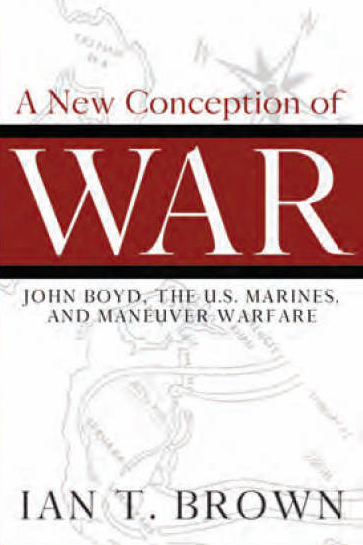
A New Conception of War A NEW CONCEPTION OF WAR: John Boyd, the U.S. Marines, and Maneuver Warfare. By Maj Ian T. Brown. Quantico, VA: Marine Corps University, 2018. ISBN: 9780997317497.357 pp.

After years of fighting a seemingly endless war, the new challenge is to refocus on fighting peer competitors again after over a decade of counterinsurgency operations. Having spent billions on fighting the endless war, our equipment is worn out and in need of modernization while peer adversaries used the time to modernize. Dollars for defense are tight. Finally, individuals outside the Marine Corps believe “that technological progress by future adversaries has made amphibious assaults too hazardous.”1 Is this the present day Marine Corps? No. This is the 1970s Marine Corps> post-Vietnam.

A New Conception of War: John Boyd, The U.S. Marines, and Maneuver Warfare by Maj Ian T. Brown is the story of how:

The Marine Corps, bereft of numbers and weapons and struggling with the consequences of misunderstanding its adversary in Vietnam, found itself drawn to Boyd’s ideas. In them, the Marines saw answers to the problem of what the Marine Corps was to do with itself [post-Vietnam] and how it was to do it… [t]hey took and injected Boyd’s ideas-or what they understood to be his ideas-into the larger debate of how maneuver might serve the future Corps better than simply buying a new tank or adopting a different NATO mission.

Maj Brown’s A New Conception of War is partially a biography of Col John R. Boyd, USAF(Ret), which tells the story of Col Boyd’s years of study and observation that led to his view of warfare ultimately culminating in his “Patterns of Conflict” presentation. The book also illustrates how Boyd’s ideas on warfare were instrumental in assisting the Marine Corps refigure itself in the post-Vietnam era by helping to answer the question: “Where do we go from here?” Lastly, this is the story of the ultimately successful struggle to adopt maneuver warfare as the official doctrine of the Marine Corps and the publication of FMFM 1, Warfighting in 1989.2

Fighter Pilot, Military Theoretician, Iconoclast

Boyd’s philosophy was “to be or to do.” He once told a young Air Force captain:

One day you will come to a fork in the road. And you’re going to have to make a decision about which direction you want to go. If you go that way[,] you can be somebody… you will be a member of the club and you will get promoted and you will get good assignments.

Boyd counseled that the other fork in the road was harder and lonelier, but if offered a chance for true accomplishment: “You can do something- something for your country and for your Air Force.”

Boyd’s entire Air Force career and post-Air Force career was driven by “the determination to produce” accomplishments that mattered. As an instructor in Fighter Weapons School in Nellis AFB, NV, Boyd “wrote the first manual on jet aerial combat”3 and became known as “40-second Boyd:” Accordingly, throughout Boyd’s career:

He made a standing bet that he would meet any pilot over a preselected patch of ground, get on his tail for a kill within 40 seconds of the engagement commencing, or pay the victor $40. No pilot ever collected on that bet ý

One of Boyd’s “accomplishments” was his development of the wellknown observation-orientation-decision-action (OODA) loop; an important tenet of maneuver warfare. Most Marines-including myself-thought Boyd’s OODA Loop “was a derivative of aerial dogfighting” based upon his experiences as an F-86 Sabre pilot in the Korean War. Instead, “Boyd was clear that the loop’s genesis came from work and anomalies associated with [the] evolution and flight tests of [the] YF 16/17.”

Acknowledging that this simplifies a complex issue, Boyd learned during the mid-1970s Lightweight Fighter Program fly-off between the YF-16 and the YF-17 (precursor to the F/A18) that the top speed of a fighter visa-vis its adversary is less important than its ability to “shed and regain energy far more quickly” against an adversary. Consequently:

Boyd labeled these traits fast transient maneuvers, and he found that they granted the YF-16 pilots’ quicker responsiveness and a faster operating tempo, repeatedly generating favorable mismatches against the less responsive YF-17- The notion of mismatches contributing to one’s success and survival-of using agility and tempo to overwhelm an adversary’s perceptions and reactions, thus causing his perceived reality to diverge from actually reality-stuck with Boyd.

Utilizing the OODA Loop and other concepts, Boyd developed his “Patterns of Conflict” presentation summing up everything he had learned about war-just in time for the Marine Corps to make use of it.

Boyd s Influence on the Marine Corps

Post-Vietnam, the Marine Corps had an enormous problem: how does a traditionally naval-oriented, medium-weight force remain viable in the new operational environment of massed Soviet and Warsaw Pact armored and mechanized armies? The Marine Corps was getting a lot of outside advice, including the infamous Brookings Institution’s, Where Does the Marine Corps Go from HereN But wise people, both inside and outside the išdarine Corps, felt that debating whether to mechanize or lighten the Marine Corps or assuming the NATO Northern Flank mission missed the point; what was needed was a new warfighting construct.

Boyd’s “Pattern of Conflict” provided “the conceptual framework” that eventually lead to the adoption of the maneuver warfare doctrine by the Marine Corps.

Maneuver Warfare-The Answer and the Struggle to Adopt It

I found the last chapter of Maj Brown’s book, tracing the debate about maneuver warfare from its inception to being adopted as official doctrine, the most interesting. As Brown explains, four individuals were responsible for the successful adoption of maneuver warfare as the official doctrine of the Marine Corps: William S. Lind, Col Michael D. Wyly, Gen Alfred M. Gray, and Capt John Schmitt.

Lind was “the promoter;” the “outsider” whose “widespread public access and sheer enthusiasm” and “ability to connect key people to each other, combined with the force of his enthusiasm for Boyd’s work, extended Boyd’s reach to new and wider audiences.” Though, as is well-known, Lind was also persona non grata to many in the Marine Corps.

Col Wyly was “the teacher.” A rifle company commander in Vietnam, he was “frustrated by stale tactics and doctrine,” and had a strong “desire to preserve the lives of his men by finding less wasteful ways of fighting.” Wyly spent much of his career as a field grade officer trying to update tactics instruction until he was chosen by Gen Gray to be the Vice President of the newly established Marine Corps University, an assignment for which he was “perfectly suited.”6

Gen Gray was “the doer.” As is well-known, Gen Gray adopted maneuver warfare in the 2d Marine Division and encouraged officers of all ranks to study and discuss maneuver warfare. Appointed Commandant in

1988, Gen Gray “used his authority to make the maneuver philosophy based on Boyd the cornerstone of Marine Corps combat doctrine.”

Capt Schmitt was “the writer.” As a junior officer, Schmitt “found maneuver warfare, with its emphasis on lower-level initiative, empowering” and “became one of maneuver warfare‘s true believers.” Gen Gray give Schmitt “free reign” as to what to write:

You have to satisfy me and nobody else. You don’t answer to anybody except me. If anybody tries to unduly influence what you’re saying or you’re writing, you tell me about it and I’ll take care of it.

Consequently, “Schmitt was free to talk with whomever he wanted and used the ideas of any theorist he desired … he consulted with Lind, Wyly, and others.” Five months later, Schmitt “presented his completed draft to Gen Gray for comment. Gray read it and, as a testament to how well he believed Schmitt had captured his intent, made only two changes in the whole document.”

With the publication of Warfighting, maneuver warfare was now the official doctrine of the Marine Corps.7

Conclusion

Just as “Patterns of Conflict” arrived at the right time to assist the Marine Corps in the process of adopting maneuver warfare, A New Conception of War comes at an auspicious time for the Marine Corps as it struggles with understanding where to best position itself in the current operating environment refocusing on peer warfare. While reading A New Conception of War, I came across five different articles from various media sources providing advice on how the Marine Corps should go forward. While some of the material in the articles is redundant, referencing and quoting each other, the articles collectively illustrate that the Marine Corps is currently facing an “identity crisis.”8 Sir, Who Am 1? An Open Letter to the Incoming Commandant of the Marine Corps by Maj Leo Spaeder, a MAGTF planner, poses the “existential question” of what is the identity of the Marine Corps and the necessity for a “big idea organizing principle.”9 Maj Mark Nostro, also a MAGTF planner, suggests that the Marine Corps “must look to the future to evolve into a force that is reflective of its naval purpose.”10 A Proceedings article, coauthored by highly regarded LtCol Frank G. Hoffman, USMCR(Ret), explains why “amphibious power projection remains viable” and that “[t]he tactical value of the Marine Corps’ forcible-entry capability has not expired.11 A Washington Post article with the self-explanatory title, “Marine Corps Suffers Identity Crisis in Age of Cyberwarfare, Artificial Intelligence”12 and Russell’s Century-Old Plea for the Marine Corps, Updated for 2019 by Maj Brian Kerg support these articles. Maj Kerg “[i]mplore[s] all the stakeholders in the future of the Marine Corps to do their due diligence in providing our senior leadership with meaningful recommendations on how the Marine Corps should determine its purpose, character, and mission.”13

Earlier, I stated A New Conception of War is partly the story of how the Marine Corps adopted maneuver warfare as its doctrine. As important as that narrative is, the greatest benefit of reading A New Conception of War is the story of how the Marine Corps, facing a post-Vietnam operational environment with seemingly insurmountable problems, successfully overcame them. A New Conception of War provides confidence to present day Marines that we can successfully meet the challenges of the present operating environment, just as Marines in the past have done.

After reading A New Conception of War, I read both Boyd: The Fighter Pilot Who Changed the Art of War by Robert Coram,14 and The Mind of War: John Boyd and American Security by Grant T. Hammond.^ Boyd was previously on the Commandant’s Professional Reading List (CPRL) until replaced in 2017 by The Mind of War. I agree that a book about Boyd’s development of his warfighting theories and their impact on the Marine Corps is worthy of inclusion on the CPRL, but highly recommend Maj Brown’s A New Conception of War be that book. Maj Brown provides a coherent overview of Boyd’s career (as do the other books), while also dictating a broader narrative concerning Boyd’s influence on the Marine Corps’ maneuver warfare debate, and the story of how maneuver warfare was adopted as the official doctrine of the Marine Corps via the efforts of some key individuals.

A New Conception of War is strongly recommended for anyone desiring an in-depth understanding of how maneuver warfare was adopted by the Marine Corps, and for those Marines currently struggling with ascertaining the best path forward for the Marine Corps today.

Notes

1. Frank G. Hoffman and. George P. Garrett, “Amphibious Assault Will Remain a ‘Core’ Competency,” Proceedings, (Annapolis, MD: U.S. Naval Institute, March 2019).

2. Renamed MCDP 1 in 1997.

3. Grant Hammond, The Mind of War: John Boyd and American Security, (New York, NY: Smithsonian Institution, 2012).

4. For all the times I have read Boyd described as a “former Air Force fighter pilot,” he “only accumulated 29 missions and44 combat flight hours before the signing of the [Korean] Armistice.” Boyd did not fly combat in Vietnam, possibly because by that time, “his career to this point was largely defined by solving scientific problems.”

5. This study suggested several ideas including mechanizing the Marine Corps to fight on NATO’s Central Front or go the opposite direction and change the Marine Corps to a light infantry force, transferring Army airborne, air assault and special operations units to the Marine Corps.

6. Boyd.

7. In a 1993 Gazette article, Wyly explicitly stated: “Had there been no … Lind or John Boyd, we would have continued our fight for a new style of fighting anyway.” Boyd’s contributions were instrumental, but he was not the central figure in the process of getting maneuver warfare adopted as doctrine.

8. Carlo Munoz, “Marine Corps Suffers Identity Crisis in Age of Cyber warfare, Artificial Intelligence,” The Washington Times, (Washington, DC: April 2019).

9. Leo Spaeder, “Sir, Who Am I? An Open Letter to the Incoming Commandant of the Marine Corps,” War on the Rocks, (Online: March 2019).

10. Mark Nostro, “Discarding the Ptolemaic Model of the Marine Corps,” War on the Rocks, (Online: April2019)11.

“Amphibious Assault Will Remain a ‘Core’ Competency.”

12. “Marine Corps Suffers Identity Crisis in Age of Cyberwarfare, Artificial Intelligence.”

13. Brian Kerg, “Russell’s Century-Old Plea for the Marine Corps,” War on the Rocks, (Online: April 2019).

14.1 found Coram’s Boyd to be an informative, yet fawning, narrative of Boyd’s life and career that does little, if anything, to explain Boyd’s part in adopting maneuver warfare as the Marine Corps’ official doctrine that Brown’s book fails to cover any better.

15. The Mind of War. I agree with Maj Brown’s assessment that “The Mind of War has … [a] better focus on Boyd’s professional career, but … it only briefly assess Boyd’s impact on the Marine Corps.” “Briefly” is an understatement.

Intellectual Renaissance

by Maj Austin M Duncan

In the wake of a long and bloody conflict in Vietnam, the U.S. Armed Forces faced the daunting task of reflecting on what went wrong and how to reorganize for future wars. Every service transformed from their experiences in Vietnam; however, none were as significant as the United States Marine Corps’ intellectual renaissance, culminating with the adoption of a new warfighting philosophy. Though many organizational artifacts remain, over thirty years later, the transformation of the Marine Corps during the 70s and 80s is an unheralded part of our history. During the Marine Corps’ intellectual renaissance, the Service increased education standards for potential recruits, birthed a new philosophy of warfighting, professionalized the force through education, and institutionalized maneuver warfare. We must continue to build on that legacy today.

Social, Political, and Economic Context

Following Vietnam, service members returned from fighting elusive adversaries in the jungle to arguably an even more significant fight at home. The United States experienced significant strife, tearing at the very social fabric of the nation. Racial tensions and drug abuse were rampant, affecting every sect of society.2 The situation was even more magnified in the military. In 1971, Col Robert Heil wrote in the Armed Forces Journal:

Historical precedents do not exist for some of the services’ problems, such as desertion, mutiny, unpopularity, seditious attacks, and racial troubles. Others, such as drugs, pose difficulties that are wholly NEW. Nowhere, however, in the history of the Armed Forces have comparable past troubles presented themselves in such general magnitude, acuteness, or concentrated focus as today. ^

In addition to monumental discipline and morale issues, the military faced an evolving political landscape. In 1973, President Richard M. Nixon ended the draft and the U.S. shifted to an All-Volunteer Force (AVF), emphasizing the importance of quality recruitment.^ Mounting casualties at the end of Vietnam and the Watergate scandal altered American’s faith in government leaders and discredited the military for years to come.5 In terms of foreign policy, “Vietnam Syndrome” took root, leaving America reluctant to commit troops unless absolutely necessary-another significant blow to the military brand.6 Economically, the Vietnam War severely damaged the U.S. economy, spiking inflation and interest rates, spurring an economic recession.7 In sum, despite a significant impetus for change following the U.S.’s “unprecedented and unrepeated defeat and humiliation” in Vietnam, the Armed Forces faced considerable headwinds.8 A historical social divide, cancerous discipline issues, changing political landscape, and the prospect of economic austerity prefaced any attempt at reform.

Out of all the Services, discipline and morale concerns were even more exaggerated in the Marine Corps. In the 1973 General Officer Symposium, the Commandant of the Marine Corps, Gen Robert Cushman, acknowledged the Marine Corps had the highest absentee and deserter rate of all Services. Ironically, he also bragged about the health of recruiting, noting each district made quota in 1973 for the first time since 196710 Initially, the Marine Corps was optimistic it could recruit an AVF in a fiscally austere environment while also addressing discipline concerns; however, by 1975 it was clear there was a problem: “the Marine Corps had the worst rates of imprisonment, unauthorized absence, and courts-martial in the armed forces.”11 The Corps needed significant reform.

Wilson-Barrow Reforms: Increasing the Education and Quality of Recruits

In the summer of 1975, Gen Louis H. Wilson became Commandant. Facing intimidating obstacles, Gen Wilson devised a plan to navigate the AVF era and address the poor discipline throughout the Corps. While the Army was loosening standards to meet recruiting goals, the Marine Corps chose to do the exact opposite.12 With high school graduates accounting for less than 50 percent of recruits, Gen Wilson stated the new goal was “three out of four Marines have high school diplomas when they come in, and the remainder have completed tenth grade or higher.”13 Additionally, he oversaw a significant reboot of the entire recruiting system, to include establishing a chain of accountability “from the individual recruiter to the depot commander,” and implementing a recruiting management course to improve efficiencies at recruiting stations around the country.14

In 1979, Gen Wilson’s tenure as Commandant ended, and he handed over the reins to his protege, Gen Robert H. Barrow to oversee the remainder of the manpower reform. By the time Gen Barrow changed command in 1983, 82 percent of recruits were high school graduates.13 Because of an increased emphasis on education and improved accountability of recruiting, the Marine Corps experienced a dramatic reduction in discipline issues while also increasing the quality and elitism of the force.16

Seeking a New Philosophy of Warfare

With manpower reforms underway, another group of professionals intellectually sparred over the warfare philosophy guiding the Service. Coming on the heels of defeat in Vietnam, many veterans of the Corps questioned their “received wisdom” of doctrine and training.17 Whereas firepower and attrition previously dominated military thought, some Marines questioned if the Marine Corps, a numerically inferior and inherently seaborne force, should focus on maneuver. In 1978, a young Marine captain astutely summarized the state of the Corps in the Marine Corps Gazette: “In recent years, while the Marine Corps’ existence is being questioned from without, many of its members are experiencing an identity crisis of their own.”18

The heart of the identity crisis stemmed from the prospect of war on the Eastern front against a massive and highly capable Soviet military. In a renowned 1976 Brookings Institution report, the authors questioned the Marine Corps ability to fight alongside NATO in Central Europe, suggesting the Corps should reorganize as a land force to fight together with the Army.19 However, doing so threatened to alter the defining character of the Marine Corps as an amphibious force, a sacrosanct consideration for a force plagued by the perpetual organizational paranoia of its looming demise.20

In 1979, the Marine Corps Gazette featured a two-part series by Capt Steven W. Miller arguing that

maneuver doctrine can propel the Marine Corps into the 21st Century where it will again, as in World War II, provide the leadership to this revolution in warfare.21

Though his articles marked the start of the official Marine Corps debate, Capt Miller appropriately noted the origins of maneuver doctrine trace back to Genghis Khan and the more recent unpublished works of Col John Boyd, USAF, (Ret) ,22 Maneuver warfare was nothing new, but a debate emerged within the Corps, spurring a clash of “maneuverists” versus “attritionists.”23

Between 1979 and 1993, the Marine Corps Gazette published more than 50 articles concerning the debate on warfighting.24 Though there was no shortage of opinions on the matter, the intellectual giants of the time were Col John Boyd, LtCol Michael Wyly, and William Lind. As Robert Coram later summarized, “Boyd’s ideas were the foundation and impetus for changes, but Wyly, as an active-duty Marine Corps officer [head of tactics at the Amphibious Warfare School], was the agent of change.”23 Additionally, William Lind heavily advocated for maneuver doctrine, often hosting study groups in Quantico with anyone who would listen while also writing prolifically in the Marine Corps Gazette and later penning the Maneuver Warfare Handbook.26

The maneuver theorists had a tremendous impact, ultimately informing a new philosophy of warfare. Opposed to the firepower-attrition doctrine prescribed in Army field manuals, which intended to defeat the enemy in the physical domain, maneuver doctrine sought to disrupt and disorganize the enemy psychologically.27 The new style of warfare stressed mission-type orders, decentralized operations, creative thinking, and opportunistic initiative.28 Most importantly, it offered the Marine Corps a way to remain uniquely amphibious while shedding the baggage of defeat in Vietnam. As such, the Corps birthed a new war fighting philosophy: maneuver warfare.

Professionalizing the Force

With the seeds of maneuver warfare taking hold at the grassroots level, the Corps needed a champion to professionalize the force and institutionalize the new philosophy. During Gen Alfred M. Gray’s 1987 confirmation hearing to be the 29th Commandant, he stated a priority goal was improving the “understanding of the art, as well as the science of war.”2’1 He made quick work realizing that goal. On his second day in office, he ordered the creation of Marine Corps University, an organization to synchronize the disparate education commands under one roof with a common vision.30 He also demanded each school be accredited and yield degrees for their students, an enormous undertaking which was not realized until the mid-1990s.31 Furthermore, Gen Gray, with the help of LtGen Paul K. Van Riper, implemented a professional reading program organized by grade.32 The education reforms during the late-19 8 Os cannot be understated. Not only did Gen Gray accelerate professionalism throughout the force, many elements of his education reform remain intact today-a true testimony to their impact.

Though Gen Gray’s acute focus on education was remarkable in its own right, his legacy stems from the publication of the Marine Corp capstone document: FMFM 1, Warfighting. Enlisting a small group of deep thinkers, including Col Boyd and Capt John F. Schmitt, Gen Gray turned years of maneuver warfare debates into the guiding philosophy of the Corps. FMFM 1, now known as the MCDP l, crystallized maneuver warfare as “the Marine Corps concept for winning.”33 After nearly two decades of debate following the embarrassment of Vietnam, the Corps institutionalized maneuver warfare as their new philosophy of warfighting, and the credit belongs to Gen AI Gray.

Conclusion

Post-Vietnam reform redefined the Marine Corps. On the battlefield, adversaries threatened to defeat an outmoded war fighting philosophy; at home, skyrocketing discipline issues threatened to destroy the Corps from the inside out. To preserve the legacy, the Marine Corps recruited “the few, the proud,” deliberated a new warfighting philosophy, and professionalized the force through education.3^ The dramatic post-Vietnam transformation culminated with the publication of Warfighting, marking the institutional adoption of maneuver warfare and punctuating the Marine Corps’ intellectual renaissance. As Gen William Bowers wisely noted, the Corps was able to achieve an intellectual renaissance because

in the late 1980s the ranks were then filled with tough smart, elite, physically fit, ethical warriors who graduated from high school, scored well on their enlistment tests, were completely drug free, and were capable of understanding the more sophisticated operational and tactical concepts called for by maneuver warfare.33

Today, there is no shortage of spirited debates and admissions of shortfalls within our service. But these are not only the opinions of young authors filling the pages of our Marine Corps Gazette and other professional outlets. The National Defense Strategy and Marine Corps Operating Concept openly acknowledge we are in the midst of “a period of strategy atrophy” and “currently not organized, trained, or equipped to meet the demands.”36 Following two decades of land war, our Corps is once again struggling to define its identity and rectify known deficiencies-not all that much different from the postVietnam identity crisis. Much like the Marine Corps intellectual renaissance of the 70s and 80s, we must invest in the intellect of our youth and champion their ideas if we are to inspire the next generation of our Corps. America’s youth continues to demonstrate they will clear the bar; it is on us to keep raising it.

Notes

1. Headquarters Marine Corps, MCDP 1: Warfighting, (Washington, DC: 1997).

2. The White House Historical Association, “Racial Tension in the 1970s,” WhiteHouseHistory.org, (Online); Tim Stoddart, “Drug Addition Through the Decades-Focus: 70’s,” Sober Nation, (Online: July 2013).

3. Col Robert D. Heinl, Jr., “The Collapse of the Armed Forces,” Armed Forces Journal, (Washington, DC: June 1971).

4. Bernard Rostker, The Evolution of the AllVolunteer Force, (Washington, DC: RAND Corporation, 2006).

5. “Watergate Scandal,” History.com, (Online: 2009); Alan Rohn, “How Did the Vietnam War Affect America?,” Vietnam War, (Online: April 2016).

6. Geoff Simons, The Vietnam Syndrome: Impact on U.S. Foreign Policy, (London, UK: MacMillan Press, 1998).

7 “How Did the Vietnam War Affect America?”

8. The Vietnam Syndrome: Impact on U.S. Foreign Policy.

9. Gen Robert E. Cushman, Jr., “Corps Operations Facing Austerity,” Marine Corps Gazette, (Quantíco, VA: August 1973).

10. Ibid.

11. Allan R. Millett, Semper Fidelis: The History of the United States Marine Corps, (New York, NY: The Free Press, 1991).

12. Col William J. Bowers, “Making Marines in the All-Volunteer Era,” Marine Corps Gazette, (Quantíco, VA: November, 2014).

13. Gen Louis H. Wilson, “New Directions,” (presentation, Council of the Navy League, Washington, DC, September 1975).

14. LtCol Joseph D. Riech and Maj Gary Kozlusky, “The New Recruiting Command and the Story of Marine Corps Recruiting,” Marine Corps Gazette, (Quantíco VA: August 1994).

15. Douglas Martin, “Robert Barrow, A Marine Corps Reformer Who Became Commandant, Dies at 86,” The New York Times, (New York, NY: The New York Times, October 2008).

16. “Making Marines in the All-Volunteer Era.”

17. LtGen Paul K. Van Riper, USMC(Ret), “Warfighting Discussion Panel.” Youtube video, 1:23:29, (Online: February 2015).

18. Capt Stephen W. Miller, “Marine: A Question of Identity,” Marine Corps Gazette, (Quantico, VA: January 1978).

19. Martín Binkinandjeffrey Record, Where Does the Marine Corps Go from Here?, (Washington, DC: Brookings Institution, 1976).

20. Terry Terriff, “Innovate or Die: Organizational Culture and the Origins of Maneuver Warfare in the United States Marine Corps,” Journal of Strategic Studies, (Abingdon, UK: Routledge, 2006 ); LtGen Victor H. Krulak USMC(Ret), First to Fight: An Inside View of the U.S. Marine Corps, (Annapolis, MD: Naval Institute Press, 1984).

21. Steven W. Miller, “Winning Through Maneuver: Conclusion-Counter the Defense,” Marine Corps Gazette, (Quantíco, VA: December 1979).

22. Ibid.

23. MAGTF Instructional Group, “QPME: Warfighting: History of the MCDP, Roots of Maneuver Warfare, and the Doctrine in Action,” Gray Research Center, (Quantíco VA: February 2018).

24. Maj Kenneth F McKenzie, Jr., “On the Verge of a New Era: The Marine Corps and Maneuver Warfare,” Marine Corps Gazette, (Quantíco VA: July 1993).

25. Robert Coram, Boyd: The Fighter Pilot Who Changed the Art of War, (New York, NY: Back Bay Books, 2002).

26. William S. Lind, Maneuver Warfare Handbook, (Boulder, CO: Westview Press, 1985).

27. G.I. Wilson, Michael D. Wyly, William S. Lind, and B.E. Trainor, “The ‘Maneuver Warfare‘ Concept,” Marine Corps Gazette, (Quantíco VA: April 1981).

28. William S. Lind, “The Changing Face of War: Into the Fourth Generation,” Marine Corps Gazette, (Quantíco VA: October 1989), “Making Marines in the All-Volunte er Era.”

29. United States Senate Committee on Armed Services, Hearings Before the Committee on Armed Services United States Senate One Hundredth Congress, (Washington, DC: 1987).

30. Gen Alfred M. Gray USMC(Ret), “Warfighting Discussion Panel,” (Quantíco, VA: 2015).

31. “Warfighting Discussion Panel.”

32. Ibid.

33. Headquarters Marine Corps, MCDP 1, Warfighting, (Washington, DC: June 1997).

34. Jeff Schogol, “Marine Corps May Replace ‘The Few, The Proud’ as Its Recruiting Slogan,” Marine Corps Times, (Online: September 2016).

35. “Making Marines in the All-Volunteer Era.”

36. U.S. Department of Defense, Summary of the 2018 National Defense Strategy of the United States of America: Sharpening the American Military’s Competitive Advantage, (Washington, DC: 2018); Headquarters U.S. Marine Corps, Marine Corps Operating Concept: How and Expeditionary Force Operates in the 21st Century, (Washington, DC: Headquarters Marine Corps, September 2016).

Damn the Torpedoes

by Maj Jacob H. Wilde

In reading LtCol G. Stephen Lauers article “Damn the Torpedoes,” (MCG, Febl9) I struggled to understand how it was possible for a retired Marine infantry officer and current School of Advanced Military Studies professor to write an article supporting the basic tenets of attrition warfare. Such an article would have been completely at home in the Gazette during the mid-1980s with the debates surrounding the Marine Corps’ adoption of maneuver warfare doctrine, but that such antiquated thinking and assumptions about the character of war still exist in the mind of any military professional-to say nothing of one entrusted with the development of our future strategic thinkers-is both baffling and troubling.

LtCol Lauer states that the purpose of his article is to “demonstrate the extraordinary departure of the current Marine Corps Operating Concept from the traditional assumptions of amphibious operations.”1 Missing from this purpose is a recognition that in an ever-changing operational environment, military thinkers must continually question and reassess those traditional assumptions, and accept that they may no longer be valid. Throughout history, various developments periodically conspired to force a complete shift in the manner in which wars were fought. Whether one calls them “military revolutions,” “generations of war,” or some other label for classification, the fact remains that each brought a paradigm shift in the baseline assumptions and conceptualization of war. Those organizations willing and able to adapt to the new paradigm won and survived. Those unable or unwilling to adapt did not. The recognition that the character of war is in the midst of another paradigm shift is absolutely necessary if the United States is to retain its place in the world and succeed in its future engagements.

To defend his position, LtCol Lauer builds his argument on several indefensible assumptions. In the exposition of his first point, he argues that the British failed at Gallipoli because “the landing force lacked the land superiority to win decisively against numerically superior military forces of the Ottoman Empire.”2 A careful study of the failures at Gallipoli reveals that the relative lack of combat power was far from the decisive factor in the failed contest for Gallipoli. In fact, Lieutenant General Stop ford enjoyed a ten-to-one local numerical superiority for two full days at Suvla Bay.3 Had he attacked aggressively with the force he had, there is little question that he could have cut the peninsula in two and established a foothold to expand the lodgment ashore. Rather than an underwhelming force strength, it was weak and unimaginative leadership and a failure to press the attack inland that brought the Gallipoli campaign to its disastrous end.

The author derides the Ellis Group’s emphasis on expanding the concept of combined arms integration to include information and cyber warfare, calling it a

turn from decisive maneuver to a multi-domain and philosophical view of warfare that elevates the ephemeral over the tangible, the cognitive over the physical, disruption over destruction.^

Certainly, the author is aware that the Marine Corps’ foundational doctrine, MCDP 1, Warfighting, repeatedly refers to both itself and maneuver warfare as philosophies. Further, a significant number of notable military commanders and theorists have noted and extolled the relevance of the intangible arenas of war as being decisive. LtGen A. A. Vandegrift stated, “Positions are seldom lost because they have been destroyed, but almost invariably because the leader has decided in his own mind that the position cannot be heldV Similarly, Napoleon’s oft-quoted belief that “Moral is to the physical as three is to one,” further attests to the decisive nature of seeking victory in the moral and mental realms of human conflict-using every capability available-to destroy the enemy’s will to fight.

Regarding his assertion that the Marine Corps departed from a doctrine of air, sea, and land superiority and turned toward an emphasis on positional advantage to destroy or disrupt the enemy’s cohesion as late as 2014, indicates a complete ignorance of the development of the Marine Corps’ post-Vietnam doctrine.6 In his book, A New Conception of War, Maj Ian Brown explores the debates surrounding the adoption of maneuver warfare, which initially centered on how the Marine Corps could contribute to a NATO fight against the Soviet Union.7 In such a fight it was assumed that as an amphibious force, the Marine Corps would be outnumbered, out-gunned, and out-armored. The solution to this mismatch rested on a concept of mobility, maneuver, and high operating tempo in order to disrupt or destroy the enemy force’s ability to operate as a cohesive whole and enable its piecemeal destruction or incite its surrender. To suggest that this doctrinal concept did not emerge until 2014 is simply incorrect.

The idea that “the infantry is the Marine Corps” demonstrates an apparent misunderstanding of the true strength of the MAGTF and the fundamental purpose of combined arms integration.8 It further demonstrates a failure to recognize the changing character of war and that a more nuanced view of combined arms integration is absolutely necessary for success. Capabilities such as information, cyber, legal, and economic warfare can certainly be employed with significant effect to undermine or destroy an opponent’s center of gravity and erode his ability and will to fight. Nowhere in his article does the author address the possibility that the weapons and capabilities available to America’s near-peer opponents might prevent a landing force from even arriving at the operational area intact and retaining some modicum of surprise. The author’s conclusion that, “The Marine Corps has acquiesced into the sliding loss of its naval character and the irrelevance of any naval roots,” when the MOCclearly identifies the integration of the naval force as one of its five critical tasks is also baffling.9

Lastly, the author fails to clarify the conditions under which a massive amphibious operation might be employed as he describes. What strategic objective would it seek to accomplish? What use is a massed ground combat force against an enemy whose warfighting ethos is based in Sun Tzu and Mao Zedong-a lesson the U.S. failed to learn in Vietnam? Would the U.S. potentially seek the complete overthrow of a near-peer state, or is it more likely that the amphibious force might be used for more limited objectives, such as deterring or countering actions that threaten regional stability or the interests of the U.S. and regional partners? Without ties to strategic assumptions or objectives, such a concept exists solely for its own benefit-a product of what Chuck Spinney refers to as “incestuous ampliThe fi cation”-and is dangerously detached from reality.10

What LtCol Lauer essentially advocates is a return to the ‘”‘glory days” of World War II: The days when large forces of aggressive and disciplined Marines and Soldiers charged the beaches and wrestled terrain from the enemy by raw mass and firepower-and died by the thousands doing so. At a time when 71 percent of American youth are ineligible for military service of any kind, the prospect of wasting the lives of the narrow band of young people that are both willing and able to serve is unconscionable and self-defeating.11 Furthermore, the assumption of fighting on enemy soil far from home automatically limits the U.S.’ ability to introduce a numerically superior force ashore, particularly in an environment of contested sea and air control. The proliferation of sensors, unmanned vehicles, and other emerging technologies means that the U.S.’ reliance on the “few and exquisite” platforms required to support the author’s conception of amphibious war falls fíat against competitors arming themselves with “small, many, and smart” platforms that sidestep American strengths and exploit its vulnerabilities.12 Not only is the cost imposition upon the United States in such an engagement wholly unsupportable, but the unacceptable risk for which the author denigrates the MOC is significantly greater under his own operational conception.

Ultimately, the author builds his argument on an outdated conceptual framework and a set of assumptions about maritime operations that fails to recognize the changing character of war. It does not address the threats that emerging technologies and methods pose to American forces, capabilities, and interests. It further fails to recognize the capabilities that those same emerging technologies provide to U.S. forces as a means of exploiting maneuver and combined arms integration in new domains beyond the traditional land, sea, and air of the physical realm. This is dangerously regressive thinking. Drawing upon history is only valuable if the correct lessons are learned, and improvements at fighting the last war do nothing to improve the chances of victory on a wholly new and different battlefield.

Notes

1. G. Stephen Lauer, “Damn the Torpedoes: The Marine Operating Concept and the Failure of Decisive Maneuver from the Sea in the 21st Century,” Marine Corps Gazette, (Quantico, VA: February 2009).

2. Ibid.

3. Eliot A. Cohen and John Gooch, Military Misfortunes: The Anatomy of Failure in War, (New York, NY: Free Press, 1990).

4. “Damn the Torpedoes.”

5. Alexander A. Vandegrift, Battle Doctrine for Front Line Leaders, (Quantico, VA: U.S. Marine Corps Education Center, 1981).

6. “Damn the Torpedoes.”

7. Ian Brown, A New Conception of War, (Quantico, VA: Marine Corps University Press, 2018).

8. “Damn the Torpedoes.”

9. Ibid.

10. Franklin C. Spinney, Evolutionary Epistemology, (Online: December 2014), PowerPoint presentation, available at https://fasttransients, fi les .wor dp re ss .com.

11. Heather Maxey, Sandra Bishop-Josef, and Ben Goodman, Unhealthy and Unprepared: National Security Depends on Promoting Healthy Lifestyles from an Early Age, (Washington, DC: Council for a Strong America, October 2018).

12. T.X. Hammes, “The Future of Warfare: Small, Many, Smart vs. Few Sc Exquisite?,” War on the Rocks, (Online: July 2014).

Educating the Enlisted Marine

by GySgt Neil D. McCoy

Let’s Start with Some Questions. We invite you to try something today. Whether you are in the field or at the office, ask one of your subordinates, peers, or superiors this question, How well do we train our junior Marines? We determine that most answers will come back as “pretty well.” Now ask this: How well do we educate them? Before one attempts to answer this question, let us review the meaning of education. Military education is an integral part of tactics and the operational art. Education removes the need for simple checklists and “canned” solutions. It enables commanders to place constantly changing situations on and off the battlefield into the larger context of military history, theory, and behavior in combat. The ability to contextualize and think logically under the rigors of combat will lead to creative and innovative solutions to the problem. Knowing this, the answer to this question by many would most likely be “not that well.” We are convinced that, in this respect, we repeatedly fall short. How much longer are we willing to accept this?

With the current educational construct, enlisted Marines are only required to attend approximately 40 weeks of technical or “educational” schooling throughout a career of 20 years. If the Marine completes only one enlistment of four years, that number is reduced to twelve weeks if the Marine is promoted to sergeant and attends Sergeants Course. All-in-all, the maximum amount of schooling an enlisted Marine will receive from the Marine Corps in a period of twenty years equates to ten months. This does not even equal one tour at the Expeditionary Warfare School that officers attend. How then can we expect our enlisted Marines to be conversant in Marine Corps doctrine and maneuver warfare? How can we expect them to speak a common language (doctrinal language) throughout the Marine Corps if we do not spend the required or necessary time to debate and discuss it? Most PME schools give only an introduction to MCDP 1, Warfighting1 by reading and discussing chapter one of the first book. There are nine total doctrinal publications, and most Marines are not even aware of publications such as Planning, Logistics, Command and Control, and Intelligence.2 Again, I ask how can we expect Marines across all the MOS to speak on common ground during combat operations without having first discussed these documents? This article addresses how our current enlisted educational system both in the Operating Forces and the institutional system is in need of desperate improvement.

Before we attempt to answer these questions in new ways, let us first reflect on it from a historical perspective. We must revisit a time of significant transition in terms of war fighting doctrine, a time where these questions were dissected and discussed by some of the brightest minds the military has ever seen. At the end of the Vietnam War, a small group of mostly company grade officers identified the need to readdress how Marines think, fight, and win wars. Together with the help of a number of civilians, these officers created our waffighting philosophy and doctrine: maneuver warfare. During this time, some of the greatest work on the subject of maneuver warfare was being written, published, discussed, and debated. Examples of this include, The Maneuver Warfare Handbook, Patterns of Conflict, The Dynamics of Doctrine, the OODA Cycle, and FMFM 1, Warfighting.3 Maneuver warfare requires Marines at all levels to use their minds in pursuit of achieving their respective missions. The Marine Corps, unfortunately, has placed great importance on only educating officers. For instance, all officers spend six months at TBS. This is not their boot camp, (OCS is) this is six months of training and education. When done, they continue to their follow-on MOS school. Furthermore, it is time we change this, and it is not a matter of wanting to change: we must. For evidence we need only look at today’s highly complex challenges and ever-adapting enemies. Both Expeditionary Force 2D and the Squad Leaders Development Program agree with us on this point. Although the Squad Leaders Development Program is in its early stages, the Marine Corps has identified the need to spread this same construct to all MOSs. Imagine a platoon where not only the lieutenant, but all the unit leaders spoke the same language in regard to our warfighting philosophy, doctrine, techniques, and tactics. But how do we get there, and is it even possible?

We absolutely determine this is possible. We start by immersing our junior Marines in our warfighting philosophy. “Free maneuver has to become a way of life, a state of mind,” Gen Alfred M. Gray, our 29th Commandant, once said. A way of life or state of mind does not simply start after attending a month-long course. It must be present at the beginning of a Marines career and reinforced throughout. So we must begin at recruit training.

Start at the Start: A New Kind of Recruit Training

At boot camp, junior Marines should become highly familiar with the ideas presented in our doctrinal publications, particularly Warfighting, Tactics, and Marine Corps Operations2 Recruits do not necessarily need to read the MCDFs. They can instead go through the excellent MCI Warfighting Skills Program f which the Marine Corps used in the 1990s but has since {and inexplicably) abandoned. This introduction to our beliefs and theory of war will initiate the development of critical thought. The young recruit may not fully grasp the concept of the entire texts, but that is fine to begin with. Thoughts will begin to form. Conversations will take place. Debates will emerge. Senior drill instructors and series commanders can present simple decision-making exercises that draw out the core ideas of maneuver warfare and ethical values of the Marine Corps. This will allow the recruit the opportunity to speak his thoughts and facilitate a better understanding of the subjects. It will be the starting point to get the ideas into Marines, that these publications can guide us through our quest to become a more effective and efficient warfighting institution.

As the recruit graduates and earns the title, “Marine,” the School of Infantry (SOI) -whether it be the Infantry Training Battalion or Marine Combat Training-could set aside time for follow-on maneuver warfare-themed guided discussions and exercises. At this point, the Marine will now have a rudimentary understanding of the science and art of war, but an understanding nonetheless. The Marine will be able to take this understanding and put it to work immediately in their unit. To get here, we must allow recruits and SOI students to openly speak their minds. Instructors, in turn, must actively listen with appropriate verbal and nonverbal responses, giving proper feedback and acceptance, all while remaining nonjudgmental. Of course, the focus of SOI should remain on the technical skills and the science of war, but discussions of doctrine and maneuver should be actively pursued when the time allows.

The implementation of this education throughout the entire enlisted ranks in the Marine Corps, in any MOS, must be a priority. There are many reasons why infantry and noninfantry Marines should be well-versed in our doctrinal publications and maneuver warfare. Infantry alone cannot be successful in war without the assistance of supporting agencies such as fire support, aviation, and logistics. Focus of effort {Schwerpunkt), that is the understanding and implementation of, is essential in maneuver warfare. A commander must understand this to establish the unit that will achieve the decision in that phase of the battle and must apply all support necessary to do this. If all Marines understood this at generally the same level, ground commanders would be able to work more efficiently together to focus all combat power in accordance with commander s intent. This understanding will further increase the longevity of the support and supported relationship.

At this point, some readers may think that, while this sounds all well and good, we need Marines who practice instant and willing obedience to orders. We teach our junior enlisted Marines that such obedience is key to mission accomplishment. But, at what point does this idea become irrelevant or even dangerous? We argue that on today’s battlefield that such unthinking obedience can cause its own chaos, uncertainty, and friction. A Marine who has neither the ability nor the will to analyze a problem or understand the purpose of an order through implicit communications can be just as dangerous as the enemy. Furthermore, immediate obedience to orders inherently stifles boldness. Let us be clear, we do not want Marines to question every order. Rather, if we want our Marines to practice boldness and take the initiative, we must first develop their thought process, which will allow the understanding of the situation as a whole. This will then naturally temper boldness with sound judgment. In doing this, we encourage understanding of the “why” behind orders, which leads to immediate obedience to orders through implicit communication.

Education in the Marine Corps as dictated by MCDP 1 should be three tiered: the education establishment, the commander, and the individual.7 First, the professional schools of the Marine Corps should focus not only on the technical skills required in that specific field, but also the application of the art of warfare that is appropriate to that specific rank of Marine. Schools must not be completely filled with the memorization of facts and knowledge regurgitation. A portion of the curriculum may call for classes of this type, but they must also encourage discussion, sound judgment, and decisionmaking exercises. Second, commanders must consider it essential to their job as leaders to expand upon the baseline of education received at the professional establishments. Junior leaders must be seen as a direct reflection of their commanders. This expansion can be done through free play field exercises, terrain walks, supervised reading programs, map exercises, wargames, decision-forcing cases, or any other creative way that will facilitate learning. Lastly it is the responsibility of the individual Marine to self-educate and dedicate the time to studying military history and theory. MCDP 1 states:

Self-directed study in the art and science of war is at least equal in importance to maintaining physical condition and should receive at least equal time.

Conclusion

Yesterday’s Marines already identified the importance of this education for our officers years ago. We are now at another point where this education has become just as important for the enlisted Marine. Aligning ourselves with Expeditionary Force 21, and preparing our Marines for disaggregated operations throughout the world, we simply must extend this education of maneuver warfare and study of Marine Corps doctrine to our enlisted Marines. As William Lind said in The Maneuver Warfare Handbook, “We must return to personnel management as explained by MCDP l,”8 and carefully select those commanders and operations officers who will advocate this type of education and training in the Fleet Marine Force and the school system. With the right men and women in the right positions, those who truly believe and understand maneuver warfare, can strive for a more effective decentralized command, which will allow our team leaders, squad leaders, section leaders, and platoon sergeants the freedom necessary to analyze the situation and implement smart decisions on and off the battlefield. This thought process and ability to make decisions is vital to success in the asymmetric wars we fight today.

Notes

1. Headquarters Marine Corps, MCDP5, Planning, (Washington, DC: 1997); Headquarters Marine Corps, MCDP 4, Logistics, (Washington, DC: 1997); Headquarters Marine Corps, MCDP 6, Command and Control, (Washington, DC: 1996); Headquarters Marine Corps, MCDP2, Intelligence, (Washington, DC: 1997).

2. Headquarters Marine Corps, MCDP 1, Warfighting, (Washington, DC: 1997).

3. William S. Lind, The Maneuver Warfare Handbook, (Abington, UK: Routledge 1985); John R. Boyd, Patterns of Conflict, brief, Congress, (Washintőn, DC: 1986); Timothy T. Lupfer, The Dynamics of Doctrine, (Fort Leavenworth KS, 1981); John R. Boyd, The Decision Cycle, (1976); and Headquarters Marine Corps, PMPM 1, Warfighting, (Washington, DC: 1989).

4. Headquarters Marine Corps, Expeditionary Force 21, (Washington, DC: 2014)

5. Headquarters Marine Corps, MCDP 1-3, Tactics, (Washington, DC: 1997); and Headquarters Marine Corps, MCDP 1-0, Marine Corps Operations, (Washington, DC: 2017).

6. Headquarters Marine Corps, Marine Corps Institute, Warfighting Skills Program, (Washington, DC: 1990).

7. MCDP 1, Warfighting.

8. The Maneuver Warfare Handbook.

On War’s Continued Relevancy

by Maj Scott Helminski

With his master work, On War, Carl von Clausewitz sought to bring about a “revolution in the theory of war.”1 In this regard., Clausewitz intended to draw on his experiences in war to develop a way to improve the commander’s ability to think about and conduct warfare. This unique approach stands in stark contrast to similar works from his era, which attempted to generate rules and formulas for the conduct of war, and contributes to his theory’s continued relevance in the 21st century. Nearly 150 years after Clausewitz’s death, a small group of Marines and civilians, disenchanted with recent combat experiences in Vietnam, looked to combine existent and emergent military theories to revolutionize the way the Corps’ leaders thought about and conducted war. Their efforts led to the Marine Corps’ adoption of maneuver warfare as doctrine in 1989. As the Corps renews its focus on the concept of maneuver warfare,2 Clausewitz’s On War and its influence on FMFM 1 and its successor MC DP 1-both titled Warfighting-warrants a closer examination. Clausewitz’s direct influence on the present-day Marine Corps and his current relevancy are apparent in Warfighting’s intent, structure, and espoused views on the nature and theory of war.

A revolutionary theory can change the way military professionals understand the phenomenon of war, which in turn changes the way they think about its conduct. This was not Clausewitz’s original intent for his work. Enlightenment-influenced military thinkers, such as Bülow and Jomini, sought to isolate and reduce war to a series of universal and immutable principles that, when applied in the conduct of war, could guarantee success. As was the common practice of the time, Clausewitz originally intended to dictate his observations into short, concise statements without considering their impact on the whole phenomenon of war.^ However, two major factors influenced the change in Clausewitz’s thinking. First was his extensive combat service, beginning in 1793 and including the time spent writing On War between 1816 and 1830. Second was the influence of the changing intellectual environment in Prussia amidst the German movement, which challenged much of the Enlightenment’s way of thinking. The movement rejected universal and immutable principles while focusing on concrete human experiences and the creative and unique character of individuals.5 Combining the new, German way of thinking with his experiences in war, Clausewitz modified his initial intent and was now determined to develop a new way to think about war as a whole rather than developing reductionist principles for its execution.

In his attempt to understand the phenomenon of war and change the way professionals thought about war, Clausewitz first sought to define the nature of war. The first chapter of Book One reflects his progression from defining war to describing the unchanging nature of war. He initially defines war as a duel, using the metaphor of two wrestlers exerting energy to impose their wills on each other. With this simple metaphor, he introduces the complexity of human interaction into the nature of war. This theme, threaded throughout the entirety of the work, immediately counters the use of immutable sciencebased rules in war.6 He also introduces war’s subordination to policy. Clausewitz concludes the chapter with the “marvelous trinity,” arguing that the prevailing tendencies of violence, probability, and reason-which generally concern the people, commander, and government, respectively-are always present. They comprise the unchanging nature of war. However, their interactions and wars’ subordination to policy explain the changing character of war throughout time.7

The majority of the remaining chapters of Book One address the realm of chance. Clausewitz devotes the longest chapter outside of Chapter One to the concept of genius, which he defines as “a very highly developed mental aptitude for a particular occupation.”8 In this chapter, he discusses the impact a commander can have on uncertainty and chance in war. He discusses character traits that best lend themselves to genius and alludes to the fact that training and education can illuminate and increase a commander’s genius to an extent. 9 He also introduces the concepts of danger, physical exertion, intelligence, and friction. He concludes that these concepts all combine to create the concept of general friction, which makes activity-especially decision making: the cerebral activity-in war increasingly difficult. He argues that the only counter to friction is experience.10 By introducing the complex and unchanging nature of war and the role of the commander in the realm of chance, Clausewitz sought to change how professionals thought about war.

Recognizing the significant effects of friction and the potential positive impacts of the commander and experience, Clausewitz then turns his attention to theory and its use in influencing how commanders think in war. He contends that theory enables the informed study of war. He avoids prescribing theory as a means to achieve a set of rules and principles for action in the conduct of war; rather, he argues that theory drives study by providing a framework that enables commanders to learn through the critical analysis of historical cases. From this informed self-study, commanders gain familiarity-vicarious experience-with war, which improves their judgment. This familiarity and judgment aids in avoiding poor decisions in combat and prevents the need for a manual of action that accompanies the commander to the battlefield.11 Thus, theory, based on an understanding of the nature of war, provides the means for commanders to learn how to think about war.

Over a century and a half later, On Wars influence is evident in the Marine Corps’ revolutionary capstone doctrine, Warfighting. Like Clausewitz, Marines attempted to synthesize a new way of thinking because their disillusionment with their recent combat experiences in the Vietnam War and perceived organizational and doctrinal problems. They found the answer in retired Air Force Col John Boyd’s concept of maneuver warfare. In line with Clausewitz’s view of theory and Kritik, Boyd developed his brief, Patterns of Conflict, as a critical analysis of over 2,500 years of war and conflict, seeking to discern any emergent patterns.12 The Marine Corps adopted the resultant concept of maneuver warfare as its warfighting philosophy with the publication of FMFM1, War fighting, in 1989.13

Like On War, Warfighting revolutionized the way Marines think. Although a doctrinal publication, Warfighting avoids prescribing specific techniques and procedures. Instead, it provides overarching concepts and direction that requires judgment in application.1^ The publication concludes that “maneuver warfare is a way of thinking in and about war that should shape our every action.”13 Unlike many other doctrinal publications, Warfighting s emphasis on developing habits of thought and avoidance of specified rules and principles is consistent with Clausewitz’s approach to the theory of war. With its adoption, Warfighting indeed revolutionized the way Marines thought about war.

Similar to On War, Warfighting kirst explores the nature and theory of war in order to provide Marines with a common understanding of the phenomenon of war. The first two chapters borrow heavily from the first two books of On War, citing the work thirteen times,16 Warfighting’s author even comments in an endnote that On War is “arguably the definitive treatment of the nature and theory of war. All Marine officers should consider this book essential reading.”17 In the chapter on the nature of war, Warfighting identifies the role of human interaction, complexity, violence, danger, uncertainty, and chance in creating friction in war-all present in Clausewitz’s book on the same topic.18 The chapter on theory begins with war’s subordination to policy, another of Clausewitz’s unchanging tendencies in the nature of war that accounts for its ever-changing character.1^*

However, Clausewitz’s influence is not limited to the first two chapters of Warfighting. The value of critical analysis and critique of the training and education of Marines is evident in the chapter on the preparation for war.21 Clausewitz’s focus on the mind of the commander, self-study, and decision making appears in both the chapter on preparing for war and the chapter on its conduct.21 This list of Clausewitz’s influences is not all inclusive; rather, it offers an insight into the extent to which Clausewitz’s thinking influenced the thinking of the Marine Corps. In its attempt to revolutionize the way its Marines think, the Marine Corps used a literary work intended to do the same.

Rather than develop a set of rules and principles applicable to the conduct of war in his time, Clausewitz defined the complex but unchanging nature of war and identified theory’s role in enabling informed study. The work has inspired intense debate and discussion about its contents since its publication. Thus, Clausewitz achieved his goal of revolutionizing the way professionals thought about war “that would not be forgotten after two or three years, and that possibly might be picked up more than once by those who are interested in the subject.”22 The Marine Corps’ intent, structure, and views on the nature and theory of war in its current capstone doctrine evidence Clausewitz’s continued relevance. As Gen AI Gray, 29th Commandant of the Marine Corps, writes in the preface of MCDP 1, “Warfighting has stimulated discussion and debate from classrooms to wardrooms, training areas to combat zones.”23 Twenty years later, another commandant is urging Marines to rediscover the tenets of maneuver warfare first propounded in Warfighting. As today’s Marines turn back to MCDP 1, they will once again encounter revolutionary thoughts that continue to resonate two centuries after they were written. Clausewitz’s ideas are alive and well in the Marine Corps.

Notes

1.Carl von Clausewitz, On War, edited and translated by Michael Howard and Peter Paret, (Princeton, NJ: Princeton University Press, 1976). This statement is in Clausewitz’s Note of 10 July 1827.

2. Headquarters Marine Corps, Marine Corps Operating Concept: How an Expeditionary Force Operates in the21st Century, (Washington, DC: September 2016).

3. Azar Gat, A History of Military Thought: From the Enlightenment to the Cold War, (New York, NY: Oxford University Press, 2001). See also R.R. Palmer, “Frederick the Great, Guibert, Biilow: From Dynastic to National War,” in Makers ofModern Strategy from Machiavelli to the Nuclear Age, edited by Peter Paret, (Princeton, NJ: Princeton University Press, 1986), and John Shy, “Jomí ni,” in Makers of Modern Strategy from Machiavelli to the Nuclear Age.

4. On War. This statement is in the author’s comment, “On the Genesis of his Early Manuscript on the Theory of War, written around 1818.”

5- A History of Military Thought.

6. On War. See also Alan Beyerchen, “Clausewitz, Nonlinearity, and the Unpredictability of War,” International Security, (Cambridge, MA: MIT Press, 1993).

7. On War.

8. Ibid.

9- Ibid. This chapter deserves a separate discussion, and this explanation does not do the concept justice. For a better treatment of the subject, read the chapter in its entirety.

10. Ibid.

11. Ibid.

12. Damian Fideleon, The Road to FMFM 1: The United States Marine Corps and Maneuver Warfare Doctrine, 1979-1989, master’s thesis, Kansas State University, (Manhattan, KS: 2008).

13. Headquarters Marine Corps, FMFM 1, Warfighting, (Washington, DC: 1989).

14. Headquarters Marine Corps, MCDP 1, Warfighting, (Washington, DC: 1997).

15. Ibid.

16. Ibid.

17. Ibid.

18. Ibid.

19. Ibid.

20. Ibid.

21. Ibid.

22. Ibid.

23.Ibid.

People First

by Mie Augier & Maj Sean F.X. Barrett

“[P]eople are more important than systems,”‘

-LtGen Bernard E. Trainor, Marine Corps Gazette, September 1983 2

Following seventeen years of war in Afghanistan and. Iraq, the Marine Corps is in the process of turning its focus to the “reemergence of long-term, strategic competition” with “revisionist powers,” as directed by former Secretary James N. Mattis’ National Defense Strategy.2 The Marine Corps will be forced to confront this new security paradigm with a force that has increasingly little combat experience, especially among its company grade officer and NCO ranks. Given the enormity of these challenges, including the “increasingly complex global security environment,”3 the Marine Corps will benefit from looking at its own history in order to inform how it will confront this future operating environment. While today’s siren song of technology, weapons systems, and artificial intelligence promises quick and clean solutions,^ this article notes that seemingly radical change is oftentimes messy, surprisingly gradual, and attempts to nudge the pendulum back toward the idea that people matter most. This emphasis is consistent with important aspects and people in Marine Corps history, especially regarding maneuver thinking. In particular we draw on the post-Vietnam intellectual renaissance in the Marine Corps, which emphasized the development of critical thinking skills and professional military education under the leadership of Gen Alfred Gray, as a way to inspire a reinvigoration of strategic thinking and education to meet the challenges and uncertainty of the future.

Critical Thinking, PME, and Maneuver Warfare

After the decades-long Vietnam war effort, the United States faced great challenges, including a great power competition with the Soviet Union, a burgeoning terrorist threat, an inflationravaged economy, and the transition to the All-Volunteer Force.3 Military thinkers were again beginning to question the future of the Marine Corps and the need for an amphibious capability in the Nuclear Age.6 The quality of the Marine officer was also challenged. In 1978, William Lind, who would become an influential member of the maneuver warfare movement, wrote a critique of Marine officers- observing the lack of new tactical or operational concepts introduced in the Gazette, which he attributed to an inadequate knowledge of theory and history and a promotion system that did not emphasize theoretical ability.7 He was also critical of how unwilling some senior officers were to adapt to the changing security environment. In the face of such challenges, the Marine Corps began the long march toward the development of the maneuver warfare thought process.

The maneuver warfare movement partially traces its roots to Vietnam in the 1960s. Body count strategies, centralized decision making unable to cope with fluid battles, and inadequate doctrine led to the early adoption of maneuver warfare tenets on the battlefield and created a burning desire for change among junior members of the officer corps following the war.8 Gen Gray proved instrumental in the development of multiple hardware programs, such as the LCAC, V-22 Osprey, HMMWV, and the light armored vehicle, which increased the Marine Corps’ mobility on the battlefield and facilitated its adoption of maneuver thinking/theory.^ However, Gen Gray never lost sight of the primacy of the individual Marine and his bias for action as the basis of maneuver warfare.

Based on this mindset, Gen Gray took a bottom-up approach to implementing maneuver warfare, notably as CG, 4th MAB, the Marine Corps Development & Education Command, and 2d MarDiv. In addition to tinkering with task organizations and increasing the mobility and firepower of Marine GCEs, Gen Gray began to combat the anti-intellectual current in the Marine Corps at the time by making reading and serious self-study an expectation. For example, as CG, 2d MarDiv, he consolidated a packet of literature on maneuver warfare for his Marines to read,10 activated a “professional study group,”11 and established a Maneuver Warfare Board to act as a clearinghouse for spreading ideas on maneuver warfare.12 Additionally, during his rime at Quantico, after working-hours debates-wherein the merits of a given idea and not the rank of the holder mattered-were commonplace.13 This enthusiasm for ideas enabled Gen Gray to recruit Marines to come work for him at the Doctrine Center in Quantico, which helped create momentum for maneuver ideas.1″1 At Lejeune, he consistently fielded requests to join the 2d MarDiv. The Marines knew they were creating something which inspired them to relish the challenge.13

As part of this, Gen Gray was determined to make his leaders and junior Marines think. During after-action reviews, for example, he was more concerned about why a Marine did what he did {and what he was thinking about it) than whathe did.16 In continually challenging his Marines in command post and field exercises, which emphasized “free play” instead of scripted scenarios, he let his Marines discover the merits of the maneuver philosophy first-hand.17

The creation of an open and collaborative environment that broke down traditional notions of hierarchy was essential to nurturing critical and creative thinking. A tireless operational critic, Gen Gray insisted on these after-action reviews following wargame and field or command post exercises, during which discussions took place without rank insignia being visible, thus encouraging open dialogue and emphasizing the merit of ideas over rank.18 Additionally, even though outside of Gray’s immediate purview, maneuver warfare discussion groups at Camp Pendleton- inspired by those at Lejeune-insisted on participants, regardless of rank, referring to one another as “Sir,” thus placing a similar emphasis on the merit of ideas.17 The conceptual debates in the Gazette, also central to the eventual organizational embrace of maneuver thinking, were not inhibited by a deference to rank either.20

The emphasis Gen Gray placed on ideas and understanding the need for fresh inputs involved non-Marines as well, leading to an eclectic mix of reform minded politicians, military theorists, staffers, and Army officers who joined forces with the Marine maneuverists.21 For example, a retired U.S. Air Force Colonel, fighter pilot, and influential military theorist, John Boyd, inspired a generation of Pentagon reformers with his broad perspective on warfare encapsulated in his famed “Patterns of Conflict” lecture.22 Gen Gray and other influential Marine maneuverists, such as Col Mike Wyly, invited Boyd to speak to their Marines, beginning in the early 1980s.23 William Lind, a legislative aide to Senators Robert Taft, Jr. and Gary Hart, proved to be another key contributor to the debate and the conceptual development of maneuver warfare. He was a frequent contributor to the Gazette and initially met Gen Gray at a seminar at Carlisle Barracks in the mid-1970s. Though Lind was known to be an iconoclast at times, Gray was willing to speak with anyone who had ideas and wanted to help.24 Additionally, inviting outsiders to contribute helped avoid the deleterious impact of becoming a closed system while fostering innovative thought. It also embodied one of the most important roles of education; to help broaden minds-helping students learn how to think about complex issues (not what to think) and reinforcing the importance of learning as a lifetime activity.

The intellectual underpinnings and arguments in maneuver thinking {represented, for instance, in the Gazette debates and Boyd’s briefings) fit well with Gray’s maneuver exercises and broader operational philosophy and experience. This created a synergy that enabled him to nudge the entire organization toward a maneuver warfare philosophy that incorporated people {e.g., study groups), organizational processes {e.g., exercises), and thinking (e.g., core organizational documents, especially AMAM /).

When he became Commandant, Gen Gray institutionalized the intellectual renaissance undergirding maneuver warfare by revitalizing the Command and Staff College curriculum and faculty, publishing a reading list for all Marines (enlisted and officers), revising the Marine Corps Institute professional education curriculum, introducing a Professional NCO and SNCO Education Training System, and securing funding for the construction of a credible library and research center. Gray’s vision was to consolidate “all of the educational type institutions in the Marine Corps under the broad umbrella of such a Marine Corps University”-an institution which soon celebrates its 30th anniversary.23

Success on the battlefield in Operation Desert Storm was in many respects due to maneuver warfare.26 Gen Gray proved to be a transformational leader not because of any technology or hardware he championed, but rather because of the intellectual renaissance he led, which empowered the institutions most precious asset: the individual Marine. As Rep Ike Skelton, (D-??) noted, having observed the Marine Corps’ transformation under Gray’s leadership: “The Marine Corps, thanks to General A1 Gray, did a complete 180-degree turnaround, which today makes us very, very proud of the Marine Corps, not just in its graduate staff level, but now with its War College.”27

General Gray s Educational Vision and the Future

Ike Skelton was a keen observer of the military and was in charge of the Military Education {“Skelton”) Panelin the late 1980s. He believed the education of officers was a lifelong process and studying military history was central to it: a vision he shared with Gen Gray.27 Gen Gray’s maneuver warfare transformation had important educational underpinnings and elements too.

Maneuver warfare is a warfighting philosophy predicated on competent leadership, decentralized command, and empowering young leaders to adapt to changing circumstances and generate a faster operational tempo by making and implementing decisions consistently faster than the enemy.30 Gen Gray, who found greater kinship with Sun Tzu than Clausewitz, remarked, “But I believe in the indirect approach. I believe in the absolute essentiality of using the subtleties of war and thinking as part of the major game plan.”31

As such, Gen Gray’s intent for the Marine Corps PME system was to teach military judgement, not material to be memorized.32 History, Gray noted, should be used to teach such judgment, “not to make academic historians or simply teach facts.”33 He insisted that lesson plans enabling learning objectives, and terminal learning objectives are “inappropriate for education,” and that it is inherently impossible to “objectively” or “quantitatively” measure an art.34

Imbuing this sense of judgment will become increasingly important to a Marine Corps with increasingly less combat experience. The first President of Marine Corps University, then-BGen Paul K. Van Riper, observed:

I often noted in my two years at Quantico that the primary Weapon” that officers possess remains their minds … [and] that books provide the “ammunition” for this weapon … I wanted to impart a simple lesson: a properly schooled officer never arrives on a battlefield for the first time, even if he has never actually trod the ground, if that officer has read wisely to acquire the wisdom of those who have experienced war in times past.33

Such vicarious experiences impart wisdom and military judgment and enable “practitioners of war to see familiar patterns of activity and to develop more quickly potential solutions to tactical and operational problems”-one of the first principles of maneuver warfare.36 He eagerly embraced the case study method as most conducive to instilling such judgment and critical thinking skills in our Marines.

The importance of critical thinking is not only crucial to fostering initiative on the battlefield, but also in managing change (e.g., through articulating our hardware needs to Congress). Congressman Mike Gallagher, who served as an intelligence officer in the Marine Corps for seven years and now sits on the Seapower and Projection Forces Subcommittee of the House Armed Services Committee, observed that traditional arguments for seapower and the defense budget have fallen flat, necessitating a new, more compelling story identifying what the future fleet will do and how it will differ from today’s.37

Hope for the Past, Lessons from the Future

Throughout Gray’s strategic leadership of the Marine Corps, thinking and education remained central; his awareness of people, ideas, and organizations made him unusually skilled in leading the change toward an organization embracing maneuver warfare. This did not happen overnight, but over time, changes were gradually built into “how the organization was thinking” and fighting. Though a seemingly radical transformation, it was quite incremental and evolutionary in nature. A detailed examination of his leadership and the organizational transformation will give useful insights into how to create organizational changes in the future, but here we just point to a few implications in light of current debates regarding PME.

Last April, Under Secretary of the Navy, Thomas Modly, convened an Education for Seapower (E4S) Study to “develop a series of observations and recommendations for knowledgebased continuing learning throughout the naval services.”38 In full recognition that there are no simple solutions, a few observations from the Marine Corps’ post-Vietnam revival that may inspire future changes are:

* The centrality of leadership; inspire and understand; do not dictate or prescribe. This can be done by enabling forums that foster creative and innovative discussions and thought. In contrast to this way, requirements are oftentimes a symptom of the abdication of leadership. When Gen Gray appeared befor1e the Skelton Panel, he noted, that the joint PME requirements in the Gold wat er-Nichols Act not only told the Service Chiefs what to do, but also how to do it, which took away their flexibility and was inimical to the ideals of mission-type orders.39

* Quality over quantity. More requirements can easily lead to a box-checking mentality and a creeping careerism, which Gen Gray disliked.40

* A greater appreciation for opportunity costs. Gen Gray made thinking a priority. Today, however, constantly increasing requirements and administrative matters can make us victims of a “tyranny of the inbox” syndrome. Retired U.S. Army MG Robert Scales often remarked that the DOD is “too busy to think.” It is easy to become too focused on what is seemingly urgent rather than what is important.

* Fresh input. In the spirit of the E4S Study and Gen Gray’s emphasis on thinking, judgment, and education, the Marine Corps (as well as other Services) might find inspiration in how other professions and their educational institutions have transformed and improved in the past.41

Finally, the importance of the evolutionary nature of seemingly dramatic changes. When asked about whether the establishment of permanent MAGTF headquarters, the maritime prepositions squadrons, and the LAV battalions were “radical changes” that heralded in a “new Corps,” LtGen Trainor responded,

I’m not sure I’d categorize the changes as ‘radical/ nor is a ‘new’ Corps emerging. … What you are witnessing is the fruit of a great deal of past thought and effort. Its evolutionary progress rather than revolutionary change.4^

Enduring organizational changes takes a significant amount of time and effort. It promises to get messy; the road to progress is rarely easy or straight.

Notes

1. John C. Scharfen, “Views From PP&O: An Interview with LtGen Bernard E. Trainor,” Marine Corps Gazette, (Quantico, VA: September 1983).

2. Department ofDefense, Summary of the 2018 National Defense Strategy of the United States of America: Sharpening the American Military’s Competitive Edge, (Washington, DC: 2018).

3. Ibid.

4. LtGen Paul K. Van Riper observes,

My experience has been that those who focus on the technology, the science, tend towards sloganeering. There’s very little intellectual content to what they say, and they use slogans in place of this intellectual content. It does a great disservice to the American military, the American defense establishment… What I see are slogans masquerading as ideas.

“The Immutable Nature of War,” PBS, (Online: May 2004).

5. The transition to the All-Volunteer Force negatively impacted the Marine Corps, in particular. By 1975, the Marine Corps had the worst rates of imprisonment, unauthorized absence, and courts-martial in the U.S. military and was second only to the Navy in drug and alcohol abuse rates, all of which adversely impacted proficiency and readiness. Allan R. Millett, Semper Fidelis: The History of the United States Marine Corps, rev. ed., (New York, NY: The Free Press, 1991). LtGen Trainor attributes this to three primary errors the Marine Corps made as it transitioned to the post-Vietnam All-Volunteer Force: prioritizing mental testing of the IQ variety over education; assuming the draft would not adversely impact the Corps’ recruiting effort since it was already largely a volunteer organization; and assuming drill instructors could make a Marine out of anyone. Bernard E. Trainor, “The Personnel Campaign Issue Is No Longer In Doubt,” in The Legacy ofBelleau Wood: 100 Years of Making Marines and Winning Battles, eds. Paul Westermeyer and Breanne Robertson, (Quantico, VA: History Division, U.S. Marine Corps, 2018).

6. Martín Binkin and Jeffrey Record, Where Does the Marine Corps Go from Here?, (Washington, DC: Brookings Institute, 1976).

7. William S. Lind, “Marines Don’t Write about Warfare,” Marine Corps Gazette, (Quantico, VA: February 1978).

8. Michael D. Wyly, “Doctrinal Change: The Move to Maneuver Theory,” Marine Corps Gazette, (Quantico, VA: October 1993); and personal conversations between authors and Gen Al Gray, USMC(Ret), in September 2018.

9- Whether maneuver warfare movement is best expressed as a “theory” or way of thinking or thought process is an argument for another day and place. Here, we simply note that to the extent one wants to emphasize maneuver warfare as an adaptive and interdisciplinary mindset, perhaps “thinking” (or “maneuver warfare framework”) is more useful than “theory,” as that sounds a bit too deterministic and monodisciplinary. For similar reasons, Herbert Simon preferred to refer to bounded rationality as a framework encompassing and spanning different disciplines, not a theory.

10. See the Alfred M. Gray Collection, Box List Part 2, Box 39, Folder 13, BGen Edwin H. Simmons Center for Marine Corps History Quantico, VA for the packet of readings.

11. Gerald H. Turley, The Journey of a Warrior*, 2nd ed., (Arlington, VA: Potomac Institute Press, 2018).

12. Personal conversation between author and Gen Alfred M. Gray, Jr.

13. Al Gray, Paul Van Riper, and John Schmitt, “Warfighting Panel,” YouTube video, 01:23:29, (Online: March 2015).

14.Ibid.

15. Personal conversation between author and Gen Alfred M. Gray, Jr.

16. “Warfighting Panel.”

17. Personal conversation between author and Gen Alfred M. Gray, Jr.

18. Míe Augier and Jerry Guo, “Overcom’ ing Negative Leadership Challenges Through Leadership: Building Organizational Identification and Commitment, With Inspiration From the United States Marine Corps,” in Negative Leadership: International Perspectives, eds. Daniel Watola and Dave Woycheshin, (Kingston, Ontario, Canada: Canadian Defence Academy Press, 2016).

19. A1 Gray, Frank Hoffman, and T.X. Hammes, “The Great Story NEVER Told-The Untold Story General (Ret) Alfred M. Gray,” YouTube Video, 02:02:04, (Online: August 2016).

20. Kenneth F. McKenzie, Jr., “On the Verge of a New Era: The Marine Corps and Maneuver Warfare,” Marine Corps Gazette, (Quantico, VA: July 1993). The editors include a comprehensive list of early articles concerning the maneuver warfare debate.

21. Personal conversation between author and Gen Alfred M. Gray, Jr. Gen Gray noted meeting with several politicians, including Representatives Gingrich and Nichols and Senator Sam Nunn, as well as working with maneuver warfare advocates in the Army, such as GEN John Lindsay, USA< the first Commander, U.S. Special Operations Command.

22. Aírpower Australia, (Online), available at http://www.ausairpower.net. Boyd’s papers, including many iterations and versions of “Patterns of Conflict,” are located at the BGen Edwin H. Simmons Center for Marine Corps History, Quantico, VA.

23. Trainor himself was part of the maneuver movement too, both institutionally (e.g., approving Wyly inviting Boyd to speak to students at AWS) and intellectually (e.g., article Wilson and others in Gazette).

24. Personal conversation between author and Gen Alfred M. Gray, Jr.

25. The Journey of a Warrior. See also The Journey of a Warrior, Semper Fidelis, and “Warfighting Panel.”

26. G.I. Wilson, an early maneuver warfare advocate, championed the cause in the Gazette. G.I. Wilson, “The Gulf War, Maneuver Warfare, and the Operational Art,” Marine Corps Gazette, (Quantico, VA: June 1991).

27. A Cooperative Strategy for 21st Century Seapower, 110th Cong., lstsess., (Washington, DC: December 2007)28.

The Journey of a Warrior.

29. Appearing before the Skelton Panel, Gen Gray explained,

It is a process of education, study, reading and thinking that should continue throughout an entire military career. Yes, tactical proficiency is very important, but so too is strategic vision. That can only come after years of careful reading, study, reflection, and experience.,

Professional Military Education Before the Military Education Panel, Committee on Armed Services, House of Representatives, 100th Congress, (Washington, DC: July 1988). A copy of transcript can be located in the Alfred M. Gray Collection, Box List Part 2, Box 6, Folder 8, BGen Edwin H. Simmons Center for Marine Corps History, Quantico, VA.

30. U.S. Marine Corps, FMFM1, Warfighting (Washington, DC: 1989).

31. Professional Military Education Before the Military Education Panel, Committee on Armed Services, House of Representatives.

32. CMC to CG, Marine Corps Combat Development Command, “Training and Education,” October 1988, located in the Alfred M. Gray Collection, Box List Part 2, Box 6, Folder 12, BGen Edwin H. Simmons Center for Marine Corps History, Quantico, VA; The Journey of a Warrior.

33. “Training and Education.”

34. Ibid.

35. Paul K. Van Riper, “The Relevance of History to the Military Profession: An American Marine’s View,” in The Importance of History to the Military Profession, eds. Williamson Murray and Richard Hart Sinnreich, (New York, NY: Cambridge University Press, 2006).

36. Ibid.

37. Mike Gallagher, “Change Course: Making the Case (Old and New) for American Seapower,” Texas National Security Review, (Austin, TX: Texas National Security Network, February 2018).

38. Thomas B. Modly, “Memorandum for Distribution: Department of the Navy Education for Seapower (E4S) Study,” (Washington, DC: April 2018). For a discussion of the E4S St udy, see Ben Werner, “Focus on Critical Thinking is Key in New Navy Education Study,” USNI News, (Annapolis, MD: August 2018). The recently published final report is now available at https://www.navy.mil.

39. Professional Military Education Before the Military Education Panel, Committee on Armed Services, House of Representatives.

40. Ibid.

41. In particular, the “Flexner Report,” the comprehensive study by Abraham Flexner published over 100 years ago, helped significantly reform and improve medical education in the United States.

42. “Views From PP&O.” In a personal conversation with the authors, Gen Gray recently emphasized Trainor’s role in the maneuver movement and how he and Trainor were both good friends and good colleagues working in parallel on maneuver ideas. Trainor was also an early contributor to the Gazette debates. See Bernard E. Trainor, “New Thoughts on War,” Marine Corps Gazette, (Quantico, VA: December 1980); and G.I. Wilson, Michael Wyly, William Lind, and Bernard E. Trainor, “The ‘Maneuver Warfare‘ Concept,” Marine Corps Gazette, (Quantico, VA: April 1981).

The 2035 GCE

by LtCol David W. Baas

In guidance preceding the 2025 planning effort, the Commandant offered a severe warning: “Failure to change the shape and form of the Service will condemn it to irrelevance.”1

The 2025 effort has imparted change-such as structure and naming conventions-under the umbrella of broad Service concept documents. However, the clear vision and detail required for unified evolution of the major subordinate elements of the MAGTF toward a cohesive, modern force-one that adapts to the future operating environment (FOE) while remaining true to our maneuver warfare roots-has not followed. As subordinate plans develop, they often lack the clarity of vision and practical detail required to drive unity of effort across disparate occupational fields.

The GCE needs a clear vision-the “ends” to unify force development efforts. This article intends to add to the dialogue around ívhat must change about the GCE and why. In considering these questions, we must also recognize an important constant: the unchanging “nature” of ground conflict and the role of the GCE within the MAGTF. A clear vision informs force development efforts of other MAGTF elements-just as a dulled vision provides little practical insight and leaves room for wasted or uncoordinated effort and expense. As the 2025 effort is effectively into execution, our planning horizon must expand. This vision considers our unchanging nature and what is presupposed of the FOE to arrive at a series of mutually supporting conditions: the “ends” for a 2035 GCE to meet the likely missions, address the premier problems, and remain relevant to the MAGTF and the joint force.

The Unchanging Nature of Ground Conflict and the GCE

As we assess the implications of the FOE, it is clear the character of the GCE must adapt and evolve. However, any changes must enhance, not compromise, our ability to thrive within the unchanging nature of ground conflict. The GCE serves as the “base” unit within a MAGTF and must be an expert practitioner of maneuver warfare. In concert with the other MAGTF elements, the GCE must consistently take action to generate and exploit a relative advantage over the adversary as a means of effectively accomplishing the mission.2 The unchanging goal in conflict is “to diminish enemy freedom of action while improving our own-so the enemy cannot cope with events as they unfold, while we can.”3

The GCE interacts with populations, terrain, and conflict, across the spectrum in a direct and personal manner. It must embody recognized, time-tested fundamentals of ground conflict:^

* Maintaining situational awareness.

* Exploit known enemy gaps.

* Control key terrain.

* Dictate the tempo of operations.

* Neutralize the enemy’s ability to react.

* Maintain momentum.

* Act quickly.

* Exploit success.

* Maintain flexibility.

* Be audacious.

* Provide for the security of the force.

Any change must enhance these fundamentals to retain our ability to generate a faster relative tempo, seek out and shatter an adversary’s cohesion, and destroy their “ability to fight as an effective, coordinated whole.”5

The Projected Future Operating Environment

With the unchanging nature of ground conflict reaffirmed, an understanding of key trends presupposed of the FOE provides the “why” for evolving the character of the GCE. The following trends incorporate common aspects and challenges from multiple joint and Service documents for the 2035 timeframe.6 They should not be viewed in isolation, as the GCE will likely be required to operate within and across several at any given time.7

Complex conflict in complex environments. Adversaries have learned to leverage complex environments-those with physical and cognitive stressors that also limit the effectiveness of technology- to their advantage, reducing any fight to infantry alone.8 This includes jungle, mountain, cold weather, and the urban megacity. Rapid growth of megacities coupled with demographic shifts will stress traditional social norms, resources, and infrastructure-setting the stage for imbalance, unrest, and potential conflict.9 The “three-block” war is likely to evolve to a “three-floor war” where actions occur among an intermingling of combatants and non-combatants in high-rise buildings within one block of a crowded urban littoral slum.10 Conflict will be a “multi-agency fight across multiple lines,” spanning sectarian, ethnic, health, or other issues.11 Destruction from extreme weather, natural disasters, desertification, resource shortages, and migration of distressed populations all increase the likelihood that water, food, and energy issues will accompany regional instability and crisis.12

Increasingly contested maritime domains. The increasing “congested, contested, and competitive” character of the maritime global commons will revitalize the importance of the GCE in naval actions to ensure freedom of navigation and commerce.13 This pits the value and utility of amphibious forces against the proliferation of state and non-state anti-access and area denial capabilities. Additionally, new areas of contention may emerge-such as control of Arctic waters. ^

Technology proliferation and evolution of employment. From the global commons to “high tech warfare at knifepoint range”13 in an urban three-floor war, technology proliferation must be leveraged to enable and streamline- not overburden-the ability of GCE echelons to sustain a relative advantage over adversaries. Standing efforts to evolve situational awareness, precision lethality, and force protection are joined by signature detection/management, manned/unmanned teaming (MUM-T), preventative health and expeditionary medicine, and threats from proliferated chemical/biological agents. Signature is an area of particular urgency. To adapt, ground forces must manage signatures across all aspects of contact, from visual to electromagnetic-as well as understand and be able to exploit the signatures of an enemy.

Information as a weapon. In balance with signature management, the GCE must become more effective and efficient at leveraging information networks to establish conditions, achieve specific objectives, or create and exploit opportunities. This begins with ensuring continuity of our networks through redundancy and defenses “capable of reacting in a highly dynamic environment.” 16 With a protective foundation, global network “connectedness” offers leverage points to observe, orient, and find gaps through which to act- “leaping over” traditional military force to directly influence an adversary via effects on select leadership, audiences, or infrastructure.17 The speed and depth of human connectivity offers a specific challenge to turn the “rallying power of information connectedness”18 from a historically counterproductive force to one that actively supports security objectives.

The 2035 GCE

To establish the desired clear vision and end state, we add consideration of the likely missions the GCE will face in 2035, across three categories:1920

* Military engagement, security cooperation, and deterrence.

* Support to extended deterrence, freedom of navigation, and global commons stabilization.

* Military support to foreign partners.

* Crisis response and limited contingency operations.

* Support to Department of State (DOS; Diplomatic Post Reinforcement, non-combatant evacuation operations).

* Support to stabilization (blocking operations/exclusion zones, punitive raids).

* Global commons defense.

* Large-scale combat operations.

* Global maneuver and seizure (power projection to defend interests, seize key terrain/objectives).

* Counterinsurgency and peace enforcement.

To be successful across these missions in the FOE, the 2035 GCE must adapt its character without compromising its nature. Toward this balance, two premier problems must be addressed:

* Evolve intelligence and command and control (C2) to support situational awareness (observe, orient) in complex conflict and terrain, without provoking cognitive overload of small unit leaders, to provide the foundation upon which the battle for relative tempo is won.

* Leverage situational awareness into bold, relentless action through a complementary evolution in maneuver, fires, force protection, and logistics to overcome a sophisticated multi-domain defense-in-depth.

Given our nature, FOE, missions, and problems to be solved, the GCE must focus force development actions toward ten specific conditions that collectively define an end state for 2035 (see Figure 1).

This vision-nine initial complementary conditions enabling a tenth and final condition-İs illustrated via the following three vignettes.

Vignette #1: Support to DOS-Company in Sub-Saharan Africa. Migrants fleeing food and water shortages stress the aging infrastructure of a developing capital city, creating unrest. As outlying camps develop into slums, the population grows to over ten million residents, with migrants increasingly pitted against traditional residents. Clashes over resources, law enforcement, and wages deteriorate the situation. Despite international attention, western nations do not intervene- angering migrants. Extremist groups leverage information networks to import and distribute ideology, gaining influence and radicalizing individuals toward employing violence. As the U.S. Embassy becomes a focal point for protest, the DOS assesses the threat as requiring rapid additional military support.

An expeditionary landing team (ELT), comprised of a rifle company and enablers, reinforces the post while its parent battalion landing team and MEU postures to conduct foreign humanitarian assistance and/ or non-combatant evacuation operations if required. Inserting under cover of darkness, the ELT assumes a defensive posture around two facilities separated by several city blocks. Compatible communications allow the ELT to quickly connect and contribute to overall situational awareness, leveraging intelligence, surveillance, and reconnaissance to assess, identify, and track key instigators of violence. Patrolling and numerous disposable sensors expand the situational awareness network as the fire support team (FiST) works with MEU informationrelated capability (IRC) enablers to disrupt the adversary’s ability to rally protests, isolate them from external information, and discredit/distance them from the population. Resupply is received via unmanned logistics systems (ULS) with smaller ULS distributing between the separate facilities. Preventative measures protect Marines from disease while corpsman are able to stabilize and treat serious injuries- providing more time for evacuation or avoiding the need at all.

Condition 1 (situational awareness). Accurate situational awareness is the foundation upon which we generate and sustain a relative advantage over an adversary. Enhancing this begins at the small unit level (company and below) by combining unit leaders capable of understanding a complex, rapidly changing environment with a light, rugged, and simple common tactical picture (CTP) interface. Multiple wargames reinforced the need to provide a CTP down to the lowest echelon possible.21 However, access to excessive and untailored data risks cognitive overload. The interface must enhance the leader’s ability to understand the environment-enabling rapid assessment of situations and the potential to “see the enemy first.”22 Complementary development of disposable low-signature sensors to seed areas will expand the network of information that can be collected, filtered, and interpreted. Consistent with our maneuver warfare foundation, the interface should focus on the small unit first and then expand to higher echelons. Implementing, enhancing, and safeguarding a layered situational awareness network is key toward addressing larger issues such as countering adversary long-range precision fires.

Condition 2 (interoperable communications). Provided the best situational awareness, gaps and inefficiencies in communications degrade our ability to act quickly-allowing the adversary opportunities to recover or preempt our action. Again, wargames point to the need for:

* CTP integration for intelligence, information warfare, fires, and C2 information.23

* Extended range/redundancy in complex terrain by leveraging civilian infrastructure, combat/tactical vehicles, and the use of unmanned (ground/air) communications nodes.24 23

* Interoperability with aircraft, naval forces (ships/landing craft), special operations forces, and DOS security personnel.

* Adjustable electromagnetic signature to manage risk in varying environments.

This condition should also focus at the small unit level first, then expand upward to higher echelons.

Condition 3 (small unit employment of IRC). Rules of engagement or other circumstances may limit our ability to gain advantage over an adversary through physical maneuver or fires until an overt hostile act is committed. IRC employment in this vignette to exploit known gaps and neutralize the adversary’s ability to react is critical for mission success. We must refine the company FiST to provide complementary kinetic/ non-kinetic capabilities in support of maneuver. While IRC may best be provided through missi on-tailored enabler packages, the FiST must have the knowledge, experience, and access to the authorities and equipment to produce the most appropriate effect for the situation.

Condition 4 (sustainment of distributed small units). Meeting this condition encompasses both a reduction in the amount of required sustainment and enhanced means of distribution. In balance with maintaining small unit capabilities, required sustainment may be reduced but never eliminated. Distribution of sustainment by ULS provides promise, with different sizes in a modified hub-and-spoke system from the seabase down to the small unit.26

Condition 5 (enhanced small unit medical coverage). Increasing operating distances and degraded health environments require enhancing preventative and field medical care. Urbanization and proliferation of disease adds to the difficulty of preventative measures as GCE personnel are called upon to operate in “overcrowded urban environments where human waste, garbage, and insects combine with a lack of sanitation,” potentially requiring regional specialization for units to deploy rapidly.27 Once deployed, the traditional concentration of medical capability above the company level necessitates enhancing the ability of line corpsman to provide the “gift of time” through casualty stabilization at or near the point of injury.28 29 Additionally, leveraging ULS to transport medical supplies and evacuate casualties holds significant potential.

Vignette #2: Global Commons Stabilization/Defense-Battalion in South China Sea. Following increasing congestion and competition over resources and territorial rights, adversarial nation threats to restrict freedom of navigation have brought international sanctions and intervention to avoid large-scale conflict. In partnership with allies, an expeditionary advanced base (EAB) is established by a special purpose MAGTF centered on an infantry battalion to retain the base and conduct stabilization and defensive activities in support of freedom of navigation. The battalion is organized to project company ELTs with small boats, assault support aviation, amphibious combat vehicles (with surface connectors), ISR and IRC enablers, and long-range precision fires. Should conditions escalate, the battalion is equipped for interoperability with joint forces that could be deployed to the area.

A punitive raid is directed to counter adversary emplacement of an anti-ship cruise missile system in a critical international shipping area. Two littoral combat ships and a submarine support an ELT raid via small boats. The fire support coordination center aligns IRCs to isolate the target while concurrently employing multi-signature decoys, sensor swarms, and long-range fires to identify and exploit adversary gaps and protect the ELT-maintaining the initiative throughout the operation. Two additional ELTs posture (one air assault, one in amphibious combat vehicles aboard connectors) as an alternate raid force or a means to reinforce.

Condition 6 (reconnaissance by force: sensor swarms and decoys). Achieving a relative advantage over a sophisticated adversary requires GCE echelons to gain and maintain contact while simultaneously reducing or masking their own signature. In balance with our ISR/C2 demands, we will likely only manage signature-never eliminate it. Therefore, we must work, as we gain and maintain contact, to degrade the effectiveness of the enemy’s decision cycle through multi-signature decoys and cheap, disposable sensor swarms that seek to activate and overwhelm adversary ISR and strike networks.30 This low risk reconnaissance by force will provide gains in information and elicit adversary reactions-exposing gaps through which we can maneuver or enable us to find, fix, and attack high pay-off targets (like long-range fires).

Condition 7 (expeditionary advanced bases and punitive raids). EABs offer a vital role to the GCE-to control key terrain and facilitate access and maneuver, they offer persistent presence while freeing up and reducing risk to valuable naval shipping.31 Raids offer a limited response to hostile disruptions of the commons. Non-traditional naval assets-like an littoral combat ship or submarine-can support audacious low signature maneuver under an umbrella of IRC and kinetic fire support from the EAB. Alternate means of achieving or reinforcing the objective (air assault, heavier surface forces) retains flexibility as circumstances develop.

Condition 8 (enhanced fires and air defense). The GCE must extend the range of kinetic fires to support dispersed and distributed units, fully integrate employment of IRCs into fire support/coordination cells, and contribute to countering adversary air/ unmanned systems. We must refocus on the nature of fires in support of maneuver, employed to destroy when necessary, but primarily to disrupt/obscure and neutralize the enemy’s ability to react effectively to our tempo. Additionally, efforts toward efficient small unit targeting, counter longrange precision fires, and fire support de-confliction within a complex urban environment are needed.32

Vignette #3*’ Global Maneuver and Seizure-Regiment/Division in the Baltics. Following a popular uprising in the eastern portion of a Baltic NATO nation, the initial allied, response pushed through proxy forces to reveal multiple adversary battalion tactical groups (BTG). A Marine division is deployed to destroy the adversarial forces and restore territorial integrity in the dead of winter.

The division employs regimental combat teams (RCTs) conducting complementary infiltration and exploitation operations in the cold weather to seize and maintain a speed/ tempo advantage in relation to the BTG-oriented defense in depth. Decentralized and dispersed action by light and mobile forward infiltration units and heavier mechanized exploitation units enable each RCT to deny enemy effective situational awareness, identify and exploit gaps, and by-pass/ hand-off urban areas to allied/hostnation forces. Sustaining a higher relative tempo and speed keeps attacking echelons ahead of threat long-range fires and allows the RCTs to break up each BTG and neutralize/destroy it at will.

Condition 9 (equip and train for specialized environments). The GCE must equip and train itself to operate across all environments. Adversaries will exploit conditions (jungle, mountain, cold weather, etc.)-as well as chemical or biological weapons-to disrupt our tempo and gain an advantage. While chemical and biological conditions apply uniformly, attempts to train and equip every GCE formation equally for every environment is likely unrealistic. Ensuring readiness may require unit specialization to effectively leverage limited resources.

Condition 10 (modern breakthrough battle). The integration of the first nine conditions culminates to produce this tenth and final condition: a cohesive GCE-base unit of the MAGTF-capable of modern breakthrough battle. Our battalions, regiments, and divisions must be the foremost practitioners of maneuver warfare to counter a sophisticated adversary’s integration of technology within a multi-domain defense in depth. Dispersed tactical maneuver must still behave “like water,” infiltrating to seek out weaknesses via multiple thrusts by small units, decoys, and sensors. In combination with fires, these thrusts disorient/disrupt defenders thereby gaining and maintaining the initiative while slowing the enemy’s ability to react. When a gap is identified or created, it must be exploited ruthlessly by subsequent echelons of strength to “unhinge the front” and bring about the collapse of the enemy’s cohesion and ability to resist.33 A 2035 RCT organized for breakthrough battle:

* One infiltration battalion combining sensor swarms, multi-signature decoys, and maneuver companies to seek and aggressively develop gaps through:

* Light MUM-T vehicles to enhance air-transportable low-signature mobility.

ш Longer-range anti-armor weapons.3^

* C2 tools that enable CTP, targeting, IRC enablers, and signature management.

* Two exploitation battalions that maximize mobility, protection, and direct fire/shock effect by mechanizing with armor and managing their signature with regimental IRC support.

* Enhanced fires and air defense to neutralize high payoff targets, disrupt and obscure in support of maneuver, provide counter-battery fires, and counter air/unmanned systems.

* Reconnaissance contributing to situational awareness and deception with decoys and unmanned vehicles operating “like traditional cavalry” to demand/distract enemy attention.33

Conclusion

Success begins for the 2035 GCE with the battle for situational awareness. Our ability to gain and maintain contact while selectively masking our own signature remains essential to reducing the effectiveness of enemy decisions and actions. Illustrative of a sophisticated enemy, the BTG’s primary advantage relies on an ability to find and target slow-moving formations, command posts, or other nodes emanating an electronic signature with long-range systems.36 Building on an unchanging nature in ground conflict and maneuver warfare, we must enhance and evolve the character of our echelons across the conditions described above to produce a 2035 GCE that will outpace our enemy, find and exploit gaps, and close with and destroy through bold and relentless action.

Notes

1. Commandant of the Marine Corps, Marine Corps Force 2025, Planning Guidance Brief, (Washington, DC: 2016).

2. Headquarters Marine Corps, MCDP 1, Warfighting, (Washington, DC: 1997).

3. Col John Boyd, Patterns of Conflict, Undated: Slides 127-128.

4. Headquarters Marine Corps, MCWP 3-10, Ground Combat Operations, (Washington, DC: 2016).

5. MCDP 1.

6. Joint and Service FOE documents referenced include:

* Joint Staff, Joint Operating Environment 2035, (Washington, DC: July 2016).

* CD &I/Futures Directorate, Marine Corps Security Environment Forecast 2030-2045в

* Corps Intelligence Activity, Future Operating Environment (2015-2025), (Quantico, VA: August 2015).

* Headquarters Marine Corps, Marine Corps Operating Concept, Washington, DC: September 2016).

* Headquarters Marine Corps, Draft USMC Ground Plan, (Washington, DC: PP&O, 2017).

7. Joint Operating Environment.

8. Robert Scales, Scales on War, (Annapolis, MD: Naval Institute Press, September 2016).

9. Futures Directorate 2015 Marine Corps Security Environment Forecast.

10. Ibid.

11. Marine Corps Intelligence Activity.

12. Futures.

13. JOE.

14. MCI A.

15. Futures.

16. JOE.

17. Ibid.

18. Futures.

19. Derived from JOE.

20. Joint Staff, Joint Publication 3, Operations, (Washington, DC: January 2017)- See Categories of Military Operations.

21. MCWL Ellis Group Wargame One, (Quantico, VA: April 2017).

22. Scales on War.

23. MCWL Ellis Group Wargame One.

24. MCWL Ground Warrior 2016 Quick Look Report, (Quantíco, VA: October 2015).

25. Scales on War.

26. MCWL Unmanned Logistics Systems Wargame 2016 Executive Summary, (Quantíco, VA: 2016).

27. Futures.

28. MCWL Expeditionary Medicine Wargame 2016 Final Report, (Quantíco, VA: 2016).

29. Ground Warrior 2015.

30. MCWL Ellis Group Wargame One.

31. Center for Strategic Budget Analysis, Advancing Beyond the Beach, (Washington, DC: 2016).

32. MCWL Ellis Group Wargame One.

33. Boyd, audio tape of “Patterns of Conflict”- from discussion of Center of Gravity concept at approximately slide 36 (year unknown).

34. Marine Corps Tactical Operations Group, Air Assault Wargame Quick Look Report, (Twentynine Palms, CA: Marine Corps Air-Ground Combat Center, January 2017)

35 MCWL Ellis Group Wargame One.

36. Andrew J. Russow, and Amos C. Fox, Institute of Land Warfare Paper No. 112: Making Sense of Russian Hybrid Warfare, (Alexandria, VA: Association of the U.S. Army, March 2017).

A New Conception of War

reviewed by LtCol Frank G. Hoffman, USMCR(Ret)

A NEW CONCEPTION OF WAR: By John Boyd, The U.S. Marines, and Maneuver Warfare. By Ian T. Brown. Quantico, VA: Marine Corps University Press, 2018. ISBN: 978-0997317497,354 pp.

This İs an exceptional effort blending biographical, military theory, and institutional history into a cohesive narrative. The author, a serving major in the U.S. Marine Corps, has produced a crisp and spectacularly researched history of the development of maneuver warfare theory that culminated in 1989 with the publication of FMFM 1, Warfighting.

A New Conception of War builds upon and significantly extends the excellent work done by Robert Co rum’s Boyd: The Fight Pilot Who Changed the Art of War, Grant Hammond’s A Mind at War, and Frans Osİnga’s Science, Strategy, and War. These were more biographical İn nature rather than focusing on Boyd’s influence on the Marines in the post-Vietnam era. Osİnga’s effort was a deep dive into the multi-disciplinary foundation of Boyd’s theories. Maj Brown puts Boyd’s ideas and the debates surrounding the introduction of maneuver warfare into their context as the Marines sought to learn from their decade in Southeast Asia. The result İs a rich insight into the Marine Corps culture and its efforts to adopt an understanding of warfare that reached a highpoint İn 1989 but continues today.

In addition to detailing the role or major contributors such as Commandant Gen Alfred M. Gray and his amanuensis Capt John Schmitt, Brown weaves İn the observances of Col Mike Wyly, William Lind, and then Majs G.I. Wilson and Tony Wood. Having worked at HQMC at this time, working for Gen Gray, the history of the period, and the brief biographical sketches of the major contributors resonates throughout the book. Without a doubt many others were involved.

Utilizing interviews from the key contributors and newly available material, Maj Brown captures the many aspects of maneuver theory and elaborates on how Boyd’s major ideas, including deception, fast transitions, and the famous “OODA loop,” were initially interpreted. Brown devotes considerable effort on the cognitive or “moral conflict” elements of the theory which are key to its defeat mechanisms. The moral elements, properly developed in peacetime, built upon trust, cohesion, and bold initiative that allowed units act under conditions of ambiguity and friction. This İs a form of warfare that seeks to increase the uncertainty and friction of the opponent or, in Maj Brown’s words, “sought to deliberately fray or sever those bonds in a way that reduced an opponent to a chaotic assortment of frightened, mistrustful, and isolated individuals.” This requires careful knowledge of one’s opponent.

A key aspect of Brown’s analysis is the identification of the role of individuals and the intellectual debate among professionals. This was key to the development of both the Small Wars Manual and amphibious warfare in the 1930s, and it continued to be critical İn the development of the maneuver warfare philosophy İn the late 1970s and early ’80s. Maj Brown demonstrates how the Marine Corps Gazette served as the venue for intellectual debate and acknowledges the role that the editor, the late Col John E. Greenwood, played in maintaining the vigorous and balanced discussion.

This book comes at a timely point in the history of our Corps. The former Commanding General of the 2d Marine Division and Marine Corps Combat Development Command, retired LtGen Paul K. Van Riper, observes in the foreword that:

It is a superb piece of scholarship that U.S. Marine Officers must read and digest if they are to truly understand the roots of maneuver warfare, and more important, advance the profession of arms with their own intellectual efforts.

That Foreword underscores the immense value of this book, a timeless call for action by one of our Corps’ great intellectuals, from someone who helped revolutionize our thinking and the educational system that sustains it. Gen Van Rip er s comment reminds us how to proceed today to sustain our institution and its aggregate value in the coming age. The essence of maneuver warfare is not simply reacting to change but adapting faster than your opponents and targeting the enemy’s gaps in order to generate dilemmas faster than the adversaries may cope. Boyd did not limit that famous cycle to merely examples of aerial combat or even campaigns. His theory is for both the institutional and operational level, calling for what Maj Brown describes as a “mind-set that could recognize when circumstances changed, process the new in formation, and make those decisions necessary to adapt and triumph.”

The Marine Corps is once again in an era of transition, as the wars in Iraq, Afghanistan, and Syria appear to be winding down. The institution is grappling with the realities that our Nation must adapt, including facing fiscal limits. Additionally, similar to the conclusion of the Vietnam War, there are debates about the utility of amphibious warfare given the proliferation of precision weapons, which make the DOD’s penchant for expensive and “exquisite” acquisition programs appear problematic. Do these programs expand the competitive space or impose costs on ourselves? What are the roles and missions the Marine Corps should focus on? How well have we truly embraced maneuver warfare and does it apply in this coming age? What new operational and organizational concepts need to be tested and implemented?

As the Corps transitions, it has begun the process of introspection and inquiry essential to adapting to the ever-evolving character of conflict. Additionally, it has begun to ask critical questions about the role of geography and history as it applies to maritime power, cyber threats, and non-direct but coercive forms of influence. The Marine Corps is also examining the introduction of key but disruptive technologies like nano-tech, artificial intelligence, and advances in materials and manufacturing which do not favor complacent assumptions of competitive advantage in future scenarios. Amidst this ongoing transition, the value of Brown’s history is that it emphasizes Col John Boyd’s ideas and framework for thinking through the implications. New options for influencing the moral and human dimension of conflict are available and it behooves all security institutions to recalibrate their competencies if they are to anticipate and adapt to modern conflict under these conditions.

This is a wonderfully impressive intellectual history, and it most certainly belongs on the Commandant’s reading list and in every Marine’s library.