The Marine Space Support Team Concept

by Majs Joseph Horvath, Erika Teichert, & James Connolly

[As] U.S. dependence on space has increased, other actors have gained access to space-based systems and information. Governments and private sector firms have the ability to launch satellites into space at increasingly lower costs. The fusion of data from imagery, communications, and geolocation services allows motivated actors to access previously unavailable information. This ‘democratization of space’ has an impact on military operations and on America’s ability to prevail in conflict. Many countries are purchasing satellites to support their own strategic military activities. Others believe that the ability to attack space assets offers an asymmetric advantage and as a result, are pursuing a range of antisatellite (ASAT) weapons.1

The MAGTF is impacted by both the adversaries’ ability to attack space assets and the proliferation of capabilities they have access to in the military and commercial sectors. Despite this challenge, Marines must still be able to “shoot, move, and communicate” in order to close with and destroy our enemies, whether with a bayonet or cyberfire. Space operations support them at each step. Within the collections and targeting processes, spacebased intelligence, surveillance, and reconnaissance (ISR); environmental monitoring (EM), and position, navigation, and timing (PNT) are all used to find, fix, and track a target. When engaging that target through a lethal or non-lethal strike, PNT and satellite communications (SATCOM) are in support, along with ISR for battle damage assessment. When “moving,” Marines are using ISR and EM to understand terrain and weather, as well as PNT for precision navigation. Finally, SATCOM and PNT are necessary to support communications in a distributed, expeditionary environment. Understanding the capabilities of the space domain and operating them whilst being contested is critical to enabling advanced maneuver warfare in the terrestrial and maritime domains. The MAGTF of today does not understand how to take full advantage of spacebased capabilities and is not prepared to operate in a denied, degraded, or disrupted space-operating environment (D3SOE). The Marine space support team concept is designed to address these areas by providing organic, scalable space operations capability in order to increase our lethality, survivability, and operational tempo.

Background and History

The DOD has been involved in space operations since the late 1950s when the United States began launching satellites to provide SATCOM and strategic reconnaissance. Over the next few decades, space capabilities became more complex, spreading throughout our military capabilities and mission areas. Operation DESERT STORM represented a defining moment for space operations where U.S. forces capitalized on precision GPS-enabled navigation and guided munitions, SATCOM, and ISR in order to overwhelm the Iraqi forces with speed and accuracy. This was the first major engagement harnessing the power of space operations capabilities. Throughout the next two decades, the U.S. military continued to further refine these capabilities, benefitting from our overwhelming advantage within the space domain. Meanwhile, our adversaries identified this asymmetric U.S. advantage as a gap in their capabilities. While space capabilities have provided an advantage, the increasing reliance on this asset is a noticeable vulnerability. Adversaries began to aggressively pursue space technologies and capabilities for their own benefit, while also preparing to deny, degrade, and disrupt our use of space. For this reason, space is now considered a warfighting domain and must be treated as such.

Since the early 2000s, the Marine Corps has relied heavily on Army Space Support Teams (ARSSTs) to provide support at the MEF level. These teams deploy out of the 1st Space Brigade and are comprised of both active and reserve units who provide planning, coordination, and integration of space capabilities. The reality is that while the teams provide a useful capability, their support cannot be guaranteed because they are considered a combatant commander (CCDR) asset. During Operations IRAQI FREEDOM and ENDURING FREEDOM, the Marine Corps was able to leverage these teams on a recurring basis, but there is no guarantee of future support, especially during training and exercises.

The usefulness of the ARSSTs was the impetus to permanently assigning each MEF a Marine Space Operations Officer (MOS 8866) billet in 2012. This billet is located within the fires and effects coordination center (FECC) and was established to provide permanent and organic subject matter expertise. Flowever, there are severe limits in the ability of one individual to provide all necessary functions during 24/7 operations either in training or real-world operations. Furthermore, while the Space Operations Officer’s education (a two year master’s degree) is substantial, there is no training required for the billet.2 The second “space MOS” is the Space Operations Staff Officer (MOS 0540). The Space Operations Staff Officer was originally designed as an additional MOS to add specific space training requirements to necessary billets, usually intelligence- or communications related, but was never intended to be a billet MOS. The courses required to receive this MOS are typically two to four weeks in length; those courses also lack the training received by ARSST personnel. Because of the ever increasing reliance on space capabilities, the introduction of tasks related to operations in the information environment (OIE), and an increasing threat to the space domain, the current model does not provide the ability to integrate space operations across the operational phases or a capability that can “fight tonight.” The MAGTF cannot continue to rely on the ARSSTs as the support is not guaranteed, the ARSST may not arrive for months after the beginning of a conflict, and Army personnel are not as familiar with MAGTF-specific operations. Additionally, the current structure of one Space Operations Officer and two minimally trained (educated) Space Operations Staff Officers at each MEF falls woefully short of meeting the increasing demand signal.

Doctrine and the Warfighting Functions

The Marine Operating Concept states,

“Our ability to successfully execute the concept will depend greatly on the extent to which we have … mastered the implementation of 21st century combined arms as our means to conduct maneuver warfare across all domain….3

In the space domain, these concepts are not limited to the strategic level of warfare. At the operational and tactical levels of warfare, the MAGTF will be impacted by adversaries’ ability to conduct maneuver warfare concepts in the space domain. The MAGTF must understand the threat of the adversaries’ ability to attack space systems and assets. Joint Publication 3-14 (JP 3-14), Space Operations provides doctrine for space operations and was updated in April 2018 with significant changes to highlight the paradigm shift to space as a warfighting domain. According to JP 3-14:

Space operations are those operations impacting or directly utilizing spacebased assets to enhance the potential of the U.S. and multinational partners. DOD space forces are the space and terrestrial systems, equipment, facilities, organizations, and personnel, or combination thereof, necessary to conduct space operations.4
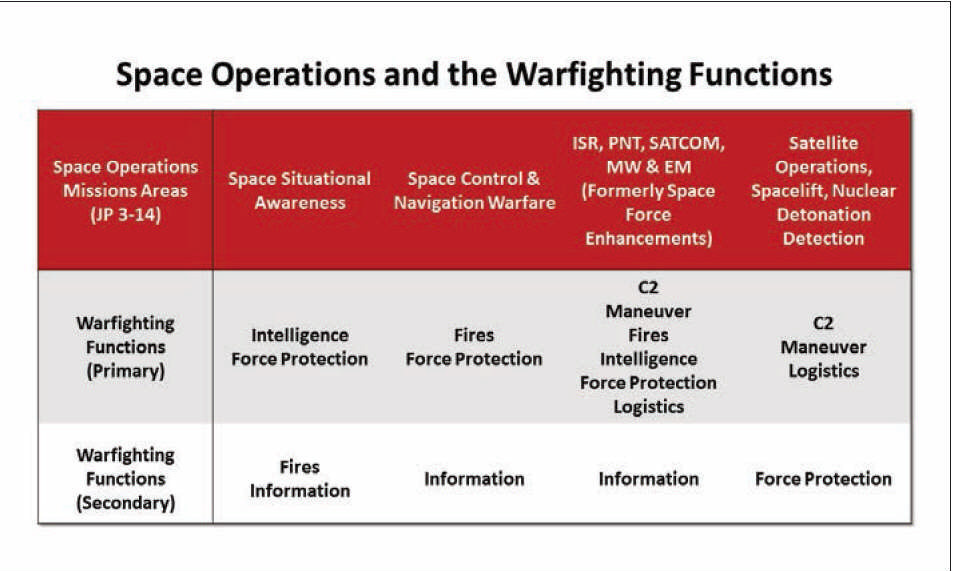
Figure 1

The primary support to MAGTF operations comes from the space mission areas ofISR, PNT, satellite communications, missile warning, environmental monitoring, and space control. Space situational awareness, satellite operations, space lift, and nuclear detonation detection are largely a focus of the other Services, which acquire, launch, operate, and defend the assets on-orbit. Figure 1 outlines the space operations mission areas and how they support doctrinal warfighting functions. This breadth of support exists across all seven functions to include the newest function: information. The authors and several colleagues developed this table, and though it is not doctrine, it is based on the collective insight and experiences of the Marine space operations community. It is also based largely on a figure in the draft version of JP 3-14 that did not make the version published in early 2018. While the Marine Corps does not own or operate its own spacecraft, Marines are a significant end-user of these systems and have equity in the capabilities provided by all mission areas.

It should be noted that while the Marine Corps considers space operations a supporting function of OIE, this is only one of multiple areas in which the MAGTF leverages space capabilities. JP 3-14 describes the relationship to information as:

providing [Joint Force Commanders] the ability to integrate the generation and preservation of friendly information, while leveraging the inherent informational aspects of all military activities to achieve the commander’s objectives and attain the end stateri

In this way, space operations and the employment of information environment activities are mutually reinforcing. The Marine Corps Space Operations Concept of Employment reiterates this point very clearly in saying,

Space Operations are considered a core mission of [OIE] in full recognition they enable or support all warfighting functions, MAGTF operations, and other MAGTF capabilities beyond the scope of [OIE].6

A MAGTF Space Operations Officer is primarily focused on supporting the unit’s ability to “shoot, move, and communicate,” in concert with the other functional areas of the operations sections, with a secondary focus on supporting operations in the information environment.

The Marine Space Support Team Concept
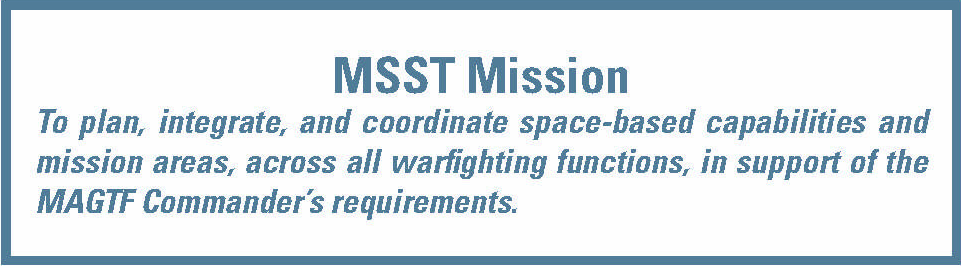
Figure 2

After experimentation during recent MEF exercises, the Marine Space Support Team (MSST) concept was developed to fill the requirement for organic and scalable space operations support across the MAGTF. (See MSST drawn box.) The proposed mission statement for the MSST is to plan, integrate, and coordinate spacebased capabilities across all warfighting functions, in support of the MAGTF commander’s requirements. Additional requirements and tasks are as follows (not inclusive):

* Commander’s primary advisor on space operations.

* Develop the appropriate space operations portion of a base operations order or applicable annex. Develop space operational requirements and the space estimate.

* Support a unit’s staff with space operations expertise. Provide space operations analysis and specific products to the staff. Support subordinate elements that do not have embedded space operations officers to ensure proper consideration of space capabilities and operations to the unit.

* Provide situational awareness of the space domain, to include threats to spacebased systems and spacebased threats to the MAGTF. Ensure possible effects of a D3SOE are integrated into staff planning and execution. Recommend specific priority intelligence requirements and/or information requirements to the G-2. Ensure G-6 awareness of electromagnetic interference threats and incidents.

* Plan, integrate, and coordinate U.S. Strategic Command-unique capabilities for SATCOM, PNT, ISR, navigation warfare, MW, EM, and space control capabilities into staff planning.

* Support red team capabilities involving threats to spacebased systems, specifically GPS and SATCOM jamming.

The concept maximizes use of existing structure, while minimizing new costs, as well as utilizing established and proven systems and methods already developed by the joint force. Focused on providing support at the MEF, but adaptable for MEUs or Marine forces, the MSST is simply a collaboration between the G-3 FECC space operations officer, the MEF Information Group (MIG) Space Operations Planners, as well as the G-2, G-6, and related technical specialties (cyber, electronic warfare, and special technical operations). The G-3 FECC and MIG will maintain control of space operations officers within their respective staffs. Marine Forces, U.S. Strategic Command (MARFORSTRAT) has an active duty space operations officer along with its Reserve Individual Mobile Augmentee Detachment of space operations planners. These Marines are trained to support MEF-level MAGTFs and the MSST concept and may provide reach back support and coordination with Strategic Command and other Service component commands, to include the Armys 1st Space Brigade and the Department of the Navy’s Naval Network Warfare Command. The MARFORSTRAT space operations planners may also provide augmentation to the MSST when requested for major operations or exercises.

With appropriate training and systems, the MSST may largely replicate the capabilities of an ARSST, as well as organically support the MEF and provide the fight tonight capability that an ARSST cannot. The MSSŤ can assist with training the MAGTF on advanced threat scenarios such as a GPS-degraded environment. Additionally, with the assistance of the 1st Space Brigade and MARFORSTRAT, a MSST certification checklist will develop based on current tactics, techniques, and procedures used by the ARSSTs. The checklist is used on an annual basis to certify the ability of the team to conduct its mission. This certification could be added as a Defense Readiness Reporting System (DRRS) reportable item for the MEF to show the MSST is mission capable.

As identified earlier, the current space operations MOS structure of8866/0540 falls short of meeting the MAGTF’s space needs partly because of a lack of training on the necessary software and tools required. While the MSST structure may ensure collaboration between these personnel, without additional training the Marine Corps will still fall short of the requirement. The needs of the MAGTF (and thus the MSST) necessitate the creation of an intermediate MOS (tentatively being referred to as MOS 0545, Space Operations Planner). The new MOS will require an additional level of training over and above the requirement for the space operations staff officer in order to fulfill the needs of the MIGs. Whereas the original 0540 MOS will continue to be used to add basic space knowledge to some billets, the O545 MOS will specifically prepare billet holders to utilize the systems and tools necessary to provide tactical space operations planning and support to the operating forces. This additional MOS has precedence, as it will mirror the information operations community, which has a basic staff officer level, an advanced planner level, and a master’s degree level (MOSs 0510/0550/8834). Specific courses for the new MOS have been identified and are currently used to train the MARFORSTRAT Reserve space operations planners to validate the requirements. These courses include the Army’s Tactical Space Operators Course and the Air Force’s Space Warfighter Preparatory Course.

A final aspect of the concept is the necessary systems and equipment to support the MSST capability. The ARSST teams utilize a specific space operations software package associated with the Distributed Common Ground System-Army system. This package includes the software toolsets to accomplish the analysis and product development required for the MSST mission. HQMC is working to integrate this toolset into a future system that will be used by the MEF and the MIG. This software, combined with the appropriate training and networks, constitutes the basic equipment required. Additional capacity will be gained from a stand-alone SATCOM capability and a dedicated commercial imagery capability. Johns Hopkins University Applied Physics Laboratory is concluding a study, sponsored by Deputy Commandant, Plans, Policies, and Operations (PP&O), that is documenting the MAGTF’s reliance on spacebased capabilities. As part of the study output, Johns Hopkins University Applied Physics Laboratory is modifying the Dagger dependency-modeling tool developed in part for Marine Forces, U.S. Cyber Command (MARFORCYBER). This tool will allow space operations officers to conduct advanced planning for GPS- and SATCOM-degraded environments, along with other threats to spacebased capabilities. Furthermore, MAGTF Staff Training Program can use the tool as a way to give realistic feedback to the training audience for master scenario event list injects during exercises. The additional structure, training, and equipment represent a small investment for tremendous and necessary capability to support MAGTF operations.

Space Force

On 9 August 2018, the Final Report on Organizational and Management Structure for the National Security Space Components of the Department of Defense was delivered to Congress from the Secretary of Defense. This report recommended the creation of a Space Command and highlighted a number of new organizations as well as a plan to strengthen and focus the DOD approach to space as a warfighting domain. On 13 August, the President signed the FY2019 National Defense Authorization Act (NDAA), which stated,

[W] ith the advice and assistance of the Chairman of the Joint Chiefs of Staff, the President, through the Secretary of Defense, shall establish under the United States Strategic Command a subordinate unified command to be known as the United States Space Command … for carrying out joint space warfighting operations.”‘7

Placing Marines who understand warfighter needs and the reliance on space-capabilities by the MAGTF into this joint force will provide a necessary level of support and influence within the joint space community.

Way Forward

The MSST concept was initially briefed to the Space Operations Working Group in May 2018 and recommended for experimentation by the MEF/MIGs and Marine forces in attendance. Over the course of this year, this concept will provide a framework for experimentation at major exercises to refine and validate the concept with the end goal of formal adoption of the MSST concept. With a minimal cost for training and equipment, and no additional structure necessary for implementing the MSST up to the MEF level, we believe the Marine Corps can drastically increase its level of preparedness for the next war, conflict, or contested action. The MAGTF must take full advantage ofspacebased capabilities in order to increase lethality and survivability, and the MSST is an excellent start to creating organic support to accomplish these goals.

Notes

1. White House, National Security Strategy of the United States of America, (Washington, DC: December 2017).

2. The Space Operations Officer, MOS 8866, is an analyst MOS, produced at the Naval Postgraduate School via the Special Education Program. The requirement for the billet is education, not training; most MOSs are received at the conclusion of training where a Marine is required to demonstrate the capability to “do” a skill vice “know” or “analyze.”

3. Headquarters Marine Corps, Marine Corps Operating Concept, (Washington, DC: September 2016).

4. Joint Staff, Joint Publication 3-14, Space Operations, (Washington, DC: 2018).

5. Ibid.

6. Headquarters Marine Corps, The Marine Corps Space Operations Concept of Employment, (Washington, DC: 2017).

7. Congress of the United States, 2019 National Defense Authorization Act, Title XVI, Sec. 1601 (Washington, DC: 2018).
Warfighting Revisited

by Col Thomas C. Greenwood

Rarely do book reviews elicit spirited responses, so I am both honored and pleased that my critique of Dr. Anthony J. Piscitellis, The Marine Corps Way of War (MCG, Marl 8) did so, generating subsequent commentary from the author and a leading maneuver warfare advocate from the 1980s, Col Mike Wyly, USMC (Ret). I hope Gazette readers share my gratitude to both men for continuing to make this a meaningful discussion in our professional journal.

Having re-read Dr. Piscitellis letter (MCG, Septl8) and the concluding chapter of his book, I find that we agree on more points than not. Nor does he owe anyone an apology for his publisher’s oversights. Still, the next revision of his book will be strengthened by a more balanced presentation of the maneuver warfare debate that animated professional discussions around the Corps for nearly two decades. The so-called “opposition” was not composed of insubordinate officers who refused to carry out orders; rather, they were committed professionals who shaped the broader discussion that ultimately defined the Marine Corps ethos after Vietnam. The interactive nature of the debate sharpened maneuver warfare‘s foundational ideas and brought about institutional change.

The ways in which military organizations reform themselves to prevent repeated failures, avoid complacency, and remain useful to the Nation, is an important story that deserves to be told. Not just for history’s sake but, more importantly, so that successive generations of Marines might gain insight from lessons learned in the past. The latter have institutional responsibility to ensure doctrine keeps pace with the changing character of war and evolving threats our Nation faces. It is through this lens that I offer the following additional observations.

Dr. Piscitelli alludes that warfighting philosophy serves an important and necessary function in any military organization; however, philosophy alone does not produce battlefield victory. As the French discovered in WWI-when their philosophy of war became so sacrosanct as to escape dispassionate scrutiny and evolved into the cult of the offense-generalized conceptions of war still require armies to apply their visualization of combat to the specific operational context of each specific conflict.

The French were not alone in misunderstanding the evolved nature of war. The British also discounted changes in warfare that had been underway for decades and continued to believe moral factors could overcome revolutionary changes in firepower. Gen Douglas Haig’s thoughts on these matters reflected Britain’s outdated warfighting philosophy of the day:

The Staff College, and (General) Douglas Haig did accept the fact of modern firepower, but while making adjustments to tactics, they came to the conclusion that, other things being equal, it was simple solutions such as morale, discipline and leadership that decided battles. So, the problem of modern fire-power was to be solved by intensifying morale, discipline and leadership rather than using the same fire-power to devise appropriate solutions … this emphasis (on human factors) tended to distract Haig and others from fully appreciating the change that were taking place … only the mounted arm could win the decisive vietory-success in battle simply opened the way for cavalry to achieve the decision.!

This issue is still relevant with today’s leaders and Marine Corps Commandant Gen Robert B. Neller, who stated publicly in June 2017 that the Marine Corps is “not currently organized, trained, and equipped to face a peer adversary in the year 2025.” The Commandant’s candid pronouncement has prompted some to question why the Corps is not adequately postured for success against our most dangerous adversaries despite a $41 billion annual budget.

No doubt, there are multiple answers to this question; however, a key explanation is that warfighting philosophy must be complemented with a viable concept that translates philosophy into operational activities. As one writer has noted: The operational concept filters theory through the lens of geopolitical circumstances, national culture, historic context and technolog}’- to frame a doctrine of war-the codification of practice. An operational concept may or may not be explicitly set forth in doctrine, but it drives doctrine nonetheless. Doctrines that can demonstrate their basis in a clear and widely understood operational concept are far more effective than those that cannot.2

Since Warfighting was first published in 1989 (and most recently updated in 1997’s MCDP 2), the Marine Corps has drafted several operational concepts (e.g., Maritime Prepositioning Operations, Operational Maneuver from the Sea, Enhanced Network Seabasing, Expeditionary MAGTF Operations, Ship-to-Objective Maneuver, Sustained Operations Ashore, Distributed Operations, and Littoral Operations in a Contested Environment) that have enjoyed varying degrees of longevity. Unfortunately, before some reached full maturity, they were eclipsed by the speed of change in the security environment, adaptive nature of our adversaries, and bureaucratic limitations. So, it remains to be seen if the Corps’ latest concept- Expeditionary Advance Base Operations (EABO)-will serve effectively as David Fastabend’s “operational filter” for fighting a peer adversary in a degraded and contested environment.

Ingenuity and innovation will help the Marine Corps overcome EABO’s logistical, mobility, and survivability challenges. If not, then EABO must be jettisoned in favor of a better operational concept that is subjected to rigorous experimentation and validation before being adopted. This cycle of rapid concept development and experimentation which, if done correctly, may involve as many failures as it does successes, is an essential part of creative military discovery. It also inoculates military institutions against falling in love with either their warfighting philosophy or their concepts.^

The same holds true for official doctrine, which may easily become irrelevant unless it is frequently updated. Worse, aging doctrine could potentially become worshipped as a kind of high religion- much like the offense and horse cavalry were in earlier eras-promoting inaction, intellectual stagnation, and slavish adherence to warfighting methods that are ill-suited for modern conditions. On this point, I think Col Wyly and I agree. My argument is not that Marine Corps warfighting doctrine (i.e., maneuver warfare) has outlived its usefulness. Rather, that after two decades (three decades if we use the original 1989 FMFM1 publication date), Chapter 4 of MCDP 1 will benefit from a discussion of today’s information environment; the contribution Marines are now being called upon to make in the competition phase short of armed conflict; the imperative of employing land-based long-range fires (both non-kinetic and kinetic) with fires in other domains; the impact of unmanned technology on force development; and organizational dexterity required to integrate with other joint/combined forces (whose warfighting philosophy and operational concepts may not embrace those held dear by any single U.S. Service). Ultimately, we must work to keep alive many of maneuver warfare‘s fertile ideas vice simply admiring the achievement and allowing it to become an artifact of military history.

Notes

1. Tim Travers, The Killing Ground: The British Army, the Western Front Ó’ the Emergence of Modern War 1900-1918, (United Kingdom: Pen and Sword, 1987).

2. David A. Fastabend, “That Elusive Operational Concept,” Army Magazine, (Arlington, VA: June 2001).

3. For additional insights into the critical role experimentation plays in concept development, see, Kevin M. Woods and Thomas C. Greenwood, “Multi-domain Battle: Time for a Campaign of Joint Experimentation,” Joint Forces Quarterly, (Washington, DC: January 2018).

False Choice

by Maj Brett Friedman

The Marine Corps is not unique in its struggle to address an operating environment frequently characterized by both state and non-state irregular enemy forces equipped with increasingly advanced weaponry and technology. The other branches of Service have struggled equally despite a shared history of success against both conventional and irregular opponents around the world.

The Marine Corps is unique, though, in that its essential core ethos, maneuver warfare, remains a valid and powerful philosophy. Tested again during the opening phase of Operation IRAQI FREEDOM, the concept proved sound. As an institution, the Marine Corps continues to produce the kind of dynamic and innovative leaders required to execute maneuver warfare on the modern battlefield.

The Corps must decide, however, how best to address a global trend of adversaries who are increasingly potent given the rapid proliferation of advanced technology. The question of whether the Marine Corps should focus on conventional or irregular warfare itself implies a fallacy: that our maneuver warfare philosophy is designed solely for conventional war and cannot address irregular warfare. This is wrong. The Marine Corps can most effectively wage war against irregular organizations by scuttling the idea that our tactical philosophy is an inappropriate means to address the threats, redoubling our efforts to achieve mastery of those tactics, and fostering a better understanding of the strategic operating environment.

Just Good Tactics

At the tactical level, warfare operates on the same principles whether the actor is a uniformed, conventional soldier or an irregular fighter. A surprise flanking attack on an enemy’s weak point will serve both the professional and the guerrilla well. So-called guerrilla, or irregular, tactics are focused on speed, deception, surprise, and maneuver, but no good professional soldier or Marine should eschew such principles. These are simply good tactics. Any intelligent and effective military force will employ them.

Doctrine has long recognized the similarity between conventional and guerrilla tactics. The 1940 Small Wars Manual, for example, recognizes that all tactics are generally the same. In the section “Small Wars Tactics,” it states,

During the initial phases of intervention, when the landing and movement inland may be opposed by comparatively large, well led, organized, and equipped hostile forces, the tactics employed are generally those of a force of similar strength and composition engaged in major warfare. *

Even in later stages,

the tactics of such infantry patrols are basically the military methods, principles, and doctrines of minor tactics, as prescribed in the manuals pertaining to the combat principles of the units concerned.3

The principles of war that the manual refers to include “mass, movement, surprise, and security.”3 Essentially, the Marines of the small wars era recognized that when it came to the actual fighting, the tactics and principles were similar to those of conventional wars. Even former Commandant of the Marine Corps MajGen John A. Lejeune attributed the success of Marines in the First World War-some of the most “conventional” warfare in history-to the skills and experience they gained fighting guerrillas in the Banana Wars.4

Major strategic theorists would agree. Carl von Clausewitz wrote in his war college lectures on small wars that

the use of weaponry in Small Wars is not different from that in Large Wars. The same is true of those things that are taught to soldiers. Flanking … and sniping … are in Small Wars just the same as in Large Wars.3

Mao Tse-tung, the Chinese guerrilla leader and theorist, prescribed tactics to his fighters:

In guerrilla warfare, select the tactic of seeming to come from the east and attacking from the west; avoid the solid, attack the hollow; attack; withdraw; deliver a lightning blow, seek a lightning decision. When guerrillas engage a stronger enemy, they withdraw when he advances; harass him when he stops; strike him when he is weary; pursue him when he withdraws.1^

Marines will recognize this as good advice for any type of warfare and can identify the same concepts in our own doctrine, for our capstone doctrine plays the same notes. MCDP 1-0, Marine Corps Operations, for example, uses phrases like:

Avoid the enemy’s strength and attack his weakness by focusing combat power against the enemy’s critical vulnerabilities. Isolate the enemy from his sources of support … Strike the enemy from unexpected directions.3

Perhaps it would have just been easier to cite Tse-tung than to write the above. MCDP 1, Warfighting, defines maneuver warfare as

a warfighting philosophy that seeks to shatter the enemy’s cohesion through a variety of rapid, focused, and unexpected actions which create a turbulent and rapidly deteriorating situation with which the enemy cannot cope.8

The best way to achieve this end state is through mass, movement, and surprise, or guerrilla warfare. Maneuver warfare has been criticized as just being good tactics. It is. So is guerrilla warfare. In fact, the two are so similar that MCDP 1 explicitly states,

[Maneuver warfare! applies regardless of the nature of the conflict, whether amphibious operations or sustained operations ashore, of low or high intensity, against guerrilla or mechanized foe, in desert or jungleP

The strategic studies’ academic community has also noticed the similarity of these works’ tactics. In a monograph for the U.S. Army’s Strategic Studies Institute called Categorical Confusion?: The Strategic Implications of Recognizing Challenges as Either Irregular or Traditional, Professor Colin S. Gray examined whether dividing war into conventional and irregular warfare makes sense. He unequivocally concluded,

It is an error amply demonstrated by historical evidence to divide threats, challenges, war, and warfare into two broad, but exclusive categories-irregular and traditional (regular, conventional).10

The conclusion for the Marine Corps is clear: there is no distinction between irregular and conventional warfare. If the Corps continues teaching its members an inaccurate conception of warfare, it can hardly expect to be successful at waging it.

The best academic study of this convergence of tactics in modern warfare is Stephen Biddle’s Military Power: Explaining Victory and Defeat in Modern Battle. Biddle found that modern technology virtually mandates some tactics as opposed to others. Those tactics he refers to as the “modern system.” He found that good offensive tactics are “cover, concealment, dispersion, smallunit independent maneuver, suppression, and combined arms integration.”11 Defensive tactics, he found, operate on largely the same principles,

[demanding] much the same exposurereduction tactics of cover, concealment, dispersion, suppression, combined arms, and independent small unit maneuver that modern system attackers require, albeit adapted to the particular problems of the defense.13

Yet what the modern system actually describes are tactics that we normally associate with guerrillas. Now, everyone on the battlefield must use them-soldier and guerrilla.

When military professionals, guerrilla fighters, and academics all agree on which tactics work and which do not, it leads to one inescapable conclusion: when tactics are good for one mode of operation, they are good for another. Thus, the true difference between conventional and irregular warfare lies not in tactics but in differing strategic precepts. Differences in uniforms, armament, and professional training are minute when compared to the strategic differences between the guerrilla force and the conventional military. The tactical principles for the soldier and the guerrilla seem similar because they are similar: they are just good tactics.

The distinguishing factor between conventional and irregular war can be explained by the ideas of two strategic theorists: Hans Delbrück and Navy RADM J. C. Wylie. Delbrück was a German historian who believed that there were two modes of strategy: Niederwerfungsstrategie (strategy of annihilation) and Ermattungsstrategie (strategy of exhaustion).13 A strategy of annihila- tion is focused on the quick destruction of the enemy at a concentrated point in time. A strategy of exhaustion, however, is predicated on the wearing down of the opponent vice a fast campaign of attrition. Whereas Delbrück used time to differentiate between the two modes of strategy, Wylie viewed process as the distributing factor. His two modes of strategy are sequential strategies and cumulative strategies.14 In a sequential strategy, each tactical event (battle, operation, movement, etc.) follows logically from the previous one and is contingent upon its predecessor eventually leading to a target that achieves victory. The island-hopping campaign of the Pacific Theater during World War II is an example of a sequential strategy. In a cumulative strategy, however, tactical events are not necessarily connected in a one-after-another manner but happen in a seemingly random pattern. Victory is achieved when one side has simply had enough. This is the strategic logic behind many guerrilla campaigns, such as the Taliban insurgency in Afghanistan.

/Executing a strategy of annihilation in a sequential manner usually requires a professional, organized military force to do the heavy lifting. A cumulative strategy of exhaustion, however, does not. Any force that lacks the required strength to execute the former-such as a guerrilla organization-will choose the latter. A cumulative strategy of exhaustion requires tactics that help to outlast the enemy: ambushes, surprise, deception, and the ability to hide amongst a population. A force with a strategy must be beaten at its own game, outlasted and out-exhausted. A strategy of annihilation, however, cannot succeed against an enemy that refuses to be annihilated. Since 9/11, the U.S. military has attempted to do just that and has focused on defeating insurgent tactics-of IEDs, etc.-while it needed to confront its strategy of exhaustion. This only highlights how important it is for Marines to understand strategy in order to execute tactics successfully.

There are many competing but ultimately distracting concepts that are marketed and sold to the U.S. military. Stylish but shallow concepts like hybrid warfare, asymmetric warfare, and gray-zone conflicts are simply the recognition of an ancient truth that has recently become more obvious: a strategic actor will not eschew one form of tactics for another except in rational self-interest. Given similar equipment, each strategic actor will choose the most effective tactics. This is not to say that there are not important and significant differences between conventional and irregular wars and the actors that wage them. There are. But when it comes to the actual fighting, at bullet and bayonet range, the same tactical principles apply.

Technology and Trends

The ever-increasing lethality of firepower and proliferating intelligence, surveillance, and reconnaissance technology is driving a convergence of conventional and irregular methods. If modernization and the spread of technology will eventually produce a general consensus of which tactics are effective and which are ineffective, then in what direction is technology currently driving tactics? Fortunately for the Marine Corps, there is a lot of data to be gleaned from conflicts around the world. What current events show us is that technology is not driving toward new tactics but rather tactics that raise the cost of poor decisions. Biddle’s modern system still holds, but the consequence of failure ıs not just high casualties but the annihilation of entire units. This trend has long held true for our enemies, seen in the Battle of 73 Easting or An Nasirıyah. The trend has now caught up with us.

Still, it is folly to try and differentiate conventional and irregular fighters based on equipment. The Viet Minh at Dien Bien Phu in 1954 vastly outgunned the French Army units it surrounded. The Islamic State (or ISIS) was much better equipped than most other “guerrilla” forces because it captured avast amount of American-made equipment from the Iraqi Army. Additionally, state-sponsored irregular forces like Hezbollah in Lebanon and Donetsk separatists in Ukraine have access to the most modern military equipment. These ongoing conflicts demonstrate the convergence of tactics normally associated with either conventional or irregular warfare.

This is not to say that warfare is not changing or that modern technology is not driving those changes. Both those statements are true. Timeless tactical principles endure but express themselves in novel ways on the battlefield. Cover and concealment, for example, is of vital importance for both professionals and guerrillas as the ubiquity of aerial surveillance drones with long loiter capabilities grows. This is why First World War-style trench works have begun to reappear in places like Donetsk and Mosul, Iraq. The use of ambushes, of course, has been a dominant tactical maneuver in both Iraq and Afghanistan, and IEDs have driven American tactical and equipment adaptations like the MRAP. Firepower, as usual, retains value. Russian artillery fired at targets spotted by UAVs in Ukraine, and ISIS used waves of vehicle-borne IEDs to shape its objective of Ramadi.

What these trends show is that while tactical principles remain the same, failure to adhere to these principles leads to dire consequences, thanks to the proliferation of aerial and precision guided munitions. The use of poor tactics promises not just casualties-but massive casualties.

Implications for the Marine Corps

There are numerous implications of dropping the regular/irregular dichotomy from Marine Corps doctrine. All are necessary to preserve the long-term utiliry and viability of the Marine Corps as a warfighting institution.

When it comes to the tactical level, the Marine Corps has more opportunities than threats. Maneuver warfare, as a warfighting philosophy, is well-suited to the character of modern warfare. The other major strength, perhaps the Marine Corps’ greatest strength, is its NCO corps. Future tactics are in the hands of our NCOs more than anyone else’s, and MCDP 1 recognizes that. Indeed, its use depends on it. Unfortunately, institutional traditionalism frequently clashes with a maneuver warfare mindset. Our capstone doctrine is an ideal for which we must continue to strive; when tradition and philosophy clash, tradition must give way.

Tactical implications include:

* Teaching “guerrilla” tactics at the School of Infantry, Marine Combat Training, and Infantry Officer Course. Let Marines learn to fight as individuals and in small teams in freeplay, force-on-force exercises first, and then build up from there.

* Refocusing training at these schools on the principles of war taught not as a checklist to memorize but as parameters to evaluate tactical options. Train tactical judgment by exercising it.

* Teaching every concept as a lecture, then as a sand table tactical decision game, then a student-led planning phase, then a practical exercise. This method is already used at TBS to great benefit.

The Marine Corps has less inherent strength at the strategic level. It is not so much falling behind the other Services in developing strategic and innovative leaders as it is refusing to join the race. Other Services have strategists by MOS, world-renowned war colleges, and publishing arms that attract talent military and civilian. These institutions and individuals constantly evaluate and research future environments, fostering better vision and strategic planning. With the exception of Marine Corps University, the Marine Corps fails to employ such resources. We prefer to employ common Marine phrases like “stay in your lane” or “shut up and color.” These phrases should be abolished as emblematic of intellectual laziness. The luxury of burying our heads in the sand of tactics is one we can no longer afford.

This can be fixed by revamping the education system for officers. Resident PME should refocus on broadening an officer’s base of knowledge in military history and strategic theory rather than teaching doctrine and enforcing its dogma. Familiarity with and adherence to doctrine are the responsibility of the officer and his chain of command when stationed in the Operating Forces. It is a waste of time and resources to reiterate it during PME. As NCOs increasingly dominate the realm of tactics, officers will increasingly need to understand the broader strategic context of the battlefield. Instilling a lifelong study of war in our officers from the very beginning is no longer an option but a mandate.

Strategic implications include:

* Eliminating the Center for Irregular Warfare Integration Division. It makes no sense to segregate irregular tactics in an office aboard Marine Corps Base Quantico.

* Making selected books from the Commandants Reading List mandatory for officers at each grade. Physical fitness is already mandated by HQMC, but mental fitness is merely encouraged.

* Introducing strategic theory to officers at TBS, expanding the strategic theory curriculum at Expeditionary Warfare School, and fostering expertise in strategic theory at the Command and Staff College. A crawl, walk, run approach is appropriate, but officers should be crawling as lieutenants, not as majors.

* Expanding the Marine Corps Warfighting Lab’s Ellis Group. Use the personnel and cost savings from shuttering the Center for Irregular Warfare Integration Division to turn the Ellis Group into a more robust and capable office.

These subtle and inexpensive changes will work slowly but in the long term will reap dividends for the Marine Corps and its members.

Security Cooperation and Building Partner Capacity

A solid foundation in strategic theory will be necessary for our leaders who will not just be called upon to fight but also to work with foreign partners. Security cooperation was a key component of Operations ENDURING FREEDOM and IRAQI FREEDOM, and the United States will increasingly work with and through partnered nations. Building partner capacity is not just a feature of irregular warfare; it never has been. Both World Wars and the Korean War had major building partner capacity components. Wherever and whenever Marines deploy, security cooperation will occur.

Eliminating the assumption that there is a practical division between irregular and conventional tactics will allow Marines to become better partners. Building the tactical expertise of all Marines, and specifically NCOs, will make them ideal partners and trainers. Equipping officers with the intellectual tools to understand strategic and historical contexts will enable them to tailor instruction and training plans to the specific needs of any partnered force. These efforts, in turn, will build a common tactical language and a common strategic outlook among the archipelago of American allies, thus improving the interoperability, cooperation, and coordination of those forces in any situation before that situation occurs. The security cooperation efforts in recent years have been ad hoc and sporadic, rarely advancing beyond basic low-level tactics. When it comes to partnering, Marines should never be put in the position of starting from scratch again.

Conclusion

The irregular warfare debate is stymied not by a lack of answers but by continual appeals to the wrong questions. Should the Marine Corps focus on conventional or irregular war? What is the right mix? How can the Marine Corps succeed in irregular warfare? These are all questions founded on an erroneous assumption that the tactics are vastly different for each. The face of every war will indeed be different, but the principles remain the same. LtCol Pete Ellis said it best when discussing how Marines can succeed in war:

It is not enough that troops be skilled infantry men and jungle men or artillery men of high morale; they must be skilled water men and jungle men who know it can be done-Marines with Marine training.

At a time when the other Services and the DOD are focused on the next technological leap-ahead-and sacrificing training and education to pay for it- the Marine Corps should refocus on and strengthen tactical training, strategic education, and its battle-tested warfighting philosophy. It should drop the distracting conventional/irregular dichotomy and refuse to chase the intellectual flavor of the week. This will make Marines ready for and adaptable to any situation and make the Marine Corps itself more valuable and successful as a partner and ally. In short, Marines with Marine training will be ready for any clime and place.


Notes

1. Headquarters Marine Corps, Small Wars Manual, (Washington, DC: 1940).

2. Ibid.

3. Ibid.

4. John A. Lejeune, The Reminiscences of a Marine, (1930).

5. Christophers Daase and James W. Davis, Clausewitz on Small War, (Oxford: Oxford University Press, 2016).

6. Mao Tse-tung, translated by Samuel B. Griffith, On Guerrilla Warfare, (Urbana-Champaign, IL: University of Illinois Press, 2000).

7. Headquarters Marine Corps, MCDP 1-0, Marine Corps Operations, (Washington, DC: 2011).

8. Ibid.

9. Ibid.

10. Colin S. Gray, Categorical Confusion?: Strategic Implications of Recognizing Challenges Either as Irregular or Traditional, (Carlisle, PA: U.S. Army War College Strategic Studies Institute, 2012).

11. Sam Biddle, Military Power: Explaining Victory and Defeat in Modern Warfare, (Princeton, NJ: Princeton University Press, 2004).

12.Ibid.

13. Gordon A. Craig, “Delbrück: The Military Historian” in Peter Paret, Makers of Modern Strategy: From Machiavelli to the Nuclear Age, (Princeton, NJ: Princeton University Press, 1986).

14. RADM J.C. Wylie, Military Strategy: A General Theory of Power Control, (Annapolis, MD: Naval Institute Press, 2016).

Maneuver Warfare in Cyberspace

by Capt Brian R. Raike

“Maneuver warfare is a warfighting philosophy that seeks to shatter the enemy’s cohesion through a variety of rapid, focused, and unexpected actions which create a turbulent and rapidly deteriorating situation with which the enemy cannot cope.”1

The concept of maneuver warfare has been studied in all domains and is a foundation that guides the way the Marine Corps conducts operations. Retired Air Force Col John Boyd studied the subject regarding air-to-air combat and then translated it to fit conflict in all domains. According to Col Boyd, to outmaneuver an enemy, one must create a greater relative tempo of operations.2 This is true in all domains of warfare. Historically, during conflict, one side’s militarization of a new domain and the other side’s failure to militarize that domain results in a decisive victory for the former and a devastating loss for the latter within that domain. However, as Dr. James Lacey of the Marine Corps War College stated, “Losing in one domain does not equal defeat.”3 While it is true that losing in one domain does not equate to losing a battle, campaign, or war, cyberspace tends to underpin most of the other domains on the modern battlefield. As such, the United States and its allies cannot afford to be outmaneuvered in this space.

The decentralized command and control (C2) of operations enables effective maneuver warfare.^ To create this decentralized C2, the joint community has developed battlespace coordination measures and fire support coordination measures (FSCMs) that govern deconfliction requirements for air, ground, and sea operations. Joint Publication 3-0, Joint Operations, addresses the cyberspace problem statement by stating that cyberspace operations require “coordination, cooperation, and a comprehensive approach to achieve common objectives.”3 While joint doctrine addresses a need for this comprehensive approach, it does not prescribe a method by which the Services may achieve this end.

Cyber Battlespace

To enable tempo in military operations across multiple domains, the joint force uses boundaries and control measures. Specifically, commanders “establish various maneuver and movement control, airspace [coordination], and fire support coordination measures to facilitate effective joint operations.”6 The joint force employs these concepts in the air, sea, and land domains; this can be done in cyberspace as well.

The cyber battlespace is essentially composed of the infrastructure, systems, and protocols that make up the Internet. However, it is important that we standardize the way in which we view these elements. By understanding the interrelatedness of cyberspace, we may be able to leverage existing boundaries to institute controls that allow for processes similar to traditional battlespace C2 and deconfliction.

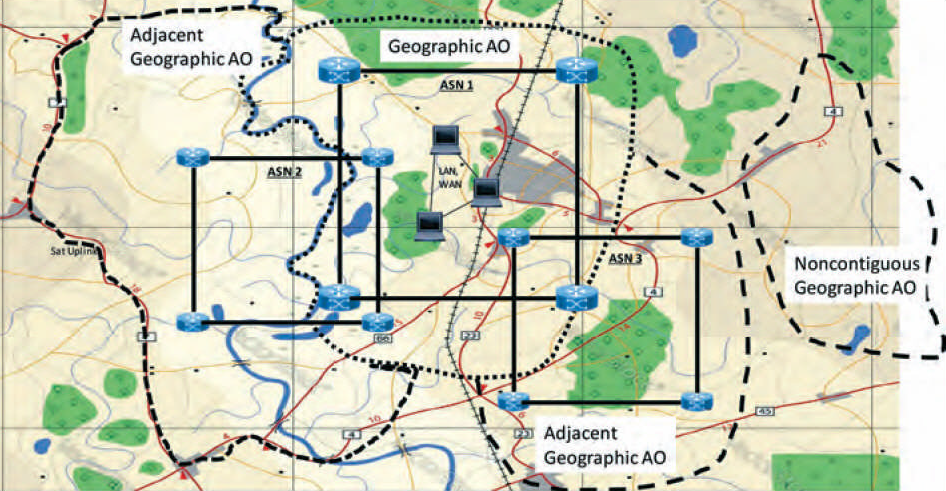
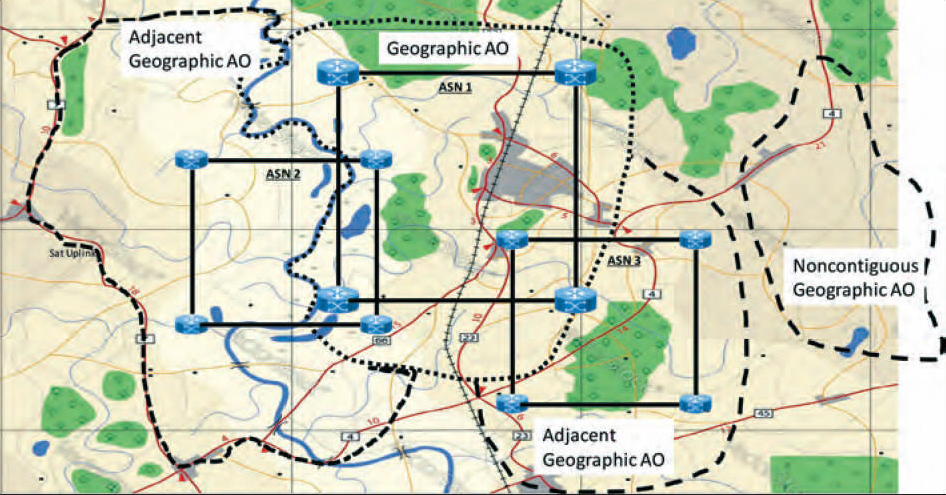
Cyberspace, without defined boundaries, is akin to a map without military graphics, markings, or sector delineations. Autonomous systems, designated by numbers in shared databases (known as ASNs), are interconnected, high-level routers and switches that connect to other networks over physical cables. Large organizations, such as Internet service providers, own and operate ASNs and conduct the intra-domain routing of packets using the language of border gateway protocol.7 Large international backbones carry data over vast distances between ASNs. Large networks may also connect via satellite links using radio frequencies. Once the data reaches a regional gateway, network access points convert the data to the format of transmission control protocol/Internet protocol (TCP/IP). Subordinate to these large networks are smaller networks known as widearea networks and local-area networks, which use TCP/IP to send and receive data, known as inter-domain routing. To reach its final destination, data may ride over multiple methods of transportation, including radio waves and microwaves. The client/server methodology used by TCP/IP allows data to travel to the appropriate destination via routers using interior gateway protocols and provides the appropriate data type based on the server used to deliver the data.

Using the inherent boundaries depicted above, cyberspace can be broken down into areas of operations (AOs) and assigned to military commanders, who can conduct supporting operations to military actions within their geographic AO. In joint doctrine, the joint force commander assigns AOs to his subordinates as a means to enable subordinate commanders to “accomplish their missions … and protect their forces.”8 Similarly, in cyberspace, a cyber-AO (C-AO) may be defined as the logical space and physical routing devices, transmission paths, and network components which may impact the applicable geographic AO. The starting point for defining the C-AO is to determine which ASNs impact the geographic AO. By listing these ASNs, one may understand the larger inter-domain routing pathways that impact the physical AO. The ASNs, which communicate via border gateway protocol, essentially become the outer boundary of the C-AO. Border gateway protocol ıs a path vector protocol, which means that it maintains a specific path for data flow. This is particularly useful in establishing the C-AO because a reading of the protocol at a given point allows one to infer which ASNs connect to the ASNs that directly impact the geographic AO. The associated IP space confining these ASNs makes the first element in the C-AO. (See Map 1.)

Map 1

An analyst may define the intra-domain atmosphere after discovering the ASNs that may impact the geographic AO. Specifically, he must discover which networks are subordinate to each individual ASN. These subordinate networks are the wide-area networks and the local-area networks. One may identify these subordinate networks through a combination of open-source and intelligence community resources. (See Map 2.)

Map 2

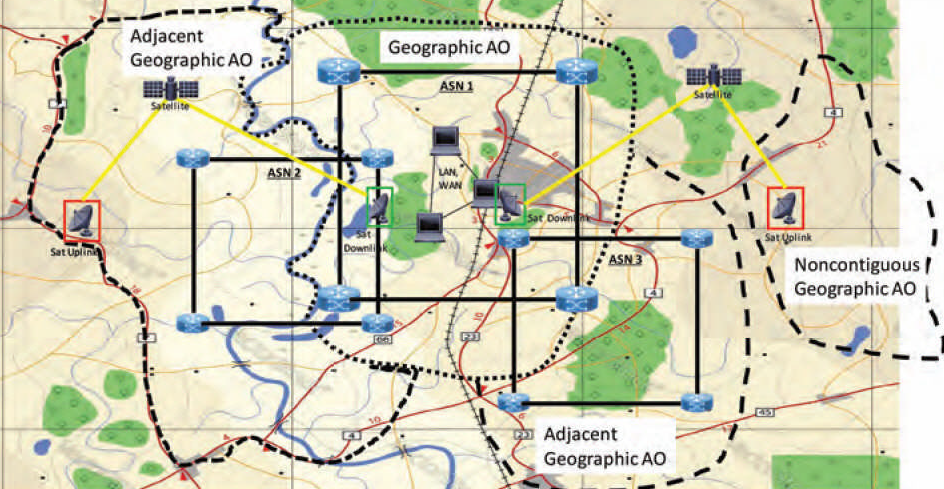
With a concrete understanding of the construct of relevant networks in a geographic AO, it is imperative to consider outlier technologies, which may bypass the ASN structure. Users within a geographic AO may leverage satellite communications (SATCOM) for data transferal.9 For this reason, the C-AO should include all satellite coverage areas that fall within the geographic AO, the associated, command link data systems, and all of the relevant downlinks. In addition to SATCOM, cellular networks should be included in the C-AO. Cellular networks generally fit more neatly into the geographic AO because of their reliance on the relatively short span of coverage provided by cell towers, which are largely concentrated in developed areas.10 (See Map 3.)

Map 3

The combination of ASNs, subordinate networks, SATCOM infrastructure, and other cyberspace entities relevant to a specific geographic AO should make up the related C-AO. These entities are logically represented by IP addresses, media access control addresses, and other cyberspace selectors. FSCMs are the method by which the C-AO may be deconflicted.

Traditional FSCMs are either permissive, which facilitate attacks and minimize coordination, or restrictive, which are imposed to safeguard friendly forces. While traditional FSCMs are depicted as specific graphics on maps, FSCMs in cyberspace may not fit as neatly. Instead, they may be better represented as lists of IP addresses, media access control addresses, or other logical designators that appear in the relevant cyberspace. These lists should include details regarding restrictions, rules of engagement, and coordination instructions. For example, a cyber no-strike list is a restrictive FSCM composed of a list of targets within a designated C-AO upon which cyber effects are not authorized. A cyber-restricted target list, on the other hand, is a list of cyberspace targets within a designated C-AO which require additional coordination prior to firing because either another coalition entity is planning a similar operation or the target is politically sensitive and would require interagency approval. Known cyberspace elements that do not appear on either of these lists would be placed on a cyberspace joint target list and require no additional coordination prior to firing. These cyberspace FSCMs are akin to those used in the physical realm to aid commanders in the targeting process.

Delineating the cyber battlespace and implementing associated FSCMs would enable a commander to quickly assess which cyber targets are relevant to his AO. Further, it would allow him to understand the coordination requirements to attack a cyber target, which would enable tempo in cyberspace and could facilitate a commander’s attack on cyber targets to out-tempo his adversary. However, it is important to note that cyberspace rapidly changes. Since cyberspace is constantly updating, the joint force must construct a realtime monitoring authority to facilitate deconfliction. This will be resource- and time-intensive but is the only way to facilitate the rapid engagement of targets needed to outmaneuver an adversary in cyberspace while ensuring the prevention of fratricide.

“But Cyberspace is Different”: An Erroneous Premise

Despite the growing acceptance of cyberspace operations as commonplace, a widely held belief regarding cyberspace operations is that they are too complicated to be compared to traditional military operations. Authors have warned that cyberspace is filled with attackers capable of appearing and disappearing at will, stealing identities, and shifting network nodes.11 While all this is true, if one breaks down cyberspace into separate AOs and implements an authorization authority, his perspective may be more optimistic.

Further, others have argued that the cyber battlespace is composed of only a singular battlefield. The argument is that since there is only “one Internet” which comprises the World Wide Web, then there may only be one cyber battlefield.12 While this argument warrants some merit, it is analogous to an exclamation that because there is only one Earth, there is but one physical battlefield. To mitigate ideas like this in other domains, the joint community divides battlespace in the air, land, and sea and assigns commanders responsibility for the various aspects of those domains which relate to their military mission. Additionally, the Marine Corps traditionally views all battlespace through the “single battle concept,” in which an action taken in one area of the battlespace may very well impact an action taken in another, potentially noncontiguous area of the battlespace. Marines have already accounted for the fact that there is a singular Earth and that military operations are rarely linear and confined to any singular space therein.

Cyberspace is indeed “different,” but only inasmuch as airpower was different to warfare during the attritionist fight in the pre-World War I world. Though both sides of the war exuded initial skepticism, the advancement of air power and the control thereof became a prominent factor in overall strategy by the conflicts conclusion.13 After World War I, the air domain became commonplace to war as we know it. Cyberspace will follow suit.

Conclusion

The ability to out-tempo an adversary is key to winning at maneuver warfare. Tempo demands that a commander must have decentralized control of his operations. To facilitate tempo, the joint community establishes boundaries and control measures in the air, sea, and land domains. Despite the differences that exist in the cyber domain, boundaries and FSCMs in cyberspace will enable tempo in the cyber domain.

Notes

1. Headquarters Marine Corps, MCDP 1, Warfighting, (Washington, DC: 1997).

2. Col John R. Boyd, USAF, Patterns of Conflict, (Online: December 1986), available at www. dnipogo.org.

3. James Lacey, “A Historical Look at the Future,” lecture given at Expeditionary Warfare School, 21 August 2017.

4. MCDP 1, Warfighting.

5. Joint Chiefs of Staff, Joint Publication 3-0, Joint Operations, (Washington, DC, 2011).

6. Ibid.

7. Geoff Huston, “Exploring Autonomous System Numbers,” The Internet Protocol Journal, (Online: 29 July 2015), available at http://www. cisco.com.

8. Joint Publication 3-0, Joint Operations.

9. “Satellite Basics,” Intelsat General Corporation, available at http://www.intelsatgeneral.com.

10. Michael Miller, “How- Mobile Networks Work,” in Wireless Networking: Absolute Beginner’s Guide, (Online: 14 March 2013), available at http://www.informit.com.

11. MAJ Matthew Miller, LTC Jon Brickey, and COL Gregory Conti, “Why Your Intuition about Cyber Warfare Is Probably Wrong,” Small Wars Journal, (Online: 29 November 2012), available at smallwarsjournal.com.

12. Kenneth Geers, “Cyberspace as Battlespace,” Black Hat, (Online: 9 October 2014), available at http://www.blackhat.com.

13. Bernard Wilkin, “Aerial Warfare during World War One,” British Library, (Online: 29 January 2014,) available at https ://www.bl.uk.

Back to Helmand

by Capt Hill Hamrick & BGen Roger B Turner, Jr.

As the early morning sun rose over Nawa District İn Helmand Province, Afghanistan, a small, eclectic mix of Afghan National Defense Security Forces (ANDSF) leaders casually finished their breakfast. A few kilometers away at an Afghan outpost, a team of Marine advisors grew increasingly anxious, as they still had no idea what their Afghan partners intended to do that day. Finally, a call came İn from the Afghan district chief of police, who relayed the scheme of maneuver that the Afghans had constructed over their meal. The advisors, members of Task Force Southwest (TFSW), immediately relayed the plan back to the TFSW Joint Operations Center (JOC), initiating the repositioning and tasking of intelligence, surveillance, and reconnaissance and fires assets to support the Afghan operation.

Minutes later, the TFSW Joint Terminal Attack Controller told the F-16 flying over Nawa, “Tripoli 6 approves that target,” as the CG, TFSW, authorized an airstrike on three Taliban fighters armed with AK-47s and rocket propelled grenades. The Marines working in the JOC used full motion video from an unmanned aerial surveillance asset to find these three fighters as it scanned a few kilometers ahead of the Afghan ground force. Just seconds after the approval, a 2.75mm rocket hit the three fighters, instantly killing one and wounding the other two. Through his cultural advisor, we relayed the location and result of the strike to the Afghan district police chief on the ground, who immediately sent his forward element to the site. The Marines İn the JOC watched the full motion video feed as Afghan police forces sprinted to the strike site, detained the two wounded enemy fighters, and seized their weapons. The Marines then shifted their intelligence, surveillance, and reconnaissance platforms in search of the next target ahead of the Afghan maneuver unit.

Over the course of a nine-month deployment, TFSW repeated this process hundreds of times, enabling the Helmand-based Afghan National Army (ANA) 215th Corps and Afghan National Police (ANP) 505th Zone to reverse years of Taliban momentum, retake lost territory, and expand population control without once sending U.S. forces to the front lines of combat. The center of gravity in this effort was the confidence of the partnered Afghan force to conduct offensive operations, knowing that coalition support gave them a decisive advantage at the point of attack in every engagement. Building this confidence in our Afghan partners was a twofold effort. First, TFSW advisors fully integrated into the Afghan command structure, advising and assisting the Afghans in each phase of both planning and executing large-scale operations. Second, with the battlespace understanding gained by advising, TFSW delivered precision fires in close support of Afghan maneuver forces, which in turn created Afghan

confidence in their capability to accomplish their security objectives.

Through this operational concept, TFSW effectively enabled the Helmand-based Afghan forces without putting United States troops on the front lines, minimizing the risk to U.S. forces and preventing an unsustainable Afghan dependency on the presence of U.S. troops. As the United States continues to fight wars “by, with, and through” partnered forces, this model serves as an example of enhancing warfighting capability İn partnered operations while minimizing risk to U.S. forces to achieve tactical success. While situationally dependent, these tactical successes can allow the United States and the partnered force to achieve operational and strategic objectives.

Arriving İn Helmand Province in April 2017 amidst a dire security situation, TFSW quickly realized restoring Afghan confidence and maximizing combat power were two interrelated and mutually supporting critical tasks. At that point, the ANDSF controlled only the two major population centers of Lashkar Gah and Gereshk and were suffering a crisis of confidence after years of catastrophic losses following the departure of U.S. forces in 2014. With only 300 Marines and an advising mission, TFSW’s success had to come by, with, and through the Afghan forces, which required an Afghan willingness to take the fight to the enemy.

To maximize integration with the ANDSF and increase their confidence, TFSW developed an operational concept that treated the Afghan forces as an organic element. Reverting to Marine Corps doctrine, TFSW built a MAGTF-like unit and functioned like a command element fully engaged İn combat operations. But, in this case, the ANDSF acted as the GCE; an Army combat aviation brigade, an Air Force F-16 squadron, and an assortment of unmanned aerial surveillance platforms comprised the ACE; and contractors and Afghan units served as the LCE. The task force’s advisors were the critical link from the command element to the Afghan forces-not just the ANA but also the Afghan National Police, the Afghan Border Police, the Afghan Local Police, and the National Directorate of Security. The advisors provided TFSW the necessary understanding of the battlespace to properly support, influence, and enable the Afghans İn combat operations. Most importantly, the advisors’ integration with their Afghan partners set the foundation for restoring Afghan confidence.

Equally essential to Afghan confidence was the application of maneuver warfare concepts in this atypical structure. Embracing the by, with, and through philosophy, TFSW avoided im- posing U.S. objectives on the Afghans; instead, we encouraged the senior Helmand ANDSF leaders to jointly develop their own operational objectives and commander’s intent. Once decided, we leveraged TFSW advisors to ensure each Afghan warfighting function adhered to that intent, which synchronized advising efforts and Afghan action to support the operational plan. This approach also kept the Afghans and the entirety of TFSW oriented on the enemy and gave the Afghan leaders confidence that TFSW would effectively support their planned operations and accomplish Afghan objectives.

Once in execution phase, without the capacity or capability to accompany Afghan maneuver forces into combat, TFSW had to overcome the challenge of remaining integrated with our Afghan partners. To solve this, TFSW built ad hoc teams of task-organized advisors, known as expeditionary advising packages, to deploy with the forward Afghan command and control element for the operation. This team of advisors served as the primary link between the Afghan ground forces and the TFSW command element. While these forward-located advisors never achieved perfect certainty of the intentions and actions of the Afghan maneuver force, the information they did gather was enough to allow TFSW to effectively enable the Afghans through precision fires and preserved Afghan confidence in coalition support throughout the operation.

The most critical element of TFSW s operational approach and in building Afghan confidence was leveraging U.S. and coalition assets to deliver precision fires in close support of Afghan maneuver forces. Persistent advising created a MAGTF-like command element to the GCE relationship between the TFSW JOC and the Afghan ground force and provided the requisite communications links to facilitate the close coordination of air strikes. Quickly discovering that Afghan maneuver was the most effective way to find and fix the enemy before conducting a strike, TFSW centered all advising efforts around supporting Afghan maneuver and closely coordinating with Afghan ground forces.

On a daily basis during an Afghan operation, Afghan forces, closely tracked by the TFSW JOC and advisors, maneuvered and forced the Taliban to react by positioning forces, conducting reconnaissance, or staging ambushes. Taliban actions exposed them to TFSW collections platforms and then subsequently to fires assets like Air Force F-16s, Army Apache helicopters, and MQ-1C Predator drones. Every strike required battlespace clearance through the Afghan chain of command and then constant confirmation, as most targets emerged in highly dynamic environments. Following these strikes, TFSW pushed information back to Afghan leaders, who routinely maneuvered to and exploited the strike site, oftentimes leading to more strikes as the Taliban reacted again to the Afghans.

TFSW conducted more than 500 air strikes over the course of the deployment, the vast majority of which occurred because of Afghan maneuver. This close integration and high volume of air support ended the Afghans’ crisis of confidence. Each strike reinforced to the ANDSF that they had an overwhelming advantage at the point of attack in every engagement, and their confidence grew exponentially. And as their confidence increased, their drive to conduct offensive operations similarly grew, and the ANDSF seized the initiative from the Taliban early in TFSW s deployment and never relinquished it. True to maneuver warfare, the ANDSF used tempo as a weapon against the Taliban, conducting at least one offensive operation on approximately 250 of the 280 days of TFSW s deployment. In fact, it became a challenge for TFSW to keep up with the ANDSF tempo, as they often proposed more offensive operations than TFSW could support at one time.

When properly enabled and advised, the ANDSF proved to be a highly willing and capable partner, achieving impressive tactical success by retaking ground from the Taliban and expanding population control. Because of the Afghans’ confidence, TFSW had no need to accompany our partners to the front lines or put U.S. troops in direct combat. This model succeeded in Helmand as a way to work by, with, and through our partners to accomplish tactical objectives at a sustainable level of effort and level of risk to U.S. forces. While there is still much work left to be done, the combined efforts of TFSW and the ANSDF reversed the momentum of the war in Helmand Province and offer a potential model to create the tactical success needed to accomplish the overall operational and strategic objectives of the Afghan campaign.

Response to Col Thomas Greenwood’s Letter to the Editor

by Dr. A.J. “Tony” Piscitelli

Let me begin by thanking you for reviewing my book, The Marine Corps Way of War {MCG, Marl 8), and for your response to Col Mike Wyly {MCG, Jull8). Your thoughts and insights have given me a new yardstick to further frame this important part of the Marine Corps’ history. I am in the process of completing a sequel to this history, and your review will, in some ways, help me to shape a more complete history of the Marine Corps’ warfighting philosophy, as you noted in your recent Gazette reviews.

When I started this work, I was encouraged by your late father to write my then-doctoral dissertation on maneuver warfare and how this topic became a lightning rod within the Corps. His guidance was, and still is, most valuable for my future work. As stated by Gen Alfred M. Gray, this was not a doctrinal but a philosophical renaissance, or evolution, in the Marine Corps.

As I stated in my preface, all errors and omissions belong to me. I apologize for any and all of those which you highlighted, which were cut from the first printing, reinserted incorrectly elsewhere in the book, or even omitted completely by the editor and, subsequently, the publisher. I am embarrassed, and this is an understatement, to say the least. Rest assured this will be rectified in my next work on Marine Corps maneuver warfare.

Again, thank you for your time spent in this important review of The Marine Corps Way of War and for all subsequent letters to the editor.

As for your latest missive regarding Col Wyly, let me address the following points.

It was never my intent to showcase the opposition and the negative tactics used to ward off the inevitable acceptance of a Marine Corps-centric maneuver warfare, as this, in my estimation, was conduct unbecoming of any officer in the Marine Corps. As far as halos are concerned, those who did offer opinions and recollections were forthright in the guidance that they gave me. You are responsible for the hagiography, not those who contributed to The Marine Corps Way of War. I wrote about the process, not the egregious detractions on and/or off the record.

As for the issue of a Marine Corps DNA and its contribution to this evolution, it must be noted that the ethic and ethos of the Marine Corps coupled with the notion of a Marine Corps “exceptionalism” uncovered the pre-existing environment for FMFM1.

Next, please re-read my conclusions and observations; I am an outsider looking into a fishbowl created by Marines. I am not calling for stagnation. I am more than aware, and have written, that the process must be ongoing and developmental if the Marine Corps is to maintain its preeminence as the world’s best fighting force. In essence, I did give credence to your “multi-domain battle” requirements, to those who now have the responsibility of carrying on the legacy of Gen Cray, Gen Bernard Trainor, Col John Boyd, USAF, and, most assuredly, Col Mike Wyly.

Lastly, you may consider the significance of the concept of military evolution and education as it applies to the Marine Corps. A narrow view cannot define the ownership of this change; a broader view of the situation is achievable. If the Marine Corps is, as you stated, sans concepts and doctrine while trying to attain a better operational performance and win in the battlespace, then all concerned can acknowledge the Marine Corps’ prior history and its contributions to the art and practice of maneuver warfare.

Again, thank you for your time and thoughts expressed in all of your comments.

Maneuver Warfare

by LtCol James D. Burke, USMC(Ret)

Imagine the young infantry officer who, in his first Vietnam combat engagement, experiences overwhelming success against a numerically superior enemy force. Like his grunts, he has been instilled with historic Marine combat victories, but now, he has suddenly experienced victory firsthand! After the fight, he considers what worked and realizes infantry victory built on tactical surprise, firing first-accurately, rapidly, and with better guns from a secure position-and firepower/attrition warfare can be a great way to fight. And the best part? No friendly casualties and plenty of enemy casualties!

This first win would establish his mindset for the rest of his life.

Years later, while serving as a Captain at 8th&I in the mid-70s, he attends a PME conducted by a self-described “defense reformist” named William Lind. Lind, an Ivy League academic, wastes no time in claiming the Marine Corps will never win another battle because we are too light to fight against armor-mechanized forces and too heavy to fight what is now called counterinsurgency. The young infantry officer rises to his feet and directs Lind s attention to the scores of volumes of USMC history comprising the Center House library. The argument, “We were the first to defeat the German infantry at Belleau Wood and the first to defeat the Japanese infantry at Guadalcanal”-that we always find a way-falls on deaf ears. Unimpressed, Lind goes on to claim that the only answer for our Corps is to embrace the defense reformists3 enhanced version of Blitzkrieg entitled “maneuver warfare,” the tenets of which are now known to all. The Captain believes this is easier said than done, that the enemy always has a vote, that he, too, may change his tactics rapidly. Further, he believes that iris better to let a numerically superior enemy throw himself at our tactical defense to be killed and lose much of his combat power before we attack and destroy him than to hope to “outmaneuver” him on his ground.

The defense reformist and the Marine are at a stalemate.

The Marines next tour as a Major with BLTs 2/8, 2/6, and 3/6 over 30 months and two Landing Force Sixth Fleet cruises instruct him in great detail on the capabilities and limitations of reinforced Marine rifle battalions3 ability to attack from the sea and advance ashore under varying conditions. He learns through experience.

Still the bright, shiny object-maneuver warfare-draws much attention at HQMC and Quantico. Respected Marines are advocating maneuver concepts. Now, as a student at the Naval War College with an academic requirement to write a tactical concept paper, the Marine considers the possibility that he might be wrong-that perhaps maneuver warfare should be embraced as doctrine going forward. So he selects “Maneuver Warfare and the MAGTF” as his concept paper topic and reads everything published at the time on maneuver warfare.

He concludes firepower/attrition warfare is still the way to go.

To his surprise, his views are well received at the Naval War College. He is encouraged to submit the concept paper to the Gazette. It is published and “draws fire” from the “maneuverists.” He returns fire. The debate is on!

His eight Gazette-published conclusions emphasize that the 1980s1 MAB {forerunner to today’s MEB) was structured for firepower/attrition warfare, not maneuver warfare, and should be employed as such. And for good reasons-the Marine Corps’ missions were based on “seize, occupy, and defend,” not “outmaneuver! ” Our fundamental imperative is that we need to win our first engagement against peer or near-peer adversaries to set the tone for the campaign and to live up to the heritage handed to us at Belleau Wood, Guadalcanal, and other fights. He still believes that firepower/attrition warfare is our primary modus operandi because it brings all the MAGTFs combat power to bear on the enemy at a place, if not time, of our choosing.

2018-a saved round-finally fired. In the big leagues, pitchers don’t succeed with just a fastball, slider, or change up because hitters adjust. Asked today, that not-so-young Marine would reply that decades of counterinsurgency, stability and support operations, humanitarian assistance/disaster relief, foreign internal defense, clear and hold, nation building, and expeditionary operations of all sorts combine to demand Marine leaders to consider firepower/attrition warfare, maneuver warfare, and other approaches as tools in the toolbox- ready to be used, as is taught in our tactics courses everywhere-based on “the situation and the terrain!”

You are encouraged to discover the rest of the firepower/attrition warfare maneuver warfare debates for yourself at the Marine Corps Gazette’s online Maneuver Warfare Collection.

>Editor’s note: Access our Maneuver Warfare Collection at https://www.mca-marines.org/magazine-category/maneuver-warfare/

MCDP 1

by Capt Brandon Bocian

Over my last eight and. a half years In the Marine Corps, I have read MCDP 1, Warfighting, no less than five times. I have also been a part of four different units. So, every time I have checked into a new unit, I have been asked to re-read MCDP 1, Warfighting. The beautiful thing about this 96-page work is that you have a new revelation each time you read it. At first, when you are trying to simply find out exactly what maneuver warfare is, you walk away knowing a flanking attack is always the answer, and whoever tries to tell you otherwise is an attritionist! Another time, the difference between supporting arms and combined arms comes to light, and you wonder why we don’t call the combined arms exercise the supporting arms exercise. There’s nothing wrong with these takeaways. They’re explanations of warfare. In fact, the first two chapters (49 pages) simply condense thousands of years of warfare into explanations specifically geared toward those who have either never been to war or think they’ve figured it all out. The third chapter (and the shortest, at fifteen pages) discusses preparation for war. The final chapter is where our doctrine discusses how the Marine Corps wishes to conduct warfare-through the use of mission tactics, commander’s intent, and main effort. I have learned through the study of Warfighting that you can apply its principles to your leadership style and ultimately lead a unit that can understand and win through maneuver warfare. MCDP 1 was not written as a leadership book, but if a leader cannot embrace its principles, he cannot execute maneuver warfare.

Let’s begin by looking at maneuver warfare, arguably the driving force behind publishing FMFM1, Warfighting, in 1989. Though the word “maneuver” doesn’t appear until page 30 (aside from the foreword and table of contents), and “warfare by maneuver” doesn’t appear until page 37, the concept is ingrained within the doctrine. Maneuver warfare is on the opposite end of the spectrum from attrition warfare, neither of which exists in pure form. “Warfare by attrition pursues victory through the cumulative destruction of the enemy’s material assets by superior firepower.”1 This is relative, however, as what may look like a brilliant maneuver to one person may look very much like a dreaded frontal attack to another. Armies, generals, and individual soldiers have been conducting maneuver warfare long before the term was coined. Though I believe the concept is best summed up where it first appears on page 37: “warfare by maneuver which stems from a desire to circumvent a problem and attack it from a position of advantage rather than meet it straight on.”2 Another way to view maneuver warfare is as a form of critical thinking and problem solving. To be effective in maneuver warfare, we must take the limited resources we have and apply them to the problem. This idea, though not obviously stated, shows itself multiple times in Warfighting, through initiative and response, speed and focus, surprise and boldness, creating and exploiting gaps, decision making, commander’s intent, and surfaces and gaps. Marines who are not proactive will spend the battle being reactive. Leaders must allow their Marines to be proactive and must be understanding of the outcome. If we are unable to think two, three, or four steps ahead, we cannot locus on the solution to a problem and apply that solution with speed.

Now that we can see how the need for critical thinking is woven throughout Warfighting, you can see why Marines at a decisive point may need to think outside the box, or unconventionally. This does not come at a specified point (age, rank, experience, MOS), which is why leaders must be open to their Marines thinking critically at all levels and İn all situations. But before scoffing at the notion that we, the Marine Corps, don’t encourage Marines to think, ask yourself if you’ve ever heard a Marine say, “I’m not allowed to think,” or “I’m not allowed to question orders,” or “I don’t know,” etc. The idea behind an immediate obedience to orders is drilled into Marines during entry-level training, and the expectation is maintained throughout one’s time İn service. Our culture has bred us not to think unless we’re specifically asked. I was once told by a major, “The only one İn a battalion who’s allowed to have an opinion is the deuce [intelligence officer]; everyone else just needs to do what they’re told.” Really? I would argue that every Marine should have an opinion and know when to ask questions. As officers, we are taught to ensure that every mission statement or task has a purpose associated with it. The why is the most important part of the mission. A critic may argue that Marines can’t be taught to question orders because not following those orders could lead to immediate failure of a mission or, worse, death for those involved. This may be true, but İt is why Marine leaders at all levels must build inherent trust with their Marines before first contact with the enemy is made. I shouldn’t need to explain my actions when in contact if I first built trust with my Marines. My Marines won’t question my orders but will intuitively trust that I am making the best decision. Leaders at all levels should strive to build an understanding with their Marines at every opportunity. Not only will leaders learn what their Marines understand and are capable of, but the subordinate Marines will have an intuitive understanding of how their leader thinks. If Marines feel their welfare is being addressed and that they are being listened to İn garrison, they will be more comfortable when they’re asked to put their lives on the üne İn combat. Building this trust İs essential to effective leading.

Despite “trust” only being mentioned ten times İn Warfighting (five times in one paragraph), it is inherent İn building a cohesive unit. When you replace war with everyday life in the Marine Corps, you realize the nature of war (friction, uncertainty, fluidity, disorder, complexity, the human dimension, violence, danger, and physical, moral, and mental forces, etc.) also applies to an armory draw, vehicle maintenance, or range week. Very little of what the Marine Corps does is kinetic operations. If we view our daily operations through a maneuver warfare lens, these skills will easily transfer to the kinetic operations. Is there any reason why every month, week, and day in garrison shouldn’t begin with the commander (or any leader) issuing his intent to his subordinates? If a Marine is confused, lost, or not understanding his role İn the mission, what İs an extra 30 seconds to explain to him the why? Additionally, by showing our Marines we care enough to give them the time to locus on their input, we also encourage feedback and new ideas from our Marines. Regardless of how many schools you’ve been to, books you’ve read, or deployments you’ve been on, the 40-plus Marines in your platoon or 150 Marines İn your company will bring an entirely new perspective to the problem set.

This must all come together for maneuver warfare to be successful. A Marine will not take the initiative and exploit a gap İf he is not allowed that opportunity in garrison or training because there is a lack of trust between the leaders and the led. “Trust is an essential trait among leaders-trust by seniors in the abilities of their subordinates and by juniors in the competence and support of their seniors.”3 Without taking time to build these relationships-to develop that trust-Marines will be unable to effectively conduct warfare by maneuver. Leaders must be able to trust that their Marines will accomplish the mission when given an intent without being told how; subordinates must be able to trust their leaders will give them an intent and the latitude to accomplish the mission. As this relationship is being built, mistakes will be made. Leaders have a responsibility to understand their Marines will make mistakes, and subordinates have a responsibility to learn from their mistakes. As Gen Charles C. Krulak said,

There are lessons to be learned from mistakes. Good leaders create an environment where subordinates are allowed to make mistakes, yet are not put into situations for which they are unprepared or for which the scope of the mistake could be dangerous.

Now, all too often, we as leaders fear our Marines making mistakes. We must foster an environment where Marines at the lowest levels can not only make decisions but also make mistakes. If you build the right environment, Marines will learn from their mistakes when training. They will learn what their left and right lateral limits are with respect to their commander. We must encourage thinking outside the box and accept when it fails or when Marines make mistakes. Only then can we, and our Marines, truly learn how we’ll react in adverse situations.

Throughout EWS, several speakers posed the questions, “Is MCDP 1 still applicable?,” “Does the concept of maneuver warfare still apply?,” “What will future technologies mean for MCDP 1?” While I personally do not know what the cyber domain or artificial intelligence means for warfare, I believe it is safe to say that there will always be people involved. When nuclear weapons were developed in the 1940s and 1950s, it was common belief that nuclear weapons would take the place of ground combat. Wars would be fought by aircraft, which delivered strategic nuclear strikes, and wars would be over in days. Despite this new’ technology, the Marine Corps continued to find itself deployed across the globe, with smaller and smaller unit actions having operational- and strategic-level implications. As Marines, we must continue to invest in the lessons of MCDP 1 and look to apply its leadership principles.

In conclusion, MCDP 1, Warfighting, lays the framework for how Marines are expected to understand, prepare for, and conduct warfare. As leaders, it is our responsibility to train our Marines to accomplish a mission in any clime or place. To do this within the framework of maneuver warfare, we must encourage our Marines to think critically and develop an implicit understanding between leader and led. As the Marine Corps engages future challenges, we must realize more Marines will have greater tactical-, operational-, and strategic-level impacts. The only way to effectively fight will be to employ the concepts of maneuver warfare. This requires a greater influence from leadership to develop young Marines before they are sent into harm’s way.

Notes

1. Headquarters Marine Corps, MCDP 1, Warfighting, (Washington, DC: 20 June, 1997).

2. Ibid.

3. Ibid.

Making Thinking Warriors

by Col Christopher Woodbridge USMC(Ret)

Last month, Gen Alfred M. Gray, USMC (Ret), the 29th Commandant of the Marine Corps, turned 90years old. In late April, the editors of the Marine Corps Gazette and Leatherneck had the chance to spend several hours with the General for a wide-ranging conversation about his decades of service as a Marine. Gen Gray’s commandancy in the late 1980s came at a pivotal time for the Nation and the Corps.

As Commandant, Gen Gray shaped the Corps’ warfighting philosophy and professional military education in comprehensive ways that prepared the Marines for the 21st Century. The approach to “leading by example” expressed by this tough, thinking warrior was developed over a career spanning enlistment in 1950, service as a infantry Marine and reconnaissance NCO through commissioning, command at every level, from the Corps’first signals intelligence unit and later 1st Radio Battalion in Vietnam to Fleet Marine Forces Atlantic and IIMEF, and ultimately to the Commandancy.

In retrospect, the ability to execute much of what wouldfollow for the Corps throughout the 1990s and into the new century, from victory in DESERT STORM to the concepts of the “Three-Block War” and from “The Strategic Corporal” to the hard-won battlefield successes of nearly seventeen years of continuous operations in Iraq, Afghanistan, and elsewhere, can be traced back to Gen Gray’s initiatives.

Maneuver Warfare

When asked about the movement in the late 1970s and early 1980s that led to the development of the Corps’ warfighting philosophy and doctrine based on maneuver warfare, Gen Gray was clear about the “bottom-up” approach to affecting this kind of change in the Corps’ thinking.

“It was very clear coming out of Vietnam that we had to make some changes to our thought process about warfighting. No question about our history- our history was so great. No question about the value of the individual Marine or anything like that. One of the great tricks trying to get some of these things done by those of us who wanted to see some change, and there were many, but the art of really getting it done was to get it done from the bottom up within the context of the situation. You have a lot of senior people, for example, who don’t like change. You had to do this in such a way as not to alienate them because it doesn’t do the Marine Corps any good to have that kind of division. You have to preserve a sense [of] one Corps going forward. And so İt was very difficult. That’s why in the 70s and 80s, particularly in 1981 through 1986, we opted to to try to bring the new thought process of warfighting into being from the ground up instead of developing doctrine and going through all of the layers and challenges of bureaucratic thinking, staffing, and having papers approved at multiple levels. When you do that, you can have a lot of people who didn’t believe İn İt and a lot of dissent, all that kind of thing. We went the other way. The interesting thing was that we really gained “disciples” through exercises and application because the approach really worked in practice. This practical discussion of what really works was more than theory like Col John Boyd’s “OODA” loop, and this is what some people have missed in the way the change really came about.

“There were examples when wellknown leaders, who in some cases opposed our ideas, changed their mind during field maneuvers. An illustration of what we called recon pull’ instead of command push’ was in 1981 while 8th Regiment was training at Camp Pickett (Virginia) on how to break out of an encirclement. We had the regimental headquarters and one of the battalions reinforced with tanks, reconnaissance, and artillery. The other elements of the regiment were the opposing forces surrounding us with the rest of the tank battalion and recon and other supporting forces. The Regimental S-3, then Maj (later MajGen) Ray Smith, put out reconnaissance teams in a 360-degree type environment, and one of the recon teams reported, ‘Were out here by Checkpoint 16 … There’s nobody here.’ Smith grabbed the radio-we had the PRC-25 radio İn those days-and said, ‘the focus of the main effort is now through Checkpoint 16.’ They escaped the encirclement, and Smith became a believer. Well, when you get a young guy like Smith, who won the Navy Cross İn Vietnam, you’ve won a good guy over and you’re on the right track there.

“Whether İt was a platoon or a regiment, İt was freeplay with an opposing force, and İt was never scripted. You had to use your own reconnaissance to provide your own intelligence and use your own security and your own logisitcs and the like. At every level, the MEF always trained as a MAGTF, and we came to be known as “the Carolina MAGTF.’ It was a tremendous time and it was exciting for the young officers and the staff NCOs and the young NCOs because they were allowed to do things. We had already attacked the so-called mistake-free or zero-defect mentality. We said, ‘You know you can’t let people do things and learn without allowing them to make some mistakes.’ Of course we don’t want them to make mistakes, but when we care more about how we look rather than how we are, well that İs careerism and it is the antithesis of what we were trying to do.

“We were also trying to teach our officers and our noncommissioned officer leaders that you need to think one or two levels up the chain of command and be ready to take over at any time. We had talked a good game about that, but we never really practiced it. So we changed and routinely practiced this kind of thing in training. Very important to this is your understanding of the mission two echelons up and, of course, understanding the commander’s intent is crucial. Because that way you can operate on your own under the umbrella of intent without disrupting the whole overall game plan.”

Professional Military Education

Always a strong proponent of self-education and PME throughout his career> as Commandant, Gen Gray made the education of Marines one of his highest priorities. The impact of this focus remains with us today in the Commandant’s Professional Reading List and in the continued world-class caliber of the colleges and schools of Marine Corps University.

“In my own experience, we had learned a lot through reading. Most of what I learned through the years, I learned through reading. You can’t send everybody to school, so reading was a good way to learn. I wanted that for everybody. I said the privates and PFCs should read the Guidebook for Marines. Everybody else has to be in the reading program. And so from lance corporals on up, we had the reading program. And my thought was very simple: what I was trying to do was hook them on reading.

“I wanted to establish Marine Corps University to include non-resident courses for a Warfighting Skill Program, AWS {now EWS), Command and Staff College, and to have a Staff NCO Academy. I looked at what they taught at Fort Leavenworth {U.S. Army Command and General Staff College), and I looked at what they taught at Carlisle {U.S. Army War College) and at Fort McNair {National Defense University), and I paid a great deal of attention to what they were doing at Maxwell Air Force Base in Alabama {USAF War College). So hand in glove with our thinking through the years was to have a powerful non-resident program and the ability to grant accredited degrees to our graduates. We looked at all of the universities we could find that were involved in what was called ‘alternative non-traditional education’ like Thomas Edison University in New Jersey, Syracuse University, as well as programs at Oklahoma, California, and Florida for ideas on the non-resident programs and regional accreditation.

“Fet me say a bit more about my relationship with Maxwell, which is related to professional reading and the university. We couldn’t have an accredited university because we didn’t have a first-class library at Quantico. We had a small library on the second deck of Breckinridge Hall, the Command and Staff College. I had seen the library at Maxwell, and that was the genesis of the idea for the research center, so I set a ‘task force’ and sent Col Gerry Turley down there to see their facility. Then I approached Representative Ike Skelton and the other people İn Congress to support our research center-“library” has an administrative connotation, and I knew Congress wouldn’t buy that. There were several proponents of military education in Congress at that time, and I worked with them. So I got a lot of backing even though some people thought I knew nothing about Congress.”

In 1989, FMFM 1, now MCDP 1, Warfighting, was first published as the Corps’ capstone doctrine as the result of the bottom-up intellectual “insurgency”that embraced maneuver warfare, spearheaded by Gen Gray. Today, the General Alfred M. Gray Research Center is among the finest military research libraries. It also houses the Corps’ archives and the History Divison of Marine Corps University. MCU is accredited by the Southern Association of Colleges and Schools to grant graduate degrees with resident, distance for both EWS and CSC; and the Staff NCO Academy has developed into the College of Enlisted Military Education as part of a campaign plan to modernize enlisted PME. This legacy of learning continues to build Marines who are thinking warriors, better prepared for the uncertainty and unknown challeges of future warfare-all thanks to the vision of our 29th Commandant.

>Authors’ Note: Gazette readers can access Col Mary Reinwald’s companion article on Gen Gray in this month’s Leatherneck at www. mca-marines. org/leatherneck.

Way of War Review of a Review

by Col T.C. Greenwood, USMC(Ret)

I am pleased that Col Mike Wyly- one of maneuver warfare‘s founding fathers and a prominent leader of the renaissance that produced our current warfighting doctrine-has commented on my review of The Marine Corps Way of War by Dr. Anthony Piscitelli (March 2018).

Under Gen Alfred M. Gray’s deft leadership, the Marine Corps was able to move past the post-Vietnam malaise and disillusionment and think about warfare anew. Along the way, Col Wyly helped to educate and inspire the next generation of leaders-a few whom I mentioned by name in my review. Most of them were too young to serve in South Asia or were not in uniform during Vietnam. However, over time, many of these individuals, along with their peers, recognized the need for Marines to fight smarter. So they participated in the Corps-wide debate, helped refine the concept, and tried to put maneuver warfare into practice with their subordinates. Those subordinates now command regiments, aviation groups, and logistics groups. So, I am surprised that in his “review of my review,” Col Wyly did not deservedly take more credit for spawning this larger group effort which gave maneuver warfare doctrine the necessary traction that helped it stick.

But my fundamental criticism of the book (aside from the shortcomings my review addresses) is that Dr. Piscitelli repeatedly mentions certain attributes and characteristics as being “baked into the Corps DNA,” which by book’s end has morphed into a kind of divine narrative and hagiography with a shallow analysis of the competing ideas and arguments that made the transition to maneuver warfare so institutionally difficult at that time. That such a serious restructuring of the Marine Corps approach to modern warfare is essentially reduced to an oversimplified story about the “enlightened versus the uninformed” does a disservice on two accounts.

First, if the renaissance that Col Wyly helped to create is to endure for another 100 years, as he hopes-and we agree on this point,-then it is necessary for Marines to subject its warfighting philosophy and doctrine to rigorous and recurring scrutiny to ensure it remains relevant to the changing character of warfare.

Second, we must provide tomorrow’s joint force commander with trained and ready Marine combined arms formations that can effectively deter and fight peer adversaries in the domains of air, land, sea, space, cyberspace, and the electromagnetic spectrum. This multi-domain battle will inevitably require doctrinal adaptation by all the Services as we move from de-confliction and integration toward a fully interdependent joint force that can rapidly conduct cross-domain maneuver.

I agree with Col Wyly that Marines of all ranks should exude a sense of ownership over their profession, to include contributing to concept development and the articulation of new doctrinal ideas. But ownership must not come at the expense of the Marine Corps finding new and imaginative ways to advance the operational goals of the joint force and strategic objectives of the combatant commanders. Concepts and doctrine are never ends in themselves but tools to attain better operational performance and win. Regrettably, this is not the message that Marines will receive from reading the book nor the “review of my review.”

The Battle of Belleau Wood

by Bradley J. Meyer

Why did the Marines win the Battle of Belleau Wood? The actions on 11 June 1918 were key. On that day, 2d Battalion, 5th Marines charged across “the wheatfield,” decisively entered the wood, broke the German line, and drove across the breadth of the wood. They cleared most of the area, along with an attack the following day, but the wood was not finally cleared until 26 June because of a number of factors: exhaustion of the Marine Brigade, partial reinforcement and recovery of their position by the Germans and the ensuing period of gas warfare trying to maximize American casualties, and a final defensive line to the north. But the actions on 11 June broke the back of the German defense.

German sources make clear why the Marine attack of 11 June succeeded. A small party of Marines, who remain unidentified to this day, after suffering heavy casualties assaulting across the wheatfield, hit an undefended gully just after entering the wood. The Germans had stationed forces to cover this gully, but they were taken out by the preparatory artillery fire. Furthermore, the gully was a weak point; not only was it a junction point between two different regiments (the 461st of the German 237th Infantry Division and the 40th of the German 28th Infantry Division) but it was also a junction point between the two divisions-the 237th and the 28th. Working down the gully, this party of Marines, and others who no doubt followed them, came in behind the right flank of the German 2/40th Regiment and rolled up its two rightmost companies from the flank and rear. Marines attacking from the southern part of the wood (2/6) hit the battalion from the front, while elements of 2/5 continued rolling up the battalion from its right rear. The 2/40th Battalion broke. Large numbers of Germans surrendered or were shot as they tried to escape the collapsing German position.

Meanwhile, the German battalion to the left of the penetration point (from the Marines’ perspective), the 1st Battalion, 461st Regiment, was rolled up from its left by Marines who exploited the newly opened gap, surrounding the two leftmost German companies. When the Germans brought up their reserves, these companies had to fight their way out in “savage hand to hand combat.”1

In what was no doubt a highly confused action, the Marines of 2/5 drove all the way across the wood; they arrived on the east side of Belleau Wood, but they thought they were on the north side. They looked out of the wood and saw the village of Bouresches, which they thought was Belleau village, and they looked at Belleau and thought it was Torcy, which was north of Belleau Wood. This all seemed good, since the original plan had been to enter the wood, turn north, and clear it to the north end. But in fact, the north end of the wood was still occupied by substantial German forces, which in fact were behind and to the rear of the left flank of the Marine line. It took some time for 2/5’s commander, LtCol Frederic M. Wise, and all of his company commanders to accept the idea that they had completely lost orientation and faced a serious threat to their flank and rear.2

In January 2018, myself and Maj Ryan Gordinier of the School of Advanced Warfighting (SAW) class of 2018 had the opportunity to reconnoiter the battlefield, preparatory to an expanded SAW staff ride to the battlefield. Already aware of this history, I hoped perhaps to be able to find the critical gully that enabled the rolling up of the German position. This proved to be possible. If you follow the attack path of 2/5 across the wheatfield, toward the end of the assault path of 2/5, there is a kind of depression that would offer cover to a standing man from the German machine guns known to have been off to 2/5’s left flank at Hill 169. (See Map l.)It is also the case that a kind of a ridgeline conceals the tree line off to the south of 2/5’s line of attack (meaning that there would be no fire from that section of the woods).3 It would be a natural thing for troops to move into that draw to find shelter from fire.

If you continue in the lowest part of this draw, you hit a little stream running through it, and if you continue down this stream, you hit the woods, where the stream becomes a gully perhaps twenty yards wide. If you continue down the stream, the valley widens until it turns into the central ravine which enters Belleau Wood from the northeast.

This little gully was in fact the gully that enabled 2/5 to get on the right flank of the German 40 th Regiment and. roll it up. The German 461st Regiment accused the 40th Regiment of breaking from a Marine frontal attack, enabling the Marines to roll up the left flank of the 461st. Responding to this accusation, the commander of the German 28th Division, General Gusav Boehm, stated that the flank of the 40th Regiment had been rolled up by a Marine attack coming up the gully of the central ravi neri That central ravine was İn the German 237th Divisions sector, not the 28th’s. Therefore, a contemporary German source specifically fixed the gully the Marines used to enter the German position. This gully İs not obscure or easily confused with other gullies in the area; it is the western end of the main gully in Belleau Wood.

It is apparent what happened. After crossing the wheatfield, some Marines of 2/5 had gotten into the gully, which according to German accounts was not covered, the positions intended to cover İt having been taken out by artillery fire. German accounts say there were trench mortars intended to help cover 2/40th’s left flank. But as soon as they opened fire, Marines assaulted out of the gully and overran them. Then, the whole German line was rolled up as previously described.

This reconstruction of events helps clarify an iconic image of Belleau Wood, Marines charging machine guns with bayonets. Generally speaking, in World War I, charging machine guns with bayonets didn’t work too well. But a heavy machine gun’s are of fire İs limited by its tripod to about 90 degrees to its front. The tripod can be shifted, but that takes some rimeri So, if you came upon a machine gun from the rear, İt might make sense to charge İt before the trail could be shifted.

American accounts of the battle are much less clear than the Germans’. But if you think about İt, İt was not necessarily memorable to particular Marines that no one was shooting at them as they moved through a gully. Some mortars opened up off to the right, so they were rushed, and then there was a lot of confused fighting İn which the little group rushed one or more German machine guns, possibly from the rear. When the confusion died down, everyone thought the battalion had turned left and driven to the north, but as it turned out, it had driven straight east.

It is telling that for years after the battle, LtCol Wise argued that the fight would have gone a lot better if they had followed his plan to attack farther to the north. Considering the astonishing good fortune of the attack as İt actually took place, this is evidence that he never understood what had actually happened. Ironically, that may be true of all the Marines who fought on 11 June.

The Germans, however, knew what had happened to them.

What can be said by way of analysis and summary? First of all, this was very much a maneuver warfare battle. The Marines hit a gap and poured through it.

The Marines at Belleau Wood showed a high level of initiative and willingness to engage İn combat at low levels, another maneuver warfare tenet. A lot of troops might have sat down and awaited orders once they reached the safety of the gully. As military historian Edward G. Len gel put İt:

Other men might have waited for direction or slavishly followed orders that made no allowance for such an opportunity, but the Marines simply drove along the ravine and slammed with unstoppable momentum into the enemy flank and rear/1

The Marines attacked whatever enemy was nearest. In the confused fighting in Belleau Wood, perhaps no one on the Marine side had a complete picture of what was going on, but the overall effect was to break the German position.

In the charge across the wheatfield on 11 June (see Map 2), the first two companies suffered heavy losses from the flanking German machine-gun fire. The two rear companies suffered less. A small group of Marines hit a gap,- which German sources say was opened up by artillery fire-poured through the gap, crossed a small plateau, and rolled up the main German line. Other Marines, in a confused wooded environment where everyone quickly lost basic orientation (such as which way was north), exploited this gap and rolled up the German line to the north (461st Regiment) as well.

That, together with a lot of fighting spirit in all phases of the battle, İs what won the battle of Belleau Wood.

Notes

1. All historical events, unless otherwise noted, are drawn from Edward G. Lengel, Thunder and Flames: Americans in the Crucible of Combat, (Lawrence, KS: University Press of Kansas, 2015).

2. Robert В. Asprey, At Belleau Wood, (New York: G.P. Putnam’s Sons, 1965).

3. I had a conversation about two years earlier with a student of the battle, Col Sean Callahan, USMC(Ret), who had noticed from battlefield reconnaissance that one company of 3/5 in the 6 June attack that made it into Belleau Wood more or less intact, the 47th, had been sheltered by “a ridge near Lucy-le-Bocage.” Maps made it clear this ridge was associated with Hill 181. While not directly related to 2/5’s attack on 11 June, this conversation alerted me of potentially protective terrain in the wheatfield area. On 11 June, no Americans attacked south of the ridge, but its presence prevented fire coming from the base of the trees south of 2/5’s attack route.

4. Thunder and Flames. See page 399, note 8 for General Gustav Boehm’s statements about the breakthrough gully.

5- Waldemar Pfeifer, Entwurf eines Exerzierreglements fuer die Infanterie, (Berlín: Verían von R. Eisenschmidt, 1921).

6. Thunder and Flames.