PME

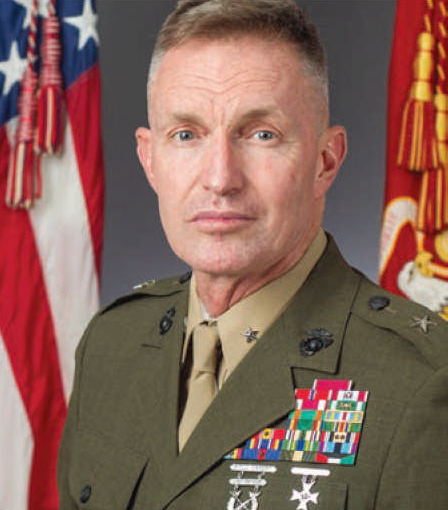
by BGen William J Bowers

On behalf of Marine Corps University, I want to compliment the Marine Corps Gazette’s editorial staff on the outstanding articles they’ve published recently The Gazette is being true to the spirit in which Gen John A. Lejeune created it: to serve as a forum for new ideas intended to improve our Corps. Several of these recent articles have focused on improving the Marine Corps’ professional military education (PME) system. Our PME system is in a constant state of review and refinement, and we need recommendations from the force to help us develop and deliver the most professional, current, relevant, and challenging curriculum possible in order to prevent stagnancy. The purpose of this letter is twofold: 1) to inform the Gazette’s readers on what we’re doing about many of the excellent ideas raised, and 2) to encourage Marines to keep reading, thinking, writing, and publishing their ideas because, as you’ll see below, they do make a difference.

First, it’s important to note a powerful movement that’s quietly occurring across our Corps that will significantly impact the future of PME: enlisted Marines are demanding, receiving, and exercising a greater role in how our Corps educates Marines. For example, SNCOs authored three of the four articles devoted to improving PME in the March 2018 Gazette. Enlisted Marines submitted more than half of the 41 essays we received for the just-concluded Belleau Wood Centennial Essay Contest and penned two of four winning articles. The days in which SNCOs and NCOs feel “‘intellectually under-nourished” by our Corps’ PME system (as a Staff Sergeant Career Course student told me in fall 2017) are gone. At the start of this academic year, the Commandant challenged us to tap into the intellectual potential of our enlisted Marines-what he called “the unexplored gold mine of our PME system”-and in the spirit of MCU’s founder, Gen Alfred M. Gray, we’re moving out. The College of Enlisted Military Education (CEME) staff will cover these reforms in a separate article, but they’re coming-and fast.

Second, SSgt Matthew P. Petitgout’s March 2018 article, “The Reading List and Quarterly PME,” suggests revamping both the Commandant’s Reading List and Quarterly PME programs to achieve greater educational benefit for Marines. For the Commandant’s Reading List, he suggests “some sort of short answer questions to not only inquire about the information gleaned from the book but to stoke the fire of creative thinking much the way guided discussion does.” This is an excellent idea. MCU can (and shall) create a “lesson card” for each of the six books the Commandant personally selects annually to be read by Marines, and these cards will be used as a vehicle to generate discussions and/or used by unit leaders for writing assignments. For the Quarterly PME program, while we would not advocate making this “mandated training for all units,” we do believe that by creating relevant, valuable, and useful tools, MCU can enhance a unit’s PME program by enabling and empowering leaders to run their own PMEs. Our goal for next year is to publish one case study per trimester (see LLI’s (Lejeune Leadership Institute’s) website at www. usmcu.edu/lh for what we’ve done so far) to emphasize a theme important for our Corps.* Case study leader discussion guides will further enable a small unit leader to guide the conversation so that it contextualizes the lessons in ways important for his unit.

Third, GySgt Jay C. Barnard’s “Educational Value” asks our Corps’ leaders, ” [I] s PME really challenging our [enlisted] members as much as it should?,” lamenting a “[PME] check in the box’ mentality” in which “commanders are not willing to send Marines to receive an irrelevant education.” GySgt Barnard specifically challenges MCU to “consider revising the program of instruction provided to our enlisted Marines” by including such subjects as sociology, psychology, and ethics and studying the dynamics of human behavior. The Commandant and Sergeant Major agree with GySgt Barnard. As he suggests, we will add more “relevant, difficult coursework to the [enlisted] curriculum[s],” but as we desire for all Marines to succeed, we will also provide more resources, such as: 1) communications instructors, 2) expanded opportunities for seminar programs, and 3) improved network access. As noted above, these reforms will be covered in detail elsewhere by the CEME staff but they are coming-fast.

Fourth, SSgt Thomas Maddoxs “The Future of Education is Now” rebuts an article written by an academic questioning the value of online writing classes. SSgt Maddox concludes that “online or distance education works,” and that while professors might not “see” the cross-talk and discussions that occur in a physical classroom, learning takes place virtually via email and chat rooms “in a manner that may be transparent to the professor.” He calls on professors to be “flexible enough in their thinking to adapt to new ideas, methods of teaching, and ways of learning.” Another winning idea. We have actually been talking about some of our distinguished MCU professors offering courses online to Marines across the Corps-why should this expertise stay bottled up aboard the MCU campus? SSgt Maddox’s article tells us it’s tíme to stop talking about it and execute, so that’s what we’re going to do. Next fiscal year, we will begin to offer online courses to Marines across the Corps, and credits will be coming shortly after we complete phase I of elective development. More details will be forthcoming on this initiative.

Fifth, Maj Breck L. Perry s “Reinvigorating Maneuver Warfare Through PME” provides “a model that attempts to reinvigorate maneuver warfare at the battalion level” with a “formalized PME plan.” Maj Perry proposes five lines of effort; an approach, method, and end state to execute the plan; and roles and responsibilities within the battalion to ensure it gets done correctly. He even includes an example six-month PME plan, so he has clearly seen what right looks like. So how can MCU support such a unit PME plan as Maj Perry proposes? By creating and making tools available for Commanders and SNCOs to execute-that’s how.

We’ve covered above how we will create lesson cards for the Commandant’s annual book selections, produce case studies available on the LLI website, and expand opportunities for online learning. We can also help with staff rides by either: 1) making an expert available to travel and conduct the staff ride, or (even better) 2) publishing guidance and expertise on how small unit leaders can do this on their own. We have expertise here, and we will take this task on and post the product on the LLI website.

Sixth, the Marine Special Operations Command Commander and Staff published an article in the January 2018 Gazette calling for measuring Marines’ “ability to think, adapt, and collaborate with allies and partners” by leveraging “time spent in the existing Marine Corps education continuum.” The authors correctly point out that “Marines use many of these skills in educational venues as they interact with classmate peers.” These, again, are excellent points. We have already submitted a waiver to DC, M&RA to write observed fitness reports on our Corps’ doctoral candidates (and have been observing them regularly), and perhaps it’s time to expand this mindset to more of our resident PME students-to include those in CEME. Having observed and/or participated in seminar discussions at every school and having read student papers, there are some students who “stand out” in the areas the MARSOC Marines note. While Faculty and School Directors do typically put some comments on their students’ fitness reports, we’ll get with M&RA and explore ways to more formally document Marines’ student performance in their OMPFs.

In conclusion, the Corps’ Young Turks are once again on the march, and they’re not half-stepping. Moreover, their restless energy and vision is being fueled and nourished by the Commandant, who’s simultaneously telling the Corps’ senior leaders to “Go faster!” This letter explains how MCU is responding to our Marines’ ideas to improve the quality of education we provide to all Marines. We have much vrork to do. We also encourage your feedback on how we’re doing and where we can improve. Finally, we want to encourage Marines to keep reading, thinking, writing, and publishing. As LtGen Victor “Brute” Krulak once wrote:

Progress in military affairs has ever been the product of the curiosity, impatience and iconoclasm of youth. Were this not true we might still be using the phalanx, the ramrod or the hollow square. If young Marines are indeed challenging the status quo I can only declare that they are behaving in the tradition of their forebears, and wish them well.1

Stay after it Marines-we’re listening and executing!

Notes

* Our plan for next year is to produce the three following case studies: 1) BGen Edward Craig and the Fire Brigade in Korea 1950 (suggested by Gen Alfred M. Gray); 2) the re-capture of the Aleutian islands from the Japanese (to familiarize students with the North Pacific and explore amphibious operations); and 3) Hue City (the EWS team plans to explore the impact information environment operations in this battle). We welcome input for other case study ideas.

1. LtGen V.H. Krulak, “The Corps’ Critics Are Wrong,” Washington Post, (Washington, DC: 27 October 1985).
Review of a Review

by Col Michael Wiley, USMC(Ret)

I Having been interviewed extensively by Dr. Anthony Piscitelli in writing his excellent The Marine Corps Way of War (Savas Beatie, 2017), I read with special interest Col Tom Greenwood’s review as published in the March Gazette.

It was a sentence four paragraphs into the review, where Col Greenwood quotes Gen Alfred M. Gray, 29th Commandant of the Marine Corps, that first motivated me to write this “review of the review.” The sentence read: “a large cadre of returning Marine officers who had served in Vietnam wanted to see a change in some of our conceptual thinking.” Back in the 1970s, when the need for change was so evident, I would have been glad to have met that “large cadre.” My experience through the 1970s and well into the ’80s (as we visualized a potential war with the Soviet Union) was that too many sought to blame “the hippies, the politicians, and the press” for all that had not gone well in Vietnam and move ahead without a course change. To those of us down at the company-grade level, Gen Gray stood out as one of the few who saw a need for change, and it was not my privilege to meet him until he took command of 2dMarDiv in 1981.

Col Greenwood lists about fifteen authors, including at least one civilian, that dealt with maneuver warfare in articles of the Gazette, some in favor of it, others taking issue. The articles span fifteen years, including the four years following my retirement and the retirement of Gen Gray. The authors were mostly young and were not Vietnam veterans. So this is not evidence of “a large cadre of returning Marine officers who had served in Vietnam.” In fact, through the 1980s, from Gen Gray’s assumption of command as CG, 2dMarDiv, until he became Commandant in 1987, my experience was that it was “pretty lonely” being an advocate of tactical change.

Marines need to appreciate that the burden of readiness rests on each and every one of us. That burden, that responsibility, is an unending calling to honor of the Marines who serve with and under us to serve our country by ever asking the questions: Are we ready to compete with and defeat today’s potential adversaries? Tomorrow’s? What are the hard lessons we learned in the last conflict?

In his final paragraph, Col Greenwood opines that

doctrine is a tool that armies use to codify their institutional memory until the changing character of warfare dictates something new must be adopted if the force is to remain relevant and avoid defeat.

I beg to differ. Doctrine quickly becomes dogma, and we must always be skeptical of it. It too quickly stultifies thinking. Col Greenwood continues by suggesting that the Marine Corps’ way of war, in reality, is little more complicated than “move on order, perform on arrival-eschewing any single dogma or prescriptive approach.” I will counter by saying that it is a great deal more. It-“the Marine Corps way of war”-is a unique and special shared understanding, cohesion, and trust that has to be practiced in the field and discussed in the classroom and in informal conversation so that it becomes a shared way of thinking that will sustain itself through the toughest rigors of violent action.

Col Greenwood’s lament that The Marine Corps Way of War is not a book to be compared with Barry Posen’s The Sources of Military Doctrine: France, Britain, and Germany Between the World Wars, or Edwin H. Simmons’ classic battle history, The United States Marines, 1775-1975, is true but not relevant. Dr. Piscitelli’s is a totally different kind of story. Posen’s and Simmons’ are about the institutional behavior of fighting forces. Dr. Piscitelli’s is about a unique movement within the Corps that started at a very low level in the 1970s and worked upward. Seen in that light, it is an intriguing and unprecedented story; one that could only happen in the U.S. Marine Corps. This is because we Marines identify the Corps as ours, neither the generals’ nor the Defense Department’s but the prized property of each and every one of us, including the youngest rifleman in the squad.

Marines will find this work a helpful introduction into maneuver warfare, but more importantly, it is a unique study of an unprecedented effort that took place in our Corps; in fact, it is a renaissance that will endure another hundred years in the form of an organization of warriorscholars, unafraid to speak up when stagnation rears its ugly head: Marines who, without exception, place the strength of the country above personal advancement.

Ender’s Galley

by Ender’s Galley Club Members

The character of war is changing faster than a stagnant U.S. defense bureaucracy can adapt. New concepts and capabilities associated with operations in the information environment necessitate military professionals, from the schoolhouse to the fleet, to organize for innovation. The future force will deftly maneuver through the physical, cognitive, and informational domains, utilizing the time-tested principles of war. We will always seek to create and exploit positions of advantage and not let the enemy beat us “unfairly.” But how do we get there, and who will connect the stars to create constellations and a map by which to navigate? Enders Galley (EG) is here to enter the public forum, and ?t will bring to bear the resources and diverse student body of the Marine Corps Command and Staff College (CSC) to develop new concepts for operations in the information environment.

Our genesis stems from students previously assigned to information operations billets at I MEF, III MEF, the Marine Corps Information Operations Center (MCIOC), and commensurate joint force units. We are a dedicated group of like-minded professionals seeking to learn more about and explore operations ?n the information environment. Our area of interest includes information operations, information warfare, information environment operations, cyberspace operations, Russian reflexive control, Chinese stratagems on deception, and everything related to the study of maneuver warfare ?n the information environment.

The mission of Marine Corps CSC is to “develop critical thinkers, innovative problem solvers, and ethical leaders.”2 The curriculum is rigorous, inspiring, and diverse. We want to build on what we have learned to develop solutions for the future force. We strive to leverage the student body and accomplished staff to develop and experiment with radical ideas for the future information environment in a “safe to try, safe to fail” environment. We will apply the principles of maneuver warfare doctrine to achieve asymmetrical advantage and overmatch against the adversaries of the future. Our mission statement is as follows: Ender’s Galley is a Marine Corps University student-led organization promoting the exchange of ideas and improving the understanding of the information environment in order to enhance the students’ ability to serve as future commanders, planners, and staff bfficers. Our lines of effort (LOE) are: 1) Build a community of interest, 2) Organize lectures and expert panels, and 3) Provide feedback to the battlefield.

LOE 1: Build a community of interest. LOE 1 begins with CSC students because there is no EG without the people. In the spirit of the Marine Corps Operating Concept (Washington, DC: HQMC, September 2016), we aspire to “exploit the competence” of students, military faculty, academic faculty, and organizations in the National Capital Region (NCR). We have a small student staff with a large group of students ready to learn. EG includes joint and coalition officers with diverse experiences. We are currently connecting with the Deputy Commandant for Information, MCIOC, the Marine Corps Civil Military Operations School, Marine Forces Cyber Command, the Marine Corps Information Operations and Space Integration Branch, and 1st Army Information Operations Command to accomplish our mission. These organizations form the core of our professional network thus far, but we are looking for more forward thinkers who believe disciplined intellect is essential to the profession of arms.

LOE 2: Organize lectures and expert panels. This is how we leverage our professional network to facilitate some of the forward thinkers and key leaders in order to expand the conversation of how the military can create and exploit positions of advantage via information environment operations. Our namesake now comes into play; this is our “Galley.” We want to use these moments to provide a deeper understanding, going beyond the conceptual discussions in our exercises or classes. The environment is designed to be conducive to galley discussions-free-spirited conversations incorporating everything from wild, innovative ideas to stern criticism. How do you call for offensive space or cyber fires? Is the MEF Information Group a good concept? Why or why not? What new technologies can we leverage to enhance maneuver warfare in the information environment? EG seeks deep discussions on difficult concepts, using lectures and expert panels to illuminate topics worthy of consideration.

LOE 3: Provide feedback to the battlefield. Internal dialogue alone is of little utility until exported. We will create a dialogue with the Marine Corps and larger joint force to inform the discussion from our vantage point. One method will be crowdsourcing via a website for our information environment challenges (IEC), which will be published in future Marine Corps Gazette issues. These IECs are loosely modeled after traditional TDGs or Mokkes map exercises, seeking input to an array of problem sets across the information environment’s physical, cognitive, and informational dimensions. Additionally, our future articles will focus on important aspects of the information environment and how the Marine Corps should posture to sharpen its competitive edge. We seek divergent opinions, critiques, and challenging problem sets, all in the name of enhancing the marketplace of ideas.

Regardless of futuristic technology, autonomy, or manned-unmanned operations, war remains a human endeavor. Warriors have always sought to apply new technologies and concepts to the battlefield. The examples of Scharnhorst, the Chowder Society, and Ender’s Game show us that relationships and dialogue are the foundation of innovation and creativity. If you or your organization would like to join EG or provide your expertise to advance our cause, contact us at [email protected]. “Remember, the enemy’s gate ?s down.”3 Sometimes the battlefield orientation is entirely relative. Ender’s Galley seeks to challenge the common battlefield orientation to exploit information as part of the 21st century concept of combined arms. We want your company and your feedback.

Notes

1. Orson Scott Card, Ender’s Game, (New York: Tor Books, 1991).

2. Information is available at https://www. usmcu.edu.

3.Ender’s Game.

On Cyber

by Capt Austin Duncan

The MAGTF is the Marine Corps’ principal warfighting organization, a taskorganized. force tailored in size and capability to accomplish any mission across the range of military operations. The Marine Corps Operating Concept, published by HQMC in September 2016, asserts, “The 21st century MAGTF executes maneuver warfare through a combined arms approach … across five domains-air, land, sea, space, and cyberspace.” Currently, MAGTFs of all sizes and capabilities are unable to execute maneuver warfare through combined arms in cyberspace. To prepare for armed conflict in the cyberspace domain, the Marine Corps must stop conceptualizing conflict in cyberspace as a primarily defensive operation, enable MAGTFs with organic cyber capabilities, and demand an extension of cyber authorities to the tactical level in support of MAGTF operations. Should the organization evolve, the 21st century MAGTF can, and will, succeed ?n the cyberspace domain.

The essence of maneuver warfare is conducting both offense and defense, simultaneously and ?ndiscernibly. To date, MAGTFs focus efforts in the cyberspace domain almost exclusively on defense of friendly communications networks and safeguarding information. What MAGTFs lack ?s an offensive capability or striking power. A critical component of any defense is the inclusion of offense, the threat of a decisive counterattack to seize the initiative. Similarly, an effective offense requires defensive characteristics to conceal the main effort and achieve surprise. Offense and defense must co-exist. Despite the recognition of cyberspace as a new domain, the principles of warfighting remain the same. Cyber professionals are not only network defenders, but they must be armed and capable of transitioning from defense to offense, rapidly and unremittingly. The Marine Corps cannot continue to emphasize network defense as the primary focus for MAGTF cyber professionals; it must make a concerted effort to also train and equip cyber warriors on offensive principles in order to gain and maintain the initiative in combat.

MAGTFs require organic cyber capabilities to conduct cyberspace operations in a contested-network environment. MAGTFs are currently unable to effectively operate in cyberspace because of a limited number of cyber personnel, rudimentary equipment, and a lack of intelligence support. Present deficiencies are addressed through reachback agencies or an arduous request process for specialized support from the newly created Cyber Mission Force. These shortterm fixes are not viable solutions for a forward deployed MAGTF operating in contested-network environments ?n the 21st century, especially against a potential near-peer adversary. Untimely support requests, technological restrictions on connectivity and bandwidth, and inherent security risks while communicating with a reachback entity represent only a fraction of total concerns. While the cyber mission force may serve as a viable force provider in the near term by attaching support teams, the Marine Corps’ vision must be one which seeks a permanent cyber-force solution inherent within all sizes of MAGTFs. To fight and win ?n the cyberspace domain, MAGTFs require organic cyber personnel and equipment.

The Marine Corps must lead the charge to extend limited cyber authorities down to the tactical level in support of the MAGTF. Critics allege that the inherently sensitive nature and complexity of cyberspace operations require authorities to reside at a very high level. This ?s a valid argument for some operations in cyberspace. However, cyberspace operations span a large continuum of complexity and destruction, ranging from something as benign as network mapping or a denial-of-service attack at a local W?-Fi to catastrophic permanent destruction of critical services. MAGTFs do not require broad cyber authorities, much like they do not retain the authority to indiscriminately engage every target with all fire support assets. MAGTFs simply require limited authorities, captured within clear rules of engagement, to execute cyberspace operations on planned targets and targets of opportunity directly pertaining to the accomplishment of the mission. The Marine Corps must contest senior policy leaders1 current stranglehold of cyber authorities. If left unchallenged, cyber authorities will remain at too high a level for a MAGTF to employ.

The 21st century MAGTF can win in the cyberspace domain. As the Marine Corps’ premier organization, task organized to fight and win across the range of military operations, success in cyberspace is a no-fail mission for the MAGTF. To better prepare for future armed conflict, the Marine Corps must empower MAGTFs to assume the offensive in cyberspace, train and equip them with organic cyber capabilities, and aggressively seek delegation of limited cyber authorities to the tactical level. Evolving the MAGTF by preparing to fight in the cyberspace domain will ensure Marines continue to win in any clime and place.

The Marine Corps Way of War

by Col Thomas C. Greenwood

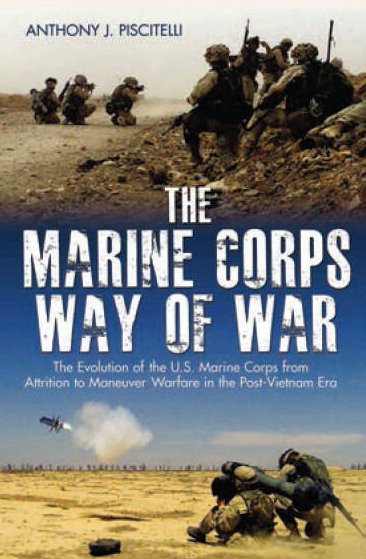
The Marine Corps Way of War THE MARINE CORPS WAY OF WAR: The Evolution of the U.S. Marine Corps from Attrition to Maneuver Warfare in the Post-Vietnam Era. By Anthony Piscitelli. El Dorado Hills, CA: Savas Beatie, 2017. ISBN: 978-1611213607,264 pp.

Dr. Anthony J. Piscitellis The Marine Corps Way of War: The Evolution of the U.S. Marine Corps from Attrition to Maneuver Warfare in the Post-Vietnam Era boldly attempts to capture how and why the Corps adopted maneuver warfare doctrine after Vietnam and, at the same time, stimulate readers with concise battlefield summaries from Belleau Wood (WWI) to the present day. Either one of these tasks would pose a Herculean challenge for any military historian. So neither author nor reader of this intriguing book should be surprised that İt comes up short. It neither matches the scholarly standards of previous doctrinal analysis, such as Barry Posen’s The Sources of Military Doctrine: France, Britain, and Germany Between the World Wars, nor has the appeal of Edwin H. Simmons’ classic popular battle history, The United States Marines, 1775-1975.1

Marines will nonetheless find this work a helpful introduction into maneuver warfare‘s main doctrinal tenets: commander’s intent, missiontype orders, trust tactics, speed of decision making, attacking weak spots, surprise, shock, and shattering the enemy’s cohesion. Interviews with key participants of the spirited doctrinal debates of the 1980s and ’90s that flourished around the Corps offer insight into a largely “bottom up” movement that sought to discover smarter ways for Marines to fight outnumbered and win {an imperative necessitated by the quantitative advantage Soviet conventional forces enjoyed at the time). In particular, Piscitelli’s informative interviews with Col Mike Wyly, MajGen Mike Myatt, and Gen James N. Mattis discussing how the Marines applied maneuver warfare during Operations DESERT Shield and Desert Storm enrich the author’s work. The accounts of the roles played by Maritime Prepositioning Squadrons (MPS) and afloat naval expeditionary forces İn the first Gulf War, and a decade later when Task Force 58 deployed into Afghanistan from unprecedented distances İn the Arabian Sea, create a maritime context that helps the reader better understand the current Commandant’s continued emphasis on the Navy-Marine Corps Team maintaining proficiency İn conducting maneuver warfare from the sea.

The book’s central thesis-that during the post-Vietnam era, the Marine Corps did not experience a revolution İn military affairs but rather continued its tradition of innovation and adaptation going back to 1775-would have been enhanced by more robustly framing historical antecedents of war in its opening pages. Piscitelli discusses the Small Wars Manual drafted in the 1930s and the Combined Action Program (CAP) implemented İn Vietnam (the Marine Corps’ pacification alternative to big search and destroy operations). However, he gives scant attention to other important doctrinal initiatives, such as the development of amphibious warfare {recorded İn the publication Tentative Landing Party Manual of 1934/1938), close air support, vertical envelopment using helicopters, adoption of the MAGTF concept, afloat prepositioning, the MEU training program, and live fire combined arms exercises in the Mojave Desert. Greater attention to the lengthy continuum of doctrinal initiatives throughout the Corps’ history would have strengthened his argument that innovation, adaptation, and constantly rediscovering ways to remain useful to the Nation İs coded into the Marine Corps’ DNA.

The book’s foreword is written by Gen Alfred M. Gray, Jr., 29th Commandant of the Marine Corps and highly respected advocate and sponsor of the “fighting smarter” mindset. Gen Gray spearheaded a more creative philosophical approach to war that eventually matured into official maneuver warfare doctrine with the publication of FMFM 1, Warfighting, on 6 March 1989. In the foreword, Gen Gray states,

The history of our Corps during this time frame supported this evolutionary paradigm shift away from the American doctrine of attritional warfare to a maneuver way of fighting, operating and thinking … a large cadre of returning Marine officers who had served in Vietnam wanted to see a change in some of our conceptual thinking, making this warfighting philosophy a priority for the future.

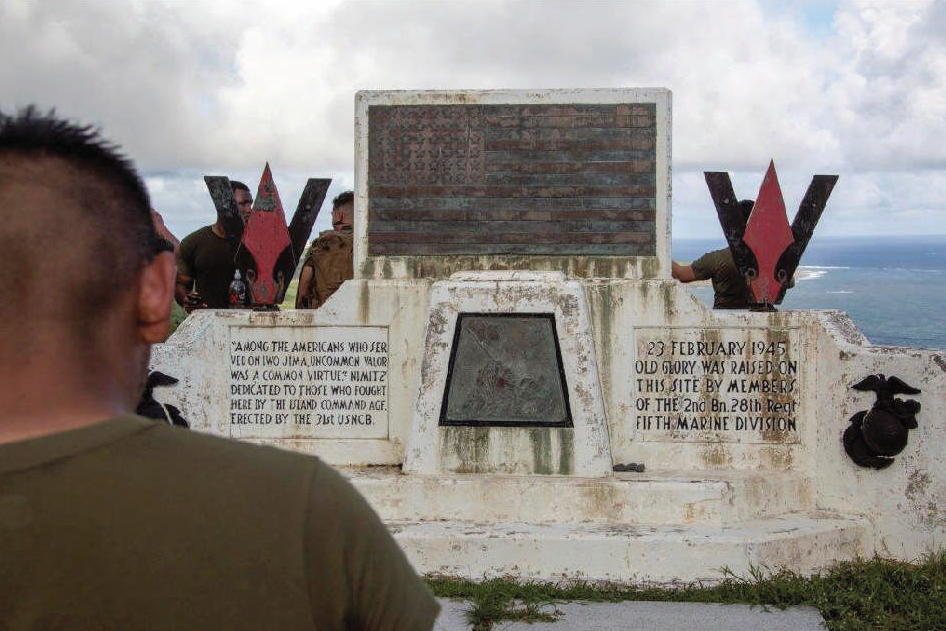
Part of the evolution Gen Gray alludes to İs the Marines’ classic amphibious assault against Japanese forces on the Pacific island of Tİnİan and the Inchon landing during the Korean War.2 Both of these epic achievements used operational maneuver from the sea to bypass enemy defenses but receive little more than a sentence or two in the book.

With few exceptions, Piscitelh focuses the maneuver warfare story on a small coterie of like-minded officers who inspired a Corps-wide organic movement that helped elevate maneuver warfare from the purview of a few into widespread acceptance and official doctrine. To that end, the book would have benefited from deeper excursions into some of the issues that Marines argued about as part of the broader maneuver warfare debate. For example, more than 70 maneuver warfare-related articles were published İn the Marine Corps Gazette from 1980-95 by such authors as Anderson, Brickhouse, Driscoll, Estes, Hammes, Hayden, Hoffman, Leaderer, Lind, McKenzie, Moore, Murray, Schmitt, Walker, Waters, Wilson, and others. These articles questioned or defended some facet of maneuver warfare thinking as it related to the role of firepower, synchronization, aviation as a maneuver element, Auftragstaktik (directive control), Schwerpunkt {heavy point or main effort), the OODA loop, light infantry, expeditionary sustainment, recon pull, and more. In short, scores of critical thinkers at all ranks contributed immeasurably to the Corps’ institutional learning during those heady years and helped reconcile maneuver warfare with the Marines’ combined arms, MAGTF, and expeditionary ethos.

Yet the book paints far too rosy a picture of the challenges the Corps still faces İn implementing maneuver warfare doctrine. There İs no discussion of the after-action analysis that attributed the great DESERT STORM victory to non-doctrinal factors.3 Some observers have also noted how a forward operating base mentality isolated Marines from the Afghan and Iraqi populations that needed their protection. Moreover, after-action reports from urban operations in both wars suggest that binary choices between attrition and maneuver approaches are sometimes false dichotomies in places like Helmand Province and Fallujah- where room clearing quickly escalates into lethal combat with high casualties.

One of the book’s major disappointments İs its poor editing. Swaths of text are erroneously recycled (half of page 66 İs repeated from page 57). On page 80, the 7th Marines Regimental Commander, Col Carlton W. Fulford, Jr.-who later retired as a 4-star general after serving as the Deputy Commander İn Chief for U.S. European Command-is listed as Carl Colfert. Chapter 6, entitled “Small Wars and Humanitarian Assistance,” includes a section on Operations DESERT FOX (Iraq) and ALLIED FORCE (former Yugoslavia), and both were punitive air campaigns, not small wars or humanitarian actions. They were major military operations undertaken to respectively weaken Saddam Hussein’s regime and coerce Slobodan Milosevic back to the negotiating table. Operation Allied Force lasted 11 weeks, and 14 of the 19 NATO Alliance members flew more than 40,000 combat sorties (about one third the number flown at the opening of DESERT STORM) altogether.^ These operations seem inappropriately categorized.

Finally, doctrine İs a tool that armies use to codify their institutional memory until the changing character of warfare dictates something new must be adopted if the force İs to remain relevant and avoid defeat.3 For that reason, the Marine Corps’ “way of war”-to the extent it is anything more complicated than “move on order, perform on arrival”-İs to continue eschewing any single dogma or prescriptive approach toward warfare İn favor of championing the intellectual dexterity of leaders who exercise military judgment informed by history, experience, and an unrelenting bias for action.

Notes

1. Other doctrinal classics in this category include John English, On Infantry, Bruce Gudmundsson, Stormtroop Tactics’, Jonathan House, Toward Combined Arms Warfare, Timothy Lupfer, The Dynamics of Doctrine; Elizabeth Kier, Imagining War; and John Nagl, LearningtoEat Soup with a Knife.

2. Tinian has been described as the classic amphibious assault of the Pacific Theater in World War II. “In fact, as a study in pure technical skill and amphibious virtuosity, the assault on Tinian excels any other landing in the history of the war.” Jeter A. Isley and Philip A. Crowl, The U.S. Marines and Amphibious War: Its Theory and Its Practice in the Pacific, (Princeton, NJ: Princeton University Press, 1951). The authors eloquently explain Tinian’s success using maneuver warfare concepts-deception, tactical surprise, massing combat power against enemy weak spots, and imaginatively integrating firepower with rapid ground maneuver to shock and collapse enemy forces.

Regarding Inchon:

It would never have happened were it not for the ingenious and altogether professional actions of the Marines and Navy people involved. The piecing together of the thirty thousand man air-ground force in the space of three weeks, the succession of improvisations in embarkation and İn planning, the steadfast poise with which General Smith, Admiral Doyle, and their staffs fought off the meddling of General Almond as they pursued their affairs, the ingenious adaptations to the unusual nature of the mandated landing area these were the indispensable lubricants that oiled the gears of strategy, these were the things that converted Inchon from a dream to a reality.

Victor H. Krulak, First to Fight, (Annapolis, MD: Naval Institute Press, 1981).

3.For three different perspectives on the Operation Desert Storm victory, see G.I. Wilson, “The Gulf War, Maneuver Warfare, and the Operational Art,” Marine Corps Gazette, (Quantico, VA: June 1991); J.J. Edson, “A Perspective on Desert Storm,” Marine Corps Gazette, (Quantico, VA: June 1991); Stephen Biddle, “Victory Misunderstood,” International Security, (Cambridge, MA: Fall 1996).

4.Ivo H. Daalder and Michael E. O’Hanlon, Winning Ugly: NATO’s War to Save Kosovo, (Washington, DC: The Brookings Institution, 2000).

5.John Nagl, Learning to Eat Soup with a Knife: Counterinsurgency Lessons from Malaya to Vietnam, (Chicago, IL: The University of Chicago Press, 2002).

Reinvigorating Maneuver Warfare Through PME

by Maj Breck L Perry

There are far too many units in the Marine Corps that fail to prioritize and formalize PME. Focus of effort goes to training and developing techniques and procedures in correlation with training and readiness mission-essential tasks. Perpetual turnover, fluctuating training exercise and employment plans, and surging operational tempo typically consume commands, and PME becomes a “nice to have” instead or a priority. This is counter to our maneuver warfare doctrine and a disservice to the Marines and Sailors İn our charge. Fortunately, there is a movement underway to reinvigorate maneuver warfare in our Corps’ culture. In his FRAGO 01!2016 Advance to Contact, the Commandant of the Marine Corps decried: we will re-emphasize that Marines and Sailors of all ranks have the responsibility to educate themselves. Commanders will enable educational opportunities and will conduct unit level PME for all ranks.1

The Commandant’s vision implies the need for commanders at all levels to design and institute a formalized PME plan within their respective units. The purpose of this article is to assist in that endeavor and provide a model that attempts to reinvigorate maneuver warfare at the battalion level. This model is undergirded by our warfighting doctrine and organized along five lines of effort (LOEs): history, will, leadership, adversary, and advanced warfighting, with the end state being to create the best thinkers, decision makers, trainers, planners, and teachers in the Marine Corps. (See Figure 1.)

Approach

Training and education are mutually supporting terms, but they are not synonymous. Training is about skill, focusing on task performance and effectiveness, techniques and procedures, and the building of effective habits of thought and action. Education is about the will, concentrating primarily on thinking and decision making, aimed at cultivating military judgment, implicit communication, and trust. Doctrine provides the common language and philosophy, while education provides the understanding of the doctrine within fighting organizations. The amalgamation of intellect, audacity, and tactical proficiency has produced victory in battle for over 4,000 years. It is a moral imperative that officers and SNCOs possess an insatiable desire to “teach and learn, coach and be coached, and possess and cultivate an innate curiosity and appetite for understanding.”

MCDP 1, Warfighting, should be the first resource thoroughly studied prior to developing a PME program. MCDP 1-3, Tactics, should be the second. MCDP 1-3, Chapter 8 vividly describes the systemic, mutually supporting relationships between doctrine, education, training, and operational employment.

Doctrine establishes the philosophy and practical framework for how we fight. Education develops the understanding, creativity, military judgment, and the background essential for effective battlefield leadership. Training follows doctrine and develops the tactical and technical proficiency that underlies all successful military action. Individual and group exercises serve to integrate training and education, producing a whole that is greater than the sum of its parts. The lessons learned from training and operational experience then modify doctrine.2 (See Figure 2.)

Commanders intent. The cornerstone to PME plan development is the commander’s intent. It is also recommended to go two levels up when conducting an initial analysis on crafting the model. The commander’s intent should be interwoven throughout the model, and the commander’s end state articulated up front. Today’s generation of officers and SNCOs should understand the purpose for the PME program and what İs expected of them.

Commander’s guidance. Dialogue pertaining to LOEs needs to occur between the PME coordinator and the commander to achieve the objectives or end state of the unit’s program. Recommended LOEs are described below:

* LOE 1-History. Focused on the lessons learned from over 4,000 years of recorded military history, in pursuit of developing the 4,000-year-old mind. As Gen Alfred M. Gray told us: “If you want a new idea, read an old book.”3 Central points: history and legacy of the battalion and lessons learned in previous conflicts.

* LOE 2-Will. Focused on the development of decision makers who can thrive in chaos, uncertainty, constant change, and friction. Central points: nurturing the maneuver–warfare mindset and truly understanding the human dimension of war.

* LOE 3-Leadershİp. Leadership is the foundation of any command. Focused on developing the moral, mental, and physical capabilities of the battalion’s leaders. Central points: building of trust and the warrior ethos.

* LOE 4-Adversary. Oriented on the ever-pervasİve and mutating enemy threats that seek to eradicate the American way of life, from radical, terrorist groups to near-peer competitors. Studying the current operating environment and potential scenarios the battalion may fight İs essential. Central points: transnational terrorist groups and near-peer state actors.

* LOE 5-Advanced Warfighting: This LOE İs loosely coupled from the PME program. It İs a weekly seminar that is strictly voluntary and managed by the operations officer. The purpose of this LOE is to have discussions on doctrinal warfighting articles and publications in order to discuss creative and adaptive ways to fight and win. It corresponds directly to the tactical tenets in MCDP 1-3, is focused on the tactical level of war, and aims to stimulate outside-the-box thinking. Central points: offense, defense, shoot/move/ communicate-related topics. In addition, outputs from this LOE drive training and experimentation for future field exercises and facilitate SOP refinement.

Methods. The PME program utilizes multiple educational techniques employed across the breadth of the program. These techniques include but are not limited to guided discussions, staff rides, guest speakers, decision-forcing case studies, videos, and critiques. Most PMEs will require a “read-ahead” for preceding preparation. PMEs are recorded and archived for a podcast that Marines can access and reference at their leisure.

Writing requirements. There should be a monthly writing requirement for a Marine Corps Gazette article submission for the battalion, apportioned by company. For example: Fox CompanyNovember, Goli Company-December, etc. The topic İs of the company commander’s choosing. (See Figure 3 for an example.)

Assessment and redesign. The PME schedule is published semiannually with a quarterly assessment conducted. The assessment consists of the PME coordinator and CO having a dialogue on ways to improve the program, projecting the next six months, and canvassing the commanders and staff for feedback on the rough-cut schedule provided by the PME coordinator. This assessment is vital to ensure the PME program remains relevant and correlates with the operational requirements for the battalion. For example, a battalion compositing as a battalion landing team might want to focus effort on the Leadership LOE İn order to build cohesion and esprit de corps and inculcate commander’s intent to the SNCOs and officers newly integrated into the team. The next month’s PME plan may want to focus effort on the history of amphibious operations in the History LOE, then transition into the Adversary LOE to discuss recent enemy tactics against coalition forces İn Iraq and Syria. The top-down guidance is given. Bottom-up refinement İs provided. The result intended is buy-in and stewardship of the program.

Roles and Responsibilities

PME coordinator. The officer and SNCO PME coordinator should be the battalion executive officer. As the second in command of the battalion, the XO is responsible for the leadership development and mentorship of the staff and officers. The XO has the pulse of the unit, a close relationship with the sergeant major for senior enlisted counsel, and a high-fidelity grasp of the commander’s intent. The XO should have adept teaching and coaching skills and a drive to instill those traits İn others. The XO is responsible for a PME plan focused on four of the five LOEs: History, Leadership, Will, and Adversary.

Assistant PME coordinator. This is a collateral duty usually assigned to the assistant intelligence officer (S-2 Alpha). This officer İs ideally one of the best educated young officers in the battalion and İs skilled in organizing, coordinating, and communicating. Primary responsibilities for this billet are to coordinate logistical support for offsite PME, record each PME, supervise the coordination of guest speakers and distinguished guests, and archive the PME for future use.

Advanced warfighting coordinator. The Advanced Warfighting LOE is the province of the operations officer. The operations officer fights the battalion and always seeks to gain advantage over the enemy to lead to their collapse and defeat. Associated with the battalion TEEP, the operations officer provides weekly articles, topics, and coordinating instructions centered around the CO’s guidance. The operations officer collaborates with the CO on teaching seminars and preparing the appropriate resources: maps/interactive tactical decision games, media, etc.

Derivatives: Implicit Communication and Military Judgment

There are many obvious benefits to a formalized and deliberate PME plan. Critical thinking, teaching, and reasoning skills become sharpened and refined. Creativity İs enhanced. Verbal and written communication skills mature. However, the two most essential abilities developed through a consistent PME program are implicit communication skills as they relate to a command and military judgment as it relates to the individual decision maker. MCDP 1-3 points out that Lord Admiral Horatio Nelson didn’t lead the British fleet through semaphore. He invested time İn developing understanding, sharing experience, coaching, and instilling his commander’s intent amongst his captains.

Implicit communications must be developed over time. This requires actions that strengthen unit cohesion and mutual trust. This requires keeping people together in their units and stable in their assignments. It implies keeping good teams together. It means developing a band of brothers in our units, as Admiral Horatio Nelson did. He spent many evenings with his captains gathered in the cabin of his flagship talking over tactics, ways they might fight different engagements, how they would defeat this or that opponent. From those evenings came a shared way of thinking so strong that, at Trafalgar, Nelson needed only to signal ‘England expects every man will do his duty,’ and ‘Close action.’ Sometimes words have meaning beyond the normally obvious meaning because of shared experiences and understanding.^

Military judgment is the other derivative skill of PME. It İs the nucleus of adept decision makers and tacticians and the catalyst of decisive action.

Military judgment is a developed skill that is honed by the wisdom gained through experience. Combined with situational awareness, military judgment allows [Marines] to identify emerging patterns, discern critical vulnerabilities, and concentrate combat power … Marine leaders must be able to cut to the heart of a situation by identifying its important elements, developing a sound plan, and making clear decisions.^

Most young officers have limited combat experience. Formalized unit PME provides a vehicle by which Marines can harvest wisdom from the vicarious experience of historic military leaders, educate themselves on an adaptive enemy, or garner lessons learned from recent tactical experiments with emerging technology.

Conclusion

All commanders should consider the professional development of their subordinates a principal responsibility of command. Commanders should foster a personal teacher-student relationship with their subordinates. Commanders are expected to conduct a continuing professional education program for their subordinates that includes developing militaryjudgment and decisionmaking \siĄ and teaches general professional subjects and specific technical subjects pertinent to occupational specialties. Useful tools for general professional development include supervised reading programs, map exercises, war games, battle studies, and terrain studies. Commanders should see the development of their subordinates as a direct reflection on themselves.^

MCDP 1 gives resounding and unblemished guidance on PME expectations for all commands İn the Corps. This article focused solely on an officer and SNCO PME plan with the intention of assisting and supplementing units with a purpose-driven PME model to employ. This model is far from perfect, but it is modular, sustainable, and an enduring priority of the command.

Notes

1. Headquarters Marine Corps, FRAGO 01/2016 Advance to Contact, (Washington, DC: 19 January 2016).

2. Headquarters Marine Corps, MCDP 1-3, Tactics, (Washington, DC: 30 July 1997).

3. Paul Otte, Grayisms and Other Thoughts on Leadership From General Al Gray, USMC (Retired), 29 th Commandant of the Marine Corps, (Arlington, VA: Potomac Institute Press, 2015).

4. MCDP 1-3, Tactics.

5. Ibid.

6. Headquarters Marine Corps, MCDP 1, Warfighting, (Washington, DC: 20 June 1997).

Implementing Maneuver Warfare in Daily Operations

by 1stLts J.L. Currie & Matt Hartley

We observe a conversation happening across the Marine Corps, a conversation that asks, “Is the Marine Corps heading in the right direction?” Within the context of this broader question, devoted and enthusiastic officers and enlisted Marines are asking: What ?s the future of amphibious warfare? How can we adapt to (the elusive concept of) fourth generation warfare? How can we marry the rapid pace of technological development with a traditional warfighting organization? This, we believe, ?s a positive response to the Commandant’s call for disruptive thinkers. Much of this debate is centered around questions that are as interesting and exciting as they are large in magnitude, for which no obvious answers or solutions exist. This has been evident in the debate surrounding Capt Joshua Waddell’s article, “Innovation: And other things that brief well” (MCG, Febl7). As young lieutenants, we feel the frustrations expressed ?n Capt Waddell’s argument, but we also acknowledge Capt Jeffrey E. Little’s logical response ?n “A Modest Rebuttal: Response to ‘Innovation: and other things that brief well.'”

Like many thinkers across the Marine Corps, these questions have been the background to our own conversations. In this article, we hope that our analysis offers something unique: a specific focus on individual Marines operating at the platoon, company, and battalion levels. Instead of attempting to address the apex question (“Is the Marine Corps heading in the right direction?”) or other, larger questions, like the ones previously mentioned, we address practices on our level by asking, “How does cell phone and email use affect the way we operate and plan?” This question may seem trivial, innocuous, and possibly silly, but we believe it contains broader moral and existential importance.

We are not arguing for a return to simpler communications technology or, in the extreme, none at all; we argue for discipline: rules on using these technologies consistent with our warfighting philosophy and modern science. We purport to fight maneuver warfare, but ungoverned availability and access to these communications technologies is antithetical to our warfighting philosophy. They deprive us of initiative, reduce efficiency, and degrade effectiveness. A total ban is regressive, but rules and etiquette for bounded use are both practical and necessary. The first section of this article sets the foundation, reviewing maneuver warfare theory, introducing fundamental documents, and defining key concepts. In the second section, we offer comments and observations from our own experience. In the final section and conclusion, we reiterate that discipline is critical, providing useful recommendations for regaining the initiative in daily operations.

Concepts & Definitions

The foundational publication of the Marine Corps’ warfighting doctrine, MCDP 1, establishes maneuver warfare as the standard by which the organization executes military action. MCDP 1 defines maneuver warfare as

a warfighting philosophy that seeks to shatter the enemy’s cohesion through a variety of rapid, focused, and unexpected actions which create a turbulent and rapidly deteriorating situation with which the enemy cannot coped

Recent Marine Corps publications such as Expeditionary Force 21, (Washington, DC: HQMC, 2014), and Marine Corps Operating Concept, (Washington, DC: HQMC, 2016), review and reinforce maneuver warfare‘s central tenets of speed, decentralized command, and rapid decision making. The Marine Corps Operating Concept reaffirms maneuver warfare as the method to ensure the Marine Corps defeats its future enemies.2 Theory and practice, however, hardly align. Juxtapose the central tenets of maneuver warfare against daily battalion operations across the Marine Corps. We believe we fail at the lowest levels to execute the maneuver philosophy envisioned by theorists such as Col John Boyd, USAF(Ret).

Maneuver warfare is ultimately about disrupting and out-cycling an opponent’s observation-orientationdecision-action process, also known as the OODA loop. Col Boyd developed the OODA loop as a theory for how human beings make decisions. He first explained it in Destruction and Creation. He further examined this concept and fleshed out the implications and principles inherent in maneuver warfare in his groundbreaking brief, “Patterns of Conflict.” These ideas laid the intellectual basis for Capt John Schmitt’s publication, commissioned and endorsed by Marine Corps Commandant Gen Alfred Gray as FMFM 1, Warfighting. Throughout the creation of Warfighting, Schmitt conferred with fellow maneuver enthusiasts, including Gen Bernard Trainor, Col Mike Wyly, and Gen Paul Van Riper, to refine and capture the major tenets of maneuver warfare.3 First published in 1989 as FMFM 1, it was later revised in 1997 to become MCDP 1, Warfighting.

In this article, we focus on three key concepts from maneuver warfare theory: initiative, decentralized command, and commander’s intent. In our analysis, we use these concepts as the standard for measuring our daily operating effectiveness. Initiative, as defined ?n MCDP 1, is “the willingness to act on one’s own judgment.”^ Boyd argued initiative was a requirement for shaping and adapting to change, that the warfighter must avoid passivity.3 Decentralization ?s a prerequisite for inspiring initiative. Decentralized command enables high tempo in the face of uncertainty, disorder, and the ever-changing events of combat.6 The imperative for action, however, must still be in harmony with the larger organization’s goals. To achieve this effect, commander’s intent harmonizes initiative with the overarching tactical, operational, or strategic goal. It is the commander’s intent that allows subordinates the freedom to deviate from the original plan as circumstances change yet remain focused on achieving the end state.7

Practiced ?n concert, these concepts have the unifying effect of rapid decision making; and the ability to make decisions faster than the enemy is the essence of Boyd’s theory and maneuver warfare. The combatant who acts quickest generates the tempo and controls the momentum of the conflict. The Marine Corps, down to the smallest unit, moves through this decision-making cycle. As such, it is imperative we understand and analyze the effect communications technology has on this cycle and our ability to make decisions.8

Email &? Cell Phones: What’s the Big Deal?

Despite the focus in recent months and the previous few years on disaggregated operations, it remains unattainable if access to cell phones and email remains unconstrained in training. Warfighting asserts that, “In order to develop initiative among junior leaders, the conduct of training-like combat-should be decentralized.”^ Even in peacetime, training must mirror combat. Warfighting continues,

subordinate commanders must make decisions on their own initiative, based on their understanding of senior’s intent, rather than passing information up the chain of command and waiting for the decision to be passed downT

Unrestrained email and cell phone use eliminates the need for clear commander’s intent; it strips the decision-making power from subordinates. It ruins our ability to communicate clearly and implicitly. The end result ?s an organization that does not train like it fights. The daily habits and practices needed for decentralized operations are slowly whittled down. When the day of reckoning comes and we find ourselves again involved in a conflict, will we have the experience or understanding to create a coherent decision-making cycle? Who needs an enemy to disorient us when we can do it ourselves? In the words of Pogo, “We have met the enemy, and he is us.”

Too often, our ability to work in solitude and think through our most difficult challenges is interrupted by the constant stream of emails cluttering our inbox. If, as stated in MCDP 1, “the mind is an officer’s principal weapon” and “the military profession ?s a thinking profession,” then only through solitude can we discover the solutions that will truly make us a better force. We often avoid our most difficult problems, inadvertently choosing the distraction of email. Rather than taking the time to face truly essential problems and improve our units, it appears we are merely reacting to the day s email traffic. In the book Focus, Daniel Goleman references a Harvard business study that examined the inner work lives of a team tasked with completing innovative challenges. The study found the most critical aspect to the team’s success was protected time to think freely within a “creative cocoon.” 11 As William Deresiewicz argued in his speech “Solitude and Leadership,” leaders need protected time to think through problems, focus their efforts, and decide which actions are truly important for success and improvement. Solitude allows us the time to clarify our thoughts and beliefs, enabling us to focus our efforts with greater resolve and precision.12 Gen Moshe Dayan, an Israeli Defense Force commander who helped orchestrate the exemplary display of maneuver warfare by the Israeli Defense Forces during the 1967 Six Day War, was known to reserve time to think in solitude.13 We have too few leaders who spend time deeply thinking and too many reacting to distractions.

We confuse busy work with progressive work. Answering and receiving emails (busy work) gives the illusion of progressive work because it ?s a timeconsuming endeavor leading to a constant shift ?n focus. As Herbert Simon, a Nobel Prize-winning economist, said, “a wealth of information creates a poverty of attention.”14 With email, each new “ding” becomes a new priority. As a result, we cannot focus on one problem long enough to develop a solution, “Patterns of Conflict” advises maneuver warfare practitioners to “present many simultaneous and sequential happenings to generate confusion and disorder.”13 Every time a message pops into our inbox, we are forced to orient on an entirely new information set, inflicting damage to our own OODA loop. To paraphrase Warfighting, email creates a rapidly deteriorating situation in which we are no longer able to distinguish between relevant and irrelevant information. Instead, we are left with the impression that we accomplished something because we were busy throughout the day.

To be clear, cell phones and email are not inherently problematic-how we use them is. Ultimately, how we use communications technology is a direct reflection of how we communicate:

We believe that implicit communication-to communicate through mutual understanding, using a minimum of key, well-understood phrases or even anticipating each others thoughts-is a faster, more effective way to communicate than through the use of detailed, explicit instructions. We develop this ability through familiarity and trust, which are based on a shared philosophy and shared experience.

This concept has several practical implications. First, we should establish long-term working relationships to develop the necessary familiarity and trust. Second, key people-“actuals”-should talk directly to one another when possible, rather than through communicators or messengers. Third, we should communicate orally when possible, because we communicate in how we talk-our inflections and tone of voice. Fourth, we should communicate in person when possible because we communicate also through our gestures and bearing.1*’

We wager that the entire Marine Corps violates these four practical implications. The misuse of communications technology decreases face-to-face interaction, preventing the necessary development of familiarity and trust. We observe our seniors, subordinates, and even ourselves choosing to use a cell phone or landline to speak with someone across the street or even in the same building. Furthermore, orders and warning orders passed through text message increase uncertainty, confusion, and disorder-explicit communication at its worst.

Without disciplined structures governing the use of emails and cell phones, we will continue to delay decisions, shift priorities, and inhibit our ability to think through complex challenges. Rather than operate off implicit communications, staffs increasingly turn to the explicit communications found in email, slowing tempo and increasing the time for action. Leaders become more hesitant to make decisions, waiting until they have complete information. This dependence on explicit communications creates a mentality that centralizes command and develops a pattern of behavior grossly opposed to the guidance expressed in MCDP 1. A flood of email traffic or the constant access to a cell phone reduces the clearness of commander’s intent.

The Information Age brought us the Internet, the smartphone, and email. As these technologies have progressed, instantaneous access has become commonplace. Knowing when and how to use and access these technologies is the key; otherwise, undisciplined use results in intellectual, cognitive, and psychological torpor. Furthermore, access to this technology without restraint has operational side effects. It robs us of initiative and lessens the importance of commander’s intent. It degrades the quality of our communications, placing emphasis on explicit communications. Finally, it inhibits our ability to practice decentralized command and therefore disaggregated operations.

Conclusion Recommendations

There ?s great value in the speed, range, and ease of use provided by cell phones and email. These systems can enhance command and control in Marine Corps units but only through discipline and clearly defined boundaries. The rampant email abuse and cell phone addiction throughout the Marine Corps destroys our ability to solve the right problems. We regress as a warfighting organization and fail ?n our execution of maneuver warfare by remaining addicted to and dependent on these systems.

Discipline ?s what separates mobs from armies. As John Keegan points out ?n The Face of Battle, discipline has created and upheld victorious military units for decades:

Inside every army is a crowd struggling to get out… For a crowd is the antithesis of an army, a human assembly animated not by discipline but by mood, by the play of inconstant and potentially infectious emotion which, ifit spreads, is fatal to an army’s subordination.12

Gen John A. Lejeune draws a clear connection between discipline and morale in his 1921 address to the Army General Staff College: the more disciplined a unit, he argues, the higher their morale.18 Rules, limits, and guidance for cell phones and email are not merely matters of efficiency and effectiveness. As Lejeune points out, the morale of the fighting unit is at stake.

Although anecdotal, we believe the doctrinal argument compelling: Constant access to cell phones and email degrades our ability to implement maneuver warfare. The addiction to cellular devices has other pernicious effects: it worsens sleep,^ mirrors substance addiction,20 and increases anxiety.21 Rules need to be written based on operational concepts and scientific evidence.

As a starting point, we propose the following recommendations for managing cell phone and email use at the battalion level:

* Personal cell phones will not be used between 0800 and 1600 during the work day.

* Limit email use to two hours during the work day.

* Communication should be done in person.

* Communications required to occur over a phone will be made through a DSN (Defense Switched Network) number.

As a result of these (or similar) boundaries, we believe units will improve their ability to solve problems, increase individual initiative, exploit implicit communications, and generate a faster OODA loop consistent with commander s intent.

Writing and enforcing rules for email and cell phone use consistent with history, science, and our warfighting philosophy seems to be common sense. We believe the effect will be dramatic and immediate. We encourage all commanders to institute and enforce stricter rules governing cell phone and email availability during accepted working hours.

For our part, we already have and will continue to do so.

Notes

1.Headquarters Marine Corps, MCDP 1, War1, (Washington, DC: 1997).

2. Headquarters Marine Corps, Marine Corps Operating Concept: How an Epeditionary Force Operates in the 21st Century, (Washington, DC: 2016).

3. Dan Grazier, “The Creation of Warfighting, with John Schmitt,” Project on Government Oversight, (podcast, Online: November 2016), available at https://pogo.org.

4.MCDP 1, Warfighting.

5. John R. Boyd, “Patterns of Conflict,” eds. Chet Richards and Chuck Spinney, (PowerPoint, Online: January 2007), available at http://ww w.dnipogo .org.

6. MCDP 1, Warfighting.

7. Ibid.

8. For a deeper understanding of the history and ideas behind the Marine Corps’ adoption of maneuver warfare, the authors suggest Robert Coram, Boyd, (New York, NY: Hachette Book Group, 2002).

9. MCDP 1, Warfighting.

10.Ibid.

11. Daniel Goleman, Focus, (New York, NY: Harper, October 2013).

12. William Deresiewicz, “Solitude and Leadership,” The American Scholar, (Online: March 2010), available at https://theamericanscholar. org.

13. Steven Pressfield, The Lions Gate, (New York, NY: Sentinel, 2014).

14. Focus.

15. “Patterns of Conflict.”

16. MCDP 1, Warfighting.

17. John Keegan, The Face of Battle, (London, England: Penguin Books, 1976).

18. LtCol Charles P. Neimeyer, USMC(Ret.), ed., On the Corps, (Annapolis: Naval Institute Press, 2008).

19. Liese Exelmans and Jan Van den Bulek, “Bedtime mobile phone use and sleep in adults,” Social Science and Medicine, (Online: January 2016), available at https://wwwncbi.nlm.nih. gov.

20. Simon Sinek, Leaders Eat Last: Why Some Teams Pull Together and Others Don’t, (New York, NY: Penguin Group, 2014). See also Aeapdonlinelive, “Simon Sinek Q&A: How Do Cellphones Impact our Relationships?,” YouTube Video, 12:57, (Online: September 2015), available at https://www.youtube.com and Sherry Turkle, Reclaiming Conversation: The Power of Talk in a Digital Age, (New York, NY: Penguin Press, 2015), which document the social and psychological effects of unfettered access to cell phones.

21. Ibid.

MIX-16

by Capt Dilan Swift

Thank you for publishing Sgt Luke G. Cardelli’s recent article, “MAGTF Integrated Exercise (MIX-16),” (MCG, Novl7). His experience as an opposing force pointed to the crux of maneuver warfare; decentralization empowers warfighters to act faster, out-cycle the enemy, and win. His enthusiasm was palpable, and I believed it when he wrote that his Marines bought-in, cared, and demonstrated their skill and professionalism. One question remains: Why do Marines have to be the “bad guys” to have fun and embody our maneuver warfare philosophy? William Lind observed this phenomenon in his 1985 Maneuver Warfare Handbook: If you want to see maneuver warfare, watch the lance corporals of the opposing force. What distinguishes these maneuverists from their good-guy peers? I cannot help but think it is a matter of trust. Our Marines are young, raucous, and energetic, and they want to win. Accordingly, we take off the proverbial kiddy gloves, and we trust our Marines to be competent bad-guys; yet those very traits engender chaos and disorder, which then inhibits leaders from trusting our Marines to be Marines. In his day job, Sgt Cardelli was one of the real good guys; isn’t it interesting that he “left the Corps … to pursue other interests?”

The 21st Century MAGTF

by the Staff, MCWL

The Marine Corps experience in the 21st century so far has been characterized by longterm stability and counterinsurgency operations against insurgent forces and terrorist organizations, a situation which necessitated a focus on the demands of land operations against such enemies. However, the evolving nature of the operating environment now requires a recalibration toward restoring our maritime focus and ensuring our decisive advantage over peer and nearpeer adversaries. The operating environment of the 21st century requires a MAGTF trained and equipped to counter emerging threats and exploit emerging technology and capabilities.

The Marine Corps Operating Concept {MOC), {HQMC, Washington, DC: 2016) guides our collective efforts to ensure the Marine Corps’ future readiness and relevancy. It is intended to describe in broad terms how the Marine Corps will operate, fight, and win in 2025 and beyond, as well as to shape our actions as we design and develop the capabilities and capacity of the future force. The MOC describes the 21st century MAGTF as one that:

conducts maneuver warfare in the physical and cognitive dimensions of conflict to generate and exploit psychological, technological, temporal, and spatial advantages over the adversary. The 21st Century MAGTF executes maneuver warfare through a combined arms approach that embraces information warfare as indispensable for achieving complementary effects across five domains-air, land, sea, space, and cyberspace. The 21st Century MAGTF avoids linear, sequential, and phased approaches to operations and blends maneuver warfare and combined arms to generate combat power needed for simultaneity of action in its full range of missions. The 21st century MAGTF operates and fights at sea, from the sea, and ashore as an integrated part of the Naval force and the larger Combined/Joint force.

Essential to how we operate is our identity as a maritime force. The Marine Corps operates as a forward naval expeditionary force allowing persistent engagement within potential threat areas. Operating forward, the Marine Corps is postured within contested space under potential adversary threats. In the event of potential conflict, the MAGTF can distribute and fight forward to hold key terrain and assist in maritime security, deterrence, and sea control by denying freedom of action along key sea lines of communication. The key to fighting forward is integrating into the naval/joint force, winning the battle of signatures, maintaining maritime domain awareness, and integrating Marine Corps strike capabilities (aviation, unmanned swarms, and missiles) in the naval fight for sea control.

Currently, MAGTFs employ effective and relevant capabilities across air, land, and sea domains. To make the MAGTF more relevant and capable ?n the future, the Marine Corps must integrate space and employ cyberspace capabilities ?n addition to enhancing our capabilities across all five domains. Once realized, the Marine Corps will achieve the vision laid out in theMOC to provide an enhanced, expeditionary, multi-domain force to the nation.

The Marine Corps is pursuing technological enhancements to support amphibious and expeditionary operations so that they may maneuver in a distrib- uted manner with reduced signatures in order to mass and concentrate effects as the mission dictates. Coincident with technology integration is the development of new and updated doctrine and tactics, techniques, and procedures to fully realize the potential of the 21st century MAGTF.

This effort is underpinned by a campaign of learning that integrates force development and Operating Forces’ concerns to understand and solve our most vexing warfighting challenges. The Marine Corps Warfighting Lab, as a driver of innovation, has re-instituted the SEA DRAGON experiment campaign designed to explore the changes necessary to thrive ?n the future operating environment. Through the development of an innovation portal, MCWL captures the best ideas from individual Marines to identify best practices and incorporate emerging ideas into the experimentation campaign.

We have actively sought to create enduring relationships between concept developers and technology developers through our Advanced Naval Technical Experiment (ANTX) series. This series was started with the Ship-to-Shore Maneuver Experimentation and Exploration (S2ME2) Task Force, established by the Deputy Commandant for Combat Development and Integration and the Deputy Assistant Secretary of the Navy for Research, Development, Test, and Evaluation. This process pairs Naval Warfare Center engineers with operational Marines in an in-depth examination of an operational problem set to see what capabilities are required and what technology is ?n the realm of possibility to help solve ?t. After a series of workshops, wargames, and exercises, best-of-breed technologies from industry, academia, and government labs are assessed and selected for rapid prototyping, limited fielding, or entry into the acquisition process.

In 2017, MCWL conducted a S2ME2 demonstration held at Camp Pendleton, CA. The S2ME2 provided a forum for civilian entrepreneurs and government scientists to showcase new and innovative technologies for Marine Corps evaluation in an innovative program to accelerate the identification of new, operationally relevant technologies. This initiative ?s one component of an expansive program to identify and advance promising capabilities in areas of networked command and control; networked sensors and weapons, autonomy, manned-unmanned teaming, and robotics; precision effects; and cognitive computing.

In 2018, the ANTX rapid prototyping process will be Urban 5th Generation (U5G) operations, focusing on the company level and below. At Camp Pendleton, CA, Operating Forces will assess technologies suited to urban operations over a two-week period. Promising technologies will be identified for rapid prototyping and inclusion in follow-on experiments or large-scale exercises. In 2019, MCWL will shift the ANTX series to look at technologies that will support expeditionary advanced-base operations.

Ultimately, it will be through these and other innovative efforts that the Marine Corps will develop the methods and means to achieve the following ideas as listed ?n the MOC:

* Integrate the naval force to fight at and from the sea: To support deterrence, sea control, and power projection, the Marine Corps must operate in all domains as part of an integrated naval force. To do so requires additional capability and capacity in a wider variety of naval platforms, integrated Navy/Marine commands and staffs, tailored capabilities that support sea control and power projection missions, integrated command structures, and shared naval concepts such as littoral operations in a contested environment.

* Devise and refine an approach to operate from more diverse platforms and expeditionary advanced bases as part of a naval campaign.

* Employ fire support systems (antiship missiles and unmanned swarms) to affect sea control.

* Integrate weapons, sensors, and command and control into naval command and control architecture, supported by expanded experimentation and naval exercises.

* Ensure the interoperability of Marine and Navy command and control systems while increasing integration with combined/joint force maritime component commands.

* Evolve the MAGTF: The 21st century MAGTF must retain the essential advantages conferred by its inherent flexibility. The MAGTF requires the ability to fight as an integrated naval and joint partner integrating command, control, and informational tools as well as MAGTF and special operations capabilities; the ability to rapidly composite MAGTFs ?n forward locations; the ability to fight as distributable forces; the exploitation of automation technologies; and a total force approach to readiness.

* Pursue an aggressive wargaming experimentation exercise program that leverages thinking adversaries, force-on-force training, and live, virtual, and constructive capabilities.

* Develop capabilities that support a forward expeditionary posture.

* Develop autonomous systems, artificial intelligence, and machine learning to enhance how we operate.

* Fully leverage advanced aviation capabilities that contribute to force protection through a layered a?r-defense capability, combining airborne defensive counter-air with persistent ground-based air defense and integrating command and control and networked sensors to allow target engagement closer to a weapon’s maximum effective range, effectively increasing the range and depth of protection coverage.

* Operate with resilience in a contested-network environment: The modern battlefield is saturated in information and digital network technology, which presents both opportunities and challenges. We must maneuver in the electromagnetic spectrum, establish and defend networks that support increased situational awareness and higher-tempo operations, exploit networking for rapid and precise fire support, utilize the processing power of modern computers at the tactical edge, and expand and enhance military intelligence concepts.

* Reduce the electromagnetic signature of the 21st century MAGTF and employ low-signature, reliable digital communications networks.

* Provide persistent, multi-spectral battlespace awareness for the MAGTF through a family of sensorequipped manned and unmanned aircraft.

* Provide a protected, long-range, integrated command and control network that enhances the capacity to gain and maintain an understanding of friendly and enemy environments.

* Develop layers of persistent multispectral armed unmanned systems to cue, target, and provide kinetic and non-kinetic fires.

* Institutionalize the MEF information groups to employ informationrelated capabilities such as electronic warfare, cyber warfare, and spacebased systems.

* Develop and train a viable missioncommand framework to continue operations when communications are degraded or denied and positive control is not feasible.

* Enhance our ability to maneuver: Operating ?n all five dimensions requires maneuver in and through five dimensions. This includes naval and littoral maneuver, a broader concept of combined arms that includes information warfare, enhancing our ability to fight in and through urban environments and complex terrain, improving the mobility of ground combat and logistics forces, employing a mix of light and heavy forces, sustaining distributed forces through expeditionary logistics, and exploiting operational energy.

* Employ modern, highly mobile and protected vehicles, connectors, and mobility systems incorporating unmanned sub-surface, ground, and air vehicles.

* Enhance our armored mobility to support maneuver on land and from the sea.

* Develop effective stand-off detection and breaching capabilities for operations in the urban littorals.

* Develop a hybrid logistics system (built on existing capabilities + AM, unmanned distribution, sense and respond capabilities, and improved integration with naval, joint, and Defense Logistics Agency enterprises) to support distributable forces across a dynamic and fully contested battlespace-because iron mountains of supply and lakes of liquid fuel are liabilities and not supportive of maneuver warfare.

* Employ unmanned systems and automation at all echelons and in every domain because mastering the man-machine interface offers a revolution ?n military operations.

* Continue to experiment with concepts and emerging technologies to enhance energy storage, distribution, and throughput capability to support maneuver forces.

* Reduce our dependency on fuel using emerging energy generation technologies.

* Exploit the competence of the individual Marine: With the emergence and proliferation of new technologies and capabilities, the only distinguishing feature between our forces and our adversaries’ may be the qualities of the individual Marine. The power of the MAGTF rests squarely on the quality of our individual Marines. Current Marines have grown up and thrived in a digital, interconnected, federated, and fast-paced environment. Our young Marines are naturally adept at creatively employing an ever-changing set of tools. The Marine Corps must continue to adapt itself as an institution in order to take advantage of those strengths, from the bottom up, while we cultivate the strong moral and ethical foundation demanded by our complex operating environment. Recognizing that the U.S. Marine ?s the Marine Corps’ decisive and unique advantage, the Service must expand opportunities and mechanisms for Marines to reach their full potential, using the training and education continuum to leverage their unique strengths and skills. The Marine Corps can achieve this vision using tough and realistic training against a thinking and determined adversary and by incorporating technology that augments the capabilities of the individual Marine.

* Expand enlisted education opportunities and reinforce MOS progression training to foster Marines as tactical and technical experts in their field.

* Incorporate live, virtual, and constructive training events against a realistic and adaptive adversary to fully exercise and strengthen decision-making skills across the force.

* Adopt human resources systems to better foster unit cohesion, professional development, and readiness.

* Institutionalize “trust-based” tactics through leaders that coach and mentor through mission commandstyle orders and foster team-focused command climate at all levels.

* Set the moral, mental, and physical standards for Marines across the MAGTF through a mission-driven perspective that fully recognizes the demands on expeditionary forces conducting operations ?n austere and uncertain environments.

* Develop leaders at all echelons who know how to fight in the complex terrain of densely populated urban environments and understand the power of information and information warfare because “fighting hard” and “fighting smart” are mutually reinforcing.

* Design and implement manpower systems, policies, and processes to attract, develop, retain, and support highly qualified Marines and civilian employees prepared for the rigors of 21st century expeditionary operations.

* Utilize 21st Century Combined Arms across all domains: This requires using all available means across all domains to confront the enemy with multi-faceted, reinforcing, and rapidly shifting dilemmas in order to shatter his cohesion, corrupt his decision making, and increase friction. It ?s vítal that the Marine Corps achieves a tight level of integration combining the physical and cognitive effects, kinetic and nonkinetic, lethal and non-lethal, across all capabilities.

* Provide enhanced, long-range precision, lethal and non-lethal fires as well as the ability to mass effects at ranges beyond potential adversaries.

* Provide fires that deny access to sea lines of communication from expeditionary locations ashore.

* Develop swarming, armed air, surface, and sub-surface capabilities.

* Leverage networking to shorten the kill chain to the tactical edge by linking distributed forces to sensors and fires with the ability to rapidly provide precision fires and massed effects.

* Develop organizational and employment concepts for information warfare efforts to ensure the MAGTF has a cohesive, organic capability to employ effects across all five domains.

* Develop an organic air/UAS- and missile-defense capability.

* Organize, train, and equip all echelons to integrate information warfare as a combination of creative thinking and advanced technology.

* Provide expeditionary air and missile defense, to include counter-UAS.

* Integrate networks; Marine aviation should link sensors and shooters across the naval force, contributing speed and range to the combined arms capability of the MAGTF.

Conclusion

To fight and win the Nation’s battles in the future, we must innovate to meet the challenges of adaptive and innovative adversaries. To achieve this, we will leverage and exploit any and all military research labs, individual Marines, and commercial outlets. Ultimately our ability to successfully execute as a 21st century MAGTF greatly depends on the extent to which we accomplish the above points and:

* Integrate as a full partner with the Navy, special operations forces, and the joint force because Marines both contribute to and benefit from unique and complementary capabilities across the range of military operations and across all five domains.

* Master the implementation of 21st century combined arms as our means to conduct maneuver warfare across all domains because we will exploit every opportunity to gain an advantage.

* Design and protect our command and control and intelligence, surveillance, and reconnaissance networks as a multi-source information-sharing architecture that reliably serves disparate MAGTF elements because distributing actionable information keeps operations in chaotic environments from becoming chaotic operations.

* Configure the MAGTF to fight and win when it fluidly distributes and concentrates elements because maneuver warfare and combined arms create combat power at any scale.

* Enable small units to achieve greater effects because they can leverage the full combat power of the MAGTF and naval/joint forces.

* Overcome the enduring obstacles to leveraging and sustaining commercial off-the-shelf systems because affordable “70 percent” solutions now are better than outdated solutions 10 years from now.

The 21st century MAGTF is within our reach. Even as the Marine Corps defends the Nation abroad, the institution is driven to rapidly innovate to meet the challenges of the emerging operating environment. This comprehensive program, properly resourced and focused, underwrites the MAGTF’s contribution to the joint force and the Marine Corps’ role as our Nation’s expeditionary force ?n readiness.

Innovation Information War

by The Ellis Group

The Marine Corps Operating Concept calls for a 21st Century MAGTF [that] conducts maneuver warfare in the physical and cognitive dimensions of conflict… through a combined arms approach that embraces information warfare as indispensable for achieving complementary effects across five domains-air, land sea, space, and cyberspace.^

This is an end point: a Marine Corps that employs the means necessary to win on the modern battlefield. What the concept does not do ?s provide a roadmap. It is, in and of itself, a missiontype order. The Commandant has given the Marine Corps a mission and has left it up to Marines to devise how the mission will be achieved. Nowhere ?s this more obvious than when it comes to information warfare. While ?t may not be new, information warfare is newly important. Marine Corps forces must begin to reflect that new importance. To cross the gap between the goals of the MOC and the Marine Corps as it is today, the Marine Corps must adapt and innovate.

The Marine Corps prides itself on its ability to adapt and overcome, but it has not always been an innovative organization. New equipment, ideas, and tactics have usually been implemented in response to specific challenges. At times, however, the Marine Corps has truly innovated. The development of vertical envelopment and the use of helicopters ?s one example where the Corps developed and embraced true “leap ahead” ideas. The difference between adaptation and innovation ?s key. Adaptation ?s reactive. Innovation is proactive. To maintain its relevance and its fighting ability, the Marine Corps must do both.

Adapting to the Information Environment

Integrating information warfare into combined arms requires an organization to employ information-related capabilities, just as the GCE and the ACE employ ground- and air-related capabilities respectively. Adaptations in ground and air combat already occur because there is an overarching structure interested in improving those operations. Information warfare has lacked that overarching structure.

An adaption approach for information warfare ?s made possible by the creation of MEF information groups (MIGs). The creation of MIGs consolidates information warfare functions, capabilities, and personnel under a single organization at each MEF. While this will serve to provide better direction for those capabilities in stride, the concepts, doctrine, and tactics will need to be developed by those Marines involved as MIGs begin to function and operate. Adaptations will have to emerge over time as the MIGs identify best practices, authorities, and processes for the employment of their capabilities.

Simultaneously, Marines not assigned to the MIGs will have to adapt to the new organization. Whereas ground or air units used to work with specific information-related units, they will now be able to direct requests for support to the MIG. Thus tactics, techniques, and procedures across the entire MAGTF will have to adapt. Many commanders and staffs view information warfare as an afterthought or an add-on to more familiar and traditional means. To adapt effectively, information warfare will have to be truly integrated into planning and operations. Training and education in information warfare can address this issue.

Innovating for the Information Environment

The Marine Corps reconnaissance community has a long and storied history in the Marine Corps which continues today. However, it has become increasingly obvious that the nature of reconnaissance and counter-reconnaissance will necessarily change due to proliferating unmanned intelligence, surveillance, and reconnaissance platforms, satellite imagery, and electromagnetic sensing capabilities. Marine recon units can no longer depend solely on visual means to ascertain enemy positions and actions. Simultaneously, the information revolution means that reconnaissance (gaining information about the operating environment) and counter-reconnaissance (denying information to the enemy) will become more important than ever before, and winning that competition is integral to Marine Corps operations.

Since there ?s already a pre-existing reconnaissance capacity, what is needed is an innovative concept to give new direction to that community. The Marine Corps is currently working on a new reconnaissance/counter-reconnaissance concept to do just that. While reconnaissance is not information warfare, information-related capabilities offer both threats and opportunities for recon units. A conceptual solution for integrating and exploiting those capabilities is needed to better support information warfare efforts and the MAGTF mission.

Once the concept ?s finalized and finished, reconnaissance Marines will have to devise the best and most efficient way to execute the concept on the battlefield. That will require adaptations triggered by the adoption of the new concept.

Institutional Innovation and Adaptation

As should be clear from the above example, innovation and adaptation, while different, are nevertheless interrelated. Indeed, the proactive development of a recon/counter-recon concept has an emergent, adaptive quality to it, as the effort grew out of communication between leaders in the recon community and the Marine Corps Warfighting Lab.

That this innovation did not occur according to a set process is a function of the fact that there is no set process. Various Marine Corps units in the Supporting Establishment perform various functions such as long-term (futures) planning, operational analysis, wargame analysis, exercise analysis, and experimentation, development, and procurement. These entities are organized along functional lines just as the Operating Forces are organized. Functional organization, however, is usually hierarchical, and hierarchical organizations are great at control. Its why our Operating Forces are organized along hierarchical lines. According to organizational theory, however, hierarchical organizations are bad at innovation. Innovative institutions are organized like networks. That’s why Silicon Valley companies are better at innovation than government ones. In order to drive innovation at the institutional level, the Marine Corps needs to release innovation from traditional hierarchical processes.

The Marine Corps War fighting Lab is already taking steps to drive innovation forward through the extensive use of wargaming and increased willingness to look farther afield for new ideas and capabilities. The Lab has set up a web-based innovation portal to harness ideas from across the Marine Corps and instituted the NCO Fellowship to ensure that the views of the enlisted Marines are heard. Last year, the Lab hosted an Advanced Naval Technology Exercise (ANTX) at Camp Pendleton to bring together commercial, industry, and military leaders to demonstrate cutting-edge technological solutions for amphibious and expeditionary operations. This year, the Lab will host another ANTX focused on urban warfare. These efforts are necessarily messy and chaotic, but it is through such different approaches that true innovation can be achieved. In this way, we apply the maneuver warfare philosophy of boldness and aggression to our innovation and adaptation processes just as we would on the battlefield.

Conclusion

While the Marine Corps has always been able to adapt and overcome, it has less often turned to true innovation to keep its cutting edge. Fortunately, its smaller size in comparison to other Services is actually a strength: both adaptation and innovation can occur faster given the smaller number of Marine Corps personnel.

Thus the Marine Corps has an opportunity, even as every military organization foreign and friendly is forced to adapt to the information environment, to seek true innovation to remain ahead of other organizations. As mentioned above, the Corps should not leave its traditions of adaptation behind; ?t has been and will continue to be a source of strength. However, as technological innovations and progress occur seemingly continuously-and even appear to be accelerating-?n the civilian sector, the Marine Corps will have to match its ability to adapt with an ability to innovate.

Notes

1. Headquarters Marine Corps, Marine Corps Operating Concept: How an Expeditionary Force Operates in the 21st Century, (Washington, DC: 2016).

How to Eradicate* a Scourge

by Staffs, Lejeune Leadership Institute & Marine Corps History Division

In his 1989 letter to the Commanding General of the Marine Corps Combat Development Command, the CMC, Gen Alfred M. Gray, directed the rapid establishment of a Marine Corps University. Gen Gray outlined his intent “to teach military judgment rather than knowledge.”1 He foresaw that Marines in the 21st century would need to develop “a way of thinking in and about war that should shape our every action… [and] a state of mind born of a bold will, intellect, initiative, and ruthless opportunism.”2 Lifelong education for all Marines was Gen Gray’s vision. In this vein, this three-part case study analyzes a complex situation from an earlier time when military planners confronted what seemed an intractable problem: how to deal with yellow fever and malaria during construction of the Panama Canal.

French and American engineers learned that in order to complete construction of the Panama Canal, the devastating scourges of yellow fever and malaria would have to be reduced or outright eradicated. These tasks subsequently required great stores of leadership, intellect, moral courage, commitment, and perseverance as well as scientific and statistical analysis of complex data. The military leaders for this mission had to develop the capabilities to deliver and execute commanders’ intent; anticipate, ideology, and overcome obstacles; assess and shape the situation; analyze and leverage scientific and statistical data; and break a complex problem down into simple yet executable parts that could be understood and executed by subordinates. They also had to improvise and adapt. As the foundation of our maneuver warfare philosophy, MCDP I, Warfighting, explains, “providing intent ?s to allow subordinates to exercise judgment and initiative-to depart from the original plan when the unforeseen occurs-in a way that is consistent with higher commanders’ aim.”3 There’s much we can learn from this case.

Gen Gray’s vision for MCU was that “history should be used to teach officers [and NCOs] military judgment.”4 Accordingly, this case is not intended to make you and your Marines experts on yellow fever, malaria, or construction of the Panama Canal, although these subjects are certainly interesting. Rather, as you delve into the details of this fascinating story, consider some of our Corps’ modern “scourges” and how you, as a leader of Marines, will deal with them. Can we develop and execute a campaign plan? How will we break it down into simple parts and supervise it? How will we aggressively assess its effectiveness? Applying the tenets of maneuver warfare to solving complex problems is what the American people expect from their Marines to get better. The story of the eradication of yellow fever can help us do so.

> Editor’s Note: The three-part case study is available at https:Hwww.usmcu.edu/lli/ marine-leader-development/discussion-topics.

Notes

1. Gen Alfred M. Gray, “Letter to CG, Marine Corps Combat Development Command,” (Quantico, VA: July 1989).

2. Headquarters Marine Corps, MCDP 1 Warfighting, (Washington, DC: 1997).

3. Ibid.

4. “Letter to CG, Marine Corps Combat Development Command.”

5. Robert Patterson, M.D., “William Gorgas and His War with the Mosquito,” Canadian Medical Association Journal, (Online: September 1989), available at https://www.ncbi.nlm. nih.gov. u&j?pvic

* “Eradicate” is a strong word. It means not only to drive the incidents of a scourge all the way down to zero, but also to do so in such a way that it never returns. Accordingly, eradication of a scourge is very difficult. This is exactly what Col William Gorgas and John Stevens did to yellow fever in Panama from July 1905 to December 1906-they eradicated it. Their lesson for us is a powerful one: eradicating a scourge seems impossible until someone actually does it.