Maneuver Warfare: An Anthology

reviewed by Maj Skip Crawley, USMCR(Ret)

MANUEVER WARFARE: An Anthology. Edited by Richard D. Hooker. New York, NY: Press, 1933. ISBN: 978-0891415183,409 pp.

In the 1980s, there was vigorous debate within the Marine Corps on whether we should adopt maneuver warfare as our official tactical doctrine. The debate was settled by the 29th Commandant of the Marine Corps, Gen Alfred M. Gray, with the publication of MCDP 1, Warfighting, in 1989.1 Twenty-eight years later, however, there is discussion within the Marine Corps on whether we “practice what we preach” in exercises and combat in addition to what exactly constitutes maneuver warfare.

Maneuver Warfare: An Anthology is a compilation of 21 essays by different authors published in 1993 that “seeks to clarify and refine the maneuver warfare debate.” While the debate in the Marine Corps is over, the discussion is not. Despite maneuver warfare being the official doctrine of the Marine Corps for 28 years and being taught in the schoolhouse, there is still a lack of understanding as to what is, and is not, maneuver warfare.

Featured on the Commandants Professional Reading List, Maneuver Warfare: An Anthology discusses issues that are as relevant today as they were 24 years ago when the book was published. The book discusses numerous maneuver warfare issues, including many that are not well understood:

* Why the military thrives on order, and therefore is pre-disposed against maneuver warfare.

* Why maneuver warfare better reflects the reality of combat than methodical battle.

* How can proponents of maneuver warfare claim the Wehrmacht (and other armies) practiced maneuver warfare when the Germans never used the term.

* Contrary to what critics’ claim, proponents of maneuver warfare do not claim it is a “bloodless” and casualty-free way of winning battles.

* That maneuver warfare is not limited to mechanized/armored warfare and is applicable to many other environments such as mountain warfare and arctic warfare.

* Understanding that the principle of surfaces (strengths) and gaps (weaknesses) is always relative and does not mean that you always have a physical gap.

The editor of Maneuver Warfare: An Anthology, Richard D. Hooker, Jr., has divided the book into three sections, each dealing with a different facet of maneuver warfare: “The Theory of Maneuver Warfare” (nine essays), “Institutionalizing Maneuver Warfare” (four essays), and “The Historical Basis of Maneuver Warfare” (eight essays).

This book review will be somewhat different than a typical book review. Instead of reviewing Maneuver Warfare: An Anthology in its entirety, I’ve chosen 8 of the 21 essays to discuss; essays that I feel best represent the issues that are most relevant today in the Marine Corps’ ongoing discussion of maneuver warfare.

Part I: The Theory of Maneuver Warfare

“The Theory and Practice of Maneuver Warfare” by William S. Lind2 is an outstandingly appropriate lead essay. Lind explains the basic concepts of maneuver warfare: “main effort,” “commander’s intent,” “surfaces and gaps,” “recon pull,” etc., but much more importantly, Lind explains why military institutions generally have a viscerally negative reaction to adopting maneuver warfare as their tactical doctrine: the military, above all, desires order.

Why the obsession with order? The military legitimately requires order in the sense of the foundational basics, such as discipline, teamwork, etc., but the military goes beyond the legitimate need for order and tries (oftentimes unsuccessfully) to impose order on the inherently chaotic battlefield.

Lind explains that the challenge is to “move the military culture from being a culture of order, attempting to impose order on the inherent disorder of war, to a culture that can adopt to, use, and generate disorder.” Maneuver warfare can be thought of as an intellectual construct that recognizes the reality that war is inherently chaotic and disorderly, accepts that reality, and takes advantage of it. Or, as Lind says, “driving change instead of being driven by it.”

The next essay is “Maneuver Warfare Reconsidered” by Daniel P. Bolger. Bolger is a retired Army lieutenant general who has written several excellent books, including his experiences leading units at the National Training Center, Fort Irwin, and the Joint Readiness Training Center, Fort Polk. Bolger’s essay, however, is an over-the-top negative critique of maneuver warfare. Bolger claims that maneuverists define maneuver warfare as “anything that works,” i.e., if something worked in the past, it’s maneuver warfare; if it didn’t, it isn’t maneuver warfare. In addition, Bolger contradicts himself by mocking Lind’s claim that “maneuver warfare is not new” before adding that “mission tactics have typified the American military since 1775,” an inconsistency Bolger doesn’t bother to explain.

So, does this essay have any value?3 Yes. Like sifting through a lot of dirt to get to the few gold nuggets at the bottom of the pan, reading Bolger’s essay requires looking beyond his lack of understanding of maneuver warfare and looking at some of the more subtle points. For example, Bolger claims that “at the lowest levels, there are really no flank attacks.” Bolger’s view reminds me of a discussion I had with the OIC of Infantry Officer Course when I was a student. The OIC mocked maneuver warfare, saying that no matter what you do, someone eventually ends up conducting a frontal attack. Yes, that’s generally true, but as I tried to explain to the major, you maneuver your force in such a way as to make sure that “frontal attack” is conducted in the most advantageous way possible. As I explained, it’s better to have a rifle company attack the enemy squad providing flank protection for the rest of the dug-in enemy company instead of attacking frontally, company to company.4

Bolger’s correct to point out that not every “gap” will be a physical gap, but he doesn’t seem to understand that surfaces and gaps are relative. That’s part of the very essence of maneuver warfare. Most maneuver warfare principles are relative. The tempo of an infantry battalion conducting a dismounted attack will probably be slower than the tempo of an AAVmounted infantry battalion. The crucial issue is not how fast each battalion is physically moving. The crucial issue is the tempo of each attack relative to the enemy’s ability to react.

It’s easy to set up straw men and knock them down, but it’s another thing to discuss maneuver warfare in such a way as to advance the course of the discussion. Unfortunately, Bolger does the former, not the latter.

The editor of this book writes “Ten Myths About Maneuver Warfare,” an excellent, point-by-point response to the many critics and criticisms of maneuver warfare. Hooker acknowledges that the criticisms of opponents of maneuver warfare “are real and deserve a substantive response.” However, he also points out that “[m] uch of the criticism of maneuver warfare is not based upon a careful reading and analysis of maneuver warfare as a body of thought or set of concepts. In the past … a number of conclusions were drawn which are now commonly accepted as fact.” Hooker does an admirable job of exploding the many myths that opponents of maneuver warfare espouse.

One myth Hooker discusses and quashes is: “Maneuver warfare promises bloodless war.” As Hooker explains, even some of the best examples of maneuver warfare, such as the “1866 Prussian-Austrian War, the 1940 invasion of France, and the 1967 Six-Day War … were not bloodless.”

Hooker’s point is that, much like the concept of surfaces and gaps being relative, not absolute, properly executed maneuver warfare has great potential to ensure that casualties will be relatively less, not non-existent.

Institutionalizing Maneuver warfare

Even if maneuver warfare is officially adopted as the doctrine of the Service, if it isn’t institutionalized, i.e., willingly accepted, clearly understood, and executed by everyone on a day-to-day basis, it won’t do the Service much good. As Hooker explains, “For maneuver warfare to realize its potential, it must become part of the institutional and organizational culture of the U.S. military, and not a rival cultural imposed by force from outside.”

One of the essays in this section of the book is “Teaching Maneuver Warfare” by Col Michael D. Wyly, USMC(Ret) co-author of the Maneuver Warfare Handbook and one of the people most responsible for the eventual adoption of maneuver warfare as the tactical doctrine of the Marine Corps. Col Wyly makes several superb points that are just as applicable today as when he made them in 1993 (and earlier in other venues).

Wyly explains there is a difference between being “taught a decisionmaking process” and teaching “students to think, to exercise judgment” and equipping “students to make decisions.” Why is decision making so important in maneuver warfare? As Wyly explains, “it is decision-making ability that, in maneuver warfare, determines whether or not the unit is successful.”

Another key point Col Wyly makes is the purpose of studying history. The purpose of studying history is not to memorize dates and the names of battles and generals, but for a student to gain “a look at human behavior in combat, an understanding of the many variables involved, an appreciation of which variables weigh more under different circumstances, and some additions to his ‘bag of tricks’ for application in real war.” Or, as Wyly puts it more succinctly, “teaching maneuver warfare is teaching people to think.”

In addition, Col Wyly explains the importance of combat veterans studying military history, or as he prefers to call it, “combat history.” Why? Because no matter how much combat experience someone has, he doesn’t have personal experience in every combat situation. “Successive wars tend to be different [p] rofessional warriors … must be able to respond to war situations that are completely new.” Or, as Col Wyly wisely explains, students who study combat history are “studying human behavior, which is the essence of the determinant in battle.”

The Historical Basis of Maneuver Warfare

The third and last section of Maneuver Warfare: An Anthology consists of eight case studies of maneuver warfare. Personally, I think my fellow maneuverists in the 1980s made a big mistake by focusing too much on World War II panzer battles as their historical examples of maneuver warfare. This inadvertently gave people the impression that maneuver warfare was essentially synonymous with armored/mechanized warfare. The eight essays in this section do a commendable job of showing other examples of maneuver warfare besides the armored/mechanized campaigns of World War II (though they are also well represented). In this section, the authors discuss maneuver warfare operations conducted in mountainous terrain: Rommel’s experience in the mountains on the Italian Front during World War I, the German 1941 Balkans Campaign, and the 1940 Norwegian Campaign. But the most important thing this historical section does is demonstrate that maneuver warfare is not a new concept. The fact that a general or an army didn’t utilize the term maneuver warfare doesn’t mean that some generals and armies didn’t practice what we today call maneuver warfare.

In “Maneuver Warfare: The German Tradition,” Bruce I. Gudmundsson, author of the outstanding work Stormtroop Tactics: Innovation in the Germany Army, 1914-1918 and coauthor of On Infantry (revised edition), explains:

To modern American maneuverists, the fact that the German army had no word for ‘maneuver warfare‘ presents a number of problems … [this] leads to the superficial but powerful argument that, since the Germans had no word for maneuver warfare, they did not practice it.

The issue is not whether an army used the term maneuver warfare-the term came into vogue post-Vietnam-but whether they had a way of thinking and fighting by maneuver warfare principles. As Gudmundsson points out, during the Austro-Prussian and Franco-Prussian Wars, Moltke

wrote orders … painting a broad picture of what he desired to accomplish” (mission orders), and there was “stress on rapid decision making … [the officer] was expected to observe, orient, decide, and act more quickly than his opponent [OODA Loop].

In World War II, “Tanks, trucks, and ground attack aircraft allowed the Germans to exploit rapidly, at the operational level, gains made at the tactical level in ways that would not have been possible in World War I” (focus of effort and tempo).

Bottom line: the Prussian/ German Army fought according to the principles of maneuver warfare, though they never used the term. This is also true of other historical generals and battles, such as Gen Robert E. Lee at Chancellorsville in 1863, MG Ulysses S. Grant’s Vicksburg Campaign in 1863, and the Israeli’s Sinai Peninsula Campaign in the SixDay War of I967.

An example of maneuver warfare that doesn’t reference any armored/ mechanized combat is in “Maneuver Warfare in the Light Infantry: The Rommel Model” by David A. Grossman. On the Italian Front in 1917, then-Oberleutnant Erwin Rommel, “in command of a three-company mountain infantry detachment” negotiated “elevation differences of eight thousand feet uphill and three thousand feet downhill,” capturing “150 officers, 9000 men, and 81 guns” and suffering “only 6 dead and 30 wounded.” In addition, “the orders of the day of the German Alpine Corps5 stated that the capture of key terrain by Rommel’s unit ’caused the collapse of the whole of hostile resistance … [and] initiated the irresistible pursuit on a large scale.'” An excellent example of maneuver warfare, and not a Panzer or Stuka in sight.

I will briefly mention one last essay in the historical section. “Maneuver Warfare in the Western Desert: Wavell and the 1st Libyan Offensive, 1940-1941″ by Harold E. Raugh, Jr. Mention the North African desert and immediately people think of Rommel, but the initial example of maneuver warfare in the North African desert was conducted by the Western Desert Force (later redesignated British 8th Army) over two months, 7 December 1940 to 7 February 1941. Commanded by Gen Archibald P. Wavell, Operation COMPASS advanced over 500 miles. It totally destroyed the Italian 10th Army of 9 Vt divisions and captured some 130,000 prisoners, 400 tanks, and 1,290 guns, at a cost of only 500 British and Dominion soldiers killed, 1,373 wounded, and 55 missing. Throughout COMPASS, the British never employed a force of more than two divisions or about 31,000 men.

As Raugh points out, “Wavell regularly issued, based upon his intent, mission-type orders to his subordinates. There was mutual trust and respect throughout the chain of command.” Wavell encouraged his subordinates “to use their own good judgment, intelligence, and initiative in the process. Innovation and flexibility were encouraged at the lowest level.” In other words, Wavell utilized maneuver warfare principles to gain a very lop-sided and decisive victory.

Wavell’s campaign was so successful that Hitler had to bail out his Italian ally Mussolini by sending Rommel and the Afrika Korps to the rescue.

Conclusion

BG Huba Wass de Czege (USA, Ret), former Director of the School of Advanced Military Studies, has the last word from Maneuver Warfare: An Anthology:

People who read maneuver warfare advocates as advocating ‘dancing around the enemy’ or ‘bloodless war’ have misread them. Maneuver warfare advocates do say, and I most whole heartedly agree, that defeat mechanisms are not limited to physically killing people and breaking things. The will to fight is at the hub of all defeat mechanisms.

In many instances … the only effective way to get at the will is to kill and break in a sustained, pitched fight; to win by direct application of superior force… [however] [o] ne should always look for a way to break the enemy’s will and capacity to resist in other ways …

Contrary to what many believe, maneuver warfare is not a new concept; on the contrary, there are many examples throughout military history. Nor is it a panacea promising bloodless combat and nocost victories. Maneuver warfare is an “analytical framework that provides a guide to action.” Maneuver warfare is the best construct to deal with the uncertainty and chaos of combat. Maneuver warfare is the best doctrine to deal with the way combat really is (chaotic), not with the way most people would prefer it (orderly). You cannot always avoid a frontal attack (Tarawa, Iwo Jima). Sometimes, your only option is a “pitched fight.” But, as BG Wass de Czege says above, you should always try to conduct maneuver warfare whenever you can (which is most of the time).

Maneuver warfare is the official doctrine of our Corps, yet not well understood by many. As someone who was a maneuverist when maneuver warfare wasn’t “cool,” I can say without hesitation that there is a great deal to learn from Maneuver Warfare: An Anthology. Reading and thinking about the issues raised in this compilation of essays is profitable for any Marine officer who desires to gain a greater understanding of maneuver warfare. I highly recommend that any officer who has yet to read Maneuver Warfare: An Anthology read it to better understand our tactical doctrine.

Notes

1. Originally called Fleet Marine Force Manual 1.

2. Lind is the author of the seminal Maneuver Warfare Handbook and one of the key people in getting maneuver warfare adopted as the official tactical doctrine of the Marine Corps.

3. Besides having a good laugh at Bolger’s ineffective attempt to mock maneuver warfare.

4. The OIC of IOC emphasized his argument by jumping up, turning 90 degrees in the air, and landing on the deck with a loud thump. Perhaps my argument lost something by not jumping up and down at 90-degree angles as the major did!

5. The three-company detachment Rommel commanded was part of the Württemberg Mountain Battalion, part of the Alpine Corps.
Training Command

by Staff, Training Command

We need every Marine and Sailor to seek creative solutions to today’s and tomorrow’s complex problems. We need your ideas and your critical thinking. We need to change where it makes sense; adapt as quickly as possible, and constantly innovate to stay ahead of our adversaries.

-The Marine Corps Operating Concept1

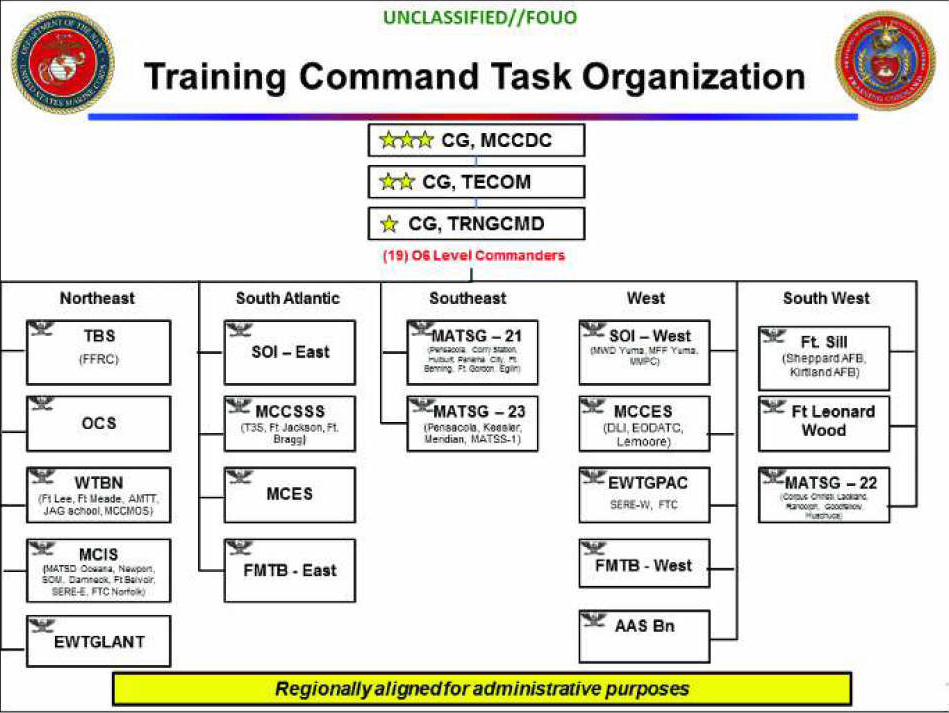
Training Command touches the entire Marine Corps, both officer and enlisted. Its 19 major subordinate elements (see Figure 1 below) commanded by Marine colonels and Navy captains, and 90 formal learning centers (see Figure 2 on next page) responsible for 618 POI (programs of instruction), provide numerous touchpoints to instill the values, knowledge, and skills required of Marines and Sailors to tackle the complex problems the Commandant addresses in the MOC (Marine Corps Operating Concept). Training Command’s mission is to consistently produce officer and enlisted entry-level MOS, career progression, and career enhancement skills trained Marines and Sailors to meet force generation requirements. The command’s over 6,000 permanent personnel achieve this by training over 102,000 Marines and Sailors every year. As such, Training Command is in a unique position to influence the culture and future of the Corps. It is a mechanism for change.

Training Requirements

Training Command does not unilaterally determine the subject matter and capabilities in which it trains Marines and Sailors. The command develops its programs of instruction from the strategic guidance found in the MOC and the Commandant’s FRAGOs 1 and 2.2 It receives further operational guidance from the Marine Corps Combat Development Command/Combat Development & Integration Force Development’s, and Training and Education Command’s strategic plans. These documents provide broad guidelines on the topics that must be covered, but the manner in which the knowledge and skills are taught is determined by Training Command.

Additional input on generating talent for the Marine Corps is provided by Training Command’s customers and occupational field advocates. The Operating Forces and Supporting Establishment are Training Command’s primary customers. Their tactical requirements are derived from their missions, operational experiences, exercises, and experiments, all of which inform the development of the classes and skills taught at Training Command school houses. The occupation field sponsors, advocates, and proponents further provide Service-level input into production standards, quantity, and timing. Train- ing Command translates this guidance into force generation plans that sustain the transformation of entry-level and career Marines and Sailors (see Figure 3 below).

Mechanism for Change

Training Command’s diverse portfolio and wide span of control enable it to impact change in many different ways. The command constantly seeks improvement in its instructors, subject matter, training methodologies, and efficiencies in training the best force available within resource constraints. It is currently pursuing a number of initiatives to “gain inches” in improving the Marine Corps. The following three examples provide a small sampling of its efforts.

MCT (Marine Combat Training) Enhancement

Commanding the SOIs (Schools of Infantry) allows Training Command to reinforce the Marine Corps’ warfighting ethos while better developing basic riflemen. It intends to do this by adjusting the existing MCT (Marine Combat Training) POI to reinforce five themes: core values, leadership development, basic tenets of maneuver warfare, resiliency, and fitness. The SOIs will build on the core values learned by all enlisted Marines at recruit training to garner further inclusiveness and understanding of the contribution of all Marines to assist in the cultural change the Commandant seeks. The lock-step approach to training currently conducted by the SOIs during MCT will be replaced with a progressive tactical scenario in which students are organized into fireteams and squads with every Marine serving a minimum of one week as a fireteam leader under the coaching and mentoring of their 0913 combat instructors. The SOIs will introduce MCT Marines to the basic tenets of maneuver warfare at the junior Marine level. They will gain an understanding and appreciation of how their application of these tenets will assist their units in succeeding on the fluid battlefields of the 21st century. Although the Operating Forces train their Marines and Sailors to withstand the rigors of combat, the SOIs will train Marines in the coping skills necessary to overcome the stressors of life to improve unit readiness and assist Marines in successfully completing their terms of enlistment. The SOIs will also leverage the Marine Corps’ new physical fitness program and force fitness instructors to improve the overall fitness of their Marines while instilling the personal ownership of one’s fitness into every Marine. These MCT enhancements are expected to be implemented in fall 2017. Training Command intends to reinforce these five themes at its MOS producing schools as part of the transformation process and training continuum.

Force 2025: 06XX Communications FMP (Force Modernization Plan)

Understanding the need to adjust capabilities to compete on the modern battlefield, Training Commands MCCES (Marine Corps Communications-Electronics School) in Twentynine Palms developed a FMP (force modernization plan) under the cognizance of Marine Corps C4I (command, control, communications, computer, and intelligence). The MCCES reorganized legacy stove-piped communications fields into mu.jpgaceted network capabilities. This transformational change makes every 06XX Marine a “networked Marine,” professionalizes the 06XX force, and strengthens the Marine Corps’ overall cyber security. The FMP supports the generation of Force 2025 and consist of four paths: 062X-Transmissions, ОбЗХ-Network, 067X-Data Systems, and 068X-Cyber Security. Training Command, MCCES, C4I, and Marine Forces Cyberspace Command are also working together to develop a future 17XX Cyber Marine training program. Full implementation of the FMP is scheduled for spring 2018.

MAT (Marines Awaiting Training) Enhancement Program/Modernizing the Classroom

Training Command is leveraging technology and new training methodologies to enhance learning and achieve greater efficiencies. It is experimenting with and employing government and commercial off-the-shelf applications, WiFi, learning management systems, elearning systems, bring-your-own device technologies, simulations, and other tools to facilitate individually paced learning, provide more repetitions and sets, and assist Marines in more rapidly mastering skills. This will translate to reducing T2P2 (transfers, transients, patients, and prisoners) across the Corps, more rapidly getting Marines to the Operating Forces, keeping leaders in front of their units longer, and increasing overall unit readiness. The applications and opportunities offered by technology are endless, but they do require investment.

Investing in the Future

Training Command optimizes finite resources to support a complex and dynamic training continuum. It partners with many advocates and stakeholders to generate the individual talent that comprise successful units. It accomplishes this by investing in the quality and quantity of its professional instructor core-its center of gravity. Continued investment in the 0911 drill instructors needed at Officer Candidates School, 0913 combat instructors needed to train officers at TBS and enlisted Marines at the SOIs, and numerous other quality instructors across all occupational fields needed at Training Command’s many other schools will ensure its sustained ability to be a mechanism of change for the Marine Corps. The investment in sending the right number and quality of Marines and Sailors to be instructors at the school houses will pay dividends on their return to the Operating Forces. The increased knowledge, skills, and expertise they gained as instructors will manifest itself in the new leadership roles they fill in the Operating Forces.

The Partnership

Training Command is committed to implementing the changes needed to better develop and field the Marines and Sailors who will operationalize the MOC and sustain the Marine Corps’ success in the 21st century. However, it cannot do this alone. It will only accomplish this through a close partnership with and shared visions and support of the occupational field advocates, sponsors, and customers. Together we will generate and train an unbeatable force.

Notes

1. Headquarters Marine Corps, The Marine Corps Operating Concept: How an Expeditionary Force Operates in the21st Century, (Washington, DC: September 2016).

2. Commandant of the Marine Corps, FRAGO 1/2016: Advance to Contact, (Washington, DC: 2016) and Message to the Force: Seize the Initiative, (Washington, DC: 2017).

Chasing the Dragon

by Capt Timothy H Courchaine & 1stLt L. Glinzak

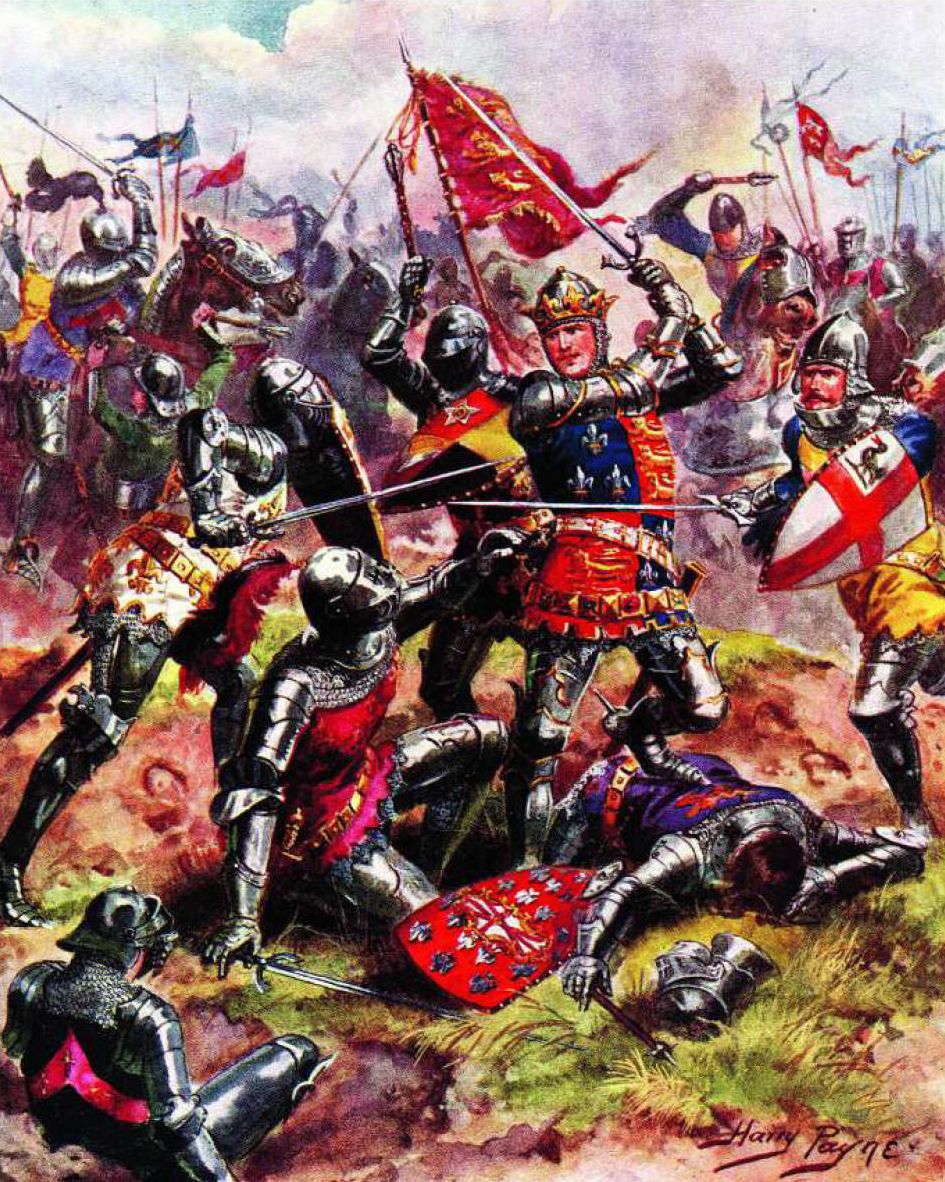
As Henry V surveyed the battlefield at Agincourt, he saw a sight he surely did not want to. Arrayed in front of him was the flower of the French King’s army, armor-clad knights and men at arms, thousands of whom had marched across Normandy and France and successfully cornered him here on a muddy, narrow field. He knew that his men were exhausted from campaigning, half starved, and most had unpleasant cases of dysentery, making their assembly area aromatic. He also knew, to a certain degree, the weapons capabilities of each side and the terrain he was fighting on. He could see across the field to the opposing commander’s standard and watch his enemy’s messengers move Irom battle to battle,1 relaying orders and observations. This picture paints an image of a commander who in reality had far more information, or at least felt that he had far more information, than what most commanders would feel today.2

Information saturation and the quest for information by commanders and the Marine Corps at large is a by-product of the proliferation of information-producing sources available to commanders in the field today. While these sources can be a critical asset, their overuse leads to two distinct drawbacks. First, the sheer volume of information one must process and the source management associated with its collection shifts the focus of the planning phase almost exclusively to an analytical approach. While thorough, it degrades a commander’s ability to make snap decisions when there are several hundred things that need to be considered. Secondly, by seeking to possess all of the potential information up front, a commander is centralizing decision making, a concept which flies in the face of the Marine Corps’ doctrine of decentralization. The quest of a commander in seeking information therefore should not be in collecting as much as possible but rather revolve around the question of what few, critical pieces of information their assumptions rely on. Similar to the priorities of reconnaissance, this question focuses data collection while narrowing the input necessary for a decision.

Just as warfare eventually caught up with the Industrial Revolution during World War I, the modern battlefield is increasingly influenced and dominated by the current Information Revolution. Computers and networks are now a necessary and common tool. ISR (intelligence, surveillance, and reconnaissance) assets can be found on a wide range of platforms and the information they can now provide is staggering. Communications have increased in range and reliability, allowing a commander potentially hundreds of miles away to receive information reports in realtime.

The information these assets provide can be absolutely critical to making the right decision and plan. When unfocused, however, they provide a sensory overload. Sifting through these sources can become the job, and while intelligence shops producing significant analysis are powerful tools, they are one rarely available to the lower-level commanders trying to make a decision with this exhaustive inflow of information.

This overload is not merely a passive one. Military planners recognize that these assets are available and want to make use of them. With increasing spotlights on the strategic implications of small unit decisions and a zero defect culture, it is a way of insuring a commanders decisions are not seen as negligent, and that commanders did their due diligence if something goes wrong. The drive for that clear picture of the battlefield is a commander’s safety blanket. When he knows exactly what he is up against, he knows what he will receive. This feeling of intellectual comfort in decision making leads to an overreliance on an analytical decisionmaking processes. With this increased reliance, commanders are less and less likely to be comfortable with the snap judgment necessary for quick and intuitive decisions that must be made during information deficits.

Maneuver warfare is the bedrock of Marine Corps tactics. Out-cycling the enemy, moving faster, adapting, anticipating the enemy’s next move, achieving a decision, and then exploiting success have all led to the triumph of maneuver warfare. Maneuver warfare has been embraced doctrinally and contributed to the success of countless engagements. In order for maneuver warfare to continue to be successful, however, we must stay rooted in its tactical fundamentals and, even more importantly, not let today’s thirst for information interfere with our ability to quickly achieve a decision and adapt to an ever-changing battlefield and thinking enemy.

One of the tactical fundamentals in the Marine Corps is achieving a decision.5 Decisions must be made quicker than our enemy-a 70 percent solution now is better than a 100 percent solution that comes too late. Unfortunately, when Marines wait for technology to answer ever}7 question, our desire for more information before we make a decision hinders our ability to achieve a decision before the enemy. Technology is a powerful asset that can be used to achieve a decision, but it should not be the driving force.

Part of achieving the decision to act before the enemy relies on a commander’s military judgement, which is hampered the longer they wait for information. Military judgment requires a leader to conduct a thorough METT-T (mission, enemy, terrain and weather, troops and support available-time) analysis, including looking at things from the enemy’s perspective in order to figure out the enemy’s most likely course of action.4 This allows a leader to analyze the situation and develop ideas. Such thorough analysis does not come only from technologically-provided information. Instead, it often comes from experience and the ability to use intuitive decision making.5 Instead of being over reliant on technology to paint a “perfect picture” of the enemy situation and the operating area, leaders should rely on their experience and intuitive decision-making skills to conduct a thorough analysis of that ever changing enemy and operating area. Leaders must be encouraged to use their skill sets to achieve a quick decision that may not be perfect but is more than capable of accomplishing the mission rather than a perfect solution that may come too late.

In addition to slowing down the decision-making process, the quest for information can harm our ability to adapt. MCDP 1-3 discusses how adapting means having flexible plans that avoid unnecessary detail, can be easily changed, and are simple.6 During the quest for information, leaders must ensure it does not over-complicate our plans and provide mundane details that, in the end, inhibit our ability to quickly change and adapt to a thinking, ever-changing enemy. Information can be an asset in developing critical aspects of plans, but it will never deliver a “perfect plan.” Such a plan will slow Marines down and prevent them from adapting. Instead, leaders should use the information gained to aid their METT-T analysis so that they can act as critical thinkers, ones who anticipate the enemy’s next move and are willing to improvise when a curve ball is thrown.

What commanders must realize is that as the battlespace continues to increase, so too will the information deficit inherent in command. The op posing will of the enemy is now spread across a wide front and is no longer visible in one look across the field. In order to combat this, the focus of information gathering must be laser like and identify only the decisive points of the decision-making process. In recreating the picture the ancient commander saw atop his horse, he saw a myriad of data points: the color or each banner, their jovial demeanor, and the flowers in the field. For a modern commander, however, which one is important? It will take too long and be too laborious to completely recreate the scene. At least two separate information sources could be required in such a scenario: image surveillance to show the banners and the flowers and human intelligence sources to reveal their demeanor. The prioritization of information is what will give the modern commander the equivalent decision-making power.

The Marine Corps preaches a doctrine of decentralization, one which should allow commanders to operate in this informational deficit because each or their subordinate leaders will have a closer view of the conditions in front of him. Essentially, they will have the view he is attempting to develop with all of the various information assets he is employing. “Mission tactics” is more than a task and a purpose statement given in case a situation does not develop according to plan-it is also a tool to make coherent and informed decisions effecting pivotal swings in battle when the commander is nowhere near, is unavailable, and quite possibly innocently uninformed as to the fact that his unit is even in contact.

As commanders seek information, the first place they often go is to their subordinates. This will either be with a task to go find information or a request to relay information back up to the commander. Tasked with gathering information, the subordinate leader is now diverted from making decisions in an area he is already adequately informed about for his own purposes to gathering, processing, and then relaying up to higher information that may or may not be critical. The over reliance on this dynamic creates a middleman in information development that results in both inefficiency and centralization in a removed leader.

Decentralization encourages bold, decisive leaders. Military judgment must be developed in our leaders so that they can quickly adapt and achieve a decision faster than the enemy. Technology is an asset that can aid in our success and decision making. It should not be relied on, however, to bring us to a “perfect plan” or to paint the “perfect picture.” Leaders must have confidence in their analytical and intuitive skills and be critical-thinking leaders. Such an environment should be rostered and encouraged within subordinates. Technology and information is a tremendous asset, but it is not as crucial as a critically-thinking leader who is able to take the information he is given-even if it is not all of the desired information-and use analytical skills to anticipate the enemy’s most likely course of action. This allows Marines to keep a quick tempo, one that is faster than the enemy and, in the end, is a foundation of maneuver warfare.

Notes

1. Battle is a medieval formation commonly used throughout the Hundreds Year War.

2. John Keegan, The Face of Battle, (New York: Penguin, 1983).

3. Headquarters Marine Corps, MCDP 1-3, Tactics, (Washington, DC: Headquarters Marine Corps, 1997), 11.

4. Ibid., 25-26.

5. Ibid., 26.

6. Ibid., 85-86.

An Unbreakable Network is Like an Unsinkable Ship

by LtCol Gregory A. Thiele

In the last 30 years, the Marine Corps has tied its warfighting capability ever more closely to the use of computers and the Internet. This development has had some benefits. Unfortunately, it has also created tremendous vulnerabilities potential adversaries may be able to exploit. While no communications system is ever entirely secure, the Internet and other computer-based information sharing systems have proven extremely vulnerable. The Marine Corps should reconsider its use of internet-based technology and employ it only in a carefully targeted manner compatible with the Marine Corps’ warfighting philosophy oí maneuver warfare.

The Marine Corps now uses computers and the Internet for nearly everything, both in garrison and in wartime. It seems that virtually every Marine has a computer, Internet connection, and email address. Everything from personnel records to maintenance records, annual training statistics to annual training classes are delivered and shared via the Internet and tracked, cataloged, and stored on computers and servers. When servers crash or the Internet fails for any reason, workflow virtually stops in affected units. Units now drag computers, servers, heating and cooling systems, and associated generators to the field in order to establish Internet connections with other units. The light, foot-mobile headquarters seems to be a thing of the past.

The Marine Corps’ use of computers and Internet-based information sharing systems for both garrison and wartime use has some beneficial aspects. A greater amount of information can be shared more rapidly among more Marines than ever before. Tasks that used to take a great deal of time or manpower can now be automated and conducted cheaply, quickly, and efficiently.

Unfortunately, the Internet’s benefits have not come without significant drawbacks. Our fascination with technology may actually be detrimental and make Marine units less capable. Commanders are now inundated with information. The increased information requires a corresponding increase in staff to process it. More staff officers mean that there are more individuals vying for a commander’s time. The plethora of information available is likely to result in a commander experiencing information overload, which may inhibit effective decision making.

Information sharing technology may also degrade unit performance in less obvious ways. The Internet provides higher headquarters with the means to monitor virtually any aspect of a subordinate’s actions it chooses. Nothing can escape the all-seeing electronic eye of Big Brother. To augment this electronic supervision, units are required, to send so many reports to higher headquarters each day/week/month/year that this effort can easily become a unit’s focus of effort in garrison. Higher headquarters’ appetite for information only increases during wartime with a corresponding potential negative impact on unit focus and initiative.

Perhaps the greatest drawback that comes with wedding warfighting capability to information sharing technology is that every network is vulnerable. In fact, it is quite impossible to create a network that is impervious to attack.1 Despite the financial resources of the United States and the extensive efforts made to protect important data, U.S. government files are routinely compromised. For instance, in 2015, it was revealed that the Office of Personnel Management’s files were hacked and the information of at least four million federal service employees may have been compromised. Even the U. S. Secretary of State at that time, John Kerry, once admitted that it was “very possible” that his email account had been compromised “and I certainly write things with that awareness.”2 Although Secretary Kerry’s actions may be no more than prudence, if the U.S. Secretary of State cannot be certain that his email is secure, what does this say about the ability (or inability) to provide secure communications in other areas, particularly where the scale of use is much greater (such as the Department of Defense)?

In such an environment, what may actually be required is for the Marine Corps to chart an entirely contrary course when it comes to information technology. The most secure option is for the Marine Corps not to use Internet-based technology at all. Given current trends and ever-greater desires for data communication, this is likely an unpalatable option. If the Corps is to continue to rely on information technology, it should be far more selective than is currently the case in how and when such technologies are employed. Marines ought to employ technology in a manner that contributes to the Marine Corps’ warfighting capacity while presenting or creating a minimum of vulnerabilities that can be exploited by a potential threat.

The Marine Corps must place technology in its proper relation to war and to the Marine Corps’ warfighting philosophy. The best guide possible for the employment of technology is that provided by the United States’ greatest military theorist, U.S. Air Force Col John Boyd. Boyd used to say, “People, ideas, hardware-in that order.”3 Marines seem to have forgotten this lesson, if indeed they had ever truly learned it. The Marine Corps should work tirelessly to find the best people available (and then work even harder to incentivize them to remain in the Corps).4 These Marines can then develop concepts suitable for modern war and consistent with the Marine Corps’ maneuver warfare doctrine. This group must then identify the equipment required to put the new concepts into practice so that it can be purchased or, if necessary, developed.

The preceding description probably sounds fairly logical, so it may be surprising that the Marine Corps rarely seems to follow this model in determining what equipment to buy. The MV22 Osprey, for example, is a testament to the Marine Corps’ tendency to fall in love with and buy technologically complex equipment and develop a concept of employment later.3 The same is true of the F-35 and Expeditionary Force 21. In each case, because no clear requirement existed for these aircraft, the Marine Corps created a concept and attempted to tie the equipment to the concept after the fact-however tenuous the links.

Marines need to employ technology in a targeted fashion. Each potential purchase needs to undergo a rigorous review process in which several important questions are asked: How will this piece of equipment fit with Marine Corps’ maneuver warfare doctrine? Is the equipment compatible with a decentralized philosophy of command and control (C2)? How will this piece of equipment actually be used in both peace and war-how does it fit into the way in which Marines will fight in anticipated future conflicts? Some may argue that these questions are already asked and exhaustively studied, but such a claim would seem to have little merit, as the preceding examples indicated. If equipment is incompatible with the Marine Corps’ warfighting philosophy or its C2 philosophy, the Marine Corps should not purchase it.

Breaking the Marine Corps’ addiction to technology will help Marines make better procurement decisions and permit the Corps to focus scarce resources on securing the technologies acquired. In the end, however, Marines must accept and embrace the nature of war described in Marine Corps Doctrinal Publication 1 (MCDP1). Among other attributes, war is chaotic, violent, and a clash of hostile, irreconcilable wills, each seeking to impose itself on its opponent. The enemy will seek to compromise our use of the electromagnetic spectrum or turn our use to their advantage.

Networks that rely on the electromagnetic spectrum can be compromised in numerous ways. The codes they use to keep information secure can be broken.6 Signal transmission can provide the location of the emitter inviting physical attack or targeted disruption. Servers can be attacked with malicious code or distributed denial of service (DDOS) attacks. Such attacks do not require an enemy with the same level of technology and resources as the United States; such capabilities are becoming increasingly available to Fourth Generation Warfare (4GW) adversaries.

Marines must prepare for a battlefield where the enemy seeks, and is able to interrupt or compromise any use of, the electromagnetic spectrum. Ever more complex and costly defenses are unlikely to be able to keep pace with the threat. The best security against disruption of the electromagnetic spectrum is to use it as little as necessary.

There is, perhaps, a simple answer to this dilemma. We should prepare Marines to rely on the oldest network in existence: the network that exists between individual human beings. Col Boyd used to say that, “Machines don’t fight wars, people do, and they use their minds.”7 Fluman networks consist of relationships between individuals. These connections can be extremely difficult to disrupt, can be surprisingly resistant to major shocks, and at their best can often be broken only through physical destruction. The resilience of human networks is maximized when paired with a decentralized C2 philosophy that allows individuals the autonomy to make decisions in an atmosphere of trust.

Unfortunately, one cannot simply buy an improved human network; connections between people must be built over time. Once forged, however, a unit utilizing decentralized C2 can function much more rapidly and effectively than a highly centralized network. A decentralized, less rigidly hierarchical organization that trusts its people will be more effective in combat-with or without the aid of the electromagnetic spectrum.

If the Marine Corps is to succeed in the future, Marines must take a more thoughtful approach to the acquisition of technology. The role of technology is to serve Marines, not enslave them or overmaster them. Over reliance on technology can be dangerous and can have devastating consequences. This is particularly true in the realm of Internet-based information-sharing technologies. The best method to safeguard information in a digital world is not to use computers or the Internet at all. Since it is unlikely that the Marine Corps will turn away from informationsharing technologies entirely, the best option remaining is to limit the use of such technologies and to target their use carefully. Such an approach will help reduce potential vulnerabilities and allow the Marine Corps to focus limited resources on securing the systems it procures. In the end, though, it is people that matter. The most powerful information-sharing network that can be created is among people, and so long as war is waged by human beings, it will remain so, no matter how technology changes.

Sidebar
Footnote

Notes

1. Before World War II, the Germans adopted the ENIGMA as their means of encoding sensitive communications. At the time, the ENIGMA was the most advanced technology available, using a plug-board and a system of variable rotors to provide what was considered to be an “unbreakable” encryption. The problem, of course, was that ENIGMA was not unbreakable. There can be no question that penetration of the ENIGMA played a significant role in the course of World War II in Europe (just as penetration of the Imperial Japanese naval codes were vital to success in the Pacific). Anything that human genius can create, human genius can penetrate or destroy.

2. “Kerry: ?Very Likely’ Hackers Reading Emails,” CBS Washington, accessed on 27 August 2015 at http://washington.cbslocal.

3. Robert Coram, Boyd: The Fighter Pilot Who Changed the Art of War, (New York: Back Bay Books, 2002), 354.

4. Although beyond the scope of this essay, while the Marine Corps may do a good job of finding the right people, the Corps’ personnel management policies are so bad and so out-of-date as to deserve to be called “regressive.” The best work on this subject is by Major Don Vandergriff, USA (Ret.), in his book The Path to Victory.

5 – In the case of the Osprey, the concept it was touted to support was/is Operational Maneuver From the Sea (OMETS), yet OMPTS was introduced in 1996, well after development of the Osprey began, making the Osprey a classic example of a program in search of a concept of employment.

6. Like the German ENIGMA.

7. Coram, Boyd, 354.

Investing in Marines

by Maj Carl Forsling, USMC(Ret)

2016 Kiser Family Irregular Warfare Essay Contest: First Place

The military establishment once hoped that the drawdowns from Iraq and Afghanistan marked the end of irregular warfare as a driving force behind the manning and equipping of the Nation s military forces. The muchhyped “Pacific Pivot” gave the promise of a return to more traditional military combat, with preparations becoming more geared to deterring and fighting state actors.

The emergence of ISIL (Islamic State of Iraq and the Levant), as well as Russian irregular operations in Ukraine and the Crimea, have made it clear that the adversaries of the United States are not going to let the United States have any breathing room to pivot or reset.

The Marine Corps is caught between the world it has planned for and the world as it actually is. In the Marine Corps Planning Process, Marines are taught to identify an enemy’s most dangerous and most likely courses of action. What is the likelihood of conflict and, equally important, the type of conflict with which they will confront the United States?

Many would contend that the most dangerous enemy course of action is a large-scale, state-on-state conflict with a near-peer competitor. Russia or China are often thrown out as potential adversaries. While such a conflict would indeed be extremely dangerous because of the threat of escalation such a conflict would entail, the actual likelihood of a direct conflict with those states is so low that they may as well be replaced with a “Competitor X” placard. Still, the United States prepares for such a fight in a manner disproportionate to its likelihood.

The most likely enemy course of action is a continuation of what the United States is dealing with right now, or something very similar. The United States is simultaneously waging a conventional battle against ISIL, especially in regard to fire support, while also conducting unconventional warfare through proxy fights via allied state and non-state actors. ISIL fights with a combination of semi-conventional warfare on the ground as well as terrorism and subversion in both its immediate area of operations and in Western nations. While the fight against ISIL has been a slow grind with the United States steadily increasing combat power on the ground, battlefield defeat of American units has never been at issue. The major threat from ISIL from an American perspective is the potential for wider export of Islamist violence, not ISIL destroying military targets. This type of fight will demand a far more complicated array of capabilities from the Marine Corps, and that complexity will be apparent at even the lowest echelons.

Analysts often portray the United States as facing a binary choice between variations on those themes. On one end. is a high-end force built to confront near-peer competitors on sea, air, and land. On the other is a force geared to fighting low-intensity conflicts, punitive air strikes, and doing such missions as advising foreign forces. One might just work out a matrix and design the force according to a formula weighing probability versus severity. If only the choices were so simple.

In actuality, the United States will face escalating hybrid threats from nation-states, non-state actors, and complex combinations of both. While certainly a relief in terms of not being the existential conflict the United States would face against, say, China or the Competitor X du jour, the hybrid threat means that the United States can’t simply forget about counterinsurgency and rebuild its air and sea armadas, nor can it completely re-center itself around being a crisis response and low-intensity conflict force. The vagaries of this challenge, in concert with relentless resource shortfalls, make planning the Marine Corps of the future far more difficult than either of these extremes.

The Challenge

Tomorrow’s force must be able to conduct operations, both direct combat and partnered, while under threat of attack not just from skirmishes or from rockets or mortars but also from unmanned systems, cyber, and electronic attacks. Almost as threatening for an expeditionary force, the seaborne support which they are accustomed to may have to be much further away than before because of the proliferation of antiaccess/area denial (A2/AD) weapons. Commercial satellite and modern media technology have reduced the potential for operational surprise. Small countries and even non-state actors will have access to weapons and sensor capabilities previously only known to major powers. Over-the-horizon amphibious capability is no longer a shield but just a starting point.

Many proposals rely too heavily on breakthrough technologies. Present force plus carbon nanotubes/lasers/ robots equals force of the future. That’s not strategy, that’s wishful thinking. The United States needs to embrace emerging technology while realizing that technology is not going to suddenly transform the force. Resource constraints will prevent ambitious reengineering of the force, as exemplified by efforts such as the Army’s failed Future Combat Systems program.1 As former Secretary of Defense Donald Rumsfeld infamously remarked, “You go to war with the Army you have, not the Army you might want or wish you had at a later time.”

The United States will largely go to war with the Marine Corps it has, at least as far as equipment goes. There will be some near-term additions, such as the F-35B, and replacements of such mainstays as the HMMWV and MRAP, but most equipment of the future force will closely resemble what is operational today. Off-the-shelf acquisitions and mission kit modifications of existing equipment will make most improvements evolutionary, not revolutionary. In a resource-constrained environment, those methods will be the only way to keep up technologically vice major decades-long acquisition programs.

The key differences will be not in what we use but in how we use it. The way we select, train, and employ Marines will define the future force. The Corps must take advantage of emerging technologies but cannot mortgage its future to them, especially when it doesn’t know how big its next paycheck will be.

The Marine Corps, distinct from the Army, is defined by its expeditionary nature. Marines fight in the littorals, usually supported by, but not necessarily tethered to, amphibious shipping. As such, they must be able to provide maximum combat power while maintaining as light a logistical footprint as possible. This would seem to be self-evident, but the years since 9/11 have led the Marine Corps far astray from its expeditionary roots.

The Corps has answered the demands of counterinsurgency operations in Iraq and Afghanistan in a way that has prevented the Corps from truly pivoting to a distributed model. For too long now, the Corps has been tied to major forward operating bases (FOBs). This is a luxury that may not exist in the future.

To begin with, political considerations may prevent the establishment of major bases ashore. Some of these considerations may be domestic, in that the U.S. political leadership will not commit large numbers of “boots on the ground.” Other times, foreign governments may not allow such facilities to be established on their soil. Recent events show that fiscal constraints may even hobble America’s ability to establish and sustain the large, logistical hubs that the U.S. military is accustomed to.

Additionally, these bases are tactically vulnerable to both simple threats, such as rockets and mortars, and to more sophisticated ones, be that by infiltration, such as at Bastion airfield, or evolving threats, such as swarms of drone-borne IEDs {improvised explosive devices).2 Their enormous logistics trains, often provided by civilian contract providers, are even more fragile.

Eventually they become an escalating “death spiral” of logistics and force protection, wherein the FOB is there to support Marines, Marines are required to protect the FOB, those Marines in turn require a bigger FOB, and so forth.

For these reasons, the more the Corps can keep support structure afloat instead of ashore, the better off it is. This means that distributed operations will become the keystone of the Marine Corps.

Bring Big Unit Capabilities to Small Units

Expeditionary Force 21, {Washington, DC: HQMC, March 2014), describes the battalion as the primary deployable unit of the Corps with a nod toward company landing teams as a crisis response force. The future will likely require the capability to further devolve the crisis response element down to the platoon or sometimes even squad level, while still requiring the ability to restack to the company and battalion level as the operational and tactical situation requires.

Those squads and platoons must have capabilities across the spectrum of war- fare. On the low end, they must be able to conduct training of foreign military forces and conduct partnered operations. On the high end, they must be able to conduct field and combat operations, both independently and in their more traditional role, as part of larger units.

The Corps already has strengths in the distributed warfare arena. More than any other units in the U.S. military, M AGTFs have integrated fires and logistics capabilities combined with an intrinsic modularity. The unique independence of amphibious forces is a huge asset. This too will continue to evolve into a more distributed environment, as Expeditionary Force 21 describe. This will begin with greater use of logistics ships such as T-AKEs and other MPF (Maritime Prepositioning Force) assets for operational mobility as Expeditionary Force 21 details, but it will need to accommodate even more non-traditional shipping. Every naval vessel with a rotorcraft capability must be prepared to transport and deploy Marines, from destroyers to aircraft carriers. This will be critical as the number of purpose-built amphibious ships continues to decrease relative to the number of places Marines must be prepared to deploy.

The Corps’ long-time emphasis on small unit leadership will be critical in building units able to operate in a distributed environment. The Corps needs to further accentuate the strengths of Marine small units down to the squad level. This will get more “bang for the buck” than any other option the Marine Corps has. Fiscal constraints are a fact of life for the foreseeable future, and the ROI (return on investment) in people will be far greater than on investments in things. The principles of a knowledge economy will be just as transformational in warfare as they are for business.

Logistics, intelligence, and medical expertise cannot solely reside at higher echelons. If the Corps is to execute distributed warfare, those skills have to be present in the smallest unit capable of independent action. In distributed warfare, this may go as low as the reinforced squad level. While the squad doesn’t need to be able to do everything itself, it has to be able to fight and maneuver in a given area of responsibility, coordinate with higher headquarters and adjacent units to get what it needs, and work with foreign forces to improve their capabilities.

In the Marine Corps, this capability already exists in Marine Special Operations Command (MARSOC). Unfortunately, that command is overtasked, as are the rest of the Nation’s special operators. They are overtasked not only because they are top-notch but because the nature of warfare has changed, and they are already aligned to it.

While MARSOC will continue to support national objectives, it cannot be everywhere the Corps needs it to be. The Corps cannot be MARSOC writ large, but it can build a large measure of MARSOC’s capability in supporting partnered operations and foreign internal defense, while retaining the conventional combat skills needed for major combat operations.

Strong Marines, Stronger Units

This can be achieved in large part by altering the way the Marine Corps manages personnel. Leaving the same individuals in the same squad for multiple tours will afford the opportunity to build both the diverse skills necessary for quasi-special operator capability while budding the unit cohesion that makes for combat ready units.

Small unit cohesion enables the development of, and adherence to, standard operating procedures that allow the upscaling and downscaling of units. This is what will enable a MAGTF to move up and down the continuum of conflict. This cohesion needs to be integral to everything that unit does.

Selection and training of Marines generally, and infantry Marines in particular, will also have to change. In order to be prepared to support and conduct small unit operations ashore, all Marines will have to be tougher and possess greater individual combat skills. Every Marine must be prepared to go to the field and hold his or her own with a platoon-sized or smaller infantry unit as an enabler. It will require looking at additions to the squad beyond the traditional specialties the Corps has known for decades.

For example, the inclusion of an unmanned systems operator at the squad level is an idea being actively explored by the Marine Corps right now.3 This is exactly the sort of enabler that needs to be available to Marines at the lowest level. Unmanned systems will soon be just as ubiquitous and as essential as automatic weapons on modern battlefields.4 The use of robots at the small unit level will continue to expand for tasks from small-scale strike to providing over watch in danger areas during a long movement to helping clear the next room in an urban environment. They will not be luxuries but necessities. The tactical unmanned systems operator needs to become universal and an actual infantry MOS alongside riflemen and machine gunners.

When small units operate in distributed fashion, they may need any number of different enablers in addition to an unmanned systems operator, though generally on an ad hoc basis. Depending on the scenario, this may include communicators, logisticians, motor transport, and many other MOSs. Any Marine must be prepared to go to the field if his or her MOS is needed, no matter how remote, austere, or kinetic. They cannot just tag along under the protection of infantry Marines. In such a unit, they will have to be ready to engage in combat as a fully participating member.

To accomplish this, the Corps must be willing to kick more recruits out during initial training. This won’t be because of capriciousness. Currently, very few Marines are attrited during recruit training for reasons of aptitude. Fraudulent enlistments, injuries, and conduct drive what little attrition there is.3 The Marine Corps must screen and evaluate for higher standards of intelligence and physical fitness throughout the accession process, from recruitment through assignment. Distributed operations require the highest levels of independent thought and physical conditioning. There will be no room for hangers-on.

Furthermore, the length and difficulty of Marine recruit training, combat training, and School of Infantry needs to increase. Marine combat training, in particular, cannot merely be an ori- entation program. Initial training for all Marines needs to resemble what infantry Marines receive today. That means that the School of Infantry for enlisted and the Infantry Officer Course for officers would become graduate education on top of, not in place of, that challenging foundation. “Every Marine a rifleman” needs to mean far more than a trite saying that actual infantryman giggle at. Think, “Every Marine a rifleman. Every infantryman an operator,” to use the oft-overused operator descriptor once more.

This will undoubtedly reduce the inflow of new Marines. That means keeping Marines in operational billets longer, but that’s not a bug; it’s a feature and a force multiplier. The Corps will have to re look at the rank distributions as well as time-in-grade limitations, especially at the squad and platoon level. Small units in special operations routinely have more senior personnel. Line combat arms units need to move toward this model as their mission starts to more closely resemble special operations.

If a Marine unit is together for just a few months, it can train to one mission. If it is together for years, it can serve as a cohesive unit in many. Infantry Marines must be proficient in missions from foreign military training to civil affairs to counterinsurgency operations to high-intensity conflict. This will require them to have what might be termed a “doctorate” in three-block war.

In addition, looking at military training and education holistically will aid greatly. Currently, the Corps generally sees education as a part of a retention or transition tool, e.g., a benefit of enlisting or a step in the transition process. Unless a Marine is applying for special education or similar program, what he or she studies doesn’t really matter. This is a waste. Subjects such as foreign languages, regional studies, medicine, and engineering disciplines should be free to Marines or even have bonuses for completion.

The PME system as a whole needs to reflect the broader scope of responsibility that Marines will potentially face at junior grades. Even at such schools such as the Corporals’ Course, the Corps must not just train but also educate. If it expects independent actions from NCOs, it must also expect a high level of independent thought.

Working from people outward, vice just seeing them as operators of the next generation of equipment, means a huge increase in capability for a comparatively small cost. A relatively small sum spent on recruiting, incenrivizing, and training the right people can result in an increase in capability far in excess of what can be done for the same amount spent on gold-plated weapons systems.

Making the Main Thing the Main Thing

Centering the Corps around the small unit means decentralizing control of fires and logistical support.

While technology will continue to make evolutionary improvements in infantry equipment, their organic firepower is not going to change markedly within the foreseeable future. New Service rifles, machine guns, grenade launchers, and individual equipment will incrementally increase their capabilities, but they will not be game changers.

Fortunately, the firepower of the MAGTF can bring continues to improve. The air portion of the MAGTF can bring the Harvest Hawk, the AV8B, as well as the F-35B and possibly MV-22Bs with offensive weaponry in the near future. Joint armed unmanned systems are proliferating. HIMARS, the M777 howitzer, and the Expeditionary Fire Support System can bring all-weather fires to bear when aviation is not available or responsive enough.

The firepower exists, but the capability to bring it to bear is not always there. While JTÀCs (joint terminal air controllers) have proliferated greatly over the last several years, giving every squad the capability to control fires of all types is something the Corps has not yet done yet needs to. Keeping Marines serving in their units longer would afford the opportunity to train more Marines in aviation and indirect fires without losing highly-trained Marines in the constant churn of today’s normal career rotation.

Existing and programmed logistics capabilities can allow units to be sustained independently at great distances from their logistics bases. Aerial delivery from both KC-130J and MV-22Bs has been effectively used in Afghanistan for several years now. The upcoming fielding of the CH-53K will further enable the delivery of heavy equipment and supplies without using vulnerable overland logistics.

In concert with this, as new ground vehicles are fielded, they have to retain their ability for aerial transport. Inter- nally transportable vehicles need, to be the mainstay of small units. As the Marine Corps replaces the HMMWV, it has to vigilantly guard against size and weight inflation in order to retain transportability via air. At least one company of every infantry battalion needs its vehicle support to be entirely transportable by MV-22Bs. This will facilitate tactical mobility by ground in addition to the operational mobility afforded by the Osprey. The preponderance of the battalion’s remaining vehicle support should be CH-53K and KC-130J transportable. If the Corps is to operate in an expeditionary environment in the future, it cannot depend on LCACs and LCUs (utility landing craft) to deliver essential vehicles to shore.

Acceptance of Risk

Employing smaller units independently means accepting the possibility that they will experience losses while far from friendly forces. Even with assets such as Ospreys, quick reaction forces and casualty evacuation may not always be available in a timely fashion during distributed operations.

One of the benefits of distributed operations is the ability to influence a large area with a small number of Marines. That also brings with it the need for those units to conduct operations with what they have, not necessarily everything they want.

The French experience in their Mali campaign is a prime example of the type of independence and ingenuity the method requires.6 As a mediumsized country with outsized aspirations dating to their days as a colonial power, the French have accepted the need to do more with less. Even more so than the Marine Corps, the French learned to project power far from major logistical bases. They maneuvered without overwhelming fires when necessary and operated independently at no level higher than the brigade, often at the company level and below. French units made several ground movements of over 500 nautical miles during the Mali campaign.

French forces subscribe to the same “golden hour” philosophy of casualty evacuation as Americans, but they were willing to expose themselves to tactical problems well outside the golden hour standard. They conducted maneuver warfare in conjunction with local partners. They travelled light but packed a disproportionately heavy punch, mostly because of their willingness to accept risk.

All too often, Marine units pack everything but the kitchen sink, just in case. Our leadership too often practices risk mitigation by the “what if” method. While this can be effective in peacetime or in a situation where they possess an extreme overmatch in capability, the Marine Corps may not have that luxury in the future. Economy of force is something the Corps must be prepared to practice, not just say.

Units as small as squads must be prepared to maneuver independently, fight, and call for fires as required. They must be prepared to move without casualty evacuation coverage, providing self-aid as required. Units in Afghanistan became used to stopping when air went “red.” That will no longer be an option in battlefields of the future, be they conventional or not.

The United States has had the luxury of using technical solutions to defeat tactical problems. Witness the overuse of the MRAP series of vehicles to defeat the IED threat in Iraq and Afghanistan. That vehicle was only sustainable in the context of a massive base infrastructure. While it gave some measure of tactical mobility, albeit constrained by roads, it was nearly impossible to move operationally with assets organic to a MAGTF. Lighter vehicles expose individual operators to greater risk in the form of vulnerability to IEDs and small arms, but offset this with the fact that they are less road bound, and are easier to move both operationally and strategically. Just as importantly, they reduce the need for logistical support and, thus, the logistical death spiral of escalating levels of support ashore. This exemplifies the importance of solving problems by maneuver not by throwing assets at a problem.

Marines First

The advantages obtained by an extreme devotion to decentralization and an acceptance of risk are greater contributors to combat power than any breakthrough technology. Distributed operations are facilitated by the embrace of technologies like the MV-22, unmanned systems, and communications, but they are really just facilitators of the maneuver warfare doctrine that the Marine Corps has embraced for decades.

The Marine Corps has avoided the logical endpoints of that embrace because our operational and tactical advantages have allowed it to. Allowing small units to operate fully on their own is a risk that the Marine Corps must take as the playing field becomes more level and assets become scarcer every year. Investing in small units will provide the best return on investment for the Corps’ increasingly scarce capital. Marines are undoubtedly willing to accept this. Is their leadership?

Notes

1. Christopher Pernin, et al, “Lessons Prom the Army’s Future Combat Systems Program,” (Arlington, VA: RAND Corporation, 2012).

2. Sidney J. Preeburg, Jr., “Small Drones are a Big Danger; Think Flying IEDs: CNAS,” Breaking Defence, (Online: 10 June 2015).

3. Hope Hodge Seek, “Marine Infantry Squads May Get Their Own Drone Operators,” DefenseTech, (Online: 11 August 2016).

4. MG Robert Scales, USA(Ret), Scales on War, (Annapolis, MD: Naval Institute Press, 2016).

5. Aline O. Quester, “Marine Corps Recruits: a Historical Look at Accessions and Bootcamp Performance,” (Washington, DC: Center for Naval Analysis, September 2010).

6. Michael Shurkin, “France’s War in Mali: Lessons for an Expeditionary Army,” (Arlington, VA: RAND Corporation, 2014). usJV«”c

The PES

by Mai David R. Dixon & 1stLt Matt Ford

“She will make a great Huey pilot in the Fleet.” An encouraging comment like this on a performance evaluation would certainly bode well for the career of a young aviator completing helicopter training. Unless, of course, that Marine happens to be a male in the AH-1W Cobra syllabus. While comical, this true example ofa a I comment (from an obviously aloof reporting senior) illustrates a painful fact that many of- us have experienced firsthand-young Marine officers often author maladroit fitness reports (FITREPs).

This anecdote also highlights one of the numerous issues discussed during the Marine Corps Warfighting Lab’s Innovation Symposium which convened in Quantico from 23 to 24 February 2016. The symposium assembled disruptive thinkers from across the DOD in order to address the myriad uncertainties and challenges that create barriers to innovation and to propose solutions in order to develop a learning organization that is ready to meet future warfighting challenges.1 This is a bold mission statement indeed, and in order to succeed as a military organization, it is paramount that we recognize, promote, and retain the most talented and fully-qualified SNCOs.

However, accurately assessing the quality of a SNCO is a difficult task for a promotion board, which relies almost exclusively on the FITREPs from the SNCOs reporting seniors and reviewing officers-many of whom have little or no experience writing performance evaluations. Frankly put, most lieutenants are unsatisfactory FITREP writers. Almost everyone reading this article has either once been a novice lieutenant or had one evaluate you at some point. How many sergeants and SNCOs have had their otherwise exemplary careers damaged or possibly ruined by a wellintentioned but overzealous companygrade officer whose limited knowledge of the Performance Evaluation System (PES) caused him to write an inaccurate appraisal? This problem has existed for decades yet there has been little done to address how we train lieutenants to write FITREPS. This article proposes a solution that costs zero dollars, adds zero time to the current periods of instruction for officers, and can be implemented within a month.

Years ago, students at TBS wrote peer evaluations on each other that were more affectionately known as “spear evals.” Alter an assigned training periods (usually every two weeks), the student squad leaders would rank his squad, each student platoon commander would evaluate the squad leaders, and so on. The ranking criterion was extremely subjective and shrouded in the personal biases of the student evaluator. The delivery method for these spear evals was even more obscure and awkward. At the end of the six month TBS syllabus, students would tape an empty manila envelope to their barracks door, and the lieutenants would surreptitiously slip their opinions into each other’s packets. You were never really sure who said what- you just woke up in the morning with a bunch of index cards where your platoon mates anonymously vented about how great or terrible they thought you were based on whatever grading standards each person deemed most important.

Needless to say, that was an absurd system that made it extremely difficult to obtain accurate feedback. Even worse, spear evals did nothing to teach lieutenants about how the PES actually works in the Marine Corps. The process today at TBS has evolved somewhat-the mouse and keyboard have usurped the notecard and envelope-and now the lieutenants use the five TBS “horizontal themes” to rank themselves against each other. These themes are:

1. A man or woman of exemplary character.

2. Devoted to leading Marines 24/7.

3. Able to decide, communicate, and act in the fog of war.

4. A warfighter who embraces the Corps’ warrior ethos.

5. Mentally strong and physically tough.

These themes are solid, and they may be adequate for lieutenant students to critique each other; however, this is not how we actually conduct evaluations in the Marine Corps. In other words, we are not training like we fight.

The solution is simple. TBS students should write training FITREPS on each other in order to intimately learn the Marine Corps PES, master brief sheet, and promotion process. Logically, fireteam leaders would RS (reporting senior) their fireteam, and the squad leader would RO (reviewing officer) fireteam members. Squad leaders would RS their fireteam leaders, and the student platoon commander would RO the fireteam leaders, and so on and so on.

By the end of the six-month syllabus, each student will develop a comprehensive RS/RO profile in addition to personally receiving dozens of training FITREPS-all of this would be reflected on the student’s training master brief sheet. After TBS graduation, these training FITREPS would be expunged from the system by the FITREP Division at HQMC.

If HQMC is unable or unwilling to cooperate by eliminating these training FITREPS, a pragmatic solution is for TBS to develop a program in Microsoft Excel that identically mimics the FITREP grading scale, RS/RO profile formulas, and master brief sheet profiles. We don’t need to hire computer engineers or bid out contracts to software companies in Silicon Valley. There are lieutenants at TBS right now who could easily write these formulas in Microsoft Excel. In order to get this program quickly online we could utilize the free market economic principle of competition. If the Commanding Officer, TBS, offered a Navy/Marine Corps Achievement Medal and a “96” to the student team who designed the most accurate model based on our FITREPS and master brief sheets, it would be done in less than one month. More importantly, the TBS lieutenant community would feel ownership of the process. If this does not work for some reason, then we could direct some of our bright captains and majors studying in the computer science or manpower systems analysis curriculum at the Naval Postgraduate School to design this Excel program. The point is that we have the brainpower right now within the Marine Corps to get this up and running soon.

Training FITREPS will familiarize lieutenants with the arcane technicalities of the PES grading criteria and RS & RO rankings. Lieutenants would furthermore learn the even more befuddling intricacies of Master Brief Sheets (such as the “at processing” and “cumulative” FITREP averages, and the “upper, middle, lower”/”above, with, below” RS and RO profile scores). The profiles that students create on each other can then be used as a training aid during the promotion block to help young officers understand how their performance evaluations influence the promotion system.

Each lieutenant would surely get the uncomfortable opportunity to receive a few unjust or inaccurate training FITREPs. TBS lieutenants would then understand what it feels like to get rooked on a FITREP and how those few inaccurate FITREPS can inflict longterm carnage on their master brief sheet. These unsettling moments will emotionally seal the learning objectives into the lieutenant’s brains, thus making it less likely that they will give erroneous or half-hearted evaluations to their sergeants and SNCOs in the future. Moreover, by using training FITREPS and master brief sheets, the staff platoon commanders at TBS will have much more accurate means of evaluating their students’ leadership potential. Everyone wins.

TBS has already apportioned time in their syllabus for peer evaluations. The same amount of time will be spent evaluating, just using training FITREPs instead of the five horizontal themes. The bottom line is that the intent of this article can be met with zero money spent by the Marine Corps and zero time added to the TBS syllabus.

A very small percentage of lieutenants will actually fire their weapon in combat or call in an airstrike via a nineline, but every single officer will write FITREPS on sergeants and SNCOs. Yet, TBS devotes only a few classes to teaching this vital skill. FITREPS are highly technical and writing them can become an emotionally charged ordeal. Athletes can’t learn how to play football or basketball in a classroom, and lieutenants can’t become astute evaluators without feeling the pain over many repetitions.

Historically, lieutenants write clumsy FITREPs and do not understand the impact that a few inaccurate evaluations can have on a SNCO’s career and morale. This injustice to our enlisted Marines demands bold innovation and a better way of doing business. Change of any sort is typically unpopular, especially for a monolithic organization that highly values uniformity (such as the military). LtGen Michael Dana implored the Warfighting Lab Symposium to, “Be innovative despite the machine.”2 MCDP 1, Warfighting, also reminds us that,

Since war is at base a human enterprise, effective personnel management is important to success. This is especially true for a doctrine of maneuver warfare, which places a premium on individual judgment and action. We should recognize that all Marines of a given grade and occupational specialty are not interchangeable and should assign people to billets based on specific ability and temperament.^

We will never meet the intent of MCDP 1 unless we recognize, promote, and retain the most talented and fully qualified SNCOs-there are few things more important in our Corps. We can accomplish this only if company grade officers adeptly utilize the PES. In order to train like we fight, TBS should replace their five horizontal themed peer evaluations with a system that teaches about actual FITREPS, master brief sheets, and the promotion board process.

Notes

1. Headquarters Marine Corps, MARADMIN 041/16, Marine Corps Warfigbting Lab Force Development 25: Designing The Future Force (Innovation Symposium), (Washington, DC: 22 January 2016).

2. Opening Comments by LtGen Michael Dana, Marine Corps Warfighting Lab Force Development 25: Designing the Future Force (Innovation Symposium), (Quantico, VA: Marine Corps University, 23 February 2016.)

3. Headquarters Marine Corps, MCDP 1, Warfighting, (Washington, DC: 1997), 64.

On 21st Century Warfare

by Majs John E. Kivelin III & Travis C. Onischuk

2016 Lt Col “Pete” Ellis Essay Contest: 1st Place

Our enemy is not stupid; to the contrary, he employs cunning, innovative, and often wicked tactics. Nor are we describing the enemy we faced during the previous 15 years. Our past enemy adapts, while our future enemy innovates. Currently, our future enemy prepares for a significant shift in the character of war unwitnessed in several generations. An adversary who effectively adapts during combat has a slight advantage, but the adversary who innovates and prepares prior to conflict has a tremendous advantage if he correctly recognizes patterns likely to grip future conflict.2 In this article, we argue that conflict will be characterized by the hyper-decentralization of intelligence, surveillance, and reconnaissance (ISR) assets combined with both air- and ground-launched nonline-of-sight precision-guided munitions (NLOS-PGMs). Consequently, the survivability of detected conventional military equipment-tanks, artillery, aircraft, etc.-drops to zero. Absent supporting arms, infantrymen will engage each other in close combat within terrain that offers concealment from ISR. Accordingly, the Marine Corps must innovate by procuring NLOS-PGMs, reorganizing the light infantry tables of organization and equipment, and shifting heavy conventional equipment to the reserves. Within this article, we discuss the evolving problem set that will necessitate innovative change, recommend updates to light infantry tables of organization and equipment, and discuss necessary changes in minor tactics.

Our potential adversaries have already proliferated ISR capabilities. Moreover, they continue to develop these capabilities at alarmingly exponential rates. Frankly, our infantry Marines operating on the ground already do so at a disadvantage to our enemy. This is unacceptable. The tactics enabled by improved ISR remain unchanged-find the enemy, fix the enemy, finish the enemy. A revolution in technology combined with adjustments in minor tactics, however, will ensure the devastation of our most depended upon forms of combat power, namely armor, motorized platforms, artillery, aircraft, air bases, and littoral shipping. With the proliferation of affordable, compact, and user-friendly ISR platforms, our Nation’s enemies will “soak” the battlespace with ISR, attempting to locate our high-value targets. Once detected, the adversary will engage highvalue targets using NLOS-PGMs with devastating effect.3

More sobering still, our current equipment and organization are nearly defenseless to such a threat. Military history reveals the necessity of recognizing the likely effect of such innovation, however minor it may seem technologically. During the American Civil War, the trench was the natural response to the Minié ball. J.F.C. Fuller observed, Not understanding the powers of the rifle, the tactics of this war were not discovered through reflection but through trial and error. Thus, over a year of bitter fighting was necessary to open the eyes of both sides to the fact that the trench was a by-product of the rifle bullet, and like so many by-products, as valuable as the product itself.4

In contrast to this adaptation, the U.S. Navy implemented new technology during the inter-war period through the adoption of innovative technologies. What we propose is a result similar to that of U.S. naval innovation of weaponized ship-borne radar systems prior to World War II. Developing, training, and fielding ship-borne radar systems prior to and during the onset of war gave the U.S. Navy a distinct advantage over the far superior Imperial Japanese during the earliest naval campaigns- an advantage from which the Japanese never recovered.5 We must invest in the proper current and emerging technologies now, otherwise our adversaries promise to continue outpacing us.6

How might the battlefield look if the enemy arms itself with this capability? A brief look across three warfighting functions-intelligence, fires, and command and control (C2)-reveals the decisiveness of this technology.

Intelligence

Utilizing unchanged tactics from past and current warfare, adversaries will blend their ISR assets across different mediums.

Sensor employment. Initially, combatants will utilize both active sensors (which both transmit and receive signals) and passive sensors (which only receive signals). However, commanders will soon replace active sensors that radiate signals with passive sensors to prevent signals surveillance teams (SSTs) from detecting, locating, and targeting active sensors. SSTs easily locate units that use active sensors because a sensor’s transmissions compromise both the sensor location and the controller location. Modern telecommunications compounds the challenge. An undisciplined unit’s use of personal electronic devices, which generate electro-magnetic negligent discharges (e.g., smartphones), paint a target for astute SSTs.6 Unwittingly, Marines also provide adversaries information through embedded GPS data in photographs posted on social media. A rudimentary hacker navigating a social media site can collect valuable targeting information with little recourse by the Marines he is targeting.8

Active sensors. Commanders will use active sensors, such as counter-battery radars or unmanned aircraft systems (UAS), to detect adversary activity and determine target locations. Commanders may use three techniques to increase the survivability of our forces and infrastructure by disrupting SSTs from collecting information about assets. In the first technique, operators will utilize faux emitters that create false signal emissions on the battlefield, thereby increasing the adversary SST workload.

In the second technique, commanders will utilize on-call active sensors that do not emit electro-magnetic radio-wave energy until a time of the operator’s choosing. Unfortunately, both of these techniques are subject to enemy pattern analysis, which can quickly detect different signals and analyze how they correspond to each other. In due time, analysts will separate the legitimate patterns from “chaff” using computer programs with complicated algorithms.

Finally, in the third technique, operators will limit SST collection capabilities by using directional antennas and appropriate power settings. In all three techniques, the transmitting unit will immediately displace to increase survivability each time the active sensor is activated.

Passive sensors. Commanders will use sensors that absorb information and transmit data to command posts without creating radio-wave bursts of energy vulnerable to enemy SSTs. Reconnaissance teams using optics will be the most effective passive sensors. Reconnaissance elements may hard-wire sensors or use weak electronic signals, such as Bluetooth, to transmit data short distances to information collection systems. Upon detecting enemy activities, they will utilize high frequency or satellite communications radios to report the adversary positions. To avoid being targeted, Marines will use offset antennas and immediately leave any listening post/observation post once they compromise the position with a detectable transmission.

The increased sophistication and proliferation of sensors-whether UAS, reconnaissance teams, or SSTs-merely shapes the battlefield. The concept only becomes decisive when ISR is integrated with a non-line-of-sight, precision-guided firing platform that does not requiring a static, detailed target location.

Fires

PGMs. Commanders will use airto-ground and ground-to-ground fired PGMs to target enemy threats detected by their ISR. 7’he Marine Corps currently possesses outstanding PGMs in its arsenal, yet we lack non-line-of-sight (XLOS) ground-to-ground and airto-ground PGMs that do not require controllers from another unit in visual contact with the target.

Contemporary systems. Currently, missilemen can achieve devastating effects on mechanized forces at moderate distances with TOW and Javelin missiles. Assaultmen and infantrymen, concealed within 350 meters of a target, can also attain shocking effects utilizing rockets. Artillery forward observers can reach out to extended distances with indirect fire weapons and target with precision-guided rounds such as the Excalibur round or HIMARS. However, each of these weapons systems possess the same weakness: the observer is limited by what he can physically see. Rockets are limited to the line-of-sight and optics capabilities. Javelin and TOW missiles are limited by the observer to target line-of-sight, observing through the command launch unit and M41 Saber sights. Even artillery forward observers require good observation and fair weather conditions to detect and prosecute targets. A further limitation of artillery is its limited effectiveness against a mobile target.9

Unmanned drones are excellent tools to engage armor threats, yet they are also vulnerable to the SST triangulation problem presented earlier in this text. Manned or unmanned aircraft also must be “on station” with appropriate ordnance and fair weather conditions to provide responsive support. Likewise, they also provide valuable information to enemy SSTs utilizing even the most modest technology through transmission interception between the aircraft, the controller, and airfield control groups. In the future, a commander will strike and destroy targets with NLOSPGMs soon after ISR confirms the target location-static or moving-with a high level of confidence.

NLOS air /ground-to-ground PGMs. Thus far, we have addressed technology that already exists within the Marine Corps’ tables of equipment. Yet what makes this article relevant is the answer to the following question: is there existing or forthcoming technology that can generate “destructive innovation’in the way our Nation fights?10 The answer is, unequivocally, yes. Enhanced fiber optic guided missiles (EFOGM) deliver precision-guided strikes at extended distances with real time high definition observation. The missiles do not emit any electro-magnetic radiation to be jammed or detected by SSTs. Missiles will defeat enemy counter-battery radar by designing casings that produce small radar cross-sections and utilizing terrain to screen the missile by controlling the flight pattern. The missile is a completely enclosed system, invulnerable to jamming, cyber-attacks, and counterbattery radar. These characteristics result in a missile that is nearly impossible to detect; thus, operators can fire these missiles with near impunity.

C3

The kill chain11 of EFOGMs will be greatly reduced as compared with current fire support platforms. Unlike HIMARs, artillery, and most aviation ordnance, EFOGMs are not fire and forget. Therefore, the positive identification required before launching an EFOGM will not be nearly as restrictive. The EFOGM enables a collocated commander to make a positive identification of his target through its sophisticated high definition optics during its approach to target. If the target is not identified as hostile or otherwise inaccurate, the missile operator can redirect the missile into an uninhabited area. Therefore, C2 of devastating fire support will be decentralized to the lowest commander possible.

Furthermore, mission tactics and commander’s intent will be more than a preferred doctrine. These principles of C2 will be the only means of controlling widely distributed units without exposing forces to SST detection. Any combatant who attempts to employ C2 systems will be swiftly targeted by his adversary through the use of SST triangulation followed by a near-simultaneous volley of EFOGMs.

Missile Design Characteristics

The most important feature of the EFOGM-the missile-integrated optic-gives it key advantages over other PGMs. Unlike the TOW and Javelin missiles, the EFOGM is an indirect fire weapon, giving the missile a remarkable advantage over line-of-sight missiles. An EFOGM will assist in avoiding fratricide while providing responsive fires for light infantry commanders. Each operator receives high-definition, real time imagery from the camera. The operator reconnoiters along the flight path with the high definition optic, increasing the clarity of the target as the missile approaches. EFOGMs aid in the reduction of fratricide incidents because operators gain target clarity as the missiles approach the targets.12 However, the integrated optic increases the cost of each missile.

In recent years, an Israeli helicopter employed an EFOGM to kill Hussam al-Ámin, a guerrilla leader in southern Lebanon. The pilot used the missileintegrated optic inflight to read the license plate of the car prior to guiding the missile onto the target. Perhaps most impressive: This was done with technology from over two decades ago.13 These missiles are especially suited for the current operating environment, which is characterized by adversaries who take refuge amongst civilian populations. Commanders will use EFOGMs to engage these time-sensitive, high-value targets when collateral damage considerations outweigh missile costs.

EFOGMs do not disclose missile launcher points of origin because the missiles do not fly in ballistic trajectories. Instead, the operators guide the missiles in flight via fiber optic cables that feed out the back of the missiles inflight. Furthermore, the fiber optic cables transmit data at approximately 200 MBits/s allowing the operator to receive and store real time high-definition video. This information is critical for immediate analysis and follow-on targeting.

Currently, EFOGMs range approximately 25 kilometers. However, Serbia designed a missile variant for the Advanced Light Attack System (ALAS) missile that extends the maximum range to 60 kilometers.]H Despite these considerable distances, the unclassified circular probability of error for an EFOGM is equivalent or better than current missile and PGM inventories.

Military personnel will request that engineers either redesign the missiles to enhance capabilities for increased lethality or decrease capabilities to make proliferation more affordable. Skeptics should not ponder if this technology is possible. The technology has existed for over two decades with approximately 25,000 missiles proliferated around the world. Instead, the question that we should ask is, “How can I make the missile better against our enemies and more affordable?” The implications of this technology are far reaching. Other countries with far lower military budgets likely have conducted wargames to determine how a few batteries of entrenched EFOGMs would perform against an armored regiment. Imagine an enemy section of EFOGM armed vehicles within 60 kilometers of an airfield, amphibious landing area, armored unit, or combat logistics support area. The EFOGM section could deliver long-range precision-guided munitions on static and moving targets with impunity.

The technology exists, so we must leverage it and be ready to face it. We must accept this will change our heavy conventional combat formations of the past and greatly favor the defender. We must create variants with specified performance characteristics required for the modern battlefield. Here are our recommendations for specific warhead types:

Anti-tank variant. Operators would use this variant as the primary method of defeating mechanized/motorized columns utilizing shape-charge or explosively formed penetrator warheads. Anti-helicopter/personnel variant. Operators would use this variant to conduct follow-on attacks on dismounted personnel attempting to withdraw from destroyed mechanized/motorized columns or to engage helicopters flying in support of dismounted infantry.

Dual-purpose variant. Operators would use this variant to conduct follow-on attacks on fleeting opportunities or when the target is uncertain.

Cratering-charge variant. Operators would use this variant to neutralize airfields prior to or during attacks to neutralize enemy air support capabilities. Reconnaissance variant. Operators would use this variant to collect data, leveraging the high rate of data transfer in the fiber optic cable, which is secure from jamming. Design engineers would equip this variant with more sensors and possible jamming or faux signal capability.

Faux-missile variant. Operators would use this variant either as a counterpart to an actual missile salvo or to conduct a “reconnaissance by fire.” SSTs can collect on enemy signal positions as soon as an enemy begins transmitting communications following the detection of friendly missile launch. This variant would be inexpensive and present a more “detectable” radar cross-section. It could be volley fired alongside more expensive missiles to defeat countermeasures by saturating the enemy missile defense system.

The missile design cost was approximately $150,000 per missile in 1998.15 The current estimated cost of the missile is between $200,000-5500,000 per missile based on previous costs for similar designs. When compared to the cost of main battle tanks, APCs filled with personnel, and aircraft, the cost of the missile is negligible. In fact, the cost of a single missile is equal to a typical rounding error when discussing the cost of tanks and aircraft. Countries with much smaller defense budgets will engage and destroy our expensive equipment on the battlefield with relatively inexpensive EFOGMs.

The New King of Battle

Through modest adjustments in both organization and minor tactics, our adversaries will achieve decisive results. In the early days of the Yom Kippur War, the Egyptians tactically routed the Israelis in large part by acquiring Sagger missiles, rocket propelled grenades, and surface-to-air missile defense from the Soviet Union. They employed this new equipment within infantry battle and ambush positions, turning the Israeli preference of the armored offensive to their advantage.16 EFOGMs will have a similar impact on the battlespace. Adversaries will not require significant modification to be more lethal. Ironically, it was the results of the devastation inflicted on the Israelis during the Yom Kippur War that generated the needs request by Israeli forces to acquire a NLOS-PGM, leading to the technology now available. With this technology, light infantry will be the king of battle, rendering heavy conventional formations a thing of the past. Adversaries will rapidly reduce detected motorized, mechanized, or assault support-borne units in favor of their dismounted light infantry forces. Tactically, light infantry will prefer the defense to the offense. Reconnaissance units will stymie offensive movements by observing avenues of approach and targeting attacking units with EFOGMs. Ambush and skirmisher teams will logistically attrite dismounted units along the adversary’s attack route and lines of communication.

The current solution proposed by and integrated into our MAGTF for providing remotely located light infantry with fire support is the expeditionary fire support system (EFSS). The EFSS, as compared to EFOGMs, provides little bang for your buck. It requires 13 MV-22 Ospreys to lift the EFSS system, which includes 13 internally transportable vehicles, 4 M327 120mm mortars, and associated ammunition trailers.17 This requires several deck cycles over the course of several hours. Absent any infantrymen, this single, full squadron lift provides the ground commander with only 120 rounds of high explosive, non-precision fire support. Contrast that with light infantry equipped with EFOGMs. A single rifle company, reinforced with mission enablers, requires 13 MV-22s for insertion in a single lift. This lift could be augmented by a dismounted EFOGM variant-similar to the command launch unit that fires the Javelin. Depending on the mission, the Marine Expeditionary Unit (MEU) commander may augment the landing team with as many as 40 long-range variants of the missiles integrated into the same initial lift. The 40 missiles would provide precision-guided fire support at ranges of up to 60 kilometers. That is up to 40 enemy tanks destroyed, to say nothing of how this would alleviate the frustration of timely deck cycles, troop-to-task limitations, and other challenges facing MEU commanders when task organizing proper fire support to the ground commander for an airborne expeditionary landing team.

The threat to bases of support will greatly increase lines of communications in order to limit the exposure of static positions within the threat ring of EFOGMs. Logisticians will make position hardening and concealment, a reality of war that atrophied during the conflicts in Iraq and Afghanistan, a primary concern. Poor concealment from enemy ISR platforms will result in observation followed by near-simultaneous targeting. The only force capable of defeating such a threat is the persistent, close in fighting of light infantry forces. Only the concealed will survive.

Infantry Organization

The Marine Corps is already well aligned for this problem, given its existing doctrine, leadership training, and focus on the light infantry mindset. However, some refinement is needed to best address the new threat. HQMC should examine the following rifle company task organization:

a. Company headquarters. No change.

b. Three infantry platoons. No change.

c. Reconnaissance platoon.

(1) Platoon headquarters.

(a) Platoon commander-0203

(b) Platoon sergeant-0231

(c) Company-level intelligence cell-4X Marines-0231

(2) Forward scout section-4X teams (4X Marines per team)

(3) Signals and surveillance section-4X teams (4X Marines per team)

(4) Counterbattery/UAS section- 2X teams (3X Marines per team)

(5) UAS section-3X teams (2X Marines per team)

d. Weapons platoon.

(1) Fire support team (FiST). Add missile representative.

(2) Machinegun section. No change.

(3) Missile section. 5X delivery platforms18 (40 missiles total)

(4) Mortar section. No change.

(3) Assault section. No change.

Resistance to Innovation

The nature of the human condition is to resist change. People are affected by several psychological biases that prevent us from changing our behavior. The three biases that cause us to resist innovation are the availability bias, the substitution bias, and the sunken cost bias. The availability bias states that we are affected by our previous experiences and that these experiences provide us with examples of success or failure. History is crucial in our assessment, forcing us to isolate ideas to reflect on, so we can ask the right questions and consider events in our present under proper context.19 Yet we must guard ourselves from seeking future solutions from past experiences alone; the past teaches us we must change because the opportunities of war wait for no man.20 The substitution bias states that when presented with a complex problem or question, people will subconsciously create a simpler question in a mental sleight of hand. Question A: “How will ground-to-ground missiles and persistent ISR affect the character of war?” might translate to Question B: “Do I believe that warfare will change in a way that relegates our military table of equipment and tactics to antique relics in my lifetime?” Answer: “I don’t think that will ever happen. The technology is just not there.” The sunken cost bias states that people are prone to continue to invest in any asset they have already spent time and resources on. The sunken cost bias is probably the greatest bias our national economy would have to overcome.21

A dramatic, innovative shift in our tactics and procurement of equipment is unlikely and nearly impossible for a myriad of contracting and economic reasons. Instead of innovation, military institutions typically implement change in the form of adaptation following tactical defeats.22 In his book on adaptation in combat, Dr. Williamson Murray writes:

Most military organizations and their leaders attempt to impose prewar conceptions on the war they are fighting, rather than adapt their assumptions to reality. In this case they adapt only after great losses in men and national treasure.23

Murray illuminates the human condition, highlighting our inability to rationally cope with any change that attacks concepts our leaders hold to be true and enduring. All military and civilian leaders should be concerned by this notion. A reader may ask, “Why have we not invested in this technology?” We are not privileged to these decisions, but we suspect they follow the sentiment of the British Admiralty’s memorandum of 1828 that stated:

Their Lordships feel it is their bounden duty to discourage to the utmost of their ability the employment of steam vessels, as they consider that the introduction of steam is calculated to strike a fatal blow at the naval supremacy of the Empire.2^

Just as the British had much to lose with the advent of steam engines, the United States has much to lose in the acceptance of EFOGM dominance because the concept negates most of our offensive technological advantages and greatly favors the defender. Consider the implications if this technology is improved and proliferated greatly over the next 20 years. We will likely see the end of tanks, artillery, and other equipment, which generate an emotional connection for many.

The Marine Corps should innovate by investing in EFOGMs or other NLOS air-to-ground and ground-toground missiles and by emphasizing light infantry capabilities as the future, not mechanized combat formations. Force protection technology, such as the Trophy system, should be developed in parallel; however, leaders who ignore the combined arms ofTSR and NLOSPGMs do so at their own peril. The implications of this technology are clear. An adversary with the ability to affordably deliver over-the-horizon precisionguided warheads capable of reducing armor, neutralizing ships, destroying aircraft, and eliminating combat logistics support areas should compel us to take action now, lest we accept the trend Dr. Murray describes and are forced to adapt later at a far greater cost in blood and treasure.

Notes

1. Thucydides, The Landmark Thucydides: A Comprehensive Guide to the Peloponnesian War, translated by Robert Strassler, (New York: Touchstone, 1996), 47. In his speech to the Spartan assembly, Archidamus, King of Sparta, cautioned the government assembly in going to war against Athens with insufficient preparations in naval power relative to the Athenians.

2. As early as Ancient Greece, military preparedness gave distinct advantages to those who most comprehensively prepared during peaceful eras. For example, prior to the Peloponnesian War, Sparta’s King Archidamus recognized the significant challenges that would face the Spartans in a conflict with Athens due to the significant investments, training, and proficiency of Athenian naval forces after the Persian war.

3. For a discussion on the evolution of military infantry, artillery, and tank tactics, see Dr. Bruce I. Gudmundsson’s books On Infantry, On Artillery, and On Armor (all books were published by Praeger, Westport, CT, in 1994, 1993, and 2004, respectively). The author addresses the problems presented by evolving ground based long distance PGM technology such as enhance fiber optic guided munitions (EFOGM) and his ideas are the genesis of this article.

4. John F. C. Fuller, Grant and I.ee, (Bloomington, IN: Indiana University Press, 1982), 269.

5. Samuel F.. Morison, The History of United States Naval Operations in World War II: The Rising Sun in the Pacific and Guadalcanal, (New Jersey: Castle Books, 1948). In these two volumes, Morison explains the innovation of American naval radar systems prior to and during the war. Although the tactics for employing said radar were yet TO BF, discovered, the innovation and adoption of the technology enable the American Navy to adapt their tactics at a far greater pace than the Japanese-who still relied upon line of sight detection and employment of torpedoes and naval guns for the first two years of the war. Despite significant attrition during operations near Guadalcanal, the U.S. Navy realized the true potential of radar controlled weapons systems during the campaign to encircle and defeat the Japanese at Rabaul in 1943.

6. For an in depth analysis on the concepts of innovation and adaptation, see Dr. Williamson Murray’s books, Military Innovation in the Interwar Period and Military Adaptation in War: With Fear of Change. The authors were inspired to write this article after reading these books.

7. Brad Lendon from CNN quoted our Commandant on 10 August 2016, when Gen Robert B. Neller expressed concerns about negligent electro-magnetic emissions by personal electronic devices in Tendon’s article on CNN. com, “General: Marines, put down those cell phones!” Gen Neller stated, “What do you think the largest electromagnetic signature in the entire MEF headquarters emanated from? The billeting area. Why? Because everybody had their phone on.”

8. The author was shown a Flickr account that collected pictures from the cell phone photo book and created a “recommended slide show” without a single prompting from the user.

9. Bruce I. Gudmundsson, On Artillery, (Westport, CT: Praeger, 1993), 69. In On Artillery, Dr. Gudmundsson discusses what he calls the “great divorce” between artillery and infantry. Prior to WWI, commanders removed artillery from the frontline because the increased precision and rates of fire of enemy artillery made frontlines too dangerous for artillery. Forward observers utilizing evolving indirect fire techniques combined with field phones and radios accurately controlled artillery from behind the friendly lines.

10. During a visit to speak to the 2013-14 class at Expeditionary Warfare School, LtGen Jon M. Davis discussed the concept of destructive innovation. He described destructive innovation as technological innovations that change the way a military fights and task organizes as a result of the impact of the technology. J.F.G. Fuller in his book Grant and Lee describes the Minié ball as an excellent example of destructive technology that was responsible for drastic changes in tactics as well as operational design.

11. “Kill Chain Approach,” Chief of Naval Operations, 23 April 2013. “Kill Chain” is a reference to concept related to the structure of an attack. It consists of target identification, force dispatch to target, decision and order to attack the target, and finally the destruction of the target.

12. Readers who experienced or studied the Battle of A1 Nasiriya and Company C, 1st Bn, 2d Marines may experience limbic responses to this comment. Kenneth F. McKenzie, Jr., and John F. Schmitt shared a discourse about concept of synchronization and the concept’s role in maneuver warfare in their articles, “Fighting in the Real World,” McKenzie, MCG March 94; “Out of Sync with Maneuver Warfare,” Schmitt, MCG, August 94; and “They Shoot Syncronizers, Don’t They?” McKenzie, MCG, August 94. MajGen Kenneth McKenzie and Maj John Schmitt predicted this type oftragedy with eerie precision when they discussed contradictions between “maneuver warfare” initiative that utilizes conventional or “synchronized” fire support coordination measures (FSCM). During the Battle of A1 Nasiriya, a company commander seized initiative from the enemy by seizing the undefended bridge head on the far side of the Euphrates River. The unit was engaged by U.S. A-l()s whose pilots understood the river was a FSCM that permitted deep fires without ground coordination on the far side and did not recognize the assault amphibious vehicles as friendly.

13. Bruce I. Gudmundsson, On Armor, (Westport, CT: Praeger, 2004), 172.

14. The authors accessed https://en.wikipedia. org/wiki/AI.AS (missile) on 15 August 2016.

15. This cost is comparable to the current cost of each HIMARS rocket.

16. Abraham Rabinovich, The Yom Kippur War: The Epic Encounter that Transformed the Middle East, (New York, NY: Schocken Books, 2004).

17. This example reflected the experience of the F.FSS fire direction officer, Battery C, BIT 2/1, interviewed by the author, while he was deployed on the 11th MEU in 2014-2015.

18. Further testing will be required to determine whether delivery platforms should be reloaded or whether a vehicle should be SI.-3 to each container of missiles. Assuming eight missiles per delivery platform, the cost of the missiles may easily approach or exceed $4,000,000. A $40,000 vehicle would equate to 1 percent of the cost of a single missile launcher system with missiles. The final platform design should focus on a few determining factors: ease of employment, speed of employment, and minimum training required for satisfactory results.

19. Colin S. Gray, Another Bloody Century: Future Warfare, (London: Weidenfeld and Nicolson, 2005), 371.

20. Thucydides, The Landmark Thucydides, 82. In his speech before the Athenian assembly, Pericles discussed the need for action against the Spartan alliance and that the preparedness, investment, and proficiency of the Athenian navy during the post-Persian war era left the Athenians in excellent position fora war against the Spartans. He cautioned that inaction on the part of the Athenians would be fateful, because “the opportunities of war wait for no man.” Inaction on our part, by poor investment and preparedness, may leave us in a worse position than that of Sparta relative to Athens.

21. Daniel Kahneman, Thinking Fast and Slow, (New York: Farrar, Straus and Giroux, 2011). Kahneman clearly explains human nature and our biases in this book.

22. Examples of adaptations that resulted from tactical defeats are trenches in tactical response to the rifle and military fortifications with mutually supporting walls in tactical response to the proliferation of cannons and siege artillery. Dr. Bruce Gudmundsson presents an outstanding case study based on Leonardo Da Vinci’s defensive fortification plans in response to improvements and proliferation of cannons at the turn of the 16th century.

23. Williamson Murray, Military Adaptation in War: With Fear of Change, (New York: Cambridge University Press, 2011), 6.

24. William McNeill, The Pursuit of Power: Technology, Armed Force, and Society since A. D. 1000, (Chicago: University of Chicago Press, 1982), 226.

21st Century Maneuver

by The Ellis Group

What is perhaps the longest armored raid in military history occurred in August 2014 in Eastern Ukraine. Under then-Col Mikhail Zubrowski, the Ukrainian 95th Air Assault Brigade, which had been reinforced with armor assets and attachments, launched a surprise attack on Separatist lines, broke through into their rear areas, fought for 450 kilometers, and destroyed or captured numerous Russian tanks and artillery pieces before returning to Ukrainian lines. They operated not as a concentrated brigade but rather split into three company-sized elements on different axes of advance. Col Zubrowski is a graduate of the U.S. Army Command and General Staff College and modeled the attack on a similar raid that occurred during the American Civil War.1

The story of Zubrowski’s raid demonstrates that certain principles of warfare hold true across military history. Since that time, however, the conflict in Ukraine has solidified. Russiansupported Separatist forces operate advanced capabilities, including electronic warfare (EW) and persistent intelligence, surveillance, and reconnaissance (ISR) enabled by advanced commercial off-the-shelf (COTS) unmanned aircraft systems. Ukrainian positions have been reduced to a lengthy series of underground trenches reminiscent of World War I. During that conflict, the ubiquity of indirect fire artillery produced stasis in the lines through sheer imprecise volume of fire. In Ukraine, that same stasis is the result of precision-guided munitions married to persistent ISR that renders volume of fire unnecessary. No Ukrainian offensive has been able to repeat the success of Zubrowski’s maneuver.

Maneuver is the core of our maneuver warfare philosophy. It is also the core of our force structure: every MAGTF is built around a maneuver unit. Maneuver, however, is not just limited to a spatial definition, and maneuver units are certainly not the only units required to execute maneuver warfare. Maneuver is described in MCDP 1, Warfighting, as any means of attacking from a position of advantage.2 The original FMFM1-3, Tactics, identifies two general types of maneuver: in space and in time.3 The Marine Corps Operating Concept {MOC) identifies four ways to gain advantage: psychologically, technologically, temporally, and spatially.4 Maneuver warfare means that we favor any indirect or non-linear method to gain an advantage, whatever means by which we maneuver. In the years since the adoption of maneuver warfare as the Marine Corps’ warfighting philosophy, spatial maneuver has been favored. In the 21st century, however, Marines must also master alternative maneuver spaces. What does maneuver mean in a strategic environment where every movement can be detected?

Strategic Context

To understand maneuver in the 21st century, we must examine it against a backdrop of the strategic environment in which it will be employed. The current and near-future operating environment has been described in the MOC and in this series of articles as being characterized by complex terrain, technol- ogy proliferation, information warfare, EW (“The Battle of the Signatures”)* and an increasingly contested maritime domain.^ These trends offer not only threats but also opportunities for maneuver-for us and our adversaries.

The proliferation of advanced weaponry and technology to even non-state actors is clearly an opportunity for our adversaries and, thus, a threat to us. Access to high-end weapons systems not only allow adversaries to mitigate our technological advantages but, due to other factors such as their willingness to accept or inflict civilian casualties, allows them access to advantages barred to us.

The global digital media environment enhances an already existing aspect of the nature of war, information, and influence. Even high-end peer competitors, like Russia and China, now routinely employ military deception in any action because of the potency of information warfare. EW will no longer be an option but will necessarily be central to large operations, both offensively and defensively.

Complex terrain limits traditional forms of maneuver but allows other forms. We see the rise of megacities, especially in the littoral environment, as a challenge and a limitation to maneuver. Adversaries, however, see megacities and their concentration of civilians as terrain to exploit in an attempt to negate our fire support and airpower advantages. Cities, however, are just one form of complex terrain; arctic, mountain, and jungle environments will see more conflict in the 21st century.

Lastly, because of the wide availability of advanced weapons systems, fortifications are returning to wide use, and every environment is contested. A network of trenches that would not be out of place during World War I now exists in Ukraine, and both sides in the ongoing Battle of Mosul are using fortification techniques. This trend reduces the ability of forces to employ spatial maneuver and places a new premium on armor and combat engineer units.

These trends combine to form two major conclusions. First, the line between conventional and irregular tactics is all but dissolved. The non-state actor known as the Islamic State holds territory that it won with our own weapons, and the Russian military in Ukraine employs as much, if not more, deception and information warfare as any terrorist organization. “Hybrid” warfare is no longer a special designation, but simply the normal form of warfare. Secondly, the combination of technology proliferation, automation of weapons, and constant aerial surveillance make the modern and near-future battlefield more dangerous than it has ever been, with the one exception of World War I.

Tactical Trends

These trends add up to a battlefield where protection and mobility are still important, but the need for units to operate in a dispersed and decentralized manner is vital. This is not to say that massing in order to concentrate combat power against enemy vulnerabilities will not happen or will not need to happen. It will. Rather, units will need to operate on a dispersed base routinely and only concentrate as the mission and situation dictates. This means that a maneuver unit’s agility-its ability to transition quickly between concentration and dispersion-will matter more than its ability to do one or the other.

Consequently, legacy command and control (C2) hierarchies will be increasingly ineffective in modern combat. Because of both advanced cyber and EW that can disable the means of C2- communications-and the high tempo of tactical decision making required to survive the battlefield, decentralized C2 will become a matter of survival. When a maneuver unit’s survival on the battlefield depends on quick concentrations and dispersions, C2 hierarchies designed solely for top-down command will no longer be feasible. Some measure of hierarchical C2 necessarily remain, especially in non-maneuver units. The point is not to entirely favor one or the other, but our C2 system is no longer “one size fits all.” More organic and flattened C2 will need to be adopted based on battlefield realities.

A high tactical tempo and greater dispersion must be enabled by organic firepower at the lowest levels. Maneuver forces need the capability to use fire and maneuver without losing tempo and, thus, initiative. In other words, this means utilizing combined arms without sacrificing the ability to continue to move in space and/or time. This requires an organic combined arms approach down to the squad level-a mix of direct and indirect fire weapons, including high explosives such as grenades, out to roughly 800 meters. There will still need to be an ability to call for fire support from outside agencies and battalion/regiment mortars, but tempo should be sacrificed to leverage inorganic support only when absolutely necessary. A stationary unit is a detected unit. This translates to the greater use of shoulder-fired missiles and/ or rockets by infantry forces and places a premium on combat engineering at the bleeding edge of the fight.

Lastly, to be successful on this modern battlefield, sustained investment needs to be made in maneuver forces, particularly infantry units. As firepower and ISR drives a greater need for dispersal of smaller and smaller units of maneuver, the danger to those forces of being outnumbered and defeated in detail increases. To mitigate this risk, the training and employment of infantry forces must be modernized; increasing squad-level firepower is only part of the solution. The dilemma is how to increase the capability and potency of infantry forces without overburdening them with gear. In a recent book, retired Army MG Robert H. Scales laid out a plan to do just that. In Scales on War (Annapolis, MD: Naval Institute Press, 2016), Scales describes numerous ways to increase infantry capabilities based on a modern, scientific understanding of the physiology of humans in combat that takes into account cognitive, physiological, and social aspects of the nature of infantry combat. In a recent issue of the Gazette, four infantry officers reviewed the book and offered detailed recommendations tailored to the needs of the Marine Corps. Many of these recommendations are inexpensive, or are only expensive in the short term, but still offer an asymmetric advantage that adversaries will be unable to match.

Maneuver Spaces

The technical capabilities of the weapons and systems that maneuver torces can bring to bear are important, but conceptually, the most drastic change is the need to expand our idea of maneuver space. As the Nation’s amphibious force, we inherently seek to leverage the sea as maneuver space. However, this is just one way by which we seek to gain advantage.

Psychological. We seek to gain a psychological advantage over the enemy by either removing his ability to react to our actions or corrupting his perception of our actions and the situation. We can accomplish the former through surprise and the latter via military deception efforts. Boldness and aggressive action also offer psychological advantages that cannot be discounted.

Technological. A technological advantage can be acquired and maintained both by ensuring that maneuver forces have both the organic equipment to outmatch their opponents (discussed above) and the ability to “reachback” and leverage inorganic support from across the MAGTF and the joint force. However, we should be wary about relying too much on technological advantages. They are always temporary as adversaries acquire similar technology or develop countermeasures.

Temporal. We gain a temporal advantage over the enemy by manipulating the relative operational tempo to our advantage and to gain and maintain the initiative and by preserving our ability to make decisions and act upon them faster than the enemy. We mitigate the enemy’s temporal advantage via countermobility and interdiction actions. If the enemy’s temporal advantage is that he can outlast us in theater-such as is the case with insurgents in Iraq and Afghanistan-we must take steps to ensure we do not culminate or contribute to the culmination of domestic political support.

Spatial. Expanding our conception of maneuver space does not mean that achieving a spatial advantage over opponents by maneuvering against flanks, rear areas, and gaps in the opponent’s system will not remain an important tool. The ability to maintain our mobility in the face of enemy attempts to diminish it, such as improvised explosive devices, is of the utmost importance.

Informational. We seek an informational advantage by exploiting various information warfare means to selectively withhold and release information. We utilize operational security to prevent the enemy from gaining an awareness of our actions and operations. We seek to gain information about enemy forces not only to assist in our planning processes but also to use it to our advantage. Information regarding enemy actions that violate the Law of Armed Conflict, for example, can be released and highlighted in order to undermine the legitimacy of their goal among local and international audiences.

To be sure, these maneuver spaces overlap. For example, a temporal advantage allows us the ability to rapidly employ spatial maneuver, which contributes to the ability to surprise the enemy, creating a psychological advantage. Utilizing decentralized decision making assures our temporal advantage by forcing the enemy to react to increasingly inaccurate information as he is successively out-cycled. Additionally, because any enemy is a thinking and reacting entity, they will attempt to gain their own advantages in each realm as well. Evaluating the enemy system and identifying both surfaces and gaps in terms of maneuver space across these dimensions will be imperative for future fights.

21st Century Maneuver Forces

While 21st century maneuver involves more than just “maneuver forces,” they remain the core of our organization and the base unit of any operation.

True light infantry forces will be a necessity on near-future battlefields. The more complex the terrain, the higher the premium placed on light infantry. As improvised explosive devices, precision guided anti-tank guided missiles, and precision ordnance continue to proliferate, the use of motorized and mechanized infantry forces will become more restricted. Since light infantry forces lack protection and rapid mobility, air assault operations will become more prevalent. Additionally, the Marine Corps needs to make innovation focused on augmenting infantry units without overburdening them an institutional main effort. Manned-unmanned teaming will be the most lucrative area of investment, but weapons systems that contribute to combined arms operations at the squad level and modern training simulators equivalent to those used to train pilots will be important as well.

That being said, the proliferation of firepower systems-both improvised and traditional-demands the MAGTF employ highly-mobile mechanized forces alongside light infantry. It is especially important for the MAGTF to have a dedicated reconnaissance/counterreconnaissance task force able to both ascertain gaps in the enemy’s array and to protect friendly vulnerabilities (see “21st Century Reconnaissance,” MCG, January 2017). MAGTF commanders will also need a capable mechanized force to act as a reserve and to exploit enemy vulnerabilities identified by the reconnaissance/counterreconnaissance task force. Being able to transport troops via armored personnel carriers is vital to both efforts. Additionally, the options available to “upgrade” an infantry unit’s mobility via vehicle transport will have to expand. Unarmored flat-bed trucks, like the MTVR, will not always be the best or even a viable option. Maneuver units will more and more often look to options such as the internally transportable vehicle (ITV), all-terrain vehicles, or other small mobility platforms. This means that infantry forces will need to be prepared to fight like dragoons (18th and 19th century units that travelled mounted on horses but fought as dismounted infantry once enemy forces were located).

Recent declarations that tank warfare is dead are false; tanks and tank warfare will remain a presence on the battlefield. Tanks themselves, however, will almost certainly evolve. Remotely-operated unmanned tanks are already in use in Iraq.6 With the rise of unmanned tanks, they will increasingly be employed more as a weapons system than a crew/unit. Once the unmanned tanks become common, the variety of tanks will increase. Light tanks, medium tanks, tank destroyers, and other tank concepts that were less than successful during the manned tank’s apex in World War II will become more viable. Unmanned tanks designed for specific complex terrain-urban terrain for example-will be both necessary and possible. Infantry operations in megacities becomes a little less daunting if every squad leader has a “hip pocket” tank small enough to be mobile in canalized urban terrain. In the long term, a modular tank chassis can be deployed and then outfitted with weapons systems 3D-printed on the battlefield based on the real time needs of forward forces.

One way to increase the capability of maneuver units without overburdening them is to revitalize combat engineering. The habitual relationships between infantry and combat engineering units in the division should be as intimate as those between infantry and artillery, if not more so. Combat engineers bring key mobility and countermobility solutions to the lead units, and as automation and robotics advance, the capabilities of combat engineers will only increase in both capability and importance.

Lastly, the importance of mortars as the maneuver commander’s “hip pocket artillery” will in no way diminish. Although precision-guided munitions will extend the range and increase the utility of mortars, especially in urban terrain, the ability to mass a high volume of indirect firepower will still play a key role in combined arms and maintaining tempo.

The Maneuver-Fires Relationship

As the characters of both maneuver and fires on the 21st century battlefield evolve, the relationship between the two will also need to evolve. Since some aspects of fire support lag behind adversary capabilities, the Marine Corps will increasingly need to maneuver to fire; fire support will require more enablers in order to be effective. Spatially, territory may have to be seized to get fire support within range of enemy forces. Maneuvering to fire will not just occur at the tactical level; Marine forces may be called upon to seize and hold territory in order to emplace anti-air defense or anti-ship cruise missiles emplacements that enable joint forces. Other maneuver spaces, such as informational and psychological spaces, will increasingly play a role and perhaps a more important role. As mentioned in “21st Century Reconnaissance,” recon units will be called upon to force the enemy to react so that Marine forces can detect his positions. Marine forces will also need to prevent enemy forces from do the same to us.

Using fires to enable maneuver will still be a key component of maneuver warfare but will be covered in detail a future article.

Conclusion

In some ways, equipping our maneuver forces-both physically and mentally-is the easiest way to prepare for the battlefields of the 21st century. The cost is less than even some single copies of higher-end platforms. In other ways, however, it is the most difficult. It will require innovative ideas and sustained effort, and it will mean traditions will have to bend. The hierarchical organization currently in use is flexible only to a point, a point that is being reached. More organic and modern command and control organizations are now necessary. (This will be addressed further in a future article, “21st Century Command and Control”).

Combined arms across five domains requires a greater variety in the type of weapons that the MAGTF can bring to bear. Greater diversity of arms, and thus flexibility, will be reflected within maneuver units as well not just among the wider Marine Corps. Maneuver is about attacking the enemy from an advantageous angle. The MAGTF itself is reflective of this as it is structured to shift between ground, air, and logistics efforts at any time. Maintaining our ability to maneuver in the 21st century is about maximizing the amount of options and arms available to the Marine on the ground.

Notes

1. Phillip Karber, “Lessons Learned from the Russo-Ukrainian War: Personal Observations,” Report for the Johns Hopkins Applied Physics Laboratory & U.S. Army Capabilities Center, (Vienna, VA: The Potomac Foundation, 8 July 2015), 35.

2. Headquarters Marine Corps, MCDP1 Warfighting,, (Washington, DC: 1997), 37.

3. Headquarters Marine Corps, FMFM 1-3, Tactics, (Washington, DC: 1991), 33-34.

4. Headquarters Marine Corps, Marine Corps Operating Concept: How an Expeditionary Force Operates in the21st Century, (Washington, DC: 2016), 8.

5. Ibid., 5.

6. Kelsey D. Atherton, “Iraq’s War Robot Makes Battlefield Debut at Mosul,” Popular Science, (Winter Park, FL: Bonnier Corporation, 2 November 2016), accessed at http:// www.popsci.com.

21st Century Reconnaissance

by the Ellis Group

The ubiquity and availability of surveillance assets on the modern battlefield is unprecedented in the history of warfare. The “unblinking eye” of satellites orbiting the globe and observing every inch of its surface is available to anyone, not just military forces. Aerial surveillance systems are available off-the-shelf in department stores. The battlefields of the 21st century will occur on a global stage with an audience of billions. Despite this quantum leap in the capability and presence of surveillance, the need for military forces to conduct reconnaissance and prevent enemy forces from doing so will not diminish. In fact, the ability of such forces to interrupt or deceive enemy surveillance measures will become even more important.

Simultaneously, advancements in electronic warfare and cyber warfare mean units on the battlefield can be detected in a variety of ways, not just visually. As precision-guided munitions proliferate, units that can be detected will be fired upon. The “battle of the signatures” cannot be won simply by mitigating our own emissions-reconnaissance forces must be detectors and the MAGTF must actively and passively counter both enemy reconnaissance and the impact of social media. The ability to detect, analyze, and understand complex terrain, especially in urban megacities and among local populations, will not end with U.S. involvement in Iraq and Afghanistan. Such information will be vital for Marine commanders in every future fight. Reconnaissance forces are ideally suited to lead the fight for information.

The use of reconnaissance to find and enable the exploitation of enemy surfaces and gaps and counterreconnaissance to prevent enemy forces from doing the same will not change, but the means and capabilities required to be effective will. Indeed, that change has already occurred. Maneuver warfare in the 21st century demands a modern concept of reconnaissance and counterreconnaissance operating alongside units tailored to fight and win the battle for information.

Horses and Tanks

For centuries before and after the gunpowder revolution, horse cavalry performed two general tasks: 1) reconnaissance and counterreconnaissance, and 2) direct shock via a charge to break the enemy line and the exploitation thereof. Traditionally, the cavalry arm was simultaneously the eyes of a general and a striking force. It was not coincidence that the Romans carefully selected their general’s second-in-command, his Master of Horse. Reconnaissance and counterreconnaissance was of the utmost importance. As gunpowder firearms improved in lethality, however, the ability of cavalry to perform these missions began to decrease. During the Crimean War, the famous “Charge of the Light Brigade” heralded the end of horse cavalry’s effectiveness as a shock force. By World War I, cavalry could not reliably perform reconnaissance nor conduct charges. During August 1914, both German and French cavalry reconnaissance units proved unable to operate in their traditional roles. As the war dragged on, the tank was developed and eventually filled the shock role while aircraft began to fill the reconnaissance role.

In some ways, reconnaissance and counterreconnaissance capabilities vastly improved, as aircraft began to fill the role. More ground could be covered faster than ever before-and in a much safer manner-as aircraft could avoid ground units by simply flying higher. Military forces, however, lost some of the detail that cavalrymen were able to acquire on horseback. The defeat of enemy reconnaissance units, now that they were aircraft, became the business of air forces. Motorized and mechanized reconnaissance units proliferated before and during World War II, but they have largely remained unchanged while aerial surveillance has changed dramatically.

Drones and Satellites

Aircraft, unmanned aerial vehicles, and satellites are now the dominant means for reconnaissance. As advanced as the technology is, however, ground commanders are still bereft of the feel for the ground provided by a cavalry commander that knows his business. Aerial surveillance is an excellent, but insufficient, capability.

Unmanned systems are proliferating at a rapid rate; in any future conflict, they will be in use by our adversaries as well as ourselves. Even non-state actors now possess sophisticated unmanned aircraft systems’ capabilities. In October 2016, Islamic State militants used an armed drone to kill two Kurdish fighters and injure two French Special Operations troops in Iraq.1 Unmanned systems will increasingly be employed like a line of skirmisher’s-simultaneously observing and preventing the enemy from observing. Part of reconnaissance and counterreconnaissance then will be to punch holes in that line. Marine Corps reconnaissance units will not just need the ability to operate against an enemy on the ground but across all domains.

Potential adversaries are well aware of American over reliance on aerial surveillance. The Iranian Revolutionary Guard Corps (IRGC), for example, has copied the success of Hezbollah when it comes to the camouflage and masking of positions. During the 2006 Israeli offensive into Southern Lebanon, the Israeli Defense Force was confronted with a defense-in-depth of squad-sized anti-tank and rocket teams that aerial surveillance could not locate. Hezbollah teams use both caves and buildings while employing low signature weapons systems in order to avoid detection.2 To further minimize their signature, teams did not communicate with each other; each team leader was charged with fighting the fight as he saw fit within his assigned area. The IRGC plans to replicate Hezbollah’s success on the Iranian shore of the Persian Gulf. This so called “mosaic” defense cannot be accurately mapped and analyzed through aerial surveillance alone. To be overcome, it will need to be probed by the MAGTF and forced to react.

Fighting for Information

In late 1950, Chinese forces streamed across the border between China and North Korea straight toward American lines on the peninsula. Despite daily surveillance flights, American aircraft never spotted the incursion. In late October and early November, Chinese forces attacked Republic of Korea and U.S. Army forces in the west and the 1st MarDiv in the east.3 Then, the attacks stopped. In late November, they attacked again, this time flowing around American strong points and then attacking from the rear. The initial attacks had located surfaces and gaps in the American positions.

The Chinese forces, by attacking the American forces for a short time, were fighting for information. The Chinese military was new and had never faced Americans before. After the initial phase of fighting, Chinese leaders wrote a pamphlet about how the Americans had reacted and distributed it to their forces.4 Then they attacked again, this time with a plan designed for their strengths and American weakness. By fighting for information and then planning based on that information, Chinese forces pushed the U.S. Eighth Army all the way back to the 38th parallel and forced the U.S. X Corps to trek through the Chosin Reservoir to be evacuated by the Navy.

The First and Second Phase Offensives-as the above attacks were named-are an excellent example of how intelligence can, and should, drive operations. But passive intelligence collection does not provide enough decisive information to drive operations and depends wholly on the enemy to make mistakes in protecting their information. The Marine Corps requires both a concept and a force tasked with the proactive reconnaissance and counterreconnaissance fight.

In 2014, just such a concept was proposed in the Marine Corps Gazette. In an article titled “Operate to Know,” LtCol Drew Cukor, Col Matthew L. Jones, Capt Kevin Kratzer, and 2ndLt Sy Poggmeyer proposed a four-point concept designed to ascertain and utilize intelligence to drive operations. The article states,

We effectively ask our most important expeditionary combat forces to operate nearly blind, relying primarily on limited theater and national surveillance capabilities to develop a meaningful picture of the battlespaced

Such tools are important but can never in and of themselves unveil the entire picture of an operating environment. The four aspects of the concept intended to alleviate this problem are: 1) intelligence and operations integration, 2) pervasive and persistent surveillance and reconnaissance, 3) a continuous operations and intelligence picture, and 4) integration with the global knowledge environment (GKE).6

The key is a multifaceted approach that analyzes both the enemy and the environment through a variety of means: aerial and satellite surveillance, reconnaissance, interaction with the human terrain, the electromagnetic spectrum, signals and human intelligence, and the GKE. Once the information from those means is analyzed, it then needs to influence the decision making of commanders. Currently, the MÂGTF has no one unit that can leverage all of those different means and then disseminate the knowledge resulting from the analysis thereof.

The MAGTF does, however, have a variety of means available to conduct reconnaissance and counter recon naissance. MCDP1-0, Marine Corps Operations, defines reconnaissance as,

A mission undertaken to obtain, by visual observation or other detection methods, information about the activities and resources of the enemy or adversary, or to secure data concerning the meteorological, hydrographic, or geographic characteristics of a particular area

and. counterreconnaissance as, “All measures taken to prevent hostile observation of a force, area, or place.”8 It also describes the various means available to the MAGTF to conduct both missions, such as radio battalion, reconnaissance battalion, and light armored reconnaissance battalion. While the MAGTF has a wide variety of such means, they do not fall under one command authority; the fight for information violates the principle of unity of command. A MAGTF WARRIOR exercise found that, during the execution, there were seven entities with responsibilities in the security area of the MAGTF, all of which had a different chain of command and none of which had any authority over the others.

The problem identified at MAGTF WARRIOR is twofold. First, the employment of reconnaissance/counterreconnaissance assets in such a manner is a detriment to the security of the MAGTF as information and action is fuzzed at the MAGTF headquarters, which in turn hampers initiative and the bold action required by maneuver warfare. Second, any information garnered by such units is filtered through various staff processes impeding unity of effort and rapid dissemination throughout the MAGTF-if that information proliferates at all.

While fighting for information is vital, so is preventing the ability of the enemy force to probe and test friendly positions as the Chinese did in 1950. The purpose of screening and guarding missions is to prevent just such a situation; however, screen and guard must be applied in all domains. Marine Corps reconnaissance assets must therefore be invested with full-spectrum intelligence capabilities while retaining their current ability to fight and win if need be while simultaneously falling under a single commander tasked with the mission.

21st Century Reconnaissance and Counterreconnaissance

To conduct reconnaissance and counterreconnaissance in the 21st century, the detailed information formerly available to the cavalry or infantry unit must be combined with the full spectrum of modern sensing, acquisition, and intelligence collection capabilities while retaining sufficient combat power. This requirement is not limited to major combat operations. In “small wars” or counterinsurgency fights, there is a need for effective reconnaissance to map the human and urban terrain and assess insurgent actions. While reconnaissance assets must surely be prepared to fight, their proper role is much less “shoot, move, and communicate” and more “sense, make sense, and communicate.” Such assets are not currently employed and equipped to accomplish the latter.

MCDP /-//describes reconnaissance operations as those that, “Use visual observation or other detection methods to obtain information about the activities and resources of an enemy or adversary,” and counterreconnaissance as, “All active and passive measures taken to prevent hostile observation of a force or area.”^ For the 21st century, reconnaissance will have to rely much more on other detection methods-such as electronic and signature detection- rather than visual observation. Counterreconnaissance will have to employ more active measures to “ping” and “probe” the enemy in order to either deceive them as to the whereabouts and plans of friendly forces or unmask their force employments.

Fighting for and generating intelligence, preventing the enemy from doing the same, and leading the MAGTF’s military deception efforts is a task as daunting as it is necessary and thus will require a maneuver commander assigned mission and employing a task-organized force combining reconnaissance, information and electronic warfare assets, and all source intelligence capabilities into one command. This will better enable the MAGTF to identify enemy critical vulnerabilities, protect its own, and exploit that knowledge through decisive action.

The role of reconnaissance forces in the future will resemble the “Long Patrol” of the 2d Raider Battalion on Guadalcanal in 1942. The battalion, led by LtCol Evans Carlson, initially landed at Aola Bay, east of the main American position protecting Henderson Field. Then-MajGen Archer Vandegrift tasked Carlson to

scout west toward the perimeter to determine the strength of enemy forces between Aola Bay and Henderson Field, as well as to interdict any of the fifteen hundred Japanese troops … 111

During its month-long operation through Japanese-held, territory, the battalion fought dozens of skirmishes and small fire fights with enemy troops as well as a major battle at Asamana village.11 After eliminating Japanese artillery positions and locating the main Japanese movement corridor, the Raiders then eliminated Japanese positions overlooking Henderson Field by attacking their hill top positions from the rear. All told, the Raiders inflicted 488 casualties on the enemy while suffering only 16 killed and 18 wounded themselves, although malnutrition and disease plagued the unit as well.12

Carlson’s patrol simultaneously conducted reconnaissance, disrupted enemy movements and attacks, and prevented the enemy from conducting its own reconnaissance. The Raiders’ specialized training allowed them to move quickly and evade enemy counterattacks, but when a fight could not be avoided, they were able to prevail. Modern reconnaissance forces need to be able to do the same but will need assets to do so which were not available to Evans Carlson.

Conclusion

Modern reconnaissance forces are the heirs to the horse cavalry’s mastery of fighting for information on land. Increasingly though, both reconnaissance and counterreconnaissance efforts will need the ability to detect and fight for information in the air, sea, space, and cyberspace realms. Capabilities such as unmanned aircraft systems, the ability to counter them, electromagnetic sensing and detection, and the full spectrum of intelligence gathering will need to be brought together on a routine basis. All of the capabilities needed to conduct 21st century reconnaissance and counterreconnaissance are currently housed throughout the MAGTF: task forces tailored and devoted to the fight for information will be necessary.

The changing nature of the fight for information leads to a few questions that should drive Marine Corps efforts to modernize its recon naissance/counterreconnaissance concepts:

* How can we best equip the MAGTF to conduct reconnaissance and counterreconnaissance in all domains?

* How can we organize, train, and equip the MAGTF to achieve surprise on the 21st century battlefield?

* How can we organize, train, and equip the MAGTF to deceive our adversaries?

* How can we best protect our intent and determine the intent of our adversaries?

* How can we conduct the reconnaissance/ counterreconnaissance to control and manipulate tempo?

As reconnaissance is a vital part of maneuver warfare, these questions should guide Marine Corps concepts and force structure in order to conduct maneuver warfare in the 21st century.

Notes

1. Thomas Gibbons-Neff, “ISIS used an armed drone to kill two Kurdish fighters and wound French troops, report says,” The Washington Post, (Washington, DC: 11 October 2016), accessed at https://www.washingtonpost.com.

2. Marc Lindemann, “Laboratory of Asymmetry,” Military Review, (May-June 2010), 109.

3. T.R. Fehrenbach, This Kind of War, (Washington, DC: Potomac Books, 2001), Kindle edition, Location 3729.

4. Ibid., Location 3863.

5. Drew Cukor, Matthew L. Jones, Kevin Kratzer, and Sy Poggemeyer, “Operate to Know: A Proposed Operating Concept for Intelligence and Operations to Enhance Combat Effectiveness,” Marine Corps Gazette, (Quantico, VA: April 2014), 58.

6. Ibid., 59.

7. Headquarters Marine Corps, MCDP 1-0, Marine Corps Operations, (Washington, DC: August 2011), Glossary 28.

8. Ibid., Glossary 10.

9. Ibid., 6-4.

10. John Wukovits, American Commando: Evans Carlson, His WWII Marine Raiders, and A merica ‘s First Special Forces Mission, (New York : Penguin, 2009), 182.

11. Ibid., 193.

12. Richard B. Frank, Guadalcanal: The Definitive Account of the Landmark Battle, (New York: Penguin, 1992), 424.

Creating Capabilities

by Maj Jeffrey L. Seavy

“Congress has shown the same strong confidence in the Corps’ reliability. This precious confidence can be maintained only by a religious dedication to one thing that impresses congressional members, and that one thing is performance. Performance, in its turn, is geared to readiness, not just readiness but readiness to go and win-and then come home alive. Without steady, reliable performance, year in and year out. Congress would never have so consistently stood by the Marines in their times of trial. Performance is what it is all about.”

-LtGen Victor H. Krulak1

America is in perpetual financial distress. The Marine Corps must evolve and improve in an efficient and fiscally defensible manner. It must be fiscally defensible to the Secretary of Defense, the President, and Congress. While doing so, the Marines must dramatically increase capabilities over adversaries and the enemy. The threat is “rooted in attitudes or aspirations of the Army, the Navy, or various chief executives, its nature has varied-threat to the Corps’ repute, to its right to fight, to its very survival.”1 Therefore, the Corps performance must continue to improve to ensure battlefield victory and institutional survival.

The Marine Corps needs to make significant investments to improve capability and capacity to operate and fight in the urban littorals. In the next 15 years, the Service will need to modify how it organizes, trains, and equips to remain the Nation’s force-in-readiness, and it will need to do this at a bargain price. This article will focus on what significant investments the Marine Corps needs to make to create capabilities and capacities necessary to fight on tomorrow’s battlefields.

When there is a challenge, the Marine Corps normally looks first to a technological solution. During the last 15 years of war, an entire generation of Marines has become accustom to buying their way out of problems. It was Boyd, the father of maneuver warfare who said, “The military believes most of all in hardware, but people should come first. Then ideas. And then hardware.”2 This article will use Boyd’s lens of people, ideas, and equipment to explore ways to raise the bar and expand the Marine Corps’ urban capability.

People

The term “urban” is very general- it could mean anything from shanty towns to high-rise buildings. Urban terrain is especially complex because of the abrupt changes and angles, both physically and politically. Urban littoral operations can achieve improved outcomes and lower risk with Marines who can see the hazards and have the savvy to exploit the opportunities like those found in a three block war.3 It was common a few years ago, when talking about developing Marines, to say that “we’re aiming to put a gunnery sergeant head on a PFC’s body.” The idea was to take a young Marine and imbue him with all the insight and experience of a Marine a decade older. Real experience, however, is earned. Mentoring alone cannot take its place. Both Geoff Colvin’s book Talent is Overrated and Malcolm Gladwell’s book Outliers discuss the 10,000 hour rule4 and how it takes approximately that much time to gain the experience necessary to fully master a job. It takes time to gain experience, both for individuals and units.

So what is experience?

Training + Education + Real World and Daily

Operations – Experience

This article assumes a Marine with experience has the wisdom needed to make better decisions.

The Marine Corps starts with raw recruits-the Service does an outstanding job recruiting the best young men and women in America. Therefore, only marginal increases can be made through improved recruiting. The Marine Corps does an outstanding job with training and education. In the last 20 years, great strides have been made with ranges, highly realistic simulators, and unit training techniques. All of these improvements have resulted in a superior Corps and its ability to provide a successful, forward deployed force.

Now and in the future, the Corps absolutely needs to continue to improve TTP (tactics, techniques, and procedures). It needs to raise mental and physical standards when readiness gains result. The problem is the Service has reached a point of marginal and diminishing returns under the current training model, i.e., it is impossible to put a gunnery sergeant’s head on a PFC’s body, and that is why an experienced military force is so difficult to form. It takes time to acquire experience, and there isn’t a short cut.

Risks and Opportunities

The Marine Corps had a very different operational capability 150 years ago. In 1894, William F. Fullam, USN, first proposed to reorganize the Marine Corps into six ready expeditionary battalions to support the fleet or U.S. foreign policy.-5 Although, at the time, the institution did not respond well to his suggestion, the Marine Corps did evolve, and it is evolving today to develop a better capability.

New soldiers, Sailors, airmen, and Marines can be trained in a matter of months, but the experience the Nation often demands takes many years acquire. The bar has been raised by the American public and the Nation’s leaders. It takes far too many years to have the experience and capability needed to continue to be considered a key player by our national leadership.

The Marine Corps is losing the battle for the right to fight on several fronts. The question is not one of ability to execute-it is a question of being selected. The Marine Corps is being beat by better trained and equipped units from the other Services. The Marine Corps only needs to find a few innovative ways to close the gaps on its weakness and seize the opportunities with its strengths. The Navy/Marine Corps Team has a unique readiness position which resonates well in Congress. They have a packaged “army,” “air force,” and navy, i.e., a MAGTF aboard L-Class ships. This forward deployed capability gives the Marine Corps ownership of the word readiness.6 The ownership of the word readiness needs to be protected by ensuring mission performance.

The Marine Corps is in the business of providing the Nation with a guarantee of military performance. There are numerous examples of when experience has made the difference. In Ken Burn’s film, The Civil War, it was BG John Buford’s experience that made the difference at Gettysburg.7 In Malcolm Gladwell’s book, Blink, LtGen Paul K. Van Riper, USMC(Ret), discussed Chancellorsville8 and how the battle came down to some ineffable, magical decision-making ability that GEN Robert E. Lee possessed and GEN Joseph Hooker did not. Lee had more experience with complicated tactical situations. He learned to instinctively use the principles of war-and had the experience to creatively break those principles, as he did at the Battle of Chancellorsville.

The judgment and wisdom gained by experience separates winners and losers. In COL T.N. Dupuy’s book, A Genius for War, he discusses the importance the German General Staff played in the success of the army and how institutional experience drove individual wisdom and performance.^ Mary Walton’s book, DemingManagement at Work, discusses how Marine Col Jerald B. Gartman needed a critical mass of experienced people to carry out his mission.10 In Roger W. Claire’s book, Raid on the Sun, the 1980 Israel operation to destroy Iraq’s nuclear reactor was executed by highly experienced and specially selected team of pilots.11

The Marine Corps cannot quickly train an experienced force. Special operations communities have shown the value of concentrated pools of experienced soldiers and Sailors. The Marine Corps needs to raise its game to a new higher standard. The Marine Corps needs to further re-invest in Marines who are proven performers.

Ideas

The Army, Navy, and Air Force have an average age of 29 to 30 years. The Marine Corps is the youngest, with an average age of 25 years.12 The Marine Corps has had good results providing these young Marines with outstanding training and first class equipment; however, the Marines Corps has largely maximized its operational capability with this model:

E3 – Experienced Marines + Enhanced Training and Equipment

The Marine Corps needs to seize the opportunity and capitalize on its experienced Marines to make material improvements. The Service should build concentrated pools of experienced Marines by adopting an E3 concept, which would convert between 5 percent to 30 percent of structure from within selected units, currently filled by first-term Marines, and trade it for second-term and career Marines. Only MOSs and units which could significantly increase capability would be selected. The concept would affect less than five percent of total structure.

An E3 concept uses experienced second term and career Marines to form units. These units would conduct training according to the respective training and readiness (T&R) manual13 to meet mission essential tasks and specific mission essential task lists for a unit’s individual mission analysis. These units would execute T&R tasks to a higher standard and would take on additional tasks. Marines in these units would be provided with enhanced training and equipment.

The Urban littoral environment is the most complex, dangerous, and “man intensive” terrain in which to conduct military operations-“MOUT eats infantry.” E3 units (experienced Marines, enhanced training and equipment) would more efficiently and effectively execute these operations. These E3 units would have a higher base line level of experience and wisdom, which will allow them a jump start on the lower end 1000 to 3000 T&R tasks. These experienced Marines will quickly accelerate to collective 4000 to 6000 tasks and the respective E-coded events.1’1

An Illustration of the E3 Concept- Infantry Battalion

The E3 concept provides a path to improve performance in infantry battalion mission essential tasks and specific unit mission essential tasks lists. It opens the door for units to develop new T&R tasks and events based on the higher potential these experienced units are likely to achieve, e.g., operationalization of company landing team (CLT) concept and single ship deployers as outlined in Expeditionary Force 21E The E3 concept will result in higher standards and enhanced capabilities for the forward deployed force.

Imagine an infantry battalion with one less rifle company {–182 Marines), traded for two T9 Marine E3 enhanced infantry companies and one T9 Marine E3 reconnaissance scout sniper company (RSS). These E3 units would be led by major company commanders, captain platoon commanders, and SNCO section leaders, with the balance of the unit being made up of mostly NCOs. The remainder of the infantry battalion would be made up of two rifle companies {–198 Marines), with 15 Marines added to execute distributed/company landing team operations,16 a standard table of organization and equipment weapons company and the headquarters and services company {minus scout sniper platoon). {See Figure 1.)

Enhanced Infantry Company {Enfantry)

The E3 enhanced infantry company, which this article will now refer to as the “enfantry company,” is led by a major company commander, a captain executive officer, a first sergeant, a master sergeant operations chief, a gunnery sergeant logistics chief, a staff sergeant intelligence chief, a staff sergeant communications chief, corporal radio operator, corporal cyber exploitation technician {for local attack and defense interface), and one petty officer first class independent duty corpsman. The company has three platoons, led by a captain platoon commander, a gunnery sergeant platoon sergeant, sergeant intelligence chief, a sergeant of radio chief, and a petty officer second class independent duty corpsman. The platoons are made up of three sections, each led by a staff sergeant, with a sergeant assistant section leader, a corporal radio operator, a corporal automatic rifleman, a lance corporal grenadier, and a petty officer third class corpsman.

The enfantry company is designed to be employed as a company or as an individual platoons. For example, the platoons are large enough to secure and isolate {cordon) an objective areas and still have enough Marines to provide support to an assault force, which would reduce the objective. Sections are the base tactical unit designed to act independently for short durations. Each platoon and section would have a balanced infantry MOS mix. There would be a heavy dose of MOS cross training. Crew-served weapons would include: two medium machine guns, two SMAWs, and two 60mm mortars. These weapons would be held at the company level but maintained, and checked out by sections depending on the mission requirements. (See Figure 2 on previous page.)

Reconnaissance Scout Sniper Company (RSS) Company

The RSS company is led by a major company commander, captain executive officer, first sergeant, master sergeant operations chief, gunnery sergeant logistics chief, staff sergeant intelligence chief, a corporal intelligence analysis, staff sergeant radio chief two corporal radio operators, and one first class independent duty corpsman. The company is made up of two different platoons: a reconnaissance platoon with three sections and a scout sniper platoon with eight teams.

The reconnaissance platoon is led by a captain platoon commander and a gunnery sergeant platoon sergeant. The base unit of the platoon is a section, each led by a staff sergeant, with a sergeant assistant section leader, a corporal radio operator, a corporal automatic rifleman, a lance corporal grenadier, and a petty officer third class corpsman. This unit is designed and optimized to conduct reconnaissance missions for a battalion executing distributed operations, while supporting collection activities of the greater G CE and MAGTF. The section is built to conduct independent operations for several days or weeks.

The scout sniper platoon has eight sniper teams and is led by a 0203 first lieutenant platoon commander and a master sergeant platoon sergeant. The teams are made up of the following: two teams made up of a gunnery sergeant and a sergeant, two teams made up of a staff sergeant and a corporal, and four teams made up of a sergeant and a corporal. These teams are designed and optimized to execute precision fires and scouting missions for the battalion. The base unit of employment is one team of two Marines, which could conduct independent operations for short periods, combine teams for longer more complex missions, or directly support companies. (See Figure 3.)

Strengths. There are numerous advantages to trading current infantry battalion structure for two enfantry companies and one RSS company:

1. Enhanced performance. These units will execute current T&R tasks to highest standards and effectiveness, 1.e., near 100 percent reliability and proficiency.

2. Versatile. These units will be able to expand the capabilities of battalions by taking on new advanced T&R tasks, i.e., ability to execute (CLT) distributed operations, use of advanced communications equipment, joint terminal attack controllers with an ANGLICOlite capability, ability to execute ‘ long range” patrols and raids, and enhanced medical capacity.

3- Trusted. With virtually a guarantee of performance, the national leadership and combatant commanders would be more willing to select these units, e.g., they would be trusted to carry out missions from L-Class ships that currently warrant calling in Special Operations Command units.

4. Flexible. E3 units are leadership heavy and would be able to support advisor training teams taskings without stripping the key billets of an entire battalion. These units could partner to advise and train and/or to conduct combine operations with allies and partner nations.

5. Expandable. Each enfantry company could scale up to a full regular rifle company. The NCOs, SNCOs, and officers are hard to scale up quickly, but they would be in place. The junior Marines could scale up relatively quickly and combine to establish a standard table of organization and equipment rifle company.

6. Interoperable. E3 units would aim to be the preferred partner of the Raiders and other Special Operations Command units.

7. Candidates Pools. There is an opportunity for the Marine Corps to establish an in-depth candidates pool, which would feed recon and Raider units without breaking the rest of the Service (specifically recon) by logically progressing from a rifle company, to an enfantry company, to recon battalion, and to the Raiders. Raiders could cycle back to spread the knowledge and experience to the Service’s operational forces. (See Figure 4.)

8. Freeing. The E3 concept will likely free recon from some tasks, allowing them to focus on missions from higher headquarters, and having the depth to fully achieve and/or increasing standards and capabilities.

Challenges. There are few disadvantages to the E3 concept:

1. Higher cost to retain more secondterm and career Marines, i.e., NCOs, SNCOs, and officers-captains and majors. (See Figures 5 and 6.) Time will be needed to grade shape the force.

2. The Service is only allowed 21,000 officers by law. Of those, 17,500 are available to support table of organization requirements after taking into account trainees, transients, patients, and prisoners costs. Of those 17,000 that support the Authorized Strength Report (ASR), 16,400 are available to actually fill unit billets. This would cause a shortage about 168 officers, which means total officer structure would need to be reallocated or increased.

3- There would be a higher cost to arm, train, and equip the force over those required for entry-level training and standard battalion deployment work ups.

4. The E3 concept also will cause grade shaping for recon and Raider Marines.

Other MOSs

E3 infantry battalions, recon and Raiders units, would benefit from individual and unit E3 capabilities in other communities. Other communities would execute current T&R tasks to a higher standard and possibly add some newT&R tasks. These would include: engineers, intelligence analysis, logistics teams, communication teams, and unmanned aircraft (VMM) squadrons. Imagine a VMM squadron where 30 percent of its pilots and air crews are made up of highly exceptional pilots, also known as “good sticks.” These majors and SNCOs would focus on flying.

Equipment

An equipment (technological) solution is often the first option used to solve a challenge. This article relegates equipment third behind people and ideas, but it’s still a key force multiplier. To ensure performance in urban littoral operations requires trained and certified Marines, cutting edge equipment, LClass ships, and possibly non-standard shipping.

Naval power projection and protection. The Marine Corps and the Navy have a unique capability which needs an antimissile and anti-ballistic missile ship protection system. A similar subsurface threat protection system is also needed. A realistic solution needs to be found to continue to field a credible capability.

Urban communications. Communications is the number one challenge. It’s the communications device that allows a Marine on the ground to call in the vast resources to locally overwhelm the enemy. It enables Marines to strike the enemy, conduct command and control (C2), resupply, and call for life saving support. Troops on the ground need internal communications for every Marine. PDAs (personal digital assistant) will provide better situational awareness, mapping, 3D mapping, and a way to quickly pass orders/frag orders. A way is needed to overcome the communications dead spots that are inherent in a dense urban environment and also overcome the likely use of local jamming and hacking. A communications system is needed that is locally strong enough to overcome jamming and provide multiple avenues or relays for messages to be sent around urban obstructions. Imagine an airborne network made up of numerous small independent unmanned aircraft vehicles/systems that are link into a system that allow for continuous coverage and service by allowing them to seamlessly integrate and self-repair, as individual vehicles/systems need maintenance or are lost.

Unmanned systems. Unmanned systems will be needed to support the six warfighting functions. The urban environment is very Marine intensive. Unmanned systems, large and small, both ground and air (fixed- and rotary-wing) will be needed to conduct: 1. reconnaissance, 2. logistical resupply, 3- communications and relay platform, and 4. strike/ground attack. The wave of the future for logistics is unmanned aircraft systems. They have great advantages for ship-to-shore logistics and are 100 percent safe to transport supplies into and through an urban environment. GPS guided, parachute, aerial resupply systems could also be an option. Imagine an enfantry section using “pull logistics” and directly receiving a night delivery of batteries, ammo, water, ammo, and MREs directly from a quad-copter.

Fires. The ability to deliver small diameter munitions, with high accuracy, is essential to the landing force for engagement winning or lifesaving support while limiting collateral damage and the political side effects. The landing force will likely be distributed and outnumbered. Superior CLT (GCE) precision fires (munitions) capability will be the key force multiplier to ensure operational and tactical execution.

The landing force will also require munitions capable of targeting rooms and floors within buildings. Enhanced M203 ammunition options, soft launch rockets, and an improved system for the 0351 community will greatly improve the capability of the landing force. This includes an overpressure thermobaric or novel explosive rounds.

Urban mobility. The landing force will need systems to ingress, transit, and egress the urban environment. To connect to the seabase, non-standard, and L-Class shipping will require a system like the ultra-heavy lift amphibious connector. A connector is needed to land on narrow beaches were LCACs cannot land. An innovative solution is needed to tackle sea walls. Think of Inchon and its sea walls, which are now commonplace. Protection will need to be balanced with weight, speed, amphibious ability, and overall efficiently. The same will be needed while transiting the urban environment. Innovation is needed with everything from improved armored vehicles and fast attack vehicle options to urban terrain climbing kits.

Other technology.

* Imagine eye protection integrated with a heads-up display and a camera mounted weapons system that would allow the Marine to shoot around corners and capture images or video and upload them to their squad, platoon, or company. With the use of night vision goggles becoming wide spread, the Marine Corps needs to add a different technology. Thermal optics coupled with smoke may be a way to maintain an advantage.

* Developing an airborne medical module would greatly improve performance and enable longer range missions. Heart defibrillators are everywhere, why not build a complete medical system that could be loaded into an aircraft? Mission risk would be lower by providing casualty stabilization. Crews and corpsman would need training.

* Regarding the invisible electronic battlefield, Marines should look for ways to enable non-technical specialists to hack into local networks. Think network hacking kit (NHK). This capability would allow non-technicians to locally setup a reach back capability, which could unleash 100s of cyber Marines, while at the same time providing network protection to stop attacks by adversaries who attempt to hack into the communications network and taking over unmanned logistic and weapons systems.

Other challenges. At the end of the “Ideas” section, this article covered the higher cost to retain second term and career Marines, the challenges with officer structure, and the cost to arm, train, and equip E3 units. In addition to those challenges, some of the proposals in the equipment section would be costly and require extensive maintenance. It would also open the force up to risk of critical failure regarding integrated C2 communications; personal communications, data, and optics; as well as the complex problem of making a fleet of unmanned vehicles/systems and ground systems function to support reconnaissance, logistics, communications, and strike/ground attack. To ensure capability, technology integration needs to be balanced with non-electronic backups, e.g., GPS vs. maps and compasses.

Conclusion

The urban littoral environment is the most complex terrain in which to conduct military operations. The best way to improve Marine Corps performance and operational capabilities is to adopt an E3 Concept by adjusting ^5 percent of our total force structure to build concentrated pools of experienced Marines by forming units made up of NCOs, SNCOs, and officers. This will result in an overwhelming tactical advantage by raising the bar on standards, capability, and performance, and it does so in a practical, cost-effective fashion. There is one thing that impresses congressional members, and that one thing is performance, which means the Marine Corps will go in, win, and then come home alive. An E3 concept will ensure performance.

Notes

1. Victor H. Krulak’s book First to Fight, (Annapolis, MD: Naval Institute Press, 1984) discussed the infighting between the Services and Congress and how Marine Corp performance and how thriftiness saved it. Without steady, reliable performance, year in and year out, Congress would never have so consistently stood by the Marines in their times of trial.

2. Robert Coram’s book, Boyd: The Fighter Pilot Who Changed the Art of War, (New York: Little, Brown and Company, Back Bay Books, 2004), discussed the life of Air Force Col John Boyd and the maneuver warfare theory he developed, his theories on innovative thinking, and his development of fighter tactics.

3. Gen Charles C. Krulak, “The Strategic Corporal: Leadership in the Three Blocks War,” Marines Magazine, (Washington, DC: January 1999).

4. Geoff Colvin book, Talent is Overrated, (New York: Penguin Portfolio, 2010), and Malcolm Gladwell’s book, Outliers, (New York: Little, Brown and Company, 2008), discussed the 10,000 hour rule-the time it takes to train and gain enough experience to fully master a skill or job.

5. Krulak, First to Fight, discussed how William F. Fullam, USN, first proposed in 1894 to reorganize the Marine Corps into six ready expeditionary battalions to support the fleet or U.S. foreign policy.

6. Jack Trout’s book, Differentiate or Die: Survival in Our Era of a Killer Competition, (New York: John Wiley & Sons, 2008), makes the point that companies need to emphasize how they are different from competitors to ensure survival, A differentiating idea must be as simple and as visible as possible and delivered over and over again. Politicians try to stay “on message.”

7. Ken Burn’s, “The Civil War,” a documentary film about the American Civil War, discussed the Battle of Gettysburg and the important role played by MG John Buford during the battle’s first day, by holding key terrain until MG John F. Reynold’s I Corps could arrive to establish a deliberate defense.

8. Malcolm Gladwell’s book, Blink, (New York: Little, Brown and Company, Back Bay Books, 2007), discussed the kind of wisdom that someone acquires after a lifetime of learning and watching and doing.

9. COLT.N. Dupuy’s book, A Genius for War, (Fiero Books, USA, 1995), discussed the importance of the German General Staff in the success ofthe army and the institutional experience imbued on the staff to ensure its success.

10. Mary Walton’s book Deming Management at Work, (New York: Perigee Trade, 1991), discusses how six successful companies used the principles of Dr. W. Edwards Deming-to include a Marine colonel. The concepts of quality circles were easily stood up across DOD, but it did not work. The concepts were easy, but it was difficult to develop a way to practically execute a system until a critical mass of people were in place who understand how to carry out the system. The system demanded continuity, but the system wasn’t designed to provide it. According to Col Jerald B. Gartman, tough training was a good investment: “We think it pays about $14.00 to $1.00, Training is very, very expensive, and ignorance costs more than you can imagine.”

11. Roger W. Claire’s book, Raid on the Sun, (New York: Broadway Books, 2005), covers the 1980 Israel war planning and execution of an operation to destroy Iraq’s nuclear reactor. Israel was given an opportunity to buy 160 F16s during this timeframe. They agreed to buy the aircraft with the mission in mind. They stood-up the initial squadrons with highly experienced pilots who were secretly selected to form a squadron to bomb the reactor.

12. Statistic Brain, “Demographics of Active Duty U.S. Military: Statistic Brain 2015 Statistic Brain Research Institute,” (Ladera, CA: 2015), accessed at http://www.statisticbrain. com.

13. Training and readiness manuals establish training standards, regulations, and policies regarding the training of Marines. A task is defined in the Training and Readiness Manual, e.g., Gun Drill, Immediate Action Drills, or Rehearsals, Military Operations on Urbanized terrain.

14. E-Coded events, or evaluation coded events is defined in the Training and Readiness Manual.

15. Fleadquarters Marine Corps, Expeditionary Force 21, (Washington, DC: March 2014), provides a concept for how the Marine Corps will engage forward and respond to crisis, and fight in the 21st Century.

16. Major Jeffrey Seavy, “The Company Landing Team Challenge, Expeditionary Force 21 f Marine Corps Gazette, (Quantico, VA: April 2015). Staff augmentation would require additional personnel in S-l (one billet) to support personnel assignments and accountability; S-2 (three billets) to support analysis and collections; S-3 (three billets) to support current, future operations, and fires; S-4 (three billets) to support planning, maintenance management, ammunition, engineering, embarkation, and supply; S-6 (three billets) to support communications operations, and planning. The CLT would need additional augmentation for unit maintenance of vehicles, generators, weapons, and communication equipment (two to eight billets). The CLT or distributed unit would need an additional fifteen to twenty-one personnel. The personnel augmentation cost can be kept low by cross training some 03XX Marines, from within the company. The training would provide the unit with a lager workforce to augment HD/LD MOSs needed to support intelligence collection and analysis, communication set-up, and maintenance.

17. Gen Robert B. Neller, “A Message From the Commandant,” (Washington, DC: September 2015), accessed at http://www.hqmc.marines, mil/cmc.

TWSEAS: A pratical training system for the FMF

by LtCol Frank J. Martello, Jr.

Over the past 10 years a substantial number of Marine officers and staff noncommissioned officers have been exposed to the tactical warfare simulation evaluation and analysis system (TWSEAS) either in formal Marine Corps schools or during training exercises in the Fleet Marine Force (FMF). In many cases these officers received their exposure as participants in a large exercise and, therefore, did not acquire a full appreciation of the system’s capabilities or its potential for small unit training. For others the exposure was several years ago and, consequently, their knowledge of the system is outdated. As a result, more than 12 years after its introduction into the Marine Corps, TWSEAS continues to be an enigma to many Marines. This article describes the current capabilities of TWSEAS and discusses some of the preparations and employment considerations that a unit should be aware of when considering this type of training.

During the early 1970s, the Marine Corps began searching for a more efficient method of generating realistic exercise scenarios to support command post exercises and evaluate field maneuvers. The immediate objective was to eliminate or reduce the labor intensive manual generation of battlefield scenarios designed to provide realistic training for operational units and their headquarters staff elements. Two developmental projects were undertaken to accomplish this goal. This first project, the tactical warfare analysis and evaluation system (TWAES), focused on evaluating performance during actual field exercises. The second, the tactical exercise simulator and evaluator (TESE) was developed to facilitate command post and map exercises for training unit staff sections. TWSEAS, which was adopted by the Marine Corps in 1976, consolidates these efforts to provide a realistic and effective training system for both active duty and Reserve forces.

Presently, the Marine Corps has three active TWSEAS systems. One is located at the Marine Corps Combat Development Command (MCCDC) at Quantico. This site provides tactical exercise support for formal schools at the Training and Education Center and also serves as the central network support center for all TWSEAS functions, including future development efforts. The remaining sites at Camp Pendleton and Camp Lejeune provide TWSEAS support for the operating forces of I Marine Expeditionary Force (MEF) and II MEF respectively. A fourth site to support III MEF forces on Okinawa will be activated during 1990. Although the system capabilities are consistent from site to site, the standing operating procedures differ as a result of differing missions, concepts of employment, and available personnel support These differences illustrate TWSEAS flexibility and its capability to adapt to local training requirements.

System Capabilities

TWSEAS is a powerful training medium that enables commanders to evaluate tactical exercises and measure their unit’s effectiveness in the areas of staff planning and command and control. The system can simulate scenarios involving Marine expeditionary unit (MEU) through MEF level forces in low-, mid-, and high-intensity conflicts. During a command post exercise (CPX) conducted with TWSEAS, staff sections at each echelon of the exercise force are confronted with a scenario that requires them to function in a continuously changing environment. The exercise unit determines the scope of the scenario. Friendly forces are built in accordance with input provided by the supported unit’s operations section (S-3/G-3). The opposing forces are built around information provided by the intelligence section (S-2/ G-2) acting as part of the TWSEAS tactical exercise (TacEx) team or a tactical exercise control group (TECG), if one is established. If the supported unit does not provide a TECG, as is common with battalion-level exercises, the TWSEAS TacEx team performs this function. Since in most exercises it is necessary to simulate many higher headquarters agencies and external elements with which a unit would normally interact (e.g., the tactical air command center (TACC) or the artillery battery’s fire direction center (FDC)), the exercise control team also provides the command and control system that would originate or terminate in these constructive elements.

TWSEAS generates exercise play by implementing decisions made by the commander and his staff in such areas as the maneuver of tactical units, use of supporting arms, and the employment of combat service support (CSS) assets. The control of opposing forces is accomplished by the TECG/TacEx team or by a separate unit commander and his staff in a force-on-force, free-play exercise. Once TWSEAS is aware of the combat capabilities of both the friendly and opposing forces, the system measures the results of tactical engagements of opposing units by assessing personnel casualties and equipment damage and provides a setting in which the unit commander can measure the success of his subordinate elements in accomplishing their assigned missions and his “commander’s intent.” All TWSEAS exercise activity is generated by the interaction between real world decisions by the commander and his staff and simulation programs in the TWSEAS application software.

TWSEAS simulations are now controlled by a map maneuver control (MMC) program. The MMC software functions primarily as a tactical staff training mechanism and is used to support CPXs and fire support coordination exercises (FSCExs). When conducting a CPX, the system simulates all maneuver units; when conducting an FSCEx, actual firing units, (e.g., artillery batteries or mortar platoons) can be integrated into the friendly forces constructive task organization. All inter/intra unit communications are conducted over simulated (wire) doctrinal tactical radio nets that would normally be available to the unit in an actual combat situation. These communications nets are usually manned by organic unit communications personnel, thereby providing concurrent hands-on training for junior enlisted radio operators during the course of an exercise.

TWSEAS Simulations

To fully appreciate how TWSEAS provides the driving force for a tactical scenario and taxes the technical and tactical proficiency of the exercise force staff, it is necessary to understand the simulation capabilities resident within TWSEAS software. The cornerstone of these simulations is the generation of raw intelligence data that friendly forces must gather and interpret. The flow of combat intelligence is the principal driving force within TWSEAS, and the ability of a unit’s intelligence section to gather and evaluate it correctly will determine their tactical success during an exercise. Intelligence is made available through higher headquarters agencies (e.g., information provided by force reconnaissance units or photo reconnaissance/remotely piloted vehicle missions), external units provided in the task organization (e.g., battalion reconnaissance teams and sensor control and management platoon (SCAMP) assets), and organic subordinate units (e.g., surveillance and target acquisition (STA) platoons and reports from simulated units operating in the field). The intelligence officer and his staff must use the assets at their disposal to seek out available information and analyze it to obtain an accurate estimate of the enemy’s combat power, capabilities, and probable course of action.

In TWSEAS, as in the real world, a prerequisite to collecting combat intelligence is the ability to detect the movement/activites of enemy forces. The detection module in the MMC software provides this capability through a network of detection simulations. These simulations are designed to reflect, as realistically as possible, the detection capabilities of tactical units and intelligence collection agencies available to the exercise force. In TWSEAS, the ability of a unit to observe or have an aural detection of another unit depends on range between units (and the size of the unit being observed), line-of-sight limitations, and situational variables, such as time of day, weather, illumination, area vegetation, movement by the detector/detectee, and the posture of the observed unit (e.g., unprepared, covered, a hasty defensive, dug-in, or fortified positions). Each of these variables is assigned a mathematical probability factor that is used by system software algorithms to determine the outcome of the detection situations. Further, a randomly generated probability factor varies the outcome in a series of similar detection situations. (This randomly generated probability factor also applies to the supporting arms.)

TWSEAS has the capability to strictly control the mobility of maneuver elements during an exercise. The rate at which any unit or subunit can move is determined by its mode of transportation (e.g., on foot, in wheeled or tracked vehicles, etc.), time of day (e.g., day, night, or nautical twilight), and terrain. TWSEAS can be programmed to recognize the actual relief of the terrain represented in topographical maps of the exercise area. As a result, the exercise force staff must carefully consider the terrain over which its subordinate units must operate, paying close attention to such things as lines of communication, transportation assets available, and any natural or man-made obstacles that might be encountered. The exercise force can employ manmade barriers and minefields to delay or canalize enemy units, thereby exploiting the tactical advantages of available terrain. Concomitantly, the employment of barriers and minefields by opposing forces must be countered through the proper use of friendly engineer assets.

The ability of the commander and his staff to effectively plan and coordinate the use of supporting and combined arms determines a unit’s success or failure on today’s battlefield. TWSEAS fire support and tactical air simulations offer an ideal opportunity for commanders to evaluate and improve their unit’s capabilities in this critical area. The fire support simulation provides exercise forces with the capability to execute a fire support plan and determine its effectiveness in supporting the commander’s scheme of maneuver. TWSEAS can simulate all conventional indirect fire weapons currently available to U.S. forces as well as those of the Soviet Union and its client states. The effectiveness of these fires on both friendly and opposing forces will be determined by such variables as the caliber and type of weapon system being employed, its effective range, and prevailing weather conditions (e.g., snow or heavy rain). Fire mission results are made available to friendly forces if they have a subordinate unit in a position to observe that fire. Since TWSEAS is completely impartial in its casualty assessments, consideration must be given to the “danger close” parameters normally associated with the respective type of fire support used.

The aviation support simulation, the most recent major enhancement to the TWSEAS MMC software, was added to the system in May 1984. Prior to this update, a persistent criticism of TWSEAS was its inability to simulate a realistic air defense capability. TWSEAS is now capable of providing exercise units with a realistic simulation of offensive air support, assault support, and air defense, including air-to-air engagements, surface radar detection systems, and surface-to-air missile defense systems. With the manual simulation of air reconnaissance and electronic warfare capabilities by the TWSEAS TacEx team, exercise units now have the opportunity to plan and coordinate all functions of Marine aviation. MMC monitors variables such as aircraft turnaround times, ordnance loads, fuel expenditures/ time-on-station, preplanned and on-call missions, and time-on-target Battle damage assessments (BDAs) are determined by weighted and random variables in the same manner as described for the fire support module.

The system determines casualties and BDAs when units are engaged in force-on-force confrontations and when they are subjected to direct or indirect fire from enemy supporting arms. As stated earlier, the commander’s task organization structures the friendly forces and their available equipment at the outset of a TWSEAS exercise. Tactical units normally begin an exercise with the personnel strength listed in their table of organization and the weapons and equipment allocated to them in their unit table of equipment or allotted to them in the task organization of the exercise force operations plan. These are finite quantities that will be accounted for by the TWSEAS system as the battle is fought. Units receive realistic spot reports. As a result, all exercise force units receive continuous feedback on the impact of their tactical moves and cost in terms of manpower and equipment. As units suffer attrition, their effectiveness is degraded accordingly until they are not longer combat effective. Casualty limits, (e.g., the point at which a unit will automatically withdraw from an engagement), can be set at the discretion of the unit commander. For instance, setting a casualty limit of 100 percent for a subordinate unit causes that unit to fight to the last man. Decisions in this area must, therefore, be carefully considered. The number of casualties a unit suffers in any particular engagement is determined by the type of weapon system and ordnance employed against it (e.g., heavy machineguns, artillery, etc.), its tactical formation (e.g., column, on-line, etc.), and its tactical posture (ranging anywhere from troops in the open to heavily fortified positions). Once again random probabilities prevent consistent outcomes in similar engagements.

CSS considerations are another factor that must be taken into account by a unit conducting a TWSEAS exercise. Since the system closely monitors such things as ordnance expenditures and the damage or destruction of major equipment items, developing an effective CSS plan to support the commander’s scheme of maneuver is imperative. Because all CSS elements supporting the exercise must deal with the same constraints and tactical threats applied to tactical units within the simulation modules, CSS planners must develop plans for such things as the tactical movement of logistical trains and rear area security.

Amphibious operations are the Marine Corps’ stock-in-trade, and it is also the area in which TWSEAS has its greatest potential. An effectively coordinated TECG, using the full range of simulation capabilities, can realistically execute most aspects of advanced force operations and amphibious assaults across a hostile beach. During advanced force operations, the commander of the amphibious task force and the commander of the landing force receive feedback on the results of preassault operations, such as naval bombardments, deep air strike missions, and intelligence gathered from photoreconnaissance assets and force reconnaissance team insertions. Operations normally conducted during this phase, which are not reflected in the system software, such as mine countermeasure operations and hydrographic surveys of landing beaches, can be generated manually by the TWSEAS TacEx team or TECG.

During the assault phase of an amphibious operation the TWSEAS ship-to-shore simulation allows the ground combat element commander to execute the landing plan developed by his staff and gauge its effectiveness as the tactical situation develops ashore. The ship-to-shore simulation will phase units ashore, on a real-time basis, in accordance with the landing plan entered into the database. However, the sequencing and loading of scheduled and on-call waves acquire added meaning as maneuver elements begin their assault inland to seize amphibious task force and landing force objectives. Consideration of such things as an effective fire support plan, the availability of helicoper deckspace on assigned shipping, single lift capabilities of helicopters and assault amphibian vehicles, and the capability to “pre-boat” tanks, artillery, and other essential combat equipment in landing craft take on critical proportions as maneuver elements attempt to secure their initial foothold ashore.

Maneuver Warfare

There are those who feel that TWSEAS, with its ability to provide specific casualty assessments for personnel and equipment, is an attrition based wargame and, therefore, incapable of evaluating units in the context of the techniques of tactics of maneuver warfare. This is not the case. As stated earlier, the objectives of a TWSEAS supported CPX are established by the commander of the unit conducting the exercise. Success or failure in the exercise must be measured in terms of these objectives. It is the responsibility of the senior controller to ensure that the exercise is conducted in accordance with the exercise force commander’s intent and that system output is used in such a way as to achieve/support the designated objectives.

Attrition data is not inimical to a maneuver warfare exercise. It is, in fact, necessary to any tactical wargame as a means of determining the effectiveness of fire support plans and the relative costs in terms of personnel and equipment of different tactical plans. Problems only develop when players fixate on quantitative data in an effort to determine “winners/losers” of an exercise in numerical terms, thus diluting the importance and effectiveness of the system.

Planning Considerations

The high tempo of operations within the FMF requires that all training opportunities be considered with regard to their cost in terms of preparation time and personnel support requirements. TWSEAS is similar to any other training endeavor; its effectiveness is contingent upon proper planning and aggressive execution on the part of the using unit. TWSEAS is unique in that its flexibility allows a unit commander to tailor an exercise to his specific training objectives and time constraints, thus facilitating its integration with other scheduled commitments. Personnel support requirements for TWSEAS vary depending on the level of the unit conducting the training and the scope of the exercise scenario. As a point of reference, a battalion conducting a CAX using the Twentynine Palms “CAX” scenario would normally provide approximately 10 officers/staff noncommissioned officers and 15 enlisted personnel as TWSEAS facilitators. These Marines are required to perform duties as supporting anus and maneuver cell controllers (officers/staff noncommissioned officers) and radio operators (enlisted personnel). The only prerequisites for these support personnel are a positive attitude and expertise in their respective military occupational specialties. When assigning support personnel, however, one should keep in mind that the performance of these individuals in their assigned billets will determine the quality of the exercise.

As stated earlier, TWSEAS can accommodate MEU through MEF level exercises, including individual battalions and regiments. Note that TWSEAS training is not limited to infantiy units. In the case of combat support and CSS units wishing to use the system for in-house training, a constructive ground combat maneuver element can be generated by the TWSEAS TacEx team to drive a scenario emphasizing their particular training requirements. Nor is physical proximity to the TWSEAS site a limiting factor when planning for an operation. Each TWSEAS site now has the capability to support exercises at remote locations using dedicated phone lines for the transmission of exercise data. This is particularly important to Reserve units since it allows them to conduct a TWSEAS exercise from their local Reserve centers at significantly reduced expense.

As a rule, a unit requesting an exercise should begin detailed planning a minimum of three to four weeks in advance and prepare to attend three coordination meetings with the TWSEAS TacEx team personnel during this period. The first meeting consists of an in-brief during which the appropriate unit staff representatives, usually from the operations and intelligence sections, are given an overview of the system and data input requirements concerning such things as friendly task organization, the composition of the opposing forces, and the commander’s concept of operations. During the second meeting, TWSEAS representatives will review unit input and provide any assistance required in developing the exercise scenario. The third meeting involves final coordination and resolution of any remaining problems. Depending on the size of the exercise force, units will physically set up at the TWSEAS site one to three days prior to the start of an operation in order to establish command posts and ensure all simulated tactical radio nets are functioning.

An average exercise lasts from two to five days, although the actual duration of any TWSEAS training evolution is determined by the exercise unit commander. It is important to emphasize that during a TWSEAS exercise the TacEx team works for the supported unit commander and views that entire evolution as “in-house” training for the exercise force. The TacEx team does not provide post exercise reports to higher headquarters; it only provides post exercise debriefs to the supported unit at its request. Because of the planning requirements mentioned above, exercises less than two days in duration are neither feasible nor practical. In this regard, potential users of the system should realize that detailed planning on the part of the using unit to construct the general and special situation surrounding an exercise is an integral part of the TVVSEAS training cycle. For this reason the TacEx teams supporting I MEF and II MEF do not maintain any canned scenarios designed to accommodate units on a last minute basis.

Future Development

As a result of continuing hardware and software enhancements over the past 12 years, TWSEAS has evolved into a powerful training medium. Nevertheless, the system has a number of limitations that must be corrected if it is to keep pace with future training requirements. Efforts are presently underway to accomplish this with the development of the integrated maneuver control (IMC) program, which is scheduled for implementation during 1989. IMC will significantly enhance the system’s capabilities to support CPXs by adding three new simulation modules that will include the areas of combat engineer operations, communications/electronic warfare, and nuclear, biological, and chemical warfare employment. Many of the existing simulations will also be refined/expanded to reflect an even greater degree of realism for exercise forces.

IMC will also provide the capability to evaluate a unit’s tactical performance during field exercises. Personnel assigned as unit evaluators will be able to relay information to the supporting TWSEAS site from their remote field locations using a tactical radio connected to a digital communication device. Once received, this information will be processed by the system and made immediately available to the TECG, providing a continuous update of the exercise as it develops. Throughout the exercise, operational units will receive feedback on the results of their tactical maneuvers in the form of battle damage assessments resulting from unit engagements.

TWSEAS is not a shortcut to effective unit training or a replacement for the hands-on experience derived from fire support coordination exercises and field operations. However, when used to complement rather than replace traditional training methods, the system can be extremely useful in honing the combat effectiveness of any organization. The crucial point for commanders and their operations officers to keep in mind is that TWSEAS is available today to support the training requirements of operational forces in the FMF. While the system is not perfect, its effectiveness has been well documented throughout the Marine Corps during the past 12 years. Current plans for enhancement of the system will ensure that its training value increases as the Corps’ modernization program proceeds through the 1990s and into the next century.