A Window on the Future of Amphibious Warfare KERNEL BLITZ 88-1

by Col Richard B. Rothwell

KERNEL BLITZ 88-1, a free play exercise involving the Navy-Marine Corps team, was the first major attempt to develop and execute a tactical scheme compatible with the new concepts and weapons pertinent to amphibious warfare. Interested readers may wish to refer to Col Rothwell’s earlier work, “Toward a New Amphibious Tactical Concept” (MCG, Jul83, p. 63), which lays much of the theoretical groundwork for the concepts discussed here, as well as Col Bruce G. Brown’s excellent twopart series, “Maneuver Warfare Roadmap” (MCG, Apr82, p. 42, and May82, p. 80), an early look at the doctrinal implications of maneuver warfare on amphibious operations.

1000, D-1. Only 10 hours before the first elements will land. The officers are assembled in the flagship wardroom-some in woodlands, others in khakis. Commander Amphibious Task Force (CATF) and Commander Landing Force (CLF) are at the end of the long table flanked by staffers and commanders seated in no apparent pattern. CATF and CLF are about to take a major practical step into the future of amphibious warfare. The G-3 stands at the other end and, in an understatement that masks the significance of the event, says, “Gentlemen, the purpose of this meeting is to decide where we will land.”

The Concept

Critics of traditional amphibious assaults have challenged their merit in the face of the mismatch between today’s reduced seabased fire support and the standoff defenses of even modestly sophisticated potential foes. The answer, they generally agree, is to replace the direct approach with the indirect. Emphasis should shift from overwhelming firepower and massive daylight assaults against heavily defended beaches to stealth, speed, and nighttime, over-the-horizon (OTH) launches.

New items of equipment, such as the air cushion landing craft (LCAC), tilt-rotor Osprey (MV-22), remotely piloted vehicle (RPV), and light armored vehicle (LAV), will play big roles in the new tactics, but the specifics of their employment are not clear. This is not for a lack of ideas. Papers have been written, speeches delivered, arguments joined-and rice bowls threatened. Will the LCAC be an assault craft or a logistics platform? Does the time-honored assault amphibian vehicle (AAV) still have an assault role, or will its slow water speed require amphibious ships to venture too close to shorebased defensive fires? Even if AAVs are too slow, what is the alternative, given the midterm shortage of LCACs and supporting amphibious lift? Are LAVs too lightly armed-and armored-to have a significant role in amphibious assaults? Will a tactic that emphasizes stealth, speed, and night OTH launches be too complex to succeed? Good questions all, and ones without clearcut answers.

KERNEL BLITZ 88-1 was perhaps the first major attempt to develop and execute a tactical scheme compatible with the new concepts and weapons systems of amphibious warfare. It was a free-play exercise conducted by Amphibious Group 3 and the 5th Marine Expeditionary Brigade (MEB) in Southern California during February 1988. The major event was an amphibious assault in the fictitious country of Orange (Camp Pendleton) to seize a beachhead and permit the uninterrupted flow of follow-on forces. The ground combat element (GCE), Regimental Landing Team 5 (RLT-5), included two active duty infantry battalions (1/5, 2/9), one Reserve infantry battalion (2/25), one direct support artillery battalion (2/11), a tank company, LAV company, AAV company, reconnaissance company, and an engineer company. Orange forces, a reinforced mechanized infantry battalion, had the mission of defending the 17-mile coastline of Camp Pendleton. They were not told exactly where or when the attack would come.

Free play invited innovative offensive tactics, but limitations of fast ship-to-shore lift could not be ignored. Two LCACs and two composite helicopter squadrons (19 CH-46s, 8 CH-53s) were too few for a true OTH launch. They were, however, sufficient to test a new type of assault plan that included many characteristics applicable to future OTH launches. At the same time, the assault plan also served as a practical model for testing new approaches to amphibious operations with current capabilities. While the results may be only a step in the evolution of amphibious doctrine, they are of sufficient significance to warrant careful study by all students of our profession.

The assault plan had six key elements:

* Multiple options. Rather than a traditional, set scheme there were three landing options, each with a different beach and initial objectives. For planning purposes, one option was designated as primary, but all were feasible. The decision on which plan would be used was delayed until noon on D-1.

* Simple landing plan. Even though the assault could take place over any one of three widely separated beaches, the composition, sequence, and timing of surface and helicopter waves were identical for all options. From the ship-to-shore perspective, only the beach and helicopter landing zone (HLZ) locations were different. Of course, the assault forces would have to adjust their schemes of maneuver ashore to complete their mission from different starting points, and this caused some concern. Since detailed rehearsals for each option, though desirable, were impractical, briefings, sandtable exercises, and careful coordination would be essential.

* Avoiding enemy strength. This tactic embodied the indirect approach. The decision of where to land would depend on information about enemy weaknesses provided by a comprehensive system of human, optical, and electronic intelligence gatherers.

* Night landing. Picking the least heavily defended beach was not enough. The landing had to be made in darkness to reduce the chance that defenders would detect and react to the attack.

* Isolation of the main landing beach. Beyond assaulting a lightly or undefended beach under the cover of darkness, it would be necessary to isolate the beach to ensure the rapid buildup of surface landed, heavy combat forces: tanks, AAVs, and artillery. Assault forces landed by LCACs and helicopters before H-hour would accomplish this important task.

* Rapid seizure of inland objectives. Finally, the assault plan called for the uninterrupted attack of surface landed, heavy combat power from the high water mark toward inland objectives. It would not be easy for an armored task force to pass through the helicopter landed elements isolating the beach at night. But waiting for daylight might allow any advantage gained to shift back to the defender, something that could not be permitted.

The Options

Tactical surprise for a MEB-size amphibious exercise at Camp Pendleton is easier said than done. Although the coastline between Oceanside and San Clemente is 17 miles of largely uninterrupted beach, steep cliffs, built-up areas, and state parkland overlook most of the shoreline, severely restricting movement inland. Interstate 5 and a railroad parallel the entire ocean front. While not significant obstacles for a combat assault, in exercises they can be crossed at only a few bridges and underpasses, futher limiting the choices of landing sites.

In recent years virtually all large amphibious exercises at Camp Pendleton have landed over one of two beaches on the southern half of the base (Figure 1). White Beach, the more southerly, is some 1,700 meters wide. It is partially backed by marshes that channelize vehicles and also serve as nesting grounds for an endangered species of seabird, the least tern. These characteristics limit the training value of White Beach. By default, Red Beach, about 2,500 meters to the northwest, has become the most commonly used Camp Pendleton landing site.

Landing force planners expected a free play defender with a strategy of defending the shoreline to contest Red Beach and, most likely, White Beach as well. Nevertheless, the dearth of good landing beaches and the chance that the enemy might not choose to defend the shoreline led them to select Red Beach as the primary landing site and White Beach as an alternative.

The search for additional landing options created interesting risk versus potential gain challenges. Most of the remaining coastline was backed by 30- to 50-foot cliffs that severely restricted movement inland. Assault forces might have to attack in column along the narrow shoreline to Red or White Beach before finding an exit for vehicles, hardly a popular idea. On the other hand, tactical surprise was most likely at remote locations.

The risk became more manageable with the discovery of a little known, unimproved road from a remote stretch of beach to the crest of the cliffs that loomed about 100 meters beyond the high water mark. Tanks, AAVs, and, hopefully, self-propelled artillery might be able to reach the high ground over this road, although a better exit would be needed to offload 5th MEB’s logistical train. Of course, a surface assault would likely fail unless the cliffs were undefended or firmly under the control of the landing force. With this in mind planners chose Gold Beach, some 7,500 meters northwest of Red Beach, as the third landing option.

The Decision

The alternatives now identified, emphasis turned to the selection process. CATF and CLF needed timely answers to two questions: Had recent storms obstructed the normally good offshore approaches to any of the beaches? Where was the enemy weakestnot just at the water’s edge, but along the routes to inland objectives as well? A coordinated collection effort by all ATF and LF intelligence gathering agencies and a dependable shore-to-ship communications system were essential.

In the aggregate, the collection plan was well coordinated. Reconnaissance battalion teams assigned to the GCE were responsible for observing potential HLZs and enemy defenses along routes to the ATF Objective “S”-the Camp Pendleton Air Station. On the night of D-5, 7 teams launched in combat rubber raiding craft (CRRC) from USS Harry W. Hill (DD 986) some 10 miles at sea. After navigating to the surf line, the Marines swam ashore, buried their sea entry gear, and began their treks to reconnaissance areas of operations high in the coastal hills (Figure 2). CATF-controlled SEAL teams infiltrated by CRRC from a submarine on the night of D-3 to positions near Red and Gold Beaches. Lacking a third team for White Beach, the SEALs on Red Beach were assigned double duty.

Finally, two of CLF’s force reconnaissance teams also launched at night from a submarine. Their mission was to reconnoiter two potential LCAC landing sites, CLZ-A to the north and CLZ-E on the southern extremity of the Camp Pendleton littoral. Depending on the assault beach decision, a reinforced LAV company was to be landed before Hhour at one of these locations.

All SEAL and reconnaissance teams completed their insertions without incident.

Dependable transmission of information to the CATF, CLF, and GCE staffs was a challenge. SEAL teams were the most capable. They communicated reliably with AN/PRC-117 VHF radios over the covered special warfare net. As a backup they were prepared to use AN/PSC-3 radios and a satellite link. The shortcoming of their system was that the special warfare net terminated aboard the primary control ship (USS Duluth, LPD 6). Reports had to be relayed from Duluth to CATF and CLF on the flagship (USS Tripoli, LPH 10). A second relay was necessary to pass their findings from Tripoli to the GCE aboard USS Germantown (LSD 42).

Communications for Marine reconnaissance elements were less effectual. Force reconnaissance teams carried only AN/PRC-104 HF voice radios for shore-to-ship transmission over the landing force intelligence/recon net While that net reached decisionmakers on both Tripoli and Germantown, secure voice transmissions were at best extremely slow and sometimes unintelligible. Teams from the reconnaissance battalion had an even greater challenge. They sent reports over AN/PRC-77 VHF radios to a communications coordination and radio relay team high in the coastal hill range. From there the information was sent seaward by a URC-104 (SATCOM) radio over the MAGTF command net Unfortunately, that net, which doubled as the ATF command net, was heavily used. Tightly scheduled reports every four hours made the best of a poor situation. Both CATF and GCE guarded the MAGTF command net, CATF by ship’s SATCOM and the GCE by an AN/ PSC-3 radio. Successful communications for the GCE depended upon the ability of a Marine on a weather deck of Germantown to point his handheld antenna at the proper point in the sky as the ship steamed a sinuous course. Not an easy task.

Human intelligence gathering was supplemented by the RPV Federal Aviation Administration regulations prohibited RPVs from flying through the busy southern California coastal airways, so missions were flown from a strip ashore, and helicopter couriers brought videotapes to the flagship. This artificiality notwithstanding, RPVs proved their value. Their videotapes provided a perspective that in some ways was superior to verbal reports.

While the intelligence gathering effort on KERNEL BLITZ 88-1 molded available assets to do the job, improvements are needed to support multiple-option landing plans:

* There must be greater integration of the capabilities and employment of SEAL and landing force reconnaissance teams. SEALs are more attuned to seeking answers to questions about offshore approaches, while the force reconnaissance teams concentrate primarily on indications of enemy activity. Multiple-option landings require that both agencies be prepared to perform the tasks normally assigned to the other and that plans for their use be made jointly by a CATF-CLF-GCE team.

* Covered, HF voice nets used by reconnaissance elements should be replaced with either HF continuous wave (CW) or, more desirably, satellite nets. CATF, CLF, and the GCE must recieve all reports directly.

* CATF, CLF, and the GCE need a downlink to receive RPV video signals.

By 1000, D-1, the picture developed from the collection effort was sufficiently clear for CATF and CLF to make a decision. Shifting sandbars clogged the approaches to White Beach, eliminating it from consideration. As suspected, Red Beach appeared to be heavily defended. SEALs reported large numbers of troops in the vicinity. An RPV videotape highlighted a newly constructed tank obstacle running the entire length of the beach that, surprisingly, had gone unreported by the SEALs. In contrast, offshore approaches to Gold Beach remained clear, and neither SEALs, RPVs, nor RF-4Bs reported any enemy presence. Tactical surprise seemed possible.

Shortly before noon, only eight hours before the first assault forces were to land, CATF and CLF changed the landing site from Red to Gold Beach.

The Assault

2000, D-1. Startled by the roar of engines outside her rented Special Services trailer on the San Onofre Recreation Beach, an Orange officer’s wife rushed to the window. At the water’s edge a large craft, which she recognized as an LCAC, had touched down. In contrast to the din that was now almost deafening, the craft’s approach had been surprisingly quiet. By steering a course perpendicular to the shoreline the LCAC pilot had kept his engines directed seaward. Masked by the pounding surf he had closed to within 1,000 meters of touchdown before anyone on land had heard his craft.

The LCAC began to discharge its cargo-four LAVs and a small truck that the woman recognized as a HMMWV (high mobility multipurpose wheeled vehicle) or Humvee. Immediately seaward, a second LCAC waited with a similar load.

Mindful that her husband and his battalion had the mission of defending Camp Pendleton from an amphibious assault, she telephoned the alarm to his battalion’s duty officer, “The Americans are coming! The Americans are coming!”

It was the defenders first knowledge that the attack was underway.

At his field command post, the Orange battalion commander received the duty officer’s report with ambivalence. Were the Marines really landing over the restricted northern beaches, or was this merely a diversion to draw him away from his prepared positions at Red and White Beaches? Even if it was not a ruse, how could he mount an unrehearsed counterattack in darkness against an undefined enemy at least 12 miles away?

The fog of war plays no favorites. He decided to remain in place.

While the Orange commander considered his options, three turnaround LCAC sorties landed the remainder of a uniquely configured reinforced LAV company. In addition to its own LAVs (12 LAV-25s and 2 logistic variants) and 2 HMMWVs, there were 7 RLT-5 TOW vehicles. Beyond their antiarmor firepower, TOW thermal sights provided a night vision capability that LAV companies currently lack. Additional attachments included a combat engineer platoon to provide reconnaissance expertise and closein protection, a forward air controller team, an artillery forward observer team, and a naval gunfire team. This force would be a powerful weapon throughout the exercise.

Soon after the initial touchdown, the first LAV platoon with TOWs attached crossed under I-5 and the railroad and headed southeast (Figure 3). Using the TOW thermal sights, it silently advanced some 8,500 meters in 90 minutes, sweeping through the HLZ on the coastal plain above Gold Beach. The platoon reported no enemy contact.

The first turnaround LCAC filled out a second LAV/TOW platoon that began to screen inland along the Basilone Road corridor. Near Homo Summit, about 10,000 meters from the CLZ, it made the first hard contact. An Orange company commander and 35 of his men were surprised to find themselves prisoners so far from the shore.

The main assault was still several hours away, but, with minor exceptions, the landing unfolded as painstakingly practiced during map and sandtable exercises (Figure 4).

2400, D-1. With the aid of terminal guidance from the LAVs, helicopters from HMM-161 landed the assault elements of 2/25 into a zone above Gold Beach. Still no contact along the coast. With the cliffs secured, a successful surface assault by the armored task force seemed certain.

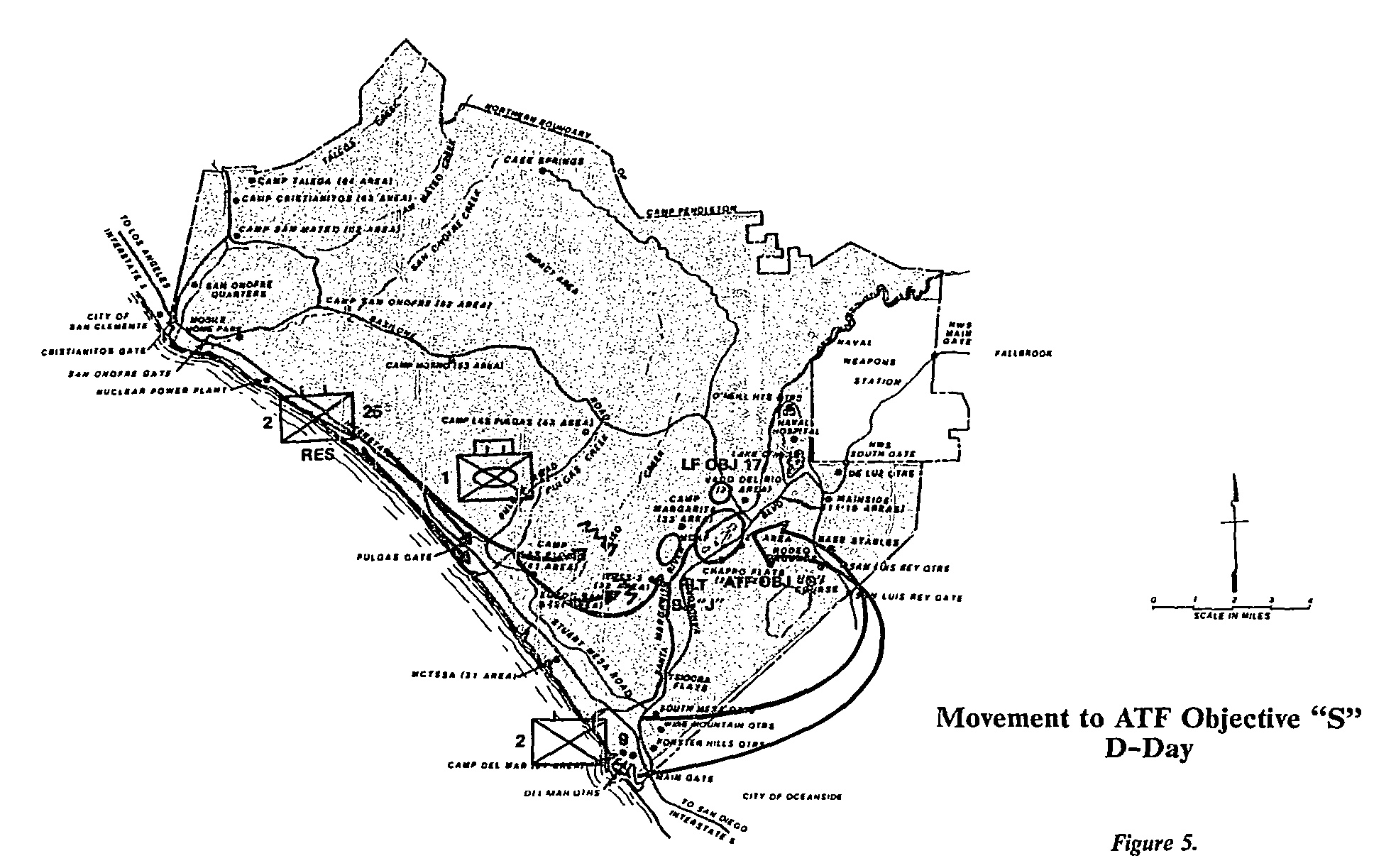
H-Hour, D-Day. The first wave of AAVs churned ashore at 0100 carrying assault elements of 1/5. Within five minutes it was joined by a second, similar wave. By H+40, 17 tanks along with Beachmaster and Landing Force Shore Party teams had landed. Self-propelled artillery would follow on the first turnaround landing craft. Quickly, a rifle company in AAVs attacked southeasterly along the narrow beach toward Red Beach. A tank-mech team reached the high ground overlooking Gold Beach via the little known, unimproved road, passed through 2/25’s perimeter, and attacked on a parallel axis above the company in AAVs. A third tank-mech team with LAVs leading the way began a deliberate attack toward initial inland objectives to the south (Figure 5). With tactics similar to those used in the landing, it probed several routes, seeking the path of least enemy resistance to RLT Objective “J” that dominated ATF Objective “S”-the Camp Pendleton Air Station. From Objective “J” it could support a daylight helicopterborne assault by 2/9 to seize the air station.

Continued pressure kept the defenders from recovering from their initial surprise. Facing a twopronged armored-mech attack on their flank and rear. Orange forces withdrew from Red Beach after only light resistance. Quickly, Beachmaster and Landing Force Shore Party teams closed Gold Beach and shifted south to unload the remainder of 5th MEB at the more suitable Red Beach.

As reconnaissance teams had warned, lead mech elements met stiff resistance in the canyons that were the most likely avenues of approach inland. But Orange forces could not be everywhere. Other 1/5 assault elements soon found undefended routes to RLT Objective “J” dominating the airfield. By the end of D-day, 24 hours ahead of schedule, a helicopterborne assault by 2/9 had seized the ATF objective.

With one significant change and several miner variations, RLT-5 continued to base its tactical decisions on actual intelligence for the remaining six days of the free-play exercise. The major change was in the focus of the intelligence gathering effort. Rather than seeking holes in Orange defenses. reconnaissance elements sought to fix Orange forces so that they could be destroyed by air, artillery, or direct attack. The reinforced LAV company was particularly effective in that role. Working in general support of the RLT, it ranged far forward of the front lines to provide intelligence and bring fire on the enemy. Maneuvering at night with the aid of TOW thermal sights, LAVs completely disrupted the Orange commander’s plan to mass his armor for a major strike against the beach support area. The marriage of LAVs, TOWs, engineers, and fire support teams yielded far greater capabilities than anyone imagined.

Conclusions

Experiences from KERNEL BLITZ 88-1 will not end the debate over amphibious assault tactics. They did not prove the superiority of indirect tactics over the time-honored direct approach, but they did confirm four important points:

* Complex, flexible amphibious assault plans are manageable by both the Navy and the landing force.

* Tactical surprise can be achieved, even in unlikely circumstances.

* Reconnaissance is critical; coordinated collection planning and improved, interoperable communications are a must.

* LAVs, adequately reinforced, add a powerful new dimension to the landing force.

These “lessons” give confidence and direction as we look toward the future for amphibious operations.

Ideas for Changing Doctrine

by Col Michael D. Wyly

Marine Corps tactical and operational doctrine is aged beyond relevance to modem war. It would be difficult to show that the Fleet Marine Force Manuals (FMFMs) on the Marine division through squad ever were of value in combat They say little of tactics. Beyond defining terms, describing control measures, and establishing some procedures that are as likely to bring about defeat as victory, they serve little purpose. We need to change. Quantico has been restructured. Now is the time for the revolutionary change we need.

Existing FMFMs are categorized by unit size; that is, there is a book called FMFM 6-1 for the division, another, FMFM 6-2, for the regiment, another for the battalion, and so on. Within each book, one finds subdivisions generally running along the lines of offensive, defensive, and amphibious operations, none of which is particularly meaningful.

First of all, it is needless to publish a separate book for each echelon of command. After all, the battalion will not abide by one tactical concept while its parent regiment employs another. Needless structure is appended to our tactics the moment we say that only battalion and higher normally employ the mobile defense, that only companies and higher normally hold out reserves, or that any tactical employment is to be exercised at one echelon but not another. It is the situation and not the size of the friendly unit or the seniority of its commander that dictates what is best to do in combat The notion that there are “normally” correct solutions to problems in combat is misleading. Perhaps it was the expectation of “normal” conditions that led to our loss in Beirut in 1983.

Under the present set of doctrinal manuals, it is particularly awkward to change any of our FMFMs. If the officer responsible for FMFM 6-3, The Marine Infantry Battalion, makes any change at all, we then have the ridiculous situation of having one doctrine for battalion and possibly a conflicting one for the regiment. The ensuing difficulty in making changes has been one of the factors that has kept Marine doctrine out of date. Rather than complete the slow, painful process of change, we have remained static.

The categorization by ground unit has become less relevant, also, because we train more and more as Marine airground task forces (MAGTFs), and plan to fight that way. Our FMFMs should be made relevant to MAGTFs, not regiments and battalions. Basic FMFMs on warfighting should be equally relevant to infantry, aviation, engineers, artillery, and tanks.

The separate sections on amphibious operations included in each manual can be traced to the same era when the junior School became Amphibious Warfare School and when Marine expeditionary forces were changed to Marine amphibious forces. The Marine Corps felt compelled to justify its existence in the late 1960s and early 1970s and clung to amphibious warfare as its raison d’etre. This was a mistake borne of ignorance. Had we not been so willing to compromise sound military thinking in deference to politics we might have realized that amphibious warfare is not a specialty separated from tactical and operational concepts, ashore or afloat.

Defensive and offensive tactics cannot neatly be separated one from another. In fast-moving combat, a commander may employ a combination of both simultaneously. Whether a force is on the offensive or defensive is not always readily identifiable, unless the tactics employed are rigid and set piece.

First of all, we must scrap FMFMs 6-1 through 6-5. No book should be heeded to tell a Marine how to fight the various elements of the division, the regiment, the battalion, etc. To say how is to provide too much structure. Let the tables of organization define unit structure. If a commander cannot decide what to do with the units given him, he should be relieved and sent back to study tactics. One who knows about tactics can make such determinations without being told how.

Modem Marine Corps doctrine should center around a single manual to set forth how we fight Capt R. Scott Moore’s “Bridging the Doctrinal Gap” (MCG, Apr88, p. 47) provides an excellent basis. Hypothetically, suppose we publish our basic doctrinal philosophy in a new FMFM 6-0, entitled Marine Combat Principles. I would suggest three additional manuals, divided according to the levels of war that have proved useful for conceptualization and study: strategy, the operational art, and tactics. I would entitle the manuals: FMFM 6-1, Strategic Concepts for Employment of Marines; FMFM 6-2, Operational Level Doctrine for MAGTFs; and FMFM 6-3, Marine Tactics. Each should be read by all Marine leaders from the division down to the squad. We are, after all, one Corps, and we should all speak the same language.

FMFM 6-0, Marine Combat Principles, could follow along the lines suggested in Capt Moore’s article mentioned above; that is, the universal principles that should govern all Marine operations would be set down as the Marine Corps’ doctrinal “battlefield philosophy” or “approach to combat” (quotations from Capt Moore). Capt Moore’s principles-“know the commander’s intent, focus on the enemy, create a dilemma, maximize combined arms, and be unpredictable”-serve as an excellent starting point Rather than “maximize combined arms,” I would have been inclined to say “integrate combined arms for maximum effect” in order to reject the notion that more is necessarily better. History’s great combined arms practitioners-Genghis Khan, Gustavus Adolphus, and Heinz Guderian-seemed to be intent on integrating the various arms into a single team more than maximizing their use. Capt Moore clearly understands this, as he states, “Fire support . . . is an integral component that can be maneuvered as readily as a tank.”

FMFM 6-1, Strategic Concepts for Employment of Marines would be but a brief pamphlet Marines are not expected to make strategy. But they must understand it Without the context in which battles are being fought, it is easy to lose direction, to employ tactics that are overly destructive or not destructive enough, or to choose the wrong battles. FMFM 6-1 would simply examine the ways in which the Joint Chiefs of Staff would be likely to employ Marines. I would suggest subsections on topics such as deep intervention aimed at destruction of enemy forces, amphibious turning movements (for example, Inchon), amphibious landings in support of major ground campaigns (such as Patton employed in conjunction with his drive along Sicily to Messina), seizure of ports and shorelines, seizure of airfields, counterguerrilla operations, and counterterrorisna. Some general guides might also be included, such as the wisdom of designating a strategic main effort and strategic reserve. Also, strategic objective ought to be defined and discussed.

FMFM 6-2, Operational Level Doctrine for MAGTFs, would be much more detailed. It should be worthy of study by all officers, including very senior ones. Topics treated in depth would include the subject of maneuver itself, not only defining the term but explaining it, using examples from actual campaigns. Other topics would include speed and its advantages; attrition and its minor usefulness within a maneuver scheme and its futility in most cases; the operational offensive compared to the operational defensive and how the two can merge into the defensive-offensive; the role of battles and consideration when to engage and when not to; operational reconnaissance; and the operational reserve and the main effort at the operational level.

FMFM 6-3, Tactics for Marines, would be the most detailed and should be read and studied by all Marines, most importantly, junior officers and noncommissioned officers. But senior officers would have to understand it Though they would be less likely to employ forces at the tactical level, they must understand the tremendous latitude junior leaders need to fight modern war. The starting point for this manual would, of course, be mission order tactics, for it is upon this concept that all tactics in maneuver warfare are based. More important than whether tactical deployments can be diagrammed to look like the sketch of the envelopment, the frontal assault, or the penetration-or for that matter, one of the defensive postures-is that the lowest level commander act against the ‘enemy in the best way possible without waiting for orders. Essential also is that the subordinate’s initiatives fit within his commander’s intent. Once that is clearly explained, the tactics manual would discuss such topics as the infiltration attack, fluidity in the defense, the tactical defensive-offensive, the merits and demerits of getting into the enemy’s rear versus going against his front, and strength against weakness (“soft-spot tactics”). “Objective” would be defined at the tactical level and numerous examples of possible objectives drawn from real battles would be cited. Tactical reconnaissance, the tactical reserve, and the main effort at the tactical level would all be described in depth.

A section must be devoted to the subject of fire suppression. What do artillery and air do to the enemy? What have they done in history? I did not understand this when I went to Vietnam. I found out. I later discovered the lessons had been learned back in 1915 when I came home and studied military history. Why had the Marine Corps not taught me? It should have. But little mind was paid to history at Quantico in the 1960s.

A final section of Tactics for Marines, perhaps an appendix, might define and standardize a few control measures. But these must never be central to the study of tactics. It is high time that we allowed thinking about how to undo the enemy to replace our focus on how to control our own forces. Control is not our main problem. Commander’s intent is replacing control as a concept. The uncontrolled subordinate commander, acting within his commander’s intent, as did Nelson at Cape St. Vincent and Copenhagen, and Patton in relieving Bastogne, is of far greater value than the commander closely controlled or restrained. Wars are hardly won through restraint Control, then, seems an unfortunate fixation. Most of our doctrine on control measures would be better scrapped than perpetuated. Only by eradicating the old baggage will we get the clean slate we need to revolutionize doctrine.

So much of future warfare seems bound somehow to guerrillas and terrorists, so much so that psychological operations will be important for the rest of our lifetimes. They must be dealt with in our new FMFMs.

None of these new manuals would have a separate section entitled “maneuver warfare.” Nothing could be less appropriate. All our doctrine will be maneuver warfare. The term maneuver warfare, after all, has merely been a substitute for modern war, or faster moving tactics, or relevant tactics. It has been a name for the new, a way of saying it is time for change. The atomic bomb, after all, did not make the study of the art of war obsolete. Thinkers in the Pentagon in the 1950s thought that it did but now we know better. Korea and Vietnam proved that. We now must learn from those less-than-victories and move on, as professional armies always must

Our manuals must be readable. They must be more than listings of “principles” that have bored students for years. For tactics, operations, and strategy are the heart of our profession. Whether you are a logistician, an engineer, an aviator, an artilleryman, an infantryman, or a tanker, we are in business for one purpose: to win war. So war is what we all must understand. Our various specialties should follow an understanding of war. It cannot work the other way around.

Operational Handbook 6-1, Ground Combat Operations

reviewed by Col Michael D. Wyly

Operational Handbook 6–1, Ground Combat Operations The Marine Corps recently published a new draft manual describing tactical ground combat. In this article, our reviewer assesses its strengths and weaknesses and suggests some changes to make it a better Fleet Marine Force Manual.

Quantico’s new Operational Handbook 6–1, Ground Combat Operations, is at the same time both encouraging and discouraging. Encouraging because it gives long-awaited official sanction to concepts of modern war; discouraging because many old ways of thinking that we need sorely to expunge seem bound to continue to haunt us.

That OH 6–1 was done by committee is evident In reading it, one hears the voices of many authors, the disjointed fragments of disparate thinking on tactics that have influenced the Marine Corps for the past 20 years. A three-page section in the first chapter is entitled “Maneuver Warfare.” The term itself is explained in as succinct a definition as I have read. “The essence of maneuver warfare,” it begins, “can be reduced to the following commonsense considerations.” From there flows beautifully in 10 short paragraphs a description of the art of war that should be read and reread by everyone.

Though the book purports to champion modern concepts of decentralized command and individual initiative, top-down centralized control and insistence on blind obedience are not so easily expunged. They have lurked in our thinking for many years since the thin red line and the Brown Bess musket went obsolete, and they may be depended upon to die hard. “All policies, decisions, plans, and orders are authorized or approved by the commander before being effected” says a paragraph headed “The Staff.” Then, as if to further ensure that subordinates are held back from acting on their own, it says, “The commander deals directly with his subordinates never allowing his staff to usurp his personal relationship.” What does this mean? Does it mean that the staff should be impersonal and the commander personal? And if this is to be, how is the staff to help accomplish the work of the commander when the commander is away? Impersonally? This seems to be built-in rigidity. The chapter on amphibious operations produces similar confusion. The commander is admonished to “not subject his forces to defeat in detail by procrastinating in the reestablishment of centralized control.” In a manual that started out championing low-level initiative, the contradiction here is almost appalling. I was disappointed that there was no treatment of the landing point assault; that is, maneuver warfare’s infiltration tactic carried over into amphibious warfare.

Why every publication on tactics must list again J.F.C. Fuller’s old principles of war, I do not know. But they reappear in Off 6–1 as another checklist Gen Fuller refuted the list shortly after he finished writing it, but it was air ready too late. Both the British and American armies had already copied it down and made it doctrine. The British have long ago taken Fuller’s advice and stopped requiring their soldiers to memorize them. I hope that now, instead, our British allies are learning useful theory. Still, Fuller’s list has remained etched in American doctrine for 63 years as if in concrete.

Clausewitz, after publishing a list of principles in 1812, refuted it later, as Fuller would do, and concluded that only two things in war were so essential that they deserved the status of being called principles. These were concentration and speed. They both deserve consideration by all of us-ground, air, and combat service support. And the sooner we all start thinking alike as warriors and stop being specialists with different sets of principles, the more quickly we will develop into a cohesive fighting force.

Regarding concentration, nearly three full pages are devoted to “the main effort,” which seems to have emerged as the agreed upon anglicization of the German Schwerpunkt, or heavy point that aroused so much anti-German outcry when the maneuverists began using the term in the late 1970s. But what it implies is concentration. It is such an essential concept that so serves to bring together the efforts of air, ground, and combat service support, I was elated to see it at last included in an official publication. The concept is clearly described until an example is postulated. Unfortunately, the example is not well chosen and where it ought to clarify, it confuses. The whole beauty of having a Schwerpunkt or main effort is that you convey to the entire force what you are trying to do and where you are concentrating your efforts. The one brief example does not adequately convey this.

The book’s treatment of speed under the heading “The Battlefield in Terms of Time” is too brief. Napoleon was trying to tell us something when he said “I may lose a battle, but I will never lose a minute.” I think this was more than an offhand comment. Battles are important, but campaigns are more important, and wars even more so. Time must be used to advantage, and Clausewitz, in elevating speed to the status of one of only two principles, was getting at the same thing.

My point is not to be overly critical. That concentration and speed, or the main effort and the battlefield in terms of time, were singled out and treated is unusual, innovative, and a step in the right direction. Also heartening was the attention given to the reserve, psychological operations, and the operational art-all subjects that are important to modern war but that have suffered from intellectual neglect since World War II. Each could and should have been treated in more depth, but at least they were included. Our Soviet counterparts have gained an edge over us in recognizing their importance. They will weigh heavily in the next war.

OH 6–1 must be rewritten so that it is more readable, so it will hold the attention of the serious student of war. In its present form it cannot do that It meanders through too many subjects. The wisdom in it is interspersed among long passages of checklists and meaningless idle rhetoric. For instance, idle statements, unresearched and unattributed, such as “military history has generally favored the superior force,” leave one asking, “What military history? What about Cannae and Colenso and Soumussalmi, Crete, Golan Heighis, and the 1st Marine Division in Korea?” These are only a few of the many victories by small forces over big forces. The serious student is left frustrated, cold. He goes on to better things.

But there are also gems in OH 6–1. Most are attributed to Gen A. A. Vandegrift. Why he should be the one military thinker drawn upon to any large degree is of question. But how effective are his quotations! The reader can think, “Aha! I know who he was. He said that and in context of what he did, the battles he fought, the campaigns he won, it makes sense. I understand.” “Positions are seldom lost because they have been destroyed,” says Vandegrift in Chapter 1, “but almost invariably because the leader has decided in his own mind that the position cannot be held.” And, “Offensive tactics, briefly summarized, may be stated as follows: Hold the attention of your enemy with a minimum force, then quickly strike him suddenly hard on his flank or rear with every weapon you have . . . .” There is concentration and speed!

On the defense, the book is less eloquent. The quotes from Vandegrift do not appear (though many are available). I got the feeling the authors did not understand the defense as a means of destroying the enemy. The reverse slope is treated still as a second-best altenative, though modern experience has shown it to be otherwise. The collective authors, whose combat experience and research sources are unknown to us, say through the veil of anonymity, “Commanders [in the defense] at every level must seek every opportunity to take offensive action in order to wrest the initiative from the attacking enemy and shift to the offensive.” The words are hollow. The authors see no value in the defensive at all. They counsel to shift to the offensive. They presume that in taking up the defensive we have ceded the initiative to the enemy. Not so, I say, if we have selected our defensive position craftily and forced our enemy’s hand, making him come to us to take back what is dear to him, luring him to cast away his resources in a vain attempt to regain it. I appreciate that the defense has its limitations, but if we are going to teach it, let’s teach it at its best.

But like so much of the book, it is as if someone made a long list of topics to cover and tried to cover all of them whether he had anything significant to say about them or not. Some of the topics I have singled out need more research and need to be rewritten in much greater depth. The others can be eliminated. What we have in OH 6–1 is a useful rough draft.

What we still need is a book on the art of war for Marines. The Army’s FM 100-5, Operations, remains the best example of the decade. It identifies its sources, which are invariably real battles. In this way, it uses and applies history. The Marine counterpart would be unique, designed to fight the Marine air-ground task force (MAGTF). We need a book that recognizes that the MAGTF is not three forces-ground, air, and combat service support-but one force with may facets, all directed toward the same end, undoing the enemy. OH 6–1, our rough draft, gives an uneven view of the ground side with a bit of combat service support thrown in. Much work remains.

The Next Agenda: Military Reform

By William S. Lind

Last month, we took a look at what military reform means for the Marine Corps in five areas: concepts and doctrine, equipment, personnel, training, and organization. In each area, we gave some examples of problems and some possible solutions.

Throughout that discussion a major question was left untouched. Why have these problems arisen? Deficient doctrine, unrealistic training, personnel policy that generates tremendous turbulence-such problems do not arise from nothing. They have roots and causes. Unless we can discern those roots and causes and move to change them, we have little hope of fixing the superstructure problems that grow from them. Military reform demands we get at the disease, not just the symptoms.

Reformers answer the “why” question on two levels. The first is the institutional level. Four institutions bear major responsibility for the problems we see in the superstructure: the officer corps, the research and development (R&D) and procurement processes, the Joint Chiefs of Staff and the Office of the Secretary of Defense, and the Congress.

There is relatively little the Marine Corps can do to correct deficiencies in the latter three institutions. Because of the Constitutional separation of powers, only Congress can reform Congress. The Marine Corps has relatively little influence over the way the Office of the Secretary of Defense (OSD) conducts its business, and only slightly more on the Joint Chiefs of Staff (JCS). Few R&D or procurement programs are solely or even primarily Manne Corps programs.

But even in these areas, the Marine Corps can undertake or press for some reforms. For example, one of the main weaknesses of the current R&D process is the absence of thorough, honest operational testing of new weapons. Such testing cannot be “simulated” with computers; it demands shooting weapons at real targets and shooting at them with actual threat weapons. The absence of such testing (or, in some cases, the rigging of the tests to give the developers the positive results they want) is a major reason why we get ineffective weapons like Dragon and Maverick.

What can the Marine Corps do? It can do its own realistic and honest operational testing of any weapon it is considering procuring. If the weapon does not pass the test, the Corps can refuse to buy it.

Again, while the Marine Corps can undertake some reforms that touch on such larger institutions as the R&D process, its influence over them is limited. But there is another institution it can do a great deal to reform: the Marine officer corps. From the military reform perspective, three officer corps problems are of central importance: careerism, bureaucracy, and military incompetence.

Careerism is a deadly danger to any military organization. If an officer corps comes to think primarily about promotion, the country it serves and the men it leads are both in serious trouble.

If a military organization is to be effective in combat, it needs officers whose first thought is service, not self. They must see their work as a calling, not a job. They must prize such qualities as strength of character because without it they will not be able to make the swift, bold decisions combat demands. They must have moral as well as physical courage: willingness to tell superiors they are wrong, to be honest bearers of bad news, to take and assign responsibility, and to give subordinates room for initiative, accepting the errors and failures this sometimes brings. They must have the courage to be leaders of change when change is required and to put the long-term good of the country and the Marine Corps above the short-term interests of their particular specialty, project, or shop. They must also be men of imagination and creativity, because combat is an art.

Careerism fatally undermines these necessary qualities. It nourishes instead the yes-man, the office politician, the “milicrat,” and the courtier. It rewards those whose main concern is “looking good,” rather than being good. It favors those who are masters of detail rather than men of vision, those who excel in “keeping all the rice bowls filled” rather than leaders of change.

Today, the rot of careerism has spread widely in the Marine Corps. Why has this happened? A major cause goes beyond the Corps itself: it is the up-or-out promotion system. Up-or-out virtually compels officers to worry about their careers because unless they are promoted, they must leave the Service. A company commander or fighter pilot cannot choose to remain a captain through his time in Service, as he can in most foreign militaries. He must get himself promoted or leave. Up-or-out thus institutionalizes careerism.

On its own, the Marine Corps cannot eliminate the up-or-out system. But civilian military reformers are advocating its elimination, and the Marine Corps could join in that advocacy. Doing so would considerably enhance the chances of getting Congress to look seriously at the problem.

However, up-or-out is not the sole reason careerism has spread so widely in the Marine Corps. Up-or-out has been with us for more than 40 years, yet many Marines can remember when the Corps was much less afflicted with careerism than it is today. Careerism has grown and spread in part because many Marines accept and even admire it. They believe it is necessary, legitimate, and “smart.” With such acceptance, careerism is bound to flourish.

Marines can change this. They can change their own attitudes toward careerism in themselves and in others. They can make it unacceptable, through peer pressure, for Marines to put their own careers above their duties, or at least to do so openly. In this sense, the key to reducing careerism is changing the way Marines think about it.

A second major problem in the officer corps is bureaucracy. It is evident everywhere: in grossly overstaffed headquarters, in demands for volumes of reports, in developing battle plans by committee, in the rapid turnover of command billets as officers fight for one of the few real jobs, and in the way decisions are driven to ever-higher levels, leaving the junior commander with little scope for initiative.

What causes this officer bureaucracy? The officer surplus. Above the company grades, there are far more officers than there are real jobs for them-jobs that actually need to be done. For example, the Marine Corps has 356 command positions for lieutenant colonels, but more than 1,600 people in that rank. It has only 3 divisions and 3 wings, but more than 70 generals.

What do the surplus officers do? They generate paper, they demand paper, they make decisions (or fail to) by committee, they create vast numbers of makework jobs; in short, they produce bureaucracy, in large quantities.

The only solution to the problem of officer-generated bureaucracy is to reduce drastically-by at least 50 percent-the number of officers above the company grades. While this policy should be DOD-wide, the Marine Corps can take the initiative. Congress has already directed some very small reductions in the size of the officer corps. It would probably respond favorably to a request from the Marine Corps that it be allowed to go further.

A third officer corps problem is military incompetence. The Marine Corps, with our other Armed Services, has too many officers who are good managers, know process and methods, administrate well, are physically courageous and well-intentioned, and know little or nothing about the art of war. They lack a central ability of the soldier: the ability to think through a military situation, to practice the tactical and operational arts. Such a person, whatever his merits in other respects, is militarily incompetent.

One specific element of military incompetence must be noted because it is both a part and a cause of that incompetence. Many Marine officers are professionally illiterate. They are familiar with neither the classical nor the current literature on war. Many do not even read the Gazette. Few are familiar with the guiding ideas of their profession. For example, modern maneuver warfare is 70 years old; it was fully developed in the German army by 1918. But it is new to many Marines. Why? Because they read little or no military history.

You would not go to a lawyer who never read law, nor to a doctor who did not study medicine. But we expect Americans to entrust their sons to officers who have not studied war.

Many Marines will undoubtedly be offended and angry that the issue of military incompetence is even raised. But officers have a responsibility to look beyond their personal emotions. The issue is too important to pass by, however unpleasant it may be. The price of military incompetence can be high. Or is Beirut already forgotten?

Why has military incompetence become a major problem? A large part of the answer is deficiencies in Marine military education. Two deficiences are of particular importance. First, the Marine Corps’ education system does not impress the importance of reading and ideas on Marine officers. It does not inculcate the habit of self-study, of the constant reading and thinking about the art of war that has characterized most great soldiers. It does not impart to Marines the understanding that you must know the guiding ideas of your field if you are to be a professional. It does not include, in the Marine officer’s self-image, the picture of the thinker.

This is primarily the fault of Officers Candidate School (OCS) and The Basic School (TBS). These are the schools that give a Marine officer his basic self-image, the picture of what it means to be a Marine. From the beginning, that must include the mental and intellectual aspects of officership. Currently, it does not.

The second deficiency is mainly the responsibility of Amphibious Warfare School (AWS) and Command and Staff College (C&SC). Both schools teach methodical battle. As noted in Part I of this article, methodical battle is the opposite of maneuver warfare, and it was the central French error that led to disaster in 1940. Nevertheless, it is what both schools teach. They teach it because most of the instruction is in what to do and what to think, not how to think. It is form, formats, processes, and terminology. The guiding rule is, “Don’t worry about the tactics, just get the format right.” It produces graduates who will prepare perfectly formatted bad orders, who in combat will focus not on the situation and the enemy, but on what they were taught on their own methods and processes. It is the French all over again, and it will again result in defeat.

What reforms are necessary to deal with these deficiencies and graduate militarily competent officers? A few important ones include:

* From the first day of both OCS and TBS, students must be taught that Marines read and think. Upon acceptance to OCS, the student should receive a book he must read before he comes-not Clausewitz, but perhaps The Forgotten Soldier* The goal should not be just to read a certain number of books, but to ingrain the habit of serf-study. The graduate should leave knowing that he will read, talk, listen, and think about the art of war on a regular basis for the rest of his days as a Marine officer.

* Equally from the first day, OCS and TBS should balance techniques and tactics. Currently, virtually the whole emphasis is on techniques. Instead, techniques must be taught with tactics, with the creative, imaginative side of the profession. That means encouraging initiative, risk-taking, and thinking for yourself; critiquing reasoning more than solutions; using mission-type orders with the students; and making some training free play. Unless these schools give lieutenants a taste of the chaos and confusion of combat, of the need and way to make decisions on their own in the fog and friction of war, they have not done their jobs.

* Most of the current curriculums at AWS and C&SC should be made self-study through correspondence courses. Students should have to pass entrance exams to get into the schools, and the exams would cover the self-study material. This would ensure they have the necessary terminology, procedural knowledge, etc

The schools themselves should be modeled on the School of Advanced Military Studies at Fort Leavenworth, KS.** As at that school, the focus should be war games, study of past campaigns, and current campaign planning, all in small group discussions, not lectures. The goal should be to teach the student how to think militarily, how to be a competent commander or operations officer. At AWS, the focus should be tactics; at C&SC, the operational level.

This cannot be done just by changing the formal curriculums and lesson plans. It requires major changes in faculty. Real faculties have deep expertise in the areas they teach. To obtain that, a faculty member’s first year at Quantico should be spent learning his field, under the tutoring of a small, permanent faculty of world-class people. To attract the highest quality officers as faculty, a faculty tour should be well rewarded. For example, a successful tour on the C&SC faculty should be the normal route to a regimental command.

Sound military education will not guarantee military excellence. It also requires careful selection of commanders and operations officers, personnel stability, plenty of training time, and many other changes. But without high quality education, excellence is unlikely and incompetence will continue to be a major problem.

We can see how each of these institutional problems relate to the superstructure problems discussed in Part I last month. If the R&D process does not include realistic, honest operational tests, we are likely to receive equipment that works poorly in combat. If military education is weak, problems in doctrine and concepts will not be noticed. If careerism is rampant, problems that are noticed will be swept under the rug because admitting them will make someone look bad.

But we are still left with a question of why? Why have these institutional problems developed? Why have we failed to tackle problems like careerism-a problem many Marines have long recognized?

These questions bring us to the third and final level of military reform: institutional culture. Over the past few years, many American companies have become interested in the subject of institutional culture because they have seen it is at the root of why they no longer compete effectively. Books such as In Search of Excellence* are really books about institutional culture.

What is institutional culture? It is the attitudes of the people within the organization toward each other and their jobs; its informal rules of behavior; its corporate style and etiquette (e.g., in some organizations, it is “improper” to tell a superior he is wrong); its morals and values-the ones it actually practices, not just what the leadership may preach; its systems of rewards and punishments, and what someone is rewarded or punished for; its guiding ideas, principles, and goals. It is an organization’s slice of the Nation’s culture, and like that larger culture, it is what guides how people live, think, and behave.

Traditionally, institutional culture has been the Marine Corps’ greatest strength. The Corps has had what is known as a “corporative” culture. In a corporative organization, every member shares the institution’s overall goals and purposes and makes them his personal goals and values. He works, not just in his job, but beyond his job to advance those goals and values every way he can. In the Corps, this has meant every Marine is a Marine 24 hours a day, 7 days a week. He is a Marine, not a logistician, or an infantryman, or an aviator. He lives being a Marine.

Why is this important? In any organization, there is always pressure to do what is comfortable internally rather than what is competitive externally. There is pressure to serve a particular branch or program or superior rather than the needs and goals of the larger organization. Often this pressure is felt in terms of threats to promotion. It is dangerous pressure because if enough people yield to it, the organization ceases to be competitive in the outside world. If it is a military Service, it loses its ability to fight and win.

The corporative ethic fights this dangerous pressure. At every level, when something is proposed that will “look good” but that won’t work in the outside world, people object. The organization’s leadership, when it is doing its duty, rewards those people and sustains their objections.

This has been the Marine tradition, and it still is with many Marines, especially junior officers. But it is an endangered tradition. The opposite organizational model, the “bureaucratic” model, has been spreading within the Marine Corps.

In the bureaucratic model, the individual focuses not on the organization’s overall goals and purposes but only on his particular job. The job is defined narrowly and rigidly, and the individual is forbidden to look beyond it. The twin mottos of bureaucracy are, “That’s not your job” and “That’s not my job.” The bureaucracy rewards with promotion those who look good, those who put the comfort of their specialty, unit, or superior above the needs of the organization as a whole, especially its need to produce a competitive product.

The bureaucratic model has become common in America. It is one reason why we no longer compete effectively in many fields. It is easy to see how it undermines combat effectiveness in a military Service. Problems such as poor military education, a personnel system that generates turbulence, equipment and training needs that are not met, and the like cannot be identified much less addressed. Doing so would upset rice bowls, make superiors angry, and make important people “look bad.” So the problems fester and grow, and when war comes, the Service and the Nation pay the price in unnecessary casualties and sometimes in defeat.

Bureaucracy is especially dangerous to a military Service. Combat is dominated by uncertainty and rapid change. How do bureaucrats deal with uncertainty and change? Very poorly. They want everything centralized, clear cut, and under their own rigid control. They hate change because it upsets all the comfortable little arrangements they have made inside the Service. Quite simply, there is an inherent and unbridgeable contradiction between bureaucracy and military effectiveness. A bureaucratic Service cannot be highly effective in combat.

Much of the Marine Corps continues to resist the expansion of the bureaucracy. From the battalion down, the Corps is still largely a corporative institution. Some recent changes, such as the formation of a Marine Air-Ground Task Force (MAGTF) Warfightmg Center at Quantico, are designed to fight bureaucratization. But at higher levels, the growth of bureaucracy is all too obvious, much of it driven by the officer surplus and careerism. Unless its spread is stopped and reversed, it will eventually swallow the whole Corps. When that happens, the real Marine Corps will be gone. Only a facade will be left, a facade that will quickly shatter in war.

The growth of bureaucracy is, from the military reform standpoint, the Marine Corps’ single most serious problem. However, it is not the only problem in the Corps’ institutional culture. Anti-intellectualism is a cultural problem. So is the increasing number of “Yummies”-Yuppie Marine officers-in the junior ranks. Like his civilian counterpart, the Yummie’s values are “You are what you own and what you look like” and “I’m out to get mine.” Marines can and should identify additional problems in the institutional culture because cultural problems are the deepest, most serious, and most difficult problems. They are also usually the most deadly.

You now have at least an outline of what military reform means for the Marine Corps. Clearly, it offers a major challenge. However, it is not a call for revolution, but rather for restoration. The Old Corps, the Marine Corps of the interwar years, was very much like the future Marine Corps military reformers envision. It was a strongly corporative institution; it had a lively intellectual interest in the art of war, evidenced by its development of amphibious doctrine; it was innovative, experimental, and focused on the goal of winning in combat. Naturally, it was different in many specifics. But would the Marines who developed amphibious doctrine not have been quick to seize on ideas such as maneuver warfare and the operational art?

The spirit of the Old Corps is the spirit of the Marines who today are leading the fight for military reform.

Notes

* By Guy Sajer (Harper & Row. Inc.. 1971) Republished by Sphere Books, Ltd , 1977, with reprints through 1987

** See article by Col Michael D. Wyly m MCG, Apr88

* By Thomas J. Peters and Robert H. Waterman, Jr., (Harper & Row, 1982) Reprinted by Wamer Books in 1984 (paperback).

The Next Agenda: Military Reform

By William S. Lind

The most serious gap between capabilities and practices may be the way so little of a Marine’s time and effort go to things related to winning in combat.

Over the last 10 years, the Marine Corps has been engaged in a major debate over maneuver warfare. That debate has been useful and productive, but maneuver warfare is just part of the challenge facing the Marine Corps. While correct doctrine is necessary for winning in combat, doctrine alone does not make a military Service combat effective.

As the pages of the Gazette and the experiences of most Marines attest, there are gaps in many different areas between the Corps’ capabilities and practices and what is needed for winning in combat. Such gaps are evident in training, in weapons, in unit cohesion, and in officer education. Perhaps the most serious is simply the way so little of a Marine’s daily time and effort go to things related to winning in combat. Addressing and closing these gaps-the gap between “looking good” in peacetime and winning in time of war-must be the Marine Corps’ next agenda. It is the agenda of military reform.

Military reform is an effort to bring our defense policies and practices at every level, from the infantry squad through the Pentagon and the Congress, into line with what is important for winning in combat. The focus of military reform is not efficiency, but effectiveness: effectiveness on the field of battle. As the briefing of the Congressional Military Reform Caucus states, “We have two simple goals. First, we want military forces that can win when called upon. Second, we want the support of the American people for such forces, not just for one or two years, but for the long haul.”

Military reform relates to all four Services, to the Pentagon and the Joint Chiefs of Staff, to the Office of the Secretary of Defense, and to the Congress. The military reformers have produced an extensive literature detailing problems and potential solutions in each of these areas.

What agenda does military reform offer the Marine Corps? Military reform looks at the Corps on three levels. The first is the superstructure: concepts and doctrine, equipment, personnel, training, and organization. These areas are part of the superstructure not because they are unimportant-each is very important-but because problems in each of them generally derive from deeper, often unseen roots. Part I of this article will examine the Corps’ superstructure. In Part II, we will look at some causes on two additional levels: institutions and institutional culture.

A single article cannot look at all the problems in the superstructure. It can only touch on some representative samples. In each area, Marines are encouraged to identify further problems and possible solutions.

Concepts and Doctrine

Important conceptual and doctrinal challenges facing the Marine Corps include:

* Learning how to do maneuver warfare. Many Marines are familiar with at least some of the basic concepts of maneuver warfare, such as missiontype orders, focus of effort, and throwing strength against weakness. But there is a great difference between having an academic understanding of maneuver warfare and actually being able to do it in combat. The first is necessary for the second, but it is by no means sufficient. Learning how to apply maneuver warfare in combat means major changes in Marine Corps education and training; some of those changes will be discussed later in this article.

* Understanding the operational art. The operational art is the art of using tactical events to strike directly at an enemy’s strategic center of gravity. In that sense, it is the art of the campaign. It is of major importance to Marines because, in many situations, the amphibious campaign is likely to be more important to the Nation than the amphibious assault. The Marine Corps needs to incorporate the operational art into its doctrine, educate at least a cadre of commanders and staff officers in its practice, and attempt it in major war games and command post exercises.

* Adopting true light infantry tactics. Although Marines call themselves light infantry, by historical and world standards they are line infantry. Line infantry tactics derive from French tactics in World War I; true light infantry tactics are descended from the German tactics of 1917-1918.

Adopting light infantry tactics implies major changes from current tactics. The attack is by infiltration; defense controls an area rather than holding a line and relies on ambushes and counterstrokes rather than visible defensive positions. Most fire support is local: machineguns, mortars, and infantry guns (distributed, locally attached artillery). Mobility and high tempo come from high march rates; units must be capable of marching a minimum of 40 kilometers per day on a sustained basis. That, in turn, requires a drastic reduction in the Marine’s load.

In order to adopt true light infantry tactics, Marines need to become familiar with the current literature on the subject, especially Gen Franz UhleWettler’s Battlefield Central Europe- The Danger of Overreliance on Technology by the Armed Forces.* The Corps also needs to begin experimenting with light infantry tactics, perhaps with the formation of a few light infantry training and testing units, and to publish a light infantry tactics operational handbook.

*Avoiding methodical battle. Methodical battle is the opposite of maneuver warfare. It requires its practitioners to focus not on the situation and the enemy but on their own stylized, memorized processes and procedures. In his splendid book on French doctrine between the World Wars, The Seeds of Disaster,** Col Robert Doughty. USA, notes that the fundamental French error was methodical battle. The French learned a “method” of fighting based largely on fire support coordination, and were determined to follow it no matter what the enemy did. Indeed, they were so thoroughly trained in it that they could do nothing else. In 1940, when the Germans drove events at a tempo faster than their method could accommodate, they had no option but collapse and surrender.

When we look at Marine Corps practice today, too often what we see is methodical battle. Thanks largely to the highly methodical combined arms exercise (CAX) at Twentynine Palms and the carefully choreographed Marine Corps combat readiness evaluations, tactics are driven by fire support planning rather than the other way around. Tempo, constrained by detailed orders, by slow-moving fire support coordination techniques, and often by an absence of even the concept of tempo, is very slow. It looks as if the Marine Corps is repeating the French mistake, not so much in its formal doctrine as in the way Marine units actually operate. Methodical battle dominates.

How can the Corps avoid methodical battle? Marines need to understand that combat is dominated by surprise, uncertainty, and rapid change, which no set method can accommodate. Their focus must be outward, on the situation and the enemy, not inward on staff procedures and coordination requirements. They must grasp the idea that tempo is itself a weapon-often the most powerful weapon. Field exercises must avoid the compulsive rigidity and canned solutions of the CAX, instead emphasizing adaptability, improvisation, high, tempo, verbal mission orders, and running mental estimates. Training, like combat itself, must be dominated by the need to deal with a hostile, independent will in an environment of fog and friction.

Equipment

Apart from the aviation wings, the Marine Corps is not heavily equipment oriented, which is good. Overconcern with equipment leads to neglect of leadership, tactics, and realistic training. However, equipment must still be adequate to do the job. In that regard, military reformers inside and outside the Corps question several Marine Corps acquisition programs, including:

* The M198 howitzer. A fine weapon for coastal artillery, the weight and bulk of the M198 make it a questionable artillery piece for an expeditionary force. The Marine Corps seems to realize it made a mistake here, and that it needs a light, modern 105mm howitzer or more heavy mortars or both.

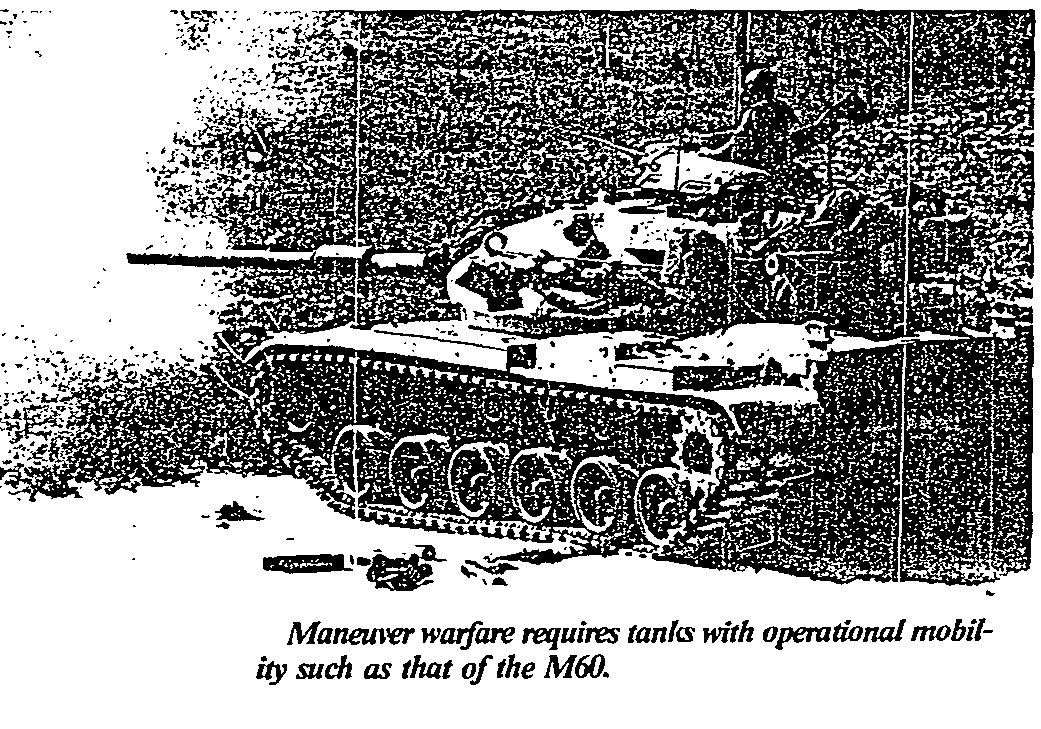
* The M1A1 tank. Maneuver warfare requires tank units with operational, not just tactical, mobility. They must be able to pick up and move 100 kilometers or more into the enemy’s rear when an opportunity appears. With a weight of almost 70 tons, fuel consumption 4 times that of the M60, and dependence on black box maintenance, which is to say, on a secure, well developed line of supply, the M1A1’s operational mobility is poor. With the Israeli modifications-reactive armor, removal of the cupola, extra machineguns, and added protection against fire-the M60 looks like a better as well as a more affordable tank.

There is also a question of whether the Corps, focused as it properly is on Third World conflicts, needs heavy tanks. Should it instead rely on light armored vehicles (LAVs)? The Chadians defeated the Libyans using Toyota pickup trucks and a few French LAVs. The answer to this question is not clear, but it should be thought through carefully before a new tank is purchased.

* The Osprey. The fundamental question about the Osprey goes beyond the specific aircraft. The real issue is whether the helicopter (or tiltrotor) is a viable combat aircraft. In past conflicts, including Vietnam, helicopter losses were high. Even against the minimal opposition encountered on Grenada, we lost about 18 percent of our helicopters. Are we deluding ourselves in thinking we can make helicopter or Osprey assaults without prohibitive casualties? What do modern air defenses and the proliferation of automatic weapons in most armies mean for the survivability of the Osprey? Is the Osprey in effect a bigger, stronger cavalry horse-a system serving a concept whose time has come and gone?

Reformers also raise questions about Marine Corps equipment needs that are not being met. These include:

* A light antitank weapon that works. The Dragon is virtually useless, and the LAAWs small warhead raises serious doubts as to its effectiveness. Without an effective light antitank weapon, Marine infantry and rear areas are seriously at risk. It is difficult to overstate the importance of effective infantry antitank weapons in modern combat, or the disaster that can ensue if the troops come to realize they are defenseless against enemy tanks.

The Marine Corps should make obtaining an effective light antitank weapon one of its top priorities. The AT4 may be such a weapon, but the tests done on it to date are not adequate to know. The Marine Corps should run its own tests on the AT4, firing it at real tanks under combat conditions. If it passes, buy it; if not, start testing other weapons available on the world market.

* A real close air support aircraft. Marine air claims to be specialists in close air support, but the Corps has no suitable close air support aircraft “Fastmovers” do not work well for close air support, because their speed makes it difficult for the pilot to see what is happening on the ground; their guns are too light for effective strafing (which in close support is often more useful than bombing); they have virtually no antiarmor capability (weapons like Maverick simply won’t work under combat conditions); and they are highly vulnerable to automatic weapons fire. The latter point is especially important because, in combat, every soldier shoots at every airplane. Ironically, the Harrier is the most vulnerable aircraft in this respect in the whole U.S. inventory because the fuel is stored around the engine, and it has no self-sealing tanks.

The only real close support aircraft the United States has today is the A-10. That aircraft has some serious deficiencies, but the basic concept is valid: a slow airplane, designed to survive multiple hits from automatic weapons, built around a powerful gun that has a real antiarmor capability. The Marine Corps should join current DOD efforts to design and procure a follow-on to the A-10 that preserves those characteristics while fixing the A10’s specific faults, namely its overlarge size, sluggishness, and high price. Until the Corps acquires such an aircraft, its rhetoric about close air support will be just that: empty words.

* Heavier reliance on off-the-shelf systems. The Marine Corps has traditionally been a leader in finding inexpensive systems that enhance combat performance. The current research and development (R&D) process seldom develops such systems, but the civilian market offers many. What Marine does not know he can buy better boots, packs, and other equipment in the civilian market-often at lower prices than we pay for the “approved” items? Similar opportunities exist with radios, dirt bikes, and even weapons. The current procurement process generally avoids off-the-shelf equipment, not because it is inferior, but because it leaves the R&D bureaucracy out of work. The Marine Corps can cut through this bureaucratic game by purchasing off-the-shelf equipment whenever it can do the job.

Personnel

To military reformers, personnel issues are usually the most important issues. Wars are fought by people, not by weapons. Many Marines rightly believe that the Corps’ most serious problems are personnel problems. Examples include:

* Hollow units. Too often, although a unit looks fully manned on paper, it is actually understrength. Up until a couple years ago, troops were FAPed (troops from operational units reassigned to basethe so-called Fleet Augmentation Program) out to the point where, at times, companies went to the field to train with as few as 60 men, platoons with as few as 12. The recently announced policy of filling the Marine Corps from the bottom up-starting with the combat units-is a promising step toward solving this problem. Current reports indicate actual company strength is up to about 130 men, a major improvement.

* Unacceptable levels of personnel turbulence and turnover. Despite the Precise Personnel Assignment System (PREPASS), personnel turbulence continues at a high rate. This makes unit cohesion impossible and severely undermines training. No unit can train to a high standard when it faces a constant influx of new, largely untrained people. This problem can be solved only by fundamental reform of the personnel system so that units remain stable for at least three years (the normal term of enlistment). The Army’s cohort program, as originally conceived, is one possible answer to this crippling problem.

* Commanders with no recent Fleet Marine Force (FMF) experience. Too often, many years pass between company, battalion, and regimental command. The intervening time is filled with paperpushing jobs that have little relevance to combat. By the time an officer gets another command, his leadership and tactical skills are often rusty at best. Then, he has his new command for only about two years-far too short a time to make himself and his unit proficient The overall result is institutionalized amateurism. The root cause is the officer surplus that we will look at in Part II of this article.

Training

Neither equipment nor doctrine mean much unless a unit is well trained. Marines pride themselves on their training, but that pride is open to question. Problems include:

* Too many restrictions on the drill instructors (DIs) in boot camp. The modern battlefield requires a thinking Marine who can take initiative, not automatons, and boot camp should reflect this. Trainees should be faced with challenges that require them to think for themselves. But this does not mean boot camp should not stress trainees. Combat is the most stressful of all human activities, and basic training should expose Marines to heavy stress. Current regulations largely prevent DIs from doing this. A high school football coach can yell and swear at his players and push them around a bit, but a Marine DI cannot do that with his trainees. DIs should not be brutal, but in trying to prevent brutality we have gone too far in the other direction. We have also taken away too much of the DI’s authority and discretion by making officers oversupervise. We need to move back toward traditional Marine boot camp with its heavy stressing of recruits, with the modification that the stress should require trainees to think, make decisions, and show initiative, not just obey.

* Too little time for platoon and company commanders to train their own units. This is an especially severe problem in the 2d Marine Division. Large unit and individual training are both important, but they cannot be substitutes for letting the platoon and company commander take his unit to the field on its own frequently and regularly. If this means allocating additional resources to acquire new training areas or funding company moves to distant training areas, such actions must be taken. At least in the 2d Marine Division, the current situation is intolerable.

*Insufficient skill in techniques. Techniques are those things that are done by formula. They range from using a weapon, through patrolling, to battle drills. Too many Marines do not perform them to a high standard. The new Battle Drill Guide offers a useful tool for improving performance in techniques, and its application throughout the Corps should raise standards significantly. It is important, however, that the correctly rote and formalized training emphasized by the Guide not be allowed to carry over into tactics, which must never be done by formula or method.

* Insufficient tactical training. Tactical training requires free-play exercises, because nothing else duplicates the hostile, independent will of the enemy that characterizes combat. Only free-play training requires commanders at all levels to confront the unexpected and devise schemes for dealing with it, which is what tactics is all about. Tactics is the opposite of techniques in that it is a free, creative activity in which each situation is different. Only free-play exercises allow such creative freedom.

Unfortunately, free-play exercises remain the exception rather than the rule. Even the 2d Marine Division, which pioneered free-play training in the early 1980s, usually sees only one major free-play exercise each year, and that only involves a portion of the division. Free-play training must become standard Marine practice at all levels. It must begin in The Basic School and must be extended to the CAX by adding a second, nonfiring, aggressed free-play segment MCCRESs should also be free-play. A number of reforms along these lines are currently being considered by the Marine Corps, and prospects for them look promising.

* The infrequency of fluid aviation training. Too often, the aviation wings are allowed to play by their own rules, which say they must be given substantial advance notice of when and where air is to be employed. This allows detailed, slow tempo planning and rigid, centralized control. In war, such an approach is unlikely to be effective. If air is to be useful, it must be able to respond quickly to the unexpected. Aviation units must be fluid enough to support a fluid, high tempo situation on the ground.

A similar problem exists in air-to-air training. Too much of it is simple one versus one or two versus two training; too little, the many versus many situation a real conflict may offer. As past combat and some peacetime exercises have shown, there is a qualitative difference in a many versus many situations.

The Corps needs to make major changes in aviation training. The most important is compelling aviation to respond with little notice to the needs of ground commanders, including the need to mass air, not just provide a couple quick passes.

Organization

Three organizational problems in the Marine Corps provide examples of reformers’ concerns:

* The lack of fighters. The Marine Corps obtains only 3 divisions and 3 aviation wings from almost 200,000 men-a low ratio by world standards. As Maj Mark F. Cancian pointed out in previous Gazettes, the proportion of actual fighters within those few divisions is also low. A force that is supposed to be “lean and mean” has become a vast supply train, maintenance depot, and conglomeration of headquarters looking for a few good fighting men.

* Insufficient tactical mobility. Most Marine ground forces are heavy, slow-moving line infantry. They have neither adequate motorization to be mobile in open terrain nor the close terrain mobility true light infantry obtains from its high march rates. In terms of tactical mobility, most Marine units are fortress troops or siege troops.

To fight maneuver warfare Marines must have good tactical mobility. This suggests reorganization into a mix of true light infantry and motorized/ mechanized units from which a “package” suitable to the terrain can be task organized.

* Marine aviation’s organization as a complete miniair force. Despite the close air support rhetoric, Marine aviation includes a strong fighter force, deep interdiction aircraft, and air transports. History shows that once an aviation service becomes a complete air force, it tends to divorce itself from ground support. Its members think of themselves first as flyers, not soldiers. If Marine aviation is truly to focus on supporting the Marine on the ground, it needs to be reorganized to emphasize that role at the expense of air-to-air and deep interdiction capabilities. It also needs to give Marine pilots enough ground combat training and tours with ground units so they continue to think of themselves as Marines first and pilots second.

Again, the above are examples, not a full discussion of all the problems in the Marine Corps’ superstructure. But they are sufficient to illustrate that there are problems, many of them serious, in each of the superstructure areas: concepts and doctrine, equipment, personnel, training, and organization.

What are the solutions? We have suggested a few here, again as examples. But by definition, superstructure problems derive from deeper, often hidden causes. They can only be resolved by identifying those causes and eliminating them. Next month in Part II, we will look at some of the underlying causes.

Note

*This work has been translated by the U.S. Army, but has not been published in the United States. Copies are available for interlibrary loan from Breckinridge Library at Quantico.

**Review by Col Allan R. Miliet, USMCR, in MCG, Oct86.

Maneuvers & Sanctuaries

by Gen Raymond G. Davis

I read with great personal interest the piece by William S. Lind and note with pleasure that his judgment on Marines and maneuver warfare has matured. A few short years back he castigated us unmercifully in The Washington Post.

It now appears that, as we suggested, he educated himself on the facts about our mobility and maneuver in Korea and in Vietnam. The early years in Korea and late in the Vietnam War saw maneuver used as strategic and tactical innovations with unparalleled success. Success, that is, up to the point where political decisions gave sanctuary to enemy forces behind arbitrarily drawn lines.

Once the enemy gained protection in sanctuaries he had all the choices-when and where to attack us. We could only react to push him back. Then when he was hurt he fled back into safe areas.

Rarely could enemy forces be decisively defeated and destroyed because political lines prevented our deep penetration into his rear or on his flanks.

In Vietnam our “high mobility” innovations gained success in trapping enemy outside their safe areas, but only because our small stealth patrols could provide concise information on enemy movements.

Possibly Mr. Lind could “run interference” for the military in efforts to limit the adverse and costly effects of sanctuaries. Documentation of the extreme costs to us in Korea and Vietnam could be most helpful.


by 1stLt John R. Studt

I especially enjoyed reading Mr. Lind’s Misconceptions of Maneuver Warfare. He seems to have addressed many of the most common arguments that are heard concerning “maneuver warfare.” Whether Mr. Lind’s ideas and words will ever be completely accepted by the Marine Corps remains to be seen. But, as a junior officer, I find his articles thought provoking and fascinating. It’s too bad that the Corps doesn’t utilize him more fully.

Maneuvers & Sanctuaries

by Gen Raymond G. Davis

I read with great personal interest the piece by William S. Lind and note with pleasure that his judgment on Marines and maneuver warfare has matured. A few short years back he castigated us unmercifully in The Washington Post.

It now appears that, as we suggested, he educated himself on the facts about our mobility and maneuver in Korea and in Vietnam. The early years in Korea and late in the Vietnam War saw maneuver used as strategic and tactical innovations with unparalleled success. Success, that is, up to the point where political decisions gave sanctuary to enemy forces behind arbitrarily drawn lines.

Once the enemy gained protection in sanctuaries he had all the choices-when and where to attack us. We could only react to push him back. Then when he was hurt he fled back into safe areas.

Rarely could enemy forces be decisively defeated and destroyed because political lines prevented our deep penetration into his rear or on his flanks.

In Vietnam our “high mobility” innovations gained success in trapping enemy outside their safe areas, but only because our small stealth patrols could provide concise information on enemy movements.

Possibly Mr. Lind could “run interference” for the military in efforts to limit the adverse and costly effects of sanctuaries. Documentation of the extreme costs to us in Korea and Vietnam could be most helpful.


by 1stLt John R. Studt

I especially enjoyed reading Mr. Lind’s Misconceptions of Maneuver Warfare. He seems to have addressed many of the most common arguments that are heard concerning “maneuver warfare.” Whether Mr. Lind’s ideas and words will ever be completely accepted by the Marine Corps remains to be seen. But, as a junior officer, I find his articles thought provoking and fascinating. It’s too bad that the Corps doesn’t utilize him more fully.

The Asymmetrical Ace

by Col J.J. Edson, USMC(Ret)

“Thinking About War” by LtGen Philip D. Shutler, USMC(Ret) (MCG, Nov87) is a difficult article, but it can provide those who stick with it new insight into maneuver warfare, operational art, and general military theory. I hope it gets wide attention.

The Guadalcanal Campaign illustrates many of the author’s basic ideas. In 1942, the United States moved to stop the Japanese advance by sending MajGen A.A. Vandegrift’s 1st Marine Division to the Guadalcanal-Tulagi area. On D-day some 11,000 Marines stormed ashore, more than enough to deal with the 2,000 or so Japanese-primarily construction troops-who were in the area building what the Marines would name Henderson Field.

This projection of U.S. power into the Solomons chain confronted the Japanese with a major problem. To be certain of overtaking U.S. forces and continuing their advance, the Japanese needed a troop strength advantage of perhaps three to one. For three and a half months they tried to achieve it, but they never reached that goal. In each of their major ground attacks on the Marine position-Tenaru River, 21 August; Bloody Ridge, 12-14 September; Henderson Field, 23-26 October-they moved too soon with insufficient strength and were turned back in vicious fighting. But the issue was really decided elsewhere by the “shields” that were extended around the Guadalcanal positions. Aircraft, surface ships, and submarines operated in the surrounding areas. They fought five major naval battles and almost continuous lesser actions to limit Japanese reinforcements and hold counterattacking air and surface bombardments to manageable levels.

Some of these engagements were “symmetrical,” i.e., they brought two similar forces, such as surface fleets, into action against each other. In these instances heavy losses were often suffered by both sides. Other engagements were “asymmetrical,” e.g., unprotected troop transports destroyed by aircraft or surface combatants. These often resulted in dramatic successes, such as on 14 November when the Japanese lost 7 transports and some 7,000 Guadalcanal-bound troops.

“Thinking About War” focuses our attention on the “modes” of warfare-on the kinds of forces involved in engagements. It reminds us how vulnerable a unit can be before it is fully deployed or when it comes under attack by a combat element it was never designed to engage. Thus an amphibious landing force is essentially helpless before it lands. En route to the objective area, it is totally dependent on the effectiveness of the shields provided by the Navy. (See Maj Milstead’s “Defending the ATF” MCG, Sep87.)

To keep the concept simple, Gen Shutler did not distinguish among the various types of land, sea, or air forces. Obviously, not all ground forces are the same. Artillery, light infantry, armored forces, surface-to-air missiles all come under the heading of ground forces, but they are vastly different in capabilities. Impressive victories have been won when artillery, for example, was able to standoff and engage light infantry and when light infantry has penetrated inadequate defenses and closed with missile units, command posts, or service support units. The importance of fielding a balanced combined arms team is immediately apparent from these considerations. If a force is lacking any major capability, it opens the door for asymmetrical attack and potentially severe losses. Providing sound air defenses, effective counterbattery capabilities, sufficient antiarmor weapons, etc., reduces the weaknesses that might be exploited by a competent, well-equipped enemy.

Once two reasonably balanced combined arms teams are locked in combat, the likelihood of one side or the other finding a decisive asymmetrical advantage diminishes greatly. Both sides are apt to suffer high losses with little to show for it Maneuver warfare seeks to break this symmetrical gridlock and open opportunities for more productive engagements. One of the major advantages of an amphibious capability is that it also opens such opportunities not only by projecting assault forces against vulnerable rear area units, but also by forcing the enemy to reposition/ redeploy forces, i.e, temporarily adopt formations that can be readily attacked asymmetrically by air, naval gunfire, or artillery.

It is interesting also to think about over-the-horizon assault in terms of Gen Shutler’s modes of warfare. If the assault force can land in lightly held areas, its presence may force the enemy to make major readjustments, moving armor units, troop units, support, and headquarters over long distances to react to the new threat Ideally, the assaulting force should be prepared to take advantage of this-and these preparations could easily drive major changes into the landing plan. Having deep and distant reconnaissance elements in place with an abundance of air, artillery, and combat engineer (mines) support available in the earliest stages might offer far greater advantages than would a more traditional landing plan with its infantry heavy assault waves.

Gen Shutler speaks a different language. I’ve not been faithful to his terminology, and I have touched only a few of the ideas implicit in his article. I believe he has made a true contribution to military theory. Now we must absorb, understand, and use it.

The Operational Art

by William S. Lind

Among the challenges facing Marines is understanding the operational level of war. The Corps’ adoption of maneuver warfare as doctrine, announced in the 1988 edition of OH 6-1, Ground Combat Operations, means that the operational level is also Marine Corps doctrine since it is central to maneuver warfare.

Neither the term nor the concept are new. Both were introduced by the Germans in the 19th century. The Soviets make frequent reference to the “operational art,” and their approach to war is focused on the operational level. The term was officially introduced into the American military vocabulary by the 1982 edition of the Army’s field manual FM 100-5.

What is the operational level of war? It is sometimes defined as actions taken at or above corps level. However, that is not a very useful definition since it really does not tell us much. It has little relevance to the Marine Corps, which normally deploys units smaller than corps. It is also partially incorrect because small units may at times undertake operational actions. We call those actions “special operations.” What makes them “special” is not so much their technical or tactical characteristics, which may differ little from a standard infantry raid, but the fact that they have operational or strategic significance. In fact, a good definition of special operations might be, “tactical actions that in and of themselves have direct operational or strategic significance.”

Another common definition is to say that the operational art is the art of the campaign as distinguished from tactics, which is the art of battle. The 1986 edition of FM 100-5 defines operational art as “. . . the employment of military forces to attain strategic goals in a theater of war or theater of operations through the design, organization, and conduct of campaigns and major operations.” Unfortunately, this definition is also somewhat unsatisfactory. It implies that any employment of forces in a theater to attain strategic goals is operational art if it manifests itself in “major operations.” Yet such “operations” may be little but floundering from one battle to another, and the linkage to strategic goals may not go beyond the notion that if one wins enough battles one must win strategically. Yet in such a situation-historically, not an uncommon one-the operational art is simply absent.

I would propose a third definition, one I think gets to the heart of the matter:

The operational art is the art of using tactical events-battles and refusals to give battle-to strike directly at an enemy’s strategic center of gravity. In other words, it is the an of deciding when and where to fight battles, and when and where not to, on a strategic basis. It includes the idea that a goal is to win strategically with the fewest possible battles.

FM 100-5 gets at this in the discussion of operational art that follows its definition. It states:

Operational art thus involves fundamental decisions about when and where to fight and whether to accept or decline battle. Its essence is the identification of the enemy’s operational center-of-gravity-his source of strength or balance-and the concentration of superior combat power against that point to achieve a decisive success.

This, not simply the notion of “the art of the campaign,” is the heart of the operational art.

Two questions can be raised about the wording in FM 100-5 (as good a document as it generally is). The first concerns the phrase, “concentration of superior combat power against that point.” This could be taken to mean massing large forces directly against some point on a map. Sometimes that will be the case, but not always. As noted, special operations are “operational,” but do not involve large forces. And the enemy center of gravity may not be a geographic “point.” For example, in the current Iran-Iraq war, one of Iran’s centers of gravity is its ability to export oil.

The second objection is more serious. By saying that the operational art involves striking the enemy’s operational center of gravity, FM 100-5 misses its essence. Rather, the goal should be to hit the enemy’s strategic center of gravity. The focus is not winning the campaign, but winning the war. FM 100-5’s error here is missing one of its own most important words, a word central to understanding the operational art. The word is “decisive.” The operational art focuses on achieving a decision, achieving it on the highest possible level-the war-winning, strategic level-and achieving it as quickly as possible with the minimum number of battles. Of course, circumstances affect how closely one can approach this ideal. In some cases, it may require a series of campaigns, in which case it is correct to say the operational art in each campaign is focused on the operational (campaign) level. But the goal of seeking a decision requires the campaign planner to aim as high as possible, which is to say, to aim at a strategic center of gravity. The lower aim is a fallback, only adopted when circumstances compel it.

As noted earlier, the operational art is central to maneuver warfare. As important as maneuver is at the tactical level, it is even more important at the operational level. Why is this the case? There are two basic reasons: tempo and economy of force.

In maneuver warfare, tempo is a weapon, often the most powerful weapon. Maneuver tactics both use tempo in battle and permit operational tempo to be sustained through the course of battle. However, almost all battles, even those which go as well as one could expect, slow operational tempo to some extent. A lost battle can slow it considerably or even stop it. It is, therefore, highly important in sustaining tempo to avoid unnecessary battles, battles where victory really does not do much beyond causing some attrition. Operational art is the art of determining beforehand which battles are worth fighting.

Equally important to the Marine Corps is the macro-level economy of force provided by the operational art. Every battle involves friendly casualties. The smaller force-and a Marine expeditionary force will often be out-numbered by its opponent-can win a series of battles, only to find itself reduced to the point where it cannot win the war because of the casualties each victory entailed. The smaller force must use battle sparingly, because it must economize its forces on a theater basis. The operational art permits you to use battle sparingly. It is thus the basis of theater-wide economy of force.

The notion of using battle sparingly, of refusing battle where a victory will not mean much strategically, is a new and probably somewhat uncomfortable idea for Marines. (Sometimes you will have little choice as a competent enemy may force you to fight where you would rather not.) In the past, American forces have generally attempted to win strategically by accumulating tactical victories, accepting battle wherever and whenever offered. There have been exceptions, such as the island-hopping campaign in the Pacific in World War II, which was based on avoiding battle wherever possible. But accumulation was the rule, and it was essentially a replacement for the operational art (of which, institutionally, we had little or no concept).

Vietnam shows the weakness of the accumulation approach. We kept accumulating tactical victories, but they brought us no closer to our strategic goal. With no concept of the operational art, we could not link our tactics and our strategy. Our ability to win battles was ultimately meaningless. Unfortunately, our opponent did understand the operational art. The Tet Offensive, although it resulted in a tactical defeat, was a major operational victory. It struck a decisive blow at our center of gravity, the home front’s support for the war.

The operational art has direct relevance to the Marine Corps’ principal mission, expeditionary warfare. In most cases, expeditionary warfare is likely to mean military intervention in the Third World. Because of the political reaction in the United States to such interventions, it is of the highest importance that they achieve decisive results quickly. The American people are unlikely to support a lengthy limited war, and no administration is likely to be able to continue such a conflict in the face of widespread public opposition. The operational art is central to obtaining a quick decision, and therefore it is also central to the Marine Corps’ utility to the Nation as an expeditionary force.

The Marine Corps’ seaborne amphibious mobility is also operationally important. In fact, it offers a capability we often overlook, one that can only be exploited through the operational art. We normally think of the Corps’ amphibious capability as providing two advantages: one strategic-strategic mobility; and one tactical-forcible entry. But there is a third in many expeditionary situations: an operational mobility advantage.

In many Third World areas, a seaborne force is more mobile than even a mechanized land-based force, which must contend with few roads, most of them bad. The seaborne force can shift its operational point of main effort faster than can the land-based force. Operational mobility advantages can be decisive. The defender had that advantage in World War I. He could shift reserves laterally by rail faster than the attacker could advance on foot. In World War II, mechanization reversed the operational mobility advantage, giving it to the attacker. The result was shown in France in 1940.

In many expeditionary situations, the advantage in operational mobility the Marine Corps has from being seabased may be more important than the forcible entry capability. In other words, the amphibious campaign may be of more value than the amphibious assault. In this sense, the future of the Marine Corps may be seen better in Wellington in Spain than on Tarawa or Okinawa.

A third way the operational art is of direct relevance to the Marine Corps is in special operations. The Corps has been a late entry into the special operations sweepstakes, and this may be to the good. It may give the Corps the opportunity to get it right. So far, our national record in special operations has been less than impressive. Much of the reason has been a failure to grasp the essence of special operations. It has been defined largely as a set of techniques, techniques for storming airplanes, jumping out of helicopters in wet suits, eating snakes, etc. That conception misses the point. As noted earlier, the essence of special operations is that they must be operational. They must be thought through in such a way that a tactical success has direct operational or strategic significance. Sometimes specialized techniques may be needed, and as in all combat, competence in techniques is necessary; but a well-trained infantry unit may often have techniques adequate to the task.

The key here is the phrase, “thought through.” The quality of thought must be high, both in planning and in executing the operation. That means we want people like T.E. Lawrence, not Conan the Barbarian. The Marine Corps can put such people at the core of its special operations forces.

Understanding operational art is one thing, putting it into practice is another. How does one learn how to do it? As in maneuver warfare generally, there is no method or process by which you can do it. Process-type thinking leads to methodical battle, which is the antithesis of maneuver warfare.

For the individual Marine who wants to study operational art, the best route is probably study of past campaigns. He must look not just at what happened, but why it happened. Memoirs of accomplished practitioners of the operational art are also valuable. One of the best is Field Marshal Erich von Manstein’s Lost Victories. You could do worse than taking the advice one Army general gave the officers of his division: “Read this book once a year for 30 years.”

There are several institutional steps the Marine Corps could take to develop expertise in the operational art. One, which is currently under discussion, is to establish a small second-year course at the Command and Staff College at Quantico, modeled on the Army’s excellent second-year course at Fort Leavenworth. That course is focused on the operational art.*

Second, it could put out an Operational Handbook on the operalional art, one that would include some good case studies.

Third, it could game the operational art in developing scenarios for major exercises. By developing those scenarios in wargames instead of just concocting something arbitrarily, staff officers could be exposed to operational level thinking.

None of this will make the operational art easy or something anyone can do with a little “common sense.” No military has a lot of von Mansteins floating around. But if the Marine Corps wants genuine excellence in expeditionary warfare, it must come to grips with the challenge. The potential reward for the Corps and for the country is enormous. Excellence in the operational art is the ultimate force multiplier.

Fundamentals of Maneuver Warfare

Operational Handbook (OH) 6-1, Ground Combat Operations, which was published at Quantico last month, discusses the fundamentals of maneuver warfare in terms that closely parallel Capt Moore’s thoughts. The following has been extracted from Section 1303 of the new OH:

Focus on the enemy; not on terrain objectives.

Act more quickly than the enemy can react. Maneuver warfare is as much a mental approach to warfare as it is a physical one. The essence of maneuver warfare is to make and implement operational and tactical decisions more quickly than the enemy. However, this does not mean making rash decisions and executing incomplete plans. The commander who generates a faster operational tempo gains a significant advantage. He seizes the initiative and dictates the course of battle until the enemy is overcome by events and his cohesion and ability to influence the situation are destroyed. Gen AA Vandegrift wrote: “Positions are seldom lost because they have been destroyed, but almost invariably because the leader has decided in his own mind that the position cannot be held.” In order to facilitate the necessary operational tempo, the commander should decentralize tactical decisionmaking, make effective use of mission-type orders, and make his intent clearly understood.

Support maneuver by fire. Firepower supports maneuver by suppressing and disrupting enemy forces, or physically destroying the remnants of enemy units whose cohesion has been destroyed.

Issue mission-type orders. Mission-type orders specify what must be done without prescribing how it must be done. In order to effectively issue mission-type orders, the commander must ensure that his intent is clearly understood so that subordinates can exercise initiative and still serve the ultimate mission. The high degree of initiative afforded subordinate commanders and the decentralization of decision-making authority provide for the rapid operational tempo essential to success. At the same time, certain combat functions, such as the coordination of fire support with maneuver, require explicit instructions. As a rule, orders should contain only the degree of detail needed to ensure necessary coordination.

Avoid enemy strength and attack enemy weakness. The commander bypasses located enemy strength-sometimes described as surfaces-and exploits enemy weaknesses-also known as gaps-attacking aggressively at key locations where he can achieve local superiority. He seeks to attack at an unexpected time and place and from an unexpected direction. Enemy weaknesses may take the form of physical gaps between enemy units or may take the form of inferior mobility or firepower, inefficient command and control, lack of initiative or flexibility on the part of commanders, poor night-fighting capability, discernible tactical patterns, or any identified characteristic that can be tactically exploited. Attacks follow the course of least resistance into the enemy flanks and rear.

Exploit tactical opportunities developed or located by subordinate units. This technique, sometimes known as “reconnaissance pull,” is the means by which the commander attacks enemy weakness. In this manner, the course of battle is shaped by subordinate units. Higher commanders must maintain the flexibility and agility to react quickly and decisively to fleeting opportunities created by his subordinates. Operations should be fluid and continuous, each operation based on a previous success. Exploitation should be immediate and relentless, offering the enemy no respite until his total collapse is achieved.

Always designate a main effort. The main effort is the most important task to be accomplished, that task on which the overall success of the operation depends at that instant. The commander assigns the main effort to a subordinate unit, which he provides with the necessary combat power and support. Through the main effort, the commander provides focus to the decentralized efforts of his command. All elements of the command must understand and support the main effort. The decisions of where to locate his main effort and when and where to shift it are among the most important and most difficult decisions a commander must make in combat.

Avoid set rules and patterns. The enemy must not be allowed to anticipate tactical events or he will seize the initiative. Each combat situation is based on different circumstances and requires a unique approach. Leaders must take an imaginative, practical approach to solving tactical problems. They must not fight according to checklists.

Act boldly and decisively. Commanders at all levels must be able to deal with uncertainty and must act with audacity, initiative, and inventiveness within their commander’s intent to seize fleeting opportunities. When fighting a numerically superior enemy the commander must be willing to take prudent risks, especially when there is the opportunity for a significant gain.

Command from the front. The commander must be located well forward in order to make effective and timely decisions based on first-hand knowledge of the situation. The commander must not be confined to his command post; rather, he should locate himself where his presence has the greatest influence on the battle.

Because OH 6-1 represents a major shift in emphasis and approach to warfare, the Gazette plans to publish one or more detailed reviews of its content in a future issue.

Maneuver Warfare: Where Are We Now?

by Capt Kevin R. Clover

In 1980, 2d Marine Division commander, MajGen AM. Gray, sent the following correspondence to the Marines in his division:

Realizing that many of our potential enemies could bring superior numbers of men and good equipment to bear against us in a distant theater, it would be fool-hardy to think about engaging them in firepower-attrition duals. Historically, maneuver warfare has been the means by which smaller but more intelligently led forces have achieved victory. It is, therefore, my intention to have us improve upon our understanding of the concepts behind maneuver warfare theory and to train our units in their application.

Under this direction, the 2d Marine Division began to study and practice the concepts of maneuver warfare.

Beginning in the late 1970s and continuing to this very day, an interesting debate has occurred within the Marine Corps about the art of warfare. This has centered on the idea that there are two points on the ends of a “styles of warfare” spectrum. It was argued that all strategy and tactics were some combination of these two styles: maneuver warfare and firepower/ attrition warfare.

Maneuver warfare was also a heated topic of discussion within the other military Services, academia, and even Congress. The House Armed Services Committee directed the Marine Corps to make a formal report in 1982 to explain, “the manner in which maneuver warfare concepts are being or have been incorporated into the policies and training . . . of the Marine Corps.”

The official Marine Corps policy on maneuver warfare was stated in a report sent to the House Armed Services Committee in 1983. The report declared that the “Marine Corps does not subscribe to any exclusive formula or recipe for warfare,” but that “the concepts of maneuver warfare are evident throughout the Marine Corps” and that efforts are being made “to further integrate the concepts of maneuver warfare and amphibious warfare.” The implication of this report was that the Marine Corps considers maneuver warfare to be one of many theories included in the repertoire of Marine commanders on both the tactical and strategic levels.

If the Marine Corps intends to train and fight maneuver warfare, then we need to determine how well we have educated our Marines to fight in this manner. We also need to ascertain how those Marines feel about maneuver warfare. What are their perceptions and attitudes toward it? Insight in these areas would give us a starting point from which to intelligently continue our training.

In June 1986, a survey was completed by a random, representative sampling of 375 Marines in 2d Marine Division. The objective was to determine the level of dissemination of maneuver warfare concepts among these Marines and to appraise their attitudes about those concepts. The 2d Marine Division was chosen because of its reputation as a leader in the area of maneuver warfare. The survey respondents ranged in rank from sergeant to sergeant major and second lieutenant to lieutenant colonel and concentrated on the combat arms military occupational specialty (MOS) groups. The survey was administered to members of 15 battalions. The survey respondents included infantrymen, artillerymen, tankers, assault amphibian vehicle (AAV) and light armored vehicle (LAV) crewmen, and reconnaissance Marines.

This article will report the results of that study by looking first at knowledge about maneuver warfare and its related concepts and then at attitudes toward maneuver warfare.

Knowledge of Maneuver Warfare

Marines were asked to categorize their own knowledge of maneuver warfare tactics as one of the following:

  • I don’t know anything about maneuver warfare.
  • I know very little about maneuver warfare.
  • I have a basic understanding of maneuver warfare.
  • I consider myself an expert on maneuver warfare.

Of the Marines that returned the surveys, 67.3 percent claimed that they had at least a basic understanding of maneuver warfare. Not surprisingly, the enlisted ranks were less confident in their knowledge than the officers, and the number of officers who believed themselves to have a basic understanding of maneuver warfare increased with rank. Very few of the respondents said they knew nothing about maneuver warfare, and very few said they were experts. Of 103 Marine officers surveyed, only one captain considered himself an expert in maneuver warfare theory. Seventeen officers said they knew very little about maneuver warfare and two lieutenants said they knew nothing about it.

The tank/AAV MOS group had the most confidence in their maneuver warfare knowledge with 78 percent reporting at least a basic understanding. The infantry and artillery/engineer groups followed closely at 69.8 and 65.8 percent respectively. The percentage of correct answers to the multiple choice questions did not differ significantly between MOS groups.

In the next portion of the survey, 12 multiple choice questions sought to determine what differences exist in the quantity and/or quality of knowledge about maneuver warfare concepts. The results of this test support both positive and negative conclusions, depending on the criteria of the individual making the conclusion.

If one believes that maneuver warfare can be simply defined as attacking weaknesses and avoiding strengths, then the 2d Marine Division has a widespread knowledge of the concept. Over 80 percent of all Marines surveyed knew that in maneuver warfare, one should “avoid enemy strengths and exploit enemy weaknesses.” Every field grade respondent and 76.2 percent of the sergeants answered the question in this way. Also, the respondents seemed to realize that maneuver is different from mobility and, although there is some confusion, the majority believed maneuver warfare is an innovative way of thinking about war rather than old wine in new bottles.

If, however, one believes maneuver warfare to be a complex concept made up of many concepts and processes, then the knowledge of maneuver warfare tactics among Marines in the division falls short of what is needed, especially among the noncommissioned officers (NCOs), staff NCOs, and lieutenants. Some of the concepts, such as focus of main effort and mission-type orders, are unfamiliar and confusing to many Marines.

An example of this confusion is shown in the answers to the following multiple choice question:

  • “Mission-type” orders require:

a. strict and unquestioning obedience of detailed instructions given during the commander’s briefing.

b. decisions to be made at the highest level possible.

c. that the commander give only general guidance to his subordinates in how to carry out a mission.

d. all of the above.

e. I don’t know.

The percentage of correct responses to this question shows a wide disparity in the level of knowledge about mission-type orders between the officer and enlisted respondents. Over 90 percent of the field grade and company grade officers answered correctly that mission-type orders require “that the commander give only general guidance to his subordinates in how to carry out the mission.” Only 41 percent of the SNCOs and 27.9 percent of the sergeants answered the question correctly.

It is interesting to note that around 25 percent of the sergeants surveyed believed that mission-type orders require “strict and unquestioning obedience of detailed instructions given during the commander’s briefing.”

Another example:

  • The “focus of main effort”:

a. can be changed during an operation,

b. cannot be changed during an operation,

c. can only be changed with specific, detailed instructions from the senior commander,

d. I don’t know.

While 89.7 percent of the field grade respondents answered correctly that the focus of main effort “can be changed during an operation,” only 62.5 percent of the lieutenants and 27.1 percent of the sergeants made the correct response. The number of respondents answering that the focus of main effort “can only be changed with specific, detailed instructions from the senior commander” increased as rank decreased.

Limiting the usefulness of the focus of main effort concept by requiring specific, detailed instructions to be delivered restricts a unit’s ability to maintain the initiative. By quickly and smoothly shifting the focus of main effort, opportunities may be exploited that otherwise could be lost in the drawn out process of creating and promulgating a new operational plan. All Marines must be aware that a senior commander may change the focus of main effort at any time during an operation and they must be able to react accordingly.

In several of the questions, even the field grade respondents displayed a disparity of views concerning the definitions of certain concepts or terms. A “gap,” for example, was incorrectly defined as “a geographical place” by 62.1 percent of the majors and lieutenant colonels. Only 34.5 percent of the field grade respondents answered correctly that a gap could be “any enemy weakness.” Only 29.1 percent of all respondents answered correctly.

This difference between the actual definition of a gap and the definition that the majority of respondents believe correct is a problem. If a large number of the practitioners of maneuver warfare tactics are searching for gaps in the enemy defenses only in geographical terms, then there is the possibility that an enemy weakness or gap of some other form may be overlooked.

The respondents were grouped according to rank to best determine knowledge of maneuver warfare concepts at the levels a tactical order is delivered. The results of this survey show that the definitions a commander has in mind when he delivers an order to his subordinates may quite possibly conflict with the operational definition the subordinate has in mind.

An analysis of the percentage of correct answers based on the amount of time the respondents had spent in the division showed that knowledge levels do not significantly increase with the amount of time spent in the 2d Marine Division. This indicates that Marines coming into the division already have knowledge of maneuver warfare tactics almost equal to those who have been members of the division for some time. This suggests also that there is not, as some authors have stated, a heavier emphasis placed on maneuver warfare tactics in the 2d Marine Division than in the rest of the Marine Corps.

Another survey question asked the Marines to indicate where they had learned the most about maneuver warfare. An analysis of the answers indicates significant differences between officers and enlisted. Enlisted Marines claim they learn the most about maneuver warfare from unit training and operations. Officers believe they learn the most about maneuver warfare on their own initiative-from professional literature and other sources. Neither of these groups believe they learned the most about maneuver warfare from Marine Corps schools.

Attitudes Toward Maneuver Warfare

Command support for maneuver warfare was directly measured through these two survey questions:

  • Does your commander encourage using maneuver warfare tactics during training exercises?
  • Does your entire chain of command support the use of maneuver warfare tactics?

A large number of Marines, ranks sergeant through lieutenant colonel, responded that both their individual commanders and their entire chain of command supported the use of maneuver warfare tactics. However, an equally large number were undecided as to the support for maneuver warfare among their superiors. In fact, 50 percent of the respondents refused to agree or disagree with the statement that their chain of command supported maneuver warfare.

Obviously, there is some confusion among Marines concerning maneuver warfare. This uncertainty could be the result of the intense debate that has surrounded the subject Any Marine who has followed this debate in the professional literature knows there are a wide variety of views concerning maneuver warfare and its related concepts. While this debate is healthy for the Corps, it is obviously confusing to many Marines. While the senior Marine Corps leadership admitted the merits of maneuver warfare to the House Armed Services Committee in 1982, it declined to support it as an exclusive doctrine. And subsequent criticisms made about the Marine Corps and maneuver warfare by the Military Reform Movement probably contributed to this uncertainty. In the summer of 1986, this author sensed that apprehension toward the term “maneuver warfare” was widespread in the 2d Marine Division. As one Marine major put it, “Maneuver warfare is a dangerous subject.”

The next step in determining how the Marines felt about maneuver warfare was to ask if and when maneuver warfare tactics were an appropriate response to current threats to national interests. The respondents were asked to agree or disagree with the use of maneuver warfare tactics in four different types of conflict scenarios. The types of conflicts and the percentage of respondents agreeing that maneuver warfare tactics would be an appropriate response are shown in Figure 1.

The data shown here demonstrate clearly that Marines perceive a direct link between conflict intensity and the appropriate use of maneuver warfare tactics. This is in concert with the official Marine Corps policy that calls for a military response appropriate to the situation. Maneuver warfare, in other words, plays an important, but by no means dominant, role when applied across the spectrum of warfare.

The survey then turned to training. Most every respondent had definite opinions on the adequacy of maneuver warfare training in the division. Very few were undecided. This was measured through the following questions:

  • Is your unit given adequate time for the practice of maneuver warfare?
  • Has your unit trained and operated together enough to perform maneuver warfare tactics in combat?
  • Do your subordinates have the training necessary to perform maneuver warfare tactics in combat?

The results showed that a large number of Marines in the division believe maneuver warfare training to be adequate. An equally large number believe the training is not adequate. This indicates that maneuver warfare tactics are given different amounts of emphasis in training by the units within the division.

When asked where more training emphasis was needed, the Marines as a group agreed that more time should be spent on military education and practicing combat techniques. The priority given to practicing combat techniques was higher than that given to military education.

Perhaps the most important element of any training program is the training environment Two questions were constructed to determine if an environment conducive to the practice of maneuver warfare tactics had been created in the 2d Marine Division:

  • Does your commander encourage boldness and initiative during tactical exercises?
  • Does your commander consider tactical mistakes during an exercise to be educational opportunities rather than grounds for a reprimand?

The results of these two questions were overwhelmingly positive. Only 5.8 percent of the respondents said their commanders did not encourage boldness and initiative and only 5.3 percent of the commanders considered tactical mistakes to be grounds for reprimand. This means that the leadership traits necessary for the performance of maneuver warfare tactics are being cultivated among subordinates by commanders throughout the division. Boldness and initiative are encouraged while tactical mistakes are looked upon as educational opportunities.

Indirect Measurement of Maneuver Warfare Concepts

A rose by any other name . . . .

What if the Marines in 2d Marine Division were not well versed in the jargon of maneuver warfare but were practicing it anyway? Could it be that some or all of the maneuver warfare concepts (see Figure 2) were inherent in the existing division doctrine? Are they performing maneuver warfare tactics but just do not know the terminology?

To probe these matters, six survey questions were constructed to indirectly measure the respondents’ opinions on whether or not some of the underlying concepts of maneuver warfare theory are being practiced in the division. These questions and the maneuver warfare concepts they were intended to measure are listed below:

  • Does your immediate superior commander give only general guidance in his tactical orders and allow his subordinates to accomplish the mission using their own judgment and initiative? (Missiontype orders.)
  • Does your commander issue his orders in such a way that it is very easy to understand what he intends for his subordinates to accomplish? (Commander’s intent.)
  • Does your commander issue his orders in such a way that it is clear which part of the unit’s mission is to receive the highest priority? (Focus of main effort.)
  • Does your commander require his subordinates to request permission to do anything different than what was given in his order? (Mission-type orders.)
  • Do your superiors keep you informed of the commander’s intent at least two levels up? (Example: If you are a squad leader, are you informed of the platoon’s mission and the company’s mission9) (Mission-type orders.)
  • Does your unit avoid attacking enemy strengths and seek to find and exploit enemy weaknesses? (Surfaces and gaps.)

The answers to the first five questions clearly indicated that the Marines believe maneuver warfare concepts are being practiced by the division’s units. The Marines left no doubt that, although they may not understand the terminology, maneuver warfare is included in 2d Marine Division doctrine

The only question on which the respondents were undecided was the last question about avoiding strengths and exploiting weaknesses. This could be a result of official Marine Corps policy that states that different situations require different forms of warfare. Therefore, the respondents would not commit themselves to saying that their unit always avoided strengths. They might have felt that some situations may require directly confronting the enemy’s strengths.

Conclusions and Recommendations

This study was intended to evaluate the impact of maneuver warfare theories and concepts on the 2d Marine Division at a certain point in time. And from this “snapshot,” what exactly did we learn?

First of all, the discussion about knowledge of maneuver warfare demonstrated we have a considerable amount of educating to do throughout the ranks of the Marine Corps. Marines are just not “reading off the same sheet of music” when it comes to maneuver warfare terminology.

Second, there is a great deal of confusion when it comes to whether or not maneuver warfare is official doctrine in the Corps We must reassert the Marine Corps’ position on maneuver warfare so it is clear to all Marines that, in certain situations, the Marine Corps supports the use of maneuver warfare tactics. Mannes must understand maneuver warfare is one style of warfare the Marine Corps intends to keep in its repertoire and that it is a style of warfare requiring great amounts of training.

But there was also some very good news

Maneuver warfare advocates should be encouraged by what appears to be a doctrinal base within the 2d Marine Division that favors a maneuver warfare style of fighting. The commanders of the division should be congratulated for creating an atmosphere that allows their subordinates to show initiative and to experiment with tactics without the threat of recrimination

Also, despite unfamiliarity with the terminology of maneuver warfare, a large percentage of Marines throughout the division are following the basic tenets of maneuver warfare theory, including such important concepts as mission-type orders and focus of main effort.

The Marine Corps appears to have made a good start at bringing maneuver warfare into its doctrine. What now needs done is to further identify those areas requiring attention and act to correct the deficiencies. As a start, I would otfer the following recommendations.

  • Create a program of standardized unit-level training to ensure a common understanding of maneuver warfare tactics and related concepts among Maones.
  • Place more emphasis on educating tactical leaders from the platoon level down in the concepts and terminology of maneuver warfare.
  • Make tactical leaders aware of the differing levels of knowledge about maneuver warfare among their subordinates so that they may ensure all have some common level of understanding. This may avoid costly tactical errors stemming from confusion over terms.
  • Increase the amount of education and discussion of maneuver warfare tactics in Marine Corps
  • Ensure all Marines remember maneuver warfare concepts by adding key definitions to the essential subjects manual.

These are all very simple measures that could be implemented at virtually no cost in dollars. But they are important measures because they would allow us to all read from the same sheet of music. In this way we would make certain, as we reported to the House Armed Services Committee in 1983, that “the concepts of maneuver warfare are evident throughout the Marine Corps.”

Over the past decade the Marine Corps Gazette has been at the forefront of the discussions on maneuver warfare and has contributed notably to therenaissance of interest in warfare concepts stressing mobility and the indirect approach. More than 50 Gazette articlesaddressed these themes from every aspect and with diverse viewpoints. Most of them are as pertinent today as when they wereinitially published. Here are some suggestions, drawn from this group, for those interested in further reading on thetopic schools.

Capt Stephen W. Miller, “Winning Through Maneuver, Part I-Countering the Offense,” MCG, Oct79.

“Winning Through Maneuver, Part II-Countering the Defense,” MCG, Dec79.

William S. Lind, “Defining Maneuver Warfare,” MCG, Apr80.

Maj William C. Fite, “Some Lessons from the Israelis,” MCG, Sep80.

MajGen Bernard E. Trainer, “New Thoughts on War,” MCG, Dec80.

Capt Gary I. Wilson, et al., “The Maneuver Warfare Concept,” MCG, Apr81.

William S. Lind, “Tactics in Maneuver Warfare,” MCG, Sep81.

Col Brace G. Brown, USMC(Ret), “Maneuver Warfare Roadmap, Part I-Trends & Implications,” MCG, Apr82.

“Maneuver Warfare Roadmap, Part II-Concepts of Employment,” MCG, May82.

Maj Jack W, Klimp, “Attack on a Fortified Area: Lessons From the Past,” JWCG, Jun82.

Maj James D. Burke, “Maneuver Warfare and the MAGTF,” MCG, Sep82.

LtCol Michael D. VVyly, “Thinking Beyond the Beachhead,” MCG, Jan83.

William S. Lind, “Preparing for Maneuver Warfare,” MCG, Jun84.

Maj Gary W. Anderson, “Maneuver, Attrition, or the Tactics of Mistake,” MCG, Sep85.

LtCol Edward J. Robeson IV, “Forrest War: Putting the Fight Back . . . ,” MCG, Aug86.

William S. Lind, ‘Misconceptions of Maneuver Warfare,” MCG, Jan88.