Misconceptions of Maneuver Warfare

by William S. Lind

Over the past 10 years, Marines have made significant progress in understanding and applying the concept of maneuver warfare. Many Marine officers now devote substantial time and effort to studying tactics, reading military history, and thinking about the art of war. In terms of both level of interest and knowledge, the situation has advanced greatly from where it was in the mid-1970s.

At the same time, a number of misconceptions of maneuver warfare have arisen. This is a normal part of the process of change and innovation. But it will strengthen the debate and help move it forward if the misconceptions outlined in the following paragraphs can be corrected.

* Maneuver warfare is just some theory propounded by a small group of “armchair generals. “Maneuver warfare is not the- ory; it is historical fact. Everything that maneuver warfare proponents (who include many Marine Corps and Army officers) call for has been done, in combat, by armies-successful armies. Focus of effort, surfaces and gaps, and mission-type orders are concepts with long combat histories. All the theorists have tried to do is explain the common threads that run through these histories and relate the experiences of other times and nations to today’s Marine Corps.

* Maneuver warfare advocates claim that with maneuver, there need be no real fighting, no killing. A look at history lays this misunderstanding quickly to rest. Did Stonewall Jackson or George Patton avoid real fighting? Have the Israelis avoided fighting and killing? All war is bloody business, and maneuver warfare is no exception. It will involve plenty of hard fighting. What maneuver warfare advocates have pointed out is that maneuver can often reduce friendly casualties, compared to running head-on against an enemy at his strongest point; that in a campaign of maneuver, a relatively high proportion of enemy casualties are often prisoners (again, a historical fact); and that the amount and difficulty of actual fighting is situational, depending on the skill and toughness of the opponent. We need to prepare and train under the assumptions that our opponents will be skilled and the fighting, tough. If, as on Grenada, that proves not to be the case and maneuver alone is sufficient to collapse them, so much the better, but we cannot count on that.

* Firepower is not important in maneuver warfare. Nothing could be further from the truth. Firepower, often massive firepower, is highly important in maneuver warfare. Rommel’s Infantry Attacks describes cases where a few squads were given whole machinegun companies and artillery batteries for fire support Rommel constantly stressed plastering the enemy with tire as soon as he is encountered.

What changes in maneuver warfare is the use of firepower. It is used to open the way, to support maneuver by blasting a “gap” or fixing an enemy in place so you can maneuver around him, not just to cause enemy casualties. Perhaps the greatest change is the stress on immediacy of fire support. Tempo must not be sacrificed to the need for fire support control; fire support must accommodate the tactics, not the other way around. This places increased emphasis on direct fire weapons and implies a revolution in command and control of indirect fire weapons-including air support. A few rounds that are immediately available may be worth more than a massive bombardment hours or days later, after the enemy has had time to regain his equilibrium or prepare his positions. In sum, maneuver warfare will require that fire support be made more responsive, perhaps through more decentralization of control, but it in no way lessens the importance of firepower.

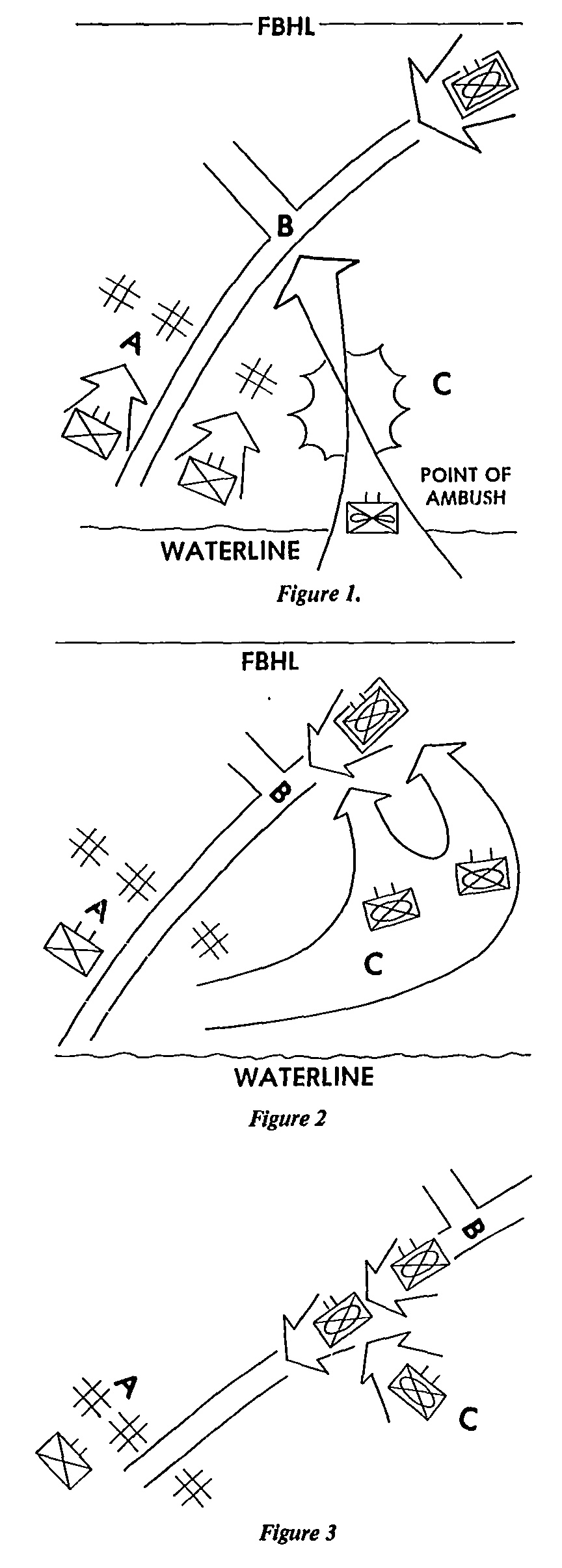
* Maneuver warfare is irrelevant to amphibious operations. Maneuver warfare relates directly to amphibious warfare at both the tactical and the operational levels. At the tactical level, it offers the landing point amphibious assault as an alternative to current doctrine. The landing point assault carries the infiltration attack over into the amphibious assault itself, with multiple deep penetrations on separate axes. At the operational level, maneuver warfare opens a vista on the amphibious campaign, which may be more important under modern conditions than the amphibious assault. It suggests that we look at amphibious warfare not only in terms of Tarawa and Iwo Jima but also of Moore and Wellington in Iberia.

* Maneuver warfare means heavying up-mechanizing the Marine Corps. Actually, for most of the Marine Corps, maneuver warfare means lightening up. It requires the conversion of most Marine infantry from line to true light infantry. That means getting rid of vehicles, cutting the Marine’s load to no more than about 46 pounds, reducing greatly the size and complexity of headquarters, etc. True light infantry is the most mobile type of force in close terrain, and maneuver warfare demands mobility. For mobility in open terrain, vehicles are required, but for the Marine Corps, these may be trucks, LAVs, and motorcycles rather than personnel carriers and tanks. The goal should be a mix of light infantry and mounted forces, from which a force appropriate to the terrain can be task organized.

* Maneuver warfare is just common sense tactics. Depending on one’s philosophical approach, everything that is successful in life may be termed “just common sense.” Common sense is certainly useful in maneuver warfare, but if that were all it required, history would have seen many more “Great Captains” of maneuver warfare. In fact, developing an accurate picture of the battlefield and figuring out how to outmaneuver the enemy in a specific situation requires considerable ability. It requires commanders and operations officers with what Clausewitz called a “talent for judgment,” composed of imagination, creativity, and intuition. It requires study of the enemy, his weapons, techniques, doctrines, and, if at all possible, his commander’s tendencies. It adds up to a good deal more than is usually meant by “just common sense.”

* Maneuver warfare is just a formula for flank attacks. In maneuver warfare, a usual goal is to attack the enemy in an unexpected place. But that does not just mean flank attacks. If you always attack his flanks, he will soon figure out the pattern you follow, and he will be waiting for you at the flanks. His flanks will, in effect, become his front.

More fundamentally, maneuver warfare is not a formula for anything. Maneuver warfare tactics never follow a checklist. Those who just make up a new checklist with “commander’s intent” and “focus of effort” on it do not understand maneuver warfare. It is a way of thinking, a way of thinking that recognizes that each combat situation is different and, therefore, requires a unique approach. Through education, training (especially free play, force-on-force training), and careful selection of commanders and operations officers, it cultivates the creativity, active spirit, and willingness to innovate and take risks that yields situational rather than checklist tactics. Maneuver warfare requires officers who have been taught how to think, not what to do or what to think.

* Focus of effort (or Schwerpunkt) is just a new buzzword for the main attack. It is much more than that. When a commander designates his focus of effort, he says, in effect, “This is the unit with which I will achieve a decision.” It is not a casual or simple decision, nor one to be taken lightly. Then he ruthlessly concentrates combat power to support that unit, often taking major risks elsewhere. This second element in particular is somewhat new to Marines, in that it often means depriving other units and sectors of what they regard as “their” assets. In Marine exercises, such assets are usually distributed so that everyone gets his “fair share.” That contradicts the concept of focus of effort. Focus of effort demands the total focusing of combat power at what the commander thinks will be the decisive point.

* Maneuver warfare advocates don’t consider techniques important. Not true. A military with sloppy techniques will be ineffective in combat, no matter how good its schemes of maneuver. Excellence in techniques is very important in maneuver warfare, and many maneuver warfare advocates strongly support such efforts to improve technique skill levels as the new Marine Corps Battle Drill Guide.*

At the same time, maneuver warfare brings some changes in techniques. Examples include the three-element assault, where a small assault element, supported by a strong suppression element, makes a small breach through which a large exploitation element is passed to collapse the enemy from the rear while pushing still deeper into his depth;** forward push logistics; and the use of ambushes in the attack.

* Advocates of maneuver warfare ignore the chaos and confusion of combat; they think battle is neat and orderly. Quite the contrary. Maneuver warfare is rooted in the realization that combat is dominated by uncertainty and rapid change, by what Clausewitz called “friction.” The very core of the maneuver warfare concept is that we can turn the confusion and chaos of battle to our advantage, but only by taking risks, using mission-type orders, allowing wide latitude for subordinates to act as the situation requires (and expecting them to do so), and by placing heavy stress on junior leader initiative. While attrition warfare usually attempts to eliminate the chaos and friction of war with centralization and strict control, maneuver warfare accepts chaos and confusion, seeking to work within it while magnifying it for the enemy. Maneuver warfare also recognizes that “friction” increases as you move up the chain of command and away from the actual scene of battle. Therefore, it stresses commander’s intent, commanders forward, and initiative and flexibility on the part of subordinate commanders who are closest to the actual fight.

* Maneuver warfare advocates are not interested in aviation, fire support, or logistics. In fact, all three are vitally important in maneuver warfare. However, all supporting arms and combat service support must be keyed to supporting the ground scheme of maneuver. The great challenge is embodied in the ideas of immediacy and decentralization. In the areas of aviation, fire support, and logistics, the state of the discussion is about where it was 10 years ago in ground tactics. We need to generate thought and debate in each area, beginning not by asking for answers but for the right questions. How can air support and artillery support be made more responsive? How can each be focused, not on following its own procedures and methods, but on the ground scheme of maneuver? Can logistical support be pushed forward, especially to the focus of effort? Are organizational changes and changes in institutional culture required?

Maneuver warfare advocates urge all Marines to join in the attempt to create thoughtful debate and discussion in each area-debate like maneuver warfare itself has generated in relation to ground tactics and operations. Clearly, maneuver warfare will bring changes in each area. What those changes need to be can best be thought through by Marines, especially Marine aviators, artillerymen, and logisticians.

Again, Marines have made great progress in understanding and beginning to implement maneuver warfare. The fact that some misconceptions have arisen is understandable and indeed inevitable. The task now is to clear up those misconceptions, deepening the understanding and expanding the experimentation. The achievements of the past decade are substantial. On the base they provide, progress can be steady and rapid toward the shared goal of improved combat effectiveness.

Generals Speak Up-Or Do They?

by Maj James P. Etter

LtGen Victor H. Krulak’s article was challenging, thought provoking, and inspirational. In his opening paragraph he stated that “the essence of loyalty is the courage to propose the unpopular …, and the essence of leadership is the ability to inspire such behavior.” Well, I am inspired to put my loyalty to the test….

I am writing about Marine Corps generals and the quality of their creativity as defined by LtGen Krulak. He states:

However important the quality of creativity is in the subordinale, it is even more important in the superior. If he has a strong instinct to innovate, if he is willing to speak up and to write for publication himself, it is likely that he will be an effective vehicle for nourishing the ideas of his subordinates.

During the past 10 years, the Gazette has published 125 articles or commentaries by generals-a rate of approximately one per month. At first glance this seems like quite an acceptable quantity, but the figure ‘requires more detailed examination.

Twenty-four of the articles were posture statements-reprints of testimony given before one or more of the congressional committees. Articles of this type are routinely prepared by the staff to reflect the existing position of Headquarters and are then reviewed by the principal delivering them. They typically deal with the status of equipment and personnel and expound on the outstanding posture of the Corps, except where an effort is being made to justify new hardware or programs. Much like a snapshot, they report “what is,” without any of the why or value judgments.

Thirty of the articles written by generals were largely historical in nature. These dealt either with chronological events or presented personal accounts of a historical event. These articles rarely looked back in order to give guidance to the future; rather they told “what was.”

Twenty-five of the total were “work related.” These articles told what was accomplished in a specific billet or during a specific training exercise in which the particular general was a participant.

Thirty of the articles can best be classified as “miscellaneous.” They include letters to the editor, reprints of statements by deceased generals, and articles on subjects not related to the Marine Corps.

Sixteen of the articles are left. These are the ones in which the generals speak out and, to quote Gen Krulak’s words, “emphasize that their minimum duty to you, to your institution, and to their country is an honest and fearless expression of their best thinking. …”

It is this small number, 16, categorized as “speaking out” articles that causes concern. In the past 10 years, our general officers have written only 16 articles that attempt to deal with the many issues that the Corps has faced and will continue to face. It is important to note that 11 of these articles were written by MajGen Richard C. Schulze and MajGen David M. Twomey. This means that only 7 individual generals over the past 10 years have chosen to speak out or address the major issues that could, did, and do affect our Corps, and 3 of these wrote after their retirements. One would think that subordinates deserve more than this amount of “speaking out” by our senior leadership.

In the past 10 years, the Corps has been involved in many significant events and has confronted several key issues. Yet our generals have not spoken out in print. Where are the articles debating our performance in Beirut and Grenada, driving home the lessons learned? Maneuver warfare has been debated and written about by all except our generals. Surely they have opinions. Our generals talk about the new equipment and the ever increasing quality of our manpower, but where is their discussion about how these new resources should be applied on the battlefield? Is this reluctance to speak a manifestation of careerism at the highest levels? Should the Corps be led by officers who express no opinions unless they are blessed by the Commandant?

Gen Krulak stated it well when he said:

Young officers must strive to keep alive their creative and innovative energies, to do all that is necessary to improve the Corps. And senior officers must encourage and promote this attitude…. For both, it is a matter of duty and obligation.

The caption above the Gazette’s Ideas and Issues section reads, “candid professionally oriented comments on matters of interest to Marines.” Who is more qualified to give their candid opinions on ideas and issues than our generals? If we as subordinates are to glean the wisdom that is gained through experience and should be passed on to us, then our generals must put their thoughts in print and “speak out.”

Sorting Out Maneuver and Attrition

reviewed by Col Gordon D. Batcheller

Sorting Out Maneuver and Attrition MANEUVER IN WAR. By LtCol Charles A. Willoughby, USA, The Military Service Publishing Company, Harrisburg, PA, 1939, 286pp. NA. Reprinted 1986 as NAVMC 2796.

Those participating in the maneuver warfare dialog will be interested in NAVMC 2796, the reprint of the 1939 edition of LtCol Willoughby’s Maneuver in War. The title alone is enough to make it an obligatory “read.” While it is dangerous to draw conclusions on the superficial reading that most of us find ourselves limited to, the book contains some interesting observations for those trying to sort out maneuver, attrition, and Forrest warfare. (See LtCol EJ. Robeson IV’s article in MCG, Aug86.) Strangely enough, it will bring little happiness to the maneuverist camp. On page 1 it warns the student to be wary of those who claim to have found THE ANSWER to war’s challenges by quoting from Gen Douglas MacArthur’s 1935 Annual Report as the Army Chief of Staff:

They apparently cling to the fatuous hope that in historical study there is to be found a complete digest of the science of war rather than simply the basic and inviolable laws of the art of war. . . .

Even more interesting, as a sign of the time, the quotation is part of a longer dissertation on military historical study and the military profession. Maybe during lean fiscal years, with a paucity of programs and systems to arvel at, thoughts turn to more enduring aspects of our profession. (Gramm-Rudman-Hollings to the rescue?)

The book goes on to develop the historically revealed “principles of war,” demonstrating in the process the fundamental importance of terrain in warfare and the requirement for the successful practitioner of war to draw from a broad knowledge of these principles, of terrain, and of the behavior of men in dealing with the situation confronting him. Napoleon, one of the greatest military “cooks” of all time, would have little sympathy with a rejection of these principles because they are conducive to “cookbook tactics.” He would appear to endorse the requirement for a cookbook, based on the diversity of dishes on the menu of war, and on the variety of skills found in the kitchen.

On page 133 the student learns that superiority in numbers, while not essential to victory, is eminently desirable: Napoleon had a 2 and 5 won-lost record when outnumbered, and Moltke deliberately avoided such engagements. Similarly, the value of defensive warfare receives support and endorsement, and Moltke is given credit for recognizing that “the tactical defensive has gained an unmistakable advantage over the offensive, as a result of increased firepower.” Several lines later: “. . . the attack of a position has become increasingly more difficult than its defense.” But rather than espousing one form of warfare or another, the book serves to underscore only that the study of war reveals a number of principles that commanders must be able to apply to the tactical situation at hand. Battles are fought, on at least one side, by moving men, and the author finds it useful to repeatedly talk in terms of mass and direction, and of the advantages derived from the proper combination of these vectors. But he makes it clear that this proper combination will come most frequently to the commander with good intelligence and a sound plan.

There is nothing m Maneuver in War that suggests Marine Corps doctrine or style is as woefully deficient as the maneuverists claim; rather, it shows that maneuver is one of several means to an end, and the attainment of that end is more likely when the commander accommodates the “basic and immutable” principles and properly prepares the battle. It is normal for historians to search for order and meaning as they interpret the “what” and the “why” of the past, and it is normal for the participants in past events to reinforce (or create anew) order and reason as they recount the events. But even allowing for these tendencies, it is difficult to find support for the fluid, uncoordinated battle that maneuverists seem to champion. Maneuver in War advocates an approach to battle that stresses planning, and preparation, and coordination, and discipline. It may be only a matter of emphasis, but the tendency of the maneuverists to belittle the unimaginative mindset of those concerned with formations, and firepower, and terrain, and coordination detracts from the valid points they would make. Perhaps the best end for this discussion is to revisit its beginning and agree that dogma, from either end of the spectrum, is fatuous.

In any event, Maneuver in War is worth the time it takes to read it, and the Marine Corps has done us all good service by keeping this book available for a new generation of readers.

Maneuver

by Capt Michael H. Decker

LtCol Robeson (MCG, Aug86), correctly identifies the central problem with the popular version of maneuver warfare: nobody ever gets killed in the OODA-loop (observation, orientation, decision, action). Armchair strategists don’t have the stomach to visualize what really happens when the flagged-pins on their board games close on each other.

Both LtCol Robeson and Maj Davis (also MCG, Aug86) point out that maneuver warfare rightly consists of maneuver that climaxes in brief, localized firepower/ attrition engagements (read: riflemen kill the enemy). “Forrest War recognizes that both firepower and maneuver are essential components of warfare and that they must be integrated. . . .” And from Maj Davis “… the Army did not accept the contention that maneuver and firepower/attrition were dichotomous….”

I think that active duty proponents of true maneuver warfare (vice the armchair strategists’ popular version) understand that fighting belongs in the OODA-loop. They make their stand on maneuver versus firepower to focus on the difference between the military art and the bureaucratic method.

LtCol Robeson’s “OODAF-loop” reminds us that after getting there first with the most men, you need to close with and destroy.


by Col Gordon D. Batcheller

Maj Davis’ piece on military history and other things was valuable for several reasons, but primarily because it points out that many things that are intellectually attractive or superficially compelling become considerably less so when taken out of the realm of speculation and plopped down in the midst of experience. One thinks of the dramatic difference of battle as reported by S.L.A. Marshall in Men Against Fire and as implied in Col Boyd’s OODA-loop theory. One is superficially attractive because it makes things simple, and maybe some things are simple. But battle is not, and a theory of warfare built on the analysis of a one-on-one shootout between two pilots, or two swordsmen, can be interesting but of limited utility in understanding war. Reliance on such a theory could be disastrous. Clausewitz said “Many intelligence reports in war are contradictory; even more are false, and most are uncertain.” It is all well and good-and totally uncontroversial-to be in favor of initiative and alertness, aggressiveness and audacity; it is something else to claim warfare is reducible to a label, or a single way of thinking, and argue that one type of operation should determine the organization, structure, and tactics of all Services. The maneuverists would be much easier to listen to if they realized this.

LtCol Robeson’s article also does a creditable job of keeping “maneuver warfare” in perspective and highlighting its limited utility for a force designed for strategic maneuver and tactical assault. One can forgive him for creating yet another warfare label. There are, depending upon your national orientation, about nine generally accepted principles of war. While disparaged by some as a checklist crutch or the ingredients for “cookbook tactics” or a substitute for thought, they, rather than simplistic ideological labels, provide the frame of reference from which practitioners of war approach their profession.


by LtCol Wesley L. Fox

The August GAZETTE surely meets the criteria expressed as the purpose of our magazine, the advancement of knowledge, interest, and esprit of Marines. I wonder if it was by chance that LtCol Ed Robeson’s interesting and thought-provoking commentary of “Forrest War: Putting the Fight Back” and the two book reviews on “America Can Win” by Hart and Lind appear in the same issue and only two pages apart. Majs Funk and Anderson in their separate reviews gave good support to LtCol Robeson’s position of a third model of war fighting, identified as “Forrest War.”

I like the six characteristics of Forrest War. All deserve the commander’s fullest attention, but the last one, “Pursuit,” deserves special recognition, thought, and study. “Positioning of friendly forces for battle to ensure that they will end the initial engagement where they are advantageously deployed for the next event” requires more of the commander’s influence than can be satisfied with the free play of the maneuver model.”. . . over 8,000 troops thrown into a rout and driven headlong for nearly a hundred miles by just under 5,000″ is what it is all about. ATTACK! ATTACK! ATTACK!


by IstLt W.P. Miller, USMCR

Maj Davis misses an important point in his article on military history and reform. Proponents of maneuver warfare don’t necessarily maintain that only one form of warfare will succeed. Rather, they maintain that given the realities we face today, it is the only method that is likely to bring us success. Grant fought Lee toe to toe because he rightly saw his main objective as the destruction of Lee’s army. In a future conflict, we’ll more likely face Lee’s dilemma-keeping our force intact in the face of a numerically superior enemy.

American Can Win

AMERICA CAN WIN. By Gary Hart and William S. Lind. Adler and Adler, Bethesda, MD, 1986, 301pp., plus index, $17.95 (Member $16.15)

reviewed by Maj R.C. Funk

Recently, a new book has been published entitled America Can Win. Written by Senator Gary Hart and William Lind, it outlines in detail the military reform movement and its goals. After reading the book, I thought that its message was important enough to warrant a review. Many of the points made by the authors have been made before, some in the GAZETTE, and some in other military and civilian publications. But I felt that the compilation of their ideas and criticism into one book was particularly effective in focusing the debate on military reform.

The twin problems of our record of military failures since World War II and our inability to spend ourselves strong, say Hart and Lind, require fundamental changes in our defense policy. The authors believe that our long string of military failures is the most important reason we need new defense policies, because a military system that fails in combat endangers our existence as a nation. Huge increases in the defense budget have also failed to produce any real improvement in our military strength. Despite a 33 percent increase in the trillion dollar defense budget since 1980, the authors contend that not a single unfavorable element of the U.S.-Soviet military balance has been reversed. In 1980, NATO was inferior on the ground and still is, and, in the authors’ opinion, the balances at sea in submarines and in the air in tactical fighter aircraft are still unfavorable.

The military reform movement is basically comprised of two wings, one civilian and one military. The civilian wing is headed by a core group of five individuals who provide much of the substance for the reform movement in the creation and formulation of ideas. The other important element of the civilian wing is the Congressional Military Reform Caucus. It is a bipartisan organization in Congress, composed of both liberals and conservatives, that has had some limited success in amending legislation on defense matters. The authors make the point that the caucus’ most important function, however, is to educate the members of Congress on defense matters and to change the terms of the congressional defense debate from “spend more to spend less” to “what do we need to do differently to restore the combat effectiveness of our Armed Services.”

The second wing of the reform movement is composed of active duty officers of all Services and ranks, although most are younger officers. The authors state that the officer reformers’ motivation is simple-if they are sent into combat, they want to win, and they recognize that many of our current practices and policies undermine what is required to win in combat.

The authors define military reform as an effort to make all our defense policies and practices, from the infantry squad to the Office of the Secretary of Defense and Congress, serve the purpose of winning in combat. The authors take great care to explain what the reform movement is not because they feel it is often misrepresented. To summarize their views, the reform movement is not an effort to reduce or increase the size of the defense budget. Instead, its goal is to reduce the amount of attention the defense budget receives in Congress and the press, and to give more attention to whether we are buying and doing the right kinds of things-right for what is required in combat. It is not an effort to buy large quantities of inferior weapons rather than smaller numbers of superior weapons. They do not advocate quantity over quality, but they feel that weapons should be smaller, less complex, and less expensive, the characteristics that lead to true quality in combat. And last, the reform movement does not call for more centralized management at the Pentagon in search of more efficiency. The reform movement has effectiveness as its goal. Effectiveness means the ability to win in combat, while efficiency means winning at minimal cost. The authors believe that both are important, but effectiveness is the most important.

Most of America Can Win is a provocative, but comprehensive, critique of the Military Establishment. The authors accuse the military of designing weapons that belong in museums rather than on battlefields, asking the wrong questions, teaching the wrong courses, emphasizing the wrong doctrine, and preparing to fight the last war. The book is certain to be controversial because of the emotional issues it raises and the recommendations made by the authors to make our military more effective. Are the authors right in their criticisms? In my opinion, yes, on most issues. Do I agree with their recommendations? Yes, most of them. Some are idealistic and easier said than done; others would take decades to correct, and the cost would be exorbitant.

I was very fortunate to be in the 2d Marine Division in 1982 when maneuver warfare, which is nothing new, was proclaimed as doctrine. I participated in two combined arms exercises at Fort Pickett, VA, and I saw the value of a totally new type of training, that of freeplay exercises conducted with force-on-force maneuver. I saw the value of mission-type orders issued just hours before the start of the exercise, and especially the value of the critiques. It was not uncommon to see platoon commanders and even squad leaders called upon by the commanding general to stand up and explain what the regimental or battalion commander’s intent was, where the point of main effort was, how they accomplished their mission, or why they did not. The zero defects mentality was absent, and the training made people think. Most participants were enthusiastic about its results. That type of training marked real progress. There is good progress and bad progress, and sometimes it may be hard to tell the difference. But we should not reflexively cringe from progress because it is something new. Some in the military have made that a habit.

The reform movement and the issues advocated by the authors, Senator Nunn, Jeffrey Record, Edward Luttwak, Richard Gabriel, and others should be welcomed by the military. Constructive criticism never hurt anyone. Unfortunately, the Defense Establishment is the largest bureaucracy in the country where milicrats exist who passionately believe that business as usual is the plan of the day and resist all change. Even though many officers believe that reforms must be made, the responsibility for military reform lies squarely with our civilian leadership, and it is our duty to give our candid advice.

But here the authors miss the point. In their analysis of Congress, they failed to identify the most critical problem concerning our civilian leadership. That problem is the total lack of military experience of our elected representatives and a whole generation of professionals, journalists, bureaucrats, teachers, and other opinion leaders, brought about by our Nation’s policy of allowing the rich and educated, the middle and upper class, to avoid any type of military or national service. I think it would be safe to say that approximately 90 percent of our elected representatives (and their staffs), born after 1940, have never worn a uniform. A few have served with distinction in the military, some are even decorated combat veterans, Senators Dole, Inouye, and Denton, and Representative McCain to name a few. But in a few short years, the World War II and Korean War veterans will pass on, and the congressional leadership, and ultimately, thePresidency, will fall under the Vietnam-era members of Congress, most of whom have never served. Most have no firsthand, personal experience, either good or bad, with the military. Most do not understand and do not appreciate what is needed in peacetime to keep the military ready to fight and win; most tend to exaggerate what the military can do; and most believe that years of neglect can be corrected with a brief flurry of attention by spending huge sums of money. Our elected representatives are patriotic and dedicated, but we would have a better military, with a more hopeful future, if the people who lead it had also served. Sir Francis William Butler said it best:

The nation that will insist on drawing a broad line of demarcation between the fighting man and the thinking man is liable to find its fighting done by fools and its thinking done by cowards.

Our nature causes us to object to criticism from outsiders, especially when we know that those who criticize have never served and have never had to cope with the pressures of command and produce results. However, our Military Establishment needs to face these problems, not ignore them, not rationalize them away, nor dismiss the reformers as ignorant boobs, which assuredly they are not. The reform movement reminds me of the 1964 Presidential campaign, when Senator Goldwater persisted in telling the American people what they did not want to hear or believe, but that ultimately proved to be the truth. As I read America Can Win and thought about the issues and recommendations advocated by the authors, Senator Goldwater’s famous campaign slogan kept ringing in my ears-“In Your Heart You Know He’s Right.”


reviewed by Maj G.W. Anderson

A Washington acquaintance of mine once accused Senator Gary Hart (Democrat from Colorado) and William S. Lind of having a Faustian relationship. My friend said that if Hart ever gets elected President, he will have Bill Lind build a superb military machine that will not be used until the Russians get west of the Hudson River. In their book America Can Win, Hart and Lind give us blueprint for their vision of a new and improved Department of Defense.

Readers familiar with Bill Lind’s style will quickly discern that he wrote a vast majority of the book. Hart appears to have written the introduction and the last four pages. The books message will hold no surprises for anyone who has followed Lind’s writing and speaking for the past several years. America Can Win is a total indictment of the way the Pentagon does business, followed by a prescription for a sure cure.

The authors charge that the officer corps is bloated and that most of the Armed Forces still adhere to an attrition warfare mentality. They see the Navy as having made a colossal mistake in emphasizing nuclear submarines and large aircraft carriers at the expense of quiet diesel submarines and smaller carriers. They also see the current Joint Chiefs of Staff (JCS) structure as hopelessly cumbersome and fatally flawed. Many of these issues are being seriously discussed in the Pentagon, but this book is not a discussion guide. It’s an indictment.

Since the book is not designed for a military audience, its errors of fact, which are many, will go essentially unchallenged by the general leadership. For example, Lind and Hart drag up the notorious JCS system of flimsy, buff, green staffing as an example of the current joint system. What remains unsaid in the book is that the system has been eliminated. There are other mistakes in the volume, bit this one represents the essence of America Can Win. The entire book is a clarion call for an externally directed change of the Armed Forces. The authors believe that military leadership is too hidebound and set in its ways to change, even when change is badly needed. The demise of the flimsy-buff-green atrocity is but one minor example of the fallacy of this view. Lind and Hart are callously contemptuous of the Military Establishment’s efforts to reform itself from within and its successes in doing so are either ignored or shrugged off as being too little too late.

Lind and Hart reserve their most pointed attacks for the Marine Corps for failing to adopt Lind’s pet project “maneuver warfare” as doctrine, ans this is where the reviewer takes special issue with the authors, particularly Mr. Lind. Since the late 1970s, Lind has assiduously pursued the argument that maneuver warfare should be adopted as U.S. military doctrine. As proof of historical efficacy of maneuver, Lind has offered selective historical examples ranging from the battle of Leuctra to World War II. Lind has yet to make a cast that maneuver warfare has valid historical efficacy. In researching his on book on military theory, this reviewer found that maneuver warfare has worked only 40 percent of the time that has been attempted since Leuctra. The reasons for the failures are varied, the track record certainly begs careful review before we seriously consider adopting maneuver as doctrine.

This reviewer maintains that senior Marine Corps leaders are correct; maneuver warfare is a legitimate technique to be used withing the context of the greater whole, but it should not be adopted as doctrine. Doctrine is something that is done automatically unless there is a good reason not to do so. No doctrine should be based on an idea so complicated that is works less than half the time it is tried.

Lind and Hart are on the wrong side of history in selling maneuver warfare as a doctrine rather than a technique; despite this, their book will probably do well. “Pentagon bashing” is popular among those who have only a marginal knowledge or interest in military affairs, and that is the authors’ true target audience.

The real tragedy of Bill Lind’s relationship with the Marine Corps is that he could have a truly positive effect on the Corps if he could be satisfied with incremental change. Senior Marine Corps leaders realize maneuver warfare is but one potential technique among many in a greater scheme that this reviewer calls the “tactics of mistake.” Instead, Lind has opted to support Hart in a quick fix doctrinal employment of maneuver warfare that might as well provide us with a mobile version of Maginot Line.

Marines interested in the Lind-Hart view of the would should review old copied of the Gazette, Military Review, and the Air War College Review; $17.95 is too great a price to pay to have one’s intelligence, dedication, and professionalism insulted.

Military Reform and Military History

by Maj M.T. Davis, USA

In the wake of the Vietnam War, the United States Army launched an intensive campaign to reevaluate its doctrine and operational concepts. This effort, initiated by Gen William DePuy, was designed to move the Army beyond the Vietnam experience and refocus attention on what has traditionally been the Army’s major mission, fighting a conventional war in Europe.

In 1976, as part of this endeavor, the Army issued a new version of its FM 100-5, Operations, which described an operational doctrine that quickly became known as “Active Defense.” In military journals published by various service schools, as well as those of the private press, this new doctrine was soon taken to task. Critics described it as too bent on defense, too risky in its reliance on lateral repositioning and small reserves, and too quick to surrender that indeterminable yet invaluable condition known as the initiative.

By 1982, when the Army published a new version of FM 100-5, promulgating a doctrine called “AirLand Battle,” it was clear that many earlier critics, especially maneuver warfare advocates who promoted the concept of maneuver and initiative over that of firepower/attrition, had been quite influential. Although the Army did not accept the contention that maneuver and firepower/attrition were dichotomous, it did place considerably more emphasis on offensive operations, initiative, agility, synchronization, and the ability to see and attack deep in the enemy rear.

Nonetheless, the debate continues. The maneuverists, who have expanded their agenda and are now the selfproclaimed “Military Reform Movement,” are not completely mollified. Having a doctrine, they declare, is fine; but before this can be truly meaningful, the officer corps must also internalize doctrine into a “shared way of thinking.” The key to reaching this new level of consciousness is through an education system that relies much more extensively on the study of military history and the “operational art.” So emphatic are the Reformers on the value of military history, that they argue historical research is the only valid basis upon which quantitative analysis on such things as weapons system performance should be based.

This is an intriguing theory, and it goes to the heart of a continuing debate about the necessary content of military education. But like so many other observations offering pat answers to complex problems, it ignores numerous uncomfortable facts.

Two major considerations are relative to this issue. First, although many Reformers refuse to acknowledge it, a considerable amount of military history is currently being taught throughout the professional officer education system. This fact undermines their basic contention that the contemporary military, its doctrine, and its procedures, are hopelessly ahistorical and, therefore, incapable of internalizing and capturing the promise of maneuver warfare.

Second, regardless of the Reformers contentions about the amount of military history taught, they have not demonstrated that it would make any difference if there were not a single hour of military history taught in any Service school anywhere. Why? Because the study of military history is far from conclusive on the virtues of maneuver warfare-or any form of warfare for that matter-and, in America’s most memorable and studied war, the Civil War, it can be shown that detailed knowledge of military history mattered relatively little. Let’s look at this in more detail.

When advancing their claims, Reform enthusiasts like to list those figures in military history who have been successful adherents of maneuver doctrine. This list invariably includes Hannibal, Douglas MacArthur, Stonewall Jackson, Winfield Scott, George Patton, Heinz Guderian and Erwin Rommel. That many of these figures ultimately lost, and others did not always rely exclusively on maneuver, matters little.

Prominently absent from these listings is the most accomplished “maneuverist” the United States has ever produced, Ulysses S. Grant. For many, this may seem a surprising statement, for Grant is widely regarded as the very symbol of “firepower/attrition” warfare.

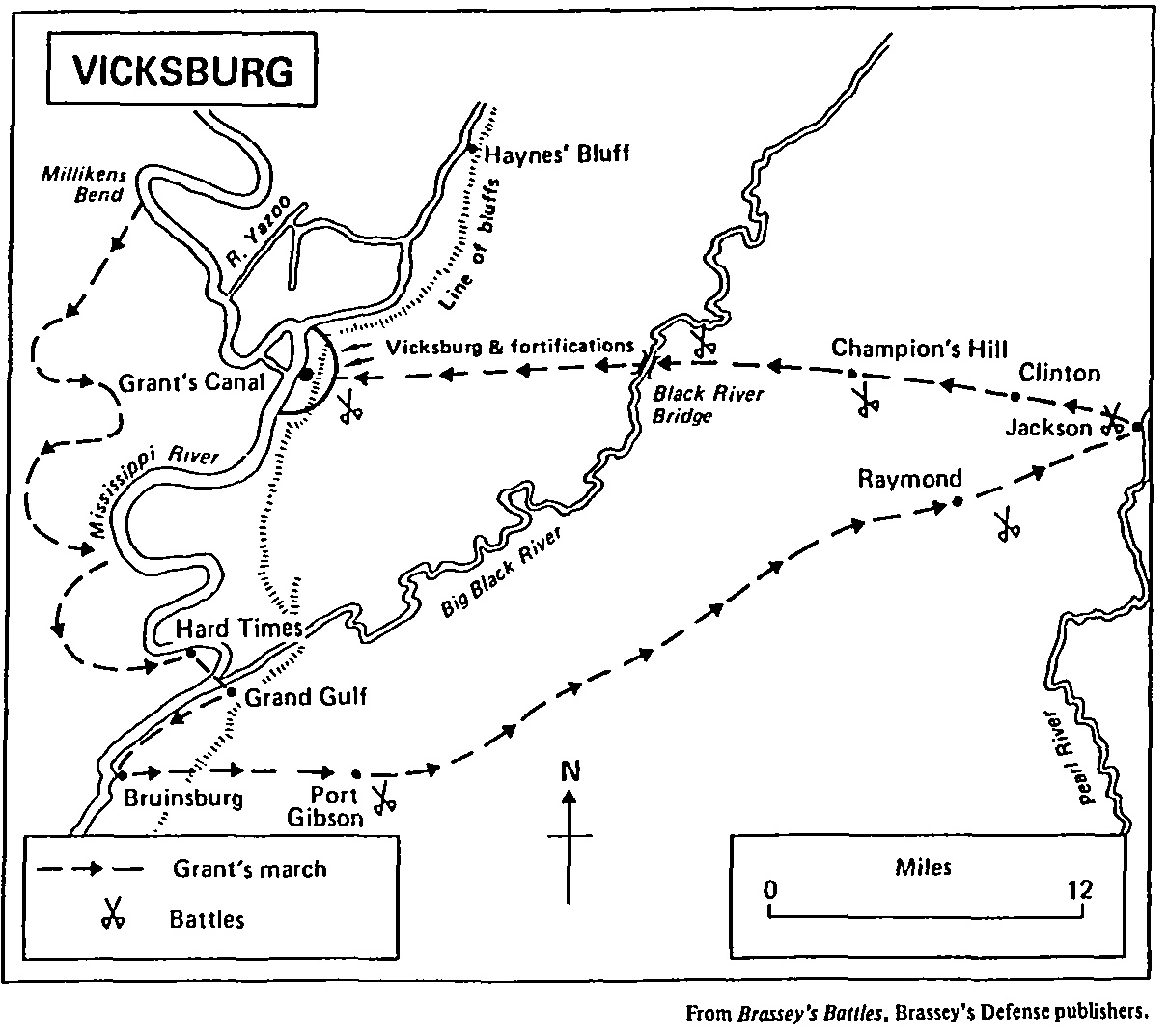
But this belies far too narrow an understanding of Grant in particular and warfare in general. As stated in the latest edition of FM 100-5, Grant’s Vicksburg Campaign in 1863 is the finest example of maneuver warfare ever conducted on the American continent. But the following year, as commanding general of all Union Armies, Grant placed himself in Virginia and slugged it out with Robert E. Lee from the Wilderness to Petersburg in evident disregard of the approach that had served him so well along the Mississippi, winning him the reputation as an unimaginative commander and insensitive to casualties. Nonetheless, as Lynn Montross has correctly noted, “Few soldiers in history have been the victims of an injustice as has permanently clouded Grant’s military reputation.”

We can safely assume that the Reformers have heard of Grant, so why do they so consistently ignore him in their analysis? They do so for two quite transparent reasons. First, were they to admit that the Grant of Mississippi and the Grant of Virginia were the same person, that the conditions which led him to maneuver against Pemberton in Vicksburg were absent against Lee in Virginia, then the entire basis of their argument that maneuver warfare is a strictly distinct form of conflict, universally applicable, which all successful commanders must employ, completely unravels.

Second, the inclusion of Grant in any discussion pertaining to campaign leadership raises serious questions about the value of an education heavily based on the study of military history. Although some seem to forget, it is important to note that going into the Civil War two of the Union’s best versed experts on military history were Gens Henry W. Halleek and George B. McClellan. Both had authored studies based on Jomini’s interpretation of Napoleonic warfare, yet both failed as field commanders, eclipsed by Grant who was, by comparison, an illiterate in military studies and theory. As a student at West Point, Grant had no scholarly interests other than horsemanship and mathematics-in that order!

Other examples exist, but Ulysses S. Grant is the most pronounced and obvious. Given the experience of the Union in searching for military leadership during the Civil War, it is difficult to offer a convincing argument that an intensive education founded on military history is the key to either tactical, operational, or strategic success.

If maneuver warfare is not the solution the Reformers had advertised, if its acceptance has not led to the immediate and strikingly favorable results anticipated, the reasons lie not with real or imagined omissions in officer education.

Maneuver warfare has simply been overanalyzed and then oversold. It is, as Grant demonstrated over 100 years ago, a form of warfare that yields favorable results when practiced under favorable conditions. But the conditions of war, as all military analysts agree, are dynamic and frequently unfavorable.

Adding more military history to the curriculum of our military schools is not the key that will unlock the promise of maneuver warfare. It is rather the excuse of those unwilling to reconcile their theory with plainly incongruous facts.

Forrest War: Putting the Fight Back. . .

by Lt Col E. J. Robeson IV

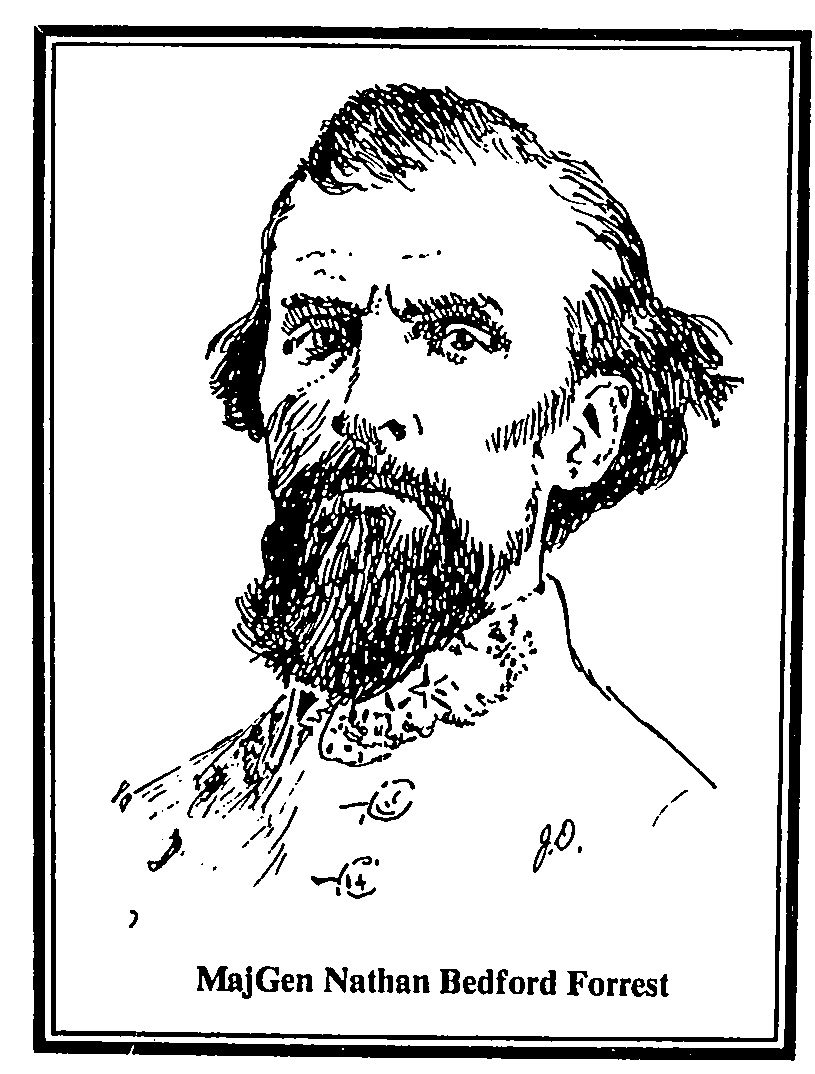
War is far more complex than either the firepower-attrition or maneuver warfare models suggest. The campaigns of MajGen Nathan B. Forrest illustrate a third model that could prove devastating on the modem battlefield if we master the characteristics that made him successful.

The debate over the conflict in Indochina has prompted a renaissance in American military studies and has yielded essentially two schools of thought on how wars have been successfully fought throughout history; they are popularly known as maneuver warfare and firepower-attrition warfare.

The maneuver warfare school has been particularly vocal in advocating its position and in castigating firepower-attritionists. In fact, the debate has been singularly one-sided. Few strategists would openly advocate pure firepower-attrition (although several prominent leaders have come close in practice). Moreover, the skeptic must ask whether the firepower-attrition school is really nothing more than a “straw man” alternative developed by the maneuverists, for it has many detractors and no known champions.

I believe that warfare is much more complex than either of these two models suggests, and we should actually be striving to implement a third alternative. Let’s call it “Forrest war,” in honor of one of its foremost practitioners. MajGen Nathan Bedford Forrest, Confederate States Army (CSA).

Forrest war recognizes that both firepower and maneuver are essential components of warfare and that they must be integrated to obtain maximum effectiveness. Certainly, no one in the maneuver warfare school would argue with that; but there is a fundamental difference. Forrest war also postulates that firepower is not only essential, but that it must always come first. This is true because of the realities of war, especially at the level of the individual combatant. For the infantryman on the ground, every attack is a frontal assault. Here, weapons are for killing, wounding, or causing the enemy to cower. Assertions that a rifle is not for killing, but should be principally regarded as a means to maneuver are simply ludicrous. (Only when the rifle butt is placed under the arm and used as a crutch could a rifle be considered as a means to maneuver.) In truth, it is only after the enemy has been dominated by aggressiveness and firepower that maneuver can become an effective option at all. Educating the enemy to the consequences of firepower can be a brutal, personal struggle; but, if it is successful, it will make him susceptible to maneuver. Gen Forrest understood this very well and knew how to fully implement this third style of warfare to which we have attached his name.

Six characteristics quickly become apparent in an analysis of the art of Forrest war. These are: 1) fearsome reputation, 2) preparation and positioning, 3) surprise, 4) physical dominance through firepower, 5) moral dominance through maneuver, and 6) pursuit. Let’s look at each of these in turn.

Gen Forrest initially gained reputation during the fight for Ft. Donelson, where Union forces captured the Confederate garrison with one notable exception: Forrest‘s command, which was then a Tennessee cavalry regiment. Here, in February 1862, strong winds, sleet, and snow brutalized the Confederate garrison trapped inside the fort by superior Union forces. Forrest and other junior commanders advocated a breakout attempt, but the senior leadership faltered, even after the initial Confederate attacks were successful, and decided the garrison should be surrendered. As R. U. Johnson writes in his history of the Civil War:

Colonel Forrest promptly announced that he neither could nor would surrender his command. He requested permission from General Pillow to cut his way out. He assembled his men, all as hardy as himself, . . .moved out and plunged into a slough formed by backwater from the river. An icy crust covered the surface, the wind blew fiercely, and the darkness was unrelieved by a star. There was fearful floundering as the command followed him. At length he struck dry land, and was safe. He was next heard of at Nashville.

It is from such character and stamina that the first requirement for successful prosecution of Forrest war is derived-the establishment of a fearsome reputation.

Cultivating this irreplaceable commodity is also essential. It can only be done through demonstrated excellence in the performance of duties in the field. Forrest accomplished this at the end of the Battle of Shiloh in April 1862. Forrest‘s cavalry regiment was assigned to cover the Confederate retreat, but even here, he was a dangerous opponent. When Forrest noticed momentary confusion in Sherman’s pursuing infantry, he ordered an immediate charge. Firing their double-barreled shotguns, Forrest‘s men rode over their opponents, shooting down men by the score. Sherman himself, says W. Sword in Shiloh: Bloody April:

. . .was caught in the tumult and nearly killed. He said ‘My aide-de-camp was knocked down, horse and rider, into the mud, and I and the rest of my staff ingloriously fled pell mell. . .closely followed by Forrest and his men. . . .’

It was for actions such as these that Sylvanus Cadwallader in Three Years with Grant observed:

Forrest was the only one whom Grant sincerely dreaded, largely because he was amenable to no known rules of procedure, was law to himself for all military acts, and was constantly doing the unexpected, at all times and places.

An excellent case study that clearly demonstrates all six tenets of Forrest war can be found in the Battle of Brice’s Crossroads, MS, which took place from 10-12 June 1864, between the forces of MajGen Nathan Bedford Forrest, CSA and MajGen Samuel Davis Sturgis, USA.

By May 1864, Sherman had advanced deeply into the South and was becoming increasingly concerned over the vulnerability of his lines of communication to Forrest‘s predations. Having previously met him at Shiloh, Sherman wrote to Sturgis, “I expect to hear every day of Forrest breaking into Tennessee from some quarter.” Forrest‘s reputation had not been lost on Gen Sturgis either. When ordered to tie up Forrest in Mississippi, he reported:

The force sent out was in complete order and consisted of some of our best troops. . . .I saw to it personally that they lacked nothing to insure a successful campaign. The number of troops deemed necessary by Gen Sherman, as he telegraphed me, was 6,000, but I sent 8,000.

In fact, Sturgis sent 8,300-3 brigades of infantry, 2 of cavalry with the latest repeating carbines (“which would give them a big advantage in firepower over their butternut opponents”) and 22 field artillery pieces.

This force left Memphis on 1 June in an unrelenting rainstorm that soaked the men and flooded fields and roads, and began to slowly move south toward Tupelo, MS.

At Tupelo, Forrest made known his presence in the area (Characteristic 1), permitting his previously established reputation to begin to prepare the terms of the battle. He then demonstrated the second characteristic preparation and positioning, by collecting his 4,800-man division for the fight.

A study of the terrain, possible Union objectives, and the axis of advance of the Union troops provided Forrest the intelligence he needed to complete his preparations and position his force. He chose his battlefield just south of Tishomingo Creek, MS, now flooded by a week of rain, at Brice’s Crossroads.

Meanwhile, Sturgis’ forces continued to crawl along through the nonstop deluge and muddy roads. Discouraged by his progress, as well as by the thought of all the Confederate troops gathering ahead, Sturgis remarked in his official report that his delay could provide time needed by the rebels to “concentrate an overwhelming force against us.” Like Sturgis, Forrest was also having thoughts about the comparative force ratio. Even though Sturgis would have almost a two-to-one advantage in men, and three times as many artillery pieces, Forrest believed that boldness and the nature of the terrain, which he knew well, would make up for the numerical odds he faced. He said:

I know they greatly outnumber the troops I have at hand, but the road along which they will march is narrow and muddy; they will make slow progress. The country is densely wooded and the undergrowth so heavy that when we strike them they will not know how few men we have. . ..Their cavalry will move out ahead of their infantry and should reach the crossroads three hours in advance. We can whip their cavalry in that time. As soon as the fight opens, they will send back to have the infantry hurried in. It is going to be hot as hell, and coming on the run for five or six miles, their infantry will be so tired out we will ride right over them.

Forrest‘s sensitivity to weather and terrain is clearly seen in this analysis. He had selected a battleground to which the enemy had only one avenue of approach, the narrow, muddy Guntown Road that crossed the flooded Tishomingo Creek bottom on an elevated dirt causeway before climbing for about one-half mile in a southerly direction to Brice’s Crossroads. It was near this intersection that Forrest intended to meet the enemy, but from an easterly direction, requiring the Union forces to make a 90 degree turn as they entered the battle area. This radical change of direction would most assuredly create problems of command and control. Next day, as the rising sun began to bake steam out of the muddy fields and roads, Union cavalry moved up the hill to the crossroads to find a sense of foreboding in the air.

Forrest‘s march to this same location had begun well before dawn in the cooler hours of the day and on as many parallel routes as were available, for he had over twice as far to come.

Forrest initially had few forces available, but he opened his attack suddenly with lines of dismounted gray soldiers moving rapidly forward and fixing the lead Union cavalry units in position. These vicious frontal assaults were merely designed to buy time for his units to close and force Gen Sturgis to commit his entire force. In this, he was eminently successful. The Union cavalry brigade commanders were soon desperately crying for reinforcement or relief, and Gen Benjamin H. Grierson even asked that his division be withdrawn, as it was being “overwhelmed by numbers” and was “exhausted and well nigh out of ammunition for its rapid-firing carbines.” In fact, however, the Confederate “desperate charges” were being successfully conducted against Union forces that were much larger and which overlapped the Confederates on both flanks; the Union forces had six cannons in action and four more in reserve, while Forrest‘s guns had not yet arrived.

Meanwhile, on Guntown Road, the Union infantry brigades were marching to the sound of the guns. They were being hurried along by their officers and staff noncommissioned officers through the Mississippi summer heat. Gen McMillian was among the first to arrive at the crossroads, leading his infantry brigades and finding:

. . .everything was going to the devil as fast as it possibly could, he [McMillian] threw caution to the winds. Though many of his troops had already collapsed from heat exhaustion on the hurried approach march, and though all were blown and in great distress from the savage midday, mid-June Mississippi sun, he sent preemptory orders for his two front brigades to come up on the double quick and restore the crumbling cavalry line before the rebels overran it.

With these actions, Forrest had achieved the third important characteristic of surprise.

Physical dominance through firepower had become the key concern. Forrest had closed all his units on the battlefield, and he rode along putting the fire of battle into his lines of soldiers lying on the line of departure. At the bugle call, he had them up and surging forward. It was a brutal frontal assault, and everywhere “there was a grim struggle, much of it hand to hand, before the contest reached the climactic point and the time came to hit ’em on the ee-end.” The stage was set for the fifth characteristic-moral dominance through maneuver.

Forrest committed his final reserves, small units who were sent simultaneously around the right and left flanks of the Union lines to gain their rear. Because of the carnage occurring to their front, even veteran Union brigades were now susceptible to dislocation, and these actions “. . .made the whole line waver and cave in, first slowly, then with a rush.” As Gen Sturgis related in his official report:

Order gave way to confusion and confusion to panic. . . .Everywhere the army now drifted toward the rear, and was soon altogether beyond control.

The Confederate battery along with a captured Union cannon were now playing with deadly effect along the Union escape route, and the closely pursuing Confederates ensured “. . .that every attempt to make a stand only brought on a new stampede.”

As Gen Sturgis related to Col Edward Bouton during this retreat, “. . .for God’s sake, if Mr. Forrest will let me alone, I will let him alone.” Forrest, however, had other ideas. He directed his commanders to “keep the skeer on “em,” and they did just that, past sunset and on into twilight and full night. Forrest later reported that after 8 p.m.:

It being dark and my men and horses requiring rest, . . .I threw out an advance to follow. . .after the enemy, and ordered the command to halt, feed and rest.

Pursuit was now in full operation, and unlike his contemporaries of that era, he did not see darkness as an insurmountable obstacle to further combat operations. By 1 a.m., Forrest had his troopers back in the saddle and hard on the equipment-littered trail.

By dawn, Forrest caught up with the last Federal rear guard about four miles south of Ripley, MS, and smashed it. His official report stated;

From this place, the enemy offered no further organized resistance, but retreated in the most coplete disorder, throwing away guns, clothing, and everything calculated to impede his flight.

One Union commander described it thusly:

On we went, and ever on, marching all that day and that interminable second night. . .we marched, marched, marched, without rest, without sleep, without food.

An Ohio regimental commander reported that his troops became so stiffened they needed assistance to walk. Some of them crawled upon their hands and knees. These accounts are starkly indicative of the dangers that come when units are both physically and morally beaten.

As one Union cavalry major put it:

. . .it is the fate of war that one or the other side should suffer defeat, but here there was more. The men were cowed, and there pressed upon them a sense of bitter humiliation, which rankles after nearly a quarter of a century has passed. . . Just over 8,000 troops had been thrown into a rout and driven headlong for nearly a hundred miles by just under 5,000.

What can we learn today from this exhilarating victory and tragic defeat?

First, success in combat requires an excellent professional reputation that is only obtained in peacetime through hard, uncompromising training. Secondly, preparation and positioning of friendly forces for battle must ensure that they will end the initial engagement where they are advantageously deployed for the next event. (Every billiards player understands this instinctively as he lines up his “next” shot with his current one.) This, of course, often requires modification of the open-ended mission-type orders that the maneuver school advocates. Stipulating the commander’s intent for the current battle is important, but ensuring that subunits are properly positioned for the next sequence of engagements is essential. This often requires specific instructions that detract from the freedom of subordinates. Maneuver warfare extremists decry such “how-to” instructions, but a Forrest war proponent would counter that there is a middle ground between chaos caused by subunit “free play” and rigidity caused by instructions that are unnecessarily restrictive. When Forrest chose Brice’s Crossroads as his battleground, he positioned his brigades so that he could meet the enemy there or respond to enemy initiatives elsewhere. He also enhanced the effectiveness of his surprise by permitting the enemy to extend before he struck at an unlikely time and place.

Achieving physical dominance through firepower is perhaps the single greatest difference between the contemporary definition of maneuver warfare and the tenets of Forrest war. Gen Forrest stated when describing his 30th victim in personal hand-to-hand saber/pistol combat:

You know, if that young fellow had had sense enough to give me the point, I wouldn’t be here right now; but he tried to slash, which was his last mistake.

Military commanders today should recognize Forrest‘s symbolic intent: sophisticated movement will never compensate for failure to give the enemy “the point.”

War is a grim and bloody business. Maneuverists seem to forget this fundamental fact. Clever schemes to gain the enemy’s flanks or rear may appear eloquent and even delay the day of reckoning, but sooner or later the shooting must begin. As the Germans discovered again and again during OPERATION BARBAROSSA in Russia during World War II, bold maneuvers did not disconcert Soviet soldiers. In fact, the Red Army continued to resist even when surrounded and often succeeded in getting out large bodies of troops. Soviet soldiers, cut off in severe weather for days at a time, lay without shelter on the frozen ground in defensive positions until a breakout or exfiltration could be successfully accomplished.

Failure to recognize this hardiness and professionalism in our most dangerous adversary and his relative immunity to being “dislocated” by flank attack or even encirclement is the maneuver school’s greatest error. Only after the shooting is well underway can the door to maneuver be opened with any guarantee of success against a competent adversary.

However, “giving ’em the point” through vicious application of firepower can unhinge even professional soldiers from their organizational security and ensure the disintegration that is required for total victory. Tough, not fancy, infantrymen are required for this task. Demonstration of physical dominance through firepower sets the stage for moral dominance through maneuver-and successful maneuver produces the conditions required for the culminating phase of Forrest war-the pursuit.

In summary, Gen Nathan Bedford Forrest‘s campaigns stand as fine examples of how inferior forces led by hardened commanders with proven character and reputation can dominate a larger enemy. The six characteristics or phases of Forrest warfare form a pattern of building blocks that prove devastating when properly woven together on the battlefield.

So, while maneuver warfare advocates continue to press the Marine Corps to radically change its traditional mode of operations, perhaps the more prudent action would be to have confidence and believe in ourselves, to resist the current vogue, and to remember that at the core of every conflict is a rifleman, whose every attack will be frontal and brutal, and whose weapon is for killing, not for maneuver. The more effectively we institutionalize this truth in the souls of all Marines, the better able we will be to fight, maneuver, and pursue on the battlefields of tomorrow.

Maneuver Warfare Handbook

reviewed by Maj F.G. Sanford, Jr.

MANEUVER WARFARE HANDBOOK. By William S. Lind. Weslview Press, Inc., Boulder, CO, 1985,133pp., soft cover, $16.50. (Member $14.85)

Mr. William S. Lind, a military affairs advisor to Senator Gary Hart and president of the Military Reform Institute, is a recognized, vocal, and prolific critic of the doctrine, force structure, and professional education methodologies of the uniformed Services. Although Lind’s targets for reform have included the Air Force, Army, and Navy, his most recent caustic salvo, a biting Washington Post article coauthored with Jeffery Record, ruthlessly attacked the U.S. Marine Corps. Indicting the Marines generally for professional negligence and operational ineptitude, Lind directed specific censure to an issue near and dear to his heart: the Corps’ failure to institutionally adopt his particular brand of maneuver warfare.

During the past six years, Lind, in concert with a host of other advocates, trumpeted maneuver warfare through a series of articles published in various professional military journals (primarily the GAZETTE) and defense reform anthologies. Although most Marines view Lind with mixed reservation, there is little disagreement with respect to the fundamental maneuverist contention that makes up the central theme of the Maneuver Warfare Handbook: winning in combat is the warrior’s paramount goal; concomitantly, hitting the enemy where he is weak is preferable to reliance on attrition slugfests, which are aesthetic anathema to the operational artist and dictate a no-win equation for the numerically inferior force.

Major Marine-oriented arguments generated by the maneuverist debate are concerned less with the indirect approach nature of the basic maneuver philosophy and more with confusion over terminology, doctrinal considerations, and the efficacy of the Marine Corps’ professional military education system. Accordingly, both Lind’s supporters and detractors waited anxiously for the publication of the Maneuver Warfare Handbook. They hoped that the author would definitively approach his subject, specifically address past criticisms, provide comprehensive scenarios, and tightly tie his maneuver warfare concept to large scale coordinated operations. Most will not be entirely satisfied with the results.

The Maneuver Warfare Handbook is divided into the primary presentation, an annotated bibliography, and an appendix of related lectures. The first section constitutes the author’s central argument and is little more than a compilation of previously published articles, The message remains unchanged. The term “maneuver” in maneuver warfare does not necessarily connote movement. Instead, Lind explains maneuver using the “Boyd cycle” theory of the observation, orientation, decision, action (OODA) loop. Each battlefield event involves a unique OODA cycle. The force that more quickly solves the loop, responds, and then initiates the next loop, consistently keeps its adversary off balance and eventually destroys the enemy’s cohesion and ability to fight. Maneuver warfare is characterized by fluidity, imaginative improvisation, and decentralization of control. It also involves an appreciation for the focus of effort (or Schwerpunkt), use of missiontype orders, and application of reconpull techniques. Lind rejects attrition warfare-the antithesis of maneuverwhich is characterized by set piece tactical formulas, inflexible checklists, the pitting of strength against strength, terrain objectives, and tight central control. Lind then amplifies his concept of maneuver warfare application with supporting chapters on techniques and operations, amphibious operations, and education. Again, the material is pulled substantially from previously published articles, often regurgitated verbatim.

The second section is a short annotated bibliography, provided ostensibly “to give students of maneuver warfare a basic reading list. . . . “The bibliography contains two dozen entries, most of which fall into the category of professional library standards, e.g., On War, Panzer Leader, Strategy, Attacks, and War as I Knew It, There is certainly something to be gained from continued study of the venerable masters; however, Lind provides no adequate explanation as to why his bibliographic recommendations are so skimpy.

The final section consists of a series of stimulating tactics lectures delivered to the Amphibious Warfare School (AWS) by Col Michael D. Wyly during the 81-82 academic year. Early in the book Lind acknowledges Wyly’s help in reviewing manuscript drafts; later in his introduction to the lectures, Lind praises Wyly’s educational capabilities in support of maneuver warfare. Lind notes that AWS no longer uses the lectures, and he chastizes both AWS and the Command and Staff College for resurrecting multiple choice tactical evaluation, obsession with formats, and teaching officers what to think rather than how to think. In comparison it is interesting to note that Wyly wrote a September 1985 GAZETTE article praising the quality of 1984-85 graduates. He cited substantial improvements in the AWS curriculum and rated the educational status quo as superior to its predecessor. I find this nonsequitur between author and advisor remarkable and indicative of Lind’s “don’t confuse me with facts” reaction to well armed skeptics.

The Maneuver Warfare Handbook is a polemic that abounds with examples of tunnel vision. In a june 1984 GAZETTE article Lind lashed out at AWS for administering a 1983 “final exam in tactics” that queried potential combat leaders on such innane issues as the type of stove to be used in the 10-man tent and the basic ski technique for down hill movement. Rebuttals in the September 1984 GAZETTE explained that there were no final tactical exams at AWS. Tactics evaluations were continuous and involved substantial subjective problem solving evolutions. Despite irrefutable evidence to the contrary, Lind repeated his educational denunciation one year later in his book.

In summary, the Maneuver Warfare Handbook is essentially a short, singlesource recapitulation of previously published material regarding Lind’s particular conceptualization of maneuver warfare as it applies to the Marine Corps. In that respect the Handbook performs a service, although at a considerable cost for a thin, paperback volume. The sketchy, unimaginative bibliography is of marginal value to the military professional. Col Wyly’s lectures, a substantial portion (albeit an appendix) of the book, are well done and worth reading. However, since these were once used at AWS, separate copies are probably available. The book is regrettably unindexed.

My principal criticism of the Maneuver Warfare Handbook is that Mr. Lind has refused to join the heated fray with his antagonists but has chosen instead the simpler, safer route of reorganizing and republishing existing material without conducting the exhaustive, critical research necessary to argue effectively his thesis on the battlefield of open debate-the inevitable reform initiative success discriminator.

RACE TO THE SWIFT: Thoughts on Twenty First Century Warfare

reviewed by Col Henry L. Trimble

RACE TO THE SWIFT: Thoughts on Twenty First Century Warfare. By Richard E. Simpkin. Brassey’s Defence Publisher’s, London, 1985, 345 pp., $32.50 (Member $29.25)

The debate concerning the merits of maneuver versus attrition warfare continues. BGen Richard Simpkin is a recognized maneuver warfare theorist who has had an exceptional career in the British Army as a combat tanker and in the development of armored weapons. He is a linguist and lecturer on defense matters in this and other countries. His stated hope is that this book will provide a wider understanding of war so as to enable soldiers and politicians to use armed force quickly and precisely (if at all), thus avoiding the terrible bloodshed of the past. The underlying thesis of Race to the Swift is that large, standing, heavily armored armies have lost their usefulness; that these armies with their “baroque” weapons will join nuclear weapons as an “unusable” deterrent.

Gen Simpkin’s theory is that weapons and doctrines of war have a life of approximately 50 years. In a world where terrorism, revolutionary warfare, and violent competition between north and south are prevalent, he believes doctrines and weapons, which had their genesis between the two World Wars, gradually become less germane. Guderian’s theory of blitzkrieg and the Soviet deep operation theory developed by Tukhachevski are, he explains convincingly, quickly losing validity in a changing world.

In the second section entitled “The Physics of War,” Gen Simpkin puts forth a remarkable and masterful exposition of the theory of maneuver warfare. He constructs a fluid, dynamic model in which such elements as leverage, momentum, velocities, and tempo can be clearly combined by the maneuverist into a synergy of military effectiveness. He compares the combat commander to a symphony orchestra conductor who brings penetrating and overpowering music to the listener from the disparate sec tions of strings, horns, and percussion. Further on the author offers valuable insights as to the effects and management of such factors as surprise, risk, and luck. He also emphasizes the importance of “directive control.” In the heat and stress of battle, Gen Simpkln insists, subordis must have a clear understanding of the commander’s intent in order to react instinctively and contribute to the common goal. Here again is the analogy of the war fighter and concert performer. The commander and his subordinates must be well “attuned” to one another, having mutual trust and respect.

In the future, Gen Simpkin posits, large, tank-heavy armies must give way to smaller, lighter, and much more maneuverable units transported by light armored vehicles and, more importantly, helicopters. He brings Mahan’s theory of naval warfare across the beach, seeing helicopter mobile forces as fleets and unmanned automated frontier zones as forward naval bases. With helicopters, armies can use “the ground tactically without relying on it for mobility” (p. 121). With large helicopter-carrying submarines in the next century, these “amphibious light mechanized troops . . . [can] provide a potential for strategic surprise” (p. 180).

In contrast to his compelling analysis of maneuver and mobility, Gen Simpkin seems to strain in applying his ideas to current NATO realities. He claims that NATO’s doctrine of forward defense is bankrupt due to the “rotten planks” in its structure-i.e., lack of warning time, difficulties in coalition warfare, asymmetry of conventional forces, etc. If attacked by Warsaw Pact forces, we must trade space for time; then with skillful and judicious use of maneuver, attain a “restabilization” without causing either side to cross the nuclear or chemical threshold. Here, the author turns Clausewitz on his head and states that negotiation (politics) will be the continuation of war by other means. We would “hope,” he states, through postconflict negotiation, to regain territory lost initially. Considering the rather tenacious behavior the Soviets have demonstrated at negotiation tables, one tends to be leery of this optimistic outcome.

Unfortunately, the geographical and political realities of Western Europe do not seem to provide Gen Simpkin fertile ground on which to nurture maneuver warfare scenarios with favorable outcomes. One suspects this forces him into his prediction that Western European nations will move from a stance of “bellicism”-a term he attibutes to the noted military historian, Michael Howard, to describe nations which turn too eagerly to the use of armed force-to “protectivism,” in which armed forces will be used only “as a means of protecting a country’s existing territory and territorial waters against armed force” (P. 275). Nations pursuing such a policy will develop light mobile forces manned mainly by militia, construct unmanned fortifications with high technology sensors, and maintain a small submarineborne nuclear force de frappe. While the author finds a new word to label his view of a new policy, others may be justified in staying with an old word for an old policy: isolationism.

While Gen Simpkin provides a substantive and useful bibliography, the absence of footnotes is frustrating. In his introduction, he states his sources “are well enough known to be familiar to any reader likely to want to refer to them.” However, this reader would very much have liked, to have learned more about the “four or five nuclearpowered submarine catamarans, the size of the largest U.S. aircraft carrier. . . confirmed by several sources” (p. 48), which will carry Soviet heliborne assault brigades to distant shores. A cursory check through Jane’s and other sources was not illuminating regarding this new Soviet threat. Similarly, one would like to know more of the author’s rather startling revelation that most Sovietologists believe the Russians view their large conventional forces as “unusable.” If they do, why do they continue to build far beyond the needs of homeland defense? Finally, Gen Simpkin’s use of Britishisms is a bit annoying. In context, one can determine that “bombing up” a tank means fueling and arming it, but the constructions of “hiving off” or “putting paid” are less clear.

One feels a nagging ambivalence about Race to the Swtft. On first reading there is frustration with a lack of focus and unity and disagreement with some of the conclusions drawn. But on second reading, one finds so many nuggets of wisdom on the inner workings of operations and maneuver that the effort becomes more and more rewarding. Too few demonstrate Gen Simpkin’s understanding of the dynamics of warfare, and fewer still can bring such clarity to the murlciness of the battlefield. If the author stumbles, it is when he ventures into the field of geopolitics, a dangerous and subjective business at best. To use his musical analogy, the listener (reader) may not care for the tonality and rhythm of his music, but cannot fail to be impressed with the exposition of the efforts, talents, technical factors, and leadership required to make the sound. For the serious student of warfare and especially for the Marine “maneuver warfare specialist;” Race to the Swift is certainly worth reading.

Maneuver, Attrition, or the Tactics of Mistake?

by Maj Gary W. Anderson

In the past decade the maneuver–attrition debate has forced the Marine Corps to examine and reevaluate some of its doctrinal concepts. One major element in the debate is the use of the term “maneuver warfare” and its corresponding association with the Wehrmacht. Unfortunately, use of German terms offends older officers who remember the “krauts” only as twotime losers. Even worse, the maneuver label has a whole bunch of lieutenants looking for tanks and armored personnel carriers that the Marine Corps doesn’t own, can’t afford, and couldn’t get to an objective area on time. Word has it that the uniform shop at Quantico has run short of Rommel glasses.

Maneuver warfare, as I understand the term, has a lot less to do with maneuver than it does with exploiting the mental and physical weakness of one’s opponents. Maneuverists stress that the secret of victory is in the process of helping the enemy to lose battles and campaigns. This is really what novelist Gordon Dickson calls the “Tactics of Mistake.” Quite simply, most of history’s battles have been lost rather than won. This article attempts to take the concepts of tactical and operational employment away from the Hegelian extremes of maneuver and firepower attrition. It will explore the art of finding the enemy’s weak links and exploiting them by helping him to beat himself. It is not a rejection of maneuver, but seeks to examine the tactical and operational realm from another angle.

The term “Schwerpunkt,” or focus of effort, conveys the idea that there is an actual physical point where any enemy should be attacked. Maneuverists would admit that this point can be mental as well as physical, but this idea isn’t communicated well enough. The tactics of mistake can be applied defensively as well as offensively. George Patton realized that they are best applied offensively, but even he knew that there are other ways to get inside the enemy’s “turning circle.”

History is replete with examples of battles being won through simple tactical error rather than initiative and tactical flair. At Crecy, and later at Agincourt, English leaders found sound defensive positions and dug in for an attritional battle. Their order of battle combined the longbow, wielded by sturdy English yeomen, with armored knights. The decisive factor in the battle hinged not on the range of the longbows, but rather on the illdiscipline of the French noblemen, who persisted in launching a series of uncoordinated attacks on English positions where they were slaughtered piecemeal.

At Hastings, the battle turned not on William the Conqueror’s audacious, daring leadership, but on the excessive zeal of the Saxon’s right wing, which broke ranks at the moment of perceived victory to pursue the withdrawing Normans and was subsequently routed. William may not have fought Hastings brilliantly, but he took advantage of that single Saxon mistake to gain an empire. Douglas MacArthur emulated William on a grand scale in 1950 when he identified the North Korean weakness to be a supply line that was vulnerable from the sea. His decision to land at Inchon exploited this weakness to the fullest.

The ability to see the enemy’s weakness and exploit it is emphasized by Col John Boyd, USAF(Ret), in his theory of the observation-orientation-decision-action (OODA) cycle, but Boyd does not effectively cover the whole potential of the tactics of mistake. Some enemies simply don’t have OODA loops that are complicated and efficient enough to disrupt. For instance, the Soviets have launched numerous combined arms campaigns designed to paralyze the command, control, and communications of the Afghan resistance, but the Afghans simply don’t have a system that is susceptible to conventionaltype attack. Some observers point out that the Soviets, realizing this, have adjusted their tactics accordingly. Hence, they are now attempting to remove the local population so the guerrillas won’t have any “sea of people” to swim in. Further, these observers believe that the current Soviet terror campaign is a calculated attempt to drive the population out of vital areas in order to repopulate them with Russians or other “safe” Soviet citizens. This ruthless method of dealing with a hostile population worked in the Baltic states following World War II. It is an example of Liddell Hart’s indirect approach in a most brutal form.

The ability to exploit the weakness and mistakes of an enemy is the mark of true military genius. Alexander the Great possessed it at the tactical and operational levels. On the tactical level at Arbela in 331 B.C. he spotted a break in the Persian lines that allowed him to lead a brilliant cavalry charge that disrupted his opponent’s command group, throwing the numerically superior Persians into confusion. Operationally, Alexander had already beaten the superior Persian Navy by marching over land and destroying its seaports with his army. Denied its ports, the Persian Navy died before the Persian Army could react to support it. In both cases Alexander had the foresight to see his enemy’s weakness and react to it before the enemy force could learn from its own mistakes.

In early 1945 George Patton was continually frustrated by Gen Eisenhower’s attempts to construct a theater reserve following the Bulge offensive in December 1944. Patton instinctively knew that the Germans had exhausted themselves in the Bulge campaign. He opted for attack everywhere with all available forces. He could see the weakness of the enemy and wanted to exploit it while the time was ripe.

Despite these examples of successful maneuver, there are numerous examples in military history of ill-conceived maneuver that led to disaster. In 1876, LtCol George Armstrong Custer divided his small command of the 7th Cavalry in order to surprise an Indian encampment on the Little Big Horn River. In other circumstances Sitting Bull and company might have retreated as had other Indian forces, but the desperate Plains Indians were fighting for their lives when they attacked Custer’s small party, and in all likelihood they would have attacked any U.S. force of even greater size out of sheer desperation.

In the heat of battle Custer made a decision that a good maneuverist would approve of; he issued a mission-oriented order to Capt Fred Benteen, one of two subunit commanders detailed to carry out Custer’s plan. The order, dispatched by Custer’s trumpeter, read as follows: “Benteen-Come on. Big village bring packs. P.S. bring pacs.” (Spelling incorrection Custer’s own.) Benteen and Capt Marcus Reno didn’t respond to that order in timely fashion. There are any number of speculations as to why the order wasn’t followed, and there is good evidence that the result wouldn’t have been much different had Custer’s order been obeyed. Despite this, it is obvious that Benteen and Reno had no idea of their commander’s intent.

Custer used a clearly maneuverist reconnaissance pull approach in a situation where the tactics of mistake would indicate that an attritionist method of deliberate pursuit with a far larger force would have been more appropriate. Custer and the Indians both fought a bad battle, but Custer ran out of troops before Sitting Bull and Crazy Horse ran out of Indians. One could score this as an example of firepower attrition over maneuver, but it would more appropriately be chalked up to the tactics of mistake.

The difference between Custer in 1876 and Patton in 1945 was that Patton had correctly identified the enemy’s weakness. Patton knew his enemy, and he updated his knowledge continuously. Custer used a formula that had worked before, but he didn’t update it to meet the existing situation. This is a superb example of a maneuverist being defeated by allowing his own weakness to be exploited.

Gen U. S. Grant is much maligned as an attritionist, but many historians forget his brilliant Vicksburg campaign that, as J. F. C. Fuller points out, was a splendid example of maneuver. When faced with a tactically superior Gen Robert E. Lee, Grant applied the tactics of mistake. Grant knew that Lee had two great weaknesses-a paucity of replacement soldiers and a vulnerable southern supply system. By using Sherman to disrupt the supply system, Grant solved the greatest strategic problem. Grant’s operational plan of fighting Lee anywhere he could be engaged may have been mediocre, but it addressed Lee’s other great weakness. Again, the tactics of mistake transcended the attrition–maneuver arena and compensated for the relatively less competent Union personnel.

The maneuverists have been accused of overemphasizing blitzkrieg tactics, but in reality that’s not the case. One of their favorite historical examples is the early Israeli-Arab conflict, where the Israelis learned that Arab forces wouldn’t stand against a bayonet attack. This seemingly un-Israeli frontal assault tactic had a “breaking glass” effect along the entire front, having an effect all out of proportion to the actual attacks. This condition was repeated in the Falklands where the threat of the Gurkhas was far more effective than their actual physical presence.

The failure of Japanese cold steel in the Pacific from 1942-1945 and the ineffectiveness of the Gurkhas in Afghanistan in the 18th century are other examples of the situational nature of the tactics of mistake. Disciplined troops and religious fanatics are usually immune to panic at the appearance of bayonets.

The real key to the tactics of mistake is to create an atmosphere of confusion among your enemies. Once this atmosphere has been created, timely exploitation should follow. The following paragraphs expand on this theme:

Knowing One’s Enemy

George S. Patton, Jr., often observed that the only way to truly learn about one’s opponent is to fight him in a real battle. This experience must be updated constantly, even in the heat of battle. This concept is inextricably tied to the principle of mission-oriented orders and the ability to learn from experience. Let’s take a scenario: In a mideast campaign our best estimate of the prebattle situation tells us that the enemy will not stand up to sustained firepower. In actuality he moves smartly through all our suppressive fire and uses his own firepower effectively to suppress ours. However, we discover that he slows and stops when he runs low on ammunition. The obvious reaction to this is to find a way to go after his ammunition supply or to make him outrun it. What can easily get lost in the analysis is the ability to recognize this as an enemy weakness at the high command level in the first place. This is only possible if a “real time” lessons-learned communications link exists from the platoon level to the highest echelons of command. Some Marine Corps units do this instinctively, others never get the hang of it. We must institutionalize this art.

Wargaming in peacetime can help systematize this link if it is properly employed. First, it can help to develop a true team approach in rapidly identifying an enemy’s mistakes and weaknesses. Second, it can show us how to quickly disseminate those lessons back down to all elements of the command. Finally, and most important, wargaming can encourage us to develop a mission-oriented approach to making the enemy’s weak points the real objectives of our operations. Wargaming lets us learn about the enemy in an effective way.

The Danger of Reconnaissance Pull

The maneuverists make a good point that warfare shouldn’t be a function of checklists, but even the very progressive 2d Marine Division has an element on its Marine Corps Combat Readiness Evaluation (MCCRE) checklist that reads, “Did they use recon-pull tactics?” Reconnaissance pull has caused its users as many defeats as victories, if not more. Custer at the Little Big Horn, Varus at the Teutoberg Forest, and Samsonov at Tannenberg were all using a variation of this form when each met his respective demise. Reconnaissance is only one element of intelligence, and it shouldn’t be used in the absence of a feel for the character of the enemy. In the hands of Alexander against Darius III at Arbela, reconnaissance pull was masterful. In the case of Custer against the desperate Plains Indians, it was disastrous. Reconnaissance pull can be a brilliant exploitation or a disastrous ambush-such are the tactics of mistake.

Cohesiveness or Groupthink; A Fine Line

Adm Nelson’s “band of brothers” concept was one of the first articulations of the concept of mission-oriented orders, but there is a dark side to the concept. The phenomenon of “groupthink” can develop where a team becomes so cohesive that it cannot accept ideas contrary to its preconceived notions. Irving Janis identified this as one of the contributing factors to the debacles at Pearl Harbor and the Bay of Pigs. A military force that cannot update its perceptions to accept changes in the external environment is more than half beaten before it becomes decisively engaged.

Nothing dies harder than a preconceived notion. In any large military organization, hundreds of rice bowls get knocked over when an element of doctrine fails to live up to expectations, but true military tactical greatness is the ability to recognize these failures early and change them. Erich F. W. von Ludendorff, our own H. M. Smith, Erwin Rommel, and George Patton were masters at this. Each in his own way was a genius at recognizing the strengths and limitations of his own forces as well as those of the enemy. All of those great commanders could translate these lessons into effective battlefield action. The crux of these skills lies first in the recognition of the enemy’s true weakness and the second in the ability to exploit that weakness in a timely manner. Let’s take a look at a theoretical example:

In an attempt to break out of the force beachhead line (Figure 1), a Marine amphibious brigade (MAB) commander encounters heavy resistance from enemy dug in a series of villages (A). Intelligence reports indicate that a reinforced Soviet-equipped motorized rifle battalion (MRB) is moving southeast toward the road junction (B). The MAB commander orders a reinforced rifle company from the MAB reserve to conduct a helicopterborne assault to seize (B) and delay the enemy MRB until (A) can be reduced. While flying over the brush country (C), the helicopters come under severe surprise attack from a squadron of Mi-24 Hind helicopters covered by jet fighters. Three CH-46s and two Cobras are lost; the attacking force turns back. In a hurried debrief, the surviving helicopter pilots and infantry officers confirm there was no ground fire or sightings of ground troops along the entire axis of (C). They also report numerous trails that didn’t show up on the maps. Reconnaissance teams inserted into the area confirm that it is free of enemy troops except for patrols; they further report that the woods are trafficable for armored and wheeled vehicles.

The MAB commander concludes that the opposing force is covering its flanks with airpower alone. Accordingly, he adjusts his main effort. Figure 2 shows the adjusted scheme of maneuver. The MAB commander knows that the enemy is surprised and is launching his counterattacks piecemeal; the MAB commander had identified the enemy’s counterattack force as the main area of weakness to be exploited through the medium of a two battalion attack through the woods at (B). This opens the Soviet force to the possibility of attack from the flank (Figure 2) or the rear (Figure 3) depending on the relative progress of the MRB making the counterattack. By employing a two-battalion flank attack, the MAB commander has changed the focus of his effort from a frontal attack to the flank in order to exploit the enemy weakness.

This quick identification of the source of enemy vulnerability is the real key to the concept of the tactics of mistake. In this case the combatants quickly reported the break on the MAB’s right flank, and the commander reacted to their observations in a timely fashion. This is much more easily written than accomplished. Despite what you choose to call it, maneuver warfare or the tactics of mistake, the success of such an operation depends upon early recognition of the enemy’s vulnerability, followed by the timely exploitation of that weakness.

Exploiting the tactics of mistake requires a true team effort. German buzzwords aside, a commander needs to keep asking one question . . . “How can these guys best be beat?” The key to victory resides in finding the answer to that simple question in a timely manner.

Bill Lind is correct when he points out that we can look backward for inspiration. In World War II up to the battle of Peleliu, Marines were able to use the Japanese banzai charge against the Japanese by inviting such forays over ground chosen by Marine commanders. These charges were generally considered to be the backbreaking climax of the battle because they drained the Japanese of their manpower. These defensive Marine Corps tactics didn’t celebrate firepower attrition any more than they rejected maneuver. By exploiting the Japanese tendency to play into the hands of our superior firepower, Marine planners validated the tactics of mistake . . . there is a lesson in that for us all.

The maneuverists have a lot of good ideas, but a position that ultimately rejects either firepower attrition or maneuver would be a step down the road to perdition. By thinking in terms of the tactics of mistake, we can start to develop a frame of reference that will help the enemy beat himself while allowing us to use our forces most effectively. The truly great organizations of military history have developed a corporate feel for the destruction of the enemy. Today’s training environment with assets such as the multiple integrated laser engagement system, modern wargaming, and the Marine Corps Air Ground Combat Center at Twentynine Palms can come close to giving the Marine Corps that capability before the first shot is fired. If we don’t maximize those assets, we have no one to blame but ourselves.

Quote to Ponder:

The “Information War”

“The improvements in sensing, electronic warfare, and command, control, and communications bring the “information war” to the forefront. The attempt to gain an information advantage by observing the other side’s forces and activities while denying them such information about one’s own forces becomes a primary rather than an ancillary part of direct conflict.”

-Seymour J. Deitchman

in “Weapons, Platforms, and the New Armed Services,”

Issues In Science and Techology, spring 1985.

Combat Intelligence in a Maneuver Environment

by Maj A. C. Bevilacqua, USMC(Ret)

This astute observation on the employment of maneuver to achieve a decisive advantage could be considered as a capsule discourse on maneuver warfare in general. While at first glance it might appear to be an extract from the sudden plethora of contemporary writings on mobile operations and the indirect approach, it is in fact one of the maxims of an American of an earlier time-LtGen Thomas Jonathan Jackson, CSA. Known to history as “Stonewall,” and to his devoted soldiers as “Old Jack,” Jackson, who never ceased seeking to employ this dictum on the battlefield, comes down through the years as one of America’s premier practitioners of the art of maneuver. His Shenandoah Valley Campaign of 1862 and his last, greatest success at Chancellorsville the following year are still accepted as classic applications of maneuver in order to, “. . . hurl your entire force against only a part, and that the weakest part, of the enemy and crush it.”

This was Jackson’s appreciation of applying the maximum force at the critical time and placemaneuver not merely to dazzle the enemy but to create the opportunity to utterly and absolutely smash him. Far better than many of his day and ours, Jackson understood maneuver not as an end in itself but as the means to an end. That end being the exercise of tactical initiative in dictating the terms of battle.

A century and more have come and gone since Jackson sent his grey-coated infantry, “Howling,” in the words of one Union officer, “like all the demons from the pit set loose,” against the exposed flank of Gen Oliver O. Howard’s hapless XI Corps in the tangled woodlands below the Rappahannock. The intervening years have witnessed astounding changes in the technology of warfare. Today’s battlefields bear but a faint resemblance to those that Jackson knew so well. Still, the modern commander seeking to utilize maneuver to destroy an enemy remains faced with the same requirement that confronted Jackson as he sat in his last council of war with Lee in the lengthening shadows of a spring evening in 1863. Before the weakest link in the enemy chain can be smashed, it must first be identified and located.

Implications For Combat Intelligence

Thereby hangs the thread that inextricably weaves combat intelligence into the fabric of tactical operations in general and maneuver operations in particular. Perhaps more so than any other form of the military art, maneuver warfare poignantly illustrates that combat intelligence is decidedly not a combat support function. Instead, maneuver warfare provides solid evidence that combat intelligence is an integral component of combat, an element of combat power, and the prime means by which the commander can effectively apply that power at the decisive time and place. The critical areas of maneuver warfare, based upon the terrain to be negotiated and the enemy who must be destroyed, are without exception combat intelligence-dependent. Bereft of combat intelligence in these vital areas, the commander’s decisionmaking is reduced to haphazard guesswork, and maneuver becomes a minuet of the blind.

Yet it may justifiably be argued that these observations are not confined to a maneuver environment but are applicable to all forms of combat. Regardless of the specific form of combat, the commander is universally faced with the need for crucial information concerning the enemy and the environment. Command decisionmaking is a process of analyzing and evaluating risk. In this process, the objective of all combat intelligence is to eliminate or reduce the commander’s unknown risks.

Why, then, should there be any peculiar actions required of the intelligence structure in a maneuver environment if it creates no new or unique decisionmaking concerns for the commander? The answer lies in two distinct areas. First is the tendency of maneuver operations to encourage rnisperceptions of the purposes and procedures of combat intelligence. Second is that maneuver operations can change certain elements of the commander’s decisionmaking process.

Misperceprions and the Altered Combat Environment

Can a simple misperception of the purposes of combat intelligence be a near guarantee of failure? If this misperception exists on the part of the commander who directs the intelligence effort, the intelligence structure could go rocketing off in the wrong direction.

What misperceptions should the commander, or the intelligence officer himself for that matter, be on guard against? There are two such errors, and each is representative of an erroneous assumption of fact. First among these is the idea that the mission of the intelligence structure is to tell the commander what the enemy is doing, rather than what the enemy will be doing in the future. The second misperception can arise from regarding the enemy as a mere target array and considering the mission of the intelligence structure as designating an endless supply of targets for supporting arms.

What is quickly discernible is that in neither case is the command provided combat intelligence that will help resolve his unknown risks in the decisionmaking process. In the midst of an engagement in progress, the enemy situation is a known factor, derived from many battlefield reports. To rivet the efforts of the intelligence structure on this known element means that future enemy situations will remain unknown. Likewise, concentrating the intelligence effort on the acquisition of targets deprives the commander of vital decision-oriented intelligence. This latter condition encourages the enemy to be seen as nothing more than a passive, inert display of targets rather than a dynamic combat entity capable of the free exercise of will.

The potential for further aggravating these conditions is present in the very nature of maneuver operations, which, by their urgency and immediacy, tend to center command and staff attention on the engagement in progress. While this is a natural reaction to known events, it prevents the intelligence structure from looking at the future engagement that may take place this afternoon, tomorrow morning, or the day after. The mission of the intelligence structure in a maneuver environment remains unchanged: to provide the commander with decision-oriented combat intelligence of what the enemy will do at a given time in the future. Combat intelligence, then, is predictive, not reactive, in nature. This observation is especially valid in a maneuver environment where the commander must rapidly shift his thoughts to new missions and objectives.

In evaluating how maneuver operations alter the commander’s decisionmaking process, it is necessary to understand how maneuver operations alter the combat environment itself. In brief, maneuver operations dramatically alter the elements of time and space with which the commander must think, plan, and act.

The conduct of high speed, high intensity tactical operations reduces the time available for the commander’s decisionmaking process on a battlefield, where friendly and enemy forces are separated not only by space but also by time. Fast moving, highly mobile forces can rapidly traverse long distances and quickly shrink the time in which the commander may think, decide, plan, and act. Despite this, the requirement for the commander to arrive at timely, sound decisions remains unchanged.

Along with a reduced dimension of time, maneuver operations simultaneously expand the dimension of space in the employment of combat power and logistical support. The same mobile forces that are capable of such rapid movement can also operate over far larger distances, presenting the commander with much greater areas of influence and interest.

These same alterations to the combat environment that so markedly affect the commander’s decisionmaking process are transmitted directly to the intelligence structure. Simply stated, the intelligence structure will have less time in which to perform the same functions and produce the same material. Time, that most precious and most finite of battlefield commodities, will assume an even greater importance in the conduct of combat intelligence operations.

The increased dimension of space is also immediately transmitted to the intelligence structure. The vastly expanded areas of influence and interest facing the commander will confront the intelligence structure, requiring that the command intelligence effort encompass a far larger geographic area. First, the intelligence structure will be faced with collecting an increased amount of intelligence information from more widely scattered locations. For example, while a static tactical environment may present requirements for intelligence information collection no more than 30 miles forward of friendly forces, in a maneuver operation the collection of intelligence information could be undertaken as much as 300 miles or more in advance of the friendly force.

Operating in an Altered Environment

How does the intelligence structure perform in less time, and how does it produce intelligence of a greater geographic area with no increase in assets? This is the quandary facing the intelligence officer in a maneuver environment. Despite its seeming complexity, the problem is not insoluble.

Quite the contrary, the dilemma of attempting to do more in a shorter time with the same resources can be solved by applying one condition to the other. Specifically, the intelligence officer must use the increased dimension of space to offset the decreased dimension of time. The only way the intelligence structure can offset its reduced time is to extend the range of the intelligence effort in spacewhich automatically extends the commander’s available time.

To find the key in applying space to time, it is necessary to appreciate one of the most basic precepts of combat intelligence-namely, that all combat intelligence is derived from raw intelligence information, and that the resultant combat intelligence will be only as good as the intelligence information on which it is based.

Fundamental to this axiom is the requirement that all intelligence information collection be undertaken only as a planned effort. To fail in this requirement is to run afoul of the incontestable fact that intelligence information exists in staggering quantity and widely disparate quality. The unplanned, random collection of intelligence information in response to vague generalities will invariably result in paralysis due to information overload. Moreover, much of this information may be neither necessary, appropriate, nor accurate, and may or may not address command intelligence objectives and the commander’s unknown risks. Planning for the acquisition of intelligence information, an elementary task in all combat intelligence operations, is the critical element of combat intelligence in a maneuver environment.

With this in mind, it may be seen as necessary that each potential combat mission be analyzed by the commander, the operations officer, and the intelligence officer. This introduction of the intelligence officer into what is essentially the second step in the sequence of command and staff action may seem mildly surprising on face value. However, while it is readily understood that all missions generate tactical objectives, it is not as well appreciated that intelligence objectives are also generated. If these intelligence objectives are to in fact be the intelligence objectives of the command, the intelligence officer should be party to the decisionmaking process from the outset.

The need for the intelligence officer to participate in the analysis of the combat mission is doubly important, since all intelligence objectives are part and parcel of tactical objectives; the two are inseparable, each dependent upon the other. If such a procedure is followed, the intelligence objectives will appear as concise statements of the commander’s unknown risks-determining information requirements, which is the third step in the sequence of command and staff action. Following this process, the intelligence officer has laid down the needed groundwork for future efforts in applying the dimension of space to the dimension of time.

In compensating space for time, think of the commander who constantly evaluates situations in terms of time and space necessary to overcome an enemy force before it can be withdrawn or reinforced. He requires an accurate determination of how far away the enemy is in distance and how long it will take the enemy to make contact. In neither instance will a simple map location suffice. For each enemy force capable of influencing the mission, there must be a careful calculation of distance, which in turn must be converted into an element of time. Given, for instance, a friendly axis and rate of advance, how long will it be before the enemy force will be encountered? Or, given the present location of an enemy unit, how long will it take that unit to reach a position that might impact on the friendly course of action?

To ensure that this element of decisionmaking is available to the commander in time to allow him to act, the collection of intelligence information must be undertaken at far greater range and depth. The intelligence structure must extend its reach beyond the engagement in progress and obtain the information needed for combat intelligence bearing upon the next battle. If the intelligence structure is successful in extending the distance of its operations, it has automatically increased the dimension of time in which to function. Provided that the information thereby collected satisfies the identified intelligence objectives of the command, it will in almost every instance be possible to present the commander with decisionoriented combat intelligence in terms of hours . . . or yes, even days-instead of minutes.

It must be noted, however, that adequately extending the reach of the intelligence structure to overcome the compression of time is dependent upon the available means. Both the range and mobility of information collection agencies are important factors. Presently, aerial multisensor imagery, aerial electronic reconnaissance, and certain national-level overhead systems provide the most practicable means of realizing this requirement. These aerial information collection systems can project the collection effort hundreds of miles forward, shift from one area to another, and subject large areas to scrutiny. These systems represent the best means of stretching the range of the collection effort, and by so doing, expanding the dimension of time.

On the other hand, ground reconnaissance units and other ground-based information collection means are generally lacking in range and mobility. While the advent of the light armored vehicle (LAV) may open new possibilities in the employment of ground-based collection agencies, it must be recognized that, at present, these kinds of collection agencies are constrained to predominantly static roles. The employment of groundbased information collection agencies in depth will offer the best method of offsetting their inherent lack of mobility and range. In this fashion, amoving enemy force no longer within range of one collection element may be picked up by another and surveillance maintained.

It becomes apparent that the careful planning of the intelligence effort, with special emphasis on the collection of intelligence information, is the only guarantee of success. This requirement is fundamental to intelligence operations in any environment. But then, so much of all combat is basics, isn’t it? Regardless, if these fundamentals are provided for, the resulting collection effort will be able to trade space for time in a manner not usually associated with that term.

The Need for Conclusions

Eventually, as in all forms of combat, but particularly in a maneuver environment, the intelligence structure must present the commander with decision-oriented combat intelligence in the form of conclusions. These conclusions must state with reasonable accuracy what the enemy will do at a given time in the future.

However, the necessity for conclusions runs headlong into one of the most enduring arguments of the intelligence profession: should conclusions be strictly confined to enemy capabilities or should there be an appraisal of intentions in addition?

Or is it possible that there is an alternative consideration? Namely, that the argument is predominantly one of semantics.

The point has already been made that the enemy is an independent being with a will of his own. Further, the enemy is free to exercise his will and is not confined to one course of action. Of those capabilities available to the enemy, the one that will eventually be executed will be the one favored by time, space, terrain, and the situation. To identify this action, it is once again necessary to view the enemy situation as it will exist in the future, since it is for the future, not the present, that the commander must plan.

Can this be done? Provided that the proper steps have been taken to collect the intelligence information needed, the answer is always, yes. The enemy situation as it existed yesterday and as it exists now-the engagement in progress, expanded by the latest intelligence information collected in depthbecomes the basis for projecting the future enemy situation. In predicting future courses of action, the key lies in recognizing that the enemy will almost invariably undertake that course of action for which he has prepared. The constant question-and the central theme of the intelligence effort is this: What tactical activity is the enemy making preparations for?

What will the enemy do in the future? He will do what he is preparing for in the present. No military activity occurs spontaneously from a vacuum. Every tactical action requires certain logical, predictable, and identifiable preparations. If enemy preparations can be identified, the capability to be executed will be identified accordingly. Provided with an identification of the enemy’s future tactical actions, the commander can successfully compare his own future course of action with that of the enemy in reaching a combat decision.

It would seem that the argument of capabilities and intentions may very well be more one of semantics than substance. A carefully planned and properly conducted intelligence effort can unfailingly provide the commander with sound conclusions concerning the future enemy situation. In a maneuver environment such an effort is a precondition to success. Without it, the commander must be willing to accept an alternative spelling of maneuver-m-u-d-d-l-e.