Mobile Logistics

by Maj G.I. Wilson, USMCR

Lt Tharp’s article on Anzio (MCG, Sep84) gives us valuable insights into contemporary MAGTF operations and identifies logistics as the Achilles’ heel of maneuver warfare. Lt Tharp is correct in his observation. However, the demands of the modern battlefield are not lost on the logisticians but rather on the tacticians who fail to realize a continuous flow of supplies and fuel is necessary to support moving forces. Sustaining the momentum is tantamount to success.

The key to logistics in the maneuver style of warfare lies in the ability of the combat service support element to provide a constant flow of logistics forward to ground combat elements. This support must be active not reactive, and it must give the frontline commander the logistical flexibility he needs to seize fleeting tactical opportunities. Tactical flexibility ultimately hinges upon logistics.

To achieve constant-flow logistics, the MAGTF’s command element must have a logistician who interacts continuously with both the ground combat element (GCE) and the combat service support element (CSSE). The principal task of this logistician is to ensure that the logistical focus of main effort coincides with the tactical focus of main effort. The logistician must think operationally as well as logistically. Keeping the commander’s intent in mind, he must anticipate support efforts.

In order to sustain a constant flow of supplies to forces in a fluid environment, some logistics personnel are integrated into the forward echelon of combat units. The integrated support personnel move and operate with the combat element in small columns or detachments, functioning as advance receiving and issuing points. The remainder of logistics personnel move with the reserve as part of a mobile combat service support detachment (MCSSD).

Transportation assets (wheeled and tracked) not organic to the GCE are placed under the centralized control of the MCSSD commander. Resupply vehicles are more effectively used in this manner because the MCSSD commander can quickly allocate or shift designated vehicles to support the logistics focus of main effort should the tactical situation change. . . .

The maneuver style of war calls for a large reserve with assault forces attacking on narrow fronts exploiting gaps. . . . Having the preponderance of the CSS with the reserve allows the logistics to be quickly shifted if necessary to accommodate changes in the tactical situation. The logistics go with the ebb and flow of battle. If the reserve is committed to exploit tactical success, the logistics go with it. The net effect is to preclude a large logistics convoy tagging along behind the combat element telegraphing the commander’s every move. The underlying dictum is a combat unit must never be slowed down or halted to wait for supplies and fuel. The logistics to sustain a maneuver style of warfare present special challenges requiring Marines who are both operationally and logistically competent. We are fortunate having young officers like Lt Tharp write for the GAZETTE reminding us of the complexities of modern warfare and our need to be tactically and logistically sound in our thinking.

Setting Up a Training Library

by Capt Thomas X. Hammes

Picture this scene. A wardroom at sea or an officers club on Okinawa. Bored Marine officers grab bowls of popcorn and glasses of bug juice, then settle down to another exciting movie-“Friday the Thirteenth, Part 6.” Two more hours of an unaccompanied tour pass in mind-numbing passivity. Why? Aren’t there alternatives that could make positive use of the literally thousands of manhours wasted in this fashion.

The answer is an emphatic “Yes.” Two relatively inexpensive options can make these hours not only productive but enjoyable. They are battalion-level professional libraries and commercial wargames. These two simple tools combined with command interest can make much of this time both fun and educational.

Each battalion can create its own extensive professional library for a deployment by using the following method. First, assign a study group from within the battalion-include various ranks and MOSs. They will be tasked with developing a recommended reading and wargaming list for the battalion. Once this list has been developed, each officer will select two or three books or wargames from the battalion’s list and purchase them. The battalion will then consolidate the purchases into a library, use them for the duration of the deployment, and return them to their owners at the end of the tour.

As a starting point, I am going to recommend a basic library and a collection of wargames for an infantry battalion. This is only a starting point, the actual selection should be made by each battalion’s study group.

BOOKS

My recommended book selections can be broken down into several major subject areas. Remember, these selections represent only one person’s reading-consider them, discuss them, and recommend your favorites.

Leadership-The Human Factor

In a time of increasing emphasis on the technical aspects of war, these books will give the reader a better understanding of the most important element in war-man.

MEN AGAINST FIRE: The Problem of Battle Command in Future War. By S.L.A. Marshall. Peter Smith, Gloucester, Mass., 1978, 215 pp.

A military classic, this volume makes a detailed examination of how men react to fire and what the small unit leader can do to prepare his men for this ordeal. Also contained are superb insights and recommendations on commanding units in combat. This should be required reading for all combat arms leaders.

SOLDIER’S LOAD AND MOBILITY OF A NATION. By S.L.A. Marshall. Marine Corps Association, Quantico, Va., 1980, 120 pp., $9.95. (Member $8.96)

Another classic by BGen Marshall, this is a comprehensive look at the load an individual Marine should carry into combat. The after action reports from Grenada indicate this is a lesson relearned every time there is a war. The book contains critical information for an infantry officer.

THE FACE OF BATTLE. By John Keegan. Penguin Books, New York, 1976, 365 pp., $17.00. (Member $15.30)

This is a fascinating study of the battles of Agincourt, Waterloo, and the Somme with emphasis on the physical and psychological effects on the soldiers fighting in these actions. Keegan is a thoughtful writer and has much to offer professionals with his insightful analyses.

COMBAT MOTIVATION: The Behavior of Soldiers in Battle. By Anthony Kellett. Kluwer Nijoff Publishing, Boston, Mass., 1982, 362 pp.

An excellent companion to Men Against Fire, this is a comprehensive, well documented study of why men fight.

BATTLE LEADERSHIP. By Capt Adolph von Schell. Reprinted by the Marine Corps Association, Quantico, Va., 1982,95 pp., $9.95. (Member $8.96)

This book consists of a collection of Capt von Schell’s post-World War I lectures to the United States Army Infantry School dealing with action on the Eastern Front in World War I. The observations on small unit leadership and tactics are as applicable today as they were in 1918.

THE ARNHEITER AFFAIR. By Neil Sheehan.

This work traces the events that led to a near mutiny aboard the USS Vance off the coast of Vietnam. It is a thought-provoking story with plenty of substance for leadership and ethics discussions.

COMMON SENSE TRAINING. By LtGen Arthur S. Collins, Jr., USA(Ret). Presidio Press, Novato, Calif., 1978, 225 pp.

This book contains practical, usable tips to improve day-to-day training from platoon to division. It is a volume to be kept and reread each time Marines return to the Fleet Marine Force.

FOLLOW ME: The Human Element in Leadership. By MajGen Aubrey S. Newman, USA(Ret). Presidio Press, Novato, Calif., 1981, 323 pp.

One of the outstanding books on leadership in print, this work provides useful insights on command presence, command techniques, and command in battle.

STARSHIP TROOPERS. By Robert A. Heinlein. Berkley, N.Y. 1959, 208 pp., $9.99. (Member $9.00)

This is a scintillating, fast-moving science fiction yam about a future armed force that bears a striking resemblance to the U.S. Marine Corps. It should be read for the underlying themes of personal responsibility, leadership, and dedication to service. It makes just plain fun reading.

MAKERS OF MODERN STRATEGY: Military Thought from Machiavelli to Hitler. Ed. by Edward M. Earie. Princeton University Press, Princeton, N.J., 1971, 533 pp., $57.50. (Member $49.99)

Twenty authors examine warfare during the last 400 years. This volume helps build a professional’s understanding of the development of strategy and tactics.

CRISIS IN COMMAND: Mismanagement in the Army. By Richard A. Gabriel and P.L. Savage, Hill and Wang, New York, 1978, 242 pp.

Two concerned former Army officers look into the problems the Army brought on itself during the Vietnam conflict. It should be read by all professionals to ensure these mistakes are not repeated in the next full-scale conflict.

Amphibious Warfare

Although amphibious warfare is the Corps’ bread and butter, many Marine officers lack background on the development of amphibious doctrine. These books help fin that gap and increase the individual’s appreciation for the complexities of these operations.

ASSAULT FROM THE SEA: Essays on the History of Amphibious Warfare. By LtCol M.L. Bartlett, USMC(Ret). Naval Institute Press, Annapolis, Md., 1983, 312 pp., $32.95. (Member $29.66)

This collection of essays written by authors from many nations on amphibious operations throughout history broadens the professional’s understanding of this unique mission.

THE U.S. MARINES AND AMPHIBIOUS WARFARE. By J. Isley and P. Crowl. Marine Corps Association, Quantico, Va., 1979, 636 pp.

This classic gives a comprehensive overview of the Corps’ development of amphibious doctrine and the painful refinement of those techniques during World War II.

VICTORY AT HIGH TIDE. By Col Robert D. Heinl, Jr., Nautical and Aviation Publishing Company of America, Annapolis, Md., 1979, 315 pp.

Heinl provides an outstanding history of the 1st Marine Division’s landing at Inchon and the subsequent drive on Seoul. It makes fascinating reading from both the historical and operational perspectives.

THE BATTLE FOR THE FALKLANDS. By Max Hastings and Simon Jennings. W.W. Norton Co., New York, 1983, 357 pp.

An excellent history of the Falklands War, the authors cover both the expeditionary force and the corridors of Whitehall. It is of particular interest for Marines because of the difficulties the British experienced conducting an amphibious landing under extremely difficult conditions with insufficient strategic lift.

Maneuver Warfare

Currently a much discussed topic in the Corps, maneuver warfare requires a strong background in its principles to develop the mindset required for operationalizing its concepts. The books of this section will introduce the reader to maneuver as developed and practiced by acknowledged masters.

THE ART OF WAR. By Sun Tzu, Translated by Samuel B. Griffith. Oxford University Press, New York, 1963, 197 pp., $11.95. (Member $10.76)

The earliest recorded maxims of war, this book is still clear, concise , and remains applicable. This short volume is well organized to facilitate study.

STRATEGY. By B.H. Liddell Hart. New American Library Inc., New York, 1974, 426 pp.

This noted author provides a carefully developed historical study of the benefits of the indirect approach. It is a must for those wishing to study the evolution of military doctrine in the 20th century.

THE ROMMEL PAPERS. Ed. by B.H. Liddell Hart. Da Capo, New York, 1982, 544 pp.

Hart compiled, edited, and provided background on Rommel’s personal account of his actions in World War II. Of particular interest is Rommel’s style of leadership in a fast-moving environment.

SHERMAN: Soldier, Realist, American. By B.H. UddeU Hart. Greenwood Press, Westport, Conn., 1978, 456 pp.

This fascinating biography traces Sherman’s development from civilian to master strategist and proponent of maneuver warfare.

STONEWALL IN THE VALLEY. By Robert G. Tanner.

This volume highlights Stonewall Jackson’s style of maneuver warfare and his masterful use of meager forces to tie down much larger Union forces thereby disrupting the North’s entire strategy.

LOST VICTORIES. By Field Marshall Erich von Manstein. Presidio Press, Novato, Calif., 1982, 574 pp.

PANZER LEADER. By Gen Heinz Guderian. Zenger Publishing Co., Inc., Washington, D.C., 1952, 528 pp.

PANZER BATTLES. By MajGen F.W. von Mellenthin. Ballantine Books, New York, 458 pp., 1971.

These accounts of the German Army in World War II trace the development of maneuver warfare and its refinement by these acknowledged masters.

ON THE BANKS OF THE SUEZ. By MajGen Avraham Adan (Israeli division commander during the 1973 war). Presidio Press, Novato, Calif., 1980.

THE CROSSING OF THE SUEZ. By LtGen Saad el Shazly (Chief of Staff of the Egyptian Army during the 1973 war). American Mideast Research, San Francisco, Calif., 1980, 333 pp.

THE ARAB-ISRAELI WARS: War and Peace in the Middle East. By Chaim Herzog. Random House, New York, 1982, 392 pp.

NO VICTOR, NO VANQUISHED: The Yom Kippur War. By Edgar O’Ballance. Presidio Press, Novato, Calif., 370 pp.

These books provide excellent accounts of the 1973 Arab-Israeli War from four very different perspectives. A wealth of information on modern armored warfare is provided. Also of note are the conflicts between the accounts.

Tactics

These volumes cover numerous actions in varied conditions and times. Many of the individual cases provide excellent material for discussion on how tactical lessons and principles may be applied.

INFANTRY IN BATTLE. By the Infantry Journal.Mantte Corps Association, Quantico, Va., 1982, 422 pp.

From the Marine Corps Association Heritage Library, this is an outstanding study of small unit action in World War I. At the conclusion of each chapter is a lucid discussion of the tactical precepts emphasized by that action.

SMALL UNIT ACTION IN VIETNAM, 1966. By Capt F.J. West, Jr., USMCR. History and Museums Division, Headquarters, U.S. Marine Corps, Washington, D.C., 1967,123 pp.

This is a well written account of small unit actions involving Marine units in Vietnam. This volume does for the Corps what BGen Marshall’s Ambush did for the Army.

VIETNAM PRIMER. By S.L.A. Marshall. Lancer Militaria, Sims, Ark., 1967, 58 pp., $6.00.

This brief work analyzes lessons learned about small unit action in Vietnam during 1966. These lessons are timeless and serve as an interesting extension of Men Against Fire.

THE FIELDS OF BAMBOO. By S.L.A. Marshall.

Once again SLAM brings history to life with a detailed examination of three battles in the Republic of Vietnam during 1966-67. More lessons on the psychology of warrior and one guerrilla warfare.

A PERSPECTIVE ON INFANTRY. By LtCol John A. English. Praeger Publishing, New York, 1981, 368 pp.

LtCol English has written a broad study on various infantry organizations with emphasis on the development of Western armies. He provides today’s Marine officer with a historical background against which to evaluate his/her organization and training.

ATTACKS. By Field Marshall Erwin Rommel. Athena Press, Vienna, Va., 1979,325 pp., $17.50. (Member $15.75)

An autobiographical account of Rommel’s service in World War I, the reader gains interesting insight into small unit tactics by studying Rommel’s handling of his units.

IF GERMANY ATTACKS: The Battle in Depth in the West. By Capt G.C. Wynne. Greenwood Press, Westport, Conn., 1976. 343 pp.

This is a study of the development of the German defense in depth of their western front from 1915 to 1918. It is particularly interesting in light of NATO’s seated defensive plans for western Europe.

THE RIVER AND THE GAUNTLET: Defeat of the Eighth Army by the Chinese Communist Forces, November 1950. By S.L.A. Marshall. Greenwood Press, Westport, Conn., 1970, 385 pp.

This work is the story of the Chinese assault on the Eighth Army in Korea and the subsequent disintegration of the 2d Infantry Division. Many lessons are contained for command and staff alike.

Vietnam

The dominant factor in shaping our recent history, Vietnam remains a controversial and emotional issue. These books give a broad range of views on how and why we became entangled in Vietnam, how we fought, and why we withdrew.

STRANGE WAR, STRANGE STRATEGY. By Gen Lewis Walt, USMC(Ret).

This is an interesting history of Marine actions and unusual approach to pacification in the Vietnam war. Gen Walt’s position as commanding general of Marine forces in Vietnam from 1965 to mid-1967 makes this a unique account.

THE BETRAYAL, By LtCol William Corson, USMC.

The story of the Marine Combined Action Platoons in Vietnam by one of the men who commanded them.

WAR COMES TO LONG AN. By Jeffrey Race. University of California Press, Berkley, Calif., 1972, 299 pp.

The author, who spent four years in Long An Province outside Saigon, gives us a villager’s view of the conflict in this province from 1954 to 1965. This account is particularly interesting in that Mr. Race first saw Long An during his tour as an advisor and later returned as an independent researcher to gather the information for his book.

A SOLDIER REPORTS. By Gen William Westmorland, USA(Ret). Dell Publishing Co., New York, 1980, 608 pp.

This is Gen Westmoreland’s account of what the Vietnam War looked like from his position as commander. These are very interesting contrasts with the other books in this section.

ON STRATEGY: A Critical Analysis of the Vietnam War. By Col Harry G. Summers, USA. Dell Publishing Co., New York, 1982, 288 pp.

Col Summers provides a thought-provoking analysis of the Vietnam War based on the Clausewitzian principles of war. His work is particularly applicable considering current events in Central America.

VIETNAM: A HISTORY. By Stanley Karnow. The Viking Press, New York, 1983, 752 pp.

THE 10,000 DAY WAR. By Michael Maclear. Avon Books, New York, 1982, 384 pp.

Both are carefully written accounts of the conflict in Vietnam from the 1940s to the 1970s. Good background information is provided for continued study on Vietnam.

OUR VIETNAM NIGHTMARE. By Marguerite Higgins.

Written in 1965, Ms. Higgins’ account covers the period from mid-1963 to mid-1965. Her account of the “popular” revolution against the Diem regime stands in stark conflict to the generally accepted version told in the two previous books. This work should be read for its crisp observations undiluted by the turmoil of the following years.

OUR ENDLESS WAR: Inside Vietnam. By Gen Tran Van Don. Presidio Press, Novato, Calif., 1978, 274 pp.

This is a fascinating insider’s account of the American period of the Vietnam War by a Vietnamese general who was close to the center of power from the very beginning.

The Enemy

Under the category of knowing the enemy, these two works give views that sharply contrast with official threat briefings.

THE LIBERATORS. By Victor Suvorov. W.W. Norton and Co., New York, 1981, 202 pp.

An insider’s account of being a company grade officer in the Soviet Army written by Victor Suvorov, a Russian defector who took the name of a famous Russian general to tell his story. His account covers his service as commander of a Soviet motorized rifle company and includes his participation in the invasion of Czechoslovakia in 1968.

INSIDE THE SOVIET ARMY. By Victor Suvorov. Berkley Publishing Co., Inc., New York, 1984, 296 pp.

This is an overview of the Soviet Army’s organization, concepts, and training.

WARGAMES

The second readily available resource that can improve officer and noncommissioned officer training in the FMF is commercial wargaming. LtCol P.D. Reissner, USMC(Ret) already provided an excellent discussion of the benefits of wargaming as well as a good list of commercially available games (MCG, Mar84, p64). In addition to the games he lists, “Firefight” is an excellent basic game that will teach officers and NCOs alike first maneuver and then maneuver with indirect fire support. Although an older game, copies may be available from U.S. Army TASO offices at no charge.

SOURCES

Since the purchase of both wargames and books will have to be done by battalion officers, a look at sources would be useful. For books, the obvious place to start is the Marine Corps Association Bookservice. Simply write them with your shopping list, and they will respond promptly with what they have available and will often recommend sources for volumes they don’t stock. Next, try bookstores specializing in history. Another virtually untapped source is used bookstores. Often the proprietors of used bookstores are men or women who have made a hobby of studying military history. They can not only provide books at a reduced price but will often recommend further reading on a particular subject.

Wargames are most often stocked by hobby shops that carry an extensive line of military models. If these stores don’t have the ganies, they usually know where to get them. All of these sources are found simply by using the telephone.

Once the books and games have been obtained, the possibilities are unlimited. Marines thrive on competition, so form teams and challenge each other. Research how some of the great minds of history have approached a problem, study their solutions, and then see if you can apply the principles to your game. Competition generates enthusiasm, enthusiasm generates study, and study improves skills.

Now let’s revisualize the opening scene of this article-it’s a stateroom at sea or a company office on Okinawa. Intense officers and NCOs are gathered around a game board. Kibitzers are discussing the problem and harassing the participants. Tension runs high as commanders maneuver to destroy each other. Fire is traded, the victor smells blood and closes for the kill. This is serious-bragging rights and beer rest on the outcome. Two more hours of an unaccompanied tour pass in an atmosphere of camaraderie and learning. These are truly big returns on a comparatively small investment.

Quote to Ponder:

Individuality

“The deepest joy in life is to be creative. To find an undeveloped situation, to see the possibilities, to decide upon a course of action, and then devote the whole of one’s resources to carrying it out, even if it means battling against the stream of contemporary opinion is a satisfaction in comparison with which superficial pleasures are trivial. But to create you must care. You must be willing to speak out.”

-Adm H.G. Rickover, USN

Quoted in To Get the Job Done (p.139)

Anzio-A Sedentary Affair

by 1stLt John J. Tharp

In “Thinking Beyond the Beachhead” (MCG, Jan83), LtCol Michael D. Wyly cited the amphibious assault at Anzio as an example of what fate awaits an amphibious invasion force that fails to move forward rapidly. Anzio does indeed provide an excellent example of amphibious disaster that, when analyzed in the light of modern battlefield conditions, offers many insights into today’s amphibious operations. In fact, Anzio can offer as much to us today as Gallipoli did to the architects of our World War II amphibious doctrine.

It is somewhat ironic that Anzio and Gallipoli should both serve as paradigms of amphibious disaster, for both were primarily the product of Winston Churchill’s reluctance to leave military strategy to the military. It is also ironic that it was the Italian surrender, after the fall of Sicily, that made Churchill’s Italian campaign necessary. The surrender terms called for the occupation of Italy by Allied forces in order to prevent annexation by Germany. This meant that an Italian campaign would have to be fought.

German defenses of Italy consisted of a series of fortified lines running across the center of the peninsula. After the Salerno landing on 9 September 1943, the United States Fifth Army and British Eighth Army (from Messina) advanced slowly up the peninsula, fighting German rearguard units while the main body of German forces withdrew to the first and most strongly fortified of their positions, the Gustav line. This line traversed the peninsula south of Rome from the Tyrrhenian to the Adriatic, along the best natural line of defense. By late October, the Allied advance came to a standstill as the German forces dug in along the line. It was at this point that an amphibious assault at Anzio was first considered. The invasion force was to secure the Alban Hills, which dominated the southern approaches to Rome, in order to interrupt the German supply lines to the Gustav line. Upon securing the Alban Hills, the assault force would then link up with the advancing main body from the south and march to Rome. With D-day set for 20 December, the landing force, comprised of a single division, was to link up with the main armies breaking through the Gustav line in a matter of days. However, by the end of November, the Allied advance had stalled so completely that the early link up between assault forces and main army would be impossible, and the Anzio landing was temporarily scrapped.

At the Tehran Conference (28-30 November 1943), Churchill had convinced Roosevelt and Stalin of the need to widen the Italian campaign, pushing his “soft underbelly” thesis as the only viable option available to the Allies before the Normandy campaign could be mounted. The leaders had already agreed to postpone the Normandy invasion, Operation OVERLORD, until 1 June 1944 and so agreed that operations in Italy be given new life. The postponement of OVERLORD meant that more landing and assault craft could remain in the Mediterranean. British Gen Sir Harold Alexander, who had succeeded Gen Eisenhower as Supreme Allied Commander Mediterranean (SACMED), suggested to Churchill that strengthening the Anzio assault force to two divisions plus armor would enable it to operate independently of the Fifth Army long enough to allow the Fifth Army to break through the Gustav line. Thus, on 28 December Anzio was born again.

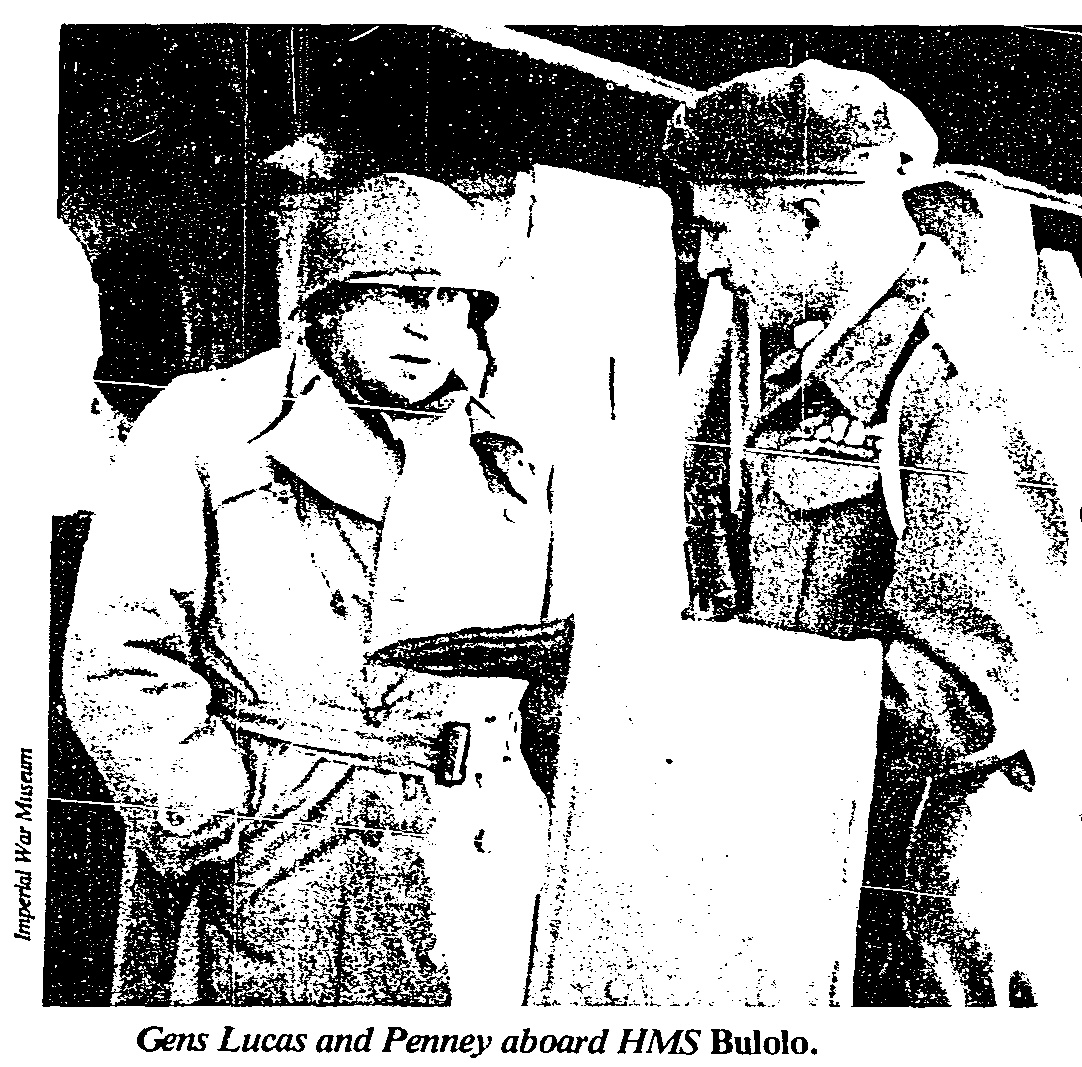
Dubbed Operation SHINGLE, the planning for the Anzio assault began immediately. The basic problem in conducting an amphibious assault along the west coast of Italy was noted by Gen Eisenhower when he stated: “If we landed a small force, it would be quickly eliminated, while a force large enough to sustain itself cannot possibly be mounted for a considerable period. . . .” The first mistake of Anzio was expecting too much of a small assault force. As Samuel E. Morison noted in his book Sicily-Salerno-Anzio: History of United States Naval Operations in World War II, “either it was a job for a full army, or it was no job at all; to attempt it with only two divisions was to send a boy on a man’s errand.” The Germans were believed to have the equivalent of four divisions available to defend Anzio, three of which could have been put into action within a week. How the Allied planners thought they could seize a sizable beachhead, cut vital enemy supply lines, seize strategic positions in the Alban Hills 25 miles inland, while protecting their own supply lines back to a beachhead, all in the face of superior enemy forces, was a mystery to MajGen John Lucas, VI Corps commander, who led the assault. Lucas saw no way to seize the Alban Hills without being cut off from the beachhead. Consequently, he made the establishment of a secure beachhead his first priority. LtGen Mark Clark, commander of the Fifth Army, to which VI Corps belonged, concurred with Lucas’ evaluation of the situation and framed his orders to Lucas accordingly. Both men had fears of another Salerno, where the German defenders nearly split the beachhead. Clark told Lucas before the Anzio landings not to “stick your neck out the way I did at Salerno.”

The availability of landing craft dictated the timing of the landing. OVERLORD would begin to draw landing craft away from the Mediterranean by the end of February. Thus, SHINGLE would have to begin at least a month before, in late January. Lunar and hydrographic considerations determined the exact date, 22 January. A night landing was decided upon in order to maximize surprise and to enable the landing forces to seize as large an initial beachhead as possible. With less than a month to plan the assault, there was barely enough time for a rehearsal. Gen Lucas insisted on one but it did little to raise his expectations for the operation’s success-it was an unmitigated disaster. However, there was no time for another.

SHINGLE was to be preceded by a renewed offensive along the main front, which began on 12 January and reached its peak on the 20th. The Fifth Army made little progress, but did force Gen Albert Kesselring, commander of the German forces in Italy, to commit two divisions of reserves from the Anzio vicinity. This meant little, however, because Kesselring, expecting an amphibious landing somewhere along the coast, had designed his defenses, with the exception of the frontline units, as one large mobile reserve. When the Allied assault began, the reserves would move rapidly to surround the beachhead, and as soon as enough troops had been massed, they would drive the invaders back into the sea. Thus Kesselring had only tripwire defenses along the coast, and Anzio and nearby Nettuno were garrisoned by only three engineer companies. Most of these were captured in their sleep by the Ranger force that took the port.

Though neither Clark nor Lucas expected it, total surprise was achieved because Luftwaffe reconnaissance planes could not reach the area after the successful bombing of the airfield at Perugia, and the Allies had gone to great pains to create a diversionary attack at Civitavecchia, north of Rome. The landing itself went like clockwork, despite the horrendous rehearsal. Rockets showered the beaches minutes before the landing craft roared in. The British landing at Peter Beach, six miles northwest of Anzio, encountered no opposition other than the sandbars and soft sand of the beach. On X-Ray Beach, four miles southeast of Anzio, the 3d Division (U.S.) landed with similar ease. By 0800 the Rangers reported the port secure, and by noon the British and American units had linked up, establishing the beachhead’s perimeter. By midnight, 90 percent of the assault convoy had been unloaded, including 36,000 men and over 3,000 vehicles, and a beachhead 15 miles wide and 7 miles deep was established, all at a cost of only 14 killed. Gen Lucas’ first priority was defense of the beachhead and port, however, and he went on the defensive almost immediately, expecting an imminent German counterattack.

Although the landing was virtually unopposed, Kesselring took little time to begin his defense. He gave the codeword for an assault on Anzio, “Case Richard,” sometime during the morning of the 22d. German intelligence knew that the Allied assault was only a two-division force and was nothing to cause a hasty withdrawal of forces from along the main front. Kesselring brought down Fourteenth Army headquarters from Rome, under Gen Eberhard von Mackensen, to coordinate the fight against the Anzio landing.

Gen von Mackensen’s first step in containing the invasion was to ring the beachhead with antiaircraft units from Rome using them as antitank batteries. Units were then fed into this perimeter as they arrived on the scene. By the morning of the 23d the flak batteries had arrived, along with elements of the 3d Panzer Grenadier Division and a regiment from the 15th Panzer Grenadier Division. By the 26th Gen von Mackensen had assembled six divisions around the beachhead. Allied patrols met initial resistance on 23 January. On the 25th the British took the agricultural center of Aprilia (known as “the Factory”) and 3d Division controlled the Mussolini Canal, but the weak patrols could gain no further ground against the rapidly building German defenses. Allied patrols were never able to reach the towns of Campoleone or Cisterna, which were considered intermediate objectives in the “advance” on the Alban Hills.

On 25 January Gen Alexander suggested to Gen Clark that an attack against Velletri be made, since the 45th Division (U.S.) was soon to be landed at Anzio in reserve. Gen Lucas agreed to go on the offensive on 30 January when the 45th Division was due to land. Gen von Mackensen was also waiting for enough troops to go on the offensive, which he was planning for 1 February. Both generals planned the same attack-along the Albano road that linked Anzio with the Alban Hills, running through the Factory and Campoleone.

Lucas managed to attack first. The British 1st Division’s advance up the Albano road began favorably, but the rugged terrain and soggy ground bogged down the tanks of the 1st Armored Division (U.S.). Without armor the British could not crack the German defenses at Campoleone and halted late in the afternoon of the 31st, occupying a salient south of the Campoleone station some 7,000 yards deep and 3,500 yards wide. The 3d Division, attacking Cisterna at the same time, depended on a successful infiltration by three Ranger battalions. The Germans ambushed the Rangers and blew the bridges across Cisterna Creek, however, and 3d Division was unable to advance beyond the Mussolini Canal. Gen Alexander, under great pressure from Churchill to maintain the offensive, did not like the situation. A German counterattack seemed imminent, however, so he and Clark acquiesced in Lucas’ request to go on the defensive.

Gen von Mackensen wasted little time switching over to the offensive. On 2 February he began attacking the flanks of the British salient. The typical German attack was a thrust at the flank of a British unit. The terrain and night fighting were well suited to the German tactics of infiltration and isolation and the frontlines along the salient became extremely fluid. By 4 February the British were being forced to conduct a fighting withdrawal, finding their positions infested by German units. Counterattacks by the 1st Armored Division could not stem the German advance. The 5th of February was perhaps the nadir of the Anzio campaign as lines were being pushed back rapidly. Gen Lucas, in his obsession to hold the beachhead, ordered intermediate and final beachhead defenses prepared. Construction of these lines took every available man from behind the lines and many more from the front where they were badly needed.

The British managed to hold their line intact during their withdrawal and, with the help of intensive artillery action, stopped the German advance about a mile north of the Factory. Gen von Mackensen switched the attack to the Cisterna front during the morning of 5 February and nearly broke through to the intermediate line of defense. MajGen Lucius K. Truscott, commanding 3d Division, decided that a strong forward defense was the only way to hold off the Germans. Gen Truscott counterattacked, regaining his original positions, and set to work restoring his frontline units to full strength and leaving the preparation of other defensive lines to the clerks and cooks in the rear.

After Gen Truscott’s successful counterattack, Gen von Mackensen switched the offensive back to the 1st Division. At 2100 on 7 February the Germans opened up an attack all along the 1st Division’s front. They were most successful on the left flank where they succeeded in pushing the British from their positions along Buon Riposo Ridge. Elsewhere the British defenses fell back slowly but intact. The Factory was overrun by noon of the 9th. The German advance was stopped here as Lucas brought up the 45th Division from reserve. A two-pronged counterattack against the Factory nearly dislodged the Germans, but it proved too small and was repulsed.

Phase one of the German offensive ended with the capture of the Factory. For the next three days fighting was limited to active patrolling as Gen von Mackensen marshaled all his forces for the drive through the beachhead. The Allies dug in feverishly. German prisoners captured in the first offensive informed the Allies that the major drive of the German offensive would be launched on 16 February, and true to their word German artillery opened up along the Albano road on the morning of the 16th. Against six German divisions, Lucas had the 45th Division astride the Albano road, 3d Division and Special Service Force on the right flank (along the Mussolini Canal), the British 56th Division on the left flank (the Molleta River), and 1st Division (British), and 1st Armored Division (U.S.), considerably weakened, in reserve.

By that evening, the Germans had driven a gap between regiments of the 45th Division in the center of the line. The next day Gen von Mackensen poured everything he had into the gap, and by the morning of the 18th he had driven the Allies back to the final defense line of the beachhead. The weakened 1st Armored Division was brought up from reserve to help man the line and every piece of available artillery bombarded the German wedge. The Germans continued to press forward, however, until the afternoon of the 19th, when their advance abruptly stalled. Gen von Mackensen had run out of reserves to hurl against the Allied line. Counterattacks later that day recaptured some of the ground lost to the Germans.

Despite their heroic stand, the Allied forces were extremely discouraged. The Germans had pinned them in for a month. The weather was miserable, there was not a dry place on the entire beachhead, and Lucas’ defense-mindedness had been debilitating to morale. The soldiers at the front were not the only ones dissatisfied with this state of affairs. Churchill had been pressing Alexander to remove Lucas since the early days of the operation. Complained Churchill, “I had hoped we were hurling a wildcat onto the shore, but all we got was a stranded whale.” By this time both Gens Alexander and Clark were inclined to agree that Lucas’ caution was excessive and replaced him on 23 February with Gen Truscott, who had been appointed deputy corps commander a week earlier as a prelude to the change.

Adolf Hitler was enraged by the failure of the Fourteenth Army to cut out the “abscess” at Anzio, and ordered another offensive, this time against the Cisterna sector. While the bulk of the German forces had tried to penetrate 1st Division’s lines, 3d Division, along the Cisterna front, had plenty of opportunity to solidify its defenses and was ready when the Germans attacked on 29 February. After four days of futile and halfhearted efforts to crack 3d Division’s lines, Gen von Mackensen ended the offensive and ordered his troops to dig in.

In March and April a stalemate settled over the beachhead as both armies sought to regroup and resupply. This was becoming increasingly difficult for both. The German supply lines were battered constantly by the Allied Air Force’s Operation STRANGLEHOLD, and VI Corps faced supply problems due to preparations for Operation OVERLORD. Action during these months was limited to active patrolling and artillery duels. By this time Allied forces numbered 6 divisions and 90,000 men facing a comparable number of Germans.

During the lull, Gen Truscott prepared plans for the breakout. He presented Clark and Alexander with four options. Clark favored Operation TURTLE, an advance on Rome via the Alban Hills, but Alexander approved only Operation BUFFALO, a drive through Cisterna, up through the Lepini Mountains into Cori and to cut Highway 6 at Valmontone. Clark suspected Alexander of directing the American divisions away from Rome in order to allow the British to enter the capital first, and told Truscott to keep Operation TURTLE ready in reserve. In fairness to Clark, TURTLE was not without tactical merit, but his obsession with being the first to enter Rome was undoubtedly the primary reason he favored the plan, as later events indicated.

None of Truscott’s plans could go into effect until the main offensive in the south began. Finally, on 11 May the decisive battle for the Gustav line began. On 14 May the French Expeditionary Corps made the first breakthrough. By the 16th, the British Eighth Army had crossed into the Liri Valley, and on the 17th Monte Cassino, stronghold of the line, fell.

Alexander ordered the breakout from Anzio for 23 May. The 3d Division and 1st Armored Division were to take Cisterna. The 36th Division was then to pass through and cross the valley below Velletri. The 36th and 3d Divisions would then advance together to Valmontone. The assault on Cisterna was a two-pronged attack that surrounded the town on 24 May and stormed it on the 25th. Gen von Mackensen, believing that the breakout attempt would be directed up the Albano road to Campoleone, kept his main forces opposite the 45th Division, which did its best to make the Germans feel that they were absorbing the brunt of the Allied offensive. On the 25th Anzio ceased to be a beachhead as elements of the 1st Armored Division ran into patrols from the II Corps, Fifth Army near Borga Grappa.

Truscott’s successful advance toward Valmontone was interrupted on 25 May by Clark, who ordered VI Corps to shift its attack to the northwest and Rome. Campoleone fell on 30 May after hard fighting in the Alban Hills, and Lanuvio fell on 3 June. The Germans were being pushed back along the entire front, and late in the afternoon of 4 June tanks from the 1st Armored Division rumbled into Rome. Clark had managed to add his name to the select list of conquerors of the eternal city.

In the end, Anzio was of great strategic value to the Allies for, along with the main front, it helped occupy more than 20 German divisions that might otherwise have been sent to Normandy or Russia. More important to us today, however, are the tactical lessons learned from Anzio and their relevance to modern amphibious warfare.

Anzio’s greatest lesson is its reemphasis of Nathan B. Forrest’s recipe for success on the battlefield: “to get there first with the most men.” After the initial landings at Anzio, Allied forces were neither. The assault force of two divisions proved entirely too small, and Lucas’ determination to secure the beachhead cost him the opportunity to exploit the extremely successful landing by seizing objectives inland.

Being first necessitates being fast. Mobility has become increasingly important on the modern battlefield with the trend toward mechanization, the development of the helicopter, and the exponential growth in electronic warfare capability. Maneuver warfare has now become the buzzword among tacticians. The concept of maneuver warfare has been expressed in the Boyd theory of conflict. William S. Lind explained the Boyd theory in a 1980 GAZETTE article like this:

. . . in any conflict situation all parties go through repeated cycles of observation-decisionaction. The potentially victorious party is the one with an observation-decision-action cycle consistently quicker than his opponents (including the time required to transition from one cycle to another).

The advent of modern battlefield information systems makes it even more important to be the first side comprehending the battlefield situation. Once this is accomplished, true maneuver warfare is made possible. Successful maneuver warfare forces the enemy into a maelstrom of problems, threats, challenges, and changing situations so rapidly that the enemy cannot adequately respond. Gen Lucas failed to grasp the essence of maneuver warfare at Anzio by being unaware of the local situation. A patrol sent to Rome would have discovered that the city was undefended and the rear of the Gustav line lay exposed. Virtually any offensive action immediately after the landing would have kept the Germans off-balance, disrupted their supply lines, and prevented them from threatening the beachhead by taking the battle elsewhere. Gen Lucas failed to adequately consider the options in between the extremes of a mad dash to the Alban Hills or an excessively cautious defense of the beachhead. He could have challenged the Germans by fortifying any number of objectives en route to the Alban Hills. Cisterna and Campoleone certainly could have been taken on the first or second day of the landing. Lucas’ expectation of a violent German counterattack at the beachhead became a self-fulfilling prophecy: by holing up at the beachhead he gave the Germans no choice but to attack him there.

Today, it is likely that an amphibious assault will encounter defenses superior in weaponry, manpower, or both. The goal of an amphibious assault is to land where the enemy is not, but even if this goal is achieved, as it was at Anzio, it is still likely that the assault force will quickly have to face large concentrations of enemy forces, as VI Corps did at Anzio. Tactics must then be formulated to keep the enemy off balance with rapidly changing, fluid battlefield situations that will prevent the kind of bottling up of the landing achieved by Gen von Mackensen at Anzio.

The presumed superiority of the defense has led some to regard the amphibious assault as an anachronism. The development of the doctrine of vertical envelopment with its use of helicopter assaults to the rear of the objective area was a partial response to these doubts. It breathed new life into amphibious doctrine and, in fact, divided modern amphibious warfare from that of World War II.

Helicopters bring the flexibility and mobility required to realize the principles of maneuver warfare to the battlefield. But, it would be a mistake for the Marine Corps to put too much emphasis on the helicopterborne portion of the amphibious assault. Anzio vividly demonstrated the need not only for mobility, but also of the need for muscle. Vertical envelopment’s critical weakness is the limited payload of helicopters. Any landing force larger than a Marine amphibious unit necessitates a surface assault of some sort. Since helicopters cannot supply a large landing force with either the artillery, armor, ammunition, or food necessary to conduct sustained combat operations, helicopterborne forces cannot operate independently for prolonged periods of time. Moreover, once the helicopters depart, these forces lose their tactical mobility. The original doctrine of vertical envelopment as developed by the Hogaboom Board called for approximately a 70/30 ratio between surface and helicopterborne forces in an amphibious operation. However, several new factors must be figured into the equation that may require a rethinking of certain aspects of the amphibious assault.

Vertical envelopment creates difficulties for the enemy’s defense against amphibious invasion, but if it is relied on too heavily, the enemy’s tasks will be made easier. The proliferation of very capable air-defense weapons will greatly complicate helicopterborne portions of the assault and helicopter attrition could be quite high in a mid- to high-intensity air defense environment. The Marine Corps needs to recognize this threat and formulate either a hardware or doctrinal response.

There are other weaknesses that need to be addressed. For example, there is a need for a greater ability to resupply and build up the beachhead. The decline of the United States’ amphibious lift capability has long concerned the Marine Corps. Today the Navy could not land or support a force even the size of the original Anzio force-two divisions. The American Merchant Marine will be of some help, but its decline has exceeded that of the Navy. The ability to provide naval gunfire has also declined, though the recommissioning of New Jersey, Iowa, and Missouri should help. The Navy is also deficient in minesweepers. With only 25 minesweepers in service, any assault force faces a serious danger from mines, which are a cheap, effective defensive measure. They were a continual hazard at Anzio, where they sank at least four ships.

Part of “the most” that never arrived at Anzio was close air support. The vast majority of sorties flown by the Allied air forces during the four month campaign were part of Operation STRANGLEHOLD, a strategic bombing campaign designed to cut the German supply lines and to isolate the battlefield. STRANGLEHOLD did do a great deal to hamper the German resupply efforts, but it failed to isolate the battlefield, as evidenced by Gen Mackensen’s rapid buildup of forces around the beachhead. Close air support (as we know it today) during the initial phases of the assault might have helped Lucas expand the beachhead much more rapidly. Fortunately, the validity of the Marine Corps’ concept of air power in direct support of ground operations has been accepted in the United States Armed Forces, and current amphibious doctrine places great emphasis on receiving such close air support. Again, however, it may be unwise to place too much emphasis on this facet of the assault.

As noted by Capt J.D. Williams, Canadian Armed Forces, in his article, “Role of the Fighter Aircraft on the Modern Battlefield, (MCG, May84, p.86) fighter aircraft could enter as many as nine surface-to-air missile (SAM) engagement envelopes en route to the battlefield. Granted this is a “high intensity” European-Warsaw Pact scenario, but the worldwide proliferation of these weapons will force the Marine Corps to deal with a SAM threat in many possible theaters of operation. Connected to this, as Capt Williams points out, will be the devastating psychological impact of losing aircraft in close air support missions. At Anzio it was artillery, not aviation, that provided VI Corps with its most effective fire support. Close air support is no substitute for firepower organic to the ground units. In many ways it is much less effective and can only complement and not replace artillery and armor.

As previously noted, Lucas’ major mistake was failing to seize the initiative and exploit his initial tactical advantage. His caution serves to highlight two other facets of the amphibious assault that have not received enough consideration, reconnaissance and leadership. Counterreconnaissance and countersurveillance are the keys to thwarting counterattacks against an amphibious landing. They would certainly have helped VI Corps. More aggressive patrols would have been able to report to Lucas just how weak the enemy forces were during the first days of the assault. Reconnaissance-in-force can help gather intelligence, foil enemy intelligence, and guard the flanks of the main forces.

Gen Lucas can hardly be blamed for failing to dash to the Alban Hills. His orders were unclear, his tasks extremely difficult, and his superiors uncritical. Lucas was a conservative soldier, and given the uncertainties and difficulties he faced, he chose conservative tactics. Some of the blame should lie with Lucas’ superior, Gen Clark, who chose the wrong man for the job. With the growing need for mobility and the emphasis on maneuver warfare, amphibious operations will require audacious, daring officers who are willing to take the initiative and think creatively. There are serious questions about whether the current officer evaluation system, with its emphasis on a clean slate rather than on quality of performance is capable of producing such officers. Unfortunately, many of our best potential combat leaders cannot survive the “paper bullets” of peacetime. Perhaps the Marine Corps should look at ways to restructure the officer selection system to ensure that leadership in the United States military continues to be as superior to that of the Soviet Union as we claim-and hope-that it is.

Gen Lucas might have been less cautious had he been given enough troops to accomplish his mission. The Anzio planners did a poor job in analyzing the operation’s requirements based on what we now call METT-mission, enemy, terrain, troops and fire support. There were different interpretations of VI Corps’ mission; the enemy’s defensive capabilities were underestimated; the problems posed by the various terrain of central Italy and the Italian winter were not considered adequately, and the forces and supporting materiel available to VI Corps were in high demand elsewhere and so were only available for a limited period. Careful consideration of METT has become even more crucial to success in today’s high-technology combat environment, where the increased accuracy and lethality of modern conventional weapons greatly reduce the time available to react and adapt to unanticipated battlefield situations.

A final tactical lesson from Anzio lies in the fact that most of the battles took place at night. German tactics of night infiltration and maneuver greatly disrupted Allied operations throughout the Anzio battle. In that connection, the Marine Corps must prepare its forces to fight offensively and defensively at night in order to maximize the effectiveness of its maneuver and counterintelligence tactics. Given the capabilities of modern defensive weapons, an invading force may well have to operate at night. The Marine Corps will have to be better prepared and equipped for night combat than were the troops at Anzio.

Much of the Marine Corps’ institutional life since the end of World War II has been spent defending its raison d’etre-the amphibious assault-against critics who claim that such operations are no longer possible. The Marine Corps has given such critics more attention than they deserve, for the question of the feasibility of amphibious operations is largely irrelevant-the Nation must be able to assault successfully by sea in order to guarantee its security. Tomes have been written on the simple fact that the United States is a maritime nation; it always has been and it always will be. The capability to conduct amphibious operations is an indispensable facet of the seapower upon which the economic and political security of our Nation rests. The Marine Corps must therefore continue to improve and adapt its amphibious doctrine in accordance with historical performance and analysis of the realities of modern warfare.

Most of the historical analysis of Anzio centers around the question of which was more important, establishing the beachhead or driving forward to the Alban Hills. In answering this question, the Marine Corps should remember the painful lessons of Operation SHINGLE. It stands to remind us of the fundamental importance of offense, maneuverability, and mass. Had SHINGLE’S planners emphasized these principles from the outset, the Anzio campaign might have been much more successful.

The concept of maneuver warfare offers promise with its emphasis on both mass and mobility. The realization of such a concept of fighting, however, is not without problems. For instance, the logistical necessitities of maneuver warfare require (among other things) a beachhead secure and large enough to handle the logistics operations as well as an amphibious capability large enough to support the invasion force. However, the Corps can and must overcome these constraints, and in conducting a forcible entry, it must avoid the same mistakes made by Gen Lucas at Anzio. A secure beachhead operation is not an end unto itself; it is a means of accomplishing the mission-to locate, close with, and destroy the enemy.

Quote to Ponder:

Teaching

“Instead of blaming people, mistakes should be an occasion for careful examination of work habits. A Marine is not necessarily a bad or inferior person because he or she makes mistakes. He may be doing things the wrong way because no one has taken the trouble to teach him better.”

-SgtMaj Melvin Bray

Henderson Hall News

Preparing for Maneuver Warfare

by L.C. Carter

Re Mr. Lind’s “Preparing for Maneuver Warfare” (Jun84). One does not have to buy all that Mr. Lind is selling to agree with the thrust of his article or to appreciate his continuing interest in our growth and health. The discouraging aspect of his article is that he felt he had to write it. Most of his points have appeared in the pages of the GAZETTE over the years, but the problems they relate to still exist. It remains for the responsible officers to respond to his specific criticisms of specific schools at MCDEC (and it is my understanding that many of his observations are no longer valid), but one is hard put to dispute his views on increasing the emphasis on military history, strengthening faculties, focusing the selection process, strengthening noncommissioned officer (NCO) education/development (convincingly corroborated by Capt Trowbridge’s “Training Staff NCOs” in the same issue), increasing the NCO role and responsibilities, and reorder some basic priorities. Imagine a civilian having to write “we need to make ‘preparing to win in combat’ the guiding, overriding priority in the allocation of our time, our dollars, and our rewards.” There is a good deal of room for discussion on what combat the Marine Corps needs to prepare for and how best to prosecute that combat, but there can be no argument about institutional priorities. That they are unclear, wavering, or perverted is a charge that ought to concern every Marine.


by Maj C.J. Gregor

The Jun84 issue of the GAZETTE is but the latest in a long string of issues that provide numerous points to ponder of significance to the Marine Corps as a fighting organization and the individual Marine as a professional. Mr. Lind’s article, in particular, was well-thought-out, well-written, and perceptive of some of our problems and possible solutions. We Marines have many areas to work on if we are to become as professional in action as we portray ourselves in words. Sometimes our own hype may even blind us to self-correctable shortcomings. I would only ask Mr. Lind to share his military insight within his occupational sphere of influence, i.e., the Congress, in order to enable that august body to provide the necessary, unified national leadership and national strategy that is currently lacking but necessary to mold the Armed Forces in general and the Marine Corps specifically into an even more battle-ready organization. The Military Reform Caucus does not appear to have accomplished many tangible results in the past two years. . . .


by Capt S.G. Duke

Though I agree with many points made by Mr. Lind, I felt somewhat incensed by his comments concerning the Amphibious Warfare School. In an effort at justifying his thesis for reeducation of the Marine officer, he cites two multiple choice questions that admittedly may not belong on an intermediate-level Service school’s final examination. What Mr. Lind fails to mention are the numerous hours the school’s tactics department devoted to maneuver warfare (commonsense tactics), and an indepth professional battle studies program. Additionally, the school conducts many tactical exercises without troops on actual civil war battlefields utilizing Marine versus Soviet scenarios. I found that on each of these exercises the tactics instructors encouraged the type of free-thinking that he so ardently advocates. The author also fails to inform the GAZETTE’S readership of an eight-hour exam administered to students that requires them to write an in-depth battalion reinforced operation order and complete fire support plan. The success of the student’s effort is largely based on finding the Soviet’s surfaces and placing the Marine Schwerpunkt on the opposing gaps. . . .

As long as the Marine Corps’ current policies on officer career patterns and the limited opportunity for service with the Fleet Marine Force exist, Marine schools will have to continue to teach officers what they should have already learned. As a force that may be overcommitted yet will refuse no mission, the Marine Corps must have capable and proficient platoon leaders, company, and battalion commanders vice potential field marshals on all levels of command. As an analogy, a football team that has not first mastered the basics of blocking and tackling will win few games by trying to master the end-run and the long-pass first.

Mr. Lind is a fine and accomplished writer who invokes healthy debate that may contribute to finding solutions to problems facing the Marine Corps. However, as a professional he should be above providing the misleading type of examples he cites as indications of the curriculum taught at one of our finer institutions.


by Maj William A. Woods

Mr. Lind’s recent contribution will leave some readers gnashing their teeth, wringing their hands, or tearing out their hair. Some may even go so far as to hope that Mr. Lind will never write again. How dare a mere civilian who has never served a day of his life in the military Service and probably could not even pass our physical fitness test tell us how to run the Corps. How could the editorial board allow such a piece to slip through?

Unfortunately, Mr. Lind’s article has the hot sting of truth in it. . . . The changes he argues for, particularly those concerning the education of our officers, are substantial and far-reaching. To institute even the minimal called for would require a monumental redirection of our thoughts on war. Those seniors who possess the power to make such changes will have to be of exceptional character-officers who can struggle through the suffocating muck of bureaucracy and lesser minds to break free into the clear, brilliant light of reason.

Like the Doomsday prophet, I too will point my finger and sound the warning. Listen to what Mr. Lind is saying. Heed his words. Shake off this encroaching antiintellectual lethargy we have slipped into. Begin by putting aside the running shoes and taking up the books. Perceive yourselves as military officers and not as “rangers” and “cowboys.” Pursue the study of the art of war with a vengeance and learn the art of conducting operations and tactics. Stop seeking the illusive safety in memorizing techniques and laundry lists of “how to.” When assigned to a Service school, challenge your instructors by presenting innovative approaches to problems. Demand excellence in your schooling and in your training. In the field, welcome free play exercises and seek opportunities to have your unit officers involved in wargaming. Learn how to critique exercises tactically. Engage your contemporaries and seniors in discussions on operations, tactics, and military history. Establish an officers’ library and allow time for study and reflection. All these things and more we can do. Accept the challenge of learning about this business of war. It is not easy and will require much hard work, but the rewards are inestimable. . . .


by Maj H-C. Peterson, Jr.

It was interesting to read Mr. Lind’s article. . . . and then to read 1stLt Berger’s comment that 3d Battalion, 7th Marines had developed relatively new concepts (building blocks) for organizing command posts for high speed warfare.

What Lt Berger and his battalion have been doing (creating an austere mobile command post (CP)) is not new at all, although it certainly is important. I recall doing much the same thing with a regimental CP when serving with the 1st Marines a few years ago; I also recall that 1st Battalion, 4th Marines was working out a mobile CP very similar to what Lt Berger described, back in 1980.

My point is obviously not to get bogged down in establishing who first established the austere mobile CP. What is curious is Bill Lind’s point that we are not studying history very well and the case in point presented almost on the same page. If Marine Corps schools and commanders had been studying “history” (to include after action reports from exercises, GAZETTE articles on “how we did it,” and battle memoirs from the past), then we would not be rediscovering the wheel (or the wheeled CP) every few years.

One cannot help but be inspired by Lt Berger’s enthusiasm for an exciting way to do war-the austere mobile CP does allow the commander and his close staff to focus on fighting the battles and campaigns. We can only hope that we do not have to read in the GAZETTE of 1994 about how Lt Banotz and 2d Battalion, 9th Marines have just discovered the new concepts of the mobile CP.


by J. Manter

Two pieces in your Jun84 issue of MCG caught my attention: “Preparing for Maneuver Warfare” by William S. Lind and “Training Staff NCOs” by Capt J.B. Trowbridge. Both referred to improvements to upgrade the Marine Corps’ noncommissioned officer (NCO) corps; Lind recommends a significant differential status between E-3 and E-4, stiffer promotion and training standards, and specific responsibilities within the company-level unit distinct from commissioned officer duties and allowing these latter to practice a more “professional” form of officership; Trowbridge makes a specific suggestion for an 0369 (infantry platoon sergeant’s) qualification training course.

My views stem from my days as a corporal during the late 1960s and early 1970s including a half tour with the Fleet Marine Force (FMF) in Vietnam, and a chance to view Britain’s Royal Marines on an exercise in the Philippines. At that time, the enlisted Marine received little serious preparation for the grade of E-4, especially in the infantry field. I am aware that three to four week courses exist now for the budding Marine NCO, however, I believe that the Corps is still regarding junior NCO training as it did during the Vietnam years. Specifically:

  • Because initial enlistments were limited to two or three years, it was felt that a high initial investment in the junior NCO’s training would never bring an adequate return. Understandably, with the draft and subsequent high turnover rates, more responsibilities were vested with the staff NCO body. Presumably these attrition rates have been moderated and units have a more stable population of Marines.
  • The staff NCO was expected to impart enough of his experience to bring the new corporal “up to snuff.” I did not find this to be so, and regularly saw corporals assume platoon sergeants’ roles in Vietnam. Once our platoon was even commanded by a PFC for a short time.
  • NCO training courses, such as existed, rarely exceeded a month’s duration, and were filled with headquarters troopers from the divisional level. Training was oriented to drill and garrison subjects, rather than fieldwork. These courses did not determine promotions; no requirement existed to complete them for a set of stripes.

My observations of Her Majesty’s Royal Marines, limited though these were, left me with a high respect for the Royal Marine “junior leader.” On the section (their squad) level, I believe he was clearly superior to his American “cousin.” These factors contributed to his high level of competence and effectiveness:

  • An initial enlistment of nine years. Promotion was slow and the young Marine had the benefit of time to train and develop before being promoted; his maturity level was quite a bit higher with three years or more behind him as a junior enlisted man compared with the U.S. Marine’s one or one and one-half years.
  • Much more extensive initial training-upward of nine months, including recruit, shipboard, amphibious, field, commando, and specialist training. The average U.S. Marine Corps “grunt” had seldom received more than four months initial training.
  • Most significantly, the Royal Marine junior leader had successfully completed a “junior leader’s course” of eight weeks duration-on top of service in a commando with its requisite amphibious, mountain, jungle, and field training.

I noted with interest the chart included in Capt Trowbridge’s article on required instruction for NCO promotion within the Anglo-Saxon military establishments. Most required longer initial training for their infantry elements. All required two months or more of qualification training to achieve the junior NCO rank. . . . With all due respect to Capt Trowbridge’s recommendations for staff NCOs in the 03 field, I believe that the road to upgrading the Marine Corps’ body of NCOs is to start at the junior levels. I submit these ideas for consideration:

  • That the infantry training course for recruit-training graduates be extended to 8 weeks, perhaps 12 weeks if airmobile and amphibious indoctrination is thrown in. . . . In the present peacetime situation, with longer duty tours and enlistments, there is time to polish the young Marine before he joins the FMF.
  • That the rank of E-4 be attained, in the 03 field, at any rate, only through the successful completion of a junior leader’s qualification course. . . . The emphasis must be on “how to” field work; the polish of parade ground and garrison oriented training can be added later.
  • That the Marine Corps observe the junior leader training of foreign Allies and draw some ideas on directions for such training in the Marine Corps. Good places to start would be with the Royal Marines junior leader’s course, or with the Canadian Army’s squad commander’s course at their Combat Training Centre in our own backyard. One has to bear in mind the respective national and institutional differences of these forces, but nevertheless useful ideas could be gleaned.

I submit these not so much in criticism of present or past training systems, but in the hope that other Marines could become the kind of junior NCO which I wish I had the opportunity to become during my short service.


by LtCol William C. Curtis

The GAZETTE gets better and better! While I enjoyed all the articles in the Jun84 issue, I was particularly interested in those by William Lind and Capt Trowbridge.

Recently, I served with a small number of Royal Marines and Royal Netherlands Marines. That experience, plus observations in Hong Kong and the United Kingdom in the early 1960s, cause me to agree completely with the crying need to improve our NCO corps.

Promotion warrants are, all too often, little more than certificates of good attendance. One cannot blame those that receive these promotions so much as those who do the promoting. I personally share guilt in that respect.

When officers devote most of their time to “ensuring” that the routine (albeit extremely important) gets done, men they are nothing more than a second set of NCOs. They resent it; the NCOs resent it; and the troops are bewildered.

The role of NCOs as stated in a number of official documents is frequently not the role in practice. Again, this is not the fault of the NCO corps, but to those who provide guidance and direction.

Well, what to do? Those ideas presented by Mr. Lind and Capt Trowbridge deserve careful thought. I would offer a few of my own:

  • Reinstitute the draft; even a limited one might have the salutary effect of reminding that service is part of citizenship.
  • Freeze the pay for junior enlisted personnel.
  • Pay BAQ, VHA, and BAS only to E-As with over 4 years of service and higher pay grades.
  • Dramatically increase the pay for all NCOs.

These, seemingly radical, steps would have extremely positive results:

  • Decrease personnel costs of the active military.
  • Discourage, rather than subsidize, early marriage by our youngest personnel.
  • Decrease commissary, hospital, housing, and moving costs.
  • Encourage greater numbers of high quality junior Marines to aspire for admission into the NCO ranks and career force.

These ideas, of course, merit careful study before implementation. While they may appear rather negative at first blush, they are not designed to punish younger Marines. On the contrary, they are designed to encourage excellence and reward performance. My personal observations are that most younger people are not aware of the pay system prior to enlistment. Rather, they enlist for travel, training, prestige, a challenge, and the like and only become aware of such things as BAQ, BAS, commissaries and so on after they arrive at their first duty station.

It seems to me, that a large number of well-intentioned people have established laws, regulations, and policies that fly in the face of all those things that develop unit cohesiveness and unit esprit. Maybe this trend can be reversed.

Educational Philosophy

by Capt G.R. Ing

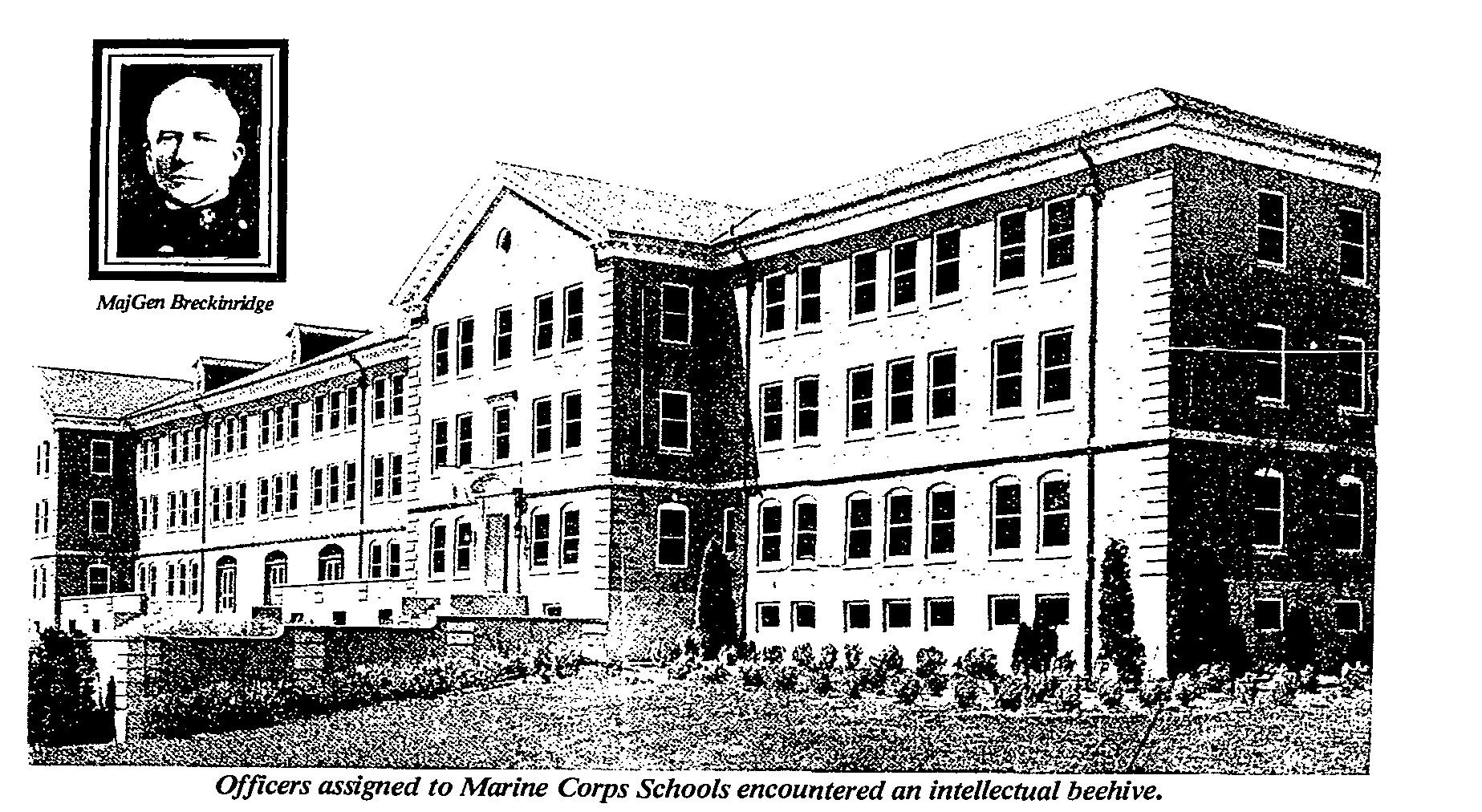
Capt Moore’s article (May84) on the legacy of Gen J.C. Breckinridge is successful in its attempt to reawaken the reader’s appreciation for the efforts of our predecessors, however his basic philosophy is not without flaws.

The first point of contention refers to the manual that was published in November of 1983 on the Marine rifle squad. The handbook is the result of a joint effort by the Doctrine Center and The Basic School. It was compiled after a year of gathering information and soliciting input from FMF commanders and a year of writing first through fifth drafts. This was done not by outsiders brought in for consultation but by a group of highly qualified combat veterans who have reputations throughout the Corps as combat leaders. Put together as a guide for FMF units, this handbook is based on these experienced individuals’ keen insight into small unit operations. It is a starting point for the young rifleman and squad leader and something far more than a “hollow statement of minutiae and drill.”

The second point of contention concerns Capt Moore’s ideas of our officer schools. Contrary to his views, the professional schools in today’s Corps are so steeped in historical analysis, problemsolving, and critical analysis of doctrine that we are turning out little more than philosophers and maneuver gurus. Every solution is the right solution; no one’s solution to an exercise is totally right or totally wrong. Every student walks away with a warm inner-glow, knowing that his solution was right. Well, in the real world there is a right solution-the best solution. Other solutions may work with varying degrees of effectiveness; the best solution will be the one that not only ensures success but is the least costly in Marine lives. In an academic environment a school solution makes sense. It is constituted from the corporate knowledge of the present cadre of instructors and affords the student an opportunity to take advantage of the collective wisdom of his predecessors.

Maneuver gurus and philosophers abound to the extent that most officers know nothing of tactics or how to train their Marines. Marine officers are so concerned with looking into the future and philosophizing on strategy, policy, and doctrinal concepts that they don’t realize they are deficient in tactical fundamentals. This is evident by Capt Moore’s statement on “the awakening of Marines to the studying of new tactical concepts and maneuver warfare.” These maneuverists have come up with nothing new or innovative in regard to tactics. Tactics have not changed nor will they change. Anyone that doesn’t realize this doesn’t understand tactical fundamentals. Read your history. Weapons, their ranges and lethality, change; speed of movement changes; dimensions change; but tactics and their inherent fundamentals do not. From Genghis Khan to MacArthur, they have remained the same.

If more time was spent by company grade officers learning tactics and tactical fundamentals, developing techniques at the small unit level, and training Marines, instead of worrying about the direction of the Corps, we wouldn’t have the problems we have.

Gen Breckinridge left us a legacy and it is a valid one. However, I’m sure he did not intend it to be at the expense of our Marines. Let’s stop some of this philosophizing and start being company grade officers. The field grade officer can philosophize, the general grade officer can shape the future of the Corps. We can lead and train Marines.

Incidentally on page i of OH 6-6, The Marine Rifle Squad, is a user’s suggestion form to solicit recommendations for changes to that handbook. MCDEC did not receive many of these from the field. Perhaps if we weren’t so concerned with the direction of our officer schools we would have more time to devote to those areas in which we can have a significant impact. Have you submitted your recommendations?

Maneuver Warfare at Tinian-1944

by Maj R.J. Brown, USMCR

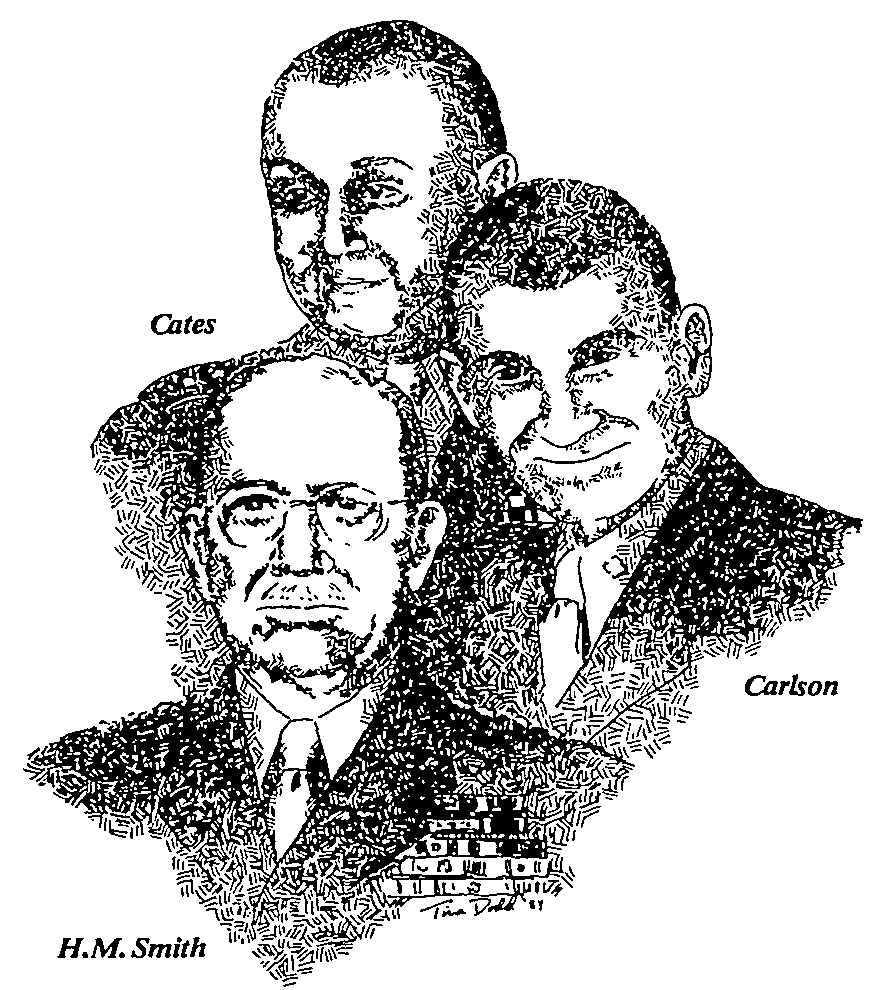
Maneuver Warfare is a term that only recently entered the Marine Corps lexicon. As result, its meaning is often misunderstood by Marines. Younger officers frequently conjure up Rommelesque visions of massive armored clashes across vast green steppes or khaki-colored deserts. On the other hand, conservative Marine “purists” are turned off by the unfamiliar, foreign sounding titles used by maneuver enthusiasts to press home their arguments. In this semantic confusion, the major thrust of maneuver warfare is frequently lost. Maneuver warfare is not a new panacea to replace older, well-proven methods of warfare; rather it is a style of warfare that uses unique application of these well-proven methods to enhance the commander’s chances for success on the battlefields of today and tomorrow. One need not rely on foreign examples to see how the concepts of maneuver warfare have been applied in the past. A Marine assault carried out 40 years ago in the central Pacific provides us with an excellent example of the principles of maneuver warfare. The practitioners of this art were none other than LtGen Holland M. “Howlin’ Mad” Smith, Col Evans F. Carlson, and MajGen Clifton B. Cates; familiar names that will warm the heart of any loyal Marine. The seizure of Tinian is a classic example of Marine maneuver warfare at its best.

The island of Tinian lies just off the southern tip of Saipan in the Mariana Islands. Its capture as a followup to the Saipan invasion of 1944 was obvious to both the Japanese and Americans. The problem was not “if or “when,” but only “how” to capture the island. The way this problem was solved marks the seizure of Tinian as one of the most noteworthy operations in Marine Corps history.

In 1944 Tinian presented a formidable obstacle. Over 9,000 Japanese defenders were preparing to defend the island, and the American capture of Saipan gave them ample warning of what was ahead. The Japanese force comprised the battle hardened 50th Infantry Regiment, a battalion of the 135th Infantry Regiment, the 56th Naval Guard Force, and assorted combat support units. This force was commanded by Col Keishi Ogata. The island’s interior was relatively flat, dotted with numerous sugarcane fields, and its coastline was characterized by steep coral cliffs. The only urban area on the island was built up around the sugar refinery and called Tinian Town. Reconnaissance of the island showed only three potential landing areas: one at Tinian Town, one at Asiga Bay, and one in the northwest corner near Ushi Point. The most favorable landing area, in terms of terrain, was the beach at Tinian Town. The beach at Asiga Bay was considered marginal because of tide conditions and coral reefs. Two beaches were spotted in the area near Ushi Point, but both were extremely narrow and coral reefs or small cliffs blocked portions of the approach lanes.

This was the situation as the date for the assault approached. After an in-depth review of several possible actions, Col Carlson, the man who made the Chinese phrase “Gung Ho” synonymous with Marine esprit de corps, urged a startling scheme of maneuver. He proposed that the 2d Marine Division fake a landing at Tinian Town to keep the Japanese busy, while the 4th Marine Division sneaked in the “back door” by landing across the miniscule beaches to the north. LtGen H.M. Smith listened and agreed that this “indirect approach” was best. By using this scheme, a shore-to-shore landing could be conducted under the protection of American artillery fire. A convincing demonstration at Tinian Town would tie up Japanese reserves during the crucial early hours of the landing and avoid the heavy concrete teeth Col Ogata had planted on the Tinian Town beaches. As was expected, some more conservative officers rejected this plan as too daring and controversial. It took the vociferous Gen H.M. Smith to convince them to accept the inherent risks and adopt the plan.

Once the plan of attack was worked out, the preparation for the invasion began. First, V Amphibious Corps (VAC) was task organized to perform the mission it was assigned. The two artillery regiments of the 2d and 4th Marine Divisions were radically realined. The five battalions of 105mm howitzers (two from each of the divisions and one from VAC) were united to form a provisional group under Col Raphael Griffin, the commanding officer of the 10th Marines. These guns were then placed under the command of BGen Arthur M. Harper’s XXIV Corps Artillery (U.S. Army). The remaining four 75mm pack howitzer battalions were united under Col Louis G. DeHaven (14th Marines) to form an assault artillery regiment. All of the available LVT armored amphibious tractors and DUKW unarmored amphibious trucks were placed at the disposal of Gen Cates, commanding general, 4th Marine Division. The remaining combat support units, shore party teams, tank battalions, engineer units, etc. were also attached to the 4th Division. One additional regimental combat team, RCT-8, was attached for the opening assault. Some LVTs were specially modified to emplace bridging equipment on the cliffs to allow the following waves to scale them easily. This task organization provided the Marines the tools needed to accomplish their goal.

The preparatory bombardment of Tinian was the most effective in the Pacific war. Each target was carefully selected and then struck by various supporting arms over an extended period. The island was divided into special fire support sectors and specific targets were located after careful reconnaissance. Three battleships, 3 cruisers, and 24 destroyers were used to provide naval gunfire. The 155mm “Long Tom” guns of Gen Harper’s artillery ranged the length and width of the island, and 105mm howitzers pummeled the northern portion. Daily air strikes and a new aerial weapon called “napalm” were also used to destroy enemy positions.

The landing was made on the morning of 24 July 1944 after a furious artillery, naval, and air bombardment. During the previous weeks, great care had been taken to ensure that preparatory fires would not betray the intended landing area, and the area near Tinian Town had received the lion’s share of the naval gunfire before J-day or “Jig” day (so named to avoid confusion with Saipan’s D-day and Guam’s W-day). An ominous portent of what might have happened had the landing been made at Tinian Town took place when Japanese coastal guns disabled several U.S. Navy ships supporting the demonstration force. To the north, however, all was well. The Marines flooded ashore and moved inland rapidly against only light opposition. Soon the combat support units crossed the beaches. The beachhead was quickly secured with very little cost to the attacking force.

At 1630 that afternoon the combat teams received orders to halt even though the first objective, the 0-1 line, was not yet captured. Gen Cates, a shrewd veteran of Guadalcanal, wisely decided to halt in place and dig in for night defense. While this move was contrary to the established Marine Corps amphibious doctrine that called for the landing force to move inland at all costs, this decision put Gen Cates inside the enemy’s “Boyd (observation-orientation-decision-action) Cycle.” By attacking that first night, Col Ogata’s forces played into American hands; rather than forcing the action, they reacted in the expected manner. The enemy struck in three columns. Each attack was crushed by the well-prepared Marines. Ogata merely wasted his finest troops in a futile effort that was doomed to fail because it lacked the necessary element of surprise. Gen Cates felt the Japanese “broke their backs” in these attacks and actually made the later conquest of Tinian much easier.

On 25 July the 2d Marine Division (MajGen Thomas E. Watson), having completed the demonstration off Tinian Town, came ashore over the northwest beaches, seized Ushi Airfield, and swung south with a zone of action covering the eastern half of the island.

On J-day plus 2, the second phase of the operation began. The two Marine divisions began “elbowing” their way south to Tinian Town. Each division alternated, tearing off huge chunks of real estate by operating in tank-infantry teams behind a rolling artillery barrage that was furnished by the bulk of the direct support artillery. This symbiotic relationship between men and machines worked well; the tanks crushed the cane stalks and tropical vegetation that barred the infantry’s way, while the Marines on foot provided close-in protection against antitank weapons and spotted targets for the 75mm tank guns. The main problem during this phase was keeping up with the fast-moving attack. These assault groups moved with astounding swiftness. On 27 July they burst ahead 1,800 yards. The next day they covered 6,000 yards over a 5,000-yard front. These were amazing advances when one considers the pace set during other operations in the Pacific. Tinian Town fell on 31 July, well ahead of schedule.

The capture of Tinian Town marked the beginning of the final phase of the attack. Col Ogata was killed the next morning when the Japanese struck the Marines with another banzai attack. The last days of fighting were tough ones because the Japanese were holed up in the cliffs at Marpo Point on the island’s extreme southern tip. Fighting became a deadly duel between small assault groups of Marines and the suicidal Japanese defenders. It became a battle in which neither side asked for quarter. Eventually, the Marines wore down the last pockets of defense, and the island was declared “secured” on 1 August 1944.

The battle for Tinian took only nine days. The Marines inflicted 6,050 casualties on the Japanese defenders, captured 250 Japanese soldiers, and interned 13,662 civilians. Marine losses were 290 killed, 1,515 wounded, and 24 missing in action. The Marine kill ratio (20 to 1) was the best of any major operation in the Pacific. Based on mileage per day, Tinian was also the fastest moving Marine operation during the war and a strategic victory of the greatest magnitude. Its flat fields soon sprouted numerous airfields big enough to support the lumbering Boeing B-29 Superfortress bombers that bombed Japan around the clock. On 6 August 1945 the B-29 Enola Gay left Tinian for Hiroshima where it dropped its atomic payload and brought the world into the nuclear age. For their fine performance in the Marianas, the Marine divisions were each awarded a Presidential Unit Citation. The ultimate tribute came when Gen H.M. Smith called Tinian the “perfect amphibious operation.”

What lessons can this battle fought four decades ago present to a commander using modern weaponry? The answer is many. Although the weapons and tactics have changed in the intervening years, the principles behind the victory at Tinian are as meaningful today as they were in 1944. The first and most important concept in maneuver warfare was the proper use of Basil Liddell Hart’s concept of the “indirect approach,” advocated most forcefully in his book Strategy. The indirect approach does not mean using an off-the-wall scheme of maneuver, hoping to catch the enemy off guard. It is a method of entering the enemy’s “Boyd Cycle” and throwing him off balance. Properly applied, it achieves such surprise that the enemy is put into a psychological and physical state from which he cannot recover. The attacking (or surprising) force gains the upper hand and forces the enemy to react at the wrong time and to the wrong stimuli. In the words of Sun Tzu, “Appear at places the enemy must hasten to defend, march swiftly to places where you are not expected.” This concept was properly applied at Tinian. The feint of the 2d Marine Division was meaningful because the enemy believed Tinian Town would be attacked and drew his forces away from the actual landing area. Feints were used several other times in the Pacific, but most encountered little success because they did not present a believable scheme of attack. A second example of sound fundamental tactical judgment was Gen Cates’ decision to stop short of the 0-1 line and dig in. He anticipated the Japanese attack; he enticed the Japanese to make it; and he decimated them along the barbed wire that ringed the Marine lines.

Another fundamental principle of maneuver warfare carefully observed at Tinian was exploitation of the situation and methods at hand to accomplish the task. The decision to land at the White Beaches was not a rash gamble, but rather a calculated risk. The enemy’s plans, preparations, and “mind set” were carefully studied. The risk was weighed against the potential gain. It was decided that if the enemy did fall for the ruse and was surprised by the Marine landings, he would be demoralized and placed at a physical and psychological disadvantage. These advantages were carefully weighed against the more conservative, but surely more costly, landings at Tinian Town. Each factor was carefully considered: the available fire support, the logistical burden, the terrain, and the weakened condition of the assault force that was tired from the Saipan campaign and had not been reinforced by sufficient replacements. In the end, the “back door” was judged the best possible scheme of maneuver for the forces available because it was within the capabilities and exploited their strengths.

The area that showed the most originality was that of task organization. The task organization of artillery for Tinian was truly unique and clearly showed the concern of the commanders for the principles of war. The availability of shore-based artillery support during the entire landing phase was the deciding factor in the task organization. By placing all the “stay behind” artillery under a single commander, the principle of unity of command was observed; and the massed fires of the 156 artillery pieces left on Saipan utilized the principles of mass and economy of force. These stationary guns, firing from near their supply points lobbed accurate, continuous observed fire on to the Japanese from well before J-day until well after the assault artillery was ashore. At the same time, landing the 75mm pack howitzers with the assault troops guaranteed responsive direct support for the maneuver force. The common pooling of the other combat support units was consistent with the principle of economy of force. The tank-infantry operations on Tinian were the smoothest of any in the Pacific Campaign. All in all, the task organization at Tinian was an excellent model for future operations.

As in any attack, a well-constructed fire support plan is mandatory if the indirect approach is to succeed. Only a fool will neglect his fire support. A good commander will use a scheme of maneuver that will maximize the effectiveness of all available supporting arms and at the same time use an unexpected avenue of approach. At Tinian, use of the most modern weapons, such as napalm, coupled with tactical flexibility produced a successful operation. The careful preparatory fires using close air support, naval gunfire, and shore-based artillery were a hallmark of integrated arms. The fire support plan used at Tinian was original and well-thought-out. Each of the available combined arms was used to its fullest capability. The planners assigned the tasks to be done, placed one person (or agency) in charge, and left the detailed execution of fire support to the experts. (It is interesting to note that a U.S. Army general was placed in command of the artillery, despite the infamous “Smith vs. Smith” controversy that erupted at Saipan, causing untold inter-Service strife.* The smooth coordination of the artillery at Tinian should be used as an example of interService cooperation that destroyed the myth that the Army and the Marines could not work together.) The fire support at Tinian was a tribute to the concept of combined arms and is a prime example of what a good fire support plan should be.

The final area was logistics. Logistics is a dirty word to some commanders, yet no other phase of an operation may be more important. Many great tacticians of the past have been undone by logistics, and the great commanders of this time-Erwin Rommel, George Patton, and Bernard Montgomery-were all victims of poor logistical planning. It is a fact of life that the scheme of maneuver will be dependent on logistical support. If the “beans, bullets, and band-aids” don’t make it to the maneuver units, they will quickly become “lack of maneuver” units. Tinian was a good example of the principle of adapting logistics to the scheme of maneuver. At Tinian a reinforced corps was landed over a difficult reef and across 2 beaches of less than 200 yards. In nine days of heavy combat not a single pound of supplies was handled in the normal shore party manner, yet, at no time did the landing force suffer any crucial supply shortages. The use of special LVTs to scale the small cliffs in the landing area and specially made landing docks were examples of innovative solutions for specific problems. The decision to use the wheels and tracks of the amphibious vehicles to provide the bulk of the logistic support and move directly inland was sound and imaginative. Modern commanders must pay particular heed to the logistics burden because modern weapons use up gas and ammunition at staggering rates.

Wise commanders have always looked to the past in order to plan for the future. The modern helicopters that make vertical envelopment possible, the amphibious assault vehicles and tanks that mesh to form mechanized combined arms task forces, the light armored vehicles designed to increase Marine mobility, the air-cushioned landing craft of the future-each is only a tool for the modern commander. As tools they cannot and, indeed, are not intended to replace the principles of war. In fact, if not used properly, these state of the art tools may only push our logistical assets beyond the breaking point. A smart commander will keep this in mind while he applies the well-proven principles, the same principles applied so soundly by Gen H.M. Smith, Col Carlson, and Gen Cates at Tinian; a plan of attack that is within the capabilities of the combat team and uses an “indirect approach” when possible, a solid fire support plan with all arms operating in concert, a flexible task organization that fits the plan of attack, and a realistic logistics plan that can keep abreast of the attack. These few principles have been the keys to victory countless times in the past and will continue to unlock the door to victory on the battlefields of the future. These lessons are the heritage of Tinian, one of the most successful amphibious operations in history.

Command, Control, and Communications Countermeasures

by Capt S.A. Raub

Command, control, and communications countermeasures is a term for a concept based on several established elements of warfare. It emphasizes that the commander must integrate all of his capabilities to fight effectively and win on today’s battlefield.

In recent years there has been increasing discussion within the military establishment on how to “fight smarter.” The emphasis has been on the thought process of the commander and his perspective of the battlefield. The concept of “maneuver warfare” has had a significant impact on the Marine Corps and has generated a great deal of healthy debate on tactics and different ways of fighting.

Another widely used term within the Services during recent years has been command, control, and communications countermeasures or C^sup 3^CM. Although prevalent in the other Services and especially in electronic warfare (EW) circles, the term C^sup 3^CM may be unfamiliar to many Marines. The Marine Corps has generally been wary of accepting the precepts of C^sup 3^CM because of uncertainty about how the concept will be coordinated and employed within the Marine Corps and also how it will be implemented in joint commands. Some also ask if C^sup 3^CM is a new strategy that adds to our ability to fight more effectively or is it simply a reshuffling of already accepted principles? Do we have sufficient intelligence resources, weapon systems, and electronic warfare equipment to fully implement a C^sup 3^CM strategy?

This article will describe the concept of C^sup 3^CM as presented in Joint Chiefs of Staff (JCS) policy statements, outline its significant aspects, attempt to dispel some of the misinterpretations of the term, and discuss how C^sup 3^CM might influence Marine Corps combat operations.

Before beginning this discussion it is necessary to look at command, control, and communications (C^sup 3^), since without an understanding of it, C^sup 3^CM cannot be intelligently addressed. The JCS has defined C^sup 3^ as:

The process of and the means for the exercise of authority and direction by a properly designated commander over assigned forces in the accomplishment of the commander’s mission . . . C^sup 3^ capabilities will include resources to:

(1) Obtain, report, communicate, process, analyze, synthesize, disseminate information to support command planning and decision-making.

(2) Formulate alternative courses of action.

(3) Make decisions.

(4) Communicate orders to subordinates and receive the results of actions and the status of forces.

While this definition is formally accepted by the Services, the actual application differs widely in each Service due to differences in combat environments, and doctrine. Contrasting the Marine Corps’ view of C^sup 3^ in a Marine air-ground task force (MAGTF) with combat organizations in the other Services can give us a better perspective of our own attributes. It also gives us an opportunity to look at the attitudes of the Army, Navy, and Air Force with whom we inevitably will be working m future wars.

Combat Environment

The dramatic differences in approach to C^sup 3^ can best be illustrated by contrasting the span of control at the two-star command level of the MAGTF with the other Services. An Army division commander has under his control approximately 18,000 troops who occupy a frontage of 16 kilometers and a depth of 40 kilometers. His orders are communicated through several layers of subordinate commands, and consequently, their execution is somewhat delayed. The division employs a wide array of weapons firing bullets, ATGMs, artillery shells, and rockets. The spatial orientation of the commander is mostly two dimensional since his forces are primarily ground troops and his helicopters generally operate at tree-top level within the battle area. Compare this to a rear admiral commanding a Navy battle group, who directs a force of approximately 8,500 and mans some 9 surface combatants, a submarine, and 80 aircraft. His area of influence may extend in a 400-nautical-mile radius. He knows the exact positions of his subordinate units at all times-an advantage no ground commander would ever have-and his ships and aircraft can respond to his orders very rapidly. The guided missile, be it air, surface, or subsurface launched, is the naval commander’s primary offensive weapon and also the greatest threat to his own forces. The nearest Air Force equivalent command level is a lieutenant general commanding a numbered Air Force. He may have 10 wings under him, each commanded by a colonel, with each wing comprising approximately 72 aircraft. He can communicate almost immediately with any of his subordinate units including those airborne. The primary threat to his units is also an air or surface launched missile.

When we examine the combat environment of the commanding general of a Marine amphibious force (MAF), we find he faces a unique C^sup 3^ situation. He must operate in all three combat environments since he commands air and ground forces and will coordinate with the Navy amphibious task force in his role as commander landing force (CLF). The MAF commander is at a tremendous advantage with respect to C^sup 3^ because he controls both the ground and the airspace above it in his battle area. As LtGen Trainor noted many years ago (MCG, Dec80), “A good C^sup 3^ system has but one purpose, to ensure that everyone and everything is doing the will of the commander,” and the will of the commander must extend to every aspect of the battlefield. When all of the planning and coordination is done in one headquarters, the C^sup 3^ problem is greatly simplified. The Navy and Air Force are much more centralized in their command structure, while the Army and Marine Corps emphasize decentralization by delegating more authority to subordinate commanders. The average rank of the commanders in the chain of command declines rather rapidly from the Navy down to the Army. The admiral’s movable subordinates are confined to ship’s captains and aircraft pilots while the Army commander’s movable subordinates include thousands of individuals down to the lowest enlisted grades. The Marine and Army forces are similar in this respect. When we compare communications environments, the ground forces are operating amid the manmade and natural clutter of earth’s surface and use predominantly VHF radios. Their communications systems tend to be transportable, which creates certain inherent difficulties with regard to C^sup 3^. The air units of the four Services operate in a three-dimensional air mass using primarily the UHF band and obviously have much better line-of-sight communications than do the “ground pounders.” Naval forces must communicate over the vast distances of the oceans; and not only their surface but also the air above and the water below. The Navy relies generally on UHF frequencies and uses HF to a lesser extent.

Clearly, each commander has a view of his mission, the threat to his forces, and his role in directing the battle that differs greatly from his counterparts in the other Services.

When we compare combat environments we must also see that each force anticipates a different type of engagement. The Navy in carrying out its mission of sea control engages the enemy to protect sea lanes and provides secure operating areas for the conduct of air strikes and amphibious operations. It expects to meet opposing forces in major naval engagements only a few times during a war. Battles will last for many hours, perhaps days, and will be decisive and far-reaching in impact. The Air Force fights a war for air control and battlefield support. Operations are governed by daily air tasking orders detailing the next day’s mission, which lead to brief engagements with the enemy, followed by return to home base and receipt of tomorrow’s frag orders. Contrastingly, Army and Marine ground forces fight in constant contact with the enemy. The FEBA never goes away and battles of prolonged duration occur frequently.

With such different perspectives on C^sup 3^ the Services then understandably have divergent attitudes toward C^sup 3^CM. Having laid this background, what exactly is C^sup 3^CM?

What is C^sup 3^CM?

The Department of Defense defined C^sup 3^CM in DOD Directive 4600.4, issued, 27 August 1979 as:

The integrated use of operations security, military deception, jamming and physical destruction, supported by intelligence, to deny information, influence, degrade, or destroy adversary C^sup 3^ capabilities and to protect friendly C^sup 3^ against such actions.

JCS policy goes on to state the goal of C^sup 3^CM is “to deny enemy commanders effective command and control of their own forces and to maintain effective command and control of U.S. and allied forces.” (Figure 1)

It is apparent that the components of C3CM are not new. They have long been accepted as measures aggressively applied by every skilled commander. The term C^sup 3^CM was coined to emphasize the incorporation of these principles into one strategy. C^sup 3^CM integrates all the capabilities of the resources available to the commander, both lethal (direct assault, close air support, artillery) and nonlethal (jamming, deception, OPSEC) into a set of options to help him achieve the best mix to support his scheme of maneuver. It also recognizes the very serious vulnerability of our own C^sup 3^ capabilities to a Soviet-type threat; therefore, there is a defensive as well as an offensive aspect to the concept. The defensive aspect is called “C^sup 3^ protection” and is defined as those measures taken to maintain the effectiveness of friendly C^sup 3^ capabilities from actual or potential enemy efforts. The offensive aspect is labeled as “counter-C^sup 3^” and defined as those measures taken to deny enemy decisionmakers the ability to effectively command and control their forces.

One underlying assumption of the concept is that in certain situations greater effect can be gained by focusing an attack on a force’s command, control, and communications structure than on his weapons systems. If the C^sup 3^ systems of a military organization-its central nervous system-are paralyzed for a period of time or partially destroyed, the rest of the organization will become uncoordinated and vulnerable and lose its impetus. The more centralized the enemy, the less initiative he normally gives to lower echelons, the more successful the strategy is apt to be.

C^sup 3^ Critical Node Analysis

An important aspect of the intelligence support for C^sup 3^CM is “C^sup 3^ critical node analysis.” A critical node is defined as an element, position, or communications entity whose disruption or destruction immediately degrades the ability of a force to command, control, or effectively conduct combat operations. If we can identify C^sup 3^ “bottlenecks” or “chokepoints,” we can achieve a significant tactical effect by knocking them out. An example of a C^sup 3^ node is the armored command vehicle of a motorized rifle division commander, a forward air controller, or a telephone switching center. Suppression or neutralization of a crucial node at a critical point of the battle may serve our purpose as well as would the more difficult goal of physical destruction. Thus, the combination of identifying the critical C^sup 3^ node, determining the time when its disruption would have the greatest impact on the enemy force, and selecting the weapon which can most effectively engage the target are essential elements of C^sup 3^CM.

In order to implement the C^sup 3^CM strategy, a list of C^sup 3^ critical nodes must be developed. This is where the intelligence support to C^sup 3^CM comes in. Certainly, C^sup 3^ systems are always on the target lists of the operations officer and are prioritized in relation to other targets, such as gun positions, armored penetrations, staging areas, logistics areas, runways, etc. The priorities assigned to the categories of targets depend on the commander’s estimate of the situation.

A great deal of work has been done by Service intelligence agencies to develop data bases with all pertinent details about the threat forces. There is discussion of creating a separate C^sup 3^CM data base, and particular information on these nodes, to aid targeting. Such a data base would be of tremendous benefit to the MAGTF’s G-2, target intelligence officer, radio battalion, and VMAQ-2 detachment, however, there is a lot of work to be done before such a data base can be tailored and integrated into our present intelligence system. Those interested in a good discussion of critical nodes may want to locate a copy of the TAC/ TRADOC Pamphlet entitled Joint Operational Concepts Of C^sup 3^CM(U).

Counter-C^sup 3^

A central theme of C^sup 3^CM is the combining of jamming, military deception, and OPSEC with physical destruction for offensive actions. This can be described as a ”blending of lethal and nonlethal” weapons. For example, in a given situation is it more effective to jam the enemy’s command radio net than to use artillery or CAS to suppress or neutralize the target? In seeking an answer, the commander’s considerations include:

* Artillery and CAS require an accurate target location (to at least 100 meters) for destruction, while jamming requires only an accurate frequency identification and a general direction to the receiver.

* Use of jamming resources assists in reducing the number of targets our weapons systems must attack by fire.

* Jamming requires less logistical support.

On the other hand, the commander and his staff must also consider the fact that jamming could lead to enemy artillery fires being brought on our jamming unit. Also, jamming is suppressive, i.e., temporary, as opposed to the more extended effects of neutralization or destruction by supporting arms. Thus, electronic countermeasures (ECM) can be considered an offensive weapon along with other weapons, and one that has its own inherent capabilities and limitations. Similar considerations exist for using deception also. The point is that the commander and his staff need to consider these options in their planning process and to employ the best combination for the situation.

Radio Electronic Combat

Having focused on the offensive aspects of C^sup 3^CM, we know it is well to keep in mind that the Soviets also recognize the value of this concept and plan to employ it against us. Consequently, we have to consider C^sup 3^ protection. The Soviets have a very well-developed doctrine, similar to C^sup 3^CM, known as radio electronic combat (REC). LtGen J.A. Williams, USA, Director of the Defense Intelligence Agency has described REC as:

the combining of all forms of intelligence, direction findings, intensive jamming, deception and suppressive fire from ground, air and seaborne platforms to attack enemy organizations and systems through their electronic means of control.

Its objective is the disruption, delay, or destruction of our C^sup 3^ systems at critical times during the battle. Characteristically, the Soviets will come to the battle with not only a preponderance of tanks, artillery, and aircraft but also of electronic warfare equipment. They fully intend to jam or destroy at least half of our C^sup 3^ electronic systems, and if they are successful they will have gone a long way toward winning the battle. In comparison, REC, in and of itself, is limited to actions in the electromagnetic spectrum while C^sup 3^CM is extended to all forms of military deception, jamming, OPSEC, and physical destruction. REC will be employed in conjunction with physical destruction means to achieve counter-C^sup 3^. Both C^sup 3^CM and REC include measures taken to protect friendly C^sup 3^ from hostile actions. An excellent unclassified description of REC is contained in the Marine Corps’ Operational Handbook 3-4, Electronic Warfare Operations Handbook.

EW and C^sup 3^CM

One significant obstacle to a clear understanding of C^sup 3^CM is that as a strategy, it is often confused with electronic warfare. Elements of EW are included in C^sup 3^CM-jamming and electronic deception (Figure 2)-however, EW is a discipline in its own right, just as communications, logistics, and intelligence are separate disciplines. C^sup 3^CM is not a separate discipline; it is a strategy that the commander uses to integrate the uses of various techniques and weapons. This is an extremely important distinction to make because too often the terms are blended together and become synonymous. This leads to misleading terms such as “C^sup 3^CM hardware,” “EW/C^sup 3^CM,” “C^sup 3^CM officer,” “C^sup 3^CM conditions,” and “hostile C^sup 3^CM environment.” C^sup 3^CM hardware could be artillery, iron bombs, jammers, direction finders, or practically anything else including a bayonet, depending upon how the equipment is being used at the time. Consequently, it’s really a meaningless phrase. EW/C^sup 3^CM is a term used extensively by those in the electronic warfare community and, in fact, this group has been the main proponent of C^sup 3^CM. They recognize our increasing dependence on electronics for communications, information sorting, acquisition of targets, and for guidance systems. To quote Gen Trainor again, “Astute use of electronics in all its forms in conjunction with superior intelligence and operational security can practically deliver the enemy into the commander’s hands for the death blow.” Electronics is utilized in all the aspects of C^sup 3^ and is an important element of our intelligence systems that are required to support C^sup 3^CM. However, to try to turn C^sup 3^CM into a separate discipline ignores the fact that it involves every functional area of military operations.

Generally, when “C^sup 3^CM” is used as an adjective it tends to obscure the meaning of the phrase rather than clarify it. Should the commander have a new special staff officer in charge of C^sup 3^CM; a C^sup 3^CMO? I don’t think so. JCS policy states that a staff component should be designated to be the point of contact for C^sup 3^CM activities. Some have taken this to mean that a new special staff officer in charge of C^sup 3^CM should be designated to handle all C^sup 3^CM activities. C^sup 3^CM involves functions that are difficult to direct and coordinate in themselves because they cross functional staff areas. For instance, operations security is the responsibility of every subordinate commander, every staff officer from operations to supply, and indeed every member of the unit. Military deception may involve both maneuver elements and fire support elements, will be based on intensive intelligence analysis, and requires special OPSEC measures. Consequently, all elements of the organization may become involved. Taking these things into account, to create a separate staff function to integrate all OPSEC, deception, jamming, and destruction would be highly disruptive to proper staff functioning. A much more reasonable method to obtain the necessary coordination is through the normal staff functioning to achieve mutually supporting actions. Thus, no separate C^sup 3^CM officer need be designated, but all members of the staff will utilize a C^sup 3^CM strategy as the commander directs. The only C^sup 3^CM officer is the commander himself who will employ the strategy as he chooses to best suit his concept of operations. The point of contact for coordinating C^sup 3^CM activities is the operations officer, since he is already tasked with the tactical employment of units, has cognizance over electronic warfare and fire support coordination, coordinates with the communications-electronics officer, and has responsibility for putting together deception plans, when appropriate.

C^sup 2^ and C^sup 3^

One very important aspect of C^sup 3^CM concerns the relationship of the third “C”-communications-to command and control. In the broadest sense all command and control involves some form of communications, whether it be electronic, visual, or audio signals. A reconnaissance patrol’s report transmitted by radio will influence the decisionmaking process of the commander. Likewise, a call for fire from a forward observer, the radio link between a tactical air controller (airborne) and close air support aircraft, or an air support radar team net all relate to command and control. But does an antiship missile represent the physical destruction aspect of C^sup 3^CM? Does jamming the search radar of a SAM site constitute C^sup 3^CM or just ECM? Trying to draw a line between command communications and other communications is very touchy, but to take C^sup 3^ in its widest possible sense results in making C^sup 3^CM a synonym for all combat. After all, every action of coordination and direction between units at every level involves communications.

This seems to be the way in which many proponents of C^sup 3^CM use the term and this “painting of the battlefield with a C^sup 3^CM paintbrush” is one of the reasons the term has been rejected by quite a number in the Marine Corps. For instance, what is excluded from C^sup 3^ in this definition from Under Secretary of Defense Dr. De Lauer (DOD Working Group on C^sup 3^CM, Final Report, 30 Jan 1980)?

C^sup 3^ is defined to include the origination of information at the sensor, the flow of information through various levels of data handling, the necessary processing of data, decision-making, the issuing of execution orders to an engagement system, and control until a weapon is no longer guided. C^sup 3^CM actions can take place at any stage in this process.

This definition seems to assume the sensor might be an acquisition radar and the weapon radar controlled. But the sensor could also be a combat patrol and the weapon an M16. How do we then decide how narrowly or widely we will define and then apply C^sup 3^CM?

LtCol G.J. Friedman, USAF, in the Air Land Bulletin, No. 82-1, 1 Feb 82, attempts to clarify the problem this way:

The third C was added to reflect the necessity for effective communications as an adjunct to command and control in today’s modern, fast-moving, complex style of war. However, there was no intent to displace the real objective of denying command and control with the more superficial one of communications countermeasures. . .the name of the game is still “C^sup 2^” warfare.

The emphasis is properly placed on command rather than on communications; or to put it another way the third “C” refers to communications that allow the commander to control his forces.

C^sup 3^CM and Maneuver Warfare

Since C^sup 3^CM is a concept that emphasizes a perspective of the battlefield, some might want to compare it to maneuver warfare. C^sup 3^CM does not compete with or contradict the concept of maneuver warfare, which is a broader concept focusing on the attack of the enemy commander’s mental cohesion. To quote the 2d Marine Division’s Maneuver Warfare Handbook, the idea of maneuver warfare is:

To present the enemy commander with so many rapidly changing situations that his circuits become overloaded, he becomes confused, and he loses his confidence in his ability to read the battlefield and influence the action. When this occurs, command paralysis sets in and the enemy’s subordinate units can be defeated in detail. . . .

The C^sup 3^CM strategy can be used to support and complement a maneuver style of warfare. Each of the components of C^sup 3^CM-jamming, deception, OPSEC, and physical destruction with their intelligence support – if employed properly has a significant impact on the mind of the commander and his ability to control his forces. The commander cannot maneuver and coordinate his forces if his command nets are being jammed unless he resorts to much slower means of communications. A good deception operation, whether it be a feint by a maneuver unit or manipulative electronic deception, can stymie an enemy, preventing him from reacting in time to the real situation. Operations security prevents the enemy from “seeing” our side of the battlefield and hinders his intelligence efforts.

Physical destruction of critical C^sup 3^ nodes, such as a CP or a communications center, is obviously going to cause a significant problem for the enemy commander. Each of these C^sup 3^CM actions not only has an immediate direct effect, but will also increase the stress and confusion in the mind of the commander, decreasing his ability to command his forces. Thus, C^sup 3^CM can be used to support maneuver warfare; however, it is a narrower concept since it does not address the movement of units on the battlefield.

The common thread running through the two concepts is that a greater effect can be achieved by our combat power when we shift our focus from the total enemy force and its weapons to the command of that force. It is a matter of emphasis and perspective.

Application of C^sup 3^CM

I submit that the C^sup 3^CM strategy can be useful to Marine commanders if it is understood as a thought process helping them and their staffs to properly analyze and select options for the employment of all MAGTF resources to attack the enemy and to protect their own forces. Also, we should recognize that C^sup 3^CM can only be fully employed at the MAGTF command level in the Marine Corps. Below this level there is not sufficient capability of integrating OPSEC, jamming, military deception, and physical destruction although a unit subordinate to the MAGTF may be involved in carrying out a part of the C^sup 3^CM strategy. The unit commander will certainly place a priority on attacking enemy C^sup 3^ systems as the situation presents itself since their destruction or neutralization will be a significant benefit to him. A fighter pilot would choose to attack a Soviet AWACS if the opportunity presented itself since its destruction may provide us with air superiority over the battlefield until that C^sup 3^ system can be replaced. This could be labeled C^sup 3^ targeting. But for the exercise of the full range of options of C^sup 3^CM, we have to go to the MAGTF or to the joint task force headquarters, if the MAGTF is a component of a joint force. At these levels, all the intelligence sources can be analyzed to identify the C^sup 3^ nodes, all of the air and ground weapons systems are available to the commander, deception can be fully exploited, and there is a radio battalion and VMAQ squadron (or detachment of them) available to provide the ECM and signals intelligence support.

Conclusion

To summarize then, C^sup 3^CM is a strategy integrating all of the resources available to the commander to allow him to achieve the best application of his assets. The components of the strategy are accepted functions of warfare, but their synthesis into one concept provides a distinctive perspective of the modern battlefield emphasizing the vulnerability of C^sup 3^ nodes, both ours and our enemy’s. C^sup 3^CM is not a separate discipline, it is not synonymous with EW, nor is it an adjective to be sprinkled around on words like a seasoning sprinkled on food. It’s a strategy to be understood by the commander and his staff through their professional education process and not confined to one or two specialities. C^sup 3^CM can be a useful tool for the MAGTF, but only if it is properly understood.

Quote to Ponder:

A True Force-Multiplier

“A thoroughly planned and coordinate campaign against the enemy’s entire C^sup 3^ system will patently produce results several orders of magnitude greater . . . .”

-LtCol Charles F. Smith, Army Communicator Spring ’83

A Traveling Command Post

by 1stLt D.H. Berger

As the Fleet Marine Force begins to put into practice the concepts of maneuver warfare that have been emphasized over the past several years, infantry unit commanders have found that many of the traditional concepts, such as the use of general purpose (GP) and command post (CP) tents and infrequent displacements of CPs, are becoming obsolete. At the regimental and battalion levels in particular, a totally new approach toward CP configuration and requisite logistical support establishments is being taken. The 3d Battalion, 7th Marines has experimented with several different CP configurations, and the one they chose to use was recently tested at a division command post exercise (CPX) at Twentynine Palms. What follows is an analysis of this particular configuration, based on observations made during a recent division-level CPX.

Important strides are now being taken toward the development of a completely mobile command post system. At both the battalion and company levels, the emphasis is on rapid displacements and reduced set-up and teardown times. With the adoption of the newer radar scattering camouflage nets and their support systems, it became evident that task organization of personnel within the CP group is a necessity. Responsibility for this normally rests with the headquarters commandant.

For the battalion command configuration, both a tactical CP and an administrative CP were established. The tactical CP functions during displacements or whenever the battalion commander intends to move forward from the combat operations center (COC) and retain tactical control of the maneuver elements. The tactical CP includes only those personnel required to retain such control: the battalion commander, S-2, S-3, fire support coordinator (FSC), air officer (AO), and artillery liaison officer (Arty LnO). Also included in the tactical CP group are the headquarters commandant for future CP site selection and the communications officer (CommO). Vehicles used by the tactical CP group are MRC-109, MRC-110, and MRC-138 jeeps.

The administrative CP does not travel forward with the tactical CP during displacement, but rather remains stationary until the tactical CP reaches and establishes a new CP site; once this has been accomplished, the administrative CP joins the tactical CP at the new site.

To meet the need for rapid displacement of the entire command element, however, it was decided that the COC should be established in a covered 2 ½-ton truck with trailer in tow. Another 2 ½-ton truck with water trailer in tow carries the remainder of the essential battalion CP group. Inside the COC is where the bulk of the changes have been made (see diagram). Staff members sit facing inboard, facilitating the passage of message traffic while permitting face-to-face communication among staff members. The value of this arrangement cannot be overstated. Two field desks occupy the center aisle. One is utilized by the battalion commander/ S-3, the other is for the FSC and his supporting arms representatives. Both are stocked with pertinent reference materials and office supplies. Due to the confined space, the only journal clerk utilized is the S-3 clerk, and the AO employs the only radio operator (due to the number of nets required for the control of air assets). This means that principal staff members must act as their own radio operators and maintain their respective journals; this, however, has not seemed to hamper the internal functioning of the COC. Based on the premise that operations can be expected to continue over a period of several days, and in some cases much longer, a 24-hour watch system should be arranged by each staff section to ensure continuous functional operation.

The size and composition of the S-1, S-4, and battalion aid station sections varies according to the extent of their involvement in the particular exercise being conducted, but these sections are generally organized and employed in one of three manners: all three sections collocated with the COC, operating out of either a separate 2 ½-ton truck or towed trailer; each section operating independently from organic vehicles (M151 jeeps, etc.); or all three sections functioning as part of a separate logistics train with representatives located with the COC. As stated, the particular method or combination of methods employed is a function of the extent of S-1, S-4, and BAS involvement, as well as the length of duration of the exercise.

Communications requirements for the battalion remain the same; however, the manner in which they are fulfilled has changed, and there are several notable modifications. The number of nets monitored in the COC is a function of task organization; however, there are certain nets which will always be required: regimental tactical net #1, battalion tactical net #1, regimental FSC, artillery conduct of fire (COF), 81mm COF, tactical air control party CTACP) local, tactical air request (TAR), and an antimechanized (Dragon) net. Additional nets (i.e., tactical air direction, shore fire control party, naval gunfire ground spot), are employed as required.

Inside the COC, AN/GRA-39s, commonly referred to as remotes, have been strap-mounted to the sides of the truck. A quick-couple cable is run from the COC to “radio hill,” where the radios themselves are positioned. The distance between the COC and radio hill must be maximized (not less than 1,000 meters), in order to ensure that any incoming indirect fire resulting from enemy direction-finding (DF) operations will be targeted on radio hill and not on the COC itself. The communications officer is responsible for task organizing his platoon in order to fulfill these requirements.

Overall control of CP displacement remains the primary task of the headquarters commandant, and close, continuous supervision is the key to an expeditious, orderly displacement. With some experimentation and much practice, a complete tear-down of the CP can be accomplished in less than 15 minutes, with the tactical CP en route to the new CP site. Set-up can take approximately 20-25 minutes, with all tactical nets up and functioning. These times, of course, are dependent upon terrain and the number of available personnel; however, they still represent a dramatic improvement over previous displacement evolutions.

This command post configuration concept is also used as a basis for the organization of the fire direction center (FDC) of the 81mm mortar platoon. Replacing the CP tent is a Gamma Goat with internally mounted AN/GRA-39s. Radios are remoted in a fashion similar to the arrangement for the COC, and mobility has increased considerably. All of the lessons learned from experimentation with the COC have been applied to the FDC, since the principles of command, control, and communications remain the same. This facet of the battalion structure must not be overlooked, since the overall mobility of any unit must be gauged by its slowest unit, and the supporting arms element of any combat organization is most often the least mobile.

The concepts developed by the 3d Battalion, 7th Marines are relatively new and are certainly not the final solution to the problems encountered in a high speed maneuver warfare environment. They do, however, represent the building blocks for future development.

Preparing for Maneuver Warfare

by William S. Lind

Over the past several years, the GAZETTE has published a number of articles describing maneuver warfare. Readers have been acquainted with the goal of maneuver warfare (shattering the opponent’s physical and/or mental cohesion); the means (presenting the opponent with a succession of unexpected and dangerous situations more rapidly than he can react to them); and some useful tools (Schwerpunkt or focus of effort, mission orders, “surfaces and gaps,” reconnaissance pull, and the distinction between tactics and techniques). Enough has been written telling GAZETTE readers what maneuver warfare is that those who still don’t know must be uninterested.

It seems about time to take the next step: to move beyond describing maneuver warfare to discussing how the Marine Corps must change if it is to be able to do it. In order to do maneuver warfare in combat, it is of course necessary to understand what it is. But that is only the beginning. It would be entirely possible to have a Service where the officer corps has a thorough academic understanding of maneuver warfare-it could pass written tests on the subject, read and write articles about it, indicate “commander’s intent” and “focus of effort” in op orders, etc.-yet where the institution were entirely incapable of doing it in combat.

During the Spanish Civil War, the Italian Army attempted something very like blitzkrieg. The Italians had some of the same ideas as the Germans; they had an appropriate organization, and they had adequate equipment, considering the opposition. The result, however, was a fiasco. Why? The Italian Army simply wasn’t the Wehrmacht. A wide range of factors made these two armies very different. What these factors were and are-what differentiates a firepower/attrition military from one capable of maneuver warfare-should be the next subject of discussion among Marines.

What will it take to make the Marine Corps capable of maneuver warfare? From what I have seen in field exercises, in wargames and CPXs, and in the preparation of Marine officers in the schools at Quantico, the changes will have to be many and far-reaching. Some of them will have to be revolutionary, not evolutionary, although much of the “revolution” will actually be backwards toward what the Marine Corps was in the 1920s and 1930s.

There will have to be far more changes than one article can discuss. The purpose of this effort is merely to begin the debate. But, with that purpose in mind, it attempts to do two things. First, it proposes a framework for the discussion. Second, it presents some specific examples of the kinds of changes the Corps should be looking at.

The framework is simple. There appear to be two basic types of changes needed. The first is in institutional structure and behavior. While it is vitally important that all Marines think and write about these, few readers of the GAZETTE other than the Commandant are currently in positions where they can implement them. The second type is made up of things that can be done now, at the battalion and company levels, through local initiative.

Institutional Changes

What kinds of changes do we need if the Marine Corps is to be capable of maneuver warfare?

First, we need to educate officers in the operational art. Soviet specialist Christopher Donnelly has recently been talking about Soviet preparations to defeat NATO on the operational level. He argues that the Soviets have identified NATO’s inability to fight on the operational level as its principal weakness, and that new creations such as the Operational Maneuver Group and an operational headquarters, the TVD, are intended to take advantage of this weakness. According to Donnelly, if all goes well for the Soviets, a war in Europe would find many individual NATO units successfully defending their assigned sectors, but quickly discovering that their tactical successes were meaningless. Before the tactical war is even well underway, the Soviets will have won operationally.

What is the operational art? Broadly, it is the art of winning campaigns. It fits between tactics-the art of winning battles-and strategy-the art of winning wars.

If we think of operational as the art of the campaign, that tells us what it is, but not much more. Can we come up with a more useful definition? Perhaps looking at a case where the operational art was successfully practiced can help us do so.

After Gen Heinz Guderian crossed the Meuse at Sedan in 1940, he was dependent on a single bridgehead. Strong French forces threatened that bridgehead from the south. What did he do? He left a single infantry regiment and part of one Panzer division to guard his crossing and attacked immediately to the west with most of his corps. He was concerned less about the battle at the Meuse-his tactical situation-than about the need to shatter the French strategy by cutting the Allied armies in Belgium off from those in France itself. Further victories against French forces south of Sedan meant nothing in terms of attaining this strategic goal, so Guderian faced them with only the bare minimum of Germans he needed to defend his bridgehead. Attacking west, toward the Channel, was what could shatter French strategy, and that is what he did-successfully, as it turned out.

The operational art here was the thought process Guderian used to see the meaning in his tactical situation, to see that a victory against the French to his south meant nothing, while a successful advance to the west meant everything. It was the art of linking his tactical to his strategic situation in such a way as to see what future tactical actions he should take. It was the art of using tactical events-the crossing of the Meuse-strategically, and of deciding what tactical actions to take-where to fight and whether to fight-on the same basis.

What definition of the operational art can we now offer? I suggest the following: The operational art is the art of using tactical events-battles or refusals to give battle-to strike directly at the enemy’s strategic center of gravity. For the commander, it is the art of deciding where and when to fight with reference to the strategic goal.

Why is this important if we are to do maneuver warfare? Because it is through excellence in the operational art more than through maneuver in tactical battle (as important as that is) that a smaller force can defeat a larger one. Traditionally, American armies have tried to attain their strategic goals by accumulating tactical victories. They have given battle wherever and whenever it has been offered wearing their enemy down engagement after engagement. This is attrition warfare on the operational level. Even if each battle is fought according to maneuver principles, it is inappropriate for the smaller force, because even the best-fought battle brings some casualties. Fighting this way, a smaller force can win battle after battle, only to find itself facing yet another battle, but with no forces left to fight it.

The small force wins only by using battle sparingly, by giving battle only where and when a victory will strike directly at the enemy’s strategic center of gravity. Determining when and where to fight so a tactical victory has a strategic result is the 26 operational art. If the Marine Corps is to do maneuver warfare, it must have Marine amphibious brigade (MAB) and Marine amphibious force (MAF) commanders who are expert in this art. The first steps toward this are to recognize the operational level in doctrine (as the Army has done in the new FM 100-5), to begin teaching it in the schools at Quantico, and to incorporate it in the planning for campaigns and in the CPXs that rehearse those actual contingency plans.

A second area where institutional change is needed is officer education. Today, officer education at Quantico is largely a matter of memorization of techniques and terminology. A sad example is provided by the final examination in tactics given to the 1983 class at the Amphibious Warfare School (AWS). It consisted of 200 questions. All were true/false or multiple choice, none essay. Questions included: “the __________ stove is the primary heat source for the Ten Man Tent,” and “the __________ is the basic ski technique in a controlled movement downhill.” Such an examination says more about the school than about the tactical ability of the students to whom it was given.

What must be done differently if we are to prepare officers for maneuver warfare? First, the goal of education must change. Today, the goal appears to be to give Marine officers a set of procedural skills, a glossary of terms, and knowledge of some battlefield techniques. Some of these are useful, and even necessary. But these should, if anything, be requirements for admission to the schools, not what the schools hope graduates leave with.

The goal of the schools must be to produce graduates who can make quick, well-thought-out, tactical and operational decisions in combat. What must be done differently if that is to be the school’s goal?

* In line with the advice offered by Col H.G. Pestke (MCG, Oct83, p.58 ff.), all schools should first endeavor to teach officers to think “two levels up,” and only then worry about teaching techniques and terminology needed at the officer’s current level of command. This is especially true of The Basic School, which justifies its narrow, technique-focused curriculum on the grounds that “we have to start with the basics.” Col Pestke directly refutes that idea. He states:

For our officer candidates, we use battalion scenarios. He is not a lieutenant yet, but consistent with our (German) method of training two levels up, we put the candidate in the battalion-level situation first. This way he builds a framework of understanding that will enable him to know what he is doing when he begins considering how to employ his platoon.

* Much more time should be devoted to military history. Indeed, the study of tactics and the study of history should largely be one and the same. The purpose of studying history is neither to memorize names, dates, and circumstances of battles nor to learn formulas based on “what successful commanders always do” or “principles of war.” Rather, it is to learn how successful commanders think-to study their thought processes.

To this end, most historical study should be case studies. The instructor’s job in leading the discussions is to focus on points where decisions were made and lead the students in asking questions: What were this commander’s options here? Did he perceive all of them? Why did he select the one he did? Was his decision quick enough to be useful? What were the consequences of his decision? What might have been the consequences of alternative decisions?

A variation on this is the game the Army calls, “What now, lieutenant?” The student is placed in a historical situation he is not familiar with and asked what he would do. The comparison between his choice and that actually taken by the historical commander can illuminate the thought processes of both. A good series of case studies is contained in the “Tactical Problems” Instructional Publications (IPs) published by the Education Center at Quantico in 1982. (See MCG, Aug83, p.8.)

* Faculty selection and career rewards must be improved markedly. There are some very capable faculty members in the schools at Quantico. But it cannot be said of either AWS or the Command and Staff College (C&SC) that the “best and brightest” are systematically recruited to teach there. Nor is there systematic effort to find as faculty those few individuals who have the gift of critiquing another person’s thought process, although that ability is central to what both schools should be doing.

If AWS and C&SC are to be high quality schools, the schools’ directors must have carte blanche to obtain whomever they want from throughout the officer corps as faculty. And the people they choose should be well rewarded. A three-year tour as a faculty member, if performance is satisfactory, should bring either promotion or assignment to a highly sought follow-on billet or both.

* Wargaming should play a much larger role in the curriculums of both schools than it does today. The purpose of gaming should not be to see who wins or loses, nor to “test” or “prove” certain approaches. Rather, it should be to teach students to make quick decisions through a coherent, logical thought process, while under pressure. Dr. R.H.S. Stolfi often talks about his discussion with Gen F. W. von Mellenthin of wargaming at the pre-war German War College. Gen von Mellenthin stressed to Dr. Stolfi the frequency of the games, and the fact that there was no “right answer.” A student was never told his decision was wrong. He was criticized for only two things: failure to make a timely decision and inability to give a logical, coherent explanation for his decision. But if he made either of these errors, criticism was severe.

These changes in the schools should help produce a Marine officer corps with a shared way of thinking. This is important in maneuver warfare, because it is the basis of the C^sup 3^ system. In a military with a shared way of thinking (how to think, not what to think), much of the communication can be implicit. Orders can be brief yet comprehensible, and control can be safely assumed instead of constantly applied, all of which helps increase the tempo of action. Much of the Wehrmacht’s ability to operate at a tempo faster than its opponents was a product of the shared way of thinking among its officers, which was in turn the result of the education its officers received.

Tied to changes in education is another change that would affect the schools and most of the rest of the Marine Corps as well. It is a major change, and one that will be difficult in the American culture. It is, quite simply, a change from fairness to excellence as the basis for promotion and assignment.

Today’s system is based on fairness. Personnel management is largely concerned with giving everyone an equal chance to be promoted. Personnel rotate at a dizzying pace to give as many individuals as possible a fair shot at getting a command-and thus, again, promotion. Standards in schools, standards of performance for those in command, selection for schools, etc., are all formulated to give the average officer who works hard a good chance of succeeding.

This approach is attractive in many ways, and it is consistent with contemporary society. It is the way most civilian institutions function; it is the basis of other government and many private promotion systems; and it has deep roots in American beliefs.

Unfortunately, it is not suitable for a military that wants to do maneuver warfare. In any Service, only a relatively few officers will have the ability to make and execute the kinds of decisions successful maneuver warfare requires. As Gen Hermann Balck said, “In the last analysis, military command is an art; one man can do it, but most will never learn. After all, the world is not full of Raphaels either.”

To put the few people capable of excellence in the key positions must be the goal of the promotion and assignment systems. This means the system must be based on excellence, not fairness. It must bend every effort toward finding “the few who can do it,” developing them, educating them, promoting them, and giving them key commands and staff positions.

This is elitism. By its nature, it is unfair to the majority, who inevitably will not be excellent. It will raise a great cry of protest, especially when it results in reduced chances of promotion for the majority. It is contrary to the American value system, which likes to pretend elites are unnecessary or even nonexistent, and it implies at least an unofficial general staff system, which is still political dynamite.

A fourth necessary institutional change is the creation of a professional noncommissioned officer (NCO) corps. Many Marines have seen such a system in their contacts with the British Army and the Royal Marines. It has two components: an NCO corps that is sharply differentiated from the troops and has a high level of competence; and an overall system that permits and expects the NCOs, not the officers, to run the units on a routine basis.

Why is this necessary for maneuver warfare? If the officer’s time is given largely or exclusively to running the unit, he has no time to think about combat and the enemy. He becomes an expert in human relations, vehicle maintenance, marriage counseling, preparing for inspections-in short, in all the things traditionally left to NCOs. But when does he read military history? When does he do his wargaming, terrain walks, staff rides, and feet-on-the-deck thinking about the art of war? The price the officer pays for becoming a good NCO is not being a very good officer, and certainly not the tactical expert maneuver warfare requires.

The Marine Corps has a long way to go before it can claim to have a professional NCO corps similar to that of the British. Many nominal NCOs-corporals and sergeants-are just first-term enlistees. Far from living on a different plane from the troops, they room with them, dine with them, share the same club, and are paid comparably. Less than half of them have had any schooling in being an NCO.

Part of the officer’s unwillingness to let the NCOs run the units stems from the fact that many NCOs are such in name only. Another part stems from the “zero defects” mentality in the officer corps, from the fact that a platoon or company commander can easily get “gigged” for maintenance, supply, or personnel problems, but seldom for tactics. So it seems safest to play NCO, to make sure all the details are handled right by handling them himself. We end up with lieutenants, captains, lieutenant colonels, and sometimes even generals who are, in terms of their interests and expertise, squad leaders.

What should be done differently?

* First, either make corporals and sergeants true NCOs or rename the E-4 and E-5 ranks and have staff sergeants at E-6 be the first NCO rank.

* If the Marine Corps decides to make E-4s and E-5s true NCOs, create (with DOD and Congressional help) significant differentials in pay, living conditions, and social life between the ranks of lance corporals and corporal. Attaining NCO rank should be neither automatic nor easy. It should require (a) passing a serious entrance exam for NCO school, (b) attendance at an NCO school of at least six weeks length, and (c) graduation from the school (which also should not be automatic).

* Make NCOs formally responsible for certain aspects of the units’ condition, possibly including maintenance, supply, and condition of facilities. This is a drastic step, since it would strike at the longstanding notion that the commander is formally responsible for all aspects of the unit he commands. But is any lesser step likely to be sufficient to free the officer from doing the NCO’s jobs and simultaneously to allow the NCO to do his work without constant interference and oversupervision? We have entrenched habits to break, and it will not be easy. The goal is not a system with formal, bureaucratic divisions of authority between officers and NCOs, but one that divides responsibilities on a commonsense basis, giving the NCOs adequate authority, responsibility, and freedom of action. Some radical steps may be necessary to get there.

Finally-in this article, anyway-we need to reorder some basic priorities. This reaches well beyond the Marine Corps. In fact, it is so fundamental an issue that it almost defines the whole military reform movement. Put simply, we need to make “preparing to win in combat” the guiding, overriding priority in the allocation of our time, our dollars, and our rewards.

Some might argue this is critical for either style of warfare, firepower/attrition or maneuver. To some degree this is true. But firepower/attrition warfare, which is essentially administrative and managerial, can be done better than maneuver warfare by a military that has made administration and management its first priorities in peacetime.

To do maneuver warfare, preparing for combat must be the focus of peacetime activities. Today, it is not. Public statements may say it is, but every Marine officer knows the real story. Training for combat, studying war, all the things that go to create tactical and operational expertise take a back seat to preparing for the grand opera productions called combined arms exercises (CAXs) and Marine Corps Combat Readiness Evaluation System (MCCRES), to the maintenance report, to inspections, even to such trivia as the Combined Federal Campaign and base beautification.

In 1982 we witnessed a clash between an army that made preparing for war its highest priority and one that had many other higher priorities, domestic politics chief among them. The two armies were, respectively, the British and Argentine. In terms of the priority Marines give to winning in combat, they are Argentines, not Britons. That should worry us very much.

Changing this situation will require action beyond the Marine Corps. But it will also take action from within the Corps at the highest levels but also, in the form of demands for change, from throughout the officer corps.

These are examples of the broad institutional issues we face if we want to be able to do maneuver warfare instead of just talk about it. The list provided here is by no means complete, and I hope Marines will add to it in future articles.

Immediate Changes

But there is another category of issues at which we also have to look. While no more important, it is more immediate and therefore perhaps of greatest interest. It is the actions Marines can take locally, on their own initiative, to prepare themselves and their units for maneuver warfare. Again, space precludes a complete list, nor do I pretend to have such a list. Marines will be able to devise more and better ideas that I can. The following possible local actions are offered to stir imagination:

* Set up local free-play field exercises. CAXs, MCCRESs, and most other large exercises (the 2d Marine Division’s exercises at Fort Pickett are a notable exception) are ballets, not tactical training. Because they follow set scripts known to all in advance, they lack the essence of combat-uncertainty and rapid change. Maneuver tactics can only be practiced against an active opponent who is trying to deceive and defeat you. This means only free-play exercises are useful for teaching tactics.

A free-play exercise devised and carried out several years ago by the 1st Tank Battalion shows what can be done through local initiative. The whole battalion went to the field and conducted a two-phase exercise. The first three days were company versus company. The rule was “any other company you encounter is an enemy,” and the battalion headquarters simply gave movement orders that ensured companies would cross paths at unexpected times. After each encounter, there was an immediate critique, into which battalion staff officers, who tried to monitor engagements inconspicuously, sometimes entered.

The second three-day period saw augmentation of the tanks with two infantry companies in amtracs, some helicopters, forward air controllers (FACs), and forward observers (FOs). The tank battalion also introduced its own reconnaissance platoon, which it had created from its own assets and mounted in jeeps. From these resources, an aggressor force of a tank company, an infantry company (mounted), some TOWs, and some helicopters was also formed. The tank battalion assigned the aggressors a broad mission: prevent the friendly forces from passing through a certain area. They could defend, delay, launch a preemptive attack-whatever they chose-and tank battalion headquarters made certain it did not know what the aggressors’ plans were. Both forces had to rely on their own reconnaissance and intelligence for all information about the other.

The result was a series of surprises and counter-surprises-just like combat. Low-level initiative was given a chance to flourish, and it did, aided by the tank battalion commander’s use of mission-type orders. One participant said:

It was mass confusion, just like real war. We quickly learned not to be alarmed by disorder, but to use our commander’s intent as a reference point and make our own decisions. We didn’t shut down when things got confused, we just did what we thought we should to support the intent. And it worked.

Endex brought an immediate critique. There and subsequently, almost all the participants expressed great enthusiasm for the free-play approach, despite some inevitable troop training problems such as units getting bypassed and not having a chance to practice techniques of engagement. “Interesting” and “challenging” were the two words most used by participants to describe the exercise-an exercise which originated and was carried out entirely at the initiative of the battalion. Other battalions can do the same and on a smaller scale, so can companies.

* Begin a regular program of wargaming at the battalion or company level. Suitable games exist both within the Marine Corps and commercially. Some caveats are necessary. Some games encourage firepower/attrition warfare by failing to reward maneuver. This problem can be overcome by the senior umpire, who can use his authority to reward maneuver when appropriate. Also, the umpire or controller must ensure the game is used not as entertainment, but as a tool to compel participants to make decisions, then justify them logically. As in the German use of gaming, the focus should not be doing the “right” thing to win, but making rapid and logical decisions. By using the unit staff as a participant, wargames can be especially helpful in seeing how quickly the staff can make a decision after a tactical opportunity is perceived and in learning how to accelerate that process.

* Establish a company or battalion “officers’ library” that all officers in the unit are expected to read and be able to discuss. This need not be many volumes, but it should include some of the basics necessary for understanding maneuver warfare. These include Capt Tim Lupfer’s study, The Dynamics of Doctrine: The Changes in German Tactical Doctrine During the First World War (published by the Combat Studies Institute, USACGSS, Fort Leavenworth, Kans.), John A. English’s A Perspective on Infantry (Praeger, New York, 1981) and Martin van Creveld’s Fighting Power (Greenwood Press, Westport, Conn., 1982). The library will undoubtedly be taken more seriously if reading from it is considered a duty-time activity, and if the unit commander leads discussions of the books.

* Learn how to critique. The value of field exercises, wargames, etc. is very much a product of the quality of the critique, because it is there that the lessons can be drawn out for all to see. From what I have observed, Marine critiques range in quality from inadequate to abysmal. Often, they are not a critique at all, but simply a narrative of who shot whom. At other times, the critique is stifled by an etiquette that demands no one be criticized and nothing negative be said. When criticism is offered, it tends to be about techniques only, not tactics.

What can be done locally to improve the quality of critiques?

First, the commanding officer can set a ground rule that demands frankness in critiquing. A good way to do this is for the commander to give a trenchant self-critique of his own actions and encourage others to do the same. Beginning a critique with the most junior officers and ending with the most senior can also help encourage frankness.

Second, a critique should be defined as something that looks beyond what happened to why it happened as it did. It may be helpful to look for instances where key decisions were made and ask the decisionmaker such questions as, “What options did you think you had here? What other options did you have that you failed to see? Why did you not see them? Did your disposition of your forces create or restrict your options? How quickly were you able to see, decide, and act? If you were too slow, why? Why did you take the action you did? Was your reasoning process sound, and if not, why not?”

Third, the unit commander can attempt to identify individuals who are good critiquers and have them lead the critique. Not everyone can do it well; there is something of an art involved.

Finally, the unit can hold a class on critiquing and from it develop some critique SOPs. These can help exercise participants look for key points during the exercises, points that can later serve to frame the critique.

Without a good critique, much of the time and effort put into an exercise is inevitably wasted. It is worth putting in some time before hand to ensure a rigorous, frank, and effective critique.

* At least once a month, and perhaps more often, the officers should turn the unit over to the NCOs for a day and leave the area. This is a concrete step toward building a professional NCO corps and toward giving officers, more time to study tactics. A day provides enough time to run a wargame, take a staff ride, or conduct a thorough seminar on some tactical issue. By leaving NCOs in charge without an officer in the next room to whom they can turn “just to check,” they get an opportunity to develop both their authority and greater independence.

The 2d Marine Division has begun to turn the battalions over to the NCOs one Friday each month, but such a program need not be instituted on the divisional level. A battalion could do it or, with the battalion commander’s permission, a company.

These four steps are just illustrations; there are many other things you can do. They need not await high-level direction. They can be done today, at the battalion or company level. They can begin to bring noticeable improvements in our ability to really do maneuver warfare tomorrow.

I hope Marines will build on these suggestions, asking themselves what needs to be done on a broad institutional basis if the Corps is to be able to do maneuver warfare, and also what can be done today, on the local level, despite the obstacles with which we are all familiar. I also hope they will write their ideas on these subjects down and send them to the GAZETTE. An idea not disseminated is an idea without much use. Marines have done an excellent job describing maneuver warfare in the pages of this publication. It’s time to see what they can offer on the question, “What is to be done?”
The Legacy of J.C. Breckinridge

by Capt R. Scott Moore

Winner of the 1983 MajGen Harold W. Chase Prize Essay Contest

Late in June 1934, the initial chapters of what remains the Marine Corps’ most lasting bequest to military science were submitted to the Commandant for approval. The completed manual, ambiguously titled the Tentative Manual for Landing Operations, has endured as the bible of amphibious warfare for nearly 50 years. Although periodically modified to meet the changing demands of military technology, the manual expounds still sound fundamentals. Perhaps more than any other contribution, of which there has been many, the amphibious warfare principles published in 1934 testify to the innovation and foresight so prevalent in Marine Corps history.

The years prior to the publication of the Tentative Manual for Landing Operations, while lethargic for most armed forces, constituted years of critical importance to the Marine Corps. Beginning in 1921, under the leadership of Gen John A. Lejeune, Marines spent the next eight years squeezing rudimentary amphibious experiments in the Caribbean and Pacific between operational commitments ranging from guarding mail in the United States to combat patrolling in Central America. By 1929, with the return of most overseas Marines, development of amphibious doctrine shifted to the Marine Corps Schools at Quantico, quickly drawing many of the Corps’ best officers along with most of its attention. To direct the developmental effort, the Commandant sent Col James C. Breckinridge to assume command of the Schools. Almost instantly the educational and intellectual climate at Quantico underwent a radical transformation.

James C. Breckinridge, who would redirect the focus of the Marine Schools during the final year of the Roaring Twenties and return to Quantico as a brigadier general 18 months later to ensure the completion of his educational revolution, brought a rare combination of operational experience and intellectual vision. Having participated in the early development of the Advanced Base Force and being intimately familiar with the operational rigors of Latin American guerrilla war, he fully understood Marine Corps missions and requirements. Equally important, Breckinridge possessed a uniquely progressive approach to professional education and the intellectual development of officers. Viewing military education as a series of logical steps beginning with fundamentals and leading toward broad policy issues at the highest level, he defined his concept as “the shedding of the all-important drill regulations and technique that is required at the bottom to make room for tactics and strategy in the middle; then a shedding of tactics to make room for strategy and policy.” At each step, Breckinridge hoped to build toward open thought soundly based on an understanding of what he called the “military craft.” At times he seemed almost obsessed with the desire to inculcate officers with initiative and “the urge to be original.” To this end, he declared blind adherence to precedent to be an anathema, going so far as to ban the use of examinations and single, preset solutions to tactical problems. Officers at Quantico were encouraged to reason rather than memorize and to question established procedures while searching for new, innovative solutions to problems. Breckinridge sought to educate the minds of Marine officers rather than train their memories.

The results of Breckinridge’s efforts were electric. Marine Corps Schools rapidly became the heart of the Marine Corps. Officers assigned to Quantico, as either students or instructors, encountered an intellectual beehive. Long accepted tactics and techniques, many based on World War I experience, were subjected to critical scrutiny by officers encouraged to question precedent. Spurred by such instructors as Maj Charles D. Barrett, an acknowledged and self-educated expert in the history of seaborne assault, students dissected amphibious operations ranging from those of an 1891 Chilean civil war to the German seizure of the Baltic Islands in 1917. By 1933, when the Commandant directed that attention be focused on publication of a manual for amphibious landing, the Schools were ready.

While the Tentative Manual for Landing Operations stands as a testimony to Gen Breckinridge’s educational concepts, it symbolizes far more. A generation of officers, bearing such names as Julian Smith, Oliver Smith, Alexander Vandegrift, and Roy Geiger, felt the impact of the intellectual fervor engulfing Quantico. That impact would manifest itself in the innovation and professional excellence that distinguished the Pacific island campaigns of World War II. Of far more importance to today’s Marine Corps, however, are the principles of intellectual development so clearly espoused by Breckinridge. The real legacy of J.C. Breckinridge is essentially twofold-the requirement that officers question precedent rather than blindly follow established routine and the need to develop professional education that will encourage initiative and new approaches to problems.

Unfortunately, Gen Breckinridge’s testament seems to have faded from Marine Corps memory. The Marine Corps’ education system is, in reality, one devoted to training. While the argument can be made that, due to long periods of absence from the Fleet Marine Force by many officers and the increasing complexities of modern combat, officers must be solidly grounded in technical fundamentals, the relative exclusion of innovative thought is tragic. Despite some historical analysis included in the curriculum at Amphibious Warfare School and the Command and Staff College aimed at improving decisionmaking skills, there seems to be little room for questioning of current doctrine. Even more tragic, many officers show little inclination for such introspection. Additionally, a large number of outstanding officers either seek alternatives to attendance of either Amphibious Warfare School or the Command and Staff College or complete schooling with the too-often-heard comment that the value of the school lay not in its instruction but in the opportunity it provided to meet peers. The intellectual dynamism that pervaded the Marine Corps Schools of the 1930s appears absent in the 1980s.

Fortunately, there are rumblings that indicate Breckinridge still watches over the Marine Corps. Whatever the merits of their ideas, maneuver warfare advocates have affected many operational units-most notably the 2d Marine Division-and have made advances into the schools’ curriculum at the Education Center. In doing so, many Marines have awakened to study the new tactical concepts, generating often heated intellectual exchanges. Quasi-official maneuver warfare boards have sprung up at several Marine bases to examine current doctrine. Perhaps even more encouraging, the pages of the Marine Corps GAZETTE have become a neutral zone where Marines, regardless of rank, can freely debate current policies and doctrine. While still somewhat tentative, the Marine Corps is showing signs of emulating the example set over 50 years ago.

For the Marine Corps to capitalize on these intellectual stirrings, they must be not only encouraged, but also permanently fixed in the Corps’ psyche. Like the Schools of the early 1930s, the Corps must establish the institutions and professional atmosphere that will compel Marines to critically examine doctrine. To do so, current education and training may require revamping and, more importantly, careful integration of all phases into a logical progression. For the enlisted Marines, this process will begin during recruit and initial training, where technical fundamentals are mastered. Critically important, the noncommissioned officer and staff noncommissioned officer schools must build upon the basics to develop junior leaders who are capable of exercising control over their Marines and can use their initiative to develop small unit tactics. At the officer level, a similar progression must evolve from The Basic School through Amphibious Warfare School and the Command and Staff College and be carried by senior Marines into the highest-level schools. Throughout a Marine’s career, he must constantly be reminded, prodded, or even forced, if necessary, to question and to approach established doctrine with a critical mind. Such intellectual prodding can only be accomplished through an educational process that is, at once, traditional and innovative.

Military history-the study of leaders, battles, and campaigns-has long been recognized as the foundation of professional military education and remains so today. Napoleon viewed a thorough knowledge of the campaigns of Alexander, Hannibal, Caesar, and Frederick as essential for any successful commander. Breckinridge incorporated military history into the Quantico curriculum; indeed, the British official history of the Gallipoli campaign could be considered the source document of modern amphibious doctrine. Only very recently, however, has the Marine Corps shown anything more than cursory appreciation of the educational role of military history. At both the Amphibious Warfare School and the Command and Staff College, serious historical study in the form of the Battle Studies Program began only in 1982. In addition, a new series of booklets published by the Education Center present historical tactical problems for squad leaders through battalion commanders.* While encouraging, these steps are not enough. If, as Breckinridge clearly understood, history is the foundation of the military profession, then its study must be systematic and thorough, concentrating on decision processes, impacts of weapons and tactics on operations, and the application of long-recognized principles. Collections of readings and diverse campaign studies, while important, are too superficial. As a largely historically illiterate military organization, the Marine Corps must incorporate historical study into all levels of education, particularly that of officers. Indeed, the analysis of military history should hold as high a position as the acquisition of technical skills, whatever the MOS.

The study of military history, however, too often degenerates into memorization of dates and events. To be effective, knowledge of military history must serve as a data base for developing sound problem-solving skills. Bismarck once remarked that fools learned by their own mistakes, he preferred to learn from others. Such is the educational value of military history. While history rarely, if ever, repeats itself, it does provide a valuable tool in assessing tactical and operational problems, the principles of which have remained remarkably consistent. The decision processes of Hannibal at Cannae, Lee at Chancellorsville, and Patton during the Normandy breakout were quite similar, despite obvious disparities in time and technology. In this sense, military history becomes the laboratory in which to test current judgment. Such was the nature of Breckinridge’s approach to amphibious operations, an approach that combined the historical knowledge of officers like Barrett with detailed analyses of past landing operations. Through such systematic study and application, Marine officers who would hold critical positions in the Pacific a decade later honed their intellectual skills.

The study of military history, and the resultant sharpening of problem-solving skills, offers Marines the tools necessary for innovation; the education system, however, must encourage these Marines to apply their knowledge to the future, particularly the critical analysis of doctrine. Unfortunately, development of doctrine largely has been divorced from education. Such a separation has led to stagnancy in doctrinal thought and resulted in a serious dichotomy between operational units and the Development Center. The recent draft of FMFM6-6, The Marine Rifle Squad, a hollow statement of minutiae and drill more closely resembling an 18th century Prussian manual than 20th century tactical doctrine, contrasts sharply with the innovative doctrinal experiments emanating from the 2d Marine Division. Much as in 1934, when officer students at Quantico redirected their efforts toward amphibious doctrine, the Education Center must become the heart of Marine Corps doctrinal development. In doing so, operational tenets will be subjected to continuous reappraisal by a constant flow of Marines with diverse Fleet Marine Force seasoning. These Marines, tasked as part of their studies with doctrinal evaluation, will be forced to apply both their experience and education to produce innovative solutions to present and future military problems. The benefits accruing from the meshing of education and development will reveal themselves in dynamic short-term doctrinal and long-term intellectual growth throughout the Marine Corps.

To achieve the type of progressive military education originally envisioned by Breckinridge and necessary to today’s Marine Corps, current educational methods require modification. While such basics as tactical fundamentals, organization, proper orders formats, and the many techniques of movement, fire support coordination, and logistics are required knowledge of all Marines, they cannot remain the primary focus of the educational system. Aside from that at the entry-level schools, instruction in these elements must be secondary to the development of Marines who can innovatively apply them. The assumption may have to be made, and perhaps verified through periodic preadvancement testing or careful selection of qualified students, that Marines are already equipped with the basics prior to attending schools. Only then can the schools concentrate on such areas as historical analysis, problem-solving, and evaluation of doctrine, so necessary to military education. The object of the schools must be to develop the intellect of Marines; professional education cannot become bogged down in techniques and training.

The Marine Corps, during the next decade, faces a crucial challenge not unlike that faced in the years following World War I. New technology, changing missions, and potential enemies equally or better armed pose serious doctrinal questions. To cope, Marines must be able to question existing precepts and develop new solutions. This ability is not hereditary, nor can the Marine Corps rely on the emerging signs of intellectual vitality evidenced by the maneuver warfare debate. The Marine Corps must educate its officers and enlisted ranks to be innovative and, as Gen Breckinridge admonished his Marines 50 years ago:

. . . never adopt a precedent for no better reason than to copy it. Lots of men can better it-and that is what we want: something better. Look ahead for progress, not back for precedent. Accept the precedent as a last resort.

Note

* IPs 6-3, 6-4, and 6-5. Publication of these handbooks was reported in the MCG, Jan83 (p.6) and Aug83 (p.8). Periodic updates are published in the Education Center’s quarterly newsletter, Operational Overview.

Battlefield Mobility and Survivability of the MAGTF

by Maj James A. Marapoti

The ability of MAGTF units to conduct maneuver warfare tactics in both mechanized and nonmechanized environments must be improved. We must identify requirements for improving mobility and survival systems and include them in training and procurement plans. Only then will the Marine Corps achieve the balance required to fight a maneuver style of warfare.

Of all the challenges facing the Marine Corps as it strives to improve its capabilities to fight on the modern battlefield over the next 5-20 years, none is greater than the need to improve battlefield mobility and survivability. Although in recent years the Marine Corps has acquired new mechanized/vehicular systems, improved firepower systems, and better aviation capabilities-all of which contribute to better ground mobility-no corresponding improvements have been made, nor are adequately planned, for the ancillary equipment needed to make any mobility improvement a reality. Consequently, the Marine Corps does not possess the proper balance of equipment and operational capabilities required for a credible amphibious force projection capability. This weakness will be especially harmful during subsequent operations ashore when a maneuver style of warfare must be waged.

Numerous Marine Corps publications, plans, and studies describe the way the Marine Corps must be prepared to fight. The mid- and longrange plans are particularly well written and provide guidelines for necessary changes or improvements in the tactics and techniques of fighting and in equipment. Further, dozens of articles have been written about a maneuver style of warfare toward which we are evolving. But, as necessary and important as these intellectual efforts are, they have yet to be translated into the organizational changes, tactics, fighting techniques, training, and equipment procurements necessary for the Marine Corps to fulfill the espoused concept of employment once ashore.

Many Marines still have not grasped the intellectual evolution that must occur before the Corps can incorporate more maneuver in its style of warfare. Whatever we ultimately call the way we fight future battles, be it “maneuver” or “Marine” style, the Marine Corps’ battlefield mobility and survivability need dramatic improvement. The improvement of our battlefield mobility, especially our mobility enhancement capabilities, is a prerequisite for a Corps-wide attainment of its long-range plans.

Battlefield mobility and mobility enhancement can be discussed in many ways. I have chosen to focus on the following topics, which should allow the reader to draw appropriate conclusions:

* Tactical ground mobility-assessing and planning.

* Obstacles and battlefield mobility.

* Current mobility and survivability enhancement capabilities of the Marine Corps.

* Reorganization of combat engineer battalions.

* Inadequacy of current tactical training.

TACTICAL GROUND MOBILITY

Tactical ground mobility is generally perceived within the Marine Corps as a function of ground mechanized/armor systems, and the availablity of adequate firepower systems and tactical aviation assets. Unfortunately, this is not a comprehensive assessment of all of the factors involved nor does it prompt Marines to undertake the necessary procurement planning or the required revisions. The major items missing in this assessment are the supporting systems needed to enhance mobility and survivability as well as the critical logistic support systems. Mobility systems are being pursued as an end in themselves with minimal commitment to current and future mobility enhancement requirements. For example, the Corps is gearing up for procurement of LVTP7A1, LAV, and possibly M1 tank systems, which will achieve speeds greater than 30 miles per hour. Currently, however, it can travel at only a fraction of that speed because it lacks the assets needed to overcome natural and manmade battlefield obstacles. Survivability enhancement capabilities are crucial to tactical ground mobility of amphibious forces because of the lethality of threat weapons, the necessity to rapidly dig in for protection from conventional or nuclear blast damage, and the difficulty in replacing casualties and destroyed equipment. Logistic support systems are also key to any assessment of tactical mobility. If lacking in equipment to deliver ammunition, fuel, and water, even the best mobility system will be less than effective.

If Marines are to view battlefield ground mobility realistically, they must look not only to mechanized/armor assets supported by firepower and tactical aviation, but also to the mobility enhancement systems, survivability enhancement systems, and logistic support systems that are absolutely indispensable on the modern battlefield.

Despite the preeminence of weaponry in this firepower dominated era, mobility enhancement as well as force survivability capabilities must be improved. A bold and dramatic commitment will be required to improve adequate capabilities in the mid- to long-range period. Changing how Marines perceive and analyze tactical ground mobility is the first step.

OBSTACLES AND BATTLEFIELD MOBILITY


As surely as enemy forces will fire smoke, chemical, and high-explosive ordnance, so too will they employ elaborate obstacles to slow, channelize, or stop opposing forces. The heaviest equipment losses will occur at natural and manmade obstacles. This is because delays in a force’s momentum will occur while efforts are made to breach or bypass obstacles. Marine forces will also encounter obstacles in the surf and on the beach. Since likely breaching and bypassing points will be covered by preregistered indirect fire as well as direct fire weapons, forces stacked up at obstacles invite destruction. Unfortunately, obstacles as a major issue affecting battlefield mobility are largely being ignored in training exercises and in equipment acquisitions. Let’s look at what the Marine Corps needs to overcome for each class of obstacle:

Minefields. During the last three wars, mines accounted for a significant percentage of all vehicular and personnel casualties (see Figure 1).

These startling figures suggest the tactical significance of mine and countermine operations to a force commander. Minefields generally are made up of antitank and antipersonnel mines and can be categorized as hasty or deliberate. Antitank mines are fuzed principally by either pressure or magnetic signature. The Soviet and other modern armies can deliver antitank and antipersonnel mines through a multiple of methods, such as rocket, helicopter and dedicated minelayer vehicles. The United States is presently fielding artillery, fixed-wing, and ground-delivery systems.

Three different systems are needed to provide a reasonable capability for hasty breaching of minefields and creating lanes for combat vehicles. These are linear demolition charges, mechanical systems, such as plows and rollers, and magnetic signature duplicators to defeat magnetically fused mines.

Gaps. Gaps refer to terrain features that preclude or hinder tactical ground mobility. They can be categorized as natural or manmade, wet or dry. Natural gaps include streams, rivers, fiords, and wadies. Manmade gaps include excavated ditches and canals. In addition, escarpments (mounds of soil) can be created by piling up ditch excavation spoil (usually on the side of the ditch being defended). Escarpments can also be created by nature. Gaps pose challenges similar to minefield, and breaching them requires more than one solution.

Gaps more than 3 meters wide, with slopes more than 45 percent (24°) and vertical steps more than a meter high are sufficient to preclude movement by combat vehicles. Such gaps usually require gap-crossing equipment, especially under assault conditions.

For breaching natural gaps and replacing damaged or destroyed bridges in the forward tactical zone, a tank-launched or battleworthy trailer-launched birdge system is required. Planning analysts and bridge designers generally agree that such bridging should be capable of breaching gaps at least 20-23 meters wide. This would enable forces to cross approximately 60-80 percent of the tactically significantly gaps likely to be encountered worldwide.

For manmade ditches 3 to 8 meters wide and accompanying escarpments, which are often part of a Soviet style hasty or deliberate defense, a relatively short (about 10 meters) military load class 70 (MLC70) tank-launched or towed bridge is required for assault breaches. The longer bridges are neither designed for, nor effective at, breaching the short gaps and escarpments. Further, an assault bridge for ditches and escarpments must have significantly more survivability and battleworthiness than the longer assault bridging required for natural gaps. This is because minefields normally accompany the manmade ditches. Thus, the bridge must be able to withstand a high degree of damage from blast and fragmentation because of mines and indirect or direct fire.

For wet gaps in the forward tactical zone that are wider than the distance assault bridging can span or deeper than combat vehicles can ford, MLC70 hasty ferries and combat support floating bridging are required. For gaps wider than assault bridging can span, MLC70 mechanical bridging is required. Ideally, hasty ferries, composed of components of a multipurpose bridging system and capable of carrying one or two tanks, can be erected in less than five minutes.

If it is to be effective, all bridging used for gaps must be capable of being rapidly assembled without use of numerous dedicated engineer personnel, equipment, and numerous bridge components. It must also have a high degree of survivability and repairability.

Non-Explosive Obstacles. Marine forces also require the ability to breach nonexplosive obstacles, such as log and steel posts, abatis, dragon’s teeth, wire, and nuclear or conventional blast rubble. An amphibious combat vehicle is required to breach surf and beach area obstacles, and an armored combat vehicle is required to breach obstacles during subsequent operations ashore. Commercial engineer-type equipment is not suitable for this work because it cannot keep up with the maneuver force and because of its vulnerability. The “ideal” vehicle would be tracked, armored, and highly mobile, mounting hinged blades and working arms. The hinged blade could be used in a wedge or bulldozer configuration, depending on the mission, terrain, and soil conditions. The working arm could remove debris built up in front of the blade or remove individual obstacles requiring a pulling or lifting effort. Such vehicles could plow through many nonexplosive obstacles that would slow or stop mechanized forces. Combat engineer teams riding in these or other combat vehicles would perform necessary demolition tasks.

The Marine Corps has never been challenged by major countermobility networks of the type that Soviets and Soviet-supported forces plan to employ. No force in the world has devoted as much effort or attention to rapidly creating obstacles for the enemy while overcoming those confronting its own forces. Between 20-25 percent of each Soviet division’s organic equipment is dedicated to obstacle reduction or survivability enhancement. A Soviet tank division has nearly 100 minefield breaching devices, 70 items of combat support bridging, and 20 combat evacuators/trenchers. The lesson of today’s battlefield is clear. The ground commander who cannot rapidly overcome battlefield obstacles has lost his maneuver options and the ability to concentrate forces in support of a main effort. He is also in danger of seeing his forces trapped or stalled in a killing zone preplanned by his enemy.

MARINE CORPS MOBILITY AND SURVTVABILITY ENHANCEMENT CAPABILITIES

A quick glance at current Marine Corps mobility and survivability enhancement equipment (Figure 2) will confirm that the Marine Corps repertoire lacks any capabilities usable in the forward tactical zone. Today’s Marine air-ground task force (MAGTF) commander would not have the kinds of mobility and survivability enhancements equipment he needs. Although there are approximately 70 tanks, 208 combat vehicles and nearly 100 artillery pieces in each Marine division, the equipment needed to enhance mobility and survivability is virtually nonexistent. It does little good to have modern vehicles, firepower, and tactical air systems without the means of achieving necessary rates of advance or of providing them essential protection.

For the Marine Corps to achieve its concept of employment in the mid- to long-range period, a major commitment must soon be made for procurements to rectify the existing deficiencies in mobility and survivability enhancement systems. Figure 2 contains descriptions of the items needed and the status of their acquisition. These capabilities are discussed further in the paragraphs below:

Minefield Breaching Systems. Mines will confront amphibious units in the surf, beach, and during subsequent operations ashore. As mentioned earlier, three types of countermine systems are required-mechanical, explosive, and magnetic.

Mechanical Systems. Though we possess no mechanical breaching system, a tank-mounted track-width mine plow is planned for fielding during FY-86. This will provide a lane breaching and proofing capability. A tank-mounted mine roller system will be evaluated during FY-84 as a highspeed mechanized mine detection system.

Explosive Systems. Currently, the M58 explosive line charge can create a lane 16 meters wide x 100 meters long. It is fired from a standoff distance (distance breaching systems are from the minefield edge) of about 60 meters. It can be emplaced from a stationary position or launched from a dump truck. To breach mines in the surf and beach zone, a LVT-launched mine clearance system kit (MCSK) for the M58 is planned to be fielded by FY-86. For subsequent operations ashore, a trailer-launched version of the M58 is scheduled to be fielded by FY-85.

Recognizing the importance of the capability and the limitations of the M58 system, a new explosive mine breaching system is currently under development. Called the catapult launched fuel air explosive (CATFAE), it will offer improvements in explosive overpressure and lane width and will fire FAE rounds individually to breach a small area. This system will be mounted in an LVT and will create a lane 240 meters long and 20 meters wide from a standoff distance of approximately 100 meters. The CATFAE is planned for fielding in FY-91 and will be particularly advantageous for the breaching of mines in the surf and beach zone.

Magnetic Systems. A system to neutralize magnetically fuzed mines, under development by the U.S. Army and Marine Corps, is planned to be fielded in FY-89. Called the vehicle magnetic signature duplicator (VEMASID), this system will project the magnetic signature of a tank-in front of the vehicle mounting the system. This way, the mines will be harmlessly detonated in front of the host vehicle as it moves through the minefield.

Combination System. To provide both mechanical and explosive means of breaching mines and partially relieve armor assets of this role, an armored engineer vehicle is being developed by the U.S. Army. To be mounted on either M88 tank retreiver chassis or M60 tank chassis and called the counterobstacle vehicle (COV), it will possess one or two independently working arms and be capable of mounting the mine plow or roller as well as towing the M58 trailer-launched line charge. The Marine Corps is monitoring this vehicle’s development. The COV could be fielded by the end of the decade.

Gap Crossing. The gap-crossing picture is as potentially bright as the planned acquisition of countermine equipment. If fully implemented, it could provide the Marine Corps with a balanced mix of needed equipment for natural gaps, damaged bridges, and manmade gaps and escarpments for the next 20 years. The program includes assault, hasty ferry, and truck-launched combat support bridging as well as fixed, floating, mechanical, and ferry combat service support bridging.

Assault Bridging. Focusing on assault combat support bridging, there would be two bridges for breaching natural gaps and damaged bridges and one bridge for breaching manmade ditches and escarpments.

For natural gaps and damaged bridges, the MLC60 18-meter armored vehicle launched bridge (AVLB) is planned for fielding in FY-87, 1 launcher per tank company. However, additional assault bridging is required to meet Marine Corps requirements. To complement the AVLB, an air transportable, battleworthy MLC70, 24-meter trailer-launched bridge (TLB) is under development. The increased load class and length of the TLB will enable it to carry the escalating loads of future combat vehicles and obstacle breaching equipment over more gaps than the AVLB can breach. Further, damaged or destroyed AVLBs could be replaced by air-delivered TLBs. The TLB would be emplaced in forward tactical areas by the tank and, under nonassault conditions and in rearward tactical zones, by the logistic vehicle system (LVS) MK48/I4. The bridge could be fielded by around FY-90. Also the U.S. Army plans to replace the AVLB around FY-93 with the 32-meter heavy assault bridge (HAB), which will be mounted on a Ml or M60 turretless tank.

To breach manmade ditches and escarpments, which are part of an obstacle system including mines, a short (10-12 meter) damage absorbing assault bridge is required. Such a bridge could be wheel/trailer mounted and push-emplaced by tanks. Another way would be to mount two or three such bridges on the AVLB or HAB tank launcher bridge system. The Marine Corps is currently testing and evaluating a 12-meter, highly battleworthy, relatively cheap towed assault bridge (TAB). Tests indicate this item is capable of losing half its main supports and its entire wheel system from blast damage yet still fulfill its MCL70 mission. The TAB accomplishes what tank-launched bridges, like the AVLB and HAB, cannot because of their vulnerability, length, and cost. The TAB can be fielded around FY-88/89.

Wet-Gap Bridging. In hopes of acquiring a multipurpose wet gap bridging system (WGBS) and replace the 40-year-old M4-T6 Floating Bridge, the Marine Corps is testing and evaluating the Army ribbon bridge raft for a hasty river-crossing capability as well as testing a method to employ the medium girder bridge (MGB), normally a fixed highway bridge, as a floating bridge. Ideally, the WGBS system recommended for procurement will require only minimum personnel and equipment support. The system should be fielded by FY-88/89.

Truck-Launched Fixed Bridging. Lastly, to provide follow-on bridging to replace assault bridging, a truck-mounted mechanical bridging system is being developed by the U.S. Army. The Marine Corps is monitoring this project. This system will also replace the manpower- and equipment-intensive and time-consuming service support medium girder bridge (MGB). The truck system employed would probably be the same nondedicated truck used to carry the WGBS bridging. Each truck will carry a folded 20-meter MLC70 span of bridge, which 2 men can launch in 10 minutes. Three trucks of bridge and 8 personnel could emplace an MLC70 60-meter bridge within 40 minutes. For comparison, a 45-meter MLC60 span of MGB requires approximately 30-35 erection personnel about 3-4 hours to erect. The truck-launched system can be fielded around FY-93.

Nonexplosive Obstacle Breaching. As with explosive obstacles (mines), amphibious units must breach nonexplosive obstacles in the surf, on the beach, and during subsequent operations ashore. Such obstacles include tetrahedrons, dragon’s teeth, abatis, and blast rubble. The only items currently available for such operations are commercial engineer equipment or perhaps the tank dozer. The engineer equipment is too slow and vulnerable. The tank dozer has very limited earthmoving capabilities, is not designed to remove obstacles, and cannot function during early stages of an amphibious assault.

A companion vehicle to the LVT (capable of breaching obstacles) is absolutely essential for accompanying and supporting assaulting amphibians in the surf and on the beach. The Marine Corps had such a vehicle, the LVTE1, until 1972, when the LVT7 family was introduced. An LVTE7A1 is currently under consideration by the Marine Corps. Called the mobility enhancement vehicle (MEV), it would ideally possess a multipurpose hinged blade and grabber arm and would work in concert with LVTs carrying the MCSK to breach lanes for combat vehicles. The hinged blade should be able to assume a wedge or bulldozer configuration depending on the nature and size of the debris to be removed. The grabber arm will remove debris clogging the hinged blade as it clears the beach area and routes of egress from the beach. The LVTE7A1 can be fielded by around FY-87.

During subsequent operations ashore, an armored engineer vehicle is required to overcome nonexplosive and explosive obstacles. The COV vehicle mentioned earlier should be considered for procurement. Its power, mobility, and multipurpose capabilities would enable it to keep a maneuvering force moving while relieving tanks of some obstacle breaching tasks during assaults.

Survivability Enhancement. Survivability enhancement is the development of protective positions for personnel and equipment. As can be seen in Figure 2, MAGTF units possess no such capability for the forward tactical zone. To provide this combat support function today, combat engineers would have to rely on commercial bulldozers, scrapers, and cranes. As with nonexplosive obstacle breaching, such equipment is too slow and vulnerable to provide effective and timely support. Currently being considered for procurement to provide basic hasty excavation support to forward maneuver units is the U.S. Army’s armored combat earthmover (ACE). The ACE is a bulldozer/scraper, which can provide rapid hull-defilade positions by completing shallow excavations and using the dirt (spoil) to make berms. The ACE could replace virtually all of the bulldozers and scrapers currently located in combat engineer battalions and could be fielded by the Marine Corps around FY-87.

To provide deliberate excavation capabilities to the entire MAGTF force, a rapid combat excavator is being developed by the U.S. Army and being monitored by the Marine Corps. The rapid combat excavator would be capable of excavating 300 to 400 cubic meters of soil per hour. It could be placed within all engineer organizations of a Marine amphibious force (MAF) and could provide rapid protection for ground and air personnel and equipment within a few hours. It, like the ACE, would replace many items of commercial engineer equipment and would give the MAGTF the ability to protect itself and its tactical gains. This vehicle could be fielded around FY-93.

Flank Mining. For gaining a rapid flank mining capability, the Marine Corps is procuring antitank mine systems that dispense magnetically fuzed scatterable mines. Remote antiarmor mine (RAAM) and area denial artillery munitions (ADAM) are artillery delivered while Gator is delivered by fixed-wing aircraft. Since these delivery systems are area weapons that lack point accuracy and may not be available due to other missions, a ground-dispensing system is needed. Under development is the suitcase sized Flipper that can be mounted in the back of any LVT or motor vehicle. It will “flip” or launch individual antitank and antipersonnel scatterable mines. It is lightweight, versatile, and its ease of employment will mesh nicely with Marine Corps desires to be light and mobile.

It should be apparent that the deficiencies and proposed solutions discussed above require urgent attention if the Marine Corps is to function effectively and carry out the concept of employment envisioned for the remainer of this century. If we do not procure sufficient types and amounts of this equipment, we will have vehicles and fire-power assets sufficient to provide some battlefield mobility but will be able to exploit them only in benign environments. Our amphibious forces would continue to be imbalanced. We simply cannot afford to move into the future faced with a basic deficiency of this magnitude.

Not only must needed amounts of obstacle reduction and survivability enhancement equipment be procured, but also provisions must be made to include these assets in assault shipping. This equipment cannot be boxed and placed in the bowels of a container ship. Just as tanks, artillery and LVTs are needed in the earliest phase of the landing, so also is the equipment under discussion here. Without it, tanks, artillery, and LVTs would lack critical mobility and survivability.

Since funding the acquisition of virtually all of the above equipment would be “new initiatives” and would have to compete for scarce procurement dollars, some tough tradeoff decisions must be made. Any acquisition plan for mobility and survivability enhancement equipment must become part of a Marine Corps commitment to “get well” in these key areas of tactical ground mobility. Further, such procurement should amount to a comprehensive procurement plan to complement the long-range plan. These systems must be considered in competition with all other new equipment proposed for procurement. Each new system must be evaluated on the basis of its ability to contribute to the achievement of a balanced and capable force that can operate in hostile environments worldwide. A priority list for mobility and survivability enhancement equipment acquisitions over the next 10-plus years might be as follows:

1. AVLB.

2. Mechanical and explosive minefield breaching systems.

3. Wet-gap bridging system (to include a hasty ferry capability).

4. Mobility enhancement vehicle (LVTE7A1).

5. Armored combat earthmover (ACE).

6. Minelaying equipment (for rapid flank mining during offensive operations.)

7. Towed assault bridging (for antitank ditches/ escarpments).

8. Counter obstacle vehicle.

9. Trailer-launched bridging.

10. Rapid combat excavators.

11. Magnetic minefield breaching systems.

12. Truck-launched bridging.

EMPLOYMENT OF DIVISION COMBAT ENGINEERS

Some changes are in order,-in fact, overdue-for the division combat engineers. First, staff cognizance for employment of engineers must move to the G-3. This will facilitate the most effective use of combat engineers, especially in the fulfillment of their primary mission-mobility enhancement of the Marine division.

Second, the combat engineer battalion must be reorganized as part of a Corps-wide reorganization of the combat engineer field. Acquisition of much of the above mentioned equipment to replace many items of existing combat engineer equipment is key to such a reorganization. Perhaps a brigade engineer company should be established while the combat engineer battalion would possess sufficient equipment to provide responsive general support to the division.

A third matter requiring attention is the combat arms issue. Combat engineers are a ground combat element; they provide close combat support to the division. We should recognize this, call them a combat arm, and employ them as such.

Finally, the division engineers require mobility and survivability equal to the force they are supporting. Space available in LVTs and trucks will not suffice in battle, so why train that way? Ideally, the LAV will be assigned to the combat engineer battalion or at least be available to engineers attached to maneuver units. This will enable timely route/obstacle reconnaissance by the obstacle reducers and enable the engineers to rapidly accomplish their missions of mobility enhancement, mobility reduction, and survivability enhancement.

REALISTIC TRAINING

With regard to mobility and survivability enhancement training, Marines are not training the way they will have to fight. Minefields, gaps, ditches, and other nonexplosive obstacles are included in field exercises, at best, as tokens to be touted at critiques. Often they are not included at all. We have never conducted enough realistic training to accurately measure the worth or inadequacy of these crucial capabilities. The standard explanations for this are insufficient time, old equipment, ecological restraints, and inexperience of personnel and commanders. But these have become trite excuses.

The time problem is the easiest to overcome. We should make more time, even if it costs more money and upsets the desired timetable for the exercise. Old equipment? Why not push the equipment we have to the limit? We should properly employ the M58 linear charge, M4-T6 bridging, and the tank and commercial dozers. We should develop battle drills using what we have today so that we better understand the tasks ahead. Concerning ecological restrictions, if fleet commands aggressively work with base commands, they could find legal ways to conduct realistic training. The key is to plan needs beforehand and cooperate with the base commander. This will enable him to gain variances in the laws (where feasible) or to budget for construction of needed training facilities. The base commander is personally liable for enforcement of the environmental laws. The task is not easy, but it can be done. Finally, inexperienced commanders, staffs, and units will continue being inexperienced until they are subjected to realistic events. Absence of such events gives everyone a false sense of accomplishment, capability, and security. To help, the Marine Corps Combat Readiness Evaluation System will have to be updated with realistic obstacle reduction and survivability enhancement events. These must be viewed and executed as combined arms events not as separate, independent combat engineer events.

This training must be included in all combined arms exercises just as it is for fire support. If it is not included, the training and evaluation are hollow and, in effect, misrepresentations of what movement and survivability on the battlefield will really be like. Let’s make mistakes in training, not on the battlefield.

CONCLUSIONS

Through major planning documents, the Marine Corps has articulated quite well how it plans to fulfill its missions on future battlefields. At the heart of how it will have to fight is a clear commitment to, and improvements in, its ability to conduct a maneuver style of warfare. Assumed in the plans is the Corps’ ability to achieve needed force projection and high rates of advance. To make this assumption a reality requires improvements in our battlefield mobility and survivability. The major intellectual planning efforts regarding how we will conduct a maneuver style of warfare in both mechanized and nonmechanized environments have not been sufficiently embraced by the Marine Corps as a whole. Moreover, these efforts require further translation into the necessary improvements in the major areas of tactics, techniques, and equipment. Key among the critical areas of improvement are the dramatic increases required in battlefield mobility and survivability. To “get well” in these areas, the Marine Corps must seriously consider the following:

* Recognize the imbalance between battlefield mobility and survivability and firepower capabilities.

* Assess mobility, mobility enhancement, and survivability enhancement requirements worldwide. Key to any such assessment is a realistic appreciation of the natural obstacles that will inevitably be present on any future battlefield.

* Change its perception of tactical ground mobility to include obstacle reduction systems. There must also be a change in the perception that these are just items of equipment that engineers want. This equipment is absolutely essential to the MAGTF commander.

* Formulate a well defined long-range procurement plan for mobility and survivability enhancement systems required to support planned acquisitions of major combat vehicle and firepower systems. A major commitment is needed in new start procurement over the next 5- to 10-year period to overcome the deficiencies.

* Realize that battle tanks will have to become the principal means by which assault breaches are conducted through explosive and nonexplosive obstacles. An armored engineer vehcile is required to relieve tank assets of some breaching tasks.

* Undertake demanding training that measures a commander and his unit’s ability to achieve necessary rates of advance and ensure survivability under simulated battlefield conditions.

* Recognize combat engineers as a combined arms asset in the division with crucial mobility and survivability enhancement missions; employ this combat support asset principally as an operational vice logistical support asset; and teach this philosophy in our formal schools.

To enable the Marine Corps to fulfill its espoused concept of employment, its planning, training, tactics, techniques of fighting, and equipment acquisition will have to go through a major evolution. In order to possess a balanced, credible force projection capability, it will have to evolve into an amphibious force with significantly more battlefield mobility and survivability. The challenges posed by such an evolution are similar to those that led to the formulation, testing and validation of amphibious doctrine and to the creation of close air support and vertical envelopment concepts.

Much of the criticism regarding maneuver warfare has centered on the claim that “That’s what we’ve been doing for years” or “That’s what we can already do as an amphibious force.” On the other hand, many challenge the idea of an amphibious force conducting a maneuver style of warfare in a mechanized or even a nonmechanized environment and see such capabilities as being illusionary without more capabilities in battlefield mobility and survivability. If we are to possess the capabilities envisioned in the Marine Corps’ longrange plans, we must overcome the current illusions regarding these matters and reckon with reality.

Quote to Ponder:

Low-Intensity Warfare

“It is not because of any deep-seated cultural defect in the nation as a whole, nor because of a lack of dedication, talent, or expertise in the armed forces that the Vietnam War was lost. . . . It was rather the uniquely inappropriate organizational structure of multiservice armed forces structurally dedicated to the conduct of ‘real’ war in the attrition style that condemned so many good men to perform so very badly.”

-Dr. Edward N. Luttwak