An Implementing Concept for Operational Maneuver from the Sea

INTRODUCTION

Purpose

The armed forces of the United States require a force projection capability that will secure early and decisive advantages over their enemies. Forcible entry capabilities are a key element of joint doctrine for force projection. Applying the approach to naval warfare outlined in the Department of the Navy White Papers,… From the Sea (MCG, Nov92) and Forward . . . From the Sea (MCG, Oct94), U.S. Naval Forces use command of the seas to gain access and freedom of action in the world’s littorals. Taking the operational maneuver space offered by the sea, U.S. forces turn the sea and littorals into vulnerable flanks for potential enemies, assailable at the time and place of the naval commander’s choosing. The Marine Corps operational concept for maritime power projection, Operational Maneuver From the Sea (MCG, Ju196), establishes clear goals for accomplishment of the objectives of the White Papers. These goals are the foundation for the development of implementing concepts and capabilities. This paper presents one of the key implementing concepts, Ship-to-Objective Maneuver, and initiates the Combat Development Process to provide the tools with which the concept will be realized.

Background

Marines operate from the assault ships of the U.S. Navy amphibious forces to perform forcible entry missions. Such ships provide the combat systems which facilitate amphibious operations. These combat systems include efficient operating platforms for launch, recovery, and maintenance of landing craft and aircraft; command, control, communications, and intelligence systems; logistical support; unit and staff accommodations; damage control; and offensive and defensive weapons suites. The ships of an amphibious task force (ATF) can transport, project ashore, support, recover, and redeploy Marine air-ground task forces (MAGTFs). The critical forward presence role of Navy and Marine forces is most effective when MAGTFs are deployed on board amphibious ships supported by other Navy combatant forces. Such offshore concentrations of force are independent of requirements for bases, ports, airfields, or overflight. They provide the United States with a credible deterrent and immediately available combat power should deterrence fail.

Operational Maneuver From the Sea describes rapid maneuver by landing forces from their ships directly to objectives ashore, uninterrupted by topography or hydrography. Naval forces must dispense with previous amphibious methods in which operational phases, pauses, and reorganizations imposed delays and inefficiencies upon the momentum of the operation.

Technologies available during the early stages of modern amphibious warfare development-particularly in the areas of mobility, navigation, and command and control-dictated that the Navy provide both the means of landing force movement and its control. The result was frequently a slow buildup ashore as slow-speed water craft executed an intricate ship-toshore shuttle from ships operating close to the beach. The landing force was required to secure a lodgment until combat power could be built up sufficiently to allow maneuver to the actual objective. Practical considerations in establishing such a beachhead reduced the littoral area vulnerable to attack.

Emerging technologies represented by the advanced amphibious assault vehicle (AAAV), MV-22 aircraft, global positioning system (GPS), and developing command and control systems will radically alter the nature of amphibious operations. Landing force units will possess their own mobility systems and have the ability to independently navigate across the ocean surface to penetrate the enemy’s shoreline at points of their choosing. Freed from the constraints of securing a large beachhead, the commander will be able to focus on the enemy and begin the landing force’s maneuver from over the horizon. These new capabilities will enable tactical commanders to make decisions as the situation develops to exploit enemy weaknesses and maintain the momentum of the attack from the ship to the objective. This combination of maneuver warfare philosophy and emerging technologies will provide the naval force with enhanced combat effectiveness. This paper, Ship-to-Objective Maneuver, describes this new tactical concept for conducting amphibious forcible entry.

The Battlefield

The requirement for forcible entry from the sea is enduring. Such operations will be accomplished by converting littorals into the enemy’s vulnerable flank, obtaining leverage against his operational center of gravity. Regardless of the presence of adjacent land bases, amphibious forces provide the joint force commander a credible and sustainable forcible entry capability.

Hostile combined arms forces supported by integrated air and coastal defense systems remain the greatest threat to landing forces. From mobile or fixed positions, defending forces may attempt to deny landing sites or counter friendly maneuvers ashore. Landing forces may face any combination of obstacles, mines, artillery, missiles, aircraft, submarines, small boats, air defense artillery, and mobile reaction forces. The enemy may attempt to defeat or disrupt the amphibious force by contesting control of the air, surface, or subsurface battlespace. He may attack the naval force at sea, attempt to repel the landing force during the assault phase, counterattack on land to eject the landing force, or any combination of the above. He uill employ an array of decoys, deceptive devices and electronic countermeasures to thwart efforts to identify and target his defenses.

The amphibious force and other elements of the naval force will offset these challenges by remaining over the horizon, using the expanded battlespace the sea offers to impede enemy targeting and provide more reaction time to defeat counterstrikes. From this tactically advantageous position, the landing force will be able to maneuver across an unmarked and inherently volatile surface to attack its landward objectives.

CONCEPT

General

Operational maneuver from the sea requires new tactical concepts for amphibious operations. Although the focus is on operational objectives ashore, the sea becomes essential maneuver space for the landing force. Successful execution of operational maneuver from the sea demands that the landing force maintain the momentum gained by maneuver at sea through ship-to-objective maneuver. The landing force generates overwhelming tempo and overmatches enemy weaknesses with its power and rapidity of execution. Tactical flexibility, combined with reliable intelligence, will allow it to bypass, render irrelevant, or unhinge and collapse the enemy’s defensive measures.

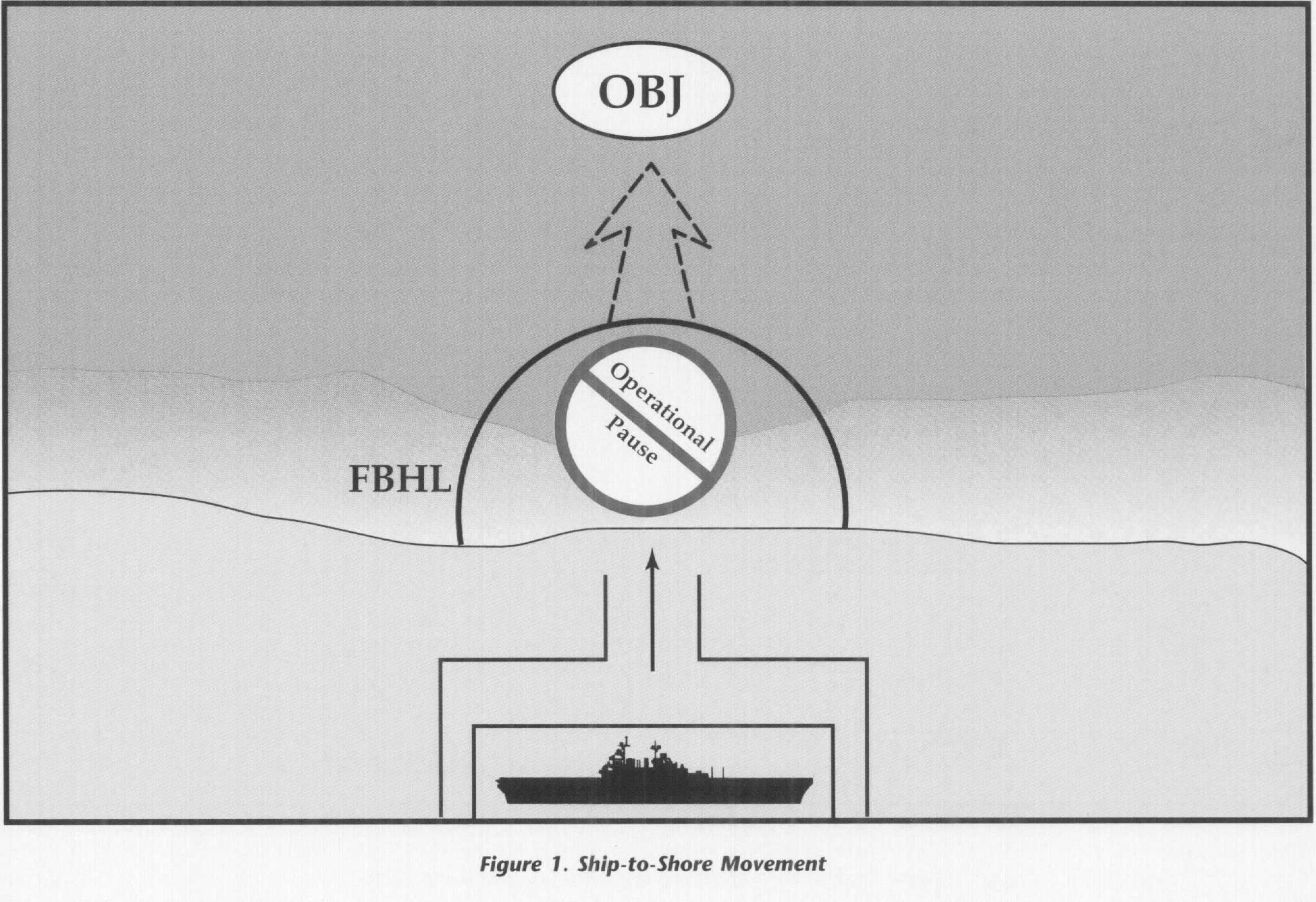
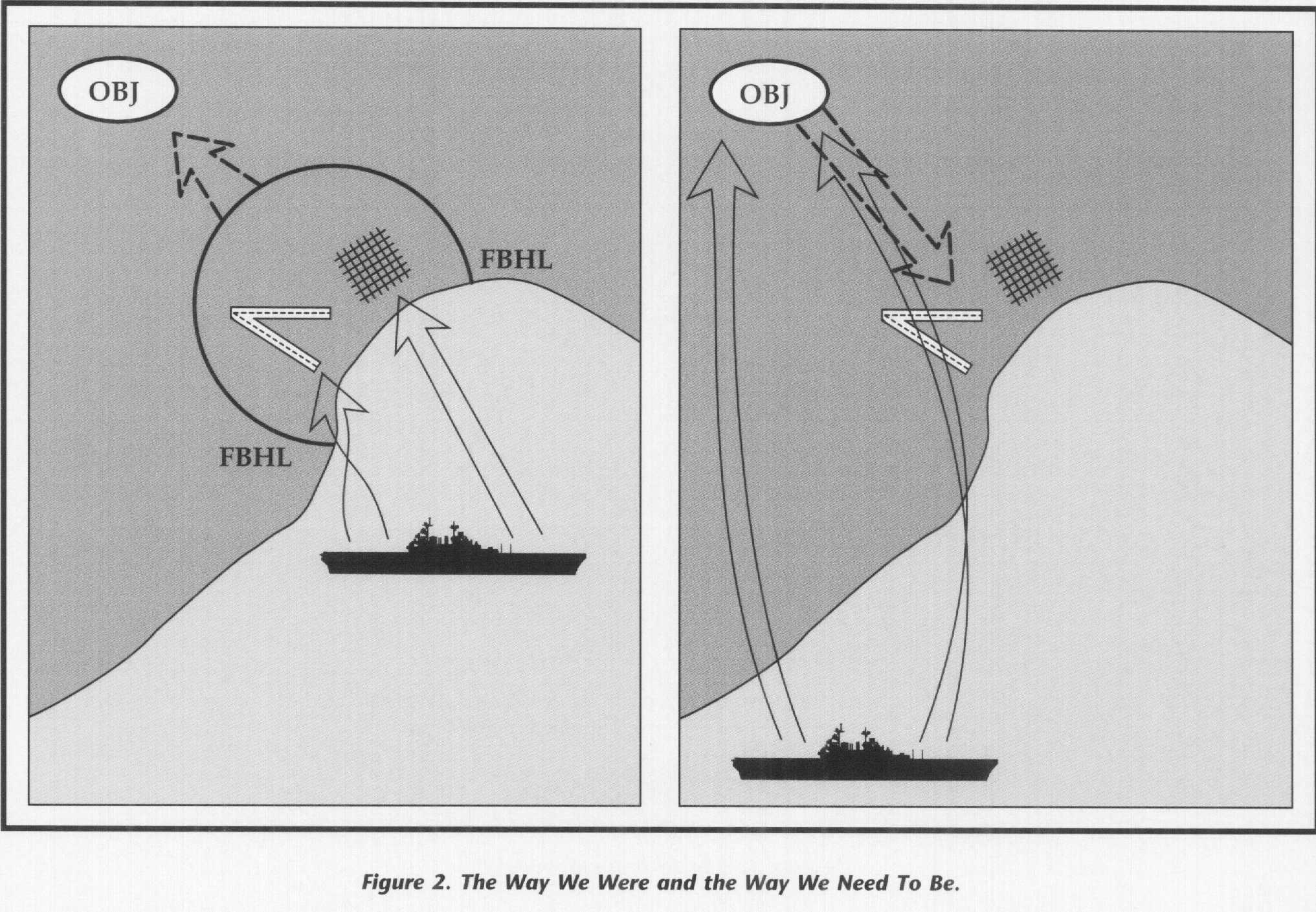
Ship-to-objective maneuver employs the concepts of maneuver warfare to project a combined arms force by air and surface means against inland objectives. Ship-to-objective maneuver takes advantage of emerging mobility and command and control systems to maneuver landing forces in their tactical array from the moment they depart the ships, replacing the ponderous shipto-shore movement of current amphibious warfare with true amphibious maneuver. Historically, reliance on Navy command and control during ship-to-shore movement and the requirement to establish a lodgment ashore worked counter to the principles of maneuver warfare (see Figure 1). By executing ship-to-objective maneuver, landing forces will exploit advanced technologies which will permit combined arms maneuver from overthe-horizon attack positions through and across the water, air, and land of the littoral battlespace directly to inland objectives (see Figure 2).


True ship-to-objective maneuver is not aimed at seizing a beach, but at thrusting combat units ashore in their fighting formations, to a decisive place, and in sufficient strength to ensure mission accomplishment. Landing forces will engage enemy units only as necessary to achieve the freedom of action to accomplish operational objectives.

Ship-to-objective maneuver provides the opportunity to achieve tactical as well as operational surprise, something seldom possible in past amphibious operations. Operations will begin from over the horizon and project power deeper inland than in the past, progressing with speed and flexibility of maneuver that will deny the enemy warning and reaction time. By requiring the enemy to defend a vast area against our seaborne mobility and deep power projection, naval forces will render most of his force irrelevant. If the enemy chooses to withhold a strong mobile reserve, he will be attacked with long-range fires. His thinly spread defenses will allow friendly forces greater freedom of maneuver at sea and ashore. Preassault operations will confuse and deceive the enemy, locate and attack his forces, and further limit his ability to react. Naval forces will take advantage of the night and adverse weather conditions, as well as the ability to control the electromagnetic spectrum. These capabilities will enable exploitation of known enemy vulnerabilities, create opportunities, achieve tactical surprise, and result in mission accomplishment.

PRINCIPLES

The key element of ship-to-objective maneuver adapts combined arms penetration and exploitation operations to the environment described in Operational Maneuver From the Sea. The result is littoral power projection that exploits significant improvements in tactical mobility to achieve enhanced combat power, and provides theater and joint force commanders a greater range of warfighting options. Ship-to-objective maneuver:

* Focuses on the operational objective and provides increased flexibility for landing force commanders to strike enemy critical vulnerabilities. No longer tied to phased operations and the cumbersome development of suitable beachheads, the landing force will concentrate on rendering the enemy ineffective.

* Treats the sea as maneuver space. For the force that controls it, the sea is both a protective barrier and highway of unparalleled mobility. Turning the enemy’s vulnerable flank, or exploiting gaps in his positions, the landing force thrusts combat units by air and surface deeply into his defensive array. Such maneuvers unhinge the enemy position, making his dispositions increasingly vulnerable and, finally, untenable.

* Emphasizes intelligence, deception, and flexibility to drive planning, option selection, and maneuver execution. Naval forces exploit preassault operations to deceive the enemy, determine his dispositions, attack his critical vulnerabilities, and initiate action to gain tactical advantage. They execute these operations specifically to find or create exploitable gaps. The common tactical picture provided to all commanders by advanced command and control systems, combined with the inherent flexibility of ship-to-objective maneuver, will allow the landing force to exploit such gaps.

Applies strength against weakness and projects combat power through gaps located or created in the adversary’s defenses. These gaps are not necessarily geographical; they may be exploitable weaknesses, such as limited night fighting capability, poor command and control, lack of endurance, or low morale. While the landing force will attempt to bypass the enemy’s defensive strength, it may be necessary to neutralize or destroy critical positions in the defensive array, including coastal strong points, in order to cause a rapid disintegration of the enemy force.

* Creates overwhelming tempo and momentum. Air and surface units maneuver from ships to inland positions faster than the enemy can effectively react. The landing force maintains the initiative and operates at a pace that allows it to dictate the terms of engagement. Operational surprise, through a combination of secrecy, deception, ambiguity, electronic warfare, lethal attack, and tactical successes, delays enemy recognition and disrupts his response. Complementary actions that fix, confuse, or neutralize the enemy support the rapid and uninterrupted thrust of combat power to decisive points ashore. The enemy will continually face dilemmas and a tempo of operations that denies him control of the battle and keeps him off balance and reactive.

* Integrates all elements in accomplishing the mission. Whether operating in a joint or combined environment, the naval forces will employ all available assets in support of ship-to-objective maneuver in order to maximize the effectiveness of the landing force.

OPERATIONS

Overview

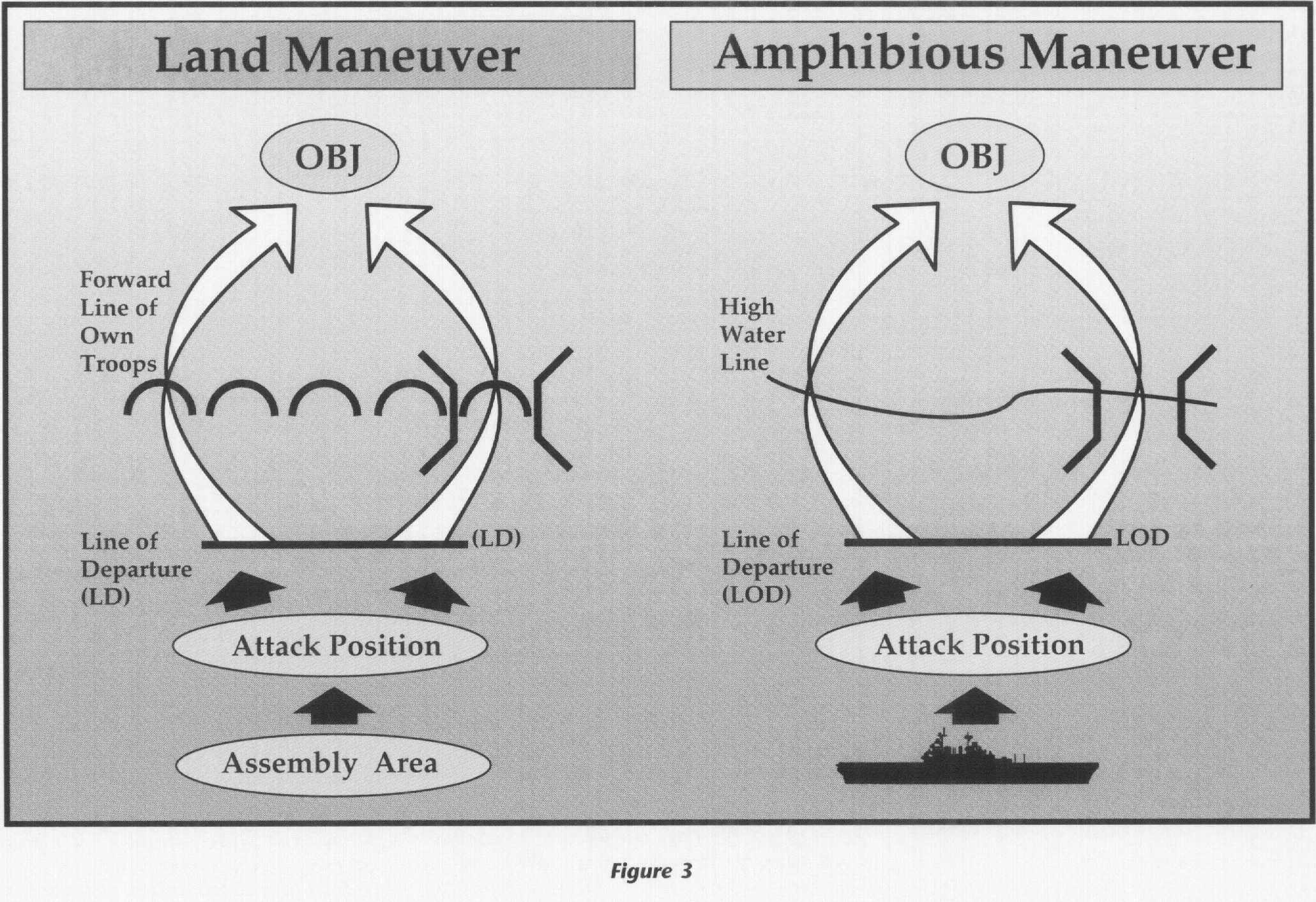
Ship-to-objective maneuver applies the principles and tactics of maneuver warfare to the littoral battlespace. Specifically, it will allow for conducting combined arms penetration and exploitation operations from over the horizon directly to objectives ashore without stopping to seize, defend, and build up beachheads or landing zones. Landing forces will conduct ship-to-objective maneuver by executing plans which are detailed, but flexible. A focus on the overall objective will drive planning and the scheme of maneuver ashore, allowing commanders to base decisions (such as the time and place of landing) on enemy gaps, movement of enemy reserves, or other events. Surface and vertical maneuver elements will be employed to accomplish the mission, producing a cumulative effect greater than the sum of the parts. Application of maneuver warfare principles in the execution of ship-to-objective maneuver (see figure 3) will require a number of changes to current doctrine, to include:

(1) Landing force maneuver will begin upon crossing the line of departure (LOD). The assembly areas will be the ships themselves, and attack positions will be well offshore.

(2) Assault elements will depart their ships knowing the plan in effect and will proceed from at-sea attack positions to the LOD.

(3) Movement parallel to the shore may occur at any point between leaving the ships and crossing the high-water mark. The shift from amphibious task force control to landing force control will occur at or before the LOD.

(4) At any point after reaching the attack position, tactical commanders on the scene may choose to vary their attack formations and axes and give other tactical directions based upon the changing situation and commander’s intent.

(5) Tactical commanders plan landing force maneuver options so that they can exploit up-to-date information and cross the beach at the most advantageous points. They would normally seek gaps in the enemy defenses but sometimes operational considerations may require a deliberate assault against a defended position.

Four new coordination measures will be needed to control maneuver forces in the expanded battlespace of ship-to-objective maneuver: littoral penetration area (LPA), littoral penetration zone (LPZ), littoral penetration site (LPS), and littoral penetration point (LPP).

These are defined in the adjacent diagrams:

As maneuver elements touch down on the shore, the transition from maneuver on the sea to land maneuver must be seamless, allowing the force to maintain momentum and tempo so as to conduct deep penetrations and reach inland objectives quickly. The landing force will attack enemy critical vulnerabilities, creating and exploiting new opportunities until achieving a decisive advantage. Vertical and surface maneuver forces bring complementary capabilities to the battle, permitting operations to continue unabated until the forces achieve their objectives. Vertical assault forces may attack key positions within the enemy defenses and continue to maneuver on the ground or repeat their vertical assaults on subsequent objectives. Surface assault units accomplish assigned missions and keep pressure on the enemy, either linking up or maneuvering in tandem with the vertical assault units.

The command and control system will provide the commander with the ability to see and influence the battlefield, while giving subordinate maneuver commanders the freedom to exploit fleeting opportunities. Plans will be based on accurate intelligence, but an understanding of the commander’s intent will permit maneuver unit commanders to adapt their actions to the changing situation.

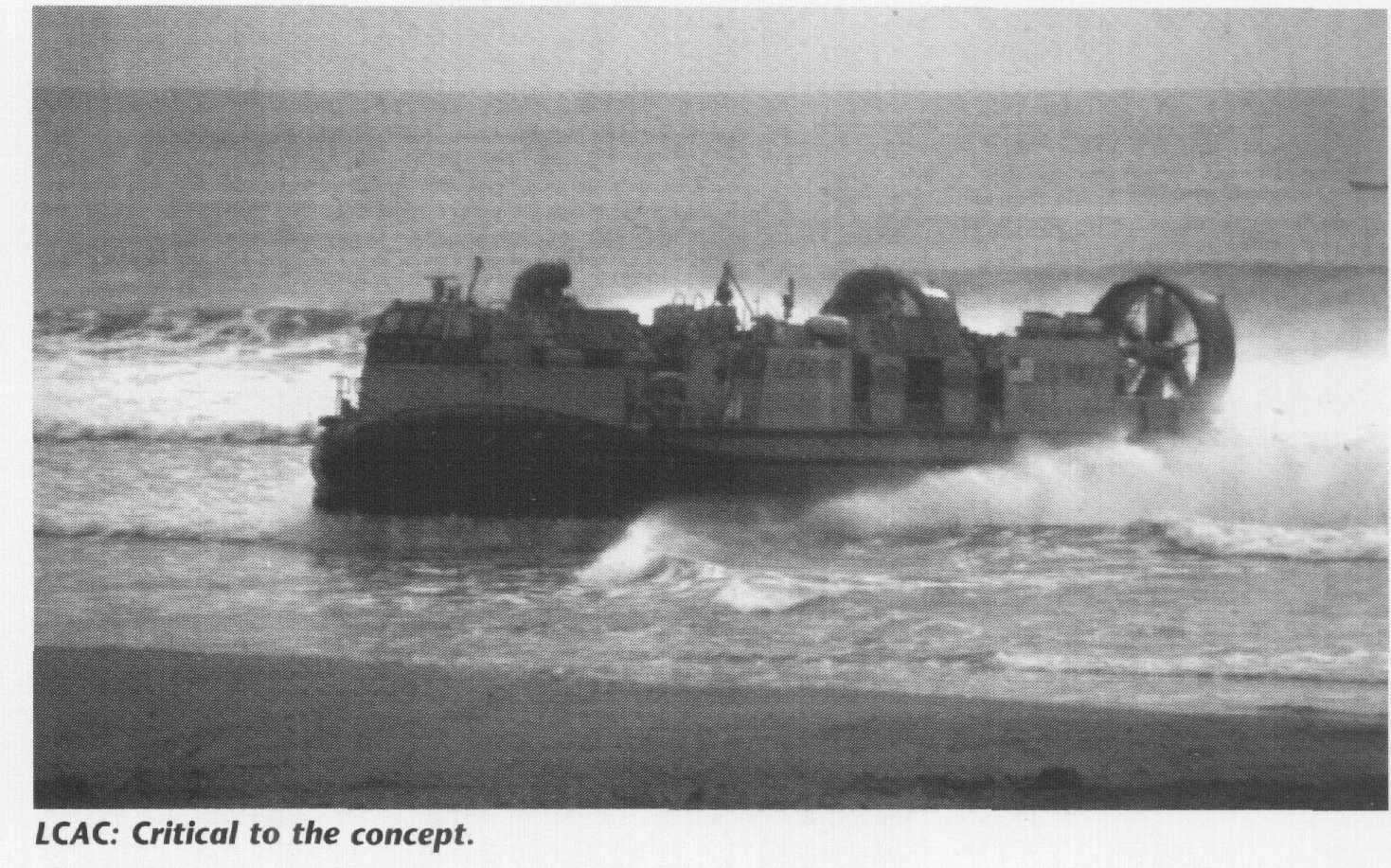
Ship-to-objective maneuver calls for rapid projection of combined arms teams ashore, but emphasizes sea-based command and control, logistics, and fire support. Improved information connectivity allows the landing force command element to remain at sea, capable of effective command, but better protected from enemy attack. When afloat, the headquarters retains direct influence upon naval support operations, but does not drain scarce landing force combat and logistic resources. The seabasing concept calls for ships of the amphibious task force to serve as floating combat service support platforms to resupply the combat units rapidly and directly, fully exploiting the lift and mobility offered by landing craft, air cushion (LCAC) and vertical take-off and landing (VTOL) aircraft. By seabasing most supporting fires, landing force vulnerability and footprint ashore are significantly reduced, greatly improving freedom of maneuver and enabling the naval force to project ashore combat formations which are leaner, lighter, and more effective.

In ship-to-objective maneuver, the distinction between advance force operations and the assault fades. Historically, amphibious operations have relied on successful preassault operations. A dedicated advance force which preceded the main body of the amphibious task force conducted deception operations, mine clearing, fire support, and obstacle reduction in the objective area. While such tasks remain critical to the success of ship-toobjective maneuver, it may no longer be desirable to establish a separate advance force to perform them. Reconciling the contradictory requirements of preassault operations and surprise requires a change in our concept of advance force operations. The benefits of surprise are so important that, with the exception of deception, those functions which cannot be executed by clandestine means must be performed “in-stride” by assault units. Thus, future operations will emphasize clandestine efforts to determine enemy strengths and weaknesses by locating and identifying mines, obstacles, fire support units, critical command and control nodes, and force dispositions. Breaching, preparatory fires, and obstacle clearing-traditionally preassault tasks-will become an integral part of the assault phase.

As the phasing of the assault changes, so does the organization of the landing force. The separation of the landing force into the five traditional movement categories of scheduled waves, on-call waves, prepositioned emergency supplies, remaining landing force supplies, and nonscheduled units disappears in shipto-objective maneuver. By task organizing landing units into combined arms teams, the requirements for specialized units in on-call waves are reduced.

The amphibious operation does not terminate with the transfer of command ashore, but rather with the accomplishment of the mission. The MAGTF may then either transition to subsequent operations ashore, or reembark on board the ships of the amphibious task force to prepare for further force projection operations. A general unloading of the landing force will not take place.

Surface Maneuver Force

The surface assault force consists of self-contained combined arms teams. After leaving the ship, these teams maneuver in AAAVs and LCACs over the sea under the direction of their tactical commanders, much as land forces maneuver across a desert. The rapid movement of this force inland to their objectives reduces landing force vulnerability to enemy beach defenses and creates a tempo of operations that will outpace the enemy’s ability to react. The combined arms teams include supply and maintenance capabilities that will be replenished and augmented as required from the seabase.

The flexibility offered by the combination of AAAVs and LCACs will provide multiple penetration options for each maneuver element. Overwhelming combat power will be concentrated from several directions using organic firepower of maneuver units and sea-based fires. High-speed amphibious mobility will enable friendly forces to reinforce success quickly by redirecting their efforts toward gaps found or created in enemy defenses. Given the range and speed of the AAAV and LCAC, these forces might penetrate the enemy’s coast outside the area they intend to control, and then attack back into the vital area (see Figure 2). Subsequent surface elements may not penetrate at the same points as initial elements. As defenses are turned and impediments destroyed, subsequent elements will be able to penetrate at the points most advantageous to their mission, rather than simply follow in trace.

Vertical Maneuver Force

A deep vertical envelopment presents the enemy with a dilemma. If he reacts to the vertical assault force, he risks increasing his vulnerability to other vertical assaults, to the maneuver of the surface assault force, and to supporting fires. If he ignores the vertical assault force, it can cause significant damage and seize objectives facilitating the surface assault, creating other opportunities for exploitation. The MV-22 and CH-53E offer mobility which enables the vertical assault force to attack from over the horizon and strike rapidly at deep objectives, reembark, and strike other objectives before the enemy can react.

As with the surface elements, vertical assault units will operate on multiple axes and not be restricted to the same littoral penetration points previously used. Furthermore, the endurance and speed of the MV-22 permit multiple lifts and extractions of the same unit, providing a flexibility of maneuver seldom before achieved in vertical assault operations. The ability to insert deep and then conduct bounding maneuver will allow the vertical assault force to maintain a rapid tempo, exploiting freedom of maneuver, destroying the enemy’s forces through supporting fires, without allowing the vertical assault force to become decisively engaged.

PLANNING

While detailed tactics, techniques, and procedures will evolve, ship-to-objective maneuver planning will follow the basic doctrinal principles established in Joint Publication 3-02, Joint Doctrine for Amphibious Operations. Forces will focus planning on mission objectives and the scheme of maneuver ashore, culminating in a landing plan. The major differences between traditional and future amphibious power projection planning are the elimination of the requirement for a force beachhead and the need to plan for several schemes of maneuver, all of which must be supported by a single embarkation plan. Future landing forces will attack through littoral penetration points that best support accomplishment of the operational mission. The best option might not be the shortest route, but the one that best takes advantage of gaps in the enemy defenses. Some situations will require creating a gap by destroying enemy forces.

Several factors will influence planning for ship-to-objective maneuver. First and foremost is the objective. Operational maneuver from the sea envisions the accomplishment of a significant operational or strategic objective. It is not an assault to seize a beachhead. All decisions will be based upon this overall objective, from landing force missions to the degree of risk acceptable to the force as a whole. The practical implications for the landing force include assembly areas and attack positions that remain miles offshore. While this change complicates pre-H-hour unit actions and coordination, these challenges can be overcome through exploitation of increased maneuver space, improved command and control, and precision location and navigation systems. Launching the attack from over the horizon will enhance security while expanding the potential for surprise.

The second major factor involves the execution and timing of preassault tasks, such as minefield and obstacle breaching. If such obstacles cannot be avoided, surface assault forces must time their landing to coincide with the successful completion of breaching operations. This requires an in-stride breaching capability.

The third factor which influences planning for ship-to-objective maneuver is task organization and embarkation of the landing force. Since landing forces, especially Marine expeditionary units (MEUs), will often deploy prepared and embarked to accomplish a variety of missions, the doctrinal sequence of planning, embarkation, rehearsal, movement, and assault (PERMA) might often become EMPRA, with embarkation and movement occurring prior to the planning, rehearsal, and assault phases of an amphibious operation.

A fourth and closely related factor deals with distances, cycle times, and lift availability for the landing. For the task-organized assault force, launch and coordinated movement from widely dispersed ships will require the use of precision location and navigation systems to achieve appropriate arrival at the LOD. Tactical commanders of landing force units must coordinate movement of combined arms teams embarked in AAAVs and LCACs to maintain unit integrity and combat power. Different launch distances, varying craft and vehicle speeds, and the potential requirement to divert critical lift assets to alternate ships as losses occur will complicate coordination.

Ship-to-objective maneuver requires tactical commanders of individual landing units to control their own unit’s movement. This must include the authority to divert through alternate LPSs or LPPs, as the situation dictates. Those permissive tactical control measures used in ground operations will be extended seaward and applied to the amphibious assault.

While less precisely defined than the factors listed above, operations conducted with dispersed forces maneuvering over extended distances will impact planning. Concentrating combat power, providing fire support, sustaining the landing force, and conducting mutually supporting attacks will require extensive planning, training, and shared situational awareness.

EXECUTION

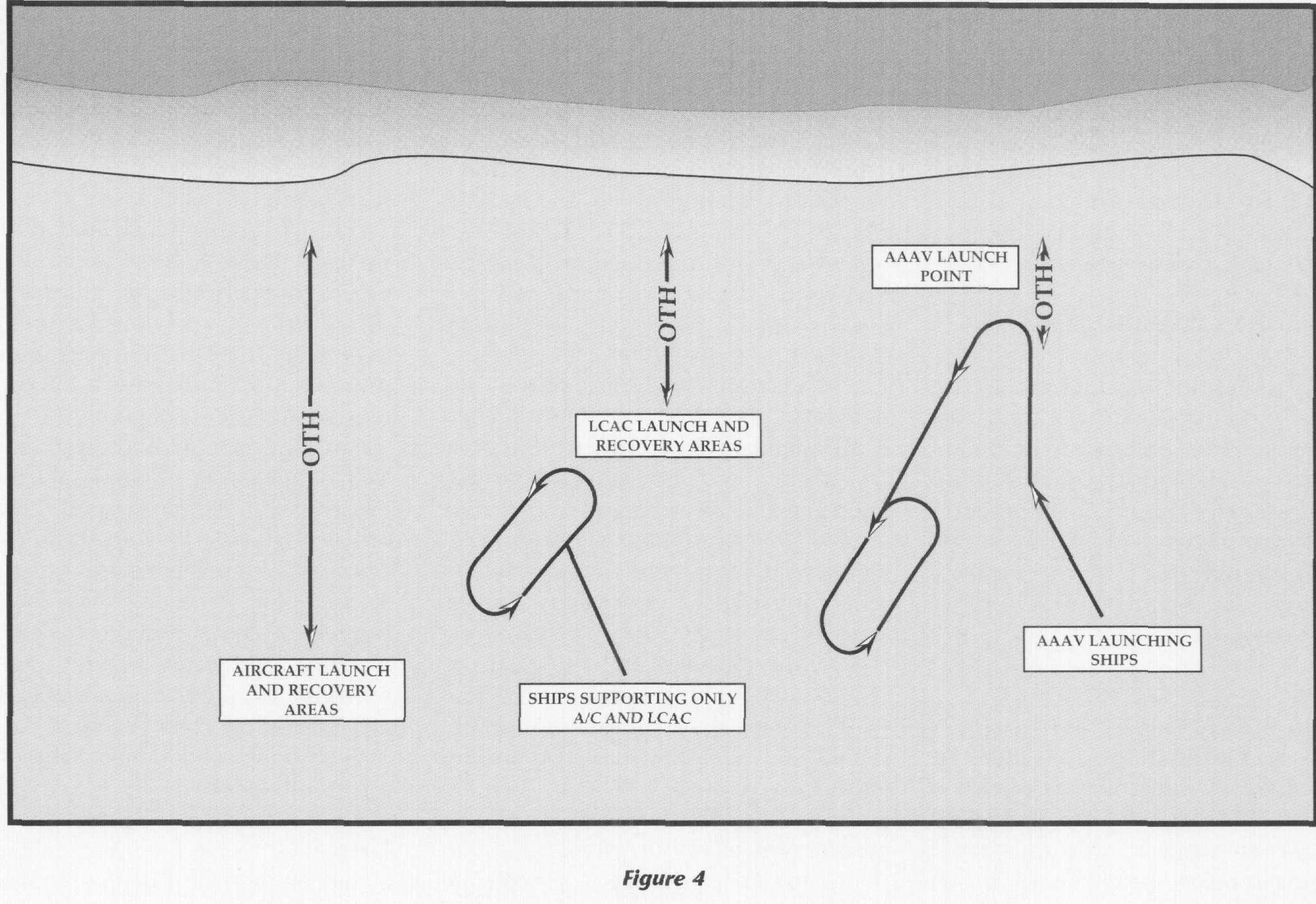
Landing force surface maneuver will require careful coordination between elements of combined arms landing teams. These teams, generally embarked in a mix of AXAVs and LCACs, will deploy from a number of dispersed amphibious ships (see Figure 4). Initially, the amphibious task force commander will vector units to attack positions seaward of their planned LPSs. As in a combined arms attack ashore, units will use attack positions to complete final preparations by assuming tactical formations, confirming orders, and accomplishing any “last minute” tasks. Attack positions can also serve as decision points for selecting a course of action from multiple options supporting the scheme of maneuver.

Different missions, movement rates, and survivability factors will determine the sequence and timing of each element through the attack positions. After crossing the LOD, landing elements will begin their run at their LPPs and inland objectives. Amphibious task force and landing force commanders will continue to monitor progress, though the landing unit tactical commanders will now have the authority to maneuver as required, depending upon the tactical situation. Attack helicopters may escort the AAAV and LCAC-mounted surface force to provide added capability against hostile watercraft during the long transit to the objective. Careful coordination by individual unit commanders will ensure that units cross LPPs with tactical integrity and cohesion intact, ready to prosecute the scheme of maneuver.

Resistance at the beach is always possible. The leading elements of the landing force, mounted in AAAVs, will provide supporting arms and direct fire to overcome resistance in the vicinity of the LPP. Leading assault elements u ill maneuver to clear sufficient space, laterally and in depth, to ensure secure offloading of LCACs, while continuing the rapid inland penetration uninterrupted.

In concert with the surface assault, the vertical assault force will maneuver inland, using evasive routes, feints, and alternate approaches to confuse enemy defenses. Commanders will coordinate vertical assault and surface assault times to achieve maximum enemy disruption. Timing of the landings is designed to maintain tempo and overwhelm local defenses. The number of vehicles or aircraft in each element and the time between elements will depend on the mission, enemy situation, and characteristics of the LPZ. Each landing team may embark on different ships in order to facilitate near simultaneous launching as cohesive units. While such dispersion is not ideal for administrative purposes during the movement phase of an operation, it will speed the landing of cohesive combat units during the assault phase. With all of its nonamphibious vehicles loaded in LCACs, a tactical commander can maneuver his unit so that it will be able to land as a combat team regardless of the number of ships upon which it was embarked.

KEY CAPABILITIES

Successful implementation of the ship-to-objective maneuver concept will require improvements in mobility, command and control, intelligence, fires, sea-based logistics, organization, doctrine, training, and education. Specific capabilities that we must achieve through the combat development process are outlined below.

Mobility

The landing force must maneuver from attack positions well offshore through LPPs and rapidly to inland objectives. This requires surface and vertical assault systems with the speed, range, precision location and navigational capabilities, protection, and firepower to launch from over-the-horizon positions, maneuver toward any LPP, and crack the environmental and defensive shell of the LPA while maintaining the momentum of the attack. The technologies required to provide these capabilities are under development, and the combat systems implementing these technologies are the highest acquisition priority in the Marine Corps. These include AAAV, MV22, and surface craft and aircraft to deliver equipment and supplies throughout the littoral region. A force properly equipped with the AAAV, LCAC, MV-22 and CH-53E, and supported by sufficient numbers of amphibious and support ships, will provide the required operational capabilities in the early 21st century.

The landing force must also locate, identify, and overcome both natural and manmade impediments to mobility. Mines, obstacles, adverse terrain, and built-up areas can all impede the mobility of the landing force. Just as in land maneuver, the surface assault force must be able to penetrate obstacles between the LOD and final objectives either through preexisting gaps or by breaching. To accomplish these tasks, robust mine reconnaissance and rapid in-stride breaching capabilities are essential.

Command and Control

Command and control provides the mechanism by which a commander recognizes what needs to be done and communicates those actions required to ensure mission accomplishment. Maneuver warfare emphasizes decentralized execution with subordinate commanders exercising the maximum possible latitude in performing assigned missions. Command and control systems must provide landing force commanders at all echelons a common operational picture and the connectivity to monitor execution and to influence events when necessary.

Intelligence

Satisfaction of intelligence requirements is critical. The most immediate intelligence priority for ship-to-objective maneuver is locating and identifying enemy forces and impediments to mobility. The landing force will exploit this intelligence throughout the operation using “reconnaissance pull” tactics to take advantage of gaps while avoiding obstacles and strong points. Commanders at all levels require timely access to all-source intelligence relevant to their immediate needs. They must be able to request and receive specific, real-time, and near-real-time information in a usable format, whether they are embarked, maneuvering toward objectives, or conducting subsequent operations ashore.

Fires

Fire support of ship-to-objective maneuver must provide immediate and responsive high volume suppression and neutralization fires in support of all landing force elements. Unit commanders at all levels will call for and control the fires of organic and supporting arms. Fire support systems must be capable of providing highly accurate and lethal long-range fires to simultaneously satisfy the needs of both the vertical assault and the surface assault. Furthermore, these fires must be available “around the clock” and in all weather conditions. Fire support agencies must respond to calls for fire with sufficient speed and accuracy to support landing force maneuver.

Information Operations

Ship-to-objective maneuver relies on surprise, deception, and ambiguity to create exploitable gaps in the enemy’s dispositions and reactions. Friendly forces must not only have the capability to gain knowledge about the enemy, but also the resources to develop and execute convincing deceptions. Having “painted a picture” for the enemy, they must then be able to selectively disrupt and degrade his command and control systems to delay his recognition of the actual situation. The capability to defeat the enemy’s command and control system while protecting its own will give the naval force an important edge.

Sea-Based Logistics

Sustaining deeply inserted vertical assault forces and rapidly penetrating surface assault forces from a seabase presents a critical challenge. The alr sence of dumps ashore, limited resupply delivery means, and rapidly maneuvering combat forces combine to make “logistics push” techniques undesirable and infeasible. Maneuver units will operate under a “logistics pull” concept, drawing support from the floating combat service support areas. This will require total asset visibility and selective offload capability within the seabase, and systems for delivering tailored logistic packages directly to the using element.

Organization, Doctrine, and Training and Education

The human element is as important to the implementation of ship-to-objective maneuver as are materiel improvements. Placing responsibility on the landing force commander for controlling movement from the ship to the objective is a significant departure from current doctrine. The organization and coordination agencies of the naval force must adapt to fully exploit the advantages offered by new technology. Tactical maneuver unit commanders will now direct ship-to-objective maneuver from attack positions located beyond the horizon all the way to objectives located deep inland, coordinating movement with higher and adjacent units, calling for fires, and making rapid decisions to achieve the commander’s intent. Preparing future naval leaders to deal with the challenges and opportunities of conducting maneuver warfare in the littoral battlespace will require that:

* Naval sen-ice schools impart a common understanding of this emerging doctrine and its underlying philosophy.

* Navy and Marine units develop and refine tactics, techniques, and procedures through unit, staff, and task force exercises.

* Realistic naval power projection simulations stimulate and encourage initiative, imagination, boldness, and rapid decisionmaking in exercises and in operations.

SUMMARY

Ship-to-objective maneuver is a tactical concept for the conduct of amphibious operations in support of operational maneuver from the sea. It applies maneuver warfare concepts to the littoral battlespace. By doing so, a landing force will be capable of seamless maneuver from over the horizon directly against objectives deep inland. Through application of the tenets contained in this concept paper, the principles of operational maneuver from the sea are integrated with those of maneuver warfare, as described in MCDP-1, Warfighting.

Ship-to-objective maneuver and operational maneuver from the sea mark a major evolution in amphibious warfare. These concepts take advantage of innovations in technology to enhance the capability of naval forces to conduct amphibious operations in the 21st century. Ship-to-objective maneuver directly links maneuver at sea to maneuver on land, enabling naval forces to fully apply the principles of maneuver warfare in support of operational maneuver from the sea. The improvements in doctrine, organization, training and education, and equipment outlined above will result in unprecedented operational flexibility and a greatly improved capacity to project power ashore.

Unified Effort in Support of Dominant Maneuver on the Joint Battlefield

by Col John A. Clauer

In September of 1994, as part of Operation UPHOLD DEMOCRACY, U.S. forces prepared to conduct forcible entry combat operations in the small Caribbean nation of Haiti. After planning and testing a number of options, the U.S. Atlantic Command settled on a concept that would involve the following: Seizure of targets in Port-au-Prince by airborne elements of the 82d Airborne Division and by helicopterborne elements of a Joint Special Operations Task Force (JSOTF) operating principally from the USS America.

Seizure of targets in the Cap Haitian area by Marines of the Special Purpose Marine Air-Ground Task Force (SPMAGTF) operating from U.S. Navy amphibious shipping.

Combat support operations by 300-plus aircraft under the command of the airborne joint force air component commander (TFACC).

Post H-hour peace enforcement operations by the 10th Mountain Division.

Thus at H-hour on D-day, four commands would be employing combat forces in an area no larger than New Jersey. Yet unlike a similar operation in Grenada over 10 years earlier, this operation had all of the trappings for being successful. It was commanded and controlled by a single entity, the commander of the Joint Task Force drawn from the XVIII Airborne Corps, using newly forged joint doctrine to employ forces from all four Services and the U.S. Special Operations Command, and planned to employ operational maneuver to shatter the enemy’s cohesion through unexpected actions. Since the combat operations were never executed as planned, it is difficult to pronounce this operation a success in joint combat warfare. However, it can be used as a model in examining joint doctrine and to specifically observe command, control, and maneuver from the operational level.

The commander of the XVIII Airborne Corps, as commander of the Joint Task Force, UPHOLD DEMOCRACY (CJTF) maintained firm overall operational command. Although the JTF Headquarters was an ad hoc organization built around the Corps Headquarters (with limited participation from the other Services until shortly prior to execution) it, nonetheless, qualified as ajoint command element. The chain of command was well defined, and the joint force organization was within the guidelines of joint doctrine. Maneuver was the planned method for getting a variety of forces deep into the enemy’s defenses in order to break up his cohesion and force quick capitulation of the Haitian forces. Because movement of forces would be rapid and widely dispersed, control was, by necessity, decentralized. While CJTF was aboard the USS Mount Whitney exercising overall command, he was not in a position to function as the on-scene commander. Consequently, at H-hour on D-day, the following command and control (C2) arrangements would have existed in the area of responsibility:

The JFACC would be airborne over Haiti exercising C^sup 2^ over fixed-wing aviation but not over rotary-wing aviation.

The JSOTF on the USS America would exercise C^sup 2^ over his forces and rotary-wing aviation from an airborne platform and would have a backup EC-135 in the air over Haiti as an alternate C^sup 2^ cell.

The commander of the 82d Airborne would exercise C^sup 2^ over his forces and aviation assets through the commanders inserting with the force.

The Marines near Cap Haitian would be under the command of the MAGTF commander and under the control of the onscene ground combat element (GCE) commander.

The JTF Headquarters would have a jump command post insert at H-hour, but it would exercise little influence over actions until some time after the initial assault.

The JTF Headquarters also planned to have a EC-135 in the air over Haiti to act as a “deconfliction” command element (however their primary mission, due to limited communication nets, was to monitor and in exigent situations deconflict).

With four different element commanders controlling their forces in the air and on the ground at H-hour on D-day, the plan for coordination and control along the “seams” of the battlefield involved the intricate use of synchronization measures. Obviously, these synchronization measures needed to be coordinated. However, with no designated onscene commander, one miscue or mistake in the preplanned flow of forces and fire support clearly had the potential to be fatal. Everything seemed to depend upon precise execution to prevent fratricide and to accomplish the CJTF’s intent.

Problem

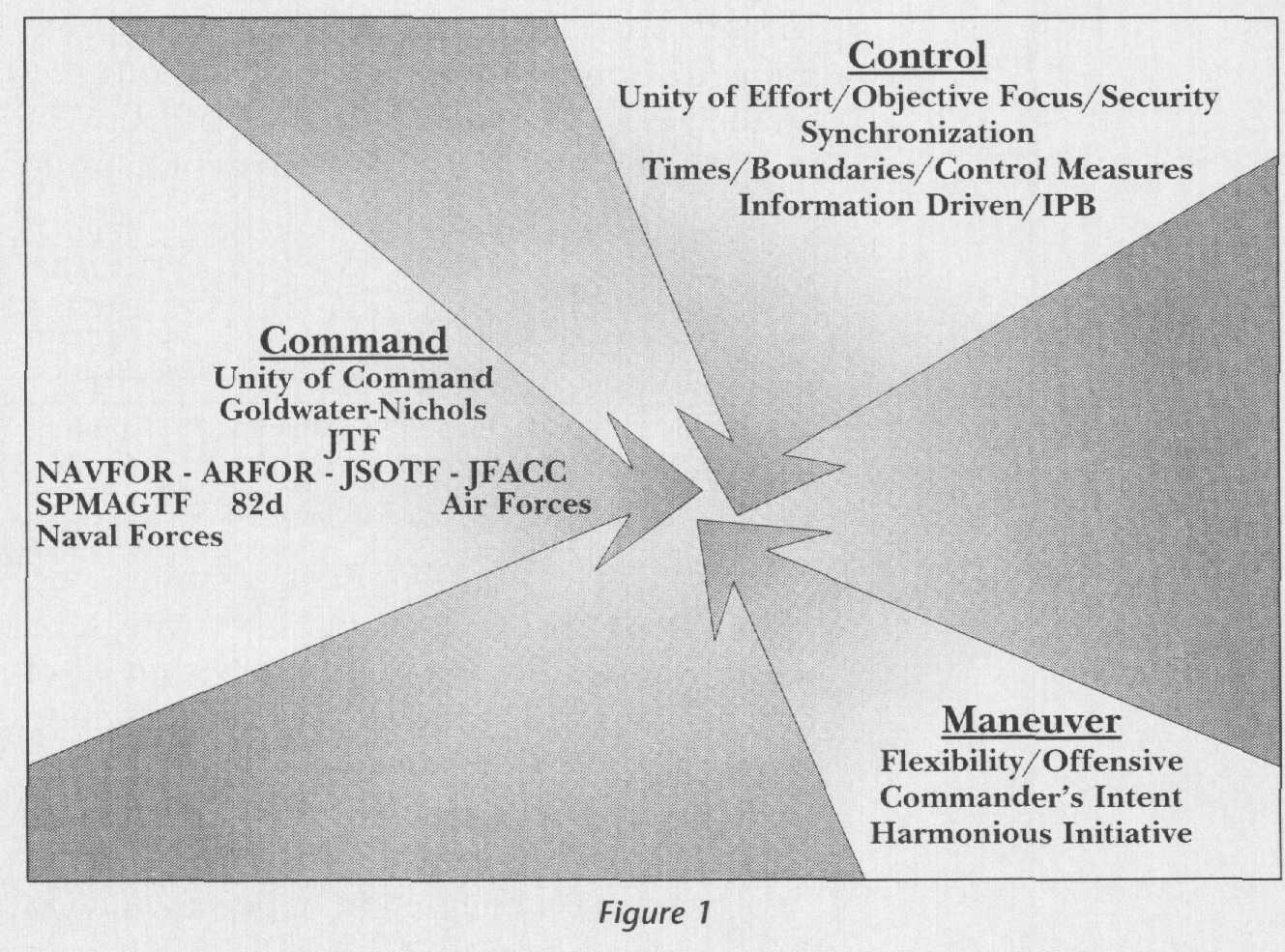
While CJTF was organizing, planning, and preparing to fight his forces in accordance with current joint doctrine and attempting to achieve a “seamless” unity of effort, his operational concepts for command, control, and maneuver appeared to be on a collision course.

All three of the operational concepts outlined in Figure 1 are firmly established in joint doctrine and are essential to successful combat operations. However, based upon the situation identified in UPHOLD DEMOCRACY, it is apparent we either have an inadequate organization for combat, a misunderstanding of the concepts and terms of command/control/maneuver, or there is some other method necessary to achieve harmony between the three concepts. I believe that as we seek the answer to this problem we will find that it lies not with our organization for combat, nor with our terms or doctrine, but with the method of achieving the often misunderstood and overlooked concept of “harmonious initiative.” This essay will attempt to analyze command, control, maneuver, and harmonious initiative and present an operational concept that enables integration of the four terms.

History

One of the results of DESERT ONE and Grenada was the changes made to U.S. law concerning the organization and employment of U.S. forces. The Goldwater-Nichols Act of 1986 was Congress’ attempt to fix the problems identified by these operations. Specifically, they were attempting to strengthen the Chairman of the Joint Chiefs of Staff and the Joint Staff, streamline the warfighting authority of the unified commanders (CinCs), and remove the Service parochialism and rivalry from the battlefield. Congress’ intent in the Goldwater-Nichols Act was clearly articulated by Senator Sam Nunn:

These changes are designed to correct problems that have been evident in the Department of Defense for many years. These problems include lack of interservice cooperation, poor quality of collective advice from the Joint Chiefs, cumbersome chains of command, inadequate authority of the warfighting commanders in the field and excessive bureaucracy at every level.

Clearly, the single greatest problem that the Goldwater-Nichols Act was trying to address was the lack of unity of command. Responding to the military history of the postWorld War II period, Congress was attempting to force unified effort among the separate Services and correct problems that led to combat inefficiency and, in at least one case, to combat failure. While the efforts of Congress to mandate “jointness” were admirable, the success of the Goldwater-Nichols Act has been mixed. While it has strengthened the Chairman and Joint Staff and resulted in the development of joint doctrine, it has created more CinCs, more components within the combatant commands, and as a result increased the potential “seams” on the battlefield. In essence, the legislation fixed many problems but in the process created more complexity for the warfighter.

Prior to Goldwater-Nichols, the Services each had their own method for dealing with the seams and coordination necessary for unity of effort. The Army had its AirLand Battle, the Navy had Composite Warfare, and the Marine Corps had Amphibious Doctrine. All were designed to ensure efficient command and control, unity of effort, and maximum combat power at the point of main effort. Problems ensued, however, when multiple Service forces had to operate together on the same battlefield. Clearly, unified command, doctrine, and unity of effort were necessary for the emerging joint battlefield of the late 20th century. The issue was how to achieve this unity of effort during joint operations. This is the question that the combatant commanders and other joint force commanders had to answer.

Reorganize

The principal approach, as modified and utilized in DESERT STORM, was to organize and fight by component commands. This method created at least six organizations (Army Forces, Marine Forces Ashore, Coalition Forces, Air Forces, Special Operations Forces, and Naval Forces afloat) with multiple seams on the battlefield. While this method was effective for DESERT SHIELD, Gen Merrill McPeak in testimony to Congress on roles and missions recommended a new concept for the battlefield of the 21st century. He envisioned reorganizing forces along three functional lines with a reduced number of seams and establishment of firm centralized control. His presentation specifically recommended:

Reduce seams to the lowest practical number. The fewer seams the better.

A reasonably competent opponent attacks seams. Have strong seams.

Seams management (“integration,” “coordination,” “interface”) should be the responsibility of commanders who have full authority over all the organizational entities operating on both sides of the specified boundaries.

He further recommended that battlefield activities be divided into three categories: The Close Battle should be fought by ground forces (including organic aviation and air defense) under the command of a joint forces land component commander (JFLCC), either Army or Marine, depending on who supplies the preponderance of forces. The Deep Battle should be fought by air forces under command of the JFACC, either Air Force or Navy, depending on who provides key force elements and has appropriate C2 capabilities. The High Battle should be fought by air and naval forces under the command of a joint forces air defense commander (JFADC), whether Air Force or Navy, depending on the scenario. Normally, the JFACC is dual-hatted as the JFADC.

Gen John H. Cushman, USA(Ret), in a Military Review article (Mar-Apr95) takes an even more radical force consolidation approach. Gen Cushman states:

While this command structure (Component Commands) suffices for personnel management and administration, to fight using these component commanders as operational commanders alone simply will not work. For fighting, the forces must be mixed in a task organization that is designed for the specific mission and situation.

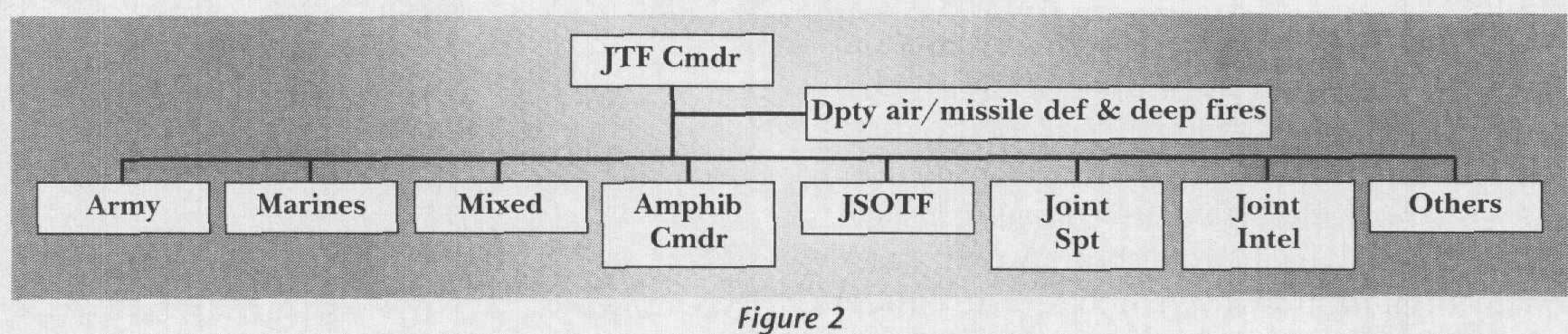
In support of enhancement for the purpose of conducting maneuver warfare, he proposes a command organization that has five or more maneuver formations, the JFACC/ JFADC consolidated under one commander for air/missile defense and deep fires, joint/unified communications, and joint logistics and intelligence supporting commands (see Figure 2).

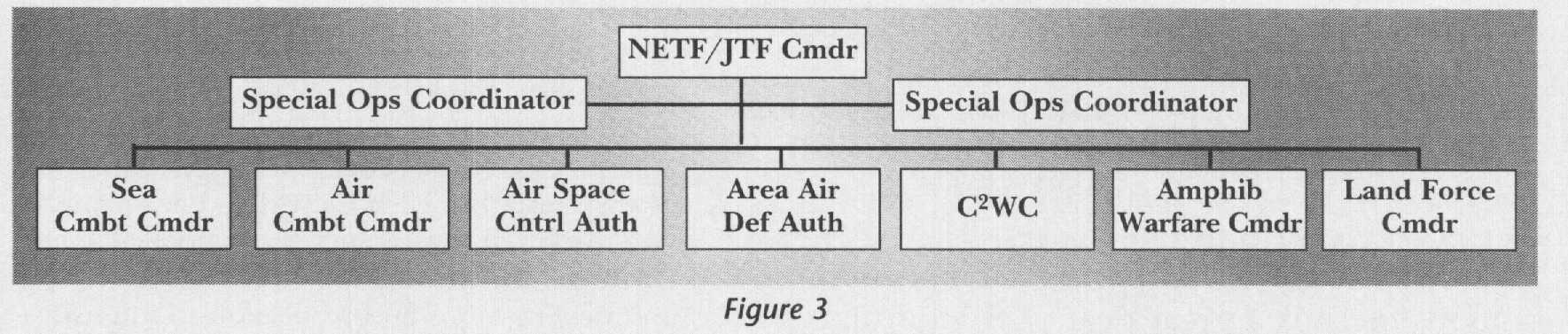
The Navy, on the other hand, in its draft document on integrated battle order, creates a naval expeditionary task force (whose commander could function as a joint force commander) that has seven subordinate commanders and two commander/coordinators as illustrated in Figure 3.

It is clear that there are a multitude of concepts on how to organize the joint force for combat. While many may take exception with some of the concepts presented above, the authority to effect such reorganization of combat forces is clearly articulated in both federal law and in joint doctrine. The Goldwater-Nichols Act of 1986 provides that a combatant commander has authority for “prescribing the chain of command to the commands and forces within the command…. organizing commands and forces within that command as he considers necessary to carry out missions assigned to the command.”Joint Publication 0-2 further specifies that “JFCs [joint force commanders] have the authority to organize forces to best accomplish the assigned mission,” that “Service forces may be assigned or attached to subordinate joint forces without the formal creation of a Service component of the joint force,” and “the JFC can establish functional component commands to conduct operations (joint force land, air, maritime, and special operations component commanders are examples of functional components).” The three restrictions specified by the joint doctrine are that (1) a functional component’s staff that employs forces of more than one Service must be joint, (2) the MAGTF commander will retain operational control of organic air assets, and (3) “JFCs should allow Service tactical and operational assets and groupings to function generally as they were designed.”

Clearly, there is a great deal of latitude given to a JFC to reorganize the forces within a JTF. We can expect, as the U.S. military becomes smaller and more specialized, that we will see more and more creative ways of organizing the joint force. However, it is also clear that many of these reorganizations will not simplify command but actually create more seams on the battlefield. If reorganization does not necessarily create unity of effort and reduce the seams and battlefield friction, then what other tool does the JFC have to achieve harmony of his forces?

Centralized Control

Many commanders turn to the concept of control to achieve unity of effort on the battlefield. Anyone who has served in the U.S. military for any period of time recognizes the importance of control. Control is the glue that holds combat organizations together and “allows commanders freedom to operate, delegate authority, place themselves in the best position to lead, and synchronize actions throughout the operational area.” A major function of the JFC is to ensure the proper execution of the synchronization of forces plan. By doing so, he ensures that his intent or concept of operations is achieved, fratricide or friendly firefights are reduced, and the seams of the battlefield are protected. But is there a cost to be paid by too much synchronization or too much control? Capt Robert T. Muise, in discussing synchronization (Proceedings, Nov94), states:

The Army manuals describe it as `arranging activities in space to mass at the decisive point.’ To achieve the appropriate timing, all players must be operating from the same sheet of music. The concept of synchronization elicits the image of an orchestra, all elements of which must operate from the same score at precisely the same instant. To achieve the desired results, a central coordinator-the conductormust ensure strict adherence to the score. The armed services are not in the business of playing concerts, but the music analogy is valid. In Operation DESERT STORM, for example, the main effort-the Army’s VII Corpsdid not achieve decisive results. In his article, “Pushing Them Out the Back Door,” Col James G. Burton, USAF(Ret), links the VII Corps failure to their incessant quest for synchronization. Col Burton states, ‘Clearly, Franks’ [LtGen Frederick M. Franks, Jr., commanding officer of the VII Corps] failure to cut off the Republican Guard’s escape can be traced to his strict adherence to the synchronization element of the Army’s new doctrine.’

While it is true that there were other factors that facilitated the escape of the Republican Guards, it is also correct to say that reliance on strict synchronization and control slowed the advance of the VII Corps and impacted the achievement of the much publicized requirement to destroy the Republican Guard.

While control certainly may “glue” the force together and ensure management of the battlefield seams problem, it also may degrade the combat power of the force by depriving it of surprise, flexibility, and the ability to conduct effective maneuver. It appears, as stated earlier, when operational maneuver is used, there is a great deal of friction that cannot be resolved by simply reorganizing the force or exercising stricter control.

What Is Maneuver?

Maneuver warfare is defined as operations that seek to shatter the enemy’s cohesion through a series of rapid, violent, and unexpected actions that create a turbulent and rapidly deteriorating situation with which he cannot cope. Maneuver is achieved by the use of decentralized control, mission orders and directives, and a well-communicated commander’s intent and end state.

Decentralized control, by definition, takes the control of forces on the battlefield and places it in the hands of the maneuver elements within an operational command. It does not mean, however, that the operational commander relinquishes all responsibility for his subordinate elements. While the object is to have subordinate commanders make decisions on their own initiative, they must also keep the operational commander aware of changes on the battlefield. The key is that the operational commander does not use his situational awareness of the battle to stifle the initiative of his subordinates.

The second method for achieving maneuver is to rely on mission orders. This is the art of assigning a subordinate a mission without specifying in excruciating detail how the mission must be accomplished. From the operational commander’s perspective the operational concept must plan for movement of forces and attack of objectives by use of maneuver. Orders to subordinates to support this concept must be specific enough to accomplish the objective and ensure coordination between friendly forces but general enough to allow the subordinate to take advantage of the constantly changing situation on the battlefield.

The third way of enhancing maneuver is to articulate a clear statement of the commander’s intent. The intent is a vision that conveys what the commander wants to do to the enemy. It is the desired end state on the battlefield-what the commander wants the enemy to look like when the mission is accomplished. It should not be confused with how the commander wants to accomplish his mission; that is contained in the concept of operations.

Capt Muise goes back to his music analogy for a description of how maneuver warfare works:

A proper understanding of the military concept (of maneuver) has been compared to a jazz improvisation session: where the whole band works to one broad harmonic framework or direction, but each individual player improvises upon it harmonically, melodically and rhythmically, introducing new shades of colour and new tensions and resolution to intensifyor relax-the sense of pace over the underlying progression. It is the adaptability of the individual initiative to emergent opportunities. It is easy to see that such an exercise of maneuver, while essential to combat success, will put pressure on the seams of a battlefield. Additionally, the more complex a command or the greater the disparity of military forces on the battlefield (typical of the operational level of war), the more likely we are to incur problems with the seams while executing maneuver. Consequently, with the requirement for maneuver established, and force reorganization and centralized control exposed as counterproductive to seams management, where does the commander turn for tools to ensure unity and focus on the battlefield? I believe we must examine the frequently overlooked concept of harmonious initiative and lateral communications.

Harmonious Initiative

Harmonious initiative is a term that would not appear to have a place in military jargon or warfighting doctrine. Harmony, as defined in the dictionary, is a pleasing combination of the elements that form a whole. Initiative is defined as action without prompting or direction from others. It appears that the two terms contradict one another. However, if we harken back to the example of the jazz session, we can get a sense of how harmonious initiative works. It is initiative that seeks to complement the end state of the group. It is accomplished through training, intuition, and practice. But, most of all, it requires communications between the musicians. By their eyes, ears, and through the feel of the music, they communicate with one another and ensure a harmonious effort. Indirect and lateral communications/coordination between the musicians is the key to the success of the group as a whole. MCDP 1, Warfighting, the Marine Corps doctrine on warfighting, also recognizes this need for harmonious initiative and lateral coordination:

It is obvious that we cannot allow decentralized initiative without some means of providing unity, or focus, to the various efforts. To do so would be to dissipate our strength. We seek unity, not principally through imposed control, but through harmonious initiative and lateral coordination within the context provided by guidance from above.

The key, then, to achieving this harmonious initiative is to have effective lateral coordination (or in the case of the operational commander, communications and coordination) between his subordinate maneuver elements. This is the “new glue” that helps us achieve unity of effort on the complex and technical battlefield of the 21st century without falling back on the old and wornout methods of reorganizing the chain of command or centralizing control. But what constitutes lateral coordination and communications? Is it simply having electronic radio and telecommunications between adjacent commanders? Military history provides abundant examples, such as the Battle of Leyte Gulf, that illustrate the misunderstandings that can arise from overreliance on electronic communications. But there are other measures that help avoid this danger.

Liaison: A Concept

Liaison is a tool that has received little attention at either the tactical or operational level of war. The task of being a liaison officer for a command often falls to a less experienced or less competent officer who has failed in other assignments. On the other hand, a wise commander will recognize that a competent liaison officer greatly assists in seams management, builds harmony of effort with higher and adjacent commands, and enhances the command’s ability to exercise the initiative necessary on the modern fluid battlefield. In addition to experienced and mature officers, liaison teams must include the best communications equipment and personnel available in order to ensure effective and continuous coordination across the seams of the battlefield. So critical is this type communication to the success of war at the operational level that it is essential that the “liaison channel” be dedicated and continuous. In other words, the communications officer must give as much priority to the liaison net as he does to the command net. Joint Publication 1: Joint Warfare of the Armed Forces of the United States reinforces the importance of this concept:

Experience shows liaison is a particularly important part of command, control, communications, and computers in a joint force. Recalling Clausewitz analogy of a military force as an intricate machine, ample liaison parties, properly manned and equipped, may be viewed as a lubricant that helps keep that machine working smoothly.

It is certainly true that there are other methods that commanders may use to communicate with higher and adjacent commands. There is, of course, no substitute for face-to-face communication between commanders. Today that is available not only through meetings, but also through video teleconferences. However, these methods do not replace nor negate the need for the competent liaison officers/liaison teams.

The cost in manpower and equipment for this concept is not cheap. To dedicate a handful of mature and competent field grade officers and communications specialists to liaison teams that are often not provided for in tables of organization is a hard decision for the commander to make. However, if the proper personnel are assigned, trained, and equipped for the job, the payoff to the commander can be the freedom to exercise harmonious initiative.

Liasion in UPHOLD DEMOCRACY

We now need to return to UPHOLD DEMOCRACY and complete the analysis of that operation. What was the “glue” that ensured the seams for the planned invasion of Haiti were managed and coordinated? The answer was an intricate and comprehensive network of highly skilled liaison teams provided by the JSOTF to the adjacent and higher headquarters. These teams were positioned at the CinC’s headquarters, with the JTF commander, with adjacent commanders, at key shore installations, and in airborne C^sup 2^ platforms. They became a two-way street for the flow of information and intent that quite often gets lost in the communications channels and centers or inappropriately filtered by layers of command. Their value can be demonstrated by the absence of a liaison cell in one location. There was, for a number of reasons, no liaison team from the JSOTF with the U.S. Marines in Cap Haitian. They were the one element left out of this information grapevine. Consequently, the Marines had to rely on message traffic and radio communications via several layers of command. What resulted was friction when JSOTF elements planned to operate near or in the area of the Marine forces. Additionally, while other commanders in the organization enjoyed the benefit of receiving near realtime orders and commander’s intent from the CJTF, the Marines relied (at least early in the planning cycle) on message traffic filtered through the naval component commander. If the plan had been executed as planned, this is the one seam that potentially could have provided problems due to a lack of liaison/coordination.

Information Superiority

Over the past 18 months,Joint Vision 2010 and its key enabler, Information Superiority, have matured and taken on greater significance in the joint community. One of the concepts being pursued under Information Superiority is Network Centric Warfare. This concept envisions fused information, sensor, and engagement grids. The information grid is designed to give the commander dominant battlespace awareness, which is defined as achieved when the level of information possessed by the joint force concerning friendly forces, enemy forces, neutral forces, and the environment in which they are deployed reaches a sufficient level. Clearly the technology exists to “network” the battlefield of the 21st century and to achieve the level of information awareness envisioned by Network Centric Warfare. Consequently, some argue that the JFC will no longer have problems with the seams of the battlefield and will not require extensive liaison capabilities. But this view is by no means unanimous throughout the joint community and the Services. While this level of information awareness may be achievable, without changes in how we push/pull and process data, the JFC may be totally overwhelmed by this new level of information. Additionally, there are also concerns about reliance on an information system, which without significant technological enhancements in protection, is subject to interdiction and damage.

As a supporter of Joint Vision 2010, I believe in the power of information as an enabler. However, I also share the concerns expressed above. Consequently, the ideas expressed in this paper, in my opinion, take on even greater relevance on the 2010 battlefield. Effective liaison will become a powerful way for the commander to deal with an explosion of information. Liaison teams will assist in information validation, information fusion, and in understanding the all important “intent” element of information management; ultimately turning information into knowledge. They will also assist in coordination and interface with multinational partners and Reserve components that may possess a lesser capability with their information systems (also to assist in sharing of classified information among allies). Finally, they will provide an all important redundant and backup capability for retention of dominant battlefield awareness by the JFC in the event of loss of the “network” capability.

Conclusion

The implications for the Marine Corps in joint warfare are clear:

First, forward deployed MAGTFs will nearly always function as part of a naval component in support of a JTF during contingency operations. If the MAGTF wants to have its capabilities properly understood and employed, wants to minimize friction along the battlefield seams with other land forces, and wants to respond quickly to changes in the JTF operational concept, it will need to provide field grade level liaison cells to adjacent and higher organizations.

Second, with a standing JTF headquarters within II MEF, the Marine Corps will need to maintain a strong liaison capability in its force structure and an aggressive liaison role in its operational concept.

Third, all Marine task forces, regardless of size, assigned to a JTF or as part of a naval component within a CinC’s area of responsibility will need to plan for deployment of competent liaison cells early in the planning/deployment phase of operations.

Liaison is clearly the glue for management of the seams of the battlefield and effective coordination between higher and adjacent commands. It is the operational concept that harmonizes command, control, and maneuver. In the Chairman’s Joint Vision 2010, the battlefield of the 21st century will become deeper, faster, and significantly influenced by new technology, and will require “new operational concepts-dominant maneuver, precision engagement, full dimensional protection, and focused logistics.” In this type of dynamic joint environment, Marine combat organizations can ill afford to wait for dissemination of information/coordination across the seams of the battlefield. Liaison with higher and adjacent organizations will be critical to combat success.

MCDP 2 Approved

Recently the Corps published Marine Corps Doctrinal Publication (MCDP) 2, Intelligence. MCDP 2 provides all Marines with a conceptual framework for the understanding and practice of effective intelligence. In doing so, it provides a framework for the planning and execution of intelligence operations in peace, in crisis, or in war.

MCDP 2‘s view of intelligence is based upon a common understanding of the nature of war and the Corps’ maneuver warfare philosophy. MCDP 2 builds upon this doctrinal foundation by describing the relationship of intelligence within the context of other warfighting activities. In particular, MCDP 2 emphasizes that:

Intelligence is a fundamental component of command and control that is inseparable from operations.

Intelligence provides not just information but knowledge of the enemy and the environment that is used to support decisionmaking.

Effective intelligence shapes operations by uncovering enemy vulnerabilities that may be exploited to provide a decisive advantage. Intelligence also aids in protecting friendly forces against the effects of enemy actions by identifying the enemy’s capabilities and potential courses of action.

Given the inherent uncertainty of war and the fact that intelligence deals directly with the hostile, independent will of the enemy, intelligence provides estimates and probabilities, not certainty.

The commander’s direct involvement is necessary to provide effective conduct of intelligence operations. MCDP 2 points out that intelligence is every Marine’s responsibility. All Marines must see themselves as collectors, protectors, disseminators, and users of intelligence.

MCDP 2 is the third in a series of nine higher order doctrinal publications presently under development; the series is on schedule to be completed by the end of this summer. MCDP 2 does not supersede any current doctrinal publications, however, it does provide the authoritative basis for the subsequent development of intelligence doctrine, education, training, equipment, procedures, and organization.

Marine units will soon receive sufficient copies of MCDP 2 via the Marine Corps Publications Distribution System for all officers, SNCOs, and unit libraries. In addition, the publication is available now for immediate electronic distribution from the Marine Corps Combat Development Command’s Doctrine Division Internet Homepage at http//ismo-www1.mqg.usmc.mil/docdiv or http//138.156.107.3/docdiv/.

MCDP 1 Approved

On 20 June 1997 the Commandant signed Marine Corps Doctrinal Publication (MCDP) 1, Warfighting. MCDP 1 replaces FMFM 1, Warfighting, as the Marine Corps’ capstone doctrinal publication. It provides the authoritative basis for how Marines fight and prepare to fight, and defines a way of thinking that guides our approach to duty.

Since FMFM 1 was first published in 1989, it has had a significant impact both inside and outside the Marine Corps. In effect it has changed the way Marines think about warfare. However, doctrine is not stagnateit evolves based on new operational experiences, advancements in theory, and the changing face of war itself.

MCDP 1, with a foreword by Gen XM. Gray-the architect of FMFM I-retains the spirit, style, and essential message of the 1989 document. The majority of the text has been carried forward from the original Warfighting with only minor revisions. The new publication contains three major enhancements:

First, the description of the nature of war has been expanded both to emphasize war’s complexity and unpredictability and to widen the definition of war to account for the expanding forms of conflict in the modern world.

Second, the descriptions of the styles of warfare have been clarified.

Third, important maneuver warfare concepts such as commander’s intent, main effort, and centers of gravity/critical vulnerabilities have been refined.

Marine units will soon receive their initial allocation of MCDP 1 via the Marine Corps Publications Distribution System (MCPDS). Additional copies may then be ordered from MCPDS or via the Doctrine Division internet homepage at http://ismowww1.mqg.usmc.mil/docdiv or http://138.156.107.3/docdiv.

Information Superiority

by LtGen Paul K. Van Riper

Introduction

Mr. Chairman and members of the committee, let me begin by expressing my appreciation for having this opportunity to speak to you today. This may be my final visit to Capitol Hill to testify on future warfare requirements, since I plan to retire from the Marine Corps this summer after more than 40 years of Active and Reserve service. During these years, I have had many opportunities to consider the fundamental aspects of war. Some of this time I spent reflecting on warfare in the quiet solitude of a library. At other times, the sounds of the battlefield punctuated my “study” time. From these experiences, I have drawn a number of observations and conclusions that I want to leave with you. I realize that, given the distinguished Representatives present today, I do not have a monopoly on combat experience, but because I believe strongly that we are at a significant juncture in history, I welcome the chance to offer my comments for the record.

I would like to begin by providing my perspective on the so called Revolution in Military Affairs-or RMA-and then transition to an outline of the Marine Corps view on the nature of war. I will then discuss the Marine Corps’ basic philosophy for command and control, which provides an overarching approach to the use of information systems and the technologies needed to win battles. Finally, I will finish with a brief description of the programs the Corps is pursuing, within a joint context, for future applications. With an appreciation for how the Corps looks at war today, you will be able to better understand how Marines intend to march ahead into the next century.

The Nature of Revolutions in Military Affairs

Our success in the Gulf War in 1991 and the explosive growth of information technologies over the past decade have resulted in a number of extraordinary claims about the future of war. Some of these claims have gone so far as to argue that technology will allow us to see and understand everything in the battlespaces of the future-even to eliminate the “fog” and “friction” of war. There are indeed great changes that are occurring with civilian and military technologies. But our view in the Marine Corps is that these changes will only allow us to improve our capabilities, they will not alter the fundamental nature of war. This is the argument that we insist should be central to any effort to provide effective military capabilities for the defense of our national interests.

I believe the current period is analogous to the interwar period of the 1920s and 1930s. That was an era where threats were uncertain, where technological advances occurred steadily, and where defense resources were limited. In that interregnum, military organizations matched a number of innovative operational concepts with new doctrines and emerging technologies. These efforts resulted in the development of carrier aviation, armored blitzkrieg, amphibious doctrine, air defense, and strategic bombing. What occurred was the culmination of a number of RMAs. They occurred simultaneously during a period very similar to our current situation. Today as then, we do not know whom we will fight, where we will fight, and how we will fight. To decide now that we know and understand the coming revolution (or revolutions) in military affairs will more than likely close down a number of potentially significant options.

There are important lessons to be gained from the interwar period that are relevant to thinking about RMAs. First, success in developing advantageous capabilities does not always go to those with the most sophisticated technology. History suggests that technology has played only a relatively small part in past RMAs. Success appears to be the result of the combination of different organizational structures and innovative operational concepts to solve specific problems. Second, success is the result of serious intellectual effort that focused, not on near-term, but long-term advantage. Finally, success follows those who have anchored their combat development on a solid and honest historical analysis and on realistic experimentation. Those who ignored history got lost. Those who followed narrow paths, espoused dogmas, or placed undue faith in ungrounded assumptionsthose who failed to use a painstaking process of experimentation-paid a harsh penalty in the early days of World War II. To protect U.S. national security interests in the 21st century, we should heed these lessons and plan accordingly.

During the interwar era the Marines saw opportunity in amphibious operations, where others, because of the disaster at Gallipoli, saw only failure and limitations. The Marines anticipated the upcoming changes in the strategic environment and envisioned a need to seize and defend advanced naval bases in the Pacific. They translated this vision into concepts that prepared the Corps for amphibious assaults to support the emerging Pacific strategy. Despite a lack of resources, the Marines worked through the problem. With serious study of history, they developed a number of innovative concepts and technical applications. These were eventually tested and refined in experiments with the Navy near the island of Culebra.

Getting the most out of revolutions in military affairs requires an approach perhaps best characterized by comparison with a set of automobile headlights. What the American military needs as it travels towards the next millennium is to use a set of high beams with halogen bulbs. Our Nation needs to extend its vision and peer far down the road into the future by asking the right questions. Driving too fast with only the limited illumination of parking lights is simply unsafe. Using too narrow a beam or insufficient visionary illumination will only limit how fast and how far we can travel. Above all, the military must conduct its preliminary moves in light of a study of history. The microchip has not made Thucydides, Clausewitz, or Mahan irrelevant. In fact, all the trends in modern science, evolutionary biology, nonlinear mathematics, and quantum physics underline that Clausewitz’s fundamental belief that we do not live in a predictable universe was right on target.

The Nature of War in the 21st Century In addition to understanding the historical parameters of revolutions and military innovation, the American military must address the changing character of war. Unfortunately, the RMA debate has distracted some experts from an open-eyed assessment of the character of future conflict. Our national security cannot be preserved solely by being able to destroy targets from a great distance. Simply put, the destruction of greater quantities of things more efficiently will not help the United States accomplish its political objectives in the next millennium. Its Armed Forces must prepare for the complex, dynamic, and asymmetric threats of “the day after tomorrow,” not simply create and field forces that can fight DESERT STORM more efficiently. In the next century, we will confront thinking and adaptive opponents who have studied our systems and configured their tactics to defeat ours. To address lethal and flexible adversaries, the American military must radically reduce its current vulnerabilities, those key nodes that make easy targets for an enemy possessing only limited technical capabilities. The United States has the time today to take advantage of the current “strategic pause” to explore and experiment, before rushing towards substantive investments.

Much of the RMA debate over the past few years has centered on investing in a set of platforms or in acquiring more information systems. There are valid modernization requirements among all the Services, but that should not be the focus today. Ultimately, national security is not about platforms, software, or hardware, but about the capabilities the United States needs in an uncertain world. A narrowly defined threat will result in an equally narrow set of defense capabilities. The real issue is far broader and more complex than measuring and quantifying our ability to strike a specific threat from great distances. The United States will confront a great number of threats from the high end of the spectrum to the low; consequently, it must prepare its forces to adapt against a wide variety of challenges. The forces designed this year for the day after tomorrow must be capable in a range of operating environments, from deserts to foliage, to densely populated urban centers with embedded antagonists. Not all of these environments are conducive to “information dominance.”

Preparing to Fight in the 21st Century The Marine Corps efforts to prepare for the 21st century rest on a solid appreciation of the fundamental nature of war. This understanding has shaped our central philosophy about warfighting and is the basis for a cohesive doctrine that shapes all our combat development efforts. FMFM 1, Warfighting, our capstone doctrinal publication, sets out our basic understanding of war.

War possesses elements that are both timeless and ever changing. We view the basic nature of war as immutable. It is a violent clash between opposing wills to seek to impose their own will on the other. This interaction occurs cyclically in a series of actions and counteractions between two independent and irreconcilable forces. Our view of the nature of war captures a number of factors including friction, chance, and disorder. Because war is a clash between opposing human wills, the human dimension is central to our views about conflict. Fusing war with intangible factors beyond calculation, prediction, or rational analysis is an absolute necessity, for war is shaped by human nature, the complexities of human behavior, and the limitations of human mental and physical capabilities. These human and moral factors shape our understanding and preparation for combat. Any view of war that fails to consider fear, danger, and exhaustion is extremely suspect, if not irrelevant. Any doctrine or theory that neglects the human element neglects the central dimension of warfare.

Yet for all of its immutable nature, the means and methods used in war vary continuously. Changes in the way wars are fought can occur in an evolutionary manner or in rapid flashes. Technological advances can be a major catalyst of change. The employment of the stirrup, the longbow, the rifled musket, and the railroad had a measurable impact on warfare and induced changes in both organizational and operational terms. As the physical hardware of war improved through new developments, so did the tactical, operational, and strategic use of those means adapt to new capabilities offered by technological change.

War in the future will be characterized, as always, by friction and uncertainty and the ensuing chaos. Where, why, and how we fight will undoubtedly change. The epicenter of instability will be in the world’s littorals where 70 percent of the world’s population now lives. By 2010, that percentage will have increased. Unfortunately, this environment will negate much of our technological edge.

The conflicts of the future are not likely to have much in common. In all respectsgoals, organizations, armaments, and tactics-conflict in the coming decades will be distinguished by its great variety. For that reason, it is imperative that the United States resist the temptation to prepare for only one type of conflict. To focus on one threat increases the danger that the American military will be surprised, and perhaps defeated, by another. The chaos of the future requires that the Nation maintain the capability to project power ashore for a variety of potential tasks, ranging from disaster relief to countering armed threats in high-intensity urban combat. In the future, such threats will not array themselves neatly on a chessboard or subject themselves to attrition from afar. Any examination of the revolution in military affairs must consider a wide array of threats and threat environments.

But we also have to be realistic about the nature of warfare and the limits of technology. I have in my military career commanded a platoon, a company, a battalion, a regiment, and a division; and some of those commands were on the terrifying and frictionfilled battlefield. I have also been the assistant chief of staff for the Command, Control, Communications, Computer, and Intelligence Department for the Marine Corps. Consequently, I have a combat commander’s perspective on the issue of communications, information, and intelligence; but I also understand the technical side of the equation. Without a doubt information is important, but all the information in the world is useless unless it contributes to effective decisionmaking in battle. The U.S. military possesses a plethora of systems today to gather, store, and retrieve information. It has numerous programs in place to improve its capacity to manipulate and handle pixels and imagery. Yet information is not knowledge. Our command and control needs to focus, above all else, on providing the combat commander with understanding in a form that allows professional judgment and experience to be rapidly applied.

Given the pervasive nature of uncertainty, ambiguity, and friction on the battlefield, it is natural that the U.S. military focuses on command and control and information superiority. At the same time, however, we should temper our enthusiastic rush to embrace the Information Age. As Mahan once observed, “It will be better to offer certain considerations for reflection, rather than make sweeping dogmatic assertions.” However, much of what one hears today is sweeping assertions and dogmatic platitudes. For example, a cursory review of recent comments in defense publications provides these examples:

* “If you see the battlefield, you win the war.”

* “If we had today’s sensors, we would have won in Vietnam.”

* “In the near future, we will be able to find, fix, track, and target-in realtime-anything of consequence that moves or is located on the face of the earth.”

* “Technology now provides the ability to identify virtually everything of military significance, in realtime, in any kind of weather, at any time.”

These assertions do not square with the Marine understanding of the nature of warfare or my personal experience. In fact, they represent a considerable ignorance of war and a certain arrogance. Vietnam represents a failure of flawed strategy and operational concepts that no amount of sensor data could solve. “Seeing” things and designating targets is not the same as wisdom. Warfare is more than systems; it is fundamentally and ineluctably an interactive contest of human wills. Information superiority, as an enabling element in a command and control system that includes the appropriate doctrine and professional education, is vital. But information superiority in and of itself will not win any wars.

I think that a useful way to visualize this point is to look at a glass of water. You and I would both agree that this glass is half full. The difference between winning and losing battles is not in the half that is full, but in being able to deal with the half that is empty. There will always be uncertainty and ambiguity on the battlefield. We may be able to visualize 80 percent of the battlespace, and we might even believe that we can target everything that we think is militarily important. But the battle will be lost or won in the portion of the glass that is empty due to enemy deception or the limits of our own technology. Trying to fill the glass with more technology, more systems, and greater investment will not eliminate the existence of uncertainty or friction. Our approach to command and control addresses this critical factor and defines how we hope to function effectively despite the confusion, uncertainty, and ambiguity of war.

Command and Control

The Marine Corps published its fundamental command and control doctrine last year in Marine Corps Doctrinal Publication 6, Command and Control (MCDP 6). It provides the authoritative basis for subsequent development of command and control technologies, procedures, organizations, facilities, training, and professional military education. The doctrine is descriptive rather than prescriptive; that is, it provides guidance in the form of principles and concepts rather than specific instructions. It requires broad judgment in application.

The Command and Control Environment

The two fundamental factors that drive the Marine Corps’ approach to command and control are uncertainty and time. Of these, uncertainty is dominant. In the words of Clausewitz:

War is the realm of uncertainty; three quarters of the factors on which action in war is based are wrapped in a fog of greater or lesser uncertainty.

Simply put, uncertainty represents what we do not know or understand about a given situation. From a practical point of view, we can think of uncertainty as doubt which threatens to block action. It is not simply the result of gaps in information. It is a fundamental and inevitable attribute of war, and no amount of information technology, no matter how powerful, will eliminate it or even reduce it to the point that it becomes a materially easier problem.

Uncertainty is not merely an initial environmental condition resulting from a lack of data solved by gathering and processing more information. It is a natural and inevitable product of the dynamics of war. Any action in war-friendly, enemy, or neutral-necessarily generates uncertainty. Because there will always be a significant amount of uncertainty we cannot eliminate, the ultimate requirement is to operate effectively in spite of uncertainty.

The second factor that drives command and control is time. War is a tempo-based, interactive phenomenon. Theoretically, we can always reduce uncertainty by gaining better knowledge of the situation. However, to gain better knowledge takes time. We reduce uncertainty at the expense of time and so risk surrendering the initiative to the enemy. It is axiomatic that effective command must strive to generate a faster operating tempo than the enemy. This dual desire to operate effectively despite widespread uncertainty and to generate a higher operating tempo than the enemy is the fundamental conceptual basis for all aspects of Marine Corps command and control.

We view war as a highly complex interactive system characterized by friction, unpredictability, disorder, and fluidity. It is not a mechanistic system amenable to precise, positive control mechanisms or synchronized, centralized schemes. War has more in common with biological and ecological systems than with closed, mechanical systems. It is an open system interacting with its external environment (which includes the enemy) and characterized by complex feedback loops and nonlinear dynamics.

As a result, one cannot control a complex system like war. We should not think of command and control as a coercive form of mechanistic control-the way an operator operates a machine. The object of mechanistic command and control is for the top of the organization to be “in control” of the bottom, and for the bottom to be “under* the control of the top. The worst thing that can happen is for a commander to “lose” control of the situation. But given the reality of war, it is a delusion to believe that a commander can really control the enemy or the situation with certitude or precision.

The prevailing metaphor for military command and control is a chess player moving chess pieces. We are all familiar with the rules for moving chess pieces across the board. In fact it is a poor analogy for describing the potential range of options for military operations. The turbulence of modern war suggests a need for a looser form of influence, one that provides the necessary parameters for control in an uncertain, disorderly, time-competitive environment without sacrificing flexibility or stifling the initiative of subordinates.

Command and control should not impose precise domination over details because the details are inherently uncontrollable. Rather, it should aim to provide a broad, meaningful structure to the roiling chaos and complexity of the battlefield. War defies microscopic command and control and instead requires macroscopic command and control which “controls” the system by influencing the system parameters and boundary conditions. “Command” and “control” are not coercive measures imposed on the bottom of the organization by the top. Instead, “command and control” is a process of reciprocal influence-give and take-in which all parts of the organization contribute action and feedback.

The Purpose of Command and Control

Popular literature today is replete with talk about “dominance”: command and control dominance, information dominance, dominant battlespace awareness, dominant battlefield knowledge, dominant maneuver, dominant fires, etc. Command and control is not fundamentally about dominance; information is not a medium anyone or any organization can dominate the way the air or sea can theoretically be dominated. Instead, in the Marine Corps’ view, the fundamental purpose of command and control is, first, to recognize what needs to be done in a situation and, second, to see to it that appropriate actions are taken. Command and control is thus essentially about effective decisionmaking and effective execution. The sole measure of effectiveness of any command and control component-technology, organization, procedure, whatever-is whether it facilitates timely decisionmaking and execution. Stripped to its essentials, this is what command and control is all about.

The Command and Control Process: The Observation to Action Loop

We use a simple model to explain the Marine Corps view of the command and control process. Developed by the late Col John Boyd, USAF(Ret), it is known as the observation-orientation-decision-action (OODA) loop. The OODA loop essentially describes command and control as a continuous, cyclical process of adaptation to a changing situation. It applies to any conflict, whether the antagonists are individuals in hand-to-hand combat or large military formations.

Engaged in any conflict, we first observe the situation-take in information. Having observed the situation, we next orient to it-make certain assessments, estimates, and judgments about the situation and the possibilities. Based on our orientation, we decide what to do. Then we put the decision into action. Having acted we have changed the situation, and so the cycle begins again.

Importantly, the OODA loop reflects the significance of generating tempo. In any conflict, the antagonist who can cycle through the loop faster-who can maintain a higher operating tempo-gains an ever-increasing advantage with each cycle. The slower antagonist falls farther behind with each cycle and is increasingly unable to cope with the deteriorating situation. In short, speed is an essential element of effective command and control.

The Information Hierarchy.

One way or another, command and control is about information: getting it, judging its value, processing it into useful form, sharing it with others, acting upon it. We view information not as a medium to be dominated but as a control parameter. It allows us to provide structure to our actions. But to be useful, information must be converted into knowledge, into an understanding of what the massive amounts of bits and bytes really mean.

MCDP 6 defines uncertainty as a function of the lack of knowledge or understanding rather than of data. The distinction is important because not all information is the same; there are different classes. The lowest class of information is data. Data are the most quantifiable and tangible class of information. They are the easiest to gain. However, they are the least useful as the basis for effective decisionmaking. Data must be turned into knowledge through the process of cognition, by which humans add meaning and value through analysis, evaluation, integration. Technology may assist, but cognition remains primarily a process of human intellect. The highest class of information is understanding-knowledge that has been synthesized and applied to a specific situation to gain a deeper level of awareness that allows us to make projections about the future. True situational awareness, what Napoleon would call coup d’oeil, is a function of understanding.

We should not confuse having masses of data with understanding what it represents or what to do with it. By nature, data are significantly easier to generate, identify, quantify, reproduce, and transmit than are knowledge and understanding. But commanders need knowledge and understanding to make effective decisions. Likewise, subordinates need not merely data, but knowledge and understanding of the commander’s concept and intent. The goal in command and control should not be collecting, processing, and communicating vast amounts of data-and increasing the danger of information overload in the process-but approaching understanding as closely as possible. However, we cannot simply provide the commanders with readymade wisdom and understanding. They will have to make the final judgments themselves. Unfortunately, the “information revolution” is primarily a “data revolution.” The Marine Corps believes that this emphasis on data is misplaced and that there is no substitute for the judgment and intuition of experienced and properly educated commanders.

Mission Command and Control

Marine Corps doctrine calls for mission command and control-a relative term which describes a loose, decentralized form of command and control based on deciding and acting out of an understanding of the requirements of overall mission rather than out of compliance with detailed, coercive direction from above. Every situation is different and some require greater control than others, but MCDP 6 calls for mission command and control to the extent that each situation permits. Mission command and control is preferable because through decentralization it:

* Provides greater flexibility for adapting rapidly to changing battlefield situations-to deal with unforeseen problems and exploit fleeting opportunities.

* Generates a higher operating tempo. Subordinates do not have to pass reports up the chain and wait for instructions to be passed down; they act on their own initiative.

* Deals better with the friction, uncertainty, and disorder that are pervasive in war.

In mission command and control, commanders assign missions and explain their underlying intent, but leave subordinates as free as possible to choose the manner of accomplishment. Commanders frame guidance in such a way as to provide subordinates sufficient understanding to act in consonance with their desires, while not restricting freedom of action. They reserve the use of close personal supervision for exceptional cases. And they use restrictive control measures and prescribe the manner of execution only to the degree required to provide coordination they cannot achieve by any other method.

Mission command and control relies on initiative from subordinates who must act on their own authority without waiting for instructions. Mission command and control requires a knowledge of the commander’s intent so that when the situation changes subordinates can exercise initiative in consonance with the commander’s desires. This intent is an essential device for providing harmony of effort in a decentralized and adaptive system. Finally, mission command and control rests on mutual trust throughout the organization, as well as a sense of implicit understanding and communication. This latter requirement describes the ability of people familiar with each other to understand one another and communicate with minimal information having to be expressed explicitly. It is essential in a decentralized system. Command and control based upon implicit understanding and communication is less vulnerable to disruption and attack than command and control relying on explicit communication.

Our philosophy provides a command and control doctrine that accepts war for what it is: an uncertain, tempo-driven, disorderly, and complex phenomenon. It seeks to provide a philosophy of command and control that will allow commanders to make and implement effective military decisions faster than the enemy in any type of conflict, in any setting, on any scale. It relies on mission command and control to provide the flexibility and responsiveness to deal with uncertainty and generate the tempo that is a key to success in war. It seeks to provide a workable balance among people, procedures, and technology, but recognizes that ultimately there is no substitute for human judgment and understanding.

Realizing Command and Control The preceding sections have described our vision of the future, our philosophy of maneuver warfare, and the profound impact that both have had on the Marine Corps doctrine of command and control. This final section will describe the intent, if not the methodology, behind our approaches to realize the elements of the command and control system. In doing so, many terms familiar to our warfighting concepts-balance, innovation, and jointness-have analogous representatives in the effort to transition command and control from concept to a reality.

Underpinning our approach is a single belief. It is the central thread which weaves throughout our efforts. Ultimately people, not machines, define success in war. Accordingly, we will equip our Marines, not man our equipment.

Balance

“Equipping Marines” is the fulcrum for a balanced approach to realizing effective command and control. By focusing in this way we establish the right mix of people, the doctrine, and technical systems. This balance ensures that the human dimension complements the technical element of information systems. Using this approach, our definition of a robust command and control system does not simply refer to spare equipment and alternate circuit paths, but also includes those training and education programs oriented toward enhancing rapid decisionmaking skills at all levels of command.

The Marine Corps uses this balanced approach in meeting command and control deficiencies identified through its Concept Based Requirements System. The process is not predisposed toward equipment solutions for command and control deficiencies. Rather it produces solutions involving new training procedures or updates to doctrinal publications as readily as it does acquiring new radios. With this approach, the Marine Corps pursues a balance of educational and equipment solutions for successful command and control.

Our command and control training and educational pursuits reflect the depth of commitment which the Corps makes towards its most valuable resource, the Marine. Our goal is to equip every Marine with the thinking ability to win on the battlefields of the 21st century, where the junior enlisted Marine may well need and use more information than a battalion commander does today. The changes are Corps-wide, from the transformation of recruit training to the many steps taken to improve the Corps’ entire Professional Military Education Program. The entire Marine Corps University serves not only to educate Marines but also to interact with our operating forces and the Warfighting Lab so that real thinking and innovation take place. Some of this is accomplished by exposing our Marines to classic military theorists such as Clausewitz, as well as the unique writings of historians such as John Gaddis, Alan Beyerchen, and Williamson Murray. Other of our initiatives are literally on the “edge of chaos,” involving the emerging nonlinear sciences such as chaos and complexity. These “new sciences” are the object of research at Quantico and are also being introduced into the curriculums of our schools.

Innovation

The ability to generate and harness innovation is too important to be left to chance. We believe that innovation is best achieved through experimentation. This is particularly significant during a time when the United States-without a peer competitor-can effect a “strategic pause.” The Marine Corps believes experimenting with command and control will support the innovation and agility necessary to recognize, respond, and adapt to fleeting opportunities. The Commandant’s Warfighting Laboratory is our most visible indication of this approach.

Just as the Corps used its schools at Quantico and the fleet exercises to redefine the science and art of amphibious operations during the 1930s, so the Warfighting Laboratory now helps us chart our future course. At the forefront of this effort is the “Sea Dragon” process of experimentation, which reflects our commitment to innovation. It is a model for future thinking and exploring, where ideas are born, evaluated, bear fruit, or die.

While the Laboratory is our engine of change, we expect innovative ideas and approaches will come from many sources; from Marines throughout the Corps, from combat developers and defense academics, as well as industry. The seeds of innovation have been planted in our logistics community, our training and education establishment, in our personnel management programs, and in the operating forces. Many ideas are being brought forth to be evaluated by the Warfighting Laboratory. Some will be of immediate benefit to the Fleet Marine Force. Others will be tossed aside or taken back to the drawing board. Results from our most promising experiments will be fed into the Marine Corps Combat Development System at Quantico.

The Commandant’s Warfighting Laboratory’s recently completed Advanced Warfighting Experiment (AWE) HUNTER WARRIOR exemplifies Marine Corps command and control experimentation. The operational concept required the linking of individuals, teams, and information technology assets together in new organizational structures far different than the classic Napoleonic model. The objective for the command and control concept was to create an information management system that supported a reduction in decision process times from hours to minutes and a reduction in deliberate planning times from days to hours.

To support the operational concept, the experiment’s command and control system supported parallel decisionmaking, rather than time-consuming and inflexible sequential decisionmaking. A new network with “expert agents” was employed for HUNTER WARRIOR to represent knowledge within the system as facts and relationships of these facts, thus providing a structure for organizing and accessing this knowledge. Communications was based on Internet technology, to support the new information flows and decision processes. Cellular communications extended the network from the Enhanced Combat Operations Center to dispersed Marine forces across the noncontiguous, extended battlefield.

The results of the AWE execution phase were exciting. While detailed analysis of the results will take time, the feedback from participants and observers thus far has supported continued commitment to command and control experimentation for the Marine Corps. Just after his visit to the HUNTER WARRIOR AWE, Dr. Marvin Langston, the deputy assistant secretary of the Navy for Command, Control, Communications, Intelligence, Electronic Warfare and Space Programs, commented:

I visited the Marine Corps/Navy HUNTER WARRIOR demonstration/experiment this Saturday and found myself completely overwhelmed by the significance of what was quietly taking place. This exercise (small dispersed force supported by remote fires opposing large force) says much about the extent to which we are actively searching for profound new ways to sustain our mission. I am not saying that this set of systems operated seamlessly or even close to flawlessly, but I am saying that by this one exercise we have proven that warfare can change dramatically.

This quote captures my own feelings about HUNTER WARRIOR and my enthusiasm for the work in which our young Marine and Navy warfighters are engaged. They are throwing the full weight of their creativity into this effort.

Joint Solutions

Critical to our approach to realizing command and control is to seek and support joint solutions for command and control. We recognize the Marine Corps will not retain its warfighting edge by simple product improvements of today’s technology and thinking. Our commitment is to get the most out of equipment and at the same time integrate technology properly with related Marine Corps and joint systems. We are fully committed to a joint solution and the Chairman’s vision, C41 for the Warrior. We will achieve it through implementation of the joint standards and common operating environments of the Defense Information Infrastructure.

We have mirrored our joint approach after the tenants outlined in the Defense Information Infrastructure Master Plan. From the perspective of command and control, we do not view ourselves as mere users of an external Defense Information Infrastructure. We consider the Marine Corps’ command and control infrastructure, whether in garrison or deployed, as the Marine Corps segment of the infrastructure. While the benefits of jointness are most often described in terms of interoperability and integration, the Marine Corps views jointness as a means to leverage our limited resources. Each dollar we spend on joint command and control solutions opens up greater potential. Dollars spent otherwise run the risk of ending up in stovepipe systems.

One of our most significant efforts to date under this joint approach has involved the migration of legacy command and control systems to the Global Command and Control System’s common operating environment. Ultimately, all our automated systems will transition or be developed to use the core services of the Global Command and Control System. This will provide commanders and their staffs the capability to send, receive, process, filter, and display data to aid their decisionmaking. With the first 15 of our legacy systems to migrate, we will reduce the associated code from 4.4 million source lines to an estimated 1.5 million lines.

Conclusions

The foregoing has provided a macro perspective of how the Marine Corps views revolutions in military affairs, the immutable and fundamental nature of war, and how the American military should approach the current age of uncertain threats and rapid technological change. Technology permeates every aspect of war, but the science of war cannot account for the dynamic interaction of the physical and moral elements that come into play, by design or by chance, in combat. War will remain predominantly an art, infused with human will, creativity, and judgment.

Technology will undoubtedly assist the commander faced with a massive variety of data in an environment of ambiguity. But to focus solely on the technological side of information superiority would be a major mistake. Effective command and control, as the Marines understand it, relies just as much on a shared understanding of the commander’s intent, doctrine, teamwork and mutual trust, and extensive investment in professional military education. The use of mission command and control seeks to give subordinates sufficient understanding of the situation and the commander’s intent before the battle, while encouraging initiative and creativity once the fight is joined.

The Marine Corps sees great opportunities and great challenges in the coming decades. We are working energetically in many places to address these challenges. The Commandant’s Warfighting Laboratory is just one example of the Corps’ interest in melding innovative concepts with appropriate technical capabilities. The Commandant has planted the seeds of innovation and encouraged fresh thinking throughout the Corps, and I can assure you that our speed of innovation will remain high. But experimentation and evidentiary-based processes should be preferred over unfounded assertions. We have the time today to explore across a broad range of solutions to tomorrow’s problems.

I would like to leave you with a quote from a wonderful classicist on how the early Greeks thought about preparing for the future:

The early Greek imagination envisaged the past and the present as in front of us-we can see them. The future, invisible, is behind us . . . paradoxical though it may sound to the modern ear. This image of our journey through time may be truer to reality than the medieval and modern feeling that we face the future as we make our way forward into it.

As we in the American military make our way into the 21st century, we need to keep a solid anchor in the past to understand what is possible and what is not. One path leads from analysis and experimentation toward knowledge of the real world, the other toward ignorance and thus peril.
You Say You Want A Revolution?

by Maj John M. Jansen

Since the end of DESERT STORM, there has been an intense, if not confused, discussion over the current condition and future direction of close air support (CAS). The discussion has been fueled by uncertainties created by changing roles and functions, and by a heightened competition for diminishing assets among and within the Services. Concurrently, as the Marine Corps has been seeking new operational effectiveness by merging new technologies with concepts of maneuver warfare, questions have arisen regarding the role and validity of Marine and Navy tactical aviation (TacAir) on future battlefields. This rather loosely knit discourse has taken place in an environment where change is considered good. This dialectic has produced many recommendations for changes in doctrine, tactics, and even force structure, as well as a few recommendations that no change is required at all.

This debate over the future of CAS is actually a debate over future roles and functions within the larger context of offensive air support (OAS). Many of the recommendations made in this regard unknowingly impact our ability to engage in the operational art of combined arms warfare, which is an enduring concept, critical to the Corps’ future warfighting strategy. This concept is characterized by the calculated orchestration of firepower and maneuver elements that produces a ferocious synergy on the battlefield. The retention of the combined arms warfare capability is the litmus test that must be used when considering any proposed changes to doctrine and/ or force structure.

Combined Arms and Maneuver Warfare

Is the concept of combined arms relevant within the construct of maneuver warfare? It is not only relevant, it is critical. To give up on combined arms within the framework of maneuver warfare merely trades in one brand of three-dimensional warfare for another, rather than going for a brand of operations that is truly four dimensional. Conventional combined arms tactics are three dimensional in that weapons are brought to bear from a three-dimensional battlespace. The fourth dimension-timeis a critical element of maneuver warfare. Ideally, it is brought into play by rapid movement on the battlefield to engagement points of our choosing, while creating shock and confusion within the enemy. Many of the proposed changes to our doctrine and force structure appear to be offered for the sole purpose of gaining the element of time/rapid movement on the battlefield. The advocates of these “advancements” recommend the use of various weapons systems as independent maneuver elements to capitalize on their respective characteristics of speed, firepower, or observation. The advertised benefits are the expansion of the battlefield and confusion within the ranks of the enemy brought on by multiaxis attacks. What is gained in the dimension of time/rapid movement, however, may be sacrificed in the area of density. We risk the loss of the synchronized employment of complementary weapons systems and, at the same time, provide the enemy with better predictability as to what he needs to defend against, depending on the position and ranging of our various maneuver elements. These proposals risk losing the capability to produce the kind of shock and confusion that the synchronicity of combined arms warfare brings to the equation. As we examine some of the schools of thought we will see a common tendency to simply trade one dimension for another.

Schools of Thought

Four groups have emerged out of this free flowing debate, each with its own view of the future. These groups include the Airpower Strategists, the Evolutionaries, the Traditionalists, and the Revolutionaries.

The Airpower Strategist asks: “Is not the concept of combined arms and the resultant need for Servicespecific air arms antiquated, given a national strategy of executing a sustained air campaign prior to the introduction of ground forces? Based on our success in DESERT SHIELD/ STORM, can’t we rely largely on a ground-based air force for the execution of the air campaign, with minor mopping up operations to follow on?”

The downfall of this strategy is that it hinges on having an opponent willing to provide the time required to execute a sustained air campaign. Given a scenario of a rolling invasion, sustained in its own right, into a sovereign state by a committed aggressor, we will not have the time needed to execute a pure, ground-based air campaign. Absent this ability, ground forces will have to engage concurrently with air forces to counter the sustained enemy thrust. At that point you will want a force that is capable of sustaining itself, a combat-ready force trained in the principles and tactics of combined arms.

The Evolutionary asks: “Quantum leaps in laser-guided missile technology, as well as the newly acquired ability to self-laser designate, have turned the attack helicopter into a formidable offensive weapons platform. Given their performance in Southwest Asia, should we not evolve into an all-helicopter attack force? Are they not perfectly suited to maneuver warfare with their ability to easily liaise with the ground combat element and the ability to act as independent maneuver elements?”

Like the Airpower Strategist, the Evolutionary relies almost solely on experiences in DESERT STORM to make his case. An all-helicopter attack force assumes a clear air, foliage-free environment where the primary target is armored vehicles, and there is a relatively defined forward line of troops. Given an environment of heavy foliage or triplecanopy,jungle or where the threat is massed infantry, the case for an allhelicopter attack force is more difficult to make. (The Pacific Rim and North Korea come to mind as locations/scenarios where the benefits of laser-guided weapons will not be as profound as in a desert environment and where the survivability of helicopters will be more difficult to guarantee.) It is hard to tell whether this offering has greater implications for force structure or doctrine. However, it is clear that you cannot make a case for added synergy by removing the benefits of fixed-wing platforms from the equation.

The Traditionalist asks: “Do we not now have the right mix of doctrine and tactics suitable for the future? We teach a doctrine born of many years of development in combat and training, and we see no reason for fundamental change. Also, while we realize that our command and control system is cumbersome and restrictive, it is a necessary evil that prevents friendly fire incidents from occurring in the heat of battle. Much of what is offered in the way of change arises only from the need to create or protect a rice bowl, for which we have no time. We have training to accomplish.”

This position is obviously short sighted. While it is the one school of thought that is solidly grounded in current doctrine, it fails to acknowledge a great many dynamics that simply cannot be ignored. Even though this position is doctrine-centered, it may ultimately lead to changes in force structure as those who espouse this point of view will become irrelevant and fade away.

The Revolutionary asks: “Is not our current system of employing fixed-wing aerial fire support outmoded? Aren’t we sacrificing capability by restricting naval TacAir with our cumbersome command and control system, as well as by current close control tactics of CAS? Could we not gain capability on the modern battlefield by scrapping the only system entirely and creating a new breed of aviator, one trained to hunt and kill on his own volition? It is time for a change and we offer something completely different.”

There is nothing wrong with those sentiments. Our command and control system is too cumbersome and our repetitious training in close control CAS does raise questions about underutilized capability. So this school of thought holds some promise. We will see that while the problems that the Revolutionaries identify are right on target, the direction of their conclusion is off course. Yet, by bringing this issue to the fore, the Revolutionaries find their greatest utility. We are provided the impetus to examine our current doctrine within the context of maneuver warfare, which is exactly the direction that we want to head.

Each of these groups is making its own recommendations, based on its own set of assumptions. Ironically, the different assumptions used to proffer vastly divergent concepts of warfighting all tend to find their birth in recent experiences in Southwest Asia, Bosnia, and even Somalia. Generally given, the assumptions are that our experience in DESERT STORM is readily transferable to potential conflicts in other regions of the world, and that events such as Bosnia and Somalia are the defining models of future conflicts. These assumptions are shaky pillars on which to build a warfighting model for the future.

You Say You Want a Revolution?

What are the different methods that we can use to analyze a “revolutionary” idea? One is simply to judge it on its own merits, acknowledging the potential benefits and exposing potential problems. Another way is to judge this new idea relative to the reality that it seeks to replace. However, it is important to determine if the reality that this new idea seeks to replace has been misrepresented, and if the direction in which this new idea seeks to take us is as revolutionary as claimed. For starters, the synergistic potential of tactical aviation has been simplified, trivialized, and marginalized by conducting the discussion under the headings of CAS and, to a lesser extent, battlefield interdiction (BI). Col Michael Wyly, USMC(Ret), and Cdr Daniel E. Moore, USN, do a fine job of painting a picture of the problem in their article published in the December 1995, Proceedings. In this article, they produce a “Theory for warfare in the littorals,” built around a “new” brand of air support that they call Jaeger Aviation. In their attempt to provide us with insight, however, they use the stereotypical, narrow definition of CAS to deride its usefulness as they seek to create a new flavor of aerial firepower. An examination of their concept reveals the dangers we submit ourselves to when we are not fluent in current doctrine and why it is critical that we use current doctrine to establish a common language as a frame of reference.

The common denominator with which we must become familiar is FMFM 5-40, Offensive Air Support (OAS). It can only be through discussion of the limitations and functional benefits of OAS in its entirety that we can productively debate the support that fixed-wing tactical aviation will provide to our future endeavors. Our doctrine not only accounts for the concept of Jaeger Aviation in the form of guidance on deep air support (DAS), but also increases five-fold the possible uses of CAS in the form of offensive employment of CAS. Yes that’s right, there is an offensive side to CAS that engages the enemy based on commander’s intent. Fires before the preparation, fires in preparation of the attack, fires in support of the attack, fires in support of exploitation and pursuit, and fires in support of consolidation and reorganization are all subtasks of CAS that are underutilized in current fleet training as well as in the current debate.

The article by Col Wyly and Cdr Moore is a good example of the dangers we can subject ourselves to when we don’t understand our own doctrine. They make a case for their revolutionary brand of warfighting that supposedly “will bring an entirely new dimension to warfare:”

Understanding the force’s intent and the friendly scheme of maneuver on the surface and familiar with the enemy’s predisposition, hunter aviation separates friend from foe and attacks on its own initiative. It probes and ranges outward ahead of the force and to its flanks, seeking to destroy or pin down the enemy before he can slow us down.

Compare their thesis with selected definitions from the FMFM 5-40 and it becomes clear that this “new dimension” of warfare is provided for under the two missions of DAS known as armed reconnaissance (AR) and air interdiction (AI):

Deep Air Support requires a complete understanding of the MAGTF Commander’s intent and scheme of maneuver. Air Interdiction and Armed Reconnaissance are DAS tasks . . . (A)rmed reconnaissance missions can be used as a covering force. These aircraft will patrol open, extended flanks of the main axis of movement not covered by scout or reconnaissance forces. Air Interdiction can neutralize, destroy, or delay the enemy’s military potential before it is brought to bear against friendly forces.

The Jaeger Group’s definition of hunter aviation almost perfectly mirrors the concepts of DAS, AI, and AR.

Can’t We All Just Get Along?

Is this a simple matter of talking about the same concepts using different terminology? No. At the very least, the danger of such an argument becomes manifest in the degree to which it consumes valuable resources creating a system that, while new, is qualitatively no better than the system or culture that it replaces. In the worst case, the danger lies in the degree to which the new doctrine provides us with a net decrease in capability or a doctrinal mindset that does not match the tactics that it is supposed to spawn. For instance, when we examine the specific examples given by the Jaeger Group to flesh out its proposed general philosophy, we are confronted with serious logical inconsistencies that stand a good chance of producing negative unwanted consequences on the battlefield. While we have seen that the general construct of hunter aviation is provided for by our current understanding of DAS, the two examples used by Wyly and Moore to demonstrate this “new” capability actually sound like offensive CAS missions.

Enemy forces retreating in disarray is the first scenario used to flesh out their concept. Such a situation will require close and/or deep support missions based on the degree to which the enemy forces have managed to disengage and, more importantly, the degree to which friendly ground maneuver elements have decided to pursue. If the bad guys have disengaged from ground-based direct fire weapons but are still being ranged by indirect fires, this would be a CAS mission defined by current doctrine as fires in support of exploitation and pursuit. Even if the enemy forces have retracted out of range of all groundbased fires but the ground maneuver elements are on the move in pursuit, this would still be a CAS mission as a high degree of coordination will be required to ensure containment and efficient destruction of enemy forces as well as deconfliction to inhibit friendly fire catastrophes. This does not necessarily mean that TacAir would be controlled by a FAC or an airborne FAC (FAC(A)). It does mean however, that a coordinated game plan should be constructed to define the roles and assign areas of responsibility. For example, will the mission and priority of fires for the aviators be to limit the advance of the retreating forces? to allow the advance but canalize enemy forces? or to simply engage targets of opportunity?

The second example given by our Jaegers is definitely a CAS mission even though a single aircraft may never be brought to bear under the close control of a FAC or FAC(A). Their illustration offers the potential of airborne weapons platforms as a maneuver element in a “one-two punch” where the “two” is armor and mobile infantry. This is certainly a viable tactic that leans toward the decentralized nature of maneuver warfare and is a departure from our peacetime training that generally puts all of our firepower assets in the same target area. I submit, however, that there is a level of integrated planning and detailed coordination required that goes beyond the concept of having aviators roaming the flanks, armed with nothing more than years of experience and commander’s intent. Absent this close coordination, we should expect a less than synergistic effect on enemy forces and a higher rate of “blue-on-blue” opportunities.

The Jaeger initiative asks all of the right questions: What limitations are inherent in past and present practices vis-a-vis the employment of naval TacAir in OAS? How best to tailor future organizational tactics and training to maximize the lethality and flexibility that aerial trigger pullers bring to future battlefields? How do we mate that flexibility and lethality with emerging concepts ot maneuver warfare in the littorals-for example-infestation tactics? How do we take advantage of emerging technologies such as the Joint Direct Attack Munition and the forward observer/FAC, or FO/FAC? (For more on FO/FAC, see articles appearing in MCG, Apr, Jul, & Oct96, and on pp. 47-53 of this issue.) While their questions are right on target, their “theory of warfare” misses the mark. Their general concept of freeing the attack birds from a perceived paradigm of close control by the ground combat element has brought them to a place that strongly resembles the detached, disassociated employment of fixed-wing assets practiced by the U.S. Air Force. It tends also to lean in the direction of those who believe that future battlefields will consist almost solely of remote and/or airborne weapons platforms to the exclusion of ground combat elements. A movement in this direction is not in the best interest of our warfighting capability. Because it ultimately seeks total pilot autonomy in the cockpit, it is not supportive of what continues to be a highly lethal and valid concept of combined arms warfare. However much these pilots are supposed to be air-to-mud, maneuver warfare ninjas, the disassociated nature of the aviation combat element in their paradigm renders it just one more three-dimensional proposal.

Summary

If the Revolutionaries have asked so many good questions, but come up short on good answers, what are the fill-ins? I believe that a truly fourdimensional battlefield must be the goal. If the goal of maneuver warfare is to cause the collapse of the enemy by inflicting violent, measured blows to critical nodes within his system (rather than causing defeat by utter obliteration through force-on-force engagements), then the role of aviation is to be part of a firepower “package” that is delivered at a time and place of our choosing to one of the bad guy’s critical nodes. At times, that package will consist, exclusively, of aviation assets. At other times, the targets will be engaged by a coordinated attack from an air/ground team. The method of engagement will be determined by the nature of the target and by the desired results. And the degree to which coordination is required between air and ground elements will determine whether or not the mission is a combined arms attack or simply simultaneous attacks, mutually supporting by presence, that supports the overall intent of the commander.

Communications will be the key to success on the four-dimensional battlefield. In order to engage in those communications, we must speak the same language. If we want to speak the same language, we must read the same book and, for now, that book is titled Offensive Air Support. This doctrine may change a little or a lot. The degree to which it changes will depend upon such things as the level of incorporation of new tactics, like infestation, as well as modifications based on evolutionary operations in the joint environment. It will also change by the degree in which concepts of CAS and DAS are developed to optimize their impact on a fast-paced, coordinated, four-dimensional battlefield. Communications will be characterized by a much higher degree of premission planning and coordination between the ground element and aviation commanders. As a result, the operation order for a combined arms attack will look much more like a present day, premission brief for a deep air strike with coordinated times on targets, suppression plans, electronic warfare plans, etc., as opposed to the current method of simply fighting the air war off of an air tasking order. And communications technologies using datalink, satellite communications, and Global Prepositioning Systems will be used for command and control rather than routing elements through various agencies.

The days of training to defensive CAS-nine lines, terminal control, and “cleared hot,” over and over again-must come to an end. Aviators train to it because we think that is what the grunts want. The grunts ask for it because they are not sure what else to do with the assets. There is so much more out there. The clues (not the answers) lie in our current doctrine. We must capitalize on the beneficial concepts of maneuver warfare as well as on the benefits of emerging technologies without losing our ability to provide the Nation with a skilled airground team capable of meting out destruction using a combination of maneuver warfare and advanced principles of combined arms. We must actively define our own futureor someone else is going to come along and define it for us.

Response to “If Not Synchronization, What?”

by Maj Irvin E. Evans III

Synchronization is a path for moving toward the maneuver warfare ideal. Flaws emerge; but, as a way to drive home the importance of coordination, cooperation, preparation, and planning, it has merit by capturing modern battle in the mind’s eye. Unfortunately, Maj Schmitt has committed the error attributed to “synchronizationists”-limited mechanical thinking. His descriptions of synchronized planning do not reflect the techniques, tactics, and procedures being taught today. Intelligence preparation of the battlefield, matrices for battlefield operating systems, commander’s intent, and mission and main effort nesting are dynamic, enemy focused, command and staff processes that generate decisive force at the critical place and time within the constraints of politics and resources.

Asynchronous operations, while appearing worthwhile, pose significant risk. The level of operational independence where “each subordinate unit pursuing its assigned mission can act independently, operating without constraint imposed by the requirement for close coordination with other components” seems utopian. Today’s world is one of growing operational constraints-campaign design requirements, logistical shortfalls, fire support coordination, C4I, political guidance, and changing social values. Synchronization responds with a selection of tailoring devices to shape courses of action for national security interests. Where “truly asynchronous operations are no more possible than are truly synchronized ones” synchronized planning offers battlefield and campaign solutions that are realistic and within immediate reach of the joint force commander.

We applaud the brainstorming of future doctrine illustrated by the caliber of this essay; however, for the immediate future, synchronization offers the commander the most precise application of force, the best use of available resources, the highest dexterity to political guidance, the lowest force risk profile and the greatest likelihood of mission accomplishment.

MCDP 4 Approved

Recently the Corps published Marine Corps Doctrinal Publication (MCDP) 4 Logistics. MCDP 4 provides a conceptual framework for the understanding and practice of effective logistics. Because logistics is an essential component of any military activity, this publication is meant to guide Marines at all levels of command in both the operating forces and the supporting establishment.

MCDP 4 recognizes that war is conducted in an environment of complexity, fluidity, disorder, and uncertainty, and it seeks to provide the commander with the physical means to win in such an environment. As such, MCDP 4 recognizes logistics as an integral part of warfighting. Logistics provides the resources of combat power, brings those resources to the battle, and sustains them throughout the course of operations.

Further, MCDP 4 describes Marine logistics capabilities that are based upon our warfighting philosophy of maneuver warfare. These capabilities are expeditionary in nature and naval in character.

They extend our operational limits and allow us to anticipate requirements while remaining flexible, adaptable, and responsive to changing conditions in the battlespace.

MCDP 4 is the second in a series of now 10 (originally 9) higher order doctrinal publications presently under development, the last of which will be completed by summer 1997 (MCG, Jan96, p. 9). MCDP 4 does not supersede any current doctrinal publications, however, it does provide the authoritative basis for the subsequent development of logistics doctrine, education, training, equipment, procedures, and organization.

Marine units will soon receive sufficient copies of MCDP 4 via the Marine Corps Publications Distribution System for all officers and SNCOs. In addition, the publication is available now for immediate electronic distribution from the MCCDC Doctrine Division Internet Homepage at http//ismo-www1.mqg. usmc.mil/docdiv or http//138.156. 107.3/docdiv.

If Not Synchronization, What?

by Maj John F. Schmitt, USMCR

There are two basic, rather compelling reasons why most Marines believe synchronization is not a valid approach for implementing maneuver warfare. First, synchronization is thoroughly systematic, linear, and quantifiable in its approach. These conditions make it incompatible with Marines’ view of the frictional, chaotic, and fluid battlefield. Second, the Soviet experience has shown that synchronization simply does not work well in practice.

So where does this leave us? We have reaffirmed the importance of coordination, cooperation, preparation, and planning to successful operations, but not to the extreme and inhibitive degree advocated by the synchronization enthusiasts-war simply does not work that way. Marines at all levels, however, continue to grapple with how to implement maneuver warfare theory. Just how do we put these concepts into practice? We are learning that this is something apparently more easily said than done. What practical form should maneuver warfare operations take? The purpose of this article is to pose an initial, partial answer to those questions.

Asynchronous Operations

In general, not only do we not want to move toward synchronized operations, we actually want to move in the opposite direction. We want to move toward asynchronous operations. Let me make it perfectly clear that I do not propose a new buzzphrase, “asynchronous operations,” to replace the old buzzword “synchronization.” The last thing we need to do is to make “asynchronous operations” an official term. I simply use the adjective “asynchronous” to describe one aspect of the operations we should conduct in order to implement maneuver warfare concepts:

Maneuver warfare operations are generally asynchronous. What does this mean? The American Heritage Dictionary states that to “synchronize” means “to cause to occur at the same time . . . to operate in unison . . to cause to agree exactly in time or rate.” An asynchronous operation, then, is an operation in which the different tasks that make up the operation do not need to occur at the same time, the various units do not need to operate in unison, and the various components of the operation to not need to agree in time or rate. Notice that I have described the operations as asynchronous rather than antisynchronous. Antisynchronous (if there were such a word) would mean that the operations are intentionally discoordinated or out of phase, whereas asynchronous means that the operations do not require synchronization to work. In an asynchronous operation, the timing of one unit’s actions does not depend on the timing of another’s. One unit’s accomplishment of its mission does not depend on another unit accomplishing its mission first. In short, an operation is asynchronous when each component of the operation-each “moving part,” each subordinate unit pursuing its assigned mission-can act independently, operating without constraint imposed by the requirement for close coordination with other components.

Asynchronicity Emergent

Actually, rather than say we want to move away from synchronized operations, it might be more accurate to say that we want to move past synchronized operations to asynchronous operations. As a concept, synchronization is already passe. Experts and researchers in a growing variety of fields-from computer programming to electrical engineering to genetics to economics-are recognizing the significant advantages of asynchronicity. Computer scientist David Gelernter, for example, talks of “asynchronous ensembles” as complex computer programs consisting of multiple, simpler programs that actually run independently of one another, yet in cooperation. Likewise, the telephone answering machine and E-mail have facilitated asynchronous communications: The receiving parties do not actually have to be present to receive your message and can respond (or ignore you) at their own convenience.

Or consider an example from everyday life. The inherent advantages of asynchronicity explain the boom in the video rental business and the corresponding decline of the television movie. With a video you do not have to make it a point to be sitting in front of the television precisely at the scheduled time for 2 uninterrupted hours (along with everybody else in America who is going to watch the movie). With a video you do not have to synchronize your trips to the refrigerator to correspond with the commercial breaks in the broadcast. A video gives you complete asynchronous freedom and convenience. You watch the video exactly when you want. You pause it when you want. You replay the good parts. The videotape is asynchronous; the broadcast is synchronous.

The basic appeal of synchronization is the unity of effort that it is designed to create. But we are beginning to learn that we can achieve effective unity with asynchronous systems, and we can do so without the loss of flexibility that synchronization invariably involves. Synchronization is based on the underlying assumption that the various moving parts of a system are “dumb”-meaning that they lack the internal intelligence necessary to allow them to act independently or in cooperation with one another. Synchronization assumes that each moving part will move only as the result of a force acting on it from the outside. In such a system, synchronization is in fact necessary to achieve coordinated action. The “logic” of the system must be imparted from the outside. However, a military operation, or a military unit, is hardly a dumb system. Rather, it has innate intelligence built into each moving part that is composed of numerous humans. The “logic” of the system builds up from the bottom.

Military units and military operations exhibit the characteristics of what scientists have come to call self-organizing, adaptive systems. The world around us is filled with self-organizing, adaptive systems (also known as complex systems). Examples include economies, many computer programs, ecologies, families, evolution, food chains, all living things (plant or animal), stock markets, the Internet, jazz bands, soccer teams. Consider the soccer team-Il players, each with assigned responsibilities but acting independently in relation to the situation on the field as it pertains to him. There is a team captain, but he rarely tries to move the other players around during the course of the game. The team plays according to certain offensive and defensive strategies, but rarely uses set plays. Yes, the team uses set plays off a penalty kick or corner kick-these equate to what we would call “deliberate” operations. But most of soccer and most of war (unlike American gridiron football) consists of what we would call “hasty” operations. The players react individually to the ball, and yet somehow the result is that they manage to work together as a team. The logic of the team’s play is innate in each player and not imparted by a coach maneuvering players from the sideline. Individual players may cooperate closely-as in demonstrating pinpoint passing and timing while mounting an attack against the enemy’s goal. But it is important to recognize that the cooperation is improvised and “local.” It occurs spontaneously between the individual players involved and is not the result of instructions from the captain or coach. A key feature of any self-organizing, adaptive system is that it is asynchronous; the moving parts do not act according to the instructions of some central “synchronizer,” but each acts independently, according to its own local situation. And yet, the parts somehow work together as a cohesive system.

The Critical Consideration: Harmony

The critical issue with regard to asynchronous operations is how to create focus of effort or cohesion if all the moving parts act independently. We know that synchronization seeks to achieve cohesion through close, coordinated control-that is, regulation-of each component in the execution of the operation. But with asynchronous operations, focus takes a different form. Focus is not imparted on the system from the outside. As with the soccer team, the logic (or “intent”) of the whole system is programmed into each part of the system so that the parts will cooperate spontaneously. Harmony is thus perhaps a better word than focus. The parts will operate in harmony, and the ultimate result will be what FMFM 1, Warfighting, calls “harmonious initiative.”

It is all well and good to talk about harmonious initiative, but what does this mean in practical terms? It means that units cooperate indirectly rather than directly, implicitly rather than explicitly, by the effects they achieve rather than by the way they operate in relation to one another. For example, Alfa Company supports the main effort, while Bravo Company keeps the enemy occupied north of the river however it can rather than by launching a supporting attack against a specified objective, at a specified time, after a scheduled preparation fire. In other words, the parts of the operation fit together, but “loosely” rather than “tightly.” (More about this later.)

The Advantages of Asynchronous Operations

Now, in reality we know that truly asynchronous operations are no more possible to conduct than are truly synchronized ones. It is important to recognize that we are talking about matters of degree. No commander can operate with complete autonomy, without the need for any coordination whatsoever with others. But we can say that a given operation is more asynchronous than synchronous, or vice versa. As a general principle, we want to conduct operations that tend to be more asynchronous than synchronous. Why?

First, asynchronous operations facilitate tempo. The synchronizationists argue that synchronization does not mean timetables and a lock-step mentality. But in practical reality we know better. Let us say that three companies are going to participate in a synchronized attack in which their actions are closely coordinated. In order to do this, each must arrive at the designated place at the prescribed time, ready to execute its assigned task. We know what will happen: One of the companies will arrive first at its designated place and will be waiting on the others. To avoid this problem higher headquarters may try to closely regulate the progress of each company to ensure that all three arrive at their designated places at the same time. Or else, as often happens, higher headquarters will establish a time of attack which is sufficiently delayed to ensure that all three companies have more than enough time to get into position-and all three end up waiting. In any case, we surrender tempo. No matter how we look at it, in practice synchronization involves waiting around to get all the assets marshaled so that we can carefully integrate them. Instead, the object should be to devise an asynchronous operation that allows each moving part to operate at its own best speed and without having to wait or slow down for others. A unit does not have to wait at a phase line for adjacent units to come abreast, but instead protects its own flanks and charges ahead. A unit does not have to hold up its advance for a scheduled air strike, but continues to advance and employs on-call air when needed. Bravo Company does not have to be standing by ready to fall in directly in trace of Alfa and directly in front of Charlie in the march column, but instead all three move separately to the common destination.

Second, asynchronous operations minimize the effects of friction, that bane of all military operations. Synchronization means that components are closely integrated, whether in space or in time; this is precisely how synchronization seeks to achieve optimal effect. In other words, the components are in close contact. In a military operation as in any physical system, where there is close contact between moving parts there is friction. The closer the contact, the greater the friction. The greater the friction, the greater the coordination required to make things work. The more coordination required, the slower the operating tempo. Asynchronous operations in effect minimize the direct contact between moving parts and therefore minimize the friction and increase the tempo.

Third, asynchronous operations maximize the opportunities for initiative. This is important since we recognize that the ability to exploit fleeting opportunities is vital to success. In synchronized operations, commanders are constrained by the requirement to maintain a certain relationship (spatial, temporal, or otherwise) with other units-to keep abreast of another unit, to guide off or maintain contact with another unit, to remain within supporting distance of another unit, or to wait for another unit to accomplish a given task before acting oneself. In other words, synchronization promotes an inward focus and limits freedom of action; commanders cannot act in any manner that could throw the other parts of the system out of whack. Less freedom of action means less variety of action, and less variety of action means greater predictability. Commanders not limited by the constraints of synchronization have greater freedom. They are more concerned with the requirements of the situation than with maintaining the proper relationship with other units. Not concerned with being at the designated place at the specified time, they have time to actually look at the situation and consider what needs to be done. Greater freedom of action implies the freedom to be unpredictable-obviously a good thing when it comes to dealing with the enemy. We want our commanders to act primarily in relationship to the enemy rather than in relationship to friendly units.

A Simple Example: Targeting

The synchronizationists have argued that opponents reject any sort of planning or preparation-that those opposed to synchronization insist on always “winging it.” This is untrue. We can clear up this point and also illustrate the distinction between synchronized and asynchronous operations using targeting as a very simple example. Prearranged targets and targets of opportunity are the two basic types of targets. Prearranged targets are planned in advance. These targets are given designators known both to firing units and the maneuver units that may request fire support. The firing data for these targets is calculated in advance, and the targets may even be registered by adjusting rounds to ensure the accuracy of the data. By contrast, targets of opportunity are targets that appear during combat and against which fires have not been prearranged. Opportunity targets clearly are not synchronized, but are done “on the fly.” To refuse to do any target planning and to rely only on targets of opportunity would definitely be to “wing it.” But opponents of synchronization are not opposed to target planning (or any other kind of reasonable planning), and target planning does not necessarily equate to synchronization. Prearranged targets may or may not be synchronized, as we will discuss.

There are also two basic types of prearranged targets-scheduled targets and oncall targets. This is where the distinction between synchronized and asynchronous comes in. Scheduled targets are those prearranged targets fired according to a predetermined timetable or schedule. The idea behind scheduled fires is to ensure that the fires occur at precisely the proper time to support another scheduled event, such as a deliberate attack scheduled to kick off at a specific time. In other words, the intent is to synchronize the two events through scheduling to achieve the optimal cooperative effect. But scheduled fires by their nature lack flexibility. In theory, if the attack is delayed, we can also delay the fires; or if the situation develops differently than we expected, we can change the fires but in practice, as we all know, these things are more easily said than done. On the other hand, on-call targets are planned in advance but are fired only when requested. The firing data is calculated in advance to ensure that the fires can be provided quickly when needed, and if the target is a priority target the firing unit may even lay its guns on that target, awaiting only the command to fire. But the firing of the mission is triggered by a request and not a predetermined schedule or causal event. Despite the fact that they are prearranged, on-call targets are by definition asynchronous. They are designed to be fired at any time for any reason, independent of any schedules or other events. Their execution is not linked to, and therefore not constrained by, any other action or event. They are not fired according to a synchronization matrix. On-call fires are thus inherently more flexible than scheduled fires. But this is not to say that they are necessarily any less coordinated. A unit can use on-call fires quite effectively to support an attack-hasty or deliberate. But the point is that the fires are not linked directly to the attack, so as the situation changes we can change the fires without disrupting the attack or can alter the attack without disrupting the fires. The fires and the attack are asynchronous.

This is not to say that all scheduled fires are bad. There will be some situations, namely the occasional deliberate operation (like the occasional corner kick in soccer), in which some scheduled fires can be useful. This is simply to make the point that in typical, fluid operations, we would do better to rely more on flexible, on-call targets than on scheduled targets. This is also to recognize that we cannot possibly anticipate all our fire support needs and must have the additional flexibility to engage targets of opportunity-sometimes we will have no choice but to wing it.

“Tight” and “Loose” Coupling

Another way to compare synchronized and asynchronous operations is by a discussion of “tight” and “loose” coupling. Coupling refers to how the components or moving parts of a system come together. Synchronized systems tend to have “tight” coupling, meaning that the various moving parts mesh together precisely. When they are working properly, tightly coupled systems are efficient and precise; there is little wasted energy. But tightly coupled systems also have little or no tolerance for deviation or friction. A tightly coupled system runs like a Swiss watch, an apt simile since we are talking about synchronization. The gears in a Swiss watch mesh with a jeweler’s precision. But a watch is a closed system that has no interaction with the outside environment. What happens to the Swiss watch when a piece of grit or sand gets inside the mechanism? The gears grind to a halt. The obvious problem is that war, unlike the Swiss watch, is hardly a closed system. It is an open system susceptible to countless outside forces-the enemy, the terrain, the weather, to name the most obvious-that will get in among and screw up the gears of a tightly coupled military operation.

Tightly coupled systems have difficulty compensating for problems. In fact, tightly coupled systems tend to compound those problems. Even a minor problem in one component of the system can cause a ripple effect that eventually leads to the catastrophic failure of the system – just as a driver who merely taps his brakes on a rush-hour interstate can bring all traffic to a sudden stop a couple miles back.

The more tightly coupled and complex a system is, that is, the more moving parts it has and the more tightly they mesh-the greater the potential for friction. Compare this with a system with “loose” coupling, in which the components fit together loosely. Loosely coupled systems have “slop” or “wobble” built into them. Consequently, they are generally less efficient than tightly coupled systems-efficiency defined as smooth internal functioning-but they have a greater capacity to cope with friction, and they have greater room for deviation and variation (initiative, in military terms). Loosely coupled military operations do not depend on precise timing, phasing, or close coordination. They allow commanders greater latitude to deviate from the original plan without fear of throwing the rest of the plan “out of whack.” Loosely coupled systems also tend to be selfcorrecting. When the above driver taps his brakes on a lightly traveled interstate (on which the following distance-“coupling”-between cars is much greater), it does not cause a traffic problem at all. The flow of traffic absorbs the momentary deviation in speed.

Or, let me give a military example. Consider the Blue Angels precision aerobatics team. The Blue Angles fly in a tightly coupled formation and execute closely synchronized maneuvers. The pilots must guide off the flight leader precisely; they have no freedom of action whatsoever. The flight leader is equally constrained: any improvisation or deviation on his part will upset the entire formation. The pilots’ entire focus is inward, on maintaining the proper relationship with the other planes. And, of course, it has to be this way: the smallest error can cause a disastrous midair collision. The Blue Angels do not have to worry about being shot down by enemy fighters-they constitute a closed system. But do we apply this approach to air-to-air combat? Of course not. For combat we adopt a combat spread that is more loosely coupled and therefore gives the pilots greater freedom of action and allows them to focus outward on the hostile situation rather than inward on maintaining the formation.

A Musical Analogy

As a further analogy, let us compare the music of an orchestra with that of a jazz band. The music of the orchestra is synchronized or, as the very name indicates, orchestrated. Each member plays his or her music exactly as scored on the music sheets (a sort of musical synchronization matrix) and in precise synchronization with the other members. The members answer to the precise, positive direction of the single, all-important conductor, often called maestro because of his preeminence and his ability to synchronize all the various instruments. Synchronization is absolutely essential. There is no room for improvisation, or any kind of variance at all for that matter. Each musician plays each note as composed. The orchestra must exactly rehearse each piece of music numerous times to gain the level of synchronization necessary to perform the difficult, refined, and complex symphony with any sort of competence. The orchestra plays in an acoustically designed concert hall under optimal conditions to achieve the optimal effect-the perfect sound. The audience listens in reverential silence. Without argument, when done well, the results can be spectacular-a finely meshed, delicate, and exact performance.

Now consider the jazz band, such as the Preservation Hall Jazz Band in New Orleans. Preservation Hall is a cramped storefront joint off Bourbon Street in the French Quarter. It is dark, dingy, smoke-filled, and noisy from both the crowd inside and the bustle outside. Not only does the audience not listen silently; it will sway to the beat, stamp its feet, clap and sing along, and the musicians will interact with and feed off that atmosphere. The band members will change from one performance to the next-a different piano player, a different sax player-never the same band. Although the band will play the same standards from one set to another, no two performances are remotely the same. Any given number will have a simple beat or baseline (or bassline, if you will), but the musicians will depart from it freely to improvise and experiment creatively, relying on their intuitive “feel” for one another rather than the music sheets to hold the sound together. The sound is anything but orchestrated; it is “loose” and “rough” and sometimes disjointed. Yet the results can be every bit as spectacular as with the orchestra in a raw, rather than polished, sort of way. The result comes not from the precise and refined synchronization of different musicians in the performance of a masterfully orchestrated symphony. Hardly. Rather, it comes from the soul (in military language we would call it coup d’oeil) and the improvisational skill of the members and the intuitive harmony they share with each other and with the audience.

I am not suggesting that one form of music is inherently superior to the other. That is a question of aesthetics. Each, in its own vastly different way, can achieve virtuosity. Each, in its own way, requires a high level of skill from its performers. Rather, the question that concerns us is which approach to music more resembles the reality of military operations and the battlefield? Do we want to adopt an approach that requires detailed and centralized orchestration and repeated exacting rehearsal to achieve a precise, synchronized, and optimal result performed without variation under optimal conditions? Or do we prefer a flexible approach specifically designed to work under far less than optimal conditions with continuously changing members-one that relies on improvisational skills and maintains its harmony through the shared understanding of its members?

Clearly, given the chaotic, frictional, uncertain, random, and unpredictable nature of war (as described in FMFM 1 and other places), we definitely want to be more like the jazz band than the orchestra. To carry the analogy further, the reality is that there will be very few situations (Operation DESERT STORM is an example) in which we will have the opportunity to compose, rehearse, refine, and perform an intricate military symphony. Rather, in the overwhelming majority of cases, the requirement will be for a comeas-you-are military jam session.

How Do We Devise Asynchronous Operations?

It is one thing to talk about asynchronous operations in theory; it is another to describe how to put them into practice. There are no simple techniques or procedures that make it easy. There is no process called “asynchronization.” You cannot “asynchronize” something. The ability to devise plans that are “loosely” coupled and that allow subordinates freedom of action while at the same time providing them with adequate focus is no mean ability. It is largely a matter of judgment and experience and falls under the heading of the art rather than the science of war. But several related techniques can help:

The first suggestion is to make extensive use of mission tactics or mission control. In mission tactics, the senior tells the subordinate what to accomplish but leaves the subordinate broad latitude in the manner of accomplishment. We all know the importance of commander’s intent to effective mission tactics. By explaining the intent behind his designs, the commander provides subordinates the essential logic on how to act as the situation begins to develop and change. Commander’s intent is a device designed specifically to enhance the broader quality that computer scientist Gelernter has called “topsight”-the ability to understand the big picture and to see how all the pieces fit. Topsight allows us to act with initiative yet in harmony with the other components of the operation. Mission tactics involve far more than simply assigning a mission with an “in order to” statement tacked on the end. If we subsequently issue lots of control measures, detailed coordinating instructions, and other restrictions, we have defeated the whole purpose.

The second suggestion is an organizational one that we can call the “unit principle.” If a senior is going to give a subordinate broad latitude in the accomplishment of a mission and is going to hold that subordinate responsible for the accomplishment of the mission, then he is obligated to provide the subordinate with the assets needed to accomplish that mission. By providing each “moving part” with all the assets it needs to perform its task, we create self-contained task forces (or “asynchronous ensembles” as Gelernter would say). In so doing, we minimize the need to coordinate and request support from external sources. In other words, we make each “moving part” as self-reliant as possible-because self-reliance allows independence of action.

The third suggestion is to simplify operations by minimizing the number of moving parts in each operation. The more moving parts a plan has, the more contact points it has-that is, the more points where parts contact one another. The more contact points a plan has, the greater the requirement for coordination. The greater the requirement for continuous coordination, the less the independence of action and the more time spent coordinating instead of executing.

The fourth suggestion is to minimize the number of control measures we need and use. We should seek to minimize the use of limits of advance, phase lines, coordinating points, contact points, restricted fire lines, “on-order” missions, and so on. In short, we should avoid any measure that requires a commander to stop and request permission to continue or to coordinate before continuing. This is not to suggest that we simply eliminate the use of control measures because control measures wisely used serve an important purpose. However, we should eliminate the widespread overuse of restrictive control measures. We sometimes have a tendency to draw boundaries or phase lines where they serve no purpose other than to allow the commander to delude himself into believing that he is really in control. But there is more to this than just that. Rather, the object is to devise tactics and operations in which such control measures are not necessary. Given the choice between a scheme of maneuver that would require two units to coordinate closely to avoid interfering with each other or one in which the two units move in such a way that there would be little risk of interference, we should chose the latter, all other things being equal.

The fifth suggestion is to consciously design operations that allow each “moving part” to focus first and foremost on the enemy. As I have discussed earlier, synchronized operations are by their nature inwardly focused; the emphasis is on being in the designated place, in the proper sequence, at the prescribed time in relation to other friendly units. That is precisely what it means to be synchronized. What does it mean in practice to devise enemy-oriented operations? It means that as a rule we express the mission, intent, tasks, concept of operations, and other guidance and instructions in terms of the enemy rather than in terms of other friendly units. We minimize the use of tactics that require instructions such as “guide off 1st Platoon on your right,” “follow in trace of Echo Company but in advance of Golf,” or “Keep contact with 1st Squad on your left flank and 3d Squad on your right.”

The final suggestion is that we should leave many details of coordination unspecified. This goes against our training. We are trained that a good order provides instructions for every possible requirement and covers every conceivable detail. If the concept of operations creates the requirement for two subordinate units to coordinate, then higher headquarters will slap down a control measure between them-a boundary, contact point, whatever. That control measure then often becomes an imposition for both subordinate units. Higher headquarters are like big government in this respect. Getting the Federal Government involved is rarely the best way to work out local issues, yet the Federal Government seems to think that any worthwhile program should be a Federal program. In general it is not a bad idea to leave the details of coordination to the parties involved: “Bravo, remember you’ve got Charlie operating on your right flank; make sure you coordinate.” Consider again the pinpoint passing between the soccer players mentioned earlier. How effective could it be if the coach tried to synchronize the passes from the sideline? Trained subordinates gifted with topsight will see where the “moving parts” meet and, if they are one of those “moving parts,” will recognize the need to coordinate and will effect that coordination in the most expeditious manner.

Aviation’s Maneuver Doctrine

Questions about how Marine aviation should respond to the Corps’ adoption of maneuver warfare doctrine first arose more than a decade ago. Would this change in doctrine affect the operational concepts, training, and focus of effort of Marine aircraft wings-perhaps even their organization and aircraft mix? Early discussion of the issue centered primarily on the possibility of using the aviation combat element (ACE) as an independent maneuver element and assigning it missions, such as guarding a flank or seeking out and interdicting the movement of enemy ground reserves. These ideas, however, never really impacted exercises or aviation activities in major way, and the basic questions remained unresolved. Earlier this year discussion of Jaeger Air seemed to renew interest in the topic (see MCG, May, Jun, Sep96). The Commandant’s Warfighting Laboratory now plans to include tests of Jaeger Air in the first advanced warfighting experiment (AWE) to be conducted early next year (see CMC’s discussion of AWEs on p. 15) Now in this issue (pp. 21-23) Maj Richard M. Rayfield revisits the discussion of the aviation–maneuver warfare relationship.

Maj Rayfield’s basic thesis is easily summarized: He recognizes that the strength and success of the Corps’ MAGTFs stem from the combined arms team concept and believes “the adoption of maneuver warfare as the Corps’ warfighting philosophy signals a need for a reevaluation of Marine aviation.” He examines how the capabilities of the ACE relate to maneuver warfare principles and finds that, potentially at least, the match is good. The ACE can provide “a newly realized dimension of flexibility, firepower, and mobility to add to the commander’s tools,” but unless we train and employ aviation properly “we will be unable to effectively maximize it inherent capabilities.”

To put Rayfield’s thesis in different terms, the ultimate goal of maneuver warfare is to bring about the collapse of the enemy, a goal that is to be accomplished not by attacking and destroying his strengths but by confronting him with a tempo of unexpected actions he cannot match and by disrupting capabilities essential to his functioning. Aviation plays a critical part in achieving this. It not only must provide critical close air support for engaged ground units but also must contribute directly to the collapse-a condition that is most likely to occur when enemy commands are stripped of their electronic surveillance means, unable to communicate reliably with their own or external units, unable to obtain direct fire support, unable to move or resupply their forces, and experiencing the psychological effects of this uncertainty and helplessness.

As Marine aviation strives to improve its contributions to a Corps employing maneuver warfare doctrine, locating and destroying or neutralizing the nodes and processes that allow the enemy to function should become a primary goal. Obviously, Marine aviation has always sought these targets, but arguably they have not been central objectives in its operational concept, nor have the means for doing so been available. This is now changing. Aviation intelligence can make the location of nodes critical to the enemy’s surveillance, targeting, fire support, communications, and logistics subsystems a more important focus in its collection/analysis efforts.

Such a shift should further facilitate the functional collapse of enemy regiments, divisions, or corps confronting the MAGTF and could conceivably lead to aviation structure changes driven by the need for increased reconnaissance and surveillance capabilities, additional command and control warfare assets, and for closer integration with Joint STARS, E-2C Hawkeye, or other outside assets. Maximizing aviation‘s contributions to the implementation of maneuver warfare remains an important goal, and we would welcome your ideas on this matter.

J.E.G.

MAGTF Aviation and Maneuver Warfare

by Maj Richard M. Rayfield

Marine air-ground task forces (MAGTFs) have one purpose-to achieve success on the battlefield. Maneuver warfare provides the basis for the Marine Corps’ warfighting doctrine. FMFM 1 Warfighting codifies this philosophy and outlines the basic principles of maneuver warfare. These principles capitalize on use of the main effort; focus and speed; surprise, unpredictability, and boldness; lethality; and effectiveness. Maneuver warfare requires opportunistic maneuver in time and space to gain a positional advantage over the enemy. It concentrates on those actions that present the enemy with a hopeless situation-a dilemma.

The Marine Corps uses aviation as an integral part of our naval expeditionary air-ground team. As Gen Carl E. Mundy, Jr., former Commandant of the Marine Corps, stated:

Marine aviation units are an integral element of an air-ground combat system. They are not merely joined at the top when the time comes to fight. They are fully integrated from top to bottom, and they train that way full time.

As part of this combined arms team, aviation extends and expands the MAGTF‘s warfighting power. Combined arms, with aviation as one of the key players, has guided Marine Corps force structure decisions for most of this century. It has long been a hallmark of the Corps. Combined arms is a method of fighting; maneuver warfare employs fire support systems not as just supporting arms, but as combined arms. Combined arms strike the enemy with two or more arms simultaneously in such a way that whatever course he takes leads to devastation.

Marine aviation units, like the other elements of the MAGTF, conduct operations using this maneuver warfare and combined-arms doctrine-or do they? From 1989-1992 use of Marine air as an independent maneuver element was discussed in more than a dozen Gazette articles and letters. Officially, the Marine Corps has stated, in writing, that Marine aviation, task organized into the aviation combat element (ACE) of the MAGTF, can provide a separate maneuver force (in support of the MAGTF). These statements have appeared in such documents as the Commandant-approved Marine Corps Long Range Plan (1989) and MAGTF Master Plans (1991 and 1993); and Marine Corps doctrinal publications that include FMFM 5-50 Antiair Warfare (1994); FMFM 5-60 Control of Aircraft and Missiles (1993); FMFM 5-70 MAGTF Aviation Planning (1995); and Maline Corps Warfighting Publication 3-2 (Coordinating Draft) Aviation Operations (1996). The commanding general of the 1st Marine Division during Operation DESERT SHIELD/DESERT STORM, MajGen James M. Myatt, stated, “Sometimes Marine air can be a maneuver element on its own, with a ‘mission-type’ order . . .”

Ample evidence exists, past and present, to verify the validity of the ACE as a maneuver force, but the Marine Corps seem-ingly continues to be paying only lip service to a potentially lethal punch capability. Aviation is a key player in the MAGTF‘s ability to conduct maneuver warfare. Aviation broadens the MAGTF commander’s ability to gain a decisive advantage and create a dilemma for the enemy. The MAGTF commander uses aviation to aid and reinforce his maneuver by attacking the enemy’s ability to maneuver. If the enemy moves rapidly to counter ground actions, he becomes vulnerable to aviation. If the enemy moves to counter aviation actions, he cannot react quickly enough to thwart ground actions. Whichever course the enemy takes, disaster awaits. Task Force Cunningham during the Persian Gulf War serves as a prime example of present day use of aviation as a maneuver force. Initially, this all-helicopter force was given a mission-type order to act as a screening force designed to fight a delaying action; subsequent evolutions developed it into a fixed and rotary-wing force with a mission to attrite and force Iraqi forces into fire sacks established by the Marine division, where fixed-wing aircraft would attack along the long axis and rotary-wing along the flanks of the Iraqis.

Marine aviation, task organized into the ACE, operates in support of ground maneuver forces or provides a separate maneuver force within the MAGTF. These employment options for Marine aviation give the MAGTF commander added combat power and flexibility to shatter the enemy’s will to fight. The MAGTF commander has two combat arms to employ-the ACE and the ground combat element (GCE)-to help him achieve a decision. The MAGTF commander can rapidly shift his main effort between them, focusing against critical enemy vulnerabilities that lead to the collapse of his center of gravity. Aviation can pin down the enemy while ground forces attack; it can decimate an enemy that ground forces have cornered; it can strike when the enemy is unprepared.

Virtually every training exercise continues to revolve solely around the GCE first developing a scheme of maneuver or concept of operations, with the ACE subsequently developing a plan to support the GCE. Consideration of the ACE’s employment as either the main effort or a maneuver force never surfaces. Perhaps the reason for this is three-fold: the misguided notion that maneuver warfare means you must occupy or maneuver on terrain, that aircraft or aviation cannot be designated the main effort, or the fear of the ACE becoming a “separate Service” within the MAGTF or the Marine Corps.

The idea of maneuver warfare being restricted solely to ground forces maneuvering to gain positional advantage in respect to the enemy places an unnecessary limitation on the MAGTF commander’s options. To maximize the usefulness of maneuver, maneuver in time must also be considered. More accurately, FMFM 1 defines maneuver warfare as:

The employment forces within the battlespace through movement in combination with fire, or fire potential, to achieve a position of advantage in time or space in respect to the enemy in order to accomplish the mission.

Aviation clearly allows us to generate a faster operational tempo, thus gaining the upper hand on the enemy. The use of mission-type orders, vision, intent, desired end state, and ability to focus on the enemy play a major role in the conduct of maneuver warfare. These concepts can be equally applied to Marine aviation, organized as the ACE. Unity of effort and designation of a unit or force as the main effort by the commander integrates these concepts towards the common goal-success in war.

The MAGTF commander may designate any element of the MAGTF, including the ACE, as the main effort. The main effort may be associated with battlespace dominance, power projection, or force sustainment. The main effort is focused where it will affect the enemy the most and where the best opportunity for success exists. The commander stakes the success of each phase of the operation on the main effort’s performance; the main effort can be shifted, as required, to reinforce success or exploit an opportunity. The action of the main effort seeks to achieve a decision; everything else remains secondary. The main effort focuses on a critical enemy vulnerability, enemy capabilities that prove both susceptible to attack and crucial to the enemy’s success. These vulnerabilities lead to the enemy’s center of gravity, the destruction of which achieves the objective of defeating the enemy forces or shattering their will to fight.

The ACE can be designated the main effort through mission-type orders and the air apportionment process. The ACE assumes a supporting role when another unit or element of the MAGTF is designated the main effort in the same manner. If the GCE is the main effort, the air apportionment (approved by the MAGTF commander) of ACE assets will reflect a priority (normally by percentage, converted to sorties) of aircraft tasked to support the GCE. Specific units can also be assigned a mission of direct support to the GCE. Direct support is defined as “a mission requiring a force to support another specific force and authorizing it to answer directly the supported force’s request for assistance.” The goal remains to exploit success, not reinforce failure. Those units not designated as the main effort assume a supporting role. It is not always necessary to weight the ACE as the main effort in the traditional manner that the GCE is weighted when it is the main effort; supporting attacks, priority of fires, or priority of force sustainment may suffice. Organization of task forces, with aviation assets providing the predominance of forces, can occur. Supporting units weight the main effort by ensuring their actions either directly assist the main effort, or provide the main effort as much freedom as possible.

The MAGTF commander normally designates the ACE as the main effort to gain air superiority. The GCE and combat service support element (CSSE) can provide critical support to weight the ACE as the main effort in this role. When the ACE establishes forward operating bases (FOBs) ashore to extend their reach and increase sortie generation rate, the GCE can provide security for the FOBs against ground attack. This allows the ACE to conduct offensive antiair warfare to gain the air superiority necessary for the MAGTF to conduct operations without prohibitive interference. The CSSE can support the ACE as the main effort by aiding in the force sustainment of the ACE, i.e., construction of aviation facilities and buildup of supplies required by the ACE. The ACE can also be designated the main effort to shape, prepare, and isolate the battlespace for follow-on decisive operations. The MAGTF commander can designate the ACE as the main effort to quickly exploit an opportunity or pursue a fleeing enemy. The GCE can support, or weight the ACE as the main effort in this instance, by establishing a blocking position to channel the enemy into an “aviation fire sack.” Like the commander’s intent, the main effort harmonizes the various actions of the force, allowing all parts to act as a whole. The MAGTF commander uses aviation at the tactical and operational level to achieve a decision that realizes strategic results. Marine aviation capitalizes on its inherent speed, surprise, and unpredictability, focusing its lethality and effectiveness on a critical enemy vulnerability to achieve a decision.

The fear of the ACE becoming an entity unto itself is unfounded. Marine aviation makes the Marine Corps unique. To understand Marine aviation, we must understand maneuver warfare, combined amis, and the MAGTF. The fundamental difference between Marine aviation and other aviation forces is that Marine aviation is part of a combined arms organization-the MAGTF. MAGTF aviation never operates independently-it remains an integral part of the MAGTF. Aviation cannot win alone, but its inherent capabilities as a combat anil of the MAGTF must be maximized-whether in a supporting role or as the main effort. As T.R. Fehrenbach stated:

You may fly over a land forever; you may bomb it, atomize it, pulverize it and wipe it clean of life-but if you desire to defend it, protect it, and keep it for civilization, you must do this on the ground, the way the Roman legions did, by putting your young men into the mud.

Historical failures of aviation operating alone abound, just as successes of aviation integrated with ground forces and combined arms are numerous. Aviation can be crucial to victory, as it was against Iraq in 1991, but as noted in the Department of Defense’s Final Report to Congress on the Persian Gulf War, “Air power alone could not have brought the war to so sharp and decisive a conclusion.” Marine aviation, as the ACE, is a complementary part of the larger whole-the MAGTF. It must remain integrated with all other forms of combat power, part of the MAGTF combined arms team, focused on one goal-to achieve success. Marine aviation functions as an inseparable element of the MAGTF; employment of each element requires cooperation of the others. Only when the MAGTF is employed as a whole can it fight and win. This basic concept outlines the very purpose of Marine aviation and subsequently provides the framework that guides its employment. As MajGen Myatt stated, “The MAGTF is more powerful than the sum of the parts, where a Marine’s most sought after privilege is to be able to fight for another Marine.”

The adoption of maneuver warfare as the Marine Corps’ warfighting philosophy signals a need for a reevaluation of Marine aviation. The emergence of the Marine expeditionary force as the warfighting MAGTF, focused on the operational level of war, contributes to this reexamination of the ACE. The MAGTF commander retains the option of weighing the ACE’s effort in support of any one aspect of his total effort, yet seeks to employ aviation to create conditions for decisive results. The MAGTF commander may use the ACE in support of ground maneuver forces or employ the ACE (or any elements thereof) as a supported force. MAGTF aviation contributes significantly to all forms of maneuver-in support of, or as part of-a frontal assault, flanking attack, envelopment, or turning movement. If not designated the main effort, the ACE functions in a supporting role to the offense, defense, reserve, or security operations. For example, the MAGTF commander may task the ACE to conduct deep shaping operations that isolate the battlespace for future operations, using aviation to discover the enemy’s operational intentions; delay reinforcements; degrade critical enemy command, control, and logistics capabilities; screen his intentions; and manipulate the enemy’s perceptions. The MAGTF commander can also direct the ACE to support the CSSE’s force sustainment operations.

The ACE provides a newly realized dimension of flexibility, firepower, and mobility to add to the MAGTF commander’s tools for victory. The traditional concept of the ACE as solely a supporting arm of the GCE expands to that of a combat arm in support of the entire MAGTF. If we do not train to use the ACE as a maneuver force or employ it as the main effort as part of an integrated combined arms MAGTF, we will be unable to effectively maximize its inherent capabilities in combat. The ACE packs a lethal punch; let’s not just pay it lip service.