MAGTF Aviation and Operational Maneuver from the Sea

The threshold of the new millennium reveals a world poised for instability. Comprehensive studies suggest that the 21st century environment will be one of crisis and conflict. Nation-states, and an ever-expanding lineup of nonstate actors, will continue the age old struggle for mastery, wealth, and security in a world increasingly provoked by exploding populations, depleted resources, cultural strife, and ideological differences. Most daunting will be the challenges these conditions create in the expanding sprawl of urban littorals. The resulting conflicts will vary in complexity and lethality, from humanitarian assistance operations to full-scale conventional warfare-possibly conducted simultaneously within a shared battlespace. 7hese challenges will shape future military requirements.

A traditional strength of U.S. military forces has been their ability to meld distinctive capabilities, competencies, and cultures into flexible, multimission capable forces. But this strength also presents a challenge: to fight effectively as a joint force, while retaining individual component strength with specialized roles and missions. In a period of fiscal constraint, Services must choose capabilities carefully while filling gaps and minimizing duplication. Responding to multidimensional threats requires the ability to seamlessly and rapidly integrate widely dissimilar-and possibly dispersed-combat forces.

AN OMFTS FORCE: ANSWERING NEW CHALLENGES

The white papers, . . . From the Sea and Fortvard. . . From the Sea, sought to fulfill our Nation’s strategic requirement for maritime forward presence and initial crisis response by initiating a new approach to naval operations that places increased emphasis on the littorals. The Marine Corps expanded upon this warfighting philosophy with Operational Maneuver From the Sea (OFITS), our capstone operational concept that describes the marriage of maneuver warfare and naval amphibious operations. Embarked aboard Navy amphibious ships, carrier battle groups, and maritime prepositioning ships the Marine air-ground task force (MAGTF) will employ OMFTS principles as a self-contained combined arms force to accomplish strategic, operational, and tactical objectives. Task organized and integrated at all levels, it provides a unique forcible entry capability-through focused combat power with minimal logistical footprint-to serve as an exploitation force, a decisive force, or as an enabler for follow-on forces. The OMFTS MAGTF will conduct missions across the spectrum of conflict, providing mission depth without losing momentum or effect. This enduring commitment to naval expeditionary operations as a core competency will proactively steer the Marine Corps into the next century, and will continue its primacy as the Nation’s forward deployed airground force in readiness.

THE ‘A’ IN MAGTF

The aviation combat element (ACE) as an element of maneuver has evolved from a supporting arm of the ground combat element (GCE) to an integral combat arm of the MAGTF. Like all other elements of the MAGTF, the ACE is a unique, critical, combined arms component of an integrated force. It provides the MAGTF commander a task-organized force possessing operational relevance and tactical focus. Able to rapidly deploy and immediately employ, the ACE delivers its operational capability through speed, mobility, and flexibility. Marine aviation‘s culturebased, “true expeditionary” nature resides in its ethos and is emphatically ingrained in its doctrine, training, and the shared vision common to all Marines. The ability to operate from large and small naval platforms, austere positions ashore, and established airfields equates to ACE responsiveness and allows the MAGTF to focus and magnify combat power. The ACE remains objective oriented, supporting the MAGTF scheme of maneuver across the spectrum of conflict; however, the concept of OMFTS marks a significant change in the way the MAGTF will conduct maneuver warfare.

MAGTF ACE: A CATALYST FOR OMF-S

Just as OMFTS is shifting the focus of the MAGTF, so shall it demand a significant shift in emphasis and magnitude of traditional ACE activities. Aviation operations will transcend traditional linear, sequential applications of power. The MAGTF commander will utilize inherent ACE capabilities-mobility, speed, depth of influence, lethality, responsiveness, and battlespace perspective-as the catalyst to negotiate the obstacles that time and space present. In close coordination with the other elements of the MAGTF, the ACE will enable rapid power projection, create the conditions necessary for decisive action and sustain the force to a degree greater than heretofore envisioned.

From Technologies to Tactics: OMFTS necessitates a greater degree of interdependence and cohesion between the elements of the MAGTF than ever before. That is why it makes little sense to have one element of the MAGTF frame its contributions along functional lines that are unique to itself-as in the case of the six functions of Marine aviation. In the future all the elements of the MAGTF will frame their contributions as they relate to battlefield functions: command and coordination, power projection, and sustainment. It is important to note that Marine aviation will continue to perform the six functions that it has in the past-but these functions will now be framed and discussed in terms that are common to all elements of the MAGTF.

COMMAND AND COORDINATION OF ACE OPERATIONS

During OMFTS operations command and coordination begins with the MAGTF commander. The ACE commander exercises command over aviation forces through commander’s intent and mission-type orders. He provides guidance which is ultimately translated into actions and processes that organize, plan, coordinate, and direct all ACE operations toward accomplishing the MAGTF mission. Therefore, the primary aim of ACE command and coordination-the process through which “control” is embedded within the exercise of ACE command-is to provide the ACE commander with realtime access to relevant information while reducing uncertainty to acceptable levels. ACE command and coordination empowers the ACE commander to act decisively in support of MAGTF operations.

COMMAND INFORMATION ARCHITECTURE

The future MAGTF command information architecture will provide both internal and external MAGTF connectivity. It will provide a single database, a common operational picture, and the tools needed to rapidly collect, process, analyze, and exchange information in support of ACE operations. ACE platforms and information systems will play a significant role as a conduit for MAGTF connectivity by allowing information to rapidly “flow to/through” without human intervention. Key elements of the architecture include:

Interoperability: Compatible and interoperable with naval and joint command information systems, enhancing lateral and vertical coordination in both voice and digital data formats.

Accessibility: Easily accessible, affording the ACE commander with a flexible means to “plug into” the architecture and influence ACE operations from virtually any location in the battlespace.

Reachback: Enables the ACE to quickly and efficiently access and exploit available information, intelligence, operations, and support assets-through the vast resources of our national power-regardless of the physical location of the assets or individuals involved.

INTELLIGENCE

The ACE will not only use intelligence, but will be a primary contributor to the intelligence process. Both manned and unmanned ACE assets will routinely conduct deliberate data collection against stated MAGTF requirements through aggressive, proactive reconnaissance, surveillance, acquisition, and assessment activities. Collected information will be fed into a shared database, providing invaluable intelligence “pieces” to the overall common operational picture. Processing and dissemination of intelligence must be accomplished through the MAGTF command information architecture to support OMFTS. Intelligence must be protected, but to be truly effective in combat it must also be available, relevant, and free of “black box” restrictions.

FACILITATING ACE COMMAND AND COORDINATION

The future dictates a single MAGTF command information architecture. However, this will not negate the need for an “aviation module” within that architecture that can translate the ACE commander’s intent into aviation specific capabilities, or to effectively and efficiently transform airframes into focused air power. This requirement stems from the myriad aviation unique tasks that ACE command and coordination must perform, from precision controlled approach to detailed airspace deconfliction. ACE command and coordination will not be simply an “equipment set,” instead we will use specially trained Marines that focus functional aviation capabilities. Today’s Marine air command and control system will provide the foundation from which ACE command and coordination will emerge.

Enabling ACE Command Functions: The essence of command will not change, and will be exercised through ACE command and coordination. Empowered with a broad perspective of the battlespace and enhanced situational awareness (SA), the ACE commander will graphically track the prosecution of the Aviation Plan in realtime-intervening only when the situation requires, or when actions diverge from his intent. Finally, ACE command and coordination must provide the ACE with the capacity to coordinate with other Service and allied nation aviation agencies.

Maximizing Efficient Planning/Air Direction Functions: The ACE commander will implement the MAGTF commander’s apportionment guidance, allocate and task assets, and issue orders through ACE command and coordination. Planning functions must become more responsive, increasing overall efficiency within the air tasking cycle. Interactive, computeraided collaborative planning, connectivity and reachback capabilities will enable effective planning for tomorrow’s events while providing the full asset visibility and SA required to permit dynamic in-flight retasking. This true mission-in-progress replanning capability is essential in the rapidly changing maneuver warfare environment envisioned by OMITS.

Streamlining Air Control Functions: Air control functions will be accomplished through the MAGTF common operational picture; however, increased air control decentralization and flexibility are required to respond to changing situations and unanticipated opportunities. Seamless connectivity must replace positive point-to-point air control. We must exploit intuitive information filtering systems, pattern recognition tools, advanced information technologies, integrated sensor grids/arrays, and sensor-to-shooter connectivity to maximize situational awareness. The management and dissemination of the information most relevant to each user will be key. ACE systems will be modular, using common, integrated data formats.

APPLYING ACE COMMAND AND COORDINATION TO OMFTS

ACE command and coordination must respond to Marine aviation‘s expanding roles within OMITS. It must possess the capacity to affect flexible command relationships, and emulate the mobility and responsiveness of other MAGTF elements.

Aviation Relationships: Forward deployed MAGTFs, as a part of a naval expeditionary force, are often the first to respond to a crisis. ACE command and coordination must enable stand-alone aviation operations, yet also provide a foundation to integrate follow-on forces and assets into a working joint task force (JTF) command structure-to include nontraditional elements of national power. When the MA_GTF serves in this JTFenabler capacity, the ACE commander may be tasked to serve as an enabling joint force air component commander (JFACC). This will require ACE command and coordination to exercise JFACC command functions-and in some cases exercise operational control-over other Service and allied nation aviation elements.

Seabased ACE Command and Coordination: ACE command and coordination will remain seabased to the greatest extent possible to limit infrastructure ashore, permit the mobility and agility required for high tempo OMFTS operations, and to reduce exposure to hostile actions. To accomplish this, shipboard spaces must be designed and allocated to support ACE command and coordination requirements. Some tactical situations may require the ACE commander to move a portion of his functions ashore. The extent of such displacements will depend upon the mission, the location of the preponderance of ACE assets, and the requirements of the MAGTF commander.

THE ACE ROLE IN MAGTF POWER PROJECTION

The MAGTF projects power by applying maritime maneuver and combined arms resources to achieve a desired operational result or decisive influence ashore. OMFTS will place unprecedented reliance upon ACE capabilities, increasing its relevance across the full breadth of power projection activities from battlespace shaping through reconstitution. ACE contributions to the warfighting functions of maneuver, fires, and force protection will enhance our ability to achieve decisive action, and amplify the MAGTF‘s power projection capabilities overall.

ACE MANEUVER

OMFTS seeks to extend the boundaries of maneuver warfare by viewing both land and sea as maneuver space. The ACE adds the vertical dimension to maneuver, but more importantly it supports the MAGTF commander’s scheme of maneuver bv dramatically expanding his reach throughout the battlespace. Thus, the MAGTF gains a decisive, natural advantage over its adversaries within the context of time and space. In the conduct of OMFTS, the MAGTF will initiate power projection from beyond the visible horizon, with its elements executing rapid, simultaneous maneuver in concert with commander’s intent. The ACE must support this aim bv continuing to improve upon its inherent ability to exploit time and distance factors, and by reducing the current limitations they impose. The ACE’s mobility, range, speed, and battlespace perspective are well suited to the elements of maneuver warfare: tempo, enemy focus, surprise, combined arms, and flexibility. ACE maneuver, characterized by decentralized control, applies to all facets of MAGTF power projection. ACE contributions such as physically maneuvering MAGTF assault forces and enabling maneuver through suppression and local airspace domination are familiar to the MAGTF; however, OMFTS will require ACE warfighting advancements to include the enhancement of maneuver through logistics movement, and employment of the ACE as an element of maneuver. Future ACE operations must fully capture and support commander’s intent, which may include opportunities for the ACE to serve as the primary maneuver element-or main effort-in an operation. This will require a recalibration of old mindsets that simply depict the ACE as long-range artillery.

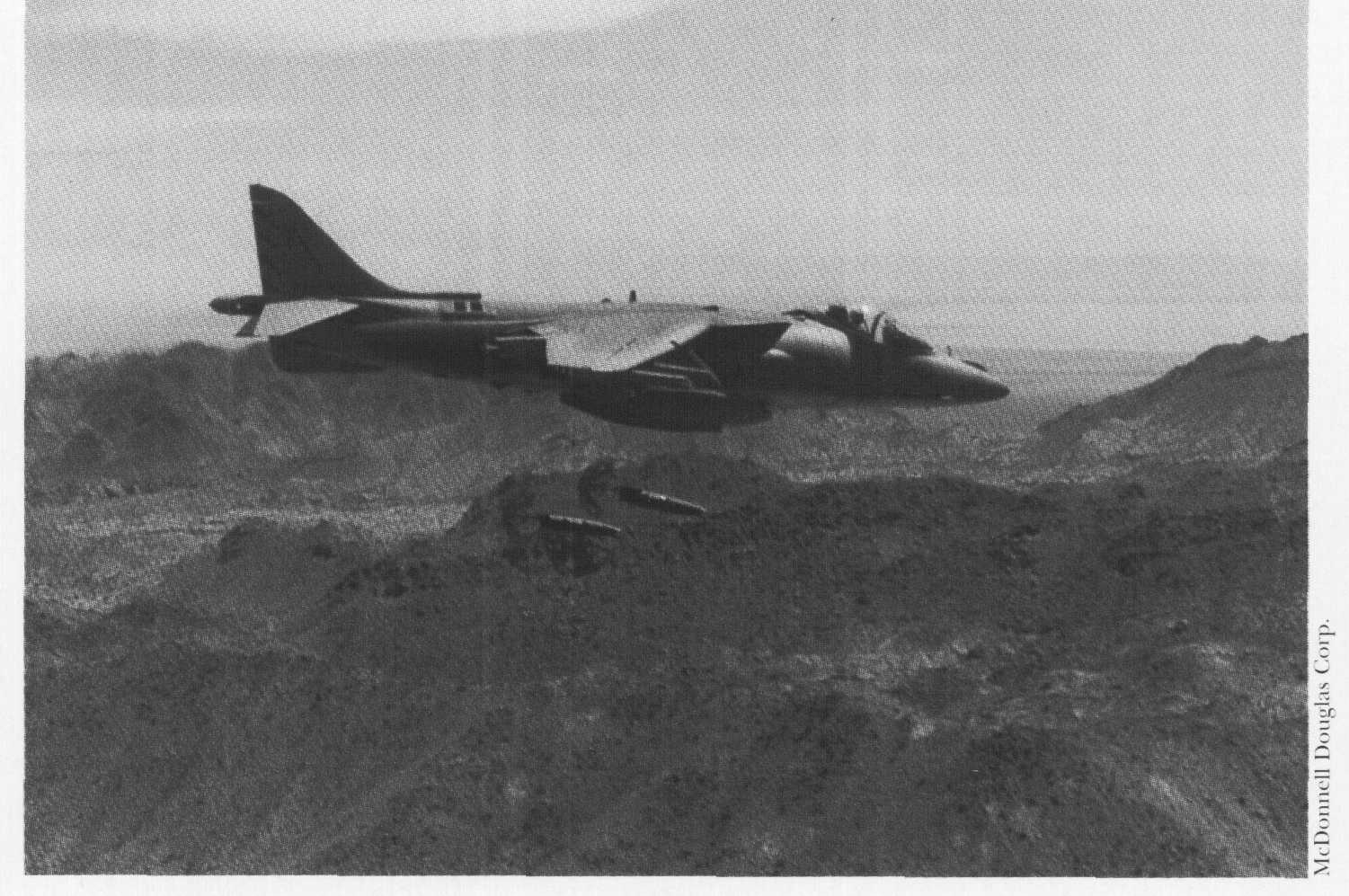
During seabased operations, efficient deckspace management will be critical to maneuver and operational tempo. The sea base must afford all-weather launch and recovery of a flexible, vertical/short takeoff and landing (V/STOL) ACE, and expeditiously accommodate massing or dispersing forces. The MAGTF cannot allow deck area to constrain force size, and the ACE can never relinquish the capability to operate in close proximity to the GCE. To achieve desired sortie generation rates and rapid aircraft turnaround, precise amounts of fuel, ammunition, logistics, and ACE-specific services must be available at shore locations. Thus, the ACE must possess an organic capability to establish and operate flexible expeditionary sites ashore, ensuring responsiveness and endurance. The ACE will not “phase ashore” in the traditional sense, but operate within a continuum comprised of both seabased and shore positions.

ACE FIRES

The MAGTF utilizes fires to achieve a desired operational effect by destroying or disrupting adversary capabilities through which he derives freedom of action, physical strength, or will to fight. The MAGTF will call for and direct organic fires, and will have access to available nonorganic naval and joint fire support-to include spacebased systems. Aviation fires must be available in all weather conditionsboth day or night-and be precise, lethal, efficient, versatile, sustainable, and coordinated.

The command information architecture will connect the cockpit with supported elements through onboard systems that download realtime mission information such as fuel state, ordnance availability, weapon effects footprints, and intelligence/mission feedback. Fire support coordination agencies can utilize this shared data to develop appropriate weapons-to-target pairings and achieve effective resource utilization. Combat identification (CID) measures embedded within the architecture, in tandem with onboard target detection/acquisition/identification systems, will be applied to each potential target to ultimately prevent incidents of fratricide. Collectively, these capabilities will ensure a timely target validation/confirmation process which can support extensive requests, taskings and retaskings of ACE fires in close proximity to ground forces. This process will satisfy reasonable assurance thresholds and SA requirements for all participants, permitting ACE weapons platforms to engage targets without “eyes on” verification.

Nonlinear approaches to fire support coordination measures will provide ACE assets with flexible access throughout the asymmetric battlespace. Roving restricted fire areas will provide increased opportunities to make best use of available ordnance. The overall objective is to achieve the most efficient and effective use of ACE assets by minimizing squandered weapons, lost sorties, and requirements for repeated attacks.

Engaging targets in an urban environment will pose complex challenges. Adversaries will use the proximity of noncombatants to their advantage, requiring us to rely more heavily on precision weapons and systems that are capable of a greater degree of target discrimination. The ACE requires an enhanced family of munitions-both lethal and non-lethal-which can achieve a broad range of desired effects and also provide due regard for friendly locations, proportionality, collateral damage, and “rubble” factors.

FORCE PROTECTION

The asymmetric battlespace presents significant force protection challenges. The broad spectrum of missions and distance factors are compounded by the number of disparate agencies that will require protection. Layered protective measures must be designed to cover not only military forces, but for all involved joint/combined agencies and local citizens within our area of influence. The ability to extend protection over vulnerable business entities, critical information networks and resources, nongovernmental organizations, and noncombatants must become part of our overall force protection effort. The goal is to effectively protect our forces without diminishing our offensive capabilities.

Force protection is not an end unto itself, but a byproduct derived from the synergistic integration of all warfighting activities. The OMFTS MAGTF capitalizes on seabasing, force mobility, stealth, and speed to achieve maximum force protection effect and ensure continued freedom of action from predeployment through reconstitution and redeployment. The ACE will seek to exploit these principles for its own benefit, but will also closely integrate with the sea base to provide the far-reaching umbrella of security essential to effective force protection. ACE activities will focus on detecting, identifying, and defeating enemy offensive actions. The ACE will provide local air superiority, tactical recovery of aircraft and personnel, localized ground security, and airspace control functions-further contributing to force protection. The command information architecture must support these ACE capabilities, and provide means to coordinate them across joint/combined boundaries-both afloat and ashore. When ACE elements operate ashore, locations will be carefully selected to maximize capability and versatility, and to mitigate vulnerability. ACE assets ashore charged with defending MAGTF assets must be at least as mobile and survivable as the elements they are supporting.

ACE SUSTAINMENT OPERATIONS

Sustainment activities will physically integrate, prepare, deploy, supply, train, maintain, reconstitute, and redeploy the force, constituting the measures necessary to support the MAGTF throughout OMFTS. The maritime prepositioning force (MPF) pillars provide a force sustainment framework. Yet in addition to MPF, the MAGTF will take advantage of all available elements of national power, to include leveraging successful business practices to streamline its resource management-acquisition/distribution and repair-and ensure right time/right place support.

RESOURCE ACQUISITION/ DISTRIBUTION

Efficient, dependable resource acquisition and distribution is critical to maintaining operational tempo. Resources will be acquired from sources internal or external to the ACE, in some cases requiring the means to engage in contractual arrangements. Reachback capabilities will ensure accessibility to distant resources and may even employ commercial carriers to expedite deliveries. ACE supply systems will connect with joint, automated systems that can identify, request, acquire, track, receive, and distribute resources through total asset visibility. Once located, the ACE will assign assets to move and distribute resources in support of itself and of the MAGTF as a whole. Deliveries will be tailored into specific support packages that maximize “in-time” delivery and economy of lift.

RESOURCE REPAIR/ MAINTENANCE

ACE maintenance provides for actions necessary to classify discrepancies, perform necessary repair or modifications, and dispose of unusable material. Future ACE assets will take advantage of technology to simplify troubleshooting procedures without reducing thoroughness. Systems will self-diagnose discrepancies, transmit the repair requirement into a networked computer system that, in turn, will automatically schedule phase and routine maintenance, identify repair and/or support system components, and order the appropriate resources. Exploiting such technology will require increased skill sets in maintainers; yet, common operating systems/environments for all aircraft, ground equipment, maintenance systems, components, and repair processes will ultimately lessen the load placed upon them. Maintainers will have required resources and support systems in place when the asset is available for maintenance, decreasing turnaround/down time and improving readiness. Contractor support and modular ACE systems will reduce the intermediate level structure, moving toward “skip-echelon” maintenance procedures that float components directly from operational to depot levels.

LOGISTICAL FOCUS

The ACE requires the ability to effectively operate while being logistically supported from a sea base, yet it must also retain the ability to provide flexible, adaptable, and maneuverable support from shore locations. Regardless, OMFTS shifts much of the MAGTF sustainment burden to the ACE, requiring it to provide operational sustainment and tactical logistics support both for itself and the MAGTF. To accomplish this, the ACE will shift its mindset and “operationalize” sustainment activities, executing them from within the context of a “complete tactical focus.” Marine air must simultaneously carryout both tactical and logistics functions-providing the lifeblood for the MAGTF at the operational level, while managing muscle movements at the tactical level. To carry this increased portion of MAGTF sustainment, the ACE requires the proper number of assets, intelligent resource management, and the connectivity to coordinate disparate efforts into a cohesive, holistic package.

FUTURE DIRECTIONS

Maneuver warfare places a heavy reliance on initiative. We must train our tactical operators at the most junior level-flight and section leads-to proactively exploit commander’s intent and maintain an operational tempo that is overwhelming to the enemy. Our command architecture must recognize the inherent presence of friction in battle, and support training opportunities in peacetime that capitalize on building leadership, judgment, and initiative.

Marine aviation stands at a crossroads. The Joint Strike Fighter USF) and MV-22 represent the fruition of a forward thinking neck-down strategy that began nearly 2 decades ago. Not simply airframes, aviation as a whole has participated in this philosophy promoting efficiency, commonality, and expeditionary capability. To perform OMFTS the ACE must continue this trend toward efficiency in operations, commonality in support, lethality, and flexibility in execution. The following represent some key future ACE characteristics.

ASSETS & AIRCRAFT

Multirole, multisensor, modularly upgradeable, all weather, reliable airframes.

V/STOL, able to operate from ‘L’ class ships without performance degradation.

Commonality with joint platforms in repair and weapons systems and GCE sustainment assets to the maximum extent possible.

Survivable across threat spectrumMANPADS to NBC-employing stealth, active/passive self-protection, advanced tactics.

Configured primarily for attack/lift.

EXPEDITIONARY OPERATIONS

“Lighter” shore operations requires a flexible-in size and services providedexpeditionary shorebased capability.

An ACE organic capability to establish, operate, and protect MAGTF support sites, that provide a conduit for sustainment.

All-weather aircraft recovery capability. Common asset servicing and creative logistics packaging and delivery.

RESERVE INTEGRATION: COMBAT REACHBACK

ACE Reserve organizations to deploy through same modes as active component.

Common equipment and training to improve integration and compatibility.

UNMANNED AERIAL VEHICLES (UAVs)

Provide payload capabilities to support tactical resupply and strike.

Long-range target acquisition, designation, reconnaissance and surveillance (to include electronic) deception decoys, communication/data relay, and electronic jamming.

UAV integration within the command information architecture to gather and disseminate vital information.

MUNITIONS

Family of smaller, enhanced munitions.

Conventional “dial-a-yield” capabilities for urban versus open, and hard versus soft targets.

Cost effective and competent, as well as smart weapons, for level-of-effort fire support.

GCE munitions, ACE transportable in sufficient quantities.

Fire and forget, precision-guided, allweather ordnance. Bring-back capability.

Antiradiation missiles with greater target specificity and “smart” guidance.

ELECTRONIC WARFARE

Proliferation of sophisticated surface-to-air missile systems, integrated through a variety of command and control systems will remain prevalent.

AGE requires layered capability set that includes manned and unmanned assets dedicated to dominating the electromagnetic spectrum, compatible with MAGTF and joint assets.

Ability to rapidly detect, identify, locate, and defeat prohibitive pop-up mobile air defense systems.

Dedicated electronic attack, electronic surveillance, electronic protection assets/measures in conjunction with selfprotection jamming suites and expendables.

Threat warning and ambiguity resolution in signal saturated battlespace, integrated with CID measures, that provide positive identification of all assets and signals.

Operational and tactical capability to deliberately influence (deny, degrade, deceive) an adversary’s information systems and protect our own.

CONCLUSION

In its most complete definition, OMFTS represents a Navy-Marine Corps capability. Naval heritage makes OMFTS a conceptual possibility, but making it a reality necessitates U.S. Navy continued commitment and cooperation. While the MAGTF projects power ashore, the naval expeditionary force operates, maneuvers, and protects the sea base, as well as providing critical fires in support of Marines.

OMFTS represents a cultural paradigm shift calling for ever greater interdependence and closer integration between MAGTF elements. Ground and aviation Marines must immerse themselves in each other’s tactics, capabilities, and limitations to foster our “shared vision” and develop “trust tactics.” This mindset provides an avenue to shed parochial blinders, empowering necessary realignments during our evolution to a new level of expeditionary readiness.

Executing OMFTS does not depend on a revolution in technology, but an evolution in ideology. Taken together, the platforms of the 21st century do not represent sweeping warfare changes and cannot guarantee success in tomorrow’s environment. The revolution resides in the ability to integrate, coordinate, and execute operations-unlimited by physical boundaries and linear thought. OMFTS epitomizes that revolution. MAGTF success depends upon growing and nurturing the leaders who will think, plan, provide their intent, and allow execution in the expanded dimension OMFTS will present. Commanders at all levels must promote inventiveness and initiative in subordinate leaders, creating an environment where fear of failure is not a substitute for success in maneuver warfare.

From its inception, Marine aviation has been an integral and indispensable element of Marine Corps combat power. This position was solidified with the development of the MAGTF, and will be further enhanced in future operations. OMFTS will require the ACE to broaden its scope, cor relating traditional functional areas within the full array of MAGTF warfighting functions and seeking new ways to apply its capabilities. Marine air must operate whenever and wherever Marines operate, overcoming not only aviation specific obstacles, but also those that challenge the MAGTF‘s ability to operate as a coherent whole-across the “three block war” scenario. A MAGTF without organic fixed-wing, multirole, and vertical-lift assault support capabilities is not only untenable, but also unthinkable. Only the synergy of the ACE, GCE, and combat service support element-under the direction of the MAGTF commander-will provide the power and flexibility required of future operations from the sea.
The MCDPs

MCDP 1, Warfighting-is a revision of FMFM 1 which was originally published in 1989. MCDP 1 retains the style, spirit, and basic concepts of the original while refining and expanding upon the warfighting philosophy expressed in FMFM 1 Key additioins to the, manual include all expanded discussion of the nature of war, a more detailed description of the styles of warfare, and clarification of key doctrinal terms such as commander’s intent, main effort, centers of gravity, and critical vulnerabilities.

    • MCDP 1-1, Strategy-is a new manual designed to give Marine leaders at fundamental understanding ol military strategy. MCDP 1-1 is not a guidebook for how to make strategy or a critique or endorsement of any particular strategy. Rather, it provides its readers with the basic knowledge to “think strategically” through the examination of the strategic environment, the relationship between policy, strategy, ends, and means, the use of various strategic approaches, and the strategy development process. Such knowledge is essential to understanding the context in which military operations are conducted and how actions at the tactical and operational level impact on attainment of national objectives.
    • MCDP 1-2, Campaigning-is a revision of FMFM 1-1, Campaigning. Campaigning focuses on the operational level of war and the military campaign used to organize tactical actions to achieve strategic objectives. MCDP 1-2 develops and refines the concepts of the original manual based upon recent operational experience and the evolution of military operations in the post-Cold War world. The update publication has three significant additions: an expanded discussion of the linkage between strategic objectives and the campaign, a section on conflict termination. and section entitled “synergy” which describes how key capabilities are harmonized in the conduct of the campaign.
    • MCDP 1-3, Tactics-is also a revision of all existing manual, FMFM 1-3, Tactics. MCDP 1-3 addresses the theory of tactics and the application of maneuver warfare to the tactical level of War. It emphasizes that success on the battlefield comes not just from excellence in -weapons or procedures, but from leaders who can think creatively and act decisively. Key updates to Tactic, include a new chapter on exploiting success and expanded sections on adapting, tempo and gaining advantage.

MCDP 2, Intelligence-is the first of five new manals which address the key warfighting functions. MCDP 2 provides Marines with a framework for understanding the importance of intelligence to the conduc of maneuver warfare and a basis for the execution of effective intelligence operations. The publication stresses that intelligence provides not just information, but knowledge in support of decisionmaking; that intelligence can reduce but never eliminate the uncertainty inherent in the nature of war; that intelligence is inseparable from operations and is used to shape the execution of successful military actions and, finally, that intelligence is an inherent responsibility of command which requires the commander’s direct and personal involvement.

MCDP 3, Expeditionary Operations-describes the organization and concepts used by Marines in the conduct of expeditionary operations. MCDP 3 applies the warfighting philosophy of MCDP 1 to the operations of the Marine air-ground task force (MAGTF) and the expeditionary settings in which MAGTFs operate. It discusses the expeditionary environment, the nature off expeditionary operations, the naval expeditionary forces, MAGTFs, Marine component commands, and expeditionary concepts such as operational maneuver from the sea, sustained operations ashore, and military operations other than war. As the first doctrinal manual published since the early 1 990s to address these topics, Expeditionary, Operations is intended to educate and guide Marines in the empoyment of Marine Corps capabilities and forces.

MCDP 4, Logistics-provides a conceptual framework for the understanding and practice of effective logistics in maneuver warfare and expeditionary operations. MCDP 4 describes logistics as a fundamental elelement of warfighting whose purpose is to provide the commander with the physical means to prevail in an environment off complexity fluidity and uncertainty. The manual identifies the goal of Marine logistics as extending our operational limits while permitting us to remain adaptable and responsive to changing conditions in the battlespace.

MCDP 5, Planning-describes how we use planning to effectively prepare for operations when the future is uncertain. MCDP 5 emphasizes that planning is a fundamental element of maneuver warfare which involves both the science of war through analysis, and the art of war through synthesis, judgment, and creativity. Planning describes the nature and types of plans and planning, the theory which underlies the development of and the keys to effective planning within the context of` maneuver warfare.

MCDP 6, Command & Control-defines command and control as the means by which a Commander recognizes what needs to be done and sees that appropriate action is taken. It emphasizes that the essence of command and control is the art of military decision making and details an approach that enables us to reach decisions and take action faster than our adversaries. MCDP 6 explores the nature of command and control, the challenges to command and control in both the infromation age and the uncertain environment of war, and outlines effective approaches for leadership decisionmaking, information management, and command and control organization, procedures, and equipment.


Live Fire & Maneuver or MILES

by LtCol John Poole, USMC(Ret)

Today’s overcommitted Marine might wonder how the juxtaposed viewpoints of LtCol Michael H. Collier and Paul Seidenman (MCG, Aug98) could both be right. Live fire against pop-up targets has its place in Marine training. Such ranges test reaction time and accuracy. However, to say that “live fire and maneuver” is now the priority violates maneuver warfare doctrine. In maneuver warfare, surprise displaces firepower. The firing of small arms alerts the enemy to the physical presence of ground troops. Modern tactics involve applying force silently or with weapons that sound like indirect fire or mines. In the past, we gauged our success by ordnance delivered. Now we must measure it by casualties avoided.

That’s where MILES [Multiple Integrated Laser Engagement System] comes in. Situationally inappropriate standing operating procedures can be easily identified by too many people beeping. In other words, casualty totals are the best indicator of tactical effectiveness. Fleet Marines are ready for improved MILES gear. They realize the importance of casualty assessment but are frustrated by the scarcity and limitations of the older version. The upgraded MILES 2000 will certainly be welcomed.

Marines who wonder how to proportion training with live fire and MILES need to do some historical research. When the enemy shows up in actual war, one is tempted to start shooting with every weapon available. While shooting may be the appropriate response initially, subsequently moving forward while shooting can quickly become inappropriate. A “prepared enemy position” must either be bypassed or neutralized by deliberate attack. Most of the units injured in Vietnam were not ambushed per se, they merely stumbled or were drawn into prepared enemy positions and then made the mistake of hastily attacking them.

Live Fire & Maneuver or MILES

by LtCol John Poole, USMC(Ret)

Today’s overcommitted Marine might wonder how the juxtaposed viewpoints of LtCol Michael H. Collier and Paul Seidenman (MCG, Aug98) could both be right. Live fire against pop-up targets has its place in Marine training. Such ranges test reaction time and accuracy. However, to say that “live fire and maneuver” is now the priority violates maneuver warfare doctrine. In maneuver warfare, surprise displaces firepower. The firing of small arms alerts the enemy to the physical presence of ground troops. Modern tactics involve applying force silently or with weapons that sound like indirect fire or mines. In the past, we gauged our success by ordnance delivered. Now we must measure it by casualties avoided.

That’s where MILES [Multiple Integrated Laser Engagement System] comes in. Situationally inappropriate standing operating procedures can be easily identified by too many people beeping. In other words, casualty totals are the best indicator of tactical effectiveness. Fleet Marines are ready for improved MILES gear. They realize the importance of casualty assessment but are frustrated by the scarcity and limitations of the older version. The upgraded MILES 2000 will certainly be welcomed.

Marines who wonder how to proportion training with live fire and MILES need to do some historical research. When the enemy shows up in actual war, one is tempted to start shooting with every weapon available. While shooting may be the appropriate response initially, subsequently moving forward while shooting can quickly become inappropriate. A “prepared enemy position” must either be bypassed or neutralized by deliberate attack. Most of the units injured in Vietnam were not ambushed per se, they merely stumbled or were drawn into prepared enemy positions and then made the mistake of hastily attacking them.

Comments on Maneuver

by MajGen J. Michael Myatt, USMC(Ret)

Maneuver warfare has been a topic of discussion for two decades, but some aspects of the concept are not fully appreciated. I recommend we use the term “maneuver” for this mission area and avoid the term “ground maneuver.” My reason is that the term “ground maneuver” is far too narrow in its description of joint operations on land-particularly when you consider that tactical aviation can be used as a separate maneuver element in land operations; that operational maneuver from the sea has been decisive in many campaigns of military history; and that “maneuver” requires sustainment, making it impossible to conduct land warfare on someone else’s turf without a robust maritime transportation capability for the logistic support of the forces ashore.

Maneuver warfare is recognized Department of Defense doctrine, however, not many seem to really understand what this doctrine means. Recently, I reread JCS Pub 3-0 and then read a new brochure on diitizing the battlefield. Both documents emphasize synchronization as a tenet of maneuver warfare. This emphasis has some unintended effects. It implies waiting to do something to the enemy until everyone on our side is ready. It makes the synchronization matrix the end and not just a means to the end. Synchronization is a catchy buzzword, and I worry that some junior officers might actually believe that synchronization is more important than speed of action and initiative.

Our joint doctrine is deficient, and the proof is provided by the joint definition of maneuver, which concentrates only on the spatial aspect of gaining a positional advantage over our opponent. We should consider maneuver in time also, where we generate a greater operational tempo than an adversary, gaining a temporal advantage. We need to consider both dimensions of maneuver to truly understand how we can use maneuver to achieve decisive superiority at the right time and place. This must be understood as we do any mission area analysis.

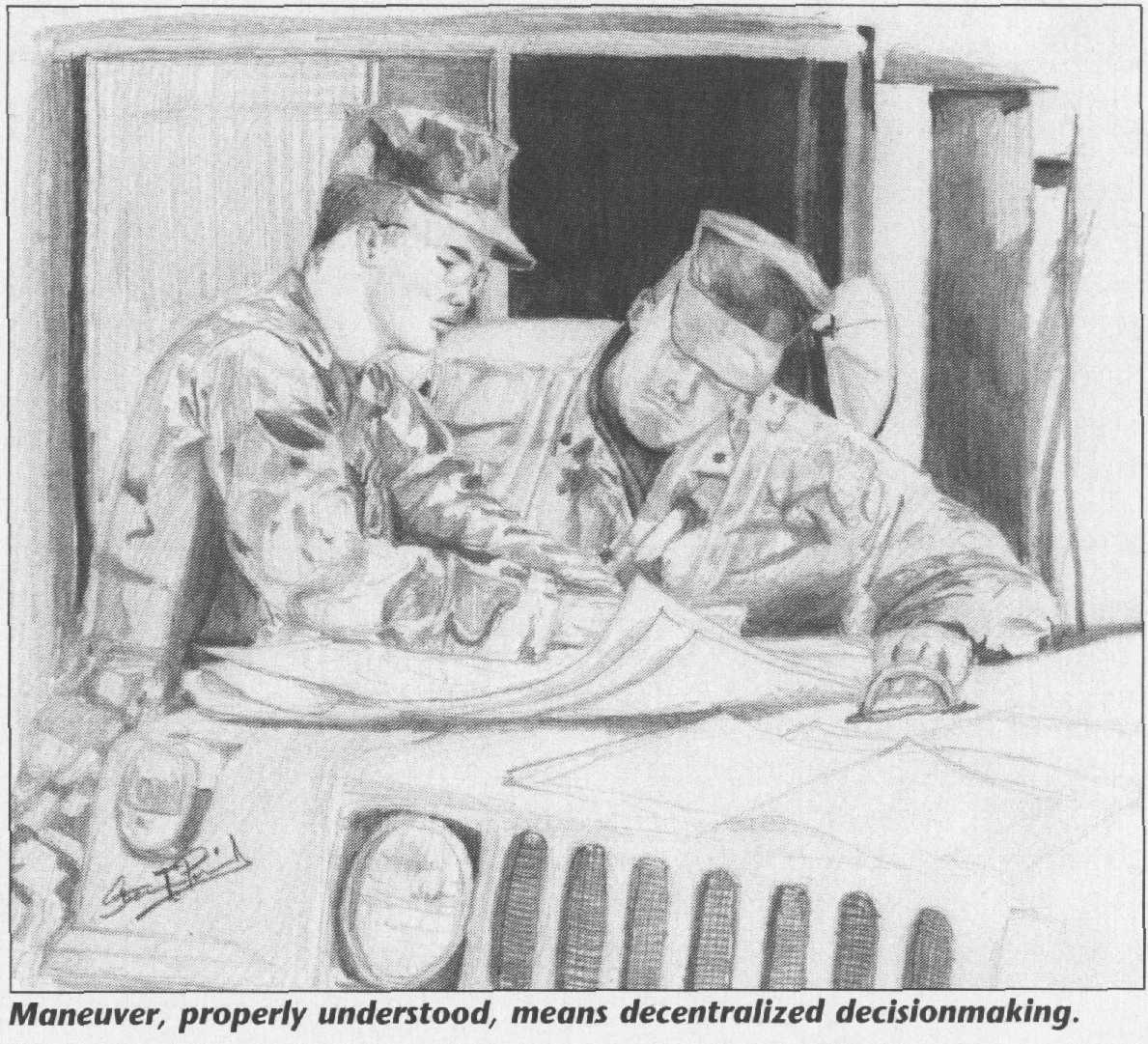
First and foremost we must recognize that warfare is an intellectual endeavor because combat is between thinking adversaries, each trying to gain an advantage over the other through trickery of all forms. The moves and countermoves of a conflict all originate in the intellect, and are not generally subject to prediction or modeling. Ironically, because men are involved, there is a strong human tendency to attempt to organize and control the battlefield. This perspective is one that ignores the fact that war is incontinued after Insert herently chaotic-an uncontrollable, two-sided contest dominated by chance and confusion. Some people predict chaos on a battlefield where a senior isn’t in complete control of his subordinates. In fact, due to friction, uncertainty, and the inherent chaos of war, complete control is an unattainable goal, just as much as is a goal of “perfect information.” Coordination of actions of subordinates on the battlefield is possible because the commander has expressed his intent (the “why”) and there exists a trust between the commander and subordinates that the subordinates will act (take initiative) and make decisions in consonance with the commander’s intent, which is the glue that binds these actions together. Some erroneously label this as “centralized planning, decentralized execution.” What we are describing here is “centralized vision and decentralized decisionmaking!”

I want to stress the importance of maneuver’s temporal aspect. Speed of actions is vital to generate the tempo necessary to be relevant-and it is possible to unhinge an opponent and unravel his unit cohesion by continuing to cause him to focus inward. In the analysis of maneuver, we need to address “speed of action” and rise above the tendency to use “tons of steel on target,” as our sole criteria for decision.

The tendency to focus on firepower in analysis could be blamed on the fact that we know how to model “tons of steel on target,” but we aren’t able to model the “intellect.” However, I think it is more a result of the complete absence of the proper view of war that I mentioned above as being primarily a process of outthinking one’s opponent. This is not to say that it will ever be devoid of fighting. But, if we [senior leadership] at our level understand that we must outthink our opponents, then there will be a lot less fighting and a lot less dying by those youngsters entrusted to us to lead, teach, and train to fight.

At least some conscious addressal of the fact that it is the intellect that must be paramount in the Pentagon warfighting appraisal is appropriate. One way to achieve this goal is to begin to think of our way of war as being one focused on defeating an enemy rather than trying to destroy him. I have example after example of why this is important. It is vital that we all understand that destroying an enemy is far more costly in national treasure (i.e., lives and dollars) than it is to defeat him. Some will laugh and say the Sun Tsu doesn’t apply in modern war. How ludicrous! He is more relevant today than ever. Isn’t that what the public has been saying when calling for victories with no casualties? We have a far better chance of satisfying this political imperative by teaching our subordinates to defeat the enemy rather than to destroy him. J.F.C. Fuller was obsessed with this problem and wrote about it in his essay on Battle, published in 1931. Although his prophetic insights are even more relevant today, his own countrymen (and the Americans, too) proved it is “easier to think like a wild beast,” ignoring Fuller while the Germans adopted his every recommendation.

Let me cite two examples of the “defeat vs destroy” situation:

During the 5 months of Operation DESERT SHIELD, the Ist Marine Division spent a great deal of time studying how the Iraqis fight and looking extensively at the Iran-Iraq war. Iraqi artillery was very effective in trapping Iranian soldiers time and time again in `firesacks’ where thousands of Iranians perished. We knew there were 1,200 artillery pieces belonging to the 6 divisions facing the 1st Marine Division. In our studies of the two obstacle belts in Kuwait and the amounts of Iraqi artillery, we concluded that the Iraqis were planning on trapping us in at least two firesacks when we attacked. We also recognized that there wasn’t enough ordnance in the aviators’ inventory to “destroy” all that artillery during the first phase of DESERT STORM. So we designed a series of ambushes (combined arms raids) to “defeat the Iraqi artillerymen” before we ever attacked into Kuwait.

DESERT STORM kicked off on 17 January and the Iraqis began firing their artillery into Saudi Arabia at Marine and Arab units (along with an extensive air defense artillery display when our aircraft ventured over Kuwait. Two aircraft were lost over Kuwait and two French aircraft were badly shot up forcing them to change their tactics and go high). On 19 January, we ran our first raid. In all, we conducted 9 raids from 19 January until G-day on 24 February. Having chosen a lucrative target during the day with a Pioneer remotely piloted vehicle (RPV), our scheme was to move an artillery battery close to the Kuwaiti border at night, escorted by a light armored infantry company. We would station an EA6B to jam the Iraqis ground surveillance radars (which they had in large numbers and employed liberally) until after we had fired the entire battery-6 on the target, using dual purpose, improved conventional munitions. Then, just as the artillery battery started its withdrawal phase of the raid, the EA-6B would stop jamming just long enough for the Iraqi’s to detect the battery’s movement before “turning on the buzzer” again. The Pioneer RPV would orbit the Iraqi artillery. Our intent was to cause the Iraqi artillery to respond to our fires, which they did each and every time, meaning that there were Iraqi soldiers on their guns. Once they would begin firing, our F/A-18 FastFac would detect their muzzle flashes and he would then direct the “wolfpack” of F/A-18s and AV-8Bs waiting in orbit to roll in on the firing Iraqi artillery.

Please remember that our aim was to defeat the “minds” of the Iraqi artillerymen-to convince them that it just wasn’t smart to man their artillery pieces because every time they did, aircraft came rolling in on them. We achieved this objective in the third week of February when Iraqi artillerymen were observed by the RPV abandoning their howitzers as our aircraft began attacking their positions after such a raid.

My second example is about the time we conducted an operation in mid-February of 1991 to cause the Iraqi infantrymen to think we had prematurely commenced the ground attack. We were just trying to screw with their minds. We collected all the old trucks and cars we could find that were still able to run and rigged them with explosives and remote detonators. Then one night we put the vehicles in a formation and tied the steering wheels to keep them pointed toward the first obstacle belt. We used the huge psyops speakers to broadcast tapes of tanks moving around the battlefield. Then we conducted an extensive artillery prep and sent the trucks heading toward the awaiting Iraqis. As the vehicles approached the obstacle belt, we detonated the explosives in the trucks. We called this event “Operation Flail.” In digesting all the captured documents after the war, we were most pleased to note that the frontline division commander concluded that he had been attacked that night and had been defeated.

Lastly, we need to ask about the confusion of the term “overwhelming force” with the term “decisive force.” We must guard against conveying the impression that the United States will always commit overwhelming force to end all conflicts quickly with minimum casualties, or we won’t get involved. Is this a policy statement that would prohibit action with forces positioned at the right place at the right time to take decisive action even though it might take much longer to achieve “overwhelming force”? How might this confusion affect the assessment process? Will we spend more resources to make sure we always have “overwhelming force?”

As we get on with the Joint Warfare Capabilities Assessment process, our focus should be on the interoperability of systems and programs. Comparing one Service’s “system A” with another Service’s “system B” isn’t what we need to do at this level. And, in the assessment process, using a series of attrition-based analytical models would do nothing more than reward “brute force instead of generalship.” As this is our first year to do the assessments, our expectations should be realistic. I personally think that each Service would derive enormous benefits and knowledge about the other Services from discussions and education resulting from the professional debates during a series of seminar wargames. The games could be held in a decision lab-type facility where professional military judgment makes the calls and where the results are supported by computer software that permits a free exchange of ideas and opportunities to sway, convince, and prioritize the value of programs for the chairman’s use.

Beyond C2

INTRODUCTION

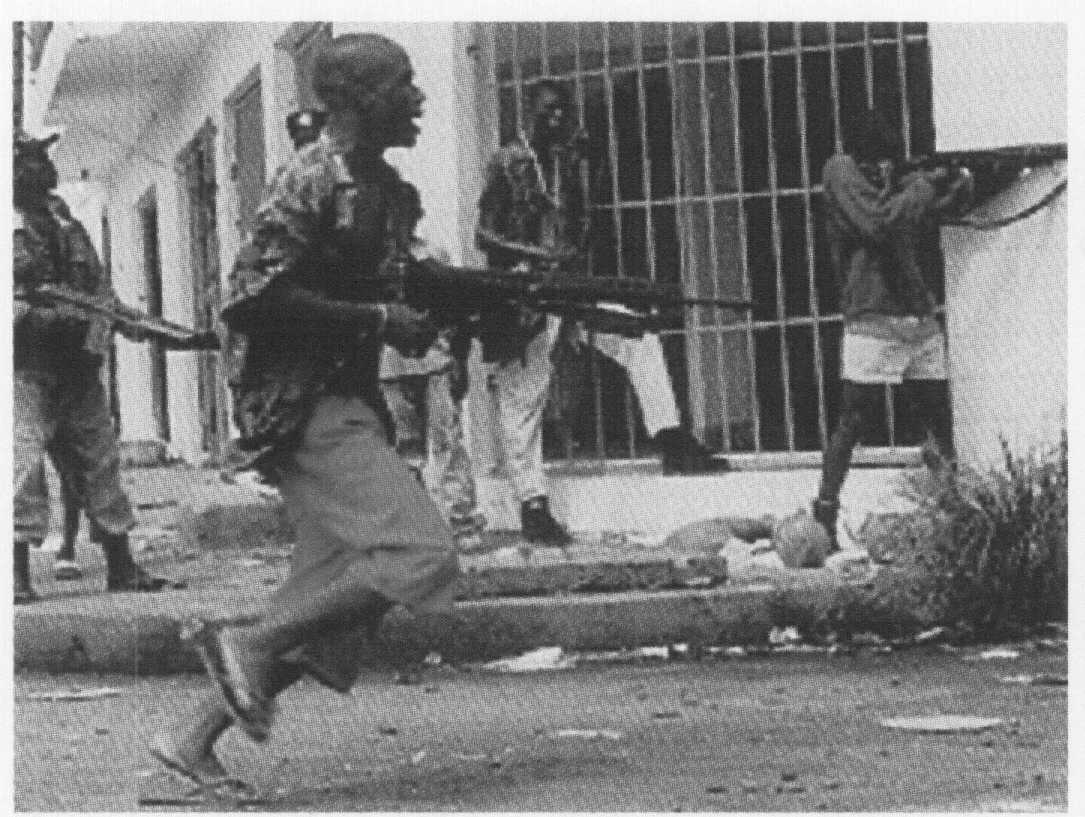
As Marines learned in Lebanon, the Los Angeles riots, Somalia, Haiti, and Bosnia, conflict is becoming less “traditional.” The future will bring new threats, fueled at least in part by a continuing breakdown in societal order. Street gangs, clans and transnational adversaries will wage the war of “all against all,” as the proliferation of high-technolog weapons and information systems encourages our opponents to attempt asymmetrical forms of attack against our perceived critical vulnerabilities. To maintain the primacy of the Marine airground task force (MAGCTF) as the Nation’s force of choice in complex contingency operations, our command and control philosophy will adapt to meet the new multidimensional stresses imposed by evolving, dynamic environments.

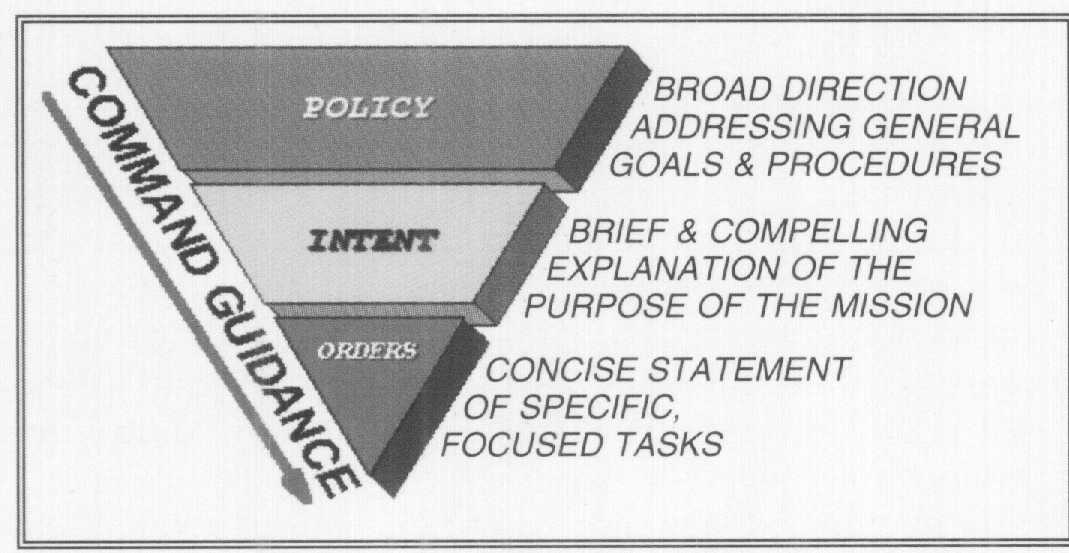
The warfighting philosophy of the Marine Corps is maneuver warfare. This philosophy recognizes that all military evolutions, from major theater wars to the complex contingencies encountered in other expeditionary operations, occur in an inherently uncertain and chaotic environment shaped by continuous human interaction. The human influence on war takes two forms. First, war is and will remain a clash of hostile wills. The enemy is unpredictable and beyond our capacity to “control,” while similarly, we strive to operate in a manner which makes our own actions unpredictable to the enemy. Second, leaders and their subordinates interact with one another: leaders issue guidance in the form of policy, intent, and orders, while subordinates provide feedback through reports, as well as through the operational results of their actions. The Marine Corps, by virtue of its mission as a sea-based, forward deployed, air-ground force-in-readiness, is uniquely positioned to move beyond today’s notions of command and “control.”

Human influence is an immutable, defining characteristic of war. On the one hand, it contributes powerfully to the “fog and friction” that increase the difficulty of conducting operations. On the other hand, human influence is a source of incredible creativity through which leaders and their subordinates overcome obstacles and accomplish their missions. The systems and processes that a commander uses to shape events must function within the context of war’s unpredictability and must exploit the powerful positive effects of human influence. Traditional forms of command and control will evolve as Marine leaders continue to command while exerting control through command, not through the technologies that have come to be viewed by some as synonymous with “control.” We must envision the day when mechanistic control will be replaced by broad coordination. The aim of MAGTF comprehensive command and coordination is to empower commanders at every level to focus resources upon a mission, while enabling the inventiveness and initiative of subordinates.

MAGTF comprehensive command and coordination will be optimized for maneuver warfare in highly complex future operating environments. It will incorporate the best features of flexible and decentralized mission command and control by providing for harmony of effort while eschewing unnecessary control measures which limit the initiative of leaders. Further, it w ill address the full range of capabilities that might be wielded by a commander, going beyond the conventional forms of military force and extending to the more nontraditional elements of national power: diplomatic, commercial, intellectual, experiential, and many others. The result will be an integrated organic whole, capable of crisis deterrence and response, and combining a broad range of military capabilities with disparate, nonmilitary forms of pressure and influence while preserving freedom of action at every level.

FRAMING A NEW CAPABILITY

To create and sustain a capability for comprehensive command and coordination of the MAGTF, we must embrace new ways and means for guiding future evolutions in the exercise of command. Certain characteristics are central to the development of the doctrine, organizational structures, training and education, equipment, and support mechanisms that will achieve our aim.

Facilitates Interconnectivity/Reach-back

In the complex, chaotic environments of the future, MAGTF conunandels will find many unique and useful resources beyond the boldes of the MAGTF through a seamless, worldwide command information architecture. The development of a “reach-back” capability will facilitate access to a Aide range of information, materiel, and expertise not formerly available to the MAGTF, regardless of the relative physical locations of the MAGTF and the supporting assets or individuals involved. Reach-back will play a pivotal role in the Nt;&GTF commander’s ability to significantly increase operational, even cultural, awareness prior to initiating actions and in the development of plans and formulation of commander’s intent.

Reach-back is best described as “direct interconnectivity,” since commanders will use this capability not only to reachback to the U.S., but also to reach out to adjacent units, or to reach forward to personnel or organizations that may already be located within their areas of interest. Requests for support might be focused at a specific organization, or broadcast to several agencies which could potentially provide the required capability. Responses back to the MAGTF would be direct and timely, yet must also inform all senior leaders in the chain. Capabilities provided to forward deployed forces could come from many sources, including:

Military Organizations. Capabilities could be provided through direct MAGTF connectivity to all senior and subordinate elements, as well as to other joint and combined forces.

Other Government Organizations. MAGTF missions may require worldwide direct interconnectivity with any number of diverse agencies or organizations to include all major governmental departments, as well as other government agencies. Uninterrupted MAGTF reachback will enhance interagency coordination and will provide the MAGTF commander with the means to access critical government capabilities. We must leverage such efforts as the Joint Interagency Task Force and Marine Corps ChemicalBiological Incident Response Force to develop an interconnected coordination capability.

Nongovernment Organizations. MAGTFs will connect, communicate, and coordinate with nongovernment organizations (NGOs), private volunteer organizations (PVOs) and other international organizations, not only in support of worldwide humanitarian operations, but also other forms of complex contingencies.

Academia. A key component of our knowledge strategy is to further empower MAGTF commanders through reachback access to the wealth of technical and sociological knowledge possessed by our academic community. Close connectivity to military war colleges, Service and civil research and development laboratories/centers, simulation facilities and military doctrine and experimentation centers must be pursued, established, and maintained. Connectivity through Marine Corps Fellowship students to major civilian institutions of higher learning will ensure that our Nation’s keenest minds are afforded the opportunity to stand with us as we face new crises.

Business. Connectivity must be established with both national and international business organizations to ensure access to cutting-edge technology, techniques, and business applications. Marines will focus on the development of proactive decisionmaking and solution-development partnerships with all aspects of business, to capture the essence of their entrepreneurial spirit and their aggressive, agile, and competitive approach to problem solving.

Technology. While generally considered an enabler for the capability sources described above, new technologies can also be leveraged throughout the information architecture to provide automatic feedback relative to a commander’s critical information requirements. A network of sensors, intelligence organizations, academic libraries, and internet sources could be programmed to respond in accordance with pre-set criteria-or “trip-wires”-to generate data concerning the MAGTF commander’s key areas of interest and intent.

Linkages and connectivity will become transparent. Through meticulous orchestration of this vast array of resources, the forward deployed commander will forge formidable coalitions. From the reduction of uncertainty surrounding an enemy’s capabilities and intentions, to the rapid identification and dissemination of critical adversary cultural biases or thought processes, interconnectivity and reach-back will support the commander through all phases of an operation. The intent is to unify the efforts of all elements of our national power, including the power contributed by friends and allies, thereby enabling a focused synergy. These new connections can resolve many problems rapidly, and reduce costly and time-consuming duplications of effort between military, government, and nongovernment agencies. Once connecti’4ty is established, the capabilities provided in response to AL&GTF requests will take the form of:

Information. Information. Information of value to the MAGTF commander will be available through the intellectual, operational, experiential, medical and cultural resources found in government agencies, NGOs, commercial interests, academia and across the entire spectrum of technology. In most cases, the MAGTF commander will seek direct assistance regarding a potential adversary’s cultural attributes, doctrine, capabilities and limitations, political motives or objectives, and the adversary’s potential for using weapons of mass destruction. This will require not only physical communications connectivity, but also the capability to analyze and filter incoming information to ensure that it is free from agenda-based biases which could become attached to the source. Validated information would then be provided to adjacent and subordinate commanders over the command information architecture to ensure shared situational awareness at all levels of command. New means, however, will be necessary to support civil-military relationships and information exchange requirements. Pressure. A MAGTF commander will often require the ability to apply pressure or exert influence to affect the character of activity within the environment, or upon the capabilities of a potential adversary. Pressure may be exercised through economic, diplomatic, informational or physical capacities, and could be derived from commercial interests, academia, NGOs, and government sources.

Networks. Diplomatic entities, NGOs, and the business community maintain capabilities around the world to enhance their access in various regions. In some cases, these are communications networks in the familiar sense, which provide for the transfer of data. In other cases, these are “organic networks” consisting of people who interact regularly through personal contact. Commanders must be afforded the opportunity to exploit existing regional networks or to use diplomatic, academic, or business ties to create networks.

Military Forces. Specialized, task-organized groupings of military personnel and materiel will be requested, as needed, and will augment the MAGTF by providing additional mission-specific capabilities that can be deployed with the MAGTF or can be made available through reach-back.

Nonmilitary Government Forces. These forces include groupings of personnel and materiel originating from government agencies, to include the intelligence community, legal/law enforcement organizations, and other specialized government entities. Capabilities provided could range from nuclear incident support to hostage or terrorist response forces; or even resources to assist in the formation or re-establishment of indigenous civil control, authority and capacity.

Training Resources. On occasion, personnel, systems and equipment will be needed by the MAGTF commander to satisfy an unexpected, mission-specific training requirement. These capabilities could be obtained from government, commercial or academic sources.

Technical Support. This type of support would be provided in response to unanticipated mission-specific technical requirements that are beyond the capability of the MAGTF. Examples include unforeseen enemy technical capabilities, communications limitations or anomalies, environmental encumbrances, or the development of technical deficiency trends in fielded equipment.

Materiel. These are mission-specific items necessary to augment the MAGTF commander’s capability to equip, operate, maintain and support MAGTF activities. These items may include additional medical capabilities, environmentally tailored support equipment, or other assets in support of unique mission requirements. Materials could be obtained through government channels, business entities, or even NGOs.

In addition to providing the MAGTF commander with the ability to deal with crises in realtime, reach-back must evolve into a future-oriented, anticipatory art. The ability to focus our national power upon the crisis of the moment is important, yet we must strive for the development of predictive, indepth analytic capabilities that capitalize on reach-back. As a long-term objective, reach-back must offer opportunities to reduce the incidence of conflict; or preferably, to avoid it altogether. By providing the forward deployed commander with resources that enable the ability to anticipate and influence the development of a situation, he will then possess the means to apply proactive, preemptive solutions in the incipient phases of a crisis. The key is to develop options to physical intervention that will defuse potentially hostile situations before conflict erupts

Supports Operational Maneuver From the Sea (OMFTS)

OMFTS is the fundamental, overarching warfighting concept which serves as the foundation for future Marine Corps required operational capabilities. It describes the union of maneuver warfare and amphibious warfare through the application of maneuver warfare principles and the exploitation of technological advances. OMiTS addresses use of the sea as maneuver space and as a force protection measure.

Comprehensive command and coordination capabilities must support the peculiar requirements and new demands imposed by the future amphibious operations envisioned in OMFTS. First, lines will strike from beyond the visible horizon at sea, with tactical unit commanders at the most junior levels maneuvering their respective forces throughout the attack, both at sea and ashore. Second, the landing force will not pause to establish a lodgment or beachhead as in past amphibious operations. Instead, tactical elements will continue maneuvering to strike at objectives located well inland. Third, the landing force will sea-base fires, logistics, and major command elements. Seabasing enhances force protection for headquarters and support units by reducing their direct exposure to enemy ground action or environmental threats found ashore. Concomitantly, it provides for increased operational tempo by freeing the landing force to maneuver without the encumbrance of protecting a vulnerable support “tail.” Additionally, a smaller landing force footprint ashore results in a reduced logistics burden, allowing more focused support to maneuver units striking towards their objectives.

Performs Effectively Across the Range of Operations

In the future, Marines will engage in a broad spectrum of evolutions ranging from major theater war, at one extreme, to activities which do not even have a conventional military character, at the other. In many cases, moreover, Marines will undertake missions involving multifaceted threats and disparate challenges, with several even occurring simultaneously: opposing hostile military forces, heavily armed criminals, the presence of noncombatant civilians in a combat zone, starving refugees, environmental disasters, and a host of others. Comprehensive command and coordination capabilities must provide for swift and decisive action in any situation, however apparently tangled or complex.

Serves as a “Cornerstone”

Forward deployed MAGTFs will frequently be, as they have been, the first forces to reach a crisis area. Indeed, seabasing permits MAGTFs to remain at sea as a crisis develops, free from dependency upon land bases. As additional forces and resources arrive in a forward area of operations, it is essential that they be quickly assimilated into a working command structure. Comprehensive command and coordination capabilities must support the MAGTF command element’s unique qualifications to serve as the “cornerstone” for the creation and tailoring of large coalition forces, which might include joint and combined military formations, as well as the nontraditional elements of national power. The sea-based AGTF command element, which can deploy quickly to a crisis area with a highly developed capacity to command and coordinate a wide array of military and civil forces and resources, will provide the Nation a crisis deterrence and response capability tailored to the challenges of the 21st century.

Creates a Learning Organization

Conflict takes an infinite number of forms because of the interaction of humans with one another and the environment. The Marine Corps must take a comprehensive view of command and coordination and use reach-back, vertical, and lateral communications to become not only a smart organization, but also a learning one. Patterns in adversary movement or behavior, the detection of anomalies and variants, and a sensing of the enemy’s rhythm and tempo-essential to success in the art of warfighting-will reveal themselves to the MAGTF commander through application of diverse elements of national power. A learning organization anticipates the adversary’s behavior, senses opportunities created by the adversary, and then shares and exploits this knowledge to defeat him.

Encourages Intuitive Decisionmaking

Rapidity in decisionmaking builds tempo, which introduces rates of change and the need for masses of information which exceed the enemy’s ability to cope. Speed brings potentially decisive advantages on the battlefield. Ponderous analytical decisionmaking models that require mathematical computations and detailed comparisons using enormous quantities of information actually impose friction and sap the commander’s ability to generate tempo. Intuitive or naturalistic decisionmaking, however, relies upon the commander’s experience, judgment, and intellect to rapidly produce an effective plan-not necessarily a perfect plan. Systems and processes for comprehensive command and coordination of the MAGTF will support intuitive decisionmaking, sacrificing some degree of certainty and precision for speed and agility. Speed and agility create the “initial condition,” allow us to preserve the initiative, and force the enemy to react by design to our actions.

Enables Mutual Understanding With Limited Exchange of Data

Understanding is the highest form that information takes. It connotes deep awareness of the critical factors in any situation. Mutual understanding between leaders and subordinates is critical for shared situational awareness, as well as for the exercise of initiative, which results in dynamic and decisive operations. We can never expect to achieve full understanding of any situation because the “fog and friction” which are characteristic of military evolutions will always affect our ability to collect and analyze information. Our command and coordination tools must enhance our training and discipline and enable leaders at all levels to achieve the maximum possible mutual understanding, but with the minimum exchange of raw data.

Exploits the Power of Implicit Communications

While sophisticated digital communications technologies provide for the transfer of large quantities of data, digital data lack certain qualities inherent in direct, personal human interaction. These intangible qualities constitute implicit communications. The more direct the human interaction, the greater the level of information exchange. “In-person” communications, for example, convey terabytes of information through facial expressions and gestures, in addition to the spoken word. Voice-only telecommunications are slightly less rich in information exchange than are “face-to-face” conversations, but even human voices alone provide an array of signals not found in written messages.

Implicit communications are vital to commanders because they remain the most effective means for converting information into the understanding that is central to effective decisionmaking. Therefore, MAGTF comprehensive command and coordination will employ methods and tools which exploit capabilities for implicit communications.

FUTURE DIRECTIONS

Through a seamless information architecture, future comprehensive command and coordination will provide two broad capabilities that will enhance the MAGTF’s power and flexibility:

Increased freedom of action-command includes control. Control is a part of effective command, not resident in the technologies commanders use. The capability to provide superior command will further our ability to apply the tenets of maneuver warfare in all operations in which Marines will be engaged.

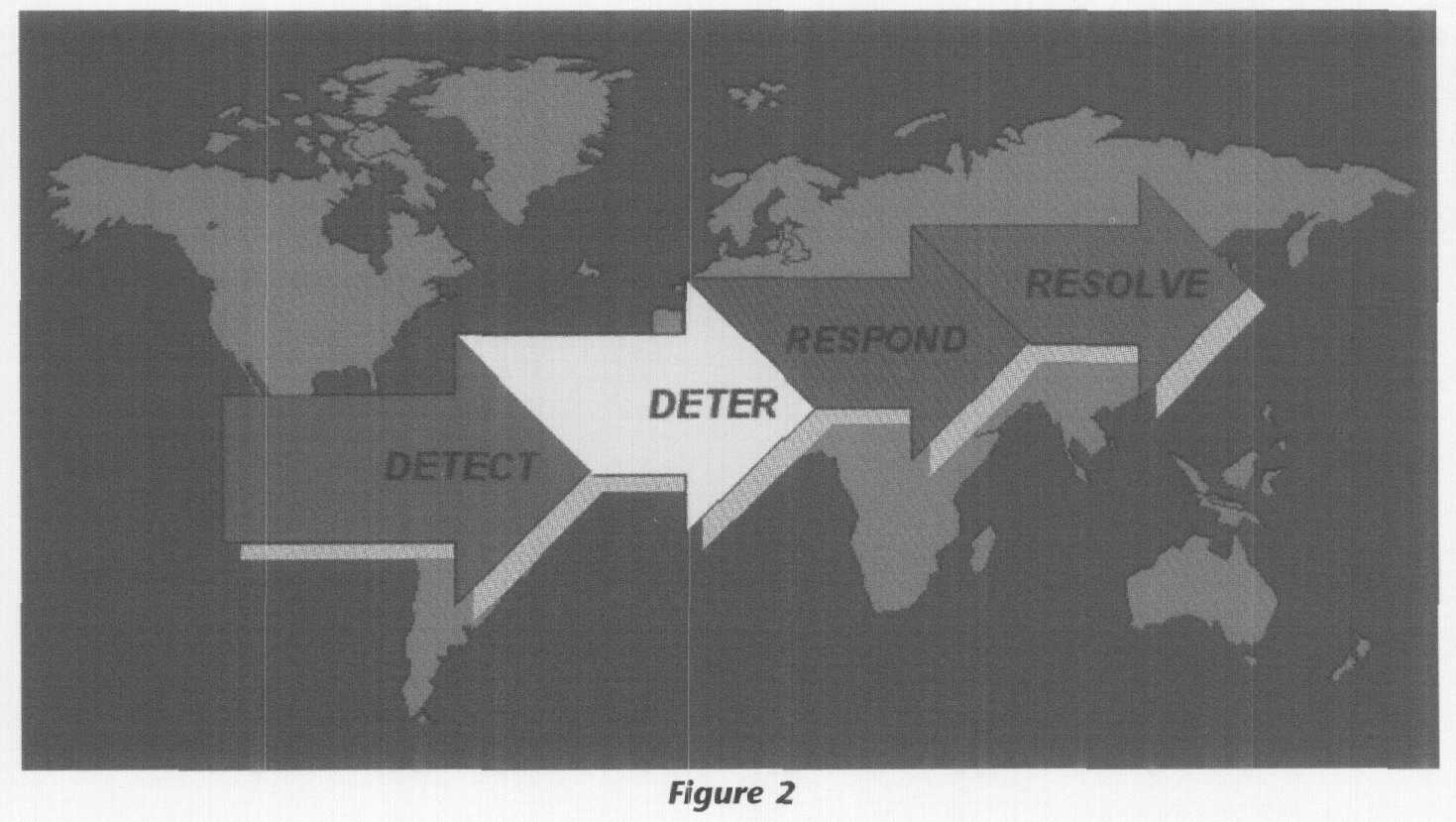
Access to all elements of national power, including “reach-back” access to nontraditional elements of power. This capability will provide MAGTF commanders an improved ability to detect emerging crises, effect deterrent action, respond where necessary, and resolve threats to U.S. interests.

Comprehensive command and coordination is vet another step in the evolution of the MAGTF. The realization of the new capacities it provides will help make 21st century Marine forces “the most ready when the Nation generally is least ready.”

A Critique of the HUNTER WARRIOR Concept

by Maj John F. Schmitt, USMCR

Now that the Warfighting Laboratory has completed its evaluation of the HUNTER WARRIOR experiment, it is time for the Marine Corps to consider the institutional implications of the results. The larger institution, not the Lab, must ultimately determine what effects, if any, those results should have on doctrine, organization, training, education, equipping, and so on-just as the Marine Corps as an institution had to come to grips with the development of amphibious doctrine in the 1930s and the adoption of maneuver warfare in the 1980s. This can be accomplished only through a serious and open discussion of the merits of the experiment. This has not happened. The Lab has done its part by positing the HUNTER WARRIOR thesis What has not followed, but should, is a thorough and critical conversation that can eventually lead to an informed conclusion.

With this in mind, I offer the following critique: I have serious reservations about the HUNTER WARRIOR concept, which I think is flawed as an operating concept for Marine airground task forces (MAGTFs). First, it is not a true operating concept at all but a technical concept mistakenly advanced as an operating concept. (I will explain this important distinction later.) Second, it is based on assumptions that I believe are inconsistent with the true nature of warfare and with the emerging character of most future warfare. Third, it is largely incompatible with the Marine Corps’ own existing doctrine. Finally, HUNTER WARRIOR is susceptible to several simple yet potentially effective tactical or operational countermeasures.

Let me make clear that this critique applies to the overall concept for the employment of the MAGTF during the experiment rather than to the specific techniques or technologies tested within the framework of that concept. Some of the techniques and technologies exercised in HUNTER WARRIOR may very well become valuable additions to our warfighting capability. My argument is with the broader operating concept that underlies the exercise. I have no problem with using technology to improve the ability of forward observers or small-unit leaders to provide accurate, effective, and timely fire support. My problem is in presenting this relatively minor technical advancement as an innovative MAGTF operating concept.

Let me also make perfectly clear that I am not criticizing the efforts of those involved in the HUNTER WARRIOR experiment; I am criticizing the HUNTER WARRIOR concept. The issue here is military theory. Some have branded theoretical discussions about practical experiments, especially where doctrinal issues are involved, as irrelevant and “old religion.” Debates over theory are anything but irrelevant. An understanding of the theory of war is an essential requirement in the profession of arms in general and in the development of new warfighting methods in particular. Getting the concepts right is the essential first step in effective combat development. If we are unwilling to look carefully and critically at theoretical issues, we risk adopting ill-considered concepts.

The Concept

The HUNTER WARRIOR concept was known as Green Dragon when it was first proposed as an operating concept. That name was changed to Sea Dragon to provide the concept a naval flavor, but then the name Sea Dragon was removed from the specific concept and reapplied to the entire experimental process. Since this transition, the original concept has had no official title but has clearly and explicitly remained the theoretical basis for the HUNTER WARRIOR experiment.

Based on the assumption that anything that moves or masses on the battlefield can be targeted and anything that can be targeted can be destroyed by precise, long-range fires, the HUNTER WARRIOR concept involves blanketing the battlefield with dispersed rifle squads (supplemented with other ground and aerial observers and sensors) with the object of being able to spot and direct fires against any enemy force. These enemy forces are not engaged in actual combat but are defeated entirely by supporting arms from sea-based platforms, preferably at standoff ranges. The idea is to destroy the enemy using longrange, precision fires while denying the enemy the chance to damage us by avoiding the tactical formations that would provide the enemy with lucrative targets. HUNTER WARRIOR is essentially warfare-by-forward-observer. The dispersed squads are not combat formations but exist only to provide information to the MAGTF combat operations center. They rely on concealment for their protection.

These dispersed squads, variously called long-range contact patrols (LRCPs) or HUNTER WARRIOR teams, are under the direct control of the MAGTF. Larger organization do not exist as tactical units. The squads are assigned static observation posts (OPs) and specific named areas of interest (NAIs) by the MAGTF. The squad’s sole mission is to watch its assigned NAI and generate two digitized reports any time an enemy unit enters the NAI. The first is a call for fire that enters firing data into the MAGTF’s automated fire direction system. The second is a SALUTE* report, that updates the automated database that drives the situation display in the MAGTF combat operations center. Both reports are preformatted, requiring the squad leader only to enter the appropriate numerical or textual data into the format (although squad leaders also have the ability to transmit voice and free-text digital messages.) At this point, the squad’s role is essentially finished.

The MAGTF does the rest, deciding whether, when, and how to engage the targets with supporting arms, which are no longer “supporting” but are now the arm of decision. These decisions are all made in the engagement coordination cell *size, activity, location, unit, time, and equipment. (ECC) of the MAGTF’s combat operations center. The squad leader has no input into when, how, or even if to engage the target. The squad leader has no latitude to exercise tactical initiative. He is not expected to demonstrate much in the way of tactical judgment. His tactical decisions are limited to getting into position and local security at the OP. He has little need to understand any larger concept of operations or the commander’s intent. The squad leader needs only to watch his assigned NAI and generate the prescribed reports. The rifle squad might as well be another inanimate sensor; it has about the same latitude for tactical action. The MAGTF’s greatest concern throughout the exercise was the safety of the deployed HUNTER WARRIOR teams. The logical extension of the concept would be eventually to replace the teams with automated sensors which, unlike people, do not need to be fed or rescued if compromised.

The Genesis of the Concept

There is nothing cutting-edge about the HUNTER WARRIOR concept. The technology may be cutting-edge, but the operating concept is a direct descendant of the failed World War I French doctrine often referred to as “methodical battle.” Robert A. Doughty, a leading authority on the development of French military doctrine between the World Wars, wrote in The Breaking Point (p. 27):

In formulating its doctrine, the French Army placed the greatest emphasis on the requirements of firepower. From their perspective, advances in weaponry after 1918 had increased the importance of firepower and made the possibility of maneuver less likely. Both the 1921 and the 1936 field service regulations stressed the importance of firepower. In its description of firepower as “the preponderant factor of combat,” the 1936 field service regulations repeated another sentence that had appeared in the 1921 edition: `The attack is the fire that advances, the defense is the fire that halts [the enemy].’

Doughty could just as easily be describing the philosophy that underlies the HUNTER WARRIOR concept. HUNTER WARRIOR appears to assume a return to the overwhelming dominance of fires in war-a sort of Second Age of Firepower recalling the positional warfare of World War I.

HUNTER WARRIOR is one of a growing number of concepts that fall under the general heading of “distance warfare.” Driven by advances in weapons technology, these concepts envision remote-control warfare conducted with pushbutton precision from a safe distance by technicians. Driven by a desire to minimize friendly casualties by minimizing exposure to the enemy, the ultimate object is to make war without putting ourselves in harm’s way. The desire is understandable, but it will never happen. War being a clash of wills, human ingenuity will always find ways to make war costly to the other side.

Technical Concept Mistaken for Operating Concept

One of the main reasons for my criticism is that the HUNTER WARRIOR operating concept is not a true operating concept at all but merely a technical concept mistakenly treated as an operating concept (whether by design or default). Operating concepts describe generic strategic, operational, and tactical principles and schemes. They provide the foundation for how we operate in broad terms. Examples include mission tactics and operational maneuver from the sea (OMFTS). (Maneuver warfare is a complete system of primarily operating concepts.) By comparison, functional and technical concepts describe the performance of a particular function or technical task. They are subordinate to operating concepts. For example, sensor-to-shooter is a technical concept describing one specific fire-direction technique. Ship-to-objective maneuver is a functional concept describing one aspect of OMFTS. Functional and technical concepts are properly supporting concepts rather than operating concepts in their own rights. That is, they cannot stand on their own as a general description of overall operating principles, as mission tactics or OMFTS can, but require a broader operating concept that provides context and which they support. Testing a technical concept is fine, but it is important not to try to draw broader operational conclusions from it-as HUNTER WARRIOR has tried to do.

The practical application of an operating concept to a particular situation requires more specific functional and technical concepts. Higher level concepts thus provide the context within which lower level concepts can be applied. Conversely, supporting concepts must be compatible with the operating concepts they support. In the Marine Corps, this means that functional and technical concepts must be consistent with the operating concepts of maneuver warfare. For example, a technology or technique that imposes centralized command and control is generally incompatible with the operating principle of mission tactics. The conscious decision to adopt a technical concept that contradicts an existing operating concept necessarily calls into question the validity of the latter.

In the absence of a true operating concept, there is the danger of a supporting concept being treated as a operating concept. The result is operations as the rote application of technique and procedure: methodical battle, in which mechanical procedure replaces operational and tactical judgment. This is not all that uncommon in history. For example, the lack of a clear operating concept in Vietnam resulted in a U.S. “strategy” that amounted to little more than the accumulation of “body count.” The same phenomenon has occurred with HUNTER WARRIOR.

The HUNTER WARRIOR concept is basically a technical concept for the efficient processing and coordination of fire support. It is essentially a procedure. Treated as an operating concept, it reduces practically the full art and science of war to the processing of targets. The HUNTER WARRIOR teams are not tactical formations-of which, in fact, there are none in this concept-but merely fire control sensors. Planning is essentially reduced to plotting OPs and NAIs and scheduling insertions and extractions. The HUNTER WARRIOR concept sees the enemy not as a hostile, independent, and sentient will but simply as an array of targets to be serviced as efficiently as possible. HUNTER WARRIOR essentially reduces MAGTF operations in their entirety to the efficient processing of multiple fire requests. The MAGTF is no longer a warfighting organization but a targeting agency.

HUNTER WARRIOR and Existing Doctrine

Doctrine is not dogmatic ideology. It is general guidance that must allow wide latitude for differences of situation and that requires considerable judgment and technique in application. No doctrine should stand in the way of taking whatever action is effective in a given situation, and so we must be careful about passing judgment on the basis of doctrine alone. That said, however, the HUNTER WARRIOR concept is at such odds with the Marine Corps’ doctrine of maneuver warfare as to call into question their mutual compatibility. Logically, this does not by itself invalidate HUNTER WARRIOR; it could invalidate maneuver warfare. If HUNTER WARRIOR is meant to explore a radical change to existing doctrine, this is a valid experimental objective that should be addressed openly and explicitly. But this issue has never been raised explicitly. The exercise was never proposed as anything other than the continued development of maneuver warfare, which it clearly is not.

Maneuver warfare is based on certain basic beliefs about the nature of war: war is essentially an interactive clash-a Zweikampf or “twostruggle,” as Clausewitz put it-between independent, hostile, and sentient wills, characterized by constant friction, uncertainty, disorder, and fluid dynamics. It is a complex, distributed phenomenon resulting from the congregation of the individual, local actions of the numerous agents that make up each belligerent; it cannot be directed by a single, all-knowing intelligence. The HUNTER WARRIOR concept does not seem to share these fundamental views.

The HUNTER WARRIOR concept is extremely centralized. All decisions of any tactical or operational significance whatsoever are made at the MAGTF level. It is true that the rifle squads were widely dispersed on the battlefield, but mere physical dispersion should not be confused with decentralization. The MAGTF in HUNTER WARRIOR had an extremely flat organization, with a direct link between MAGTF and each rifle squad, but again, a flat organization does not equate to decentralization. An extremely flat organization such as this provides only two choices: extreme decentralization or extreme centralization. There is no middle ground. HUNTER WARRIOR was the most extreme attempt at centralization I have ever witnessed in a military operation. Where Marine Corps doctrine favors as much decentralization as each situation permits in order to promote initiative, flexibility and tempo, the HUNTER WARRIOR concept maximizes centralization for the sake of control and efficiency. It is interesting that the overwhelming lesson of the global Information Revolution has been individual empowerment-distribution, demassification, decentralization-and yet the predominant military response has been to try to use technology for even greater centralization. Because of its distributed complexity, war defies such efforts at extreme centralization. I have written elsewhere (MCG, Jan97 and May98) about the need for a new paradigm for command and control. I used the term “Newtonian” to describe the traditional paradigm which involves precise, mechanical, microscopic control from above. I argued instead for a more adaptive form of spontaneous cooperation below guided by broad macroscopic influence from above. HUNTER WARRIOR is Newtonian command and control in the extreme. In command and control terms, HUNTER WARRIOR is not an advancement but a regression.

Marine Corps tactical doctrine relies on principles such as initiative, tempo, and surprise, but the HUNTER WARRIOR concept practically eliminates the role of any of these. By covering the battlefield with stationary observation posts and waiting for the enemy to appear, the HUNTER WARRIOR concept willingly cedes the initiative to the enemy and allows him to operate at any tempo he chooses. It may pursue limited surprise by ambushing the enemy with supporting arms, but it does not seek to surprise proactively by understanding the enemy and exploiting that understanding with unexpected action that seizes the initiative and pursues a positive aim. The assumption behind HUNTER WARRIOR is that no matter what the enemy does, what tactics he employs or how quickly or cleverly he acts, we enjoy such an overwhelming technological superiority that we will be able to detect him and destroy him with precise, instantaneous long-range fires. History warns that such “techno hubris,” as Col Michael D. Wyly has put it, is a dangerous thing.

HUNTER WARRIOR and Technology

The Commandant has warned: “Technology is a combat multiplier, not a substitute for combat.” In all fairness, the Marine Corps seems less infatuated than the other Services with technology as the key to future military effectiveness. And it is definitely within the Lab’s charter to experiment with new technology-as well as with new methods and organizations. That said, however, I am concerned that the HUNTER WARRIOR concept places too much emphasis on technology at the expense of sound concepts. Technology can be a combat multiplier, as the Commandant says, but not necessarily. Just because a technology is exciting does not mean it will automatically improve performance. All technology comes with a cost in terms of overhead and constraints on operating methods. Improperly used, technology can even be counterproductive. “Improved” technology in support of a flawed concept is rarely an improvement.

The HUNTER WARRIOR concept is grounded firmly in the belief that technology almost by itself can revolutionize warfare. In this case, the “revolutionary” technology is digital communications, navigational aids and especially improved long-range precision firepower, which is expected to change the entire calculus of warfare. Let me make clear that I am all for making the most of technological progress. The effort to improve the capabilities and survivability of the rifle squad through improved communication, navigational equipment, and fire support is very important and long overdue. But HUNTER WARRIOR goes far beyond that. Its concept makes the modest technological improvement of current rifle squad capabilities the underlying concept for MAGTF operations. HUNTER WARRIOR is essentially a concept for automated warfare, designed to allow us to use technology to make war from a distance without having to put ourselves at significant risk-in short, as a substitute for combat. It will not happen. Such an approach fails to recognize the inherently interactive nature of war.

Generally, technology should support fundamental operating concepts, not vice versa. Unfortunately, whether consciously or not, the HUNTER WARRIOR concept seems driven more by technological imperatives than tactical or operational ones. Modern information technology is extremely useful in collecting, processing, communicating, and displaying data-the lowest form of information. Data are facts and figures. The technology is much less helpful in working with knowledge and understanding-less tangible forms of information that require human input in the form of cognition and judgment. Knowledge and understanding take the form of inferences about what the data mean and projections about future eventualities. They simply cannot be captured in data bases. Data may be useful in the technical and procedural activities, such as plotting the location of friendly and enemy units, but are of very limited value in making tactical and operational decisions, which instead rely on information that is much softer and more complex. The HUNTER WARRIOR concept, by reducing operations to a technical fire direction problem, supports the technology by maximizing the role of simple data and minimizing the role of soft information and judgment. The concept reduces the enemy essentially to a series of discrete targets and assumes that, for a target, hard data are all that is needed. Essentially a target consists of a location and description. With a target, we do not need to make inferences about what the data mean. We do not need to figure out enemy intentions, plans, or schemes. We do not need to project probable eventualities. We especially do not need to integrate individual pieces of data into macroscopic patterns. Either we engage the target or not. If we engage it and destroy it, inferences, eventualities, and patterns do not matter. The focus on battle damage assessments (BDA) that the concept encourages also plays to the strength of the technologyBDA is easily captured as quantifiable, data-level information.

Having essentially no moving parts once the squads are in place and requiring practically no tactical interaction with the enemy, the HUNTER WARRIOR concept also simplifies the friendly information situation. The static nature of the concept makes it easier to positively track friendly units. The HUNTER WARRIOR report observes that accurate tracking of the friendly situation by the MAGTF combat operations center was much lower during the one phase of the exercise when actual movement was involved: When the only forces on the ground were LRCPs, the ECOC [enhanced combat operations center] had no trouble keeping track of them. The displays lagged behind rapidly-moving forces such as the OME [operational maneuver element], however, and did not track aircraft well at all. Because the squads essentially only sit and observe, the only information required about the friendly situation is location-something easily satisfied by quantifiable data (an automated Global Positioning System (GPS) signal, in fact)-as compared to a unit engaged in mobile close combat, for example, which would necessitate much more complicated, qualitative, and fleeting information. Because units occupy static positions and do not “wrestle” with the enemy, this also simplifies the problems of deconflicting fires. Certainty of itself is not a bad thing, but we must realize we will never achieve it, and its pursuit should not become the driving force behind how we operate. Valid concepts and sound principles, rather than the requirements of technology, should be the basis for how we operate.

Countering HUNTER WARRIOR

Putting larger operational and doctrinal reservations aside, from a purely technical perspective HUNTER WARRIOR is vulnerable to several relatively simple countermeasures that were not adequately explored by the experiment. The HUNTER WARRIOR concept is predicated on the assumption that any enemy can be reduced to the status of target-thus reducing warfare to a technical targeting problem. But all potentially hostile entities on the battlefield simply cannot be treated that way. Targeting means not only that a potential prey can be detected and its location accurately fixed, it also requires that the potential target can be engaged effectively and that it be suitable for engagement in the first place. Just because we have the technical capability to engage by supporting arms does not necessarily mean that that is the right thing to do, militarily or politically.

The most obvious countermeasure is to disperse just as the HUNTER WARRIOR teams have done to complicate targeting and to avoid presenting a lucrative target. (This was in fact, the opposing force’s initial intention in the exercise, but it was prevented from doing so by the lack of sufficient numbers of controllers to move with each small element.) A guerrilla force, for example, dispersed in small units and lacking easily targeted heavy equipment and support, could effectively confound the HUNTER WARRIOR concept. A dispersed force operating in restricted terrain such as jungles or especially urban areas (the consensus battlefield of the future), where visibility is much more limited than in the desert and where long-range fires are less effective, could likewise negate the effectiveness of the concept. A force that mixed or shielded itself with a civilian populace, even if detected and located, might be invulnerable to engagement for fear of the collateral damage that would be caused. (The idea of using nonlethals to incapacitate everyone and then sorting things out once everyone is “down for the count” greatly oversimplifies the problem and betrays an imperialistic highhandedness that will be political inviable in many situations.) And finally, an enemy who operated in a way calculated not to justify massive punishment-a deathby-a-thousand-pinpricks approachmight also be largely invulnerable to the “distance warfare” of HUNTER WARRIOR.

The concept might work tolerably well against a clearly identifiable enemy who, with no air cover, was nonetheless willing to operate in easily targetable, massed formations in the open, unshielded by civilian populations. In other words, it might have worked tolerably well against the Iraqis in 1991. But as the Commandant has said: “Few sandlot strongmen will come up and pull Uncle Sam’s beard and challenge us to a rematch of DESERT STORM. Enemies will not attempt to match us tank for tank and ship for ship.” Indeed, perhaps the overriding lesson of the Gulf War is that no potential enemy can allow the United States to fight such an industrial war. In fact, one of the dominant trends in the evolution of military methods today, especially in the tumultuous developing world where conflicts are most likely to arise, is the development of tactics specifically designed to negate a more advanced enemy’s technological superiority.

Some of the most interesting operating concepts and some of the most valuable tactical lessons to come out of the experiment were provided by the opposing force (OpFor), which was not constrained by any preconceived operating concepts and therefore had more freedom to adapt its methods to the situation. The OpFor was required (by the rules of the exercise) to try to attack the HUNTER WARRIOR teams. But rather than the direct approach of scouring the rugged mountains of Twentynine Palms in search of the teams on the ground, which would have amounted to searching for a needle in a haystack, the OpFor decided to focus on attacking the teams in their transport helicopters prior to insertion, when they were much easier to locate and when a single shoulder-launched missile could eliminate one or more squads once and for all. This was a truly asymmetrical response, and like most truly asymmetrical responses, it came as a surprise. As a result, neither the OpFor’s airdefense systems nor the MAGTF’s transport helicopters had been instrumented for the exercise, and even though the OpFor felt it had (in one officer’s words) “shot down every transport helicopter that entered the AO [area of operations],” it was not getting credit for any kills and the HUNTER WARRIOR teams were suffering no losses.

(This is again not a criticism of the Lab: one cannot rightly be criticized for failing to predict the unexpected. It does, however, make the point that no matter what we do, the enemy is likely to adopt a countermeasure we had not anticipated. It further serves as a reminder that war is fundamentally a clash of human wills and intellects, and not merely a technical test of weapons systems versus targets. HUNTER WARRIOR reminds us that we underestimate the human element in war at our own significant peril. The OpFor demonstrated what the Elder von Moltke was fond of saying: “You will usually find that the enemy has three courses open to him, and of these he will adopt the fourth.”)

To its credit, the Lab recognized this potential gamebreaker in its report:

Clear that LAAD [low-altitude air defense] teams had a lot of engagement opportunities . . . What is not clear is the interaction and effects-air defense and survivability during insertion/extraction needs additional investigat[ion] …. Because they were uninstrumented, we don’t really know what the force-on-force outcome of helicopters vs. LAAD was…. [S]eeing is not targeting for air defense, either, and the critical element-how many “good” opportunities OpFor air defense had against SPMAGTF helicopters is missing. We need to experiment with and investigate the issue of helicopter survival against low-altitude air defense further. We also should investigate other means (e.g., surface insertion) of inserting and extracting the LCRPs. Even at pessimistic Pk [probability of kill] levels it appears the transport aircraft would have been engaged which may have resulted in the aircraft being downed or at [least] a “mission abort.” . . . [T]he substantial number of shots taken highlights the need to improve the survivability of transports conducting inserts/extracts when a ground-based air-defense threat exists. One countermeasure the OpFor was expressly prohibited from employing was attacking the MAGTF’s extensive and potentially fragile command and control apparatus by electronic warfare of any other means. All that technology may provide significant capability, but it also creates significant dependency. Understandably, the Lab wanted to find out how well such a complicated C4I system would function uninterfered with before letting an enemy attack it. Nonetheless, that leaves unresolved the issue of how vulnerable HUNTER WARRIOR command and control is to disruption and how significant are the effects of that disruption on the quality of operation. Because HUNTER WARRIOR command and control is extremely centralized, it is reasonable to expect that the effect of disruption would be significant at least.

This evidence does not invalidate the concept outright, but it casts doubt on the validity of the concept and is sufficient cause for reservation. Even on a technical basis, the HUNTER WARRIOR concept appears to have only a limited range of applicability.

Conclusion

I sincerely believe Exercise HUNTER WARRIOR was a success, or at least has the potential to be a success, depending on what we learn from it. Nothing in this criticism is meant to repudiate the potentially very valuable lessons of the experiment. First and foremost, the experiment revealed significant questions about using the HUNTER WARRIOR concept as an operating concept, as I have discussed. These should be seriously contemplated before we consider possible implementation. The experiment illustrated the importance of a solid conceptual basis for combat development. It showed the dangers of mistaking a supporting technical concept for an operating concept. It revealed ways in which the HUNTER WARRIOR concept is inconsistent with existing doctrine, requiring reconsideration of one or the other. It revealed potentially effective tactical and operational methods, which had not been considered, for countering the concept.

It uncovered several technical, tactical, and operational issues of significant interest, such as the problems of squad insertion and helicopter survivability. HUNTER WARRIOR has in fact revealed a wealth of potentially valuable lessons, although generally not the obvious lessons most people anticipated entering the experiment- and only if we are truly interested in learning them.

In a recent U.S. News & World Report article, Col Wyly wrote about the current conflict between two opposing schools of military thought:

Technological Superiority Theory holds that high-performance aircraft, smart bombs, longrange missiles, electronic sensors, “secure” communications, and computerized information technology will deter any less sophisticated foe. So defending the nation becomes a matter of developing technological systems, then training soldiers to use them.

Mental Agility Theory suggests that any technological barrier can be circumvented by a determined enemy dispersed so that he is less of a target, fighting at close quarters.

HUNTER WARRIOR clearly falls within the school of Technological Superiority Theory, while maneuver warfare falls generally under Mental Agility Theory. Wyly observes that while “no thinking professional would completely rule out either theory”: Technological Superiority Theory is the prevailing view at the Pentagon today, even though it is clear the problems we will face for the next several decades cannot be solved by lobbing high-tech munitions at an enemy from long standoff distances. This was evident in the recent Persian Gulf crisis, where our strategy was predicated on an attack without extensive ground action. No one could give assurances that this strategy would bring Iraq’s Saddam Hussein to heel. . . . In DESERT STORM, American technology rained on the enemy for 38 days, amid hope that the dreaded ground attack would not be necessary. But the ground attack did have to come. Will there ever arise a situation when high-tech “distance warfare” will be the appropriate military solution to a political problem? Absolutely, although, the Gulf War possibly notwithstanding, the trend clearly is in the other direction. “The future is not the son of DESERT STORM, but the stepchild of Somalia and Chechnya,” the Commandant said in a recent Army Times interview. “We need a new view of warfare. We need to replace the industrial approach, which we have now.” I argue that HUNTER WARRIOR embodies the industrial approach.

In its proper place, as a technical concept in support of an appropriate operating concept, HUNTER WARRIOR may have some practical meritbut not as a MAGTF operating concept. In those situations calling for “distant punishment,” other Services will play the primary role because, even if the Marine Corps can do it as well or better, it is all some of the other Services will be able to do. The Marine Corps will be called on to perform the types of missions it has always performed-expeditionary operations in complex and unruly situations requiring a close physical presence on the ground and discretionary direct action. And in fact, the growing consensus is that these are precisely the types of operations the future will require most.

There can be little disagreement that the HUNTER WARRIOR concept is incompatible with maneuver warfare in philosophy and general principle. Indeed, it seems at such a variance with warfighting as to not even share the latter’s underlying assumptions about the limits of technology and the very nature of war itself. Perhaps the greatest success of the HUNTER WARRIOR experiment is that it has indirectly raised a truly fundamental question: Has technology at last so profoundly changed the dynamics of warfare that the Clausewitzian assumptions, descriptions, and principles no longer apply? I think there is only wishful thinking, but no empirical evidence, to support this. Clearly others disagree, for this is the unspoken assumption behind Technological Superiority Theory. In any event, this is a weighty issue of profound importance to the future of both our Corps and our Country. It is not irrelevant ideology-which is precisely why it needs to be discussed deeply and at length.

Building Decisionmakers

by Capt Arthur L. Glasgow

The Marine Corps has made great strides in implementing the doctrine of maneuver warfare. It has become accepted that the core of maneuver warfare rests in a mindset characterized by rapid decisionmaking, acceptance of risk, and bold initiative at the lowest level.

While maneuver warfare has been touted at the highest levels of our Corps, it clearly has not received the attention it deserves at the level that matters most-the Marine noncommissioned officer (NCO). Ask any infantry corporal or sergeant what the combat “bible” is and the answer you will most likely receive is FMFM 6-5 The Marine Rifle Squad. While this is a useful document based on sound tactical experience, it should be taken for what it is-a reference tool of techniques.

It does not address combat decisionmaking. If this is the source document by which we are training our small-unit leaders, then we are missing the boat. Rather than limit ourselves to a cribsheet of techniques, we must develop small unit leaders who are capable of thinking “outside the box,” leaders who understand that the decision is what is most important, not the technique. The goal is to train leaders capable of employing these time-tested techniques in innovative ways and at unexpected times.

The need for our Corps to be led by such men is critical considering the modern battlefield. Technological advances as well as the current world situation have dissolved the nature of war as we know it. The modern battlefield proves to be a nonlinear, high-tempo arena with combat and support areas intermixed. Actions will be dominated by small units operating in relative isolation, led by junior leaders taking advantage of fleeting moments of opportunity. It is paramount that we prepare our NCOs to win on this modern battlefield.

In order to produce this type of decisionmaker the Marine Corps must adopt a new attitude towards the way it trains NCOs. Capt Michael F. McNamara addressed the first step in his article, “The Price of Remaining Amateurs in the Field of Education.” (MCG, Feb94) Combat decisionmaking must be instituted at every formal school in our Corps.

This is necessary to ingrain the mechanisms of decisionmaking and standardize the language by which we define it at every stage of a Marine’s education. While these initiatives will take time and effort to implement, this article will address what can be done now, at the company and platoon levels, in order to better train our small-unit leaders as combat decisionmakers. The topics discussed are not meant to be an all inclusive formula, but rather an attempt to create an atmosphere and effect a change of attitude.

Creating the Image

It is vital that the newly promoted corporal be viewed in a different light by both himself and those around him. Every leader must maintain an image or position that lends credibility to his actions and decisions. This is especially important to the individual who finds himself suddenly transformed from being a Marine into a Marine leader. This, the hardest of all adjustments, must he aided bv the command, allowing the CO time to attune to his new anthority and responsibility. From moving him into an all-NCO room to a personal talk with the commander welcoming him into the ranks of Marine leaders, every effort must be made to instill within the new corporal an understanding of the gravity of his new position. The authority and responsibility he now holds must be as tangible to him as the rewards for attaining his new position of leadership.

All Marine leaders should be active in the study of our Corps’ history and all things military. The Marine NCO is no exception. The Marine Corps has defined professional military education (PME) requirements by grade to include the corporal. Outside of formal schooling, it is our duty as SNCOs and officers to ensure that the new NCO catches the “bug” of self`education; that he becomes fascinated with his profession. He must understand that every printed word he assimilates will better prepare him for the day he must lead men into combat. This means that a strong, relevant, and workable NCO PME program must be instituted at the company and battery level throughout the Marine Corps.

Throughout the first few months after pinning on his second chevron, the new NCO will be struggling to find his own niche in the unit’s leadership and develop his own personal style and priorities. This effort must be aided bv command attention through open displays of support and accountability. The NCO must be comfortable with the fact that when he speaks, he does so with a certain level of command authority and will be backed up. He must tinderstand completely that his realm of responsibility has expanded to more than just himself and that he will be held accountable for his Marines.

Establishing an “image” for the new NCO is crucial in lending credibility to his decisions. Before we can expect him to make sound decisions, we must first create the atmosphere that will allow him to do so. Once this is accomplished, we can begin to train the NCO, and help him train himself, to become a combat decisionmaker.

Making the Decision

The crux of maneuver warfare rests in the rapid decision made at the lowest level and the willingness and initiative to act on that decision. Contrary to what we may like to believe, the current atmosphere in our Corps today at the junior NCO level is not conducive to bold decisionmaking. Time dependent training schedules, the willingness of junior officers and SNCOs to do an NCO’s job, and the still present zero defects mentality are just a few of the factors that undercut the NCO initiative so necessary for maneuver warfare.

The first step in creating NCOs who are comfortable with decisionmaking is to force them to make decisions often and on demand. This can be accomplished within a semiformal structure regardless of the merit of the decision. The goal is not so much to induce sound decisions initially as it is to simply produce rapid decisions. When the process of making a decision begins to become a reflexive traiL, the ability to produce sound decisions can be taught. As an example, implementing a “tactical decision game a day” program within the platoon only takes a minimal amount of time to accomplish and sets the tone that some sort of tactical decision is expected of Marine leaders every day. Additionally, exposing our small-unit leaders to a steady diet of tactical scenarios will aid in building their ability to produce sound, recognition-primed decisions. Recognition-primed decisionmaking, vice analytical, is the fastest process by which the human mind assimilates and evaluates data. The ability to operate in this manner at the lowest level is central to successful implementation of maneuver warfare. The vast majority of decisions at the point of impact must be recognition-primed because of the time factors involved. There will seldom be time for analytical, stafftype decisions. And herein lies the dilemma, for the ability to derive a sound, recognition-primed decision rests in extensive personal experience or an educational regimen oriented towards producing such decisions. Newly promoted N(COs have neither the experience nor the luxury of this type of formal education. In the absence of either, the responsibility for building proper habits of decisionmaking rests almost entirely with the unit.

The next step is to allow the NCO more leeway in the training of his Marines, forcing him to plan and supervise properly. Look at your unit’s training schedule; chances are that every minute of every day is accounted for. This prevents initiative at the instructor (NCO) level. Adopting a mission order training schedule, whereby we set goals, objectives, and standards, allows the NCO to train to standard instead of time. He must make the decision whether remediation is needed. Hc must determine when his Marines are ready to be evaluated. As an example, instead of dictating 1.5 hours of weapons maintenance time, allow the squad leader to determine when his weapons have met standard. Rather than dictate 0530 reveille, let the NCO determine when he needs to wake his people in order to have them ready for the day’s training. This approach places the responsibility for planning and time management on the shoulders of the NCO and he must decide the appropriate method to accomplish the mission as well as validate his own instruction. It also makes it clear to the lance corporal and below that it is the Marine corporal who will have the most direct impact on their lives in garrison or combat. The cynic will say this approach will result in short work days, incompletely trained units, and general chaos. The trusting leader will see that if officers plan and set proper standards, and employ the SN(COs correctly, the result will be a more productive workday, better trained units, and a small-unit leader comfortable with responsibility and capable of making sound, timely decisions.

Conclusion

Finally, in order to make this work, we as officers must understand our role in the training process. There is a great moral commitment in maneuver warfare. Pushing authority and responsibility down increases the chance of failure. Senior leaders must see that although we can be, we are not the trainers. We set the standards, evaluate, and facilitate the training. Individual training standard (ITS) level training is the responsibility of the NCO with the SNCO providing guidance, direction, and reinforcement. It should be considered unacceptable for a junior officer to stand on the platform in front of his Marines and teach an individual or small-unit skills class. The challenge for us is not to teach these skills, but rather to teach the NCO how to instruct them. The reasoning behind this is clear. When the call comes to protect our country, we will go whether or not our NCOs have been prepared to succeed. If our small-unit leaders have not been educated in peace to employ our doctrine, how can we expect them to do so amidst the horror and carnage of` war? When the rounds begin to fly and the young Marine at the point is filled with fear and doubt, he will naturally turn for direction and reassurance to the individual who has guided him through training. When he turns to find that man, it will not be the lieutenant or the staff sergeant behind him. That spot is reserved for the Marine corporal.

The Marine NCO

by Capt Charles N. Black

“Victory smiles upon those who anticipate the changes in the character of war, not upon those who wait to adapt themselves after they occur. ”

-Giulo Douhet

The focus of this article is to address the necessity to devote more time and effort in the development of our small unit leaders, specifically our noncommissioned officers (NCOs), in order to win the threeblock war. The Commandant has challenged us in his planning guidance to question what we as an institution do right, what we do wrong, and what we can do better. I believe that currently our schools do a superb job of producing an NCO who can function technically on the battlefield, i.e., he has a basic understanding of weapons, tactical formations, and leadership skills. However, in future conflicts our NCOs must be tactically and technically as capable as our second lieutenants. In order to do this, we must train our NCOs how to think, communicate, and take action in an uncertain and rapidly changing environment. My intent is to promote thinking at the company level and to ignite professional debate on this fundamental issue: the training and education of our NCOs to fight and win the threeblock war.

Today we, as a Corps, stand on the brink of the next millennium, rapidly conducting a large-scale, friendly METT-T (mission, enemy, terrain and weather, troops and support availabletime available) evaluation of our capabilities and limitations to fight and win future battles for our Nation. We have come to live in a world that is more volatile, unstable, and more uncertain than any other time in the last century. Our Commandant describes this future battlefield as the “three-block war,” one in which Marine units will find themselves dispersed within the battlefield simultaneously conducting operations across the compressed spectrum of conflict. One squad may be involved in a combined arms engagement with threat forces, while another squad only one block away is conducting humanitarian assistance tasks (numerous examples of this can be found in Marine Corps Lessons Learned System reports on operations in Somalia). Squad and team leaders will continue to operate in an uncertain enironment with rules of engagement (ROE) under the ever present and watchful eye of the international media. Urban conflict requires decentralized execution by capable, small unit leaders, and future successes will depend more heavily upon our NCOs than anv other time in history.

In his 1887 Proceedings review of a pamphlet published by the USA’s Artillery School titled “The Tactics of Infantry in Battle” by Col Sir Lumley Graham, Lt Dennis Hart Mahan, USN, highlighted the importance of Graham’s prediction of the emergence of the captain as a tactical decisionmaker in future conflicts. Since that time history has shown that Graham was correct.

Change is constant. A New World Order was established in the early 1990s with the downfall of the Soviet Union and the rise of a fractional, multipolar world community. This new environment brings with it an increase in operational tempo and operations other than war. It has become the norm, rather than the exception, for lieutenant platoon commanders to make tactical decisions that have had numerous implications on both a political and social scale. During Operation UPHOLD DEMOCRACY in 1994, 2dLt Palumbo’s actions in a firefight with Haitian police forces in CapHaitien directly impacted national security policy in that region. The level of tactical decisionmaking continues to be pushed further and further down the chain of command. The principles of commander’s intent and mission type orders increasingly become a requirement, not an option of local commanders. By 2010 the squad leader and possibly the team leader will regularly be required to make rapid tactical decisions in an uncertain situation without time to seek guidance.

Historically junior officers and NCOs have executed predetermined battle drills as a small part of a larger unit formation or maneuver. As we passed from close order to open order tactics, the focus of the NCO was primarily on the control of fires. Still, the squad and team leader were specifically trained to facilitate control of the unit and its fires-not to make tactical decisions. Our NCOs have proven their adaptability, inventiveness, and courage in every armed conflict. History is replete with examples of an NCO leading his men to close the last 100 yards; but nowhere was there a formal education process-learning and growth were purchased in blood and death on the battlefield.

The Marine Corps is not fully preparing its squad and team leaders to operate in chaos. Success in winning the three-block war requires junior leaders who are not only masters of techniques and procedures, but who are capable of making relevant and timely tactical decisions in concert with the commander’s intent. The current selection, training, and education of our combat arms NCOs are not consistent with this intent. The mandated professional military education (PME) courses, both resident and nonresident, provide only a start point. The PME and military occupational specialty (MOS)-related advanced schools focus on leadership and technical skills, with little time devoted to the development of tactical decisionmaking skills. These schools do a good job teaching the technical knowledge such as battle drills, weapons employment, gunnery, and other related small unit skills. Technical expertise is essential for success in maneuver warfare; but one must also have a fundamental understanding of theory and conduct of war. None of these schools have the underlying theme of teaching young leaders how to think and make decisions in an uncertain situation.

A good job is being done by many commanders who run in-house education programs due to a shortage in school quotas and the void in formal schools. Battalion Landing Teams 2/6 and 1/8 of FMFM are just two examples of units that conducted such inhouse programs. These programs, consisting of additional instruction in FMFM 1, Warfighting, and reinforced through sand table discussions, combat leadership guest lecturers, and tactical exercises without troops, were instrumental in the increased development and operational capabilities of these units at the NCO level. Majs David J. Furness and William H. Weber’s article “Leadership and Maneuver Warfare” (MCG, Apr93, p. 47) addressed a similar issue about inadequate NCO training and education. The education of our future small unit leaders must be improved.

Successfully applying maneuver warfare to win the three-block war requires an institutional NCO education program founded in excellence on the basics. The German Army of the 1930s effectively developed a professional NCO corps that was extensively educated in the theory and conduct of war, technical knowledge, and decisionmaking as evidenced by their superior performance during the Battle of Sedan in 1940. If NCOs are to retain their status as the “backbone of the Corps,” then we must infuse them with the skills necessary to win on any battlefield: to quickly evaluate a situation, make a decision, and then violently execute that decision. We must do better-our NCOs deserve more.

Today, only a few semiformal NCO schools exist for the newly promoted corporal. These schools successfully teach leadership, drill, and other troop handling skills. They fail to introduce the basic maneuver concepts that must be instilled and reinforced throughout a young NCO‘s time in service. Many argue that an NCO does not need to learn about maneuver warfare and decisionmaking. Decentralized and dispersed operations on urbanized terrain will require our Corps to implement maneuver warfare concepts at the lowest level. The only way to make warfighting a reality is if the young NCO understands and can successfully apply decisionmaking skills in an uncertain environment. The systems approach to training mandates a progressive building block approach to training. The education process must also be progressive, beginning with our basic warfighting principles.

The Marine Corps needs a new combat leader NCO school by restructuring existing PME and advanced MOS schools. This new school should focus its efforts on mastering techniques and procedures and, equally important, how to think. The end-state of the school must be to develop junior leaders with the will and knowledge to take decisive action in an uncertain environment within the commander’s intent-a goal identical with that of the Infantry Officer Course. The underlying tenets of this school must be the ability to make a decision, communicate that decision to his subordinates, and execute that decision. Additionally, developing excellence at techniques is essential. The decision process must be continually reinforced throughout all technical and tactical training.

I do not propose that corporals or sergeants become masters of doctrine or the operational art of war. Four basic concepts must be mastered in order to facilitate decisionmaking in uncertain situations. The first concept is commander’s intent. What is the final result desired by higher headquarters in relation to the enemy, friendly, and terrain? Second, the squad or team leader must be capable of working with mission orders. This is nothing new to most combat ready units. Third, give the NCO a tactical problem and mission statement and let him determine how to accomplish the assigned task. Fourth, the NCO must understand the concepts of main and supporting efforts. Mastery of techniques and the application of these four concepts will ensure success in the three-block war.

Selection to NCO rank must not be taken lightly. Because of the lack of formal schooling, today’s corporals are often little more than higher paid lance corporals. Selection must be based upon character, potential leadership ability (decisionmaking), and technical proficiency. Selection should not be determined by cutting score points accrued for time in service. Many Marines are great lance corporals, but do not have the ability or will to lead Marines as an NCO. Those selected for promotion would attend the combat leadership school, and upon successful completion be promoted to corporal. The new NCO would then return to his parent unit as a leader, willing and capable of leading Marines in combat. The new unit cohesion program established by Headquarters Marine Corps will facilitate those selected for NCO rank to attend the school during the down cycle of the battalion. To build cohesion among junior leaders, all those selected from a given unit would attend the course at the same time operating as a tactical unit throughout the course. The school will ensure consistent education and training. The NCO‘s further education and development would be left up to his chain of command until he attends an advanced combat leaders course developed for staff NCOs.

The future success of the Marine Corps depends upon our ability to fight and win urban conflicts. To fight and win hinges upon the ability of our smallest unit leaders to make prudent decisions in the face of uncertainty. Warfare is changing and so too must the education of the Marine NCO.

Mobility Requirements and the 21st Century MAGTF

by Maj Chris Yunker

Operational Maneuver From the Sea (OMFTS), a concept paper reprinted in the June 1996 issue of the Gazette; postulates that among other principles, a Marine airground task force (MAGTF) may focus on an operational objective, generating overwhelming tempo, and pitting strength against weakness. Such a mission would require the MAGTF to maneuver/fight at both the operational and tactical levels. While fighting at the tactical level is very familiar to Marines, fighting at the operational level is not. This is certain to change because OMFTS, landing from over the horizon, ship-to-objective maneuver (STOM), sea-basing, and other emerging concepts are exploring the most effective means of projecting combat power toward operational objectives. While significant study and dialog has occurred on required characteristics and tradeoffs in long-range fires, aviation, and communications, less attention has been paid to other initiatives required for long-range ground maneuver and mobility.

The purpose of this article is to stimulate thought on operational level mobility by explaining its contribution to OMFTS. It will then examine the capacity of current ground equipment and maintenance support philosophies to support OMFTS by measuring them against four cardinal elements of maneuver warfare; 1) tempo, 2) combined arms, 3) flexibility, and 4) decentralized command.

In the tactical arena, we have the advantage of long experience in developing balanced, effective tactical combat units. On 4 January last year, the Commandant broadened the Corps’ doctrinal framework with the approval of the OMFTS concept that emphasizes focus at the operational objective. Parallel to the development of new OMFTS doctrine and organizational changes, we must develop hardware necessary to support the emerging concept. We must reassess the capabilities of our ground equipment and our approach to fuel-handling and maintenance support to ensure our measures and practices are relevant to the operational framework.

Mobility‘s Contribution to OMFTS Let’s consider the mobility characteristics a MAGTF’s ground equipment will need to (1) focus on the operational objective, (2) achieve a tempo superior to the enemy’s and (3) pit our strength against his weakness.

Achieving Reach to the Operational Objective: The operational objective of a campaign may be near the seabase area, making tactical mobility sufficient. However, we would expect a center of gravity to be adequately protected, by either force or distance or both. When the operational objective is not within the amphibious objective area, we will need the ability to maneuver directly to a fairly distant objective. If encumbered with the requirement for a refueling/rearming point en route, we expose a significant weakness for the enemy to exploit. Increasing this reach out to a range of 700 miles unrefueled is not unreasonable for properly configured vehicles. This long reach characteristic also supports ship-to-objective maneuver. A significant portion of the MAGTF will need the ability to conduct an extended continuous movement to the operational objective and then fight a combined arms engagement upon arrival.

Superior Tempo: Achieving superior tempo in a ground campaign requires the capacity to mentally cycle through the observation-orientation-decision-action (OODA) loop faster than the enemy, and then to execute those decisions faster than the enemy. When concerned with an operational objective, this requires the ability to reliably move outside the tactical area and engage the enemy more quickly than he can react, inviting him to shift forces from one tactical sector to another and back. Achieving superior destruction of enemy forces and material is not required (getting there in a degraded mode is better than not getting there), getting him to react is. By adapting more quickly to his countermoves than he adapts to ours, we will uncover a weakness. His ability to orient and adjust to the changing battlefield will unravel because he can’t keep up. We can achieve this through sustainable mobility that enables us to move faster and farther than the enemy. Getting inside his OODA loop contributes to a continuous sense of surprise and disorientation, creating a mental isolation and defeat. At that point we employ a third principle of OMFTS, pitting strength against weakness.

Pitting Strength Against Weakness: As we uncover a weakness in the enemy center of gravity, we’d like to put our force in a tactically advantageous position that will enable us to achieve an operational decision affecting a significant enemy force. The more pronounced the weakness, the greater potential for asymmetric results. The key to this is a force that gives priority to speed and flexibility rather than to destructive power or mass. A lightly armed force is acceptable, as long as it can overwhelm the enemy force’s OODA loop. If our force must stop frequently to refuel or repair and maintain equipment, the enemy’s OODA loop continues, and we lose our advantage. Understanding the mobility required to implement these three principles of maneuver at the operational level helps us define operational mobility.

What Is Operational Mobility?

Many current conceptual documents, including OMFTS and STOM, imply that ground hardware will have operational mobility if it can be hauled in an MV-22. Is this a correct assessment?

JCS Pub 1, FM 100-16, and FM 100-5 do not provide definitions of operational mobility. We all have a pretty good understanding of strategic mobility in a ground weapon system, and how to achieve it-make sure a system is compatible with ships, rail, and C5s. We also have a pretty good idea of tactical mobility-a system capable of traversing steep grades, soft soils, ditches, and water obstacles, capable of moving under fire.

If we define operational mobility within the context of its contribution to maneuver warfare as outlined above, we can use a specific set of metrics to assess it. As the operational campaign tends to unfold in a matter of days and weeks rather than hours, operational mobility can be measured in terms of sustainable miles per day, rather than miles per hour. As most ground weapon systems require refueling and some maintenance checks after 4 to 5 hours of continuous operation, we see that range, fuel consumption, maintenance ratios, and repairability are integral elements of a system’s operational mobility. Adopting these measures of operational mobility, we can provide starting points for the required capabilities of an operationally mobile system: exceptional unrefueled range; a capacity for recovering from failed internal systems through redundancy; a design that enables field repairs without replacement parts; a capacity to fire, move, and communicate in degraded modes; a relatively high sustainable speed when measured in miles per day; and a high commonality in vehicle parts within the unit to minimize parts inventories and enable cannibalization.

Now back to the MV-22 lifted equipment. If a system with 4 hours worth of fuel is lifted into an operating area, how many MV-22s will it take to move and then fuel the force long enough to out maneuver the enemy? If there are not enough airframes to keep the vehicles fueled and supplied with repair parts for the duration of the campaign, the force’s operational mobility will zero out pretty quickly.

Striking a Balance in Mobility Characteristics

The design of any weapon system strikes a balance among desirable capabilities. For ground systems that will be employed at the operational level, we can make conscious tradeoffs between capabilities that optimize the equipment for operational rather than tactical employment. Prime examples are the current light armored vehicle (LAV) and its planned successor, the future light combat vehicle (FLCV).

A mission need statement exists today in draft form for a program targeted for production during the latter part of the next decade. The draft operational concept report on the FLCV attempts to forecast the capabilities the FLCV will need to accomplish its mission. It obliquely mentions operational mobility, but perceives it only in relation to the FLCV’s air transportability. Required speed, payload, range, and planned maintenance practices remain optimized for the tactical framework. The perceived mobility requirements for this system should be reassessed to ensure adequate adjustments are made to accommodate the OMFTS framework. From the adjusted requirements, we can derive the desired characteristics of hardware and provide the manufacturer such critical metrics as maintenance ratios, meantime between failures, and fuel consumption rates while he is still in the design phase.

Adjusting to the operational framework may lead to some striking changes in design philosophy. For example, to achieve an extremely low failure rate, designers may overbuild a drive train, sacrificing something in weight, price, and fuel efficiency. We may decide that an operationally capable system needs high reliability, while a system optimized for the tactical battle should be striving for lowest possible weight, highest sprint speed, and maximum ammunition payload. A dialog on adjusting equipment to the operational framework between Marine Corps Combat Development Command and those interested in the full development of OMFTS as a fighting concept would include questions such as:

Can the unit increase its ability to fight operationally if the resupply requirement is reduced?

What can we change about replacement/repair practices and fuel/lubricants criteria to reduce resupply requirements?

Is it feasible to reduce quantities of replacement parts if the system is built with fewer line replaceable units and a higher percentage of repairable units?

Can resupply needs be reduced if cannibalization is planned by the unit throughout the mission?

Is a multifuel vehicle, capable of using seized fuels, useful if the performance is degraded?

Current Ground Equipment

Measuring current and planned equipment against these mobility characteristics reveals that current design practices were driven largely by concerns for strategic and tactical mobility. Equipment designed in this manner is exceedingly difficult to support when landed from over the horizon to strike an operational objective. Even with MV-22s, MAGTF aviation will be hard pressed to deliver adequate sustainment, particularly fuels and lubricants, to support ground units maneuvering in advanced assault amphibious vehicles (AAAVs), high mobility multipurpose wheeled vehicles (HMMWVs), and trucks towing lightweight howitzers. Precision logistics, a vital element in seabasing the OMFTS force, offers to deliver only needed materials, but doesn’t reduce the material requirement of the warfighter. One of the major reasons for focusing on operational mobility is to design in a reduced need for materials to fuel and maintain our mobile equipment.

The AAAV design provides good water speed and ground mobility equal to the MlA1 tank, but a high powered engine is required, and advanced technology is used to achieve that power. When launched from over the horizon, the AAAV will require refueling prior to moving on to an objective 50 miles inland. Most ground equipment in the MAGTF today has mobility characteristics that are not particularly bad, but also not particularly designed to achieving a campaign of higher tempo than the enemy’s.

While amtracs and LAVs enable infantry to move about the battlefield, other elements of our combined arms team are not as well covered. Engineers, artillery, air defense, electronic warfare, and reconnaissance will, for the foreseeable future, possess a mixed bag of battlefield mobility assets. We would be wise to learn from some of our foreign neighbors who are taking a common chassis, making multiple variants, and achieving a combined arms team with balanced operational mobility.

Though not a consciously desired characteristic, our vehicles are undergoing a persistent reduction in flexibility. By flexibility we mean a capacity to adapt to circumstances without failing, maintaining an ability to return to a usable form. For example, we can no longer bump start a HMMWV as we could an M151. We can achieve flexibility in ground equipment by designing in redundancy, reducing specialization, and relaxing some engineering standards. An engine that can burn DF 2, kerosene, JP-4, 5, and AVGAS has the flexibility to forage for fuels on the battlefield, which can be desirable even perhaps at some cost in degraded performance. A manually adjusted fuel system rather than one electronically controlled by a black box is flexible enough for bailing wire repairs in the event of a field failure. Systems that can fire in a degraded mode and those that can fire several types of ammunition may both contribute to the ability of a system to operate consistently at a tempo superior to the enemy and are, under our definition, attributes of an operationally mobile system.

What Is Expected?

Maneuver warfare places different expectations on our ground forces and their equipment than previous doctrinal frameworks. Operational maneuver generates different requirement than tactical maneuver. If we expect the campaign to be decided in the first engagement, or if we believe we will have the luxury of stopping long enough to refuel and rearm as necessary, systems with simple tactical mobility will suffice. If we accept the OMFTS principles stated at the outset, we discover that the optimum ground equipment will have different characteristics for that style of warfare. Defining these characteristics is a starting point on the road to building a MAGTF that possesses the mobility to fight at the operational as well as the tactical level.

OMFTS: Innovation, deep maneuver, and aviation

by Col Gary I. Wilson, USMCR, Maj Chris Yunker, & Franklin C. Spinney

Gen Charles C. Krulak in his Commandant’s Planning Guidance (CPG) Frag Order notes that in order to create the agile, adaptable, combined arms forces the Nation needs in the 21st century, the Marine Corps is focusing its efforts on three areas: Operational Maneuver From The Sea (OMFTS), Innovation, and the Individual Marine. This article will outline several innovative concepts currently stirring in the Marine Corps’ “marketplace of ideas” and suggest that these concepts serve in part as linchpins for OMITS.

The Marine Corps’ capstone operational concept of OMFTS was established in January 1996. OMFTS does more than describe how Marines will conduct power projection operations in the 21st century. It begins a process of proposal, debate, and experimentation building on the foundation laid by “. . From the Sea” and “Forward. . . From the Sea.” As a naval concept developed by the Marine Corps for execution in concert with the Navy, OMFTS places unprecedented emphasis on the littorals and demands greater cohesiveness between naval warfare and maneuver warfare. The Marine Corps will meet OMFES challenges by coupling new ideas, force mix, hardware, and technology to improve our combat power. In order of importance, people, ideas, and hardware are the fundamental elements of combat power. The hard-learned lessons of history demonstrate that combat power is improved by the creative combination of these factors working together in harmony.

OMFTS seeks this creative combination through a marriage of maneuver warfare and naval warfare. Maneuver warfare provides an understanding of dynamic conflict and the requirement for skillful operations at a high tempo. Naval warfare demonstrates the advantages inherent in seaborne movement and seabased logistics. OMFTS capitalizes on naval forces’ ability to use the sea as a maneuver space. The intent in employing this concept is to achieve decisive objectives, selected from across the broad operational reach, and achieved in large measure through ship-to-objective maneuver, a major implementing concept of OMFTS. A key element of OMFTS is sea-basing the command and control, logistics, and the preponderance of fire support functions in order to maintain the use of the sea as maneuver space, and enhance the mobility of ground forces ashore. Sea-based, these functions also reduces the force’s “footprint” and vulnerability ashore.

Sea-basing allows combat service support (CSS) forces to concentrate on providing support to warfighters without rear area security concerns inherent in shore-based logistics operations. Furthermore, sea-basing provides the joint task force commander with the capability to maneuver combat forces seamlessly from the sea to decisive objective areas without the traditional impediment of securing the beach. Sea-basing thus allows putting the “teeth” ashore while leaving the logistics “tail” afloat, significantly leveraging land maneuver operations.

Change of this magnitude is not easy. While rising to the challenge of working out the mechanics of OMiTS, much of today’s combat development and operational thinking tends to be smothered by the quest for technology. Clearly technology influences operational concepts, but we must not lose sight of the relationship of new technology to true innovation in the conduct of war. Maneuver warfare recognizes that the activity of war can never be predictable, and that advances in technology alone do not master war. Any application of technology in a maneuver or operational context must be applied in a way which takes that into account. At the operational level, we strive to develop a tempo of activity that is superior to that of the enemy, throw our strength against his weakness, and leverage individual initiative and decentralized execution. In tactical engagements, combined arms are used to defeat an enemy who has been selectively engaged by attacking with unpredictable, swift, dilemmaproducing actions. While the Marine Corps has all the components needed to employ this doctrine robustly, our institutional structure, training, and equipment have not been adjusted sufficiently to enable its full implementation. Towards this end the Corps needs to take a serious look at increasing its operational potential based on OMFTS, innovation, current equipment and force mix.

Although the Marine Corps broke new ground both conceptually and technologically with the adoption of maneuver warfare and the acquisition of light armored vehicles (LAVs), the full merger and exploitation of the two initiatives has yet to occur. Today, however, interest in fielding an amphibious force that can carry out operational level mission is growing. The concept was outlined in three Gazettes last year and versions of it are now being tested in field exercises. The concept employs an operational maneuver element (OME), a force built around LAVs, to conduct deep maneuver operations. The OME is an organization and concept based on current equipment and forces that seem particularly well adapted to the threats and adversary orders of battle most likely to be encountered by our Marine air-ground task forces in the foreseeable future.

Changes in weapons technologies show potential to bolster the viability of this type of force, suggesting that large conventional armored combat formations are waning in significance. Larger combat formations are becoming more vulnerable as technology improves munition performance, spreads globally, and provides smaller forces the means to unleash as much destructive power as larger and easily targeted combat formations. Conversely, an agile light armored force with speed, range, communications, and precision munitions is increasingly capable of displacing mass as a principle characteristic for decisive ground engagement. These technologies also make light armored forces suitable for deep maneuver operations.

Rigorous thinking regarding OME and other concepts is taking place in the Fleet Marine Force (FMF) as ways are sought to bolster and emphasize operational level doctrine. The FMF’s interest in deep maneuver was reported on in the article, “I MEF Eyes Deep Maneuver” (MCG, Feb97, p.6). The purpose of the I MEF’s Deep Operations Working Group is to examine current Marine Corps deep ground operations capabilities considering among other alternatives, the inherent mobility of the light armored vehicle. A unique series of exercises were born of this endeavor culminating in DEEP STRIKE, conducted in August of this year. (See accompanying article.)

DEEP STRIKE’S exercise goal was to explore the capabilities of a large LAV force operating without ground lines of communication and relying on fixed and rotary wing aircraft for sustainment. DEEP STRIKE successfully demonstrated long-range (air) sustainment and command and control of a 300-vehicle LAV-based task force. The concept of deep maneuver by light armored reconnaissance (LAR) units at the operational level was considered generally as viable.

In a separate but related experimental effort, Col Gary W. Anderson with III MEF is developing a battlefield shaping task force (BSTF) concept that is similarly focused on limited objectives at the operational level. Proposing a BSTF designed for battlefield shaping, it provides a framework for ground, fire support, and aviation to execute a faster observation-orientation-decision-action cycle.

A third parallel concept, one that relates specifically to sea-based aviation, has been proposed in the form of the aviation from the sea (AFTS) initiative that regards aviation primarily as yet another maneuver element of the ground force. AFTS seeks to use air (both Navy and Marine) in a maneuver context, integrating air (Navy and Marine) with ground elements at the tactical level in order to be employed optimally at the operational level. The combination of deep maneuver and AFTS, employed within the BSTF framework, represents an enhanced and innovative use of resources and force mix. The common theme of these efforts is to seek operational solutions supporting OMFTS.

A combination of an OME and AFTS, when correctly used to implement OMFTS, can provide our Marine expeditionary forces (MEFs) with a unique operational level capacity. These initiatives herald a move to closely integrate deep fires with a maneuver force of LAVs, Navy and Marine air, conducted against an OMFTS backdrop to prosecute the strategic objectives of a unified command.

During the HUNTER WARRIOR Experiment in March, the Marine Corps Warfighting Laboratory (MCWL) experimented with technologies that could enhance these concepts. These experiments also generated healthy debate regarding aviation from the sea and operational maneuver capabilities. One of the more controversial issues involved .’S’s predecessor, Hunter or Jaeger Air, which was judged by some as ineffective and failing to present a credible force. Military journalist, Elaine M. Grossman, recorded part of the dialog within the Marine Corps on that portion of the experiment noting in Inside the Pentagon, (14 Aug 1997):

Marine Corps Warfighting Laboratory officials noted that. . ., among other `lessons learned’ from its March HUNTER WARRIOR experiment …. their use of T-34 trainer aircraft to test Jaeger’ or ‘hunter’ aviation tactics and techniques was ill-conceived and likely will not be repeated. Backers of the Jaeger aviation concept-using airpower more aggressively in concert with a ground commander’s objectives, as an arm of maneuver warfarehad proposed using the slow trainer aircraft…. because that might eliminate debates over “platforms” from the experiment, and instead allow for free-play tests of warfighting concepts alone.

Not all that participated in the experiment shared that view. For example, during the segment involving deep maneuver operations, both Marine and Navy aviators worked in concert with the MAGTF commander to gain an intimate understanding of the commander’s intent. The aviators enabled the LAV-based OME to maneuver, in the words of the seasoned LAR company commander, “twice as fast and far more aggressively” than anything he had previously experienced.

Maj Lawrence Roberts (“Flying In Hunter Warrior” Proceedings, Sep97) notes that, despite the limited nature of the HUNTER WARRIOR experiment, he was excited about the potential capability of the AFTS concept and the possibility of getting carrier tactical aviation more involved in supporting troops ashore.

Dialog and debate such as this is healthy, exactly what we need in the current environment. It further serves to point out the importance of ensuring clear conceptual underpinnings are articulated and employed before embracing new technologies in combat forces. Regardless of one’s views on the concepts employed in HUNTER WARRIOR, DEEP STRIKE, or BSTF exercises, it is clear the experiments dramatically moved Marines beyond their comfort zones resulting in new views and broadening the dialog on expanding carrier aviation, integrating LAR operational level capabilities, and exploring them in support of fighting in the littorals.

Operational concepts and planning can play a critical part in military undertakings. They serve to establish favorable conditions for the subsequent introduction of the main force. They perform a shaping and enabling function designed to locate and identify the enemy, impede and paralyze enemy movement, and shatter enemy command, control, communications, and cohesion by striking critical nodes.

We propose that combining the AFIS capabilities with a task organized LAR battalion within the BSTF framework provides the MAGTF an ability to focus at the operational level to influence MEF objectives, shape the battle space to set up tactical advantages, and operationally shape the campaign without the commitment of the main force. Surprise is possible through a high tempo of operations, or by penetration to unanticipated depth attacking critical nodes.

An OME positioned within a naval expeditionary task force, working with AFTS would enable the ground commander to fight deep where naval aviation has for the last 30 years engaged targets as air interdiction or deep strike. Technology infusions to weapons continue to strengthen the light ground force and enhance both a ground and aerial combined arms action in the enemy’s rear, presenting an unacceptable risk to the enemy commander.

In short, the combination of AFTS and OME, organized around LAVs and employed within the BSTF framework, offers to provide the MAGTF a force that is:

Seaborne and therefore strategically and operationally mobile.

Heavy enough in air power to provide air strikes alone if required.

Heavy enough in ground power to provide an enabler for follow-on ground and air forces.

Forward deployed and therefore on the scene and operationally proactive, with robust combat power.

Experimentation with AFTS and OME deep maneuver concepts can enable the MAGTF to introduce changes in technology within a conceptual framework, and accept or reject technical applications based on an understanding of the implications of the technology. The essential element of these emerging capabilities is balance. In the long view, these ideas offer increased combat power through operational and intellectual insight rather than overreliance on technology.

Ongoing and well-coordinated limited object experiments like those taking place at I MEF (i.e. DEEP STRIKE) and III MEF (i.e. BSTF) are providing a field venue where the importance of people, ideas, and hardware is taken into account. Such experiments are consistent with the Commandant’s Planning Guidance Frag Order, articulating how the MCWL supports the combat development process. That support uses the Fleet Marine as the centerpiece for testing and implementing reforms, the MCWL as the conduit for operational reform within the Marine Corps, and the Marine University and schools as the idea factory. They have the potential of providing operational level solutions that could be invaluable in the emerging world.

These three efforts offer a jumping off point for exploring the relevance of technology to our operational repertoires. They can contribute, together with the Sea Dragon Experiment series, to developing the agile, adaptable, combined arms forces needed by the Nation for the 21st century. As Gen Krulak notes his Planning Guidance Frag Order:

We must be a forward-thinking, learning organization that strives, day in and day out, to improve our efficiency, to improve our effectiveness and to challenge the status quo.

Note

The Marine Corps Gazette has published each of the key documents/articles cited by these authors as well as other related concept papers:

“. . . From the Sea” Nov92

“Forward . . . From the Sea”Oct94

Commandant’s Planning Guidance Aug95

Operational Maneuver From the Sea Jun96

“MEU(JOC) and Operational Maneuver” Jun96

“MEU(JOC) Stage II: Growing an Operational Capability” Sep96

“An Operational Maneuver MAGTF” Dec96

Commandant’s Planning Guidance Frag Order Oct97

Future Operation on Urbanized Terrain Oct97

Ship-to-Objective Maneuver Nov97