Maybe It’s Time to Reconsider Maneuver Warfare

by Maj Michael S. Chmielewsk, USMCR

While the discussion about a revolution in military affairs (RMA) predates the end of the Cold War and the Gulf War, it has recently become the center of attention in the Department of Defense (DoD). Secretary of Defense Donald Rumsfeld has created an Office of Transformation, headed by retired VADM Arthur Cebrowski, with responsibility for identifying innovative systems and concepts that could significantly change the way we fight.1 My purpose is to review some of the current trends in thinking about the future of warfare and whether we should reconsider our warfighting philosophy of maneuver warfare in light of DoD’s emphasis on transformation.

With the publication of Fleet Marine Force Manual 1 (FMFM 1), Warfighting in 1989, the Marine Corps adopted maneuver warfare as our warfighting philosophy. Subsequently revised in 1996 as Marine Corps Doctrinal Publication 1 (MCDP 1), Ww)fighting is strongly influenced by Clausewitz and Sun Tzu, and it emphasizes uncertainty and friction as fundamental characteristics of warfare.

Maneuver warfare… seeks to shatter the enemy’s cohesion through unexpected actions which create a turbulent and rapidly deteriorating situation with which the enemy cannot cope.2

Maneuver warfare, however, stands in stark contrast with other theories of warfare currently embraced by the other Services and DoD, which appear to be developing a more attrition-oriented warfighting philosophy; the pursuit of:

victory through the cumulative destruction of the enemy’s material assets by superior firepower . An enemy is seen as a collection of targets to be engaged and destroyed systematically.3 By the nature of their methods of power projection, the Navy and the Air Force have emphasized their ability to systematically destroy enemy forces by projecting long-range precision guided firepower. Even the Army’s Objective Force will rely heavily on precision fires, closely aligning the Army with the Navy, Air Force, and DoD.

Transformation is fundamentally about creating “differences in kind, as opposed to differences in degree.”4 It is about taking the military out of the industrial age of the 20th century and moving it into the information age of the 21st century, radically changing the way we will fight in the future. In fact, this effort began several years ago with the publication of Joint Vision 2010 (JV2010) in 1996, which described high-tempo military operations enabled by information superiority.5 Updated in 2000 and renamed as JV2020 it reaffirmed this emphasis on information superiority.6 While he was President of the Naval War College, VADM Cebrowski developed his concept of network-centric warfare based on his observations of:

. . fundamental changes in American society, in particular the co-evolution of economics, information technology, and business practices and organizations …. By shifting to modern digital technology, we can increase battlespace awareness to yield increased combat power, with more targets destroyed.

While much has been written about the RMA, network-centric warfare, and transformation, the Marine Corps has for the most part remained silent.

At a time when ‘military transformation’ reigns at the Pentagon, the U.S. Marine Corps (USMC) is distinguishing itself as a service that does not plan on changing. USMC structure and weapons are not outdated instruments of the Cold War and therefore the service does not need to redefine itself around the absence of a Soviet threat, argues Maj Gen Robert Magnus, the USMC’s Director of [Quadrennial Defense Review] QDR…. Because the force has always had to be ready for an adverse, chaotic environment on arrival, ‘we’re pretty relevant right now,’ Magnus added. While the rest of the military is striving to become, in some ways, more like the Marines, the USMC is emphasizing its differences from the other services.8

Unfortunately, this approach may not work for much longer. While some might argue that the publication of Warfighting over a decade ago represents a transformation in the Marine Corps, this is clearly not what Secretary Rumsfeld has in mind. Transformation into a force enabled by information superiority has become so important that Cebrowski has warned the Services that weapons systems and concepts of operation that are not designed to implement the Pentagon’s transformation goals will be subject to elimination.9 For example, the Marine Corps may have to show that the MV-22 Osprey is more than simply a new way to conduct vertical envelopments. We may soon be required to demonstrate how it will fundamentally change how we fight. Of course, the development of the Marine Corps’ big-ticket acquisition programs-the MV-22, advanced amphibious assault vehicle (AAAV), Joint Strike Fighter, and lightweight 155mm howitzer-were all conceived in the 1980s, before the end of the Cold War. Like the Army’s much maligned Crusader self-propelled howitzer, it is not enough to justify how we would employ these systems to accomplish our missions better and with fewer casualties in a post-Cold War environment. We will have to show how they enable entirely new ways of fighting, using innovative warfighting concepts like HuNTER WARRIOR.

Individually, a handful of Marines have voiced concerns over the years about the emerging RMA and its emphasis on information superiority. LtGen Paul K. Van Riper, USMC(Ret) chastised those who believe that:

* If you see the battlefield, you win the war.

* If we had today’s sensors, we would have won in Vietnam.

* In the near future we will be able to find, fix, track, and target-in realtime-anything of consequence that moves or is located on the face of the earth.

* Technology now provides the ability to identify virtually everything of military significance, in realtime, in any kind of weather, at any time.10

Van Riper also criticized JV2010 as “inconsistent with Marine Corps doctrine, especially Warfighting and MCDP 6, Command and Control.”11 Col TX. Hammes disagreed with Cebrowski’s analogy of warfare to business and the conclusion that network-centric warfare would change the fundamental nature of war.12

Institutionally, the Marine Corps Warfighting Lab (MCWL) was responsible for designing and conducting experiments with new systems and concepts to enable new ways of fighting. The guiding idea behind the concept for their first experiment, HUNTER WARRIOR, was the use of long-range precision fires enabled by small teams of Marines using networked communications. The mission of these teams was to accurately locate enemy forces for destruction using precision guided weapons while avoiding direct fire engagements. There was no maneuver, and fires were intended to be decisive. The HUNTER WARRIOR concept was criticized in the Marine Corps Gazette by Maj John F. Schmitt, USMCR, the principal author of FMFM 1, as “inconsistent with existing doctrine, requiring reconsideration of one or the other.”13 It was, however, clearly an early effort to implement the tenets of JV2010. MCWL conducted a subsequent experiment with the use of handheld computers and networked communications down to the squad level to determine whether information superiority could reduce friendly casualties in an urban environment. The results of URBAN WARRIOR, however, were not very promising. Randy Gangle, a retired Marine colonel working with the MCWL said that information technology “wasn’t an enabler, it was a disabler.”14 Following URBAN WARRIOR, MCWL was refocused, and while they continue to participate in joint warfighting experiments and conducting their own limited objective experiments, they now concentrate their efforts on accelerating the development and fielding of promising technology to the Operating Forces.

Perhaps information technology will improve in the future to a degree that it might eventually “lift the fog of war,” a phrase used by retired ADM William Owens, former Vice-Chairman of the Joint Chiefs of Staff.15 Owens has long been an advocate for the use of information technology to create a “knowledge umbrella” for pinpointing and attacking enemy forces. 16 In fact, determining the exact location of all enemy forces has become so important that VADM Cebrowski foresees the “emergence of sensorbased warfare.”

The sensor has moved to a position of primacy. In some areas of warfare, they’ve always been important, now they are universally important. This is a feature of the information age, and we have to start thinking in terms of sensors as elements of maneuver force.17

Like us, the Navy is also struggling with DoD’s recent emphasis on transformation. One of the Navy’s programs that was of great importance to the Marine Corps was DD 21, the next-generation “land attack” destroyer. This surface combatant program was originally intended to fill the void in naval gunfire created by the retirement of the Iowa-class battleships. Based on Marine Corps requirements for sustained volume of fire in support of maneuver, the Navy planned to build 32 ships, each armed with 2 155mm advanced gun systems and a total of 1,200 to 1,500 rounds per ship, as well as 128 to 256 vertical launch system cells for missiles. Last summer, however, this ship program was not seen as transformational and was replaced by DD(X).18 While the requirements remain the same, DD(X) will likely be smaller, with a lot fewer rounds in the magazines. While the Navy has not yet determined how many of these destroyers to build, it appears likely that they will build far fewer than 32 ships. The Navy is currently getting beaten up by those in DoD who don’t see a need for volume of fire and believe that this ship will be able to destroy more targets with fewer precision guided projectiles. The Marine Corps has chosen not to get involved in this food fight, and as a result the Navy will likely end up satisfying DoD’s desires. Meanwhile, the real priority for the Navy is their next-generation cruiser, CG(X), which will be capable of intercepting ballistic missiles. The Navy is also spending $1.7 billion to convert the first two Ohioclass ballistic missile submarines into attack submarines, each capable of carrying special operations forces and launching approximately 150 Tomahawk cruise missiles.19 These efforts are viewed by many as truly transformational capabilities.

If the Marine Corps is to thrive in this era of transformation, then perhaps we should be conducting more experiments with innovative concepts like those used by the MCWL in HUNTER WARRIOR. We shouldn’t try to fool ourselves. Operational Maneuver From the Sea and Ship-to-Objective Maneuver are almost a decade old now and were produced primarily to justify our need for the AAAV and MV-22 in the post-Cold War downsizing of the military. While they may appear to be “transformational,” they’re really intended to simply apply the principles of maneuver warfare to amphibious operations. If we were really serious about transformation, we would experiment with the AAAV and MV-22 using HUNTER WARRIOR concepts to see just how transformational they really are. Maybe we don’t really need them after all. In the future maybe we’ll only need to insert small teams of reconnaissance Marines whose sole mission is to acquire targets for destruction by long-range, precision guided weapons delivered by the other Services. If so, then maybe we won’t need the lightweight 155mm howitzer to provide close supporting fires in support of maneuver. And if we’re not going to have to conduct forcible entry amphibious assaults against defended beaches, then maybe we won’t really need the AAAV or naval gunfire from surface combatants. Maybe we won’t even need a large Marine Corps with infantry and artillery regiments, force service support groups, and Marine air wings. Maybe we’ll just need a couple of reconnaissance, surveillance, target acquisition units to acquire targets for attack using Tomahawk missiles launched from subs. With the strong push being given to unmanned sensors lately, these Marines could eventually be replaced by robotic sensors. It’s not very hard to see a day when our Nation may no longer require a Marine Corps.

So, maybe it’s time to reconsider our warfighting philosophy. If the fog and friction of war are incompatible with DoD’s transformation, then maybe we need to scrap MCDP 1 and start over. Maybe it’s time to “get with the program” and adopt a philosophy of attrition warfare using long-range, precision guided weapons enabled by information technology in order to destroy more targets more quickly, like the rest of DoD. Or, maybe it’s time to tell the emperor he has no clothes, and that JV2010/2020 and DoD’s transformation goals are inconsistent with our understanding of the fundamental nature of warfare. Maybe maneuver warfare isn’t such a bad idea after all. Maybe.

Notes

1. “Cebrowski Appointed as Director of Force Transformation,” DoD News Release No. 599-01, 26 November 2001.

2. Department of the Navy, Headquarters, United States Marine Corps, MCDP 1, Warfighting, 20 June 1997, p. 73.

3. Ibid., p. 36.

4. Kaufman, Gail and Amy Svitak, “Pentagon Develops New Transformation Criteria,” Defense News, 11-17 March 2002, p. 4.

5. Office of the Chairman of the Joint Chiefs of Staff, JV2010, Washington, DC, July 1996.

6. Office of the Chairman of the Joint Chiefs of Staff, JV2020, Washington, DC, June 2000.

7. Cebrowski, VADM Arthur K., USN and John J. Garstka, “Network-Centric Warfare: Its Origin and Future,” U.S. Naval Institute Proceedings, January 1998, pp. 28-35.

8. “QDR 2001: The Battle Begins,” Jane’s Defence Weekly, 16 May 2001.

9. Kaufman and Svitak, p. 4.

10. Van Riper, LtGen Paul K., “Information Superiority,” Marine Corps Gazette, June 1997, pp. 54-62.

11. Van Riper, LtGen Paul K., USMC(Ret), “More on Innovations and Jointness,” Marine Corps Gazette, March 1998, pp. 55-57.

12. Hammes, Col TX., “War Isn’t a Rational Business,” Proceedings, July 1998, pp. 22-25.

13. Schmitt, Maj John F., USMCR, “A Critique of the HuNTER WARRIOR Concept,” Marine Corps Gazette, June 1998, pp. 13-19.

14.Freedman, David., “Killed at Their Keyboards,” Business 2.0 Magazine, February 2002.

15. Owens, ADM William A., “The Emerging System of Systems,” Proceedings, May 1995, pp. 35-39.

16. Graham, David E., “Retired Admiral Advocates Smarter Forces, Restructure,” San Diego Union Tribune, 30 January 2002.

17. Hodge, Nathan, “Transformation Boss Sees `Sensor-Based Warfare’ Era,” Defense Week Daily Update, 5 February 2002.

18. McCarthy, Gen Jim, USAF(Ret), Chairman, Transformation Study Group, “Transformation Study Report,” Prepared for the Secretary of Defense, 27 April 2001.

19. Fahey, Michael, “Transforming the Trident,” Newport News Daily Press, 3 March 2002.

Combat Service Support in Transition

by Capt Robert S. Burrell

With all the changes and proposed changes to combat service support (CSS) in the past decade, the development of the force service support group (FSSG) has made some jagged turns. Although proposals are adopted and modified, the future structure of the FSSG remains unclear, and there seems to be no consensus on its evolution. Without a unified vision, the 1st, 2d, and 3d FSSGs continue to test new ideas-which often differ from each other. CSS is currently in transition, but some of the changes being made at the operational and tactical levels appear contrary to maneuver warfare principles of task organization, decentralized control, simple and flexible planning, mission tactics using mission type orders, and initiative-based direction.

Doctrine and Conceptual Employment

Since World War II (WWII) the success of the Marine Corps can be attributed to its combat readiness, technological superiority, and logistical might. After the Cold War, budgetary restrictions forced the Marine Corps to reexamine its way of doing business. The emphasis on technology remained, but Congress considerably diminished the Corps’ capacity to purchase, store, maintain, and transport large quantities of material and equipment.1 CSS compensated for shrinking resources through a philosophy of “precision logistics.” The term precision logistics has been used to encompass such a diverse assortment of changes to the Armed Forces that the phrase has lost much of its original meaning. In this article I refer to precision logistics as the solution the Corps embraced for its decreased resources-in essence, the cliche of “doing more with less by fighting smarter.” It is important to note that precision logistics was not introduced because of its superiority to the time-proven lessons of WWII, Korea, and Vietnam, but because financial constraints made change necessary.

In the current environment of budgetary and manpower constraints, FSSG headquarters develops comprehensive operational plans that manage every aspect of CSS down to the last Marine and smallest piece of equipment. Essentially, current contingency plans fragment the FSSG into minute pieces and then glue it back together again for its wartime employment. This is the case for both contingency plans 5027 and 1003. In time of war the FSSG expects these blueprints to be meticulously implemented. It makes perfect sense for logisticians to plan as precisely as possible, but as I will demonstrate, the limitations of an exact logistical solution do not complement maneuver warfare.

Support of a rapidly maneuvering ground combat element or aviation combat element should primarily rely on the principles of speed, decentralized command, and multiple capabilities rather than precision. For example, maritime prepositioning ships (MPS) demonstrate a reliable logistics methodology in support of maneuver warfare. MPS revolutionized amphibious capabilities by its ability to convey a diverse assortment of logistical assets when and where they are needed. MPS can employ singularly or in groups, but they do not offer a specific remedy for any situation, and it would entail a lengthy process to do so. Instead, the ships are preloaded in several configurations and stationed at multiple locations. The Marine Corps justifies the enormous expense of MPS by demonstrating its ability to project logistical support worldwide at a moment’s notice. Of immense importance to the combat elements, MPS supports maneuver warfare because it employs fast and delivers the most essential items. However, it does not offer a precise (or economical) logistical solution.

In an organizational sense, the slimming and trimming of precision logistics have made rapid employment of the FSSG impractical. If anyone needs evidence of the FSSG’s current dilemmas, they need only study the table of equipment (T/E) and table of organization (T/O). In actuality, these Headquarters Marine Corps (HQ,MC) documents run contrary to the FSSG’s wartime employment. To compensate for peacetime responsibilities, the three FSSGs assign the majority of military occupational specialties (MOSs) and their respective equipment to single units. Hence, units such as transportation support battalion consist of most transportation assets; engineer support battalion retains engineer assets; the majority of administration is placed in one company, food services in another, communications in another, and so forth. This process occurs for nearly every MOS and its respective equipment.

So how does the FSSG function with a peacetime organization that is incompatible for war? Shortly stated, the FSSG has responded to the challenges of minimized available assets by creating a new unit for each assigned mission. The process of organization begins when the FSSG is assigned a supporting role in an operation. When this occurs, representatives are gathered from each major CSS field to conference until the manpower and equipment required to support the operation are established. Essentially, the FSSGs create a new T/O and T/E for each deploying unit from scratch without any regard for the group’s current administrative organization. Through this process the FSSGs intend to specifically tailor the force required while conserving their available assets for garrison functions.

The current FSSG system of creating new units for operations has frequently been referred to as “task organization.” However, that term has been inappropriately applied and needs correction.2 Task organization requires a standing base unit that subsequently absorbs reinforcement. In contrast, the notional CSS detachments (CSSDs) in FSSG contingency plans do not currently exist in any form. Far different from task organizing, contingency plans create entirely new CSS units for employment.

Creating a new unit to explicitly meet the requirements of an operation may be feasible, but this attempt at precision makes the employment of CSS complicated, slow, and inefficient. Depending on the size of the operation, the process of organization could take weeks and probably should take months. Each section within the FSSG takes the newly created manpower allocation table and fills those line numbers as best they can. The process simply picks Marines at random and pulls them from their current units. Now, imagine assembling thousands of personnel who have never worked together before and demanding that they accomplish a CSS mission within a short period of time! The determined nature of the Corps has made such efforts possible in the past, but this approach should be one of last resort-not one of choice.

History demonstrates the foolishness of rearranging personnel structure for wartime employment. I could discuss the adverse experiences of the Germans in WWI or MajGen A.A. Vandegrift’s difficulties in preparing for Guadalcanal in WWII, but I believe common sense alone can prevail on this point.3 Simply stated, a thorough knowledge of one’s subordinates is a prerequisite to the mission orders that make maneuver warfare possible. That begs the question: how can implicit trust be formulated with strangers who have been immediately thrown into the chaos of deployment?

In regard to equipment, dictating the needed vehicles and principal end items in support of a given operation is relatively easy, but assigning the numerous smaller items can be a daunting task. A finalized equipment table could consist of hundreds of thousands of items. Even after the generation of the initial list, an extensive process of revision needs to be implemented so that commanders, and others with expertise within the FSSG, can make suggestions. Making a T/E for a unit of any size is a timeconsuming process, but the FSSG hurries to implement extensive equipment tables for contingency plans by slapping them together in a matter of weeks.

Despite Herculean efforts, the current process of rearranging the entire FSSG in contingency plans does not produce the desired result of a precise logistical solution. The manpower and equipment tables that the FSSG creates for its plans remain questionable because the notionally designed units are untested. If the history of warfare has taught us anything, it is that untried units will have both excesses and shortages in critical manpower and equipment that will not be discovered until employment. Furthermore, when the time comes to rapidly support an expeditionary operation, the FSSG will be forced to implement whatever existing contingency plan that most closely resembles the realworld situation. Consequently, the force that the FSSG finally employs will not provide a precise solution to the actual CSS requirements. Because of time constraints, the intent of creating the “just right” CSS package is not achievable by the current system. And, I would argue that the exactness being pursued is not necessary or even a desirable aim of maneuver warfare. For unless the force commander can determine his route of advance, fuel requirements, equipment losses, repair parts, expended ammunition, and casualties in advance, it will remain impossible to “precisely” support a rapidly maneuvering combat element in the chaotic environment of war.

In the effort to conserve resources, the FSSG has sacrificed maneuver warfare on the altar of precision logistics. Mission orders have little relevance or importance in FSSG planning. Because the organizations that the FSSG will deploy in war do not actually exist, there is no scrutiny of mission orders and, in my experience with contingency plans, mission orders have frequently been overlooked altogether. Instead, wartime employment emphasizes the time– phased force and deployment data (TPFDD) needed for the FSSG to reorganize itself. The TPFDD has become more than the product of planning-it has become the sole purpose of it. To effectively support maneuver warfare, preparation for CSS should underscore personal relationships and training rather than imposing strict order on manpower and equipment.4

Reorganization

The three FSSGs should take a second look at the purpose of HQMC’s Tf O and T/E. Equipment and personnel should be assigned to standing subordinate units that are already task organized to accomplish designed combat functions. In other words, the administrative organization of the FSSG should be tailored to rapidly respond in support of the five basic types of Marine air– ground task forces (MAGTFs). To quote Marine Corps Doctrinal Publication 1 (MCDP-1), Warfighting, “Operating forces should be organized for warfighting and then adapted for peacetime rather than visa versa.”5

Similar changes have been proposed to the structure of the FSSG over the last two decades.6 In October 1991 Carlton W. Meyer wrote an article in the Marine Corps Gazette, entitled “The FSSG Dinosaurs,” in which he proposed a three-tier partition of the FSSG into brigade service support groups (BSSGs).7 Meyer envisioned the following for Ist FSSG: BSSG-7 would be stationed in Twentynine Palms and be tailored for MPS operations and support the Combined Arms Exercise (CAX); BSSG-5 would be stationed at Camp Pendleton in overall support of I Marine Expeditionary Force (I MEF); the third brigade would encompass Marine Expeditionary Unit (MEU) Service Support Group 11 (MSSG-11), MSSG-13, and MSSG-15. Although some may argue that the brigade emphasis in Meyer’s plan is outdated, several aspects of his pitch are worth noting. Principally, by giving depth to the organization of the FSSG, Meyer’s proposal enhanced rapid deployment, combat readiness, unit cohesion, training, and redundancy.

In 1992 Maj William S. Aitken wrote a prophetic thesis entitled “Increase the Size of the FSSG: An Evolutionary Idea.”8 At a time when the Marine Corps was beginning its force reductions, he stated that:

… current plans for the draw-down envision combining many of the battalions within the FSSG. By mixing the functions of combat service support, the FSSG will have trouble rapidly responding to contingencies.

He went on to state that in the fast-paced expeditionary operations of the future:

… units will need to be prepared and organized for deployment in a manner that lends to rapid mission accomplishment … there will not be time for reshuffling of staffs and troops and commands.

Opponents to restructuring the FSSG often point to the Gulf War as an example of its flexibility.9 CSS accomplished its mission in Southwest Asia, but the Gulf War is a poor historical case to justify the status quo. First, CSS had 6 months of preparation to work through the chaos of deployment and reorganization before ground combat occurred. The United States can no longer depend on the long periods of preparation that its global location in North America has afforded it in the past. In order to support the fast-paced expeditionary operations of the 21st century, CSS should organize before deployment becomes necessary. Second, the Gulf War exemplified the United States’ ability to overwhelm the enemy with its massive logistical might. With the drawbacks in manpower, material, amphibious shipping and, especially, airlift, CSS needs to become more proficient which requires innovative changes to the FSSG’s decades-old design.

In the May 2001 issue of the Marine Corps Gazette Col Thomas X. Hammes released the results of a symposium that discussed the lessons learned in the Gulf War.10 In spite of the Marine Corps Association’s commendable efforts to convene the seminar, many of the conclusions in regard to CSS and the FSSG appear understated or misunderstood. Although the conference recognized that the FSSG was not adequately prepared to provide operational CSS in the Gulf War, it appears to have accepted that these problems have been resolved through the creation of a notional Marine Logistics Command (MLC) in contingency plans. In reality, the MLC is an untested and untrained ghost. Even Col Hammes expressed some doubts in regard to the MLC, but a serious debate on the issue remains sorely lacking. In addition, the conclusion that the FSSG was, and still is, fully prepared for the tactical support of the MEF is questionable. The notional CSSDs in FSSG contingency plans are just as transparent as the MLC. In truth, the current organization of the FSSG supports neither operational nor tactical CSS but rather its peacetime responsibilities. Furthermore, the symposium faulted the FSSG for not fully understanding MPS but did not criticize its lack of proficiency in supporting large-scale operations. The reason why so much logistical effort was duplicated during the war had more to do with an FSSG that was not organized, prepared, or trained to employ in support of a MEF than with an ignorance of MPS.11 Unfortunately, these problems appear unresolved.

Training

In an April 2001 Gazette article by Capt Michael D. Grice entitled “Train Like We Fight,” Grice pointed out the many shortcomings of CSS training in support of CAX.12 However, he fails to mention that the deficiencies in CSS training primarily stem from the structure of the FSSG. With the short period of time allocated to a CSSD’s organizes tion, it takes a great deal of effort for the unit to support CAX, let alone participate in the training. For a newly organized CSSD, there are no such things as standing operating procedures (SOPs). Consequently, detailed plans must be made to accomplish nearly every task. And, Marines who are unfamiliar with each other must implement those details. CAX imparts beneficial experience to CSS personnel, but the CSSD loses most of that knowledge when the unit disbands. The next time a CSSD forms, lessons are learned the same way they were the year before-trial and error. The current system results in CSS units that support training exercises but rarely operate in accordance with the efficient performance required to win wars.

Assigning standing FSSG units to support exercises like CAX would provide a more thorough response to CSS and impart superior experience to the personnel assigned. A unit operates more proficiently when the personnel have a history together. High levels of loyalty, cooperation, and morale often characterize such organizations. A fixed unit can also incorporate the necessary changes to its SOPs so that the same mistakes do not occur year after year. Furthermore, the command and staff are readily familiar with their unit’s capabilities allowing CSS the time to fully participate with the air and ground elements during the planning process and throughout the exercise. Rotating a number of CSS units to support routine exercises creates a healthy spirit of competition. CSS could actually improve after each operation-the goal the FSSG should be striving for.

Culture

To quote MCDP-1, “Because war is a dash between opposing human wills, the human dimension is central in war.”13 When the basic philosophy, organization, and training of CSS fail to support maneuver warfare, cultural aspects are not far behind. For example, take a look at most FSSG battalions and prepare to be awed by the number of desktop computers. In fact, it is a rare occurrence to see a Marine using a laptop, and those that do usually make a considerable effort to attain one. The FSSG has neither the embarkation material nor the necessary lift to transport all those desktops. Even if transportation were available, shipping computers makes them unusable until after debarkation. Conversely, a laptop can be packed in a briefcase in less than 3 minutes, carried by its user via sea or air, and be ready for employment at a moment’s notice. Furthermore, the user is already familiar with the software required to perform the mission since it is the same computer that Marine uses daily. The FSSG should be using the platforms that are compatible with maneuver warfare, especially since doing so is cost-effective and takes little effort. The present preference toward desktops can be attributed to the fact that FSSG battalions are not organized for employment and rarely embark on large exercises. This creates an environment in which combat requirements become unanticipated.

A Solution

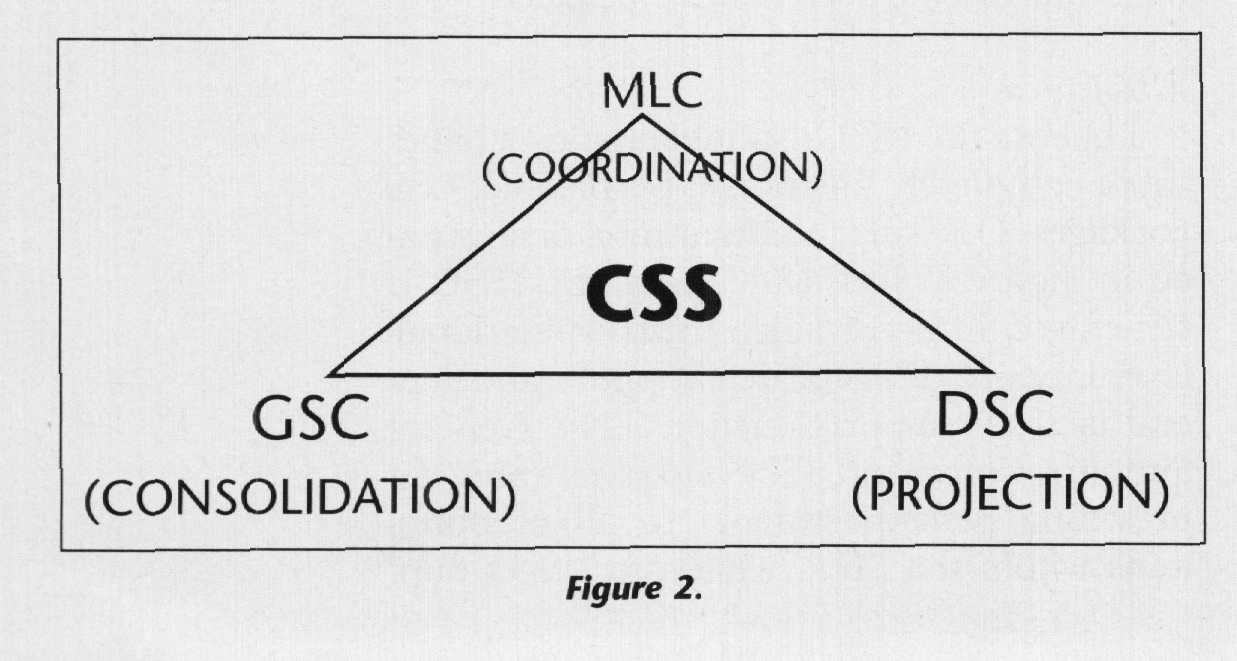
I believe the FSSGs should employ a handful of completely functional, yet flexible, CSS packages. One such configuration is illustrated in Figure 1. In this diagram, the FSSG is structured in accordance to its operational– level support, direct tactical support, and general tactical support functions. The General Support Command (GSC) concentrates on providing general support to all organizations within the MEF, while the Direct Support Command (DSC) trains and employs for the direct support of designated operations. I have labeled the four subordinate elements of the DSC by their more commonly known designation of CSSDs, but these units would actually be permanent. These CSSDs would have most of the inherent assets to support operations the size of a CAX or a MEU and could rotate to support both. However, the GSC could reinforce a CSSD to provide direct support to a special purpose MAGTF, or the DSC could employ multiple reinforced CSSDs to support a brigade or MEF forward. By maintaining a flexible infrastructure that can be easily reinforced, the CSSDs could support mobile, vertical lift, or landing support operations. In other words, the FSSG can task organize the direct support required for MAGTFs around the base units in the DSC. Ultimately, the standing organization of a DSC allows for the flexible, proficient, and speedy projection of CSS, which will more effectively support the Marine Corps’ expeditionary needs.

In essence I am suggesting that the FSSG create a handful of standing units similar to the MSSG. HQMC disbanded the standing MSSGs years ago, but the structure of the MSSG remains basically the same today. The MSSG can be viewed as a standing FSSG battalion that has been designed for a tactical purpose. (It simply has a 1 1/2-year tour of duty and a borrowed T/E.) What makes the MSSG operationally proficient is the time allowed for personnel to train together before deployment. The MSSG’s organization also permits sailors and Marines to conduct adequate turnovers with incoming personnel. Additionally, the equipment necessary to perform the MSSG’s mission has been correctly identified through years of operational experience.

Equally important, the creation of an intermediary command between the FSSG and its battalions, as illustrated by the GSC, is long overdue. As a consequence of centralization, group headquarters directly supervises a number of CSS capabilities (consolidated personnel administration, consolidated food services, and numerous others). These additional tasks force the commanding general’s staff to focus inward instead of outward. At the operational level of logistics, resources need to be coordinated with our sister Services, the Department of Defense, civilian agencies, and host nations. The deficiencies in training and planning for these operational-level requirements were recognized as early as 1990 and still remain in doubt.14 By giving the FSSG organizational depth, CSS efforts can be distributed along the lines of Figure 2; in terms of a boxing analogy, MLC is the brain, DSC is the jab, and GSC is the power punch. By reorganizing in this fashion, group headquarters can better synchronize operational-level logistics in support of the MEF instead of expending precious energy micromanaging all of its CSS assets.

The proposed organization in Figure 1 is not all that original. It has many similarities to FSSG contingency plans as well as the structure of the FSSG during the Gulf War.15 Just as in the division and air wing, any organization of the FSSG must remain flexible. But, by establishing operating forces now, the FSSG can assign mission orders to standing subordinate units in time of war. If shortfalls are identified in the DSC, a general support unit can simply reinforce the deploying unit. If shortfalls exist in general support units, they can be filled by Reserves. This process allows the basic organization of the FSSG to remain intact upon employment.

Organizing the FSSG for rapid employment allows for genuine task organization in larger-than-MEU-sized operations. Should a contingency need several CSSDs, the DSC can quickly be augmented with additional CSSDs from other FSSGs. Or, one MLC could employ two, or maybe even three, DSCs. The point to be made here is that it is possible to establish the command, personnel relationships, and infrastructure that will support all five types of MAGTFs without recreating an entirely new FSSG every time wartime employment becomes necessary. For all intents and purposes, establishing an administrative organization that is designed for task organized employment makes for more thorough combat preparation, which is why most of the Marine Corps already operates in this decentralized manner.

Beyond aspects of organization, CSS needs a doctrine and culture that aligns with maneuver warfare philosophy. The FSSG must embrace decentralized decisionmaking and initiative-based mission orders rather than detailed and centralized planning. CSS units should annually conduct both large- and small-scale training exercises in an aggressive, realistic, and time-competitive environment. Furthermore, units should train in a manner that supports their combat employment, which means programs like combat skills training need to be eliminated or seriously adjusted. In short, the importance placed on preparing for war should take precedence over the routine and demanding tasks of garrison.

Impact on Force Structure

Forecasting the impact of FSSG’s reorganization on force structure is difficult. To begin with, I am not convinced that the solution presented is the only-or the best-one. Additionally, FSSG has reorganized under the constraints of manpower limitations and garrison requirements for far too long, which produced many of the current deficiencies. Instead, FSSG needs to create a completely revised T/O and T/E in accordance with a detailed examination of its wartime requirements. That task should be patiently and thoroughly completed before looking at the impacts on force structure, which may be significant or may be negligible. With a renewed brigade emphasis, perhaps the FSSG should review Carlton W. Meyer’s 1991 proposal. Conversely, Figure 1 depicts a flexible model that basically realigns existing units and current resources instead of creating original ones.

Although the purpose of this article is to stimulate the perception of the need to change, I will generally outline the force structure issues one could expect in a proposal along the lines of Figure 1. In this example the GSC is the only novel unit proposed. Basically, creation of this intermediate unit requires a reshuffling of the staffs in headquarters and service battalion and group headquarters. Although some new staff-level positions will need filling, I believe much of the GSC’s personnel could derive from group headquarters since the MLC would no longer need to manage all of its battalions.

As far as four permanent MSSG-type units are concerned, I have made the assumption that three CSSDs of the DSC could be made permanent based on the current manpower levels of the FSSG. Today’s MSSGs (equaling roughly 300 Marines each) are “temporary” organizations. Making them permanent implies that the FSSG’s battalions would lose roughly 900 line numbers on their T/Os. That may seem awfully hard to swallow, but the battalions already operate without these personnel on a daily basis. Those battalion line numbers considered essential for combat employment, but not necessary in garrison, could be filled by Reserves. Optimally, FSSG battalions could place entire platoons or companies in this reserve status, which preserves unit integrity.

The fourth CSSD proposed in Figure 1 provides the DSC with the flexibility to support the MEU as well as other CSS operations simultaneously, but it may require as many as 300 new line numbers. Combining the needs of 1st and 2d FSSG totals 600 additional Marines. Where will those Marines come from? Either the Corps can increase its size by 600 (which may be possible in today’s political climate), or (as blasphemous as it may sound) the air and ground forces could be reduced by a small fraction. The question that begs answering: does the Marine Corps want to be relegated to MEU-sized operations in the future, or do we desire the ability to rapidly respond in support of larger contingencies? In a Corps of over 150,000, increasing the manpower of the FSSGs by 600 Marines seems a small price to pay for flexible, proficient, and speedy CSS projection.

Summary

Currently, the FSSG is continuing to consolidate resources into MOS-specific units from which personnel and equipment can be reorganized to fit wartime situations. But, micromanaging the numerous CSS assets from FSSG headquarters is simply too large a task to accomplish effectively. The fixation with finding the exact requirements for any given operation wastes valuable time and, because of the nature of war, is unattainable anyway. The time required to create a perfect plan is exactly what the Marine Corps is attempting to avoid with maneuver warfare. Moreover, establishing peacetime garrison battalions that do not properly coincide with combat employment is precarious. The most dangerous aspect is that FSSG’s wartime requirements may not be correctly identified. Moreover, quickly organizing untested units defeats the benefits of training Marines in peacetime like they will fight in war. By establishing battalions that cannot be employed as they are organized, a “garrison-mentality” permeates the culture of the FSSG.

Recognizing the need to improve CSS is relatively easy, but implementing a solution will take strong leadership, force of will, collective cooperation, and patience. The Marine Corps is fond of using cliches like “. . . professionals think logistics” and “. . . logisticians win wars.” If the Corps adheres to its jargon, then it needs to take a second look at where the evolution of CSS is leading and ensure that it corresponds with maneuver warfare philosophy. If the FSSG cannot rapidly and efficiently employ in direct support of all five types of MAGTFs, then how can CSS effectively sustain the maneuver warfare doctrine being implemented by the air and ground forces?

Notes

1. For a historical perspective on the United States’ logistical changes, see Clayton R. Newell, “Logistical Art,” Parameters, March 1989, pp. 32-40.

2. For more information on the requirements for task organization, see Fleet Marine Force Manual 3-1, Command and Staff Action.

3. Renowned veteran Erick Von Schell stated that the German Army transferred many of its officers to new positions when WWI broke out. Schell believed this to be a mistake and maintained that “the heavy burden occasioned by the new impressions of battle would have been considerably lessened had there existed that feeling of unity and that mutual understanding which long service together engenders among officers and men.” Erick Von Schell, Battle Leadership, (Fort Benning, GA: The Benning Herald, 1933), pp. 20-21. For an outstanding review of the lessons learned while planning for the Guadalcanal operation, see Richard B. Frank, Guadalcanal, (New York: Random House, 1990).

4. See MCDP-1, pp. 61-65. William S. Aitken discusses the necessity of personal relationships for proper CSS performance in his thesis “Increase the Size of the FSSG: An Evolutionary Idea,” Individual Research Paper, Marine Corps University, 1992, pp. 13-15.

5. MCDP-1, p. 55.

6. The need to organize CSS for rapid deployment while maintaining flexible employment has been recognized in the Army as well. See Leon E. Salomon and Harold Bankirer, “Total Army CSS: Providing the Means for Victory,” Military Review, 11 April 1991, pp. 3-8; or Wayne C. Agness and others, “Task Organizing CSS,” Infantry, September-October 1992, pp. 40-42.

7. Carlton W. Meyer’s idea was not unique; he borrowed it from a 1984 2d FSSG study. For Meyer’s proposal, see “The FSSG Dinosaurs,” Marine Corps Gazette, October 1991, pp. 32-36.

8. Aitken, William S., “Increase the Size of the FSSG: An Evolutionary Idea,” Individual Research Paper, Marine Corps University, 1992, pp. 1, 5-6.

9. Woodhead, John A., Col, “Reorganization of the Force Service Support Group,” Marine Corps Gazette, October 1991, pp. 37-38.

10. Hammes, Thomas X., Col, “DESERT SHIELD/DEsERT SToRm-Ten Years Later,” Marine Corps Gazette, May 2001, pp. 73-79.

11. Aitken, p. 12.

12. Grice, Michael D., “Train Like We Fight,” Marine Corps Gazette, April 2001, pp. 49-50. The problem of not integrating CSS into the training and evaluation portion of exercises occurs frequently. For an Army perspective, see Calvin R. Sayles, “Are We Ready: Combat Service Support Integration,” Armor, May June 1990, pp. 33-36. Also see Gilbert S. Harper and Robert J. Ross, “Managing CSS Unit Training,” Army Logistician, January-February 1990, pp. 6-10.

13. MCDP-1, p. 13.

14. For more information on how CSS could prepare for its theater-level responsibilities, see Jerome P. McGovern, “Combat Service Support at the High End of the Spectrum,” Marine Corps Gazette, January 1990, pp. 50-52.

15. O’Donovan, John A., “Combat Service Support During DEsERT SHIELD and DEsERT SToRm: From Kibrit to Kuwait,” Marine Corps Gazette, October 1991, pp. 26-31.

Terminology and Graphics

by the MSTP Staff

‘The mission, in particular, must be unmistakably clear so that once units become engaged all subordinate commanders can act with a unity of effort.’

-Capt Adolf Von Schell Battle Leadership

In his book, Battle Leadership, Capt Von Schell expressed the essence of mission tactics in maneuver warfare. When we assign missions to subordinates we must provide a task with a purpose and then provide the subordinate the necessary resources and time to accomplish the mission. Mission orders are only effective if they are clearly understood by the commander issuing them and, more importantly, by the subordinates executing them. Therefore, it is imperative that the mission and tasks are clearly understood and that the purpose endures contact with the enemy. Additionally, units must clearly understand the freedom of action and restrictions available within their delineated battlespace.

Words and graphics matter. Without the use of proper military terminology and symbology during planning and execution, the “unmistakable clarity” described by Capt Von Schell becomes impossible to achieve.

While the importance of proper terminology and graphics appears self-evident, Marine Air-Ground Task Force Staff Training Program (MSTP) often sees terminology loosely applied without an understanding of resource implications, use of nondoctrinal terminology, doctrinal terms “morphing” between higher and subordinate operations orders (for example, a tactical task to “seize” in a Marine expeditionary force order becomes “secure” in the division order), and the failure to use graphic control measures to clarify functional responsibilities.

References

Like any profession, the military possesses a unique vocabulary to address the complexity of the profession of arms. Similar to a lawyer or doctor, a military professional must have an understanding of some basic references as he applies his craft. These references form the foundation of our professional military vocabulary and must serve as “ground truth” in any discussion of tactical or operational planning. These publications include:

Joint Publication 1-02 (JP 1-02), Department of Defense Dictionary of Military and Associated Terms, defines the approved terminology for general use by all components of the Department of Defense (DoD). In DoD Directive 5025.12, the Secretary of Defense has directed the use of JP 1-02 throughout the DoD to ensure standardization of terms. JP 1-02 should serve as the “first stop” in any search for doctrinal definitions.

Marine Corps Reference Publication 5-12C (MCRP 5-12C), Marine Corps Supplement to the Department of Defense Dictionary of Military and Associated Terms, supplements JP 1-02 and contains definitions of Marine Corps terms, abbreviations, and acronyms not found in JP 1-02. MCRP 5-12C is designed to be used in conjunction with, JP 1-02.

MCRP 5-12A, Operational Terms and Graphics, is a dual-designated publication with the U.S. Army (Field Manual 101-5-1, Operational Terms and Symbols). This publication has terminology, acronyms, operational graphics, and symbology. The definitions in this reference are annotated where they are unique to one Service (Army or Marine Corps).

Marine Corps Doctrinal Publication 1-0 (MCDP 1-0), Marine Corps Operations, provides us with definitions of military terms and doctrinal explanations associated with Marine Corps operations. This publication is particularly useful because, unlike alphabetical order dictionaries, MCDP 1-0 organizes terms into subject matter areas: tactical tasks, types of operations, forms of maneuver, etc.

Tasks and Resources-Words Matter

Tactical tasks define the actions that commanders must take to accomplish their mission. They are relative to the enemy, terrain, and friendly forces. The following examples are not all-inclusive, but instead highlight tasks that are often used interchangeably or otherwise misused. Consider the difference in time, risk, and resources involved in each case.

Destroy or defeat? Destroy and defeat are each tactical tasks that focus on an enemy force. Destroy is “a tactical task to physically render an enemy force combat-ineffective unless it is reconstituted.” The definition clearly focuses on inflicting material damage and/or casualties on the enemy force. The level of damage required to meet the criteria of rendering a force combat ineffective has many variables. Unit size, composition, disposition, training, tactics, logistics, and morale are some of the variables that must be considered and assessed. Destroy is a difficult task to achieve and very difficult to assess, especially if a percentage of destruction is specified (50 percent of a named brigade, etc.). Collection assets and analysis must be allocated for the commander to know when he has accomplished this task.

Defeat is a tactical task to:

. . . disrupt or nullify the enemy commander’s plan and overcome his will to fight, thus making him unwilling or unable to pursue his adopted course of action and yield to the friendly commander’s will.

Like destroy, this tactical task relates to enemy forces, but in the doctrinal definition of defeat, the key phrase is that the enemy is unwilling or unable to continue his adopted course of action. Instead of pure physical destruction, the aim is to apply enough resources to affect the mind of the enemy commander or the capabilities of the enemy force relative to the friendly force or terrain. The friendly resources applied to defeat the enemy could come in a variety of ways. For example, denying the enemy the ability to cross a particular bridge could nullify his ability to attack along an avenue of approach.

In summary, it normally requires less time and resources to defeat an enemy force than to destroy the same force.

Secure, seize, or clear? Secure, seize, and clear are all tactical tasks that focus on terrain. There frequently is confusion over the differences between these distinctive tasks. Secure is defined as:

. . . to gain possession of a position or terrain feature, with or without force, and to prevent its destruction or loss by enemy action. The attacking force may or may not have to physically occupy the area.

Seize is “a tactical task to clear a designated area and obtain control of it.” This definition illustrates “a task within a task.” The definition of seize, “to clear a designated area,” leads us to the definition of clear. Clear is defined as:

. . . the removal of enemy forces and elimination of organized resistance in an assigned zone, area, or location by destroying, capturing, or forcing the withdrawal of enemy forces that could interfere with the unit’s ability to accomplish its mission.

While all three tactical tasks relate to terrain, to secure an area potentially requires far less time and resources than does seizing with its imbedded requirement to clear enemy forces from an area.

Screen, guard, or cover? Security operations are designed to provide reaction time, maneuver space, and protection to friendly forces. The three types of security operations– screen, guard, and cover-are often misunderstood. While all three tasks focus on the friendly force, they differ greatly in their resource implications. Screen is a task “to observe, identify and report information, and only fight in self protection.” A unit with a task to guard must “protect the main force from attack, direct fire, and ground observation by fighting to gain time, while also observing and reporting information.” A unit with a task to cover operates apart from the main force to “intercept, engage, delay, disorganize, and deceive the enemy before he can attack the main body.” These three tasks are often misused. They are all oriented on protecting a friendly force, but again, the level of resources committed escalates from screen through guard to cover. Additionally, guard specifies a level of mutual support while screen and cover do not.

Purpose

In the context of maneuver warfare words take on a new importance. In assigning a tactical task to a subordinate unit, we effectively tell that unit “what to do.” We also need to tell them the purpose-“the why.” This is most clearly expressed as the object of the phrase “in order to.” The purpose provides the common understanding that facilitates unity of effort. It focuses resources on the commander’s end state-the vision of success. Together, the task and purpose form the subordinate unit’s mission. The purpose (with method and end state) makes up the commander’s intent-the key tool of maneuver warfare that promotes initiative in mission accomplishment.

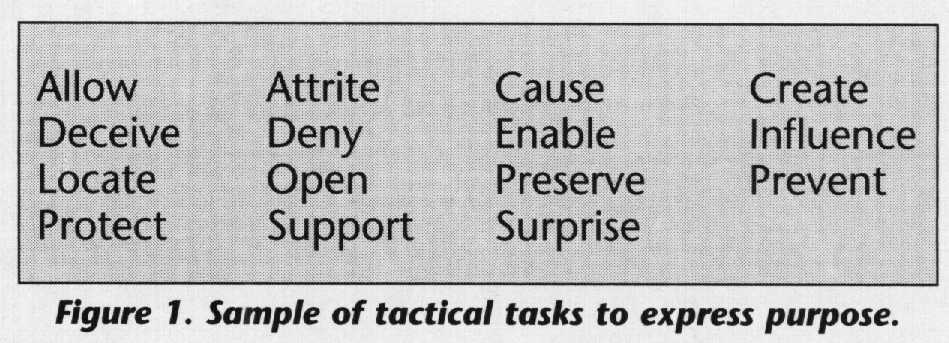
To be effective in these three roles the purpose has to be unambiguous and must endure beyond contact with the enemy. Figure I is a sample of words that may be effectively used to express the purpose of tactical tasks. The list is drawn from various sources and is not comprehensive.

The crucial point regarding the purpose of tactical tasks is that they must be clearly understood by all concerned. If the stated purpose is confusing-it must be clarified. Clarity can be added through an explanatory statement, “By deny I mean. . . .” The goal is shared understanding; common terminology is a tool to achieve this goal. To ensure this understanding the commander may want to add a glossary to the operation order or plan when nondoctrinal terminology is used.

Graphics

Precise terminology should be complemented by well-thought-out and understood graphics. Military symbology serves as our professional “shorthand.” Properly used, these graphics are a powerful tool for the commander and his staff. Graphics visually portray intent, tasks, and responsibilities. The old saying that “a picture is worth a thousand words” holds true in the area of military symbology. Consider the task of “attack along Axis Sword.” (See Figure 2.) While the words clearly portray the task, the visualization of this task is incomplete without graphically tying the task to the terrain.

The power of military symbology is often diluted by a lack of attention to detail. MSTP commonly sees incomplete development or understanding of basic control measures such as boundaries and fire support coordinating measures, failure to properly label control measures with the establishing agency and date/ time/group when the measure takes effect, and the improper depiction of on-order control measures. As a result, the fog and friction of war often starts with the operations overlay.

Conclusion

Tactical terms and the related graphics associated with military operations are our tools for communicating and directing the activities of our subordinates. As such, these words and symbols control resources and time and incur different levels of risk. As leaders and planners we are obliged to know what effects we want to have upon the enemy, the amount of resources we are willing to expend, and the risk we are willing to accept. We must then communicate this vision and direct our subordinates during execution. To accomplish this we have to properly articulate our vision by using doctrinally correct military terms and supporting graphics.

Precise terminology and graphics can help the commander generate tempo in planning and execution because subordinate commanders have a clear end state. On the other hand, improper terminology and graphics undermine unity of effort, generate confusion, and may take away from a common understanding, thereby degrading tempo and increasing the risk to the force.

Notes

>This article is part of a series of articles by the MSTP staff that addresses MAGTF operations and lessons learned- Readers may download copies of these articles on the MSTP web site <www.mstp.quantico.usmc.mil> under Publications/Team Positions.

1. Each of the publications identified in this article can be accessed and downloaded from the Internet. Marine Corps publications are available at <www.doctrine.usmc.mil/> and joint publications may be found at <Www.dtic.mil/doctrine>.

Expeditionary Maneuver Warfare

Our new capstone concept, Expeditionary Maneuver Warfare (EMW), moves us down the path outlined in Marine Corps Strategy 21, and provides the foundation for the way the Marine Corps will conduct operations within the complex environment of this new century. EMW is the union of our core competencies; maneuver warfare philosophy; expeditionary heritage; and the concepts by which we organize, deploy, and employ forces. It emphasizes the unique capabilities the Marine Corps provides the joint force commander JFC) and the synergy created when leveraged with the complementary capabilities of other Services and agencies. These capabilities translate into power projection designed to shape the global security environment, assuring our friends and allies while dissuading, deterring, and defeating potential adversaries. The elements of EMW will guide the process of innovation, change, and adaptation to ensure the Corps continues its role as the Nation’s total force– in-readiness.

J.L. JONES
General, U.S. Marine Corps
Commandant of the Marine Corps

EMW is the Marine Corps’ capstone concept for the early 21st century. It is built on our core competencies and prepares the Marine Corps, as a “total force,” to meet the challenges and opportunities of a rapidly changing world. Capitalizing on our maneuver warfare philosophy and expeditionary heritage, the concept contains the enduring characteristics and evolving capabilities, upon which the Marine Corps will rely, to promote peace and stability and mitigate or resolve crises as part of a joint force. EMW focuses Marine Corps competencies, evolving capabilities, and innovative concepts to ensure that we provide the JFC with forces optimized for forward presence, engagement, crisis response, antiterrorism, and warfighting.

The purpose of this document is to articulate to future JFCs and contemporary joint concept developers the Marine Corps’ contribution to future joint operations. EMW serves as the basis for influencing the Joint Concept Development and Experimentation Process and the Marine Corps Expeditionary Force Development System. It further refines the broad axis of advance identified in Marine Corps Strategy 21 for future capability enhancements. Joint and Multinational Enabling Marine forces possess the capabili

ties to provide the means or opportunity to make joint and multinational operations possible. Enabling operations may be as basic as establishing the initial command and control (C2) system that the assembling joint or multinational force “plugs into,” or a complex as physically seizing forward operating bases for follow-on force Other examples of enabling opera tions include defeating enemy antia( cess capabilities and serving as an operational maneuver element to exploit joint force success or open new fronts. Marine forces are ready to serve as the lead elements of a joint force, act as joint enablers, and/or serve as joint task force JTF) or functional component commanders (i.e., joint force land component commander, joint force air component commander, joint force maritime component commander).

Strategic Agility

Marine forces will rapidly transition from precrisis state to full operational capability in a distant theater. This requires uniformly ready forces, sustainable and easily task organized for multiple missions or functions. They must be agile, lethal, swift to deploy, and always prepared to move to the scene of an emergency or conflict. Operational Reach

Marine forces will project and sustain relevant and effective power across the depth of the battlespace. Tactical Flexibility

Marine forces will conduct multiple, concurrent, dissimilar missions, rapidly transitioning from one task to the next, providing multidimensional capabilities (air, land, and sea) to the joint team. For example, tactical flexibility allows the same forward deployed Marine force to evacuate noncombatants from troubled areas, conduct antiterrorism/force protection operations, and seize critical infrastructure to enable follow-on forces.

Support and Sustainment

Marine forces will provide focused logistics to enable power projection independent of host-nation support against distant objectives across the breadth and depth of a theater of operations.

These capabilities enhance the joint force’s ability to reassure and encourage our friends and allies while we deter, mitigate, or resolve crises through speed, stealth, and precision. Strategic Landscape

U.S. interests will continue to be challenged by an array of national and nonstate actors posing conventional and asymmetrical threats. These threats are made more complex and lethal by the increased availability of militarily applicable commercial technologies. As the technological gap between the United States and its potential adversaries narrows, our leadership, doctrine, and training will be fundamental to maintaining our continued military advantage. We expect potential adversaries to adapt their tactics, weaponry, and antiaccess strategies to confront us on terms of relative advantage. Specifically, adversaries will seek to engage us where they perceive us to be weak. Aware of our ability to degrade complex systems, the thinking adversary will opt for the use of sophisticated but autonomous weapons. Knowing our thirst for information, they will promote uncertainty, confusion, and chaos. This is the venue where our most persistent and determined adversaries will choose to operate. Our Nation must be prepared to fight– worldwide-against adversaries who will seek to engage us with asymmetric capabilities rooted deep in the human dimension of conflict. The Marine Corps, with our philosophy of maneuver warfare and heritage of expeditionary operations, is ideally suited to succeed in this challenging landscape. Expeditionary Advantage

The Marine Corps’ expeditionary advantage is derived from combining our maneuver warfare philosophy; expeditionary culture; and the manner in which we organize, deploy, and employ our forces. EMW capitalizes on this combination, providing the JFC with a total force-in– readiness that is prepared to operate with other Ser-Oces and multinational forces in the full range of military operations from peacetime engagement to major theater war.

Maneuver Warfare

The Marine Corps approach to warfare, as codified in Marine Corps Doctrinal Publication 1, Warfighting, is the product of years of conceptual development, innovation, and experience. Maneuver warfare, the philosophical basis for EMW, acknowledges the timeless realities of human conflict and does not attempt to redefine war on more humane or less risky terms. The fundamental nature of war-a violent struggle between hostile, independent, irreconcilable wills characterized by chaos, friction, and uncertainty-will remain unchanged as it transcends advancements in technology.

What has changed is the gradual shift in reliance from the quantitative characteristics of warfare-mass and volume-to a realization that qualitative factors (speed, stealth, precision, and sustainability) have become increasingly important facets of modern warfare. Maneuver warfare stresses proactive thought and action, elevating the operational art beyond the crude simplicity of attrition.

It combines high-tempo operations with a bias for action to achieve advantage-physical, temporal, or conditional-relative to an adversary. The aim is to shatter an adversary’s cohesion, succeed in other operations by rapid action to mitigate damage, or resolve a crisis on favorable terms. Maneuver warfare encourages decentralized decisionmaking, enabling Marines to exploit the chaotic nature of combat. Decentralizing decisionmaking allows Marines to compress the decision cycle, seize fleeting opportunity, and engage enemy forces from positions of advantage, which empowers us to outthink, outmaneuver, and outfight our adversary.

Expeditionary Operations

For Marines the term expeditionary connotes more than the mere capability to deploy overseas when needed. Expeditionary is our ethos-a pervasive mindset that influx ences all aspects of organizing, training, and equipping by acknowledging the necessity to adapt to the conditions mandated by the battlespace. Expeditionary operations are typically conducted in austere environments from sea, land, or forward bases. They will likely require Marines and other naval forces to be brought to bear without reliance on host-nation or outside support. As a tangible representation of our national interest, forward deployed and forward based Marines remain both a key element of America’s expeditionary advantage and are critical to the regional combatant commander’s or commander in chief’s (CinC’s) overall strategy.

The regional CinC will set the broad conditions for shaping the battlespace through engagement, forward presence, and the application of a full range of response options. As a critical component of each regional CinC’s Theater Engagement Plan, forward deployed Marine air-ground task forces (MAGTFs) and forward based Marines execute multinational training exercises, conduct mobile training teams, and participate in military-to-military exchanges. Through these activities, Marines develop invaluable regional expertise, cultural and situational awareness, and an appreciation of the interoperability required for successful joint and multinational operations.

Marine forces, as a part of the regional CinC’s engagement strategy, will focus on access operations or other assigned missions as a part of the right mix of joint/multinational forces. These operations may be as basic as establishing the initial C^sup 2^ system that the assembling joint or multinational force “plugs into” or as complex as physically seizing forward operating bases for follow-on forces. Throughout the conduct of operations, Marines will seek to leverage the unique and complementary capabilities of other Services and agencies in order to provide the JFC with a fully integrated force.

Seabasing

Marine forces, as an integral component of a larger naval force, will be prepared to influence events within the world’s littorals using the sea as maneuver space and as a secure “base” from which JFCs can project power to impact the early stages of a potential crisis. Seabasing supports versatile and flexible power projection. Seabasing enables forces to move directly from ship to objectives deep inland and represents a significant advance from traditional, phased amphibious operations. Seabased operations maximize naval power projection and enhance the deployment and employment of naval expeditionary forces by JFCs. More than a family of platforms afloat, seabasing will network platforms and promote interoperability among the amphibious task force, carrier battle group, maritime preposition force, combat logistics force, and emerging highspeed sealift and lighterage technologies. Seabased operations will capitalize on the maneuver space afforded by the sea, rapid force closure through at-sea arrival and assembly, and the protection assured by the U.S. Navy’s control of the sea. C^sup 2^, combat support, and combat service support capabilities will remain at sea to the maximum extent possible and be focused upon supporting expeditionary air and land operations ashore. Forward deployed naval forces will have access to a responsive worldwide logistics system to sustain expeditionary operations. Seabasing will allow Marine forces to commence sustainable operations, enable the flow of follow-on forces into theater, and expedite the reconstitution and redeployment of Marine forces for follow-on missions.

Marine Air-Ground Task Forces

Marines typically deploy and employ as scalable, tailorable, combined arms teams known as MAGTFs. All MAGTFs, regardless of size, share four common organizational elements that vary in size and composition according to the mission: command element, ground combat element, aviation combat element and combat service support element. Organic to each MAGTF, regardless of size, are specialized antiterrorism and force protection capabilities that are available to support the JFC. Fully interoperable, each MAGTF will have the ability to serve as a JTF headquarters or as a functional or Service component commander of a JTF.

In partnership with the Navy, Marine forces will use the capabilities of bases and stations and selected naval platforms as “launch pads” to flow into theater. During deployment, Marine forces will conduct collaborative planning and execute en route mission training and virtual rehearsals. They will capitalize on shared situational awareness that is developed in support of the JFC and processed and distributed by the Supporting Establishment. These enhancements will revolutionize the otherwise timeintensive reception, staging, onward movement, and integration activities, allowing increased operational tempo and seizing early opportunities as the enabling force for the JFC. Forward deployed Navy and Marine forces will continue to be the JFC’s optimal enabling force, prepared to open ports and airfields and to establish expeditionary airfields and intermediate staging bases in either benign or hostile environments.

Marine Expeditionary Unit (Special Operations Capable)

The Marine expeditionary unit (special operations capable) (MEU(SOC)), in close partnership with the Navy, will continue to be the onscene/oncall enabler for follow-on Marine or joint forces. Operating forward deployed from the sea, the MEU(SOC) is unconstrained by regional infrastructure requirements or restrictions imposed by other nations. Because of its forward presence, situational awareness, rapid response planning capability, and organic sustainment, the MEU(SOC) will continue to be the JFC’s immediately employable combined arms force of choice.

The MEU(SOC) initiates humanitarian assistance, provides force protection, conducts noncombatant evacuations, enables JTF C^sup 2^, and facilitates the introduction of follow-on forces conducting limited forcible entry operations when required. These early actions shape the JFC’s battlespace, deter potential aggressors, defuse volatile situations, minimize the damage caused by natural disasters, and alleviate human suffering. Increasing mobility, speed, firepower, and tactical lift will enable this seabased, self-sustained, combined arms force to conduct expeditionary operations across the depth of the battlespace, in adverse conditions, day or night.

Marine Expeditionary Brigade

The Marine expeditionary brigade (MEB) is optimally scaled and task organized to respond to a full range of crises. Strategically deployed via a variety of modes (amphibious shipping and strategic airlift and sealift) and poised for sustainable power projection, the MEB will continue to provide a robust seabased, forcible entry capability. It will use organic combined arms and the complementary capabilities from the other Services-such as netted sensors, seabased fires, and advanced mine countermeasures-to locate, counter, or penetrate vulnerable seams in an adversary’s access denial systems. The MEB will then close rapidly on critical objectives via air, land, and sea to achieve decisive results. It can be used to enable the introduction of follow-on forces (joint and multinational) or be employed as an independent operational maneuver element in support of the JFC’s campaign plan. The MEB constitutes a multidimensional, seabased or landbased, operational “capability in readiness” that can create its own opportunities or exploit opportunities resulting from the activities of other compo, nents of the joint force.

Marine Expeditionary Force

As a crisis escalates, smaller MAGTFs and supporting units are deployed until a Marine expeditionary force (MEF) is in place to support the CinC. The MEF, largest of the MAGTFs, is capable of concurrent seabased operations and sustained operations ashore, operating either independently or as part of a joint warfighting team. The MEF can be tailored to meet multiple joint requirements with its inherent sustainability.

Specialized Marine Corps Organizations and Capabilities

Special purpose MAGTFs are non- standing organizations temporarily formed to conduct specif ic missions for which a MEF or other unit is either inappropriate or unavailable. They are organized, trained, and equipped to perform a specific mission such as force protection, humanitarian assistance, disaster relief, peacetime engagement activities, or regionally focused exercises. While the MAGTF construct will remain the primary warfighting organization of the Marine Corps, not all situations will require it to operate as a combined arms unit. Should the situation warrant, distinct MAGTF elements and capabilities may be employed separately in response to critical JFC requirements.

For example, the 4th MEB (Antiterrorism (AT)) is a unique organization with specialized antiterrorism capabilities. This unit consists of Marines and sailors specifically trained to respond rapidly-world– wide-to threats or actual attacks by terrorists. The 4th MEB (AT) contains the Marine Corps Security Force Battalion (fleet antiterrorism security teams), the Marine Security Guard Battalion, the Chemical/Biological Incident Response Force, and an infantry battalion specially trained in antiterrorism operations.

Supporting Establishment

Marine Corps bases and stations provide direct and indirect support to the MAGTF and other forward deployed forces and are the means by which Marine forces are formed, trained, and maintained. These bases and stations are platforms from which Marines project expeditionary power while supporting the quality of life of Marines and their families.

The Way Ahead

Marine Corps Strategy 21 identifies capability enhancements required to continue the evolution of the MAGTF. These capability enhancements include joint/multinational enabling, strategic agility, operational reach, tactical flexibility, and support and sustainment, which create a Marine force that provides the JFC with expanded power in order to assure friends and allies or dissuade, deter, and defeat adversaries. In accordance with our expeditionary culture and warfighting ethos, our doctrine, organization, education, and training must contribute to producing Marines and organizations that thrive in the chaos of conflict by:

* Producing leaders who have the experience to judge what needs to be done; know how to do it; and exhibit traits of trust, nerve, and restraint.

* Developing leaders and staffs who function in an environment of ambiguity and uncertainty and make timely and effective decisions under stress.

* Developing leaders by improving their capacity to recognize patterns, distinguish critical information, and make decisions quickly on an intuitive basis with less than perfect information.

* Enhancing leaders’ decisionmaking skills with investments in education, wargaming/combat simulation activities, and battespace visualization techniques within a joint or multinational framework.

We will see a convergence of transformation and modernization capabilities in our MAGTFs that will revolutionize expeditionary operations when currently planned programs mature. Realizing EMW’s full potential will require a developmental effort focused on improving C^sup 2^, maneuver, intelligence, integrated fires, logistics, force protection, and information operations. Achieving these improvements will require integration of both Navy and Marine Corps operational concepts, systems, and acquisition strategies.

Organization, Deployment, and Employment

Changes in operational and functional concepts may necessitate changes in the integrating concepts of organization, deployment, and employment. Organizationally, EMW emphasizes the MEB as the preferred midintensity MAGTF and the role of the Supporting Establishment in di- rect support of forward operations. Organizational structure must be mission oriented to ensure the effective deployment, employment, sustainment, reconstitution, and redeployment of forces. The Marine Supporting Establishment must be postured to facilitate situational awareness of worldwide operations, leverage information technologies, and exploit modern logistics concepts in order to anticipate and respond to MAGTF requirements.

Marines will deploy using any combination of enhanced amphibious platforms, strategic sealift and airlift, prepositioned assets, and self deployment options to rapidly project force throughout the world. By virtue of their en route collaborative planning and virtual rehearsal capability, Marine forces will arrive in theater ready for immediate employment. While Marines achieve great operational synergy when employed as fully integrated MAGTFs, the Marine Corps can provide specific forces and capabilities according to the needs of the JFC. Continuing our tradition of innovation, we must strive to enhance our concepts and technologies to organize, deploy, and employ the force.

Maneuver

Maneuver in all dimensionsland, air and, uniquely, operational maneuver from the sea-enables commanders to exploit enemy weakness at the time and place of their choosing through the use of the operational mobility inherent in naval forces. Maneuver seeks to achieve decisive effects during the conduct of a joint campaign. It is the means of concentrating force at critical points to achieve surprise, psychological shock, and momentum, which drives adversaries into untenable situations. Maneuver can deny the enemy the initiative, reducing his choices to either defending the length and depth of the littorals, thereby dislocating his forces to the JTF’s advantage or exposing critical vulnerabilities to exploitation. Enemy forces reacting to MAGTF maneuver generate opportunities for the JFC to concentrate the complementary capabilities of other maneuver forces. Maneuver, integrated with fires, will be linked to and influenced by the JFC’s battlespace shaping operations and directed toward achieving operational effects. Innovative technologies will provide Marines enhanced mobility to cross greater distances and reduce the limitations imposed by terrain, weather, and access denial systems. The result will be an expanded maneuver space, both seaward and inland.

Enhancements in our

maneuver capability will compel adversaries to develop innovative anti- access strategies and systems. Proactive joint efforts to anticipate and counter current and future antiaccess systems will be criti- cal to ensuring freedom of action.

Integrated Fires

Fires involve more than the mere delivery of ordnance on a target. The psychological impact on an adversary of volume and seemingly random fires cannot be underestimated. The human dimension of conflict entails shattering an enemy’s cohesion through the introduct on ot tear and terror. Marines, applying the tenets of maneuver warfare, will continue to exploit integrated fires and maneuver to shatter the cohesion of an adversary.

We will increasingly leverage seabased and aviation-based fires and develop shorebased fire support systems with improved operational and tactical mobility. Streamlining our fire support coordination procedures and enhancements in combat identification techniques will support rapidly maneuvering forces while decreasing the risks of fratricide. Forces afloat and ashore require the ability to immediately distinguish friendly forces from others and to then deliver lethal and nonlethal fires with increased range and improved accuracy to achieve the desired effect. Volume and precision of fires are equally important. The continuous availability of high-volume, all-weather fires is essential for suppression, obscuration, area denial, and harassment missions. We will use fires to support maneuver just as we use maneuver to exploit the effects of fires.

Intelligence

Intelligence is a command function that optimizes the quality and speed of decisionmaking. EMW requires a thorough blending of the traditional domains of operations and intelligence. Commanders and their staffs must make decisions in an environment of chaos, uncertainty, and complexity, and they must be prepared to act on incomplete information. The goal of intelligence is to enable the commander to discern the enemy’s critical vulnerabilities and exploit them.

Intelligence must support decisionmaking by maintaining current situational awareness, monitoring indications and warnings, identifying potential targets, and assessing the adversary’s intent and capabilities at all levels of operations. This requires establishing an intelligence baseline that includes order of battle, geographic factors, and cultural information, all contained in universally accessible databases.

Deployed Marine forces will enhance their organic capabilities by accessing and leveraging national, theater, Service, and multinational intelligence through a comprehensive intelligence surveillance and reconnaissance network. The informed judgment of well-trained, educated, and experienced Marine analysts and collectors will remain the most important intelligence asset.

Logistics

Marines must access a worldwide infrastructure of distribution systems to support expeditionary operations. The integration of naval expeditionary logistics capabilities with joint information and logistics systems will provide total asset visibility and a common relevant operating picture, effectively linking the operator and logistician across Services and support agencies. Marines must explore ways to reduce the logistics footprint ashore through expeditionary support bases, seabased support, in-stride sustainment, reduction of consumables, improved packaging, better visibility over distribution, and development of alternafive ordnance variants that are smaller and lighter, but retain equivalent lethality.

Command and Control

EMW promotes decentralized execution providing subordinates latitude to accomplish assigned tasks in accordance with the commander’s intent. Organic and supporting C^sup 2^ systems and processes must be adapted to function in any environment, whether afloat, transitioning ashore, or on the move. C^sup 2^ must facilitate decentralized decisionmaking and enhanced situational awareness at all echelons. Concurrently, C^sup 2^ must provide the MAGTF commander the ability to direct joint and multinational task force operations when required.

EMW requires adaptable and intuitive C^sup 2^ architectures and systems that are fully interoperable with joint assets and compatible with multinational assets. Expeditionary forces will be able to access, manipulate, and use information in near realtime, developing a common tactical and operational understanding of the battlespace. They will have connectivity to theater and national assets and the ability to disseminate information throughout the force. This will support fully integrated collaborative planning efforts during both deployment and employment.

C^sup 2^ initiatives must address limitations in the capabilities of all amphibious platforms. Key factors include accelerated technological advances and rapid changes in equipment and capabilities. Flexibility, adaptability, and interoperability are paramount in the design and development of systems and platforms. Particular attention must be made to providing commanders with seamless C^sup 2^ capabilities throughout the battlespace.

Force Protection

Force protection is those measures taken to protect a force’s fighting potential so that it can be applied at the appropriate time and place. Force protection will rely on the integrated application of a full range of both proactive and reactive capabilities. Multidimensional force protection is achieved through the tailored selection and application of layered active and passive measures within all domains across the range of military operations-or warfighting functions-with an acceptable level of risk.

We will pursue improvements in the families of technologies and doctrine to enhance force protection capabilities. Marine forces will enhance security programs designed to protect servicemembers, civilian employees, family members, facilities, and equipment in all locations and situations. These enhancements will be accomplished through innovative technological and nontechnology-based solutions combined with planned and integrated application of antiterrorism measures, physical security, operations security, personal protection, and incident response.

Information Operations

Information operations involve actions taken to affect the adversary’s decisionmaking processes and information systems while ensuring the integrity of our own. The integrated components of information operations have always proven applicable across the full range of military operations. Information operations will be used to shape the strategic environment or impart a clearer understanding and perception of a specific mission and its purpose. Information operations will be a force multiplier-reducing the adversary’s ability to effectively position and control his forces-and prepare the way for the MAGTF to accomplish future missions. We must leverage information operations and ensure they are synchronized with the JFC’s campaign plan to achieve the desired operational effect.

Summary

EMW describes the Marine Corps’ unique contribution to future joint and multinational operations. As the Nation’s only seabased, forward deployed, air-ground force in readiness, Marines stand ready to support the JFC. Marines, intrinsically linked with naval support, maintain the means to rapidly respond to crises and respond with the appropriate level of force, MAGTFs are the JFC’s optimized force that will enable the introduction of follow-on forces and prosecute further operations.

EMW focuses our warfighting concepts toward realizing the Marine Corps Strategy 21 vision of future Marine forces with enhanced expeditionary power projection capabilities. It links our concepts and vision for integration with emerging joint concepts. EMW will guide the process of change to ensure that Marine forces remain ready, relevant, and fully capable of supporting future joint operations.

What if…? The Essence of the COA Wargame

by the MSTP Staff

The Marine Corps’ warfighting philosophy of maneuver warfare seeks to shatter the enemy’s cohesion through a variety of swift, focused, and unexpected actions that create a turbulent and rapidly deteriorating situation with which the enemy cannot cope. The course of action (COA) wargame embodies this philosophy of maneuver warfare by testing our COAs against those of an enemy, represented by the intelligence section or red cell, that thinks and acts with an independent will.1 Wargaming allows the commander, his staff, and planners to gain a common understanding of friendly and enemy COAs. It helps identify the advantages and disadvantages of each friendly COA in relation to enemy actions.

Throughout planning and wargaming we must maintain a focus on the enemy. Focusing on the enemy allows us to understand the unique characteristics that make the enemy’s system function so that we can penetrate it, tear it apart and, if necessary, destroy the isolated components. Achieving this goal requires us to “get inside” the enemy’s thought processes and see the enemy as he sees himself. It is essential that we understand the enemy on his own terms-we should not assume that the enemy thinks, fights, or has the same values or objectives that we do.

What Is a Wargame?

Joint Publication 1-02, Department of Defense Dictionary of Military and Associated Terms, defines a wargame as:

A simulation, by whatever means, of a military operation involving two or more opposing forces, using rules, data, and procedures designed to depict an actual or assumed real life situation.

A good definition, yet three additional concepts should be considered when thinking about wargaming — scalable, time dependent, and adversarial.

A wargame is scalable in the sense that the personnel (battalion through Marine expeditionary force (MEF) level) conducting the wargame can adapt the methodology to meet their particular circumstances. Wargaming is time dependent in that the thoroughness of the wargame is based on how much time is available to conduct the wargame. If time is short, the wargame may be no more than a “what if . . . ” drill done by the commander and his staff on the hood of a HMMWV. However, if time is not as crucial, the wargame may be a week-long, full-scale, computer simulation conducted by the MEF and their major subordinate commands. In keeping with the Marine Corps’ maneuver warfare philosophy, the wargame should be adversarial in nature by using a thinking and reactive enemy to fight the enemy COA.

What Are the Benefits of Conducting a Wargame?

We conduct a wargame to refine our COAs and to develop the best possible COA within the timeframe available. The staff evaluates the effectiveness of friendly COAs against both the enemy’s COAs and the commander’s wargaming guidance. Each friendly COA is wargamed against selected enemy COAs. COA wargaming helps the commander determine how best to apply his strength against the enemy’s critical vulnerabilities while protecting his critical vulnerabilities. Wargaming pits friendly COAs against enemy COAs-it does not compare friendly COAs against each other. The commander and his staff may change an existing COA or develop a new COA after identifying unforeseen critical events, tasks, requirements, or problems. They also identify branches and sequels that may become “on order” or “be prepared” to missions. The wargame assists the commander in developing his vision for success-his operational design. Wargaming helps the commander:

* Fight the single battle.

* Determine how to maximize combat power against the enemy while protecting the friendly forces and minimizing collateral damage.

* Build common situational awareness.

* Build common expectations of anticipated battlefield events.

* Determine conditions and resources required for success.

* Determine when and where to apply the force’s capabilities.

* Focus the intelligence collection and analysis effort on enemy strengths, vulnerabilities, and desired end state.

* Identify the coordination requirements that produce synchronized results.

* Determine the most flexible COA. It’s not good enough to just test the friendly COAs or just identify their strengths, weaknesses, associated risks, and shortfalls. We must capitalize on what we have identified by strengthening the weaknesses, mitigating the risks, and eliminating the shortfalls to improve the COA. The improvement of each COA by the planners, based on the results of the wargame, provides the commander the best possible COAs from which to make his decision during the next step in the planning process — COA comparison and decision.2

What Are the Results of Wargaming.

The wargame produces many planning and execution tools. It also generates professional discussion about the feasibility and flexibility of the COAs being tested. It is these professional discussions that allow the commander and his staff to react quickly to unforeseen battlefield developments faced during execution. It facilitates:

* Identifying and refining the enemy’s most likely and dangerous COAs.

* Identifying likely times and areas for enemy use of weapons of mass destruction and friendly nuclear, biological, and chemical defense requirements.

* Testing the enemy reaction to planned deception efforts.

* Refining the commander’s critical information requirements and incorporating them into the reconnaissance and surveillance plan.

* Finalizing the reconnaissance and surveillance plan.

* Developing the intelligence collection and dissemination plan.

* Refining location and timing of the decisive actions.

* Identifying key terrain and determining how to use it.

* Identifying critical events.

* Estimating the duration of the operations and its critical events.

* Projecting the outcome of each critical event.

* Determining the timing of force concentration and initiation of the attack or counterattack.

* Identifying the location and commitment of the reserve.

* Identifying or confirming the locations of decision points, named areas of interest, targeted areas of interest, and the information needed to support the decision points.

* Identifying tasks the unit must retain and tasks to be assigned to subordinate commanders.

* Refining task organization, to include forces retained in general support of the command.

* Allocating resources to subordinate commanders to accomplish their missions.

* Identifying additional requirements for support.

* Developing a synchronization matrix and decision support template.

* Developing fire support, engineer, air defense, information operations, and combat service support plans.

* Determining movement times and tables.

* Integrating the targeting process, to include identifying or confirming high-payoff targets and determining attack guidance.

* Identifying the location of the commander and unit command posts.

* Refining command and control requirements, to include control measures and updated operational graphics.

* Identifying additional hazards, assessing their risk, developing control measures to reduce risk from all identified hazards, and determining residual risk.

The wargame is an essential tool for the honing and testing of COAs. When conducting a wargame, the commander and his staff must bear in mind one of the critical tenets of maneuver warfare-focus on the enemy. The commander relies on his staff for their professional opinions and judgment. The wargame provides a venue for the staff to validate their positions and justify their opinions — all to facilitate the commander’s decisionmaking process.

Notes

> This article is part of a series of articles by the MSTP staff that addresses MAGTF operations and lessons learned. Readers may download copies of these articles on the MSTP web site <www.mstp.quantico.usmc.mil> under Publications/Team Positions.

1. For an indepth discussion on the red cell, refer to draft Marine Air-Ground Task Force Staff Training Program (MSTP) Pamphlet 2-0.1, The Red Cell, available at the MSTP web site <www.mstp.quantico.usmc.mil>.

2. For further discussion on the details and methods of conducting the wargame, refer to Marine Corps Warfighting Publication 5-1, Marine Corps Planning Process, Chapter 4 and Appendix E.

On Planning

by LtCol Steven Donnell, USMC(Ret)

This letter refers to Mr. William S. Lind’s commentary in the October 2000 Gazette, “Missing the Boat: A Response to Generals Knutson, Hailston, and Bedard. What began as promising discourse closed with a predictable refrain of maneuver warfare apathy within our Corps. As if the combatant commanders would choose a Marine-centric course of action based on our ability to translate the nonlinear tenets of the complexity theory into asymmetric applications. Desirable, but not probable.

The “absurd” idea that planning is more important than the plan is discussed in Marine Corps Doctrinal Publication (MCDP) 5, Planning (p. 84) not Marine Corps Warfighting Publication 5-1 as Mr. Lind asserts. However, the 5-1 does support the concept that planning is more important than the plan, for planning is a learning process that develops situational understanding to shorten decision cycles in execution. Faster, informed decisions lead to tempo-a viable antidote for the uncertainty inherent in all two-sided conflicts. Further, the understanding gained through planning prevails long after the plan itself supposedly succumbs to the line of departure.

As for the methodical “French-way-of-war” planning process, Mr. Lind lacks an appreciation for the volume of planning required at higher echelons, particularly during preexecution-deliberate planning when the Marine Forces and MEFs must incur the cost of overhead by populating the battlespace with sufficient structure to promote subordinate success. Additionally, Mr. Lind equates speed with maneuver warfare. While speed is a weapon and a genuine source of combat power (MCDP 1, Warfighting, p. 40), in war, it is relative speed that matters. I don’t have to outrun the bear; I only have to outrun you.

Lest we believe MEFs can cycle as fast as companies, we must be careful applying the lessons learned from free play, small unit exercises at The Basic School to larger commands.

Detailed planning for 90,000 Marines better not be easy. Level 4 TPFDDs (timephased force and deployment data), assault wave landing tables, and air tasking orders are not the result of serendipity and happenstance. The fact that the time required for detailed planning at the component or MEF surpasses the life cycle of most insects does not defy the principles of maneuver warfare. Even the company commander experiencing coup d’oeil as a result of “high ground intuition” needs frequencies, call signs, and airspace control measures to orchestrate his combined arms effort.

Perhaps Mr. Lind’s efforts might have been better served had he focused on why the MEFs continually exercise large-scale, conventional scenarios that drive staffs to laborious levels of detailed planning, particularly in light of the more likely scenario of military operations other than war. An examination of this issue and underlying causes-programmatics, force drawdowns, quality deficiency reports, theater engagement plans, and a lack of a Joint Chiefs of Staff single battle-would tie in better with Col Mark F. Cancian’s concern (“Still the Nation’s 91-1 Force?” MCG, Apr0) of dispersion versus concentration, which was the pretense for Mr. Lind’s comments in the first place.

Commander’s Intent: Easy to understand, tough to articulate

Marine Corps Doctrinal Publication (MCDP) 5, Planning, states that “the commander is probably the single most important factor in effective planning.” The central role of the commander in planning is also doctrinally codified in Marine Corps Warfighting Publication (MCWP) 5-1, Marine Corps Planning Process. The commander draws on his experience to visualize the relationship between friendly forces, enemy forces, and the battlespace. The commander envisions the interaction of these elements over time and how he will achieve a decision that leads to the desired end state. He initiates planning by communicating this vision through the most important element of the commander‘s battlespace area evaluation (CBAE)-the commander‘s intent.

MCWP 5-1 discusses CBAE in detail. This article focuses on the commander‘s intent and the difficulties that the MAGTF (Marine Air– Ground Task Force) Staff Training Program (MSTP) has observed in commanders crafting this critical element that drives planning and provides the implicit communications necessary to execute our warfighting doctrine of maneuver warfare.

According to MCDP 1, Warfighting, the purpose of a commander‘s intent is: to allow subordinates to exercise judgment and initiative-to depart from the original plan when the unforeseen occurs-in a way that is consistent with higher commanders‘ aims.

As Marines, we have long recognized the importance of commander‘s intent in execution. We have not always been as effective, however, in applying commander‘s intent in planning.

MCWP 5-1 defines commander‘s intent as:

the commander‘s personal expression of the purpose of the operation. It must be clear, concise, and easily understood. It may also include how a commander envisions achieving a decision as well as the conditions that, when satisfied, accomplish the purpose.

The following are some common observations and potential solutions that may assist commanders in the communication of their intent:

The intent is too wordy or lacks focus. When a commander develops an intent that is several pages long, it is difficult to discern his intent (purpose). If the commander‘s intent is to be of value to the planners, it must be clear, concise, and easily understood. It may also include how (the method) the commander envisions achieving a decision as well as the conditions that, when satisfied, accomplish the purpose of the operation (end state). Commander‘s intent expressed in terms of “purpose– method-end state” is more easily understood and facilitates planning. This format is not only being used in the Marine Corps, but it is also widely used in joint operations.

* The intent focuses on the “how” or “what” vice the “why.” Often commander‘s intent mistakenly focuses on defining what must be done (the task) and how it should be accomplished. In these cases, intent takes on the form of initial guidance. The commander‘s initial guidance should provide the battle staff and subordinate commanders with his view of what his force is to do and the resources he will need to accomplish the mission. The initial guidance may be based on the six warfighting functions and/or how the commander envisions the sequence of actions that will cause his force to arrive at the desired end state. Subsequent guidance may also provide preliminary decisions to focus planners on the commander‘s conceptual vision of the operation. For example, the commander may issue guidance on phasing, forms of maneuver, or task organization. Whereas guidance may be comprehensive and detailed in nature and is aimed at planners, commander‘s intent is intended for both the planners and the executors. Commander‘s intent focuses on the enduring portion of any mission by clearly stating the purpose (the why), which will continue to guide our actions in execution while the how or what (tasks) may change as the situation develops. As the commander proceeds through planning, and his situational awareness grows, he may refine his intent by describing how (method) he envisions achieving a decision and reaching a desired end state.

* The commander does not always write the commander‘s intent. Many times the commander‘s intent is not the commander‘s personal expression of the purpose of the operation. This personal expression of purpose drives the planning process and ensures unity of effort in execution. As such, its development should not be left solely to the staff. The commander may direct his staff to provide a recommended intent for his review, but the final product must reflect his own vision of the purpose of the operation. Field Marshal Viscount William J. Slim, British defender of India and liberator of Burma in World War II, says of the commander‘s intent:

It is the one overriding expression of will bv which everything in the order and every action by every commander and soldier in the army must be dominated, it should, therefore, be worded by the commander himself.1

* The terminology used to describe commander‘s intent is inconsistent or confusing. To make the commander‘s intent clear and concise, it is critical that the commander uses precise military terminology. By using accepted doctrinal terms to express key points, his subordinates focus on those things that are critical to mission accomplishment, saving time and allocating the appropriate forces and resources. Correct terminology aids subordinates in understanding the commander‘s intent by reducing confusion through the use of a common vocabulary. Additionally, the commander can add clarity to his intent by explaining the terms he uses-“by defeat I mean. . . .”

Issued as an element of CBAE during commander‘s orientation, the commander‘s intent is critical to the planning process and in subsequent mission execution. A clear, concise, and easily understood intent focuses the staff and serves as a basis for consistency’and continuity in developing a concept of operations, allocating resources, and making other planning decisions.

An effective technique for expressing commander‘s intent is the purpose-method-end state format. Using this format, a commander can issue and refine his intent ensuring that subordinates understand the purpose of the operation, how he envisions achieving a decision, and what conditions must be met to achieve the purpose. Properly issued and applied, the commander‘s intent will lead to unity of effort throughout planning and execution.

Here is an example of the commander‘s intent:

* Purpose. Restore the Blueland border.

* Method. Maneuver through existing or created gaps to bring our combined arms combat power to bear against the Orangeland 102d and 103d Armored Brigades and the 401st and 402d Artillery Regiments.

* End state. The Northern Operations Group defeated. Our forces positioned along the Orangeland/Blueland border prepared to continue offensive operations in Orangeland, if directed.

Notes

1. Field Marshal Viscount William Joseph Slim, Defeat Into Victory, Battling Japan in Burma and India, 1942-1945, Cooper Square Press, 2000, p. 211.

Missing the Boat: A response to Generals Knutson, Hailston, and Bedard

by William S. Lind

In the April Gazette, Gol Mark F. Cancun raised a serious issue: the inherent contradiction between the Corps’ extensive forward deployments and its ability to respond to large events with substantial forces committed over time. The issue is strategic in nature, and it applies to all Services, not just the Marine Corps. Nor is it new historically. Most countries have had to choose between dispersing their forces to deal with many small contingencies or concentrating them to deal with one larger threat. A good example is the situation ADM Jackie Fisher faced early in this century with the Royal Navy. His answer was to concentrate the fleet against Germany. The action was highly controversial at the time.

When I first saw that Gens Knutson, Hailston, and Bedard had replied to Col Cancun, I was hopeful. Presumably, such senior Marine Corps leaders would see the strategic nature of the issue and address the question of dispersion or concentration directly. Since our pattern of dispersion stems from the Cold War, it would certainly be timely to do so. I was, therefore, disappointed to find that the generals had missed the forest for the trees. Far from offering a strategic perspective, they offered a response that combined the usual bland assurances given to politicians on Capitol Hill in materials prepared by the staff of Headquarters Marine Corps.

The essence of the generals’ argument-that the Marine Corps need make no choice between dispersion and concentration, because it can do both simultaneously-is simply not credible. Even without a major, sustained deployment, deploying units must rob Peter to pay Paul in order to go out at all. Surveys of officers leaving the Corps repeatedly list the pressure of constant deployments as a major reason for separation. No one familiar with the difficulties the Operating Forces face daily in meeting existing commitments-the consequence of dispersion-can think it could handle a major commitment for a sustained period simultaneously. Something would have to give, and quickly.

More troubling still is the bland assurance the generals offer in response to Col Cancians’ point about competition from the Army. The Army leadership understands well that the Army must become competitive in the intervention business, and they are straining every nerve to do so. The results, so far, are unimpressive. The attempt to get Task Force Hawk into action in Kosovo was a fiasco. But, if three senior Marine Corps generals really believe that “the Marine Corps is secure in its role,” one must wonder whether the Corps’ leadership is asleep on the beach. Today, as always, Marines face three certainties in life: death, taxes, and attempts by the Army to take over the Corps’ roles and missions. The Army’s experimental, light motorized brigades at Fort Lewis exist precisely for this purpose. Interestingly, they are commanded by one of the very few Army generals who has an excellent understanding of maneuver warfare.

This leads to perhaps the most troubling aspect of the three Marine expeditionary force (MEF) commanders’ response to Col Cancun. Over the past several decades, the Marine Corps has sought to base its claim to expertise in the intervention mission not simply on equipment or techniques, but on its ability to fight a dif ferent kind of war-maneuver warfare. Today, the Marine Corps is rapidly losing that ability, and it is doing so in ways that should be obvious to MEF commanders. In all three MEFs, free-play training, which is the heart and soul of learning maneuver warfare, has all but vanished. The only Marine Corps school that now attempts to teach maneuver warfare is The Basic School. The latest product of the Doctrine Division, the new planning manual, is directly contradictory to every maneuver warfare concept of planning-to the (absurd) point of saying that the process is more important than the product. The MEF commanders’ own headquarters are virtual slaves to the staff planning process (thanks to the baneful influence of the Marine AirGround Task Force Staff Training Program), which is the heart of the French way of war-methodical battle-and the very opposite of maneuver warfare.

In sum, the “all is well” nature of the generals’ response should itself raise deep concern among all those interested in the long-term welfare of the Corps. Too often, such unseeing tranquility on the bridge has been a prelude to the cry, “Iceberg ahead!”

Nothing Wrong with ‘Our System’

by LtCol F. G. Hoffman, USMCR

It’s a distinct pleasure to see Bill Lind’s incisive commentary in the Gazette once again. His review of Andrew Gordon’s The Rules of the Game (MCG, Jul99, pp. 81-82) adroitly pointed to many lessons offered by the Royal Navy’s failure at doctrinal reform at the turn of the century. I fully concur with his assessment that the Marine Corps has something to learn from Gordon’s massive study.

The primary lesson deals with leadership, the obligations that junior officers owe their superiors, and the corresponding duty of those superiors. Mr. Lind accurately notes that the Royal Navy and the Grand Fleet had lost the “Nelson touch” which was the moral and doctrinal equivalent of maneuver warfare in the early l9th century. VAdm Horatio Nelson nurtured a number of superior young captains into a cohesive band of brothers. They were completely indoctrinated in his philosophy of command, operating doctrine, and expectations once combat began. His intent was understood from the wardroom to the gundeck and could be intuitively followed or ignored as circumstances dictated once battle was joined.

Another part of the “Nelson touch” was the expectation-no, the demand-that a captain was expected to exercise his own judgment at all times. Captains were trusted to exercise this judgment, much as Nelson himself did at the Battle of St. Vincent when he pulled his own ship, the 74-gun Captain, out of the battle line on his own. This bold act was crucial to England’s decisive victory that day. Nelson evidenced the same discretion, bordering on insubordination, at Copenhagen when he literally turned a blind eye to his superior’s commands, under the presumption that he was in a better position to judge his force’s odds. The Admiralty subsequently supported his presumptuous initiative by removing his senior, something rarely seen in the Royal Navy (or here for that matter) since.

Andrew Gordon’s tome argues that the Royal Navy’s best chance to break out of the intellectual constipation that was blocking reform in the late l9th century rested on the shoulders of VAdm George Sir George Tryon, “the man most likely to succeed.” A close reading of The Rules of the Game actually suggests otherwise, for Tryon failed at generating the band of brothers spirit, the cohesion and the spirit of initiative that spurred Nelson’s captains at Trafalgar. He did try to train them in his new methods, but never overcame the stilting traditions and heavy fog of traditionalism that existed in the Grand Fleet in the Victorian Age.

Nelson faced the same challenges since the Fighting Instructions of his day were just as rigid. He succeeded, however, in instilling cohesion and trust whereas Tryon failed, and failed miserably, as Jutland demonstrates. Ultimately, on a training maneuver off Beirut in 1893, Tryon’s judgment failed him. He ordered a movement inconsistent with safe operating distances of battleships of the line. Both his fleet lieutenant and a staff aide immediately pointed this out to him, and he reissued his orders in writing. When the signal for this maneuver was run up, every ship in both divisions save one hauled up a crisp acknowledgment. Only one officer, the hapless RAdm Markham, delayed responding, frozen at the prospect of pointing out the danger of this directive and struggling to decipher the rationale for the movement. Only when Tryon flashed a curt “What are you waiting for?” did he run up the acknowledgment to his division. The rest is history. The flagship Victoria was rammed and sunk at the cost of more than 350 souls, including Tryon’s.

The record suggests Tryon was not open to suggestions or advice from his subordinates. He refused to note his junior staff had reservations about his proposed fleet exercise. He failed by creating a climate in which even the flag captains would hazard their primary responsibility, that of one of His Majesty’s ships and the hundreds of sailors that manned them, rather than question him. Although two junior officers were willing to speak up in the privacy of his cabin, not one captain of a dozen ships challenged an improper command. This evidence indicates that the cohesion, mutual understanding, and trust that lie at the heart of maneuver warfare were absent. Such a leadership climate strongly undercuts Gordon’s thesis, and reinforces Lind’s comment about “the lost Nelson touch.” Simply put, Tryon was no Nelson and no true reformer. Tryon might have destroyed the High Seas Fleet at Jutland, but he would not have succeeded in reforming the Royal Navy’s ossified command and control doctrine.

Next, Mr. Lind noted that the book has lessons about the role of technology and its centralizing tendency. The Royal Navy’s infatuation with excessive signaling produced the overly centralized fleet maneuvers and exercises that Lind accurately calls “vast, elaborate ballets.” This centralization and rigidity lay at the heart of the famous observation by Adm Beatty during Jutland that “There seems to be something wrong with our bloody ships today.”

The Marine Corps has recognized the dangerous potential for centralization in an age of uncertainty and chaos. Its command and control doctrine, MCDP 6, notes that it is unreasonable to expect any command and control system to “provide precise, predictable, and mechanistic order to a complex undertaking like war.” The doctrine also places technology in its proper place, noting that:

High-quality equipment and advanced technology do not guarantee effective command and control. Effective command and control starts with qualified people and an effective guiding philosophy.

Nelson himself was aware of this. He had a crude Popham signaling system available to him and used it to signal his famous “England expects every man to do his duty” missive (no doubt more an attempt at entertaining than inspiring his beloved sailors). Yet, Nelson only issued three signals to direct Britain’s greatest naval victory. At Jutland, Great Britain’s Grand Fleet was managed by a signal issued every 67 seconds during daylight hours. The results speak for themselves. All in all, I think the Corps has a proper doctrine for command and control in the Information Age. Lind, who has a keen eye as an observer, suggests otherwise based on his experiences with field exercises held at the Marine expeditionary force level. This observation is troubling and should draw some comments and further discussion in these pages.

All in all, the review and the book amplify the new Commandant’s guidance, particularly his opening from Rudyard Kipling. Kipling was very familiar with the Nelson example, as was everyone in his day and age. Kipling knew that the wise wolf does not always direct the pack, sometimes the leader adjusts off the “recon pull” of the flank. Sometimes, the pack leader learns something from a younger pup. As Gen Jones’ guidance noted, sometimes the good ideas come from the bottom up. Pups are given some rope, time to roam, and chances to make errors. Sometimes, the pack succeeds, and other times it goes hungry. However, it always lives and fights together. As was demonstrated at Trafalgar, the strength of the Pack is the individual Wolf, and the Wolf’s strength comes from the Pack.

The ultimate lesson from this case study is that if we want to reform and ensure that maneuver warfare actually represents our warfighting doctrine, we will have to think about living in peace the way we want to fight in war. Maneuver warfare, and its underlying leadership philosophy, must be a part of our daily routines in both peace and war. Ultimately, we fight the way we live and train.

Benefits of NTC

by Capt Dan Sullivan, USMCR

1stLt N. Van Taylor’s article (MCG, Jun99) about the benefits of training at the Army’s National Training Center (NTC) at Fort Irwin is right on the money. In February 1995, 1 was a platoon commander with Gulf 2/5 when we deployed to Fort Irwin for a month and were attached to the opposing force (OpFor) there. For a variety of reasons, I still consider that deployment the best overall training I have experienced in the Marine Corps.

First, the OpFor at NTC places a high value on having Marine units as attachments. Our “gung-ho” mentality and high motivation compare favorably to the National Guard units that are often tasked with augmenting the OpFor. Consequently, although we onlv had about 120 Marines in our company at the time, we were always tasked with important and challenging missions throughout the entire 30-day exercise.

Second, the training at NT(: is vely realistic, principally because, as Lt Taylor notes, you are fighting against an opponent with an opposing will. In our case it was the entire Army Ist Division-the Big Red One. The highly sophisticated use of MILES (multiple integrated laser engagement system) gear on all weapons systems makes this opposing will all the more real and “deadly.” This has a tremendous impact on developing tactical skills and leadership at all levels; as officers, staff noncommissioned officers (SNCOs), and NCOs are regularly “killed” in battle, all Marines must be ready to step in and lead their company, platoon, squad, or fire team at a moment’s notice.

Finally, at NTC you get firsthand exposure to Army doctrine and tactics. We in the Marine Corps sometimes have a tendency to assume that our way is inevitably the right way. Often this is true, but not always. Whether it was setting up defensive positions by properly utilizing intervisibility lines (i.e., subtle reverse slopes in a desert environment) or being required to dig fighting positions 6 feet deep with at least 18 inches of overhead cover, I learned a lot from the Army during this deployment.

My only disagreement with 1stLt Taylor’s article comes in the conclusion. He states that the Marine Corps must choose between Combined Arms Exercise (CAX) or NTC deployments. This is a false choice. There is no reason why both types of deployments cannot be incorporated into unit training schedules. When possible, CAX and NTC should both be a regular part of all Marine Corps unit training.

CAX: A primer for maneuverists and over-the-horizon guys

by Capt Jeffrey W. Prowse

1stLt N. Van Taylor’s article “Why the Marine Corps Needs the NTC” (MCG, Jun99, p. 49) echoes the concerns that many Marines have voiced recently concerning the Combined Arms Exercise (CAX) program. For Marines raised on the doctrine of maneuver warfare and operational maneuver from the sea (OMFTS), CAX can at times seem an exercise in frustration. Is CAX truly in tune with the maneuver style of warfare and contributing aggressively to its evolution, or is it anchored to another style of warfare less oriented to maneuver and tempo? The question that is repeatedly asked is why does a company of M1A1 tanks stop, dial up indirect fire, and wait for close air support (CAS) to get on station prior to assaulting a stack of tires representing a platoon of BMPs? Why does a section of AH-lW gunships, loaded for bear with Hellfire missiles, and eyes on a target, hold for 30 minutes before being cleared to engage? These things happen regularly at CAX and at first glance seem anachronistic, markedly so in an organization that professes to ascribe to the doctrine of maneuver warfare. In this article I will advance the argument that combined arms training, as conducted at CAX, is the foundation of the Marine Corps’ ability to successfully apply the doctrine of maneuver warfare and OMFTS.

CAX and Maneuver Warfare: A Perception

The overall scenario at CAX, that of the seizure of a friendly Third World nation by a hostile belligerent, seems a perfect vessel for the application of maneuver warfare. Confronted with this scenario a Marine air-ground task force (MAGTF) staff applying the techniques of maneuver warfare develops a plan to defeat the aggressor. Prior to ground intervention a period of battleshaping would seem in order, replete with direct air support, battlefield air interdiction, and other cool aviation stuff. A thorough intelligence preparation of the battlespace will lead the staff to identify the surfaces and gaps in the enemy order of battle and disposition. Prior to arrival at CAX the staff formulates a plan that will exploit enemy weakness and exercise maneuver warfare. Man, this CAX thing is gonna be great! Upon arrival at CAX the staff is told in effect: not so fast, Guderian-CAX doesn’t work that way; there will be no points given for battleshaping or the exploitation of strategic or operational gaps. You are going to hit every surface and ignore the gaps. This first impression fosters a belief that CAX reinforces an attritionist mindset and flies in the face of our current doctrine.

So What’s the Deal?

The deal is this: What ends up happening at CAX is a series of seemingly protracted offensive, defensive, and movement to contact engagements that are conducted with a huge emphasis on fire support. CAX assumes that the MAGTF staff can make decisions about how to shape the battlefield, how to interdict the enemy’s rear areas, and how best to exploit his gaps. These are operational considerations that if effectively addressed might place the enemy in such an untenable situation that he capitulates before we ever cross the line of departure. But what happens when we hit the one surface that remains in place despite our best efforts to obviate it? What happens when the enemy, with a will of his own, places us on the horns of a dilemma? As for OMFTS, what happens over-the-horizon, alone and unafraid, when the enemy center of gravity isn’t as vulnerable as we had predicted? The answer is that we apply combined arms; we deliver fires in consonance with maneuver to achieve our objective.

Encountering a surface that must be addressed is what CAX is all about. The training objective at CAX is combined arms, which presupposes the ability to execute fires in consonance with maneuver. This is maneuver warfare at its lowest level, and it thus forms the bedrock of our doctrine. As observed by Robert H. Scales:

Employment of combat forces as a “combined arms team” has been an immutable tenet of maneuver warfare. Infantry, armor, and artillery must be employed in concert and orchestrated by the maneuver commander to gain full advantage of each individual arm’s potential. The same applies in principle to firepower. Artillery, helicopter, and tactical air are nothing more than van,ing means to deliver explosive power.1

At CAX, a MAGTF must deliver fires in consonance with maneuver in order to achieve success. This uncompromising emphasis on fires in consonance with maneuver permeates the CAX. It is a critical, fundamental skill that is the foundation of a doctrine that embraces maneuver warfare, it is akin to blocking and tackling in football. At the fire team level it’s using squad automatic weapons, M-203s, and individual rushes against an enemy bunker. At the battalion level it’s using M1A1s, heavy machineguns, TOWs, artillery, mortars, fixed- and rotary-wing CAS, and a company flank attack against an enemy strong point. CAX isn’t about how to outmaneuver the enemy. It’s about using combined arms, the primary tenet of maneuver warfare, against whatever surface we might be forced to address-after we’ve shaped the battlefield and shot the gaps.

O.K., I’ll Give You the Maneuver Thing-But What About Tempo? The biggest affront to our maneuver mentality at CAX occurs when, faced with an unavoidable surface, a plan for fires to support the scheme of maneuver is developed. In a typical scenario a company halts outside the threat ring of the enemy’s direct fire weapons systems and methodically brings the weight of supporting arms to bear prior to engagement. This 20 to 60 minutes of perceived inaction is seen by some as a loss of tempo. In using tempo as a weapon it is not necessary to be in constant action against the enemy. Maneuver warfare demands coordination, and coordination takes time. An overemphasis on tempo at the expense of coordination may lead us to employ sequential rather than combined arms. Sequential arms by definition equates to maneuver without fires and fires without maneuver. Dependant on the threat this can be a very bad thing. In combined arms battle the method we use to deliver fires upon the enemy to support the scheme of maneuver is called fire support coordination.

When fire support coordination works it does so because Marines within all facets of the MAGTF know their critical maneuver and fire support tasks and are proficient in their execution. Maneuver commanders and fire support coordinators must at some point practice live fire combined arms in close proximity to friendly troops. Maneuver warfare doctrine demands proficiency in these basic, yet critical, skills if we ever hope to meet with success in combat. Effective fire support coordination is a skill that is difficult to teach and subsequently perishable when not routinely exercised, as the U.S. Army learned in Vietnam:

The application of all in combination creates a synergism of effect that makes the whole of the system more lethal than its component parts. To apply them properly requires as much skill in orchestration from a fire support coordinator as does the exercise of combined arms from a maneuver commander. . .. Try as it might, the Army school system was no more capable of teaching young artillery captains the intuitive sense of time and space necessary to orchestrate complex firepower battle in Vietnam than it was of inculcating a similar intuitive feel for the relationship between fire and maneuver in young infantry commanders.2

Fire support coordination is a skill that can only be taught through practical application, preferably in conditions as close to combat as the limits of safety and funding will allow. The time required to coordinate fires in consonance with maneuver is largely a function of the levels of experience of those in key leadership billets. At CAX we seek to train all facets of the MAGTF in combined arms; in short, everybody’s learning curve is high, for some it’s vertical.

Live fire as conducted at CAX replicates battlefield geometry on the friendly side of the forward edge of the battle area with live rounds and actual gun target lines that must be understood and deconflicted. The levels of understanding that this system of training generates is unparalleled by any other approach to fire support training. One of the primary tasks of the fire support coordination center (FSCC) is to understand battlefield geometry and to control and manage it with fire support coordinating measures. For the FSCC the objective of all this is to safely deliver effective fires in support of the maneuver commander. For the fire support players the situation can get zany in a hurry: Reinforcing by fire was complicated by the confusion of combat and the large number of objects flying through the air near the contact. Medevac helicopters had to be brought directly into the fight to take out the wounded; . . . The FO [forward observer] was busy adjusting artillery close to his position. Artillery trajectories would be converging from all directions. Attack helicopters would be down low, trying to keep under artillery trajectories, but difficult to see. Air Force FACs [forward air controllers] and a continuous string of strike aircraft would soon arrive to further crowd the airspace, not to mention the occasional frightening appearance of enemy antiaircraft fire.3

Without CAX there would be nowhere to gain the training equivalent of the situation described above. This is why the tank company and the AH-1Ws must wait for the artillery to adjust onto the target and the fixed-wing to report on station. If the maneuver occurs without all supporting arms the training objective is lost. It is in dynamic situations with friendly units on the move supported by direct, indirect, fixed- and rotary-wing aviation delivered fires that a true appreciation for the complexity of integrating fires is gained. If we kill it all with 120mm main gun rounds and Hellfire missiles at standoff range, we miss the fire support coordination training objective. Proficiency in fire support coordination is the foundation of our doctrine. As any fire support coordinator, FAC, FAC(A) (airborne), fire support team leader, FO, artillery liaison officer, or maneuver commander who has been there recently can tell you, this critical knowledge is gained at CAX.

What About This Complex and Wacky “SEAD Package”?

1stLt Taylor makes the statement that “the suppression of enemy air defense (SEAD) package has virtually never, if ever happened, in the history of warfare.” He goes on to imply that the technique of combining SEAD and fires to support maneuver in a nonstandard SEAD “package,” is far too complex to be executed in combat. 1stLt Taylor really expresses two concerns. First, is SEAD for CAS aircraft necessary given the time it takes to plan and execute? Second, is a complex program of fires that ties direct, indirect, and aviation delivered fires executed in support of exposed ground maneuver a valid technique on the modern battlefield? These are both very valid concerns that demand detailed answers.

SEAD

SEAD for fixed- and rotary-wing CAS and assault support aircraft has been successfully employed by numerous combatants. Many examples can be found in the study of conflicts in Korea, Vietnam, the Mid-East and Afghanistan.4 In some cases the threat was such that without SEAD, aircraft losses were high enough to preclude CAS and/or assault support operations. The proliferation of MANPADs (man-portable air defense systems) on the modern battlefield makes the exposed maneuver of aircraft, especially rotary-wing aircraft, increasingly risky. This trend was especially marked in Afghanistan where the presence of “somewhere between 150 and 300 Stingers have absolutely driven the Russian Air Force out of the skies.”5 The Stinger Basic missiles that frustrated the Russians are now old technology. The second and third generation MANPAD systems now in service are far more lethal. Aircraft maneuver in the face of unsuppressed enemy weapons systems, especially when we have the means to suppress them, is a suboptimal technique.

Through the employment of CAS aircraft we seek to deliver ordnance on a target. In maneuver warfare this is often done to support the exposed maneuver of ground forces. In order to deliver on the target, two basic requirements must be met. First, the pilot must acquire the target, and second, the aircraft must fly a delivery profile that will allow ordnance to hit the target. To aid in satisfying these requirements, we mark the target and suppress known enemy weapons systems that can engage the CAS aircraft. The mark provides visual cueing; suppression allows the pilot to fly an optimal delivery profile unhindered by surface-to-air missiles, antiaircraft artillery, or small arms fire. This is called surface-delivered SEAD.6 In order to conduct assault support operations in close proximity to the enemy, we suppress those enemy weapons systems within range and line of sight to the exposed maneuver of the aircraft. Suppression for CAS or assault support aircraft need not come from indirect fire agencies. If a company delivers a heavy volume of small arms fire on the enemy to cover the exposed maneuver of aircraft, the suppressive effect, while arguably less effective than a synchronized application of direct and indirect fires, is achieved. The SEAD maxim is this: Exposed maneuver of aircraft without suppression on known threats decreases survivability as well as the chances for first pass success. In short SEAD, whether surface or air delivered, is a requirement for the effective use of CAS in the presence of a credible enemy air defense threat.

“The Package”

As Marine Corps Warfighting Publication 3-23.1 (MCWP 3-23.1) points out, “One of the most difficult functions performed by an FSCC is the integrating of CAS with surface fires.”‘ Doctrinal artillery SEAD procedures establish three types of artillery delivered SEAD timelines: continuous, interrupted, and nonstandard. We know that we want to fire a SEAD program in support of rotary- or fixedwing CAS runs. We also know that these CAS runs will be supporting our scheme of maneuver. The CAS runs will provide effective suppression to support maneuver, but we need suppression for a duration that CAS alone may not provide. Indirect fire can provide our scheme of maneuver a longer period of suppression. For this we need a quick fire plan. A technique that has proven effective at CAX is to tie a SEAD package together with a quick fire plan. In essence the “SEAD package” is an expeditious means to tie artillery, mortars, aviation delivered ordnance and in some cases direct fire to a single timeline. It is essentially a means to plan and execute a quick fire plan in a doctrinal nonstandard SEAD format. The economy of force achieved by incorporating suppression for maneuver and CAS aircraft on the same timeline provides the commander with a flexible tool to support his scheme of maneuver with combined rather than sequential arms. This is the infamous “package.” The objective of fire support in combined arms battle is to bring numerous weapons systems to bear on the enemy at a specific place and time. Regardless of how it is planned and executed, the need to coordinate the simultaneous fires of numerous agencies in a congested area will not go away in the foreseeable future. Is there a better way to achieve this objective than the package, given the advances in communications and weapons technology? Right now, given our current equipment, the package seems to provide the most responsive fire support. As new systems become available our tactics, techniques, and procedures (TTPs) for fire support will surely change with them. CAX is the perfect arena to evaluate these new systems and TTPs.

What of NTC?

The primary argument advanced by 1stLt Taylor’s article is that since CAX falls short of meeting our training objectives, the National Training Center (NTC) should replace it as our vessel for combined arms training. There are significant doctrinal differences and organizational realities that separate the Army and the Marine Corps. If OMFTS is the road down which we are headed, does NTC support that doctrine better than CAX? What are the fire support requirements that will be unique to OMFTS? Will NTC allow us to exercise those MAGTF functions that will be critical in OMFTS? Once again these are question that rate answers.

OMFTS and Fire Support

CAX in its present form supports OMFTS in a way that force-on-force MILES (multiple integrated laser engagement system) gear training cannot. The application of live fire supporting arms, most notably CAS, at CAX bears little resemblance to anything that occurs at NTC. The training derived from the delivery of live aviation ordnance in close proximity to friendly troops cannot be underestimated. CAS as applied at CAX is one of the primary tenets of OMFTS. OMFTS doctrine states that we:

generate operating tempo by combining ship-to-shore movement and what has traditionally been called “subsequent operations ashore” into a single, decisive maneuver directly from the ship.8

This means that in the initial phase of an operation we can expect to rely heavily on aviation delivered supporting arms while mortars and artillery are readied to accept calls for fire. In the OMFTS scenario presented by LtCol Timothy C. Hanifen in “The MV-22 Osprey, Part III: Warfighting and Related Acquisition Challenges” (MCG, Jul99 p. 68) he states, “we are looking at a period of 2 to 5 hours (or more) in which the aerial delivered fire support will be the GCE [ground combat element] primary standoff fire support means.” If ever there was an argument to support the emphasis on the CAS TTPs taught at CAX, OMFTS is it.

The MAGTF

The MAGTF concept, which is the cornerstone of our warfighting doctrine, is fundamentally violated if we deploy our battalions and squadrons piecemeal to NTC, presumably with operational control to the Army. If we go to NTC, it is essential that we maintain MAGTF integrity. The freeplay exercises with MILES gear conducted at NTC would give a MAGTF commander a superb opportunity to employ maneuver warfare at an operational level. That said, it must be understood that CAX and NTC have differing training objectives. NTC should not replace CAX, but augmenting CAX with a trip to NTC for some force-on-force freeplay training would undoubtedly prove valuable. The question then becomes one of funding. Do we want to spend the money that sending a MAGTF to NTC would require? Could we better allocate funds to buy more ammunition or reverse the declining levels of training and readiness throughout the Corps? (See LtCol Drew A. Bennett’s article “CAX: It’s Time To Raise the Bar, Not Lower It,” MCC, Jun99, p. 46.) Probably so.

CAX is where the foundations of our maneuver warfare doctrine are laid. CAX provides a generic template for combined arms operations, that may be adjusted to reflect the needs and assets available to a combat commander. The uncompromising focus on combined arms that characterizes the CAX is the absolute bedrock of our ability to fight the MAGTF, regardless of its size or composition. There are profound lessons to be learned from the NTC approach to training, particularly in the force-on-force arena. In the end it must be stressed that NTC was not designed, nor is it likely to achieve, the training goals that CAX delivers.

Notes

1. Scales, Robert H. Fire Power In Limited War. Novato, CA: Presido Press, 1995 p. 103.

2. Ibid., 1995 p. 103-4.

3. Ibid., 1995 p. 104.

4. Ibid., 1995 pp. 18, 110-112.

Dunstan, Simon. Vietnam Choppers: Helicopters in Battle 1950-1975. London: Osprey Publishing, 1988 pp. 61-68, 190-191, Garland, Albert N. A Distant Challenge: The U.S. Infantryman in Vietnam, 1967-1972. Nashville, TN: The Battlefield Press, 1983 pp. 183-191.

Grau, Lester W. The Bear ent Over the Mountain: Soviet Combat Tactics in Afghanistan. Fort Leavenworth, KS: National Defense University Press, 1996 pp. 77-105.

Lester, Gary Robert. Mosquitoes to Wolves: The Evolution of the Airborne Forward Air Controller. Maxwell Air Force Base, AL: Air University Press, 1997 pp. 70-72.

Van Crevald, Martin. Airpower and Maneuver Warfare, Maxwell Air Force Base, AL: Air University Press, 1993, p. 186.

Werrell, Kenneth P. Archie, Flak, AAA and SAM: A Short Operational History of Ground Based Air Defense. Maxwell Air Force Base, AL: Air University Press, 1988 pp. 138-147.

5. Werrell, Kenneth P. Archic, Flak, AAA and SAM: A Short Operational History of Ground Based Air Defense, Maxwell Air Force Base, A1z Air University Press, p. 166.

6. MCWP 3-23.1. “Close Air Support, “pp. 3-32.

7. MCWP 3-23.1, “Close Air Support, ” pp. 3-30.

8. MCDP 3, Expeditionary Operations. p. 92.