A New View of C2 Systems

by Capt Eric H. Larsen

No command and control (C^sup 2^) systems will ever remove the uncertainty associated with the battlefield. At times these systems introduce more friction than they were designed to reduce. More systems require more operators, more communications bandwidth, and more organizational overhead. C^sup 2^ systems arc moving the Marine Corps away from maneuver warfare because these systems lead to explicit control, centralization, and the mitigation of creativity.

Background

Marine Corps Doctrinal Publication 6 (MCDP 6), Command and Control, describes C^sup 2^ as “the means by which a commander recognizes what needs to be done and sees to it that appropriate actions are taken.”1 C^sup 2^ is composed of three elements – people, information, and the C^sup 2^ support structure.2 C^sup 2^ systems are part of the support structure. Most systems are designed with the intent of assembling information into a common tactical picture in order to allow a commander to make a decision, get feedback as the order is carried out, and then evaluate the results.

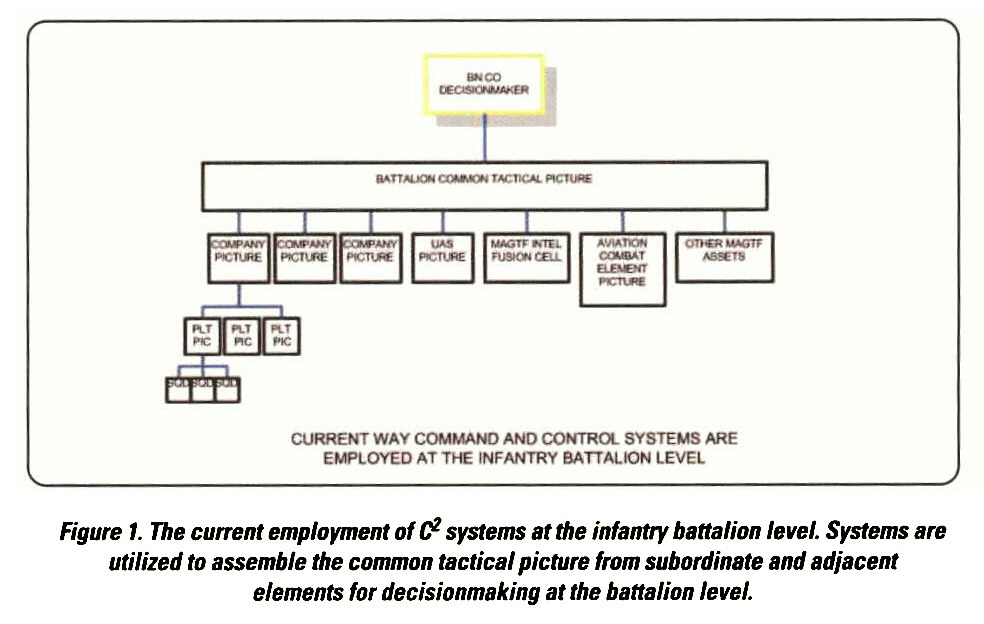
The Marine Corps’ philosophy of maneuver warfare is characterized by decentralized C^sup 2^ and rapid decisionmaking. However, the advanced C^sup 2^ systems used today allow commanders at all levels to see much more information about the battlefield than before.3 This leads to a tendency to exert more control over maneuver units, which slows the operational tempo as the common picture is assimilated. The following example, along with Figure 1, illustrates the type of control possible with modern C^sup 2^ systems and the negative effects that it can have.

Passing through a crowded market- place on a security patrol a squad leader is distracted from his surroundings when his personal data assistant (PDA) beeps. Looking down, he sees a message from his company combat operations center (COC) to speed up his patrol be- cause he is falling behind the timeline associated with his patrol route. He was told that the battalion COC wants the patrol to finish the published route on schedule or else the patrol will be recorded as late. Speeding up his patrol, the squad leader is interrupted by his PDA again when the COC tells him to find the current market prices for char- coal and motor oil. Preoccupied with answering these messages, the squad leader walks by a key insurgent leader eating at a small café in the marketplace and loses an opportunity to capture the man and his associates.

Explicit and Implicit Communications

Fundamentally two types of communications exist, explicit and implicit. Explicit communications involves telling someone specifically what to do in a step-by-step approach. Implicit communications relies upon the knowledge, understanding, and mutual trust that two individuals have in one another. Communicating implicitly conveys much more information in a shorter period of time than explicit communications. However, implicit communications requires commanders and subordinates to invest a great deal of time and effort in developing a close relationship. The Marine Corps’ maneuver warfare philosophy is based upon implicit communications.4

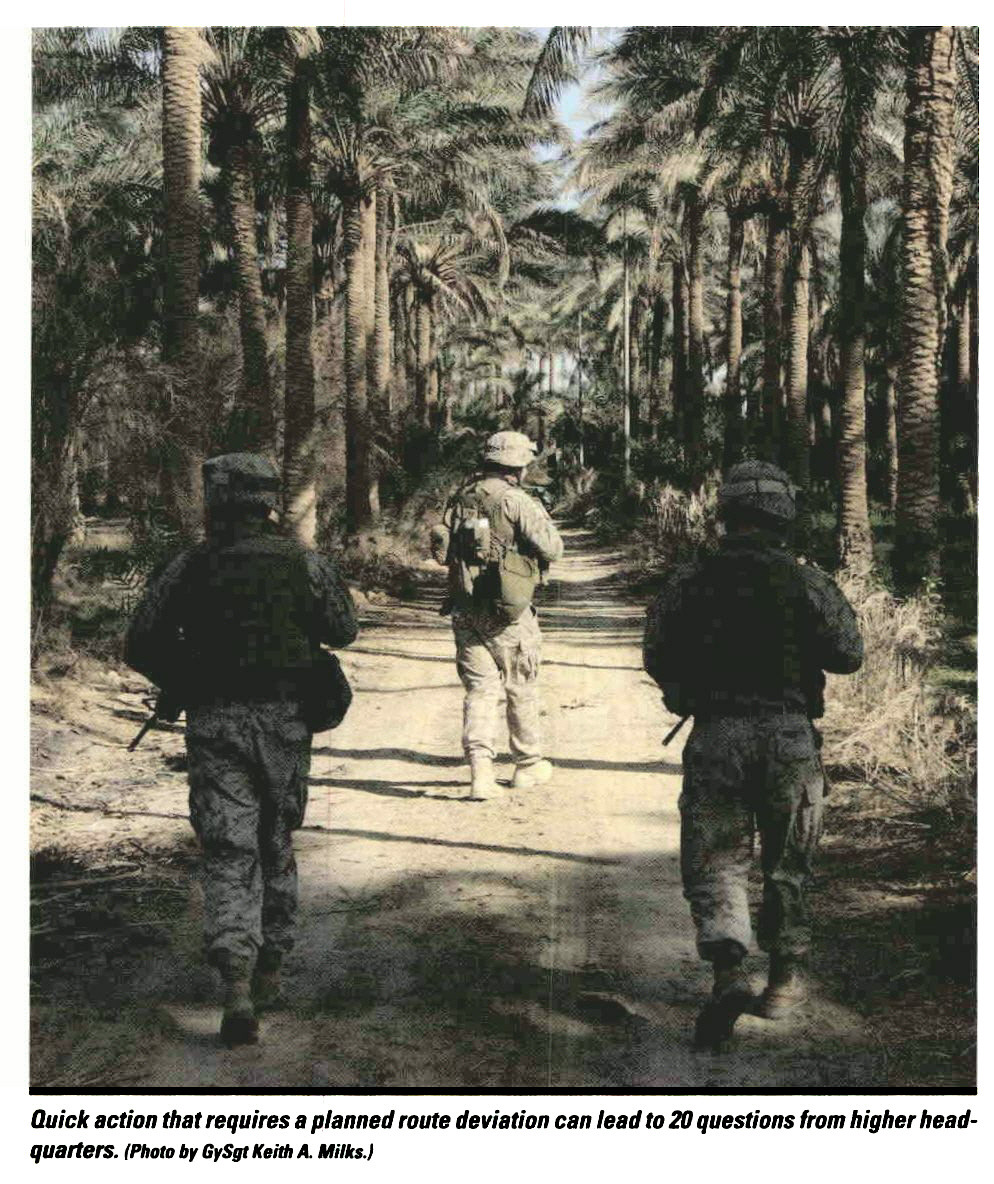
Nevertheless, the current systemsbased approach of C2 encourages explicit communications with the belief that if a concept is not briefed, the subordinate must not understand that aspect of the task. The systems remove the initiative of the subordinate leaders as their progress is monitored on wide screen monitors. Instead of being accepted, delays and deviations from planned routes and overlays generate more questions from higher levels of command and slow tempo as the subordinate takes his mind off of the tactical situation to answer questions. Opponents will justify the myriad of reports, overlays, and documentation as critical to the commander’s decisionmaking process. Yet, too many reports and overlays inhibit the fundamental trust and understanding that a commander should have with his subordinates.

Rather than being utilized simply for the creation of overlays for senior leaders’ decisions, modern C2 systems can be used for implicit communications if they are used as tools for building a shared situational awareness. In keeping with maneuver warfare, Marine Corps Vision and Strategy 2025 states:

The emerging operational environment requires that we increase the shared situational awareness of small unit leaders to support decentralized decision-making. This investment not only enhances the capabilities of these small units, but also increases the quality and quantity of shared situational awareness across echelons. In environments where human intelligence and tactical information reign supreme, we must acquire and convey information rapidly and accurately to facilitate timely decisionmaking.

These systems can implicitly build the commander’s situational awareness and cut down on radio traffic.

Centralization

Throughout history, advances in communications and technology have pushed commanders toward centralized control with the misconception that they see the bigger picture and thus are better placed to make tactical decisions. This belief is in opposition with the tenets of maneuver warfare. GEN Helmut van Moltke, a famous Prussian military strategist, commented in 1892 that “no commander is less fortunate than he who operates with a telegraph wire stuck into his back.”6 Modern systems enable commanders to control their subordinates not just through wire but also through satellite datai inks and numerous other devices from farther away than ever before. For example, the U.S. Central Command is headquartered not in the Middle East but in Tampa, FL.

A recent example of how high-technology C2 systems can lead to centralization can be seen in the 2006 IsraelLebanon conflict. Matt Matthews, a professor at the Army War College, writes that the Israeli high command employed a doctrine of systemic operational design that relied upon “superior knowledge and command and control capabilities”7 to direct its armed forces in action against Hezbollah. Matthews continues:

[T] he Israeli Defense Force (IDF) attempted to orchestrate the strategic cognitive collapse of Hezbollah through the use of air power and precision firepower-based operations. When this failed, the IDF sought to produce the same effects by using its ground forces to conduct limited raids and probes into southern Lebanon.8

Almost all of the operational decisions in the campaign were made at the IDF headquarters in Tel Aviv, detailing timelines, targets, and troop sizes to the ground brigade commanders.9 Matthews further writes, “According to an Israeli source, out of 1 1 IDF brigade commanders, only one ever crossed the border into Lebanon by war’s end.”10 Some opponents herald the technological advances of C^sup 2^ systems that put immense amounts of information at the commander’s fingertips, but they neglect to mention that a dependence on these systems leaves a commander tied to his command post and leading his troops in the field.

The Israeli leadership in Tel Aviv used their high-technology C^sup 2^ systems as a basis for making and evaluating their operational- and tactical-level decisions. However, this centralization led to numerous problems with information flow. Matthews writes of one instance:

IDF monitors picked up several reports of contact along the electronic border fence near milepost 105. Shortly after these movement reports, an IDF reserve patrol reported 20 Hezbollah fighters near the same location. Amazingly, it appears this information never filtered down to the reserve soldiers preparing to conduct the day patrol.11

The information about the Hezbollah fighters made its way to the commanders in Tel Aviv, but it was never relayed to the soldiers on the ground. Proponents for advanced C^sup 2^ systems neglect to mention that the same detailed picture that is assembled for a commander may cut his subordinates completely out of the information loop because they do not have access to the same resources. The problems that Israel had in its last conflict clearly indicate the dangers of centralization that are inherent in C^sup 2^ systems.

Creativity

One of the fundamental concepts behind maneuver warfare is that it capitalizes on the creativity of individual decisionmakers at the lowest levels. Marine Corps Vision and Strategy 2025 states:

We believe that the human dimension of war is the most critical element, and that boldness, creativity, intelligence, and the warrior spirit are prime attributes.12

These attributes allow Marines to seize fleeting opportunities and take advantage of enemy weaknesses. Unfortunately, computerized C^sup 2^ systems cannot adequately capture and convey this creativity and spirit.

Some opponents will argue that C^sup 2^ systems, such as C^sup 2^ personal computer, can be utilized to produce excellent graphics and overlays for an operation. While these digital measures can accurately convey a concept of operations, they cannot capture concepts central to maneuver warfare like commander’s intent. Upon first contact with the enemy, these carefully prepared computerized plans no longer accurately reflect the intentions of subordinate commanders and cannot be quickly adjusted.

For example, a squad leader getting ready for a patrol has to submit a patrol overlay graphic to his company and then to the battalion in order for them to be able to track his movements. During the course of the patrol, if the situation changes and the squad leader deviates from his intended route, more often than not, the first question asked is why the squad leader deviated from his route. The more important question of how can the organization support the squad leader is never asked. This takes the initiative away from the squad leader because he is restricted by lines on an electronic map and the amount of explanation required to change the lines.

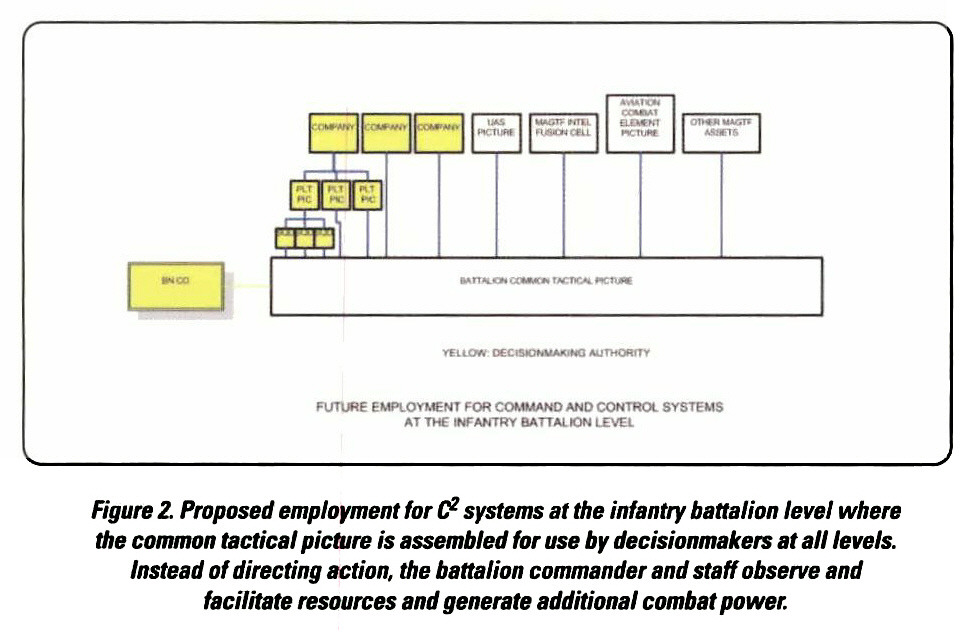
A better use for C^sup 2^ systems is to present a picture to the same squad leader of the assets that are available for him to utilize. The squad leader can see the aircraft, mounted patrols, and other assets that are in the area that he can synergistically combine to accomplish his mission. Rather than enabling senior commanders to control their subordinates, the system should be used in reverse, allowing decisionmakers at the lowest levels access to resources and a picture they would not have had under the current paradigm. The following example, along with Figure 2, illustrates how C^sup 2^ systems can be employed to this effect.

A squad leader is patrolling through a crowded marketplace with his attention outwardly focused. He sees a man whom he vaguely recognizes from the high-value individual (HVI) posters around the company command post. He pulls out his PDA and asks for the company intelligence cell to send him the picture while he orders his squad to detain the HVI and his associates. He consults his PDA to pull a feed from an unmanned aircraft system (UAS) overhead to look for any insurgent forces en route to the area. After the man is detained, his identity is confirmed using the biometrie data obtained from the battalion’s database. The squad leader then uses his radio to coordinate with an adjacent mounted patrol for a linkup to transfer the detainee to their custody for transport. Alerted to the capture, the battalion COC ensures that the mounted patrol has movement priority out of the city. All of these actions were completed before the enemy had time to regroup and mount a rescue.

Conclusion

Modern C^sup 2^ systems can be a double-edged sword to the commander. The true benefits that these systems bring are the shared information, resources, and intelligence picture. Instead of enabling senior commanders to control subordinates, C^sup 2^ systems should be used to facilitate maneuver warfare by empowering all decisionmakers. In keeping with the tenets of maneuver warfare, the goal of C^sup 2^ systems employed in the Marine Corps should be to give leaders at the lowest levels access to all of the resources that the Marine air-ground task force (MAGTF) can bring to the fight.

Notes

1. United States Marine Corps, MCDP 6, Command and Control. Department of the Navy, Washington, DC, 1996, p. 37.

2. Ibid., pp. 48-51.

3. Robinson, Clarence A., Jr., “Advances Boost Tactical Nodes.” Signal Magazine, Armed Forces Communications and Electronics Association, Fairfax, VA, June 2007, p. 50.

4. MCDP 6, p. 109.

5. United States Marine Corps, Marine Corps Vision and Srnitegy 2025, Department of the Navy, Washington, DC, 2008, p. 39.

6. Van Creveld, Martin, Command in Wir, Harvard University Press, Cambridge, MA. 1 985, p. 146.

7. Matthews, Matt M., We Were Caught Unprepared: The 2006 Hezbollah-lsradi Wa\, Combat Studies Institute Press, Fort Leavenworth, KS, 2008, p. 24.

8. Ibid.. p. 61.

9. Ibid., p. 47.

10. Ibid., p. 55.

11. Ibid., p. 33.

12. Marine Corps Vision and Strategy 2025, p. 10.

Unmanned UF-35B Lightning II

by Col L. Ross “Migs” Roberts

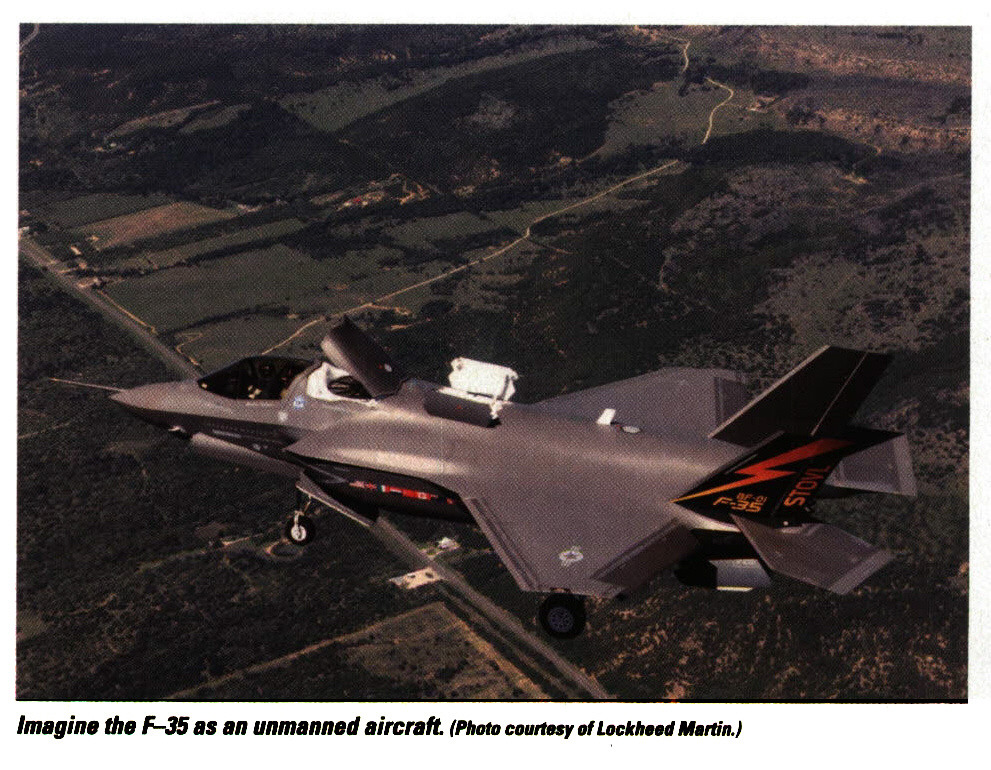
It is summer, 2020. Maj “Rump” Snyder relaxed a bit behind the UF-35B “remote crew station” while watching the unmanned Lightning II effordessly make contact with the tanker. He took a long sip of his black coffee, which reminded him that he had to pick up a gallon of milk on the way home tonight. War is hell. The UF-35B he was monitoring was in perfect formation taking on fuel. He thought, “Just 30 more minutes over Somalia and I’ll dick che ‘return to base icon sending this aircraft back to the carrier for rearming and maintenance.”

It was just 8 years ago that he finished joint F-35B pilot training at Eglin Air Force Base. Rump fondly reminisced about his “nugget” tour in Marine Fighter Attack Squadron 332, the first Marine F-35B squadron. When he joined the “Moonlighters” in 2013 there were more jets than pilots. Back in 2010 the almost “shovel ready” F-35 program received a substantial injection of money, which was good news for the Marine Corps. At that time the aging F/A-18 aircraft inventory required significant modifications, and a new Ăźghter was extremely welcome. By the time Rump arrived at the Moonlighters, the squadron had plenty of flight hours and planes to fly, and fly they did.

The training focus directed by the squadron commander, LtCol “Nomo” Hanchet, was on air superiority, secondary focus was on tactics assodated with the new technology of the F-35. The squadron took great pride at not only holding their own against U.S. Air Force F-22 squadrons, but they also trained in employing the F-35B to its maximum capability in complex high threat training environments. The Air Force RED FLAG exerdses were optimized for this kind of training and during his tour with the Moonlighters the squadron participated in three RED FLAG events.

The remaining “blue collar” squadrons (F/A-18 and AV-8B squadrons) supported Marine air-ground task force (MAGTF) training events like the new combined arms exerdses (CAXs) or “CAX IIs” along with the Marine unmanned aircrañ support squadrons (VMUs). Rump heard Nomo say many times that air-to-air skills are much more perishable than air-to-ground skills. “Good fighter pilots are made in the higthy dynamic air-to-air realm, and I don’t want to be a ‘training aide’ for the grunts. ” The F-35B training and readiness (T&R) requirements are vast, and “there just isn’t enough time in the day or flight hours to train to all of the missions delineated in the T&R.” Besides, the “North Koreans are about to move south and the Moonlighters have to be ready for the ‘first day of the war’ missions. ”

Rump found it hard to argue with that logic, particularly since the aviation portion of the CAXII syllabus focused on combined arms and low-altitude, high-threat dose air support (CAS). He heard the blue collar pilots say that all they needed was a target coordinate and time on target; the rest was just boring holes in the sky. The F- 35 didn’t have to go “low” or operate under the cover of suppressive fire combined arms tactics to conduct high-threat CAS. The F-35 exclusively employed global positioning system-guided munitions from standoff ranges at medium to high altitude. Flying in CAX II was like asking far a midair with an unmanned aircraft system (UAS). The farmer F /A-1 8D weapons and sensors officers now manning the VMU squa drons checker blocked the airspace with UASs performing CAS and even acting as airborne forward air controllers (FAC(A)s).

After Rumps fieet tour in 2016 he attended Expeditionary Warfare School (EWS). While at EWS Rump was introduced to modern maneuver warfare theorists like Boyd, Van Crevdd, andCanby, in addition to the seminal works of Clausewitz and Sun Tzu, all in the context of a warfighting philosophy based upon maneuver warfare, the Marine Corps concept for the conduct of war. Both a philosophy and method of warfare emphasizing an indepth understanding of commander s intent and mission type orders, maneuver warfare naturally leveraged tactical a viation far success but only if strong air-ground rda tionships existed. He intendy studied Ue wartime experiences of Guderian, Rudel, Patton, and Quesada pioneers in the integration of airpower with maneuver during World War II (WWII). It was ironic that ne Marine Corps was the only Service in the world tha t still practiced the “tactical air force” model perfected in WWII. Yet, through these pioneers writings, he contrasted his experiences as an F-35B pilot and saw himself- a product of F-35 B multimission training – as well equipped but poorly trained far the maneuver warfare now practiced by the MAGTF.

Through interaction with other servicemembers in his seminar, Rump relearned that the Marine Corps culture was indeed unique. Many of his contemporaries from the rotary-wing and F/A-18 andAVSB communities were eager to serve as battalion FACs and as air officers during their careers Not only were mese tours professionally rewarding many Marine pilots considered FAC tours essential for gaining the ground perspective. Yet, despite the fact that the other Services had tactical aviators, Rump learned that very few ever served on ground tours with the infantry The Air Force F-35A pilot in his seminar said that he joined the Air Force to fiy, not to be an air liaison officer with the Army. The Navy and the Army also didn’t send any of thier aviators to ground units as air liaison officers or as FACs. This seemed particularly odd for Navy F/A-18F aircrew qualified as FAC(A)s; they earned FAC qualifications as part of thier FAC(A) syllabus. Given this context he questioned the current institutional emphasis on the F-35B as the sole tactical aviation (TacAir) platform in Marine aviation capable of supporting five of the six functions of Marine aviation as if the Marine Corps would have to “go it alone.”1

As he studied joint warfare he dearly saw that the Marine Corps was missing an opportunity to facus its ever-decreasing TacAir community to specialize more in MAGTF operational art. The Marine Corps model was continuously contrasted by postwar historians with battlefidd failures where ground and aviation integration failed. He read about the success of this careful integration of ground and aviation under a single command during all of the major conflicts fought since a viation became a force on the battlefield. “Well,” he thought, “that’s all water under the bridge now, ” as he snapped back to the task at hand Rump subconsciously rubbed the leather patch on his flight suit as he dicked the “disengage” icon and then dicked the “IP (initial point) Delta” icon sending the UF-35B back to the CAS stack.

There is no doubt the F-35 B as a function of joint Service priorities and procurement economies will be the most advanced and capable multimission TacAir platform Marine aviation has ever procured. But just because the F-35 can do it all, doesn’t mean the Marine F-35 B pilot should. As part of a naval and joint team, Marine F-35 B squadrons should focus their training specifically in support of the MAGTF and rely upon the Navy and Air Force to maintain the multimission capabilities of the F-35. Our challenge is to train the Marine pilot to employ the F-35 B in a way that transcends his ability to land it vertically.

The MAGTF model is unique and envied. As the F- 35 enters service, Marine Corps leadership has set a high bar for the single-seat F-35 B pilot – more missions, fewer squadrons, fewer aircrew.2 So, as we embark upon achieving this lofty goal the challenge is do we train Marine F-35 B pilots to be “jacks” of all missions supporting five of the six functions of Marine aviation, or do we reinforce our core process of cross-pollination with F-35B training focused on Marine air-ground integration core competencies? The purpose of this article is to argue for the latter and deliberately tailor a Marine F- 35B pilot’s training to specific MAGTF missions within the context of limited funds and time available and cede other core skill missions to F- 35 squadrons of the naval and joint force.

For those of you who have served “combat time” in the Pentagon you may be thinking, “Migs, that’s not the way things work inside the beltway; what you are proposing won’t sell on Capitol Hill.” So with this admittedly Pollyannaish preamble, I want to express an operator’s perspective on what should be marketed on Capitol Hill as the future of Marine TacAir as it is transitioned to the F-35B.

Over the past 25 years Marine aviation has necked down from about 30 squadrons of largely single-mission Vietnam-era aircraft, such as F-4s, RF-4s, A-4s, A-6Es, AV-8As, OV-10s, and EA-6Bs, to 19 squadrons of multimission aircraft (F/A-18s, AV-8Bs) and 4 squadrons of the single-mission EA-6B electronic warfare aircraft. By approximately 2024 Marine TacAir will consist of about 21 squadrons of a single type/model/series aircraft, the F-35B (short takeoff vertical landing (STOVL) variant) or possibly some yet to be defined mix of F-35Bs and F-35Cs (carrier variant), in addition to more unmanned aerial support squadrons.3 Concurrently we’ve seen the emergence of joint warfare and unified action that has nearly eliminated the Service-sector approach to warfare (except perhaps in the Pentagon). The challenge for Marine aviation given this environment will be training the Marine F-35B pilot in an aircraft now being advertised as uniquely capable of performing five of the six functions of Marine aviation. This “remarkable breadth of employment allowing the Marine Corps to decrease its TacAir inventory” into a potentially all-STOVL force and “revolutionize air warfare and Naval Aviation into the 21st Century” has placed an “all in bet” on the F-35B redefining the very relevance of Marine TacAir.4

For the sake of argument, let’s as- sume that the Marine Corps’ vision concerning the value of the F-35B meets expectations and revolutionizes air warfare and naval aviation so much so that, by the year 2020, the F-35B STOVL variant is now the most widely produced fighter of the three variants and is procured by all three Services and our coalition partners. This pres- ents an interesting dilemma for the Marine Corps. The STOVL argument alone may not be sufficient to stand up against the ever-present pressure to re- duce seemingly redundant TacAir ca- pability within the Department of Defense, particularly in light of future reductions in defense spending. Using the multirole F/A-18 experience as a template for the future, training an F-35B pilot to be competent in the “remarkable breadth” of missions (de- spite the advanced fusion of sensors, mission systems, and advanced simulators) will dilute the “Marine” that makes the F-35B worthy of carrying the banner for Marine TacAir. Therefore, basing the very future of Marine TacAir on the F-35B without the proper context of why it’s a requirement for the MAGTF to have a Marine in the cockpit in the first place is placing the cart before the horse.

The culture of cross-pollination between air and ground is what makes the MAGTF unique across the spectrum of warfare. Therefore, at a minimum, it is of utmost importance to clearly and unequivocally state that, first, the Marine pilot is the guarantor of the relevance of Marine TacAir. And second, the platform is simply the means by which he does his “Marine pilot stuff.” Preserving and perhaps even enhancing the Marine F-35B pilot’s reason for existence should be first and foremost when defining the future relevance of Marine TacAir as we transition to the exponentially more capable F-35B. The T&R manual of a Marine F-35B pilot should be the foundation for leveraging the institutional cross-pollination that is the sole source of his unique contribution to the warfighting functions of the MAGTF. Just as the Marine Corps saw the strength in the justification for an F-35 variant with the hardware to support our unique operating environment (F-35B), it should also recognize the validity to operate the F-35 B in a joint environment in a way that leverages the unique nature of the Marine pilot from the first lieutenant to the colonel group commander.

To do otherwise would negate the deliberate career length cultivation of Marine TacAir pilots. Hard choices regarding F-35 B pilot training must be made in the context of limited funds and time available The primary factors we should use in those choices are Marine mission skills that reinforce our cultural ethos and training as MAGTF officers instead of aviators trained in the “breadth of employment” of the F-35 B. As evidenced by Marine F/A-18 squadrons, F-35 B squadrons will struggle with the “Marine generalist or Marine specialist” training dilemma.

The Multimission Marine Pilot: What’s Past Is Prologue

The Marine Corps will be engaged in conflict for the foreseeable future. When engaged across the spectrum of conflict, the Marine Corps will be part of a joint force flying fewer TacAir fighters than we have today. As evidenced during Operation DESERT STORM (ODS) and especially Operation IRAQI FREEDOM (OIF), Marine aviators operating throughout the depth of the Marine expeditionary force battlespace heavily employed armed reconnaissance and strike coordination and reconnaissance tactics – missions F/A-18 pilots rarely trained to before the conflicts. As a result, flight leads and wingmen well trained in antiair warfare perfected armed reconnaissance and strike coordination and reconnaissance mostly through on-the-job training. Marine aircrews fortunately leveraged their unique MAGTF culture and operated as extensions of Marine FACs and air officers connecting Marines in the command and control (C^sup 2^) centers to coordinate and control a tremendous amount of “unbriefed” joint air to support Marine ground forces, all in accordance with commanders intent. As OIF progressed, Marine F/A-18 squadrons returning to the United States were faced with a training dilemma. Do we focus our training for the inevitable deployment to Iraq, or do we revert to pre-war training and expend limited resources and time to train in accordance with the broad mission sets as delineated in the F/A-18 T&R manual?

The accomplishments of Marine TacAir in ODS and OIF offer a glimpse of what may be in store for multimission aircraft like the F-35B. In both conflicts the multimission F/A-18 and single-mission AV-8B performed the large preponderance of Marine TacAir support for the maneuver commander. F /A- 18D aircrews qualified as FAC (A) s were a much smaller subgroup of Marine aircrews uniquely trained and deliberately scheduled throughout a 24-hour period to help control and coordinate Marine TacAir and a tremendous amount of joint TacAir in support of commander’s intent. Compared to single-seat F/A-18 and AV-8B squadrons, the training requirements to earn FAC(A) qualifications – a core mission essential task list (METL) for the F/A-18D – came at the expense of aircrew proficiency for other missions. Since OIF I the single-seat F/A-18 and the AV- 8B squadrons now train to single-seat FAC(A) missions and are faced with the same dilemma of balancing core capability in critical MAGTF support missions like FAC(A) with maintaining capability in antiair warfare missions. Therefore, as Marine TacAir necks down to a single TacAir platform flown by fewer squadrons, training should maximize Marine machine interface to leverage joint “unbriefed” air to support the MAGTF.

The F-35B Pilot: Marine TacAir Specialist

Only the Marine Corps, through its purposely designed culture of integration and dependence upon its aviation arm, can redefine the training of Marine aviators to better leverage aerial forces in cooperation with ground forces. The size of the Marine TacAir force when compared to the Navy and Air Force can be a combat multiplier if not diluted with requirements to maintain on-par skills in missions not directly supporting ground maneuver. Just as the joint process yielded unique Service variants of the F-35, the current joint warfighting environment, as evidenced in the examples cited above, allows for specialization of the Marine pilot.

The leadership of the Navy and the Marine Corps should move forward under a combined strategy that links Marine and Navy aviation under a mu- tually enabling naval aviation vision built upon a deliberate alliance that be- comes closer under budgetary pressure not wider. Leveraging the F-35B/C joint acquisition experience, its time to mandate more specific and mutually dependent functions for the Navy and the Marine aviator. Within this con- struct the Navy and Marine Corps should construct the “functions of naval aviation” and then delineate sub- functions for Navy aviation and Marine aviation that encompass opera- tions at sea, on land, and combinations of the two. Each Services air arm should be given the lead in aviation functions directly related to its Service culture, similar to a supported-support- ing relationship. Once this is agreed to, the Services can write T&R documents delineating the training necessary for Marine and Navy aviators to support those functions. The end product should be a Navy F-35C T&R broadly focused but with specific and defined roles to maintain maritime and air su- periority, and a Marine F-35B T&R that is focused on air supporting ground maneuver. The combined Navy and Marine T&R should reflect the ability for the naval force to operate from both carrier and amphibious shipping as well as expeditionary airfields while delineating specific and deliberate reliance upon individual Service expertise that leverages Service culture.

To illustrate this concept, the Navy would be named the supported Service for antiair warfare and therefore responsible to maintain leadership in air-to-air and air defense tactics development and proficiency. The Marine Corps would be supported in offensive air support in MAGTF operations and therefore responsible to maintain leadership in tactics and proficiency. This would enable Marine pilots to achieve and maintain mastery in missions, such as CAS and deep air support (FAC(A)), armed reconnaissance, strike coordination and reconnaissance, airborne tactical air control, and to train the pilot to leverage the F-35B in supporting maneuver warfare. Core METLs for Marine F-35B squadrons would be focused on creating an aerial force completely at ease with operating with ground commander’s intent as if it were their own on the first day of the war. Training to the supporting roles or noncore METLs of each Service would require fewer sorties in those areas but also provide a “surge” capability if an overweight in a mission area was required. For example, a six plane F-35B detachment operating from an expeditionary strike group would be a force multiplier in helping the carrier strike group establish maritime supremacy yet be the catalyst in employing airpower from a carrier strike group in accordance with ground commander’s intent once forces move ashore.

Once this supported-supporting Navy-Marine Corps employment architecture is in place, Marine aviators can focus on enhancing Marine TacAir’s support to facilitate maneuver and thereby avoid the MAGTF on-the-job training that occurred in ODS and OIF. Through the adoption of a more focused Marine F-35B T&R manual, Marine squadrons could train more pilots earlier in their tours to become organic airborne partners with ground forces, not just additional TacAir pilots who service a target on time. The importance of the armed reconnaissance, strike coordination and reconnaissance, FAC(A), and tactical aircraft controller (airborne) missions as functions of maneuver warfare needs to be heavily emphasized during Marine TacAir training. Marine TacAir’s ability to conduct coordinated and well-planned and executed reconnaissance missions is based upon training the Marine pilot to know what to look for and why and is often not emphasized in today’s F/A-18 squadrons due to other multimission training priorities. This capability is a distinct benefit to our ground forces engaged in the less distinct or “hybrid challenges” characterizing today’s conflict. The additional trust engendered by this training focus, combined with the interoperable network capability of the F- 35B with other Service variants, has the potential to flatten C^sup 2^ further increasing Marine TacAir’s contribution to maneuver in ways yet to be discovered.

The current joint C^sup 2^ system for CAS is useful for processing “unbriefed air,” but the control measures slow the speed and tempo and by design reduce initiative. Marine C^sup 2^ operating as a subset of joint C^sup 2^ is unique and has the potential to better support maneuver warfare and irregular warfare. Yet trends indicate that Marine air C^sup 2^ is migrating to a more centralized electronic joint format that doesn’t leverage Marine aviators in ways commensurate with their experience real-time in the airspace over the batdefield. For example, Marine air group and squadron commanders rarely function as “commanders” airborne and often fly as flight leads and even as wingman on missions that junior pilots can perform. Conversely, young pilots are conditioned to answer the CAS mission with a bomb on time on target; their thoughts and observations are not part of the normal combined arms training process. The networking capability combined with the “flying sensor” qualities of the F-35 could equate to information overload to maneuver forces if not leavened by pilot perspective operating with commander’s intent, or worse, further disaggregate the F-35B pilot or the more seasoned squadron commander from the “fog and friction” and tempt commanders to remain in the operations center.

If approached correctly the F-35B may pave the way for airborne warfare qualifications for Marine TacAir commanders operating within the joint environment from irregular warfare to major combat operations underpinned by the maneuver warfare warfighting philosophy. In this role commanders could leverage the advanced mission systems and networking capability of the F-35 B to operate as more than just mere extensions of the tactical air operations center and direct air support center. Perhaps they could finally be a part of the Marine air C^sup 2^ system airborne, over the battlefield, fusing ground commanders intent with their years of aviation expertise acting as airborne commanders. This layered approach to aviation C^sup 2^ would increase the tempo of Marine air C^sup 2^ and form the basis for a pilot training model that reinforces initiative and thinking in a fluid environment and in the more static irregular warfare environment. Manned Marine TacAir limbered by the advanced capability of the F-35 B and a MAGTF training vision will thrive in both environments.

Conclusion

The acquisition of the F-35B mandates a review of Marine aviation doctrine to ensure that the aircraft best supports Marine Corps warfighting doctrine through the maximization of the most important sensor in the aircraft, the Marine pilot. This is a temporal shift away from the ever-present problem of managing the impact of CAS frags on maintaining pilot core competency in other missions. Flying with ground commanders intent in support of maneuver is warfare art borne in our Marine culture and only honed through specific pilot training. Perhaps this is the only airborne mission that cannot be replaced by a UAS. When the F-35 B is branded with “Marines” on its fuselage, it must mean more than vertical landing.

Notes

1. Marine aviation is task organized to support the MAGTF as the aviation combat element by providing six functions: assault support, antiaircraft warfare, offensive air support, electronic warfare, control of aircraft and missiles, and aerial reconnaissance.

2. Transition to the F-35 will eliminate F/A-18D weapons and sensor officers and EA-6B electronic countermeasures officers. Additionally, the Marine Corps will see an aggregate decrease in TacAir inventory.

3. Headquarters Marine Corps, United States Marine Corps Concepts and Prcgrams, Washington, DC, 2008, p. 145.

4. Ibid.

Good Decisionmakers Are Not Enough

by Capt Matthew Van Echo

The current training focus on decisionmaking is insufficient for developing Marines capable of making creative decisions consistent with our maneuver warfare philosophy. A disproportionate amount of focus is placed on teaching Marines how to make a decision and execute tactics, techniques, and procedures (TTP). These skills are important in developing effective Marines and units, but they must not displace an emphasis on teaching creativity. Current training does address decision- making. Trainers must facilitate an educational environment that encourages independent learning and self-evaluation, tolerates mistakes and teaches how to cope with failure, and uses doctrine, not TTP, as the intellectual foundation for a cooperative and socially dynamic training environment to develop creative decisionmakers.

Where Are We Now?

A quick look at the current training focus will demonstrate a shortfall that exists in training Marines to be creative decisionmakers. Each entry-level institution (boot camp, Officer Candidates School (OCS), and The Basic School (TBS)) doesn’t employ effective decisionmaking methods. Boot camp and OCS primarily focus on indoctrinating recruits and candidates into the Marine Corps. While indoctrination is an important concept, little of maneuver warfare doctrine has found its way into the training fundamentals of the Marine Corps’ entry-level training institutions. Maneuver warfare demands decentralized decisionmaking, initiative, and boldness, yet boot camp and OCS seem to emphasize rote memorization and instant obethence to orders in a highly centralized environment. It is difficult to comprehend how close order drill, a staple of first-generation warfare, is an effective indoctrination tool for the Marine Corps, which increasingly is finding itself engaged with a fourthgeneration enemy. Even TBS, which prides itself on producing decisive lieutenants and warrant officers, does litde more than teach new officers to accept making decisions in an ambiguous setting. Instead of being rewarded for effective solutions to tactical problems, students are encouraged to apply techniques learned in a class, whether or not they are appropriate for the situation. Staff members are advised to discourage “out of the box” solutions to tactical problems. Both situations discourage innovation in favor of the “safe” and predictable solution to tactical problems.

The focus of training in the Operating Forces does little more to encourage creativity. The Marine Corps’ obsession with synchronizing fires as the pinnacle of training does little to emphasize creativity. At no point in this type of training does innovation factor into a unit’s success. This type of training gets bogged down in the second-generation warfare concept of synchronization and doesn’t properly address decisionmaking and creativity.

One example of where decisionmaking and creativity connect is Exercise MOJAVE VIPER, which does incorporate long-accepted methods for training a maneuver warfare force like using force-on-force exercises and detailed debriefs. These both help develop creative decisionmakers, but units traditionally execute MOJAVE VlPER immediately before deploying to Operation IRAQI FREEDOM. However, the timing for this type of training is a case of “too litde too late.” One possible explanation for this training shortfall (from the training institutions and Operating Forces units) is that there is a prevailing misunderstanding of what creativity is and how it enables maneuver warfare.

Creativity and Decisionmaking

Training should be rooted in decisionmaking with creativity as a constant thread throughout. The fluid nature of war makes this imperative. Decisionmaking skills alone might not properly address a tactical situation because there is always the potential for making a decision that is completely inappropriate to the situation. Additionally, a predictable action, either through initiative or reaction to the enemy, can have detrimental effects. In his book, Creativity: In Education and Learning Arthur J. Cropley argues that:

Genuine creativity requires a further element over and above mere novelty: a product or response must be relevant to the issue at stake and must offer some kind of genuine solution, i.e. it must be effective.1

From that position it is clear to see that trainers must move beyond merely developing decisionmakers and also work to develop Marines who can orient on a problem that ultimately produces an effective decision. Too often in training, decisionmaking is neglected in favor of the “right” answer. This is what Cropley describes as convergent thinking:

Convergent thinking is oriented towards deriving the single best answer to a question. It is effective in a situation where a ready-made answer exists and needs simply to be recalled from stored information, or where the answer can be worked out from what is already known by conventional and logical search, recognition, and decision making strategies. . . . but it focuses on recognizing the familiar, reapplying set techniques and preserving the already known and thus does not preserve novelty.2

Trainers should aim to develop divergent thinkers who would lead to more creativity. Cropley defines divergent thinking as:

Divergent thinking, by contrast, involves processes like shifting perspective, transforming or producing multiple answers from the available information and thus favors the production of novelty.3

With Cropley’s explanation it is clear that the result of training should be the development of divergent thinkers as opposed to convergent thinkers because a divergent thinker is more likely to develop a creative and appropriate response to a tactical problem where a convergent thinker will likely produce a predictable response.

Marine Corps doctrine provides a good starting point to examine how training can be structured to develop creative decisionmakers within the maneuver warfare philosophy. Marine Corps Doctrinal Publication 1-3 (MCDP 1-3), Tactics, describes the Boyd cycle or what is commonly referred to as the OODA (observe, orient, decide, act) loop. MCDP 1-3 further explains that the better one can orient on a situation, generally the better his decision will be. The primary goal of training should be to improve a Marine’s abilities to orient on a given situation. A divergent thinker is capable of looking at a problem from multiple perspectives and arriving at multiple solutions. These characteristics of divergent thinking, in essence, describe how a Marine orients in the context of the Boyd cycle. If a Marine observes a fixed stimulus then the recognition of patterns and potential solutions becomes how the Marine orients on the problem. Training should examine and develop how Marines interpret their observations, to see why some items standout more and thus have a greater impact on the decision. This process generates dialogue, debate, and discussion that will engage more Marines and result in more education than if TTP were the only focus.

Understanding how the Boyd cycle should frame the goals for training helps one see the connection to recog- nitional decisionmaking. MasteringTac- tics: A Tactical Decision Game Workbook (Marine Corps Association, 1994), by Maj John F. Schmitt, USMCR, set the intellectual framework for understand- ing the value of tactical decision games and their role in developing recogni- tional decisionmaking skills. It highlights the need to increase exposure to tactical scenarios with requisite participation and discussion to increase one’s exposure to decisions. The true value of the method is discussing which factors one uses to develop his solution. These drills enhance one’s abilities to recognize similar combinations of variables and improve decisionmaking by providing an additional experience to orient on future problems. This ability to recall similar situations or patterns enhances decisionmaking and begins to open the door to developing creativity. It is impossible to predict every tactical situation in which a Marine might find himself. It is just as impossible to try to create a playbook of tactical responses to every potential situation. It is possible though to predict that Marines will always find themselves faced with making a decision in a friction filled environment. It is this very reason that makes it obvious that to properly execute maneuver warfare, the development of creative decisionmakers must be the core element of all training.

Implementing Change to Develop Creativity

Much can be done to develop creativity without significant changes to training schedules. The most important change is to simply accept the idea that Marines must develop more creative decisionmaking skills. The next step is to incorporate the following ideas into existing training programs. Units will have different degrees of tolerance for change, but the more change is embraced the more successful the training will be.

Independent learning and self-evaluation. It is generally accepted that one learns better when self-motivated. This is especially true for adult learners who must recognize the value in what they are learning to achieve the greatest retention of what is being taught. When learning accompanies initiative, the path of discovery is limited only by the individual. The learning experience is broadened and enriched, unlike the externally directed learning experience. Learning is usually greater when students are engaged in the subject material. A more engaged learner exhibits higher retention and assimilation of material taught. Through a self-motivated education one is more likely to evaluate the worth of his pursuit and the quality of his work. This self-evaluation becomes important during the Boyd cycle because Marines will be more critical of their thought processes thus ensuring that important pieces of information are not overlooked, resulting in faulty orientation on the problem. Achieving this level of self-education requires leaders to not only encourage self-education but also to provide guidance for how to pursue it. Just like any attitude a commander wants his unit to adopt, this idea must be regularly addressed and, more importantly, practiced by the leadership.

Mistakes must be tolera ted and failure learned from. Most adults learn best by doing or performing a particular action. This is because performing a multiple process function involves more parts of the brain resulting in greater retention of knowledge. Using more areas of the brain where knowledge can be stored increases the potential recall of information. By creating an environment that tolerates honest mistakes, Marines will be more willing to be proactive and thus attempt to do more things on their own, which then leads to increased experiences. This idea should not sound new. MCDP 1, Warfighting, addresses this issue, explaining that successful after-action critiques require commanders to be willing to tolerate mistakes by subordinates. By being willing to accept mistakes there will be a greater willingness to offer new or alternative ideas. As Marines become comfortable with this practice they will become better problem solvers and ultimately provide more creative decisions.

An important aspect of this approach is to teach Marines how to deal with failure. Simple methods include analyzing a mistake to determine the cause of failure. This analysis should be used as a learning opportunity to expose the flaw in the Marines thought process, to see why that flaw caused negative results. Marines who are trained to see failure as an opportunity for growth will be more willing to seek innovation rather than the predictable solution and will be better suited to handle failure caused by uncontrollable factors. This increased adaptability will enhance their abilities to function in fluid environments.

Doctrinal principles must form the foundation of a cooperative training style Principle-based training, which provides more natural and instinctive responses to externally imposed forces than attempting to apply techniques and procedures, is a superior method of training than using TTP. From this style of training, unit TTP can develop but not at the risk of becoming the only solution to different problems exhibiting some similar characteristics. Training and, more importantly, education should focus on warfighting principles, understand Marines’ abilities to recall similar situations, and foster and encourage creativity.

What About the Basics?

It is easy to confuse the above argument with the idea of tossing the Training and Readiness Manual (TScR Manual) out the window resulting in each unit (platoon, company, and battalion) having very diffĂ©rent tactics, but a further examination is needed to see that this is simply not true. The T&R Manual is a good tool to justify training requirements like ammunition and targets. It is good for explaining performance steps using the “task, condition, standard” template. If one were to look at it within the three levels of war – moral, mental, and physical – as described by Col John R. Boyd, USAF(Ret) in his Patterns of Conflict (unpublished manuscript, 1986), he would quickly realize that the TĂ´cR Manual only touches on the physical level of war. Training to develop creativity is not intended to replace a solid foundation in the science of war. It is intended to use these ideas with training in the science as a vehicle for providing opportunities to study decisionmaking and develop creativity.

Conclusion

Using creativity as the centralized focus with individual education as the decentralized method, a unit can create an environment conducive to improving the application of maneuver warfare. Training to make Marines decisionmakers can be a daunting task. Success is not easily quantified. However, by not applying creativity to our decisions, we may be simply playing into the hands of a highly adaptable enemy. Creativity is one of the best skills the Marine Corps can impart on its Marines to be more effective on today’s battlefield.

Notes

1. Cropley, Arthur J., Creativity in Education and Learning, Kogan Page Limited, London, UK, 2001, p. 15.

2. Ibid., p. 32.

3. Ibid.

Is Warfighting Enough?

by Col Chet Richards, USAF(Ret) & MAJ Donald Vandergriff, USA(Ret)

What are military forces going to be doing in the 21st century? Marines and the other members of America’s Armed Forces train to go to war. This seemingly bland statement actually holds the key to resolving practically all of the arguments about doctrine, training, counterinsurgency, and stability operations that we have all been reading about recently. The reason is that it is not immediately obvious that there is going to be much need for fighting wars or even deterring them in the future.

The great strategists, from Sun Tzu to Clausewitz, may not have agreed on much, but the one opinion that they held in common was that “war” is something special: “War is a matter of vital importance to the State; the province of life or death; the road to survival or ruin.”1 Clausewitz insisted that one of the defining characteristics of war is that it “is an act of violence pushed to its utmost bounds,” restrained only by one’s intelligence and the counterproductive nature of too much violence. So if what you’re engaged in doesn’t look like this, it is at the very least a strange form of war.

Is It War?

A Clausewitzian conflict among nuclear powers is likely to achieve not only the age-old dream of every pacifist-the elimination of war-but unfortunately, also the elimination of the human race. And as a range of strategists from Thomas P.M. Barnett to Martin van Creveld has observed, real “province of life and death” wars have ceased even among minor powers, once the antagonists acquired nuclear weapons.

Although it may not be entirely obvious from looking at the defense budget and, in particular, the vast sums still spent on weapons to fight large-scale conventional war, American military doctrine is beginning to accept this fact. As the new counterinsurgency manual, Field Manual 3-24 (FM 324)/Marine Corps Warfighting Publication 3-33.5 (MCWP 3-33.5), Counterinsurgency, puts it, “Sometimes, the more force is used, the less effective it is,”2 which is a statement that would have puzzled Clausewitz to no end. In the types of conflicts we are likely to be engaged in, however, the struggle is not to defeat another military force but to reestablish a government that the vast majority of people will regard as “legitimate.”3 Once such a government is in place, it can use its own resources to mobilize the people to put an end to insurgencies of either the domestic or the transnationalfourth generational-variety. Tactical success by U.S. forces on the battlefield, the manual explains, guarantees nothing.4

This is all very strange. One is tempted to believe that Clausewitz would have concluded that what we’re engaged in is not war at all and then launched off to write another 500-page treatise on legitimacy or whatever. It is already starting to happen. The recently retired British officer, Sir Rupert Smith, like Clausewitz a successful commander of his day, begins his exploration of the utility of military force by observing that such forces are often used nowadays for purposes for which they were not originally intended.5 Even a casual reading of Sir Rupert’s book strongly suggests that the further away from their original purpose, the less successful the application.

Boyd and the nonwars of the 21st century. What all this means is that for the first time since the founding of the Republic, there is no way to tell what American military forces will be used for and, therefore, should be trained for in the future. For that reason, late U.S. Air Force Col John R. Boyd may turn out to be the most influential strategist of the 21st century. Marines know Boyd primarily through the orientation, observation, decision, action (OODA) loop concept and from his influence on maneuver warfare. But Boyd’s impact on the Corps runs much deeper, and when Boyd died in 1997, then-Commandant Charles C. Krulak wrote, “I, and his Corps of Marines, will miss our counselor terribly.”

Fortunately, for all members of the U.S. Armed Forces, Boyd’s concept of strategy offers ideas for resolving 21st century conflict that might prove useful to avoiding future impasses like Iraq. Probably every Marine understands that the essence of maneuver warfare is to create chaos and exploit it faster than the other side can sort it out. These Boyd-type strategies will have not only physical but also mental and moral effects on opponents, degrading their abilities to function as harmonious teams. Physical effects are things like surfaces and gaps; mental effects are related to confusion, disorientation, surprise, deception, and ambiguity; moral effects are the strongest of all because they govern whether the opponent will even retain the will to continue the fight.

In creating his theory Boyd was able to incorporate ideas from an enormous body of science unavailable to Clausewitz, particularly the second law of thermodynamics, relativity, quantum mechanics, the “new sciences” of chaos and complexity, and advances in the biological and social sciences, such as the theory of evolution by natural selection, experimental psychology, genetics, neurophysiology, and the epistemology of science. The result is a truly new and original synthesis that is based as much on destroying the other side’s ability to function as a coherent system as on improving our own capacity to work effectively under conditions of stress and uncertainty.

The destructive side-the OODA loop. Fundamental to applying Boyd’s concepts is the realization that the OODA loop isn’t really a loop at all. Boyd, in fact, never drew it that way. Instead, the loop is better considered as a way of thinking about conflict based upon the concept of keeping our orientations better matched to reality than our opponents’. Boyd demonstrated, by combining examples both from military history and modern science, that the side that can do this will not only respond to changes more quickly, but can also shape the situation to its liking and then exploit it before the opponent can react. Another key is, through training and experience, to assemble an arsenal of potentially effective actions that will flow intuitively, smoothly, and quickly from orientation. The end result is, as Boyd called it, to “operate inside an opponent’s OODA ‘loop'” and thus produce rapid, jarring changes that disorient and demoralize the opposition.

The constructive side-attracting the uncommitted. This is all well and good, but it sounds like a better way to fight wars, which we may not be doing that much of in the future. The other, lesser appreciated, half of Boyd’s work provides tools and concepts more suited to such nonwar purposes as restoring legitimacy. First, it is important to recognize, as the new counterinsurgency manual emphatically does, that there is a limit to what military forces can be expected to accomplish. As the manual notes, “Military action can address the symptoms of a loss of legitimacy” and only the symptoms because “political factors are primary.” The important point, as Boyd insisted, is that the “good guy” military force-our coalition, for example-must operate in such a way as to:

* Support our national goals.

* Pump up our resolve, drain away adversary’s resolve, and attract the uncommitted.

* End the conflict on favorable terms.

* Ensure that the conflict and peace terms do not provide seeds for (unfavorable) future conflict.6

By operating inside the opponent’s OODA loops, we:

. . . permit real leadership to avoid high attrition, avoid widespread destruction, and gain a quick victory. This combined with shattered cohesion, paralysis, and rapid collapse demonstrated by the existing adversary regime makes it appear corrupt, incompetent, and unfit to govern.7

The same is true if we can quickly and efficiently eliminate the military component of an outside or illegitimate organization. In other words, by operating according to the principles that underlie maneuver warfare, we not only win the armed conflict, but we make it more likely that we, and the affected population, win the subsequent peace. Boyd’s analysis, by the way, suggests that the coalition military did exactly what militaries are supposed to do by quickly occupying Baghdad, with relatively few casualties on either side, and thoroughly discrediting the Ba’athist regime. What happened next provides yet another argument for considering occupations and perhaps even counterinsurgencies as something other than war.

But Carry an Effective Stick

Perhaps Boyd’s most powerful contribution to the 21st century lies not in better ways to fight, even ways to fight that don’t make the political situation worse, but in putting the focus on the positive elements of conflict. Thus his magnum opus, Patterns of Conflict, ends not with the OODA loop and sowing deception, ambiguity, and chaos, but with the “theme for vitality and growth.” In other words, our focus should always be on attracting people around the world to engage peacefully with us and our way of life, while we, in partnership with our allies, retain the capability to deal quickly and elegantly with those who would use force to gain their objectives.

Perhaps the strongest reason for recommending Boyd to those who must deal with the strangeness of the 21st century is the equally strange fact that Boyd was not primarily concerned with warfare. Although he is recognized as a father of maneuver warfare, nowhere in the 300 or so pages that he left does he use the term. He would certainly have agreed with both Sun Tzu and Clausewitz that warfare must serve a higher purpose or it is just brutal savagery. So throughout his work, he emphasized destruction and creation, coercion and attraction, chaos and harmony, isolation and interaction. These principles apply to the rifle squad just as they do to national policy, which, if you stop to think about it, is what Gen Krulak’s notion of the “strategic corporal” is all about.

Creating strategic corporals (and strategic colonels). So, how do we create strategic corporals, strategic lieutenants, strategic majors, and strategic colonels? The trick is to instill a culture like the one embodied in Marine Corps Doctrinal Publication 1 (MCDP1), Warfighting, and MCDP 6, Command and Control. Boyd once called it the “principles of the blitzkrieg,” but dropped that description in favor of “an operational climate for organizational success.” The essence of this approach is to ensure that we lead through auftragstaktik, a German word that implies that once everyone understands the commanders’ intent (two levels up), then people are free to, and indeed dutybound to, use their creativity and initiative to accomplish their missions within the intent. Within such an environment, teams will largely self-organize within the doctrinal framework to accomplish the mission. Marine Maj Gen James M. “Mike” Myatt once summarized this command philosophy as not being “centralized decision and decentralized execution. It’s centralized vision and decentralized decision making.” It is the climate that enables “strategic” soldiers at every level.

It is the mission of every military organization to create leaders and units that can operate under this concept. As one speaker at a recent Boyd conference at Quantico noted, in the 21st century, the other side has to operate this way. Centralized control isn’t an option for them.

Adaptive leadership is key. How do we create cultures and leaders capable of auftragstaktik, or as Boyd called it, “operat[ing] inside opponents’ OODA loops”? Some interesting work is now taking place. In its adaptive leaders course (ALC), for example, the Army is experimenting with bold new techniques in some of its precommissioning and junior officer training programs. One of the elements in this approach to developing adaptive leaders is the innovative use of tactical decision games (TDGs), a technique popularized by LtCol John F. Schmitt, USMC(Ret). The ALC combines TDGs with other approaches through experiential learning, scenario-based education, 360-degree evaluations and, most importantly, outstanding teachers.

The essence of the ALC is not to arrive at the school solution, or even to teach the students to go down a prescribed checklist of steps. For an era where we cannot predict what leaders will be doing-or even if it should be called war at all-the checklist mentality is irrelevant at best. Instead, the method requires instructors to put students into increasingly complex and disorganized scenarios. A good scenario employing TDGs gives students a tactical problem and then puts them under stress-often a time constraint-but there are other means limited only by the instructor’s imagination. The students must present not only their solutions but also explain why they did what they did. The instructor and the other students will critique, pro and con, the solution as well as the explanation and the technique for solving the problem. Did the students, for example, use an effective balance of written and verbal instructions? Why did they micromanage their noncommissioned officers? Did the local population think better of the coalition as a result, or did the “favorable” body count just help recruit more insurgents?

The impact of the training can be magnified by combining TDGs with the study of military history (the best TDGs are based on historical examples) and intensive fieldwork that includes free play exercises. To be most effective, these teaching approaches must take place under the cultural umbrella of what is called a “learning organization.” In contrast, today’s approach to developing leaders is still focused on a top-down memorization of processes, which is not going to help future leaders achieve mastery of Boyd-type principles.

Training adaptive groups. Recent research out of the Royal Norwegian Naval Academy (RNoNA), where many of their graduates will serve in the Third World under conditions of transnational or fourth-generation warfare, reinforces the ALC philosophy. In particular, the Norwegians, who briefed their findings at the Boyd conference, emphasized that if we want to develop leaders who can be effective in unstructured, politically charged environments, then instructors must provide such environments to the students as part of their training. In other words, to learn to use OODA loops (they use that terminology), you have to be in an environment where OODA loops make a difference.

In all of the Boyd-like approaches to training, students are continually observed, evaluated, and forced to analyze how they arrived at their decisions under stress. Uniquely, the RNoNA has developed and statistically validated ways to quantify the “maturity” of groups, which defines their readiness to operate in fourth-generation-type environments. The academy can then apply the appropriate “interventions” to help those groups that are lagging in their development.

Conclusion

OODA loops are still the answer. From the standpoint of Boyd’s strategic concepts, the 21st century is moving in a favorable direction. Although large-scale warfare among developed states is increasingly unlikely, conflict, the real subject of Boyd’s investigations, is eternal. As the world approaches 9 billion people by the end of the century, competition for increasingly scarce resources is going to make conflict, including the use of large-scale armed forces in the developing world, even more likely.

As Boyd insisted, successfully resolving future conflicts so that we don’t again become bogged down in multiyear insurgencies will very much be a “carrot and stick” affair, where the emphasis is not so much on “unconditional surrender,” or other 19th and 20th century notions, as on persuading people not to offer support to dangerous groups. A component of this approach may be that we have to discredit those who would use organized violence to achieve their ends. When this becomes necessary, Boyd’s timeless concept of operating inside their OODA loops provides the mechanism for achieving this goal rapidly and with minimum damage to our coalition, to enemy forces, and to friendly and uncommitted populations.

Providentially, as the 21st century breaks, we and our likely allies are developing training and leadership development methods that can be proven to achieve the level of proficiency needed to make Boyd’s concepts live. So operating inside the OODA loop can be as realistic a concept for ending the tragic conflicts of the developing world as it was for achieving victory in the skies over Europe, Korea, and Iraq.

Notes

1. Sun Tzu, The Art of War, translated by Samuel B. Griffith, Oxford University Press, Oxford, NJ, 1963, p. 63.

2. FM 3-24/MCWP 3-33.5, Counterinsurgency, Headquarters Marine Corps, Washington, DC, 2006, p. 127.

3. Ibid., p. 128.

4. Ibid., p. 122.

5. Smith, GEN Sir Robert, British Army (Ret), The Utility of Force: The Art of War in the Modern World, Penguin, London, 2005, p. xii.

6. Boyd, Col John R., USAF(Ret), Patterns of Conflict, unpublished briefing, December 1986, p. 139.

7. Ibid., p. 142.

On the Conduct of War

by 1stLt Mauro Mujica III

Maneuver warfare is defined as a:

. . . warfighting philosophy that seeks to shatter the enemy’s cohesion through a variety of rapid, focused, and unexpected actions which create a turbulent and rapidly deteriorating situation with which the enemy cannot cope.1

The theory is simple in its idea yet complex in its application. It is possibly the first thing that every second lieutenant is taught-and is certainly the most valuable. It has proven over the years that the Marine Corps as a military force is in a league of its own. The idea itself is not new. Sun Tzu, in The Art of War, described similar principles. They are as true today as they were 2,000 years ago. In order to be successful in Iraq and in future operations, maneuver warfare must not only be emphasized in theoretical discussions and the classroom, but it must be ingrained into the way we conduct our operations.

In March 2003 coalition forces barreled across the Iraqi border to liberate a nation under a tyrannical government and advance our national security. We again demonstrated that U.S. military forces engaged in conventional operations are unmatched. It should be no shock then that the enemy forces that remained would begin utilizing unconventional methods to inflict maximum casualties.

The improvised explosive device (IED), a rather simple concoction, has become the ideal weapon to employ against occupying forces with predictable main supply routes. One can immediately see the “surface” that has caused such devastating casualties, yet we have done little to find the “gap.” The numbers themselves highlight the effectiveness of the enemy’s principal weapon against coalition forces.2 While we train our Marines in the classroom to find gaps to maneuver on the enemy, the continuing course of action in Iraq has been to bolt more armor onto our vehicles and develop more sophisticated electronic countermeasures. These actions contribute to a cycle in which we develop new ways to protect ourselves from IEDs while the enemy evolves more sophisticated IEDs, as witnessed by die implementation of the pressure or motion switches that are being seen today.

We have in fact been practicing the opposite of maneuver warfare. We have found the enemy’s surface and have pushed even harder into it. We allow our enemy to completely control the tempo of the fight by controlling the who, when, and where of contact. During 4 months in Ramadi our battalion didn’t catch one confirmed triggerman in the aftermath of an IED attack. With all of the capabilities that the Marine Corps has, we are long overdue to reorient and act.

The use of IEDs has created a central problem that is compounded when given the nature of this war; it grants the enemy anonymity. Coalition forces can’t orient on an insurgent force that can’t be identified. Given the amount of emphasis our doctrine places on orienting on the enemy, it should be obvious that drastic action is required if we are to succeed in defeating this very stealthy foe.

We should try to understand the unique characteristics that make the enemy function so that we can penetrate the system, tear it apart, and, if necessary, destroy the isolated components. We should seek to identify and attack critical vulnerabilities and those centers of gravity without which the enemy cannot function effectively.3

The insurgent’s center of gravity is his capacity to camouflage himself within the general population and therefore dictate the tempo of battle. He decides when to attack while quickly withdrawing before coalition forces can acquire positive identification. The enemy is only allowed such privileges because he hides within a population that either actively or passively supports him. There are three courses of action that will allow coalition forces to orient on the enemy. The first is to place a far greater emphasis on information operations (IO). The second is to augment the intelligence community with additional capabilities. Finally, the third is to nullify the IED and draw the enemy into small arms engagements where it is easier to acquire positive identification.

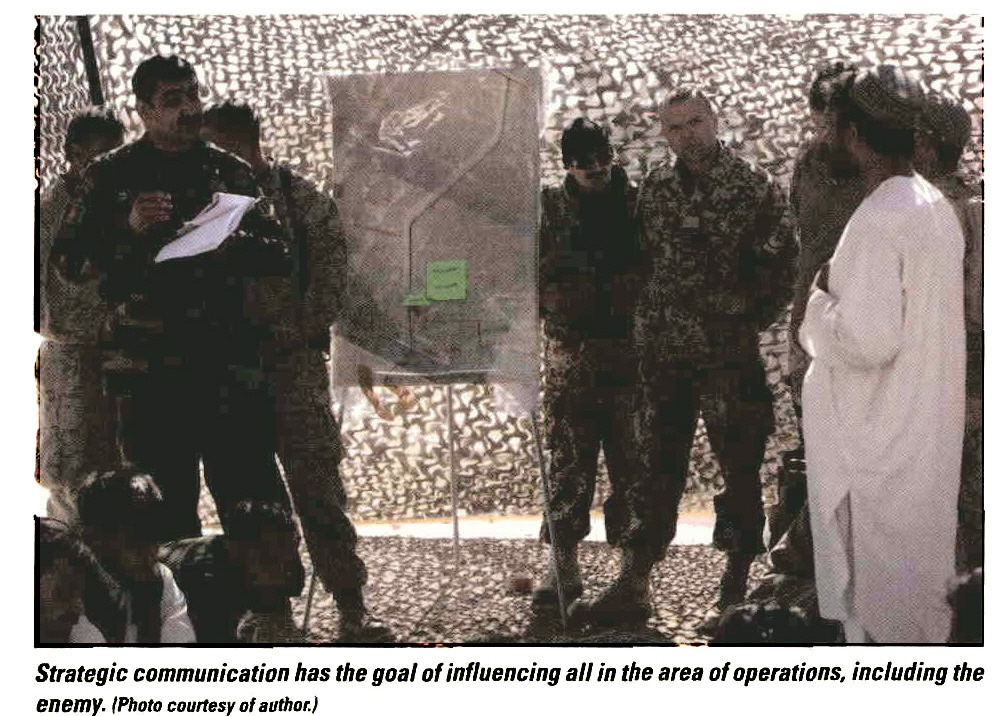
Far too often operations have been run in Ramadi without a detailed or well-planned IO component. It was often a cursory check in the box that equated to the Marines handing out leaflets with a generic statement appealing to the people’s national pride. The Marine Corps takes great pride in its ability to give subordinates the commander’s intent allowing for decentralized execution. We tell the Marine the “why,” but we rarely afford the same courtesies to the Iraqis caught in the middle of this war. It is not out of benevolence that we need to inform them of why we are running operations; it is in order to begin driving a wedge between insurgent groups and the populace. We can attack the decentralized enemy itself with a powerful IO campaign. Within Ramadi we identified rifts between various factions that made up anticoalition forces. Now is the time to exploit them. Currently, IO is extremely centralized, and company commanders are not given the authority to produce their own IO effort. This situation is utterly contrary to the way the Marine Corps does business. We must give the commander guidance and allow him to use his specific knowledge of the area of operations in order to effectively shape the battlefield through IO developed at the company level.

While the insurgency can be likened to organized crime, the Marine Corps is certainly not the Federal Bureau of Investigation. We have completely different missions, yet we agree that intelligence drives operations. When fighting an insurgency, intelligence often is the operation. Thorough intelligence sheds light on a darkened enemy and allows units to develop target packages that subsequently lead to raids. Logically, therefore, the better the intelligence is the more precise the raids will be. Human intelligence in fourth-generation warfare is the most productive due to the enemy’s lack of technological dependence, unlike so many of our former and possibly future adversaries. Human exploitation teams (HETs) are extremely valuable, but they must be augmented. The Marine Corps currently lacks the personnel to gather the amount of intelligence needed. We attempt to address the problem through phrases and concepts, such as “every Marine a collector.” While this statement is true and has proven useful, the inability to allow commanders to field interrogate within a very specific set of guidelines is prohibiting them from developing informants, which in turn is hampering our intelligence efforts. Again, we are not Central Intelligence Agency case officers and do not need to run sources. But, with strict guidelines, allowing commanders to handle low-level informants would immediately bolster the intelligence community. A clear line needs to be drawn distinguishing an informant from a source, which would clarify which people would necessitate HETs. The potential for turf wars to begin within the Marine Corps exists, but defeating the enemy is a common goal. Human intelligence is vital for successful operations in Iraq. With the HETs current manning level, platoon commanders and above should be authorized to field interrogate and handle low-level informants.

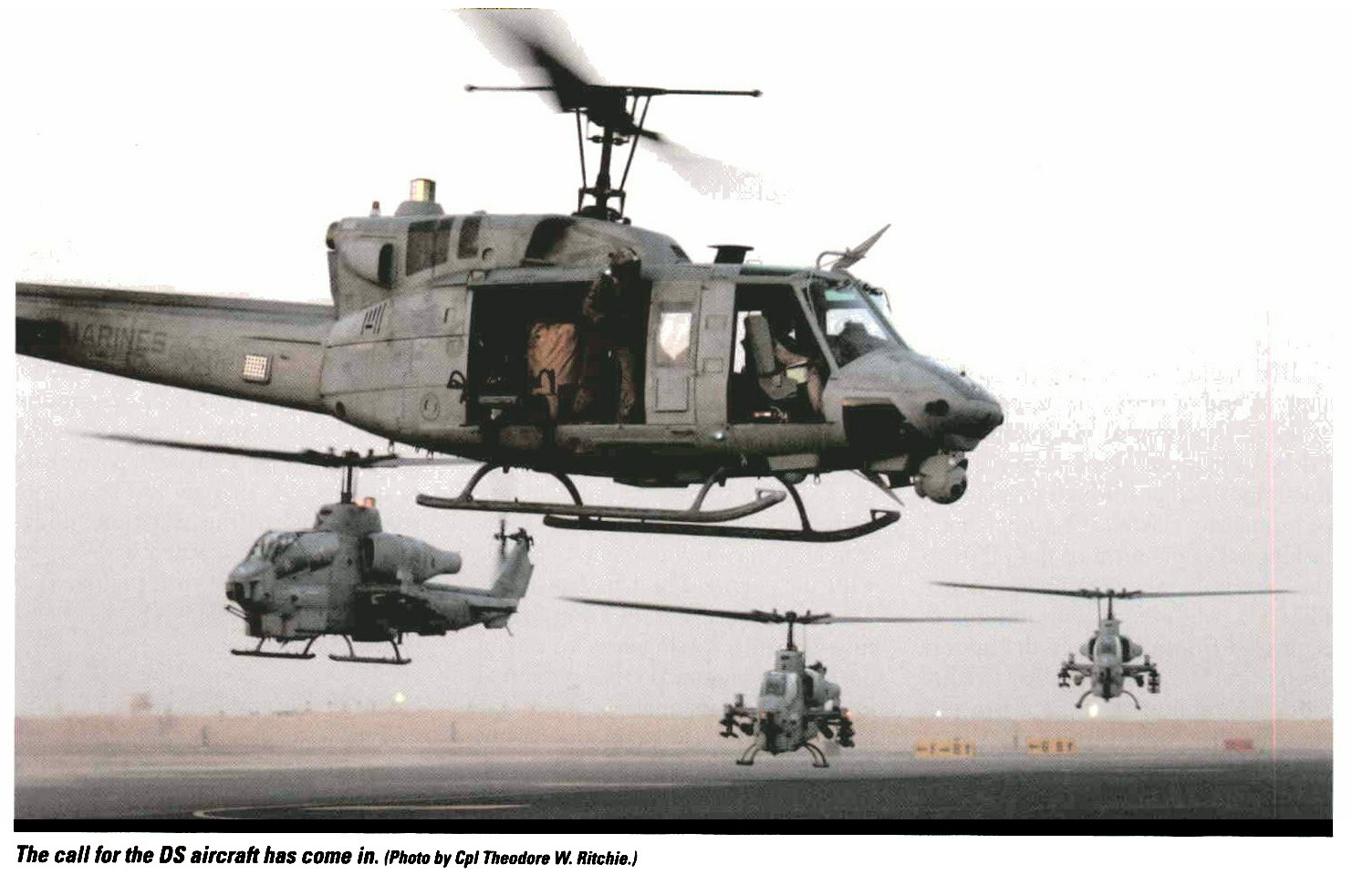
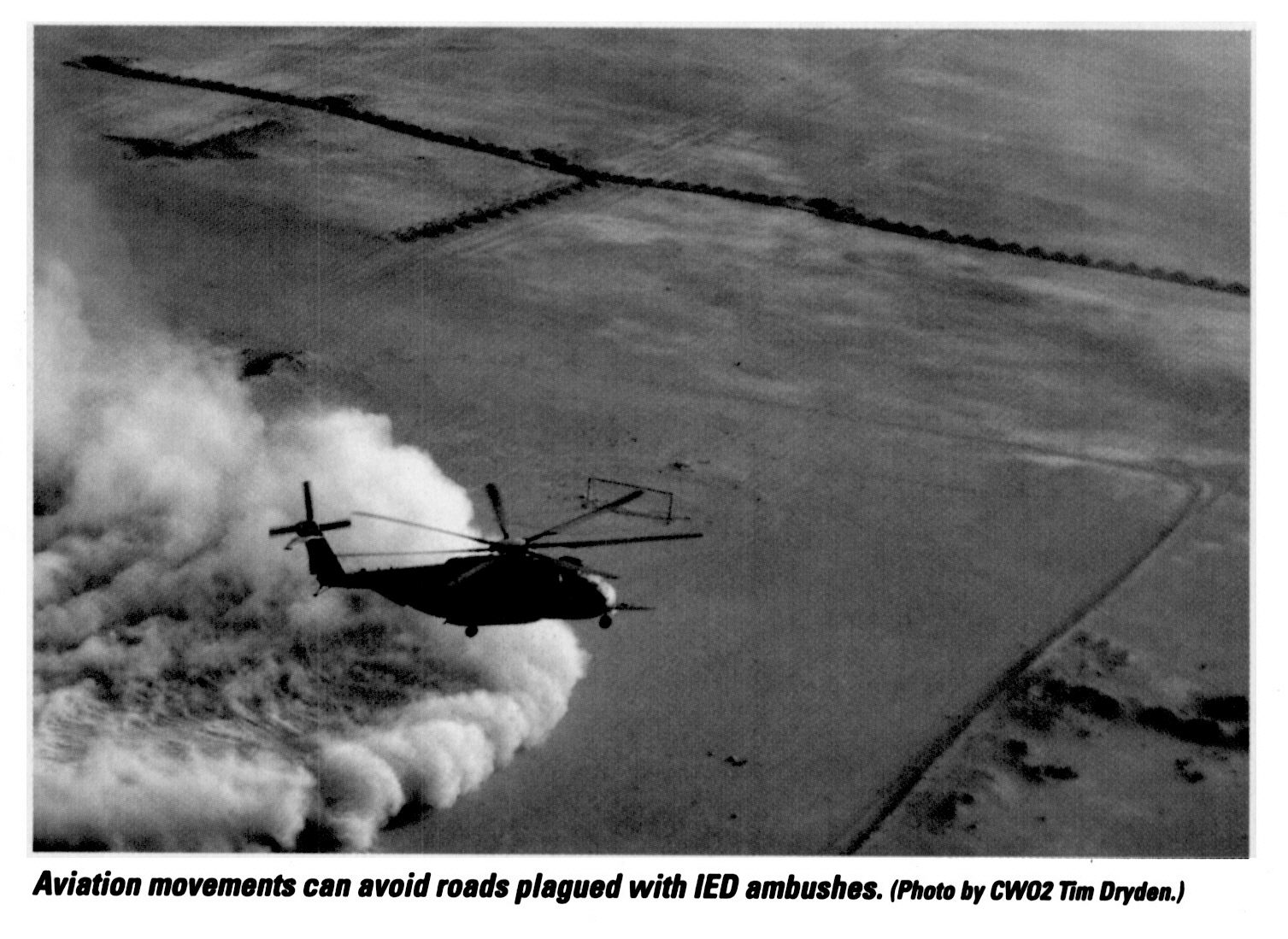
The Marine Corps derives its historical combat supremacy from our ability to strike from the land, air, or sea. Every second lieutenant can remember the lectures at The Basic School and learning about the Corps’ history. In Iraq today we must utilize all of the assets that the Marine Corps has to offer’ in order to create an unpredictable atmosphere in which enemy forces can no longer dictate the pace of contact. If insurgent forces are laying IEDs along our main supply routes, then why not fly over them? If Iraq is the land of two rivers, why don’t we use them to float around the IEDs? The argument of a high risk to benefit ratio is already moot. It goes without saying that helicopter or boat operations require more planning than normal vehicle operations, but the benefit of these operations far outweighs the burden of the planning. It is already clear that the majority of insurgents spend far more time planning their extract than their ambush. At this stage, we have made ourselves predictable and have continually invited ambushes. By using helicopters and small riverine craft, we invalidate the enemy’s principal weapon. Vehicles are extremely useful and powerful assets that should continue to be utilized in Iraq. The ability to provide a powerful communications platform, their substantial firepower, and their protection against small arms makes them an invaluable combat power multiplier. Yet, to rely on them as we do in Ramadi, and I suspect across Iraq, is much like giving the star football player the ball on every down. Very quickly the opponent will adapt and begin to double- or tripleteam his efforts. When using vehicles, we must do so deliberately.

Imagine inserting a raid force with small boats while having a few support gun trucks moving parallel along a cleared supply route that has been under observation for 24 hours. IEDs would prove useless against the primary raid force, and therefore, the enemy would be forced to use small arms to inflict damage. Now the enemy is forced into a dilemma. Does he choose to attack with small arms knowing that vehicles could vector in on his position within moments? By examining this scenario we see that it is indeed risky but far less threatening than continually driving on unpaved roads where we can be certain to continue being hit by IEDs. Taking the scenario further, let us assume the enemy engages our force. The mobile units could cordon the house or block and fire upon the enemy. Dismounts can move in and begin interrogating those present as well as the surrounding neighbors. The IO component is utilized with the neighbors by informing them that they have been disrupted because anticoalition forces have been operating in their neighborhood. Another mobile section could launch, allowing the commander to continue with the raid. A combined arms effect has been created that sets up a favorable atmosphere in which to gather intelligence, conduct successful operations, and force the enemy to divulge his location.

Marine Corps Doctrinal Publication 1 (MCDP 1), Warfighting, is our doctrine. It is the Marine Corps’ warfighting philosophy. Its principles must be fully utilized if the Marine Corps is going to be successful in Iraq. Maneuver warfare is an ongoing process, and we must continue to assess the enemy’s center of gravity and critical vulnerabilities. But the act is meaningless if we do not reorient and execute on our new conclusions. We must train and use our sea and air capabilities to create an unpredictable environment to decrease the effectiveness of the IED. Furthermore, decentralize execution and allow the commanders to create their own IO and field interrogate low-level informants. To maintain our status as the elite of the world’s military forces we must continue our scholastic analysis of the theoretical principles of warfighting but also begin to apply them practically.

Notes

1. MCDP 1, Warfighting, United States Government, Washington, DC, 1997, p. 73.

2. To date there have been 2,444 U.S. deaths as a result of hostile fire. IEDs are responsible for 1,105 of those killed in action, accounting for 45.2 percent of all hostile fire fatalities. Information is available at http://www.icasualties. org/oif, accessed on 19 January 2007.

3. MCDP 1, p. 76.

Millennials Merging

by LtCol Wayne A. Sinclair

‘The human heart is the starting point in all matters pertaining to war.’

-Frederick the Great

If war is truly a young man’s occupation, then the tactical struggle to bring order and stability to Afghanistan and Iraq certainly depends on an admired but little understood generation of Americans. In a war that transforms totalitarian societies and rebuilds failed states, great discernment, adaptability, and virtue are especially essential in its junior participants. Understandably, when older Americans consider the complexities of counterinsurgency operations and the delicate nature of cross-cultural communications in the global war on terrorism, many privately wonder how such a seemingly naĂŻve and insulated population is faring so well. Research on the character of America’s youngest generation offers some reassuring answers. America’s youth may actually be better prepared to prevail in the irregular conflicts of the early 21st century than any previous generation. The challenge for the two previous, and decidedly different, generations still in uniform lies in recognizing and realizing this tremendous potential. This recognition and realization takes more than sound leadership; it requires an appreciation of generational differences and the skill to turn this perspective into inspiration. America’s generation gap is further widened by a military culture that commends pragmatism and independent decisionmaking while promoting the doctrinal precepts of maneuver warfare-all conceptually inconsistent with the strengths, vulnerabilities, and leadership needs of a generation rapidly making its presence felt.

In spite of America’s fondness for quick, technology-driven results in warfare, blood and sweat-rather than machines and microchips-are proving the greater value. Yet as technology gives mankind ever greater powers, it gives men ever less significance. New operational concepts and promising material solutions attract far more high-level attention than studies on how people change or generations interact. Given the asymmetric character of the long war against terrorism, the American public’s deep-rooted faith in its uniformed citizenry is vital and must never be taken for granted. Although segments of the U.S. military have explored generational shifts for recruiting and marketing needs, the ability to connect with a new generation of young Americans may be completely overlooked.1

Generations

They are known as “Millennials“-the first generation to reach adulthood in the new millennium. This American cohort-born between 1981 and 2002-has other names and like-aged counterparts around the world: the Net Generation, Generation Y, the Google Generation, and Echo-Boomers. Since the dawn of civilization, people have identified generational cycles as a force of history and the master regulators for social change.2 A generation is composed of a society-wide peer group shaped by older generations, historical events, and shared experiences. It is considered as the average period between the birth of parents and the birth of their offspring-about 21 years. Within a common culture, pivotal historical events (e.g., the Pearl Harbor attack, the Cuban missile crisis, the Challenger explosion, the 11 September 2001 attacks, etc.) affect and shape different age groups’ outward and inward perceptions differently and inspire collective behaviors toward common goals.

Generational identities are also formed by the preceding generations based on what phase of life they are in, their own unique characteristics, and their intergenerational relationships. Since the exact birth dates of American generations are subjective and there is no formal naming convention per se, it is best to think of these timespans as eras. That said, the common names and approximate birth years of the six living generations of Americans are listed below:

* The GI (Government Issue) or Veterans Generation (1901-24).

* The Silent Generation or Traditionalists (1925-42).

* The Baby Boomers (1943-60).

* Generation X or the 13th Generation (1961-81).

* The Millennials (1982-2001).

* The Homeland Generation (2002-?).

Since generations are made up of people, they have many of the same characteristics. Collectively, generations have prevailing moods, temperaments, personalities and, most importantly, a distinct sense of direction and purpose. For Millennials, a brief look at their origins and traits reveals some potential strengths and weaknesses in modern war. First, however, the stage must be set by an overview of maneuver warfare doctrine and why it appeals to every serving generation except the Millennials.

Maneuver Warfare and the Human Dimension

Maneuver warfare has served as the philosophical basis for the Marine Corps’ approach to warfighting for nearly 20 years and is the cornerstone of the Marine Corps’ future concept, expeditionary maneuver warfare.3 As crafted in Marine Corps Doctrinal Publication 1, Warfighting (the watershed booklet first published in 1989), maneuver warfare begins with a thought process that stresses how, not what, to think. Accordingly, it is intended to exist not so much in prescriptive formulas or methodologies but in the minds of all Marines, where it guides their actions across the spectrum of conflict at all levels of war.4

Beginning in the mid-1970s, post-Vietnam hand wringing over the condition of the U.S. Armed Forces fueled intense debate about the American way of war. Military reformers in and out of uniform placed much of the blame on America’s “fire-power and attrition” style of warfare. Faced with the monolithic Soviet threat, and inspired by the stunning Israeli victories fighting out-numbered against Egypt and Syria in the 1973 Yom Kippur War, they sought less direct approaches to battle that promised quicker victories at lower costs using psychology as a principal defeat mechanism.5 Both linear and methodical battle reflected the prevailing military culture of order. In contrast, the principal goal of maneuver warfare is speed-at the expense of order and control if necessary-in order to make faster decisions, gain positional advantage, and leverage chaos* on the battlefield.6 In execution, this becomes what is known as tempo.

A great deal of this all-important tempo is generated by decentralized decisionmaking. Through “mission-type” orders and adept handling of “surfaces and gaps,” maneuver warfare draws its power mainly from opportunism-the calculated risk-and the exploitation of both chance and circumstances.7 Flexibility, creativity, and initiative are not just desirable in junior leaders; they are indispensable. Today, all branches of the U.S. Armed Forces embrace the precepts of maneuver warfare, and it remains the doctrinal cornerstone of the Marine Corps’ professional military education system.

* Indicative of the maneuverist mindset, “Chaos” was the radio call sign of MajGen James N. Mattis, Commanding General, 1st Marine Division during Operation IRAQI FREEDOM I.

Enter the Millennials

As a whole, the general direction of Millennials is surprising many members of the typically cynical Generation X and materialistic Baby Boomers. Millennials appear to be a more civic minded, morally grounded, and selfless generation than any in the past 40 years-maybe even longer.8 They are reversing a vast array of negative youth trends from criminal activity to drug use, from teen pregnancies and abortion to test scores and future goals.

What accounts for this change? Research suggests that a primary factor in the development of generational cycles is the oscillation between the overprotection and underprotection of children.9 While dual-career or single parents raised the “latchkey” kids of Generation X, Millennials began arriving when childbearing and rearing became a national priority once again. Childfriendly minivans with “baby on board” signs became the fashion, abortion and divorce rates ebbed, the socioeconomic tide rose, birth rates soared (at about 76 million, they are twice the size of Generation X), child abuse prevention and safety were hot topics, and several books that taught virtues and values to children became bestsellers.10 For many parents, educators, and lawyers, the goal became not to prepare children for life’s risks, but to remove as many risks as possible. By design and with the best intentions, Millennials became the most protected generation in history.11

Public education was a major influence on Millennial development and serves as the dividing line between Generation X and the Millennials.12 The reason was national school reform. After almost two decades of decline in their children’s elementary and high schools, Americans had had enough. Parent and teacher frustration with poor student performance, a lack of classroom order, and substandard public education resources led to massive school reforms during the second half of the 1980s. Changes were everywhere as parents became passionate about their kids’ education. Higher academic standards, “zero tolerance” policies, school uniforms, and formalized teacher accountability were widely instituted. By the mid-1990s, U.S. public education had moved from an “age of lament” to an “age of accountability. “13

With Millennial parents so highly invested in their children’s goals and outcomes, any sign of mediocrity in their children is met with professional “coaching” (not counseling-even the best have coaches) or expert advice. In contrast to Generation Xers, parental relationships and opinion are considered crucial to young people’s well-being and decisionmaking calculus. Accustomed to center stage, they are more than willing to work hard to meet the high expectations of the audience. For many, life revolves around organized activities. As the most over-scheduled generation in history, Millennials thrive in a multitask environment.14 To help cope with demanding schedules, technology is an enabler on a scale never before imagined. They expect light speed and interactive communications tools and are comfortable conveying and receiving information in sound bytes and cryptic keystrokes. When one considers that Millennials have never known life without cell phones, instant messaging, and fingertip access to ideas and information from around the world through the Internet, their conceptions of time, communications, and space are easier to understand.

Millennials and Maneuver Warfare

As Millennials mature, distinct traits, core values, and groupthink characteristics solidify and can be linked to positive military virtues. There is a flip side however; these much-admired assets imply expectations and propensities that can have troubling implications for many tenets of maneuver warfare. They are contrasted in Figure 1.

So are Millennials inherently better suited for methodical battle than maneuver warfare? With Generation Xers most known for self-reliance, pragmatism, and go-for-broke risk taking-tailormade characteristics for the maneuverist mindset-one may conclude that the basic concepts of maneuver warfare have a distinct generational bias. Furthermore, Millennials inherent qualities appear to have special contemporary value. Generation X decisionmakers who “just want the facts”-preferably the “bottom line up front”-to find the right “decisive” action or high-value target to accomplish the mission or destroy an enemy’s will to resist would do well to take advantage of the more introspective nature of their young warriors. Their generational propensity to impose order, seek the greater good, take the role of protector vice conqueror, build structure, and seek clarity of direction or consensus in their actions are not necessarily liabilities in the irregular three block wars and nation-building predicaments in which Marines will find themselves for decades to come. Still, one must understand their capacity for creativity and self-regulation. In contrast to their more independently minded Generation X predecessors, the Millennial small unit leaders need and expect tailored solutions (e.g., tactics, techniques, and procedures), structure, oversight, teamwork, methodology, and a cause that gives them the opportunity to make a difference for something greater than themselves. Given these ingredients, they will show a willingness to fight and, if necessary, a readiness to die that will shatter even the most negative stereotypes assigned to young Americans.

Bridging the Gap: Leading and Mentoring Millennials

Millennials look to their leaders to create an environment that respects individuals yet promotes collaborative problem solving. Hence, organizational climate is as important as organizational culture. Whereas military culture represents the sum of ingrained values and pursuits, a command’s climate develops the members’ attitudes and perceptions with respect to human interaction in several key areas: leader engagement, group cohesion, trust and respect for individuals, ethical behavior, and fair recognition for good performance.15 Millennials are not enamored by position or title. They count on experienced hands-on leaders who earn their respect by recognizing their potential and teaching them by showing them how to increase their performance. They yearn for open communications and the mentor imposed “reality check” through unembellished but entertaining “war stories” of real life challenges that focus not on a leader’s skill or stamina but on what was accomplished and learned.

In doing so, leaders must recognize that for many Millennials, sheltered affluence, communications technology, and a lifelong conditioning to virtual reality have dulled their responsiveness to the “sit and listen” lecture style of teaching. Not surprisingly, Millennials prize practical experience and the chance to “take the wheel” and learn by trial and error. Since Millennials are accustomed to structure, direction, explanations, protection, and engagement, the importance of mentoring cannot be overstressed. To this end, mentoring in a coach/partner role should seek to:

* Explain why and how things must be done-at least initially.

* Establish boundaries of conduct and behavior explicitly.

* Clarify the value of their roles in any venture. (Perceived “busy work” is despised.)

* Enforce accountability to standards through peer mentoring.

* Show how opportunism and risk taking can be balanced.

* Teach self-assessment techniques (answers truthfully, “How am I doing?”).

* Teach project and time management to include sequencing of implicit tasks.

* Provide frequent and accurate feedback in a small, interactive group.

This style serves to offset their “blindspots” and develops their decisionmaking skills before entering the chaotic environment of combat.

Finally, Millennials are exceptionally attuned to sincerity in their leaders. Leaders perceived to promote an image to intimidate, gain acceptance, or to compromise their moral authority will be suspected of fraud regardless of their levels of competence.16 Millennials may forgive many shortcomings in their leaders, but hypocrisy is the unpardonable sin.

Conclusion

As in the past, careful investments in the Marine Corps’ human capital will continue to pay the highest dividends in war. While human nature remains much the same, human behavior changes with values. In order to leverage the many qualities of the Millennial Generation, military leaders must successfully merge the best of the past with the requirements of the future.17 With three generations of Americans in uniform today, the United States is engaged in a war-predicted to last a generation-that will continue to place extraordinary demands on the character and capabilities of its servicemen and women. In a few years, virtually every company grade officer and noncommissioned officer will be a mature Millennial who entered service after the terrorist attacks of 11 September 2001. These will be America’s “strategic” corporals and captains. They will fight and win the long and arduous campaigns of this war. The mandate for leaders at all levels is clear. For the Nation to be assured that its rising generation will be the country’s greatest source of military strength in its hour of need, they need only leaders prepared to show them the way.

Notes

1. The Marine Corps Recruiting Command began to focus on understanding Millennials for marketing purposes in 1999. Other U.S. recruiting services have since followed suit. Apart from recruiting and a presentation given to newly selected Marine Corps general officers, I can find no evidence that the newest American generation has been officially recognized by the military. Regarding how they should be trained or led (compared to past generations), numerous requests to military training organizations went unanswered, or in two cases, they replied that they were not informed on the matter. Requests for official positions or informal opinions on this topic were sent electronically to members of the Marine Corps Training and Education Command, the U.S. Military Academy, the U.S. Naval Academy, the Citadel, and the Virginia Military Institute.

2. Strauss, William and Neil Howe, The Fourth Turning, Broadway Books, New York, 1997, p. 58.

3. Expeditionary Maneuver Warfare: Capstone Marine Corps Concept Handbook, Department of the Navy, Washington, DC, November 2001, p. 5.

4. Marine Corps Doctrinal Publication 1, Warfighting, Headquarters Marine Corps, Washington, DC, June 1997, p. 96.

5. Bolger, Daniel, “Maneuver Warfare Reconsidered,” in Maneuver Warfare: An Anthology, ed. Richard D. Hooker, Presidio Press, Novato, CA, 1993, pp. 1, 21.

6. Fleet Marine Force Manual 1, Warfighting, Headquarters Marine Corps, Washington, DC, 6 March 1989, p. 1.

7. Antal, John F., “Thoughts About Maneuver Warfare,” in Maneuver Warfare: An Anthology, p. 64.

8. Strauss, William and Neil Howe, Millennials Rising, Vintage Books, New York, 2000, p. 19.

9. Strauss and Howe, The Fourth Turning, p. 82.

10. William Bennett’s Children’s Book of Virtues published in 1995 is one such example.

11. Howard, Philip, The Lost Art of Drawing the Line, Random House, New York, 2001, p. 65.

12. Strauss and Howe, Millennials Rising, p. 145.

13. Toch, Thomas, “Outstanding High Schools,” U.S. News and World Report, 18 January 1999, p. 48.

14. Phalen, Kathleen, “Teaching in a Millennial World,” Virginia Education, Fall 2002, available at <http://www.itc.virginia. edu>, accessed 20 November 2003.

15. Fortune, Dan, “Commanding the Net Generation,” Australian Army Journal, December 2003, p. 105.

16. “Culture and Generational Change,” Chatanooga Resource Foundation, available at <http://www.resourcefoundation.org>, accessed 5 January 2004.

17. Fortune, p. 108.

MCDP 1, Warfighting, Revisited

by Maj Adam T. Strickland

As anyone serving with or under the Marine Corps Combat Development Command (MCCDC) umbrella can confirm, concept development consumes a considerable portion of our limited resources, as countless personnel are tasked with ensuring that our force remains ready and able to face any global challenge-present or future. To this end, commands, such as U.S. Joint Forces Command (USJFCom) and MCCDC, employ hundreds of contractors (most of whom are retired military)-in addition to active military personnel-to develop concepts addressing issues such as seabasing, effects-based planning, and distributed operations. While this type of forward thinking is necessary to ensure that we remain the finest fighting force, it tends to unnecessarily take us further away from our foundation in small wars and warfighting-maneuver warfare that is the bedrock of our current operations in Afghanistan and Iraq, and needlessly hemorrhage limited resources trying to reinvent ourselves. As the saying goes, “dance with the girl you brought,” and for the Marine Corps, this means maneuver warfare.

Reinventing the Wheel

While the U.S. Army has just produced a 150-page manual on countcriiisurgcncy and the brightest at USJFCom worked on a stability operations operating concept-both of which consumed thousands of man-hours and countless thousands of dollars-and were only able to produce such insightful recommendations as develop local intelligence, emphasize information operations, and concentrate on elimination of the insurgents and not terrain objectives, as Marines, all we need to know is found in Marine Corps Doctrinal Publication 1 (MCDP 1), Warfighting. The answer to “what ails us” is not always as elusive as it may seem; however, it may simply be obscured by those unwilling to admit that technology, expensive toys, and new joint concepts cannot eliminate the nature of warfare and the validity of maneuver warfare in any environment, to include a nontrinitarian or fourth-generation warfare scenario.

From cover to cover MCDP 1 outlines operational considerations for conducting small wars, counterinsurgency operations, and information operations. When reviewed with the 1940 Small Wars Manual or 2003 Addendum, one finds critical information necessary for effective operations in environments such as Iraq, Afghanistan, Liberia, Haiti, the Philippines, Chad, and Niger and, thus, can accurately conclude that many of the current/ongoing projects on asymmetric warfare concepts simply try to reinvent the wheel and waste limited resources. We need “how-to guides,” not more of the avalanche of concepts, equations, or theories in line with confrontation analysis or complexity theory. If one is familiar with the Small Wars Manual, MCDP 1, and military operations other than war principles, then one is equipped with the “know how” to conduct operations in Iraq and not in desperate need of further theory. This is not to say that continued professional military education (PME) is not valuable; it is essential. In fact, those who have a fundamental understanding of Mao Tse Tung, the civil operations revolutionary development support (CORDS) program in Southeast Asia, Operation PHOENIX, and the civil war in El Salvador in the 1980s tend to have a different understanding and perception of the merits and shortfalls of current U.S. operations. When discussing scenarios such as the asymmetric threat that presents itself in Iraq and Afghanistan, MCDP 1 states:

The Marine Corps concept for winning under these conditions is the warfighting doctrine based on rapid, flexible, and opportunistic maneuver. The essence of maneuver is taking action to generate and exploit some kind of advantage over the enemy as a means of accomplishing our objectives as effectively as possible. That advantage may be psychological, technological, or temporal as well as spatial. Especially important is maneuver in time-we generate a faster operating tempo than the enemy to gain a temporal advantage.

A “rapid, flexible, and opportunistic” (three block war) response is certainly consistent with Marine Corps policies in Iraq, as well as our attempts to exploit the insurgents’ inability to sustain a high operational tempo. Through superior technology and overwhelming advantage in resources available, Marines were quickly able to exploit gaps by conducting precision strikes in conjunction with psychological maneuvers pursued through speed, violence, humanitarian assistance (drinking water/subsistence items), and civil affairs, satisfying basic human needs, such as generating a feeling amongst the Iraqis of being safe in person and property, thus denying insurgents much needed popular support; supporting information operations (IO) goals; and satisfying a critical counterinsurgency principle of keeping as many indigenous personnel as neutrals or procoalition as possible. Unfortunately, this rapid response can and did lead to a “revolution of rising expectations” amongst the Iraqis, but that is the product of success and high expectations.

Our ability as Marines to see maneuver warfare in nonspatial terms is exactly what makes us different from others and in step with organizations such as the British Royal Marines. While other forces do many things exceptionally well, counterinsurgency and small wars in general are not amongst these, with the notable exception of certain British and French units. Many have unfortunately learned the hard way that vehicle assets provide mobility and spatial maneuver but don’t always equal maneuver warfare. While motorized and mechanized assets provide increased mobility and firepower, their widespread utilization adversely impacts IO by sending the wrong message, influencing the population in a manner that is unwanted, and keeping troops who are desperately needed to interact with locals cocooned in vehicles. These vehicles have become the target of increased attacks and are further signs of an occupation-not a sign of cooperation when used for routine policing and patrolling-a lesson learned previously by the British in Northern Ireland and the Israelis in the West Bank. In Iraq, this rapid, flexible, and opportunistic maneuver allows Marines to influence and inform (IO basics) indigenous personnel, whether friendly, neutral, or hostile, and thus shape the battlespace in a manner consistent with our commander’s intent. This type of maneuver by small units, led by capable company grade officers, staff noncommissioned officers, and noncommissioned officers, allows Marines to develop intelligence, develop census information necessary for properly understanding our battlespace, and influence the populace in a manner consistent with themes such as “no better friend, no worse enemy.” In fact, MCDP 1 dedicates entire sections to shaping operations (IO) and the combined arms effects (IO). Thus, while IO has become the new “cure-all,” it is certainly not a new process or idea.

Again, MCDP 1 warns us that we must influence and address human needs when combating asymmetric threats in order to successfully prosecute the campaign. Was capturing Fallujah tactically significant because of the terrain, or was it because of the message it sent other or potential insurgents throughout the area of operations (AO)? Destroying the insurgency in Fallujah is significant for many reasons, not the least of which is the impact it had on the “moral and mental” forces in Iraq. Other than through conventional operations, one does this through influencing the population through civil-military operations by achieving a unity of effort with other agencies, to include private volunteer organizations. Immediately after the regime change in Iraq, 150 nongovernmental and private volunteer organizations were operating within the country, thus the coalition had a wealth of resources to assist in achieving this end. Utilizing nonmilitary or nonstandard organizations requires our warfighters to remain flexible.

As Marines, MCDP 1 tells us that mental flexibility is essential. “We should not assume that every enemy thinks as we do, or has the same values or objectives.” While some may disagree, this tends to be the one warning that most non-Marines and nonservicemembers ignore. MCDP 1 warns us that words that are clearly defined to us may not be accurately defined when utilized in other cultures, to include Middle Eastern environs. What may be considered lawful or legitimate to us may not be so to Sunni Albu Issa tribesmen operating in Ramadi and Fallujah. What we may perceive as a show of restraint may be perceived as a sign of weakness among indigenous peoples in Najaf. What some consider unacceptable collateral damage in the battles in Fallujah may be perceived by indigenous persons as the acceptable and natural reaction to an overt hostile act by insurgents. Our warfighters must be pseudopsychiatrists and understand the mindset of those affected.

As Col Christopher C. Conlin (former Commanding Officer, 1st Battalion, 7th Marines during Operation IRAQI FREEDOM (OIF)) writes in his article, “What Do You Do for an Encore?” (MCG, Sep04), “Marines must be prepared to influence the battlespace by serving as civil administrators, public affairs spokespersons, police forces, and humanitarian assistance workers.” Since every Marine is a rifleman and expected to understand basic infantry fundamentals and the need for human interaction in postconflict environs, the Marine Corps is more capable of transforming personnel that normally serve as artillery or tank personnel into infantrymen, where others continue to find difficulty finding tactical success with noninfantry troops.

MCDP 1 tells us that “war is an extreme test of will,” and Marines know, based on their PME and familiarity with the Southeast Asian conflict, that conflicts are more than conventional fights. We understand that you can win the battle and still lose the war. Marines understand Vo Nguyen Giap’s assertion that “you will kill ten of mine for every one I kill of yours, but in the end, it will be you who tire of it.” Because of this we understand that the most committed in a conflict wins. We train to operate at a marathon runner’s pace through our warfighting fundamentals, not a sprinter’s pace, and thus are able to gain a psychological and temporal maneuver advantage.

Because of these things, the Marine Corps, like the British in Northern Ireland, have been able to sustain casualties, yet separate the part from the whole and not punish all Iraqis for the acts of the insurgents. This is why we are able to walk down the same stretch of road day after to clear improvised explosive devises (IEDs) and show the insurgents that we are patient, will outlast them, and impose our will-that will being a secure environment.

While technological resources and joint operating concepts/doctrine should be explored, it should be done in a manner that seeks to augment our current warflghting capabilities and not by reinventing the wheel. While casualties in OIF and Operation ENDURING FREEDOM have turned many into risk-averse champions of technology and a new way of thinking, in the end, the nature of warfare has not changed and so maneuver warfare remains the correct course of action. New technologies and publications have not been able to magically locate IEDs in Iraq, detect potential car bombs at Iraqi police stations, or help the Israelis locate suicide bombers; however, maneuver warfare can do all three.

A Sample of ‘How To’

In an attempt to demonstrate what we need more of, I provide the following how-to list for counterinsurgency and foreign internal defense. These are but some of the many ways to operate that satisfy both the blue and green forces’ need for security and further counterinsurgent activities.

Establish appropriate expectations. This is the essential first step to any successful counterinsurgency. Failing to establish appropriate or measurable expectations can create a situation in which no matter how well one’s forces are doing, they appear to be failing due to unrealistic expectations. Should one have expected people who had been beaten, tortured, and intimidated for 34 years suddenly to be infused with a spirit of invention, initiative, and cooperation? If one has no realistic expectation that citizens of the United States living in “rougher” inner-city neighborhoods will cooperate with law enforcement officials by providing human intelligence, should we expect foreign nationals with no civil law enforcement protection to do so? When utilizing nonactive duty components of our Services, one must establish appropriate expectations for them. Should we expect the same outputs and utility from National Guard and Reserve units that train 24 to 36 days a year as we do from our active duty units? If these are appropriate expectations, why have a large active duty force?

Remember the basics. Too often our leaders do feel as though they have not been properly trained to succeed in an insurgency. What all need to recognize is that insurgencies are less about some “skill set” that can be taught and more about leadership and influence. Counterinsurgencies require that leaders utilize their leadership more than in any other type of conflict. Counterinsurgencies demand professional leaders capable of outmaneuvering opponents in other than spatial terms. You must be able to outthink your opponent.

PME. As noted above, PME is essential and, for the most part, an integral part of training. Where we continue to fail is in the manner in which we absorb or modify our behavior based on lessons observed. Lessons observed or insights never become lessons learned until we achieve a change in behavior. In the counterinsurgency environs in which we operate today in Iraq and Afghanistan, there is much discussion about the need of interagency coordinating groups and civil affairs, and how these should affect our military operations. While we continue this debate, we neglect the example of past lessons and examples, such as CORDS in Southeast Asia. While most officers have digested works on Field Marshall Erwin Rommel and MG Thomas J. Jackson, few have read Mao or Ho Chi Minh, and thus are not in a position to recognize the phases of the insurgency they face. They continue to pursue operations in an attempt to force a decisive action, yet they fail to understand that in an insurgency, insurgents dictate decisive points and engagements. Ho and Mao would argue that insurgents only become engaged in decisive acts if it is on their terms. In addition, students of counterinsurgency utilize works by General Sir Frank Kitson, Roger Trinquier, and Sir Robert Thompson, which are all 20 to 40 years old, and further acknowledge that the British and French are much better at these operations than the United States. These students understand that patience is the key. They are fully aware that the Vietnamese and Chinese fought insurgencies that lasted over 30 years and thus do not have unrealistic expectations. Those who best understand counterinsurgency are those who also best understand certain social phenomena, and understand how best to influence behavior.

Determine security needs. This determination should be made by the unit leader on the ground, and no one elsewhich might put it at odds with higher headquarters. The unit leader will determine both physical and psychological security needs for both host nationals and blue forces. We must answer the questions, do the people feel safe, and if not, what will make them feel safe? From this sense or perception of security all else grows. Determine how to influence peoples’ sense of security. Metal detectors are a very good way when the threat is hidden weapons and bombs. Whether they work or not is not as important as making people think that you are out looking with an advanced technology. The key is to try to be in as many different places as possible from day to day and week to week, thus giving people the impression that you could always be right around the corner. Always maneuver in a dispersed fashion, which gives people the impression you are much larger than you truly are. Always remember that their security needs are no different than U.S. citizens living in the continental United States. Why won’t those afflicted by threats of physical violence and intimidation in our urban settings come forward to tell police who has threatened them? The answer is that they don’t feel safe. This perception or sense of security is the same in Detroit as it is in Najaf.

To what will the people respond”? As a sign of good faith, unit leaders must decide what need is not being met that if met would greatly improve the level of cooperation between blue and green forces. In underdeveloped nations these needs could be abundant; however, subsistence needs usually are the first to be satisfied. By providing the basics, such as water, or basic cooking implements, such as flour or rice, one’s security situation is greatly enhanced. The old saying is “don’t bite the hand that feeds you.” Violence associated with humanitarian assistance is also a good indicator of the level of resistance or character of the resistance in an area. When providing subsistence items, such as water bottles, have labels printed with a procoalition message or information that will be useful to the host nationals, such as how much money is being offered for information or weapons turned over. Families tend to respond to things like family pictures or clothes/shoes. Children obviously respond to items like soccer balls. People do not respond to armored HMMWVs in a manner consistent with their needs, but do respond to foot-mobile infantry. Remember that security and occupation are not congruent. In addition, remember the old saying, “ring the doorbell with your elbow,” meaning always have something in your hands to give to the locals.

Establish metrics or measures of effectiveness. How do you know that you are winning or that the people are responding to you? These metrics need to be based on the individual unit and not absorbed from some higher headquarters list. Fewer casualties or enemy engagements are not sound metrics.

Establish a lawful/legitimate security presence. It is imperative that all actions taken are done so in a lawful manner and as honest brokers. Clearly demonstrate that the ladder of law has no top or bottom and that all are to be treated equally and with the same respect that we would treat U.S. citizens. Establish rules-that all host nationals know they will have to abide by-through whatever civil administration may be present. Avoid empowering individuals, such as tribal elders or sheiks, while remaining culturally sensitive. However, as noted earlier, what is legitimate may not be lawful, and what is lawful may not be legitimate. While Operation PHOENIX and the utilization of paramilitaries in El Salvador remain very controversial and misunderstood, both proved to be highly effective. While both were/were not entirely lawful when viewed through a Western liberal democracy prism, they were legitimate acts that achieved the desired effects. For young men who have witnessed 34 years of violence, violence is seen as a legitimate way to achieve goals. This phenomenon is no different in many U.S. urban settings.

Create local “yellow/white pages ” or a census. A unit leader cannot effectively provide security if he does not understand who he is securing. Set up nonevasive operations, such as vehicle checkpoints, where the main object is not searching vehicles but rather collecting information. To keep a steady flow of traffic, limit interaction to two questions-what’s your name, and what do you do for a living? On another occasion ask, where do you live, and who is your sheik or leader? On a third occasion ask, where do you attend religious services (mosque), and who is your Imam? One can quickly establish a sound picture of the AO. During these stops provide water and take pictures. If possible, have a generator with a printer hooked up to provide prints from past family photos to “regulars” whom you see daily. On advanced searches, have interpreters speak with host nationals simply to “listen for inappropriate accents” denoting either foreign fighters or folks not from that area.

Always remember the hierarchy of needs: security, subsistence, infrastructure, and interpersonal wants/needs. Be mindful that all flows from security; therefore, one cannot try to meet the other needs first because they are easier. In addition, providing infrastructure needs to people who cannot feed themselves is insensitive and adds fuel to the fire that, as Westerners, we think money and material possessions are the answer to everything. School supplies are great influencers, but you cannot eat them. These items quickly find themselves sold or traded for subsistence needs. Guard against a revolution of rising expectations by not promising what you cannot accomplish. Always promise less and deliver more.

When engaged by enemy personnel, remain sensitive to the locals and do not treat all as hostiles. It is essential that you remain respectful of persons and property at all times. Make appropriate compensation payments for damaged property or harm done to local nationals. If engaged, it is essential that one maintain the ground. Never pull back once engaged, only move forward. A unit leader must demonstrate that his will is the strongest.

Money does not solve every problem. We must understand that money is not a cure-all, and in fact, it tends to create more problems. Host nationals working aboard U.S. installations and witnessing numerous sport utility vehicles, air-conditioning, chow halls, and trailers with porcelain toilets are sure to wonder why they have no electricity, water, or health care. U.S. efforts to continue to provide school supplies are well-received; however, people require basic necessities like food. Remain sensitive to the fact that everything shapes the battlespace and insurgency.

MCDP 1 gives us all of the guidance we need and, therefore, makes many of the ongoing projects at places such as USJFCom or MCCDC unnecessary, or at a minimum in need of a serious rudder change. It is imperative that we do not try to reinvent ourselves in a manner that takes us further away from that which we do better than all others-warfighting. Our positions in Iraq and Afghanistan are difficult; however, we are prevailing. Hopefully, our commanders will not decide that the positions cannot be held.

Marine Corps Doctrinal Publication 1-0, Marine Corps Operations

by LtCol John A. Bass, USMC(Ret)

With the Commandant’s signing of Marine Corps Doctrinal Publication 1-0 (MCDP 1-0), Marine Corps Operations, in September 2001, the Marine Corps‘ inaugural series of capstone and keystone doctrinal publications was completed. This series of official Marine Corps publications has provided the top-level doctrine that has articulated the Marine Corps way of fighting in the early 21st century-from its warfighting philosophy of maneuver warfare to application of that philosophy across the range of military operations and the warfighting functions.

MCDP 1-0 addresses how the Marine Corps conducts operations to support the national military strategy in naval, joint, and multinational operations. In the MCDP series, it serves to “operationalize” the philosophy. It does this by focusing and transitioning the philosophical discourse of the capstone-keystone MCDP series into an operations manual for the Marine Corps. MCDP 1-0 also provides the operational overview that influences the development of the tactics, techniques, and procedures (TTP) addressed in subordinate Marine Corps Warfighting Publications (MCWPs) and Marine Corps Reference Publications (MCRPs).

The MCDP Series

MCDPs provide higher order doctrine-the fundamental truths and broad philosophy about the nature, theory, and conduct of war. The MCWPs and MCRPs describe methods and TTP for the practical application of those fundamental truths and warfighting philosophy. The intent behind the MCDP series is to provide a body of high-quality, forward-thinking, intellectually rigorous knowledge about armed conflict that will help prepare the Marine Corps for the challenges of the 21st century.1 Although each manual might have a different center-mass audience, the MCDPs are written for all Marines. The doctrine contained in MCDPs represents the Marine Corps‘ most developed and innovative thinking on the nature, theory, and conduct of war. It is meant to project Marine Corps thinking well into the future. To Marines, doctrine is a teaching of the fundamental beliefs of the Marine Corps on the subject of war.2 As the authoritative basis for how Marines fight and operate, the doctrine and TTP form the foundation of Marine Corps education and training curricula.

The doctrine presented in MCDPs is meant to be enduring and universal. In the capstone-keystone publications above MCDP 1-0 (see Figure 1), the doctrine is not tied to any specific organization, structure, technology, type or intensity of conflict, or specific echelon of command. Subjects are described holistically, in their full complexity. Generally, the capstone-keystone MCDPs above MCDP 1-0 describe the nature of war as it applies to a particular subject, discuss the fundamental theories, and present the Marine Corps‘ philosophy on the subject.

While authoritative, MCDPs are descriptive rather than prescriptive in nature. The intent is to provide Marine leaders a common intellectual framework for applying judgment in solving the challenges they face-not to provide the solutions. The MCDPs above MCDP 1-0 describe key doctrinal concepts and considerations but do not provide specific methods and TTP. MCDP 1-0 does both. It provides a degree of “how to” with the “why” as it bridges the doctrinal publications to the MCWPs and MCRPs. It transitions the philosophical discourse of the capstone-keystone MCDPs into an operational summation that focuses on conducting Marine Corps operations.

MCDP 1-0

MCDP 1-0 broadly describes how Marine Corps leaders apply the maneuver warfare philosophy of warfighting across the range of military operations-from war to military operations other than war (MOOTW). The manual is larger and more descriptive than the other MCDPs. Its 11 chapters and 6 appendices describe how Marine Corps forces plan and conduct combat operations in war and how Marine air-ground task forces (MAGTFs) operate daily in MOOTW around the globe. MCDP 1-0 presents today’s doctrine and introduces maturing expeditionary maneuver warfare (EMW) concepts to guide the developing doctrine of tomorrow. This introductory methodology allows the manual to maintain relevancy through its 8-year life cycle.

MCDP 1-0 represents the combined efforts of the Operating Forces, Supporting Establishment, and Marine Corps Combat Development Command (MCCDC). Its development was coordinated by MCCDC’s Doctrine Division while the preponderance of the writing was performed by the proponent MAGTF Staff Training Program team. MCDP 1-0 was rewritten, restaffed, renamed, and shifted from MCDP to MCWP status several times as other MCDPs were being written and the overarching joint visions and Service concepts were being developed. In its final form, this operations manual was written as an MCDP, vetted by the senior leadership of the Marine Corps, and signed by the Commandant. In his foreword, the 32d Commandant wrote that this publication represents how the Marine Corps‘ warfighting philosophy is codified in operational terms.3 As an MCDP it establishes vetted and accepted warfighting practices as today’s doctrine and simultaneously guides the Corps‘ doctrine development toward EMW.

MCDP 1-0 can be divided into three focal areas. The first (Chapters 1 through 3) presents the reader with a broad overview of the historical role of the Marine Corps in national defense; the character of modern conflict; today’s operational environment, national security structure, and unified action; and the roles, functions, organization, and structure of the Marine Corps. The intangibles of the Marine Corps ethos and the five Marine Corps core competencies are described and followed up with discussion of expeditionary operations requirements, force projection and forward deployed naval forces, and MAGTFs conducting expeditionary operations.

The overview of amphibious operations is “hooked” or linked to reference publications that address the subject in detail; i.e., Joint Publication 3-02 (JP 3-02), Joint Doctrine for Amphibious Operations, and JP 0-2, Unified Action Armed Forces, etc. Recent changes in amphibious operations doctrine have been introduced in this first section; for example, five types of amphibious operations vice the previous four; supported-supporting vice the past commander, amphibious task force-commander, landing force command relationships; and the changed definition of the term amphibious task force (ATF) to designate only the Navy task organization. Now the ATF, when combined with the landing force, constitutes an amphibious force instead of the former ATF. Future maneuver warfare and amphibious operations are. addressed in sections titled “Expeditionary Maneuver Warfare (EMW),” “Operational Maneuver From the Sea (OMFTS),” “Ship-to-Objective Maneuver (STOM),” and “Maritime Prepositioning Force (MPF) Future.”

Deployment, Employment, and Sustainment

The second focal area (Chapters 4 and 5) addresses deployment, employment, and sustainment of Marine Corps forces at the operational and tactical levels of war. It links the discussion of Marine Corps expeditionary forces operating in the joint force commander’s campaign with the capstone doctrinal publication on the subject-MCDP 1-2, Campaigning. The second focal area takes the art of campaigning into understanding battlespace, in particular the joint battlespace at the operational level of war. It addresses the critical roles of the Marine Corps component commanders and MAGTF commanders in force deployment planning and execution. Employment is discussed in terms of the use of Marine Corps forces to conduct operations to achieve the joint force commander’s objectives. Arranging operations, combat power, effects, information operations, and the warfighting functions are discussed in relation to higher order doctrine linked to planning and executing successful operations. Redeployment focuses on the Marine Corps doctrine of reconstitution-the actions that commanders plan and take in reestablishing the force’s combat readiness as quickly as possible for subsequent redeployment and employment in new missions-in or out of theater.

MCDP 1-0 devotes a full chapter to the critical role of logistics in generating rapidly deployable, self-reliant, self-sustaining, and flexible MAGTFs that can rapidly reconstitute. The chapter gives readers a good view of how and why the Marine Corps, in coordination and cooperation with the Navy, has made logistical self-sufficiency an essential element of MAGTF expeditionary warfighting capabilities. Strategic, operational, and tactical logistics linkages are discussed down to the MAGTF combat service support element level and to the role of the Supporting Establishment as the “fifth element” of the MAGTF.

Conducting MAGTF Operations

MCDP 1-0’s third and principal focal area (Chapters 6 through 11) concentrates on conducting MAGTF operations-full spectrum from war to MOOTW. It describes how MAGTF commanders and their staffs apply Marine Corps maneuver warfare philosophy and doctrine (as described in MCDP 1, Warfighting, and its companion doctrinal publications) to planning and conducting expeditionary operations.

Chapter 6, “Planning and Conducting MAGTF Operations,” is the single most important chapter in MCDP 1-0. The chapter provides the foundation for MAGTF tactical operations because it discusses the importance of single battle, decisive and shaping actions, centers of gravity and critical vulnerabilities, main and supporting efforts, security, and the reserve. The chapter describes operational design and addresses how the MAGTF commander plans and conducts expeditionary operations. It also identifies the tactical tenets essential to succeeding on the battlefield.4

Chapters 7 through 9 describe conducting MAGTF operations in the offense and defense. Chapter 7 focuses on the offense as the decisive form of combat. Chapter 8 describes defensive operations conducted in conjunction with offensive operations to defeat enemy attacks and conducting MAGTF operations within the context of the single battle. Chapter 9 addresses other tactical operations that enable the MAGTF to execute offensive and defensive operations. These tactical operations include retrograde, passage of lines, linkup, relief in place, obstacle crossing, and breakout from encirclement. Reconnaissance and security operations are covered in Chapter 11. The warfighting functions and the enduring principles of war, relevant to all discussion of Marine Corps doctrine, are presented in appendices, as is a ready-reference list of MAGTF tactical tasks and their definitions.

MOOTW

MCDP 1-0 is the Marine Corps MOOTW doctrine. The MOOTW-unique considerations used in Marine Corps operations are discussed in Chapter 10, “Military Operations Other than War.” These MOOTW-unique considerations build on existing joint doctrine, addressing the joint, expeditionary nature of MOOTW. The chapter describes MOOTW embedded in operations doctrine because MOOTW typically involves elements of both combat and noncombat operations whether in peacetime, conflict, or war.

Conclusion

Most of what the reader will find in MCDP 1-0 is familiar to Marine Corps field grade officers and senior staff noncommissioned officers. Its usefulness is in codifying Marine Corps operations in doctrine for all to use as authoritative reference and to transition the warfighting philosophy into MCWPs and MCRPs. It discusses Marine Corps forces as a Service component under joint force command, and it doctrinally discusses MAGTFs as they exist and are employed today in joint and multinational operations. It’s the first doctrinal publication to address the fundamentals of how MAGTFs conduct tactical operations, and it concisely addresses the types of operations MAGTFs conduct to accomplish their missions.5 It also serves to introduce maturing concepts for further development in the MCWPs and MCRPs.

Notes

1. Commanding General, MCCDC 5000, C42 (Doctrine Division) did 1 April 1996, Letter of Instruction for Development of MCDPs.

2. MCDP 1, p. 55.

3. Jones, Gen James L., in his foreword to MCDP 1-0.

4. MCDP 1-0, p. 6-2.

5. Jones.

Proportionality in the Law of War

by Maj Gregory G. Gillette

Ever since Warfighting1 was published in 1989, the concept of maneuver warfare has defined and distinguished the way the Marine Corps fights. Maneuver warfare is a series of rapid, violent, and unexpected actions that create a turbulent and rapidly deteriorating situation with which the enemy cannot cope.2 Our ultimate goal in maneuver warfare is panic and paralysis-an enemy who has lost the ability to resist.3 The effective warfighter is “ruthlessly opportunistic, actively seeking out signs of weakness against which [he] will direct all available combat power.”4 Contrary to attrition warfare, maneuver warfare concentrates strength against critical enemy vulnerabilities in order to cause the greatest damage to our enemy’s ability to fight. For example, we are taught to bypass the enemy strength and strike the enemy weakness-employ our infantry company against the enemy platoon vice company against company so that we quickly and decisively defeat the enemy with overwhelming force.

Unfortunately, too many Marines, including a few judge advocates, misunderstand and misapply the law of war (LOW) principle called proportionality, mistakenly thinking that proportionality requires the commander to employ no more force than necessary to defeat the enemy and accomplish his mission. Not only is that idea contrary to maneuver warfare, it’s inconsistent with the LOW. It is legal and tactically sound to squash the proverbial enemy fly using a sledgehammer in order to accomplish the mission.

Understanding Proportionality

Proportionality is one of four basic principles in the LOW. The other three principles are military necessity, discrimination, and unnecessary suffering. To fully understand and properly apply proportionality, we need to understand the other three. The first principle, military necessity, justifies all measures that are indispensable for securing the complete submission of the enemy as soon as possible and that are not forbidden by the law of war.5 In order to be a lawful target, the objective of the attack must offer a military advantage.6

Military advantage can include weakening the enemy-for example, destroying or degrading his troops and assets, creating confusion, limiting his mobility, or limiting his command and control capabilities by degrading his ability to “see” the battlefield. Alternately, military advantage can include strengthening our forces-for example, protecting our troops and assets, creating surprise, or enhancing our intelligence-gathering ability. Military advantage does not include killing civilians or destroying civilian objects.7

Objectives that offer military advantage are termed military objectives. Military objectives are targets that by their nature, location, purpose, or use make an effective contribution to military action and whose total or partial destruction, capture, or neutralization offers a definite military advantage to the attacker in the circumstances ruling at the time.8 People are military objectives if they are enemy combatants or if they directly or actively participate in hostilities.9 Things like tanks and artillery are military objectives because they contribute to military action by their very nature. Places like bridges or roads are military objectives if they provide a military advantage at the time-for example, providing a resupply route to the enemy. Conversely, objects that are purely civilian in nature offer no military advantage and are, therefore, not valid targets.

The second principle, discrimination-sometimes called distinction-requires that military forces distinguish between military objectives and civilians or civilian objects. We know from the above discussion of military objective that commanders cannot target civilians or civilian objects but can only target military objectives.10 In fact, commanders have an obligation to take reasonable precautions to spare civilian life and property during attacks against military objectives whenever possible.11 However, if civilians or civilian objects are used to contribute to the military action, they may lose their status as civilians or civilian objects and become valid military objectives. For example, if a civilian hotel is used to billet and train enemy troops, the civilian hotel becomes a valid military objective because it is now contributing directly to the military action.

The third principle, unnecessary suffering, states that parties to a conflict do not have unlimited right to choose methods of warfare.12 The employment of arms, projectiles, materials, or methods calculated to cause unnecessary suffering to enemy combatants is unlawful.13 This principle recognizes that suffering is an inherent consequence of armed conflict but humanely seeks to minimize suffering where possible. The principle of unnecessary suffering outlaws suffering for the sake of suffering. For example, it’s illegal to put glass inside grenades in order to prevent doctors from locating the glass shards with x-ray machines when they treat wounded combatants.

This principle often rests on the intention of the commander. Lawful weapons can be used unlawfully if the commander selects the weapon specifically to cause unnecessary suffering. For example, white phosphorus rounds are lawful and effective for many purposes. However, if the commander chooses to not use available high-explosive rounds in favor of white phosphorus rounds against enemy troops because he wants to burn, disfigure, and cause the enemy to suffer, he violates the principle of unnecessary suffering.

Finally, we get to proportionality. The principle of proportionality recognizes that some civilian life and property will be destroyed during armed conflict. Proportionality excuses collateral damage to civilian property or incidental civilian death or injury that occurs during an attack on a valid military objective, as long as the collateral damage or incidental civilian death is not excessive in relation to the concrete and direct military advantage anticipated from the attack.14 Thus, proportionality begins with identifying the valid military objective and identifying any collateral damage or incidental loss of life foreseeable from the attack. The commander then weighs the foreseeable collateral damage or incidental loss of life against the expected military advantage to determine whether the collateral damage or incidental loss of life is excessive. As long as the collateral damage and incidental loss of life is not excessive compared to the military advantage, then the attack does not violate the principle of proportionality.15 If there is no collateral damage, then proportionality has no effect on the size or type of weapons used against the enemy.

Assume, for example, that your unit locates a squad of Iraqis in the desert. Also assume that there are no civilians or civilian property anywhere in the area that could be harmed from attacking the Iraqi squad. There will be no proportionality issue present regardless of the size or combination of weapons delivered because there will be no civilian death or damage to civilian property. The commander is free to select and employ any weapon or combination of weapons he chooses, and he cannot violate the principle of proportionality. The commander may violate the principle of unnecessary suffering or other rules in the LOW, but not the principle of proportionality.

Why, Then, Is Proportionality Misunderstood by So Many?

Proportionality is often confused with a similar sounding LOW concept called “proportionate response.” Unlike proportionality, proportionate response does concern the amount of force employed against the enemy. Proportionate response, however, is a principle relevant to self-defense, not mission accomplishment.16 It’s important to recognize that the LOW governing self-defense is different than the LOW governing offensive use of force to accomplish the mission. Fortunately, this is one area where the law makes practical sense.

The LOW recognizes that the commander’s objective in mission accomplishment is to offensively seize, break, destroy, or kill the objective. If we apply maneuver warfare we want to use overwhelming force to achieve our mission to physically defeat the enemy and destroy him psychologically. The good news is that, other than the principles discussed above that are designed to protect civilians and minimize unnecessary suffering of combatants, the LOW really doesn’t care whether we kill the enemy with a teeny, tiny bomb or use a really big bomb. Therefore, it’s legal, and consistent with maneuver warfare, to smash the proverbial enemy fly with a sledgehammer.

In self-defense, by contrast, the objective is to protect ourselves or protect others against a threatened or actual use of force. Accordingly, the rules for the use of force during self-defense require that we use the minimum amount of force necessary to adequately defend ourselves-a measure of force proportionate to the threat. Common rules of engagement (ROE) in self-defense state that:

Force used in self-defense to counter a hostile act or demonstrated hostile intent must be reasonable in intensity, duration, and magnitude to the perceived or demonstrated threat.

Properly drafted ROE recognize the difference between the principles of proportionality during targeting for mission accomplishment versus the principle of proportionate response during self-defense. Properly drafted ROE recognize that while force used in sell-defense must be reasonable and proportionate in response to the hostile threat or act, force used in mission accomplishment can be overwhelming and unreasonable. Unfortunately, many ROE intermix and confuse these terms using the term proportionality when discussing self-defense or using the idea of proportionate response when discussing mission accomplishment.17

Why Should We Care?

Discussing the differences between proportionality during mission accomplishment and proportionate response in self-defense is not merely an academic debate. The real danger is that ROE that confuse these two principles unnecessarily limit the amount of force a commander can use to accomplish the mission. The confused ROE erroneously prevent the commander from decisively engaging the enemy with overwhelming force and unnecessarily restrict the commander to weapons and amounts of force that are “proportionate” to his enemy target.

Let’s revisit the Iraqi squad in the desert armed only with small arms. ROE that confuse these principles might erroneously state that a commander can only use proportionate amounts of force against the enemy to achieve his mission. The commander acting under these ROE would be limited to engaging the Iraqi squad only with small arms weapons. Therefore, instead of quickly destroying the Iraqi squad using overwhelming force, the commander gets bogged down in a proportionate firefight with the enemy unnecessarily risking time and men.

Although not acceptable, the confusion is understandable because the confusion starts at the very top. The Chairman of the Joint Chiefs of Staff Standing Rules of Engagement (CJCS SROE) confuse these terms. For example, the CJCS SROE use the term proportionality to discuss both selfdefense and mission accomplishment. More recently, the ROE for Operation ENDURING FREEDOM (OEF) erase all difference between these two concepts. The OEF ROE state:

If use of force is necessary for mission accomplishment OR to respond to a threat or provocation, that use of force will be proportional in that it should be reasonable in intensity, duration, and magnitude. . . .18

Thus, documents like the CJCS SROE and the OEF ROE teach our Marines that proportionality and proportionate response are one and the same.

Another danger is that non-governmental agencies (NGOs) and international scholars increasingly confuse the principle of proportionality in mission accomplishment with the idea of proportionate response in self-defense. The confusion is sometimes innocent but other times intentional. These scholars incorrectly argue that international law requires warring nations to achieve military objectives using proportionate amounts of force. For example, after the first Gulf War, some NGOs and international scholars accused the United States of violating international law, erroneously claiming that we violated the principle of proportionality by using disproportionate force to accomplish the mission.

Some of these scholars honestly confused these two principles and ignorantly accused the United States of violating the principle of proportionality. Other scholars purposely confused these principles in an attempt to make the fight “fair” and reduce the United States’ ability to use overwhelming force upon the enemy. I expect that we’ll see the same allegations about the war in Iraq. Accordingly, Marines at all levels need to understand the principle of proportionality in order to effectively defend against these groundless allegations in the future.

The Fix

The only way to end the confusion is to first recognize the differences between these two concepts and secondly to strictly adhere to the established vocabulary to identify these two concepts. In the LOW arena, proportionality should only refer to balancing military objective against collateral damage during mission accomplishment. Likewise, the term proportionate response should only refer to the amount of force used during self-defense to respond to the threat. By using these terms precisely we can further the understanding of LOW and ensure that our commanders aren’t unnecessarily limited when they fight to accomplish the mission. By understanding and using these terms correctly we add the sledgehammer back to the commander’s arsenal when he fights the proverbial enemy fly.

Notes

1. Marine Corps Doctrinal Publication 1, (MCDP 1), Warfighting.

2. Fleet Marine Force Manual 6, Ground Combat Operations, Chapter 1.

3. MCDP 1, p. 74.

4. Ibid., p. 75.

5. Field Manual 27-10, The Law of Land Warfare, Department of the Army, Paragraph 3a.

6. Hague Regulation No. IV, Annex to the Convention: Regulations Respecting the Laws and Customs of War on Land, 18 October 1907, Article 23.

7. Protocol additional to the Geneva Conventions of 12 August 1949, and relating to the protection of victims of international armed conflict (Protocol I), 8 June 1977, Article 51(1-3).

8. Ibid., Article 52(2).

9. Ibid., Article 51(3); Article 3 common to the four Geneva Conventions.

10. Ibid., Article 48.

11. Ibid., Articles 57 and 58.

12. Ibid., Article 35(1).

13. Ibid., Article 35(2).

14. Ibid., Article 51(5)(b).

15. Ibid.

16. Proportionate response is also relevant to the concept of reprisals. However, reprisals are seldom used today.

17. There are times when the political leadership wants to limit the amount or type of force used during mission accomplishment in order to promote the strategic political goals.

18. CJCS, Washington, DC, 061130Z October 2001 ROE Authorization Serial One, OEF.

Digital Command and Control: Cyber leash or maneuver warfare facilitator?

by Capt Michael D. Skaggs

Since the beginning of mankind, mastery of tools has driven man’s conduct of war. The current explosion of communications technology has propelled contemporary man into the so-called Information Age. This ability to acquire and exchange information rapidly can equip battlefield commanders with the ability to gain immediate situational awareness of their battlespace. Armed with this awareness, commanders will be able to make decisions faster than before. The com mand and control personal computer (C^sup 2^PC), a digital map that offers realtime updates of friendly and enemy locations, offers commanders this enhanced situational awareness. Digital communications, if applied correctly, can finally unleash maneuver warfare in its true form. Unfortunately, with the introduction of the C^sup 2^PC the potential exists to use digital communications to centralize C^sup 2^ over subordinate units. If the Marine Corps is to adapt this new tool to its current maneuver warfare philosophy, this increased awareness should facilitate decentralization.

Marine Corps Doctrinal Publication 6 (MCDP 6), Command and Control, suggests “command” as legal authority to direct action and “control” as feedback of the action taken. This feedback tells the commander what adjustments or commands need to be made in order to achieve the desired result.1 The C^sup 2^PC can offer commanders the ability to extend and refine this authority. The Marine Air-Ground Task Force (MAGTF) Staff Training Program C^sup 2^PC Users’ Guide describes C^sup 2^PC as follows:

Command & Control PC is a Windows-based software application designed to facilitate military command and control functions. When connected to a computer network, C^sup 2^PC has the capability of depicting the current locations of the friendly and enemy units that have been inputted into a tactical database, as well as instantly shar[ing] overlays and message traffic. With this electronic connectivity, C^sup 2^PC becomes a powerful tool for the commander by providing a Common Tactical Picture throughout his command.2

This “tactical Internet”3 serves as a self-updating map allowing the commander to be updated continuously on the positions of subordinate units. Digital feedback is the epitome of C^sup 2^ as described in MCDP 6. Instead of focusing inward on the location of subordinate units, the commander can focus his efforts outward on the enemy.

Historically, improved communications has contributed to increased centralization of C^sup 2^. The adoption of the telegraph by 19th century armies caused many “commanders to keep in touch with the rear at the expense of the front.”4 In Europe, Napoleon III, commanding the Crimean War from Paris, demanded constant updates from his generals.5 In 1899 the United States installed wireless radio sets in all major warships and shore headquarters. However, a contemporary military writer warned of:

. . . a fleet commander in a few years directing a battle at sea with his ear attached to a wireless telephone and repeating with [a] megaphone the order buzzed into his ears from some departmental head hundreds of miles away.6

In fact, since commanders at sea feared a loss of autonomy, radio use was not institutionalized until 1917.7 MajGen J.F.C. Fuller noted that generals commanded by telegraph and telephone during World War I, yet this required subordinate commanders in the trenches to be pulled from the line in order to remain responsive to superiors.8 In some cases leaders were prohibited from actually participating in attacks so they could keep higher headquarters informed of progress.9 By World War II (WWII), the field telephone and wireless radio saw service in armies of both belligerents. S.L.A. Marshall noted in Men Against Fire that many U.S. company commanders in the Pacific were under constant pressure from headquarters to report information. Worse yet, they were often ordered to take tactical action based on the headquarters’ estimates of the situation.10 In the west, the French Army’s “methodical battle” demanded complete centralization of authority and resources. Only command elements and vehicles were equipped with radios that allowed higher headquarters to synchronize the conduct of the battle carefully.11 In Vietnam, U.S. commanders used helicopters to manage the battle from above, often overriding decisions made by subordinates on the ground.12 In these historical examples, armies that favored a centralized style of command tended to use new communications technology to manage the battle more closely from echelons increasingly farther removed.

An exception to the centralization trend is the German Army. As early as the 19th century, Prussia’s von Moltke the Elder warned that a commander “with a telegraph wire connected to his back” would be without independence and initiative.13 In WWII the Germans used the wireless radio to enhance their tradition of decentralized mission tactics. The radio was not used to give orders or manage troop movement. Instead, operation orders were given orally at the division level and below. The radio was used by subordinate commanders to provide feedback on progress to higher headquarters.14 The radio gave them further freedom to exploit opportunities while updating the commander whenever possible. The use of the radio as a facilitator instead of a management tool illustrates the German tendency to use technology to enhance, not replace existing tactics, and tradition.

History suggests that military organizations that are naturally inclined toward a centralized C^sup 2^ system will use new technology to “improve” that system, thus moving toward greater centralization. Since the Marine Corps historically has been inclined toward a decentralized decisionmaking system, one should expect digital technology to further extend decentralization. However, there are external pressures to use the emerging technology to centralize. 15 As the Marine Corps approaches the digital crossroads, it must examine doctrine and determine which road to choose.

When Fleet Marine Force Manual 1, Warfighting, was published in 1989, the Marine Corps officially embraced maneuver warfare. Elements of this doctrine are mission orders, establishment of a main effort, and commander’s intent. Mission orders specifically allow for decentralized decisionmaking, and main effort and commander’s intent give all forces involved the necessary focus of effort. The Marine Corps has done an excellent job of giving its leaders the education necessary to conduct this style of warfare. However, many attrition warfare ghosts remain at the tactical level making maneuver warfare difficult to execute. Many operation orders are suspiciously long and in excessive detail. In fact, once the operation begins, subordinates find themselves attached to a virtual “ball and chain” of tactical control measures. These measures, designed to synchronize resources and focus efforts, actually contradict the philosophy of maneuver warfare and allow for little initiative at lower levels. These countless phase lines, checkpoints, coordination lines, and axes limit initiative and creativity.

The reason for these measures is clear. This environment is created in an effort to build situational awareness. Tactical scenarios are often “canned,” and an orderly, synchronized battlefield is preferred. What better way to know where your forces are than to dictate to them beforehand where they will be at all times? This increases certainty of the friendly situation and reduces risk of fratricide, albeit at the expense of initiative. These attempts to bring order to battlefield chaos are natural; however, this focus inward and quest for certainty is counter to maneuver warfare. Maneuver warfare is difficult to execute while using the same pre-1989 attrition warfare control measures. Marine Corps doctrine speaks maneuver, but our tactical execution often demonstrates otherwise.

Digital communications technology provides the chance to break free from the chains of attrition warfare once and for all. Intellectually, the Marine Corps is there already. Marine leaders understand maneuver warfare. The C^sup 2^PC presents a window of opportunity to put doctrine into practice. Situational awareness provided by C^sup 2^PC allows for subordinate units to move without being bound by control measures. The digital technology allows commanders to “see” subordinate locations without tying them to graphics. In order to maximize the digital advantage, changes are recommended beginning with the following fundamentals that allow digital communications to facilitate maneuver warfare, not impede it:

* Reduction of restrictive movement control measures in the attack.

* Clarification of the term “objective.”

– Change operational term objective to “aiming point.”

– Label the enemy unit to be destroyed/defeated as the objective.16

Maneuver control measures could be limited to the direction of attack, unit boundaries, aiming points, and objectives. This would allow subordinates the freedom to determine how to maneuver from the line of departure to their attack on the objective. Measures used previously to “track the battle” did so at the expense of initiative. Now, C^sup 2^PC can track the battle and provide synchronized freedom to maneuver.17

Equally, C^sup 2^ relies on semantic clarity. The term objective18 clouds the thinking of subordinates. Some leaders try to clarify the true purpose by stating, “The objective is hill X, but what we want to do is destroy the enemy. The hill is just an aiming point.” This is fine, and the mission statement should include an “in order to” that clarifies the purpose. However, ask a squad leader what he is supposed to do, and he will most likely tell you, “Take that hill, Sir.” In a picture-oriented society, the pictures formed by his graphics tell him his purpose is to occupy that piece of ground. Instead, imagine the clarity of the following alternative:

At 0645, 1st Battalion attacks to destroy Objective A (motorized infantry company) operating in vicinity of aiming point 1 in order to support the main effort attack on Objective B (motorized infantry battalion).

This may seem simplistic, but these semantic changes allow the junior leader to walk away with an enemy unit circled as his objective, whether it is later sitting atop the aiming point or not.

With C^sup 2^PC an enemy unit once identified, is displayed for all. In the past, the Marine Corps used terrain objectives because they were easily identifiable and facilitated control. With a tool that helps the unit to orient on the enemy, why not make it the objective? It also makes the purpose more clear when the enemy refuses to remain on a piece of ground and absorb its enemies’ supporting arms and wait for their maneuver. With this method, a highly mobile enemy is the objective wherever it goes.

Critics of maneuver warfare exist. Some are even bold enough to contend that “there is no such thing as maneuver warfare below the battalion level.”19 So too, critics of using digital communications as a tool for maneuver warfare will emerge because of the uncertainty it will create.20 According to MCDP 1, War-fighting, maneuver warfare is “trust tactics” and implies individuals are competent to judge the best action given their understanding of commander’s intent.21 Because of C^sup 2^PC, subordinates have access to more and better quality information, creating a truly self-regulating environment. The challenge will be for commanders to exercise the discipline not to interfere or override subordinates’ actions. The only way a functioning digital network can fail is if commanders impose archaic attrition warfare controls. To do so would be micromanaging instead of independent decisionmaking “within the framework of the general plan.”22

Digital communications and C^sup 2^PC are here to stay. They can be used either to push tactical units through control measure “wickets” or to facilitate maneuver. As an organization the Marine Corps has to choose which path to take. To date, discussion about the C^sup 2^PC has been dominated by the technical experts (S-6, communications). As the C^sup 2^PC is introduced to the end user, the relationship between operational and tactical C^sup 2^ must be reassessed. Time and training will be required to ensure that C^sup 2^PC becomes an effective tool for the Operating Forces.23

The Marine Corps must continue the tradition of using technology to enhance the way it fights and harness this new ability to pull the maneuver warfare chariot even faster. The Marine Corps must embrace the technology as a vehicle for its maneuver warfare doctrine; otherwise, it will be enslaved by the technology and impotent without it. The arrival of digital communications is a unique opportunity to add the finishing touches on decentralized mission tactics. Let junior leaders welcome the technology as freedom to maneuver instead of a cyber leash.

Notes

1. MCDP 6, Washington, DC, 1966, p. 40.

2. MAGTF Staff Training Program, C^sup 2^PC User’s Guide.

3. Federation of American Scientists, Military Analysis Network. This term is used by the Army to describe “Force XXI Battle Command, Brigade-and-Below,” the Army’s version of C^sup 2^PC.

4. Van Creveld, Martin, Command in War, Harvard University Press, Cambridge, MA, 1985, p. 108.

5. Beamont, Roger, The Nerves of War, Armed Forces Communications and Electronics Association International Press, Fairfax, VA, 1986, p. 9.

6. “Wireless Control of the Fleets,” Army and Navy Journal, 9 May 1908, p. 965 as quoted by CAPT James R. FitzSimonds, USN in “The Cultural Challenge of Information Technology,” Naval War College Review, Volume LI, Number 3, Sequence 363, Summer, 1998, available at <http:www.nwc.navy.mil/press/Review>.

7. Ibid.

8. Fuller, MajGen J.F.C., Generalship: Its Diseases and Their Cure, Military Service Publishing Company, Harrisburg, PA, 1936, p. 61.

9. Van Creveld, p. 167.

10. Marshall, S.L.A., Men Against Fire, University of Oklahoma Press, Norman, OK, 1947, pp. 93-94.

11. Doughty, Robert Allan, The Seeds of Disaster: The Development of French Army Doctrine 1919-1939, Archon Books, Hamden, CT, 1985, pp. 9-13.

12. Van Creveld, p. 255.

13. Hughes, Daniel J., editor, Moltke on the Art of War: Selected Writings, Presidio Press, Novato, CA, 1993, p. 77.

14. Von Mellenthin, F.W., Armored Warfare in World War II. Conference featuring F.W. Mellenthin, Generalmajor, German Army, Battell Columbus Laboratories Tactical Technology Center, Columbus, OH, 1979, p. 34.

15. Evidenced in Operation ENDURING FREEDOM and the Marine Corps Warfighting Laboratory’s Exercise HUNTER WARRIOR.

16. As suggested by Col Michael Wyly, USMC(Ret) in the Maneuver Warfare Handbook, Westview Press, Boulder, CO, 1985, pp. 123-125. Also see Hans Gotthard Pestke, “German Training and Tactics: An Interview With Col Pestke,” Marine Corps Gazette, October 1983, pp. 63-64.

17. As long as actions support the main effort and operate within the parameters of intent.

18. Field Manual 101-5, Operational Terms and Graphics, United Stales Army, Washington, DC, 1997, states that the objective can be an enemy unit or terrain. However, I have not witnessed a single exercise in 15 years where the objective was not a piece of terrain.

19. Spoken by a battalion commander to his battalion at the beginning of a Combined Arms Exercise (CAX) in 1999.

20. This article has discussed control measures for maneuver only. Fire control measures will have to be considered.

21. MCDP 1, Washington, DC, 1997, p. 88.

22. Liddell-Hart, B.H., editor, The Rommel Papers, De Capo Press, New York, 1953, p. 77.

23. This was evidenced during CAXs 3 and 4, 2002 when MAGTF 6 integrated C^sup 2^PC into its operations. See Maj Laura Little, “The Digital Combat Operations Center,” Marine Corps Gazette, August 2002, pp. 42-43.

Maneuver Warfare Revisited

by Leon EngelbrechT

This is a belated reply to “Maybe It’s Time to Reconsider Maneuver Warfare” by Maj Michael S. Chmielewski (MCG, Aug02). Surface mail takes a while to arrive in this part of the world and, consequently, so does the arrival of my Gazette.

I read the article with interest as our forces also have a rich history of maneuver warfare (the Zulus and the Boers) and since the ability to maneuver in mind, time, and space was one major advantage U.S. forces enjoyed over its enemies in Afghanistan.

It is strange that some now want to throw away this advantage. From my point of view as a (Reserve) infantry officer in southern Africa who has read Clausewitz in part and studied Marine Corps Doctrinal Publications (MCDPs) 1 and 6 in full, you seem to have the right recipe. We, I believe, have yet to master command and control here to the extent you have doctrinally in MCDP 6. One reason is that the heresy of complete situational awareness is as alive and well here as it seems to be in your sister Services. It would be foolish to adopt any doctrine- or technology-based approach to war that was not based on an acceptance of fog and friction as normal battlefield conditions.

As MajGen Perry Smith put it in last December’s issue, decisionmakers seldom have more than 60 percent of the information they need to make a choice. And as GEN George S. Patton, Jr. put it, “The best is the enemy of the good.” A good decision now is better than a perfect decision next week (with apologies to Patton).