The Marine Corps of the Future

by Maj Gregory A. Thiele

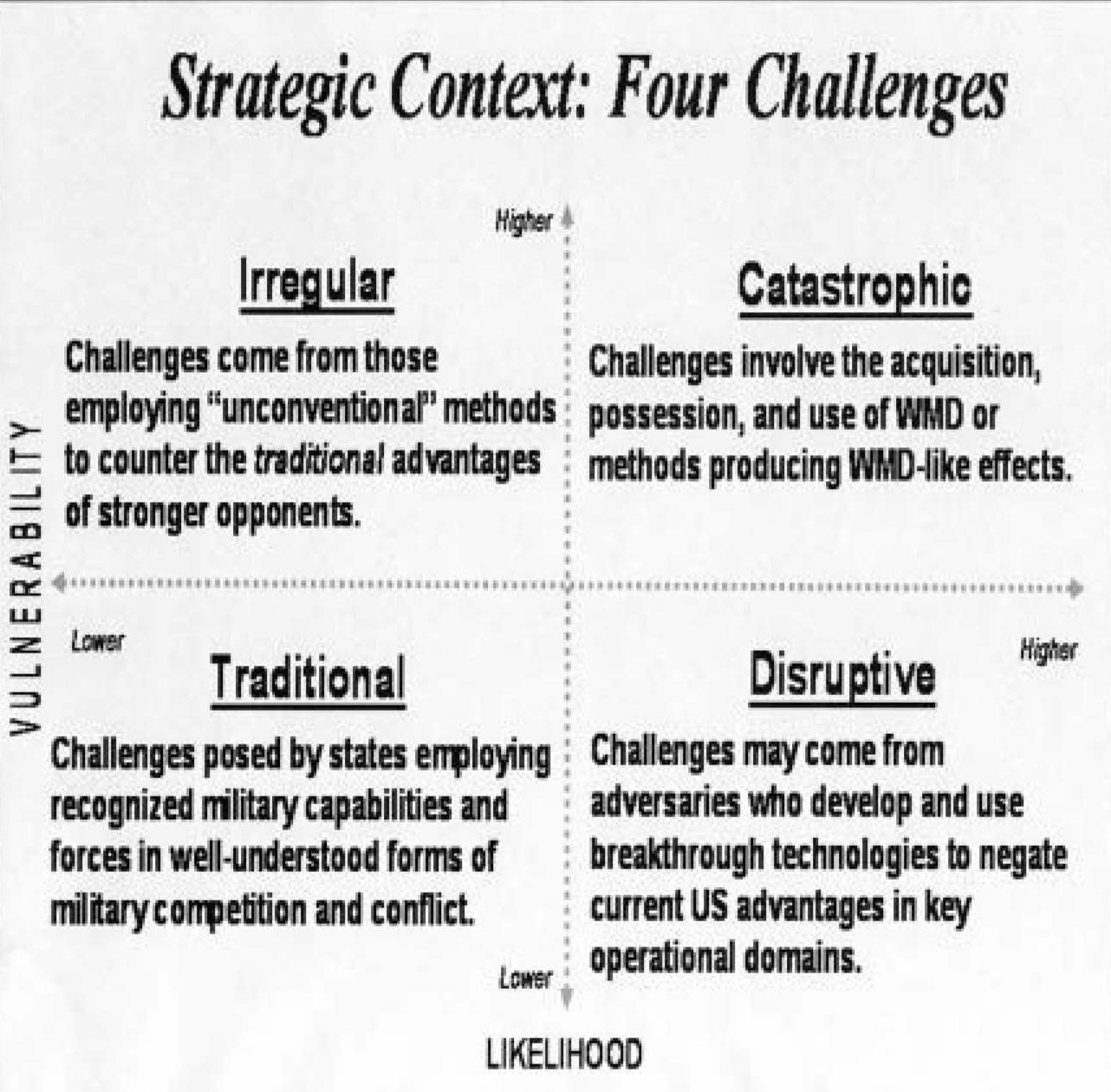
On 12 August 2010, the U.S. Secretary of Defense, Robert M. Gates, delivered a speech at the Marine Memorial Club in San Francisco in which he challenged Marines to “define the unique mission of the Marine Corps going forward . . . .”! The Secretary made the point that the wars in Iraq and Afghanistan have turned the Marine Corps into a “second land army.” This metamorphosis occurred for good reasons, but the time has come to consider the Marine Corps‘ future beyond these conflicts, and in a constrained fiscal climate. The Marine Corps must also be relevant to the types of threats the Nation is likely to face in the future. Given these requirements and constraints, the Secretary has challenged the Marine Corps to rethink its role in national defense. In every challenge there is an opportunity. This is the case for the Marine Corps today. Secretary Gates’ challenge opens the door for the Marine Corps to become the Nation’s primary force for fighting fourth-generation wars (4GWs).

The Marine Corps can no longer be confident that its capability to conduct amphibious forcible entry guarantees its existence. The Marine Corps will remain responsible for maintaining a forcible entry capability in the future, but in his comments the Secretary raised the question of how much amphibious capability the Nation requires. His concern is that “anti-ship missiles with long range and high accuracy may make it necessary to debark from ships 25 or 40 or 60 or more miles at sea,” which might make an amphibious assault prohibitive in terms of cost and potential risks. In addition, large-scale amphibious assaults are only likely against a state opponent. Nonstate actors of the sort Marines are now fighting have no borders or beaches to defend. Against such enemies, amphibious landings may simply be a way for the Marine Corps to get to the fight.

The Army should have primary responsibility for fighting any state that goes to war with the United States, with the Marine Corps playing a supporting role. The U.S. Army was designed for just such a conflict; it makes little sense for the Army to redefine its role. Instead, the Marine Corps, as a smaller, more agile force, should change its role to fill the capability gap that remains. That gap is fighting 4GWs, wars against opponents who are not states.

4GWs are the most likely conflicts in the future. In an article in the Marine Corps Gazette in 1989, “The Changing Face of War,” a group led by William S. Lind laid out a framework for thinking about war.2 4GW is the result of the state’s loss of its monopoly on war. The concept of state as the sole entity legally permitted to use violence dates from the time of the Treaty of Westphalia that ended Europe’s Thirty Year’s War in 1648. Before that time, many other entities conducted wars – business enterprises, families, tribes, religions, etc. After 350 years, the idea that many institutions or groups other than the state may conduct wars is difficult to conceive. The confusion is reflected in the terms used to describe 4GWs, such as “terrorism” or “crime,” when they are, in fact, wars.

The state arose primarily to provide security. In todays world it often fails to deliver on this promise. As a result, citizens of failing states have begun to transfer their primary loyalty away from the state that can no longer provide the security it promised, and they have bestowed this loyalty on some other entity, such as their religion, tribe, gang, or ideology. These other entities provide security and identity that was once provided by the state.

Consider the example of al-Qaeda (AQ). AQ is not a nation-state, nor does it control one. It is a transnational organization that has attempted to hijack Islam in an effort to draw recruits and claim legitimacy. As an organization without a states resources, AQ draws support from those people who feel alienated from their states. It has recruited supporters from states all over the globe. ACl conducted attacks on U.S. Embassies in Africa in the late 1990s and against the USS Cole (DDG 67) in 2000. These were clearly acts of war, but the United States treated them simply as acts of terrorism. It was not until the attacks of 1 1 September 2001 that the United States was forced to recognize the threat posed by AQ. As more states fail or have difficulty meeting the needs of their populations, 4GWs will spread. The conflicts in Iraq and Afghanistan are both examples of 4GWs.

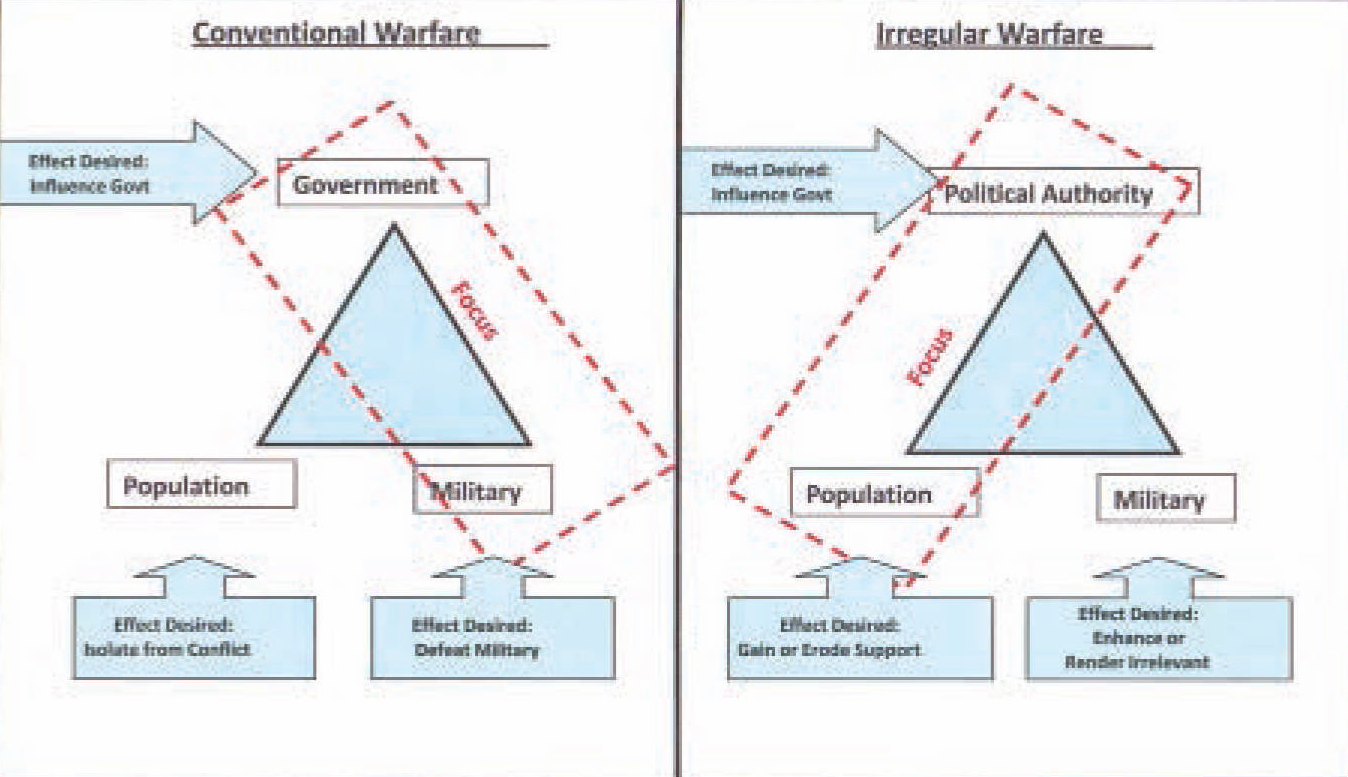
Fourth-generation opponents will attempt to avoid the strengths of the U.S. military, especially its massive fire-power. This should come as no surprise. No sane enemy will fight in a manner that plays to its opponents strengths. The entire world knows that the U.S. military is technologically advanced (perhaps “dependent” is a better word) and can kill any target it can identify. Future 4GW adversaries will be unable to match U.S. technology and will not attempt to do so. They will attempt to draw U.S. forces into conflicts that not only minimize our advantages but also turn our strengths into disadvantages.

Many future conflicts will be fought in urban or other populated terrain as 4GW enemies attempt to make it difficult for U.S. forces to target them. In his book, The Utility of Force, British Gen Rupert Smith wrote that the conflicts of the future would be “war amongst the people.”3 Given the difficulty that U.S. forces have had in Iraq and Afghanistan in rooting out the insurgents from among the civilian population, it is likely other opponents will present us with the same problem in the future. America needs a force that specializes m “war amongst the people,” which is very different from state versus state conflict like Operation DESERT STORM.

For the Marine Corps, becoming the U.S. military’s primary force for dealing with 4GWs has several advantages. The Marine Corps and Army would have roles that would be complementary and clearly defined. The Marine Corps could get out of the business of acting as a second land army for fighting DESERT STORM-style conflicts. Marines would maintain their relevance; the types of wars most likely to occur in the future are 4GWs. The Marine Corps would be able to capitalize on some of its traditional strengths. In many respects, the Marine Corps would simply be getting back to its roots.

The Marine Corps has a long and storied history of involvement with counterinsurgency and brushfire wars. The majority of the conflicts in which Marines have found themselves have been “small wars.” In fact, the Marine Corps quite literally wrote the book on how to fight a small war.4 The Marine Corps‘ focus on conducting amphibious forcible entry is relatively new. Throughout most of the Service’s history, Marines have spent most of their time conducting missions other than amphibious forcible entry. The Marine Corps must certainly maintain an amphibious capability for the Nation, but it should no longer be the only mission that uniquely defines the Marine Corps.

For 4GWs, the Marine Corps has many essential qualities including, importantly, the high quality of its recruits and the self-discipline of its Marines. Fighting 4GWs is much more demanding than fighting conventional state-on-state wars. It requires individuals who can shift instantly from aggressiveness to self-restraint. In 4GWs, among the civilian populace, the heavy use of firepower is a recipe for defeat. Many situations will call for use of small arms only as Marines make every effort to deescalate. This is counterintuitive to someone trained that his own personal safety lies in possessing and using overwhelming firepower. In fact, it may be necessary to sustain more casualties than one inflicts in order to prevail in 4GWs. Fighting in such a complex environment requires someone with the ability to think quickly on his feet, the courage to do what is right even when it is risky, and the self-discipline to refrain from killing when it is either not necessary or counterproductive to the mission. These are qualities Marines are today demonstrating in Afghanistan.

If the Marine Corps is to become the Nations force of choice for fighting 4GWs, several major changes are necessary. The first is adopting the framework of the “four generations of modern war” as doctrine. There may be a useful analogy to recent Marine Corps history. The Marine Corps adopted maneuver warfare as doctrine in 1989. (Maneuver warfare defines the third generation of modern war.) Marine officers informally did much of the intellectual work for this doctrinal change. The adoption of maneuver warfare as doctrine was a tremendous political and public relations windfall for the Marine Corps. It demonstrated to the American people that the Marine Corps is a progressive and forward-thinking organization. The adoption of the four generations of modern war framework as doctrine has the potential to repeat that success.

It is also necessary to restore the intellectual climate that prevailed in the Marine Corps during Gen Alfred M. Gray’s period as Commandant. During that time, Gen Gray encouraged Marines to read, think, talk, and write about maneuvet warfare. He revitalized the Marine Corps‘ professional military education program as part of this effort. A similar intellectual effort will be necessary for the Marine Corps to come to grips with 4GW, and an intellectually open atmosphere will be required throughout the Corps.

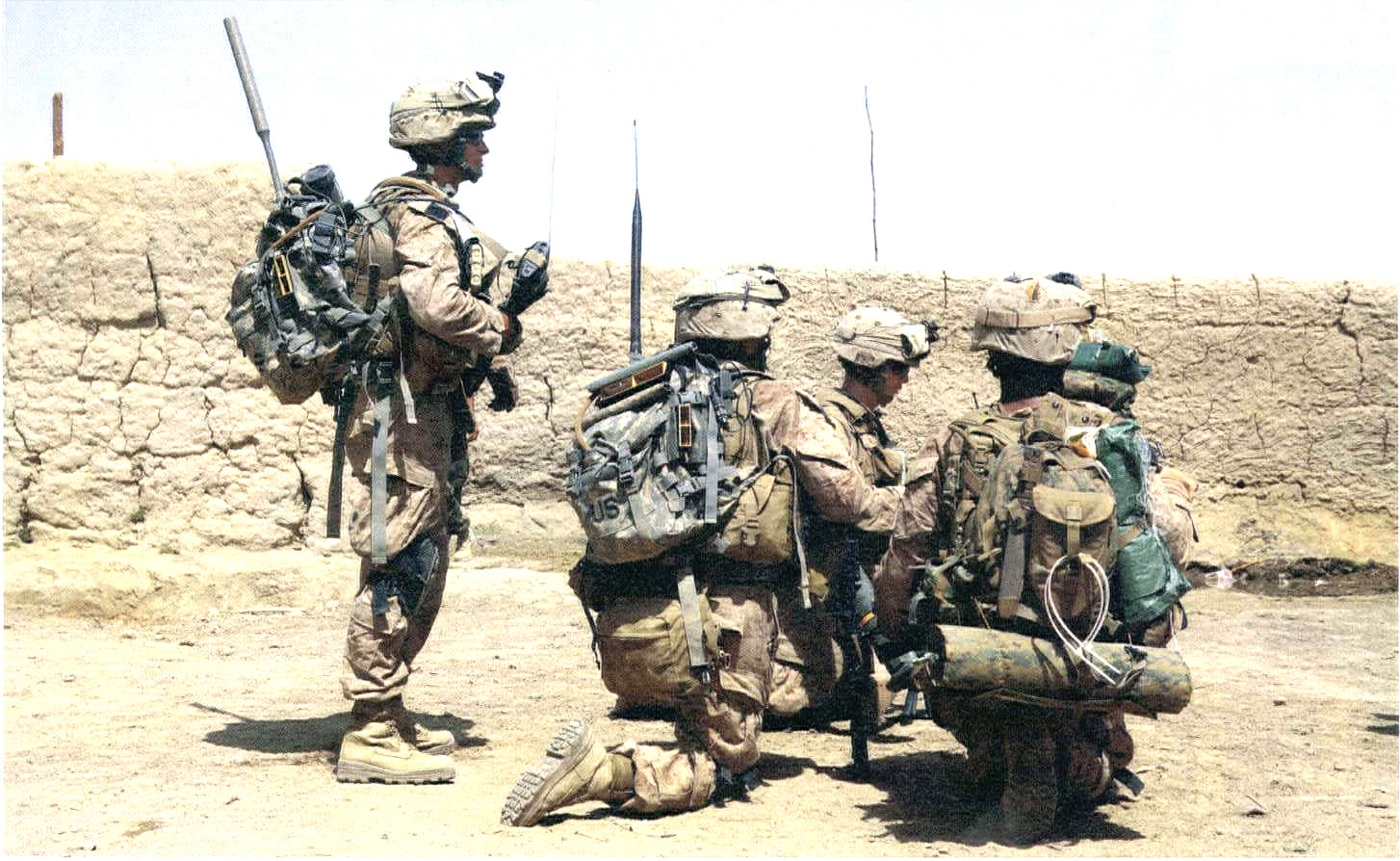
The Marine Corps must also develop some true light infantry. The U.S. military currently has no light infantry. What is now referred to as light infantry is, in actuality, line infantry. A cursory examination of the units that currently profess to be light infantry (including Marine units) will quickly reveal that there is nothing light about them. Part of the reason that the infantry the U.S. military has used in Iraq and Afghanistan has had such difficulty is because, contrary to their appellation, they are actually line infantry.

The greatest difference between light and line infantry has litde to do with gear. The primary difference between light and line infantry is the mindset of each. True light infantry is far more resourceful and self-reliant than line infantry. True light infantry is habituated to operating in an austere environment far from friendly bases and logistical support. In some circumstances, light infantry can live off the country. Line infantry requires a ponderous and expensive logistical tail to sustain ir. Light infantry is used to operating cut off from other friendly units. Line infantry units are extremely uncomfortable when they are isolated from other units or are far from friendly fire support. A light infantryman has an ambush mentality and is always seeking to exploit opportunities to discomfit the enemy. The mindset of a light infantryman is that of a hunter stalking his prey, not that of a football player attempting to push the opponent’s defensive line down the field.

There is no “one size fits all” force. Light infantry, line infantry, armored, mechanized, or motorized forces all have strengths and weaknesses. The weaknesses of line infantry have been cruelly exposed in Iraq and Afghanistan. Other than a few kinetic operations, the limitations of heavy armored formations have also been demonstrated; it is difficult to interact with the populace from behind several tons of armor. Light infantry would have limited usefulness during mobile warfare in open terrain (think World War II in North Africa). Such a fight would place a light infantry force at a mobility disadvantage and, most likely, at a firepower disadvantage as well. Light infantry, however, is well suited to warfare in close terrain. Light infantry is extremely valuable in 4GWs because it can move faster and farther on its feet than can most opponents.

Transitioning to a primarily light infantry force would have the added advantage of making the Marine Corps cheap again. The Marine Corps still provides the greatest “bang for the buck” of any U.S. Service, but given the unsustainable amounts of money spent on U.S. national defense (more than the rest of the world combined), this is not saying a lot. Light infantry costs less while still providing a powerful capability. Before the wars in Iraq and Afghanistan, Marines had a culture of doing more with less, of which they were quite proud. In this sense, transitioning to a fight infantry force would allow the Marine Corps to recapture a valuable element of its institutional culture and of its political appeal.

In fact, the Commandant of the Marine Corps is already concerned about the sustainability of current Marine Corps forces. He recently began a program to investigate ways in which the Marine Corps could reduce the amount of energy that it uses as well as cut the amount of waste produced. The goal of the program is to reduce the logistical requirements of units in the field so that there is less need to risk Marines‘ lives conducting frequent resupply operations. A force consisting of true light infantry will use less energy, require fewer resupply convoys, and ultimately save the taxpayers money.

Reorganizing many of the Marine Corps‘ combat units into light infantry will require rethinking and reorganizing the rest of the Marine Corps as well. For example, logisticians will have to consider how to resupply units that are spread out all over the battlefield, even though their requirements for resupply will be drastically reduced. Communicators will have to ensure that units have the radios necessary to talk over great distances, although fight infantry should be trained to operate even when they have no communications with higher headquarters. Fire support agencies will have to examine their organization and equipment to determine the best manner in which to provide on-call fires appropriate to a 4GW environment. Similarly, Marine Corps aviation will have to reconsider its role and the aircraft: it uses. It will no longer be enough to simply drop bombs based on a nine-line brief; the Marine on the ground will likely be more interested in what the pilot can see, as opposed to what he can destroy. All of these issues, and many more, will have to be addressed if the Marine Corps is to embrace the light infantry concept as a way to becoming the force of choice for fighting 4GWs.

The great American military theorist, CoI John Boyd, USAF(Ret), was widely quoted as saying that the proper way to build a force is, “People, ideas and hardware, in that order.” The Marine Corps already has a large number of high-quality people as a basis upon which to begin the transition to a 4GW mission, although there will be a need to retrain to the light infantry concept. What remains of this trinity is to flesh out the supporting concepts and, lastly, purchase any equipment that is necessary.

As was the case with maneuver warfare, Marines, working informally, have already done some of the intellectual work necessary to transition the Marine Corps to 4GW. Much of the Marine Corps‘ current doctrine is ideally suited to 4GW.5 4GW requires maneuver warfare, since firepower alienates the population. Marine Corps Doctrinal Publication 1, Warfìgbting, also calls for a decentralized philosophy of command and control; 4GWs can be fought in no other way. Doctrinal manuals on 4GW have already been written. They are ready for adoption. Students from the Expeditionary Warfare School’s Advanced Warfighting Seminar wrote them. The series includes two manuals that describe the fight infantry concept and how it differs from current line infantry.6

Some Marines may see Secretary Gates’ words as a challenge to their budget, pet program, or “rice bowl.” It is none of these things. There can be little doubt that in the last decade the Marine Corps, as a Service, has become a second land army. There were good reasons for this, and it was probably unavoidable. Now the Secretary of Defense has offered the Marine Corps an opportunity to rediscover and reclaim its soul, an opportunity to find its way forward again. Such opportunities come along only once in a generation, if that frequently. The Marine Corps must take advantage of this tremendous opportunity to do what is right for the Marine Corps and, more importandy, for the Nation.

Notes

1. Secretary Gates’ comments cited in this artide may be accessed at http://www.defense.gov/ transcripts/transcript.aspx?transcriptid=4672.

2. Lind, William S., Keith Nightengale, John E Schmitt, Joseph W. Sutton, and Gary I. Wilson, “The Changing Face of War: Into the Fourth Generation, Marine Corps Gazerte, October 1989, pp. 22-26.

3. Smith, Rupert, The Utility of Force, Alfred A. Knopf, New York, 2007, p. xiii.

4. Headquarters Marine Corps, Small Wars Manual, Washington, DC, 1940.

5. When referring to doctrine, me author is referring only to the Marine Corps doctrinal publication series.

6. For those with a common access card interested in learning more about 4GW or about the light infantry concept, go to http://www.mcu. usmc.mil/Pages/EWS.aspx and click on the “EWS PKI Website” link at the bottom of the page. Next click on the “Advanced Warfighting Seminar” link on the left side, and then dick on “Manuals.” This site contains a great deal of information regarding these subjects and more. Of particular note is Fleet Marine Force Manual IA, Fourth-Generation War, which describes 4GW in great detail, and a book of 4GW tactical decision games.

Rebutting the Rebuttal

by Capt Andrew J. Graham

In “Embrace Maneuver Warfare: A rebuttal” [MCG, JunlO), Maj Jason W. Heuer writes a counterargument to my February 2010 article, “Embrace Maneuver Warfare: The DS section.” He adds to the debate on the subject; however, much of his counterargument is incorrect.

Maj Heuer alleges that the details of the joint tactical airstrike request (JTAR) application process prohibit the assignment of aircraft to direct support (DS), but this is not the case. Requesting units demonstrate evidence of proper mission planning by the written detail in the JTAR request. The air tasking order (ATO) cell should require the same kind of detailed planning and analysis for a DS section JTAR request as the ATO cell would for any other air support request.

The author argues that watch officers can immediately answer requests for air support and reallocate assets from low-priority missions to higher priority missions. But what about transferring air support from low-priority missions to other lowpriority but strategically important counted nsurgency (COIN) missions? Is a direct air support center (DASC) officer likely to reapportion a mixed section of H-Is that is providing convoy escort and divert them to ferry two Afghan villagers whose child has broken his arm? This seems unlikely. The decision not to divert aircraft reflects a risk-averse aviation culture that restricts creative thinking and problem solving. Unless the MAGTF commanders guidance is so minutely detailed that it identifies and ranks every contingency, the DASC officer will likely never decide to divert the assets to another low-priority mission.

Maj Heuer additionally writes that a section in DS will not support the MAGTF commanders aviation scheme of maneuver and that the DS section does not keep with Marine Corps doctrine. This is patently untrue. Our doctrine, Marine Corps Warfìghting Publication 3-2, Aviation Operations, defines and allows for aviation in DS. The ATO cell must still assign aircraft according to their capability, DS or not. To say that the aviation combat elements (ACE s) flexibility is reduced through a DS section request instead of matching a capability to a mission, and that the crew supplied would not be the best choice for the specific mission, implies two fallacies – first, that our Marine ground brethren cannot tell Marine aircraft apart, and second, that the Marine Corps does not have properly trained aircrews.

Maj Heuer maintains that DS neglects one of the tenets of maneuver warfare – unity of command. Unity of command is a Clausewitzian principle of war and not a tenet of maneuver warfare. The squadron commander retains command over squadron aircrew and airframes, whereas the battalion landing team commander has tactical control of the aircraft during the JTAR. The author also incorrectly states that the DS section role puts the ACE commander in a subordinate relationship to the ground combat element commander. Just like the MEU, the squadron commander is already in a supporting-supported relationship with the battalion commander. Squadron commanders routinely fly and lead their crews in combat. Both the lieutenant colonel squadron commander and the lieutenant colonel battalion commander work for the MAGTF commander, with all parties supporting a designated mission commander for specific missions. Unity of command remains constant throughout, and there is no confusion about who commands the pilots or the infantrymen.

What is missing from Maj Heuer’s argument is a tie into maneuver warfare. How do we speed the flow of information and push decisionmaking down to the lowest level? Do we allow our air and ground forces to use creative thinking to solve our problems using everything in our repertoire? The ideas and experience of junior officers on the ground in Iraq and Afghanistan led to new COIN doctrine and tfie authoring of a new joint COIN field manual. Where is our contribution from the air wing? Regardless of the form it takes, there is clearly a need for more flexible and imaginative use of aviation assets in the current and future COIN fights.

The Road to Hell

by Maj Gregory A. Thiele

As an instructor at the Marine Corps’ Expeditionary Warfare School, I have heard numerous senior officers express their concern to the students that Marine leaders at every level have either lost or never acquired training management skills. Such statements have been repeated frequently enough that the problem seems to be real. It needs to be discussed and solved.

Paradoxically, one of the primary reasons for this decline in training management skills is the predeployment training plan (PTP). The PTP attempts to set out in detail the training requirements for units deploying to Operations Iraqi Freedom (OIF) and Enduring FREEDOM (OEF). Commanders no longer can determine what training to conduct; they simply must determine how best to meet the requirements of the PTP. As a result, leaders at ail levels are no longer required to be proficient trainers. Those who bemoan the fact that our training management skills have atrophied miss the point. This is not a training management problem; it is a policy problem.

Everyone has heard the old adage that the road to hell is paved with good intentions. It may seem cynical, but it is often true. People occasionally make well-intended decisions, particularly short-term decisions, that lead them away from their true and proper course. The Marine Corps appears to be on the edge of just such a calamity with respect to the impact of the PTP upon our philosophy of leadership.

Given the challenges that they face in the current operating environment, there is no doubt that the PTP was intended to help commanders and their units prepare for deployments. The pace of deployments has been extremely fast for most units in the Operating Forces. Many units still do not receive the 2:1 ratio of dwell to deployed time that is the Commandant’s goal. This places a great deal of stress on units attempting to prepare for deployment to Iraq or Afghanistan. There is simply not a lot of time to prepare. Most units have 7 to 1 1 months between deployments. These challenges are compounded by a myriad of other issues, such as late personnel fills and insufficient gear sets for training. Such challenges led to the perceived need to create and institutionalize a standardized training plan for units deploying to OIF and OEF. This decision has not come without consequences. The PTP has had a negative overall impact upon the ability of our leaders to conduct training.

The PTP prescribed the training requirements that units had to complete in order to be prepared to deploy. It included individual and unit annual training requirements, theater-specific training, and a mandated Service-level exercise to certify the unit’s readiness for deployment. The PTP also oudined a regime of briefs and progress reports that were to be delivered to the division (or equivalent) commander. These briefs occurred at specified intervals as units progressed through the PTP. The purpose of the briefs was primarily to ensure that the subordinate unit had a plan to complete the PTP successfully and that they were making satisfactory progress along the way.

The goal of the PTP was not to reduce the role of the battalion commander in training his unit, but this has been the unintended outcome. Due to the short time between deployments, very little time exists to do anything other than the training required by the PTP. The PTP was designed to alleviate the time pressures that most units are under by ensuring that commanders know what training is required prior to deployment. But the effect has been that commanders can no longer develop their own training plans; the PTP prescribes it.

The PTP has other drawbacks as well. As a program that attempts to address the training required by a broad range of units across the MAGTF, it attempts to create a “one size fits all” regimen with many of the shortcomings such an approach entails. In fairness, most commanders would likely develop a training plan that incorporated many of the same events as those that are part of the PTP. This is beside the point. The point is that most have never been given the opportunity to try.

In actuality, the purpose of this article is not to debate the reasons the PTP was instituted or its merits (or lack thereof). The PTP serves as an example of the kind of thinking that, unfortunately, is currently dominant in the Marine Corps. Our doctrinal manuals (and, as an aside, our only true doctrine is contained in the white-covered Marine Corps doctrinal publication (MCDP) series) are excellent and extremely clear on the kind of leadership required in a maneuver warfare force. MCDP 1, VCctrßghdng, states that:

In order to develop initiative among junior leaders, the conduct of training – like combat – should be decentralized. Senior commanders influence training by establishing goals and standards, communicating the intent of training, and establishing a main effort for training. As a rule, they should refrain from dictating how the training will be accomplished.1

There is nothing decentralized about the PTR It is highly prescriptive in nature. Maneuver warfare requires decentralized leadership and seniors who, rather than reserving all decisions for themselves, trust their subordinates. Fleet Marine Force Manual 1-0, Leading Marines, further states that, “The Marine Corps has always enjoyed great success decentralizing authority to the lowest levels.”2 The PTP and the philosophy behind it flies in the face of our doctrine.

The cenrral ingrethent in the formula for maneuver warfare is trust. If we truly trust our subordinates, then we should trust them to train their units for the challenges of combat. Gen James N. Mattis was recently quoted in the Army Times as saying that, “Operations in the future will occur at the speed of trust.”3 It is not a coincidence that a Marine of Gen Mattis’ stature considers trust so vital. It is the glue that holds a maneuver warfare force together. It allows such a force to work to achieve a common goal while operating on little more than the commanders intent. The key issue is to find commanders at all levels who are trustworthy and will develop their subordinates and place their trust in them.

Tb judge by the PTP, we do not trust our battalion (and equivalent) commanders to train their units. If we did trust them, we would give them broad guidance, allow them to develop a training plan, train their units, and hold them accountable for the results. The PTP seems to have as its primary underlying assumption that many of those who are selected as commanders are incapable of devising an effective plan to train their units. As a result they must be provided with detailed guidance and be closely supervised throughout implementation. There is no doubt that no one would ever admit that such assumptions exist (incidentally, such assumptions underlie many of the Marine Corps’ other training programs), but actions always speak louder than words. The philosophy that underpins the PTP is absolutely clear. We do not trust those individuals who are placed in command to fulfill their roles properly.

According to LTG Arthur S. Collins, Jr., USA(Ret), in his book, Common Sense Training, the critical individuals in terms of training are the battalion and company commanders.4 If we do not fully trust them, as it seems is the case, the answer is not to prescribe a detailed training plan so that a cardboard cutout could serve successfully as a unit commander. The proper answer is to relieve subordinates who do not possess the trust of their superiors.

There is no middle ground here. The Marine Corps either selects individuals capable of discharging the responsibilities of command, or we do not. If we do select the best, then we should trust them. If they are not the best, then perhaps our method of selecting commanders is flawed and should be changed. If we cannot find enough individuals with the capacity to command, perhaps those who are selected should spend more time in command; perhaps not everyone should have, or deserves, the opportunity to command. Regardless, some change in either our leadership philosophy or our method of selecting commanders must occur.

None of the above discussion is meant to indicate that supervision is no longer necessary or desirable. Supervision is still absolutely essential. The form and manner of supervision must change. The current model of supervision is extremely centralized and aimed at the collection of data from subordinates. This must give way to a model more appropriate to interaction between professionals who trust and respect one another. Proper supervision should take the form of the senior commander and members of the staff visiting the subordinate unit, often unannounced, to see what is going on for themselves and to determine what assistance their subordinates require to effectively train their units.

Doubtless some will charge that I have misrepresented the goals of the PTP. They would argue that the combatant commander has placed requirements on Marine Corps forces that deploy to Iraq or Afghanistan and that the PTP is simply the Corps’ mechanism to ensure that deploying units meet these requirements. It is certainly true that the Marine Corps must comply with the requirements of the combatant commander, but the prescriptive approach taken in the PTP is a clear indication of the leadership and training philosophy that underpins it. It is not necessarily the requirement that is flawed but the manner in which the requirement is being met that must concern us.

The Marine Corps is unwittingly moving toward a centralized leadership model. Leaders of character and vision must stem this tide before we have gone too far down this path to turn back. The PTP is simply one manifestation of this shift in philosophy; there are many others. Let me leave the reader with a question to ponder. If we concede that we must be able to conduct decentralized operations due to the requirements imposed upon our forces in Iraq and Afghanistan, how does a centralized training methodology create such leaders?

Notes

1. Department of the Navy, MCDP 1, Vfárñghting, Government Printing Office, Washington, DC, 1997, p. 60.

2. Department of the Navy, Fleet Affatine Force Manual 1-0, Leading Marines, Government Printing Office, Washington, DC, 1995, p. 75.

3. McMichael, William H., “Mattis: Hybrid Skills a Must in Future Wars,” Army Times, accessed at hnp://www.armytirnes.com/news/ 2009/06/military_mattis_futurewar_060 1 09w.

4. Collins, Arrhur S., jr., Common Sense Training A Working Philosophy for Leaders, Presidio Press, Novato, CA, 1978, pp. Ã’3-4.

Embrace Maneuver Warfare

by Maj Jason W. Heuer

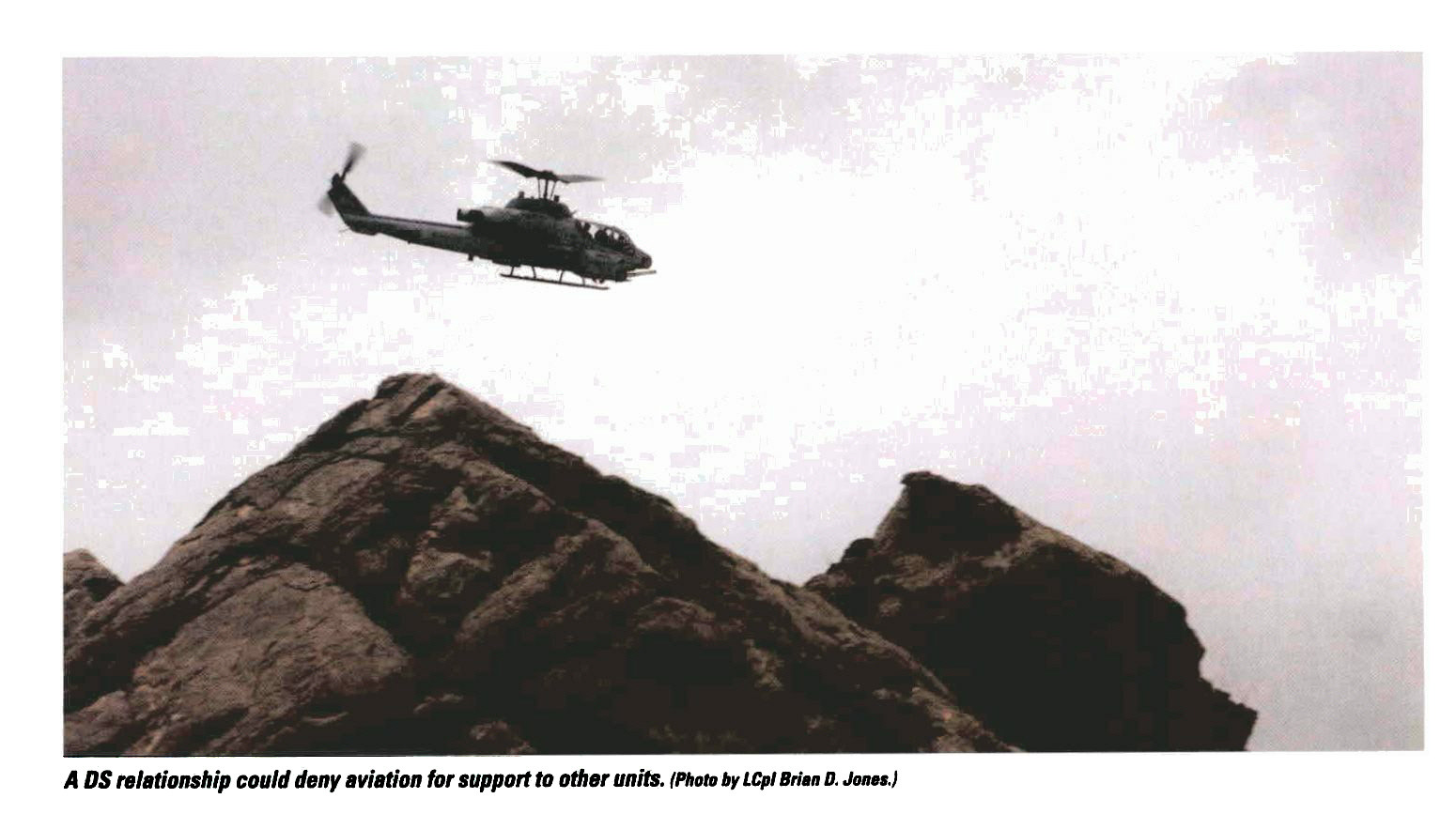
The “Embrace Maneuver Warfare” author, Capt Andrews J. Graham (MCG, Feb 10, p. 27), calls for placing aviation assets in direct support (DS) of an infantry battalion in order to better adhere to the Marine Corps’ doctrinal employment of maneuver warfare in a counterinsurgency environment. The author believes that placing a Marine light attack helicopter squadron section in DS of a battalion will allow for better and more responsive support as the aviation assets would be collocated with the battalion. This in turn would facilitate quicker response times in a complex and fluid battle and improve face-to-face planning and the aircrew’s overall situational awareness and intelligence-gathering ability. It is clear that the author intends to enhance the combat power of the infantry battalions by increasing the options available to the battalion commander when he must rapidly decide how to act with the speed and boldness required in a dynamic tactical situation. However, I believe this proposal equates to a dismantling of the aviation request and tasking process and overlooks one of the three tenets of maneuver warfare – unity of command.

On the surface this proposal appears feasible and shows a fundamental understanding of the overall intent of maneuver warfare – breaking the enemy’s will to continue to resist by constantly presenting him with conditions to which he is unable to effectively respond. It also shows that the author understands chat our doctrine implores us to be flexible and accepting of change when presented with the opportunity to improve our warfighting capabilities. However, closer examination of the author’s argument reveals that implementation of this concept would require significant changes for employing and maintaining limited aviation assets and resources. As a response I offer three areas of Capt Graham’s proposal that were overlooked.

First, the process whereby units request aviation support is not adequately covered. The current process requires that requesting units analyze their aviation requirements during the detailed planning process and integrate it into their overall concept of operations. The unit then submits to the common headquarters (e.g., MAGTF) a joint tactical airstrike request/assault support request (JTAR/ ASR) 72 hours prior to execution that requests aviation support and then has the appropriate assets assigned via the air tasking order (ATO). The necessity of submitting the JTAR/ASR 72 hours prior to execution allows for proper apportionment and allocation. The process allows headquarters future operations personnel to analyze the requests and prioritize which of the requests will be sourced by our relatively limited aviation assets. The intent is to source every request, but limited assets and the large number of requests doesn’t always make this goal a possibility. Planners will attempt to roll requests that are not sourced on the requested day to the next ATO in production. The process is intended to ensure that the use of Marine Corps aviation assets is scrutinized, the subsequent tasking of assets is based on established priorities, and effective battlefield results are achieved.

Requests must be thoroughly scrutinized in order to ensure that aviation assets currently being flown at a rate beyond their planned utilization are used in an efficient and effective manner. The author of “Embrace Maneuver Warfare” believes that this process is slow, unresponsive, and unable to react to the immediate needs of a maneuver element commander. He counters that the assignment of a section of aircraft in DS would repair this shortfall and allow for better face-to-face planning and integration in the overall scheme of maneuver. This proposal negates the need for supported units to do the essential detailed planning that results in a thorough and well-written JTAR/ ASR. In order to be able to continuously employ our valuable aviation assets and ensure that they are utilized effectively, their tasking must be supervised, planned in detail, and efficient. The detailed planning requires a requesting unit to identify a requested capability then srare a ca sfc a nd purpose, not request a specific asset for DS. The aforementioned planning expedites the ATO development process, allowing ATO development cells in future operations to allocate an asset with the requested capability, versus filling a request for DS aircraft.

When this process doesn’t match up with a rapidly evolving battlefield, there are allowances and decisions integrated in the ATO development process and execution to ensure that aviation support remains responsive to ground forces. First, allowances are made that permit supported units to submit requests for aviation support inside of 72 hours when the request is in response to a change on the battlefield or when planning assumptions and factors have changed. Second, untasked aircraft will be assigned to a strip alert status on the ATO. These strip alert aircraft allow the aviation combat element (ACE) to react to immediate requests for air support. Watch officers in the tactical air command center can immediately answer the request and respond to a dynamic situation by authorizing the launch of these assets when the situation dictates. Watch officers also have the option to divert airborne aircraft from lower priority missions to the evolving situation. The decision to divert aircraft or to launch aircraft on strip alert is executed within the parameters of the priorities assigned by the MAGTF commander and executed by the ACE commander. These allowances and decisions allow the ACE the flexibility to provide what is necessary at the point of attack when changes on the battlefield must be reacted to inside the ATO planning cycle.

Second, in addition to ensuring that aircraft are used effectively, the ATO planning process is in place to ensure that the MAGTF commander’s aviation assets are used in a way that supports his overall scheme of maneuver, objectives, and intent. Simply requesting an asset (vice a capability) when seeking the support of aircraft and subsequently granting the battalion commander tactical control of these assets doesn’t ensure that the use of aviation assets is constantly nested with the MAGTF commanders intent and tasks. Utilizing the current process ensures that the overall structure of a MAGTF and its employment is maintained in accordance with our doctrine. Further, the Marine Corps Planning Process requires that the MAGTF commander’s tasks and intents be continually nested in the planning process. The request for a capability in the JTAR/ASR is a result of this planning. If aircraft were assigned to a battalion in a DS role, I believe the ACE’s flexibility and effectiveness would be diminished by the requirement to simply supply a specific asset, vice being able to match the request for air support with the proper platform manned with a crew best trained and equipped to execute the mission. Simply assigning a section of aircraft to DS of a single battalion for an extended amount of time does not keep with doctrinal procedures and eventually denies the use of aviation assets to other maneuver battalions who desire the increased battlefield effects that a section of Marine aircraft provides. Our doctrine and the Marine air command and control system are designed to ensure that units requesting aviation support receive it in a manner that supports the MAGTF commanders priorities and that these assets are commanded and controlled in a safe, responsive, and efficient manner.

Finally, the proposal of placing aircraft in DS of a battalion commander (and potentially allowing the battalion air officer to directly task aircraft vice advising the battalion commander about methods for integrating aviation into the scheme of maneuver and doing the detailed coordination work) places the ACE commander in a subordinate relationship relative to the ground combat element (GCE) commander vice a supporting relationship. Effectively the ACE commander becomes a force provider vice a warfighter. This is a departure from the synergistic employment of the MAGTF concept, where the GCE, ACE, and logistics combat element commanders maintain a habitual relationship and constantly ensure that the tasks they assign their subordinates are nested with their higher headquarters/MAGTF commanders objectives, while still having the authority and duty to decide and act with initiative and boldness.

Capt Graham presents a solid argument in defense of his concept, but I believe further analysis reveals other issues. Our warfighting doctrine encourages us to be flexible and agile in our thoughts about, and application of, maneuver warfare concepts, but the proposed concept is too significant a departure from our MAGTF-centered employment of aviation. Use of aircraft in an extended DS role dismantles the ATO planning process, goes against the unity of command tenet of maneuver warfare, and alters the chain of command relationship between the MAGTF commander and the major subordinate elements. Our limited number of aircraft implores planners and commanders to ensure that tasking is scrutinized and the right effects are achieved on the battlefield in order to ensure that we are consistently prepared and postured to apply the effects ground commanders require at the point of attack and eventually achieve our Nation’s strategic objectives.

The Attritionist Letters (#7)

I have no intention of explaining how the correspondence, which I now offer to the public, fell into my hands. The general who authored them is almost certainly retired, for he writes with such careless disregard-and one might suggest some contempt-for our beloved Corps. The young captain to whom he writes is a more puzzling case; there are far too many Capt Wormwoods in the global access list to determine which is being addressed. Nevertheless, it is the essence of these papers that I find disconcerting-and thus the urgency with which I submit them to you, the reader. Read on.

Capt Wormwood,

After reading some of the missives that you send, I cannot help but sit down and laugh heartily at your naivete. It does not surprise me that you hear all manner of absurd ideas; there is no end of foolishness in this world. What I find laughable is that you give enough credence to the things you hear that you would actually ask me about them! I suppose I should not be terribly surprised. What else should I expect from a mere captain? In fact, perhaps I should be pleased that you are referring matters grear and small to me. That is certainly rhe role of every subordinate.

This brings me to the subject of your last letter. It is a mark of the degeneracy of these “maneuverists” that one of their number would actually state that “trust is the secret ingredient of maneuver warfare.” The arrogance of these people is stunning. If you need a “secret ingrethent” to conduct their form of warfare, what happens when it disappears? If trust between subordinates and seniors is an absolute requirement for maneuver warfare, then the maneuverists occupy an even weaker position than they know. When was the last time that you observed a relationship between senior and subordinate in which they truly trusred one another? I would wager that you have never seen ir. I certainly haven’t.

How can we trusr our subordinates? They have been trying to avoid and shirk their duties since time immemorial. Frederick the Great wanted his soldiers to be more afraid of their officers than their enemy, and with good reason. He knew they would desert if given a minute’s opportunity. Do you nor think that your lieutenants will require minute supervision? Of course they will, and not simply because they are young. They will attempt to mislead you if you do not watch them closely. This is no more than an acknowledgement of human nature.

The need for control, not trust, is a truth that the Marine Corps has long recognized. If you look beyond the rhetoric, you can see how little trust commanders have in their subordinates. It is manifest in things both small and large. Why do Marines fill out reams of paperwork before going on leave or prior to an extended liberty period? Why has the Marine Corps created a detailed predeployment training program that minutely prescribes training requirements for deploying units? The answer is obvious, although it is also obvious rhat no one will openly admit it.

Trust be damned! You cannot command and control a unit effectively based on trust! You cannot trust that your subordinates did maintenance; yoti must know. You cannot trust that your subordinates know what you want them to do; you must tell them and then ensure that it is done to your full satisfaction. I know what one of those tool maneuverists would say. I had one of them as a subordinate before T retired, and he was thick enough to attempt to discuss this issue with me. He said that “trust did not replace supervision, but that the form of supervision is différent.” He said that “in many cases, the senior would conduct unannounced visits to see what is really going on and had the right to expect total openness and honesty from his subordinates.” Can you imagine this? I was far too busy to leave my headquarters. My form of supervision was better; I had my subordinates come to my headquarters and briet me. We would sit in the conference room and they would conduct a Microsoft PowerPoint brief detailing what they had been doing. I could have them make changes or give guidance to m\ stali based upon this brief. I did exactly what everyone else did, but T had this young officer tell me that it was wrong. What did he know about exercising command? Nothing! 1 find that I am getting angry just relating the story to you now, and it happened some years ago.

Let me tell you this, Wormwood. You had better learn your place in this organization. Listen carefully and keep your mouth shut. Your superiors have been put in their positions because they are smarter than you. You would do well to remember this. I have heard maneuverists say that decisions flow up the chain of command and support flows down, but this is not the way the Marine Corps works, thank Nick. There is a reason that information flows up the chain of command and decisions flow down. It is because those who have the experience and will know best what to do in any situation are at the top.

It is quite likely that it is difficult for a mere captain to grasp all of this. If you are able to understand, you should begin to see how all of the things we have discussed in this and in past letters are interrelated. Each individual issue may not seem critical, but they arc part of a coherent and logical whole. When viewed in this manner, it is clear that the maneuverists have been defeated and that we are in charge.

If, as 1 expect, you are still confused, just shut your mouth, put your brain in neutral, and do what you’re told. No Marine who follows that order can go far wrong.

Gen Screwtape

The Attritionist Letters (#6)

I have no intention of explaining how the correspondence, which I now offer to the public, fell into my hands. The general who authored them is almost certainly retired, for he writes with such careless disregard-and one might suggest some contempt-for our beloved Corps. The young captain to whom he writes is a more puzzling case; there are far too many Capt Wormwoods in the global access list to determine which is being addressed. Nevertheless, it is the essence of these papers that I find disconcerting-and thus the urgency with which I submit them to you, the reader. Read on.

Capt Wormwood,

In my last letter I discussed some of the reasoning behind why we have made such a concerted effort to eliminate such archaic concepts as “commander’s intent” and “mission tactics.” You noted that I only mentioned examples from in theater or from combat situations. How daft of me! You obviously are aware that we are aggressively pursuing this agenda on all fronts – including in garrison environments across the Corps.

For the past 20 years we attririonists have sought to banish commanders intent and mission tactics from the modus operandi of the Corps, and we have all but succeeded. For instance, in all previous predeployment training programs (PTPs), higher echelon leadership was limited to providing commander s intent and allowing mission tactics to occur as subordinate regiment, battalion, company, and platoon commanders determined specific training requirements and the methods of best accomplishing them. However, most – ii not all – current PTP is coordinated, directed, and supervised by higher echelon directives. I think that we can all agree that such templated training programs as Enhanced MOJAVE VlPER exist because subordinate unit commanders have proven themselves consistently unable to execute higher headquarters’ intent.

Marine Corps Doari nal Publication 1 (MCDP 1), Warfighting, dates itself by claiming that “as a rule, [senior commanders] should refrain from dictating how the training will be accomplished.”1 In no other PTP environment has the Marine Corps been able to institutionally create, maintain, and disseminate such extensive guidance via such effective media as e-mail and Microsoft PowerPoint and SharePoint systems. With these assets available today, there is simply no need to rely upon subordinate commanders to create or execute training plans. Rather, it is best to implement templated training packages rhar cover all potential situations for all units preparing for deployment. Wormwood, I must ask, does it not make your job considerably less challenging now that you have no need to schedule or execute training? Just count the Marines when they show up and ensure that your operational risk management has been submitted.

Our dear friends – those attririonists who implemented the PTP – have minimized any platoon, company, battalion, and even regiment leadership input into the PTP process. This centralized attritionist policy – while clearly executed on a daily basis across our Corps – is still not reflected in those antiquated philosophies found in MCDP J. I find it so frustrating that MCDP I still claims that “commanders at each echelon must allot subordinates sufficient time and freedom to conduct the training necessary to achieve proficiency at their levels.” MCDP ÃŽ goes on to claim that commanders “must ensure that higher-level demands do not deny subordinates adequate training opportunities for autonomous unit training.”2 It is almost laughable! Thankfully, these archaic pronouncements are clearly out of step with the current attritionist trends across our Corps! MCDP 1 falsely assumes that subordinate commanders are best situated to divine training shortfalls and requirements for their respective units, when in fact the PTPs offer a far superior and comprehensive solution.

Higher echelon commands have effectively relegated subordinate commanders to “managers” of their assigned personnel with limited ability to interfere with the training of their units. While skeptics decry this trend and claim that it will serve to diminish initiative and the abilities of subordinate commanders, it is a small price to pay for the creation of a MAGTF with “standardized” capabilities and the protection of our training programs from the tampering of subordinate leaders.

Wormwood, more examples of our success abound! Think of those junior Marines who are so often subject to restrictions placed upon them while deployed. Liberty cards in Okinawa, curfew restrictions imposed in Korea, and exclusion from major cities in Kuwait are specific policies directed by the highest echelons of command, not by local subordinate commanders. After all, it is far simpler to impose a regulation than it is to establish an expectation and challenge subordinates to accomplish it. Moreover, it is far more difficult to trust a subordinate than it is to impose a regulation.

Thus the practice of the Marine Corps must be to eliminate the outdated need of “trusting subordinate commanders.” While MCDP 1 might claim that “trust by seniors in the abilities of their subordinates” is essential, you will witness the hypocrisy of that statement.3 As I mentioned in my last letter, it is far better for a senior to eliminate all doubt and ensure that subordinate commanders execute guidance as passed rather than make false assumptions.

And Wormwood, you will concur that when units return from training exercises or a deployment and the Marines seek to set out on leave, each is required to complete a paperwork-intensive leave request. In years past, the highest echelon commands would establish their intent and allow subordinate commanders to determine unit leave policies (and thus execute mission tactics). That obviously did not work. The Marine Corps has therefore established directed leave policies (including those extensive paperwork requirements) by higher echelon commands. Skeptics will query why a MEF commander must dictate the requirements of a lance corporal desiring to take leave. The answer lies no doubt in the inability of regimental, battalion, and company commanders to competently implement the commander’s intent from higher headquarters. Thus, the most senior commanders have no choice but to dictate and institutionalize standardized procedures that restrict subordinate commanders’ use of discretion and judgment.

You can see that we are achieving success on all fronts. Soon – very soon – subordinate leaders will be relegated completely to automaton-like roles, simply executing that guidance explicitly directed by the highest command. That transformation of the Marine Corps to a completely attritionist force will provide unprecedented battlefield effectiveness for the battles we have yet to fight. Until then, I remain,

Gen Screwtape

Notes

1. MCDP I, Warfighting, Headquarters Marine Corps, Washington, DC, 1997, p. 60.

2. Ibid.. pp. 59-60.

3. Ibid., p. 58.

The Attritionist Letters (#5)

I have no intention of explaining now the correspondence, which I now offer to the public, fell into my hands. The general who authored them is almost certainly retired, for he writes with such careless disregard – and one might suggest some contempt – for our beloved Corps. The young captain to whom he writes is a more puzzling case; there are far too many Capì Wormwoods in the global access list to determine which is being addressed. Nevertheless, it is the essence of these papers that I find disconcerting – and thus the urgency with which I submit them to you, the reader. Read on.

My Dear Capt Wormwood,

I must admit that the tone of your last letter surprised me. The “maneuverists” may have recently celebrated the 20th anniversary since Fleet Marine Force Manual ], Warfighting, was published, but you should ask yourself, what have they truly gained? You are, perhaps, not sophisticated enough to understand, but simply publishing a book and proclaiming it doctrine doesnoca revolution make. I will attempt to enlighten you on this topic in the future; I doubt that you are capable of comprehending my meaning m a single letter. It will suffice for now to examine this thankfully “incomplete revolution” (as I long ago took to calling it) from the perspective of terminology.

In the effort against the maneuverists, we have one inestimable advantage. Let us be blunt: attrition is simply easier to understand than their “maneuver” warfare. This is one of our inherent advantages. For those who are lost and confused in the morass of maneuver warfare, attrition will seem a light in the darkness, a beacon for the wayward. We will seduce converts with our simplicity. Simplicity is essential in war. After all, “everything in war is very simple, but the simplest thing is difficult.”1 The maneuverists are fond of trotting out this quote, but they ignore its implications – in war, everything should be as simple and straightforward as it is possible to make it.

Hard experience has shown us that our subordinates cannot deal with much complexity. Take the example of the “strategic corporal.” I have often heard senior officers extol the virtues of the strategic corporal, yet the only examples they give of the impact of the strategic corporal are negative. I do not want any strategic corporals! I want corporals who do exactly what I tell them to do. There is a reason that enlisted Marines are taught “instant, willing obethence to orders” in boot camp; it is because this is their appropriate role. Please save us from Marines who “think”! They should leave the thinking to their superiors and do what they are trained to do – follow orders. We must seek to make everything as simple as possible for our subordinates, otherwise they will leave us with a mess that we must clean up and for which we will be responsible.

We have been extremely successful in dominating the way that terms used by the maneuverists are defined. I am certain that you have heard many of your instructors and superiors repeat the phrase, “words mean things.” It may be trite, hut it is also true. We must strive to dictate the meaning of key terms to the maneuverists. By doing so we can quite literally force them to discuss and understand war on our terms. 1 his is particularly true in the case of those new lieutenants seeking to understand maneuver warfare. Ir we control the lexicon that they must learn and use, they will be predisposed to accept our views. Wc will have prepared their minds properly, and they will be much more receptive to attrition warfare, all while speaking in maneuverist terms.

Let me give you an example. Take the term “shaping.” For the maneuverists, it has many meanings. Ir may connote gathering intelligence; it may mean an attempt to deceive the enemy or create uncertainty in the enemy commander’s mind. Only rarely does it mean that you are attempting to attrite the enemy’s forces. For us, however, shaping is virtually synonymous with destroying the enemy’s forces on the Field of battle. And why not? After all, this is the purpose of military force! What the maneuverists fail to understand is that anything else is simply window dressing! The fools!

Where we cannot subvert the meanings of their words, we must attempt to sow confusion. Confused officers will look for answers they can understand – clear answers that attritionists will be able to provide. Thus far we have been extremely successful in this arena. The terms “center of gravity” and “critical vulnerability” are a clear indication of this success. As many times as I have seen it, it never tails to amuse me to watch operational planning reams devolve into chaos as they attempt to determine the enemy’s center of gravity. Perhaps the greatest joke is that upon the conclusion of this intense debate, they invariably determine that the center of gravity is the enemy’s artillery or indirect fire assers! Whatever was the debate about?

We have also been aided by a number of well-intended efforts to “clarify” the concept of the center of gravity. In some cases such clarification has been to our decided advantage as it has forced the maneuverists to employ concepts that virtually force them into an attritionist approach. I find it a delightful irony that the maneuverists’ own efforts to clarify [heir terms may actually lead to their undoing!

In my last years on active duty, 1 became heartily sick of hearing maneuverists quote chapter and verse from John Boyd’s briefings about how war is fought not just at the tactical, operational, and strategic levels, but also at the physical, mental, and moral levels. What nonsense! War is a physical act; all of Boyd’s mental- and moral-level mumbo jumbo is useless and unnecessary complication. Today, young officers are taught that the center of gravity must be a tangible thing, most likely an enemy unit. This forces them to focus on the “physical” level of war, which is only proper. They cannot escape it.

Perhaps this is all more than you can take in at one time. I sometimes forget that I am writing to a mere captain. Please forgive me if I have overburdened you with ideas that you cannot yet understand. When next we meet I will give you detailed instructions for the continuation of the struggle. Until then, do nothing unless I have approved it first.

Gen Screwtape

Note

1 . Von Clausewitz, Carl, On War, edited and translated by Michael Howard and Peter Parer, Princeton University Press, Princeton, NJ, 1976, p. 119.

The Attritionist Letters (#3)

I have no intention of explaining how the correspondence, which I now offer to the public, fell into my hands. The general who authored them is almost certainly retired, for he writes with such careless disregard – and one might suggest some contempt – for our beloved Corps. The young captain to whom he writes is a more puzzling case; there are far too many Capt Wormwoods in the global access list to determine which is being addressed. Nevertheless, it is the essence of these papers that I find disconcerting – and thus the urgency with which I submit them to you, the reader. Read on.

Capt Wormwood, I received your last letter some time ago, but you must understand that someone of my stature has far more important things to do. Furthermore, it took me some time to compose an adequate response to your misguided and – quite honestly – almost insolent comments suggesting that “mission tactics” and “commander’s intent” have redeeming value. Put such thoughts out of your feeble mind this instant! I will tell you exactly what I want you to do. You will not have to wonder, nor will you have to burden yourself with thinking about it. And as for my intent, my intent is for you to do exactly what I tell you to do! It is time for you to grow up and leave such foolish notions behind. Wormwood, I must admit that at times I suspect that you may actually be in league with these maneuverists, and then I realize that it’s just the naïveté of a young captain. It is critical that you understand that the trend toward centralization precludes the need for Marine leaders to indulge in such archaic and ambiguous concepts as commander’s intent and mission tactics.

As a relatively recent graduate of The Basic School, you no doubt will recall the terms introduced above. Long heralded as part of the “triad of maneuver warfare,” these two elements of Marine warfighting philosophy are proving to be increasingly obsolete in today’s operating environment. According to Marine Corps Doctrinal Publication I (MCDP I), Wirfiglwng.

The purpose of providing intent is to allow subordinates to exercise judgment and initiative – to depart from the original plan when the unforeseen occurs – in a way that is consistent with higher commanders’ aims.’

We must remind ourselves that commanders have been forced to use commander’s intent and mission tactics because of limits imposed upon them by chaotic battlefield situations and limited technological capabilities. Neither of these limits exists any longer. Further, we must admit that so few junior leaders on the battlefield possess that coup d’oeil – the intuitive grasp of what is happening on the battlefield. Thus, it is absolutely nor in the interest of higher echelon commanders to allow subordinate leaders to demonstrate initiative and independence.

As we further our agenda, we can clearly imagine a combat operations center (COC) 5 years from now:

A batta J i on commander walks into his COC and sees a ‘troops in contact” unfold on the plasma touch screen operations moni tor. The zoomed in li ve sa teilt te teed provides him eag}c-cyed observa don ot the situation unhiding in realtime. He sees the blue icons displaying his fri endlies – thanks to global positioning system tra eking devices embedded in the rifles – moving north along a road. He also sees die enemy pia toon a txempting to flank liis lea d units. Rea lizing the gra vity of the situation, the battalion commander double taps on the trace squad leader’s icon and slides it approxima tely 200 meters north. The commander selects an ambush graphic icon from a dropdown menu and double taps the screen a t the desired loca – don. Almost immediately, he sees the squad leader halt his movement, glance downward – no doubt a r the liquid crystal display screen strapped to the squad leader’s forearm – and make a few blurred hand gestures directing his men toward the identified ambush position. The battalion commander looks on with satisfaction as he sees the squad set out.

Wormwood, you know that the technologies to allow us these capabilities are currently available. If we adhered to the tenets of commander’s intent and mission tactics, we would have to rely upon subordinate commanders to receive, evaluate, analyze, and execute our guidance. Each or these steps introduces potential error into the process, error that – although once necessary to assume – can now be avoided.

A second reason for shifting our philosophy is that both commander’s intent and mission tactics demand that a commander trust his subordinate commanders. In todays more interconnected and globalized world, the penalties for wrongly trusting subordinates are no longer confined to a court-martial or conference room deliberations among military professionals. We attritionists must continually leverage today’s commanders who are held accountable in a court of national and international opinion, and due to the 24-hour news cycle, immediately. Thus, a results-oriented (and dare I say career-minded) individual assumes tremendous risk if he leaves subordinate commanders to interpret his guidance. MCDP 1 falsely claims that “trust by seniors in the abilities of their subordinates”2 is essential. In fact, I hope you will agree that it is far better for a senior to eliminate all doubt and ensure that subordinate commanders execute guidance as passed rather than risk mistakes. Ideally, subordinate commanders should be relegated to being nothing more than simply “managers” of the personnel assigned them. Wormwood, how easy would your job be if someone told you not just “what” to accomplish but “how” to do it as well?

You may be wondering what your role would be in such a system. Not to worry, my dear Wormwood, there would still be a need lor a few exceptional officers to be trained for higher command. Junior officers would spend their formative years learning and developing not by trial and error, not by attempting to achieve dazzling results and succeeding or failing, but as they ought, by simply following the orders of their wiser seniors. They would always succeed, and success would be their teacher. The maneuverists would certainly complain, “You will teach them obedience and they will never learn initiative!” This is absurd. When officers and NCOs are young, they are like children and should be treated as such. We will teach them initiative at the proper time, if it is necessary, but we will be very careful about giving them this tool. It is unpredictable and difficult to control, much like giving fire to primitives.

Even at the simplest levels, we must continue to centralize decisions and remove the possibility that subordinates will misinterpret orders. Wormwood, I cannot remember when you last deployed to a combat zone. No doubt you saw firsthand the emergence of attritionist policy with regard to the use of personal protective equipment (PPE) in theater. Commanders intent and trust in subordinates have been usurped by the centralized dictates of an attritionist culture, and rightfully so. While some higher echelon commanders have suggested that perhaps PPE requirements are situationally dependent and based upon subordinate commanders’ battlespace assessments, several battalion commanders have indicated that such decisions were not delegated but rather made by a senior commander at a forward operating base far removed from their daily operations. It is clear that senior commanders cannot trust subordinates to make independent decisions. And this lack of trust is justified! After all, who will be held responsible if a Marine is killed and his death might have been prevented?

Capr Wormwood, you must realize that in order to be more effective as a 21st century fighting force, we must halt our dependence upon archaic characteristics, such as commander’s intent and mission tactics. Although such practices may have seemed to work in years past, they now work against us. (It is more likely that maneuverists have simply exploited such successes by claiming credit for maneuver warfare when in fact some other rationale was responsible.) Quite simply, senior officers make better decisions than junior officers, as we have seen both in Iraq and Afghanistan. Commander’s intent and mission tactics only serve to reduce the speed and precision with which a senior commander can make necessary decisions. Subordinate commanders should be relegated to the more appropriate role of “personnel manager” focusing primarily on the human resource concerns of the force rather than on the leadership and decisionmaking so espoused in eras past. The subordinates must understand that their role is twofold: to execute the orders they have received and to report back to higher headquarters.

While this may not sound terribly exciting, Wormwood, please remember that it is for the good of the Corps. I am looking forward to your next letter and until then, I remain,

Gen Screwtape

Notes

1. MCDP I, Wtrfiglning, Headquarters Marine Corps, Washington, DC, 1997, p. 89.

2. Ibid., p. 58.

The Attritionist Letters (#1)

I have no intention of explaining how the correspondence, which I now offer to the public, fell into my hands. The general who authored them is almost certainly retired, for he writes with such careless disregard – and one might suggest some contempt – for our beloved Corps. The young captain to whom he writes is a more puzzling case; there are far too many Capt Wormwood’s in the global access list to determine which is being addressed. Nevertheless, it is the essence of these papers that I find disconcerting – and thus the urgency with which I submit them to you, the reader. Read on.

Capt Wormwood,

From your lessons at The Basic School (TBS), you no doubt recall the great 1989 victory won in Quantico by those who called themselves “maneuverists.” Then-Commandant, Gen Alfred M. Gray, arrayed his forces against us – we the noble “attritionists” – to do battle over the philosophy upon which the Marine Corps would operate. Gen Gray’s forces attempted to redefine the Marine Corps with a new interpretation of military theory, that of “maneuver warfare.”

For the past two decades, these maneuverists have touted their victory. But as you know, young Wormwood, we are far from dead. In fact, attritionist forces have long waged a surreptitious insurgency on all fronts of the Corps. Now, even as those maneuverists celebrate the 20th anniversary of their victory, it is increasingly evident that they have all but lost the war. As the Corps has quiedy transitioned from a “maneuver-centric” philosophy back to a more attritionist one, you will note that Marine Corps Doctrinal Publication 1 (MCDP 1), Vfàrfìghting, has remained anchored in the past, dated and inadequate. It should be quite obvious that the Marine Corps in no way conducts itself in accordance with this document. What is more, very few Marines realize this . . . and fewer still even care! It is now almost useless as a reference upon which to base action. As a young Marine officer, you can appreciate the importance of ensuring doctrine is kept current. This is the sign for which we have been waiting! In order to accurately reflect those attritionist methodologies we have striven so hard to implement and currently employ, MCDP 1, Wirfigfating, must be revised.

We must not strive for certainty before we act, for in so doing we will surrender the initiative and pass up opportunities.

The very nature of war makes certainty impossible; all actions in war will be based upon incomplete, inaccurate, or even contradictory information.

You will recognize the previous excerpts from the current version of MCDP 1, Wirfighting. While they could have been uttered by Sun Tzu, Moltke (the elder, of course), Clausewitz, or even Patron, they represent the most dangerous line of thinking to our Corps. Military philosophers have long suggested that uncertainty and disorder are inherent attributes of war. Clausewitz said that:

. . . the commander must work in a medium which his eyes cannot see; which his best deductive powers cannot always fathom; and with which, because of constant changes, he can rarely become familiar.

You, my dear Wormwood, being at the dawn of your career, are perhaps most familiar with the traditional Marine Corps position on this line. Since 1989 Marine schoolhouses have attempted to familiarize the student with an environment of intentionally diminished situational awareness while simultaneously demanding decisive action. This was intended to create tolerance for uncertainty and simultaneously discourage the expenditure of energies in seemingly fruitless attempts to ascertain certainty. Surely you can recall that most horrific utterance from an overzealous TBS instructor, “What now, Lieutenant?”

“But to what end?” I have long asked. Wormwood, you will note with zeal that over the past several years, we have succeeded in finally convincing Marine commanders that they can no longer tolerate the uncertainty and disorder traditionally characteristic of battlefields from time immemorial. No longer must we attempt to appease our cüscomfort at an unruly battlefield in which we lack complete and clear situational awareness. Quite the opposite, we can no longer tolerate uncertainty. We must ensure that primacy of effort lies with pursuing certainty.

As a mere captain of Marines, there is no need for you to clutter your mind with military theory. However, if you feel so inclined, there is an author who claims:

When confronted with a task, and having less information available than is needed to perform that task, an organization may react in either of two ways. One is to increase its information processing capacity, the other to design the organization, and indeed the task itself, in such a way as to enable it to operate on the basis of less information.

It is obvious that maneuverists would rather accomplish the latter while we attritionists have long sought to pursue the former.

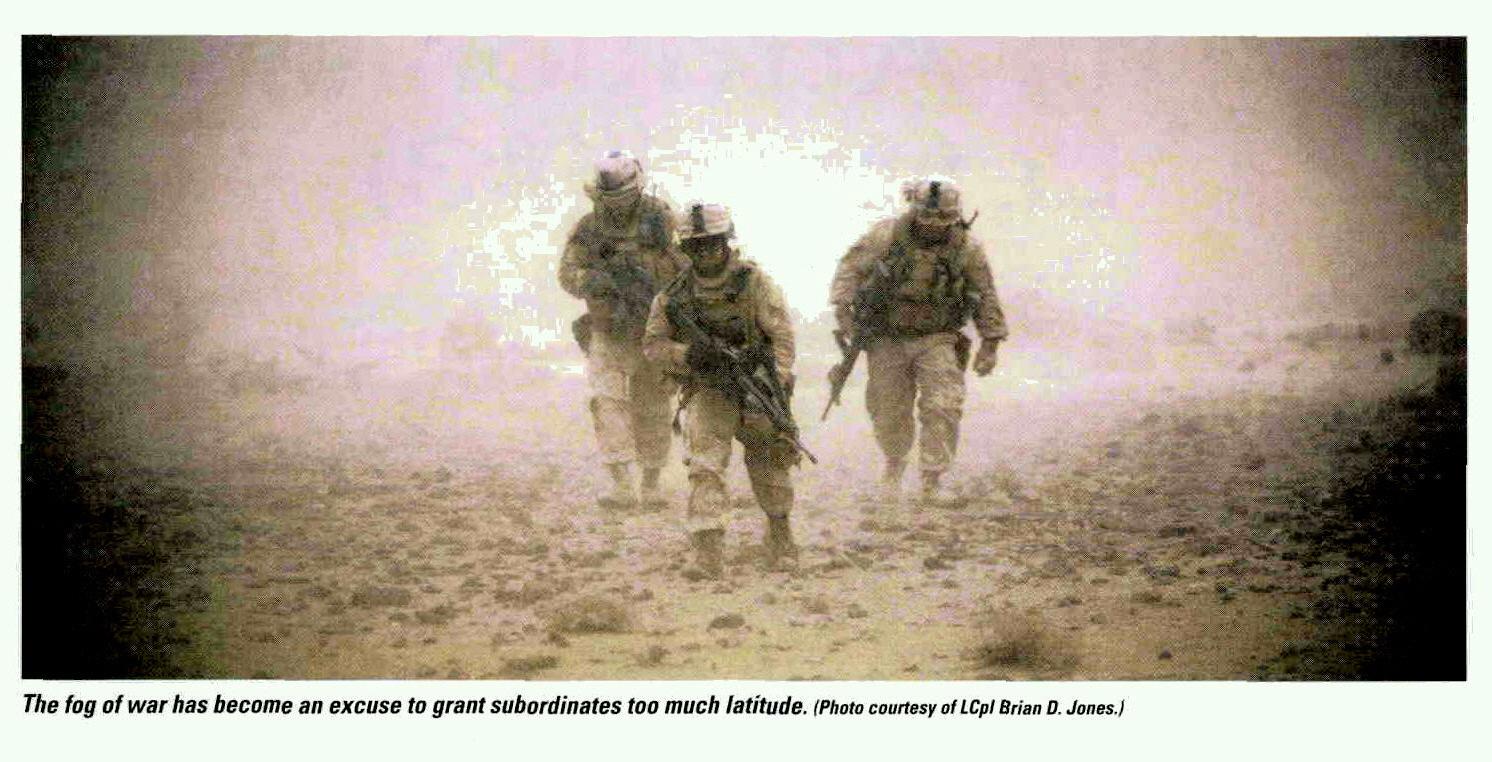
You will note with pride that fellow attritionists have worked ever so diligently to ensure that billions of dollars are invested to procure the latest technologies with the primary objective being the elimination of disorder and uncertainty on the battlefield. C2PC (command and control personal computer), CPOF (command post of the future), AFATDS (advanced field artillery tactical data system), and other like systems (as well as their interface) promise an unparalleled clarity on the current battlefield. Similarly, intelligence preparation of the battiespace is becoming extraordinarily focused on product development in order to provide the commander with the answers for any possible data requests. From your reading of Napoleon, you will recall that he would implore intelligence staffs to find “any information I might find of interest” and subsequently leave it to their initiative. How pathetic! Today’s commanders can – and therefore do – rightfully demand ever-increasing amounts of quantitative information with which to eliminate uncertainties and disorder on the battlefield. For only when the highest echelon commanders are provided all ofthe information can they determine the appropriate course of action and issue forth appropriate tasks for subordinates. You can see that current technology has eliminated Clausewitz’s “fog of war.”

I cannot recall when you last deployed to CentCom (U.S. Central Command). Was it earlier this year? Last year? Either way, you must have observed that our movement is gaining significant assistance from military contracting firms. Even in a recent issue of the Marine Corps Gazette – that forum for discourse among our Corps’ best – one firm actually published an advertisement clearly identifying “uncertainty” as the primary enemy and offering the military extensive command and control system capabilities in order to resolve the problem. I have seen similar advertisements from other companies, both offering elaborate (although expensive) information and command and control systems that seek to “increase information-processing capability” rather than to pursue the useless objective of allowing the commander to become comfortable with uncertainty. These advertisements are, of course, not targeted at junior officers like you, Wormwood, but rather they are intended to connect with our Corps’ decisionmakers. I must admit that upon seeing the advertisements, I was flooded with an immense sense of relief … relief that our position, so long banned from respectable circles, is now firmly entrenched and even valued at the highest levels.

I have no doubt that we are achieving our objectives in Afghanistan and Iraq primarily through increased use of technologies that seek to efiminate uncertainty on the battlefield. Deluded maneuverists will argue that these new technologies can actually introduce more confusion into the operating environment. They will also try to argue that rather than attempt to banish uncertainty from the battlefield, Marines should train more extensively in such unpredictable environments in order to develop confidence in their abilities. By clinging to such dated ideas, the maneuverists are proving their ineptitude by their refusal to accept the obvious: technology has eliminated the need to be comfortable in chaos. After all, one of our most esteemed fellow attritionists, retired MG J.F.C. Fuller, wrote, “Weapons, if only the right ones can be found, form 99% ofthe victory.”

Capt Wormwood, I am cognizant of your contribution – albeit a small and almost meaningless one – to this cause. At times, however, you strike me as almost rambunctious and unpredictable. How many times must I tell you? Take no unnecessary risk! Make no unnecessary decision! You would do well to simply pay attention and emulate those seniors (such as myself) who are kind enough to have assumed the responsibility for your leadership development as we proceed in our most worthy cause. Stay vigilant, for just as victory is near, it can also be seized away at the last. Until then, I remain,

Gen Screwtape

Maneuver Warfare in the Cognitive Domain

by the U.S. Marine Corps Strategic Communication DOTMLPF-P Working Group*

In recent years the term “strategic communication” has experienced a significant rise in relevance. No doubt this is due in part to revelations about the huge disparity between the cultures either engaged in, or peripheral to, the current global struggle. A renewed interest in counterinsurgency and irregular warfare, a recognition of various kinds of hybrid threats, and the explosive spread of the Internet, cell phones, and other communications-related technologies have also certainly contributed. While increased recognition of this important concept is definitely a good thing, there’s a downside. Its use has outpaced the work necessary to truly define it, understand it, and apply it effectively. The net result is that, beyond the basic, high-level definition by the Department of Defense1 at the department and joint levels, there are almost as many definitions, perceptions, and opinions about what constitutes the term as there are people throwing it about. The risk in this is multifaceted. Misunderstood, strategic communication (not communications – referring to the mediums or means of communication; e.g., radio, television, Internet) can lose operations and tactical relevance. Senior leadership could undervalue strategic communication supporting capabilities. Planners and commanders might not appreciate its true importance as an operating philosophy and fundamental guide for MAGTF operations. Its major tenets might not be applied at every level or integrated seamlessly into every operation. If acknowledged at all, strategic communication practitioners could be relegated to a functional support role in a manner similar to the way we thought about supporting arms before the advent of the term “combined arms.” True strategic communication is not just the purview of public affairs, psychological operations, civil affairs, or information operations specialists alone. It is not just a support activity cataloged in Annex Y of the operations plan and performed by subject matter experts in an ancillary, supporting role.

The term strategic communication, in fact, represents a way of thinking and operating that transcends even maneuver warfare philosophy. Or, better said, it represents the next logical step in the evolution of maneuver warfare theory. For, if the essence of maneuver warfare is to impose our will on an enemy, directly or indirectly, the essence of strategic communication is to do something vastly more difficult – namely, to influence the thoughts and actions of not just “the enemy” but of all those who either physically occupy the contested area or who are affected by the outcome of actions within it.

As Gen Alfred M. Gray, 29th Commandant of the Marine Corps, so eloquently stated in his preface to Marine Corps Doctrinal Publication J, Vfärßghting (Headquarters Marine Corps, Washington, DC, 1997):

Like war itself, our approach to warfighting must evolve. If we cease to refine, expand, and improve our profession, we risk becoming outdated, stagnant, and defeated.

Subsequent Commandants have often echoed these remarks. Whether one sees strategic communication as a replacement for maneuver warfare theory or an extension of it is immaterial. The point is that the theories and concepts that undergird the term are an almost perfect match with those that undergird success in the kinds of operations our Marines and MAGTFs face in the current fight – and in those anticipated for the indefinite future.

Major Tenets

So, what are the major tenets of strategic communication when viewed as an operating philosophy? Much has been written recently about the nature of strategic communication. This article will not attempt to summarize or restate this voluminous amount of information. We believe that all of those ideas can be grouped under one of several major tenets or principles. In effect, they represent the first-level subfunctions if one were to do a functional decomposition of the term. The first principle is to have as complete an understanding as possible of the operating environment – its history, culture, geography, and future potentials must all be completely understood and continually appraised. Second is the principle of effective listening. Even a perfect understanding of the operational environment will prove useless unless it can be placed in a wider context that can only be attained by very careful listening. Third is the principle of effective communication. Unless every member of the force understands how to communicate effectively, rhe ability to act consistently within both a preconceived plan and the exigencies of the immediate circumstances that result from the plan’s execution will occur only randomly. Arguably, the fourth and final high-level principle is the heart and soul of effective strategic communication. It is the creation and maintenance of critical relationships. Every activity within the MAGTF should be conceived and executed with this in mind. Whether it is with an identified enemy force, the inhabitants of a local village, or the random bystanders present as a resupply convoy transits a busy intersection, each engagement between the MAGTF and the other occupants of the operating environment must be treated from the point of view of a “critical relationship.” Critical relationships are characterized by possessing consequences, potential or otherwise, that will exist after the actual physical engagement concludes. Unless the MAGTF has the ability to operate at this very cognitive level, success is potentially jeopardized. When the term strategic communication is perceived in this context, the connection between it and other operational philosophies is readily apparent. Just as maneuver warfare evolved from rhe “firepower/attrition” models that preceded it, a new philosophy based on the principles of strategic communication is the natural extension of maneuver warfare. While maneuver warfare can be considered to be a refined method for applying, or threatening the application of, kinetic force against an enemy, strategic communication is a refined method for creating a “win-win-win-win-lose” situation in which all of the occupants of the contested area realize a victory, except the actual enemy – not an easy proposition, but an achievable one if the MAGTF has the right operational philosophy to guide it and the capabilities and training necessary to carry it out.

A second, and equally important, reason for accepting strategic communication as an underlying operational philosophy is the dichotomy represented by the employment of 21st century military technologies in an environment that has more in common with the first millennium than the current one – or even the last one. What are the most important attributes of a successful third millennium force conducting a “four block war” in a first millennium world? One thing seems certain. It’s not just the ability to apply overwhelming force, or even the ability to apply that force with great precision and discretion. Even the most sophisticated intelligence, surveillance, and reconnaissance targeting and weapons delivery capabilities will be largely ineffectual if the force employing them is insensitive to the cultural environment in which they are employed. Unless all of the Marines in the MAGTF are instilled with an understanding of the culture in which they are operating, and given the skills and tools necessary to allow them to operate effectively within it, operating concepts like strategic corporal and enhanced MAGTF operations, and the tactics and techniques associated with independent, dispersed, small unit operations over vast geographic areas, are at risk. The psychology of operations of this type, in environments of this type, against threats of this type, with both enemy and nonenemy using communications technologies, channels, and tactics as effectively as we do (or even more so) is not the psychology of force-on-force warfare against a peer competitor. Modern Marines operating in first and second millennium environments, dispersed over vast areas in small groups, have more in common with the Marines of a Vietnam-era civic action team than they do with the Marines in a line company engaged in a World War II- or Korean-style amphibious assault with subsequent operations ashore. Accordingly, we need to adapt not just our small unit tactics, equipment, command and control methods, and other tools and techniques of war, but also the very philosophy from within which our Marines categorize and engage all of the human beings who occupy the contested area.

Institutional Understanding

The fundamental skills and tools associated with strategic communication as an operating philosophy – effective listening, meaningful communication, and creation and maintenance of critical relationships – warrant much more treatment in our formal schools, training institutions, and operational doctrine. It’s time to advance our institutional understanding of maneuver-based operations in the cognitive domain to the next step.

Consistent with its long history of innovation and adaptation, the Marine Corps is doing just that. Experienced Marines now serving in education and combat development assignments are expanding our intellectual envelope, thinking through the details and complexities of these kinds of operations. While much of this adaptation begins with a review of the small wars tactics and techniques made famous by earlier generations of Marines, new concepts are being written that document and build on experiences gained in recent operations. Capability developers at Marine Corps Combat Development Command are teaming with strategic communication practitioners from across the Marine Corps to develop a strategic communication functional concept that should have DOTMLPFP (doctrine, organization, training, materiel, leadership and education, personnel, facilities, and policy) implications across the entire set of Marine Corps operating concepts and capability development scenarios. New organizations, like the Center for Advanced Operational Culture Learning, the Marine Corps Information Operations Center, and the Security Cooperation Education and Training Center, have been established for the express purpose of advancing capabilities fundamental to effective strategic communication. Advanced technologies and new techniques for employing them, and for thinking about the way they contribute to operational success at every level, are being continually developed. Even though the Marines involved might not presently describe them as such, all of these activities fall under the conceptual umbrella now being recognized as strategic communication.

Strategic communication, as a descriptive term for an overarching operational philosophy, might not be as appealing as maneuver warfare with its obvious emphasis on combat and bias for action. The term strategic communication carries with it an obligation to act, but also an obligation to listen, to think, to be creative, to be influential, and to be consistent in both word and deed. Whether it’s called strategic communication, communication integration, maneuver warfare II, or any number of proposed conventions, the MAGTF needs the ability to think and to act in an environment not entirely envisioned by current maneuver warfare theory.

The articles that will follow in the April issue of the Gazette describe various aspects, subfunctions, and organizations devoted to advancing the MAGTF’s ability to strategically communicate. They have been written to inform and to inspire additional thought and discussion. The defining characteristic of all Marines is a bias for action. Strategic communication enables that characteristic and adds to it a bias for thought. The members of the U.S. Marine Corps Strategic Communication Working Group, who authored this article, are hopeful that the ideas contained here and published in future Gazette articles on this topic will do just that.

Note

* The MAGTF Strategic Communication DOTMLPF-P working group’s mission is to identity, develop, and integrate ioint. Marine Corps, and MAGTF warfighting strategic communication capability requirements and advise the MAGTF command element advocate (Deputy Commandant, Capabilities Development and Integration (CD&l)) how to best provide this capability to the MAGTF commander. The working group is comprised of representatives from Washington, DC, CD&I’s Capabilities Development Directorate, G-3 (Operations)/G- 5 (Plans) Division; MAGTF Staff Training Program, Center for Advanced Operational Culture Learning; Deputy Commandant, Plans, Policies, and Operations, Information Operations and Space Integration Branch; Marine Corps Information Operations Center; the Division ot Public Affairs, HQMC; and Marine Corps Systems Command.

1. The definition is from Joint Publicwon 5-0, Joint Operation Planning, p. II – 2. “Focused US Government efforts to understand and engage key authences in order to create, strengthen, or preserve conditions favorable for the advancement of US Government interestes, policies, and objectives through the use or coordinated programs, plans, themes, messages, and products synchronized with the actions of all instruments of national power.”

Embrace Maneuver Warfare

by Capt Andrew J. Graham

In the opening throes of Operation Iraqi Freedom (OIF), the 3d Marine Aircraft Wing (3d MAW) employed its helicopter gunships in a unique manner for aviation assets, but a manner that the infantry battalion is very familiar with; a section of H-Is was tasked with direct support (DS) of a Marine battalion. Unlike a joint tactical air request (JTAR) time on station (TOS), the DS section was attached to the battalion landing team (BLT), and the aircrews’ 12-hour crew day was dedicated to DS of the battalion. Adapted to aviation counterinsurgency (COIN) operations, the DS section multiplied the combat power of Marine ground combat units.

The DS pilots and crew stood their strip alert at the battalion combat operations center (COC), awaiting tasking. If there was no tasking or if the unit was in a consolidation period, the aircrew returned to their base at the end of their crew day. However, if there was tasking, their physical presence allowed the battalion commander to instantly call on his own air support, without delaying the request through the JTAR process.

To clarify: the delay in support is not a problem when trying to get close air support (CAS) assets; this becomes an issue when requesting nonkinetic support. The battalion commander attempting to investigate time-sensitive intelligence beyond the reach of his ground units will be unable to compete with the more pressing requirements of troops in contact (TIC) situations, convoy and assault escort, or other CAS engagements in neighboring areas of operation (AOs).

In addition to giving the commander another tool to use in the MAGTF, the DS section allows Marine aviation units to support the MAGTF COIN effort in accordance with our Service philosophy of mission-based orders or individual initiative through commanders intent. An expansion of the JTAR process, and the next generation of four-bladed utility and attack helicopters, will enhance the utility of the light attack helicopter (HMLA) community and allow the supported element commander to greater dictate the tempo of his AO. This is achieved not through a change in tactics, techniques, and procedures (TTP) but by applying our doctrine of maneuver warfare in a more flexible manner.

To start with, we must ask, how does the Marine Corps apply aviation in maneuver warfare? And how do we apply maneuver warfare to aviation COIN operations? Filling the assault support and offensive air support roles of the six functions of Marine aviation, HMLA squadrons respond to requests for support either through preplanned or immediate tasking. The preplanned tasking takes the form of the JTAR to the tactical air command center (TACC), while immediate tasking is requested from the direct air support center (DASC). This is similar to a fire truck scrambling after the alarm bell rings at a fire department.

In both high- and low-intensity COIN operations, CAS plays a vital role in supporting the ground combat element (GCE). But in order to allow greater freedom for section leaders to influence the batdefield, the pilots need to be empowered through their other missions. (Independent action by aircrew requires detailed knowledge of the atmospherics of the local AO, friendly and enemy schemes of maneuver, and a list of actions automatically approved by the ground commander.) In the TTP outlined in the UH-I Navy TTP 3-22.3, UH-Is already teach tactics that allow intelligence collection and analysis. What they do not do is enable the pilot on the scene to act on that intelligence based on commander’s intent.

Even more than mechanized and motorized maneuver elements, aviation is perfectly suited to rapid retasking, taking advantage of shifts in tempo before the enemy can react. Currently the DASC performs this role and, under guidance from the TACC, will shift assets based on ground unit requests.

Ground forces spread across an AO have a lighter footprint the farther they push from the forward operating base (FOB). Air support multiplies their fire and maneuver, also providing direct responsiveness to the GCE commander, executing his intent. This completes our forces’ total orientation on the enemy and their state of mind. WTiat the DS section provides is an infantry patrol mindset in the skies, always searching to gain and maintain contact with the enemy. The true fruit that a DS section bears is in investigating time-sensitive intelligence. In a tenuous border region, the DS section allows the commander to investigate reports of smugglers crossing boundaries or guerrillas infiltrating the area of operations, without having to declare a TIC situation.

Philosophy

If maneuver warfare is a state of mind, how is our MAW adapted to maneuver warfare? Instead of applying mission type orders, are we just a combined arms force, essentially flying artillery and semitrailers? If I tell the subordinate what the commander wants, do I really allow him to determine how to accomplish it? At what level do I stop that? And what is my role in the overall plan? Providing utility support is not good enough; we must be able to identify what the enemy wants most, and then take it from him. If maneuver warfare’s goal is to shatter the physical and moral cohesion of the enemy, this goal can only be realized with an increase in operational tempo that the preplanned JTAR process slows.

In order to target the mind of the enemy, we must destroy his center of gravity, a concept in COIN that is one area with many nuances. For example, a guerrilla force survives with the support of the people either willingly or unwillingly. If the people are culturally xenophobic, and both the insurgent and counterinsurgent present bad alternatives, the people will support the local area leadership. Creative leadership at the junior officer level can affect this in innovative ways.

Maneuver warfare requires a shared responsibility for the success or failure of an operation. By giving the DS section to the BLT commander, the HMLA squadron becomes even more invested in the success of the ground unit. By working closer with the ground unit, the pilots will participate in the mission analysis and be able to recognize when the situation fundamentally changes. When it does, the pilots must be able to recognize that and provide the BLT COC with new courses of action.

Maintenance and Readiness

The DS section concept raises some unique logistical questions. Unlike DS support of tanks, amphibious assault vehicles, light armored vehicles, or artillery, aviation assets cannot perform their own operational-level maintenance. Does the battalion commander then require to be briefed by the maintenance material control officer on the status of the aircraft in phase maintenance? No. If fuel is available at the FOB, there is no footprint requirement that cannot be satisfied by returning the aircraft to the parent airfield at the end of the crew day, being replaced by another section with fresh pilots and aircraft. At the end of the DS JTAR, the DS section returns to the parent squadron, and operational-level maintenance is performed by the squadrons maintenance section.

The DS section concept does not necessarily need to be provided entirely by helicopter gunships. The proposed armed variant of the MV-22 will supposedly be capable of self-escort, allowing the maneuver battalions greater freedom and speed of movement on the battlefield. A DS section of F/A-18s cannot provide the quick reaction force (QRP) capability, but it can still provide dedicated forward air controller (airborne); nontraditional intelligence, surveillance, and reconnaissance (NTISR); counterimprovised explosive device (IED) search; and CAS beyond the limitations of a JTAR requested TOS.

Marine Corps Wirftghting Pubi i cation 3-2 (MCWP 3-2), Aviation Opera rions, states that:

. . . with the designation of an aviation unit to the direct support role comes the requirement to establish direct liaison, direct communications to receive critical information, coordination of local security, and logistic support from the supported unit.1

These requirements are easily fulfilled by using the pilots to establish direct liaison and by normal communications between the aircrew, the COC, the BLT, and the squadron commander. Local security is provided by perimeter security at the FOB, and logistical support comes in the form of food, water, and aviation fuel. All ordnance and maintenance is provided at the parent squadron’s headquartered airfield once ordnance has been expended. Some ordnance can also be prestaged at the FOB, but this would likely exclude precision guided munitions (PGM).

The forecast impact of DS section requirements on maintenance and readiness is minimal. In Iraq an HMLA with an 18 Cobra/9 Huey mix was commonly responsible for a main body at the larger airfield and a detachment at the smaller FOB. The detachment provided a CAS section and medevac chase 24 hours a day, continuously. The main body of the squadron provided two mixed sections for CAS and three Cobras for the medevac chase, again 24 hours a day, continuously. The pilots and aircrew maintained 12-hour shifts, flying between two and four JTARs per shift. Shifting the CAS responsibility from one section and sending them to provide DS would have no impact on the maintenance requirements for the aircraft, provided that the DS section is sourced from the main body and not from the detachment. The DS section can always be diverted to CAS in case of emergency; however, with low-intensity COIN operations, retasking the second CAS section to DS aids the BLT commander in shaping his battlespace. Squadrons in Iraq have proved that this level of operations can be maintained, with very few exceptions, for the duration of a 7-month deployment. Based on this model, I present the following scenario.

Scenario

A BLT commander has a large AO, almost 50 square miles. The area includes 1 town of 15,000 people, 3 villages of 6,000 people, mountainous terrain over riie southern portion, and large open desert between the northern towns. The local population varies from accepting the American presence to indifference to overt hostility. There is an experienced and aggressive guerrilla force conducting a grassroots insurgency campaign. The BLT has been tasked with eliminating their influence in the AO in order to spread the a uthority of the legitimate host-nation government. There is low threat to air and high threat to ground forces from IEDs. The BLT commander allocates his forces as follows:

* Company A is responsible for the main town.

* Company B opera tes from the pa trol base sending out squa d-sizedpa trois for 1 to 2 days at a time in the northern desert.

* Company C divides the pia toons between the three villages and runs combined action platoon patrols in and around the area with the local national police, sometimes (but not always) winning hearts and minds but providing constant presence and pressure on the enemy grassroots campaign.

* Weapons company (QRF/combined antiarmor team (CAAT) Aight armored reconnaissance section) actsasa maneuver element but provides mounted patrols covering the open areas between the towns.

* Reconnaissance platoon/surveillance target acquisition section provides an independent maneuver element, conductingraids based on actionable intelligence but, except for extreme circumstances, does not participa te in QRF opera tions.

* DS strip section provides two 12-hour shifts to provide 24-hour support outside die JTAR process. One AH- 1 and one UH-I provide PGM, armed reconnaissance, assault support, NTISR, urgent casevac, and CAS capabilities within 50 nautical miles.

Now, without a JTAR, the DS section provides the BLT commander with NTISR, on-call leader’s reconnaissance, movement, aeroscout-type QRF capability, humanitarian assistance/disaster relief Un capability, and ail other aspects of the six functions of Ma ri ne aviation.

Here, is a bad day. After days of heavy fighting, weapons company is down to 20 percent of its mortar reserves, and PFC Jackson from Company A needs a root canal. Early in the morning, the DS section transports Jackson to trie BLT headquarters and the battalion aid station, and Jackson and the mortar resupply are returned to the field before the end of the day without the trouble of putting a convoy together and risking IED a tracks.

After die DS section returns PFC Jackson to Company A, they support Company B with aerial reconnaissance, until Company A encounters a TIC situation. This causes the Company A commander to con ta a the fire support coordination center to request air. While Company A conducts a firefight with guerrillas in the town square, t/ie battalion air officer (Air O) redirects the DS section from Company B to Company A. The section will have faster reaction rime than a strip alert section beca use they will a I rea dybea irborne. While the DS section finishes its fuel and TOS, the Ai fO coordinates with DASC (or follow-on support. When the DS section runs out of gas, a preplanned on-call section relieves it. Meanwhile, the DS section returns to the FOB to refuel and rearm, and if Company A still needs air support, they can relieve the CAS section or remain at trie FOB for follow-on tasking.

While on pa trol, a pia toon from Company C finds a child with a broken leg. The injury is not life threatening but is painful and devastating to me child’s parents in the village. Sgt Smith, the patrol leader, contacts the compa ny FAC who requests the DS section from the AirO. The DS section arrives; the child and her parents are loaded onto the Huey. They are taken to the battalion aid station where she is treated and then all are returned to die village. This would be painful and nearly impossible to do by ground transport. If the villagers respond in a positive way it is a bonus. Helping the locals is the morally responsible thing to do and supports the saying, “first, do no harm.”

In the late afternoon, guerrillas storm the police station in the large town, executing the policemen and taking their weapons and equipment. As weapons company launches the CAAT team and the ground QRF, the battalion AJrO launches tAe DS section to provide overhead on the scene. After pushing overhead, the DS section spots a convoy of civilian vehicles exiting the town at a high rate of speed. The convoy consists of several vehicles with covered equipment in the back lea ving the town toward the open desert. The DS section sees the men in the vehicles and suspects their covered vehicles contain the stolen police weapons. The Cobra pulls into a hover hold, halting the convoys departure, while the Huey establishes a position to the rear of the convoy to prevent any escape. The a i reran remain on the scene until the ground QRF arrives to search the convoy. (With a Yankee Huey, the DS section can execute NTISR with a fire team on board, providing instant QRF.) Finding the police weapons, the QRF takes all of the drivers prisoner but does not ha ve room for all of the prisoners in its HMMWVs. The QRF loads several prisoners in the DS Huey and destroys the vehicles in place. The DS section returns to the FOB with the prisoners to pick up reinforcements for the QRF or resets as directed by the ba ttalion AirO.

This scenario shows the BLT spread thin, not uncommon in realworld COIN operations. Yet the battalion’s varied operations, and the speed and maneuver provided by the mechanized and aviation assets, deny the enemy a center of gravity and afford him no place to rest or retrofit in the open. It forces the enemy to react to our will.

Command Relationships

The DS section will be under tactical control (TaCon) of the BLT commander, because the squadron commander retains command over squadron aircrew and airframes. (The squadron commander retains operational control.) However, TaCon still provides the BLT commander with the authority to direct the DS section for the duration of that 12-hour JTAR.

MCWP 3-2 defines DS as:

. . . a mission that requires a force to support another specific force and authorizes it to directly answer the supported force’s request for assistance (e.g., an attack squadron in direct support of one subordinate unit of the GCE).2

DS differs from close support in that close support is:

. . . the action of the supporting force against targets or objectives that are sufficiently near the supported force. This close proximity requires detailed integration or coordination of the supporting action with fire, movement, or other actions of the supported force (e.g., aviation units providing CAS to units in contact).3

DS is preferred over close support because the tasking is not based on a specific target or mission set but because the fluidity of COIN operations necessitate taking advantage of the varied capabilities of the aviation platform.

As a whole, Marine Corps aviation is usually in general support of the GCE because there are usually finite aircraft to meet infinite requests for support. General support:

. . . allows Marine aviation to fight or to provide support throughout the MAGTF area of operations and allows the most efficient and effective allocation of aircraft to the MAGTF. This process is orchestrated through the air tasking cycle, allowing flexible and prioritized tasking.4

MCWP 3-2 clearly states that:

. . . the command support relationship established for the ACE [aviation combat element] by the MAGTF commander is almost always in general support of the MAGTF. . . . Since availability of aviation assets for mission tasking rarely meets the demand, the MAGTF commander keeps the ACE in general support of the MAGTF. . . . By using and completing the air tasking cycle, planners can ensure that finite aviation assets are allocated to achieve maximum effect with correct prioritization based on the main effort.5

If aviation assets are finite, how do we find enough to make the DS section a supportable concept? While there are limited assets available, they are often augmented with joint and allied aircraft. The decision to dedicate a DS section for 12 hours to one battalion’s AO is made with the knowledge that the force multiplication given to one BLT’s AO provides more benefit to the overall mission end state than by spread-loading aviation assets in general support across the theater.

Conclusion

The DS section would still be requested using the JTAR process; however, instead of a specified TOS, the JTAR would request 12-, 24-, or potentially 48-hour support. The aviation squadron commander is responsible for the maintenance and safety of his pilots and aircraft, while the battalion commander would have launch authority under very specific guidelines. As a component of the air tasking order, the DS section is not a revolutionary concept. However, as far as driving the aviation capabilities and decisionmaking process further toward the ground commander, it is a vast departure from the normal process.

Real application of maneuver warfare requires courage and acceptance of risks. In the infantry this means empowering the junior noncommissioned officer to make important decisions, literally the “strategic corporal.” The aviation battlefield equivalent is the pilot, usually a captain or major, senior to the corporal but still a Marine whose actions can have both tactical and strategic consequences. In the MAW this means more than acceptance of risk; real acceptance means that we will take battle damage, lose airplanes due to hostile fire, and suffer casualties alongside the Marine ground units we support. Current safety climates are opposed to these as a metric for a successful command, but if battlefield success is the metric by which we judge a successful command, then we need to accept the risk that might lose a garrison safety award. A commander who accepts this risk will allow his people greater freedom to operate and succeed based on their initiative. The DS section allows our ground commanders greater flexibility and dominance in their AOs. Adapted to aviation COIN operations, the DS section will multiply the combat power of Marine ground combat units.

Notes

1. MCWP 3-2, Aviation Operations, Headquarters Marine Corps, Washington, DC. 9 May 2000, p. A-A.

2. Ibid., p. 4-2.

3. Ibid., p. 4-3.

4. Ibid.

5. Ibid., p. 4-4.