This article is the first in a series we call The Maneuverist Papers, discussing maneuver warfare doctrine in the Marine Corps. Under the leadership of Commandant Gen Alfred M. Gray, the Marine Corps first codified maneuver warfare as Service doctrine with the 1989 publication of Fleet Marine Force Manual 1 (FMFM 1), Warfighting, although the significant intellectual effort that produced the underlying concepts had begun well over a decade earlier. In 1997, Gen Charles C. Krulak oversaw the revision of Warfighting as MCDP 1, which clarified and elaborated on select ideas from the original but did not change the essence of maneuver warfare in any way. Maneuver warfare doctrine has thus served the Marine Corps for over three decades. Much has happened in those years, especially two lengthy wars that saw significant changes in the conduct of warfare. In contrast, during the same period of time, U.S. Army doctrine has evolved from AirLand Battle to Full-Dimensional Operations to Full Spectrum Operations to now Unified Land Operations over a span of nine capstone field manuals. Now the Marine Corps is set to undertake arguably the most dramatic changes to structure and capabilities in over a half century.
This begs the question: Is it time for the Marine Corps to revise its doctrine? Several Gazette articles in recent years have argued so. The aim of The Maneuverist Papers is to energize that conversation. The Maneuverist Papers will continue the discussion begun with “What We Believe About War and Warfare” in the June Gazette by describing the development of and elaborating on key maneuver warfare concepts, providing historical context for the development of Warfighting and the maneuver warfare movement in general, and discussing recent changes to the face of war that may justify a doctrinal revision.
The maneuver warfare movement must be judged an institutional success in that maneuver warfare became Marine Corps doctrine and has remained so for over three decades. Moreover, the movement brought other lasting changes—most notably in the area of professional military education—in full view today. In some areas, such as training, the impact of maneuver warfare, with its emphasis on free-play, force-on-force exercises, arguably has been less enduring. In other areas, such as personnel management, the movement seems to have had little impact at all. A broader issue is operational and tactical success. From Grenada in 1983 through the Gulf War to Afghanistan and Iraq, the historical record has been mixed. But is this an indictment of maneuver warfare itself? Is it a result of the Marine Corps no longer embracing maneuver warfare in practice? Or never having truly embraced it in the first place, as some have argued? Or is the mixed record the result of some completely external factors, such as the growing ineffectiveness of combat as a decisive factor in resolving conflict in general? That is a topic for another debate.
The Historical Context
It is important to understand that the maneuver warfare movement emerged at a particular moment in history. After the Vietnam War, the Marine Corps underwent a period of institutional introspection. The maneuver warfare movement was a response to the institutional and operational dysfunction of the Vietnam experience that sought, among other things, to put the Marine Corps approach to war on a solid historical and theoretical footing.
Gray, of course, was the leading exponent of maneuver warfare, providing impetus and top cover. Retired Air Force Col John Boyd was the movement’s intellectual godfather. Civilian Bill Lind was chief provocateur and proselytizer. But the core was a grass roots movement comprising a combination of Vietnam veterans who had remained on active duty after the war to see things set right and young officers who saw maneuver warfare as empowering. Of the active duty maneuverists, Col Michael Wyly was the most prominent. Other early thought leaders included then-Capts Stephen Miller, G.I. Wilson, and William Woods.
The Marine Corps was not alone in reforming. Each of the Services, and the broader Defense establishment, responded differently to the Vietnam experience. Not surprisingly, the Army and Marine Corps, which bore the brunt of the war and experienced its dysfunction most keenly, eventually enacted the most extensive reforms, although the first reforms actually came out of the Navy, or more precisely the Naval War College, where ADM Stansfield Turner reformed the curriculum almost immediately upon assuming the presidency in 1972.Three curriculum reforms were most significant for our purposes. The first was the reintroduction of strategic thought, which the Services had mostly abrogated to civilian academics by then and which had largely become focused on nuclear strategy. The second was the rediscovery of the great Prussian theorist Carl von Clausewitz, whose theories at that time had been all but forgotten in favor of the more formulaic and geometric approach of the Swiss military theorist Antoine-Henri Jomini. The rediscovery of Clausewitzian theory, made much more accessible by the Michael Howard and Peter Paret translation of On War in 1976, was foundational to maneuver warfare theory. The third was the revival of the study of military history, which had virtually been removed from military education after the Second World War in favor of operations research and procedural training. This revival also proved important to the maneuver warfare movement.
For the Army, reform meant, among other things, returning to what it considered to be its primary mission: defeating a Soviet invasion of Europe. A new, post-Vietnam edition of the Army’s capstone doctrinal manual, Field Manual 100-5 (FM 100-5), Operations, introduced the doctrine of Active Defense in 1976. Active Defense met with immediate and widespread criticism within the Army as being too defensive and mathematical. A coordinated, Army-wide effort to develop a more offensive doctrine ensued. A new FM 100-5 introduced AirLand Battle doctrine in 1982, and a revision followed in 1986. Neither manual directly mentioned Europe or the Soviets, but it was clear that was the problem space. AirLand Battle was a rigorously reasoned doctrine—arguably more so than any of the Army doctrines that have followed. Never executed against its envisioned enemy, AirLand Battle turned out to be highly effective against the Iraqi army during Operation DESERT STORM in 1991. Moreover, AirLand Battle, elevated to the multi-Service level, became the de facto joint doctrine.
Where the Army undertook a coordinated and methodical effort to develop AirLand Battle, the maneuver warfare movement took on more the character of a back-alley brawl conducted on the pages of the Marine CorpsGazette—which in retrospect is probably appropriate. Col John Greenwood, the editor of the Gazette at the time, deserves a lot of credit for encouraging and managing the debate. Being able to focus on a particular threat in a particular theater allowed the Army to write in more specific and concrete terms. As the Nation’s force-in-readiness in the 1980s, the Marine Corps did not enjoy that luxury, and one consequence is that Warfighting is more abstract and theoretical than the Army capstone manuals have tended to be. It was, as Gray wrote in the foreword, more a “philosophy for action” than a traditional doctrine. Maneuver warfare as described in Warfighting was designed to have very broad utility but required significant judgment in application, which has been a source of frustration for some Marine readers looking for more specific guidance. Conversely, as a result, Warfighting could be written in more enduring terms, which goes some way in explaining why the Marine Corps has not found the need to update its doctrine as frequently as the Army has.
A second aspect of the historical context of maneuver warfare is that it is a product of the Cold War era and implicitly reflects that paradigm. FMFM 1’s default was the classic military force-on-force model. It did not explicitly exclude irregular warfare, but it had nothing specific to say about it either—one of the criticisms of both editions of Warfighting. The 1997 revision acknowledges the possibility of nonstate belligerents but offers no additional insights into nonclassical warfare. It is a credit to the Corps that countless Marines have extrapolated the classic theory of Warfighting to decades of irregular warfare. Arguably, Warfighting reflects a worldview that became dated when the Berlin Wall fell—or, alternatively, possibly one that is just now coming back into relevance.
The Maneuver vs. Attrition Debate
Perhaps the biggest controversy to arise during the development of maneuver warfare was the maneuver warfare vs. attrition warfare debate. The early maneuverists chose to describe maneuver warfare by comparing it with its opposite, which they called attrition warfare. In retrospect, this may have been an operational error that delayed the eventual acceptance of maneuver warfare. The simplistic interpretation of the argument was: maneuver good, attrition bad. In reality, the problem was partly semantic. All warfare involves attrition—that is, incremental degradation of combat power because of accumulating losses. And all warfare involves relational movement, if only to bring weapons into position to cause more attrition. Maneuver and attrition are not a matter of either/or, but that is how proponents came to frame the issue. The Marine Corps split into two camps: the maneuverists and the attritionists. The maneuverists thought they were simply advancing ideas on a better way to fight, but the attritionists felt (with some justification) that they were being painted as Neanderthals for wanting to kill the enemy. How could attrition inflicted on an enemy possibly be bad? The attritionists thought the maneuverists were unnecessarily complicating what should be a straightforward proposition: find the enemy, destroy the enemy. (Frankly, and unfortunately, part of the attritionists’ motivation also was a reaction to the confrontational Lind, who was closely associated with the maneuver vs. attrition construct. The term “attrition warfare” assumed a pejorative connotation, so naturally some Marines adopted it as a badge of honor to show their opposition.)
The issue was not whether it was better to maneuver or to inflict attrition, because both again are inherent in warfare. In retrospect, the issue is what you choose as the mechanism by which you propose to impose defeat on the enemy. The important concept of defeat mechanism was not explicitly recognized at the time. (A later article will address defeat mechanisms.) The defeat mechanism of attrition warfare was inherent in the name: you inflicted defeat by cumulatively eroding enemy personnel and material strength or psychological resolve until he gave up the fight or eventually was eliminated. The maneuverists pointed out that this tended to be a time-consuming and costly approach. Moreover, it did not work well if there was a marked asymmetry of interests: if one belligerent was fighting merely a war of choice while the other fought a war of survival (read: Vietnam), the odds were significantly stacked.
The defeat mechanism of maneuver warfare was much harder to put your finger on. It certainly was not inherent in the word maneuver, which many understood narrowly to mean relational movement, but which the maneuverists imbued with deeper meaning that they sometimes struggled to explain. (A popular attritionist joke was that maneuver warfare sought to win not by defeating the enemy in battle but by “driving in circles and confusing him to death.”)
For some, the “maneuver” in maneuver warfare suggested that the doctrine was defined by the forms of maneuver it employed, namely envelopments, penetrations, and turning movements—basically anything other than a frontal attack, which by implication was considered stupid. This was a gross misunderstanding. Attritionists complained that the maneuverists could not lay exclusive claim to select forms of maneuver, and they resented the implication that they favored only frontal attacks. Others equated maneuver warfare with mechanized warfare, likely based on the tendency to associate maneuver warfare with the German blitzkrieg of the Second World War. (More about the German influence shortly.) The iconic image of Gray in utilities with desert goggles on his helmet probably reinforced the misconception.
We now understand that the defeat mechanism of maneuver warfare is systemic disruption—eliminating the enemy’s ability to operate as a coherent and cohesive whole. According to FMFM 1: “Maneuver warfare is a warfighting philosophy that seeks to shatter the enemy’s cohesion through a series of rapid, violent, and unexpected actions which create a turbulent and rapidly deteriorating situation with which he cannot cope.” Boyd used to talk about “tearing the enemy apart from the inside.” In other words, where attrition warfare attacks the components of the enemy system to degrade them, maneuver warfare attacks the relationships between those components to break the coherent functioning of the system.
Maneuver warfare is a systemic doctrine, which was a hard sell in 1989. The emergence of complexity theory in the 1990s, with a host of popular books on the subject, greatly enhanced the understanding of complex systems. (It also greatly enhanced the understanding of both Clausewitz and Boyd. Alan Beyerchen’s masterful “Clausewitz, Nonlinearity, and the Unpredictability of War,” published in International Affairs in 1992, argued convincingly that Clausewitz intuitively understood complex nonlinear dynamics but lacked the language to describe them. Likewise, the language and concepts of complexity theory helped us to realize that Boyd’s thinking had been even farther ahead of its time than we had previously appreciated.) The 1997 revision of Warfighting was much more explicitly systemic in its description. It was still a hard sell.
Finally, complicating the issue was the often-misunderstood annihilation-attrition strategic construct. The German historian Hans Delbruck (1848-1929) posited two basic types of strategy: Ermattungsstrategie and Niederwerfungsstrategie, which were mistakenly translated in English as strategy of attrition and strategy of annihilation. The English terms are problematic because they are practically synonymous. In fact, most American readers were probably introduced to the terms in Russell Weigley’s 1973 classic The American Way of War, in which, the author later acknowledged, he had got the terms confused. The former strategy is probably better termed strategy of exhaustion, which Delbruck argued was a viable option for a weaker belligerent that lacked the ability to defeat the enemy outright and instead sought a limited objective—to raise the enemy’s costs so high that he was willing to settle on your terms rather than continue to fight. The latter is better termed a strategy of incapacitation. (The German literally means “taking-down strategy,” as in a take down in wrestling. It does not require reducing the enemy “to nothing,” the literal meaning of “annihilation” from Latin.) The latter strategy involved the outright defeat of the enemy’s ability to resist, which Delbruck argued involved the adoption of an unlimited military objective and was available only to the stronger belligerent.
The German Influence
Another controversy during the maneuver warfare movement was the German influence. The maneuverists, some more than others, were fond of using German historical examples and terminology. They made two arguments. The first was that the German army had in fact achieved tactical and operational excellence using maneuver warfare and was one of the few modern armies to do so. The second was that the German army was the only modern army to codify its maneuver doctrine. As a result, any primary source documents tended to be German. For the maneuverists, both arguments made the Germans worth studying. The maneuver warfare canon thus was filled with titles like Mellenthin’s Panzer Battles, Guderian’s Panzer Leader, Manstein’s Lost Victories, Rommel’s Attacks, and Schell’s Battle Leadership.
Schwerpunkt (main effort or center of gravity), Auftragstaktik (mission tactics), Flaechen und Luekentaktik (tactics of surfaces and gaps), aufrollen (rolling up enemy forces from the flank after a penetration), and Fingerspitzengefuhl (literally “finger tips feeling,” meaning intuitive flair or instinct) found their way into the discussion, often getting mangled in pronunciation in the process.
Fueling the debate was the 1982 publication of Martin van Creveld’s Fighting Power: German and U.S. Army Performance, 1939-1945 (although it was available several years earlier as a DOD-funded study). Van Creveld did an extensive statistical analysis of 87 engagements between U.S. Army and German forces in the Second World War and concluded that German ground forces were tactically and operationally superior to U.S. forces. The oversimplified lesson that some took from Fighting Power was that German troops were 1.5 to 2.0 times better than their American counterparts, which did not sit well with many American readers and may have helped to push some into the attritionist camp. Last, but not least, the controversial Lind was an unabashed Germanophile (Prussophile is probably more accurate), and this alone produced antibodies.
In the end, Warfighting intentionally avoided the use of German terminology. Thirty years of subsequent experience has reduced the need to rely on German examples, and the controversy has largely blown over.
Why the Maneuver Warfare Movement Succeeded
There are several reasons for maneuver warfare’s institutional success, and those may provide lessons for today’s situation.
The maneuver warfare movement came from a point of real institutional pain. The origin and motivation of the maneuver warfare movement, as mentioned, was the pain caused by the dysfunctional experience of the Vietnam War. It was this motivation that sustained the movement. Maneuver warfare was not merely an intellectual exercise, although clearly it contained an intellectual element. In contrast, many capability development initiatives today seem like purely intellectual exercises not motivated by any institutional pain. They appear to be change for change’s sake.
The discourse was extensive, open, and transparent—and frequently messy. This was critical. The argument took place in the open over more than a decade. It got ugly at times, but this forced the maneuverists to strengthen their case and in the end helped garner widespread support for the doctrine. Maneuver warfare was not developed in secret by some high-level “working group” and then imposed on the rest of the institution. In today’s parlance, we might say it was crowd sourced. The open discourse went a long way toward socializing, strengthening, and eventually vetting maneuver doctrine.
The movement operated as a classic insurgency. While the discourse took place in the open, the maneuver warfare movement itself operated like a classic insurgency, employing an inkblot strategy to gradually expand its influence over time, increasing its profile as it grew stronger. The maneuverists thought of themselves as insurgents, working to subvert the existing order. Maneuverist cells popped up spontaneously around the Marine Corps. With Gray’s succession to the Commandancy, the insurgency became the regime.
The movement enjoyed a combination of strong visionary leadership and bottom-up, grass-roots commitment. Gray provided a compelling and unifying vision as well as critical top-cover for the insurgents. Meanwhile, Lind drew most of the attritionists’ fire, providing additional cover for the rest of the movement. But the ultimate driving force was the growing number of Marines who supported the new concepts. Maneuver warfare would not have succeeded to the extent it did without both the top-down and bottom-up dynamics.
Maneuver warfare had strong historical and theoretical foundations. A key attribute of the maneuver warfare movement was the strength of its intellectual foundation. The maneuverists did their homework. People might have bemoaned the number of German historical examples, but there was no shortage of examples. Meanwhile, maneuver doctrine rested on a solid philosophical foundation of Sunzian, Clausewitzian, and Boydian theories. (One of the early criticisms of Warfighting was that there was “nothing new” in it. LtGen P.K. Van Riper used to respond that that was true: there was nothing in Warfighting that wasn’t in Sun Tzu, Clausewitz, or Boyd. The trick of Warfighting was that it managed to synthesize those three disparate theories into a coherent whole.) In contrast, too many contemporary warfighting concepts appear to be no more than PowerPoint deep. Moreover, many seem to be anti-historical, implying or openly asserting that some technological or other innovation has so “changed the fundamental nature of war” that there is nothing to be learned from the past.
The process involved significant experimentation. Long before there was a Marine Corps Warfighting Lab, Second Marine Division became a maneuver warfare laboratory when Gray took command in 1981 and declared at an all-officers call at the base theater that maneuver warfare was the division’s official doctrine. The pinnacle of experimentation was the annual Combined Arms Operation at Fort Pickett, VA, a completely free-play, force-on-force exercise pitting some combination of battalions against each other. At ENDEX each day, all officers and staff NCOs would drive back to the base theater at mainside for an extensive hotwash moderated personally by Gray, with Lind in attendance like a Prussian Nestor. The Combined Arms Operation and similar exercises went a long way toward creating additional maneuverists.
Conclusion
To understand where you are and where you are going, it is important to know where you have been. The future evolves from the past. This short history of the development of maneuver warfare in the Marine Corps may illuminate some worthwhile questions for the Marine Corps today as it faces yet another transition after long period of war: Is there institutional pain today sufficient to drive doctrinal and other reform? Is that pain even a necessary ingredient now as it was then? (Arguably, the effort that led to the initial development of amphibious doctrine in the 1930s was not based on institutional pain but simply on a clear-eyed assessment of the future security environment.) Must any successful reform involve a bottom-up grass roots movement, and must it too take the form of an institutional insurgency? Will there need to emerge another Gray, Boyd, Wyly, or Lind? Should or how should maneuver warfare adapt to recent and emerging changes in warfare? Or, more fundamentally, has warfare changed sufficiently that the Marine Corps should reconsider its basic doctrine? Most Marines would instinctively and emphatically say, “No!”—but does that mean the question should not be asked?
by GySgts Neil D. McCoy, Adam D. DuVall, & Joshua L. Larson,
& SSgt Luke T. Hudson
Twenty-eight years ago, the Marine Corps published Fleet Marine Force Manual 1, Warfighting, solidifying maneuver warfare as its warfighting doctrine and philosophy. FMFM 1 has since been renamed MCDP 1,Warfighting, and its writings have stood the tests of time through the last eighteen years of combat in the Middle East and beyond. Marine Maj Ian Brown published a book entitled A New Conception of War: John Boyd, the U.S. Marines, and Maneuver Warfare,”1 the most comprehensive history of the Marine Corps and its relationship with maneuver warfare. This work highlights the level of acceptance of maneuver warfare throughout the Marine Corps, as well as Marines’ reservations with the concepts in application. Today, it is generally accepted by the Marine Corps that practicing maneuver warfare in both its physical form and as a mindset will continue to elevate the Corps as a warfighting organization. The problem with the current outlook, however, is that, although the Corps has made it clear verbally for the last three decades that we prepare and fight wars under the philosophy of maneuver warfare, it is rarely seen in practice in training environments, at our schools, in the Fleet Marine Force, and—most important of all—in combat. Therefore, going forward, the Marine Corps must address the current level of understanding of maneuver warfare, the current implementation of maneuver warfare inside the Corps today, and how, through training and education, we can transition the responsibility of maneuver warfare to the small unit leaders of the Marine Corps.
Where We’ve Been and Where We Are
The Correlates of War database has recorded 464 conflicts since 1815, with 82 percent occurring between state and non-state actors.2 The most well-known of these wars include the French-Algerian War, the Irish “Troubles,” the Vietnam War, and the Philippine Insurrection. These four among many other hundreds of conflicts show a trend falling further away from conventional state versus state warfare. The Marine Corps, however, continues to place the majority of its peacetime training focus on state versus state fighting. To reinforce the point of misplaced focus, for the last fifteen years of combat, Marines have not faced a single uniformed or “state” enemy force on the battlefield. Furthermore, Marines are tasked to remain flexible enough to deal with multiple types of operations ranging from stability operations to high-intensity combat. These are tall orders for young men and women who, in most cases, possess a still developing prefrontal cortex.3 At face value, both the United States and the Marine Corps demand its Marines embody the traits of the professional warrior and practice our warfighting doctrine in order to defeat the enemy, and yet the Service does a poor job of explaining, teaching, and assessing the concepts of maneuver warfare in both training and educational environments.
Presently, while maneuver warfare is acknowledged as the Corps’ warfighting philosophy, the authors have identified a significant disparity between the level of understanding between the officer corps and enlisted community. This disparity stems from the lack of implementation of maneuver warfare in both its physical form and as a mindset in the daily lives of Marines. Having been through every level of enlisted PME that exists today in the Marine Corps, the authors think that the vast majority of enlisted Marines, regardless of MOS, possess a severely deficient understanding of maneuver warfare. This requires immediate attention. One of the greatest problems is that Marines who serve outside the GCE believe that the principles of professional warfighting lie outside of their level of expertise or do not apply to them. And yet, according to MCDP-1, Warfighting,
Every Marine has an individual responsibility to study the profession of arms. A leader without either interest in or knowledge of the history and theory of warfare … is a leader in appearance only.4
This is where we are now.
Where to Go from Here
Having acknowledged where the ideas and concepts of maneuver warfare have been and where they are now, our next logical step is to recognize and implement methods that will better prepare us for war. Before continuing, however, we ask you, the reader, to reflect on these two questions:
What are the timeless qualities that we require from our warfighters?
How do we cultivate those qualities?
These questions will likely produce a variety of answers from leaders across the Service, but instead of answering them directly, the authors propose a focus in three areas that will develop qualities that will serve well in any kind of conflict. The areas include personnel management, focused and purposeful training, and command sponsored PME.
Personnel management. This is one area that has not improved, updated, or evolved fast enough since the adoption of maneuver warfare by the Marine Corps. Marines continue to be placed in billets based on a number of questionable criteria with temperament, ability, and intellect falling very low in that ranking system. Too often, Marines are placed in billets and in geographical locations simply because a position has opened—they just so happen to be up for rotation, or the needs of the Marine Corps dictate that move. While these factors may indeed have an effect on our manpower model, they should not be the dominant determining factors for billet assignment. MCDP 1 states:
Since war is at base a human enterprise, effective personnel management is important to success. This is especially true for a doctrine of maneuver warfare, which places a high premium on individual judgment and action. We should recognize that all Marines of a given grade and occupational specialty are not interchangeable and should assign people to billets based on specific ability and temperament.5
In order for the Corps to effectively educate Marines on the tenets of maneuver and develop technical and tactical proficiency, the right men and women must be placed in key billets around the globe. This is particularly true for instructor billets at the schoolhouses. Through student-centered learning and exercises that focus on problem-based decision making, the right instructors can inculcate in young Marines a thirst for lifelong learning that will eventually begin to change the culture of the Marine Corps.
Focused and purposeful training. Standards-based training that seeks to mimic the rigors of combat has long been the mantra of our warfighting institution. Too often in the FMF, however, training simply becomes a checklist-based execution of tasks that are pulled from the training and readiness manuals with almost no tie-in to actual modern combat. And to be clear on this point, a Marine does not need direct combat experience to create tie-ins. This can be done by retrospectively analyzing the experiences of warriors who have gone before us. Take combat marksmanship as an example. There have been proven methods that focus on intuitive gun fighting that are utilized across the world in many allied armies, particularly their special forces communities. These methods seek to perfect the basic fundamentals of shooting combined with a relentless combat mindset to increase speed, accuracy, and overall lethality against the enemy. The Marine Corps, however, continues to practice annual rifle training that has remained fundamentally unchanged in the last 20 years, and, what is more, it is only conducted once a year for every Marine. Focused training implies that one must spend hours conducting the task via thousands of repetitions. If there is any hope of achieving a level of proficiency in marksmanship that modern combat demands, it is imperative that the entire model of training be revamped. The type of focused training that contains a “why” behind it will also act as a “gateway drug” when introducing the ideas of maneuver warfare to young Marines. By reaching the deepest parts of their thought process with an exercise like shooting and perfecting an employment technique, we can exploit their interest to facilitate conversation about the art of war and how the task they are currently performing relates to it.
Yet another example of this focused and purposeful training of would be the 2019 1stMarDiv Infantry Rifle Squad Competition, won by a rifle squad from 2d Battalion, 7th Marines (2/7). During the course of the 7th Marine Regimental Squad Competition and subsequent training in Camp Pendleton leading up to the Division competition, the squad from 2/7 scarcely focused on performance examination checklists or rigid/structured training per the infantry training and readiness manual. Instead, the squad, guided by four SNCOs and NCOs from the regiment, concentrated on scenario-based live fire and patrolling exercises, tactical decision games, discussions of maneuver warfare, and non-standard approaches to combat marksmanship. These reinforced perfect repetitions, intuitive gun fighting, and employing a combat mindset at all times. The squad members unanimously attributed their victory at the Division competition to the non-standard training. This preparation was solely based on commander’s intent and a ruthless focus on developing a mindset for winning in combat, not winning a competition.
PME. “Self-directed study in the art and science of war is at least equal in importance to maintaining physical condition and should receive at least equal time.”6 In conjunction with focused and purposeful training, or more simply put, deep knowledge of and skill in the science of warfare, PME should be vigorously implemented at every level of a Marine’s career. Furthermore, identifying those who have a particular aptitude for the art, history, and theory of warfare is a responsibility that leaders cannot take lightly as these are the men and women who will shape the way we fight in the future. Some maneuver warfare-focused PME programs exist in the FMF. The members of 2/5, over the course of the last two years, were able to develop a thirst for PME inside their battalion that directly related to increased lethality during training and on deployment. Several SNCOs and officers of the unit identified a need to distribute Marines with a passion for the art of war and education throughout the maneuver companies. Former instructors from the School of Infantry and graduates of Infantry Small Unit Leaders Course were dispersed based on temperament and ability. They then easily developed effective training events, making the events interesting and opportunities to explore warfighting concepts in a manner that generated buy in or retention from the Marines. The focus that these key individuals placed on professionalism, history, current events, progress, and competition fostered an environment where Marines willingly sought out education in maneuver warfare, which subsequently resulted in a greater efficiency in the execution of warfighting skills.7
According to the Commandant’s Planning Guidance,
What we need is an approach that is focused on active, student-centered learning using a problem-posing methodology where our students/trainees are challenged with problems … We have to enable them to think critically, recognize when change is needed and inculcate a bias for action without waiting to be told what to do.8
The Commandant charges the Marine Corps with developing a more effective approach to learning and becoming better decision makers with a bias for action. This is not a new idea. In fact, a young infantry staff sergeant submitted it as a proposal to the Commandant’s 2017 Innovation Symposium 2017. The submission was awarded as a winner. The staff sergeant’s proposal focused on institutionalizing decision-forcing cases, tactical decision games, and sand table exercises into not only PME schools but also the FMF. This plan was widely recognized by the Marine Corps as a vast improvement to the current model of instruction.9 After receiving such praise, however, nothing happened. It seems counterintuitive that the staff sergeant’s proposal has not been institutionalized and ruthlessly enforced at the education facilities, even after receiving the Commandant’s endorsement.
The authors invite all Marines to challenge the ideas in this article and use it as a catalyst for discussion. By no means do we think that the above-mentioned training and education methods are the answer to building maneuverists—there is no set recipe. We only hope this sparks honest, frank, and fruitful discussions for implementing more effective means of developing a culture of maneuver warfare throughout the Marine Corps.
Conclusion
Gen Alfred M. Gray, LtGen Paul Van Riper, and Mr. John Schmitt once spoke in an interview about the intellectual renaissance that took place within the Marine Corps during the post-Vietnam era.10 Each spoke of the difficulties they encountered with the lack of acceptance of maneuver warfare at an institutional level. Even with a growing acceptance of the ideas throughout the last three decades, practice and study of maneuver in not only its physical form but as a mindset is slow going in implementation across the force. We as a Corps need to institutionalize the concepts that have been solidified as our doctrine for so long and adopt more focused, purposeful, and adaptive training and education methods that assist in the preparation for combat. Gen Berger recently reinforced the fact that outdated training and education models will not be enough to defeat the enemy in future asymmetrical battles when he stated,
As good as we are today, we will need to be even better tomorrow to maintain our warfighting overmatch. We will achieve this through the strength of our innovation, ingenuity, and willingness to continually adapt to and initiate changes in the operating environment to affect the behavior of real-world pacing threats.11
The Commandant has clearly communicated his intent. It is now time for this warfighting organization to go forth and execute.
Notes
Ian Brown, A New Conception of War, John Boyd, the U.S. Marines, and Maneuver Warfare, (Quantico, VA: Marine Corps University Press, 2018).
Sebastian L. v. Gorka and David Kilcullen, “An Actor-centric Theory of War. Understanding the Difference between COIN and Counterinsurgency,” Joint Forces Quarterly, (Washington, DC: National Defense University Press, 2011).
Experience and the developing prefrontal cortex; information available at https://www.ncbi.nlm.nih.gov.
With the publication of Fleet Marine Force Manual 1, Warfighting, our 29th Commandant, Gen Alfred M. Gray, cemented maneuver warfare not only as the Service doctrine, but as a warfighting philosophy to guide all Marine Corps actions. It excelled at shaping how the Marine Corps prepared and pursued war as evidenced by the successes achieved during the Gulf War and beyond. Unfortunately, our ability to think and act as maneuver warfare adherents diminished during the steady state operational periods of the subsequent conflicts in Iraq and Afghanistan and caused our 37th Commandant, Gen Robert B. Neller, to ask, “How do we reinvigorate Maneuver warfare?” This question caused me to think long and hard, and the result was the conclusion that our Marine Corps needs to fundamentally change how it educates, mans, trains, equips, and even perceives its close combat forces. Before we get to those recommended changes though, we need to describe how we arrived at this point.
The Decline of Maneuver warfare
I believe Gen Neller asked the question regarding reinvigorating maneuver warfare for three primary reasons. First, the changes we have seen in the Fleet Marine Forces over the past eighteen years of involvement in Operations ENDURING FREEDOM and IRAQI FREEDOM. After the successful maneuver warfare centric invasions of both Afghanistan and Iraq, counterinsurgency operations required Marines to “fight” from largely static positions. While small units employed maneuver warfare to gain positions of advantage during firefights, large-scale maneuvering was not required, which caused our skills to atrophy overall. These changes were compounded by the increased operational tempo, a great deal more prescription with training requirements, and less time between deployments. The result over time has generated small unit leaders who are less engaged with their subordinate unit leaders and leaders, in general, being more directive because of a lack of trust. These factors also engendered the belief on the part of many of our leaders that they had little to no control over the training in preparation for deployment, so they did not take ownership as much as they should. These factors have also led to a decrease in subordinate initiative where we have subordinate leaders thinking it is acceptable to merely wait for orders instead of taking intelligent initiative based on intent.
The second reason is the growth of technology that enables seniors to reach well down into the lowest tactical levels to direct actions they deem appropriate, as well as the extensive reporting requirements that only seem to grow from year to year. The ability to rapidly communicate with anyone, anywhere, at any time is a tremendous temptation that can, and often does, lead to overreach for non-essential and seemingly spurious reasons. Rather than increasing our speed, it causes hesitation and, in some cases, paralysis on the part of subordinates. Reporting is a major factor in this since control from above—real or perceived—inhibits subordinate confidence resulting in a reluctance to take the initiative and act on intent. The growth in both directive control and reporting requirements leads subordinates to feel they are not trusted, and this further undermines our maneuver warfare philosophy because these things lead to the perception that the leaders of our institution do not understand our own philosophy and that our institution itself does not act as if our philosophy matters.
The third reason is that, over the past few decades, our Corps has increasingly allowed a focus on expensive acquisition programs to dominate our thinking, investment priorities, and even worse, to define who we are in our dialogue with Congress and the American people. While driven by the demands of the planning, programming, budgeting, and executing process and understandable to a point, none of these programs define the Marine Corps. Our Marines define the Marine Corps. Even if we had none of these programs, our ethos would enable us to find a way to get the mission accomplished. By allowing the planning, programming, budgeting, and executing agenda to drive our narrative, our internal audience—our Marines—have focused more on the material things they believe they need instead of the requirement for personal professional development of our leaders and the pursuit of tactical competence across our units.
The three reasons mentioned above have also combined with an institutional obstacle that currently stands in the way of enabling maneuver warfare. This institutional obstacle is the way we man units that inhibits the timely building of cohesive teams. The “business rules” approach to manning almost guarantees a lack of available time to form a cohesive unit and build the trust that is essential to the conduct of maneuver warfare. Based on our strategic guidance, the units that need to adhere to our warfighting policy the most are our close combat units, but they consistently seem to be the lowest priority for ensuring the best quality leadership at every level, particularly at the small unit level. We spend a great deal of time and effort selecting lieutenant colonel-level commanders and sergeants major, while spending little to no time ensuring that they have a fully manned and qualified command team all the way down to perhaps the most important point—the squad level.
The challenge with all that has been stated above is that there is perceived to be a “say-do” gap in that we profess to believe in our maneuver warfare philosophy, but, in practice, we are doing things that undermine our ability to adhere to that philosophy for a variety of reasons. This say-do gap creates dissonance within our ranks while undermining the credibility of senior leaders and belief in the institution overall.
Maneuver Warfare’s Essential Ingredients
Our philosophy of maneuver warfare can only exist when essential ingredients are present. The first, most important, ingredient in maneuver warfare is having leaders who possess maturity, intelligence, and a coach/teach/mentor mentality. Also, these leaders must understand our philosophy thoroughly and possesses the ability to inculcate every aspect of it in their units. The lack of such leaders inhibits getting to even the rudiments of our philosophy because if the leader is not interested or does not understand it, no one else in the unit will care. As with just about everything else, it has to start with the unit commanding officer, and since we seem to be suffering from anti-intellectualism where so many of our leaders do not read and study their profession anywhere near enough, many leaders today too often lack the required level of understanding.
The second ingredient is unit cohesion. It comes from a team having all its key leadership positions filled and stable for the entire duration of its training, deployment, and recovery period. It also comes from a solid and challenging training regimen—based on a clearly understood higher purpose—that demonstrates to all on the team that each member can be counted on and assists all leaders in understanding the capabilities and the limitations of their seniors and subordinates. Sun Tzu told us to know ourselves, and this is what cohesion enables. Without knowing ourselves and coming together as a team, we would merely be lucky to beat any opponent.
The third ingredient is competence. Competence on the part of seniors and subordinates needs to come both upon their arrival with a solid base of knowledge regarding the billet they will hold, as well as participating as part of the team during the training period that demonstrates the competence of all the unit’s leaders. This demonstration of competence further enables cohesion. Without competence in the senior leader, subordinates doubt the capacity of the unit to accomplish any mission, and the effect is corrosive in the extreme. Without competent subordinates, leaders distrust their subordinates’ ability to fulfill their intent in an effective way. In both cases, units experience difficulty in building cohesion, and their poor performance reflects this condition during training, or worse, in combat.
When you combine the ingredients above, you gain the trust between seniors and subordinates that is absolutely critical and which enables them to operate as a team with little more than intent to go by as the guiding premise. This trust enables seniors to know that their subordinates will take their intent and accomplish the mission in the best manner possible, regardless of changing conditions, and require little more in the way of guidance unless the intent needs to change. It also enables subordinates to trust that their seniors will not micro-manage them or pull the rug out from under them when they take whatever action is required to accomplish the intent provided. There is a reason why people refer to the speed of trust—when you have it, you need less communication, and it provides for a great deal more initiative which results in greater agility across the organization. Without it, you have leaders hesitant to make decisions and more oriented on protecting themselves than in accomplishing the mission as quickly and effectively as possible.
What is described above can best be stated as the maneuver warfare equation: Quality Leaders + Extended Cohesion + Core Competence = TRUST. This trust is essential to action maneuver warfare. Without trust, there can be no mission command. Without trust, combined arms is dangerous at worst, ineffective at best. Trust is the fundamental fuel that is needed for the future fight. Our Corps’ challenge is that almost every institutional process we utilize works against this equation, and when coupled with a high operational tempo, we will always fall short. With that said though, we do achieve this ideal in some cases with the commanders who “get it” and work to achieve this in the units they command. Absent the institutional processes that standardize and enable the equation above, we will fail to achieve consistent and predictable outcomes. In order to reinvigorate maneuver warfare, we have to change the way we educate, man, train, and equip our close combat forces, which is where we need this capability the most.
Reinvigorating Maneuver Warfare in the 21st Century
To alleviate the challenges mentioned above and thereby enable the Corps to return to fulfilling our maneuver warfare philosophy, we need to treat the close combat forces of the Marine Corps differently. Given our strategic guidance, these forces are our Corps’ direct bid for success when executing daily tasks in the current and future operating environments. As our strategic guidance specifically directs, these close combat units must be educated, manned, trained, and equipped differently from the rest of the Marine Corps. An analogy would be a NFL team. Everyone in the organization is a member of the team, but those who go out onto the field to engage with the opposing team directly are the ones who get the most focus, so they are treated differently from everyone else. They are the team’s bid for success—they win the game through their actions on the field. It is the same for our close combat units, so they must be treated differently also. The changes recommended below apply across the Marine Corps in some cases, but apply to our close combat force in particular:
Education. We need to establish career length PME continuums for our officers and SNCOs, with progress in them tied to promotion and strictly enforced. It has to be more than just attending a formal PME course or accomplishing it through distance education. All of our leaders need to understand that they have joined a profession and that there are career length continuing education requirements that must be accomplished to continue to be a member of the profession of arms. We are currently working on proposals for these continuums, which, if adopted, need to be sustained and enforced across the Marine Corps. We must have more intelligent leaders at every level who truly understand our philosophy and what is required to make it work. This becomes even more imperative as we increase in rank and responsibility. As former Secretary of Defense James N. Mattis once said, “the price of a lack of competence in our profession is filling body bags until we figure it out.” This has never been acceptable, but as the pace of change in the operating environment gets faster and the challenges get more complex, his statement is truer now than ever.
Manning. We need to prioritize stability and cohesion over a longer term in our close combat forces much more than we do now. As soon as a close combat unit returns from post-deployment leave, all of the new members they are going to get should be standing by and ready to join to enable the team to cohere and train throughout the entire work up period. This in particular means leaders at their normal table of organization rank with the training they need to set them up for success accomplished before they arrive at their unit.
Each leader in a close combat formation needs to be periodically evaluated, to include 360-degree evaluations, to eradicate toxic leadership. These evaluations can be used with more junior leaders to influence them to be better leaders if there is a challenge, but as leaders become more senior, they get less of a chance for remediation, especially if they have been counseled earlier in their career for the lack of appropriate leadership. Our Marines deserve only the best, most committed leaders we can provide, and we need to be ruthless in the pursuit of that objective. Again, leaders in close combat units have to be treated differently. We try as an institution to enable stringent screening of commanders, but we continue to see evidence that we still have room to improve.
We need to ensure our small unit leaders are competent and have something that sets them apart from the junior Marines they are leading. We can do this by making the advanced infantry training courses provided by the Schools of Infantry both required and “Ranger School-like” experiences for our junior leaders. This will cause them to realize that before they go, they need to be well prepared, and when they return, they are a different person from the Marine they were previously. The more junior courses should be a requirement for promotion to the next grade with the honor graduate promoted two ranks. This will generate a much better sense of confidence in our junior leaders and will enable the Marines they lead to truly look up to them as someone they can aspire to be—they will also be more likely to be the role model leaders that we need given the guidance we have received. The Squad Leader Development Program is a step in the right direction, but it is not nearly enough.
We need to raise the required GT score as well as the lower age limit for membership in our close combat units so that we get the smarter, more mature Marines we need. The Information Age we are in has generated a sense of transparency through increased access to information which means that more people, to include our Marines, are “influence-able” by the dissemination of disinformation. This is especially true since many of our young Marines are not inclined to dig deeply or think critically about what they are mentally absorbing. If it rhymes with what they want to believe, they are inclined to accept it as fact. As we pursue our national interests across the globe, our Marines must understand the impact of their every action, or inaction, or we will continue to experience challenges in the operational environment. Whether willful or not, ignorance threatens our ability to accomplish our assigned missions, undermines public confidence in our institution, and erodes trust within our ranks.
An adjunct to what was stated above is that the more junior members of our close combat units need to understand that they are not entitled to be there. They should have to earn their spot on the team, and keep it over time, through demonstrated performance in all aspects of training and being a Marine 24/7. Failure to comply means being warned and counseled at first then cut from the close combat team for failure to adjust. When cut, they should be placed in a pool of Marines who have also failed to comply. These Marines will continue to train in order to try and earn a spot in a different unit (as long as there are no legal or behavioral issues) and will have one more chance to be a part of a close combat unit if they are recommended for that chance by the leadership of the training pool. If they fail again, they are given another MOS or a job elsewhere supporting the fleet. This effort is designed to get at the “need to belong” that Dick Couch speaks of in his book A Tactical Ethic (NEED COMPLETE INFORMATION). If Marines know they will have to earn their spot, then protect what they have earned through continuous performance, just like on a football team, most will rise to the occasion with a corresponding rise in the competence and cohesion of our close combat units. Once they realize that they can lose their spot, they will work a great deal harder to stay there and the training pools will not be as large as some might think.
Training. Our close combat units deploy for different reasons and their training is, and should continue to be, oriented on the challenges they will face once deployed. That said, there still needs to be a culminating event that everyone recognizes will likely be more difficult than what they will face when deployed. Whether this is a Marine Corps Combat Readiness Evaluation or an Service-level training exercise, it needs to be standardized from the standpoint that the evaluators see many different units and can best judge the unit they are currently looking at by direct comparison. It also needs to be fully instrumented to enable the collection of every aspect of the exercise. This will enable data analysis for identification of trends that need to be fixed across the force. They should also train against a live, thinking enemy, and train to failure at every opportunity—with each event reviewed in the after-action review process and reset to be run again if needed to cement in the lessons that need to be learned.
The physical training for close combat units also needs to be different from the rest of the Marine Corps. To get to the warrior athletes we need, the regimen needs to include aspects of functional fitness as well as hiking and combat endurance courses as part of a regular routine for these forces. It should also include nutrition counseling and the involvement of athletic trainers to prevent injury and help with recovery when injury occurs. We have made a start in this area but need to do more. There should also be a different Combat Fitness Test for close combat units that involves some challenges and tactical tasks coupled with hiking and speed marching to ensure that every member of the team is in peak physical condition and able to keep up under combat conditions. Once again, different rules for the close combat units that are our bid for success on the battlefield.
Equipping. The way we spend money has to demonstrate what is most important to us and that means we should be spending a great deal more on our close combat units. By several estimates that were validated by the Office of the Secretary of Defense continuing and professional education as well as listed in our strategic guidance, these close combat units take 90 percent of the casualties in combat, yet form the smallest percentage of our Marine Corps overall. An accelerated acquisition process coupled with prioritizing close combat units will enable them, and only them, to get the best equipment and technology available in the shortest amount of time. This focus on our close combat units will significantly enhance our chances of winning in combat, but it will also demonstrate to the members of those units that they are indeed our main focus. Special operations forces already have this focus, and the more we can approach what they do for their teams, the better. This is not to make our close combat units a close replica of special operations forces, but to give them more confidence in what they are using in combat and more confidence in themselves as a team. We have to ensure that any fight we engage in with our close combat units is not a fair fight in any way. We have to dominate and win every fight, or we will have lost in everyone else’s eyes. The confidence that comes from clear dominance is priceless.
Enabling and Sustaining
Bureaucracies follow certain predictable behaviors regardless of the requirements levied upon them. As a large, bureaucratic institution we struggle against organizational friction to enact lasting change —the recommendations contained in this article are no exception. Making some or all of the changes recommended in this article has the potential to reinvigorate maneuver warfare, but change of this nature also takes more time than most think—it is a generational shift that must be sustained over time. When we get distracted by a high operational tempo, we tend to lose focus. To prevent this, we should establish maneuver warfare tactical contact teams consisting of recognized experts who visit exercises, talk to the participants, observe operations, and provide relevant lessons learned to all concerned. These contact teams should be the conduit through which lessons are disseminated in all directions and can be the “directed telescope” for the Commandant to be able to measure and influence progress toward enabling the maneuver warfare culture throughout the Marine Corps, but in particular, in our close combat units where it is essential to success.
All of this is a great deal to ask, but so is combat, especially when data indicates that the units we are talking about take the overwhelming percentage of casualties in any fight. Becoming a part of one of these units, as well as continuing to maintain one’s position or move up in one of them has to be something different from the average Marine experience. There are those who will call these changes unfair but so is taking 90 percent of the casualties in any fight. Institutionalizing the measures required to reinvigorate and maintain a culture of maneuver warfare are vitally necessary to ensure that the next close combat fight we engage in is a crushing and thoroughly demoralizing experience for anyone who chooses to be our opponent in that fight.
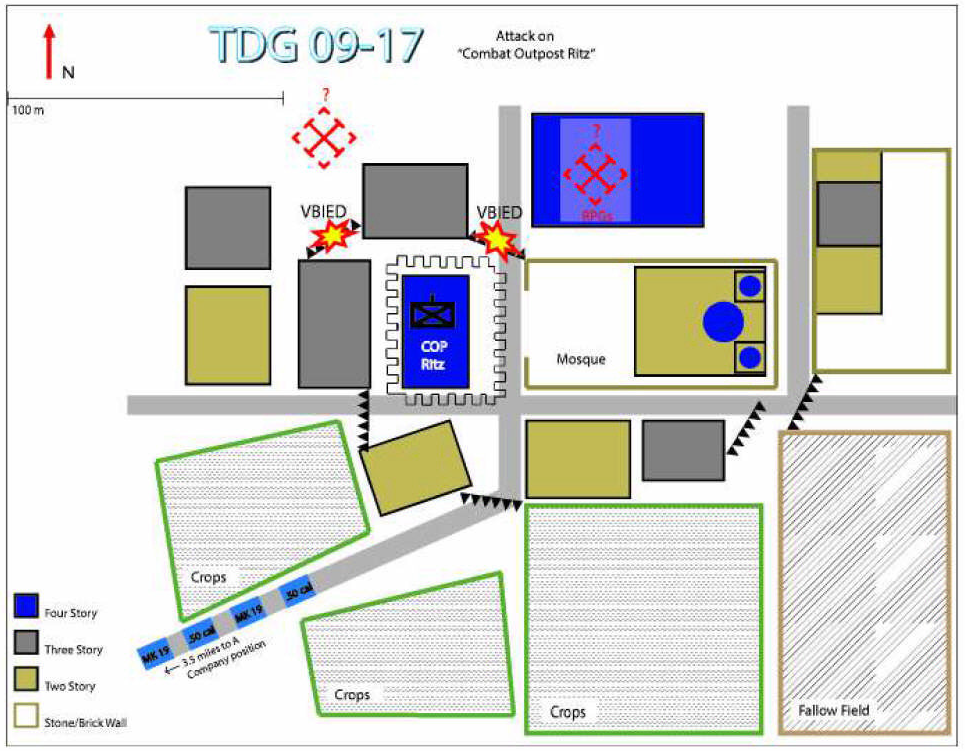
You are the Company Commander, A Company, 1st Bn, 1st Marines. It has been two days since the two families of squatters living in COP Ritz hastily left their rooms in the outpost after a visit from two of their “cousins.” You have taken a team of three MUGA commandos, including Sgt Chef Benazzi. His seniority and experience remind you of an old-school infantry gunnery sergeant, and he has also proven to be one or your most savvy interpreters. You have been outside the wire since dawn meeting with Imam Mehmet Binouadoud, the Imam of the Al Mumeet Mosque, and Mkuu (chief) Uhuru Honore, the leader of the Albu Xuzuri tribe. You are determined to build on your relationships with these two very different local leaders to get to the bottom of the sudden departure of the squatters and to shore up local security in the neighborhood.
Your reports, based on many engagements over the past months, have helped confirm multi-source intelligence analysis findings that the leaders of the Albu Xuzuri tribe may be ready to openly support the MUGA and the CJTF. Your battalion CO has also “read you in” regarding diplomatic efforts at the U.S. mission in the capital, Minna Sultan Usween, to bring the Nuzuris into the MUGA. The Nuzuris are numerous and heavily armed, but they are a minority in the country. They have been historically ostracized as the descendants of enslaved mainland Africans brought to the country by the French in the 18th century. The Nuzuri are further stigmatized due to their unorthodox interpretation of Sufi Islam influenced by tribal and Christian practices. In response, they have developed a strongly self-reliant and isolated warrior culture with a reputation for violence, revenge, and criminal enterprises.
The three of you, along with Sgt Chef Benazzi, are all sitting on the floor of one of the offices on the third floor of the Imam’s compound due east of the mosque, drinking sweet tea. Your commandos, the Imam’s mosque police, and the Mkuus personal guard are posted outside. Soon after the noon call-toprayers, you hear two explosions and heavy small arms fire. You see smoke rising from the northern boundary of the COP, but you cannot make contact with your Marines on the company radio. More automatic weapons fire and several smaller explosions follow, now you are able to see smoke rising from north of the COP. You cannot see the action north of the COP and have no idea how many attackers are involved, what has caused the explosions, or what actions your Marines are taking.
You are still unable to raise your 3d Platoon Commander, 1st Lt Przyby, who you Iert in charge at the COP. As you silently recite the “mantra” of tactical reporting-“What do I know? Who needs to know? Have I told them?”- you use your local network cell phone to call the battalion’s CMOC (civil-military operations center) and, after a brief exchange with one of the contracted interpreters, you provide a “Flash” SITREP to the Battalion Operations Officer: “40-plus enemy; attacking COP Ritz from the north; time: now; automatic weapons and IEDs; COP in danger of being overrun.” You deliberately create a number of attackers to “work the system” the CFACC (combined force air component commander) uses to authorize CAS requests when there is a tactical unit in contact, or “TIC.” You know 30 enemy is the CJTF Commander’s threshold to immediately pull attack aircraft plus either rotary-wing or a UAS terminal controller from one of the “stacks” managed by the CFACC from their palatial combined air operations center at the international airport in the capital. Further, you add a “worse case” assessment about COP Ritz being overrun to ensure your Marines have the best chance for immediate support. As you finish your call, you hear the familiar sound of a .50 cal machingun and the crum-crump-crump of a MK19. You had been expecting the S-4A with a resupply convoy, and it sounds as if he has arrived and is joining the fight.
The Mkuu turns to you and, in heavily accented but perfect English, says, “My men can help you. My Militia is here protecting us at this meeting, and they are ready to fight and kill the terrorists attacking your Marines. I know you are only a captain, but at least you are here with us. I also know you understand what I am offering, and your generals and colonels will listen to you. You will make your reports, and you will see to it that 1 meet with the general of your ‘see jay tee eff.'”
He goes on to tell you that he has 30 militiamen with rifles and RPGs spread between the large, 4-story apartment building north of the Mosque and the COP. Mkuu Honore assures you that his men will support your Marines and help you get safely back to the COP. He goes on to report that the Albu Nuzuri are “blood enemies” of the terrorists and the tribes who support them, and that they are ready to secure this part of the city for the MUGA. Sgt Chef Benazzi and the Imam have been conferring Arabic, and while clearly caught off guard, they both appear pleased.
Suddenly, the Mkuu calls in one of his personal guard who is carrying a Styrofoam cooler held together with duct tape and wire. With obvious pride, he declares “to prove my point…” and opens the cooler to show you the severed heads of the two “cousins” who had visited the squatters at COP Ritz two days ago. Sgt Chef Benazzi starts cursing in Arabic, and Imam Binouadoud reels in shock. The commandos, mosque police, and Nuzuri Militia start screaming at each other in the hall way. You fight back the nausea and lean in to the Mkuu.
Realizing what this means to the CJTF and your battalion, do you accept his offer of support? “Deal, or no deal?”
If you do accept, how do you want to employ the militiamen in the apartment building between you and the COP? What are your instructions, and how do you communicate them?
If your ploy to get immediate CAS to support your Marines is successful, and with degraded communications, how do you plan to ensure effective terminal control of these aircraft?
Where do you put yourself in this fight? Do you get back to the COP as fast as possible, or do you “embed ” with your new allies?
How and when do you tell your battalion commander that your SITREP included deliberate fabrications?
Do you do something completely different?
Requirements
In 5 minutes or less, write your decision, providing a brief discussion of the rationale behind your actions. Submit your solutions by email to gazette@???marines.org or to the Marine Corps Gazette, TDG 09-17, Box 1775, Quantico, VA 22134. The Gazette will publish solutions in an upcoming issue.
“Never tell people how to do things. Tell them what to do and they will surprise you with their ingenuity.”
-GEN George S. Patton
During an October 2019 Lecture Series entitled Developing Leaders for Maneuver Warfare at Marine Corps University, former Secretary of Defense, James N. Mattis, was asked what he thought was the biggest threat to the preservation of democracy in the United States.1 His response included a thoughtful analysis of likely threats to democracy at home and abroad and how they would be mitigated in a future contested environment—through vicious harmony enabled by the human interface at all levels of command.2 He described the human interface as a system of feedback loops informed by intent and capable of learning and adapting.3 Echoing pages of MCDP 1, Warfighting, Secretary Mattis’ sentiments demonstrate how, through the integration of commander’s intent and the human interface, leaders can build trust, open lines of communication within their organization, and promote concepts of maneuver warfare—like mission command.
Threats to the United States’ command and control architecture reinforce an important principle regarding the effective application of commander’s intent: the greater the probability of conducting operations in distributed or communications-degraded environments, the greater the responsibility of our Nation’s commanders to skillfully issue clear and concise intent.4 The ability of our naval forces to persistently operate in contested, anti-access environments will require simple commander’s intent to promote intelligent initiative.5 Simplicity in orders and intent will clarify end states, increase speed in decision making, and generate trust in subordinate execution of operations in an anticipated communications-degraded environment.6
As LtGen Steven Boutelle points out in The Art of Command, “The effectiveness of today’s armed forces leadership will define the future of the nation.”7 To emphasize the importance of simple commander’s intent supporting future U.S. naval operations, this article examines ADM Lord Viscount Horatio Nelson’s use of commander’s intent at The Battle of Trafalgar and Field Marshal William Slim’s use of simple orders to unify the British 14th Army during World War II.
Commander’s Intent and the Human Interface
Emphasizing the role of individual behavior within the naval Services through organizing principles like commander’s intent can foster a culture of intelligent initiative. Studies of multi-domain battles throughout history highlight the importance of incorporating simple commander’s intent in future concepts of operations.8 The tactical art of ADM Nelson sheds light on the effectiveness of simple commander’s intent when combating a numerically superior naval force.
On 21 October 1805, ADM Nelson defeated the combined fleets of the French and Spanish navies during the Battle of Trafalgar off the coast of Spain.9 The victory concluded with all British vessels intact, 22 ships from the combined French and Spanish fleets destroyed, and French ADM Pierre-Charles Villeneuve taken prisoner aboard his flagship. It was described as, “The most decisive naval battle of the [Napoleonic Wars], conclusively ending French plans to invade England.”10 The victory was achieved through ADM Nelson’s belief in the value of commander’s intent and his deviation from formal ship-of-the-line warfare typical to 18th century fighting sail tactics.11
At the time, the British practice was for commanders to centralize control of the fleet under a single commander using line-ahead battle formations.12 Conventional line-ahead battle formations organized fleets in parallel lines that were good for communication but limited their dispersion.13 At the Battle of Trafalgar, ADM Nelson arranged his ships in columns, directing, “The Order of Sailing is to be the Order of Battle.”14 His unconventional use of column formations facilitated speed and independent maneuver of British ships—and allowed his fleet to approach ADM Villeneuve’s linear formation perpendicularly. Shaping actions afforded by his maneuvers created additional fields of fire for his broadside-mounted 24-pounder long guns, which supported feints and ultimately broke ADM Villeneuve’s lines.15
ADM Nelson unified the actions of his captains through commander’s intent, effectively overcoming anticipated degradations in communications through his use of a column formation.16 In his personal journal, ADM Nelson referred to his unorthodox methods of decentralizing authority as “the Nelson touch,” writing, “I am anxious to join the Fleet, for it would add to my grief if any other man was to give them the Nelson touch, which we say is warranted never to fail.”17 Prior to the battle, he created a common understanding of his objectives, enabling decisive actions at the captain level.
ADM Nelson organized the actions of his subordinates through simple guiding principles like, “No captain can do very wrong if he places his ship alongside that of an enemy.” He decentralized authority to open fire down to his fleet’s captains and emphasized the importance of attacking effectively first.18 One recollection said, “If signals could not be seen from the flagship, [captains] had complete autonomy to engage the enemy as they saw fit.”19 On the morning of battle, ADM Nelson signaled to his captains: “Engage the enemy more closely.”20 The control of the battle was effectively handed off to his captains, bringing unmatched speed and decisiveness to the fight. ADM Nelson’s use of commander’s intent built trust and unleashed intelligent initiative by emphasizing short and concise guidance.
Modern applications of commander’s intent—shaped by LtGen John A. Lejeune’s 1920 philosophy of the relationship between officers and men, Gen Alfred M. Gray’s 1989 model of teacher-student relationships, and Gen David H. Berger’s 2019 emphasis on measuring the effectiveness of planning processes by the quality of their intent—continue to demonstrate the importance of enabling vicious harmony by promoting subordinate initiative.21 Through simple guidance based on a common understanding of objectives and decentralized decision making, our naval forces will continue to confirm the value ADM Nelson placed on intent by allowing decentralized operations to thrive in distributed and communications-degraded environments.
Defeating the Undefeated
Enhancing the lethality of the U.S. naval Services through proposed complex force packages will require organizing principles to endow a shared sense of responsibility across a large number of distributed military platforms.22 Harmonizing the actions of a large number of distributed military platforms can be accomplished through simple unified intent, as demonstrated by historical examples such as then-LTG Slim in his defeat of the Japanese 15th Army during World War II.23
In his memoir, Defeat into Victory, Field Marshal Slim highlighted the effectiveness of commander’s intent in leading the British 14th Army to victory over formidable Japanese forces during World War II.24 From 1942 to 1943, LTG Slim commanded the Burma Corps and the XV Corps, both of which faced critical defeats against Japanese forces during the Burma Campaign.25 Widely renowned in the Asiatic-Pacific theater for their training and discipline, LTG Ren’ya Mutaguchi’s Japanese 15th Army prioritized speed in tactics to exploit gaps in allied defensive positions, allowing them to beat back the British forces from Burma into India during the Arakan Campaign in 1943.26
Following the 1943 Japanese defeat of the British XV Corps in the Arakan Campaign, LTG Slim was assigned to command the British 14th Army and given orders to prevent Japanese seizure of British India.27 Upon assuming command, he identified many struggles his soldiers would have to overcome—from correcting a notably poor supply chain to altering his troop’s mindset that Mutaguchi’s forces were unable to be beaten. Most important to LTG Slim was his need to organize the British 14th Army—which comprised British, Gurkha, Burmese, African, American, and Chinese troops—into simple chains of command.28
Soldiers from the British 14th Army were collectively characterized by a vast medley of cultures, languages, and religions. LTG Slim unified this disparate force by establishing three transparent priorities for the British 14th Army which he nested in subordinate priorities in every level of his command: build a cohesive army, prioritize small-unit defeats of Japanese forces, and leverage coalition force capabilities.29 LTG Slim emphasized the importance of his priorities at the tactical level to support the achievement of his strategic objectives in Burma.30
To build a cohesive army, he reinforced the three aforementioned priorities by “speaking tirelessly to his men and [explaining] to them how each man’s contribution [to his priorities] played an important part in the overall result.”31 He regularly visited the front lines and delivered intent to his subordinate commanders in their own language, using interpreters when he was unable to do it himself. He decentralized control of his distribution network to ground maneuver forces to keep supply lines moving during Japanese attacks.32 Furthermore, considering the feedback he received regarding the needs of his troops, LTG Slim exploited his robust logistical network to provide culturally appropriate meals to his troops with religious dietary restrictions.33
Transparency in goals and decentralization of authority to competent subordinates generated quick wins at the small-unit level, allowing the British 14th Army to overcome the mindset that the Japanese were supermen and unbeatable. Deliberately limiting the size and scope of his tactical objectives, he emphasized the conduct of small patrols to build confidence in his troops’ abilities to move and fight in the Burmese jungle.34 The success of the British 14th Army from 1943-1945 during the Burma Campaign was the result of LTG Slim’s simple orders and organizing principles, ability to transform the army into a winning team, and unifying principles around a common cause.35 Utilizing the momentum of small-unit victories, LTG Slim adhered to the leadership advice he received as a young cadet: “Hit the other fellow, as quick as you can, and as hard as you can, where it hurts him the most, when he ain’t lookin!”36
With coalition support from American LTG Joseph Stilwell, USA, commanding Chinese forces and British American GEN Orde Wingate commanding Chindit forces, the Allied forces disrupted Japanese supply lines, limited Japanese freedom of maneuver, and stunted Mutaguchi’s ability to reinforce the Japanese 15th Army. Accordingly, “in March 1945, the British 14th Army took Mandalay and the Japanese stronghold of Meiktila.”37 By May 1945, the remaining Japanese 15th Army forces were successfully repelled from Burma and unable to seize British India, allowing Allied forces to establish critical supply lines into China.38
LTG Slim understood that true leaders do not inspire through writing or dictating their orders, but through leading their people and being with them.39 He built a leadership team where his army operated more from his commander’s intent than written orders, and he developed strong relationships that imparted trust in his leaders and earned trust in return. In a post-career analysis of his application of orders to his maneuver warfare mindset which contributed to victory in Burma, Field Marshal Slim notes,
I suppose dozens of operation orders have gone out in my name, but I never actually wrote one myself. I always had someone who could do that better than I could. One part of the order I did, however, draft myself—the intention … it is always the most important.”40
LTG Slim’s use of simple priorities provides a relevant example of how to establish command and control systems that are flexible, adaptable, and resilient.41 The anticipated speed of a future conflict reinforces the importance of decentralizing authority to the lowest competent authority.42 Emphasizing speed in decision making through simple priorities promotes certainty in uncertain environments and generates the bottom-up initiative necessary to maintain tempo in the absence of direct communications.43 Simple priorities nested in every level of command exploit the full potential of the U.S. naval Services’ junior enlisted and officers, and will no doubt enable success in a future contested environment.
Unleashing Intelligent Initiative
Maintaining the United States’ strategic advantage in the emerging operational environment will require tactical decision makers to intelligently respond to evolving threats impacting the U.S. naval forces’ operational and strategic objectives.44 Historical military operations during the Napoleonic Wars and World War II, modern guidance like Gen Berger’s Commandant’s Planning Guidance, and even industry best-practices highlight the effective use of commander’s intent as an asymmetric advantage critical to supporting distributed and complex force packages.
FedEx chief executive officer and Marine veteran Fred Smith’s simple guidance to his employees integrates speed with control for a complex and distributed organization responsible for more than fifteen million shipments per day: “get all packages to their destination free of damage, in a cost-effective manner, and within the shipment period specified by the customer.”45 Smith’s use of simple intent promotes intelligent initiative for more than 450,000 FedEx employees worldwide and harmonizes subordinate execution of the FedEx mission in line with his priorities.
The gradual erosion of American technological advantages demonstrates the need to emphasize commander’s intent at the tactical level, in order to increase effectiveness during distributed operations.46 A Design for Maintaining Maritime Superiority, Version 2.0, highlights the importance of decentralized authority as a priority to maintain strategic advantage within a contested maritime domain.47 Achieving strategic victories in the emerging operational environment will require execution of intelligent tactical initiatives through quality commander’s intent because as Alfred Mahan noted, “[Subordinate] action by the various great divisions of the fleet [have their] own part contributory to the general whole.”48
As anticipated in Gen Berger’s planning guidance, the application of maneuver warfare philosophy will increase as we divest of legacy systems that no longer support the speed of our operational requirements.49 Leadership in the high speed and distributed operations of a future contested environment will require skillful judgement in the application of maneuver warfare through the use of succinct, effective, and easily-disseminated commander’s intent to promote the same intelligent initiative demonstrated by ADM Nelson off the coast of Spain and by LTG Slim in Burma.
Notes
Gen James N. Mattis, “Developing Leaders for Maneuver Warfare: General Mattis on Leadership,” (lecture, Quantico, VA, October 2019).
Ibid.
Ibid.
James Acton, “Command and Control in the Nuclear Posture Review: Right Problem Wrong Solution,” War on the Rocks, (February 2018), available at https://warontherocks.com; and Jeffrey Reilley, “Multidomain Operations: A Subtle but Significant Transition in Military Thought,” Air & Space Power Journal, (Maxwell AFB, AL:Air University Press, 2016).
Gen David H. Berger, Commandant’s Planning Guidance, (Washington, DC: 2019).
Anthony Piscitelli, The Marine Corps Way of War: The Evolution of the U.S. Marine Corps from Attrition to Maneuver Warfare in the Post-Vietnam Era, (El Dorado Hills, CA: Savas Beatie, 2017); Liang, Qiao and Wang Xiangsui, Unrestricted Warfare, (Beijing: PLA Literature and Arts Publishing House, 1999); and “Multidomain Operations: A Subtle but Significant Transition in Military Thought.”
Harry S. Laver, The Art of Command: Military Leadership from George Washington to Colin Powell, (Lexington, KY: University Press of Kentucky, 2010).
James Lacey, “An Historical Look at the Future,” (lecture, Quantico, VA, August).
John B. Hattendorf, Trafalgar and Nelson, (Newport, RI: The Naval War College Museum, 2006).
Dan Fogel, “Lord Nelson Can Teach us Lots About Strategy,” SP3, (May 2019), available at http://www.spthree.com.
The Editors of Encyclopaedia Britannica, “Ship-of-the-line Warfare,” Encyclopaedia Britannica, (August 2010), available at https://www.britannica.com. See also Trafalgar and Nelson.
“Lord Nelson Can Teach Us Lots About Strategy.” See also “Ship-of-the-line Warfare.”
Staff, “Battle of Trafalgar: Napoleonic Wars,” Learning History, available at https://www.learning-history.com.
Horatio Nelson, Victory, off Cadiz, 9th October 1805, (October1805), available at https://www.bl.uk.
Trafalgar and Nelson.
“Ship-of-the-line Warfare.”
Oliver Warner, Nelson’s Last Diary and the Prayer before Trafalgar, (London, UK: Seeley, Service & Co., 1971).
Wayne P. Hughes and Robert Girrier. Fleet Tactics and Naval Operations, Third Edition. (Annapolis, MD: Naval Institute Press, 2018).
Christopher Gabel, Christopher Willbanks, and James Willbanks, Great Commanders, (Fort Leavenworth, KS: Combat Studies Institute Press, 2014)
Ibid.
John A. Lejeune, Relations between Officers and Men. Marine Corps Order No. 29. 1920; See also Headquarters Marine Corps, MCDP 1, Warfighting, (Washington, DC: 1997); and the Commandant’s Planning Guidance
John Paschkewitz, “Mosaic Warfare,” (lecture, Quantico, VA:, August 2019); DARPA, “DARPA Tiles Together a Vision of Mosaic Warfare,” available at https://www.darpa.mil; and Benjamin Jensen, “Innovation: Myths and Meaning,” (lecture, Quantico, VA: August 2019).
“DARPA Tiles Together a Vision of Mosaic Warfare.”
William Slim, Defeat into Victory: Battling Japan in Burma and India, 1943-1945, (New York, NY: Cooper Square Press, 2000).
David Cotter, “Field Marshal William Slim,” (lecture, Fort Leavenworth, KS, January 2019.
Maj N. R. M. Borton, British Army, “The 14th Army in Burma: A Case Study in Delivering Fighting Power,” Defence Studies, (Milton Park, UK: Taylor & Francis, 2002).
“Field Marshal William Slim.” See also Thomas M. Jordan,The Operational Commander’s Role in Planning and Executing a Successful Campaign, (Fort Leavenworth, KS: School of Advanced Military Studies, 1992).
Owen Connelly, On War and Leadership: The Words of Combat Commanders from Frederick the Great to Norman Schwarzkopf, (Princeton, NJ: Princeton University Press, 2005).
“Field Marshal William Slim.”
Ibid.
Thomas Jordan, The Operational Commander’s Role in Planning and Executing a Successful Campaign, (Fort Leavenworth, KS: School of Advanced Military Studies, 1992).
Defeat into Victory: Battling Japan in Burma and India, 1943-1945.
Ibid.
Andrew Knighton, “Bill Slim and WWII’s Forgotten Army—One of The Most Successful Commanders of the War,” War History Online, (December 2017), available at https://www.warhistoryonline.com.
Aivars Purins, “Uncle Bill of the Forgotten Army or the Leadership of Field-Marshal Lord Slim.” Baltic Security & Defence Review, (Tartu, EE: Baltic Defence College, 2008).
Defeat into Victory: Battling Japan in Burma and India, 1943-1945.
“Bill Slim and WWII’s Forgotten Army—One of The Most Successful Commanders of the War.”
“Field Marshal William Slim.”
Defeat into Victory: Battling Japan in Burma and India, 1943-1945.
Ibid.
James N. Mattis and Bing West. Call Sign Chaos: Learning to Lead, (New York, NY: Random House, 2019); See also Commandant’s Planning Guidance.
“Developing Leaders for Maneuver Warfare: General Mattis on Leadership.”
MCDP 1, Warfighting.
Rob Wittman, “Backing the Corps: Ensuring the Future of the Amphibious Force,” War on the Rocks, (October 2018), available at https://warontherocks.com.
Chad Storlie, “Manage Uncertainty with Commander’s Intent,” Harvard Business Review, (November 2010), available at https://hbr.org. See also FedEx Corporation, “Corporate Fact Sheet,” FedEx, available at https://about.van.fedex.com.
John Kroger, “Charting the Future of Education for the Navy-Marine Corps Team,” War on the Rocks, (November 2019), available at https://warontherocks.com.
United States Navy, A Design for Maintaining Maritime Superiority, Version 2.0, (Washington, DC: 2018); see also United States Navy, Navy Leader Development Framework, Version 3.0, (Washington, DC: 2019).
Alfred T. Mahan, Types of Naval Officers Drawn from the History of the British Navy, (London, UK: S. Low, 1902). See also Williamson Murray, “MCDP 7,” Marine Corps Gazette, (Quantico, VA: November 2019).
Adam Elkus, “Man, the Machine, and War.” War on the Rocks, (November 2015), available at https://warontherocks.com. See also Commandant’s Planning Guidance.
War is both timeless and ever changing. While the basic nature of war is constant and methods we use evolve constantly … [o]ne major catalyst of change is the advancement of technology. As the hardware of war improves through technological development, so must the tactical, operational, and strategic usage adapt to its improved capabilities to counteract our enemy’s.1
This excerpt from MCDP 1, Warfighting, has proven particularly relevant with the advent of cyber warfare. Recent technological advances have allowed hackers to conduct cyber-attacks against the United States and countries around the world. The 2015 Office of Personnel Management hack, for example, resulted in the theft of 21.5 million Federal employees’ personal information. In 2007, a series of coordinated cyber-attacks crippled the Estonian government, banks, media, and other institutions, bringing the country “to a virtual standstill.”2 Most recently, Russia has employed cyber operations as part of the conflict in Ukraine.3
In the absence of treaties or statutes, the DoD and Marine Corps have taken steps to adapt to and regulate this new wrinkle in modern warfare. Several DoD documents relevant to this discussion are classified; those documents will not be addressed and limit this article’s permissible scope.
The United States does not stand alone in its quest to regulate cyberspace and cyber warfare. An international group of experts developed the Tallin Manual and Tallin Manual 2.0, which seek to establish an international code to govern cyber operations. While the Tallin Manual and the Tallin Manual 2.0 provide useful guidelines, they are not binding on the United States. It would benefit the United States to take a leading role in the development of domestic and international standards, both as a world leader and because such standards will improve America’s ability to act and react decisively, consistently, and in coordination with our allies.
Current Legal Framework
Modern warfare is analyzed under two primary sources of authority: the UN Charter and the Law of Armed Conflict (LOAC). Cyber warfare, however, presents several challenges that the definitions in the UN Charter and the LOAC may not adequately address.
The UN Charter. The UN Charter establishes many of the basic principles for international relations. Various interpretations of the UN Charter have occasionally resulted in political tensions, such as balancing a state’s right to sovereignty with a state’s right to preemptive self-defense. Sovereignty versus preemptive self-defense remains an ongoing source of friction in international relations and international law—a problem that will be exacerbated if the conduct of cyber warfare is analyzed within a framework that does not account for its intricacies.
Article 2 of the UN Charter grants states the right sovereignty, stating,
[a]ll Members shall refrain in their international relations from the threat or use of force against the territorial integrity or political independence of any state, or in any other manner inconsistent with the Purposes of the United Nations.4
Article 51 grants states the right to self-defense. It reads, in part,
Nothing in the present Charter shall impair the inherent right of individual or collective self-defense if an armed attack occurs against a Member of the United Nations, until the Security Council has taken the measures necessary to maintain international peace and security [emphasis added].5
The UN Charter, understandably, does not address issues specific to cyber warfare in several ways. The UN Charter does not define the “force” that may not be used “against the territory integrity” of any state nor does it define “armed attack.” Cyber-attacks resulting in physical damage, and thus having the effect of a physical attack, would likely constitute force in violation of Article 2. One could argue, however, that cyber-attacks that donot result in the manipulation of physical objects (such taking information from an electronic database) may not constitute “force” against a state’s “territorial integrity” as the terms are commonly understood. This represents a potentially dangerous gray area, and one that our enemies could exploit.
Additionally, as with traditional warfare, no clear guidance exists on how far the right to self-defense, as articulated by Article 51, extends. A state’s right to self-defense is not absolute, and it remains unclear when action in cyberspace crosses the line between “preemptive self-defense”6 and a violation of another state’s sovereignty.7
The LOAC. The DoD applies the LOAC to all military operations. The LOAC is a combination of the “Hague Tradition” and “Geneva Tradition.”8 Hague Tradition regulates the means and methods of warfare, such as the tactics, weapons, and targeting criteria.9 All military operations must be evaluated in terms of necessity; proportionality; distinction; and humanity.10
The LOAC applies to both international armed conflicts (IACs) as well as non-international armed conflicts (NIACs). However, the distinction between the two categories of conflict could prove critical to other issues such as use of force and the status of enemy combatants. The ability to attribute an attack to its source will be crucial in determining whether an IAC or NIAC framework applies.
IACs. The UN classifies armed conflict between two states as IACs. It bases this classification on Common Article 2,11 which is supplemented by Additional Protocol I.12 Cyber warfare in an IAC poses few legal problems. If a foreign military or government conducts cyber-attacks against the United States as part of a conflict, the United States could respond in accordance with UN Charter Article 51 and the LOAC, constrained only by the principles of necessity, distinction, proportionality, and humanity. Those foreign operatives working on behalf of the state would be entitled to the same protections as any other prisoner of war.
NIACs. The more complex scenario would involve one or more non-state actors that conduct cyber-attacks against the United States. One can easily imagine a scenario in which a terrorist organization, or other organization operating independently of any nation-state, attempts to bring down all or parts of the DoD or Marine Corps network. These actions and actors would likely fall within the NIAC framework.
NIACs, or “armed conflict[s] not of an international character occurring in the territory of one of the High Contracting Parties,”13 trigger Additional Protocol II obligations for the state party involved in the conflict.14 NIACs have traditionally involved the imposition of international regulations on entirely internal conflicts, such as the Colombian government’s struggle against the Revolutionary Armed Forces of Colombia. But this definition has expanded in recent years; multiple international courts have recognized that NIACs may exist across international borders.15
Unlike combatants in IACs, combatants in NIACs do not receive combatant immunity or prisoner of war status or protections for their actions.16 Foreign cyber operatives will likely fall somewhere along a spectrum between “no state support” and “state or military employee;” and the Marine Corps should have a plan for how to classify actors at various points along this spectrum, providing various levels of support, and train Marines on what protections those actors are entitled to. Once we accurately categorize these actors, we will next have to determine at what point they become valid military targets depending on their actions in cyberspace. Commander’s intent should then empower decision-makers at the appropriate level.
Improving our Combined Arms
The Marine Corps relies on maneuver warfare to defeat its enemies. Part of this approach includes the use of combined arms, which MCDP 1 defines as “the full integration of arms in such a way that to counteract one, the enemy must become more vulnerable to another.”17 Speed provides a crucial means to exploit the enemy’s gaps that the combined arms dilemma exposes. The cyber domain is no different.
The Marine Corps is aware that its reliance on electronics could prove to be a critical vulnerability in battle. A successful enemy cyber-attack could act as a force multiplier for an otherwise inferior force, drastically slow our operational tempo such that we lose relative speed over the enemy, and severely limit the Marine Corps’ ability to use combined arms. In a near-peer engagement, the ability to move our personnel and aircraft close to and into enemy territory both undetected and unimpeded will be critical for shaping operations. Developing cyber capabilities organic to the MEFs and empowering decision-makers at the MEF level would allow for a quicker response, thus improving our relative speed and exposing our enemies to a combined arms dilemma earlier in the fight.
Moving Forward
Domestically, the United States has recognized the immediacy of the cyber threat, as evidenced by the 2017 National Security Strategy and the 2018 National Defense Strategy (NDS). While discussing how to protect the United States in the cyber era, the National Security Strategy noted that information sharing and layered defenses will be key to deterring and defeating rogue actors.18. The NDS enacted this intent, stating that we will “invest in cyber defense, resilience, and continued integration of cyber operations into the full spectrum of military operations.”19 The Marine Corps Cyberspace Command addresses and develops defenses to cyber-attacks, assesses system vulnerabilities, and prepares to digitally “maneuver” in support of operational forces.20
Internationally, the Tallinn Manual distinguishes between “use of force” and “armed attack”21 and concludes that cyber operations can qualify as an armed attack, particularly in cases involving substantial injury or physical damage.22 Additionally, some members of the group posited that a “sufficiently severe non-injurious or destructive cyber operation, such as that resulting in a state’s economic collapse, can qualify as an armed attack.”23
These domestic and international measures represent a great deal of progress and a useful baseline in an emerging field. The United States should seek to lead the global community in this area. The DoD will benefit from having a set of rules for responses and engagement criteria. While not a necessity, signing and ratifying a single international framework can both improve relations with our allies and allow the DoD to improve interoperability during combined operations. Such a framework will also facilitate decentralized decision-making as to whether an “attack” has occurred and allow MEFs to respond quickly and decisively in fluid situations.
Decentralized decision-making remains especially important to the Marine Corps. Our structure and doctrine place decision-making responsibility on our personnel closest to the ground. Predictability and known rules of engagement may become critical considerations for these individuals. Our MAGTFs and MEFs would benefit from an organic cyber warfare element that could react instantaneously to an enemy cyber-attack, conduct a counterattack, and relay relevant information to the GCE, ACE, or LCE. Such decentralization is also consistent with the NDS’s directive to integrate operations “into the full spectrum of military operations.” Cyber and electronic warfare will likely take on an increasingly prominent role in future conflicts; we owe our Marines the power to make critical decisions with confidence and consistency so we may continue to win battles in any clime and place.
LTC Scott W. Beidleman, USA, Defining and Deterring Cyber War, (Carlisle, PA: U.S. Army War College, 2009).
Laurens Cerulus, “How Ukraine Became a Test Bed for Cyperweaponry,” POLITICO, (February 2019), available at https://www.politico.
United Nations, Charter of the United Nations, (San Fransico, CA: October 1945). See Article 2 (4).
Charter of the United Nations. See Article 51.
UN Special Rapporteur Philip Alston has stated that “[a] targeted killing conducted by one State in the territory of a second State does not violate the second State’s sovereignty [where] … the first, targeting State has a right to international law to use the force in self-defen[s]e under Article 51 of the UN Charter, [and] the second state is unwilling or unable to stop armed attacks against the first State launched from its territory.” UN Human Rights Council, Special Rapporteur on Extrajudicial, Summary or Arbitrary Executions, Study on Targeted Killings, UN Document A/HRC/14/24/Add.6, (Geneva, CH: May 2010). For other examples of preemptive self-defense in international law, see William H. Taft IV, The Legal Basis for Preemption, Council on Foreign Relations, (2002); available at http://www.cfr.org
In traditional warfare, absent consent, a “victim” state may only violate another state’s sovereignty in the name of self-defense if the host state is “unwilling or unable” to stop the threat to international peace. Additionally, the victim State’s operations must conform to the LOAC’s principles of necessity and proportionality. A similar standard would be useful cyber warfare, especially considering the clandestine and secretive nature of some hacking groups in countries like China and Russia. See Ashley S. Deeks, “’Unwilling or Unable’: Toward a Normative Framework for Extraterritorial Self-Defense,” Virginia Journal of International Law, (Charlottesville, VA: University of Virginia School of Law, December 2011). (citing Permanent Rep. of the Russian Federation to the U.N., Letter dated Sept. 11, 2002 from the Permanent Rep. of the Russian Federation to the United Nations addressed to the Secretary-General, Annex, U.N. Doc. S/2002/1012/Annex (Sept. 12, 2002).
LTC Richard P. DiMeglio, Judge Advocate, USA, et al., Law of Armed Conflict Deskbook, (Charlottesville, VA: United States Army Judge Advocate General’s Legal Center and School, 2012).
Hague tradition consists of the Hague Conventions of 1899, as revised in 1907, the 1954 Hague Cultural Property Convention, and the 1980 Certain Conventional Weapons Convention. Geneva Tradition focuses on respecting and protecting victims of warfare. Geneva Tradition focuses on respecting and protecting victims of warfare; Geneva Tradition is composed of the four Geneva Conventions of 1949, each of which protects a different category of war victim. Law of Armed Conflict Deskbook: supra n. 8 at 19.
Law of Armed Conflict Deskbook.
“Common Article” refers to articles that are common to all four Geneva Conventions.
“[T]he present Convention shall apply to all cases of declared war or of any other armed conflict which may arise between two or more High Contracting Parties, even if the state of war is not recognized by one of them.” Geneva Convention for the Amelioration of the Condition of the Wounded and Sick in Armed Forces in the Field [“Geneva I”] article 2 (1949). The United States has not signed or ratified Protocol I, in part because it expands Common Article 2 to include conflicts previously classified as non-international armed conflicts (NIACs). Under Protocol I, Common Article 2 would include “armed conflicts in which peoples are fighting against colonial domination and alien occupation and against racist regimes in the exercise of their right of self-determination.” Protocol Additional to Geneva Conventions of 12 August 1949 and Relating to the Protection of Victims of International Armed Conflicts art. 1, para. 4. The United States has resisted ratifying Protocol I because it expands liability for commanding officers for the actions of subordinates (id., at arts. 86, 87) and because it states enemy combatants have not distinguished themselves from civilians until they have engaged in preparatory or combat activities (id., at art. 44[3]). For a fuller discussion of the reasons that some States have chosen not to ratify Protocol I; see Harvey Rishikof, “Institutional Ethics: Drawing Lines for Militant Democracies,” Joint Force Quarterly, (Washington, DC: National Defense University Press, 2009); see also David McGrogan, “Whither Now, Additional Protocol I?” International Law Observer, ( January, 2009), available at http://www.internationallawobserver.eu.
Geneva Convention for the Amelioration of the Condition of the Wounded and Sick in Armed Forces in the Field [“Geneva I”] art. 3 (1949).
Law of Armed Conflict Deskbook.
See Supreme Court of the United States, Hamdan v. Rumsfeld, 548 U.S. 557, (Washington, DC: 2006). Holding that “the term ‘conflict not of an international character’ is used here in contradistinction to a conflict between nations” and thus recognizing that Common Article 3 conflicts can expand beyond the territory of one States. See also International Court of Justice, 2005 I.C.J. 337,Case Concerning Armed Activities on the Territory of Congo (Democratic. Republic of Congo v. Uganda), (The Hague, NL: December 2019).
For further reading, see Supreme Court of Israel, HJC 769/02, The Public Committee Against Torture in Israel, et al., v. The Government of Israel, et al., (Jerusalem, IL: December 2005).
MCDP 1.
National Security Strategy of the United States of America, 2017.
National Defense Strategy of the United States of America, 2018.
James K. Sanborn, “Cyber Battlefield Grows in Importance,” Military Times, (April 2009); available at http://www.militarytimes.com.
Collin Allan, “Was the Cyber Attack on a Dam in New York an Armed Attack?” Just Security, ( January 2016) available at https://www.justsecurity.org.
The Commandant’s Planning Guidance (CPG),published in July 2019, is the vision and strategy document that describes the Marine Corps’ current and future force operational strategy to fight and win in the next 5-15 years. Within the context of current operational realities and potential future force challenges, the document provides a foundational view for decision makers to follow and understand the direction the Marine Corps is driving toward over the next decade. The CPG recognizes the need to conduct command and control (C2) over contested networks, which can support maneuver forces in a distributed manner. The CPG also recognizes the growing threat of cyber warfare, and the Marine Corps’ reliance on the electromagnetic spectrum (EMS) to conduct operations across the MAGTF must be resilient.1 It further points out how operating in an environment where networks will be attacked, compromised, degraded, or denied is an operational reality.
Much of the focus of cyberspace operations in recent years has centered on the strategic and operational levels of war. Cyberspace is defined by Joint Publication 3-12 as a global domain within the information environment consisting of the interdependent networks of information technology infrastructures and resident data, including the Internet, telecommunications networks, computer systems, and embedded processors and controllers.2 Cyberspace constitutes three layers: physical network, logical network, and cyber-persona. The physical network component is comprised of the hardware, systems software, and infrastructure (wired, wireless, cabled links, radio links, satellite, and optical) that supports the network and the physical connectors (wires, cables, EMS frequency, routers, switches, servers, and computers).3 The logical network layer consists of those elements of the network that are related to one another in a way that is abstracted from the physical network. An example of the logical layer is the DOD’s nonsecure Internet Protocol router network. The cyber-persona layer consists of the people who are actually on the network. A single cyber-persona can have multiple users or many virtual locations, but normally not linked to a single physical location.4 In order for networked MAGTF operations to be successful, all three layers of cyberspace operations must work effectively. The operational entities within the Marine Corps that deal with addressing cyberspace operations are the MAGTF Communications Control Center (MCCC)* (*MAGTF can denote any operational level within the MAGTF or major subordinate element. For example, a MCCC could reside at the MEF/MEB/MEU levels or at the division, air, or logistical component. GOES AT THE BOTTOM OF THIS PAGE.) and the cyberspace and electronic warfare coordination center. Traditionally the Cyberspace and Electronic Warfare Coordination Center supports MAGTF commanders use of EMS via integrated planning across the MAGTF’s operational environment to increase the operational tempo and achieve military advantages.5Currently, this role now falls inside the MEF Information Group.
Battlefields have traditionally comprised of four domains: land, sea, air, and space. The last few decades changed the warfighting landscape to include a fifth domain: cyberspace. Some believe EMS deserves its own domain, especially considering the impacts it has on the conduct of war. Spectrum is the invisible medium that saturates the area of operations upon which the use of Marine Corps’ electronic systems depend. Spectrum is a unique environment because it transcends all three levels of war and can shape tactical, operational, and strategic means and end-states on the modern battlefield. Whether the Marine Corps is operating unilaterally or as part of a joint coalition, spectrum has both enabling and restricting characteristics. Therefore, defending, controlling, and shaping the spectrum landscape can be decisive because if a unit can be seen or located electronically, it then can be attacked and destroyed.
Until very recent, the elements of the MAGTF, EMS frequency complexities surrounding cyberspace operations is given scant attention. There are many questions to consider as to the real practical impacts for maneuver forces within an EMS denied or degraded environment. Does the GCE possess the necessary capabilities to properly mitigate a spectrum contested or denied battlespace? What are the practical steps to mitigate the loss of critical C2 at the infantry battalion level or lower? Does the Marine Corps current maneuver warfare doctrine properly support the loss of network-centric C2? Are there specific training scenarios that would help mitigate the loss of networked C2? What technologies should the Marine Corps adopt or develop to support or reinforce maneuver forces at the tactical level? What are the likely scenarios near-peer adversaries attack to limit, deny, or degrade MAGTF C2? What investments in training and technology should the Marine Corps make in order to ensure C2 of its forces during likely cyber network attacks and spectrum denied battlespaces?
While the Marine Corps has taken steps to ensure freedom of action in EMS contested environments, it has not done nearly enough to mitigate challenges of a congested radio frequency (RF) spectrum environment and the likely threats first world adversaries will impose on the battlefield to the GCE and, specifically, front line units like an infantry battalion. If tactical units cannot tie into the overall operational design of a campaign, then achieving the strategic end-state is unlikely to occur. Therefore, this article contends the Marine Corps must reexamine its current technological based C2 capabilities that enable maneuver warfare through the lens of spectrum denied or degraded operating environments. Decision makers should consider integrating readily available dynamic spectrum allocating systems and RF mapping technologies, which would significantly address key vulnerabilities that negatively affect networked C2. If adopted, they may provide the mitigation steps required to maintain decentralized C2. By waiting or failing to take steps now, the Marine Corps risks the ability to conduct decentralize decisive maneuver warfare through the use of automated C2 systems.
Methodology of Study
With the above in mind, this article explores the Marine Corps’ maneuver warfare doctrine within the context of an EMS denied or the degraded environment. The current command and control structure is an operating mental framework that uses mission command and control and offers the flexibility to deal with changing situations and to exploit fleeting windows of opportunity.6 First, the context is set by briefly examining Marine Corps maneuver warfare doctrine and key changes to command and control over the past fifteen years. Second, the framework examines the radio frequency spectrum challenges and the current communications capabilities at a typical Marine Corps infantry battalion to operate in spectrum congested environments. This article further examines some near-peer adversaries’ capabilities and likely threats posed by them. In order to properly scope the topic, the article purposely does not discuss the impacts of all EMS dependent technologies such as global positioning or reconnaissance satellites, both of which would have strategic impacts for U.S. military forces worldwide. However, it is recognized that a loss of either would have significant negative impacts on Marine forces both operationally and tactically. Finally, this article will examine some emerging technologies developed by the Defense Applied Research Agency (DARPA), which, if adopted by the Marine Corps, could positively affect its ability to operate in a spectrum contested environment. Though this article centers on front line tactical units, its concepts could further be applied to both air and sea domains, regardless of echelon or scale.
Maneuver Warfare Doctrine
The Marine Corps’ warfighting doctrine centers on the concept of maneuver warfare and denotes the idea of gaining a positional advantage over an adversary. While not exclusive to geographical boundaries, “this positional advantage may be psychological, technological, or temporal as well as spatial.”7 Maneuver warfare supports the philosophy of command, which requires subordinate commanders to make decisions based on higher command’s intent. A commander must develop his own understanding of this intent and utilize his own initiative in order to exploit opportunities as they present themselves.8 This concept ideally, when executed properly, generates a faster-operating tempo, which disrupts an adversary’s ability to effectively resist friendly actions. Maneuver warfare, at its core, is people centric and thus does not fundamentally require external systems in order to operate. However, it requires competent leadership and high degrees of trust at all levels of the organization to be effective when employed in a decentralized manner. In modern warfare, decentralized C2 requires communications equipment.
Operating at a faster tempo requires C2 systems and structures that provide for the speed of execution of key warfighting functions. In recent years, the Marine Corps, along with the entire DOD, has sought to reduce uncertainty by dramatically increasing the amount of information utilized through networking in order to make faster decisions. This insatiable appetite for copious amounts of information has pushed the Marine Corps to move from a “people-centric” model of C2 to an information or network-centric model of C2.9 This is evidenced by the enormous and overreliance on information systems technologies in order to operate in almost any capacity. For some, this overreliance has been seen as somewhat of an “Achilles heel” for the Marine Corps and the U.S. military as a whole. Nevertheless, the ultimate goal is to have effective C2 to mitigate the “fog of war,” friction, and uncertainty of enemy actions. Effective C2 is not simply a matter of generating enough information to make a decision but rather generating the information faster with more accuracy. Ironically, this dramatic increase of information flow now means commanders run the risk of information overload with more information than can be possibly assimilated. Therefore, information for effective C2 is valuable only insofar as it contributes to effective decisions and actions. The critical thing is not the amount of information but key elements of information that are available when needed and in a useful form that improves the commander’s awareness of the situation and ability to act.10 In this way, the use of automated C2 has helped commanders enhance what is considered essential information for decision making while at the same time made it more complex and often burdensome to acquire and share it.
Marine Corps maneuver warfare doctrine does provide for effective C2 with or without information systems. However, the solution relies on training commanders and subordinates to be very comfortable in fluid and chaotic environments. A high level of trust must exist between all elements of the MAGTF. It is likely that current and future operations will require the aggregation and disaggregation of forces over a distributed area of operations to conduct expeditionary advance based operations. The reality is any distributed operations require communications systems to extend the span of control of forces. Contested EMS environments limit the friendly span of control, and maneuver warfare requires thinking of the network as a maneuver element. This enables the performance of critical C2 functions throughout operations and prioritizes support to required C2 capabilities. That is, commanders must plan for and have the capability to maneuver and adjust the network to provide C2 at decisive points and times, much like shifting and concentrating fires to impart the desired effects on an adversary. C2 structures must allow for this flexibility, and commanders and staffs must train for this eventuality.11 Maneuver warfare theory is therefore uniquely suited for EMS contested environments because it fundamentally relies on implicit communication and mutual understanding to operate. Commanders must continue to hold to mission-type orders even while supported by networked control systems. As long as the Marine Corps continues to train with the realities of friction and uncertainty, then it is likely effective C2 will remain.
Changes in C2 over the Past Fifteen Years
Prior to the wars in Iraq and Afghanistan, the Marine Corps generally followed the people centric C2 model and was comfortable relying on single channel radio, implicit communications, and commander’s intent to make faster decisions than its adversaries. However, the Marine Corps also recognized the necessity to use key technologies, which supported decentralized C2. As a result, since 2003 and because of the wars in Iraq and Afghanistan, the Marine Corps has expanded almost every method of communications technology available today. For example, in 2002, the average Marine Corps infantry rifle company only processed five Very High Frequency (VHF) tactical radios to facilitate C2. Today, almost every Marine possesses some type of communications device to support C2. Larger maneuver units have also increased the use of high bandwidth terrestrial and satellite systems for C2. This accounts for almost a 200 percent increase in communications technologies within the GCE. Therefore, without any formal change to its warfighting doctrine, the Marine Corps has shifted from a people-centric to information system-centric C2. On the surface, this is not a negative factor and, arguably, the rapid proliferation of communications technologies has directly facilitated the concept of maneuver warfare because these technologies have increased the operating tempo of all Marine Corps warfighting functions. Conversely, this dramatic increase in communications equipment has amplified the need for more expeditionary power sources to operate the demand. Large battalion command posts and company footprints require more tactical power sources that leverage a networked C2 posture. Additional power sources require more logistic trains such as fuel and create additional vulnerabilities that can negate the advantages of the Marine Corps’ maneuver warfare doctrine. A case can be made the average Marine Corps infantry battalion is actually slower and more vulnerable today based on its overreliance on communications systems and the logistics tail required to support them. In addition, there is a generation of Marines who have grown accustomed to operating in large logistical footprints.
In practical terms, the average infantry battalion in the Marine Corps is the base unit for combat operations within the construct of the MAGTF. This design requires the Marine Corps operating in an integrated task force fashion, which will be ready to address any crises as they arise through the use of power projection from the sea and the use of expeditionary locations. The infantry battalion, with the use of its organic communications enablers, are designed to utilize maneuver warfare and conduct C2 in multiple ways. The use of line of sight (LOS) systems is the primary means for data and voice communications. In recent years, the use of beyond line of sight (BLOS) C2 systems has grown to meet the need for distributed operations. LOS systems are most closely related to tactical radio systems. BLOS systems are usually associated with satellite or tropospheric technologies. GPS are also included in BLOS systems but are mostly associated with the position, navigational information which facilitates friendly and enemy locations, fires, and other automation. For the purposes of this article, GPS is excluded from analysis but should be considered linked to other satellite technologies in terms of capabilities and vulnerabilities.
The Radio Frequency Spectrum
One of the biggest challenges for military communications is dealing with the RF spectrum. TheRF spectrum is a commodity that is infinite supply and heavily regulated, both in and outside the United States.12 Military communications equipment, civilian communications infrastructure, and countless other technologies, specifically anything with an RF emitter, must compete for available spectrum in order to operate. Entire government and commercial enterprises are centered around proper spectrum allocations. Communications technologies rely on the enforcement and regulation of spectrum access (Appendix 1, Figure 1 illustrates the congested spectrum in the United States alone). For the DOD there are specific RF spectrum areas that allocate for military use only (Appendix 1, Figure 2). Unfortunately, certain areas of the spectrum permitted inside the United States are not allowed in other countries. The U.S. military lacks authority to transmit on all desired frequencies while outside of the continental United States (OCONUS) because of interference with other host-nations’ communications infrastructures. Therefore, host-nation approval is required before utilizing those frequencies. Despite the escalating demands on available spectrum, only about five percent is used at any given time, which is an incredibly inefficient use of space.
Figure 1. APPENDIX A: Frequency Spectrum Charts. The United States Frequency Allocation Chart. Source: U.S. Dept. of Commerce, National Telecommunications and Information Administration, Office of Spectrum Management, March 1996.Figure 1. APPENDIX A: Frequency Spectrum Charts. The United States Frequency Allocation Chart. Source: U.S. Dept. of Commerce, National Telecommunications and Information Administration, Office of Spectrum Management, March 1996.
Military communications at the infantry battalion level fall at all ends of the RF spectrum range. Most tactical radio communications use a variety of high frequency (HF), VHF, and ultrahigh frequency (UHF). Almost all wideband satellite communications use super high frequency and extremely high frequency.13 Communication channels are often broken down further into narrowband and wideband channels in order to denote the amount of bandwidth available to operate. Narrowband technologies, under 25 kilohertz (KHz), usually support voice, positional, and limited data communications.
Narrowband technologies are used heavily to support maneuver and fires because of their reliability and mobility over uneven terrain. Wideband technologies are usually anything channeled over narrowband but also utilize all elements of the spectrum to support large amounts of data and voice communications. Most often they operated in megahertz (MHz) channel spaces and can often provide much larger bandwidth capabilities to support network-centric operations. Wideband technologies require significantly more power and are usually static in nature. However, in recent years, mobile wideband technologies have begun to emerge and show great promise for future MAGTF operations. As a rule, all military communications employ communication security protocols and encrypt both data and voice signals to ensure the integrity of information delivered. In addition, many narrowband systems utilize frequency hopping algorithms and sophisticated waveforms to thwart any adversaries’ attempts to frequency jam friendly communications signals. Finally, the manipulation of the RF spectrum has enabled C2 in many positive ways. The key is finding ways to optimize it once it becomes contested.
Spectrum in a Contested Battlespace
Since 2003, and as a counterbalance to the growing threat of insurgent attacks via IEDs, the Marine Corps began to adopt a host of jamming technologies in order to counter or defeat the threat posed by IEDs that are command-detonated by radio signals. During the early stages of the Iraqi campaign, Marine communicators at the infantry battalion level had to develop best practices for operating in highly congested spectrum environments like Ramadi and Baghdad.14 Eventually, the Marine Corps successfully integrated these systems into their C2 infrastructures, often through trial and error and planned design. Additionally, successful techniques, tactics, and procedures only developed once the campaign slowed to counterinsurgency operations operating from fixed forward operating bases. There were not spectrum sensing technologies available to ensure enemy forces were not denying or disrupting operations. Even today, there are no RF sensing tools organic to an infantry battalion’s communication platoon. Ideally, a reconnoiter of the spectrum environment would help Marine communicators understand if there is probable or current interference with their communications systems. As such, it is often through the arduous task of trial and error, loss of vital communications links, and placement of key retransmission nodes that a robust communications architecture can take form. The inability to conduct RF sensing operations does present a real and likely vulnerability for an adversary to exploit. The incapacity to quickly identify the source of interference and take mitigation steps could prove disastrous for maneuver forces.
Figure 2. APPENDIX B: Russian Land Based Jamming Equipment. (Not all inclusive). Location of Most Military RF Spectrum. Source: Borner, Katy, Atlas of Science: Visualizing What We Know, (2010). The MIT Press, page 112.)
Current and Likely Threats Posed by MAGTF Adversaries
Arguably, Russian and Chinese military forces pose the greatest near-peer technological threat to the Marine Corps’ ability to C2 its forces. Both countries have existing spectrum disrupting capabilities which could deny or significantly degrade Marine Corps tactical C2 systems. The negative impacts are many. A cursory examination of recent Russian and Chinese military activities can provide a sense of how each country could seek to counter the Marine Corps ability to C2 maneuver forces, conduct integrated fires, and maintain information superiority on the battlefield.
Russia. Russian military forces possess an array of jamming capabilities which operate across all areas of the spectrum. In every area where the Marine Corps operates its critical radio frequencies is where electronic countermeasures could be employed. An example of Russian military cyber warfare tactics manifested with its war with Georgia in August 2008 and most recently with its conflict with Ukraine. In both cases, Russian conventional military attack was complemented by a series of cyber-attacks targeting key networks of Georgian institutions, the media, and even the country’s government. When Russian tanks crossed the border into Georgia, network denial of service operations was conducted against the computer systems of Georgia. The targets of the cyber-attack were Georgian government websites and even included websites of the United States and British Embassies. The attacks initially came from Russian IP addresses, which resulted in a cyber blockade that perfectly correlated with the Russian military actions to make its offensive more successful. For these reasons, this type of cyber-attack should be considered an operational approach likely used by the Russian military that prepared the battle-space for a Russian military invasion of Georgia.15 The effects of the cyber operation had little to offer in the terms of severity. No one killed as a direct result of the operation and no property damage occurred, but it does offer a glimpse as to the combined armed nature cyber operations will be used in conjunction with traditional military forces.
Russia’s computer network attacks against Georgia during the South Ossetia conflict are best characterized as a digital blockade of information. As recent as last March, Russians have developed systems mounted on land-based vehicles, helicopters, and ships to jam military communications and weapons from several hundred kilometers away.16 It is likely, whether through the use spectrum interference or Internet style attacks, that the ability to ‘block” Marine Corps C2 systems is a tactic to be employed by a near-peer competitor like Russia. Therefore, strategic options and the operational design of any campaign may have to change for joint force commanders if cyber operations are likely to occur. For example, the strategic option of sea-based forcible entry operations, a core MAGTF mission, may be negatively affected if critical C2 systems are degraded or denied in an operational environment.
As recent as 2015, the Russian military has completely upgraded its suite of land-based jamming equipment capable of detecting and suppressing mobile satellite communications and navigation signals, as well as jamming tactical communications networks in the HF through the UHF range. Tactical impacts are clear, but operational and strategic maneuver are affected as well. By employing four different software-controlled jammers, it is replacing the earlier systems to cover the full RF spectrum. For example, the most recent Russian electronic warfare system is a multifunction system mounted on a BTR-80 armored personnel carrier (see Figure 3). It is designed to protect land units from mines and remote-controlled improvised explosive devices, as well as jamming tactical communications.17 Appendix B/Table 1 reveals Russia’s full spectrum capabilities to deny or degrade Marine Corps tactical communications systems.
Figure 3. The Russian military has the capability to employ the BTR-80 with mounted jamming equipment. (Photo by Vitaly V. Kuzmin and is licensed under Creative Commons Atribution-ShareAlike 4.0 International license.)
Russia’s capabilities also extend into the counter-space capabilities sphere. As recent as December 2016, Russia conducted a successful test of an anti-satellite weapon.18 There may be a variety of ways to degrade or destroy a satellite. Russia has demonstrated the ability to simply develop kamikaze satellites designed to disable other satellites by crashing into them.19 Although the United States has a multitude of spacecraft that facilitate ground-based C2, the impact of disabling key wideband satellites over a particular geographic area would have negative impacts on Marine forces.
If the Marine Corps ever faced Russian conventional forces, it is very likely the ability to C2 would be severely compromised or denied. Even a non-kinetic confrontation could lead to a severe enough degradation of networked C2, which would inevitably limit the span of control and dramatically shorten lines of communications of ground forces. GCEs such as infantry battalions possess no organic ability to scan the RF spectrum in order to understand the impacts on their critical communications links. Since most direct combat formations conduct operations over voice and data communications links, Russian targeting whole frequency ranges and frequency hopping algorithms could lead to a virtual breakdown of C2. A breakdown of C2, therefore, eliminates the ability of the MAGTF to conduct maneuver and combined arms operations.
People’s Republic of China. China is another potential near-peer adversary who has demonstrated the capacity to target one of the most widely used communication technologies by the United States: satellite technology. Over the past fifteen years, the Marine Corps has dramatically expanded its use of digital C2 networks over satellite transmission links. First in 2007, and then later in 2013, China successfully tested the use of anti-satellite weapons.20 These tests illustrate a clear warning as to the critical vulnerability U.S. forces have against the loss of critical communications architecture. Furthermore, China is capable of developing ground-based lasers, space jamming technologies, and microsatellites to attack U.S. space assets.21 China recognizes the asymmetric benefit that U.S. forces gain from space—through the use of reconnaissance and communications spacecraft—and is employing counterstrategies designed to deprive the United States of this lopsided advantage. For example, Chinese military writings “emphasize the necessity of ‘destroying, damaging, and interfering with the enemy’s reconnaissance … and communications satellites.”22 Crippling or degrading these systems exploits a critical vulnerability for the United States.
The employment of anti-satellite weapons by China is problematic on two fronts. First, such action would completely change the ability of ground maneuver forces to communicate via BLOS digital or voice networks. As a result, almost all information superiority stemming from high capacity digital networks, which ride satellite transmission paths, are disrupted or denied. Second, distributed combat formations would necessarily shrink in order to keep critical lines of communications open. Mass distributions of information are then regulated to wideband terrestrial communication links and are traditionally limited to 30 miles or less. Only voice communications would remain. Couple the RF jamming threats referenced above by Russia, the average Marine Corps infantry battalion relegates C2 distances similar to World War II formation in the Pacific Theater. Given the distributed nature in which the MAGTF operates most effectively today, such a loss would dramatically weaken the combined-armed nature in which the MAGTF fights.
Emerging threats. Other potential adversaries that could employ technologies which would counter the Marine Corps C2 capabilities are actors such as Iran or North Korea. Each of these countries possesses electronic countermeasure capacities which are certainly a derivative of both Russia and China potential employment strategies. More recently, the commercial off-the-shelf software has allowed nations like Iran and North Korea to wage theoretically bloodless offensive cyber-attacks against well-established powers. For example, in December 2009, an unsecured downlink from a U.S. military unmanned aerial vehicle (UAV) was intercepted by Iran using a $25 piece of file-sharing software, called “skygrabber,” originally developed to intercept satellite television feeds.23 Additionally, Iran, in December 2011, claimed it hacked the GPS signal of a U.S. Lockheed Martin RQ-170 Sentinel UAV (see Figure 4).24 Iran landed it near Kashmar about 225 km inside northeastern Iran and then 12 months later, Iranian television broadcast footage of a Boeing Scan Eagle long-endurance UAV (see Figure 5), which they claimed had been hacked by Iran.25 Iran and North Korea are known buyers of sophisticated weaponry and are no less capable in their ability to disrupt C2. It is clear both countries view the EMS as an area to conduct combat operations.
Figure 4. Lockheed Martin RQ-170 Sentinel UAV. (Drawing by FOX52 and is licensed under Creative Commons Atribution-ShareAlike 4.0 International license.)Figure 5. Boeing Scan Eagle long- endurance UAV. (U.S. Navy photo.)
Radio electronic combat (REC) is the integration of signals intelligence, target acquisition, and electronic attack/protection.** (**The Democratic People’s Republic of Korea , [North] Korea People’s Army , the People’s Republic of China (PRC), Chinese People’s Liberations Army (PLA), and the ground forces of the Russian Federation all employ variations of REC. BOTTOM OF THIS PAGE.) The core of enemy REC lies in the sequence of activities that attempt to selectively deprive MAGTF forces of tactical electronic support assets. REC priorities depend on the tactical situation and level of command but could include targeting fires and air forces. Command posts, key logistic sites, and point targets that menace enemy forces may also be possible targets. Likely tactics, techniques, and procedures may or may not include disrupting C2 links below the battalion level; however, given the trend of MAGTF operations in a dispersed manner, any disruption could be lethal for friendly forces. Simple direction finding can precisely provide the location of friendly forces, which can easily provide targeting information for adversaries. Any concentration of radio signals can paint a picture for enemy forces to exploit. The use of high-energy radio frequency guns can reach hundreds of meters or more through pulsed or continuous sine waves which can degrade or damage communication systems from high voltage spikes.26 The success of REC depends on many factors but does not need to be decisive to be completely effective. Merely limiting the effects of friendly intelligence gathering tools limits the ability of MAGTF forces to conduct detailed planning. Massing jamming of friendly narrowband radio circuits during amphibious operations or other maneuver operations strikes at the center of friendly concept of operations.
In terms of relative combat power, the United States is certainly dominating in many areas. However, adversaries such as Iran and North Korea only need to conduct a simple calculation of where to apply pressure in order to mitigate any U.S. technological advantages. By attacking or disrupting friendly C2, the speed and lethality of the Marine Corps maneuver forces are quickly diminished—if attacked properly. The question is not whether near-peer adversaries or other state actors possess the ability to affect Marine Corps C2, but rather, what steps can the Marine Corps take to mitigate against it. Although technology is not the only answer it does provide avenues to pursue and consider.
Technological Mitigation Techniques
Historically, uncertainty is considered a fundamental aspect of warfare. Despite this, the pursuit of certainty for more effective command and control information systems remains. The DARPA has recognized this problem for DOD and has some unique solutions to address spectrum denied/degraded environments. The challenge for DOD is not the ability to develop new anti-jam tactical radio systems but rather to make a business use-case for the defense industry to develop such technologies on their own accord. It is feasible to produce tactical radios at $1,000-1,500 per unit vice the $20-25K per average unit cost now. This is largely because of the adoption of low-cost field-programmable gate arrays and integrated circuits (ICs) which can implement complex digital computations and interconnects embedded microprocessors on current tactical radios systems. DARPA believes this industry trend of using field-programmable gate arrays and ICs will only increase the power and capabilities of radio systems.27 As the costs go down, so does the size. The radio circuit industry has continued to outpace the speed of delivery to Marine Corps tactical units. Newer ICs combine entire RF, analog, and digital front ends of radios with high-bandwidth heterogeneous multiprocessor-based computations all on one integrated circuit. The radio manufacture industry is capable of providing what the MOC infers needed for all Marine forces: C2 via voice/data that is ubiquitous with the equipment attributes of low size, weight, and power consumption.
Dynamic Spectrum Access
DARPA, through its next generation program, has developed technologies which utilize the EMS more effectively and thus may help the Marine Corps mitigate against those near-peer threats outlined above. These technologies come in the form of a cognitive radio technology, which dynamically uses available RF spectrum in a unique way. DARPA refers to the technology as dynamic spectrum access (DSA) radio technology. DSA is a cognitive radio system that has the ability to detect and recognize its settings—in order for it to adjust its radio operating setting dynamically and autonomously—and to learn from the results of its actions and its operating framework. A cognitive radio is a form of wireless communication in which a transmitter or receiver can logically detect which communication channels are in use and which are not and can transfer communications to the unused channels. This allows optimum use of the available radio frequencies within a given spectrum space while minimizing interference with other users. It can adjust the operating settings of the radio’s frequency in a network node. For example, the range of frequency, the type of modulation, and the power output all occur dynamically.28 Because of the enormous algorithmic computations that must occur, cognitive radios are software defined radios. A software defined radio is an enabling technology for cognitive radios because of the flexibility, reconfigurability, and portability inherent to the cognitive radio’s aspect of adaptation.29
The unique attributes of such a technology provide for a host of opportunities for the Marine Corps communications community. Specifically, for infantry battalions, this technology allows for mobile and static radios networks to adapt to unfavorable spectrum conditions, therefore offering network users simpler, effective, and complete access to clear frequencies. Cognitive radios using DSA technology also offer a solution to the problem of spectrum crowding (degraded communications) or jamming (denied communications) by giving priority to a spectrum owner, then allowing others to access it by using available parts of the spectrum. When unauthorized users are detected on the same channel, a DSA-enabled device instantly moves to vacant channels. Since many RF frequencies use only a small portion of the time and in a fraction of locations, DSA technology enables more networks to share a given spectrum band. This is particularly useful for dense urban terrain or in megacity environments. Since it is likely that future conflicts will occur in highly populated and littoral areas where spectrum availability are further complicated by host-nation internal rules or unfriendly neighboring states emissions, DSA technology provides the least intrusive method of spectrum dominance. Freedom of action in the electromagnetic battlespace will be the responsibility of spectrum managers who must carefully balance the requirements of Marine forces and the capabilities of each equipment set used for combat operations.
Marine Corps spectrum managers currently apportion CONUS and OCONUS frequencies based on national policy and regulations, unit priority, geographic location, system capabilities, and host-nation agreements. To assist in this management, DARPA also has shown that DSA-enabled radios can be programmed with policy modules so that no matter where in the world the radio is located, they can automatically adhere to spectrum usage policies. This is particularly useful for MAGTF G-6 planners because they can institute policies that more precisely enable or restrict communications within the particular geographic area. Ideally, cognitive systems would allow Marine communicators to enter into an environment not knowing anything about adversarial systems, understanding them, and even devising operational countermeasures rapidly.
Dynamic spectrum access technology mitigates an enemy’s ability to dynamically jam a whole range of friendly frequencies at the exact same time with variable levels of power because the cognitive nature of the technology will dynamically switch to areas of the frequency spectrum which are unmolested. Cognition in this space is essentially applying machine learning to make systems smarter than the enemy can react. If the enemy switches its radio countermeasures approach, the technology will dynamically move, based on preconfigured policies, without user knowledge and thus maintain vital communications services. Radio network operators can provision a range of spectrum management policies such as interference levels, transmit power, consumption limits, co-existence thresholds, and allocation methodologies. Such capabilities allow for realtime spectrum deconfliction with friendly counter radio electronic warfare systems and congested noise floors in urban environments.
Mapping the RF Environment
Adopting a new technology like DSA only provides a limited mitigation for spectrum denied or degraded environments. Although it uses the spectrum more efficiently for communications, it does not provide enough spectral situational awareness for the average Marine Corps infantry battalion. The vital question remains: how does an infantry battalion know what is affecting its radio network if it does not possess the capability to sense the spectrum in a meaningful way? Outside of the electron warfare or signals intelligence community, which reside outside the infantry battalion, there is no realtime ability for infantry battalions to understand its frequency battlespace. To date, the focus of effort for spectrum sensing technologies in DOD has been to facilitate targeting, electronic warfare, and intelligence collections activities. However, because of the limitations of doctrinal employment and security protocols, the trilateral synergy between those communities and the general communications systems community are very weak.
There are great advantages for spectral sensing for command and control systems planning and shaping. Understanding and planning electromagnetic spectrum operations based on seeing and sensing the spectrum environment can be a vital capability for infantry battalions. Currently, the infantry battalion S-6 sections operate blind, in a spectrum sense, when planning and executing communication plans. If, and when, RF inference occurs, there is no current way for Marine infantry battalions to determine whether it is occurring from urban noise, other transmitting systems, or jamming by adversarial entities. There is no current method in place which is organic to conduct a reconnaissance of the spectrum battlespace in order to ensure frequency assignments are optimal to support the communications plan.
Radio Map
DARPA has developed a technology called RadioMap that increases planning, de-conflicting, validating, or shaping spectrum support to the electronic warfare, signals intelligence, and C2 communities. At a minimum, there is a prospect to expand the scope of this capability to exchange realtime electromagnetic environment data with other C2 RF propagation tools and an opportunity to work on the collaboration piece of electromagnetic spectrum operations between operations, intel, and the communications communities within the Marine Corps.
The DARPA solution is quite unique and leverages existing RF sensing architectures and uses to act as distributed sensors on the battlefield. The approach centers on efficiently managing the congested RF spectrum by providing realtime awareness of radio spectrum use across frequency, geography, and time. The output of the technology is a map that gives an accurate picture of spectrum use in in any environment. This enabling technology can generate tempo and speed by identifying problems caused by spectrum congestion and potential interference problems. The program uses existing tactical radios and jamming devices deployed for other mission purposes and uses the capabilities of these modern radios to sense the spectrum when they are not communicating. Using distributed high-density sensors can generate very sophisticated views of what is going on in a complex and RF congested environment.30 RadioMap enables operators to see where RF conflicts exist, or even anticipate where they might occur, and find unused frequencies to utilize in order to improve the effectiveness of tactical missions.31
The creation of a realtime map can be likened to traffic cameras in urban areas that present the flow of traffic congestion during different periods of the day, providing awareness of a road. RadioMap is designed to help see and avoid congestion. Unlike DSA, RadioMap is not designed to deal with external transmission systems but rather to identify frequency usages and to help determine if preplanned or existing radio frequencies are clear or jammed. Hence, allowing better planning and allocation of the RF spectrum to units operating in RF congested, denied, or degraded environments. A significant derivative of RadioMap is the ability use existing radios or jamming equipment already used by infantry battalion units and, in essence, would conduct multiple functions to inform the Marines about threats and targeting opportunities that are visible in the RF spectrum. Ideally, future mapping systems would enable Marine operators to undertake realtime reconfiguration and simultaneously conduct jamming/transmitting or surveillance/receive missions, so that infantry forces can benefit from a range of tasks from electronic intelligence gathering, electronic protection/attack, communications jamming, or electronic support measures without having to rely on external attachments from the signals intelligence battalions.
Remote control improvised explosive devices use a variety of transmission systems to enable detonation. Any electronic device with enough power to detonate a blasting cap has been used to initiate attacks.32 Since RadioMap uses existing tactical radio networks to sense the electromagnetic environment, small tactical units such as infantry platoons could monitor radio transmissions and other RF transmitting devices in order to exploit opportunities and mitigate potential threats. The practical application of situational awareness in the RF environment can constitute a force protection measure for ground forces. From an intelligence gathering perspective, ground units outside the signals intelligence community would be able to observe transmissions and determine the type and characteristics of any RF emitting devices within a given radius.33 The benefits of seeing the “unseen” displayed on a graphical map would shape combat operations and allow small unit leaders to exploit enemy activities by rendering devices like remote-controlled improvised explosive devices less effective. Of course, improvised explosive device mitigation is but one of multiple applications RF sensing technologies could be used for. The ability to “see” how crowded the airwaves are allowed for Marines to understand how to optimize internal networks against outside interference.
Conclusions and Recommendations
The real challenge to C2 posed by contested EMS environments is not just about technology fixes or organizational changes but rather about recognizing critical vulnerabilities and hardening these areas to mitigate the threat from adversaries. The approach explored in this article posits there are specific technologies available today which can help Marine infantry battalions navigate likely electronic cyber-attacks on their tactical C2 systems. Just as a commander would use combined arms or reconnaissance assets to control or understand their operating environment, there should be efforts to help Marine communicators adjust to the electromagnetic operating environment.
As noted before, C2 is uniquely a people-centric enterprise, but one that is made more efficient through the use of information-centric systems. EMS is a unique operating environment because it transcends all three levels of war and because can shape tactical, operational, and strategic means and end-states on the modern battlefield. C2 systems allow for speed in the decision-making process as well as disaggregated operations which underpinned the Marine Corps Operating Concept; however, the heavy reliance on these information systems creates a new set of critical vulnerabilities which strike at the heart of the MOC.
We are competing against near-peer adversaries who possess disruptive EMS technologies and other methods to counter our traditional military advantages. The Marine Corps must invest in technologies that ensure it can dominate any EMS contested environments. DSA and RadioMap technologies are some methods in which this can be done. Both of these technologies have the potential to significantly offset the growing capabilities of our adversaries. They also expand the operating abilities of Marine infantry battalions’ communication platoons by providing cognitive adapting technologies which allow for greater battlefield awareness.
In the end, the challenge of operating in EMS contested environments is a topic which requires future research. Some recommended topics include a cost-study which examines the feasibility to rapidly upgrade or replace vulnerable information systems. Another would be the organizational changes in training and education which would be required to integrate these technologies into the GCE. If the Marine Corps waits to address this problem, then future adversaries will not and will continue to gain momentum in their efforts to thwart our military dominance. We must embrace this reality and adopt technologies that ensure the Marine Corps will succeed no matter which operating environment it fights in.
Notes
Gen David H. Berger, 38th Commandant’s Planning Guidance, (Washington, DC: 2019).
Joint Staff Director of Operations, (J-3), Joint Publication 3-12 (R), Cyberspace Operations, (Washington DC: Department of Defense, February 2013).
Ibid.
Ibid.
Headquarters Marine Corps, Marine Corps Interim Publication 3-40.04, MAGTF Electromagnetic Spectrum Operations, (Washington, DC: January 2015).
Christopher Tsirlis, “Overreliance on SATCOM,” Marine Corps Gazette, (Quantico, VA: September 2011).
Paul Stokes, “The Will to Communicate,” Marine Corps Gazette, (Quantico, VA: September 2016).
Ibid.
Christopher Tsirlis, “The RF Spectrum Battlespace,” Marine Corps Gazette, (Quantico, VA: March 2011).
Ibid.
Author’s personal experience while serving as an Infantry Battalion S-6 for 2d Battalion, 5th Marine Regiment, Operations IRAQI FREEDOM I and II.
Joseph Bussing, “The Degrees of Force Exercised in the Cyber Battlespace,” Connections: The Quarterly Journal, (Sofi a,BG: Procon, Ltd., 2013).
Jaroslaw Adamowski, “In Shadow of Russian EW might, Baltics Take Action,” Defense News, (October 2015), available at https://www.defensenews.com.
Zòrd, “New Jammers for Russian Land Forces,” Journal of Electronic Defense, (Gainesville, FL: Association of Old Crows, 2016).
Weston Williams, “Russia Launches Anti-Satellite Weapon: A New Warfront in
Space?,” Christian Science Monitor, (Boston, MA: Christian Science Publishing Society, December 2016).
Ibid.
Yasmin Tadjdeh, “New Chinese Threats to U.S. Space Systems Worry Officials,” National Defense, (July 2014), available at https://www.nationaldefensemagazine.org.
Jeffrey Lewis, “False Alarm on Foreign Capabilities,” Arms Control Today, (2004), available at https://www.armscontrol.org.
Office of the Secretary of Defense, Annual Report to Congress: “Military and Security Developments Involving the People’s Republic of China 2015,” (Washington, DC: April 2015).
Staff, “Intelligence Intercepted,” Air Force Times, (Springfield, VA: December 2009).
Jeremy Binnie, “Iran Releases Footage from Captured RQ-170,” Jane’s Defence Weekly, (London, UK: 2013).
Farnaz Fassihi, “Iran Claims it Captured U.S. Drone,” Wall Street Journal, (New York, NY: December 2012).
Dorothy E. Denning, Information Warfare and Security, (New York, NY: ACM Press Books, 1999).
Discussion between John Flanagan, DARPA, Scientific, Engineering, and Technical Assistance (SETA)/Adaptive Execution Office (AEO), and author on 13 October 2016.
Benmammar Badr, and Amraoui Asma, Radio Resource Allocation and Dynamic Spectrum Access, (Somerset, US: Wiley-ISTE, 2013).
Ibid.
Geoff Fein, “Lockheed Martin Effort Links RF Receivers to Create an EM Spectrum Map,” Jane’s International Defense Review, (December 2016), available at https://www.janes.com.
Kevin McCaney, “Uncluttering the Spectrum by Putting it on the Map,” Defense Systems, (November 2015), available at https://defensesystems.com.
Author’s personnel experience in Iraq 2003-2005. Remote control improvised explosive devices have been denotated with a variety of transmission devices to include, cellphones (UHF), long-range cordless phones (VHF), and tactical radio equipment (HF/VHF/UHF).
DARPA, “DARPA’s Advanced RF Mapping (RadioMap) Program-RF Café,” Defense Advanced Research Projects Agency, (November 2013), available at https://www.darpa.mil.
IHS Jane’s, “R-325U HF Automated Jamming System,” (April 2016), available at https://janes-ihs-com.lomc.idm.oclc.org.
IHS Jane’s, “R-378A HF Automated Jamming
Station,” (April 2016), available at https://janes-ihs-com.lomc.idm.oclc.org.
IHS Jane’s, “R-934B VHF Automated Jamming Station,” (April 2016), available at https://janes-ihs-com.lomc.idm.oclc.org.
IHS Jane’s, “R-330T VHF Automated Jamming Station,” (April 2016), available at https://janes-ihs-com.lomc.idm.oclc.org.
IHS Jane’s, “RP-377 Series Radio Reconnaissance, DF, and Radio Countermeasure Family,” (April 2016), available at https://janes-ihs-com.lomc.idm.oclc.org.
IHS Jane’s, “SEL SP-162 ‘Batog’ Cellular Jammer,” (September 2015), available at https://janes-ihs-com.lomc.idm.oclc.org.
IHS Jane’s, “AURA Mobile Communications GPS/WiFi Jammer,” (December 2015), available at https://janes-ihs-com.lomc.idm.oclc.org.
You are 3d Squad Leader, 1st Platoon, Company B, 1st Battalion, 1st Marines, deployed to Farah Province, Afghanistan. Your squad was tasked with finding and destroying a suspected Taliban weapons cache reported to be located somewhere in the village of Wadi Zai.
The last reported activity involving U.S. forces in the area is from an Army patrol which conducted a route clearance mission almost seven months ago. That patrol identified a possible IED on the road in vicinity of Building A5. However, when they dismounted their vehicles to investigate, one soldier stepped on a pressure plate IED located near the southeast corner of Building A4. A second soldier moved to provide first aid, but he also stepped on a pressure plate IED along the eastern wall of Building A3. In the ensuing minutes, both of them died of their injuries. The possible IED in vicinity of Building A5 was later confirmed and rendered safe.
During mission planning, through the use of sensors provided by unmanned aerial systems, and through reliable reports from intelligence sources, you have identified four possible IED locations in the village. These are marked by a red “X” on the map.
The remainder of your platoon is located 2km south at Forward Operating Base Driftwood. As your squad patrols into the village from the South, your Platoon Commander comes over the radio with the following information: “Intel reports indicate a high probability the enemy weapons cache is located in Building A3. Get there ASAP and search that building.”
As you approach Building A3 on foot from the south, you notice disturbed earth in three locations surrounding the building, specifically in locations that you identified as likely IEDs during mission planning. Your interpreter is also talking to a local man who claims to live in Building B1. He nervously tells you that you should not go in there because the entire compound is filled with “bombs.”
You report the situation back to your Platoon Commander and request explosive ordnance disposal (EOD) support to further investigate and render any IEDs safe before entering the compound. He comes on the radio with this reply: “Negative. EOD currently unavailable. Find another way to get into that compound. You need to find that cache.”
The compound walls are about six-feet high, and you know your Marines can scale them with the help of a buddy. Through your interpreter, you ask the local man if he knows of a safe way to get into the compound while avoiding IEDs, but he says that he is not sure. He adds that the Taliban used to use the building, but they do not go in it anymore because they forgot where the “bombs” are. After you spend a few minutes talking with the local man, your Platoon Commander comes over the radio and says the following: “Quit delaying. Search that building or I’ll put someone else in charge of your squad who will.”
Troops and Fire Support Available
(1)Rifle Squad with (15) Marines
(1)Interpreter
155mm howitzer battery located 5km west
Squad-sized QRF with (4) MRAPs located 2km South at FOB Driftwood.
Requirements
How do you respond to your Platoon Commander?
In three minutes or less, develop a plan and give orders to your squad.
Considerations
What are the potential risks and benefits associated with obeying your Platoon Commander’s order to search the building? What are the potential risks and benefits of disobeying him?
T&R ITS Links
INF-ASLT-4003: Conduct a breach (T&R pg 7-10)
INF-FSPT-4001: Integrate fires (pg. 7-11)
INF-INT-4001: Conduct Tactical Site Exploitation (TSE) (pg. 7-12)
INF-MAN-4213: Conduct a cordon and search (pg. 7-31)
INF-MAN-4301: Conduct a combat patrol (pg. 7-32)
0300-PAT-2007: Lead a unit in reaction to a detonated Improvised Explosive Device (IED) (pg. 8-82)
0300-PAT-2008: Lead a unit in reaction to a undetonated Improvised Explosive Device (IED) (pg. 8-83)
In the history of man, war has existed as a function of expression and a problem-solving solution. With a likeness to simplicity in this vague description, war is anything but. It is a timeless and ever-changing complexity with a constant nature that has multiple ways of being conducted.1 Current modern-era conflicts occur within a specific type of warfare of an irregular nature. Consequently, some believe current Marine Corps doctrine does not prepare Marines to perform maneuverwarfare concepts. However, Marine Corps maneuverwarfare concepts described in MCDP 1, Warfighting, adequately address the expanding forms of modern conflict and prepare Marines for irregular warfare by ensuring leaders are knowledgeable of the nature of war, theory of war, and preparation for war. The doctrine retains relevancy because it addresses the re-occurring themes of war as both an art and science, and it emphasizes decentralized command.
To prepare for war, it is best to understand its nature, theory, and the requirement needed to conduct it. Warfighting provides guidance over the nature and theory of war so the concepts can be applicable when identifying your enemy and how to defeat him. In irregular warfare, centers of gravity and critical vulnerabilities exist. Warfighting describes the relationship between these as “wanting to attack the source of enemy strength, but [not] into that strength.” Additionally, it examines the attributes of war that can be combined and utilized to exploit the enemy. This vulnerability can be a tangible, technological piece of gear, or it can be the intangible willpower and morale of the community. Either can be exploited by maneuverwarfare concepts within irregular warfare conditions. Preparations for any conditions of warfare are done through training to address what is known (ballistics, weaponry, technology) and education to prepare for what is unknown (historical references for solutions). This allows us to balance the art and science of war.
Science is responsible for the types of weapons and technology that are created and used in war. The creative application of these weapons and technology is how art comes into play. Warfighting concludes “that the conduct of war is fundamentally a dynamic process of human competition requiring both the knowledge of science and creativity of art but driven ultimately by the power of human will.” The human will is a constant between art, science, and an attribute described in the nature of war as the human dimension; it is central in war. This balancing of technology and creativity exists on the battlefield of irregular warfare as does our will to exploit and defeat enemies. The understanding of this balance and the concepts in Warfighting is important for all levels because Marine leaders follow the guidance it gives to decentralize their command from the top to the lowest level to ensure the greatest unity of force.
In an irregular warfare environment, a leader cannot be at every significant event or place. However, he can give his intent so subordinates make decisions that align within his started, goals, giving him the opportunity to influence a greater area through his followers. This increased unity of force can be an intangible factor in the exploitation of a critical vulnerability in irregular warfare. The greater the area, the greater responsibility a commander will have as the levels of war compress together because his actions can influence different levels. As a commander of a conventional force, irregular warfare generates fair amounts of “uncertainty, disorder, and fluidity of combat,” but our doctrine provides the capability to combat this:
In order to generate the tempo of operations we desire, and to best cope with the uncertainty, disorder, and fluidity of combat, command and control must be decentralized.
It is the duty of Marine leaders to ensure the maneuver principles in Warfighting are implemented as they prepare for any type of war or conflict. To understand what is known about the nature and theory of war, we are given the edge against our enemies regardless of the type of warfare. Knowing these concepts will assist in the conduct of any war, as they affect the human will, which is a dynamic in all forms of war. Battle drills for combat, and the proper use of technology on the battlefield, contain known standards dictating how Marines should be trained. Education comes in the study of how art and science were paired in previous battles and understanding how decisions in these battles shaped their outcome PME can give references in unexperienced situations. All of this is achieved through a decentralized approach, with the intent lying within the pages of MCDP 1, Warfighting, to prepare Marines for modern conflict and irregular warfare.
Note
Headquarters Marine Corps, MCDP 1, Warfighting, (Washington, DC: 1997). MCDP 1 is cited throughout this article.
Here we present a Tactical Decision Game from the pages of the June 1994 Gazette along with previously published solutions. Your mission is to critique the solutions. You may point out what you see as flaws in the proposed solution, highlight relevant tactical concepts, identify the effects new weapons or technology on the course of action or offer your own solution.
In response to LtGen Robert B. Neller’s letter commenting on “The Attritionist Letters” (MCG, Junll), let me quote MajGen Mike Myatt, who commanded 1st MarDiv during Operation DESERT STORM, “Maneuver warfare is not centralized decisionmaking and decentralized execution. It is centralized vision and decentralized decisionmaking.”