How TQL Should Have Been Introduced To the Marine Corps

by Capt Roger S. Galbraith, USMCR

The Department of the Navy and Headquarters Marine Corps Total Quality Leadership (TQL) visionaries have done the Corps a disservice. Traditional Marine Corps leadership, maneuver warfare, and TQL are not mutually exclusive as most Marines have been led to believe. Instead, those concepts can be combined to make a more effective, more efficient fighting force.

For over 220 years now, our Corps has been fighting and winning wars without TQL or maneuver warfare. The backbone of the Corps’ success in its honored past has been the ability of junior leaders to put the 14 Leadership Traits and 11 Leadership Principles to work for them. These pillars of traditional Marine Corps leadership work. Even after close review from leadership and behavior experts, one is hard pressed to find any way to improve upon their simplicity and effectiveness for outlining the character of a combat leader. The introduction of TQL can be compared and contrasted in many \vays to the introduction of maneuver warfare several years ago. The Department of the Navy (DoN) and Headquarters Marine Corps either misinterpreted or failed to interpret many possible barriers to the acceptance and implementation of TQL. One has only to observe the difference in reactions to a maneuver warfare discussion and a TQL discussion to see which topic draws the most interest.

The Introduction of Maneuver Warfare

All proposed change will be resisted. That is a rule of psychology, management, leadership, and a plain fact of life. Statements such as “We’ve never done it that way before” or “You’re new, you’ll realize things don’t \vork like that around here” become common when Marines are faced with new regulations, ideas, or philosophies. The philosophy of maneuver warfare was no different.

Even though from where we sit now, maneuver warfare makes so much sense as to be second nature, there was initial resistance to the change in warfighting philosophy upon its introduction. Suddenly, juniors fresh out of school were closer to experts than their seniors. The old timers remarked that the Corps did just fine without it for so many years, so why do we need this now? However, the resistance was overcome, and maneuver warfare was adopted as the Marine Corps warfighting philosophy. The resistance to this change was overcome with two significant factors: Maneuver warfare was taught by the Corps’ formal schools immediately upon its introduction. This lent the legitimacy of the formal school structure to the new philosophy. Second, maneuver warfare makes sense, it saves firepower and lives, and relates directly to our mission of fighting and winning wars.

The Introduction of TQL

We are now in the middle of another thought revolution. Similar to the introduction of maneuver warfare, this time, the new philosophy is TQL. We are also faced daily with conserving our peacetime resources. Spare parts, ammunition, material, money, and manpower are all scarce. The Marine Corps is begging for total quality, but Marines would be the last to admit it.

Why would there be so much resistance to a concept that makes so much sense? First of all, TQL should never be confused with the traditional Marine Corps leadership traits and principles I spoke of earlier. By calling this new philosophy “Total Quality Leadership” DoN unwittingly is implying to most Marines that they didn’t know how to lead before TQL. TQL is really a method for managing resources to produce results that meet the needs of customers.

That word “customer” is the second obstacle facing TQL. Marines just don’t like it. Even though many Marines, especially those assigned to bases, stations, administration or supply shops may actually have customers, we still hate that word. DoN made the mistake of giving the Navy and Marine Corps a total quality philosophy that was oriented towards a civilian organization. Every civilian organization that has attributed success to total quality has customized the philosophy for its own needs and culture. The Marine Corps should have done the same. We can start by rewriting the lesson plans-call them units, end users, recruits, Marines, whatever-just don’t call them customers.

Third, the leadership of the Marine Corps has not taken TQL as seriously as it has maneuver warfare. Maneuver warfare instruction first started in the formal schools. The Basic School, Amphibious Warfare School, and the staff noncommissioned officer (SNCO) academies, both resident and nonresident, involve a great many Marines. It would make sense to introduce all Marines to the new philosophy here and, at the same time, save the money involved with starting unit-level schools. In addition to saving money and time, teaching the new philosophy at a formal school-and explaining its relationship to leadership traits and principles-would have legitimized TQL in a way that no amount of civilian instructors could have accomplished.

Fixing the Damage

TQL can be taught effectively in the Marine Corps, and even accepted by Marines. It makes sense, and it is the right time to start examining the way we do everything. Now, more than ever, we need to get more bang for our buck. I believe TQL could receive more acceptance if it is taught with the following guidelines:

* First, teach that TQL is a management method. Students must be told this. It does not deal with inspiring Marines in the face of danger. It does give us a philosophy of examining what we do to improve something or to save time, effort, and money.

* Second, TQL and maneuver warfare can coexist. Maneuver warfare promotes a focus on an outside force-the enemy. It also encourages initiative from juniors as well as mission-type orders. TQL does the same. The only difference is instead of focusing on the enemy, TQL focuses on the customer as the outside source (who may seem like the enemy at times).

* Third, TQL can only survive if seniors let go of a zero defects mentality. Promotion boards, reenlistment boards, office hours, etc. must all reflect the same acceptance of mistakes. Fleet Admiral Chester Nimitz, hero of the Pacific Campaign, was court-martialed as a lieutenant (junior grade) for a mistake he made. Someone recognized his abilities and figured they had an officer who would never take seamanship short cuts again.

* Fourth, full TQL implementation means accepting risks. Seniors must be willing to try something different if they think they can improve their unit’s effectiveness-even if it does not absolutely guarantee the avoidance of failure. At Tarawa, LtCol (at the time) “Red Mike” Edson was disappointed to see that so many of his contemporaries had lost the ability to take risks through years of peacetime service. Marines pride themselves on taking chances in war. Let’s take some chances in peace-when the cost of failure is merely poor statistics.

The Future

From my previous perspective aboard Marine Corps Recruit Depot, San Diego, the Marine Corps is improving its total quality education and implementation. Several years ago when I attended the TQL fundamentals course, there was no mention of how a TQL tied into other Marine Corps philosophies. Now, when you sit in on an introduction course to TQL, the instructor (a Marine instead of a civilian) specifically addresses the fact that this does not replace leadership traits and principles, it merely enhances them.

The original TQL visionaries made the mistake of giving the Marine Corps the same training the Navy and many civilian organizations received. The Marine Corps is very different from both those groups. We currently practice many TQL concepts, particularly those pertaining to personnel management and leadership. The Marine Corps must move into the second generation of total quality education and custom fit its lesson plans to the audience. The Corps must also break the subconscious stereotype that “Marines are not managers.” Unfortunately, more of our time is taken up with management than leadership-in areas such as maintenance management, training management, etc. Marines have always been the world’s best leaders and warfighters. Now, in these times of scarce resources, we must endeavor to be the world’s best managers as well.

Let’s Put Jaeger to the Test

by Maj L. Ross Roberts

The article “A Review of Jaeger Air” (MCG, Jun96) by Majs Robert L. Gardner and James S. Robertson states that Jaeger Aviation merely “reinvents the wheel” when compared to current joint and Marine aviation doctrine. The authors write:

Marine aviation as a whole has trained in these areas [close air support and battlefield air interdiction, or CAS/BAI] for many years, and we submit that these are not significant shortfalls in Marine air operations.

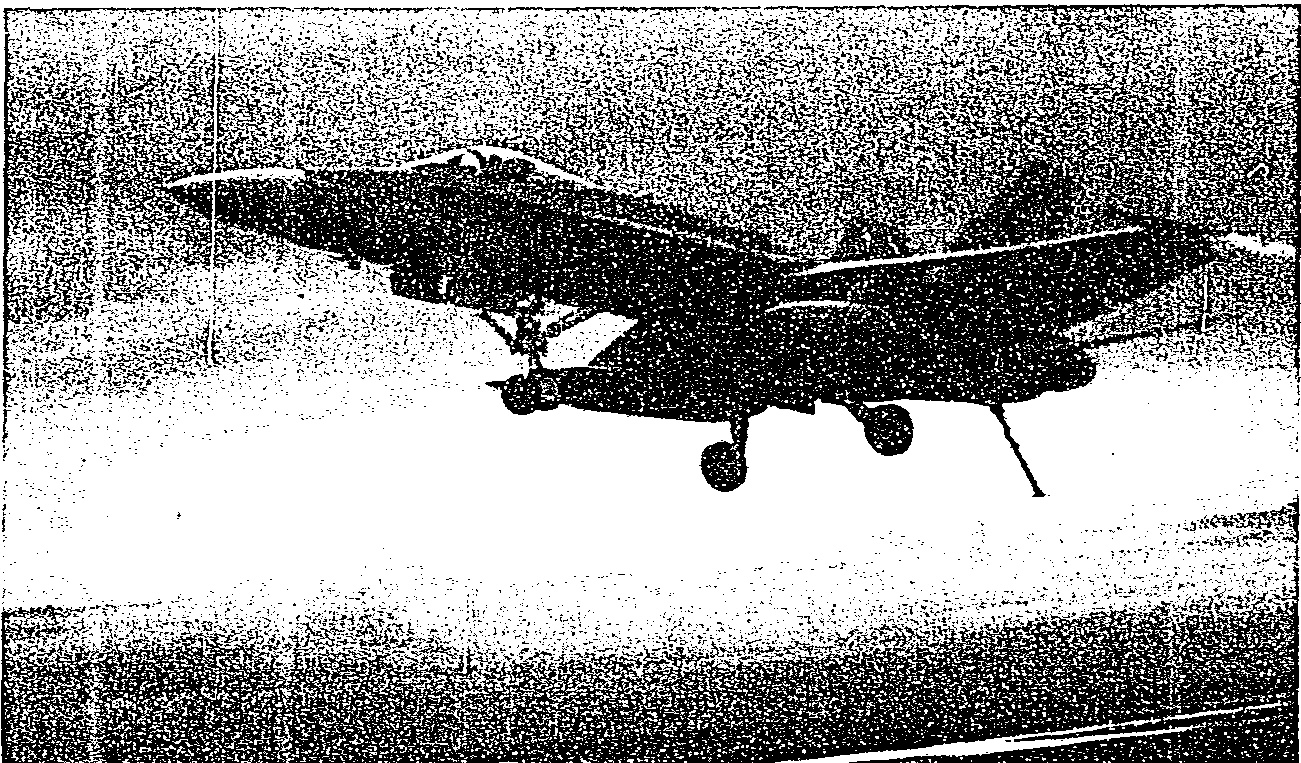
But they fail to realize that Marine aviation does not train to the doctrine they claim Jaeger Aviation replicates. We agree with the authors that the Navy and Marine Corps perceive the importance of the CAS/BAI missions differently. The commander, Naval Air Force Pacific (CNAP) initiative clearly articulated the need for Navy air to move closer to the CAS/BAI missions but also correctly indicated that Marine and Navy aviation have not kept pace with maneuver warfare theory in terms of command, control, communications, computers, and intelligence (C^sup 4^I) and aerial fire support. Jaeger Aviation will attempt to build upon the uniqueness of the Marine airground team and develop a naval aerial fire support initiative that will function in the highly chaotic and fluid battlefield inherent to nonlinear warfare. It is this premise that separates Jaeger Aviation from current joint and Marine doctrine.

We propose a high-initiative offensive aerial fire support that does not separate itself from the maneuver element. The impetus is placed on the man (pilot to grunt, grunt to pilot) in the loop, not on the C^sup 4^I loop itself. Although Jaeger Aviation may appear to replicate current doctrine, it proposes a new way of thinking. The plan is to discover answers the system is not providing with respect to integrating air into the mission order, decentralized context of maneuver warfare. We believe the Jaeger concept has a potential for enhancing the close cooperation required between maneuver element and supporting aviation-a concept current doctrine ignores. Jaeger advocates will hope to prove that well trained knowledgeable pilots can operate within close proximity of offensive ground forces, as well as beyond the next ridge or deeper, by using streamlined C^sup 4^I that can take advantage of rapid developments. We want to test this concept of filling a critical gap between defensive fire support and offensive fire support in a free play, maneuver warfare context, where our opponents are given maximum freedom to prove us wrong.

Our critics justifiably are concerned with fratricide. But current Marine Aviation Weapons and Tactics Squadron (MAWTS) methods (heavily weighted in C^sup 4^I and suppression of enemy air defense (SEAD) programs preceding a time on target) have not prevented fratricide. Finely honed, knowledgeable pilots specializing in Jaeger Aviation may do better. Jaeger Aviation proposes that by eliminating the overburdening C^sup 4^I, the Jaeger pilot will be able to employ his weapons systems more efficiently. He can tailor his tactics to the mission and threat, making him more survivable.

The authors seem to believe that burdensome layers of C^sup 4^I are required to prevent the fratricide. “This idea (Jaeger Aviation) turns a blind eye to lessons learned through bloodshed in past conflicts.” How many pilots reading this have bypassed the C^sup 4^I and directly switched to the tactical air control party frequency in order to provide the required support? I submit that extensive layers of C^sup 4^I will be outrun by maneuverists, further complicating the intended purpose of C^sup 4^I. We need a flexible system that can function in the nonlinear battlefield while not suppressing the dynamic affects of aviation. DESERT STORM provided good examples of this. A-10 pilots are cited in William J. Smallwood’s book, Warhog, Flying the A-10 in the Gulf War, for their simple coordination procedures when relieving another section of A-10s. “They passed the fighter to fighter handoff without going through the ABCCC [airborne battlefield communications, command, and control] which was nice,” he wrote. The subsequent mission accounted for more than 12 tanks destroyed or damaged. The same A-10 section flew two additional missions working with Marine F/A-18Ds and amassed a total of 33 tanks destroyed or damaged. This is the type of decentralized “man in the loop” aerial fire support Jaeger Air proposes. We hope to prevent instances when the C^sup 4^I can be a contributor to fratricide, such as occurred during the Gulf War when an AH-64 fired on a British armored personnel carrier.

Marine aviation provides excellent examples of effectively linking the aviation element to the ground forces. But through outdated, multimission training and readiness (T&R) requirements (the current threat makes it hard to justify the air-to-air training requirements of an F/A-18D squadron) there is not enough time or money to make pilots of Jaeger caliber. Navy aviation is even further away and needs to embrace the Jaeger concept if it is serious about littoral warfare.

Current Marine training and the new Navy Strike Fighter Weapons and Tactics (SFWT) program tends to make pilots jacks of all mission areas and masters of none. Marine tactical air will probably still have to provide all six functions of Marine aviation, but in the current joint environment it is becoming increasingly clear it must be weighted (particularly the F/A-18D community) in offensive aerial fire support in close proximity to maneuver forces. We hope to avoid the learning-as-you-go type scenarios that were described continually in Smallwood’s book.

Current CAS doctrine is primarily defensive and stifles aviation’s dynamic effect on the battlefield. Warriors continually expend limited training time and dollars exercising the C^sup 4^I in support of static ground forces and not training to doctrine that enables pilots to support maneuver forces with fire. We often use the C^sup 4^I system to make up for the aviators’ lack of knowledge in supporting the ground scheme of maneuver. The nine-line brief of curent CAS tactics followed by an artillery/laser mark are purely defensive tactics and would be extremely difficult to employ in maneuver warfare. SEAD programs fired by artillery in support of CAS missions are extremely complicated, waste limited ammunition, require flawless intelligence, and virtually preclude additional calls for fire from being prosecuted. I don’t know of many ground commanders who would risk losing the initiative by tying up artillery and aviation assets on one target. The defensive CAS tactics we employ have not changed since the days of Vietnam, where remote fire bases and cut-off units had to be defended by non-Inertial Navigation System/Global Positioning System equipped aircraft in heavily forested terrain. These tactics have no place in offensive oriented maneuver warfare and have proven to fail in recent combat, even under ideal desert conditions. Again, Smallwood describes A-10 pilots coping with their lack of training with nonlinear battle:

In the traditional CAS scenario, the army moves a distance, stops and consolidates, and moves again-always with reasonably well defined positions and doctrine-dictated lines where CAS aircraft work and are subject to control . . . in this war the doctrine rarely got past the textbooks where it was printed.

“Proven” CAS tactics/doctrine were never employed in DESERT STORM, nor are they being employed in Bosnia.

Instead of training to encumbering tactics that hamstring aviators, Jaeger Aviation proposes to train pilots to not only operate in dynamic environments, but thrive and become an airborne extension of the ground combat element. The complexity of CAS/ BAI is folly appreciated by the authors of Jaeger Air. They also recognize the fact that Jaeger aviators must be mission specialists in order to excel in aerial fire support and survive on today’s maneuver battlefield. Our familiarity with “proven” CAS/BAI tactics lead to the conclusion that current tactics will not support maneuver warfare. The authors imply that technological innovations are required to move current CAS tactics forward. We disagree. We need to move the pilot into maneuver warfare and then develop the technology, not vice versa.

Current multimission requirements make it difficult for squadrons to train for CAS other than when required by the “group frags,” Combined Amis Exercises, etc. More often, pilots become the training aids for the C^sup 4^I system, running at the same static targets and simulating a threat to a defensive position. This is just the type of unimaginative, unrealistic, irrelevant tactical training we propose avoiding.

The authors state that “Marine aviation as a \vhole has trained in these areas (CAS, BAI) for many years,” but fail to point out that Marine aviation does not train for armed reconnaissance, precisely what they compare to Jaeger Aviation. The authors would be hard pressed to find six sorties in the F/A-18 community where pilots flew a mission dedicated to armed reconnaissance within the last year. F/A-18Ds had good success in DESERT STORM with restrictive (kill box) armed reconnaissance. Why has the Marine tactical air community not trained more in this area to further refine these tactics? Equally important, the authors point out Navy aviation’s lack of interest in CAS/BAI. Jaeger Aviation is an attempt to refocus carrier groups to supporting ground forces in the littorals.

Marine aviators who attend The Basic School do get exposed to the ground perspective. But this hardly substitutes for the level of training required for pilots flying Jaeger Air in a high-initiative, self-adaptive form of carrier-based aviation, and teaches the prospective Marine pilot nothing about maneuver warfare theory. Marine pilots serving in ground exchange tours as forward air controllers and air officers (many of whom are not tactical air pilots) still only train to defensive, linear CAS tactics. Jaeger Aviation proposes to expand upon what the Marine air-ground team currently employs via their exchange programs. We foresee a Jaeger squadron of Marine and Navy pilots, as well as infantrymen via a robust exchange program. Not only will the Jaeger pilot learn the special requirements of the supported maneuver element, but Jaegers attached to ground units would teach them how to employ aviation to its maximum capability.

Recommendations

Current CAS/BAI tactics do not support maneuver warfare. Fifty years of “experience” has frozen Marine and Navy aviation in attrition warfare CAS/BAI tactics. We must seize the initiative started in the late 1980s and validated in DESERT STORM with respect to maneuver warfare theory. Specific recommendations include:

* Specialize squadrons in the aerial fire support mission. The Jaeger Squadron (X) will verify/nullify this concept. If verified, then we recommend the Harrier and naval F/A-18 communities be the starting point to implement the lessons learned after tactics have been developed.

* Reinstitute a program similar to the supporting arms coordinator (airborne) ground exchange officer in a flying status, and make it an integral part of the F/A-18D community. Follow-on ground exchange programs for Navy and Marine aviators should be implemented. Use MAG-31’s example of making aviators who return from ground tours the squadron pilot training officers, one of the most sought after billets for junior officers.

* Invite the Jaeger Air board to a MAWTS course to help validate the experiment within a modified Marine air-ground task force concept.

* Train the carrier battle groups, amphibious ready groups, and maritime propositioning ships together, as we currently train MEU(SOC)s, and deploy them together to enhance their interoperability.

* Rewrite the F/A-18D training requirements syllabus. The current weapons sensor officer (WSO) training track is a holdover from the F-4 days, when the training is heavily weighted in the air-to-air mission. The WSO should leave the Fleet Replacement Squadron with night vision goggle, air officer, and airborne forward air controller, or FAC(A), qualifications. Currently he is exposed to both the air-to-air and air-to-ground missions, but only as a watered down version of what the pilot is trained to. Follow-on fleet training should be highly specialized in aerial fire support, special weapons, and target recognition.

* Make the military occupational specialty of F/A-18D pilots unique to signify their skills in aerial fire support. Even though the F/A-18D is a more capable airframe in the air-to-air mission than the F/A-18A (AMRAAM vs AIM-7), its capability to thrive in the maneuver battlefield is infinitely enhanced by a well-trained crew of two. This would prevent the current practices within the F/A-18D community of having to abide by a training syllabus that is essentially identical to that of the F/A-18C community, but which includes the missions of FAC(A)/ TAC(A), or airborne tactical air controller. Additionally, crew coordination would be enhanced immensely while preventing the revolving door policies currently employed to keep pilots cross pollinated among the F/A-18A/C and D communities.

Jaeger Aviation should not be seen as a threat to Marine air. Instead the CNAP initiative should have been welcomed and nurtured as an improvement to the way naval aviation can better support maneuver forces. It is obvious that the initial phases of operational maneuver from the sea will be supported primarily by Navy pilots.

Either MAWTS gets on board and helps move naval aviation toward a truly naval (Navy and Marine) air force supporting ground maneuver forces, or Marines will find themselves going ashore without the kind of air support they deserve and should have. The authors missed the boat by not attending followon planning conferences for Jaeger Air. By doing so, MAWTS is abrogating its responsibilities as the “CAS/BAI” experts within naval aviation.

The Packaged Maneuver Trilogy

reviewed by Arthur J. Bredehoft

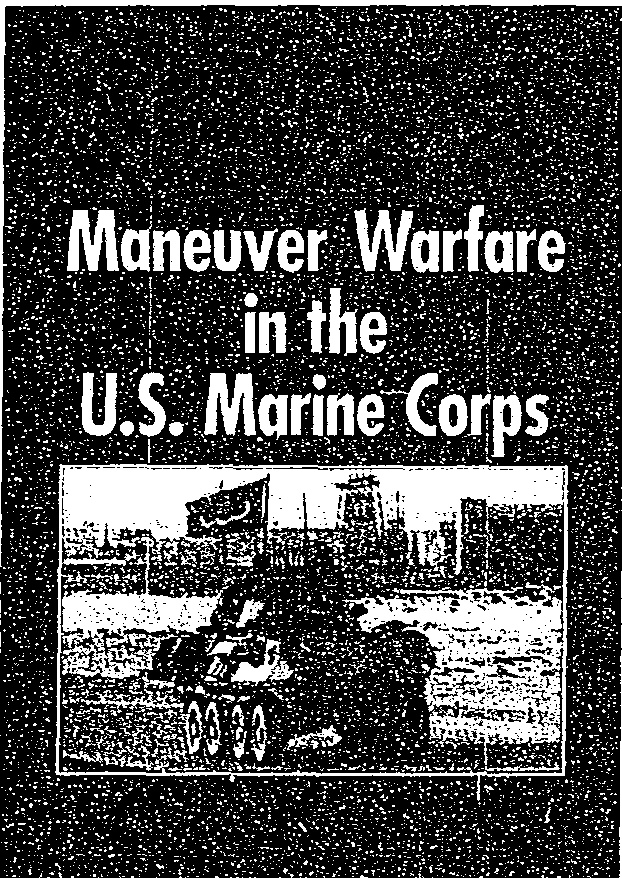
WARFIGHTING: Maneuver Warfare in the U.S. Marine Corps. Edited by LtCol H.T. Hayden. Greenhill Books, London, and Stackpole Books, Mechanicsburg, PA, 1995, 208 pp., $29.95. (Member $26.95)

FMFM-1 Warfighting, the first of three Marine Corps field manuals on maneuver warfare, was first released in 1989. In 1994 Currency Doubleday published Warfighting: Tactics for Managing Confrontation, the U.S. Marine Corps Book of Strategy-the same publication as the first field manual that Gen A.M. Gray had authorized 5 years prior but with an editor’s forward included. In 1995 another new edition of the warfighting manual hit the street-Warfighting: Maneuver Warfare in the U.S. Marine Corps, edited by LtCol H.T. Hayden.

The LtCol Hayden edition neatly packages for the serious “hunter” the three basic field manuals: FMFM 1 Warfighting, FMFM 1-3 Campaigning, and FMFM 1-3 Tactics. This edition could replace the three manuals as the official reference for Marines. Maneuver warfare, as a philosophy of warfighting, has been a difficult concept for many to understand. Now here is a single source that explains the concept and contrasts maneuver warfare \vith the Army’s philosophy of synchronization. LtCol Hayden’s Warfighting also includes new informational footnotes that improve upon the original publications.

LtCol Hayden’s work contains other improvements as well. Among them are numerous well-researched and insightful “notes” strategically placed throughout the book (in addition to the above mentioned footnotes). These notes provide the reader with the editor’s views on maneuver warfare from a theoretical and combat experience point of view. Also included and enhancing the book’s value are a preface, introduction, epilogue, and extensive bibliography.

The preface offers several points that will be of interest to the progressive thinker. For instance: “It must be emphasized that Maneuver Warfare, to the U.S. Marine Corps, is more than just a new doctrine. It is a way of thinking.” Also:

Synchronization has long been a basic tenant of the U.S. Army doctrine. Since the publication of FMFM 1 Warfighting, the U.S. Marine Corps has debated the extent to which synchronization concepts apply in Marine Corps maneuver warfare doctrine.

The editor objectively clarifies the point that the Army’s approach to warfare is different than the Marine Corps’ without arguing one approach over the other. He is correct to avoid this debate, as it is better suited for journals such as Proceedings, the Marine Corps Gazette, and the Army’s Military review.

The introduction likewise contains useful material, including a history of the development of maneuver warfare. Here again, the editor takes up the maneuversynchronization contrast by offering William S. Lind’s thoughts on the matter and then a few of his own comments on Lind’s thoughts. I encourage the reader to focus on these pages because of Lind’s contribution to the development of the maneuver concept. It is in this section, however, that the edition’s one significant shortfall can be found. LtCol Hayden discusses the contributions made to maneuver warfare by Lind, Air Force Col John R. Boyd, Col Michael D. Wyly, and Capt John F. Schmitt. He fails, however, to mention here or in the bibliography the significant contributions that have been made by numerous others.

The three official field manuals make clear the following 11 maxims of maneuver warfare:

* Mission Tactics

* Focus of Effort

* Speed and Surprise

* Reconnaissance Pull

* Surfaces and Gaps

* Firepower

* Camouflage, Concealment, and Deception

* The Concept of Reserve

* Command and Control Systems

* Center of Gravity

* Combat Service Support

Col Wyly, while not refuting these maxims, is quoted in LtCol Hayden’s edition as saying: “Every new structure begins the process of erosion and decay the moment it is formed.” He added that if you want principles for maneuver warfare, there are two-speed and focus. That notion is just one more example of how maneuverists have developed and refined their concept since 1989 and one more reason for reading the newer edition.

The LtCol Hayden edition is drawing some attention from outside military circles as well. Among those looking at broader implications for the concept is George Gendron, editor-in-chief of Inc. Magazine, who wrote in February 1995 that the chapter on “The Conduct of War” has more to say about general leadership than most books on the subject. The LtCol Hayden book offers much for the business professional who is engaged in commercial combat. Watch out Harvard, the Marine Corps’ maneuver warfare is a tool the commercial combat warrior will seek out.

Perhaps, the words of LtCol Hayden best summarize the spirit of his book:

There are some men who will never be comfortable with maneuver warfare. Some people like a structured life. They learn it from birth. Maneuver warfare theory and doctrine will only be fully grasped by a certain personality-aggressive, independent, intuitive, curious, intellectual, and a man who knows that you go for the kill. It is not a game.

Planning the Battalion Attack: A new paradigm for an old process

by LtCol Paul A. Hand

The philosophy of warfare that is defined in FMFM 1 implies the need for new command and staff procedures that enhance the operational tempo. This article outlines the planning and decisionmaking process now being taught at the Marine Corps University-a process more in line with the new style of warfare.

The Battle of Loos, which occurred September-October 1915, was a 3 1/2 hour frontal attack that resulted in the loss of 385 officers and 7,861 men. As the British withdrew from the battlefield, the Germans stopped firing out of compassion. Siegfried Sassoon would later write the following lines that not only captured the spirit of that debacle, but are a message for all who would lead men into battle.

‘Good-morning; good-morning!’ the General said,

When we met him last week on our way to the line.

Now the soldiers he smiled at are most of ’em dead,

And we’re cursing his staff for incompetent swine.

He’s a cherry old card, grunted Harry to Jack,

As they slogged up to Arras with rifle and pack . . .

But he did for them both with his plan of attack.

FMFM 1 trumpeted a new era in the art of war for the Marine Corps. It is a warfighting philosophy that seeks to disrupt the enemy’s cohesion through the use of maneuver-both physical and mental. It seeks to identify and strike the enemy’s critical vulnerability. With our new style of warfare, however, we continue to use our old paradigms for planning an attack. To fully realize the advantages of maneuver warfare we must reevaluate our planning process and develop a system more in step with FMFM 1. This article is an attempt to describe the process that we must go through to apply this new style of warfare.

Currently, the Army and the Marine Corps use the acronym METT-T to describe the estimate of the situation. As a review, the letters stand for:

* Mission

* Enemy

* Terrain and weather

* Troops and fire support available

* Time available

While you have, no doubt, studied this as far back as The Basic School, looking at it through a new FMFM 1 filter will help you understand how to apply it. A common misconception is that METTT is a sequential process. In fact, many of the steps in METT-T will occur concurrently. We will start with the last T, time available, instead of the first M.

Time Available

Before you can begin the planning process you must first determine how much time is available. To a large extent, this will determine what method of decisionmaking you will use. Starting from most time required to least time required, the various methods would be:

* Deliberate planning process (using the 15 command and staff planning steps).

* Rapid planning process (as currently practiced by our Marine expeditionary units (MEUs).

* Team recognitional decisionmaking (wherein the staff works together to quickly identify and wargame a course of action).

* Commander only decisionmaking (the commander makes the decision using his own recognitional ability).

The planning process selected will be dependent on numerous factors:

* How much time do you have.

* How much time does the enemy have to react.

* The enemy dispositions.

* How much time do your subordinates need for the operation.

Moreover, we must remember that speed is a weapon in its own right. Speed provides its own security. Therefore, when selecting a method you must carefully evaluate the need for speed. Will an immediate or near-term attack provide a distinct advantage over expending the time to plan a detailed attack? Finally, we must allocate adequate time for our subordinates to prepare for the operation.

Mission

Upon receipt of the mission you begin mission analysis. First, you must determine the specified tasks. Specified tasks are those tasks stated in the higher headquarter’s order. Examples are:

* Clear Regimental Objective B.

* Be prepared to conduct passage of lines with the regimental reserve.

* Coordinate with 2d Light Armored Reconnaissance Battalion for forward passage of lines.

Next, we ascertain implied tasks. Implied tasks are not specifically stated in the order, but must be accomplished in order to satisfy the overall mission or to satisfy any of the specified tasks. Implied tasks come from:

* Analysis of the higher headquarter’s order.

* Commander’s intent (two levels up).

* Enemy situation.

* Friendly situation.

* Requirement to maintain the security and integrity of the force.

Examples of implied tasks are:

* Clear obstacles along Highway 60.

* Seize high ground at 456347.

* Establish blocking position vicinity of 467389.

* Coordinate with 3d Battalion, 6th Marines on the left flank (where it has not been specified).

Next, we consider constraints (things we must do) such as “Attack no later than 0645″ as well as restraints (things we can’t do) such as “Do not destroy bridges.”

We identify mission essential tasks. Mission essential tasks are those (specified or implied) that the commander considers critical for mission accomplishment. Some examples of mission essential tasks are:

* Seize Obj B (from our specified tasks).

* Clear obstacles along Highway 60 (from our implied tasks).

Finally, the overriding concern of the commander is the accomplishment of the intent of the higher commander. Where the specified tasks become inconsistent with the commander’s intent, the bold commander must deviate from his specified tasks and modify them to bring them in line with this intent.

The mission analysis and the next step, analysis of the enemy, are conducted concurrently whenever possible. Always look for ways to economize on your time.

Enemy

The ultimate objective of tactics is the destruction of the enemy and his will to fight. Any plan that does not focus on the enemy is doomed to fail from the start. Moreover, if the enemy’s disposition changes, so does our plan.

A first step is to gather as much information as time allows by developing and implementing the reconnaissance, surveillance and counterreconnaissance (RS&C) plan. At the same time we begin the offensive intelligence preparation of the battlefield (IPB) process. The RS&C plan and the development of the modified combined obstacle overlay (MCOO) are designed to yield the following information to the commander and his staff (FM 71-2, page 3-19):

* Enemy positions and orientations

* Location of existing and reinforcing obstacles.

* Enemy intent based on his dispositions.

* Avenues of approach to exploit known enemy weakness.

* Likely courses of action for employment of enemy reserves, counterattacking forces, and combat support assets.

The early identification of enemy vulnerabilities is predicated on an aggressive reconnaissance effort. Vulnerabilities will rarely be obvious and may, in fact, be well concealed.

During the IPB process, the S-2 develops an enemy situation template. Ideally, the MCOO and the enemy situational template are developed concurrently. The S-2 plots known enemy positions on his map. The S-2 then plots suspected enemy positions on his map by “templating” those positions based on his knowledge of the enemy’s tactics, the current terrain and weather conditions, and his best guess. Once both known and suspected enemy positions are ternplated, he draws range fans for all major enemy weapons systems. These include:

* Antitank guided missiles

* Mortars

* Tanks

* Artillery

* Rocket systems

The S-2 uses his MCOO when drawing range fans so that he can get a more accurate picture of terrain masking. When possible, the range fans are drawn so as to reflect its effects. Finally, the S-2 has to begin filling in the information gaps by helping to develop information requirements.

Once the commander has evaluated the current intelligence picture, he must decide what other critical pieces of information he must have. These are transformed into essential elements of information (EEIs) on the enemy situation and disposition, and terrain. For example, if no assailable flank is readily apparent to the commander, he may decide to commit reconnaissance assets to locate a gap or soft spot. The area to which a reconnaissance or surveillance asset is committed to gather information is called a named area of interest (NAI). Within the NAI, we wish to confirm or deny:

* The existence of enemy forces.

* Absence of enemy forces.

* Enemy dispositions.

* Location of specific enemy \veapons systems (air defense assets, artillery, etc.).

* Terrain favorable to our plans.

The S-2 places the NAIs on his map and begins to develop the intelligence collection plan. He uses the intelligence collection worksheet (see Annex E, FMFM 3-21, MAGTF Intelligence Operations) to assist him in this planning effort. It should be noted that while assets at the battalion level are limited, other assets are available at the regimental or MEB level.

As the commander and his staff continue the planning process, a list of enemy vulnerabilities should begin to emerge. These vulnerabilities might include:

* Poor or faulty dispositions.

* Exposed flanks.

* Insufficient defense in depth (inviting an envelopment or turning movement).

* Poor morale.

* Poor logistics system (easily cut off, for example).

* Lack of critical supplies or ammunition.

* Too few forces on a wide front (inviting a penetration).

* Poor training.

* Poor command and control systems or procedures.

* Poor commander.

Where no apparent vulnerability exists, the commander must aggressively and boldly intensify his reconnaissance effort to find a vulnerability. The commander may, in this situation, have to create a vulnerability through skillful application of supporting arms and maneuver. In the case of penetration, the commander, by massing combat power along a narrow front, attempts to create a vulnerability that can be exploited. Once the commander and his staff have compiled a list of vulnerabilities, the commander must select the critical vulnerability.

The commander analyzes those identified vulnerabilities and determines which of them, “if eliminated, will do the most decisive damage to his ability to resist us” (FMFM 1). Moreover, FMFM 1 enjoins us to “compare the degree of criticality with the degree of vulnerability and to balance both against our own capabilities.” This vulnerability then may become the critical vulnerability. The plan of attack is designed to attack the critical vulnerability. Everything else becomes secondary and designed only to support this attack.

The evaluation of the enemy situation and his vulnerabilities will continue throughout the attack. We must recognize that the enemy’s situation is not static.

Enemy defensive positions, terrain critical to our scheme of maneuver, and critical avenues of approach into the enemy’s position must be kept under observation during the planning phase in order to ensure that the enemy does not change his defensive disposition. If the enemy situation changes significantly, then the plan may have to be modified.

Terrain and Weather

In current parlance it is popular to look at the acronym OAKOC. As a review, the letters stand for:

* Obstacles

* Avenues of approach

* Key terrain

* Observation and fields of fire

* Cover and concealment

Remember that METT-T is not necessarily a sequential process but, in most instances, will be an interactive process. Terrain and weather are considered when the MCOO is evaluated. Additionally, key terrain is designated on the MCOO. The S-2, when he prepares the enemy situation template, has also considered the effects of terrain and weather on enemy weapons systems. However, it will be useful for the commander and his staff to review again those aspects of terrain that will affect the enemy’s scheme of maneuver as well as his own.

Weather must also be considered regarding its possible impact on weapons systems, aircraft, visibility, and survivability. Bad weather is not always good or bad from a tactical viewpoint. Rommel needed and waited for a rainy night to conduct his raid against Pine Tree Knob. Gen Slim pushed his men and equipment to their limits in order to capture Rangoon before it rained. What Americans traditionally refer to as bad weather can be a great ally.

Troops and Fire Support Available

Concerning the final T, the commander must carefully consider all those forces available to him. This includes organic assets, attachments, and assets available in direct support of the battalion. Additionally, the commander considers other assets that could be requested if a need arose. Then the commander considers all the supporting arms agencies that are available to him. These include (but are not limited to):

* Naval gunfire

* Mortars

* Artillery

* Fixed wing close air support (FWCAS)

* Rotary wing close air support (RWCAS)

* MLRS

* Electronic warfare support

Once the commander has analyzed those troops and fire support available to him, he and his staff conduct a relative combat power analysis. This process involves a comparison of major weapons systems, troops, and fire support assets between his forces and the enemy’s. This analysis may consist of a matrix that lists our assets against the enemy’s comparable assets. For example:

If either the enemy or our own forces are at less then 100 percent, then this factor should also be figured in to our relative combat power analysis.

In addition to the tangible assets, the commander also must consider the intangible considerations. These include:

* Morale of the enemy

* His moral certitude (fighting for homeland or cause?)

* His state of training

* The ability of his commanders

While these things are difficult to quantify, they can play a significant role in development of the plan of attack.

Once the commander and his staff have completed the initial estimate of the situation (the estimate of the situation is a continuous process), then they are ready to begin developing courses of action that will ultimately become a concept of operations. Since the critical vulnerability has been identified by the commander, he and the staff look for ways that they can attack that critical vulnerability. This, in turn, will drive the selection of a form of maneuver. For example, if the commander identified an open flank as the enemy’s critical vulnerability it is likely that the flanking attack will be the desired form of maneuver. If the commander identified the enemy’s critical vulnerability as weak, extended lines then a penetration may be the desired form of maneuver. If no particular form of maneuver is indicated by the critical vulnerability, then several forms of maneuver can be wargamed for suitability.

In any event, the commander articulates his point of view in his commander’s intent. He may have to give an initial commander’s intent that will be fleshed out later. The reason for this is that the commander and his staff cannot begin wargaming courses of action (COAs) unless they have a critical vulnerability to attack. All courses of action must attack the critical vulnerability.

Once a form of maneuver is selected, then we must identify task groupings that could execute portions of that plan. An example of a COA might be:

3/6 will conduct a flanking attack against Regimental Objective A. The main effort, a mechanized company, will attack along avenue of approach #1 into the flank of the enemy position and seize Regimental Objective A in order to open Route 1 for follow-on forces. Supporting Effort #1: One motorized company will attack along avenue of approach #2 to seize Battalion Objective 1 in order to support by fire the attack on Regimental Objective A. One mechanized company will occupy an assembly area at 456345 as the reserve.

Another example, this time using a penetration, might look like this:

2/5 will conduct a penetration, seizing Battalion Objectives 1, 2, and 3. Supporting Effort #1: Team Mech will attack along avenue of approach #1 and seize Battalion Objective 2 in order to create a gap that Team Tank can pass through. Supporting Effort #2: One mechanized company will attack along avenue of approach #2 to seize Battalion Objective 1 in order to support Team Mech’s attack on Battalion Objective 2. The main effort, Team Tank, will pass through the gap created by Team Mech, attack along avenue of approach #1 to seize Battalion Objective 3 in order to prevent enemy reinforcements from attacking in the battalion‘s zone of action.

An example for a frontal attack might read something like this:

1/3 will conduct a frontal attack to seize Battalion Objectives 1 and 2. Main Effort: one foot-mobile infantry company will attack in zone to seize the left half of Battalion Objective 1 in order to prevent enemy reinforcements from attacking along Route 4. Supporting Effort #1: a footmobile company will attack in zone to seize the right half of Battalion Objective 1 in order to control the critical road junction at 234567. Reserve: one motorized company will occupy assembly area vicinity of 234545.

It is, once again, important to note that each COA must attack the critical vulnerability that the commander identified during the estimate. In general, there are five criteria that should be met when developing COAs:

* Suitable: Does it attack the critical vulnerability and lead towards mission accomplishment?

* Feasible: Do we have the required resources?

* Acceptable: Is it worth the cost in terms of possible losses?

* Variety: COAs should give the commander several viable options, with different levels of risk, that he can choose from.

* Completeness: All units tasked with performing actions that lead towards mission accomplishment.

Once a COA is developed, it should be graphically displayed on a suitable map. Worksheets are useful for some aspects of developing COAs, but they do not replace seeing the COA graphically displayed on a map.

One technique to use when writing COAs is to include the purpose of each action within the COA itself. This ensures that the commander and his staff have a clear idea of the purpose of each element of the operation and, consequently, can more effectively evaluate the suitability of that COA. This is particularly true during the wargaming process.

Once the COAs have been developed, the commander and his staff wargame each one. Wargaming will help:

* Identify areas of risk in each COA.

* Identify gaps in supporting arms coverage.

* Help develop the fire support plan.

* Show the time-space relationship for all maneuver units.

* Determine suitability.

* Indicate modifications to the basic COA that will make it workable.

Wargaming may be a formal process conducted by the staff or it may be a mental process performed by the battalion commander. The difference will depend primarily on the time available. The three methods of wargaming are the box, the avenue of approach, and the belt. In the box technique, the staff focuses only on critical events, such as breach of an obstacle. The box technique is used when time is limited. In the avenue of approach method, the staff wargames all the critical events that occur from the line of departure to and through the objective along an avenue of approach. Similarly, in the belt method the staff wargames all those critical events that occur within a certain belt (such as a phase line). The last two methods are used when more time is available.

While it is beyond the scope of this article to present all the wargaming schemes currently used, in general we follow the format of friendly action-enemy action-friendly counteraction. The S-2 plays the enemy. The S-3 and the rest of the staff describe actions as they would occur using the above three categories. The fire support coordinator and the S-4 must be key players in this process as well. Once wargaming is complete, the battalion commander makes his decision to accept, modify, or choose a completely new course of action that developed out of the wargaming process.

Completing the Concept of Operations

Once the COA has been accepted, the S-3 rewrites it to correspond to the commander’s wishes. When writing the concept of operations, the same general format is used for the COA. That format includes:

* Overview: At H-hour 1/6 conducts a frontal attack to seize Regimental Objective A and Battalion Objective 1 with two reinforced companies forward and one reinforced company in reserve.

* Main Effort: One company will attack along Axis Blue to seize Regimental Objective A.

* Supporting Effort #1: One company will attack in zone to seize Battalion Objective 1.

* Reserve: One company follows in trace of the main effort and will be prepared to exploit success.

* Priority of fires: Priority of artillery and air to the main effort. Priority of mortars to the supporting effort.

Note that we no longer say “avenue of approach number 1” but, instead, we have either designated an axis of advance, a zone of action, or a direction of attack.

Once the concept of operations is completed, we must draft appropriate task statements for each subordinate element. These task statements and their attendant purpose will flow from the concept of operations, the previous COA statement, and the wargaming and/or wargaming matrix. The important points that must be included in a task statement are:

* The main task that the unit must perform (seize Objective A, clear Route 610, etc.).

* The purpose of the main task (in order to clear Route 610 for follow-on movement of the regimental reserve, in order to cut off any forces attempting to reinforce, etc.)

* Actions to take upon consolidation (establish blocking positions in the vicinity of 345343).

* All be-prepared missions.

While numerous techniques exist for the presentation of task statements, the most prevalent notation list tasks sequentially. An example might look like this:

Company B:

1. Attack and seize Battalion Objective A in order to create a gap in the enemy lines that can be exploited by the battalion reserve.

2. After passage of the battalion reserve, attack to the west to seize Battalion Objective B in order to widen the gap and to hold open the shoulder of the penetration.

3. Consolidate Battalion Objective B, orient to the northwest in order to protect the battalion‘s western flank.

4. Be prepared to conduct passage of lines with the regimental reserve.

5. You are Supporting Effort Number 1 and have priority of air and artillery initially.

Once again, note that a task is incomplete without a purpose statement.

At this point in the planning, the commander should begin to develop the deception plan. That plan can range anywhere from camouflaging vehicles to a full scale feint or demonstration. The important thing to point out, at this juncture, is that our brilliantly conceived plan will come to naught if the enemy learns of our intentions and counters them. One technique is to use one of the discarded COAs and make that a deception plan. The four methods of planning a deception are:

Normal: The deception is planned by the commander and his staff as they would any activity.

Ad hoc. A special staff is established to plan and/or implement the deception. Personnel for this staff may be drawn from within the unit, from outside, or a combination of both.

Close hold: The commander uses selected subordinates only (could be the S-3, S-2 or S-3A). This provides for better operational security, but some of the other subordinates may inadvertently undermine the operation.

Commander only. The commander plans the entire operation. This has good operational security, but the only person who even knows the deception plan is the commander. Subordinates may inadvertently compromise the plan. Regardless of the method used, this is a vital part of planning our attack.

Next, the fire support plan is the commander’s plan for incorporating all his organic and inorganic fires in support of his scheme of maneuver. It is the utilization of combined arms. Said in another way, it is our plan for combining our fire support and maneuver assets so that the synergistic effects of all our assets are greater than the sum of their individual parts. While it is, once again, beyond the scope of this article to go into detailed fire support planning, the philosophical underpinnings of developing a fire support plan are contained in FMFM 1:

We use assault support to quickly concentrate superior ground forces for a breakthrough. We use artillery and close air support to support the infantry penetration, and we use deep air support to interdict enemy reinforcements. Targets which cannot be effectively suppressed by artillery are engaged by close air support. In order to defend against the infantry attack, the enemy must reinforce quickly with his reserve. But in order to avoid our deep air support, he must stay off the roads, which means he can only move slowly, he cannot reinforce in time to prevent our breakthrough. We have put him in a dilemma.

On selection of a COA and the subsequent development of the concept of operations, the commander and his staff must decide how to allocate their assets. In is not enough to say that you are going to “weight your main effort” or that you are going to “conduct economy of force operations” elsewhere. You must decide how best to weight the main effort with overwhelming combat power so that the mission is accomplished. Supporting efforts must be given adequate assets in order to accomplish their mission. These requirements should be developed throughout the planning process. Specifically:

* During COA development, major attachments such as tank platoons and assault amphibious vehicle platoons will probably surface.

* During wargaming, enemy capabilities can be countered by judicious allocation of combat power.

* Requests from subordinate commanders who will execute the tasks.

After completion of tasks, we will draft coordinating instructions. Any instructions that are pertinent to more than one unit can be included in coordinating instructions. However, coordinating instructions should not be a catch-all for everything you can think of. Rather, those things not covered in the unit’s standing operating procedures and that are important “tactical” instructions should be included.

Logistics planning is not the final step, but a continuous process that begins on receipt of mission. JCS Pub 1-01 defines logistics as “the science of planning and carrying out the movement and maintenance of forces.” The S-4 must begin planning the things he knows about, such as MREs and water, and he begins making estimates of bow much ammunition and other commodities he is going to need. While the S-3 draws the sweeping arrows on his map, the S-4 must confine himself to the practicalities of how he is going to support this operation and, in the process, be prepared to support the subsequent operations. During wargaming, the S-4 highlights those aspects of the plan that can or cannot be supported. If one aspect of the plan cannot be supported then the S-4 must say so or, at the least, offer an alternative fix to that COA.

In conclusion, planning an attack is not a checklist but a process. Part of the process includes products such as the MCOO or the enemy situational template. Part of the process centers around making judgments about the enemy and the friendly situation. In the end, a well-trained staff quickly pushes information to the commander who quickly makes initial decisions that culminate in the selection of a course of action and, ultimately, in a plan of attack. In closing, Napoleon wrote:

If I always appear prepared, it is because before entering on an undertaking, I have meditated for long hours and have foreseen what may occur. It is not genius that reveals to me suddenly and secretly what I should do in circumstances unexpected by others; it is thought and meditation.

Information Enhancement on Today’s Battlefield

by Maj Robert S. Walsh

The information available on today’s battlefield is driving decisionmakers to new approaches to tactical decisionmaking. Battlefield decisions rely on the quality and speed of the information received, and today’s information explosion permits rapid and accurate decisions never before dreamed of. Information enhancement, which includes such activities as surveillance, reconnaissance, and data fusion, seeks to provide timely and accurate, pertinent information to commanders. Its purpose is to get the right information to the right person at the right time-to provide the information needed to know when, where, and how to act. Commanders must be able to detect changes on the battlefield, determine whether those changes represent a threat or target of opportunity, and effectively direct friendly forces to alleviate the threat or take advantage of the target of opportunity in near real-time.

Former Vice Chairman of the Joint Chief of Staff, Adm David E. Jeremiah, USN, stated in the June 1994, Armed Forces Journal, that “. . . [information] drives doctrine and tactics, and to a major degree drives strategy.” Martin C. Libicki and Cdr James A. Hazlett, USN. in the Autumn 1993, Joint Forces Quarterly, went even further to show the value of information by stating:

… the traditional relationship between information and force will be turned on its head. Information no longer serves units of force-rather units of force are fire support for information systems.

The ground commander with the most information will have the most tactical options. Information dominance will give him the capability to decide, act, and stay ahead of his enemy before his enemy can react. The goal is to exploit information dominance and create a decisionmaking sequence in which decisions are made quickly and decisively before the enemy can react. This action denies the enemy access to information and degrades his ability to make timely and accurate decisions. Units become isolated, and command and control degenerate. The isolation results in lower morale and the desire to quit fighting. Many regard it as a major factor in the performance of Iraqi soldiers in February 1991. Fleet Marine Forces Manual (FMFM) 1, Warfighting, clearly states the advantage of information to the ground commander:

Whoever can make and implement his decisions consistently faster gains a tremendous, often decisive advantage. . . . We should spare no effort to accelerate our decision-making ability.

Although information has been applied in war throughout history, sometimes to decisive effect, modern information technology offers an opportunity to achieve a degree of information dominance in war that can enhance the combat power of smaller forces in a consistently decisive way on today’s maneuver battlefield. Today’s information technologies go hand and hand with the maneuver warfare doctrine of the U.S. Army and Marine Corps. The Army in Field Manual (FM) 100-5, Operations, and the Marine Corps in FMFM 1, Warfighting, each state their commitment to maneuver warfare. The Army defines maneuver as:

. . . the employment of forces through offensive or defensive operations to achieve relative positional advantage over an enemy force to achieve tactical, operational, or strategic objectives.

The Marine Corps defines it as:

… a warfighting philosophy that seeks to shatter the enemy’s cohesion through a series of rapid, violent, and unexpected actions which create a turbulent and rapidly deteriorating situation with which he cannot cope.

Using maneuver warfare, U.S. ground forces will strike rapidly with overwhelming force and combined arms at decisive points. The objective is rapid movement and the destruction of enemy forces versus holding terrain.

Information has transformed the essence of how we view combat power. In the past, combat power has equated to firepower plus maneuver. Information dominance now requires information power to be included in the combat power equation. With information power, the ground commander will act quicker, at decisive points, and with overwhelming force. The advantage of adding information power to the equation is evident in FMFM 1 Warfighting, in the following statement:

Force enhancement through information allows the commander to concentrate forces in superiority at the decisive time and place, with the speed necessary to seize the initiative, and to achieve surprise striking in a manner for which (the enemy] is unprepared.

Focused generation of information from data should result in enhanced awareness with minimized overhead to ensure the decisionmaking cycle is as short as possible, enabling control of operational tempo. The ground commander must be given the necessary information to dominate the enemy and thus decisively win each engagement and battle.

Problems

Though information technologies exist to exploit information dominance, we are still out of cadence with providing this force enhancement capability to the ground commander and his warfighters. A significant change in reconnaissance and surveillance emphasis is necessary in order for information warfare to realize the critical battlefield impact that is possible. Air Force reconnaissance and surveillance systems tend to be more strategically rather than tactically dedicated. Their tendency is to use a limited number of platforms that generally are not designed to work well with the systems of other Services. This strategic emphasis has resulted in support for the strategic or operational levels of war but not the tactical level. Support to the tactical warfighter on the ground has been the result of trickle-down vice dedicated support. The problem will continue in the future since most U.S. reconnaissance systems were not designed to support the tactical ground commander.

This strategic emphasis is critical because the ground commander does not have organic systems capable of seeing “deep.” As a result, he must rely on Air Force and national systems for information relative to the enemy’s second echelon. This has become even more significant with the introduction of weapons having a “deep” capability by the Army. The Army, with its Army Tactical Missile (ATACM), now has the capability to affect the deep battlefield but is unable to see its targets. The Marine Corps’ ability to target deep with organic fixed-wing assets is hampered in the same way. This situation exists because most Army and Marine Corps collection systems support the close-in battle and do not have the range to see enemy second echelon forces. Gaining access to information from Air Force and national assets will be a concern for the ground commander since control of these assets is normally held at the theater or national level. A further problem exists in that the ground forces would like to deploy larger numbers of relatively low-cost, smaller systems down to the battalion level. The Air Force tends to develop large, centrally based, fixed sites that are not advantageous to rapid maneuver operations. All of this has resulted in scarce reconnaissance support to the ground commander.

The end-state has been a centralized control of reconnaissance and surveillance information that fails to support the tactical ground commander adequately. The centralized system in DESERT STORM was often able to see battlefield targets but was unable or late in getting the information to the ground units requiring the targeting data. As Maj James P. Marshall, USAF, explains in his recent book:

We provide centralized reconnaissance that tends to emphasize support to the air component at the expense of the ground forces. This emphasis led to the perception among the other services that the Air Force does not adequately support the ground commander’s intelligence requirements … the result is that the senior leadership of the Army has lost confidence in the Air Force’s resolve and ability to provide timely intelligence support to the tactical ground commander.

Requirements

The first requirement in solving the above problems will be to achieve a “congruent view” of the battlefield by all friendly forces. This requires a coordinated effort by all components to provide an accurate picture, using near-real-time information, on all enemy and friendly locations. A system that effects this congruent view of the battlefield must share common data bases, compatible collection and reporting systems, and standardized displays between all ground and air forces. All users must be able to push information into the information system where it can be processed, fused, and integrated as part of the congruent view. Of critical interest to a standard picture is our ability to reduce and prevent incidents of fratricide. By sharing a common view of who is friend and foe such incidents can significandy be reduced.

The next step after achieving a congruent view of the battlefield will be to speed this information to the decisionmakers and shooters. Past problems have resulted from many layers of command existing between the sensors and shooters. Information processing and fusion must be centralized; however, the ability to access the system and receive timely accurate information has to be decentralized. The required picture must be capable of being “pulleddown” by any desiring ground unit. The end-state should be the dissemination of continuous, time-sensitive information in near real-time, under all-weather, all-terrain, and day-night conditions.

The final step for the ground commander will be to attack targets both inside and outside the fire support coordination line. Maneuver warfare doctrine results in fluid situations in which the close and deep battles shift rapidly, requiring the ground commander to see and attack enemy forces far to his front and rear. What once was the deep battle requiring air interdiction may soon be the close battle requiring close air support. The current intelligence cycle is far too slow to support the rapid and deep thrusts into the enemy’s rear that are essendal to maneuver warfare.

It is essential for the ground commander in maneuver warfare to locate, target, and destroy enemy forces using air interdiction and close air support. His ability to destroy enemy forces in the deep and close battles or to disrupt or delay enemy forces from being committed to the battle is crucial to his success. Therefore, air interdiction and close air support are critical to maneuver warfare and must be responsive to the ground commander’s needs. As stated by LtCol Price T. Bingham, USAF, formerly of the Airpower Research Institute, “Air interdiction must be planned and controlled to be responsive to the dynamics of ground maneuver.” All efforts on the battlefield by the ground and air components must ensure maximum synergism and economy of force for the battle and the campaign to be a success. This synergy has proven successfully in all conflicts since World War II using the synchronization of combined arms to attain maximum combat power.

Recommendations

The combat information system of the future must support the ground commander and his warfighters. To this end, there should be commonality with all Services in order to provide the timely fire support vital to the execution of the ground scheme in future maneuver warfare execution. The system must provide constant surveillance of the battlefield and accurate and timely targeting information to everyone. This continuous surveillance and reporting will allow the ground commander to see, decide, and act quicker than the enemy by providing critical near real-time targeting information.

As stated earlier, the system of tomorrow must support the strategic, operational, and tactical levels of war. Maneuver warfare requires sensors linked with battlefield decisionmakers and shooters that create the ability to operate inside the enemy’s decision cycles. For maneuver warfare to be successful, the ground commander must be able to view the deep battlefield accurately since it may only be moments before the same terrain and enemy forces become his close battlefield. The ability to see and attack follow-on forces must be decentralized, and we must provide relatively small, low-cost systems for this purpose down to the battalion level. All echelons need a common view of the battlefield and the ability to coordinate the targeting of threats with the appropriate weapons system. This common view should be electronically displayed on a horizontal situation display that allows the ground commander to and display desired information from an integrated sensor tasking and fusion system.

Creating a joint combat information system that allows warfighters at all echelons to share a common view of the battlefield will enhance our ability to dominate information and use it in a way that creates information gaps for our enemies and allows us to wage short, violent wars with less death, destruction, and collateral damage.

Among the sources used in preparing this article were three works published by the Air University Press at Maxwell AFB in Alabama: Robert F. Futrell’s Ideas, Concepts, Doctrine, Vol 2, 1961-1984; LtCol Price T. Bingham’s Ground Maneuver and Air Interdiction in the Operational Art; and Maj James P. Marshall’s Near-Real Intelligence on the Battlefield.

Aviation and Maneuver Warfare

In April 1989, nine years after the discussion of maneuver warfare began in earnest, the Gazette published its first article about how FMFM 1 ‘s maneuver doctrine might impact the employment of the aviation combat element (ACE) of a Marine air-ground task force (MAGTF). Its author, Maj R. Scott Moore, envisioned the ACE doing more than close air support, deep air support, interdiction, or air superiority functions. He foresaw it acting as a separate maneuver element, perhaps with other elements of the air-ground team attached, seeking to “exploit breakthroughs, conduct pursuits, screen flanks, act as a MAGTF reserve, or even control terrain.”

Four other major articles explored and expanded the subject later that same year and three more followed in 1991 and 1992. Some authors perceived the new role as something akin to “armed reconnaissance.” Others stressed how aviation must focus on the whole battle not just the mechanics of getting bombs on target. The idea that the ACE’s role would change significantly, that under maneuver doctrine it must do more than provide close air support and assault support for the ground combat element, seemed to be widely acknowledged. Maj William H. Dixon, Jr., noted (Feb92) that “To fight the ACE only as a supporting element is to fight with one hand tied behind the back.” He listed nine aviation missions for possible use in MAGTF planning: gain and maintain air superiority, isolate enemy units on the battlefield, shape the batttlefield, screen GCE’s flanks, destroy bypassed strongpoints, pursue and destroy retreating enemy, delay enemy during a withdrawal, provide rear area security, and provide a reserve force. Maj Thomas X. Hammes, writing in the same issue went further. He put aviation‘s role in true maneuver terms emphasizing that “Air must contribute to the MAGTF commander’s ability to identify, locate, and attack key enemy vulnerabilities . . . and focus on disrupting [the enemy’s] command and control to a point where he cannot function.”

All eight of these articles contain well-argued, useful discussions, and they are worth careful reading today. They raised an issue of vital importance: As the Corps continues to develop and refine its maneuver warfare doctrine, what will emerge as the principal roles of Marine aviation? It is a question that has yet to be clarified. Over the past 3 1/2 years since the last of these “ACE as a maneuver element” articles appeared, the aviation community has continued to focus on its traditional support responsibilities and on the six functions of Marine aviation. What is needed now is a clear understanding of the most productive courses of action for aviation operating under maneuver warfare doctrine. Aviation‘s traditional supporting tasks will remain important, but beyond them lie the hope and possibility that aviation can contribute, as Hammes suggested, directly to the objectives sought by the maneuver warfare ground forces. Unless there is a clear picture of what Marine aviation is to do, it cannot be properly structured, equipped, and trained to realize its full potential under the Corps’ current style of warfare.

In dealing with this issue, the much debated air campaign of the Gulf War is instructive. It demonstrated at the strategic level what can be done to paralyze a complex, integrated national structure. Effective military organizations at every level, like nations, have similar structure and critical centers of gravity. Their directing authorities, command and control mechanisms, communications and logistics networks, intelligence collection means, infrastructure, etc., are crucial to their unctioning. Maneuver doctrine calls for identifying these critical nodes and disrupting the functioning of those most vulnerable. The goal is to collapse the enemy. It is reasonable to believe that in many cases Marine aviation can help directly with this task by locating critical centers of gravity at the operational and tactical level and destroying their effectiveness. Recent operations in Bosnia may provide new insight into the capabilities and techniques needed if aviation is to help locate these centers and disrupt their functioning. Planning and executing an air campaign that contributes directly to collapsing an enemy is a complex task. The ability to carry it out successfully demands extensive preparation and training.

J.E.G.

Warfighting: A leap of faith

by LtCol G. Stephen Lauer

1994 Chase Prize Essay Contest Honorable Mention

A ‘modern’ infantry may ride sky vehicles into combat, fire and sense its weapons through instrumentation, employ devices of frightening lethality in the future-but it must be old-fashioned enough to be iron-hard, poised for instant obedience, and prepared to die in the mud.

-T. R. Fehrenbach

Tactical ground combat requires a certain type of training; the creation of a certain mindset, pride, and toughness; the willingness to obey orders intelligently, flexibility of mind in leaders; and the ability to adapt to the environment presented in each combat situation. Historically, Marines have fought and won this way-without the practical need for a theory of battle. We looked with confidence to our own experience.

Our institutional vision was simple-the Corps exists to fight on the ground. Whatever equipment was added to the inventory, whatever method of entry or transport was provided to us, the vision for its employment remained that of usefulness in the successful prosecution of tactical ground combat. In 1989, the Corps adopted a theory of war as its own, the theory of maneuver warfare. Thus enlightened, we now move towards a future, defined not by our institutional experience of combat but by the tenets of our theory.

What did we do before the “enlightenment”? How did the Marine Corps find its way through the wilderness and the fog of war to adapt itself to the warfighting requirements of the 20th century before seeing the true light? In what way were we so unsuccessful in the prosecution of war? How many battles did we lose? What catastrophe on the order of Cannae, or Dien Bien Phu, did we suffer to bring about the need for a complete redirection of our tactical theory and practice? This enlightenment was accomplished by dictate in the publication of FMFM 1, Wafighting.

In the past we relied upon an institutional vision born of battle experience. This experience led to a commonsense approach to the requirements of ground combat. Our officer and staff noncommissioned officer forebears were schooled in the realities of war and battle, and they were uniformly victorious. They looked at our own history of battle and viewed the battles fought by others to devise a doctrine and force structure needed to win in close combat. The history of the Corps in World Wars I and II, Korea, and Vietnam sees us victorious on the battlefield, fighting with common sense, within political constraints, against enemies that did not surrender. We suffered no defeats, nothing invalidated how we prepared our Marines to fight. We adapted to the changing battlefield environments of “every clime and place” to win. Even Vietnam, which has been used as the justification for this change, was successfully fought by Marines on the ground within the political constraints defined for us.

Until the maneuver age, we articulated no theory of war except that of experience. Our institutional experience of war in the 20th century was one of close combat against enemies who did not surrender, even when disrupted or surrounded. The lens through which we viewed war was experience at warfighting. We are a ground combat force. We developed a uniquely effective entry technique-amphibious warfare. Our doctrine sought to describe ways to engage an enemy first through assault from the sea and then to destroy him in close combat ashore. The force was structured to obtain maximum firepower and mobility. Commanders were expected to improvise. We became a powerful combined arms force-agile and flexible. This led to the practice of building force structure that sought balance between mobility and firepower and doctrine that maintained the need for few rules.

The maneuver theory is not a basis for doctrine but is now the basis of our tactical dogma. It is a theory built upon our acceptance by faith in the inductive leap demanded by the logic of the theory of maneuver. That dogma espouses the cult of maneuver. It is based on faith in an interpretation of the history of warfare that tells us that battles are won by the disruption of an enemy in the face of our quicker movement, that battle is no longer essential, that war is fundamentally different than we believed or experienced, that we are no longer slaves to our attrition past.

The terms of the debate have been defined for us. We have been handed a dogmatic requirement for belief. Dogmatic debate demands that any debate simply reinforce the creed. Dogmatic debate is self-feeding, endlessly circular, and politically correct. Who wants to stand up today and be seen to be in favor of attrition or destruction? The connotations of attrition are all negative, reflecting darkness and backward or wrong-headed thinking. Maneuver connotes light and forward or right-headed thinking. Maneuver theory rejects experience that does not conform to the tenets of its dogma. It requires us to teach war as we wish it were-battle without violence, hatred, enmity, or bloodshed. The dogma of maneuver teaches wishful warfare.

What is the effect of this on the Marine Corps? In the institutionalization of wishful warfare, we run the profound risk of not preparing our next generation of leaders for the horror and violence of death and their absolute need to face that reality and continue to lead. By teaching that they can, and indeed must, avoid battle in order to win, we are not preparing them for the truth. The end results of the tactical dogma of maneuver include the following:

* Loss of institutional vision, i.e., the common vision that defines the ethos of being a Marine.

* Denial of the value of previous combat experience that does not conform to the dogma.

* Creation of force structure built on false analysis of the requirements of modern ground combat.

How can these effects be limited? First, rewrite FMFM 1 to reflect our experience and the primacy of combined arms. The primary lesson of our combat history is the effectiveness of combined arms. To the extent that we need a theory of war, a theory of practical experience that views battle as it is, not as we wish it to be, would seem to fit our needs best. Where does such a theory come from? Clausewitz is a good start. Modifications to his writings are best found in our experience with combined arms battle during the 20th century.

Second, place the maneuver theory in the school house and take from it what is applicable, discarding what is unrealistic. It is no better and of no more use than any other theory that fails to reflect what our experience tells to be true.

Third, take all references to theory out of our tactical manuals. Tactical manuals must be written to reflect our experience of war, in other words, they reflect our institutional experience of battle. Faith in theory has no place in an organization whose sole purpose is warfighting. We do not have the right to risk the lives of our Marines on the basis of faith. Let’s write tactical manuals to reflect the reality of war, not wishful warfare. As T. R. Fehrenbach wrote in This Kind of War, “The problem is to see not what is desirable, or nice, or politically feasible, but what is necessary.”

Finally, we need to understand the effect the adoption of any theory has on the Corps’ future ability to fight and win in battles. The accompanying diagram describes how theory becomes the lens through which we view battle and the requirements to fight with the forces ultimately derived from that theory.

In effect, the lens you use creates a cascading effect throughout the Marine Corps. We derive warfighting requirements from analysis of our own experience in battle and from the vicarious experience gained through the critical analysis of history and recent accounts by others. Our view of battle is fundamentally changed by the choice of lens or theory that serves as a guide to that analysis. From that analysis comes the creation of doctrine that drives all aspects of training, organization, and equipment. The Corps procures equipment and builds force structure to fight that doctrine, and when that force goes to war, experience is then analyzed again through whatever theory lens has been chosen. If you choose the lens incorrectly, the effect may only be discovered on the battlefield and paid for in the blood of young Marines. We do not have the right to be wrong.

In conclusion, maneuver warfare is not simply “a mindset, or way of thinking about war,” it is the theoretical basis for tactical doctrine and force structure. It is this connection to doctrine and force structure that is profoundly misunderstood by many Marines. Instead of a theory built upon the practical experience of war- war in which enemies, though cut off, surrounded, and thoroughly disrupted, would not surrender; war in which enemies had to be brought to close combat before either their death or capture-the Marine Corps embraced maneuver warfare. We abandoned our history-the lens of practical experience which guided us through our first 200 years-in favor of a lens based on faith in the theory of maneuver and the dogma derived from that theory.

Is Mission Control the Weakness of Maneuver Warfare?

by Maj Eric M. Walters

Marine Corps doctrinal and instructional publications, such as FMFM 1, Warfighting; FMFM 1-3, Tactics; and the excellent MCI 7400 Warfighting course, emphasize that the primary means to gain tempo in military action is through a “mission control” command philosophy-i.e., the reliance on mission-type orders that allow subordinates considerable latitude for guided initiative. Yet this idea has come increasingly under attack by a number of military thinkers since the 1991 Gulf War. The recent synchronization debate in the pages of the Gazette is but one example, and many within the Department of Defense (DoD) command and control (C^sup 2^) field, as well as the information warfare business, echo this same theme.* Even a generally recognized “maneuverist” author, Maj Robert R. Leonhard, USA, has opined that the impact of modern information technology is contributing to “The Death of Mission Tactics” (the title of his July 1994 Army magazine article).

Why are so many people bent on reducing the importance of mission control? Why is it so controversial? Is there a rational argument against mission control? If so, what is it, and what is its impact upon maneuver warfare? Most important, if there are seemingly insurmountable problems with mission control, are the alternatives any better?

Superficial Criticisms of Mission Control

Unfortunately, a number of the negative judgments seem to be based on a misunderstanding of the nature of maneuver warfare in general and mission control in particular. Perhaps the oldest misperception is the idea that mission control is simply “winging it.” There is no acknowledgment that the commander guides initiative and improvisation through his intent. Fortunately, there aren’t many Marines who actually see mission control as a license to do anything they want, unmindful of the results the commander desires.

Despite this, a misunderstanding still exists about the relationship between mission control and initiative. Mission control does rely heavily on subordinate initiative, but that is not all there is to the concept. Initiative standing alone is not mission control. Equally important are the commander’s intent and the designation of a main effort that focuses it. Even maneuverists can lose sight of this and narrowly focus on initiative, as Maj Leonhard does in “The Death of Mission Tactics.” It is an easy mistake to make and can result in skewed conclusions.

Maj Kenneth F. McKenzie betrays this incomplete understanding in his “Guderian: The Master Synchronizer,” (MCG, Jul94), when he maintains Guderian was exercising centralized control in redirecting his divisions to the French coastline in 1940. If one sees mission control solely in terms of initiative, it’s a small step to equate any attempt by a commander to run his fight-even if only issuing a new intent and mission orders to subordinate units-as leaning towards centralization. Such is not the case; these actions are part and parcel of mission control.

If the commander discovers that the unfolding situation requires him to issue a new intent and mission orders, this is still mission control. It is not detailed or centralized because the commander is not trying to control all the individual actions of all his units. He is setting the stage for them to correctly act on their own initiative. Some will argue with this, pointing to Rommel’s and Patton’s command style of being up front, directing tactical actions, often commandeering forces to get a job done. Isn’t that detailed control? After all, these two leaders were well versed in maneuver warfare.

The answer lies in looking at what they actually did when up front. They still did not try to direct the whole army in minute detail. They placed themselves at the critical point and did whatever was necessary to make things happen fast. Sometimes it involved siting individual weapons and taking over tactical formations. But how often did this happen? In those rare instances, doing this was quicker than formulating and issuing a mission-type order to a perhaps poorly oriented weapon or unit leader. More often, these leaders did this to correct a troublesome situation before the enemy could take advantage of it. But this was the exception; normally, leading from up front still involved issuing mission orders. They got better results that way.

What is striking about this command style is that it wasn’t designed to optimize, it was designed to speed up friendly actions at the critical point. It wasn’t done using any sort of preplanned matrix but instead through direct command influence. Commanders such as Patton and Rommel were not managing the battle, they were leading it. They were focused outward on getting results vis-a-vis the enemy, not inward on fulfilling the plan.

Last, there remains a misperception that maneuver warfare advocates reject centralized command and control completely. This is untrue. While mission control is favored, there is no iconoclastic dogma that says you should never use anything else. Othenvise, how does one explain another master of maneuver, von Manstein, earning his Marshal’s baton through his painstakingly methodical reduction of Sevastopol in 1942? Maneuver warfare only demands that one act faster relative to the enemy. When the enemy immobilizes himself through any means, detailed control will provide better unity of effort and yet still may outpace enemy reactions. This is what happened in Operation DESERT STORM. It all depends on the specific scenario.

The problem “maneuverists” have with detailed control is that we Marines seem to spend so much time and effort working on it. Mission control always seems to get short shrift. While some will claim that the culture of maneuver warfare will prevent it, use of the synchronization tool will certainly result in misuse if Marines are not trained to work with anything else. They will reach for the one and only tool they know how to wield, regardless of the situation. Far better that our primary training setting is in a mission-control mode, practicing the detailed control techniques as little as we can safely get away with-right? Well, not so fast folks. . . .

Substantive Criticisms of Mission Control

Maj Leonhard remarked in his Army article that “mission control fails at least as much as it succeeds.” This is a serious charge, although his one illustration, Guderian at Yelnia in 1941, does not support his claim. He may very well be right, but we don’t know for sure because we have not yet seen a scholarly, comprehensive inquiry specifically addressing that issue. The “maneuverists” have long claimed the superiority of their style of warfighting. They have quite naturally pointed to the historical success stories of mission control: von Muffling’s unilateral diversion of Bulow’s Corps at Waterloo, Rommel in Italy in World War I, Guderian’s exploitation of the Meuse bridgehead, and so on. But failures? Have we really looked at that? Command and Staff College, the School of Advanced Warfighting, and postgraduate students take note-this would make an extremely profitable research topic.

What appears to be the biggest fear concerning mission control, reflected in Maj Leonhard’s article and a number of pieces by Maj McKenzie, is the prospect of a fight lost because of uncoordinated and inappropriate initiative. This is interesting, because there’s little talk about what happens when there’s a bad intent or a wrong focus of effort (presumably the commander always knows what he’s talking about). But even with the necessary guidance from the commander, initiative may still be uncoordinated and inappropriate. This is going to happen at least sometimes. Why does it happen? How often? And what must one do to correct it when it does?

Before we address this issue, let’s briefly consider the problems of a bad estimate, a carelessly formulated intent, or a wrongly designated focus of effort. Might these factors contribute to the probability of uncoordinated and inappropriate action? Certainly they would. But again, that hasn’t been the complaint, possibly because if the commander can’t provide adequate guidance, then it just doesn’t matter what command and control philosophy he is using. He stands a terrific chance of being beaten regardless.

So maybe it’s not a fruitful line of inquiry to look at the failure of mission control from the standpoint of how well a commander perceives what is important or how well he tells folks what he wants. The crux of the matter is what the subordinates are doing (or not doing, as the case may be). Detractors of mission control must defeat the maneuverist argument that-on balance-mission control has enhanced the chances for victory in warfare in the past and will continue to do so for the foreseeable future. The beginning point of research into possible failures of mission control may well lie with the idea that, even given adequate, mission-oriented guidance, subordinate initiative contributes at least as much-if not more-to defeat as it does to victory in a number of historical examples.

If this happens in certain situations, why does it happen? If the guidance is sufficient, then the use of initiative ought to be self-correcting. Leaders who find that what they’re doing isn’t bringing success ought to charge off someplace where they will find it, or at least help someone who already has. If this is not happening, what might be the cause?

My gut feeling is that the answer to this question must necessarily focus on training and unit cohesion. Units unfamiliar with mission control are bound to have major problems when they first try it. They hesitate or they won’t follow the guidance. And they pay for it. But continuous practice brings with it mistakes and learning. After a few successes, the unit grows confident and is encouraged to try more. After this, success comes more frequently, and the effect snowballs. Of course, this doesn’t happen if the same people aren’t kept on the team. Only through unit cohesion can there be the long-sought-after “Nelson’s touch”-implicit communications. But what is to be done with a unit that hasn’t practiced and/or is victimized by constant personnel turnover? Can it really perform using mission control?

Mission Control: We Can’t Get There From Here?

The hardcore maneuverist requirements for better training and stable units haven’t brought much comfort for most Marines, especially those who have to deal with an already loaded training and deployment schedule; constant personnel turnover; unevenly trained seniors, peers, and subordinates; and the “zero defect” attitude that is so prevalent. Critics point to the burdens that mission control imposes: developing tactical judgment in all ranks; the need for leaders to articulate commander’s intent well, the radical overhauling of training, education, and personnel management practices; etc. All of these measures tend to fly in the face of pertinent DoD policies.

So, successfully practicing mission control in maneuver warfare is not something where a couple of classes and field problems are sufficient to “check the box.” Mission control, like maneuver warfare, is a philosophy that must permeate everything the unit does. And creating conditions to execute it well means running against the grain of most everything we are now doing or are encouraged by the system to do. But we’re supposed to implement it anyway. After all, it is official doctrine. But can we? Many Marines will lament in hushed tones that we cannot.

This, then, is the fulcrum of the whole argument-mission control is simply too hard for the Marine Corps to do, given current operational realities. It could be true that without the necessary institutional changes to support it, mission control cannot be expected to work well enough in combat to bring success.

Assessing the Argument

Those advocating more detailed control in our C^sup 2^ philosophy, such as the synchronization school, are acutely aware of this possibility. There is certainly the lure of pragmatism in what they are attempting to do. With great sincerity, they are hard at work to sidestep the problem, to solve it in another way. That is a laudable goal, since implementing mission control in today’s military seems akin to banging one’s head against a wall. If the argument is true that mission control cannot work without the training and cohesion it demands, it’s hard to condemn what they are doing. They want to adapt their methodology to the other, more easily attainable, features of maneuver warfare. They aim to bind up this Achilles’ heel with the synchronization tape and get on with tackling other issues.

Unlike mission control, tools necessary for detailed control can be learned to a basic degree of competency after a few classes and field problems. Actually doing it also comes more naturally. Commanders and staffs feel more accomplishment after mastering it. In exercises, such C^sup 2^ techniques appear much easier to implement, more practical, and seem more realistic. But never mind whether detailed control methods feel easier, practical, and realistic in peacetime. The real question is: Are they going to actually work in combat? Is this philosophy an alternative that materially contributes to victory in the chaos of war, not just in exercises?

To the dismay of the maneuverists, sometimes it will. Witness the triumph of the U.S. Army’s centrally controlled attack on the relatively inert Iraqis in the Gulf War. Despite this one example, there is real doubt as to whether it often will work. We suffered no major surprises in the Gulf War. Is a tendency for detailed control (especially in its latest incarnation-synchronization) a hindrance for a force trying to cope with a major surprise? Maneuverists such as Maj John F. Schmitt make a good case in saying that it is; it simply takes too long to get positive control when initial assumptions turn out to be grossly mistaken. And, as he points out, the history of warfare is replete with examples of forces finding out that their initial assumptions were grossly mistaken.

While the forms and character of war change, the nature of warfare does not. Success in synchronization is absolutely dependent on the ability to anticipate accurately a range of enemy actions. Synchronization offers us nothing better than the forlorn hope of finding an enemy with a preference for acting in ways we can predict. But we may not be able to choose our enemies, nor adequately foresee how they will wage war against us. That has been the trend of history.

While they have labored mightily to fix what they see as the biggest problem with maneuver warfare-reliability-the synchronizers ironically end up in much the same situation. Synchronization is not a reliable enough means of command and control either, albeit for a different reason. Let’s assume that research confirms our worst supposition that mission control can’t optimally work because of the nature of our institutions. It still does not negate the fact that synchronization won’t work either because of the nature of warfare. And trying to buck the nature of war is, I would argue, a more futile endeavor than bucking one’s own military culture.

At least mission control offers hope of success against unpredictable foes if we would only muster the will to change ourselves. That is not completely inconceivable (though it seems so at times). The Prussians found the will after being humiliated by Napoleon in 1806. Maybe it takes such an unambiguous defeat to create such a will. Perhaps we cannot change ourselves so radically, so necessarily, until we ourselves are massively defeated. But rather than end on such a pessimistic note, it is worth remembering that although mission control is hard to do successfully, this does not justify abandoning it. Marines have never been known for shrinking away from the difficult.

The controversy over mission control boils down to this: Are we willing to give up the hard road to combat success for something easier that might only work occasionally? Do we struggle to adapt our institutions to fit a superior warfighring philosophy, or do we settle for a sometimes successful methodology so we don’t have to change our military culture?

Note

* For other recent examples, see letter by Capt Robert W. Jones, MCG, Mar95, p. 13 and the article by LtCol G. Stephen Lauer that follows in this issue.

Less SigInt, More EW

by Maj Rodney L. Dearth

Electronic warfare is an important, but possibly neglected, component of the Marine radio battalions’ mission. This author points out that Marines need to focus more attention on this aspect of maneuver warfare.

Backed by proper intelligence information and employed in conceit with destructive fire weapons, electronic countermeasures (ECM) can be extremely useful on the battlefield. This fact is nothing new, and a variety of conceptual approaches to combining electronic warfare (EW) with other battlefield activities has existed for some time. Strategies such as command and control communications countermeasures (C^sup 3^CM) and, more recently, command and control warfare (C^sup 2^W) are attempts to devise a systematic approach to the employment of intelligence, fires, and EW, on the modem battlefield.

C^sup 2^W (and previously, C^sup 3^CM) represents a holistic approach to concepts that the Marine Corps, as an institution, wholeheartedly supports. Unfortunately, our support is mostly rhetorical because we have not built the capability in our operating forces to conduct C^sup 2^W in all its dimensions.

This failure is most pervasive and readily seen on the ground side where the Corps’ signals intelligence/electronic warfare (SigInt/EW) units have traditionally placed very little emphasis on one of C^sup 2^Ws principal componentsEW. The reasons for our superficial approach to EW are varied but have historical precedent in the origin of the Corps’ SigInt/EW capability.

SigInt/EW units in today’s Marine Corps harken back to their forebears of World War II-the radio intelligence platoons of the division signal companies, which supported our amphibious forces in the Pacific theater.

Establishment of the platoons was authorized by the Navy Department in March 1943. They were given the signals intelligence mission of conducting communications intercept and radio direction finding against Japanese military and naval units, as well as the electronic warfare mission of own force communication security monitoring.

Key to the Navy Department’s authorization to establish these units was the stipulation that the platoons would be under the functional control of the Navy Communications Intelligence Organization. Why mandate this particular stipulation? Because inherent to functional control was the requirement for the platoons to forward collected information that “… could not be utilized by Marine forces in the field,” directly to Fleet Radio Unit Pacific (a Navy unit commonly referred to as FRUPac). Additionally, Navy communications intelligence (ComInt) activities like FRUPac could direct the platoons to perform strategic or operational level Comlnt on a secondary basis.

While this degree of control by the Navy over the radio intelligence platoons is significant because of the precedent it set, perhaps of even greater relevence to today’s problems was the fact that these early SigInt/EW Marines received their skill training through Navy owned and operated schools.

What should be apparent from this brief historical discussion was the early emphasis on signals gathering, particularly for operational and strategic intelligence purposes, as opposed to any emphasis at all on tactical electronic warfare. Although all aspects of EW were understood and employed during World War II, especially jamming, our Marine forebears and the Navy obviously did not consider it an important mission for the radio intelligence platoons. The greater significance of this apparent decision to ignore EW, as well as the effects resulting from the comprehensive relationship established between the Navy and the radio intelligence platoons, was the initiation of a long-term, Navy-oriented emphasis on SigInt in the Corps.

The platoons were disbanded shortly after the Pacific campaigns, and the Marine Corps had no SigInt/EW capability until the early 1960s when we again established a radio intelligence unit, this time at the company level.

As in World War II, the radio companies were oriented on communications intercept for higher command intelligence purposes. The Marines again received their skill training under the auspices of Navy cryptologic schools, and a close relationship with the Navy’s cryptologic hierarchy was maintained.

The eventual expansion of the radio companies into the battalions we have today changed nothing with respect to their mission orientation or training. All through the Vietnam War, SigInt/EW Marines concentrated on providing intelligence information derived from communications intercept and radio direction finding. In other words, they conducted Sigint, not EW.

By the early 1970s, the Corps was starting to give some thought to the various aspects of EW. To this end, the radio battalions even acquired dedicated communications jamming equipment. Nevertheless, the principal emphasis continued to be on tactical signals intelligence operations. One Marine Corps SigInt/EW professional declared in the late 1970s, “. . . ECM is the least important aspect of the Corps’ signals warfare posture.” He summed up his position on the matter by stating, “The Marine Corps has not radiated one electron in anger against the enemy (but we have copied and exploited many).”

These comments came in the wake of an August 1978 article by MGenJohn H. Miller (at the time Commanding General, Marine Corps Development Command) in the Marine Corps Gazette that claimed Marine Corps EW must be developed to stand abreast of the Corps’ other supporting arms. Obviously, the first author’s comments reflected an attitude which was inimical to Gen Miller’s desires, as well as the desires of the Corps as a whole. Today, this attitude of resistance may have abated somewhat, but if one examines the relationship of Marine Corps EW (particularly ECM) to its actual employment and use in training, it would seem that the thrust of our tactical SigInt/EW units is still intelligence collection.

Another reason for the emphasis on SigInt is that the radio battalions have enjoyed a great deal of success at it during the past two decades. The battalions’ good reputations have been built, for practical purposes, exclusively on their ability to successfully exploit the communications of our adversaries for intelligence purposes. Such successes have earned them accolades from commanders at the tactical, operational, and strategic levels. For example, within the past decade both battalions have been recipients of a prestigious award given by the National Security Agency, and one has been awarded the Navy Meritorious Unit Citation. Also, at least one of the battalions has been “mentioned in dispatches” by tactical commanders who have enjoyed its support during realworld operations.

Under these circumstances, and with that kind of positive reinforcement, it is little wonder that the radio battalions are oriented towards tactical SigInt. They have obviously developed the proper operating formula for their intelligence role. However, these successes have had a negative effect with regards to our ground EW capability because they reinforced the prevailing attitude of the Corps’ SigInt leadership regarding the supremacy of intelligence collection versus EW. With this in mind, we need also to keep in perspective the environment that permitted the battalions’ achievements.

Throughout the last two decades, most of the situations involving Marine forces supported by our own SigInt/EW units could best be described as operations other than war. The SigInt targets were the communications systems of relatively unsophisticated foreign military, paramilitary, police, and guerrilla organizations. Successfully solving the SigInt problems presented by these targets was the principal concern of the radio battalions. At the same time, the battalions fended off inquiries regarding ECM employment against real-world targets. This comment is based on my personal experiences while deployed with Landing Force Sixth Fleet during 1983-1984. The cumulative effect of these events was, as I mentioned earlier, to simply reinforce the orientation of the radio battalions as tactical SigInt units.

Even during the late 1980s, the senior leadership in the Marine Corps SigInt/EW community still argued emphatically that the radio battalion was primarily a tactical SigInt unit. While serving on the staff of the commanding general, Fleet Marine Force Atlantic, I was taken to task several times by senior officers in the SigInt community who regarded my promotion of ground EW as contrary to the interests of the radio battalions. In 1988, during the course of a working group convened to rewrite Marine Corps SigInt/EW doctrine, one of the field’s most senior officers vehemently argued that “electronic warfare” doctrine did not even exist in the Marine Corps. He was totally unaware of an existing operational handbook (OH) on the subject that had been in use for 2 years. While it can be argued that an operational handbook does not necessarily constitute doctrine because it is not directive, the fact that a senior SigInt/EW officer did not even know the Corps had published an OH on EW is indicative of how tenaciously our SigInt orientation was protected.

Unfortunately for the Marine Corps, the tactical and operational commanders of the past two decades were mostly ignorant of the ongoing doctrinal arguments in the SigInt/EW community. They were, however, increasingly demanding the kind of ground EW support they had been led to believe the radio battalions could provide. These demands and the growing emphasis on EW in the joint arena, combined with the Commandant’s emphasis on maneuver warfare, did lead to acquisitions of new ground EW equipment, notably the Mobile Electronic Warfare Support System (MEWSS) which, unfortunately, has proven to be an unreliable system not capable of performing all aspects of the mission it was intended for. Increased emphasis on EW also prompted experiments with helicopterborne ECM. Yet, despite this limited progression, what was needed most has never been developed-a viable tactical doctrine.

The principal Marine Corps reference for EW matters is FMFM 7-12, Electronic Warfare. The current version of this manual was published in May of 1991. It is far and away the best the Marine Corps has produced with respect to electronic warfare doctrine, but it still leaves a great deal to be desired regarding the actual mechanics of tactical EW.

One of the most significant shortfalls of this doctrine is the failure to discuss coordination of EW with fire support, which is a key feature of the C^sup 2^W strategy. While this aspect of warfighting has long since been addressed in the EW doctrine of the other Services, particularly the Army, it receives no mention in our own. This is undoubtedly a reflection of the “SigInt only” attitude which still infuses the Corps’ SigInt/EW community. As an example, despite my own successful, albeit ad hoc, employment of ground radio direction finding (RDF) as a method of targeting artillery fires, there is still a great reluctance among the SigInt/EW leadership to use RDF in this combined arms approach.

We have been official proponents of the C^sup 3^CM strategy for many years and, as mentioned earlier, this strategy (and now C^sup 2^W) calls for a true combined arms approach involving several activities including jamming, protection, and destructive fires. Why then, doesn’t Marine Corps tactical doctrine reflect this issue? It is because of the institutional hold SigInt has on the Corps’ ground SigInt/EW units.

FMFM 7-12 is an improvement over previous doctrinal publications of its type, but it still fails to address the grass-roots-level procedures for ground tactical EW that are lacking in the Marine Corps. There is nothing in the manual that tells the personnel in our SigInt/EW community exactly how to do things such as establish a direction finding baseline to support landing operations, or how to site jammers for optimal effectiveness against the target and to allow for EW team survival. In my conversations with many ground EW officers, I have found few who can explain certain basic EW employment principles that all should know automatically. The situation is worse among our sergeants and corporals. The Corps could go a long way towards rectifying this problem by developing some good, basic, tactical doctrine (i.e., techniques and procedures) aimed at the SigInt/EW operator.

Notwithstanding our ground electronic warfare ills, the Corps can still make good use of its present EW capabilities in the context of maneuver warfare. First, however, the warfighter must recognize that maneuver warfare does not simply mean how often and how quickly we can move our forces around on the battlefield. To quote our doctrine, “. . . successful maneuver depends on the ability to identify and exploit enemy weakness, not simply on the expenditure of superior might.”

The identification and exploitation of enemy electronic weaknesses is the raison d’etre of electronic warfare, but not when warfighters most often attempt to use EW simply as an additional means to “pile on.” Let me illustrate with a personal example from my own experience.

Several years ago, I had the opportunity to provide EW support to a MAGTF involved in a NATO exercise in Northern Europe. At one point, I was tasked to provide direct communications jamming support to a mechanized raid against the opposition forces (opfor) rear area. When I briefed the raid commander on my unit’s capability, I pointed out that the tactical considerations for jamming operations to support his raid were not favorable (the terrain was heavily compartmented). I also mentioned that I did not yet know the opfor electronic order of battle and had been unable to identify any of his communications frequencies. Furthermore, I had only one linguist in my unit capable of intercepting in the target language. Finally, I did not have locating data on any opfor communications emitters in the forward areas, much less in the rear area. I explained that these factors coupled with my relatively low powered jamming equipment made the mission he was proposing a waste of the MAGTF’s assets.

The commander acknowledged my operational constraints but declared that he had been taught raids were supposed to have EW support, so the one he was about to lead would have it. His response to my lack of data on the opfor was to “. . . jam all the freqs!”

Jamming all the frequencies was a technical impossibility, but even if it hadn’t been, to have done so would still have been a significant waste of a limited asset. Not only did that raid commander demonstrate a poor comprehension of maneuver warfare by trying to employ one aspect of superior might where it had no possibility for success, he also demonstrated that he didn’t understand that ECM is best used like a sniper rifle, not an area weapon.

This was just one of many examples of the all too common improper employment of EW I have seen over the years, and it could have been avoided if the commander had been a bit better informed about the maneuver warfare principles vis a vis EW.

Maneuver warfare is concerned principally with the effect our actions have on the enemy relative to the advantages created for us. In the example cited above, I doubt seriously if the jamming had any effect at all on the opfor because it was an unfocused application of force. EW, like any other Marine Corps asset, must be employed in a context which attempts to elicit a specific response from the enemy, such as jamming his covered nets to force him to communicate in the clear. More important, it must be used in concert with other assets to achieve an overall response, which is ultimately “. . . to shatter the enemy’s cohesion.” This is the core of our maneuver warfare doctrine, and we need to keep it in mind at all times, particularly when we employ our limited EW assets.

In the previous example, the proper employment of EW might have involved monitoring the opfor rear area communications to identify the circuit or net used by security forces, and to identify command nets to forces deployed forward. If at all possible, the emitters should have been geo-located (by RDF) so that upon commencement of the raid, transmitting sites could be hit by destructive fire weapons. At the same time the receivers of the security forces could have been jammed to prevent those units from hearing and responding to emergency calls.

One of the first and most important things we have to do is to review our SigInt/EW doctrine with an eye towards the 21st century. This means we must put old concepts and heretofore sacred SigInt dogma behind us. As EW operators, we need to truly get on board with the combined arms aspect of warfighting. The threat is growing too sophisticated to rely totally on our tactical SigInt abilities. To repeat a previous example, instead of resisting the idea of radio direction finding as a targeting method, we need to start pushing it to the warfighters (and to ourselves). It has worked in the past, and it can work in the future. If we have technical limitations, then we should be pounding our research and development (R&D) folks to solve them.

If we don’t adopt this approach to our development of EW doctrine and willingly employ it in support of the warfighters, the warfighters will forsake EW completely. We have to remember that they are the folks who decide how the money, billets, and other assets are allocated. If we don’t give them what they want, they won’t give us the things we need. Believe me, they want and expect ground EW as a combined arms asset.

Concurrent with our doctrinal development, we need to energetically develop the tactics to support command and control warfare. It’s a good strategy, just like C^sup 3^CM was, and we shouldn’t let it lie unused. At the same time, we need to make sure the rest of the Corps’ operators are on board with it. Above all else, the tactics we develop should ensure that we can provide EW support in the C^sup 2^W context to all types of battlefield operations.

For our own SigInt/EW operators we need to develop realistic tactics, techniques, and procedures that tell them exactly how to do their jobs at the nuts-and-bolts level. We’ve never had a SigInt/EW FMFM that was useful to anyone below an 0-5 staff level, and it’s time we produced one. If we expect our young Marines to provide EW support, let’s give them a roadmap to get there.

Military occupational specialty (MOS) training for both officers and enlisted in the SigInt/EW specialties needs to be changed to emphasize the tactical aspects of our business. As I mentioned earlier, Marine SigInt/EW training hasbeen tied to the Navy since 1943. Right now, Marine lieutenants entering the 2600 field receive their principal MOS training via the Navy’s Cryptologic Division Officer Course. This school is designed to prepare Navy officers to perform a cryptologic mission on board surface ships, primarily combatants such as carriers and cruisers. It’s a good school, for the Navy, but it doesn’t adequately prepare a young Marine officer for duty with the radio battalion.

The bread-and-butter operators of our enlisted community, the linguists, are in much the same boat. While they receive their MOS training on an Air Force base, the material they are presented is organized, developed, and taught primarily under the auspices of the Navy. Granted, we have Marine instructors in some of the classrooms, and we have input to the courseware development, but the fact remains that the material is strongly Navy oriented.

Mitigating against this situation was a recent Marine Corps initiative to provide schoolhouse training on one of our tactical systems to Marines undergoing crypto analytical instruction at the same school our linguists attend. However, the bottom line is that the meat-and-potatoes SigInt/EW operators get their critical, tactical MOS skills via on-the-job training. This is unsatisfactory. We should be teaching our intercept operators their tactical skills at school, not in the FMF just before they deploy.

Another pressing deficiency we need to correct is in the area of equipment. To cite just one example, the radio battalions have been employing 1970’s technology receivers for years as their frontline intercept equipment. These receivers are not only old and prone to breakage, but they lack the capability found in even relatively low-tech receivers available to the general public at retail. Sadly, I am personally aware of instances where MOS 2600 Marines have purchased their own receivers from sources such as Radio Shack just so they would have at least one radio of modern, albeit limited, capability while on deployment.

This deficiency was recognized by a recent intelligence mission area analysis, just as it has been recognized in past analyses. The answer is the same this year as it has been in the past-new systems are in the development cycle. Unfortunately, initial operating capability for the most desperately needed equipment is still a ways off. Instead of waiting, we need to adopt a QRC (quick reaction capability) approach and purchase some state-of-the-art, off-the-shelf equipment to tide our Marines over. The cost would be minimal compared to what the Marine Corps spends to field a system through the R&D process. As for supportability, it too would cost little and radio battalion maintenance technicians are more than capable of handling the most sophisticated repairs. If they aren’t, then we can get them contract supported training just as we have for other systems in the past.

The SigInt/EW community cannot pretend to be able to provide the kind of EW support the rest of the Marine Corps expects unless we start correcting the deficiencies in these areas. There will be some inertia to overcome in making the needed changes, but the right leadership, properly applied, will get the job done. The following general principles must be kept in mind as the problems are worked:

* We must consistently assign our best and brightest SigInt/EW operators and thinkers to the Marine Corps’ doctrine branch. We need to take the front-runners who are fresh from operational tours in the FMF, put them in place, and task them with developing a new, responsive, and dynamic doctrine that emphasizes EW as a combined arm. To get this type of doctrine, we should employ developers from not only the SigInt/EW community, but also from the combat arms MOSs.

* The SigInt/EW tactics we employ must be coordinated with, and complement, the tactics being developed and used by the Marine Corps’ other operational elements. They must be realistically and routinely tested, at the radio battalion level and objectively evaluated through appropriate means.

* SigInt/EW training for Marines needs to achieve a healthy balance between Marine Corps unique requirements and Navy cryptology. We never signed up with the Navy ’til death do us part, and while a divorce probably isn’t necessary, a good evaluation of our mutually supporting relationship might be. We need to seek out the schools and instruction that can prepare our young officers and enlisted Marines for duty in the radio battalions.

* We desperately need to bring a new approach to EW equipment acquisition. The SigInt/EW community has wasted millions of R&D dollars developing and acquiring systems that do not serve our needs and are technically inadequate from day one. Before we spend even one more dollar on research and development, we should decide exactly what tactics we are going to use to support the Fleet Marine Force, write those tactics into doctrine, and then buy the equipment to support it. In the meantime, let’s get some useful QRC equipment into the hands of the operators so they can continue to work.

In closing, I would like to offer this final comment: It would be unfair to the hundreds of Marines in the SigInt/EW business who put their hopes and faith in leaders to improve things to let this discussion end on a sour note. Consequently, I would remind all who read this that the radio battalions are still the premier tactical intelligence organizations in the Marine Corps. Their hard work and diligent efforts have been directly responsible for saving the lives of many Marines. In evaluating the arguments and issues I’ve presented, don’t forget this important fact.

Aviation’s Role, Properly Understood

reviewed by William S. Lind

AIR POWER AND MANEUVER WARFARE. By Martin van Creveld, with Steven L. Canby and Kenneth S. Brower. Air University Press, Maxwell AFB, AL, 1994, 268 pp.,(Available for active duty personnel through Air University Press.)

For at least a decade, Marines have awaited a book that would provide a solid basis for understanding how to employ air power in maneuver warfare. Air Power and Maneuver Warfare meets that longstanding need. At the same time, it must be said that this book-one of Martin van Creveld’s lighter works-begins but does not complete the process of developing a thorough historical understanding of the role of aviation in the maneuver battle and campaign.

Martin van Creveld is undoubtedly the most thought-provoking military historian writing today. His book, The Transformation of War (The Free Press, New York, 1991), is the most important book on war written in the last quarter-century. Here he is joined by two other eminent authorities, Steven L. Canby, who is probably the best American ground-force analyst, and Kenneth S. Brower, a noted naval architect and specialist on the Israeli Defense Forces. Regrettably, as is often the case in such collaborative efforts, the whole is somewhat less than the sum of its parts. (Note: in the authors’ biographies on page ix of the book, the photos of Brower and Canby are inverted.)

Air Power and Maneuver Warfare’s most important point is that in maneuver warfare, air power is focused neither at the tactical level, in close air support, nor at the strategic level, in what was called strategic bombing and is now known as deep interdiction. Rather, it is focused at the operational level. What that means and how historically it was done, by the Germans, the Soviets, and the Israelis, is in turn the logical focus of the book.

The first chapter lays out the nature of maneuver warfare. Appropriately, the bulk of the chapter is about ground warfare, since air power in maneuver warfare is closely integrated with action on the ground. Since all three authors have a well-developed understanding of maneuver warfare, the chapter offers little to criticize. Marines will find it not only an accurate summary of well-known maneuver warfare concepts but also an intelligent discourse on some of the less well-known aspects of maneuver warfare such as logistics.

The second and third chapters deal with the German experience beginning with World War I and look in some detail at the lessons the Germans drew from the Spanish Civil War. Then, the use of air power in the blitzkrieg in Poland, France and, in chapter 3, Russia, is reviewed in depth. Usually, the Luftwaffe’s role in these campaigns is presented largely in terms of close air support, such as that provided to Guderian in his crossing of the Meuse on 13 May 1940. But the book notes that this was the exception, not the rule. The Germans lacked the command and control measures necessary for close support where ground forces were intermixed, and in any case the Luftwaffe strongly resisted attempts to make it subordinate to the army. Rather, the Luftwaffe focused on operational tasks, which “required an understanding by air commanders of the situation on the ground but not close cooperation.” These tasks included destroying the enemy’s air force to prevent it from interfering with German operational movements, attacking enemy operational reserves (often the air Schwerpunkt-focal effort at the center of gravity), protecting the open flanks of German operational spearheads, and providing emergency resupply of ammunition, and petroleum, oils, and lubricants to fast-moving German ground units. In Russia, another key role for air power emerged, though it was one the Luftwaffe did not much like: serving as a “fire brigade” to deal with Russian counterattacks until ground forces could be repositioned to defeat them. The difficulty of closing the pockets in the vast Kesselschlachten on the eastern front also left the Luftwaffe performing that task, although with mixed results.

Looking at the work of the Luftwaffe in Russia, Air Power and Maneuver Warfare offers an excellent summary of the roles aircraft can play in maneuver warfare with potentially decisive effect:

. . . the contribution that the Luftwaffe made to the campaign was enormous. It was able to secure air superiority and protect friendly forces against attack, although its ability to carry out the latter mission diminished as rime passed. Next, its forces used every means at its (sic) disposal to help the army move forward. Luftwaffe units reconnoitered the enemy ahead of the army and often helped the latter’s commanders decide on the best direction in which to mount their operativ thrusts. They flew supplies to army units that could not he reached in any other way. They protected the long, exposed flanks that naturally resulted from the blitzkrieg style of war, forming Schwerpunkt wherever and whenever the enemy showed signs of preparing a counterattack. They helped prevent the withdrawal of trapped Soviet forces and launched punishing attacks on those that had been cut off inside the pockets created by the army’s operativ thrusts. Whenever a river was to be crossed or an important city to be captured, the Luftwaffe was certain to be found flying close-support missions even to the point where it literally dropped its bombs at the German infantryman’s feet.

Chapter 4, which discusses the Soviets’ use of air power in their version of maneuver warfare, offers the book’s most surprising observations. Usually, the Soviet air force is dismissed in contempt as perhaps the least effective air force of any of the major belligerents in World War II. This book sees it otherwise. It argues that because the Soviet air force was focused at the operational level, it was highly effective-perhaps more effective than the tactically far superior air forces of the Western powers-in terms of the actual utility of the results it obtained.

What did it mean from the Soviet standpoint to focus air power at the operational level? The key was disrupting the movement of German operational reserves, which were the main threat to attacking Soviet forces.

Thus, operationally speaking, disruption translated into compartmentalizing enemy reserves to prevent their mutual support. This resulted in Soviet air power sometimes being used in bridge attacks (normally planned missions) and, much more commonly, large-scale “free hunt” search-and-destroy missions against moving tank columns as well as their supporting artillery, infantry, and antitank units. Therefore, disruption was the priority within the priority missions for Soviet tactical aviation.

More broadly,

Aviation enters the Soviet scheme primarily because the operations of ground forces will cause the enemy to move and expose himself to air. Conversely, the task of air is to disrupt his tempo and even bring his movements to a halt, thus enabling friendly ground forces to pin, envelop, and destroy him.

Here again we see the high level of sophistication the Soviet armed forces achieved at the operational level, during and after World War II. Focused as it was through the Cold War (and largely remains) at the tactical level, the U.S. military had difficulty seeing this. It appears this may have been even more true in regard to air power than it was in respect to ground warfare.

These initial chapters of the book are very good, although they sometimes leave the reader longing for more detail, especially with regard to the design, command, and control of air operations. Just how did the Germans and the Soviets get their air forces to work at the operational level? How did they create in them the willingness to do this, and how did they get them to understand the ground situation so that they could do it? It is in answering questions such as these that much more remains to be written on the subject of air power and maneuver warfare.

With Chapter 5, on the Israel’s use of air power, the book gets somewhat weaker. The chapter is an excellent and insightful discourse on Israeli’s wars in the Sinai, but it deals only peripherally with air power. It does make the point that, once again, the Israelis’ focus for air power was the operational level. But here the source material should offer a wealth of information on how they made it happen, yet little is said.

Chapter 6, “Maneuver Warfare and Air Power in the 1990s,” is devoted mostly to a discussion of what air power could do in Europe in the event of a revival of a Russian threat. But this case is so unlikely-even if the Russians sought to become a threat again, their internal condition and the changed geographic relationships make it almost impossible, at least at the conventional level-that the discussion has a strong air of unreality. The chapter’s final section, “Differences in Styles of War for Air Power,” is a thoughtful summary of how the employment of air power changes-quite radically-in maneuver warfare.

While Chapter 6 ends the book proper, it does not stop there. It includes two addenda, one brilliant, the other bizarre. The brilliant addendum is an appendix on DESERT STORM that offers the best published debunking to date of that “great victory.” It argues conclusively that DESERT STORM was not maneuver warfare and that the envelopment by VII Corps was poorly conceived and executed. As in Chapter 5, not much is said about air power, but the dissection of DESERT STORM from a maneuverist perspective is easily worth the diversion.

The bizarre addendum is, in effect, an Air Force disavowal of everything else in the book. Written by the staff at Maxwell, it twists and turns and wiggles to try to get the book to justify Douhet-style “strategic” use of air power, which of course the book in fact undercuts.

It is easy to see what happened. The Air Force, having inadvertently created a thoughtful, honest appraisal of how air power can best be employed, was appalled at the conclusion. It was about to put out a product that brought its own “aerospace power” propaganda into question. So instead of taking its medicine like a man and thereby earning for itself some moral and intellectual credit, it ordered its “think tank” at Maxwell to write a weasel piece. The result is an appendix that reads as if written by lawyers, not soldiers. In terms of the impression of the Air Force it will create with any serious reader, it leaves that Service where, in Chapter 1 of the book, the French commander at Sedan in 1870 reported himself: “Nous sommes dans un pot de chambre et nous y serrons emerdees.”

Lessons on Maneuver Warfare and Fighting Smart

by Col Lawrence G. Karch, USMC(Ret)

The Marine Corps has officially adopted maneuver warfare as “. . . a philosophy for generating the greatest decisive effect against the enemy at the least possible cost to ourselves-a philosophy for fighting smart. ” Alongside maneuver warfare, the last two Commandants of the Marine Corps have placed renewed emphasis on the study of military history. By learning the lessons of past battles, Marines will thereby become more adept at fighting smart.

The East Prussia campaign of World War I-often referred to as Tannenberg after its most important battle-is of interest today because it is a clear example of the successes of both maneuver warfare and fighting smart. In August 1914, at the same time that German forces were pouring into France, thereby executing the infamous Schlieffen Plan, two invading Russian armies failed miserably to defeat a much smaller German force that maneuvered brilliantly to score decisive victories. The ringing lessons of Tannenberg transcend 80 years.

War Preparations

Germany entered World War I with the best equipped army on the continent. Each active German division contained 12 batteries of light artillery (twice as many as a Russian division), backed by 6 batteries of howitzers. Each active German corps had an attached battalion of heavy howitzers. Further, such impressive firepower was supported by an efficient logistics system fed by Germany’s highly developed rail network. Indeed, the best and brightest officers on the German General Staff were assigned to logistics planning involving wartime use of the railroads.

Germany’s advantages were not confined to the material. Across the board, German soldiers engaged in tougher and more realistic training than those in other armies. German junior officers had a much better grasp of the tactical problems posed by modem weaponry. At higher levels, the General Staff system produced officers skilled in large-scale operations.

The Russian army, on the other hand, appeared to have made a remarkable recovery from defeat in the Russo-Japanese War some 10 years prior. To foreign observers, Russia’s vast manpower inspired visions of inexorable advance crushing all opposition. Before World War I, the term “Russian steamroller” was widely heard in Paris and London. The governments of both countries placed great faith in the massive Russian Army in any future war with Germany.

However, in reality, the field armies of Czar Nicholas II were poorly prepared for the challenges of modem warfare. The entire army was short a million modem rifles and a billion cartridges. There were not enough uniforms or boots. While Russia had 60 batteries of heavy artillery, Germany had 381. In August 1914, Russian depots held 7 million artillery shells, but only 650,000 more were delivered during the remainder of the year. Soon after hostilities started, many Russian artillery batteries were limited to firing no more than four rounds per day due, in part, to a lack of transport for munitions.

But in truth, the greatest Russian deficiencies lay elsewhere. Command of Russian forces was mostly entrusted to men whose only talent consisted of flattering their weak-willed monarch. Russian officers, mostly aristocrats, openly displayed contempt for the peasant conscripts they led. Such contempt led to mistreatment, which engendered resentment in the normally patriotic Russian soldier. In time, resentment would grow into revolution.

War Plans

To repulse a surprise German invasion, France wanted an early Russian attack into East Prussia to draw German forces from the Western Front. In 1911, the French extracted a Russian promise to invade East Prussia on the 16th day following general mobilization (M+16). The French knew Russia could not completely mobilize and concentrate all its forces in 16 days, but an early Russian attack of any magnitude was essential.

In 1912, Gen Jilinsky, chief of the Russian General Staff, foolishly promised the French that all 800,000 Russians intended for East Prussia would fight one day sooner-on M+15. The next year, he further advanced the planned attack to M+13. Thus, the seeds of Russian defeat were sown, watered, and fertilized long before the conflict began.

The Russian plan for East Prussia called for separate advances by two armies of about 400,000 men each. The Russian First Army, commanded by Gen Pavel Rennenkampf, would advance due west and engage the largest Gentian force as close to the Russian border as possible. The Russian Second Army, under Gen Alexander Samsonov, would swing around south of the Masurian Lakes region into the rear of the engaged German force.

Russian success depended on coordinated movement of their two armies. But even here there were unneeded complications. Samsonov and Rennenkampf were old and bitter rivals going back to the Russo-Japanese War. And Rennenkampf was not even on speaking terms with the promisethe-French-anything Gen Jilinsky. These personal animosities did not augur well for a concerted Russian effort.

Germany was thoroughly committed to defending East Prussia, the home of the Hohenzollern ruling class, despite intentions to execute the Schlieffen Plan. There would be no retreat in East Prussia. The defending Gentian Eighth Army was about two-thirds the size of either Russian army, superior in artillery, logistically sound, and extremely well trained. The Eighth Army’s strategy-indeed the only hope of victory-was to sequentially attack and defeat the separate Russian armies.

Sarajevo Assassination

Following the assassination of the Archduke Ferdinand, Russia mobilized on 30 July 1914. When a German ultimatum to demobilize expired, Germany mobilized and declared war on Russia. Now events moved fast. Four days later, Germany initiated the Schlieffen Plan on the Western Front.

Eight days after Germany moved on France, Russia fulfilled her prewar promise to France by moving the lead elements of the two armies into East Prussia. However, Russia’s invasion started well before all her support units had mobilized. Both Russian armies thus began moving away from their unprepared logistics bases and toward some very prepared and determined Germans.

The early Russian invasion of East Prussia shocked the German General Staff, which had assured Kaiser Wilhelm that Russia would require at least 6 weeks to fully mobilize. This was a reasonable estimate given sound logistical planning. However, this estimate did not contemplate an attack with poor logistical preparation. Had the Kaiser even suspected an early Russian invasion of East Prussia, he might never have permitted the German General Staff to move on France. Kaiser Wilhelm constantly expressed concern for East Pmssia in a two front war to Gen Helmuth von Moltke, Chief of the General Staff.

Aborted Ambush on the Angerapp

LtGen Maximilian von Prittwitz, the obese commander of the German Eighth Army in East Prussia, owed his rapid promotions and army command more to his close friendship with the Kaiser and less to merit. Gen Moltke tried for years to get rid of Prittwitz but to no avail. Following the Russian invasion, Prittwitz wanted to abandon East Prussia and defend instead on the Vistula River. However, he knew this was not an option, at least not initially, so he accepted the advice of his chief of staff, Col Max Hoffmann, to lure Rennenkampf into an ambush west of Gumbinnen on the River Angerapp. If the Russians were defeated quickly here, he could then move southwest to deal with the Russian Second Army.

Unfortunately for Prittwitz, these plans were spoiled by an act of insubordination on the part of MajGen Hermann von Francois, one of his corps commanders. Francois, an East Prussian who held little regard for Prittwitz, launched an unauthorized attack against one of Rennenkampfs divisions at Stallupoiien, some 25 miles east of Gumbinnen. After a brief and highly successful engagement where Francois took 3,000 prisoners, he withdrew westward.

But the Germans had now lost the element of surprise. Instead of pressing forward and falling into the prepared German trap on the Angerapp, a cautious Rennenkampf halted. Moreover, the Russian General Staff strangely choose to interpret the withdrawal of Francois’ corps from Stalluponen as a German evacuation from all of East Prussia! If true, this would dash Russian plans to trap and destroy German forces in East Prussia.

Repulse at Gumbinnen

Prittwitz was now in a dilemma. He wanted to fight a defensive battle on the Angerapp, but Rennenkampf wouldn’t cooperate, and all the while Samsonov would be moving up from the south into his rear. So, goaded on by the aggressive Francois, Prittwitz ordered an attack on Rennenkampf using four corps on line. However, the attack lacked coordination-once again the problem was with the impetuous Francois.

On the German left, Francois was in an excellent position to attack Rennenkampf because his corps was closer to its assigned target. Francois was so close because he had once again disobeyed Prittwitz by not pulling his corps all the way back to the Angerapp after his initial unauthorized attack at Stalluponen. However, the other three German corps were still on the Angerapp and would have to move a considerably greater distance to engage the Russians.

In the predawn of 20 August 1914, following fast upon a night forced march, Francois and his corps struck the Russian right flank like a hammer out of the darkness. Russian artillery initially put up a spirited defense, but when their ammunition ran low (an early Russian logistics casualty), the Germans prevailed.

Later in the day, however, in the Russian center and on the left flank, the Teutons fared very differently. With their longer march from the Angerapp, three German corps attacked several hours later than Francois. The Russians were ready for these attacks and soundly rebuffed the Germans. Two of the attacking German corps were routed in great disorder. The uncharacteristic sight of defeated German soldiers streaming mob-like to the rear really unnerved Prittwitz. He telephoned Moltke and announced that all was lost in East Prussia, and that the Eighth Army would retreat behind the Vistula to avoid annihilation. Moltke, of course, could hardly believe his ears.

Had the Russians pursued the retreating Germans, the Eighth Army would have been in serious trouble. But, Rennenkampf did not pursue. He did not even send forward his five cavalry divisions, which had not seen action, to maintain contact with the retreating enemy. Rennenkampf had his reasons for holding fast, but the opportunity to inflict a decisive defeat on the German Eighth Army would not come again. Indeed, when he next encountered the Eighth Army, the situation would be very different.

Hindenburg and LudendorfF

Moltke reacted quickly to replace Prittwitz. For a new commander, Moltke brought Gen Paul von Hindenburg out of retirement. Hindenburg had a reputation for imperturbability-a quality which the new German commander in East Prussia would surely require. For chief of staff, Moltke selected MajGen Erich Ludendorff. Ludendorff was already a war hero having led the capture of the key Belgian fortress of Liege just days earlier and been awarded Germany’s highest honor for his efforts. Col Hoffmann, arguably the best strategist during the entire war, would become chief of operations.

Meanwhile, back in East Prussia, Col Hoffmann convinced Prittwitz that a retreat behind the Vistula River posed great risk because the Eighth Army would be withdrawing across the line of advance of Samsonov’s Second Army. The Eighth Army should either renew the attack on Rennenkampf, or take Hoffmann’s advice and attack Samsonov. Prittwitz accepted Hoffmann’s advice, but then incredibly failed to inform Moltke of these changes of plans! Up to this point, the Germans were running a close race with the Russians in command ineptitude.

On 23 August 1914, Hindenburg and Ludendorff (H-L) arrived at Eighth Army headquarters to find Hoffmann redeploying units to attack Samsonov. H-L quickly approved this plan to covertly redeploy and attack the Russian second Army as it held great promise. Once Samsonov was dispatched, the Eighth Army could then wheel about and deal with the Russian First Army.

For success, the Germans needed hard intelligence and efficient road and rail movements. The Russians obliged by transmitting many important radio messages in the clear or in easily broken codes. Next, German redeployments, though complex, were near perfect. Given the attention paid to tactical and strategic mobility by the German General Staff before the war, these accomplishments of large scale movement were not unexpected.

Francois’ corps, initially on the left of the Eighth Army, entrained at five railroad stations west of Gumbinnen and traveled for two days via a circuitous route through Konigsberg and Marienburg. Following an intricate detrainment, he moved into position on the right flank of the single German corps which had screened the Russian Second Army since it crossed into East Prussia.

The rightmost German corps at Gumbinnen redeployed by another set of trades to become the new German center at Tannenberg. Finally, the two German corps that broke and ran at Gumbinnen forced marched and reorganized en route to become the new Eighth Army left flank. Only a single German cavalry division was left to screen Rennenkampfs quiescent First Army. The road to Berlin was now open, but Rennenkampf wasn’t traveling.

Tannenberg

In just 2 days, which included a forced change in command, the German Eighth Army had boldly redeployed without either Russian army commander being the wiser. Rennenkampf still thought the Germans were abandoning East Prussia. Samsonov thought he was facing a single corps instead of a five-corps army poised to strike a mortal blow. At Russian General Staff Headquarters, Jilinsky compounded the problem by urging Samsonov to move faster (i.e., into the German trap) while ignoring Rennenkampfs lack of movement.

When Samsonov ordered a general advance, his center two corps immediately became heavily engaged. Simultaneously, his right flank was turned by two German corps which promptly proceeded to decimate a Russian corps. (These were the same two corps which suffered defeat and humiliation at Gumbinnen.) Next Francois attacked the Russian left flank with tremendous artillery barrages. Russian soldiers, unfed for days and drained of the will to fight, retreated in the midst of these cannonades with great loss of life. By nightfall of 28 August 1914, H-L’s warriors were on three sides of Samsonov’s troops and poised for the kill. The next morning Francois opened up with another great artillery barrage that shattered the remainder of the Russian left flank. This permitted his corps to block the route of retreat of the entire second Army. In the center, two Russian corps continued to fight well, but their situation deteriorated rapidlycaught in the crushing jaws of an enormous double envelopment.

The German victory at Tannenberg was near total. The Eighth Army took nearly 100,000 prisoners and captured most of the Russian artillery. Enemy dead were greater than 30,000. Survivors of the Russian second Army amounted to less than a brigade.

Masurian Lakes.

With one enemy army destroyed, the victorious Huns turned to deal with another. Over the next week, German forces redeployed to once again confront Rennenkampfs First Army. Two additional German corps arrived from the western front to bolster German forces in East Prussia to seven corps. (One wonders whether the absence of these two corps from the Western Front contributed to the German defeat on the Marne.) The Russians also used this period to reinforce. The lead elements of a new army, the Tenth, began arriving in East Prussia in the Masurian Lakes region on the left flank of the First Army. But the logistics problems that had dogged the Russian First and Second Armies also slowed flip Tenth.

When the German offensive came, only a few regiments of the Tenth Army were actually in position on the First Army’s left flank. It was at this weak left flank over terrain that Rennenkampf thought unsuitable for attack that H-L aimed a powerful force of four corps commanded by Francois. The fast-marching Germans slashed through the poorly organized Tenth Army and raced toward the rear of the Russian First Army in an effort to encircle all Russian forces. Another Tannenburg was looming large.

At this point, Rennenkampf finally came to life. In a series of astute forced marches and effective rearguard actions, the Russian First Army saved itself and crossed back into Russia on 13 September 1914. Though Russian losses were heavy (125,000), another Tannenberg had been averted-but just barely.

Russia’s defeat in East Prussia had a catastrophic effect on that country as evidenced by later political events. The sudden loss of over 300,000 trained men, considerable modern artillery, and many experienced officers and noncommissioned officers was never made up.

For Germany, East Prussia coincided with the defeat on the Marne River in France and with Austro-Hungary’s catastrophic defeat in Galicia. Victory in East Prussia alone permitted Gennan leaders to conceal the true meaning of these defeats-the failure of a short, glorious war and start of a long, bloody conflict of tragic proportions.

Lessons

Much of Germany’s success in East Prussia was due to superb prewar preparations. Though Russia possessed a significant numerical superiority that seemed overwhelming, German superiority in about everything else that mattered more than offset the three-to-one numerical advantage of the Czar’s armies. Clearly, the German Army’s emphasis on strategic and tactical mobility, logistics, firepower, and training in the prewar period resulted in a German force in East Prussia that was flexible and capable enough to execute just about any scheme of maneuver.

But, besides maneuverability, the Germans simply fought smarter than the Russians. German intelligence was superior and the Eighth Army made masterful use of their intelligence at about every point in the campaign. Besides doing mundane things such as building watchtowers across East Prussia and providing bicycles to Gennan farm boys, the German Army also made outstanding use of two revolutionary-for those days-intelligence gathering means: the airplane and electronic signals intelligence.

In what must have been the first large-scale use of tactical airborne reconnaissance, the Eighth Army employed observation aircraft to locate Russian forces. On the other side, the Russians sent all their aircraft to the Austrian Front for some unexplained reason. Had the Russians just one aircraft to spy on the Eighth Army, Tannenberg may never have happened. Of course, if Rennenkampf had used his many cavalry divisions to keep an eye on Eighth Army movements, Tannenberg may still have been avoided. Russian forces in East Prussia disregarded the need for tactical reconnaissance in a most bizarre and egregious way and paid dearly.

Along with tactical airborne reconnaissance, the Germans also made outstanding use of intercepted Russian radio messages, which were conveniently broadcast in the clear or in easily broken codes. Ludendorff personally received these intercepts and issued orders accordingly with little delay. There was an enormous asymmetry between German and Russian forces in the intelligence area which greatly boosted the Huns and blinded the Slavs.

Final Thoughts

World War 1 would seem to be the last place to seek lessons on maneuver warfare and fighting smart. Averaged over 4 years of conflict and millions of lives, World War I is deservedly remembered for being exactly the opposite. But in one sense the East Prussian campaign in August-September 1914 is probably more like future wars of the 21st century-short notice, high intensity, conventional arms conflicts fought close to the borders of warring states by largely untested combatants armed with the latest in high technology weaponry.

In this the eightieth year since the start of World War I, the Marine Corps might well consider the lessons of Tannenberg as the Corps strives to implement a maneuver warfare doctrine and instill a philosophy of fighting smart.