Misunderstanding Synchronization

by Capt David J. Lemelin, USA

An order is a good basis for discussion.

-Anonymous

The current debate in the Marine Corps over the mainly U. S. Army concept of “synchronization” seems to revolve around three fundamental questions:

* Does the means of command and control (C^sup 2^) define maneuver warfare?

* Does synchronizing of an operation fly in the face of FMFM 1 Warfighling?

* Is synchronization “detailed control” in disguise?

The following article will focus on the third question from an Army perspective and discuss the synchronization process as it is intended versus how it is misused and misunderstood in practice.

Clearly, FMFM 1, following B. H. Liddell Hart and Richard E. Simpkin, espouses directive control as the sole means of C^sup 2^ in the Marine Corps view of maneuver warfare. If synchronization as a process is “command by detailed order” in disguise, then it violates the concepts behind FMFM 1 and the second fundamental question is answered. The Army, as the chief practitioner of synchronization, tends to command primarily by detailed order. This practice, however, is not a conscious choice of C^sup 2^ methods, but is the de facto result of misunderstanding the process of synchronization. Army commanders frequently approach synchronization as an end unto itself and not a means to an end. The Army’s personnel system and the resultant incohesiveness of Army units are other contributing factors to the Army’s C^sup 2^ methods.

Synchronization is a tenet of Army operations, something akin to a principle of war. At its simplest, FM 100-5, Operations defines synchronization as “. . . arranging activities in rime and space to mass at the decisive point.” This definition, as even Liddell Hart would agree, is the same as “concentration” as defined by FMFM 1:

. . . the convergence of effort in time and space. It is the means by which we develop superiority at the decisive time and place . . . It applies equally to all available resources.

“Unity of effort” is another term that both the Army and Marine Corps use for this principle. All these terms are focused on the endstate of concentrating superior combat power at the decisive point. The problem, then, is not in the definition of synchronization but in the understanding and practice of synchronization as a process for planning and controlling operations.

Synchronization is an all-inclusive term for the analysis of courses of action as described in the new FM 101-5 and the Ft Leavenworth Student Text 100-9. Through this analysis process, commanders and staffs integrate possible enemy actions and friendly combat multipliers into the proposed course of action. Wargaming and detailed time-space analysis are a part of the overall process. Through this synchronization process the commander and staff visualize the flow of events through end of mission. Results of analysis include task organization for the operation and a basic operations order. Most significantly, the commander identifies within the course of action where alternate plans may be necessary and a concept of those plans. The entire process is designed ultimately for the commander to set the conditions in time, space, and resources to mass at the decisive point.

Maj John F. Schmitt’s, article “Out of Sync with Maneuver Warfare” (MCG, Aug94) equates synchronization with “detailed orders” or “command-push” method of command and control. Maj Schmitt’s obvious distaste for this method of command and control may stem from watching the Army struggle with it for years. Certainly, Maj Schmitt points out the dangers of synchronization when taken to the extreme. Unfortunately, many Army units and commanders do not understand these dangers nor do they understand the relationship, the balancing act, between unity of effort and initiative as described by Maj Kenneth F. McKenzie’s article “They Shoot Synchronizers; Don’t They?” (MCG, Aug94). As Robert R. Leonhard states in his book The Art of Maneuver while discussing both control by detailed order and directive control, “. . . today’s Army praises directive control but practices detailed control.” This is an unquestionably correct assertion. But why is this so? Army doctrine is replete with references to mission orders, directive control, and initiative. Initiative is even a tenet of Army operations:

. . . In battle, initiative requires the decentralization of decision authority to the lowest practical level. At the same time, decentralization risks some loss of synchronization. Commanders constantly balance these compering risks, recognizing that loss of immediate control is preferable to inaction. Decentralization demands well-trained subordinates and superiors who are willing to take risks.

This definition subordinates control to initiative and hints at the balance of unity of effort and initiative. However, the bulk of Army doctrine tells us how to mass effects by synchronizing combat power in rime and space without explaining that this unity of effort is predicated on detailed knowledge of the enemy and especially his weaknesses. In order to find these weaknesses, we must decentralize operations and allow subordinates freedom to operate (and the assets to do so) to find those weaknesses. Army doctrine fails to explain that only then, once we have found LiddellHart’s “gaps,” do we emphasize unity of effort over initiative. So Army leaders are continually faced, if they follow their doctrine, with an apparent dichotomy-how to follow our doctrine, tactics, techniques, and procedures that focus on detailed operations and still issue mission orders. The synchronization process is the means by which we reconcile these seemingly exclusive C^sup 2^ methods.

As stated, the Army does not have a clear understanding of synchronization as a process. Nowhere, in fact, does Army doctrine define this process precisely. All too often, commanders focus on one synchronized plan often reflected in the “synchronization matrix,” as a product, the endstate itself that now only needs to be executed. Commanders and staffs, working against time, will develop a plan and synchronize it to the nth degree based on an unrealistic assessment of the intelligence picture. The catch phrase is always “an 80-percent solution now is better than a 100-percent solution later.” Often, in fact, they only have a 20-percent solution because they have very little confirmed intelligence. The chief factor in deciding where to be on the detailed/directive sliding scale is the clarity of the enemy situation. The more we know, the greater the emphasis on unity of effort. Conversely, the less we know the more latitude and resources we must grant subordinates until the situation clarifies and we can concentrate combat power and thus become more detailed. A good part of the art of command is knowing when to transition between methods.

The synchronization process, when practiced correctly, does support both methods. In fact, as alluded to earlier, detailed and directive control are not separate methods at all, but rather should be addressed as either end of a sliding scale. Through the synchronization/courses of action analysis process, commanders and staffs should determine where on that sliding scale to begin the operation and when to shift. This analysis assists in visualizing possible enemy actions and our responses to those actions. It helps the commander determine how to organize for battle. Does he put more assets under his control to maximize unity of effort or give more to subordinates until the situation develops? Do we use zones of attack and allow maximum freedom to subordinates or axes and battle positions to mass combat power? Do we need to mass multiple subordinate units? Most importantly, this process helps the commander take his current plan with a greater or lesser degree of control and determine where the gaps are in intelligence and where alternate plans are necessary and, as much as possible, develop those plans.

In its purpose as a process, synchronization/analysis embodies the great Von Moltke’s assertion that, “Plans are nothing. Planning is everything.” The problem, then, in the Army is not synchronization as a conceptual process, but rather in the failure of commanders to understand the process. Worse, and all too common, is that this misunderstanding leads commanders to become fixated with one synchronized plan the execution of which is everything regardless of whether or not the enemy cooperates. When this plan, goes awry, commanders have not thought through their possible actions and so, essentially begin guessing.

Army doctrine is relatively muddled when it conies to defining methods of C^sup 2^ let alone when and how to shift up and down the scale between directive and detailed control. Certainly, FM 100-5 does not lay the foundation for maneuver warfare as an overriding doctrine as does FMFM 1. However, Army doctrine is uniform in its emphasis on the preeminence of the commanders intent in all operations. This intent is further broken down into the purpose of the operation, the method, and the endstate. Of these, purpose and endstate are the most critical. Method is deliberately secondary, acknowledging the fact that the planned method will change with the circumstances. Purpose and endstate are related and paramount. Purpose is the “why” of the operation and gives subordinate leaders the reason for the tasks they are to perform. Endstate is the minimum standard that must be achieved if, as one officer put it, “the plan goes all to hell.” Combined, purpose and endstate provide subordinate leaders the framework within which to operate and make decisions when the situation changes or opportunities arise. Even the most detailed order based on complete knowledge of the enemy will contain purpose and endstate to assist subordinates in dealing with the inevitable unpredicted events on the battlefield. This concept of commander’s intent is also misunderstood in practice. Too many Army commanders’ intents are simply “photos” of the end or culmination of one particular plan as it would look if carried out completely. One fully synchronized plan, coupled with a poor commander’s intent leads to the disastrous pitfalls Maj Schniitt depicts in his article. On the other hand, a commander equipped with a well-analyzed plan, synchronized to the level our knowledge of the enemy allows and a well understood endstate and purpose can shift his C^sup 2^ method as appropriate between the need for unity of effort and the need for subordinate initiative as the situation develops. All the while, subordinate leaders have the commander’s intent as a guide and framework within which to make decisions when the situation demands.

The second and possibly most significant reason the Army practices detailed control is the result of its archaic and frequently counterproductive personnel system. This system that replaces soldiers individually, leaves units incohesive and combat teams not solidified. The one facet of directive control that all sources including Army and Marine doctrine agree on and emphasize is the cohesion required at all levels to execute directive control. Well-trained individuals are a prerequisite for directive control, but individual training alone is insufficient. Combat units must train and work together for considerable periods. As Simpkin says in Race to the Swift, “. . . the root of directive control lies in the sharing of ideas and interpretations by minds well attuned to one another.” The Army can rarely achieve this level of cohesion under its current personnel system. Commanders and subordinates are changing so rapidly that real trust, laterally and vertically, does not develop. Hence, commanders fall back on detailed orders to assure themselves that their subordinates will take appropriate actions.

If commanders analyze their situation properly and synchronize to the appropriate degree, then their maneuver-based operations will be enhanced. Further, the commander will be able to adjust the level of control throughout the operation based on a thorough understanding of what he knows and more importantly, what he does not know. As Sun Tzu tells us:

Act always according to the changes in the natural course of things. Nothing stays the same and you must never, therefore, stick to a single course of action. Be aware of how the situation is altering and transform your behavior to conform to the new circumstances.

Conversely, if a commander is fixated on the synchronized plan, he will not be able to adjust to the changing conditions on the battlefield, the domain of the uncertain.

The Army is struggling with the concept of maneuver warfare, the business of achieving both positional and psychological advantage before closing with the enemy. These simple yet essential ideas are working their way into tactical schools and doctrine. Given its existing tactical decisionmaking process and its continuing struggle against its own personnel system, the Army will continue to use the entire directive and detailed control sliding-scale. The challenge will be to analyze each situation properly and understand when to adjust up and down that scale. Maj McKenzie and Robert Leonhard make good cases for both styles of C^sup 2^ in maneuver warfare. Their position is, as is the Army’s tacitly, that operations be defined by the endstate not by the C^sup 2^ methods.

The original issue, however, was whether or not synchronization was compatible with Marine Corps doctrine. As we have shown, if the Army’s style of synchronization is misunderstood by practitioners and by analysts then it is detailed control ad nausea and clearly violates the precepts of FMFM 1, Warfighting. If the synchronization process is practiced correctly, it assists the commander in adjusting his level of control as appropriate. The Army must increase its leaders’ understanding of the range of C^sup 2^ methods and steer away from its continued fixation with detailed orders. The Marines may benefit from a reassessment of their focus on directive control as an absolute. Both Services, however, must continue to train units and leaders together in the application of directive control because that end of the scale requires the most training and teamwork.

Leadership Principles for Warfighters

by 1stLt Scott E. Camden

. . . it should be clear that maneuver warfare exists not so much in the specific methods used-we eschew formulas-but in the mind of the Marine. In this regard, maneuver warfare-like combined arms-applies equally to the Marine expeditionary force commander and the fire team leader.

FMFM-1

The Marine Corps doctrine of warfighting, laid out in FMFM 1, continues to generate numerous interpretations regarding its specifics, i.e., “commander’s intent,” “tempo,” and “decentralized command.” However, all these become merely professional academic debates if the proper command relationships between commanders and junior leaders, which are so essential for warfighting to flourish, are not established. FMFM 1 is not a replacement of tactical fundamentals and techniques, as perceived by many senior Marines, but is rather a mindset, or as described in FMFM 1, “. . . a way of thinking in and about war that should shape our every action.” It is a philosophy of command and leadership that provokes, even demands, critical analysis of present techniques and strives for everhigher levels of proficiency.

This mindset, or shared way of thinking, is required both of the commander and the commanded. Trust tactics between commanders and junior leaders can never begin to take hold and flourish if we only pay lipservice to FMFM 1 buzzwords and phrases, and don’t make a sincere effort to implement its principles on a daily basis. Maneuver warfare, represents a radical departure from the Corps’ past ways of conducting battle. With decentralized decisionmaking, the size of a unit becomes secondary, and the internal relationships between leaders and junior leaders-the Marine expeditionary force commander and the fire team leader-take precedence. New emphasis is placed on the individual Marine and his ability to be a “thinking warrior,” making every Marine a leader in some capacity. The way we lead this new breed of warfighters also needs radical revamping to bring our leadership into line with the spirit of FMFM 1. This essay addresses the issue of leadership within the doctrine of warfighting, and the relationship between commanders and junior leaders.

The commander’s authority is derived from rank, but his command atmosphere results from attitude. While there are no checklists that can ensure an effective command relationship between leaders and subordinates, there are certain character traits and leadership principles that are useful in creating a positive command environment.

First, before a commander can have confidence in his subordinates he must have confidence in himself. He must be man enough, both emotionally and psychologically, to realize that he cannot be the “duty expert” in every matter relating to his command, and he must possess the strength of character to utilize those junior leaders who are. Can every officer hold every company- and battalion-level billet? No. Therefore it follows that no one man can have all the answers for every situation that arises at those levels. Soliciting counsel from junior leaders and acting on it must not be misconstrued as a sign of weakness, rather it is a sound leadership practice that can drastically improve the efficiency of a unit.

Second, he must not be afraid to experiment with unorthodox methods and techniques during training. In the structured environment of the Marine Corps, the courage to break with the accepted norm is a rare trait indeed, but warfighting demands innovation to keep tactics and techniques pertinent to reality instead of checklists. Company- and battalion-level commanders must accept that most techniques of leadership and tactics taught at The Basic School in the seventies or even the eighties are not being taught there now. History has rendered harsh judgment on those militaries unable to cope with changes in weaponry and technology by creatively implementing changes in their tactics and techniques. In reality, after-action debriefs are debates about how to save more lives. The effective warfighting commander must demand honest and open debate from his junior leaders at every debrief, and sycophancy must be dealt with harshly. Healthy critical analysis, no matter how unflattering to the commander, does not equal insubordination or lack of respect.

Third, clear standards and guidance must be established, followed by the true empowerment of junior leaders so that they are able to act within those standards without second guessing from above. Training should not be limited to field problems conducted far away from the judging eyes of one’s higher commander. Only by giving junior leaders real power to make decisions at all times, including in garrison or during a “high visibility” situation, can a commander instill a strong sense of responsibility and the implicit understanding among his junior leaders that will allow them to make the appropriate decisions in his absence.

Finally, a commander must be decisive. The willingness to accept risk, as an unavoidable part of every decision, is paramount in the warfighting commander. Nothing represses the development of an effective command and saps initiative and morale more from subordinates than indecisiveness and second guessing. Once the courses of action are debated and the order given, every commander expects the full support of his subordinates. This attitude must prevail when the roles are reversed.

As previously stated, responsibilities flow both ways under warfighting doctrine. Junior leaders also must possess certain personal traits:

First, a successful junior leader must possess, as the foundation of his character, a strong sense of rugged individualism and self-reliance. This is the willingness of the junior leader to accept responsibility for his actions and what is more important, those of his Marines. Just as he is expected to offer healthy critical analysis during debriefs, he must constantly engage in a candid analysis of his own strengths and weaknesses and those of his unit and act on the results to develop improvements.

Second, is a base of solid and mature judgment. This is an essential ingredient in the decentralized decisionmaking environment created by true warfighters. Through training and constant development, judgment can be honed and molded to closely resemble that of the commander’s. Junior leaders must always be conscious of the potential weight their decisions hold. They must be developed by their superior to distinguish the often blurry differences between bold action and reckless behavior.

Finally, the subordinate must have initiative. The ability of subordinates to “self start” themselves is the cornerstone of any successful warfighting command structure. Many senior officers would find themselves quite surprised to find the great things accomplished within their commands by merely allowing someone to take the ball and run; the essence of trust tactics. Without initiative, and the willingness of a command to exercise it, the doctrine of warfighring will never get off the ground.

In conclusion, there are no checklists, formulas, or charts to clearly illustrate what constitutes successful warfighting leaders and subordinates. There are as many styles of leadership in the Marine Corps as there are people, and each individual must choose what fits him best. However, the basic traits and principles outlined above are a good reference point when evaluating the conditions that exist within a command, and should be encouraged and developed to the fullest extent possible. What is more important, commanders and their junior leaders must realize and accept that they each bear specific responsibilities to one another, and that carrying them out on a daily basis is the only way for the principles of warfighting to take root and grow within their unit.

Synchronization and the Corps

by Capt Mark D Johnson

In recent issues a debate between two schools of thought on warfare has been ongoing. One school of thought as advocated by Maj John E. Schmitt, USMCR, is the theory of maneuver warfare, which all Marines are well versed in. The other school as advocated by Maj Kenneth F. McKenzie is the theory of synchronization, which most Marines are not familiar with. Having recently graduated from the Field Artillery Officers Advanced Course at Fort Sill, OK, where we were inundated with the “Army” way of planning, i.e., synchronization, I would like to add to the discussion by providing one company grade officer’s viewpoint. I believe that the integration of the synchronization process along with the concept of maneuver warfare will prove invaluable to the Marine Corps in future operations.

First, in its purest and most doctrinally correct form, the synchronization process is very time consuming and manpower intensive and thus very rigid. Maj Schmitt in his article “Out of Sync with Maneuver Warfare” (MCG, Aug94) mentioned this as one of the flaws of synchronization. He provides wire diagrams as examples of the theory’s rigidity. Furthermore, he concludes that this rigidity is not advantageous to the Marine Corps‘ concept of warfighting. This is a valid argument, but the rigidity that is applied in his examples is unrealistic. I submit that no American force would ever “lock” itself into such a narrow, fixed process outlined by Maj Schmitt. He gave us synchronization in its purest-most exaggerated-form. He further leads us to believe that synchronization is the determining factor in operation order preparation, that it is an end in itself. Simply put, that is not what synchronization is advertised or designed to do. What it can do is provide the best picture of the future battle as deduced by the staff. In reference to the resource problem-to time and manpower-the process can be modified if the situation warrants a more expeditious result, as normally is the case in rapid planning process which the Marine Corps embraces. By extracting pieces of the process that meet this goal, an acceptable end product can be reached, one that aids both planners and executors.

Second, if we accept that synchronization does not mean that the plan is inflexible and unchangeable, then we can also conclude that it does not require “central control” as Maj Schmitt believes. A well-synchronized plan provides the maneuver commander with a great tool to use in battle. This process provides the subordinate commanders with a base of support to help him in accomplishing the mission. Col Michael D. Wyly, USMC(Ret), in his article “Reestablishing What?” (MCG, Aug94) provides examples of his experiences of synchronization in Vietnam. He states that “synchronization consistently failed to optimize efforts because the enemy acted unpredictably and was seldom in preplanned target areas.” I would agree that if an enemy’s actions were unpredictable then synchronization is difficult. To add a side note to his comment, if a staff used synchronization to determine preplanned target engagements, disregarding targeted areas of interest or target acquisition feedback, then the process would most definitely fail. This does not mean that the process itself is flawed. It suggests that the staff did not understand how to use the process to optimized the results. Being able to predict the enemy’s every movement is not a prerequisite for synchronization. Knowing something about enemy capabilities and tendencies is required regardless of the process used, be it synchronization of maneuver warfare.

Third, with the preponderance of todays’s operations conducted in the joint or combined arena, the requirement for fully synchronizing Marine Corps assets, as well as those of other Services, could not be greater. This was evident in DESERT SHIELD and DESERT STORM, as well as in RESTORE HOPE in Somalia. It is imperative that the Marine Corps understand the theory of synchronization when working in the joint arena. I am not suggesting that we are obligated to adopt this process; but if we expect to benefit from its products, we must know how to “tap” into the system. Two examples will help to illustrate this point. One scenario is when the Marine Corps is the senior command. The subordinate elements of other Services expect information derived from the synchronization process and by virtue of the Corps‘ position it would have the responsibility to provide the requested information. The second scenario is when the Marine Corps is subordinate to another Service. In order to benefit from the results achieved through synchronization the Marine Corps needs to know how to extract the derived information or in some situations how to incorporate resources into the system to derive information that may be of particular importance to the Marine Corps.

An example will help illustrate the value of synchronization in the Marine Corps. A battalion receives a mission. The higher headquarters, which initiates the order, determines an initial plan for the support of that battalion. The battalion conducts initial planning after receiving the warning order. Simultaneously, the higher headquarters should be conducting synchronization. The staff, through the analysis of battlefield activities (what the Army calls operating systems), considers all activities and agencies throughout the area of operation, both friendly and foe. A “package” of support is determined and provided, dictated through the operation order, identifying the needed external support, i.e., artillery, air logistics, etc. The staff takes the process a step further by considering not only “what” is needed but “how” to position it if it is to be available when required. This is a very important step for the battalion as well as for the support agencies. For example, the reaction times for the various fire support assets are very diverse and require a great amount of planning and coordination in order to tie them together. Synchronization aids this process by providing the staff with a means of allocating these scarce resources to support the maneuverist’s plan, taking all the battlefield parts and making them into “a whole.” Without this process of ensuring that these assets are mutually supporting in time and space, the maneuverist could not operate as freely as his initiative desires. Although to a pure maneuverist support should come when requested, it is unrealistic to expect or assume that support can be automatic or always available without planning, preparation, or coordination with other commitments. In this instance the higher headquarters has considered all of the “moving parts” and therefore facilitated the executor’s mission not impeded it.

Some would argue that this is only coordination and planning, and I would agree; however, there is more to this process when the planning begins at the regimental level or above. These are the levels for which synchronization is designed. In synchronizing the battlefield, the staff evaluates both the enemy and friendly situations. The enemy’s disposition and possible courses of action (COA) are determined through intelligence preparation of the battlefield. The friendly disposition and COAs are determined through senior command orders and by analyzing the force composition. The staff then takes this information and conducts wargaming, using a synchronization matrix, in order to try and reduce the “fog of battle,” not eliminate it. Furthermore, the staff has not dictated to the subordinate commander the “how to fight,” only provided the means to do so. This is in direct opposition to Maj Schmitt’s opinion that synchronization leads to the stifling of initiative and a requirement for “centralized, detailed control.”

In conclusion, although the term synchronization, when taken in its purist context implies excessive planning by Marine Corps standards, we should not disallow it as a tool for staff planning at regimental levels and above. These level’s possess both the manpower and “braintrust” to make the synchronization process work and, more important, the common sense to allow the recipients of this information to use it as they see fit through their own initiative. Maj Schmitt’s closing comment regarding the relationship, or disrelationship, as he believes, between maneuver warfare and synchronization is incorrect. These two theories can be mutually supporting if used with proper discretion. I submit that through synchronization Marines who find themselves “close to the front” will be able to fight the battle without having to worry about the myriad external actions that the major command staffs are capable of controlling and monitoring.

The Missing Link: Company Fire Support Coordinator

by Capt Stephen M. Sullivan

As the reinforced company rolls towards its final coordination line, the company commander observes his final preparation fires. He notices that heavy automatic weapons fire is coming from a bunker several hundred meters west of his objective. As he decides to orchestrate his fire support assets, he becomes immersed in instructing his fonvard air controller on how he wants to use the close air support on this “pop up” target on grid 903678 at 0205, coordinating the artillery forward observer to mark the target with illumination on the deck on grid 903678 at 0204:30 and instructing the naval gunfire forward observer that he needs to call for additional prep fires on the objective at 903678 from 0204 to 0209. Additionally, he tells the 81mm mortars forward observer to be prepared to call in support to suppress potential enemy air defenses. After several minutes of supervising the intricacies of initial points, run-in headings, and timing, he gives the bunker target and the objective another look. A knot forms in his stomach as he sees one of his assault amphibious vehicles (AAVs) rolling dangerously dose to the intended bunker target and realizes that fratricide is a very real possibility. The unfolding of battlefield events and the momentum of his maneuver elements have gotten away from the company commander as he was preoccupied with syndironizing his fire support.

Several years after the Marine Corps adopted maneuver warfare as its doctrine, there remains a problem at the company level worthy of our professional attention. Maneuver warfare hinges on our ability to employ combined arms rapidly and effectively. Moreover, our doctrine allows for the lowest element leaders to make the appropriate battle decisions in order to achieve greater tempo. However, our present policy towards fire support coordination at the lowest level is flawed. Present Marine Corps policy in Operational Handbook (OH) 6-2A states:

Assisted by his artillery forward observer, mortar forward observer, forward air controller, and naval gunfire spotter, a company commander can perform the fire support planning and coordination necessary at the company level.

Although necessity can prove this true, it is at best inefficient. The growing demands for integrating fire support with maneuver warfare threaten to present the company commander with a workload that diverts his focus of energies away from driving tempo and could make him a victim of tactical events rather than the initiator. A designated fire support coordinator (FSC) at the company level would correct a vital flaw in our present policy. A company FSC is needed to assist the company commander in his conduct of offensive operadons, defensive operations, and fire support training requirements.

Some may argue that because it is the company commander’s responsibility to integrate fire support assets into his fight, a company FSC is unnecessary. Delegating authority dees not mean that responsibility is abdicated. Moreover, delegating authority does not connote that authority is lost. Marine Corps doctrine in Fleet Marine Force Manual 2-7 (FMFM 2-7) states that the commander is “responsible for all that happens or fails to happen within his command. This is especially true regarding the planning and coordination of fire support.” Marine Corps doctrine also provides commanders at every echelon above company with a FSC who is delegated the necessary authority to assist the commander in fire support planning and coordination. His dudes as described in OH 6-2A are “to integrate fire support effectively into battle plans to optimize combat power.” Individuals opposed to designating a company FSC should understand that this assignment would not change the company commander’s responsibility or authority. The company commander would still have to train his FSC to ensure a high degree of implicit communication and a clear understanding of commander’s intent in order to integrate him as a valuable asset. The Marine Corps’ compliance with maneuver warfare principles combined with continuously growing technology has resulted in increasing demands for the company commander regarding fire support. Maj Brian D. Catlin, of the Marine Corps’ Tactical Exercise Evaluation Control Group in 1992, explained why it has become necessary to provide a company FSC in these terms:

The company FSC was simply not necessary historically because the tempo of operations did not detract from the company commander’s ability to integrate his supporting arms, however, the Marine Corps’ increased use of battlefield mobility combined with the growing variety of fire support assets continues to make his job more demanding than ever.

The first area in which a company FSC would provide the commander with badly needed assistance is offensive operations. Although a company FSC should be collocated with the company commander whenever possible, maneuver warfare doctrine in FMFM 1 states that. “A commander should command from well forward . . . this allows him to see and sense firsthand the ebb and flow of combat.” Additionally, it recognizes the advantages of recon pull through enemy gaps to maintain momentum and initiative. However, the commander traveling well forward causes substantial problems: Accompanied by the fire support group, the commander creates an obvious signature problem. Moving for survivability in a forward area, puts fire support personnel at a distinct disadvantage in seeing the battlefield and performing their functions effectively.

A current example in handling this problem is illustrated in light armored reconnaissance’s use of the company executive officer’s vehicle as the company fire support coordination asset rather than the company commander’s vehicle. Another example is the technique of placing the FSC in the support position of a raid. This puts the FSC in the most advantageous position to control fire support while the company commander remains with the assault element of a raid in order to oversee the main effort.

Maneuver warfare has generated a greater demand for rapid planning in the offense. Battalion commanders continue to give an increasing number of fragmentary orders to their company commanders. The company FSC could attend operation order briefings with his company commander and use the occasion to accomplish essential coordination. The Army’s fire support team concept makes use of this technique. While the battalion commander gives guidance to his company commanders, the battalion FSC briefs the company FSCs on the battalion’s fire support plan.

Defensive operations is the second area where the assignment of a company FSC would provide needed assistance to the company commander. Maneuver warfare advocates that we remain on the offense whenever possible. Marines normally assume a defensive posture in order to rearm, resupply, and prepare for subsequent offensive operations. Company commanders must be prepared to submit their defensive plan to the battalion and receive the next offensive order shortly after assuming the defense. In the short span of time prior to reporting to the battalion, myriad tasks must be accomplished. One possible solution is to have the weapons platoon commander act as a company FSC and develop supporting arms targets, supporting arms final protective fires, and preplanned targets for the company’s local security patrols. Each plan is prepared on its appropriate overlay for approval by the company commander and submission to the battalion FSC. Meanwhile, the company commander is able to focus on supervising priorities of work, walking the lines, compositing fire plan sketches, and issuing security patrol warning orders. Experience has shown that the delegation of fire support planning and targeting to the weapons platoon commander, acting as a company FSC, can be an extremely valuable asset to a company commander in defensive operations.

The final area in which the designation of a company FSC would provide the company commander much needed assistance is fire support training. Maneuver warfare doctrine encourages using better technology whenever possible to increase combat effectiveness. Today’s company commander possesses more assets and potential to employ combined arms in maneuver warfare than ever before. In order to stay abreast of fire support’s maximum potential and our continuously developing procedures, an individual must be fully committed to this vital role.

Assigning a company FSC would give the battalion FSC a better asset for training companies in standing operating procedures and new techniques. His assignment would produce a direct company point of contact focused on fire support concerns. The weapons platoon commander is a logical choice for this job because each separate weapons system section in weapons platoon is assigned a dedicated “section leader” by the table of organization. Providing the company commander with an FSC would improve the unit’s proficiency and ability to remain current in fire support techniques.

Our stunning success in DESERT STORM and the Marine Corps’ use of maneuver warfare and combined arms will continue. Maneuver warfare doctrine calls on us to exploit all advantages possible in order to increase our tempo of operations and maintain the initiative. Some may question how a company commander could delegate a tremendously important duty like fire support coordination. It’s simple. He can’t afford not to. It’s time dial the Marine Corps acknowledges that we could improve our combat efficiency by providing a company FSC.

They Shoot Synchronizers, Don’t They?

by Maj Kenneth F. McKenzie, Jr.

The preceding articles that critique my “Fighting in the Real World” (MCG, Mar94) are intelligent and well written, making it easy to rapidly sum up what their authors like about my ideas on synchronization: nothing. Nevertheless, I am grateful to the authors for responding to my article and for sharing their responses with me so I could offer these comments.

In debating complex subjects, it’s often best to attempt to find some common ground, however slight, that provides a mutual frame of reference-to recognize that the world isn’t black and white, but often shades of gray. The hard-line “maneuverists” reject even the possibility of this and instead choose to craft their criticism in an “either-or” framework that accentuates extreme positions. Their criticisms are very useful, and many of them should give us pause, but we do not need to make the choice they demand: rejection of synchronization in all its forms and acceptance, without deviation, of a hard-line maneuverist view of the world. Their reasoning is elegant, but it is based on a false premise: that the use of a tool is equivalent to the abuse of a tool. This false dilemma, coupled with a refusal to recognize a middle ground in this argument, makes it hard to view their arguments as more than interesting but intellectually incomplete ideas. Their thinking certainly answers part of the puzzle, but standing alone it is not the key.

Rather than engage in a protracted struggle over definitions and who said what, I reaffirm that “Fighting in the Real World” seeks to lay out clearly what I think synchronization is, what it means to the Marine Corps, and how it supports our warfighting doctrine of maneuver warfare. Despite the articles in rebuttal, I still think it accomplishes these three objectives. To move the debate forward, my plan is to address in this article four areas of reasonable disagreement that will benefit from further discussion. These are centralization, the box, the either-German-or-Soviet comparison, and the “so what?” test.

CENTRALIZATION

Does the reaffirmation of the command element (CE) as the principal planner and warfighter in the Marine airground task force (MAGTF) create an unwarranted and unneeded degree of centralization that will destroy the bottom-up flow of opportunities so vital to maneuver warfare? As a corollary, does synchronization automatically equate to overcentralization? I don’t think so, and for these reasons:

It is a matter of fact-not an assertion and not an opinion-that today the MAGTF CE is the nexus of command within all MAGTFs from Marine expeditionary units (MEUs) to Marine expeditionary forces (MEFs). It may or may not be in accordance with maneuver warfare holy writ, but it is undeniably reflected in the way our MAGTFs are organized, deploy, and fight. The ground combat element (GCE), aviation combat element (ACE), and combat service support element (CSSE) do not fight independent battles. They participate in a single MAGTF battle, and that battle is commanded by the MAGTF CE.

This is the headquarters that pushes down opportunities for initiative and decisionmaking to the lowest possible level, while maintaining an overall concept-a direction-of the campaign. Doing this does not remove opportunities or the requirement for initiative and decentralized decisionmaking from the GCE, ACE, and CSSE, but it does reflect the unique capabilities of a force that must fight simultaneously in vastly different operational and functional regimes. We teach this in our schools, it is reinforced by the efforts of the Marine Corps Combat Development Command’s MAGTF StaffTraining Program, and is, in short, the way business is done today. Formal doctrinal publications nearing completion, such as FMFM 2, The Marine Air-Ground Task Force, and FMFM 2-1, MEF Operations, will reflect this outlook.

Interestingly, this signals a return to the original view of MAGTF doctrine. Over the course of several decades, the GCE had assumed de facto primacy within the MAGTF. Other elementsthe ACE and CSSE-simply supported the GCE’s courses of action. The MAGTF command element served as a facilitator and provider of assets, but it too was clearly in the slipstream of the GCE. This changed with the Gulf War, as the inadequacies of a GCE-centered command system became obvious amidst the joint warfighting structure within U.S. Central Command. The MAGTF CE reasserted itself, actively planning and executing combat operations and tasking all elements of the MAGTF-ground, air, and logistics-in pursuit of campaign objectives.

The primacy of the MAGTF CE is essential on a three-dimensional battlefield within which combat actions may spread across hundreds of kilometers in depth and height and require the realtime, simultaneous integration of intelligence, fires, maneuver, logistics, and other battlefield activities. The CE’s planning of an extended battle need not restrict the scope of subordinate headquarters to plan and execute operations, but it does require they understand and work within the three-dimensional nature of the MAGTF battlefield in support of MAGTF objectives.

All headquarters, indeed all leaders, synchronize-from the fire team leader who balances resupply of ammo and water within his squad’s attack, all the way to the MAGTF CE, where extended battlefield activities are synchronized. It is neither useful nor accurate to consciously decouple “fighters” (read: good guys) from “headquarters” (read: Colonel Blimps). While there are successive headquarters echelons in the MAGTF, it doesn’t follow that as a matter of course they must all be progressively out of touch with reality or that they are all populated with officers who are predisposed to meddle with subordinates’ plans, stifling agility and initiative.

There is no “master” synchronization matrix upon which all elements of the MAGTF down to the lowest level are laboriously plotted, maintained by a single commander who tries to be allknowing and all-seeing. Instead, there are a series of hierarchical efforts, as each commander synchronizes his activities within the MAGTF and adjusts to his unique situation, all operating with a “general framework of order.” Every level of command integrates its activities in time, space, and purpose. The level and detail of synchronization may vary greatly from echelon to echelon, based on the situation and personalities. The MAGTF CE is going to be thinking about things that do not concern a company commander, just as the latter’s focus excludes the minutiae of the fire team leader’s world.

The Role of Doctrine

MAGTF doctrine is unique; no other force attempts to closely integrate fixed- and rotary-wing aviation, ground, and logistics operations at the tactical level under a single commander. The challenge becomes even greater when it incorporates movement between land and sea or extended seabasing in a littoral battlespace.

FMFM 1 remains a guide, not constitutional law. Its failure to address all concepts of employment of the MAGTF doesn’t mean that such concepts are sec ondary, or that the Marine Corps must either mark time, awaiting new tablets from on high, or that we must feverishly search for supporting verbiage from FMFM 1 for any new idea. As Gen A. M. Gray wrote in its foreword, “it provides broad guidance,” but “requires judgment in application.” It is a useful guide for thinking about warfare, but to hold to it unthinkingly will turn good ideas into dogma. As warfare evolves, we may well end up very far away from the teachings in today’s keynote doctrinal publication.

The Maneuverist Critique

Criticisms of synchronization provide an interesting window into the purist view of maneuver theory. It is unrelentingly based on a small-scale ground combat model. While this model is excellent as far as it goes, and is extremely useful in thinking about small-scale ground combat operations, it does not provide complete conceptual guidance for the diversity of activities that a MAGTF, fighting in all dimensions, will have to perform.

Maintaining air superiority, conducting strike operations or air interdiction; controlling aircraft and missiles; building up a maritime prepositioning force lodgment; coordinating deep, close, and rear combat operations; and, last, plugging into, and perhaps commanding, a joint theater infrastructure all require some level of anticipatory top-down planning by headquarters at different levels. The joint world within which we must function is a world that synchronizes. As the 9 May 94 final coordinating draft of Joint Publication 0-2, Unified Action Armed Forces states: “Combatant commanders should ensure that their joint operations are synchronized in time, space, and purpose …”

Operations incorporating air, ground, and logistics elements moving at widely differing rates over long distances can’t be driven exclusively from the bottom up by subordinates on the spot, armed only with the commander’s broad intent. Some degree of anticipation, based on probabilities is needed, if you want Class V to get to the shooters, if you want tankers at the air refueling control points, and if you want close air support when needed by the GCE. Such things cannot be left to uncoordinated initiative.

Our Amphibious Nature

Perhaps most important, the maneuver school does not fully address the careful synchronization that is fundamental to amphibious operations, We are, and will remain, an amphibious organization. A MEU(SOC) playbook or a landing plan at any level reflects the careful coordination that is critical, not optional, if intent is to become reality. While it is easy to sneer at “the plan,” it is dangerous to attempt operations of this nature without careful planning (and synchronization), even though these sacrifice some element of spontaneity in order to gain unity of effort.

One thing remains certain: The issue of centralization and the role of the MAGTF CE is too complex to be falsely constrained by the straightjacket of “either-or” reasoning demanding an “all-ornothing” solution. Yet those who argue exclusively from an extreme maneuvertheory perspective do precisely that. We should not ask too much of any single model of conflict, or everything of maneuver warfare. To paraphrase the historian Paul Johnson, maneuverists must learn to differentiate between varying decrees of centralization.

THE BOX

When using synchronization to plan, are we drawing a box that inherently subverts the reality of the battlefield? Yes. Any representation of reality is going to be inaccurate to some degree, and will grow more inaccurate over time, unless continually updated and refined. This is true of any planning methodology. Certainly, any plan that is large enough to encompass all possible alternatives is too large and amorphous to be of practical value. Does this mean we shouldn’t plan? Of course not. The plan doesn’t have to be perfect, only good enough to implement action that is relatively better than our enemy’s.

Synchronization does not mean lockstep overcontrol or a rigid formula of execution. In the Marine Corps Command and Staff College’s Commander and His Staff Planning Guide for Academic Year 93-94, the following cautionary guidance is provided about the use of synchronization matrices:

Never become a slave to the process. With the matrix, it is very easy to allow style-or form-to dictate substance . . . The matrix is merely a tool . . . Do not hesitate to change what is in the matrix if it suits your purpose to do so . . . the matrix can not think, it can not compare, it can not differentiate. It will not substitute for honest analysis and hard work . . . Modify, experiment, and change ruthlessly. It is your tool-don’t let the matrix technique circumscribe your thoughts.

This is hardly a closeminded deification of the planning process; in fact, this seems to be a very moderate, openminded attempt to achieve balance in the use of a tool. Matrices can be useful tools, but only as a means to an end; they are not central to the process. Only the maneuverists argue that the matrix “is the very thing the whole process (synchronization) is working toward.” To be sure, it is useful to argue this, if you are bent on attacking synchronization, but this is an attack on their own rhetorical construct. The draconian, rigid synchronization they use as an example is not the way synchronization is being taught within the Marine Corps.

Occasional abuse is inevitable, and may lead to slowness in execution, but the threat of this is probably no greater than the danger of abuse by intemperate misapplication of the principles of maneuver warfare, which may result in shoddy, uncoordinated planning and execution. Both dangers are disastrous, and both must be avoided. The reasonable course is in the middle, as the Command and Staff College manual clearly attempts to capture.

A commander continually balances what he knows of his own situation and capabilities against what he knows of the enemy. His mission must be at the point of balance; it is what he must accomplish. In his own mind he creates a model of future friendly action that will animate his forces in time, space, and purpose. Innately qualitative, it may be long term and extremely complex, or it may last only minutes and be very simple. It will certainly change, perhaps unrecognizably. The commander must also balance quantitative constraints as part of his plan: fuel, ammunition, ranges of weapons systems, closure times, and a myriad of other measurable data. At the MAGTF level, the commander considers the unique demands of air, land, and sea warfare. He shapes the deep battle, which requires the synchronization of fires; and in designating the main effort, he must prioritize sustainment.

He must also think carefully about what the enemy may do. In doing this, the commander cannot assume from the beginning that the enemy will act irrationally every time, otherwise he will be forced to tell his Marines-“look, we’ve got a crazy bedlamite foe out there; anything can happen! Don’t plan for anything, it’s too time intensive. Just use your initiative.” If we accept this bizarre view, we will fight an exciting, ammunition-intensive, high casualty battle.

Obviously, this nihilistic line of thought is not particularly useful. In thinking about the enemy, we certainly want to look at the terrain, avenues of approach, his doctrine, where he might be, and what he might do. Quantitative information is part of intelligence preparation of the battlefield, whether we call it that or something that is less offensive to maneuverists.

The commander will also have to begin to make informed decisions about what the enemy is likely to do: a qualitative process. This is an inevitable narrowing, as commanders match insufficient assets against possibilities and probabilities. To be prepared for everything is to be prepared for nothing. Time retains certain immutable physical properties, not the least of which is its linear nature, and no foe will retain all options forever. If this means that intelligence officers must work hard and make constantly tested predictions upon which the commander will base friendly actions, then so be it. This does not mean that commanders are locked into the “PERT Chart from Hell” that mechanically predicts what our foe should be doing.

The commander’s plan must be constantly updated or replaced, as some, but never all, probabilistic assumptions and possibilities are replaced by facts, which, of course, may then be replaced yet again. He seeks relative advantage over the enemy, not perfection-there will always be an element of uncertainty. The plan may be highly detailed, as in an amphibious operation, or it may use the lowest level of synchronization: the designation of a main effort. William S. Lind, writing in Maneuver Warfare: An Anthology, has provided a very accurate description of what a commander does in planning and synchronizing:

… he determines what action he thinks will be decisive, then ruthlessly focuses combat power to be stronger than the enemy in that action … He often takes major risks elsewhere . . .

The techniques and procedures used to concentrate, to focus, combat power in time and space are the tools of synchronization. Obviously, this requires constructing a plan-or box for the future.

The degree of control the commander will exercise over his subordinates in achieving this focus depends on the nature of the situation and the personalities of the individuals involved. Operations of heavy forces conducting a penetration attack within restricted maneuver space will have to be more carefully synchronized than the same forces operating in an exploitation or pursuit, in open terrain. Because of this, the approach to command and control adopted by the commander, whether directive or detailed, may very well change over the course of an operation.

As Robert Leonhard argues in The Art of Maneuver, both detailed and directive control have advantages and disadvantages. Both are useful, and both have applicability. The tension between directive and detailed control equates to the dynamics of what was described in “Fighting in the Real World” as the relationship between control and opportunity. The reconciliation of competing imperatives-the foundation of all art-is also at the center of the art of command. This dynamic, unique to each situation, can only be solved by commanders at each level of war, balancing the factors of METT-TSL.* Surely, this is not too much to ask of Marine commanders..

EITHER SOVIET OR GERMAN?

According to maneuverists, when thinking about maneuver theory, we must choose either a Soviet or German heritage. There is no middle ground-all is black or white, a Manichaean approach that requires Marines either be “with us or against us.” If this sounds too constraining, that’s because it is! The “either-or” didacticism that permeates the entire “maneuverist” critique is a false choice.

The German and the Soviet schools of maneuver theory were the products of cultural and historical factors that were unique to their time in history. The Germans owed their remarkable successes to reasons far more subtle and complex than simply a maneuver-based tactical doctrine, as demonstrated by Martin van Creveld in his book Fighting Power. The Soviets adopted a more centralized view of maneuver theory than the Germans, yet ultimately political and social pressures, not only military factors, forced them to drop this approach to maneuver theory. Given the vastly different cultures and settings involved, it is uncertain, at best, how much of this is directly relevant to the current American situation.

This uncertainty is reinforced when we return to a familiar maneuverist hard line: German thinking is good, everyone else’s is bad. The argument is this: Marine synchronization, French methodical battle, Soviet maneuver theory, and the U.S. Army are all basically alike-nonGerman and therefore wedded to a lockstep, centralized-control model that is doomed to failure. We will always be eating Prussian dust, trapped by a rigid American passion for order. This condescending view ignores societal, cultural, and historical factors that are critical in studying and understanding why and how armies develop certain styles of fighting.

So WHAT?

The principles of maneuver warfare theory form our tactical doctrine. It is a mistake to frame a discussion of the utility of synchronization concepts as an “either-or” argument that requires us to choose between maneuver warfare or synchronization. Synchronization techniques are not compering doctrine but rather a body of supporting tools. They do not innately undermine maneuver theory-and we do not have to choose.

Instead, we should pragmatically take what works within the constraints of specific situations. Some situations will require a high degree of synchronization, unity of effort, and possibly, centralized control. Other situations will be more suited for decentralized operations. Undoubtedly, a strong bias for decentralization will serve us well, but the situation on the ground must dictate.

The maneuverist argument demands we choose an extreme position and rejects the possibility of a more balanced compromise. Luckily for the Marine Corps, we do not require their approval to obtain a workable synthesis of an umbrella concept of maneuver warfare theory, implemented when and where appropriate with the tools of synchronization. By denying this dialectic, maneuverists risk marginalizing themselves. The world is passing them by. This will be unfortunate, because many of their ideas have been and will continue to be important for the Marine Corps.

Synchronization in various forms is being used throughout the Marine Corps today. These ideas have arrived, and they are now part of our doctrine and formal schools system. Different organizations are taking as much or as little as appropriate, and most of them are doing so because synchronization works. If synchronization doesn’t work, then it will be rejected. Marines, being results-oriented, will apply the principle of natural selection. Theorists, pundits, and their fierce arguments in the Gazette will ultimately yield to the effectiveness of these ideas in the field.

Synchronization

by Maj Eric M. Walters

Before the Marine Corps brings synchronization techniques to the chaotic, fluid battlefields of tomorrow, it should examine the rich Soviet experience in this area. The danger of adapting a warfighting method that will not meet the stress of combat requires such inquiry.

To a former student of Soviet military doctrine, the similarities between past Soviet writings and current discussions in U.S. professional military journals are startling. One example of this is Maj Kenneth F. McKenzie’s “Fighting in the Real World,” which appeared in the March 1994 issue of the Gazette. McKenzie argues that his ideas of synchronization-which he says are different from the Army concept of the same name-are not inimical to maneuver warfare as some critics suggest, but actively support it.

McKenzie’s conception of synchronization parallels Soviet military doctrine from the 1960s through the end of the 1980s, doctrine that stresses optimizing the integration of combined arms during battle through centralized mmmand and control (C^sup 2^). If the similarities are more than superficial, the argument of whether synchronization aids or hinders maneuver warfare really depends on which control context, centralized or decentralized, frames the discussion.

What is most important for the Marine Corps, however, is that the Soviets realized that centralized control can no longer reliably work under actual conditions of war. This conclusion bankrupts any notion that a centralized-control philosophy can support maneuver warare. These findings bode ill for U.S. attempts to win using synchronization in the heat of battle.

The Conceptual Groundwork

While McKenzie attributes many meanings to the term “synchronization” in his article, the “techniques and procedures” connotation is the core of his piece. These techniques and procedures (intelligence preparation of the battlefield, battlefield activities, and battlefield geometry) are designed to assist the commander and his staff. Synchronization, in McKenzie’s view, is primarily meant to support C^sup 2^.

Maneuver warfare is a more slippery term. One can find many definitions, but the common thread among them is the drive to achieve a faster operating tempo. The use of speed as a weapon to disorient and shatter the enemy’s cohesion-as opposed to physically obliterating himis its distinguishing feature.

In his book, The Art of Maneuver (Presidio Press, 1991), Maj Robert Leonhard, USA, notes that the method of C^sup 2 ^is not mandated by maneuver warfare. Any C^sup 2^ style that creates a higher tempo than the enemy’s achieves the goal of maneuver warfare. Leonhard then distinguishes between the two schools of maneuver warfare theory-one German and one Soviet. Both schools sought to defeat the enemy through high tempo operations focused against enemy weakness rather than the brute application of strength against strength. What differentiates them is their dissimilar approaches to C^sup 2^; the Germans tended to work in a decentralizing directive or mission-control style, while the Soviets preferred the centralizing detailed-control style. As to which style is better in performing maneuver warfare, Leonhard states: Each form of command and controldirective [mission] and detailed-offers advantages over the other, and both have been employed to equal effect by maneuver oriented commanders in the past. The former method seeks a gap; the latter creates one. The former exploits opportunity; the latter exploits unity of effort…. In point of fact, both methods of command and control can be effective.

There is now room for doubt about this last point, as shall be seen.

The Quest for Optimization

At the foundation of both synchronization and Soviet military doctrine is the belief that the commander must always achieve efficiency in battle-both seek to constantly optimize application of force.

McKenzie states that: at the operational and tactical levels, commanders work within the construct of a coherent set of functions intended to optimize the interplay of the various elements of warfighting power.

The core function is the intelligence preparation of the battlefield (IPB), which McKenzie describes. As anyone familiar with it will attest, IPB is a very labor- and time-intensive process, yet the expected payoff in analytical power is supposed to be worth the cost. The Soviet planning effort also began with a time-consuming but formidable intelligence effort to reduce uncertainty to the lowest possible level. IPB decision aids (particularly the decision support template, or DST) are according to McKenzie, “designed to enable rapid adjustment of the commander’s vision of the unfolding battle, provided and organized quantitatively.”

McKenzie’s emphasis on quantitative comparison, analysis, and outputs, even during execution while in contact with the enemy, parallels the concept-algorithm-decision methodology of Soviet C^sup 2^-particularly their use of diagrammatic network process modeling in planning operations. It must be said that IPB facilitates analytical decisionmaking in a more interactive format than the purely mathematical models of the Soviets, providing a structure for action without prescribing specifically what that action will be. Commanders are free to adjust what they do based on what the enemy does; the framework is simply a medium which enables rapid optimization of improvisation.

Like McKenzie, the Soviets maintain the process could adequately cope with uncertainty. This was done by calculating unknowns based on probabilities or simply “worst-casing”; operational options were also “hedged” to allow for unforeseen circumstances and delays in execution. To assist in doing the analytical stubby-pencil work, manual and automated decision aids helped in comparing friendly options to each other and versus enemy capabilities.

Despite all this effort, Soviet rhetoric strongly stressed that the commander’s judgment was indispensable in correctly arriving at a decision. These tools were simply to assist him in doing so more quickly and accurately during both planning and execution. This neatly coincides with McKenzie’s admonition that IPB:

cannot be a substitute for the commander’s decision, reached through analysis and the spark of intuition, but it can help make his decision an informed and rapid one.

But, like McKenzie, the Soviets never adequately explained how to reconcile the “spark of intuition” with their analytical approach.

McKenzie’s synchronization does allow more flexibility than the Soviet methods-but only within the framework he says synchronization provides:

Through the medium of the commander’s intent, a plan’s ‘branches’ are developed during the planning and wargaming process, preparing units for possible rapid changes in situation, mission, and status. Concurrently, potential ‘sequels’ are identified that enable the staff and commander to coordinate battlefield activities for future operations. The entropic nature of combat will challenge all plans, but a planning and analysis structure that recognizes the inevitability of change will be able to accommodate these occurrences.This “built-in” illustrated by McKenzie’s quotation of capacity for change is illustrated by McKenzie’s quatation of the U.S. Army’s 1992 draft of FM 101-5, which maintains that synchronization constructs a “critical path of concentration and priorities.” Determination and monitoring of the critical path in an operation also lay at the heart of Soviet diagrammatic network process modeling. Through identification of the critical path in an operation, the Soviets attempted to avoid tying “all maneuver units to the pace of the slowest, like yoked oxen,” as McKenzie’s synchronization critics might claim.

The Soviet plan was highly articulated and flexible, being able to absorb a number of changes in the noncritical path processes (usually the majority of events) without slowing down the overall operation. In other words, slack to take delays into account was built in. The critical path in a network highlighted those events that, if delayed, imposed a corresponding delay on the entire operation. Events comprising the critical path indeed spelled out the main effort for the operation since they were its backbone; all measures were designed to ensure critical path processes were not delayed. Because both develop explicit critical path processes in an operational plan, U.S. Army synchronization matrices physically look extremely similar to Soviet diagrammatic network process models. This is important, because both of these command tools cannot help but script subordinate-unit actions to various degrees.

Soviet network-style planning provided a framework for a flow of events dependent on other events, facilitating quick adjustment of operational actions and associated schedules to the unfolding situation. This parallels McKenzie’s statement that synchronization is not timedriven, but event-driven and anticipatory.

McKenzie says that IPB “is particularly useful in wargaming potential courses of action, both enemy and friendly, during the development and execution of a plan. . . .” This emphasis on analysis during execution coincides exactly with the Soviet point of view.

It should be said here that analysis and optimization are not rejected wholesale by the decentralized school. Optimization and centralized control are not necessarily bad per se-what is at issue is when they are appropriate. They work best when variables are relatively few, are adequately definable, and can be anticipated. There should also be no time limitations to perform and communicate the analysis required to support them. Indeed, analysis and optimization have historically been very useful in planning for the first engagements in a campaign.

What is significant about synchronization and Soviet doctrine is that both maintain rigorous analysis and optimization can be accomplished even in the thick of the fight. This requires either a lot of information on the situation or a lot of wargaming and/or calculations to account for high degrees of uncertainly in order to hedge the plan.

The decentralized school rejects any attempt to do this no matter how seemingly flexible the method, since high fog and friction levels conspire to slow down the process. In other words, synchronization and Soviet doctrine work as long as events conform to plan or framework assumptions. If something happens that falls outside these assumptions, a lot of time is needed to rationalize the plan or framework to fit the new situation. And time is of the essence in maneuver warfare.

The Primacy of the Planning Process

The end product of both Soviet C^sup 2 ^doctrine and synchronization is a plan or framework that can deal with the anticipated chaos during execution-this through continuous analysis of the situation and subsequent adjustments to the plan to realize a new optimized solution even when in contact. While not explicitly stated, there is an underlying assumption here that the plan or framework is paramount.

To achieve the ideal in optimization requires total unity of effort in unit actions. Total unity of effort requires complete centralized, detailed control by headquarters. Since the holy grail of synchronization and Soviet doctrine is optimization, the tendency will be to centralize, not decentralize. Indeed, tolerating lesser degrees of control by headquarters means less unity of effort, which then forfeits the ultimate goal. This puts synchronization in the detailed-control school, whether McKenzie wants to admit to it or not. This parallel is reinforced by McKenzie’s comments on the importance of the IPB process over its products and the preeminence of the MAGTF command element. Planning and the entity that does the planning are of primary importance for both synchronization and Soviet military doctrine.

By way of contrast, mission control is satisfied with a “good enough” solution cobbled together by cooperating warfighters on the spot in accordance with the commander’s intent. In this view, once the overall intent is given, the headquarters and its planning process are less important than the people who are doing the actual fighting.

The Role of Initiative McKenzie’s statement that synchronization is conceptually “counterpoised against agility and initiative” is another indication of how synchronization primarily supports detailed control. The necessity for centralized decisionmaking is asserted as he maintains that the commander-armed with the synchronization framework-will himself make the decision when to use agility and initiative. In McKenzie’s words, “The ability to reconcile these concepts . . . varies from commander to commander, but ongoing synchronization makes it easier to define critical issues and expedite decisions.” This, of course, defeats the entire purpose of agility and initiative in the first place. These qualities allow subordinates to take immediate action without consulting the commander, especially in situations where there isn’t enough information to come up with an optimum course of action quickly-ongoing synchronization or not. One can readily see that synchronization will cause units to wait around in uncertain situations for permission to take the initiative.

McKenzie insists that his synchronization does not script or choreograph units; the implication being that this is what separates his concept of synchronization from that of the U.S. Army, French methodical battle, and the Soviet approach. But this separation is only rhetorical; underneath all these concepts is the familiar foundation of centralized control. When maximizing unity of effort, analytical decisionmaking, quantification, and subsequent optimization of combined arms application, it follows that executing units must always obey the detailed instructions of a single entity who blends their actions together. How can optimization-the stated goal of synchronization, French methodical battle, and Soviet doctrine-be achieved in any other way, without continuously centralized control?

Given the thrust of McKenzie’s discussion, his concept of synchronization does indeed support maneuver warfare, but only of the Soviet-style, detailedcontrol school. It cannot support mission control as advocated in FMFM 1 Warfighting and its brother publications. Yet these are the publications McKenzie says synchronization indeed supports. He does mention that “Commanders must recognize that fleeting opportunities will arise, requiring immediate and perhaps unanticipated action.” Unfortunately, nothing else in the article provides any insight as to how this would be done within the synchronization context. It has to be assumed, given the thrust of the article, that the commander would explicitly grant permission for units to take the initiative and then try to rationalize the framework to the new development. This will take much time-probably more time than is available.

Because the synchronization framework does have such analytical power, it will be difficult for people to free themselves of it when in an ambiguous situation, even when the situation demands rapid action. Since it comfortably organizes a frightening environment, the tendency will be to cling to it in case of doubt, not abandon it when necessary. One can easily envision people spending precious hours attempting to modify the framework to fit a situation it did not originally envision; isn’t this the idea behind ongoing synchronization? How much time is needed to perform such a process? Can we afford it?

Far more dangerous-and perhaps more likely-will be the temptation to rationalize an ambiguous situation to fit the framework. The human inclination will be to focus inward on the process, even though the process is designed to focus outward on the enemy. Means can very easily become ends despite the best of intentions, and synchronization processes make this very easy. Maj McKenzie flatly states that the Marine culture of maneuver warfare will prevent this, but how this would happen is hard to envision.

The Soviets were able to achieve high-tempo operations by massive hedging and tightly optimizing force application for critical path events and then ruthlessly sticking to the plan. Their liberal use of mass compensated for the shortcomings of their centralized-control systems in coping with the unexpected. They were slow in planning and preparation, but fast in execution, since they hardly ever deviated from the plan with success. Aware of their lack of flexibility, they developed automated decision aids to shorten the time needed to do analytical decisionmaking in the middle of combat. If we, like the Soviets, adopt such a centralized-control philosophy as McKenzie implies, could we similarly compensate with profligate doses of mass? Can “ongoing synchronization”perhaps also using automation-facilitate analytical decisionmaking fast enough?

Some Warnings

The U.S. Army, whose methods parallel Soviet C^sup 2^ processes to even greater fidelity than do McKenzie’s, is trying to do exactly this. Maj Leonhard writes that the Army conduct of Operation DESERT STORM was stringently controlled from the top down; yet Training and Doctrine Command’s official statements say that the Army was improving in its “mission tactics” and “mission orders.” Leonhard provides much evidence that the difference between Army written doctrine, which stresses decentralization, and Army choreographed operations in the field was never more blatant than in the Gulf War. Such centralized control of massive firepower appears to have worked, perhaps because the relatively inert Iraqis did not pose truly high levels of fog and friction. Another contributing factor was the ample amount of time to prepare a detailed plan before the ground war began. Yet, Leonhard asks, does this one success mean that centralized control is the preferred way to fight future wars?

Ironically enough, the Soviet school of maneuver warfare died even before the end of the Soviet Union. The Ministry of Defense began to realize in the early 1980s that the Soviet C^sup 2^ approach, while it worked in World War II and in subsequent military exercises, was found wanting when “fighting in the real world” in Afghanistan. By the latter half of the decade, combat experience had graphically demonstrated that only through individual initiative-giving up on analysis, optimization, and centralized C^sup 2^ in battle-could the Soviets hope to win against the insurgents.

If this were not enough, Soviet military academicians, bolstered by data gained from their own advanced technology-related testing, claimed that future largescale warfare would necessitate decentralization of C^sup 2^ far below the regimental level. They believed that a major war with the West would be conducted with long-range, precision-guided, conventional weapons of high lethality linked to deep-seeing sensors. These so-called “reconnaissance-fire” and “reconnaissance-strike” complexes would radically change the balance of combat power, and thus the situation, constantly across the breadth and depth of the entire theater. This would happen much faster than centralized C^sup 2 ^at any level could possibly cope with. Even with high-speed computers which analyzed and wargamed options, no optimized plan or concept could keep pace with real world events.

It should be noted that the Soviets originally adopted the detailed-control style because they knew they could not perform maneuver warfare using mission control. With their multilingual and multicultural conscript force, the necessary cohesion and training to achieve effective decentralized control could never be attained. If the Marine Corps ends up adopting such a centralized style of control, then it can only be because we, like the Soviets, could not expect to achieve the level of cohesion and training decentralization demands.

If the Marine Corps intends to use synchronization techniques in the chaotic and fluid medium of combat, we should closely examine the rich Soviet experience and open-source writings in this area. The danger of adopting warfighting methods that might not work in the stress of combat would warrant such inquiry.

Out of Sync with Maneuver Warfare

by Maj John F. Schmitt, USMCR

Synchronization-the arranging of battlefield activities in time, space, and purpose to produce maximum relative combat power at the decisive point-has long been a basic tenet of Army doctrine. Since the publication of FMFM 1, Warfighting, Marines have debated the extent to which synchronization concepts apply to maneuver warfare. An article by Maj Kenneth F. McKenzie, published last March, focused the arguments and brought this debate into the open. Brief comments on his article appeared in the June Gazette; here the issue is treated in depth with three articles maintaining that synchronization is incompatible with the Corps’ maneuver warfare concepts and two rebuttal pieces by Maj McKenzie.

Maj Kenneth F. McKenzie’s article “Fighting in the Real World” in the March Gazelle asks whether the concept he calls synchronization supports maneuver warfare or is incompatible with maneuver warfare. In deciding that it does support maneuver warfare and that the Marine Corps should adopt synchronization techniques, McKenzie reaches the wrong conclusion. Not only does synchronization not support Marine Corps maneuver warfare doctrine, it is wholly incompatible with that doctrine.

McKenzie’s description of synchronization is vague and inconsistent. He makes the obligatory references to FMFM 1 as the basis for his beliefs and then promptly contradicts them. Although he insists that synchronization is a collection of practical techniques and procedures rather than a doctrinal concept, he conspicuously avoids discussing any specifics of how these techniques and procedures work or how they fit together to achieve the desired effect. Sometimes his description of synchronization sounds like the definition of combined arms, sometimes it sounds like nothing more than simple coordination, sometimes it sounds like “the plan.” It is not easy to understand exactly what McKenzie is trying to say-this lack of clarity and specifics is part of the reason he can suggest that synchronization is compatible with maneuver warfare.

Some take synchronization to mean nothing more than what is needed to coordinate and prepare our operations-that we cannot just “wing” it. If synchronization is nothing more than coordination and adequate preparation, you will get no argument here. No “maneuverist” will argue that you do not need to coordinate or prepare-although the form the coordination and preparation take may be a matter for discussion. But if that is all synchronization means, there is nothing to be gained by introducing this new term, especially a term that implies much more than that to most people and that, in fact, has a much more specific meaning in the U.S. Army literature where it originated. While McKenzie points out that he has some potential differences with the Army’s implementation of the concept, it is clear he agrees in principle.

In order to discuss synchronization and its implications intelligently, we need to get past the buzz words and ambiguity and come to grips with exactly what the concept really means. Based on the U.S. Army’s and McKenzie’s own descriptions of synchronization, I will develop a model which illustrates the synchronization process in specific theoretical terms. I will then go on to discuss how, based on this model, synchronization is flawed conceptually and how synchronization is incompatible with Marine Corps maneuver warare doctrine as described in the FMFM 1 series.

How Synchronization Works in Theory: A Model

McKenzie writes that “synchronization is an ongoing analytic process that provides a methodology for shaping, not scripting, efforts within the chaotic environment of combat.” In other words, synchronization provides a structured framework for dealing with the disorder of combat. Or put yet another way, synchronization deals with the nature of the battlefield by drawing a box around the disorder, uncertainty, and so on and by providing a structure for dealing with everything inside that box.

In fact, putting things into “boxes” is a natural human approach to creating order and structure in our lives. We store our belongings in boxes. We organize our closets, cupboards, drawers, and bookshelves. We order our files in our filing cabinets. Sometimes we order our understanding of a subject by creating mental compartments (MOOSEMUSS* is an alltoo-common example of trying to compartmentalize our understanding of the art of war). We create boxes on the battlefield by drawing boundaries, phase lines, limits of advance, fire support coordination lines, restricted fire areas, and airspace control areas. In the same way, the synchronization framework, with its intelligence preparation of the battlefield (IPB), battlefield activities, and battlefield geometry, is a box designed to enclose and provide structure to the disorder that is war. The whole key to this approach is whether we can draw our box big enough to encompass all possibilities without having to draw it so big that it becomes useless as a tool for ordering and focusing our efforts. Some things just do not fit well into boxes.
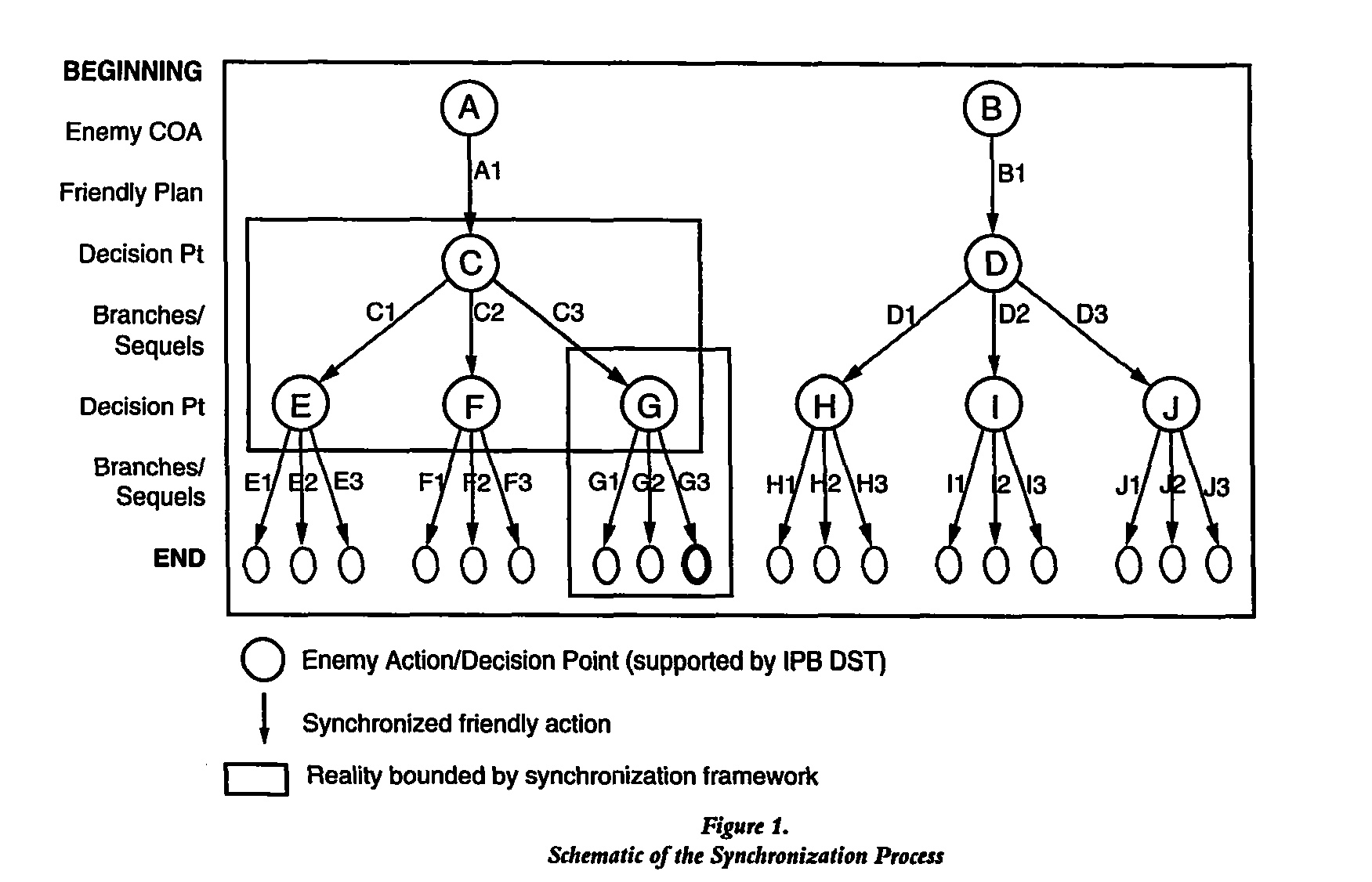
Figure 1 provides a schematic of how the process works in theory. Based on our framework of assumptions about the situation-our “box”-we analyze enemy courses of action, which lead to corresponding friendly plans with associated decision points. Each decision point leads to anticipated branches and sequels, which in turn lead to new decision points and sub

*A mnemonic devise used to help remember the nine principles of war-mass, objective, offensive, security, economy of force, maneuver, unity of sequent branches and sequels. The purpose behind anticipating branches and sequels, in McKenzie’s words, is to “enable the staff and commander to coordinate battlefield activities for future operations.”

In Figure 1, each small circle is driven primarily by the IPB process-the initial enemy courses of action by the initial IPB and the subsequent decision points primarily by the decision support templates (DST) generated as part of ongoing IPB. The arrows, on the other hand, represent the actions that are the results of our and enemy plans and operations. It is within each of these arrows that we would optimize battlefield activities through prior coordination and planning; in other words, this is where the actual synchronization takes place. The gray pathways represent all me possible developments. In McKenzie’s own words, synchronization thus “envisions possible paths to obtain decisive mass and tempo at the proper time and place.” The black cause-and-effect pathway (A-G3), depicting the course of events as it actually unfolds, represents what McKenzie would call the “critical path of concentration and priorities.”

For example, enemy course of action A leads to our adopting predetermined friendly plan A1 that, when combined with the enemy’s actions, logically leads to decision point C. Once the enemy has adopted course of action A (or led us to believe that he has) we stop worrying about path B and focus on what happens after decision point C. We can focus on ensuring the optimal integration of all our assets for the future execution of C1, C2, or C3. Decision point C represents the last place we can choose C1, C2, or C3hopefully, the enemy’s triggering named areas of interest (NAI) during the course of A1 has allowed us to make the determination sooner. Let’s say we choose C3, which leads naturally to decision point G; we can now ignore the E and F paths (and all their subsequent branches) and can focus on synchronizing G1, G2, and G3. And so on. It is not necessary to have laid out the entire structure in advance, but it is necessary to have laid out in advance at least through the next decision point and each of its possible branches. In practice, this requires both the ability to anticipate and the ability to do the necessary analysis, planning, and coordination fast enough to stay ahead of unfolding events. It is precisely this anticipatory ability that allows for the advanced planning and coordination essential to the optimal integration of efforts and resources. This point is absolutely key and bears repeating: The whole object of the synchronization process, in theory, is to allow us to anticipate events so that we can get the jump on the enemy and can develop coordinated, integrated plans in advance.

The foundation of this whole process is, as McKenzie implies, IPB. IPB is the long pole that holds up the synchronization tent; without it, the tent would collapse. It is IPB that establishes the overall framework-draws the “box” of possibilities, in other words-by establishing our set of assumptions. It is the initial IPB that allows us to anticipate enemy courses of action, and therefore to develop our own synchronized plans in advance. It is ongoing IPB, primarily through the use of decision support templates at decision points, that allows us to anticipate events as the operation unfolds and, therefore, again to synchronize our efforts in advance.

As we proceed through the operation (from top to bottom in Figure 1), we can see that the number of options and outcomes increases exponentially. At first glance, this might appear a problem because it is impossible to plan for every potential outcome or variation. But each decision point theoretically provides a narrower framework of possibilities-a smaller “box”-because once we choose a given path, we can shut down the other paths. This continuous narrowing of the framework is absolutely essential to the process; without it we would become overwhelmed trying to deal with all the possibilities.

At the same time, synchronization is theoretically very flexible because, through its cumulative system of branches, it provides eventually for a vast array of possibilities. As we can see from the bottom row of Figure 1 (E1-J3), in theory the anticipated final actions and outcomes pretty much blanket the entire range of possibilities as defined by our framework. There are no gaps in our framework; we’ve covered every contingency. Theoretically, success is merely a function of defining and continuously narrowing the range of possibilities (to allow us to focus our synchronization effort), identifying all the variables (i.e., decision points), and following the proper path to the right outcome.

The BOS Synchronization Matrix

The logical and natural culmination of the synchronization process is the battlefield operating systems (BOS) synchronization matrix. Battlefield operating systems, or what McKenzie calls battlefield activities, refer to the various activitiesmaneuver, fire support, logistics, intelligence, air defense, and so on-which must be integrated optimally in order to achieve synchronization. Each arrow in Figure 1 represents an integrated collection of activities governed by a synchronization matrix. Not only does synchronization enclose combat in a box, it further subdivides that box in order to try to fit combat into a matrix. This matrix is the manifestation of McKenzie’s assertion that “commanders work within the construct of a coherent set of functions intended to optimize the interplay of the various elements of warfighting power.”

In practical terms, the synchronization matrix is a contingency script that lists, on one axis, the various anticipated decision points and, on the other axis, the predetermined actions that each battlefield operating system will take in the event of each decision point being triggered. As the name indicates, the object of the matrix is to ensure the synchronization of all the BOS or battlefield activities. Figure 2 provides a partial sample of a synchronization matrix and a corresponding decision support template.
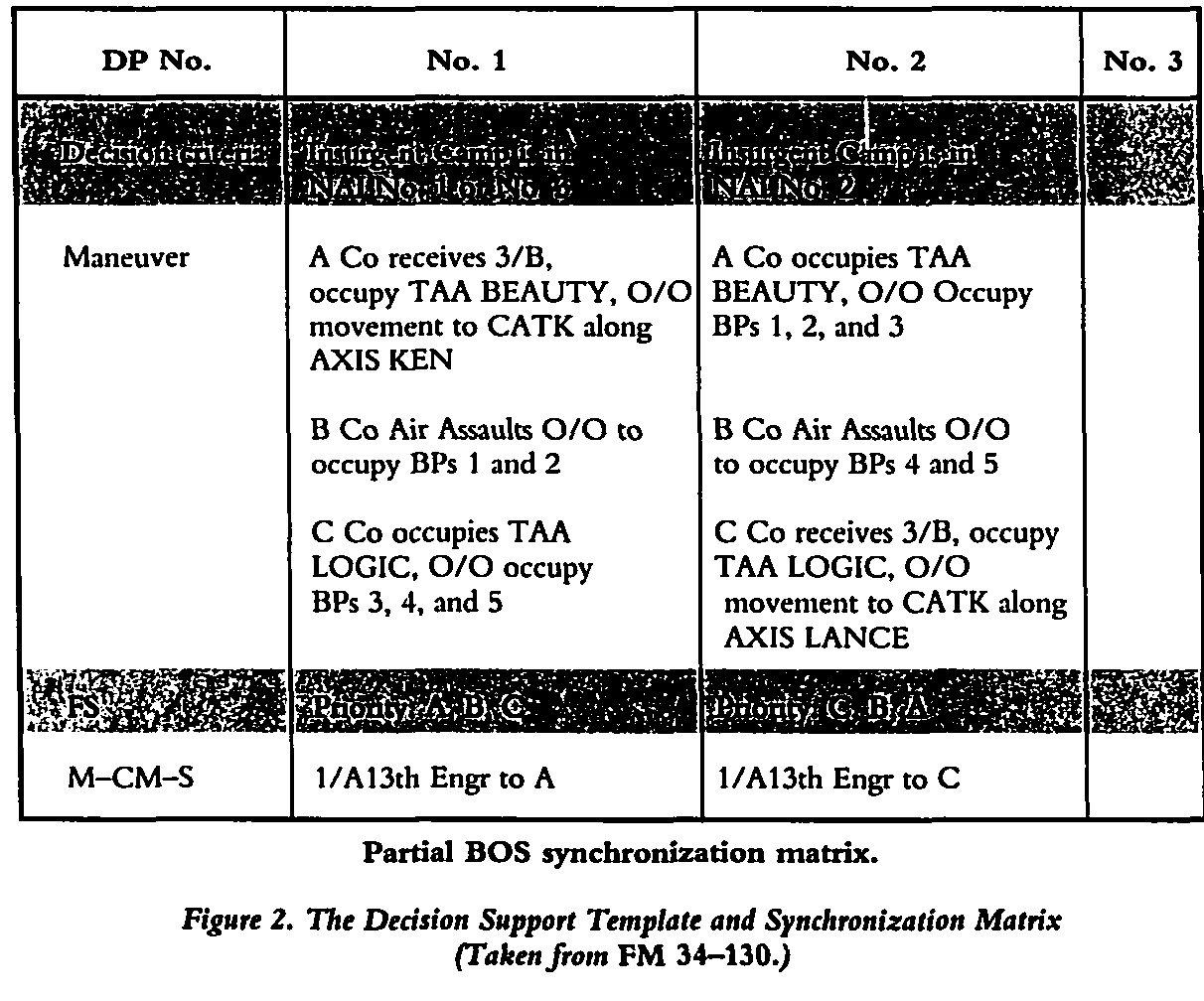
McKenzie conspicuously stops short of mentioning the synchronization matrix in his article, perhaps because he realizes that it reveals just how mechanistic and quantitative the synchronization approach really is. Supporters of synchronization might argue that we can believe in the process without carrying it to that extreme. But this is irrational. The matrix is the very thing that the whole process is working toward; it is precisely the device that allows us to achieve the optimal “integration of combat, combat support, and combat service support systems in time and space to obtain a sum of combat power that is greater than the simple addition of individual parts”-McKenzie’s words. Why go through the trouble of pursuing optimization only to stop short of the very thing that will theoretically achieve it for you? That makes about as much sense as building a fence around your yard to keep your dog from running away, only to purposely leave the gate open.

What Is the Appeal of Synchronization?

As we can readily see from Figures 1 and 2, synchronization reflects an extremely deterministic and methodical approach to military operations. We can understand the appeal it has for the American mind. It is organized, orderly, and logical. It may be somewhat complicated, but that’s not a problem as long as it is systematic-in fact, to our way of thinking, the more complicated something is, the more advanced it must be. It is also labor intensive, with a heavy reliance on comparative analysis, coordination, and planning. But, again, that is not a problem because we have large, eager staffs ready to do the necessary stubby-pencil work.

FMFM 1 tells us that war is inherently uncertain, unpredictable, frictional, fluid, disorderly, imprecise, and somewhat random. The problem is that these truths do not sit well with Americans in the current culture. We are products of the scientific age that hold that through the scientific method we can master nature. We expect things to go the way we want them to. We crave certainty and precision. We want guarantees. We want to see quantifiable proof. We like to believe that if we take a certain action it will have direct, predictable, and exact results. We like to believe that every question has a right answer, and that if we get enough information and apply the right method we will find that right answer. We strive for optimization and efficiency in all things. We like everything orderly-a place for everything and everything in its place. It is clear that synchronization and IPB are typical products of this mindset.

Unfortunately, the nature of war as described in FMFM 1 is inconsistent with-no, make that contradictory to-this culture. This is why the adoption of maneuver warfare is not merely a matter of doctrinal change but of cultural change. Meanwhile synchronization holds out the alluring but irrational promise that we can have it both ways: Yes, war is inherently uncertain, random, chaotic, and frictional, but we can still get certainty, precision, order, and optimization. Like a security blanket, synchronization provides a false sense of security. Like a belief in magic, it allows us to ignore the laws of nature.

How Does the Synchronization Model Deal With the Unexpected?

Marines are agreed that war is the province of the unexpected. Our doctrine consequently places a premium on initiative. McKenzie writes:

The entropic nature of combat will challenge all plans, but a planning and analysis structure that recognizes the inevitability of change will be able to accommodate these occurrences.
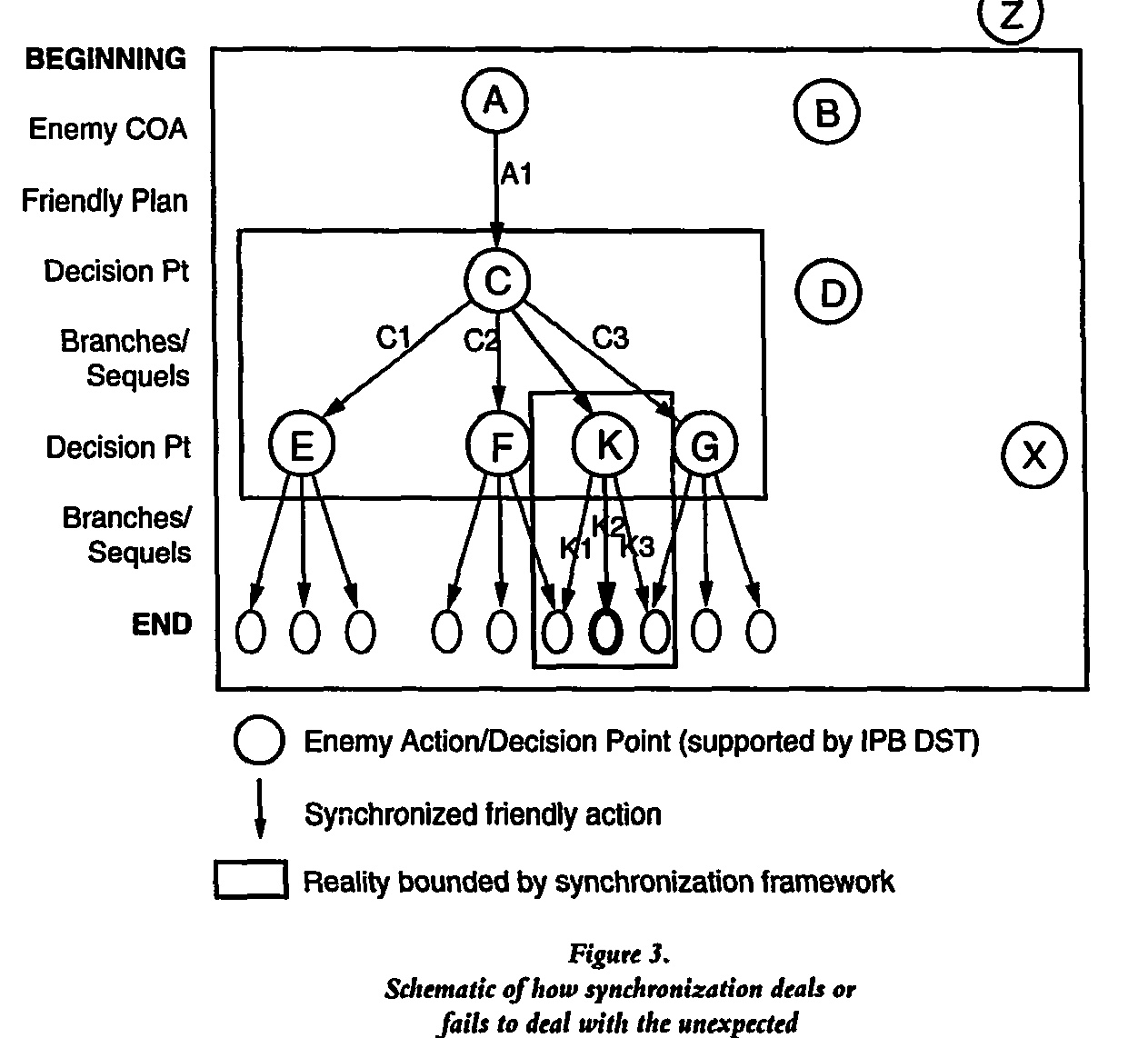
So how does synchronization deal with the unexpected and allow room for initiative? Figure 3 is a schematic showing how this works in theory. Say that the enemy chooses course of action A, which leads to action A1 and eventually to decision point C. Suppose that we reach C, but none of the anticipated branches (C1-C3) are quite appropriate given the situation. Although it is not an event we anticipated exactly, it does not violate any of the basic assumptions that decision point C is based on. It is still within our box. Let’s say it is somewhere between C2 and C3. We can interpolate the requirement and adopt new course C4. Most of the synchronization already done for C2 and C3 can be applied with some modification. C4 leads to new decision point K, and K leads to more branches (K1-K3), all of which are still bounded by our established framework-that is, they are within our basic set of assumptions. In this way we exercised “initiative” at decision point C to improvise branches C4 and, later, K2. Even though a plan was not specifically developed in advance, as long as events are within the bounds of the established framework, synchronization thus theoretically provides the means to adapt. This is how McKenzie can argue that it is possible to exercise initiative within the synchronization framework. We should make it clear, however, that when we use the term “initiative” in this sense, it has a much more limited meaning than is typically used. McKenzie betrays this reality when he makes the admission that “conceptually, synchronization is counter-poised against agility and initiative.”

Problems With the Model

There are some basic problems with the synchronization model. First, what happens when events fall outside the bounds of the framework? In other words, what happens when our basic assumptions are wrong? Figure 3 illustrates this schematically. For example, say that the enemy chooses course of action A, as we anticipated he might, and so we appropriately adopt friendly course A1; but-due to fog, friction, chance, an enemy who doesn’t act logically, whatever-the result does not take us to decision point C as we expect, but instead to X, an event which is not envisioned by the C range of possibility-it’s outside the “box.” X bears little resemblance to C or any of its branches. We have not developed, nor even considered, any branches or sequels developing out of X. As a result, the whole process is stillborn. Or let’s say that we have correctly identified the enemy’s two possible courses of action (A and B), but that the enemy has cleverly deceived us into thinking he is choosing A when he is really choosing B (not so hard to do if we are ready to believe he is choosing A and are merely waiting for him to trigger a NAI as confirmation); instead of ending up at decision point C we end up at D, which is part of the original B pathway. You might say that we simply shift to the D path, adopting D1, D2, or D3. Unfortunately, in order to keep the amount of analysis, planning, and coordination down to a reasonable level, that entire pathway was shut off from above when our IPB led us to decision point A vice decision point B. Again, the whole process is stillborn. Or, perhaps most dangerous of all, what if the enemy doesn’t choose either of our two anticipated possibilities in the first place? Let’s say that instead of A or B, he chooses Z, completely outside our widest framework? For example, we are expecting an armor attack along avenue of approach A or B; not only does he not choose either avenue, but he doesn’t even launch an armor attack-instead he mounts a light-infantry infiltration. Like the North Koreans when MacArthur landed at Inchon, we are taken completely by surprise and are completely unprepared to deal with it. What we have in this case is catastrophic failure of the synchronization process. In any of these examples, none of our existing or envisioned branches and sequels will work, and we do not have a framework for adapting. Remember, the whole process is predicated on the ability to anticipate. Once we have failed to anticipate the next decision point with at least some degree of accuracy, from that point on we cannot synchronize and the process cannot work. And what happens then to a military that has come to depend on synchronization?

The second basic flaw with the synchronization model is the time factor. Marines are agreed that time is a critical factor in combat and that the aim is to generate a higher tempo than the enemy. In fact, that is the whole basis of maneuver warfare. Of course, we have to assume that the enemy also realizes this and is trying to do the same thing to us. But the synchronization model does not account for time. Synchronization is a fundamentally methodical approach requiring explicit analysis, planning, and coordination. While the stated aim of synchronization is to increase tempo by allowing us to anticipate the enemy, in practice the time-consuming techniques and procedures upon which synchronization is based make this impossible. An Army officer at the School for Advanced Military Studies in Ft. Leavenworth confided that in order to have the time to do the things needed to synchronize operations at the division and corps levels, it is necessary to predict the enemy’s actions a full 72 hours in advance. In other words, at that level (which equates roughly to the Marine expeditionary force level), it takes 72 hours to mount a synchronized operation. The model assumes we will have the time to accomplish all the necessary procedures. But what if the enemy simply does not give us the time to execute the method? What if he does not worry about the optimal integration of his assets but would rather just be fast? What if we simply cannot work through the IPB and synchronization techniques in time? If we cannot keep up with developing events, then we cannot possibly anticipate. And, as we have mentioned, once we fail to anticipate, the process is scuppered. This is essentially what happened to the French in 1940; the Germans denied them the time they needed to implement their plans.

The third basic flaw with the model is its failure to account for the human element, which our doctrine tells us is central in war. War is made up of the actions of countless people-friendly, enemy, and neutral-and we cannot rely on them all to act rationally. Yet the synchronization process assumes that operations will unfold in a predictable and logical chain reaction of cause and effect. It is based on recognizable patterns and “If A, then B” sequences. It is important to note that the Army originally created IPB, the foundation of synchronization, specifically in response to the Soviet threat-a supposedly doctrinaire and systematic conventional enemy whose patterned operations were easily transferable to graphic templates. Not surprisingly, the Army is having much less success shoehorning IPB to fit various, less-structured low-intensity operations. What if the enemy is an unorganized rabble with no doctrine or infrastructure to speak of? What if the enemy does not feel at all compelled to adhere to his established doctrine? Or what if the enemy’s doctrine specifically calls for him to act unpredictably and without discernible patterns (as maneuver warfare does but synchronization definitely does not)?

The final basic flaw with the model is, I think, the most significant and by itself invalidates the whole synchronization process. Any model is merely a simplified representation of reality. Reality is rarely as neat and clean as the model representing it. But in order to work, the model must reasonably approximate the reality. If the model has little resemblance to the reality it purports to represent, then it is not of use. It may in fact be worse dian useless-it may actually mislead us into belief and actions that are inconsistent with reality. Consider the following passage from FMFM 1:

In an environment of friction, uncertainty, and fluidity, war gravitates naturally toward disorder. Like the other attributes of the environment of war, disorder is an integral characteristic of wan we can never eliminate it. In the heat of battle, plans will go awry, instructions and information will be unclear and misinterpreted, communications will fail, and mistakes and unforeseen events will be commonplace. It is precisely this natural disorder which creates the conditions ripe for exploitation by an opportunistic will.

Each encounter in war will usually tend to grow increasingly disordered over time. As the situation changes continuously, we are forced to improvise again and again until finally our actions have little, if any, resemblance to the original scheme.

The flaw with the synchronization model is that, even taking into account that the model is a necessarily simplified representation, the process it describes bears little resemblance to the reality described in this passage.

The Inherent Nature of War

McKenzie readily accepts this description of combat. He writes that:

Synchronization in the Marine Corps context encompasses a set of techniques and procedures designed to enhance performance within the chaotic battlefield envisioned by the philosophy of maneuver warfare.

He has got the problem right, but he has got the solution all wrong. By trying to create order on the inherently chaotic battlefield, through its systematic and methodical approach, synchronization will not enhance performance but instead will seriously hamper performance. To be effective, any doctrine, tactic, technique, or procedure must come to grips with the natural environment of combat. There are two basic ways to try to do this. The first is to try to overcome the inherent nature of war, to turn it into something it’s notin other words to impose smoothness, certainty, order, and structure. The other is to recognize war for what it is and to learn to function in that environment Clearly, with its heavy emphasis on optimization, detail, explicit coordination, geometry, templates, matrices, and so on, synchronization derives from the former approach. However, doctrinally, through the FMFM 1 series, the Marine Corps has clearly adopted the opposite approach. This is a fundamental point. Any approach that does not recognize this, such as the effort to incorporate synchronization, is fundamentally incompatible with maneuver warfare doctrine.

The Failure To Understand Maneuver Warfare

This leads us to the next point, namely that the argument for synchronization reflects a failure to understand the concepts that are the very basis of maneuver warfare. McKenzie starts the article out with the following assertion:

Through an evolutionary doctrinal process, the Marine Corps is reestablishing the primacy of the Marine air-ground task force (MAGTF) command element (CE) as the principal warfighting headquarters at all levels of the air-ground team.

McKenzie’s opening statement is just flat wrong and once pointed in the wrong direction, the article never recovers its bearings. A move toward the primacy of the MAGTF command element would be by definition a move toward centralizationthe MAGTF command element becomes increasingly more important in relation to subordinate echelons. McKenzie has a very good reason for wanting to establish this point: Synchronization is impossible without centralization; there is no other way to achieve the high level of analysis or integration required. But, in fact, the evolution of Marine Corps doctrine, as evidenced by the FMFM 1 series, has been clearly in the opposite direction. Our doctrine strongly and clearly advocates decentralization by increasing the authority and responsibility placed on lower echelons. Our doctrine requires that the authority for initiative and decisionmaking be pushed down to the lowest possible level as a means of generating tempo, adjusting to disorderly and rapidly changing situations, and overcoming friction. This is another fundamental point. If you do not recognize it, then your argument from this point on will be inherently flawed.

Theories of Control

There is much more to this than simply the question of centralization versus decentralization. Fundamental to the issue of synchronization is the question of the Marine Corps’ overall philosophy of command and control, since synchronization deals with how we command and control our forces in the conduct of operations. As military historian Martin van Creveld points out in the classic Command in War, the defining feature of the challenge of command and control is the problem of uncertainty. Van Creveld asserts that the entire history of command in war can be described as a “quest for certainty,” a quest that, given the inherent nature of war, he eventually concludes is futile. There are two, and only two, possible responses to the problem of uncertainty. The first is to pursue certainty (or as close to it as possible) as the basis for effective command and control. The second is to accept uncertainty as a given and to learn to cope with it by creating a command and control system that does not require a high level of certainty to function effectively. These two responses lead to two opposing theories of control. Each theory in cum provides the basis for a distinctly different practical approach to command and control.

The first theory, stemming from the pursuit of certainty, is called detailed control. The second, deriving from the acceptance of uncertainty, is called mission control (or directive control). Detailed control tries to eliminate uncertainty by creating a powerful, highly efficient centralized command and control apparatus able to process huge amounts of information and intended to reduce nearly all unknowns. Mission control takes the opposite approach. Rather than increase the degree of certainty that we achieve, we reduce the degree of certainty that we need. Detailed control stems from the belief that war is systematic and deterministic, and that through efficiency and sheer effort we can impose structure and certainty on the inherently disorderly and uncertain battlefield. Mission control stems from the acceptance that war is inherendy chaotic, meaning that the best we can hope for is probabilities rather than certainties. Detailed control is centralized, formal, and inflexible, relying on control measures, detailed planning and analysis, and elaborate and precise procedures and methods. Orders and plans are thorough and explicit and their successful execution requires strict adherence to the plan and minimizes subordinate decisionmaking and initiative. Mission control is decentralized, informal, and flexible. Orders and plans are brief and simple, relying on the judgment of subordinates in execution.

Detailed control seeks to achieve unity of effort by means of tight, centralized control that aims at the precise-dare I say synchronized?-integration of all subordinate elements. Naturally, there is little tolerance for any deviation from the plan, much less for the exercise of outright initiative by subordinates. In mission control, by contrast, unity of effort is not the product of conformity imposed from above, but of the spontaneous cooperation of all the elements of the force. Subordinates are guided not by detailed instructions, control measures, timetables, or event matrices, but by their knowledge of the requirements of the overall mission.

In detailed control, discipline is imposed from above. In mission control, that imposed discipline is replaced by selfdiscipline throughout the force. Relying on detailed planning and analysis, detailed control seeks to “optimize”-that is, to reach the optimum plan of action. Detailed control aims at precision. Where detailed control seeks to optimize, mission control recognizes that there is no perfect solution to any battlefield problem and instead seeks to “satisfice”-to pick the first course of action which will work. Mission control willingly sacrifices precision for speed in the belief that precision is a futile goal given the inherently disorderly nature of war. Mission control aims instead at the “eighty percent” solutions. Detailed control is essentially a top-down approach to command and control, emphasizing vertical, linear communications-linear meaning that reports and requests go up and orders come down. Mission control is essentially a bottom-up approach, relying on horizontal as well as vertical, and interactive vice linear communications.

Where Does Synchronization Fit?

Clearly, the concept of synchronization is quite compatible with the characteristics of detailed control. The emphasis on optimization, analysis, detailed anticipatory planning, and adherence to the plan fit right in with a top-down, centralized approach to control. In fact, it is quite easy to see that IPB, with its deterministic, mechanistic, and systematic emphasis on generating operational templates and anticipating enemy courses of action, is the brainchild of this mindset.

Just as clearly, however, we can see that, from a rational point of view, synchronization is entirely, irreconcilably incompatible with mission control.

What’s the Significance of This?

Understanding the difference between these philosophies of command and control is fundamental to understanding maneuver warfare as practiced by the Marine Corps. Fortunately, as Maj Eric Walters points out in his adjoining article, we have two excellent historical examples of hightempo, maneuver-oriented militaries adopting vastly different command and control styles based on the opposing philosophies: The Germans, who adopted a mission approach called Auftragstaklik, and the Soviets, who adopted a system based on extreme detailed control. Clearly, the U.S. Army, so concerned with fighting the Soviets for half a century, has bought into the Soviet model. This is abundantly clear if you read the Army’s version FMFM 1, FM 10O-5, Operations. On the other hand, the FMFM 1 series makes it just as clear that the Marine Corps has taken the opposite approach and adopted mission control as the basis for its command and control philosophy. Make no mistake about it, the Army and Marine Corps philosophies as described in their respective keystone doctrinal manuals are fundamentally different. Regardless of what you think of synchronization as a concept, there is no denying that it is rationally consistent with the official Army philosophy. It is just as rationally incompatible with the Marine Corps’ stated philosophy. You cannot take a concept that is the product of one specific paradigm and apply it blindly to another, opposing paradigm; it won’t fit.

The ironic thing, as Walters points out, is that while the synchronization enthusiasts in the Army and elsewhere move ever closer to the Soviet model, the Soviets themselves abandoned it in the late 1980s, after over four decades of trying, they decided it just doesn’t work. Of course, due to peculiar political and cultural factors that existed in the Soviet Union, the Soviets had a much more compelling reason than we have for giving detailed control a try in the first place.

Your View of the Nature of War

It all comes down to your fundamental view of the inherent nature of war. Do you believe that war is admittedly complicated, confusing, disorderly, but yet somehow ultimately deterministic and systematic? Do you believe that results are predictable and logical? Do you believe that the chaos and uncertainty of the battlefield can be mastered and provided with a governable structure and order? Do you believe that we can anticipate the enemy’s actions with enough accuracy often enough to make that the basis for the way we operate? Do you believe that we can fit the conduct of war neatly into a box? If so, then synchronization makes rational sense.

Or do you believe, as FMFM 1 asserts, that war is fundamentally, intractably chaotic and probabilistic? Do you believe, as FMFM 1 states, that war is the province of human vagary and therefore inherently unpredictable? Do you believe, as FMFM 1 argues, that the unexpected and unanticipated will be commonplace? Do you believe, in fact, as FMFM 1 urges, that it is the unforeseen event that provides the greatest opportunity for exploitation and the unexpected act that has the greatest chance of decisive effect? And do you believe, as FMFM 1 insists, that speed is essential in war and that we should do whatever we can to increase our own speed relative to the enemy, even at the expense of order and optimization? Do you believe, in short, that the conduct of war will not fit neady into that box? If so, you realize that synchronization is incompatible with Marine Corps maneuver warfare doctrine.

I mentioned earlier that the key question was whether it was possible to draw the synchronization framework big enough to encompass the nature of combat without having to draw it so big that it loses all usefulness as a structuring tool. To read our own doctrine, the answer is, clearly, No. You can support the Marine Corps view of maneuver warfare. You can support synchronization. You cannot do both.

At one point, McKenzie states: “The greatest threat to synchronization is a commander who is unable to accept uncertainty as his handmaiden in battle.” Once again, he’s got it backwards. The greatest threat to synchronization is actually the commander who will accept uncertainty as his handmaiden; for such a commander, recognizing that synchronization is incompatible with his view of reality, will readily and quickly dismiss it. For our own good, let us hope there are plenty of such Marines out there.

Responses to “Fighting in the Real World”

by Maj Frederick J. Whittle

Bravo zulu to Maj McKenzie. His article represents some new and original thinking on a subject of great interest to all Marines. Synchronization concepts have a place in our warfighting toolbox, and I am pleased to see that the debate over their role within our doctrinal structure has been kicked off by such an insightful, thoroughly sound article. I’m sure he will now be the subject of a “full court press” by dogmatic maneuver-warfare theorists, but I don’t think they’ll erase the significance of what he’s written. Good job-and keep writing!


by Capt Judith A. Orr, USMCR

Thanks to Maj McKenzie for pointing out that synchronization is not necessarily incompatible with either maneuver warfare or Marine air-ground task force operations. He reminds us that the danger is not in the adoption of methods aimed at improving the commander’s understanding of the battlefield or improving the allocation of limited assets, but in becoming a slave to a method and its products. By helping the commander make rapid and accurate decisions on the battlefield, commander’s preparation of the battlefield (CPB) and intelligence preparation of the battlefield (IPB) may enable a commander to achieve one of the two qualities Clausewitz views as indispensable-coup d’oeil-a term that Clausewitz adopted to describe sound decisions taken in the midst of action.

It does not matter whether the process is called synchronization, CPB, or IPB; all that really matters is that the process reflects the commander’s intent and is flexible enough to describe a confusing and changing battlefield. Techniques for synchronizing battlefield operations are not new to warfare or the Marine Corps. Operations orders, landing plans, beach assignments, fire control plans, and on-call targets are all techniques used to help commanders at all levels to better coordinate combat, fire support, and combat support activities. When properly used, they allow a commander to bring the full force of his combat power to bear against the enemy; they can help him make rapid and accurate decisions. Used incorrectly, synchronization can tie the commander’s hands. The art is to not contuse technique with tactics or doctrine. Synchronization is simply a technique to help the commander to develop a tactical plan. Maneuver warfare is doctrine.


by Maj William T. DeCamp III

Maj Kenneth F. McKenzie delivered an open-minded, forward-thinking, intellectual, and articulate application of synchronization and its concomitant parts to maneuver warfare. In fact, Clausewitz would have been the first to admit that friction in war does not render unnecessary an attempt to create “inharmonious harmony” (Horace) through the construction of artificial arrangements to help clear the fog of war-even if the creation of such order were simply a figment of the commander’s imagination. If friction is reduced and a sense of order created through the processes of synchronization, intelligence preparation of the battlefield (IPB), battlefield activities, battlebooks, etc., so the commander’s coup d’oeil intuits or perceives activities on the battlefield whose forms or patterns he recognizes from those he previously envisioned in his mind’s eye; and if these activities are developed and metamorphosed during the course of battle, so that the commander anticipates the enemy’s next move; and if he acts relatively faster than the enemy (inside the enemy’s OODA loop) to achieve victory-then who is Bill Lind but a rigid ideologue, whose arguments hinge on a nonsequitur that equates use and abuse of a tool (synchronization). He is too busy counting angels on the head of his maneuver warfare pin (and pricking us with it) to see the laser clarity of the McKenzie logic and its potential for victory in mortal combat.

Guderian and Synchronization

by Capt William S. Jesson

In his March article on synchronization, Maj McKenzie suggested that effective implementation of the principles of maneuver warfare doctrine requires reliance on “a body of techniques and procedures grouped under the umbrella heading of synchronization….” Below is a sampling of initial reactions. In addition, the editorial board is now considering three lengthy manuscripts prompted by the article, which obviously touched a sensitive and important point. Look for more on the “Synchronization Debate” in future issues.

Maj Kenneth F. McKenzie’s article “Fighting in the Real World” (MCG, Mar94) deserves high praise for attempting to work the broad, generally agreed upon, conceptual ideas of FMFM 1 into what will be vigorously debated procedures/techniques for use in the “Real World.” I bought the author’s logic on most points, however, I take exception to his statement that Guderian‘s XIX Corps attack at Sedan was an example of synchronization. I wish to offer a brief historical description of the 1940 campaign and make some conclusions on the issue of synchronization.

The breakthrough at Sedan can be analyzed at two levels. At the operational level, the attack through the Ardennes by Army Group A and XIX Corps was the main effort, although deceptively cloaked at the time. This is an example of synchronization when it is taken in context with the noisy, attention-grabbing secondary attack conducted through the low countries by Army Group B. However, the tactical conduct of the Meuse crossing and the follow-on actions of XIX Corps do not fit the synchronization paradigm.

An infantry regiment of the 1st Panzer Division attacked across the Meuse, near Sedan, without artillery or most of its engineer support. Ground combat support was delayed due to traffic congestion along the Ardennes corridor. Only massive Luftwaffe support silenced the French guns covering the crossing points and enabled an infantry assault to gain the high ground. The German infantry boldly continued the advance at night to enlarge the bridgehead without armor, artillery, or antitank gun support. This opportunistic stroke preempted the effectiveness of the next day’s counterattacks and opened the road to the channel ports. Would this fleeting opportunity have been lost if the crossing attacks were delayed to organize a combined arms attack that met the prerequisites of synchronization?

On their march to the sea Guderian‘s units formed combined arms teams to defeat piecemeal French counterattacks (battlefield activities). As the tank-infantry teams were outpacing their competitors in a risky advance behind enemy lines, Guderian had to fend off (in somewhat of a disobedient manner) numerous attempts from Army Group A (von Rundstedt) to slow the advance. This loss of “nerve” at higher headquarters was really a conservative tendency to grasp at synchronization in order to deal with the increasing level of uncertainty that was caused as lines of communication lengthened.

As XIX Corps neared the channel ports from the south, von Brauchitsch, Commander in Chief of the Army, transferred Guderian‘s Corps to Army Group B, which was nearing the coast from the east. This would have synchronized the pincers around the Allied pocket. However, Hitler, who was visiting von Rundstedt’s headquarters, countermanded this order. Von Rundstedt then ordered the panzers halted under Hitler’s authority. XIX Corps was unleashed 2 days later with Army Group A regrouped and in a better position to orchestrate the effort. This critical 2-day delay enabled the miracle of Dunkirk.

The cautious von Rundstedt, focused on synchronization within his own command, sought to protect his flanks, rear, and resources (XIX Corps) from the Allies and other friendly commands without grasping the opportunity presented the organization as a whole. His influence may have clinched Hitler’s decision to switch the effort to Air Marshal Goring’s Luftwaffe at Dunkirk. Hitler and Goring have received the preponderance of blame for a decision that was made against a backdrop of disunity among Army leaders. Would an intelligence preparation of the battlefield (IPB) process have modified the behavior of the Army Group A commander?

I see the debate on synchronization as the “intellectual tension” Maj McKenzie describes. I think it can be characterized as tension between decentralization and centralization at various levels of command. Decentralized control allows such brilliant tactical and operational maneuver as was displayed at the Meuse crossing and the race to the sea. Centralized control is necessary for obedient and unified application of force, which was demonstrated successfully by the use of close air support during the Meuse crossing, but was unattainable at the strategic command level as envelopment pincers closed in on the Dunkirk pocket. Only a vibrant and trust-filled culture can enable an organization to maker proper judgments on decentralization/centralization issues when the chaos of war distorts the “real” situation. Synchronization is a tool for centralized control that is especially useful in staff planning and can be used within the dynamics of a campaign only when necessitated by external factors (exploiting enemy weaknesses, battlefield opportunities, etc.). Synchronization used as a tool to comfort internal phobias and appease internal political pressures will erode the potential effectiveness of maneuver warfare doctrine.

Keeping Up With Maneuver Theory

reviewed by Maj Kenneth F. McKenzie, Jr.\

Maneuver Warfare: An Anthology edited by Richard D. Hooker, Jr., Presidio, Novato, CA, 1993, 414 pp., $35.00. (Member $31.50)

This is an eclectic collection of 21 essays dealing with maneuver warfare. It is organized somewhat loosely into three parts: “The Theory of Maneuver Warfare,” “Institutionalizing Maneuver Warfare,” and the “Historical Basis 7of maneuver Warfare.” It is an excellent one-volume source for much of the thinking behind maneuver warfare. It is useful regardless of a reader’s position on the value of maneuver warfare, because it makes much of the current literature readily accessible.

The authors are principally serving Army officers and defense academics. Followers of the maneuver warfare debate will recognize the work of William S. Lind; LtCol Daniel P. Bolger, USA; and Col James McDonough, USA, among others. Interestingly, Col Michael D. Wyly, USMC(Ret), and Maj Brace I. Gudmundsson, USMCR, are the only two Marines to contribute to this collection.There are no Navy or Air Force authors. An examination of the excellent footnotes-there are 554 in all-reflects no citations from the Marine Corps Gazette, ajournal that through mid-1993 had published no less than 50 articles on maneuver warfare.

Marine readers may want to ponder why this is so. Can it be that Marines have little worthwhile to say on the subject, or is it that the debate has moved beyond the Corps? Whatever the reason, it surely suggests that much of the maneuver warfare debate-so important to Marines-may be taking place outside the Marine Corps and away from its professional journal.

On balance, these essays do a good job of describing some of the major positions surrounding maneuver warfare. Their tone may be a little pretentious; some have the portentous zeal of proselytizers converting the masses. There is only one “anti” essay provided for critical balance, that of LtCol Bolger, whose sustained withering attack on the maneuverists stands conspicuously alone, yet is so powerful it needs no reinforcement. What this book does not do is provide a unitary, congruent group of essays. Maneuver warfare, it seems, is clearly in the eye of the beholder, and every beholder has his own vision. There is no consensus. Perhaps the best summary definition of maneuver warfare is found in Gen John R. Galvin’s introductory essay:

Maneuver warfare, as a concept, is a way of thinking about the purpose of engagements, battles, campaigns, one that asks the question, How can I seize and hold the initiative, stay ahead of my enemy’s ability to think and act, dismantle this enemy, cause his collapse, take him apart?

While there are many schools of thought on maneuver warfare, the feet that this collection of essays has been published bodes well for future open debate on this absolutely critical subject, and in that we find this book’s great contribution-it encourages independent critical thought and analysis by Marines. It is unfortunate that so few Marines participated in its preparation.

Marines should read this book. They should also read the excellent articles in the Gazette-some by these authors-on the same and allied subjects. Most important, they should write. This debate over the utility of maneuver warfare and its associated concepts is too important for Marines to leave to our Army comrades and a few defense intellectuals.

Fighting in the Real World

by Maj Kenneth F. McKenzie, Jr.

. . . courses of action are wargamed using the enemy situation predicted by the intelligence preparation of the battlefield. Critical decision points are identified based on key events that support synchronization and mission execution.

FMFM-3, Command and Control

Through an evolutionary doctrinal process, the Marine Corps is reestablishing the primacy of the Marine air-ground task force (MAGTF) command element (CE) as the principal warfighting headquarters at all levels of the air-ground team. Concurrently, the Corps has introduced a body of techniques and procedures grouped under the umbrella heading of synchronization, all designed to more effectively implement the principles of our maneuver warfare doctrine. Few challenge the reassertion of the MAGTF CE’s primacy. On the other hand, some critics have expressed concern over the introduction of synchronization principles as enabling tools for maneuver warfare.

There seem to be two general schools of criticism. William S. Lind, an early proponent of the maneuver warfare concept, holds that the concept of synchronization categorically is incompatible with maneuver warfare. In the October 1993 Marine Carps Gazette, he says, “Intelligence preparation of the battlefield, battlefield operating systems, and battlefield activities, etc., all flow logically from synchronization, which is to say they are all incompatible with maneuver warfare.” A second criticism seems to be based simply on the fact that, originally, synchronization was an Army concept, thus insufficiently naval in outlook.

Maneuver warfare is the doctrine of the Marine Corps. It provides broad guidance and a rationale for our style of combat. In brief, it is part of our Service culture. On the other hand, synchronization is not a doctrine, but is rather the umbrella principle associated with a number of techniques and procedures first introduced by the Army in AirLand Battle in 1982. These procedures include intelligence preparation of the battlefield, the battlefield activities, and battlefield geometry. The crux of the issue is this: Do these techniques and procedures support maneuver warfare, or do they destroy it from below, by introducing irreconcilable contradictions?

In order to examine this issue, it is necessary to look at synchronization in light of our own maneuver warfare doctrine, as outlined in FMFM 1, Warfighting; FMFM 1-1, Campaigning; FMFM 1-3, Tactics; and FMFM 3, Command and Control By defining synchronization, placing it in historical perspective, including the charge that synchronization is the French methodical battle recast, one can gain insights beyond the rhetoric and superficial political opposition to an Army concept. In fact, synchronization can be a powerful tool for the commander, and one we can use to answer our own unique Marine requirements.

Maneuver Warfare

As outlined in FMFM 1 maneuver warfare is the Corps’ broad operational concept for how and, most importantly, why we fight the way we do. FMFM 1 describes an environment of friction, uncertainty, fluidity, and disorder. To achieve success in this environment, two principles are key: concentration and speed. “Rapid, flexible, and opportunistic maneuver” is used to gain a relative advantage over an opponent who is struggling within the same chaotic environment. The target is more the foe’s cohesion than the material integrity of his forces.

Written in a clear, straightforward style, FMFM 1 and its companions on campaigning and tactics provided a brilliant foundation for subsequent refinement of supporting procedures, techniques, and tactics. The development and implementation of synchronization concepts is the first real attempt to build on this foundation in a formal sense.

What Is Synchronization?

Synchronization is the integration of combat, combat support, and combat service support systems in time and space to obtain a sum of combat power that is greater than the simple addition of individual parts. It is a body of techniques and procedures that support our style of combat. LtGen John H. Cushman, USA(Ret), writes in the July 1993 Naval Institute Proceedings that

. . . synchronization is supposed to mean bringing to bear at one time and place the combined power of maneuver, artillery, air, deception, and other means so as to strike the enemy again and again with massed power greater than the sum of all the parts. It is the essence of combined-arms teamwork.

Commanders at all levels synchronize their efforts to accomplish the mission. At the strategic level, the elements of national power-economics, diplomacy, and military strength-are integrated. At the operational and tactical levels, commanders work within the construct of a coherent set of functions intended to optimize the interplay of the various elements of warfighting power. These are collectively called “battlefield activities” in the Marine Corps, and “operating systems” in the Army.* At Officer Candidates School, candidates learn to establish a base of fire on an objective and to shift and then lift it on signal. They arrange for the displacement of the supporting fire team forward and conduct resupply and reorganization on the objective. At the lowest level, this is the synchronization of fire, maneuver, and logistics-a structure that operates within the chaos and friction of the battlefield.

Coordination and synchronization are not synonymous; there is instead a hierarchical relationship. The commander’s intent and concept of operations outlines his synchronization: what he envisions doing with his fire, maneuver, logistics, intelligence, and other activities. This directs vertical and lateral coordination, which then becomes a tool to attain an end-the coherent application of combat power. In situations where there are more opportunities than assets, broad synchronization will focus and enhance limited combat power. As a general principle, synchronization springs from the commander’s concept of the battle. As noted in the Army’s 1992 draft FM 101-5, it creates a “critical path of concentration and priorities,” defining the main effort. Here, a danger must be seen and avoided: This path must not become a one-way street that brooks no deviations. In the largest sense, synchronization is an ongoing analytic process that provides a methodology for shaping, not scripting, efforts within the chaotic environment of combat.

By design, synchronization is not time-driven; instead, it is event-driven and anticipatory. Critics who argue that synchronization treats men like “stopwatches,” and ties all maneuver units to the pace of the slowest, like yoked oxen, simply do not understand its essence, which is the integration of functional battlefield activities, a much broader and deeper process than merely issuing movement orders. Nor does synchronization imply the lockstep massing of forces. Instead, it envisions possible paths to obtain decisive mass and tempo at the proper time and place. Critics of synchronization are actually-and rightly-attacking scripting, which is an attempt to choreograph action with a rigid timeline. Attempts to link actions on the battlefield to time almost universally fail.

Synchronization can be abused to manifest both a “dress right” approach to maneuver and a rigid timetable. Today, some believe that in the Army there is evidence that the process of synchronization may subordinate critical thought and the role of the commander as decisionmaker to a rigid ballet of execution that cannot deal with a fluid battlefield. If true, this is a valid criticism. In the Marine Corps, the overarching culture of maneuver warfare will prevent this. The greatest threat to synchronization is a commander who is unable to accept uncertainty as his handmaiden in battle.

Conceptually, synchronization is counterpoised against agility and initiative. This dynamic tension is created by the conflict between what is planned and what actually happens. Tension like this is inherently good, and a robust tactical doctrine will always feature a contrast between order and understanding on one hand and initiative on the other.* Reconciling these competing imperatives, each of which is fully justifiable within its own particular logic, is T. E. Lawrence’s “kingfisher flash,” the essence of the operational art.

The commander holds two competing ideas in his mind as he plans and executes combat operations: on the one hand, order, understanding, control, and the lure of certainly; on the other, creativity, spontaneity, and the uncertainty of opportunity. The ability to reconcile these concepts effectively over time varies from commander to commander, but ongoing synchronization makes it easier to define critical issues and expedite decisions. This balancing test is at the center of F. Scott Fitzgerald’s observation that the best test of intelligence is the ability to hold two opposing ideas in one’s mind at the same time and still retain the ability to function.

Through the medium of commander’s intent, a plan’s “branches” are developed during the planning and wargaming process, preparing units for possible rapid changes in situation, mission, and status. Concurrently, potential “sequels” are identified that enable the staff and commander to coordinate battlefield activities for future operations. The entropic nature of combat will challenge all plans, but a planning and analysis structure that recognizes the inevitability of change will be able to accommodate these occurrences. Commanders must recognize that fleering opportunities will arise, requiring immediate and perhaps unanticipated action (e.g., recon pull).

Commanders direct battlefield activities in order to carry out tactical plans. As events unfold, the tactical situation will erode the initial synchronization of effort, and the commander will have to adapt to new and ever-changing situations. However, the recognition that battle is a dynamic, chaotic activity is part of the synchronization process.

How Intelligence Preparation of the Battlefield (IPB) Fits In

The commander is aided in rapidly reassessing and modifying plans by his IPB, a process that has continued since before the operation began. In close collaboration between the commander and his operations, intelligence, and logistics officers, the battlefield is subjected to an exhaustive terrain analysis, with particular attention being paid to mobility corridors, key terrain, and chokepoints. Applied to this is a doctrinal template of how the enemy may choose to fight, based upon his doctrine and the terrain. From these two elements comes the situational template, an analysis based on the factors of mission, enemy, terrain, troops-time, or METT-T. It is updated constantly throughout the fight. Typically, commanders seek to know the most likely and the most dangerous enemy courses of action.

As part of this ongoing effort, a variety of information, decision, and execution aids are created, based upon the commander’s intent and the concept of operations. These aids, all designed to enable rapid adjustment of the commander’s vision of the unfolding battle, provide and organize quantitatively. Often, the situation precludes the development of all IPB products, forcing the commander to prioritize his requirements. In any event, the products of IPB are less important than the IPB process, whose purpose is to maintain a relentless focus on the enemy.

IPB requires intimate interaction between the operations, intelligence, and logistics officers and must be coordinated by the commander. It is particularly useful in wargaming potential courses of action, both enemy and friendly, during the development and execution of a plan and lends itself to rapid, continual updates as the situation changes. IPB helps to identify opportunities for decisive friendly maneuver, while tightening the observation-orientation-decision-action loop through continual analyses of enemy options. It cannot be a substitute for the commander’s decision, reached through analysis and the spark of intuition, but it can help make his decision an informed and rapid one.

Is Synchronization the Methodical Battleand What Is Methodical Battle?

Critics of synchronization often argue that it is only the French bataille conduite or methodical battle of the interwar years expressed with modern weapons. The doctrine of methodical battle reflected two French lessons from World War 1: the dominance of the defense, and the superiority of fire over movement. It was spawned in the peculiar culture of a victorious French military establishment, revolted by the casualties of 1914-1918.

In the 1920s and 30s, this doctrine deemphasized maneuver, controlling it with rigid phase lines, elaborate reporting procedures, and the centralization of virtually all assets under higher level commanders. Attacks were conducted in phases, each defined by the establishment of a mathematically modeled density of artillery. It was above all a cautious, defensively oriented doctrine, one that reflected France’s grisly experience in World War I and her limited manpower pool. It was further compounded by the fact that the exposed location of her critical industrial areas and mineral fields forced her to fight on the frontiers. Politically, the Army could not afford to surrender the ground necessary to create maneuver opportunities.

As new weapons of greater range and mobility were introduced in the 1930s, the French Army forced them to fit the methodical battle model, rather than changing doctrine to encompass the new technology. The French Army rejected the German World War I success of infiltration tactics, believing the latter attributable to the use of elite formations and refusing to credit them as an idea worth copying. The methodical battle was a style of war ready-made to be ravaged by the decentralized execution. rapidity, and shock of formations such as Guderian’s XIX Corps, which spearheaded the German breakthrough with a synchronized attack at Sedan.

The methodical battle is not synchronization, at least in the Marine usage of the term. They cannot fairly be compared. Methodical battle was a philosophy of war inextricably wedded to the defense, firepower, and resistant to rapid, decentralized maneuver. Synchronization in the Marine Corps context encompasses a set of techniques and procedures designed to enhance performance within the chaotic battlefield envisioned by the philosophy of maneuver warfare.

More akin to the methodical battle was the U.S. Army’s “active defense” of the 1970s-the predecessor of maneuver warfare and AirLand Battle. The methodical battle and the active defense both embraced concentration, the supremacy of the defense, and centralized control. Maneuver warfare was, and is, a reaction to just this view of combat.

The Real World

What does all this mean for Marines? Wars are not fought in sterile, academic settings. Military forces today must deal with not only the factors of METT-T, but also very real political considerations that promise to intrude to even the lowest tactical levels. This may not be good, but it is a fact of life. Not all engagements are fought on terrain like a billiard table, where freewheeling gnostics can implement frictionless plans in an airy, structureless environment. There are limitations that operate on even the most profound genius. In the real world, synchronization is a method that will identify potential limitations and possible work-arounds.

For Marine forces operating from the sea, in immature theaters with minimal infrastructure, synchronization concepts may prove to be very useful in a number of areas, particularly in the realm of logistics. We are a force that must integrate amphibious assault forces, maritime prepositioning ships, and strategic airlift into a coherent plan. The limiting actor in many littoral operations will be our ability to supply the landing force ashore, while standing up prepositioned equipment with its troops. Synchronization will identify limiting factors, and suggest alternatives, not only as part of the planning process but also in execution.

Marines are pragmatic people. To us doctrine is not theology, we are agnostics, tending to shun a comprehensive doctrinal structure and opting for whatever seems to work best for a particular situation. In maneuver warfare we have a concept for fighting, a clear philosophical paradigm within which to operate. But philosophy, however clear and lucid, cannot in and of itself provide all the conceptual ammunition a large military organization needs to fight. Too much structure leads to dogma, thus choking initiative; yet doctrinal anorexia-a studied disdain for the tools of doctrine-can also be dangerous. Appropriate tools, techniques, and procedures to give shape to maneuver warfare doctrine are found in synchronization, IPB, battlefield activities, battlefield geometry, and their allied concepts.

These concepts, however, do not represent a philosophy themselves, rather a body of procedures that support the commander within the mission-orders, high-tempo world of maneuver warfare. Synchronization is ideally suited to support maneuver warfare, if practiced by thinking, skeptical Marines who do not become slaves to the process and maintain the spark of intuition and aggressiveness that no system of war can provide. Command in war is and will remain an art.

There is no reason to shun ideas merely because they originate elsewhere-a second criticism of synchronization. Using this strange proprietary logic, it was wrong for the Marine Corps to scour the Pacific battlefields after World War II, bringing vast quantities of formerly Army equipment to Barstow-equipment that proved vital in Korea. There’s no natural law that says that all good ideas must come from within the Marine Corps; we should get them wherever they are found and adapt them to our own purposes.

The introduction of synchronization concepts into our doctrine of maneuver warfare is helpful, not hurtful. When applied with perspective, avoiding the extremist positions on both sides of the argument that demand an “all or nothing” approach, synchronization becomes a powerful enabling tool that translates the ideas of maneuver warfare into procedures and techniques that can be used in the real world: the world of friction, violence, and uncertainty. In this world, even Moltkean geniuses must grapple with sleep deprivation, chemical protection gear, “the reasonable promptings of fear,” and the death of comrades, all while controlling the levers of an increasingly complex machine. To reject synchronization categorically is to invite a judgment pronounced on the French Army in World War II: “. . . too pedantic, too theoretical, and not practical enough; their doctrine was more suited for the classroom than for the battlefield.”*

Notes

*The MEF has seven battlefield activities: command and control, maneuver, engineer operations, aviation, fires, intelligence, and combat service support.

*Wayne P. Hughes, Fleet Tactics: Theory and Practice. Naval Institute Press, Annapolis, MD, 1986. p. 29.

*Robert A. Doughty, The Seeds of Disaster: The Development of French Army Doctrine, 1919-1939. Archon Books, Hamden, CT, 1985. p. 187.