FMFM-1, Warfighting

At the Forefront of Tactical Thought

by Col Michael D. Wyly, USMC(Ret)

It is well that two articles appearing in the October 1993 Gazette (“Revise FMFM-1, Warfighting,” by Maj Philip E. Knobel, and “Dysfunctional Doctrine,” by Maj Robert S. Trout) recognize the need to change FMFM-1, bring it up to date, and keep it relevant, useful, and at the forefront. For even as we worked on it in 1989, we feared that, like previous doctrine, FMFM-1 would become ensconced as sacred and beyond criticism or modification. The omnipresent danger of doctrine is that it will inhibit needed change. Every new structure begins the process of erosion and decay the moment it is formed.

The benefit of FMFM-1, as originally written, was that it added four important new dimensions to our fighting style: (1) action by subordinates without waiting for orders; (2) dependence on judgment instead of methodology; (3) emphasis on speed more than control and on substance more than form; and (4) focusing outwardly on the enemy (and the entire surrounding situation, including civilian populace) more than inwardly on our own organization These new concepts were alien to our Marine Corps culture when I entered commissioned service in 1962. They remained so until we were well into the 1980s. But now that FMFM-1 has made them doctrine and they have been assimilated by a large number of Marines, we have gained tremendously in terms of fighting power.

So long as our equipment keeps pace with technological development, our new tactical concepts enable us to keep ahead of any enemy whose soldiers are less able to think independently than our own. This ought to mean all of the Third World. Our new tactical concepts uniquely equip us to overpower swift-moving, elusive guerrillas, as well as conventional forces with the latest technology and weapons.

Majs Knobel and Trout’s October articles are encouraging because officers are thinking, but discouraging because the thought appears only as entries in the Chase Essay Contest, a contest that rewards “boldness and daring.” That is, thoughts about changing doctrine are categorized as radical thoughts, just as they were in the days of the pre-1989 doctrine. Thoughts on changing doctrine continually ought to be the mainstream priority at Headquarters Marine Corps and Quantico, as well as in the Fleet Marine Force. Even before FMFM-1 was signed, I had a file of proposed changes in process. Where is the file now, I wonder?

I would take issue with the notion expressed in one of the two October articles, where its author contend that we should modify our doctrine to conform to the latest U.S. Navy and Joint Chiefs of Staff doctrine. To predicate Marine Corps tactics on another Service’s methodology, “senior Service” notwithstanding, would drive us back to the habits of the pre-Vietnam years, the very habits that slowed our ability to deal with the new kind of war that faced us. That is, the internal focus, or the lining up of one of our own organizations with another. The outward focus, to which FMFM-1 introduced us, predicates our actions on the situation that we are faced with. That is, our tactics would be dictated by awareness: awareness of the enemy, our surroundings, and unpredictable new faces of war.

As stated on page 69 of FMFM-1, Warfighting:

We should base our decisions on awareness rather than on mechanical habit. That is, we act on a keen appreciation for the essential factors that make each situation unique instead of from conditioned responses.

Another questionable feature of one of the articles in the October issue is the suggestion of a return to the principles of war, for whose rote memory the acronym MOOSE-MUSS was invented, toward what useful purpose no one has ever articulated. One need only look to the principles’ origin, as told by their originator, to appreciate the absurdity of their having dominated our doctrine for so long. It was 1919 when the British Army first took note of the work that J.F.C. Fuller had begun on his own in 1915, developing the list of “principles.” No sooner did the British Army incorporate the list into doctrine than the U.S. Army and Marine Corps followed suit. Fuller continued to work on and change his list over the years, based on his continuing study of war. His list had grown from six principles he authored in 1912 to nine, which the Army incorporated. Eventually it reached a height of 19 principles before descending again, down to 3, then to “economy of force” alone; and, at last, by 1929, to zero.

Fuller finally concluded that his “principles” were not principles at all, and rejected the whole idea, regretting that he had caused the entire British Army to forsake professional study to memorize his list unthinkingly, as if it were a ritualistic prayer. Meanwhile, we see military bureaucratic behavior at its worst. Ensconced into “concrete,” the principles remained in U.S. doctrine for 64 years, even after the British had abandoned them by 1980.

When I was on active duty the list of “principles” that were not principles served only to stymie thought. Can a list of words that speaks of “mass” but omits “dispersion” be principles? Is “speed” on the same level of importance as “economy of force” and “unity of command,” when speed alone enables us to shift from mass to dispersion and back again when the changing situation demands?

And herein lies one of the flaws in FMFM-1 that needs to be fixed. “Concentration and speed,” it says on page 31, “are two concepts of such significance and universality that we can advance them as principles.” Yet, speed seems decidedly more important, certainly for successful maneuver. And why should concentration be elevated above dispersion? Perhaps it ought to have been in Clausewitz’ time-and the “concentration and speed” idea came from Clausewitz’ On War when it was written into FMFM-1. The Brown Bess musket and its contemporaries, after all, had to be massed, or concentrated, to be effective. Many modern weapons do not.

I have to assume a certain amount of personal responsibility for Clausewitz’ concentration and speed being in FMFM-1, as they are. However, to take them out again, I remember, was first in my file of proposed changes for revision.

FMFM-1 needs to be revised in order to move beyond Clausewitz and his era. It needs to reflect the requirements of situations like Somalia, where the main excuse given for the defeat of American infantry was, pathetically, “We didn’t have the tanks.” Tanks were hardly the solution; better intelligence and better tactics were.

Action without orders, dependence on judgment, emphasis on speed and an outward force can be clarified well beyond FMFM-1’s expository. They can be expressed differently, revised, or added to. In the process of writing this article, I have done a synthesis of my own in order to extract what, after 4 years, seems to me to be the essence of the changes of 1989. These four ideas, however, more than any others, are what brought us out of a long period of tactical stagnation. To hold to FMFM-1 as if it were Holy Writ, would be to repeat the mistakes of our predecessors. Yet, to crawl back to the trenches of the nine “principles,” or to start all over from scratch, would demonstrate a real fragility in Marines’ confidence in their own contribution to the art of war.

Studying Squad Tactics

by Col Michael D. Wyly, USMC(Ret)

How encouraging it is to see that the Gazette continues to publish articles on the all-too-often neglected tactical level of war-right down to the squad! In the August 1993 issue, Capt Daniel J. O’Donahue’s “The Last 300 Yards” and Army Maj Richard D. Hooker’s “Light Infantry Assault Tactics and the Night Attack” were usable grist for the squad leader’s mill. After years of hearing, “But down at the squad level it’s all the same, whether in maneuver warfare or the stuff we used to do . . .” some of our young lions in the Army and Marine Corps are pointing out how much is indeed different.

Both pieces imply a central idea that lies at the heart of the change from old to new. But neither author brings it out explicitly. I first caught sight of it in Vietnam when it began to be evident that much of what we had gotten in training was obsolete in modern combat. I noticed it first in the behavior of squads and squad leaders. Capt O’Donahue alludes to it briefly when he says, critically, of our premaneuver tactics, “The emphasis [was] on inward control.”

In training, riflemen had worried most about keeping the formation, while squad leaders concerned themselves with controlling their Marines’ spacing and speed of movement. Focus was inward. But in combat, focus was outward. Riflemen scanned the terrain and so did squad leaders.

Clearly, what we were called upon to do in combat, including the “last 300 yards,” was quite different than what we had been called upon to do in training. When I finished a 29-year career as an infantry officer 2 years ago, however, I was still too often seeing in training the behavior my Marines in Vietnam had rejected.

Next time you are in the field, notice a squad in action. First, look at the squad leader. Are his eyes on the terrain before him and around him? Is he looking for targets and danger areas? Or is he watching his men, trying to catch the eye of a fire team leader and give him a hand signal? Most often, you will find his attention divided between the two. He glances anxiously outward, then, signals to the fire team leader to move forward or to stop and wait for others to “close up.” Perhaps he looks behind him and directs the fire team following to fall back a little, and then shifts his attention to some particularly dense foliage to his front that might be hiding a well-camouflaged enemy.

Notice the squad members. Are their eyes and rifles fixed on their surfoundings, searching for opportunities to kill and disrupt? Or are they looking backward, toward their squad leader, trying to find him, watching for his signal directing them where to go, where to look, and at what speed to proceed? As with the squad leader, the chances are that you will find riflemen torn between two conflicting claims to their attention.

A fundamental difference between maneuver warfare and what we used to do, and between my Marines’ style in Vietnam and what we did in training, is that in maneuver warfare and the real thing, focus is outward on the enemy and surroundings. But more essential, in combat, their attention must be undivided. Often in Vietnam we talked to one another about the importance of concentrating all our senses on the enemy. “Getting into his head,” we called it. We shared stories about the strange intensity of our senses in combat. My Marines even believed the enemy would feel it if they looked at him directly. “Never look at ’em in the eye when they come in the kill zone,” they counseled. I doubt the enemy could really feel my Marines’ eyes on them, but obviously my Marines were aware of their heightened senses and the importance of keeping them tuned and focused.

So you have, on the one hand, the outward-focused squad of 13 men, together, doing what the ever-changing situation demands, each one out to undo the enemy. And on the other, you have 13 men, wary of their surroundings, but concerned with transmitting and receiving the squad leader’s commands and keeping the squad under control. The difference may sound subtle, but actually it is stark.

In Vietnam, squad leaders departed from the doctrinal “Be wherever you can best control your squad” and customarily moved toward the fronts of their units. Control was not the issue. Awareness was. Awareness of surroundings. So it is in maneuver warfare. (See page 69, FMFM 1.)

In Vietnam, squad leaders depended on their Marines to be alert and move into opportunities without waiting for orders. It was the squad leader’s job to be there with the point man or whoever first met the enemy. It was the squad leader’s job to exhort and encourage, to send for help if it was needed, and to make sure his Marines moved on and got fire out, sometimes more “out of control” than “in control.” More important than keeping them under control was the squad leader’s task of keeping them in action. And, by being up front, he was lending his own eyes and ears as the most expert “hunter” in the squad.

Likewise with squad members, all eyes looked outward for the enemy, not inward, waiting for a signal or to get the formation right. The worst situation imaginable would be for their attention to be divided in any way. Only the enemy counted. The squad leader was secondary once the squad moved out because he had done his job. And he could be depended upon to do it again the moment the enemy appeared. If the mission wasn’t understood before the squad moved out, it was unlikely it would be conveyed in the midst of a fire fight. So riflemen were guided by the unfolding situation upon which their survival depended.

Grenadiers and designated automatic riflemen, focused to the front but vulnerable in other directions, required protection. We found this was best provided by a buddy system, not unlike wingmen in aerial combat, assigned to protect attack aircraft from enemy fighters. Again, this mission-who would protect whom-was understood before moving out. Combat unfolds too quickly for the squad leader to signal a formation change in hopes of protecting vulnerable elements. But focus for both the “assault men” and “wingmen” was outward-toward the enemy. The wingman positioned himself according to the movement of the Marine he was protecting, but he followed his moves as a secondary matter, never slackening his attention toward the enemy. After all, the threat was the enemy, wherever in the 360 degrees around the assault man he might appear. It was the enemy’s position that had to be pinpointed. The exact positions of the Marine assault man and his wingman were unimporant.

The well-trained squad can operate this way. The squad leader depends on his men to be in the right place, to set the pace, to find targets, and to attack them.

In Vietnam, replacement riflemen spent weeks discovering what was demanded of them. Noncommissioned and junior officers were ill equipped to articulate it. What we saw before our eyes, and came to understand intrinsically, had not been part of our training. We knew it was there; we knew what our Marines had to do and we told them. Had we been trained in advance, we could have explained it far better. As it was, we said, “Keep your eyes and ears open and watch; you’ll learn.”

What we need to be doing now is radically changing the training we give at the most basic levels. From the moment he first puts on the uniform, the new Marine must know that his primary function is to act and that he must direct his attention to the enemy, that unless he does so he lets his squad down and he doesn’t survive. That was the lesson in the infantry squads of Vietnam. It is also the central difference, so far as the rifleman is concerned, between maneuver warfare and old-fashioned tactics.

In the days when riflemen armed themselves with semiautomatic weapons and when we were willing to fight a slower moving methodical battle, Marines may have waited for orders and kept formation in combat. Though even still, I wonder sometimes if World War II and Korean War veterans fought according to the methods in the manuals we were given when I came in the Corps in 1957 as a private. What I know for sure is that by 1965, when we went to Vietnam, those manuals were obsolete, and most of them being used today, e.g., the FMFM 6 series, still are. Happily, now that Marine noncommissioned officer schools have been formalized, the new training can be quickly instilled at the tactical level. But if we are not teaching it to recruits and officer candidates, then we are waiting too long. If the recruit and officer candidate’s first lesson is to wait and obey, then he is learning lessons he must unlearn the first time under fire.

Discipline must be stricter than ever. But modern combat demands proactive Marines at the lowest level, not Marines who let someone else think for them.

Such training is necessary to enable Marines to do the kinds of things O’Donahue and Hooker propose. With the old training, which emphasized formations, control, and awaiting orders from a central authority, we were reacting to the enemy’s initiatives, and never doing it quite fast enough. Interestingly, it was down in the squads and platoons that young Marines finally broke the Viet Cong’s “code” and learned to fight as their enemy did, only better.

Training that imbues initiative is the starting point for enabling all of FMFM 1’s philosophy, and, in particular, the kind of assaults and night attacks proposed in the August Gazette. Consider infiltration, which Hooker writes about in his treatment of the night attack. Capt O’Donahue takes us up to the enemy lines but not inside. Nevertheless, I think his plan for the attack would likely include an infiltration, or at least we can call it that if one of his small units breaks through and enters before the other units do, a possibility which he allows for in his article. Whether or not we use the term “infiltration,” the assault in maneuver warfare becomes an endeavor to get in as close as you can-inside the position if possible. And both authors are correct that it cannot be done well through centralized orders dictating fire and movement. Riflemen have to make decisions as they go. But it is essential to realize that infiltration-especially night infiltration-can only be achieved through training of the sort I have described, where squads are equipped to fight as a team, all focusing outward.

The Viet Cong were masters of infiltration, and we would be neglectful not to learn from our enemy. Indeed, he failed to dislodge us from our positions; however, this must not be interpreted as a condemnation of his tactics. He lacked the reserves to come in and hold on to the terrain where he wreaked hovoc, and more important, lacking any aviation whatsoever, he well knew he had to be out of there when the sun came up.

But the lesson the Viet Cong’s tactics offer is that once inside our enemy’s position, we can anticipate a change in his behavior. A paralysis sets in. Having viewed it from the standpoint of the defender, I can attest that when your troops think that maybe even one enemy is in their position at night, the assumption is quickly made that there are multiple intruders. With this in mind, leaders who believe they are infiltrated are less inclined to move from man to man and encourage them. The prospect of being mistaken for the infiltrator becomes distinctly real. My point here is that the tactic of getting a small assault force inside an enemy position, as O’Donahue and Hooker suggest, is extremely powerful.

Once Viet Cong were inside U.S. positions, they seemed totally focused on seeking targets of opportunity. Centralized command and complicated control measures to prevent fratricide were left behind at the American perimeter. There was no luminous tape on their backs or flashed signals of recognition. Distinguishing friend from foe had to be done intrinsically by noticing the Vietnamese manner of running and walking compared to the American, language, and shape of headgear. And it worked. The lesson is clear: Only troops who are good at acting on their own are good at operating inside enemy positions or close to the enemy in any role-as attacker, defender, or infiltrator.

Through the course of two tours in Vietnam, I watched Marines discover these subtleties. Discovery occurred at the lowest echelons and seldom went very far up the chain of command. We failed as often as we succeeded in applying the lessons, progressing through a process of trial and error. But what we were beginning to see was that in the age of the universal issue of fully automatic assault rifles, a more outward-focused fighting man was demanded. (Capt O’Donahue states that a “squad equipped with only assault rifles can deliver 6,000 rounds a minute during the last 300 yards.”) The methodical tactics of our predecessors had seen their day. When I left Vietnam for the last time in January 1970. we were a long way from maneuver warfare and ideas of shattering an enemy’s cohesion. But in the form of decentralized tactics, high dependence on individual initiative, and outward focus, we had the necessary beginnings.

Dysfunctional Doctrine: The Marine Corps and FMFM 1, Warfighting

by Maj Robert S. Trout

1992 Chase Prize Essay Contest Honorable Mention

The fact that we teach it means we believe it. If we teach it and don’t believe it. we’re all frauds. If we teach it and we believe it. then we must buy the weapons that make it work and write the manuals that say how to use the weapons that make it work.

-Gen William E. DePuy, USA

Unlike the ongoing equipment modernization process, doctrinal development has remained stagnant. Thus, as the Corps faces the next century, it does so with 1990s weapons and 1970s doctrine-completely forgetting that even the best weapons can be rendered impotent by improper employment. The root causes of the Corps’ dysfunctional doctrine lie in two areas. First, a capstone manual that is amorphous and not solid enough to support a foundation for future development; and second, a doctrinal development process that thus far has been unable to produce a utilitarian and pragmatic doctrine.

The Joint Chiefs of Staff define military doctrine as a set of fundamental principles by which military forces guide their actions in support of national objectives. Doctrine is authoritative, but requires judgment in application.

FMFM 1, Warfighting announces itself on the first page as being both doctrine and the authoritative basis for how we fight. Eschewing formulas, it is the capstone doctrinal manual of the Marine Corps. Enclosed within its 74 pages is a mixture of maneuver warfare concepts. Clausewitz, and Sun Tzu. All are carefully blended to expand on the well-founded nine principles of war* that have guided U.S. military thought since 1921. It purposely does not contain specific techniques or procedures, but instead provides broad guidance in the form of concepts and values.

The principles of war are fundamental to doctrine, but they are not doctrine in and of themselves. It is an attractively deceptive argument to believe that broad guidance in the form of concepts and values, based on the principles of war, is doctrine. It is not. Doctrine must be constructed by the organization and include those attributes that are unique to the force that is building it. Each organization has a different view of its cultural heritage, subordinate span of control, and junior leadership. It is these special attributes along with the principles of war that make up a military organization’s doctrine. If this were not so, every military force would look and perform in an identical fashion. What separates the successful militaries of the world from the defeated is not the principles of war, but how they blend and bend them into a particular style of warfare-into doctrine.

To succeed on the battlefield, Marines need solid doctrinal underpinnings. This is particularly important in giving commanders and subordinates on the battlefield shared assumptions that enable them to know intuitively what others might be doing under the confused pressures of combat. Warfighting with all its generalities does not provide this, nor does it provide guidance in four other areas that are doctrinally related to an organization’s warfighting ability.

First, it does not provide guidance on weapons procurement. Given the relative sophistication of today’s battlefield, it is vital that the Corps continues to acquire advanced weapons. It is equally vital that those weapons “fit” into the organization’s doctrinal style of warfare, in order to magnify the capabilities of both. Without a specific doctrine, a weapon is merely purchased to fill a gap or perceived need. There is a difference. One method speculates on what the organization and the weapon together will do to the enemy. The other method is centered on just the weapon, regardless of who employs it or how it is employed.

Second, Warfighting doesn’t explore force structure. Military organizations design their forces around their doctrine and equipment. Their style of warfare determines the size and capability of not only the combat forces, but the combat support and combat service support formations as well. All are structured and integrated to display the organization’s warfighting ability to its best advantage. A dated or unclear doctrine indicates that the organization employing it is not clearly structured and therefore not fully combat capable, regardless of its weapon suites. Poor doctrine also indicates that a force deploying modern weapons will not be able to properly maintain or employ them to their maximum potential.

Third, doctrine alone is useless unless training and education can instill the necessary standards of performance. Doctrine sets these educational and training standards. It also ensures that there is a link between education, training, and battlefield realities. Doctrine also provides the educational and training laboratory in which to test new equipment and methods outside the unforgiving arena of combat. Additionally, a thorough education and training process not only teaches doctrine, but is itself a pathway for doctrinal change.

Fourth, a well-written capstone document should serve as a foundation for subordinate doctrine. It has the dual purpose of stringently examining current practices while simultaneously serving as a base for tactical and technical innovations. It also ensures that the organization’s tactical and operational concepts are interrelated and mutually supportive. A successful capstone document is the Army’s Field Manual 100-5 (FM 100-5) Operations. Revised in 1986 to present AirLand Battle doctrine, it serves as the basis for all Army warfighting field manuals. Its precepts were the chief cause of victory during Operation DESERT STORM. Using FM 100-5 as a doctrinal template, Central Command was able to engineer a tactical success into a deep operational turning movement to meet its mandated strategic goals.

As the authoritative basis for how Marines fight, Warfighting is woefully inadequate and fundamentally flawed. It does not provide the necessary guidance that is needed to glue weapons acquisition, force structure, education and training, and subordinate doctrine together. Furthermore, Warfighting ignores the attributes that are unique to the Corps, and are our greatest strength-a balanced combined arms team, integrated air support, tactical excellence, and the ability to quickly task organize. Nor in its generalities, does it furnish the operating forces with a battle-tested, lucid method of waging war. The flaws in Warfighting, grave as they are, are only a symptom of a larger and more intractable problem-the doctrine development process.

If the development of combat doctrine is used as a test, the Corps has failed. Established in 1984 to write doctrine, the Doctrine Center-now the Doctrine Division-has yet to produce a doctrinal capstone manual written for a force preparing for war. Warfighting is not adequate nor is its companion manual FMFM 1-1 Campaigning. In Campaigning, the Corps’ preeminent publication on the operational level of war, less information is contained on the employment of Marine aviation than in a like manual, FM 100-15 Corps Operations, published by the U.S. Army (11 lines versus 4 pages).

Not only has the Corps’ doctrine development process failed to publish a pragmatic doctrine, it has also failed to update or upgrade those “doctrinal” manuals that are obsolete. For example, FMFM 6-1 Marine Division, last updated in 1988, contains numerous organizational errors and contains absolutely no information on light armored infantry or how the division operates in the rear, close, and deep battle areas. However, it contains no fewer than 14 pages on how to mark a railroad flatcar.

A process that publishes ambiguous doctrine and allows years to pass without doctrinal upgrades needs to be changed. Three specific changes that are needed include greater involvement of the operating forces in the doctrine writing process, ensuring that a group and not an individual writes the doctrine, and insisting that the developed doctrine be pragmatic.

The U.S. Army brought the whole force into its doctrinal writing process. The idea of the French peasant’s proverbial “pot of soup,” i.e., a mix to which new ingredients were continually being added for the general benefit, was fostered. Involving the whole force also had the effect of crystallizing doctrinal theories into valid and workable concepts. Unworkable or nebulous ideas would never be acceptable to the frontline units, who had a say in the matter. This not only created interest within the operating forces, it also made the subsequent introduction and adoption of new doctrine easier. The Army made it a point to consult with its soldiers down to the battalion level about proposed doctrine. When was the last time the Corps consulted its officers, and in particular its experienced staff noncommissioned officers in the operating forces, on new doctrine?

When the whole force is consulted on a new doctrine, a facilitator and not necessarily an author is needed. While supervising the writing of the revolutionary Stormtroop doctrine, Gen E. F. Ludendorff, Deputy Chief of Staff of the World War I German Army, saw himself as a doctrine coordinator, not as an author. As such, he emphasized a group effort in writing doctrine. Appointing a group of junior officers (majors and captains) of various occupational specialties to do the actual writing, Ludendorff coordinated their efforts with the various staff sections. The group ensured, through its mix of occupational specialites, that battlefield concepts were both workable and supportable. The result was a remarkable document that not only met the German Army’s immediate needs, but later served as the doctrinal foundation for the blitzkrieg operations used in World War II. The writing of Marine Corps doctrine compares unfavorably to this practice, and may account for the dearth of information in Marine Division on deliberate breaching operations, an engineer/ infantry task.

Both the German and the U.S. Armies dealt with the pragmatic. They were concerned with winning the first battle of the next war. A solid doctrine was seen as a means to do this. To this end, both produced capstone doctrines that encompassed both proven and conceptually proven methods. This attempt to articulate specific and useful ideas is in direct contrast to the Corps’ cautious retreat into vagueness.

Incorporating the above changes into the Corps’ doctrinal development process can be done easily and cost effectively. Consulting the operating forces by a simple phone call or a liaison visit can put these forces back into the doctrinal loop. Requiring Fleet Marine Force concurrence on new doctrine can have the same effect.

Collocated with the Doctrine Division at Quantico are the Senior SNCO Academy of the Marine Corps, the Amphibious Warfare School, Communications Officer School, Command and Staff College, School of Advanced Warfighting, and the Marine Corps War College. All are composed of experienced Marines of various ranks and specialties. It would be a simple matter to consult them, or to require their involvement, in the formulation of doctrine. Gen John H. Russell successfully did this during the 1930s, thereby producing the amphibious doctrine that was used to devastating effect in World War II.

The first step in achieving a pragmatic doctrine is to recognize Warfighting and Campaigning for what they are. Both contain useful information that can serve as a foundation for doctrinal development, but in themselves are not doctrine. Neither document is written in enough detail to serve as the capstone manual for the Corps. Their publication as training circulars-a Reader’s Digest version of Sun Tzu and Clausewitz-would be more appropriate. Retaining them as existing doctrine creates a barrier to future doctrinal development. Use them as an educational tool, not as doctrine.

If it is to maintain its battlefield edge into the next century, the Corps needs something it currently does not have. It needs a pragmatic warfighting doctrine-a doctrine written by a group of Marines of diverse operational backgrounds in close consultation with the operating forces and coordinated by the Doctrine Division. Its key doctrinal tenets should be practical, achievable, and supportable. It should build upon the principles of war and upon those attributes that have been crucial to the Corps’ success in the past-employment of balanced combined arms, integrated air support, tactical excellence, and the ability to quickly task organize. These measures will give the Corps a viable doctrine that will have an immediate use today and will serve as a doctrinal foundation for tomorrow. With an adequate doctrine, effective forces can be deployed. With an inadequate doctrine, a military force and a nation are courting disaster.

Revise FMFM 1, Warfighting

by Maj Philip E. Knobel, USMCR

1992 Chase Prize Essay Contest Honorable Mention

FMFM 1 Warfighting was published in 1989 as the foundation document that would set a new direction for Marine Corps doctrine. It was well received and widely regarded as a useful “short, concise, lively, and easy to read” guide to a new style of warfare. But even from the earliest days some believed it had shortcomings that would undermine its effectiveness as the fundamental statement of Marine Corps warfighting philosophy (MCG, Nov89). Now 4 years later, as the articles below illustrate, criticism continues and some believe revisions are overdue . . .

FMFM 1, Waifighting is the Marine Corps’ stated doctrine. By publishing fundamental principles to guide its actions, the Marine Corps made substantial improvements in unifying its organization and to its effectiveness. Waifighting is both a statement of intent and an aid to thinking, communicating, planning, and executing. It serves as the official acceptance of the maneuver style of warfare, and its packaging and distribution evidently were the model for the later development of Joint Pub 1, Joint Warfare of the U.S. Armed Forces.

Because doctrine is authoritative and requires judgment in application, its statement in a document such as Warfighting should be comprehensive and accurate. It should be easier to arrive at better decisions using the doctrine. However, a significant body of experience indicates that as written, Warflghting is incomplete, misleading, or has been superseded. For good reasons we plan and fight differently than we say we will.

To be plain, we fight better than our doctrine. It is time to fix that by revising Warfighting.

Ground Rules

The purpose of the current Warfighting is to provide broad guidance in the form of concepts and values and to establish maneuver doctrine unambiguously. The doctrine expressed should be:

consistently effective across the full spectrum of conflict, because we cannot attempt to change our basic doctrine from situation to situation and expect to be proficient.

A revised Warfighting should support the same broad guidance while providing a more general and effective description of how we prepare and fight.

What causes changes in doctrine? Changes in national policy, relative national strength, or capability derived from technology can stimulate fairly rapid changes in doctrine. Changes in human nature and psychology are slower, so doctrine should be expected to remain more stable in these areas.

The target audience remains the same, however. It consists of Marine officers and staff noncommissioned officers, other military leaders, elected and appointed officials, and interested members of society. The broad range of the audience is intentional, since all are concerned with maintaining the Marine Corps as an effective organization. Effective writing will make its guidance understandable to the full audience.

Publication of Joint Pub 1 and “. . . From the Sea” change the situation for Warfigltting. These two “senior” documents and establishment of the Naval Doctrine Command provide a framework into which Warfighting must now fit. This is not to say that unique Marine aspects should be abandoned or diluted. On the contrary, they should be explained well and strengthened while fulfilling the intent of the senior documents. The broad audience and the necessity for judgment require logic, clarity, and supporting rationale.

The purpose of this article is to look at specific areas where improvements are needed.

The Object of War

From the beginning, Warfighting is influenced heavily by Carl von Clausewitz’ On War. This is understandable, given the seminal nature of the work and the strong emphasis that On War receives at the war colleges. Warfighting defines the object of war to be the imposition of our will on our enemy. This is a straightfoiward development from the hostile characterization of war and also serves to introduce the maneuverist maxim of “orient on the enemy.”

But another statement from On War is provided in Section 2: “War is an extension of policy by other means.” This is much closer to our system of civilian control of the military. Along these lines, serious defense reform efforts have been taken to rationalize command structure, planning, and employment by linking policy rigorously to execution. Joint Pub 1 states that the object of war is to win. In this context, we can see that the object is to realize policy goals and establish a desired condition at the termination of hostilities.

The difference between the views is crucial. If the object is to impose our will, then we risk subordination of national to military goals. If the object is to achieve national goals, then appropriate means can be apportioned and other elements of national security brought into play. Consistent with the National Military Strategy and much of the rest of Warfighting, we should adopt the latter view.

Better Emphasis

To be complete and accurate, four areas require better emphasis in the revised Warfighting:

Mission. At any level the externally assigned mission dominates preparation and action. Specific means are provided to accomplish the mission and constraints in area, timing, or actions are imposed. Within this framework commanders and staffs detail plans and identify additional necessary actions. In fact, externally imposed constraints on risk often determine the style of operation to be performed. Warfighting does not acknowledge the primacy of the assigned mission.

Because of these constraints, the Marine Corps may not be able to adapt a doctrine that exclusively demands a maneuver style of warfare.

* Estimates. To fulfill a mission responsibly, evidence of military judgment must be made tangible. Estimates are the means a priori to show the results of judgments, and a number of techniques have been developed to prove and improve estimates and resulting plans. We all can agree that comparison of objective factors does not represent a complete estimate. Yet words such as “combat power,” “multiplier,” and “optimum” are found throughout Warfighting, indicative of some basis of comparison. The “Combat Power” section makes clear, however, that relative comparison and description of its elements are undesirable. Perhaps this stems from an emphasis on the intuitive.

Military judgment is developed through education and experience based upon individual aptitude. The basis of our actual estimating process and its use in developing military judgment should be described.

* Transitions. Transitions from one mode of operation to another are central to Warfighting. Whether changing tempo, shifting the main effort, modifying task organization, or changing from attrition to maneuver style, the ability to make a smooth transition quickly minimizes risk and improves our effectiveness.

Operational and strategic transitions lie at the heart of various proposals to restructure the military’s operating forces. How well one trusts our capability to execute such transitions seems to determine where one stands in the “forward deployed” to “surge from the United States” spectrum. Expeditionary Marine air-ground task forces (MAGTFs) have demonstrated the transition from zero to a full operational capability to the world. That they can sustain themselves while supporting entry of additional units is a decisive advantage on the scene and in the Washington battles. Smooth command and control transitions between smaller and larger MAGTF headquarters and joint task force headquarters remain to be demonstrated to an equivalent level.

The revised Warfighting should explicitly discuss transitions within Marine Corps operations and in combined and joint settings.

* Joint Operations. Joint operations were not central to the initial development of Warfighting; they are today. Both domestic political reality and the fragmented international order will require contributions from more than one Service to achieve national goals.

“. . . From the Sea” states an intention to link air, land, and naval warfare to ensure truly joint warfare. A revised Warfighting should describe how the Marine Corps should fit into a joint operation.

Overemphasis on ‘Maneuver’

A key aspect of Warfighting is that it prescribes the maneuver style of warfare as the Marine Corps’ doctrine. To meet the challenge described in Section 4, we need to be able to exploit a range of options. The mission and situation may limit or constrain courses of action, so current practice is to operate using a range of styles adaptable to the situation and its timing requirements. Stated differently, Warfighting is ignored under certain conditions because a strict maneuver concept is not generally appropriate. A significant portion of the differing professional opinions between the maneuverists and the “firepower tribe” stem this reality.

The means used to establish maneuver warfare as the dominant style in Warfighting appear to be unfair and arbitrary. Unfair because the attrition examples are evidently lacking an equivalent level of judgment and subscribe to literal interpretations of Clausewitz. Arbitrary because neither logic nor experience lead from the statement of the problem to selection of maneuver warfare. The argument presented is basically that effective maneuver is better than ineffective attrition.

Examination of the first three phases of DESERT STORM’S air war shows attritionist behavior while I Marine Expeditionary Force’s Ground Combat Element was confined to Saudi Arabia. The national goals of inflicting damage and recapturing terrain are described as attritionist objectives. So the situation, the buildup, and the national goals all required a portion of the war be fought in the attritionist style. Evidently we are both attritionists and maneuverists as the conditions suit us.

Part of the problem lies in the limited definition of maneuver warfare that is provided, a definition that combines gaining positional and temporal advantages and that apparently limits supporting arms to suppressive roles. Another part of the problem stems from misinterpretation of history and technological change. Maneuverists did not clearly envision the consequences of precision guided munitions well targeted at known locations. The problem is not that we cannot trust naval gunfire, rather that we cannot trust indiscriminate fires of any type.

Overstatement of maneuver’s benefits and of attrition’s drawbacks weakens our ability to use doctrine as an aid in judgment. As a tool to overcome the ineffective bombing campaigns in Vietnam and to convey a point of view to senior civilian leadership, such overstatement may have been effective. However, a lack of balance hinders the document’s usefulness.

The Presentation

Warfighting’s effectiveness in communicating both a philosophy and an intent is governed by its presentation. The structure of factual information in Sections 1 and 2 followed by prescriptive information in Sections 3 and 4 supports the reader’s understanding. The use of examples to achieve desired goals communicates ideas well as in “Command Philosophy” and “Mission Orders.” The uniformity and consistency of the presentation can be improved to the same high level throughout.

Providing new principles of war gives a new perspective, but an opportunity to link them to the well-known and accepted set used in Joint Pub 1 is missed, as is an opportunity to communicate to the wider audience. Terms should be used in their common military sense or be consistent in use of specialized meanings. Use of buzzwords such as “shape,” “gap,” and “force multiplier” cloud the message. Since Warfighting wants to avoid approaches based on formulas, it is contradictory to think of “optimizing.”

The marketing phrases “nation’s force in readiness” and “nation’s rapid response force” likely belong in another document. The offensive remark about the Navy should be eliminated.

Recommendations

* First, as the naval doctrine is established, Warfighting should be revised, reissued, and given broad distribution. An opportunity to communicate broad guidance in this manner is invaluable to this widely dispersed organization and to supporters within and outside the Government.

* Take advantage of our operational experiences and change the balance to reflect the use of a fighting style appropriate to the situation.

* Maintain the strong points of “Philosophy of Command” and “Focus of Effort” and provide additional examples such as found in “Mission Orders.”

* Address the impact of joint operations as well as other omissions in the mission and estimates discussions.

* Finally, an effective editorial review can identify internal inconsistencies and deliver a more coherent document.

Summary

Using a short book, such as Warfighting, to communicate common concepts, values, and a common doctrinal basis is a good idea and can improve the Marine Corps’ effectiveness. However, if it is to be effective in this role, a clear consistent message must be sent. The book will be found useful to the degree that its contents help the users in performing their duties.

We are fortunate that we are able to fight smarter than our doctrine would suggest. It is time to upgrade Warfighting to support more effective Marine Corps and joint performance in the future.

Operational Maneuver From the Sea…Making It Work

by Cdr Terry C. Pierce, USN

Operational Maneuver From the Sea (OMFTS) is a concept for combining the maneuver of Navy forces and the maneuver of the Marine air-ground task force (MAGTF) to produce a seamless operation between actions at sea and actions on land. Applying the principles of maneuver warfare to littoral battles and operations, the Navy and Marine Corps hold that this concept can exploit the extraordinary operational mobility offered by naval expeditionary forces without loss of momentum during the transition from sea to shore. Our ability to achieve this improved power projection capability, however, requires that we possess a seamless command and control capability from sea to land. This is a difficult proposition, one that may be solved only after a close examination of the maneuver warfare term, “main effort.”

The naval expeditionary force (NEF) is a cohesive, integrated, task-organized Navy and Marine force designed to control and dominate a designated sea-air-land battlespace. The tools of NEF power projection include missiles, shells, bombs, bullets, and bayonets. Of all the NEF’s power projection capabilities, the most decisive tool is the amphibious operation. Only a MAGTF can introduce troops into hostile territory from the sea, culminating a naval operation or enabling a continental one.

OMFTS refers to the means by which the Navy and Marine Corps bring a MAGTF from the sea to bear against selected enemy vulnerabilities and gaps. Like maneuver warfare, OMFTS is a philosophy, a way of approaching a particular set of problems. In short, it is an effort to remove the seam at the highwater mark that has traditionally separated naval and land combat. In this new approach, sea and land are both used as maneuver space for a single fluid operation.

Admittedly, our doctrine writers have yet to describe the command philosophy that is necessary for the NEF to fight as a maneuver force and project power ashore. This may take time as the Navy is just beginning to thoroughly understand the Marine Corps concept of maneuver warfare. Fortunately, however, the tenets and terms of maneuver warfare are generally interchangeable with those used in OMFTS. This fact, I would argue, means that the NEF’s philosophy of command should be the same as the MAGTF’s philosophy of command.

In other words, the Marine Corps not only brings a wealth of ideas from maneuver warfare to OMFTS, but also its philosophy enriches and complements the Navy’s notion of OMFTS, thus making both more effective. Since the maneuver warfare concept of main effort is an important tool for providing unity of effort for the MAGTF commander, it will also be an important tool for providing unity of effort for the NEF commander.

In fact, of all the key ideas of maneuver warfare, main effort is perhaps the most important. Unfortunately, however, this concept means something different to the Navy and Marine Corps. For the Marine Corps, the term “main effort” includes supported unit. For the Navy, it does not. Yet, when main effort includes the concept of supported unit, it allows us to mesh the Navy’s composite warfare commander (CWC) concept with amphibious doctrine to achieve a single seamless operation from commitment of the NEF through success ashore.

Main Effort

Modern maneuver warfare theory, as explained in three recently published Marine Corps Fleet Marine Force manuals, uses the concept of main effort to put maneuver warfare into practice (see FMFM 1, Warfighting; FMFM 1-1. Campaigning; and FMFM1-3, Tactics). The main effort is defined as the unit that the commander believes will enable him to achieve a favorable decision. This unit has the most important task to be accomplished, the one on which the overall success of an operation will hinge.

Once the commander designates a unit as the main effort, he then concentrates his support and combat power on it so as to ensure quick success. Likewise, all other units work to support the main effort, even in the absence of specific directions. Thus, through the main effort, the commander creates a unity of effort by providing a focus that each subordinate commander uses to link his actions to the actions of those around him. As a result, throughout the force, main effort ties together a multitude of independent efforts ensuring that they relate to one another.

Conversely, without a main effort, combat quickly breaks down into a multitude of independent efforts, each divergent from one another. So the value of specifying main effort is that it allows subordinate commanders to seize opportunities as they arise during combat while still supporting operational goals.

The commander designates only one main effort at any one time. In other words, in any operation, only one portion of a particular organization is designated to strike the decisive blow. Considering the safety of his entire force and the level of acceptable risk, the commander stakes the success of the entire action on the performance of his main effort.

Calling it effort principal, the French were the first to coin the phrase of main effort. Applying main effort primarily at the corps level, the French saw its significance as a course or direction of effort decided on before an attack and afterward seldom changed. The Germans, on the other hand, placed a much different emphasis on the concept. Calling it Schwerpunkt, they saw it applying not only to the corps, but also spanning the entire chain of command to include small infantry units at the tactical level.

By 1918, Schwerpunkt was becoming more sophisticated and differed dramatically from the French concept of main effort. Indeed, the Germans had developed an attack based on locating an enemy’s critical vulnerability and forming a main effort to exploit it while their other forces supported that effort. Moreover, their introduction of the idea that a force could shift its main effort during an attack was of critical importance. Thus, in the course of the attack, as the situation changed, the commander could shift his main effort and redirect the weight of his combat power in the manner that made the most sense and offered the greatest chance of success. In this way, a commander was able to exploit success and prevent failure.

The German’ concept of supporting effort is also important to us. The means by which supporting units assist the main effort is often covered in explicit orders. In the absence of these, all other units must seek and do all they can to assist the main effort. In most cases, this can be accomplished by aggressive action. The more aggressive the action of supporting units, the less will be the ability of the enemy to resist or even identify the main effort. For example, during the German blitzkrieg of May 1940, panzer group commander Gen Paul L.E. von Kleist, overall panzer commander for the campaign, designated Gen Heinz Guderian’s Panzer Corps as the main effort for the attack through Sedan to the French coastline. Similarly, Kleist designated Gen Hermann Hoth’s 15th Panzer Corps as the supporting effort. Consisting of 5th Panzer Division and Gen Erwin Rommel’s 7th Panzer Division, Gen Hoth’s Panzer Corps, as a supporting effort, was to protect the right flank of Guderian against an attack by powerful Allied forces that would be located farther north in Belgium.

Although Guderian received most of the Luftwaffe ground attack support because he was the campaign’s main effort, Rommel, who was Hoth’s main effort for the supporting attack, pushed his division so successfully that it not only matched, but at times outpaced Guderian’s. The result of Rommel’s supporting spearhead was that he so perplexed the French command as to which penetration, Rommel’s or Guderian’s, was the main thrust that he successfully created a distraction that diverted French forces from Guderian’s main effort.

Thus, the continuous designation of the main effort from above, throughout the chain of command, is an inherent part of this concept. In other words, as soon as the commander designates a specific unit as the main effort, all subordinate commanders, whether they are the main or supporting effort, will; in turn, designate their main effort. And the process continues on down the chain of command. So we have the concept of a main effort within another main or supporting effort. Thus, commanders at all levels designate a main effort, focus resources to support it, and shift it rapidly as the attack unfolds if another effort appears more promising.

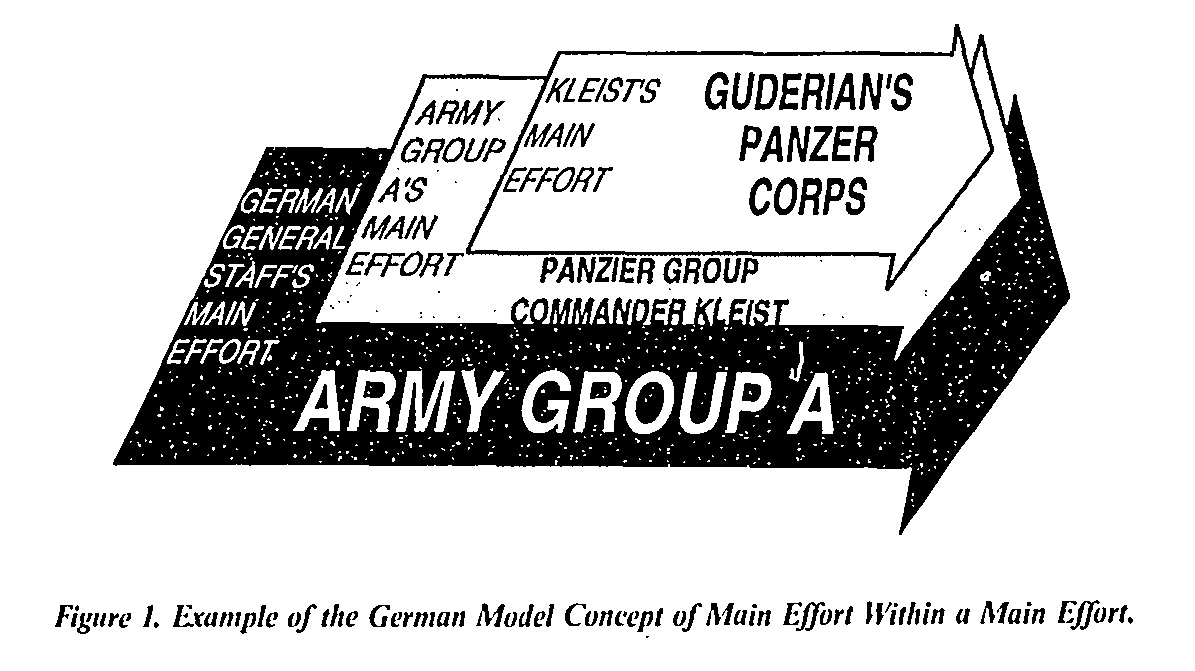
An example of this concept is again contained within the German blitzkrieg into France in May 1940. The German General Staff made Army Group A its main effort and Army Group B and C its supporting elements. Group A’s commander. Gen Gerd von Rundstedt, in turn, made Kleist’s Panzer Group his main effort. Kleist’s Panzer Group was made up of Reinhardt’s Panzer Corps (the 6th and 8th Panzer Divisions), and Guderian’s Panzer Corps (1st, 2d, and 10th Panzer Divisions). Kleist then designated Guderian as his main effort (see Figure 1).
Main Effort and Operational Maneuver From The Sea

OMFTS relies upon the naval expeditionary force (NEF) commander exercising centralized planning and decentralized leadership. It is he who. considering the situation on both the sea and the land, will conceive the operation, express his intent and concept of operations in the form of mission-type orders, provide unity of effort by determining his main effort, and respond, if necessary, to changing situations by shifting the main effort.

The tool that will enable this flexibility of main effort within the NEF is the composite warfare concept. Without using maneuver warfare terminology, this command and control concept has used maneuver warfare tenets for years. It employs commander’s intent, mission-type orders, and decentralized execution-all mainstays of maneuver warfare. Its shortfall, however, at least with regard to OMFTS. is that it is functional in design. In other words, its commanders are neither supported nor supporting, they simply perform the desired function. To take this one step further, we must add the concept of main effort-a concept that includes supported and supporting.

The commander of the NEF is in command of a variety of subordinate leaders including the amphibious warfare commander (AWC) and MAGTF commander. The important point to remember is that depending on the situation, the NEF commander can designate any subordinate commander as his main effort. He may then shift the main effort to another commander, in accordance with his plan and the developing campaign. For example, during the period when the NEF commander is trying to achieve battlespace dominance and his most immediate threat is small, fast enemy patrol boats, he may initially designate his antisurface warfare commander (ASUWC) as the main effort. Of course, the remaining warfare commanders are also supporting efforts (see Figure 2).
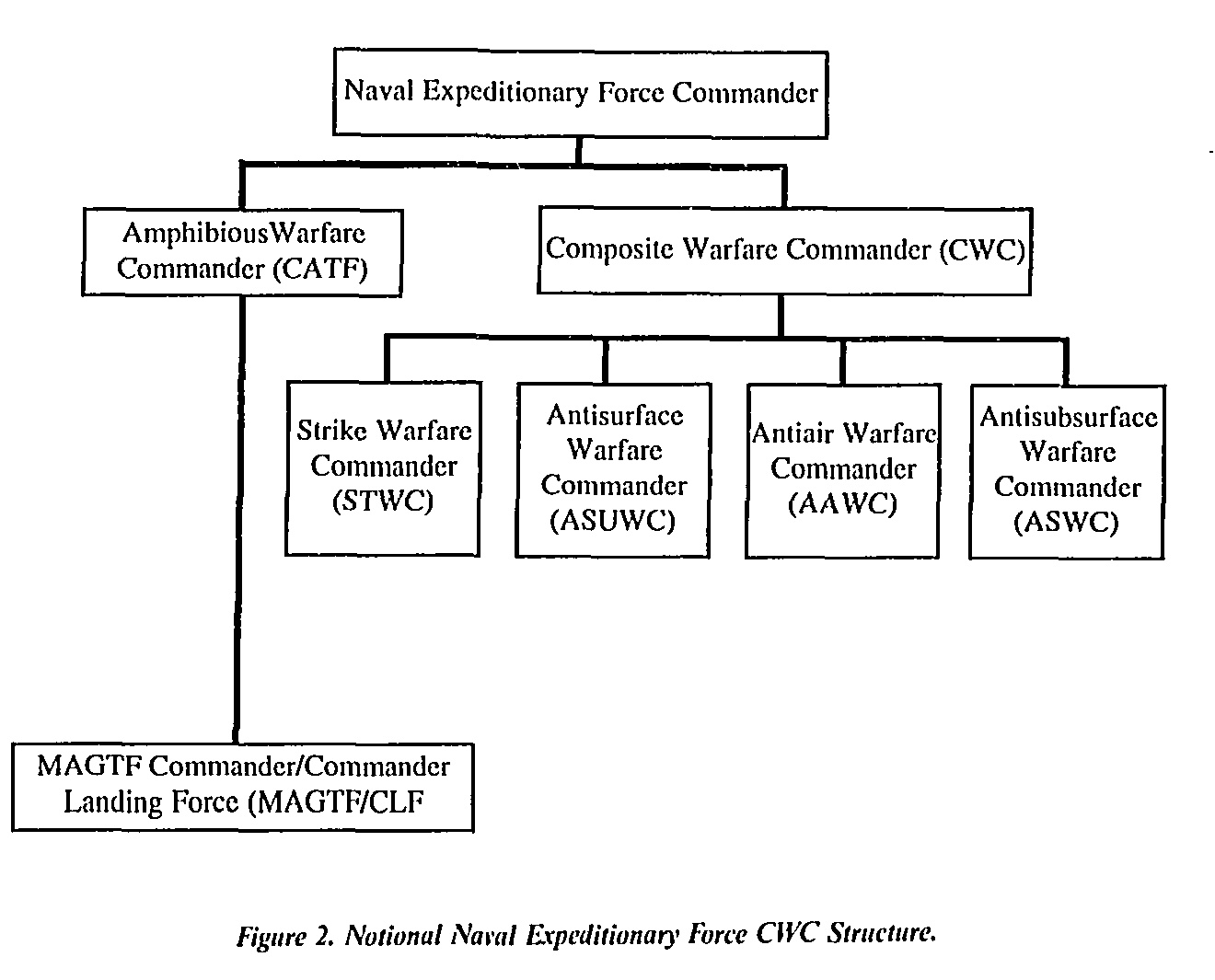
If the NEF commander receives an initiating directive or a warning order for an amphibious operation, he will designate the AWC as the commander amphibious task force (CATF) and the MAGTF commander as the commander landing force (CLF). Likewise, he will designate the CATF as his main effort. Similarly, all other warfare commanders will support the CATF as the main effort until the CATF has completed his mission or the NEF shifts it to another commander (see Figure 3).
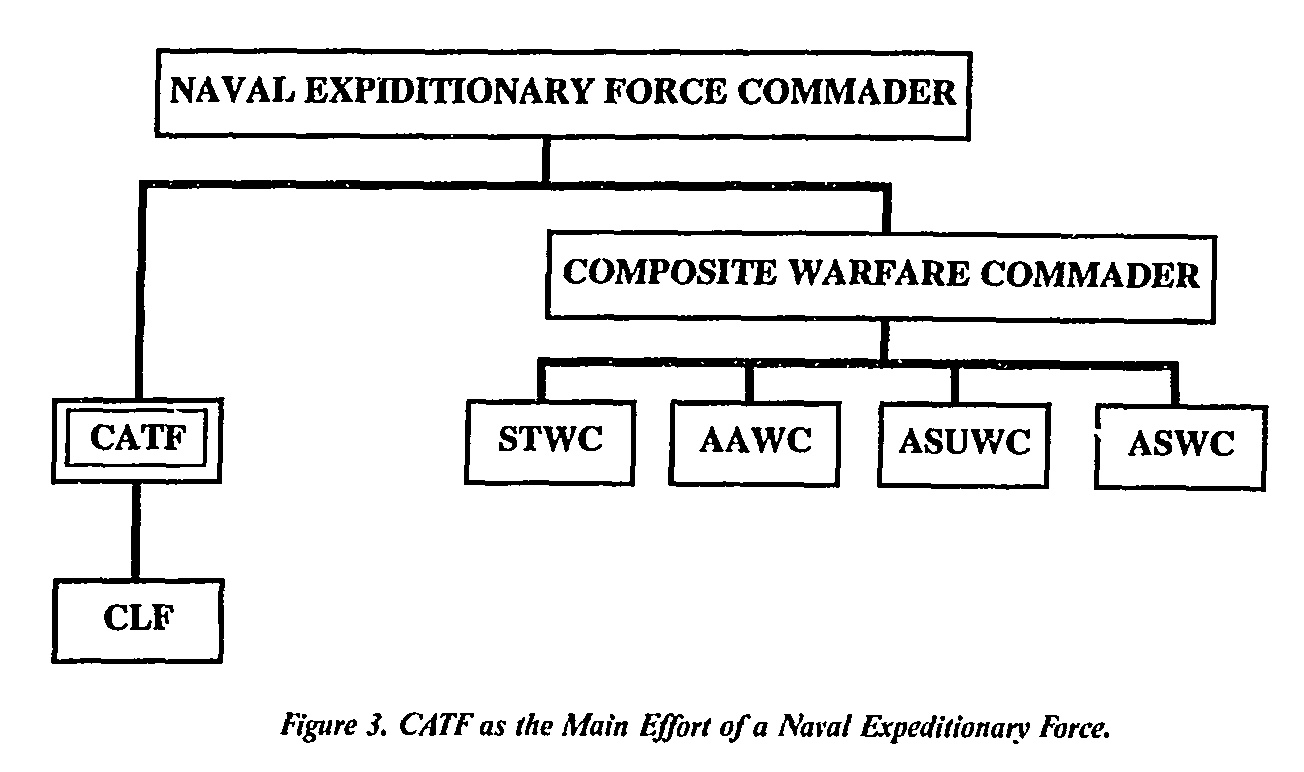
If CATF’s primary threat, however, is mine warfare, he may, in turn, designate his mine warfare commander as his main effort. All other warfare commanders will be supporting efforts and do what they can to support the CATF’s main effort. After the CATF achieves mine superiority, he may shift his main effort to the navy commander in charge of the ship-to-shore movement.

For those who are concerned that the entire NEF could be supporting a very junior commander, such as the mine warfare commander, there have been cases where the unit, which is the main effort, is tiny in comparison to the supporting units. Of course, typically in an assault, the main effort is the largest of a commander’s subordinate units. But modern maneuver warfare theory accepts that small units can be the main effort. For example, 5 weeks after the German blitzkrieg began, the main effort of the German attack on the French fortress of La Ferte was a single company of combat engineers commanded by a first lieutenant. Supporting this main effort was the reinforced artillery of an entire army corps commanded by a general.

At some point during the amphibious operation, perhaps during the ship-to-shore movement, the CATF will designate his subordinate commander, CLF, as his main effort. Because the operational level of war is central to maneuver warfare, this will be a situational decision based primarily on operational rather than tactical requirements. When this occurs, the NEF commander, the CATF, and all other subordinate commanders will support the CLF in his maneuver ashore. This arrangement, in fact, is very similar to our previous example of the 1940 blitzkrieg into France where Rundstedt, the Group A commander, who is like the NEF commander, designated Kleist’s Panzer Group as his main effort. And Kleist, who is like the CATF, in turn, designated his main effort as Guderian’s Panzer Corp, which functions like the landing force (see Figure 4).
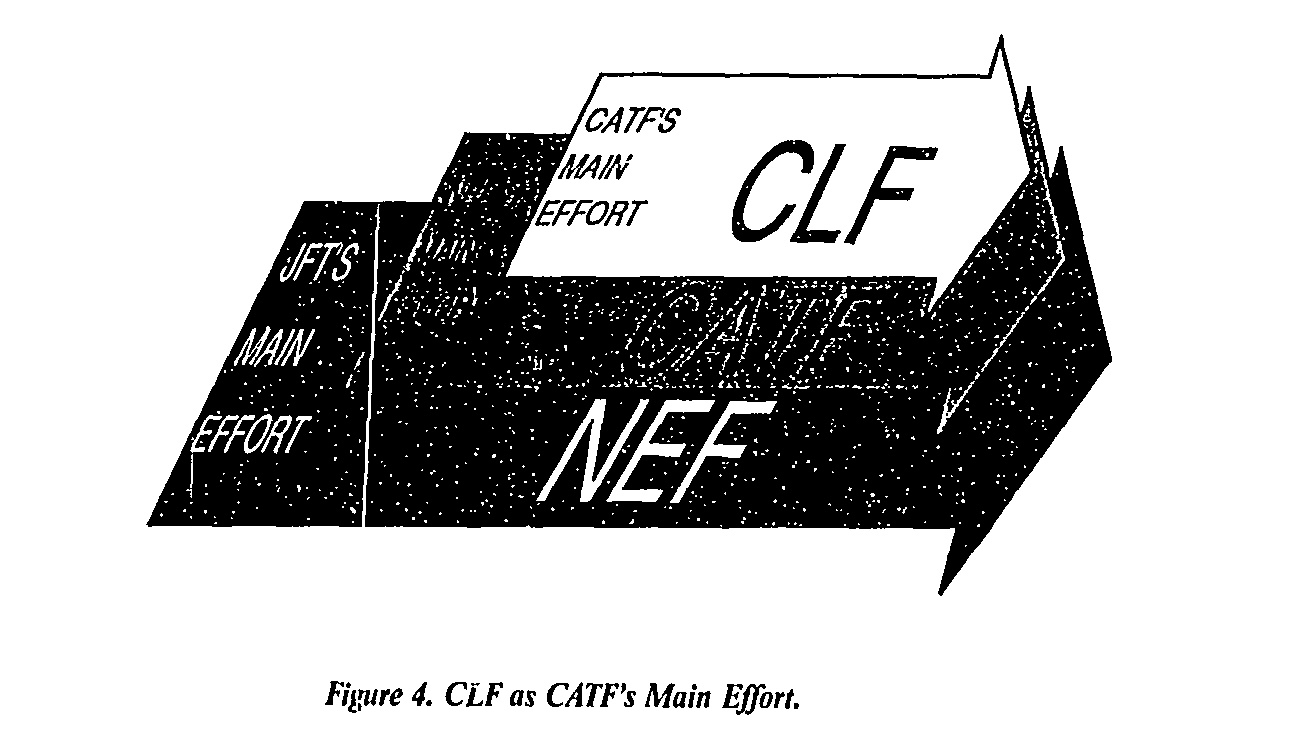
What we have introduced is the concept that within the NEF commander’s main effort, we will have two other main efforts: one is the CATF (as the NEF’s main effort); the other is the CLF (as the CATF’s main effort). While the commander of the NEF always remains in overall command, considerable autonomy and discretion is granted to the CATF, and by extension, to the CLF. Indeed, unity of command is maintained, and we have the flexibility to have all the other warfare commanders support the CLF to accomplish his operational objective.

Continuing our analogy for a supporting effort, we can compare the Navy’s strike force commander to Rommel. Like Rommel, who performed superbly in the role as the main effort of a supporting effort to Guderian, the strike warfare commander (STWC), in turn, can be expected to perform equally as well in the role as the main effort of a supporting effort to the CLF.

For example, because strike air knows the CLF’s intent in maneuvering toward its objective, strike air could continue to take actions to shape the battle to the CLF’s advantage. Examples include using strike air assets to canalize enemy movement in a desired direction or to block or delay enemy reinforcements so that the CLF can fight a piecemeal enemy rather than a concentrated one.

For most amphibious operations, once the CATF designates the CLF as his main effort, the CLF will remain the main effort until completion of the mission. We must understand, however, that during the amphibious phase of the operation the NEF commander can shift the main effort from the CATF to another warfare commander. An example would be, if we were no longer able to dominate the battlespace, the main effort of the NEF could shift to the antiair warfare commander (AAWC) or the STWC until dominance is again achieved.

Even if the main effort shifted from the CATF, the CLF would continue to be the CATF’s main effort. But the CATF would be a supporting effort within the NEF. As such, the CATF and the CLF would no longer be receiving the concentrated support and combat power from the rest of the expeditionary force. After achieving battlespace dominance, the NEF commander could, once again, shift back to the CATF as his main effort.

Solving the CWC and Amphibious Integration Dilemma

Applying this concept of main effort to the NEF should enhance our ability to conduct OMFTS. The NEF commander, quite simply, designates one of his warfare commanders as his main effort for a particular phase of the operation. He may then shift the main effort to another commander in accordance with his plan and developing campaign. This concept solves our problem of how to mesh the CATF and the CLF with the powers of the CWC who is capable of swiftly shifting the forces’ assets to meet rapidly changing threats. In other words, the CWC concept is relevant to littoral warfare if we use the concept of main effort with it.

The immediate difficulty that we in the Navy have with main effort is that it does not appear to be much different from how we now operate. In fact, several of us might argue that when the CWC does not negate a warfare commander’s request to task assets, then he is, at least tacitly, stating his main effort preference. We do not call it main effort, but it is the same thing-isn’t it?

The answer is no. We in the Navy do not understand main effort the same way the Marine Corps does. That is the crux of the problem. When we read about main effort, we look through a blue CWC lens, which only tends to distort the image. As a result, we envision main effort to be a concept where a warfare commander assumes that his assigned warfare mission is the CWC’s main effort. This, however, is not unlike the problem posed when other warfare commanders see their warfare missions as main efforts as well. Of course, the result is that several warfare commanders think and act as if they are the main effort.

We encourage this whenever we ask each warfare commander to task assets as if he were the only warfare commander who could do the job. However, when two warfare commanders simultaneously task the same asset, the CWC commander decides which one has the greater need. Thus, each warfare commander is expected to task, deploy, and fight with all the assets in the force in the best possible manner, to support his mission without regard to how the other warfare commanders might want to task or deploy these assets.

As I have shown, this is not like the concept of main effort. There can only be one main effort at a time, and, if need be, this main effort can shift. In the CWC concept, each warfighting commander thinks of himself as the main effort. This is where the CWC concept falls short in OMFTS. Warfare commanders, like the CATF and CLF, are assigned missions in littoral warfare that require support relationships within the command structure. To make the CWC relevant to littoral warfare, the NEF commander must designate a main effort. He must also clearly identify supporting efforts. And if someone is designated as a supporting effort, he must learn to ask the question, “What can I do to support the main effort?”

In summary, main effort is the tool for providing unity and decisiveness within the NEF. That is to say, main effort is the glue that holds OMFTS together. It allows the NEF commander to focus and rapidly shift his resources to exploit opportunities. When the Navy embraces the concept of “main effort,” the NEF will then exploit its operational mobility at sea and on land. That’s the surest way to guarantee successful OMFTS.
Regression

by William S. Lind

Congratulations on the July issue. A number of articles showed a growing and deepening understanding of maneuver warfare, including those by Col Gary W. Anderson, Capt Paul C. Schreck, Capt Francis C. Halliwell, Capts Michael F. McNamara and Paul C. Kennedy, and 1stLt Michael O. Barron. Jr.

Unfortunately, while Maj Kenneth F. McKenzie, Jr’s article, “On the Verge of a New Era: The Marine Corps and Maneuver Warfare,” starts out well with its brief history of maneuver warfare and the Marine Corps, it quickly gets badly off the track. The concepts that, according to Maj McKenzie, are central to the draft FMFM 2-1-battlefield geometry, battlefield systems, and top-down planning-do not represent the institutionalizatiort of maneuver warfare but rather its abandonment. These are the guiding concepts of methodical battle, the opposite of maneuver warfare.

Maj McKenzie makes plain the source of these fundamental doctrinal errors: the Marine Corps has (again) been copying the Army’s doctrine. Regrettably, after some progress toward maneuver warfare in the early 1980s, the Army has gone hard in the other direction. Army doctrine is now dominated by the concept of “synchronization,” which under different terms was also the centerpiece of French army doctrine in the 1930s, Intelligence preparation of the battlefield, battlefield operating systems, and battlefield activities, etc., all flow logically from synchronization, which is to say they are all incompatible with maneuver warfare.

In the late 1980s the Marine Corps demonstrated with the excellent Warfighting, Campaigning, and Tactics FMFMs that it was capable of thinking for itself and did not need to copy the Army’s doctrine, Each of these manuals is far superior to anything the Army has produced and all of them are used in a number of Army units. For Quantico now to return to copying seriously defective Army manuals that directly contradict the Marine Corps’ doctrine of maneuver warfare is both damaging and unnecessary.

As to the draft FMFM 2-1, if it follows the lines laid out in Maj McKenzie’s article, it represents a sad case of doctrinal regression.

New Doctrine or Slipping Into the Past?

by LtCol Gary I. Wilson, USMCR

Maj Kenneth F. McKenzie, Jr. in a well-crafted piece (MCG, Jul93) covers the spirited debate that over the last decade has led to a major change in the Marine Corps’ warfighting doctrine. The Gazette has been a key forum in this debate about warfighting philosophies.

Today, the warfighting philosophy emphasizing force ratios, attrition, and frontal bludgeoning contests has largely been replaced by one of maneuver and deception. The significance of this philosophical change was even noted by the Secretary of Defense in his Annual Report To The President And The Congress of February 1992:

The effectiveness of our Marine Corps forces was most dramatically demonstrated by the brilliant movement of I MEF through numerically superior defensive forces into Kuwait City revalidating the maneuver warfare doctrine adopted by the Corps.

While McKenzie highlights the positive aspects of maneuver warfare philosophy, he doesn’t get it all quite right and may miss the mark all together in a couple of crucial areas. For example, McKenzie contends that maneuver warfare is only now moving beyond the partially formed visions of its founding enthusiasts to become a workable, guiding doctrine. Does this mean maneuver warfare thinking of the Gulf War and the execution that sliced deep into Kuwait were mere flukes? One thinks not. Also, the advent of maneuver thinking was marked by an intellectual revival sometime ago as noted by MajGen Paul K. Van Riper in Perspectives On Waifighting No. 2, Vol. 1:

. . . many of the ideas put forth by the military reformers found a wide acceptance in the armed forces in the 1980s, especially in the Army and Marine Corps, the climate for this acceptance was created by the self-generated intellectual revival begun within the professional military schools.

One can’t help but believe that the process of transition from theory and philosophy to doctrine is more advanced than McKenzie realizes.

In fact, maneuver warfare or third generation warfare was conceptually developed and operationally tested 75 years ago during the German offensives in the spring of 1918. Recognition of this led the “founding enthusiasts” of maneuver warfare in the 1980s to ask what might fourth generation warfare look like and where do we go from here (see “The Changing Face of War: Into Fourth Generation” MCG, Oct89).

McKenzie, on the other hand, argues that maneuver warfare thinking (as mature doctrine) is “now” culminating in a set of precise terms and techniques that describe and control combat as reflected in draft FMFM 2-1, a document that he seems to regard as the Holy Grail of maneuver doctrine. FMFM 2-1 centers in part around three fundamental concepts: battlefield geometry, battlefield operating systems/battlefield activities (BOS/BACT), and top-down planning (TDP). McKenzie goes on to point out the hidden goal of these fundamental concepts is “synchronization”

While McKenzie has given credit to the Corps for throwing off its philosophy of attrition and head-on bludgeoning, he sharply turns in his focus and becomes logically inconsistent when attempting to link maneuver thinking to the concepts of synchronization, BOS/BACT, and TDP. Synchronization means you can only move as fast as your slowest unit. This definitely is not a tenet of maneuver warfare. Col James G. Burton. USAF(Ret) in Proceedings (Jun93) describes in vivid detail how VII Corps Ml tanks performed in DESERT STORM. They did well, but an overemphasis on synchronizing and battlefield geometry (phase lines and control measures) allowed Saddam Hussein’s Republican Guard to slide out the back door.

If synchronization is indeed a hidden goal of FMFM 2-1 as McKenzie suggests, it appears that the Corps’ warfighting philosophy is being led down the primrose path. Marines will be so busy synchronizing battlefield operating systems and battlefield activities with top-down planning (to say nothing of scoping out battlefield geometry) that there will be little time left to engage the enemy. As Col Burton commented:

Clearly, Frank’s failure to cut off the Republican Guards’ escape can be traced to his strict adherence to the synchronization element of the Army’s new doctrine Synchronization also prevented Luck and McCaffery from circling around behind.

Additionally, McKenzie describes draft FMFM 2-1 as a close cousin of the Army manual FM 100-15. Corps Operations. Does the Marine Corps want doctrine that so closely resembles Army doctrine? After all, it was this doctrine that literally provided the dogmatic underpinnings allowing the Republican Guard to skip out the back door.

I suspect LtGen James C. Breckinridge is rolling in his grave at the prospect of Marine Corps doctrine so closely iesembling Army doctrine. Ms Kerry Strong, Archives Director, Marine Corps University, in a research paper quotes one of Gen Breckinridge’s constant complaints in the 1930s, “Marine officers are not Marine officers in much more than official designation. They are Army officers in Marine uniform . . .” Ms. Strong writes that Breckinridge believed this because Marine Corps schools imitated Army schools. When Army personnel asked for information on what the Marines were doing and what they had developed “in their own particular line as Marines,” the Marines offered them back most of their own Army teachings.

One can only wonder if Maj McKenzie’s views and draft FMFM 2-1 do not represent a throwback to an earlier era and a resurgence of old doctrinal dogma so disdained by Gen Breckinridge.

Doctrinal Change: The Move to Maneuver Theory

by Col Michael D. Wyly, USMC(Ret)

Maj Kenneth F. McKenzie, Jr’s “On the Verge of a New Era,” (MCG, Jul93) captures some of the history of the long struggle for maneuver warfare, but among the missing parts is the most essential: The real origin of maneuver warfare was in Vietnam in the 1960s. Had there been no Vietnam, no body-count strategy, no attempts by senior officers to apply outdated, rigid doctrine to fast-moving fluid battles, no lost war-and had there been no returning veterans, conscious of the inadequacy of our old doctrine-there would have been no maneuver warfare.

What’s more, had there been no William S. Lind or John Boyd, we would have continued our fight for a new style of fighting anyway. The hard lessons learned in combat left an indelible mark on the minds of many of us. But whether or not we would have prevailed in the end as we did without the help of a few outside the organization remains an unanswerable question. We were, after all, relatively junior in rank then, and our views were not favored by colonels and generals.

Our quest for a better way began in combat in Vietnam, as did our experiments with fluid tactics and high initiative at the lowest levels. The need for change was clearly visible at junior levels, among lieutenants, corporals, and sergeants, but often not so among the more senior. The problems in the years that followed were in getting the Corps’ hierarchy to admit that change was needed and in developing an articulation of what those changes ought to be. Maj McKenzie is correct that our observation of the Arab-Israeli wars, especially in 1973, added to our realization that change was urgent. But the struggle had already begun, inexorably, years before.

We who had already committed ourselves to change drew in Lind and Boyd because Lind’s appreciation of history and Boyd’s use of fighter tactics as a model upon which to rethink tactics on the ground added to our bank of source material for ideas. Both men had already become active on their own, outside the Marine Corps-their original dissatisfaction, too, having roots in their observation of Vietnam. But we gave Boyd and Lind as many ideas as they gave us, to which they have always freely admitted.

Lind’s name became disproportionately prominent partly because a rigid Marine bureaucracy found him a convenient scapegoat for criticism in their effort to defend the status quo. Of him they could say “He’s never been in combat so he can’t be right.” So a separate controversy having nothing to do with tactical thought arose surrounding him, a manifestation of George Bernard Shaw’s axiom: “All professions are conspiracies against the laity.”

The truth is that both Lind and Boyd were a tremendous help to those of us who had experienced combat on the ground and sought a better way. First of all, it had gotten lonely within the Corps for those of us pressing for change. As civilians, they could bring pressures where we could not, finding ourselves at every turn “outranked.” Contacts outside the Corps helped to broaden our horizons beyond the Vietnam experience as well, which was important because it was predictable that the next war would not be Vietnam all over again, though it too, would call on us to break from our old doctrine.

But all in all, it was what we saw in combat in Vietnam, contrasted against what Quantico through the 1970s and 1980s insisted on perpetuating as doctrine despite its irrelevance to real war, that drove us to our present style of fighting.

The Last 300 Yards

by Capt Daniel J. O’Donohue

The frontal attack is the most frequent form of attack.

-German Tactical Doctrine

20 December 1942

FMFM 1, Warfighting has spurred a tactical renaissance in the Marine Corps that largely ignores the problems of assaulting the enemy. This preoccupation with maneuver overshadows the squad leadership, fire support techniques, and tactics that propelled divisions across the beaches of Iwo Jima and Inchon. Maneuver warfare seeks to bypass and collapse the enemy’s resistance. Using soft spot tactics. Marines exploit gaps or critical vulnerabilities, thus negating the need for direct, frontal attacks. Some even argue that this warfighting philosophy demands light infantry units that specialize in patrolling, raiding, and infiltrating. The focus is on stalking rather than assaulting skills. In short, the tactics of closing the last 300 yards of an infantry assault is losing pride of place in our training and doctrine. This approach risks leaving fire team and squad leaders unprepared for the chaos and confusion of their first combat assault.

Closing the last 300 yards of the infantry assault is one of the most demanding tactical maneuvers. The accuracy, range, and lethality of modern weapons magnify the inherent difficulties of moving while under fire. Almost every enemy infantryman is armed with at least an automatic weapon. An enemy squad, equipped with only assault rifles, can deliver 6,000 rounds a minute during these last 300 yards. Over the same ground, the assaulting unit’s supporting fires lose their effect. Artillery, air, mortar, and machinegun fire must shift as friendly troops mask or assault into the kill radius of these weapons. The difficulty of closing this ground without an obscene number of casualties is a compelling reason for maneuver.

Unfortunately, maneuver is not always an option, and proficiency in the close assault is essential. Against competent opponents, gaps will not be readily apparent. Surfaces may be disguised as gaps and vice versa. Additionally, the unpredictable meeting engagements of a chaotic battlefield are won through rapid assaults. Finally, a “soft spot” is a relative term. A battalion may plan a flanking movement to exploit an enemy weakness. For the assaulting squads, however, the battle may be a frontal attack, possibly against a well-prepared position. In fact, the smaller the unit the greater the likelihood of frontal attacks. For the private first class, every attack is a frontal attack.

Despite 13 years of debate and 3 years of doctrinal support, maneuver warfare theories within the Corps have not successfully addressed the problem of the last 300 yards. The most glaring disconnect between theory and practice is the parade-deck method of squad and fire team rushes. This method is still widely practiced in the fleet and taught in some of our schools. During the course of the attack, the squad leader directs his squad from the rear through voice and hand and arm commands. The emphasis is on inward control of the squad as fire team and individuals move in choreographed formations dictated by the squad leader. This form of positive control might work on quiet, linear, and open battlefields. However, this inward precision takes the focus off the enemy, ignores the impact of terrain on movement, and stultifies the initiative of fire team leaders. The centralized control and rigid techniques practiced in our most fundamental fighting unit are a damning indictment of our implementation of FMFM 1.

An infantry assault can occur under a wide variety of circumstances. An assault at night in urban terrain to clear a building against infantry clearly differs from a daylight attack in a forest against a mechanized unit. Still, a common tactical approach, true to the principles of FMFM 1, is essential to fielding squads that can rapidly close the last 300 yards.

The Squad as the Fundamental Tactical Unit

The first point to emphasize is that squads are the focal point of the assault. A battle is shaped to allow these units to work their way across the objective successfully. The true measure of an army is, in fact, the esprit and tactical proficiency of the squad. The strength of German arms in World War II was built as much on superb infantry squads as the more widely publicized panzer divisions.

By any measure, the size of the basic tactical unit has decreased over time. Napoleon’s battalions were replaced by companies in the Austro-Prussian War of 1866 (The Captains’ War), and the companies by stormtroop squads of World War I. A basic tactical unit is the smallest element capable of:

* Independent action or performing a simple combat task.

* A personal relationship between the unit leader and his men.

* Voice control by the unit leader.

Today, the squad is the highest level of organization that meets these three criteria. The increased range and lethality of weapons is forcing greater dispersion of units on the battlefield. In his book On Infantry, John A. English estimates that from 1800 to the present, the number of men required to defend a mile of battle front has diminished from 20,000 to 1,000. Thus the squad is the basic fighting unit.

Additionally, the squad is the lowest level at which a unit can fire and maneuver simultaneously. The squad leader can employ his three fire teams and squad weapons to achieve the correct balance between suppressive fires and maneuver units. A decentralized battle fought by squad and fire team leaders provides flexibility to the attack. These small-unit leaders are in the best position to hunt for the line of least resistance. They can exploit the advantages afforded by microterrain and the enemy’s defense.

The last 300 yards of the assault, however, presents more than just a tactical problem. The moral problems of the assault are equally as important and best solved by the squad. On a dispersed battlefield, it is the moral authority of the squad leader and the cohesiveness of his squad that will cause men to assault. The fighting spirit of the Marine Corps is built on the cohesion and small-unit leadership of squads.

The NCO as a Decisionmaker

Within the context of a decentralized and dispersed assault, the squad and fire team leaders become key tactical decisionmakers. Their role is to penetrate lines of least resistance and maintain the momentum of the assault. The squad leader leads from the front, focusing the squad’s efforts forward. Instead of using rigid command and control procedures, squad leaders designate a base fire team from which the other two fire teams guide.* Squad leaders expect fire team leaders to do much more than relay commands. A fire team leader should grab ground with initiative, using every advantage terrain and enemy dispositions afford him to pull the attack forward. Fire teams do not have to stay on line but can leap forward if the opportunity permits. The base fire team provides a general reference to the direction and speed of the attack. It should not, however, restrict the tempo of the attack. The pull from the front, not the push from the rear, decides the speed and direction of the assault.

Under these conditions, squad and fire team leaders must rapidly orchestrate the best line of attack, speed, and combined arms effect for their weapons. Among the most difficult and subtle decisions is deciding whether the squad is winning or losing. Many engagements are won by the leader who takes the “longer breath” and continues the assault despite seemingly insurmountable difficulties. As Gen Alexander A. Vandegrift noted in World War II “. . . there comes a point in every close battle when each commander concludes that he is defeated. The leader who carries on wins.” It takes a skilled squad leader, however, to tell the difference between intestinal fortitude and pressing a doomed attack. An equally difficult task is determining when to call for help. Deploying a platoon or calling for artillery fire to remove a sniper is time-consuming and wasteful. The squad leader must develop a feel for the threats he can handle without slowing the attack to employ outside assistance. Moreover, squad and fire team leaders must decide these issues while employing their personal weapons, for they are fighters as well as leaders.

On the maneuver warfare battlefield, noncommissioned officers (NCOs) must make decisions based on tactics, not just rigidly apply techniques. The decisionmakjng requirements are stringent. As was noted in Infantry in Battle, published in the 1930s:

. . . the leader who would become a competent tactician must first close his mind to the alluring formula that well-meaning people offer in the name of victory . . . he must learn to cut to the heart of a situation, recognize its decisive elements and base his course of action on these. The ability to do this is not God-given, nor can it be acquired overnight; it is the process of years.

Fire Support

The suppression of the enemy’s weapons on the objective during the assault is normally the most critical task of company fire planning. Within this context are two critical decisions-when to initiate indirect fires and when to shift supporting fires in order to prevent friendly casualties.

* Initiating Indirect Fires: Indirect fires are an important component of the combined arms effect called for in FMFM 1. This combined arms effect, however, is much more responsive when achieved with organic weapons. At the lowest level, the bursting power of the hand grenade complements the direct fire of the M16 rifle. Hand grenades drive out and destroy an enemy driven to the ground by a fire team’s direct fire weapons. German stormtroopers of World War I and Marine infantrymen of the Vietnam War were alike in their keen appreciation for the grenade as an indirect fire weapon. The M203 grenade launcher increases the fire team’s indirect fire range from 50 to 300 meters. The shoulder-launched multipurpose assault weapon (SMAW) and AT4 can also be employed to complement the squad’s M 16s and squad automatic weapons. Although these are direct fire weapons, their concussion and bursting power simulate the effects of an indirect fire weapon. All these weapons can be directly controlled by the squad or fire team leader.

The company 60mm mortars, battalion 81mm mortars, and the artillery battalion provide the rifle squad increasing firepower. but at a price. The cost is decreased responsiveness-the additional time required to call for and adjust these weapons. A squad leader should aggressively employ his organic weapons to achieve fire superiority during the essential first moments of a firefight. An excessive reliance on supporting arms will slow the assault. In both Vietnam and Grenada, units would needlessly halt the attack in order to employ nonorganic supporting arms.

This is not to say that artillery support should be forfeited in all circumstances. Rather, the desired combined arms effect should be initially built using the organic weapons of the lead units in contact. The supporting arms of companies will therefore build on the firepower of squads, and battalion’s firepower will build on the company’s. The combined arms effect is thus built from the frontlines to the rear and from lower units to higher. This method fosters the aggressiveness, maneuver, and initiative of forward units. Moreover, a little well-organized violence now is better than a lot later, especially during a hasty attack when speed is essential.

In all cases, supporting weapons should be pushed forward to maximize their responsiveness to lead units. Rommel, for instance, would position his artillery with his assault troops. Even at the company level this practice is not always followed. The 60mm mortar is a case in point. Company mortar sections can use the improved range of this mortar to fight from more secure (and rearward) firing positions. From these positions, however, they are subject to the uncertainties of radio communications, lose situational awareness, and are incapable of directly engaging targets (direct lay). The company commander’s “hip-pocket artillery” should be just that, well forward in his hip pocket.

The obscuration and suppression effect of supporting arms is often required to cover an assault. If at all possible, however, surprise should be preserved. The closer an assaulting force gets to the objective before opening up the better. Not only is the enemy put off psychologically, but he has had less time to bring his heavy weapons systems to bear.

* Shifting Supporting Fires: In many cases, surprise is not possible and supporting fires must be used to cover the assaulting force. At approximately 300 yards, the assaulting force must begin shifting the supporting fires that cover its assault or risk friendly casualties. Therefore, just as an assault leader is subject to the bulk of the enemy’s firepower, his own fires diminish. There are several methods to counter this effect:

– Establish a gun-to-target line that is perpendicular to the direction of attack. This placement minimizes overhead fire and the masking of fires by lead units.

– Maximize the employment of organic direct and indirect fires in the final stages of the assault. The relatively small bursting radii of the 60 and 81mm mortars allow them to be fired much closer to the assaulting units than artillery. The Mk19 automatic grenade launcher, SMAW, and AT4 can apply bursting munitions with still more precision.

– Use effective signals to shift base of fires. “Leaning into” your supporting fires is possible by either allowing a certain amount of fratricide or by devising an effective signal for shifting fires at the last moment. One method is to mark an assault’s advance by using infrared chemical lights that can be observed through a night observation device at the base of fire. These infrared lights can be strapped to the helmets of a flank or lead unit. Larger chemical lights can be thrown on the deck.

Minimum Essential Control: The Role of Platoon and Company Commanders

The infantry assault is a series of nested battles that begins with the squad sector and works up to the platoon, company, and battalion battle. The platoon commander assigns sectors, protects squad flanks, shifts the main effort of his attack when required, and acts in general as an onthe-spot problem solver for his squad leaders.

The company commander is also up front controlling the suppressive fire of his machineguns and mortars. His job is to shape the battle for his nine squads. He sets the framework for the attack and the employment of company-level combined arms. Supporting fires are used to protect flanks and isolate the battlefield for platoon commanders and squad leaders.

Once the company is in the final assault, the company commander cannot retain positive control, nor should he. Once supporting arms are shifted, it is a squad leader’s battle. How then does the company commander prevent a company attack from dissolving into a series of independent squad actions? A company commander must retain the minimum essential control that ensures a coordinated attack without limiting the aggressive actions of his squad leaders. There are several ways to do this.

* Above all is a commander’s intent that includes a clear end-state for the attack. This commander’s intent started the day the company commander assumed command and was consciously reinforced during training. By the time of the assault, unit leaders should know how their commander operates in general and his specific expectations for the attack. When the company commander unleashes his assaulting squads, this intent will guide the attack.

* An effective leaders’ reconnaissance and rehearsals are also important to synchronize the assault Contingency plans and coordination problems can then be worked out.

* A base unit, the main effort, can be used to guide the attack rather than detailed timetables. Units can move, begin firing, and shift fires in relation to the base unit. By controlling just one squad, the base squad in the platoon with the main effort, the company commander can control his company.

* A follow-and-support unit can be used to reinforce the main effort. This unit can be task organized to provide engineering support enemy prisoner of war teams, first aid and litter teams, and demolition teams. This unit can also destroy bypassed units and, in general, support the rapid advance of the main effort.

* A company commander can also train his subordinates to think two levels up. In the attack, squad leaders are considering the company when looking for attack positions, directions of attack, and likely enemy weak points. When stalled in their attack, they can fix the enemy and scout for a company attack. By thinking two levels up, squad leaders provide the reconnaissance pull for the company, not just their squads.

Implications

* The tactical responsibilities of NCOs as decisionmakers must be recognized by increased status, training, and education. Meritorious and regular promotions to NCO should be based on these moral and tactical responsibilities. Squad leader’s school should be expanded to include fire team leaders who are now expected to be tactical decisionmakers in their own right and must fill the gap if the squad leader is hurt or killed. Company training should focus on squads. In short, NCOs must become the “backbone” of our Corps in fact as well as name.

* Company training should focus on squads. The pull of higher level commitments must be resisted. Once the company commander has unleashed his dogs of war into the assault, he has lost positive control. His responsibility is to train the squads realistically, provide a clear commander’s intent from the day he arrives, and frame the battle. A company commanders attempt to control the final assault personally is doomed to failure. In the words of S.L.A. Marshall:

. . . no commander is capable of the actual leading of an entire company in combat. . . . therefore [he must] determine which are the moral leaders among his men when under fire, and having found them, give all support and encouragement to their effort.

* The art and science of employing weapons as combined arms must be emphasized at every level, but especially within the squad. Regular and realistic live firing drills are the key. Hand grenades must be integrated into live fire assault courses. If not, we risk fielding Marines hesitant in the employment of a key infantry weapon. The exceptional weapons handling of our individual Marines in Somalia is, in large part, a tribute to the training and ammunition invested at the Schools of Infantry. Are our squad and fire team leaders equally adept in the combined arms employment of their organic weapons? At a minimum. Fleet Marine Force ammunition allowances and live-fire ranges must be maintained during budget cuts to ensure this proficiency.

* Finally, Marine Corps doctrine and training should recognize the complexity of closing the last 300 yards of an infantry assault. Doctrinal guidance within the maneuver warfare context must be provided and training standards should be developed.

Conclusions

Although it is not the preferred form of maneuver, the frontal attack is one of the most likely and demanding. Squad leaders and company commanders alike must prepare for the technical, tactical, and moral problems associated with closing the last 300 yards of the assault. Although maeuver warfare seeks to bypass units and obstacles that cannot affect the mission, organized resistance must be anticipated. This is especially true in an age when even Third World armies are fielding excellent infantry. When infiltration, envelopment, or bypass are impossible, maneuver warfare tenets still apply to the execution of a frontal attack. Leadership from the front, reconnaissance pull, combined arms, and the enhanced role of junior leaders will ensure squad leaders of the future are ready for the chaos and confusion of their first attack under fire.

Maneuver Warfare Theory

by Capt Michael R. Ramos

I read with interest LtCol Lauer’s article. “The Theory of Maneuver in USMC Doctrine and Force Structure” (MCG, Apr93), which challenges the Corps’ reliance on maneuver warfare theory as the basis for its doctrine.

While I agree wholeheartedly with him that the focus of the curriculum at The Basic School must be to teach lieutenants a solid grounding in tactics, techniques, and procedures, I believe the main point of his article is a faulty one. Maneuver warfare theory does not ignore the lessons of Marine combat experience. The theory of maneuver has evolved from a learned appreciation of what an expeditionary force will face in future engagements. We can no longer presume the luxury of having the vast numerical superiority over our enemy that we had in the past. Our doctrine must cope with reaching a rapid decision, with minimal casualties and limited external support, against a physically superior foe. Our doctrine of maneuver warfare, if understood and correctly applied, provides significant opportunity for success under these conditions.

Additionally, maneuver warfare theory does not discount the value of firepower. Indeed, firepower will often be essential in shattering the enemy’s moral and physical cohesion. The key is in not applying firepower indiscriminately, but concentrating overwhelming fire superiority at decisive points to suppress, neutralize, or destroy an enemy in order to achieve a larger purpose.

The MV-22, M1A1, LAVAG, MLRS, and other battlefield operating systems can and should be components of a force structure based on maneuver warfare doctrine. Our combat experience tells us that these systems and maneuver warfare offer the greatest chance for success in future conflicts.