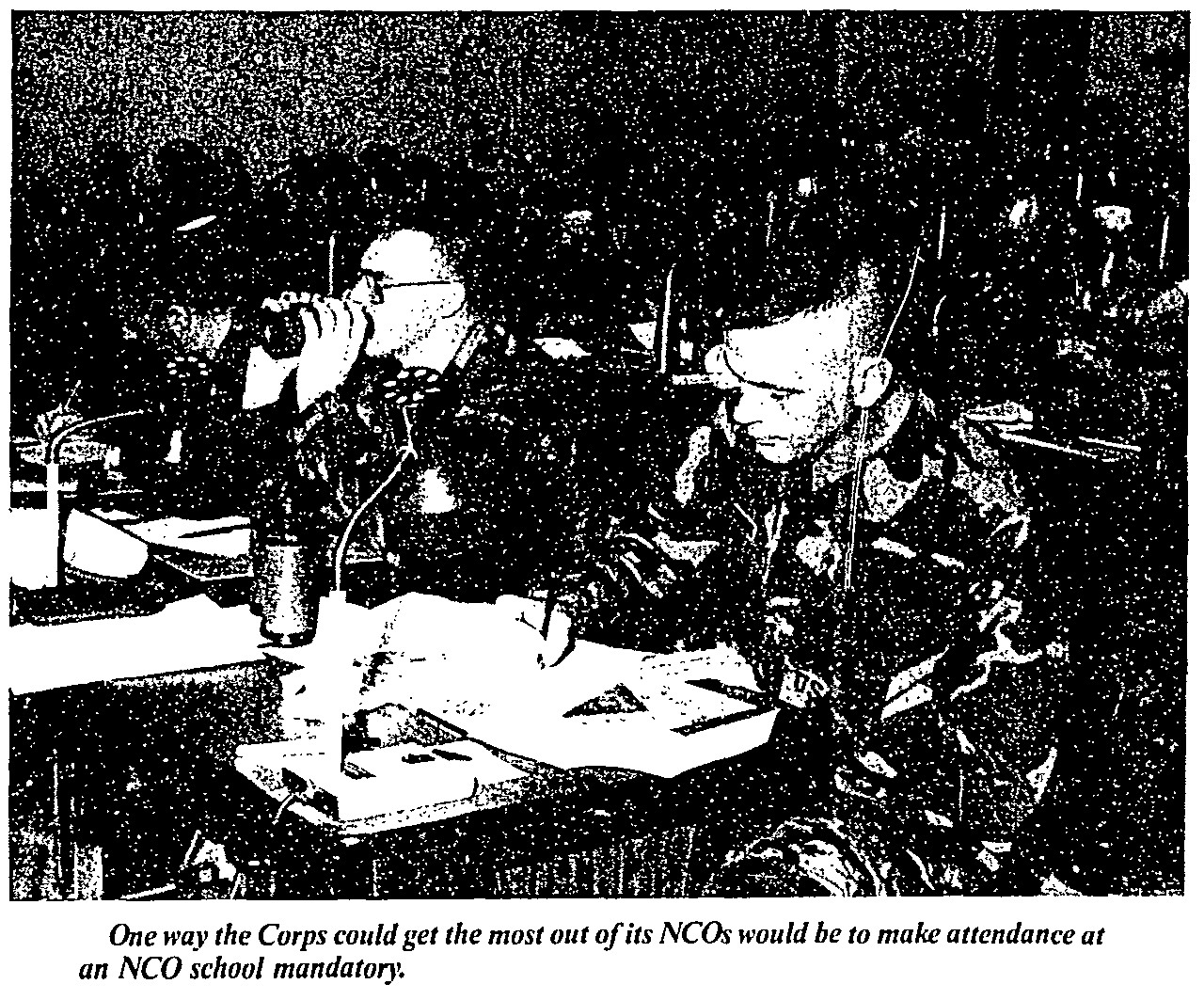
Leadership for a More Educated Corps

by Capt Francis E. Halliwell

With its emphasis on mission orders, maneuver warfare demands Marines who can be innovative, creative, and flexible-Marines who can exercise initiative in fast-moving, fluid situations without the benefit of orders. This need is clearly identified in FMFM 1. Warfighting, which states that “the Marine Corps’ style of warfare requires intelligent leaders with a penchant for boldness and initiative down to the lowest level.” Marines with these characteristics will enable our Corps to take advantage of the chaotic battlefield of the future, rather than be hindered by it. These traits, however, don’t come from Marines who just follow orders as if they were robots: they come from thinking Marines with inquisitive, questioning minds. Stifling those minds by requiring blind obedience would destroy the traits we hope to exploit through maneuver warfare. It becomes our duty, therefore, to encourage the questioning, thinking nature of our educated Marines. This will be especially important over the next few years since the average intelligence and education level of our Marines is going to increase, as only the best and brightest will be recruited and retained in a Corps of decreasing size.

The question for us then is this: How do we lead Marines who are encouraged to question orders and authority? The answer is quite simple: We lead them as we always have. All the leadership traits and principles we are familiar with still apply. Today, however, we need to give greater emphasis to the principle of keeping our Marines informed. Since most Marines today are better educated than their predecessors, keeping them informed of basic decisions, such as what we’re doing or where we’re going, isn’t enough. Today’s Marines are a part of the information age. They are accustomed to receiving and accessing almost any information desired, and they bring that expectation with them to the Corps. In a time when we can watch a war on television from the enemy’s point of view, what else can you expect? Under these circumstances we must be prepared to explain the rationale behind our decisions-the why to go with the who, what, when, and where. When a Marine questions why a task is necessary, why it needs to he carried out in a particular manner, or why one Marine is carrying out a specific task rather than another, we must be prepared to explain. If we tell the Marine to just follow orders, he may have lingering doubts as to its validity or appropriateness. Given time, these doubts could jeopardize his trust and confidence in his leader. On the other hand, by answering the question we clear up any doubts or misunderstandings and prevent any loss of trust. Additionally, the Marine’s question may reveal a weakness in the plan that a change in the order might remedy. As frustrating and distracting as it may be, this questioning behavior results in several other important benefits to the Corps.

First, when we take the time to encourage and answer questions, we show a Marine that we care about him and his opinions. Additionally, when we keep an open mind toward criticism, we allow a Marine to participate in the decisionmaking process. This practice is highly recommended by FMFM 1. which states that ” . . . until a commander has reached and stated a decision, each subordinate should consider it his duty to provide his honest professional opinions. . . . ” LtGen Louis Metzger, in his article “Some Thoughts on Leadership” (MCG, Jan93), concurs when he reminds us that “communication is a two-way street.” Finally, LtCol Jon W. Blades, USA. in his book Rules for Leadership also support (his two-way communication and suggests that this practice is good not only for morale, but for unit esprit and cohesion as well.

Second, in explaining the purpose or intent behind an order, a leader demonstrates the reasoning that went into his decisions; and that explanation assists a Marine in learning how he should think. If he understands how his leader’s mind works, then he will have greater trust and confidence in the leader’s decisionmaking ability. Over time, this increased trust will result in fewer questions and better understanding. Some might argue that many leaders don’t have time to be constantly answering the questions of Marines, but they’re wrong. In my experience, there is rarely a time when a leader can’t spare a few moments to explain his order or reasoning, particularly in peacetime. It is usually poor management on the part of a leader that creates the illusion of a lack of time.

Finally, a biproduct of the previous two benefits is the development of a certain rapport between the leader and those he leads. This is manifest in his ability to communicate implicitly with Marines-that is, communicate without the benefit of the physical transmission of information, but rather through a shared way of thinking. Thus, just as a less-educated Marine may instantly carry out an order, we can also expect instant obedience based on trust and an understanding of our reasoning from our educated Marines. It is this kind of response that enables Marines to adapt to changes and achieve our intent even if the assigned mission is no longer valid. It is this kind of response that is crucial for maneuver warfare, which requires implicit communication in order to achieve maximum results. This capability, in and of itself, is worth any frustration that might result from encouraging questioning from our Marines.

By way of an example, let me describe the events during which I first became aware of this questioning behavior among my Marines, and how I used it to my advantage. While on sea duty. I wrote the Marine detachment’s guard orders and most of the detachment’s standing operating procedures (SOPs). I had put a lot of effort into them and was quite proud of the result, but upon publication I was besieged with questions and comments. I listened to these questions and, in turn, explained the rationale behind my decisions. We then evaluated what would work best. Quite often, the recommendations I received improved the original orders and drove me to modify them accordingly.

This questioning behavior, however, was not limited to just orders and SOPs, instead it encompassed almost everything we did. I routinely took the time to explain my reasoning when a question arose and would not hesitate to make changes if a better alternative was proposed. This practice helped build a deep sense of mutual trust and confidence. Eventually, the detachment developed into a highly efficient organization in which implicit communication was self-evident. Later, when we went through the Nuclear Weapons Acceptance Inspection, we passed with flying colors, and I credit this to the inquisitive, questioning nature of my Marines. All this may seem like common sense to you, and you may wonder what this has to do with maneuver warfare, but the point is that if I had demanded silent obedience rather than encouraged questioning, the performance levels and degree of implicit communication we achieved would never have been possible, and that is a lesson that can be applied universally.

I admit that the idea I have presented isn’t new. To keep Marines informed is routine procedure for any good leader, as is the practice of providing subordinates with the maximum opportunity to exercise initiative and flexibility. What is new, however, is the depth and extent to which we must be prepared to explain our orders and decisions to our subordinates. If we are afraid to explain, or cannot articulate, the reasoning behind our orders, then perhaps the order should never have been issued. The key to keep in mind is that our Marines do not question orders or authority in order to be disruptive. They do so in a genuine effort to learn, to improve, and to achieve the goal, whatever it might be. It is our job, as leaders to ensure that they are equipped to do just that. If the price we must pay is to answer the questions of our inquisitive Marines, then it is a small price to pay for such a large reward.

On the Verge of a New Era: The Marine Corps and Maneuver Warfare

by Maj Kenneth F. McKenzie, Jr.

As the dawn of a new century approaches, the Marine Corps is poised to employ a sophisticated, highly structured version of maneuver warfare as its principal tactical doctrine. The preparation of a formal doctrine heralds the beginning of a new age in Marine Corps tactical thinking: an age in which the philosophies of maneuver warfare, now accepted as the Corps’ style of fighting, gain structure through a variety of planning and combat systems. The sum of this is to lend precision and speed to combat, while supporting the tenets of maneuver warfare. To understand the significance of this change, it is necessary to journey back more than a decade to 1980 and follow the development of maneuver warfare in the Marine Corps. This development occurred in two distinct periods, and a third period is currently struggling to emerge.

The First Period: Experimentation

The first period of maneuver warfare in the Marine Corps was from 1980 until 1989. During this time of experimentation. Marines tried, adopted, and discarded tactics and techniques, seeking to find a measure of equilibrium between fire and maneuver on the battlefield. Competing philosophies of warfighting sparred, all explicitly rejecting the traditional primacy of fire over maneuver. This was a response to Army and Marine Corps doctrine of the 1970s, which reflected a firepower based outlook on war. rooted firmly in the American tradition of overwhelming strength and technological superiority. The 1973 Arab-Israeli War seemed to support this vision of a lethal, highintensity battlefield dominated by fire. Centralized control was more important than the possible positive effects of decentralized execution and decisionmaking. In the Army, this was the “active defense.” In the Marine Corps, suppression of maneuver in favor of fire was expressed through restrictive control measures, rigid reporting requirements, and an obsession with linear deployment.

The recurring credo of the 1970s was concentration. Mobility was a means to serve the end of concentration, which produced the superiority of firepower needed to overcome a numerically superior foe. If anything, a doctrine that emphasized fire over movement fit the Marine Corps better than the Army. The Marine division faced significant problems in attempting to maneuver on the battlefield because its table of organization did not provide adequate organic lift for sustained mobile land combat.

By 1980, criticisms of the firepower model coalesced around what seemed an inescapable fact: the doctrine did not offer a formula for decisive victory. Since attrition-a favorable exchange ratio-was the goal, it was difficult to shape battles to a larger purpose: the annihilation of the enemy.

Like a boiling pot, a spillover was inevitable. In a March 1980 article in the Marine Corps Gazette, “Defining Maneuver Warfare for the Marine Corps,” William S. Lind sounded an overture to the birth of maneuver warfare in the Marine Corps. In attacking the attrition model, he argued for:

. . . warfare on the model of Genghis Khan, the German blitzkrieg and almost all Israeli campaigns. The goal is destruction of the enemy’s vital cohesion-disruption-not by physical setpiece destruction. The objective is the enemy’s mind, not his body. The principal tool is moving forces into unexpected places at surprisingly high speeds. Firepower is a servant of maneuver. . . . Maneuver warfare is more psychological than physical.

Presciently, Lind’s article used as an example a future war in which Marines were employed to assist Saudi Arabian forces in thwarting an Iraqi invasion. Lind’s maneuver warfare thinking was based on the “Boyd Theory,” the work of Col John Boyd, USAF(Ret). The Boyd Theory proposed the reiterative cycle of “Observe, Orient, Decide, Act,” or the “OODA loop,” as a practical model of military decisionmaking in battle. It followed that the side that could execute its OODA loop faster eventually could paralyze enemy decisonmaking. The publication of this article provoked a virtual explosion of writing and thinking on the subject.

MajGen A. M. Gray assumed command of the 2d Marine Division in 1981. An aggressive innovator and maneuverist, he soon transformed the 2d Division into a virtual cauldron of bubbling, evolving doctrine. Gen Gray published a “Battle Book” for subordinate commanders that codified maneuver warfare principles by functional area. He identified four ideas as key: the OODA loop, mission tactics, commander’s intent, and the point of main effort. Within the division, his highest priority became the creation of an atmosphere that nurtured mission tactics, or decentralized execution, under the rubric of commander’s intent.

To spread these principles, the 2d Marine Division Maneuver Warfare Board was established, to act as a clearinghouse for ideas on maneuver warfare. Many of these ideas percolated to other Marine formations. The 1st Division established the Junior Officer’s Tactical Symposium, roughly comparable to the 2d Division’s Maneuver Warfare Board.

Throughout the 1980s, ideas about maneuver warfare were unevenly applied within the divisions of the Marine Corps, and its concepts were bruited about within the Corps’ school system. Local commanders partook as much or as little as they desired, with no “top down” resolution or guidance. Despite this, a single fundamental principle colored Marine Corps thinking everywhere on maneuver warfare. The global outlook and spectruin of potential adversaries an expeditionary force might be required to face seemed to dictate a certain broadness in the cast of its doctrine. To retain this flexibility, diffusiveness and imprecision found their way into maneuver warfare thinking. The Corps was particularly resistant to the elaborate architectural structure that accompanied AirLand Battle, the Army’s maneuver-based response to the dilemma of firepowerattrition.

The doctrinal debate became personalized and emotional, and suffered from overidentification with Lind and the 2d Division. Who wanted to be labeled an attritionist with all the bloody baggage of Passchendaele, static warfare, and heavy casualties? Conversely, to be called a “maneuverist” implied a giddy, carefree vision of flitting about the battlefield-moving for the sake of movement alone. The overexuberant and confrontational arguments advanced by proponents of maneuver warfare tended to further polarize the issue.

Maneuver warfare thinking in the Marine Corps followed the rise of its most vocal proponent. Gen Gray. When he became Commandant in 1987, few doubted that the maneuver revolution was complete. He wasted little time in spreading the gospel, this time from the top down. The publication of OH 6-1, Ground Combat Operations in January 1988, explicitly reflected maneuver warfare thinking both in the offense and the defense. Additionally, OH 6-1 affirmed for the first time the innate consistency and congruence of maneuver warfare and AirLand Battle principles.

The Second Period: Acceptance and Employment

The appearance of FMFM 1, Warfighting in 1989 as Marine Corps doctrine marked the beginning of the second phase of maneuver warfare in the Marine Corps: the period of institutional acceptance and employment that has lasted until today. Gen Gray’s “little white book,” the Corps’ capstone doctrinal publication, was intended to set forth a broad philosophy of warfighting in the manner of the Army’s FM 100-5, Operations. In it, maneuver warfare was formally adopted as the Corps’ doctrine, and was given this definition:

Maneuver warfare is a warfighting philosophy that seeks to shatter the enemy’s cohesion through a series of rapid, violent, and unexpected actions which create a turbulent and rapidly deteriorating situation with which he cannot cope.

The subsequent publication of FMFM 1-1, Campaigning, and FMFM 1-3, Tactics, in 1990 and 1991 respectively, completed the doctrinal trilogy of maneuver warfare manuals, and provided the Marine Corps with broad conceptual guidance on how to fight. It was now Corps-wide doctrine, pushed from the top down.

Despite the institutional acceptance of maneuver warfare theory, it still remained more a philosophy than a doctrine. It was applied unevenly throughout the Corps, since it still remained largely an insurgent interloper, linked too closely to the personality of Gen Gray, in the minds of many commanders. Despite the support of Headquarters Marine Corps, an aggressive Commandant, and the Marine Corps Combat Development Command (MCCDC), it became apparent that maneuver warfare thinking in and of itself did not lend adequate analytic precision to combat operations. A philosophy of war did not automatically yield a comprehensive doctrine. Something was missing: a framework for the consistent application of maneuver warfare theory.

While maneuver warfare might be fine as a philosophy, or as a vision, there was precious little in print about how to translate resolution-so ably provided in Warfighting and its sisters-into directed, coherent, consistent action. Warfighting was inarticulate about how to allocate air sorties, how to prepare and command a deep battle, how to organize a Marine expeditionary force (MEF) headquarters, and virtually all of the myriad other critical enabling tasks of maneuver warfare. It was a crippling omission for a doctrine. Talk of centers of gravity, critical vulnerabilities, and Schwerpunkt might be fine for theorists, but such flowery prose provided little guidance on how to organize a MEF to fight a maneuver-based engagement.

In 1990 and 1991, the need for an architecture of the battlefield grew, and became the object of detailed studies at MCCDC. The answer to these analyses was found in the Army’s AirLand Battle, which had taken a different approach in the 1980s to arrive at the same maneuverist end. The Army’s complex hierarchical model organized all aspects of combat under a series of master concepts for employment. As part of this, the Army had always recognized that AirLand Battle doctrine at the battalion/task force level was maneuver warfare. Now, the Marine Corps began to realize that integrating the aviation combat element (ACE) of the Marine air-ground task force (MAGTF) in a controlled deep interdiction capacity was, by any name, AirLand Battle doctrine. This recognition signalled the birth of a dialog and debate that sought to seek the best way to impose structure as an enabling tool of doctrine.

The Birth of the Third Period: A Mature Doctrine

The ongoing preparation of FMFM 2-1, known variously as MEF Doctrine. Fighting the MEF, and Sustained Operations, may signal the culmination of maneuver warfare thinking in the Marine Corps, the movement into a third era. Although still evolving, this developing concept features the dissemination of a mature, balanced doctrine that for the first time systematically articulates the philosophies of maneuver warfare thinking in clear, logical, enabling tactical terms and techniques. Theory is matched to techniques, and philosophies are shaped into reality in an overarching plan for MEF-level tactical employment.

The draft of FMFM 2-1 introduces the Marine Corps to a set of precise terms and techniques that can be used to describe and control combat. Built around the largest MAGTF, the MEF, it stresses expeditionary, joint, and combined operations. Despite this, its principles are applicable to any size MAGTF. In many ways, it is a close cousin to FM 100-15, Corps Operations, an Army manual that describes a Corps-level operational environment. Basically, FMFM 2-1 introduces three concepts fundamental to AirLand Battle Corps-level planners, but new to the Marine Corps, at least as formal doctrine: (1) battlefield geometry, (2) the battlefield operating systems/battlefield activities (BOS/BACT), and (3) top-down planning (TDP).

Battlefield geometry divides the battlefield into three areas: deep, close, and rear. By assigning clear responsibilities, this geographic division has the effect of making commanders-at all levels-extend their horizons to encompass areas of interest as well as areas of influence. It greatly extends the arena of combat. Hand in hand with this geometry is an emphasis on intelligence preparation of the battlefield (IPB), a sophisticated analytic approach to templating various enemy courses of action, frontages, speeds, and options. It is a tool to aid the commander in making rapid decisions, often based on incomplete information, using operations analysis techniques. IPB requires a revolutionary leap forward for Marine intelligence officers. Well-done IPB can resurrect Marine Corps tactical intelligence. The sum of these principles is to ensure that proper organization of the ground subtly shapes and speeds the flow of the commander’s thinking.

Organization in this manner also emphasizes the importance of the deep battle, fought largely by Marine aviation. The ACE, for the first time, has a consistent doctrine for its application and synchronization as a coequal partner in the MAGTF. The Marine Corps has always talked of its unique air-ground interactive team, but now there is a possible doctrine that provides a framework for fully integrating the effects of the MAGTF’s aviation element.

The introduction of the BOS/BACT concept of organizing combat functions is also a new approach for the Marine Corps. When grouping combat activities by function, instead of by tradition or emotion, planners are forced to think rationally, always seeing and considering the requirement to coordinate. FMFM 2-1 recognizes seven primary operating systems: command and control, maneuver, engineer operations, aviation, fires, intelligence, and combat service support. The hidden goal of these ideas is synchronization, naturally reinforced by the BOS/BACT and battlefield geometry. Synchronization permits combat and combat support systems to obtain seamless coordination in time and space, creating opportunities for agile forces to achieve decisive results.

To employ the BOS/BACT as an orchestrating tool on a complex battlefield requires a top-down approach to planning. Alien to many Marines, who equate it with the over-control of previous eras, TDP actually is a tool that enables the MEF commander to allocate scarce and decisive assets-usually intelligence systems and fire support-while preserving decentralized execution. TDP is not incompatible with maneuver warfare principles, and in fact tends to support maneuver by rapidly and efficiently defining the main effort.

The force of these arguments will be to resurrect the MAGTF headquarters as the “warfighter.” Through decades of neglect, it has fallen into the slipstream of the ground combat element. Now, if we accept a doctrine that calls for the simultaneous capability to fight deep as well as close, it may enjoy a renaissance. Indeed, the Marine Corps’ long neglected MAGTF doctrine seems better designed for the principles of AirLand Battle than the uneasy alliance of Army and Air Force.

With the debate over FMFM 2-1, maneuver warfare doctrine in the Marine Corps has moved beyond the partially formed visions of its founding enthusiasts and is close to becoming a workable nuts and bolts doctrine. From the complementary but separate concepts of maneuver warfare and AirLand Battle, the Marine Corps is fashioning a doctrinal synthesis. This synthesis is the maneuver warfare thinking of the 1980s, now codified and weighted with precision by the structural organization of battlefield geometry, the BOS/BACT. and TDP. Two successive classes at Command and Staff College have studied the various versions of these new idea, and they carry its teachings with them into the Fleet Marine Force.

Maneuver warfare is close to maturation, and is entering the third period of its existence within the Marine Corps. Vague and partially formed philosophies are being translated into discrete, manageable systems that permit commanders and staffs to function through the friction of war. It has taken the Marine Corps some 10 years to approach the leap from vision to complete, comprehensive doctrine. The reasons for the delay have been political and historical, driven by normal organizational resistance to change and a misplaced xenophobic reaction to borrowing Army doctrine. The slowness of adoption was also due to the Corps’ maritime outlook, which, because of a need for global utility, tended to reject doctrines that were founded upon specific threats.

Maneuver warfare, practiced within the organizing envelope of FMFM 2-1 and supporting publications, provides the doctrinal advantage the Marine Corps needs to fight effectively in its traditional expeditionary role into the next century. Marines of today are the intellectual heirs of Pete Ellis and John Archer Lejeune, men who with great courage and foresight redefined the future of the Marine Corps in the first half of this century. We now live in equally turbulent and exciting times. The same opportunities and responsibilities are being met by this generation of Marines.
Tactical Decision Games

by Capt Nicholas Ferencz III

It was with great interest that I read Maj Marietta’s somewhat tongue-in-cheek assessment of TDG #92-10. (MCG, Jan93). As a former artilleryman turned aviator, I look forward each month to matching wits with your talented TDG staff as a means of refining my own understanding of maneuver warfare while remaining abreast of current tactical thinking.

I was however, a little perplexed by the scenario, solution, and subsequent explanation set forth by the author of TDG #92-10. As Maj Marletto’s clever and candid examination of the engagement revealed, there appeared to be several subtle oversights in the regimental commander’s otherwise bold plan which may ultimately have cost him the victory.

While it is certainly not my intention to suggest any shortcomings on the part of the TDG author (after all, creating controversy can be extremely healthy-especially when discussing tactics), I would like to offer the observation that the majority of MCG readers are probably better served by more fundamental TDGs that tackle plausible scenarios involving elements no larger than the battalion/MEU. Nevertheless, as there still exists a need to study the far more complicated nature of wargaming at higher echelons, perhaps it could prove worthwhile to occasionally print a “strategic decision game” or even a “staff decision game.” Such games would intentionally afford those interested the additional planning time needed to wrangle with any number of collateral considerations which are more meaningfully and appropriately addressed somewhere other than the commander’s 10-minute frag order.


by Capt Eric M. Walters

Being a fan of your tactical decision game (TDG) series, I thoroughly enjoyed Maj Maretto’s entertaining yet thoughtprovoking article (MCG. an93). He brought up a point that both fledgling tacticians and TDG designers would do well to remember-you can’t expect to win by “winging it.” Good concepts need time to be put into practice.

This would seem to mean that the time limit so prevalent in the Gazette TDGs is unrealistic and should be discontinued. Not so. Time limits are essential to the value of the TDG experience, as it orces the participants to make sound military judgments conidently and quickly. What needs to be done is that TDGs hat are written dealing with iigher level decisions, such as hose at battalion level or above, have suspenses that accurately reflect the pressures to ie found at that level. Instead of posing a situation where a regimental commander must formulate a plan that is to be implemented by his unit in less than an hour, wouldn’t it be more realistic to cast the TDG player in the role of an overworked S-3 faced with a concept brief to the boss on the next morning’s operation, and only can afford to spend 10-15 minutes to sketch out his courses of action? Such a scenario sidesteps the problem Maj Marietta raises.

Terrence C. Walker’s article “Ask ‘How,’ ” (MCG. Jan93) reminds us that, despite the focus on the more cerebral aspects of doing maneuver warfare, there is no substitute for technical expertise in doing routine tasks. I hope that TDG designers also begin to experiment with posing problems that give the player an imperfectly trained or equipped force-too often TDGs assume that the troops can do anything asked of them, and they possess their full authorized table of equipment. Sometimes the unit you want to do that fancy maneuver just may not be up to snuff-do you try to swap it out for a unit that can? Or do you find another way? How about the impact of subordinate leader personalities/ skills on these kinds of decisions? Battles are clashes of men, not just abstract collections of weapons. Let’s start seeing situations that look less like they come from a text book and more like what we find in a history book.


by Capt Michael L. Ettore

I read the various solutions to the TDGs in each issue, and I am impressed with the obvious skill utilized by those Marines offering their solutions.

One point continues to disturb me, however. More often than not the fragmentary orders do not adhere to some basic tenets of maneuver warfare. I am referring to the frequent absence of a designated main effort or focus of effortwhatever one chooses to call it-the commander’s decisive alow. Next comes the general lack of a specified commander’s intent statement illustrating the desired final result in relation to enemy forces, friendly forces, and terrain. Finally, many mission statements are incomplete, failing to fulfill the still valid five Ws.

I am offering these comments not to snipe at those who at least take the time to participate, but rather to reinforce current instruction given at our various schools. Specifically, all orders at a minimum must contain a clearly defined mission statement, the commander’s intent, and an assignment of main effort status to one of the subordinate units.

None of these three items can be left to implied understanding or partial understanding from senior to subordinate. In reality, maneuver success absolutely depends on total and uniform understanding by all elements of the units participating in the upcoming action.

The Theory of Maneuver in USMC Doctrine and Force Structure

by LtCol George S. Lauer

1992 Chase Prize Essay Contest Honorable Mention

Is the theory of maneuver warfare the proper lens through which to view modern tactical combat? The answer to this question has great implications for how the Corps builds its future doctrine and the force structure to fight according to that doctrine.

Theory will have fulfilled its main task when it is used to analyze the constituent elements of war, to distinguish precisely what at first sight seems fused, to explain in full the properties of the means employed and to show their probable effects. to define clearly the nature of the ends in view, and to illuminate all phases of warfare in a thorough critical inquiry.

-Clausewitz

The word theory, for most of us, brings to mind visions of endless debate over the interpretation of this or that quote from Clausewitz, Jomini. or the maneuverists of today-great for classroom aetivities, but of little immediate relevance. Given the current investigation into Service roles and missions, theory may soon take on a whole new and personal interest for Marines. Whether we realize it or not, theory performs a basic role in how we develop doctrine and how we build force structure to apply that doctrine.

Theory acts as a lens through which we view all aspects of warfighting. The lens focuses our view of combat experience, technology, and potential adversaries. That view then guides the development of doctrine and force structure. The theory, or lens, must be chosen carefully. It must be ground to provide a true focus on the fundamental nature of war, or it will lead to a flawed warfighting doctrine and force structure.

In today’s environment in which the cry for ever greater and deeper cuts in the Defense budget drives the debates over Service roles and functions, the need for clear insight into the fundamental nature of war becomes dramatically important. We are called upon today to justify our force structure decisions based on the perception of reduced threat in the post-Cold War world. There are calls to reevaluate not only the need for Marine Corps aviation, but also tanks and heavy artillery, infantry force structure, and indeed, the Corps itself.

Up until a very few years ago, the Corps had adopted no formal theory of war. On what did we base the analysis that provided the doctrine and force structure used to fight so successfully throughout this century? Where was the description of this lens, or theory, transcribed for us so that we spoke with one voice on matters of tactical combat?

The Marine Corps theory of war was our own institutional experience in battle. Our experience of combat ground the lens, giving the Corps a clear view of the requirements of land tactical combat. That view then shaped our doctrine and the force structure we built to carry out that doctrine.

Warfare for the Marine Corps was intensely personal: a “brutish, inglorious” experience against strong enemies ill-disposed to moral disruption or surrender. In our experience, victory over an enemy occurred as the result of his annihilation. The nature of war demanded the crossing of no man’s land. Marine Corps doctrine stressed the practical nature of war, combining fires and movement to close with an enemy. Our enemies did not collapse morally or physically until we closed with them and killed them.

Closing demanded high technical knowledge of weapons (ranges, effects) and skill at combining the movement of individuals and units in close coordination with fires. Our type of warfare demanded high personal skill and courage. The Marine Corps practice of war demanded great imagination and the innovative application of the tactics, techniques, and procedures to successfully close with and destroy an enemy at the least cost to ourselves.

In the premaneuver Marine Corps, combat experience provided the institutional lens through which warfare requirements were evaluated, justified, and codified into doctrine and force structure. Today, the Corps has formally adopted the theory of maneuver. In contrast to our past, maneuver theory proposed a radical change in the fundamental nature of ground tactical warfare. Based on a revision of World War II German Army combat methods, and the application of air-to-air combat observations to land combat, this theory postulates that modern combat does not require forces to close with an enemy in order to break him physically and morally. Physical destruction is considered to be wasteful, slow, and unimaginative. Moral disruption is the key to victory, and physical destruction has little part to play. Through quick movement and the selective application of fires, movement against critical enemy command and control nodes (or other key areas) can present the enemy with an ever-increasing series of events with which he cannot cope, thereby causing his moral collapse. It is this maneuver inside this decision cycle which is the real cause of victory-a victory that belongs to the force which is light, imaginative, and moves quickly.

Let me give just one comparison of how radically different the solutions to the needs of tactical ground combat can be when viewed through these two very different lenses.

Prior to DESERT STORM, why did the Marine Corps have a force structure. Active and Reserve, that included 5 tank battalions and over 700 tanks? The Corps had never fought a major tank battle. Certainly, we had never fought a tank battle which would, on its own, justify the need for so many tanks. In our premaneuver warfare days, employing a theory based on combat experience, we determined that to successfully prosecute modern land tactical combat, the doctrinal need existed for relatively large numbers of mobile protected firepower systems. Tanks were necessary to provide the tempo of destruction; they were capable of crossing either through or around no man’s land, then closing quickly to destroy an enemy. Despite the cost, we successfully fought to put that force structure in place. Hence, the doctrine and force structure necessary to fight the war against Iraq were ready when needed.

Under a theory of maneuver, the Corps made force structure decisions to reduce the actual tank force from over 700 to just over 200 tanks (albeit with a structure goal of 490). Tanks are heavy and firepower intensive; they need large maintenance structures and extensive logistics support; they can slow the tempo of movement. In a warfare theory in which the definition of tempo is speed of movement, the tempo of destruction, for which protected, mobile firepower is required, is of greatly lessened consequence. Therefore, tank force structure can be radically altered. There is no need to justify the high cost of relatively large numbers of unnecessary tanks. The maneuver lens radically changes what is needed to prosecute land combat.

Similar arguments can be applied for any other firepower-intensive asset, whether they be the multiple launch rocket system (MLRS), fighter/ attack aircraft, or line infantry. With the adoption of the theory of maneuver, we now view war through a fundamentally different lens-a lens that is not ground on Marine combat experience. In the maneuver Marine Corps, that experience became an invalid criterion on which to judge land combat. Marine practice of war was incorrect-too slow and methodical. We accepted as our own a theory of war that implies that our insistence on the destruction of enemy forces (who did not have the good sense to surrender) was wasteful in lives and time, and that Marine combat experience in the past involved the unimaginative application of faulty combat doctrine, tactics, techniques, and procedures based on an attrition style of warfare.

If approved theory tells you that fighting is not essential, you need only justify and maintain enough transport in the form of helicopters, trucks, and light armored vehicles (LAVs) to move your minimum infantry to occupy the few critical enemy nodes that will cause that enemy to collapse like a house of cards. A couple of tanks, a few airplanes, and some light artillery would seem to be all that is required for the prosecution of war in the maneuver Marine Corps.

The theory of maneuver, however, is a flawed lens. It focuses the Marine Corps on dangerously unproven concepts and tells us that our previous doctrine and force structure were fundamentally unsound. The force structure in place for DESERT STORM still represented a premaneuver doctrinal compromise between heavy and light. The key to understanding the success of our premaneuver doctrine is that it represented the best compromise between the need to get the force to the beach and the need to fight once there. We are called “soldiers of the sea” because our task is to “soldier” in land combat once ashore or, when necessary, to “soldier” our way inland by fighting across the beach.

We do not have the luxury to choose where, when, or at what intensity we will fight. As in DESERT STORM, we cannot dictate that we be given the room to practice the doctrinal demands of our maneuver theory and its tenets of psychological disruption. Maneuver theory concepts provide little comfort to a force that must breach a fortified defensive line. When fighting an enemy whose dependence on centralized command and control is minimal, or an enemy with the discipline to continue to fight when cut off and surrounded, the maneuver theory offers little insight. Our lighter Marine Corps-the Corps of our maneuver theory future-departs far too radically from our exoerience of combat.

How does the Corps avoid being unprepared by doctrine and force structure to fight the battles of the future? How do we justify the need for a force that can fight under any conditions and at any intensity? How do we answer the questions about why we need our aircraft wings, our own tanks, our own heavy artillery and the MLRS, sizable infantry units, and sufficient amphibious lift?

Discard the Maneuver Warfare Theory

Marine Corps doctrine and force structure should be focused through the same lens which guided us throughout most of this century-our own combat experience. Rather than encouraging our Marine intelligentsia to try and justify the theory of maneuver, let’s bring them together and put them to work on composing a theory of combat based on our own experience. An analysis based on that combat will enable our officers to go before Congress and the Nation and fight for what we need to win and survive on the modern tactical battlefield. I submit that the experience needed to justify the MV-22 Osprey, sufficient tanks, LAV-105s, MLRS, fighter/attack aircraft, and sufficient infantry strength will come from this analysis.

Return The Basic School to the study of basics. Let’s teach our lieutenants the value of solid grounding in tactics, techniques, and procedures. Evaluate our leaders on their ability to use their imaginations to innovatively employ the technical and human materiel at their charge.

Provide rigor in the use of terms. Drop pseudo-psychological references to mental disruption and train to ensure that the enemy’s moral collapse occurs through a doctrine that stresses closing with and destroying the enemy.

As with the knights of legend searching for the Holy Grail, we need only see that the goal of our quest lies in the journey itself. Our answer, our grail, lies in our own institutional combat experience. Through the lens of that experience lie the answers to questions of doctrine and force structure. In the end, the task of the Marine Corps is to provide tactical combat forces to the warfighting commanders-in-chief. Let’s return the focus of the Marine Corps to its appropriate place-tactical ground combat. Abandon the theory of maneuver in favor of one tested by timeour own experience of combat in this century.

Examining Our Warfighting Doctrine

reviewed by Capt Cory D. Hoggatt, USMC

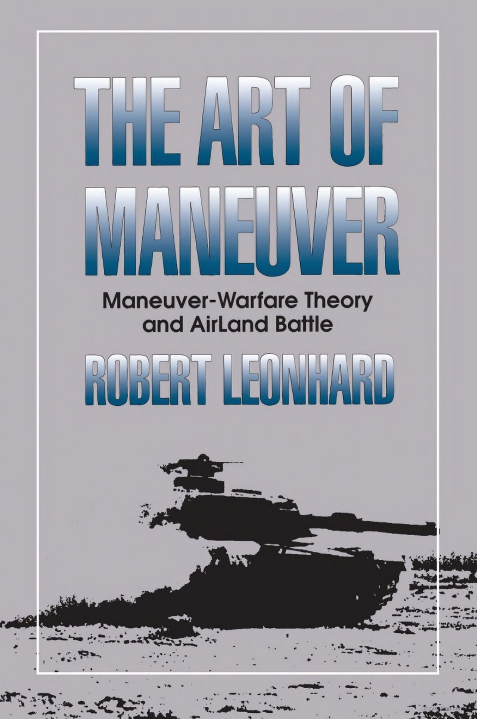
THE ART OF MANEUVER: Maneuver Warfare Theory and Airland Battle. By Maj Robert Leonard, USA. Presidio Press, Navato, CA, 1991, 310 pp., $24.95. (Member $22.45)

The close of the last decade and the start of this one witnessed an amazing resurgence of thought in military circles concerning strategy and the operational art. The concept of the “indirect approach” has been reborn in the creation of what the Marine Corps has coined “maneuver warfare” and the U.S. Army has renamed “AirLand Battle” (ALB). During this same time. America has been involved in major military actions in Panama and in Southwest Asia. How much of our victory in both conflicts can be attributed to this “new” style of warfighting? Have the principles of maneuver warfare been validated by fire, or have we been unable as yet to grasp them firmly enough to apply them in these recent conflicts? Does our current doctrine fully embrace the fundamental approach to warfare embodied in maneuver or are we still clinging to the last vestiges of our traditional approach to waging war? These questions form the basis of this masterly analysis of where we stand today and where we are going with respect to our style of fighting. Although the focus is on the U.S. Army’s doctrine as expressed in FM 100-5 Operations, this commentary on warfighting is of value to any student of warfare, especially with our current emphasis on the importance of joint and combined operations.

Maj Leonard has been a commissoned officer in the U.S. Army since 1978. He has served most of his career as a mechanized infantryman and has commanded a rifle company. Currently, he is a student at the U.S. Army Command and General Staff College, Fort Leavenworth, KS. He has written a number of articles for both Infantry and Army magazines. These assignments and his previous duties drafting doctrine at the U.S. Army Infantry School, Fort Benning, GA, prepared him well to be the author of this work.

The book has two major parts. In the first, the author performs an extensive analysis of maneuver warfare theory and develops criteria that help us judge doctrine as either “attrition-oriented” or “maneuver-oriented.” He describes the evolution of maneuver theory and its fundamentals and surveys the framework of ideas that define the theory. While similar to both the Marine Corps and Army approaches to warfare, his maneuver concepts differ from accepted thought in several significant respects. His descriptions and examples provide the most coherent explanation of maneuver warfare I have read, and any Marine who took the time to review just this section alone would benefit from it.

Maj Leonard has clearly developed many of his ideas in terms of the strategies of chess. Most Marines, when asked to identify the chess piece most closely reflects the opponent’s “center of gravity,” would select the queen. As the author writes:

When I first considered the question. I hastily concluded with my friend that the center of gravity in a game of chess must be the strongest piece, the queen. Remove the queen, and the opponent has suffered a terrible reduction in his ‘warfighting capabilities.’ And indeed, as my friend pointed out, usually when he captured my queen, he won the game-but not always. Greater reflection revealed our flawed thinking. We had both come to the wrong conclusion, because we had incorrectly defined the characteristics of the opponent’s center of gravity. The enemy’s center of gravity is not his source of strength: it is his critical vulnerability. Destruction or neutralization of his center of gravity must not result merely in reduction of his capabilities, but rather in the paralysis of his forces. The answer then becomes obvious: the opponent’s center of gravity is the king. By no means the strongest piece, the king is the one piece whose neutralization wins the war.

His analysis of maneuver theory is quite comprehensive, including discussion of the psychology of war, force dichotomy, combined arms tactics, the “means of defeat” (preemption, dislocation, and disruption), command and control, and risk in warfare. His section on the “physics of war” is amazingly concise and quite comprehensible. Of particular note is his comparison of the U.S. and (former) Soviet approaches to maneuver warfare.

In the second part of the book, Maj Leonard subjects ALB to critical scrutiny and finds it wanting in many areas. His careful study of its tenets reveals an impressive depth of thought on the subject. His commentary boils down to a fundamental disagreement with ALB’s focus on maneuver for the sole purpose of winning an inevitable attrition-style battle. While not specifically analyzed in this manner, FMFM-1 is quoted often, and the author’s opinions provide some valuable insights on our own doctrine. The author goes on to describe the Army’s forays into future doctrinal developments, such as Airland Battle-Future (Heavy), with no less critical an eye.

The author completes his work by describing and analyzing the salient aspects of Operations JUST CAUSE and DESERT STORM, and how we applied or failed to apply these principles. His summary is cogent, complete, and accurate. While necessarily brief, he makes a strong argument that our actions in Panama reflect the essence of maneuver: speed, surprise, timing, and a focus on a critical vulnerability. He entitles his appendix on DESERT STORM “arguing with success,” which reveals his views on our performance there (in terms of applying maneuver theory). Primarily, he cautions us against drawing invalid conclusions based on a unique set of circumstances.

This is an intelligent, thorough, and well-researched work. The author’s knowledge is demonstrated amply throughout, and his ability to express maneuver warfare concepts in simple terms is unequaled. Any Marine would benefit from his clear descriptions of the terms and ideas we continue to grapple with today. Our maneuver warfare instructors could easily incorporate his style of teaching to ease the absorption of concepts that can often be ambiguous or misleading.

This book is an important milestone in the evolution of the maneuver style of warfare. Read it!

The Decline of the Mission/The Rise of Intent

by Capt Eric S. Downes, USMCR

One of the vital keys to maneuver warfare is the concept of commander’s intent. Unless commander’s intent is clearly stated, understood, and respected, maneuver warfare cannot succeed. This article discusses the concept and outlines specific steps that should enable us to use it more effectively.

In the past few years, maneuver warfare doctrine has caused us to reconsider everything we do. We study it, talk about it, write about it, test it, succeed at it, and sometimes fail at it. Change, chance, and uncertainty surround its implementation. For some Marine officers, the doctrine becomes quite difficult for them when they try to move from the realm of philosophy to the realm of practicality. The challenge of making it work is like the challenge of eliminating the zero-defects mentality: We know both require the release of decisionmaking power to subordinates, but we also know who shoulders the responsibility of those decisions.

The central issue in this philosophical conflict is control. What you command you will want to control, and that which you cannot control you would rather not be responsible to command. Unfortunately for our comfort level, it does not always work that way. Consider, for instance, the realities of the battlefield-call it the “fog of war,” Murphy’s Law, or whatever you like-once any battle begins, control over a unit is more of a fading dream than a concrete reality. If you study most conflicts in which Marines have fought over the years, chaos and loss of control are the norm, not the exception. In fact, we have won more often by the preparations made before battle than by any efforts to exert control once the fighting has begun. Challenging training, continuous education of our leaders, and proficiency in planning have ensured our combat successes in the past. The initiative and innovation of individual Marines play a role in winning a fight, to be sure, but even these are unrelated to control.

Maneuver warfare is not the first philosophy to purport that proper preparations reduce the consequences of losing control. The Marine Corps has been the master at preparations since our first involvement in amphibious operations, long before our adoption of maneuver warfare. What makes our latest doctrine unique, however, is that it openly acknowledges that loss of control is inevitable. To do battle effectively by the theory requires decentralized control, which means giving subordinates the authority to plan and execute their own actions, since centralized control is predictably ineffective and quite possibly detrimental.

For the commander, one of the primary steps of battle preparation is planning. His goal is to communicate a plan that will endure loss of control as well as unexpected changes in METT-TSL (mission, enemy, terrain and weather, troops and fire support available, time, space, and logistics). To begin with, the plan requires a format for issuing instructions in a clear and concise fashion, which for us is the operations order.

Every good commander is concerned with effective order-writing skills, and he should be. Once the order is issued, contact between commander and subordinate may be broken completely until the next lull in the fight. Therefore, the order must state what the commander wants in enough detail so that subordinates can follow the plan without him, but also with enough freedom of decision for them to act on their own initiative. To put it another way, the order should be written so that the subunit commander has the freedom to out-OODA-loop his opponent (i.e., complete the observe-orientdecide-act cycle faster), while ensuring that his OODA-loop still supports the master plan of the commander. For this purpose we have “commander’s intent.”

Commander’s intent is one of a short series of elements in the middle of the operations order that is the creation of the ordenvriter himself. All of the elements that precede this are factual in nature and are provided mostly by the next higher command. Of all the created elements, this is the most important, and also the most troubling for commanders to write. Consequently, many such statements fail to serve the purpose they should. I believe this is true, not because of a lack of commitment to maneuver warfare by commanders or because of their lack of understanding of the purpose of the statement, but rather because we lack a prescribed method for creating it.

Good commanders have little difficulty devising schemes of maneuver, fire support plans, tasks, etc.; tactical experience and the study of warfighting make these routine. Articulating intent, however, involves something more than just experience. Each situation requires a unique mental picture spanning much more than what one can see at any given moment. It requires a conceptual outlook of the factors of the battlefield-something that is mentally more difficult to produce than are the other details written in the order.

Some commanders have a tendency to accept a mission and never broaden their perspective beyond that point. By not doing so, they skip a golden opportunity to see the bigger picture. The remainder of the order-writing process is a series of microscoping steps, ending in the assignment of tasks and coordinating instructions. Once this process is in motion, it is frustrating and complex to develop an adequate intent, since intent should be a broader view in terms of space, time, and other factors than the mission itself. To broaden perspective, once it has been narrowed, requires the commander to actually go backward mentally. Rather than force this retrograde of thought, many find it easier to write intent statements that “fit” their schemes of maneuver, rather than the other way around.

Commander’s intent is not a restatement of the mission, and it should not focus solely on friendly action. It is also not a byproduct of the mission, nor is it necessarily parallel to it. It should not suggest how to accomplish the mission, and it should not specify the intensity of that action. Making any of these mistakes will create a meaningless redundancy that does nothing to support the concept of maneuver warfare.

True commander’s intent is a statement of what the commander intends to do to the enemy-with a concept of how his action will cause the enemy to behave in a particular way. Its purpose is to communicate to subordinates a goal that should be utmost in their minds as they execute the order. The mission, scheme of maneuver, fire support plan, and tasks are all fickle elements; one major change in the situation could render these outdated. Intent, while not impervious to change, remains a constant element in comparison. While doing battle, should a subordinate realize that the assigned mission will accomplish nothing, or may even ensure disaster, he can mentally page back to the intent in order to regain focus and momentum.

Imagine that you are a commander facing a particular foe. You have determined through your analysis that to force him to move in a certain direction will give you a decisive advantage. There are several possible courses of action that could make this happen, but you have chosen the one you feel is the best. If all you articulate to your subordinates is that one course of action, and then suddenly, in the confusion of the battle, the situation changes making that course untenable, they will be at a loss as to how to continue supporting your plan. If, however, you also tell them what your plan means in terms of the enemy, then they will be able to think their way to another viable course of action. By presenting them with both your plan for the maneuver of friendly forces and what behavior you want to elicit from the enemy, your subordinates will have a complete understanding of the plan, rather than just half of it.

The writing of intent requires a broad overview of the factors influencing the potential battle. The commander must, in a sense, step backward after receiving an order so that he can widen his view from the mission assigned. He needs a more comprehensive picture of the enemy’s possible actions, what may happen over time, what terrain might influence movement, and so on. If by old habits he immediately narrows his view instead of widening it, he will most likely skip the opportunity to look over these factors and include instructions for friendly maneuver without true regard for the enemy perspective. Instead, he must consider the high likelihood of changes in METT-TSL and write his order to survive those changes. Only by writing a statement of intent, with the enemy as the object of focus, can this survival occur.

What I propose to simplify the perplexing challenge of formulating intent is a methodology of thought to be used during the maneuver warfare order-writing process. It includes a set of mental steps for the creation of Paragraph 3, placed in the order in which the mind most naturally flows-from broadest to narrowest focus. To describe the thinking involved in each step. I will use the model of a telephoto camera lens, referring to broadening one’s view as “zooming out” and narrowing it as “zooming in.” It is important to note the type of thinking necessary in each step:

Step 1: Receive the order from your superior. This is his best assessment of what must be done to accomplish the intent of his superior, given the current METT-TSL. Pay particular attention to the intent of both your commander and the commander above him. Crystal-clear understanding of the rest of the plan without the same understanding of intent could prove disastrous: even slight changes in METT-TSL could render all but intent irrelevant. These two intent statements will therefore become the central theme for your own actions.

Step 2: You have received your mission from your commander’s order. Many commanders typically zoom in from this point and begin developing their schemes of maneuver. Remember that METT-TSL components are all subject to instantaneous change: developing your scheme by focusing only on the mission assigned is likely to produce an incomplete or even outdated plan. Resist the temptation to zoom in and instead zoom out; see more than what is visible at the present moment. Picture the possible outcome of your action from your perspective and then turn your map around and picture it from the enemy’s perspective. To write your intent, consider several key items. Conduct a thorough analysis of METT-TSL and, most important, the enemy situation. Much of this intelligence will come from the order you have received; the rest must come from your own observations and reconnaissance. In studying the enemy, consider his vulnerabilities and determine which are the most critical. Decide, among all the intelligence gathered, which factor is the most critical on the battlefieldthe one which, if you were to control it. would give you the decisive advantage over your foe. This critical factor and the enemy’s most critical vulnerability are most often the same: in any case, both must be analyzed as preliminaries to the formulation of intent. Just as you consider the intent of the commanders two levels up from you, your subordinates will be doing the same with your intent. It must be the first creation in your order.

Step 3: Write your intent using the following guidelines:

* Make the statement oriented on the enemy, not on friendly action.

* Make clear what you intend to do to the enemy.

* Consider strongly how what you intend to do will cause the enemy to behave in a particular way. Remember that you want to “out OODA-loop” your foe, so plan how to influence his behavior to your advantage.

* Keep your intent broad; do not specify or guide particular actions to be taken or the intensity of these actions.

Step 4: Zoom in, back to your mission. Double check your intent against your mission, the intent statements of the commanders two levels up, and all other METT-TSL elements. Your statement should be clear enough that even if your subordinates have no contact with you, they will still know how to serve the overall command most effectively.

Step 5: Zoom in. Develop your scheme of maneuver and fire support plan to support your intent, given the current METT-TSL. If your superiors have remained maneuver warfare minded, you should have nearly free rein to create this plan in the way that you feel you can best support their intent.

Step 6: Zoom in. Develop task statements for the execution of the scheme of maneuver. Be mindful of providing the same freedom of action to your subordinates that was given to you. From this point, your subordinate commanders should follow the same process you did as they develop their orders.

There is nothing magic about the steps shown here. In order for the methodology to work well, it is essential that commanders up and down the chain follow it; otherwise, more junior commanders will have to develop statements of intent that only support their best guess about what higher commands really want. Maneuver warfare suffers due to weak links in the chain of operations orders-those where subordinates are told what to do, without being told the intent that should drive their initiative.

For our doctrine to become a reality, we actually need to change more than just the way we write orders. We also need to more fully define the term “mission-type order” by subsequently redefining our objective from a maneuver warfare perspective. Most officers, when asked, would describe mission-type orders as ones that state what will be done, without specifying how. While this is a good start, commanders are again likely to focus only on mission accomplishment unless they have a fuller understanding of mission-type orders. Commander’s intent is crucial.

If we continue to teach our Marines that mission accomplishment is the most important objective of leadership, and in the chaos of the fight that mission loses its viability, then only those smart enough to disobey the order and lucky enough to find an alternate way to win on their own will prevail. When we have a clear statement of the commander’s intent, it seems archaic to continue to call mission accomplishment our objective. The most important objective on the battlefield in the age of maneuver warfare is the support of commander’s intent, not the accomplishment of the mission. If we can grasp that concept as a Corps, then we will finally realize the benefits that maneuver warfare and thinking Marines can provide.

Commander’s Intent Defined

by Capt Michael L. Ettore

Several years ago the U.S. Marine Corps adopted maneuver warfare as its primary warfighting philosophy. The general concepts of this philosophy were outlined in FMFM 1 Warfighting, a publication intended to provide broad guidance on how the Marine Corps prepares for and conducts combat operations. While most of the content of FMFM 1 can legitimately be labeled as purely common sense, there are several concepts which at the time of publication were new, unfamiliar ideas.

One of these new concepts was that of commander‘s intent. While most Marines have heard of this concept, it is extremely rare to find two individuals with the same perspective as to what commander‘s intent really is. Any student of maneuver doctrine will agree that to be successful in this style of warfighting, subordinate leaders must be encouraged to use initiative during the execution of any mission. Commander‘s intent is designed to provide these leaders with the ability to deviate from a specific plan of attack if necessary, yet still accomplish the ultimate desires of their commander. This initiative is properly focused by a crystal-clear expression and understanding of the commander‘s intent.

Recently, the Marine Corps University conducted a Quarterly Curriculum Review Board which was attended by representatives of the various schools within the University system, as well as from other commands. One of the topics discussed was the concept of commander‘s intent and the need for a standard definition of the subject as well as specific guidance for its use during the conduct of Marine Corps operations worldwide. The following definition of commander‘s intent was forwarded to the President of the Marine Corps University and has subsequently been approved:

* The commander‘s intent statement will be depicted in a formal operations order in paragraph 3a (1) followed by the concept of operations in paragraph 3a (2). The higher unit commander‘s intent will be depicted in paragraph 1b.

* The commander‘s intent statement must include a statement of the end state of the battlefield as it relates to his force, the enemy force, and the terrain. Additionally, this statement may include:

– The purpose of the operations.

– The enemy’s actions and intentions.

– An identification of the enemy’s critical vulnerability or center of gravity.*

Currently, the entire Marine Corps University is adopting this definition of commander‘s intent. Once implemented, these changes will result in the substantial enhancement of the orders process and will reduce confusion as units and individuals are reassigned. Graduates of the staff noncommissioned officer academies. The Basic School. Infantry Officers Course, Amphibious Warfare School, Command and Control Systems Course. Command and Staff College, School of Advanced Warfighting, and the Marine Corps War College will have the same understanding and will utilize the same techniques.

Some important points to remember:

* Every Marine must know the commander‘s intent two levels up.

* During most infantry battalion operations order briefs, the battalion S

* Center of Gravity. The characteristic, capability, or locality from which a military force derives its freedom of action, military power, or will to fight. (FMFM2-1 Draft)

Critical Vulnerability. A weakness in an opposing military force’s assets, tactics, or strategy that can result in that force’s defeat if that weakness is exploited. (FMFM 2-1 Draft) 3 actually issues the majority of the order. It is highly encouraged that the battalion commander issue his intent statement for clarity and emphasis.

* The commander‘s intent statement is intended to be written in narrative form, not by listing elements 1 through 5. It is a statement, not a format.

* During the preparation of the vast majority of operations orders, whether formal or fragmentary, the shortage of time usually will result in the commander‘s intent statement being limited to the statement of the end state of the battlefield as it relates to friendly forces, the enemy forces, and the terrain.

* A technique used to describe the end state of the battlefield is to begin the statement with, “Final result desired is.” The following are some examples:

– Final result desired is to block the enemy north of Route 1 in order to allow the unimpeded movement of Company C to BLT Objective Alpha.

– Final result desired is to destroy the enemy radar equipment at Objective Bravo in order to prevent early detection of subsequent coalition air attacks.

* The commander‘s intent statement is not a duplication of the scheme of maneuver paragraph; not where missions or tasks are assigned to subordinate units; and not the place for useless statements such as “we will attack vigorously.” “we will utilize supporting arms to stun the enemy.” or “try not to get bogged down.”

* A short, concise commander‘s intent statement is easier to send via radio or messenger and is more easily remembered by subordinates once they come under extreme stress.

The most important thing for a young lieutenant to remember if he must suddenly assume command of a rifle company in a rapidly changing combat situation is the concept of commander‘s intent.

Finally, it is incumbent upon every leader to adopt and enforce these changes with enthusiasm. The result will be the standard interpretation and usage of this key concept throughout the Marine Corps. Additionally, it will put an end to the friction and confusion that happens all too often today.

The NCO and Maneuver Warfare

by Capts William H. Weber IV & David J. Furness

1992 Chase Prize Essay Contest First Place

As leaders, we must push power downward to the young Marines who hunger and thirst for more responsibility-and are quite capable of handling it. . . . In combat, NCOs carry battle. Is it fair to expect them to do this in war if we have not trained them in peacetime-by allowing them significant responsibility and authority?

-Gen Walter E. Boomer

On the third day of the ground war during Operation DESERT STORM, a platoon of Company A, 1st Light Armored Infantry Battalion moved north toward Kuwait International Airport as the point element of the battalion’s drive, conducting an aggressive forward reconnaissance with the battalion moving up quickly behind them to assume blocking positions north of the airport. At 1700, an Iraqi strongpoint halted the battalion’s movement, and the point platoon came under sporadic machinegun fire. Far over on the right flank, a light armored vehicle, commanded by a corporal, pushed out on its own to try and find a way around this obstacle. Unsupported by any friendly forces, the vehicle commander found a route that would allow the battalion to bypass the strongpoint and continue its mission. The corporal called his platoon commander: “Red 1 this is Red 6, I’ve got a way around over here on the right. We can get on a trail under those power lines on the 68 grid line and continue moving.” The platoon commander acknowledged the transmission and immediately changed his direction, moving his platoon and the rest of the battalion around the obstacle and onto the route blazed by the corporal. The battalion accomplished its mission, arriving in its blocking position an hour early, ensuring that other units could seize the airport without concern about possible Iraqi reinforcements descending from the north. A junior NCO, using initiative and making decisions, allowed the battalion to accomplish its mission. His platoon commander listened to him and was willing to commit the battalion to a route chosen by a corporal. This is maneuver warfare.

Understanding maneuver warfare is difficult. Executing it is even harder. Our current warfighting doctrine, as set forth in FMFM 1 and FMFM 1-3. fails to address the key to maneuver warfare execution-creating a command environment that empowers our NCOs. Without NCOs who are willing and able to make decisions on their own, and without officers who will support those decisions, we will surely fail. Our doctrine of maneuver warfare “applies equally to the Marine expeditionary force commander and the fire team leader.” It is a decentralized system that “requires leaders at all levels to display sound and timely judgment.” How do we make our Marines into the warfighters our doctrine demands? The answer is simple. If we are going to fight the way our doctrine dictates, we must empower our NCOs so that decisions are made and executed at the lowest level.

Empowering our NCOs is critical for many reasons. In Men Against Fire. S.L.A. Marshall observes: that no commander is capable of the actual leading of an entire company in combat, that the spread of strength and the great variety of the commander’s problems are together beyond any one man’s compass, and that therefore a part of the problem in combat is to determine which are the moral leaders among his men when under fire, and having found them. give all support and encouragement to their effort.

If a commander cannot control all of his people, then how can he ensure unity of effort and reliable action by subordinates? The solution lies in proper leadership, and commanders must take notice. If we, as an institution, fail to develop our NCOs so that they are the tactical equals of junior officers, we risk slowing our physical and mental speed at the point of contact and throwing away many valuable opportunities for battlefield success. Our NCOs must make and execute decisions.

The empowerment of the NCO starts with the leadership of the unit commander and the command environment he fosters. He must personally take an interest in his NCOs’ professional development and give them the responsibility and knowledge to train junior Marines. FMFM 1 describes this command environment:

All commanders should consider the professional development of their subordinates a principal responsibility of command. Commanders should foster a personal teacher-student relationship with their subordinates. . . . [and] should see the development of their subordinates as a direct reflection on themselves.

Besides our doctrinal emphasis on junior leaders who make decisions, we also stress the use of mission tactics as the best way to take advantage of these junior decisionmakers. Mission tactics requires units that can quickly execute basic and advanced techniques and are led. down to the lowest level, by men who make timely decisions. This decentralized decision authority must include the NCO. In his book On Infantry. John A. English concluded his discussion of the subject by saying:

. . . the decentralization of tactical control forced on land forces has been one of the most significant features of modern war. In the confused and often chaotic environment of today, only the smallest groups are likely to keep together, particularly during critical moments.

The noncommissioned officer therefore holds the key to the execution level of maneuver warfare, the level where we translate our doctrine into action. The Marine Corps must acknowledge this. Many company grade officers do not regard the NCO as a leader, trainer, and decisionmaker. They are not comfortable with young corporals and sergeants training their Marines or having the freedom of action necessary to grow as leaders and decisionmakers. Hampered by the need to clear all decisions before executing, the junior leaders atrophy. Action at the point of contact slows to a crawl. Opportunities and battles are lost.

But we can solve these problems. Our company grade officers must force our NCOs to accept more responsibility while simultaneously focusing their junior officers and staff NCOs on improving the abilities of NCOs to lead, think, and fight-added responsibility should be accompanied by the training that will allow NCOs to succeed. This is empowerment. The command environment we foster and the schools we send our NCOs to must work together toward this end if we expect to create true warfighters.

Conversations we have had with several of our contemporaries convince us that we were truly fortunate as new lieutenants to be sent to units that viewed the tactical expertise of NCOs as their number one priority. One of our company commanders explained his priorities to all of his new lieutenants and staff NCOs in these terms:

* The NCOs would be the principal trainers of Marines.

* Our responsibility was to ensure that the NCOs were tactically proficient and could conduct effective training.

* Our focus of training would be at the individual, team, and squad level.

He understood that expertise at the small unit Jevel is essential to the execution of our warfighting doctrine. He believed that by focusing the efforts of the company on building strong NCOs and strong teams and squads, the company as a whole would succeed. He realized that limiting the NCOs participation in the planning and execution of small unit training negated their responsibility for ensuring that their unit was prepared for combat. It also diminished their credibility in the eyes of their Marines. By clearly defining the NCO‘s proper role in the conduct of training, we began to give them the power they needed to succeed.

We believed that for the NCOs to train their Marines, they had to become unquestioned experts in techniques and procedures, battle drills, and tactics. They needed to understand completely our warfighting doctrine and what their role was in it. To reach these goals, we established a program at the company level that should be a part of every unit in the Marine Corps. The program began with an examination to test the basic skills of the NCOs. Then, using existing publications such as The Essential Subjects. The Marine Battle Drill Guide and Command Tasks, Soldier Skill Level 1, 2, 3, 4 for MOS 11B and 11C, the company began to train the NCOs while simultaneously conducting basic individual training. Once our NCOs mastered the basic skills, we began to teach them advanced warfighting techniques and concepts. We conducted sandtable and map exercises designed to illustrate the fundamental maneuver warfare principles. These exercises forced the NCOs to develop their own courses of action and express them in a standard five-paragraph order format. We stressed the ability of the NCO to communicate his plan to his Marines. There were no right and wrong answers, but unsound tactical thinking was thoroughly critiqued. The intent of this training was to develop the thought process that we could later expect the NCO to employ in combat. We tried to train the NCO to become the tactical equal of the junior officer.

Initially, the transition from troop handler to small unit leader was difficult. Many junior NCOs lacked the technical and tactical expertise to educate and train their Marines, and they were reluctant to assume their new role. They quickly overcame this initial reluctance when they realized that we meant to give them real power. They then became eager to learn about their profession. They understood that their increased role brought additional responsibilities, and they rose to the challenge. After several months of intensive training, augmented by many quotas to NCO school and the division’s squad leader’s course, the technical and tactical proficiency of the NCOs skyrocketed. These corporals and sergeants were hungry for additional tactical expertise-they were becoming professionals. As they began to instruct their Marines, some astonishing things happended:

* The NCOs’ status as leaders increased dramatically.

* A clear teacher-scholar relationship grew between the NCOs and their Marines. The NCOs’ focus became training. They became inquisitive and interested in professional reading. Marine Corps Institute courses, and tactical decision games.

* The example set by the NCOs constantly reinforced critical skills and techniques throughout the company. A strong bond developed between the NCO and his men, leading the Marines to an almost unquestioned faith in their junior leaders.

* The entire company’s growing competence in battle drills, techniques, and procedures allowed the NCOs to adapt easily to rapidly changing tactical environments. They became much more aggressive and willing to make significant decisions. During free-play exercises, the NCOs’ new-found freedom translated to dramatically improved physical and mental speed at the small unit level.

The company became a warfighting machine driven by a desire to learn and become more competent. The worth of an NCO rested not only on how well he could drill or prepare for an inspection but also on how he could think and execute on the battlefield. The officers were constantly challenged professionally because even the most junior leaders in the company clamored for knowlege. Morale was never a problem because the command environment bred professionalism.

This is what a Marine Corps rifle company should be.

The second element in our drive to create true warfighting NCOs is formal education. To get a better understanding of the importance of education in our present situation, it is wise to look to the experience of the German Army between the two World Wars. The treaty ending World War I dramatically limited the size of the German officer corps. Given their reduced officer strength, they realized that they would have to rely more heavily on their NCOs. The Germans moved quickly to raise the competence level of their troops. During the 1920s and 1930s-while the American enlisted man was wasting away-the Germans began sending their NCOs to a new school, a school dramatically different from any other in the world.

The Germans designed their NCO schools to create decisionmakers. They believed that a man could be trained to make decisions quickly by getting him in the habit of making decisions. Once that habit was in place, all that remained was to give him the experience necessary to make good decisions. They were, in essence, attempting to teach intuition, an effort which modern research suggests was not in vain. Recent research also suggests that the best way to do this was embodied by the structure of the German NCO school: force men to make decisions again and again punishing only timidity while gradually giving them the experience and knowledge needed for the development of battlefield intuition. They will become battlefield leaders.

This school was very different from our current NCO schools where much of a Marine’s time is focused on garrison skills that although admittedly important subjects for the NCO. are of limited value in the face of the enemy. Our educational system makes the considered point that drill is but a means to an end, but there is a demonstrably superior way of reaching our goal of NCOs who crave responsibility and consider themselves as elite professionals in the U.S. Marine Corps. Specifically:

* NCO schools should be lengthened from their present 38 days to at least 4 months. The schools should devote this additional time to two things-decisionmaking exercises and directed study on the art of war, study aimed at making the NCO both knowledgeable and hungry for more learning.

* Attendance at NCO schools should be an absolute requirement for promotion to sergeant.

* Because NCO schools would be truly professional schools, we would expect to be paid back by the Marines who attend it: any Marine graduating would serve at least 2 additional years in the Fleet Marine Force before he could leave the Corps. Attendance al an NCO school would therefore be voluntary, and any Marine refusing to attend would not be promoted past the rank of lance corporal. Failure at NCO school would mean reverting to lance corporal for the remainder of the enlistment or immediate release from the Corps.

Making these changes would be costly. The future success of our Corps, however, depends on producing Marines who can fight our doctrine on a decentralized battlefield. Institutionally, we are not doing this, and we must. The money must be spent, and the NCOs must get the power they need. We must force our future company commanders to let their NCOs do their jobs. We must educate our company grade officers at Amphibious Warfare School on the real role of the NCO in warfighting and on how to train him to fill that role. We must also change the expectations of the NCOs by changing our NCO schools-the NCO should leave these vital schools fully expecting to be challenged professionally by his officers. He should return to his company with a burning desire to take charge on the battlefield, and, by doing so, force the Marine Corps to execute what we spend so much time talking about-our doctrine.

Commentary on Amphibious Operations

by Maj F. G. Hoffman, USMCR

. . . Much of the Navy’s ignorance of, or seeming indifference to, amphibious issues, which was noted by Col Batcheller, may stem from more than its preoccupation with the now outdated maritime strategy or its traditional interest in carriers and nuclear submarines. In fact, the Marine Corps itself may be partly to blame.

Over the past decade, Marines have focused a lot of attention on the merits of new and innovative approaches to warfare. Their exploration of boldness, speed, tempo, and all the other tenets of maneuver warfare have also contributed to the present pessimistic state of amphibious capability in the Navy. It may have been an oversight, or it may have been done in ignorance, but FMFM 1. Warfighting mentions amphibious operations only twice. In fact, the Navy is mentioned only once and only as an aside. Other key words, such as “naval,” “seapower,” “maritime,” and “littoral,” are inexplicably absent.

I find this bizarre, given the Corps’ mandated role for service with the fleet. As the “authoritative basis for how we fight and how we prepare to fight,” FMFM 1 is deficient in its regard to our naval character and our relationship to the Navy. I would recommend that this be corrected by the development of new naval doctrine, as suggested in the implementing actions of ” . . . From the Sea.” The first product of the new Naval Doctrine Center should be a rewrite of FMFM 1 that properly reflects the roles of each of the Naval Services in preparing for and conducting war.

Maneuvering Blind

by LtCol Bruce E. Brunn

Recent Gazette articles on use of the aviation combat element (ACE) as a maneuver element (see box) have been both timely and important during this period of force reductions and budget slashing. As we face the prospect of a substantially smaller Corps, no one can argue that Marine aviation will play an increasingly critical role in the total combat power of the Marine airground task force (MAGTF). Unfortunately, Marine Corps aviation lacks the basic ability to “see the battlefield,” which is essential for maneuver warfare.

The excellent article by Maj Thomas X Hammes (MCG, Feb92) came closest to this fact by clearly identifying the need for increased intelligence capability within the ACE to enhance its ability to perform the observation-orientation-decision-action loop functions fundamental to maneuver warfare. He was mistaken, however, in regards to the MAGTF and the ACE having the necessary equipment to support this maneuver role. Since the retirement of the RF-4B in 1990, the ACE has abrogated the aerial reconnaissance mission to the U.S. Air Force, thereby slaving the MAGTF and the ACE to the air tasking order (ATO) process. While this 3-day ATO process is marginally capable of supporting static defense operations, it cannot support the tactical aerial reconnaissance required for maneuver warfare. As confirmed during Operation DESERT STORM, MAGTF and ACE commanders have become nearly totally dependent on national and theater sensors to see the battlefield, resulting in the loss of the timeliness that was previously provided by tactical sensors. Additionally, DESERT STORM also witnessed increased difficulty in the ability of the ACE to insert ground reconnaissance teams, employ unattended ground sensors, and to operate aerial observers at effective altitudes in the vicinity of the forward edge of the battle area-all of which further degrade the MAGTF commander’s view of the typical Third World battlefield. The Pioneer remotely piloted vehicle (RPV) is an outstanding target acquisition platform, but it lacks the speed, range, wide-area search sensors, and all-weather capabilities of the RF-4B and other tactical reconnaissance aircraft.

An immediate fix is urgently required if the ACE is going to be a viable maneuver element. While it is not feasible to upgrade the capabilities of all three Marine expeditionary forces, at least one set of equipment must be obtained to enhance the MAGTF and ACE commanders’ ability to acquire and rapidly target enemy forces in the deep battle area. A minimum capability must include the following:

* F/A-18 recce pods using existing RF-4B film and side-looking airborne radar sensors fitted into a standard F/A-18 fuel pod.

* Secondary imagery dissemination systems to rapidly disseminate imagery, target graphics, and products needed for the intelligence preparation of the battlefield (IPB) to the ACE and the ground combat element.

* A joint surveillance target attack radar system ground station to receive a direct downlink from the only effective broad area search sensor in the theater.

* Intelligence work stations to rapidly exchange targeting and IPB information between the joint task force, the MAGTF, and major subordinate commands, to include a dry process reproduction capability to disseminate much of the information in easy-to-assimilate graph and IPB formats.

* Forward looking infrared and precision navigation equipment for flight leaders on penetration missions to rapidly locate and confirm enemy targets.

Eventually, mid-range and endurance unmanned aerial vehicles will be able to perform many MAGTF reconnaissance missions, but these systems have been delayed for years, and we need this capability today. A blind man cannot effectively conduct maneuver warfare, and with the notable exception of the few Pioneer remotely piloted vehicles we have, MAGTF and ACE commanders are largely blind on today’s battlefield. Tactical reconnaissance in the joint environment has been and will continue to be a Service responsibility. We must move rapidly and decisively to restore our organic target acquisition capabilities as soon as possible, not only to facilitate the use of the ACE as a maneuver element, but also to enhance MAGTF combat power as a unique and vital force on the joint battlefield of tomorrow.

For further reading:

  • Maj R. Scott Moore, “The Act of MAGTF Warfare” (Apr89)
  • William S. Lind “Maneuver Warfare and Marine Aviation” (May89)
  • Maj John B. Saxman. USAF, “The Role of Marine Aviation in Maneuver Warfare” (Aug89)
  • Maj Steven B. Donnell, “The ACE as a Maneuver Element” (Aug89)
  • Majs Gordon C. O’Neill & Daniel A. Driscoll, Jr., “Maneuver Warfare: Can the ACE Adopt This Philosophy of War?” (May91)
  • Maj William H. Dixon. Jr., “The ACE Is Not a Maneuver Element-Yet!” (Feb92)
  • Maj Thomas X. Hammes, “Air as a Maneuver Element: An Idea Whose Time Has Come?” (Feb92)

Employing the Defense in Maneuver Warfare

by Maj Joseph V. Medina

1990 Chase Prize Essay Contest Honorable Mention

Defensive tactics have never been “popular” with Marines, but knowing when and how to assume the defensive is crucial on the modern battlefield.

Marines, being naturally aggressive, shun the defense because it lacks boldness. We revert to it only as an economy of force measure that allows us to strike elsewhere or because weakness compels us to adopt it. To optimize our combat potential, however, we should seek to employ the defense in maneuver warfare for its strengths. When and how we decide to employ the defense is critical if we are to be successful in shattering the enemy’s moral and physical cohesion rather than just attempting to rack up more numbers to the enemy’s attrition.

Our focus of effort must be directed to wherever-or whatever-will cause the most decisive damage to the enemy. Often our focus of effort will be directed to the enemy’s obvious weak areas: his command posts, logistics support areas, communication sites, reserves, etc. However, there comes the time when our focus of effort should be directed against an enemy’s combat forces. This may be a result of a unique opportunity presented that must be exploited, because at this particular time and place this is his vulnerability or simply because the destruction of the enemy’s force has become, in itself, a decisive objective (as Paulus’ German Sixth Army became the Russian objective in the Battle of Stalingrad). The method of destruction is a critical decision the commander must make. A key technique, but one often overlooked for sheer destructive power, is to assume the defense.

Why do we have a reluctance to consider the defense, or to use defense techniques, when we are looking for destruction of the enemy? When we review what our own doctrine tells us, we find in FMFM 1 the following:

The offense contributes striking power. The offense generally has as its aim some positive gain; it is through the offense that we seek to impose some design on the enemy. The defense, on the other hand, contributes resisting power, the ability to preserve and protect oneself. Thus, the defense generally has a negative aim, that of resisting the enemy’s will.

This leads us to the conclusion that while the defense is the stronger form of combat, the offense is the preferred form, for only through the offense can we truly pursue a positive aim. We resort to the defensive when weakness compels.

Our own doctrine tells us that we must constantly strive for the offense in order to be victorious, and that we only assume the defense as a result of weakness-not to take advantage of our strengths. Although I embrace FMFM 1 as a welcome and needed change, there is more to the art of the defense than is reflected here. The defense can provide striking power, and can offer positive aim-that being the destruction of the enemy, his cohesion and integrity-if employed properly at the right time and place. We should consider assuming the defense to exploit our strengths and the enemy’s weaknesses. This is not to imply that we surrender the initiative. We must always maintain the initiative, especially when using the defense for a decisive stroke. This is the tricky part, but an essential element of employing the defense in maneuver warfare. Additionally, in contradiction to FMFM 1, in the defense we must seek to impose some design on the enemy. We must not be reacting solely to his offensive moves.

The destruction of an enemy force by assuming the defense is not a new concept. In fact, it has been employed by some of the masters of warfare, and a number of decisive battles were won by the defender. We need only look at Hannibal in the Second Punic War or, more recently, at MajGen Alexander A. Vandegrift at Guadalcanal. A brief review of these examples will help to better understand how the defense can provide us much more than an economy of force effort, and it should help to clarify employment techniques in maneuver warfare.

The Trebia to Cannae: A Lesson From Hannibal

A full 22 centuries ago, Hannibal engaged in a military campaign in Italy lasting 15 years. Fighting both the weather and the Gauls, Hannibal crossed the Pyrenees and the Alps in 218 B.C., arriving virtually undetected in the Po Valley of northern Italy. There he engaged and defeated every Roman force that rose to meet him. His first major battle against the Roman Legion, the Battle of the Trebia, is an excellent example of using defensive techniques for tactical success. After establishing a deceptively weak defensive position, Hannibal lured the hot-headed Roman leader, Sempronius, to attack across the freezing Trebia River, whereupon an effective counterattack struck the Roman flank and rear. The ensuing onslaught resulted in 30,000 Roman casualties. The following spring, after a surprise crossing of the snowy Apennine passes and a strenuous march through marshes thought to be impassable, Hannibal established his force on a narrow defile on the line of communication between the Roman army and Rome. From their position on the cliffs overlooking Lake Trasimene, the Carthaginians conducted the greatest ambush in history when they caught the Roman column moving to reestablish their link to Rome resulting in another 30,000 Roman casualties. At Cannae, Hannibal met a newly raised army of Roman and allied legions. In this tactical masterpiece of military history, Hannibal established a defense anchored on a bend in the Aufidus River. Although outnumbered by over two to one, he purposely weakened his center and strengthened his wings and allowed the overwhelming Roman infantry to push, but not break, his thinned center. At the decisive moment, Hannibal’s strong wings hit the Roman flank and rear, causing chaos and resulting in a complete slaughter.

What lessons can we take from these examples of Hannibal? The Carthaginian general fought his greatest battles at times and places of his choosing. His defense was never static, but relied on his greatest weapon-a swift, strong counterattack by a very capable force, his formidable Spanish, Gallic, and Numidian cavalry. He was not reluctant to change tactics and formations when he recognized the value of change; in fact, he adopted much of the Roman formations and tactical systems when he saw their superiority.

Guadalcanal: A Test of Determination

One of the best examples of a key defensive battle comes from our own history-the Guadalcanal campaign. What began as an offensive amphibious battle soon became a solid defense of the small perimeter surrounding Henderson Field. While there may be some argument whether this should be classified as a defensive campaign, this is best resolved by viewing the Guadalcanal campaign by stages according to Baron von der Goltz’s four variants of offensive and defensive action. The amphibious assault was assuredly an offensive action, both in the tactical and operational sense. However, after a successful landing, the operation turned to the tactical defense, guarding the airfield, but remained offensive in the operational sense. The initiative could very easily have slipped into Japanese hands, and only through active measures was Vandegrift able to retain it. These measures included continuous patrolling (even an attempted reconnaissance in force operation), limited objective attacks, employment of Marine aviation, constant adjustments in force dispositions and expansion of the perimeter, and pressure on the Navy for more active supporting operations. Vandegrift was not only able to achieve the first major operational success in the Pacific, he also made a sizable blow to the Japanese ground forces. The defense again moved into the tactical offensive in December 1942 after the 1st Marine Division was relieved by the XIV Corps, but by then the Japanese defeat was ensured. The defense of Guadalcanal should be reviewed in more detail, because only then will we understand the nuances of the defensive measures employed.

Employment of the Defense: Lessons Learned

Many other examples could be cited -Wellington at Waterloo, the Battle of Saratoga (Freeman’s Farm and Bemis Heights), Morgan at Cowpens, Jackson at Second Bull Run, Lee at Antietam, or Meade at Gettysburg; the list is extensive. By careful analysis of these examples we can see common threads which makes the defense “the stronger form of combat,” and makes it a technique we must keep in our professional bag of tricks for sheer destructive power and/or to gain a decisive edge over the enemy. A critical review highlights the following points:

* Offensive Action: The most effective defense employs many offensive techniques-often the distinction between offense and defense becomes blurred, as at Cannae. The reverse may also be true in that the defense may be employed as part of an overall offensive move. Care must be shown when taking up defensive positions to retain our offensive capabilities. Helmuth von Moltke the elder believed that:

A clever military leader will succeed in many cases in choosing defensive positions of such an offensive nature from the strategic point of view that the enemy is compelled to attack us in them.

We should look to combine the strategic offensive wilh the tactical strength of the defensive.

* Deception: Deception is a key element. The enemy should be of the opinion that he is gaining a decisive edge in his attack; he should believe he is going for our center of gravity or exposed critical vulnerability. In order to do this, we will have to plan the battlefield so that it creates the illusion of vulnerability, i.e., creating exposed critical targets (headquarters, communication sites, air command and control facilities, etc.) or key avenues of approach. However, we should never expect the enemy to do exactly what we desire (move along a specific corridor, for example), but rather we should attempt to create a situation that would allow us to anticipate his intent.

* See the Battlefield: We must be able to see the battlefield as it appears to the enemy as well as it really is, and we must optimize the use of terrain to our favor. Use of reverse slope defense cannot be over emphasized for, in effect, it represents a form of ambush. Use the terrain to best advantage, but never depend on the strength of terrain alone. (Remember Alexander’s favorite technique was to attack precisely where the terrain and fortifications appeared the most formidable.) We must select the terrain for its true advantage, not solely because it is the highest point on the map. (At Gettysburg, the Little Round Top proved to be the key to the Union line, not the larger Big Round Top.) Look at the microaspects of terrain.

* Combined Arms: Combined arms is a must in the defense. Consider the Cactus Air Force’s contribution to the defense at Guadalcanal. Conversely, the value of combined arms was a lesson forgotten by the Israelis prior to the 1973 Yom Kippur War when they overly relied on their armor and air forces to support the Bar Lev Line thereby neglecting their artillery and infantry arms. In this regard, a Marine air-ground task force (MAGTF) is uniquely able to capitalize on combined arms. More on this later.

* Static vs. Mobile Defenses: When we establish a defense, it cannot mean we become static or immobile even if we are defending a fixed feature (such as Henderson Field at Guadalcanal). To retain the initiative we must maintain contact with the enemy through constant patrolling at the small unit level, up to reconnaissance in force operations at the operational level. Other methods to consider are the use of helicopterborne forces for delaying elements or antiarmor teams, raids, etc. In the Iran-Iraq war, the Iraqi general Abed Al-Rashid attained distinction through his use of a mobile defense at the operational level.

* The Counterattack: Above all else, we must learn from these examples the value of the counterattack. As noted by Clausewitz, “A swift and vigorous transition to attack-the flashing sword of vengeance-is the most brilliant point of the defensive.” The counterattack force must be a strong, formidable force; in a defense employed out of strength, the counterattack force should be the main effort by design. It must have sufficient assets to deliver the decisive blow. Since the battle will unfold in an unforeseen manner, the counterattack force must also be highly mobile.

MAGTF Warfare and the Defense

The Marine Corps’ philosophy of employing all combat units as MAGTFs provides us more of an ability to optimize the strengths of the defense. When planning a defense, the MAGTF command element would be remiss if it did not give special consideration to the capabilities inherent in our aviation combat element (ACE). The concept of the defense should be planned at the MAGTF level, not by the ground combat element (GCE) alone. Airpower is relatively new; we still do not fully recognize this third dimension of warfare. Likewise, there can be no hard and fast rules, such as placing a fixed percentage of your combat power in reserve in the defense, because the defense must be planned around a ‘particular situation. Rather, let’s look at some ideas for employment of the MAGTF in the defense:

* Consider employment of the ACE as the main effort if your intent is the destruction of the enemy. Use the ACE to destroy the enemy’s command and control, strong armor reserve, and logistics support while simultaneously employing a supporting attack (possibly a separate counterattack force). This may entail attachment of a ground combat element to the ACE (possibly a battalion at the Marine expeditionary force level, or a company at the Marine expeditionary brigade level). It must be recognized that the supporting counterattack will have less than the degree of air support desired by the commander in this case.

* Consider holding one-third or less of your GCE in reserve, especially if the ACE is to be designated the main effort. The reserve force still has to have a high degree of mobility and lethality in order to exploit success to the maximum. Positioning of the reserve may also require special consideration; possibly placing it along a flank rather than behind forward elements.

* Consider a deceptive delaying action and follow through with a strong counterattack. Counterattacks are normally not a part of delay actions. If the enemy “reads” delay by your actions, then he should not expect a counterattack; consequently trip the counterattack at a most unexpected location.

* Consider assuming a defense following a successful offensive where you find yourself well behind the enemy’s forward elements. Once you are in an enemy’s rear area, you may find his critical areas well defended. It may be wiser to establish a defense along his line of communications at a location that makes him believe he must attack or wither on the vine.

Summary

The defense must always be based on a thorough analysis of the enemyhis strengths and weaknesses, his commander’s intent, a review of his recent actions, and his order of battle data. Only then can it succeed in enticing the enemy to some goal. Deception is a key; we must paint a picture of surfaces and gaps that expose the “vulnerability” that we desire the enemy to see. It must not only be plausible, it must appear irresistible. We must also analyze our own strengths and weaknesses, ensuring that the capabilities inherent within the MAGTF are optimized. Combining the tactical advantages of the defense with the force multipliers of full employment of the MAGTF, we have the capability to deliver a knockout punch. We should not fail to consider the defense because of our inherent reluctance to show weakness. Let’s plan wisely and consider assuming the defense out of strength.