Curriculum Clarified

By LtCol Michael D. Wyly

I heartily applaud Maj William C. File’s article in the September GAZETTE, Some lessons from the Israelis. As Head, Tactics Division, Amphibious Warfare School (AWS), I have recommended it to every tactics instructor and student.

The article’s one flaw results from no fault of Maj Fite. The AWS of today is much improved over the AWS that Maj Fite may have attended. His article, therefore, is out of touch with what AWS is teaching.

Liddell-Hart’s Strategy of the Indirect Approach is a basic reference that every student is familiar with. Maneuver warfare and firepower-attrition are part of every instructor’s vocabulary. In January 1980, we conducted our first free-play exercise. There were no school solutions. Students produced no staff documents. They’made tactical decisions. Winners and losers were declared regardless of whether they represented the U.S. side or the enemy’s. The exercise will be repeated this year with some added sophistication. This was but one of several exercises in whch we abandoned the school solution (the old “yellow”) in favor of more subjective form of evaluating student work.

Principles of war are weighed and discussed all year, not forgotten about after a two-hour lecture. The acronym MOOSEMUSS is never mentioned. Students learn how J.F.C. Fuller’s list of principles evolved. They write essays on the principles, comparing them with events in required readings, including O’Ballance’s No Victor No Vanquished, Heinl’s Victory at High Tide, and Chew’s account of the Russo-Finnish War.

Some Lessons from the Israelis

By Maj William C. Fite

The 1980 Bevan G. Cass Award

The Middle East is not a new hotspot. Israel and her Arab neighbors have fought four wars there since the end of World War II. More recent events, such as the revolution in Iran, the seizure of Americans in Tehran, the attack on the Grand Mosque in Mecca, and the Soviet invasion of Afghanistan, have underscored the volatility of the region. At the same time, more and more Americans have come to recognize the economic importance of the Middle East to the U.S. and the Western World. We must have oil, and although few believe we could take it by force, a growing number of American leaders acknowledge that the U. S. might have to fight to maintain the right to buy the oil essential to national survival. The need for U.S. Marines to look to their readiness could hardly be more clear.

Combat readiness is the ability to get somewhere quickly and fight effectively. Because moving quickly is easy to test, we have always been good at it. Some Marines even make the mistake of thinking that moving out in a hurry is all that readiness demands. In fact, fighting effectively is more important, but it is not easy to measure before the shooting starts.

Combat effectiveness is a product of materiel and human factors. The materiel factors include weapons, equipment, supplies, and facilities. We are fortunate that ours are among the world’s best, because in the short run their development and supply are pretty much fixed. Most Marines can only maintain, not improve, our material readiness. The Commandant of the Marine Corps and his staff make hard choices every day between more weapons now and better weapons later, but today’s Marines will fight with what we have.

Human factors of combat effectiveness are both tangible and intangible. Marines themselves are tangible. We would like to have more of them, but, like weapons and equipment, they take time to produce, and for many months, if need be, we will fight with what we have. Other, intangible human factors are of vital importance to combat effectiveness. They include spirit, tactics, military skills, and leadership, to name a few. Because these qualities and subjects are hard to measure, we cannot always be as certain about them as we can about our equipment.

Are we ready? Marines are always ready, more or less-depending on the terrain and the situation, as our instructors like to say. In the Middle East the terrain is tank country. Our enemy there will most probably be formidable in his numbers, his arms, and his zeal to destroy us. He may have recent combat experience, and he will probably know the ground well. Unless we can imagine the United States starting the fighting, we may expect to find that the enemy has the initiative. The threat of nuclear war and world economic chaos will rapidly build pressure for a ceasefire, putting a premium on early battle success and reducing the relevance of national industrial staying-power.

Well, no one promised us a rose garden. The contest could be close, to say the least, just as the October War of 1973 was for a time very close for the Israeli Defense Forces (IDF). Despite being caught by surprise, they fought back against desperate odds on two fronts to gain the upper hand militarily by the time of the cease-fire. In this remarkable feat, no less than in the 1948, 1956, and 1967 Israeli victories, the margin of success was due more to human than to materiel factors.

The IDF experiences hold lessons in combat effectiveness for U.S. Marines. Facing parity or disadvantage in materiel factors, we must work to gain advantage in human factors. We must outthink and outfight the enemy. Marines have done so before, but not recently, and not in the Middle East. Using Israeli examples, let us remind ourselves of some fundamentals:

* Know the theories of warfare. Opportunities in war, as in chess, are inherent. They exist, though they may not be seen. The advantage belongs not so much to the strongest or the brightest, but to the side which sees and takes the better opportunity. In chess, to continue my analogy, a knowledge of the theory of the game is necessary to compete with the best. One does not become a serious player merely by learning the rules, the inventory of pieces, and the powers of the pieces; yet we sometimes seek skill in our professsion through a similar approach.

Officers in Marine Corps schools study Marine Corps organization, equipment, and doctrine. They spend an hour or two on the “principles of war” (conveniently reduced to the acronym MOOSEMUSS), but they do not analyze military history, and they do not study theories of warfare, either classical or current. One result is that most Marines know little about maneuver warfare, in which the goal is the psychological defeat of the enemy through movement in relation to the enemy and his purposes. Our doctrine emphasizes the physical destruction of the enemy through firepower, a method known as firepower-attrition warfare-though most Marines are not familiar with the term.

In contrast, IDF doctrine is based on a full appreciation of maneuver-warfare theory as it evolved through the writings of J.F.C. Fuller, B. H. Liddell Hart, Heinz Guderian, and others. Early Israeli military leaders and thinkers, such as Yigael Yadin, were especially influenced by Hart’s theory of the “indirect approach” and his assertion that “the real target in war is the mind of the enemy commander, not the bodies of his troops.” Theory soon turned to practice on the battlefield. In The Arab-Israeli War, 1948, military historian Edgar O’Ballance said:

The accepted strategy of the indirect approach, so obvious and so simple once the lesson has been driven home, had to be painfully learnt by the Israelis before Latrun, but once they mastered the technique much of their success was due to skillful use of it. The full value of mobility was quickly appreciated by the young Israeli commanders. Lack of it contributed heavily to the general Arab failures.

In 1956 Moshe Dayan, then Chief of Staff of the IDF, planned “to confound the organization of the Egyptian forces in Sinai and bring about their collapse.” Dayan reasoned that there was little point in killing great numbers of Egyptians because they could easily be replaced.

Through the October War of 1973 the Israelis have, indeed, confounded their enemies by waging maneuver warfare, firepower-attrition warfare, and combinations of the two, as the situation seemed to demand. We need to study theories of warfare, especially maneuver warfare, to have the same flexibility. The efforts of Marines at the Development Center at Quantico and at the Marine Corps Air-Ground Combat Center (MCAGCC) at Twentynine Palms are encouraging, as are recent Marine Corps GAZETTE articles on maneuver warfare.* Our schools should teach more theory, however, and individual Marines should study more. Those who understand warfare theory will see more opportunities on the battlefield, and, incidentally, will be less vulnerable to maneuver tactics.

* Know the enemy. In any kind of warfare knowledge of the enemy, especially enemy weaknesses, should be the basis of all planning. The Israelis believe in this principle, and their knowledge of their opponents is legendary. In The Israeli Army Edward Luttwak and Dan Horowitz described the efforts of Gen Yeshayahu Gavish and others at the IDF Training Command to learn about Russian and Egyptian tactics in the mid-1960s:

Gavish and his colleagues stopped at nothing in their efforts to understand Russian tactics: they analyzed the voluminous Western and Russian literature on the subject, interviewed Israelis who had served in the Russian army, and even read Russian war novels hoping to glean some useful information.

Gen Gavish’s own account of how the IDF trained illustrates the practicality of their approach:

First of all [in discussions] within the training command and then in wider groups where dozens of people participated, each of whom suggested this or that solution . . . We examined [rival] theories and conducted a series of exercises . . . We constructed a Russian-style deployment on a large scale and then attacked it.

The training paid off. In the Six-Day War of June 1967, IDF forces under Gen Gavish defeated an Egyptian force of 5 infantry and 2 armored divisions, taking over 12,000 prisoners in the process. For many reasons U. S. Marines cannot expect to match the IDF’s combat intelligence record, but we would do well to match their effort.

We know that the Soviet Union is our Nation’s primary threat, and we know that the Soviets have armed and trained other potential enemies in the Middle East. But how will the Soviets or their clients attack us? Specifically, what is likely to be the disposition of their tanks? At what range can we expect their gunners to achieve a 50 percent first-round hit probability? Will their infantry dismount from carriers and, if so, where? Where will their air defense be weakest? What vulnerabilities can we exploit? How can we disrupt their plans? Most Marines don’t know the answers to these questions and aren’t required to know them; in fact, most don’t even ask the questions. In our schools we emphasize military intelligence by studying such things as “the sequence of information processing activities and their interrelationships,” and by producing documents, such as estimates and annexes, from excessively long exercise “scenarios.” In our units we sometimes do little more than display posters showing Soviet equipment. These activities offer little or no advantage on the battlefield compared to the study of enemy tactics and weaknesses, which should be our emphasis. Much important information about the Soviets and other potential opponents is readily available,* but studying that information is voluntary, encouraged only by an appeal to individual “professionalism.” Our schools should trim their courses of excessive attention to ourselves and begin to teach Marines about the enemy. Meanwhile, unit leaders can cull relevant information about possible opponents from available publications, teach it to their ssubordinates, and establish standards cm the subject in their units. The more we know of our enemy, the better will be our chances for success.

* Dare to risk. Although U. S. Marines are renowned for their traditional boldness, epitomized in the amphibious assaults of the Pacific in World War II, our most recent combat experience was gained in the Vietnam War where bravery was commonplace, but boldness was not. We entered the war cautiously under very restrictive rules of engagement, and we departed cautiously with avoidance of casualties our greatest concern. In the intervening years we did conduct some bold operations, such as Operation Dewey Canyon, but it is fair to say that they were few. Moreover, certain restrictions and practices at the small-unit level were perhaps more than prudent. Prescribed patrol compositions, manatory helmets and flak jackets for ambushes, prohibition of small stay-behind ambushes, routine registration of defensive fires (disclosing our locations), and liberal use of battlefield illumination are examples of measures that sometimes sacrificed gain to reduce risk. True, we frequently had the best reason for avoiding risk: low potential for compensating gains. The point is not so much to say we were wrong as to remind us that we were cautious.

We still are. Since Vietnam, if not before, the peacetime Marine Corps has been well stocked with careful officers. The reason, in a word, is careerism, which may be defined as the habitual placing of one’s ambitions (i.e., professional advancement) over the good of the Service. Our “up-or-out” system is not inherently bad; Israeli officers who do not advance are usually not retained either. A critical difference in the two systems, however, is that advancement in the IDF is based largely on initiative and competence in battle; in the U.S. Armed Forces a clean or “zero-defects” record may be the most common criterion for promotion. The importance of a near-flawless record of performance in the Fleet Marine Forces is greater than for other duty and greater still for performance while commanding in the Fleet Marine Forces. Our officer-assignment policy allows only brief, widely spaced opportunities to command in the Fleet Marine Forces, and comand in combat is rarest of all. The message is clear to many: BE CAREFUL!

In each of their four wars since 1948, and between wars as well, IDF military operations have been distinguished by boldness, even audacity. Gen Ariel Sharon’s crossing of the Suez Canal in the October War of 1973 is an excellent example. Sharon’s actions are still debated even in Israel, where calculated risk-taking is almost an art form; however, it is difficult to argue with success. A week after crossing the canal the Israelis had surrounded and isolated the Egyptian Third Army of 300 tanks and 20,000 men. No gambler wins all the time, but the IDF has demonstrated that bold, unexpected moves can bring success against seemingly great odds. Israeli leaders dare to make the moves. We should note, too, that although the IDF has not been fettered by careerism, no nation has shown more concern for its own war casualties than Israel. Though inhibited, they continue to take risks because they know the value of surprise, and they know that caution can be very costly to the side with fewer numbers.

Can risk-taking be learned? Certainly not by everyone, but I believe most Marines are bold by nature. We can combat careerism and encourage the spirit to dare by challenging ourselves and our subordinates to take action and to innovate. We should allow subordinates to fail in a good try, and we should rate bold leaders a notch above cautious ones. We do not need changes without benefits, nor do we need new “systems,” charts, statistics, reports, or other additions to our administrative workload. We do need leaders with the courage to seek new ways to defeat the enemy.

* Learn the odds. Gamblers must have courage, but even more they must know the odds. Las Vegas is no place to learn blackjack, and the battlefield is not the ideal place to learn high-risk operational methods. In our field training throughout the Marine Corps and in the classroom, we must find out what is possible and what is practical. Marines at Twentynine Palms and at Quantico, among other places, work at testing our tactics and developing doctrine, but more can be done elsewhere. The key to learning the odds and our limits is free play.

There are many reasons why military exercises seem to have been planned by choreographers. We want a lot to happen because exercises cost money. We gain much by going through the motions of operations as a form of drill, but often we must simply defer to the wishes of our allies. Nonetheless, we must allow some units, particularly battalions and below, an opportunity to conduct free-play exercises to test tactics and abilities without a scorecard. To know their own limits and to know what works, leaders must be given chances to experiment and to fail without penalty. Free-play exercises will cost more than money. There will be fiascos, especially at first. Welcome to combat! Some leaders may consistently do very badly; better we find out now than later. Despite these and other problems, we will be paid back in spades if our leaders learn to innovate. We should try to move away from the predictable phased occupation of successive terrain objectives so common in past exercises and tactical tests.

Free play or war-gaming in the classroom could bring similar benefits. Most exercises at Amphibious Warfare School and the Marine Corps Command and Staff College, with school solutions issued every few hours, emphasize staff procedures and production of staff documents. A common plea of instructors at both schools is, “Don’t get hung up on the tactics.” They might more profitably say, “Don’t get hung up on the procedures; just think about the tactics!”

From the beginning, training for the Israeli soldier stresses flexibility and innovation in unexpected situations. In the field trainees are frequently given tactical problems to solve within a time limit, and then required to react to different conditions introduced just before the time runs out. Similar techniques are applied in the classroom through use of the blackboard, map, and sand table. Emphasis is on commonsense, original solutions, not procedure or doctrine. The soldier learns to think and to improvise. His confidence grows as he learns what he and his unit can do. He becomes bolder and, therefore, less predictable to his opponent.

* Be quick. Fighting in future war, especially in the Middle East, promises to be furious. In 18 days of October 1973, the Arabs lost 2,300 tanks, far more than the Marine Corps owns, and 475 aircraft. In the same period the Israelis lost about 2,500 men killed, fewer than the Arabs but proportionally equivalent to over 175,000 Americans. It has been estimated that on 7 October the Israelis flew 20 times as many sorties as could be mustered by the U. S. Sixth Fleet. Artillery batteries on both sides demonstrated a common ability to move locations between 12 and 15 times a day.

We will need to be quick to win. The time we take to reach a decision, draw up and convey orders, and move where required must occur consistently faster than the enemy can react. If the enemy does have time to react to our moves, we are most unlikely to disrupt his operations or to engage him decisively. If we are slow in reacting to him, we are dead.

Given our present doctrine and training methods, we probably operate close to our maximum pace. Are we fast enough? I cannot believe so. In training for operations ashore (but not for amphibious operations), we must change to be faster by valuing speed over form, results over procedures, the simple over the complex, and command over control. Our typical battalion field exercise has the goal of teaching us to operate “by the book”; that is, step by step in all actions. Staff officers, for example, keep logs and journals, make formal estimates, and write out radio messages. We do benefit from these procedures, but they will have to be dropped when the tempo of operations increases. Training time is precious. We can get the most from it by training to do the hardest things we may be expected to do ashore, such as conduct up-to-division-sized operations with only verbal orders. We should not throw away the book, but we need not spend so much of our nonamphibious training time plodding through it. If the situation permits we will always be able to slow down; speeding up takes practice.

It should surprise no one to learn that the Israelis routinely conduct complex operations with divisions and brigades, using only verbal orders. They exert continuous pressure on their opponents by moving, reacting, and making decisions faster than any army in modern times. Practice may not make perfect, but it surely builds improvement. We need improvement.

* Maintain military skills. The importance of military skills-technical and tactical proficiency-is too obvious to dwell on and too important not to mention. Much of the IDF’s success has been due not to incaution or great armor sweeps maneuvering ever to the rear, but to mastery of basic military skills such as flying, tank gunnery, and tactics. In the Golan during the October War, for example, superior shooting and organization of the ground enabled about 180 Israeli tanks to stop about 800 attacking Syrian tanks. Such achievements are all the more remarkable when one considers that the Israeli army numbers fewer than 20,000 regulars (less conscripts). On mobilization, reservists with a 30-day active duty obligation per year fill in cadred units at every level from the brigade commander’s billet on down. Regulars and reservists alike excel in military skills because their training is devoted overwhelmingly to maintaining those skills.

How do we compare? Favorably, surely, in many respects. Emphasis on performance-oriented training and evaluation in the Marine Corps has steadily improved our mastery of military occupational specialty skills in recent years, and better programs are on the way. New courses for formal training of infantry officers and enlisted Marines have been very successful. We do have at least one serious problem: because our training outside of the Fleet Marine Force is not combat-oriented, Marines on other duty tend to lose their military skills. The problem is most acute for officers in the combat arms above the rank of captain, who may be assigned to the FMF only once in a decade or longer. Many infantry lieutenant colonels are in this category.

Should not our battalion and regimental commanders in the combat arms be more experienced in their occupational fields? They are not likely to be, so long as we fill the FMF with officers who have been away the longest. That policy may be fair to individuals, but not to the Corps. Success in battle is our primary goal, and we need every possible advantage to secure that goal. Eight or 10 years away from the field is too long for the “first to fight.” The rapid pace and growing complexity of modern combined-arms tactical engagements can best be met by specialists, not well-rounded generalists. Of Marine officers available for assignment to the FMF, the best qualified should be sent first-beginning with those who want to go. At the outset of hostilities the FMF is our starting lineup. Ability and desire to be in that lineup must count for more than “fairness” if we are to have our best chance to win.

* Leadership: lead and let lead. Two points about IDF leaders are made by virtually every author who has studied them. First, they lead from the front. The costs in leaders killed are high; that the one Israeli soldier killed during the daring 1976 Entebbe Raid was the leader of a rescue unit is symbolic, if not typical, of IDF leadership. The Israelis believe that the strong unit cohesion which results from respect for officers and noncommissioned officers more than offsets the high leader casualties. Furthermore, leaders in front see more and react faster than do directors in the rear.

Second, Israeli leaders trust their subordinates, placing them on their own whenever possible by giving them missions without detailed instructions and by encouraging them to make on-the-spot decisions. This approach sacrifices control to gain quick, aggressive responses to unexpected battlefield situations. In the battle for El Arish during the 1967 war, for example, as explained by Luttwak and Horowitz:

What saved the day was the leadership of unit commanders who never paused to reorganize or to search for their mother formations. In accordance with [Gen Israel Tal’s] standing orders, they continued to fight and advance toward the divisional objective: El Arish. When Col Eytan’s battalion of Patton tanks lost touch with his mechanized paratroops, neither stopped to find the other; both went on to fight separately. One company of the Patton battalion advanced right across the southern half of the Rafah shield, reached the main road, linked up with a battalion of the 7th Brigade, and spearheaded its second thrust through Jiradi, and all this because of a communications breakdown.

Marine leaders, in my experience, know that one cannot lead from behind, but we can probably improve on letting those under us make decisions. Trends in warfare certainly portend increasing demands on junior leaders. The mobility of forces today and the expected rapid tempo of operations increase the likelihood of units becoming physically separated. Enemy electronic warfare may prevent radio communication of specific instructions to subordinates even if time permitted. To fight best on a fluid, fast-moving battlefield, we must let junior leaders lead.

One caveat: the politics of a limited conflict may demand almost purely symbolic military action of minimal risk and absolute control. While encouraging initiative we should be mindful that actions justifiable militarily can sometimes be disastrous to national purposes.

Conclusion

Comparisons can be overdone: every nation is different. The Israelis fight the way they do because they must. We cannot copy the IDF, but their experiences should remind us how human factors can overcome materiel parity or disadvantage.

We Marines spend a lot of time wondering if there will be a role for us in future wars. Gen Barrow probably had the answer when he said, “I’ve been through three wars, and I haven’t seen a crowded battlefield yet.” There will be room for us if we are ready.

In a practical sense readiness is being prepared to win with what we have. The Marine Corps’ hardware is good, but so is that of our potential enemies. Our intangible human resources, however, are second to none. We must make better use of them to be most effective, and all Marines can help. The key to improvement is not harder work (I doubt that Marines could work much harder for long) but different work. I have tried to suggest some ways we can change; GAZETTE readers can think of many more. Let’s get ready.
Footnote

* William S. Lind’s “Defining maneuver warfare for the Marine Corps” in the March 1980 GAZETTE is particularly good, and should be read by all Marine leaders.

*See article by Capt Wright in this month’s Ideas and Issues for a discussion of one such source.

Maneuver Warfare Well Done

By Col J. C. Studt

* Mr. Lind’s article on maneuver warfare in the March GAZETTE was brilliant and thought provoking . . . I’m struck with the magnitude of what he is suggesting, which is far more than merely shifting emphasis from firepower attrition to maneuver tactics. He is proposing a dramatic reeducation of our officer corps to develop a much higher level of self-reliance, individual initiative, and creative thinking which will result in flexible command on the battlefield. While emphasizing the potential of maneuver warfare for light infantry in terrain not suitable for armor, he is also implying a substantial reorganization to include a family of light armored vehicles.

Mr. Lind’s frequent reference to historical examples seems to lend a good deal of weight to his theories. It is not surprising that it is a military historian, rather than a military practitioner, who is proposing a radical change in tactics. As Alfred Mahan once noted: “The study of history lies at the foundation of all sound military conclusions and practice.”

The Marine Corps should rise to the challenge!

Defining Maneuver Warfare for the Marine Corps

By William S Lind

Several recent articles in the GAZETTE have referred to “maneuver warfare.” The term may have occasioned some confusion among Marines. After all, doesn’t all warfare involve fire and maneuver? Isn’t maneuver just another word for movement? How can there be such a thing as “maneuver warfare“? It may be time to review just what this term means and why it’s important to the United States Marine Corps.

Maneuver warfare refers to an overall concept or “style” of warfare. It has an opposite, the firepower-attrition style.

Firepower-attrition is warfare on the model of Verdun in World War I, a mutual casualty inflicting and absorbing contest where the goal is a favorable exchange rate. The conflict is more physical than mental. Efforts focus on the tactical level with goals set in terms of terrain. Defenses tend to be linear (“forward defense”), attacks frontal, battles set-piece and movement preplanned and slow.

In contrast, maneuver war is warfare on the model of Genghis Khan, the German blitzkrieg and almost all Israeli campaigns. The goal is destruction of the enemy’s vital cohesiondisruption-not piece-by-piece physical destruction. The objective is the enemy’s mind not his body. The principal tool is moving forces into unexpected places at surprisingly high speeds. Firepower is a servant of maneuver, used to create openings in enemy defenses and, when necessary, to annihilate the remnants of his forces after their cohesion has been shattered.

Maneuver conflict is more psychological than physical. Effort focuses more on the operational than on the tactical level. The goal is set in terms of destroying the enemy’s forces not seizing terrain seen a priori as “key.” A defender places only a “tripwire” forward and relies on counterattacks into the flanks and rear of enemy penetrations. “One up and two back” is the rule. Attacks ooze through and around enemy defenses. Battles are usually meeting engagements. Rates of advance are high. Movement is constant, irregular in direction and timing and responsive to fleeting opportunities.

A key to understanding maneuver war is to realize that not all movement is maneuver. Maneuver is relational movement. Maneuver is not a matter simply of moving or even of moving rapidly. Maneuver means moving and acting consistently more rapidly than the opponent.

Recently, the concepts behind maneuver war have been organized and expanded into an overall theory of conflict. This theory was developed by Col John Boyd, USAF (Ret.) and is appropriately known as the “Boyd Theory.”

Col Boyd was the father of energy management air combat tactics. More recently he has devoted himself to studying the nature of conflict in general. He observed that in any conflict situation all parties go through repeated cycles of observation-decision-action. The potentially victorious party is the one with an observationdecision-action cycle consistently quicker than his opponent’s (including the time required to transition from one cycle to another). As this party repeatedly cycles inside his opponent, the opponent finds he is losing control of the situation. Because of his longer cycle time, his reaction is facing a later action by the faster party than that which it was intended to oppose. Instead of achieving convergence with the first party’s action, he finds himself facing everwidening divergence. Suddenly, he realizes there is nothing he can do to control the situation or turn it to his advantage. At that point, he has lost. Often he suffers mental breakdown in the form of panic and is defeated before he is destroyed physically.

The Boyd Theory is the theory of maneuver warfare. In maneuver war, if the enemy is destroyed physically (and often that is not necessary), that is not the decision but merely the outcome. The real defeat is the nervous/ mental/systemic breakdown caused when he becomes aware the situation is beyond his control, which is in turn a product of our ability consistently to cut inside the time of his observation-decision-action cycle.

The French campaign of 1940 is an excellent example of the Boyd process in operation. The Germans presented the French with a succession of new and unexpected situations at a pace too rapid for the French observation-decisionaction cycle. The nerve of the French high command broke under the strain.

How does the Boyd Theory and its application to ground warfare, maneuver war, relate to the Marine Corps? It is relevant, because maneuver war is the most promising tool for the side with fewer numbers and less weight of metal. In many scenarios Marines are likely to be outnumbered in men and materiel. An attrition contest is not promising for the outnumbered force, while maneuver makes quantitative factors less important by striking at the enemy’s mind. As Dr. Edward Luttwak said in an excellent article in the August issue of Air Force magazine:

While the side that has materiel superiority can choose freely between attrition or maneuver, the side whose resources are inferior overall can only prevail by successful maneuver. If an inferior force remains tied by tradition and attitude to low-risk or low-payoff attrition methods, it must be defeated. In the cumulative destruction of the forces ranged against one another which characterizes an attrition contest, the inferior force will inevitably be defeated. It is not surprising that maneuver warfare is so unfamiliar to American military men-in whose self-image materiel superiority still looms large-while it is almost instinctive to those who see themselves as inferior in resources, be they from Vietnam or Israel.

Maneuver war relates directly to the probable main mission of the Corps during the remainder of this century, supporting the United States’ friends in the Third World. Despite the current Administration’s fixation on NATO, Europe is becoming relatively less important to United States’ interests and non-European areas, developed and less developed, more important. Japan is now the United States’ largest single trading partner. America’s vital interest in areas rich in raw materials, especially petroleum, is well known. The increasing economic vitality of parts of Latin America, especially Brazil, suggests our interests in that area may become more important.

In many potential Third World scenarios, the Marine Corps faces an opponent superior in numbers and in materiel-possibly quality as well as quantity of materiel. For example, if we consider the possibility of Marine Corps intervention to assist Saudi Arabia against an attack by Iraq, we see Iraq has an army of 180,000 men, compared to only 80,000 for Saudi Arabia (including the Saudi National Guard). Iraqi forces include four armored and two mechanized divisions. Equipment includes T-62 and AMX-30 tanks, BMPs multiple rocket launchers and ZSU-23-4 antiaircraft guns-equipment equal or superior to that possessed by Marines. The supporting air force has 339 combat aircraft, including modern MiG-23s, SU-20s and Mirage F-1s. While Saudi equipment is also modern, quantities are smaller. Operational effectiveness also may be less.

Maneuver warfare would offer a Marine amphibious force (MAF) the best chance in assisting Saudi forces to victory. An attrition contest between well-equipped Iraqi mechanized divisions and a single MAF would not be promising. The need is for a force which, although small, can wage maneuver warfare in support of an ally who probably cannot, against an opponent who probably cannot.

Indeed, the force multiplier effect of maneuver warfare should be more striking against a Third World opponent. While Third World armies may be large, well-equipped and competent at operating their weapons systems, they are likely to be tactically and operationally inflexible. Third World nations can produce some highly competent officers and planners, as the Egyptians demonstrated in the canal crossing in 1973. But they are not likely to have many such officers, and flexibility may be lacking in field forces. The impact of maneuver warfare, with its emphasis on speed, surprise and the creation of unexpected situations, could be devastating. Such has been Israel’s experience in several wars with her Third World neighbors. However good the prewar planning and set-piece operations of the Arabs, the Israeli maneuver style of warfare triumphed dramatically once the situation became fluid. The reason was not that Israeli equipment was better or that Israeli troops were more courageous, but that Israeli field forces showed great flexibility. Their opponents did not.

It is sometimes mistakenly thought that maneuver warfare automatically means armored warfare. To be sure, foot infantry cannot fight effective maneuver war in open terrain. But in rugged terrain, maneuver concepts apply fully to infantry warfare. Indeed, maneuver war was first manifested in the West in this century during World War I by German foot infantry in so-called infiltration “von Hutier” or “soft-spot” tactics. The World War II blitzkrieg differed little in concept from these early infiltration tactics, merely substituting tanks for storm troops and achieving the higher rates of advance permitted by mechanization. Infiltration tactics may offer as much potential to Marine foot infantry as to future Marine mechanized units.

Changes will be required in the Marine Corps if it is to fight maneuver warfare effectively. Maneuver doctrine must be developed and disseminated. Marine foot infantry may have to become lighter if it is to fight maneuver warfare effectively in appropriate terrain. Mechanized forces must be formed for open terrain, not based on heavy tanks and tracked infantry fighting vehicles which restrict strategic mobility but on a family of lightweight, probably wheeled combat vehicles such as those discussed by Maj Jim Williams in the October 1978 issue of the GAZETTE. To provide strategic responsiveness, equipment for substantial mechanized units should be prepositioned at sea in potential trouble areas, probably on rollon, roll-off (RO-RO) ships. Some arms, especially artillery, may require expansion.

But unlike the Army, the Marine Corps can develop a strategically responsive force to fight maneuver war in Third World areas. Bound as it is to airlift and to land prepositioning, the Army cannot quickly move mechanized forces over strategic distances. The Army, like the Marine Corps, could preposition equipment at sea. But then the Army would become another Marine Corps, and few force planners think we need two.

A shift to maneuver warfare offers a major challenge to Marines. But it is an exciting challenge, especially for company and field grade officers. In maneuver warfare, the responsibility placed on company and field grades increases dramatically. The key to maintaining a rapid observation-decision-action is to make all decisions on the lowest possible level, the company and battalion level. This is one of the fundamental principles of the German army and is central to their concept of mission orders tactics (Auftragstaktik). Mission orders tactics require company and field grade officers to understand the concepts of maneuver war and of the operation in which they are engaged. Only through a solid conceptual understanding can they hope to make the right decisions on their own as events occur in the field.

There is no question Marines can meet the challenge. By adopting a maneuver concept of war, they can give the United States the capability it needs to defend its vital interests outside Europe. And by performing that task, the Marine Corps can assure itself a solid mission of unquestionable value.

Only a Beginning

By William S. Lind

The May issue of the GAZETTE carried a news story (p. 10) about the mechanized task force tests at 29 Palms entitled, Mechanized combined arms task force test exercise concluded. Unfortunately, this story may have created some misconceptions, especially where it stated that, “the test, held at the Marine Corps Air Ground Combat Center, 29 Palms, from 26 February to 2 March, marked the third and final phase of the Corps’ evaluation of its capability to operate in a mechanized environment by temporarily task organizing with current assets to accomplish missions.”

In fact, it appears many more phases of testing may be required to enable the Corps to field an effective mechanized force. While Phase III was successful, it had only limited objectives, and it was essentially administrative, not tactical. Future tests appear required to explore the following areas, among others:

* Reconnaissance. Current reconnaissance capabilities, especially force recon, do not seem suitable for mechanized operations. Recon units appear to need more mobility, and, if “recon pull” tactics are to be adopted, greater ability to turn information into intelligence on a real-time basis.

* Definition of the objective. Phase III showed some units still conceive of objectives in terrain terms. Units more than once exerted themselves to seize pieces of terrain which were thought a priori to be significant, but which proved meaningless in terms of the real objective in mechanized warfare-destruction of the enemy forces.

* The basic concept of maneuver warfare may not yet be adequately understood. In Phase III, the focus remained on tactical success. Operational success was presumably to be achieved by accumulating tactical successes. In contrast, maneuver warfare attempts to achieve operational success directly, shattering the enemy command by maintaining an increasing tempo of operations deep in his rear area. Tactical engagements are necessary evils. Operations are not a linear extension of tactics, but are qualitatively different.

* Integration of foot infantry into mechanized operations. If Marines go to war, the bulk of their force for the foreseeable future will be foot infantry. Future phases should attempt to integrate a large quantity of foot infantry into the mechanized operation. The German World War II system of consecutive reliefs, in which the foot infantry permitted the mechanized forces to focus on the operational battle by taking on the actual tactical engagements, may be a useful model. Unless future test phases develop a suitable integrating system, we risk tasking the foot infantry with little more than guarding the baggage on the beach while the small percentage of the force which is mechanized fights the campaign.

* In Phase III, as in almost all exercises, the aggressor was heavily outnumbered. It is unlikely this will be the case in actual campaigns. Future tests appear necessary to address the problem of undertaking offensive operations against a numerically superior opponent.

* Contrary to what might be understood from the GAZETTE article, it is not certain that mechanized forces can be task organized quickly. It may be necessary to have some units mechanized on a permanent basis in order to permit timely response with well-trained forces. Future tests are needed to investigate this further.

These and similar issues should be considered before the Marine Corps decides it is prepared for mechanized operations.

Marine Corps Wargaming

by Capt John C. Ketcherside

The Marines have a history of embracing innovative concepts that add to their warfighting capability. These concepts include intellectual and academic ideas, such as wargaming. The wargaming conducted by the Marine Corp in the 1930s laid the foundation of the amphibious doctrine used in World War II and is still cited as a classic use of wargames to win wars. However, in the Marine Corps today, wargaming below the Marine expeditionary force (MEF) level suffers from ignorance and apathy-I don’t know and I don’t care. Most Marines have not been exposed to any wargaming or simulations during their careers, and have no idea why they should be. This is because wargaming in the modern Marine Corps suffers from both misused capabilities and unused potentials.

For clarity, this article is not referring to course of action wargaming as used in the Marine Corps Planning Process. Rather, it is referring to the conventional wargame that is a conflict simulation or as defined by the Wargaming Division of the Marine Corps Warfighting Laboratory (MCWL) as:

. . . the artificial replication of a situation of competition or conflict not involving actual military forces, and is characterized by human decisionmaking which impacts the course of events throughout. It revolves around the interaction of two or more opposing forces guided by predetermined objectives, rules, data, and procedures designed to depict an actual or assumed real world situation.

The Marine Corps has developed two extremes in regard to wargaming. The first is that most simulations Marines encounter (if they encounter any) are large, complex, high command-level computer simulations that last for days or weeks. On the other end are tactical decision games (TDGs). TDGs are one of the best and most enduring training aids the Marine Corps has used, but they are limited by the fact that they have a static enemy force. They are excellent for what they are designed to do, and that is train Marines to develop an executable plan in the minimum amount of time. But, unlike a simulation, there is no following test of that plan against a thinking enemy. A simulation trains a Marine in the same things as a TDG but also trains the decisionmaking cycle against an intelligent opponent.

As far as the large, complex simulations are concerned, this is where the Marine Corps has misused capabilities. This author has participated in Marine tactical warfare simulations in Twentynine Palms, Camp Lejeune, and with the Marines in Thailand, and in ULCHI Focus LENS in Okinawa and UNIFIED ENDEAVOR at Camp Lejeune. The utility of these simulations for command levels below division was minimal. These simulations were designed to train joint commands on a MEF level and higher. These fall under the category of Title 10 wargames, such as the type addressed in the article by the Wargaming Division, MCWL, “Expeditionary Warrior: The Marine Corps and Title 10 Wargaming,” (MCG, Sep03). These games usually involved dozens or hundreds of people for several days or weeks. The problem is that for Marines and staffs under a divisional level, there is a great deal of time spent with little in return. Since the focus of these games is high-level command and control, small unit staffs are relegated to pushing icons around the screen in a slow and tedious process. There is rarely any realistic tactical play for these units. For instance, the smallest level unit in ULCHI FOCUS LENS was a battalion that could not be broken down into its component units. This is a software problem and could be fixed, but that is not the focus of Title 10 simulations, so it probably will not be addressed.

Nor should it be. The focus for Title 10 wargames is high-level command and control. The actions of an individual company may not contribute to the training objectives on that level. The problem is that battalion staffs, company grade officers, staff noncommissioned officers (SNCOs) and NCOs are drawn into these simulations to act as unit commanders and staffs. While these units derive some training benefit from these simulations by conducting staff planning and writing orders, this is usually done by the unit only for their use and will end up having no real impact on the simulation. Battalion and company commanders would most prefer to use their scarce time to conduct this type of staff training in conjunction with their own field exercises and training objectives.

The future trend is for more simulations of this type becoming bigger, more complex, and joint. The MCWL Warfighting Division web site at <www.wargaming.quantico. usmc.mil> discusses several of these simulations in detail. This is a good trend and will be most beneficial to joint staffs and higher level commands. Unfortunately, it is not good for units that must participate or send Marines to participate for a week or more at a time in a simulation that provides little to the unit in return.

How can this problem be corrected? Two ways are by focusing and limiting-focusing on what the training objectives of these simulations are and limiting the number of people involved to those being trained and the minimum needed to operate the simulation (usually contractor personnel). Focusing on specific objectives and personnel will restrain the urge to incorporate more and more Marines with the idea that “everyone will get something out of it.” Specifically, if the objective is to train a joint staff in strategic-level operations, then there is no need to incorporate lieutenants as battalion commanders pushing icons across a screen. This addresses the misused capability in wargaming the Marine Corps has, but what about the unused potential?

The unused potential is the widespread availability of wargames and the ability of battalions, companies, and squads to use them for their own training. For the purposes of this article there are three types of wargames available for widespread use-computer, manual, and nonspecific.

Off-the-shelf computer wargames abound. They can be obtained cheaply and are easy to learn how to use. These include much more than traditional “first-person shooter” games such as Doom© and Tom Clancy’s Rainbow Six© series. For instance, Talonsoft has an entire series of games called The Operational Art of War© spanning conflicts across the 20th century. This series of games allows the player to command units from battalions to divisions. On a lower level, games such as Steel Panthers© by Matrix and Talonsoft’s Eastfront and Westfront allow the player to command any number of individual squads and vehicles. Generally, even the first-person shooter games give the player the option of controlling anywhere from 1 man to a 12-man squad in game-provided scenarios or in player-generated scenarios.

These games can be configured to suit unit training objectives. Most have scenario generators that allow the user to develop his own scenario, tables of organization, and tables of equipment for play. 1st Battalion, 6th Marines used Steel Panthers to simulate various engagements from Operation DESERT STORM, using scenarios generated by the battalion commander.

This article cannot even begin to cover computer wargames in any depth with the wide variety of games available. Rather, the intent is to show they are available, cheap, easy to use and, despite being designed for entertainment, have training potential.

Manual wargames are those simulations that have traditionally been called map exercises by the military. These span almost as wide a spectrum as computer games.

To begin with, like computer games, there is a wide variety of commercial board wargames available. A game can be found to simulate almost any conflict, historical or hypothetical, on almost any level from TSR/SPI’s Sniper!©, commanding individual men and vehicles, and Avalon Hill’s Advanced Squad Leader©, commanding squads and vehicles, to the popular Milton Bradley game Axis and Allies©, where the player commands an entire country or coalition. With a manual game such as this, it is even easier to modify it to suit the training objectives of the unit. Board wargames are much more difficult to find in stores than computer games, but they can be easily found on the Internet.

But manual wargames are not limited to what can be bought commercially. Anyone with paper and a map can conduct a manual simulation. Units can be represented by labeled pieces of paper moving across a map (or on a command and control personal computer) with a predetermined movement rate and fighting with a predetermined combat value. Dice rolls, a system of tables, or the ruling of a referee can resolve combat. Of course, this is simulation at it simplest. According to how the unit wants to train, factors such as weather, terrain, etc. can be factored in. What makes this system easy to use in the Marine Corps is that, unlike commercial games designed to entertain, the Marine Corps can use a referee in place of a more complex rules system for combat resolution. This is the method the German General Staff used at the Kriegsacademie in the mid- to late-1800s.

A variation of manual wargames would include the use of graphics or miniatures on a sandtable. The same basic concepts of movement and combat apply, but a sandtable has a greater flexibility in configuring terrain and adds a three-dimensional aspect. Miniature wargames are rising in popularity in the civilian sector. Games such as Warhammer© by Games Workshop is particularly popular. Warhammer is a fantasy/science fiction game that uses models to represent units on an elaborate map table that has realistically sculpted terrain. While not directly applicable to Marine Corps use, the principles of Warhammer can be applied to sandtable exercises. Warhammer is popular to the extent that it may be worth the time to query the Marines in a unit to see if there is a Warhammer player among them. And, like board wargames, there is a wide variety of miniature wargames to be found on the Internet, though the spectrum of conflict is narrower. Miniature wargaming focuses primarily on the tactical level as this is what models can best represent.

While I was at The Basic School an interesting variation of a sandtable exercise was used. The students were divided into teams and stood at sandtables at such a distance apart that the teams could not interact with each other. Each team was given a number of units to command, represented by their operational symbol on a piece of paper. Each team had the same terrain features on their sandtable and was given a specific objective. All movement, combat, and other information was given to each team by the referees who moved from table to table describing to each team what they could see and what the results of their decisions were. This exercise proved to be very popular with the students and tested their decisionmaking capability, as the referee gave only a limited amount of time for a lieutenant to make a decision. The use of the referee kept the simulation in “real-time” vice “turn based.” In effect, it was like being given one TDG after another in rapid succession, each one being affected by the previous decisions. I have used this exercise several times since for my Marines as it is very easy to set up and run.

Lastly, there are nonspecific games. Under this category fall generic games of strategy that are familiar to all. These include Chess, Go, Othello, Backgammon, Mancala, and any number of others. While they have no direct contribution to training, they exercise decisionmaking cycles and fire up the strategy neurons in the “brain housing group.” Even Monopoly© accomplishes this to some extent. They cost little enough to make available and are at least a much better way to pass time than some.

This article is not meant to imply that wargaming is a panacea to training and budgetary shortfalls in the Marine Corps. Nor is it advocating that wargaming be made mandatory at all levels. Rather, it is attempting to show that wargaming is another tool the commander has to train his Marines. It can be tailored to suit constraints of time and other resources and focused to meet specific training requirements.

High-level simulations are excellent training tools, especially for joint strategic operations. However, these simulations must be focused on specific objectives and limit the number of personnel involved to those who can benefit from the training. On the other end of the spectrum, this article hopes to show commanders the wide availability and adaptability of wargames for their use if it suits their needs. To paraphrase Clausewitz, the study of theory alone will not prepare one for combat, but will educate judgment. 1 Wargames are one more type of professional military education that can be used to educate.

Footnote Note
  1. Von Clausewitz, Carl, On War, edited and translated by Michael Howard and Peler Paret, Princeton University Press, NJ, 1976, p. 141.

Operation Extract

by Capt Brian S. Christmas

Situation

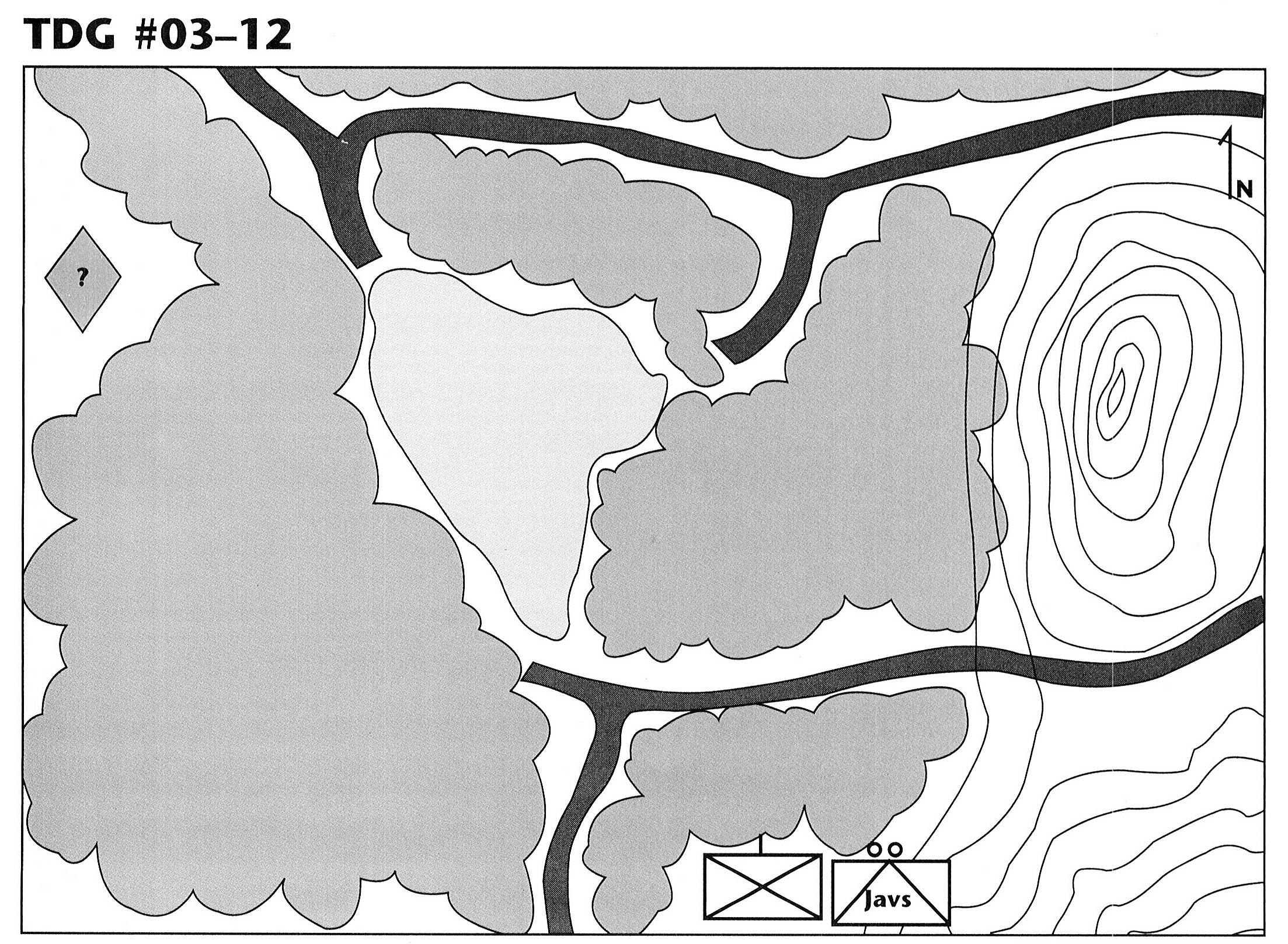
You are the rifle company commander for Charlie Company, 1st Battalion, 6th Marines. Your battalion has been operating in this area for the last 30 days with great success. The enemy has been reduced to operating as elements smaller than platoon size. Currently your battalion is attempting to conduct a helicopterborne extract and plans to secure two landing zones within its area of operation (AO).

The AO is heavily forested with clearly defined trails overlooked by steep mountainous terrain. The enemy is foot mobile and is armed with AK-47 rifles and medium machineguns. There is an unknown enemy force that is consolidating to the northwest and looks to be in a recovery mode. You are currently moving south to north en route to an open area large enough for 1.5 CH-53Es.

Mission: Charlie Company (Rein), 1st Battalion, 6th Marines conducts a foot movement to secure and prepare a landing zone to accommodate two CH-53Es in order to facilitate the expeditious extract of the battalion.

Table of organization and equipment:

* Three rifle platoons (75 percent strength). (Each fire team has one AT-4.)

* One weapons platoon (75 percent strength).

* One Javelin squad (100 percent). (Each team has a demo kit with C4 (Composition 4) and detonation chord.)

* One section of 81mm mortars is in general support from the south.

Requirement

In a time limit of 10 minutes, identify your specified and implied tasks and develop your scheme of maneuver and fire support plan. Submit your solution to Marine Corps Gazette, TDG #03-12, P.O. Box 1775, Quantico, VA 22134, fax 703-630-9147, or e-mail to <[email protected]>.

Dumas Sucker Punch

by Capt Edward P. Mullen

Situation

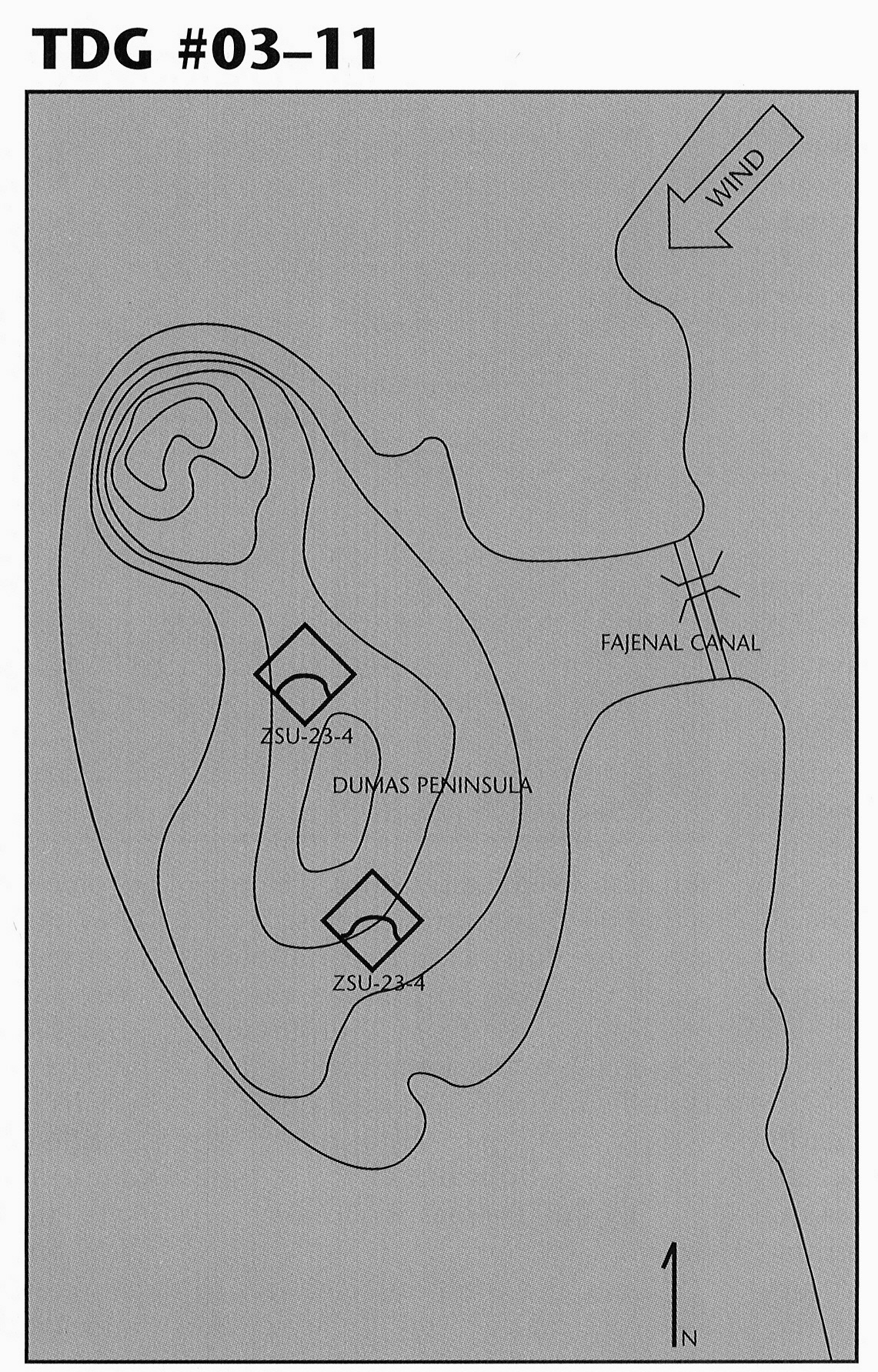
You are to be the division leader for a mixed flight of two UH-1N Hueys and two AH-1W Cobras conducting aerial interdiction in support of a combined amphibious and heliborne landing. The time is now 1700. L-hour is 0600 tomorrow morning when both the boat and helicopter companies will put “feet ashore.”

Reconnaissance assets report that two ZSU-23-4s have moved onto the Dumas peninsula this afternoon where both companies will insert. The accompanying support structure has been moving ammo to the antiaircraft artillery sites. The enemy is known to have Generation I night, vision devices. No SA-9/13s or reinforcing mechanized infantry have yet crossed the Fajenal Canal onto the peninsula, but they are expected to follow. You are operating off of the LPD of a Marine expeditionary unit in an established fire support area, and the commander, amphibious task force will not exit until 0400.

Forecasted ceilings for tonight are broken at 5,000 feet, wind 045/12. Sunset is 1842; moonset is 2024. Both Cobras are up for TOW; only one is up for Hellfire. Only one Huey has a fully operable Star Safire. No friendlies are ashore and no surface fires are available. The Marine air-ground task force (MAGTF) commander’s priority of fires is air defense, indirect fires, command and control, and then mechanized assets. Your task is to destroy the two ZSU-23-4s to facilitate landing the heliborne force.

Requirement

Within a time limit of 10 minutes, develop an objective area scheme, following offensive air support briefing considerations, that accomplishes the MAGTF commander’s intent. Explain your geometery and weaponeering choices. Provide a sketch of your plan of action and rationale behind it.

Submit your solution to Marine Corps Gazette, TDG #03-11, P.O. Box 1775, Quantico, VA 22134, fax 703-630-9147, or e-mail <[email protected]>.

The Race Is On

by CAPT Garth Gould, Australian Army

Situation

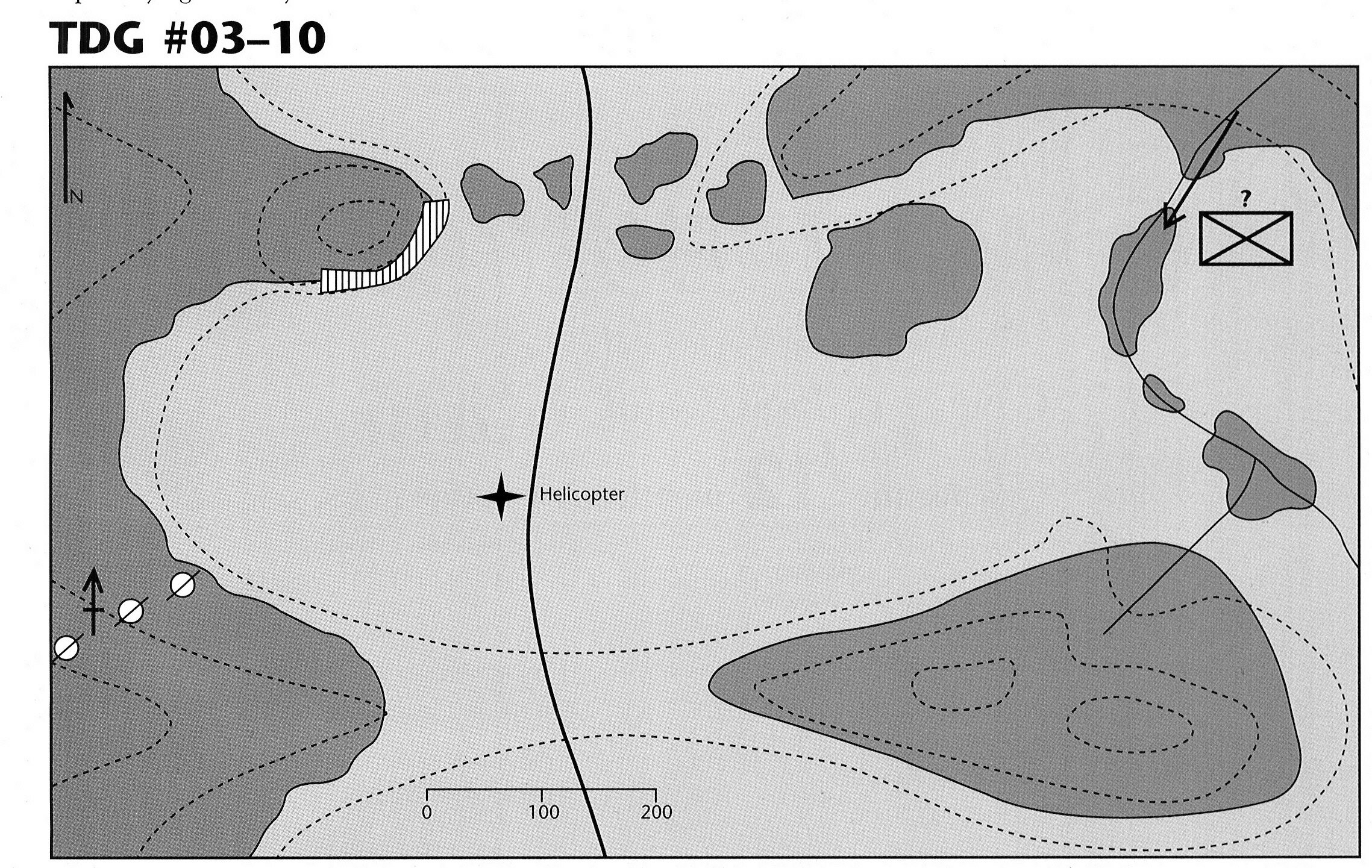
You are a squad leader conducting a foot patrol in wooded, rolling terrain. You have a machinegun team from weapons platoon (two M240Gs) attached to your squad. You are in radio contact with another squad from your platoon that is patrolling approximately 2,500 meters to your north. The remainder of your platoon is occupying a firm base some distance away. Due to the threat posed by enemy counterbattery fire, your squad is unlikely to receive any indirect fire support during this patrol. Recently, your unit has encountered enemy who are well-trained and usually operate in teams of six, although they regularly combine two or three teams together.

The time is 1600 hours when you suddenly hear the sound of a helicopter flying low to your northeast. Although you can’t see the helicopter through the trees, something tells you it’s in trouble. As you expected, you soon hear the abrupt thud of the aircraft hitting the ground not far from your patrol. You shake your squad out and cautiously patrol toward the accident sight. After only a few minutes your patrol reaches the edge of the tree line. You can see that a friendly utility helicopter has crash landed heavily 300 meters to your east. There is smoke emanating from the engine of the wreck. Some aircrew and passengers are frantically trying to pull other survivors from the wreckage, and it’s obvious that several personnel have been seriously injured in the crash. Just as you’re deciding what to do, your scout draws your attention to a group of enemy moving from the cover of a tree line into a creek about 700 meters to your northeast. They are moving cautiously and appear to be equipped with small arms. You’ve counted five into the creek line so far. What do you do?

Requirement

Within a time limit of 5 minutes, issue the orders you will give to your subordinates. Provide the rationale for your decisions and a sketch of the plan. Submit your solution to Marine Corps Gazette, TDG #03-10, P.O. Box 1775, Quantico, VA 22134, fax 703-630-9147, or e-mail <[email protected]>.

Offroading

By Maj Terry Branstretter

Situation

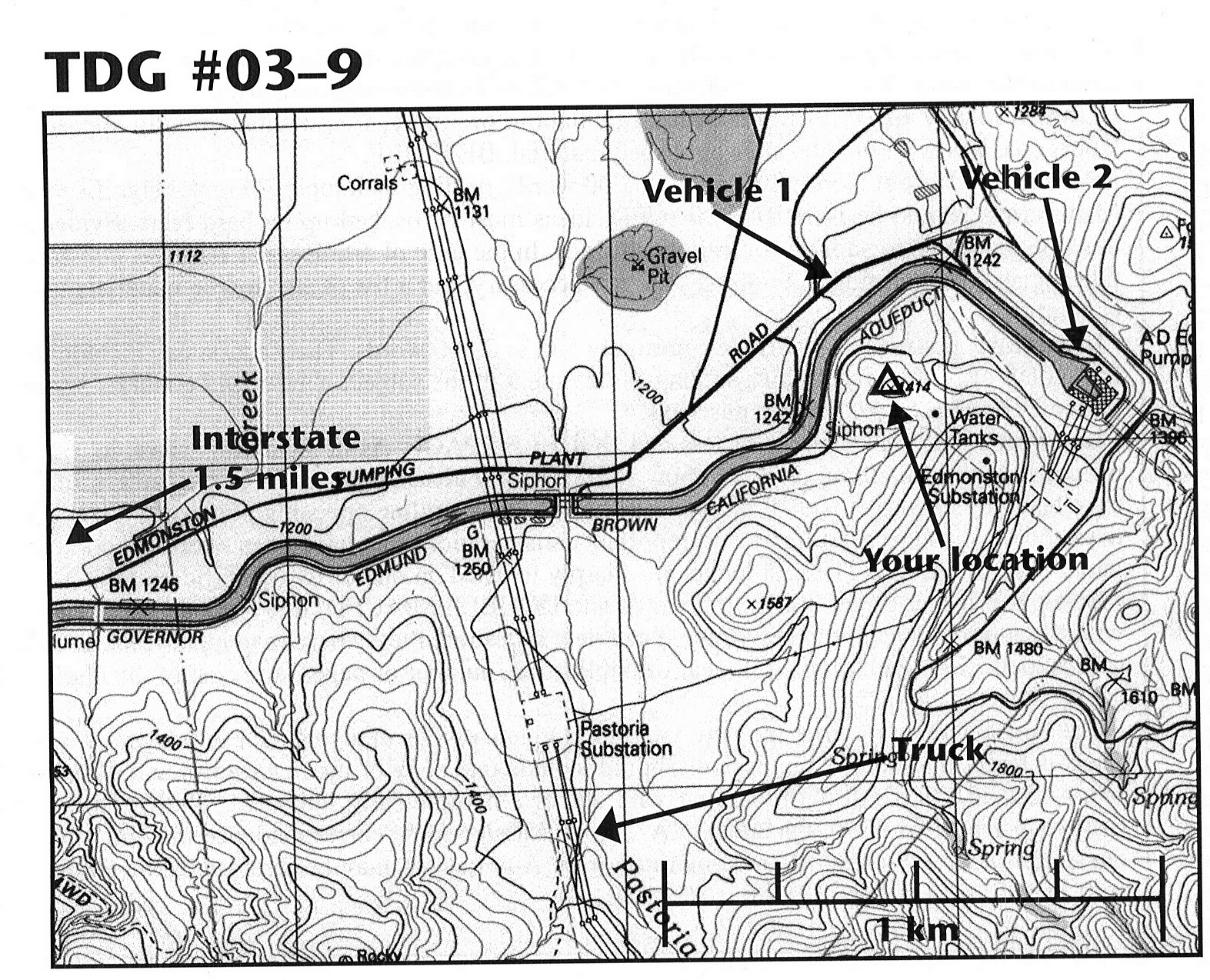
You are Cpl Smith, USMCR, stationed at Pico Rivera, CA. You are an off-duty police officer with the Los Angeles County Sheriff’s Department. You’ve spent the morning four wheeling with fellow noncommissioned officer, Cpl Jones. You decide to take a lunch break near an aqueduct that provides about a third of Los Angeles’ water supply.

You parked your truck where the jeep trail ends near a power substation (1 hour’s drive from the main highway). After trying to check in with your wife (your cell phone did not get a signal), you and Jones decide to hike to some high ground and have lunch. You walk for about 20 minutes to a hill that overlooks the station that pumps water over the mountains to your east.

You remark to Jones as you loosen your boots, “I bet we could have driven most of the way to this hill if we stayed near the water. At least the return is mostly downhill.” You rest and eat while calculating how much water must be moving through the station. You remark at the engineering marvel of the aqueduct and the pumping station. “That much water and it looks like only a few guys actually man the site. I wonder if the pumps are monitored remotely?”

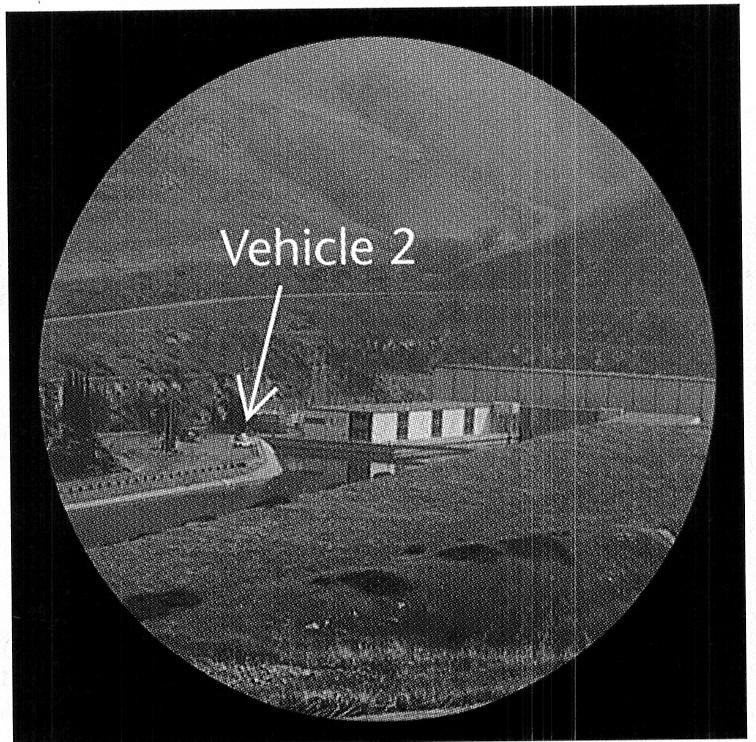
As you enjoy the day, two large vans approach the pumping station. They stop at separate locations (shown on the map). With a set of small binoculars you observe six men exiting the second vehicle. On closer inspection you see that they appear to be armed. A minute later you see the men fire an automatic weapon toward an entrance to the pumping station. Dumbfounded, you murmur, “Why did I leave my pistol in the truck?”

Requirement

In a time limit of 5 minutes explain how you intend to react to this situation. Provide a sketch of your actions and the rationale behind them. Submit your solution to Marine Corps Gazette, TDG #03-9, P.O. Box 1775, Quantico, VA 22184, fax 708-630-9147, or e-mail <[email protected]>.

Standoff in the Swamp

By 1stLt Joshua E. Cavan

Situation

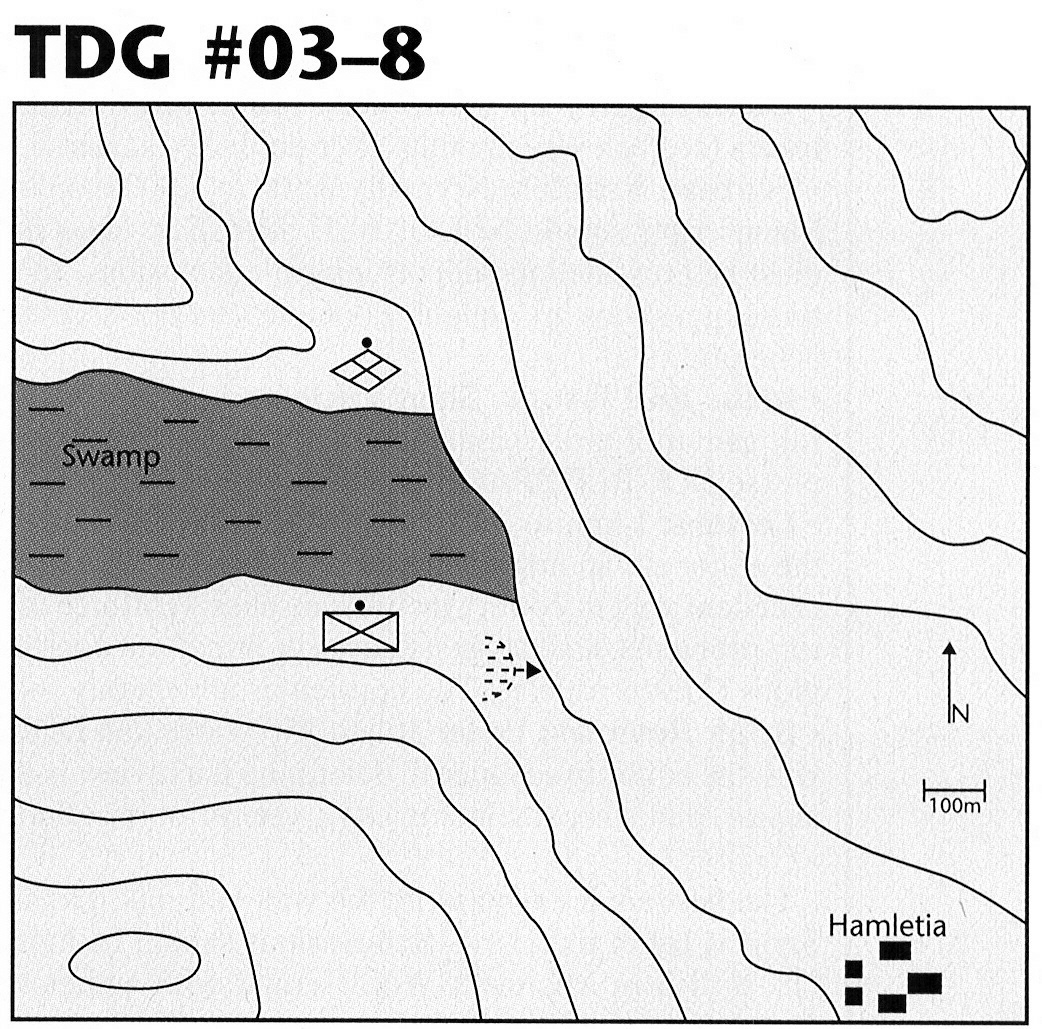
You are 1st Squad Leader, 1st Platoon, Company A, 1st Battalion, 6th Marines. Your battalion has been conducting patrolling operations in the country of Jungleland. The battalion is assisting the Jungleland Marines in defeating an indigenous guerilla movement that has been linked to an international terrorist organization. The terrain in the interior, where the guerilla movement is based, features steep hills covered with triple canopy jungle cut by numerous, small, easily fordable streams and swamps in the low-lying areas. Visibility is limited to 100 meters or less in the hills and 200 meters or less in the lowlands.

The guerillas operate largely in 10- to 12-man groups based in villages. They depend on their home villages for food, fresh water, and new recruits. They are armed with a variety of small arms from bolt action rifles to rocket propelled grenades. They are not known to possess a significant heavy machinegun or indirect fire capability.

Company A is operating with a Jungleland Marine company in the area of the small town of Villagton that has several small, outlying hamlets. The company’s mission is to deny the enemy the use of the village in order to cut the enemy off from the supplies and potential recruits in the village. 1st Platoon is tasked with occupying the outlying hamlet of Hamletia and conducting combat patrols in order to prevent small enemy units from infiltrating into Villagton. 2d and 3d Platoons have the same mission in hamlets to the south of the village. Your company command post and the Jungleland Marine company are located in Villagton itself. 2d and 3d Squads will remain in the village while you patrol and will prepare to conduct their own patrols upon your return. Located north of Villagton are 60mm mortars. They are in general support of the company with priority of fires to 3d Platoon, then 2d Platoon, and then 1st Platoon.

Your squad has been tasked with conducting a daylight patrol north of the village along a route that squad-sized enemy units have used previously to move into the Villagton area. You will insert by helicopter and patrol on foot back toward Hamletia. Your mission is to conduct a heliborne and foot security patrol in order to prevent any enemy forces from infiltrating along the known route toward Hamletia and Villagton. Commander’s intent is as follows:

The enemy’s center of gravity is the support, in the form of supplies and recruits, that he receives from the Villagton area. His critical vulnerability is that he uses known routes to infiltrate toward the village. I intend to send out patrols along these routes to find enemy patrols and prevent them from moving toward the village by destroying them.

You will be within range of 60mm mortars during your entire patrol.

You insert at 1200 and begin moving south following a small stream. Radio communications in the dense jungle has been unreliable throughout the patrol. At approximately 1400 you move into a swampy area bounded by two small streams featuring knee-deep brackish water, waist-high grass, and some tall trees, although the area is not so densely wooded as the hills. You are moving on the south side of the swampy area when one of your Marines spots a group of guerillas moving on the north side of the swampy area approximately 200 meters away. You immediately halt and begin to deploy for a hasty ambush facing east across a larger stream along the route you think the enemy forces will take toward Villagton. As you begin to position for the ambush, the enemy force suddenly halts and goes to ground. You are not sure if they have seen you or what they intend to do, but you cannot see them moving away. You attempt to call higher to report, but you cannot get a response.

Requirement

In a time limit of 5 minutes, issue your orders to your patrol. Provide a brief rationale for your actions and a sketch of your plan. Submit your solution to Marine Corps Gazette, TDG #03-8, P.O. Box 1775, Quantico, VA 22134, fax 703-630-9147, or e-mail <[email protected]>.