Decision in the Streets

By Maj David H. Mayhan

Situation

You are the platoon commander for 1st Platoon, Company A, 1st Battalion, 6th Marines (1/6). U.S. forces have been conducting offensive operations as part of a multinational coalition in the desert country of Kartiq. The United Nations coalition is operating under a resolution intended to remove the oppressive Kartiqi dictator from power in order to return stability to the region. Military resistance has been light thus far. While the majority of the Kartiqi population despises their leader, they remain skeptical of American interests in the area. Locals have generally tried to avoid U.S. forces and have not yet demonstrated any open opposition. However, if convinced they were becoming the direct target of military action, they would likely rise up in defense of the homeland. Aware of this fact, the Kartiqi military has increased its presence in urban areas in hopes of drawing the local populace into the conflict.

A week ago the regiment seized the town of Rikala. 1/6 has assumed responsibility for maintaining the town’s security as the remainder of the regiment pushes north. The battalion has subdivided the town into four quadrants with Company A occupying the northwest. The company’s mission is to control Quadrant Alpha in order to prevent the enemy from infiltrating back and reestablishing power. The company has established checkpoints on the outskirts of town, conducted searches of suspected hideouts, and demonstrated its presence with aggressive urban patrolling. Two reaction forces are always available on 10-minute alert: a rifle platoon from your company and a HMMWV-mounted heavy machinegun section from the battalion. Because the United States is at war with Kartiq, the rules of engagement are much less restrictive now than in the past. Servicemembers are authorized to engage the Kartiqi military by any means consistent with the law of war. Nonmilitary personnel observed committing serious crimes will be detained using minimal force necessary. If all reasonable graduated response techniques have been exhausted, and it appears that human life will be lost, deadly force is authorized. Self-defense is always authorized.

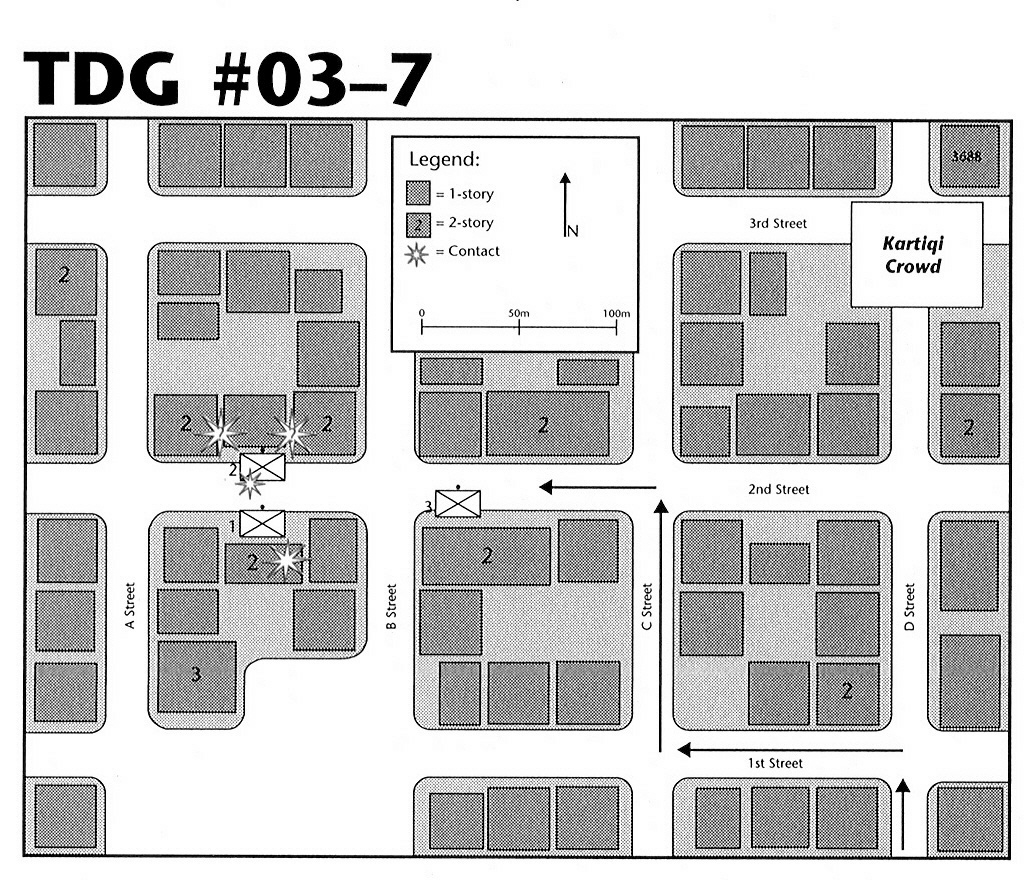
Your platoon has been tasked with conducting a patrol through the quadrant in order to deter renewed enemy action and report on suspicious activity. Advancing north along the streets, you observe a crowd of approximately 15 Kartiqi locals about 2 blocks away, engaged in what appears to be an intense argument. As you approach, they cast a few glares your way but otherwise leave you alone. Thinking better than to continue in that direction, you instead turn west and report the situation to higher. After advancing one block to the west, you notice a large open lot to your front and again decide to detour around this potential danger area. Turning north and then west again, you finally find yourself on a safer route.

Your movement standing operating procedure has been a typical “two up, one back” double column. Your lead squads advance along either side of the road, staggered with respect to each other, providing security to the front and opposite flanks. 3d Squad is moving in trace of 1st while also providing rear security. As you come to the next intersection, you treat it as a danger area and manage to get 1st and 2d Squads across safely. As you prepare to cross with 3d Squad, a rifle shot suddenly breaks the silence, and a Marine from 2d Squad crumples to the ground. “Sniper!”

You know the shot came from the north side but can’t tell from which building. The two squads appear to be executing your immediate action drill. 1st Squad scrambles for the southern buildings to provide suppression while 2d Squad conducts an immediate assault to the north, dragging the downed Marine inside. As the squads disappear from view, you hear tremendous fire erupting from the southern buildings. Apparently 1st Squad has run into a fight of its own. “Ambushed!” you think to yourself. You and your 3d Squad are still east of the intersection. You shout to the other two squads but get no response.

Requirement In a time limit of 5 minutes, develop a plan and state what orders you will issue to your squad leaders. Provide a brief rationale for your decision and a sketch of the plan. Submit your solution to Marine Corps Gazette, TDG #03-7, P.O. Box 1775, Quantico, VA 22134, fax 703-630-9147, or e-mail <[email protected]>.

Reconned by Fire

By Paul Turnan

Situation

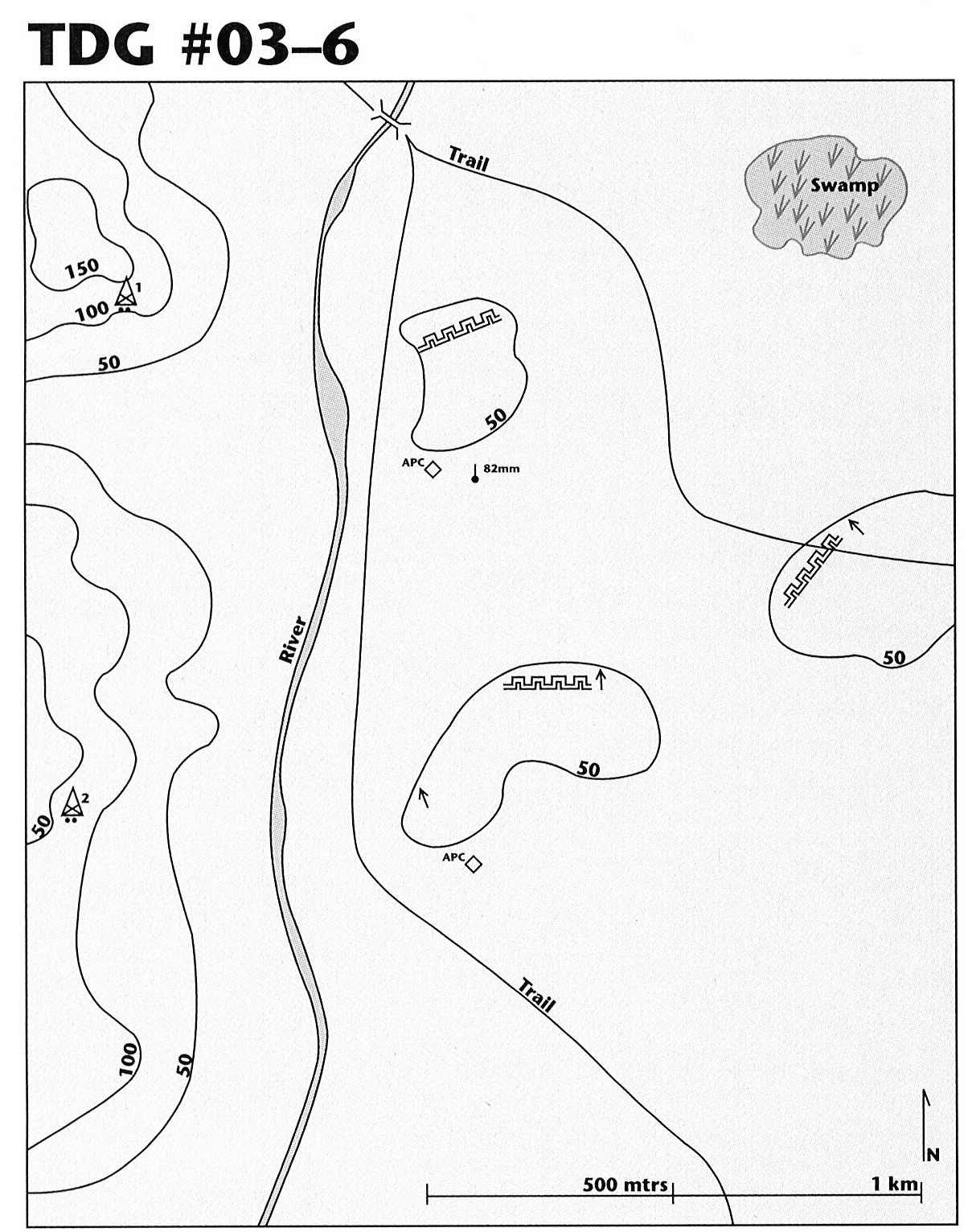
Your battalion intends to conduct a night attack on foot tomorrow night from north to south in order to clear the enemy from your zone of operations-an isthmus 2 kilometers wide and 5 kilometers long.

Your four-man fire team and one other team have been assigned to observe and report enemy positions and activity in preparation for tomorrow morning’s attack. The previous night your patrol established an observation post (OP 1) on the forward slope about 50 yards from the crest. Visibility and fields of observation are good across the treeless grassland. Radio communications with battalion and OP 2 is loud and clear. Your position is well-concealed. Between both OPs you have reported to battalion the positions of the enemy as shown on the map. You observe that the enemy position is well-entrenched. The enemy is behaving rather casually, lining up for chow, doing laundry, etc. The enemy dispatched squad-sized patrols to the northeast earlier in the day.

The time is now 1130. You observe a frenzy of activity on the enemy position. The enemy begins to fire on OP 2 with machineguns and small arms. You monitor OP 2’s report to battalion that they have taken casualties. OP 2’s request to battalion for artillery is denied. Looking to the south you can see OP 2 pop smoke. OP 2 goes silent and does not respond to radio calls from battalion. The enemy continues firing. Now enemy rounds begin to impact all over the hillside you occupy. This fire seems random. You are confident that your OP remains undetected, yet enemy fire intensifies. One of your Marines calls out that he’s hit. An enemy round splashes you with dirt. What now?

Requirement

In 2 minutes decide on a course of action, and issue your frag order. Provide a sketch and rationale for your action. Submit your solution to Marine Corps Gazette, TDG #03-6, P.O. Box 1775, Quantico, VA 22134, fax 703-630-9147, or e-mail <[email protected]>.

Broken Screen

by Maj Scott E. Ukeiley

Situation

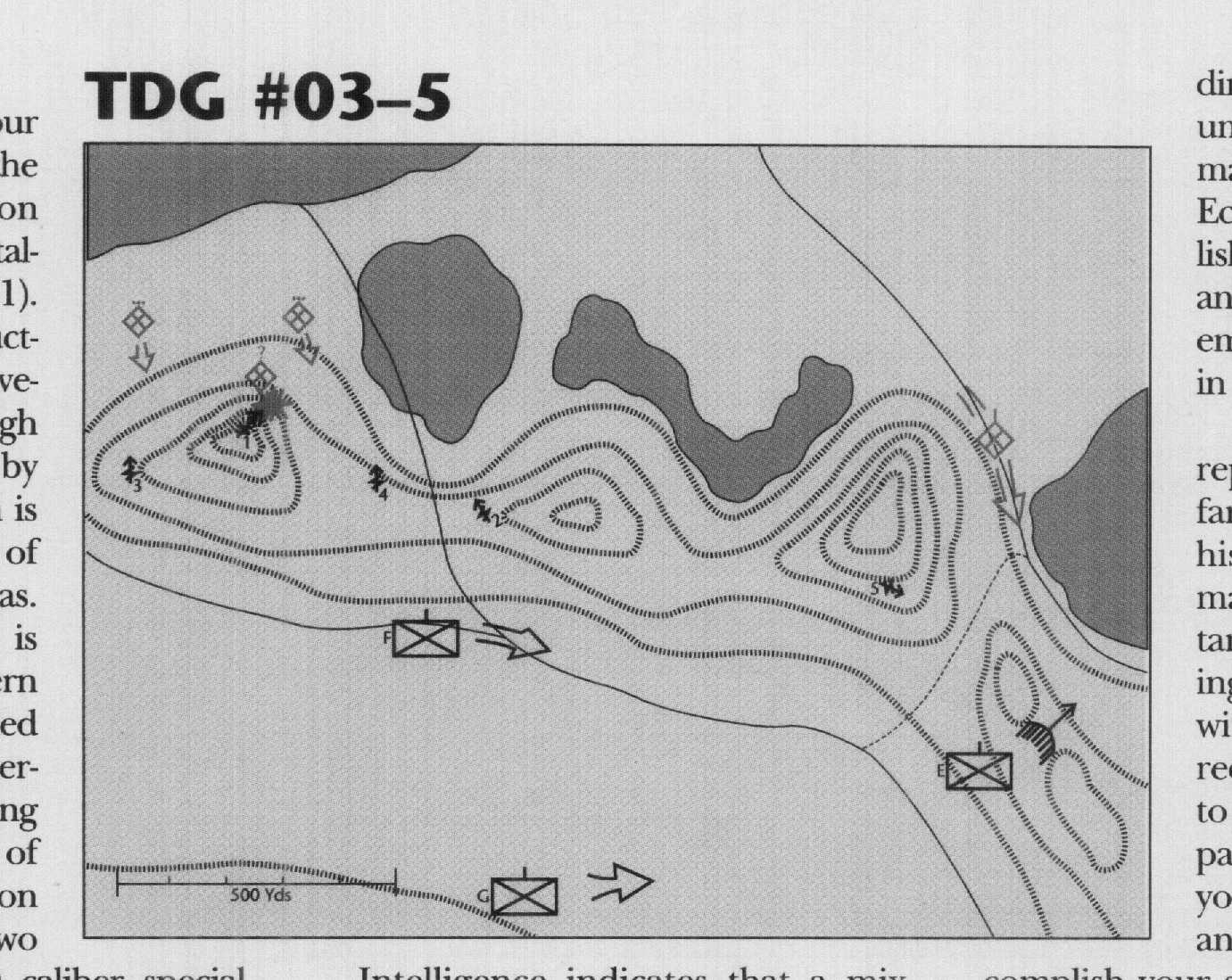
It is 1730 and 1 hour until sunset. You are the Scout/Sniper Platoon Commander, 2d Battalion, 1st Marines (2/1). Your battalion is conducting a dismounted movement to contact through an open valley flanked by low ridges. The terrain is rolling with a mixture of wooded and open areas. Scout/sniper platoon is screening 2/1’s northern flank and has established a series of indepth observation posts overlooking the most likely avenues of approach. Your platoon is task organized into two three-man M82A3 .50 caliber special application scoped rifle (SASR) teams and three two-man M40A3 sniper teams that are depicted on the map. You are collocated with Hunter 2. All teams are in good communications with each other and battalion.

Intelligence indicates that a mixture of regular and irregular forces, estimated at battalion strength, occupy the area. These forces possess automatic weapons, mortars, and manportable air defense systems. This last element was a nasty surprise as two Cobras conducting armed reconnaissance were damaged yesterday.

The lead company commander (Echo Company) reports that he has reached the high ground overlooking the valley exit, made visual contact with the enemy, and has not been spotted. Traveling perpendicular to the battalion’s line of march on an unimproved dirt road, the enemy column consists of approximately 80 to 90 infantry. Echo Company is establishing a hasty far ambush and estimates that the enemy will be in his kill zone in 10 minutes.

Just then Hunter 3 reports a platoon of infantry advancing toward his position, approximately 300 meters distant. Hunter 3 is requesting mortar fire to deal with this threat. His fire request has been denied to facilitate Echo Company’s ambush. Just as you are analyzing time and space factors to accomplish your screen mission in light of the enemy proximity to the ridge, the silence is shattered by rapid fire from Hunter l’s M82A3 SASR and M249 squad automatic weapon (SAW). “Infantry, technicals, 100 yards my pos . breaking contact now!” Simultaneously, Hunter 4 reports approximately 30 to 40 men approaching their position from the northwest, 300 yards away.

So much for Echo’s ambush. What now, Lieutenant?

Requirement

In a time limit of 5 minutes, detail the orders you give to your platoon and your report to battalion. Provide the rationale for your decisions and a sketch of the plan. Submit your solution to Marine Corps Gazette, TDG #03-5, P.O. Box 1775, Quantico, VA 22134, fax 703-630-9147, or e-mail <[email protected]>.

Scout/Sniper Platoon

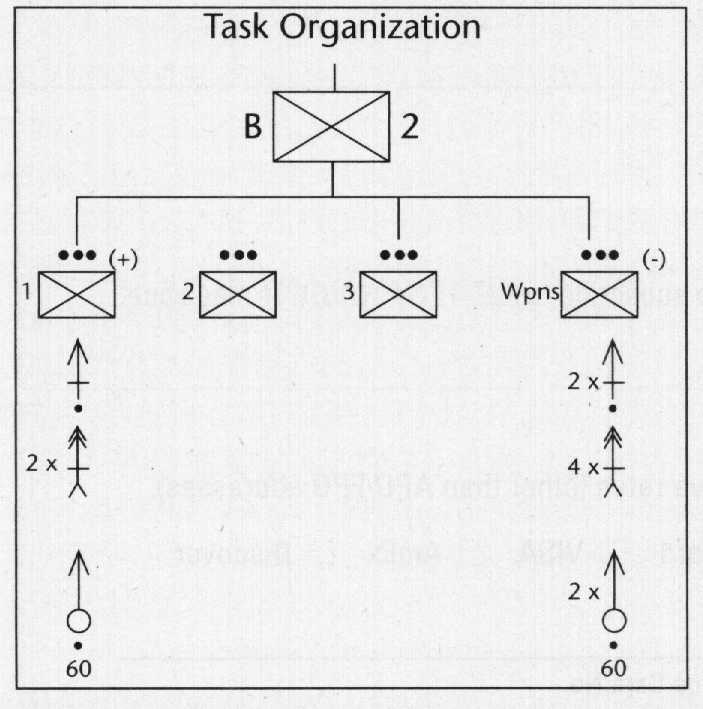
Task organization

Hunter 1

SASR Team (3 Marines)

1 x M82A3 special application scoped rifle

1 x M249 SAW

1 x M16A2 rifle

Hunter 2

SASR Team (3 Marines)

1 x M82A3 special application scoped rifle

1 x M249 SAW

1 x M 1 6A2 rifle

Hunter 3

M40A3 Team (2 Marines)

1 x M40A3 sniper rifle

1 x M16A2/M203 rifle

Hunter 4

M40A3 Team (2 Marines)

1 x M40A3 sniper rifle

1 x M16A2/M203 rifle

Hunter 5

M40A3 Team (2 Marines)

1 x M40A3 sniper rifle

1 x M I 6A2/M203 rifle

Scout/Sniper Platoon Weapons

The M82A3 SASR is a .50 caliber semiautomatic, magazine fed, shoulder fired weapon equipped with a 10-power scope. The weapon has a maximum effective range of 2,000 yards against vehicle-sized targets. Due to its lack of minute of angle capability, it is not a sniper rifle and considered inaccurate against man-sized targets beyond 600 yards.

The M40A3 sniper rifle is a 7.62mm bolt action, magazine fed, shoulder fired weapon capable of minute of angle accuracy. Coupled with a 10-power scope, the weapon has a maximum effective range against personnel to 1,000 yards.

Battling Terror

by Maj Terry L. Branstetter

Situation

You are the commander of Company B. Your battalion is prosecuting the war on terrorism in the Philippines. The battalion has been conducting company-sized raids from amphibious shipping. You have met with some success, especially since you joined forces with local military and police forces that are sympathetic to your mission. These successes consist of arms seizures and the apprehension of several alleged terrorist leaders.

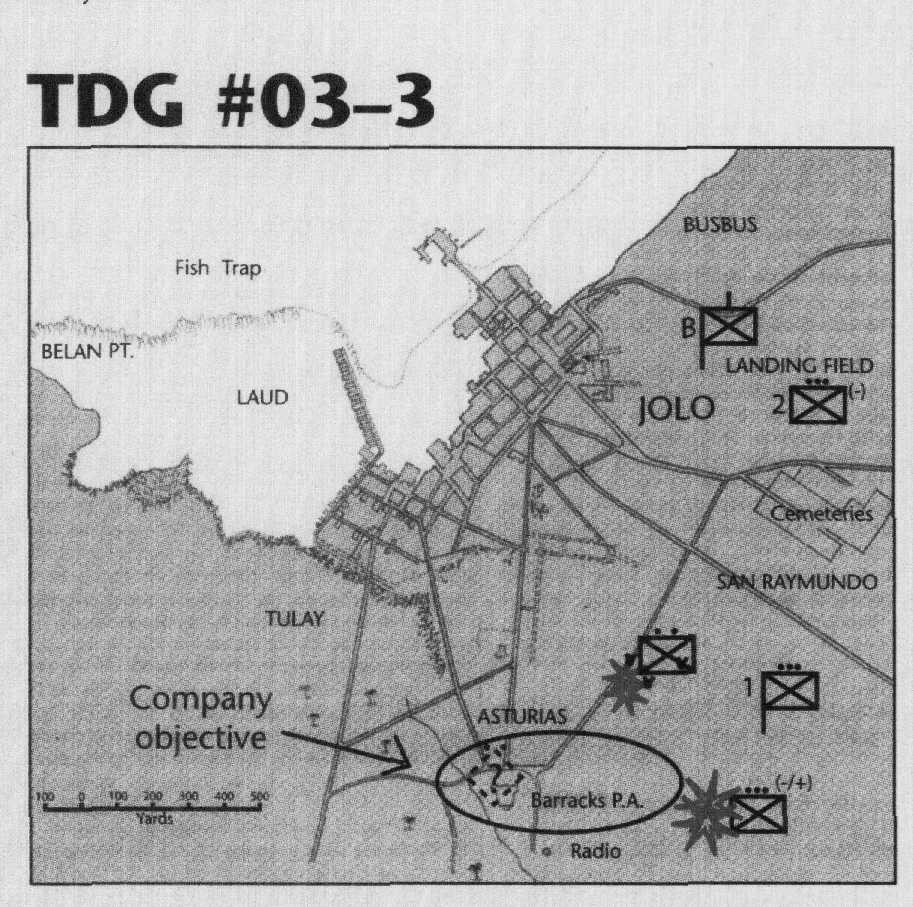
Today, your company will link up with a squad of local military forces to raid a suspected terrorist training camp on a remote island. The objective is a barracks compound near a small coastal village bordered by vegetation that thickens as you move inland.

Your mission is to seize the objective in order to apprehend potential terrorist personnel and destroy weapons. Your scheme of maneuver is as follows: your 1st Platoon will helicopter into a landing zone (LZ) about 1 mile northeast of the objective. This platoon will link up with a squad of local forces at a nearby cemetery and move along two routes to isolate the objective. One squad will parallel a road to the objective. The remaining members of the reinforced platoon will approach the objective from the east.

You will arrive in a second helicopter wave consisting of 2d Platoon to assault the objective. A third wave consists of one squad from your company reinforced with engineers who will destroy weapons if found. This wave is oncall and will arrive within 20 minutes of your call.

When you are 15 minutes from the LZ, your 1st Platoon commander reports successful linkup with the local squad. Meanwhile, your CH-46 pilot informs you that one of the flight’s four helicopters had to return to the ship. While passing word about the reduced size of your flight, your radio/telephone operator informs you that a squad from 1st Platoon encountered a minefield and has casualties.

Unable to get the 1st Platoon commander on the radio, your flight arrives at the LZ. As the helicopters depart over the coast, you reestablish communications with 1st Platoon to receive the following report. “Six, this is One. 2d Squad has three wounded in action in a minefield near the road. Break. We have taken fire from the objective. One local killed, one wounded. Break. 1st Squad reports three captured; one is wounded and claims to be American. Break. I am currently between my two forces. Over.”

Requirement

In a time limit of 5 minutes, explain how you intend to react to this situation. Provide a sketch of your actions and the rationale behind them. Submit your solution to Marine Corps Gazette, TDG #03-4, P.O. Box 1775, Quantico, VA 22134, fax 703-6309147, or e-mail <[email protected]>.

Trouble in Barass

by Rittmester Patrik Schaathun, Norwegian Army

Situation

The battalion you command is part of a Marine expeditionary brigade (MEB) spearheading the United Nations operation in Barass, a Third World country torn apart by civil war. The aim of the operation is to bolster the democratically elected president by preventing insurgents from taking over the country.

The MEB mission of checking the rebel advance on the capital Cucaracha has been achieved by a show of force. A stalemate has occurred and negotiations are ongoing between the insurgents and the democratically elected government. Your interim mission is to disarm all militias in your area of operations (AO) and provide humanitarian aid to the civilian population. The militias are believed to have withdrawn northward out of your AO. Rules of engagement allow you to use deadly force in selfdefense and if met with noncompliance when disarming militias. A minimum of force is to be used.

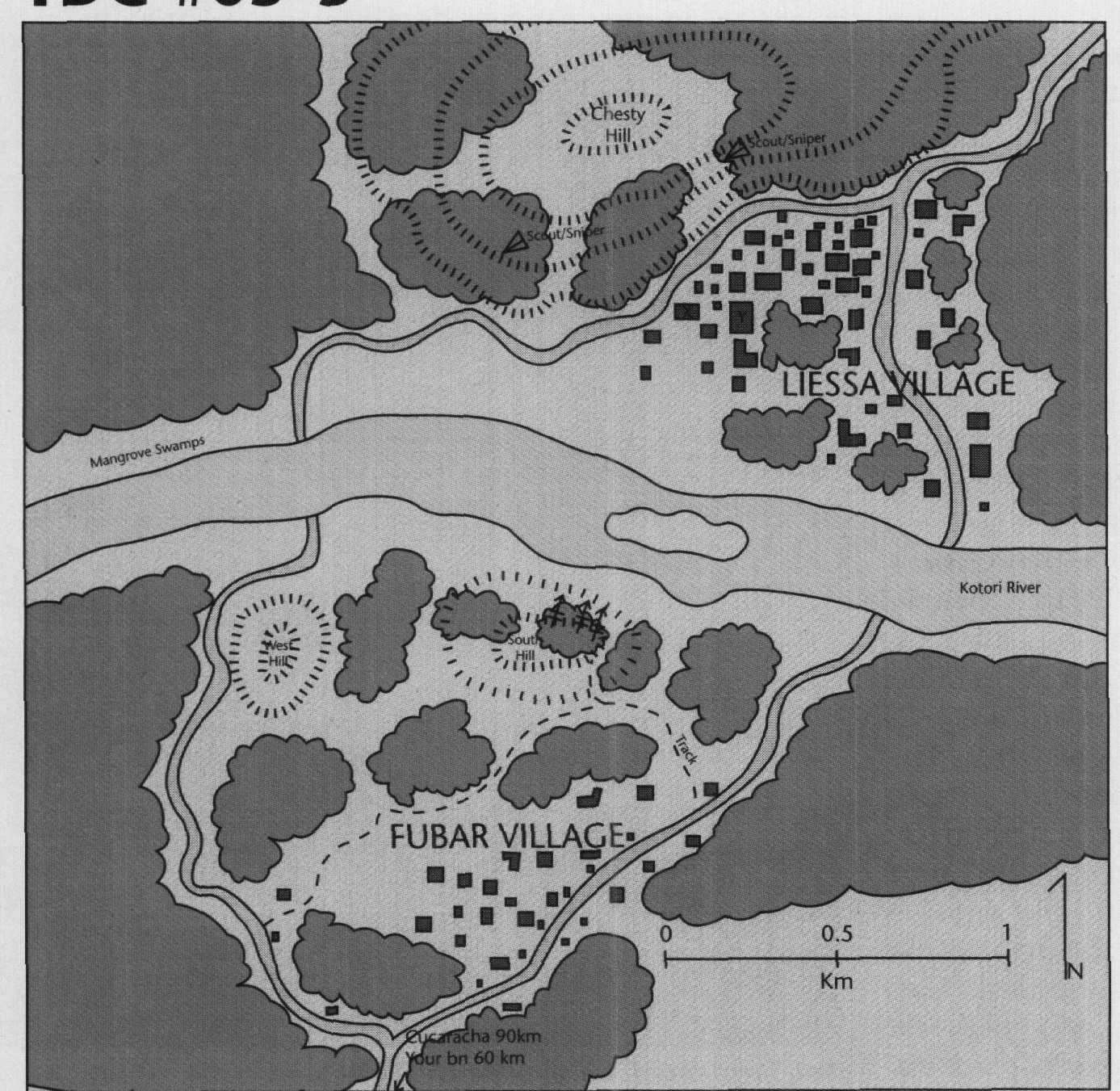
It is 1800 and the sun is setting. Its rays won’t be seen again until tomorrow at 0600. The battalion is located 30 kilometers (km) north of Cucaracha. Charlie Company has been detached to guard the U.S. Embassy in the capital. Riots have broken out in Cucaracha, and operations to evacuate foreign nationals are pending. Yesterday morning 12 men from Alpha Company were taken hostage while distributing food to locals 20km west of your position. The perpetrators belong to a group called the “Nasty Boys.” Fueled by alcohol and drugs, they are known to have raped, plundered, murdered, and mutilated their way across Barass. Through an intermediary the MEB has been able to get in touch with the group. Demands for the release of the hostages seem unclear and have ranged from cases of beer, weapons, and cell phones to a HMMWV. Intelligence has revealed that the hostages are held in the village of Liessa. Two scout/sniper patrols are on the site and have reported that the hostages are held in building X guarded by eight soldiers manning four sangars (stone breastwork, lookout post) around the house. A platoon-sized unit has been observed in building Y. At least two more platoons are believed to be billeted somewhere in Liessa. A company is billeted in Fubar, a nearby village. Heavy machineguns are located north of Fubar. In both villages civilians roam the streets. The shallow and fast-flowing Kotori River runs westward through mangrove swamps.

Your immediate superior fills you in. “We have it from reliable sources that the hostages are to be transferred to an unknown location tomorrow evening. Between your present location and Liessa we believe there are between six to eight potentially hostile company-sized militias armed with small arms. We have no antiterrorist unit available to support you. You must rescue your Marines before they are moved. Four CH-53s, two AH-lW Super Cobras, and one CH-46 will support your operation.”

Requirement

In a time limit of 20 minutes develop your intent, plan, and tasks to subordinate units. Provide a fragmentary order, overlay of your scheme of maneuver, fire support plan, and the rationale for your actions. Submit your solution to Marine Corps Gazette, TDG #03-3, P.O. Box 1775, Quantico, VA 22134, fax 703-630-9147, or e-mail <[email protected]>.

Platoon Lost, Position Unknown, Situation–We Are Winning

By Maj Michael J. Targos

Situation

You are the commanding officer of Bravo Company, Ist Battalion, 2d Marines (1/2). The Marines have landed in the country of New Sherman in order to assist the host nation’s military in defeating an invading conventional force consisting of two mechanized rifle divisions (MRDs). Marine forces have been conducting offensive operations in order to secure the Sheridan Airport and allow unimpeded fly-in of reinforcements. The bulk of the MRD is at least 48 hours away to the north and being interdicted by the bulk of the air assets with poor results due to weather.

While the Marines have made substantial ground gains, the advance has halted south of Chamberlain Ridge. Highway 1 is only one usable route for our tanks due to road width and bridge capacity. It was thought that airpower would make quick work of enemy resistance, but the weather turned extremely foul 6 days ago to include “buckets” of rain, sleet, fog, and an ever-present cloud cover. Additionally, intelligence collection has been severely restricted. Infantry and division reconnaissance (recon) units have become your primary information sources. The Marines have paid in blood waiting for external feeds on enemy dispositions.

Situation: Cumberland Pass is defended by a motorized rifle battalion (MRB). The MRB is estimated at approximately 70 percent strength with questionable morale due to casualties and the weather. The S-2 (intelligence) believes that the enemy will defend as long as he has a strong combined arms capability.

2d Marines’ mission: At D+9, 2d Marines secures Sheridan Airport in order to allow the fly-in of reinforcements.

Regimental commander’s (CO’s) intent: “We must introduce more forces into the area of operations in order to deal with the remainder of this MRD. I intend to open Highway 1 by attacking the enemy from the rear with a light force aimed at his artillery-his backbone-and moving rapidly through Cumberland Pass before he can react. A rapid attack to the airport, that I believe to be lightly held by ground forces, is essential. My desired end state is control of the airport.”

Task to 1/2: “You are the supporting effort. No later than 0400 on D+9, attack to destroy the enemy’s indirect fire support assets in order to allow the remainder of the regiment to move through Cumberland Pass. Your company has been tasked with conducting an infiltration and attacking the objective. The remainder of the battalion is in trace of the regiment as a reserve.”

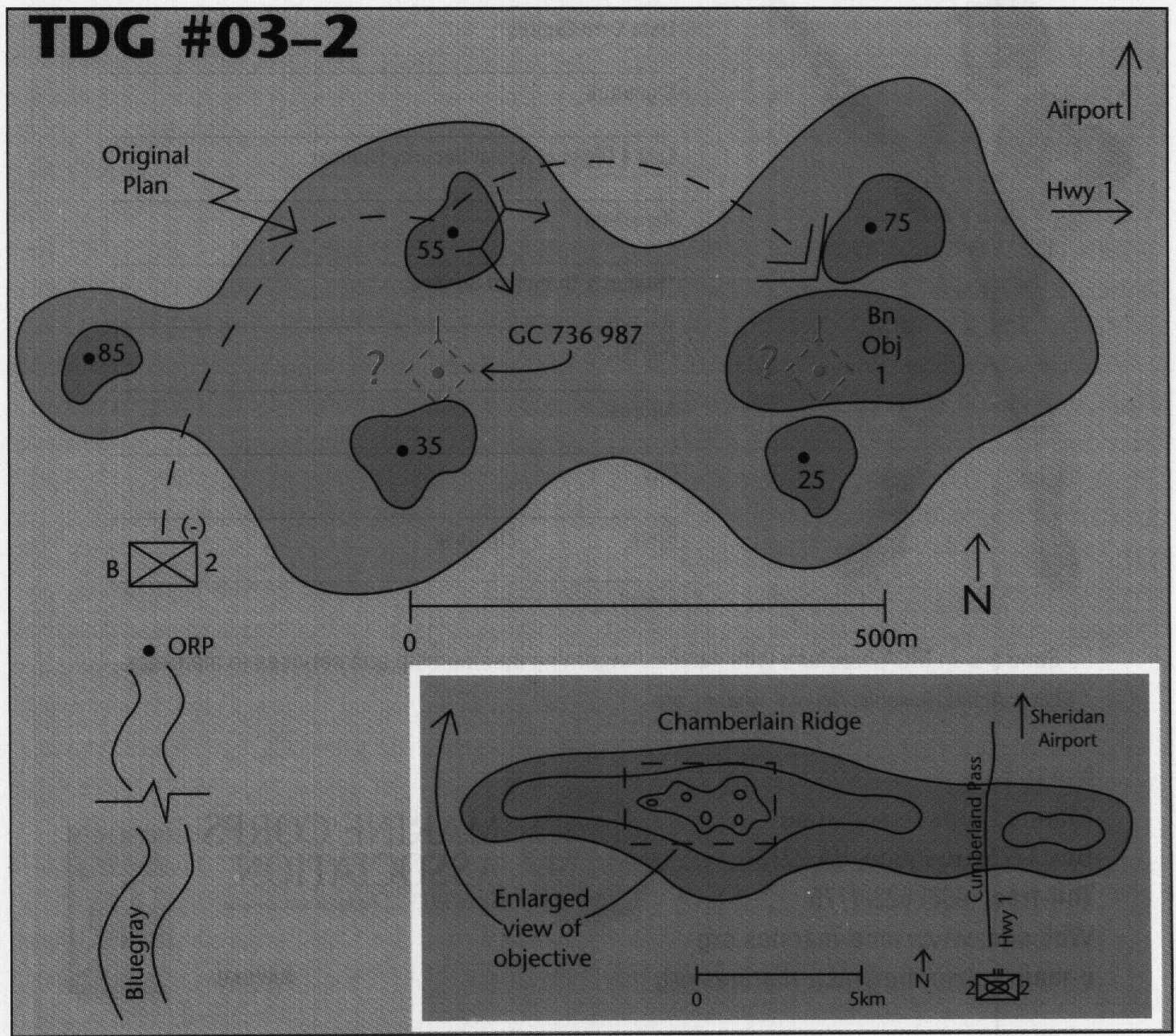
Situation update: Your company’s movement along infiltration lane “Bluegray” began on D+7, and you have made no contact along the way. Your company links up at the objective rally point (ORP) at 2100, D+8. You confirm the assault plan (depicted as a dashed line on the map) with your platoon commanders. You move out at midnight (D+9) from the ORP with lst Platoon in the lead. The rain begins … again. It is the hardest rain yet. Visibility is reduced to the man in front of you. At 0230, Ist Platoon checks in on the net and says he’s disoriented. He just passed Checkpoint 5 (CP 5). (There’s no CP 5 on any map.) You strain to look at your map in the dark and decide to personally walk up and find them. When you reach the rear of Ist Platoon, the trail squad leader says that they halted about 1 hour ago, stood up to continue, and the rest of the platoon was gone! Upon returning to your command post, you discover that you have no communications with Ist Platoon or regiment. You do hear the following conversation between your executive officer (X0) and a recon team:

XO: “Station calling. Say again about that artillery battery.”

Recon Team 2: “SA-9 and towed artillery battery located at grid 736 987 with no troops visible. Over.”

You look at your map. That puts the enemy battery less than a click away with Ist Platoon somewhere to your front-lost! You grab the handset.

CO: “Recon 2, are you sure about that position? Over.”

Recon Team 2: “Almost positive. The global positioning system is down, but I matched up the terrain. I can call for fire right now!”

All of this terrain looks the same. As you begin to tell the recon team to adjust fire on the enemy position, the XO grabs your arm and asks, “Shouldn’t we locate Ist Platoon before we call that mission, Sir?”

What do you do?

Requirement

In a time limit of 10 minutes, issue your orders to your company. Provide a brief rationale for your actions and a sketch of your plan. Submit your solution to Marine Corps Gazette, TDG #03-2, P.O. Box 1775, Quantico, VA 22134, fax 703-630-9147, or e-mail <[email protected]>.

Another Day Afloat

By LCpl Kevin M. Charkowske

Situation

You are the commander of a Marine expeditionary unit (special operations capable) (MEU(SOC)) sitting 25 miles off the coast of the country Exbeyond.

Exbeyond is a mountainous country recently liberated by coalition forces with an interim government friendly to the United States. The countryside, however, is still sympathetic to the terrorist forces that were recently driven from power. The country is war torn and in need of humanitarian assistance and military support while it rebuilds its infrastructure.

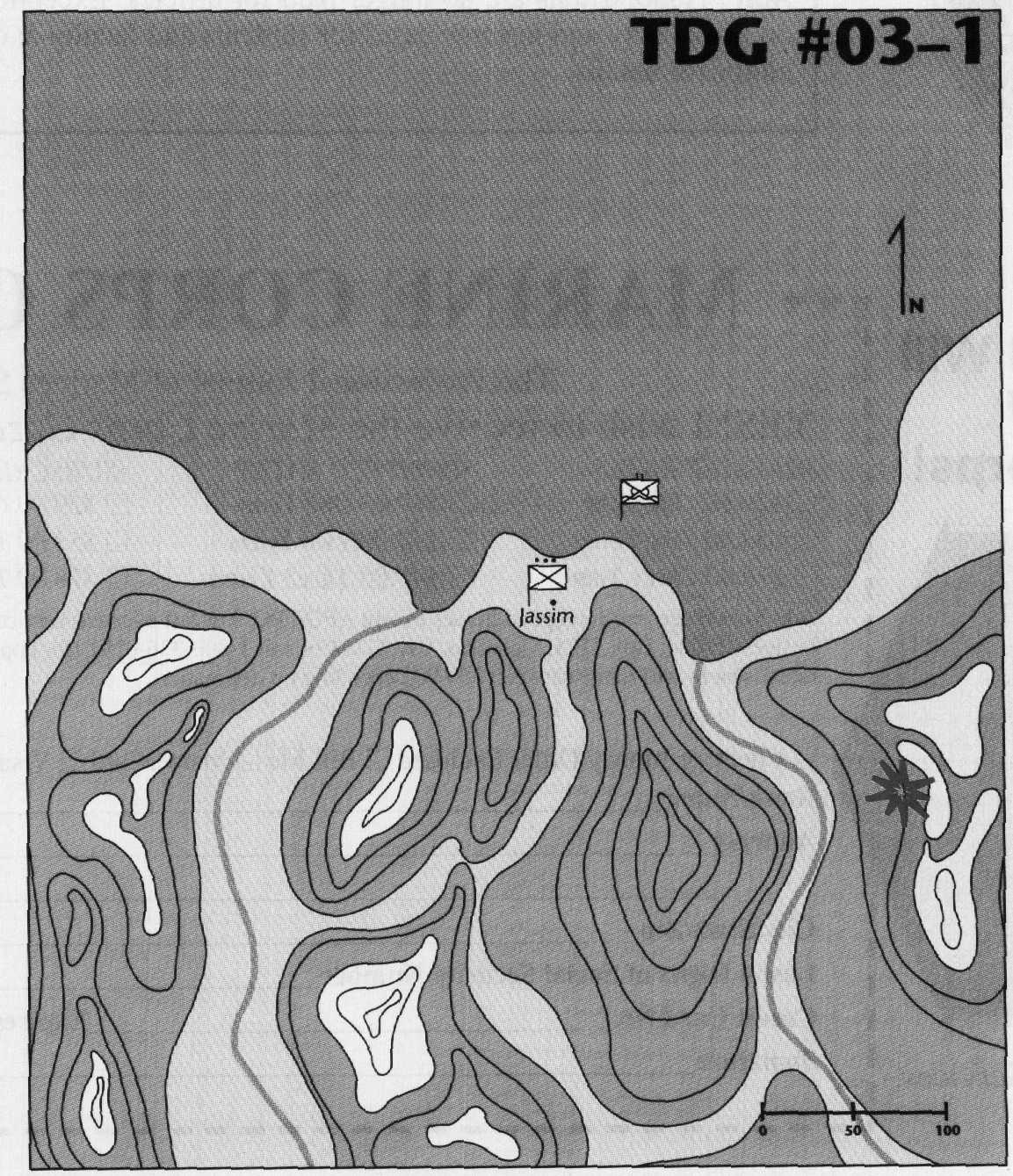
It is now 1900. There are currently two missions that the MEU is conducting. The first is a humanitarian assistance operation. A platoon-sized element (1st Platoon) is providing medical, dental, and food services to the port of Jassim, the second largest city in the country. Jassim is located 70 nautical miles southwest of the amphibious ready group’s position. They are supplied daily after nightfall.

The second mission is a close air support (CAS) mission being conducted by three of the MEU’s four AV-Ss. The fourth AV-8 is down for maintenance. The CAS is in support of an Exbeyond battalion engaging a terrorist base camp 200 miles to the southeast.

At 1930 collection assets detect a terrorist base camp consisting of 30 to 40 men, 75 miles due south of the MEU. Intelligence indicates that Abdul bin Wazaid is present. Wazaid is the operations chief for the entire terrorist organization in Exbeyond and is responsible for a number of attacks on U.S. forces. Intelligence also indicates that Wazaid will be moving at 0300 to another location. This is the first time that Wazaid has been positively identified, and it will likely be some time before he is located again.

You give the warning order for a heliborne raid to be conducted no later then 0200. Your plan is to use four CH-53Es for the raid and four AH-Is for CAS.

At 2037 Ist Platoon reports that a large crowd of Exbeyondians has gathered requesting health care and food. The majority of these Exbeyondians appear to be refugees from the local countryside. The platoon is out of medical and dental supplies and requests resupply in order to continue providing services to the Exbeyondians. The crowd is currently peaceful, but it is becoming increasingly hostile as the platoon is forced to turn them away.

At 2105 one of the returning AV-8s is shot down by a manportable air defense missile. The remaining two AV-8s are returning ofter locating the crash site. Both AV-8s have taken damage from antiaircraft artillery fire while conducting the CAS. The pilot has established contact with friendly forces and is moving to an evasion and recovery site. The S-2 (intelligence) informs you that the terrorist forces are aware of the pilot’s position and will close in on it by 0200.

The MEU is the only friendly unit in the area capable of conducting these missions. Joint and theater assets are hundreds of miles to the south supporting a coalition offensive near the southern border.

The CH-53E is the only asset that can recover the downed pilot.

You have a hostile crowd, ‘a downed pilot, and one shot at catching one of the world’s most wanted terrorists. What do you do, Colonel?

Requirement

In a time limit of 3 minutes issue your orders to your platoon commanders. Provide a fragmentary order, overlay of your scheme of maneuver, and the rationale for your actions. Submit your solution to Marine Corps Gazette, TDG #03-1, P.O. Box 1775, Quantico, VA 22134, fax 703-630-9147, or e-mail <[email protected]>.

Sidebar

Ten Years of TDGs

by Maj Brendan B. McBreen

Almost 400 solutions to tactical decision games (TDGs) have been published in the Marine Corps Gazette during the last 10 years. These published orders reflect the tactical thinking and orders techniques of a small but thoughtful percentage of Marines. These orders can provide us with some interesting insights and assist us in thinking about the orders we issue and receive within our own units.

I reviewed all of the TDG orders published between June 1990, when the first solutions were published, and November 2001. Discounting a small number of unique TDGs whose solutions were not combat orders, I analyzed the remaining 365 orders against the standards that our doctrine and our education system recommend for a good order. A good order includes:

* An assessment of the situation.

* A tie to the higher intent.

* A unit mission and intent.

* A series of subordinate tasks and intent.

* A designated main effort.

* A designated reserve.

Conversely, a good order avoids excessive conditional phrases, confusing task organizations, micromanagement, and trivial “more of the obvious” phrases. My observations are based on the following questions:

(1) Is the order clear? If I were a subordinate commander receiving this order, would I understand the plan and my role in the action?

(2) Is the order complete? Are any key pieces of information missing?

(3) Is the order flexible? How well would a leader who received this order be able to exercise his initiative and react to changes in the situation?

Observations

Every order published during the last 10 years communicated a tactical plan. Actual units would have responded well to the majority of orders presented. The following observations identify those areas in need of improvement.

An assessment of the situation. Only 27 percent of the orders included some assessment of the situation. Most times, where a situation was included, the information was usually a repetition of the facts, devoid of context or insight. This trend reflects our doctrinal emphasis on almanac information-facts, rather than assessment.

A tie to the higher intent. Only 12 percent of the orders included any link to the higher commander’s intent. We teach that the actions of a leader who does not know the higher commander’s intent cannot support his commander, whereas the actions of a leader who knows the intent of his headquarters two levels up cannot fail to support his commander. Some authors may have assumed such an understanding already existed, but the overwhelming absence of this fundamental precept of our warfighting doctrine is significant.

A unit mission. The majority of orders-75 percent-included a clear and concise mission statement. The remaining 25 percent had no mission at all but went straight to issuing tasks to subordinates. A few confusing orders issued a scheme of maneuver as the mission statement.

An intent. Forty-seven percent of the orders included an intent in some part of the order. However, some of these intent statements added no value to the order. Weak intent should be cause for concern. In reading hundreds of intent sentences, my sense is that many leaders understand the concept but few have experience with expressing solid intent. Intent should be why not how. Some intent was nothing more than, “I intend . . . ” followed by the scheme of maneuver. “I intend to encircle his forces north of Balzar and attack along two axes from east of the river. ” Other weak examples equated the intent with the mission. “Attack Objective A in order to seize Objective A.” Your intent should justify your mission. Ask yourself, “Why is this important? Why are we doing this?” Good intent focuses on the enemy, fair intent focuses on friendly forces, and weak intent focuses on terrain.

A series of subordinate tasks and intents. Forty-six percent of the orders used the good practice of linking each task with a corresponding intent or purpose. Since each task becomes a mission statement for your subordinate, each task is best understood when phrased as a mission statement with an accompanying intent. The most concise technique is to link the mission and the intent with “in order to.” “Seize the tower in order to prevent its use as an enemy observation post.”

More than half of the task statements contained no intent. Many of the poorer tasks were “puppet orders,” physically placing units on the deck but communicating no hint of what was expected of them. “Move to Checkpoint One. Orient east.” Other weak tasks were nothing more than detailed movement orders. “Move south between Route 5 inclusive and Route 10 exclusive. At release point follow river, stay in trees, cross east of bridge. Enter treeline north of creek and establish position there. ” Defensive tasks, especially, need to avoid the puppet tendency. “Occupy and defend battle position 10.” A better example is, “Defend battle position 10 in order to prevent enemy fire on our main supply route.” Defensive tasks that include only targeting information-“lead four vehicles are yours–are especially weak. Defensive orders need a clear intent to encourage subordinates to conduct an active, aggressive defense.

A designated main effort. Only 37 percent of the orders designated a main effort. This powerful technique has been recommended by our doctrine and taught in our schools for over 10 years. The main effort is the unit that will strike the decisive action. This concept unifies the actions of all subordinate units and serves to focus their attention when the situation changes. The main effort focuses fire support, logistics support, supporting units, and other priorities. A main effort that is weak, relative to other units, is evidence of a misunderstanding of the concept, a lack of tactical focus, a “fair share” mentality, or a failure to make tough economy of force decisions. Every order, for all units, for all types of missions, should designate a main effort.

A designated reserve. Twenty-six percent of the orders assigned a reserve. The more times a commander is surprised by unexpected enemy actions, the more he learns to maintain an untasked reserve. In the Marine Corps, during field exercises or map exercises, we are rarely surprised, so many leaders do not internalize lessons concerning the reserve. On the other hand, most TDGs address small unit problems. Our doctrine suggests that small units below the company level should not be expected to identify a reserve. “You are also the reserve” is a potentially dangerous tasking. When a surprise arises, is that unit available or engaged? A reserve provides flexibility. Without one the commander has few options available when the situation changes.

Excessive “on order. ” Only three percent of the orders included more than two “on order” or other conditional phrases. Too many “on orders” is an indicator of a fragile plan overly dependent on good communications and the commander’s ability to make all the decisions.

Task organization confusion. Nine percent of the orders were unclear or unnecessarily complex in task organization. Unclear command relationships were usually the result of imprecise language: “travel with Ist Platoon, ” “send two tubes with 3d Platoon, ” or “organize the battle position with 2d Platoon and tanks. ” The doctrinal terms direct support or attach should be used. Many of the identified confusions applied to the weapons platoon of the rifle company– an administrative-not a tactical unit. Unless attached out, weapons sections work directly for the company commander and are not tasked through the weapons platoon commander.

Micromanagement. Ten percent of the orders attempted to micromanage the tactical employment of a subordinate commander’s unit. A few examples broke units apart or assigned individuals. “Pull two men from your 3d Squad across the river, ” or “use that vehicle crewman to set up the landing zone.”

More of the obvious. Only a tiny number-3 percent-of the orders included any more of the obvious phrases. What does a Marine think when given the following instructions? “Care for your wounded. ” “Make timely and accurate reports.” “Normal radio procedures apply.” “Be flexible, move fast fight aggressively. ”

Tendencies

The majority of the TDG orders were short, direct, and unambiguous. Overall, however, there was far too much evidence of poor orders practices. Almost three out of four leaders failed to designate a reserve. Nearly two out of three leaders failed to designate a main effort. One out of every two leaders failed to provide a commander’s intent.

One out of four leaders communicated no mission at all but went straight to issuing tasks to subordinates. Either the commanders felt that the mission had not changed and did not need to be repeated or the heat of the moment required immediate taskings. An order lacking a mission statement is inherently weak and prone to misunderstanding. These types of orders can be heard frequently on the radio during unit exercises in the Operating Forces.

A large number of muddled orders failed to identify a main effort A main effort should always be identified. The concept of the main effort is such an integral part of our warfighting doctrine that its absence in almost two-thirds of the TDG orders should be cause for concern.

Most orders avoided the debilitating practices of excessive conditional phrases, confusing task organizations, micromanagement, or more-of-the– obvious phrases. This is probably caused by the concise TDG format and recommended time limit that combine to encourage brevity. The large number of repeat authors is also probably a contributing factor. Leaders who write many orders develop clarity of thought and clear phrasing habits that avoid most poor orders practices.

A large number of orders were written by the same people. Twenty-two percent of the orders were written by non-Marines. Eleven percent were written by enlisted Marines. Forty-four percent were written by company grade Marine officers. Twenty-three percent were written by field grade Marine officers. This does not include the far larger number of orders received by the Marine Corps Gazette but not selected for publication. In one regard, this shows that these individuals are interested in their profession and are practicing and contributing. On the other hand, this may indicate the interest that tactical decisionmaking and the orders process has in our organization. How many units train with TDGs on a regular basis? How many leaders train with TDGs on their own?

What Is To Be Done?

Combat orders, like any communications skill, is more art than science. Issuing concise, unambiguous orders is a skill acquired only through continuous practice. In order to improve our skills we, as Marine leaders, need to improve our own orders technique as well as guide the development of our subordinates’ skills.

Teach orders. Marines learn from their leaders. All leaders need to take the time to train their subordinates on effective orders techniques. A weekly officers’ call that includes a tactical decisionmaking exercise is a valuable event. Some schools focus on the format of orders but provide very little guidance on good philosophies and good habits of combat orders. Developing leaders should not have to sift through numerous orders to develop their own habits. Appendix C of Marine Corps Doctrinal Publication 1-0, Marine Cords Operations, includes the precise definitions of tactical tasks.

Require orders. Because the standard written order has grown so complex, some leaders do not require orders during map exercises, wargames, exercises, or unit professional military education. This is a mistake. A brief but effective order is a valid order. Every order written on a notebook page, index card, or issued verbally is a training opportunity gained.

Fight real opponents. In competitive fights, where an implacable enemy with a free will attempts to counter friendly actions, commanders learn how to issue robust orders. Only when the enemy has the capability to surprise us and disrupt our plans do leaders internalize solid lessons on the criticality of reconnaissance, the benefits of a simple task organization, the importance of a main effort, and those difficult decisions surrounding the use of the reserve. Leaders need to fight wargames, fight map exercises, and fight in force-on-force exercises against a thinking and difficult foe. Your orders will benefit from these realistic experiences.

Encourage practice. The average Marine Corps officer has caught more fly balls than he has issued orders. We get plenty of practice in unimportant skills but too little practice in our critical skills. Leaders need to schedule and encourage more practice on orders technique– teach more, require more, and fight more. Our serious professional force needs to get serious about the key professional skill of communicating tactical decisions.

Conclusion

TDG orders coming from a small percentage of Marines who were published in the Marine Corps Gazette may not be representative. One-third of the orders were written by the same author who wrote the TDG scenario. These individuals are especially interested in tactics and their profession. If the TDG orders were written by leaders who are keenly interested in the process, what of the average? Think about your own unit. How would you rate your average leader’s orders abilities? How would you rate the orders abilities of those leaders who do not regularly practice? Do you and your leaders issue the type of robust orders that will increase the combat power of your unit when committed to action? Our expeditionary force philosophy is tomorrow we may go to war. That means that today we need to train to fight and train to issue orders to prepare for war.

Encounter on the Coast

By Capt Gregory A. Thiele

Situation

Four days ago, the country of Green invaded its southern neighbor, Orange. The army of Orange had little notice of the attack and was quickly overrun. Due to treaty obligations the 11th Marine Expeditionary Unit (Special Operations Capable) (11th MEU(SOC)) was introduced into the country of Orange yesterday in order to stabilize the situation.

You are the company commander of Company B, the light armored reconnaissance company attached to the battalion landing team. Your orders were to push north along the coastal road, establish a screen line north of the capital of Orange, and provide the MEU with time so that it can offload without interference. In the S-2’s last briefing before you came ashore you were told that the enemy does not want to fight U.S. forces and will likely halt their attack and use the territory they have gained to this point as a bargaining chip.

You have pushed your company about 50 kilometers (km) north of the capital and established a screen line. Highway 1 is a four-lane, hardsurfaced road that runs along a flat, broad coastal plain. There is another road, Route 16, that runs toward the capital to your west. It is also a hard-surfaced road, but this valley is narrower and off-road movement is more difficult than on the coastal plain. There is only one road that runs between the coastal plain and this valley between your position and the capital. It is about 5km to your left rear.

You take these things into consideration and deploy your company. You direct 2d and 3d Platoon to screen along Highway I and the coastal plain and send your lst Platoon to screen along Route 16. You place your mortar section behind the two platoons on the coast. As you take stock of your fire support assets, you discount the possibility of artillery support. They won’t be off the ship until the morning. You will have a section of AH-1Ws on 10-minute alert off the deck of the USS Peleliu if you need them.

After 2 uneventful hours on the screen line, you see and hear your 3d Platoon engage an enemy force. The platoon commander quickly reports that two enemy reconnaissance vehicles fired on his vehicles and that the enemy had been destroyed. Shortly afterward the 1st Platoon commander sends a similar report. His platoon has also engaged an enemy reconnaissance element, but he has taken three casualties, none lifethreatening. As you report the situation to higher and request that the Cobras get airborne, the Ist Platoon commander comes over the net and tells you that he can see a sizable force of BMP-1s moving south toward his position about 6km away. He estimates the size of the enemy force at a company minus. This information is troubling enough, but more bad news comes when he sends an update and tells you that he can see two or three T-55s as well!

What are your orders?

Requirement

In a time limit of 3 minutes issue your orders to your platoon commanders. Provide a fragmentary order, overlay of your scheme of maneuver, and the rationale for your actions. Submit your solution to Marine Corps Gazette, TDG #02-12, P.O. Box 1775, Quantico, VA 22134, fax 703-630-9147, or e-mail <gazette@ mca-marines.org>.

Kill All the Lawyers?

By Maj Cody M. Weston

Situation

You are a rifle platoon commander for Fox Company, Battalion Landing Team 2/1, 13th Marine Expeditionary Unit (Special Operations Capable) (13th MEU(SOC)) operating in the African country of Blueland. Your platoon has been sent ashore to reinforce the American Embassy in the nation’s capital, Blueland City. Blueland is in the middle of a civil war between the pro-U.S. democratic government and rebel forces known as the “Zebras” because of the distinctive black and white utilities they wear. The Zebras have small arms, primarily AK-47s. The violence has escalated to the point where the Embassy staff may be in danger despite the presence of a 10-man Marine security guard (MSG) detachment.

At the MEU confirmation brief prior to the launch, the MEU lawyer, or staff judge advocate, spelled out the rules of engagement (ROE). He said that: (1) the Zebras had been “declared hostile”; (2) “proportional force” was authorized to defend U.S. forces, the Embassy staff, and any other U.S. citizen against any “hostile act” or demonstration of “hostile intent”; (3) tear gas and pepper spray were not authorized; and (4) all efforts must be made to “minimize collateral damage.”

You have no attachments or detachments. You have your organic platoon weapons-M16s, M203s, M249s, 9mm pistols-as well as nonlethal weapons to include shields, batons, stinger grenades, beanbag rounds, and rubber bullets. A forward command element (FCE) consisting of the MEU executive officer, two other officers, and three radio operators inserted into the Embassy 3 days prior to conduct liaison with the U.S. Ambassador. The MSG Marines have already spread concertina wire around the perimeter.

You inserted via helicopter into the Embassy compound, did some quick coordination with the FCE, and then established three hasty squad defensive positions along the Embassy perimeter. The MSG Marines are inside the Embassy building itself.

Once you were satisfied with your initial defensive scheme you went back into the Embassy to conduct more detailed coordination with the FCE. Within a matter of minutes, two of your squad leaders are trying to reach you via radio.

Ist Squad, at the northern end of the compound, reports that a group of five men are standing about 30 meters away smoking cigarettes. They are wearing the same black and white utilities that the S-2 had briefed and have AK-47s slung on their shoulders. The squad leader is requesting guidance.

2d Squad, at the southern end of the compound, reports that a group of about 50 civilians is within 20 meters of their position shouting and waving their fists at the Marines. A few civilians are throwing rocks at the squad. The Ambassador overhears the conversation and mentions that his MSG Marines have tear gas grenades and pepper spray canisters that your Marines can use to disperse the crowd.

What do you do?

Requirement

In a time limit of 5 minutes, issue your orders to your squad leaders. Provide a brief rationale for your actions and a sketch of your plan. Include a discussion of how your orders fall within the ROE. Submit your solution to Marine Corps Gazette, TDG #02-11, P.O. Box 1775, Quantico, VA 22134, fax 703-630-9147, or e– mail <[email protected]>.

Sergeant, You Have Your Orders. Carry Them Out, Now!

by MSgt William D. Lohan, USMC(Ret)

Situation

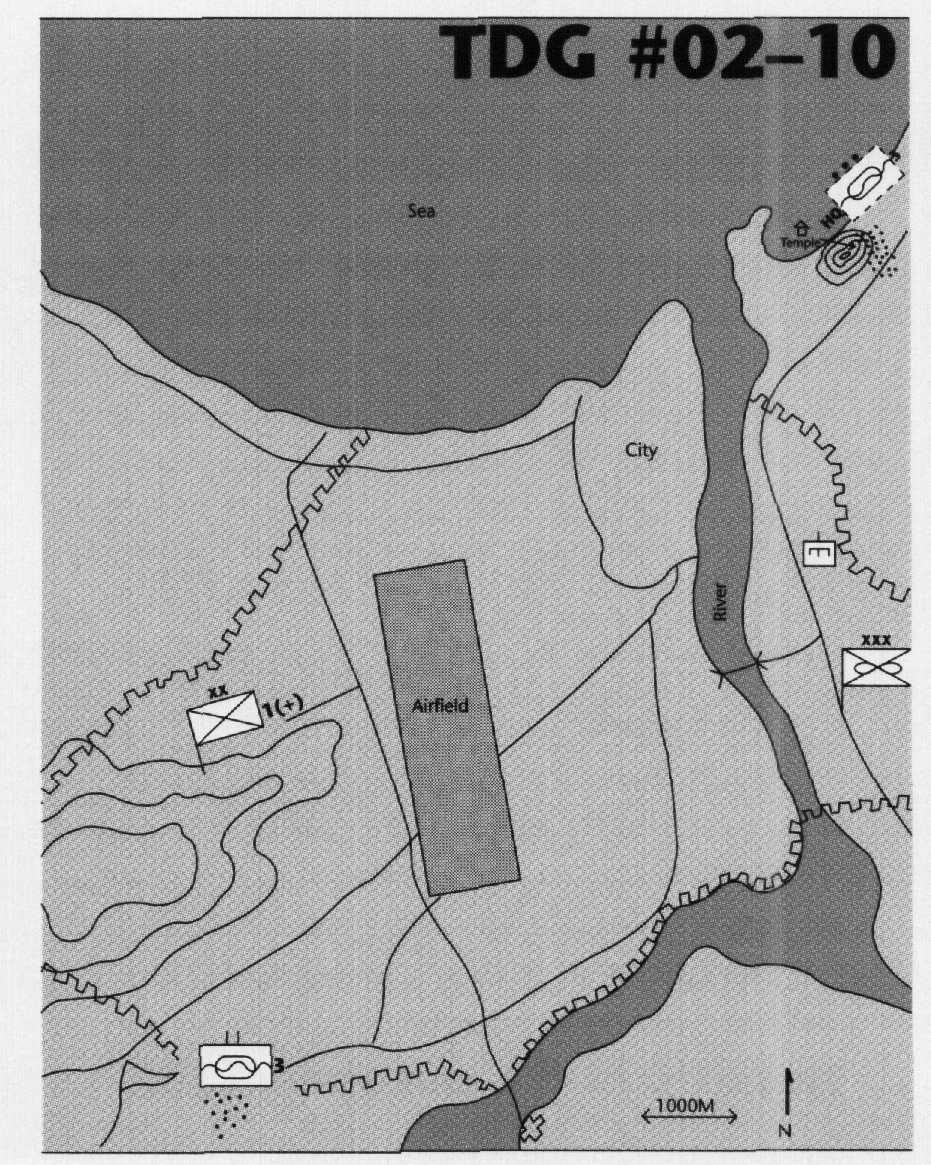
You are the company gunnery sergeant of Headquarters Company, 3d Assault Amphibian (AAV) Battalion. The battalion has been assigned to the Ist Marine Division. The division is currently deployed in a Third World country as part of a Marine air-ground task force (MAGTF).

The battalion is encamped 7,000 meters inland on the south side of a primary road. The compound is one of several that forms a defensive perimeter around the country’s second largest city. The battalion’s letter companies are deployed forward in direct support of division’s regiments. Headquarters and service company’s AAV platoon periodically supports field operations.

In an effort to extend the city’s defensive perimeter approximately 1,700 meters along the waterfront, the division commanding general has directed the attached Navy mobile construction battalion (NCB) to erect a new camp for the AAV battalion on the beach to the northeast side of a small mountain. A monastery belonging to the country’s primary religious sect is located on the mountain. The nation’s senior cleric remains in the monastery during the day. However, each evening he returns to the city in a late model, armored automobile.

The NCB agrees to build the camp provided their work detail can return to their primary defensive camp within the perimeter each evening. They offer to provide 81mm mortar support from their camp, approximately 1,000 meters north of MAGTF headquarters, for any security detachment assigned to protect the worksite. Their mortar position is approximately 4,000 meters from the new campsite.

The decision is made that elements of headquarters and service company will provide security at the new encampment. The security element consists of 10 AAVs and their 3-man crews, platoon commander, platoon sergeant, radio operator, 2 mechanics, truck driver, and a corpsman-a total of 37 personnel.

During the first week the encampment is subjected to small arms fire and an occasional rocket propelled grenade (RPG) being fired into the area. It has been determined that the harassing fire coming from caves located on the mountainside is being directed by observers in the vicinity of the monastery. At the request of the platoon commander the platoon is reinforced at night with additional headquarters personnel-roughly 13 Marines under command of the company gunnery sergeant.

Several days later the encampment is hit hard with small arms fire and several RPGs. In responding to the situation you find several Marines have been wounded, one Marine seriously. His left arm has been severed at the shoulder from an RPG round that struck within 3 feet of his position. A ground medical evacuation is conducted that catches the enemy offguard, and all wounded Marines are safely evacuated.

The following morning, still dressed in your blood-spattered uniform, you report to the battalion commander (CO). The battalion interpreter accompanies you. The CO is livid and informs you that you will go to the monastery and speak with the head monk. He directs you to inform the cleric, “If one more round is fired at my people on the beach from the vicinity of that rock pile, the next time he sees you will be the last time he sees you.” Although you remind the CO that division has explicitly directed that contact with the head priest must first be approved and coordinated by MAGTF headquarters, the CO tells you to carry out your orders.

As you prepare to do so the interpreter asks for some time to compose a letter to his family. When asked why he tells you he does not expect to return from the visit to the monastery.

Requirement

In a time limit of 5 minutes explain how you intend to carry out your orders. Provide a sketch of your actions and the rationale behind them. Submit your solution to Marine Corps Gazette, TDG #02-10, P.O. Box 1775, Quantico, VA 22134, fax 703-630-9147, or email <[email protected]>.