Tropical Gold

by IstLt Robert L. Miller

Situation

You are the company commander for Company C, 1st Battalion, 8th Marines and your regiment is attached to 2d Special Purpose Marine Air-Ground Task Force that is part of Joint Task Force (JTF) Rambada. Six months ago the Revolutionary Forces of Rambada (ReFoR) began combat operations and were able to seize the enure country of Rambada. It took 90 days for the U.S.-led task force to position themselves and execute an amphibious and vertical assault with the intent of reestablishing the legitimate Rambadan Government. After seizing the port facilities and most major cities within the country’s interior, JTF headquarters (HQ) has decided to make the final push to destroy ReFoR and all of their assets. This has been your mission for the last 2 months, and you have now entered the “seclusion zone,” deep in the Rambada rain forest, to hunt down the last remaining ReFoR elements. ReFoR elements have continued to withdraw into the seclusion zone and have executed delaying actions the entire way. They have limited, but proficient, 82mm mortars and an excellent array of small arms and heavy machineguns (MGs) (U.S. and Soviet block). It has been determined that they have been withdrawing in an attempt to use their familiarity with the terrain to gain an advantage. Intelligence believes the big fight is coming, and the ReFoR is consolidating its forces.

It is approaching the monsoon season and is raining 12 hours a day. The high jungle is triple canopy, and low areas are marsh and patties. Most rivers are not fordable and take hours to rig for crossing. The ReFoR and local farmers have systematically slashed and burned sections of low-lying rain forest to help in the growing of crops.

At present your battalion is executing a blocking mission along a supply route, and your company’s mission is to secure the small village of Bulverde and the main unimproved road intersection nearby to ensure that the enemy is unable to resupply or reinforce to the northeast or withdraw from the north to the south-southeast. ReFoR command and control (C^sup 2^) facilities are considered high-priority targets and should be engaged once discovered.

You have planned to secure the intersection and the village and use the surrounding steep terrain to provide mutual support to defend the village and intersection. Your battalion commander’s intent is for you to hold Bulverde for 48 to 72 hours to allow the regiment to sweep north along your eastern flank.

Your plan is to move your company to the initial release point and set in mortars and HQ elements and then release one squad from the MG section and your four-man sniper team to move to their overwatch/support by fire position to the west of you. Two platoons will then systematically sweep toward the village, secure the intersection west of the village, and begin to clear the town from west to east. Once the intersection is secured you will move forward with your remaining assets and begin to prepare defenses while your remaining platoon helps secure the village and surrounding terrain. This is the fourth village your company has secured, and you have been told there are no defenses in place and the local populace should not react harshly to your presence. You are the supporting effort and have no priorities of fires, except for a section of Cobras set on 5-minute strip alert with an estimated time of arrival of 10 minutes.

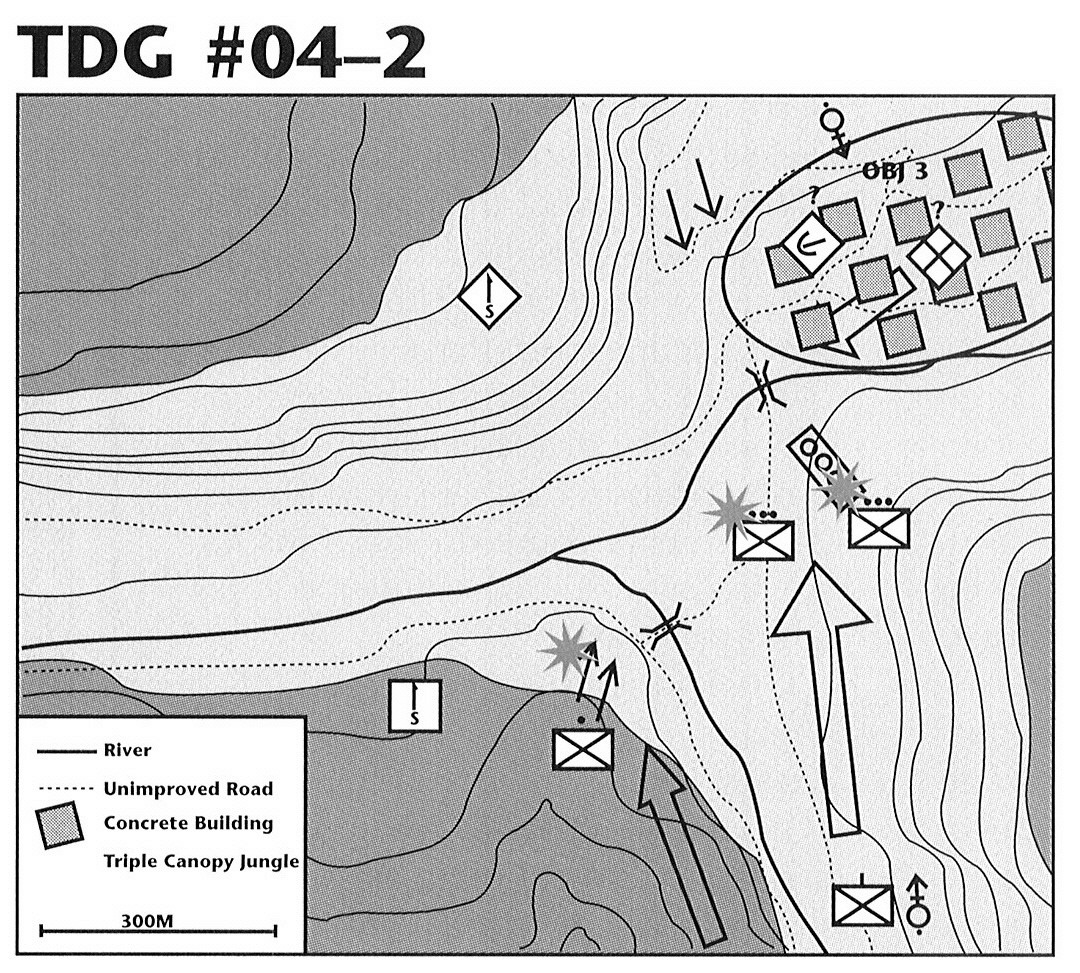
You assume your overwatch position without contact, and your two platoons quickly move forward to seize the northern bridge, intersection, and gain a foothold in the village. As they near the bridge one platoon finds itself in a minefield and quickly takes three casualties. Instantly, your second platoon comes under direct MG fire from the west of the village, and both platoons begin to take sporadic mortar fire. Your MG section opens up and attempts to destroy the enemy guns but quickly comes under accurate sniper fire from the north and takes three casualties. Your sniper team begins to report a large concentration of C^sup 2^ facilities within the village and a large concentration of troops moving toward your position.

Requirement

In a time limit of 5 minutes, develop a plan to deal with the situation. Provide a sketch of your actions and the rationale behind them. Submit your solution to Marine Corps Gazette, TDG #04-2, P.O. Box 1775, Quantico, VA 22134, fax 703-630-9147, or e-mail <[email protected]>.

Attack and Seize the Pass

by Capt Jason C. Drake

Situation

You are the company commander of a rifle company that has been reinforced with the following assets: engineers, .50 caliber machineguns, and Javelins that are all foot mobile. Your total strength is 174 Marines and sailors. Platoons consist of 28 Marines to include corpsmen. Weapons platoon is robust with complete sections: 18 Marines with 6 M240G machineguns, 13 Marines with 6 Mk153 shoulder-launched multipurpose assault weapons, and 15 Marines with 3 60mm mortars. Attachments, as stated, are the following: 8 engineers, 10 Marines with two .50 caliber machineguns, and 10 Marines with 3 Javelins.

Your mission is to attack and seize a platoon (reinforced) strongpoint. It is reinforced with three BMPs (Soviet mechanized infantry vehicle) and possible SA-7 man-portable air defense systems. The enemy has typical Soviet-style small arms with medium machineguns and rocket propelled grenade assets. It is critical that this strongpoint is destroyed and the ground to the northwest of the objective be held to protect the battalion’s movement on the left flank of the pass.

The area is a narrow pass in a mountainous and desert terrain. The average temperature is 90 degrees during the day and 60 degrees at night. The enemy is a platoon (reinforced) and has been in the vicinity of the pass for 2 weeks. This has allowed the enemy to prepare minefields, trenches, and harden vehicles in the vicinity or the trenches. All minefields are covered with wire, interlocking fire, and 10 meters in depth. Two of the BMPs are in a hardened position while the remaining BMP acts as a mobile reserve. All intelligence of the site is recent to within 6 hours due to recent unmanned aerial vehicle flights in the area in preparation for the battalion’s movement. The S-2 (intelligence) reports that the enemy position appears isolated, and its purpose is possibly to serve as a “tripwire” for units moving into the vicinity of the pass. In addition, the enemy’s parent mechanized battalion is 20 kilometers away.

As stated, your battalion will be moving to your left along a separate corridor to the southwest. The battalion is mechanized with a company of tanks in the lead. They will be moving through the valley in 4 hours. Your mission is to seize the pass. In addition, your company must be prepared to defend the area and protect the battalion’s flank until they seize their objective. (Not shown on the map.)

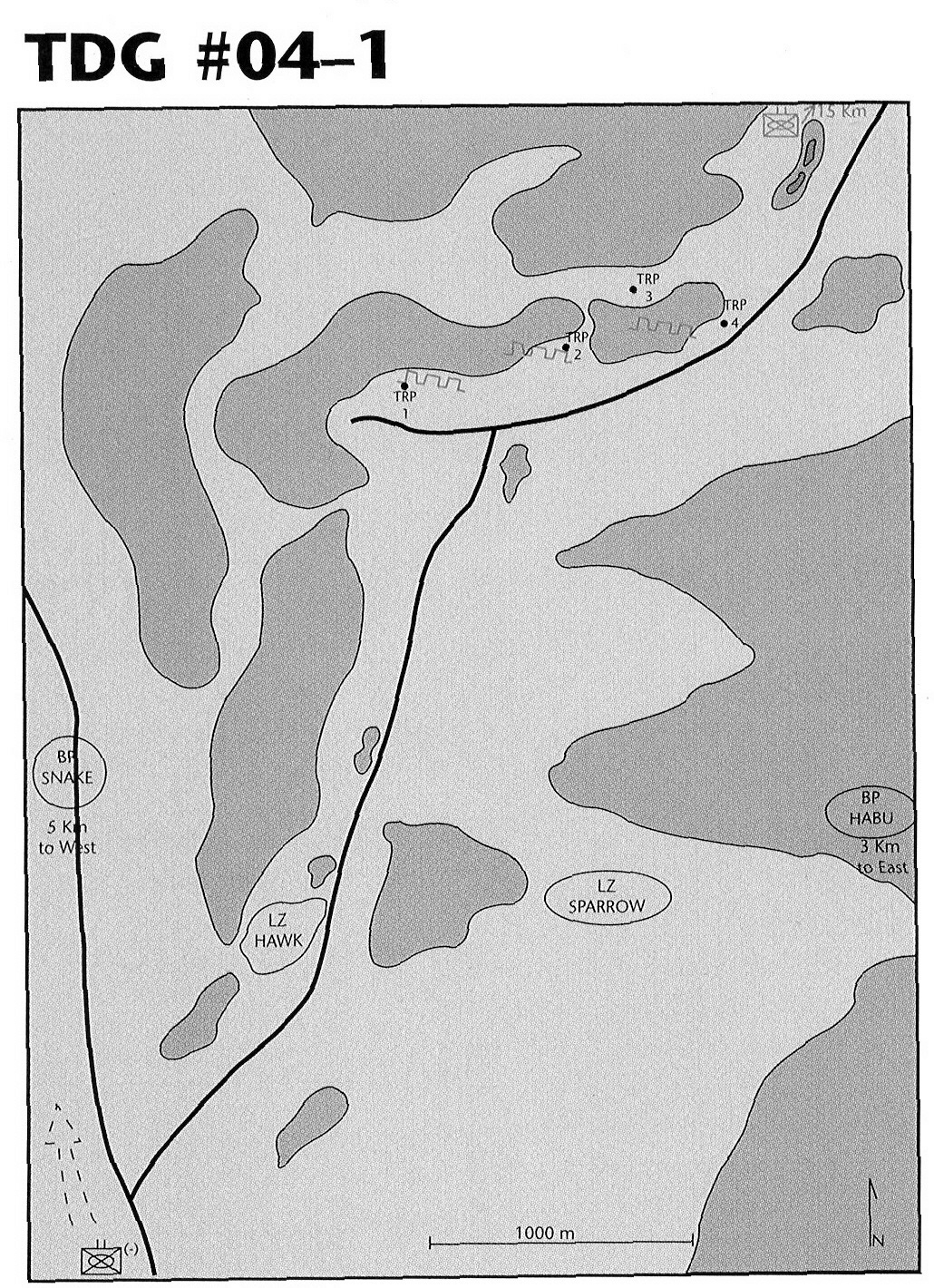
As a heliborne force your company must move swiftly to destroy the enemy in the pass while reserving combat power for immediate follow-on operations. To aid in your attack, the company will have a section of AH-1s and one section of fixed-wing for 1 hour prior to and during your initial arrival into the landing zone (LZ). With two LZs identified (LZs Hawk and Sparrow), the company will have a lift capability of three CH-53s and six CH-46s. To aid in communications, one Huey will serve as “command and control” and aid with initial fire support coordination then pass the “baton” once forces are aground and a “battle handover” is conducted. Fire support will be robust initially with one artillery battery in direct support for the attack.

Requirement

In a time limit of 60 minutes develop a heliborne operation that includes the following: movement of units in the attack (using supporting efforts and main effort), actions on the objective, consolidation, and resupply. Consider fire support assets to be used. Use a graphic depiction to aid in continuous suppression of the objective from insertion of the force to actual destruction of the strongpoint. Lastly, consider the site for possible “resupply LZ” to aid in the hasty defense of the pass. Provide the rationale for your actions and a sketch of your plan. Submit your solution to Marine Corps Gazette, TDG #04-1, P.O. Box 1775, Quantico, VA 22134, fax 703-630-9147, or e-mail <[email protected]>.

The ‘TACWAR’ Wargame

By Capt C.A. Leader

Since the introduction of Kriegsspiel into the German Army by Gen Mueffling, Chief of the German General Staff, in the early 1820s, wargaming has been an idea whose time has alternately come and gone in many nations. For the Marine Corps, however, it is an idea whose time has come with the recent development of the first of a series of wargames which eventually will provide training for Marines from squad leaders to MAF commander levels.

As presently envisioned, the family of games will include:

― TACWAR: a company level wargame.

― STEELTHRUST: for use by battalion and MAU staffs.

― LANDING FORCE: to exercise regimental and MAB staffs.

― WARFARE: a top level simulation for MAB and MAF staffs.

TACWAR, officially described as a company-level, wargame-based training system, will be the first of the wargames to be sent to the FMF. Present plans are for the initial group of 30 units to be delivered in April 1982 with a purchase of 254 more copies to be completed in 1983. Plans call for each rifle company in the FMF eventually to be issued its own copy of TACWAR.

Skeptics anticipating a simplistic or amateurish product should be pleasantly surprised with TACWAR. The Manual Wargames Project, under the cognizance of HQMC’s Director of Training but working at the Navy Training Equipment Command in Orlando, Fla., has produced an imaginative and extremely versatile training system. If properly understood and accepted by commanders, TACWAR can add a dimension largely lacking in the present training and development of subordinate leaders on the company level.

TACWAR is designed for use by the company commander in the training of his platoon and squad leaders. It is specifically intended to provide a means of demonstrating tactics and techniques rather than an analytical outcome of a battle. It does, however, depict a way that a battle might go. Perhaps most importantly, it provides an opportunity for small unit leaders to make decisions and mistakes and have the probable results of those actions graphically demonstrated. It helps the company commander reinforce the tactical lessons.

In this it is very successful, due in no small part to the professional experience of those developing TAGWAR. In addition to a Fleet Project Team of about a dozen Marines collected from throughout the Corps and representing a wide variety of MOSs and experience, the Manual Wargames Project has a team of professional civilian simulation specialists. Their experience in the development of commercial wargames as well as the experience attained in developing wargames for other Services is impressive and has paid handsome dividends by allowing TACWAR to address specific Marine Corps training requirements while avoiding limiting compromises and mistakes made in the development of wargames used currently by other Services.

Central to TACWAR is a 3-dimensional terrain board (a rectangle almost 7 × 9 feet in size) representing 20 grid squares on an accompanying 1:50,000 map sheet. Each board square represents a square kilometer at a scale of 1:2,000 and the terrain is geomorphic; that is, it can be rolled in a continuum north or south, east or west, to represent any desired four by five kilometer section of the accompanying map sheet. The current terrain is a hypothetical area in northern Europe although several add-on modules are under development. Specifically, envisioned are a beach section to provide amphibious play as well as desert and mountain modules.

One aspect of TACWAR unusual in wargame simulations are the provisions for concealed movement. In forested or village areas, the concept of “cells” with “cell caps” to allow concealment of movement and placement of units by opposing players adds a dimension lacking in most board simulations. Concealment combined with the line of sight restrictions of a three-dimensional board reinforce the potentials and limitations of direct and indirect fire weapons as they support maneuver and engagement.

Across the board, two teams face each other. The opposition force has the assets of a Soviet motorized rifle or tank regiment to include supporting arms. Marine Corps assets include a rifle company reinforced with a tank and amphibian assault vehicle platoon and supporting arms. Each scenario will set the exact composition of forces within the limits of the assets available as well as providing a general and special situation and operations orders. A rules referee, called a controller, supervises the play between the two teams. Each team consists of maneuver players responsible for the fire and movement as well as an air player and indirect fire player whose roles may be combined or assigned to separate individuals.

In addition to the traditional game “counters” representing units, leaders, FOs, vehicles and helicopters, the use of miniature models of vehicles, tanks and helicopters provides players the opportunity to become proficient in the recognition of Soviet model equipment. Playing the opposition force also provides familiarity with Soviet weapons and armor potential and limitations. The opposing forces player who initiates a Sagger ambush within 500 meters, for example, is not likely to forget again the arming limitations of that particular weapon.

TACWAR is played in “slow time.” That is, each minute of combat will take longer than 60 seconds to simulate. TACWAR game “minutes” are divided into three segments; an Indirect Fire Segment, a Fire and Movement Segment, and an Administrative Segment. An experienced group of players can complete a game minute in 4-5 actual minutes, although a game minute involving extensive fires and close combat may take much longer to resolve.

The Fire and Movement Segment is the heart of the game. All movement allowances and probabilities of effects of fires in this segment are adjusted to simulate what could be achieved in one minute. The segment is divided into pulses alternating between teams. During each pulse, each maneuver player of one team moves or fires one piece or unit. Pulses thus simulate simultaneous movement while still allowing fire at targets of opportunity as they are revealed. The conclusion of the segment involves the resolution of antitank guided missiles and simulates the opportunity to provide suppressive fires against the slow missiles.

Two levels of rules for TACWAR will be available: a basic and advanced set. The basic rules are simple but not simplistic and provide for such aspects as movement and vision affected by terrain, signatures for backblast weapons, laying smoke, antiaircraft fires, and realistic delays and mission restrictions on indirect fire requests. Further, the basic rules reinforce the requirement of line of sight and window for wire guided missiles and antiair weapons such as the ZSU 23-4. Advanced rules will cover such aspects as electronic warfare and communications, engineer functions, intelligence, and CBR effects.

TACWAR has been designed so that its component parts can be used to support other training. The miniature models can be used to teach and test identification of Threat equipment. The board, or parts of it, alone or in conjunction with the 1:50,000 map and miniatures, will support instruction in map reading, land navigation, terrain appreciation, tactical control measures, estimate of the situation (METT), as well as demonstrating movement and tactical formations.

The value of TACWAR as a training system to provide opportunities for innovative training should be quickly apparent. Those traditionally sedentary periods when deployed aboard ship are ideally suited for the honing of tactical thought processes with TACWAR.

STEELTHRUST and LANDING FORCE, for the MAU and MAB respectively, are also vehicles to provide dimension in training. Both of these battle simulations are planned for play in real time. As opposed to TACWAR, where the decisions and movement of the represented combat minute are allowed to consume as much time as is needed by the players, these real time games will hold the players to moving at the speed of the clock. This does not necessarily mean that 1 minute of play will represent 1 minute of combat; perhaps, 10 minutes of play would represent 10 minutes of combat. Only those decisions reached and orders transmitted during the allotted time would be allowed by the referee controlling play.

This real time simulation becomes very important when training for what is now called maneuver warfare. If a commander and staff are to tighten their observation-orientationdecision-action cycle, the Boyd Theory, so that they can turn within their opponents cycle to disjoint his control and defeat him, they must obviously practice making observations and decisions at the pace of real world time. These games will also be an ideal way for commanders and staffs to master the techniques of mission orders and expeditious communication.

The introducion of wargaming to the MAU/MAB staff level should be most beneficial in providing an element of human friction too often sacrificed in canned CPX scenarios that are orchestrated from start to finish. In wargaming, however restrictive the scenario, once contact is made between opposing forces, the personalities of the players and their ability to free play create that friction which can, even unintentionally, upset the best laid plans and test the flexibility and imagination of the Marines involved.

For those many Marines who have walked the ground through a canned “tactical” exercise wondering what their commanders were learning, wargaming may provide a respite. STEELTHRUST and LANDING FORCE may be best used in a closed mode to drive a CPX. The staffs exercised are separated from the game and communicate with the battle through the same nets and systems they would use in battle.

Used this way, a MAU staff would establish a CP in the field with subordinate maneuver and logistic CPs located in separate locations communicating with controllers manipulating the wargame at an independent site. Orders and reports would be passed by the same systems as battle would require. The “fog of war” would be reproduced by the isolation from the game board and the unknown intention of the opposing commander. The “fortunes of war” would be decided on the wargaming board and force response from the commanders. A computer could be integrated in results determination if necessary to maintain “real time” play.

The value of such training is obvions, particularly in tightening the decision-making cycle. Perhaps more important is the very real possibility of the Marine commander and staff being taught to recognize when an opponent is gaining the initiative and causing disruption in their command.

As with any system, there are limitations. TACWAR will not be all things to all Marines. Strict realists will complain, as with any simulation, that it cannot duplicate combat and has some gamesmanship factors. Experienced wargamers may argue for certain favorite gaming ideas used or excluded. In this regard, it is necessary to keep in mind two facts to place wargaming in perspective as it formally enters the Marine Corps. First, wargaming does not replace other, more traditional training, it expands and enhances it. Units must still go to the field and leaders must still practice moving and fighting their men on real terrain.

Secondly, wargaming is not a “game”; it is a simulation of an aspect of battle. The wargames designed for the Marine Corps do not have, as do their commercial counterparts, the primary purpose of entertainment. The games are designed to hone certain war-fighting decision processes and techniques. An aspect of a military wargame that appears initially more cumbersome than the commercial counterpart may well have been specifically designed in that manner to reinforce a tactical learning point that is unimportant in an entertainment game.

TACWAR and the family of Marine Corps wargames does not mark a revolutionary change in Marine Corps training, but rather is an exciting evolutionary step forward. To effective trainers it will be a welcome tool imaginatively used, for wargaming has tremendous potential to excite tactical thought and technique. But then, the German General Staff began to demonstrate that nearly 160 years ago.

A Critique of ECP 9-5, 1981 Edition

By William S. Lind

Recent talks with Marine units on both the east and west coasts suggest few Marines have read, or even seen, the new ECP 9-5, Marine Amphibious Brigade Mechanized and Countermechanized Operations. This is unfortunate, because ECP 9-5 is an important document.

The new ECP marks a major step along the road toward maneuver doctrine. Not only does it state many of the concepts of maneuver warfare in clear and comprehensible terms, it relates them to tactical problems Marines often face. It should be “must” reading for any Marine with an interest in tactics.

A good example of the ECP‘s grasp of maneuver warfare is its discussion of battlefield chaos:

Chaos on the battlefield is the rule, not the exception. The commander must, therefore, anticipate it and be more prepared than his opponent to maneuver in spite of it. By doing so, he will make that inevitable chaos more disruptive to his opponent’s force than to his own.

This touches directly on the essence of maneuver warfare: the realization that conflict brings uncertainty and change, and that winning means adapting to and shaping that uncertainty and change. Agility in thinking and acting is the key to success; tactical patterns and formulas are paths to failure.

Some commanders might attempt to deal with the chaos of the battlefield by more dependence on high technology C^sup 3^, more centralized control, more elaborately detailed plans and orders. Such an approach would be self-contradictory. Elaborate orders and centralized control are attempts to eliminate uncertainty, when the problem is that uncertainty is inevitable, As ECP 9-5 states, the right answer is mission order tactics: giving subordinates wide latitude to act independently within the commander’s intent as uncertainty and change alter the situation facing their units.

The ECP is equally good in some recommendations of techniques. Among the more useful suggestions:

* “When the MAB conducts independent operations, maintain a mobile sea base to reduce (or eliminate) the requirement for a force beachhead.” A logistics base ashore is both a military and a political liability. Militarily, since you have to defend it, it gives the opponent a “nose” he can grab you by to “kick you in the tail”-a device to fix your attention, a place where he can force you to fight on his terms. Jeffrey Record discusses the political disadvantages in his recent study, The Rapid Deployment Force:

The ultimate loser in a Third World conflict will be the party that succeeds in arousing the local nationalism most strongly against itself. For forces from outside the local area, this will tend to be the party which has the highest profile; for most locals, to see the outsider is to dislike him.

* ”Emphasize the use of key officers on radio nets during the assault. By using the air liaison officers (ALOs), artillery LnOs and S-2s on their respective radio nets, message brevity can be achieved (the change from current doctrine is noted and considered essential).” Too often, American units fill the ether with chatter, much of it unnecessary by the standards of other armies. Radio traffic creates vulnerability to detection and disruption. The less the traffic, the more likely the necessary messages will get through.

* “During offensive mechanized operations, a large portion of the total force (25%-33%) should be employed as combat reconnaissance.” Success depends on knowing where the enemy’s tactical strength is and going where it isn’t-throwing strength against weakness. A few reconnaissance teams deep behind enemy lines won’t tell you all you need to know. Substantial assets must be used to create an effective reconnaissance screen.

These and other techniques recommended by the manual can be of great assistance, and the authors are to be congratulated for some very thoughtful work.

Unfortunately, ECP 9-5 also has some flaws. Most dangerous is its tendency to give tactical recipes and formulas for maneuver warfare. As the exponents of maneuver doctrine have repeatedly stated, maneuver warfare is not a replacement formula, but a replacement for formulas. The ECP itself says as much:

the avoidance of stereotyped operations has (an) . . . advantage. The enemy who must face the possibility of night and day attacks, raids, and rapid thrusts from any direction will be much easier to deal with than one who can predict our actions by simply reading our field manuals or identifying terrain features on a map.

Yet ECP 9-5 offers precisely the sort of recipes it says we must avoid. Right at the start (p.2) it says:

Our objective must be the deliberate breakdown of the enemy’s ability to function as a total force. In order for our forces to achieve this objective, clear priorities of engagement must be established.

(1) A high priority should be given to the enemy’s air defense units . . .

(2) Our second priority should be given to the engagement of enemy command and control elements . . .

(3) A third priority of engagement should be to separate the enemy’s infantry from his tanks . . .

(4) The final priority established should be attacks on the enemy’s CSS elements . . .

This prescription has several fundamental deficiencies:

* First and foremost, it enables the enemy to “predict our actions by simply reading our field manuals.”

* Second, because it aspires to be universal, it will often be inappropriate. Priorities of engagement must be derived from the specific vulnerabilities of the specific opponent in the specific time and place. For example, if we believe the enemy commander is incompetent, do we want to destroy his command and control, or should we seek to preserve it? If our enemy relies heavily on his artillery, do we make its disruption a lower priority than separating his infantry from his tanks?

* Third, at least one of the tasks is open to question. The focus on destroying enemy air defenses in effect reverses the traditional roles or air and ground. Now, in the heat of their own battle, the ground forces are to divert effort to support the air-indeed, they are to make such action their first priority.

Even if this proves feasible-which seems unlikely, given the many tasks already facing the ground units and the difficulty in locating and targeting many of the enemy’s air defense weapons-it suggests the “cavalry portee syndrome.” In the 1920s and 30s, the horse cavalty, desperate to prolong its own existence, came up with a new approach: move the horses around in trucks. Someone finally realized this obviated the need for the horses. If the aircraft wing must be supported by the ground forces instead of providing them with support, is it time to raise some questions about the viability of close air support?

* Fourth, in jumping directly from the goal of destroying the enemy’s cohesion to a list of target priorities, ECP 9-5 forgets the central point of maneuver warfare: maneuver! The ECP falls right back into a firepower mentality-a more sophisticated version than the “blow away everything” approach of pure firepower/attrition doctrine, but a firepower mentality just the same. In maneuver warfare, maneuver is itself the prime tool for destroying the enemy’s cohesion: maneuver to create unexpected and dangerous situations more rapidly than the enemy can cope with them. Firepower is very important, but it must be integrated with the scheme of maneuver, and it must support and facilitate that scheme.

The authors of the ECP do qualify their formula later in the manual, stating that “the model . . . is intended as a vehicle for understanding, not as a stereotype for future planning.” Unfortunately, this single statement may not be enough to prevent their model from being used as a recipe. Those who understand maneuver warfare-as I am certain the authors do-must write so their advice cannot be read as a “cookbook.”

As noted earlier, the ECP does well in emphasizing the importance of mission order tactics in maneuver warfare. But it fails to discuss several other important concepts, including:

* Surfaces and gaps. The purpose of the reconnaissance screen is to find surfaces-where the enemy is-and gaps-where he isn’t. The object of the following combat units is to go through the gaps, rolling out behind the surfaces to pocket them and collapse them from the rear.

* Recon pull. If we are to throw strength against weakness, our axis of advance must shift constantly in response to the discovery by the reconnaissance screen of surfaces and gaps. This “recon pull” approach stands in opposition to “command push” tactics, in which the axis of advance is determined before the start of the attack and then maintained regardless of whether the attacking force hits a gap or a surface.

* Combined arms, as opposed to supporting arms. I suggest defining combined arms as hitting the enemy with two or more arms simultaneously in such a way that the actions he must take to avoid one make him more vulnerable to another. It is much more disruptive to the enemy’s cohesion than supporting arms, which can be defined as arms applied in sequence or, if simultaneously, then in such a way that actions taken to defend against one are complementary to actions to defend from the others.

These concepts, along with many discussed in the ECP, are helpful in understanding and practicing maneuver warfare. But there is another, even more useful (and more difficult) concept we must come to terms with: operations.

The ECP is titled “. . . Mechanized and Countermechanized Operations,” but it is in fact a discussion of tactics. To a German or a Soviet, operations, or “the operational art,” is something quite different from tactics.

The operational art is hard to define. One common definition is that operations are actions by a corps or by several corps. However, I would offer another definition, one more relevant to Marines: the operational art is the use of tactical engagements to strike directly at the enemy’s strategic center of gravity.

If we have no concept of the operational art, tactics relate only in a cumulative fashion to achieving the strategic goal: every successful engagement adds to the gradual dissolution of the enemy’s strength. Unfortunately, even if our tactics reflect maneuver warfare, this puts us back into an attrition contest on a higher level. We are still trying to grind the enemy down, battle by battle.

Operations, on the other hand, focus beyond the battle. An operational success is an engagement (not always tactically successful) which plays a decisive role in overturning the enemy’s whole system, one which strikes not at his limbs (units), but at his strategic brain (overall military or political cohesion) or heart (will).

Some examples may help us grasp this rather slippery concept. The abduction by German commandoes of the Regent of Hungary, Adm Horthy, in 1944 was tactically brilliant. But more important, it was an operational success: Horthy had been planning to change sides, and his kidnapping kept the Hungarian army fighting on the side of Germany for a while longer.

Guderian’s Panzers were tactically successful in crossing northern France in 1940, just as other German forces were tactically successful punching through the Allied forces in Belgium and Holland. But Guderian’s thrust was also an operational success, because it shattered the French Army’s cohesion and will. By the time Guderian reached the Channel, his tactical strength was not very great. But that was irrelevant to his operational victory.

The Soviet Army is today a tank army operationally, but it is an artillery army tactically.

The Tet offensive was a tactical defeat for North Vietnam, but an operational victory, in that it overturned the American strategy of convincing the homefront that the war would soon be over.

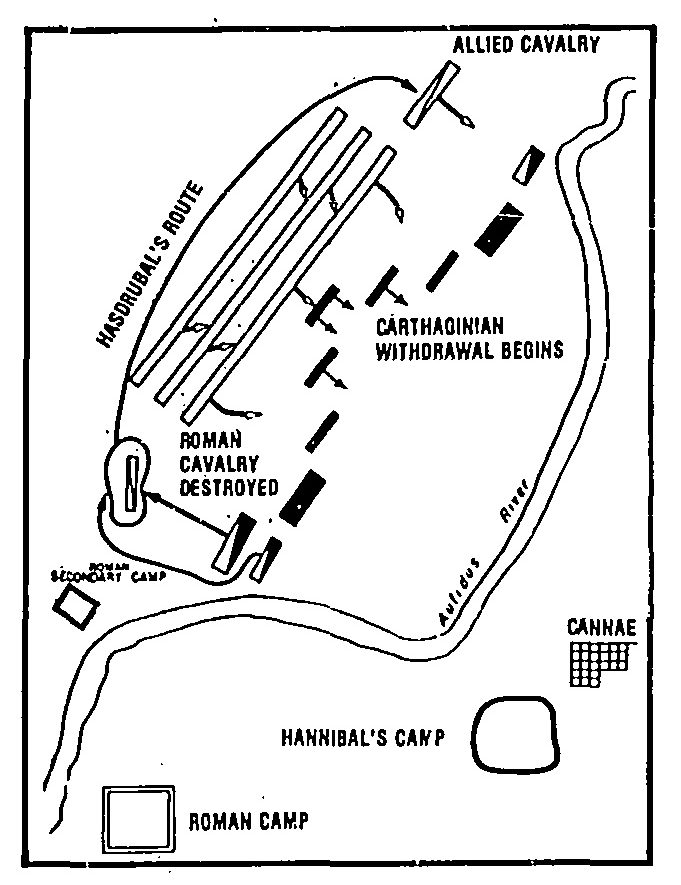
Cannae was perhaps the greatest tactical victory in all history, but it was not a success operationally; Rome continued to fight.

The point is that tactics and operations are qualitatively different. Success on the tactical level often does not bring operational success; operational success can sometimes (though not often) be won despite tactical failure.

Maneuver warfare must focus on the operational art or we will find ourselves still engaged in an attrition contest. But before we can focus on it, we must understand what it is. Is it perhaps time for an ECP on operations?

The Merits of Military History

By Maj Terrence P Murray

At Chancellorsville in May 1863, Lee’s Army of Northern Virginia, outnumbered two to one, deployed two divisions defensively abreast the Rappahannock River to thwart the advance of the Army of the Potomac, while Gen Stonewall Jackson’s corps flanked the Federal Army and conducted a devastating attack on the Federal rear. It was a classic exhibition of the philosophy of defensive maneuver, wherein the outnumbered and outgunned Confederate commander balanced his offensive and defensive dispositions to maximize his mass at the point of decisive action, at a selected time and place on the battlefield. This historic battle offers one of innumerable examples of the importance of maneuver in war.

Mr. Lind’s article, “Defining Maneuver Warfare . . .”, which appeared in the Mar80 GAZETTE and his follow-on commentaries in Apr81 and SepSl concerning the Corps’ need to shun the concept of attrition warfare and embrace and master the concept of maneuver should be a stimulus for Marines to adapt the current instruments of war to the looming high-tech battlefield of tomorrow. Reactions to his insights in defining maneuver manifest the impact of his timely observations. These reactions also demonstrate the shallow understanding that Marines, in general, have of the concept of maneuver.

Maneuver is as timeless as conflict itself. Mr. Lind is attempting simply to apply it to the present conditions, technology, and potential missions of the Corps. The basis of his application, however, is more adaptation than innovation. The wide-eyed response to Mr. Lind’s observations suggests our seeming ignorance of this and underlies a greater problem at the center of this ignorance. Marines, and military men in general, would be more comfortable with concepts, new or old, if their knowledge of military history were better founded. “Read and re-read the campaigns of Alexander, Hannibal, Caesar . . . and Frederick,” advised Napoleon, “take them as your model; that is the only way of becoming a good captain, to obtain the secrets of the art of war.” The scarcity of training in military history strikes at the heart of our military education.

It is insufficient that our Marine Corps schools merely teach principles of war without rooting them thoroughly-even exhaustively-in historical examples. As Napoleon and the other recognized masters of strategy and tactics have attested, even the most practiced combat veteran suffers from insufficient exposure to the varied, capricious, often confounding circumstances which battle can present. Detailed and intensive studies of great battles would, in part, serve to alleviate the limits of personal experience. As Napoleon observed:

. . . tactics, evolutions, the techniques of engineers and artillery can be learned from textbooks, but a knowledge of the higher elements of war can only be acquired through a study of military history and through experience itself.

Today, there is but a modicum of historical study imbued in our primary Marine officer education institutions. The Basic School offers some historical examples in defining the principles of war and expounding the tenets of company tactics. Amphibious Warfare School strikes at the periphery in elective studies and in its research requirements, and Command and Staff gets a bit closer in similar curricula. None of these schools, however, makes the study of military history integral to the officer development process, and therein lies the critical deficiency.

Can we be so presumptuous, so indolent, as to suggest by the scant presence or total omission of historical analysis from our military educations that we can do without drawing on the experience and insights of past masters-Jomini, Lee, Frederick the Great . . . This is not to say that their thinking should go unquestioned, for Mr. Lind, through Boyd’s’ thesis, has, himself, attacked them mightily. Yet it is uncontestable what the great captains achieved. Moreover, as Willoughby observed in his brilliant Maneuver In War, the great captains themselves-Clausewitz, Moltke, and Foch:

did not consider the tactical schooling of leaders as the most important item of their professional equipment; they esteemed above all an intellectual training derived from a comparative study of the past.

How can we, then, rely on one FMF tour every four to six years, particularly in an age of rapidly expanding technology, without compensating with intense and pervasive analyses of the great or small-yet-significant battles of past wars at all our military schools, recognizing that the principles of war, to large measure, remain constant and only the implements of war and the scenarios change. As the Army’s Chief of Staff in 1935, MacArthur noted:

. . . the military student does not seek to learn from history the minutia of method and technique. In every age, these are decisively influenced by the characteristics of weapons currently available and by the means at hand, for maneuvering, supplying and controlling combat forces. But research does bring to light those fundamental principles and their combination and application which in the past have been productive of success. These principles know no limitation of time.

Familiarity with the writings of notable strategists of the past and case studies of history at every level of officer education would make us, for want of a better example, less awestruck by the newly bandied about concept of maneuver warfare, which is far less revolutionary in many respects than current authors would lead us to believe. This is not to say that present commentary is not necessary to stimulate creative minds not to suggest that we, as Marines are already intrinsic masters of maneuver doctrine. I submit, however, that military history proves that maneuver theory reaches decades, even centuries back in time, and yet so many of us seem ignorant of it. In the Civil War alone, as Chancellorsville denotes, evidence of maneuver warfare is replete: Jackson’s Valley Campaign; on a lesser scale Longstreet in the Wilderness; and in the final days of the South’s decline, painfully long after the last legitimate Confederate offensive, Lee fending off a host of Federal thrusts at Richmond-all examples of maneuver warfare with the South fighting at incredible odds and surviving through maneuver on a grand and often brilliant scale. Unquestionably, attrition warfare was in evidence in the defense of trenches during the Civil War, but there was maneuver also.

It is time for Marine planners to rethink the education process, to formulate additional means to teach doctrine and ensure it remains current during the interminable voids between FMF tours and in the absence of actual combat experience itself. Correspondence training, for example, should be expanded to encompass military history, perhaps to include separate courses or case studies at company-battalion, regiment-division, and corps-army level. Such training would enhance career development and give continuity to officer education while countering the inefficiency, from a combat readiness standpoint, of normal officer career patterns.

Dr. Luttwak’s profound retrospective of our Vietnam involvement in the Ju181 GAZETTE and his attendant critique of military education identifies the lack of practical training provided by Service academies and other military schools and particularly the void in studies of military history, which inherently denies a diversified perspective of war. In Dr. Luttwak’s words military schools:

treat military history as if it were a marginal embellishment instead of being recognized as the very core of military education, the record of trial and error on which today’s methods can be based.

Military thinkers who have exerted a pivotal influence on what has broadly evolved as contemporary tactical and strategic theory forged their doctrine, in part, through the study of history. Napoleon’s application of the principles of war, including his theories on mobility and maneuver, which he formulated from detailed studies of principles and concepts of his legendary predecessors, were instrumental in his transforming a demoralized French Army into a near unbeatable force during his stunning campaign in northern Italy in 1796 and 1797. Guderian’s brilliant success in World War II, as the architect of the Third Reich’s blitzkrieg lightning war of movement, was developed through his exhaustive studies of maneuver in previous wars and by his firsthand observations of the debilitating nature and strategic futility of trench warfare in World War I. And the list goes on and on.

The road is clear for Marine leaders to add a vital component-the study of military history-to the intellectual development of the officer corps. In a cogent essay, S. L. A. Marshall once provided an elemental formula for officers’ education:

The basic requirement is a continuing study, first of the nature of men, second of the techniques that produce unified action, and last, of the history of past operations, which are covered by abundant literature.

The material is readily available. The need is evident. It is time to act.

Maneuver Warfare Training

Units of the 2d Marine Division, 2d Force Service Support Group, 4th Marine Division,-and 2d Marine Aircraft Wing have been at Camp Pickett, Va., since early September undergoing field training and refining a variety of maneuver warfare concepts.

Subordinate elements involved include Headquarters 6th Marine Amphibious Brigade (6th MAB); Regimental Landing Team 2 (RLT 2); 2d and 3d Battalions, 2d Marines; 3d Battalion (-), 24th Marines; nearly 60 tanks from 2d Tank Battalion; more than 50 assault amphibian vehicles from the 2d Assault Amphibian Battalion; company sized elements from 2d Reconnaissance Battalion and 2d Engineer Battalion, and Combat Service Support Battalion 22 with a sizable bridging capability from 8th Engineer Battalion.

In addition to extensive weapons firing for troops and classroom work for officers, each battalion had a full week of mechanized-countermechanized training that involved extensive familiarization with LVT and tank operations followed by a three-day war.

From 13-15 October, the 6th MAB, commanded by BGen J. E. Hopkins, conducted a command post exercise coordinated with a free-wheeling regimental level exercise by RLT 2. This training focused on specific aspects of maneuver warfare, such as bridging and river-crossing operations and employment of a mobile combat service support detachment.

During the training, MajGen A. M. Gray, Jr., commanding general of the division, deployed forward with a small “jump command post” element and joined in the field maneuvers to test communications and staff functions during periods of rapid movement.

Maneuver Warfare Board at Lejeune

The 2d Marine Division recently established a Maneuver Warfare Board as a focal point for the tactical ideas now being emphasized throughout the division. MajGen A. M. Gray, commanding general, appointed approximately 15 officers-primarily company and junior field-grade-to the board, which is headed by LtCol Shawn W. Leach, commanding officer of 2d Reconnaissance Battalion. Gen Gray and the commanding generals of the 2d Marine Aircraft Wing and 2d Force Service Support Group-MajGen K. A. Smith and BGen R. E. Moss, respectively-form the steering committee that oversees the activity.

The board will take the lead in collecting, receiving, and disseminating theoretical and practical information regarding maneuver warfare. Its purpose is to improve upon the understanding of maneuver warfare concepts and encourage their refinement and test in field exercises.

Specific board duties assigned:

  • Publish a reading list of books that provide the historical and theoretical basis for modern maneuver warfare thought.
  • Distribute current articles dealing with maneuver warfare concepts and techniques.
  • Publish terminology associated with maneuver warfare theory.
  • Develop and present a series of lectures and seminars about maneuver warfare.
  • Develop a maneuver warfare training guide.
  • Publish a periodic newsletter to disseminate information on maneuver warfare theory and training.

Mr. William S. Lind-legislative assistant to Senator Gary Hart (D-Colo.), military analyst and frequent contributor to the GAZETTE and other periodicals-visited Camp Lejeune 16-21 August to observe training and discuss maneuver warfare concepts with the officers of all major commands within the division.

Among the background readings first recommended by the board were the following GAZETTE articles:

  • Oct79: Capt S. W. Miller, Winning through maneuver, Part I-Countering the offensive.
  • Dec79: Capt S. W. Miller, Winning through maneuver, Conclusion-Countering the defense.
  • Mar80: William S. Lind, Defining maneuver warfare for the Marine Corps.
  • Sep80 Maj William C. Fite, Some lessons from the Israelis.
  • Apr81: Capt G. I. Wilson, The Maneuver Warfare Concept.

Lind’s latest GAZETTE article, Tactics in Maneuver Warfare, appeared in the Sep81 GAZETTE.

Tactics in Maneuver Warfare

By William S. Lind

Interest in maneuver warfare has been spreading rapidly in the Marine Corps. Almost every issue of the GAZETTE now includes some reference to it. The Commandant has expressed support for it in testimony to Congress.

However, when we come to the subject of tactics, we run into some confusion. Many Marines are asking, “What does maneuver warfare mean in terms of tactics? Do we need to change our basic tactics and if so, how?”

In some cases, these legitimate questions are receiving a dangerously wrong answer:

Maneuver warfare is just a different tactical formula. Instead of attacking frontally, we will attack into the enemy’s flank and rear. Instead of defending a rigid line, we will allow the enemy to penetrate, then counterattack and encircle him. That’s all maneuver warfare means to the tactician.

Flank attacks and elastic defenses are techniques likely to be employed in maneuver warfare. But they are not formulas for maneuver tactics, since maneuver warfare is not a new formula, but a replacement for formulas. In maneuver warfare, the object is to shatter the enemy’s organizational and mental cohesion by creating unexpected and dangerous situations more rapidly than he can deal with them. If our tactics are formulistic, our actions will be predictable. If we are predictable, we will seldom be able to create situations unexpected by the enemy, [dagger]

Thus, all formulas are wrong. How then do we come to understand tactics in maneuver warfare? Are they just a “gut reaction” on the part of the commander? If we cannot follow a tactical recipe book, what do we do?

Perhaps a definition of tactics in maneuver warfare will help. This definition may seem somewhat abstract until we think it through, but since we cannot offer a formula, a certain degree of abstraction is necessary. Let us define maneuver tactics as:

A process of combining two elements, techniques and education, through three mental “filters” or reference points-mission-type orders, the search for enemy surfaces and gaps, and the focus of our own main effort-with the object of producing a unique approach for the specific enemy, time, and place.

Again, this sounds abstract. But as we look at it bit-by-bit, the pieces quickly fall into place:

  • Techniques. Marines are familiar with these. They range from how to fire a weapon, give an order, or make sure the troops are fed up through how to organize an attack, set up a defense, or reconstitute a reserve.

Specific types of offenses or defenses, including the flank attacks and elastic defense mentioned earlier, are not tactics but techniques. Tactics is the process of selecting from among techniques to produce that unique approach for the specific enemy, time, and place.

Some Marines accuse spokesmen for maneuver warfare of incorrectly deemphasizing the importance of techniques. Any such deemphasis would indeed be incorrect. Excellence in techniques is highly important in any style of warfare. What maneuver advocates have correctly condemned is seeing tactics as nothing more than techniques. When we do this, we become formulistic.

Maneuver warfare demands excellence in techniques, but it demands more: creativity and originality in selecting from among and combining techniques. The other elements in our definition-education and the three mental “filters”-are the tools which help us to be creative and imaginative in making our selections and combinations.

  • Education. The officer must be able to see the opportunities in the combat situation facing him. To do so, he must be educated in the art of war. He must have sufficient understanding of military history to be able to put his specific situation into context, to see how the situation looks through his opponents’ eyes, to have some idea about the enemy commander’s thought process. He must understand how to think through his own situation.

This is perhaps the hardest part of our definition to explain clearly, because our goal is not a commander with a mental “checklist,” but one with what the Germans call “a feeling in the tips of his fingers” for his situation and the opportunities in it. Seeing these opportunities is a thought process rooted in a Gestalt-in seeing something as an entity-not in checklist-type analysis.

Study of military history must not be a search for precise analogies, for there are none. Its focus must be not the actions, but the thought process of commanders. The goal is not knowledge, but understanding; not what to think, but how to think. As Gen Hermann Balck has said:

Therefore, one of the first principles has to be: There can be no fixed schemes. Every scheme, every pattern is wrong. No two situations are identical. That is why the study of military history can be extremely dangerous . . . No one thinks of becoming a great painter simply by imitating Michaelangelo. Similarly, you can’t become a great military leader just by imitating so-and-so . . .

  • The three “filters.” These are mental reference points, not rules. They are concepts the commander keeps in the forefront of his mind as he attempts to fashion a unique combination of techniques for his specific situation.

― Mission-type orders. The commander does not expect or attempt to control every action of his subordinates. Nor does he attempt to foresee and plan for every event which will take place. Rather, he determines his intent-what he wants to have happen to the enemy. He makes certain this intent is consistent with the intent of his superiors, and he communicates it clearly to his subordinates.

As the action develops, he supports and expands the local successes of his subordinates, committing his reserve where he perceives the enemy weakest and the chance for success greatest. At times, he will issue detailed orders in order to do this. But in general, he will trust his subordinates’ abilities to make the best decisions as to how to achieve his intent-what techniques to select for their particular unit-within the framework of his guidance and support.

This definition of mission-type orders is somewhat different from the way the term is often used in the Marine Corps. To many Marines, a mission-type order is, “Captain, I want your company to take Hill 432.” This order does not really give the company commander an understanding of the battalion and brigade commanders’ intent-what they want to have happen to the enemy. Nor does it leave the captain much latitude for initiative, especially if intelligence proves wrong or the situation changes.

Marines will need to rethink what they mean by mission-type orders. In fact, they might want to use a different term, such as “intent orders,” to make it clear that this is something new.

― The search for enemy surfaces and gaps. Maneuver warfare seeks to avoid enemy strengths-surfaces-and throw maximum strength against enemy weaknesses-gaps. This can result in something very much like the socalled “von Hutier” tactics of the German 1918 offensive, which were in turn very like German armored warfare tactics in World War II.

But there is a danger here. Von Hutier tactics were appropriate in positional warfare in World War I. Their development into blitzkrieg was appropriate against Poland in 1939, France in 1940, and Russia in 1941. They will be appropriate against some opponents in the future, in some times and places.

But they cannnot be allowed to become formulas. The starting point of the thought process which is tactics cannot be these German techniques. Our starting point must always be the specific strengths and weaknesses of our specific opponent in the time and place in which we face him.

An illustration may be helpful. In the 1950s, the Israelis developed effective tactics against Arab fortified positions. They attacked frontally, got into the trench-works, and engaged the enemy in hand-to-hand combat. This may not sound like maneuver warfare, but it was. The Israelis had identified a specific weakness of their opponent. The Arabs’ lack of social cohesion outside the family made it very difficult for the Arab soldier to show initiative. He had no reason to expect support from those around him. When faced with a melee in the trenches, the Arabs’ cohesion came apart as each soldier looked out only for himself. The Israeli techniques were very different from those of German von Hutier tactics, but the process of tactics was the same.

Thus, we must understand surfaces and gaps on a macro, not just a micro level. The micro level is technique-useful technique-but unless it is relevant to the specific opponent, it is a formula. The techniques which take advantage of the weaknesses of one opponent will run head-on into a different opponent’s strengths. In maneuver warfare, techniques must be formed into tactics in relation to the specific opponent.

― Focus of effort. This is the German concept of Schwerpunkt. It is usually translated as “point of main effort,” but this leads to misunderstanding. It is not a point on a map. The focus of effort is a unit, not a geographic point or a direction. There is always a focus of effort, but there is never more than one at a time. The Schwerpunkt is a conceptual focus of effort which each subordinate commander uses to link his actions, through the intent of his superior, to the actions of those around him. It is the “glue” which permits mission orders to allow initiative without losing cohesion.

Again, an illustration may help. You are the commanding officer of a regiment. You are advancing with two battalions forward, one in reserve. On the basis of our reconnaissance, you believe the enemy is weak in front of the 1st battalion, stronger in front of the 2nd battalion. You designate 1st battalion as the focus of effort. All supporting arms are given to 1st battalion, and the reserve is echeloned behind it. The commander of 2nd battalion asks himself the question, what can I do to help the advance of 1st battalion? All his actions are devoted to that end. So are all the actions of everyone else in the regiment-not following detailed orders from the regimental commander, but on their own initiative.

The focus of effort may shift during the attack. 1st battalion runs into an ambush. But 2nd battalion has launched a supporting attack, intended as a feint, which takes the enemy by surprise and breaks through. Immediately, the regimental commander gives an order, “Focus of effort now with 2nd battalion.” The supporting arms switch their fires to 2nd battalion, the reserves move laterally to echelon behind 2nd battalion, and the axis of advance shifts. Everyone now asks himself, how can I assist the effort of 2nd battalion?

Can we now understand more clearly our definition of tactics? Let us return to our regimental commander. The attack we have just described is successful. He collapses the enemy line of resistance, pocketing one enemy battalion, sending a second plus the enemy reserve fleeing in disorder. He passes the encircled enemy battalion off to a division reserve unit to contain or reduce. He advances until he meets the enemy’s second defense line.

Now he must again think, “What are my tactics here?” He looks at the new situation and asks himself, “What techniques can I employ?” That is, given the factors of METT, the availability of supporting arms, etc., what is the full range of options open to him? He puts his situation in an educated context-how have successful commanders thought through situations like this in the past? He considers his three “filters”: What are the specific strengths and weaknesses of this enemy in this place? What intent does my superior have, and what intent do I communicate to my subordinates? Which unit do I designate as my initial focus of effort?

The answers to these questions are a set of actions, a combination of techniques. But tactics includes the whole thought process, not just the actions. Unless we see tactics as the whole process, we are likely to be reduced to formulas, to techniques applied by the book.

Understanding tactics as a process rather than just a set of actions on the battlefield requires a major mental “shift of gears.” But if we want to do maneuver warfare, it is a necessary shift.

In turn, if we expect Marines to think in a new way, we must change some of the ways the Corps as an institution does business. We must give officers time to read, think, and reflect. We must devote our schools to educating officers in the art of war, not just to more training in techniques. And we must rewrite our FMFMs so they cannot be read as recipe books (a deficiency in the new ECP 9-5, Marine Amphibious Brigade Mechanized and Counter-mechanized Operations).

Maneuver warfare is not a way of moving but a way of thinking. Its essence is well illustrated by the remarks of two generals. The first, Gen Henri Nivelle of the French Army, was the author of the disastrous French offensive of 1917. To garner support for his planned attack, he told the Allied leaders “I have the formula.” In contrast, his opponent, Crown Prince Rupprecht of Bavaria, said in his memoirs, “There is no panacea. A formula is harmful. Everything must be applied according to the situation.”

Prince Rupprecht’s approach is the one we want to follow.

Maneuver Warfare

By Capt G.I. Wilson, USMCR

MajGen Trainer’s remarks on modern warfare (GAZETTE, Dec80/ Apr81) are convincing, a movement in the right direction, and basically in concert with Bill Lind’s maneuver warfare thinking (GAZETTE, Mar80/ Apr81). . . However, Lind does point out a very basic flaw in the [Trainor] approach to C^sup 3^. Higher level of commands must relinquish subordinate combat commanders from the micromanagement grip of high technology C^sup 3^. We don’t need generals or presidents talking to squad leaders which sophisticated electronics allows us to do with high technology C^sup 3^.

Unless there is an increased reliance on mission order tactics and enhanced trust in subordinates at all levels, the high technology C^sup 3^ will serve only to unwittingly strangle the initiative of combat commanders and subordinates. This is not to say that combat elements will be allowed to run wildly over the battlefield-a true understanding of mission order tactics clearly precludes this. A balance needs to be struck between high technology C^sup 3^ and combat effective C^sup 3^. This can be accomplished by keeping in mind that initiative and maneuverability will be a premium on any battlefield and essential to maneuver warfare. This is a sharp departure from MajGen Trainor’s handling of C^sup 3^, but it is a necessary one. Bill Lind appears to be correct in his approach to C^sup 3^ advocating combat effective C^sup 3^ in contrast to high technology C^sup 3^. . . .

Effective employment of maneuver warfare will depend primarily on the interaction of several factors: (1) reconnaissance/counterreconnaissance effort, (2) mission order tactics, (3) Schwerpunct, (4) extensive training, (5) reliance upon and trust in subordinates, (6) maximum and effective use of artillery, and (7) flexible logistic systems with a fuel-it-fix-itforward thinking. It must be emphasized, however, that these are only factors requiring interaction, not a cookbook formula for maneuver warfare.

Maneuver Warfare

By Maj K. L. Thompson

Col Brown freely admits that his “outline of a revised mission orientation and structure is by no means a complete picture, . . .” Nevertheless, I would recommend that it be given a most thorough review at appropriate decision-making levels to ascertain its true merit vis-a-vis our present mid/long range plans. I make this point because I have formed a distinct impression over the last several years, that the Marine Corps lacks a comprehensive, fully integrated, “living” mid/long range planning cycle. I share to some extent, the concerns of Maj K. W. Estes (Paradigm Changes Mar81) when he states, “Improvisations upon the traditional methods are attempted, but with unsatisfactory results.” Efforts to prepare the Corps for the future, be it doctrine, systems acquisition, etc. sometimes bring to my mind a picture of a city with a number of parallel avenues, all eventually ending in a large park. Down these parallel avenues, but isolated from each other, march interest groups with signs representative of their programs-LAV, LVTX, MCATF, FLS, HXM, etc.-the list is endless. As each group reaches an intersection (representative of period transitions, program milestones, whatever) they get a brief glimpse down cross streets of the other interest groups in their like march toward “year 2000 park.” Finally all groups reach the park, but is the product progress or chaos? In the park there may be over 100 acres of containers yet we now favor maneuver warfare with its lack of large fixed installations (a la Vietnam). The HXM may be fully developed upon the “traditional methods” of its predecessor the CH-46 yet it lacks adequate lift and survivability to be a truly viable asset. The LAV and the LVTX may both be operational yet doctrine to integrate and maximize their utility is lacking and personnel to maintain the large numbers of vehicles (each program wanted) aren’t available. We may have elaborate (mega-dollar) C^sup 3^I systems which unfortunately don’t interface well with a high mobility, maneuver warfare situation. Again, this list of developmental (both doctrine and equipment) dichotomies could go on but I hope the point is made.

Col Brown’s article may not be the panacea for our future yet it represents a bold, imaginative departure from our present “product improvement” approach. I believe there is a need for a Marine Corps and this need will increase in the future. However, to paraphrase Col Brown’s words, if anphibious assault and sustained land warfare form the basis of a ‘status quo’ Marine Corps, I can see no window to that future.

The ‘Maneuver Warfare’ Concept

by Capt G. I. Wilson

The term “maneuver warfare” is finding its way into the vocabulary of Marines and is appearing more frequently in journal articles. Several recent articles in the GAZETTE have touched upon the aspects of maneuver war and are discussed herein. Although the concept of maneuver warfare is not a current development in military thinking, it holds promise of fostering a dramatic reconceptualization of the “style” of modern day warfare. What is involved is really a question of maneuver warfare versus firepower-attrition warfare. Interest in the maneuver style of warfare is being generated by the increased likelihood that Marines will engage an adversary numerically superior in personnel and equipment.

What does maneuver warfare mean to the Corps? What does the maneuver style of war hold in store for Marines? These questions were best addressed by William Lind in his GAZETTE (Mar80) feature, Defining maneuver warfare for the Marine Corps. Lind’s presentation should be read, reread, and weighed carefully by all Marines both Regulars and Reserves, for the concept of maneuver warfare may be the very essence of the Corps’ future. The firepower-attrition approach with its “artillery conquers and infantry occupies” thinking cannot be employed effectively in scenarios where the enemy has numerical and materiel superiority. What, then, is this “maneuver warfare” concept that offers the most viable alternative to firepower-attrition concepts?

The key element of maneuver warfare is the disruption and disorganization of the enemy rather than a fixation with the kill-this-and-kill-that syndrome. The maneuver style of war is more psychological in its destruction of the enemy, whereas firepower-attrition war is more physical. With maneuver warfare, the precept is to create for the enemy as many unanticipated and threatening situations as possible, while at the same time seeking out tactical advantages on the battlefield. This seeking out of advantages will require the use of opportunity tactics coupled with bold aggressive action and individual initiative. Marines employing maneuver warfare concepts will have to possess the capability to go anywhere on the battlefield they, choose, creating a myriad of rapid, unexpected, and threatening events for the enemy as they go.

By creating a rapid sequence of unanticipated multiple events to which the enemy cannot react effectively or keep up with, the enemy’s cohesion is shattered. The enemy perceives he has lost control and becomes the victim of disruption, confusion, and disorganization. This rapid chain of unexpected events, which the enemy finds impossible to cope with effectively, is in concert with the “Boyd Theory” as described by Lind in his previously mentioned article.

In addition to creating this turbulent environment which overloads the enemy’s “observation-decision-action cycle,” maneuver warfare requires that reserves be used to reinforce success and exploit opportunity tactics. To accomplish this the combat commander (especially at the lower unit level) will need to have the ability to take well calculated risks when the opportunity arises. Maj W. C. Fite’s prize article in the GAZETTE (Sep80) addresses this very matter of calculated risks when writing about the Israeli Defense Forces (IDF):

Gen Ariel Sharon’s crossing of the Suez Canal in the October War of 1973 is an excellent example. Sharon’s actions are still debated even in Israel, where calculated risk-taking is almost an art form; however, it is difficult to argue with success. A week after crossing the canal the Israelis had surrounded and isolated the Egyptian Third Army of 300 tanks and 20,000 men. No gambler wins all the time, but the IDF has demonstrated that bold, unexpected moves can bring success against seemingly great odds. Israeli leaders dare to make the moves. We should note, too, that although the IDF has not been fettered by careerism, no nation has shown more concern for its own war casualties than Israel. Though inhibited, they continue to take risks because they know the value of surprise and they know that caution can be very costly to the side with fewer numbers.

However, as Maj Fite observes, this “dare to risk” approach is all too often dampened by careerism, and being careful becomes paramount:

A critical difference in the two systems, however, is that advancement in the IDF is based largely on initiative and competence in battle; in the U.S. Armed Forces a clean or “zero-defects” record may be the most common criterion for promotion. The importance of a nearflawless record of performance in the Fleet Marine Forces is greater than for other duty and greater still for performance while commanding in the Fleet Marine Forces. Our officer-assignment policy allows only brief, widely spaced opportunities to command in the Fleet Marine Forces, and command in combat is rarest of all. The message is clear to many; BE CAREFUL!

As a consequence of the “be careful” mentality, Marine officers may run the risk of nurturing a bureaucratic mindset. Training today is conducted within a bureaucratic/political structure with all its governmental and environmental regulations. It is quickly perceived that whatever keeps the political/bureaucratic structure tranquil in training is also acceptable in combat. This bureaucratic/political compliance may prove disasterous for some. Suppose a Marine is restricted from digging a fighting hole in training for fear of disturbing some endangered species, the consequence of which would be an environmental violation. That same Marine in combat may fail to construct an adequate fighting hole. The “endangered species” at that point would be the Marine. The bureaucratic structure unwittingly undermines the efficiency of military training. Josiah Bunting in the September 1980 issue of Harper’s magazine accentuates this bureaucratic barb when writing of Marine boot camp training:

Only in combat can the efficacy of a military training program possibly be proved, but even then the connection between recruit training and disciplined enterprise can be inferred only tenuously. Boot camp cannot instill valor. It can at best habituate a young Marine to a certain kind of stress (that which approximates the erratic, capricious, wildly oscillating stresses of combat); but it is just this kind of stress that, paradoxically, the dogged rationalization of all aspects of boot camp at Parris Island, imposed by the reforms, has removed from training.

The military officer who becomes a product of the bureaucratic training and political compliance will be conditioned to cover his “six” with a paper trail. At the very best in combat, he will probably be reluctant “to dare to risk” maneuver warfare. And even worse, bureaucratic training and political compliance may have made it all but impossible to distinguish a competent commander from an incompetent one without the existence of combat.

In addition to the bureaucratic and political environment, careerism has restricted real leaders, eliminated strategists, and made management supreme. More often than not, Marine leaders generally end up managing Marines and leading things, when in fact they should be leading Marines and managing things. The management approach does lend itself to a degree of efficiency, but inevitably the conflict of managerial efficiency versus combat effectiveness emerges. What generally occurs is managerial efficiency deteriorates combat effectiveness. Our present day dilemma is best summed up by Dr. Edward Luttwak of Georgetown University: “We end up with gross materials to fight stupid.”

To be effective in combat, where a Marine unit will likely be pitted against an adversary with a preponderance of combat power, may require the adoption of the maneuver warfare concept. The characteristics of the battlefield of the future will include great speed and destruction; see-and-hit weapons of extreme accuracy; and lightweight, highly mobile weapon systems. Freedom of movement on the battlefield will be enhanced, and distances will become less important with advances in technology. To cope with the characteristics of future battlefields, it may be necessary to consider an alternative to the firepower-attrition style of warfare. The answer will be maneuver, for firepower-attrition will not measure up to the challenge.

Does the Corps lend itself to the maneuver warfare concept? Yes, it does, given its fairly small size, flexibility (land, sea, and air capabilities) and present technology favoring lightweight, highly mobile weapons. When considering maneuver war in terms of the Corps, attention should also be directed to the areas of intelligence, surveillance, reconnaissance, command and control, combined arms, EW, air assets, NBC, mines, countermine measures, and flexible logistical systems.

Undoubtedly flexible logistical systems will be an essential and extremely important aspect of the maneuver warfare concept. The fast pace of future battle arenas will demand expeditious logistical support as events develop spontaneously. Capt R. C. Stout emphasizes the logistical aspect of warfare in the GAZETTE, Nov80:

Marines must recognize that the logistical dimension of warfare is, at least, on an equal footing with the operational, technological, and social dimensions. If we are to suceed in future combat, the Marine Corps’ logistics system must be maintained, and specialized, highly qualified, logistics officers must be available to cope with the vast array of problems that occur in this area.

There cannot be any doubt of the tremendous importance of the flexible logistical dimension of maneuver war.

The officer corps will need to possess this same flexibility in its thinking. For the maneuver warfare concept to be effective, a reeducation of our officers will be necessary. Col J. C. Studt touched upon this when he wrote (GAZETTE, Jun80) of Lind’s remarks:

Mr. Lind’s article on maneuver warfare in the March GAZETTE was brilliant and thought provoking . . . I’m struck with the magnitude of what he is suggesting, which is far more than merely shifting emphasis from firepower-attrition to maneuver tactics. He is proposing a dramatic reeducation of our officer corps to develop a much higher level of self-reliance, individual initiative, and creative thinking which will result in flexible command on the battlefield.

Along with flexible command and logistics, the need to develop the Marine’s ability to perform independently on the spur of the moment and use his individual initiative will be indispensable in the scheme of maneuver warfare. Combat commanders will have to use initiative, aggressively seize opportunities, and issue mission type orders to subordinates to impose a turbulent environment on the enemy. Once the enemy perceives that he can no longer influence the action effectively, he is beaten. This is often more psychological than physical. Yet, the nemesis of maneuver warfare may be the micromanagement of the bureaucratic training structure. LtCol D. J. Myers bracketed the problem (GAZETTE, Nov80):

The modern battlefield more than ever requires leaders at all levels to exercise initiative and aggressiveness. Leaders who are not allowed to practice this in peacetime will not know how to do it in war. They will await orders because that is what they have been trained to do.

With the Corps deploying units to various parts of the world and the increased probability of Marines facing a numerically superior force, maneuver warfare may offer the only substantial hope of success in combat. It will be up to the individual Marine leader to act immediately upon receipt of mission type orders. The concept of maneuver warfare is generally thought of in terms of armor and this can be misleading. Maneuver warfare can be applied to the infantry. Mechanization alone does not necessarily mean maneuver warfare. It is important to remember what William Lind considers a key to comprehending maneuver warfare:

A key to understanding maneuver war is to realize that not all movement is maneuver. Maneuver is relational movement. Maneuver is not a matter simply of moving or even of moving rapidly. Maneuver means moving and acting consistently more rapidly than the opponent.

Moreover, maneuver warfare can logically be applied to the Corps’ amphibious capability. There are third world scenarios where an amphibious projection of combat power within a maneuver warfare concept would prove extremely valuable, even if only deterrent in nature. Gen Barrow in the AFJ (Nov80) pointed out the following:

True usefulness of amphibious capability begins with the deterrent aspects, even from the day of loading out. Because there’s no accurate forecast of where you’re going and what you’re going to do, and there’s no dependence on bases and overflight rights that require your commitment to be one that you can’t call back. The deterrence aspects of being in a given region or nearby a scene of some crisis merits better understanding. A decision to conduct an amphibious operation is always done with a full understanding that you’re going to have air superiority, and that you’re going to land in a place and time of our choosing, not the enemy’s. You do not choose to land where he’s strongest-you choose to land where he is weakest and where he’s less likely to reinforce quickly.

The Marine Corps must anticipate combat against forces steeped in Soviet doctrine, superior in numbers and materiel, and with logistical support near at hand. Even though outnumbered, Marines can with the maneuver warfare concept exploit the enemy’s vulnerabilities and win decisively. The time is now for actively accepting, teaching, and training for maneuver warfare. What is desperately needed is a doctrinal publication on maneuver warfare, a manual of maneuver warl To be sure, the Marine Corps does succinctly address maneuver warfare in Operational Handbook (OH) 9-3A, Mechanized Combined Arms Task Forces. However, the treatment of maneuver warfare is extremely brief, inadequate, and isolated from the rest of the text. OH 9-3A does contain the necessary “nuts and bolts” and “how to” material to organize a MCATF. Where OH 9-3A fails is in its handling of the manuever warfare concept itself. What one ends up with is only half of the equation. A complete doctrine of maneuver war must be developed. In conjunction with the development of a maneuver doctrine and publication, serious consideration needs to be given to the wheeled combat vehicle and the permanent integration of Marine infantry with tracked vehicles (LVTs). The development of “formulas” and “rules” for maneuver war, however, must be discouraged. Such an approach to maneuver warfare would serve only to impede the initiative of combat commanders at the lower unit level where initiative is needed most in the doctrinal scheme of maneuver war.

The psychological barriers of “play it safe,” “be careful,” and “avoid obvious risk” are significant and pose the greatest threat to doctrinal acceptance in the immediate future. There is a “clear and present danger” that Soviet expansionism will attempt to profit from the turmoil in the Third World and that U.S. national interests will be severely threatened. We can no longer afford to wait to develop an effective maneuver warfare capability. We need it now. Let’s get on with it!

>>>Editors Note: Col John E. Greenwood

At least a partial answer to Capt Wilson’s call for more comprehensive maneuver warfare doctrine will be found in a new instructional booklet just published by the Education Center at Quantico for student use and field consideration.

ECP 9-5 Marine Amphibious Brigade Mechanized and Counter-mechanized Operations, which was approved by MajGen B. E. Trainor on 20 January 1981, is subdivided into three main chapters. Chapter 1 deals with the initial employment-the ship-to-shore movement and establishment ashore-of a mechanized force of MAB size. Chapter 2 discusses how the mechanized MAB would defend the force beachhead. Chapter 3 covers offensive operation.

A listing of a few of the principles stressed throughout the manual will serve to indicate the extent to which maneuver warfare concepts are incorporated:

  • The primary objective of the force employed must be the destruction of the enemy’s combat cohesiveness. (High priority is to be given to destroying enemy air defense units, engaging enemy command and control elements, separating enemy infantry from his tanks, and attacking combat service support elements.)
  • The enemy must be exposed to the full combined array of our weapons and potential threats. Stereotyped operations must be avoided.
  • The commander must anticipate battlefield chaos and be prepared to maneuver in spite of it. He must be able to mass und disperse his forces quickly and react rapidly to the changing situation.
  • Command and control must be decentralized at all levels and maximum reliance placed on mission orders.
  • Commanders, their control elements, and many service support elements must be as mobile as assault elements.

Numerous other principles thrust in the same direction as the examples above. Although the text runs only to 37 pages, it is an extremely good treatment of maneuver warfare concepts and suggests in a tangible, realistic manner how they might be employed in Marine amphibious operations.

By LtCol Michael D. Wyly

I receive a disquieting signal whenever I hear a briefing on a Marine Corps exercise that uses the computer, TWSEAS (Tactical Warfare Simulation, Evaluation and Analysis System), to measure the would-be casualties. It is that perhaps we have lost sight of the important measure of good tactics. We seem to be focusing on the wrong thing. The signal comes whenever I hear an officer saying, “our air strike will attrite their armor” or “our forces have been attrited.”

The problem is one of both English and tactics. To try to make a verb out of attrite, which cannot be properly used as such,* is ineffectual (and discordant!). But the disquietment comes with the realization that the officer’s tactical sense may be equally ineffectual. We may have to live with bad English, but bad tactics will kill us.

“Attriting the enemy” too often becomes the central activity toward which every effort is directed. Tactics are ineffectual when they focus on the wrong objective. After all, a force that is attrite but full of tenacity and wisely employed is more formidable than an opposing force, fresh, without attrition, but timid and unwisely employed against a poorly selected objective.

Attrition is not even relevant to winning or losing. It is but one of many factors that bear on the course of war. Our war games should focus on meaningful things, such as destruction, not attrition. We destroy the enemy when we destroy his will to resist. We will need much more than attrition to destroy his will, unless he is woefully short on resolve.

The computer is a valuable tool that can be adapted to measure the things that count in battle. Unless we can so adapt it, TWSEAS may well be a hindrance rather than a help in teaching tactics.

If we are amusing ourselves with bean counts of friendly and enemy casualties in our exercises, we are guilty of the same crime for which I blame commanders who ordered their troops to risk their lives counting dead enemy bodies in the Vietnam War. The name of the crime is waste. The count doesn’t mean anything. Where you strike the enemy does. By skillfully selecting objectives, you can throw him off balance so that he can’t pick himself back up. You can destroy him by attacking his command and control or his logistic lifeline. You cannot destroy him by attrition.

*Attrite is an adjective. It means “worn down.” It also has a meaning in Christian theology. An attrite spirit is remorse for one’s sins that arises from motives lower than that of the love for God. A contrite spirit is the perfect sorrow, i.e., remorse for having sinned against God.*

The key is concentrating on the right objective. When we attack our objective, we most certainly must in-flict casualties ruthlessly. We may have to accept as many casualties as we inflict. What counts is that we destroy the enemy in the right place and control something that he cannot do without. Then, when he is off bal-ance, we may exploit and pursue until he is defeated beyond recovery.

I wonder whether anyone supposes that the Soviet Union would be dis-couraged by attrition. If ever they are, it will be the first time in their history. If we are going to fight a war of attrition with the Soviets, we are not likely to win. Their population exeeds ours by more than 40 million.

How crucial is attrition to a U.S. unit? Is it important that we hook up a computer to find out whether our units will lose 10, 30, or 60 percent. Such statistics are helpful in planning for replacements; however, I submit that if such statistics preoccupy us, we are in trouble already. War means casualties. The next war will probably mean more casualties at a greater rate than the last one. We had best engen-der the spirit that will keep our of-ficers and men fighting, even when their ranks have been thinned.

Let us consider history. The Soviet Union lost 8.6 percent of its popula-tion, killed, in World War II. Some 13 percent of its population had been mobilized and 34 percent of those mobilized were killed. The Soviet Union did not lose its will to resist. Germany did. Germany’s casualties were lighter, whether you measure percentage killed or raw numbers. Germany lost only 5 percent of its population, killed. Of the 14 percent that was mobilized, only 31 percent died. In raw numbers, 3,250,000 Ger-man soldiers were killed in action or died of wounds, compared to 7,500,000 Russian soldiers, who met the same fate. No matter how you look at it, then, the Soviet Union, the winner, suffered more casualties than Germany, the loser. The statistics show that higher casualties do not mean defeat, even though I have made no attempt to point out that Germany’s somewhat lighter casual-ties were inflicted by British and Americans on the western front, as well as by the Soviets. Although Germany singlehandedly inflicted tremendous casualties on the Soviets, she failed to find and strike the decisive point. The Soviets’ will to win never faltered.

How do we Americans stand up under casualties? At Chosin, between 27 November and 15 December 1950, the strength of the 1st Marine Division fell from 25,473 to 19,520, a net loss of 5,953 men. Yet, these Marines’ will and resilience while fighting outnumbered stand to remind us of the real meaning of tenacity. On Guadalcanal the 1st Marine Division was, by December 1942, worn down by four months of fighting in the jungle. The tremendous expenditure of Japanese lives that figured in the process of inflicting attrition on our Marines was wasted, however, because the 2d Marine Division and the Americal replaced the 1st with fresh men and equipment. The Japanese could not sustain their operation. They finally evacuated the island, not because of attrition, but because they had lost control of the surrounding seas. They had been defeated at the decisive point. All else, as a result, gave way.

History bears out, then, that casualties have not led to American defeats. This in no way relieves a commander of the responsibility to conserve the lives of his men. He conserves them by attacking only against wisely selected objectives. In this way, the lives that are lost, are not wasted.

Did attrition defeat us in Vietnam? One thing is certain. Attrition did not defeat the North Vietnamese, who lost far more men that we did. Our Marines unquestionably had still the will to resist, right through the day of their departure. If attrition broke the American will at home, we ought to consider a bit of Napoleon’s philosophy. That is, never enter a war that you are unwilling to see through to its successful conclusion, even when winning means expenditure of resources. Great Britain made this mistake in 1775 when she began a war for those colonies, for which she was unwilling to expend the resources required to win.

If indeed, then, we mean to place great emphasis on the body count or how the computer “attrites” our forces, we probably should not be tampering with a thing so demanding as war. If we have become preoccupied with thought of attrition, we would be better off drafting our surrender instead of preparing to fight. For if we do not win, and we will not without being strong in the face of losses, then attrition will amount only to waste.

I use the term, body count, because I hope that it emphasizes the folly of the attrition game. I do not, however, mean that the folly of the game stops at counting bodies. Counting dead tanks, downed aircraft, or damaged artillery is equally misleading. In the 1973 War, Israelis repaired disabled Egyptian tanks and put them to use against their enemies. Likewise, German and British tanks changed hands between both sides in the North African desert in 1942. Our country’s abortive raid in Iran in 1980 failed as a direct result of our preoccupation with numbers of men and machines. The victory goes to the side that has the resilience to replace and repair its losses, or do without. It goes to the side that can use the enemy’s equipment against him and that knows where to strike to destroy the enemy’s will.

Nothing that purports to measure success in combat, no TWSEAS, no computer, no controller, no war game, is worth its cost if it ignores the value of surprise, deception, attacking the flank as contrasted against the front, striking weak points compared to strong. One should look intently at the value of an attack on the enemy’s command and control with electronic warfare, and the effects on us if he attacks ours.

Do we need to count casualties to learn how to employ economy of force? Of course not. You apply economy of force by keeping your reserves out of the battle until the decisive moment.

Napoleon said to find a single point, the decisive point, concentrating our power there to create a situation where the “equilibrium is broken and the rest is nothing.” Clausewitz said “in war, the aim is to disarm the enemy.” Sherman said to put the enemy “on the horns of a dilemma.” All three saw their principles applied against their enemies, whose forces crumbled. Let us use the war game and the computer, therefore, not to count casualties. Instead, let them help us to discover where the decisive point is, what disarms our enemy when denied him, and what dilemma can put him on its horns.

As for attrite as a verb, let us not politely discourage its use. Pounce on it. Jump up and down on it. Forbid its mention. And, destroy it.

By William S. Lind

MajGen Trainor’s article, New thoughts on war, Dec80 GAZETTE makes some good points. His warning against attrition warfare is particularly important, since many Marine officers seek guidance from Army FMs, which express a firepower-attrition doctrine. Some Marines may absorb a firepowerattrition mind-set from these FMs without realizing they are doing so.

However, a few questions do need to be raised about some of Gen Trainor’s views:

  • The Initiative. If understood in terms of the Boyd theory-maintaining a more rapid observation-orientation-decision-action cycle than the opponent-the initiative is a useful concept. Gen Trainor clearly understands it in this way. But if we use the term “the initiative” to mean the Boyd cycle, we run the risk of being misunderstood. Some may understand the term in more traditional senses, such as keeping pressure on the enemy at all times, or maintaining the offensive. In those senses, Pickett had the initiative one afternoon at Gettsyburg and Haig had it at the Somme, which is not what anyone (including, I’m certain, Gen Trainor) is recommending. If we put new wine in old bottles, we risk having it mistaken for old wine.
  • Intelligence. Intelligence is of course important, and Gen Trainor correctly notes it must go beyond the usual order of battle to include an understanding of the psychology and personality of the opponent. But every intelligence officer should have a sign on his door reading, “The more you depend on intelligence, the more vulnerable you are to surprise.” The key word here is “depend.” If you structure your operations plan, locate your reserve, and establish your center of gravity (Schwerpunkt) solely on the basis that intelligence says, “The enemy will attack frontally,” and he hits you in the flank instead, you may be in trouble. You need to structure both to take advantage of your intelligence and to maintain a high degree of agility to deal with/take advantage of the unexpected. The two requirements are often in tension, but that is why war is an art, not a science.
  • Maneuver. I must disagree with Gen Trainor when he defines maneuver as “physically disposing the enemy at a disadvantage to himself and an advantage to us.” This definition is too narrow, in that it fails to portray maneuver as a continuous, psychological as well as physical process. It is also unclear, in that it could be read to mean, “maneuver is getting the enemy in a position most advantageous to my firepower, and least advantageous to his.”

Maneuver is best understood as a continuous process of change in both reality and appearance whereby the enemy’s actions and counteractions are rendered irrelevant in time and place. Both Gen Trainor’s definition and the definition of maneuver as getting into good firing positions are valid subsets of maneuver warfare, but they cannot be seen as its entirety.

  • Combined arms. Let me here suggest some definitions: Combined arms is hitting the enemy with two or more weapons, systems or arms simultaneously, in such a manner that the actions he must take to avoid one make him more vulnerable to another. In contrast, supporting arms is hitting the enemy with two or more weapons, systems or arms in sequence, or if simultaneously, then in such a manner that the actions he must take to avoid one also protect him against the others.

Gen Trainor’s discussion of combined arms reflects the tendency in the Marine Corps to call both of these phenomena combined arms. This is even more evident at Twentynine Palms where the so-called “combined arms exercises” are focused on what I define as supporting arms. Yet the distinction between the two is critical, because from the opponent’s standpoint, they are very different. Combined arms puts the enemy on the horns of a dilemma, and is thus qualitatively different. It not. only increases his physical problems, it also pulls him apart psychologically. If Marines understand the difference between combined and supporting arms clearly (as some analysts believe the Soviets do), they will be in a better position to achieve true combined arms, and thus make more effective use of their firepower.

I must also disagree with Gen Trainor’s statement that, “battle itself must be sought, because war is a killing game . . . only physical punishment (will break the enemy’s will to resist).” This cannot be stated as a rule, because whether it is valid or not depends on the specific opponent. Some opponents will only break after being punished physically, but for others, being outmaneuvered may suffice. How successful would Rommel have been at Caporetto if he had followed a rule that said he had to force the Italians to fight? How often in the Chinese civil war did whole units change sides? War is not a killing game, it is a game to defeat the enemy, which may or may not require much killing, depending on circumstances.

  • C^sup 3^. Gen Trainor has not addressed the dilemma facing C^sup 3^: better C^sup 3^ enables higher levels of command to be better informed and to exercise greater control, but maneuver warfare requires giving subordinate commanders greater latitude. We cannot use C^sup 3^, when it is available, to exercise detailed control of subordinates, then expect these same subordinates to operate independently, showing initiative, when it breaks down. And it is not clear centralized control is desirable even when it is feasible. We need to make a conceptual choice: centralized control through high-technology C^sup 3^, or mission-orders tactics. Gen Trainor presents both as a continuum. They are not; they are in tension, because commanders have great difficulty in giving subordinates sufficient latitude when the means of control are readily at hand.

Finally, I suggest there is a danger in saying, “superiority in the six factors of modern warfare will lead to victory.” The only formula for victory is to recognize there are no formulas. Everything must be relational to the specific opponent in the specific time and place. We can develop understandings of what generally leads to success, but not formulas or check lists. We must see tactics as a process, combining learned techniques with an educated understanding of the art of war, all applied in a unique way to the unique circumstance that is each opponent, each battle. This is not a prescription for a “gut reaction” approach to the battlefield, for a view that says, “since there are no formulas, each commander’s hunch is as valid as any other approach.” Rather, it is a call for education as opposed to rote training, for developing the “sense” for opportunities and enemy weaknesses so often shown by German commanders. Not every officer can do it. But as Gen Balck has remarked, “In the last analysis, military command is an art: one man can do it and most will never learn. After all, the world is not full of Raphaels either.”

By MajGen B.E. Trainor

True to form, Bill Lind has contributed to the dialogue on war in the modern world. I am grateful for Mr. Lind’s development of the thoughts expressed in my essay on the six factors of warfare. I view most of his comments as an extension of the essay rather than a contradiction. For example, there is nothing incompatible between “physically disposing the enemy at a disadvantage to himself and an advantage to us” and rendering the enemy’s actions and counteractions “irrelevant in time and place.” Likewise, the combined arms “factor” is meant to include more than supporting arms (hence my inclusion of EW). It is weapons plus technique of employment.

I do have a problem with Mr. Lind’s treatment of the C^sup 3^ “factor.” Good C^sup 3^ does not necessarily inhibit subordinate commanders, but it can prevent units running nilly-willy over the battlefield. As for my view that war is a “killing game,” I plead guilty to being a hostage of my Service. Marines never seem to fight enemies who capitulate when the rules of chess would so dictate. Until we do, I still think it’s wiser for an enemy to know that we intend to kill him, not psych him.