Tactical Decision-making Simulations

by GySgt Paul Nichols, USMC(Ret)

The family of tactical decisionmaking simulations (TDSs) consists of several different wargaming software applications designed to be distributed on compact disk or via the web. The focus of effort during TDS concept development was to enhance the Marine’s decisionmaking ability. TDSs are designed to provide a training capability that could be used to exercise doctrinal, analytical, and intuitive decisionmaking applications and skills. Combining this approach with other operational and leadership initiatives, such as mentoring and leadership development based on experiential learning methods and critical thinking, poses a leverageable opportunity for enhanced performance anytime, anyplace.

The software installs with scenarios, scenario editors to create new scenarios, reference library, and user manuals. TDSs are used at the centers of excellence and simulation centers as well as by units employing the deployable virtual training environment (DVTE) and by individual Marines on their personal computers.

Justification for Game Play

Because a cursory view of the TDS may be that of “playing games” vice executing viable and pertinent training into the already overburdened training schedule, unit leaders may ask themselves, “Do I really have time to play games? Can I justify the application to meet the means?”

Gen Alfred M. Gray, our 29th Commandant, formalized the use of tactical decision games (TDGs) as a means of developing leadership skills through realistic scenarios infused with tactical and doctrinal applications and approaches. While the employment of TDGs became universal throughout the Marine Corps, they still had limitations, such as facilitator experience and the ability to link the applications with the commander’s intent. Too often the TDG of yesteryear focused on the conventional concept of tactics and weapons employment vice a conceptual application to achieve outcomes favorable to friendly forces’ mission objectives and unfavorable to opposing forces. Marine Corps Doctrinal Publication 1 (MCDP 1), Warfighting, specifically addresses this issue as follows:

Our philosophy of command must also exploit the human ability to communicate implicitly. We believe that implicit communication-to communicate through mutual understanding, using a minimum of key, well-understood phrases or even anticipating each other’s thoughts-is a faster, more effective way to communicate than through the use of detailed, explicit instructions. We develop this ability through familiarity and trust, which are based on a shared philosophy and shared experience.

Gen Charles C. Krulak, our 31st Commandant, used a more technical approach to develop decisionmaking capability by authorizing the use of video games as a warfighting development tool and specifically designating Marine Corps Order 1500.55, Military Thinking and Decision Making Exercises. While Gen Krulak provided a more modern approach, it lacked universal application-due to resource limitations, access, and facilitation skills-to link the experiential learning to training applications. Despite the limitations, Gen Krulak expanded the opportunity to integrate gaming through emerging concepts like “the strategic corporal” and human networks that linked noncontiguous operations in diverse environments with informational flows and decisionmaking requirements to meet 21st century operational expectations. TDSs combine the opportunity to link individual study with group training based on the ability to assess, evaluate, and link simulation activity to doctrine, tactics, techniques, and procedures utilized in the warfighting environment.

The ability to leverage time, which is a critical vulnerability when conducting training and operations, requires mission focus and competent operational leadership. Limited time is allocated to meet operational, training, logistical, and administrative goals in the training and operating environment. TDSs provide Marines with operational enablement via simulation that reduces time requirements and amplifies the thought processes required to perform operational and administrative tasks. Wargaming provides the ability to identify operational surfaces and gaps within the unit standing operating procedures and develop corrective actions if needed before the first weapon is drawn from the armory.

All TDSs give the individual or unit the ability to conduct analytical decisionmaking before the scenario begins by issuing the trainees an order and having diem go through the appropriate planning process for their level of command. The following TDSs excel in providing the means to conduct analytical decisionmaking by facilitating an operational unit of Marines working together as a team. The interactions of the units that are created for any given scenario by the end user are conceptual in nature. The focus of effort is on group situational awareness. The representation of units is accomplished with military standard icons moving and interacting on a two-dimensional map. Two to three hours is generally required from the time that the unit’s course of action is created in a scenario until the after-action review (AAR) is completed.

Tactical Operations Marine Corps (TacOps MC). TacOps MC stimulates a virtual tactical exercise without troops (TEWT) from the company to regimental landing team level. TacOps MC is a turn-based simulation. Each turn consists of two phases, an orders phase and a combat phase. Once all orders have been given, the combat phase begins. During the combat phase the units of both forces, under computer control, simultaneously carry out their orders for movement and combat in four 15-second pulses. You only observe during the combat phase; you cannot give or change orders until the next orders phase.

The primary focus of TacOps MC, is conventional ground operations. The movement and interaction of computer-generated infantry and armor units are treated with great detail. Supporting air and artillery activities are treated more conceptually. The simulation may be played alone against an opposing force (OpFor) computer opponent or between two or more players on one or more computers. TacOps MC is available for download by all Marines from the TDS web site.

Manne Air-Ground Task Force XXI (MAGTF XXI). This simulation stimulates a virtual TEWT from the company to the Marine expeditionary unit level. MAGTF XXI is a realtime simulation; once the simulation is started it will wargame the course of action. Orders are received and executed while the scenario plays out. The duration of the training scenario is determined by the trainer. The simulation may be played alone against an OpFor computer opponent or between two or more players on multiple, networked computers. The primary focus of the simulation is MAGTF operations. The movement and interaction of computer-generated ground, air, and naval elements are treated conceptually.

MAGTF XXI is used to conduct staff training exercises at the Expeditionary Warfare School as well as during the Infantry Operations Chief Course at the School of Infantry-East. With an interface to command and control personal computer (C2PC), MAGTF XXI provides the , capability for the training audience to use the actual command, control, communications, computers, and intelligence gear they would use in a real environment. MAGTF XXI and the C2PC gateway are available for download by all Marines from die TDS web site.

Experience is a critical vulnerability for intuitive decisionmaking. Multiple experiences allow the decisionmaker to consciously and subconsciously draw on the experienced past and rapidly make current decisions. In addition to conducting small unit analytical decisionmaking during the planning phase prior to executing the scenario, the following TDSs afford the opportunity to run multiple iterations of the same scenario in a short amount of time. The scenario can be focused on specific tasks. An example is an infantry squad leader working on controlling direct fires. The scenario can be limited to 5 minutes followed by a 5 minute AAR with the leader asking the following questions: What happened? Why did it happen? How could it have been done better? Within 1 hour the trainee would have made multiple decisions all in relation to the control of fires that become “experiences” that the Marine can draw from while using intuitive decisionmaking in the future.

Close Combat Marine (CCM). This TDS stimulates a virtual TEWT from the squad to platoon levels. CCM is a realtime simulation; once the simulation is started it will wargame the course of action. Orders are received and executed while the scenario plays out. The duration of the training scenario is determined by the trainer.

The primary focus of CCM is conventional ground operations. The movement and interaction of computer-generated infantry units are treated with great detail. Supporting air and artillery activities are treated more conceptually. The simulation may be played alone against an OpFor computer opponent or between two or more players on multiple, networked computers.

CCM is used to conduct training exercises at the Infantry Officer Course as well as the Staff Noncommissioned Officers Career Distance Education Program Marine Corps Institute 8100. Use of CCM outside of the Marine Corps includes the Command and General Staff College at Fort Leavenworth, KS, the Army Modeling and Simulation Analyst (FA-57) Course, and the Royal Air Force for the airfield defense forces. CCM comes with a complete training support package with a section in the workbook detailing how to create scenarios to support a unit’s mission essential task list, collective training standards, and individual training standards. CCM is available for download by all Marines from the TDS web site.

Additional requirements that have been identified and are being worked on for CCM include enhancing the capability to control supporting arms for the company and platoon levels, antiterrorism and force protection capabilities, and the addition of coalition and civilian models to train noncontiguous operations in diverse environments.

Forward Observer Personal Computer Simulation (FOPCSim). This training tool simulates the conduct of basic call for fire training on actual Twentynine Palms terrain. Each mission is scored based on the Fort Sill, OK observed fire grading standard. FOPCSim has realistic enemy targets that the user must correctly identify and then determine the correct munitions with which to engage.

The primary focus of FOPCSim is conventional call for supporting arms fire. Using computer-generated procedural formats, artillery and mortar fires are covered in great detail. Currently, the simulation is played alone against computer-generated targets and scored at the completion of training. FOPCSim is used to conduct initial and sustainment-level training at the School of Infantry-East Advanced Infantry Training Course. FOPCSim was developed by Marines at the Naval Postgraduate School. It has a wide and expanding use throughout the Marine Corps and Army. FOPCSim comes with a complete training support package and is available for download by all Marines from the TDS web site.

Additional requirements that have been identified and are being worked on for FOPCSim include the ability to network multiple observers in the same environment, moving targets, and the ability to network directly with the advanced field artillery tactical data system. These added capabilities will allow FOPCSim to be used as a stand-alone trainer or as part of a larger virtual training environment within the DVTE combined arms network (CAN).

Virtual Battlefield Systems 1 (VBS-1). VBS-1 is a first-person shooter-type simulation originally developed as part of the DVTE infantry tool kit. Although similar in look and feel to a commercially available video game, such as Battlefield 2, this TDS is designed to allow Marines to conduct training in this virtual battlespace. Prior to “playing” the scenario, the trainee receives an order from higher headquarters and issues orders to subordinates. Once the simulation is started it must be facilitated in order to focus the training. Orders are received and executed while the scenario plays out. The duration of the training scenario is determined by the trainer.

The primary focus of VBS-1 is conventional ground operations. The movement and interaction of computer-generated forces is treated more conceptually with each player controlling an entity in the scenario. The simulation may be played alone against an OpFor computer opponent or between two or more players on multiple, networked computers. Caution must be used when playing alone due to the conceptual nature of the computer-generated forces. VBS-1 has restrictive licensing; it cannot be freely distributed but can be scheduled for training at simulation centers.

Since VBS-1 was released, an additional version, DARWARS Ambush!, was developed under a Defense Advanced Research Projects Agency effort. Both VBS-1 and DARWARS Ambush! are based on the commercially available Operation FLASH POINT. VBS-1 and DARWARS Ambush! are being used to conduct convoy operations at the simulation centers.

Additional requirements that have been identified and are being worked on for a first-person shooter TDS include the ability to conduct TEWTs, editing tools, unlimited distribution to all Marines, the ability to conduct mission rehearsal, and a connection to joint semiautomated forces and the CAN. This effort is being referred to as the “virtual tool kit.”

Conclusion

This brief synopsis provides some detail about the family of TDSs currently available to all Marines, as well as the specific decisionmaking skills that can be addressed with each TDS. As stated, all of these TDSs (except VBS-1) are available for download from the TDS mission support center at <www.usmc-tds-msc.com>. In addition, this web site provides access to supporting documentation as well as collaborative forums for the communities who use these TDSs for training. For more information on TDSs, please visit the mission support center.
Trouble in Ponchoville

by Sgt Eric P Serna

Situation

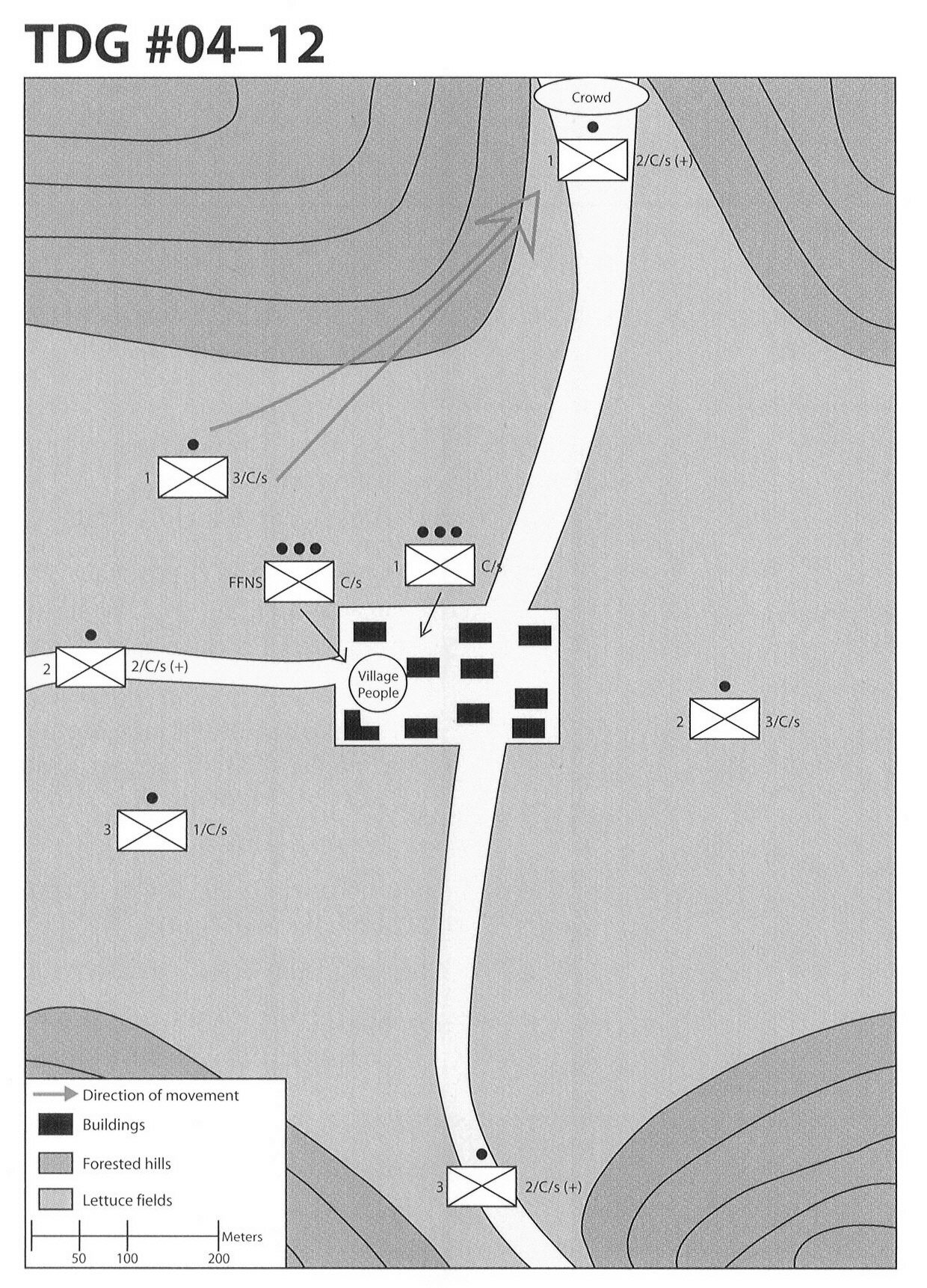
You are the commander of Company C, 1st Battalion, 8th Marines. Your battalion has been conducting peace enforcement operations in the country of Tenochichitlan. Tenochichitlan has been suffering from a horrible civil war, and U.S. forces are supporting the legitimate government by helping to eliminate armed guerrilla resistance. Your company has been tasked with conducting a cordon and search of the village of Ponchoville in order to locate weapons and information on guerrilla activities. This small village of about 200 people has been known to support the guerrillas by hiding weapons and providing food.

The guerrillas are known to possess Soviet small arms (AK series, Dragunov sniper rifles, light machineguns, and rocket propelled grenades (RPGs)). They operate in small units and only conduct harassing attacks. They will not fight to the death and are not capable of reinforcing. They will withdraw when friendly reinforcements arrive.

The village consists of several small stone houses and a few farming structures. Ponchoville lies in a valley surrounded by forested hills and fields of lettuce. There are three dirt roads leading into the village that break the surrounding farmland into three areas. Many of the villagers are indifferent about the U.S. and government forces, but some are very upset about the foreign presence.

You have tasked organized your company into cordoning and searching elements. 1st Platoon and weapons platoon will enter the village to do the searching. 2d and 3d Platoons will lay in the cordon. Additionally, you have six HMMWVs from the battalion’s heavy machinegun platoon attached. They consist of three M2 .50 caliber heavy machineguns and three Mk 19s, all vehicle mounted. 2d Platoon will place one squad along each road as it enters the valley. Each of those squads will have two heavy machinegun HMMWVs attached. 3d Platoon will conduct patrols of the farmlands and forested areas around the village while the search is conducted.

The cordon is in place at 0500, just as the sun comes up. 1st Platoon and weapons platoon arrive at the village 1 hour later. After meeting with the village chief, he agrees to have the villagers assemble just outside of the village to the west. Weapons platoon watches over the villagers while 1st Platoon searches. 3d Platoon begins its patrols. Two hours later, 2d Platoon calls and informs you that there is a large crowd of approximately 100 visibly upset civilians approaching the northern cordon position. They appear to have come from a nearby village north of their position. They are carrying banners that state, “Amerikan go hoom!” You immediately send 1st Squad, 3d Platoon to their position to aid in dealing with a potential riot.

One hour later, you’re told that the crowd at the northern cordon position is getting bigger and angrier. At the same time, you hear the sound of RPGs and small arms fire south of the village. 2d Platoon calls to inform you that the southern cordon position is under attack. The two HMMWVs have been destroyed by RPGs, and many of the squad are wounded. Your first sergeant reminds you that the search is not yet complete and that the villagers are getting restless.

Requirement

In a time limit of 5 minutes, issue orders to your platoons and reports to higher headquarters. Include your intent, scheme of maneuver on an overlay, and report(s) to higher headquarters. Send your solution and rationale for your actions to Marine Corps Gazette, TDG #04-12, P.O. Box 1775, Quantico, VA 22134, fax 703-630-9147, or e-mail <[email protected]>.

Cartonville Patrol

by Sgt Stephen Chorney

Situation

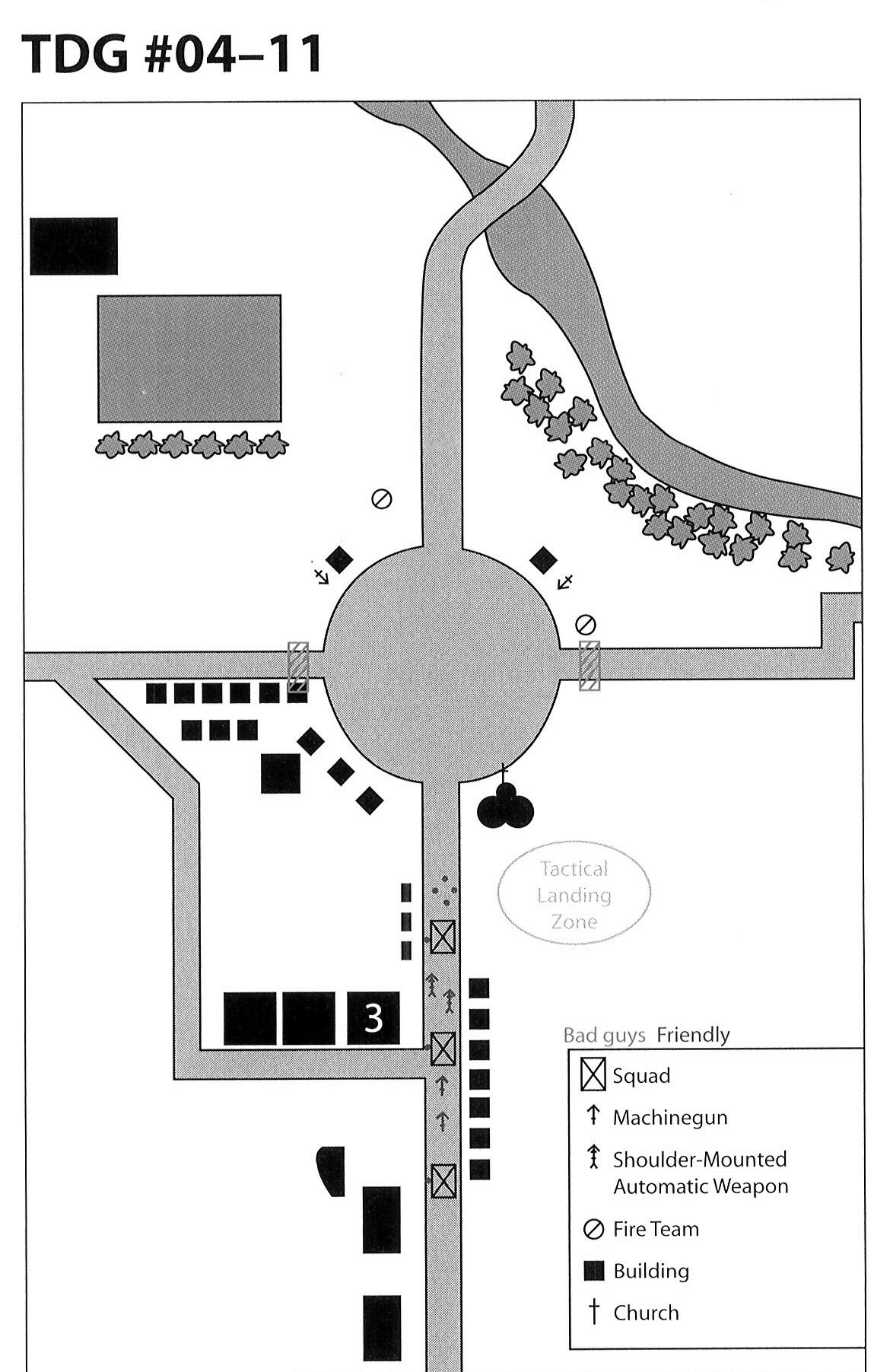
You are the platoon commander of 1st Platoon, Company C, Battalion Landing Team 1st Battalion, 8th Marines. You are currently engaged in stability and support operations in the country of Grapeland. Coalition forces have routed organized enemy resistance, but there are still numerous “dead-enders” who operate in squad-sized units. These units utilize Soviet Bloc small arms to include AK-series assault weapons, light machineguns, rocket propelled grenades, and 82mm mortars. They are mostly former regime military officers augmented by terrorists from other countries. Their actions are well-thoughtout, rehearsed, and usually effective. Hostile threat is high, but you have not been engaged in any manner in the 14 days you have been there. Your battalion is in a defensive perimeter at a rundown airfield located within city limits of Cartonville, Grapeland. Your rules of engagement state that you are only to fire if fired upon or if hostile intent is positively identified. You are to use the least amount of force necessary to gain fire superiority. There have been restrictive fire measures emplaced as well. In any situation, collateral damage is to be kept to a minimum.

Your platoon has been tasked with a security patrol in the city. You have two machinegun teams and two assault teams attached to you. The platoon has a standard combat load of ammunition (squad automatic weapon, M203 grenade launcher, M16), and each squad has one AT-4 rocket as well. You have no direct or indirect fire support due to the restrictive fire measures. Illumination is your only asset from your supporting weapons platoon and company. There is a section of AH-IW Cobras armed with 20mm and 5-inch Zuni rockets, as well as a dedicated medevac bird (on 20-minute strip alert at a nearby forward operating base), that are within a 5-minute flight of you once they launch. It is 1 hour before dusk, and your patrol exits friendly lines. Your patrol is spread out about 400 meters long and staggered on both sides of the road. As you come to the intersection in the city square, you see that two of the avenues are now barricaded with trash, vehicles, and wood and are impassable for your patrol. There are very few people in the streets as well. At this time you halt the patrol to look at your map in order to coordinate new routes. You are hit from the front by small arms and machinegun fire. The machineguns seem to have interlocking fire, and the small arms are in sporadic positions within the buildings. All of the buildings in the square are two floors or higher and made of heavy concrete. (1st Fire Team, 1st Squad is pinned down and taking casualties.) As the patrol advances toward the contact, mortar fire begins to fall in behind your position, pushing you toward the kill zone. First assault team and machinegun team moved to join 1st Squad on their own initiative upon contact. second assault team and machinegun team moved to support 2d Squad upon contact. 3d Squad moved into a reserve position and all are awaiting orders.

What do you do?

Requirement

In a time limit of 5 minutes, come up with a fragmentary order for your squads and your attachments; include scheme of maneuver, commander’s intent, and signal plan. Provide an overlay for your scheme of maneuver. Also prepare any reports that you would send to higher headquarters, along with any requests for support. Send your solution and rationale for your actions to Marine Corps Gazette, TDG #04-11, P.O. Box 1775, Quantico, VA 22134, fax 703-630-9147, or e-mail <[email protected]>.

Catching a Link

by Sgt James Fegler

Situation

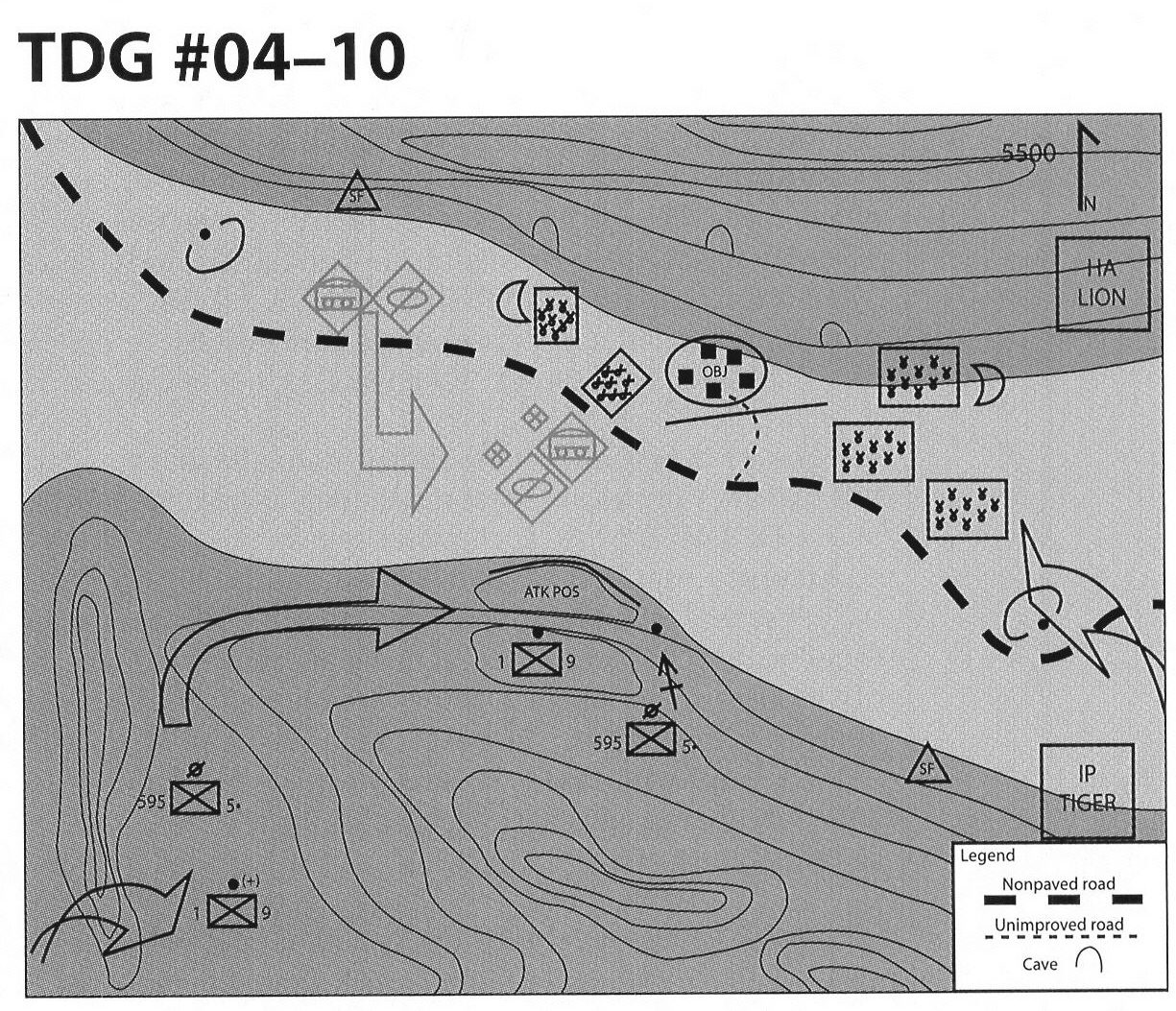
Intelligence reports that one of alQaeda’s top generals, Omar Sharruf, will be in the Ka Bada (KB) training camp. The camp has a squad (plus) element providing security. The camp’s last reported activity was training and strengthening the defense. The camp is in northern Remotistan in the mountains. It’s now 1300. It is believed that Omar will leave in 24 hours. At KB they have Soviet Bloc small arms (AK series and RPK light machineguns (MGs)), as well as RPG-7s (rocket propelled grenades) and third-generation night vision goggles (NVGs). The enemy’s most probable course of action will be to defend the compound long enough for Omar to leave via roadway or foot trails into the mountains. If Omar gets to the mountains he’ll be there for months. They have the ability to reinforce via roadway from the northwest. Special forces (SF) teams have been watching the compound for 24 hours, and they have eyes on and are updating the situation. SF positions are around the compound. There will be one SF team at the landing zone (LZ) to mark it and guide you to the objective.

At 1700 the 28th Marine Expeditionary Unit (Special Operations Capable) launches a platoon-sized heliborne raid against the compound. You are now 1st Squad leader, Company B, 1st Battalion, 9th Marines. Your squad has 13 Marines, and you have an assault team and a squad of MGs as your attachments. Your reinforced squad has a combat load-two claymores, one AT-4, three shoulder-launched multipurpose assault weapon rockets, and 1,000 rounds for each MG. Your mission is to extract Omar (alive if possible) to LZ Tiger, destroy all KB equipment, and capture or eliminate all KB personnel. To prevent escape along the roads, 2d Squad will position themselves to the northwest of the compound to set a blocking position. 3d Squad will set up a blocking position to the southeast on the road. Both squads setting up blocking positions will land via helicopter onto their objective. They each have an assault team and an MG squad. You have two Harriers that are in direct support of you. They will stand by at Holding Area Lion.

You arrive at 0100 on the deck in northern Remotistan. The hills are steep with loose rock and boulders that provide good cover. It’ll take a little time and effort, but the hills can be climbed. It is a cold night with the moon giving a little more than 60 percent illumination. While sitting in the LZ you give radio checks to all of the key leaders, and communications is excellent. You then scan the area with your NVGs, and you see two flashes of an infrared beam. You respond back with three flashes; the light shines back one time; you have made link up.

As the SF team guides you through the valley, you notice that it’s very flat and is all loose sand. At 0305, as you move into your objective rally point, the KB compound begins to shoot up flares and spotlight the valley floor. This lasts for about 5 minutes. Your MG attachments break off to go to their overwatch positions from which they can provide overhead fire until your squad reaches Phase Line Red. The SF team will provide security. You spend 40 minutes crawling to Phase Line White. Listening to the radio, 3d Squad notifies you that they have set in. 2d Squad had to turn around and abort due to a mechanical malfunction with the helicopter.

Hearing something that alarms you, you look to your west and see vehicle lights. Taking a closer look through a AN/ PAS-13 you discover a BTR-70 (Soviet armored vehicle) and an old Russian flatbed truck with a ZSU-23 (self-propelled antiaircraft gun) mounted on it. The truck has four to six men on it. Both vehicles are heading toward your position. As the vehicles close to 500 meters, the BTR-70 and the truck dismount all troops. They assume a combat formation and continue a course that will bring them straight to you.

The observation post to the northwest reports that through their NVGs they have spotted an individual they believe to be Omar, and he is getting ready to flee. They also report that the compound is scrambling to their defensive positions. The radio goes quiet as more flares go up and the spotlights come back on.

Requirement

In a time limit of 5 minutes, organize your squad for a hasty ambush of the vehicles, extraction of Omar, and destruction of the compound and its equipment. Include your intent, scheme of maneuver on an overlay, and your signal plan. Send your solution and rationale for your actions to Marine Corps Gazette, TDG #04-10, P.O. Box 1775, Quantico, VA 22134, fax 703-630-9147, or e-mail <[email protected]>.

Urban Contact

by the Office of Naval Research and Program Manager Training Systems Science and Technology Team

Note: Readers should use the CD enclosed with this issue of the MCG when developing their TDG solution. See note at end of “Tasks.”

Situation

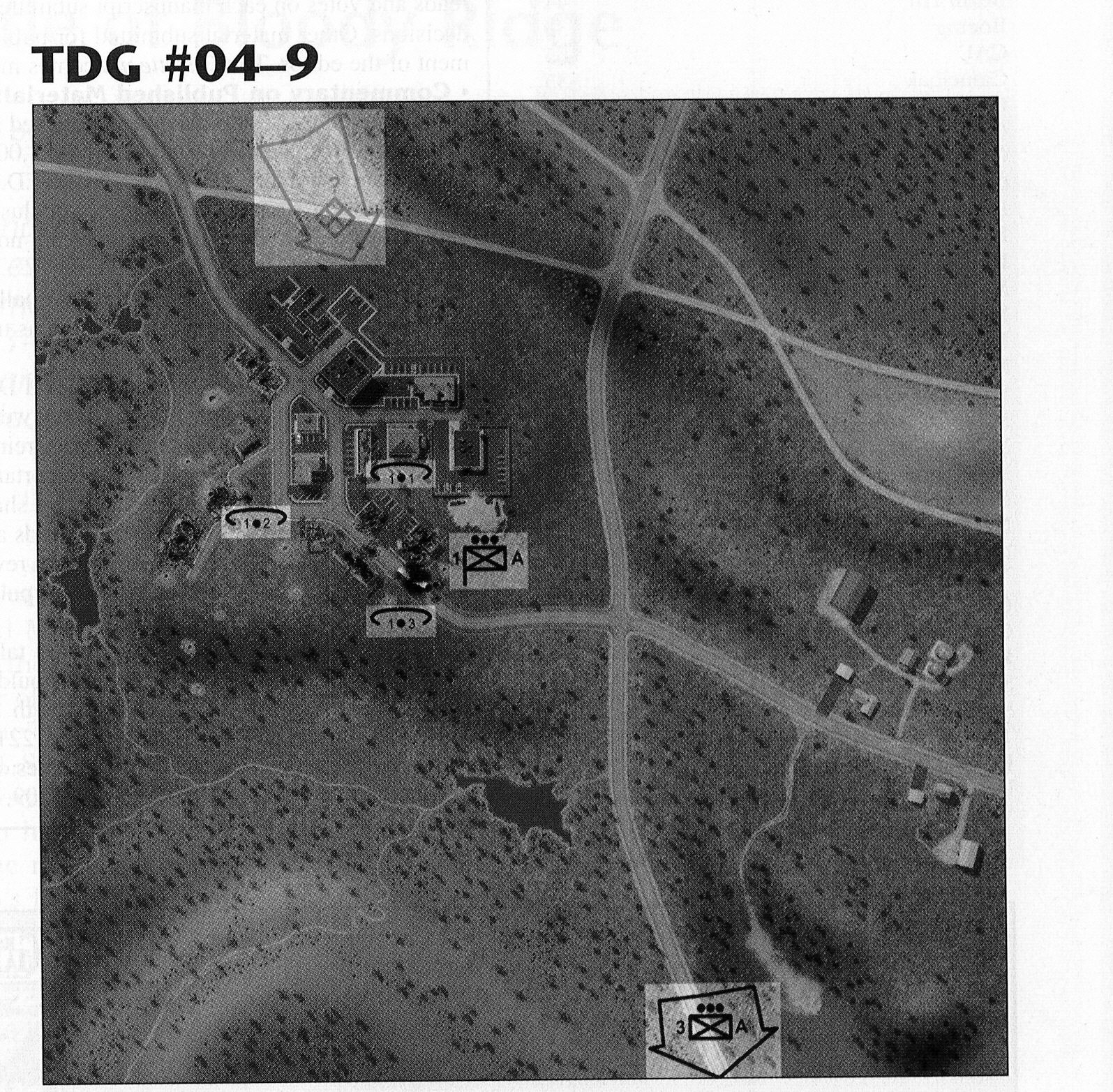
You are the Commander, 1st Platoon, Company A. Your platoon is reinforced with one machinegun squad.

Company Commander’s Order

“Enemy patrols, mostly squad size, have become increasingly bolder as we have withdrawn south. I think we can expect tentative contact here in the village this morning. The battalion is withdrawing south and repositioning in order to turn over this sector to allied forces. Company A is tasked to guard the battalion rear in order to prevent enemy interference with our withdrawal. One platoon is detached to battalion. One platoon guards the town while one platoon moves south to establish the next rear guard position. There is no close air or artillery support.”

Tasks

“1st Platoon is the main effort; guard the company rear in order to prevent interference with our withdrawal. 2d Platoon is detached. 3d Platoon, move south and establish the next rear guard position in order to permit 1st Platoon’s withdrawal. Priority of fires for mortars is to 3d Platoon.”

(Note: If you are wargaming your course of action by yourself, load Fight 1-1 a which is designed for single play. In single play you will fight with one squad reinforced with a machinegun team. Use Fight 1-1b for three to six Marines; you must have opposing force players when fighting two or more players.)

Requirement

In a time limit of 2 minutes, issue orders to your subordinates. The players have 8 minutes to predeploy before the scenario will automatically begin. After completing your course of action, describe any additional actions that you had to take while the scenario was being played out. Then provide a sketch of your initial plan and an explanation of the outcome. Submit your solution to the Marine Corps Gazette, TDG #04-9, P.O. Box 1775, Quantico, VA 22134, fax 703-630-9147, or email <gazette @mca-marines.ore>.

For more detailed information on the structure of Marine Corps units, Marine Corps equipment, and symbols used in TDG sketches, see the MCG web site at <www. mca-marines. org/gazette>.

Additional Information

When the Close Combat Marine (CCM) tactical decisionmaking simulation is loaded on your computer, a training library is installed automatically. The library contains the following:

* User’s manual that covers CCM wargaming and multiplayer use through local area network or Internet use.

* CCM workbook containing:

* Warfighting training philosophy.

* Use of the training and readiness (T&R) manual.

* Eight modules on tactical tasks.

* Thoughts on verbal orders.

* Orders shorthand.

* Facilitation.

* Glossary/tactical tasks.

* Infantry T&R manual.

* Marine Corps Reference Publication 3-0A (MCRP 3-0A), Unit Training Management.

* MCRP 3-0B, How to Conduct Training.

* Map folder containing CCM maps.

Battle Damage Assessment

by Sgt Richard A. Bell

Situation

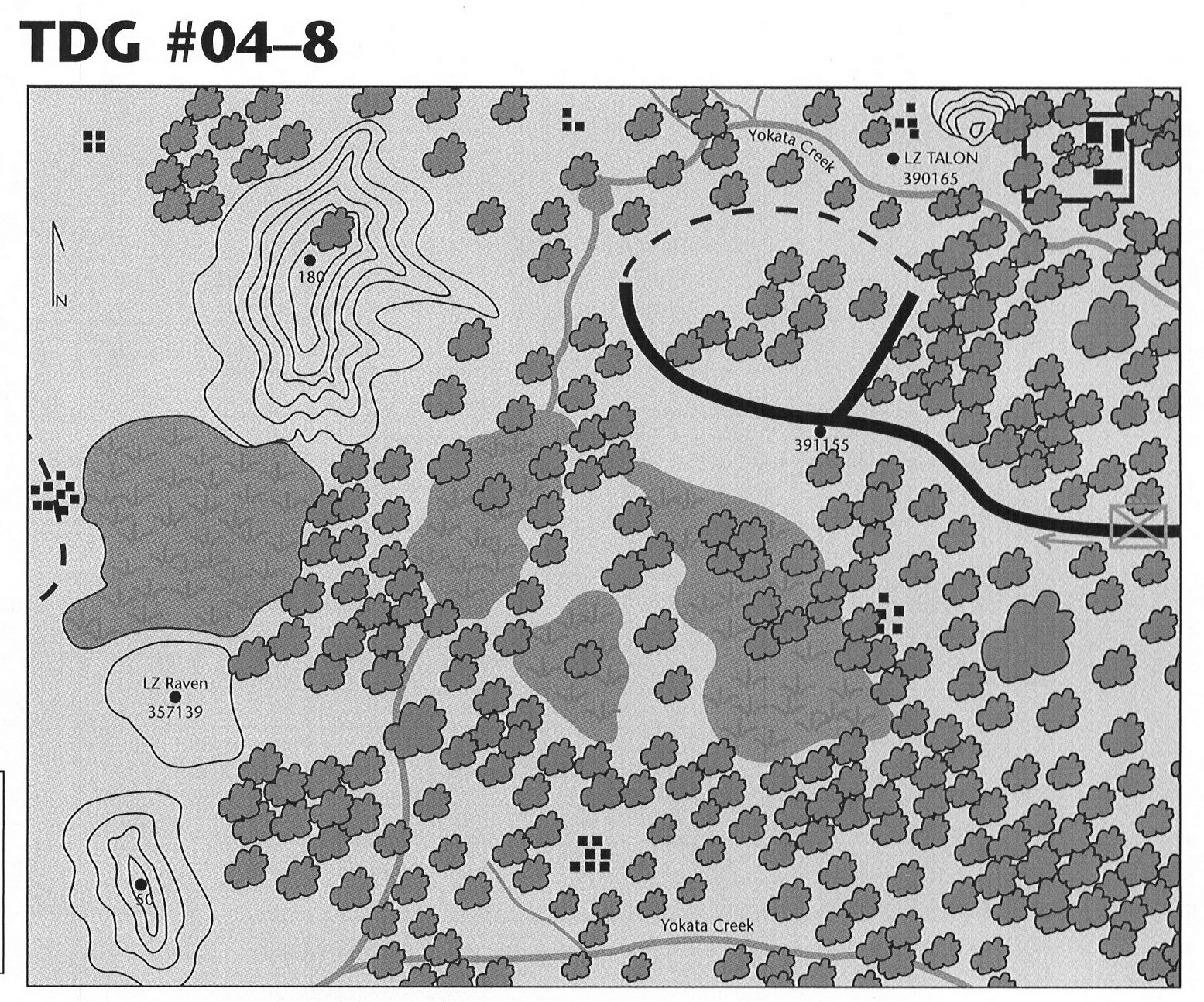
You are the platoon commander of 3d Platoon, Company C, Battalion Landing Team 1st Battalion, 8th Marines, 26th Marine Expeditionary Unit (Special Operations Capable). Your platoon is tasked with conducting a battle damage assessment (BDA) of an AV-8B Harrier strike that was carried out on a terrorist training camp. You are to helo into Landing Zone (LZ) Talon with your platoon, reinforced by a squad of machineguns (two M240Gs) and an assault squad (two shoulder-launched multipurpose assault weapon rocket launchers). Also attached to your platoon are a two-man intelligence team, a combat camera team, and a human intelligence team. Your platoon carries a full combat load of ammunition to include grenades (fragmentary and smoke), M203 high-explosive rounds, and signal flares, and each squad has one AT-4 antitank rocket and one claymore antipersonnel mine. In support of your mission is a sec tion of AH-IW Cobras providing aerial fires, but due to the flight having to take a circuitous route to avoid an unexpected ice storm, they are almost out of fuel and must return immediately to amphibious shipping to refuel. The S-2 (intelligence) briefed that current imagery shows the area is secure, with all remaining terrorists having fled to the mountains.

You have been inserted into the LZ without problems, and the CH-46s have left to refuel aboard the ships; they will not be able to extract the platoon for 45 minutes. As you prepare to conduct the BDA, the Cobra flight leader suddenly reports to you that there is an enemy platoon (reinforced)-sized convoy moving toward the objective. The enemy is traveling west on the road and is estimated to arrive in 20 to 30 minutes. They were driving six to seven technical vehicles (pickup trucks) that appear to be mounted with either 12.7mm or 14.5mm machineguns. Each vehicle contains about six terrorists. The Cobras have made one gun run on the convoy, destroying or damaging two to three vehicles, but are now critically low on fuel and have to return to the ship, so they cannot provide further close air support. It appears as if the remainder of the convoy (4 to 5 vehicles totaling 25 to 30 enemy personnel) is still proceeding in your direction. Time has priority, and you have 45 minutes on the ground to gather the BDA and return to LZ Talon for extract.

Task your squad and attachments to accomplish this mission. This is a daylight operation for photographic purposes, and all personnel in the area are declared hostile.

Requirement

In a time limit of 5 minutes, come up with a fragmentary order for your squad leaders and compose your reports to higher headquarters. Include your commander’s intent and scheme of maneuver with an overlay. Send your solution and rationale for your actions to Marine Corps Gazette, TDG #04-8, P.O. Box 1775, Quantico, VA 22134, fax 703-630-9147, or e-mail <[email protected]>.

Rahadnak Valley Search

by Maj Kenneth R. Kassner

Situation

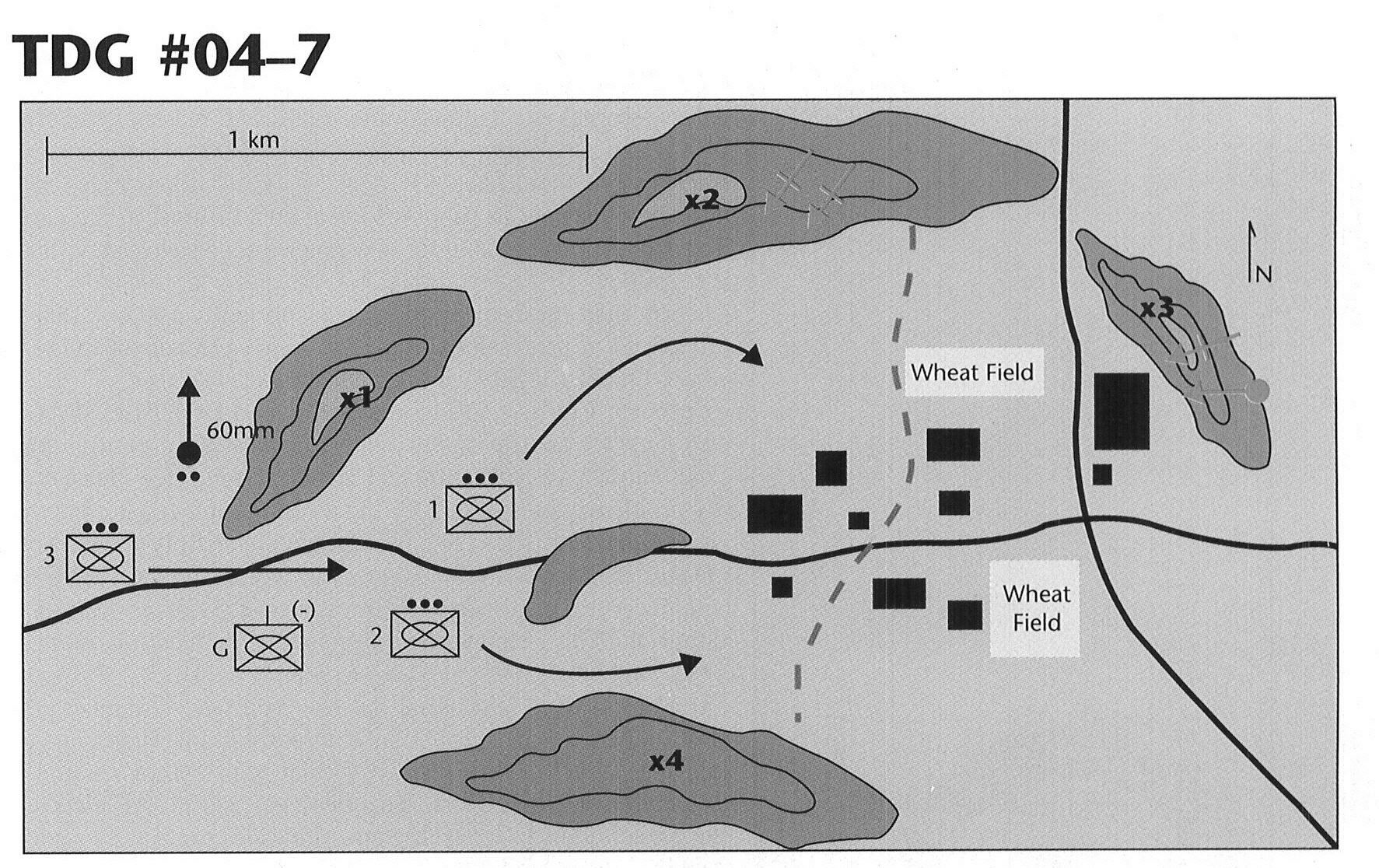
You are the Commanding Officer, Company G, Battalion Landing Team 2d Battalion, 2d Marines-the mechanized rifle company currently deployed with the 26th Marine Expeditionary Unit (Special Operations Capable) (26th MEU (SOC)). Recently, the MEU was sent to the country of Ghanifstan in order to reinforce coalition units searching for Nadel nib Amaso and remnants of his Nabilat forces and needihajum freedom fighters believed to be operating in the southeastern part of the country. Throughout the winter months Rahadnak and the surrounding provinces have been relatively quiet with no armed conflict in this region. However, with the arrival of the spring thaw and warming temperatures, organized guerrilla groups reignited an active campaign against coalition forces and inflamed tribal unrest throughout the region.

Your mechanized company, embarked aboard 14 assault amphibious vehicles, is reinforced with elements from its organic weapons platoon, including three machinegun squads and six assault teams evenly dispersed between the platoons and a 60mm mortar section. While traveling east along a main road in the Rahadnak Valley during a routine mechanized patrol, your unit is tasked to search a village suspected of harboring Nabilat and needihajum fighters. Speed is essential as the enemy is prone to resupplying its forces and then quickly fading into the rugged and mountainous countryside. A section of AH-IW Cobras that can reinforce your unit within 15 minutes remains on call to provide close air support.

In order to maximize the “shock and awe” and speed of your mechanized unit, you decide on a simple, though previously effective, scheme of maneuver that calls for two platoons to encircle the village-one from the north and the other from the south-one platoon to advance along the main avenue of approach to seal the entry point and a dismounted mortar section to isolate the objective area with calls for fire as needed. The section of Cobras can be used to further isolate the objective area or provide supporting fires if required.

As your lead elements enter the village area, 1st Platoon immediately begins taking machinegun fire from the vicinity of Hill 2. As the platoon commander begins to take immediate action, mortars begin impacting around him. One of his vehicles has sustained a mobility kill. What now, Captain?

Requirement

In a time limit of 5 minutes, issue your orders to your element leaders. Prepare an overlay depicting your scheme of maneuver, fragmentary order, and rationale for your actions. Submit your solution to Marine Corps Gazette, TDG #04-7, P.O. Box 1775, Quantico, VA 22134, fax 703-630-9147, or email <[email protected]>.

For more detailed information on the structure of Marine Corps units, Marine Corps equipment, and symbols used in TDG sketches, see the MCG web site at <www. mca-marines.org/gazeUe>.

Protecting the ‘Golden Leaf’

by 1st Fire Team, 2d Squad, 2d Platoon, Company C, 1st Battalion, 8th Marines

Situation

You are the 1st Fire Team Leader, 2d Squad, 2d Platoon, Company C, Battalion Landing Team, 1st Battalion, 8th Marines of the 22d Marine Expeditionary Unit (Special Operations Capable) (22d MEU(SOC)). Your company has been tasked to maintain peace in the city of Koper, Slovenia. Slovenia has been suffering from a 5-year civil war. The legitimate government has finally come to a truce with the major belligerents in the war; however, there are rebellious factions who continue to conduct guerrilla warfare against the government and its supporters. The citizens of Koper remain peaceful with American forces but have recently begun to hold peaceful demonstrations against American imperialism. The demonstrations have yet to ignite into resistant crowds. The MEU commander believes that the population will soon become more aggressive in their protests. This is due to a few unfortunate misunderstandings and guerrilla propaganda. The citizens are caught in a whirlpool between the guerrillas’ political ideologies and the efforts of American forces. Their emotions are severely stirred and teetering on the edge. The guerrillas have Soviet-bloc small arms and experiment with crude “basement made” chemical irritants and explosives.

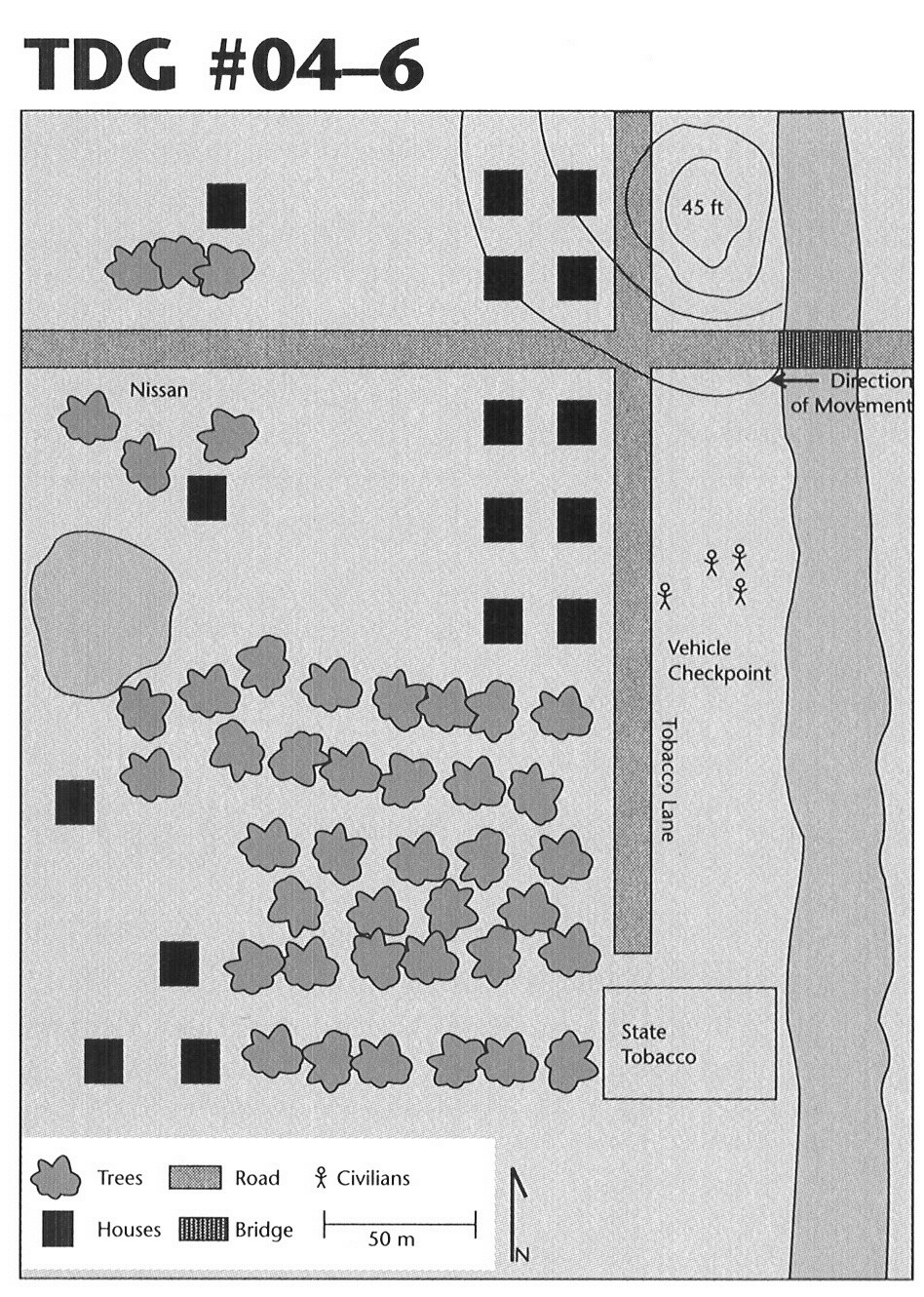
Your squad has been tasked to conduct an urban security patrol in a village located in your company’s area of operations in order to show presence and deter guerrilla actions. Attached to your squad is a corpsman, machinegun squad, assault team shoulder-launched multipurpose assault weapon, and a human exploitation team (HET) Marine who can speak Slovenian. It is early afternoon, there is light traffic on the streets, and the sky is cloudy. After crossing the bridge en route to checkpoint Nissan, your squad is fragged over the radio to set up a vehicle checkpoint. Your squad leader states that S-2 (intelligence) has reliable information indicating that rebel forces are planning to attack the nearby State Tobacco factory with a car bomb. Your squad must search every vehicle attempting to enter the factory’s perimeter. Your squad establishes a checkpoint in the middle of Tobacco Lane-the only road leading into the factory. There are some small houses to your west and a river to the east. A small crowd of civilians approaches from the riverbank to watch the Americans in action.

As your squad begins to set up the vehicle checkpoint, members of the 3d Fire Team, on the east flank, report a strange odor. At the same time the HET Marine with the 3d Fire Team begins to vomit uncontrollably. He begins to rub his face screaming that his eyes and skin are burning. He collapses in agony and continues to cry out. Your squad leader immediately gives the command to don protective masks, but it is too late for another two members of 3d Fire Team-the squad automatic weapon gunner and rifleman begin experiencing the same symptoms as the HET man. The Marines who masked in time experienced no symptoms except for burning of exposed skin. The corpsman speculates that these are symptoms of a known improvised non-lethal gas that the guerrillas have developed. The crowd becomes aggressive when several civilians begin feeling the effects of the gas. They begin throwing debris (bricks, bottles, and rocks) with extreme force and incredible accuracy at the Marines. Seeing the Marines mask up, the crowd thinks that the Marines used the chemical agent on them. Acting utterly on emotion they are unaware of the fact that the guerrillas probably employed the gas. The squad leader is then suddenly hit in the face with a rock knocking him nearly unconscious. You are now in charge. The crowd is growing angrier and more people are joining them. They are not holding back. What do you do?

Requirement

In a time limit of 2 minutes, write down your fragmentary order and any reports to higher headquarters. Provide a sketch of your actions. Rules of engagement state that riot control agents require authorization, and approval for their use will be given on a case-by-case basis. Submit your solution and rationale for your action to Marine Corps Gazette, TDG #04-6, P.O. Box 1775, Quantico, VA 22134, fax 703-630-9147, or e-mail <[email protected]>.

No Bugles, No Drums

by IstLt Quinn P. Colgan

Situation

For the past 7 weeks the 2d Marine Division has been conducting conventional operations against an invading enemy force in the country of Hartland. The enemy has been fighting a delaying action as 6th Marines has pressed its attack across the open countryside; however, they are beginning to consolidate in more urban areas as they approach their own borders. Intelligence believes they will continue to consolidate forces and attempt to reinforce while they prepare to defend more earnestly.

Brownsville is a small town that sits along the White River, 15 miles south of Orange City, the metropolis in a string of urbar communities along the White River known as the “Upper Valley.” The Upper Valley and Highway 5 have been serving as important transportation and supply routes for enemy forces operating within this area of Hartland.

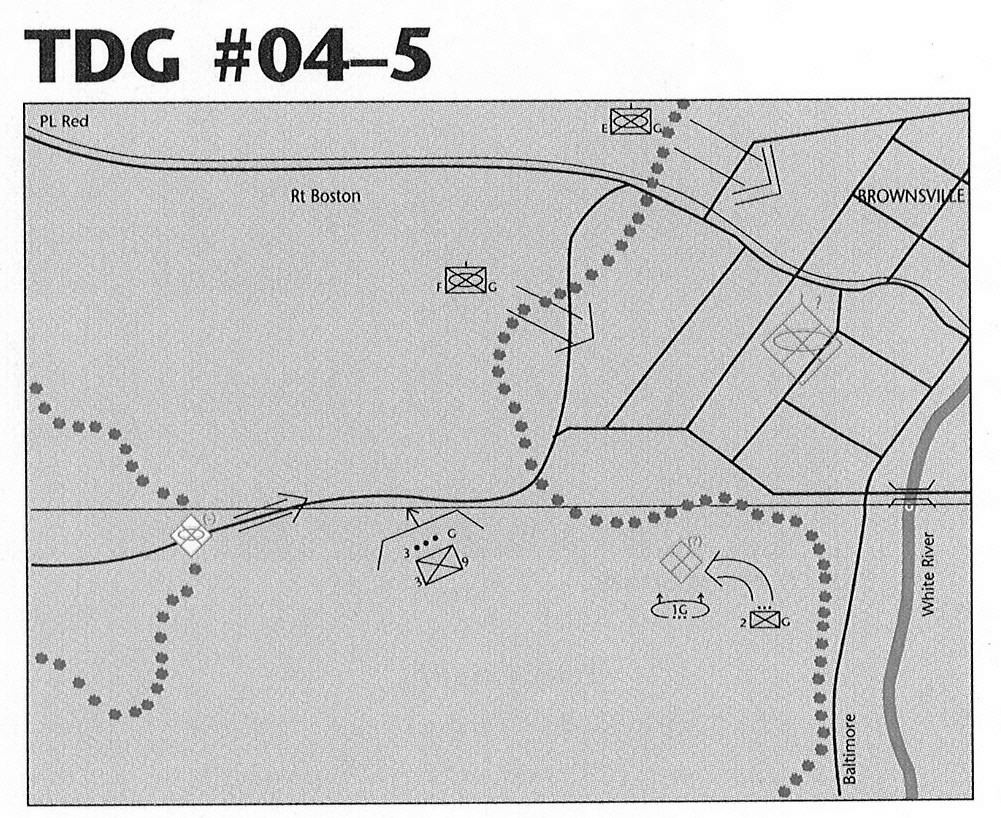
You are the company commander of Company G, 2d Battalion, 6th Marines (2/6). 6th Marines is conducting an attack on the southern sector of Orange City, and 2/6 is supporting that attack by seizing Brownsville and isolating enemy units in their area of responsibility in order to prevent enemy interference with the main effort to the north. Your battalion scheme of maneuver is sending Companies E and F into Brownsville from the northeast via assault amphibious vehicles, while a combined antiarmor team screens to the northeast. You have been tasked with conducting a heliborne insertion south of Brownsville and isolating the town south of Phase Line Blue (PL Blue) along route Baltimore. 3/10 is in general support of the regiment, and two sections of rotary-wing aircraft are in general support of 2/6. Company E has priorities of fire from the 81mm mortars platoon. PLs Red and Blue are serving as company boundaries for this operation.

The S-2 (intelligence) reports that the majority of the indigenous population has fled the town. Those who remain are sympathetic to the enemy invasion and should be considered dangerous to U.S. forces. Expect at least a company-sized enemy force within the town itself. They have been using BMPs/BTRs (Soviet mechanized infantry vehicles/Soviet armored vehicles) and 82/120mm mortars but have been operating without adequate resupply for some time. Their morale is waning due to the lack of support and bad weather, but their increased defensive posture indicates they expect an imminent U.S. attack. There have not been any reports of reinforcement or resupply within the past 72 hours.

You inserted into Landing Zone Eagle, 7 kilometers (km) to the south of Brownsville and have proceeded north in a movement to contact formation for 5km. The terrain on the western side of the White River consists mostly of rolling hills that gradually rise into a low intermittent mountain range off to the west. The local country alternates at varying intervals between cleared farm communities and wooded areas. The forests contain moderate undergrowth that thankfully does not limit foot trafficability. Heavy rainfall in recent weeks has swollen the river and streambeds while hampering vehicle mobility on all unimproved surfaces.

Along your route toward Brownsville your company has been involved with two brief engagements with the enemy. 1st Platoon, at the lead of the company formation, came into contact, and both times you directed 3d Platoon to maneuver to the west with one assault squad and one machinegun team in accordance with your unit standing operating procedure. In both instances the enemy disengaged and withdrew ahead of the company as 1st and 3d Platoons pressed forward and pursued by fire. As you approach PL Blue, 3d Platoon is still out forward to the west and you have been unable to communicate with anyone over battalion Tactical Net 1 (Tac 1).

3d Platoon now calls you over the company Tac and tells you he has spotted what looks to be a platoon (minus) dismounted from three BTRs attempting to drive northeast toward PL Red. They are traveling along an unimproved road not recorded on the map. At that moment you hear single shots and automatic weapons fire erupt from 1st Platoon’s direction, and the battalion operations officer suddenly comes through over battalion Tac 1 asking for an update. What do you do?

Requirement

In a time limit of 5 minutes, develop your plan. Include an estimate of the situation, your intent, scheme of maneuver with overlay, and all reports to higher headquarters. Send your solution and the rationale for your actions taken to Marine Corps Gazette, TDG #04-5, P.O. Box 1775, Quantico, VA 22134, fax 703-630-9147, or e-mail <gaze [email protected]>.

To Ambush or Not to Ambush

by SSgt C.S. Norton

Situation

You are the 1st Squad Leader, 1st Platoon, Company F, 2d Battalion, 7th Marines (2/7). Battalion Landing Team 2/7 (BLT 2/7) is the ground combat element of the 31st Marine Expeditionary Unit that has landed at the port city of New Zeda in the country of Zedastan. The established government is struggling with counterguerrilla insurgency, and there have been numerous high-profile kidnappings, bombings, and assassinations in the past month. Conditions have deteriorated to a point requiring international intervention. The city is home to over 1 million people most of whom require humanitarian relief. The main enemy force, the Zedastan People’s Army (ZPA), retreated from the city upon the arrival of the Marines. ZPA is a large but untrained army with mostly small arms, machineguns, and a few mortars. They do have access to modern communications such as cell phones and global positioning systems.

The BLT is the security element for both U.S. and international aid organizations that are feeding the estimated 300,000 refugees. Company F has been tasked with ensuring that ZPA forces do not return to the city to interfere with humanitarian efforts. Your platoon has been tasked with conducting security patrols outside the city approximately 2 kilometers to the northeast. The terrain is heavily wooded with rolling hills.

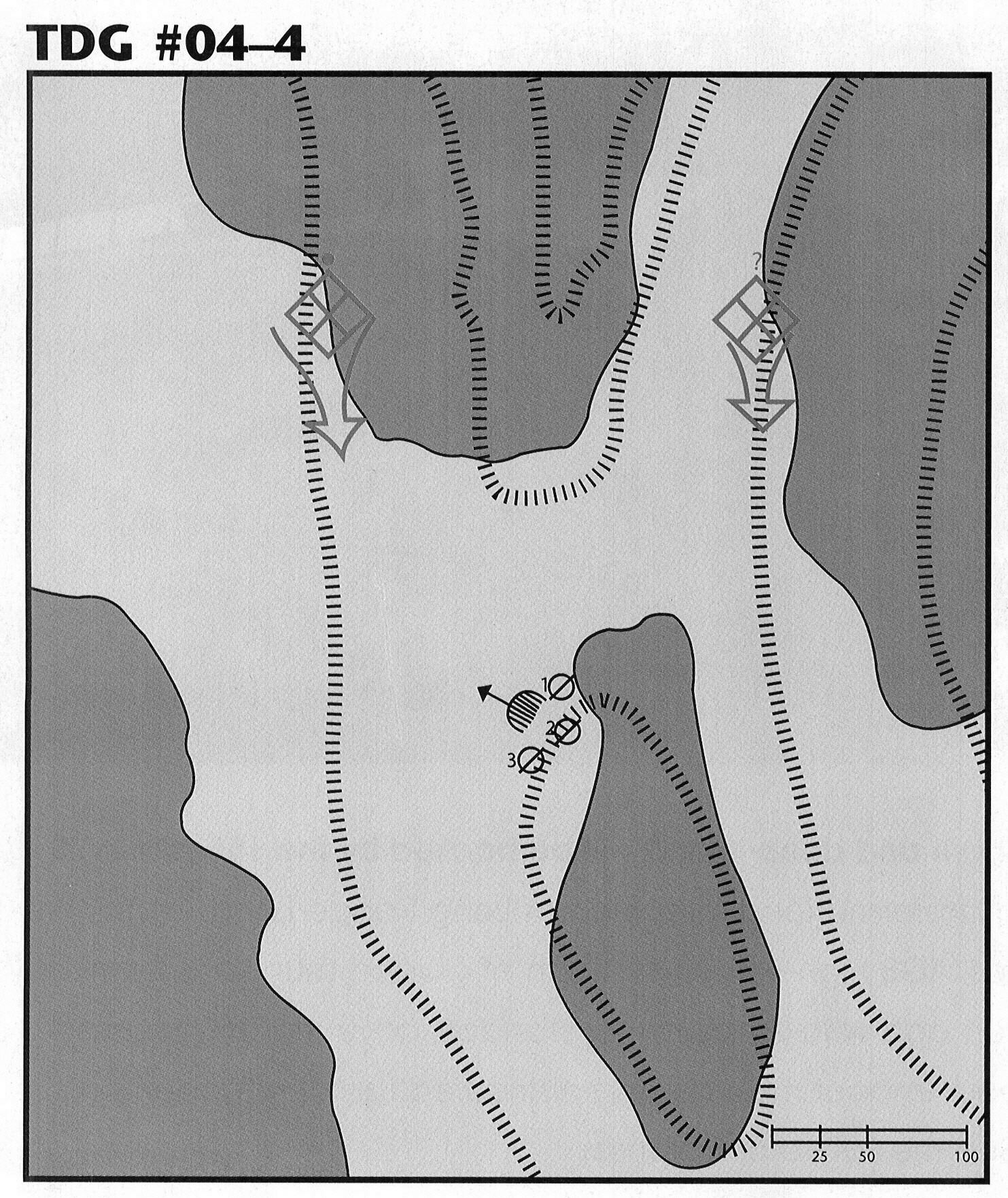
Your squad has been on patrol for over an hour. The BLT perimeter and city outskirts are approximately 2 kilometers to the south. Your point man spots what appears to be an enemy patrol armed with small arms moving south toward your squad. You decide to establish an ambush and set your squad into hasty ambush positions oriented to the northwest. You radio higher headquarters and inform them of the situation. just as you are about to initiate your ambush (with a closed bolt weapon), the 1st Fire Team Leader points out another enemy unit moving toward and behind you. he counts at least six enemy with more following. He’s not sure how many. The team leader also notes at least one RPK (Soviet) medium machinegun. It is now 1730 and EENT (end evening nautical twilight) is 10 minutes away. What now, Sergeant?

Requirement

In a time limit of 30 seconds decide whether or not you will spring your ambush. Develop your scheme of maneuver for either case and rationale for your decision. Submit your solution and rationale for your action to Marine Corps Gazette, TDG #04-4, P.O. Box 1775, Quantico, VA 22134, fax 703-630-9147, or e-mail <[email protected]>.

The Fallen Angel

by LCpl Ramon Pinto

Situation

Your Marine expeditionary unit (MEU) has been conducting operations in the coastal country of Atlantica. A former general by the name of Franco has been terrorizing the capital city by sending his rogue army to loot and pillage the locals and kill all who oppose him. U.S. carrier-launched aircraft have been making low-altitude, high-speed flybys to make our presence known and demonstrate the resolve of the international community. They have also bombed Franco military units after Franco’s forces engaged U.S. aircraft with antiaircraft fire. Later that day a Navy F-18 was shot down by a long-range surface-to-air missile and crash-landed south of a local airfield. The pilot’s last radio transmission stated that he had ejected safely and was heading to his extraction point (which is near the airfield).

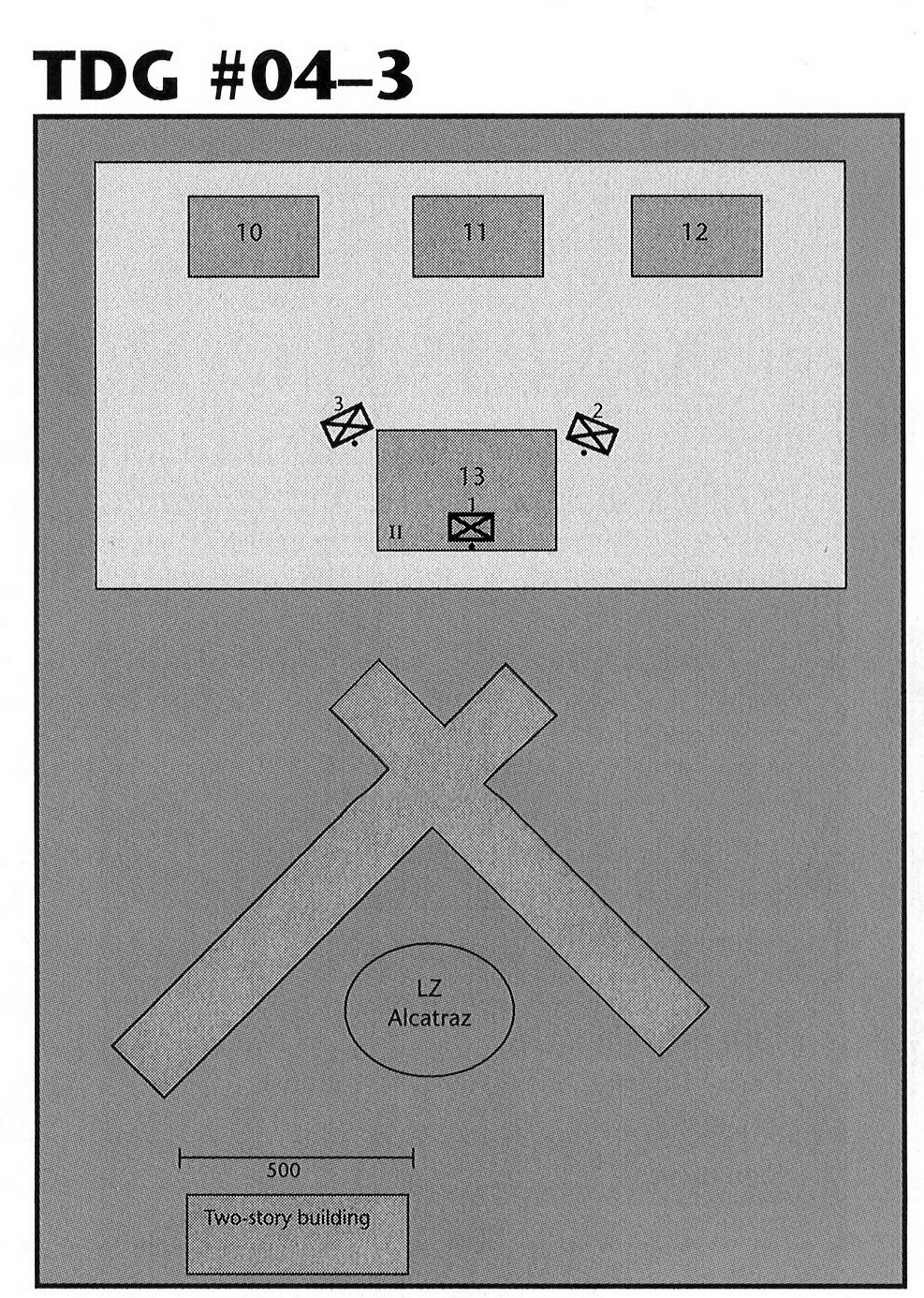
You are 1st Squad Leader, 2d Platoon, Company C, Battalion Landing Team 1st Battalion, 8th Marines, and your platoon is tasked to conduct a TRAP (tactical recovery of aircraft and personnel) mission to recover the downed F-18 pilot who is hiding in Building 13 of the abandoned airport. The MEU S-2 (intelligence) reports that there is no known enemy presence at the bombed out airport. The airport consists of four administrative buildings made of cinder block and corrugated steel roofs. The runway is cratered and covered with debris.

At 2200 2d Platoon is inserted by helo into Landing Zone (LZ) Alcatraz (50Om south of Building 13). Two AH-I Cobras are on station but only for 20 minutes. 2d Platoon moves out in a tactical column heading north to Building 13. 1st Squad with the platoon commander will clear the building and find the pilot. 2d and 3d Squads are responsible for perimeter security north of the building using the remains of cars and debris for cover outside of the building. 1st Squad tactically and quickly enters the back door of the building and immediately clears the first floor of the two-story building. When you reach the second floor you notice a dead body with an AK-47 in hand directly across a door in the hallway. Stacked against the wall the lead fire team leads the way into the room. Suddenly the room erupts with automatic rifle fire. The fire team returns fire and the AK-47 fire ceases. The fire team leader yells out, “Room clear,” and you enter.

From a closet in the back of the room you hear a voice shout, “I am an American!” The F-18 pilot comes out of the closet and explains that he was compromised in his hide site and had to seek cover in this building. The enemy rushed him and he shot the one in the door minutes before you arrived. As you step back in the hallway to tell your platoon commander that you have the “package,” you see the corpsman frantically tending to the platoon commander. One of the AK-47 rounds penetrated the wall and hit him in the stomach under the interceptor vest. he is bleeding profusely and is out of the fight.

As you digest the fact that you are now temporarily in charge, a long burst of machinegun fire lets loose on 2d and 3d Squads’ positions outside of the building. The 2d Squad Leader reports that they are taking heavy machinegun fire from Buildings 10, 11, and 12. The platoon sergeant, located with 2d Squad, has been hit in the shoulder breaking his collarbone. all Marines carry a full combat load. Additionally, the squad leaders have intrasquad radios, and the platoon has two PRC-IlQs and a PRC-113.

You are 1st Squad Leader and you have assumed command of the mission. What do you do?

Requirement

In a time limit of 60 seconds develop your scheme of maneuver including any request for close air support. Prepare an overlay depicting your scheme of maneuver, designated targets, and rationale for your actions. Submit your solution to Marine Corps Gazette, TDG #04-3, P.O. Box 1775, Quantico, VA 22134, fax 703-630-9147, or e-mail <[email protected]>.