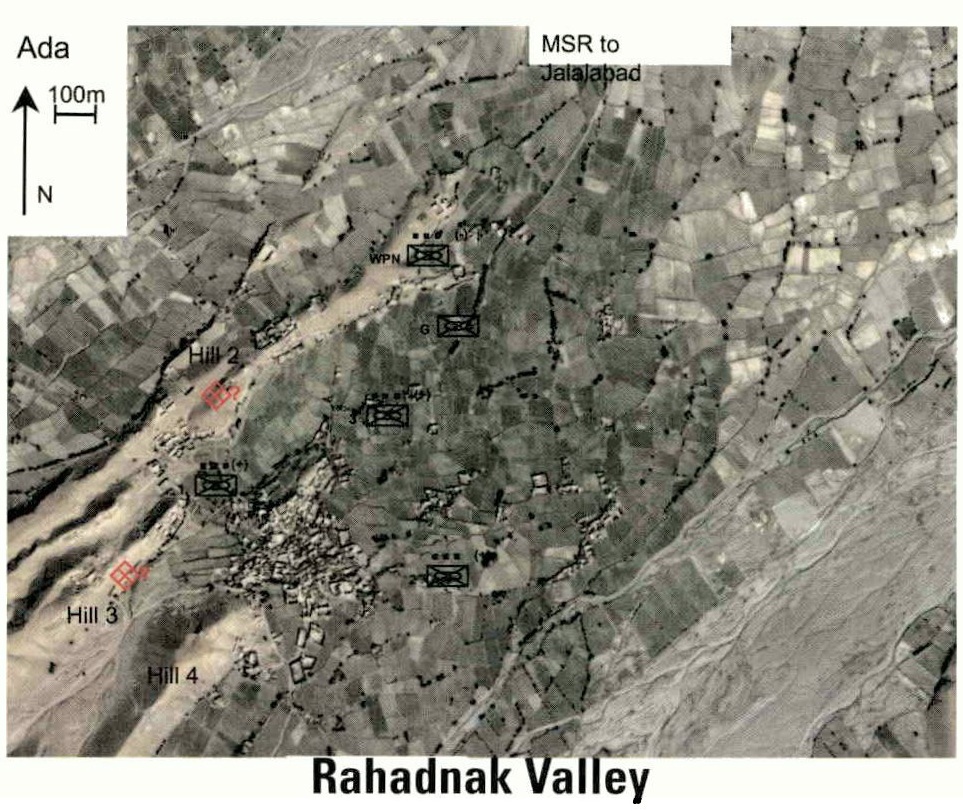
Rahadnak Valley Search

Situation

You are the Commanding Officer, Company G, Battalion Landing Team 2d Battalion, 1st Marines (BLT 2/1), a mechanized rifle company. Recently, the MEU was sent to Jalalabad, Afghanistan, in support of NATO forces during Operation ENDURING FREEDOM. You have been in-country approximately 1 month and have been assigned to the northeast sector of the area of responsibility, Nangarhar Province. Recently, the BLT has been searching for the warlord Sher Dil and his needihajum freedom fighters believed to be operating in the Rahadnak Valley. Sher Dil is the primary source of arms transportation into Jalalabad. The arms shipments flow from the northwest tribal regions of Pakistan into the Tora Bora region, through the Rahadnak Valley, then into Jalalabad. The Rahadnak Valley was initially quiet with no armed conflict. However, after successful arms interdiction in the area, organized guerrilla groups ignited an active campaign against coalition forces and inflamed tribal unrest throughout the valley.

Your mechanized company is embarked aboard 14 assault amphibious vehicles. You ordered the weapons platoon to detach three machinegun squads and six teams evenly between the platoons. While traveling southwest along a main road in the Rahadnak Valley during a routine mechanized patrol, your unit is tasked to search a village suspected of harboring Sher Dil and needihajum fighters. Speed is essential as the enemy is prone to resupplying its forces and then quickly fading into the rugged and mountainous countryside. A section of AH-IW Cobras, which can reinforce your unit within 1 5 minutes, remains on call to provide close air support.

In order to maximize the “shock and awe” and speed of your mechanized unit, you decide on a simple, though previously effective, scheme of maneuver that calls for two platoons to encircle the village, one from the west and the other from the east; one platoon to advance along the main avenue of approach to seal the entry point; and a dismounted mortar section to isolate the objective area with calls for fire as needed. The section of Cobras can be used to further isolate the objective area or provide supporting fires if required.

As your lead elements enter the village area, 1st Platoon immediately begins taking machinegun fire from the vicinity of Hill 2. As the platoon commander begins to take immediate action, mortars begin impacting around him. One of his vehicles has sustained a mobility kill.

What now, Captain?

Requirement

In a time limit of 10 minutes, issue your orders to your element leaders.

Issues for Consideration

1 . Who do you believe the enemy force is? What is their motivation for attacking?

2. What do you believe is the BLT intent for this area?

3. How do your actions support this intent?

4. How do your actions defeat the enemy’s motivation to attack?

5. How much collateral damage do you anticipate as a result of your actions?

6. What do you expect civilian response will be to collateral damage:

* At conclusion of fighting, while you are in the area?

* Within 1 hour after you leave?

* Ar the end of the day?

* At the end of the week?

7. What is the expected enemy response to collateral damage:

* At conclusion of fighting, while you are in the area?

* Within 1 hour after you leave?

* At the end of the day?

* At the end of the week?

8. What actions can you and the BLT take to counter and exploit enemy and civilian responses to collateral damage:

* While you are in the area?

* After you return to base?

* When you subsequently patrol in the area?

9. What action can you take to defeat enemy motivation to attack:

* While you are in the area?

* After you return to base?

* When you subsequently patrol in the area?

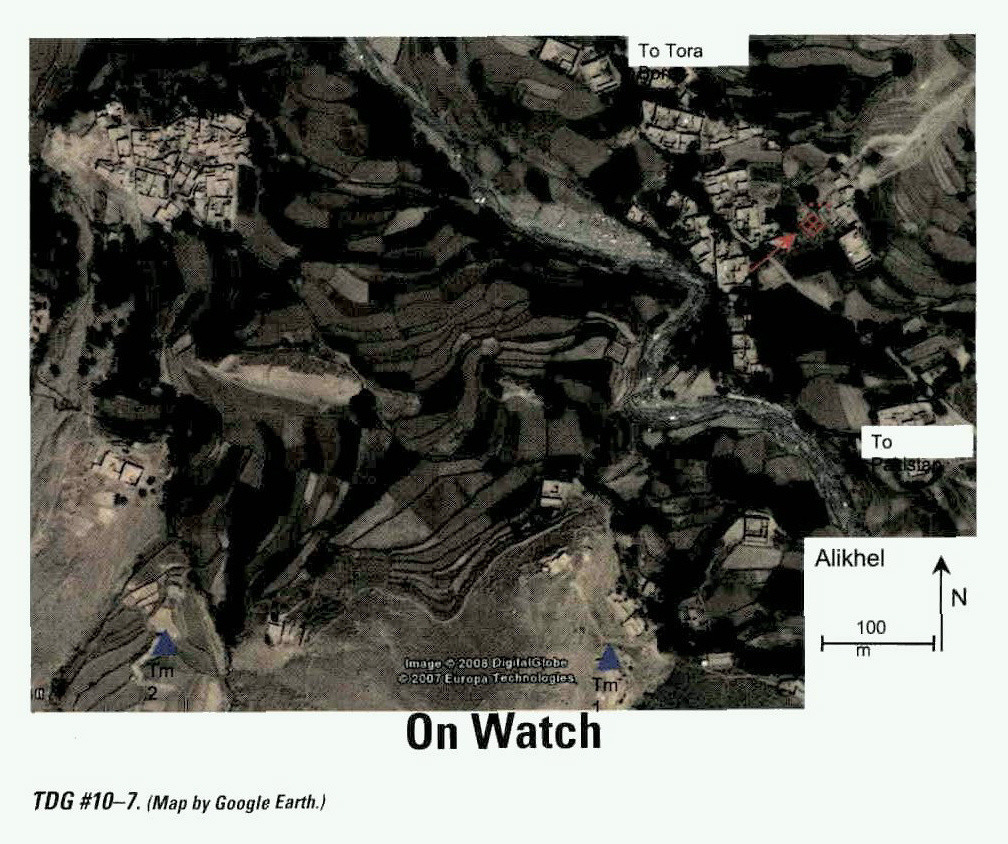
On Watch

Situation

You are the S-3A (assistant operations officer) and battalion watch officer (as well as battalion landing team (BLT) training officer and education officer) of BLT 2d Battalion, 1st Marines, 1 1 th MEU. Recently, the MEU was sent to Jalalabad, Afghanistan, in support of NATO forces during Operation ENDURING FREEDOM. You have been in country 1 month and have been assigned to the northeast sector of the area of responsibility, Nangarhar Province. Recently, the MEU has been focusing on the southern sector of the area of operations intercepting arms and explosives flowing from Pakistan into Afghanistan through the mountains of tribal Pakistan into the Tora Bora region. This region has three major tribes in the area – the majority Pashtun, the Wakhi, and the Tajik tribes. The tribes are further divided by clans, led by family patriarchs, that fight each other, regardless of tribe, over water rights, territory, and trade rights. The MEU has started to establish allies and informants in the area.

Acting on intelligence from a local tribe, the BLT commanding officer (CO) has tasked Echo Company, a helicopterborne company, to conduct a cordon and search operation in the village of Alikhel on the Afghan istan- Pakistan border in order to interdict insurgents and weapons flowing into the country. With BLT and MEU CO approval, Echo Company first deployed scout/sniper teams into the area in order to detect weapons and insurgent activity prior to commencing the cordon and search. Once the sniper teams detect insurgent activity, they are to report to the combat operations center (COC) and then the COC notifies the Echo Company CO (also heliborne unit commander) who then deploys into the area 2 hours after sniper reporr. If the sniper team is compromised, the MEU has a helo team on standby to retrieve the sniper team. It will take the helos 30 minutes to reach the extract landing zone. It is 1 1 30 and two sniper teams have been in place southwest of Alikhel since 2300 last night. Currently the CO is in a meeting with the MEU CO, and the S-3 and executive officer (XO) are out of the office but can be reached by cell phone to inform them they have to come to the COC, but no other information can be passed by phone.

You overhear one of your radio transmission operators (RTOs) talking to the sniper teams and wander over to his position. The RTO turns to you and says, “Sir, Dagger 1 has contact.” You grab the radio, identify yourself to the sniper team, and receive the report.

Approximately 20 enemy armed with clubs and rifles are attacking a local family. Estimate 2 minutes before they slaughter the family. Am engaging pending your orders. Both teams will need evac in 40 minutes. Over.

Requirement

In 10 minutes, explain what order you give to the sniper team leader; what action you take in the COC; what you report to the S-3, XO, and/or CO; what actions you recommend higher headquarters take; and what actions you recommend Sniper Team 2 take.

Issues for Consideration

1. If you order the team leader not to fire, do you think he will obey you?

2. What do you believe is Sniper Team l’s intent?

3. How do his actions relate to that intent?

4. Do you believe his actions are in keeping with the MEU COs intent? Why?

5. Are the sniper team leaders actions in keeping with the rules of engagement? Why?

6. Do your actions and order support the troops on the ground? Why?

7. What are the potential consequences of Sniper Team 1 s actions?

What Now, Lieutenant . . . I Mean, Sergeant?

By Luke DeVore

Tactical decisionmaking and critical thinking are competencies junior officers must have to be successful in any operating environment. For this reason The Basic School (TBS) incorporates tactical decision games (TDGs) and sandtable exercises (STExs) into the program of instruction for newly commissioned lieutenants, giving them the opportunity to analyze tactical situations and practice making appropriate tactical decisions. The culture of TDGs and STExs is alive and well in our officer corps, as evident by the longstanding tradition of the Marine Corps Gazette publishing TDGs in the back of every issue. TDGs are so much a part of the officer corps’ culture that the proverbial question, “What now, Lieutenant?” flows off the captain’s tongue as freely as the first general order flows from the private’s tongue 3 weeks into recruit training.

More than ever, however, tactical decisionmaking and critical thinking competencies are needed below the company level. In an operational environment defined by the distribution of forces, with platoons responsible for geographic areas that companies or battalions would have covered in previous years, enlisted leaders at the squad level need to have tactical decisionmaking and critical thinking skills in order to prepare for the tactical dilemmas they will certainly face in today’s operating environments. Whereas “What now, Lieutenant?” is the proverbial question of conflicts past, the more appropriate question of today’s conflicts is “What now, Sergeant?” With some exceptions, squad leaders do not have the opportunity to engage in the type of exceptionally well-designed and executed TDGs and STExs that lieutenants experience at TBS. There are several reasons for this. Arguably, the culture of our enlisted leaders at the platoon level and below does not include a heavy emphasis on TDGs and STExs. Also, TDGs and STExs, to be conducted in a manner that best ensures skill transferal, require appropriate resources and exercise leaders with experience conducting them. Finally, the opportunities for squads to conduct independent training during “white space” are constrained by the time- and resource-consuming predeployment training program requirements that are usually conducted as prescribed training events at the battalion and company levels.

We should also recognize that our younger generation of Marines learns very differently than previous generations. The “YouTube” generation learns best with a more immersive and interactive approach to skill transferal. Whereas written after-action reviews (AARs) and white papers on emerging enemy tactics, techniques, and procedures (TTP) may be an appropriate means of communicating complex ideas to some, the current generation learns best when exposed to a visually and audibly stimulating experience. There is research to support that this is not just true of the YouTube generation; students of any age display higher information retention, recall, and understanding when the instruction is provided in an interactive and multisensory format.

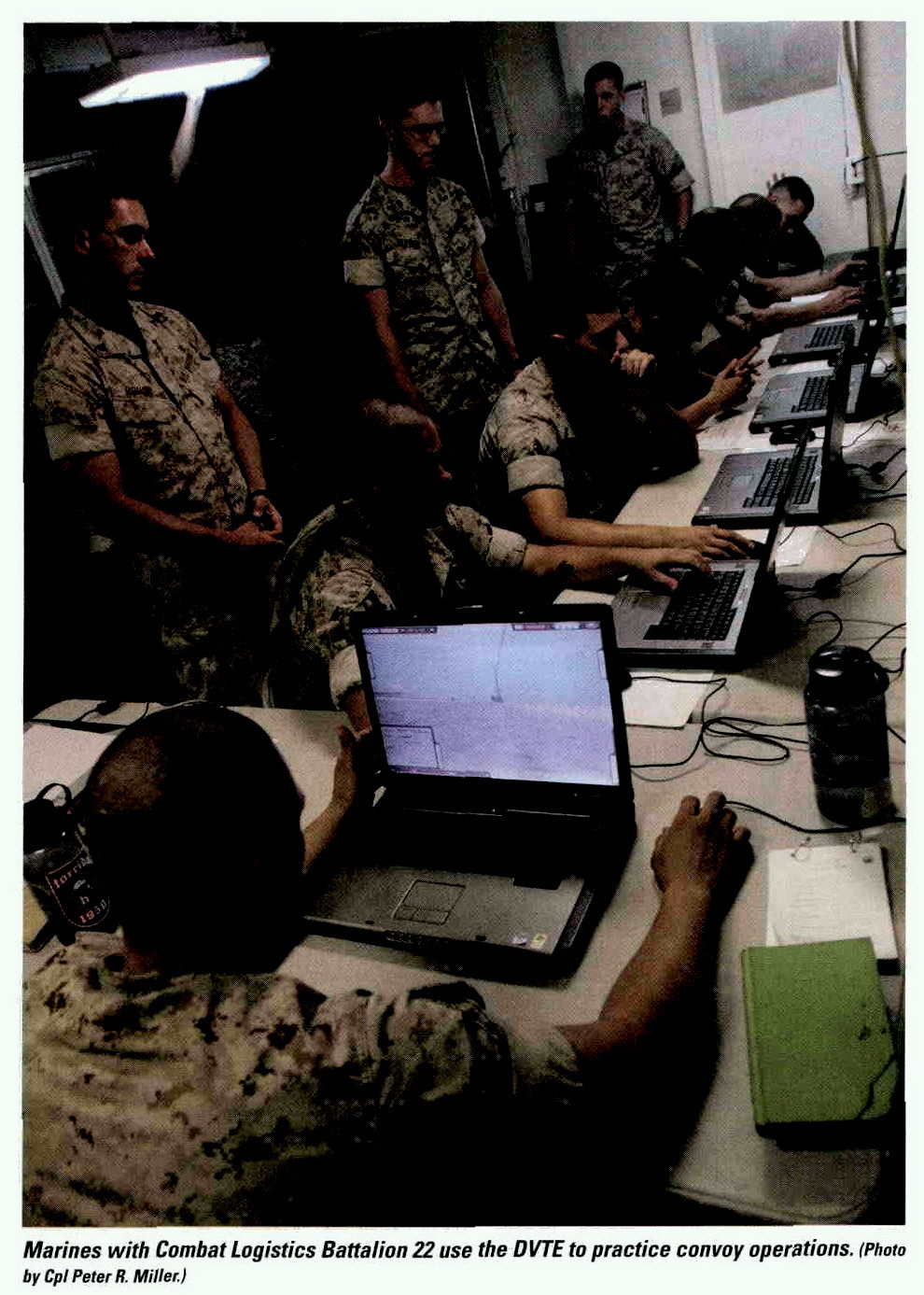
Traditionally, TDGs are decidedly low tech and offer little sensory stimulation. However, the emergence of technology-based training solutions now offers Marines new opportunities in a huge swath of training, especially TDGs. Most infantry units at the battalion level and above now have a deployable virtual training environment (DVTE) suite. The DVTE is a suite of laptop computers fielded to units in deployable cases. Resident on the DVTE suite is a variety of simulation software that can be used for an assortment of individual and collective training. One of the more flexible and useful programs resident in the DVTE suite is the first-person simulation, Virtual Battle Space 2 (VBS2). The simulation allows VBS2-trained personnel to develop scenarios with surprising detail and realism that training authences can execute as teams, squads, platoons and, in some cases, even companies.

At the II MEF Simulation Center, DVTE analysts from Cubic Applications, Inc. have developed a method for conducting TDG-type training using VBS2. The new TDG concept, called tactical virtual guided discussions (TVGDs), allows squad-sized groups to receive an orientation, situation, and mission just like traditional TDGs, but the TVGD also allows the training authences to execute the mission in a first-person virtual environment. The execution, however, is not the principal training objective TVGDs are designed to support. As the name implies, TVGDs are designed to provide just enough execution to facilitate a robust discussion on critical tactical thinking and decisionmaking. VBS2 offers a multisensory format that enables the Marines to quickly and thoroughly understand the learning outcomes. With the aid of a discussion leader, the exchange of views resulting from a TVGD provokes the participants to engage in a surprisingly detailed analysis of enemy and friendly TTP. The AAR feature of VBS2 aids in this process. The AAR records the execution portion of exercises, including radio transmissions, which can then be played back and projected on a wall or screen. The playback can be viewed from literally any vantage point – enemy, friendly, bird’s-eye, etc. With the use of the AAR playback, the training authence is able to engage in an indepth analysis of enemy TTP; the impact of terrain, cover, and concealment; the effectiveness of internal communications; and the effect of friendly forces’ decisions and actions on the overall scenario.

The DVTE section at the II MEF Simulation Center has a catalogue of TVGD scenarios designed around an infantry squad with or without attachments (e.g., medium machinegun team). All of the scenarios are designed using very precise enemy TTP, and most of the scenarios directly replicate real-world ambushes and firefights detailed in AARs from units recently returned from Operation ENDURING FREEDOM. The Marine Corps Center for Lessons Learned (MCCLL) has been a valuable source for scenarios and emerging TTP that are then applied to TVGDs. For example, MCCLL posted an AAR from 3d Battalion, 8th Marines (3/8) and 2d Reconnaissance Battalion that detailed several ambushes the units experienced while deployed to Afghanistan in 2009. The AAR included detailed descriptions of the ambushes and friendly and enemy TTP, as well as maps depicting the terrain and friendly and enemy positions. This AAR was used to develop the first TVGDs. As additional AARs and reports on TTP are made available, the TVGD catalogue continues to grow. By recreating actual events, the Marines immediately recognize the relevance of the training, adding emotional involvement to the training – and they do get emotional. Since the first TVGD was conducted in June 2009, more than 200 Marines from across II MEF have participated in TVGDs, and the response has been overwhelmingly positive.

It is difficult to develop metrics that validate the effectiveness of TVGDs, but the general validity and economic efficiency of using simulations for groundbased combat training has long been established. While all evidence of the TVGDs being a legitimate training method is anecdotal. Marines and sailors report the training to be challenging, relevant, emotionally involving, and fun. One example speaks to the effectiveness of the TVGDs. Marines from a 2d MarDiv infantry company participated in TVGDs one Friday at the II MEF Simulation Center. Later that night the company commander wrote an email describing how the company’s NCOs were so energized about the discussions resulting from the training that they all got together at the beach that night to share drinks and thoughts about what they learned, what they would do differently in each scenario and, perhaps more importantly, what they learned about their Marines.

Each scenario is designed to last from 40 minutes to 1 hour from start to finish. Intended to be as turnkey as possible, each scenario is accompanied by a Microsoft PowerPoint presentation that defines the purpose and method for each scenario, as well as a detailed fragmentation order and associated maps and images. The TVGDs are designed to occur in four steps.

Step one: fragmentation order. Given by either the squad leader or another Marine selected to assume the leadership position.

Step two: execution and recording of the scenario. This portion lasts for only 5 to 10 minutes, or ends whenever the discussion leader decides that enough has occurred in the execution to conduct a thorough discussion of the event.

Step three: debrief. Systematically, each Marine is asked to recall what he saw and what he did or did not do.

Step four: after-action playback and group discussion of die event. The discussion leader will challenge the Marines to conduct a mission, equipment, troops, rime, terrain, civilian analysis of the event and discuss possible alternative solutions and considerations. The PowerPoint slides that come with the scenarios also include a list of recommended discussion points should the discussion leader need them.

The training authence can go through most scenarios as either the friendly or enemy forces. The Marines have responded very well to the ability to “red cell” the scenarios. By allowing the members of the training authence to conduct the scenarios as the opposing force, they have the chance to employ what they know about Taliban TTP and to more fully understand how the enemy fights and how best to combat the enemy threat.

Simulations are being used to effectively conduct a wide spectrum of groundbased training. At the Il MEF Simulation Center, Marines and sailors are using simulations to conduct everything from motorized patrolling and tactical recovery of aircraft and personnel to fire support team training and fixed-site security. Though the simulations resident on the DVTE suite support these training events, there are no premade scenarios that the units can simply fall in on and execute. In the absence of premade scenarios, units can contact the DVTE section at the II MEF Simulation Center for copies of the TVGDs or any other DVTE training or technical support.

The TVGDs, which can be conducted on a unit’s DVTE suite or at the simulation center, offer a focused, well-designed, and near turnkey training opportunity that allows the Marines at the squad level to receive the tactically focused critical thinking and decisionmaking training they will need to be successful down range.

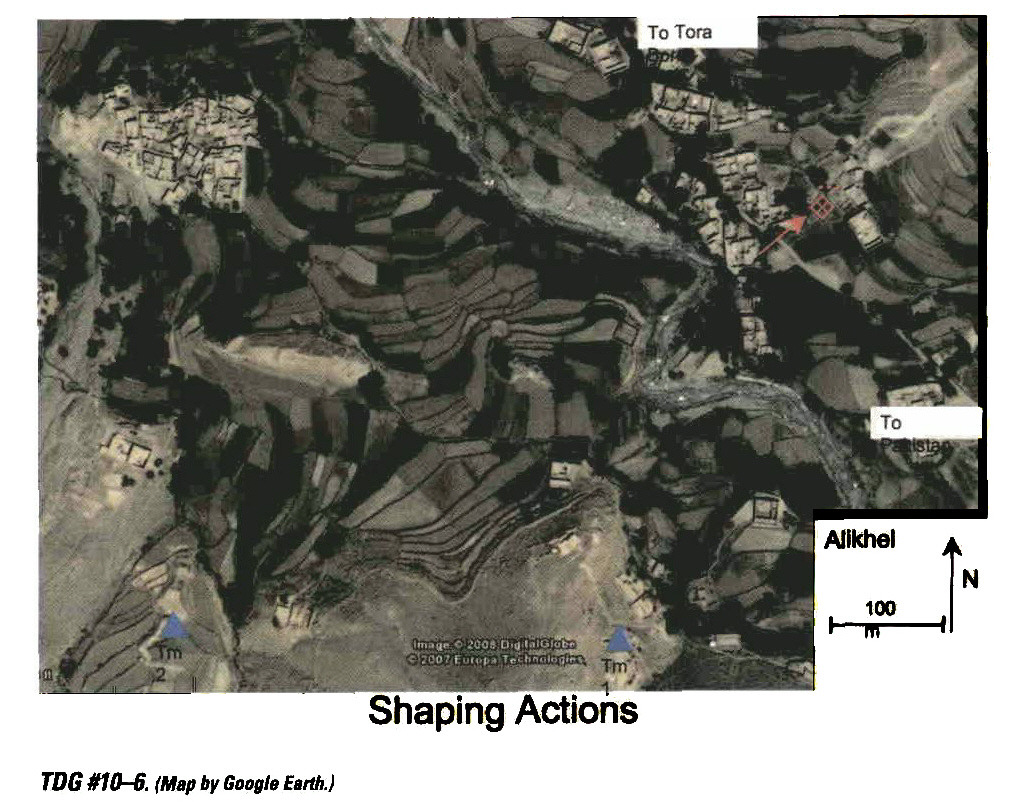
Shaping Actions

Situation

You are a scout/sniper team leader of Sniper Team 1 assigned to Battalion Landing Team 2d Battalion, 1st Marines (BLT 2/1). Recently, the MEU was sent to Jalalabad, Afghanistan, in support of NATO forces during Operation ENDURING FREEDOM. You have been in country 1 month and have been assigned to the northeast sector of the area of responsibility, Nangarhar Province. Recently the MEU has been focusing on the southern sector of the area of operations intercepting arms and explosives flowing from Pakistan into Afghanistan through the mountains of tribal Pakistan into the Tora Bora region. This region has three major tribes in the area – the majority Pashtun, the Wakhi, and the Tajik tribes. The tribes are further divided by clans, led by family patriarchs, that fight each other, regardless of tribe, over water rights, territory, and trade rights. The MEU has started to establish allies and informants in this area.

Acting on intelligence from a local tribe, Echo Company, a helicopterborne company, has been assigned a cordon and search operation in the village of Alikhel on the AfghanistanPakistan border in order to interdict insurgents and weapons flowing into the country. The company commanding officer (CO) has decided to deploy scout/sniper teams into the area first in order to detect weapons and insurgent activity prior to commencing the cordon and search. Your teams are specifically looking for trucks filled with personnel, weapons, or boxes moving into Afghanistan and stopping in Alikhel. You radio the BLT combat operations center, and Echo Company will commence the attack approximately 2 hours after your report. If your teams are compromised, helos will be on station in 30 minutes. It will take you 20 minutes to get to the evacuation landing zone. Your sniper team is four personnel with one 7.62 sniper rifle, one .50 caliber sniper rifle, two M1615s with PEQs, four night vision scopes, digital camera with 16x zoom lens, binoculars, and communications capability to talk to air and ground and send digital pictures, as well as your combat load for sniper teams.

Yesterday at 2300 your team and Sniper Team 2 inserted into Alikhel and established positions as shown on the map overlooking the village and main supply route from Pakistan into Afghanistan. It is now 1130 and your team noticed one vehicle approximately an hour earlier either entering or leaving the village going south into Pakistan with no suspicious activity so far. Approximately 10 minutes later you notice about 20 males armed with clubs and AK-47s surround and enter a home in a village. There is a lot of yelling in the home, at least six shots are fired, and a family is dragged from the home and placed in a clearing surrounded by the armed men. A crowd of at least 50 villagers forms around this scene while the perceived leader of the armed men begins to shout something to the villagers that you do not understand. The family consists of one older woman, four male children, and two female children. You have clear shots on several of the gunmen, including the leader. You believe the family will be killed if you do nothing in the next several minutes.

Requirement

In 10 minutes explain what order you give to your team, what you report to higher headquarters (HHQ), what actions you recommend HHQ to take, and what actions you recommend Sniper Team 2 to take.

Issues for Consideration

1. Based on your understanding of the local culture, could this be an insurgent activity, or could it be a local situation? WTiat could lead an insurgent to take this action? What could lead a clan to this action against another family?

2. What do you believe is your company COs intent? What is the MEU company commander’s intent? How does it apply to this situation?

3. In this scenario, how do your action and order relate to their intent?

4. What does the enemy hope to gain from this attack, assuming it is an insurgent activity?

5. How do your actions deprive the enemy of those gains?

6. What if it turns out the armed men are not enemies but an allied clan?

7. How do your recommendations to higher translate into actions your HHQ can take?

8. Assuming this is insurgent activity, what actions could your company, battalion, or MEU take to prevent enemy forces from continuing actions in this area?

9. Assuming this is a local feud, is it in the company’s, battalions, or MEUs interest to prevent these actions from occurring? Why?

10. Assuming it is in the MEUs interest to prevent vigilante justice in the outlying provinces, what actions can the MEU take to discourage this?

11. What are the possible results of your action given that this is a blood feud culture?

Two Birds, One Stone

Situation

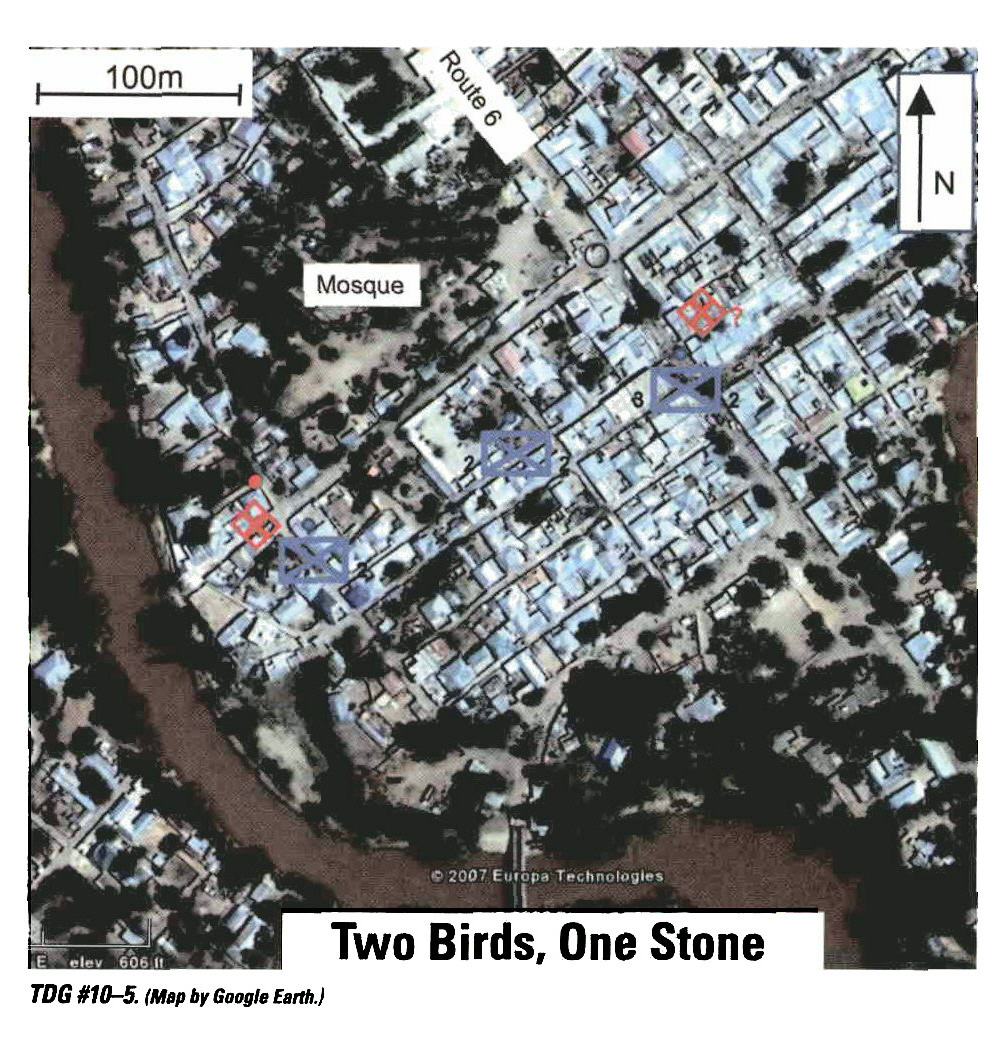
You are Bakhtawar, a leader under the warlord Wadaan Zarhawar. Your clan held a position of prominence in Jalalabad prior to the invasion of the Americans and Europeans and the subsequent American occupation. While your Pashtun tribal leaders reluctantly supported the foreign intervention, smaller clans, especially the Tajiks under warlord GuI Rang, seek to increase their power by allying themselves closely with the Americans.

As a result, Wadaan has ordered you to infiltrate into Gul’s area of control and ambush the Americans. You have 16 fighters, 14 armed with AK-47s and 2 armed with rocket propelled grenades (3 rounds each). You also have access to three mortar rounds, three handgrenades, one mortar round that is rigged to blow up by cell phone, and two cell phones for communications. You do not have access to your vehicles due to Gul’s vehicle checkpoints.

You sent out two scouts with one cell phone to the bridge to report when the Americans cross the bridge and are heading north. The rest of the your warband infiltrated into Gul’s area by foot and got ready to attack. You have been in place approximately 1 hour when your scout calls and reports that the Americans have just crossed the bridge in 3 groups of 10 to 15 men each moving along Route 6 and two parallel streets. What now?

Requirement

In a time limit of 1 5 minutes, determine what actions you would take during your 1-hour preparation time and what orders you would issue to your warband.

Issues for Consideration

1. What is your reason for launching this attack on this ground?

2. What does Wadaan Zarhawar want you to accomplish?

3. How do your actions support this?

4. What do you consider mission success?

5. What do you want to see happen to warlord GuI Rang’s area of control? What do you want to see happen to the American forces?

6. What considerations do you give to damage to personal property and loss of life in Gul’s area?

7. Is your focus on using your fighters to engage the enemy or on instigating locals?

8. Assume at the end of the engagement that you have brought down two Americans, your fighters have ceded the battlefield to the Americans, you have fallen back to your area of control with most of your fighters, one child and one woman were killed in the fighting, their home was damaged, and two of your fighters were killed. How can you use all of these factors to your advantage?

9. How sensitive are you to casualties among your own fighters? How sensitive are you to local civilian casualties?

TDGs Return

by Col Thomas X. Hammes, USMC(Ret)

I was very happy to see the return of tactical decision games (TDGs) to the pages of the Gazette. Throughout my career I found TDGs to be an effective training tool – if used correctly. Unfortunately, like most Marines, I didn’t use them well at first. I simply followed the instructions with predictable results. Often the Marine who offered a solution was immediately subjected to 10 to 20 minutes of criticism from his fellow Marines about why his solution wouldn’t work. What many learned was to not volunteer to provide the answer.

Fortunately, Mike McNamara, a former Marine captain, took the time to show me a much better way to conduct a TDG. He started with the premise that TDGs are not just about teaching tactics but are really about teaching Marines how to analyze the fight they are in and, through lots of different games, learn how their fellow Marines think. The games are designed to provide the basis of the meeting of the minds essential to maneuver warfare.

Thus the first step of the solution is not to provide a five-paragraph order but to explain how you see the battlefield. The designated leader starts by giving the commander’s intent two levels up. Since intent drives mission orders, it is essential that the plan start with a clear articulation of the intent. Next, he states what he believes to be the enemy’s mission. (Given that the focus of maneuver is on the enemy rather than friendly forces, we should have our Marines consider the enemy’s outlook every time.) What does he think the enemy’s center of gravity is, and what are his vulnerabilities? What does he see as the friendly strengths, and how does he plan to use them against the enemy’s weaknesses? In particular, what dilemma does he plan to present to the enemy?

Once these steps are completed, all of the personnel involved in the game understand how the designated leader sees the battlefield. This is critical. In the current TDG discussions, it is often apparent that different people have different understandings of the problem. Thus the game devolves into a discussion of minor tactics without a common understanding of the tactical situation. Taking the time to explain how the leader sees the batde reveals a great deal about how he listens, interprets, and thinks. Both his seniors and subordinates gain a much greater understanding of his tactical thought. And of course, one of the primary requirements for success in maneuver warfare is an understanding of how the other leaders in your organization will react to changing situations.

Once he has articulated how he sees the fight, the leader issues his five-paragraph order using a visual aid like a basic terrain model or a white board. The TDG moderator then allows a very brief series of questions about the tactics involved. After no more than 5 minutes of questions, you begin to play out the problem. To start, the moderator flips a coin. If it comes up heads, the first step is successful. If tails, something bad happens. (It is obvious that the moderator’s role becomes critical to both playing out the scenario and guiding the discussion.) In either case, the moderator asks if the changed situation changes the leader’s evaluation of the situation and if he wants to change his plan. Again a brief discussion is allowed.

The moderator then flips the coin again and repeats the process. But rather than asking the leader what to do, the leader is declared a casualty. If nothing bad has happened he can simply be a heat casualty. The moderator then appoints one of the other participants as the new unit leader. That individual has to give a quick brief of his understanding of the situation and what he proposes to do from here. This leads to the problem of executing someone else’s plan. Do you continue with that plan, even if you don’t agree with it, or do you try to change the plan midexecution? Why or why not? The game can then continue using the coin flip until the moderator determines to terminate the problem.

Obviously this method demands greater preparation and training for the TDG moderator. However, my experience was that this develops fairly quickly and goes all the way down to squad and even fire team leader level. But most important, the games go to the heart of maneuver warfare – a clear understanding of intent, communication to ensure a common understanding of the battlefield, and execution by a team of leaders who understand how each member of the team thinks and reacts to a variety of situations. This most inexpensive of tools can and should be used every day so that no time is wasted in building a team capable of executing maneuver. I hope that passing along McNamara’s approach to TDGs will make them both more fun and more useful to todays Marines.

Capital Crimes

Situation

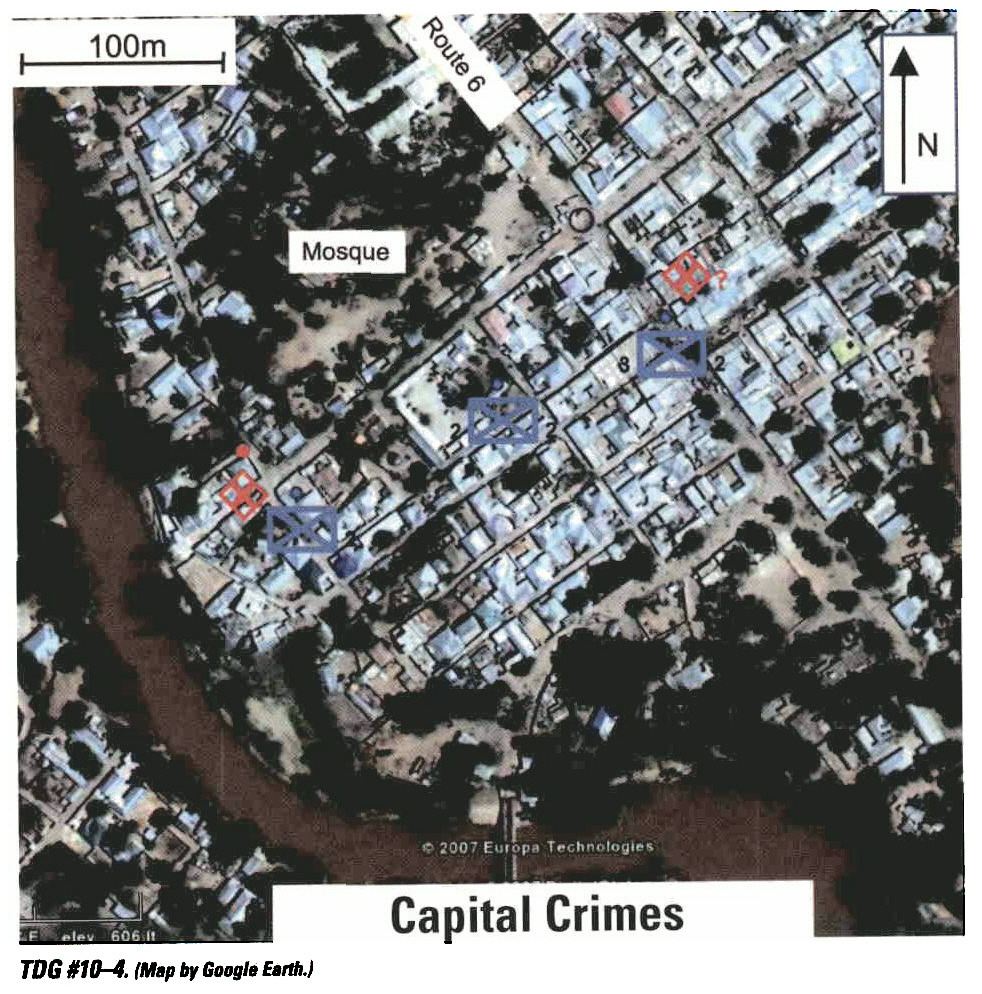
You are the battalion intelligence officer with a collateral billet as the assistant information officer, Battalion Landing Team 2d Battalion, 1st Marines (BLT 2/1), I lth MEU. Recently, the MEU was sent to Nangarhar Province (capital city Jalalabad), Afghanistan, in support of NATO forces during Operation ENDURING FREEDOM. The MEU completed the relief in place of the small NATO force 2 days ago and has started operations in Jalalabad and the Tora Bora region of your area of operations (AO). After initial operations in Jalalabad, organized resistance has ceased. However, insurgent and tribal fighters remain as active combatants.

Jalalabad is an urban environment characterized by densely but haphazardly arranged mud brick houses of one and two stories with flat roofs, with the occasional taller building, usually a mosque or other religiously associated structure. The main roads are paved and two lanes wide. Side roads are paved but only 1 ll2 lanes wide. In addition, there are numerous dirt alleyways only suitable for foot traffic.

The enemy you face wears no standardized military uniform and often appears in civilian dress, uses Soviet-era infantry weapons (AK-47s, light machineguns, and rocket propelled grenades (RPGs)), and has the occasional command of 82mm mortars and 12.7mm machineguns. His main tactic is the ambush, initiated by RPG attack or improvised explosive device (IED). The enemy rarely stands to fight, even after such ambushes. When they do, it is often the signal of a major engagement. Recent prolonged engagements between insurgents and NATO forces here and in Kabul indicate that prolonged engagements generally occur around religious sites.

The NATO force has been relatively successful in matters of civil affairs and civil-milirary relations. They initiated a “weapons buy back program,” paying for each weapon turned in depending upon its lethality. The MEU commanding officer (CO) has continued this program at the same rates the NATO force authorized. Despite such gains, the area of responsibility still has its share of insurgent attacks. Of the seven major clans in the AO, the BLT has secured the support of one smaller Tajik clan but still faces resistance from several of the larger Pashtun and Tajik clans in the city and surrounding area.

It is 1530. The BLT is on day 3 of operations in Jalalabad with Fox Company as the main effort. Their specific tasks include deterring enemy activity and identifying local police and security forces in order to isolate enemy forces in Jalalabad. You are currendy in the combat operations center (COC) tracking 2d Platoons patrol. They have crossed the Helmand River bisecting Jalalabad and are continuing north along Main Supply Route 6 (Route 6). You note that they are currendy entering the area controlled by the one friendly Tajik tribe in Jalalabad. As you are monitoring their progress, the watch officer (the BLT S-4A (assistant logistics officer)) yells, “Quiet in the COC. 2d Platoon in contact,” grabs the radio, and turns up the speaker. You notice someone in the COC pick up the cell phone, dial a number and say, “To the COC,” and hang up.

From 1st Squad: “Enemy squad with AKs, RPG, mortar IED. Watson and Perez are down. Need casevac. Break. Recommend 2d Squad move north of my position and cut off retreating enemy elements. Over.”

Approximately 30 seconds later from 2d Platoon commander to 3d Squad: “2d Squad is reinforcing 1st Squad attack. Proceed north to major intersection in order to prevent enemy reinforcements from attacking our flank. Break. Break. [Platoon call sign to battalion call sign], Request casevac at TLZ [tactical landing zone] Robin in 10 minutes. How copy, over?”

Approximately 1 minute later from 1st Squad to COC: “Be advised, we also have one local child urgent casevac. Over.”

The watch officer radios casevac helo section and verifies they will be available at the time and place specified.

Approximately 4 minutes later from 3d Squad to platoon commander: “Be advised, at intersection. Intercepted local security force that is assisting. Over.”

Approximately 5 minutes later from 1st Squad: “In position at TLZ Robin. Observe helos inbound.” Approx 1 minute later: “Casevac away. Break, break. [Call sign 1st Squad to platoon commander], we are rejoining platoon moving from south to north along the road. Over.” The platoon commander verifies 1 st Squad’s transmission.

Approximately 4 minutes later the helos land, and the injured personnel are transferred to the shock trauma platoon. Also this from the platoon commander: “Enemy forces no longer resisting. We have four enemy killed, three wounded, and local female wounded. Request casevac at TLZ Robin. Will drop captured weapons and munitions with casevac helo and leave one fire team as security for wounded EPWs [enemy prisoners of war] with casevac. Will turn over bodies to local security force that 3d Squad found. Will continue patrol pending further orders. Over.”

The watch officer looks at you and asks, “Anything you want them to do from the intel side while they are there?”

Requirement

In a time limit of 20 minutes, indicate to the watch officer what 2d Platoon needs to accomplish and why (task/purpose), what actions you will take (and additional actions you will recommend to the CO that the BLT take) with regard to the EPWs and wounded civilians, what information operations products you will recommend to the CO as a result of this action, and what other information you need from 2d Platoon now and after they return from patrol.

Issues for Consideration

1 . Who do you believe the enemy is? What information do you need to determine who the enemy is?

2. How do your actions and orders to 2d Platoon provide that information?

3. What kind of information do you plan to get from the EPWs that may support your intelligence and information operations?

4. What course of action would you recommend to the CO for the injured civilians? The local “security force”?

5. What will the enemy say about the attack, and what method will he use to exploit the situation in his favor? How do your actions and recommendations counter his efforts to exploit the situation?

6. What will the local population say about the attack, and what method will they use to discuss this incident? How do your actions and recommendations promulgate the idea that your unit’s presence is positive for the local population? How do you plan to measure the messages effectiveness?

Hostile Intent

Situation

You are the 3d Squad Leader, 2d Platoon, Company F, Battalion Landing Team 2d Battalion, 1st Marines (BLT 2/1), 1 1th MEU. Your company has recently taken over the area of responsibility (AOR) of Jalalabad, Afghanistan. After initial operations, organized resistance has ceased. However, insurgent and tribal fighters remain as active combatants.

Your AOR is in an urban environment characterized by densely but haphazardly arranged mud brick houses of one and two stories with flat roofs, with the occasional taller building, usually a mosque or other religiously associated structure. The main roads are paved and two lanes wide. Side roads are also paved but only 1 u2 lanes wide. In addition, there are numerous narrow dirt alleyways only suitable for foot traffic.

The enemy you face wears no standardized military uniform and often appears in civilian dress, uses Soviet-era infantry weapons (AK-47s, light machi neguns, and rocket propelled grenades (RPGs)), and has the occasional command of 82mm mortars and 12.7mm machineguns. His main tactic is the ambush, initiated by RPG attack or improvised explosive device (IED). The enemy rarely stands to fight, even after such ambushes. When they do, it is often the signal of a major engagement. S-2 (intelligence) believes such battles center around religious sites.

The BLT has been relatively successful in the matter of civil affairs and civil-military relations. They initiated a “weapons buy back program,” paying for each weapon turned in depending upon its lethality. Despite such gain, the AOR still has its share of insurgent attacks. Of the seven major clans in the area of operations, the BLT has secured the support of the one smaller clan but still faces resistance from several of the larger clans in the city and surrounding area.

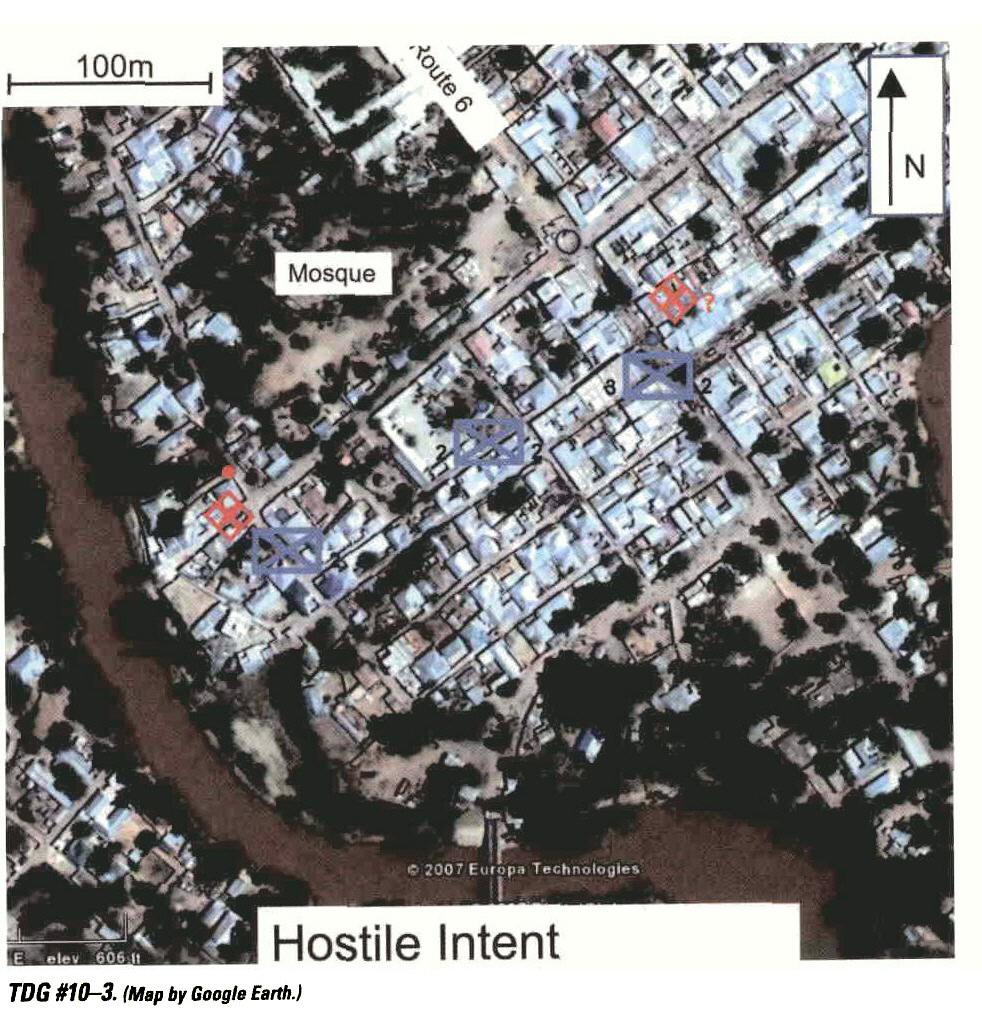
Currently, your platoon is on its second patrol. After crossing the Route 6 bridge, you enter the area controlled by the smaller clan that supports coalition forces. You are moving from south to north. 1st Squad is on the left flank, 2d Squad is in the center with the command element, and your squad is on the right. You have only your organic weapons and are in radio contact with the other squads and command element, though such contact is not always 100 percent due to the urban environment.

Approximately 20 minutes after crossing the bridge, you hear and see an explosion where you expect 1st Squad to be, followed by automatic and semiautomatic weapons fire. You execute a halt in place and establish 360-degree security. Firing continues for 30 seconds before you hear 1st Squad report: “Enemy squad with AKs, RPG, mortar IED. Watson and Perez are down. Need casevac. Break. Recommend 2d Squad move north of my position and cut off retreating enemy elements. Over.”

Approximately 30 seconds after the 1st Squad report, the platoon commander radios to you: “2d Squad is reinforcing 1st Squad attack. Proceed north to major intersection in order to prevent enemy reinforcements from attacking our flank. Over.”

After acknowledging the order, the squad proceeds north along Route 6. About 100 meters up the road, you observe approximately 20 men armed with a combination of AK-47s and RPGs emerge from a compound and board 3 pickup trucks and 2 trucks with mounted machineguns. They have not observed you yet. You estimate that this force will be ready to leave the compound in 2 minutes. What now, Sergeant?

Requirement

In a time limit of 5 minutes, determine what actions you would take, what orders you would issue, and what reports, if any, you would make.

Issues for Consideration

Who do you believe this new force is? What is their intent?

What actions might you take to determine if this force is friendly or hostile?

If this force is hostile, are your actions in accordance with your commander’s intent?

If this force is friendly, how might they assist you in accomplishing your mission and the BLTs mission?

If the force is friendly, how might they assist your battalion commander in achieving his intent?

Assuming this force is hostile, how can the enemy seek to exploit this situation in the local community?

What are some actions you can take or recommendations you can make to your commander to counter enemy exploitation efforts? Immediately after the fight? After you return to base?

First Contact

Situation

You are the 2d Platoon Commander, Company F, Battalion Landing Team 2d Battalion, 11th Marines (BLT 2/11), 11th MEU. Your company has recendy taken over the area of responsibility (AOR) of Jalalabad, Afghanistan. After initial operations, organized resistance has ceased. However, insurgent and tribal fighters remain as active combatants.

Your AOR is in an urban environment characterized by densely but haphazardly arranged mud brick houses of one and two stories with flat roofs, with the occasional taller building – usually a mosque or other religiously associated structure. The main roads ate paved and two lanes wide. Side roads are also paved but only 1 !/2 lanes wide. In addition, there are numerous narrow dirt alleyways only suitable for foot traffic.

The enemy you face wears no standardized military uniform and often appears in civilian dress, uses Soviet-era infantry weapons (AK-47s, light machineguns, and rocket propelled grenades (RPGs)), and has the occasional command of 82mm mortars and 12.7mm machineguns. His main tactic is the ambush, initiated by RPG attack or improvised explosive device (IED). The enemy rarely stands to fight, even after such ambushes. When they do, it is often the signal of a major engagement. S- 2 (intelligence) believes such battles center around religious sites.

The BLT has been relatively successful in matters of civil affairs and civilmilitary relations. They initiated a “weapons buy back program,” paying for each weapon turned in depending upon its lethality. Despite such gains, the AOR still has its share of insurgent attacks. Of the seven major clans in the area of operations, the BLT has secured the support of one smaller clan but stili faces resistance from several of the larger clans in the city and surrounding area.

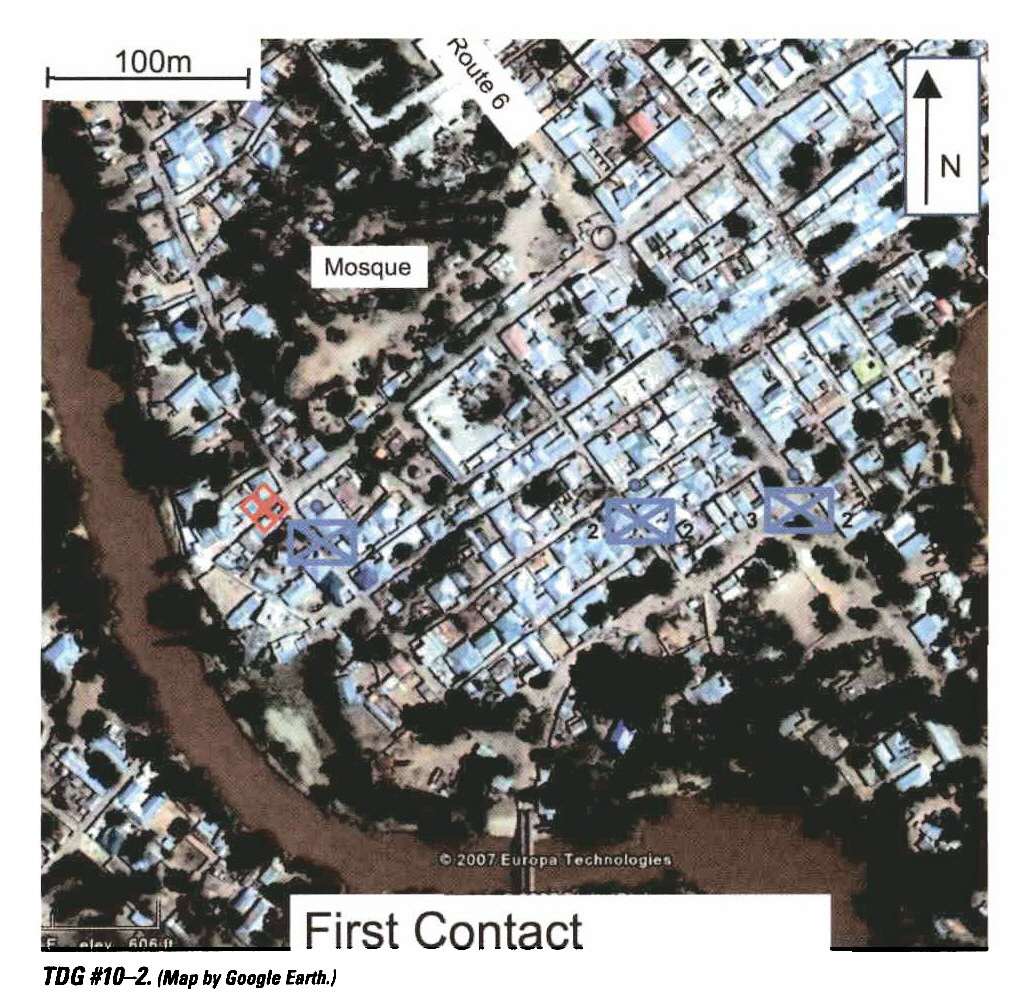
Currently your platoon is on its second patrol. After crossing the Route 6 bridge, you enter the area controlled by the smaller clan that supports coalition forces. You are moving from south to north. 1st Squad is on the left flank, you are with 2d Squad in the center, and 3d Squad is on the right. You have only your organic weapons and are in radio contact with the other squads and the battalion combat operations center, though such contact is not always 100 percent due to the urban environment.

Approximately 20 minutes after crossing the bridge you hear and see an explosion where you expect 1st Squad to be. The explosion is followed by automatic and semiautomatic weapons fire. 2d Squad leader executes a halt in place and 360-degree security. Firing continues for 30 seconds before you receive 1st Squad’s report: “Enemy squad with AKs,. RPG, mortar IED. Watson and Perez are down. Need casevac. Break. Recommend 2d Squad move north oí my position and cut off retreating enemy elements. Over.”

Requirement

What now, Lieutenant? In a time limit of 5 minutes, determine what actions you would take, what orders you would issue, and what reports, if any, you would make.

Issues for Consideration

Who do you believe the enemy is?

What do you believe your company and battalion commanders’ intents are?

In this scenario, how do your actions and orders relate to their intents?

What does the enemy hope to gain from this attack?

How do your actions deprive the enemy of those gains?

How will the enemy counter your platoon’s actions?

Assume that as a result of this incident, two civilians are wounded and one home is damaged. How will the enemy exploit this information in 20 minutes? By the end of the day? For the rest of the week?

What can you do to counter his effects at exploitation? Now? After you return to base?

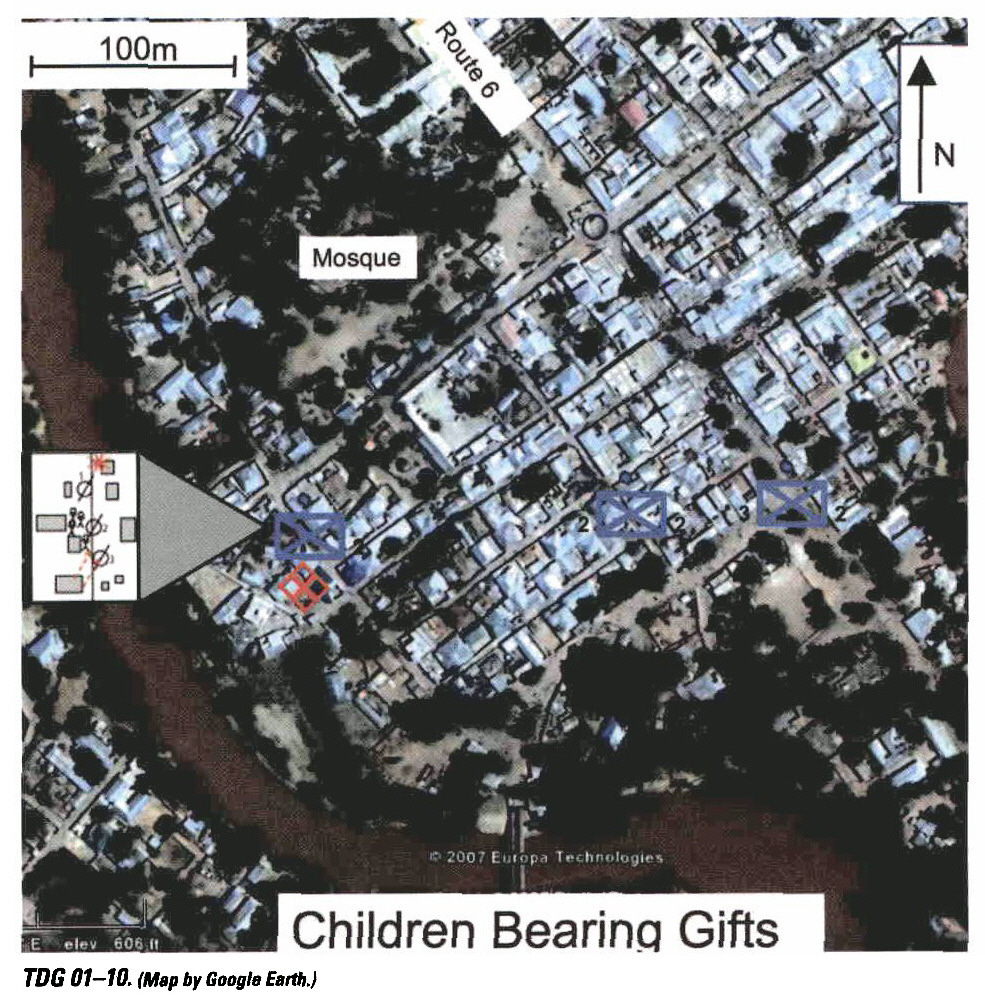
Children Bearing Gifts

Scenario 1: Squad TDG Situation

You are the 1st Squad Leader, 2d Platoon, Company F, BLT 2/1, 11th MEU. Your company has recently taken over the area of responsibility (AOR) of Jalalabad, Afghanistan. After initial operations, organized resistance has ceased. However, insurgent and tribal fighters remain as active combatants.

Your AOR is in an urban environment characterized by densely but haphazardly arranged mud brick houses of one and two stories with flat roofs, with the occasional taller building – usually a mosque or other religiously associated structure. The main roads are paved and two lanes wide. Side roads are also paved but only one and a half lanes wide. In addition, there are numerous narrow dirt alleyways only suitable for foot traffic.

The enemy you face wears no standardized military uniform and often appears in civilian dress, uses Soviet-era infantry weapons (AK-47s, light machineguns, and rocket propelled grenades (RPGs)), and has the occasional command of 82mm mortars and 12.7mm machineguns. His main tactic is the ambush, initiated by RPG attack and improvised explosive device. The enemy rarely stands to fight, even after such ambushes. When they do, it is often the signal of a major engagement. S- 2 (intelligence) believes such battles center around religious sites.

The BLT has been relatively successful in matters of civil affairs and civilmilitary relations. They initiated a “weapons buy back program,” paying for each weapon turned in depending upon its lethality. Despite such gains, the AOR still has its share of insurgent attacks. Of the seven major clans in the AO, the BLT has secured the support of one smaller clan but still faces resistance from several of the larger clans in the city and surrounding area.

Currently your platoon is on its second patrol. After crossing the Route 6 bridge you enter the area controlled by the smaller clan that supports coalition forces. You are moving from south to north, your squad on the left flank, 2d Squad in the center with the command element, and 3d Squad on the right. You have only your organic weapons and are in radio contact with the other squads and command element, though such contact is not always 100 percent due to the urban environment.

Approximately 20 minutes after crossing the bridge, the patrol is broken by the sound of yelling and screaming kids coming at you from your left through an alley. You turn to see four young boys, 8 to 10 years old, each with different types of ammunition. One boy has a belt of 12.7mm around his neck, two boys hold 82mm mortar rounds like dead fish from their fin tails (you note one is fused), and to your horror, the fourth clasps a grenade, spoon in place, like a dead frog, but from your angle you cannot see signs of the pin.

At this instant there is the sound of an explosion and a large dust cloud forms to your front. “Sergeant,” yells your 1st Fire Team Leader, “Watson is down hard. Perez is hit too, but maybe not as bad.” One kid drops his mortar round and flees, followed by the kid with the 12.7mm. Then AK-47 fire erupts from a nearby building behind you.

Requirement

What now, Sergeant? In a time limit of 5 minutes, determine what actions you would take, what orders you would issue, and what reports, if any, you would make.

Issues for Consideration

* Who do you believe the enemy is?

* In terms of your mission, what is your most important task?

* How do your actions and orders relate to that task?

* What is the enemy trying to accomplish?

* How will he counter your actions?

* What are the effects of your actions and enemy reaction? Number of civilians wounded or killed? Amount of damage and destroyed property?

* How will the enemy exploit the effects of your actions? In 20 minutes? By the end of the day? The rest of the week?

* What can you do to counter his efforts at exploitation? Now? After you return to base?

Submit your solutions by e-mail to [email protected]. Solutions may also be mailed to: Senior Editor (Attn: TDG), Marine Corps Gazette, PO Box 1775, Quantico, VA 22134.

Editor’s Note: This TDG is based on TDG 05-2, “Children Bearing Gifts, ” by Andrew H. Hershey, printed in the Marine Corps Gazette. All imagery used in the TDGs has been provided by Google Earth.

Tactical Decision Games

In the December 2009 issue of the Gazette, readers were informed that tactical decision games (TDGs) would be returning to the magazine. With the assistance of Maj Gregory A. Thiele and the students of the Expeditionary Warfare School’s (EWS’) Advanced Warfighting Seminar, TDGs are back. While the titles of some TDGs may be familiar to readers, the contents of the TDGs are different. This particular set of TDGs takes place in Afghanistan; names of locations will be familiar to most of our readers.

In this issue we are publishing the General Situation, the Commander’s Engagement Guidance, and Rules of Engagement as they appear in the Fourth Generation Tactical Decision Game Manual used by the students at EWS. It is our intention that a new TDG will be published each month, with solutions to be published on the Gazette website as soon as they are edited and formatted for the web. The Gazette will publish a “proposed” solution 2 months after the TDG appears in the print issue of the magazine. Because of space constraints, the Gazette will not republish the TDG when the proposed solution is published. The proposed solution will appear under the title of the TDG for which it was written.

The General Situation, Commander’s Engagement Guidance, and Rules of Engagement will not be reprinted in the print copy of the magazine. This information will be posted on the web and may be accessed when necessary.

Now, on to the first TDG.

General Situation

You are assigned to the 1 1th Marine Expeditionary Unit (1 1th MEU), with Battalion Landing Team 2d Battalion, 1st Marines (BLT 2/1), as the ground combat element, as it deployed to Afghanistan for 6 months in support of Operation ENDURING FREEDOM. Your assigned area of operations (AO) is Nangarhar Province (capital city: Jalalabad) in the northeast sector of Afghanistan. The MEU has relieved a small coalition (NATO) force headquartered at an airfield southeast of Jalalabad near the town of Samarkhel.

The terrain varies from desert to temperate and is generally mountainous. There are three provincial main supply routes that run from Jalalabad south through the Tora Bora Valley into Pakistan, from Jalalabad east into Pakistan through the Khyber Pass, and west from Jalalabad to Kabul. There are no railroads or major rivers, but there are underground waterways that have been used for various activities from smuggling to insurgent activities.

Your primary mission is to execute support and stability operations in Nangarhar Province in order to strengthen the legitimate government and economic development of your AO. Specific tasks include:

  • Monitor and maintain security of Afghan-Pakistan border.
  • Monitor and maintain security in Afghanistan.
  • Interdict illegal arms trafficking.
  • Protect members of the Afghan Government and provide security during elections, as necessary.
  • Train local security forces.

You have a coordination relationship with adjacent NATO forces and are under operational control of U.S. Central Command headquartered in Kabul.

Commander’s Engagement Guidance

I intend that all Marines under my command understand their authority and obligation to defend themselves, fellow servicemembers, our allies, and local civilians from any hostile act. That being said, our leaders are under a further obligation to understand that most engagements should be resolved in our favor using methods other than deadly force. In many circumstances, resolving situations through deescalation vice resorting to deadly force will increase our standing and authority among the local populace. Resolving situations through means other than deadly force, when possible, increases my ability to work with local leaders by demonstrating that while Marines can kill those who attack us, our allies, and those we protect, we apply selective force. This tells neutral and hostile parties that we are not using “full force” but are “holding back.” These neutral and hostile parties will be more inclined to talk because they do not know how much we are “holding back” and what our “full force” is. I intend to exploit that uncertainty and our standing among the local population to our advantage, but I need thinking leaders who do not “shoot first and ask questions later” to set the stage for me to engage hostile and neutral leaders from a position of advantage.

Rules of Engagement

  1. These rules do not limit a Marine’s inherent authority and obligation to use all necessary means available and to take all appropriate actions in selfdefense of the unit, yourself, and other U.S. forces in the vicinity.
  2. Neither these rules nor the supplemental measures activated to augment these rules limit the inherent right and obligation of self-defense.
  3. HOSTILE FORCES: NO forces have been declared hostile. U.S. forces are not authorized to engage forces based solely on uniform, appearance, or possession of weapons.
  4. HOSTILE ACTORS: You may engage persons who commit hostile acts or show hostile intent with the minimum force necessary to counter the hostile act or demonstrated hostile intent and to protect U.S. forces, designated non-U. S. forces, nongovernment organizations (IRC [International Red Cross] , Doctors Without Borders, etc.), and unarmed civilians.
  5. A Hostile Act is an attack or other use of force against the United States, U.S. forces, U.S. nationals, their property, designated non-U. S. forces, foreign nationals, and their property as outlined in part d. A Hostile Act is also force that precludes the mission of our forces including recovery of U.S. personnel and vital U.S. property as designed by the CO. Vital U.S. property is defined as:
    • All ComSec [communications security] gear.
    • All military issue weapons.
    • All military issue explosives and demo.
  6. Hostile Intent is the threat of imminent use of force against the United States, U.S. forces, and other forces designated in parts d and e. It is also the threat of force to impede the mission and/or duties of U.S. forces, including the recovery of U.S. personnel or vital U.S. Government property.
  7. Civilians will openly carry weapons as a sign of status. Possession and carrying weapons is not automatically considered a hostile act or demonstration of hostile intent. Marines who believe a civilian carrying weapon(s) demonstrates hostile intent are authorized to engage in accordance with Graduated Measures of Force (part i, below). At no time are civilians authorized to impede military operations.
  8. Local security forces, who often do not wear uniforms, are authorized weapons required to maintain order in their respective areas. During initial operations, detection of local security forces are to be reported to Battalion S-3 [operations] to include security force commander, location, and security force HQ location. At no time are local security forces authorized to impede military operations.
  9. Use Graduated Measures of Force. When time and circumstances permit, use the following degrees of graduated force when responding to hostile act/intent: (1) shout verbal warnings to halt, (2) show your weapon and demonstrate intent to use it, (3) block access or detain, (4) fire a warning shot, (5) shoot to eliminate threat. These Measures of Force will change if issued riot control or security force gear. Examples include rapidly approaching thieves with weapons at the ready to stop them from robbing a civilian. Further example includes approaching several local military-aged males carrying rifles that are impeding the activities of representatives from the IRC. The males offer no resistance when confronted, are detained, and transported to HQ for questioning. If the males try to escape, military forces are authorized to pursue. Deadly force is only authorized if the males execute a hostile act (shooting at military forces or civilians) or demonstrate hostile intent (draws a weapon and begins to aim at civilians or military forces). Do not target or strike anyone who has surrendered or is out of combat due to sickness or wounds.
  10. Do not target or sttike hospitals, mosques, churches, shrines, schools, museums, national monuments, and any other historical cultural sites or civilian populated areas or buildings UNLESS the enemy is using them for military purposes or if necessary for your self-defense.
  11. Do not target or strike infrastructure (public works, commercial communications facilities, dams), Lines of Communications (roads, highways, tunnels, bridges, railways) and Economic Objects (commercial storage facilities, pipelines) UNLESS the enemy is using them for military purposes, if necessary for self-defense, or if ordered by your commander. If you must fire on these objects, fire to disable and disrupt rather than destroy.
  12. ALWAYS minimize incidental injury, loss of life, and collateral damage.
  13. U.S. military forces are authorized to use force, to include deadly force, in the following circumstances:
    • To protect U.S. forces and designated allies (see General Situation).
    • To protect vital U.S. property designated by the commander (part e).
    • To protect U.S. property not designated by the commander to be vital but is inherently dangerous (i.e., nonU.S. military demolitions or UXO [unexploded ordnance]).
    • To prevent serious offenses against others (rape, murder, etc.).
    • To prevent escape of personnel who commit hostile acts.
    • When you receive a lawful order from a commander. The lawful order must have:
      1. Description of the person(s) to use force on.
      2. Reason why lawful force is authorized. Example: “Engage the four men in the green truck; they attacked the marketplace.”
  14. ALL personnel MUST report suspected violations of the Law of War committed by any U.S., friendly, or enemy force. Notify your chain of command, judge advocate, IG [inspector general], Chaplain, or NCIS [Naval Criminal Investigative Service] .

Editor’s Note: To view manuals on fourthgenera ti on war produced by the Advanced Warfighting Seminar, go to http://www.d-ni.net/dni/stra tegy-a ? d-forceemployment/fourth-genera tion-warfare-man uais, or if you arc in the U.S. military and have a common access card, go to https:// www. intranet, tecom. usmc rnil/sites/EWS/Ad vWF.