


A Battle Long Forgotten: Marines Protect Guam
By: Maj Richard A. “Rick” Stewart, USMC (Ret)Posted on November 15, 2023
As the Marine Corps has shifted its focus toward forward deployed expeditionary forces at strategic points in the Pacific, particularly Guam, it is worth looking at what occurred there in the first few days after Pearl Harbor was bombed in 1941.
Because Guam fell quickly, histories of the period have largely treated the event as little more than a footnote. As a result, very few people are aware of the brief but furious and courageous defense by fewer than 100 Marines, Sailors and Guamanian Insular Guardsmen in the early morning hours of Dec. 10, 1941, at the Plaza de Espana in the capital of Agana. All lacked combat experience and some Guardsmen were without weapons. The Guardsmen had never fired their three machine guns. Outnumbered more than four to one, outgunned and facing almost suicidal odds, the steadfast defenders displayed extraordinary courage in standing their ground. None deserted their post, and all performed their duty.
The Marine NCOs and junior enlisted defending the Plaza displayed exceptional heroism despite believing they had no chance of survival, even if captured. As hundreds of Japanese troops descended on the Plaza, Sergeant George Shane, leader of the Marine Insular Patrol defenders was quoted in “Captured: The Forgotten Men of Guam” as saying, “On a scale of one to 10, our pucker factor was a 15 at that instant.” While the Japanese would claim their occupation of Guam was “bloodless,” official historian Samuel Eliot Morrison noted, “Both the Americans and Chamorros put up a brave resistance and twice drove the attacking force back with rifle and machine-gun fire, losing 17 of their men but killing and wounding a much greater number of Japanese.”
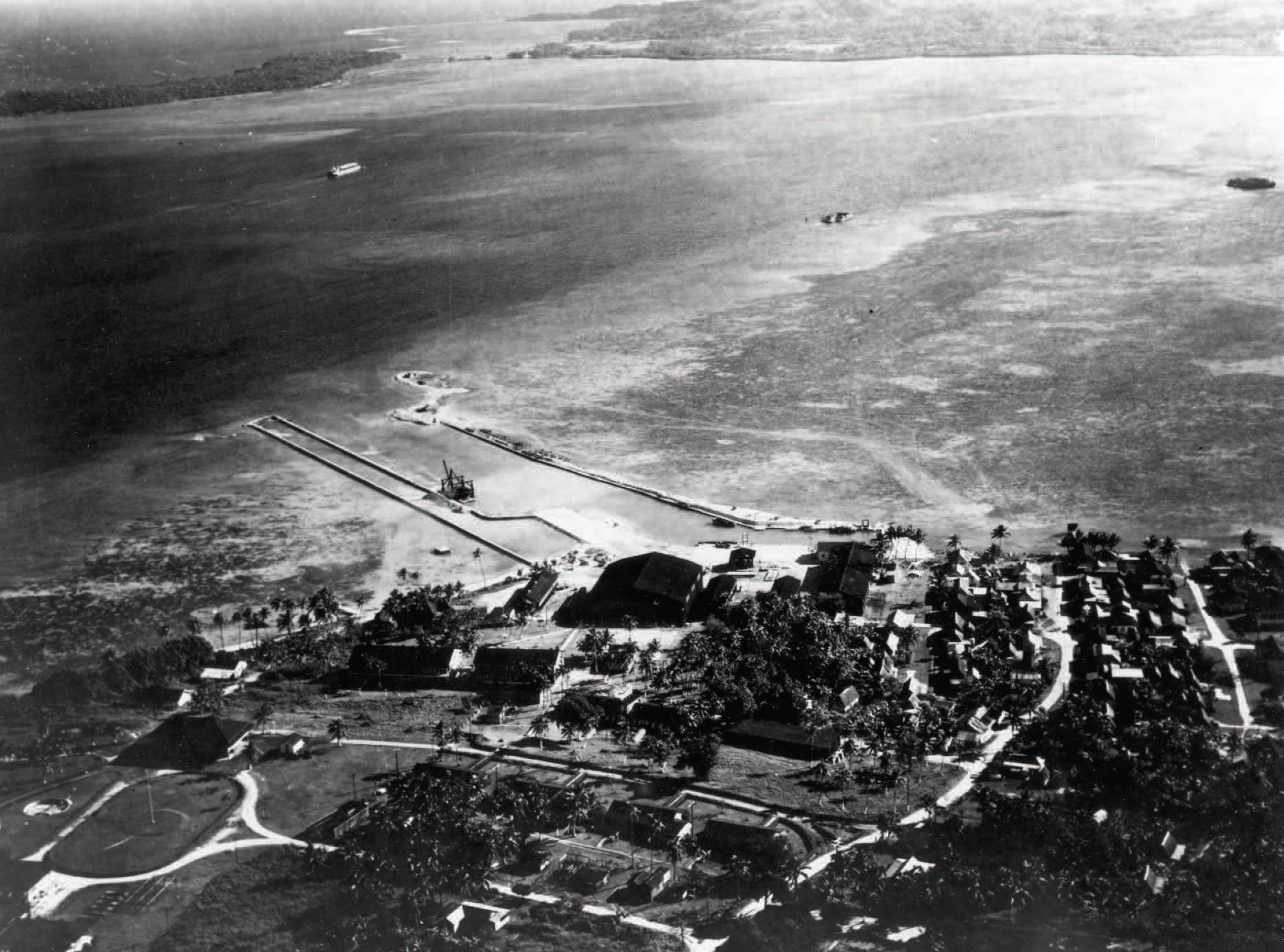
Guam, an American territory since 1898, is the southernmost island in the Marianas chain and is a mountainous island with jungle 20 miles long and a width of 12 miles or less. The population in 1941 was some 23,000, consisting mainly of native Chamorros and a few hundred Americans, mostly Navy and Marine personnel, civilian construction workers and a few employees of Pan Am who operated a seaplane Clipper service and small hotel for passengers transiting the Pacific. The capital and largest city is Agana on Guam’s north coast, located about 5 miles north of Apra harbor. In 1941, there was no airfield or American air forces on the island. By the terms of the 1922 Washington Naval Conference, the United States was not permitted to fortify Guam, so there were no coastal gun emplacements in 1941. As a result, the defensive capabilities were wholly inadequate to defend the island.
This fact was painfully obvious to the Governor of Guam, Navy Captain George J. McMillin, who was responsible for civil and military administration but not tactical command of Navy and Marine forces. CAPT McMillin realized that the island could not be successfully defended against a determined Japanese invasion. To avoid unnecessary loss of lives, he planned to surrender the island quickly with minimal resistance should the Japanese land. As the island’s chief executive, he had direct authority over the Marine Insular Patrol whose force of 28 Marines supported by Navy corpsmen performed police duties at Agana and around the island. The Insular Patrol of 30 enlisted U.S. Marines armed only with pistols was commanded by McMillin’s military aide, Captain Charles S. Todd, USMC. Its day-to-day operations were directed by the assistant chief of the Insular Patrol, Sgt Shane. Marines and corpsmen were assigned to posts around the island with native members of the Patrol. The remaining Marines were at the Guard barracks in Agana. There they would play a key role, along with the Navy administered Guam Insular Force Guard and other Marines and Sailors in the fight against the Japanese in the Plaza de Espana.
The U.S. Naval force consisted of 20 Naval officers, six warrant officers and 220 enlisted Sailors. The force operated from a small Piti Naval Yard in Apra Harbor, the old minesweeper USS Penguin (AM-33) with four officers and 75 enlisted men; two old yard patrol craft, each with a five-man crew; and a small disabled oiler, USS Robert L. Barnes (AG-27), used for training mainly Chamorro messmen for duty with the U.S. fleet. In addition, there were naval staff at the governor’s office and a wireless naval communications facility, Radio Agana, with 22 Sailors not far from the Plaza in Agana. There was also a smaller naval wireless station 2 miles from Agana called Radio Libugan, a facility staffed with eight enlisted Sailors and used for finding the Japanese fleet. There was a naval hospital in Agana with a staff who provided medical care to military personnel and local populace.
The Navy-administered Guam Insular Force of 222 native Guardsmen, including bandsmen and hospital medical orderlies, were housed in Agana. They were organized and led by their training officer, Chief Boatswain Mate Robert B. Lane, and under the overall command of Commander Donald T. Giles, the governor’s civil aide and second in command. This small force protected the Piti Naval Base and Government House while patrolling around the island. They wore Navy uniforms and had Navy ranks. Their armament included three .30-caliber machine guns, four Thompson submachine guns, six Browning automatic pistols, 50 .30-cal. pistols, a dozen .22-cal. rifles, and 85 Springfield ’03 rifles marked “For Training Only. Do Not Fire.” As there were not enough weapons, some Guardsmen were not armed. The force had been expanded only a few months earlier, lacked training in the use of their weapons and had never fired their machine guns.
The island’s Marine Barracks detachment of six officers and 118 enlisted Marines (less 31 assigned to the Marine Insular Patrol) were quartered in a two-story barracks at Sumay on the Orote Peninsula, located on a bluff overlooking Apra Harbor. Commanded by Lieutenant Colonel William Kirk MacNulty, USMC, they were armed with M1903 Springfield rifles and 10 Lewis machine guns. Though the Marine detachment was the principal ground defense force, they had no mortars, artillery or antiaircraft guns.
Prior to Pearl Harbor, there was no effort to dig entrenchments, roadblocks or beach defenses. The only entrenchments were the rifle range butts on the Orote Peninsula overlooking Apra Harbor. With war looming, all military and civilian dependents were evacuated in October. The Marine Sumay detachment’s pre-war activities, aside from occasional rifle range practice, were performing weekly parades and close order marching and providing music and transport for the Naval staff. Duties usually ended at noon. No tactical training or maneuvers were conducted. After duty hours, many Marines hung out at Ben’s Bar in nearby Sumay town where beer was 10 cents. The bar was operated by a Japanese man whom everyone called Ben Cook (who turned out to be a Japanese Naval officer working as a spy). As one detachment Marine commented in Roger Mansell’s book “Captured: The Forgotten Men of Guam,” pre-war Guam was “truly a paradise.”
As tensions with Japan rose with war warnings came from Washington, Japanese observation planes from Saipan flew over Guam daily. LtCol MacNulty met with the Pan Am Station Manager, Charles Gregg, during the last week of November and informed him that a Japanese attack was imminent and, if it happened, his Marine force would be in command of all government personnel with plans to evacuate American civilians. The Marines began improving defenses at their rifle range. They were issued ammunition and kept their weapons and ammo under their beds. The command was making plans to cache a week’s worth of food at select remote locations to enable personnel to hold out for rescue by the Navy.
When the invasion did occur, there was no time for MacNulty to coordinate defensive actions. While the Americans still hoped that ongoing negotiations with Japan in Washington would forestall war, on Dec. 6, Governor McMillin ordered the destruction of all classified documents on the island to prevent them from falling into Japanese hands.
While this was happening, the Japanese were making final preparations for the invasion of Guam. The principle invasion unit was the South Seas Detachment under Major General Tomitaro Horii. It included the 144th Infantry Regiment and other units from the 55th Division, with a total of 4,886 men who were aboard ships in the Bonin Islands. They would be accompanied by a supporting force, the 370-man strong 5th Company (also called the 5th Special Force) of the 2nd Maizuru Special Naval Landing Force, commanded from Saipan by Naval Captain Hiromi Hayashi.
The two forces would be transported to Guam on nine transports escorted by the Japanese Fourth Fleet’s heavy cruiser Aoba, destroyers Yuzuki, Kihuzuki, Uzuki and Oboro, four gunboats, five subchasers, a minesweeper squadron and other auxiliaries, with air support from the 18th Naval Air Corps at Saipan. This oversized landing force was being employed because the Japanese believed (strangely because of their careful surveillance of the island) that there were 300 Marines and 1,500 armed native defenders on Guam. Major General Horii assumed that the main resistance would be by the Marine detachment on the Orote Peninsula.
For Guam, the war commenced at 5:27 a.m. on Monday, Dec. 8, 1941, (Dec.7 at Pearl Harbor across the International Dateline) when the Navy Communications Office at Agana received a teletype message from Admiral Thomas C. Hart, commander of the Asiatic Fleet tersely stating “Japan Started Hostilities. Govern yourself accordingly.” Guam was also notified of the Pearl Harbor attack. The radio operator immediately notified McMillin and MacNulty. There was an immediate attempt by radio to alert the minesweeper USS Penguin, which was on patrol around the island, but the ship’s radio was not being monitored at that time. McMillin notified Commander Donald T. Giles, who was responsible for the Insular Guard, and his military aide, Capt Todd, that Pearl Harbor was being attacked. Various posts were notified by phone until Japanese saboteurs or bombs cut the phone lines about 7:30 a.m., which caused the use of runners. Todd was directed to have his Insular Guard Force arrest all Japanese who were quickly rounded up and put in the Agana jail. The governor also ordered the residents of Agana, Agat and other towns to evacuate and most fled into the jungle and mountains.
USS Penguin tied up at its buoy about 8 a.m. where a launch arrived with a message informing the captain, Lieutenant J.W. Haviland, of the Pearl Harbor attack. At 8:27 a.m., 18 Japanese seaplane bombers and fighters attacked various points including the Libugan radio station, without effect, and Agana, Sumay and USS Penguin. Three Japanese fighters made two passes at Penguin, whose crew tried to fight back with their antiaircraft gun. One Japanese plane was hit but not observed to go down. The gun crew commander, Ensign White, was killed by strafing. Three bombs exploded close to the ship, inflicting leaks in the hull. Three crewmen, including Haviland, were injured. Haviland ordered the ship to be scuttled and the seacocks were opened while the crew boarded a life raft or swam to shore. The Pan Am hotel was also attacked and destroyed, with loss of civilian life.
For Marines at Sumay, the day began with the usual early reveille followed by breakfast. Many Marines were still in the barracks when the Japanese bombed the barracks at 7:27 a.m., even though MacNulty had been alerted before 6 a.m. Some Marines ran out in skivvies and began firing their rifles at the low flying planes. Three Marines were seriously wounded while running across the golf course to seek protection in nearby thickets. A bomb exploding 10 feet from the barracks’ radio shack mortally wounded Corporal Harry E. Anderson, who died at the hospital a few days later.
That afternoon, the Japanese also bombed several coastal villages, some of which would be landing points for the Japanese. Until about 5 p.m., more bombs were dropped around Agana but only one building was destroyed. Their bombing of Agana was opposed by antiaircraft fire from a machine gun that lacked a tripod and was manually mounted on a ledge atop the old Spanish fort above Agana. Manned by Marine Private First Class Knute Hanson, he was certain that he downed at least one Japanese aircraft.
That evening McMillin conferred with his officers and informed them that he had obtained permission from Admiral Hart to give up the island without resistance when the Japanese landed. MacNulty disagreed and insisted that his Marines would not surrender without a fight. It was agreed that only a token resistance would be offered, and that the Marine detachment would defend the Orote Peninsula and the approaches to Sumay and Apra Harbor. The Guam Insular Guard and Insular Patrol along with Sailors from Penguin and from the Government House would be concentrated at the Plaza in Agana where they would set up defenses. Preparations would be made to destroy equipment to prevent it from falling into Japanese hands. The Guam Insular Guard was recalled to the Plaza at Agana and Todd was instructed to recall the remote Insular Patrol Marines and native Guardsmen, but he disregarded the instructions. He and Sgt Shane drove to the outposts but only instructed the native Patrol members to assemble at Agana. According to author Tony Palomo’s “An Island in Agony,” Shane disagreed with the decision, feeling that the Marines at those posts would have a better chance at the Plaza. However, events proved Todd was correct.
During the night, CAPT McMillin received a report that the Guam Insular Patrol had apprehended three men who had landed in a dugout canoe during the night near Ritidian Point at the northern end of the island. They were brought to the government house for questioning by McMillin and his staff. Local Chamorros identified the men as Chamorros who were native to Saipan but had relatives on Guam. The men stated that they were sent to be interpreters for the Japanese landing force which would land the next morning at Dungcas Beach, about a mile up the shore from Agana. When asked by McMillin why they were offering this information, they said that on Saipan the Chamorros were treated like slaves by the Japanese. They apparently believed what they said even though the invasion did not actually start until the day after. Both McMillin and MacNulty were skeptical and thought the infiltrators were trying to draw the Marines away from the Orote Peninsula. No effort was made to set up defenses at Dungcas beach.
Bombing resumed at 8:30 a.m. the following day against the same targets, along with the Government House in Agana and some scattered air attacks at villages around the island. The Marine barracks was damaged along with the Pan Am Air installation and the Standard Oil tanks, which had already been hit and set afire the previous day. Marines from the barracks were deployed in the rifle range butts. Machine-gun and rifle fire was directed against the Japanese planes from Orote and Agana, but no hits were observed.
That evening, the Japanese invasion fleet departed the island of Rota for Guam. Because General Horii assumed there could be almost 2,000 armed defenders, possibly with heavy weapons, his plan divided the landing force into three components. The Hayashi Naval 5th Special Unit with an Army reinforced battalion called the Tsukomoto Force would land at Tumon Bay about 4 miles northeast of Agana, then move quickly down the coast road to capture Agana. The Hayashi Force would then move to secure the installations at Apra Harbor. The main force with two thirds of the reinforced 144th Regiment, called the Kusunose Force, would land at a beach on the southwest coast near Merizo and advance north to overcome any resistance at Orote and meet up with the northern force. A smaller detachment from the main force would land in the east at Talofofo Bay and move inland to protect the heights above Apra.
About 1 a.m. on Dec. 10, on the orders of McMillin, the small force of defenders began setting up their defenses in the Plaza. Sgt Shane and the 11 Marines of the Insular Patrol prepared defensive positions with sandbags, ditches and overturned benches in front of the Government House on the southwest side of the Plaza. Lane led the three platoons of Insular Guards, about 80 men with a few Penguin Sailors, who were deployed with little cover around the Plaza. A machine gun was assigned to each platoon. One, under Guardsman Pete Cruz, was positioned without cover at the critical northeastern corner near the cathedral to cover the narrow street to the north. He was assisted by Guardsman Vincente Chargualaf to whom Cruz handed his pistol to provide cover when he changed ammunition belts. They were unexpectedly joined by an 8-year-old boy, Ramon Camacho, who emerged from the cathedral intending to take photos. Cruz tried to warn the boy away but he stayed and assisted Cruz in changing the ammo belt while Chargualaf covered them with a pistol. Across the Plaza at the northwestern corner in front of Dorn Hall, Guardsman San Nicholas with two men set up their gun to cover the Agana jail and elementary school on the north side. The third machine gun under Guardsman Joe Perez and crew was set up to cover the southeastern corner and area south of the cathedral. The Guardsman and Sailors with rifles were deployed around the Plaza using the cover of hedges where possible.
The Japanese landing plans went slightly astray but did not affect the ultimate outcome. The transports began readying their landing barges for debarkation at 1 a.m. on Dec. 10. In the south, the main Kusunose Force landed at Merizo but split into two parts because there were no direct roads. This significantly delayed their move toward Sumay and the Orote Peninsula. The northern Tsukamoto Force found its way through the coral reefs and landed at Tumon Bay at 2:25 a.m. as planned. These troops almost immediately encountered and fired up a jitney carrying a Chamorro family, killing most of them. They also captured two Sailors from Penguin.
The Hayashi Special Naval Landing Force, which debarked from a different transport, could not find the reef opening, so it moved southward around the steep cliffs at Oca Point where they found a channel into Agana Bay. Firing flares to guide the landing craft, they landed about 3:30 a.m. on Dungcas Beach less than 2 miles from the Plaza in Agana. As the boats approached shore, the splashing was overheard by Insular Guardsman Juan Perez on beach patrol. He fired at the first boat then ran to Agana to warn Governor McMillin. The landing force encountered six Sailors from the USS Penguin. After a short exchange of fire, the Americans surrendered and were then wired together and killed by bayonets. Farther north at Tumon Bay, the Army Tsukamoto Force was delayed by waiting for the Hayashi Force, unaware they had landed 2 miles farther down. This delay prevented them from reinforcing the Hayashi force.
Around 4 a.m., McMillin received a report of flares at Dungcas Beach. Assuming a Japanese landing was underway, he issued orders to all stations to carry out their assigned missions. A Penguin Sailor patrolling the San Antonio District between the Plaza and the beach reported a large landing force to Lane at the Plaza. Japanese troops entering that district began sweeping the streets with gunfire.
That shooting was heard at the Plaza, and some fires were seen. The Marines, Sailors and Insular Guard were in their defense positions around the Plaza, which was ringed with buildings, including a Catholic church, Guard barracks, public works, police station and Government House. This limited the Japanese approach to mainly a narrow street from the north and streets from the northwest and south. There was little protection, mainly hedges in some spots. Their three machine guns were set up to cover two intersections by the church, the road from Agana Heights and an intersection by the police station. There were fewer than 100 defenders. Marine defenders in the Plaza included Sgt Shane and PFCs Harris Chuck, Robert Hinkle, Frank Nichols, William Bomar, Hal Burt and John Kaufman from the Sumay barracks. Kaufman had joined earlier from the hospital and apparently fought alongside the Guards and Penguin sailors. Insular Patrol PFC’s Richard Ballinger and Garth Dunn guarded the rear entrance to the Government House.
As the defenders nervously awaited the Japanese who were infiltrating the streets toward the Plaza, Shane ordered PFC Chuck to take a few Marines to the garage and armory and destroy everything. Accompanied by PFCs Bomar and Burt, he commandeered a van and drove to the garage where the three disabled the vehicles with hammers and then broke the lock to the armory and set it afire with gasoline.
Hayashi’s men moved rapidly approaching the Plaza on a narrow street from the north alongside the hospital and a cathedral and also from the northwest. Some of his force were moving to circle around the Plaza to approach from the northwest and cut off retreat to the south. About 5:15 a.m., the Japanese crammed in the narrow street by the cathedral and marched almost shoulder to shoulder with their bayoneted rifles facing forward into the plaza. Guardsman Juan Perez opened fire with his Browning Automatic Rifle on a soldier crossing the Plaza, causing others to run for cover. Guardsman Pedro Cruz, manning the machine gun at the northeastern corner near the cathedral, saw Japanese begin sneaking into the plaza from the north and opened fire. As the Japanese entered the Plaza in force, the defenders opened fire on the advancing Japanese front ranks, killing and wounding many. The Marines defending Government House joined the firing. The intense fusillade caused the Japanese to fall back, reform and then advance again. The defenders continued heavy fire, causing the attackers to withdraw a second time. Reforming again, the Japanese advanced from the north and northwest, swarming into the Plaza with fastened bayonets and leveling heavy fire at the defenders. They also rolled in a pack howitzer.
The firing remained intense as the defenders fell back. At the northeast corner of the Plaza covering the cathedral approach, Pedro Cruz continued firing his Lewis gun, with the boy helping change belts, until Japanese return fire killed both Roman Camacho and Vicente Chargualaf. Cruz withdrew and was soon captured. At the northwestern corner, the Lewis gun operated by Guardsman San Nicholas and his two-man crew fired on the Japanese. After some exchange of fire, they dropped the gun and fled under Dorn Hall to escape but were met by a large group of Japanese soldiers between Dorn Hall and the Guard barracks where Nicholas escaped up a cliff behind the Government House but his loader, Angel Flores, was shot and killed.
Todd issued orders to the surviving defenders to withdraw to the protection of the thick-walled Insular Guard barracks on the western side. The Insular Patrol Marines and some defenders ran to that shelter including Radioman Second Class Robert Epperson, who fired his pistol at the attackers until his ammunition was expended. Penguin sailor Electricians Mate First Class Ralph Gwinnup was shot in the ankles and dragged by his comrades to the barracks. Other Japanese began to flank from the south side of the Plaza.
With the Japanese overrunning the Plaza and the surviving defenders in retreat, Governor McMillin, who had by then received telephone reports of other Japanese landings, realized that resistance was futile. Deciding to surrender, he telephoned MacNulty to not resist. About 5:45 a.m., to prevent an imminent slaughter, Giles crawled out in front of Government House and ran to a nearby Chevrolet and sounded three horn blasts. He believed they would understand and cease firing, which they did as did the Japanese. However, there was immediately some brief gunfire behind Government House. There is some dispute as to the reason but most likely was because Chief Petty Officer Malvern Smoot and a civilian, John Klugel, came from behind Government House in effort to escape.
Smoot fired his pistol and hit several Japanese before he and Klugel were killed in a hail of gunfire. Two sailors from Government House, Joseph Blaha and Lyle Eads, exited and tried to join the defenders but were wounded and initially presumed dead by the Japanese. To be sure, they bayoneted Blaha and started to bayonet Eads, but he rose and raised his hands. Both were taken to the hospital and survived. PFCs Bomar and Burt, who had ridden with PFC Chuck to sabotage the armory and motor pool, jumped out of his van on the return trip to try to escape. They were soon captured by a Japanese patrol and executed, by some accounts by beheading. In words of McMillin in his later formal report, “The Insular Force Guard stood their ground, and opened up a fire with machine guns and rifles hot enough to halt the invading force for a short time. The situation was simply hopeless, resistance had been carried to the limit.”
As a tense quiet prevailed over the Plaza, a Japanese near the cathedral, using a bullhorn, called out in broken English, “You are surrounded. You must surrender. Send your Captain!” At the direction of the governor, Giles and Lane stepped out and crossed the Plaza unharmed to parlay. They were marched through the San Antonio district to make contact with the Commander of the Naval landing force, Hayashi, and returned about a half hour later with the Japanese commander. The remaining defenders in the Plaza put down their weapons and began to rise and raise their arms, the pre-dawn darkness masking their fears of harm and execution. Before the Japanese commander arrived, a squad of Japanese soldiers entered the governor’s quarters and took McMillin captive. He was made to remove his jacket and trousers then marched to the Plaza where the Japanese were assembling their prisoners in three ranks, covered by machine guns. Prisoners were prodded by bayonets and savagely beaten into line. Those who had taken refuge in the barracks were ordered by a Japanese officer to come out and surrender. The prisoners were ordered to remove their clothing. PFC John Kaufman was not removing his underwear fast enough; the enemy slashed open his abdomen and he fell over and died.
Hayashi, McMillin and Commander Giles entered the Government House escorted by a Japanese guard with rifles and fixed bayonets. Because none of the Japanese with Hayashi spoke English, a local Japanese civilian, Mr. Shinahara, was brought to act as the interpreter. McMillin indicated that he was prepared to sign a declaration of surrender if the Japanese agreed to respect the civil rights of the people of Guam and that the surrendered military would be accorded the rights under international law. Hayashi agreed and surrender terms were drafted and signed by McMillin about 7 a.m. on Dec. 10. The Japanese laid out an American flag in the Plaza and shined flashlights on it to signal the surrender to their planes overhead.
By now, dawn was breaking and the surrendered defenders in the Plaza could see bodies of Japanese and some defenders strewn around the Plaza. The Marines had lost three killed, all after being captured or surrendered. Fortunately, none of Shane’s Marines defending Government House were killed in the actual fighting. The Navy had lost two and the Insular Guard had lost three plus the civilian volunteer, Roman Camacho. Despite the surrender agreement, the fate of the prisoners remained uncertain. More than once, they were stood up as if facing a machine-gun firing squad then told to sit down. Chief Petty Officer Robert O’Brien from Penguin, who could speak Japanese, overheard Hayashi say that he wanted to execute the prisoners because they had killed more than 200 of his men but was overruled by his Fleet commander. A formal count of Japanese losses was not reported but the island’s mortician, Pharmacists Mate First Class John Ploke recorded in his diary that he later counted more than 200 dead Japanese. Other sources reported that only one Japanese sailor was killed and six wounded which seems unlikely given the fusillade that met the Japanese advance into the Plaza. At the same time, more than 200 Japanese dead appears high as it would have been half the 400 men from the Landing Force and there were still swarms of Japanese in and around the Plaza after the surrender.
After a time, the prisoners’ clothes were returned. The American officers were taken and held in the Navy hospital. The other Plaza prisoners, along with those in Agana who had surrendered were rounded up and sent to the cathedral. The wounded were taken to the hospital for treatment.
At the Sumay barracks that morning, the Marines were advised by the executive officer, Major Donald Spicer, to take cover in the surrounding jungle and not congregate at the rifle range butts west of the barracks. This is according to a Pan Am manager, James Thomas, who was in direct contact with MacNulty. MacNulty realized that surrender was imminent and that with daylight, Japanese aircraft would be swarming overhead with the Orote Peninsula a prime target. Congregating the Marines would attract the attention of strafing aircraft and result in unnecessary loss of life. Many Marines scattered into the nearby jungle for cover while some remained at the barracks. A roadblock ordered by MacNulty was never fully implemented.
Having secured the Plaza and ended resistance, Hayashi formed a detachment of his men and march directly over a paved road to secure the Piti Navy Yard. He then began marching to Sumay. Shortly after leaving Piti, his force encountered a few Marines of the Insular Patrol who were unaware of the surrender and opened fire. The Japanese quickly surrounded and disarmed the Marines without any injuries to either side. Hayashi’s detachment then marched quickly to the neck of the Orote Peninsula where they were supposed to join and support an attack by General Horii’s main force.
At the barracks, MacNulty had been informed by McMillin of the surrender agreement directed not to resist. The Marines were called back from the surrounding area and assembled. A Marine bugler sounded retreat and the American flag was lowered amidst many tears. Hayashi proceeded to the barracks where he accepted the surrender of the Marines from MacNulty. The Marines were initially stripped naked and made to sit on the adjoining golf course and then later taken to the cathedral where Japanese soldiers from Tumon Bay had taken over guard duty. The Marines around the island were alerted and came in or were captured by Japanese patrols unharmed. Over the next few days, the Sailors and Marines who tried to hide in the jungles and mountains turned themselves in or were captured by roaming patrols. Six Sailors from the Agana radio station remained at large hoping for rescue by a Navy task force and hidden for a time by loyal Chamorros.
The battle for Guam, though brief, was over. The Marines had four killed and 12 wounded from the bombing and Plaza battle. The Navy had lost nine and 25 wounded while the Guam Insular Force lost four including the civilian volunteer and five wounded. On Jan. 10, 1942, the prisoners were loaded aboard ships bound to Japan where they were imprisoned. Back on Guam, the Japanese were determined to find the missing Americans issuing warnings that if they did not turn themselves in, they would be executed when captured. Five were eventually caught and executed. One Sailor, Radioman First Class George Tweed, was hidden and moved around by loyal Chamorros, evading constant Japanese patrols. In June 1944, he was rescued by the destroyer USS McCall (DD-400) just prior to the Marine landings on Guam. The Hayashi detachment stayed on Guam and was wiped out by Marines during its recapture.
Today, the people of Guam are U.S. citizens who require and deserve American protection. World War II showed that the Chamorro people are loyal, brave and would courageously support defense of their island. There also may be lessons we derive from the 1941 fall of Guam. Guam is an important strategic U.S. possession in the western Pacific with a large Air Force base and major naval base. Air superiority is crucial as Guam still lacks any substantial ground force defense capability and would require rapid reinforcement if threatened or attacked. Guam is key to our western Pacific defense strategy and a likely defense mission for Marine Forces Pacific to ensure 1941 is not repeated.
Author’s bio: Maj Stewart is a 1973 graduate of the Naval Academy. He also has a master’s in national security studies from Georgetown University. He served in the Marine Corps as a signals intelligence, electronic warfare and communications officer. After retiring from the Marine Corps, he pursued a 30-year career in cybersecurity as a Director, Chief Technical Officer, Corporate Chief Information Security Officer and Subject Matter Expert Consultant to Federal agencies and large corporations. He has written several articles for military journals and is a past recipient of Marine Corps Gazette’s Major General Harold W. Chase Essay Award. He is the author of the award-winning book, “Sunrise at Abadan: The 1941 British and Soviet Invasion of Iran.”