

John Adams and the forging of the Continental Marines
The story of the Marine Corps often begins at Tun Tavern, but the institution that Marines entered in late 1775 was shaped long before the first recruits assembled in Philadelphia. The Congress of late 1775 was a place defined by urgency and fatigue. Delegates worked in cramped chambers, debating the shape of a military establishment that did not yet exist. It was in this atmosphere of uncertainty that Adams pressed for disciplined maritime forces, including a body of Marines that could project resolve at sea.
The qualities he championed in those early months bear striking resemblance to the expectations placed on Marines today, revealing that many modern attributes of the Corps can be traced directly to his early leadership decisions. Its foundations were laid in Congress by leaders who saw that a new nation required disciplined maritime forces. No member of Congress contributed more to this work than John Adams. His leadership, influence, and insistence on naval preparedness created the political and institutional structure from which the Marines emerged. The early Marine Corps was not only born of recruitment at Tun Tavern but from the strategic vision of John Adams in Congress assembled.
Adams entered the naval debates in October 1775 with characteristic urgency. The Journals of the Continental Congress show him as one of the most active members of the temporary naval committees formed to draft rules, select officers, acquire ships, and establish the essential components of a maritime force.1 His participation was not symbolic. Day after day, he pushed military matters forward in a Congress still struggling to secure funding and define a strategy for war to include constructing and sustaining an Army and a Navy, with an organic Marine Corps. Adams demonstrated that the Marine Corps was conceived as part of a broader effort to create American power at sea during an hour of national fragility.
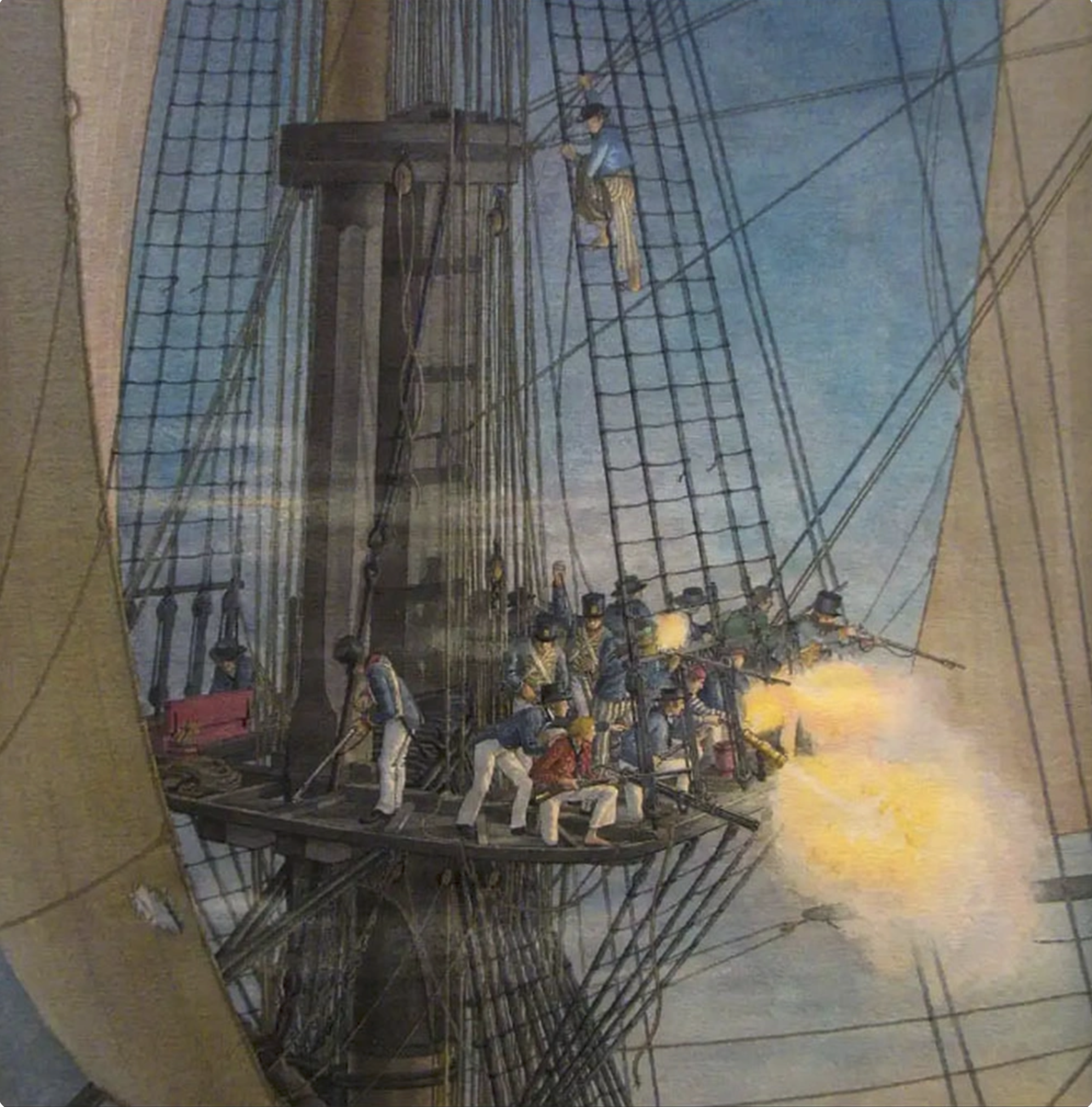
Earlier that fall, Adams had supported the Articles of War for naval forces, legislation that emphasized order, accountability, and the disciplined conduct of officers and enlisted personnel.2 This legal framework created the doctrinal foundation into which Marines would fit. Marines were designed as disciplined shipboard infantry who enforced order during daily operations and fought at the decisive moment of boarding. Adams helped establish Marines as integral to naval discipline and combat rather than as ornamental additions to naval vessels.
Adams’ writings reinforce this understanding. In his autobiography, he reflected that naval force was “a matter of necessity” for a nation that lacked the geographic depth and strategic depth of Europe.3 Necessity, in Adams’ mind, required structure, discipline, and professional forces capable of contributing to the survival of the Republic. His writings emphasize that enthusiasm and courage, though valuable, were insufficient without institution-building. These writings reveal a statesman who believed that disciplined military institutions were essential to national survival.
Beyond his committee work and personal writings, Adams played an essential role in shaping the earliest leadership of the Continental Marines. Committee notes suggest that Adams studied officer rolls with unusual care, asking pointed questions about experience and character even as ships waited in port for Marine detachments that did not yet exist. These early decisions were made under pressure, with Congress urging vessels to sea long before their organizations were fully formed. Adams understood that the character of the first Marines would depend heavily on the character of the officers who led them; he approached these selections with a seriousness that reflected the stakes of the moment.
Adams supported the appointment of Samuel Nicholas as the first Marine officer and worked with the Marine Committee to establish expectations for officer conduct, training, and readiness.4 He believed that officers must embody both discipline and republican virtue, a view consistent with his broader philosophy that military institutions must reflect national character. His attention to leadership selection helped shape the professional identity of the Continental Marines in their earliest months. In this way, Adams ensured that both the structure and the spirit of the first Marines reflected the disciplined character he considered essential to American arms.
Historians have long recognized these contributions. Charles A. Smith’s work on Marines in the Revolution highlights how Congress conceived Marines as both shock troops and guardians of discipline aboard ship.5 This matches the logic of Adams’ arguments in committee, which consistently emphasized combat function and organizational order. Marines were placed in key positions where discipline and close-quarters fighting determined shipboard success. This demonstrates that Adams’ vision shaped the Marines’ earliest operational identity.
James Thompson’s study of the Continental Marines reinforces this theme. Thompson notes that Marines were expected to serve as boarding specialists, sharpshooters, and disciplined infantry capable of enforcing order in the chaotic confines of an eighteenth-century warship.6 These expectations were not accidental. They reflected the structure Congress approved and the professional standards Adams supported. Adams ensured that Marines were conceived as practical contributors to naval operations rather than hypothetical constructs.
Merrill Lindsay offers further evidence. His examination of Marines during the period from 1775 to 1815 shows that Marines served as the backbone of discipline at sea, enforcing order, preventing mutiny, and preparing for the violent moments when ships closed for hand-to-hand combat.7 Their presence increased naval effectiveness far beyond their numbers. This confirms that the roles envisioned for Marines aligned with Adams’ broader intent to build a disciplined and effective maritime force.
Edwin Simmons, former Director of Marine Corps History and Museums, explicitly credits Adams for shaping both the Navy and the Marines. Simmons notes that Adams’ influence was so strong that he can be considered a principal architect of the Naval Service.8 Simmons’ analysis reflects the view that the Marines did not emerge spontaneously but were part of a deliberate institutional design. Simmons’ scholarship affirms Adams’ leadership in creating the Marine Corps as part of a coherent naval system.
John Ferling’s broader biography of Adams adds further detail. Ferling writes that Adams stood out among delegates for his persistent insistence on professionalization, even when the Congress was distracted by crises and competing priorities.9 Professionalization meant developing institutions that could endure past immediate battles. Ferling demonstrates that Adams viewed Marines as part of this effort to create a disciplined national force capable of sustained resistance. Ferling’s analysis highlights Adams’ leadership in shaping a durable military identity for the young Republic.
Christopher McKee’s study of early American naval leadership deepens this understanding. McKee observes that Adams’ influence ensured Marines were integrated into the ethos of the Naval Service, not merely its organizational chart.10 Marines were placed where discipline, moral character, and combat readiness intersected. Their presence communicated expectations about order aboard ship and contributed to the identity of the early Navy. These historical assessments highlight the practical consequences of Adams’ early design decisions.
Adams’ influence on the early Marines extended beyond organization and leadership selection to the operational expectations placed upon the force. During committee deliberations, he consistently argued that American naval power must include a disciplined body of shipboard infantry capable of decisive action in close combat and prepared for expeditionary operations.11 Historians have noted that early operations were not improvisations but reflections of a deliberate effort to build a maritime fighting force that could project American resolve.12 Adams helped establish the expectation that Marines would serve as disciplined, expeditionary infantry whose actions at sea and ashore would express the character and purpose of the new nation.
Taken together, these sources illustrate a consistent pattern. Adams exercised leadership through clarity of purpose, institutional design, and a commitment to disciplined republican military power. Five qualities stand out. Adams:
• Demonstrated strategic clarity during a period of institutional uncertainty. John Adams understood that the nation could not simply improvise maritime strength. He pressed Congress to establish a clear purpose, legal structure, and disciplined organization from the beginning. His ability to define what was essential at a moment when institutions were fragile ensured that the Marines were created with intention rather than by accident.
• Enabled the integration of Marines into the naval system as disciplined fighters and ambassadors of order and discipline. Adams did not see Marines as separate infantry placed on ships for appearance. He saw them as essential to the fighting system of the early Navy. They maintained discipline, secured the decks, and provided the decisive force in close combat. This created a unified maritime fighting structure rather than a collection of unrelated parts.
• Embraced and fostered a commitment to professionalism grounded in civic responsibility and moral seriousness. Adams believed that a military force in a republic must reflect the values of the people it protects. He emphasized discipline, accountability, and integrity as foundational expectations. The early Marines, therefore, embodied a standard of principled service that matched the republican ideals of the new nation.
• Promoted a design for institutional endurance far beyond the immediate needs of the Revolutionary War. Adams did not create structures that would simply carry the Nation through a single conflict. He consistently argued for enduring institutions that would shape American maritime strength in the future. His choices gave the early Marines an institutional identity that was built to last and not merely to serve one moment in time.
• Championed a belief that the identity of the Marines must be rooted in republican virtue as much as battlefield function. To Adams, Marines were not only warriors at sea or ashore. They were representatives of American purpose and character. Their discipline and conduct were intended to reflect the Nation itself. He shaped a Corps whose identity fused civic virtue, readiness, and disciplined service into a single expression of national commitment.
These leadership qualities helped shape a Marine Corps identity that endures to the present day.
As the Marine Corps looks across 250 years of service, Adams’s leadership offers enduring relevance. Marines today serve in environments that require clarity of purpose, integration across joint and combined domains, and professional conduct that reflects national values. Adams’ work in 1775 demonstrates that these expectations are not modern impositions but foundational characteristics of the Corps. The values Adams embedded in the early Marines remain core elements of the institution today.
The Marines who served under the framework Adams helped craft fought across the Atlantic, Caribbean, and coastal waters of North America. They enforced discipline, protected officers, manned boarding parties, and shaped traditions that persist in modern Marine culture. While Tun Tavern remains the symbolic birthplace of the Marine Corps, the institutional birthplace lies in Congress, shaped by leaders who built a disciplined naval service during the opening months of the Revolution. The Marine Corps was forged not only on the quarterdeck but in the halls of Congress, where Adams helped define its character.
Seen in this light, Adams’ leadership deserves renewed recognition. His arguments, committee work, and writings contributed directly to the formation of a Marine Corps designed to serve a disciplined maritime nation. Adams’ fingerprints remain visible in the disciplined character of the Marine Corps from its earliest days to the present.
ABOUT THE AUTHOR
>Col Dunne retired in 2024 after 31 years of service. He served as an Operational Planner and later as a Service-level Planner, focused on future-year resourcing, development of future capabilities, and the integration of emerging concepts across the FMF. He has been a frequent contributor to the Marine Corps Gazette and continues to study future operating environments and future conflict.
Notes
1. Journals of the Continental Congress, October–November 1775, Library of Congress, https://memory.loc.gov/ammem/amlaw/lwjc.html.
13 October 1775: Congress forms a committee “to prepare a plan for armed vessels,” and Adams is listed among its members.
30–31 October 1775: The Naval Committee reports recommendations on fitting out vessels, selecting officers, and establishing administrative rules; Adams participates directly in these debates.
5 November 1775: Congress debates and refines the Articles of War applying to seagoing forces, the discipline framework into which Marines would be inserted.
9–10 November 1775: While the resolution text does not list sponsors, Adams was involved in the same naval committee work that preceded the authorization of two battalions of Marines.
Late November–December 1775: Multiple entries show Adams involved in continued officer selection, ship acquisition, and naval governance through the end of the year.
2. Rules for the Regulation of the Navy of the United Colonies, November 28, 1775, Naval Records Collection, Record Group 45, https://www.history.navy.mil.
The 1775 Naval Rules establish a legal regime centered on order and discipline. The introductory sections emphasize obedience, chain of command, punishment for disorder, and conduct becoming naval forces (the exact environment in which Marines were meant to enforce discipline).
The Articles define Marines as shipboard enforcers of discipline. Though not always explicitly named, Marines fall under “officers commanding soldiers on board” and are referenced in sections about enforcing order and managing arms during engagements.
The Articles describe shipboard battle procedures in which Marines’ roles are implied. Sections on boarding, repelling boarders, and security at the gun decks align directly with the roles Congress determined for Marines as shock troops.
The Articles formalize accountability and punishment, a hallmark of Adams’s influence. Adams’s committee work repeatedly emphasized accountability through uniform codes of law. These 1775 Articles reflect that approach: strict regulation, structured punishment, and clear expectations.
The 1775 Rules show early codification of the professional ethos Adams demanded. They embody the professional, disciplined “sea service” Adams advocated in his letters and autobiography, reinforcing the argument that Marines were not ornamental, but doctrinally essential.
3. John Adams, Autobiography of John Adams, vol. 3, Adams Papers, Massachusetts Historical Society, https://www.masshist.org/publications/adams-papers.
Adams emphasizes the necessity of discipline over raw enthusiasm. He writes that courage alone does not sustain armies or navies; structured law, institutions, and discipline are required.
Adams links military organization to republican survival. His writings stress that without disciplined, principled institutions, the new Republic risked collapse under the pressure of war.
Adams explicitly ties naval and maritime readiness to broader national endurance.
He argues that maritime forces must be professionalized, regulated, and morally grounded to secure independence.
4. John Ferling, John Adams: A Life (New York: Oxford University Press, 1992).
Adams believed that the quality of officers would determine the character of the new American forces.”
He took a special interest in the appointment of officers to the naval committees, insisting that only men of proven judgment and probity should be entrusted with command.” Adams viewed the establishment of proper leadership not as “a detail but as a matter of national survival.”
In his correspondence and committee work, he left no doubt that he considered “discipline and moral character the foundation of a republican military.”
5. Charles R. Smith, Marines in the Revolution (Washington, DC: Marine Corps Historical Division, 1975).
Marines as disciplinarians aboard ship: “The Marines were stationed at points where their steadiness and discipline could best control the crew and maintain order.”
Marines as boarding and close-combat troops: “In battle they were expected to lead boarding parties or repel the enemy in the desperate moments of close combat.”
Congressional conception of Marines as integral to naval combat: “Congress clearly intended the Marines to form the disciplined infantry element of the naval service rather than serve as mere ornament.”
6. James Thompson, The Continental Marines (Washington, DC: Marine Corps Historical Division, 1976).
Thompson describes Marines drilling with muskets, pikes, and small arms specifically for fighting in the confined spaces of naval decks.
Further, Thompson emphasizes that Marines were stationed at control points on ships to enforce order and protect the command structure.
7. Merrill L. Lindsay, The American Marines, 1775–1815 (Oxford: Osprey Publishing, 2023).
Marines as the “discipline backbone” of shipboard life: Lindsay describes Marines as the stabilizing presence aboard Continental and early U.S. warships, positioned at control points to enforce order and prevent disruptions in the chain of command.
Marines prepared for “the decisive shock” of boarding actions: Lindsay highlights their role as trained close-combat fighters ready to lead or repel boarding efforts in the violent moments when ships locked together.
Marines’ disciplined routines enhanced naval readiness: Lindsay notes that Marines’ drill, musketry practice, and constant presence raised ship-wide readiness levels far beyond what their small numbers suggested.
Marines’ presence reduced risk of mutiny and instability: Lindsay explains that Continental and early U.S. naval officers relied heavily on Marines to maintain stability among heterogeneous crews.
8. Edwin H. Simmons, The United States Marines: A History (Annapolis, MD: Naval Institute Press, 1974).
Simmons, a former Director of Marine Corps History Division, explicitly credits Adams for shaping both the Navy and the Marines. Simmons notes that Adams’ influence was so strong that he can be considered a principal architect of the naval service.
9. John Ferling, John Adams: A Life (New York: Oxford University Press, 1992).
Adams’s relentless focus on professional institutions: Ferling emphasizes that Adams consistently pressed Congress to adopt structured, disciplined military norms instead of ad hoc, volunteer-based practices.
Adams as the leading advocate for naval preparedness: Ferling explains that Adams viewed maritime power as strategically essential and pushed the Congress into serious naval action.
Adams’s view of disciplined forces as expressions of republican virtue: Ferling describes Adams’s conviction that a republic required disciplined, morally grounded military institutions.
Adams’s leadership amid congressional distraction and crisis: Ferling highlights that while others were pulled toward short-term threats, Adams kept returning to long-term institutional building.
Adams’s wartime thought linked discipline directly to survival: Ferling shows how Adams believed that only a structured, disciplined force (including Marines) could withstand the pressures of war against Britain.
10. Christopher McKee, A Gentlemanly and Honorable Profession: The Creation of the U.S. Naval Officer Corps (Annapolis, MD: Naval Institute Press, 1991).
McKee describes the early naval officer corps as shaped by congressional expectations for order, professionalism, and discipline. He notes the Navy’s structure was deliberately developed, reflecting the values promoted by leaders such as Adams.
McKee discusses the integration of Marines into naval command culture. He indicates that Marines were placed within the naval hierarchy as symbols and instruments of shipboard discipline and martial ethos.
McKee highlights Adams’s influence on committee decisions that shaped the fabric of naval leadership.
He notes that Adams set expectations for the moral character and conduct of officers, which extended to Marine detachments.
McKee’s treatment of “honor” and “gentlemanly” conduct reinforces the idea that Marines formed part of the moral backbone of early sea service. He explains that naval discipline required both officers and Marines to embody republican virtues.
McKee frames the early Navy as a coherent moral and organizational system rather than a loose collection of ships. This supports the claim that Marines were woven into the identity of the service, not simply attached ad hoc.
11. Allan R. Millett and Peter Maslowski, For the Common Defense: A Military History of the United States of America, 3rd ed. (New York: Free Press, 2012).
“Adams and his colleagues on the naval committee envisioned a maritime force that included disciplined shipboard infantry, essential for boarding actions and maintaining order at sea.”
“Congress accepted Adams’ logic that naval operations required a corps of soldiers permanently attached to ships to enforce discipline and provide shock action when ships closed.”
“The Marines, conceived alongside the Navy, were structured to give American ships the close combat capabilities that Adams believed decisive in naval warfare.”
12. Jon T. Hoffman, U.S. Marine Corps: A Complete History (Quantico, VA: Marine Corps Association, 2002).
The seizure of Nassau in March 1776 stands as the first amphibious assault in American history and demonstrated the aggressive spirit expected of Continental Marines.”
“Nicholas’ Marines conducted themselves with the discipline Congress had envisioned when it created the Marine Corps the previous November.”
“The operation reflected a clear understanding that Marines were more than shipboard guards. They were intended for offensive maritime employment.”
“The raid served as early proof that the Marine Committee’s concept for Marines had operational merit.”