Russian Reflections and Military Renaissance

By LtCol A.M. Del Gaudio

Our former Commandant rendered these words in his testimony to the Senate Armed Services Committee in July prior to being confirmed as the next Chairman of the Joint Chiefs of Staff. The words are instructive for many reasons. They not only challenge current thought about the global security environment, but also resonate within Marine history, calling to mind the legacy of then-Capt James C. Breckenridge who took up his post as Naval Attaché in Petrograd and began a lifelong study of the problem of Russia in military and international affairs. Thousands of Marines have walked the halls of Breckinridge Hall at Quantico, knowing only the great leader for whom the building is named was an instrumental part of the first intellectual renaissance of the Corps in the 1920s and 30s, giving the Corps amphibious operations and the Small Wars Manual, (Department of the Navy, Washington, DC: Government Printing Officer, 1940). Gen Breckinridge was also a visionary Marine leader who understood Russia and the role it sought to take on the world stage. His legacy is well worth the attention of the present generation of Marine officers who face another Russian problem, “post-Cold War,” but rooted in a longer tradition.

Breckinridge’s many writings for the Marine Corps Gazette, as well as his personal writings contained in the Gray Research Center, allow us to gain a new perspective on Russia. The point of departure for the present work is Breckinridge’s own understanding of Russia. He watched the Czar’s empire go through the tremendous changes of the 1917 revolution while he served as the Naval Attaché to Petrograd. This basis of knowledge not only forms the backdrop for a review of another intellectual renaissance of the Marine Corps in the 1980s and 1990s under Gen Alfred E. Gray, but also grounds our understanding of the present era of Russian relations with the West. Having already learned from Russia twice before, can we do so once again? We examine the Russian actions of 2014 through the lens of General of the Army, Valeri Gerasimov, the Chief of the Russian General Staff. His article, “The Value of Scientific Prediction,” has wrongly been called a “doctrine” based on a western desire to mirror image, lessening significance while hoping to improve understanding.2 The Marine Corps, like the U.S. military at large, needs to regain a focus on Russian affairs. It must also develop a vision of the future informed by a deeper understanding of the past. In the present instance, Breckinridge lights the way.

The First Military-Intellectual Renaissance: Breckinridge on a Russian War of Ideas

In the years immediately following the First World War, Breckinridge wrote extensively about his experiences as the Naval Attaché to Petrograd. In reflection on his experiences in Russia, he thought America largely misunderstood Russia and her people. This led Western societies to underestimate Russian thought. In “Russia, Leading up to Present Conditions,” an unpublished report written shortly after the October 1917 Revolution, Breckinridge framed the historic revolution against the character of Russian society and the void of power in the Baltic region following the First World War.3 Pointing to the chaotic environment of the revolution, Breckinridge observed,

Three influences began to manifest themselves; one was the criminal element, which since the abolition of law and police had grown to imposing proportions; another was the arrival of internationalists and opportunists of every degree of mental instability or crookedness, and the last was German propaganda, which left no stone unturned in assisting the other two, for the greater the chaos in Russia the less chance would there be of reestablishing the old east front, which since the collapse of the [German] government was no longer a fighting factor.4

Ideas influenced action, the action in turn influenced ideas in an environment of chaos brought on by revolution. The chaos brought about by military defeat facilitated the introduction of disruptive new ideas, themselves aimed at military as much as political effects. War had expanded to the realm of ideology, terror, and crime.

Between 1927 and 1928, Breckinridge wrote a three-part series of articles published in the Marine Corps Gazette, entitled, “A Russian Background.” The purpose of this series was to provide readers with a general understanding of events occurring in the Soviet Union in light of Russia’s turbulent history. Breckinridge used S.F. Platonov’s History of Russia to frame his thoughts and work.5 Ten years after writing “Russia, Leading up to Present Conditions,” Breckinridge opened the first part of “A Russian Background” with the words:

The history of human development runs true to itself all over the world, the chief differences seeming to lie in the degree of education possessed by the people and, hence, in the methods they pursue, whether by vote or bayonet.6

What Breckinridge observed in this quote, he treated in his discussion of trends from Russian history. Russia, while a culture rich in heritage and traditions, never experienced an Enlightenment in the same sense as other European countries had done centuries before. Breckinridge correctly posited in the conclusion of his work what would become painfully obvious for the next 63 years: “[T]he real renaissance (for Russia) was not born until February, 1917.”7 In the wake of the revolution, Soviet Russia under the red banner of “scientific communism” was deeply exploring a future methodology for the conduct of war at the Frunze Academy. Great debates during this interwar era gave birth to Soviet operational art, the term itself having been bequeathed by Czarist Russian officers.

Like German officers of the post-World War I era, officers of the Red Army debated the merits of a strategy of annihilation versus one of attrition, both terms having been borrowed from the writing of the German military historian, Hans Delbrück.8 Each school of thought drew on the experiences of officers from the Russo-Japanese War, First World War, and Russian Civil War of 1918–1920. All were also influenced by the writings of Marx and Lenin.

The debate came to a head in 1926 at the Frunze Academy.9 Championing the school of annihilation was Mikhail Nikolaevich Tukhachevsky. A deep and critical thinker, Tukhachevsky authored several works during the interwar period supporting the strategy of annihilation or destruction.10 An equally deep thinker was the chief proponent of the school of attrition, Aleksandr Andreevich Svechin. In Strategy, Svechin appears to have been the first to use the phrase “operation art,” found in a series of lectures from 1923–24 at the Frunze Academy.11 Both Tukhachevsky and Svechin would fall in Stalin’s purges of the late 1930s, and their work would not become widely known, even in Soviet circles, until after Stalin’s death.

The Second Military-Intellectual Renaissance: Arms and Ideas in Operational Art

It would take until the 1970s–80s before Soviet work would become known to Americans, mainly due to its incorporation into the doctrine of AirLand Battle by the U.S. Army and U.S. Air Force. The new work drew on translations made available by the U.S. Air Force in the 1970s.12 Driven by a sense of urgency, the U.S. military had launched into a new intellectual renaissance, once more studying a potential enemy to elevate its own capabilities. The chief products of the second American military-intellectual renaissance were maneuver warfare, the operational level of war, and operational art. These ideas entered into both Army and Marine Corps doctrine. A number of scholars, including participants in that Cold War development, attribute the changes to a new appreciation of Soviet interwar military theory, aided by “Sovietologists” who concentrated on the USSR’s contribution to combined arms doctrine and theory.

Drawing new ideas from its foremost rival for the future, the American military nevertheless was also learning from an enemy of a bygone era. The interwar origins of the “new” concepts were not strictly Russian but rather also German. In practical terms, many of the ideas have roots in both nations’ military traditions, being refined on the battlefields of the First World War. In the years immediately following the war, under the Rapallo Treaty of 1922, the two former enemies began collaborating in the development of cutting edge technologies and concepts.13

Many American military thinkers, still ignorant of Russian/Soviet military science in the 1970s and 1980s, focused on learning from German military art. The distinction between art and science, often convoluted, nonetheless became apparent in the German emphasis upon spontaneity and individual initiative, in contrast to the Soviet quest for a precise theory of military affairs. Scholars have debated for decades now the authenticity of German “Blitzkrieg” as operational art, but the effectiveness of initial German operations in the Second World War remains beyond dispute. In the interim, the Soviets had purged their ranks of the theorists of operational art. The hard lessons of wartime losses motivated them, belatedly, to revive their interwar doctrinal efforts.

As the U.S. Army was defending Germany with the U.S. Air Force during the Cold War, AirLand Battle was the product of attempting to understand the Soviet methodology to fight it. The United States developed its own operational art in both emulation of and competition with the Soviets.14 AirLand Battle incorporated the concept of operational art directly into Army doctrine.15 Operational art became more prevalent in the American military lexicon when GEN Norman Schwarzkopf, USA, first used the phrase in a briefing on Operation Desert Storm in 1991.16 In difference, the emphasis on “mission type orders” in maneuver warfare, as described by MCDP 1, Warfighting, has clear origins in the German tradition of Auftragstaktik.17 MCDP 1 became Marine Corps doctrine as the result of the second “Marine Corps Renaissance” from the late 1980s into the mid-1990s. Of the many reasons for the Marine Corps to base their doctrine on the German example, one was the appeal of small unit tactical actions using maneuver in place of the attrition of the Vietnam War experienced and excoriated by many Marines.18 Also featured prominently in MCDP 1, however, is the emergence of the operational level of war, intellectually connecting Marine Corps Warfighting to the U.S. Army’s AirLand Battle doctrine of the early 1980s. In the process of adapting their doctrine to the Soviet threat, U.S. military thinkers absorbed many of the same concepts and terminology but took the adversary’s doctrine to a new level while imbuing it with the flexibility and initiative inherent in maneuver warfare.

It was ideas again in the spirit of Breckinridge that brought the necessary change. Warfighting as a philosophy complemented the logic of war being treated as both an art and science. Drawing on a wide range of sources from Clausewitz and system theory to Sun Tzu, the new doctrinal publication articulated and advocated initiative for the lowest level to fight through the point of friction. Although not directly influenced by Soviet methods, maneuver warfare eventually merged with Army doctrine in AirLand Battle, in what some have called “a Hegelian synthesis.”19

By striving to learn how to deconstruct the Soviet style of fighting, the U.S. military came to reshape its own doctrine in large part along similar lines, though with key differences due to very different strengths and weaknesses, including geography and manpower. A generation later, we now must once more undertake a similar effort. The days of massive East-West confrontation on the continent of Europe faded with the end of the Cold War. Current constraints on the U.S. military portend the need for a very different response to Russia. As in the immediate aftermath of Vietnam, moreover, the U.S. military comes at the problem from a prolonged involvement in counterinsurgency and “nation building.” Like Breckinridge, and the Army’s TRADOC, the Western defense enterprise today must learn the current Russian methodology for war while reflecting on how best to adapt itself.


Are You Enjoying this Article?

Join MCA&F today to receive monthly editions of Leatherneck Magazine and the Marine Corps Gazette.


A New Military-Intellectual Renaissance? Learning From Current Russian Methodology

In March 2014, Russian troops appeared in Crimea with the intention of securing the Peninsula for the Russian Federation. Almost immediately, Europe and the world were inconveniently confronted by renewed Russian aggression. Interest in the Russian methodology of military thought spiked as military professionals sought to “frame the problem,” leading to the search for the latest Russian “doctrine.” The Russian move into Crimea along with actions of Ukrainian separatists in the east of the Ukraine backed by Russia were foreshadowed by General of the Army Valeri Gerasimov in his January 2013 speech before the Russian Academy of Military Science, entitled, “The Value of Scientific Prediction.”20 Gerasimov has broadly explored Soviet and Russian innovations throughout history to inform his thoughts but specifically examined recent Western conflicts to determine their patterns.

With examples such as American involvement in Iraq and Afghanistan, NATO operations against Libya, and the Arab Spring, Gerasimov discerned a pattern in the Western use of military operations as a tactic or technique in the attempt to control chaos. Gerasimov explains,

In recent conflicts have emerged a new means of military action that cannot be considered purely something of military means. As an example, operations in Libya saw the use of a no fly zone, sea blockade, and wide use of private contractors in close cooperation with armed groups of opposition. We should admit if we clearly understand the essence of traditional military actions as conducted by our regular armed forces, our knowledge of asymmetrical forms and means of battle is superficial. Coming from this reality, the role of military science should be increased and it should develop a common new theory for the above mentioned actions.21

Chaos, however, could be employed as a military system as part of a strategy when used in conjunction with other systems such as law, politics, economics, and culture (see Figure 1). In essence, Gerasimov demonstrated it is far easier to instill chaos, pulling the appropriate “system levers” when required, than to control it as in the western model of the last 14 years in counterinsurgency operations. What Gerasimov said about Russian views of war in “The Value of Scientific Prediction” were certainly not new, whether in Russia or the West. Like the Cold War, Western understanding of the Russian character and their conduct of war had been forgotten. Breckinridge had said it first: Soviet methods flourished in chaos and drew strength from the circumstances created by socio-political and military crisis.

Looking back to Breckinridge’s work nearly 100 years ago, we see a Marine who instructed his Service and the wider public on Russia while preparing to lead an interwar intellectual renewal in the Marine Corps. The lessons acted on during that broad awakening served the Marine Corps in good stead in the coming conflicts. In similar fashion, the reading of Soviet doctrine in the late Cold War helped the West bring that long-running confrontation to a successful end, with the material and intellectual efforts undertaken to renew the military in the 1980s helping to avert the need for war. As the security environment of Europe continues to demonstrate to the world, failing to understand Russia now could find the United States and her allies miscalculating Russian intentions at a critical time now or in the future and therefore facing an unacceptable fait accompli.

The next military renaissance must likewise stay ahead of the next crisis. Being “formed, trained and equipped” is not good enough to prepare for the unknown future of an increasingly turbulent world. Developing institutional intellect and the ability to deal with a peer competitor has not been the American way of war for some time. It begins with remembering we must first understand the environment to interact and change. To cope with the challenges we have been presented with today and tomorrow requires study and intellectual honesty about the unknown, while having the courage to change. In doing so, we reduce our chances of miscalculation because we made an effort to learn from Russia. As Gerasimov’s thoughts demonstrate, the Russians learned from observing us, just as Breckinridge learned from observing them. The next intellectual renaissance for the Marine Corps must be born of the will to change and to innovate as we have always done. The Breckinridge legacy points the way forward.

Notes

1. Gen Joseph F. Dunford testimony as nominee for CJCS to the Senate Armed Services Committee, 9 July 2015. See: https://www.washingtonpost.com.

2. General of Army Valeri Gerasimov, Chief of the General Staff of the Armed Forces of the Russian Federation. See: http://www.vpk-news.ru/articles/14632 for original article, “The Value of Scientific Prediction,” translated and edited by LtCol A.M. Del Gaudio.

3. J.C. Breckinridge, “Russia, Leading up to Present Conditions,” (Quantico, VA: USMC Archives J.C. Breckinridge, Gray Research Center, Box 16, Folder 26).

4. Ibid, 6.

5. S.F. Platonov would have been known to Breckinridge as he was a well-known Russian scholar of history in Petrograd until his retirement in 1916. See: S.F. Platonov, History of Russia, (New York, NY: The Macmillan Company 1928), VI.

6. J.C. Breckinridge, “A Russian Background: Part I,” Marine Corps Gazette, (Quantico, VA: December 1927), 229.

7. Breckinridge, Part III, 124.

8. See: Hans Delbrück, The Dawn of Modern Warfare, (Lincoln, NE: University of Nebraska Press, 1990).

9. Jacob Kipp, The Operational Art, Development in the Theories of War, edited by B.J.C. McKercher and Michael A. Hennessy, (Westport, CT: Praeger, 1996), 69.

10. For more on Tukhachevsky’s writings, see: M.N. Tukhachevsky’s Selected Works, 1928–1937, (Moscow, USSR: State Publishers, 1964).

11. Aleksandr A. Svechin, Strategy, (Minneapolis, MN: East View Publications, 1992), as well as Jacob Kipp, The Operational Art, Development in the Theories of War, 61.

12. In the 1970s, in an effort to better understand the Soviet threat, the United States Air Force translated selected Soviet works to better understand Soviet thinking. For the Soviet/Russian conception of operational art in English, see: V. YE. Savkin, The Basic Principles of Operational Art and Tactics, (Moscow, USSR: State Publishers, 1972).

13. “In 1922 the German-Soviet rapprochement was complete with the Rapollo Treaty, which established diplomatic and trade links between the two nations.” See: James S. Corum, The Roots of Blitzkrieg, (Lawrence, KS: University of Kansas Press, 1992), 170.

14. Scholar and author COL David M. Glantz, USA(Ret) was the former founder and Director of the U.S. Army’s Foreign Military Studies Office who was charged with examining Soviet Military development in the 1980s.

15. Headquarters United States Army Training and Doctrine Command TRADOC Pam 525-5, Military Operations: Operational Concepts for the AirLand Battle and Corps Operations, (Fort Monroe, VA: U.S. Government Printing Office, 1986).

16. Svechin, 23.

17. Chapter 4 of MCDP 1, Warfighting, examines maneuver warfare and mission tactics or mission type orders. See: Headquarters Marine Corps, MCDP 1, Warfighting, (Washington, DC: 20 June 1997), 71 and 87.

18. In the late 1970s and 80s, the Battelle Corporation conducted several conferences, interviews, and exercises with former German general officers from the Second World War. Amongst the exercises conducted were the participation of German general officers in a Marine command post exercise at 1stMarDiv.

19. Kenneth F. McKenzie, The Event Horizon: The Marine Corps and the Dialectic of Maneuver Warfare and AirLand Battle, (Washington, DC: 1992). See: http://www.globalsecurity.org.

20. General of Army Valeri Gerasimov, Chief of the General Staff of the Armed Forces of the Russian Federation. See: http://www.vpk-news.ru/articles/14632 for original article, “The Value of Scientific Prediction,” translated and edited by LtCol A.M. Del Gaudio.

21. Ibid, 2.

22. Ibid. A translation from the original Russian chart.

Dull Garrison Chronicles, Part III: Last Stand R

By Carl F. Kusch

Situation

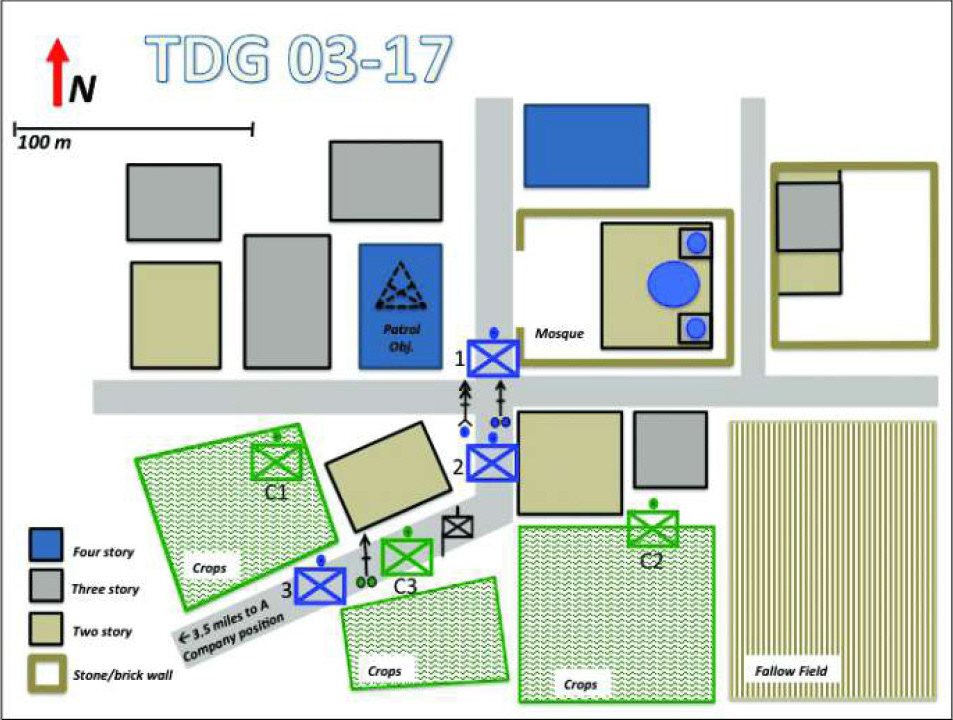
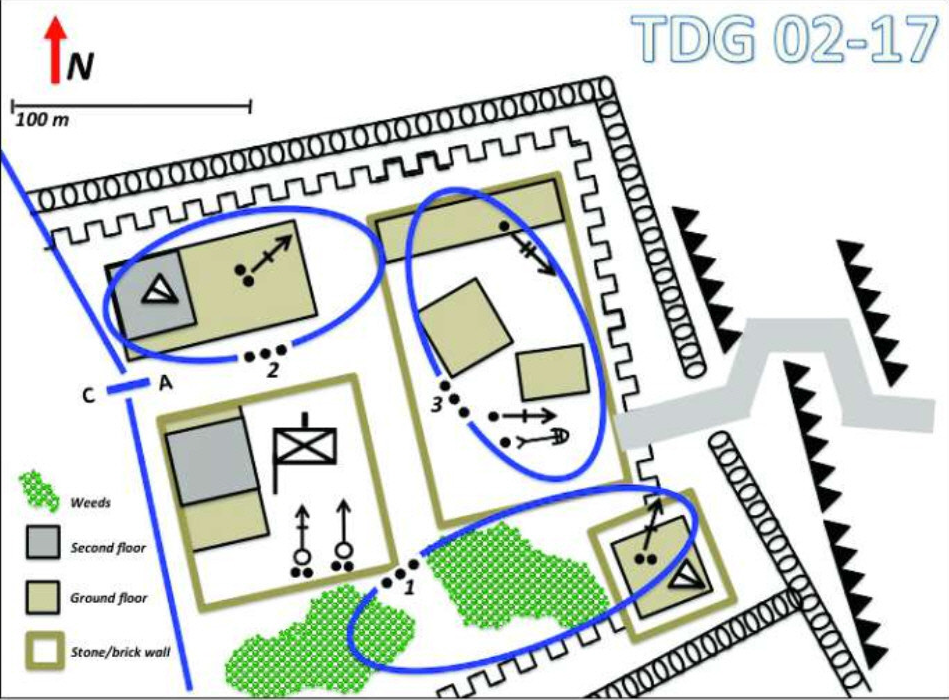
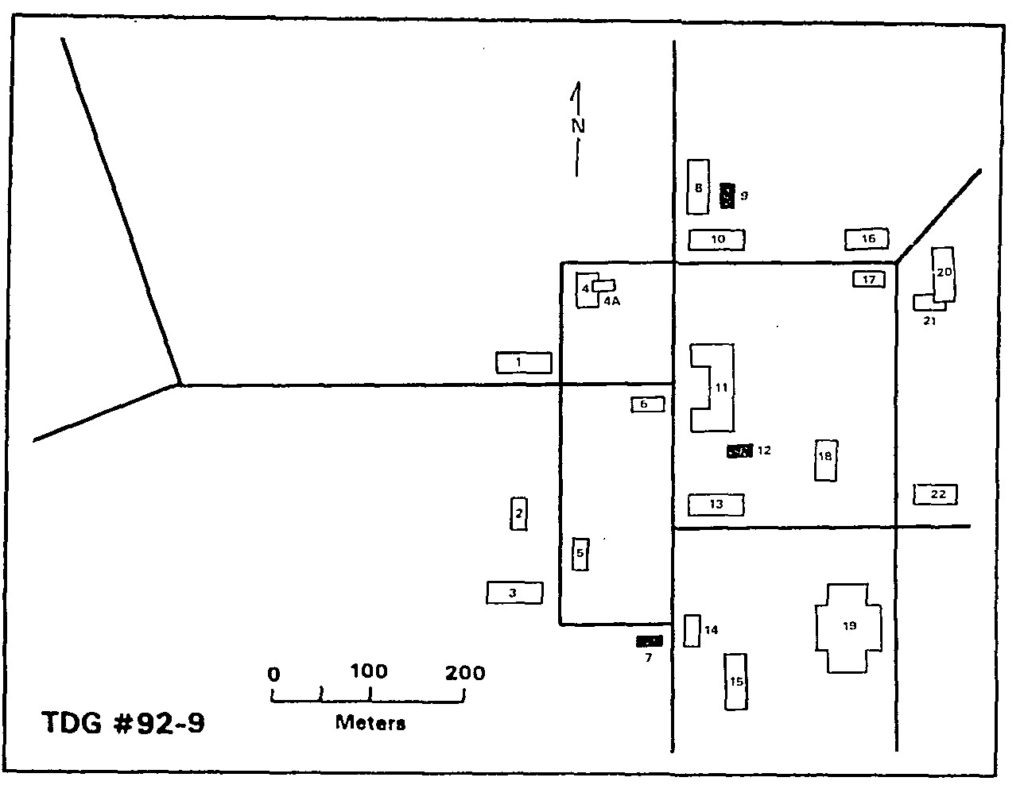
This is a continuation of TDG 08-16R. The enemy is continuing to press its assault of Dull Garrison Island. Against overwhelming odds and in the face of heavy casualties, the fight is not going well for our provisional battalion, which has begun to consolidate its survivors into a single perimeter here at Al Habib—a relatively large town and the regional communications and transportation center for this part of the island. The enemy’s main body is still many kilometers to the north but getting closer. Eventually, the enemy’s main attack is expected to come from that direction.

The battalion commander’s plan is to shrink the perimeter and fight a defensive battle within the town itself. The final stand will be a tight “shoulder-to-shoulder” position located at the very heart of Al Habib where the battalion command post (CP) is currently positioned. The 1st Company is deployed on the outskirts of the town and will constitute the northeastern section of the battalion’s perimeter with the 2d Company on the northwestern outskirts. Both will meet in the middle and refuse their outboard flanks. Meanwhile, 3d Company will continue to delay and frustrate the enemy’s main body in order to give the battalion as much time as possible to make these final arrangements. 3d Company will ultimately constitute the entire southern sector of the battalion’s perimeter once they fall back into town.

The 2d Special Infantry Company is currently deployed with its 1st and 3d Platoons positioned facing north and 2d Platoon facing west on the company’s left flank. You are Sgt J.H. Quick, the acting platoon leader for the 2d Platoon. Your platoon sector is shown on the accompanying map. Between being deployed from the States understrength and with the casualties you have sustained in the recent fighting, your platoon is down to 20 Marines, many of whom are walking wounded like yourself.

Although the company’s attachments from the battalion are located with 3d Platoon, you have been assigned one machine gun squad (two M240G guns) and one SMAW squad (two launchers) from Weapons Platoon.

Since 3d Company is doing such a tremendous job delaying the enemy, your company commander (Lt S.D. Butler, who was your original platoon leader until an enemy mortar attack hit the company CP a couple days ago) feels that he has a little extra time and has called his acting platoon leaders and remaining SNCOs together to discuss the tactical alternatives before he issues his final instructions.

Requirement

In a time limit of five minutes, complete your suggestions for the company commander. Include an overlay sketch indicating the recommended positions for your platoon and provide a brief discussion of the rationale behind your actions. Submit your solutions to the Marine Corps Gazette, TDG 07-16R, Box 1775, Quantico, VA 22134 or by email at [email protected]. The Gazette will publish solutions in an upcoming issue.

Military Ethics

By Maj Dennis W Katolin

The DOD does not have a comprehensive approach toward ethics. While many leaders place emphasis on the subject, they do not have a simple and comprehensive approach toward defining ethics. In light of this shortfall, the following article is designed to provide a tool for leaders to link ethical conduct with the Marine Corps’ success across the range of military operations.

With a basic definition for ethics (adherence of one’s actions to their values), one can address military ethics and how they are valuable to the Marine Corps. Military ethics focuses on the qualities that are valuable to a military organization. These qualities become a unit’s values, and military ethics are the application of those values through action.

Ethics and Trust

Trust is defined as reliance on the integrity, strength, and ability of a person or organization. Ethics is the foundation of facilitating trust. Our actions (good or bad) communicate our true intentions and speak to what is (or is not) valuable to us. Consequently, a person’s actions will show others if he truly believes in his values. If someone is behaving ethically, he is communicating that he believes in certain values and will allow those values to drive his actions. This is often referred to as “character.”

When a Marine demonstrates his strength of character, others will gravitate toward him because the consistency of his ethical action makes him reliable. Reliability is the fundamental component of trust.

Trust and Maneuver Warfare

Warfighting states that “Maneuver Warfare is the warfighting philosophy that seeks to shatter the enemy’s cohesion through a variety of rapid, focused, and unexpected actions.”1 Cohesion is critical to this philosophy. Without it, an organization’s will to fight will erode, leaving it unable to cope with the deteriorating situations in which war places us. Our warfighting philosophy is centrally focused on cohesion. It is critical to any unit’s ability to succeed in war.

Sustaining The Transformation states that

cohesion is the intense bonding of Marines and units that results in absolute trust. It is characterized by the subordination of self and an intuitive understanding of the collective actions of the unit and of the importance of teamwork, resulting in increased combat power.2

The Marine Corps’ warfighting philosophy focuses on the destruction of the enemy’s cohesion, not the enemy itself. This emphasizes the value of cohesion as a potential source of strength for our unit. To facilitate cohesion, Marines must become trustworthy; they must be consistent performers whose actions are reliably driven through institutional values. A clear understanding of values and morals compels a person’s ethics; ethics make a person reliable and trustworthy to others; and this facilitates cooperation, which provides the cohesion. Cohesion leads to success in war. (See Figure 1.)

Military organizations require strong teamwork, unit cohesion, and loyalty. These qualities are at a premium on the battlefield, given the complexities, friction, and danger that are inherent in war. One source of friction and uncertainty are other Marines. Uncertainty in the unit’s ability to perform, to adhere to guidance, or to be obedient to orders deteriorates trust, thus minimizing cooperation and, ultimately, compromising our cohesion.

Marines can minimize such uncertainty by serving as “known goods.” Ethical adherence to our core values of honor, courage, and commitment will facilitate trust and cohesion. The stronger our cohesion, the less likely the enemy will be able to destroy it, minimizing their ability to use maneuver warfare against us.

Trust, stemming from ethical conduct, is the most important element of unit cohesion. By demonstrating ethical conduct, a Marine earns the trust of others. When a Marine shows he is trustworthy, he becomes a source of reliability, minimizing the impacts of friction.


Ethical Leaders and Followers

The understanding of vertical cohesion requires that both senior and subordinate alike are trustworthy and cooperate with each other so they can facilitate a unit’s cohesion. To become an ethical leader, one must strive to uphold the Marine Corps’ leadership traits. These traits are the values of a leader. Consequently, ethical leaders must use the values in JJDIDTIEBUCKLE (judgment, justice, dependability, integrity, decisiveness, tact, initiative, endurance, bearing, unselfishness, courage, knowledge, loyalty, enthusiasm) to help shape their actions, consistently aligning them with our core values. In doing so, a leader will become trustworthy and inspire others to follow him. Being ethical allows unit leaders to cooperate with good followers and achieve unit cohesion. (See Figure 2.)

While being an ethical leader is challenging, it is made easier by the fact that the Marine Corps has clearly defined these traits and educates all its leaders on what they are and how to achieve them.

It is a common misconception that leadership is more important than followership. This is often the result of an overemphasis that we have placed on leadership in our history. While many Marines are leaders, all Marines are followers. Without followership, vertical cohesion cannot be achieved, and a unit will fail.

Consequently, a Marine must strive to be an ethical follower. This means he must be someone who can complement his organization’s leadership to facilitate cooperation. In order to be an ethical follower, one must adhere to values that help him complement his leader.

What are the values of an ethical follower? They are the exact same as those of a leader. The only difference between a leader and a follower is the moral lens of how he applies those traits. Just as a leader uses bearing, integrity, and loyalty to become reliable and trustworthy to his followers, a follower must show bearing, integrity, and loyalty to be reliable and trustworthy to his leaders.

The difference between an ethical leader and a follower is not what his values are but how he applies them to achieve unit cohesion. The moral lens determines if he is doing so.

Ethics and the Nature of War

War is the violent clash of wills to achieve a political end. By its nature, warfare is painful, difficult, dangerous, and stressful. These characteristics cause a military force’s power to erode. The ability to think, move, and communicate become more and more challenging as war progresses, resulting in a culminating point. The concept of culmination is often applied to physical and mental capability, where someone either physically can no longer move, or mentally cannot concentrate, focus, or even think.

Just as war can cause someone to culminate physically or mentally, it can also cause a Marine to culminate morally. In the extreme environments of war, a person will begin to see that adherence to one’s values may come at a cost, which will exacerbate the elements of friction.

The elements of fatigue, hunger, or sleep deprivation naturally make a person long for rest, food, and normal comforts. When these qualities in warfare become extreme, a person may become desperate to end them. This begins a tendency for someone to “go internal” and focus on his own discomfort.

Ethics can be perceived as a meta-motivation, which is to say that we can afford to be motivated by values because our basic physiological needs are met. But when the physiological needs of food, water, clothing, and shelter are absent, people naturally focus their efforts toward fulfilling those needs.

This is outlined in Maslow’s hierarchy of needs. The level 5 need of “self-actualization” facilitates a Marine’s ability to reflect on values and how to apply them in action. A failure to meet levels 1–4 will compromise a Marine’s ability to think on level 5 issues.3 (See Figure 3.)

It is at this point when a Marine may fail to incorporate her/his values. This occurs as s/he slowly slides down Maslow’s hierarchy of needs and begins to realize the basic need for safety is not being met. As war persists, the removal of basic needs (or perceived removal of basic needs) will tempt Marines to focus internally. When this happens, views on values shift. Values that were once the bedrock of one’s moral character have now become an unaffordable luxury. War quickly compels someone to focus on the need for survival or sense of belonging to a team. Those needs will take priority over self-actualization, which allows us to reflect on values.

Ethics and Will

Warfighting states that

one essential means to overcome friction is the will; we prevail over friction through persistent strength of mind and spirit. Human will, instilled through leadership, is the driving force of all action in war.4

With this in mind, Marines must understand what will is, how it is cultivated, and strive to develop it as much as possible.

Will is the purpose or determination to choose one’s own actions. A key principle of will is having the resolve that what one is doing is necessary or right. Consequently, a Marine’s need to think about what is right and how to put that into action is a critical component to his resolve. Ultimately, one’s understanding and belief in what is right strengthens his will.

Ethics’ inherent requirement to reflect on traits and qualities that are valuable helps Marines to internalize the importance of the institution’s values. While being able to state those values is good, the understanding of their worth is what compels a Marine to act in accordance with those values. This helps a Marine determine what the right thing to do is.

The more a Marine understands and believes in those values (and why they are important to him and his unit), the stronger his resolve will be to ensure his actions reflect those values. In short, ethics is the critical component to human will.

Ethics’ Value in War

War is an extension of both policy and politics with the application of military force. The single most important thought to understand about our theory of war is that war must serve policy. While militaries may perform tactical tasks well during combat, their actions will be useless—and possibly counterproductive—if they do not help achieve our political end.

As a result, the Marine Corps is obligated to conduct war in a manner that will achieve those ends. Military rule of law, the Uniformed Code of Military Justice, the Law of Armed Conflict, and the Geneva Convention are grounded in these principles.

The Marine Corps does not fight to simply destroy armies. Our doctrine of maneuver warfare states the opposite: that we want to erode the enemy’s will with a rapid and focused application of combat power. Though wars often compel Marines to mass destructive power when needed, the use of that power can harm our ability to support policy.

While Marines must strive to maximize combat power (both at the individual and unit level), the application of that power must fit within the guidance of policymakers. Everything from treatment of enemy prisoners of war, restrictive rules of engagement, constraints when engaging civilians, personal appearance, and the tactics, techniques, and procedures we employ all have an impact on our ability to impose the will of our political policy on the enemy.

The ethical demands of war in this context is for a Marine to honor the oath he made to obey lawful orders, even if it means less desirable outcomes in the immediate future. To do otherwise is to make tactical gains to the detriment of operational- or strategic-level goals.

Conclusion

Ethics is a critical component to our success in war. The inherent requirement for will, trust, cohesion, and cooperation in maneuver warfare compels us to understand ethics and place it at a premium. Being an ethical Marine is necessary to prevent the enemy from shattering our cohesion and facilitates the unity of command that maximizes the collective capabilities. Leaders must strive to train and educate Marines on the value of ethics in maneuver warfare and the importance of being an ethical warrior.

Notes

1. MCDP 1, Warfighting, (Washington, DC: HQMC, 1997).

2. MCRP 6-11D, Sustaining the Transformation, (Washington, DC: HQMC, 1999).

3. Abraham Maslow’s hierarchy of needs was proposed in his 1943 paper, “A Theory of Human Motivation,” published in Psychology Review, (Washington, DC: American Psychological Association).

4. MCDP 1.

The Warfighting Skills Program

By LtCol Gregory A Thiele

There is great news for those interested in understanding or teaching others about the changes in warfare that have taken place in the last 350 years. The Warfighting Skills Program has been scanned and posted online. The Warfighting Skills Program was a correspondence course offered by the Marine Corps Institute to junior officers in the late 1990s. It did an excellent job of teaching maneuver warfare concepts. It also provided students with the historical background necessary to understand maneuver warfare so that they could continue their personal education plan in a meaningful way.

Understanding of maneuver warfare and its integral concepts has sunk to an abysmal level in the last few years. Professional military education has come to be nearly a contradiction in terms. The lack of serious thought and discussion about military affairs within the military is extremely troubling. The Warfighting Skills Program is a first step to addressing these conditions.

The Warfighting Skills Program consists of five books. The first book, Tactical Fundamentals, provides a basic understanding of maneuver warfare. The second book, Small Unit Tactical Problems, requires students to provide solutions to a variety of tactical decision games (TDGs) that will test and deepen their understanding of maneuver warfare. Book three, Combat Techniques, discusses techniques useful for a maneuver warfare force as well as how to develop future techniques because techniques must evolve as the enemy adapts. Book four, Marine Corps Leadership, addresses leadership principles appropriate for a maneuver warfare force. Book five, Combined Arms, teaches the student the appropriate manner to employ combined arms in support of maneuver warfare.

This course is particularly well adapted to teaching young NCOs about maneuver warfare. There are a number of small unit TDGs and discussion questions included in the course.

The Marine Corps discontinued the requirement for Marines to complete the Warfighting Skills Program some years ago. Since then, the books have gone out of print and are exceedingly difficult to find. Fortunately, they have each been scanned and can now be found online. Those wishing to download copies should visit www.themaneuverist.org. The Warfighting Skills Program can be found in its own folder under the “Resources” tab. Those desiring access to the site must create a user identification and password, but there is far more information on maneuver warfare on the site than just the Warfighting Skills Program; www.themaneuverist.org may be the most comprehensive site for maneuver warfare resources available on the Internet.

Young leaders and those interested in military affairs once again have access to the Warfighting Skills Program. This is a significant opportunity and one not to be missed for those seeking to improve their own or other Marines’ understanding of maneuver warfare.

Warfighting 3.0

By Maj Ian T Brown

In February, I was privileged to attend the Force Development–25 Innovation Symposium. In two exciting days of lectures and workshops, everything from refining Expeditionary Force 21 to mobile 3D printers to autonomous nanobots building their own autonomous drones was scrutinized with pioneering eyes. Yet curiously absent from this soup-to-nuts assessment of all things Marine Corps was one item: Marine Corps Doctrinal Publication 1 (MCDP 1), Warfighting. Why? If we are serious about institutional innovation, how can we ignore the engine that drives everything else?

About now, I can hear accusations running from presumptuousness to heresy. Since 1989, Warfighting has been the muse guiding combat operations from DESERT STORM to ENDURING FREEDOM. Much in the Marine Corps has changed, but Warfighting remains our northern star. Gen Alfred M. Gray, among our most innovative commandants, lent it the full weight of his office. Brilliant thinkers like John Boyd provided its intellectual foundations. John Schmitt, a master of analysis and synthesis, wrote it. Do I think I could do better?

I don’t claim to be John Boyd or Gen Gray. But—risking even greater presumption—I think they’d acknowledge the value, in principle, of giving their work a fresh look. Boyd did not believe in closed systems or “final” theories, observing that if you stuck with Clausewitz as your theoretical model, your mind hadn’t moved beyond 1832.1 Almost as soon as Fleet Marine Force Manual 1 was published, Boyd called Schmitt and outlined ways to improve it.2 Indeed, thinking that Warfighting hasn’t changed since its inception is mistaken. In 1997, Gen Charles Krulak enlisted Schmitt and Boyd to revise it extensively. In MCDP 1 (Warfighting version 2.0), Krulak’s thoughts on doctrinal evolution were clear:

Military doctrine cannot be allowed to stagnate, especially an adaptive doctrine like maneuver warfare. Doctrine must continue to evolve based on growing experience, advancements in theory, and the changing face of war itself.3

In less than a decade, Warfighting was published and then revised. Yet two decades later, it remains untouched. In that timeframe, the Marine Corps has been transformed by the Information Age, fought two major wars, and now faces a geopolitical landscape utterly unlike that of the late 20th century. It is a world where materiel revolutions are no longer exclusively ours, leaving thought as the last realm open to exploitation.4 And yet, to paraphrase Boyd, our institutional philosophy hasn’t moved beyond 1997. I suspect sages like Krulak and Boyd would agree that reassessing Warfighting is a tad overdue.

In that spirit, I humbly offer some ideas for refining certain aspects of MCDP 1. My list is not comprehensive, nor do I argue that it is always right. Rather, I hope to generate thought and discussion as part of our institutional recommitment to innovation. If everything is on the table, our warfighting philosophy should not escape scrutiny.

Methodology

My suggestions follow the chapter structure within MCDP 1. I’m not offering wholesale replacement of text but will instead bring up major themes as points of departure for discussion. I cover only Chapters 2 through 4; Chapter 1 remains a brilliant synthesis of war’s nature, and I would not dare tinker with it. Finally, I’m approaching the manual from the framework outlined by Dr. Charles Oliviero in his model of “war-centered military theory.”5 This model differentiates between “philosophy,” “theory,” “strategy,” and “TTP” (tactics, techniques, and procedures), which are often misunderstood and erroneously interchanged. Per his model,

… philosophies are the underlying sets of beliefs upon which a society, including its armed forces, bases all that it does. Theories are compilations of principles and premises to aid in understanding.6


Are You Enjoying this Article?

Join MCA&F today to receive monthly editions of Leatherneck Magazine and the Marine Corps Gazette.


Both Gens Gray and Krulak described Warfighting as a philosophy, with the publication defining that philosophy and teasing it out into “Marine Corps theory.” Capstone doctrine should operate at those levels, and some of my offered amendments remove aspects of the manual that go below them.

Chapter 2 – The Theory of War

“Levels of War.”7While Warfighting hints at the Information Age impact on compressing levels of war, the evidence of two decades of conflict demands that we reassess both the levels and degree of compression. Warfighting illustrates that the traditional levels—strategic, operational, and tactical—sometimes overlap, with small unit tactical decisions having strategic effects.8 It also notes that above military strategy lies the level of national strategy;9 omitting further discussion of national strategy implies that such lofty goals are of little interest to the frontline warrior. If the last 20 years taught us anything, it is that the Information Age has flattened the levels of war such that one is almost indistinguishable from the other; that there are higher levels that the frontline warrior must comprehend; and that our “strategic corporal’s” actions can directly impact the Nation’s highest goals. This flattening is depicted in Figure 1, a model adopted from the works of John Boyd and Emile Simpson.10

From the abuses at Abu Ghraib to the Madrid train bombings, it is clearly no longer sufficient to say that tactical actions have “strategic” effects; rather, in the seconds required to upload a picture or video to the Internet, the repercussions of tactical actions are catapulted to the top level of national leadership and radically alter national goals.

Yet the consequences of this flattening are not wholly negative. In the Information Age, a handful of strategic corporals may achieve strategic or national goals that were once only accomplished by large armies or the combined resources of multiple Federal agencies. The key lies in both the strategic corporal and national leadership recognizing this new dynamic and understanding what responsibilities each owes the other. This will be discussed further in the “grand ideal.”

“Styles of Warfare.”

Styles in warfare can be described by their place on a spectrum of attrition and maneuver. Warfare by attrition pursues victory through the cumulative destruction of the enemy’s material assets by superior firepower. On the other end of the spectrum is warfare by maneuver which stems from a desire to circumvent a problem and attack it from a position of advantage rather than meet it straight on.11

Were it ever possible to argue that “attrition versus maneuver” covered the full gamut of warfare “styles”—a tenuous argument, as labeling the style maneuver caused unnecessary confusion at the outset, and our maneuver warfare is less about dimensional movement and “more about how a commander interprets battlespace and then applies combat power to achieve a desired outcome”12—it is surely no longer possible today. The examples provided in MCDP 1 unintentionally demonstrate the narrow scope of such a spectrum: with the exception of the Combined Action Program in Vietnam, all feature conventional uniformed force-on-uniformed-force combat under a formal declaration of hostilities.13 That is not the world we live in now.

Conventional, irregular, asymmetric, catastrophic—the list of modern warfare styles could fill this magazine and still be incomplete. Nor is warfare restricted to the use of military force, as two Chinese officers pointed out at the turn of the century. Cyber war, trade war, ecological war, and a host of other methods can fall under the rubric of styles; thus contemporary war includes “using all means, including armed force or non-armed force, military and non-military, and lethal and non-lethal means to compel the enemy to accept one’s interests.”14 Today’s warfare is “beyond limits,”15 but unlike the total war of World War II, war “beyond limits” combines “ten thousand methods” to achieve one goal. It merges national, international, and non-state organizations; cross-domain solutions; and military and non-military means.16 It leverages the strategic corporal (or hacker, or aid worker) to give tactical acts national-level effects.17 It is a “street fight,” with each side fighting for its own reasons and by its own rules.18 It recognizes that “the struggle for victory will take place on a battlefield beyond the battlefield.”19 Today’s style is Russia hacking the State Department email system or sending “little green men” into Crimea and the Ukraine; it is China hacking records in the Office of Personnel Management and militarizing the South China Sea under the guise of “land reclamation;” it is Iran hacking into the computer system of a New York state dam and using American hostages to further its nuclear and ballistic missile ambitions; it is the Islamic State of Iraq and Syria (ISIS) using the Internet to radicalize and advise lone wolves in the conduct of complex terrorist attacks without requiring that the radicalized travel to ISIS-held territory for training. Today’s style is ten thousand styles, only a few of which cross into the domain of traditional military force.

Determining which style we’re to face, and thus what style we should use to counter, comes through our orientation in preparing for war. But before moving on, let me point out one additional and uncomfortable attribute amongst these styles: the United States cannot assume materiel supremacy in any of them. Indeed, nations like China have poured resources into developing parity and/or superiority in other styles specifically to negate our conventional military supremacy (often the only style America worries about).20 Some might counter that the American military accepts the implications of materiel parity and retains supremacy in the quality of its individual warriors. Yet, given the global availability of genetic, robotic, and nanotechnology, we can’t even assume that we’ll have the edge in “building a better soldier.” Should America someday field warriors with physical and cognitive enhancements, our adversaries will likely be capable of fielding “enhanced” soldiers as well.21 With a level playing field in physical and mental factors, one realm remains open for exploitation in achieving superiority: the moral. This realm lies beyond nukes and neurons; its intangibility means it cannot be hacked, spliced, or enhanced with nanobots. But it can be manipulated, and the “ten thousand combinations” of styles enable this. Thus, the Marine Corps should aim to fight in the realm of moral warfare, and I elaborate on this in Chapter 4. First, however, we will explore two complementary elements that should be included in a modern theory of war: a theory of deception and the “grand ideal” or strategic narrative.

“Surprise and Boldness.”22 MCDP 1 suborns deception as one element of many in the category of surprise, with surprise itself a mere sub-element of generating combat power. Looking at today’s adversaries and today’s world—in which combat power is merely one card of many played in warfare “beyond limits”—I believe this relationship is dangerously inverted. “Warfare is the Way of deception … [one] gains victory through the unorthodox [ch’i],” as war’s first master stated 3,000 years ago.23 How did we lose sight of this? Any theory of war should include a theory of deception, of the “unorthodox;” yet the American military traditionally employs deception on an ad hoc basis, tossed aside when no longer needed. This is not the case among our adversaries today, all of whom ingrain deception into their own philosophical and theoretical frameworks.

With Sun Tzu, I have already touched on China; since the mid-1980s, Chinese defense thinkers have shown renewed interest in their nation’s classical military writings as they seek unorthodox ways to counter American military superiority.24 Aside from the instances of hacking and corporate espionage that we’re aware of, Chinese institutional deception rises high enough to obfuscate their real levels of defense spending.25

Radical Islam has its own deception modality—taqiyya— grounded in Shari’a law and derived from Muhammad’s assertion after the Battle of the Trench that “war is deceit.”26 Taqiyya is a complex concept—it was originally developed in Shi’ite communities to avoid persecution by Sunni Muslims—but its definition now encompasses any active deceit used by the faithful to gain advantage over non-believers. As all schools of Islamic jurisprudence have validated it, Sunni radicals like Osama bin Laden have no compunction using taqiyya in their operations against the West.27 Yet Iran (appropriately, as the theological home of taqiyya) has raised the concept to high art in its international dealings. Taqiyya, kitman, khod’eh, taarof, and a host of other concepts related to deception and disinformation enjoy long usage in Persian Islamic thought, justifying everything from financing terrorist operations abroad to masking the extent of the Iranian nuclear program at home.28

But Russia has arguably the most refined theory of deception. For decades, Russia practiced what is popularly known in the West as maskirovka, or “concealment.” This is a poor translation of the term, and a tribute to Russia’s employment of deception that maskirovka remains misunderstood. Its definition has evolved significantly since first employed, and today it is a subset of the broader Russian concept of voennaya khitrost, or “military cunning/stratagem.”29 As with taqiyya, voennaya khitrost covers not only passive measures but active steps taken to cloud and bend an enemy’s perceptions. Most importantly, Russia has long viewed deception as a critical combat support activity to be taught to leadership cadres from military schools to the Defense Ministry and integrated into planning from the tactical to the grand strategic levels.30 Russia’s recent Crimean and Ukranian expeditions bring the power of its deception operations into stark clarity.31

Today, we face adversaries for whom deception is not an “oh, by the way” function but a key component of the philosophies each uses to achieve its national goals. Across decades, China, Russia, and Iran have developed deception modalities that are entrenched in their culture, practiced in a whole-of-state approach, and integrated within their militaries at all levels. Their approach is not merely passive, seeking to hide their own capability. Take Russia in the Ukraine: Russia so corrupted and corroded the information flowing into their adversaries’ decision-making apparatus that both the Ukraine and European Union actively contributed to Russia’s own ends. Such unconscious collaboration goes well beyond making an adversary “act in a manner prejudicial to his own interests.”32 We must elevate deception to the same level in our warfighting theory. While the whole-of-state approach requires buy-in beyond the Marine Corps, there is no reason we can’t implement a whole-of-institution approach on our own. The Information Age offers myriad new opportunities to deceive an adversary across the five domains and in his own mind. I offer some suggestions for this in the conclusion.

Looking at deception, one sees that it preys upon negative factors—menace, uncertainty, mistrust—in order to “pump-up friction … to breed fear, anxiety, and alienation” within an enemy.33 While deception may degrade or spoof some of the enemy’s physical systems, its greatest impact lies in corroding the enemy’s “spiritual” systems, his moral cohesion. The obverse of this negative, enemy-focused moral attack is the positive, self-focused moral amplifier Boyd labeled the “grand ideal.” This concept integrates the positive moral factors of insight, initiative, adaptability, and harmony into a “unifying vision … used to attract the uncommitted as well as pump-up friendly resolve.”34 Whereas deception seeks to corrode and corrupt an enemy’s moral cohesion, the grand ideal engenders friendly cohesion, acting as a spiritual anchor while allowing one to adapt and thrive to changing circumstances. The Nation’s leaders generate this positive vision, using it to “surface courage, confidence, and esprit, thereby make [sic] possible the human interactions needed to create moral bonds that permit us, as an organic whole, to shape and adapt to change.”35

An esoteric concept, Emile Simpson recently laid out a more pragmatic application of Boyd’s ideal which Simpson labels the “strategic narrative.” One’s grand ideal or narrative comes down to an explanation of actions crafted to persuade people of something, and which is tailored to an audience.36 In modern conflict with flattened levels of war and a global stage connected by digital communications, this narrative must be customized for each audience—friendly, enemy, and indifferent—while internalized for execution by all players from the national leadership down to the strategic corporal. Figure 2 shows this model, illustrating how the narrative is modified for audiences at lower levels of war while remaining nested in the larger ideal.37

As with Boyd, the power of Simpson’s narrative comes from several components: a permanently aspirational moral component, or ethos; historical association, drawn from and tailored to the experiences of each audience; and confidence in one’s vision, values, and intentions.38

Simpson adds a crucial component to this narrative absent from Boyd’s construct: a feedback mechanism from the strategic corporal to the Nation’s leadership. The grand ideal is our Nation’s “desire;” and while it is well and good to push that desire down to the tactical level—ensuring that the least of the warfighter’s activities supports the national goal—national leadership needs a way to determine whether those desires are feasible when the rubber meets the road. War is a brutal judge of whether an idea works; leadership must be open to the realistic “possibility” assessment delivered up from the idea’s implementation at the tactical level (see Figure 1). Ideal and real must communicate with each other through all levels of war, with players at each level feeding into this cycle and keeping the gap between desire and possibility as small as possible.39

While the power of the grand ideal was understood in past conflicts—especially those driven by ideologies40—our recent operations applied it imperfectly. Its importance makes it central to preparing for war, which will be discussed next.

Chapter 3 – Preparing for War

In a book operating at the level of philosophy and theory, Chapter 3’s content feels out of place. Discussions on force planning and personnel management, while important, do not rise to either level; they are more suited to an appendix or different manual altogether. Instead, I’d offer that at the theoretical level, the key concept in preparing for war is orientation: on our enemy, but also—perhaps more importantly—on ourselves. MCDP 1’s Chapter 4 includes a brief discussion of orientation, but I believe it’s worthy of a chapter all its own.

The second “O” in his observation-orientation-decision-action (OODA) loop, John Boyd first defined orientation in Organic Design for Command and Control:

Orientation is an interactive process of many sided implicit cross-referencing projections, empathies, correlations, and rejections that is shaped by and shapes the interplay of genetic heritage, cultural tradition, previous experiences and unfolding circumstances.41

In The Essence of Winning and Losing, Boyd offered his only graphic representation of the concept (see Figure 3), which makes clear the criticality of orientation to the OODA process.42

Of the five “key statements” in the brief, distilling the most important concepts from Boyd’s 30 years of research, three deal with orientation.43 Could I “foot stomp” on paper, it would be here: orientation, with its inputs, outputs, and processes, was Boyd’s cornerstone for victory or defeat. On its surface, it does not seem a novel concept—Sun Tzu arguably captured its tenets thousands of years ago44—but Boyd’s was an understanding and implementation of orientation without parallel.

One may ask why orientation deserves such emphasis; after all, it sounds suspiciously like “problem framing” or “mission analysis.” It is much more than that: as it functions primarily in the moral realm, it remains our and our potential adversary’s last arena for achieving superiority. “Genetic heritage”—the physical makeup of one’s body and mind—can be enhanced; knowledge is vastly more accessible both individually and collectively in the Information Age.45 What’s left is how well we understand and exploit orientation. We orient with our own filters, as does our enemy; we need to identify those filters. By knowing them, we can corrupt them, which is the goal of moral warfare. In assessing our adversary’s orientation, we learn his style of war. We must also realize that we need more than one orientation. To avoid predictability to our enemies and ensure adaptability to future threats, we require a “repertoire of orientation patterns,” and people with a wide variety of backgrounds and experience so that we have even more filters available for application.46

Finally, to fully exploit orientation in future warfare, we need another filter in the mix: the grand ideal/strategic narrative outlined above. In moral warfare, that is the filter which guides, however subtly, each action across every level of war. It is a constant in the analysis and synthesis that transitions orientation to decision. This turns orientation into the “supra-orientation” that Boyd believed was the foundation for success in moral warfare (see Figure 4).47

Chapter 4 – The Conduct of War

Let me caveat that I do not propose discarding maneuver warfare. It remains a valuable operational construct for our conventional forces. But moral warfare subsumes maneuver warfare in itself while layering on additional concepts. These concepts seek to employ unorthodox (or Sun Tzu’s ch’i) forces and use conventional forces in unorthodox ways.48

Two examples from today’s preeminent practitioner of moral warfare highlight its possibilities:

[Russia] paralyzes the target state’s functions by all means necessary to implement “deep penetration.” In this regard, the Ukrainian intelligence apparatus, and probably high political echelons too, was so systematically penetrated by several Russian intelligence agencies … that although the Ukrainian General Staff warned Kiev about “unusual Russian activity in Crimea” in January 2014, this was completely ignored.49

The campaign’s success can be measured by the fact that in just three weeks, and without a shot being fired, the morale of the Ukrainian military was broken and all of their 190 bases had surrendered. Instead of relying on a mass deployment of tanks and artillery, the Crimean campaign deployed less than 10,000 assault troops—mostly naval infantry, already stationed in Crimea, backed by a few battalions of airborne troops and Spetsnaz commandos—against 16,000 Ukrainian military personnel. In addition, the heaviest vehicle used was the wheeled BTR-80 armored personnel carrier.50

The remarkable thing about the second example is the parallel between the Russian units employed and the Marine Corps’ current force structure. To wit: we are already positioned to do this. We just need a few more ch’i elements—most of which currently exist in some form—to fulfill moral warfare’s promise.

Boyd outlined the factors and aims that a nation using moral warfare would direct at its adversary.51 He did not otherwise provide a theoretical construct for its execution; fortunately, one may be found in a highly-developed Russian theory, which the Kremlin is increasingly adept at exercising. This is the concept of “reflexive control,” which combines orientation and deception into a ruthless form of moral warfare.

Reflexive control mirrors maneuver warfare in that it interferes with the enemy’s decision-making process. It is a means of conveying to … an opponent specially prepared information to incline him to voluntarily make the predetermined decision desired by the initiator of the action.52

It targets both human/mental and computer-based decision-making processors. A brief summary shows how it brings orientation and deception into play:

‘Reflexive control’ occurs when the controlling organ conveys (to the objective system) motives and reasons that cause it to reach the desired decision … the nature of which is maintained in strict secrecy. The decision itself is made independently. A ‘reflex’ itself involves the specific process of imitating the enemy’s reasoning or imitating the enemy’s possible behavior and causes him to make a decision unfavorable to himself.

In fact, the enemy comes up with a decision based on the idea of the situation which he has formed, to include the disposition of our troops and installations and the command element’s intentions known to him. Such an idea is shaped above all by intelligence and other factors, which rest on a stable set of concepts, knowledge, ideas and, finally, experience. This set usually is called the ‘filter,’ which helps a commander separate necessary from useless information, true data from false and so on. [emphasis added]

The chief task of reflexive control is to locate the weak link of the filter and exploit it.53

Described here is a theory directed expressly against the enemy’s orientation, complete with a similar characterization of the filters from Boyd’s model. Reflexive control clogs, corrupts, and corrodes the information going into those filters to manipulate the enemy on the moral plane. It depends on levels of deception so profound that every input to an adversary’s OODA loop is distorted, closing the loop to everything but that which we choose to feed into it. It implements the destructive and constructive sides of Boyd’s moral warfare by attacking enemy linkages and isolating his components (destructive) and feeding deception into his loop at all points to build a false picture (creative), thus driving what limited actions the enemy takes toward our own ends. We may even want to keep some or all of the enemy’s linkages intact to better corrupt them, to feed into his confusion and uncertainty, and keep his loop closed (see Figure 5).

Such control demands a truly perceptive and comprehensive understanding of the enemy’s orientation, to “see” through his filters as he would.54 We must know the thought processes of his soldiers and politicians, from privates through top commanders; we must

… be aware of his military doctrine, how leaders are taught to use the services and branches, historical precedents, the nation’s principles for using men and equipment during operations.55

As I stated, this does not replace maneuver warfare. We should still strive to operate at a faster relative tempo than our enemy, keeping our decision-making process intact and dynamic while disrupting his own. But in applying our supra-orientation to the enemy, we may discover that “[seeking] to shatter” his cohesion, or making him realize that he “cannot cope” with the situation,56 are not ideal goals. Maybe the enemy does not need to be shattered or paralyzed in toto. By using deception and the ten thousand combinations of warfare beyond limits, we can inject menace, uncertainty, and mistrust into his decision-making system across all levels of war and allow his feedback loops to magnify their effects over time.57 If, by so doing, we can degrade his system’s cohesion and adaptability—and keep it degraded—the end result may suit us equally well as shattering him, with fewer resources expended.

Conversely, some adversaries never admit that they “cannot cope;” the Japanese forces of World War II and hardcore Islamists today come to mind. An enemy maneuvered into not coping may also suddenly decide that he can cope again:

… to call an enemy defeated because he has accepted the likelihood of actual physical defeat while his forces are largely intact may prove short-lived if he changes his mind.58

By poisoning the enemy’s orientation so that he cannot respond effectively, and by corroding his cohesion and adaptability, I really don’t care whether he refuses to despair or despairs and then changes his mind. Finally, perhaps we want to let the enemy think he is coping: by clouding and corrupting his inputs, the enemy will simply be coping with a situation detached from reality. By so closing his loop, he may truly believe he is coping until the bitter end.

In doing these negative things to the enemy, let’s not forget the positive aspect of moral warfare that works simultaneously to bolster our moral advantage. As we feed our adversaries friction, fog, and fear, the grand ideal inculcates in our troops and countrymen moral supremacy, motivates our allies, and further undercuts our adversary by its contrast. We adapt this ideal to each level of war as it travels down from the national leadership to the strategic corporal, adjusting it when necessary as its results travel back upward. We tell our story loudly through every venue, and across all levels of war; our enemy’s narrative cannot get out, and is incoherent and unhinged from reality if it does.

Conclusion

The above may imply that the Marine Corps must undertake significant restructuring to employ this type of warfare. This is not so, as our MAGTF is already scalable up or down and contains the cheng (“orthodox”) force embedded within. We stand a mobile, rapid response force well-versed in maneuver warfare tempo and exploiting decision loops; we have the foundation upon which to build a ch’i structure. This structure requires more robust cyber, information, and propaganda arms to cloud and corrupt the enemy’s orientation. We have great capabilities for this in our agencies at home; we need the authority to borrow them, make them expeditionary, and employ them without extra interference from above the MAGTF commander. And we have a compelling argument—duty, even—to request such resources and authority be given the MAGTF. We are America’s first responders, and in a flattened world where the levels of war are virtually coexistent, that first responder may be the only chance for a decisive response.

We must also look at how we can use our orthodox forces in unorthodox ways, “beyond limits.” Imagine a MAGTF whose forcible entry did not risk expensive stealth aircraft in negotiating an integrated air defense system or expose ships to antiaccess/area denial missile systems, but instead could shut down a power grid; spoof local social media accounts; jam satellites; snarl ground and air traffic patterns; ignite forest fires to tie up military assets; reprogram valve sequences for oil, natural gas, and water pipelines to disrupt distribution; delete or alter military equipment maintenance records; or crash financial networks before inserting “little green men” of its own to sow further confusion and mayhem. Pushing this forward to the MAGTF vice sheltering it in the continental United States is critical should an adversary attempt—which they will—to cut or degrade our own global connectivity. Putting ch’i assets with the MAGTF lets us bring moral warfare to the enemy regardless of how he affects our other global linkages.

But before we can do this, we must be willing to look hard at our basic philosophy of conflict. As I said at the outset, such an assessment is necessary if, as an institution, we mean to walk the walk on innovation. Per Gen Krulak, we cannot allow ourselves to stagnate; thus, in adjusting our Corps to the world in which we live, not even Warfighting is sacrosanct. Today’s world, with its flattened levels of war, interconnectivity, and information saturation, is primed for moral warfare. We must understand it and be ready to operate within it.

Notes

1. John R. Boyd, “Discourse on Winning and Losing,” lecture to USMC Command and Staff College, 25 April 1989, tape 1, side 1 (8 audio cassettes/8 compact discs), Archives and Special Collections Branch, Library of the Marine Corps, Quantico, VA.

2. John F. Schmitt, interview by LtCol Sean Callahan, 21 February 2013, transcript, Oral and Video History Section, History Division, Marine Corps University, Quantico, VA.

3. Headquarters Marine Corps, MCDP 1, Warfighting, (Washington, DC: Department of the Navy, 1997), Forward.

4. Qiao Liang and Wang Xiangsui, Unrestricted Warfare: China’s Master Plan to Destroy America, (Panama City, Panama: Pan American Publishing Company, 2002), 94.

5. Dr. Charles Oliviero, The Complex Web of Western Military Theory: A New Model for the Investigation of Western Military Theory, (Doctoral dissertation, Royal Military College of Canada, 2006), 30. This dissertation is a draft of a larger book on military theory currently in revision by Dr. Oliviero. This author is grateful for Dr. Oliviero’s permission to cite his work in this article.

6. Ibid., 16.

7. Warfighting, 28–32.

8. Ibid., 31–32.

9. Ibid., 28.

10. John R. Boyd, “Patterns of Conflict,” in A Discourse on Winning and Losing, (unpublished manuscript, 1987), 141; Emile Simpson, War From the Ground Up: Twenty-First-Century Combat as Politics, (London: Hurst and Company, 2012), 91–109.

11. Warfighting, 36–37.

12. LtCol Michael D. Wyly, “Those Confusing Ms,” Marine Corps Gazette, (Quantico, VA: September 1983): 30; Oliviero, 252.

13. Warfighting, 37–39.

14. Liang and Xiangsui, xxi–xxii, 38–43.

15. Ibid., 155.

16. Ibid., 155–168.

17. Ibid., 168–171.

18. Simpson, 35.

19. Liang and Xiangsui, 153.

20. Michael Pillsbury, The Hundred-Year Marathon: China’s Secret Strategy to Replace America as the Global Superpower, (New York: Henry Holt and Company, 2015), 134–155.

21. Maj Michael Regner, Human Performance Commoditization and Future War: The Requirement for a Dominant Spirituality, (Future War Paper, School of Advanced Warfighting, 2016), 3–5. Disclaimer: the opinions and conclusions expressed in this paper are those of the individual student author and do not necessarily represent the views of either the School of Advanced Warfighting or any other Governmental agency. The author is grateful for Maj Regner’s permission to cite his work.

22. Warfighting, 42–44.

23. Sun Tzu, “The Art of War,” in The Seven Military Classics of Ancient China, trans. Ralph D. Sawyer, (New York: Basic Books, 2007), 158, 165.

24. Ralph D. Sawyer, The Tao of Deception: Unorthodox Warfare in Historic and Modern China, (New York: Basic Books, 2007), 328–329; Pillsbury, 11, 50.

25. Pillsbury, 141.

26. Raymond Ibrahim, “How Taqiyya Alters Islam’s Rules of War,” Middle East Quarterly 17, no. 1 (Winter 2010), 3–6.

27. Ibid., 3–13.

28. Dr. Andrew Campbell, “Iran’s Nuclear Deception: Taqiyya and Kitman (Part I),” National Observer 67, (Summer 2006), 8–25; Idem., “Iran and Deception Modalities: The Reach of Taqiyya, Kitman, Khod’eh, and Taarof,National Observer 70, (Spring 2006), 25–48. Kitman is the justified concealment of the full truth by telling only a part or fraction of the truth. Khod’eh is defined as “trickery,” taarof as “indirection or expediency.”

29. Christopher D. Jones, “Soviet military doctrine as strategic deception: An offensive military strategy for defense of the socialist fatherland,” Journal of Slavic Military Studies 16, no. 3 (September 2003), 33, 45, 47; Richard J. Heuer, Jr., “Soviet Organization and Doctrine for Strategic Deception,” in Soviet Strategic Deception, eds. Brian D. Dailey and Patrick J. Parker, (Lexington, MA: D.C. Heath and Company, 1987), 42–43; Timothy L. Thomas, Recasting the Red Star: Russia Forges Tradition and Technology Through Toughness, (Fort Leavenworth, KS: Foreign Military Studies Office, 2011), 107–117, 383–386.

30. Thomas, 116; Heuer, 43; Notra Trulock III, “The Role of Deception in Soviet Military Planning,” Soviet Strategic Deception, eds. Brian D. Dailey and Patrick J. Parker, (Lexington, MA: D.C. Heath and Company, 1987), 280–282.

31. Lucy Ash, “How Russia outfoxes its enemies,” BBC News Magazine, accessed 24 February 2016 at http://www.bbc.com; Frederick W. Kagan and Kimberly Kagan, “Putin Ushers in a New Era of Global Geopolitics,” Institute for the Study of War, last updated 27 September 2015, accessed 24 February 2016 at http://www.understandingwar.org; Maria Snegovaya, “Putin’s Information Warfare in Ukraine: Soviet Origins of Russia’s Hybrid Warfare,” Institute for the Study of War, last updated 17 September 2015, accessed 24 February 2016 at http://understandingwar.org; Can Kasapoglu, “Russia’s Renewed Military Thinking: Non-Linear Warfare and Reflexive Control,” NATO Defense College, last updated 25 November 2015, accessed 24 February 2016 at http://www.ndc.nato.int; Julian Lindley-French, “NATO: Countering Strategic Maskirovka,Canadian Defense and Foreign Affairs Institute, last updated May 2015, accessed 24 February 2016 at https://cloudfront.net.

32. Warfighting, 43–44.

33. Boyd, Patterns of Conflict, 125.

34. Ibid., 143–144.

35. Ibid., 125, 143

36. Simpson, 179–188.

37. Ibid., 182.

38. Ibid., 207–226.

39. Ibid., 117–128. This is also hinted at in Liang and Xiangsui, 185.

40. Mao Tse-Tung, On Guerrilla Warfare, trans. Samuel B. Griffith, II, (Champaign, IL: University of Illinois Press, 2000), 89; David Kilcullen, The Accidental Guerrilla: Fighting Small Wars in the Midst of a Big One, (New York: Oxford University Press, 2009), 300; John A. Nagl, Learning to Eat Soup with a Knife: Counterinsurgency Lessons from Malaya and Vietnam, (Chicago, IL: University of Chicago Press, 2005), 29, 195–196; David Galula, Counterinsurgency Warfare: Theory and Practice, (Westport, CT: Praeger Security International, 2006), 71–72, 76–92.

41. Frans P.B. Osinga, Science, Strategy and War: The Strategic Theory of John Boyd, (New York: Routledge, 2007), 193.

42. John Boyd, “The Essence of Winning and Losing,” Defense and the National Interest, last updated 6 December 2007, accessed 24 February 2016 at http://pogoarchives.org, 4.

43. Ibid., 2.

44. Sun Tzu, 157.

45. Regner, 3–5; Maj Paul Tremblay, Jr., Shaping and Adapting: Unlocking the power of Colonel John Boyd’s OODA Loop, (Master of Military Studies paper, Marine Corps Command and Staff College, 2015), 11. Disclaimer: the opinions and conclusions expressed herein are those of the individual student author and do not necessarily represent the views of either the Marine Corps Command and Staff College or any other Governmental agency.

46. Frans P. B. Osinga, “The Enemy as a Complex Adaptive System: John Boyd and Airpower in the Postmodern Era,” in Airpower Reborn: The Strategic Concepts of John Warden and John Boyd, ed. John Andreas Olsen, (Annapolis, MD: Naval Institute Press, 2015), 80.

47. Boyd, Patterns of Conflict, 143.

48. Sawyer, 67.

49. Kasapoglu, 3–4.

50. Ibid., 6–7.

51. Boyd, Patterns of Conflict, 125, 136.

52. Thomas, 118; see also Clifford Reid, “Reflexive Control in Soviet Military Planning,” in Soviet Strategic Deception, eds. Brian D. Dailey and Patrick J. Parker, (Lexington, MA: D.C. Heath and Company, 1987), 294–295; Snegovaya, 10.

53. Thomas, 123.

54. Ibid., 125; Reid, 295; Snegovaya, 10.

55. Thomas, 134.

56. Warfighting, 73.

57. Osinga, “The Enemy as a Complex Adaptive System,” 77, 81.

58. Simpson, 185.

Dull Garrison Chronicles, Part II: Buy Us Some Time, Lieutenant! R

By Carl F. Kusch

Situation

This is a continuation of TDG 07-16R. You are the platoon leader for the 3d Platoon of the 3d Special Infantry Company of a provisional rifle battalion that has been deployed only recently to Dull Garrison Island in the Indian Ocean. Currently, you are located in the vicinity of the small village of Al Bandi.

The enemy is continuing its invasion of Dull Garrison Island. Against overwhelming odds and in the face of heavy casualties, the fight is not going well for your provisional rifle battalion, which has begun to consolidate into a single perimeter in the hopes that it can hold out until relieved. The 3d Company is being used to establish platoon-sized outposts across a wide front and has been instructed to trade space for time in order to give the battalion an opportunity to prepare its defensive positions.

The north-south road through Al Bandi is just one of the likely avenues of approach for the enemy’s continued advance. The enemy will be approaching from the north. Several hundred meters to the south are other fallback positions for your platoon as well as the company’s command post. The battalion’s final perimeter is located a couple kilometers to the south of those.

Your mission is to establish your first blocking position in the vicinity of Al Bandi. You are to disrupt and delay the enemy for as long as possible at this position without becoming decisively engaged. You are to fall back to your next position either when ordered to do so or when the local situation dictates. Inform the company of your withdrawal. Although most of its citizens have not yet evacuated Al Bandi, the situation has become so desperate that you have been authorized the use of its buildings as part of your position if needed. You have been assigned one machine gun squad (two M240G machine guns) and one assault squad (two SMAWs) from Weapons Platoon as well as one heavy machine gun squad (two HMMWVs, each with one .50 caliber M2 machine gun and one 40mm Mk19 machine gun) and one anti-armor squad (four AT-4 launchers) from Weapons Company. For indirect fire, the company’s 60mm and the battalion’s 81mm mortars will be available.

Requirement

In a time limit of five minutes, decide how you will deploy your platoon. Include an overlay sketch and provide a brief discussion of the rationale behind your actions. Submit your solutions to the Marine Corps Gazette, Tactical Decision Game 08-16R, Box 1775, Quantico, VA 22134, or by email at [email protected]. The Gazette will publish solutions in an upcoming issue.

Are You the Next Napoleon?

In war there is no substitute for experience, no substitute for the intuitive skill that comes from repeated practice. Tactical decision games are a practice field for the tactical leader. This article explains why and how.

Think of the Great Captains of military history—Alexander, Hannibal, Frederick the Great, Napoleon, Genghis Khan. We hold these men in high regard because we recognize them as military geniuses, as true masters of the art of war whose mastery of the art form clearly eclipses the mass of the merely competent. Clearly, the art of war places high demands on the intellect of military commanders, and any professional continually strives toward mastery.

The “Mystery of Mastery”

But how are such masters made? Are they born geniuses or the product of training? Napoleon’s quote makes it clear that he believed intellectual preparation was an essential factor. While natural abilities are certainly a contributing factor, psychological studies show that Napoleon was right. The pioneering work to uncover the “mystery of mastery” was done by cognitive psychologists in the 1960s and 1970s, using chess players as the subject. According to Robert J. Trotter in “The Mystery of Mastery,” Psychology Today, July 1986:

It had been assumed that the ability to think many movers ahead and consider the implications of each move was what separated the expert from the novice chess player. But in the mid 1960s, psychologist Adriaan de Groot showed that neither experts nor novices think more than a few moves ahead.

Instead:

… findings suggest that a chess master is someone who, after years of experience, can recognize as many as 100,000 meaningful board positions and make the best response to each. So instead of being a deep thinker who can see many moves ahead, the master chess player is now seen as someone with a superior ability to take in large chunks of information, recognize problem situations and respond appropriately. This explains how a chess master is able to defeat dozens of weaker players in simultaneous play. For the most part, the master relies on pattern-recognition abilities, or so-called “chess intuition,” to generate potentially good moves.

According to Robert Glaser and Michelene Chi of the University of Pittsburgh’s Learning Research and Development Center in the same Psychology Today article:

The most important principle of skill performance is that skill depends on the knowledge base. In general, the more practice one has had in some domain, the better the performance, and from all indications, this increase in expertise is due to improvements in the knowledge base.

The same principle applies to tactics—which have obvious similarities to chess—and to tacticians. And that is where tactical decision games come in.

Tactical decision games (TDGs) are a simple, fun, and effective way to improve your decision-making ability and tactical acumen to improve your mastery of the art of war. Like most skills, you can improve tactical decision-making ability through practice. The idea behind TDGs is to put you in the role of a commander facing a tactical problem, give you a limited amount of time and information, and require you to develop a plan to solve the problem. By repeatedly working through problems like these you will learn not only to make better decisions, but you will also learn to make decisions better—that is, more quickly and efficiently. You will learn to look at a situation and instantly take in its essential features, to cut right to the heart of the problem.

Coup D’oeil

In short, you will develop the skill Frederick the Great called coup d’oeil (pronounced “koo dwee”). Coup d’oeil literally means “strike of the eye,” and Frederick described it as:

The talent which great men have of conceiving in a moment all the advantages of the terrain and the use they can make of it with their army … The clever general perceives the advantages of the terrain instantly; he gains advantage from the slightest hillock, from a tiny marsh; he advances or withdraws a wing to gain superiority; he strengthens either his right or his left, moves ahead or to the rear, and profits from the merest bagatelles … Whoever has the best coup d’oeil will perceive at first glance the weak spot of the enemy and attack him there … The judgment that is exercised about the capacity of the enemy at the commencement of a battle is also called coup d’oeil. This latter is the result only of experience.

Just as the chess master immediately sees patterns and opportunities on a chess board where others see a disarray of pieces, the tactician gifted with coup d’oeil sees patterns and opportunities on the battlefield where others see chaos and confusion. While no two battlefield situations will ever be identical, the master tactician can recognize patterns on the tactical “chess board.”

Improved Tactics

Not only will you improve your ability to make decisions quickly and effectively through TDGs, but your appreciation and mastery of tactics will improve also. An understanding of tactical theory is an important foundation for tactical mastery, but theory will only take you so far. Frankly, the basic concepts behind good tactics are not all that complex, nor are they particularly hard for the average Marine to comprehend. The difficult thing is in applying those concepts to specific tactical situations—that is where true genius and the development of coup d’oeil come in.

As coup d’oeil improves, you begin to make sense of situations that made no sense before, you begin to see patterns, and in those patterns you spot opportunities and options that previously did not exist for you. As you become more experienced, you become more comfortable with a variety of different situations. You have the opportunity to experiment with different tactical ideas without having to worry about paying the price in terms of casualties. Your tactics become more ambitious. Where before an enemy movement appeared threatening, now you see it as an opportunity to strike him in the flank. Your tactics become more advanced. Where before your tactics involved simply trying to attack your enemy, now you think of ways to get him to expose himself first. By “more advanced” I do not necessarily mean more complex. A plan does not have to be more complex to exhibit a greater understanding of tactical principles, greater flexibility, a greater appreciation for the use of terrain, a greater sense of timing, or a greater range of options. Often the simplest plans are the most inspired precisely because they are the most economical.

A valuable fringe benefit of TDGs is that you become more familiar with weapons capabilities and employment techniques, the use of control measures and map symbols, and other technical details.

Tactical Decision Games Group

I say all of this out of personal experience. I was part of a group of Marines and civilians that met at the Marine Corps University late every Thursday afternoon for a couple of years to play and develop TDGs. The makeup of the group ranged from corporals to brigadier generals, from clerks and drivers to the editor of the Marine Corps Gazette, a Marine Corps University librarian, and Command and Staff College instructors in operational art. Some members came and went, but a devoted cadre remained. Those of us who participated regularly unanimously agreed that our tactical skills had improved significantly as the result of the TDGs. Not only could we reach tactical decisions—that is, formulate plans—more quickly and efficiently, but we found we could communicate those plans more clearly and concisely to the group and in general the standard of our tactical plans was higher. Each of the members benefited from seeing how others handled the same tactical problems and from being critiqued by the others—and in the atmosphere of professional fraternity the group consciously refused to “sugar coat” the critiques. The TDGs generated serious discussions on tactical concepts and created a heightened interest in tactics in general. While we may not have developed any new Napoleons, all who participated felt much more confident of their abilities as a result of the experience.

How the Games Work

Playing a tactical decision game is very simple. Putting yourself in the role of the commander, you read (or have described to you) the situation; within an established time limit, you decide what plan to adopt and communicate that plan in the form of the orders you would issue to your unit if the situation were “for real.” You provide an overlay of your plan. Then—and this is an important part of the process—you explain the plan as a means of analyzing why you did what you did—What options did you have? What factors or considerations were foremost in your mind? On what tactical principles or concepts was your plan based? What assumptions did you make about the situation?

Drawing an overlay of your plan is an important part of the process. It is much easier to be vague in words, hiding the fact that you haven’t thought the problem all the way through, than in a diagram. Diagrams are precise. In order to be able to draw a diagram of your concept, you must have thought the concept through clearly; the overlay is a good way to ensure this. But by the same token, it is equally important to develop a verbal order as well (whether written or oral) because words are the primary means by which we communicate our plans, and we should practice using the same tools we will use in combat.

One advantage of TDGs is that just as in “real life,” there are no absolute right or wrong answers—no “schoolbook solutions.” Tactics are concerned only with what works. There are countless ways to solve any tactical problem. However, some plans reflect a truer understanding of tactical principles than others. The whole objective of TDGs is to arrive at a truer understanding of tactical principles than others. The whole objective of TDGs is to arrive at a truer understanding that eventually results in mastery.

Normally, the scenario is fairly simple and the information about it is far from complete, requiring us to make certain assumptions as the basis for decision—just as in combat. Unlike board games or their computer versions, TDGs have very few rules or mechanics to learn. In fact, there are really only two “rules:” (1) the imposed time limit and (2) the requirement to give the solution in the form of a combat order. Both are worth discussing briefly.

There are two reasons for the time limit. First, it introduces a certain amount of friction, in the form of stress, to the decision process. The idea is to give the player less time and information than he thinks he needs to formulate a good plan and yet require him to come up with one anyway. This is the reality of war and precisely one of the abilities that makes for a successful commander. Second, the game imposes a time limit because combat is time competitive. Speed relative to your opponent is essential. Not only must you make good decisions, but you must make them quickly. If not, your decision, no matter how sound, will be irrelevant because you will be too late.

The reasons for requiring the solution in the form of a combat order are also two-fold. First, communications skills improve with practice. The means that commanders use to communicate instructions to subordinates is through combat orders—either full operations orders or fragmentary orders. The ability to communicate clearly a plan involving the participation of hundreds or thousands of men and pieces of equipment in an atmosphere of fog and friction is no mean skill. A brilliant plan muddled in the issuing is a bad plan. Effective communication means not only clarity, but also forcefulness and, due to the need for speed, conciseness. It is no coincidence that so many of the great military leaders were also inspiring communicators. Second, tactics demand action, not an academic discussion of the merits of this or that scheme: Decision, not debate. “The essential thing is action,” wrote Hans von Seekt, once chief of staff of the German army. “Action has three stages: the decision born of thought, the order or preparation for execution, and the execution itself.” The third, and really meaningful, stage—execution—cannot happen without the first two stages. The TDGs printed here and in the Gazette ask players to submit explanations of their plans, but only after they have issued their orders. So the rule is: “Orders first, then discussion.”

Solitaire Play

There are a couple of ways to play the games. The first is solitaire play, working the scenarios just like you would solve a brain teaser or crossword puzzle. This is the form the TDGs take in these pages. The time commitment is usually no more than 15 minutes to a half hour. This method exercises the decision-making process but lacks certain advantages of the second method.

Group Play

The second method is to play the game in an interactive group, with one player (usually the senior or most experienced member) acting as moderator. The moderator describes the scenario to the players, answers questions (some, but not all) about the situation, enforces the time limit, selects different players to brief their plans to the group, and moderates the critique of each plan. The moderator plays devil’s advocate, introducing “What ifs” and asking “Why did you do that?” The advantages of group play are:

  • A built-in sense of pressure and competition. Players’ abilities are on display for others to see.
  • Immediate feedback. Each player gets a critique of his plan from the moderator and other players.
  • Practice giving orders. Each player must actually issue his order to the group.
  • See other solutions. Players can see how others approached the same problem, gaining insights that they can add to their own repertoire.
  • Teamwork. Especially within operating units, these group sessions can help develop intuitive understanding among members.
  • Generates discussion in tactics. As happened in the Quantico group, the TDGs become a catalyst for sharing tactical ideas. Of Scenario #9, “The Enemy Over the Bridge,” MCG, Jun 90, Cpl J. R. Murphy wrote, “I have shown your article to three other Marines, and have been involved in three heated conversations regarding the scenario and what course of action the frag order should initiate. This simple tool that you’ve published has the demonstrated ability to really turn on some minds.”

This method is ideally suited to officers’ or NCOs’ calls or professional development sessions within units. The group method works best using an overhead projector so players can project an overlay of their plan for their briefing.

Two-Sided or “Double-Blind” Play

A third, more involved, method is two-sided play. Two-sided play involves a controller and two opposing teams. The teams solve the same problem, but from opposing sides. The controller compares the two solutions and makes judgments about the result: Blue’s tanks platoon is ambushed by TOWs at the clearing; Red’s LAI company has reached the bridge with no enemy contact; a Blue rifle company has broken through Red lines in the woods with moderate casualties. The controller then separately presents each team with the updated situation—i.e., a new problem to solve. Each team “sees” only those enemy forces it has been able to locate by its own means. Now, instead of allowing the teams to develop deliberate plans, the controller requires commanders to issue fragmentary orders “on the spot;” “Alpha Company, attack north to seize the bridge in order to deny its use to the enemy.” The controller then compares the new fragmentary orders, generates another updated situation, and the game continues. After four or five turns the teams have fought out an engagement.

This version more resembles a conventional wargame than the others and takes up to a couple of hours to play. But rather than relying on movement ratings, casualty tables, and dice rolls like a board game, the two-sided TDG relies on the judgment of the controller for its results. The actual results are not as important as the fact that they create new tactical problems for the players to solve. This version works best if each team includes several players, a senior commander, and several subordinates to lead the different units.

Friction

Clausewitz wrote that “friction is the only concept that more or less corresponds to the factors that distinguish real war from war on paper.” TDGs are, quite literally, war on paper and so are not subject to the countless difficulties that distinguish real war. In reality, units get lost, orders get misunderstood, subordinates make bad decisions, important intelligence reports get misplaced, communications break down, and nothing happens as fast as it should. A plan that seems simple in conception can be extremely difficult in execution. A plan brilliant in conception that is impossible to execute given the circumstances is not brilliant at all, but foolish. Commanders’ responsibilities do not stop when they issue their orders, of course; they must also supervise the execution of their plans. But TDGs stop short of execution. You should keep this in mind when playing TDGs so as not to get the impression this whole business is much easier than it really is. In the group version, the moderator should serve as a “reality check” by questioning the feasibility of the various plans: “Do you really expect to make a 12-mile forced march through the woods at night?”

Solve the Problem, Don’t Critique It

In order to keep the scenarios from getting too complicated and unwieldy, the situation descriptions are intentionally short and simple. This also adds an element of the uncertainty that is present in any tactical situation. In any situation, a commander could identify countless pieces of information he wishes he had, as well as countless inconsistencies in the information he does have. Since this is so, he must make certain assumptions. Dealing with uncertainty is one of the fundamental challenges of tactical decision making. It is easy and tempting to pick apart a simplified scenario and call it unrealistic, inconsistent, or impossible. But that is simply avoiding the challenge. The fact is war is full of unrealistic, inconsistent, and apparently impossible happenings. It is important to take the scenarios on their own terms.

One captain’s response to Scenario #1, “Ambush at Dusk,” MCG, Nov 91, was not to offer a solution but to question how the unit in question got into the situation it did—probably a reasonable criticism. But in fact, the scenario was based on an actual incident in Vietnam, and a more detailed account could have explained more fully why the unit was where it was. More important, whether or not the unit should ever have gotten into that predicament in the first place, it did and Marines had to find a way out.

The person whose first response to a problem scenario is to complain, “This would never happen,” is probably the same person who has trouble dealing with unexpected situations. As with any problem, the best advice is to solve it first and then figure out how it could have happened.

In Closing

Experience is the great teacher. Unfortunately, ours is a field in which experience can cost dearly. As Field Marshal Sir William Slim wrote of taking over British forces in Burma in 1942: “Experience taught a good deal, but with the Japanese as instructors it was an expensive way of learning.” We are professionally obligated to do whatever we can to gain whatever experience we can without paying full price. That is precisely why we study past campaigns, and precisely why we should play tactical decision games.

Now, it’s time for your first mission. Good luck!

>Editor’s Note: Exert from Marine Corps Gazette’s Mastering Tactics by Maj John F. Schmitt, USMCR, Copyright 1994 by Marine Corps Association.

Defend the Airfield, Part I* R

By Carl F. Kusch

Situation

Beginning with the fall of communism in the early 1990s, the past several years have witnessed tremendous changes throughout the world. You find yourself the commanding officer of the 1st Special Infantry Company in a provisional rifle battalion that has been formed recently and deployed (without major attachments) on a deployment for training to Dull Garrison Island in the northern region of the Indian Ocean. In part, the deployment maintains presence and replaces the more expensive regular deployment of amphibious forces. It also provides familiarization and training for potential leaders of the local defense force forming on the island.

Even before international sanctions had been lifted, the Southwest Asian nation of BAD had been secretly rebuilding its military arsenal with the intent of avenging the embarrassment suffered at the hands of the United States in 1990–91 and of accomplishing its original objectives of that period, but this time BAD has determined to do it right. You have been following the message traffic, which states that BAD has invaded its neighbor (the peace-loving nation of GOOD) and the 26th MEU with BLT 2/8 and a carrier battle group has been dispatched to the area.

You are now being told that BAD has the capability to stage limited amphibious and helicopterborne assaults using its elite Guards battalions. Furthermore, it is believed that BAD is planning an assault on the relatively large island of Dull Garrison in an effort to forestall any American effort to redevelop this island as a marshalling area. Faced with this threat, your provisional battalion is directed to deploy throughout the island and attempt to provide security until reinforcements arrive.

Your company is currently located on the southeast coast of the island in the vicinity of one of the island’s three small airfields/landing strips. Your mission is to defend the airfield so that additional forces may be introduced for the island’s defense. You have been assigned one squad each of heavy machine guns (M2 .50 caliber machine guns) and Javelins from Weapons Company. Your only indirect fire support comes from the battalion’s organic 81mm mortars. Currently, both the carrier battle group as well as the amphibious task force are too far away to provide any support.

Approximately two kilometers northeast of the airfield is the mouth of North River, the only suitable landing beach in the immediate vicinity. North River itself is extremely shallow and often dry in this arid land. You are ordered to ensure that your deployment will in no way endanger the lives or property of the good citizens living in the area.

Requirement

In a time limit of five minutes, decide how you will deploy your platoons. Include an overlay sketch and provide a brief discussion of the rationale behind your actions. Submit your solutions to the Marine Corps Gazette, TDG 07-16R, Box 1775, Quantico, VA 22134 or by email at [email protected]. The Gazette will publish solutions in an upcoming issue.

*originally published in March 1992.

Implications From Operation IRAQI FREEDOM for the Marine Corps

By F J “Bing” West & MajGen Ray L Smith, USMC (Ret)

MajGen Richard C. Schulze Memorial Essay

Geopolitics

At the broad level of geopolitics, the significance of Operation IRAQI FREEDOM (OIF) was an increase in what may be called “the deterrent quotient”; that is, nations antithetic to the United States will tread more cautiously. Defeat encourages aggression, and victory discourages aggressors. The speed and ease of the televised American victory in Iraq impressed the global audience. Conversely, after Saigon fell in 1975, the United States experienced a bout of national dyspepsia, and for a period of about 7 years we were challenged by the Soviet Union, China, Cuba, and even by Iran and Nicaragua. On the other hand, after Baghdad fell in April, Iran, North Korea, and Syria—to name but a few—reacted by avoiding actions that would antagonize the United States. Secretary of Defense Donald H. Rumsfeld growled at Syria, which hastily expelled some of the Iraqi supporters of Saddam who had fled to Damascus. The military leaders of nations hostile to the United States will counsel against their governments openly supporting terrorists because they know this President has the will and possesses an array of weapons with which to strike. OIF abetted rather than diverted from the war on terrorists.

Conversely, by demonstrating convincingly our martial superiority, the campaign against Saddam’s army probably strengthened the determination of countries like Iran to follow the lead of North Korea and acquire nuclear weapons as their deterrent against any potential American attack intent on regime elimination. Indeed, a principal reason for the war was to remove Saddam before he gained a nuclear capability. So, on balance, the war in Iraq altered national security priorities away from large-scale conventional war and toward combating terrorists—especially preventing the use of weapons that produce mass casualties—and dealing with the nuclear ambitions of North Korea and Iran.

Overall Conventional Power

America emerged from the war as the world’s military colossus, able and willing to employ overwhelming force unilaterally. The panoply of arms illustrated that the United States can strike any country with a combination of lethal blows. To the extent that Operation DESERT STORM (ODS) in 1991 was remembered for its air campaign, OIF will be remembered for its ground campaign. America can win a war by leading with air or by leading with land forces. With unassailable air superiority, American fixed-wing aircraft pounded both Baghdad command centers and military vehicles outside Baghdad. Having learned from ODS, a large percentage of Iraqi crews abandoned their armor and their vehicles at the outset of the war. This flight was followed by a second wave of desertions as the American armored convoys approached. American artillery provided fire support while their counterbattery radars nullified Iraqi indirect fires. As in ODS, the Abrams tank was unstoppable. The combination of direct firepower, maneuver, indirect supporting arms, and rapid resupply exceeded expectations.

The Iraqi Army did not fight with cohesion or determination, either because they wouldn’t, or as we have postulated here, they couldn’t. Either way, the highly publicized and lengthy buildup to the war psychologically unhinged the Iraqi armed forces. They had decided they were beaten before the war began. In all wars there comes a tipping point when the weight of the moral to the physical weapons systems becomes exponential. Often when Napoleon appeared on the battlefield his mere presence caused the opposing army to believe defeat was inevitable, prompting Napoleon to declare that the moral was to the physical in battle as 3 to 1. In Iraq it was 20 to 1. It certainly is in our interest to maintain that air of invincibility both for deterrent and for warfighting purposes.

OIF was more a demonstration of America’s martial capabilities than a two-sided battle against a tenacious foe. We do not know how the body politic will respond when American casualties are significant—which will inevitably happen in some future war. Nonetheless, when casualties occur unexpectedly, a commander must keep his focus on the mission and not halt to take counsel of his fears. In peacetime an accident always results in an investigation and often relief of commands all the way up the immediate chain of command. In wartime risks must be run, and some decisions will be wrong. Marines at all leadership levels must beware of hesitancy due to casualties.

When casualties and setbacks occurred during 23 to 25 March, the press turned from highly positive to highly negative in the space of a few days. There were reports about U.S. forces bogged down in the desert and a flawed Pentagon strategy. While these stories were coming in, Baghdad fell. The dizzying speed with which the press can report from the battlefield and the alacrity with which individual battles are headlined as overall trends suggest that when our forces do suffer heavy casualties, the fortitude and patience of our elected leaders will be tested.

Marine Role at the Operational Level

The major observation is that maneuver warfare worked. The Iraqi order of battle in the I Marine Expeditionary Force (I MEF) zone included numerous irregular forces (fedayeen, Ba’ath Party special police, and militias), six regular army divisions, and two Republican Guard divisions. Two divisions were deployed forward near the Kuwaiti border defending the oilfields and the Euphrates crossings. The others were disposed in depth along the Basra to Baghdad highway that parallels the Tigris River and is the historic invasion route for armies attacking from the Gulf.

Before the war, LtGen James T. Conway, the I MEF commander, and MajGen James N. Mattis, commanding the 1st Marine Division (1st MarDiv), had plotted an aggressive strategy that provided a roadmap throughout the campaign. Col Joseph Dunford’s 5th Marines Regimental Combat Team (5th RCT) attacked 9 hours ahead of the war plan’s schedule in order to secure the oilfields before they could be torched. The 7th Marines seized their portion of the oilfields the next day. The destruction of the 51st Iraqi Division in the oilfields suggested the coalition’s main attack was directed east toward Basra and then up the Tigris. Instead, the 1st MarDiv then swung 70 kilometers to the west to pick up the highways leading to Baghdad. This sideslip allowed the 1st MarDiv to bypass five Iraqi regular Army divisions and one Republican Guard division that were held in place by the 3d Marine Aircraft Wing (3d MAW), Task Force Tarawa, and the British (UK) division (part of the MEF).

Confusion and hesitation at An Nasiriyah cost the 1st Marine Regiment a day, but the 5th and 7th Marines moved their convoys north on schedule, thanks to the logistics light, or LogLite, supply system of the division. For a brief time (23 to 24 March) at the city of An Nasiriyah, it looked like the Iraqi tactic of mobile teams firing rocket propelled grenades from cities would significantly slow down the convoys. However, a few days later at the city of Diwaniyah, where the fedayeen posed a threat to the western flanks of the convoys, Marine infantry advanced and cleared the trench lines. There were no further attacks from that city, illustrating that the threat of the fedayeen to logistics lines had been overblown. While Task Force Tarawa and the UK forces secured the southern portion of Iraq, the 1st MarDiv marched on Baghdad.

The 5th RCT had reached Route 27 and was turning northeast to the Tigris on 27 March when an unfortunate and widely denied “pause” ordered by the Coalition Land Forces Component Commander halted the division for several days. When the attack resumed, the 5th RCT feinted as if intending to charge straight north up Highway 1. Instead, the 5th RCT suddenly cut northeast and crossed the Tigris at a seam in the artillery fans between the two Special Republican Guard divisions on the east bank. MajGen Mattis drove to the front, surveyed the fighting, and ordered a “run and gun” sprint for 120 kilometers in 2 days with 36 tanks in the lead as the hammer, and 3d Battalion, 5th Marines (3/5) flushing the fedayeen from the culverts along the highway. The major resistance occurred during 3 to 4 April along Route 6 near Baghdad. The tanks and hardbacked HMMWVs of 5th RCT led the way in a running fight, while again it was dismounted infantry who delivered the coup de grâce. The vast majority of the enemy’s main forces were behind them and irrelevant. Nothing stood between them and Baghdad but the Diyala River.

Once at the Baghdad bridge over the Diyala River, Col Steven Hummer’s 7th Marines took the lead, and 3/4, 1/7, and 3/7 charged across the Diyala River, followed by Col John Toolan’s 1st Marines. The overall war plan called for raids into Baghdad, but the division “forgot” to include withdrawal plans after each raid, and on 9 April the Marines and Iraqis tore down Saddam’s statue near the Palestine Hotel symbolizing the end of sustained military resistance.

The Iraqi regular forces did not put up much of a fight, just as they didn’t in Kuwait in 1991. However, one should not dismiss them as fighters. They didn’t put up much of a fight because our combined arms power, coupled with a brilliant maneuver-oriented plan, made a cohesive defense impossible. The bypassed divisions were placed on the horns of a dilemma. If they left their prepared positions to counter the maneuver of the division, the pilots of 3d MAW (and the Navy and Air Force) would pounce on them. Any Iraqi armor surviving the air onslaught would be in the open terrain and at the mercy of the superior range and optics of the M1A1s and light armored vehicles (LAVs).

The Iraqi regular forces, if attacked in their fixed defenses, tried to fight. For instance, the 51st Division, supposed to be unreliable, fought as well as any other division the MEF faced. In operational terms, the attack on the 51st Division was frontal and with only a few hours “shaping” in order to achieve tactical surprise and seize the oilfields intact. As a result the effects of maneuver, deception, and combined arms that the rest of the Iraqis suffered did not apply to the 51st Division. Had we pounded our way from Basra to Baghdad, as the Iraqis expected and we might have done in the past, we suspect the reputation of the Iraqis as fighters might be better today than it is.

The culture of the Marine Corps, given the losses in the trenches of World War I and in storming the beaches in World War II, had led in Vietnam to an unreflecting acceptance of high casualty rates. After Vietnam the Marine Corps embraced the theory of maneuver warfare, and OIF was the first major war fought according to that doctrine. Employing three RCTs as its fighting core, the 1st MarDiv advanced on two routes, 7 and 1, and then converged onto Highway 6 on the east bank of the Tigris for the final sprint to Baghdad. To pin down and bypass major Iraqi forces, the division first feinted toward Basra and later feinted toward driving straight up Route 1 into Baghdad. The division split the seams between major Iraqi forces, conclusively engaging by direct fire only three of the eight Iraqi divisions in its area of operations. In contrast, the 3d MAW attacked those divisions incessantly, delivering 6 million pounds of high explosives and shredding their equipment.

The march up to Baghdad and on to Tikrit, the longest expedition in the history of the Marine Corps, was a remarkable achievement in maneuver, endurance, and supply. The LogLite austerity combined with the determination of the crews in the convoys, C-130s, assault amphibious vehicles (AAVs) LAVs, and tanks to eke out the last gallon of fuel and to keep moving the three armored columns (the three RCTs), each stretching 100 kilometers in length.

If the helicopter was the signature piece of equipment in Vietnam, the tank was the premier fighting machine in OIF, and the night vision goggles (NVGs) that permitted 24-hour driving were the “new best thing.” Without the NVGs the pace of the campaign would have been unsustainable. While the convoys rolled 24 hours a day, each night the battalions would coil, and the battalion commander and the sergeant major were the leaders, dealing directly with the company commanders and the first sergeants. ODS in 1991 was described as a “generals’ war” because the campaign was orchestrated from the top. In contrast, OIF was a colonels’ war because the rolling convoys—best pictured as discrete sets of battlewagons—attacked under the direct leadership of the regimental and battalion commanders.

Operational Implications for Marines

Missions becoming more joint leads to larger staffs far in the rear with larger information technology (IT) budgets. In OIF the movement toward Baghdad outpaced the planning cycle of the staffs in the rear. ITs yielded self-licking ice cream cones, with senior staffs using chat rooms on the computer networks to fan each other’s predilections or fears. The lesson should be that senior staffs, such as the Coalition Land Forces Component Command, should focus on coordination before the battle and thereafter issue mission-type orders, relying on the commanders on the battlefield to fight the battle. The problem is that as the size of the staffs off the battlefield increases and as communications enable them to believe they understand what is going on, then those staffs will, with good intentions, issue authoritative orders not reflective of battle conditions. Gobbledygook and over-the-top rhetoric about the marvels of “network-centric warfare” overlooked a central fact: networks transmit the same messages simultaneously only to everyone on the network, and those at the front doing the fighting weren’t on the highly touted “net.”

From battalion on down in the Marine Corps, communication is primarily by radio and by voice, and the distances were too long for reliable radio relay to the rear while on the move. On the other hand, the major feeds at higher joint headquarters in the rear are primarily digital and rely upon computers, supplemented by satellite photos, teleconferencing, television, and video streamed from unmanned aerial vehicles. However, on fast-moving battlefields like OIF, these digital technologies lag far behind the battles, where voice communications are employed and no one is taking the time to type in reports.

A singular irony of OIF was that the embedded press became a major source of information to the higher staffs. The reporters, with better technologies than the battalions, are trained to speak and type succinctly and to convey with clarity the information within the limits of what they understood; that is, they did not speculate; they reported what they were seeing. Early in the war, for instance, I MEF received from 3d Light Armored Reconnaissance Battalion (3d LAR) the radio code word “slingshot,” meaning the unit was being overrun. As the staff was scrambling to divert attack aircraft, a reporter from Fox News popped up on television, and his narration showed that the LAR was overrunning the enemy, not the other way around. And, when the 7th Marines entered Baghdad, a main feed showing what they were doing and showing the friendly crowds was CNN (Cable News Network). I MEF adapted its plan on the spot as the live pictures were seen in the command center.

The press, however, is not an acceptable military communications system, and the distances—sometimes even in one convoy—were too great for the PRC-119 radios. Significant use was made of commercial satellite cell phones and the Army’s blue force tracker—a vehicle-mounted monitor displaying via satellite communications the locations of friendly units across the battlefield. Of the Marine budget for IT, 40 percent goes to garrison and such gargantuan and controversial projects as the Navy Marine Corps Intranet. Another 40 percent goes to support Marine air-ground task force activities above the battalion. Only 20 percent goes to the battalion and below, and most of that is for the SINCGARS. The current trends point to a digital-based communications and information system from Washington to the combatant commander to corps, division and, perhaps, the regiment, and a voice/radio system at the fighting level. A major lesson from OIF is that the Marine Corps must put together a review panel, mainly of noncommunicators, whose members do not have loyalties to the current IT program. Marine IT at the dismounted and mounted fighting level from battalion on down needs a radical new look.

So, too, does the V-22—not in terms of the program but rather of reaffirming that the aircraft will be employed in concert with maneuver warfare. Rotary-wing transport aircraft played a marginal role in OIF due to the nature of the battlefield. In the Vietnam War the jungle and the close terrain demanded the extensive employment of helicopters. In OIF, as in ODS, the open terrain lent itself to vehicular movement. The V-22 can assure advance lodgements far in front of the main force, an impossibility with the wornout CH-46. The V-22 will open up a new dimension in maneuver warfare—if it is not treated as an asset too valuable to be employed radically. Marine frugality mitigates against objective risk-reward calculus. For the V-22 to live up to its advertising, those who control the Osprey must be willing to risk its loss.

Similarly, the long-distance overland movement of the AAV must be ensured. The AAVs during OIF performed very well indeed, and great credit goes to the crews who night after night performed maintenance and repairs even when they were physically exhausted.

In preparing for the next expedition, the Marines must ask what the terrain will be as well as the nature of the enemy. The wisdom of a balanced force, just like a balanced stock portfolio, is manifest. The advocacy 20 years ago of generals to establish a mounted infantry force training center at Twentynine Palms in the mid-1980s deserves applause. Over the next decade, a review of the usual suspects for conflict—North Korea or Iran—suggests building upon the RCT. Key to maneuver warfare is speed, agility, and ruthlessness to shatter the enemy’s cohesion, even while leaving most of his forces physically intact. The infantry’s instinct to close with and destroy the enemy at the point of attack must remain at the forefront of training.

The tactic needing most refinement is the proper alignment of the firepower of the tank and AAV with the maneuver and closure of the infantry. The firepower provided by a section of AAVs with the up gunned weapons station has brought a great leap forward for mechanized operations. More effort is needed to “meld” the infantry/AAV team in tactics, techniques, and procedures. Also, organizing “bite-sized” packages that can be refueled and resupplied on the move needs development. The spongy ground between the Euphrates and Tigris Rivers severely restricted off-road maneuver, and so the three RCTs were strung out along two highways. If a battalion dropped its supply train to attack with only one or two companies, it risked the vehicles left behind becoming ensnarled in gigantic traffic jams.

To “repackage” battalions so that they can be resupplied and fight in smaller, self-contained packages is a daunting challenge. But it is also an opportunity. Every Marine is a rifleman and wants to be part of the action when deployed on an expedition. In OIF, supply was more than 50 percent of the challenge, and everyone in a convoy was equal—and equally needed. This is the model for the future battlefields, and it means that the logisticians should have a center seat in the design of operational plans and force packages.

Overall, OIF indicated that the Marines have the proper balance for the next 10 years and that the doctrine of maneuver warfare is the proper framework for preparing for the next war.

Joint Implications

At the joint level, four issues require addressal.

First, disturbing to all Marines in OIF was the incautious driving of Iraqi civilians who persisted in driving during combat conditions. Due to the constant but statistically improbable threat of a suicide car bomber, this phenomenon resulted in tragic casualties. The research and development community should work hard to develop a non- lethal means of signaling to, and perhaps startling, civilian drivers so they will not persist in driving into life-threatening situations.

Second, combat initiatives below company and battalion level were few in this war due to the open terrain. The battalion and company commander could see his subordinates, and independent patrolling was scant, so the small unit leaders were usually operating under the command of the company commanders and above. At the same time, during OIF the Special Operations Command (SOCom) performed credibly in separate task forces and worked well with everybody, albeit at a measured pace. On the other hand, force reconnaissance (recon) appears to have been superceded by SOCom for the more risky and independent missions for which they trained for so many years. For instance, although recon was ready and standing by, joint command relations were such that it was special operations units—including Army Rangers and Navy SEALS—that rescued PVT Jessica Lynch from a hospital inside the center of the Marine operating area. On balance, the trends indicate that while Marine doctrine encourages initiative at the lower levels, it appears that SOCom will become the actual repository of small unit operations. SOCom is the first congressionally legislated military organization to take jointness to its logical conclusion and remove the Services from the operating forces. In OIF there were 14,000 SOCom troops deployed. Such a large number suggests that units like force recon will migrate to SOCom for missions such as training against terrorists in the Philippines or sending teams into the mountains of Afghanistan.

Although the history of the Marine Corps has been a history of small unit independent leaders—the Smedley Butlers and Presley N. O’Bannons—in the future such small unit actions may be done by SOCom. The possibility is that the niche of the future Marine Corps will be in expeditions at the battalion, regiment, and division level. This is not an altogether salutary trend. As SOCom becomes the tip of the spear, many young men attracted to the Marine Corps will contemplate an alternative Service as the stepping stone into SOCom, with institutional loyalty and career path determined by that organization and not by the parent Service.

Third, after the war there is a period of considerable turbulence in adjusting to a peacekeeping force. It is in our interest to have a written, joint doctrine for actions after a war. In 3 months the Army suffered 50 killed in action and the Marines 1. This is ticklish to delineate as there are clearly demographic differences between the operating areas of the Army and the Marines.

However, 80 percent of the casualties have occurred in vehicles. The Army forces—driven by their force structure-conduct most of their patrols mounted. The Marines are almost exclusively patrolling dismounted. The dismounted Marine patrols assault into the ambush force. It seems apparent that a mostly mounted force is at a distinct disadvantage in an urban guerrilla environment. But it is difficult to hammer out a joint doctrine for peacekeeping when the on-the-ground experiences have differed dramatically based upon different demographics, different operational philosophies, and different force structures. That said, it is hard to argue with success, and the decentralized, constant patrolling and presence approach of I MEF in the Shi’ite south deserves being chronicled and studied for application elsewhere.

Lastly, from OIF it is manifest that there is not a joint concept for seizing a city. Baghdad was not taken in a seriously contested fight. Before that city fell the concept of the Army was to encircle and to raid, attacking in and out with columns of tanks. This was a tactic of attrition based on superior firepower. The Marine concept was to seize and hold, employing armor protected by dismounted infantry. The stark contrast in the two approaches was in part driven by the difference in force structure—the Army being mainly armor and vehicular mounted and the Marines with proportionately many more dismounted infantry. The UK chose yet a third approach at Basra where they surrounded and wore down the defenders by psychological pressure as well as by firepower. There was no reconciliation among these three strategies before or after OIF. This is a serious subject that requires joint addressal.

Conclusion

OIF was a remarkable military victory. What stood out were the speed and the logistics movement. Potential adversaries of America took note, and deterrence was enhanced. The Marines demonstrated innovation in planning and tenacity in execution, completing a campaign that will be studied for years to come. Maneuver warfare moved from being a theoretical doctrine to a real battlefield where it proved itself.


Complex Military Environment

By 2ndLt Jacob W Foster

There is dissonance between Marine Corps theory of maneuver warfare versus the linearity of our institution’s centralized systems approach to training. The Marine Corps identifies maneuver warfare as the keystone philosophy for defeating our enemies. However, a top-down systems approach to training and education curbs the flexibility of critical thought required of every Marine in the development of their decision-making abilities, which is inherently required for the application of maneuver warfare. The solution requires more focus on improving the decision-making capabilities of the individual Marine rather than checklist-style evaluation of proficiency.

MCDP 1 Warfighting identifies war as a “violent struggle between two hostile, independent, and irreconcilable wills” and states that “success is derived from our ability to exploit critical vulnerabilities and attack the enemy’s centers of gravity.”1 To do this, we must identify enemy surfaces (or strengths), avoid them, and exploit gaps (or weaknesses) to generate the most decisive effect upon the enemy at the least possible cost to ourselves. To this end, the Marine Corps focuses on developing, studying, and implementing maneuver warfighting capabilities. The Basic School (TBS) in particular sets the institution apart from its counterparts in attempting to build a framework for newly minted junior MAGTF officers that are capable of executing the MAGTF mission and are competent decision-making students of the doctrine of maneuver warfare.

In the era of fourth generation warfare as outlined by William Lind in 1989 where modern challenges and technology adds friction and we are faced with a violent non-state threat, the ability of subordinates “who can manage the challenge of minimal or no supervision in a rapidly changing environment” is paramount.2 The result, as Gen Charles C. Krulak states in “The Strategic Corporal: Leadership in the Three-Block War,” is that there is an inherent need for not only commissioned officers but also NCOs who are trained and evaluated in their exercise of judgment and decision-making abilities.3 The product is that individual Marine’s ability to achieve a decision echoes the concepts of MCDP 1, Warfighting and MCDP 3, Tactics and is permeated through all elements of the warfighting unit down to the fire team level. Or in other words, Marines must understand not only the procedures of their profession but must also understand how the tactics they employ work to execute tasks based on commander’s intent to accomplish the mission. This symmetry of intent between commander and subordinate must be a part of the robust system of command and control.

MCDP 6, Command and Control highlights the human dimension of warfare, “Where the command and control system is that of a complex one governed by the human element.”4 Ultimately, systems are either complex or complicated, two similar but different concepts. For the most part, we as human beings like to believe that most things are complicated, which means that they are composed of a system that is ultimately knowable or understandable. A good example of this is a vehicle engine. If you are driving down the road and your vehicle stops working, you can conduct a root cause analysis and determine why the engine ultimately failed. However, most systems in regard to social phenomena (economic, political, etc.) are not complicated, they are complex. Meaning no matter how much we delve into the root of the problem or the system, it remains ultimately unknowable. We may be able to familiarize ourselves with certain trends we see in each system and thus act according to the probability of those trends recurring based on historical data. However, one can never accurately predict human behavior. To relate a quote often attributed to Mark Twain, “history doesn’t repeat itself, but it often rhymes.” No retrospective look into historical events can prove why or when a dozen Islamic extremists would board three commercial airliners in September 2001 or at the time predict the eventual collapse of the Soviet Union. Additionally, there are events that provide a catalyst for change in the system. These events can either be considered as static (often recurring at a high degree of certainty and a slow to change over time), or dynamic (events that do not occur very often but have a high impact on the relative system around them). A good example of a dynamic event would be the events that triggered the First World War: an assassination in Sarajevo served as a catalyst for a multinational conflict. For us, in our line of work with a countless number of uncertainties (“the fog of war”), warfare is fundamentally complex and dynamic. This leaves us to work in the least desired situation or rather the most difficult in which to achieve success.

Why does this matter? As an institution, we use a standards-based systems approach to training to validate the proficiency of our Marines to Congress and the tax-paying citizens of the United States. All Marines are trained to that standard for which government funding is allocated and verified. However, the method we train to this standard is with training and readiness (T&R) manuals from which performance evaluation checklists can be developed. For example, the collective task for an infantry squad to conduct a ground attack against an enemy objective is found in the T&R manual under the event code “INF-MAN-4001: Conduct a ground attack.” In the manual, the condition by which the unit will achieve the standard is written: given a unit, attachments, an order, while motorized, mechanized, or dismounted, and operating in a full range of environmental conditions, during daylight, and limited visibility. The standard is also listed: to accomplish the mission and meet the commander’s intent. Below this is listed the event components or performance steps which are a list of steps that will be evaluated to determine how well the unit is achieving the standard. Another example would be the specified enabling and terminal learning objectives of every concept taught in the Marine Corps. These are specific learning outcomes of a course of instruction that identify the material to be covered and have an associated amount of time allotted for covering each topic regardless of the difficulty of the topic and the time actually required to study the topic in depth. The problem with this process, especially in the collective skills series, is that it presents warfare as complicated and not complex. It does not train Marines to act in uncertainty, react to random events, or even emphasize critical thinking and achieve a decision, all of which are invaluable in combat.

Current Marine Corps training regimes are inadequate for the modern exigencies of maneuver warfare. As Michael Wyly makes clear in “Teaching Maneuver Warfare,” “Warfare is not an exercise of calculated and orderly response. Warfare is action. Decisive action. The student’s mind must be trained to act.”5 Yet, too often these systematic and orderly approaches to training are utilized in evaluating Marines to a standard for combat readiness. This effort focuses on verifying specific training events rather than the employment of outside-the-box critical decision making that is required of today’s small unit leaders. Evaluation is specifically myopic in observing Marines readiness. MCDP 6, Command and Control summarizes:

The essence of war is a clash of human wills, and any concept of command and control is not to eliminate or lessen the role of people or to make people act like robots, but rather to help them perform better. Human beings from the senior commander framing a strategic concept to a lance corporal calling in a situation report are integral components of the command and control system, not merely users of it.6

The question then is how can we improve the training and evaluation of Marines to employ the flexibility of commander’s intent to accomplish required tasks? First and foremost, it is up to the platoon commander to impart his knowledge to subordinates through training and education. There still exists a dilemma in how we share this knowledge and how training events are validated and verified to Congress.

Marine Corps training methods can and should be improved. We must ensure training is not limited to a check-in-the-box mentality and develop the means for allowing and demanding more critical thought and an understanding of how maneuver warfare is applied to training in the dynamic and complex system of war. Recommendations for the future would be to build Marines’ critical thinking ability, force Marines into situations with simulated randomness, and load the situation with uncertainty so that he must adapt and improvise to meet the standard (accomplish the mission and meet commander’s intent). We must engage in more force-on-force exercises where free play scenarios are the norm and not presented with an opposition force that has been designed to be defeated. Expressions of critical thought should be encouraged to all junior Marines who often have brilliant solutions and the ability to identify key problems. One means of doing this would be to encourage Marines to write and issue an award from a dedicated Gazette column as an outlet. Congressional evaluations must still be verified, but instead of simply checking boxes, the implementation of a board of experts can serve as a secondary means of evaluation. For example, the implementation of a battalion-training cadre whose primary purpose is to ensure readiness and proficiency in technical skill is met in addition to the Marines’ cognitive skill sets being employed tactically. In such a system, the use of judgment can be exercised and mission accomplishment can be achieved with or without checking every box.

The bottom line is that we must continue to hold each other accountable. As leaders, we are accountable for our Marines’ training—their successes and their failures. In addition, we are accountable to the American people. As leaders, we must ask ourselves: if our current means of satisfying our validations to Congress are limiting the development of Marines’ capabilities, are we really achieving this? We need to train for war as it exists today. Nation states no longer have a monopoly on warfare and chaos in the littorals can erupt into crisis at any moment. It will be the sons or daughters of America, the junior Marine, and the strategic corporal who is there to achieve a decision, not put a check in a box, and act in the time of crisis to accomplish the mission.

Notes:

1. Headquarters Marine Corps, MCDP 1 War fighting, (Washington, DC: 1997).

2. William S. Lind, et al., “The Changing Face of War: Into the Fourth Generation,” Marine Corps Gazette, (Quantico, VA: 1989), 22–26.

3. Gen Charles C. Krulak, “The Strategic Corporal: Leadership in the Three-Block War,” Marines Magazine, (Washington, DC: 1999).

4. Headquarters Marine Corps, MCDP 6 Command and Control, (Washington, DC: 1996).

5. Michael Duncan Wyly, “Teaching Maneuver Warfare,” article from Richard Hooker, Maneuver Warfare: An Anthology, (Novato, CA: Presidio Press, 1993), 263.

6. MCDP 6.

The “Grand Ideal”

By Maj Ian T Brown

Col John Boyd, USAF(Ret), is best known for his observation-orientation-decision-action (or “OODA”) loop. But as I mentioned in a previous article (“Opening the Loop,” MCG, June 2015, 52), there is more to Boyd’s theories on conflict than is generally appreciated. Today, as our Nation struggles to define strategies for countering global adversaries, our decision makers could benefit from the study of another underappreciated aspect of his work: his analysis of levels of conflict, especially at the highest national level. For him, the tactical successes of maneuver warfare were linked through the operational and strategic levels to a national vision that provided the moral impetus for everything below it. This “unifying vision,” “rooted in human nature so noble,” worked on an ideological scale to increase one’s own moral strength while undermining that of the adversary.1 There have been times in our country’s history when our leaders understood the power of this idea; today, they urgently need to rediscover it.

Boyd’s largest work—the “Patterns of Conflict” brief—contained observations on the full spectrum of conflict well beyond decision-making processes. For example, Boyd’s excellent analysis of insurgency and counterinsurgency has remained virtually unknown until reexamined in Daniel Ford’s A Vision So Noble.2 Boyd also discussed levels of conflict beyond the tactical. He noted that there were three kinds of conflict: the familiar attrition and maneuver and then “moral” conflict.3 The ideas that came to define Marine Corps maneuver warfare melded intangible and physical factors together, attacking an adversary’s mind (intangible) so that he could not effectively manipulate his forces (physical). Moral conflict operated almost entirely on the intangible plane, with the goal of attacking an adversary’s ability “to exist as an organic whole.”4 Moral conflict was comprised of several “negative factors” and their counterweights; Boyd’s description of its essence is worth quoting at length:

Negative Factors:

Menace – Impressions of danger to one’s well being [sic] and survival.

Uncertainty – Impressions, or atmosphere, generated by events that appear ambiguous, erratic, contradictory, unfamiliar, chaotic, etc.

Mistrust – Atmosphere of doubt and suspicion that loosens human bonds among members of an organic whole or between organic wholes.

Counterweights:

Initiative – Internal drive to think and take action without being urged.

Adaptability – Power to adjust or change in order to cope with new or unforeseen circumstances.

Harmony – Interaction of apparently disconnected events or entities in a connected way.

Aim:

Pump-up friction via negative factors to breed fear, anxiety, and alienation in order to generate many non-cooperative centers of gravity, as well as subvert those that adversary depends upon, thereby sever moral bonds that permit adversary to exist as an organic whole.

Simultaneously:

Build-up and play counterweights against negative factors to diminish internal friction, as well as surface courage, confidence, and esprit, thereby make possible the human interactions needed to create moral bonds that permit us, as an organic whole, to shape and adapt to change.5

Moral conflict raised the discussion beyond the interaction of units on a battlefield and into the realm of survival as a people or nation. Here, physical destruction mattered less than spiritual destruction. “Courage, confidence, and esprit” became the important counters, not infantry battalions and fighter wings.

At the grand strategic level, Boyd’s analysis emphasized a shift from a destructive to a constructive mental framework. Most of “Patterns of Conflict” focused on the adversary and what to do to him; thus, the goals of tactics, “grand tactics” (operations), and strategy sounded much the same:

Penetrate adversary’s moral-mental-physical being to dissolve his moral fiber, disorient his mental images, disrupt his operations, and overload his system, as well as subvert or seize those moral-mental-physical bastions, connections, or activities he depends upon, in order to destroy internal harmony, produce paralysis, and collapse adversary’s will to resist.6

In articulating one’s “strategic aim,” however, we begin to see the shift in focus from the enemy to one’s self: “diminish adversary’s capacity while improving our capacity to adapt as an organic whole, so that our adversary cannot cope, while we can cope, with events/efforts as they unfold.” Grand strategy focused on self even further:

… shape pursuit of national goal so that we not only amplify our spirit and strength (while undermining and isolating our adversaries) but also influence the uncommitted or potential adversaries so that they are drawn toward our philosophy and are empathetic toward our success.

Finally, the national goal is entirely self-focused: “improve our fitness, as an organic whole, to shape and cope with an everchanging [sic] environment.” Thus, before an adversary ever entered the equation, a nation needed a powerful sense of what it was about, and what it sought for itself in the future. This went back to Sun Tzu, whose placement of “know yourself” before “know your enemy” in his famous dictum was no accident. A modern paraphrase of “know yourself” is “why we fight,” and Boyd observed that in the most difficult national struggles, a powerful “why” was crucial:

For success over the long haul and under the most difficult conditions, one needs some unifying vision that can be used to attract the uncommitted as well as pump-up friendly resolve and drive and drain-away or subvert adversary resolve and drive … what is needed is a vision rooted in human nature so noble, so attractive that it not only attracts the uncommitted and magnifies the spirit and strength of its adherents, but also undermines the dedication and determination of any competitors or adversaries … such a unifying notion should be so compelling that it acts as a catalyst or beacon around which to evolve those qualities that permit a collective entity or organic whole to improve its stature in the scheme of things … we are suggesting a need for a supra-orientation or center-of-gravity that permits leaders, and other authorities, to inspire their followers and members to enthusiastically take action toward confronting and conquering all obstacles that stand in the way.7

Boyd characterized this concept as a “theme for vitality and growth,” which fed the national goal by combining the “unifying vision” with key ingredients:

Unifying Vision:

A grand ideal, overarching theme, or noble philosophy that represents a coherent paradigm within which individuals as well as societies can shape and adapt to unfolding circumstances—yet offers a way to expose flaws of competing or adversary systems.

Ingredients Needed to Pursue Vision:

Insight – Ability to peer into and discern the inner nature or working of things.

Initiative – Internal drive to think and take action without being urged.

Adaptability – Power to adjust or change in order to cope with new or unforeseen circumstances.

Harmony – Power to perceive or create interaction of apparently disconnected events or entities in a connected way.8

This is heady stuff, linking the success of maneuver warfare tactics and overall strategy not to a nation’s industrial base or manpower pool, but its sense of why it exists in the first place and why it deserves to survive and win. Ideas alone did not win the struggles of nations—Boyd made this clear in connecting the intangibles of the national goal down through the maneuver tactics required to collapse an adversary’s physical forces in the field—but a combat force lacking a “noble vision” articulated from above also lacked the moral and spiritual motive required on the battlefield when things got hard.

Perhaps this seems beyond the purview of America’s national security. But there have been many a time when American leaders understood that a vision as described above could be a crucial factor in the success of the country’s security goals. America has always been a nation of ideals, appealing to principle—rather than ethnic, linguistic, or other traditional measures of nationality—to justify its use of armed force. One sees this, for example, in the Emancipation Proclamation and Abraham Lincoln’s Second Inaugural Address, both of which linked the military and political goals of the Civil War to the concept of justice for the enslaved.9 In the last 100 years, with its increasingly robust bureaucracy and penchant for formally codifying strategy on paper, the executive branch and defense establishment have done the same with documents detailing strategic guidance. When articulated well, I believe that the “unifying visions” within those documents had very concrete real-world impacts.

Arguably the best strategic vision of the modern era was laid out in the Report to the National Security Council or NSC 68 of 12 April 1950. It was an eloquent summation of why the United States believed confronting communist expansion was imperative. Its first 12 pages drew a stark and detailed contrast between the values and motives of the United States and Soviet Union and made American leadership and the ultimate collapse of communist totalitarianism a moral imperative.10 Drawing on America’s founding documents (as well as possibly the only reference to the Federalist Papers in any strategic paper), NSC 68 made clear the stakes at the dawn of the Cold War. Interestingly, it was not written as mass propaganda; classified Top Secret, NSC 68 was intended for a select inner circle of the executive branch. Thus, there is a purity in making the principles of freedom fundamental to security strategy. Its clarity arrived not a moment too soon, as a Soviet-backed North Korea invaded the South mere months after it was written.

Ronald Reagan’s National Security Strategies (NSS) of 1987 and 1988 also exemplified the “grand ideal.” Both were unapologetic in their belief in the goodness of American values, pulled no punches in outlining the oppressive nature of the Soviet state, and promised that the United States would not ignore the plight of those millions who lived under the communist yoke.11

After the fall of the Soviet Union and the brief vacation from history of the 1990s, America found herself confronted by another dark ideology in the form of radical Islam. NSS 2002 sought to confront Islamism head on, swearing to counter it with a uniquely American internationalism based on the values of the Constitution and Declaration of Independence.12 It failed to lay out the moral contrast between America and Islamism to the extent of NSC 68 or Reagan’s NSSs, but the NSS of 2006 corrected this shortfall. It then went beyond moral contrasts to specify how democracy could be used to counter terrorism’s supposed grievances and finally offered operational guidance linking this vision to the “clear, hold, and build” concept American forces were applying in Iraq. This concept meshed political, security, and economic goals together, thus making NSS 2006 perhaps the only modern American strategic document that attempted to connect the national goal, grand strategy, strategic aim, and operational methodology together in the fashion of Boyd’s exegesis on the moral level of war.13 It is worth reading in its entirety with Boyd’s ideas in mind.

I believe one can link the potency of the visions outlined in these documents with corresponding high points in the execution of American security strategy. NSC 68 was applied when America decided to hold the line in Korea against armed communist expansion. NSS 1987 and 1988 were the background for the competition in the 1980s that finally drove the Soviet Union into the grave. NSS 2006 laid the foundation for the remarkable turnaround in an Iraq torn asunder.

Conversely, we don’t tend to do as well when our strategic guidance is unmoored from a driving vision. The incoherence of Lyndon Johnson’s strategy in Vietnam can be traced to his first memorandum on the subject, National Security Action Memorandum No. 273. It argued that it was in America’s interest to fight in Vietnam but never said why, while seeking plausible deniability for any American activity.14 President Richard M. Nixon was the first to explicitly walk back the notion of American leadership laid out in NSC 68.15 In Presidential Directive 18, the Carter administration could no longer bring itself to call the Soviet Union an adversary or explain why its expansion should be countered.16 Several of the NSSs of the first Bush and Clinton administrations gave lip service to American values but foreswore their active promotion or defense in other countries.17 Parts of the NSSs from the current administration are more critical of previous administrations and domestic political opponents than those nations and organizations seeking to undermine or attack the United States.18 All told, these documents lack the type of compelling ideas and contrasts that Boyd argued were as crucial to national success as the strength of one’s armies. The strategic drift of the 1960s, 70s, 90s, and today reflect the cost of a vacillating America, unsure of herself and her guiding values.

John Boyd believed that a “unifying vision” acted as a force multiplier at the highest level of war. Many times, our national leaders—consciously or unconsciously—understood this concept and made it the foundation of their security strategies. I think our Nation has done better abroad when this is the case, with the historical record bearing out the power of clear, compelling, and unapologetic ideals. We urgently need to rediscover this truth today, when our leaders and commanders have publicly admitted lacking a strategy for dealing with a world full of adversaries. As this country faces threats from Islamists in ISIS, apocalyptic theocrats in Iran, an aggressive regional hegemon in China, resurgent imperialism in Russia, and a host of other adversaries, renewing our clarity of vision is increasingly critical. While our Nation’s response to each crisis may vary, national leaders owe their strategists well-articulated principles when framing the problem. Failing to do so has never prevented future conflict; it only makes that conflict, when it comes, longer, harder, and bloodier than necessary.

Notes:

1. John R. Boyd, “Patterns of Conflict,” A Discourse on Winning and Losing (unpublished manuscript, 1987), 143–144.

2. Daniel Ford, A Vision So Noble: John Boyd, the OODA Loop, and America’s War on Terror, (Durham, NH: Warbird Books, 2010).

3. Boyd, “Patterns of Conflict,” 111.

4. Ibid., 125.

5. Ibid.

6. Ibid., 141.

7. Ibid., 143.

8. Ibid., 144.

9. Abraham Lincoln, Second Inaugural Address, The Avalon Project, (4 March 1865), accessed 27 August 2015 at http://avalon.law.yale.edu. Abraham Lincoln, Transcript of the Emancipation Proclamation, National Archives and Records Administration, (1 January 1863), accessed 27 August 2015 at http://www.archives.gov.

10. A Report to the National Security Council–NSC 68, President’s Secretary’s File, Truman Papers, Truman Presidential Library, (12 April 1950), 1–12, accessed 28 July 2015 at http://www.trumanlibrary.org.

11. Ronald Reagan, National Security Strategy of the United States, National Security Strategy Archive, (January 1987), 1–10, 41, accessed 28 July 2015, http://nssarchive.us. Ronald Reagan, National Security Strategy of the United States, National Security Strategy Archive, (January 1988), 3–4, 7, 10 accessed 28 July 2015 at http://nssarchive.us.

12. George W. Bush, The National Security Strategy of the United States of America, The White House, (September 2002), iv–vi, 1–3, accessed 28 July 2015 at http://georgewbush-whitehouse.archives.gov.

13. George W. Bush, The National Security Strategy of the United States of America, The White House, (March 2006), 1–5, 10–13, accessed 28 July 2015 at http://georgewbush-whitehouse.archives.gov.

14. Lyndon B. Johnson, National Security Action Memorandum No. 273, Johnson Presidential Library, (26 November 1963), 1–3, accessed 28 July 2015 at http://www.lbjlib.utexas.edu.

15. Richard Nixon, First Annual Report to the Congress on United States Foreign Policy for the 1970s, The American Presidency Project, UC Santa Barbara, (18 February 1970), 1–2, accessed 28 July 2015 at http://www.presidency.ucsb.edu.

16. Jimmy E. Carter, Presidential Directive/NSC-18, Carter Presidential Library, (24 August 1977), 1–2, accessed 28 July 2015 at http://www.jimmycarterlibrary.gov.

17. George H.W. Bush, National Security Strategy of the United States, National Security Strategy Archive, (August 1991), v, 2, accessed 28 July 2015, nssarchive.us/national-security-strategy-1991. William Jefferson Clinton, A National Security Strategy of Engagement and Enlargement, National Security Strategy Archive, (February 1996), i, iii–iv, 2, accessed 28 July 2015 at nssarchive.us/national-security-strategy-1996.

18. Barack Obama, National Security Strategy, The White House, (May 2010), 2, 5, 10, 36, accessed 28 July 2015, https://www.whitehouse.gov/sites. Barack Obama, National Security Strategy, The White House, (February 2015), ii, 3, 19, accessed 28 July 2015 at https://www.whitehouse.gov/sites.