Skirmish at Pheoville

By Maj David N. Ashby

Situation
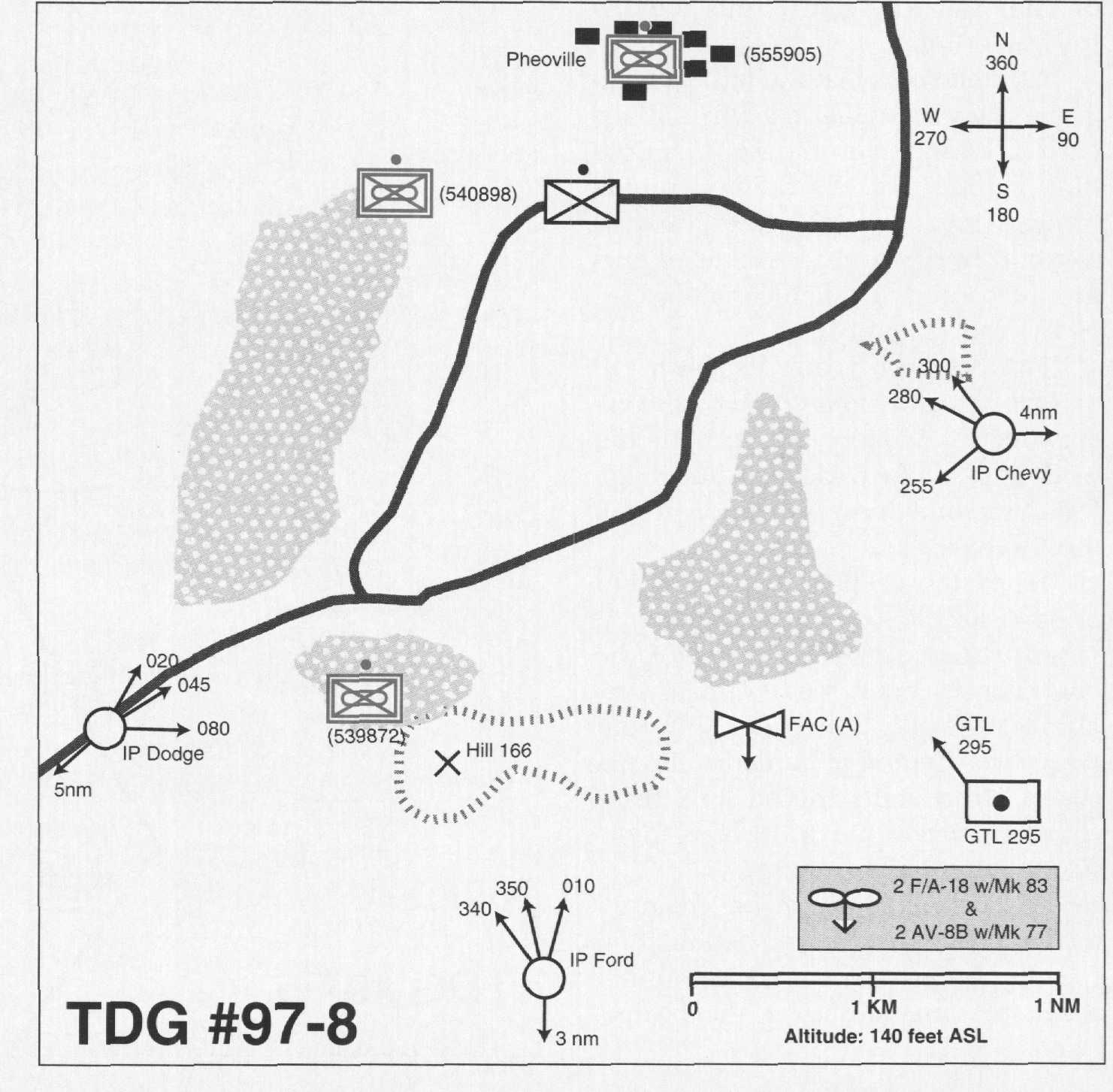
You are a UH-1N pilot conducting a routine visual reconnaissance mission when the direct air support center (DASC) diverts you to act as an airborne forward air controller, or FAC(A). Your new mission is to support a Marine squad patrol pinned down in an irrigation ditch south of Pheoville, an abandoned village made of wooden structures. The DASC is also diverting fixed-wing close air support (CAS) for your control and passes a call sign and frequency for an artillery battery that is to provide direct support.

You approach the area to the west of Hill 166 and immediately come under small arms fire from a tree line north of the hill. Your door gunner suppresses the fire, and you reposition yourself to the east of Hill 166, where you have a good vantage point overlooking the area. You contact the squad by radio. The squad leader reports he has had no communication since the initial call for help. He indicates the squad is taking fire from Pheoville and the tree line to the west. Due to the intensity of the fire, the squad cannot break contact and is pinned down in the elbow of the ditch just south of Pheoville. The squad leader reports he needs to get to a landing zone to evacuate two wounded Marines. Although the volume of fires from the west is heavier, the squad leader reports the fires from Pheoville are having more effect and if that target is suppressed the squad should be able to break contact.

Your copilot has been busy identifying targets with a forward-looking infrared (FLIR) system. He has identified two BTR-152s, one ZU-23, and at least a squad in Pheoville. On the north side of the western wood, he has identified a bunker that seems to contain a heavy machinegun-possibly a 14.5mm. He also estimates at least a squad in trenches around the bunker. [The location of the inital points (IPs), and the bearing to the three known enemy targets-Phoeville, the bunker position, and the southern troops-are shown on the sketch.] Your wingman lets you know he has contacted Alpha Battery and the battalion air officer for initial liaison. The former reports a maximum ordinate of 5,000 feet. The latter reports no other friendlies in the area. You are given terminal control responsibility.

A section of AV-8Bs and a section of F/A-18s check in on the assigned tactical air direction (TAD) net. The Harriers are carrying four Mk 77 fire bombs each. The Hornets are carrying four Mk 83s each. Each Huey in your section is carrying four 2.75-inch rockets, six 2.75-inch HE, a .50 caliber machinegun, and a 7.62mm minigun. Requirement

In a time limit of 10 minutes, come up with a plan of action. First, describe your overall concept, then provide any reports and support requests. Then provide a brief explanation of your decision. Send your solution to the Marine Corps Gazette, TDG #97-8, P.O. Box 1775, Quantico, VA 22134 or fax 703640-0823. For more detailed information on the structure of Marine Corps units, Marine Corps equipment, and symbols used in TDG sketches, see MCG, Oct94, pp. 53-56 and the modification reported in Jan95, p. 5.
Rest No More

By Andrew H. Hershey

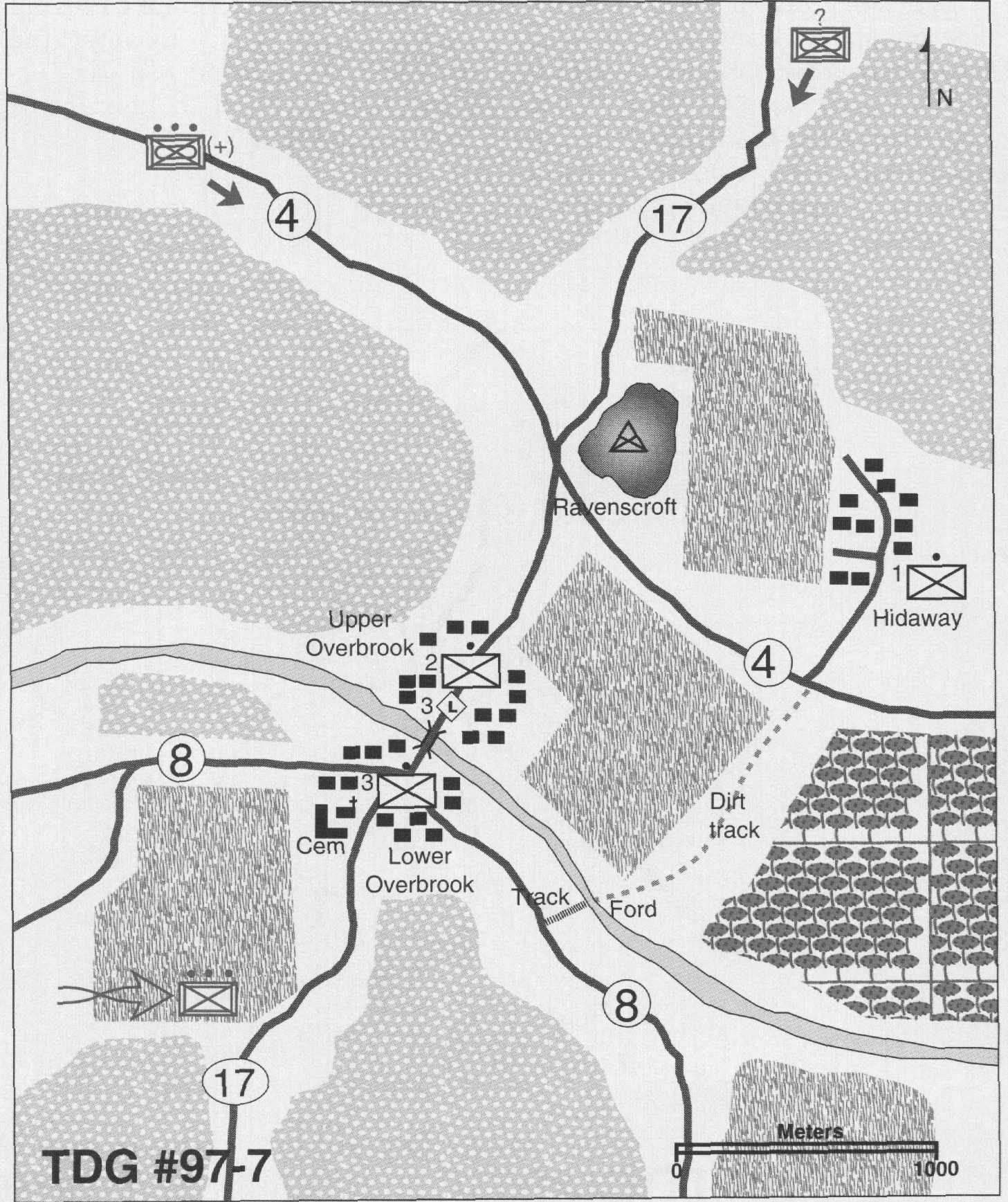
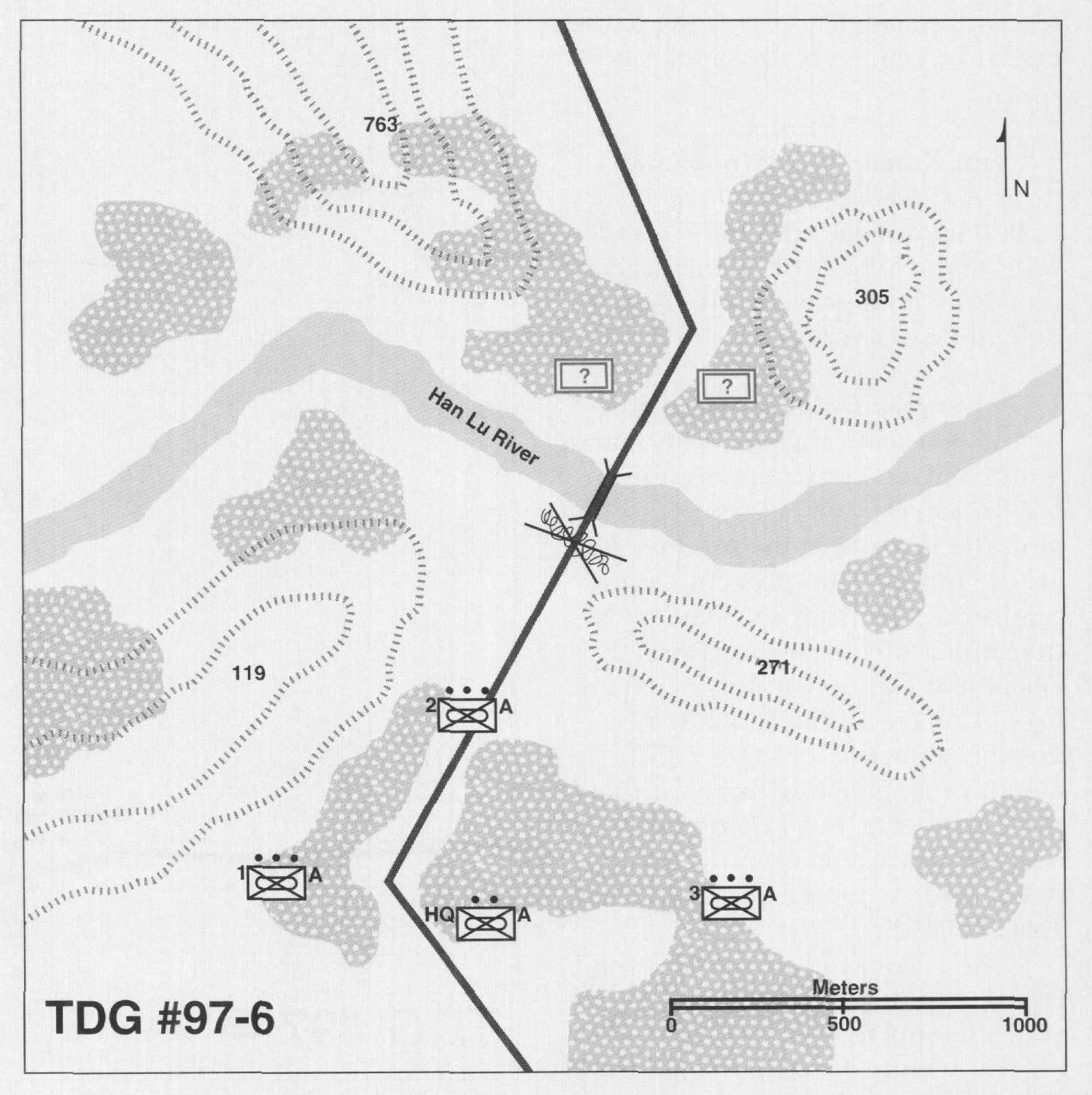
You command a Marine rifle platoon. You and your men have been in a standdown period for the last 48 hours while the rest of the company has remained in the line to the north. Your platoon has been billeted in two small villages, Hidaway and Overbrook, with a fire team observation post (OP) on Ravenscroft, a steep rock outcropping that overlooks two key roads. Each squad has four AT4s in addition to its normal arms. The swift boulder-strewn stream that runs through Overbrook is passable for men and machines only at the bridge and at a ford located a kilometer downstream from Overbrook.

Truck transport is scheduled to arrive at 0700 to return your unit to the forward area of operations, but you have not heard from the motor transport company as to its estimated time of arrival.

As you wait, you suddenly get this report from your OP:

This is Ravenscroft. I have enemy mechanized infantry in BMPs, estimate platoon strength, heading southeast on Route 4 at 20-25 kilometers per hour. The third and fifth vehicles appear to be bridgelayers. Also suspect enemy mechanized activity 3 klicks north of me on Route 17, though no visual at present.

Almost immediately the sergeant from 3d Squad-in your judgment your most capable NCO-comes on the net and reports that he has just seen enemy transport helicopters lifting off from the edge of the grain field 1.5 klicks southwest of Lower Overbrook. He estimates the helicopters could have inserted an infantry platoon.

As these reports are coming in, an a light armored vehicle (LAV) detachment (two LAV-ATs and one LAV-25) traveling north on Route 8 arrives in Overbrook. You explain the reports you have just received to the lieutenant in charge of the LAVs. He agrees to put himself under your command, but informs you that his TOW vehicles have only five rounds apiece. The LAV-25, however, is fully armed with a mix of armor piercing and high explosive ammo and has three scouts aboard.

How do you plan to employ your expanded command, Lieutenant?

Requirement

In a time limit of 5 minutes draft your frag order and any other reports/requests you might make. Then provide a sketch of your actions and explain the rationale behind them. Send your solution to the Marine Corps Gazette, TDG #977, P.O. Box 1775, Quantico, VA 22134 or fax 703-640-0823.

For more detailed information on the structure of Marine Corps units, Marine Corps equipment, and symbols used in TDG sketches, see MCG, Oct94, pp. 53-56 and the modification reported in Jan95, p. 5.
Contact at the Han Lu River Bridge

By Capt Timothy E. Barrick

Situation

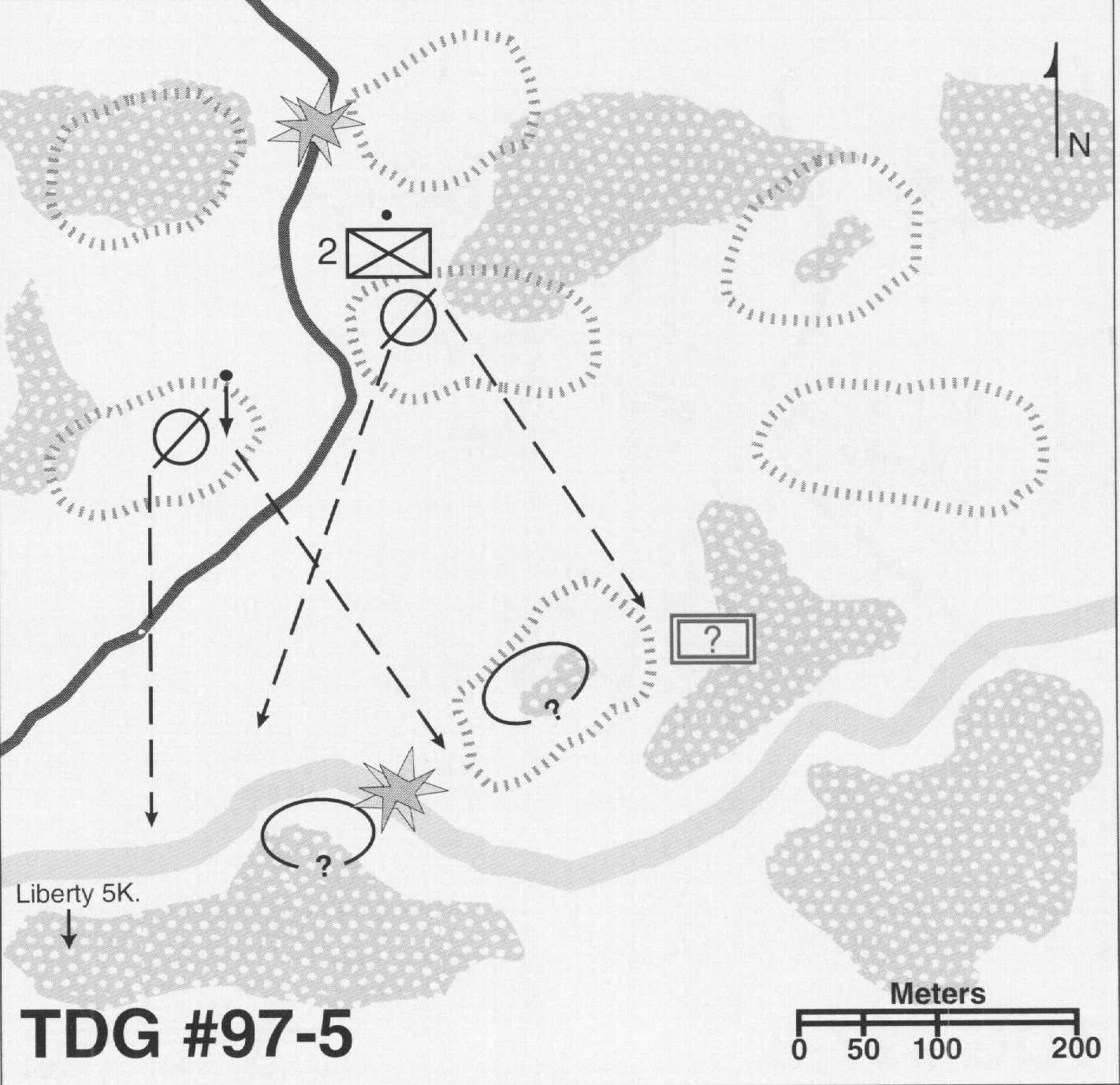
You are the commander of Company A, 1st Battalion, 6th Marines. Your battalion is attacking north to secure a bridgehead across the Han Lu River for the regiment’s attack into the enemy’s rear areas. There are two bridges in the battalion’s zone, and it is the battalion commander’s aim to secure both bridges to give the regiment more flexibility in choosing its axis of advance. Company B has been tasked with seizing the bridge about 6 miles to the east and is the battalion’s main effort. You are the supporting attack and have been tasked with seizing the bridge to your front. Company C is in reserve to the rear of Bravo.

The S-2 believes that the remnants of an enemy mechanized battalion may be defending the areas north of the river. The enemy is experienced and well equipped with surplus Warsaw Pact weapons and vehicles. However, the force you are facing has been significantly worn down after several days of severe fighting. It is 1420, and the weather is clear. The terrain is wooded and consists of gently rolling hills. The woods are not thick and allow passage of vehicles, although the going is difficult.

Your company is mounted on AAVs. You are moving in a wedge formation with lst Platoon on the left, 2d Platoon in the lead, 3d Platoon on the right, and your Headquarters Section tucked in the middle. You have attached one machinegun squad and two assault teams to each platoon. Your Mortar Section is moving with the Headquarters Section.

You send 2d Platoon forward to get eyes on the bridge. The platoon commander radios that he is dismounting and moving to the forward tree line to observe the bridge. A few minutes later he reports:

Bridge is intact. Roadblock on the south side of the bridge. Dug-in positions in tree line across river on both sides of the road. Estimate platoon size position. I have not been seen. Am continuing to . . .

His radio transmission is interrupted by the chatter of machinegun fire. Beginning with one gun, it rapidly escalates. Moments later, the platoon commander reports again:

Am receiving heavy machinegun fire from tree line across the river. They are vehicle mounted and well dugin. Cannot identify vehicles clearly. Have three casualties and am pulling back to the tracks.

As his transmission ends, you hear and see light mortars begin to impact in the vicinity of 2d Platoon. What now, Captain?

Requirement

In a time limit of 5 minutes, issue any orders you would give and make any requests or reports. Once this is done, provide a sketch of your plan and an explanation of your decision. Send your solution to the Marine Corps Gazette, TDG #97-6, P.O. Box 1775, Quantico, VA 22134 or fax 703-640-0823.

For more detailed information on the structure of Marine Corps Units, Marine Corps equipment, and symbols used in TDG sketches, see MCG, 0ct94, pp. 53-56 and the modification reported in Jan95, p. 5.

Meeting at the ‘Mounds’–The platoon commander

By Maj John F. Schmitt, USMCR

This scenario is the continuation of TDG #97-3, “Meeting at `The Mounds,’ only this time you are the platoon commander instead of the squad leader. The scenario is based on the author’s solution to TDG #97-3, which appears on page 91.

Situation

You are a platoon commander in company K, 3d Battalion, 4th Marines. The company is making a movement to contact, moving south toward Liberty with the mission of locating and destroying any sizable enemy forces en route. The company commander has said he “wants to bag a big one.” The march objective is merely a reference point for the direction of movement; the true objective is the enemy. You are fighting infantry forces that use maneuver and fires aggressively. Your platoon is the advance guard. 1 st Squad, led by your most experienced and reliable squad leader, has the point. You are about 200 meters back, followed by 2d and 3d Squads.

1st Squad has entered an area known as The Mounds. The sudden sound of small arms and machinegun fire up ahead tells you that 1st Squad has made contact. Just then, artillery starts impacting around you. You move through the barrage and notice that 2d Squad has managed to follow you, but 3d Squad has not. You come across a fire team engaging the enemy from one of the mounds and another fire team and machinegun squad doing the same from a mound to the right. The fire team leader points out two enemy positions to the south, which you estimate to have a total strength of at least a platoon. You immediately call for fire on the enemy positions (shifting from your current position, which is a preplanned target). The fire team leader says: “The squad leader and the 3d Fire Team are checking out the left flank.”

“How long ago did he leave?” you ask.

“Less than 5 minutes.”

2d Squad leader has joined you and points out movement in a small wood between two mounds to your left front, very close to one of the enemy positions. You check your watch and are surprised to see that it has only been 12 minutes since the engagement started. Fire has settled to a sustained rate. You search to the left but see no sign of the 1st Squad leader or the men he took with him. You look behind you and see no sign of 3d Squad through the artillery fire. Your radioman reports: “The CO’s on the hook asking for an update.” What do you do, Lieutenant?

Requirement

In a time limit of 5 minutes, issue any orders you would give and make any requests or reports. Once this is done, provide a sketch of your plan and an explanation of your decision. Send your solution to the Marine Corps Gazette, TDG #97-5, P.O. Box 1775, Quantico, VA 22134 or fax 703-640-0823.

For more detailed information on the structure of Marine Corps units, Marine Corps equipment, and symbols used in TDG sketches, see MCG, Oct94, pp. 53-56 and the modification reported in Jan95, p. 5.
Battle of Sanna’s Post

By Capt Douglas J. MacIntyre

Situation

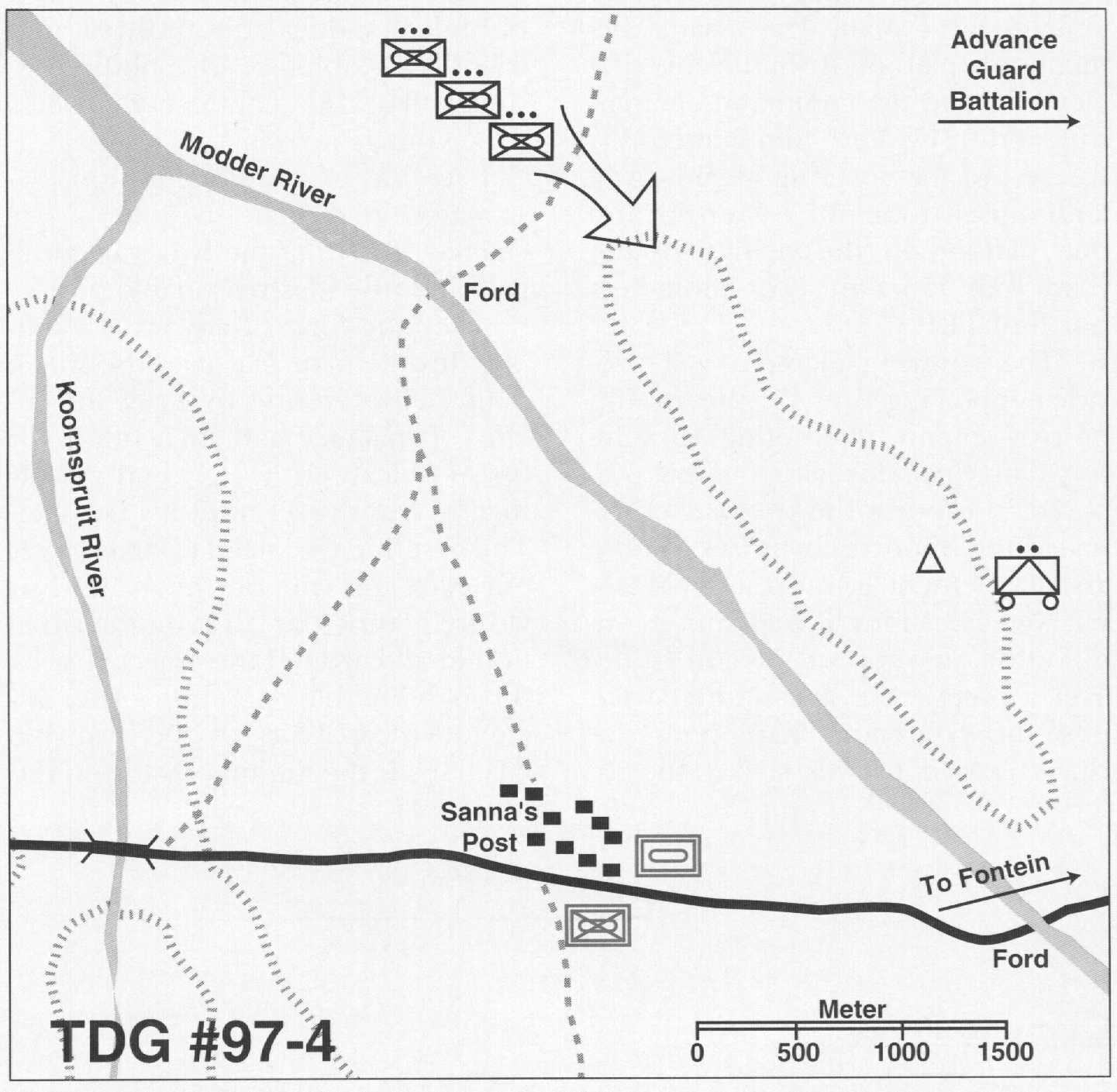
You are the commanding officer of a rifle company with an assault amphibious vehicle (AAV) platoon and a combined antiarmor team (CAAT) made up of three TOW HMMWVs and two heavy machinegun (HMG) HMMWVs. The battalion is currently moving south-southeast as 2d Marines’ advance guard. The regimental landing team (RLT) is pushing hard to engage enemy mechanized forces moving east before they can consolidate near the port city of Fontein. Your company’s mission is to provide flank security on the right of the battalion’s movement to contact and to be prepared to assume the lead element as directed.

The terrain in the area is a flat, rocky desert, with sparse vegetation. Two rivers, flanked by steep banks, run through the area and are swollen by recent rains; they are fordable at only a few points. Elsewhere trafficability for wheeled and tracked vehicles is good. It is 0100, partly cloudy with good visibility. You are currently moving 10-15 kilometers per hour south, approximately 3-4 kilometers west of your battalion.

The CAAT team, currently moving in advance of the company, has sent scouts along the high ground to observe the Modder River area, including Sanna’s Post, a small village to the west, and the road running perpendicular to your route. The CAAT leader reports “Enemy sighted, vicinity of Sanna’s Post, 2,000m west of Modder River Ford. Looks like a logistics site with two T-72s, a BTR-60 platoon, and many fuel trucks and supply vehicles. They are stationary near several small buildings. Will maintain observation and move vehicles into firing positions. I don’t think they have seen us. Please advice.

As you digest that information, battalion reports “lead companies heavily engaged with elements of motorized rifle battalion and tank force . . . Regiment will attempt flanking maneuver with its follow-on forces as we fix the enemy . . . I am counting on your company to prevent enemy reinforcement from the west . . .”

What is your plan, Captain?

Requirement

In a time limit of 10 minutes, decide what you will do, prepare appropriate orders as well as any requests/reports you would submit. Provide a sketch and an explanation of your plan. Mail your solution to Marine Corps Gazette, TDG #974, P.O. Box 1775, Quantico, VA 22134 or send fax to 703-640-0823 or Email to ([email protected]).

For more detailed information on the structure of Marine Corps units, Marine Corps equipment, and symbols used in TDG sketches, see MCG, Oct94, pp. 53-56 and the modification reported in Jan95, p. 5.
Meeting at ‘The Mounds’

By Maj John F.  Schmitt. USMCR

This TDG should look familiar. Its scenario is essentially the same as the one encountered in TDG #97-1 for which three solutions are given on the preceding pages. There is one major difference however-this time you are the enemy. How does having read pages 83-85-having looked at three alternate ways your opponent might see the situationinfluence your decision? Does it help you to have “worn your opponent’s shoes” for a few minutes? Is “wearing his shoes” part of what is meant by orienting on the enemy?

Situation

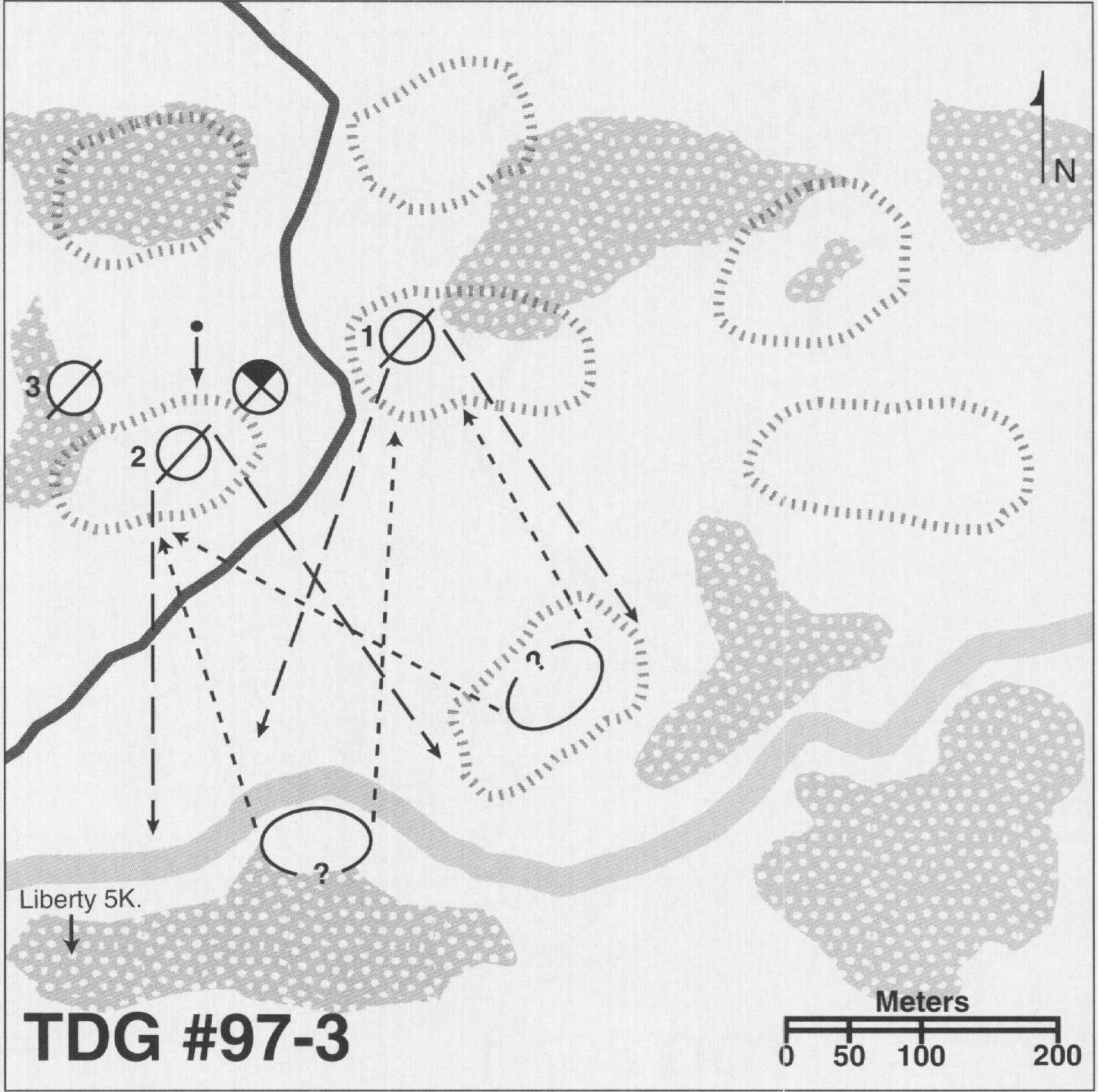
You are a squad leader in Company K, 3d Battalion, 4th Marines. The company is making a movement to contact, moving south toward Liberty. The company’s mission is to locate and destroy any sizable enemy forces en route. The company commander has made it clear that the march objective is merely a reference point for the direction of movement; the true objective is the enemy. You are fighting an aggressive infantry force that when assembled usually either pushes rapidly ahead to bypass your positions or calls in supporting fires and attacks them.

Your platoon is the advance guard, and your squad has the point. Your lieutenant has given you the following instructions:

I’m relying on you to develop the situation to the best of your ability whenever you make contact. If you can overpower the enemy yourself, fine. If it’s a sizable enemy force, my intent is for you to develop the situation advantageously for the rest of the company. Try to maneuver to fix the enemy so they can’t escape and so the CO can bring the rest of the company to bear. I’ll support you with the other two squads.

Your squad is in a wedge formation with 1st Fire Team on the left, 2d Fire Team in the center leading, and 3d Fire Team on the right. An attached machinegun squad is located with you behind 2d Fire Team. The platoon commander is about 200 meters behind you, and the rest of the platoon is about 300-400 meters back.

Your squad is moving through an area known as The Mounds, generally following a road that winds its way toward Liberty. The terrain is unusual and you have Marines on both sides of the road alert for possible contact. As 2d Fire Team crests one of the mounds, you see the Marines drop quickly to the prone position and begin firing. You crawl forward to the crest and can see an enemy force firing from a stream bed about 300 meters south. Another position soon opens up from a mound to the left front. You estimate the total enemy strength so far at about platoon strength. You notice that 1st Fire Team has also taken up firing positions on a mound to your left. 3d Fire Team and the machineguns are in defilade to your right rear. Supporting arms begins exploding on the road about 200 meters to your rear. What do you do, Sergeant?

Requirement

In a time limit of 2 minutes, issue any orders you would give. Once this is done, describe any additional action you would take and provide a sketch of your plan and an explanation of your decision.

A Pointed Projection of Power

By S.E. Richmond

Situation

As the commanding officer (CO) of Battalion Landing Team (BLT) 1/6, 26th Marine Expeditionary Unit (Special Operations Capable (26th MEU(SOC)) you’re attending a CO’s and senior staff meeting on USS Wasp (LHD-1) in the Adriatic. The MEU CO is briefing on a mission just received.

“Our Amphibious Ready Group has been designated a Joint Task Force (JTF). We have been tasked by the National Command Authorities to demonstrate the resolve and military capability of the United States to the Serbian leadership by conducting a forcible entry into Mosovic and seizing two indicted war criminals. Rules of engagement allow the immediate use of deadly force against armed men and military vehicles. The S-2 will now fill us in on the opposition.”

“Security for the Serbian headquarters in Mosovic consists of a mechanized rifle company, reinforced with SA-7 teams, mounted in seven BRDMs and some trucks. They are concentrated around the town square. There is a 750-man mountain brigade living in the hills 6 kilometers east. Analysis indicates they will fight. Two Serb mechanized brigades are reported to be dispersing among the Serbian population further to the east. Along with the SA6 and associated radar activity around Bihac and Banja Lake, an EA-6B picked up emissions from acquisition and range radars around the units at the border.”

“Thanks 2. We’ll use a fake helo mishap as deception to set up a forward arming and refueling point (FARP) and staging area here at Kalinovik, 41 nautical miles from Mosovic. Then just before dawn we will prep target reference points (TRPs) 2 through 5 with cluster munitions and drop the northern bridge (TRP 1) with four Mk-84 laserguided bombs. Almost simultaneously we’ll helo assault into Landing Zones Lew and Frenchy to take MEU objectives Alpha and Bravo. If they won’t surrender the bad guys, we seize the town.

“If they call for reinforcements our aviation combat element (ACE) will teach them all about Marine air support. The ACE CO is to serve as the joint forces air component commander and will have opcon of VMFA-224 and VMAQ-1. CVW-7 is tasked in direct support from USS Washington; she has four MH-53s available also.

“We will withdraw under heavy air cover, but detailed withdrawal planning must wait for events to develop.

“Commander Amphibious Task Force 4 (CATF) has shifted to Shreveport. I will command from the Wasp’s Combat Information Center. “CO, BLT we need your scheme of maneuver ASAP. Your battalion is reinforced with a platoon each of engineers, recon, LAVs, tanks, tracks, and a battery of M198s.”

In response to questions the ACE S-3 said they could lift up to 510 loaded personnel per wave, subtracting 19 per HMMWV and 38 per LAV or M198.

Requirement

In 30 minutes provide a scheme of maneuver to seize Alpha, Bravo, and then the town; also recommend a withdrawal option. Include rationale, sup port requests, and a map sketch. Mail your solution to Marine Corps Gazette, TDG #97-2, Box 1775, Quantico, VA 22134, or send by fax (703-640-0823 or E-mail ([email protected]).

Intuitive Decisionmaking

by LtCol Leonard A. Blasiol

When I received my April 1996 Gazette, I turned immediately to the Tactical Decision Game (TDG), as always, and worked the problem. Later, when reading that issue’s round of debate on the subject of intuitive decisionmaking, I thought about the technique I had used to develop my solution to the TDG: I’d analyzed the mission, identified several courses of action, quickly analyzed those options according to various criteria, and selected the “best” of them for execution. It felt intuitive, but in reality I had instinctively and subconsciously resorted to the standard analytical model of FMFM 3-1.

Reviewing my thought process, I realized that my first course of action could have accomplished the mission, although it entailed a great deal of risk. My second choice minimized risk. The whole process took me about 4 minutes (Maj John F. Schmitt, author of the game, allowed me 10). So, by resorting to that age-old analytical method (streamlined through internalization and several major shortcuts), I hit upon a better decision than that originally considered, and still within the game’s time limit.

Intuitive decisionmaking is a worthy goal, but there’s an irony to it. Maj Schmitt, who also authored one of the decisionmaking articles, stressed that intuition is based on experience. So we can conclude that as we move down the chain of command to the level of company grade officers and noncommissioned officers (NCOs), the quality of intuition will be correspondingly degraded as the level of experience decreases. Unfortunately, the further down the chain we look, the more likely it is that leaders will find themselves in situations requiring rapid decisions. Historically, commanding generals rarely, if ever, find themselves having to make immediate decisions. At the other end of the spectrum, a sergeant commanding a squad in combat may be forced to make scores of immediate decisions every day. So, the leader with the most highly developed intuition-the general-rarely uses that talent, while the leader whose need for intuition is greatest-the NCO-lacks the requisite experience.

I agree with Maj Schmitt’s contention that intuitive decisionmaking can’t be taught-it must be learned. Sadly though, it is improbable that even a reasonable percentage of Marines are capable of such learning. A hint of the reason for that may be found in Cdr James J. Tritten’s fine article of that same issue, “Intuitive Combat Decisionmaking.” Cdr Tritten noted that, “If anything, the desired Myer-Briggs Type Indicator pattern at the highest levels of the military are ‘NT’ (intuitive thinking).” When the Myer-Briggs Type Indicator was administered at the Marine Corps Command and Staff College in the late 1980s, the results indicated that more than 90 percent of Marine Corps officers displayed the “SJ” preference (sensing-judging), the polar opposite of the preference that indicates a capacity to develop and use intuition. While people can learn to use skills that fall outside their own set of preferences (as Cdr Tritten stated) we must remember that to do so can be very challenging, like forcing oneself to breathe. In a demanding situation, such as combat, people will typically resort to their “comfort zone.”

What is perhaps the most revealing comment on this subject to appear in the April 1996 issue was in an unrelated article. In a fine piece entitled “On Going To War,” LtGen Bernard E. Trainor wrote:

. . . I learned a lot in those final 72 hours of TBS. Most of all I learned how easy it is to become mistake prone when cold, wet, sleepless, and fatigued over a prolonged period of time. It was then that the rote repetition of things like the five paragraph combat order, the seven troop leading steps, and immediate action drills suddenly made sense. They allow an officer to engage in automatic when the brain can’t handle manual. It was a lesson I appreciated the rest of my career.

The 10 percent who possess the rare characteristic described by T.E. Lawrence as “the flash of the kingfisher” (itself the subject of a fine article in these pages some years ago) can decide intuitively under the most demanding circumstances. For the other 90 percent of us, perhaps there is some value in the structure afforded by analytical methods.

On the Road to Martinstraus

By Steven L. Banks

Situation

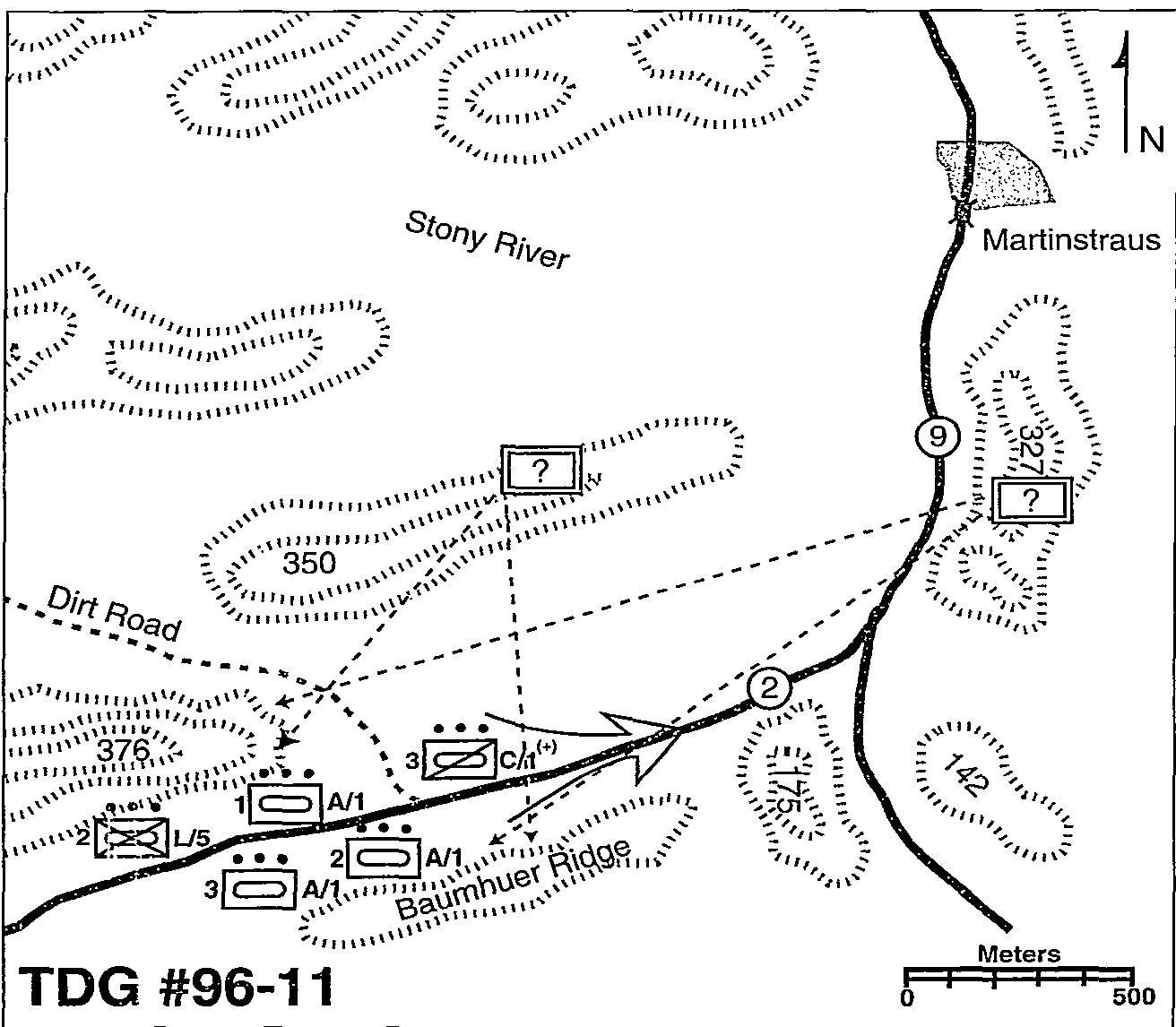
You are the commander of Company A, 1st Tank Battalion, with three tank platoons, a rifle platoon on AAVs, and a reinforced light armored reconnaissance (LAR) platoon (four LAV-25s, two LAV-ATs). 1st Marine Division is conducting combat operations in a hilly region of the country of Tracoatia and plans to attack northeast to destroy a brigade-size enemy force that intelligence indicates is building up north of Stony River. 1st Tanks has been ordered to seize the Martinstraus bridge in order to facilitate the attack north across the river. Your company will be the advance guard, with the rest of the battalion following in trace ready to support. Battalion informs you that artillery and four AH-1W Cobras are in direct support of your company.

At 0700 your company departs its assembly area traveling along Route 2 in the order of march shown. As you approach the dirt road intersecting Route 2, your company begins receiving fire from Hills 327 and 350. Your platoons seek cover and return fire. Your forward observer (FO) calls for artillery support. You estimate the incoming fire to be 14.5mm, consistent with what you would expect from enemy security forces.

What are you going to do, Captain?

Requirement

In a time limit of 5 minutes decide what you \vill do by issuing any orders and/or making any appropriate reports/ requests. Then provide a sketch and any explanation of your plan. Send your solution to Marine Corps Gazette, TDG #96-11, Box 1775, Quantico, VA 22134 or fax 703-640-0823.

On a Clear Day

by Maj John F. Schmitt, USMCR

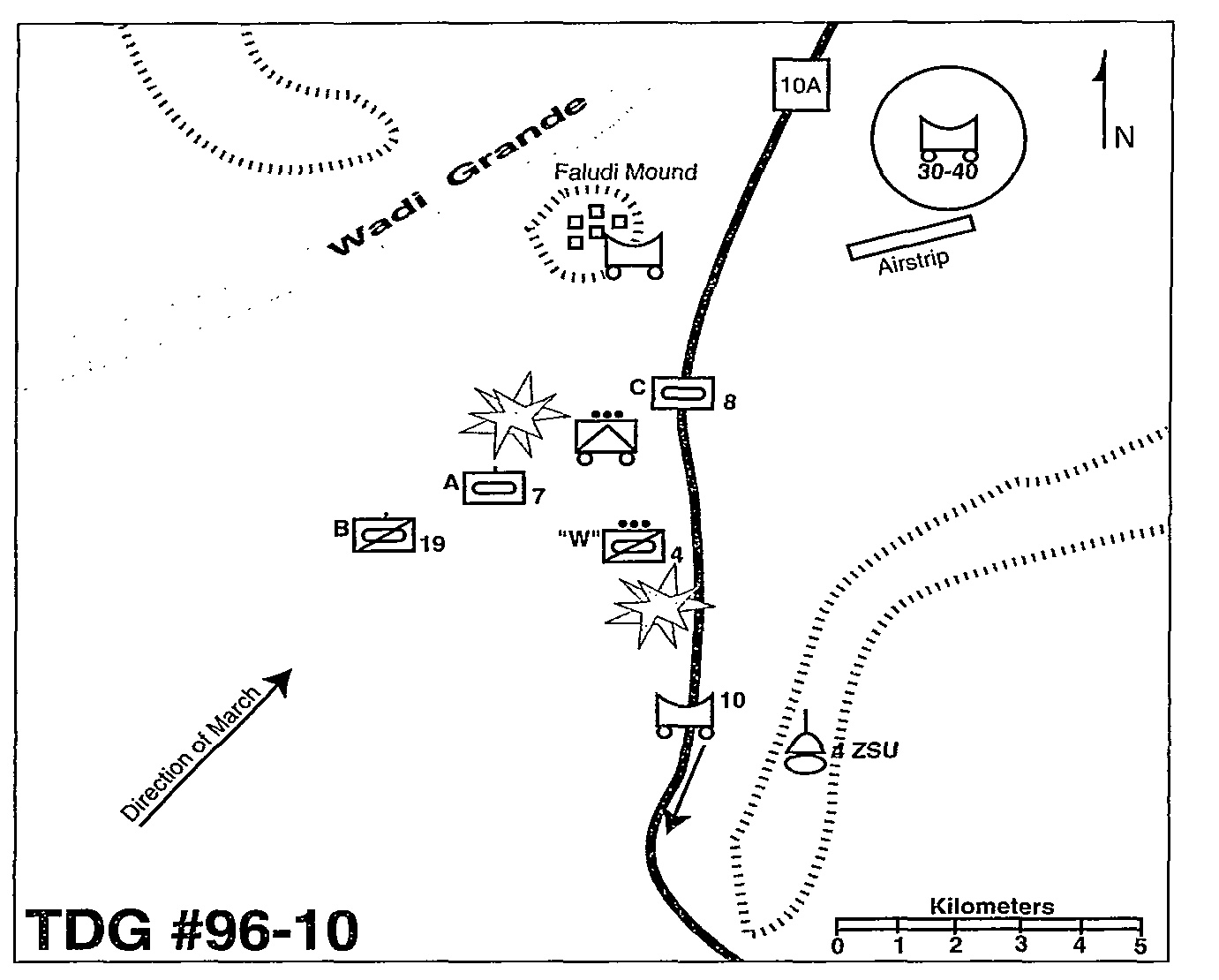
You are the commanding officer of a tank battalion operating in a desert region with three tank companies and an antitank platoon of five TOWs. It has been a war of rapid movements. The enemy is generally to the north, but after the marching, countermarching and confused fighting of the last 24 hours you realize that is a fairly meaningless distinction. There exact location is uncertain. At 0200 you are in a leaguer. With no idea of where the nearest friendlies are, you established 360-degree security. You have refueled; you have redistributed ammunition and decide you have enough to get you through another engagement. Your main concern is trying to raise Bravo Company, which you have not seen or heard from since early afternoon. Alpha Company has seven tanks, Charlie has eight.

You are thinking you might actually get some rest tonight when you receive instructions from division: “A mixed enemy force of tanks and mech-estimated battalion strength, but that’s probably exaggerated-was reported to have overrun the Faludi airstrip about an hour ago. Attack to destroy.” You ask for more information, but that is all that is known. You remind division of your ammunition situation and the fact that you only have 15 tanks, and the reply is: “Roger; attack at the earliest opportunity.”

Faludi is a deserted settlement on a small mound some 25 kilometers north-north-west. By 0245 you move out with Charlie in the lead, followed by your headquarters with the TOWs, and Alpha in the rear. At 0330 you meet up with a reinforced light armored reconnaissance company (19 LAVs) that lacking any other instructions, falls in behind Alpha. At 0430 Alpha reports that another platoon of LAV-25s (callsign “Whippet”-4 LAVs) has attached itself to your right flank.

At 0550 Charlie reports it has hit a track that you think must be Route 10A. You move forward to have a look. Dawn is just beginning to appear. Your gunner is listening to Armed Forces Radio and says: “It’s gonna be clear and hot today.”

Charlie reports it can just make out Faludi in the haze about 5 kilometers north. “There are a couple thin-skinned vehicles there. I can’t ID them.” Suddenly, gunfire erupts to the south and Charlie reports: “Whippet has just engaged a convoy of about 10 vehicles. They are fleeing south.” Charlie now reports: “I’ve got a visual on the airstrip. About 30-40 trucks; maybe 6 artillery pieces; no armor or mech.”

The engagement continues in the south and now Alpha reports: “Whippet is pursuing the convoy and says they’re engaging some ZSUs-4 or 5 of ’em-on an escarpment about 5 clicks south.” Just them, artillery fire starts to land just north of your position. A piece of shrapnel pings off your turret. You decide it’s going to be anything but clear today, but it is starting to get hot. What do you do?

Requirement

In a time limit of 5 minutes, decide what you will do by issuing instructions to your subordinates. Then provide a sketch, a short explanation, and a premortem (see box insert) of your decision. Send these items (the initial solution, unaltered by the premortein results) to Marine Carps Gazette, TDG #96-19, Box 1775, Quantico, VA 22134 or fax 703-640-0823.

Flank Guard, Part III

by Maj John F. Schmitt, USMCR

This scenario is the continuation of Tactical Decision Game #96-3, “Flank Guard” (MCG, Mar96) and Tactical Decision Game #96-7, “Flank Guard, Continued” (WICG, Jul96), based on the author’s solution to #96-7 on p. 107.

Situation

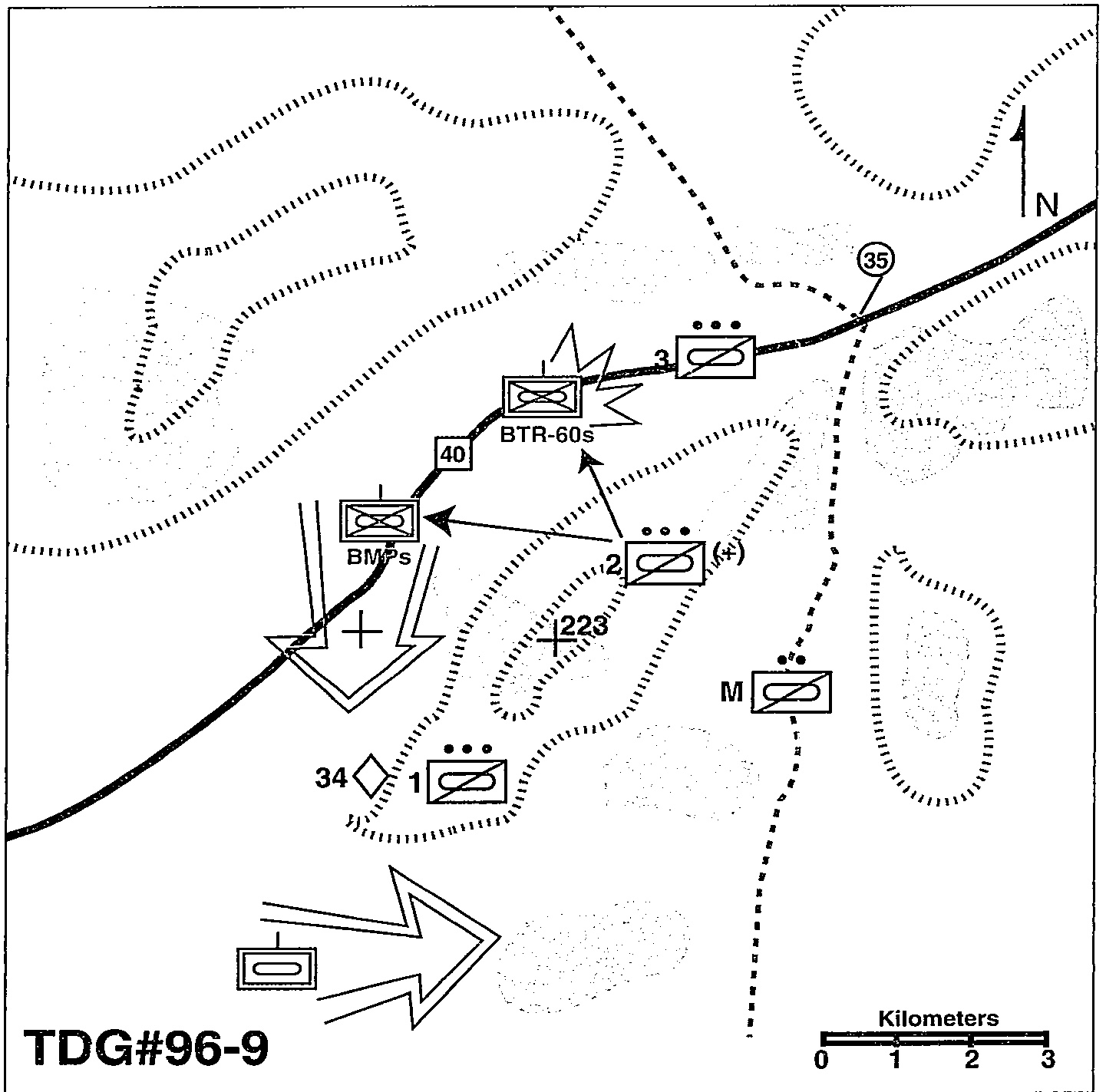
You are the commander of a light armored reconnaissance (LAR) company guarding the right flank of 6th Marines. You are about 10-12 kilometers east of 6th Marines, generally paralleling that regiment as you move north astride a dirt road. The terrain is sparsely vegetated. It is a clear night.

As you near Checkpoint 35, you discover an enemy column moving west across your front with a company of T-64s in the lead followed by a company of BMPs and BTR-60s. You decide to spring a hasty ambush with the intent of drawing the enemy’s attention away from 6th Marines, but you only catch the tail of the column. You lose contact with the enemy tanks. 2d Platoon and your attached TOW section engage the enemy rear, but apparently a couple of LAV-ATs are hit. 3d Platoon makes no contact near Checkpoint 35, so you order it to attack west toward the enemy rear. Meanwhile, you lead 1st Platoon to the southwest side of Hill 223 to try to relocate the enemy tanks.

While moving, you monitor the progress of the other platoons. 3d Platoon’s attack seems to be going well; the platoon commander reports 5 or 6 enemy vehicles hit. 2d Platoon reports: “We’ve only got 1 LAV-AT operational; the others have been knocked out. I’ve collected the AT crews and 3 KIA. I’m engaging BTRs. Be advised the BMPs seem to be swinging around in your direction.”

As you move into position southwest of Hill 223, you spot the BMPS, under artillery fire, approaching from the north; a muzzle flashes as a BMP opens fire from about 2,000 meters. Just then your 1st Platoon commander reports: “Six T-64s, 200 degrees, range 2,500 meters.” A BMP 73mm round explodes nearby, and you decide it’s time to move. What will you do, Captain?

Requirement

In a time limit of 2 minutes decide what you will do by issuing any orders and/or making any appropriate reports/requests. Then provide a sketch and an explanation of your plan. Send your solution to Marine Corps Gazette, TDG #96-9, Box 1775, Quantico, VA 22134 or fax (703) 640-0823.