A World of Hurt

Situation

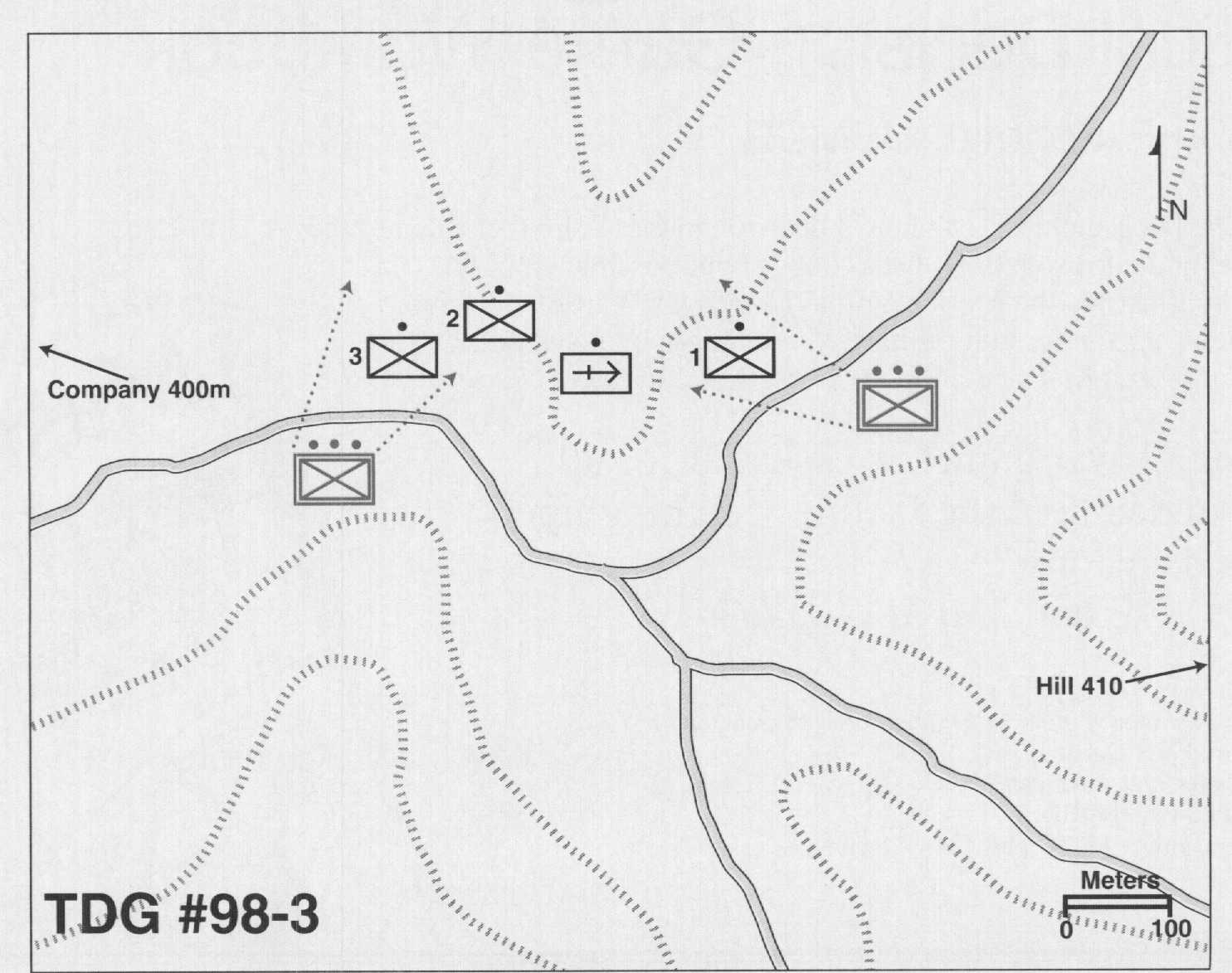
You are a platoon commander in Company K, 3d Battalion, 8th Marines. Attached to your platoon is one squad from the machinegun section of Weapons Platoon (two M240Gs). The company is conducting a movement to contact, through gently rolling wooded terrain broken by small streams, in order to locate and destroy enemy forces infiltrating your battalion’s area of operations. Yours is the lead platoon. Visibility is generally limited to less than 75 meters because of the thick vegetation. Streams have occasional pools, but are easily waded.

The company march objective is Hill 410. A half hour ago the company commander told you to step it out and reach Hill 410 as soon as possible to begin setting up the company’s defensive perimeter for the night. As a result, you are about 500 meters in front of the company when your lead squad seems to run into a large ambush directly to your front. It sounds like an enormous amount of fire is being delivered on 1st Squad as the whole platoon goes quickly to ground. 1st Squad begins to return fire, and you can hear the squad leader screaming commands. From your position with the machineguns, you start to make your way forward toward 1st Squad when a similar amount of fire erupts on your right flank back around where 3d Squad should be. From your position you cannot see either contact, but you can hear rounds whizzing overhead.

LCpl Vargas, from 1st Squad, crawls back to your position and reports: “Sir, Sgt Carden says 1st Fire Team is down, and we can’t get to them. He thinks there’s got to be a platoon in front of us!” At the same time, word is passed forward from the rear of the platoon: “Platoon sergeant says two men are down in 3d Squad; at least two enemy squads closing in from the right and rear.” Your company commander is on the radio wanting to know what’s going on. What now, Lieutenant?

Requirement

In a time limit of 3 minutes, issue any orders you would give and any reports/requests you would make. Once this is done, provide a sketch of your plan and an explanation of your decision. Submit your solution to Marine Corps Gazette, TDG #98-3, P.O. Box 1775, Quantico, VA 22134 or fax 703-640-0823.

Advance guard at Colenso Crossing

By Maj Kevin D. Poling, USA

Situation

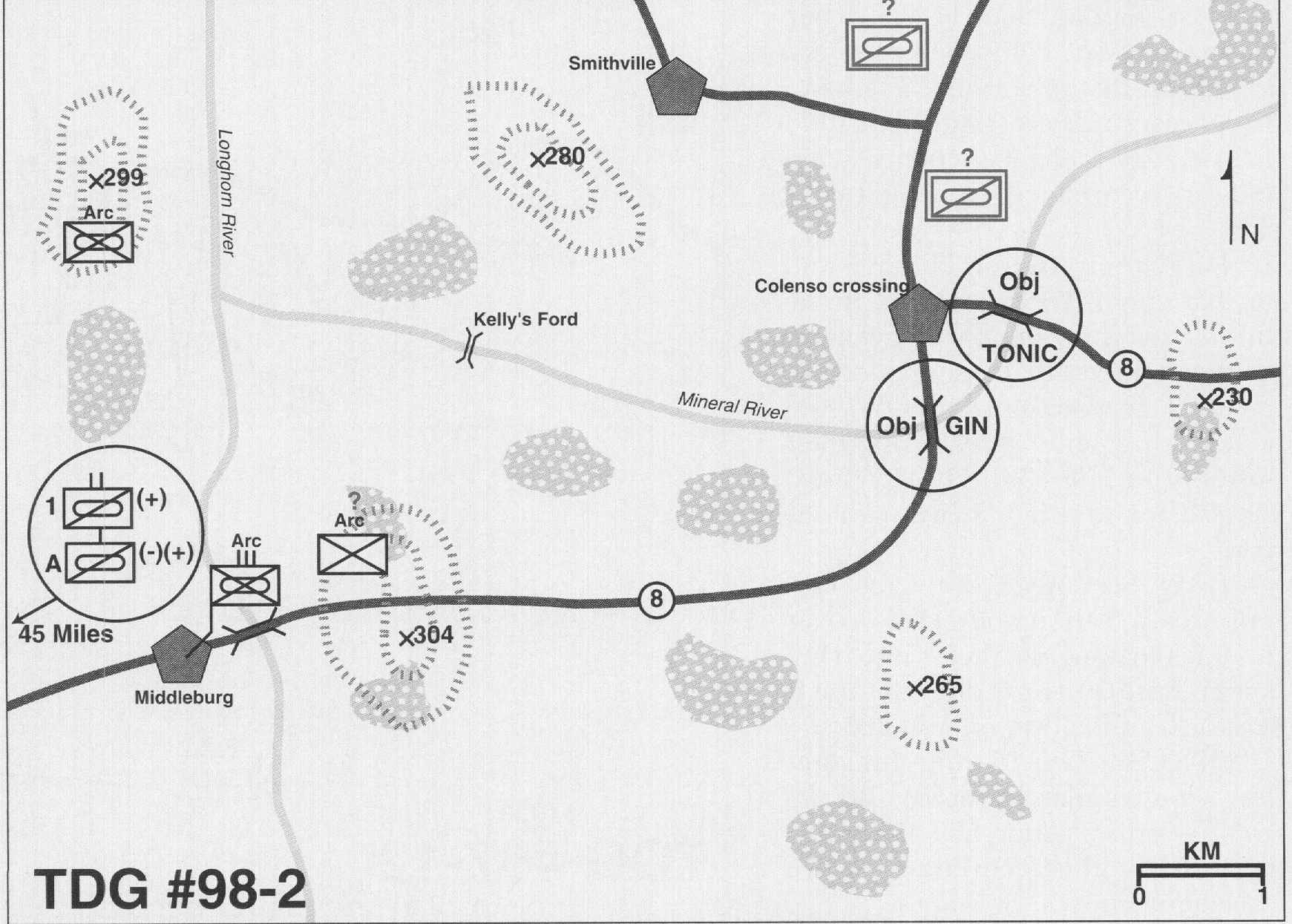
You are the commander of Company A, 1st Light Armored Reconnaissance Battalion, currently assembled about 45 miles west of Middleburg. Your unit is part of I Marine Expeditionary Force (Forward), which is supporting Arconian defense forces in resisting an invasion from Baltonia, its neighbor to the east. Reinforced by infantry, tanks, and artillery, the battalion is ordered to secure at first light the two bridges near Colenso Crossing in order to facilitate the attack by follow-on mechanized forces east along Highway 8 to defeat Baltonian forces and restore the Arconian border.

The time is now 2115. Your battalion commander briefs you on the situation: Arconian forces have broken contact and withdrawn to a hasty defensive line along the Longhorn River following a Baltonian attack. An Arconian regiment is located in Middleburg with forces on Hills 299 and 304. Since the Baltonian attack, only small enemy patrols have been sighted near Colenso Crossing, with no reports of enemy movements further west. Baltonian forces are equipped with secondhand Soviet-style gear and adhere loosely to Soviet doctrine. The Baltonians are not equipped with the latest thermal devices for night fighting, but there is a good chance they have captured some thermal devices from the Arconians. The Baltonians can achieve local air superiority for up to a few hours at most.

Highway 8 is a paved, two-lane highway in various states of repair between Middleburg and Colenso Crossing. The terrain is mostly rolling farmland with patches of forest. Because of steep banks, it is believed the Longhorn and Mineral Rivers can be crossed only at bridges or identified fords. Sunrise is at 0500 and sunset at 2000. Colenso Crossing is culturally significant, being the site of several historic Arconian landmarks.

Your company will form the battalion advance guard and main effort, and at 0500 will conduct a surprise attack to seize Objectives Gin and Tonic, the two bridges at Colenso Crossing. You will be reinforced with an infantry platoon on assault amphibious vehicles and a tank platoon, both of which are on their way to your company assembly area. The battalion main body will follow an hour behind and will consolidate positions around Colenso Crossing or reinforce your attack if needed. Supporting artillery will provide on-call suppression. Radio listening silence will be in effect until contact with the enemy. The battalion commander instructs you go forward with him at 2145 to coordinate the passage of lines with the Arconians at Middleburg, leaving you very little time to make the necessary arrangements. What is your plan, Captain?

Requirement

In a time limit of 10 minutes, issue any orders and make any appropriate reports/requests. Then provide a sketch and explanation of your plan. Submit your solution to Marine Corps Gazette, TDG #98-2, P.O. Box 1775, Quantico, VA 22134 or fax 703-640-0823.

For more detailed information on the structure of Marine Corps units, Marine Corps equipment, and symbols used in TDG sketches, see MCG, Oct94, pp. 53-56 and the modification reported in Jan95, p. 5.

Han Lu River Bridge, part II

By Capt Timothy E. Barrick

This scenario is the continuation of TDG #97-6, “Contract at the Han Lu River Bridge,” (MCG Jun97; Solutions, Aug97)

Situation

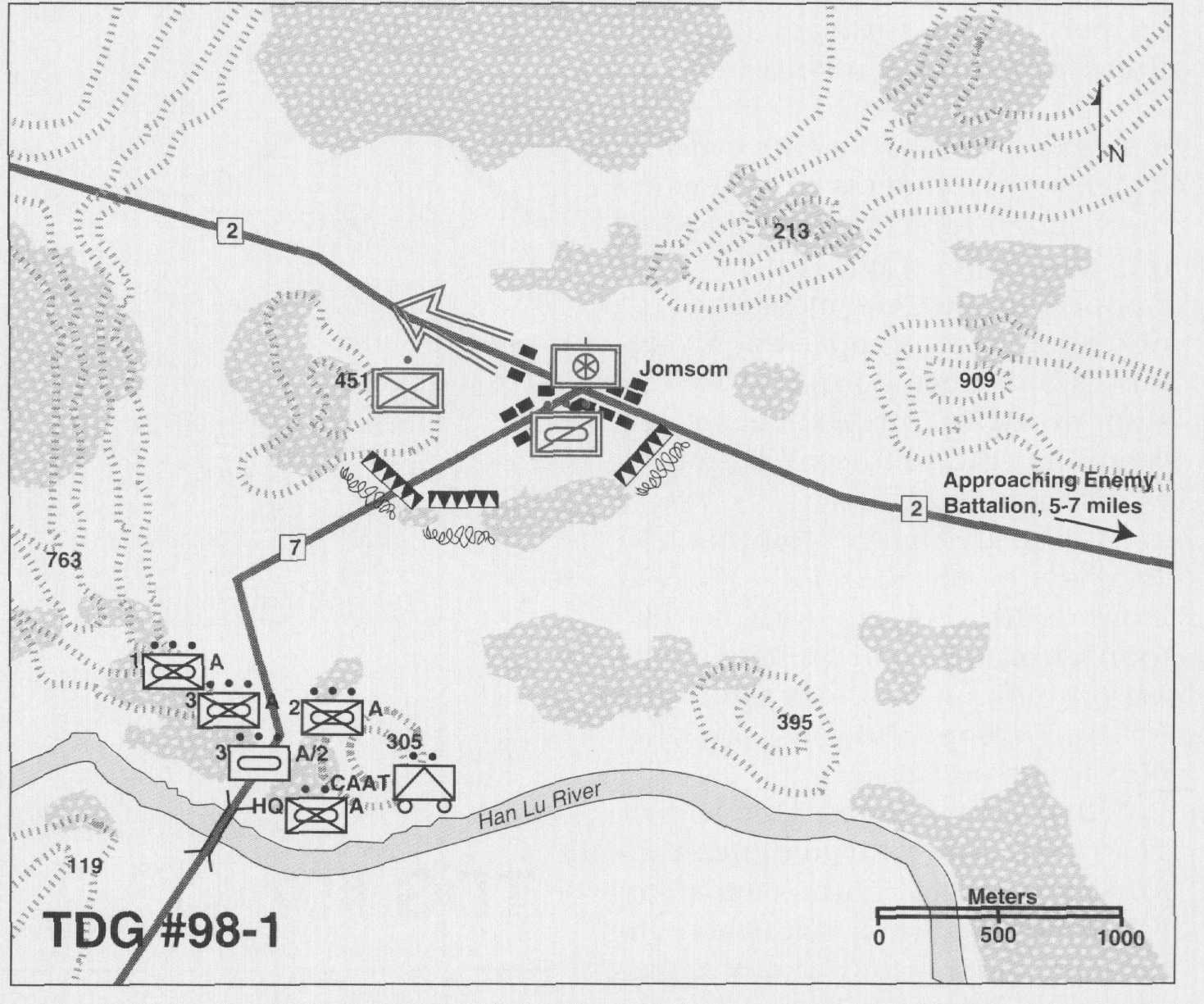
You are the commander of Company A, 1st Battalion, 6th Marines. Your battalion has attacked north to secure a bridgehead across the Han Lu River for the regiment’s attack into the enemy’s rear areas. Your company has just successfully seized the Jomsom Bridge over the Han Lu River, while Company B (the main effort), supported by Company C, has seized a bridge 6 miles east. Your platoons are consolidating the bridgehead when you receive the following message on the battalion tactical net:

Bravo and Charlie are engaged with an enemy mechanized battalion about 10 clicks to your east. The enemy seems to be fighting a delaying action west toward Jomsom. You are in a position to cut off his only avenue of retreat. I expect him to break and run at any time. Your mission is to ensure that no enemy forces be allowed to escape west of Jomsom. When the enemy main body commits to its retreat, you will become the main effort and receive priority of fires. [The battalion has one artillery battery, a section of Cobras and two sections of Harriers in direct support.] In addition, I’ve already sent you a tank platoon and CA-AT [combined antiarmor team].

You tell your XO, “Get the orders group assembled for a frag order and have the company ready to attack immediately.”

You move to Hill 305 for a look. You see wire and ditches stretching across all open areas from Hill 451 to Rte. 2. An enemy unit, apparently squad size, is entrenched atop Hill 451 overlooking the obstacles. East of Jomsom, Rte. 2 is devoid of traffic, but Jomsom itself is a flurry of activity with 20-30 trucks and about 6 BTRs being loaded with equipment and personnel. You see enemy soldiers but no civilians. There are about 10 trucks already heading west out of Jomsom. Looking to the east, you see the smoke and hear the sounds of battle but no enemy forces heading your direction . . yet.

At the base of Hill 305 you find your commanders standing by. You see four MlAls and five HMMWVs (three with TOWs and two with Mkl9s)just now crossing the bridge. Your FAC tells you the Cobra Section has checked in and is ready for action. The Harriers are on strip alert with a 15-minute flight time. As you begin to brief the situation, you hear the following report over the battalion net:

Enemy breaking contact and heading your way. Estimate two BMP-2 companies and one T-72 company. ETA Jomsom: 20 mikes. It is 1535-about 90 minutes of daylight remaining. The weather is clear. The woods are not thick and allow passage of vehicles although the going is difficult. Your ammo is at 70 percent.

What is your plan, Captain? Requirement

In a time limit of 5 minutes, issue any orders and make any reports or requests. Once this is done, provide a sketch of your plan and an explanation of your decision. Send your solution to the Marine Corps Gazette, TDG #98-1, P.O. Box 1775, Quantico, VA 22134 or fax 703-640-0823. US tMC

For more detailed information on the structure of Marine Corps units, Marine Corps equipment, and symbols used in TDG sketches, see MCG, Oct94, pp. 53-56 and the modification reported in Jan 95, p. 5.

Improve Your Tactical Expertise

reviewed by Maj John F. Schmitt

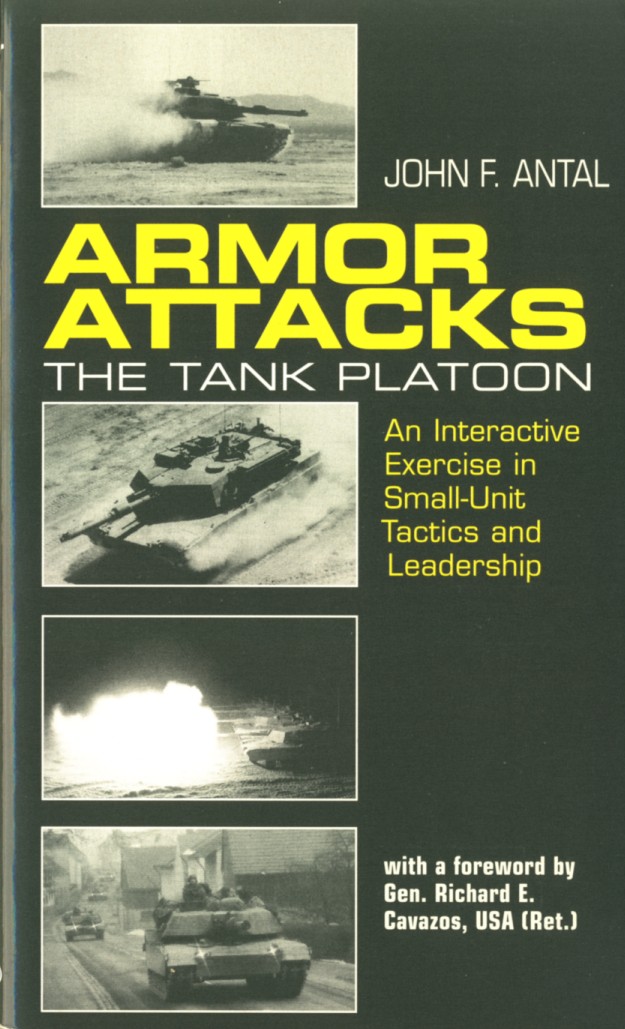
ARMOR ATTACKS: The Tank Platoon: An Interactive Exercise in Small-Unit Tactics and Leadership. By John F. Antal. Novato, CA, Presidio Press, 1991, 288 pp., $14.95 (Member $13.45).

In Armor Attacks: The Tank Platoon. active-duty U.S. Army tank officer John F. Antal has struck upon an extremely clever, curious, and innovative fictional form that is part tactical decision game (TDG), part combat adventure page-turner, and part The Defence of Duffer’s Drift. Antal has created an interactive story of current-day armored warfare in the Middle East. The reader plays the role of the central character of the story, 2dLt Sam Jaeger, a brand new M1 tank platoon commander thrust into battle for the first time. Antal creates a series of tactical dilemmas and requires the reader to choose Jaeger’s course of action from among several options. Each decision that the reader makes leads to a different result and another decision. For example:

If Jaeger decided to withdraw to live to fight another day, go to Section 20.

If Jaeger decides to stay and take on a Threat lank company with two M1 tanks, go to Section 21.

Starting with the very simple decision of whether to make his first plan on his own or ask his battleseasoned platoon sergeant’s advice, the book takes 2dLt Jaeger through 88 sections. Some decisions lead forward, some back to previous sections. In some sections. Jaeger succeeds. In others, he gets his men or himself wounded, captured, or killed-in which case Antal gives a short lecture on tactics or leadership according to AirLand Battle precepts and sends the reader back to an earlier section:

One of the major tenets of the U.S. Army’s AirLand Battle doctrine is the concept of agility. Agility is the capability to act and think faster than your opponent. . . .

Jaeger paid the ultimate sacrifice. He fought and lost. For whatever reasons, friction, luck, or just slow reflexes. Jaeger’s war is over.

If you have what it takes to lead American soldiers to victory, go back to Section 1. learning from your mistakes and fight again. Victory or Death!

Eventually the reader will learn his lessons and arrive at Section 88, in which Jaeger is promoted to captain for his actions. In the process, the reader will have undergone a primer in tank tactics and combat leadership and will have read a pretty interesting story.

Armor Attacks’ decidedly Army flavor will take some getting used to by Marines. Its style, however, will be familiar to anybody who has read Harold Coyle’s Team Yankee and similar novels-straightforward, unadorned and energetic:

“Lieutenant!” Jaeger’s new gunner cried. “IDENTIFIED . . . TANKS . . . RANGE TWO NINE HUNDRED!”

“Steady, Hyatt. Wait for the command.” Jaeger’s calm voice had a reassuring effect on his new crew. . . .

“Red, this is Romeo Four Seven,” Jaeger confidently called over the radio. “SABOT . . . TEN TANKS, THREE BMPS . . . DIRECT FRONT . . . DEPTH . . . FIRE AND ADJUST!”

BOOM! BOOM! BOOM! BOOM! The platoon fired almost at once, four finstabilized uranium-depleted sabot rounds moving faster than the speed of sound. Two T-72s burst into flames, their crews scattered to pieces across the hot desert floor.

But Armor Attacks is more than interesting reading. As for pure training value, it falls short of the Gazettes TDGs-mostly because the reader’s decisions are multiple choice rather than the creative act that we know decisionmaking to be. And the lessons Antal offers are very basic-this book is most useful to platoon commanders. Yet, because the lessons are illustrated in concrete examples rather than merely described in concept, the book is valuable to leaders at any level. The book is valuable if for no other reason than it recognizes the part luck plays in combat. After some decisions, the reader rolls a die to determine which section to go to next, and success or failure, life or death may depend on that roll. I was genuinely bothered when I or one of my men got killed off-even when due purely to a die roll.

Armor Attacks may not be as valuable a training tool as TDGs, as exciting a work of fiction as something by Tom Clancy or Harold Coyle, or as timeless as Swinton’s Duffer’s Drift. But Armor Attacks is a clever hybrid that does admirably in all three categories. A book that gets the reader personally and genuinely interested in the outcome must be doing something right. One can only hope the book’s subtitle, The Tank Platoon, indicates there will be more to follow, in units of different size and type.

If you decided to give this exercise a try, move ahead with your tactical development.

If not, go back to Square 1.

Improving the Tactical Decision Games

by BGen F. P. Henderson, USMC(Ret)

The authors of your tactical decision games (TDGs) may be interested to know that their problems in the Gazette each month do not seem to be generation sensitive. From my experience, a Marine trying to find the right solution to one of them a decade or more from now will not feel that they are “Old Corps” stuff. I must solve them with my recollections of the Fleet Marine Force of 1959, plus the changes I have learned of in the Gazette since then. Despite this handicap, I find them interesting, challenging, and that my solutions are usually acceptable, sometimes in the black, and possibly even better. In working one I always wonder why it took so long for the TDG concept to be thought of, accepted, and become a regular feature in the Gazette. It should have happened a couple of Marine generations ago.

However, I would like to recommend adding some elements to each problem that I feel would give them additional reality, factors that certainly would be considered by the problem commander in making his decision if it were actual combat. These are the weather, the length of day and night, and the combat effectiveness of his command. The Gazette has published articles on how the first two affect combat operations (Mar88 and Jul89).

The commander of any force, regardless of type or size, must consider existing and forecasted weather in arriving at an operational decision. Is it the torrential rains and debilitating heat of Guadalcanal? The freezing temperatures, snow, and driving winds of the Chosin Reservoir? In temperate zones around the earth is the foliage in full leaf or are the trees and shrubs bare? Many of the TDG problems have woods that play a role in the commander’s decision. How will the season and the weather affect the length of time it will take him to accomplish his mission? Will helicopter resupply or movement of the reserve be hampered by what tomorrow may bring?

The same consideration must be given to the seasonal length of daylight and darkness in the area of operations. Daylight generally favors a superior force with an offensive mission. Darkness favors an inferior force with a defensive mission. In either case, the commander must determine how he can use each condition to his advantage, especially when he has been given a time limit to accomplish his mission. (A recent TDG informed players that it was now 2030, a key factor in making the command decision. But, depending on the season and latitude, that could have meant it was daylight, twilight, or darkness.)

A common weakness of many map problems is a failure to give a realistic statement of the friendly force’s combat effectiveness. The general assumption is that it is at authorized strength, fully equipped, and rarin’ to go chew up the enemy. But this is rarely, if ever, the happy situation a unit commander will have in combat. Every day since his unit was first committed to combat its combat effectiveness has been eroded. Whether it is a company or division, a squadron or aircraft wing, it has incurred casualties in men and equipment and felt the stress of continued combat. Key personnel and experienced leaders have been lost. A map problem should introduce some of these considerations, without unduly complicating it, to make it more “combat real.”

It seems to me that TDGs can be as addictive as The New York Times crossword puzzles are to people who like to accept an intellectual challenge and triumph. If so, one a month is not a very sturdy diet for today’s Marine warfighters. As a start to correct this the Gazette and the Marine Corps Association (MCA) might consider joining forces to collect and publish all of those prior to 1992 in a soft cover form. These could be sold in exchanges and through the MCA Bookstore. The same could be done for each year’s problems. This would give those favored few who join the Corps each year a backlog to work on between Gazette issues.

A Short History of TDGs

by Capt Bruce I. Gudmundsson, USMCR

The Marine Corps is currently benefiting from an explosion of interest in tactical decision games (TDGs). These simple map exercises-most can be presented on one or two pages-have captured the imagination of Marines who see their potential for freeing tactics from the dead hand of the laundry list.

One of the most interesting aspects of this renaissance is its occurrence 100 years after the first introduction of the TDG to the English-speaking world. In the late 188Os military professionals trying to find more “hands on” methods of teaching tactics imported what the Germans called the Planuebung (planning exercise) or the Planspiel (planning game)-short map exercises that required players to come up with a concept of operations to deal with a given tactical situation.

Almost immediately, however, this first generation of TDGs was “improved” by the importers. Whereas the Germans had stressed the content of a solution over the form, the Anglo-Saxon importers used the games as a means of teaching the format of orders. (The five-paragraph order was first designed by Eben Swift as a means of forcing students to organize their solutions to his TDGs.) While the Germans put a great deal of stress on having individuals solve these problems under time pressure, English and American instructors formed their students into teams and gave them an hour or more to work but their solutions.

By World War I, some instructors watered down the TDG even further. Books, like Capt Alfred Bjornstad’s Small Problems for Infantry, were published that provided long, detailed solutions to simple tactical problems. These books were then used as catechisms-students memorized the solutions to the problems and then recited them in class.

Needless to say, such approaches (particular the last mentioned) robbed the TDGs of most of their educational value. After all, the chief benefit of the exercise is to practice the rapid analysis of a tactical situation, the quick ereation of a practical scheme for dealing with that situation, and the effective expression of that scheme in the form of easily understood orders.

Focusing on format rather than content diverted the players from the essence of the problem at hand. With their minds focused on what information went into which paragraph, both student and teacher were unable to give full attention to judging the practicality of the student’s solution. Having lots of time gave the student a luxury rarely afforded to combat leaders. Finally, being formed into committees freed students from the individual responsibility of decisionmaking that is the definitive characteristic of command.

Deprived of their power by these improvements, the first generation of TDGs soon slipped into oblivion. Mated with history in the classic Infantry in Battle, they enjoyed a short “Indian summer” during the 1930s. But by the time World War II was over, they were dead-a victim of rapid mobilization and the “school solution.”

The point of this little bit of history is not to condemn those who first transplanted the TDG from its native soil. Rather, it is to remind us that even something as elegant as the TDG can be ruined if its essential characteristics-simplicity of design, practicality of solution, rapidity of decision, and individual responsibility-are forgotten.

Military Thinking and Decisionmaking Exercises

By LtCol Steven M. Jones & Maj Edwin T. Kang

Success is directly related to the ability to make and execute effective military decisions rapidly under physical and emotional duress. The ability of Marines to outthink the adversary is just as important as the physical endurance and ability to outshoot and outmaneuver him on the battlefield. This guidance was repeated and reemphasized earlier this year in All Marines message (ALMAR) 025/97. The Commandant has expressed the critical need for all Marines to prepare themselves mentally as well as physically for the rigors of combat in his planning guidance by stating:

It is my intent that we reach the stage where Marines come to work and spend part of each day talking about warfighting: learning to think, making decisions, and being exposed to tactical and operational issues.

Military insight and decisionmaking skills can be developed through discussion, decision games, battlefield studies, wargames, and other techniques. A Military Thinking and Decisionmaking Exercises Program has been established to coordinate a wide range of activities that contribute to the mental preparation for warfighting, and the Commanding General, Marine Corps Combat Development Command, has been tasked with identifying and providing resources to support these intellectual development initiatives. A forthcoming Marine Corps order will provide guidance on Military Thinking and Decisionmaking Exercises and describe some of the resources available to support it, to include:

* Professional Reading. The Marine Corps professional reading program, centered around the Commandant’s Reading List, will be an important contributor. Knowledge gained through individual reading and study will provide the intellectual framework for warfighting study and the raw material necessary to develop critical thinking skills. However, reading alone is not enough. The raw material must be honed through repeated exercise and reinforcement.

* Professional Publications. Professional periodicals and journals, such as the Marine Corps Gazette (which publishes a monthly tactical decision game (TDG)), provide a rich selection of articles and vignettes to stimulate daily warfighting discussions. Commercial books from the professional reading list and board-based wargames provide excellent scenarios for the program. Many of these commercial products are available through the Marine Corps Association and base libraries. Units should also consider developing their own libraries of these resources to support the program.

* Marine Corps University. The Marine Corps University has prepared a Staff Ride Handbook for use by Marines in organizing battlefield study tours to military historic sites. They have also published Designing TDGs: A Tactical Decision Making Games Workbook. This workbook teaches Marines how to write useful and thoughtprovoking TDG exercises. Further information on these resources is available from the university.

* Marine Corps Modeling and Simulation Office (MCMSMO). MCMSMO has developed a website to provide information on available resources that support the program. The link to this site can be reached through the Internet at mcmsmo.usmc.mil/milthink. It contains electronic versions of the TDG Workbook, the Staff Ride Guide, the Personal Computer (PC)-Based Wargaming Catalog and other useful resources. The PC-based Wargaming Catalog provides a list of commercially available computer wargames that have been evaluated and found to have training merit for Marines. New games are constantly reviewed by Marine Corps volunteers and game reviews are electronically posted to the Wargaming Catalog as they are evaluated. A small team of MCMSMO programmers has also customized several commercial games to enhance their training value for the Marine Corps.

* Formal Schools. Formal Marine Corps schools have a number of products that can serve as a stimulus to daily warfighting discussions. A few examples include:

1) Expeditionary Warfare Training Group has developed situational training exercise scenarios and TDGs for use in their staff professinal military education program that could be adapted for local warfighting programs.

2) Marine Aviation Weapons and Tactics Squadron One publishes quarterly newsletters for each aviation community and the Talon journal, a compendium of articles on tactical aviation issues.

3) Mountain Warfare Training Center publishes the Field Grade Officer’s Handbook.

4) Weapons Training Battalion, Quantico, produces lessons on scout-snipers, high-risk personnel, and breaching. In short, resources to support the program are abundant and their use is limited only by our imagination.

The key impediment to fully implementing the Commandant’s guidance appears to be finding time in our already busy daily schedules to execute his plan. We must all realize that this program enhances our fundamental warfighting capabilities– particularly in an era when our livetraining opportunities seem to be decreasing. Once this concept is accepted as fact, we will find the time to do the right thing, making warfighting discussions a daily activity and inculcating the benefits in our Marines. It is but another way for us, as in institution, to stay highly tuned and ready to answer the Nation’s call.

Clash at Timpan-ni Reversed

By Maj John F. Schmitt, USMCR

This scenario is roughly the reverse of Tactical Decision Game #979, “Clash at Timpan-ni, the solutions to which were published in MCG, Nov97. Does having seen the situation through the enemy’s eyes influence your decision?

Situation

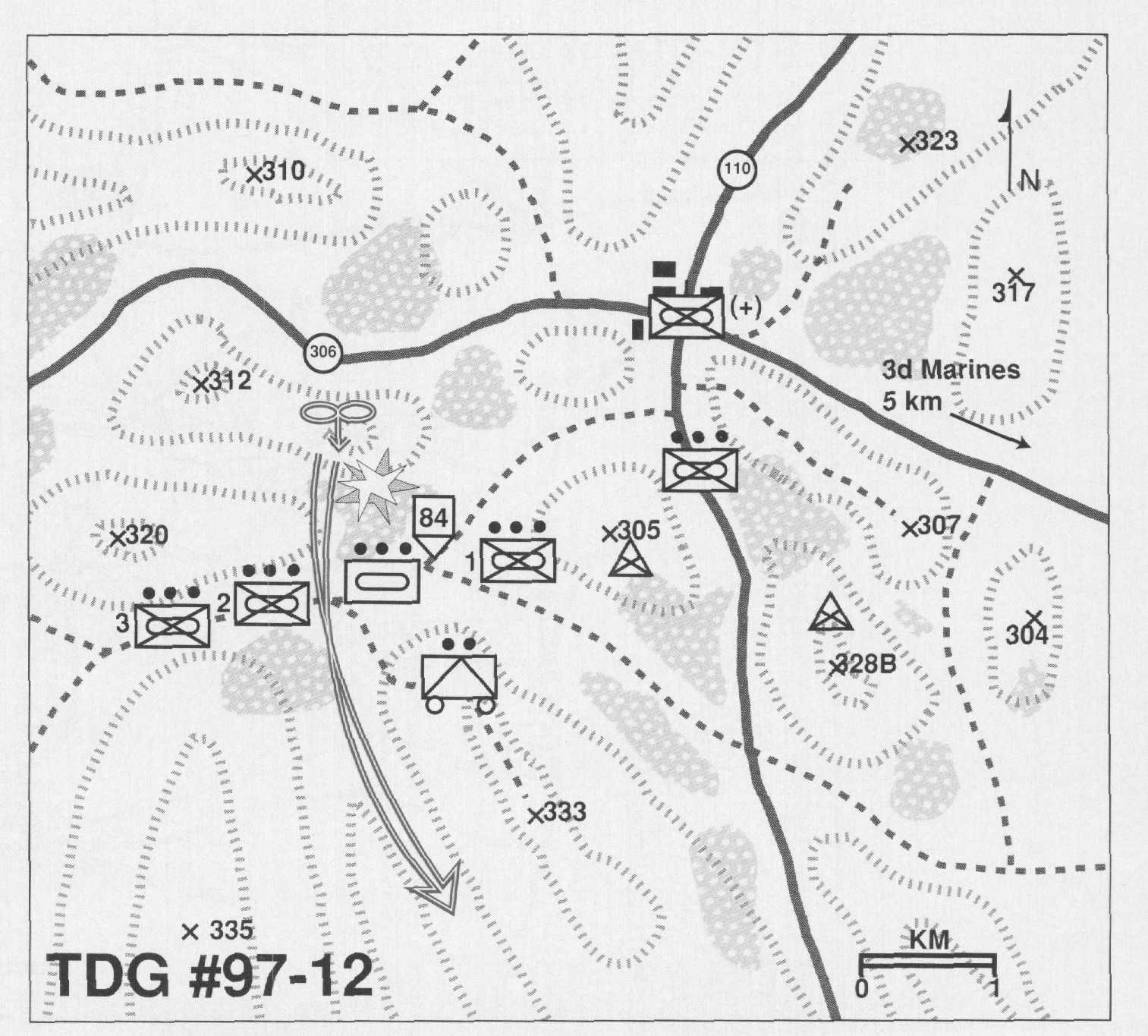
You are a rifle company commander in 1st Marines. You are operating in rugged, broken terrain spotted with sparse vegetation. Line of sight is rarely more than a kilometer. Vehicle movement is restricted to the roads and tracks, although the vegetation and small hills are generally not a problem for infantry. The enemy is a tough infantry force reinforced with tank and mechanized support.

Intelligence indicates that the enemy is beginning to advance north in division strength; his main axis seems to follow the Jho Valley east of Rte. 110. Your regiment has been tasked to infiltrate south and then east generally along Rte. 306 in order to launch a spoiling attack into the enemy’s left flank. As the lead company of the advance guard battalion, you have been instructed to avoid detection as long as possible but to develop the situation quickly and aggressively once detected. You have been reinforced with a tank platoon, assault amphibious vehicle platoon (AAV), TOW section, and Dragon section (which you have distributed throughout the rifle platoons). Rte. 110 is a two-lane paved road; Rte. 306 is a gravel road; they are the only improved roads in the area, although the freezing temperatures have kept the unimproved routes trafficable for heavy vehicles.

Bad weather seems to have grounded the planned Cobra support, so you advance cautiously, staying off the main road to avoid detection. As you approach Checkpoint 84, the fork intersection west of Rte. 110, your forward air controller (FAC) tells you your Cobra section (“Trapper”) is airborne and will be on station within 10 minutes. You tell him to put Trapper on the company tac net. Then battalion halts you with an urgent message. You are put in touch with a reconnaissance team located near Hill 328B (you had no idea it was operating in the area) which reports:

An enemy mech company passed us about 20 mikes ago, heading north on 110 toward Timpan-ni. Estimate about 15 tracks, 5 tanks, 8-10 light vehicles. At present, we can only see the rear element, a mech platoon that is now halted off the road east of Hill 305.

You ask if the team has called for fire on the enemy column and the team leader reports that he has submitted several requests but received no fire missions. Just then, you hear .50 caliber fire up ahead. Simultaneously, a pair of enemy attack helicopters passes overhead from north to south. A Stinger shot sends them ducking for cover. They were visible for several seconds, and you wonder how much they were able to see. Your 1st Platoon then reports it has chased an enemy observation post off of Hill 305 and is sending a squad to investigate. The reconnaissance team now reports: “Something’s happening. That mech platoon’s coming to life.” Artillery starts to impact in the woods to your north. What now, captain?

Requirement

In a time limit of 5 minutes, decide what you do by issuing any orders, reports or requests. Then provide a sketch and a brief explanation of your decision. Send your solution to Marine Corps Gazette, TDG #97-12, P.O. Box 1775, Quantico, VA 22134 or fax 703-640-6161.

Clash at Timpan-ni, Part II

By Maj John F. Schmitt, USMCR

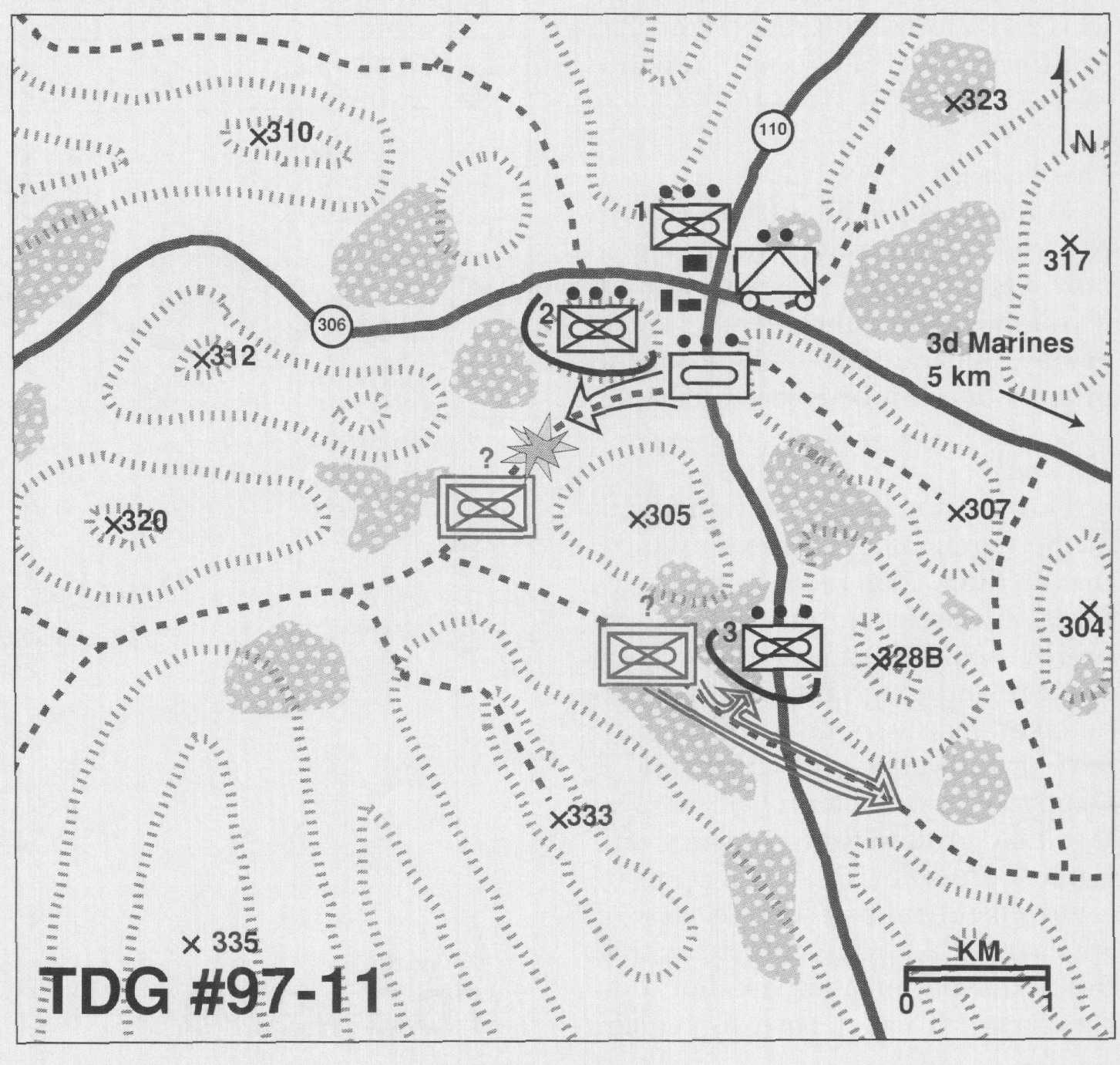
This scenario is the continuation of Tactical Decision Game #97-9, “Clash at Timpan-ni,” based on the author’s solution to that situation as presented on p. 91 of this issue. In the scenario, you are a rifle company commander in 3d Marines. You have been reinforced with a tank platoon, an assault amphibious vehicle platoon, a TOW Section, and a Dragon Section that is now distributed throughout your platoons. You are operating in rugged, broken terrain spotted uith sparse vegetation and small lakes. Line-ofsight is rarely more than a kilometer. Vehicle movement is restricted to the roads and tracks, although the vegetation and small hills are generally not a problem for infantry.

Guarding the regiment’s left flank as it advances north, you meet what appears to be an enemy company or battalion of tanks and mechanized infantry southwest of Timpan-ni. You decide to seize the initiative and develop the situation by launching the Tank Platoon on a reconnaissance-inforce southwest from the village while 2d Platoon overwatches. Your initial main effort, however, is 3d Platoon, which you instruct to deploy “south of Hill 305 to block enemy movement east toward 110.” 3d Platoon’s observation post (OP) on Hill 305 is supposed to call for immediate suppression fires and come up on the company tactical net to keep you advised of the developing situation. You hear the call for fire on the conduct of fire net, but you cannot raise the OP on the tactical net. Your forward air controller tells you that a close air support mission is about a half hour away.

Tank Platoon’s attack takes the enemy initially by surprise, although because of the terrain the tank platoon commander can rarely bring more than two tanks to bear at a time. Still, your tanks knock out several T-62s, and your Cobra Section (“Slappy”) also accounts for several combat vehicles. There is no further word from the OP on Hill 305, and your artillery forward observer (FO) takes over control of the fire mission. 1st Platoon, your reserve, reports it is assembled at Timpan-ni with the TOW Section and ready for action.

3d Platoon reports it is in position south of Hill 305 as instructed and has engaged the enemy: “We caught them in the flank as they went past.” This does not sound right to you, so you ask Slappy what he can see. He reports that enemy vehicles have crossed Rte. 110 heading east with no sign of resistance. Slappy engages the column, which he reports to consist of 15-20 vehicles. After a confusing conversation, you are finally able to ascertain that 3d Platoon is not blocking the enemy’s eastward movement toward Rte. 110 but is sitting astride Rte. 110 west of Hill 328 and that some “five or six” enemy vehicles have crossed Rte. 110 to its south. The 3d Platoon commander now reports enemy dismounted probes to either flank.

Meanwhile, the Tank Platoon has continued to make steady progress and has accounted for four more enemy combat vehicles. The enemy’s T62s are hastily falling back, and now your platoon commander reports dismounted infantry to both sides of the trail. “I could use some infantry support,” he reports. What’ll it be, Captain?

Requirement

In a time limit of 2 minutes, decide what you will do by issuing any orders, reports or requests. Then provide a sketch and a brief explanation of your decision. Send your solution to Marine Corps Gazette, TDG #97-11, P.O. Box 1775, Quantico, VA 22134 or fax 703640-0823. US MC For more detailed information on the structire of Marine Corps units, Marine Corps equipment, and symbols used in TDG sketches, see MCG, Oct94, pp. 53-56 and the modification reported in Jan95, p. 5.

Operation DEEP STRIKE

By Maj John F. Schmitt, USMCR

You are the commanding officer of Special-Purpose Marine Air-Ground Task Force (SPMAGTF) DEEP STRIKE, consisting primarily of two light armored reconnaissance (LAR) battalions, a detachment of UH-1 and AH-1 helicopters with ground support, and a mobile combat service support detachment (MCSSD) consisting mainly of refuelers. You have been deployed to the war-torn and drought-plagued African country of Kushmahdi as one of the leading elements of a joint task force (JTF). Relief organizations have been operating in Kushmahdi for several months, ministering to the star ing and displaced population. Military forces from the neighboring country of Tsanu freely make incursions deep into Kushmahdi and have lately begun raiding relief centers at Yummy, Middleville, Stumpz and Barstool with increasing frequency. Of these, Stumpz is the most important. Relief convoys bound for Stumpz out of Waterside are postponed. While Tsanu has one of the most capable militaries in the region, intelligence estimates conclude it lacks the command and control to conduct coordinated, large-scale operations.

The initial JTF plan calls for the deliberate deployment throughout the country from Waterside as forces arrive at the port and airfield there, but the frequency of attacks against the relief centers necessitates immediate action. SPMAGTF DEEP STRIKE is instructed to strike quickly to secure the relief centers, sweep Tsanu forces from the country, and establish a screen line along the border at the Odaroloc River in support of a Military Exclusion Zone sanctioned bv the U.N. Your task force will be supported by carrier aviation and will be sustained entirely by a combination of in-theater foraging and aerial logistics.

On D-day, Company C from 7th Marines and Company D, 1st LAR arrive by strategic airlift at Middleville. 1st and 3d LAR battalions arrive at Waterside by sealift and airlift and immediately advance inland. On D+l, 3d LAR secures Barstool, 1st LAR relieves Stumpz, and Company D, 1st LAR drives Tsanu forces out of Yummy. By late D+3, Ist and 3d LAR have advanced to the border to monitor crossing sites along the Odaroloc, augmented by stealth reconnaissance and sensors. 3d LAR is in the north, 1st LAR(-) in the center, and Company D, 1st LAR and C/1/7 in the south. The Tsanu Government immediately protests the establishment of the Military Exclusion Zone, which it describes as a provocation. By D+5, as more U.S. forces are arriving at Waterside, intelligence reports describe an unprecedented massing of Tsanuan forces near the border. On D+6, at first light, an enemy force estimated to be battalion strength attacks D Company, 1st LAR in the vicinity of Yummy. Another probes 1st LAR’s positions near Pooker, while a mechanized/motorized force of at least one battalion breaks through at Cheery, heading west along the heavily populated Highway 10 corridor. Satellite imagery shows that the enemy column is moving about 25-30 miles per hour.

You are instructed to deal with the problem. An allied tank company located at Waterside is placed under your operational control. What is your plan?

Requirement

In a time limit of 20 minutes, provide your solution in the form of a concept of operations, tasks for subordinate units, and any other pertinent planning guidance. Then provide a sketch and an explanation of your plan. Send your solution to the Marine Corps Gazette, TDG #97-10, P.O. Box 1775, Quantico, VA 22134 or fax 703640-0823.

Clash at Timpan-ni

By Maj John F. Schmitt

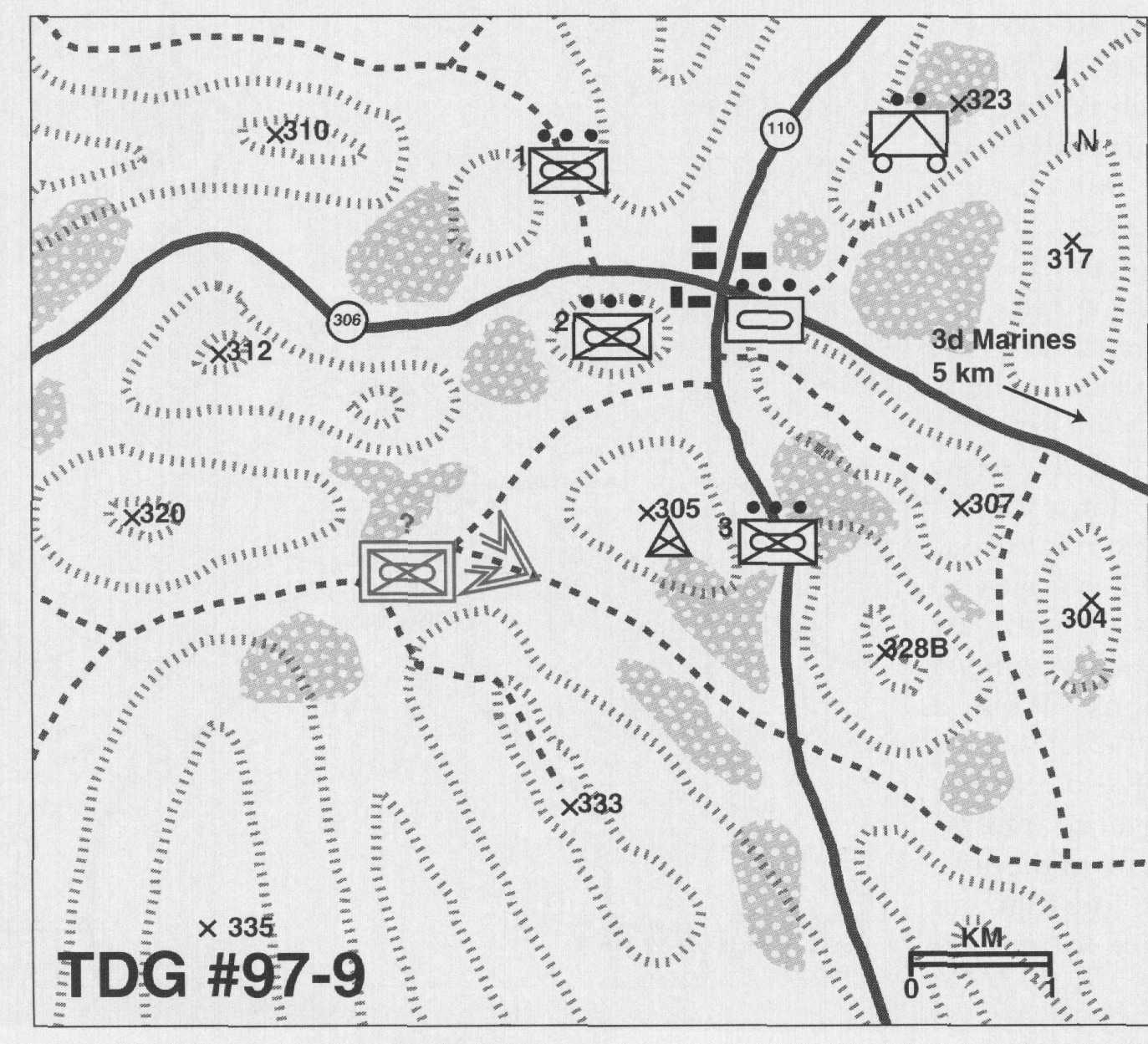
You are a rifle company commander in 3d Marines. You are operating in rugged, broken terrain spotted with sparse vegetation and small lakes. Line of sight is rarely more than a kilometer. Vehicle movement is restricted to the roads and tracks, although the vegetation and small hills are generally not a problem for infantry. The enemy is a tough infantry force reinforced with tank and mechanized support.

The division is advancing north on two axes, 3d Marines on the left. Your company is deployed to guard the regiment’s left flank. You have been reinforced with a tank platoon, an assault amphibious vehicle platoon, a TOW section, and a Dragon section (which you have distributed throughout the rifle platoons). As the regiment advances, your mission is to “Attack north toward Timpanni, the village at the Rte. 110-306 intersection, in order to provide early warning and protect the regiment against enemy forces advancing from the west.” Rte. 110 is a 2-lane paved road; Rte. 306 is a gravel road; they are the only improved roads in the area, although the freezing temperatures have kept the unimproved routes trafficable for heavy vehicles. Bad weather has grounded the planned Cobra support, so you put temporary observation posts (OPs) on the neighboring hills as you advance along Rte. 110 (although it slows your rate of movement). You reach the objective, the hamlet of Timpan-ni, without incident and report in. 1st and 2d Platoons deploy west. The section of Cobras (callsign “Slappy”) checks in, and you send it to reconnoiter west along 306. The tank platoon is located with you at the intersection. The TOW section takes up an overwatch position on Hill 323. 3d Platoon bringing up the rear is still on Rte. 110. On his own initiative, the platoon commander has put an OP on Hill 305, which reports “8 T-62s and 10 BMPs heading east in column toward 110 about 3 clicks southwest Timpan-ni.” Just then, Slappy reports “nothing on 306, but enemy mech, at least 20 combat vehicles, to the south, moving east about 4 kilometers southwest of the intersection. They have fired an SA-7 at us. Breaking off.” From your location at the hamlet you can see artillery begin to impact on Hill 305. What now, Captain?

Requirement

In a time limit of 5 minutes, decide what you will do by issuing any orders, reports, or requests. Then provide a sketch and a brief explanation of your decision. Send your solution to Marine Corps Gazette, TDG #97-9, P.O. Box 1775, Quantico, VA 22134 or fax 703-640-0823.