Trouble at Checkpoint 14

By Capt James B. Woulfe

Situation

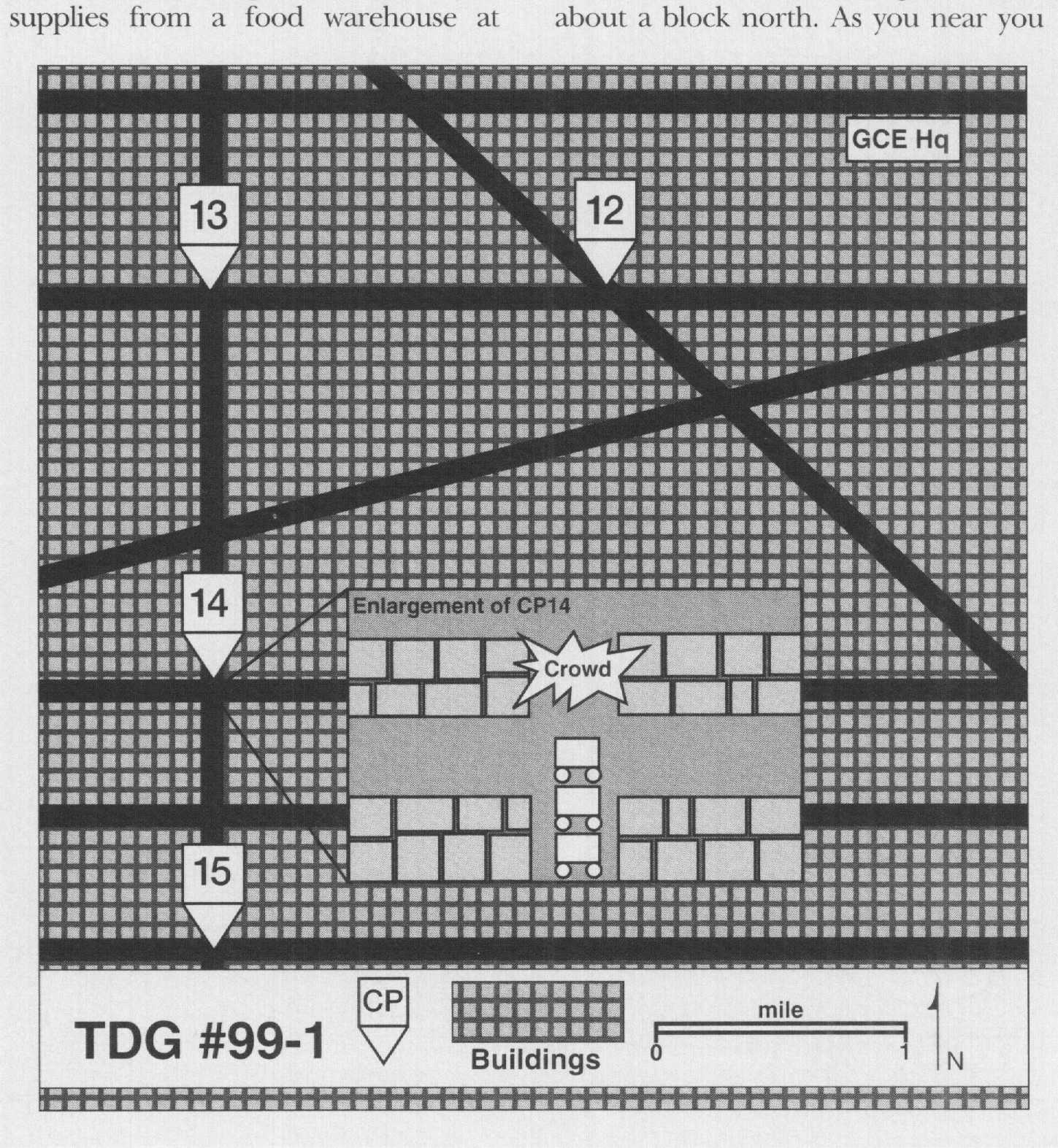
You are a supply corporal in the MEU Service Support Group (MSSG). The MEU came ashore 6 days ago to assist nongovernmental organizations (NGOs) with humanitarian operations in a poor Third World country. The city you are in is extremely congested, packed with one- to three-story buildings wherever there is not a street. All streets shown are two lane but very narrow; some also have narrow sidewalks. A maze of alleys and walkways exist throughout the city, but they are too confusing to map. Marines have had very little violence directed at them, but ethnic and religious hatred has resulted in several violent dashes within the local populace. Rules of engagement (ROE) are as provided.

You are running a convoy of relief supplies from a food warehouse at Checkpoint 15 to a distribution point on the north side of the city. Your convoy consists of three 5-ton trucks. Each truck has a driver, assistant driver, and two Marines in back for security. In each truck, one Marine is armed with an M203 and has non-lethal (rubber pellet) munitions; one is armed with an M16A2 and bayonet; and the driver and assistant driver are armed with 9mm pistols and riot batons. All have pepper spray and CS gas grenades. You are in the lead truck. There is a rifle platoon guarding the food warehouse and a reaction-force rifle company located with the forward element of the Ground Combat Element (GCE) Headquarters located ashore.

The time is 1704. As you reach Checkpoint 14, you notice a crowd of about 30-50 civilians filling the street about a block north. As you near you can see that the crowd has just pulled three people from a car and is starting to beat them. You radio the Combat Service Support Operations Center to explain the situation and reach the watch officer. You know the platoon at the food warehouse can send forces there by foot in about 10 minutes. You estimate the reaction force can arrive in about 20 minutes moving by amtracs. By now you can tell there are three victims, two men and a woman. They appear to be Americans or Europeans, either reporters or NGO workers-you can’t tell which. You ask the watch officer for guidance. “Can I help these poor people?” you ask.

Without seeing the situation himself, the watch officer understandably cannot offer much in the way of detailed guidance. “Do what you can to help,” he says, “without causing an international incident. You’re going to have to use your best judgment.”

The crowd continues to beat the three people, and you think some of them may be about to rape the woman. What do you do, corporal?

Requirement

In a time limit of 3 minutes, describe any actions you would take. Then provide the rationale for your decision. Submit your solution to Marine Corps Gazette, TDG #99-1, P.O. Box 1775, Quantico, VA, 22134 or fax 703640-0823.

Sidebar

I Want to be ‘Ender’

By Capt Brendan B. McBreen

The great combat leaders throughout history have been successful because they possessed the essential skill of the commander: the ability to consistently make effective tactical decisions quickly and intuitively in the face of extreme stress and uncertainty. This skill is virtually ignored by tody’s Marine Corps education system. There is no vehicle to teach or evaluate tactical decisionmaking. A Marine leader’s decisionmaking ability, the essential skill of the commander, is acquired in a nonsystematic and unrecognized manner. The Marine Corps needs to train its leaders in decisionmaking skills, encourage constant practice, and then select commanders who possess master-level decisionmaking ability.

‘Ender’ and the Education of a Master

Andrew Wiggin, nicknamed “Ender,” is the main character in Orson Scott Card’s novel Ender’s Game. Selected for command as a child, Ender is placed in a military school. A curriculum of creative competition based on continuous wargames relentlessly develops the students’ competitive skills and decisionmaking abilities. Eventually, Ender acquires an extraordinary ability to recognize the scope of any challenge, quickly grasp its key elements, create a solution, and lead his soldiers to victory. In the final chapter, Ender, displaying the decisionmaking skills wrought from years of preparation, wins his first real battle.

In the Marine Corps today, who is our Ender? How was he trained? What schools? Where do I go to learn what he knows? Where does the Marine Corps teach decisionmaking?

There is no school, no course, no seminar. Leaders in today’s Marine Corps do not make enough tactical decisions to develop a decisionmaking mastery. The Marine Corps needs to recognize tactical decisionmaking as the essential skill of the commander and establish a vigorous decisionmaking training regimen.

Plan, Decide, and Execute

The planning process is high religion in the Marine Corps. The Marine Corps Planning Process is used by commanders and staffs to develop plans to execute missions. In this model, a staff proposes a number of options to the commander, who then selects a course of action, which the staff develops into a plan. In the past few years, numerous authors have argued that the emphasis placed on this standard planning process provides leaders with an incomplete model. The analytical planning process works when staffs have the time to develop an optimized plan, but the model is much less useful, and some would say dangerously flawed, when key decisions are needed under time pressure.

Decisionmaking, not planning, is the essential skill of the commander. Once a planned operation starts to unfold, combat decisionmaking, the second activity in the plan-decide-execute cycle, comes to the forefront. In the stress and time pressure of combat, the planning process is unworkable, and leaders need another decisionmaking model. Dr. Gary Klein, who has studied expert decisionmakers in other fields, concludes that effective decisionmakers use experience to rapidly estimate a situation and decide what is feasible.

Research . . . has shown that decisionmakers can use . . . experience to size up the situation . . . and identify the typical way of responding. Therefore, skilled decisionmakers may never have to consider more than one option.

Klein’s research points out that the essential factor is developing effective decisionmaking skills is depth of experience.

Experienced decisionmakers know how to deal with battlefield uncertainty. Warfighting doctrine holds that uncertainty is all-pervasive and inevitable, and that Marine leaders must learn to fight effectively despite uncertainty. As Dr. Klein and Maj John F. Schmitt, USMCR, noted in their excellent article “Fighting in the Fog: Dealing With Battlefield Uncertainty” (MCG, Aug96), “Effective commanders seem to exhibit a higher-than-normal tolerance for uncertainty . . .” Effective decisionmaking experience requires that a commander prepare, recognize, reduce, and manage uncertainty.

Some decisionmaking proficiency is not enough. Mastery, or expert knowledge, is needed. The mark of a master is intuition, the ability to perceive something without conscious reasoning. Intuition is a result of wide experience being internalized as a well-organized body of knowledge. Maj Jose A. Picart, USA, contends that true experts have four characteristics: ability to quickly impose meaning on a complex pattern, ability to solve mental tasks at extraordinary speed, ability to interpret and find meaning to information, and ability to focus attention and store in memory. Since combat is a time competitive contest, each of these traits is essential in a skilled battlefield commander.

The Marine Corps knows how to plan and how to teach planning. The challenge for the Marine Corps is how to teach decisionmaking. Leaders need to be taught the tools and techniques of combat decisionmaking. They then need the experience of thousands of decisions. The average number of decisions a future commander makes in a year must be accelerated by a factor of 10 or more to begin to reach the minimum needed for the development of masters. The Marine Corps needs to identify those leaders with true master-level intuitive decisionmaking skill. There is a dynamic relationship between intuitive decisionmaking skill and deliberate planning skill. Commanders who can make effective decisions under stress, uncertainty, and time limitations, create better plans. Intuitive decisions can result from executing well-conceived deliberate plans.

Decisionmaking Training Today

Marine leaders serving in the FMF today have the opportunity to make hundreds of tactical decisions a year. Field exercises, deployments, and real-world operations are exactly the type of experiences that allow leaders to develop their decisionmaking skills. Well-run unit professional military education (PME) can focus on decisionmaking. Limitations, however-canned scenarios, the absence of a willful enemy, lack of command emphasis, and others-restrict the number of decisions a leader might make. The opportunity is wasted in far too many units.

Leaders serving in “B” billets have far fewer opportunities to make tactical decisions. Although some Marines follow programs of selfstudy and some unit leaders implement decisionmaking PME, primary duties restrict most additional decisionmaking training.

Marine Corps Institute courses, designed to parallel the formal schools, rarely attempt to cover tactical decisionmaking. An exception is the excellent Warfighting 7400 series, which requires a number of tactical decisions.

Most formal schools do include some decisionmaking training on the periphery of the curriculum. Tactical decision games, sand table exercises, battle studies, and planning exercises all contribute to decisionmaking skill. The main effort, however is placed on the Marine Corps Planning Process. The last step for most student planning exercises is the briefing. Very few plans are executed against a willful enemy. This is a lost opportunity, for execution of a plan is the point where planning stops, decisionmaking begins, and the relationship between these phases is made clearer. In the Marine Corps school system, training to plan stops short of training to fight.

Developing Master Decisionmakers

The Marine Corps University, charged with educating the leaders of the Marine Corps, is the only organization capable of institutionalizing decisionmaking education.

The Commandant’s 1995 Planning Guidance defined one of the goals for command and control: “We must reach and execute effective military decisions faster than our adversaries.” A parallel goal was set for the Commandant’s PME effort: “. . . PME . . . should be oriented toward the development of judgment (and) decisionmaking skills . . .” The solutions in both areas is not new computers or other equipment. The solution is training:

Teach Tactical Decisionmaking in School. The Harvard Business School uses case studies to teach business decisionmaking. After 2 years, each student is intimately familiar with 240 business cases. An officer who fights 240 battles in 2 years would be well prepared for combat. We need to put our future commanders in situations where they repeatedly need to make decisions. A display of decisionmaking competence should be a requirement to graduate. Decisionmaking training requires simulated combat-battle studies, decision games, simulations, and exercises-where leaders make multiple decisions under pressure. Decisionmaking training should not be a brief 1week package, but integrated into every aspect of the curriculum. All plans produced in planning exercises should be executed against a willful enemy. Feedback is vitally import.ant because a lack of feedback may teach decisionmakers poor lessons. A leader is practicing his profession if he makes 100 tactical decisions during 9 months of school. For mastery however, he needs the experience of 1,000 tactical decisions.

Rewrite the Marine Corps Institute Courses. Paralleling the formal schools, these courses need to eliminate the multiple-choice format, emphasize decisionmaking training, and provide the student hundreds of opportunities to make and justify decisions.

Establish an On-Line Warfighting Web Page. Civilian wargamers around the country fight simulations against each other, maintain rankings, and trade tactical insights. The Marine Corps should maintain a 24-hour battlespace where leaders can fight each other on-line.

Fund a Decisionmaking Seminar Mobile Training Team. A 21/2-day decisionmaking seminar could consist of 8 hours of planning, 8 hours of fighting, representing 2 or 3 days of combat and the potential for hundreds of decisions, and 4 hours of debrief. A Mobile Training Team 2week course could fight four separate battles. At a formal school, this decisionmaking seminar model could be run continuously.

Screen Instructor Billets. Some studies have shown that second only to command, teaching develops future leaders. If instructor duty is second only to command experience, then instructor selection should be second only to command selection. Selecting instructors with intuitive decisionmaking ability who will spur students in their own decisionmaking development is an important step in institutionalizing decisionmaking excellence.

Select Master Decisionmakers. Decisionmaking ability should be formally evaluated. This would create an environment that encourages long-term study and self-improvement. If the Marine Corps wants to develop true decisionmaking masters, then it needs to identify these leaders, mentor them, train them rigorously, and assign them to appropriate billets. Warfare screens good leaders from bad without an appeal process. The Marine Corps should do no less.

How Does a Leader Develop His Own Decisionmaking Skills?

The Marine Corps can and will teach leaders decisionmaking techniques, but only those who have invested heavily in their own self-development will become expert decisionmakers.

Train in the FMF. Deployments and real-world contingencies allow leaders to make real world decisions, gain valuable experience and receive immediate feedback.

Train Your Subordinates. In operating units, leaders train leaders. Individual PME, unit training, and unit PME should all focus on decisionmaking training.

Train Yourself Knowledge of war is only acquired through the study of war. Individual study, from the Commandant’s Reading List, to military journals, to books on tape, should focus on command in battle and the decisions of commanders throughout history.

Train With Tactical Decision Games (TDGs). The Marine Corps Gazette should be used for unit PME and leader training. A unit binder of TDGs should be available for leaders to use.

Train With Simulations. Commercial computer wargames are a powerful tool to teach decisionmaking. Simulations allow a leader to execute thousands of decisions in a time compressed manner, sometimes fighting a simulated week in the course of a single day. Simulations act as an excellent catalyst for tactical discussions. Simulations accurately re-create historical battles, allowing the player to examine the challenges faced by the real life commanders-an excellent method for studying military history. Tactical lessons are learned by doing. Players learn to experiment, recognize patterns, and to develop simple plans with good probabilities of success. Simulations are especially helpful for practicing how to prepare, recognize, reduce, and manage uncertainty.

Conclusion

To be successful in combat, the Marine Corps needs commanders who are expert decisionmakers, who can make effective decisions under extreme stress and uncertainty. The single most important factor in developing expert decisionmakers is experience derived from constant, directed practice. The Marine Corps currently trains leaders to plan. It needs a formalized program to train leaders to fight-to make decisions under pressure. Only when tactical decisionmaking is the training focus of Marine leaders preparing for combat will we produce the Enders of the future and maximize the combat potential of the Marine Corps.

Since April 1990 the Gazette has included a tactical decision game in every issue-a total of 97 to date. Combined with their solutions which rome 2 months later, TDG,s are, indeed, a valuable resource for training in tactical decisionmaking.

Armor, the “professional development bulletin” (really it’s an excellent, highly professional journal) published bimonthly by the U.S. Army Armor Center at Fort Knox, began a promising Tactical Vignette Series in its Sep-Oct97 issue. Solutions follow in the second subsequent isue, just as they do in Gazette games. The Gazette’s board of tactical experts recommends them to all Marines.

Ambush in the Square

By Maj John F. Schmitt, USMCR

Situation

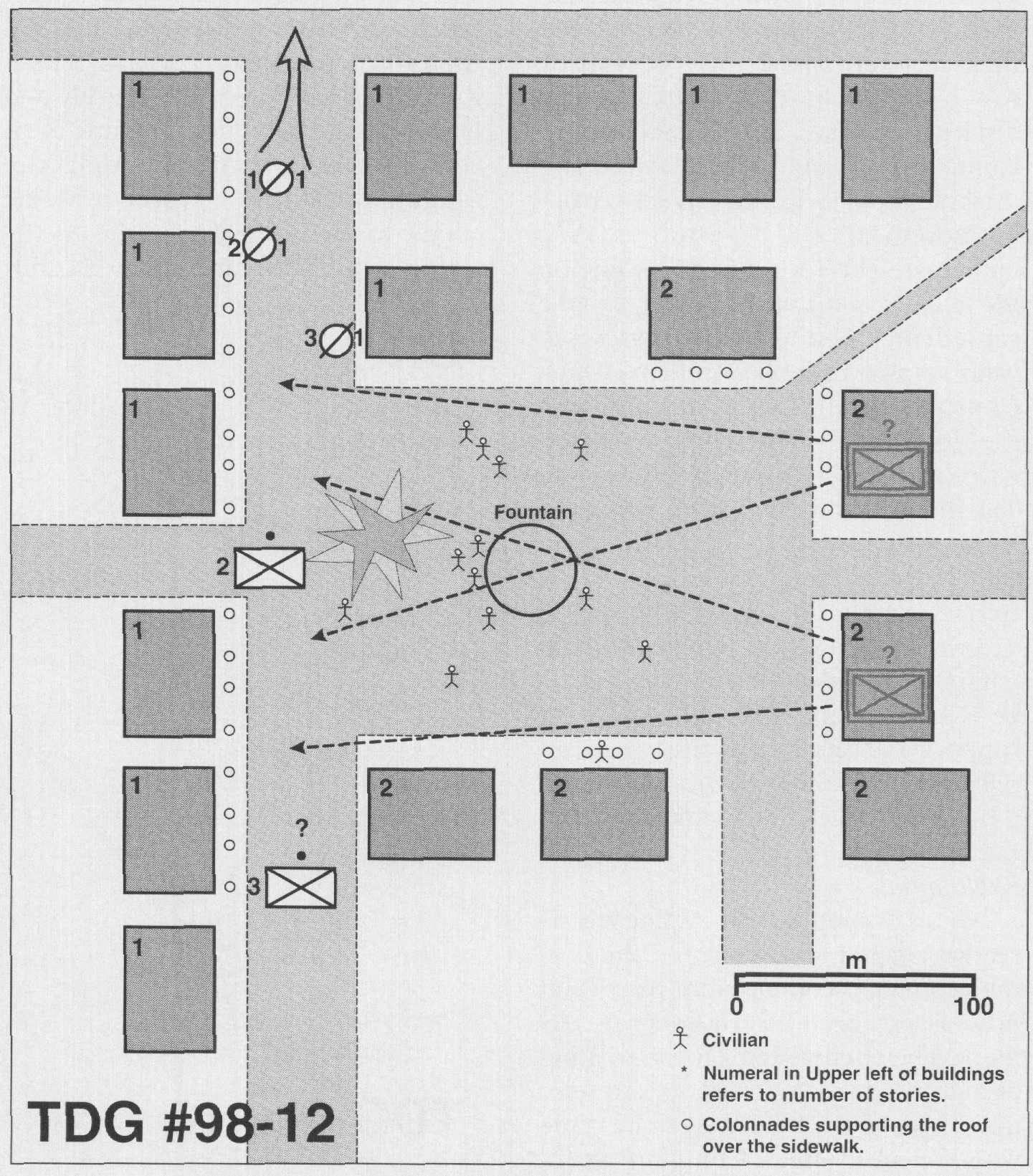
You are the leader of 1st Squad, India Company. Your platoon is conducting a security patrol through a suburban area of Old Town as part of counterinsurgency operations. (See existing Rules of Engagement.) Usually an entire patrol will pass without incident, but on a few occasions Marines have made contact with insurgency forces of up to 20 urban guerrillas armed with automatic rifles, rifle grenades, and explosives.

It is morning; the sun is not yet above the roofline to the east. Families are starting to stir, and the air is heavy with the smell of cooking. Some of the locals greet you with a nod as you pass. Your squad is the point of the platoon patrol column, moving north along a main street. The buildings are plaster and stone. Most are one story; some are two. You come upon a square opening to your right. In the center of the square is a stone fountain. A few early vendors have already opened their stalls, but the square is generally quiet.

You and the platoon commander study the square for a few minutes. It seems clear, and he instructs you to move out. You move north across the west side of the square, staying close to the colonnaded facades in case you need cover. You have exited the north side of the square and are continuing on when you hear a loud explosion to your rear followed by gunfire. You run back to the entrance to the square to get a look. Smoke is clearing from some kind of explosive. 2d Squad and the platoon headquarters are pinned down in the square, taking heaDy automatic fire that ricochets off the fountain and the buildings. Some Marines have been hit. From your position with your 3d Fire Team, you can’t locate 3d Squad or the platoon sergeant farther to the rear. You cannot tell if they are in the square or still south of it; you suspect the latter. You don’t know how they are reacting to the fire. You peer quickly around the corner of a building. The fire seems to be coming from two two-story buildings on the east side of the square a couple hundred meters away. You can’t tell if the fire is coming from both buildings or only one. It seems to be coming at least from the second story, but maybe from the ground floor as well. Civilians are screaming and hiding behind the fountain and in doorways around the square. A handful lay still in the square, apparently hit. From the square you hear calls for “Corpsman up!” What do you do?

Requirement

In a time limit of 3 minutes, explain your decision in the form of any orders you will issue. Then draw a sketch of your solution and provide a brief explanation of your decision. Submit your solution to Maine Corps Gazette, TDG #98-12, P.O. Box 1775, Quantico, VA 2214 or fax 703-640-0823.

Rules of Engagement:

1. You have the light to use lethal force promptlyand effectively to defend yourself, other U.S. or U.NV. forces, or persons and areas under their protection

2. You should use the minimum force necessary underthe circumstances and proportional to the treat. For more detailed information on the struture of Marine Corps units, Marine Corps equipment, and symbols used in TDG sketches, see MCG, Oct94, pp. 53-56 and the modification reported in Jan95, p. 5.

Long Night for the Boat Company

By Capt Michael J. Targos

Situation

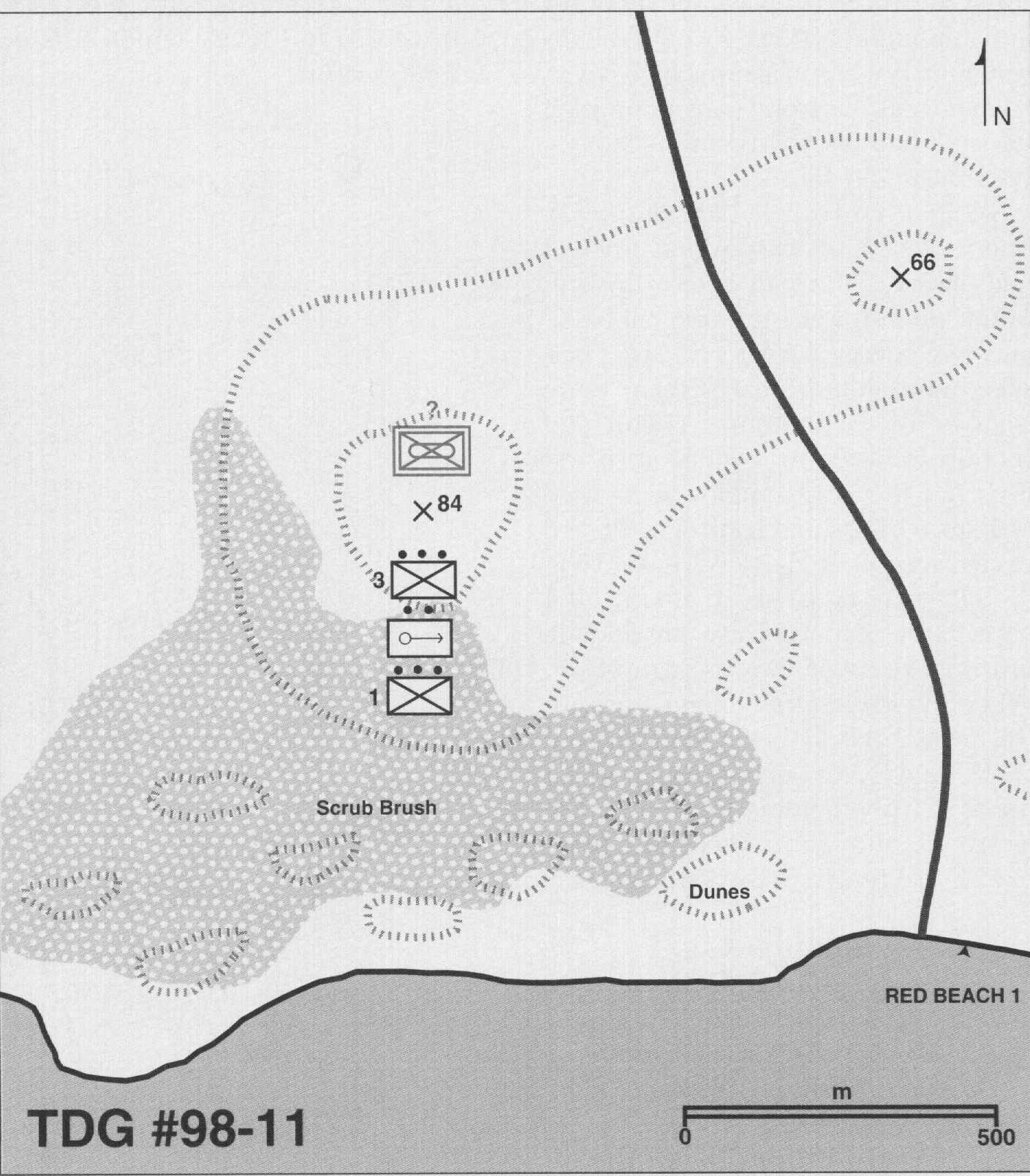
You are the commander of Company C, the boat company for Battalion Landing Team (BLT) 1/2. The BLT will be landing across Red Beach 1 in order to secure a beachhead for followon forces. Your company has been tasked with landing at H-5 and moving to secure Hill 84 in order to control the high ground overlooking the beach prior to H-hour and to protect the BLT’s left flank.

As you make your final check with the Landing Force Operations Center prior to staging in the well deck of the USS Ponce (LPD-15), you hear a SALUTE report passed over the net by a reconnaissance team: “Estimated 5-6 enemy armored personnel carriers with 10-15 dismounts digging in at grid [north slope of Hill 84].”

You land undetected in combat rubber raiding craft (CRRCs) on the west flank of Red 1 with two rifle platoons, your headquarters, machinegun section (-), and mortar section and begin your infiltration north through the sparse scrub brush. You are near the head of your company column with 3d Platoon. You signal for a short security halt about halfway up the hill. As you move up to the point, you see a soldier silhouetted at the top of the hill. It’s 90 percent illumination with no cloud cover, and you find it hard to believe you have not been spotted. The soldier walks around for about 30 seconds and disappears over the crest to the north. H-hour is in 90 minutes. What do you do, Captain?

Requirement

In a time limit of 3 minutes, come up with your plan in the form of any orders you will issue or reports/requests you will make. Then provide a sketch and a brief explanation of your plan. Submit your solution to Marine Corps Gazette, TDG #98-11, P.O. Box 1775, Quantico, VA 22134 or fax 703-640-0823.

Attack on Rommerbach

By Maj John F. Schmitt, USMCR

Situation

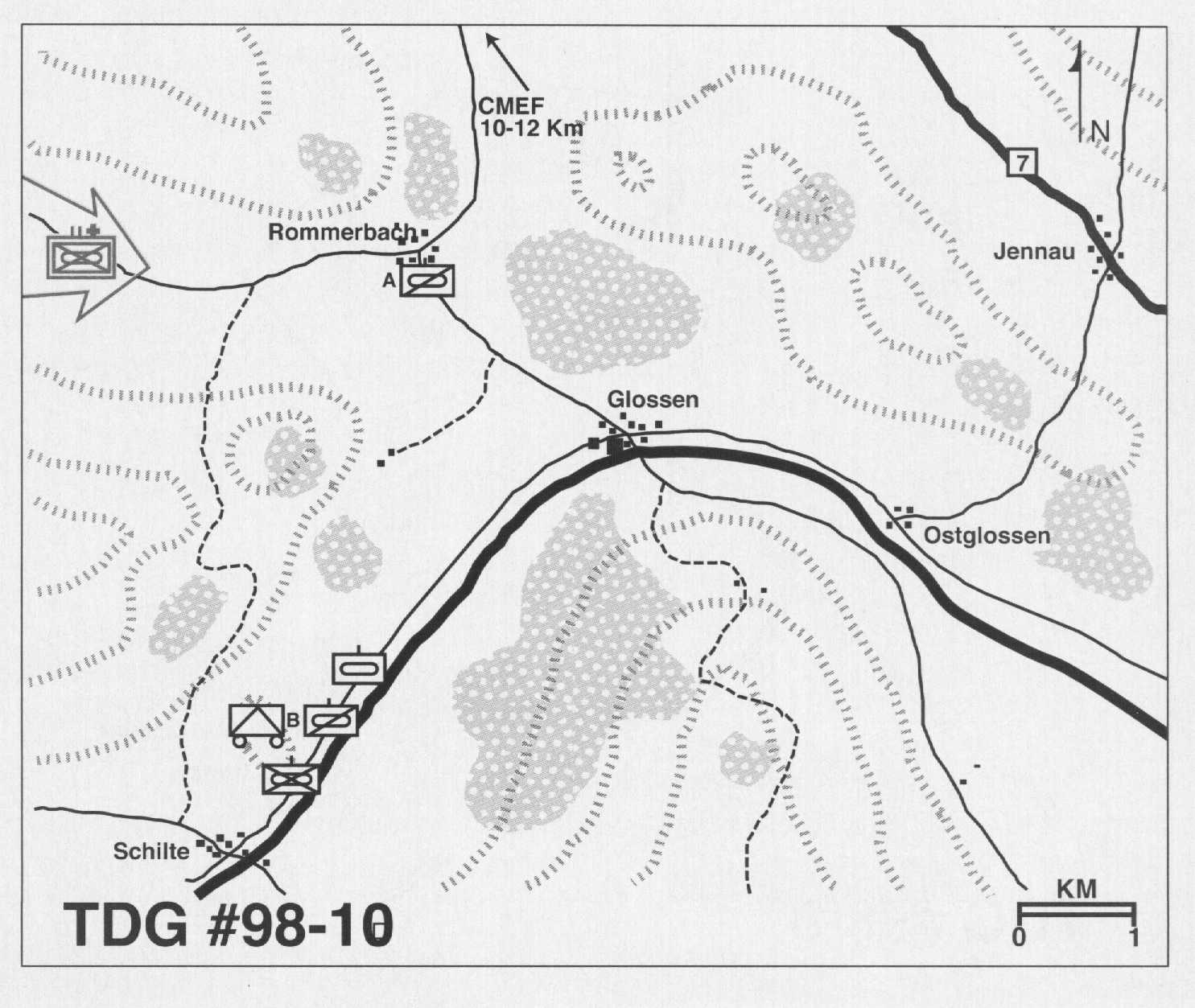
You are a colonel commanding a task force of roughly battalion strength that includes 2 U.S. Marine light armored reconnaissance (LAR) companies, Alpha and Bravo each with a platoon of antitank variants; a TOW section; and 2 host-nation Marine companies, one a company of 12 M60 tanks, the other a company of mechanized infantry. The host-nation Marines are reasonably well trained and can generally be relied on to accomplish basic tasks with a reasonable amount of supervision.

The terrain is rolling farmland punctuated by small villages and wooded areas. Enemy forces have invaded the host nation from the west. The Combined Marine Forces (CMEF), of which your task force is a part, are advancing generally northwest along Highway 7, clearing the area of enemy forces in order to restore the border. Your task force has been ordered to break off from the Highway 7 axis and advance south-southwest from Jennau through Ostglossen and Glossen to Rommerbach and Schilte to clear any enemy forces in zone. Intelligence indicates that as of 48 hours ago an enemy reinforced mechanized company was reported in Schilte, while Rommerbach appeared to be unoccupied save for periodic mechanized patrols. You will have a battery in direct support along the Highway 7 axis and are told that close air support and Cobras will be available based on priority.

You move out with Alpha in the lead, followed by the mech, tanks, TOWs, and Bravo in the rear. You reach Glossen without any enemy contact. As planned, Alpha moves on Rommerbach while you continue with the mech company, tank company, Bravo, and TOWs toward Schilte. You drop your combat operations center (COC) in Glossen and instruct the tank company to halt just west of Glossen as the battalion reserve.

Radio traffic suggests that 10-12 kilometers north, along the Highway 7 corridor, a major engagement is beginning to develop. Meanwhile, Alpha reports it is engaging an enemy force of unknown size near Rommerbach. About 2 kilometers east of Schilte, you gain observation of the town and halt to have a look, searching for signs of a defense. Radio traffic now indicates that sizable enemy forces are launching an unexpected coordinated attack along Highway 7 against CMEF which is now on the defensive. CMEF warns you to be alert for major enemy offensive activity. You should not expect much in the way of aviation support since all available air is now being vectored to the developing battle. CMEF instructs you: “Imperative you secure Rommerbach and Schilte and hold those positions in order to protect CMEF’s left flank.” Through your binoculars you see signs of a prepared defense in Schilte, but the enemy strength is unclear. You maneuver your mech, TOWs, and Bravo into attack positions outside of Schilte. Alpha now reports it has driven six reconnaissance vehicles from Rommerbach and is consolidating the town. Your COC reports that your tank company does not seem to be occupying its designated assembly area, and the Bravo CO reports that the tanks have continued with the column and are directly in trace of him.

Your first indication that something more is up with Alpha is a fire mission called against an enemy mech battalion west of Rommerbach. Shortly after that, the Bravo company commander comes on the command net to report that he has reached the west edge of Rommerbach to discover that a sizable force of mech and armor is closing on Rommerbach from the west: “A battalion, at least, in assault formation. Lead elements inside 3 clicks and closing.” You can now hear the sounds of tank main guns echoing from the north.

What do you do, Colonel?

Requirement

In a time limit of 5 minutes, describe any actions you will take in the form of orders you will issue or requests/reports you will make. Then provide a sketch of your plan and a brief explanation of your actions. Submit your solution to Marine Corps Gazette, TDG #98-10, P.O. Box 1775, Quantico, VA 22134 or fax 703-640-0823.

Battle at Blackwood Creek

By Capt Joseph A. Craft

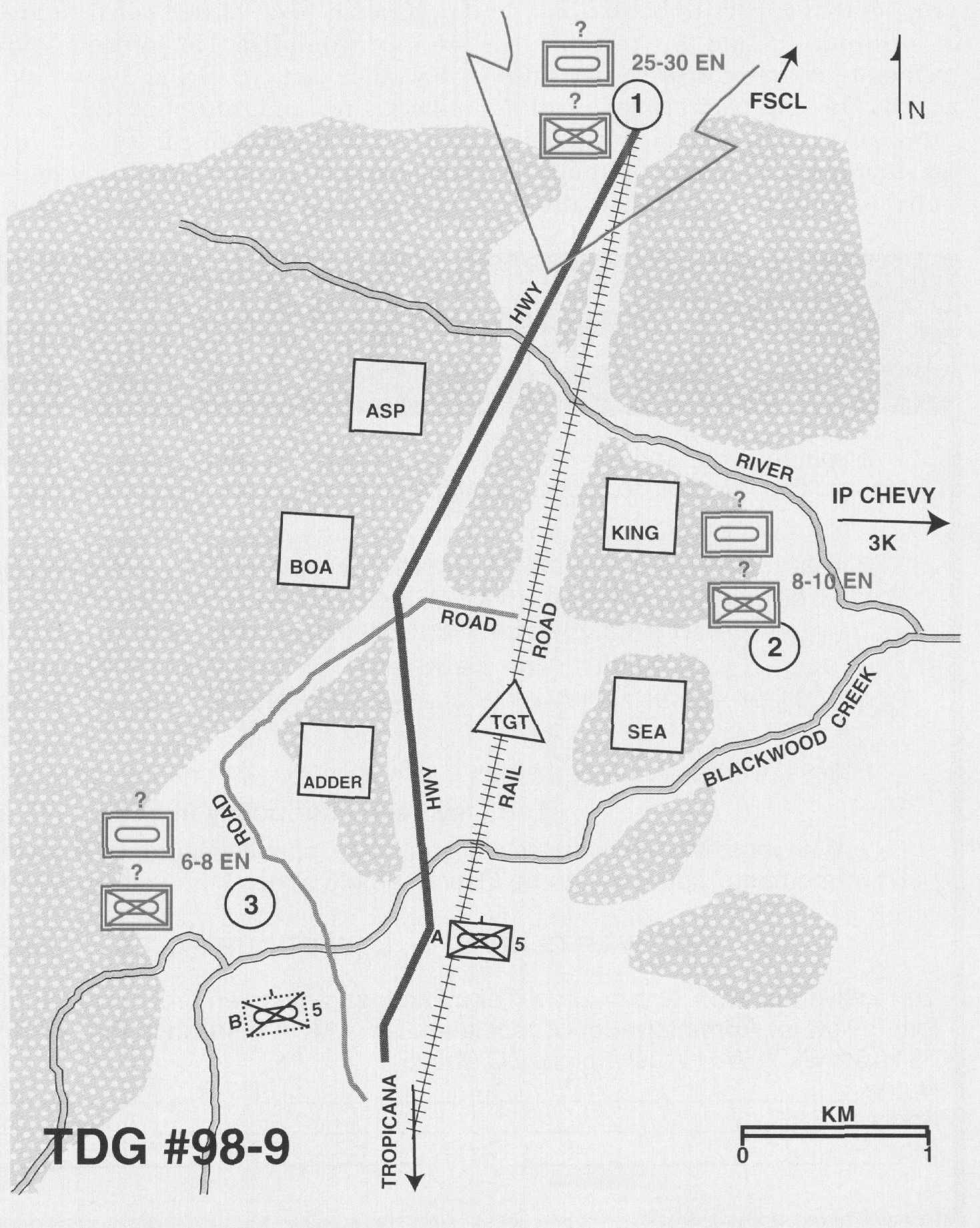
You are the section lead for two F/A-18C aircraft assigned the mission of close air support (CAS) in support of lst Battalion, 5th Marines (1/5). Your loadout is four Mk-83s; 578 rounds of 20mm; one AIM-7; two AIM-9s; and one TFLIR (Targeting – Forward Looking Infrared). Your time-on-station is approximately 45 minutes. In your cockpit you have 1:50,000 charts of the area, and the Air Communications-Electronics Operating Instruction (ACEOI).

1/5 is defending in sector to destroy enemy forces in order to prevent their movement south towards the city of Tropicana. Upon checking in with “Ronbo”, the forward air controller (FAC) for Company A, you are told to hold south of initial point (IP) Chevy at 12,000 feet and given the following situation report:

“We’re defending south of Blackwood Creek at grid AB 123456 (as depicted) and are the main effort for 1/5. Company B is to our west and Company C is to our south. 1/10 is in direct support with an approximate gun-target-line of 010 degs. We are engaging what we believe to be the forward security element of an enemy mechanized rifle regiment (MRR). The enemy is deployed with tanks, BMPs, and dismounted troops. The air defense threat expected is MANPADS (Man-Portable Air Defense Systems)-SA-7s, SA-14s, and ZSU234-nothing specific has been observed or reported. Gunfighter 01, a division of Cobras, should be on station in 10 minutes, and Cat 20, a section of AV-Bs, should be on station in 15 minutes. Stand-by for your attack brief…”

From your cockpit you can see the target area. You have identified Blackwood Creek, Alpha Company’s position, what you believe to be Bravo Company’s general position, and what you believe to be the general target area north of Blackwood Creek. There appears to be a great deal of activity in the target area. You can see several burning vehicles and smoke in the battle area. With your FLIR you can acquire but not identify individual vehicles. You inform the FAC that you have “eyes on” the target area. You are given the following attack brief:

1. (IP) Not Required

2. (HDG) Not Required

3. (Dist) Not Required

4. (Elev) 800 feet

5. (Desc) BMPs and troops in the open.

6. (Loc) AB 127477 (as depicted)

7. (Mark) WP

8. (Frnd) South 2,000

9. (Egress) Left pull off target to holding.

TOT 12+00

Remarks: Final attack cone is 260310. Remain above 4,000 feet Expect immediate reattack.

You begin your attack on time, and as you roll in you see multiple vehicles (tanks and BMPs) in the target area and what you believe to be the mark impacting. You call “contact mark” and “wings level” as you sight in on a armored vehicle, but you do not receive a clearance to drop. You hear no comm at all. You establish high cover for your wingman while he is in his delivery pattern, but he does not receive clearance either. While acting as high cover, you receive momentary cockpit indications of a ZSU 23-4 north of the target area. While over the target area, you see a large number of tanks and armored vehicles moving south at approximately 15 kilometers per hour at position 1. You see tanks and armored vehicles that appear to be stationary at positions 2 and 3. You see a tremendous amount of smoke and activity in the vicinity of Alpha Company. After several unsuccessful attempts to regain communications on both the tactical air direction and the tactical air control party-local nets, an unidentified corporal picks up the radio and informs you frantically in colorful language that the FAC and the rest of his party have all been either killed or seriously wounded. He informs you that they are receiving heavy artillery fire, and, although he can’t see a thing through the smoke, he believes that enemy tanks have penetrated their frontline. He begs for assistance. Just then you hear Gunfighter 01 attempting to check in. The situation is developing rapidly. You need to make a decision. What do you do?

Requirement

In a time limit of 1 minute, decide what actions you will take immediately and how you will use your remaining time on station. Then discuss the rationale underlying your decisions. Include a sketch if necessary to clarify your actions. Mail your solution to the Marine Corps Gazette, TDG #98-9, P.O. Box 1775, Quantico, VA 22134 or fax it to (703) 640-0823.

Poachers by the Bank

By Dr. Andrew H. Hershey

Situation

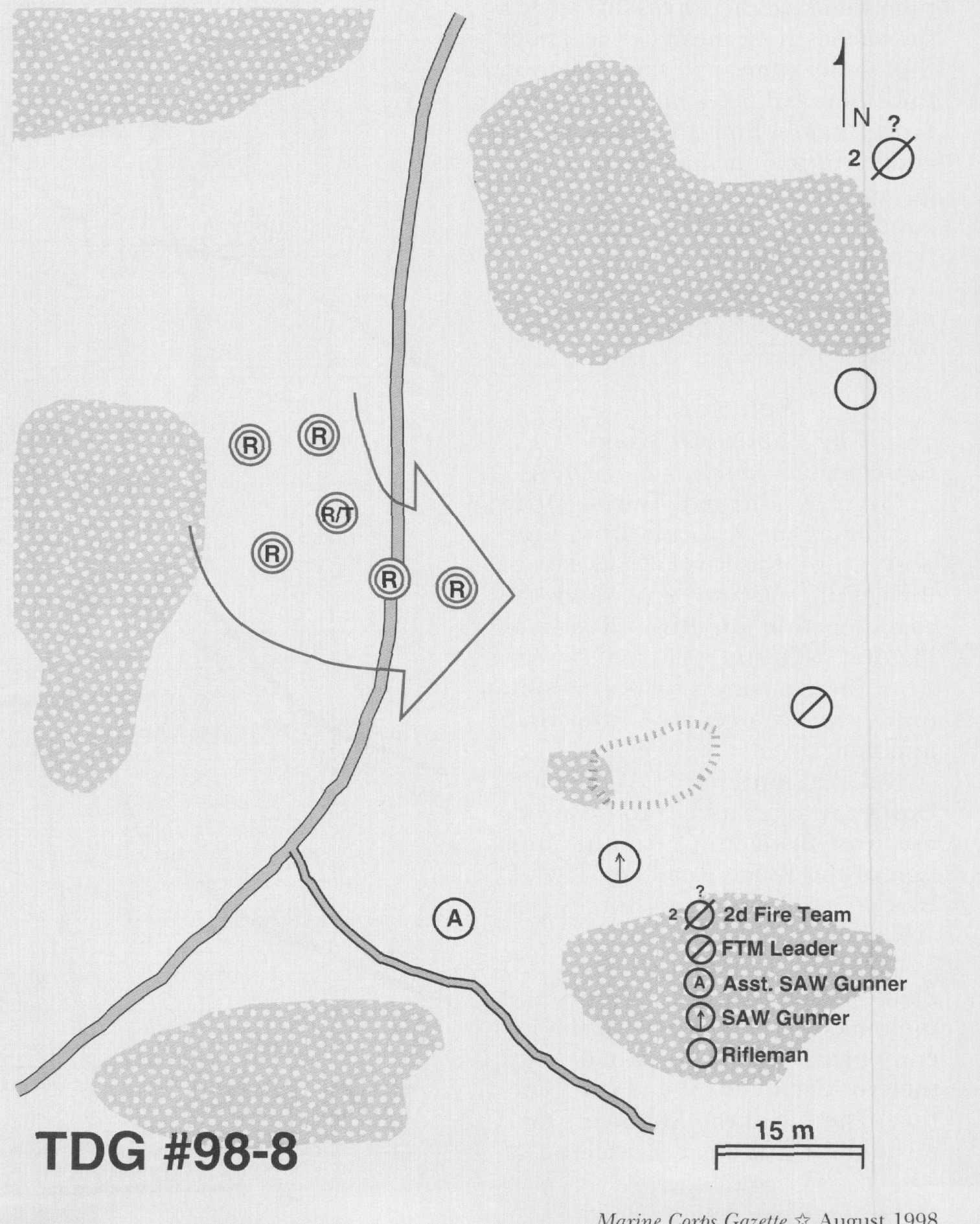
You are the leader of 3d Fire Team. Your squad is going to provide left flank security during the company’s movement to an attack position prior to a surprise night assault. As a promising squad leader, you have been instructed to attend the lieutenant’s orders briefing. There you receive information on the route of advance and the enemy’s estimated strength and disposition. You are informed that the company will be moving north, generally parallel and east of Lost Stream. The need for noise discipline and maintaining the element of surprise are stressed repeatedly. The briefing ends, and you return to your team to make final preparations. The night sky has scattered light clouds, and there is a half moon already up. Visibility is excellent, allowing your squad leader to adopt an echelon left formation with good dispersion. Your fire team will be in the left rear. The squad leader will be up between Ist and 2d Fire Teams.

The movement has gone well; you are approaching the last checkpoint before the attack position. It is 0245. Currently, your fire team is strung out along Lost Stream. The vegetation along the banks is a light mix of pines and brush. Numerous game trails also crisscross the area. As you turn from glancing at your SAW gunner behind you, your rifleman signals “Freeze.” Next, he signals “Enemy in sight.” You follow his gesture as he points to the stream, where in the process of crossing from left to right you make out six or seven figures, one of whom appears to be a radioman. You currently have sight of your rifleman and SAW gunner. The assistant gunner to your rear is momentarily out of sight. There is no sign of 2d Fire Team or the squad leader. What now, Corporal?

Requirement

In a time limit of 1 minute, describe what actions you will take and by what means. Then provide a sketch of your actions and the rationale behind them. Submit your solution to the Marine Corps Gazette, TDG #98-8, P.O. Box 1775, Quantico, VA 22134 or fax (703) 640-0823.

Bridgeton Crossing, Part IIa

By Maj John F. Schmitt, USMCR

Like TDG #98-6, this scenario is a continuation of TDG #98-4, “Bridgeton Crossing,” based on the author’s solution to that problem published in MCG, Jun98. Only this time, things have turned out differently.

Situation

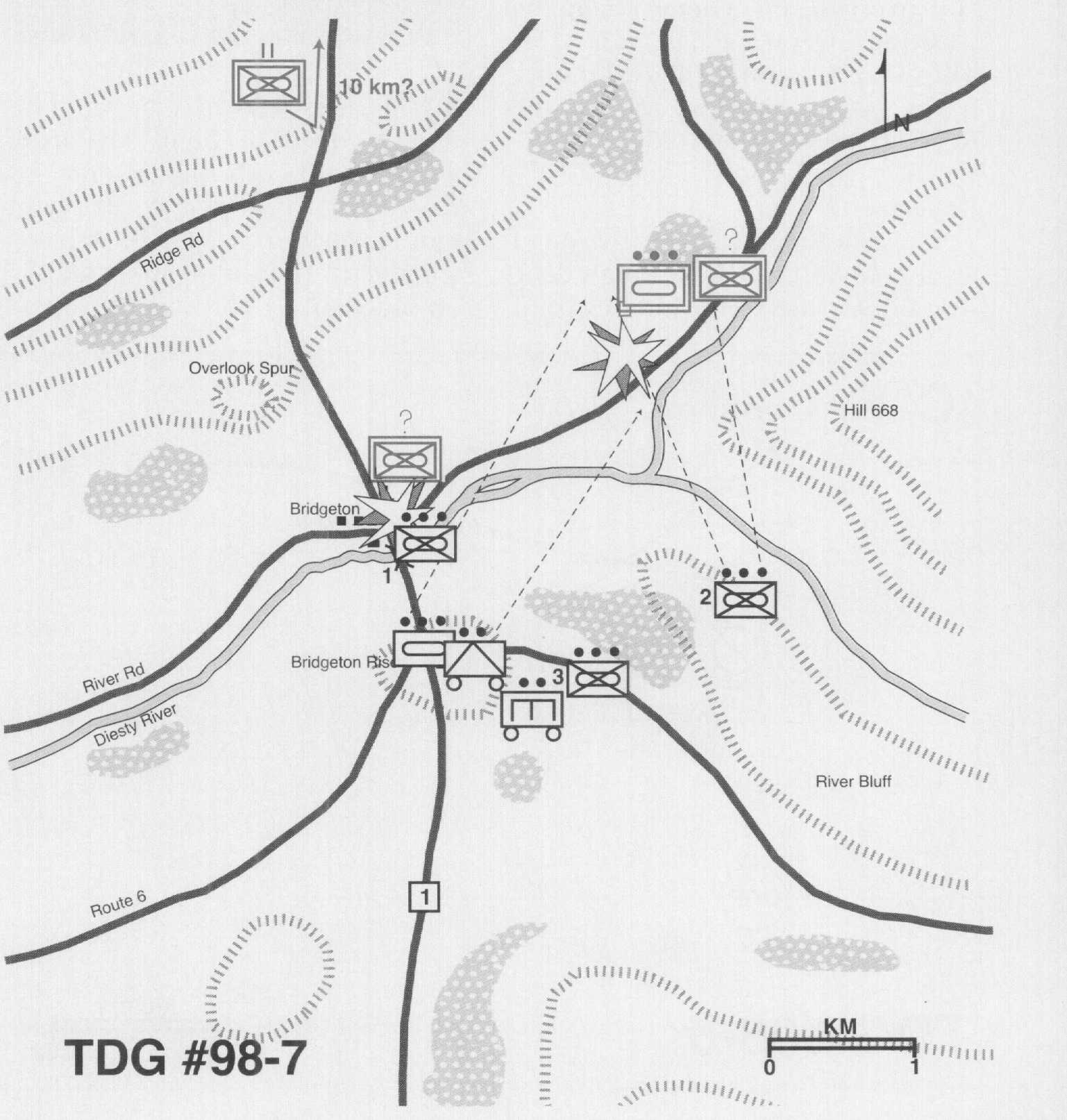
You are a rifle company commander in 1st Battalion, 3d Marines. Your company is mounted on AAVs and has been reinforced with a tank platoon, TOW section, combat engineer section, and Dragon section (attached to the rifle platoons). As the MEF advances generally north, your regiment has been ordered to swing west and seize a crossing of the Diesty River at Bridgeton in order to facilitate the continued advance. Intelligence now reports an enemy mechanized battalion heading south on Highway 1 to reinforce Bridgeton, expected to arrive sometime midmorning. Your company has been ordered to conduct a reconnaissance-in-force toward Bridgeton along Rte 6 in order to ascertain the nature of enemy defenses.

The weather is lousy and you doubt if much will be flying until it clears. You approach Bridgeton with 2d Platoon deployed onto River Bluff to protect your blind right flank. Gaining a vantage point overlooking the town, you discover that Bridgeton seems to be unoccupied except for what looks like a reconnaissance patrol. Just then, 2d Platoon reports “enemy mech on the River Road about 3 clicks east of Bridgeton. So far I count 6 APCs and 2 tanks headed southwest, but there could be more coming into view.” Convinced that you have a momentary opportunity to seize a critical crossing site, you order 2d Platoon to engage and 1 st Platoon to take the town immediately. You put the tanks and TOWs in overwatch at Bridgeton Rise and hold your 3d Platoon and engineers in reserve. Your FO calls for fire east of the town. Once your platoons are on the move, you report your decision to battalion. 1st Platoon races for the town and appears to have crossed the bridge into the town without resistance. Your tanks and TOWs succeed in holding off the enemy column from the east; a couple of enemy tanks have been knocked out. The battalion commander comes on the net: “Imperative you hold Bridgeton until we can reinforce. You’re now division main effort. Hang on; we’ll be there as fast as we can. Good work.”

Hardly moments later, Bridgeton Rise begins to come under artillery fire and you hear and see explosions and sounds of combat erupting from the town. You are unable to contact the Ist Platoon, but it has obviously come up against well-concealed, wellprepared defenses-some sort of urban ambush-deeper in the town. After a couple of extremely long minutes an unidentified voice, which you believe to be from the 1st Platoon, reports, “We’ve run into a mess. All the amtrac have been hit. It’s awful. The lieutenant’s dead. We’re in buildings just across the bridge, but everybody’s hurt. We need help.” The time is now 0920. As of 10 minutes ago, battalion still had no word on the enemy battalion to the north. What now, Captain?

Requirement

In a time limit of 3 minutes, issue any instructions and make any reports/requests. Once that is done, provide a sketch of your plan and a brief explanation of your decision. Submit your solution to the Marine Corps Gazette, TDG #98-7, P.O. Box 1775, Quantico, VA 22134 or fax 703-640823.

Bridgeton Crossing, Part II

By Maj John F. Schmitt, USMCR

This scenario is a continuation of Tactical Decision Game #89-4, “Bridgeton Crossing,” based on the author’s solution to that problem published on p. 83 of this issue.

Situation

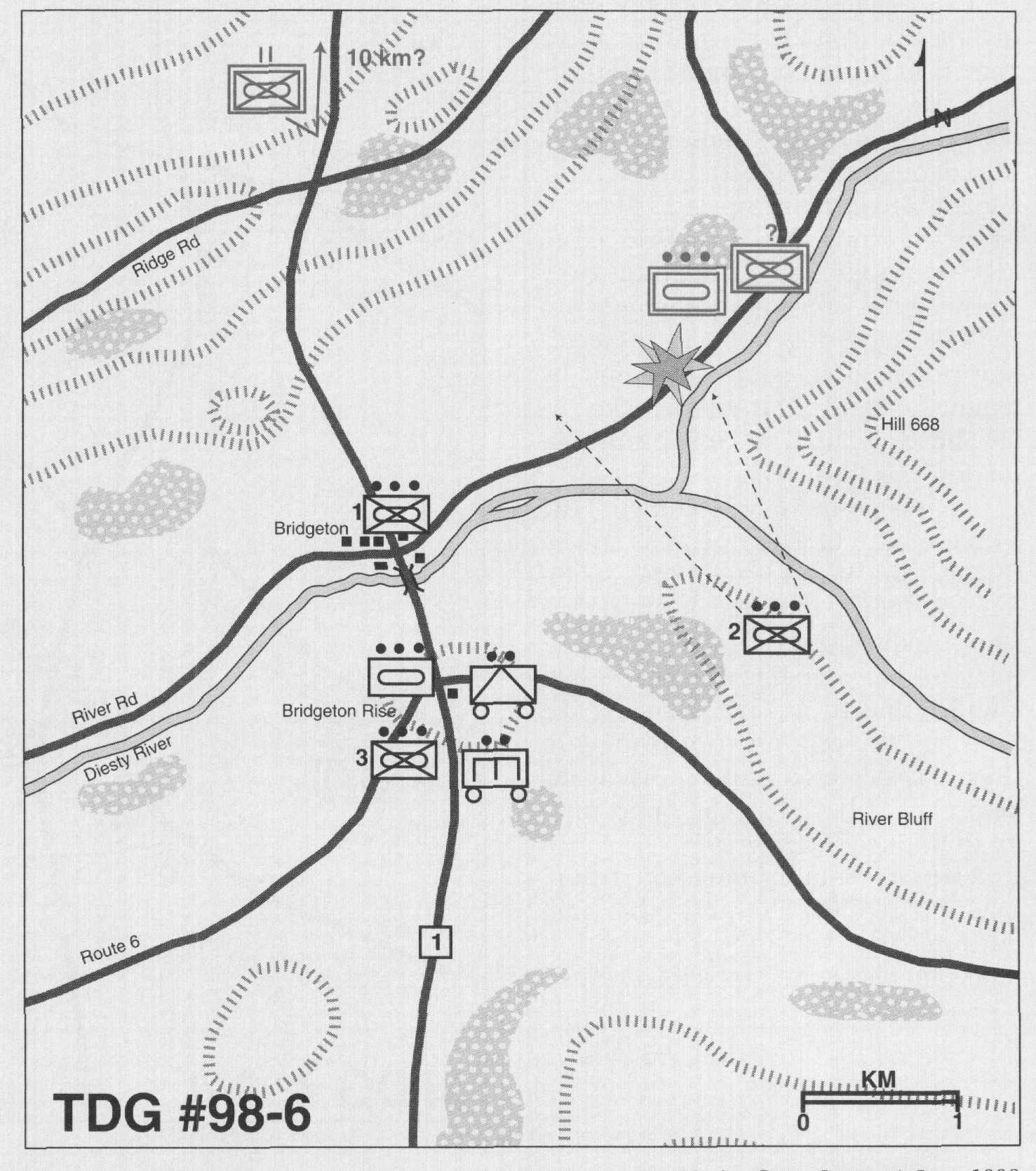
You are a rifle company commander in 1st Battalion, 3d Marines. Your company is mounted on AAVs and has been reinforced with a tank platoon, TOW section, combat engineer section, and Dragon section (attached to the rifle platoons). As the MEF advances generally north, your regiment has been ordered to swing west and seize a crossing of the Diesty River at Bridgeton in order to facilitate the continued advance. The previous night, friendly reconnaissance elements were driven from Bridgeton by an enemy mechanized force estimated to be platoon to company strength. Intelligence now reports an enemy mechanized battalion heading south on Highway 1 to reinforce Bridgeton, expected to arrive sometime midmorning. As the regiment prepares for a deliberate crossing, your company has been ordered to conduct a reconnaissance-in-force toward Bridgeton along Rte. 6 in order to ascertain the nature of enemy defenses and find possible river-crossing sites for AAVs.

The weather is lousy, and you doubt if much will be flying until it clears. You approach Bridgeton with 2d Platoon deployed onto River Bluff to protect your right flank. Gaining a vantage point to the town, you discover that Bridgeton seems to be unoccupied except for a reconnaissance patrol. Just then, 2d Platoon reports “enemy mech on the River Road about 3 clicks east of Bridgeton. So far I count 6 APCs and 2 tanks, but there could be more coming into view. They’re heading for the town like a bat out of hell.” You order 2d Platoon to engage and 1st Platoon to take the town immediately, with tanks and TOWs in overwatch at Bridgeton Rise and 3d Platoon and engineers in reserve. Your FO calls for fire east of the town. Once your platoons are on the move, you report your decision to battalion.

At 0850 you meet up in the town with your 1st Platoon commander who reports: “Town secure. We got 2 scout cars. One escaped north. Otherwise, the place seems empty.” The battalion commander comes on the net: “Imperative you hold Bridgeton until we can reinforce. I’m getting you all the support I can, including anything that’ll fly. You’re now division main effort. Hang on; we’ll be there as fast as we can. Good work.” The firefight to the east has died down. You check in with 2d Platoon, which reports: “We knocked out one APC. Enemy has pulled back. We’ve got three tanks and an APC visible in the treeline 3 klicks northeast of the town. The rest of the column seems to have withdrawn; I can’t tell where.” The time is now 0900. Battalion still has no word on the enemy battalion to the north. What next, Captain?

Requirement

In a time limit of 3 minutes, issue any instructions and make any reports/requests. Once that is done, provide a sketch of your plan and a brief explanation of your decision. Submit your solution to the Marine Corps Gazette, TDG #98-6, P. O. Box 1775, Quantico, VA 22134 or fax 703-640-0823.

For more detailed information on the structure of Marine Corps units, Marine Corps equipment, and symbols used in TDG sketches, see MCG, Oct94, pp. 53-56 and the modification reported in Jan95, p. 5.

Trouble at the ORP

By 2dLt Paul C. Merida

Situation

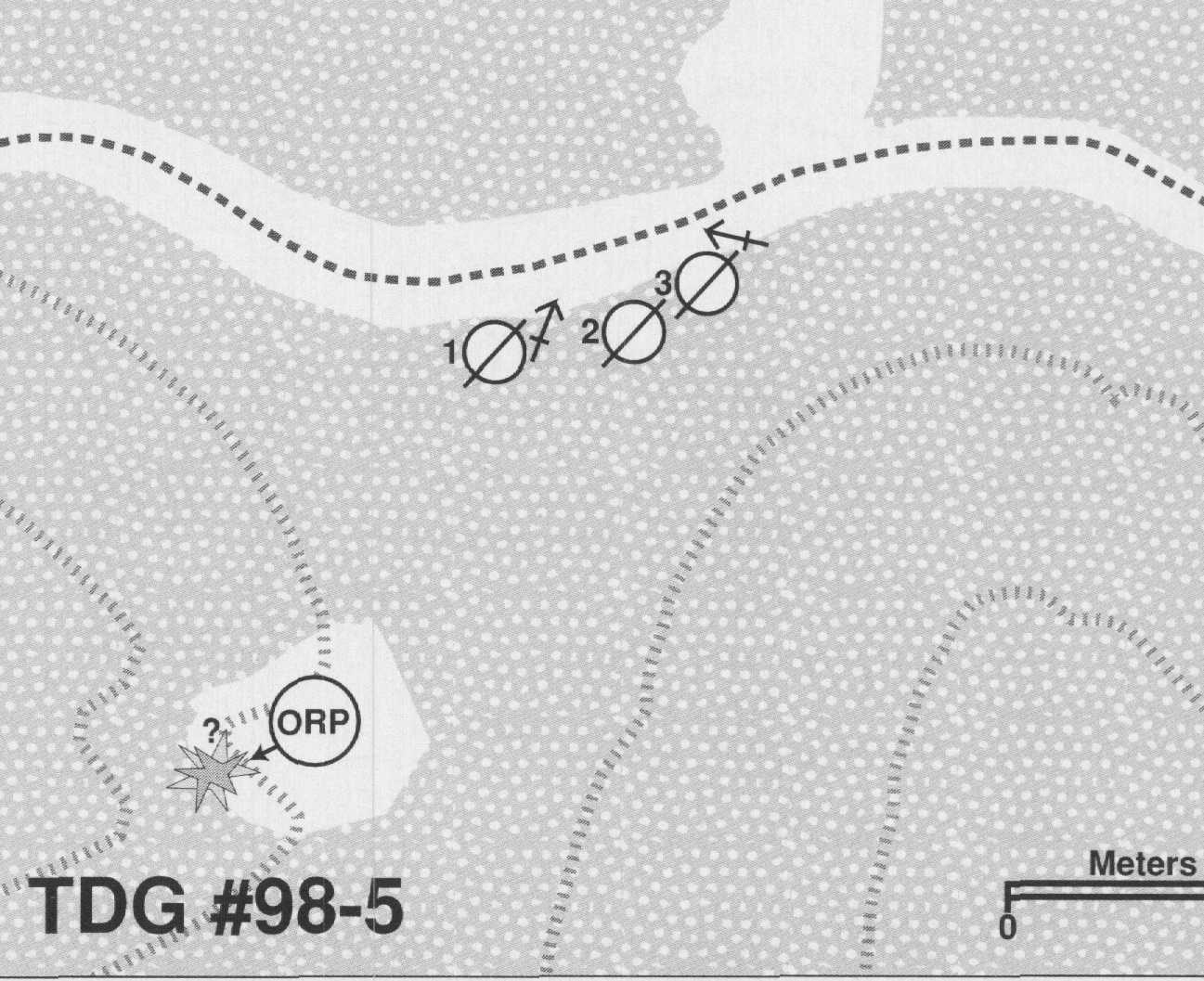
You are a squad leader leading an ambush patrol through wooded terrain, which usually limits visibility to 50 meters or less. In addition to your three fire teams, which are well-equipped with claymores and grenades, you have a machinegun squad (two three-man teams, each with an M240G). You are equipped with a radio. Your squad is in its ambush site along a trail frequently used by the enemy. Your objective rally point (ORP), where you have left two Marines and your packs, is about 200 meters to the southwest.

It is about 0100, and you have been waiting for about 2 hours when automatic gunfire suddenly erupts from the direction of the ORP. The firing lasts only a few seconds and now it is silent again. It happened so quickly you can’t be certain, but your sense is that there were at least 2 weapons involved but certainly no more than 3 or 4. You try to recall the sound of the exchange to determine if any of the weapons were M16s, but you cannot be sure. It will be light at 0500. Your platoon’s patrol base is about 3 kilometers to the southeast.

It has now been 3 minutes since the incident and you have heard or seen no sign of activity from the direction of the ORP. What now, Sergeant?

Requirement

In 5 minutes decide on your course of action, issue any orders, and make any reports or requests. Then provide a sketch of your plan and an explanation of your decision. Submit your solution to the Marine Corps Gazette, TDG #98-5, P.O. Box 1775, Quantico, VA 22134 or fax 703-640-0823.

Bridgeton Crossing

By Dr. Gary Klein, Michael McCloskey, Marvin Thordsen, David Klinger, and Maj John F. Schmitt, USMCR

Situation

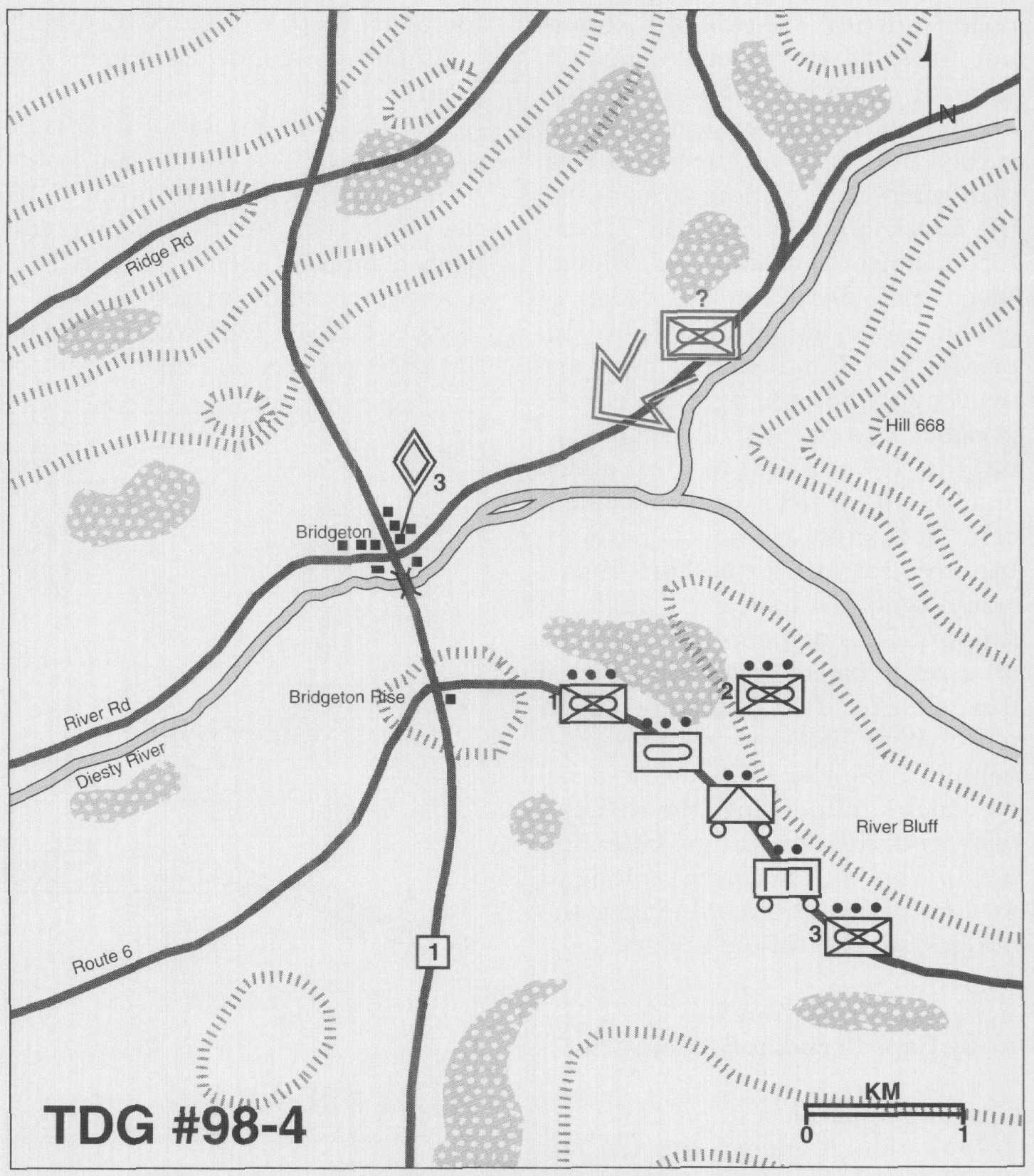
You are a rifle company commander in lst Battalion, 3d Marines. Your company is mounted on AAVs and has been reinforced with a tank platoon, TOW section, combat engineer section, and Dragon section (attached to the rifle platoons). The MEF has been advancing generally north. Your regiment has been ordered to swing west and seize a crossing of the Diesty River at Bridgeton in order to facilitate the continued advance. Originally the regimental commander had hoped to force a hasty crossing with 1st Battalion, but bad weather has slowed the advance. The previous night, friendly reconnaissance elements were driven from Bridgeton by an enemy mechanized force estimated to be platoon to company strength. Intelligence now reports an enemy mechanized battalion heading south on Highway 1 to reinforce Bridgeton, expected to arrive sometime midmorning. As a result, the regimental commander has decided he will now have to conduct a deliberate crossing and has ordered more forces forward. In the meantime. your company has been ordered to conduct a reconnaissance-in-force toward Bridgeton along Rte 6 in order to ascertain the nature of enemy defenses along the axis of advance as well as at Bridgeton. You are told to advance as far as you can without getting decisively engaged. You are also instructed, if able, to look for sites near Bridgeton suitable for crossing by AV since the banks of the Diesty are frequently accessible to amphibious vehicles.

The weather is lousy and you doubt if much will be flying until it clears. By 0805 you have advanced within 5 kilometers of Highway 1 and are surprised that you have not made contact with enemy security forces. In response to your inquiry, battalion reports no new information on the enemy battalion approaching from the north. You deploy 2d Platoon onto River Bluff to protect your blind right flank. At 0825 Ist Platoon, your lead element, reports: “Just flushed a scout car off Bridgeton Rise toward the town.” Moments later, Ist Platoon calls again: “You better get up on the double to look at this.” You move forward and find the platoon commander watching Bridgeton from a turretdefilade position offering excellent observation of the entire town. He says: “Take a look. I’ve been watching for 5 minutes now and I’ve spotted 3 scout cars and maybe a handful of troops. . . enough for a recon detachment. Otherwise the town is dead.” With your binoculars you confirm the lieutenant’s observations: no sign of infantry, mechanized vehicles or heavy weapons; no signs of any defensive preparations. Just then, 2d Platoon comes on the net: “We got enemy mech on the River Road about 3 clicks east of Bridgeton. So far I count six APCs and two tanks, but there could be more coming into view. They’re heading for the town like a bat out of hell. Do you want me to engage?” It is 0835. What do you do, Captain?

Requirement

In a time limit of 3 minutes, issue any instructions and make any reports/requests. Once that is done, provide a sketch of your plan and a brief explanation of your decision. Submit your solution to the Marine Corps Gazette, TDG #984, P.O. Box 1775, Quantico, VA 22134 or fax 703-640-0823.

For more detailed information on the structure of Marine Corps units, Marine Corps equipment, and symbols used in TDG sketches, see MCG, Oct94, pp. 53-56 and the modification reported in Jan95, p. 5.