Caught in the Open

By Capt Douglas J. MacIntyre

Situation
This scenario uses the same general setting as TDG #99-10, but changes your role. You are now the commanding officer of Company C (Co C), 1st Battalion, 6th Marines. Your company is at 85 percent strength and has a scout/sniper team attached. Your regiment has been deployed to help stabilize conditions in the war ravaged country of Athsano. Rebel units are taking control of the capital. Athsanco, Government forces are reorganizing in the south, but are expected to arrive within the next day or so. Marine forces have been sent to secure key nodes within the capital city prior to the arrival of follow-on forces. These nodes consist of the port facility, airport, and several government and communications centers.

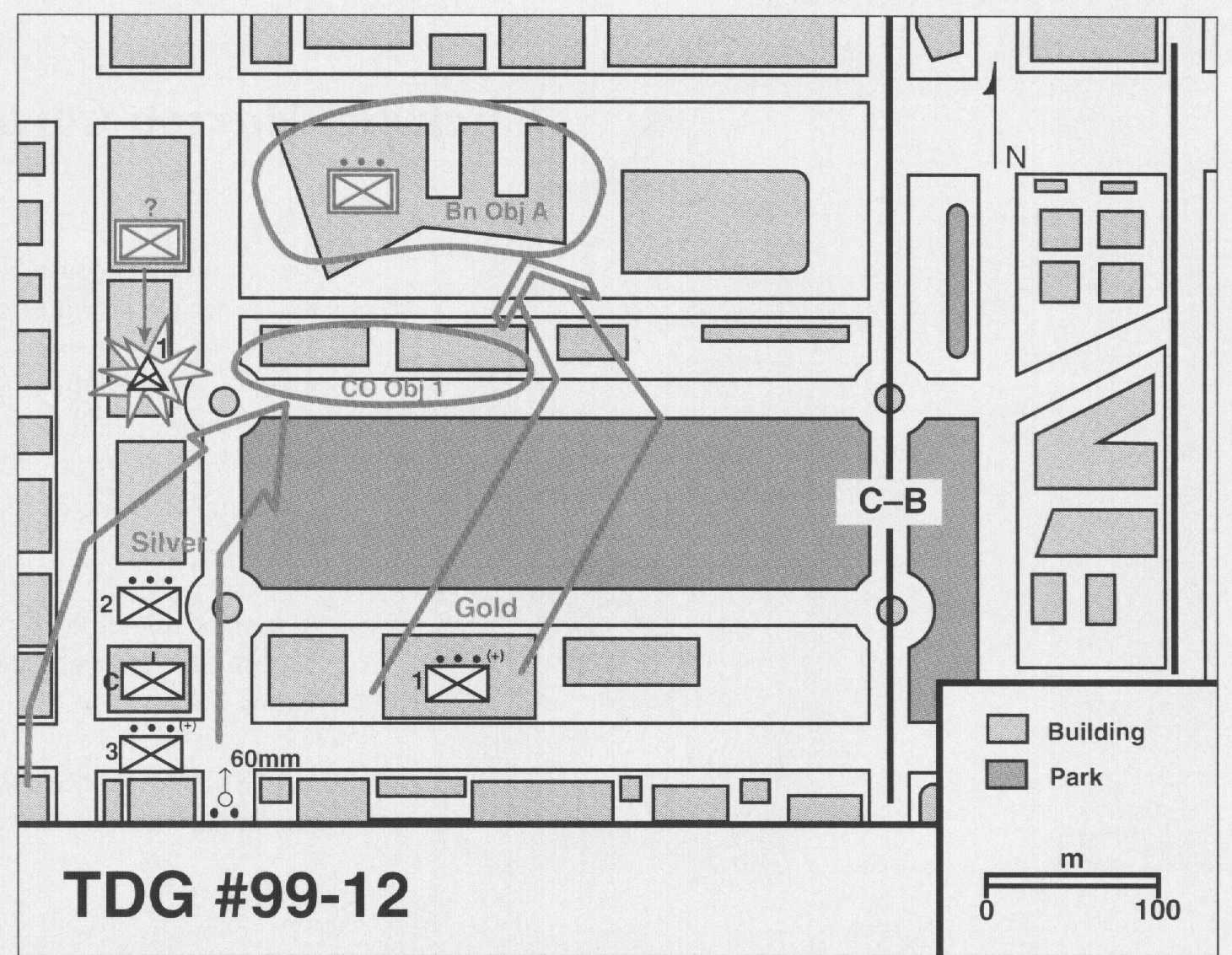
Battalion has been tasked to attack in zone to seize the radio station at Battalion Objective A (Bn Obj A) (see map), in order to deny the rebel forces the ability to communicate with their supporters and the civilian populace. Additionally, the battalion must assist in refugee control. The battalion commander’s end state is the radio station secure; the battalion’s zone clear of rebel forces and fleeing refugees; and the battalion prepared to continue the attack. Co C is the battalion’s main effort, with Co B as a supporting effort assisting refugees to the east, and Co A (Mech) as the reserve.

To date, the rebels have been quite effective in urban ambushes and weapons employment, with heavy volumes of rocket propelled grenades and light machinegun fire noted. They are considered well trained, logistically sound, and night capable. Typically operating in squad- to platoon-sized elements, they are expected to fight for control of vital areas.

In support of your plan, the attached scout/sniper team moved to a vantage point located in the building across from the northwest corner of the large, open park area that runs across your zone. From their position, they reported a platoon-sized rebel force moving into Bn Obj A before dark. The rebels appeared to be in a low state of alert.

Noting this, you briefed your plan. At 0100, 2d and 3d Platoons will attack along Axis Silver, secure Company Objective 1 (Co ObJ 1), and provide support for the company main effort. 1st Platoon (the main effort) will initially cover 2d and 3d’s movement to Co Obj 1. On order, Ist Platoon will attack along Axis Gold to conduct the initial penetration into Bn Obj A, gain a foothold, and pass through additional units to help it clear the building. Both 1st and 3d Platoons are reinforced with assault and machinegun squads from Weapons Platoon; the 60mm Section will provide preplanned smoke and illumination missions only.

It is now 0 120. 2d Platoon has secured a route through the first building along Axis Silver. You and your command element have just entered the first building, with 3d Platoon in trace. Suddenly, an engagement is heard from the north. 1st Platoon reports observing a heavy volume of small arms fire into and around the building where the scout snipers are located. 2d Platoon is caught between buildings. What now, Captain?

Requirement

In a time limit of 5 minutes, decide what you will do, prepare appropriate orders as well as any reports/requests that you would submit. Provide a sketch and an explanation of your plan.

For more detailed information on the structure of Marine Corps units, Marine Corps equipment, and symbols used in TDG sketches, see MCG, Oct.94, pp. 53-56 and the modification reported in Jan95, p. 5.
Attack on Rocky Run Hollow

By Maj John F. Schmitt, USMCR

Situation

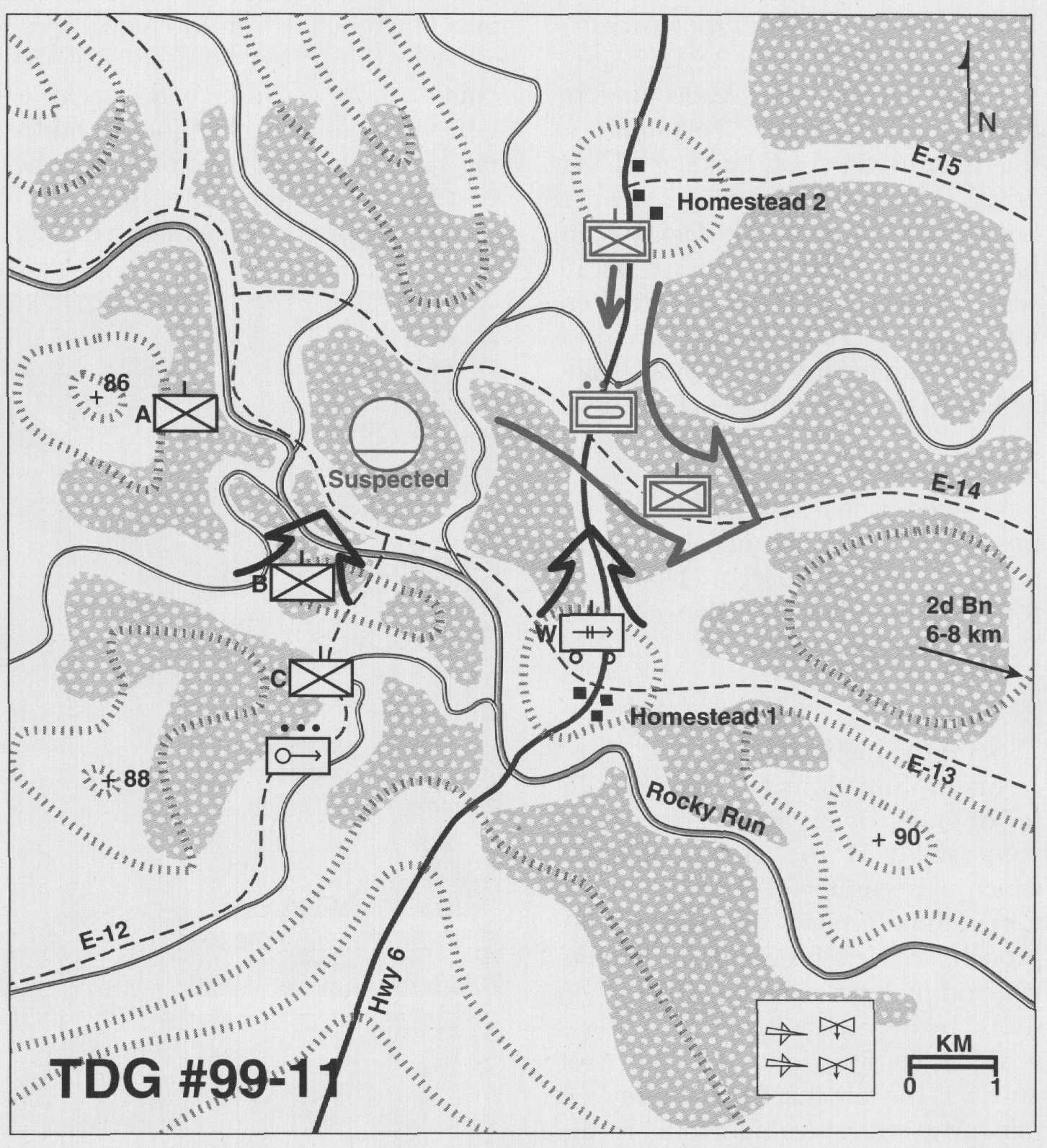
You command the 1st Battalion. Your enemy is elements of the Quantico Liberation Front QLF). A tough and effective guerilla force, the QLF tends to operate in small units, relying on ambush and hit-and-run tactics. Faced with a superior enemy, QLF forces will usually withdraw quickly, springing ambushes on their pursuers. QLF forces have shown themselves capable of mounting operations up to battalion size, with up to 8-10 light tanks in support. The terrain is thickly vegetated; line of sight is rarely more than 200 meters, and often less than 100. The largest stream, Rocky Run, is never more than 3 feet deep; the others are intermittent and pose no obstacle to infantry. The only road in your area is Highway 6, a one-lane dirt road. Vehicles are mostly limited to the road and trails.

Regiment hopes to bring the QLF to battle with a pair of simultaneous predawn surprise attacks. Your battalion is tasked to locate and attack a possible enemy regimental supply depot in Rocky Run Hollow west of Highway 6. The regimental commander makes it clear that the true objective is to force the QLF to fight, and the idea is to do that by threatening his logistics. Meanwhile, some 10 kilometers east, 2d Battalion will launch a helicopterborne raid on Triangletown, a suspected QLF assembly area.

You have two sections of Cobras (Zipper 1 & 2) in direct support and two preplanned close air support missions. Your antiarmor assets are organized into “Whiskey” Company, consisting of M2 heavy machineguns, Mk19 grenade launchers, and TOWs mounted on HMMWVs and organized into four platoons of four vehicles each.

You come up with what you think is an adaptable plan. Alpha will swing around to block the western flank near Hill 86. Whiskey will advance north on Highway 6 to block from the cast. Bravo will advance directly north on the suspected logistic site in order to fix the enemy or flush him toward Alpha or Whiskey. Charlie will be in reserve, ready to exploit the situation. Aviation will be on call.

The approach march goes well. Alpha reaches its attack position at 0300 without making contact. Whiskey reaches Homestead 1 having lost only one vehide to an enemy mine. Bravo advances quickly in the face of sporadic harassment from an estimated squad and reaches the rise overlooking the suspected logistic site with minimal casualties. Radio traffic indicates 2d Battalion has rim into a sizable force near Triangletown. As Bravo continues to advance at 0400, Whiskey moves north from Homestead 1 toward the E-14 trail intersection to “tighten the noose.” Bravo reports increasing resistance, probably platoon strength, but no sign yet of a logistic site. At 0430, Whiskey reports an enemy colunm of infantry with six enemy tanks at the Highway 6/E-14 intersection, heading east on E-14. Whiskey was able to knock out a light tank before “everybody went to ground. They didn’t expect us.” Just then, you receive a report from higher headquarters of an enemy infantry company “double– timing” south on Highway 6 near Homestead 2.

What will you do?

Requirement

In a time limit of 5 minutes, make your decision in the form of any orders you will issue or reports you will make. Then provide an overlay and a brief explanation of your decision. Submit your solution to Marine Corps Gazette, TDG #99-11, P.O. Box 1775, Quantico, VA 22134 or fax (703) 630-9147.

Decision at the Overpass

By Capt Douglas J. MacIntyre

Situation

You are the battalion commander of 1st Bn, 6th Marines, with a weapons company and three rifle companies, one of which has an attached amphibious assault vehicle (AAV) platoon.

6th Marines has been deployed to help stabilize Athsano, a war ravaged country in southern Europe. Athsano government forces are currently reorganizing to the south and are expected to push west along Highway 9 within the next 24 hours. Marine forces have been sent to secure key nodes within the capital city prior to the government’s renewed offensive and arrival of follow-on U.S. forces. These nodes consist of the port facility, airport, and several government and communications centers.

Rebel units appear highly trained and make good use of the terrain. Their tactics have centered around prepared defenses and ambushes within the city. They possess medium to heavy weapons, rocket propelled grenades, and limited indirect fire capability from 82mm mortars. Operating in squad to platoon size elements, they are expected to fight for control of vital areas.

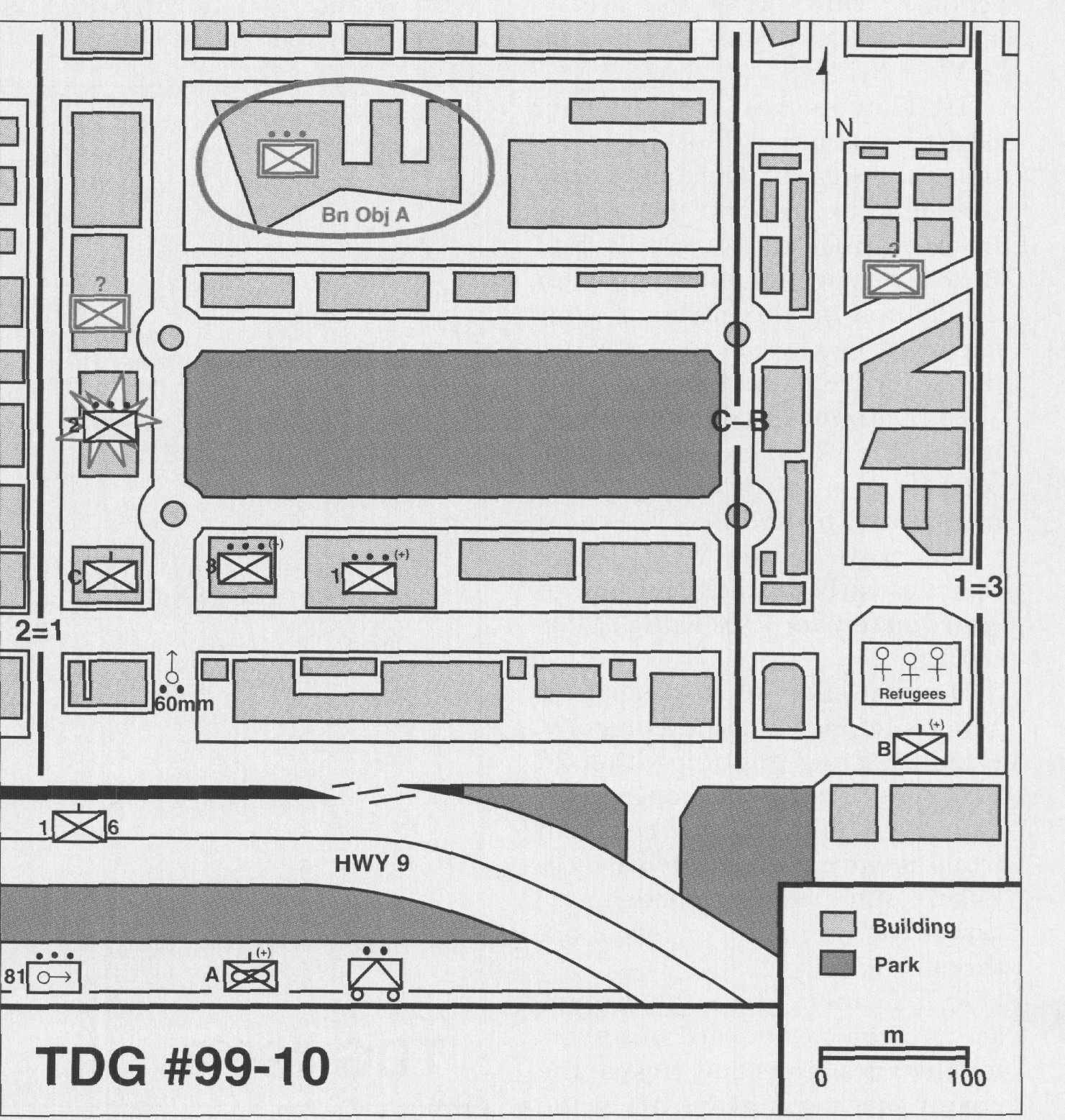
The battalion’s mission is to attack in zone to seize the radio station designated as Battalion Objective A (see map) in order to deny the rebel forces the ability to communicate with their supporters and the civilian populace. Additionally, the battalion must assist in refugee control. Your desired end state is the radio station secure, the battalion zone clear of rebel forces, refugee flow diverted away from Hwy 9, and the battalion prepared to continue the attack. Company C is the battalion’s main effort, with Weapons Company and Company B as supporting efforts, and Company A as the reserve.

The plan of attack is as follows: At 0100, Company C attacks in zone to seize Bn Obj A in order to deny the enemy use of the television station. Company B will have moved earlier to the east to prevent refugees from entering either Company C’s zone or Hwy 9. The 81mm Mortar Platoon is in general support of the battalion, and the remaining Combined Antiarmor Team (CAAT) is patrolling Hwy 9. Company A (Rein) is in reserve with attached Dragon Section, CAAT and the AAV Platoon. Upon consolidation of Bn Obj A, the reserve will reinforce Company’s C zone and expand local security.

It is now 0120. From a vantage point on Hwy 9, you observe heavy fighting to the north. The S-3 states, “Company C (advancing via the buildings on the left of its zone) has been stopped by a determined enemy defense and reinforcement. It reports heavy casualties in its lead platoon. Company B reports over 500 refugees in a holding area and an enemy of unknown strength moving to its north. The battalion reserve and 81mm platoon have staged on a secondary road south of the Hwy 9 overpass. What now, sir?”

Requirement

In a time limit of 15 minutes, decide what you will do, prepare appropriate orders as well as any reports/requests that you would submit. Provide a sketch and an explanation of your plan. Submit your solution to Marine Corps Gazette, TDG #99-10, P.O. Box 1775, Quantico, VA 22134 or fax 703-630-9147.

For more detailed information on the structure of Marine Corps units, Marine Corps equipment, and symbols used in TDG sketches, see MCG, Oct94, pp. 53-56 and the modification reported in Jan95, p. 5.
Chaos at Intercon Hotel

By Capt Timothy E. Barrick

Situation

You are a Marine rifle platoon commander in a multinational force conducting peacemaking operations in a war-torn Third World country. At 0600 on a rainy morning, you set out with your platoon on a dismounted patrol through your battalion’s sector of the nation’s capital. You have a machinegun squad (two M240Gs), two SMAW teams, and an antiarmor squad (four Dragons) attached. Additionally, each of your fire teams is carrying two AT4s. At 0630, you hear the following report to battalion from a light armored reconnaissance patrol farther to your north:

“Thunder 3, this is Rat 1, observing 3 T-72s and about 30 to 40 dismounts moving south on Sunset Boulevard. Uniforms and markings belong to Faction X ”

At 0635, you hear gunfire to the north and the following over the radio:

“Thunder 3, this is Rat 1, contact! Tanks are firing on my pos! I have one vehicle destroyed and at least four men down! I’m disen- -”

The radio transmission abruptly ends. At 0640, you receive the following frag order:

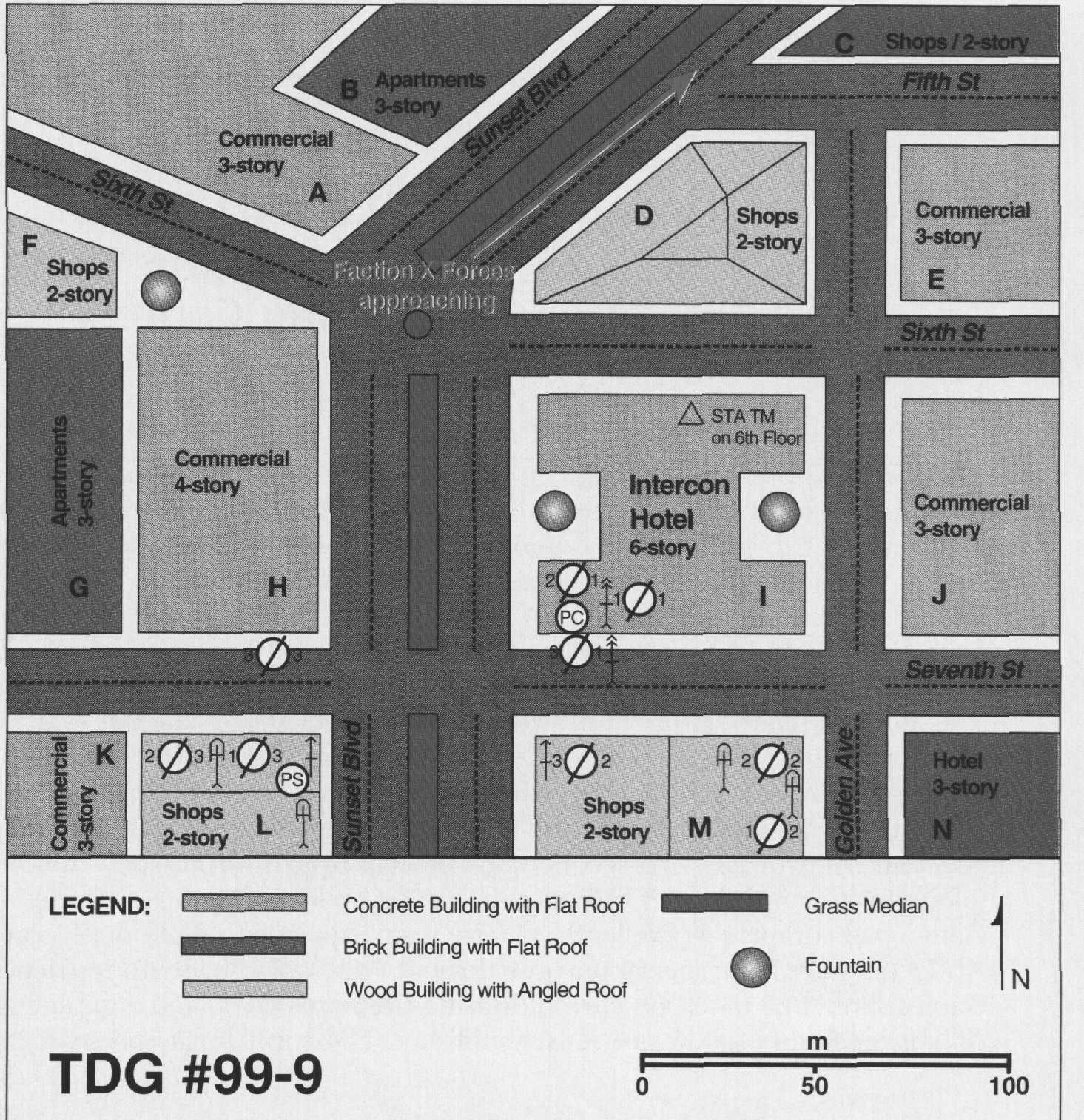
“U.S. forces have been engaged. Faction X designated as hostile. Weapons free versus Faction X. Enemy tank-infantry team moving south on Sunset Blvd. Move your platoon to vicinity Intercon Hotel and establish a hasty defense in order to prevent enemy penetration south of Sixth St. You have no air or arty in support, but you have priority on SIs. You are advised utmost caution to minimize/prevent civilian casualties.”

As you ponder the ambiguity of the last sentence of your frag order, you quickly maneuver your platoon north. As you near the Intercon Hotel, the scene before you is one of chaos. People are fleeing the streets. Several shout, “Tanks!” as they run by and point north up Sunset Blvd. You put your platoon sergeant and 3d Squad into building L (see map) and 2d Squad into M while you move with 1st Squad into the bottom floor of the Intercon. As you enter, you see about 20 foreigners and locals in the lobby. They are all very excited and anxious. At least two are obviously reporters, and their cameramen are positioned in anticipation of the tanks rolling by on Sunset Blvd.

You switch frequencies on your radio to talk to the scout team you know to be positioned in the hotel. The team reports:

“We’re on the 6th floor facing north. There are three T-72s and at least two platoons of infantry moving south on Sunset, The lead tank and infantry have just passed Third Street. The tanks are moving at a crawl allowing the infantry to clear the way in front of them.”

As you put down the radio, you feel about 30 pairs of eyes, both Marine and civilian, staring at you in expectation of your orders. What do you do now, Lieutenant?

Requirement

In a time limit of 2 minutes, decide what orders/reports you will issue, then provide a sketch of your actions and the rationale behind them. Submit your solution to Marine Corps Gazette, TDG #99-9, P.O. Box 1775, Quantico, VA 22134 or fax it to 703-630-9147. Solutions may also be submitted by email. See our web site at <www.mcamarines.org/gazette/gaz.html> for instructions.

For more detailed information on the structure of Marine Corps units, Marine Corps equipment, and symbols used in TDG sketches, see MCG, Oct94, pp. 53-56 and the modification reported in Jan95, p. 5.
Bridges East and West

By Capt Michael J. Targos

Situation

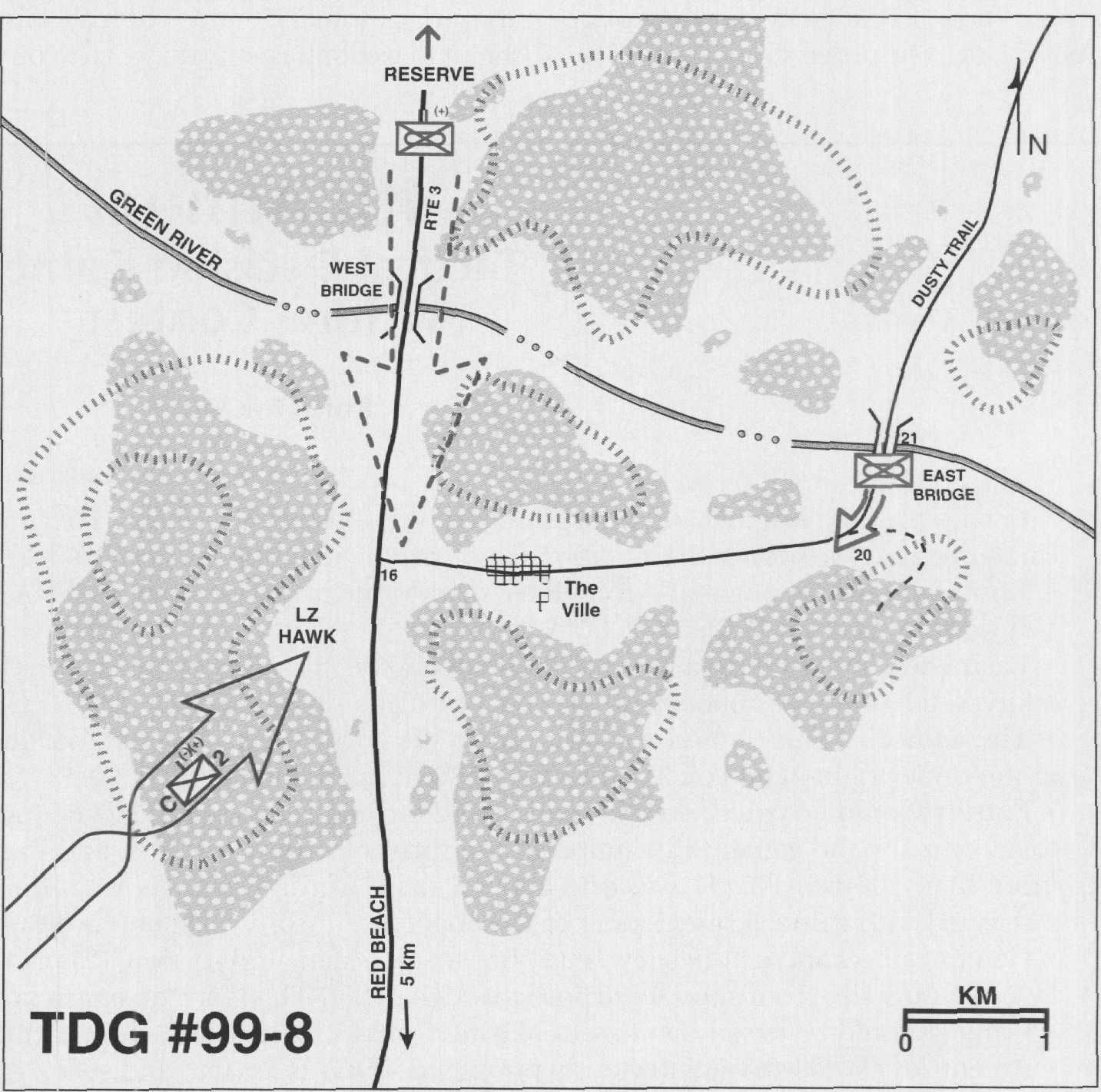
You are the commanding officer of Company C, Ist Battalion, 2d Marines, Regimental Landing Team 2. RLT-2 is conducting an amphibious assault in the country of Burgundy. The country is characterized by many rolling hills, sporadically forested. The coastline is fortified with numerous concrete bunkers, minefields, and tank obstacles. Your company is a pre-Hhour helicopterborne force tasked with inserting into Landing Zone (LZ) Hawk near “The Ville” (an evacuated hamlet of 25-30 wooden huts) and blocking on enemy reserve force along the line of the Green River. Higher’s intent is to prevent, at all costs, the enemy reserve force, which is believed to be a reenforced mech battalion equipped with BMP-2s and a platoon of T-72 tanks, from interfering with the fight on the beach. Plans call for the destruction of East Bridge by airstrike at L-30. Lhour is scheduled for 0630. H-hour for the rest of the battalion is 0900 across Red Beach 5 kilometers south of LZ Hawk. Bravo Company (Rein) will comprise the assault wave with a tank platoon close behind in LCUs.

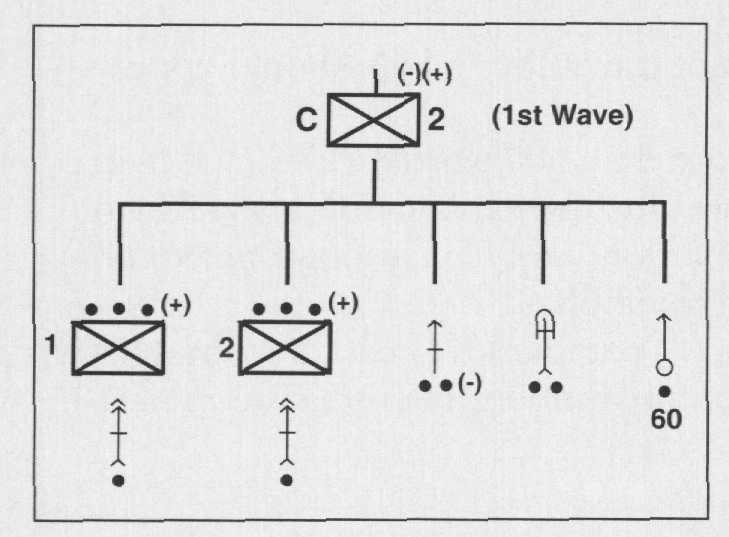
Your plan is to seize the West Bridge with your first wave and to add depth to your position with the second wave along Route 3. The first wave is loaded with two rifle platoons (1st and 2d), two machinegun squads, four assault teams (attached to the platoons), a 60mm mortar squad, a Dragon section, and your company command element (-) with a tactical air control party and naval surface fire spot team attached. The remainder of the company is capable of being in zone in 1 hour. USS Spruance (DD 963) is in direct support of the RLT, and there is a section of AH1Ws (TOWs) escorting your helicopter formation. A section of AV8Bs armed with 500-pound bombs comes on station at 0700.

As you approach LZ Hawk, you observe from your helicopter a company-sized mech force crossing East Bridge. The bridge wasn’t destroyed? You count approximately 10 BMPs and see no tanks. Your helicopter hits the deck. The ramp drops. What are your orders?

Requirement

In a time limit of 3 minutes, issue any orders you would give and prepare any reports or requests you would submit to higher headquarters. Provide a sketch of the actions taken and the rationale behind them. Send your solution to Marine Corps Gazette, TDG #99-8, P.O. Box 1775, Quantico, VA 22134 or fax to (703) 630-9147.

All in a Day’s Work (Part II)

By Dr. Andrew H. Hershey

Situation

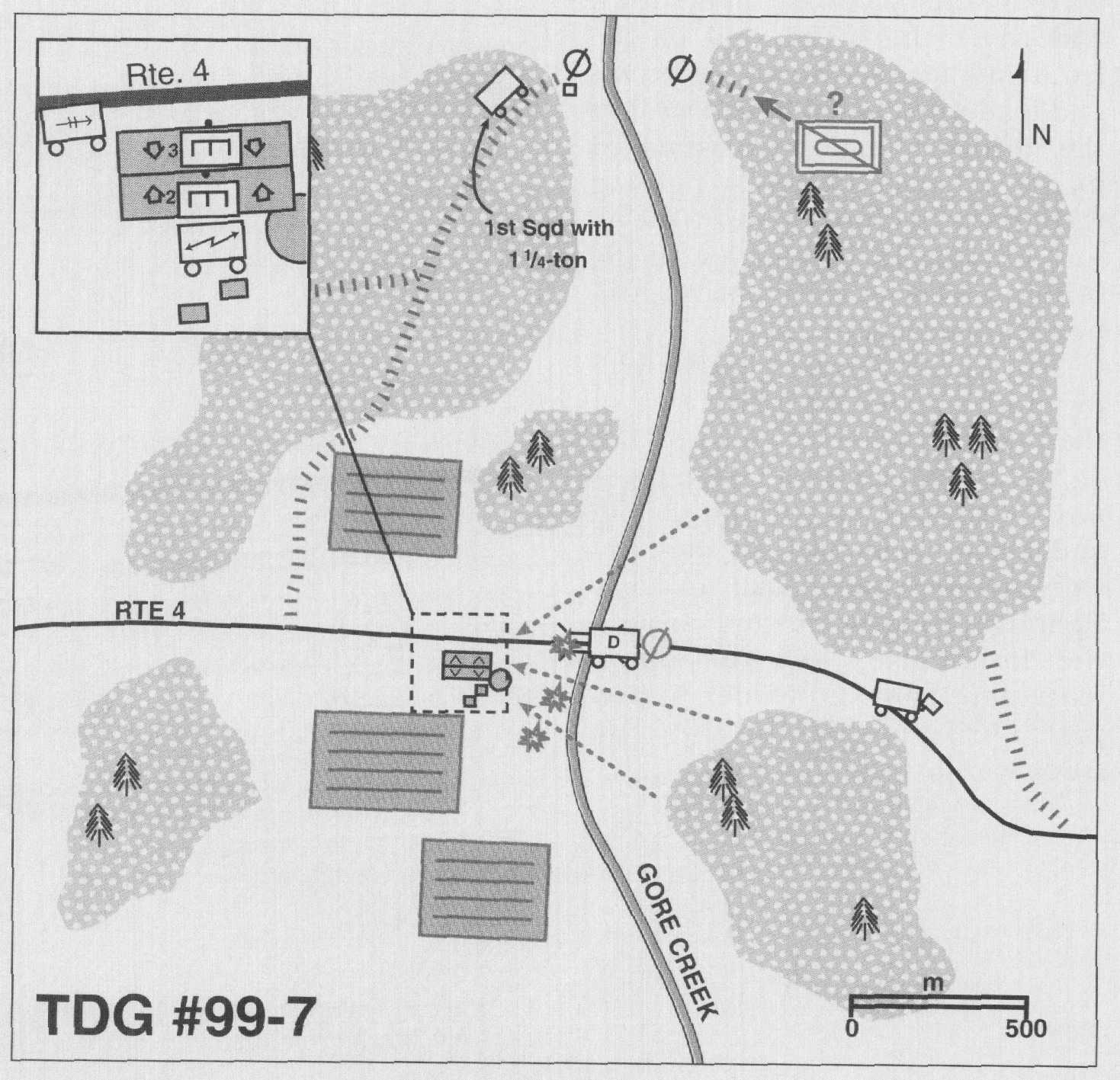
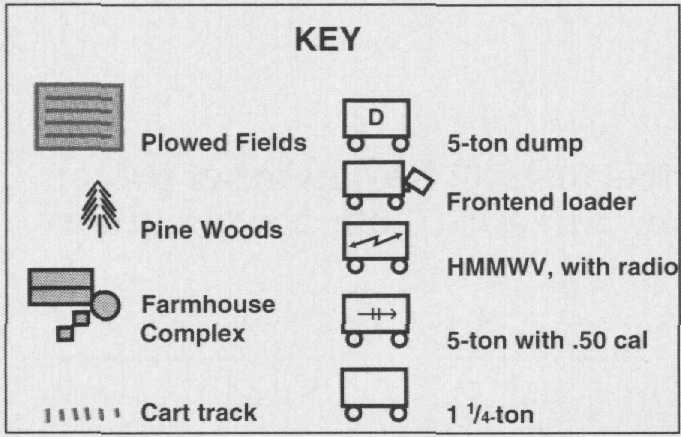
You are the commanding officer of a small combat engineering detachment consisting of three squads, each equipped with a chain saw and normal weapons (M16s, M203s, and two SAWs), and five vehicles (a 5-ton truck with a ring-mounted .50 caliber machinegun, a 5-ton dump truck, a frontend loader, a 1 1/4-ton truck, and your HMMWV).

Your mobility enhancement mission (a prelude to pending offensive operations) involves improving road conditions along Rte. 4 and repairing the bridge over Gore Creek, a 20-meter wide, bolder-strewn, moderately flowing stream.

Much of the terrain about you is covered with tall pine forest of moderate density. A stone farmhouse, whose plowed fields are enclosed by threestrand barbed wire fences stands close to the bridge. Route 4 and a cart track not marked on your map (or explored by you for lack of time) are the only visible avenues for vehicles. It is late January in a temperate region of the world. While there is no ground snow, the sky is low and heavily overcast; back home one would say “it feels like snow”.

At about 1600, shortly after you have completed work on the bridge, your 3d Squad, which was working about 1,000 meter east of the bridge, was taken under fire by enemy located 500-600 meters further to the east. Reportedly the enemy element has, at least, one BTR and a BMP.

In response to this threat, you directed the 3d Squad to disable the front-end loader to block the road near their position and then to join the rest of the command near the farmhouse complex. You had the dump truck disabled on the bridge to create another roadblock. You sent the 1st Squad with the 1 1/4-ton truck to recon the cart track leading northeast just to the west of the cultivated fields. Finally, you notified the battalion responsible for overall security of the contact and received priority of 81mm mortar fire.

The two squads and the truck with the machinegun remaining in the vicinity of the farm occupied hasty firing position. No further movement was detected on the road, but within a very short time you began receiving a steadily increasing volume of small arms fire from the tree lines east of the bridge. A short while later several of your men spotted enemy troops maneuvering toward the bridge. Your men and the .50 caliber retum fire. Enemy medium caliber mortars begin impacting 150 meters east of you. At that moment, 1st Squad comes on the net and reports, “Sir, we followed that cart track. It headed generally northeastwards, but there was one spur heading west. The track itself continues northeast and runs into Gore Creek maybe 2 kilometers from the bridges. There is a small wooden cabin up there and a shallow stretch of river. I have a team east of the creek, and they have just signaled enemy tracks approaching. Over.”

What now lieutenant?

Requirement

In a time limit of 2 minutes issue any orders/reports you might make. Then provide a sketch of your actions and the rationale behind them. Submit your solution to Marine Corps Gazette, TDG #99-7, Quantico, VA 22134 or fax it to (703) 640-0823. Solutions can also be sent by e-mail. See our web site for instructions.

For more detailed information on the structure of Marine Corps units, Marine Corps equipment, and symbols used in TDG sketches, see MCG, Oct94, pp. 53-56 and the modification reported in Jan95, p. 5.
Battle Along the Tziepov, Continued

By Maj John F. Schmitt, USMCR

Situation

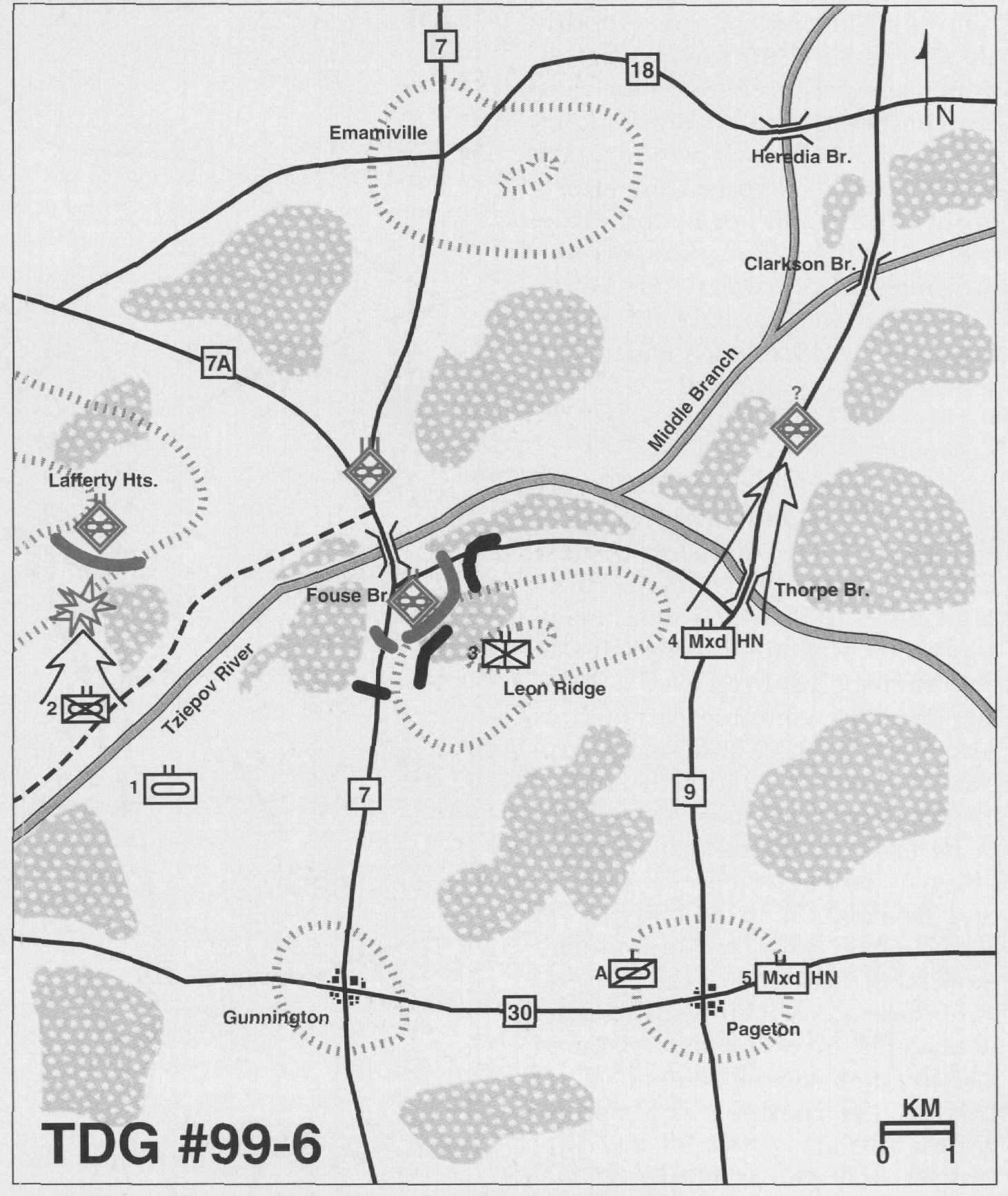
This scenario is the continuation of TDG #99-4, based on the author’s solution shown on p. 99. You command a task force (TF) consisting of a tank battalion (bn) (lst), a mech bn (2d), a motorized bn (3d), a LAR company (Alpha), and two mixed host-nation bns (4th and 5th, each consisting of two tank companies and two motorized companies). The host-nation bns are capable of most basic missions. Friendly forces, advancing north, and enemy forces, advancing south, met along the Tziepov River, which is slow-moving and fordable in many places. Your TF was sent west along Rte. 30 with urgent instructions to secure bridges on the roads leading to Gunnington and Pageton, or at least to deny those crossing sites to the enemy. Elements of your command made contact at both bridges.

Shortly after midnight the situation stabilized somewhat. Alpha was holding Thorpe Bridge and screening to the west. It received periodic probes from an estimated enemy bn north of the river. Enemy forces were holding a bridgehead south of Fouse Bridge. They were contained by 3d Bn, but the situation there was confused. Intel reported increasing enemy activity in the Emamiville-Fouse Bridge area. 2d Bn was positioned north of Gunnington; Ist, 4th, and 5th Bns were in assembly areas near Pageton. Replenishment was underway with completion expected around 0300.

You were unhappy with this posture. You felt you were losing the initiative. Although you couldn’t identify any really attractive option, you decided to undertake these actions: (1) Initiate heavy supporting fires on enemy in vicinity of Fouse Bridge. (2) Order 2d Bn, reinforced by 1st Bn, to ford the Tziepov west of Fouse Bridge without first replenishing and seize Lafferty Heights. (3) Initiate a relief-in-place between Alpha and 4th Bn in order to free up Alpha. (4) Keep 5th Bn in reserve.

2d Bn’s “immediate” move takes longer than you like but by 0415 2d’s leading elements are across the river without making contact. At 0430, the enemy estimated at regimental strength launches a dismounted attack out of the Fouse bridgehead. At 0445, 2d Bn makes contact with an enemy force in defensive positions on the slopes of Lafferty Heights. With priority of fires, it advances slowly against incr easing resistance. The relief-in-place at Thorpe Bridge is complete by 0500. The 4th Bn commander launches a probe across the bridge and at 0530 reports only scattered resistance. 2d Bn reports stiffening resistance and estimates the enemy on Lafferty Heights to be a battalion in hastily prepared defensive positions. 3d Bn reports it has halted the enemy attack out of Fouse bridgehead, at least temporarily. What do you do now?

Requirement

In a time limit of 10 minutes, make your decision in the form of any orders/guidance you will issue to subordinates and any reports/requests you will make. Include a sketch of your plan. Provide a brief explanation of your decision, to include any possible follow-on plans. Submit your solution to the Marine Corps Gazette, TDG #99-6, P.O. Box 1775, Quantico, VA 22134 or fax 703640-0823.

All in a Day’s Work

By Dr. Andrew H. Hershey

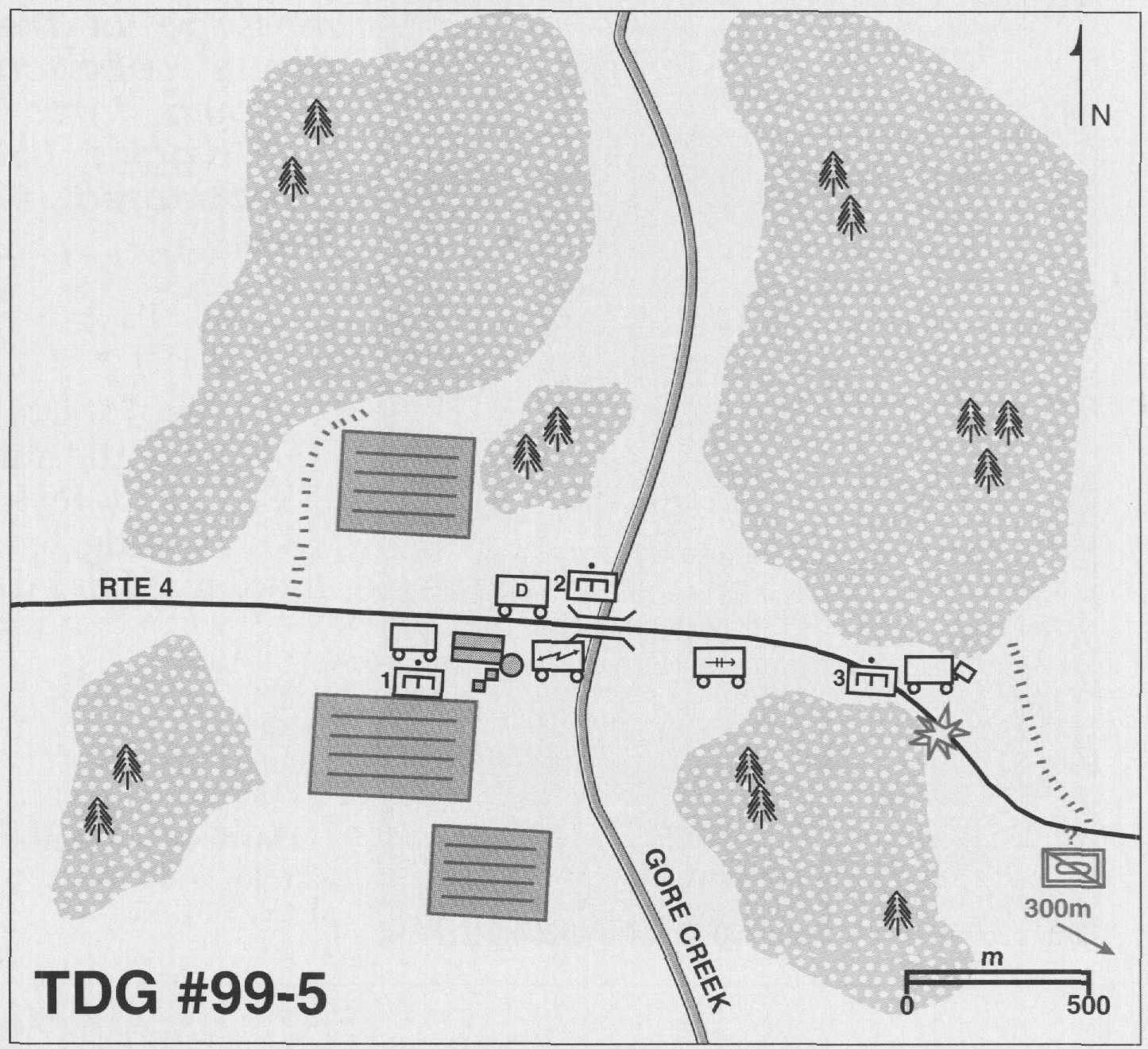
You are the commander of a combat engineer detachment. In preparation for an upcoming offensive, you have been tasked with mobility enhancement operations along a stretch of Rte. 4, to include repairing a blown bridge across Gore Creek, a 20-meter-wide, bolder-strewn, moderately flowing watercourse. You will be operating in the security area, forward of the main battle positions, protected by mobile security forces. The road repair consists primarily of filling in shell craters and clearing fallen trees. Your detachment has just completed the bridge repair and reinforcement, making the bridge passable once again for light traffic.

Your detachment consists of three squads. Your equipment includes three chainsaws (one per squad), a 5-ton dump truck, a heavy-duty front-end loader, a 11/4-ton truck, and a 5-ton truck with a ring-mounted .50 caliber machinegun. Your detachment is otherwise armed with only its organic infantry weapons–Ml6s, M203s, and two SAWs per squad. From your HMMWV, you have radio contact with your engineer company headquarters and the infantry battalion in whose sector you are operating. You are also in hand-held radio contact with your three squads.

The area alternates between farmland and pine forest of moderate density. Near the bridge stands an old stone farmhouse whose plowed fields are enclosed by threestrand barbed-wire fence. Rte. 4 and a rutted cart track, not marked on your map or explored by you for lack of time, are the only visible avenues for vehicles. It is late January in this temperate region of the world, and while there is no snow on the ground, the sky is low and heavily overcast; back home you would say, “It feels like snow.” It is 1535 hours.

Your forces are deployed as follows. East of Gore Creek, 3d Squad is clearing tree debris from the roadside. The front-end loader waits nearby for the return of the 5ton dumper to refill it with dirt from the nearby piles. The 5-ton truck is parked just east of the bridge. Just west of the bridge, 2d Squad unloads the dumper to fill in a series of craters. Ist Squad, with the light truck, is on break next to the farmhouse. You have just dismounted from your HMMWV on the bridge to give it one last look before declaring it open for traffic. You think to yourself that medium vehicles could also cross individually at slow speed. This thought is interrupted by the sounds of an explosion and gunfire to the east. 3d Squad comes on the net: “We’re taking fire from 500-600 meters down the road. Looks like a BTR and a BMP, and I can’t really tell what else.”

What now, Lieutenant?

Requirement

In a time limit of 2 minutes, issue any orders and submit any reports/request. Then provide a sketch of your actions and the rationale behind them. Submit your solution to Marine Corps Gazette, TDG #99-5, P.O. Box 1775, Quantico, VA 22134 or fax (703) 6400823.

Battle Along the Tziepov

By Maj John F. Schmitt, USMCR

Situation

You are the commander of a brigade-size task force consisting of a tank-heavy battalion (1st Bn), a mechheavy battalion (2d Bn), a motorized reinforced infantry battalion (3d Bn), a reinforced light-armored reconnaissance company (Alpha), and 2 host-nation mixed battalions (4th Bn and 5th Bn, each consisting of 2 tank companies and 2 motorized companies). Your host-nation battalions are battle hardened and capable of most basic missions. You are supported by a battalion of direct-support artillery. Your forces are depleted to about 70 percent strength. The terrain is rolling and thickly wooded in places. The wooded areas are impassable to all but infantry. Enemy forces, also depleted, are principally mechanized and motorized.

Friendly forces (advancing north with the mission of destroying enemy forces en route to the operational objective some 30 kilometers north) and enemy forces (advancing south) have clashed head to head along the trace of the Tziepov River. The Tziepov is a shallow, slow-moving river some 300-400 meters wide (with branches 100-200 meters wide). Upon contact, in an effort to seize the initiative, both forces have started shifting west, trying to turn the other’s flank and establish a bridgehead on the far side of the river. Unopposed crossings of the Tziepov, although time-consuming, are generally not difficult for vehicles or infantry. Assault crossings are another story. Fording sites can be found along most stretches of the river; generally, wherever the river is accessible, crossing sites can be found.

Your brigade is sent west along Rte. 30 with urgent instructions to secure bridges in the vicinity Emamiville-Gunnington-Pageton, or at least to deny those crossing sites to the enemy. Combat intelligence indicates an enemy mechanized regiment closing on Emamiville from the east along Rte. 18. Alpha races ahead and clashes with a reinforced enemy company of tanks and mech at Thorpe Bridge. After a heated engagement, Alpha repulses the enemy, who withdraws to blocking positions north of the river. 3d Bn reinforces Alpha and also continues west and meets an enemy battalion in the process of crossing at Fouse Bridge. Meanwhile, sensor hits indicate heavy vehicular traffic between Emamiville and Fouse Bridge. As darkness falls, a close, confused engagement develops on the wooded slopes of Leon Ridge. The 3d Bn commander reports he has only a rough idea of current friendly– enemy dispositions and that the operation has devolved into a series of intense small unit actions with the use of supporting arms being problematic.

By 2130, Alpha holds its position south of Thorpe Bridge and also screens the river between Rtes. 7 and 9, making periodic contact with enemy probes along its entire front. The company commander estimates he is now opposed by a battalion. 2d Bn has established a blocking position along Rte. 7 north of Gunnington. By 2300, 1st, 4th and 5th Bns occupy assembly areas near Pageton. Your mobile combat service support detachment (MSSD) has already replenished Alpha in its positions and will have your units in GunningtonPageton replenished by 0300. Throughout the night, reconnaissance teams report continuing vehicular movement, estimated at more than battalion strength, west across Heredia Bridge on Rte. 18. By 0030, 3d Bn commander reports the sounds of significant mechanized activity near Fouse Bridge. He reports that the situation has stalemated, with friendly and enemy forces interspersed and the enemy holding a tenuous bridgehead south of the river. He estimates that the situation is very unstable and will not be sorted out at least until dawn. In the meantime, a lull seems to have settled over the battlefield. What will be your next move?

Requirements

1) In a time limit of 15 minutes, make your decision in the form of any order/guidance you will issue to subordinates and/or reports/requests you will make. Your staff can work out the complete order as time permits. Include a sketch of your scheme. 2) In an additional 5 minutes, explain likely or possible follow– on actions you are considering. 3) Provide a brief explanation of your decision and follow-on plan. Submit your solution to Marine Corps Gazette, TDG #99-4, P.O. Box 1775, Quantico, VA 22134 or fax 703-640-0823.

For more detailed information on the structure of Marine Corps units, Marine Corps equipment, and .symbols used in TDG sketches, see MCG, Oct94, pp. 53-56 and the modification reported in Jan95, p. 5.

Action in Limbe

By Capt Daniel T. Canfield

Situation

You are the commander of 1st Platoon, Company F, 2d Battalion, 6th Marines, part of the Special Purpose Marine Air-Ground Task Force (SPMAGTF) that has just landed in Cap Haitien, Haiti. Your company quickly secured the airfield amid the uncertain situation. For the most part the local populace was excited and very happy to see the Marines, believing that you were there to throw off the “yoke of oppression” that had beset the country for years. However, tensions between Marine forces and the local government and police forces were high. Two days ago, a patrol got into a firefight in front of a police station deep within the city itself. Several of the local police were killed in the action, but an uneasy calm has been restored in Cap Haitien.

Around 1200 you see a UH-IN carrying the commander of the SPMAGTF come in for a landing near the company. A few minutes later you are summoned to the command post. In order to curtail widespread distribution or smuggling of small arms during the country’s transition, your platoon is to conduct a show of force operation in the small nearby town of Limbe. Upon insertion you will move to the police station, surround it, and provide security for the SPMAGTF commander, who will be on the scene to negotiate with the Limbe police. We believe the local police will surrender their weapons to the SPMAGTF commander and his Haitian liaison officer peacefully without incident. If not, they will be disarmed. The goal is to retrieve as many weapons as possible before they make their way onto the black market.

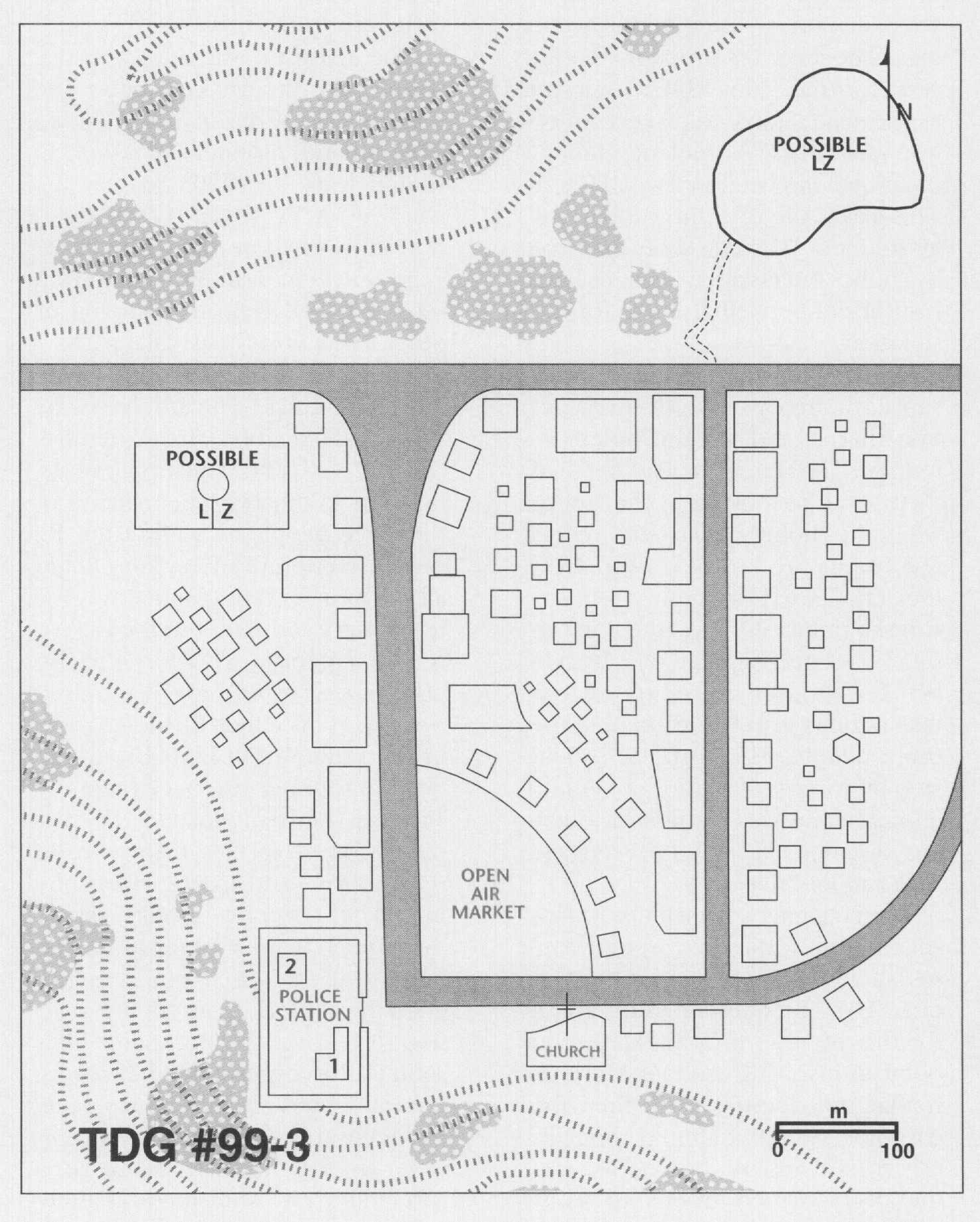
Your platoon is organized in the following manner: 1st Squad has 10 Marines, 2d Squad has 12 Marines, 3d Squad has 8 Marines, platoon headquarters consists of your platoon sergeant, platoon guide, radio operator, platoon corpsman, and yourself. Additionally, you have a seven-man machinegun squad attached. There is no map of the town, only a sketch map shown below. The S-2 believes there are 5-10 police occupying the facility. The buildings along the narrow roads in that section of the town are of an old French masonry construction. The time is now 1230; one CH-53 will be here at 1315 to load your platoon. The peacetime restriction of 24 Marines on a CH-53 has been bumped to 35. However, you are told to include the following on your manifest: company commander, battalion executive officer, two U.S. Army Special Forces captains, and a major claiming to be the “regimental historian.” The SPMAGTF commander and the Haitian Army officer will fly in the UH-1N bird. What now, Lieutenant?

Requirement

Describe your task organization and a general timeline for the platoon. Issue a frag order (Mission and Execution) to your subordinate/element leaders. Submit an overlay with your scheme of maneuver within the objective area to include landing points for the CH-53. Include any questions or concerns you would pose to your company commander. Time limit is 20 minutes. Submit your solution to Marine Corps Gazette, TDG #99-3, P.O. Box 1775, Quantico, VA 22134 or fax 703-640-0823.

Operation PURPLE LIGHTNING

By Capt Timothy E. Barrick

Situation

The Krulian Army imvaded Napa a week ago in a surprise attack that quickly overcame the weak Napian Defense Force and seized Napa’s Capital, Krosova. In response, a divided U.N. Security Council passed a resolution condemning the invasion yet not authorizing military action. Meanwhile, Krulian soldiers committed the ill-judged act of storming the American Embassy in Krosova, killing about a dozen Americans and holding several hostage. With outraged America demanding retaliation, the American President decided to take the lead in stopping the Krulian forces. The President tasked the military to:

1. Ensure the safety of American and other selected national citizens in Napa.

2. Eject the military forces of Krul from the country of Napa using all means necessary.

3. Restore the Napian democratic government.

Intel Estimate: The 1st Brigade (Mech) of the Krulian Guards Division (KGD) has been tasked with the security of Krosova. These are the Krulian’s best trained and equipped troops. The 1st Brigade’s headquarters is in the Parliament buildings. One mech battalion, reinforced with a SAM battery is defending the airport and has blocked all runways. The remaining two mech battalions and a tank company are dispersed at various locations throughout the city and have been conducting continuous mounted and dismounted patrols. The 2d (Mech) and 3d (Motorized) Brigades of the KGD are both within striking distance of Krosova to the northwest and northeast respectively. Terrain around Krosova consists of rugged hills with agricultural valleys. While the hills are severely restrictive, the valleys offer excellent mobility corridors and drop zones. Weather forecast: clear skies with moderate temperatures. There are several sections of the coast that offer potential amphibious landing sites.

Friendly Forces: The Joint Force Land Component (FLC) consists of the 13th and 24th MEU(SOC)s formed under the II MEF(Fwd) Headquarters, the 2d Brigade of the 82d Airborne Division, and two battalions of the 75th Ranger Regiment. The Joint Special Operations Component USOC) has a slice of Delta and SEAL. teams. The Marines are 60 miles offshore. The remaining forces are forward deployed to an airbase 2 hours flying time from Krosova.

Mission: On D-day, the JFLC secures a beachhead at Krosova to enable an MPS offload in preparation for future operations against the Krulian Army.

You are on the operations staff of the Joint Force Land Component Commander (JFLCC). In his commander’s planning guidance, the JFLCC stated that the enemy’s center of gravity is his KGD. His critical vulnerability is the lack of an integrated air defense, leaving him open for attack by American airpower. The JFLCC wants to simultaneously isolate the capital, seize the port facilities and airport, rescue the hostages (still at the American Embassy), and secure the parliament buildings. Once this is accomplished, he wants to focus on the destruction of the ]st Brigade of the KGD, located in Krosova. The air component commander is confident that we can maintain air superiority and provide sufficient air assets to attrite or destroy the 2d and 3d Brigades of the KGD before they can interfere with operations in Krosova. He also has the capability to lift both Ranger battalions and the Airborne brigade.

Requirement

In a time limit of 30 minutes develop a course of action for the JFLCC. Then provide a sketch and a brief explanation of your plan. Submit your solution to Marine Corps Gazette, TDG #99-2, P.O. Box 1775, Quantico, VA 22134 or fax 703-640-0823.