Early Morning Attack

By Dr. Andrew H. Hershey

Situation
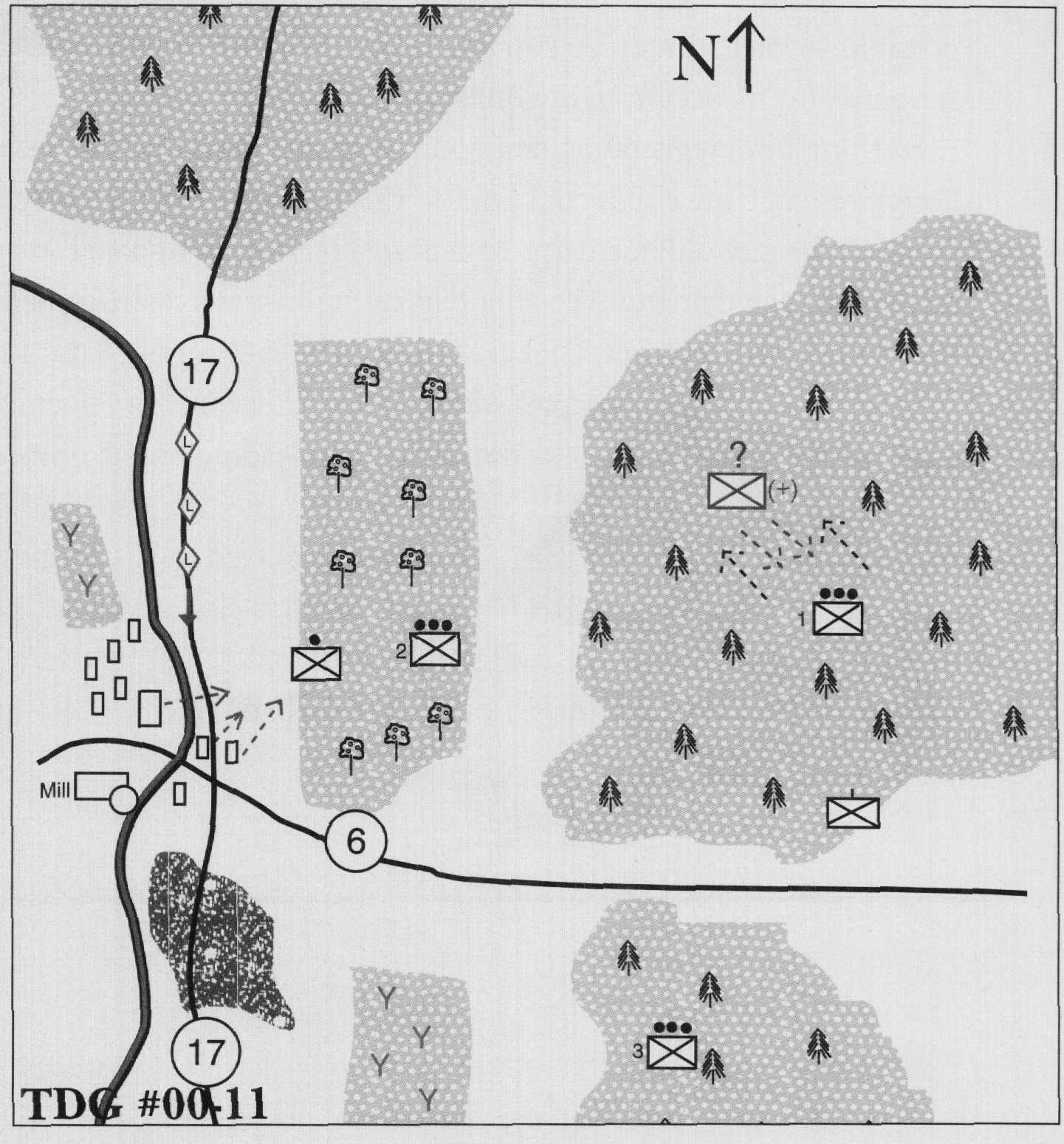
You’re the company commander, Bravo Company, 1st Battalion, 3d Marines. Directed to conduct a reconnaissance in the western portion of the battalion’s area of responsibility, you have opted to attach one assault team and one machinegun team to each of your platoons.

During the last 2 days you have conducted a series of night patrols as you have moved west toward the small town of Timberville. These patrols have been uneventful. It would appear as though battalion’s concerns about enemy forces in this area are unsubstantiated. The area you have been moving through is primarily farmland, however, there are several large, wooded areas that your company will be moving through this evening. You anticipate arriving at Timberville early the next morning. There are two roads within your zone of action, Routes 6 and 17, which intersect at Timberville. While listed as primary roads, they are little more than improved dirt roads.

2d Platoon is designated as your lead element, with lst Platoon on your right and 3d Platoon on your left. You have maintained a position just inside the tree line as the company has moved through the woods. During the late evening hours the company has moved steadily through the woods without encountering any enemy forces.

It’s approximately 0515. Your line of sight is hampered by the woods to the north, but 2d Platoon has just reported that he is about to break out of the wooded area and begin his movement through the orchards just to the north and east of Timberville.

Suddenly, you hear small arms fire, including several machineguns off to your right. Your radio crackles. 1st Platoon reports that he is taking fire; appears to be a squad– sized unit; he can handle the situation. He also reports that he has two Marines with minor wounds. Within seconds of this report, 2d Platoon reports that he is taking fire from what appears to be a platoon located in Timberville. One of his squads is pinned down, and he has one Marine wounded. The platoon commander breaks communications but comes back with the following report: “Three amphibious armored personnel carriers (BTRs) moving south on 17 just about to enter Timberville.” You hear extensive machinegun fire followed by an explosion. You soon see smoke billowing to your front and assume that 2d Platoon took out one of the BTRs.

Requirement

What now, Captain? In a time limit of 2 minutes, issue any orders or reports you might make. Provide a sketch for your scheme of maneuver and the rationale for your actions. Submit your solution to Marine Corps Gazette, TDG #00- 11, P.O. Box 1775, Quantico, VA 22134 or fax 703-630-9147.

For more detailed information on the structure of Marine Corps units, Marine Corps equipment, and symbols used in TDG sketches, see MCG, Oct94, pp. 53-56 and the modifcation reported in Jan95, p. 5.
Patrol Base Under Attack

By Capt Paul C. Merida

Situation

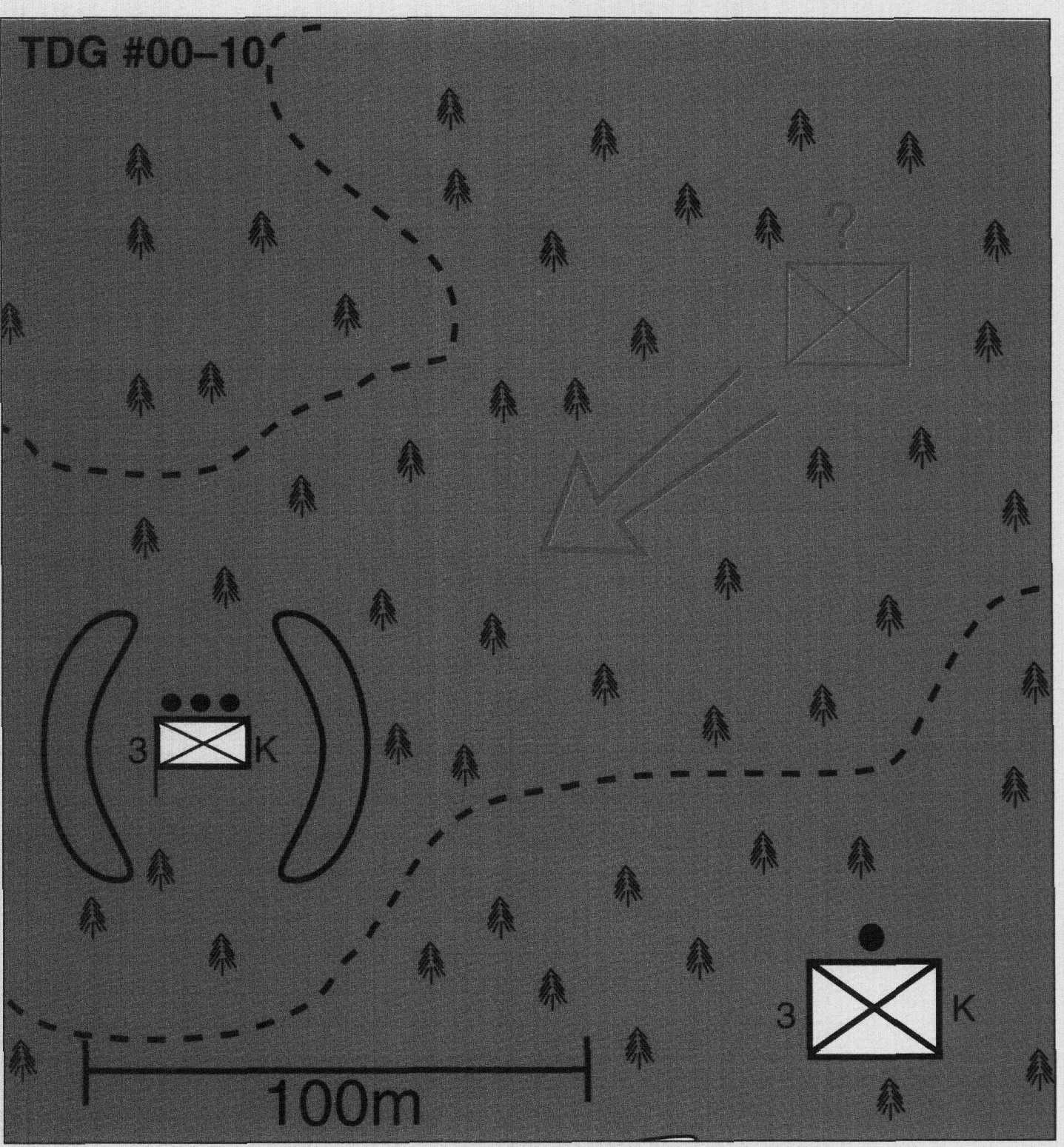
You are 3d Squad leader, 3d Platoon, Kilo Company 3/8. 3d Platoon is operating out of a patrol base and is tasked with conducting security patrols, in sector, in order to prevent enemy units from infiltrating into friendly rear areas.

As part of this mission your squad was tasked with conducting a night security patrol. You left the patrol base at 2200. Four hours later your patrol is just about to reenter friendly lines. Because of the densely wooded terrain, visibility in the daytime is no more than 50-75 meters, and at night you can hardly see at all. Communications with the platoon commander throughout the patrol has been shaky at best as you try to maintain positive communications via a PRC-68.

Your patrol was uneventful, no sign of the enemy, and you’re scheduled to meet the platoon sergeant at the reentry point between 0230-0300. You’re 200 meters from that point when you begin to hear small arms fire from the direction of the patrol base. You can barely make out green and red tracers through some of the treetops and can definitely hear the sound of an M244G machinegun. You try raising anybody over the PRC-68, but no luck. The level of gunfire slowly increases, and it now sounds like 3d Platoon is fully engaged. It also sounds like the gunfire is getting closer to your position. You make out a garbled transmission over the PRC-68, “. . . casualties . . . mortars . . . 3d Squad .”

Your fire team leaders are now at your position. First Fire Team leader, “Sergeant, we got to get in there!” Second Fire Team leader, “Sergeant, we’ve got no idea what the hell is going on out there.” Third Fire Team leader, “Sergeant, what are you going to do now?” What are you going to do now, Sergeant?

Requirement

In a time limit of 2 minutes, issue any orders/reports you might make. Then provide a sketch and explanation of your plan. Submit your solution to Marine Corps Gazette, TDG #00-10, P.O. Box 1775, Quantico, VA 22134 or fax 703-630-9147.

For more detailed information on the structure of Marine Corps units, Marine Corps equipment, and symbols used in TDG sketches, see MCG, Oct94, pp. 53-56 and the modification reported in Jan95, p. 5.

Commander Down

By Capt Terry L. Branstetter

Situation

You are the local security chief for Battery A, part of Battalion Landing Team (BLT) 1/8. Your battery has been supporting the BLT during offensive operations ashore. Most of the fighting has been light with artillery fire used only sporadically. The battery has encountered ineffective small arms fire during its movements.

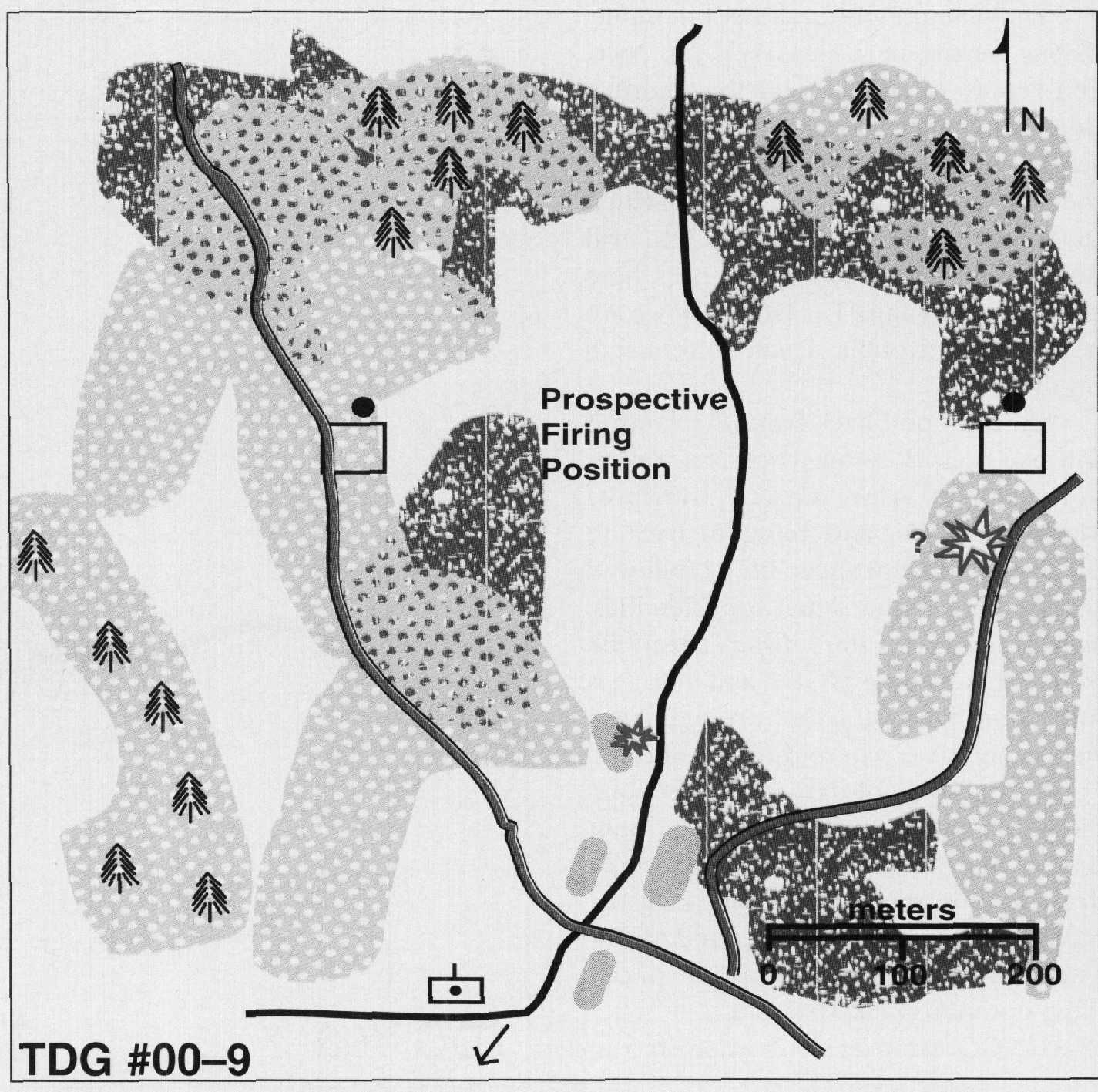
You are currently with the battery advance party (AP) scouting a new position and have just arrived in the vicinity of the prospective site. The main body of the battery is 8 kilometers to the southwest and will displace in about half an hour. The AP is led by the CO with a hardback HMMWV and mounted M240G. The AP 5-ton is next with a mounted M2 .50 caliber machinegun. Two communications vehicles-advance fire direction center and advance communications-are in trail. Per standing operating procedure, the CO led the AP to the edge of the new position. You dismounted all but the CO, corpsman, machinegunners, and drivers to conduct the security sweep of the position.

The clearing is surrounded by patches of brush and scrub growth that provide concealment as well as three areas that contain sizable trees. You split your 12man force in two and lay out the plan for a heart-shaped recon around the new position. You take a man-pack radio to keep in touch with the CO and move with the western team. Traveling up the streambed, you’ve encountered no activity when you hear gunshots to the south. They are followed by rifle and machinegun fire. As you halt your men, one of the drivers reports over the radio, “Grizzly 11 this is Grizzly 6D, the 6 has been shot. He’s down hard, but the corpsman’s working on him.” It appears that you are now the leader of the AP. No sooner do you realize this when you hear more gunfire from across the open firing position. What do you do?

Requirement

In the space of 2 minutes, reach a decision on what you intend to do and what orders you will issue to the AP. Provide a sketch of your decision and a discussion of the rationale behind it. Submit your solution to Marine Corps Gazette, TDG #00-9, P.O. Box 1775, Quantico, VA 22134 or fax 703-630-9147.

For more detailed information on the structure of Marine Corps units, Marine Corps equipment and symbols used in TDG sketches, see MCG, Oct94, pp. 53-56 and the modification reported in Jan95, p. 5.

Supporting the LAR screen

By Capt Terry L. Branstetter

Situation

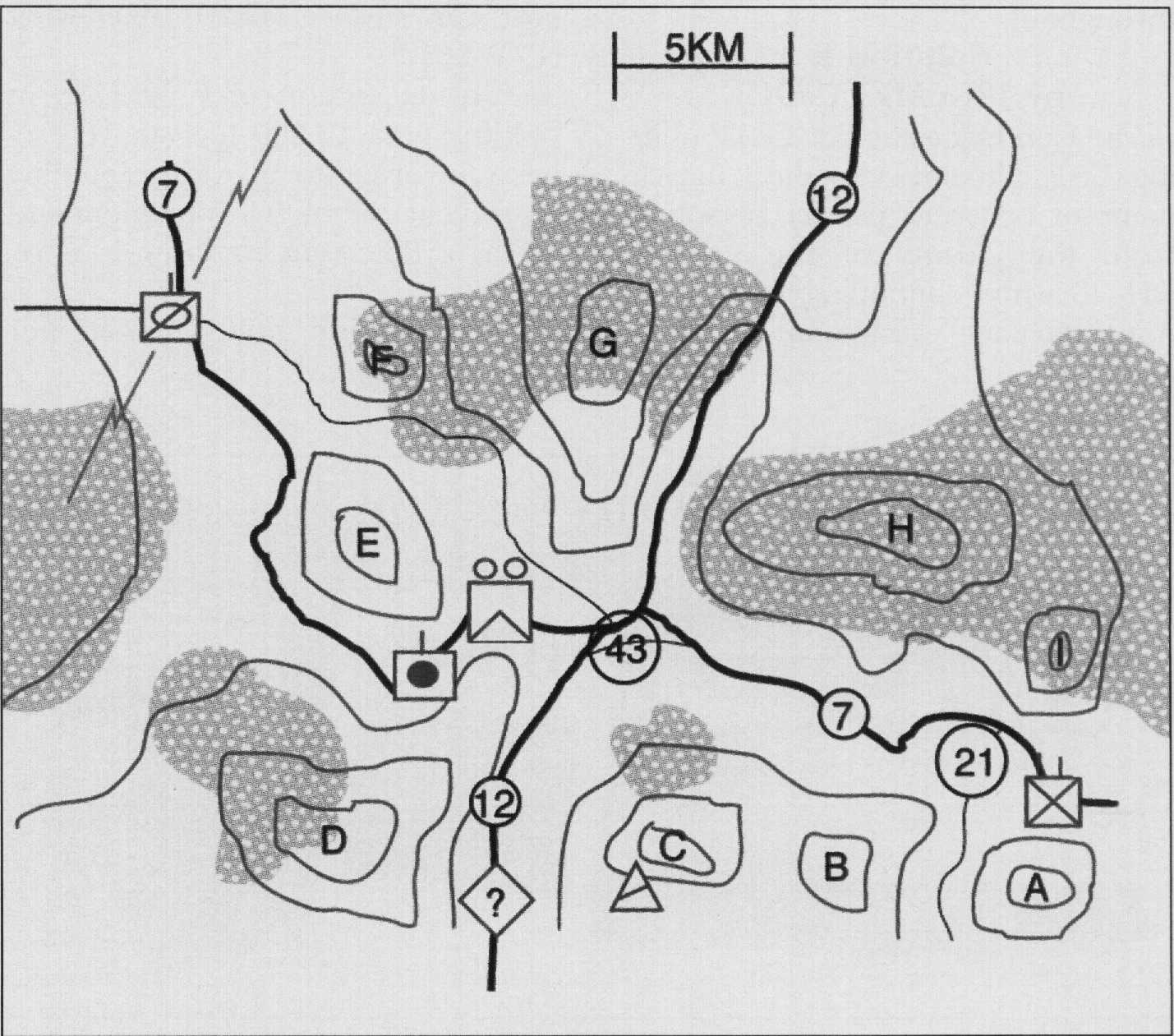
You are the CO of Battery C, 1st Battalion, 10th Marines. Your battalion is the fires element to 2d Marine Expeditionary Brigade (2d MEB), which has been operating in a high desert environment (terrain is restricted to vehicle traffic off roads and severely restricted above the first contour line, see map) against a mechanized enemy. 2d MEB is tasked to prevent disruption of JTF units arriving to the south.

Today, Battalion Landing Team 3/2 (BLT 3/2) 2d MEB’s ground combat element (GCE) attacked a strongpoint at Checkpoint 21 (CP 21 ). The remnants of an enemy reinforced meth company, believed to be the advance guard of a mechanized brigade, withdrew to the west after the 3/2’s successful attack.

BLT 3/2 is now establishing defensive positions at CP 21. The Light Armored Reconnaissance Company (LAR Co) was pushed west to screen as shown on the map. Your battery, with a detachment of the BLT’s Combined Antiarmor Team (CAAT) (two TOWS and three heavy machineguns), was sent forward to provide suppressing and disengagement fires to LAR Co. A host nation mechanized platoon is screening the MEB’s left flank (south of the map).

2d MEB expects the enemy will attack to the south tomorrow morning. The LAR Co is tasked to destroy the enemy’s recon elements/advance guard and slow the main body advance. Once your battery fires the disengagement fires for LAR, it will rapidly displace to its previous firing position east of the GCE engagement area.

You are currently in position to support LAR. The CART detachment is augmenting your local security. Because you pushed forward, before you could be resupplied with ammunition, you have only a third of your daily allocation of 155mm ammunition. The remainder of the GCE’s artillery can range to vicinity of CP 43 from positions to your east. The MEB fire support coordination centers are located some 25km to your east.

After a few hours sleep, you check on the status of the early morning’s events. All reports indicate that things are progressing according to plan, except one. Communicators give you a report timed 0440 stating that a recon team to your south reported vehicle movement. It is unclear whom the report came from.

Attempts to inquire about the report fail. Your communications chief reports that the net is down. He says that it will probably not be up until the sun comes up, 45 minutes from now. You talk to the CO of the LAR Co who knows nothing of the possible enemy to the south, but he reports that his scouts see dust clouds to the west. As he prepares to fight his battle, he reports, “My forward observer will be setting the time on target for the first series soon.”

You tell the fire direction officer to continue with the plan. Your XO reports that he has the rear road guard post on the landline and that it reports vehicle movement a few miles to the south.

Requirement

In a time limit of 5 minutes, make your plan and issue your orders to deal with your current situation. Then provide a sketch and explanation of your plan. Submit your solution to Marine Corps Gazette, TDG #00-8, P.O. Box 1775, Quantico, VA 22134 or fax 703-630-9147.

For more detailed information on the structure of Marine Corps units, Marine Corps equipment, and symbols used in TDG sketches, see MCG, Oct94, pp. 53-56 and the modification reported in Jan95, p. 5.

Dilemma at Styx River Bridge

By Capt Thomas H. Presecan

Situation

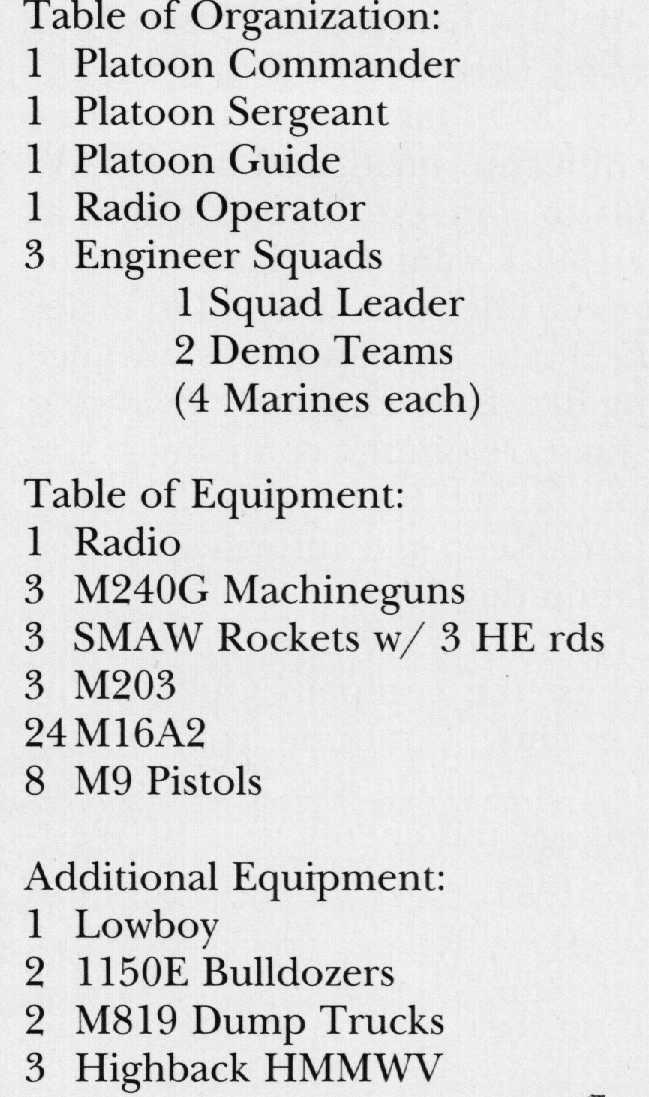
You are the platoon commander of 2d Platoon, Company B, 2d Combat Engineer Battalion. You arrived in the country of Devastation 3 days ago. As part of Battalion Landing Team (BLT) 2/6, you are assisting the local government in earthquake relief by providing a secure environment and repairing serious damage.

A fledgling democracy, Devastation is threatened by “insurgent forces” based in the neighboring country, which the BLT S-2 and higher headquarters fear may take advantage of the destruction in Devastation to expand their frontier. The United States hopes to avoid becoming involved in a border war. Rules of engagement allow deadly force in self defense only. So far, however, there has been no sign of trouble.

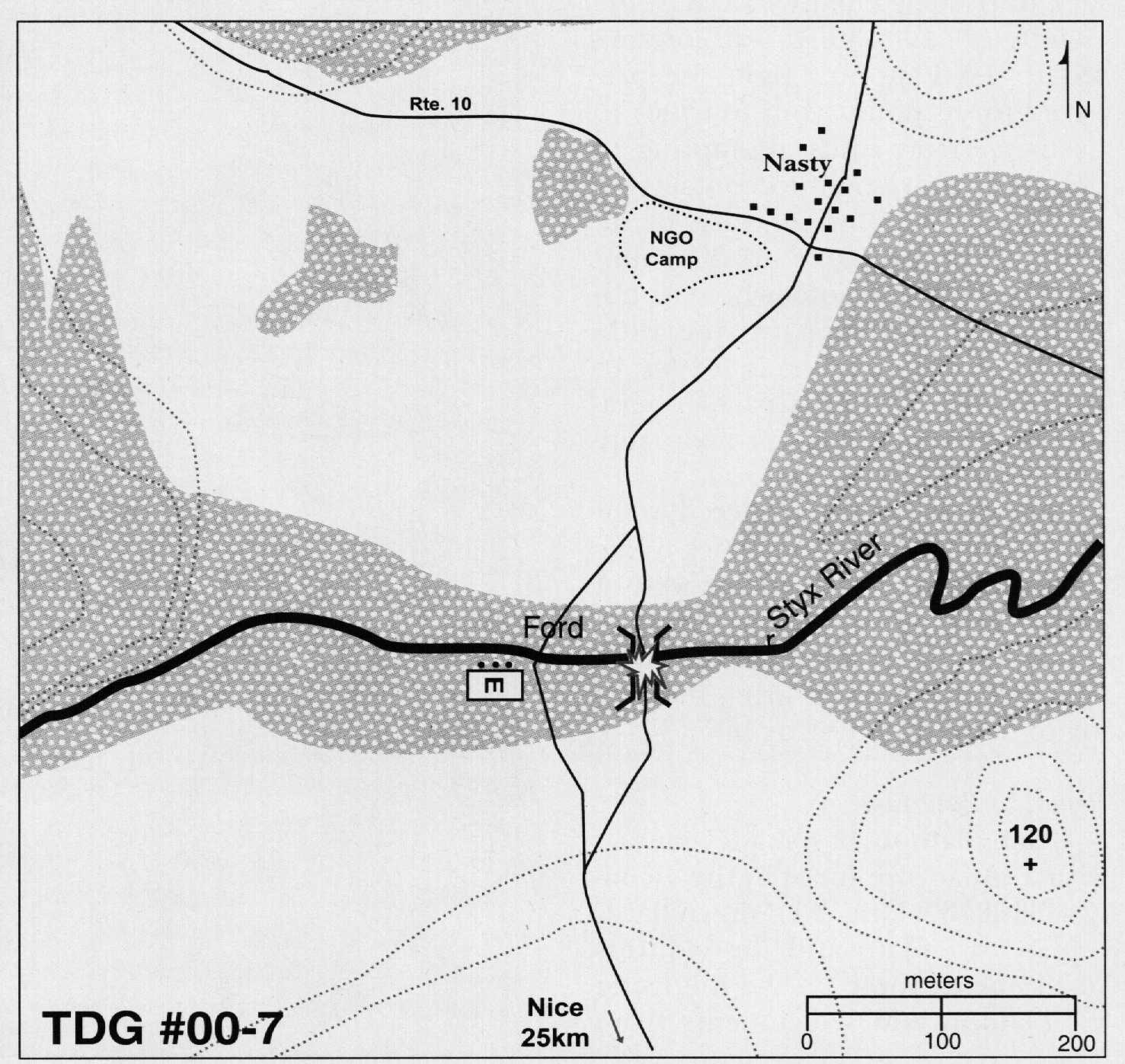
The terrain is thick with vegetation, particularly around the river, with many cleared areas for cultivation. The battalion is located in the town of Nice, 25km to the southeast of Nasty. Radio retransmission sites have been established throughout the battalion’s tactical area of responsibility (TAOR).

You are tasked with building a ford near the destroyed River Styx Bridge in order to open the lines of communication within the BLT’s TAOR. Your platoon arrived on HMMWVs at 0700 and has been working all day. The river is 2 feet deep, 10 meters wide, and has a current of 3-5 knots. An NGO (nongovernment organization) base camp is 500 meters away outside the village of Nasty. The NGO team has been establishing temporary shelters for the homeless, organizing food distribution, and providing limited medical treatment for the local population. You have been unable to raise the battalion on your radio for several hours. You are expected to rejoin the battalion before sunset.

Toward the late afternoon, you are visited by a group of Frenchmen from the NGO camp. They are very concerned about a report that the insurgents will attack the village within the hour in order to capture the NGO camp and supplies, and secure control of the ford site. The Frenchmen report that there are 25 other British and French aid workers at the camp. They have two 2 1/2-ton trucks and about 18 tons of food and medical supplies.

What do you do?

Requirement

In 5 minutes, explain to the French aid workers what you intend to do, and what you want them to do. Issue any orders to your Marines. Then provide a sketch of your decision.

For more detailed information on the structure of Marine Corps units, Marine Corps equipment and symbols used in TDG sketches see MCG, Oct94, pp. 53-56 and the modification reported in Jan95, p. 5.

Evacuation from Enniottu City

By Maj John F. Schmitt, USMCR

Situation

You are the commander of a MEU(SOC) deployed aboard amphibious shipping near the west coast of Africa. Your ground combat element includes three infantry companies (A, B, and C), a light armored reconnaissance (LAR) platoon with four LAVs, a mortar platoon, an antiarmor platoon (usually attached to the companies), a heavy machinegun platoon, an assault amphibian platoon (enough to lift one rifle company), and an artillery battery. Your aviation element is a composite helicopter squadron with 4 AV-8Bs, 4 AH-1s, 3 working CH-53Es, and 10 GH-46s. Other options for ship-to-objective maneuver include light boats, landing craft, and an LCAC.*

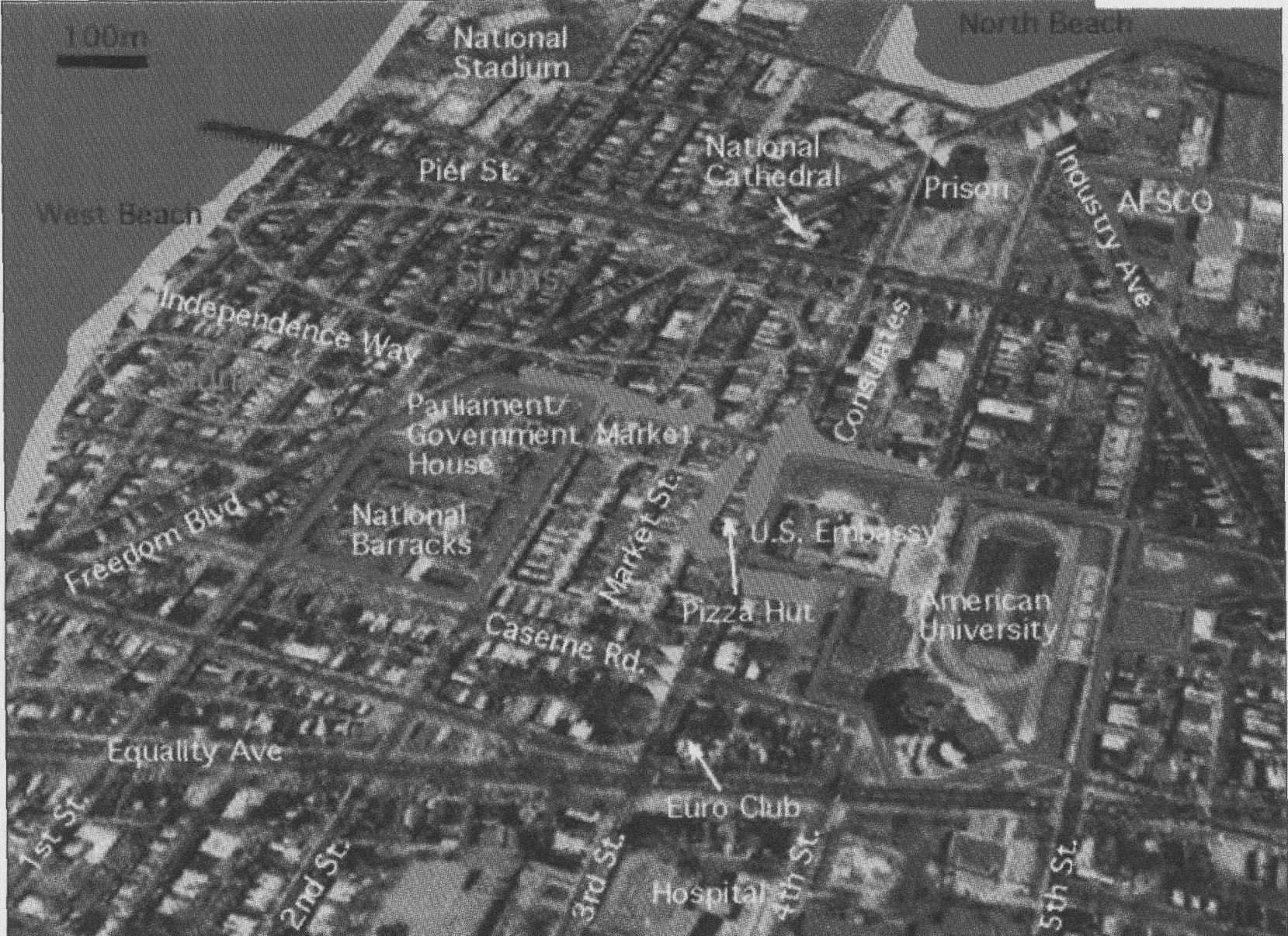
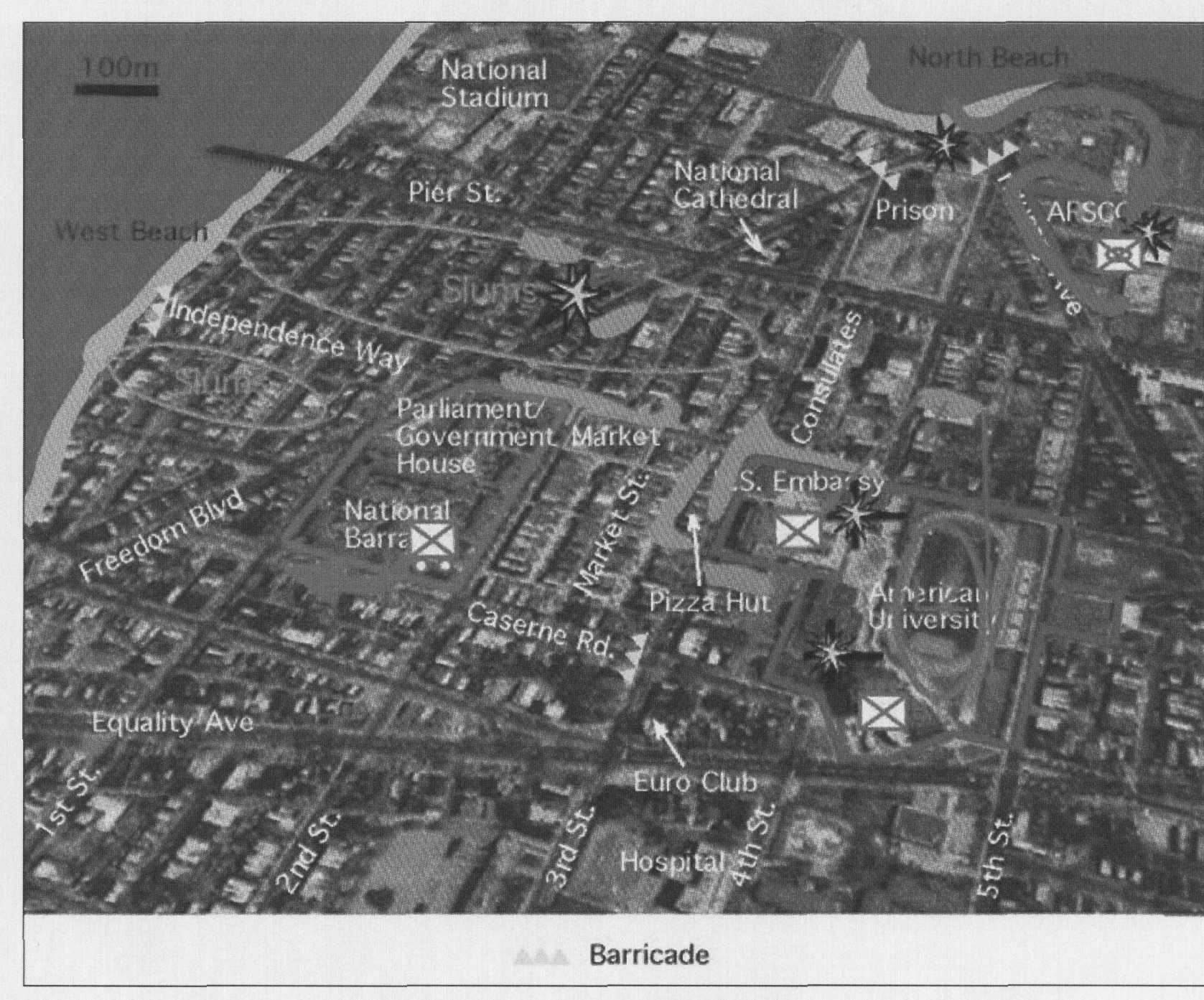
Enniottu is a former European colony that has suffered from cultural, political, and economic chaos since independence in 1963. Enniottu City is the former colonial capital. It is densely populated, especially in the slum areas along the coast. It consists of varied urban terrain ranging from European architecture of brick and concrete remaining from the colonial period to one- and two-story wood frame structures in Middleclassville to plywood and tarpaper shanties in the slums. There are no buildings taller than three stories. Some roads are paved but have not been maintained since colonial rule. The named streets (Equality, Freedom, etc.) are twolane avenues. The numbered streets are one-lane, wide enough for vehicles single file. All other streets/alleys, especially in the densely populated parts of town, are questionable as to capacity. The terrain slopes gently uphill from sea level at the beaches to an elevation of about 100 meters at University Hill, where the American University is located. A “navigable” underground sewer system-meaning a man can move with relative ease-also remains from the colonial period. You are able to download a blueprint from your database, current as of 1952, but you have no idea of the system’s current condition. The areas immediately surrounding the city center are haphazard shanty warrens. Imagery shows four barricades emplaced within the last 24 hours: on Independence near West Beach, on Freedom and Industry near North Beach, and on Caserne near 3d St. These consist of heaps of old autos, tires, cinder blocks, felled trees, and other urban impediments.

The two main elements to be reckoned with are the Enniottu Liberation Front (ELF) and the Enniottuese Army (EA). While it is true to say that the EA and ELF are generally opposed to each other, tribal loyalties and hatreds run deeper than political divisions. At least three different competing tribes are represented in both the ELF and EA. The military situation would be unpredictable in the event of hostilities.

Evacuation from Enniottu, continued

By Maj John F. Schmitt, USMCR

Situation

This situation is the continuation of TDG #00-4, “Evacuation From Enniottu City,” described in detail in MCG, Apr00 and summarized on p. 91 of this issue. You are still the commander of a MEU(SOC). Your original plan is to wait until you are within range to launch all your assets at once, and to conduct a simultaneous twoaxis evacuation: India Company (reinforced with a platoon from Lima) and an Evacuation Control Center (ECC) element will go into the American University by helo to evacuate the Embassy, while Kilo Company and an ECC element will evacuate the American Fruit & Sugar Company (AFSCO) by assault amphibious vehicles over North Beach. Your Cobras and Harriers will provide escort and close air support. The Light Armored Reconnaissance Platoon, preboated on an LCAC, will be prepared to launch a surface tactical recovery of aircraft and personnel (TRAP) or Sparrow Hawk (platoon-size reaction force). The Mortar Platoon will be prepared to launch a helicopterborne TRAP. Lima Company (minus) will be prepared to launch a helicopterborne Bald Eagle (company-size reaction force) with one platoon designated for Sparrow Hawk.

The situation deteriorates during the night, with the Embassy and University taking sporadic mortar fire and a mob forming outside the Embassy walls, so at 0145 you launch your CH-53Es with India Company (minus) to secure the Embassy. The CH-53s refuel once en route. By 0500 India has secured the Embassy perimeter, although the situation outside the walls is still very tense, and the CH-53s have departed with 135 evacuees. India reports the mob growing outside the Embassy and another forming further west on Independence, near the market and Parliament.

At 0800 Kilo Company comes ashore at North Beach, met by members of the media. Hundreds of locals are manning the obstacles at the beach exits, and the situation quickly turns dangerous as gunfire is heard and Molotov cocktails and even a few rocket propelled grenades (RPGs) explode. Employing CS gas, Kilo scatters the crowd, skirts the obstacles to the east and moves on AFSCO, making contact with a hostile force firing RPGs and machineguns from across 5th St. opposite the cannery.

Meanwhile, the rest of India (with the platoon from Lima) lands at the University by CH-46. One inbound CH-46 takes machinegun fire and crash lands off Freedom Blvd. in the slum about 400m northwest of the Embassy. Of the 18 Marines on the flight, 10 are injured, 2 seriously. The Cobra flying escort is talking to the Marines on the ground and reports that they have set up security around the crash, but the locals are starting to get curious. He reports that the nearest landing zone is the intersection of Freedom Blvd. and Pier St., but it will handle only one CH-46 at a time (maybe a CH-53).

It is now 0815. You have one section of Cobras in the air and another refueling. Kilo reports overcoming its resistance and securing the cannery after a sharp engagement. Both the Embassy and University start taking sporadic fire from the three-story apartment building about 150m north of the compound. Because of the compound walls and the high ground, most of the fire hits the upper stories of the Chancery and the University buildings. This fire seems to be increasing in volume and accuracy. It includes a heavy machinegun, but its exact location has not been pinpointed yet. The CH-46s are still on the deck at the University soccer field, waiting for the second wave of evacuees to appear from the Embassy building. One of your Cobras now reports what appears to be a companysize convoy departing the National Barracks by the main gate and turning west on Caserne Rd. Your State Department representative reports he is trying to make contact with the Enniottuese Army now to learn what its intentions are.

All this is not quite the way you drew it up at 2300 last night. What do you elect to do?

Requirement

In a time limit of 5 minutes, decide what you will do in the form of any instructions or orders you will issue. Provide an overlay and a brief explanation of your decision. Submit your solution to Marine Corps Gazette, TDG #00-6, P.O. Box 1775, Quantico, VA 22134, or fax 703-630-9147.

A Bridge to Westcott

By Capt Jeffery M. Opsitos

Situation

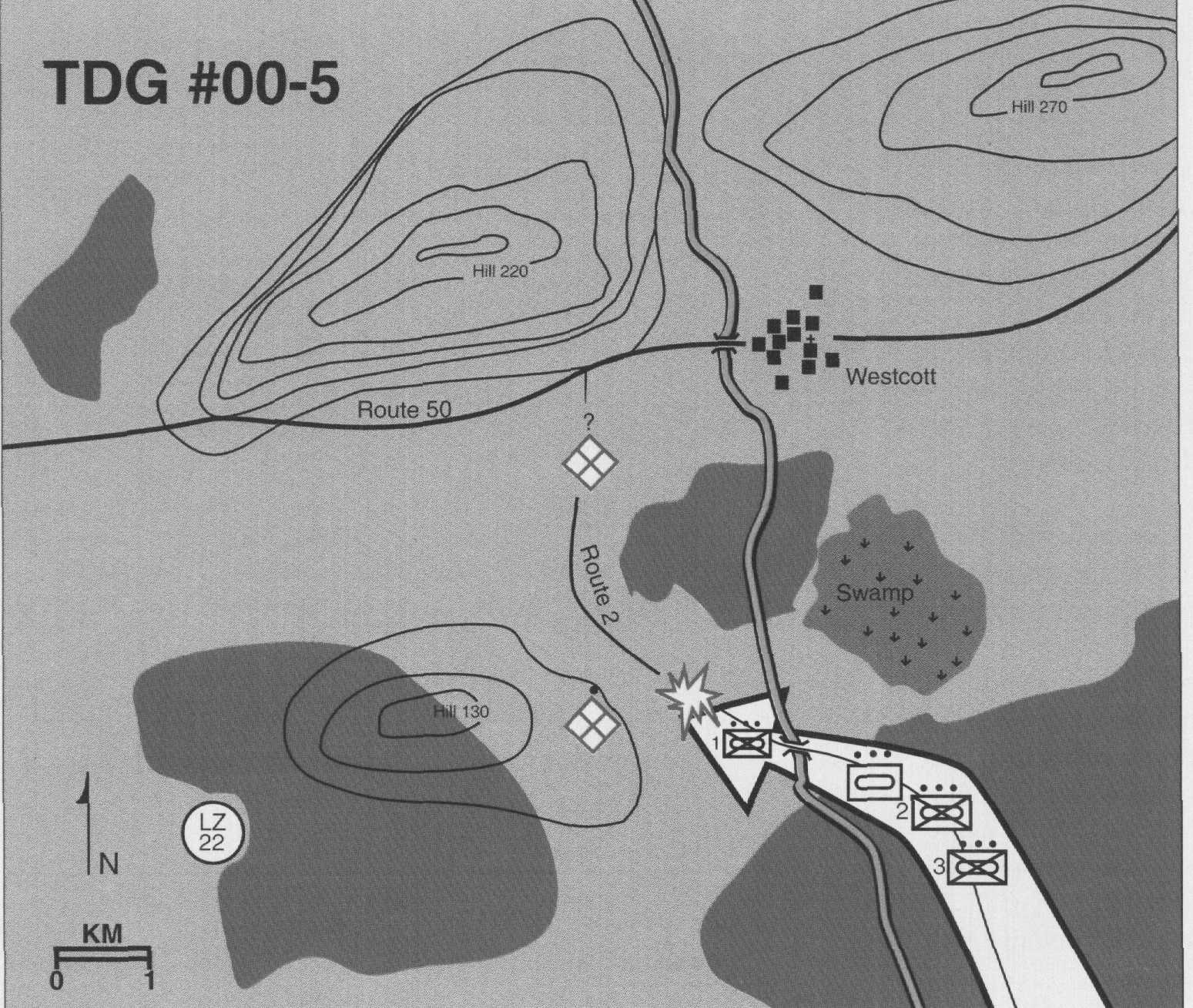
You are the commander of Company G, 2d Battalion, 2d Marines. Your company is at table of organization strength. You are mounted on AAVs and have a platoon of tanks attached. You have been tasked as the advance guard in a battalion movement to contact toward the village of Westcott. Within the last 24 hours, the enemy has withdrawn to the north, breaking contact. Your battalion is advancing north to regain contact in order to bring the enemy to battle and destroy him. Up to this point, enemy resistance has been limited to a brief contact with a platoon-size unit approximately 20 kilometers (km) south of Westcott. The enemy unit was traveling in BTRs and broke contact to the north along Rte. 2. The S-2 believes what we hit was part of a rear guard of a battalion mechanized/motorized force.

Terrain is made up of several large hill masses, a north/south river, which is fordable during the current dry season, and two unimproved roads trafficable by wheeled vehicles. Vegetation has patches of mature hardwood forests with sparse, grassy fields in the open areas. The swampy low ground directly south of Westcott is not trafficable to mechanized assets and is slow-go by foot.

You’ve just received word from your lead platoon commander that he is in contact with what he believes to be a squad-size element located in the vicinity of Hill 130. The platoon commander reports that his lead track is “down hard,” and he is currently dismounting in attempt to clear the enemy from Hill 130. In his last transmission to you, he said that he could see dust clouds to the north approximately 4km away. Your current position is with the company’s main body, which is 2km from the Krause River. The forward air controller tells you that a section of Cobra’s is en route and will be there in approximately 7 minutes.

Requirement

In a time limit of 5 minutes prepare a frag order that you would pass to your subordinates, to include your intent. Include any reports that you would make to battalion and complete the graphic with your actions for the company. Be prepared to provide a brief explanation of your solution. Submit your solution to Marine Corps Gazette, TDG #00-5, P.O. Box 1775, Quantico, VA 22134 or fax 703-630-9147.

One Balkan Evening

By Dr. Andrew H. Hershey

Situation

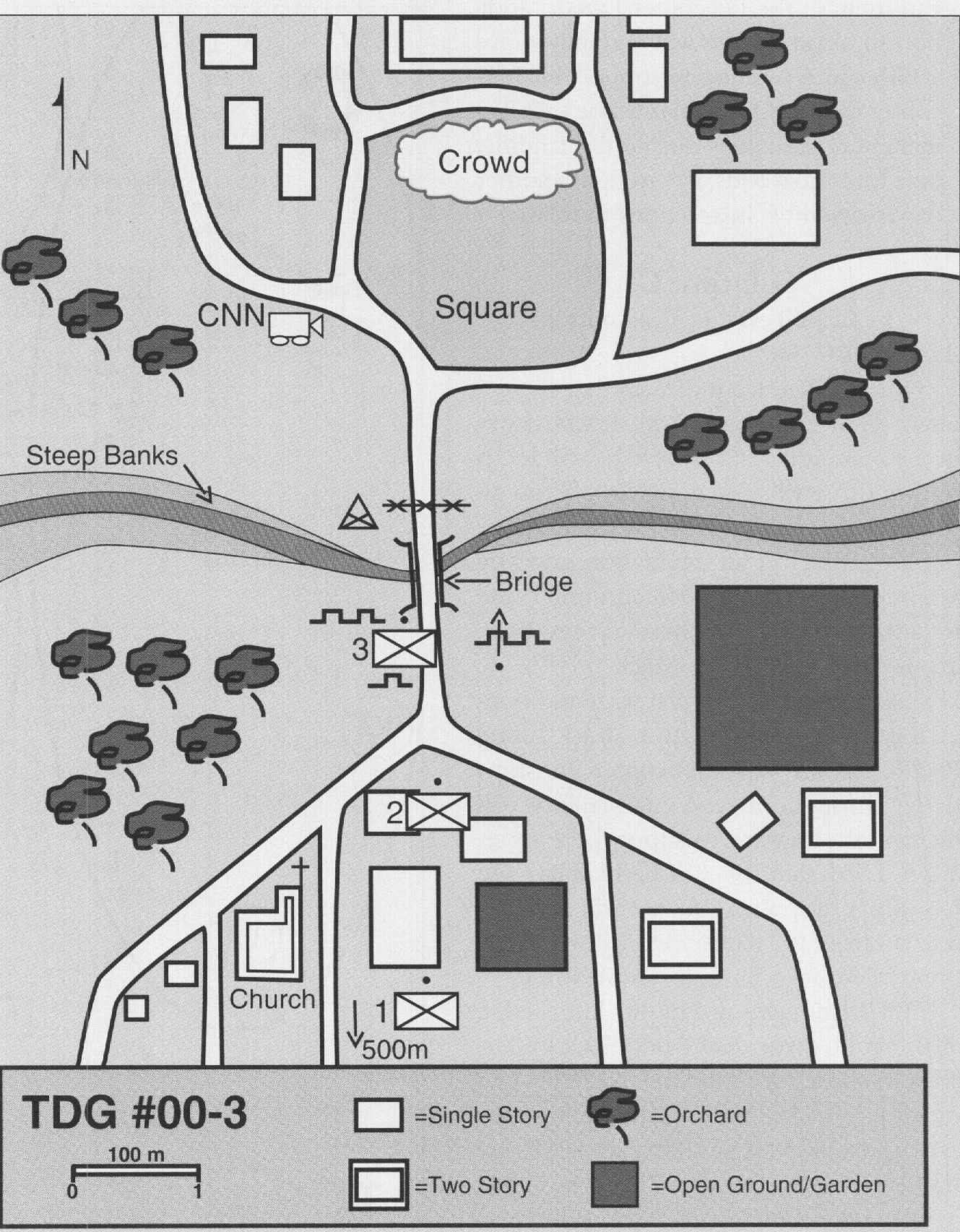
You are commanding the 1st Rifle Platoon, Company B, 1st Battalion, 3d Marines. In addition to your organic weapons, you have one M240G machinegun team attached and a designated marksman in each squad. Your battalion is currently in Kosovo as part of the Kosovo Force (KFOR) for peacekeeping duty. Your company is billeted in a small village. Your platoon has been assigned to a neighborhood that formerly housed mostly ethnic Serbs. The village is a mix of stone and wood houses many of them damaged. Running through the village is a stream with steep, grassy banks. Your specific orders are to prevent unauthorized ethnic Albanians from crossing to the south of the bridge and entering the Seth section of town, where several dozen Serb families still remain in residence, as well as preventing Serbs, without authorization, from transiting north. The bridge is of stone construction, designed for pedestrians and horse-cart traffic. You have barbed wire obstacles at either end, and at the southern exit is a vehicle control point.

It is 1930 hours, a deepening dusky sky overhead. Your command is deployed as follows: 3d Squad, with the M240 team, is in fighting positions just south of the bridge. Three men from 3d Squad man a checkpoint at the northern entrance to the bridge. 2d Squad, along with your command element and two interpreters, are deployed around a partially ruined stone building to the south of 3d’s position. Some 10 minutes ago, Ist Squad began to make its way back to the chow line to the rear, for the only hot meal of the day.

As you wonder what is on tonight’s menu, the checkpoint comes on the net. “Sir, some 50 Albanians, including several women and some men who act drunk, are at the north end of the square heading toward the bridge. Three men and a woman are in the lead. I can make out several AK47s and hunting rifles. Over.”

In the waning light, you scan the lead group with your binoculars. You immediately recognize the face of Shefki Mahti from pictures circulated by the battalion S2. He is an ex-major in the Kosovo Liberation Army who is believed to be running death squads against former Serb leaders and those alleged to have committed crimes over the past months against Albanians and their property. The others are unknown to you. The ex-major is also the darling of the Western press having given several headlinemaking interviews in recent days. Not surprisingly a CNN television crew pulls up in a European style subcompact and rapidly deploys to begin filming the crowd and your positions. Through an interpreter you issue the following warning: “You are approaching a KFOR permit area-one closed at this hour regardless of KFOR permit. Disperse immediately! Do not attempt to cross the bridge!”

With the crowd still advancing, the exmajor through his own bullhorn answers you in English. “We are coming for the Serb bastard who killed my sister’s husband and raped my niece and the daughters and wives of these men. What will you do, kill us all Lieutenant … Calley?” What now Lieutenant?

Requirement

In a time limit of 2 minutes issue any orders/reports you might make. Then provide a sketch of your actions and the rationale behind them. Submit your solution to Marine Corps Gazette, TDG #00-3, P.O. Box 1775, Quantico, VA 22134 or fax 703-630-9147.

>Editor’s Note: If your unit uses TDGs to PrePare “strategic corporals” to handle tough peacekeeping or operations other than war situations, we’d welcome copies to share with our readers. If your unit doesn’t use TDGs this way, it probably should.

Enemy Across the Park

By Capt Douglas J. MacIntyre

Situation

This scenario uses the same general setting as TDGs #99-10 and #99-12. However, this time you are the platoon commander of the Ist Platoon, Company C, Ist Battalion, 6th Marines with two assault squads and one machinegun squad attached. Your battalion has deployed to Athsano, a war torn country in southern Europe, to secure key nodes within the capital before the arrival of follow-on forces. These nodes consist of the powerplant, airport, and communications centers. The rebels have transitioned to deliberate defensive positions within the city and will fight for control of vital areas. They are employing heavy weapons, 82mm mortars, and antitank/personnel minefields. Typically operating in squad- to platoon-size elements, they are considered well trained and logistically sound.

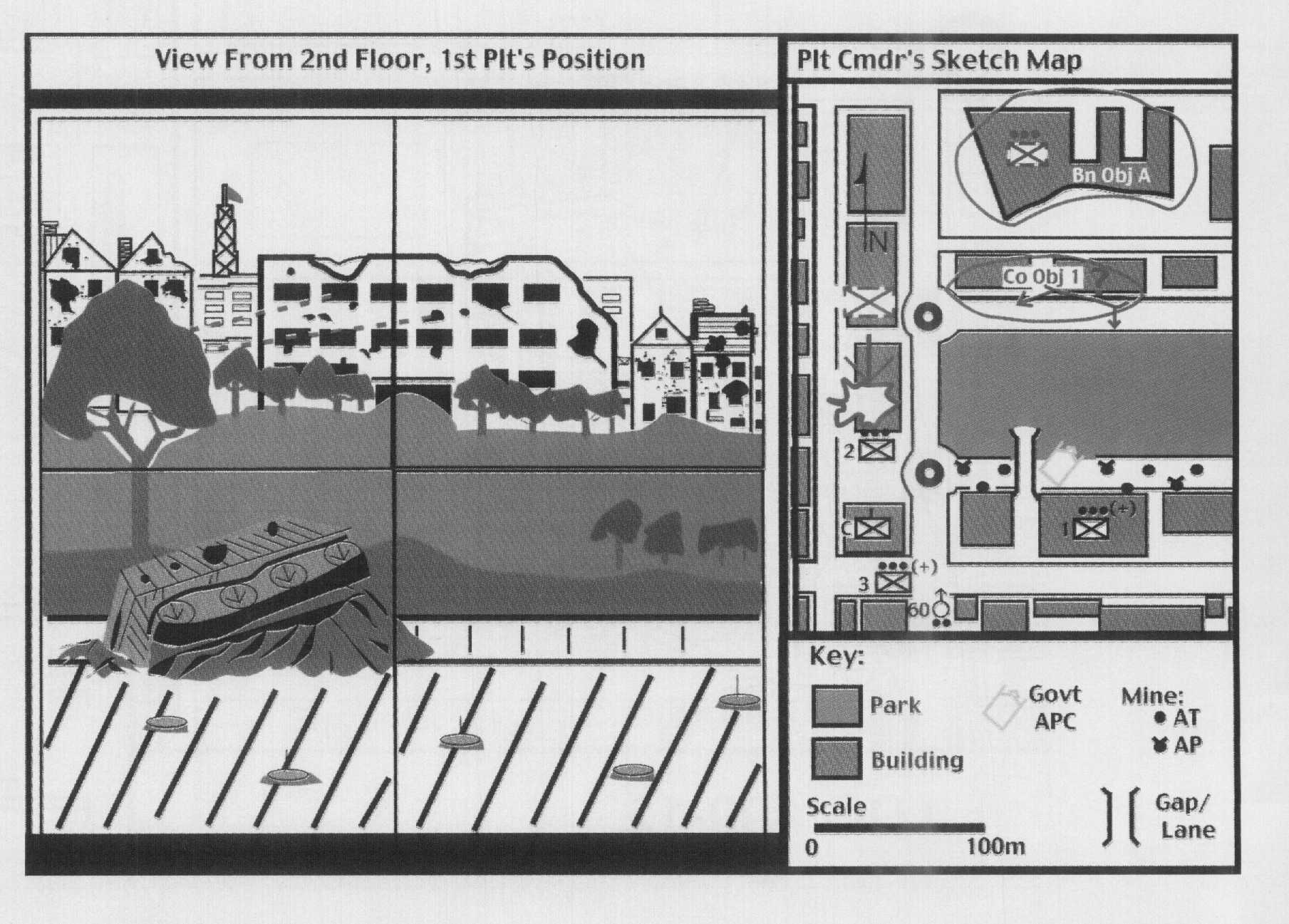
Company C (battalion main effort) is attacking in zone to seize the radio station at Battalion Objective A (Bn ObJ A) to deny the rebel forces the ability to communicate with their supporters and the civilian populace. Initially, 2d and 3d Platoons will attack to seize Company Objective I (Co Obj 1), an important intermediate objective, as Ist Platoon covers their movement. After these platoons establish covering positions in Co Obj 1, Ist Platoon (company main effort) will attack north to seize Bn OhJ A, gain a foothold, and pass through additional units to help clear the building. The 60mm mortar section will provide fires in support.

From a second story window at your current position, you observe your frontage. Your assaultmen identified an antitank/personnel minefield along the road. It is active, as shown by the visible wreckage of an Athsano M113 armored personnel carrier, but a 15-meter-wide gap appears directly behind the wreck. A thinly wooded park extends north to Co Obi I and offers good terrain for team to squad movement. Co Obj 1, two three-story concrete buildings, appears to dominate the area, but exhibits no enemy presence. In the background, the radio tower at Bn Obj I is visible. The rebels have raised their flag on its apex.

It is now 0230. 2d Platoon, advancing through the buildings on the extreme left of the company zone, has secured a route through the first building and is entering the next. Your command element and 3d Platoon are in trace. Suddenly, the enemy engages 2d Platoon and attacks south into the same building. From your position, you can observe enemy machinegun fire coming from the third floor of Co Obj I to engage the company’s positions.

The CO radios, “Attack halted, new plan. Ist Platoon attack to seize Co Obj 1. 3d Platoon assume the company main effort on order and will pass through lst Platoon to attack Bn Obj A. Ist Platoon has priority of fires from 60s until 3d Platoon launches its attack. Rotary-wing close air support requested. Intent: Catch the enemy off balance through a well-supported attack and regain the initiative. . . ” What now, Lieutenant? Requirement

In a time limit of 10 minutes, decide what you will do, prepare appropriate orders and any report/requests that you would submit. Pro-6de a sketch and an explanation of your plan. Submit your solution to Marine Corps Gazette, TDG #00-2, P.O. Box 1775, Quantico, VA 22134 or fax 703-630-9147.

Operation LUMP SUM

By Maj John F. Schmitt, USMCR

Situation

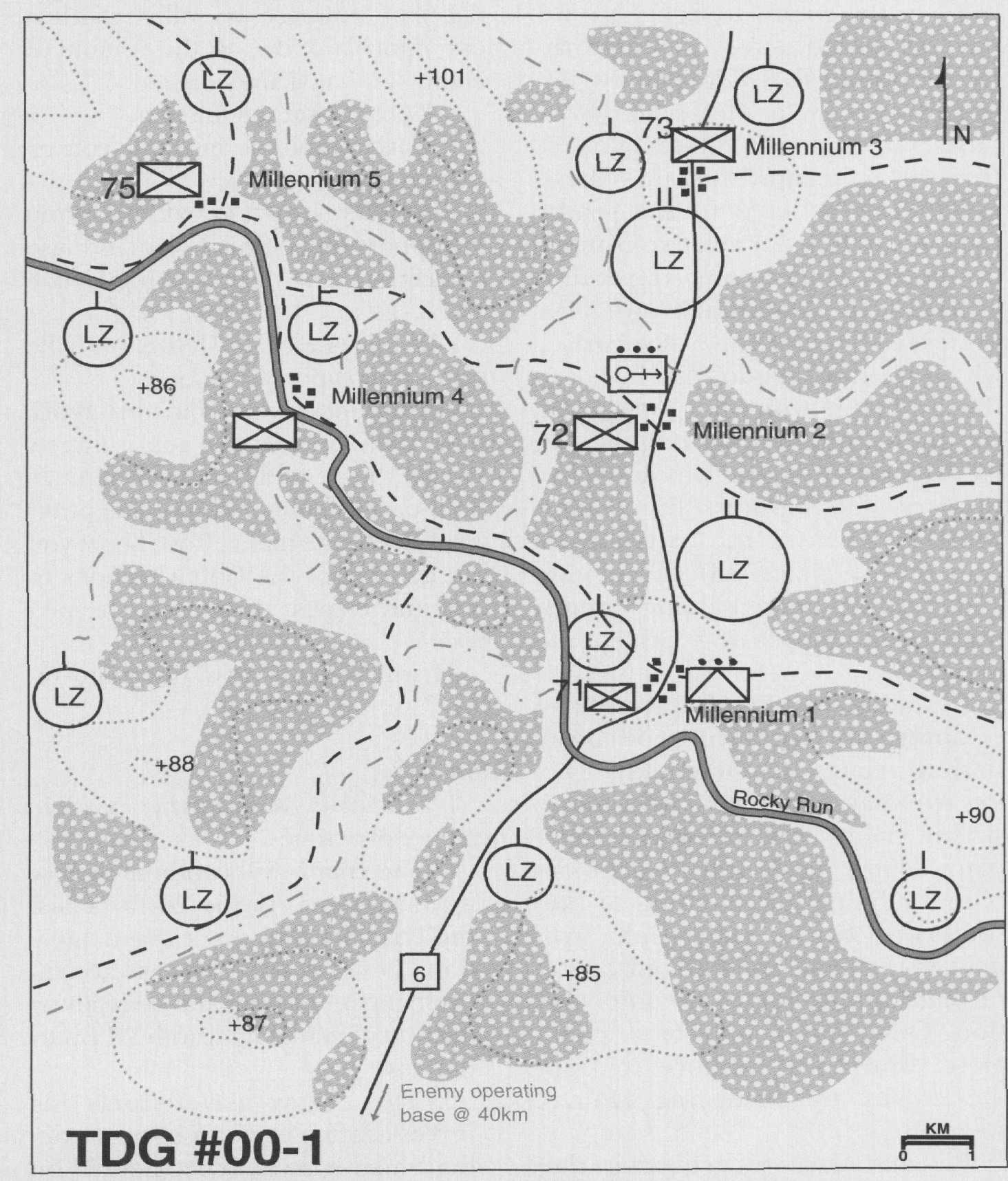
You are an advisor to the 719th Guerrilla Battalion in a civil-war-torn country, which makes you the de facto commander when it comes to operations in the field. The 719th consists of five 80-man companies (71st-75th), a mortar platoon, and an antitank guided missile (ATGM) platoon. The companies are actually fairly good guerrilla forces, making effective use of ambush and hit-andrun tactics, but for political as well as operational reasons, coordinated operations at battalion level and above are practically impossible, The battalion is lightly equipped, with few vehicles and only one unencrypted VHF radio. The companies are armed with mostly older-generation small arms, light machineguns, and light antitank weapons. Each company also has a pair of 23mm antiaircraft guns mounted on trailers. You have recently received a large arms shipment of shoulder-launched surface-to-air missiles and medium mortars-enough mortars to form a sixtube platoon in each company and an eight-tube platoon at battalion level. The mortars have a range of 3,500 meters and the ATGMs have a range of 2,000 meters, although line of sight in this rolling, wooded terrain is rarely more than a kilometer. Vehicle forces are pretty much restricted to the trails and few roads.

The 719th is responsible for defending the Millennium complex, with each company based near one of the five villages in the complex. The 719th draws it support from the local population and is resupplied from a series of cache sites throughout the sector. You have one assistant advisor, a squared-away junior captain.

The enemy is attacking generally from the south and outguns your forces in practically every way. The enemy has air superiority, which he relies on heavily. He prefers to operate in massed formations of brigade or even larger to maximize his firepower. The enemy has demonstrated the capability to lift up to a battalion by helicopter at one time. Intelligence indicates he is preparing for a major offensive-up to a brigade-size air assault with gunship support deep into guerrilla territory, probably in conjunction with a ground penetration by a mechanized battalion from one of the several fire bases some 40 kilometers south of your sector. Intelligence has even learned the enemy’s code name for the operation: “Operation Lump Sum.” Recent enemy reconnaissance activity suggests the enemy has been reconnoitering landing zones (Us). Your assistant has hastily mapped the likely enemy Us in your sector. The two largest, each of which will handle a battalion, are between Millennium I and Millennium 3 along Rte. 6.

Higher headquarters estimates the enemy offensive will commence within 72 hours and wants to know the 719th’s plan for defending its sector. The battalion commander turns to you. What’ll it be?

Requirement

In a time limit of 15 minutes, describe your plan in the form of the orders/guidance you will “recommend” to the battalion commander. Then provide a sketch and a brief explanation of your reasoning. Submit your solution to Marine Corps Gazette, TDG #00-1, P.O. Box 1775, Quantico, VA 22134 or fax 703-630-9147.