Peacetime Landing Operations

by Maj John F. Schmitt, USMCR

All Marines are familiar with actions such as Tarawa, Iwo Jima, Okinawa, and Saipan-wartime amphibious assaults against fortified beaches in the race of staunch resistance. They are the stuff of legend. Less familiar to us, but just as much a part of our history, are countless landing operations that did not involve an assault against a fortified beach-peacetime operations in which the objective was not to seize a lodgment or an advanced base, but to protect U.S. citizens abroad, keep the peace, or stabilize a government. We have a tendency to think of such landing operations as simply easier versions of the more demanding amphibious assaults. In the sense that these operations do not involve a bloody struggle just to get to the beach, that may be true. But these operations have their own peculiar problems-problems that demand peculiar answers. Since these are precisely the type of operations we will most often be called on to conduct in the future, we would do well to study them.

The opening phase of the U.S. intervention in Haiti in 1915 serves as both a reminder of our amphibious past and as a possible lesson for our amphibious future, particularly in light of the renewed attention Haiti has begun to receive of late.

Background

In early 1915, a revolutionary movement arose in the northern Haitian port of Cap Haitien against the Haitian government at Port-au-Prince. Haiti was especially important to the United States because it dominated the Windward Passage to the newly opened Panama Canal. A variety of U.S. firms and European nations also had commerical interests in Haiti, and the United States wanted to pre-empt any European action in the region. Consequently, the armored cruiser USS Washington, carrying RAdm William B. Caperton, USN, was ordered to Cap Haitien to restore the peace. On 27 July, as the Washington sat off Cap Haitien, violence broke out in Port-auPrince. Some 200 political prisoners were massacred by the chief of police. In response, supporters of those murdered, bodily dragged Vilbrun Guillaume Sam, Haiti’s President, from the French Legation, where he had sought refuge and hacked him to pieces. His chief of police was similarly dragged from the Dominican Legation and murdered. When the Washington arrived off of Port-au-Prince there was no government control. The densely populated city was in turmoil. The American, British, and French ministers requested immediate intervention. Caperton concurred.

The Naval Force

The landing force totalled about 340 men organized into 5 companies: the Washington’s Marine detachment, organized as a company; the 12th Company of embarked Marine expeditionary troops; and three companies of bluejackets formed from the Washington’s crew.

The landing force commander was Capt George van Orden, commander of the Marine detachment. The landing force was organized into two battalions: the First Battalion, comprising the thee bluejacket companies, and the Second Battalion, comprising the Marine force, commanded by Capt Giles Bishop, Jr., commander of the 12th Company.

The Washington, with her 10-, 6-, and 3-inch guns would be in position to support the landing by fire, if necessary. A Navy lieutenant would control the movement of the landing force to shore and would support the landing force with two armed steam launches from the Washington.

The Timing of the Landing

The Washington had arrived at Port-au-Prince shortly before noon on the 28th. Caperton made the decision to land troops at 1600 after conferring with various ministers. (Instructions from the Navy Department to land troops did not arrive until 2200.) Planners preferred to land early in the day, but Caperton decided that the volatility of the situation demanded immediate intervention. Troops would have to land at dusk in the face of an unknown situation.

Where To Land

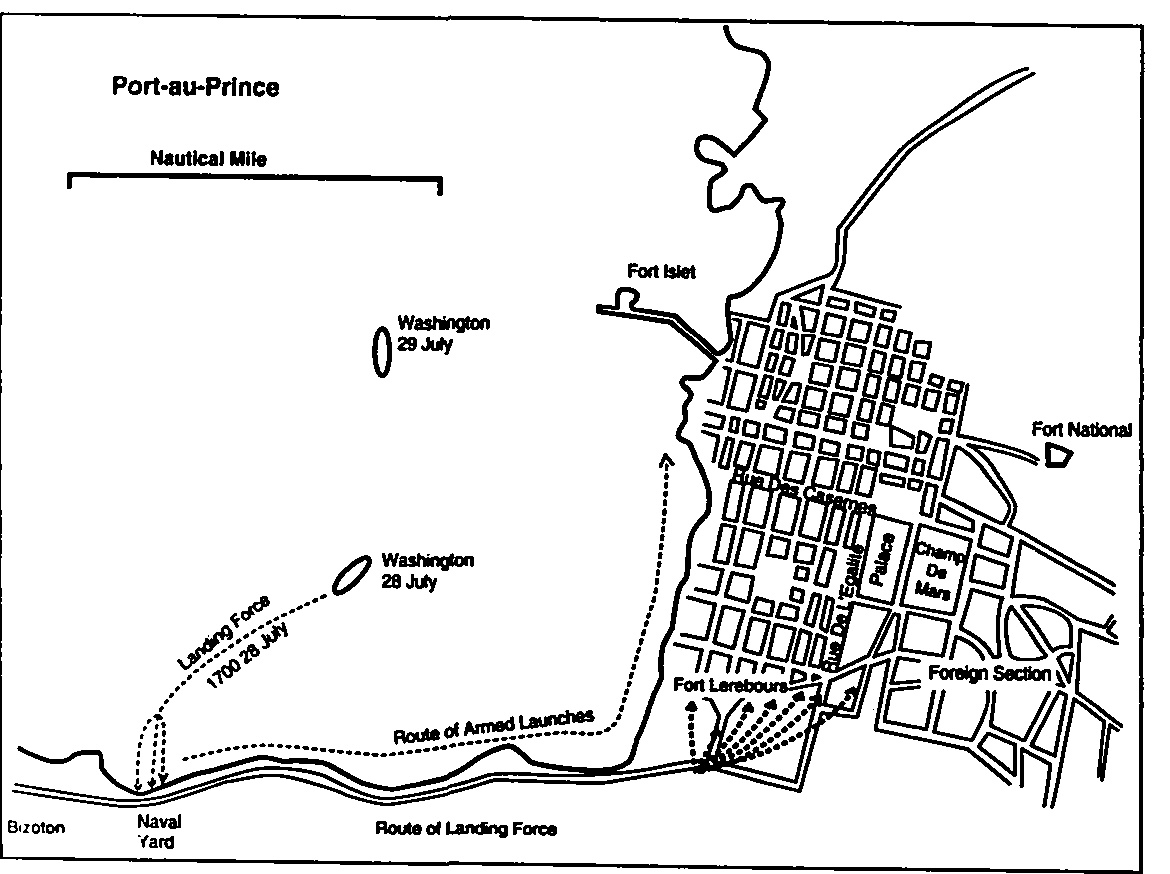
As with any amphibious operation, in any conditions, the critical question was where to land. There were only two sites suitable for the Washington’s boats. The first was at the newly constructed municipal pier in the heart of the city. A year earlier, Marines had successfully made a similar landing in the face of sporadic resistance at the pier at Veracruz, Mexico. The second option was to land across a beach near an abandoned naval yard at the suburb of Bizoton, some distance west of the city proper.

The former option would involve landing troops directly into the most densely populated part of the city. The critical phase of getting organized ashore would have to take place in the dark in the midst of a potential threat. There was little chance that the landing might actually be defeated, but there was definite potential for trouble.

Other considerations that had to be considered included:

* Fort Islet, an old stone fortress at the end of the municipal pier, which dominated any approach. It might or might not be defended.

* The long axis of the city was north-south. A landing at the pier would involve moving eastward across the narrow axis of the city, leaving portions of the city unsecured on either exposed flank of the landing force.

* Naval gunfire in support of a pier landing would be in the form of overhead fires, which, especially in the dark, would be more dangerous and less effective. Additionally, if needed, naval gunfire at this landing site would cause greater destruction to the city.

Conversely:

* A landing at the abandoned naval yard would likely meet little if any resistance. This would likely allow commanders to get their troops organized ashore before having to deal with any resistance-especially important since most of the troops were untrained in landing operations.

* If it did become necessary to support the landing with naval gunfire, the sparsely developed area of Bizoton would suffer less damage than would the heart of the city.

* By landing at Bizoton and moving east and then north, the landing force would clear the city along its long axis, with its left flank anchored securely on the shore. Additionally, moving from south to north rather than west to east, the landing force would be clearing a narrower front.

* Because the landing force would be moving parallel to the shore, the armed launches and the Washington would be able to support by fire more effectively, firing across the front of advancing troops rather than over their heads. Additionally, with the armed launches moving abreast of the landing force along the shore, control of naval gunfire would be easier.

Based on these considerations, Caperton decided to make the landing at Bizoton. In fact, he had long before selected Bizoton as his landing site in the event that a landing might become necessary. The plans had already been prepared.

There would be no element of surprise in this operation. As the landing force was preparing to disembark, Capt Edward L. Beach, USN, Caperton’s chief of staff, went ashore to notify Haitian leaders of the landing. At the National Palace, he confirmed the landing and stated that the intent was to restore peace but that no resistance would be tolerated. He instructed Gen Ermane Robin, the commander of Haitian forces, to order his troops into their barracks and to keep people off the streets. Then, he and Robin went to personally guide the landing forces through the city. Beach also sent word through the legations for all foreigners to remain indoors and to display their national flags from their residences.

The Landing and Subsequent Operations

The Washington moved to a point close to the shore where it could support the landing and the advance on the city. Shoving off at 1650, the boats made the ship-to-shore movement protected by armed launches. No supporting fires were deemed necessary.

The landing was completed without resistance by 1750, and the landing force advanced on the city in column, the Marine battalion as advance guard and the bluejacket battalion (under the close supervision of Capt van Orden) as the main body, minus a single company assigned as the rear guard. The landing force order specifically stipulated that “Companies will open fire only upon orders from a commissioned officer. Patrols will fire only in self-defense.”

The armed launches kept abreast of the advancing column. At Fort Lerebours, which guarded the southern portal of the city proper, the landing force deployed onto line. Capt Beach and Gen Robin met the advancing landing force at Fort Lerebours and, as instructed, Robin guided the troops through the city without incident. The Marine battalion advanced on the first five north-south streets inland from the shore with one section per street. The bluejacket battalion moved up on the right, with one section advancing on the next street, the Rue de L’Egalite, and one squad providing flank security on the next street inland after that. In this way the landing force fronted the enure native section of the city. Further inland was the foreign section, from which no trouble was expected. Van Orden held the rest of the bluejacket battalion in reserve, echeloned to the right rear, thus protecting the right flank and making the reserve readily available to extend the line in that direction if it became necessary to clear the foreign section of town.

At one point, an angry mob barred the advance. Officers marched at the head of their columns direcdy into the mob, dispersing it without firing a shot. The only firing came from rooftop Haitians who fired a few rounds over the heads of the Marines. The landing force soon reached the Rue des Casernes, where it halted its clearing operation for the night, having secured the National Palace and all other important government buildings. The troops had disarmed Haitians along the way, collecting over five wag-onloads of arms and ammunition. There were reports of sporadic gunfire all during the advance through the city. Some sniping occurred, but much of the gunfire was from the indiscriminate firing of weapons into the air, the typical Haitian response to unrest in the city. There were no American casualties; 2 Haitians died and 10 were wounded.

That night the 12th Company was sent to protect the legations and foreign colony. The rest of the landing force bivouacked for the night of the 28th in the city marketplace. Gen Robin and Capt van Orden went throughout the city that night to ensure that Haitian troops complied with the orders to remain indoors.

By the following morning, the Washington had moved farther north to support the continued advance by fire, if needed. By the end of the second day, the Fort National had been captured against sporadic sniping and the city secured. Two U.S. seamen died, probably from the undisciplined friendly fires of the bluejacket battalion rather than from Haitian resistance.

Results

The military operation was an unqualified success. Through prompt and discreet action, the landing force quickly diffused a volatile situation with minimal loss of life and property. The British Minister, R. M. Kohan, reported to his Foreign Office that:

The landing party put ashore at Port-au-Prince on the 28th July was not strong. … A skillful show of strength was, however, made and by at once seizing all points of military importance, together with practically all Government arms and ammunition and disarming all Haitian military and civilians, die landing force was able to anticipate any serious resistance which might have been offered.

Reinforcements

A Marine company from Guantanamo Bay arrived on the 29th. On 4 August the USS Connecticut arrived from Philadelphia with a regimental headquarters and five more companies. On 15 August the USS Tennessee arrived with a brigade headquarters and another regiment. With the Tennessee was Col Littleton W.T. Waller who was to take command of the Marine brigade, now over 2,000 strong. Its mission: occupy the country. The Marine occupation of Haiti then lasted in one form or another until 1934.

Lessons

While much has changed in the nearly eight decades since this operation, many of the characteristics of the landing can be of use to us today. The following are meant as food for thought, not as a checklist for conducting similar operations:

* The operation involved landing troops in a densely populated, depressed urban area where there was little local governmental control and a large portion of the population possessed weapons-conditions similar to those we would face in many Third World situations today.

* The situation was unclear and extremely tense, especially in regards to the amount of resistance that the landing force could expect. Tactical considerations, such as security and surprise, were clearly subordinated to political considerations. Caperton believed that “reasons of policy greatly outweighed those of tactics.” But just as important, policy did not demand what was tactically impossible.

* Discretion was essential in the conduct of the operation. Although resistance could be expected, the overall environment was not treated as openly hostile. The plan effectively minimized collateral damage.

* The need for action arose quickly when only a small expeditionary force was available. The plan envisioned the later deployment of reinforcements.

* The plan called for early coordination with any remaining local governmental forces.

* Simple and workable rules of engagement were relied upon and clearly disseminated. This made maximum use of the judgment of local commanders.

* Superior firepower was withheld until absolutely required, but it was immediately available whenever needed.

Clearly, given the likelihood of Marine Corps missions at the low end of the intensity spectrum, we have something to learn from operations like the intervention of Haiti. And who knows-we may find ourselves there again.
StarCraft

by Capt Charles A. Poulton & CpI Frederick Zuberer

For the past 20 years, the Marine Corps has trained our Marines to a standard-evaluating our units before giving the approval that they are ready for war. We then send our Marines forward to do what Marines do best: win. With a decrease in operational tempo, we now have the chance to evaluate how we train. Most Marines will admit that training in garrison can be redundant. After repeating the same class for the eighth time, or buddy rushing on the softball field for the hundredth, Marines begin to shut down. So, how can leaders reenergize training to increase our Marines3 skill and will?

It you tour a random BEQ, you will more than likely come across at least one of the following in every room: a PlayStation, XBox, desktop, or laptop. Marines love their gaming systems. They love them so much that they are willing to spend hours upon hours playing online with friends or complete strangers. Games that Marines play are strategy-based, whether RTS {real-time strategy) games, like Company of Heroes, or FPS (first-person shooters), like Call of Duty. To successfully play RTS or FPS games, Marines must develop a plan before executing certain game stages. You might remember the infamous Leeroy Jenkins video, in which a group of World of Warcraft gamers discussed how to handle an enemy threat before Leeroy infamously blows off the plan and charges forward into battle, resulting in the teams death. What the video overlooks is that the group took the time to assess an enemy threat, analyzed their own task organization and capabilities, developed a scheme of maneuver, and issued tasking statements to group members in about three minutes. This scene sounds a lot like a TDG {tactical decision game), right? It is actually not as far off as you think.

Currently, our company is working to embrace our Marines’ love of gaming in order to improve their skill and will through the use of our decision rooms and virtual training software. Using software to have Marines compete against each other, and to compete together against a thinking enemy, is no longer something from a sci-fi movie- it’s an actual reality thanks to modern technological innovation. Our decision room currently runs three gaming systems for our platoons: VSBII (Virtual Battlespace 2), which is an FPS; CCM {Close Combat Marine IV), which is an RTS; and StarCraft, another RTS. VBSII and CCM IV are both USMC proprietary software, but StarCraft on the other hand, has no ties to the Marine Corps and falls into the category of COT {civilian, off-the-shelf technology). Both VBSII and CCM are solid games that we use to run our TDG‘s, but feedback from our Marines has prompted us to look towards COTs. Repeatedly, Marines have commented in debriefs, “Hey sir, this is fun but have you played_? It is faster and a lot more realistic.” Developing games is not the Marines Corps’ strong suit; however, the civilian gaming industry has made leaps and bounds in the area. The current generation of Marines, and even the past two generations, grew up playing fast-paced, quick-reaction, and highly-competitive games. In trying to increase our Marines’ attention and create interest in our decision room, our company commander tasked me with conducting a comparison study of COT versus USMC proprietary software in order to determine if COT can be used to train our Marines.

After conducting our own company research, my team found that it is feasible to use COT to supplement USMC proprietary software. Games today involve teamwork, strategic thinking, and decision making. Games, such as Battlefield 4, feature weapons systems, ranges, and assets found on the realworld battlefield, all while driving home basic small unit tactics in a virtual, chaotic, and ever-changing environment.

Imagine taking two teams of Marines, each using realistic weapons that act as their real-life counterparts, and giving the teams opposing missions. Teams enter an area in the game and are forced to engage one another, using simulated weapons and assets to achieve a pre-determined objective. Force-on-force is one of the best types of training, but it is also the hardest to simulate in the field. We now have the technology to conduct force-on-force training in our decision rooms, allowing platoon commanders, squad leaders, and team leaders to get repetitions in tactical decision making. The best part of most COT games is that they are built to drive action, which engages the Marines’ primal instinct to win, as our study results revealed.

To help conduct our research, the company commander gave us a squad of Marines to serve as our sample, COT and USMC proprietary software games to analyze, and full use of our decision room for two weeks. We started with the hypothesis that Marines can receive the same training value using COT as USMC proprietary software programs. The two programs we chose to test this hypothesis were CCM and StarCrafit. StarCrafit, released in 1998 by Blizzard Entertainment, was chosen because of its low-impact system requirements to run on our battalion computers. We created a grading rubric that used a 1 to 10 scale rating (10=high, 1 -low) across seven categories along with a simple yes or no for the eighth category. The Marines spent two weeks playing through different game scenarios, situations, teams, and missions. Afterward, the Marines graded both programs in each of the eight categories and compiled an average across the categories. During the two-week trial period, we recorded our own observations of the Marines playing both systems. Our data analysis indicates that it is feasible to use COT to train Marines, but the process requires advance set-up and preparation. (See Figure 1.)

As the data illustrates, StarCrafit out-performed CCM in all areas. The data showed that Marines more readily bought into the training and were more enthusiastic when testing the COT product. Conversely, all 12 testers agreed that CCM is slow and unresponsive, gaving CCM a cumulative average of 1 in both the responsiveness and pacing categories. This is not surprising considering that CCM takes into account real time and space when units maneuver. While Marines agreed that both programs taught them how to use tactics and forced decision making, the results showed that StarCrafit was in some ways better than CCM. Overall, we showed that COT programs are as effective as USMC proprietary software programs to train our Marines.

Golf Company’s decision room is composed of thirty 6300 Dell computers, a projector, a 70″ fiat screen, and 3 white boards. Our company uses VBSII, CCM, and StarCrafit to execute TDGs in our decision room. Because of the results of our COT versus USMC proprietary software combined study and the recommendations of our Marines, we are in the process of testing the most recent COT FPSs and RTSs games that simulate the most realistic force-on-force scenarios on the virtual battlefield. Over the past three months, through trial and error, the company established an operating training model that we believe best integrates our decision room’s assets and technology in order to become better tacticians and decision makers.

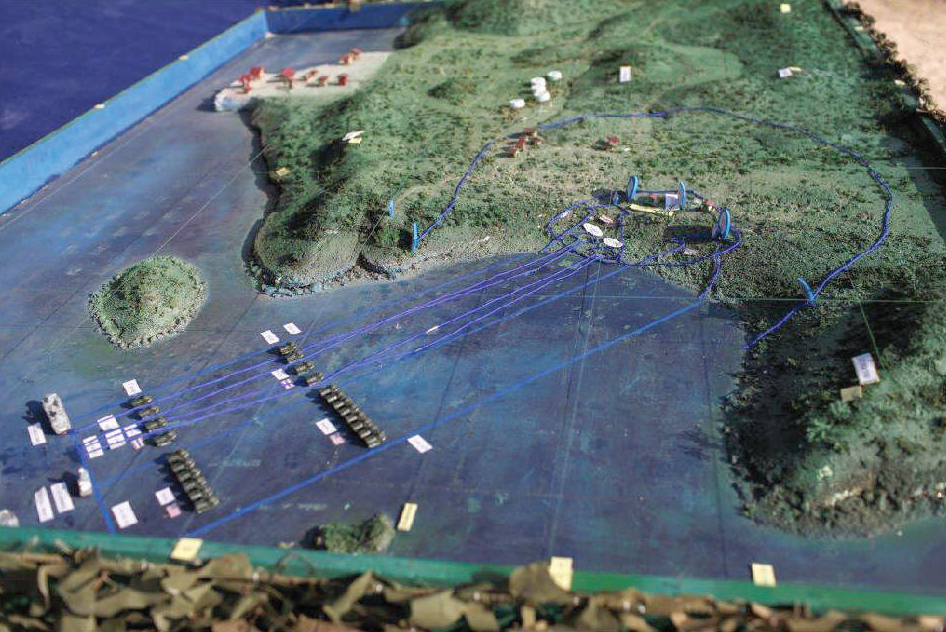
Golf Company’s decision room model is broken down into three phases: planning, executing, and debriefing. During the planning phase, two groups of Marines are separated into a Marine and enemy force and are then given a pre-built terrain model or white board that has a pre-drawn map simulating what the Marines will see on the computers during the execution phase. The two groups are then given a quick, five-paragraph order followed by five minutes to conduct their planning. Marine group units are expected to identify what they believe the enemy’s CG (center of gravity) and CV (critical vulnerability) are, develop an SOM (scheme of maneuver) andTCMs (tactical control measures), and to issue tasking statements to subordinates. Marines working on a white board are expected to incorporate proper operational graphics when drawing their SOM. Once the unit leaders have Issued their order and the planning is complete, the two groups move to the decision room where they execute their SOMs in real time.

In the past, there would be no execution phase. Marines would move straight to a debrief, circle around the terrain model or white board, and begin picking apart their plan. Today, the decision room provides us with the opportunity to bring to life unit leaders’ SOMs and simultaneously face a real opponent. We are all taught that no plan survives first contact, and using the decision room helps drive that point home. Though each team is trying to accomplish its own individual mission, the game quickly shifts to who can outcycle the opponent’s OODA (observe, orient, decide, and act) loop. The outcome of most games played within the company was based on two factors: who took the time to properly plan, and who was able execute their OODA loop faster than their opponent. During the execution phase, the Marines are positioned at opposite ends of the decision room, away from their counterparts. Once the Marines are logged into the gaming system, a controller, who also acts as an observer, initiates the game and the two teams begin to carry out their assigned missions. Once one group accomplishes its mission or destroys its opponent’s forces, the Marines return to the terrain models and white boards to begin the debrief phase.

During the debrief, our company focuses on the initial plan, how each group communicated with team members, and major decisions that were made but not planned. We try to avoid arguing over who won or who killed whom, which can drag out a debrief and get ugly at times. Once the debrief is completed, a new unit leader is appointed and the groups switch sides and missions. Because Marines are fighting each other, and each Marine thinks differently than his peers, each scenario unfolds differently and can be replayed without losing training value.

Looking toward the future of integrating COT and USMC proprietary software into our decision room will continue to allow our unit to maximize white-space time in garrison, to mentally prep Marines from the youngest PFC to the highest ranking unit member for upcoming events, and to sharpen their ability to make decisions. Our end state is simple: increase our Marines’ skill and willpower, and we believe that the decision room does just that.

Decision Time

by GySgt Paul Nichols, USMC(Ret)

The Spartan helmet, shield, sword, spear, greaves, and breast plate are no longer hanging on the CO’s conference room wall. Different pieces of the Spartan gear are now kept at the company offices and displayed front and center on “gear trees” during formations. The right to display the gear is won through competition during the quarterly Spartan Games.

Every day, the OOD gives a TDG to the duty NCOs; every Tuesday at 0500, an Advance Warfighting Seminar is held that is open to all, usually 10-15 Marines attend. Weekly “war counsels” with the officers, SNCOs, and sergeants gather to go over SOPs, discuss tactics, and voice opinions. The sergeants sit up front and are the last to vote since they will be doing the execution. PME is driven from top-down, then bottomup refined.

The second visit was in August to witness training being done with the decision room, with an ad hoc collection of computers that were scheduled for disposal utilizing software that has been around since 2002. The Office of Naval Research (ONR) had also brought in a project that they were working on-Accelerating Development of Small Unit Decision Making (ADSUDM). I talked to some of the Marines from the battalion and received mixed reviews. They weren’t really sure where the battalion was going with this concept. I also saw Marines doing immediate action drills in the quad.

In September, during Marine Week in Nashville, I ran into a lance corporal from Fox Company. I asked him about the decision room. He explained how he worked on fire team, squad, and platoon tactics at 0200 the day before they left for Nashville.

My third visit, in November 2016, was by invitation to attend the Spartan Technology and Innovation Week. From August to November, ten decision rooms had spread through the battalion. The battalion was able to find enough computers to outfit two decision rooms per company with two more in the battalion command post. The Spartan Emerging Technology Week reviewed the capabilities of simulation-based training the battalion created by utilizing readily-available technology. One of the systems the battalion employed was the Augmented Immersive Team Trainer (AlTT). The 81mm mortar platoon showcased their ability to train forward observers during the eagle eye challenge utilizing this augmented reality system. Platoon commanders built Interactive Tactical Decision Games (ITDG), the subject being each of their most recent operations during the most recent 10day field exercise. Honesty traces of each attack were included with each ITDG, provided through overlays collected via the Instrumented Tactical Engagement System II {ITESS II), showing exactly what occurred throughout the entire operation. Importing data from GoPro cameras worn by the Marines, the platoon commanders created scenarios specific to very detailed and complex decision points. I witnessed platoon commanders reviewing each of their own decisions over and over again, like a football team. The commanders then brought their squad leaders and team leaders through each ITDG in the battalion classroom, presenting their leaders with the decision points. Squad and team leaders were forced to make the same decisions as company and platoon commanders through ITDG. Each repetition of a decision builds the recognition primed decision-making capability of the Marine. Throughout the week, squad competitions were held using Bohemia’s Virtual BattleSpace II. At the conclusion of the scenario, the Marines would gather and debrief using the recorded video and data of each engagement. Cognitive scientists were never far away, recording and questioning Marines to discover why they made the decisions they did. A sampling of Marines participated in the decision requirements interview, testing the capabilities of individual Marines in a verbal test.

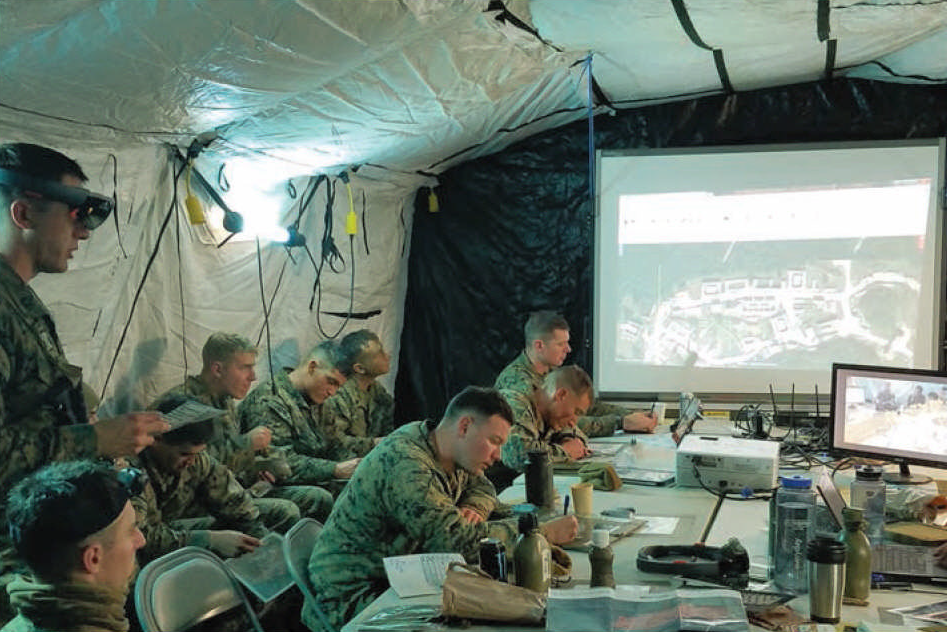
The intelligence office was in the field mapping sections of the local MOUT [military operations on urbanized terrain] facility with a DJI Phantom quadcopter. They took the images, reproduced a three dimension virtual map, and imported the map file onto a couple Microsoft HoloLens. This map was then used, in conjunction with ITDG, in the battalion’s planning during the next field exercise.

My fourth visit was only for three hours. I linked up with the battalion at Golf-3 Observation Post to observe forward observer training being conducted with live ammunition against virtual targets using the AITT. After observing the training, I left the hill to talk to some Marines about the training. They pointed out that there wasn’t a need for virtual targets because there were real targets on the range. I mentioned that most of those targets were probably on the range 20 years ago; probably still on the old maps that I used back then. This is when we came to the understanding that the virtual targets offered training in locating new targets and the target location could change constantly. I then left for the MOUT facility.

I arrived at the MOUT facility command post about 20 minutes before the main party. I had a chance to get an advanced look at what was about to be presented. The battalion, with help using ONR hardware, had completed the 3D map using a DJI Phantom quadcopter. Using the HoloLens with the 3D map, they were able to discover terrain obstacles that were not present on other terrain data bases. The S-2 used the HoloLens to brief the battalion which then launched reconnaissance assets within two hours and complete the planning in a little over four hours. The Headquarters & Services Company Commander stayed in the ITESS van and focused on data collection while the companies conducted force on force training. All data was fed into the ITDG.

In garrison, the Marines have unlimited access the decision rooms. Daily- to include weekends and holidays- Marines use Tactical Decision Game (TDG) software to practice decisionmaking repetitions. A few days before a FEX begins the Marines start planning using the HoloLens and ITDG. The Company orders are passed down to the platoons using the ITDG. Mission planning is then done out in the field using ITDG and HoloLens. During the execution, ITESS II captures all of the data on movement and engagement. This data is then fed into the ITDG and the small unit leaders are given an after-action review in the field. When the battalion returns to garrison all of the data is accessible as a TDG for the Marines study down to the individual level.

This is, without a doubt, the best training that I have ever witnessed. The finished TDG is an objective assessment oí training that was completed and can be easily referenced by anyone in the battalion to build on lessons learned. The ITDG is being used as the “glue” that binds the various training systems into one manageable and recordable training event.

The battalion has managed to merge various training systems into one final product: a robust after-action review/ TDG that captures all aspects of the training and affords an opportunity to continuously learn from the event once back in garrison. The TDG gives an objective look at what training actually occurred. While the Battalion managed to do this seamlessly, generally, in my opinion, our training systems stay within well-defined corridors that don’t facilitate cross pollination.

The Decision Room

by 2ndLts Austin Dickey, Hugo Jury, Kevin Lowring, Seamus Haggerty, and Andrew Veal

Imagine you are 1st Squad Leader, 2d Platoon, Co G, 2d Battalion, 6th Marines (2d Bn, 6th Mar). This morning, you decide to fill white-space training with a tactical decision (TDG) game in the barracks lounge over a whiteboard. After briefing the order, the attention of your Marines fades quickly as only the most outspoken fire team leaders brief their plans. At the conclusion of the TDG, most of the Marines immediately take out their phones and heatedly discuss a video game. Frustrated by their enthusiasm for a game and not their job, you realize you need to find an improved way to teach your Marines better decision-making skills through competition.

2d Bn, 6th Mar believes the “decision room” is the solution. Remodeling lounges into computer labs, decision rooms contain 16 DVTE (deployable virtual training environment) computers, tablet computers, a projector, white boards, and a large television screen. This dynamic room is designed to train decision making through interactive TDGs (ITDGs), combat decision ranges (CDRs), and virtual force-onforce gaming through Close Combat Marine (CCM).

As infantrymen, we do not spend as much time in the field as we would like. The decision room is a way to maximize our training and tactical prowess garrison. With little adjustment, DVTE computer systems that are already sourced to units throughout the Marine Corps can support a variety of software designed to test and develop the skill and will of young Marines. With the addition of ITDG, CDR, and forceon-force gaming, we can optimize the natural technical aptitudes of millennial while not requiring units to purchase additional materials.

The ITDG system is a leap forward from the traditional pen-and-paper TDG. It is a developing effort supported by the Office of Naval Research. 2d Bn, 6th Mar is fortunate to be assisting in the beta testing of many decisionmaking programs. Marines build TDGs electronically, using simple electronic overlays and any base map they import. An instructor may observe students build their schemes of maneuver, then brief the scheme of maneuver part by part, injecting enemy actions before, during, or after the student executes his plan.

ITDG layers graphics, much like an acetate overlay on a map. The instructors may digitally overlay new enemy situations as the students execute their scheme of maneuver. ITDG allows for an unlimited number of decision points reinforced by multimedia inserts into the game. For example, a video or image of a T-90 may be inserted onto the map if the student chooses to travel through an open field. The instructor may then explain the tanks actions in reaction to the field crossing.

Marines may create new enemy situations in response to the students plan, but they can also develop totally new TDGs. For example, we uploaded digital TDGs sourced from the Marine Corps Gazette into ITDG. This allows us access to hundreds of previouslymade TDGs easily distributed to students. Marines may upload their own map image, write an associated operations order, import multimedia, and then present this to their class.

To operate ITDG, the instructor must have the ITDG program on his computer, which will then act as the host computer. Student devices connect to the host via a local area or wireless network. ITDG is hosted through the Chrome browser, allowing easy access via smartphones, tablets, and computers without requiring Internet access. This is beneficial because it allows a unit to run ITDGs almost anywhere that we can bring power. For example, using a Toughpad and wireless router, a battalion staff may war game potential plans over ITDG.

It also allows the instructor to build his own scenarios from field exercises. An instructor may upload video from the Instrumented Tactical Engagement Simulation System (ITESS) location feed, UAV feed, or even audio and video from body cameras. This allows the leader to extend his lessons learned and decision making to subordinates while debriefing them in an interactive manner. This capability may also be utilized to mimic case studies of decisions made in historic battles. ITDG also provides the opportunity to conduct virtual force-on-force exercises with minimal setup.

The second program used to build recognition-primed decision making is CCM, a virtual force-on-force game. CCM contains scenarios which highlight specific infantry tactics. Each of these tactics can be tied back to Infantry Training and Readiness Manual tasks. (.NAVMC 3500 44B, Washington, DC: 2013). The instructor may focus on specific tactics critical to the mission ahead, organizing and equipping each force according to the mission. He may assign battalion-level assets, such as heavy machine guns and fixed- and rotary-wing air support, and pick the terrain based on a variety of different maps. Just as with ITDG, CCM requires the instructor to write an order or they may select one already written.

CCM IV features a system that accounts for the experience and human factors of each virtual Marine. The student must utilize sound tactics or risk his troops potentially disobeying orders. With unit tactics and the human decision of each simulated Marine, being factored into the success of the mission, this force-on-force simulator reinforces that both skill and will are required to win battles.

Virtual Battlespace (VBS III), a computer-based first person simulator, is the third program used. The program places the Marine into squad- and platoon-level force-on-force scenarios where he is forced to think tactically, make decisions, and communicate to his subordinates and adjacent units in a complex, competitive environment utilizing a range of supporting assets.

VBS III is a flexible system that promotes creativity in Marines and allows them to formulate their own scenarios that have different focus points or demonstrate different tactics. 2d Bn, 6th Mar, has integrated the above two systems to execute force-and-force exercises in a competitive manner-the Spartan Tactical Competition. During the competition, platoon commanders and squad leaders compete in a tournament against platoons from different companies. The planning process was integrated with the ITDG system prior to game play. At the end of the tournament, the platoon and squad that have demonstrated the best tactical decision-making skills in the battalion are identified. These competitions help us identify the strongest skills and leadership qualities in our Marines and are a practical, educational way to strengthen tactical decision making and morale in addition to building unit cohesion. We have already experienced leaders applying lessons learned in the decision room to force-on-force field operations in order to achieve an advantage over their opponent.

The decision room presents unlimited training possibilities for developing the Corps’ small-unit leaders. By and large, the Marine of today is more proficient than ever in gaming technologies. The Marines of 2d Bn, 6th Mar, are capitalizing on this advantage and leveraging the technology of the decision room to develop the most adept small-unit decision makers in the Corps who can innovate, adapt, and win any fight.

Author’s Note: A version of this article was published in the February Web Edition of the Marine Corps Gazette.

Creating a Hunter of Cases

by 1stLt Kenneth P. Sullivan

It was just like any other Thursday night on duty at an enlisted barracks: Marines scrambling to get back for evening formation, one forgetting about his fire-watch shift, and one Marine had even broken into another’s room to ensure it was clean for Friday morning’s field day inspection. All were simple hiccups in a normal shift of duty. Then PFC Hood (whose name has been changed to protect his identity) came into the duty hut asking to speak to me. Visibly trembling, he said he thought he was having an anxiety attack. I instructed Hood to take my seat and relax as I pulled up a loose chair.

I learned that Hood had been medically dropped from his MOS school two weeks prior and placed in a Marines Awaiting Training (MAT) platoon. Being a salty 11-month veteran of MAT platoon at TBS, I thought I might be able to relate to his situation. Hood had a plethora of administrative and medical issues preventing him from continuing to train. A back condition known as ankylosing spondylitis, in which different parts of the spine can fuse together, caused his medical drop from the course two weeks earlier.

To add to this, Hood is a Reservist who was sent to his unit and placed in “Reserve” status upon completion of Marine Combat Training but continued to receive active duty pay until reporting to MOS school three months later. In order to balance his overpayment, the Marine Corps had not given Hood a paycheck in two months. With this mounting stress, he had not slept in the past 48 hours.

What bothered Hood most that night, however, was the lack of discipline of his fellow MAT platoon members. “It’s like they forgot everything we learned at phase III of boot camp. One kid even wore headphones to formation tonight,” Hood choked out, his hands shaking uncontrollably, while his right foot tapped a fortissimo rhythm. “I just want to stand in front of the platoon and put them all on blast for forgetting what it means to be a Marine.”

Hood opened up more as I inquired about his home life and why he joined the Marine Corps. Like many Marines, he came from a troubled past. His mother had left him at a young age, and his father sold drugs when an accident prevented him from working. Hood craved the discipline and direction the Marine Corps provided him. When he dropped from his MOS school, however, he was no longer challenged intellectually, his days consisting of repeatedly cleaning equipment and rooms at the schoolhouse where he used to train.

I had been faced with a similar circumstance after fracturing my left fibula awaiting the start of my MOS school. Without much structured class to challenge me, I was fortunate to find resolution with a few other lieutenants who were motivated to continue their education despite physical setback. One such Marine had the will of a lion and the resultant leg bone structure of Mar- vel’s Wolverine. My partner in crutches had suffered a spiral fracture on his right tibia during a fast-roping exercise out of an MV-22 Osprey a year prior to my accident. During his 20-month recovery before finally conquering his MOS school, he worked at Marine Corps University (MCU) developing decisionforcing cases (DFCs) and teaching them at TBS. Following in his case method footsteps at MCU, I used the experience of developing and teaching cases under the tutelage of a passionate and welleducated MCU staff to focus myself intellectually at a time when I could not train physically.

I thought that teaching Flood a decision-forcing case might trigger academic interest in a Marine craving structure. Since Flood had never heard of DFCs, let alone tactical decision games (TDGs), I decided to start Hood with a simple TDG. After delivering a well-thought-out plan of how to attack an enemy platoon on a hilltop, Hood inquired, “So what’s the right answer?” I explained the difference between TDGs and DFCs, wherein he replied despondently that he would like to know what actually happened. I then opened a case, Di Notte, developed from an Army after-action report written at The Infantry School, Fort Benning, G A. Di Notte is about 1LT Augustine MacDonald leading Company I, 350th Infantry Regiment, 88th Infantry Division in a night attack against a fortified ridgeline in the Apennine Mountains in 1944 Nazi-occupied Italy.

Two of the firewatch Marines joined Hood as audience members for Di Notte. There was much contention of how the three participants, as “lieutenants,” wanted to attack Hill 538. Each had a different plan and sound tactical thought to justify. After lively debate, I finally revealed how 1LT MacDonald had conducted his attack 70 years prior. All three Marines who participated had tremendous buy in to the case (the firewatch Marines stayed in the duty hut to discuss the case well after their shifts ended), but PFC Hood was especially interested in the entire process. I then showed Hood the method of how we found and developed Di Notte from an after-action report.

Most cases do not just manifest themselves for a reader. They require an active hunt through stories, books, and after-action reports. While not every hunt leads to a case, the process is, in and of itself, beneficial. Understanding how to develop DFCs imbues the reader with an active mind, allowing him to absorb the experiences of the character to whom he is exposed. The hunter just needs a spark to ignite his curiosity and an understanding of the process to fuel his case development. We provided that spark on a Thursday night in a Marine barracks duty hut. It peaked Hood’s interest, allowing him to detach from his own shaking boots, embody himself in those of a company commander who undoubtedly felt anxiety 70 years ago, losing communication with one platoon at the culminating moments of his near-dawn attack.

The conduct of the decision-forcing case both relaxed and excited Hood, his anxiety transforming to anticipation with each movement of Company I’s graphic on the map. His hands no longer trembled; his foot no longer shook. Hood was able to sleep that night (we selected his room for the 0200 random room search). We can only hope the spark provided by Di Notte, and the direction of the MCU staff that one duty officer was able to impart to a PFC provided enough fuel to create another hunter of cases.

EMLCOA 2.0

By Maj Roberto Scribner& 2ndLt Patrick Terhune

The current approach to teaching and executing the enemy’s most likely course of action (EMLCOA) analysis at the company grade officer level is flawed because it allows cognitive traps to stifle empathy and creative thought. A new methodology is required that eliminates those traps and provides an improved framework for envisioning how the interactively complex system made up of enemy forces, friendly forces, terrain, missions, and moral factors act in a particular time and space. Mirror-imaging-the assumption that the subjects being studied think, process information, and see the world in the same way as the analyst-is perhaps the most common cognitive trap in conducting EMLCOA analysis. The Basic School (TBS) trains company grade officers to develop an EMLCOA by “turning the map around” and “putting themselves in the enemy’s shoes.” Using METT-TC (mission, enemy, terrain and weather, troops and fire support available, time, civilian considerations) analysis, lieutenants and captains predict the enemy’s mission; how they will try to achieve that mission with past, current, and future actions ; and how they will react to contact.1 The current methodology leads to order-writers reflecting the actions that they as Marine officers would take if placed in the same situation as the enemy, rather than how the enemy, who does not think and act like a Marine officer, will act.

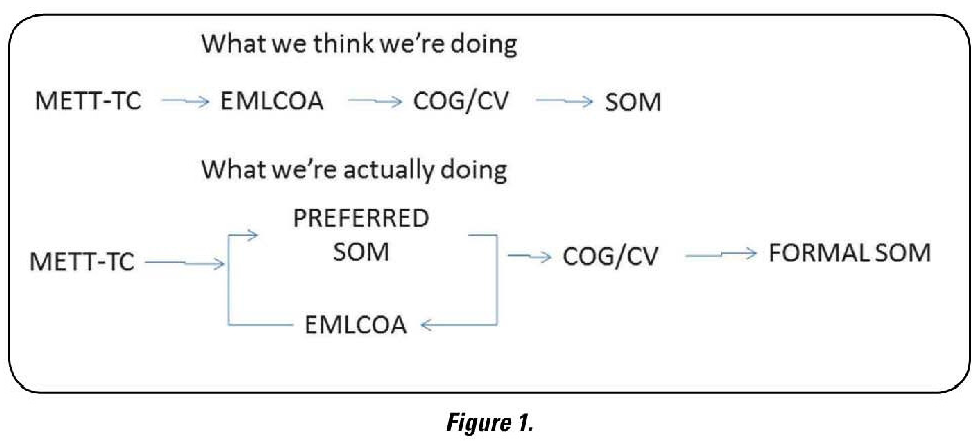
Training documents state that the EMLCOA is critical because it is central to the development of the center of gravity/critical vulnerability (COG/CV) and the scheme of maneuver (SOM).2 Additionally, the EMLCOA is the first creative narrative the junior officer presents in the operations order, making it highly in>Maj fluential to subordinates. In reality, our focus group research showed that the EMLCOA is part of a self-referential decisionmaking loop because the orderwriter has already chosen a preferred SOM to which the enemy will react to write the EMLCOA (see Figure 1). The order-writer develops a SOM based on the EMLCOA, and the EMLCOA is based on a SOM that the writer already has in mind while conducting the METT-TC. Our focus groups showed that the current approach to teaching and developing EMLCOAs (hereafter termed “EMLCOA 1.0”) leads to a middle-of-the-road approach that ascribes insufficient agency to the enemy, resulting in poorly developed analysis that falls into multiple cognitive traps. EMLCOA 2.0 is a focus group-tested methodology for teaching and conducting EMLCOA development using redteaming techniques that vastly improves the breadth and depth of analysis as well as eliminaring mirror-imaging and greatly expanding how junior officers think about the enemy.

The authors administered the included tactical decision game (TDG) (see p. 47) to 23 second lieutenants indoctrinated in EMLCOA 1.0 development at TBS.3 When initially instructed to develop an EMLCOA, the responses showed remarkable similarity with only two respondents deviating slightly from the norm by assuming that the enemy would send out patrols. The following paragraph contains the elements with 75 percent or greater commonality from the respondents’ EMLCOA 1.0 and divides the EMLCOA 1.0 into three statement sets, [SI] through [S3]:

[Si] l’he enemy is a .squad-sized element of Centralian Revolutionary Forces (CRF) [S2] set up near the top of Hill 293 buc within 300 meters of North Bridge to ensure the bridge is in AK-74 range.4 The enemy’s mission is to keep us from crossing North Bridge. They’re dug in about chestdeep in a semicircular battle position oriented east toward the bridge. Their PKM (medium machine gun) has a principal direction of fire (PDF) on the bridge. The 50mm mortar is ser up on the military crest opposite the bridge on Hill 293. They’re at 25 percent security. They have a two-man listening post/observation post (LP/ OP) on Hill 74 to watch their southern flank. [S3] Right now they’re eating chow and improving their defensive positions. When we attack tonight they’ll be at 25 percent security and will defend fiercely until they take 25 percent casualties, at which time they will withdraw to the west to link up with their parent unit.

All respondents stated that they had developed a preferred SOM prior ro EMLCOA 1.0 development.5 The respondents then consciously or unconsciously structured the enemy’s actions to serendipitously allow for the platoon’s use of a combined arms attack that maximized the use of indirect fire and automatic weapons. Additionally, the officers based the EMLCOA 1.0 on what they would do if they we rein charge oí a Marine squad given the enemy’s task, which they took to be countering the preferred friendly SOM that they had already imposed on the situation. Respondents mirrorimaged and ignored the likelihood that the CRF could maneuver through the swamp trails, would be unlikely to place themselves in the perfect position for the Marines to conduct a combined arms attack, and that the squad did not have to maneuver as a unit. The following analysis examines each statement set.

In [Si], respondents assumed the CRF squad acted as a single unit, maintaining centralized command and control to maximize mass and simplicity because that is how they are taught to employ it. The respondents ascribed the characteristics of a Marine squad to the enemy. In [S2], the respondents took their preferred SOM and created a scenario where the enemy, imbued with the characteristics of a Marine rifle squad, responded to that SOM. If the respondents commanded a Marine squad placed in the enemy’s situation, they would look for an obstacle where they could bring all their firepower to bear on a canalized enemy while maintaining standoff to protect themselves. Hill 293 fits these criteria. Because there are only two crossing points and the platoon may not be able to traverse the swamp in the time available, the enemy will be at North Bridge because that is where the platoon will be. In [S3], 25 percent security ensures that Marines man the automatic weapons at all times and that the unit gets adequate sleep. The respondents’ training teaches them to go to 100 percent security at end evening nautical twilight and begin morning nautical twilight, and since the platoon is attacking at night, the CRF will be at 25 percent security, per Marine standing operating procedures. The CRF are conducting the continuing actions taught to the respondents. The enemy will fight, of course, but the respondents believe from their casualty evacuation exercises that four injured Marines likely triggers abort criteria since manpower is consumed by carrying the wounded or dead. Thus, once the enemy sustains a similar casualty ratio, they will cease fighting while they arc still capable of withdrawing.

To achieve better EMLCOA analysis, mirror-imaging must be eliminated; the enemy must be ascribed the appropriate level of agency to do what is most effective for its own ends; and moral, psychological, and emotional states of the actors on the battlefield must be taken into account. Ehe EMLCOA 2.0 methodology evolved through experimentation and multiple failures, and is based on two key principles:

* The discourse of analysis itself is tremendously important. We found that it was critical to force the analyst to use the personal pronoun as the enemy leader when conducting analysis. Using”!” instead of “they” changed how willing the respondents were to ascribe agency to the enemy and develop courses of action that would defeat the friendly forces. In the words of one focus group member, “When you say ‘I’ and make yourself the enemy squad leader, it makes you want to win.”

* The enemy wants to win. Previous versions of the methodology failed in focus groups because respondents wanted the friendly forces to win more than they wanted to conduct a creative analysis that allowed for the possibility of enemy success. The first principle assists in breaking this bias, but it was critical to unfetter the respondents’ strong desires to limit the agency of the enemy to be as effective as possible. We overcame this by developing a step in the methodology where the respondent is directed to make the friendly unit fail in the most unpredictable way they can think of.

EMLCOA 2.0 can be accused of being a way to develop an enemy’s most dangerous course of action (EMDCOA) vice EMLCOA. EMLCOA 2.0 assigns intelligence and agency to the enemy, assuming that the enemy will take those actions that best lead to success as defined by that enemy. We argue that in a contest of wills that can lead to death, the enemy will do their utmost to win; to think that they will do any less is disingenuous. This may result in a merging of EMDCOA and EMLCOA, and we feel that this is completely acceptable. It is important to remember that conducting EMLCOA analysis does not excuse the analyst from understanding how the enemy’s doctrine may shape or constrain action and decisions. Doctrine can supersede creativity, and the analyst must understand when this is the case for a particular opponent.

EMLCOA 2.0 Process

When to use. This analysis should be conducted after the METT-TC process is complete.

Process narrative. This analysis will force the order-writer to look at how the enemy sees the friendly unit via a modified “Four Wtys of Seeing.”6 The writer will use this information to develop an enemy estimate of the friendly SOM. This method emphasizes gaining an understanding of how the enemy sees the friendly unit’s approach to solving the problem. The order-writer develops a narrative of how the enemy counteracts the friendly unit’s SOM in the most unpredictable way imaginable. Lastly, the order-writer writes a first-person narrative from the perspective of the enemy unit leader that begins 24 hours prior to contact with the friendly unit and ends 12 hours after contact. The first-person narrative continually forces the orderwriter to abandon mirror-imaging and identify with the enemy commander. Extending the preaction and postac- tion timeframes accounts for a major portion of the enemy’s planning cycle at the small unit level.

The method. (Note: When conducting EMLCOA 2.0 analysis, the “enemy” is the unit to which you, the analyst, belong. In the TDG, that makes the analyst the CRF squad leader and the “enemy” the Marine platoon.)

Step 1. Complete the METT-TC analysis.

Step 2. Using the pronoun “I” or “we,” write down how you, the unit commander, see yourself and your unit. Focus on how you view your strengths and weaknesses. Explore strengths and weaknesses that are physical, tactical, moral, psychological, and emotional. Think about your fears and what your unit can do well and what it does poorly.

Sample responses from the focus groups: We are light, fast, dedicated, and know the terrain well, especially the swamp near the south bridge. Although ive lack heavy weapons or the ability to deliver indirect fire, we have excellent patrolling and reconnaissance skills and can skillfully execute an ambush. We can melt away and appear anywhere we want. Were comfortable operating in smaller units without a lot of direction. We don’t want to die and since there are not many of us, we want to live to fight another day. We’d rather cause minor damage and then withdraw a hundred times vice standing andfighting and giving you a chance to use your superior firepower. We don t have to follow any RGBs [rides of engagement]’, so we can take the most effective actions without worrying about being investigated. I’m fighting on my home turf and I have to live here after you ‘re gone, so I care more. God is on my side and we deserve to win. My family and friends support me 100 percent in what I’m doing and I don’t want to let them down. If I fail, my family may suffer consequences from the invaders.

Step 3. Using the pronouns “you” or “they,” write down how you see the enemy you are fighting. Focus on how you view their strengths and weaknesses. Explore strengths and weaknesses that are physical, tactical, moral, psychological, and emotional. Think about their lears, and what they can do well and what they do poorly.

Sample responses from the focus groups: You are well-equipped andphysically tough fighters who understand techniques, tactics, and procedures (TTPs). You have capabilities we don’t even know about or understand. Your ability to call for indirect fire or air support gives you a huge advantage. You have excellent communications equipment that allows you to talk to each other over long distances. You have a platoon and we have a squad. You have better weapons than we do. You. carry too much stuff and this makes you move slowly and noisily. You’re very concerned with casualties and this makes you cautious and leads you to try to use the biggest guns you havefirst. Your night vision capabilities are excellent, but you think that because you have them that you have an advantage at night. You like to stay close to another friendly unit, road, or landing zone in case you have casualties or you need help. You have restrictive ROEs and worry a lot about how to follow them instead of just fighting the most effective way possible. You’re leaving when you’re done fighting, so you care less than I do. You miss your families and you’d rather be back with them than out here fighting me. You can show up anywhere by using helicopters. You have a couple of ways of doing things and you stick to them, even when the situation says that you should do something new or different. You publish all your TTP on the Internet so I can read them.

Step 4. Compare the results of step 2 and step 3 and note areas in which you think you have an advantage. Use the pronoun “I.”

For example: I have speed, better reconnaissance capabilities, stealth, and better ambush TTP. I operate well in fire teams or smaller units, so I in more mobile. I have the ability to function with missiontype orders and limited communications. 1 am not dependent on outside forces. I want to win more than you do because this is my home.

Step 3. Compare the results of step 2 and step 3 and note all places where the enemy may have the advantage. Use the pronouns “you” or “they.”

For example: You have firepower, indirect fire capability, communications technology, night vision, inter- and intraunit coordination, and much bigger unit size. You can use helicopters and vehicles to show up in unexpectedplaces very quickly.

Step 6. Based on the relative mismatches you sec in steps 4 and 3, draw or write down the SOM that you believe the enemy unitwill execute. Continually reference steps 2 to 3 to ensure that the SOM you arc building fits your previous analysis.

Step 7- Based on steps 2 and 4, which gave you how you view yourself, and step 6, the probable enemy SOM from your perspective, sketch out your plan to cause the enemy mission failure in the most unpredictable way you can think of. You can either write it step-by-step or draw it graphically on a map.

Step 8. Take a few minutes and create a movie in your head of how the SOM you developed in step 7 unfolds. Write a first-person narrative (a story) from your perspective on how the plan you came up with in step 7 unfolded. Begin 24 hours prior to making any contact and end 12 hours after making contact. This narrative is your EMLCOA.

Results

EMLCOAs using the EMLCOA 2.0 methodology exhibited a variety of creative, highly effective, and plausible solutions. All were different from the EMLCOA 1.0 analysis produced by the same focus group participants. Almost all focus group participants immediately destroyed the northern bridge, stating that the enemy needed the bridge but that the CRT did not. Several participants destroyed both bridges. Some destroyed both bridges and then waited to bait and destroy a potential heliborne force by either setting up ambushes in, or mining, landing zones. Those that did not initially destroy the northern bridge destroyed it later with a small team or explosives while the enemy crossed the bridge, splitting the enemy forces, which were then attrited through ambushes. Great care was taken to ensure that when direct combat occurred, the CRF undertook mitigation of enemy fire support assets. This varied from using terrain to keeping the enemy within the 60mm mortar effective casualty radius while fighting and then breaking contact in multiple directions. Participants broke their squad into hunter-killer teams to harass the enemy, laid ambushes, and used the swamp to maneuver into the enemy’s rear to strike. Several participants attempted a spoiling attack on the enemy’s assembly area or used attacks from the rear to force the enemy to pursue small teams into the swamp. Two participants independently developed versions of Che Guevara’s guerrilla “minuet.” The use of ruses abounded. Participants lit fires in various areas to either draw attention or to neutralize enemy night vision capabilities. One participant lit the northern forest on fire and then destroyed both bridges.

Focus group members made significant leaps in their analytical capabilities expressing and incorporating highly advanced concepts that they had not been previously exposed to such as important elements of systems thinking. Respondents stated that using EMLCOA 2.0 forced them to sec that there were multiple ways to interpret each element on the battlefield. In speaking about the northern bridge, one respondent stated:

Ic had more meanings [during EMLCOA 2.0], and [the meaning] just depended on how I looked at it. I could really jack up the Marines if 1 made the bridge mean something different to me than them and surprise the hell out of [the Marines].

The parallels between this and other like responses from our locus groups and then-BGen Aviv Kokhavi’s’s now classic discussion of conceptualizing space is instructive as to how creative junior officers can be when they are truly allowed to think:

This space that you look at, this room that you look at, is nothing but your interpretation of it. Now, you can stretch the boundaries of your interpretation, but not in an unlimited fashion, after all, it must be bound by physics, as it contains buildings and alleys. The question is, how do you interpret the alley? Do you interpret the alley as a place, like every architect and every town planner does, to walk through, or do you interpret the alley as a place forbidden to walk through? This depends only on interpretation. We interpreted the alley as a place forbidden to walk through, and the door as a place forbidden to pass through, and the window as a place forbidden to look through, because a weapon awaits us in the alley, and a booby trap awaits us behind the doors. This is because the enemy interprets space in a traditional, classical manner, and I do not want to obey this interpretation and fall into his traps. Not only do I not want to fall into his traps, I want to surprise him!”

Red-teaming methodologies must fundamentally and forcefully unhinge the accepted reality of the analyst to allow the viewing of a situation from a different frame of reference. EMLCOA 2.0 is an attempt to create a sufficient break with perceived reality for the company grade order-writer. It is necessarily simple because most company grade officers lack full-fledged intelligence cell support are often tasked with rapid mission planning cycles due to their place at the end ol larger unit planning cycles. EMLCOA 2.0 effectively creates empathy for the enemy’s point of view and capabilities, allowing company grade officers to quickly and effectively develop an EMCLOA without falling into cognitive traps. Focus group participants universally developed a better conceptualization of how the enemy might fight the Marine forces. At a deeper level, focus group participants increased the complexity and depth oí their thinking about the relationship of the elements on the battlefield and began to visualize these elements as part of a nonlinear, interactively complex system. Their EMLCOAs reflected enemy solutions to the problem that went beyond the mere application oí firepower and movement to space and time evidenced in EMLCOA 1.0 and encompassed psychological and moral factors in creative ways.


Notes

1. The introduction to EMLCOA in this publication states, “Based on your understanding ol the situation through the detailed analysis (METT-TC), turn the map around and ask yourself, ‘What would I do il I were the enemy?”‘ See Commanding Officer, Tactical Planning B2b2367/B2b2d87 Student Handout, The Basic School, Marine Corps Base Quantieo, pp. 9 and 20.

2. Commanding Officer, Combat Orders foundations B2b2377 Student Handout, The Basic School, Marine Corps Base Quantieo, 2012, pp. 12 and 14.

3. This involved administering the I DG to several focus groups. The TDG was first administered with instructions to the participants to simply perform a METT-TC analysis and EMLCOA in the manner that they had previously been taught. Results were then verbally collated by having the lieutenants individually brief their EMLCOAs. The same TDG was then administered using the EMLCOA 2.0 methodology. The examples for each step were not utilized in the conduct of the TDG. These examples were drawn from execution of the TDG itself.

4. The CRF, a guerrilla force, is one of the enemy forces faced by TBS students.

5. There was one SOM with minor variations: the platoon moves northward through the Eastern Forest, pauses before unmasking east of the bridge, uses the company 60mm mortars to suppress the enemy on I lili 293 in order to cross the bridge, and then conducts a fix-and-flank maneuver on the main enemy positions on Hill 293 before reducing the listcning/obscrvation post on Hill 74.

6. University of Foreign Military and Cultural Studies, Red leant Handbook, version 5, Fort Leavenworth, KS, 2011, p. 135.

7. Weizman, Eyal, “Lethal Theory,” Open, Amsterdam, Netherlands, 2010, pp. 82-83.

3d Platoon’s Pickle

By Damien O’Connell

Situation

You are the platoon commander of 3d Platoon (foot-mobile), Fox Company, Battalion Landing Team 2d Battalion, 1st Marines, 11th MEU. Last month, after completing operations in Nangarhar Province, the MEU was sent to support NATO forces in B armai District of neighboring Paktika Province. Two weeks ago, B armai District witnessed dozens of small-scale battles. The fighting has claimed the lives of hundreds of civilians, most of them victims of NATO air and artillery strikes. Because of this, several once pro-NATO villages have begun providing the Taliban with intelligence, supplies, and even men.

Your battalion commander finds this situation alarming and wants to strengthen relations between his Marinesand the remaining pro-NATO villages in the battalion area of responsibility. To this end, he has sent each of his companies to billet on the edge of – or if granted permission, within – a large pro-NATO village. Each company has the same mission: protect the villagers and improve their quality of life. Your company was assigned to Soor.

When Fox Company arrived in Soor, your company commander met with the village elders. Impressed by his knowledge of Pashto (and promises of food and medical supplies), they invited the Marines to stay in the village. A few days later, an Afghan National Army (ANA) infantry platoon arrived to augment your force and facilitate cooperation between the Marines and villagers. Consisting of three light infantry squads, the Afghan platoon is highly motivated but knows only the most rudimentary skills of soldiering, and except for its Soviet-era weapons, it is poorly equipped. The Afghan soldiers lack body armor and night vision devices.

Since the Marines came to Soor, the village and its environs have been free of enemy activity. The villages where your sister companies are stationed, however, have seen daily (and sometimes nightly) company-sized attacks by the Taliban. Often poorly coordinated, the attacks have cost the enemy hundreds of dead, the Marines dozens, and the villagers few.

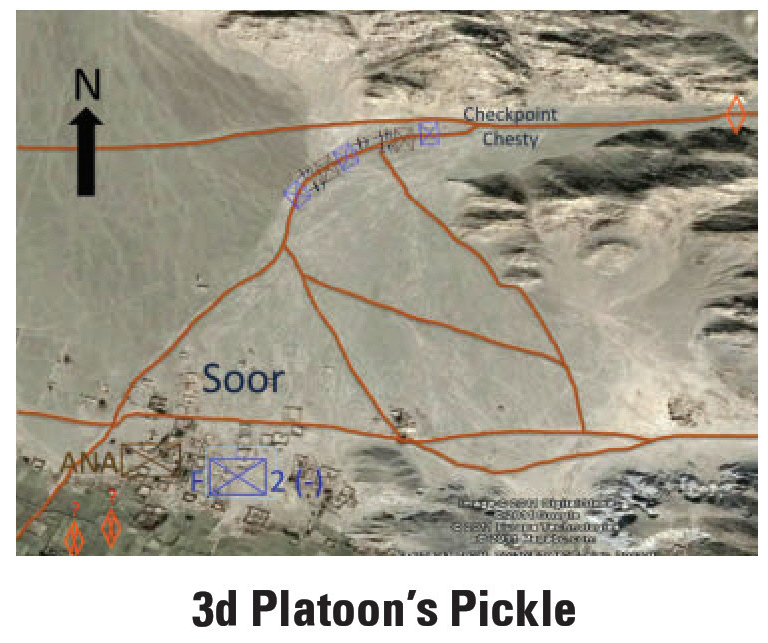
Today you and your men spent the afternoon instructing the Afghan infantry platoon in ambush techniques. With the training over, your platoon began readying itself for a night patrol. Then, around 1700, you received new orders from your company commander. “Lieutenant,” he began, “we just received word from battalion: 20 minutes ago an unmanned aircraft system (UAS) discovered a convoy of 8 pickup trucks a few hours northeast of here. Intel says they’re Taliban, about 50 in number, who came across the border from Pakistan sometime this morning. The trucks appear to be carrying at least a dozen crew-served weapons. And there’s a good chance that the leader of Taliban forces in Barmal District is among the passengers. Higher headquarters wants the convoy taken out for obvious reasons. Unfortunately, we won’t have the aid of the UAS. It’s been sent to help friendly forces caught in an ambush. Now because there are so few good roads in the area, the convoy must pass through Checkpoint Chesty, about 3!/2 klicks northeast of Soor. Ambush it there. I’m giving you three assault teams and a machinegun squad (two teams) for the mission. Since you just finished training the ANA platoon in ambush techniques, I’m sending two of their squads along. You also get the forward air controller (FAC). Two Cobras (AH-IW) are on call, so if you need them, they’re there. At its present rate the convoy should reach the checkpoint a little over an hour from now. As you know, the terrain between here and there is relatively flat and easy to travel, so you should have plenty of time to set up the ambush. Move out within 15 minutes.”

You give a quick patrol order to your subordinate leaders, conduct final equipment checks, and move out. You deploy your force in column formation, with the assault teams, machineguns teams, and ANA squads interspersed between your three rifle squads. 1st Squad is on point.

As the lead elements of the ambush force near Checkpoint Chesty, you hear explosions coming from Soor. You try contacting your company commander on the radio, but he does not respond. You then direct the FAC to check with the battalion air officer. The FAC does so and learns that Soor is taking heavy mortar fire. To make matters worse, the FAC informs you that at least two groups of Taliban (strength unknown) are moving to assault the village from the southwest. Just then, 1st Squad radios in. They report seeing 13 vehicles in the distance. The convoy is fast approaching. Night is falling. What now, Lieutenant?

Requirement

Within 5 minutes, give your solution in the form of a frag order to your subordinates. Be sure to include your intent, an overlay sketch of your plan, and the rationale for your decision.

> Editors Note: This TDG was originally submitted by Damien O’Connell with comments and suggestions by Bruce Gudmundsson and Timothy Jackson.


The Debrief

Situation

You were the 11th MEU S-3A (assistant operations officer) but have been reassigned as the team leader of an advisor/liaison team assigned to 15 th Afghan Infantry Battalion. Approximately 4 months ago the MEU was sent to Jalalabad, Afghanistan, in support of NATO forces during Operation ENDURING Freedom. The 15th Afghan Battalion completed basic training prior to your arrival. At this point in their training, they can conduct limited independent operations at the company level and often require coalition assistance for vehicle maintenance, logistics planning, and operational planning. The 15th Battalion’s area of operations is a stretch of land between Jalalabad and Kabul, the regional home of the 15th. Their primary mission has been interdiction of Taliban and insurgent weapons and personnel between Kabul and Jalalabad.

Last night 2d Company conducted a night ambush of an insurgent convoy. You were in Kabul with the battalion commander coordinating a resupply and maintenance budget for the battalion’s vehicles. You assigned your staff sergeant who is a subject matter expert in helicopter observations to observe the company’s ambush, a mission he has done before. The 2d Company has small arms capability similar to a Marine rifle company; however, its communications and night vision equipment is limited. The following morning, the 2d Company returned to the battalion headquarters riding in what you suspect are captured vehicles. You attend the company commander’s debrief to his battalion commander and members of his staff. Following are the company commander’s comments:

“My rifle company, with two medium machinegun teams and two assault teams attached (armed with rocket propelled grenades), was ordered to conduct a night ambush on a known enemy supply route. As the company commander, I had a night vision monocular. We did bring trip flares and six antitank mines along with several antipersonnel pressure mines. Our communications net enabled me to speak with my battalion headquarters and locally to each platoon leader.

“Intelligence reports indicated that enemy supplies are transported by trucks with the occasional armed jeep or light armored car acting as an escort. The trucks generally have an infantry platoon (minus) as local security as well. Convoys are six to eight vehicles long.

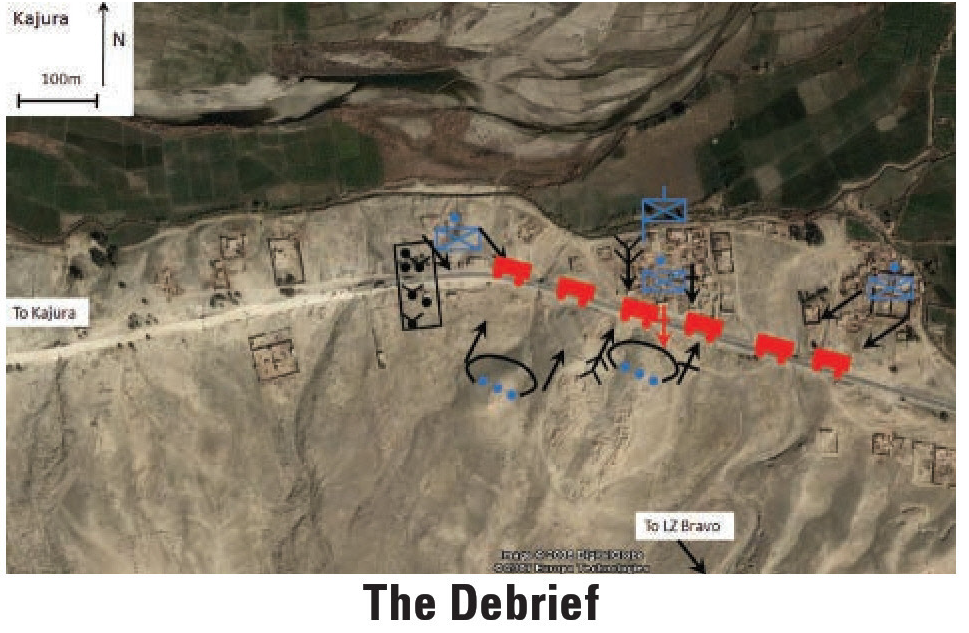
“The company was dropped off by helicopters (provided by the MEU aviation combat element) at Landing Zone Bravo at 0135, some 5 kilometers from the ambush site. The terrain was mountainous, with rocky outcroppings and low scrub. Nighttime temperatures were near or below freezing. The unit marched in column, keeping to a counterlevel below the crest, to the ambush site. Once there a platoon conducted a reconnaissance and then we assumed the fighting positions as outlined on this map. We kept radio talk to a minimum using runners or chemical light signals when able. While it was still dark, the enemy convoy approached from the village as anticipated. No jeeps or armored cars were visible from my position.

“The convoy entered the kill zone, and the company opened fire with the headquarters initiating the ambush. The enemy was hard pressed to react, but some of the infantry managed to return fire aided by a heavy machinegun (HMG) from a jeep in the middle of the convoy, but then they were overwhelmed. We suffered only four lightly wounded, one seriously wounded, and one killed in action.

“While medical attention was given to the wounded, we conducted a quick sweep of the enemy in search of items of intelligence value. We found none but did notice we destroyed a jeep with HMG. Following this search, we discovered that most of the vehicles were still operational. We cancelled the scheduled helicopter extract and returned with a large motor pool. We left the mines in place in the hopes the enemy might set them off later when picking up their dead.”

After hearing the last sentence you glance over at your staff sergeant, who smiles and nods. This is your signal that he did not know that the mines were left in place. He also tilted his head slightly, an indication that the company commander is telling the truth as far as he could observe.

The company commander turns to you and asks, “The mission was clearly a success. Don’t you agree, Captain?”

Requirement

In a time limit of 10 minutes, write what you would say in front of the battalion staff and what you would say privately to the battalion and company commanders. Describe what actions you would take. Be prepared to provide a rationale for your comments and provide a sketch if you believe that the concept of operations should be different.

Issues for Consideration

1. Would you critique the mission in front of the battalion commander, pull the company commander aside, or a combination? Why?

2. In regard to the minefield, what is your team’s responsibility in this matter?

3. What are some ways that the Afghan battalion can defeat the Kajura population’s will to resist government rule?

4. Will the action of 2d Company help defeat the enemy resolve? Explain?

5. Do the actions of 2d Company further the objectives of the MEU commander? Explain.

6. What do you do if you find out the convoy that 2d Company ambushed was a local militia vice Taliban or alQaeda?


Diesel Dilemma

Situation

You are the Commanding Officer, Company F, Battalion Landing Team 2d Battalion, 1st Marines (BLT 2/1), 11th MEU. The MEU was sent to Nangarhar Province (capital city Jalalabad), Afghanistan, in support of NATO forces during Operation ENDURING FREEDOM. You have been incountry almost 3 months now. Approximately 45 days ago your company was assigned to the eastern sector of the area of operations (AO), a sector that includes the main road from Jalalabad to Pakistan through the Khyber Pass. Your company’s tasks include defeating anticoalition/insurgent/Taliban forces, halting the illegal flow of arms and explosives, and strengthening local government, police, and army forces. All of these tasks are executed in order to increase local stability and promote legitimate economic growth in the AO.

You decided to assign one platoon to work with the Basawal Police and one platoon to work with the Hazar Police. The 3d Platoon in your company is assigned as a quick reaction force (QRF) in Hazar. The weapons platoon is currently reinforcing your maneuver platoons, and the BLT has provided one combined antiarmor team (CAAT) as the Basawal QRF under operational control to you. Company mortars are in general support of the company, currently with you at your headquarters in Basawal.

Over the last 45 days your company has been very successful in deterring insurgent activity in your AO, and your platoon commanders report success in building the professionalism and tactical proficiency of the Afghan police force in these two cities. Approximately 2 days ago, demonstrations in the town of Hazar resulted in several injuries to civilian and local police forces, as well as the seizure of local fuel trucks that were recovered 6 hours later minus the fuel they were carrying.

Yesterday, you completed movement of the company command post (CP) to the town of Hazer and temporarily reassigned the CAAT to Hazar as a company reserve. You then ordered security patrols and a curfew in coordination with the Afghan Police. While order is being restored, several tribal leaders of both the Qizilbash and Pashtun tribes have accused police and military forces of stealing fuel from local vendors. Local police (a mix of Tajik and Pashtun tribes) did not deny this, stating that their vehicles need fuel, the government will not provide it, and they will pay for what they have taken when the funds become available. What now?

Requirement

In a time limit of 20 minutes, issue your orders to your subordinate units, actions you will take, and what reports, recommendations, and requests for support you will give to battalion.

Issues for Consideration

1. What do you believe is the BLT or MEU intent in this area?

2. How do your actions and orders support this intent?

3. What is the focus of effort for your company in this situation?

4. What is your priority in this situation? What do you think is the civilian priority in this situation?

5. How do you employ the local police force?

6. What actions do you take to defeat civilian motivation to riot:

* While in the area?

* After you move your CP back to Basawal and return the CAAT to Basawal?

* Over the next month?

7. How can information operations support your actions to defeat civilian motivation to further resist?


Return to Rahadnak

Situation

You are Baz Dagar. You are 45 years old and fought with the mujahideen when the Soviets came across the mountains. You were running guns for Sher Dil when the Americans roared up the valley in armored vehicles last month, just like the Soviets in 1981. You are the fifth son of Dagar and have little chance of becoming the patriarch of your fatherâeuro(TM)s Tajik enclave in the northern end of the valley. Thatâeuro(TM)s why you decided to help Sher Dil. Since the 1970s, the Soviets came and left, and then the Americans pushed out the Taliban. When the Americans left the Rahadnak, the Taliban came back. Though you are not interested in where the guns are going or whether the Taliban come back, one thing is for certain, working for Sher Dil has given you prestige that being the fifth son of Dagar never could have afforded.

Over the past month the militia who stood and fought were cut down by the Americans. If Allah wills it, it is of no importance to you, but the fields were destroyed. An illumination mortar round burned your uncleâeuro(TM)s house to the ground. In response to this, you called on some of the younger Tajiks in the north to come down to Ada, where a platoon of Americans has been staying. You have heard that the Nuristani in Atah are upset with the Americans, who are trying to appease the Kushtuz majority in the province. You sent your nephews to spray paint graffiti in Ada Atah about the godless Americans plowing under the poppies because their masters see opium as competition for American drug dealers. Some Nuristani teenagers you met at the gas station on the Jalalabad road agree to help you if you can prove you have Sher Dilâeuro(TM)s blessing. The only problem is that no one has seen him since before the Americans came back last month.

Five fighters arrived yesterday, and you met with their Taliban leader who agreed to help you recruit the Nuristani in Ada Atah for attacking the Americans. With the five Taliban on your side, perhaps the Nuristani will think Sher Dil sent the fighters. What then will your father think of his fifth son who controls all of the guns and poppies that travel through the Rahadnak?

Just before sunset, 3 days after the squad of Americans landed in their helicopters at Ada Atah, one of your sons calls on his cell phone. He heard, over a captured Motorola radio, that the Marines are leaving the day after tomorrow at noon. The European aid workers will be leaving too. You have to act tonight. In your pickup truck you have 4 AKâeuro?47s, 22 full magazines, 1 rocket propelled grenade launcher with 7 rockets, and 1 RPK (light ma-chinegun) with 400 rounds. It would take all night to dig up the cache in the mountains. This is all you have, not counting the Taliban. It has to be tomorrow. What do you say to your family? What do you say to the Taliban fighters?

Requirement

In a time limit of 20 minutes, indicate what actions you will take, what your intent is, and what actions your sons, nephews, and Taliban leader must take tonight.

Issues for Consideration

1. Do you face a threat from the Americans or an opportunity? Explain.

2. What do you believe the Americans will do tonight and tomorrow?

3. What is your intent for your actions?

4. How do your actions and orders meet your intent?

5. What do you consider mission success?

6. How sensitive are you to:

* Casualties among your family?

* Casualties among the Taliban?

* Casualties among the Nuristani villagers?

* Damage to the village?

7. Do your actions force the Americans to fight? If so, what are the possible repercussions of a fight with the Americans?

8. If you choose not to attack the Americans, what other methods could you use to neutralize them?