>GySgt Knight is an Infantry Unit Leader (0369) currently serving as an Operations Chief. He has served as every billet from Rifleman through Platoon Sergeant in support of Operations IRAQI FREEDOM and ENDURING FREEDOM. He has also served as Heavy Machinegun Platoon Sergeant, Scout Sniper Platoon Sergeant, and Weapons Company Operations Chief in support of Unit Deployment Program Okinawa.
The Marine Corps was rendered combat ineffective during the opening weeks of the U.S.-China War in December of 2039. First, Second, and Third MarDivs were systematically engaged by the Chinese People’s Liberation Army (PLA) navy, air, and ground forces, which resulted in the reduction of these divisions by a combined 75 percent. China had used a specific and effective strategy to cripple the U.S. military. This process was the development of a worldwide trade route controlled by them, ceasing all trade with the United States and forcing military funding cuts.
In 2013, Chinese President Xi Jinping proposed the development of the Belt and Road Initiative. Seventy-one countries pledged to join in the endeavor.1 China quickly began making deals with these countries to build rail lines, improve roads, and build seaports in strategic locations. They would loan the money to the host country to build each project with only one stipulation, Chinese contracted companies would be hired to assist in the construction. China knew these countries would not be able to repay the accrued debts which allowed China to employ debt-trap diplomacy to gain strategic advantages in some of these areas.2 By 2017, the countries along the Belt received 35 percent of global foreign direct investments and accounted for 40 percent of global merchandise exports.3 This had all been part of China’s bigger concept of Tian Xia or world domination.4 The ground and maritime trade routes expanded their reach throughout the entire globe. This opened the trade routes and allowed China to influence a dominating portion of the trade deals made in the world. China began slowly arranging for resources to be acquisitioned from the countries along the Belt to reduce the number of materials they would need from U.S. suppliers.
During a press release in 2036, President Xi Jinping announced China would no longer receive any imports from the United States effectively gouging the U.S. gross domestic product (GDP) by fourteen percent. China again used debt-trap diplomacy to convince many of its partner countries to do the same. In total, the U.S. GDP was reduced by 24 percent over the next two years. This drastically affected the markets in the United States and caused an unexpected recession for which the American people were not prepared. Many companies that relied on exports went bankrupt and millions of Americans were laid off. The unemployment rate rose to eleven percent and the government was forced to start cutting its spending. By 2038, the defense budget was reduced by fifteen percent forcing the different branches to begin tightening their belts.
Due to these budget cuts much of the equipment the military used, including ships, could not be maintained. The Joint Chiefs of Staff decided to reduce the number of personnel in each of the branches to free up some funds to maintain its gear. The Marine Corps was reduced to 165,000. This forced the Marine Corps to disband all three battalions of the Fourth Marine Regiment and both battalions of the Eighth Marine Regiment as well as numerous support battalions. The Navy was also required to put 30 ships in long-term storage. The Third and Seventh Fleets took the brunt of the reduction as their ships had seen more use and required the most maintenance. This left a crucial gap in the maritime defenses in the Pacific, which Chinese military leaders exploited when they attacked the West Coast of the United States.
On 7 December 2039, U.S. Navy ships from the Third and Seventh Fleets came under fire from Chinese DF21D anti-ship ballistic missiles. These missiles were simultaneously launched from PLA Navy ships, cargo ships, and ground bases. The missiles were controlled by the Yaogan family of defense satellites they had launched between 2009 and 2012. The PLA Navy was able to target U.S. ships by monitoring their electronic emissions from the 8G personal electronic devices used by sailors aboard the ships. This attack successfully rendered both fleets’ combat ineffective. The PLA Navy then moved eight group armies (approximately 650,000 troops) from the PLA Ground Force to the West Coast of the United States unimpeded by utilizing ships that had been pre-staged and trade routes they had already established. Simultaneous with the attack on the U.S. Navy, the PLA Air Force conducted a massive aerial bombardment of Marine Corps Base Hawaii and Camp Butler Okinawa Japan. This raid was conducted by Xian H-6 long-range bombers launched from the Chinese Xi Jinping Air Station on the man-made Mischief Reef Island in the South China Sea. The raid effectively targeted the infrastructure and equipment of 3rd MarDiv resulting in a reduction of 90 percent. The PLA Ground Force invasion was contested by the 1st MarDiv as well as the U.S. Army’s 40th Infantry Division and the California National Guard. This joint task force, named Task Force Bear, was able to hold the PLA Ground Force in California until they could be reinforced by the 2nd MarDiv and the rest of the U.S. Army but not before being reduced by 85 percent. The 2nd MarDiv took 50 percent casualties during the intense fighting that followed. The loss of two of the three divisions was a fatal blow to the Marine Corps as a fighting force.
In the aftermath of the bloody U.S.-China war, Congress established a policy to prevent the country from becoming reliant on exports for such a large percentage of the GDP. This would prevent an adversary country from being able to reduce our GDP and defense budget just by monopolizing trade. When it came to the Marine Corps, Congress was also left with a choice. Re-constitute the divisions or amend Title X thereby dissolving and abolishing the Marine Corps. Ultimately, they chose the latter. On 10 November 2040, the Marine Corps Colors were retired for the final time. The remaining personnel and equipment were absorbed into the other branches.
Notes
1. Lily Kuo and Niko Kommenda, “What Is China’s Belt and Road Initiative?” The Guardian, July 30, 2018, https://www.theguardian.com/cities/ng-interactive/2018/jul/30/what-china-belt-road-initiative-silk-road-explainer.
2. Ibid.
3. Caroline Freund and Michele Ruta, “Belt and Road Initiative,” The World Bank, March 29, 2018. https://www.worldbank.org/en/topic/regional-integration/brief/belt-and-road-initiative.
4. Howard W. French, Everything Under the Heavens: How the Past Helps Shape Chinas Push for Global Power (New York: Vintage Books, 2018).
>Capt Borinstein is an Intelligence Officer currently assigned to Company B, Marine Cryptologic Support Battalion at Fort Meade, MD. He holds a Master of Science in Data Analytics from the Georgia Institute of Technology.
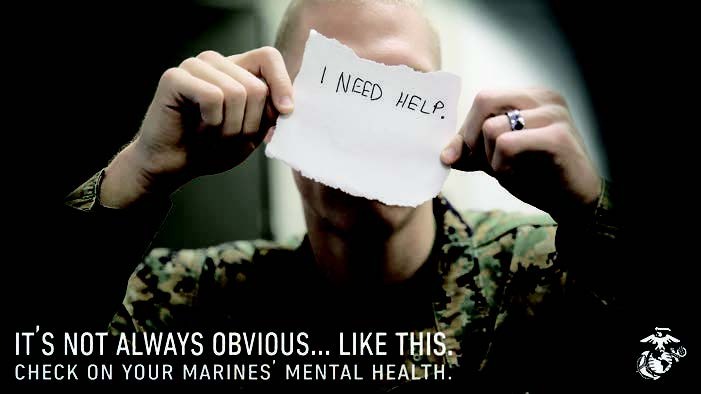
Although generally not top of mind when considering the Marine Corps’ most pressing future warfighting challenges, mental fitness, and suicide prevention unquestionably remain a chief priority across the DOD. Today, suicide rates among service members are among the highest levels in their recorded history.1
In response to increasing suicide rates, the Marine Corps has resorted to requiring commanders to become more involved in Marines’ lives and applying the risk management process to those subjectively deemed at-risk through the Force Preservation Council (FPC) program. The FPC order directs commanders to “use engaged leadership and risk management guidance … to recognize and intervene early when stressors and potentially risky behaviors first develop in Service members in order to interrupt the chain of events that can lead to an adverse outcome.”2 Unfortunately, the Defense Suicide Prevention Office’s 2020 Annual Suicide Report shows that the Marine Corps’ suicide rate has increased on average since at least 2014, with suicide rates in 2020 being the highest ever recorded in the wake of the Coronavirus Disease 2019 Pandemic.3 This trend suggests that the Marine Corps will continue to battle with and for the mental health of its Marines well into the future, which poses significant challenges to the future force’s ability to remain ready to respond to our Nation’s calling.
Despite the Marine Corps’ good intentions, the FPC program in its initial form was riddled with flaws. One of its primary problems occurred when losing and gaining commands often failed to exchange information on Marines’ past and potential struggles. When they did exchange this information, it was often through informal, non-secure means. Although the Marine Corps FPC Order (MCO 1500.60) required losing commands to “ensure the gaining command is provided the necessary and relevant force preservation information,” there were no mechanisms by which to hold units accountable for failing to comply with policy.4 Such a lack of standardization and security meant that commanders rarely received all the information needed to contextualize Marines’ behaviors and issues and that Marines’ personal data was often put at risk through the unnecessary use of PowerPoints and other informal dissemination mechanisms.
In August 2020, the Marine Corps sought to resolve these issues by adopting the Command Individual Risk and Resiliency Assessment System (CIRRAS), which is essentially a standardized database for FPC data.5 Although certainly an improvement upon the legacy FPC process, CIRRAS will sell the Marine Corps short if it remains only a tool for data storage. Indeed, CIRRAS presents a unique opportunity for the Marine Corps to experiment with using artificial intelligence—and more specifically machine learning—to combat the threat of suicide within its ranks. The Marine Corps should examine the efficacy of using the CIRRAS database in conjunction with supervised classification machine-learning algorithms to help commanders better identify Marines who are most at risk for self-harm.
What is CIRRAS?
CIRRAS is a secure application developed by Marine Corps Systems Command that standardizes the FPC program across the Marine Corps, giving commanders the ability to monitor their Marines’ holistic health and combat readiness.6 It allows commanders and their representatives to input and track the various stressors that Marines regularly experience, including information regarding mental health, relationship disputes, alcohol- and drug-related offenses, and other significant issues that could impact operational readiness.7 Though it offers a new, more secure way of storing and transferring sensitive data about Marines, CIRRAS does not make any fundamental changes to the FPC program.
Although CIRRAS offers the means to standardize and secure Marines’ holistic health information, it does not seem to offer any additional analytical advantage to commanders. In other words, CIRRAS improves commanders’ abilities to securely communicate raw data, but it does not use that data to provide valuable insights to make better decisions.
The primary purpose of collecting standardized data in any capacity is to detect trends and patterns to better inform decision making. Human minds are very good at detecting simple, linear trends in two or three dimensions, but are very limited in their capacity to detect complex, non-linear trends, which can be common in multidimensional datasets such as those involving personal health information.
Machine Learning
Machine-learning algorithms happen to be especially adept at identifying complex, non-linear trends in vast amounts of data. They can take datasets on the scale of thousands of dimensions, identify their most important factors, and detect patterns that no human brain could hope to understand or recognize. These algorithms are regularly used in the private sector to determine which Netflix shows would best suit you, which songs you will most likely enjoy on Spotify, and which products you should next consider purchasing on Amazon.
At its most basic level, machine learning is using past data and consequent outcomes to identify complex patterns, generate models from those patterns, and then combine those models with future input data to quickly deliver predictions of future outputs. The machine-learning algorithms used by tech companies take the data you and others give them, such as browsing activity and personal information, to detect patterns and build statistical models that can quickly calculate high-probability outcomes.
By centralizing and standardizing FPC data in a single database, the Marine Corps has created a venue through which it could use machine-learning algorithms to identify under-the-surface trends common among Marines who have expressed suicidal or other life-threatening tendencies. If provided with the right types of data, these algorithms could prove useful in providing commanders indications of Marines who are more likely to engage in self-threatening behavior.
Among the many different types of machine-learning algorithms, the most useful for the purposes of predicting future behavior are classification prediction algorithms. These types of algorithms are trained to predict specific categorical outcomes (green/yellow/red), and not numerical ones (1, 2, 3). Among the most popular types of classification prediction algorithms are decision trees, random forests, k-nearest neighbor classifiers, logistic regression, and support vector machines. The Marine Corps should experiment with these types of algorithms to determine whether any of them can effectively predict Marine behavior.
Issues and Requirements
Using machine learning to make impactful decisions in Marines’ lives obviously presents several potential problems. The data science and tech worlds are alight with debate over the moral and ethical use of machine-learning algorithms with others’ personal information. Moreover, no model or algorithm is perfect and, if not properly understood, can result in unfounded dependence on “the numbers” and remove commanders’ responsibility to use their judgment.
First, one should note that no model is infallible. Models are abstract representations of reality and are optimized to represent historical data. They are susceptible to developing a narrow focus and will always produce some measure of error. No model or algorithm can perfectly describe previous forms of reality nor perfectly predict future ones.
Because of this, commanders using mathematical models to make decisions must remember that such models are tools designed to supplement decision making and should never replace well-informed human leadership and judgment. It seems too often that we settle for reducing complicated situations into PowerPoint slides with boxes colored green, yellow, or red. No Marine’s personal situation can be adequately captured by a simple color, and we should be wary of similar behavior when using other models to predict which Marines are most susceptible to suicidal behavior. Instead, commanders should use such tools to identify who they should be spending more time observing.
All prediction algorithms produce false positives and false negatives. The Marine Corps must avoid a zero-tolerance approach when it comes to using machine learning and artificial intelligence of all types. Tools that use such technologies are designed to inform better and faster decisions but are never intended to generate decisions in lieu of humans.
Garbage in, garbage out is a common saying among data scientists. Because machine-learning algorithms live on the data that they are given, poor data quality can easily result in models which fail to adequately reflect reality. Leaders responsible for inputting data into CIRRAS must do so properly. The notion of no data in is also worthy of consideration. Given that prediction of at-risk Marines is the ultimate goal, a lack of data on risk factors means some Marines could slip through the cracks.
Data used in machine learning must also be computable, meaning that it should be standard throughout the dataset (think multiple choice responses or numerical data with common formatting). Supervised classification learning algorithms work by identifying which characteristics were most prevalent among Marines who expressed self-harming inclinations, generating a model by appropriately weighing each of those characteristics based on their correlation with the outcome, and then applying that model to other Marines as needed. To make this work, however, these algorithms require standard data values, especially for the metric in question, which in this instance is whether a Marine has demonstrated a predisposition for self-harm. Machine-learning algorithms cannot easily interpret free-response data without additional processing, which often involves manual interaction. CIRRAS must provide standard datasets to generate effective models.
Not all models work well and there is no guarantee that these models will provide any value at all. It is very possible that none of the models listed would be able to accurately predict which Marines are most susceptible to self-harm, and in doing so could add unnecessary noise to an already-complicated FPC system. If, however, these models can generate correct predictions even as low as 50 percent of the time, they could prove very valuable to commanders.
Conclusion
In recent years, Marine Corps dialogue has become consumed with some of the Nation’s favorite tech buzzwords: artificial intelligence, machine learning, big data, and the like. Nevertheless, we have yet to find ways to implement these at scale in the same way multi-billion-dollar corporations have been doing for years. There is little question that we should be researching and experimenting with means to harness the power of these technological advancements. In reality, however, reluctance to adapt quickly and try new things at middle and lower echelons demonstrates that research in these fields may not truly be a top priority.
Exploring the use of machine learning in conjunction with CIRRAS’ database offers an easy opportunity for the Marine Corps to showcase its long-held reputation as the Nation’s most innovative force. Further research on this topic may prompt widespread use of this technology and could prove valuable to commanders by quickly providing automated actionable data in one of the Pentagon’s top challenges: service member mental health. If our people are truly our greatest strength, then we should leverage every advantage, technological or otherwise, to their benefit and that of the Naval Service.
Notes
1. U.S. Department of Veteran’s Affairs, 2020 Veteran Suicide Prevention Annual Report (Washington, DC: 2020).
2. Headquarters Marine Corps, MCO 1500.60 Force Preservation Council (Washington, DC: August 2016).
3. Under Secretary of Defense for Personnel and Readiness, U.S. Department of Defense, Calendar Year 2020 Annual Suicide Report (Washington, DC: 2020).
4. Stephen Losey, “Military Deaths by Suicide Jumped 25% at End of 2020,” Military.com, https://www.military.com/daily-news/2021/04/05/military-deaths-suicide-jumped-25-end-of-2020.html; and MCO 1500.60 Force Preservation Council.
5. Headquarters Marine Corps, “Announcement and Implementation of the Command Individual Risk and Resiliency Assessment System (CIRRAS),” Marines, August 12, 2020, https://www.marines.mil/News/Messages/Messages-Display/Article/2310545/announcement-and-implementation-of-the-command-individual-risk-and-resiliency-a.
6. Marine Corps Systems Command, “Marine Corps Develops Secure App to Monitor Holistic Health and Combat Readiness of Marines,” Marines, February 11, 2021, https://www.marines.mil/News/News-Display/Article/2500948/marine-corps-develops-secure-app-to-monitor-holistic-health-and-combat-readiness.
A lecture to the Marine Corps Command and Staff College
Dr. Kohn is the co-editor with Peter D. Feaver of Soldiers and Civilians: The Civil-Military Gap and American National Security (BCSIA Studies in International Security) 2d Edition, Cambridge: MIT Press, 2001. ISBN 978-0262561426.
>Dr. Kohn is a Professor Emeritus of History and Peace, War, and Defense at the University of North Carolina at Chapel Hill. He was Chief of Air Force History for the Air Force at the Pentagon, 1981–199l. This article is a revised and updated version of a lecture to the Marine Corps Command and Staff College in May 2022.
Thanks, LtCol Anthony, for that kind introduction. It’s a pleasure and an honor to speak to the College class, and my thanks for this opportunity. I must note special appreciation to your Dean, Dr. Jonathan Phillips, whom I have known and appreciated for nearly 30 years, from his time in the UNC PhD program in history: one of the finest teachers and most honest, careful, and insightful scholars in my experience. And a personal friend whose advice, on professional issues as well as on what sailboat and bicycles to buy—two items of his special expertise.
In discussing dissent, we are not talking about simply disagreeing; we all disagree about many things, and frequently.1 After all, we are Americans, at least most of you in this audience. Nor is dissent insubordination or disobeying orders, although dissent can lead to such. Dissent is not about defying or disobeying lawful orders.
Where dissent differs from simple disagreement is that dissent implies disagreement with the majority opinion or judgment, with a consensus, or with established authority, or with traditional and commonly accepted institutional norms, or even orders. Fundamentally, dissent is simply thought. Sometimes, with certain people, it can be an attitude. But in your readings and in the common parlance today in civilian society and within the military, both in general and in the Marine Corps in particular, where it has something of a long tradition all the way back to Smedley Butler and Evans Carlson in the 1920s and 1930s, and after, it is accompanied by the voicing of disagreement in private or even publicly—in other words, expressing a contrary opinion. Not remaining silent. And another part of the definition is that dissent implies acting at the risk of self-interest, personal or professional, or both, and thus that it requires some courage. Risking the personal self-interest of a relationship with a boss, or peers or simply professional self-interest in promotion or reputation. As officers, you know and possess physical courage; dissent is something different, something we might call moral courage. We all know, and are educated to, or to be capable of understanding, right from wrong, and have the training, experience, education, or ability in any given situation to figure out what is a proper course of action, or ought to be, even if one is not aware of all the facts, have all the necessary information, the wider perspectives, and necessities that people at higher levels might have.
Every profession or trade expects dissent. Lawyers, doctors, professors, clergy, business executives, supervisors in factories, carpenters, electricians, social workers, nurses, and the like face, on a regular basis, problems that involve discussion with peers, supervisors, subordinates as to how to accomplish a task or solve a problem. We are a practical, pragmatic, problem-solving people and our culture thrives on differing perspectives and ideas. It is built into our culture. Our politics is infused with dissent. One of our norms—respect for alternative viewpoints—is indispensable, although it seems, unfortunately, to have declined. The country was founded on dissent from British policy, laws, and institutions; our religious traditions from earliest times involved dissenting—splits in established churches and even migration, from Roger Williams leaving Puritan Massachusetts to the Mormons leaving upstate New York and Illinois and settling in the Mountain West—and many of you know that earliest Mormon settlements had their own dissenters and breakaway groups.
Think of countries that do not permit, or do not value, dissent that arises from freedom of thought and expression. Their governments are autocracies, arbitrary, capable of terrible mistakes—such as Russia has committed in invading Ukraine—and the militaries of such governments are less flexible, more corrupt. Businesses across the world, in all societies, that are top-down and do not encourage independent thinking and open discussion often waste money, choose wrongly, misjudge the market or the popularity or appropriateness of their products, and flounder.
In the armed forces, where lives can be on the line and the country’s security or even existence can be at stake, dissent seems to me as important as in any walk of life, simply because of the stakes in military service. It seems to me that dissent is not only a moral and ethical imperative, but an obligation. Think of it at the personal level. If you witness a mistake about to be made, a decision that will lead in your judgment to unnecessary death and destruction, to counterproductive results, to self-defeating consequences, do you not have the obligation to raise questions? To stand by without asking for explanation or clarification, or further discussion, can be something of a dereliction … not serving the mission, your superior, or the people for whom you are responsible, very well or even perhaps adequately.
On the other side, in command of others, would you not want your people to express their views, give you the benefit of their experience, knowledge, and judgment in the process of deciding a course of action—if not whether to act, how to act, what are the alternatives and the risks. It seems to me that every supervisor needs to encourage subordinates to make their views known in some way or in some venue, to know that they are heard and considered, that the boss is open to ideas and thoughts that might be out of the box or unpopular. That there will be no penalty for disagreeing with the boss. You must be careful not to intimidate your people into silence. At the beginning of his tenure, as the legendary Army Chief of Staff during World War II, George C. Marshall, reputably told his immediate staff that they were not doing their job. The staff was surprised, some even shocked, and they asked for an explanation. Marshall told them that they had been working with him for a week and not one of them had disagreed with him.2
At least this is the theory of dissent and leadership. I have made it sound simple, cut and dried, no problem. But we all know that the devil is in the details. The realities, as many of you know and probably have experienced, is that dissent is always situational. That is, it depends on a number of factors, and on the circumstances.
First, the situation, the context. Is it at the tactical level, as a junior officer, or higher, at the operational level, or even higher in a geographic combatant command or in Washington or the strategic level? Is it in the field, in combat, in a unit engaged, or at a command post or headquarters, or on a staff, at home or abroad? Is there time to dissent, to discuss? Does it involve allied forces or is it all Americans? If the latter, are other Services involved, or civilians, or local populations and civilians, local leaders or institutions or partners? Is it about a policy or its implementation, say the rules of engagement, established recently or further in the past, by your command, at a close level above you or in Washington far away? Does the dilemma involve a decision or its execution? Is there time to discuss or debate the policy, decision, order, or action? Are lives at stake? Is accomplishing the mission at stake?
In other words, how important is the issue? How consequential, and is the officer in a position, because of experience, knowledge, information, and the like, to make that determination accurately? All of this requires judgment and sensitivity, acute observation, and considerable thought.
Additionally, the people involved in a situation are a crucial consideration. One has to gauge the situation, and how often to dissent. With your peers, it seems easier to dissent. To your superiors, more difficult.
And then there is the problem of how to express dissent. Speaking up, in private or within an organization or up the chain of command, but not out to the public or people who will make your views public seems to me more problematic. That is, you can speak privately one on one, or in a small group with people you know and where there has already, through personal knowledge or time together, a bond of respect and trust. Perhaps a contrary view is best offered in private, with carefully crafted language. One has to read not only the boss, but the context, and one has to make clear, always, that you are subordinate, not just in words but also in tone, body language, and understanding of the issue and the person in charge.
When I worked in the Pentagon in the 1980s, there was a saying, “that it is better to ask forgiveness than permission.” Think about that. Like all aphorisms, it can be untrue or even dangerous. My father, a canny Illinois lawyer with a likeness of Abraham Lincoln on his office wall, loved aphorisms. One he often expressed was in my judgment wrong: “You’re never sorry for what you don’t say.” Well, I disagree with that, particularly on the subject of dissent, as I will explain in a moment. On another aphorism, he was dead right: “Don’t be so open-minded that your brains fall out.” The points are these: what counts are the situation, the circumstances, the importance of the problem, the people one is trying to reach, to engage, to influence, and more.
But if dissent is a moral and a professional obligation, one with personal and professional risks, in a discussion with important consequences, and an officer who disagrees and remains silent: has he or she fulfilled the duty to his or her subordinates and the loyalty to superiors? It is a ticklish question, an important question, but also one that should not be paralyzing either in the abstract, as a matter of theory, or particularly troubling in the everyday carrying out of your duties. It is simply a part of your profession, as it is with all of the professions, with life in general. When to speak up, when to remain silent. Do not make a big deal of it, or think about it all the time, making it a defining element of your officer-ship and relationships with your contemporaries and superiors. It is just a natural part of officer-ship in a professional military service. As one retired four-star admiral said to me recently, “All of us carry out orders we disagree with, occasionally and sometimes often.”3
George C. Marshall was particularly candid about the necessity for choice. He established an independent and candid relationship with Franklin Roosevelt when, newly promoted and appointed Assistant Chief of Staff of the Army in the late 1930s, in a meeting the President made his own views clear and went around the room asking those present if they agreed. All did until Marshall, who told Roosevelt that he most definitely did not agree and why. People there told Marshall his career was over, but Roosevelt respected Marshall’s bravery and honesty, and in 1939 appointed him Chief of Staff over several other higher-ranking people. And for the next six years, when dealing with Roosevelt and with Congress, the general admitted after the war that he always saved voicing his dissents for the most meaningful, important, consequential problems or issues, and let the unimportant pass without offering contrary views, lest he forfeit his credibility or influence with these politicians on matters he considered crucial. “I never haggled with the President,” Marshall remembered. “I swallowed the little things so that I could go to bat on the big ones. I never handled a matter apologetically and I was never contentious.”4
A good example of the necessity for silence occurred at an Army Air Forces base in North Africa in 1943. Years ago in discussion with two retired generals, both four stars, the mission to take out the Axis oil refineries at Ploesti in Rumania came up. Then Col Jacob Smart, a member of the chief of Army Air Forces colonels group at Headquarters in the Pentagon, said he thought up the idea of a low-level bombing mission to avoid the fighters and flak. Hap Arnold, the Army Air Forces chief, accepted the risk and told Smart that since he came up with the idea, he should go over to North Africa and sell it to the crews that would have to fly it. Leon Johnson, the other general, then a colonel and group commander, told Smart and me that he knew the attackers would be shot to pieces and the mission likely would fail—and it did—and Johnson won the Medal of Honor for his bravery and leadership. I asked him why, if he thought it would fail, why did he not refuse to fly the mission or object to it? He was dumbfounded. In the middle of World War II, against a murderous enemy in an existential world war, it never occurred to him to refuse the mission. As far as I know, he did not dissent; to do so, in retrospect, might have unhinged his unit.
I would be particularly careful not to confuse dissent with disobedience and even insubordination, at the various levels of combat and command, as in the reading by Andrew Milburn. He cites personal instances when he disobeyed or violated orders. But every example is from the tactical or operational level, the example of the Prussian officer and king. Milburn avoids the strategic level and above, as when, in an essay over a decade ago, he cited Douglas MacArthur in Korea as an example to be followed.5 This was and is nonsense; MacArthur was guilty of insubordination and disobedience at the policy, strategy, and presidential levels. The necessity for civilian control of the military, so pervasive in the U.S. Constitution and so foundational to the American government, admits of no disobedience. Officers can dissent in discussions with civilian superiors, but in private, speaking up but not out (i.e. to the press or the public), and even in testimony to Congress, senior officers must be extraordinarily careful in discussing their advice to the most senior civilian officials.
As the field officer, and throughout the military in many and perhaps most situations at the tactical and operational level of war, there is the expectation that officers have the discretion to adjust their orders and their decisions, if necessary, to implement the commander’s intent. The Armed Services seem in the last generation to try to locate decisions at the lowest level where commanders on the ground are likely to have the best knowledge to judge what needs to be done to accomplish that intent. Officers must navigate uncertainty and risk, not just in battle, staff work, or in deciding when it is imperative to dissent, to speak up. When it comes down to it, moral courage and physical courage come out of the same wellspring of character and judgment.
One other example. There may be times when orders can be disobeyed and perhaps should be. On a trip to Vietnam some ten years ago, the group I was with visited tunnels used by the Viet Cong near a town northeast of Saigon. One member of our group told us that, as an Air Force major near the end of the war, he had been a forward air controller marking enemy targets on the ground. When an order came through to vector an attack on a certain village because a South Vietnamese brigade was taking fire from it, he refused—twice. He told his superiors that he had flown over it many times, never taking fire, that if the South Vietnamese brigade was being fired upon, it should assault and take the town, not level it and kill all its innocent civilians. The major was accused of insubordination, taken off flying duty, and hauled before the four-star commander of U.S. air forces in Vietnam. His superiors presented the situation to the four-star. Legal orders; clear situation; twice ordered, threatened, consequences made clear. At the hearing, the major explained why he refused the orders to mark the town for destruction. Gen John Vogt, the commander—a distinguished officer, a fighter ace from World War II—then cleared the room and asked the major again, what happened and why. Same story. Vogt pondered, then told the major to return to his unit, that he would be put back on flying duty, and the incident was closed.
Now another commander might have thrown the book at the major. The man had made a moral and professional decision not to kill in his mind innocent people because the South Vietnamese brigade commander did not want to risk his own casualties in a ground assault. You make up your own minds. Was this moral courage? The right choice?
Command at any level is not a popularity contest, even if officer evaluations are being done with 360-degree inputs. Situations are often unclear, information lacking, choices difficult. Just as command is filled with uncertainty, so too is the need and appropriateness for dissent. Officers are often forced to “lead from the middle,” that is to help their superiors get through ambivalent choices, advocate and argue for a course of action that runs against the thinking of a group. Or, as is more often the case, take a decision or order that is disagreeable or that even appears wrong to one’s subordinates, and make the best of it. As one former Marine officer said a few years ago, when at a conference on wars of choice, when asked how one leads people in battle when they think the war is wrong and they oppose it: he answered that he always did everything in his power to accomplish his mission with the least harm to the people under his command and to the Iraqis involved in the action.
There are times when one has to speak truth to power, but as Marshall understood, you cannot do it all the time or you become a nag and a problem. As you rise in rank and responsibility, you will learn the instinct to assess the audience and the situation. Do not take counsel of your fears any more than you do in combat situations. One Chairman of the Joint Chiefs of Staff who had to deal with a most difficult, frequently abusive, dismissive, and yet indecisive Secretary of Defense, told me that he always wanted the Secretary to be glad when he, the chairman, came into the room, knowing that he needed to be listened to. That it was essential to tell the Secretary what he needed to know even if he did not want to hear it. Marshall said essentially the same, in dealing with FDR: pick spots, save dissent, or unpleasant truth for what really mattered.
Let me close with one more thought. The Marine Corps is going through a set of dramatic changes as we speak. The law of averages tells me that some of them, hopefully, a tiny, tiny few, may be wrong or need adjustment or modification or whatever. This means that Marines at every level must be even more willing to dissent than in “normal” times, lest a mistake from the top—or near it—cause difficulties, even inefficiencies or deaths, that otherwise could be avoided. You who are not Marines in this audience should also take notice, and be prepared to dissent equally. I know the other Services face great challenges brought on by technology—to name only a few, cyber and drones, artificial intelligence, uninhabited ships and planes and vehicles—and a rapidly changing, and threatening, international situation. Not to speak of funding limitations, of changes in our alliances, and in leadership, all of which reverberate downrange. Be prepared for such; be attuned to the contributions you can make not by going along to get along, but by contributing your experience and expertise, reading widely and thinking critically, and dissenting when it is called for, and it can be helpful. Your Service and the country will be the better for it.
Notes
1. As a verb, the Oxford English Dictionary defines “dissent” as “to differ in sentiment … To withhold assent or consent from a proposal, etc.; not to assent; to disagree with or object to an action … To think differently.” The Compact Edition of the Oxford English Dictionary, s.v. “Dissent.”
2. Marshall and his staff at the beginning of his tenure.
3. Conversation in 2021, repeated in the fall of 2022 in Durham, NC. The Admiral had been a COCOM commander and after retirement, a senior civilian reporting directly to the President.
4. Quoted in Forrest C. Pogue, George C. Marshall: Ordeal and Hope, 1939–1942 (New York: The Viking Press, 1965); and Forrest C. Pogue, George C. Marshall: Education of a General (New York: The Viking Press, 1963).
5. Andrew Milburn, “When Not to Obey Orders,” War on the Rocks, July 8, 2019, https://warontherocks.com/2019/07/when-not-to-obey-orders; Thomas E. Ricks, “Richard Kohn Fires a Warning Flare about a Joint Forces Quarterly Article,” FP, September 29, 2010, https://foreignpolicy.com/2010/09/29/richard-kohn-fires-a-warning-flare-about-a-joint-force-quarterly-article; Andrew R. Milburn, “Breaking Ranks: Dissent and the Military Professional,” Joint Force Quarterly 59 (4th Quarter 2010).
>1stLt German is currently a student at the Army’s Logistics Captains Career Course. He is a Ground Supply Officer and previously was the Battalion Supply Officer for 3d Littoral Logistics Battalion, 3d Marine Littoral Regiment and has a Master’s of Economics from Purdue University.
As the Marine Corps works on applying the ideas of Expeditionary Advanced Base Operations (EABO) to sea denial and sensing across island chains in the Western Pacific, one critical component remains uncertain: logistics and sustainment. In a recent U.S. Naval Proceedings podcast, when asked what the Marine Corps still needs help on concerning Force Design 2030, the Assistant Commandant of the Marine Corps, Gen Eric Smith, remarked, “Where we always have to work is logistics, that remains the pacing challenge.”1
The current supply chain is not responsive enough to support disbursed forces in the Western Pacific, and these challenges will only be exacerbated by greater distance and less infrastructure. The Marine Corps needs to find a way to adapt its systems to do so or adjust its business practices to provide sustained support. Looking at data from the Marine Corps supply and maintenance system (Global Combat Service System-Marine Corps [GCSS-MC]) for units in the weapons engagement zone (WEZ) can provide framing for this assessment. Evaluating supply and maintenance chains is relevant to every Marine occupational specialty, especially to the individual rifleman. Sustaining that Marine will be more challenging than ever. While Gen Smith was serving as the commander of the Marine Corps Combat Development Command, he commented that when considering logistics in a distributed environment everyone should be thinking, “need less.”2 With that being said, each asset is of even greater importance. The days are gone of fleets of HMMWVs and Seven-Tons at a commander’s disposal. Logistics assets within the Marine Littoral Regiment and in the WEZ will be few and far between. Neglecting the supply chain and maintaining these assets is a risk, and the data below highlights several processes that are vulnerable and worth consideration.
When items are ordered in GCSS-MC, the user assigns a priority code which tells the U.S. Transportation Command (USTRANSCOM) the urgency of need for that requirement. The priority codes are associated with a force/activity designator (FAD), which is determined by a unit’s geographic location and proximity to a threat or enemy. Almost all of III MEF is poised to respond to a crisis in the Western Pacific and therefore has a FAD of II as depicted in Figure 1. This means units can order an item with a priority of 02 (highest priority), 05, or 12 (lowest priority).
Figure 1. Designators used in data. (Figure provided by author.)
What next determines how fast the part arrives is the source of supply (SOS) which fulfills the requisition. By looking at SOS and priority code, it is possible to analyze how well the Marine Corps supply systems perform and how impactful priority codes are in reducing wait time. The USTRANSCOM-approved time definitive delivery standards set a goal of delivering an 02 item to Marine units under U.S. Indo-Pacific Command in eleven days (not considering backorders or delays from the SOS).3 USTRANSCOM does not rely solely on the priority code, though, because what actually determines if the item goes by ship or air is the required delivery date (RDD) inputted in GCSS-MC. Even if a maintainer makes a part 02, if they leave the RDD spot blank in GCSS, it will appear to USTRANSCOM as a low priority.
Using an ordinary least squared regression (a data science practice often used by economists), it is possible to parse out not only the expected wait time from a source of supply but also how much the priority code reduces wait time. An advantage of using the ordinary least squared model versus simply averaging the wait time for each variable is the “ceteris paribus” feature or “all else being equal.” This serves to isolate the effects of each variable from the others. This gives a more accurate estimate and thus allows for an accurate evaluation of the efficiencies or inefficiencies of a supply system.
Table 2 summarizes the results of the regression and displays the wait time measured in days for each SOS that had more than 200 requisitions in III MEF over one year and the effect that assigning a priority 02 or 05 had on wait time. Overall, the data included 244,910 requisitions in III MEF over the last year from 6 different SOSs. There are two supply management units (SMUs) in III MEF, one on Okinawa and one on Oahu, these on-island warehouses are the first stop for units requisitioning parts and supplies based on enterprise business rules; they are grouped together as one SOS for analysis. The right-most column shows the percent of requisitions filled by each SOS.
Table 2. (Table provided by author.)
The most important results come from the two SOSs that filled 99 percent of the requisitions, which were unsurprisingly the SMUs and the Defense Logistics Agency (DLA). The SMUs are obviously performing the best, and even their priority twelve wait time is likely skewed by the rest of the SOSs and averages much lower (around four days). If the on-island SMUs do not have the item being requested, it is most often filled by Defense Logistics Agency. What is important to note though is that the wait times for Defense Logistics Agency are greater than two weeks even for 02 priority requisitions. Another interesting point is that 02 requisitions are only expected to come in around two days faster than a priority twelve item across all SOSs.
The results illustrate that there is little to no difference in 05 and 02 priority requirements in terms of wait time. Commanders often request weekly or daily updates on their 02 requirements; generally, they are almost identical to the 05 ones in terms of wait time. 02 priority requirements are defined as those without which “the requiring force is unable to perform assigned operational missions.”4 FAD II is also the FAD used by units “engaged or assigned to combat zones.”5 This implies that units in combat roles dislocated from the United States who need a part not stocked by a nearby SMU could expect to have the same wait time of over two weeks for their high priority requirements. Now, as mentioned earlier, some of these delays could be a result of not inputting the correct RDD correctly that then leads USTRANSCOM to assign a lower priority.
How does this apply to littoral logistics operations? For one, it is evident that the supply chain is a limiting factor. The tentative EABO manual specifically mentions how “distributing maintenance forces must be complemented by efficiency and responsiveness in the supply chain to ensure maintainers have timely access to repair parts, enabling them to restore equipment to a mission capable status.” Based on the data of requisitions in III MEF, distributing forces will have a hard time meeting this mission-capable status. Waiting over fourteen days in a contested environment is untenable; the deadlined asset will be a target well before the part can reach maintainers. Even if some of the results from above are truly from an improper RDD and priority combination, this still is a cause for concern given that the systems and pressure personnel will be under much greater pressure in the first island chain. In the status quo, units will have to anticipate lengthy wait times or construct highly comprehensive class IX resupply blocks in order to continue to operate effectively, both of which go against EABO principles.
There exists a plethora of solutions to these logistic problems. For one, automation of the correct combination of priority and RDD in GCSS would prevent one of the issues identified above. This is a simple coding switch in GCSS-MC that would prevent a Marine in the WEZ from accidentally getting his part sent via ship versus air. A more advanced and data-science-related solution is developing technology to determine supply needs in advance, this is currently being done with the Condition Based Maintenance Plus (CBM+) program. CBM+ involves placing sensors in military equipment like the Joint Light Tactical Vehicle (JLTV), these sensors can then track a vehicle over its lifetime and use data science to predict part failures or prevent catastrophic failures.6 After data is collected, it can be “transformed via machine learning applications to develop predictive insights, which are then pushed to software-driven dashboards that can be used by maintainers and operators to make decisions based on evidence of need.”7 The more time and data the system receives, the more accurate the predictions will become which goes to partially solving the current iron-mountain problem. It cannot be overstated how important this technology is to units like the Marine Littoral Regiment which will be more disaggregated and removed from sources of supply than ever before. Capturing this data will better inform not only the maintenance and supply requirements of current equipment but procurement for future programs of record. The Marine Corps must continue to invest in this program and similar initiatives. If done correctly, this could reduce the wait time to zero—where a maintainer has a part just before it even becomes an issue.
Another solution to this problem is looking at alternatives to established and expensive programs of record. There is a lot of discussion around 21st-century foraging as a way to get after this idea. The suggestion is to purchase local commercial equipment to use for logistical purposes. The upfront expenses might be high to purchase some used vehicles or assets, but the money and time saved in maintenance cycle costs could be tremendous. Vehicles like local pickup trucks, commercial construction, or engineering equipment offer several advantages within the WEZ. They are discreet, reasonably cheap, already exist there, and for the most part, the logistics networks to support them already exist. This strategy also allows leaders the option to abandon assets without the repercussions of losing millions of dollars in government equipment. This also goes along with the thinking mentioned in the tentative EABO manual, if you cannot fix it, get rid of it—which is much easier to do when you did not invest hundreds of thousands of dollars into each asset. One great counterargument to 21st-century foraging is that the local economies of the islands and countries will not be able to support these requirements for a large force (the total personnel within a single Marine Littoral Regiment is in the thousands). An offshoot of 21st-century foraging is to create equipment that is easier to throw away. Unarmored, cheap, simple equipment is one way to get Marines moving faster and support them easier. In an EABO environment, Marines are less worried about an improvised explosive device than they are about a ballistic missile. In World War II, over a quarter of a million jeeps were made, and there was not much intermediate maintenance done on them because it was not worth it. If the jeep broke down and was more complicated than a spark plug or a tire change, it could be disposed of wherever it lay. Last year the Marine Corps Commandant, Gen Berger, mentioned this same idea, asking, “what if it’s done its business in a year and we buy another one?”8 This is the mindset that Marine Corps Systems Command and procurement specialists need to start asking themselves. If parts are hard to get, then a valid solution is equipment that needs fewer parts.
The EABO manual also offers a cruder solution hinted at above, that is, “If equipment cannot be repaired forward in an expeditious manner, then it should be evacuated, cannibalized, or abandoned.”9 Again, evacuation is arguably the ideal scenario, but evacuating a principal end item like a JLTV requires more than just a simple tow (a single vehicle weighs up to 21,000 pounds). On an island within the WEZ, limited by narrow avenues of approach and poor maneuverability, it is far more likely the equipment would need to be destroyed and left. One JLTV has a price tag of around $305,000; a single part like a power-control module can make the vehicle unusable, leaving that rifleman and his squad on the island with a giant metal target parked next to them. Units like the Littoral Logistics Battalion within the Marine Littoral Regiment rate only 13 of the D00457K JLTV variant, meaning losing one would decrease their readiness immediately by 8 percent, three of them gone puts them below 80 percent readiness (if we assume the rest are all in perfect condition). On top of that, the current maintenance cycle demands a huge amount of time and money; there are routine preventative maintenance costs, modification instructions, and part replacements that the current system demands. These all might work reasonably well in garrison, but they are a huge investment of manpower and funding which is arguably too large to then be abandoned because a part breaks and there is no chance of timely resupply. On top of this, the Marine Corps is fighting for every penny in order to invest and procure technologically advanced gear like Navy Marine Expeditionary Ship Interdiction System, a replacement for the aging assault amphibious vehicle fleet and littoral amphibious warships. All this equipment will be required to defeat an adversary like China but arguing for these funds in Congress will be much less convincing if the Marine Corps abandons the same equipment on an island a few years later. The Marine Corps needs to confront this issue and accept it as a likely reality. When U.S. forces left billions of dollars of equipment in Afghanistan last year, the public outrage was enormous and top military officers were called to testify about the losses. If the Marine Corps does not adapt quickly to sustaining equipment and procuring “throw-away” equipment as mentioned above, then leaders will need to be prepared to answer similar questions.
Overall, the supply chain system needs to adapt to find ways to deliver parts faster, or at least consistently apply priority codes to get urgent parts delivered more efficiently. This applies to the EABO but also the modern battlefield in general. The pace of battle against a near-pear threat will be much faster than it was in Iraq or Afghanistan. Supply choices might need to be reevaluated using data science as here to see which systems or vendors are working and which are not. Programs like CBM+ need to be prioritized and funded so we can start collecting data and predicting now. If the system is unable to adapt, then commanders and higher will need to understand that the support they expect; is not going to be there anytime soon. The Marine Corps is going to have to find a way to come up with smarter, more flexible ideas to keep equipment operating or start investing in equipment easier to replace. There will not be wrecker support or an intermediate maintenance bay available in EABO. If parts are not anywhere close for delivery, the logistics community is going to have to figure out how to prioritize what they need and find creative ways to get it to the forward-deployed Marine. That rifleman will be the one that we are letting down by not working through these problems and facing these realities now; if we do not plan, they will be the ones figuring it out for themselves.
Notes
1. Bill Hamlet, “Proceedings Podcast Ep. 266—Stand-in Forces: Adapt or Perish,” The Proceedings Podcast, podcast audio, May 4, 2022, https://www.usni.org/maga zines/proceedings/theproceedingspodcast/proceedings-podcast-ep-266-stand-forces-adapt-or.
2. Philip Athey, “Is Expeditionary Foraging in the Corps’ Future?” Defense News, August 9, 2021, https://www.defensenews.com/news/your-marine-corps/2021/08/06/is-expeditionary-foraging-in-the-corps-future.
3. Staff, “Uniform Materiel Movement and Issue Priority System (UMMIPS),” Welcome to L&MR, n.d., https://www.acq.osd.mil/log/SCI/TDD_Standards.html.
4. Headquarters Marine Corps, MCO 4400.16H, Uniform Material Movement and Issue Priority Statement (Washington, DC: 2010).
5. Ibid.
6. Michael Whitaker, “USMC CBM+ Overview Brief,” presentation, Pentagon, Washington, DC, July 28, 2022.
7. Osman Sesay and Michael Whitaker, “Condition Based Maintenance Plus Minimum Viable Product (MVP) and Beyond,” (Washington, DC: December 2020).
8. Gina Harkins, “Top Marine General: We Need to Get Comfortable with ‘Throwaway’ Equipment,” Military.com, February 2, 2021, https://www.military.com/daily-news/2021/02/02/top-marine-general-we-need-get-comfortable-throwaway-equipment.html.
9. Headquarters Marine Corps, The Tentative Manual for Expeditionary Advanced Base Operations (TM EABO) (Washington, DC: March 2019).
>Author’s Note: A special thanks to the following individuals for their assistance in the research and drafting of this article, CWO3 Erick Bannar, Capt Joseph Shavel, 1stLt William Allred, CWO2 Wendell T. Horton, LtCol Osman Sesay, and Mrs. Anna German.
The Marine Corps is in a constant “fight for information.” Winning this fight today and every day gives us a lethal advantage in the next battle, the next war. Information and combat power are inextricably linked. Whether it is to ensure trust in the firing solution data for the next fire mission, achieve decision advantage through all domain reconnaissance, or gain access to key maritime terrain through a partner that trusts our reputational narrative, the fight for information is real, consequential, and never ends. Winning this fight requires talented Marines with a bias for action and a willingness to execute their duties to the highest professional standard. This is exactly what I have seen since serving as the Deputy Commandant for Information.
I am extremely proud of the insight, imagination, and innovation of our Marines as they take full advantage of Force Design concepts. For example, Marines from the Gulf of Finland to the first island chain are engaging in the fight for information by conducting all domain reconnaissance. This concept of Force Design directly supports the combatant commander and realizes a key aspect of Joint All Domain Command and Control. I have personally seen these Marines in action. They are not waiting for “textbook” instruction or solutions. They are smart, empowered, and focused on solving problems and mitigating challenges through an innovative spirit. We can all learn from their unconstrained view of opportunity, their technical savvy, and deep understanding of the digital environment in which they grew up. These Marines understand how fast technology changes and how a good idea today may not be so next year. Unleashed, they can help us solve numerous information challenges ranging from battlefield command and control, to targeting, to laying out phase maintenance schedules for complex aircraft. Marines today understand the power of information and how to fuse and correlate it to generate outcomes.
The office of the Deputy Commandant for Information is focused on providing the capabilities and authorities needed to make Marines successful. The essence of our approach is readiness. Using the Commandant’s guidance, we need to be “ready for what, with what, when?” Should a theater security cooperation event unexpectedly turn into a crisis, the “kit” our Marines require must move seamlessly from one to the other. We must not rely on a “digital iron mountain” of server stack farms and equipment. Instead, we must engage with the minimum information required to accomplish the mission, while minimizing logistics requirements and signatures. In such an environment, Marines require the right information capabilities based on the conditions of placement and access. This includes capabilities and methods from edge computation and storage to a lean “apps” approach through a ubiquitous transport-enabled cloud environment.
I have had the distinct privilege to work across many different parts of our MAGTF—from aviation to C4 to intelligence to cyber. It has kept me humble trying to maintain pace with our aggressive and innovative Marines. What I have learned is they have a disdain for the status quo. They always want to move forward. Force Design provides the opportunity to be innovative and to fully support our National Defense Strategy through our warfighting ethos. Semper Fidelis!
Semper Fi,
Matthew G. Glavy
Lieutenant General, U.S. Marine Corps
Deputy Commandant for Information
The Marine Corps is unprepared for the newest tactic of civil unrest events
>>Capt Deavenport is an Intelligence Officer currently serving as an Olmsted Scholar in Bangkok, Thailand.
When adversaries combine commercially available products with a little ingenuity, they can create new attack pathways that are difficult to counteract. Over the last decade, anti-government protestors around the world have done exactly that during large-scale civil unrest events. In Hong Kong, protestors used traffic cones and leaf blowers to counter the effects of tear-gas canisters. In Portland, OR, protestors used umbrellas to hide their collective faces from surveillance cameras. In Beirut, Lebanon, and Nantes, France, protestors used tennis rackets and hockey sticks to hit tear-gas canisters back at police. Perhaps the most concerning new tactic, however, is protestors using hundreds of laser pointers simultaneously to blind and disrupt law enforcement officers and government security personnel.
Given its effectiveness against law enforcement in places like Egypt, Chile, Hong Kong, Iraq, and the United States, the use of laser pointers as a form of non-violent resistance has been shared widely on the world’s social media platforms. A practical assessment indicates that the tactic will likely be a feature of future civil unrest events in countries around the world. As an expeditionary force-in-readiness that often operates in environments of civil unrest, the Marine Corps should be concerned about this emerging tactic for the risk it poses to our forces. As it stands, Marines are neither equipped nor trained to operate in this emerging threat environment. The Marine Corps has an obligation to address this problem at the Service level.
Understanding the Threat
Lasers were once considered to be little more than science-fiction, popularized by multimedia franchises like Star Wars and 007. In the 1980s, the Reagan administration narrowed the delta between fiction and reality when they considered using lasers as part of a broader ballistic missile defense platform, though researchers concluded that the technology was still decades away from military use. Today, great powers around the world are studying the potential applications of laser technology in modern directed energy weapons. Across the national security and defense community, the discourse on laser technology remains a subject of intrigue for its numerous potential applications.
For people outside of the defense establishment, however, laser technology is most commonly associated with a simple office presentation tool. The laser pointer is a seemingly innocuous device that became affordable, ubiquitous, and commercially available in the 1990s. Today, consumers can purchase a new, high-powered laser pointer online for less than $30. Aside from the warning in the fine print to “avoid direct eye exposure,” these devices are sold to the general public with very few legal restrictions. Not surprisingly, the disruptive use of laser pointers is a growing issue.
In the United States, the most common incidents of laser disruptions are reported by the Federal Aviation Administration (FAA). In 2020 alone, the FAA reported 6,852 laser incidents targeting commercial aircraft in the United States, 20 of which resulted in unspecified injuries to pilots or aircrews.1 In 2021, the number of reported incidents swelled to 8,550 incidents, 46 of which resulted in injuries. While it is a federal crime to aim a laser at an aircraft in the United States, the FAA laser incident reports suggest that the law has done little to mitigate the practice. In many cases, individuals may not realize the damage that a $30 device can cause. The data points listed above represent cases in which laser pointers disrupted the operations of commercial airlines, but they represent only isolated incidents, absent any coordination or concentrated effects. What happens when laser pointers are used as objects of resistance on a larger scale?
Since 2013, civilian protestors around the world have embraced laser pointers as useful tools for non-violent resistance, particularly in the context of anti-government protests. In places like Egypt, Chile, Hong Kong, Iraq, and the United States, protestors used hundreds of laser pointers in a coordinated fashion to confuse police officers, scramble facial recognition cameras, and deter people from taking photos amid periods of anti-government unrest.2 In one viral video from 2019, a crowd of protestors in Santiago, Chile, appeared to “shoot down” a police quadcopter by concentrating their lasers against the remote aircraft. When used against people, like police officers or government security forces, laser pointers can cause both temporary and irreversible damage to the eyes. Such is the nature of truly devastating threats: they are non-threatening enough to not be taken seriously but dangerous enough to do real harm.
There is evidence to suggest that lasers could revolutionize protesting around the world because they offer several advantages for protestors in the modern era.3 First, laser pointers are affordable and widely available. When protesters gathered in Cairo, Egypt, in 2013 to celebrate the overthrow of President Mohammed Morsi, street vendors reportedly sold laser pointers to protestors “just for fun,” apparently not yet aware of the dangerous potential that exists when many laser pointers are used together.4 In Hong Kong, laser pointers were distributed en masse for protection against police amidst widespread anti-government protests. Second, laser pointers can disrupt (or seriously harm) law enforcement personnel with the blinding effects of concentrated light. However, protestors see lasers as a novel tool for non-violent resistance because they present a relatively low risk to physical objects, at least compared to rocks, broken glass, or firearms. Third, in the age of artificial intelligence and facial recognition cameras, lasers can also protect the identities of the protestors in the crowd. When a single laser hits a camera lens, it drastically shifts the exposure and effectively washes out the image, making identification of protestors in a crowd almost impossible. Ultimately, the mass use of laser pointers offers an accessible and effective tool for protestors around the world to resist government crackdowns in a way that is generally perceived as non-violent while also offering some protection against surveillance cameras and facial recognition technology.
The available data on the disruptive use of laser pointers highlights some useful patterns to better characterize the threat. First, among the various laser pointers that are commercially available, the 532-nanometer green laser is the most widely used device in recent protests around the world. The green laser, compared to colors like red, purple, or blue, is the most visible to the human eye and is therefore the most preferred type. Indeed, the FAA data cited earlier indicates that more than 88 percent of the reported laser incidents involved green lasers. Additionally, we know that the power output for commercially available lasers can range from a meager 5 milli-watts (mW) all the way up to 1,000 mW.5 Consider this excerpt from the American Academy of Opthalmology:
If a laser with less than five milliwatts of output power is directed at someone’s eye, that person can blink or turn away without suffering an eye injury. However, the natural protective mechanisms of the eye—such as the blink reflex—are ineffective against lasers with output power greater than five milliwatts, and severe retinal damage may occur, even after momentary exposure.6
Green laser pointers are inexpensive, prolific, and can be sold at power outputs that are empirically dangerous to the human eye.
Second, the advent of digital mobilization suggests that protestors in future civil unrest events will integrate the tactics and technologies from other protestors around the world. A 2020 article in the New York Times entitled, “Why Protest Tactics Spread Like Memes,” offers several examples to reinforce this point.7 In Hong Kong during 2019, video showed protestors racing to place orange traffic cones over tear gas canisters to keep the smoke from spreading; in Minneapolis, MN, nine months later, protestors did the same thing. In Hong Kong during 2019, protestors used leafblowers to disperse tear gas; in Portland, OR, a year later, protestors did the same thing. There are several more examples, but they all lead to the same conclusion. The widespread use of social media, coupled with digital mobilization, means that successful civil unrest tactics will spread and increase in scale.
Taken together, we know three fundamental things about this emerging threat: protestors are most likely to use 520-nm green lasers, the power output of a single laser can range anywhere from 5-1,000 mW, and protestors are likely to use this technology in civil unrest zones around the world because of digital mobilization. This data alone is sufficient to mount a response to this threat. A single laser can cause blurry vision or permanent blindness, but the mobilization of hundreds, or even thousands, of lasers could effectively neutralize a ground force, particularly one without the appropriate personal protective equipment and training. Surely then, the Marine Corps is well-prepared to meet this threat—right?
Herein lies the problem: the Marine Corps’ standard-issue, authorized eyewear offers no laser eye protection. None. The current standard-issue glasses feature 2.4-millimeter polycarbonate lenses for ballistic protection, 100 percent ultraviolet protection, and fog-prevention treatment for those steamy Camp Lejeune field exercises. However, they offer zero protection against laser devices in any wavelength. In fact, the Marine Corps’ governing document on laser safety programs, Marine Corps Order 5104.1C, fails to even mention laser protective equipment or training for forward-deployed forces.8 The current eyewear arguably met the minimum eye protection requirements of battlefields a decade ago, but the threat landscape has meaningfully changed.
Bear in mind that the Marine Corps, compared to its adjacent services, is perhaps the most likely to operate during civil unrest events on foreign soil. Consider, for example, the missions assigned to the MEU. Among other things, the MEU is assigned the mission essential tasks of performing non-combatant evacuation operations, airfield seizure operations, humanitarian assistance, and stability operations. All these missions virtually ensure close contact with host-nation civilians amid varying degrees of civil unrest. The evacuation of Kabul in August of 2021 is just one example. It is a matter of when, not if, Marines will operate against protestors armed with laser pointers.
The other services acknowledged this threat years ago. In 2018, the Air Force signed a nearly $200 million contract to provide laser eye protection for their pilots and air crews. The Army issued a pre-solicitation for next-generation eye protection and the Coast Guard subsequently initiated a joint research project for low-cost laser eye-protection glasses.
Recommendations
To mitigate this threat, the Marine Corps must first purchase enhanced eye protection for threat laser devices in both combat and training situations. This eyewear should provide sufficient protection to prevent permanent eye damage and temporary effects (glare, flash blindness, etc.) from laser devices while minimizing visual acuity degradation. It is worth mentioning that the Marine Corps’ current eyewear supplier already produces a laser protective lens that blocks 99 percent of 532-nanometer green lasers. This piece of gear, or a similar model, should be fielded to Marine forces across the air-ground task force at the soonest opportunity.
Second, the Marine Corps must develop and integrate training modules to prepare Marines for the new tactics used by modern protestors. The San Francisco Police Department recently surveyed their patrol officers and asked how they would respond to the hypothetical use of laser pointers during protests.9 Some officers said they considered laser pointers to be non-threatening distractions, while others said they viewed lasers as dangerous weapons and would respond with force. Without any standardization in terms of training and equipment, it is not at all surprising that the responses among San Francisco police officers were inconsistent.
If the same question were posed to our Marines, I expect that we would get the same results: inconsistency and subjectivity. If Marines were sent to reinforce an embassy in a given hotspot today and protestors gathered at the gates with 532-nanometer green laser pointers, would Marines simply dismiss it (not likely), react with non-lethal force, or react with lethal force? No Marine on the ground or in the air should have to make this decision absent any training or guidance, much less without the proper protective equipment. Wherever possible, the Marine Corps has an obligation to reduce uncertainty, subjectivity, and inconsistency through realistic and threat-informed training.
From my perspective, the Marine Corps’ Expeditionary Operations Training Group structure is the best vector to provide this training for pre-deployment forces. The Expeditionary Operations Training Group already provides tailored, pre-deployment training packages to prepare units for the requirements of the respective geographic combatant commands. Once Marines are equipped appropriately, it would take only minor revisions to the Expeditionary Operations Training Group training framework to provide a basic introduction to modern laser pointer tactics, protective equipment, and mitigation techniques.
In the context of the world’s dynamic and ambitious threats, it is easy to dismiss the laser pointer as little more than an office presentation tool, but its emerging applications will almost certainly challenge future Marines. Now is a fitting time for the organization to make a clear-eyed assessment of its standard issue protective eyewear and associated training to meet the shifting threat landscape.
Notes
1. Federal Aviation Administration, “Laser Incidents,” Federal Aviation Administration, November 23, 2021, https://www.faa.gov/about/initiatives/lasers/laws.
2. Alan Taylor, “The Lasers of Discontent,” The Atlantic, November 23, 2019, https://www.theatlantic.com/photo/2019/11/photos-lasers-discontent/602263.
3. Jeremiah Kim, “Lasers: The Future of Protests,” Harvard Political Review, March 19, 2020, https://harvardpolitics.com/lasers.
4. “Egypt crisis: Why are Cairo Protesters Using Laser Pens?” BBC News, July 4, 2013, https://www.bbc.com/news/blogs-magazine-monitor-23178484.
5. Big Lasers, “Differences in Laser Pointer Output Powers,” Big Lasers, March 11, 2013, https://biglasers.com/blog/2013/03/11/differences-in-laser-pointer-output-powers.
6. Ari Soglin, “Is Your Laser Pointer Dangerous Enough to Cause Eye Injury?” American Academy of Opthalmology, June 22, 2018, https://www.aao.org/eye-health/news/laser-pointer-eye-injury.
7. Tracy Ma et al., “Why Protest Tactics Spread Like Memes,” New York Times, July 31, 2020, https://www.nytimes.com/2020/07/31/style/viral-protest-videos.html.
8. Headquarters Marine Corps, Marine Corps Order 5104.1C, “Navy Laser Hazards Control Program,” (Washington, DC: May 2008).
>LtCol Haycock is an 8061 Acquisition Professional serving as the Program Management Team Lead for Terrestrial Collection and Human Intelligence programs at Marine Corps Systems Command in Quantico, VA.
My name is Capt Alfonzo, but everyone usually just calls me “Captain A” for short. I command Alpha Company, 1/1 Mar. It is my first month in command having recently arrived on a ship deployed in the vast ocean east of Guam. I admit I have little experience in expeditionary advanced base operations, especially command and control by radio communications, but my Marines are mature, well-led, and well-trained. I am going to tell you the story of how I learned thirteen principles of radio communications during our assault on Duffer’s Island.
It was a cool pre-dawn hour when the reconnaissance element radioed back to the embarked battalion that we will meet minimal resistance when we assault the airstrip the following night. The objective was to clear and occupy an austere airfield named Via Saltu on tiny Duffer’s Island, located twenty miles off the coast of the allied Grey Republic. The Grey Republic, as we all know, was narrowly resisting outright domination by the treacherous Democratic Federation of Reds. The end state of our company landing team’s mission was to establish a temporary fueling and rearming point for our valiant Blue Nation pilots on Duffer’s Island as part of a surge of air superiority toward the landing force’s final objective during this stage of the campaign. By the end of the following day, Company Landing Team A owned Via Saltu Airfield, and the landing force established a forward arming and refueling point (FARP). But first, we flew by means of two flights of four Ospreys each to a clearing three miles south of Via Saltu airfield. Because I had 24 hours to prepare for my first company landing team assault, I gave initial guidance to the company operations officer to continue with preparations and then slept in hopes of drawing from my subconscious an approach to radio communications that would help us be successful in the coming operation.
First Dream
As the sun crested the jutting slopes of nearby jungle hilltops, the shadow receded in favor of jagged light, illuminating the landing zone (LZ) now certainly clear for landing. Through the night, the reconnaissance element had scoured the LZ and its surroundings. There were no threats or observers of any kind, human or otherwise. No flights of aircraft of any type were observed near the island. It appeared the landing would be entirely unopposed.
However, as the first four aircraft landed at the clearing, an enemy missile struck the first Osprey. Its destruction was sudden and catastrophic. None of the sixteen passengers and crew survived. As the other missiles struck the landing zone, a second aircraft with the remainder of 1st Platoon was also hit creating a mass casualty problem for the rest of the landing force. When 2nd Platoon landed in the third and fourth Ospreys, they were faced with competing requirements to evacuate the kill zone, establish a defensive perimeter, and provide aid to the wounded. Missiles kept pounding the LZ, one after the other, killing or wounding 42 out of 64 members of the landing force’s lead element. When the eight-missile barrage ended, Lt Secundus from 2nd Platoon took stock of the situation. With downed aircraft, mass casualties, an unseen enemy, and less than a quarter of its strength, the company landing team was, for the time being, combat ineffective.
Being short two aircraft, the remainder of the company landing team was delayed by several hours in reinforcing Lt Secundus’ isolated platoon—time in which the Red force was able to position its naval forces near the island and actively deny Blue force entry into its air and sea space. Without reinforcements, 2nd Platoon would have to evade or defend against the Red force alone for an indefinite amount of time.
I was bewildered as to how the enemy could have known the exact grid location on which the Osprey was going to land. The recon element observed no enemy spotters or other intelligence collectors in the area. The grid location was only briefed to the pilot by the recon element fifteen minutes earlier when the aircraft checked in to make its approach. After talking with the surviving pilots when they returned from the day’s flying, they reported that they attempted to use encrypted comms on their primary net, but it was not working like it did the previous week. They had switched to an emergency radio frequency—one that was unencrypted for safety reasons.
Perhaps the Red force had been observing our Ospreys with electronic warfare systems and had noticed the same single frequency used for every flight. Because they could detect the strength of the signal, but not the information it carried, they likely deduced that it was our encrypted assault support intra-flight net. Listening from anywhere in the battlespace within a couple of hundred miles of the aircraft, it is easy for the enemy to hop on its own radios and transmit noise on that same frequency. Perhaps the enemy has purpose-built jammers somewhere in the region, or even a spacecraft in low orbit, that can transmit so much noise on that frequency that the Osprey’s intra-flight radio net was effectively jammed, forcing the pilots to find a different net to operate on for today’s mission.
Perhaps there was a signals intelligence aircraft somewhere in the airspace or signals intelligence collector on the ground of a nearby island that was able to listen to the secondary radio net; the unencrypted, single frequency radio transmissions between the recon element and the pilot, or between the pilots, when the grid location of the LZ was stated: “in the clear.” With a modern networked radio relay, the grid location was given from the enemy’s intelligence collectors directly to the fire control system of the Red force’s missile battery, and the command was given for launch. The five or six minutes of flight time from the missile battery’s location was short enough to catch the lead Osprey before its wheels had even contacted the clear LZ.
As I woke from this first dream, the following three fundamental rules about radio communications came to my mind:
Rule number 1: Any radio net that relies on a single frequency for long periods of time is susceptible to simple jamming, also known as narrowband jamming. Use radio nets that hop between multiple frequencies whenever possible. Think SINCGARS and HAVEQUICK.
Rule number 2: Always encrypt your voice communications. In the contested environment, only communicate in the clear those things you intend on being heard by the enemy.
Rule number 3: If you must resort to the use of an unencrypted radio net, establish a set of brevity codes that helps you communicate without being understood by the enemy.
Second Dream
The situation and mission of the company landing team’s insertion onto the island of Via Saltu airfield by two flights of four Ospreys each remains the same. However, I was compelled to ensure the lessons of the first dream were enacted in the planning and execution of the current dream. I called to make certain that the aircraft carrying my company into the assault had been prepared with sufficient radio communications to evade such early enemy detection and interception. The assault flight lead, Capt Alex Franklyn Larson, assured me that they now had four encrypted frequency hopping nets to communicate both internally and with the recon element guiding them to the LZ. This way, they would be resilient to simple jamming by the enemy. We also agreed to a list of brevity codes to communicate in an emergency over unencrypted nets. The execution checklist for the mission also incorporated these brevity codes. With a short rehearsal, we were able to practice saying “Chevrolet” instead of “LZ is clear for landing” or “Plymouth” instead of “landing force has reached the objective” and other such codes.
As the Ospreys approached the island, the recon element provided the ten-digit grid over an encrypted frequency hopping net and both were confident the enemy Red force had not jammed or intercepted these coordinates. When the first flight of Osprey’s arrived in the LZ, the Marines of 1st and 2nd Platoons landed safely and unopposed according to their planned and rehearsed actions on the objective. While awaiting the second flight of Ospreys that would carry 3d Platoon and other enablers, like engineers, aviation ground support, and stinger missile gunners, Lt Primus of 1st Platoon established a company command post at the top of the nearest hill to get the best radio communications with the company landing team platoons, the battalion, and the MAGTF. They used standard foot-mobile radios such as the PRC-117G VHF and UHF radio and PRC-150 HF radio. They were also practiced in digital communications such as KILSWITCH and tactical chat over wideband radio capabilities like adaptive networking wideband waveform (ANW2). Almost every radio antenna was vertical to make sure that the radio propagation patterns could provide radio coverage to the whole area in 360 degrees (known simply as omnidirectional) and powered to the highest setting so they could reach as far away as possible. They also had access to standard UHF SATCOM to come up on the battalion command net. Finally, they also had commercial satellite telephones and friendly force trackers such as the Shout Nano.
Over the next two hours, Lt Primus did well to establish security, radio back to the company and battalion of the situation, and make other decisions vital to the continuation of the mission. Just as the second flight of Ospreys landed bringing myself and 3d Platoon to the LZ, there was a horrific explosion in the direction of the company command post. After talking continuously by radio to the local area and to higher over the last two hours, Lt Primus and his radio operator were fatally wounded by a missile strike. Recognizing the need to relocate the command post to another location, I took charge of the company and established a new company command post 800 meters away, where the radios could be placed at the top of a different piece of high terrain, according to the unit SOP. After all, we fight like we train.
After setting up communications at the new company command post in the new location and starting a routine of scouting patrols (each with routine radio checks and detailed situation reports), two large airplanes were spotted in the sky, both in the direction of the Grey Republic where we most expected to see the enemy. After calling over the radio to tell the scouting patrols what we saw and to lay low, a horrendous explosion obliterated the command post with fire and debris until there was nothing left but a smoking hole in the hilltop. The radio operators and the mortar section were instant casualties, and I was badly wounded. As Lt Secundus of 2nd Platoon responded and attempted to organize the company, the enemy jets came. Four hours after we landed, we were being gunned down by the enemy fighter jets making pass after pass on our position until they apparently ran out of ammunition. After sustaining 30 percent casualties and 12 hours of doing our best to prepare a deliberate defense of our position, a message came over our radio that informed us that the Red naval force had reoriented itself on Duffer’s Island and that lack of air and surface superiority would force us into isolation for the foreseeable future. We should prepare for an enemy ground assault based on our last position and that an Army airborne battalion might be able to drop in a few days. Until then, we were to maintain radio silence for our own safety.
As it turned out, our omnidirectional antennas were emitting radio signals in all directions, even toward the enemy. Because we wanted to ensure that each radio could talk with certainty, we made sure that radios were set to their highest power setting, regardless of the distance between them. Perhaps the first missile strike came as the result of enemy signals intelligence aircraft triangulating our position based on the large volume of encrypted radio communications coming from it. All it takes is two or three enemy direction-finding radios to pinpoint a friendly radio—or perhaps even just one aircraft flying around the island taking many measurements of the radio signals that reach it over a period of time. Those aircraft we spotted were probably some of the same ones triangulating our position after the first half of the company landed, and they probably also determined the actual coordinates of our radio emitters. Given the large number of encrypted radio signals across many parts of the spectrum coming from our location, the enemy probably deduced that we were a company command post of relatively high value, at least valuable enough to expend two medium-range GPS-guided missiles and to maneuver the naval force in pursuit.
As I woke from this second dream, the following three fundamental rules about radio communications came to my mind:
Rule number 4: Use terrain masking to prevent radio emitters from radiating toward the enemy force. If an omnidirectional antenna must be used, do not place it atop prominent terrain features where it will radiate toward the enemy.
Rule number 5: When able, use directionalization techniques to reduce the amount of radio signal that can go where the signal is not needed. A vertical radio antenna has a cone of silence directly above it (and below it). To avoid detection by the enemy, the enemy must be directly above the antenna. However, a horizontal radio antenna’s cone of silence is to its left and right, effectively giving it a single azimuth of radiation towards its destination and incidentally from the transmitter backward away from the intended destination. This means that an enemy signal collector could be on the left or right side and not be able to detect the presence of a radio signal. Note: Use directionalization wisely because it requires all radio operators to know their positions, azimuths to their intended targets, and often extra time to set up and tear down elaborate antennas.
Rule number 6: Use the minimum power setting that will allow you to talk between the two locations that matter to you. Do not let stray radio signals be strong enough to be observed by the enemy unless necessary.
Third Dream
The situation and mission of the company landing team’s insertion onto the island of Via Saltu airfield by two flights of four Ospreys each remains the same. However, I was compelled to ensure the lessons of the second dream were enacted in the planning and execution of the current dream. During this dream, after landing safely in the LZ on Duffer’s Island, Lt Primus established the tentative company command post on a piece of terrain that masked his radio transmissions from the direction of the enemy, essentially a stone wall in the hillside that blocked the directions of northeast, north, and northwest. I was briefed that Blue forces had general air superiority to the south. This hill was still elevated enough to provide radio coverage to the company and back to the battalion and the MAGTF. Consequently, the stone wall in the hillside had reflective qualities, so more radio power than usual was available to the company to the south coverage area. That means that the radio operators were all able to lower the power settings of their radios and still maintain communications.
For those forward patrols to the north that could not be reached by the command post radios oriented to the south, they were provided with a directionalized radio, either a horizontal HF skywave antenna where the direction of the radio signal is obscured by the atmospheric scattering, or with a horizontal VHF or UHF antenna aimed directionally toward intended recipients. In the latter case, enemy signals collectors had to stumble onto a particular azimuth in their flight pattern to observe any of our stray signals, and their access to observe our signals would end rapidly unless they were flying directly toward us. This also meant that before departing for their patrols, squads would have to prepare a full five-paragraph order, plan a scheme of maneuver, build terrain models, and brief their plans, both internally and externally. The company radio operators had to know where the patrols would be and when so that coverage areas could be moved over time according to the changing azimuth from the command post to the patrol.
Next, each radio operator was tasked to reduce power settings as often as able while still communicating. In summary, we were very disciplined about limiting our radios to only radiate in directions and at minimum power levels necessary for us to talk.
As the company landing team’s patrols scouted ahead toward the Via Saltu airfield, communications were outstanding. Patrols were able to provide situation reports every 30 minutes after pausing to set up their directional antennas.
After twelve hours on the island, the scouting patrols had viewed the airfield, identified key terrain (as marked with ten-digit GPS grids), and brought back enough information to prepare for the company assault. However, problems started occurring as the mortar section chief inquired about potential targets in and around the airfield.
When asking for information from the reconnaissance and scouting patrols that had eyes on the objective, the scouting patrols were unable to report on grid coordinates of nearby terrain features. Their GPS receivers stopped working. When reporting this back to the company, it became apparent that our standard means of radio communications also stopped working. VHF frequency hopping nets were suddenly garbled and unreadable, all of them. It was a very strange phenomenon indeed—one never experienced by our radio operators in training. When resorting to various frequencies, configuration settings, and even radio types, it seemed that they would work for about fifteen minutes and then fall apart. With as much resilience as we had planned for in our radio communications, we seemed to be getting jammed across all of our communications systems. The only system that worked was UHF narrowband SATCOM radio. Through it, we received a report that the Red naval force has obtained air and surface superiority in our vicinity. At the same time we received this information, the shelling began.
The shelling was not accurate; beginning at first a few hundred meters south of the LZ on which we landed, but it was walking closer and closer to the company command post. We could only assume that they planned to barrage the whole island in preparation for a sweep and clear operation to find us. We couldn’t communicate. We were strung out over three miles of various terrain. We were isolated and unsupported. The best we could do was send runners to the last known grids of the patrols and consolidate our company to a defensible position. While the terrain provided fair cover and concealment, the loss of local air and surface superiority meant that we were going to be in a truly dire situation. Food, water, and ammunition would deplete unless resupply and reinforcements could be arranged and delivered through enemy lines. Our casualties would not be quickly evacuated if at all. Our defensive indirect fire was limited to our company mortars and grenades. Engineers were not equipped to build the defenses necessary to stop the looming enemy assault. It was a truly dire situation indeed.
After a week-long defense of the company command post, our dug-in fighting positions were void of all vegetation, thanks to incessant accurate shelling. The company, while valiant, was reduced to 25 percent effectiveness due to casualties by enemy fire and a lack of food and water. We suspected that the enemy had no reason to assault our position and risk their own personnel rooting us out. They had us surrounded and isolated.
All they had to do was wait for us to surrender or perish due to lack of water. They had won.
In those dreadful hours awaiting death or capture, I pondered how the enemy knew that we were doing something of such strategic importance that they were willing to maneuver their naval forces to a position to gain air and surface superiority. Perhaps stray signals that made their way off the island established a suspicious pattern to signals intelligence collectors. It stands to reason that a major industrialized nation like the Democratic Federation of Reds could produce a broad-spectrum jamming capability—essentially blasting radio noise on all our VHF frequencies at the same time. Then whenever we would stray from our standard frequencies and try something new, they would listen for it, locate it, and adjust their jamming to also stamp it out too. They seem to have combined air superiority—and perhaps space superiority—and electronic warfare to make possible complete information superiority. They are able to have unfettered access to information while effectively denying our own use of information. Looks like it is back to the Stone Age for us.
As I woke from this third dream, the following six fundamental rules about radio communications came to my mind:
Rule number 7: Do not transmit radio signals unless absolutely necessary. To radiate is to be detected, to be detected is to be targeted, and to be targeted is to be destroyed. Though we have taken measures to reduce how much of our radio signal can be observed by the enemy, we cannot control various scattering and reflections from eventually reaching enemy sensors. Unnecessary situation reports and excessive radio checks serve to provide small pieces of evidence to the enemy. The less we transmit over radios, the fewer pieces of evidence the enemy has to collect, and the longer we can delay the inevitable localization of our radios.
Rule number 8: While there should be no limit to transmitting radio signals in support of fires and CASEVAC, other routine radio communication should be limited to pre-arranged periods of time, also known as comm windows. When given a small, prearranged window of time to transmit on radios, small units are forced to save their information to be passed in very short bursts, perhaps two or three minutes. Should the enemy find a friendly radio frequency to observe, they will not have enough time to triangulate its position. They also will not be able to deduce the size or capability. The next time the small unit uses that frequency, they are hours and perhaps miles away. Prolonging the time it takes for the enemy’s inevitable identification of your radio traffic and subsequent deduction of your strength or intentions allows you more time to complete your mission free from harassment or interdiction.
Rule number 9: GPS can and will be jammed. Use encrypted GPS for positioning (and timing) information that is more resilient to enemy jamming. Also, it goes without saying, always be proficient in navigating without GPS.
Rule number 10: Be mindful of your radio signature and frequently change it as the situation permits. Where a mechanized infantry battalion looks much different to imagery intelligence collectors from a heavy-lift helicopter squadron, so too will they look different to signals intelligence collectors. Where one uses predominately VHF communications and the other uses predominately UHF communications, both create a radio signature useful in deducing what types of units are operating where. Do not be afraid to reverse their signatures temporarily to confuse the enemy. Note: There will be technical limitations and operational impacts in doing so. Each limitation or impact must be evaluated carefully.
Rule number 11: Be deceptive in your use of radio communications. When you are large and want to appear small or non-existent, exercise as much radio silence as your situation permits. However, if you want to appear large and are small, you can make a concerted effort with your forces and radio assets available to spread out across the area of operations and create an exorbitant amount of false radio traffic. Use tall antennas on high power settings to make sure the enemy can detect the presence of every radio transmission.
Rule number 12: Be unpredictable in how you use radio communications. Given enough time and resources, anything you transmit can be detected, jammed, and targeted by the enemy. You must exercise full use of the wide range of communications capabilities in an unpredictable way to outpace the enemy’s electronic warfare efforts. On one day, use VHF and UHF if speed is required and the terrain permits. On the next day, trade VHF assets for HF assets as the situation permits. On the next day after that, resort to satellite phones and brevity codes, or runners, or flags, or pen lasers, or field phones and cable, each as the situation may permit.
Rule number 13: Above all else, be brilliant at the basics. All small unit leaders must prepare their five-paragraph orders with an understanding of the commander’s intent two levels up. Use terrain models. Communicate the plan and get brief backs. Conduct pre-combat checks and pre-combat inspections. Have a robust and well-thought-out no-comm plan. Know the schemes of maneuver of all your adjacent units. Have a well-informed runner that can find other small units on the battlefield. Finally, train your people to act well in absence of clear direction and in accordance with the commander’s intent. Then trust them without micromanagement. With all these basic elements in order, most radio communications need not be used until the decisive point in battle.
As I returned to my fully conscious state and these thirteen rules of radio communications manifested solidly in my mind, I returned to the company planning spaces and endeavored to ensure that all of these rules could be applied to the coming operation.
Small-unit leaders were instructed to limit radio traffic to those absolutely necessary for fire support coordination, casualty evacuation, or to make a change to the scheme of maneuver as briefed. Small-unit leaders on patrol were further instructed to reserve all of their routine radio traffic for a single five-minute comm window every three hours, and such comm windows would be made using random assignments so that it would be difficult for a three-hour pattern to emerge for the enemy to recognize. Additionally, no comm windows were allowed to be made from locations within 800 meters of any previous one. The company command post would similarly displace as often as the situation permitted. Details of such displacements would be communicated and updated azimuths to new locations would be made for directional radios.
Next, GPS devices were provided encryption keys so they could access more resilient GPS services reserved for Blue nation military units. This did not prevent platoon commanders from ensuring that all squads had sufficient maps and compasses to navigate absent of GPS.
Then, we came up with our radio signature management plan. We decided that we would use two VHF frequency-hopping nets for our primary and alternate comms as the first flight of Ospreys arrives at the LZ. Frequency-hopping UHF nets would be reserved as contingency and emergency comms. The second flight’s spectrum signature would be reversed. When the first half of the company established a command post and started patrols, for the next eight hours, primary communication would be made by runner. No two positions were more than four miles away, and only fires, CASEVAC, and changes to the scheme of maneuver as briefed would be the only information exchange requirements so urgent that a runner would not suffice.
For the subsequent eight hours, those sparing radio communications necessary would be made by HF skywave on the pause. During the following eight hours as everyone moved into position for the upcoming airfield assault, VHF frequency hopping would be the means of radio communication. For now, ANW2 would be turned off because every radio on an ANW2 network emits a constant ping like a homing beacon searching for connections to make automatically. While this does hurt digital fires and KILSWITCH data exchange, it does prevent the enemy from locating every squad equipped with an ANW2 radio. Finally, during the assault, all units will talk primarily by UHF frequency hopping. This will be convenient because as soon as the airfield is under friendly control, the first C-130 carrying the FARP aviation ground support equipment will arrive and offload, and we will be able to report the runway clear for landing.
After communicating these procedures to the team, my only regret is that we had not practiced in training a wide range of methods of radio communications so that we would be able to adapt to changes in the comm plan as quickly as we will have to during this operation. Instead, it will have to learn and do while under the stress of a no-fail mission.
In the final eight hours before crossing the line of departure, smart packs were republished with the new, more complex communications plan, but the radio operators and squad leaders all had a good handle on the dynamic changes they would make in the coming hours. We would figure out ways to make dynamic comm plan changes simple and easy to cope with after we get back. For now, it is game time.
As the company landing team infiltrated Duffer’s Island and for the first four hours, we were able to avoid using any radio communication at all. We requested the grid of the LZ to be provided before wheels-up so that transmission was avoided. The recon element reported the LZ clear for landing with a chem-light buzz-saw so that transmission was avoided. To indicate to the battalion that we had all arrived safely, I gave a pre-arranged thumbs-up to the pilot to relay when they get back. As for actions on the objective, the squads and platoons did according to their plan and their rehearsals. With encrypted GPS to guide them, navigating to their pre-arranged patrol bases was very simple, though some needed adjustment as the micro-terrain did not provide the preferred defensibility and concealment. Adjustments were all reported by runners in buddy pairs. The platoons and company were well enough informed on the changing situation.
Platoons eventually shifted from security patrols to scouting patrols to ensure there were no surprises awaiting us in our company assault on the Via Saltu airfield. The scouting patrols brought back plenty of grid coordinates of relevant targets for the mortars; a single guard post, a largely unoccupied barracks, a motor pool with a few dilapidated trucks, avenues of approach, visible micro-terrain from which to adjust fires, etc. The mortar section had no information requests when it came time to coordinate the assault.
During these eight hours, HF skywave antennas were used to communicate, but units would only be talking during their comm windows. The brevity code for “nothing significant to report” was simply “[platoon number] then Zulu.” However, there were important reports to make, and platoon commanders were as concise as possible, being certain to un-key the handset every four seconds or less.
As we proceeded into the final eight hours before the assault, everyone stowed their HF radios in favor of VHF radios to get back to frequency hopping as the operation got closer to the decisive phase. Radio discipline, brevity codes, and communications windows were still used if communication was necessary as the company massed in the vicinity of the objective rally point and support by fire positions.
In the final 30 minutes before launching smoke and illumination, we switched to the UHF frequency-hopping radios to add spectrum to the list of our many elements of surprise.
Units maneuvered. Fires supported maneuver. Units communicated implicitly, verbally, and over the radio when necessary. Marines exercised initiative in accordance with the commander’s intent. While we confronted token resistance, the airfield was captured because of our overwhelming relative combat power.
While the airfield occupants probably telephoned or radioed to report the situation, the C-130 carrying the aviation ground-support equipment was in-bound according to schedule. Fuel, bombs, and other enablers landed and made this airfield a forward arming and refueling point. When it came into operation an hour later, the F-35s surged into this airspace further than they had at any point in the campaign up to this point, made possible because we provided them a safe place to land, rearm, and refuel, and get back to safety at the end of the day.
With air superiority promised, surface superiority followed soon after.
Two days later, the FARP was still intact, and the mission was a complete success. However, we knew the enemy was looking for an opening to launch some GPS-guided missiles at our aircraft, fuel, or ordinance during FARP operations. As it turned out, our fleet’s cooperative engagement capability was very busy defending our FARP from missile attacks. It was only a matter of time before the enemy succeeded. The retrograde order came, and we packed up. As the MAGTF afloat passed nearby the island, we retrograded knowing that our infiltration worked this time on this island, and we were able to successfully surge striking power at the enemy. Next time, we will need a different approach as the MAGTF surges air and surface superiority toward some different aspects of the enemy’s war-making capability. They will be waiting.
This is truly an exciting time for our Marine Corps Installations and Logistics Enterprise. Today, we are balancing the demands of a ready force in day-to-day competition with the imperative to support the development of the future force. We recognize that success in a contested environment hinges on the ability of our Marine Corps elements to persist in early phase maneuver across vast, dispersed littoral maneuver space.
Our Commandant continues to identify logistics as the pacing function for the Marine Corps. I will continue to ask all Marines and our civilian teammates, regardless of occupational field, to think critically and offer solutions for how we can reduce demand and mitigate challenges associated with sustaining our force in campaigning and conflict. Logistics is not just a critical requirement; it is a critical vulnerability. With this in mind, we must work quickly to transition thoughts into action and concepts into capabilities to ensure future success.
As we look to the future, we are shifting our mindset from a streamlined supply chain that is vulnerable to threats to a resilient sustainment web that assures mission success. Our homestation installations and advanced bases are integral as force generation, deployment, and sustainment platforms. We are leveraging opportunities to globally position equipment and supplies at or near the point-of-use, accurately forecast and plan sustainment using real-time data, and coordinate logistics support across the tactical, operational, and strategic levels. We are exploring ways to reduce demand on a distribution system across long and vulnerable lines of communication. We are also maturing habitual relationships with partner, allied, joint, and interagency support capabilities and agreements.
Over the past three years, we have focused on expanding global logistics awareness, diversifying distribution, improving sustainment, and making our installations ready for a contested environment. We have cultivated emergent technologies to advance our tactical logistics capabilities, wargamed and exercised with variations of force organizations, and experimented across the FMF and Supporting Establishment. The output of this logistics experimentation has been critical for us to refine our organizations, capabilities, and concepts. For all who have contributed to these efforts—thank you. This is a team effort, and your voices matter!
The articles in this Marine Corps Gazette are representative of the innovation occurring across the Marine Corps Installations and Logistics Enterprise and illustrate the complexity of sustaining our forces in a globally-contested environment. This is no easy feat, but our Marines have proven time and again that they are up to the job as long as we set the conditions for their continued success. We appreciate the opportunity to share these articles with our Gazette readers and invite your thoughts on the challenges ahead. Semper Fidelis!
Semper Fi,
Edward D. Banta
Lieutenant General, U.S. Marine Corps
Deputy Commandant for Installations and Logistics
>MajGen Maxwell is the CG of Marine Corps Installations Command.
>>Col Novario is a Logistics Officer and currently serves as the Assistant Chief of Staff for Engagement, Mission Sustainment, and Innovation at Marine Corps Installations Command.
“Recognizing growing kinetic and non-kinetic threats to the United States’ homeland from our strategic competitors, the Department will take necessary actions to increase resilience–our ability to withstand, fight through, and recover quickly from disruption.” —National Defense Strategy 2022
Soccer is often referred to as “the beautiful game.” As the most recent World Cup Champions, Argentina demonstrated in Qatar, the only way to win the championship trophy was by fielding a combination of a lethal offense and a resilient and impenetrable defense that blends seamlessly together. The path to being able to raise the cup is by scoring more goals on your opponents than they score on you over a series of matches. It is unique in that for 90 minutes of the game, the play is generally fluid and continuous—there is no play calling from the sidelines or television commercial breaks. For 45 minutes in each half, it is two teams locked in competition with each other, one side leveraging the strength of their team to generate and attack while the other team is posturing to defend their goal and, more importantly, seize the ball from the adversary to generate their own attack and strike a goal. It is a constant battle for position to create a window of temporary advantage to allow an attack to develop or to seize a strategic opening to strike quickly and unexpectedly. This is the nature of championship tournaments—it is also the nature of great power competition. Today in this era of great power competition, the Marine Corps is part of a similar contest, fighting for positional advantage that will lead to decision advantage and result in “net” effects.
In many respects, the mutually supporting and reinforcing nature required in the relationship between the installations and the operating forces we support is much like the relationship between the eleven players who take to the pitch. For the Marine Corps, holding the defensive line are the Marines and civilians operating and protecting installations around the globe while simultaneously providing the foundation from which the FMF can generate an attacking offense. It is this mutually supporting relationship that allows the Marine Corps to gain the advantage and deliver the necessary effects.
If the Marine Corps Installations team is the defensive line, the foremost priority is to defend the goal—to ensure installations are secure and there is a resilient defense, capable of shifting to counter diverse points of attack, whether securing our installation perimeters, protecting the installations communications network, or ensuring the resiliency of the installation from climate and energy effects. Without a strong defense, a team will be under constant pressure, and midfielders and forwards will be forced back just to help defend the goal. For the last twenty years, we have been able to accept risk in the defense. Our adversary was not able to generate an attacking threat that could get out of their back half and cross the midfield line. This is no longer the case today.
The global nature of warfare has changed. Modern technology allows command and control from anywhere to anywhere. Drones can be piloted from around the world. The cyber domain is actively contested today—with attacks coming through virtual private networks that complicate tracing and attribution. Numerous recent examples have illustrated the ways our enemies can attack our installations. The ongoing conflict between Russia and Ukraine has dramatically changed the traditional calculus. Meanwhile at home, 11 September is perhaps the most striking example, but there are also smaller examples: Oldsmar Florida water treatment plant hack in 2021 and the Colonial Pipeline attack against our fuel infrastructure. Regular cyberattacks on airlines and healthcare systems all expose potential vulnerabilities and risks to the installations, which provide many similar services. Add to this disruptions caused by climate events like hurricanes and droughts or economic impacts of COVID-19, and it is apparent the contested environment is a today problem. Worse yet are the opportunities for our adversaries to put us in a dilemma by pressing their attack when we may be distracted by these events. Much like one player might make a deep run past a defender while another looks to exploit the space it creates, our enemies will look to be aggressive when we are dealing with another problem.
Thus the role of installations must also change. There was a time when we relied on our installations primarily for force generation and to a lesser degree force projection. It was a place to rest and refit before returning forward. Now, a defender must be able to repel an attack while providing the opportunity for a counter—potentially fighting through a contest without assistance from the midfielders or strikers. Perhaps those attacks are small UAS intrusions or swarm attacks or long-range missile attacks. Perhaps they are attacks against the communications network or the utilities infrastructure. Installations must be able to sense and make sense of those attacks and defeat the threat using both kinetic and non-kinetic responses without unduly reducing the capacity of our offense. Consistent with the themes in Talent Management 2030, we must build a team that strikes an appropriate balance of the offense and defense as well as develop players, both Marines and civilians, who can take to the field, fight, and win.
A strong defense will not only secure and protect the goal but will create opportunities to generate and sustain the attack. It is out of the defense that the ball is projected forward and the beginnings of the attack are generated. If our opponent is pressing us, it may take time—we will have to distribute the ball quickly, moving it around, often back and forth between the defense and the midfielders, looking for the opening to be able to move forward and press into the opponent’s final third. Our FMFs are the offense. They move forward, operating out of expeditionary advanced bases, constantly exercising, training, deploying, redeploying—always sensing, probing, and conducting reconnaissance to understand where the opponent’s weaknesses and vulnerabilities are. At the point of the attack, forces like the Marine Littoral Regiment are ready, waiting for the moment, and sensing the opportunity to find the opening to strike or to lay the ball off and create an opening to attack elsewhere. They are supported and sustained by MEF units transitioning between the installations and advanced naval bases forward into the opponent’s side to initiate, reinforce, or sustain attacks while at the same time always being prepared to support and reinforce the defense if under attack.
But increasingly, our operating forces can attack from anywhere and we can support from anywhere. Joint, all-domain command and control, robotics, and autonomous vehicles will only increase this global connection of our installations with our strikers. In a sense, we have big legs that can put shots on goal from around the globe. As we demonstrate the ability to fight from our installations, we must be prepared to defend them.
Just like the eleven players on the field, the installations and FMF players connect. We cooperate. We are inseparable and mutually dependent. We can project power and hold our enemies at bay. If we are resilient and prevent our opponents from penetrating our defense, our strikers can stay on offense. If the defense is brittle or weak, we may be unable to generate the offense against an effective opposing force firing on our goal. We should recognize the accumulated debt of under-investment in our installations is akin to the yellow card that can haunt a player for multiple matches, restraining play to avoid a second yellow card and ejection, or a red card that forces a club to play a man down the rest of the game.
Defeating the threats presented by today’s adversaries ensures installations can continue to support the attack but also preserve our offensive forces’ capacity if we can defend the installations with limited FMF augmentation. Resilience through disruptions will also provide continued installation support to our offensive forces. The dilemmas described above can be overcome if installations are resilient. The ability to mitigate or recover from the effects of hurricanes or power outages allows the continuation of power projection. When our enemies know we not only can survive but can adapt and respond in a contested environment, they will know our resilience is a source of strength and give them pause.
Though our homeland is no longer a sanctuary, and our goal can be shot upon at any time, the same is true for our opponents. The offense and defense are mutually integral to our strength. One must complement the other to achieve a synergistic effect. If our strikers keep the pressure on the opponent, the ability of our adversary to truly put pressure on our defenders will be limited. If our defenders can prevent or quickly repel penetrations, this allows the continuation of the attack. We must maintain pressure on the opponent’s goal. Keeping their players collapsed on their goal prevents sustained and effective pressure on our goal. On the field of competition today, this is very challenging. The game of soccer depends on two teams accepting the rules of the game. As we respect the international rules of order, the principles of national sovereignty, and the freedom and democratic values that form the foundation of this Nation, we will be constrained in what offensive strategies we can employ. Meanwhile, our adversaries do not appear to be constrained by these same values. We must assume they will have the opportunity and ability to generate an offense that can strike at our goal.
Marine Corps installations must be ready today while we make ready to meet the emerging challenges and support the future force design requirements as we provide the core of our Corps’ defense. If we want to continue to raise the champion’s trophy, we must have both an offense that can strike and score and an installations team with the capability and capacity to generate the attack and defend our critical goals.
Resilient logistics for the force today and tomorrow
“The thoughts contained here are not merely guidance for action in combat but a way of thinking. This publication provides the authoritative basis for how we fight and how we prepare to fight. This book contains no specific techniques or procedures for conduct. Rather, it provides broad guidance in the form of concepts and values. It requires judgment in application.” 1 —Gen Charles Krulak, 31st Commandant of the Marine Corps
The Marine Corps is adapting to an evolving strategic environment and emergent threats. Great power competition, globally contested environments, and expanding warfighting domains are changing the context and character of Marine Corps and Joint Force operations. The Force Design 2030 initiative is intended to modernize the force for a multi-domain crisis and conflict. Logistics is an essential part of this modernization.
Anti-access/area-denial capabilities, new and emerging threats, and time-distance challenges complicate how we sustain our forces, particularly Stand-in Forces. Modernization efforts that account for these challenges will result in relevant capabilities that will be positioned or sustained in contested environments. Therefore, Gen Berger considers logistics “the pacing function for both modernization and operational planning.”2 Service-level efforts to systemically change the Marine Corps Installations and Logistics Enterprise through analysis and experimentation are ongoing. To help guide, inform, and complement these efforts, MCDP 4 has been updated with immediate relevance for the force today and to continue to shape how we fight tomorrow.
Updating logistics doctrine is a supporting effort for Force Design 2030. The original MCDP 4, Logistics, was signed in 1997 and provided all Marines with a conceptual framework for the understanding and practice of effective logistics. This document described how logistics relates to the Marine Corps philosophy described in MCDP 1, Warfighting. While much of MCDP 4 is enduring and timeless, Marines operate in a strategic context and environment much different than the one that existed when the foundational doctrine for Marine Corps logistics was originally published. Therefore, MCDP 4 has been revised to reframe Marine Corps logistics in this emergent, high-threat environment. The primary changes address logistics in great power competition, in a globally contested operating environment, and with an increasingly important Joint Logistic Enterprise (JLEnt). The revised MCDP 4 is intended to encourage innovative thinking, experimentation, and collaboration throughout the Naval Services and Joint Force to sustain forward-positioned forces over time.
Logistics in Great Power Competition MCDP 4 explains how logistics fit into great power competition. MCDP 1-4, Competing, provides an updated framework for understanding the relations between international actors. This framework expands upon the old war/peace construct by presenting international relations as an ongoing competition. Marines compete daily through logistics activities that sustain expeditionary forces while also assuring allies and deterring adversaries. Forward posturing of logistics capabilities enables the force to rapidly respond to crises and stand ready to defeat enemies in conflict. The revised MCDP 4 aligns with MCDP 1-4 and provides considerations and examples of how logistics relates to each of these competitive acts.3
Globally Contested Environment
Another change from the late 20th century is the realization that military operations can be contested globally. Adversaries have invested in ways to match U.S. capabilities or achieve asymmetric military advantages such as mature precision strike, space platforms, and cyber networks. U.S. adversaries can attack or disrupt military operations in lethal and non-lethal ways using a variety of multi-domain options. The result is that U.S. military forces can be targeted from the most forward forces all the way back to the homeland, which includes academia and industry that form the Nation’s defense industrial base.
MCDP 4 captures the challenges of this contested environment, explores the operational implications of this environment, and provides potential ways to address these threats. For example, it is unlikely that U.S. forces will always be able to project forces into a foreign country using large-scale commercial shipping (such as maritime prepositioning ships) in permissive littorals as they did in Operations DESERT SHIELD and DESERT STORM. Marines must develop capabilities, experiment with techniques, and train to move over distance and at scale while being attacked and disrupted by opposing forces.
MCDP 4 also explores how to create a resilient logistics system. While traditional security means such as hardening, recovery, and active defense remain valid, elements of avoidance, dispersed capabilities, and swarming provide additional ways to achieve the survivability necessary to sustain forces over time. This discussion includes a shift in the paradigm from efficiency to effectiveness exemplified by using supply webs versus supply chains.
The Joint Logistics Enterprise (JLEnt)
The revised MCDP 4 dedicates a chapter to explain how Marine corps forces interface with the larger Joint Force to sustain forces. The 1997 version emphasized the self-sufficiency of naval expeditionary forces. However, decades of combat experience demonstrated that sustaining forward forces over time requires significant Joint Force cooperation. Marine Corps logistics is never conducted in a vacuum and the ability to harness capabilities from international, interagency, and inter-Service sources are important to supporting any operation. Understanding the activities, capabilities, and limitations of the JLEnt enables Marines to leverage opportunities and material resources from the entire Nation.
Figure 2. Levels of war and logistics focus. (Figure provided by author.)
The demands of great power competition and globally-contested environments increase the need for Marine logistics efforts to be integrated within the larger JLent. In the future, Marines may be called to missions they have not performed in the past, particularly logistics operations that enable the Joint Force to get to the fight, sustain the fight over vast distances, and win. For example, Stand-in Forces may be the only node in a logistics system that can rearm or repair naval vessels or refuel joint and coalition aircraft.
Logistics at Each Level of War
Logistics activities vary significantly at each level of war. The original version of MCDP 4 explicitly focused on tactical logistics, while the revised version describes what activities need to be accomplished at each level of war, and who is responsible for conducting them.
Figure 3. Logistics function activities at each level of war. (Figure provided by author.)
Understanding how operational and strategic logistics activities influence the force and provide opportunities is increasingly important. Demands affected by the threat and environment are so great on the Joint Force that Marines may increasingly be asked to contribute to operational-level logistics efforts. The time horizons and funding considerations of strategic logistics require different skills and approach than those required for tactical logistics. The revised MCDP 4 includes an updated framework with examples of how activities vary at each level (Figure 3). This framework is intended to expose Marines to the wide array of activities required to sustain the force and provoke creative ways of executing them in more relevant or effective ways.
Figure 4. Warfighting functions. (Figure provided by author.)
Figure 3. Logistics function activities at each level of war. (Figure provided by author.) Operations, Logistics, and Warfighting Functions
The revised MCDP 4 modifies how the relationship between operations and logistics is presented. Operations are the result of interplay across all warfighting functions. Each warfighting function is integral in both enabling and limiting every operation. Additionally, each warfighting function influences the others (Figure 4). For example, providing critical supplies to suffering people impacts the information aspects of humanitarian operations, to include even strategic messaging. Operational success is the result of the harmonious interactions of each warfighting function aligned to specific objectives. MCDP 4 is written for every Marine, not just those with certain occupational specialties within the logistics community. Commanders, planners, and staff at each level must consider how logistics influences achieving goals and objectives. Plans that do not incorporate supply, maintenance, transportation, general engineering, and health factors risk being unfeasible, unacceptable, and un-executable. Logistics demands cooperation. Everyone plays a role in maintaining the combat power of the force.
Conclusion The original MCDP 4 provided time-tested, combat-proven principles, yet it needed to be updated within the current warfighting context. The updated MCDP 4 includes significant and actionable concepts and ideas such as resilient supply webs versus supply chains, hybrid logistics and optionality, talent management, wargaming, and risk. This updated version also highlights the importance of installations as operational platforms for force generation, force deployment, and force sustainment. Several historical and fictional futuristic vignettes are used to broaden the reader’s perspective of logistics. This refreshed MCDP 4 brings to life the challenges of sustaining the force in a globally contested environment, within multiple domains, and across the competition spectrum.
MCDP 4, Logistics, challenges every Marine to read, think, and write about logistics. To this end, the Deputy Commandant for Installations and Logistics is spearheading efforts to modernize installation and critical infrastructure, invest in the people who sustain the force, diversify distribution capabilities, and develop concepts for moving and sustaining forces in contested environments. Efforts include a deliberate experimentation campaign plan to exercise, learn, and refine how we operate at the tactical, operational, and strategic levels of war. Armed with an understanding of the challenges of the future war, Marines will overcome these challenges with their can-do attitude and relentless spirit, as they always have in the past.
Notes
1. Headquarters Marine Corps, MCDP 1, Warfighting,
(Washington, DC: 1997).
2. Gen David H. Berger, Force Design 2030 Annual Update, (Washington, DC: May 2022).
3. Gen David H. Berger, MCDP 1-4, Competing,
(Washington, DC: December 2020).
4. MCDP 1, Warfighting.
>Capt Holden is a Marine Officer currently assigned to USSOUTHCOM where he has worked in security cooperation and collections management billets as well as managing a variety of projects implementing cutting-edge technological solutions to address the range of threats in the area of responsibility. He previously served in the INDOPACOM Area of Responsibility with 3d Mar and Combat Logistics Battalion 3, where he deployed in support of the PACOM Augmentation Team Philippines and aboard the USNS SACAGAWEA in support of Task Force KOA MOANA 17 to support a range of partner nation engagements across the Pacific.
The threats facing today’s MAGTF have evolved significantly—even over just the last decade. Cyber capabilities, unmanned aerial vehicles (UAVs), and more have dispersed across a wide range of actors and become prominent factors in conflicts across the globe. Capabilities that were once the domain of advanced states can now be found in the arsenals of rising powers, transnational criminal organizations, and terrorist groups. These technological forms of warfare are cheaper to purchase, more user-friendly, and more portable than previous generations of military hardware. A 2021 Office of the Director of National Intelligence report assessed that these trends were likely to continue, creating new disruptions.1 The spread of these capabilities has some stark implications for how the Marine Corps needs to organize, train, and equip for the next fight.
Understanding the aggregate effect of all these changes in technology and domains is essential. This is a difficult task, with many experts disagreeing (and plenty making book deals) and speculating about these impacts on warfare. It is probably most salient how these technologies are applied to modern conflicts and to project those effects into the future. Current and recent conflicts provide an exciting window into what a future U.S. engagement might look like with some of these changes.
Battlefield experiences in Azerbaijan, Ukraine, and Ethiopia all point toward three clear lessons for the MAGTF of the future. First, advancements in technology have caused lethality to become more accessible and dispersed to lower echelons than previously feasible, which is pushing lethality to the tactical edge of formations. Secondly, the war in Ukraine has shown the value of joint integration at the lowest possible level, with members of each Service able to understand, access, and employ the capabilities of the other Services. Finally, having a deep reserve of technical capability is critical in a modern conflict. A technologically skilled base of citizens to pull from in times of conflict offers a distinct advantage in an age of technologically-focused warfare. These three elements will allow the MAGTF of the future to retain a competitive advantage in the future operating environment.
Technology Pushing Lethality to the Edge of the MAGTF
Technology has improved across a broad range of metrics over the last two decades, thus becoming more reliable, resilient, powerful, lethal, and compact. Furthermore, the cost of technologically advanced systems has greatly declined, allowing more capabilities at a fraction of the price they would have cost in years past. Major advances in unmanned aerial systems (UAS), loitering munitions (LMs), and mobility options mean that the MAGTF needs to invest in ways to push high-lethality weapon systems to lower echelons while guarding against the same effect in adversary forces.
UAS can significantly extend the range of enemy fires. This allows them to reach well behind the forward lines of troops and strike at valuable targets for a relatively low cost in manpower and resources.2 This is a powerful incentive to disperse capabilities to lower-level units, leaving them less vulnerable to attack by UAS. UAS and LMs are not just a concern during combat operations against a major state. The MAGTF prepares to deal with this technology across the spectrum of adversaries. The Ethiopian Civil War against rebels in the Tigray region provides an interesting example of technological proliferation in a developing country’s warfighting capabilities.3 The second most populous country in Africa, it is one of the poorest and with less than one percent of its GDP for military funding leaving them with an annual military budget of around one billion dollars.4 Despite the constrained budget, Ethiopia’s fight has featured the use of several types of drones: Chinese-made Wing Loong 2 armed UAV, Turkey’s Bayraktar TB2 armed UAV, and Iran’s Mujaher-6 have all made appearances in the battlespace.5 As these technologies get cheaper and improve in quality, more adversaries will have access to drones across the spectrum of threats in future MAGTF engagements.
In Ukraine, small commercially produced UAVs have seen wide use at the tactical levels, serving in roles from reconnaissance to fire control to loitering munitions. Many of these UAS are commercially available and donated by outside groups. Drone enthusiast groups who ended up being part of the war effort produce some locally.6 These UAS are relatively inexpensive. If they are lost, broken, or destroyed, it is not a major event with replacement models available to purchase for $1000–$2000.7 Replacement parts can also be 3D printed by local groups of citizens or soldiers who brought those skills with them into the service.8 The relative cost and ease of replacement for these systems make them attritable, easy to disperse to frontline units, and well suited to the tactical edge of combat. The adoption of these systems provided significant benefits to Ukrainian forces across a range of operations.
LMs are a specific type of UAS which have become increasingly popular on the battlefield. Early versions of these munitions have been around since the Vietnam War, originally designed to home in on the radiation emitted by anti-air defenses.9 Advances in artificial intelligence have combined with the miniaturization of electronics to allow for munitions capable of much higher levels of autonomy.10 The ability of these munitions to loiter overhead while searching for targets within a certain signature parameter before striking or returning to base to be refitted and launched again creates a useful blend of intelligence, surveillance, and reconnaissance assets and munitions. These characteristics made them incredibly effective in the Azerbaijani war against the Armenians in 2020 when LMs played a key role in destroying enemy air defenses and armored assets.11 Furthermore, their lightweight design and relatively low cost (when compared to traditional air assets or missiles) provide an economic way to extend the umbrella of fires of a force with low cost in manpower and support. Turkey, Armenia, Iran, the United States, Israel, and China (among more than a dozen of others) have begun producing these munitions or incorporated them into their arsenals, which means that the MAGTF of the future will need to be prepared to handle them.12
The Marine Corps has done some experimentation with versions LMs and how they might be integrated into the MAGTF. The UVision Hero series of LMs have been integrated onto LAV-25 platforms with the intent to provide intelligence, surveillance, and reconnaissance and a precision-strike capability from one package on these vehicles—a significant enhancement for lethality.13 The Marines have also discussed intentions to test an air-launched version that could supplement traditional aircraft munitions, providing greater situational awareness for the crew while also providing fire support that could outlast the limited time on station for most aircraft in the Marine inventory.14 Incorporation of these types of munitions could provide enhanced battlefield awareness, close air support, and precision-strike capabilities at a fraction of the cost of traditional air assets while also maintaining the ability to disperse risk and capability. The Marine Corps needs to continue work to procure and develop lightweight, high-lethality systems that can be dispersed widely to forces.
Increasing the mobility of small teams empowered by these technologies also has a major impact on lethality. Electric bikes and motorcycles can increase the mobility and stealth of reconnaissance and sniper teams operating close to, or forward of, the front line of troops while allowing them to carry bulkier weapon systems into position. Ukrainian forces have employed versions of electric motorcycles with front-line troops for exactly this purpose. Domestically produced models of these bikes boast top speeds of 55 mph, a range of over 90 miles on one five-hour charge, and the ability to carry up to 330lbs—all having a relatively light weight of under 200lbs.15 These bikes have been used to provide greater mobility to anti-armor teams, carrying modern NLAW and Javelin anti-tank guided missiles into place, firing and displacing quickly.16 The combination of speed, lightweight build, and near-silent performance allows small teams to move into position to identify a target or to act as a shooter themselves. While the United States has invested in concepts like this in the past, Ukraine provides a fascinating proving ground that once again shows the value of quiet, highly mobile systems that can move high-lethality capabilities around the battlefield.17
The systems that the Marine Corps chooses to invest in for the MAGTF will play a large role in helping it maintain an edge in warfighting capabilities, but simple cultural shifts will allow access to much greater firepower and support by leveraging the unique capabilities of the Services fighting alongside them.
Jointness: It’s About Firepower
Integration between Services is critical on a modern battlefield, where sensors are ubiquitous and the interconnectedness of fires systems offers a major advantage. This interconnected web of sensors and shooters, each maximizing the most appropriate asset for the given task of finding, communicating, and shooting a target has been called “Mosaic Warfare.”18 The advantages of this high-level interoperability between Services have been demonstrated by the Ukrainian forces. They have been able to successfully link a variety of sensors to non-traditional shooters, allowing them to achieve some impressive battlefield results. During the back-and-forth battle for Snake Island, the Ukrainian forces were able to use Turkish Bayraktar UAVs to spot and target Russian forces and equipment.19 One impressive instance of this was in the sinking of the Russian flagship, Moskva, by a landbased, indigenously-produced Neptune anti-ship missile.20 The ability to string multiple sensors and shooters, taking advantage of various capabilities of other Services is a powerful force multiplier that the MAGTF of the future must be able to employ.
U.S. forces are going through great pains to ensure the interoperability of equipment and personnel across platforms, capabilities, and Services. The technical side of this effort is the Joint All Domain Command and Control program, which seeks to find solutions that will allow multiple generations of current platforms to become interoperable while laying a common groundwork for future systems to share that interoperability.21 The Joint Force offers a far greater variety of platforms and capabilities than those which are available to the MAGTF. This is a good thing since it allows Marines to access greater firepower, mobility, and support capabilities than would otherwise be available to them. But you cannot expect Marines who have been raised to view other Services as rivals or “less than,” led by officers whose time with the Joint Force can work against them for promotion, to fully grasp and maximize the full potential of the Joint Force.
There are cultural and materiel differences that are important to understand and navigate if you want to fully access the capabilities of a sister Service. Junior officers and staff NCOs need to be intimately familiar with the capabilities brought to bear by these forces to appropriately leverage them to accomplish the mission. What does the Army element have that can help address my challenge, how do I get it, and who do I talk to? These questions are vital for junior leaders to have the answers to before the next conflict starts, but unfortunately, the system does not incentivize junior leaders who are in the position to glean that knowledge and bring it back to the force.
The current structure (anecdotally) penalizes Marines for not having Marine raters on their fitness reports, making a tour at a joint assignment potentially damaging to a career, as non-Marine reviewers are seen as less valuable than Marines and there is a strong sense of what have you done for the Corps lately.22 Instead of penalizing young leaders for stepping into a situation that can potentially bring useful knowledge of joint capabilities back to the force, the Marine Corps should be encouraging rotations of junior officers and non-commissioned officers for that exact reason. To be truly effective across the domains of battle and enhance the firepower available to the MAGTF, jointness needs to be embraced.
Upskill for the Kill
A more technically demanding world demands technically competent personnel who can thrive by leveraging existing and emerging technologies. The United States as a whole is struggling to upskill the broader workforce, particularly in manufacturing jobs which have been replaced or moved out of the United States due to more competitive production locations overseas.23 Beyond the current workforce, the workforce of the future needs a higher level of education and technical training to hold meaningful jobs than previous generations.24 Trends in technologically advanced weaponry proliferating across the battlefield and allowing lethality to be pushed down to lower levels of the MAGTF requires a force that has the technical proficiency and mental capacity to embrace these changes.
The current changes to the Marine School of Infantry reflect that desire to upskill the MAGTF. Higher standards for intelligence, physical fitness, and longer training will all serve to lay a foundation for the skillsets that will be needed from their initial training.25 Increased training in crew-served and anti-tank weapons will provide additional skills that have proven indispensable in the conflict in Ukraine, where ATGMs have played such a key role across the battlefield. Beyond training, educational opportunities need to be provided and encouraged by leadership. Although the U.S. military has a higher percentage of the population with a high school diploma than the civilian populace, rates of enlisted attainment of higher education fall at the undergraduate and graduate levels to well below the average in the broader civilian population.26 This is a loss to the MAGTF of the future, which will desperately need both trained and educated service members serving in officer and enlisted roles to be competitive.
There are a variety of ways to upskill the MAGTF of the future. Extending the length of primary training schools to provide a longer period to learn and retain a broadening range of skill sets that are required for basic job proficiency is one way. Requiring more regular follow-on training at career waypoints to reinforce earlier training, update knowledge based on current best practices, and allow for a mixing of experiences by professionals with different operational experiences would have a major positive impact. There are also programs that could be used to incentivize Marines to pursue technical training or educational opportunities on their own time and with a greater benefit to the force. These could look like a structured program to help Marines achieve an associate’s degree or technical certification in a relevant skillset over the first two years of service through distance or night classes. It is a smart investment to make the changes that will maintain the qualitative edge that the MAGTF holds, upskilling the Marines of today and laying the groundwork for the Marines of tomorrow to be more skilled and educated for the next fight.
Smarter, Faster, Deadlier: The MAGTF of the Future
The Marine Corps will have to adapt to the increased pace of warfare in the coming decades. Adversaries across the threat spectrum will have more information, technology, and lethality at their disposal than ever before. By studying the lessons provided by ongoing conflicts across the globe, it is easy to see the path that the MAGTF must take as they move toward the future. A concerted effort must be made to push lethal capabilities and the supporting mobility further toward the edge of the tactical formation. Capabilities previously held at the battalion or regiment level have a place much lower now. The Marine Corps needs to get comfortable, even greedy, with joint opportunities for integration. This is a vital link to assets and capabilities that do not come at the expense of the Marine Corps but could provide the vital element for a successful operation. This needs to be encouraged and pushed to more junior personnel as an opportunity to learn and bring back value to the Corps. Finally, human capital is what has always made the Marine Corps the dominant fighting force that it is. Marines on Wake Island did not benefit from the best equipment as they lashed the Japanese forces. The Corps must continue that tradition, offering increased technical training and education to upskill the force while encouraging the next generation of Marines to come into the force more skilled and capable than ever.
Notes
1. Office of the Director of National Intelligence, “Global Trends 2040,” Director of National Intelligence, 2021, https://www.dni.gov/files/ODNI/documents/assessments/GlobalTrends_2040.pdf.
2. Office of the Director of National Intelligence, “Annual Threat Assessment of the US Intelligence Community,” Director of National Intelligence, February 2022, https://www.dni.gov/files/ODNI/documents/assessments/ATA-2022-Unclassified-Report.pdf.
3. Global Conflict Tracker, “War In Ethiopia,” Council on Foreign Relations, October 20, 2022, https://www.cfr.org/global-conflict-tracker/conflict/conflict-ethiopia.
4. The World Bank, “Ethiopia Overview,” The World Bank, October 06, 2022, https://www.worldbank.org/en/country/ethiopia/overview; and World Factbook, “Ethiopia: Military Expenditures,” Central Intelligence Agency, n.d., https://www.cia.gov/the-world-factbook/countries/ethiopia/#military-and-security.
5. Alex Gatopoulos, “How Armed Drones May Have Helped Turn the Tide in Ethiopia’s War,”Al Jazeera, December 10, 2021, https://www.aljazeera.com/features/2021/12/10/how-armed-drones-may-have-helped-turn-tide-in-ethiopia-conflict; and Wim Zwijnenburg, “Is Ethiopia Flying Iranian-Made Armed Drones?” Bellingcat, August 17, 2021, https://www.bellingcat.com/news/rest-of-world/2021/08/17/is-ethiopia-flying-iranian-made-armed-drones.
6. Andrew Kramer, “From the Workshop to the War: Creative Use of Drones Lifts Ukraine,” The New York Times, August 10, 2022, https://www.nytimes.com/2022/08/10/world/europe/ukraine-drones.html.
7. Information available at https://store.dji.com.
8. Amy Feldman, “Putting 3D Printers to Work in Ukraine’s War Zone,” Forbes, March 31, 2022, https://www.forbes.com/sites/amyfeldman/2022/03/31/putting-3d-printers-to-work-in-ukraines-war- zone/?sh=70814225015f.
10. John F Antal, Seven Seconds to Die: A Military Analysis of the Second Nagorno-Karabakh War and the Future of Warfighting(Philadelphia: Oxford: Casemate, 2022).
11. Ibid.
12 Manu Pubby, “Indigenous Loitering Munition Successfully Hits Target at Pokhran,” The Economic Times, September 22, 2022, https://economictimes.indiatimes.com/news/defence/indigenous-loitering-munition-successfully-hits-target-at-pokhran/articleshow/94383125.cms?from=mdr; Stew Magnuson, “Loitering Munitions Proliferate as Tech Changes Battlefield,” National Defense, August 9, 2022, https://www.nationaldefensemagazine.org/articles/2022/8/9/loitering-munitions-proliferate-as-tech-changes-battlefield.
13. Dan Parsons, “Marines Handoff Loitering Munition Control Between Air, Sea, Land Platforms,” The Drive, June 3, 2022, https://www.thedrive.com/the-war-zone/marines-handoff-loitering-munition-control-between-air-sea-land-platforms.
14. Ibid.
15. Howard Altman, “Commander in Ukraine Wants Quiet Electric Bikes for His Sniper Teams,” The Drive, May 11, 2022, https://www.thedrive.com/the-war-zone/commander-in-ukraine-wants-quiet-electric-bikes-for-his-sniper-teams; and Rachel Pannett, “Ukrainian Fighters Take to Electric Bikes in the War Against Russia,” The Washington Post, May 26, 2022, https://www.washingtonpost.com/world/2022/05/26/ukraine-russia-war-electric-bikes-weapons.
16. Matthew Gault, “Ukraine Is Using Quiet Electric Bikes to Haul Anti-Tank Weapons,” Vice News, May 24, 2022, https://www.vice.com/en/article/xgde8k/ukraine-is-using-quiet-electric-bikes-to-haul-anti-tank-weapons.
17. David Leffler, “New Spec Ops Dirt Bikes Combine Stealth and Speed,” Task and Purpose, June 15, 2016, https://taskandpurpose.com/tech-tactics/new-spec-ops-stealth-bikes-freakishly.
18. DARPA, “DARPA Tiles Together a Vision of Mosaic Warfare,” DARPA, n.d., https://www.darpa.mil/work-with-us/darpa-tiles-together-a-vision-of-mosiac- warfare#:~:text=The%20concept%20is%20called%20%E2%80%9CMosaic,that%20its%20forces%20are%20overwhelmed.
19. YUSUF ÇETINER, “Ukrainian TB2 Destroys Russian Mi-8 Helicopter On Snake Island in First Reported Aerial Kill,” Overt Defense, May 10, 2022, https://www.overtdefense.com/2022/05/10/ukrainian-tb2-destroys-russian-mi-8-helicopter-on-snake-island-in-first-reported-aerial-kill/; and Xavier Vavasseur, “Watch Ukrainian TB2 Striking Two Russian Raptor Assault Boats,” Naval News, May 2022, https://www.navalnews.com/naval-news/2022/05/watch-ukrainian-tb2-striking-two-russian-raptor-assault- boats.
20. David Hambling, “Ukraine’s Bayraktar Drone Helped Sink Russian Flagship Moskva,” April 14, 2022, Forbes, https://www.forbes.com/sites/davidhambling/2022/04/14/ukraines-bayraktar-drones-helped-destroy-russian- flagship/?sh=3fe003753a7a.
21. Congressional Research Service, “Joint All-Domain Command and Control (JADC2),” In Focus, January 2022, https://crsreports.congress.gov/product/pdf/IF/IF11493/16.
22. Paul W. Mayberry, et al, Making the Grade: Integration of Joint Professional Military Education and Talent Management in Developing Joint Officers(Santa Monica: RAND Corporation, 2021), https://www.rand.org/pubs/research_reports/RRA473-1.html.
23. Aspen Institute, “Upskill America,” Aspen Institute, n.d., https://www.aspeninstitute.org/programs/upskill-america/about- upskill-america.
24. Kausik Rajgopal and Steve Westly, “How Tech Companies Can Help Upskill the U.S. Workforce,” The Harvard Business Review, Feb 2018, https://hbr.org/2018/02/how-tech-companies-can-help-upskill-the-u-s-workforce.
25. Otto Kreisher, “Marine Infantry to Become More Commando-Like,” Sea Power, May 12, 2022, https://seapowermagazine. org/marine-infantry-to-become-more-commando-like/#:~:text=Among%20the%20training%20changes%20 underway,14%2DMarine%20element%20during%20training%2C.
26. Kim Parker, Anthony Cilluffo and Renee Stepler, “6 Facts about the U.S. Military and Its Changing Demographics,” Pew Research Center, April 13, 2017, https://www.pewresearch.org/fact-tank/2017/04/13/6-facts-about-the-u-s-military-and-its-changing-demographics.