Non-Combat Attacks on the Marine Corps

No respect for the Marine Corps 

Throughout its 250-year history, the Marine Corps, in the words of 1980s comedian Rodney Dangerfield, “Don’t get no respect.” Dangerfield’s line describes the treatment of the Marine Corps by four presidents, congressmen, the Army, and the Navy. Non-combat battles for Marines took place between the 1780s through the 1950s. Challenges included proposals to move the Marines into the Army, eliminate the Marines, reduce the size of the Marines, and pull Marines from ships.

After only eight years in operation, the United States disbanded the Marine Corps on 3 September 1783. That was the same day that Great Britain formally recognized the independence of the United States by the Treaty of Paris. President George Washington returned the Marines to action in 1789.

A major attack on the Marines came from President Andrew Jackson. On 8 December 1829, Jackson addressed Congress. He recommended merging the Marine Corps into the artillery or infantry, thus “curing the many defects in its organization.” The Marine Corps Commandant, LtCol Archibald Henderson, defended the existence of the Marine Corps. Henderson said, “As the commandant of the Corps, if I thought such a change necessary for the public interests, I should be among the first to recommend it. It is my fixed opinion that no such change will eventuate in the promotion of either economy or utility.” Henderson’s response led to Congress passing legislation placing the Marine Corps under the Secretary of the Navy in 1834. Jackson signed the bill, ending the placement of Marine functions into the Army.1

In 1864, during the Civil War, a resolution came before Congress to transfer the Marine Corps to the Army.  The Marine Corps Commandant, Col Jacob Zeilen, once Henderson’s aide, gathered support from senior Navy officers. That resolution died in a House committee. Three years later, Zeilen faced a new challenge—legislation to abolish the Marine Corps. Again, Zeilen gathered the support of senior naval officers. That legislation failed to get out of committee.2

While the Army and Navy had four-star leaders since 1866, Gen Alexander A. Vandegrift, 18th Commandant of the Marine Corps, became the first Marine to earn a fourth star in 1945. That was 89 years after GEN Ulysses S. Grant and ADM David C. Farragut received their fourth stars.3 

Between 1894 and 1908, the Marines faced a reduction in responsibility when naval officers wanted Marines off ships. Then, Assistant Secretary of the Navy Theodore Roosevelt agreed with those officers. In 1908, President Roosevelt acted by ordering Marines off the Navy’s ships. Roosevelt’s 9 November 1908 order came one day before the Marine Corps’ 133rd birthday. Under Roosevelt, the Marines were landbased only.4 Roosevelt’s successor, William Howard Taft, former Secretary of War under Roosevelt, reversed his predecessor’s decision on 26 March 1909.5

While researching generals in the Marine Corps, author Glenn M. Harned said, “Before 1916, the United States Marine Corps did not have a general officers corps. Five Marine officers served as Commandant in the grade of brigadier general or major general, but none of them advanced to the permanent grade above that of colonel.”6

In 1933, ADM William V. Pratt, chief of naval operations, called for “amalgamation of the Marine Corps into the Army.” Pratt explained that Marines were once needed to suppress mutinies by sailors in what was called the “Pratt Memo.” According to Pratt, “As the world became more settled and as colonization settled, the need for small expeditionary forces grew less.” Pratt said other nations abolished or reduced the size of their Marine units, while the United States built “a small Army” within the Navy. Pratt added, “The principal weapons of the larger proportion of the Marine Corps are the rifle, bayonet, and machine gun, exactly the same for the infantry of the Army.” Pratt’s argument suggested that cost savings would result. Pratt said, “Everything except the combat element of the Marine Corps could be eliminated,” adding that administration, training, and supply could be handled by the Army in existing facilities.7

Even during World War II, Gen Vandegrift had to defend the Corps when he spoke to the House Select Committee on Post War Policy on 11 May 1944, 34 days before Marines landed on Saipan. Vandegrift explained the Marine Corps had to fight for its existence throughout its history. Vandegrift reminded committee members of the 1867 proposal to abolish the Marine Corps and assign their responsibilities to the Army. That failed, Vandegrift added.8

Post World War II, the War Department reorganization into the Department of Defense nearly ended the Marine Corps. The 1947 reorganization created the United States Air Force from the Army Air Force. Leaders of the Army, Navy, and Air Force were named full members of the newly created Joint Chiefs of Staff (JCS). The Marines were not included. Gen Vandegrift battled to keep the Marine Corps a separate Service. On 6 May 1946, Vandegrift spoke before the Senate Naval Affairs Committee during a hearing on bill S. 2044 to place the responsibilities of the Marine Corps under the Army. Proponents of S. 2044 included President Harry S. Truman, War Department leaders, and Army Chief of Staff GEN Dwight D. Eisenhower. Vandegrift made his case to senators in what became known as the “bended knee” speech. Vandegrift spoke about the impact of S. 2044 on the Marine Corps. The general explained that the bill would “spell the extinction of the Marine Corps.” Vandegrift added, “For some time I have been aware that the very existence of the Marine Corps stood as a continued affront to the War Department general staff.” Pointing to the World War II victories in the Pacific, Vandegrift outlined the Marine Corps’ amphibious capabilities. Speaking from a historical point of view, Vandegrift explained the impact of the Marine Corps. The general said the Marine Corps forecasted a pattern of war with Japan in 1921. Vandegrift said:

In conjunction with the Navy, we provided the nation with a doctrine, technique, method, and equipment which became the standard pattern of amphibious warfare adopted not only by our own Army but by the armies and navies of eight United Nations as well. It proved to the key to victory in every major theater of the war.

With a backhand to the Army, Vandegrift described the Marines as a “skilled body of specialists” who received “world-wide professional prestige without benefit of West Point tradition or War Department direction.” Again, referencing the Pacific in World War II, Vandegrift explained the Marines are the nation’s “primary force of readiness.” He added that the operation at Guadalcanal could not have been launched by the Army, as that Service was not trained for an amphibious assault landing. Vandegrift explained the end of the Marine Corps would be offset by “the part-time assignment of Army troops for naval purposes.” He praised the Army’s ability to organize and prepare operations “with care and deliberation.” Vandegrift argued, those abilities did not “make up an effective mobile, amphibious force.” He added, “The Marines have always viewed the landing operations as a specialty—their specialty.” Continuing his case against the Army taking on amphibious operations, Vandegrift pointed to the Army’s Field Service Regulations. It had only eight of 1,084 paragraphs covering amphibious operations. In response to the War Department’s contention that Marines’ amphibious efforts “are an invasion of the Army’s sphere,” Vandegrift said, “The Army is not and never has been in the amphibious field.” The general also reminded the Senate Committee that Army troops who carried out amphibious landings used Marine Corps techniques, and in some cases were trained by Marines. Vandegrift concluded with an emotionally charged statement:

The bended knee is not a tradition of our Corps. If the Marine as a fighting man has not made a case for himself after 170 years of service, he must go. But, I think you will agree with me that he has earned the right to depart with dignity and honor, not by subjugation to the status of uselessness and servility planned for him asked by the War Department.9

Five days after Vandegrift’s Senate presentation, an Associated Press reporter asked GEN Eisenhower his take on Vandegrift’s statement. Eisenhower replied, “No one has paid more tribute to the Marines’ record,” than he (Eisenhower) did.10 Vandegrift’s speech paid off. Despite the War Department’s efforts, the Marine Corps stayed a separate Service. The Marines still did not have a position on the JCS.

With the unification of the Services finalized and the Marines still in business, the fight for the existence of the Corps continued. Alan Rems, writing in a June 2019 article for the magazine Naval History, described the post-World War II intra-Service efforts to minimize the role of the Marine Corps. For example, the Nation’s first Secretary of Defense, James V. Forrestal, held a meeting with the Service chiefs in Key West, FL, in March 1948. Forrestal did not include Gen Clifford B. Cates, Vandegrift’s successor. Truman wanted deeper defense cuts. Louis B. Johnson, Forrestal’s successor, advocated moving the Marines under the Army and placing Marine aviation with the Air Force. Legally, it was pointed out, Johnson could not do that. The battles among the Service chiefs led to hearings before the House Armed Services Committee in October 1949. The JCS Chairman, GEN Omar Bradley, told the committee that amphibious operations of the Navy and Marines would not be needed.11

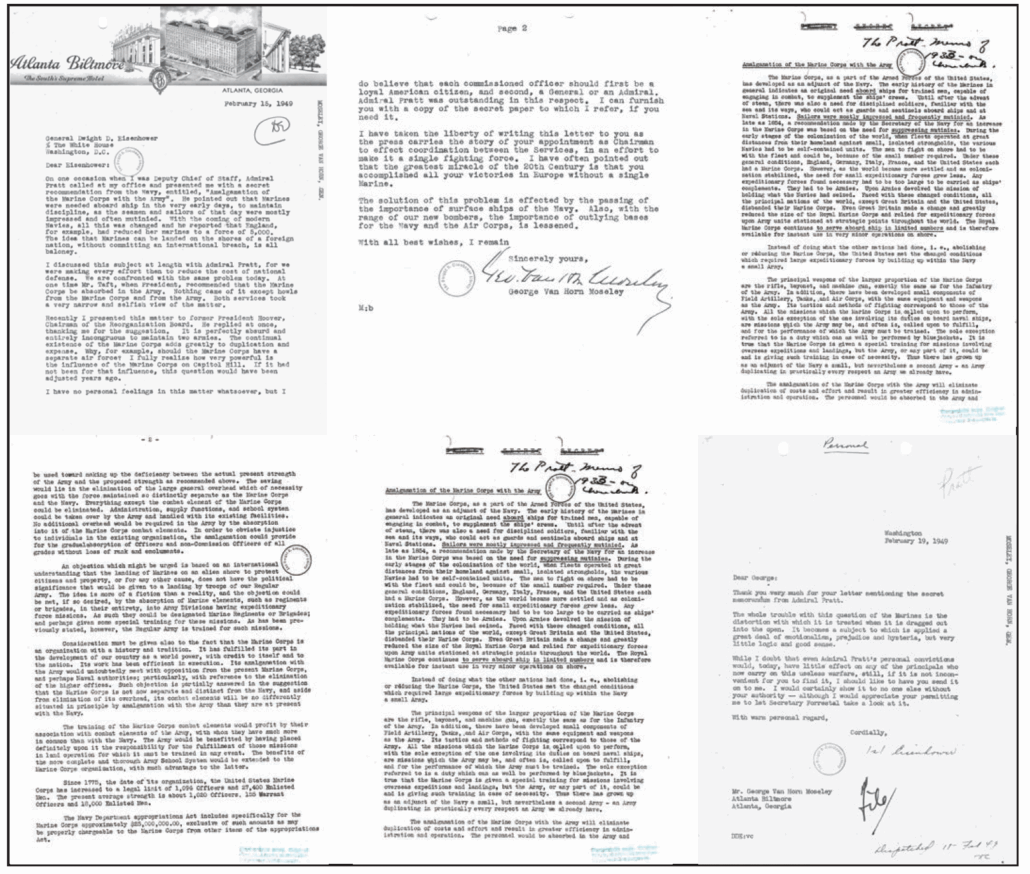
While Vandegrift’s efforts helped keep the Marine Corps as a separate branch of the military, Pratt’s memo did not die due to retired Army GEN George Van Horn Moseley. Mosely served as GEN Douglas MacArthur’s Army’s vice chief of staff in the 1930s. In a 15 February 1949 letter to Eisenhower, Moseley mentioned Pratt’s memo. Moseley summarized the memo and added his view when he wrote:

The idea that Marines can be landed on the shores of a foreign nation without committing an international breach, is all baloney. It is perfectly absurd and entirely incongruous to maintain two armies. The continental existence of the Marine Corps adds greatly to duplication and expense. Why should the Marine Corps have a separate air force?

Moseley blamed the Marines’ Capitol Hill influence when he said, “This question would have been adjusted years ago.” Moseley took one more shot at the Marine Corps with this comment, “You (Eisenhower) accomplished all of your victories in Europe without a single Marine.” (Moseley’s comment was inaccurate, according the Royal Marines’ history that said, “While few in number and often forgotten, around 700 United States Marines were present on D Day either ashore [Omaha Beach] or as part of ships crews.” In addition, Marines served in London and Iceland. Other Marines were assigned to Navy ships.)12 Finally, Mosely mentioned he sent a copy of the “Pratt Memo” to former President Herbert Hoover, chairman of the Commission on the Organization of the Executive Branch. The former President thanked Moseley for his letter and expressed “appreciation for his views.”13

Letters between Van Horn Mossley and Eisenhower; Pratt Memos calling for amalgamation of Marine Corps with the Army. (Photos provided by author.)

On 19 February 1949, Eisenhower replied to Moseley. While not directly agreeing with Moseley’s view, Eisenhower offered insight into his feelings about the Marine Corps issue with this statement:

The whole trouble with this question of the Marines, the distortion with which it is treated when it is dragged out into the open. It becomes a subject to which is applied a great deal of emotionalism, prejudice and hysteria, but very little logic and good sense.14

Eisenhower’s 8 April 1950 answer to World War II Marine veteran Richard W. Courchaine took a different tone than his response to Moseley. Courchaine wrote Eisenhower in April about a Saturday Evening Post article, “The Marine Corps Fights for Its Life.” Courchaine said, “I was very surprised to find it (the article) that you were for it, such as regulating it (the Marine Corps) to a very small size.” Eisenhower replied that he had not read the Saturday Evening Post story. He said, “I have never in anyway advocated the abolishment of the Marine Corps. I tremendously admire the Marine Corps.”15

Before the Korean War, Secretary Johnson called for a reduction of the Corps to six battalions and six squadrons. The onset of the Korean War stopped Johnson’s plan.16 When the North Koreans crossed the 38th parallel into South Korea in June 1950, the Nation needed the Marine Corps. Cates offered Marine ground and air forces and obtained Truman’s authorization to activate Marine reserves.17

On 29 August 1950, California Republican Congressman Gordon L. McDonough wrote President Truman asking him to place the Commandant of the Marines on the JCS. McDonough stated, “The United States Marine Corps is entitled to full recognition as a major branch of the Armed Services of the U.S., and should have its representative on the Joint Chiefs of Staff in the Department of Defense.” President Truman angrily replied in a letter to Congressman McDonough. Truman said:

For your information, the Marine Corps is the navy’s police force and as long as I am President that is what it will remain. They have a propaganda machine that is about equal to Stalin.18

Marines in the field had a response to Truman’s propaganda comment. One example came from retired Marine Col Warren Wiedhan. Wiedhan, a private serving in Korea in 1950 before the Inchon Landing, said that Marines felt this way about Truman’s comment, “The Marine Corps propaganda machine is BETTER than Stalin’s.”19

On 6 September, nine days before the Inchon Landing in Korea, Truman issued a written apology and addressed the Marine Corps League’s national meeting in Washington, DC. Gen Cates told Marine Corps League members, “We in the Marine Corps appreciate courage, especially personal courage.” On the same day, Truman sent Cates a letter. Truman said, “I am profoundly aware of the magnificent history of the United States Marine Corps, and of the many heroic deeds of the Marines since the Corps was established in 1775. I personally learned of the splendid combat spirit of the Marines when the Fourth Marine Brigade of the Second Infantry Division fought in France in 1918.”20 While the president attacked the Marine Corps and then had to walk back his remarks, the Marines received high praise from a surprising source, GEN MacArthur, commander of the United Nations forces during the Korean War. MacArthur said this about the Marines in a statement confirmed by the MacArthur Memorial: “I have just returned from visiting the Marines at the front, and there is no finer fighting force in the world.”21

The Marine Corps hymn includes the words “We fight our country’s battles on air, on land, and sea.” Post-World War II Marines should have added five words to the hymn: in the halls of Congress. The battle to gain a seat on the JCS continued in the early 1950s. In 1951, two Marine veterans serving in Congress battled to add the Commandant to the JCS. Congressman Mike Mansfield, a Montana Democrat, and Illinois Democratic Senator Paul Douglas joined forces with the Marine Corps League. Mansfield served as a Marine Corps private in the early 1920s. Douglas enlisted in the Marine Corps at age 50, earned a commission, and served with the 1st MarDiv in the Pacific, earning the Bronze Star and receiving two Purple Heart Medals. 

Mansfield supported the Douglas-Mansfield Bill H.R. 2034 (S. 677-the Senate version) in his 24 January 1951, House speech. Mansfield said his proposal “would in unequivocal terms establish an organizational structure for the Marine Corps that would not be subject to the whims of the appropriations.” The bill called for establishing four combat divisions and four tactical air wings with a cap on total Marines at 400,000. Mansfield said that the 400,000 limit “is in this bill to emphasize that fact that we are not trying to develop a second army.” Speaking about Marine tactical air, Mansfield listed three reasons to establish four air wings. First, Marine aviation “originated dive bombing.” Second, Marine aviation developed “close air tactical air support. Third, helicopter use “from a tactical standpoint came about from Marine aviation. Referring to the Korean War, Mansfield said, “If this force had been in readiness, ready to move at the outbreak of the Korean incident, the situation might have been drastically altered in our favor.” In addition, Mansfield called for making the Commandant of the Marine Corps a permanent member of the JCS. While acknowledging that the Senate’s version of the bill had been amended to make the Commandant a JCS consultant “on all matters pertaining to the Marine Corps,” Mansfield argued for the House version. He posed this question, “Would not the commandant of the Marine Corps, a man thoroughly trained in ground, sea, and air war, fit into this group as a catalyst?” Mansfield added, “The commandant of the Marine Corps would add great experience and scope to these councils.”22

While Mansfield’s proposal had Congressional support, the JCS opposed adding the Commandant of the Marine Corps as a permanent JCS member. On 12 April 1951, Secretary of Defense George C. Marshall sent a letter to the Committee on Armed Services, Senate Chairman Senator Richard B. Russell, a Georgia Democrat. Marshall said the JCS unanimously opposed the proposal as “unnecessary, undesirable, and impracticable.” Secretary Marshall added that he concurred with the JCS. Marshall also explained,

In addition to the fact that full consideration is now given to the views of the commandant of the Marine Corps, the combat element of the Marine Corps are part of the operating force of the Navy and the headquarters of the Marine Corps is not staffed to consider all of the problems confront the Joint Chiefs of Staff.23

Also on 12 April 1951, Senator Douglas mentioned the letter he sent to his colleagues advocating adding the Commandant of the Marine Corps as a permanent JCS member. Douglas told fellow Senators that adding the Commandant “will place two voices trained in naval and amphibious matters in an organization which is now dominated by services that have little knowledge or interest in the problems of naval warfare.” Douglas highlighted the success of the Marines in the Korean War.24 Douglas pointed to the overwhelming Army influence within the JCS from Chairman, Army GEN Omar Bradley, and Army Chief of Staff GEN Joseph L. Collins. Air Force Chief of Staff Gen Hoyt Vandenberg graduated from West Point.25 Mansfield’s bill wound its way through the legislative sausage grinder. Truman signed the final bill, Public Law 416, on 28 June 1952. The law called for no less than three combat divisions and three air wings in the Marine Corps. Regarding the status of the Commandant of the Marine Corps, the amended Senate version won out. The Commandant “shall indicate to the chairman of the Joint Chiefs of Staff any matter scheduled for consideration by the Joint Chiefs of Staff which directly concerns the United States Marine Corps.”26 For the Marine Corps, the new law was a step forward. The Marines remained a separate branch of the military and did get a larger force. The successes of Marines at Inchon, Seoul, and the Chosin Reservoir, along with World War II victories in the Pacific, earned the Marine Corps its new status. In addition, political winds were at the backs of the Marine Corps. Politically speaking, 800 Marine Corps League detachments worked with Douglas and Mansfield, demonstrating Marine influence with Congress. For Truman, then in his final months as a lame duck president, it was quite a change from his 1950 attitude about the Marine Corps. In the end, Truman’s intemperate remarks about the Marine Corps in 1950 likely helped the cause of the Marine Corps more than they hurt. 1952 was an election year and opposing the Douglas-Mansfield bill was not politically helpful. 

In 1958, a new challenge to the existence of the Marine Corps arose. President Eisenhower and Secretary of Defense Neil H. McElroy, the former president of consumer-packaged goods giant Procter and Gamble, called for streamlining the DOD and boosting research efforts. One aspect of the change concerned the Marine Corps. That provision would allow McElroy to order the abolishment or transfer of combat functions. Gen Randolph M. Pate, Commandant of the Marine Corps, blasted the proposal when he said that an official could “rationalize the Marine Corps out of a job.”27 Pate, a veteran of World War II battles on Guadalcanal, Iwo Jima, and Okinawa, faced a bureaucratic war. House Armed Services Chairman Congressman Carl Vinson argued against giving the defense secretary that power. Vinson’s 51-year career in Congress included 14 years leading the Armed Services Committee. Pushing back against Eisenhower’s reorganization plan, Vinson changed the proposal to allow Services to appeal decisions to Congress. Vinson’s bill included this provision,

However, except as otherwise provided in this subsection, no functions which have been or are hereafter established by law to be performed by the Department of Defense, or any officer or agency thereof, shall be substantially transferred, reassigned, abolished, or consolidated until thirty days after a report to the Congress in regard to all pertinent details in each instance shall have been made by the Secretary of Defense.28

Getting A Permanent Seat at the JCS Table
When World War II Medal of Honor recipient Gen Louis (“Lou”) H. Wilson became the 26th Commandant of the Marine Corps in 1975, he called for Marines to be a full member of the JCS. To avoid giving the impression he wanted that for himself, Wilson waited until late in his term. “I was doing it for the Corps and my successors,” said Wilson. Wilson’s idea called for him to reach out to fellow Mississippian Senator John Stennis, chairman of the Senate Armed Services Committee, and a few friends in the House of Representatives. Gen Wilson’s objective was legislation making the Commandant of the Marine Corps a full member of the JCS. An action in May 1978 spurred Wilson to move forward earlier than planned. When a JCS meeting was about to take place with the chairman unavailable, the Army’s vice chief of staff was named acting chairman. Wilson, who outranked that general, was upset and wanted to know why he could not chair the meeting. The answer: no one who is not a member of the JCS could be acting chairman. Wilson said that was the “catalyst” that he needed. “I determined to pursue it (full member of the JCS) vigorously,” Wilson added.29

To start, Wilson contacted the House Armed Services Committee ranking minority leader, California Republican Congressman Bob Wilson. The congressman, no relation to the Commandant, offered this guidance. Congressman Wilson said the authorization bill to fund the DOD had passed the House of Representatives. The congressman suggested getting the Senate to add the clause making the Commandant of the Marine Corps a full member of the JCS. Congressman Wilson said he could get that provision passed in the House. Gen Wilson worked closely with his legislative aide, BGen Albert E. (Al) Brewster. In 2023, Frisco Lakes Lifestyle wrote a cover story about Gen Brewster, who recalled his role in getting the legislation passed. 

General Wilson’s assignment to Al was to implement a change to make the commandant an equal full-time member of the JCS. Leveraging an existing relationship between General Wilson and Senator Stennis that dated back to World War II, Al requested a meeting with the Senator and Frank Sullivan, SASC staff director. That meeting with Stennis set the effort underway. As a result, Stennis instructed Sullivan to draft the changes.30  

After Brewster’s meeting, Wilson contacted Oklahoma Republican Senator Dewey Bartlett to introduce the measure. Bartlett, a World War II Marine pilot in the South Pacific, was, according to Gen Wilson, “delighted to comply.” Bartlett won the support of Georgia Democratic Senator Sam Nunn, who agreed to co-sponsor the provision.31 On the House Armed Services Committee side, New York Democrat Sam Stratton, a World War II veteran and a retired Navy reserve captain, supported the provision. Stennis said he asked Bartlett to speak on behalf of Gen Wilson’s idea. One hitch developed when Gen Wilson realized Stennis appeared to have forgotten about their discussion. Wilson questioned the senator. Gen Wilson told Stennis that “this means very much to me and I would deeply appreciate it if you would do it, and I will be very disappointed if you do not do this.” Stennis said that he would “see about it.” In fact, Stennis did more than see about it when he made this statement on the Senate floor:

I recognize that it may not be germane, but nevertheless this the time to make the commandant a full member. The Marine Corps has not had the opportunity in the past to express themselves and I think this bill should be passed tonight.”32

Bartlett’s remarks supporting the Marine Corps cited recent JCS history when he said, “In the past two years, the commandant of the Marine Corps has participated in every decision made by the Joint Chiefs, and his participation in recent years has averaged over 99%.” Bartlett said the amendment “would simply remove an archaic legal distinction.” According to Bartlett, the Marines were the only Service with air, sea, and ground combat forces. Bartlett added that the Marine Corps Commandant understands soldiers, sailors, and airmen.33

Wilson did not discuss his proposal with anyone in the DOD except Navy Secretary William G. Claytor, Jr., something he did in confidence. After the amendment passed the Senate, Wilson heard from the JCS chairman, Air Force General David Jones. Jones was unhappy that the amendment had not been discussed with him. Wilson told Jones he could call Stennis and express his opposition. Jones told Wilson, “Why, you know I can’t do that. But you used your influence with Senator Stennis to get this through.” Wilson sensed that the Army also did not agree with the amendment. However, ADM Tom Hayward, chief of national operations, supported the effort, according to Wilson.34

This was the second time Wilson tapped into his relationship with Stennis to equalize the Marine Corps with the other Services. Until 1975, the Assistant Commandant of the Marine Corps held the rank of lieutenant general. The second-in-command of the other Services held the four-star rank. Both Stennis and Congressman Wilson supported that effort. During Wilson’s first year as Commandant in 1975, LtGen Sam Jaskilka became the Assistant Commandant and received a fourth star.

After the bill passed the Senate, media interest followed. Columnist Robert D. Heinl, Jr., a retired Marine colonel, praised Bartlett’s speech in support of making the Commandant of the Marine Corps a full JCS member when Heinl wrote Bartlett’s speech “represents a final act of loyalty to his old Corps.” Heinl added, “Don’t be surprised, one of these days when some future Marine becomes the chairman of the Joint Chiefs of Staff.”35 Ted Bell, a reporter for the Sacramento Bee, asked Gen Wilson about an opposition argument to the amendment offered by the Air Force and Army that meant the Navy would get two JCS votes. Wilson replied, “I don’t recognize that the Marine Corps is not a separate service.”36 

The bill went back to the House of Representatives, then to the conference committee, and finally passed both the House and Senate. President Carter vetoed the bill due to the authorization of a nuclear carrier that Carter opposed. Wilson thought that the next bill might give opponents a chance to “dissect the bill.” That did not happen. The amendment remained in the revised bill. On 20 October 1978, President Carter signed the bill with the amendment so important to the Marine Corps. Responding to a question about the Carter administration’s role with that amendment, Gen Brewster said, “They were not involved in any way in the change.”37 Wilson served as a full JCS member until his retirement in 1979.

After the bill was signed into law, the Army found another law that might have kept a Marine off the JCS. That law pointed out that the senior members of the armed forces included only the chiefs of staff of the Army, the Air Force, and the Chief of Naval Operations. The Commandant of the Marine Corps was not listed and therefore could not be the chairman. Wilson asked for a ruling from Secretary of Defense Harold Brown regarding that issue. The Commandant threatened to go to Congress to get that resolved. Secretary Brown ruled in favor of the Marine Corps position. Finally, the Commandant was ruled a full-fledged JCS member.38 Wilson’s Washington success eventually paid short and long-term dividends to the Marine Corps.39 In April 1979, President Jimmy Carter nominated Gen Robert H. Barrow to serve as Commandant of the Marine Corps and the first Marine to serve on the JCS for four years. Two months before Wilson died in 2005, President George W. Bush nominated Gen Peter Pace to become the first Marine to serve as chairman of the JCS. From 2001–2005, Pace held the post of vice-chairman of the JCS. Pace was also the first Marine to serve in that role. President Bush also named Gen James L. Jones to serve as United States European Command and Supreme Allied Commander Europe. As of 2025, Gen Jones is the lone Marine to hold that position. By 1981, veterans of the Army, Navy, and Air Force served as president of the United States.40 No Marine was ever elected president or vice president until the 250th year of the Marine Corps, when Ohio Republican Senator JD Vance became the first Marine to serve as vice president. 

>Mr. Mesches is the author of The Flying Grunt, the Story of Lieutenant General Richard E. Carey, United States Marine Corps, (Ret) and Major General James A. Ulio, How the Adjutant General of the U.S. Army Enabled Allied Victory. An Air Force veteran, he served as a Public Information Officer with the 4th Tactical Fighter Wing, Seymour Johnson Air Force Base, NC, between 1972 and 1975.  He is a graduate of Grove City College and the Defense Information Officers School (now Public Affairs Qualification Course).

Notes

1. R.D. Heinl, “The Cat with More Than Nine Lives,” Proceedings 80, No. 6, (1954), https://www.usni.org/magazines/proceedings/1954/june/cat-more-nine-lives.

2. Ibid. 

3. Rhapsodyinbooks, “July 25, 1866–Ulysses S. Grant Becomes the First Four-Star General in U.S. History,” Legal Legecy, July 25, 2017, https://legallegacy.wordpress.com/2017/07/25/july-25-1866-ulysses-s-grant-becomes-the-first-four-star-general-in-u-s-history; and Staff, “David Glasgow Farragut,” Naval History and Heritage Command, n.d., https://www.history.navy.mil/browse-by-topic/people/historical-figures/david-glasgow-farragut.html. 

4. “The Cat with More Than Nine Lives.”

5. Staff, “President Taft Restores Marines on Board Ships,” Sacramento Daily Union, March 27, 1909.

6. Glenn M. Harned, Marine Corps Generals 1899–1936 (North Charleston: CreateSpace Independent Publishing Platform, 2024).

7. Moseley Correspondence, DDEPre-l File Box 84, Moseley File.pdf, from the Eisenhower Presidential Library.

8. Staff, “The Marine Corps, An Essential, Integral Element of the Naval Service,’ Statement to the House Select Committee on Postwar Policy,” published in The Marine Corps Gazette 78, No. 6 (1994).

9. Alexander A. Vandegrift, “Bended Knee Speech,” (speech, Washington, DC, May 6, 1946).

10. Associated Press, “‘Ike See U.S. Pacific bases hinging on UN,” The Atlanta Journal, May 11, 1946.

11. Alan Rems, “A Propaganda Machine Like Stalin’s,” U.S. Naval Institute, June 2019, https://www.usni.org/magazines/naval-history-magazine/2019/june/propaganda-machine-stalins.

12. Si Biggs, “The USMC on D Day,” Royal Marines History, June 4, 2024, https://www.royalmarineshistory.com/post/usmc-on-d-day. 

13. Moseley Correspondence, 31-hhpp-ic-b156-1 partial, pdf, Hoover Presidential Library.

14. Moseley Correspondence, DDEPre-l File Box 84, Moseley File.pdf, from the Eisenhower Presidential Library.

15. Courchaine Correspondence, DDEPre-File Box 19, Coury-Courtn. (Misc.) File. Pdf, Eisenhower Presidential Library.

16. Nathan Parker, “Congress and the Marine, an Enduring Partnership,” MCU Journal 8, No. 2 (2017).

17. “A Propaganda Machine Like Stalin’s.”

18. Staff, “Letters to the Commandant of the Marine Corps League and to the Commandant of the Marine Corps,” Harry S. Truman Library Museum, September 6, 1950, https://www.trumanlibrary.gov/library/public-papers/235/letters-commandant-marine-corps-league-and-commandant-marine-corps.

19. Email between author and Col Warren Wiedhan on August 17, 2024.

20. “Letters to the Commandant of the Marine Corps League and to the Commandant of the Marine Corps.”

21. Email between author and James Zobel, MacArthur Memorial, on March 5, 2025.

22. Statement of the Honorable Mike Mansfield,” Series 1, Box 11, Folder 3, Mike Mansfield Papers, Archives and Special Collections, Mansfield Library, University of Montana.

23. Marine Corps Personnel Strength Act of 1952: Hearings on S. 677, Days 1, 2, 3, Before the Subcomm. On Armed Services , 82nd Cong. (1951). 

24. Ibid.

25. Ibid. 

26. Marine Corps Personnel Strength Act of 1952, Pub. L. 461, 61 Stat. 502 (1952).

27. John Jarrell, “Ike To Get Less Than He Wants,” Omaha World Telegram, May 4, 1958.

28. Department of Defense Reorganization Act of 1958, H.R. 12541, 85th Cong. (1958).

29. Oral History Transcript, General Louis H. Wilson, United States Marine Corps (Ret), History Division, United States Marine Corps, Quantico, VA, 2008.

30. S. Sanderson and M. Yordy, “The Sky is Not the Limit for this Marine,” Frisco Lakes Lifestyle, July 2023.

31. Senator Sam Nunn was the great nephew of Representative Carl Vinson, long-time chairman of the House Armed Services Committee.

32. Oral History Transcript, General Louis H. Wilson, United States Marine Corps (Ret), History Division, United States Marine Corps, Quantico, VA, 2008.

33. Speeches, Defense, 1978, Dewey F. Bartlett Collection, CAC_CC_003_4_46_7_0000, Carl Albert Center Congressional and Political Collections, https://arc.ou.edu/repositories/3/archival_objects/5499.

34. Oral History Transcript, General Louis H. Wilson, United States Marine Corps (Ret), by Brigadier General Edwin Simmons, 1975, 1976, 1977, and 1978. History Division, United States Marine Corps, Quantico, VA. Accessed January 19, 2025. 

35. Col Robert D. Heinl, Jr., “Marines March to the Top,” The Arizona Republic, August 11, 1978.

36. Ted Bell “Top Marine Pushes Attack Capability,” by The Sacramento Bee, August 1, 1978.

37. Email from Brigadier General Albert E. Brewster to the author, December 13, 2023.

38. Oral History Transcript, General Louis H. Wilson, United States Marine Corps (Ret), by Brigadier General Edwin Simmons, 1975, 1976, 1977, and 1978. History Division, United States Marine Corps, Quantico, VA. Accessed January 19, 2025.

39. Oral History Transcript, General Louis H. Wilson, United States Marine Corps (Ret), by Brigadier General Edwin Simmons, 1975, 1976, 1977, and 1978. History Division, United States Marine Corps, Quantico, VA. Accessed January 19, 2025. 

40. Presidents by Service: Army—Presidents George Washington, Andrew Jackson, William Henry Harrison, John Tyler, Zachary Taylor, Andrew Johnson, Ulysses S. Grant, Rutherford B. Hayes, Benjamin Harrison, William McKinley,Theodore Roosevelt, Harry S. Truman, Dwight D. Eisenhower. Navy—Presidents John F. Kennedy, Lyndon B. Johnson, Richard M. Nixon, Gerald R. Ford, Jimmy Carter, and George H.W. Bush. Air Force—Ronald W. Reagan served in the Army Air Force, and George W. Bush served in the Air National Guard. These presidents served state militias: Thomas Jefferson, James Madison, James K. Polk, Millard Fillmore, James Buchanan, Abraham Lincoln, and Chester A. Arthur. Vice Presidents who served in the military and did not become president:  Aaron Burr (Army), George Clinton (militia), Richard M. Johnson (militia), Henry Wilson (Army), Charles G. Dawes (Army), Spiro T. Agnew (Army), Walter Mondale (Army), Dan Quayle (National Guard), Al Gore (Army-only president or vice president to serve in Vietnam).


Archibald Henderson: An Era

>Originally published in the Marine Corps Gazette, July 1960. Extracted from Chapter Four of The Compact History of the U. S. Marine Corps, by LtCol P.N. Pierce and the late LtCol F.O. Hough. Copyrighted by Hawthorne Books, May 1960. $4.95 


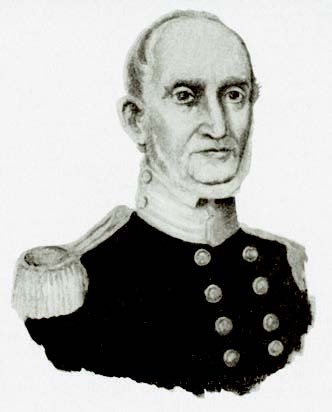
ON OCTOBER 17, 1820, MAJOR ARCHIBALD HENDERSON was promoted to the rank of lieutenant colonel and became the fifth Commandant of the Marine Corps at the age of 37.

Under the blunt, outspoken Henderson the Marine Corps underwent some profound changes. The long span of years of his command were eventful ones, and through a series of dramatic events which commanded wide attention, the Corps established a high reputation with the people of the nation. The man who was to become known as “the grand old man of the Marine Corps” was largely responsible.

Morale was low in the Armed Forces of the 1820s. As usual after each war, the military had been shunted aside. The War of 1812 was rapidly passing into the limbo of forgotten things. It had been an unpopular war to begin with, as far as Americans were concerned. The war-torn era of Napoleon had ended at Waterloo, and the great powers of Russia, England, Austria and Prussia had combined in the Quadruple Alliance to “preserve the tranquillity of Europe” against a revival of revolution. The danger of being drawn into a European war appeared very remote. The Congress of the United States was much too occupied with internal expansion to pay attention to the relatively few people it hired for the defense of the nation. The strength of the Marine Corps stood at 49 officers and 865 enlisted men.

Immediately upon assuming command, Henderson, who had evidently given the matter considerable thought, set about improving the morale and efficiency of his Corps. He began by personally inspecting every shore station which included Marines and many of the ship’s detachments. He was a stickler for detail, and continually gave evidence of knowing thoroughly the job of everyone of his Marines. He insisted on the strictest economy in the expenditure of funds, and personally handled the majority of the Corp’s legal affairs. Although he had the reputation of being a martinet, he went to great lengths to insure that his officers and men were properly accorded their every right.

In the matter of training he was almost a fanatic. He had long realized that the key to the efficiency of any fighting organization lay in two inseparable and basic fundamentals—training and spirit. He ordered all the newly commissioned officers to duty at Marine Corps Headquarters, in order to personally supervise their indoctrination and training. During most of his tour of duty, the Army was unable to absorb all of the graduates of West Point. Henderson obtained as many of these officers as possible for the Marine Corps. To assist in the training of the new officers, and to act as a nucleus for a landing force, he kept a skeletonized battalion at Headquarters. This battalion was thoroughly trained in the latest developments of military weapons and tactics.

Archibald Henderson.

Henderson demanded, and received, the strict subordination of all his officers. He took no nonsense from anyone, including his superiors in the U.S. Navy. On one occasion, when the Navy Department countermanded his orders to a Marine Captain to go to sea, Henderson went directly to the President. He respectfully, and probably vigorously, explained that it was imperative that his orders be carried out in order to vindicate his position and authority. Four days later the captain in question reported for sea duty, and the Secretary of the Navy reported to the President for what might have been described as a unilateral conversation.

The agencies for maintaining law and order in the United States during the first half of the Nineteenth Century were few and far between. Those which did exist were poorly organized, and even more poorly trained. During this era the Marines were often called upon to lend a hand in local disturbances.

In the great Boston fire of 1824 they performed both rescue work and police functions in helping to stamp out the wave of pilfering and looting which followed the holocaust.

A short time later, Maj Robert D. Wainwright earned prominent mention in the classic school books of the era, McGuffey’s Readers. And, for the next 75 years, the nation’s school children received a lesson dealing with the heroic conduct of Marines.

The scene of the action was the Massachusetts State Prison at Boston. Having become thoroughly dissatisfied with their lot in life, some 283 prisoners staged a riot which rapidly got beyond control of the prison authorities. With the situation out of hand, the warden sent a frantic call for help to the Boston Marine Barracks.

Maj Wainwright, with a detachment of 30 Marines, soon arrived at the prison area. Making a hasty estimate of what was apparently a bad situation, Wainwright came up with a simple solution. Hastily forming a single rank facing the prisoners, he ordered his Marines to fire a warning volley into the air. The shots had the desired effect and the clamor subsided. As his Marines reloaded their muskets, the major addressed the rebellious prisoners, “These men are United States Marines,” he said. “They follow my orders to the letter.”

Turning to the Marines, Wainwright consulted his watch, and then issued his orders in a loud, parade ground voice, “Exactly three minutes from now I shall raise my hand over my head,” he bellowed. “When I drop my hand you will commence firing. You will continue to fire until you have killed every prisoner who has not returned to his cell.”

For three long minutes not a word was spoken. The only sound was the shuffle of the inmates’ feet as they dejectedly returned to their cells.

With the advent of the 1830s the traditional isolationist policy of America underwent an abrupt change. It had become apparent to the United States that many areas of commercial advantage lay beyond its own boundaries. This change in policy had a pronounced effect on the functions performed by Marines. As a result of it, the Marines, under the energetic leadership of their fifth Commandant, ranged far and wide to protect the interests of their country.

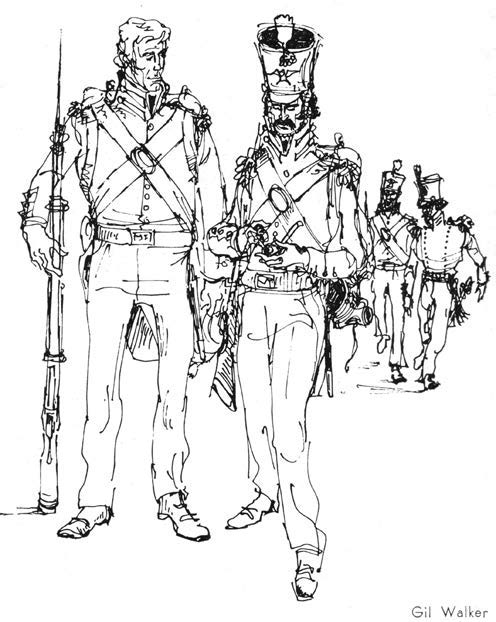
United States Marines of General Henderson’s era.

Late in 1831 the natives of Sumatra seized and robbed an American merchantman in the harbor of Quallah Battoo. This act of piracy resulted in the murder of several members of the crew. In retaliation the United States sent the frigate Potomac, especially outfitted for the job, on a punitive expedition against the Sumatran pirates. Arriving in February 1832, the Potomac put a landing force of over 250 Marines and sailors ashore. In two days of bloody warfare, the force captured four pirate forts and reduced the town of Quallah Battoo to a heap of smouldering ruins.

At the same time, on the other side of the Southern Hemisphere, Marines were having some difficulties in South America. Argentina was attempting to establish claim over the Falkland Islands. In pursuit of this claim, that country looked with extreme disfavor on American vessels conducting trade with the Islands. In an effort to discourage this practice, the Argentinians proceeded to impound three American schooners and jail their crews. Marines from the sloop Lexington waded ashore and through dint of considerable small arms fire, succeeded in impressing the Argentine officials that the United States did not look kindly upon such treatment of its ships and citizens.

  But, as far as the Marine Corps was concerned, the most far-reaching effect of the new anti-isolation policy of the United States was reflected in the Act of 1834. Passed by Congress on June 30, the legislation authorized a substantial increase in the strength of the Marine Corps. It also settled the question of its control, by placing it in the hands of the Secretary of the Navy. In addition, it authorized the President to order the Marines into whatever action his judgment dictated, including duty with the Army. Within the year the President was to make good use of his newly granted powers.

      In the Everglades of Florida a bad situation of long standing was rapidly coming to a head.

    Over a period of many years runaway Negro slaves had found refuge with the Seminole Indians and many slaves and members of the tribe had intermarried. The southern planters, aware of this refuge for their escaped slaves, had made repeated petitions to the Crown of Spain, without avail. Unhappy with the refusal of Charles IV to take the necessary steps to return their slaves, the southern land owners began to petition their own government for the annexation of Florida. In 1819 a portion of Florida was purchased from Spain for $5,000,000. Immediately the slave owners renewed their demands to the government that their slaves be returned. Inasmuch as some 75 years had passed since their ancestors had taken refuge in Florida, it was a little difficult for the Seminoles to understand the claims of the planters. As a result, such demands met with a particularly unenthusiastic response by the Seminoles.

Under the political pressure eventually brought to bear by the slave owners, the Administration completed a treaty with the Indians, under which the government would take the tribe under its protection and assign the Indians to reservations. Perhaps things might have worked out if certain enterprising souls hadn’t become aware of the lucrative possibilities in the profession of slave catching. The “slave hunters,” in direct violation of the terms of the treaty, entered Florida in organized bands to catch runaway slaves who brought high prices on the slave markets. There is no evidence to indicate that the government made any attempts to stop this practice, although the Indians continually demanded redress.

In 1828 the proposal was made to the Seminoles to move to a reservation in the area now occupied by the state of Arkansas. Tribal chiefs made a reconnaissance of the area and returned with the report that “snow covers the ground, and frosts chill the bodies of men.” Their objections notwithstanding, the Seminoles were ordered to emigrate West. At which point, things got rapidly out of hand.

Determined to force the emigration, the government sent troops into Florida. Just as determined to remain where they were, the Seminoles made preparations for war. In December 1835 the hostilities began in earnest, and in a short time the horrors of the Seminole War were being chronicled throughout the land.

BGen D.L. Clinch, who was commanding the US troops in Florida, was charged with the responsibility of the removal of the Indians. The end of the year found the well-armed Indians, under the leadership of a colorful half-breed named Osceola, assembled in the almost inaccessible swamps of the Withlacoochee River.

Clinch, whose immediate problem was to protect the white settlers, decided to attack the Indians. Since his own force, which occupied Fort King near the present town of Ocala, was too small for the job, he sent to Fort Brooke on Tampa Bay for reinforcements.

The reinforcements, numbering 110 and under the command of a Maj Dade, answered the call of Gen Clinch with colors flying and bugles blaring across the swamps. With the possible exception of Custer’s debacle at Big Horn, the fate of this force is without parallel in the history of Indian warfare.

Shortly after Dade’s force crossed the Withlacoochee, they were met with an ambush so effective that only two survivors remained to crawl through the wire grass to safety. One was Pvt Clark of the 2d Artillery who, although badly wounded, is reputed to have crawled to Fort Brooke, a distance of 60 miles. The other was Louis Pacheo, a Negro slave who acted as guide for the force. There is reason to suspect that the escape of Pacheo from the ambush was something more than blind luck. Be that as it may the only man to survive without a scratch lived to the venerable old age of 95 without being taken to task for his treachery, if such it was.

On the same day as the Dade Massacre, Osceola and a small band invaded a dinner party given by Gen Wiley Thompson, who had been sent from Washington to oversee removal of the Indians, and murdered the General and his five guests. If there had been any doubts about the earnestness of the war in Florida, the Dade Massacre and the murder of Gen Thompson provided the clinching argument.

By the spring of 1836 the Army in central Florida found themselves in difficulty. Some 1,000 soldiers were trying to round up and deport over 3,000 Indians. The State militias, which had originally augmented the Army of the South, soon had their stomachs full of poor food, swamp fever and general discomfort. And, with the coming of spring, they left Florida for healthier climes.

To add to the general misery, the Creek Indians of southern Alabama and Georgia decided to go on the warpath. The results of this uprising were severe enough to cause the Army to shift its main effort from the Seminole country to the area occupied by the Creeks.

At this juncture Archibald Henderson volunteered the services of a regiment of Marines for duty with the Army. The offer was promptly accepted. On May 23, 1836, President Jackson, under the recently enacted law, ordered all available Marines to report to the Army. Henderson, never one to sit on the sidelines, insisted on leading the regiment personally. By taking practically all officers, reducing shore detachments to sergeant’s guard, and leaving behind only those who were unfit for duty in the field, Henderson was able to mobilize more than half the total strength of the Corps.

There is a tale, often related by Marines, that Col Henderson closed Marine Corps Headquarters during this period. It is said that he locked the door to his office, placed the key under a mat, and tacked a neatly lettered sign to the door which read:

Have gone to Florida to fight Indians. Will be back when the war is over.

A. HENDERSON
Col. Commandant
More reliable accounts indicate that the Commandant left the Headquarters in charge of LtCol Wainwright, with the Band to provide the guard. Among those deemed unfit for duty in the field was one Sgt Triguet, whom Henderson commended to Wainwright in a letter of instruction which began: “Sergeant Triguet is left to assist in attending to the duties at Headquarters. He is a respectable old man, and has no other failing than that which but too often attends an old soldier….”

Henderson, with a force of 38 officers and 424 enlisted men, reported to Gen Winfield Scott at Columbus, Georgia. Since the Commandant was under direct orders of the Secretary of War, he technically became an Army officer and was placed in command of a brigade composed of Marines, Army Infantry and Artillery, and friendly Creeks.

Presaging the modern Marine battle garb of dungarees, the troops wore white fatigues, rather than the green and white uniforms of the period. Armed mostly with muskets, they also carried some of the new-fangled Colt rifles which had a disconcerting tendency to explode spontaneously when carried loaded for any length of time in the hot sun.

Both the Marine commander and Gen Scott took an optimistic view of the final outcome of the campaign. In a letter to the Secretary of the Navy, Henderson wrote: “It is now expected that the Campaign will be closed in the course of ten days or two weeks….” On the same day Gen Scott went on record to the effect, “war against the hostile Creeks is supposed to be virtually over.” One may well speculate as to the thoughts of Gen Scott a month later when he was recalled to Washington for an investigation of his conduct of the war against the Creeks and Seminoles. After a long, drawn-out investigation, Scott was exonerated and restored to his command. 

The end of summer brought with it the termination of the Creek Campaign. The Creeks were removed to a reservation in what is now the state of Oklahoma, and the Army of the South again turned its attention to the problem of the Seminoles in Florida.

On June 24 a battalion of Marines under LtCol W.H. Freeman reached Milledgeville, Georgia, and moved on into Florida. In October Freeman’s battallion was consolidated with the one Henderson had been leading into a six-company regiment and moved to Apalachicola, to garrison Fort Brooke. The Marines were augmented by a regiment of Creek Indians, some 750 strong, who had been mustered and were paid as militia. The regiment was officered mainly by Marines, and wore white turbans to distinguish them from the enemy during battle. The Seminoles were rather unhappy about being pursued by their blood relatives, and showed their dislike by scalping all Creeks who fell into their hands.

On November 21 the Creeks, under the command of 1stLt Andrew H. Ross, fought an advance guard action at Wahoo Swamp. From Wahoo a four-pronged advance, two columns of Army troops and two of Marines, pushed the Seminoles back to the Hatchee-Lustee River. Six days later the main body of Indians was located in the area of the Great Cypress Swamp, and was promptly attacked. The attackers managed to capture the horses of the enemy and 25 prisoners, most of whom were women and children. The braves slipped back into the swamp. Henderson left a detachment to guard the prisoners and horses, while the regiment pressed on after the warriors who had taken up positions on the opposite bank of the Hatchee-Lustee. The troops extended along the river bank and took up a cross fire, in an effort to dislodge the enemy. As soon as the Indians’ fire slackened, the troops crossed the river by swimming and by means of logs. According to Henderson’s report, “… we pursued the enemy as rapidly as the deep swamp and their mode of warfare permitted.”

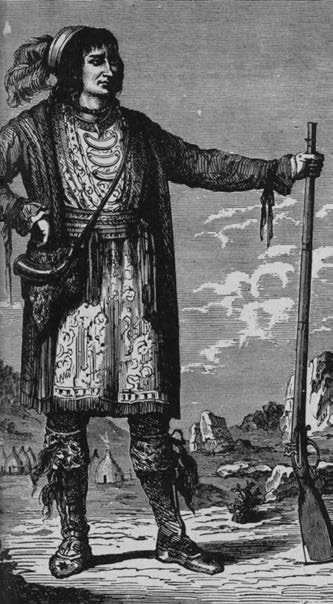
Osceola, Chief of Seminoles.

The chase continued until nightfall when Henderson was forced to withdraw his troops from the dense undergrowth. The result of the day’s operations was the capture of the Indian women and children, already mentioned, 23 Negroes, a few horses and some clothes and blankets. The battle report states that one Indian and two Negroes were seen dead by the troops.

As a result of his routing of the Indian forces Henderson was brevetted a brigadier general and several Marines were promoted for “gallantry.” Four days later, Abraham, a Seminole Chief, appeared at Henderson’s camp under a flag of truce. This marked the beginning of several days of negotiations between Maj Gen T.H. Jesup, to whom Gen Scott had relinquished command upon being recalled to Washington, and the Indian leaders at Fort Dade. These meetings finally resulted in an agreement by the chiefs to assemble their people for transportation to their new reservation. The peace treaty was formally signed on March 6. Jesup, believing the war to be over, began to discharge his volunteers.

On May 22, 1837, Henderson received orders to proceed to Washington. Taking with him all Marines except two companies, which totalled 189 officers and men, Henderson left Florida the next day.

On the night of June 2, Micanopy, grand chief of the Seminoles, and several of his lesser chiefs who had encamped with their followers near Tampa Bay, the port of embarkation, were abducted and taken to the interior. The next day a report was received from the troops south of Hillsboro that the Seminoles encamped in that vicinity had disappeared. These two incidents were the signal of the renewal of hostilities. Gen Jesup reported, “This campaign, so far as relates to the Indian emigration, has entirely failed,” and requested to be “immediately relieved from the
command of the Army.” The Seminole War was far from over.

For the next five years Archibald Henderson vainly tried to get the remaining Marines recalled from Florida. His appeals were met with refusal by the Secretary of War, who felt that the need for Marines in Florida was more pressing than the need for their return.

Jesup was finally relieved and realized what had been his burning desire since the beginning of the campaign—to join his family and spend the rest of his life on his farm. He was replaced by Col Zachary Taylor, who was soon promoted to the rank of brigadier general.

The campaign wore on and the possibility of success appeared more remote with each passing day. Osceola, who had been arrested while conferring with Gen Jesup, died in prison at Fort Moultrie in October 1837. The next year some 4,000 Seminoles made the move to Oklahoma, though many of them slipped away from the New Orleans concentration camps and returned to the Everglades.

The two remaining companies of Marines put in four more years of duty along the coast and around the keys of Florida with the Mosquito Fleet. From June 1838 to the summer of 1842, this array of half a dozen small vessels, two barges and 140 canoes was manned by 68 officers and 600 men. The Marines of the fleet numbered about 130, and for the first two years of operation were commanded by 1stLt George H. Terrett who, seven years later, was to lead the way into Mexico City.

The object of the Mosquito Fleet was twofold, to intercept communications between the Indians and small boats operating off the Florida coast, and to conduct amphibious sorties into the interior of the Everglades. The fleet operated successfully throughout the remainder of the campaign, and the Indians came to have great respect for the “sailor boats” as they called them.

In the summer of 1842 the Seminole War gradually waned, without formal cessation of hostilities and with neither side clearly victorious. The Marines returned north in July, well pleased to be relieved of what had been six long years of extremely dreary duty. In the final accounting, 61 Marines had given their lives in the Seminole Campaign. Over half of them had died from disease, and one unfortunate soul had departed the scene, dispatched by a friendly musket ball—“discharged by accident.” In analyzing the success of the campaign, one need only reflect upon the fact that the Seminoles still occupy the Everglades of Florida.

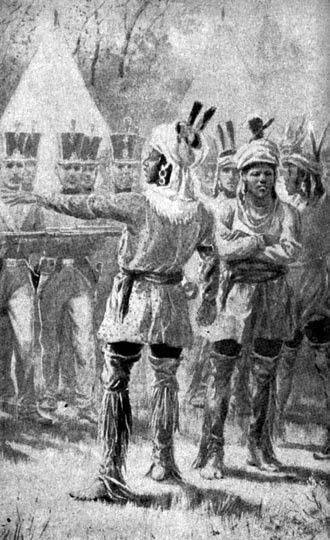
The arrest of Osceola, who later died in prison.

With the Seminole War a matter for the record books, Henderson again turned his attention to strengthening and developing the Corps. His efforts were aimed at keeping the Marines in a state of readiness for any emergency, domestic or foreign. The remainder of his career was distinguished by such important events as the Mexican War and Perry’s Expedition to Japan. Under his direction Marines virtually covered the globe. To protect Americans and their commerce with China, they stormed the forts of Canton during the great Taiping Rebellion. In the South Seas they splashed ashore to bring the rampaging Fiji Islanders to heel. In the jungles of Central America they made their first contact with the Republic of Nicaragua, which was to see the repeated return of Marines over the next three-quarters of a century. Along the Gold Coast of Africa the slave traders, on more than one occasion, felt the bite of a Marine’s bayonet.

For the 50 years he wore the uniform of a Marine, Archibald Henderson preached the gospel of strong leadership and constant readiness. At 74, he dramatically demonstrated that advanced age was no deterrent to practicing what he preached.

The issues of the elections of 1857 were particularly bitter ones. In an effort to control the election in Washington, the “Know Nothing” Party imported a gang of hired thugs, known as the “Plug Uglies,” from Baltimore. The gang commenced activities by physically threatening the voters, and finally put a complete halt to the elections by taking possession of the polling places throughout the city. Civil authorities, unable to cope with the situation, appealed to the President who ordered two companies of Marines from the Marine Barracks to restore order to the city.

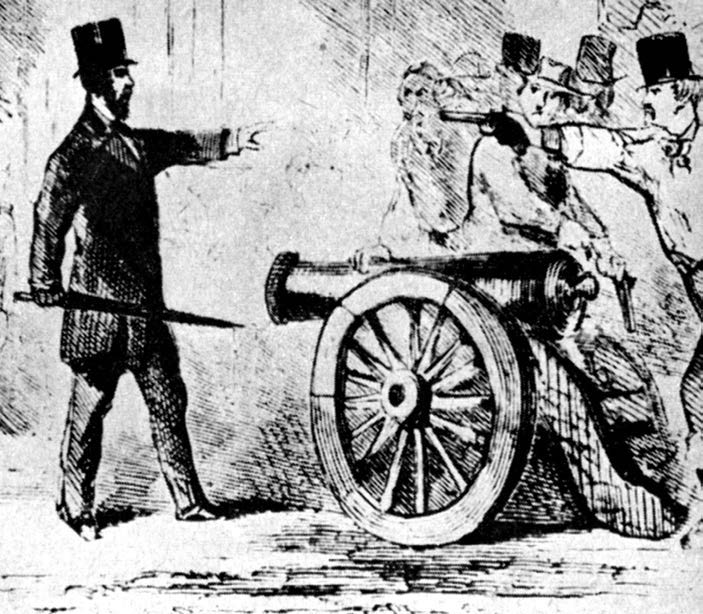
General Henderson facing up to the “Plug Uglies.”

The Marines met the “Plug Uglies” on Pennsylvania Avenue, in the vicinity of City Hall. The rioting thugs, who were armed with every conceivable weapon, dragged up a brass cannon, aimed it at the Marine formation and demanded that they return to their barracks. Capt Tyler, commanding the Marines, ordered a detachment forward to capture the cannon. At that moment, Gen Henderson, who had been mingling with the mob and was dressed in civilian clothing, walked calmly up to the muzzle of the cannon and forced the weapon around. Henderson addressed the “Plug Uglies,” warning them of the seriousness of their acts and telling them that the Marines would fire if it became necessary. In the hectic few minutes that followed, a number of rioters who fortunately were very bad marksmen, fired their pistols at Henderson. A platoon of Marines charged in to protect the Commandant and capture the cannon. One of the rioters, at point blank range, aimed his pistol at Henderson’s head. A Marine knocked the pistol to the ground with a butt stroke of his musket. The General promptly grabbed the culprit by the collar and the seat of his pants and marched him off to jail. With the riot getting out of control, the Marines opened fire. The rioters, suddenly convinced that the Marines meant business, beat a hasty retreat and order was restored to the city.

On January 6, 1859, the “grand old man of the Marine Corps,” who had served as Commandant under 11 Presidents, died in office at the age of 76. The impact of his strong personality and zealous devotion to duty remains to this day, indelibly engraved on the Corps to which he devoted over 50 years of his life.

The era of Archibald Henderson had encompassed two wars worthy of examination from the standpoint of the nation’s history. One, which had been purely internal, was the protracted campaign against the Creek and Seminole Indians. The other, which took place on foreign soil, provided the Marines with the first line to their hymn, and the nation with something it had long wanted—a western boundary that bordered the blue Pacific. 

Aleutian Allure

“Key Maritime Terrain—Any landward portion of the littoral that affords a force controlling it the ability to significantly influence events seaward.”-Tentative Manual for Expeditionary Advanced Base Operations, Second Edition 2023 

 Alaska is the most central place in the world … in the future, he who holds Alaska will rule the world.”BGen Billy Mitchell, U.S. Army Air Corps, Congressional Testimony, 1935 

The Aleutian Campaign may be one of the most forgotten U.S. undertakings of World War II. Its human carnage and materiel costs were not insignificant for both American and Japanese forces, yet few today know anything about it. Even among military history enthusiasts, names like Attu and Kiska often go unrecognized. Such obscurity is hardly surprising when one considers the large number of campaigns that took place across Admiral Chester Nimitz’s vast Pacific Ocean Areas during the war. Not only was the North Pacific Area a decidedly peripheral operational theater to Nimitz, but the campaign’s surprising and anticlimactic conclusion was also not one U.S. and Canadian commanders wanted to be remembered for. The subsequent decision by the Joint Chiefs of Staff (JCS) not to use the Aleutians as stepping stones to invade the Kuriles and attack the Japanese home islands from the north further contributed to its historical ambiguity. 

As a case study, however, the Aleutian Campaign offers numerous insights for commanders and planners on the tensions that frequently arise between theater priorities and strategic imperatives driven by time-sensitive political expectations. It also provides lessons on why the value of key maritime terrain should be periodically reassessed from both friendly and enemy perspectives. Considering the tremendous operational and logistical accomplishments of both Japan and the United States, the inclusion of this campaign in professional military education and on reading lists could elevate discussions on distributed maritime operations as envisioned today by the Navy-Marine Corps team. Certainly, the strategic implications of seizing, occupying, and/or controlling key maritime terrain in the context of amphibious operations and expeditionary advanced base operations (EABO) deserve study.  

In the case of the Aleutians, the law of unintended consequences affected both sides. By seizing and retaining key maritime terrain for purposes subject to broad speculation by the United States, Japan set in motion events that reverberated well beyond the region and achieved outsized strategic effects on the pace and direction of the wider U.S. war effort. From this perspective, observations and decisions from the North Pacific Theater may have relevance to future naval campaigns against a peer adversary. 

Strategic Context 
The persistent presence of a relatively small but capable Japanese amphibious force in the Aleutians starting in June 1942 was an audacious affront to the nation’s sovereignty and a psychological burden on Washington. With the United States now in a global world war tilting precipitously in the Axis’ favor, the intense political pressure on the Joint Chiefs of Staff to push the Japanese out of the Western Aleutians was counterbalanced by regional fears bordering on paranoia about a Japanese invasion of the North American continent. Service commanders in theater began uncoordinated actions against the Imperial Japanese Navy and its advanced bases before they were fully ready. As the perceived Japanese threat in the North Pacific grew, a cumbersome and disjointed command and control structure was hastily concocted to oversee the massive buildup of land, sea, and air capabilities unsupported by prewar planning. Hundreds of thousands of American soldiers, sailors, and airmen, along with millions of tons of equipment and supplies, were diverted to the Alaskan theater on short notice. This military might would aggregate steadily into overwhelming land, sea, and air power until it could be focused on the annihilation of two isolated Japanese garrisons doing little more than occupying the most remote American territory in the world.  

The Aleutian Allure 
Comprising over 660,000 square miles of mostly wilderness and 34,000 miles of coastline, Alaska stands out prominently on the globe because of its enormous size and strategic placement in the North Pacific adjacent to the Eurasia land mass. The Alaskan Peninsula extends to the southwest from the mainland over a thousand miles before transitioning to the Aleutian Archipelago which continues in a gentle westward arc for another thousand miles. Comprised of 14 large islands, 55 smaller islands, and innumerable islets, the Aleutians appear on a map to form a natural approach route to either the North American or Asia continents. Their appeal as an invasion route in either direction quickly fades under analysis, however. The remoteness, inhospitable topography, and relentlessly harsh weather make the Aleutians unforgiving to all forms of movement and sustainment. Most of the islands are dominated by snow-covered peaks rising to 9,000 feet above the frigid, turbulent waters of the North Pacific. What level ground can be found is usually covered by muskeg—a thick, wet, spongy bog into which vehicles quickly sink up to their axles. Harbors and airfields essential for intratheater movement or to support landward operations are scarce and underdeveloped. When the islands are not shrouded in thick clouds and mist, they are battered by shrieking winds, driving snow, and freezing rain. Not even trees grow in the Aleutians. Despite these daunting conditions, neither the United States nor Japan discounted the possibility that the other side might make strategic use of the Aleutians in a war.  

Preparing Alaska for War
Although the Aleutians’ strategic linkage to control of the North Pacific was generally understood, little was done to protect the archipelago until war loomed. In 1938, Congress appropriated nineteen$19 million dollars for the construction of air, submarine, and destroyer bases in Alaska but few military forces were assigned until after the war began in Europe.1 The only military presence in the Aleutians themselves was a Navy radio station and a small Coast Guard base at Dutch Harbor on Unalaska Island.2  In early 1940, the War Department developed plans to increase the Army garrison in Alaska, establish a major Army base near Anchorage, develop a network of airfields across Alaska, and provide troops to protect the naval installations at Dutch Harbor, Sitka, and Kodiak.3 The 750-soldier-strong Alaska Defense Force was created in July 1940 under the command of the energetic and flamboyant Brigadier General Simon B. Buckner of, the US Army. The remoteness of the proposed base locations, poor weather, and the lack of existing transportation infrastructure delayed progress on these plans until mid-1941—though Buckner spared no effort in tackling the myriad of tasks before him.4

Buckner was emphatic that Japan not be allowed to gain an expeditionary lodgment anywhere in Alaska from which they could launch air and naval operations across the North Pacific.5 He focused on defensive preparations, but remained convinced of Alaska’s offensive potential, believing the Aleutian Chain formed a “spear pointing straight at the heart of Japan.”6 He traveled throughout the archipelago identifying every island where an airfield could be built:  Umnak, Adak, Amchitka, Kiska, Shemya, and Attu. Before the war’s end, all would host advanced air bases with semi-autonomous garrisons to support maritime reconnaissance and offensive air operations.7 

Japan’s North Pacific Gambit  
Following the attack on Pearl Harbor, the Japanese Imperial High Command commenced a war of conquest to establish its long-desired Greater East Asia Co-Prosperity Sphere. By late April 1942, Japan had swept aside Allied power and seized strategic terrain across the Pacific at the cost of nothing larger than a destroyer.88 The elated Japanese High Command chose to capitalize on this momentum and press on to New Guinea and the Solomon Islands to set conditions for an invasion of Australia. 

Admiral Isoroku Yamamoto, the architect of the Pearl Harbor attack, respected American industrial capacity enough to know that time was not on Japan’s side. He believed their only hope for victory lay in keeping America on the defensive while striking a decisive blow against what remained of the U.S. Pacific Fleet—principally its aircraft carriers—while Japan still had the advantage.9 Such a victory might compel Washington to recognize Japan’s expanded empire and negotiate an end to the war. To this end, he sought to draw the American fleet from Hawaii into the Central Pacific where it could be destroyed by Japanese air power. To lure in the American carriers, Yamamoto developed an ambitious plan to seize Midway and conduct diversionary attacks in the western Aleutians. From Midway, he could project enough land-based air power to form a protective barrier for Japan straddling the North and Central Pacific.  

Japan’s Aleutian operation was intended to capture or destroy “points of strategic interest” in the Aleutians and check further U.S. naval and air movements from the north.10 Interestingly, this was not the first time the Aleutians had been identified by Japan as key maritime terrain. Just a year earlier, the Japanese Army had proposed a plan to sever U.S. and Soviet lines of communication by seizing some portion of the Aleutians. Moreover, from a strategically defensive perspective, Japanese planners saw the Aleutians as a potential northern axis of advance on Japan well before the United States had developed the capability to use them as such. After the bombing raid on Tokyo by Lieutenant ColonelLtCol James Doolittle in April 1942, some on the Imperial Staff suspected his B-25 Mitchell bombers had originated from a secret base in the western Aleutians.11

Japan Seizes Key Maritime Terrain
On 5 May 1942, Japanese Imperial General Headquarters issued Navy Order 18 to capture Midway as well as the islands of Attu and Kiska in the western Aleutians. It also directed an air attack on the U.S. base at Dutch Harbor, some 200 miles east of Adak. As Yamamoto’s armada set course for Midway, a smaller Northern Area Fleet under Vice Admiral Hoshiro Hosogaya composed of two light aircraft carriers, six cruisers, a dozen destroyers, and various amphibious support vessels moved east from the Kuriles to attack the Aleutians. The element of surprise was crucial, but U.S. success in breaking portions of the Japanese naval code informed Nimitz in mid-May of Yamamoto’s plan. Buckner’s Alaska Defense Command was duly warned as Nimitz prepared to confront both Japanese fleets simultaneously. While three U.S. aircraft carriers converged on Midway, a smaller force—Task Force 8 under Rear Admiral Robert “Fuzzy” Theobald—raced to the North Pacific to defend the Aleutians.

During 34 June, Japanese carrier-based aircraft bombed Dutch Harbor, killing 43 soldiers and sailors, wounding another 64, and damaging infrastructure. The Japanese also destroyed eleven U.S. aircraft while losing ten, including an A6M Zero fighter that U.S. forces recovered largely intact. It was quickly disassembled and shipped to the States, where a complete technical analysis was performed that was later credited with influencing U.S. fighter designs.12 Throughout the two days of attacks on Dutch Harbor, Theobald’s Task Force 8 had remained just south of his headquarters on Kodiak Island, wary of being discovered by Japanese aircraft but frustrated by his inability to locate Hosagaya’s fleet with his PBY Catalina patrol aircraft and help from Eleventh Air Force bombers.

Japan’s crushing defeat at Midway temporarily delayed their planned landings in the Aleutians as the two actions were loosely coupled. However, Yamamoto thought a small naval success would help offset the disaster at Midway, and the defensive value of establishing advanced bases in the western Aleutians remained valid. At the very least, they would bedevil the U.S. Navy’s control of the North Pacific.13 So Yamamoto directed the Attu-Kiska landings to go forward. During 6–7 June, Hosagaya landed 2,500 troops on Kiska and Attu—the first U.S. territory captured by an enemy force since the War of 1812. The landings were effectively unopposed. Once established ashore, Japanese soldiers and sailors set about fortifying positions, building seaplane ramps, and installing antiaircraft batteries. They would later attempt to construct two airfields with little more than hand tools.

America Retaliates
The occupation of Attu and Kiska dealt a serious blow to American prestige. The U.S. Joint Chiefs of Staff directed that the effort to recapture the islands begin as soon as possible. This operation, the first U.S. counteroffensive of the war (preceding Guadalcanal by two months), required a joint littoral campaign whereby a series of advanced bases would be constructed from east to west along the Aleutian Chain, with airfields suitable for heavy bombers situated close to sheltered harbors. The selection of mutually supporting airfields and harbor sites required close cooperation between the Services— a level of cooperation between the Army and Navy that had heretofore proven difficult.

Unfortunately, a unified theater commander for the Aleutian Campaign was never identified, exacerbating already tense command and personal relationships between Buckner and Theobald. In a rare oversight by Nimitz, the respective commanders of the Alaska Defense Command and North Pacific Force were directed to conduct a joint campaign through “mutual cooperation” and share the use of the Eleventh Air Force. Predictably, Buckner and Theobald were never able to set aside their differences and achieve a productive command relationship based on mutual trust and respect, and halfway through the campaign, Nimitz replaced Theobald.14

The campaign was slow to get organized and gain momentum, but Army and Navy engineers prevailed in unimaginably tough conditions, defying the skeptics, and proving essential to the ultimate success of the campaign.  Meanwhile, the fledgling Eleventh Air Force mounted a sustained long-range bombing campaign while the Navy prowled the fog-shrouded seas searching for Japanese vessels with the electronic eyes of radar.15 The weather was as much an enemy as the Japanese. Shifting winds, squalls, and low clouds made air operations extremely hazardous, while rough seas and limited visibility made the U.S. naval blockade challenging. Japanese Navy submarines were a constant menace, while its destroyers and transport vessels still managed to periodically slip past U.S. air and sea patrols to resupply and reinforce the garrisons. Japanese forces ashore not only survived the bombardments but also, over the course of the campaign, increased their concentration of antiaircraft guns, redistributed forces between Attu and Kiska, reinforced Attu, defended Kiska with seaplane fighters, attacked the new U.S. airbase at Amchitka, and most importantly continued to deny the Americans a northern approach to Japan.16 

Finally, on 4 May 4, 1943, ten months after Japanese forces seized Attu and Kiska, an American amphibious task force set sail from Cold Bay to recapture Attu. Kiska, the closer and more heavily defended of the two occupied islands, was bypassed for the time being.17 Operation LANDCRAB, the assault on Attu, began on 11 May and was spearheaded by the untested 7thth Infantry Division (7thth ID). Intelligence reports estimated Attu to be defended by a force of 1,600, but a successful Japanese reinforcement effort by fast transports and destroyers in early April had clandestinely raised the number of defenders to over 2,600. (18)  

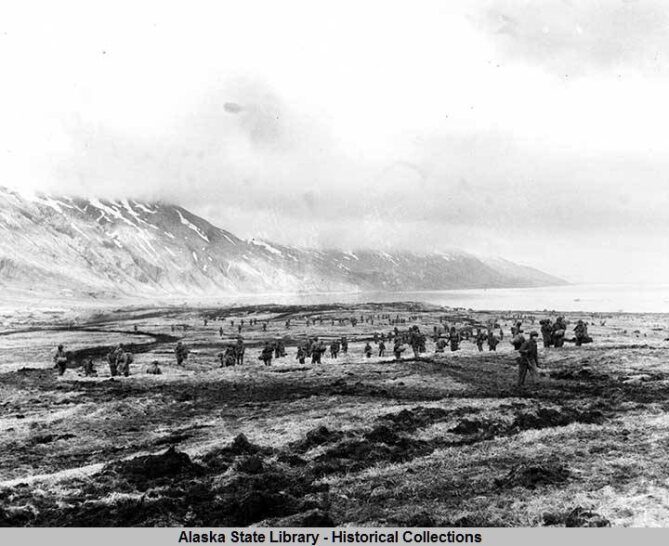
Poor weather and difficult terrain hindered the entire U.S. operation. Dense fog caused at-sea collisions, and mist ashore delayed the multi beachmulti-beach landings and limited the use of naval gunfire. Trucks and artillery pieces became hopelessly mired in the muskeg, causing supplies and ammunition to pile up on the beach and ultimately be carried inland by hand.  

Japanese light infantry occupied carefully prepared defensive positions on high ground that dominated the landing beach exits. Concealed from observers below by a protective mist that hovered a few hundred feet above the landing beaches, the dug-in Japanese soldiers could nevertheless see well enough to deliver deadly accurate fire on American soldiers below as they struggled to advance over the wet, spongy ground. By massing indirect fires, the 7thth ID was eventually able to close on the Japanese defenders from multiple points and drive them into a pocket. The last of the Japanese, some 800 soldiers, ended the battle abruptly on 29 May with a vicious banzai charge that overran several frontline formations and a field hospital inflicting horrific casualties before being stopped by a hastily formed defensive line on a promontory known as Engineer Hill.  

Only 28 Japanese soldiers survived the Battle of Attu. Burial parties counted 2,351 enemy dead on the battlefield with another three hundred found to have been buried earlier by the Japanese.  Of 15,000 Americans in the invasion force (10,000 of whom constituted 7thth ID), 549 were killed and 1,148 wounded in action. Another 2,132 soldiers were evacuated for sickness and severe cold-weather injuries. What was planned as a three-day operation had taken a reinforced infantry division backed by overwhelming air and naval power three weeks to accomplish. The 25-percent casualty rate inflicted on the landing force was only exceeded in the Pacific war at the Battle of Iwo Jima.19

The suddenness and ferocity of the final Japanese banzai charge left a deep impression on one of the few Marines in the Aleutians at the time. Major General MajGen Holland M. “Howlin’ Mad” Smith, who had overseen the amphibious training of the 7thth ID in southern California, was present as an observer during Operation LANDCRAB. After the banzai attack, Smith made a conscious decision to train specifically for such occurrences in the future.20 He would later credit this experience on Attu with his anticipation of both the time and location of the fanatical banzai attack that would occur in the closing days of the Battle of Saipan a little over a year later.21

The Kiska Surprise
With Attu in American hands, preparations for Operation COTTAGE, the amphibious assault on Kiska, shifted into high gear. Intelligence estimates fixed Japan’s Kiska garrison at around 10,000 men. With the painful lessons of Attu still fresh, American commanders assembled a massive invasion force of 35,000 troops (including 5,500 Canadians) and 100 ships at Adak over the next three months. After weeks of preparatory bombing and naval gunfire, the landing took place on 15 August.  It was unopposed. As U.S. and Canadian soldiers ventured inland, they encountered no resistance whatsoever. A cautious but thorough search revealed only abandoned and destroyed Japanese equipment, numerous bunkers, and an extensive network of underground tunnels.  

The news that so large a Japanese force had slipped away undetected despite daily bombing and aerial reconnaissance missions—to say nothing of the vastly superior American armada that encircled the island—was greeted with shock and disbelief by nearly all senior leaders. One notable exception was Major MajGen General “Howlin’ Mad” Smith, who, along with some of his staff, had returned to the Aleutians to direct amphibious training for the landing force. He had no direct role in planning the Kiska invasion but remained in Adak as an observer. For two weeks prior to the landing, Smith studied intelligence reports and aerial imagery of Kiska and, recalling how six months earlier approximately 11,000 Japanese troops had quietly slipped away from Guadalcanal on destroyers at night, concluded that the Japanese had already left the island.22 His call for a small ground-reconnaissance element to scout the island before the landing was rebuffed as too risky by the Army’s landing force commander, Major General Charles Corlett, who dismissed Smith as an interloper and would not even show him the landing plan.23 The decision was ultimately left up to Vice Admiral Thomas Kinkaid, the North Pacific Force commander who had replaced the prickly Theobald months before the Attu operation. Kinkaid considered the risk to the scouts greater than to the landing force and directed that the full-scale invasion proceed as planned, even if it turned out to be, in his words, just a “super dress rehearsal, excellent for training purposes.”24 

Despite the absence of any Japanese defenders, however, the landings proved far more dangerous than a training exercise. Casualties ashore included 21 men killed and 50 wounded either by booby traps or shot by fellow Americans or Canadians, as edgy soldiers fired at each other in the mist, mistaking adjacent comrades for the dreaded Japanese.25 The last and most serious casualties of COTTAGE occurred when a destroyer, the USS Abner Read, had its stern ripped off by a moored mine in Kiska Cove, killing 70 sailors and injuring 47. (26) In his memoirs, Smith called the failure to allow a proper reconnaissance in advance of the landings an act of inexcusable negligence by senior commanders.27 Kiska was declared secure on 24 August 1942. Operation COTTAGE brought the Aleutian Campaign to an anticlimactic but frustrating end. 

Only after the war would Americans learn how a Japanese surface task force, under the command of Rear Admiral Masatomi Kimura, had accomplished the evacuation. Kimura had waited patiently for weeks until weather conditions favored an unobservable approach from Paramushir Island in the Kuriles to Kiska. Navigating by dead reckoning in a tight formation under radio silence, Kimura guided his task force through thick fog for a week to slip quietly into Kiska Bay on the afternoon of 28 July.  Immediately upon anchoring, Kimura’s task force and the Kiska garrison began the evacuation with remarkable precision and efficiency. In less than one hour and again under complete radio silence, the entire Japanese garrison of 5,183 men was transported by landing craft and loaded aboard six destroyers and two cruisers.28 The Japanese aptly described the evacuation as a “perfect operation”; it was undoubtedly one of the most daring and successful evacuations in military history.29 

Echoes of Attu and Kiska in the 21stst Century
While the Aleutian Campaign is rarely examined from the Japanese perspective, the accomplishments and shortcomings of Japan’s forces and methods offer some intriguing lessons and planning considerations for emerging operational concepts such as EABO—particularly in a conflict with a peer adversary such as China. Japan’s operational practices can be instructive for some of the challenges the United States currently faces in the strategic island chains of the Western Pacific. Certainly, the Imperial Japanese Navy’s operational reach, stealth, speed, and tenacity both on and below the surface were critical to the sustainment, mobility, and command and control of Japanese “stand-in forces” conducting a form of EABO in the Aleutians. That Japanese naval forces were able to evade detection, strike Dutch Harbor, seize key maritime terrain, and persist in their advanced Aleutian bases for well over a year was a remarkable feat. The weather conditions naturally helped in this regard. The adverse weather routinely shielded Japan’s most vulnerable assets from American eyes and bombs. At the same time, the Japanese Navy managed to exploit prolonged periods of darkness, fog, and cloud cover to evade U.S. air patrols and run the U.S. Navy’s blockade on several occasions. Japanese successes during the campaign were manifold. They were able to reposition and resupply their forces, deliver reinforcements, conduct seaplane operations, and build a formidable air defense capability. Their evacuation of an entire garrison completely undetected in an incredibly compact time period defies the imagination and remains an unrivaled achievement in the annals of amphibious evacuations under pressure.   

Given the ongoing focus within the Marine Corps on light and mobile “littoral” formations, the effectiveness of the Japanese Army’s landward defense of key littoral terrain is also worth studying. Small numbers of well-trained, dispersed light infantrymen were able to attract considerable attention and impose severe costs on a far larger, multidomain task force after it landed on Attu. The defenders’ resilience and tenacity, despite prolonged isolation and severe conditions, were perhaps their most obvious attributes. These attributes remain relevant today, particularly for an isolated force conducting EABO. During the campaign, the Japanese ability to exploit difficult terrain and turn unique weather conditions into an advantage was equally impressive.  

While it might appear that today’s advanced technologies such as long-range precision fires and unmanned aerial vehicles make comparisons between 1943 and the present (or even the near future) problematic, there are capabilities that remain valid for any outnumbered force defending a salient of key maritime terrain. The tactical value of all-weather, suppressive fires; anti-invasion obstacles; antiship weapons; air defense; and over-the-horizon reconnaissance assets is clear; these are enduring requirements for the defense of EABs. Stand-in forces operating inside an enemy’s weapons engagement zone may also require the ability to perform heavy engineering tasks to rapidly build airfields to project power and fortifications to survive sustained attacks. Furthermore, a force executing EABO that can organically emplace maritime sensors and undersea effectors (e.g., sea mines and decoys) to interdict enemy surface and subsurface vessels around vital, littoral chokepoints can contribute asymmetrically to sea denial with virtually no signature. Bringing such effects to bear requires a deep and modular inventory of maritime capabilities from across the naval force to build balanced or specialized task organizations as required.  

In many ways, this depth in capabilities was the decisive American strength that eluded the Japanese, who were unable to complete even a single airfield during their year-long occupation of two Aleutian islandsAleutian Islands. Yet their ability to construct fortifications and tunnels dramatically improved their ability to survive bombardments requiring a sizable landing force to dislodge them from the advanced bases they had established. Had their diligence and determination been complemented by such capabilities as long-range radar and engineering, the Japanese would likely have been able to build and operate airfields which would have delayed both U.S. amphibious assaults for many months.

Conclusion
The impact of Japanese forces landing on American soil reverberated all the way to Washington. The political pressure to clear two Aleutian islandsAleutian Islands of fewer than 8,000 Japanese troops drained substantial resources at a dangerous time for the global Allied war effort. The Japanese achieved disproportionate effects against U.S. forces whose strategic objective became increasingly shaped more by emotional sentiment than reasoned assessment. Even when the actual invasion threat to the North American mainland was determined to be minimal, Washington had no strategic patience for any course of action that failed to yield a decisive tactical defeat of Japanese forces in the Aleutians. Thus, the United States adopted an attrition-centric operational approach that culminated in the costly recapture of Attu and, unknowingly, the embarrassing amphibious assault on Kiska nearly three weeks after the Japanese had departed.  

In the end, the 15-month campaign drew in over 300,000 Americans, thousands of aircraft, and hundreds of warships, transports, and merchantmen. It also necessitated an immense diversion of military engineering resources to build dozens of U.S. bases and supporting infrastructure where none previously existed—including the 1,640-mile Alaskan Highway across Canada to link the “Lower 48” with Alaska. The heavy commitment of manpower to the North Pacific disrupted mobilization plans and delayed global force deployments to primary theaters for nearly two years. It also forced the U.S. to pour billions of dollars of materiel into a physically taxing and dangerous theater that in the end contributed very little to defeating Japan and hastening the war’s end.  

The phenomena and interactions just described will likely be a feature of future wars and again prompt disproportionate, unnecessary, and even reckless decisions by distant political leaders seeking immediate results. The Aleutian Campaign case suggests that, in addition to contributing to sea denial, stand-in forces executing EABO can generate strategic effects by forcing an adversary to divert substantial resources from principal objectives to honor or neutralize the threat the stand-in forces appear to pose. Whether they can succeed in this regard will depend on their location and their attributes. Do they pose a credible and durable threat? Are they resilient, tenacious, stealthy, and survivable? Now, as then, the value of stand-in forces in the face of a regional hegemon will likely be tested. Whether they stand and fight, or slip away in the night, may once again be more a matter of strategy than tactics.

>Col Sinclair retired in 2018 after 30 years on active duty. He is currently a Senior Research Fellow at the Center for Emerging Threats and Opportunities at the Marine Corps Warfighting Laboratory.


Notes

1. Stetson Conn, The Guarding of United States and its Outposts, US Army in World War II Series: The Western Hemisphere (Washington, DC: Department of the Army, 1964).

2. Brian Garfield, The Thousand Mile War (Fairbanks, AK: University of Alaska Press, 1969).

3. Guarding of United States.

4. The Alaska Highway was not completed until November 1942. In 1940, there was only one government rail line between Seward and Fairbanks by way of Anchorage.

5. Guarding of United States.

6. Thousand Mile War.

7. Ibid.

8. Ibid.

9. Galen Roger Perras, Stepping Stones to Nowhere: The Aleutian Islands, Alaska, and American Military Strategy, 1867-1945 (Vancouver: University of British Columbia Press, 2003).

10. Ibid.

11. Japanese Navy General Staff, “Aleutian Naval Operation, March 1942–February 1943,” Japanese Monograph No. 88, trans. Military Intelligence Service Group, G2, Headquarters, Far East Command (monograph, US Department of the Army, n.d.), http://www.ibiblio.org/hyperwar/Japan/Monos/pdfs/JM-88_AleutianNavalOperations/JM-88.htm.

12. George L. MacGarrigle, Aleutian Islands, Center for Military History Pub 72-6, (Washington, DC: US Government Printing Office, 1992).

13. Guarding of United States.

14. Thousand Mile War.

15. Attu is 350 miles west of Kiska and was initially out of range.

16. Thousand Mile War.

17. Although Kiska was smaller, it was the more militarily important of the two islands with a much larger Japanese force. Attu was selected first both to gain valuable experience and because the number of available amphibious ships could not accommodate a multi-division landing force as was deemed necessary for Kiska.

18. Thousand Mile War.

19. Ibid.

20. Norman V. Cooper, A Fighting General (Quantico, VA: Marine Corps Association, 1987).

21. Holland M. Smith, Coral and Brass (Nashville, TN: The Battery Press, 1989).

22. Thousand Mile War.

23. Fighting General.

24. Thousand Mile War.

25. Ibid.

26. Aleutian Islands.

27. Coral and Brass.

28. Thousand Mile War.

29. Masataka Chihaya, “Mysterious Withdrawal from Kiska,” Proceedings 84, No. 2 (1958).

First to Fight

Lessons from the Battle of Belleau Wood
>Maj King is an Infantry Officer and currently serves as Commanding Officer, Recruiting Station Salt Lake City.

“And, waking or sleeping, I can still see before me the dark threat of Belleau Wood, as full of menace as a tiger’s foot, dangerous as a live wire, poisonous with gas, bristling with machine guns, alive with snipers, scornfully beckoning us to come on and be slain, waiting for us like a dragon in its den. Our brains told us to fear it, but our wills heard but one command, to clean it out, and I can still see before my very eyes those waves in the poppy-spattered wheat-field as the steady lines of our Marines went in.” (1)

Albertus Catlin,
With the Help of God and a Few Marines

Col Albertus Catlin, commander of 6th Mar at Belleau Wood, recorded these words a year after the Marine Corps’ performance in that small crop of woods east of Paris in the summer of 1918. Catlin’s first line poetically describes the overwhelming odds Marines faced in the battle: mustard gas from German artillery shells, Maxim machineguns dug in ready to fire, and enemy snipers scanning the battlefield for targets. It is his second line that reveals those intangible traits Marines exhibited during the almost month-long battle—virtues that have set the Corps apart since its inception: discipline, gallantry, grit, sacrifice, esprit de corps, and mission accomplishment among others. Outgunned and outmanned, a brigade of Marines fought for nearly 26 days against multiple divisions of battle-hardened German infantry and ultimately won.

Although the battle has long passed, we Marines have an obligation to look back at this storied engagement and extract from it applicable lessons for today. This article is just that, a simple recap and analysis of the Battle of Belleau Wood and the leadership fundamentals and virtues exhibited that remain timeless in war. Under the severest of conditions, Marines overcame their tactical and operational missteps, equipment shortfalls, and an overwhelming enemy force. These are the reasons every new generation of Marines must know the story of Belleau Wood.

America Goes to War
To fully appreciate the battle, we need to go back further to 1917, the year the United States entered World War I. The war had been raging in Europe since 1914 with President Woodrow Wilson pledging to keep America out. When Great Britain intercepted the Zimmerman Note (Germany’s request for an alliance with Mexico) in January 1917 and turned it over to the United States, it was enough for President Wilson to petition Congress for war.

Beleaguered French and British allies needed the Americans immediately. The United States responded by assembling roughly 14,000 troops and sent them to France in June 1917. Named the American Expeditionary Force and commanded by Army GEN John J. Pershing, the force included 5th Mar. In February of 1918, the 6th Mar arrived in France and joined with the 5th Mar to form the Fourth Marine Brigade, attached to the Army’s U.S. Second Infantry Division. (2)

American action in the war was minor throughout the winter of 1918 until the Germans launched a series of offenses with fresh troops freed from the now-silent Eastern Front. British and French forces repulsed the first two German offensives, but the third, known as the Aisne Offensive, struck at French forces in the Chateau-Thierry region of France, only 39 miles east of Paris. The force and momentum of this German offensive smashed the French army and dashed most Frenchmen’s hopes of keeping the Germans out of Paris. The Allies suddenly threw American forces into the line to blunt the invasion. The U.S. Second Infantry Division was ordered to Chateau-Thierry, and the Marine Brigade’s mission was to take back Belleau Wood, an ancient hunting ground half the size of New York’s Central Park.(3)

Baptism by Fire
Departing their camp near Paris and traveling by foot and truck for over 36 hours, the Marines arrived filthy and exhausted, falling in along the front near the villages of Champillon and Lucy-le-Bocage only a few kilometers north of the Metz-Paris Highway and the city of Chateau-Thierry. By the morning of 2 June 1918, despite poorly designed French maps issued in minimal quantities, most of the Marine Brigade reorganized along a northwest-running defensive line.(4) French troops were tied in on the brigade’s western flank and the Army’s 9th Infantry Regiment was tied in to their east. When oncoming Germans repulsed a French counter-offensive forward of Marine lines, retreating Frenchmen demanded the Marines withdraw with them. Capt Lloyd Williams, a company commander with 2/5 Mar, replied to a dispirited French major, “Retreat, Hell! We just got here.” The brigade, although untested in battle, was ready for action.(5)

On the afternoon of 3 June, the woods across from the Marines’ line finally came alive. Waves of German soldiers emerged from the tree lines and advanced through waist-high wheat fields toward the Marines. Some reports list 500 yards away, others say 300 yards away, but at some distance the Germans were not expecting, the Marines of 1/5 Mar and 2/5 Mar, lying prone with their 1903 Springfield bolt-action rifles, began pouring precision rifle fire into the advancing enemy. While watching the onslaught, Col Catlin recalled, “The Boches fell by the score there among the wheat and the poppies … they didn’t break, they were broken.”(6) Marines and their rifles alone won the day in their first encounter with the enemy. Even nearby French units praised the Marines for their unmatched marksmanship. After three failed attacks on 3 June, the Germans limped back into Belleau Wood and began fortifying their front. The Marines rested and re-organized their lines over the next two days, preparing to clear out the woods when orders came.

At 2225 on 5 June, brigade headquarters issued orders for an assault, with zero hour set for 0345 on 6 June. Commanders now had only five hours to deliver the order to their men dispersed along the line, coordinate supporting arms, and ready their men. Despite the impossibility of the task word passed through the darkness, troops checked their equipment and readied their weapons, and platoons moved to their rendezvous points. The first objective would be Hill 142, a prominent terrain feature that commanded high ground a few hundred meters west of Belleau Wood. 1/5 Mar would spearhead the attack.

At 0345 only the 49th and 67th Companies were in position to begin the assault, and at 0350 whistle blasts signaled the weary yet eager Marines to begin the attack. Many veterans remember the initial waves moving toward Hill 142 as a textbook performance of an attack formation. The platoons attacked in lines of four, maintaining proper intervals, with French-made Chauchat light machineguns interspersed for suppressive fire. The parade-like formations, however, fell apart when German machineguns sprang to life. Withering fire from German Maxims and Mausers raked the approaching Marines, killing scores. Platoon formations quickly morphed into individual struggles for survival. Momentum stalled. Then small-unit leaders took charge. Only meters from machinegun emplacements, junior officers and noncommissioned officers rushed forward, inspiring their men to keep moving. One Marine lost a hand grabbing an enemy machinegun barrel. The enemy gun crew, however, suffered a worse fate at the hands of Marines with bayonets.

By noon on 6 June, 1/5 Mar had secured Hill 142 but at a cost of 16 officers and 544 Marines killed or wounded.(7) The Germans suffered far greater with an estimated 2,000 casualties. With the high ground overlooking Belleau Wood in American hands, the assault on the woods could begin.(8)

From just the first few days of the battle, we can take away several lessons:

  1. Forced Marches: When not enough vehicles were available for transportation, 1/5 Mar, and the 5th Machine Gun Battalion were forced to march with weapons and equipment to the front line.9 Rigorous training both stateside and in France prior to the battle prepared Marines to undergo these strenuous conditions and perform superbly. Although vehicles and aircraft are the norms for transportation today, commanders must still ensure that their units can move themselves and their equipment to distant objectives without those luxuries and still complete the mission.
  2. Marksmanship: During the initial encounter with the enemy on 3 June, marksmanship displayed by the Marines engaging targets out to 500 meters was far superior to French and German marksmanship during the war. Although mission sets change, the Marine Corps must continue to imbue marksmanship fundamentals to all Marines in both recruit training and the FMF, and commanders must make every effort to increase the accuracy and lethality of Marines under their charge. Get your Marines trigger time, that is always a good investment.
  3. Aggressive Execution: Poorly planned orders to secure Hill 142 gave subordinate commanders minimal time to plan and execute. Regardless, at zero hour, NCOs and junior officers were moving amongst the troops, getting them in order and inspiring them with their command presence and leadership. When chaos ensued, well-trained small-unit leaders made the difference in securing the objective. That legacy of sacrifice, determination, and leading from the front must continue to be instilled in all junior leaders throughout the Corps through rigorous training, effective promotion screening, and character development by their commanders and senior enlisted leaders.

Into the Woods
Brigade headquarters issued orders to clear out the entirety of Belleau Wood while the engagement on Hill 142 raged back and forth. Setting zero hour for 1700 that same day, 6 June, Gen Harbord, commander of the Marine Brigade and a career Army officer, issued Field Order Number Two, calling for a multi-pronged attack on the woods. 3/5 Mar would execute the main attack by striking the woods on its western front while 3/6 Mar would penetrate the woods at its southwest tip and clear the woods northward. Rotating on 3/6 Mar’s right flank, 2/6 Mar would protect 3/6 Mar’s flank and secure the village of Bouresches east of the woods.

Intelligence on enemy activity in Belleau Wood during the days leading up to the attack was limited. Various French air scouts reported observing enemy activity inside the woods, and division intelligence believed that the Germans were consolidating positions in the woods. Gen Harbord, however, believed the woods were either empty or occupied by only a small force to be easily captured. As a result, the brigade scheduled minimal artillery support for the attack, a decision that would prove disastrous.(10)

At 1700 on 6 June 1918, the attack on Belleau Wood commenced. Leaving the safety of their lines, the attacking battalions proceeded through waist-high wheat fields toward their objectives in the dark, looming tree line. 3/5 Mar, the northernmost unit, had the most exposed approach to the woods.(11) 3/6 Mar, to the south, fared somewhat better with trees and terrain shielding their approach.

Spread out on-line in four different waves, 3/5 Mar’s Marines were several hundred yards from the woods when German machineguns ripped into their front and flanks. Marines fell by the dozens. Casualties mounted. Lieutenants abruptly found themselves in command of rifle companies, sergeants suddenly commanded platoons, and privates now led squads. Col Catlin, commander of 6th Mar, was observing his regiment’s progress when a German bullet smashed into his chest, rendering him unable to continue command. Maj Benjamin Berry, 3/5 Mar’s battalion commander, lost most of his right arm in the attack but remained with the battalion until forced to evacuate. 3/6 Mar, fighting to the south, gained a foothold on the southern edge of the woods but not before sustaining heavy casualties from devastating enemy machinegun and rifle fire.

Around 2100 on 6 June, Berry’s battered Marines of 3/5 Mar, having failed to gain a foothold in the woods, withdrew back to their lines. 3/6 Mar, also decimated by machinegun fire and low on ammunition, held only a sliver of Belleau Wood’s southwestern leg. 2/6 Mar, east of the woods, fared the best. Having gained a foothold in the village of Bouresches, 2/6 Mar would hold the village to the battle’s end.

The fighting on 6 June proved to be one of the costliest days for the Marine Corps in all its history. That day alone, the Marine Brigade lost 31 officers and 1,056 enlisted men.(12) Although the fighting spirit among the Marines was strong, valor and aggressiveness could go only so far against machineguns and artillery. The Marines would need the next few days to filter in replacements, resupply ammunition and equipment, and better coordinate their supporting arms.

The Brigade’s actions on 6 June reveal countless lessons worthy of review:

  1. Reconnaissance/Intelligence: Division intelligence reports suggested that the Germans were fortifying the woods. Any legitimate reconnaissance mission into the woods would have revealed significant enemy troop activity and the numerous machinegun emplacements. With these obstacles identified, the brigade could have ordered attacks at weaker points or utilized greater supporting arms to suppress enemy strong points. Commanders have a responsibility to get eyes on the objective whenever possible.
  2. Synchronization and the Use of Supporting Arms: Gen Harbord’s belief that the woods were lightly occupied caused him to forgo the extensive use of integrated artillery fire to soften enemy strong points. Further, the use and positioning of machineguns by the 5th and 6th Machine Gun Battalions failed to effectively suppress enemy machineguns and strong points in support of maneuver elements. Although speed and tempo are always factors in an operation, commanders must make every effort to fight the enemy using combined arms.
  3. Commander’s Intent and Mission Accomplishment: The capture of the village Bouresches east of Belleau Wood is a superb example of small-unit leaders understanding the commander’s intent and utilizing their own initiative, ingenuity, and resourcefulness to seize the objective. The first unit to enter the village was a platoon of Marines led by 2ndLt Clifton Cates, the future Commandant, whose report to higher, “I have no one on my left and only a few on my right. I will hold,” reflected the grit of those junior leaders committed to accomplishing the mission. Commander’s intent means something; it gives subordinates clarity in chaos and decision-making ease in situations of strained communication.

Hard Fought Victory
On 8 June, only two days after the bloody lessons of the 6th, Maj Berton Sibley’s 3/6 Mar continued its assault into the southern leg of the woods until casualties and overwhelming enemy fire checked their advance. Gen Harbord, realizing the full strength of the German presence in the woods, finally made complete use of his artillery. Throughout the night of 9 June and into the morning of 10 June, allied batteries fired over 34,000 shells into the square-mile patch of woods.(13)

Attacking northward behind the rolling artillery barrage, 1/6 Mar relieved 3/6 Mar and finally captured the southern edge of the woods. On 11 June, 2/5 Mar braved devastating machinegun fire and crossed the same wheat field where 3/5 Mar was bloodied and repulsed four days earlier. Harbord’s artillery preparation had reduced German strong points, allowing 2/5 Mar to penetrate the woods on its western front. After four grueling days fighting inside the woods, LtCol Frederick Wise and the Marines of 2/5 Mar had captured over 300 German prisoners, dozens of machineguns, and the southern half of the Belleau Wood.(14)

German resistance was far from over, however. As the Marine Brigade consolidated its gains in the southern half of the woods, the Germans responded with precise artillery fire, wreaking havoc with high explosive and mustard gas shells. Yet, in the chaos heroes emerged. GySgt Fred Stockham, of 2/6 Mar’s 96th Company, seeing a wounded Marine in need of a gas mask, removed his own and gave it to the man. Saving the Marine’s life, GySgt Stockham eventually succumbed to exposure and died several days later. He was posthumously awarded the Medal of Honor for his actions.

After 10 days of intense combat, near constant artillery barrages, machinegun fire/and poison gas, Gen Harbord pulled the crippled Marine Brigade off the line. On 18 June, the Army’s 7th Infantry Regiment replaced the beleaguered Marines and spent a week trying to take the northern sector of Belleau Wood. Poorly trained and untried, the Doughboys fared terribly, and by 23 June the Marine Brigade was sent back in to finish the job. On 26 June elements of 3/5 Mar cleared the northern edge of the woods of all German resistance. Maj Maurice Shearer, 3/5 Mar’s battalion commander, passed up to brigade the famous message “Woods now United States Marine Corps entirely.”(15) The Battle for Belleau Wood was over, but the legend had just begun.

Final lessons drawn from the Battle of Belleau Wood:

  1. Quality over Quantity: The quality of officers and enlistees in the Marine Corps during World War I was far above average for the Services with 60 percent of enlisted men having completed some college.16 While the Army’s standards were lowered, the Marine Corps accepted only 60,000 out of almost 240,000 applicants, looking for candidates with high moral character, athletic abilities, and patriotism. Despite today’s recruiting challenges, the Marine Corps must keep the standard high. As 21st-century missions become more complex only the best and the brightest will allow our units to adapt, improvise and overcome, like our forefathers at Belleau Wood.
  2. Combat Arms: In 1918, the Marine Corps consisted predominantly of infantrymen, engineers, artillerymen, and machinegunners. Mission requirements today have changed those ratios, but the Corps should be careful in trimming its combat-arms element. Future conflicts have highlighted the need for increased numbers of cyber specialists, intelligence analysts, and other enablers, but near-peer threats will require troops on the ground using direct and indirect fire weapons to secure physical objectives. That will never change. Should we be worried about having enough Marines to staff the finance center or enough of the right Marines to hold the line when the enemy presses an attack? The Corps cannot lose its fighting edge.
  3. Recruit Training: Col Catlin claimed tactics employed by Marines were no different from the Army’s during World War I. What made the Marine Corps stand apart, he said, was the esprit and pride imbued in all Marines during recruit training.17 From that pride flowed discipline, gallantry, grit, self-sacrifice, esprit de corps, and determination to accomplish the mission, all of which were poured out in that small patch of woods. Leaders have an obligation to sustain in their Marines those same ideals instilled at Parris Island, San Diego, or Quantico by use of challenging and purposeful training, exemplary leadership, professional education, and historical study and emphasis. Leaders often fail to challenge their Marines after their completion of entry-level training or formal schools. They joined for a challenge; it is our job to deliver it.
  4. Service Above Self: Army GEN Matthew Ridgeway later cited Belleau Wood as a “prize example of men’s lives being thrown away against objectives not worth the cost.”18 We now know that the battle had a significant effect on halting the German’s advance, yet poor tactics and misuse of combined arms did cost excess lives. What carried much of the battle was individual and unit discipline, the ability of each Marine to subjugate their own personal interests and desires for the good of the unit and the mission. Ever present at Belleau Wood, the concept of service above oneself has almost all but escaped our society and is inching its way out of our Corps. Our Nation’s trending obsession over personal liberties and social movements in place of service to a greater good is eroding the patriotism and selfless service that have long been hallmarks of the American experience. Leaders at every level must curb this overt narcissism by fostering cohesion and esprit in their units. We are Marines first. The Marine Brigade was ordered to attack and, drawing on the discipline and selflessness of Marines at every level, unhesitatingly carried out the mission and captured Belleau Wood.

Notes

1. Albertus W. Catlin, With the Help of God and a Few Marines (Nashville: The Battery Press, 2004).

2. George B. Clark, The Fourth Marine Brigade in World War I: Battalion Histories Based on Official Documents (Jefferson: McFarland & Co., 2015).

3. Robert Coram, Brute (New York: Little, Brown and Company, 2010).

4. Alan Axelrod, Miracle at Belleau Wood (Guilford, CT: Lyon Press, 2007).

5. The Fourth Marine Brigade in World War I.

6. Miracle at Belleau Wood.

7. With the Help of God and a Few Marines.

8. The Fourth Marine Brigade in World War I.

9. Miracle at Belleau Wood.

10. With the Help of God and a Few Marines.

11. Miracle at Belleau Wood.

12. The Fourth Marine Brigade in World War I.

13. Michael A. Eggleston, The 5th Marine Regiment Devil Dogs in World War I: A History and Roster (Jefferson: McFarland & Co, 2016).

14. Miracle at Belleau Wood.

15. The 5th Marine Regiment Devil Dogs in World War I.

16. The Fourth Marine Brigade in World War I.

17. With the Help of God and a Few Marines.

18. Ibid.