

Marine Corps Body Bearers: Upholding a Sacred Duty
By: Kyle WattsPosted on December 15, 2025
A hallmark trait of Marine veterans is the immense pride we take in having earned the right to wear the uniform and serve alongside our fellow warriors. Within the active-duty force, numerous entities push this a step further, separating themselves based on military occupational specialty, duty station or unit affiliation. Some of the fiercest and proudest Marines stem from the smallest and most specialized groups. One of these may also be the least recognized yet proudest section stationed at “8th & I.”
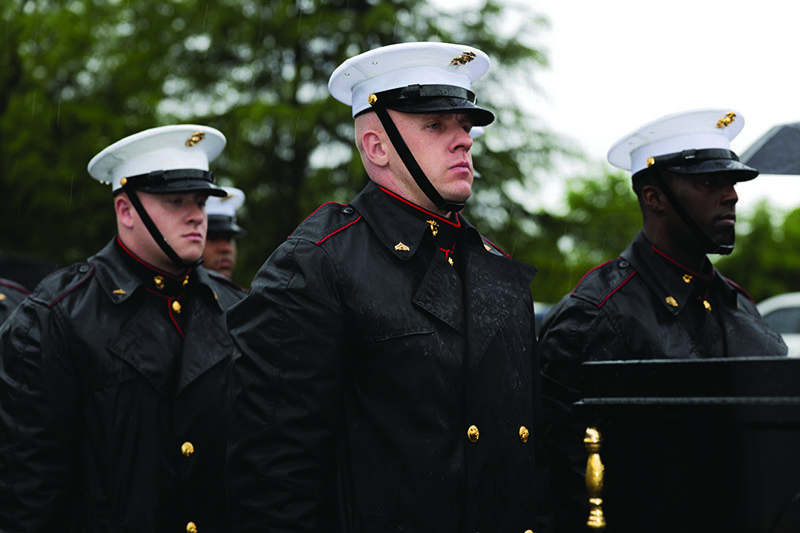
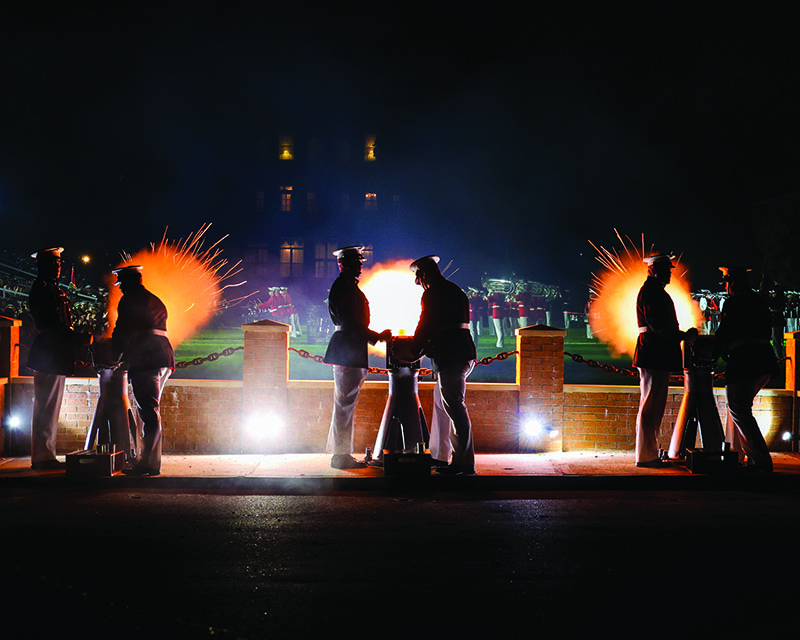
Marine Barracks Washington, D.C., houses no shortage of special units with high-visibility duties. Visitors attending any Sunset or Evening Parade may witness the immaculate marching platoons, the brilliant Silent Drill Platoon, the elite Commandant’s Four Color Guard, or flawless elements of “The President’s Own” U.S. Marine Band or “The Commandant’s Own” U.S. Marine Drum and Bugle Corps. Each Friday night throughout the parade season, while other barracks Marines wow the crowd beneath the spotlights, one small group stands silent in the dark at the end of the field, patiently awaiting their part in the performance. Without introduction or verbal cue, the Marine Corps Body Bearers fire three cannons at the appointed times, casting a smoky haze across the parade deck. For the casual viewer, the true identity of these shadowed figures may feel of less importance, their role in the show less consequential than the Marines flipping rifles, clashing cymbals or saluting a star-spangled general beneath the flagpole. For a Body Bearer, however, this perception fits perfectly in line with their occupational goal; never be in the spotlight, never draw attention to yourself and never distract from the purpose of the ceremony.
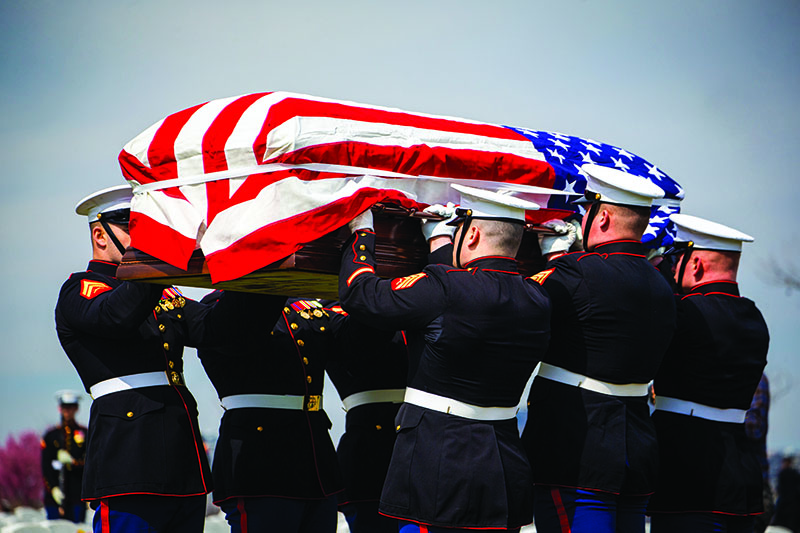
The true function of these Marines is showcased outside the barracks at Arlington National Cemetery where the section performs funerals for Marines and Marine dependents. The Body Bearers’ precision at each funeral reveals the daily training they endure to perfect their craft. Relentless attention to detail in every movement intentionally keeps the focus off of the Body Bearers and directed toward the Marine being laid to rest.
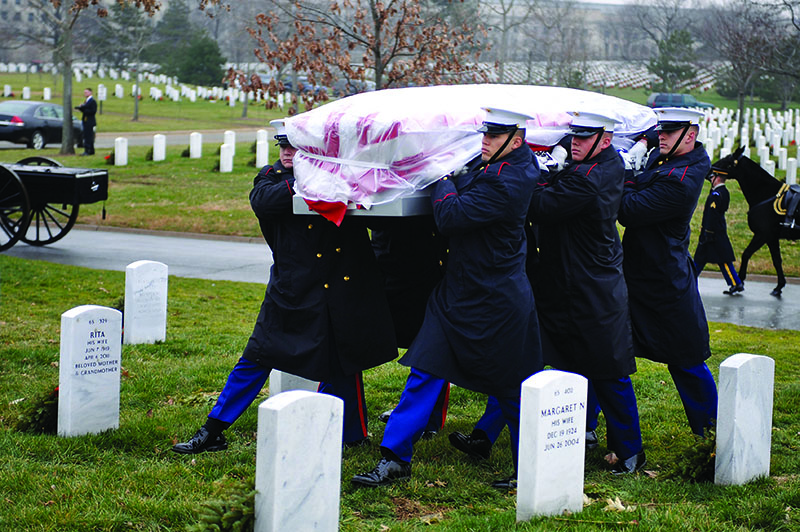
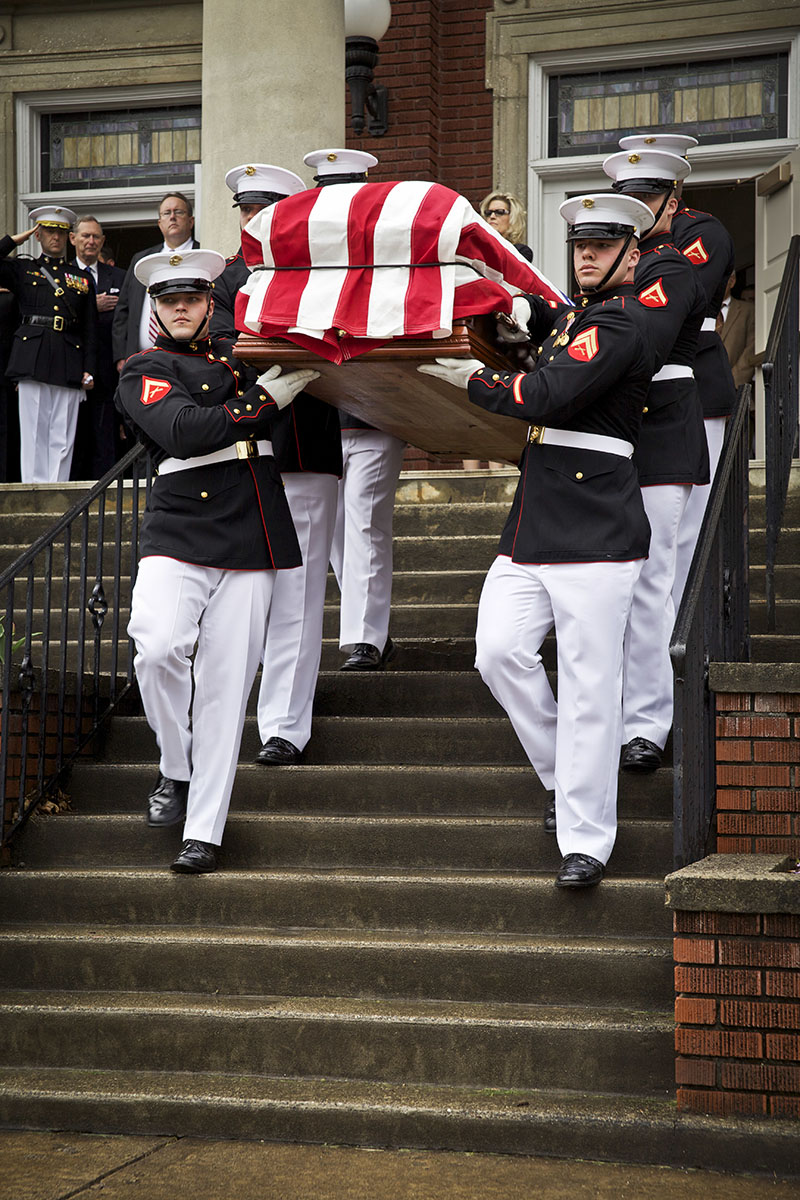
Other branches of service, such as the U.S. Navy and Air Force, maintain similarly dedicated units, highlighting the vital importance of their mission. Though similar in task, the Marine Corps scripts its funerals differently to ensure the fallen Marine and their family remain at the center of attention. While the other branches utilize eight pallbearers, the Marines operate with six, two fewer bodies blocking the family’s view of the casket being transported to the gravesite. Each branch of service trains to carry the casket at waist height, a uniform method adopted during joint funerals. At Marine funerals, though, Body Bearers hoist each casket up to their shoulders from the hearse or caisson all the way to the gravesite. In so doing, family members in attendance witness their loved one in their final journey to his or her resting place, rather than losing sight of the casket amidst a surrounding crowd of splendidly uniformed service members.
Through rain or snow, over ice, gravel or grass, in freezing or scorching temperatures, the Body Bearers execute their duties. Some caskets may weigh upwards of 600 pounds. Some gravesites may lie hundreds of feet away. Regardless, six Marines with stoic faces level the flag-draped casket at their shoulders and march in unison to the appointed place. At the gravesite, in one final and uniquely Marine salute, the Body Bearers face the casket, raise it up above their heads and freeze there for 10 seconds before lowering the casket down to the ground and folding the flag. After a funeral is complete, the Body Bearers prepare to do it all over again in a different section of Arlington, sometimes performing up to three funerals per day.
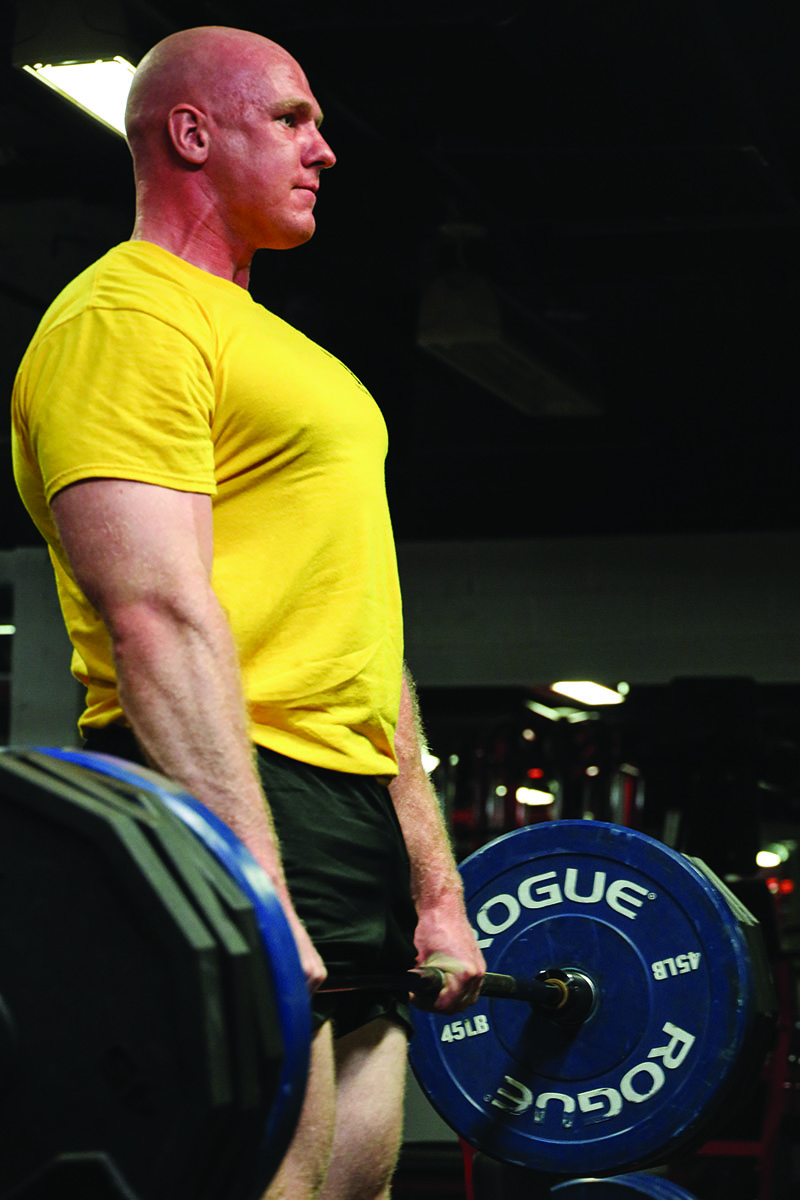
Accomplishing every funeral to the Corps’ standard of perfection requires each Marine to rigidly maintain his bearing. Any visitor to any gym in the nation will likely roll their eyes at some point watching another nearby patron grunting and hissing and sucking down air as they throw up a bar full of weight, a performance likely captured on a phone for instant upload to social media. This brand of self-serving distraction would clearly be unacceptable for Marines raising a 600-pound casket overhead in a final dignified salute. For Body Bearers, proper bearing is achieved through physical strength—astounding and extraordinary levels of endurance found few other places across the Corps.
“The distance we carry a casket can vary significantly. It can be a little as 20 feet off the road to one we did where it was probably two and a half football fields,” said Corporal Glen Hafemeister, a former Marine Body Bearer who served with the section from January 2023 to August 2025.
“For the majority of funerals we conduct, you might not need to have the strength that we require, however, there are always going to be a few every month where that strength is absolutely necessary, and we never know if the next funeral is going to be like that.”
Some of the most memorable moments from the history of other elite ceremonial units at 8th & I originated with mistakes made and worked through. Even the Silent Drill Platoon, renowned for precision and perfection, celebrates members who maintained their bearing and finished the performance through mishaps such as a rifle butt slashing open a Marine’s face or a bayonet stabbing into a Marine’s thigh. The Body Bearers’ training, however, mandates that no mistakes are made; perfection at every funeral, every day.
“Every Marine deserves our best, and we’re going to give our all for him,” said Cpl Jacob Dorton, a three-year member of the section. “He is our brother. He earned the title and served honorably. We’re going to give everything we have to give him a flawless funeral. We have a no-fail mission. We can’t have extra Body Bearers following along behind in case one of us falls out.”
“We’re also less than 5 feet away from the family,” added Hafemeister. “We don’t fall out.”
For many prospective Body Bearers, the enormous physical challenge embodies their initial interest and hook. Marines with the section deploy twice a year to both coasts on recruiting tours. They visit graduating classes from the Schools of Infantry at Camp Lejeune, N.C., and Camp Pendleton, Calif., in search of candidates. While on base, they pin up recruiting posters at the local gyms challenging corporals and below already in the fleet to try out and see if they have what it takes. With fewer than 15 slots available, trials are extremely competitive.
Any Marine hoping to join must first score a first-class physical fitness test and combat fitness test. This serves primarily to weed out the candidates who stand little chance of completing phase two: the Body Bearers’ uniquely crafted initial strength test. This minimum requirement consists of 10 repetitions of each exercise, including a 225-pound bench press, 135-pound overhead press, 115-pound bicep curl, and 315-pound squat. Each rep on each exercise must be completed with good form and bearing. The section chooses new candidates from the pool of Marines who complete the initial requirements and demonstrate exemplary character, then cuts them orders to 8th & I. Here, the most grueling phase of training begins.
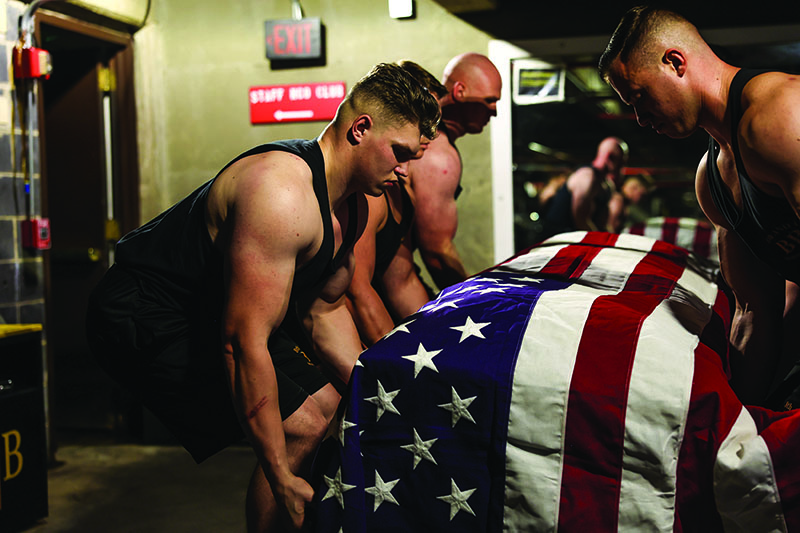
Every Marine arriving in D.C. begins their tour with Ceremonial Drill School (CDS). While most barracks new joins practice marching, rifle drill, and other disciplines with the marching platoons on the parade deck, prospective Body Bearers spend the duration of CDS out of sight, training in the parking garage. Candidates arrive in small groups throughout the year. To accommodate them, Body Bearer CDS operates as a continuous, self-paced evaluation placing new joins alongside experienced Marines in daily training and exercise. Cpl Dorton currently serves as the senior instructor for Body Bearer CDS.
“We train down there to be out of sight,” he said. “We don’t like a lot of attention towards us and the job we do. We want the attention to be on that Marine and his family. That’s why we work towards flawless bearing, so that the family can focus on their Marine, his service and life. We are just there to carry the casket, fold the flag, and walk away so they can have their moment.”
Candidates take six to 12 months to perfect each movement under the intense scrutiny of their peers. A candidate must flawlessly perform every ceremonial movement in coordination with the rest of the team. They must demonstrate perfect bearing under extraordinary physical strain in order to successfully graduate.
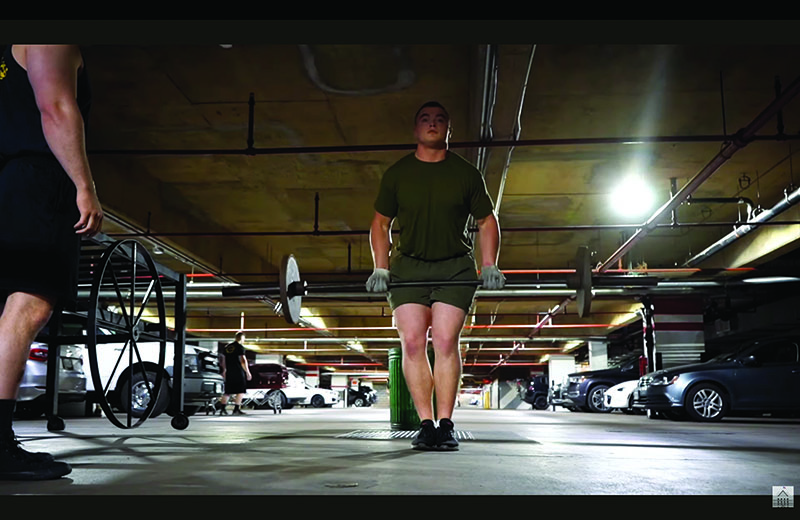
As one metric to gauge their bearing, each candidate must pass the final strength test, consisting of the same exercises and weights used in the initial strength test, but with double the repetitions. During CDS, candidates train wearing the Corps’ standard green-on-green. When they graduate, they receive the coveted black and gold tank top displaying the section’s logo and motto, “The Last to Let You Down,” officially signifying the Marine holds a spot within the section and has earned the right to perform the sacred duty at Arlington.
Sergeant Joshua Williams, the Body Bearers’ platoon sergeant, coordinates with the cemetery several weeks in advance. He determines which Marines perform funerals each day and which will remain at the barracks for training or other duties. The amount of support required at the cemetery depends on the type of funeral being conducted, whether a dependent funeral, standard honors for any Marine or full honors for higher ranking enlisted or officers, Medal of Honor recipients, or Marines killed in action or held as prisoners of war. The funeral may have a casket or an urn. The family may request other specifics, such as a horse-drawn caisson. Variations in weather create friction but will not be a reason for delay or cancellation. Ultimately, the Body Bearers will not know exactly what is required of them until they arrive on site.
“I had an experience one day where there was a funeral we didn’t know about that was not on our schedule,” Williams remembered. “We had to get everybody ready with everything they needed and in place in less than two hours. We had another instance where we set up to perform a funeral, and it turned out to be two caskets. In that case, the Marine and his dependent were being buried at the same time, so we had to carry the dependent first, then the Marine.”
Other unique experiences or special circumstances stand out from the hundreds of funerals each Marine completes during the course of their tour. Joint funerals performed with other service branches often prove most memorable. In January 2025, several Marines took part in the funeral services for President Jimmy Carter. Dorton served as a pallbearer, transporting the casket to and from the U.S. Capitol building where President Carter lay in state. Two days later, Hafemeister helped move Carter into Washington National Cathedral for his state funeral.
“We do quarterly sustainment training with the other services to make sure we are always ready to perform a joint funeral,” Hafemeister stated. “That way when we show up, there might be a different team of individuals and each branch has a different drill, but we all have a baseline that we can work off of pretty easily.”
Many Body Bearers hold similar impactful memories from the opposite end of the public visibility spectrum: funerals conducted with a single person, or sometimes even no one else, in attendance.
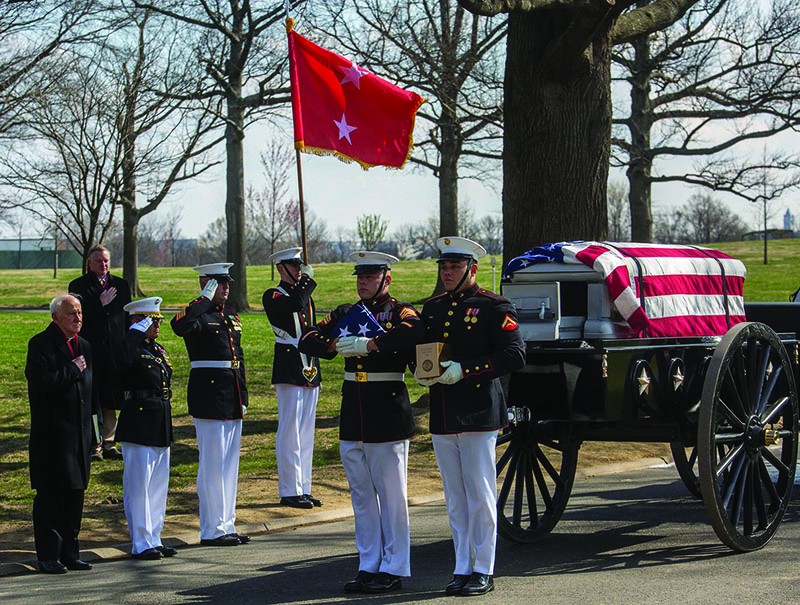
LCpl Ethan Barlow, left, and Sgt Joshua Williams, Body Bearers assigned to Marine Barracks Washington, D.C., take part in caisson refamiliarization training at Joint Base Myer-Henderson Hall, Va., on May 13, 2025. (Photo from LCpl Kiara Rawls, USMC)
“No matter how many people are there, it doesn’t matter if it is a private first class or the President of the United States, the whole country watching or nobody watching, the training and attention to detail that will go into that funeral are identical,” Hafemeister added.
Regardless of the experiences that may come after, many of these Marines cherish most the memory of their first funeral.
“That one will always stand out to me,” said Dorton. “Just the nerves I had beforehand going into it and then, during and after, being able to see the impact that I had on that family really meant a lot to me. It kind of cemented in my mind why I wanted to do this job.”
“Being on my first casket was an honor,” Williams reflected. “I could feel the presence of that Marine, even though they were deceased. At the end, a family member whispered, ‘Thank you for all that you do.’ For me, that reinforced the reason why we do what we do. The reason why I love what I do is the impact and comfort we give the families. You never forget that feeling.”
A Marine’s time with the section varies greatly. Some, especially those joining from duty stations already in the fleet, might spend as little as two years with the Body Bearers. Others, particularly those joining straight out of School of Infantry, could potentially spend their entire four-year enlistment there. Hafemeister began his enlistment as a 0331 machine gunner with 1st Battalion, 6th Marines, at Camp Lejeune. After more than two and a half years and 250 funerals completed with the Body Bearers, he left active duty. Williams is one of the less typical members who joined from the fleet, will remain with the section for four years, and intends to reenlist. He began his career as an automotive mechanic with 1st Battalion, 12th Marines, in Hawaii, before finding the Body Bearers’ recruiting poster at the gym. Now, with less than a year left in his tour at 8th & I, Williams is preparing to return to the fleet as a senior sergeant. His time with the Body Bearers has prepared him for the future in multiple unique ways.
“Going through CDS was very, very challenging,” he stated. “Going through anything else in the Marine Corps after that will seem fairly easy.”
Whether a Body Bearer, a marching platoon member, a machine gunner or a mechanic, every Marine possesses the drive to be the best, and believes they are. Relentless perfectionism and unwavering dedication to honoring our heritage are foundational to wearing our cloth. The Marine Corps Body Bearers demonstrate this daily, both on display at Arlington and in the privacy of the barracks parking deck. Their professionalism serves as an understated, little recognized, yet hard-to-match example of commitment to these core values.
Featured Photo (Top): Body Bearers carry the casket of Gen Samuel Jaskilka, USMC (Ret), the 16th Assistant Commandant of the Marine Corps, to its final resting place at Arlington National Cemetery, Arlington, Va., on Jan. 26, 2012. With only six Body Bearers around the casket, and the casket carried at shoulder-height, the Marines make every effort to keep the focus of the ceremony on the fallen Marine.
Author’s bio:
Kyle Watts is the staff writer for Leatherneck. He served on active duty in the Marine Corps as a communications officer from 2009-2013. He is the 2019 winner of the Colonel Robert Debs Heinl Jr. Award for Marine Corps History.
Enjoy this article?
Check out similar member exclusive articles on the MCA Archives:
The Final Escort
Leatherneck
April 2004
By: Mary Karcher


